Bag technique
Introduction
Home visiting :- A home visit is one of the
essential parts of the community health
services because most of the people are
found in a home.
Home visit fulfils the needs of individual,
family and community in general for nursing
service and health counseling.
Definition
Bag technique a tool by
which the nurse, during
her visit will enable her
to perform a nursing
procedure with ease and
deftness, to save time
and effort, with the end
view of rendering
effective nursing care to
• Bag technique a tool by which the nurse,
during her visit will enable her to perform a
nursing procedure with ease and deftness, to
save time and effort, with the end view of
rendering effective nursing care to clients.
Purposes
• To find out needs of individual, family and community
in relation to health, socio- economic and cultural
aspects.
• To provide domiciliary midwifery as care for pregnant,
delivery, and puerperal mother and infant.
• To give care to the sick, to a postpartum mother and her
newborn with the view teach a responsible family
member to give subsequent care.
• To assess the living condition of the patient and his
family and their health practices in order to provide the
appropriate health teachings.
• To provide basic health services for minor ailments.
(i.e. injury, boils, abrasions)
Cont….
• To provide counseling on family planning,
immunization, nutrition.
• To give health teaching regarding the prevention and
control of diseases.
• To establish a close relationship between the nurses
and the public for promotion of health.
• To make use of an inter-referral system and to
promote the utilization of community services. Steps
of home visiting Home visit refers to meeting the
health needs of people at doorsteps
•Objective
Principles
• Prevention of contamination
• Performing the bag technique will minimize, if
not, prevent the spread of any infection.
• It saves time and effort in the performance of
nursing procedures.
Cont ….
• The bag technique can be performed in a variety of
ways depending on the agency’s policy, the home
situation.
• Protection of the caregiver is very important during
to home visit.
• Make articles readily accessible
• Make follow-up care.
•Contains of community
bag
• Indication
Important points
The bag should contain all the necessary articles, supplies
and equipment that will be used to answer the emergency
needs.
The bag and its contents should be cleaned very often, the
supplies replaced and ready for use anytime.
The bag and its contents should be well protected from
contact with any article in the patient’s home.
Consider the bag and its contents clean and sterile, while
articles that belong to the patients as dirty and contaminated.
Cont ….
Ensure that the hands are washed with soap and water
before removing anything from the bag.
The arrangement of the contents of the bag should be the
one most convenient to the user, to facilitate efficiency and
avoid confusion.
Restock the bag daily with drugs, dressing and other
equipments used. Avoid too many or too less supplies for
smooth functioning.
Wash the towel and dry so that it is ready for following use
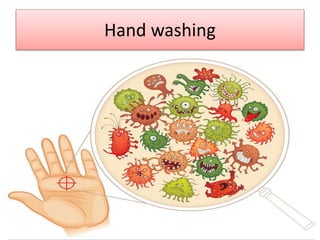
Hand washing
Steps of hand washing
Procedure
• Open the bag, take the linen or plastic lining
and spread over work field. The paper lining
clean side out (folded part out).
• Place the bag on the table or any flat surface
lined with paper lining, clean side out (folded
part touching the table). Put bag’s handles or
straps beneath the bag.
Cont….
• Take out hand towel, soap dish, and apron and place
them at one corner of the work area (within the
confines of the plastic lining).
• Place waste bag outside of work area.
• Ask for a basin of water if faucet is not available.
Place these outside the work area.
• Do hand washing. Wipe, dry with towel. Leave the
plastic wrappers of the towel in soap dish in the bag.
Cont …
• Put on right side out and wrong side with crease
touching the body, sliding the head into the neck
strap, neatly tie the straps at the back.
• Put out the things most needed for the specific case (
ex. Thermometer, kidney basin, cotton ball, waste
paper) and place at one corner of the work area.
Cont …
• Proceed to the specific nursing care or treatment.
• After completing nursing care or treatment, clean
and alcohol the things used.
Nursing responsibility
• Pack the bag with necessary supplies before leaving for
visits. Pack hand washing supplies near the top or in a
side pocket where they are easily accessible.
• Do not take the healthcare bag into infested homes or
homes of patients with antibiotic resistant infections
such as MRSA or VRE.
• In the home, identify a clean and safe area for the
healthcare bag. Never set the healthcare bag on the
floor. Always choose a place to set the bag that gives
you enough work space, is close to the patient, has a
source of water, and is away from children and pets.
Cont …
• Plan where you will discard disposable items and
sharps ahead of time.
• Spread an impervious barrier on the surface before
setting the bag down.
• Remove hand washing supplies first. Wash and dry
hands thoroughly, following proper hand washing
technique.
• Remove any items needed for patient care, including
any necessary personal protective equipment.
• Close the bag before performing patient care.
Cont …
• Wash your hands again if you need to re-enter the
bag for additional supplies during patient care.
• Only dispose of sharps in an approved sharps
disposal container. The sharps container must be
kept in a separate “dirty” compartment or a
designated sharps container pouch. Never put used
sharps directly in the bag.
• Discard disposables in a sealed trash bag or
biohazard bag. Follow local and state regulations for
infectious waste disposal.
Cont…
• Bag soiled reusable items that cannot be cleaned in
the patient’s home and transport them according to
agency policy. Do not put these soiled items back
into the healthcare bag.
• Wash your hands, then repack and close the
healthcare bag.
• Clean and disinfect the healthcare bag weekly by
hand washing in mild soap and warm water and air
drying.
• Then spray both inside and outside with Sanitized
and air dry again
• Evaluation and documentation
Bibliography
TEACHER’S REFERENCE
“Dash Bijaylashami” A Comprehensive Textbook Of Community Health
Nursing page no.42-46
“K Park” textbook of Park’s textbook of preventive and social medicine
22st edition , M/S Banarsudas Bhanot publication page no.22-25
“S.kamalam” Essentials in Community Health Nursing Practice, 3rd
edition page no. 304
“K K Gulani” text book of “Community Health Nursing (Principles &
Practices) ” 6edition , Kumar publication house. Page no. 40
“Dr. T.Vasundhara Tulasi & Dr.G.Gnana Prasuna” A text book of
Community Health Nursing-II” 2nd edition , Frontline Publication
page no. 291-294
Net reference –
1.https://www.slideshare.net/
2. https://www.who.int/hia/evidence/doh/en/
Student reference:-
“Dr. T.Vasundhara Tulasi & Dr.G.Gnana Prasuna” A
text book of Community Health Nursing-II” 2nd
edition , Frontline Publication page no. 291-294.
Bag technique

Bag technique

  • 1.
  • 2.
    Introduction Home visiting :-A home visit is one of the essential parts of the community health services because most of the people are found in a home. Home visit fulfils the needs of individual, family and community in general for nursing service and health counseling.
  • 3.
    Definition Bag technique atool by which the nurse, during her visit will enable her to perform a nursing procedure with ease and deftness, to save time and effort, with the end view of rendering effective nursing care to • Bag technique a tool by which the nurse, during her visit will enable her to perform a nursing procedure with ease and deftness, to save time and effort, with the end view of rendering effective nursing care to clients.
  • 4.
    Purposes • To findout needs of individual, family and community in relation to health, socio- economic and cultural aspects. • To provide domiciliary midwifery as care for pregnant, delivery, and puerperal mother and infant. • To give care to the sick, to a postpartum mother and her newborn with the view teach a responsible family member to give subsequent care. • To assess the living condition of the patient and his family and their health practices in order to provide the appropriate health teachings. • To provide basic health services for minor ailments. (i.e. injury, boils, abrasions)
  • 5.
    Cont…. • To providecounseling on family planning, immunization, nutrition. • To give health teaching regarding the prevention and control of diseases. • To establish a close relationship between the nurses and the public for promotion of health. • To make use of an inter-referral system and to promote the utilization of community services. Steps of home visiting Home visit refers to meeting the health needs of people at doorsteps
  • 6.
  • 7.
    Principles • Prevention ofcontamination • Performing the bag technique will minimize, if not, prevent the spread of any infection. • It saves time and effort in the performance of nursing procedures.
  • 8.
    Cont …. • Thebag technique can be performed in a variety of ways depending on the agency’s policy, the home situation. • Protection of the caregiver is very important during to home visit. • Make articles readily accessible • Make follow-up care.
  • 9.
  • 10.
  • 11.
    Important points The bagshould contain all the necessary articles, supplies and equipment that will be used to answer the emergency needs. The bag and its contents should be cleaned very often, the supplies replaced and ready for use anytime. The bag and its contents should be well protected from contact with any article in the patient’s home. Consider the bag and its contents clean and sterile, while articles that belong to the patients as dirty and contaminated.
  • 12.
    Cont …. Ensure thatthe hands are washed with soap and water before removing anything from the bag. The arrangement of the contents of the bag should be the one most convenient to the user, to facilitate efficiency and avoid confusion. Restock the bag daily with drugs, dressing and other equipments used. Avoid too many or too less supplies for smooth functioning. Wash the towel and dry so that it is ready for following use
  • 13.
  • 14.
  • 15.
    Procedure • Open thebag, take the linen or plastic lining and spread over work field. The paper lining clean side out (folded part out). • Place the bag on the table or any flat surface lined with paper lining, clean side out (folded part touching the table). Put bag’s handles or straps beneath the bag.
  • 16.
    Cont…. • Take outhand towel, soap dish, and apron and place them at one corner of the work area (within the confines of the plastic lining). • Place waste bag outside of work area. • Ask for a basin of water if faucet is not available. Place these outside the work area. • Do hand washing. Wipe, dry with towel. Leave the plastic wrappers of the towel in soap dish in the bag.
  • 17.
    Cont … • Puton right side out and wrong side with crease touching the body, sliding the head into the neck strap, neatly tie the straps at the back. • Put out the things most needed for the specific case ( ex. Thermometer, kidney basin, cotton ball, waste paper) and place at one corner of the work area.
  • 18.
    Cont … • Proceedto the specific nursing care or treatment. • After completing nursing care or treatment, clean and alcohol the things used.
  • 19.
    Nursing responsibility • Packthe bag with necessary supplies before leaving for visits. Pack hand washing supplies near the top or in a side pocket where they are easily accessible. • Do not take the healthcare bag into infested homes or homes of patients with antibiotic resistant infections such as MRSA or VRE. • In the home, identify a clean and safe area for the healthcare bag. Never set the healthcare bag on the floor. Always choose a place to set the bag that gives you enough work space, is close to the patient, has a source of water, and is away from children and pets.
  • 20.
    Cont … • Planwhere you will discard disposable items and sharps ahead of time. • Spread an impervious barrier on the surface before setting the bag down. • Remove hand washing supplies first. Wash and dry hands thoroughly, following proper hand washing technique. • Remove any items needed for patient care, including any necessary personal protective equipment. • Close the bag before performing patient care.
  • 21.
    Cont … • Washyour hands again if you need to re-enter the bag for additional supplies during patient care. • Only dispose of sharps in an approved sharps disposal container. The sharps container must be kept in a separate “dirty” compartment or a designated sharps container pouch. Never put used sharps directly in the bag. • Discard disposables in a sealed trash bag or biohazard bag. Follow local and state regulations for infectious waste disposal.
  • 22.
    Cont… • Bag soiledreusable items that cannot be cleaned in the patient’s home and transport them according to agency policy. Do not put these soiled items back into the healthcare bag. • Wash your hands, then repack and close the healthcare bag. • Clean and disinfect the healthcare bag weekly by hand washing in mild soap and warm water and air drying. • Then spray both inside and outside with Sanitized and air dry again
  • 23.
    • Evaluation anddocumentation
  • 24.
    Bibliography TEACHER’S REFERENCE “Dash Bijaylashami”A Comprehensive Textbook Of Community Health Nursing page no.42-46 “K Park” textbook of Park’s textbook of preventive and social medicine 22st edition , M/S Banarsudas Bhanot publication page no.22-25 “S.kamalam” Essentials in Community Health Nursing Practice, 3rd edition page no. 304 “K K Gulani” text book of “Community Health Nursing (Principles & Practices) ” 6edition , Kumar publication house. Page no. 40 “Dr. T.Vasundhara Tulasi & Dr.G.Gnana Prasuna” A text book of Community Health Nursing-II” 2nd edition , Frontline Publication page no. 291-294
  • 25.
    Net reference – 1.https://www.slideshare.net/ 2.https://www.who.int/hia/evidence/doh/en/ Student reference:- “Dr. T.Vasundhara Tulasi & Dr.G.Gnana Prasuna” A text book of Community Health Nursing-II” 2nd edition , Frontline Publication page no. 291-294.