
SEMINAR ON
CLINICAL TEACHING METHOD
MS. EKTA UPADHYAY
M.SC.(N) IST YEAR
General objective
On completion of the
seminar group will be
able to enhance
knowledge regarding
clinical teaching methods
and they can utilized this
knowledge in their
clinical as well as
teaching area.
Specific objective
• Define clinical teaching
• Define teaching
• Enlist the clinical teaching models
• Explain the principle of clinical teaching.
• Enlist the function of clinical instructor.
• Explain the modals of clinical teaching
• Explain the methods of clinical teaching in
nursing.
• Explain the teaching method.
KEY WARDS
INTRODUCTION
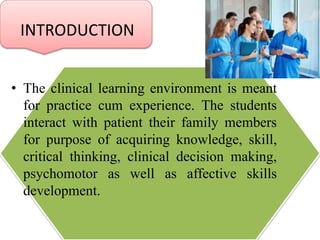
• The clinical learning environment is meant
for practice cum experience. The students
interact with patient their family members
for purpose of acquiring knowledge, skill,
critical thinking, clinical decision making,
psychomotor as well as affective skills
development.
• The importance of clinical nursing education is
undeniable in personal, professional and clinical
skills development.
• Through nursing education, nursing students will
be able to obtain necessary knowledge and skills
to assist public health.
• Success in this subject requires the adoption of
effective approaches to familiarize the students
with new knowledge and essential needs of the
clients
Steps of
clinical teaching
• Criteria for selection of clinical teaching model
•Educational philosophy for the nursing programs
•Philosophy of faculty about the clinical teaching
•Goals and desirable learning outcome of the
clinical courses and activities
•Level of nursing students
•Type of clinical setting
•Availability of expert nurse and health professional
in the practice setting
Willingness of health care personal to participate in
teaching the students.
According to Josef
Albers
“Good teaching is more a
giving of right question
then a giving of right
answers”
• Set the standards, objective for practice.
• Develop the evaluation tool
• Obtain the permission of the institute
• Set up the clinical area in an ideal manner.
• Keep the equipment ready in working condition
• Direct and supervising the students in patient care
• Assist in patient care
Functionof the clinicalinstructor:-
• Demonstrate nursing procedure on patient and
ask the student to return demonstration
procedure to develop skill and confidence.
• Help the student to develop ability to adjust
general plan of care to the need of individual
patients.
• Develop the potential of each student.
• Develop an understanding of research for better
patient care.
• Maintain strict discipline
Cont……
MODELS OF CLINICAL
TEACHING
• Teaching model- the clinical instruction and
evaluation of group of students are executed by
academic faculty members who were supervising
the students during the clinical experience.–
• Instructors accompany groups (8-12 learners) to
a clinical agency and assign them to patients.
• Relies heavily on keeping nursing students in a
skills laboratory until they are proficient with
skills
• More information about clinical practice should
be taught in the classroom before learners go.
Preceptor model –The faculty members in the nursing
program serve as a liaison between the nursing institute
and clinical setting. It promotes the socialization. Bridges
the gap between theory and practical, developing self
confidence and improve the decision making skills. But
there is lack of integration of theory, research and
practice.
Cont …..
Cont …..
CTA Model: - Clinical Teaching Associate and
educator work hand in hand to Preceptor ship:-
Increase clinical experience for students and expose
them more of the realities of the work world, which
should reduce reality shock. Allows students to learn
from practitioners with a high skill level while still
being guided by faculty.
Nursing care plan
Nursing includes the promotion of health,
prevention of illness, and the care of ill, disabled
and dying people. Advocacy, promotion of a safe
environment, research, participation in shaping
health policy and in patient and health systems
management, and education are also key nursing
roles. (ICN, 2002)
Objectives
•Promote evidence-based nursing care .
•Support holistic care which involves the whole person
including physical, psychological, social and spiritual in
relation to management and prevention of the disease.
•Establish programs such as care pathways and care
bundles.
•Identify and distinguish goals and expected outcome.
•Review communication and documentation of the care
plan.
•Measure nursing care.
Purpose
• Defines nurse’s role. .
• Provides direction for
individualized care of the client
• Continuity of care
• Documentation
• Serves as guide for assigning a
specific staff to a specific client.
• Serves as guide for
reimbursement.
• Defines client’s goals.
• Assessment
• Diagnosis
• Planning
• Goals
• Implementation
• Evaluation
Component
bed side clinic
“A bedside clinic is a process in
which a clinical teacher and a group
of learners sees a patient,
elicits or verifies physical signs,
discusses provisional diagnosis,
diagnostic or therapeutic options in
the clinical setting”.
PHASES / STEPS
INTRODUCTION
PHASE
THE
DISCUSSION
PHASE EVALUATION
PHASE
ADVANTAGES
• Bedside clinic allows the students to prepare
extensively in advance to participate
effectively in patient care.
• It helps the students to develop autonomy.
• It allows students to select patients with
disease conditions of common interest.
• It helps the students to ably review and
investigate the quality of clinical practice.
CONT….
• Bedside clinic allows the students to develop
and maintain professional competence.
• It promotes a better understanding among the
students in terms of health, illness and health
care system.
• Bedside clinic promotes clinical competencies
like reasoning, psychomotor and
communication skills among students.
Commonly used clinical teaching methods in
nursing
• Nursing care plan
• Nursing case study
• Bed side clinic
• Nursing rounds
• Process recording
• Group conference
• Individual conference
clinical teaching methods

clinical teaching methods

  • 2.
    SEMINAR ON CLINICAL TEACHINGMETHOD MS. EKTA UPADHYAY M.SC.(N) IST YEAR
  • 3.
    General objective On completionof the seminar group will be able to enhance knowledge regarding clinical teaching methods and they can utilized this knowledge in their clinical as well as teaching area.
  • 4.
    Specific objective • Defineclinical teaching • Define teaching • Enlist the clinical teaching models • Explain the principle of clinical teaching. • Enlist the function of clinical instructor. • Explain the modals of clinical teaching • Explain the methods of clinical teaching in nursing. • Explain the teaching method.
  • 5.
  • 6.
    INTRODUCTION • The clinicallearning environment is meant for practice cum experience. The students interact with patient their family members for purpose of acquiring knowledge, skill, critical thinking, clinical decision making, psychomotor as well as affective skills development.
  • 7.
    • The importanceof clinical nursing education is undeniable in personal, professional and clinical skills development. • Through nursing education, nursing students will be able to obtain necessary knowledge and skills to assist public health. • Success in this subject requires the adoption of effective approaches to familiarize the students with new knowledge and essential needs of the clients
  • 8.
  • 9.
    • Criteria forselection of clinical teaching model
  • 10.
    •Educational philosophy forthe nursing programs •Philosophy of faculty about the clinical teaching •Goals and desirable learning outcome of the clinical courses and activities •Level of nursing students •Type of clinical setting •Availability of expert nurse and health professional in the practice setting Willingness of health care personal to participate in teaching the students.
  • 11.
    According to Josef Albers “Goodteaching is more a giving of right question then a giving of right answers”
  • 12.
    • Set thestandards, objective for practice. • Develop the evaluation tool • Obtain the permission of the institute • Set up the clinical area in an ideal manner. • Keep the equipment ready in working condition • Direct and supervising the students in patient care • Assist in patient care Functionof the clinicalinstructor:-
  • 13.
    • Demonstrate nursingprocedure on patient and ask the student to return demonstration procedure to develop skill and confidence. • Help the student to develop ability to adjust general plan of care to the need of individual patients. • Develop the potential of each student. • Develop an understanding of research for better patient care. • Maintain strict discipline Cont……
  • 14.
    MODELS OF CLINICAL TEACHING •Teaching model- the clinical instruction and evaluation of group of students are executed by academic faculty members who were supervising the students during the clinical experience.– • Instructors accompany groups (8-12 learners) to a clinical agency and assign them to patients. • Relies heavily on keeping nursing students in a skills laboratory until they are proficient with skills • More information about clinical practice should be taught in the classroom before learners go.
  • 15.
    Preceptor model –Thefaculty members in the nursing program serve as a liaison between the nursing institute and clinical setting. It promotes the socialization. Bridges the gap between theory and practical, developing self confidence and improve the decision making skills. But there is lack of integration of theory, research and practice. Cont …..
  • 16.
    Cont ….. CTA Model:- Clinical Teaching Associate and educator work hand in hand to Preceptor ship:- Increase clinical experience for students and expose them more of the realities of the work world, which should reduce reality shock. Allows students to learn from practitioners with a high skill level while still being guided by faculty.
  • 18.
    Nursing care plan Nursingincludes the promotion of health, prevention of illness, and the care of ill, disabled and dying people. Advocacy, promotion of a safe environment, research, participation in shaping health policy and in patient and health systems management, and education are also key nursing roles. (ICN, 2002)
  • 19.
    Objectives •Promote evidence-based nursingcare . •Support holistic care which involves the whole person including physical, psychological, social and spiritual in relation to management and prevention of the disease. •Establish programs such as care pathways and care bundles. •Identify and distinguish goals and expected outcome. •Review communication and documentation of the care plan. •Measure nursing care.
  • 20.
    Purpose • Defines nurse’srole. . • Provides direction for individualized care of the client • Continuity of care • Documentation • Serves as guide for assigning a specific staff to a specific client. • Serves as guide for reimbursement. • Defines client’s goals.
  • 21.
    • Assessment • Diagnosis •Planning • Goals • Implementation • Evaluation Component
  • 22.
    bed side clinic “Abedside clinic is a process in which a clinical teacher and a group of learners sees a patient, elicits or verifies physical signs, discusses provisional diagnosis, diagnostic or therapeutic options in the clinical setting”.
  • 23.
  • 24.
    ADVANTAGES • Bedside clinicallows the students to prepare extensively in advance to participate effectively in patient care. • It helps the students to develop autonomy. • It allows students to select patients with disease conditions of common interest. • It helps the students to ably review and investigate the quality of clinical practice.
  • 25.
    CONT…. • Bedside clinicallows the students to develop and maintain professional competence. • It promotes a better understanding among the students in terms of health, illness and health care system. • Bedside clinic promotes clinical competencies like reasoning, psychomotor and communication skills among students.
  • 28.
    Commonly used clinicalteaching methods in nursing • Nursing care plan • Nursing case study • Bed side clinic • Nursing rounds • Process recording • Group conference • Individual conference