

Futuristic
Nursing
Mr.Veeresh Demashetti
MSc (N)
Govt Collage of Nursing KIMS Hubballi
Introduction
Nursing is a profession with good career
opportunities that changes and reflect the society in
which nurse live.
VISION OF THE FUTURE OF NURSING
• Addition new diseases and the threat of bioterrorism.
• New treatment and technologies.
• Patients are moved out of hospital rapidly those that
remain are more acutely ill.
• Those discharged patients need more assistance at
home.
• Growing specialization in medicine is resulting in a
trend towards increased specialization in nursing.
• Developments are showing the need for a deeper
therapeutic relationship between the nurse and the
patient.
NURSING IN THE 21ST CENTURY
• For the nursing graduate, the future holds numerous
social, political and technological changes.
• During the 21st century, societies will continue to move
towards globalization. with an increased sharing of
products, attitudes and financial investments.
• The clients may be more likely to combine conventional
therapies with complementary healing techniques,
such as homeopathy, neuropathy, therapeutic touch,
reflexology, acupressure, aromatherapy, and nutritional
therapy. Sibbold and other experts on nursing and
health care also predict the following:-
– Neighborhood will employ nurses who will
work in 24 hour nurse managed clinics.
– Nurse Practitioners will cross medical
threshold to provide services usually provided
by physicians.
– Nurse therapists will provide numerous
services to the clients and their families.
– Hospital stays will be exceedingly short and
early discharge will become more important.
Nurses will be strong and autonomous
practitioners whose practice and care delivery
focuses much more on health than illness
DEVELOPMENTAL CHANGES IN THE NURSING FIELD
1)NURSING EDUCATION
2)NURSING PRACTICE
3)NURSING RESEARCH
NURSING EDUCATION:
• 1. Upgrading the profession:
• 2. Nursing education through teleconferencing:
• 3. Television nursing:
• 4. Internet:
• 5. Clinical practicing nursing:
• 6. Standardized examinations:
1. Upgrading the profession:
• Nursing education has grown from the career ladder
from the GNM to M.Phil and PhD in nursing. In order to
upgrade the profession the trend in the coming years is
to eliminate the diploma course and admit eligible
candidates directly to the degree course (B.Sc(N)).
• Health care planners have now recognized the
contribution of nurses; the central government has
already made action plans and is working on the lines of
National Health Policy.
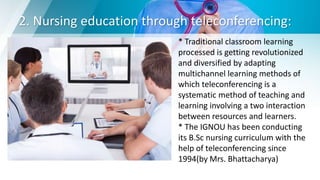
2. Nursing education through teleconferencing:
* Traditional classroom learning
processed is getting revolutionized
and diversified by adapting
multichannel learning methods of
which teleconferencing is a
systematic method of teaching and
learning involving a two interaction
between resources and learners.
* The IGNOU has been conducting
its B.Sc nursing curriculum with the
help of teleconferencing since
1994(by Mrs. Bhattacharya)
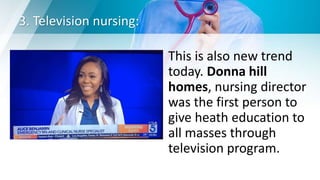
3. Television nursing:
This is also new trend
today. Donna hill
homes, nursing director
was the first person to
give heath education to
all masses through
television program.
4. Internet:
It is also an expanding
source of information to
develop nursing
education, research and
knowledge.
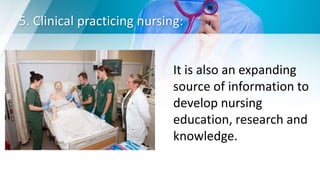
5. Clinical practicing nursing:
It is also an expanding
source of information to
develop nursing
education, research and
knowledge.
6. Standardized examinations:
• One of the recommendations of the “High power
committee on nursing”
• Nursing examinations throughout the nation would
all be the same.
NURSING PRACTICE:
• 1. The human genome project:
• 2. Robots:
• 3. Computer assistance:
• 4. Nurses enter private practice:
• 5. Space nursing society:
• 6. Remote care:
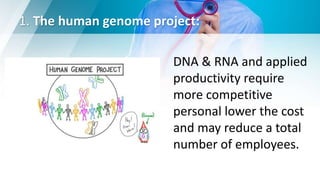
1. The human genome project:
DNA & RNA and applied
productivity require
more competitive
personal lower the cost
and may reduce a total
number of employees.
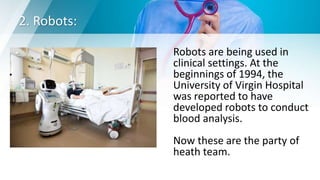
2. Robots:
Robots are being used in
clinical settings. At the
beginnings of 1994, the
University of Virgin Hospital
was reported to have
developed robots to conduct
blood analysis.
Now these are the party of
heath team.
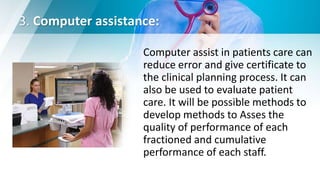
3. Computer assistance:
Computer assist in patients care can
reduce error and give certificate to
the clinical planning process. It can
also be used to evaluate patient
care. It will be possible methods to
develop methods to Asses the
quality of performance of each
fractioned and cumulative
performance of each staff.
4. Nurses enter private practice:
Another trend in nursing is that nurses today enter
into private practice. Nurse-owned home-owned
business such as home-health care agencies are growing
and becoming strong components of care.
Ex: - Africa: - nurse counselors for HIV/AIDS patient.
Italy: - nurse runs independent employment agency,
answers nursing need at home and in institutions.
India: - nurse are educating the public about nutrition,
disease prevention etc…
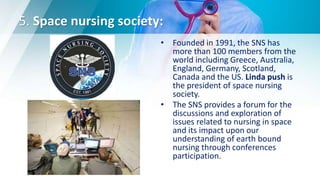
5. Space nursing society:
• Founded in 1991, the SNS has
more than 100 members from the
world including Greece, Australia,
England, Germany, Scotland,
Canada and the US. Linda push is
the president of space nursing
society.
• The SNS provides a forum for the
discussions and exploration of
issues related to nursing in space
and its impact upon our
understanding of earth bound
nursing through conferences
participation.
6. Remote care:
• It will become a norm as device for assessing clients
from a considerable distance.
• Eg: - A school of engineering in a large state
university has a federally project to develop a device
that will enable clinicians to palpate clients some
hundred or more miles distant as easily as if they
were physically present.
Other future trends in clinical practice:
• Renewal of license
• Uniform
• Healing power
• Consultants can shape the future of nursing
• The future of primary led care resets with district
• Ward sister /incharge nurse the key role in nursing
• Accountability for staff development
• Future work for nurses more time for holistic patient care
• Need for clinical investigate ability
• New dimension in nurse –physician relationship
NURSING RESEARCH:
Profession and research: Growing Amounts of
writing the researches have come as a result of
higher education for nurses. Then will be a
noticeable increase in the number of nurses writing
research articles, publishing text books and
professional materials in the next few years.
Significant factors that shape the future of
nursing education and research:
1. Theoretical clarity about the role or work of
nurses:-
2. Current atmosphere in institutions of higher
education:-
Education in nursing faces a crisis due to lack of
charity about nursing contribution to the society.
Nurses are prepared at various levels with no definite
guidelines for their services.
Significant factors that shape the future of
nursing education and research:
3. The need for reshaping nursing education to meet the
changing features of health care industry:-
There is a great need today to determine the curriculum
content in terms of a nurse, the health care needs and
respiration of the public and the advances in medical sciences
and technology.
4. The changing face of the learner and learning:-
We see today’s students are a lot different from years.
They come with career aspiration having more comfort with
technology than many teachers. New and emerging
technologies are sure to revolutionized nursing education.
Significant factors that shape the future of
nursing education and research:
5. Problems / hindrances for better future of nursing:-
It is difficult to predict the amount of change and
the nurse’s attitude towards this change.
6. Expanding Technology:-
a) Modern equipment:
b) Laser technology:
c) Knowledge explosion:
Significant factors that shape the future of
nursing education and research:
7. Influence of modern health technology on nursing education:
In the field of nursing research, research cells have to be
established for original and realistic studies, which will
indicate priorities.
8. Development need for our country:-
We see today’s students are a lot different from years.
They come with career aspiration having more comfort with
technology than many teachers. New and emerging
technologies are sure to revolutionized nursing education.
Significant factors that shape the future of
nursing education and research:
9. New threat to health: -
Depletion of the ozone, waste disposal
10. New forms of health care:-
Health care will assume new forms; mainly health
care will be preventive and restorative oriented rather
than seek patients only when there are curative services.
Further more advanced technology will enable patients
to receive much of their care in their homes.
THE NATURE OF THE PROFESSIONAL NURSING
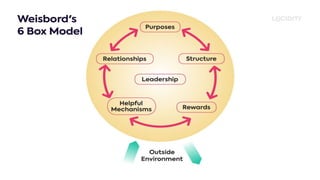
Weisbord’s “six – box model” (1983) for
managing complexity is employed to organize
recorded predictions about nursing’s future.
Weisbord (1983) proposed six areas for examination:
purpose, structure, rewards, leadership, helpful
mechanism, and relationship.
1. PURPOSE: WHAT “BUSINESS” ARE WE IN? :-
The idea of nursing as a business is not a
dominant theme in contemporary nursing literature.
Nursing ability to define and market its business and
find its niche in the health care market place has
been hampered by prolonged and bitter over
education of its entry level workers.
2. STRUCTURE: HOW DO WE DRIVE THE WORK?-
Weisbord’s question about structure, or how the
work is dividend, is approached in projections of
nursing’s future by new role delineations and
descriptions of the work place.
3. RELATIONSHIP: HOW DO WE MANAGE CONFLICT?
Nurses, hospital boards and administrators, and
physicians Emerge in discussions of professional
relationship
4) REWARDS: IS THREE AN INCENTIVE FOR
DOING ALL THAT NEEDS TO BE DONE:
It is interesting, given the importance of salary in
recruiting and retain nurses
6. LEADERSHIP: IS SOMEONE KEEPING THE
BOXES IN BALANCE?-
She believes that academic leadership is the key
to organizing consensus about nursing’s body of
knowledge, regulating pre service education, and
developing autonomous schools.
6. HELPFUL MECHANISMS: HAVE WE ADEQUATE
COORDINATING TECHNOLOGIES?
The nursing literature conveys and excitement
about new technologies. Nursing protocols are
computerized, and telecommunications and robots
facilitate assessment, analysis, monitoring of
patients, and patient care
CONCLUSION
A commitment to nursing and
participation in its endeavors for survival
by today’s registered nurses both for
themselves and for the future nurses- will
enable the profession to emerge as an
innovative force, prepared to face the
numerous challenges and needs of
healthcare consumers in the twenty-first
century.
Futuristic Nursing ppt.pptx

Futuristic Nursing ppt.pptx

  • 1.
  • 2.
    Introduction Nursing is aprofession with good career opportunities that changes and reflect the society in which nurse live.
  • 3.
    VISION OF THEFUTURE OF NURSING • Addition new diseases and the threat of bioterrorism. • New treatment and technologies. • Patients are moved out of hospital rapidly those that remain are more acutely ill. • Those discharged patients need more assistance at home. • Growing specialization in medicine is resulting in a trend towards increased specialization in nursing. • Developments are showing the need for a deeper therapeutic relationship between the nurse and the patient.
  • 4.
    NURSING IN THE21ST CENTURY • For the nursing graduate, the future holds numerous social, political and technological changes. • During the 21st century, societies will continue to move towards globalization. with an increased sharing of products, attitudes and financial investments. • The clients may be more likely to combine conventional therapies with complementary healing techniques, such as homeopathy, neuropathy, therapeutic touch, reflexology, acupressure, aromatherapy, and nutritional therapy. Sibbold and other experts on nursing and health care also predict the following:-
  • 5.
    – Neighborhood willemploy nurses who will work in 24 hour nurse managed clinics. – Nurse Practitioners will cross medical threshold to provide services usually provided by physicians. – Nurse therapists will provide numerous services to the clients and their families. – Hospital stays will be exceedingly short and early discharge will become more important. Nurses will be strong and autonomous practitioners whose practice and care delivery focuses much more on health than illness
  • 6.
    DEVELOPMENTAL CHANGES INTHE NURSING FIELD 1)NURSING EDUCATION 2)NURSING PRACTICE 3)NURSING RESEARCH
  • 7.
    NURSING EDUCATION: • 1.Upgrading the profession: • 2. Nursing education through teleconferencing: • 3. Television nursing: • 4. Internet: • 5. Clinical practicing nursing: • 6. Standardized examinations:
  • 8.
    1. Upgrading theprofession: • Nursing education has grown from the career ladder from the GNM to M.Phil and PhD in nursing. In order to upgrade the profession the trend in the coming years is to eliminate the diploma course and admit eligible candidates directly to the degree course (B.Sc(N)). • Health care planners have now recognized the contribution of nurses; the central government has already made action plans and is working on the lines of National Health Policy.
  • 9.
    2. Nursing educationthrough teleconferencing: * Traditional classroom learning processed is getting revolutionized and diversified by adapting multichannel learning methods of which teleconferencing is a systematic method of teaching and learning involving a two interaction between resources and learners. * The IGNOU has been conducting its B.Sc nursing curriculum with the help of teleconferencing since 1994(by Mrs. Bhattacharya)
  • 10.
    3. Television nursing: Thisis also new trend today. Donna hill homes, nursing director was the first person to give heath education to all masses through television program.
  • 11.
    4. Internet: It isalso an expanding source of information to develop nursing education, research and knowledge.
  • 12.
    5. Clinical practicingnursing: It is also an expanding source of information to develop nursing education, research and knowledge.
  • 13.
    6. Standardized examinations: •One of the recommendations of the “High power committee on nursing” • Nursing examinations throughout the nation would all be the same.
  • 14.
    NURSING PRACTICE: • 1.The human genome project: • 2. Robots: • 3. Computer assistance: • 4. Nurses enter private practice: • 5. Space nursing society: • 6. Remote care:
  • 15.
    1. The humangenome project: DNA & RNA and applied productivity require more competitive personal lower the cost and may reduce a total number of employees.
  • 16.
    2. Robots: Robots arebeing used in clinical settings. At the beginnings of 1994, the University of Virgin Hospital was reported to have developed robots to conduct blood analysis. Now these are the party of heath team.
  • 17.
    3. Computer assistance: Computerassist in patients care can reduce error and give certificate to the clinical planning process. It can also be used to evaluate patient care. It will be possible methods to develop methods to Asses the quality of performance of each fractioned and cumulative performance of each staff.
  • 18.
    4. Nurses enterprivate practice: Another trend in nursing is that nurses today enter into private practice. Nurse-owned home-owned business such as home-health care agencies are growing and becoming strong components of care. Ex: - Africa: - nurse counselors for HIV/AIDS patient. Italy: - nurse runs independent employment agency, answers nursing need at home and in institutions. India: - nurse are educating the public about nutrition, disease prevention etc…
  • 19.
    5. Space nursingsociety: • Founded in 1991, the SNS has more than 100 members from the world including Greece, Australia, England, Germany, Scotland, Canada and the US. Linda push is the president of space nursing society. • The SNS provides a forum for the discussions and exploration of issues related to nursing in space and its impact upon our understanding of earth bound nursing through conferences participation.
  • 20.
    6. Remote care: •It will become a norm as device for assessing clients from a considerable distance. • Eg: - A school of engineering in a large state university has a federally project to develop a device that will enable clinicians to palpate clients some hundred or more miles distant as easily as if they were physically present.
  • 21.
    Other future trendsin clinical practice: • Renewal of license • Uniform • Healing power • Consultants can shape the future of nursing • The future of primary led care resets with district • Ward sister /incharge nurse the key role in nursing • Accountability for staff development • Future work for nurses more time for holistic patient care • Need for clinical investigate ability • New dimension in nurse –physician relationship
  • 22.
    NURSING RESEARCH: Profession andresearch: Growing Amounts of writing the researches have come as a result of higher education for nurses. Then will be a noticeable increase in the number of nurses writing research articles, publishing text books and professional materials in the next few years.
  • 23.
    Significant factors thatshape the future of nursing education and research: 1. Theoretical clarity about the role or work of nurses:- 2. Current atmosphere in institutions of higher education:- Education in nursing faces a crisis due to lack of charity about nursing contribution to the society. Nurses are prepared at various levels with no definite guidelines for their services.
  • 24.
    Significant factors thatshape the future of nursing education and research: 3. The need for reshaping nursing education to meet the changing features of health care industry:- There is a great need today to determine the curriculum content in terms of a nurse, the health care needs and respiration of the public and the advances in medical sciences and technology. 4. The changing face of the learner and learning:- We see today’s students are a lot different from years. They come with career aspiration having more comfort with technology than many teachers. New and emerging technologies are sure to revolutionized nursing education.
  • 25.
    Significant factors thatshape the future of nursing education and research: 5. Problems / hindrances for better future of nursing:- It is difficult to predict the amount of change and the nurse’s attitude towards this change. 6. Expanding Technology:- a) Modern equipment: b) Laser technology: c) Knowledge explosion:
  • 26.
    Significant factors thatshape the future of nursing education and research: 7. Influence of modern health technology on nursing education: In the field of nursing research, research cells have to be established for original and realistic studies, which will indicate priorities. 8. Development need for our country:- We see today’s students are a lot different from years. They come with career aspiration having more comfort with technology than many teachers. New and emerging technologies are sure to revolutionized nursing education.
  • 27.
    Significant factors thatshape the future of nursing education and research: 9. New threat to health: - Depletion of the ozone, waste disposal 10. New forms of health care:- Health care will assume new forms; mainly health care will be preventive and restorative oriented rather than seek patients only when there are curative services. Further more advanced technology will enable patients to receive much of their care in their homes.
  • 28.
    THE NATURE OFTHE PROFESSIONAL NURSING Weisbord’s “six – box model” (1983) for managing complexity is employed to organize recorded predictions about nursing’s future. Weisbord (1983) proposed six areas for examination: purpose, structure, rewards, leadership, helpful mechanism, and relationship.
  • 30.
    1. PURPOSE: WHAT“BUSINESS” ARE WE IN? :- The idea of nursing as a business is not a dominant theme in contemporary nursing literature. Nursing ability to define and market its business and find its niche in the health care market place has been hampered by prolonged and bitter over education of its entry level workers.
  • 31.
    2. STRUCTURE: HOWDO WE DRIVE THE WORK?- Weisbord’s question about structure, or how the work is dividend, is approached in projections of nursing’s future by new role delineations and descriptions of the work place.
  • 32.
    3. RELATIONSHIP: HOWDO WE MANAGE CONFLICT? Nurses, hospital boards and administrators, and physicians Emerge in discussions of professional relationship
  • 33.
    4) REWARDS: ISTHREE AN INCENTIVE FOR DOING ALL THAT NEEDS TO BE DONE: It is interesting, given the importance of salary in recruiting and retain nurses
  • 34.
    6. LEADERSHIP: ISSOMEONE KEEPING THE BOXES IN BALANCE?- She believes that academic leadership is the key to organizing consensus about nursing’s body of knowledge, regulating pre service education, and developing autonomous schools.
  • 35.
    6. HELPFUL MECHANISMS:HAVE WE ADEQUATE COORDINATING TECHNOLOGIES? The nursing literature conveys and excitement about new technologies. Nursing protocols are computerized, and telecommunications and robots facilitate assessment, analysis, monitoring of patients, and patient care
  • 36.
    CONCLUSION A commitment tonursing and participation in its endeavors for survival by today’s registered nurses both for themselves and for the future nurses- will enable the profession to emerge as an innovative force, prepared to face the numerous challenges and needs of healthcare consumers in the twenty-first century.