- RECRUITMENT AND
SELECTION
Sales Force
Management
It means selecting right type of
sales force, providing right
training, doing right type of
motivation & controlling.
It is the key to success depending upon contacts and
relationship with customers dealings and retailers.
It starts with tracing and hunting of the qualified job
applicants & selecting the best candidates with
professional outlook.
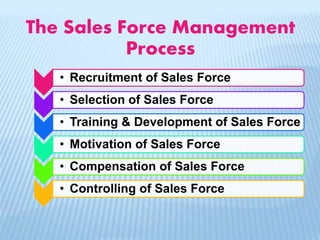
The Sales Force Management
Process
• Recruitment of Sales Force
• Selection of Sales Force
• Training & Development of Sales Force
• Motivation of Sales Force
• Compensation of Sales Force
• Controlling of Sales Force
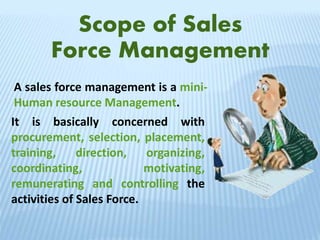
Scope of Sales
Force Management
A sales force management is a mini-
Human resource Management.
It is basically concerned with
procurement, selection, placement,
training, direction, organizing,
coordinating, motivating,
remunerating and controlling the
activities of Sales Force.
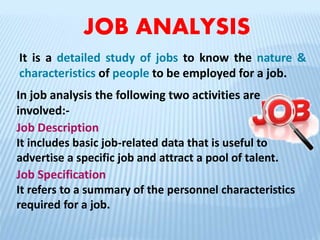
JOB ANALYSIS
It is a detailed study of jobs to know the nature &
characteristics of people to be employed for a job.
In job analysis the following two activities are
involved:-
Job Description
It includes basic job-related data that is useful to
advertise a specific job and attract a pool of talent.
Job Specification
It refers to a summary of the personnel characteristics
required for a job.
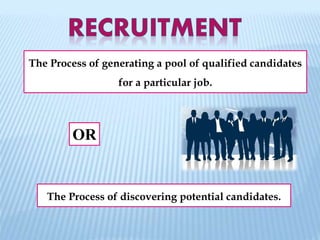
The Process of generating a pool of qualified candidates
for a particular job.
The Process of discovering potential candidates.
OR
Importance Of Recruitment
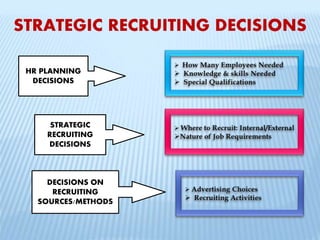
HR PLANNING
DECISIONS
STRATEGIC
RECRUITING
DECISIONS
DECISIONS ON
RECRUITING
SOURCES/METHODS
STRATEGIC RECRUITING DECISIONS
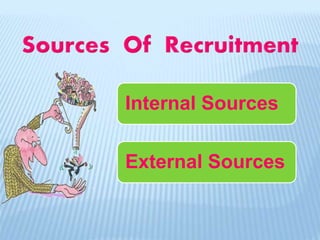
Internal Sources
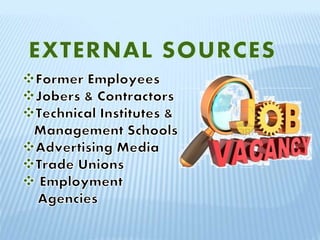
External Sources
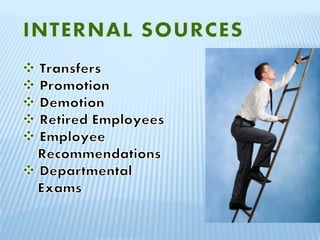
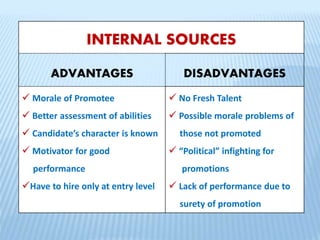
INTERNAL SOURCES
ADVANTAGES DISADVANTAGES
 Morale of Promotee
 Better assessment of abilities
 Candidate’s character is known
 Motivator for good
performance
Have to hire only at entry level
 No Fresh Talent
 Possible morale problems of
those not promoted
 “Political” infighting for
promotions
 Lack of performance due to
surety of promotion
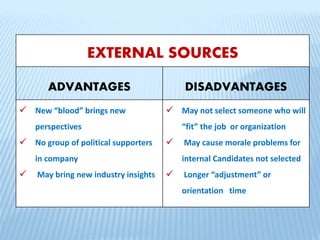
EXTERNAL SOURCES
ADVANTAGES DISADVANTAGES
 New “blood” brings new
perspectives
 No group of political supporters
in company
 May bring new industry insights
 May not select someone who will
“fit” the job or organization
 May cause morale problems for
internal Candidates not selected
 Longer “adjustment” or
orientation time
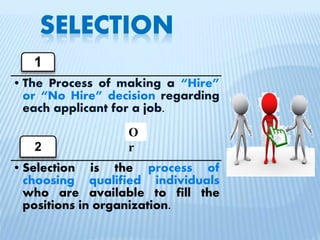
1
•The Process of making a “Hire”
or “No Hire” decision regarding
each applicant for a job.
2
•Selection is the process of
choosing qualified individuals
who are available to fill the
positions in organization.
O
r
The process of interviewing and evaluating
candidates for a specific job and selecting an
individual for employment based on certain criteria.
Employee selection can range from a very
simple process to a very complicated process
depending on the firm hiring and the position.
Selection
Procedure
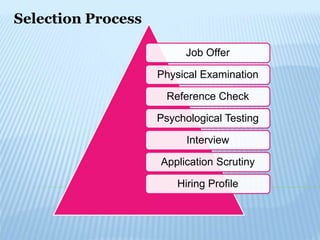
Job Offer
Physical Examination
Reference Check
Psychological Testing
Interview
Application Scrutiny
Hiring Profile
Selection Process
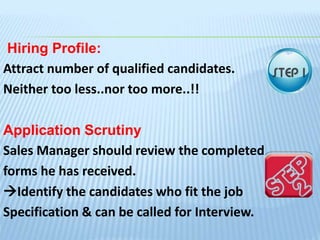
Hiring Profile:
Attract number of qualified candidates.
Neither too less..nor too more..!!
Application Scrutiny
Sales Manager should review the completed
forms he has received.
Identify the candidates who fit the job
Specification & can be called for Interview.
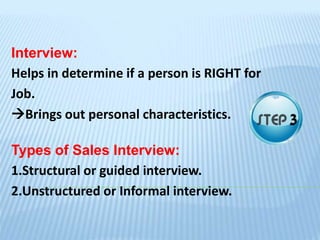
Interview:
Helps in determine if a person is RIGHT for
Job.
Brings out personal characteristics.
Types of Sales Interview:
1.Structural or guided interview.
2.Unstructured or Informal interview.
Psychological Testing:
It is designed to measure such skills &
abilities that are essential for job performance.
Types of Psychological Tests:
1.Knowledge Tests:
Measures knowledge or information regarding
sales job.
2.Ability Tests:
Measures the skills and abilities already present in the
candidate at the time of testing.
3.Aptitude Tests:
Measures whether or not the individual has the capacity
or latent ability to learn the job quickly.
4.Simulation Exercises:
A test which duplicates many of the operations &
problems confronting the sales job.
Reference Check:
Secure information that is not available from
application & verification of information from
external sources.
Physical Examination:
Physical Examination reveals whether or not the
candidate possess the required stamina, strength &
tolerance needed under hard working conditions.
Handle job without delay on health grounds.
Job Offer:
After all steps, company decides whether
it should hire the candidate or not.
If yes, the company gives offer letter.
It must be in writing for the protection of
recruit & company specifying all details.
Sometimes, sales people may have to sign
a job- contract too.
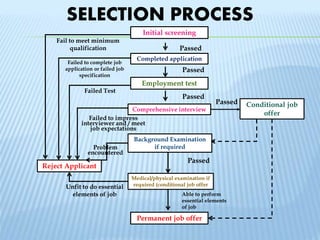
SELECTION PROCESS
Initial screening
Completed application
Medical/physical examination if
required (conditional job offer
Comprehensive interview
Employment test
Permanent job offer
Reject Applicant
Background Examination
if required
Conditional job
offer
Passed
Passed
Passed
Passed
Passed
Able to perform
essential elements
of job
Fail to meet minimum
qualification
Failed to complete job
application or failed job
specification
Failed Test
Failed to impress
interviewer and / meet
job expectations
Problem
encountered
Unfit to do essential
elements of job
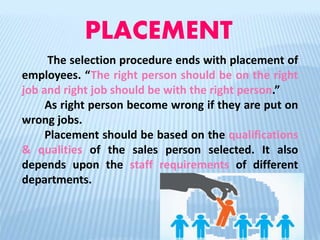
PLACEMENT
The selection procedure ends with placement of
employees. “The right person should be on the right
job and right job should be with the right person.”
As right person become wrong if they are put on
wrong jobs.
Placement should be based on the qualifications
& qualities of the sales person selected. It also
depends upon the staff requirements of different
departments.
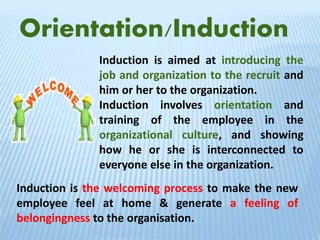
Orientation/Induction
Induction is aimed at introducing the
job and organization to the recruit and
him or her to the organization.
Induction involves orientation and
training of the employee in the
organizational culture, and showing
how he or she is interconnected to
everyone else in the organization.
Induction is the welcoming process to make the new
employee feel at home & generate a feeling of
belongingness to the organisation.
Presented By:
Vipasha
Bhardwaj
23306

Recruitment & selection

  • 1.
  • 2.
    It means selectingright type of sales force, providing right training, doing right type of motivation & controlling. It is the key to success depending upon contacts and relationship with customers dealings and retailers. It starts with tracing and hunting of the qualified job applicants & selecting the best candidates with professional outlook.
  • 3.
    The Sales ForceManagement Process • Recruitment of Sales Force • Selection of Sales Force • Training & Development of Sales Force • Motivation of Sales Force • Compensation of Sales Force • Controlling of Sales Force
  • 4.
    Scope of Sales ForceManagement A sales force management is a mini- Human resource Management. It is basically concerned with procurement, selection, placement, training, direction, organizing, coordinating, motivating, remunerating and controlling the activities of Sales Force.
  • 5.
    JOB ANALYSIS It isa detailed study of jobs to know the nature & characteristics of people to be employed for a job. In job analysis the following two activities are involved:- Job Description It includes basic job-related data that is useful to advertise a specific job and attract a pool of talent. Job Specification It refers to a summary of the personnel characteristics required for a job.
  • 6.
    The Process ofgenerating a pool of qualified candidates for a particular job. The Process of discovering potential candidates. OR
  • 7.
  • 8.
  • 9.
  • 11.
    INTERNAL SOURCES ADVANTAGES DISADVANTAGES Morale of Promotee  Better assessment of abilities  Candidate’s character is known  Motivator for good performance Have to hire only at entry level  No Fresh Talent  Possible morale problems of those not promoted  “Political” infighting for promotions  Lack of performance due to surety of promotion
  • 13.
    EXTERNAL SOURCES ADVANTAGES DISADVANTAGES New “blood” brings new perspectives  No group of political supporters in company  May bring new industry insights  May not select someone who will “fit” the job or organization  May cause morale problems for internal Candidates not selected  Longer “adjustment” or orientation time
  • 15.
    1 •The Process ofmaking a “Hire” or “No Hire” decision regarding each applicant for a job. 2 •Selection is the process of choosing qualified individuals who are available to fill the positions in organization. O r
  • 16.
    The process ofinterviewing and evaluating candidates for a specific job and selecting an individual for employment based on certain criteria. Employee selection can range from a very simple process to a very complicated process depending on the firm hiring and the position.
  • 17.
  • 18.
    Job Offer Physical Examination ReferenceCheck Psychological Testing Interview Application Scrutiny Hiring Profile Selection Process
  • 19.
    Hiring Profile: Attract numberof qualified candidates. Neither too less..nor too more..!! Application Scrutiny Sales Manager should review the completed forms he has received. Identify the candidates who fit the job Specification & can be called for Interview.
  • 20.
    Interview: Helps in determineif a person is RIGHT for Job. Brings out personal characteristics. Types of Sales Interview: 1.Structural or guided interview. 2.Unstructured or Informal interview.
  • 21.
    Psychological Testing: It isdesigned to measure such skills & abilities that are essential for job performance. Types of Psychological Tests: 1.Knowledge Tests: Measures knowledge or information regarding sales job.
  • 22.
    2.Ability Tests: Measures theskills and abilities already present in the candidate at the time of testing. 3.Aptitude Tests: Measures whether or not the individual has the capacity or latent ability to learn the job quickly. 4.Simulation Exercises: A test which duplicates many of the operations & problems confronting the sales job.
  • 23.
    Reference Check: Secure informationthat is not available from application & verification of information from external sources. Physical Examination: Physical Examination reveals whether or not the candidate possess the required stamina, strength & tolerance needed under hard working conditions. Handle job without delay on health grounds.
  • 24.
    Job Offer: After allsteps, company decides whether it should hire the candidate or not. If yes, the company gives offer letter. It must be in writing for the protection of recruit & company specifying all details. Sometimes, sales people may have to sign a job- contract too.
  • 25.
    SELECTION PROCESS Initial screening Completedapplication Medical/physical examination if required (conditional job offer Comprehensive interview Employment test Permanent job offer Reject Applicant Background Examination if required Conditional job offer Passed Passed Passed Passed Passed Able to perform essential elements of job Fail to meet minimum qualification Failed to complete job application or failed job specification Failed Test Failed to impress interviewer and / meet job expectations Problem encountered Unfit to do essential elements of job
  • 26.
    PLACEMENT The selection procedureends with placement of employees. “The right person should be on the right job and right job should be with the right person.” As right person become wrong if they are put on wrong jobs. Placement should be based on the qualifications & qualities of the sales person selected. It also depends upon the staff requirements of different departments.
  • 27.
    Orientation/Induction Induction is aimedat introducing the job and organization to the recruit and him or her to the organization. Induction involves orientation and training of the employee in the organizational culture, and showing how he or she is interconnected to everyone else in the organization. Induction is the welcoming process to make the new employee feel at home & generate a feeling of belongingness to the organisation.
  • 28.