Writing a Good
Curriculum Vitae
CV’s can be word processed or typed but never handwritten
True

A CV should always clearly state CV at the top of the page.
False

Always send a CV with an application form.
False

Employers do not need to know your age, sex or marital status on your CV
True

A brightly coloured CV will attract attention and improve your chances
False

A CV should never be longer than one side of A4.
False
Choosing your Style


                                      V
          Reverse
                                                          Skills CV
        Chronological
             CV


                                          Tells employers about your skills
Lists your information methodically

                                          Easy for employers to identify how you
Gives basic information                   meet their needs
                                          Has to be related back to experience.
Most common style of CV
                                          Giving lots of practical examples can
Easy to put together                      be hard.
The Artists CV

      Use         Gallery    Exhibition    Competition


  Only       Professional   Professional    Professional
include        Artistic       Artistic        Artistic
details:     Experience       Training      Achievement
CV Rules
                       Length – 2 sides


Good quality white                            Always list most
     paper                                      recent first


 Simple Layout –
                                             Font – Clear & Plain
   Easy to read


                             No to
                      colours, pictures, s
                       pelling mistakes
What to include
                                                                             All relevant experience
                                                                             counts. This could have
Personal Details                                                             been gained as part of
                                                                                  your studies or
Name                       Education                                                 voluntary
Address                    Name of
Contact Telephone          School/College/Uni
                                                                 Employment or Experience
Number                     Qualifications gained
                           You may include details of relevant
Email Address – No silly   modules which have been studied
names                                                            Employers Name
                           Year Awarded
                                                                 Town/City where based
This section should be
no more than 1/3 of a                                            Dates of work
side of A4. Make sure
    you are easily
  contactable at the
                                                                 Job Title
     details given.
                                                                 Brief outline of job role
Other optional sections
                                                  References
Personal Profile/Career Objective
Place under Personal Details. Should be no
                                                  Name of reference
longer than 3 – 4 lines. Can be changes to suit
job description.
                                                  Address
Skills section – if skills based
Place before employment and education.            Contact Telephone Number
Allows you to provide information specifically
relating to advertised vacancy.                   Relationship to referee
Positions of Responsibility
Place either before or after Employment. May
include activities outside work e.g. Sports
coach, Scout Leader etc..                                       If references are not
Voluntary Work                                                   explicitly requested
Opportunity to highlight your commitment to                          you can write
area of work and skills gained.                                     ‘Available Upon
                                                               Request’ to save space
Interests/Hobbies
Employers want to see you as well-rounded
person and imagine if you will fit into the
company.
Professional Development
In house courses/training i.e. Health and
Safety, National Licensees Certificate, Basic
Food Hygiene, Customer Care
Power Words
Power words can help you highlight your skills and abilities without using ‘I’ and
‘my’ all the time and becoming repetitive

For example: “I have good customer service skills”you could use instead “provided
fast and
efficient service to customers in a popular city centre restaurant on a Saturday
night.”

Some examples of power words
•Achieved         Established           Reorganised
•Co-ordinated     Created               Supported
•Arranged         Attended              Developed
•Designed         Marketed              Negotiated
•Edited           Helped                Planned
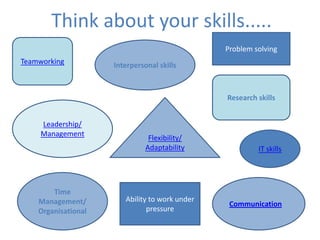
Think about your skills.....
                                                Problem solving
Teamworking          Interpersonal skills


                                                Research skills


     Leadership/
     Management
                                Flexibility/
                               Adaptability              IT skills


        Time
    Management/         Ability to work under
                                                 Communication
    Organisational             pressure
Leadership
•Being able to motivate & direct others
•Taking responsibility for the direction & actions
of a team
•Setting objectives.
•Training new members of staff, acting as a
mentor
•Leading on a presentation at college or work
•Organising & motivating others.
•Taking the initiative
•Persevering when things are not working out.
•Taking a positive attitude to frustration/failure.
•Accepting responsibility for mistakes/wrong
decisions.
•Being flexible: prepared to adapt goals in the
light of changing situations
Team working
   • Playing in a sports team, or other group
     i.e.) choir, drama etc..
   • Working on a group project at college or
     work.
   • Leading/supervising a team of other
     people.
   • Attending meetings and making an active
     contribution.
   • Participating in group discussions and
     taking initiative where appropriate.
   • Recognising and utilising skills and
     knowledge of other team members.
Flexibility/Adaptability
        • Ability to work evenings/weekends and do
          overtime
        • Willing to undertake further training and
          learn new skills to improve your work
          competence.
        • Self-awareness, being aware of strengths
          and weaknesses and what you need to
          improve on
        • Flexibility in own job role and willingness
          to take on new tasks, extra responsibilities
          and helping out others when needed.
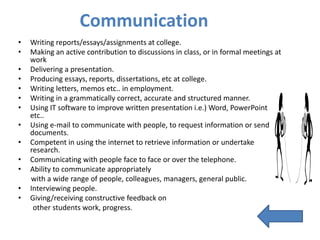
Communication
•   Writing reports/essays/assignments at college.
•   Making an active contribution to discussions in class, or in formal meetings at
    work
•   Delivering a presentation.
•   Producing essays, reports, dissertations, etc at college.
•   Writing letters, memos etc.. in employment.
•   Writing in a grammatically correct, accurate and structured manner.
•   Using IT software to improve written presentation i.e.) Word, PowerPoint
    etc..
•   Using e-mail to communicate with people, to request information or send
    documents.
•   Competent in using the internet to retrieve information or undertake
    research.
•   Communicating with people face to face or over the telephone.
•   Ability to communicate appropriately
    with a wide range of people, colleagues, managers, general public.
•   Interviewing people.
•   Giving/receiving constructive feedback on
     other students work, progress.
IT Skills
    •Using word processing packages
    •Using spreadsheets and databases
    •Proficiency of typing
    •Use of internet and email
    •Adaptability of skills – company specific
    software packages
    •Experiences of data input
    •Experiences of producing electronic
    presentations
    •IT Qualifications
Examples - Creative CVs
Degree c vs   arts

Degree c vs arts

  • 1.
  • 2.
    CV’s can beword processed or typed but never handwritten True A CV should always clearly state CV at the top of the page. False Always send a CV with an application form. False Employers do not need to know your age, sex or marital status on your CV True A brightly coloured CV will attract attention and improve your chances False A CV should never be longer than one side of A4. False
  • 3.
    Choosing your Style V Reverse Skills CV Chronological CV Tells employers about your skills Lists your information methodically Easy for employers to identify how you Gives basic information meet their needs Has to be related back to experience. Most common style of CV Giving lots of practical examples can Easy to put together be hard.
  • 4.
    The Artists CV Use Gallery Exhibition Competition Only Professional Professional Professional include Artistic Artistic Artistic details: Experience Training Achievement
  • 5.
    CV Rules Length – 2 sides Good quality white Always list most paper recent first Simple Layout – Font – Clear & Plain Easy to read No to colours, pictures, s pelling mistakes
  • 6.
    What to include All relevant experience counts. This could have Personal Details been gained as part of your studies or Name Education voluntary Address Name of Contact Telephone School/College/Uni Employment or Experience Number Qualifications gained You may include details of relevant Email Address – No silly modules which have been studied names Employers Name Year Awarded Town/City where based This section should be no more than 1/3 of a Dates of work side of A4. Make sure you are easily contactable at the Job Title details given. Brief outline of job role
  • 7.
    Other optional sections References Personal Profile/Career Objective Place under Personal Details. Should be no Name of reference longer than 3 – 4 lines. Can be changes to suit job description. Address Skills section – if skills based Place before employment and education. Contact Telephone Number Allows you to provide information specifically relating to advertised vacancy. Relationship to referee Positions of Responsibility Place either before or after Employment. May include activities outside work e.g. Sports coach, Scout Leader etc.. If references are not Voluntary Work explicitly requested Opportunity to highlight your commitment to you can write area of work and skills gained. ‘Available Upon Request’ to save space Interests/Hobbies Employers want to see you as well-rounded person and imagine if you will fit into the company. Professional Development In house courses/training i.e. Health and Safety, National Licensees Certificate, Basic Food Hygiene, Customer Care
  • 8.
    Power Words Power wordscan help you highlight your skills and abilities without using ‘I’ and ‘my’ all the time and becoming repetitive For example: “I have good customer service skills”you could use instead “provided fast and efficient service to customers in a popular city centre restaurant on a Saturday night.” Some examples of power words •Achieved Established Reorganised •Co-ordinated Created Supported •Arranged Attended Developed •Designed Marketed Negotiated •Edited Helped Planned
  • 9.
    Think about yourskills..... Problem solving Teamworking Interpersonal skills Research skills Leadership/ Management Flexibility/ Adaptability IT skills Time Management/ Ability to work under Communication Organisational pressure
  • 10.
    Leadership •Being able tomotivate & direct others •Taking responsibility for the direction & actions of a team •Setting objectives. •Training new members of staff, acting as a mentor •Leading on a presentation at college or work •Organising & motivating others. •Taking the initiative •Persevering when things are not working out. •Taking a positive attitude to frustration/failure. •Accepting responsibility for mistakes/wrong decisions. •Being flexible: prepared to adapt goals in the light of changing situations
  • 11.
    Team working • Playing in a sports team, or other group i.e.) choir, drama etc.. • Working on a group project at college or work. • Leading/supervising a team of other people. • Attending meetings and making an active contribution. • Participating in group discussions and taking initiative where appropriate. • Recognising and utilising skills and knowledge of other team members.
  • 12.
    Flexibility/Adaptability • Ability to work evenings/weekends and do overtime • Willing to undertake further training and learn new skills to improve your work competence. • Self-awareness, being aware of strengths and weaknesses and what you need to improve on • Flexibility in own job role and willingness to take on new tasks, extra responsibilities and helping out others when needed.
  • 13.
    Communication • Writing reports/essays/assignments at college. • Making an active contribution to discussions in class, or in formal meetings at work • Delivering a presentation. • Producing essays, reports, dissertations, etc at college. • Writing letters, memos etc.. in employment. • Writing in a grammatically correct, accurate and structured manner. • Using IT software to improve written presentation i.e.) Word, PowerPoint etc.. • Using e-mail to communicate with people, to request information or send documents. • Competent in using the internet to retrieve information or undertake research. • Communicating with people face to face or over the telephone. • Ability to communicate appropriately with a wide range of people, colleagues, managers, general public. • Interviewing people. • Giving/receiving constructive feedback on other students work, progress.
  • 14.
    IT Skills •Using word processing packages •Using spreadsheets and databases •Proficiency of typing •Use of internet and email •Adaptability of skills – company specific software packages •Experiences of data input •Experiences of producing electronic presentations •IT Qualifications
  • 15.