Selection
A PRIME DETERMINANT OF SUCCESS
Introduction
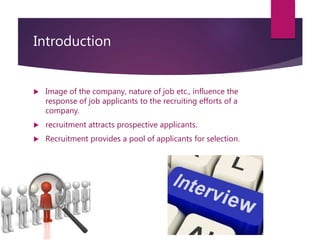
 Image of the company, nature of job etc., influence the
response of job applicants to the recruiting efforts of a
company.
 recruitment attracts prospective applicants.
 Recruitment provides a pool of applicants for selection.
Definition
 According to Thomas “Selection is the process of
differentiating between applicants in order to identify
and hire those with a greater likelihood of success in a
job.”
Meaning
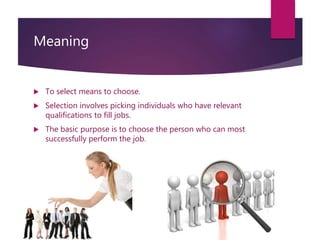
 To select means to choose.
 Selection involves picking individuals who have relevant
qualifications to fill jobs.
 The basic purpose is to choose the person who can most
successfully perform the job.
Purpose: Don’t Buy Bad Apples
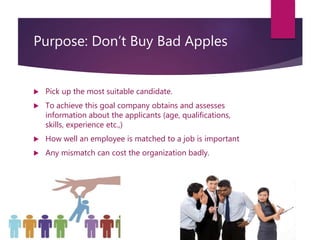
 Pick up the most suitable candidate.
 To achieve this goal company obtains and assesses
information about the applicants (age, qualifications,
skills, experience etc.,)
 How well an employee is matched to a job is important
 Any mismatch can cost the organization badly.
Putting brakes to negligent hiring
• After facing trouble due to crimes perpetrated by
employees with previous history of sexually related
offences, Wal-Mart came out with a new programme of
criminal background checks for qualified candidates in
2004.
Case study - 1
 What do you think is the main cause for the problem ?
 As an HR manager, what steps would you take to solve
this problem at Wal-Mart ?
Features of selection
 It is an expensive process.
 It is a time consuming process.
 It is a negative function.
 It is preceded by recruitment.
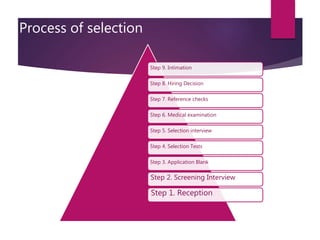
Process of selection
Step 9. Intimation
Step 8. Hiring Decision
Step 7. Reference checks
Step 6. Medical examination
Step 5. Selection interview
Step 4. Selection Tests
Step 3. Application Blank
Step 2. Screening Interview
Step 1. Reception
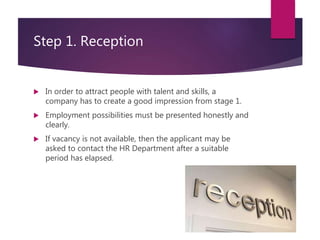
Step 1. Reception
 In order to attract people with talent and skills, a
company has to create a good impression from stage 1.
 Employment possibilities must be presented honestly and
clearly.
 If vacancy is not available, then the applicant may be
asked to contact the HR Department after a suitable
period has elapsed.
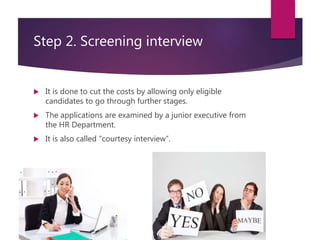
Step 2. Screening interview
 It is done to cut the costs by allowing only eligible
candidates to go through further stages.
 The applications are examined by a junior executive from
the HR Department.
 It is also called “courtesy interview”.
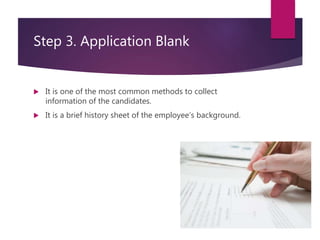
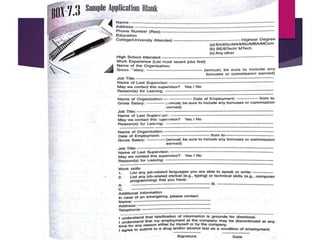
Step 3. Application Blank
 It is one of the most common methods to collect
information of the candidates.
 It is a brief history sheet of the employee’s background.
Contents of application blanks
 Personal data (address, etc.)
 Marital data.
 Physical data (height, weight)
 Educational data (levels of formal education etc.,)
 Employment data (past experience, promotions)
 Extracurricular activities data (NSS, NCC, leisure time
activities)
 References (names of two or more people who certify the
suitability of an applicant to the advertised job)
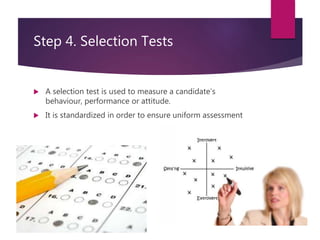
Step 4. Selection Tests
 A selection test is used to measure a candidate’s
behaviour, performance or attitude.
 It is standardized in order to ensure uniform assessment
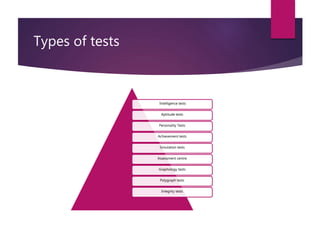
Types of tests
Intelligence tests
Aptitude tests
Personality Tests
Achievement tests
Simulation tests
Assessment centre
Graphology tests
Polygraph tests
Integrity tests
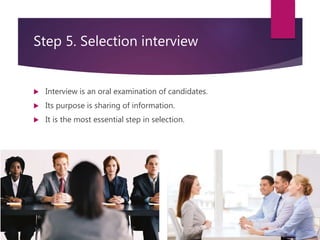
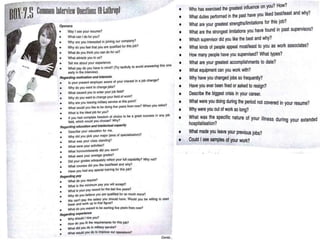
Step 5. Selection interview
 Interview is an oral examination of candidates.
 Its purpose is sharing of information.
 It is the most essential step in selection.
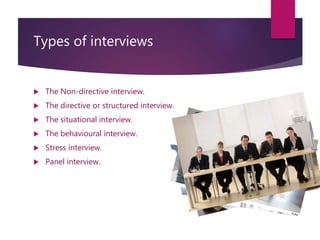
Types of interviews
 The Non-directive interview.
 The directive or structured interview.
 The situational interview.
 The behavioural interview.
 Stress interview.
 Panel interview.
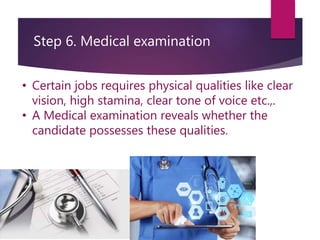
Step 6. Medical examination
• Certain jobs requires physical qualities like clear
vision, high stamina, clear tone of voice etc.,.
• A Medical examination reveals whether the
candidate possesses these qualities.
Medical examination can give the
following information.
 Whether the applicant is medically suitable for a specific
job or not ?
 Whether the applicant suffers from bad health which
should be corrected before he can work satisfactorily
(need for spectacles)?
 Whether the applicants’ physical measurements are in
accordance with job requirements or not ?
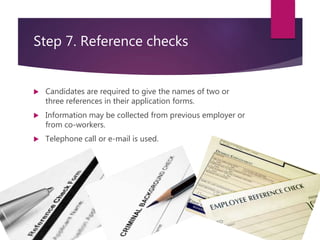
Step 7. Reference checks
 Candidates are required to give the names of two or
three references in their application forms.
 Information may be collected from previous employer or
from co-workers.
 Telephone call or e-mail is used.
Beware of Credential Fraud !
• George O’Leary was hired as Notre
Dame’s Football coach. He was forced to
resign after five days when it was
revealed that he lied about having a
master’s degree from NYU.
• Sandy Baldwin was forced to resign as
Chief Executive of the US olympic
Committee when it was discovered that
she lied about having an UG degree from
the university of Colorado and a doctrate
from Arizona.
Beware of Credential Fraud !
 Neil Taylor, Chief executive of the
Shrewsbury and Telford Hospitals NHS
trust in the UK was forced to resign
when it was found that he had lied
about having a management degree
from Nottingham university.
Credential Fraud in India
 In March 2006, Wipro fired 25 employees after an internal
audit revealed lies on their CV’s. The next day the
company filed police complaints not only against the
employees but also against the hiring agencies that hired
them.
Credential Fraud in India
 IBM had to dismiss more than 700 employees overnight
when it found employees with fake CV’s.
Step 8. Hiring Decision
 The concerned line manager takes this decision.
 The decision is taken after soliciting the required
information gathered through different techniques
discussed earlier.
Step 9. Intimation
• Intimation to both successful and
unsuccessful candidates
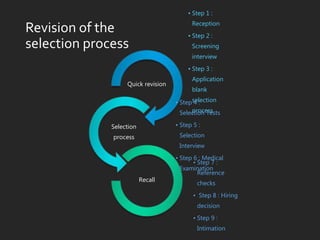
Revision of the
selection process
• Step 1 :
Reception
• Step 2 :
Screening
interview
• Step 3 :
Application
blank
selection
process
Quick revision
• Step 4 :
Selection Tests
• Step 5 :
Selection
Interview
• Step 6 : Medical
Examination
Selection
process
• Step 7 :
Reference
checks
• Step 8 : Hiring
decision
• Step 9 :
Intimation
Recall
Selection process of global giants
• It uses extensive psychometric instruments to evaluate
short-listed candidates.
• It uses occupational personality questionnaire to
understand candidate’s personal attributes.
• It uses occupational testing to measure competencies.
Sources
 Personnel and human Resource management – P Subbarao
(5th Edition)
 http://hrtrendinstitute.com/2015/08/13/trends-in-
recruitment-and-selection-new-
infographic/#prettyPhoto[galname]/0/
 Slide Share Articles.
 Online research Articles.
 D. Callahan, “Resume Padding”, in www.cheatingculture.com
 www.cnn.com
 www.backgroundchecking.co.un
Selection process, features and examples

Selection process, features and examples

  • 1.
  • 2.
    Introduction  Image ofthe company, nature of job etc., influence the response of job applicants to the recruiting efforts of a company.  recruitment attracts prospective applicants.  Recruitment provides a pool of applicants for selection.
  • 3.
    Definition  According toThomas “Selection is the process of differentiating between applicants in order to identify and hire those with a greater likelihood of success in a job.”
  • 4.
    Meaning  To selectmeans to choose.  Selection involves picking individuals who have relevant qualifications to fill jobs.  The basic purpose is to choose the person who can most successfully perform the job.
  • 5.
    Purpose: Don’t BuyBad Apples  Pick up the most suitable candidate.  To achieve this goal company obtains and assesses information about the applicants (age, qualifications, skills, experience etc.,)  How well an employee is matched to a job is important  Any mismatch can cost the organization badly.
  • 6.
    Putting brakes tonegligent hiring • After facing trouble due to crimes perpetrated by employees with previous history of sexually related offences, Wal-Mart came out with a new programme of criminal background checks for qualified candidates in 2004.
  • 7.
    Case study -1  What do you think is the main cause for the problem ?  As an HR manager, what steps would you take to solve this problem at Wal-Mart ?
  • 8.
    Features of selection It is an expensive process.  It is a time consuming process.  It is a negative function.  It is preceded by recruitment.
  • 9.
    Process of selection Step9. Intimation Step 8. Hiring Decision Step 7. Reference checks Step 6. Medical examination Step 5. Selection interview Step 4. Selection Tests Step 3. Application Blank Step 2. Screening Interview Step 1. Reception
  • 10.
    Step 1. Reception In order to attract people with talent and skills, a company has to create a good impression from stage 1.  Employment possibilities must be presented honestly and clearly.  If vacancy is not available, then the applicant may be asked to contact the HR Department after a suitable period has elapsed.
  • 11.
    Step 2. Screeninginterview  It is done to cut the costs by allowing only eligible candidates to go through further stages.  The applications are examined by a junior executive from the HR Department.  It is also called “courtesy interview”.
  • 12.
    Step 3. ApplicationBlank  It is one of the most common methods to collect information of the candidates.  It is a brief history sheet of the employee’s background.
  • 14.
    Contents of applicationblanks  Personal data (address, etc.)  Marital data.  Physical data (height, weight)  Educational data (levels of formal education etc.,)  Employment data (past experience, promotions)  Extracurricular activities data (NSS, NCC, leisure time activities)  References (names of two or more people who certify the suitability of an applicant to the advertised job)
  • 15.
    Step 4. SelectionTests  A selection test is used to measure a candidate’s behaviour, performance or attitude.  It is standardized in order to ensure uniform assessment
  • 16.
    Types of tests Intelligencetests Aptitude tests Personality Tests Achievement tests Simulation tests Assessment centre Graphology tests Polygraph tests Integrity tests
  • 17.
    Step 5. Selectioninterview  Interview is an oral examination of candidates.  Its purpose is sharing of information.  It is the most essential step in selection.
  • 18.
    Types of interviews The Non-directive interview.  The directive or structured interview.  The situational interview.  The behavioural interview.  Stress interview.  Panel interview.
  • 20.
    Step 6. Medicalexamination • Certain jobs requires physical qualities like clear vision, high stamina, clear tone of voice etc.,. • A Medical examination reveals whether the candidate possesses these qualities.
  • 21.
    Medical examination cangive the following information.  Whether the applicant is medically suitable for a specific job or not ?  Whether the applicant suffers from bad health which should be corrected before he can work satisfactorily (need for spectacles)?  Whether the applicants’ physical measurements are in accordance with job requirements or not ?
  • 22.
    Step 7. Referencechecks  Candidates are required to give the names of two or three references in their application forms.  Information may be collected from previous employer or from co-workers.  Telephone call or e-mail is used.
  • 23.
    Beware of CredentialFraud ! • George O’Leary was hired as Notre Dame’s Football coach. He was forced to resign after five days when it was revealed that he lied about having a master’s degree from NYU. • Sandy Baldwin was forced to resign as Chief Executive of the US olympic Committee when it was discovered that she lied about having an UG degree from the university of Colorado and a doctrate from Arizona.
  • 24.
    Beware of CredentialFraud !  Neil Taylor, Chief executive of the Shrewsbury and Telford Hospitals NHS trust in the UK was forced to resign when it was found that he had lied about having a management degree from Nottingham university.
  • 25.
    Credential Fraud inIndia  In March 2006, Wipro fired 25 employees after an internal audit revealed lies on their CV’s. The next day the company filed police complaints not only against the employees but also against the hiring agencies that hired them.
  • 26.
    Credential Fraud inIndia  IBM had to dismiss more than 700 employees overnight when it found employees with fake CV’s.
  • 27.
    Step 8. HiringDecision  The concerned line manager takes this decision.  The decision is taken after soliciting the required information gathered through different techniques discussed earlier.
  • 28.
    Step 9. Intimation •Intimation to both successful and unsuccessful candidates
  • 29.
    Revision of the selectionprocess • Step 1 : Reception • Step 2 : Screening interview • Step 3 : Application blank selection process Quick revision • Step 4 : Selection Tests • Step 5 : Selection Interview • Step 6 : Medical Examination Selection process • Step 7 : Reference checks • Step 8 : Hiring decision • Step 9 : Intimation Recall
  • 30.
    Selection process ofglobal giants • It uses extensive psychometric instruments to evaluate short-listed candidates. • It uses occupational personality questionnaire to understand candidate’s personal attributes. • It uses occupational testing to measure competencies.
  • 33.
    Sources  Personnel andhuman Resource management – P Subbarao (5th Edition)  http://hrtrendinstitute.com/2015/08/13/trends-in- recruitment-and-selection-new- infographic/#prettyPhoto[galname]/0/  Slide Share Articles.  Online research Articles.  D. Callahan, “Resume Padding”, in www.cheatingculture.com  www.cnn.com  www.backgroundchecking.co.un