RECRUITMENT AND SELECTION
Is the process of finding and attracting capable
applicants for employment. The process begins
when recruits are sought and ends when their
applications are submitted. The result is pool of
applicants from which new employees are
selected.
Recruitment - Definition
Reasons to Recruit Staff
Business is expanding due to:
Increasing sales of existing products
Developing new products
Entering new markets
Existing employees leave:
To work with competitors or other local employers
Due to factors such as retirement, sick leave, maternity
leave
Business needs employees with new skills
Business is relocating – and not all of existing workforce
want to move to new location
Factors Affecting Recruitment
Internal factors
Recruitment policy
HR planning
Size of the firm
Cost of recruitment
Growth and
expansion
Employer Brand
External factors
Supply and demand
Labour market
Image/goodwill
Political-social-legal
environment
Unemployment rates
Competitors
Changes in Employment Patterns
Affecting Recruitment
The way we work is changing rapidly:
 Increase in part-time working
 Increases in numbers of single-parent families
 More women seeking work
 Ageing population
 Greater emphasis on flexible working hours
 Technology allows employees to communicate more effectively whilst
apart (“teleworking”)
 People rarely stay in the same job for life
Businesses need to understand and respond to these
changes if they are to recruit staff of the right standard –
and keep them!
Sources of Recruitment
Internal recruitment
External recruitment
Internal Sources
Present Employees (Permanent/Temporary/Part-time)
Retrenched/Retired Employees
Dependants of Present/Deceased/Disabled Employees
Employee Referrals- Most effective source in recent times
Recruiting within the Organization
Benefits of a promotion-from-within policy:
Capitalizes on past investments (recruiting, selecting,
training, and developing) in current employees.
Rewards past performance and encourages
continued commitment to the organization.
Signals to employees that similar efforts by them will
lead to promotion.
Fosters advancement of members of protected
classes within an organization.
Recruiting within the Organization
Limitations of a promotion-from-within policy:
Current employees may lack the knowledge,
experience or skills needed for placement in the
vacant/new position.
The hazards of inbreeding of ideas and attitudes
(“employee cloning”) increase when no outsiders are
considered for hiring.
The organization has exhausted its supply of viable
internal candidates and must seek additional
employees in the external job market.
Internal Methods of Locating Qualified
Job Candidates
Human Resources Information Systems (HRIS)
Database systems containing the records and
qualifications of each employee that can be
accessed to identify and screen candidates for an
internal job opening.
Job Posting
Posting vacancy notices and maintaining lists of
employees looking for upgraded positions.
Outside Sources of Recruitment
Advertisements
Unsolicited applications and
resumes
Educational institutions/
Campus Recruitment
Professional organizations
Executive search firms
Private Agencies/Consultants
Public employment exchanges
Labor unions
Temporary Help agencies
Walk-In
Consult-In
Head Hunting
Body Shopping
Business Alliances
Internet/E-/recruitment
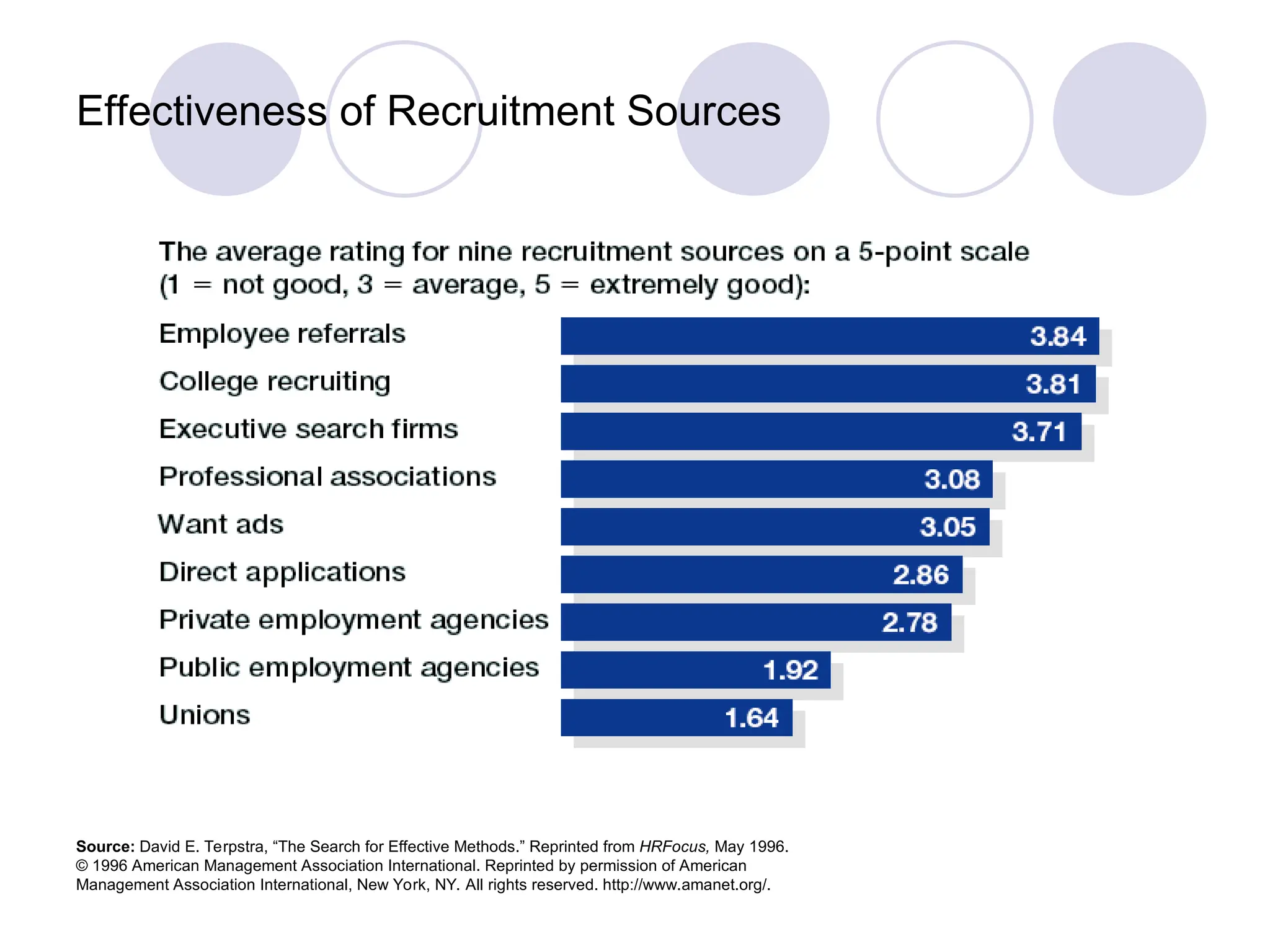
Effectiveness of Recruitment Sources
Source: David E. Terpstra, “The Search for Effective Methods.” Reprinted from HRFocus, May 1996.
© 1996 American Management Association International. Reprinted by permission of American
Management Association International, New York, NY. All rights reserved. http://www.amanet.org/.
Matching People and Jobs
Selection
The process of choosing individuals who have relevant
qualifications to fill existing or projected job openings.
Selection Considerations
Person-job fit: job analysis identifies required individual
competencies (KSAOs) for job success.
Person-organization fit: the degree to which individuals
are matched to the culture and values of the
organization.
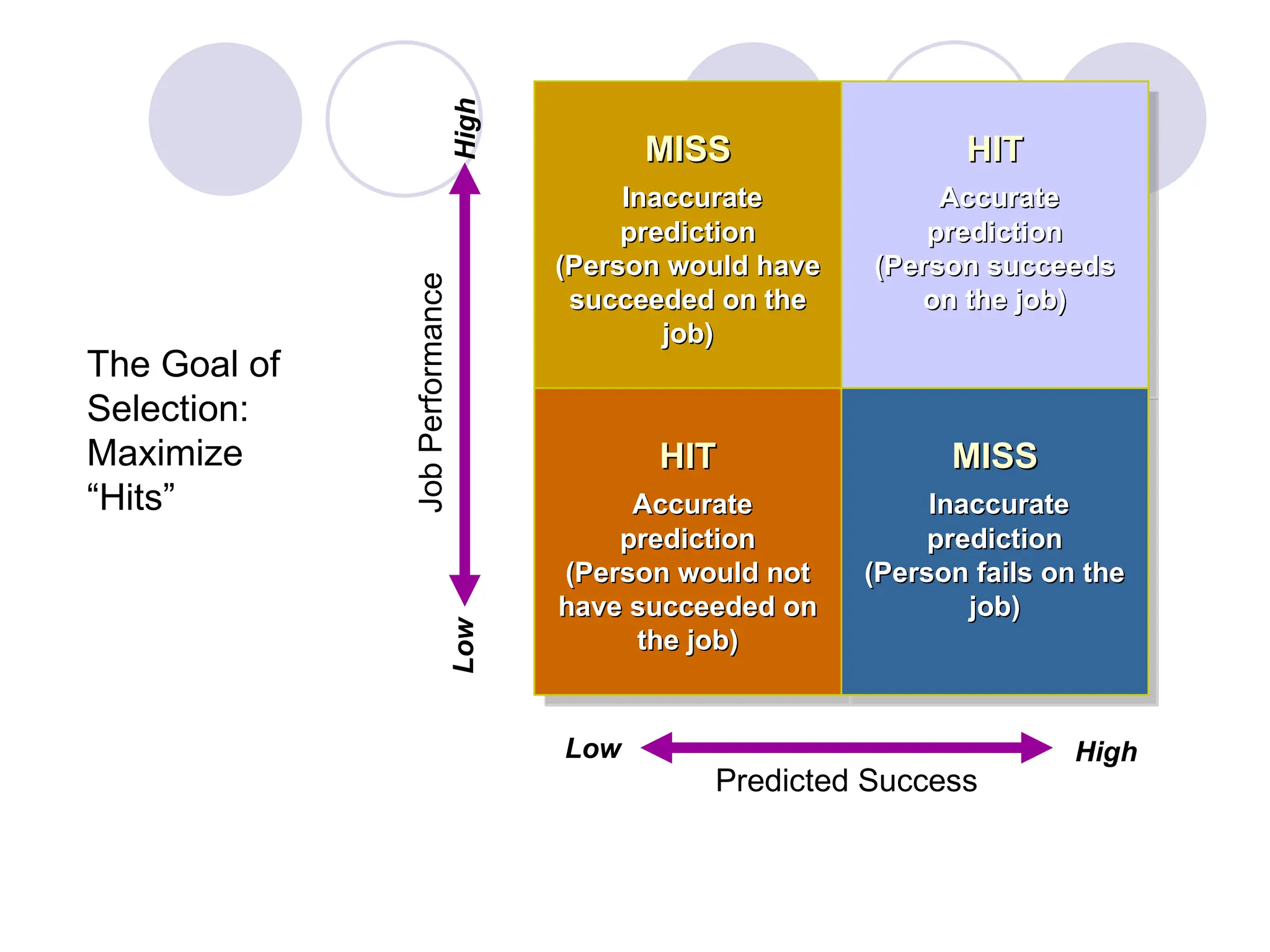
The Goal of
Selection:
Maximize
“Hits”
MISS
MISS
Inaccurate
Inaccurate
prediction
prediction
(Person would have
(Person would have
succeeded on the
succeeded on the
job)
job)
HIT
HIT
Accurate
Accurate
prediction
prediction
(Person succeeds
(Person succeeds
on the job)
on the job)
HIT
HIT
Accurate
Accurate
prediction
prediction
(Person would not
(Person would not
have succeeded on
have succeeded on
the job)
the job)
MISS
MISS
Inaccurate
Inaccurate
prediction
prediction
(Person fails on the
job)
job)
Predicted Success
Job
Performance
Low
Low
High
High
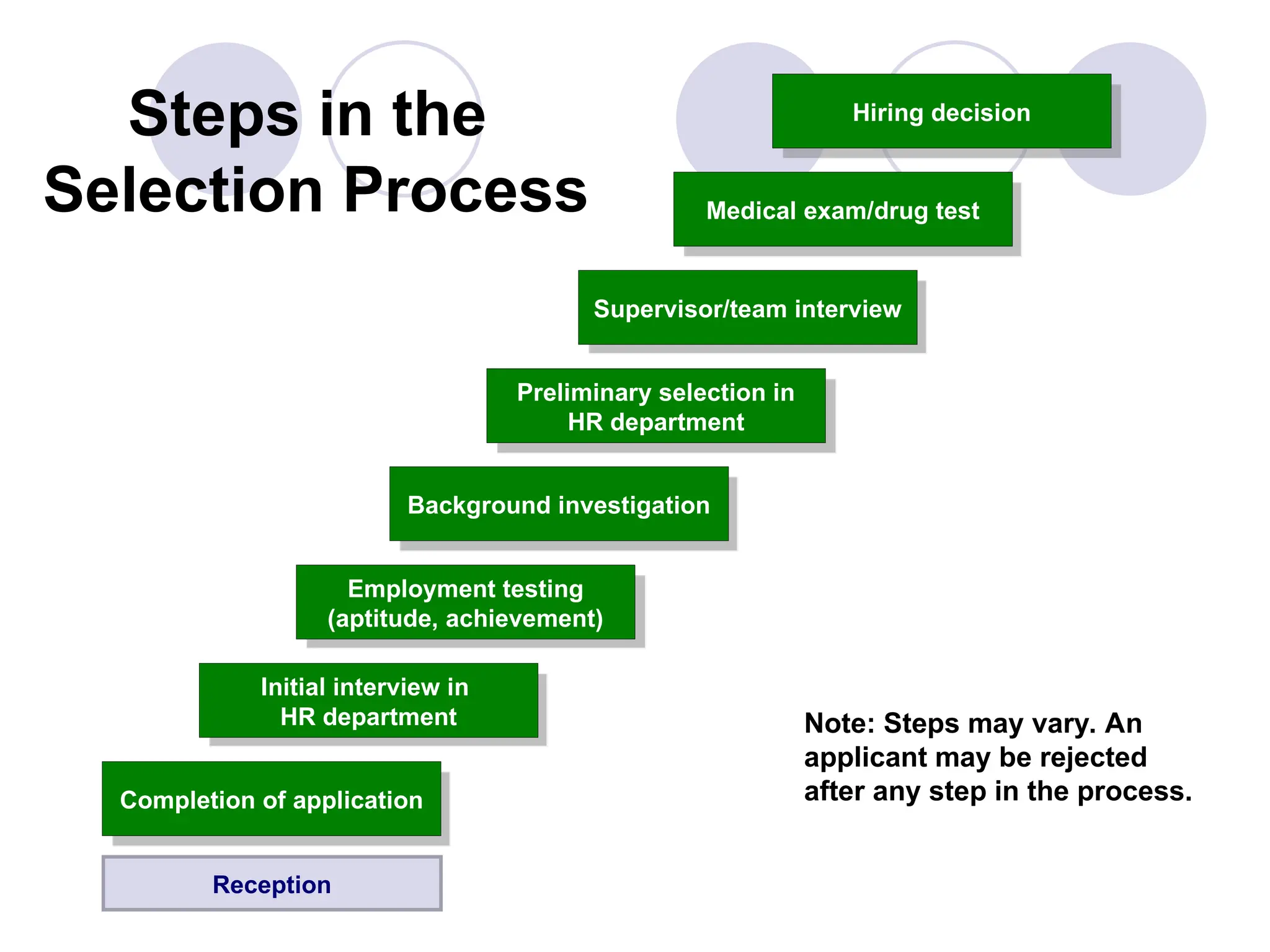
Steps in the
Selection Process
Note: Steps may vary. An
applicant may be rejected
after any step in the process.
Completion of application
Initial interview in
HR department
Employment testing
(aptitude, achievement)
Background investigation
Preliminary selection in
HR department
Supervisor/team interview
Medical exam/drug test
Hiring decision
Reception
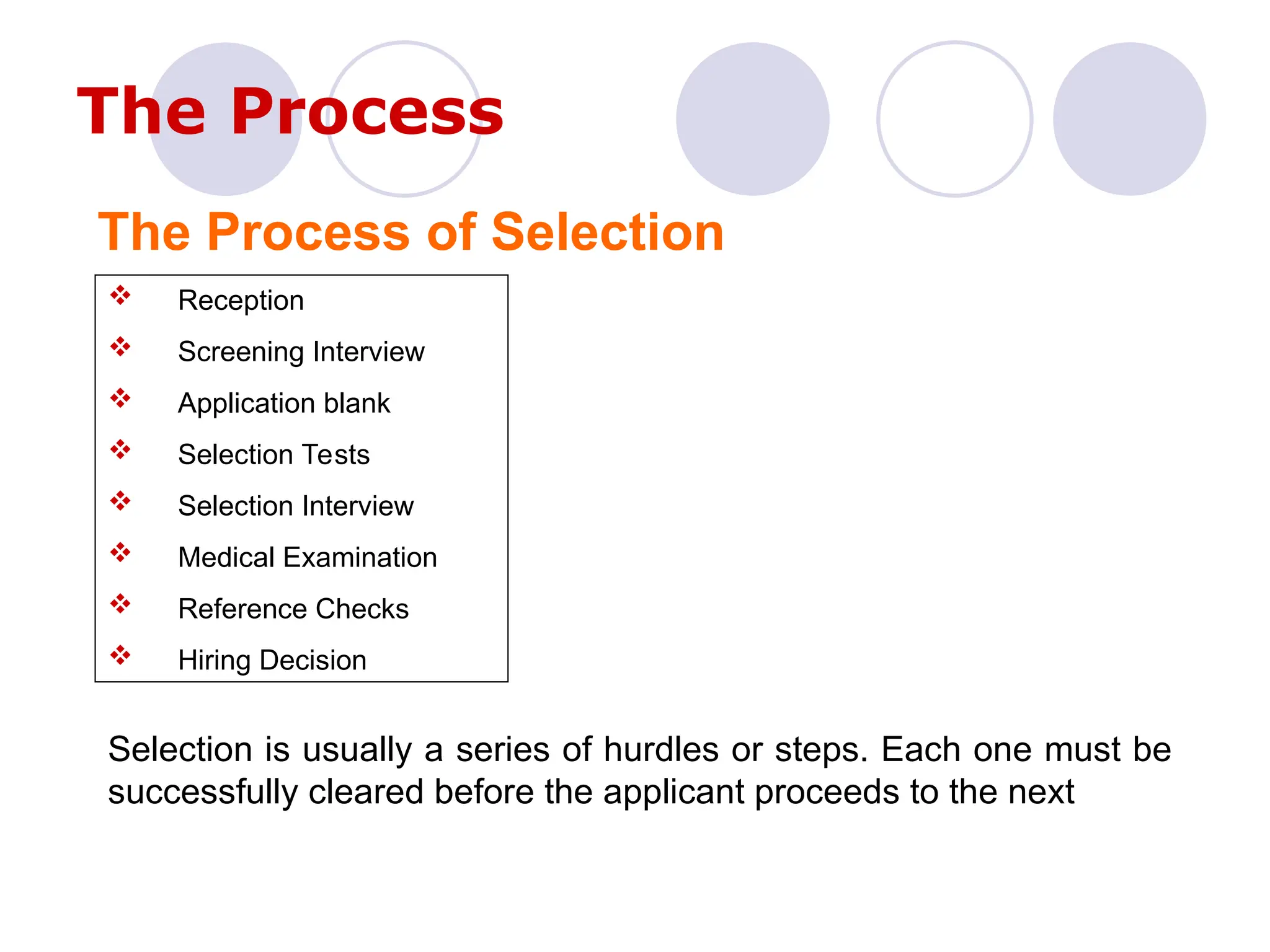
The Process
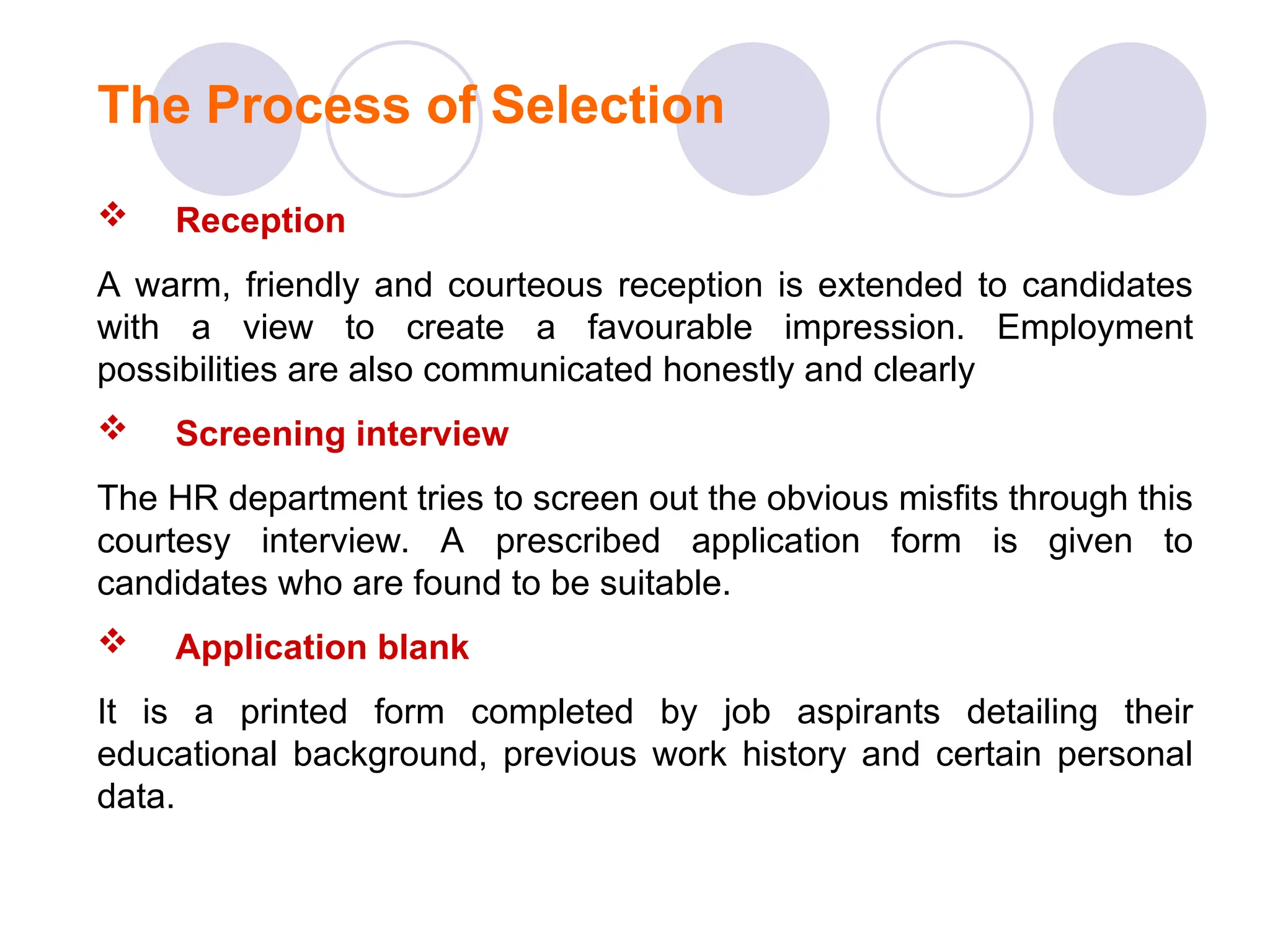
The Process of Selection
 Reception
 Screening Interview
 Application blank
 Selection Tests
 Selection Interview
 Medical Examination
 Reference Checks
 Hiring Decision
Selection is usually a series of hurdles or steps. Each one must be
successfully cleared before the applicant proceeds to the next
 Reception
A warm, friendly and courteous reception is extended to candidates
with a view to create a favourable impression. Employment
possibilities are also communicated honestly and clearly
 Screening interview
The HR department tries to screen out the obvious misfits through this
courtesy interview. A prescribed application form is given to
candidates who are found to be suitable.
 Application blank
It is a printed form completed by job aspirants detailing their
educational background, previous work history and certain personal
data.
The Process of Selection
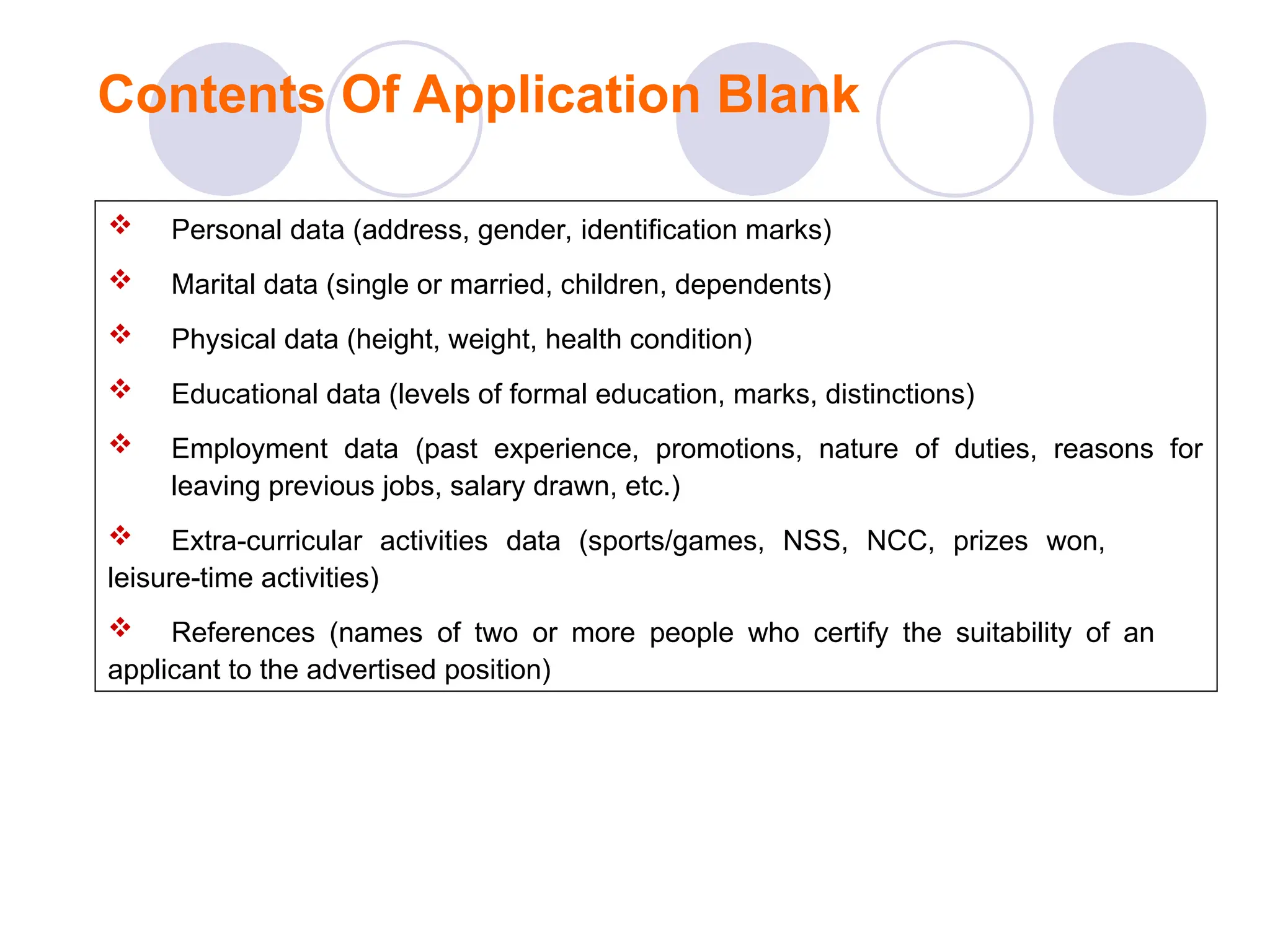
Contents Of Application Blank
 Personal data (address, gender, identification marks)
 Marital data (single or married, children, dependents)
 Physical data (height, weight, health condition)
 Educational data (levels of formal education, marks, distinctions)
 Employment data (past experience, promotions, nature of duties, reasons for
leaving previous jobs, salary drawn, etc.)
 Extra-curricular activities data (sports/games, NSS, NCC, prizes won,
leisure-time activities)
 References (names of two or more people who certify the suitability of an
applicant to the advertised position)
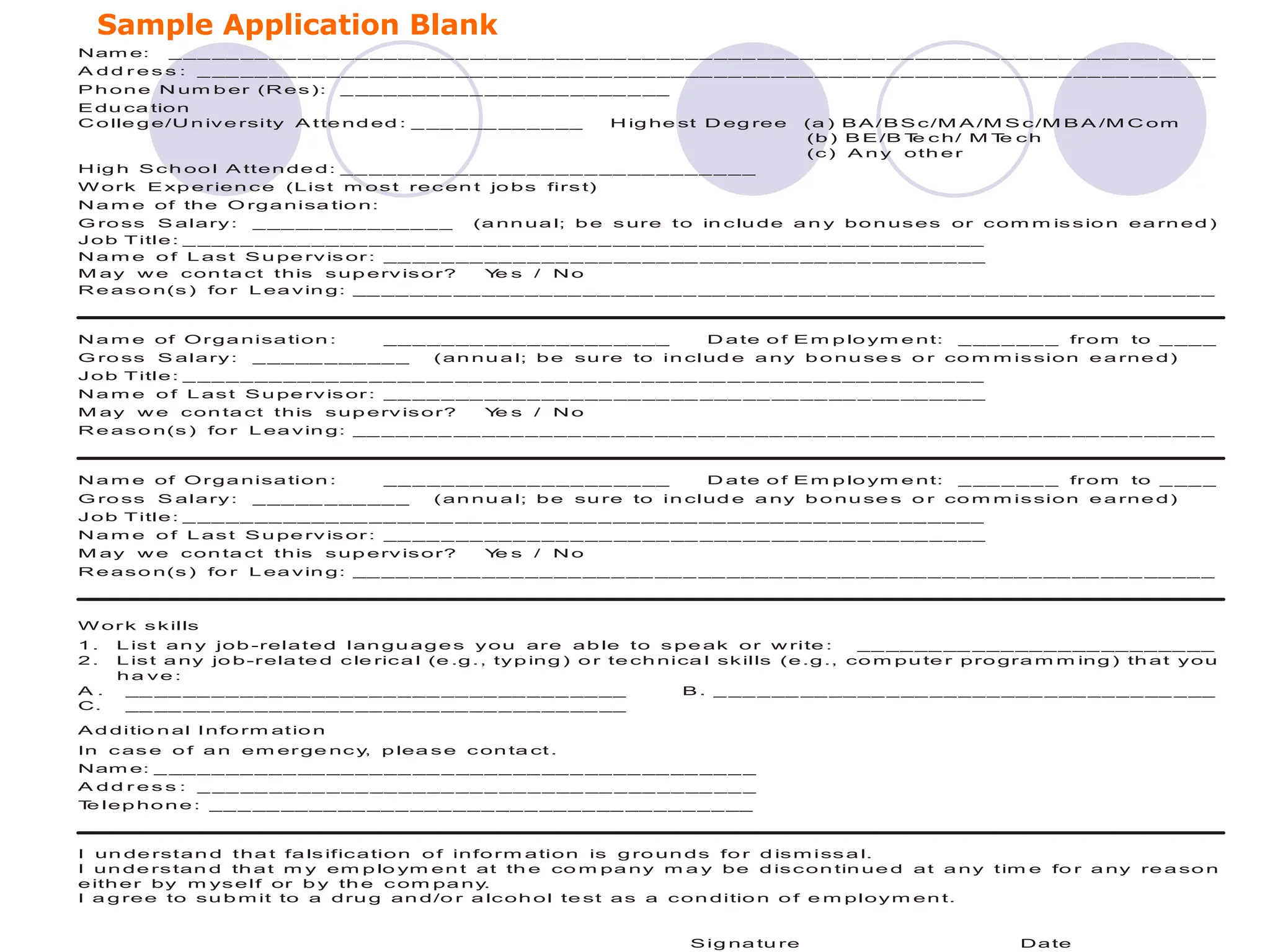
Sample Application Blank
Nam e: _ __ __ __ __ _ __ __ __ __ __ _ __ __ __ __ _ __ __ __ __ __ _ __ __ __ __ _ __ __ __ __ __ _ __ __ __ __ _ __ _
A d d r e s s : _ __ __ __ __ _ __ __ __ __ __ _ __ __ __ __ _ __ __ __ __ __ _ __ __ __ __ _ __ __ __ __ __ _ __ __ __ __ _ _
P h on e N um b er (R es): _ __ __ __ __ _ __ __ __ __ __ _ __
E du ca tion
C o lle g e/U n ive rsity A tte nd ed : _ __ _ __ __ __ __ H ig he st D eg ree (a ) B A /B S c/M A /M S c/M B A /M C om
(b ) B E /B T
e c h/ M T
e ch
(c) A n y oth e r
H ig h S ch oo l A tten de d: __ __ __ _ __ __ __ __ __ _ __ __ __ __ _ __
W ork E xp erien ce (List m ost rec en t jo bs firs t)
N a m e of the O rga nisa tio n:
G ro ss S alary: _ __ __ _ _ _ __ __ _ _ (a nn ua l; b e s ure to in clu de a n y bo n uses or com m is sio n ea rn ed )
Job Title: _ __ __ __ __ __ __ __ __ __ __ __ __ __ __ _ __ __ __ __ __ __ __ __ __ __ __ __ __
N a m e o f L ast S u pe rv is or : __ __ _ __ __ __ __ _ __ __ __ __ _ __ __ __ __ __ _ __ __ __ __
M ay w e con ta ct this sup erv isor? Y
e s / N o
R e aso n(s ) fo r L ea vin g: __ __ __ _ __ __ _ __ __ __ _ __ __ _ __ __ __ _ __ __ _ __ __ __ _ __ __ _ __ __ __ _ __ __ _
N a m e of Orga nisa tion : __ _ __ __ __ __ _ __ __ __ __ D a te o f E m p lo ym e nt: _ __ _ __ _ from to _ __ _
G ro ss S alary: _ __ __ _ _ _ __ _ (an nu a l; b e su re to in clud e a ny b o nu se s o r co m m ission e a rne d)
Job Title: _ __ __ __ __ __ __ __ __ __ __ __ __ __ __ _ __ __ __ __ __ __ __ __ __ __ __ __ __
N a m e o f L ast S u pe rv is or : __ __ _ __ __ __ __ _ __ __ __ __ _ __ __ __ __ __ _ __ __ __ __
M ay w e con ta ct this sup erv isor? Y
e s / N o
R e aso n(s ) fo r L ea vin g: __ __ __ _ __ __ _ __ __ __ _ __ __ _ __ __ __ _ __ __ _ __ __ __ _ __ __ _ __ __ __ _ __ __ _
N a m e of Orga nisa tion : __ _ __ __ __ __ _ __ __ __ __ D a te o f E m p lo ym e nt: _ __ _ __ _ from to _ __ _
G ro ss S alary: _ __ __ _ _ _ __ _ (an nu a l; b e su re to in clud e a ny b o nu se s o r co m m ission e a rne d)
Job Title: _ __ __ __ __ __ __ __ __ __ __ __ __ __ __ _ __ __ __ __ __ __ __ __ __ __ __ __ __
N a m e o f L ast S u pe rv is or : __ __ _ __ __ __ __ _ __ __ __ __ _ __ __ __ __ __ _ __ __ __ __
M ay w e con ta ct this sup erv isor? Y
e s / N o
R e aso n(s ) fo r L ea vin g: __ __ __ _ __ __ _ __ __ __ _ __ __ _ __ __ __ _ __ __ _ __ __ __ _ __ __ _ __ __ __ _ __ __ _
W or k skills
1 . L ist an y job -related lan gu ag e s you are ab le to s pe ak or w rite : __ __ __ __ _ _ _ __ __ __ __ __ __ __
2 . L ist a ny jo b-rela te d c le rica l (e .g., typ ing ) o r te ch nica l skills (e.g ., co m pu te r pro gra m m ing ) th at you
h a ve :
A . __ __ __ __ __ _ __ __ __ __ _ __ __ __ __ __ _ __ __ B . _ __ _ __ __ __ __ _ __ __ __ _ _ __ _ __ __ __ __ _ __
C. __ __ __ _ __ __ __ __ _ __ __ __ __ __ _ __ __ __ __
A d ditio n al Info rm atio n
In c as e o f a n em er ge nc y
, p lea se c on ta ct .
Nam e: _ __ __ __ _ _ _ __ __ __ __ __ _ __ __ __ __ _ __ __ __ __ __ _ _
A d d r e s s : _ __ __ __ __ _ __ __ __ __ __ _ __ __ __ __ _ __ __ __ __ _
T
e lep ho n e : __ _ __ __ __ __ __ _ __ _ _ __ __ _ __ __ __ __ __ _ __ __
I un de rstan d tha t fa ls ification o f info rm ation is g ro un ds fo r d ism iss a l.
I un de rstan d th at m y em p lo ym en t at th e co m pa ny m a y be d iscon tin ue d at a ny tim e fo r a ny re a so n
e ith er by m yself or b y th e c om pa ny
.
I a g ree to su b m it to a dru g an d/o r a lcoh ol te st as a con ditio n o f e m ploym en t.
S ig na tu re Date
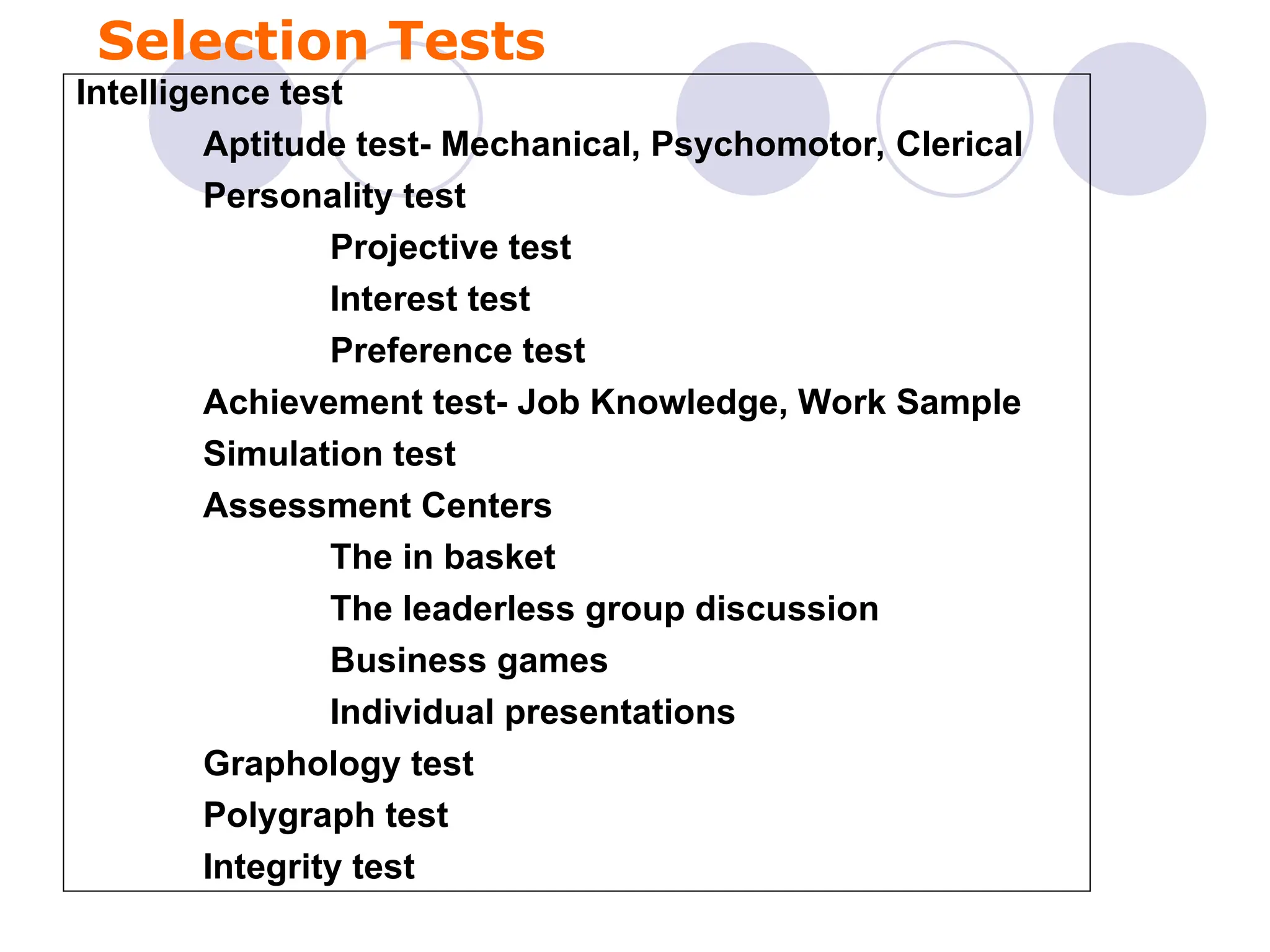
Selection Tests
Intelligence test
Aptitude test- Mechanical, Psychomotor, Clerical
Personality test
Projective test
Interest test
Preference test
Achievement test- Job Knowledge, Work Sample
Simulation test
Assessment Centers
The in basket
The leaderless group discussion
Business games
Individual presentations
Graphology test
Polygraph test
Integrity test
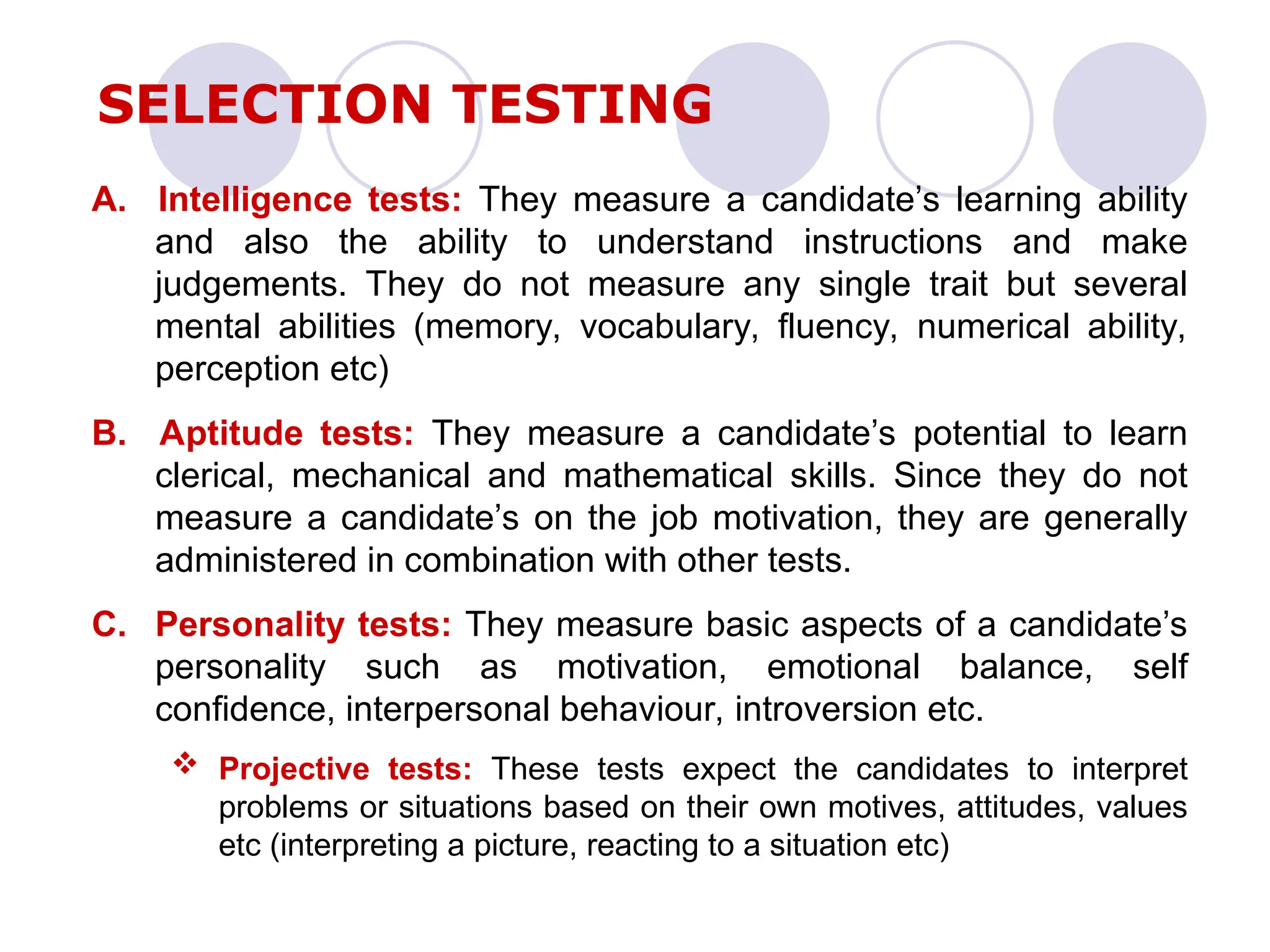
A. Intelligence tests: They measure a candidate’s learning ability
and also the ability to understand instructions and make
judgements. They do not measure any single trait but several
mental abilities (memory, vocabulary, fluency, numerical ability,
perception etc)
B. Aptitude tests: They measure a candidate’s potential to learn
clerical, mechanical and mathematical skills. Since they do not
measure a candidate’s on the job motivation, they are generally
administered in combination with other tests.
C. Personality tests: They measure basic aspects of a candidate’s
personality such as motivation, emotional balance, self
confidence, interpersonal behaviour, introversion etc.
 Projective tests: These tests expect the candidates to interpret
problems or situations based on their own motives, attitudes, values
etc (interpreting a picture, reacting to a situation etc)
SELECTION TESTING
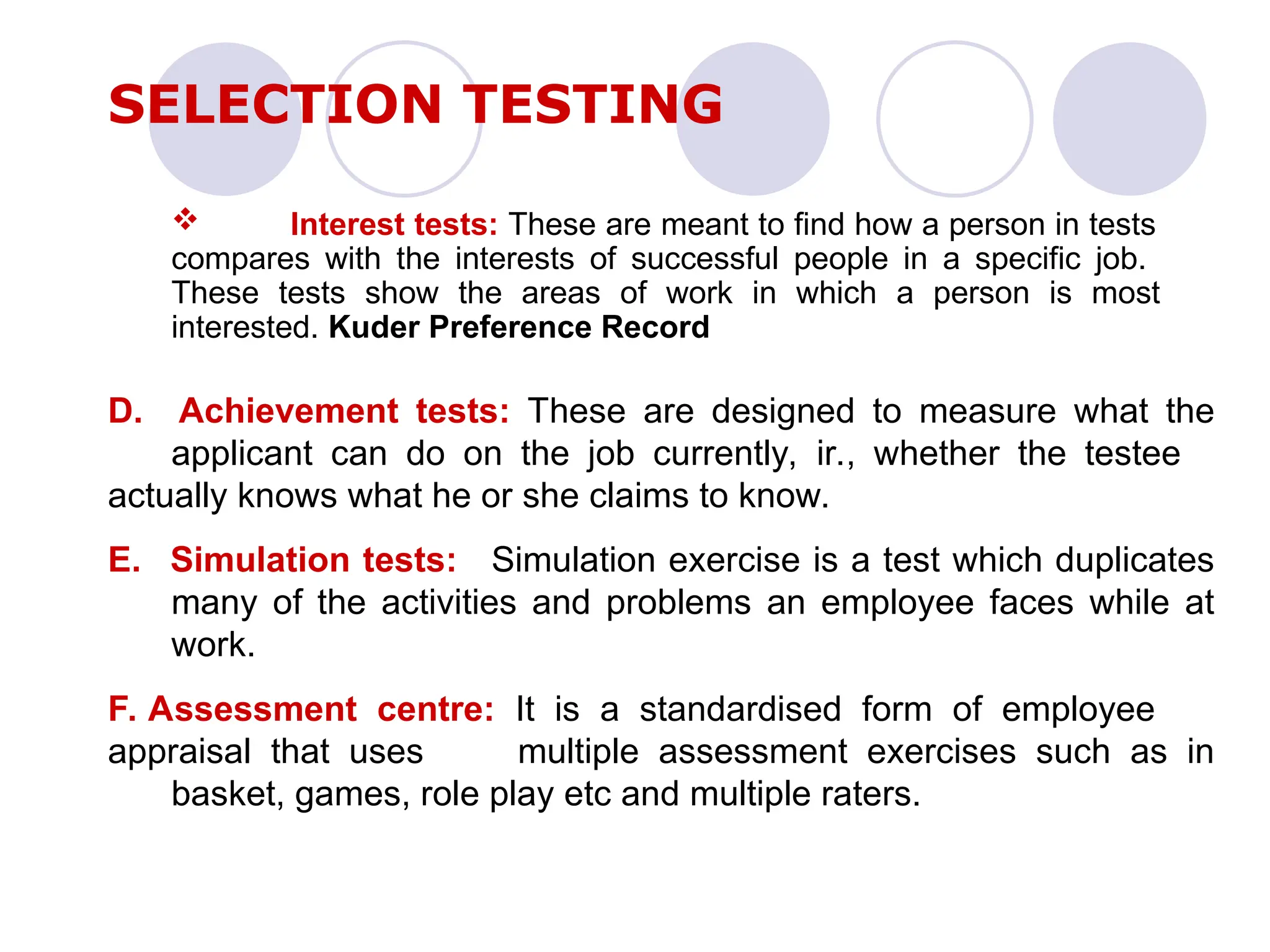
 Interest tests: These are meant to find how a person in tests
compares with the interests of successful people in a specific job.
These tests show the areas of work in which a person is most
interested. Kuder Preference Record
SELECTION TESTING
D. Achievement tests: These are designed to measure what the
applicant can do on the job currently, ir., whether the testee
actually knows what he or she claims to know.
E. Simulation tests: Simulation exercise is a test which duplicates
many of the activities and problems an employee faces while at
work.
F. Assessment centre: It is a standardised form of employee
appraisal that uses multiple assessment exercises such as in
basket, games, role play etc and multiple raters.
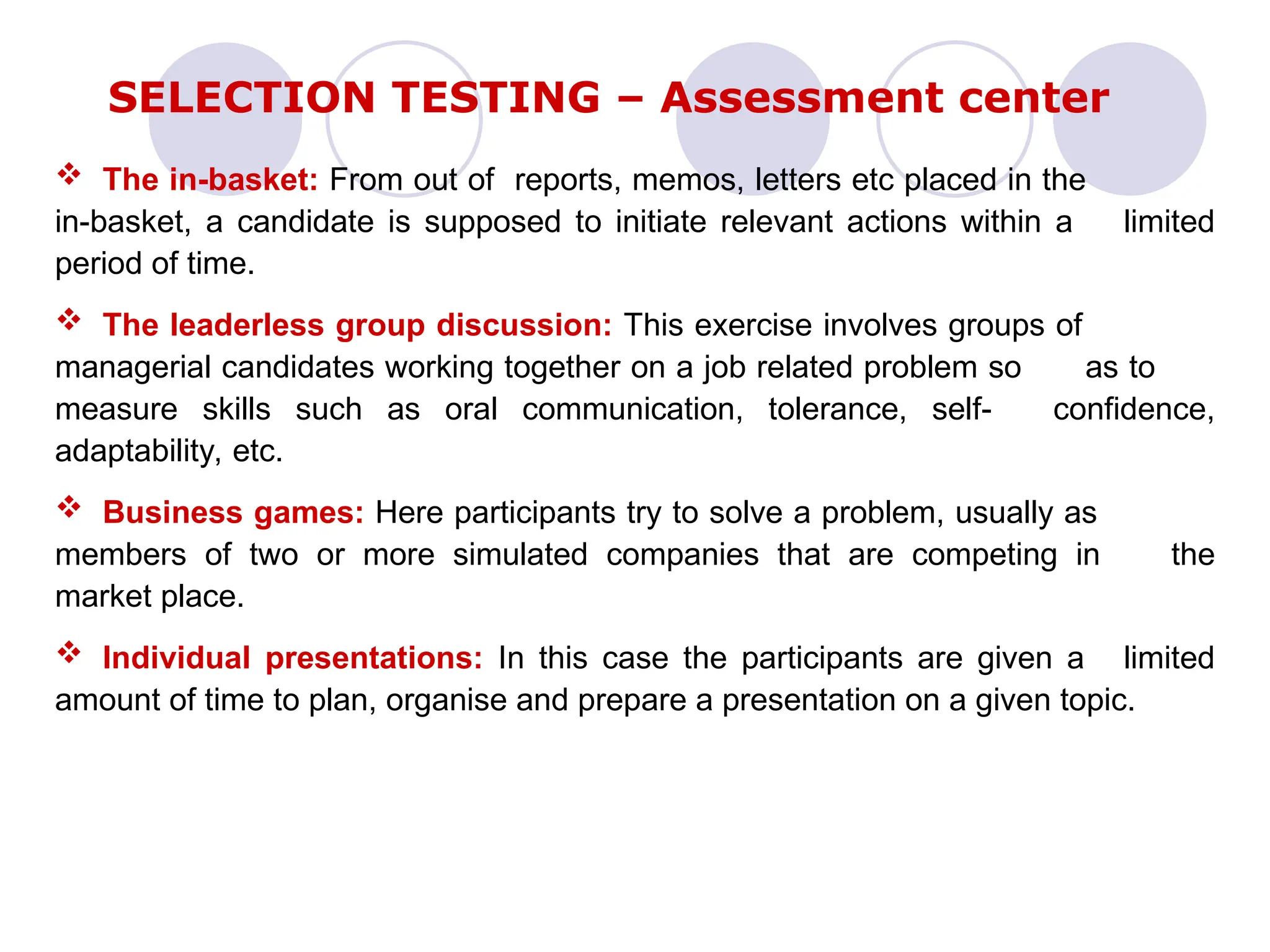
 The in-basket: From out of reports, memos, letters etc placed in the
in-basket, a candidate is supposed to initiate relevant actions within a limited
period of time.
 The leaderless group discussion: This exercise involves groups of
managerial candidates working together on a job related problem so as to
measure skills such as oral communication, tolerance, self- confidence,
adaptability, etc.
 Business games: Here participants try to solve a problem, usually as
members of two or more simulated companies that are competing in the
market place.
 Individual presentations: In this case the participants are given a limited
amount of time to plan, organise and prepare a presentation on a given topic.
SELECTION TESTING – Assessment center
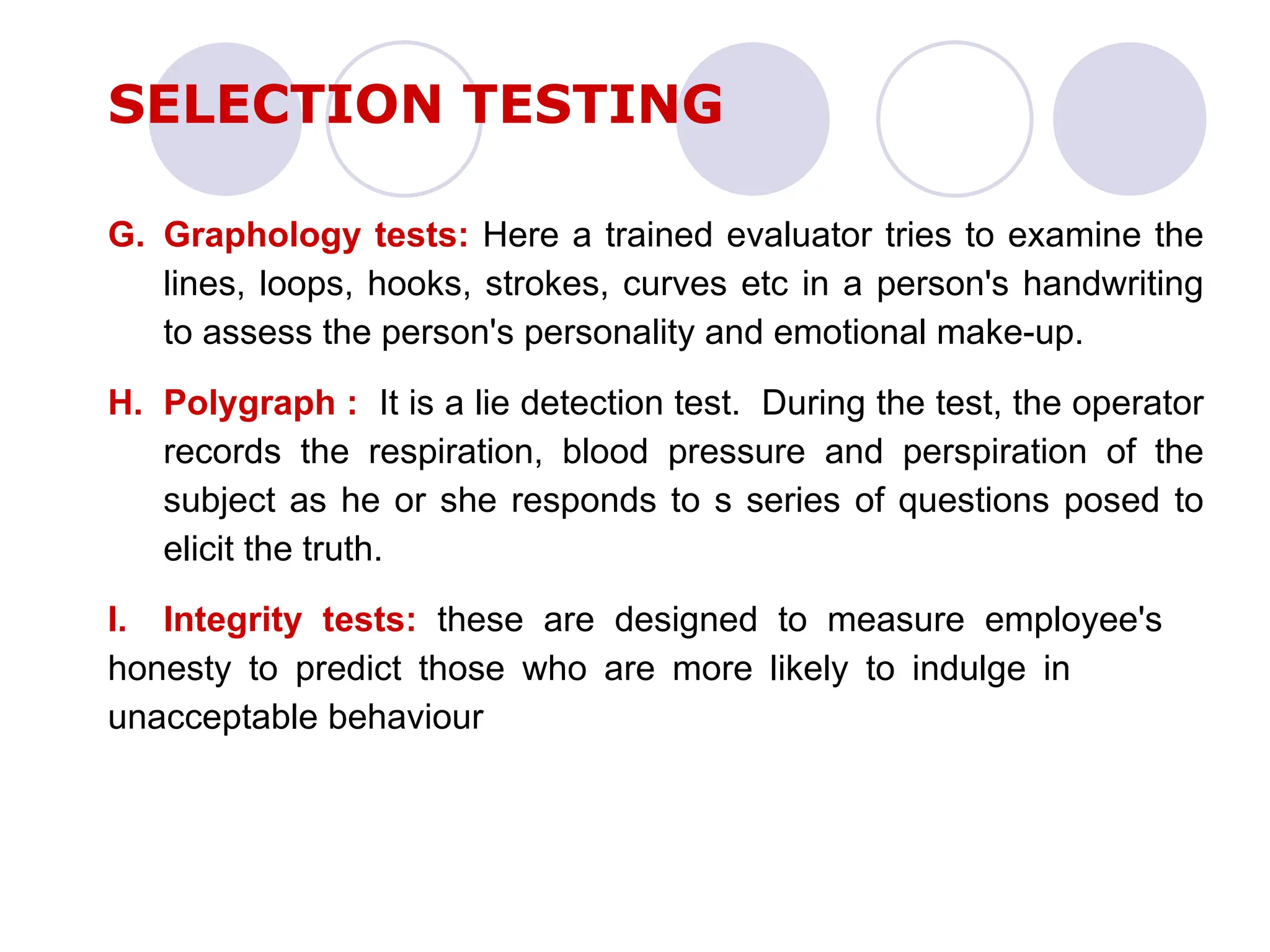
G. Graphology tests: Here a trained evaluator tries to examine the
lines, loops, hooks, strokes, curves etc in a person's handwriting
to assess the person's personality and emotional make-up.
H. Polygraph : It is a lie detection test. During the test, the operator
records the respiration, blood pressure and perspiration of the
subject as he or she responds to s series of questions posed to
elicit the truth.
I. Integrity tests: these are designed to measure employee's
honesty to predict those who are more likely to indulge in
unacceptable behaviour
SELECTION TESTING
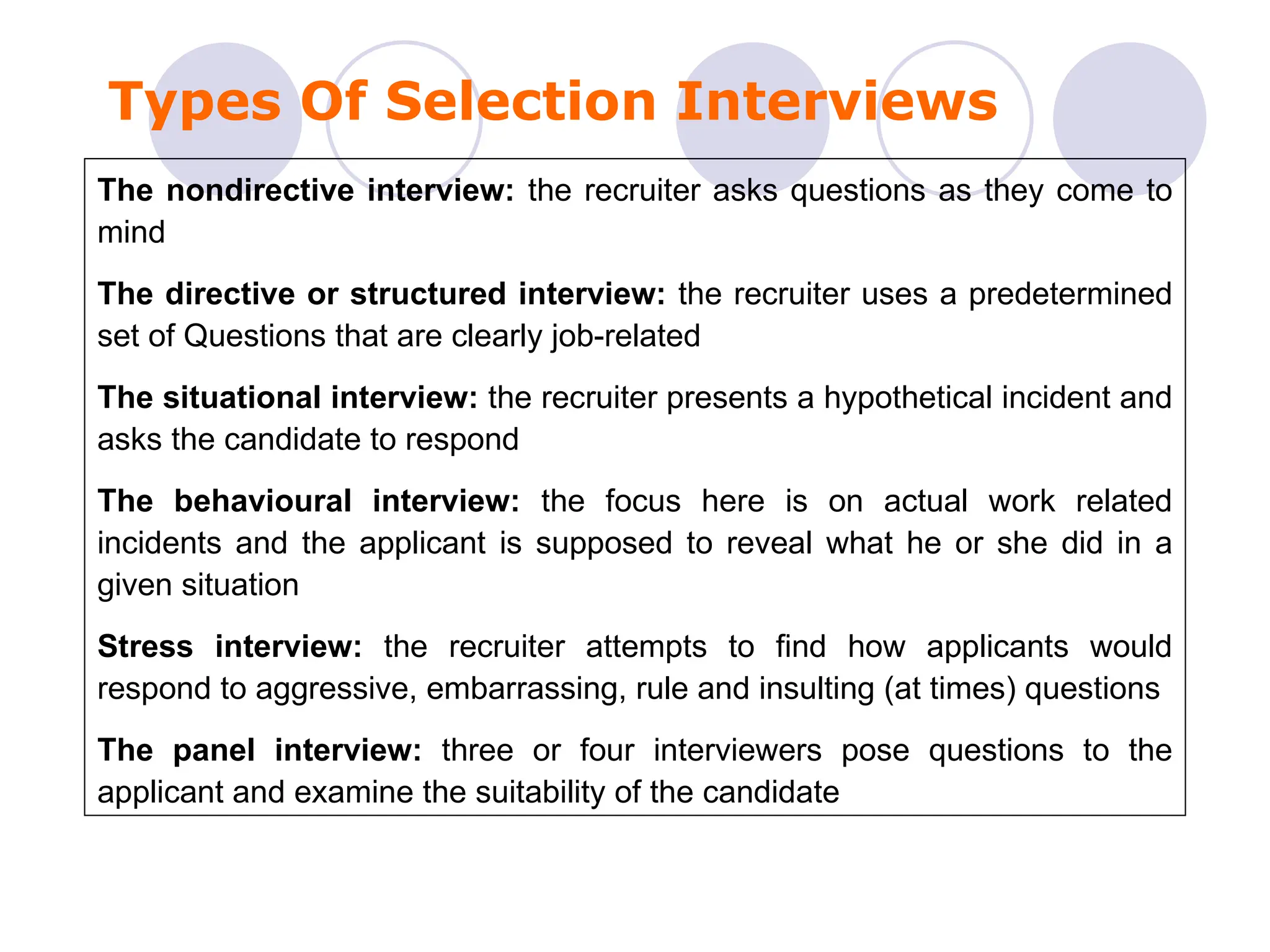
Types Of Selection Interviews
The nondirective interview: the recruiter asks questions as they come to
mind
The directive or structured interview: the recruiter uses a predetermined
set of Questions that are clearly job-related
The situational interview: the recruiter presents a hypothetical incident and
asks the candidate to respond
The behavioural interview: the focus here is on actual work related
incidents and the applicant is supposed to reveal what he or she did in a
given situation
Stress interview: the recruiter attempts to find how applicants would
respond to aggressive, embarrassing, rule and insulting (at times) questions
The panel interview: three or four interviewers pose questions to the
applicant and examine the suitability of the candidate
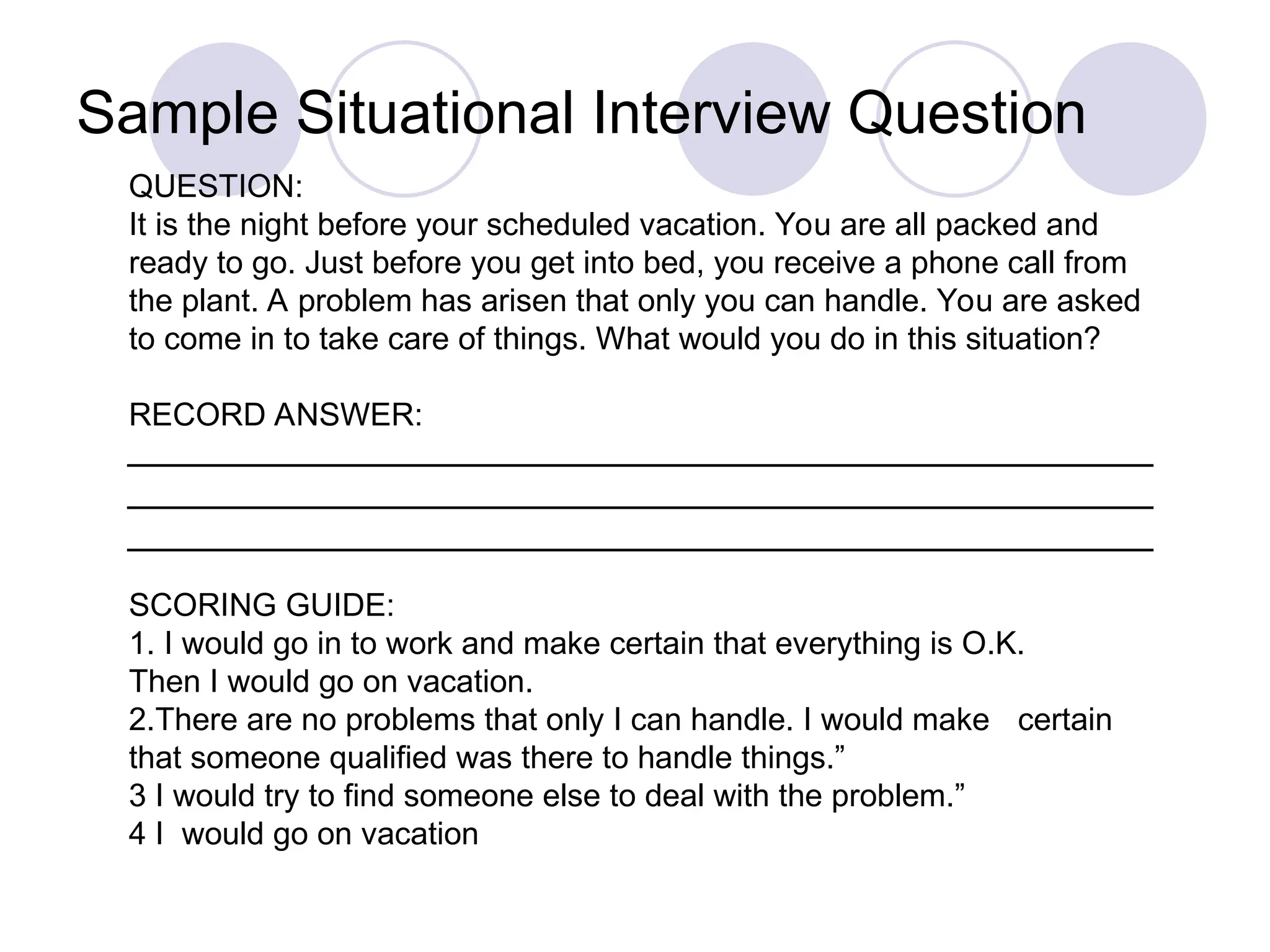
QUESTION:
It is the night before your scheduled vacation. You are all packed and
ready to go. Just before you get into bed, you receive a phone call from
the plant. A problem has arisen that only you can handle. You are asked
to come in to take care of things. What would you do in this situation?
RECORD ANSWER:
SCORING GUIDE:
1. I would go in to work and make certain that everything is O.K.
Then I would go on vacation.
2.There are no problems that only I can handle. I would make certain
that someone qualified was there to handle things.”
3 I would try to find someone else to deal with the problem.”
4 I would go on vacation
Sample Situational Interview Question
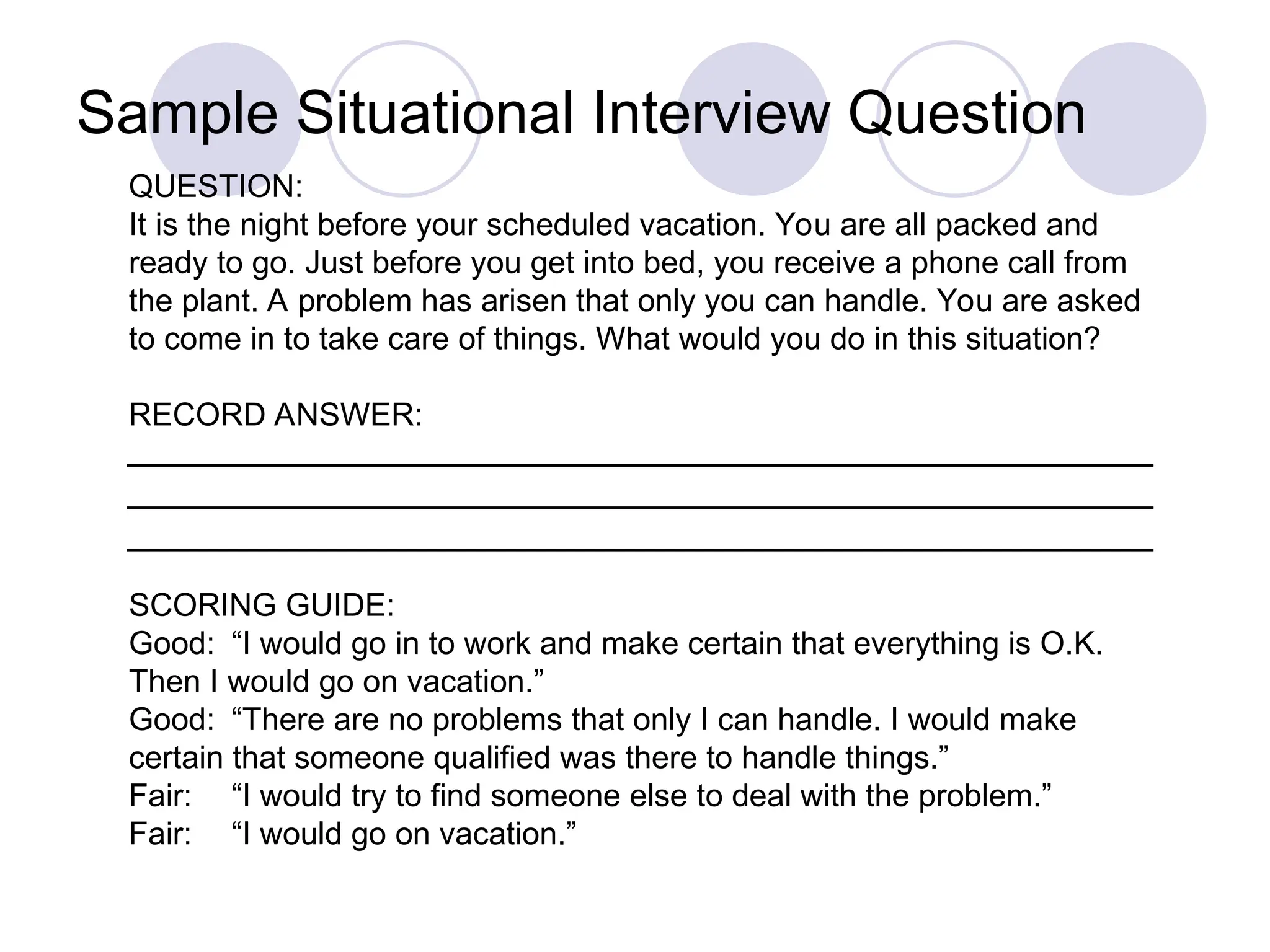
QUESTION:
It is the night before your scheduled vacation. You are all packed and
ready to go. Just before you get into bed, you receive a phone call from
the plant. A problem has arisen that only you can handle. You are asked
to come in to take care of things. What would you do in this situation?
RECORD ANSWER:
SCORING GUIDE:
Good: “I would go in to work and make certain that everything is O.K.
Then I would go on vacation.”
Good: “There are no problems that only I can handle. I would make
certain that someone qualified was there to handle things.”
Fair: “I would try to find someone else to deal with the problem.”
Fair: “I would go on vacation.”
Sample Situational Interview Question
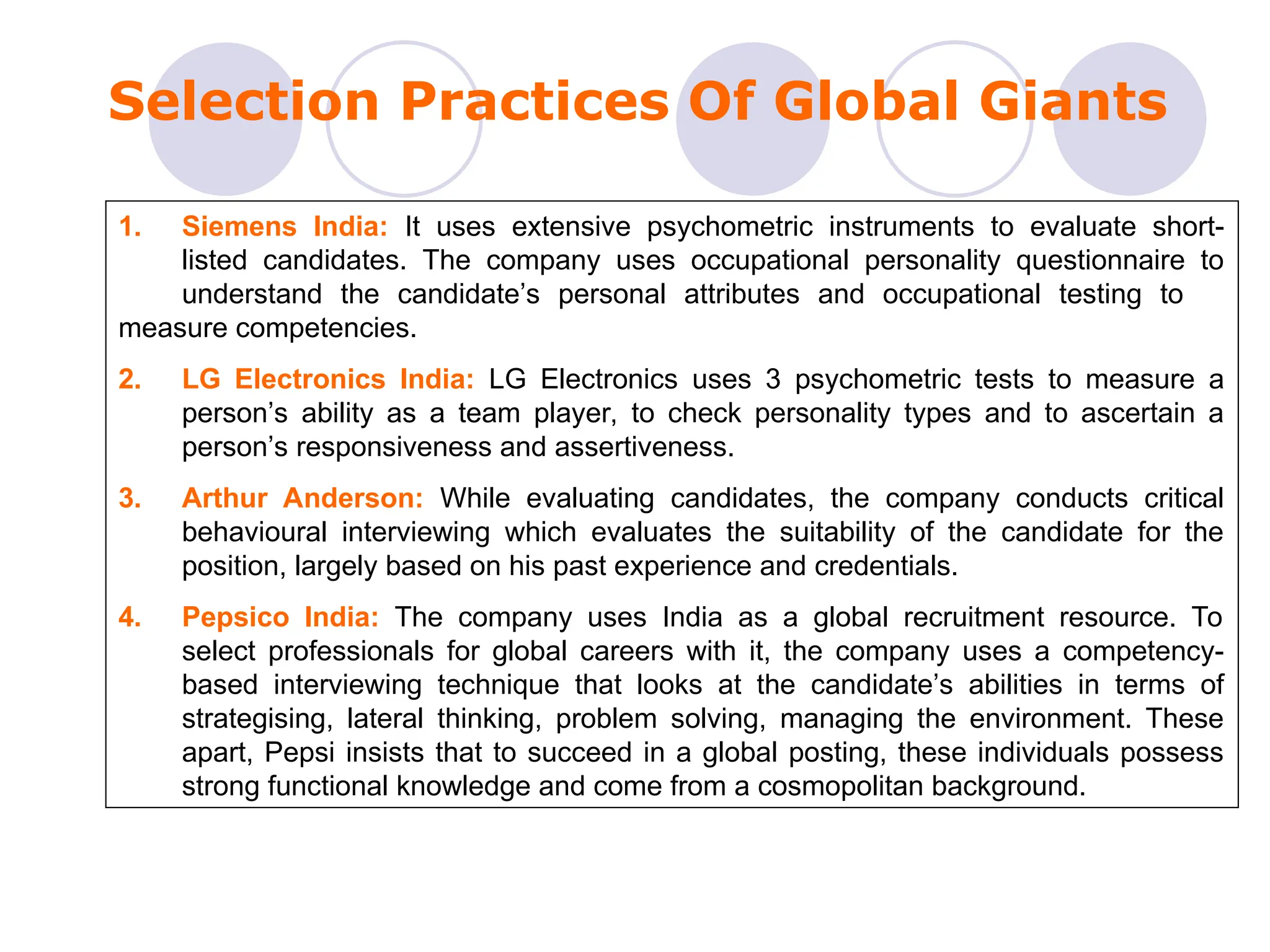
Selection Practices Of Global Giants
1. Siemens India: It uses extensive psychometric instruments to evaluate short-
listed candidates. The company uses occupational personality questionnaire to
understand the candidate’s personal attributes and occupational testing to
measure competencies.
2. LG Electronics India: LG Electronics uses 3 psychometric tests to measure a
person’s ability as a team player, to check personality types and to ascertain a
person’s responsiveness and assertiveness.
3. Arthur Anderson: While evaluating candidates, the company conducts critical
behavioural interviewing which evaluates the suitability of the candidate for the
position, largely based on his past experience and credentials.
4. Pepsico India: The company uses India as a global recruitment resource. To
select professionals for global careers with it, the company uses a competency-
based interviewing technique that looks at the candidate’s abilities in terms of
strategising, lateral thinking, problem solving, managing the environment. These
apart, Pepsi insists that to succeed in a global posting, these individuals possess
strong functional knowledge and come from a cosmopolitan background.
PLACEMENT
Placement is a process of assigning a specific job to
each of the selected candidates. It involves assigning a
specific rank and responsibility to an individual. It implies
matching the requirements of a job with the qualifications
of the candidate.
Significance of Placement
Improves employee morale.
Helps in reducing employee turnover.
Decreases absenteeism.
Reduces accident rates.
Avoids misfit between the candidate and the job.
Helps the candidate to work as per the predetermined
objectives of the organization.
INDUCTION
Once an employee is selected and placed on an
appropriate job, the process of familiarizing him with the
job and the organization is known as induction.
Induction is the process of receiving and welcoming an
employee when he first joins the company and giving
him basic information he needs to settle down quickly
and happily and stars work.
Objectives of Induction
 To help overcome nervousness in a new environment.
* To provide necessary information such as location of a café, rest period
etc.
* To build new employee confidence in the organization.
* It helps in reducing labor turnover and absenteeism.
* It reduces confusion and develops healthy relations in the organization.
* To ensure proper impressions and positive attitudes are developed.

* To develop a sense of belonging and loyalty to the organization.
Advantages of Formal Induction
 Helps to build up a two-way channel of communication between
management and workers.
* Proper induction facilitates informal relations and team work among
employees.
* Effective induction helps to integrate the new employee into the
organization and to develop a sense of belonging.
* Proper induction reduces employee grievances, absenteeism and labor
turnover.
* Induction is helpful in supplying information concerning the organization,
the job and employee welfare facilities.
Contents of Induction Programme
 Brief history and operations of the company.
* The company’s organization structure.
* Policies and procedure of the company.
* Products and services of the company.
* Location of department and employee facilities.
* Safety measures.
* Grievances procedures.
* Benefits and services of employee.
* Standing orders and disciplinary procedures.
* Opportunities for training, promotions, transfer etc.
* Suggestion schemes.
* Rules and regulations.

R&S, P&I.ppt Human Resource Management Presentation

  • 1.
  • 2.
    Is the processof finding and attracting capable applicants for employment. The process begins when recruits are sought and ends when their applications are submitted. The result is pool of applicants from which new employees are selected. Recruitment - Definition
  • 3.
    Reasons to RecruitStaff Business is expanding due to: Increasing sales of existing products Developing new products Entering new markets Existing employees leave: To work with competitors or other local employers Due to factors such as retirement, sick leave, maternity leave Business needs employees with new skills Business is relocating – and not all of existing workforce want to move to new location
  • 4.
    Factors Affecting Recruitment Internalfactors Recruitment policy HR planning Size of the firm Cost of recruitment Growth and expansion Employer Brand External factors Supply and demand Labour market Image/goodwill Political-social-legal environment Unemployment rates Competitors
  • 5.
    Changes in EmploymentPatterns Affecting Recruitment The way we work is changing rapidly:  Increase in part-time working  Increases in numbers of single-parent families  More women seeking work  Ageing population  Greater emphasis on flexible working hours  Technology allows employees to communicate more effectively whilst apart (“teleworking”)  People rarely stay in the same job for life Businesses need to understand and respond to these changes if they are to recruit staff of the right standard – and keep them!
  • 6.
    Sources of Recruitment Internalrecruitment External recruitment
  • 7.
    Internal Sources Present Employees(Permanent/Temporary/Part-time) Retrenched/Retired Employees Dependants of Present/Deceased/Disabled Employees Employee Referrals- Most effective source in recent times
  • 8.
    Recruiting within theOrganization Benefits of a promotion-from-within policy: Capitalizes on past investments (recruiting, selecting, training, and developing) in current employees. Rewards past performance and encourages continued commitment to the organization. Signals to employees that similar efforts by them will lead to promotion. Fosters advancement of members of protected classes within an organization.
  • 9.
    Recruiting within theOrganization Limitations of a promotion-from-within policy: Current employees may lack the knowledge, experience or skills needed for placement in the vacant/new position. The hazards of inbreeding of ideas and attitudes (“employee cloning”) increase when no outsiders are considered for hiring. The organization has exhausted its supply of viable internal candidates and must seek additional employees in the external job market.
  • 10.
    Internal Methods ofLocating Qualified Job Candidates Human Resources Information Systems (HRIS) Database systems containing the records and qualifications of each employee that can be accessed to identify and screen candidates for an internal job opening. Job Posting Posting vacancy notices and maintaining lists of employees looking for upgraded positions.
  • 11.
    Outside Sources ofRecruitment Advertisements Unsolicited applications and resumes Educational institutions/ Campus Recruitment Professional organizations Executive search firms Private Agencies/Consultants Public employment exchanges Labor unions Temporary Help agencies Walk-In Consult-In Head Hunting Body Shopping Business Alliances Internet/E-/recruitment
  • 12.
    Effectiveness of RecruitmentSources Source: David E. Terpstra, “The Search for Effective Methods.” Reprinted from HRFocus, May 1996. © 1996 American Management Association International. Reprinted by permission of American Management Association International, New York, NY. All rights reserved. http://www.amanet.org/.
  • 13.
    Matching People andJobs Selection The process of choosing individuals who have relevant qualifications to fill existing or projected job openings. Selection Considerations Person-job fit: job analysis identifies required individual competencies (KSAOs) for job success. Person-organization fit: the degree to which individuals are matched to the culture and values of the organization.
  • 14.
    The Goal of Selection: Maximize “Hits” MISS MISS Inaccurate Inaccurate prediction prediction (Personwould have (Person would have succeeded on the succeeded on the job) job) HIT HIT Accurate Accurate prediction prediction (Person succeeds (Person succeeds on the job) on the job) HIT HIT Accurate Accurate prediction prediction (Person would not (Person would not have succeeded on have succeeded on the job) the job) MISS MISS Inaccurate Inaccurate prediction prediction (Person fails on the (Person fails on the job) job) Predicted Success Job Performance Low Low High High
  • 16.
    Steps in the SelectionProcess Note: Steps may vary. An applicant may be rejected after any step in the process. Completion of application Initial interview in HR department Employment testing (aptitude, achievement) Background investigation Preliminary selection in HR department Supervisor/team interview Medical exam/drug test Hiring decision Reception
  • 17.
    The Process The Processof Selection  Reception  Screening Interview  Application blank  Selection Tests  Selection Interview  Medical Examination  Reference Checks  Hiring Decision Selection is usually a series of hurdles or steps. Each one must be successfully cleared before the applicant proceeds to the next
  • 18.
     Reception A warm,friendly and courteous reception is extended to candidates with a view to create a favourable impression. Employment possibilities are also communicated honestly and clearly  Screening interview The HR department tries to screen out the obvious misfits through this courtesy interview. A prescribed application form is given to candidates who are found to be suitable.  Application blank It is a printed form completed by job aspirants detailing their educational background, previous work history and certain personal data. The Process of Selection
  • 19.
    Contents Of ApplicationBlank  Personal data (address, gender, identification marks)  Marital data (single or married, children, dependents)  Physical data (height, weight, health condition)  Educational data (levels of formal education, marks, distinctions)  Employment data (past experience, promotions, nature of duties, reasons for leaving previous jobs, salary drawn, etc.)  Extra-curricular activities data (sports/games, NSS, NCC, prizes won, leisure-time activities)  References (names of two or more people who certify the suitability of an applicant to the advertised position)
  • 20.
    Sample Application Blank Name: _ __ __ __ __ _ __ __ __ __ __ _ __ __ __ __ _ __ __ __ __ __ _ __ __ __ __ _ __ __ __ __ __ _ __ __ __ __ _ __ _ A d d r e s s : _ __ __ __ __ _ __ __ __ __ __ _ __ __ __ __ _ __ __ __ __ __ _ __ __ __ __ _ __ __ __ __ __ _ __ __ __ __ _ _ P h on e N um b er (R es): _ __ __ __ __ _ __ __ __ __ __ _ __ E du ca tion C o lle g e/U n ive rsity A tte nd ed : _ __ _ __ __ __ __ H ig he st D eg ree (a ) B A /B S c/M A /M S c/M B A /M C om (b ) B E /B T e c h/ M T e ch (c) A n y oth e r H ig h S ch oo l A tten de d: __ __ __ _ __ __ __ __ __ _ __ __ __ __ _ __ W ork E xp erien ce (List m ost rec en t jo bs firs t) N a m e of the O rga nisa tio n: G ro ss S alary: _ __ __ _ _ _ __ __ _ _ (a nn ua l; b e s ure to in clu de a n y bo n uses or com m is sio n ea rn ed ) Job Title: _ __ __ __ __ __ __ __ __ __ __ __ __ __ __ _ __ __ __ __ __ __ __ __ __ __ __ __ __ N a m e o f L ast S u pe rv is or : __ __ _ __ __ __ __ _ __ __ __ __ _ __ __ __ __ __ _ __ __ __ __ M ay w e con ta ct this sup erv isor? Y e s / N o R e aso n(s ) fo r L ea vin g: __ __ __ _ __ __ _ __ __ __ _ __ __ _ __ __ __ _ __ __ _ __ __ __ _ __ __ _ __ __ __ _ __ __ _ N a m e of Orga nisa tion : __ _ __ __ __ __ _ __ __ __ __ D a te o f E m p lo ym e nt: _ __ _ __ _ from to _ __ _ G ro ss S alary: _ __ __ _ _ _ __ _ (an nu a l; b e su re to in clud e a ny b o nu se s o r co m m ission e a rne d) Job Title: _ __ __ __ __ __ __ __ __ __ __ __ __ __ __ _ __ __ __ __ __ __ __ __ __ __ __ __ __ N a m e o f L ast S u pe rv is or : __ __ _ __ __ __ __ _ __ __ __ __ _ __ __ __ __ __ _ __ __ __ __ M ay w e con ta ct this sup erv isor? Y e s / N o R e aso n(s ) fo r L ea vin g: __ __ __ _ __ __ _ __ __ __ _ __ __ _ __ __ __ _ __ __ _ __ __ __ _ __ __ _ __ __ __ _ __ __ _ N a m e of Orga nisa tion : __ _ __ __ __ __ _ __ __ __ __ D a te o f E m p lo ym e nt: _ __ _ __ _ from to _ __ _ G ro ss S alary: _ __ __ _ _ _ __ _ (an nu a l; b e su re to in clud e a ny b o nu se s o r co m m ission e a rne d) Job Title: _ __ __ __ __ __ __ __ __ __ __ __ __ __ __ _ __ __ __ __ __ __ __ __ __ __ __ __ __ N a m e o f L ast S u pe rv is or : __ __ _ __ __ __ __ _ __ __ __ __ _ __ __ __ __ __ _ __ __ __ __ M ay w e con ta ct this sup erv isor? Y e s / N o R e aso n(s ) fo r L ea vin g: __ __ __ _ __ __ _ __ __ __ _ __ __ _ __ __ __ _ __ __ _ __ __ __ _ __ __ _ __ __ __ _ __ __ _ W or k skills 1 . L ist an y job -related lan gu ag e s you are ab le to s pe ak or w rite : __ __ __ __ _ _ _ __ __ __ __ __ __ __ 2 . L ist a ny jo b-rela te d c le rica l (e .g., typ ing ) o r te ch nica l skills (e.g ., co m pu te r pro gra m m ing ) th at you h a ve : A . __ __ __ __ __ _ __ __ __ __ _ __ __ __ __ __ _ __ __ B . _ __ _ __ __ __ __ _ __ __ __ _ _ __ _ __ __ __ __ _ __ C. __ __ __ _ __ __ __ __ _ __ __ __ __ __ _ __ __ __ __ A d ditio n al Info rm atio n In c as e o f a n em er ge nc y , p lea se c on ta ct . Nam e: _ __ __ __ _ _ _ __ __ __ __ __ _ __ __ __ __ _ __ __ __ __ __ _ _ A d d r e s s : _ __ __ __ __ _ __ __ __ __ __ _ __ __ __ __ _ __ __ __ __ _ T e lep ho n e : __ _ __ __ __ __ __ _ __ _ _ __ __ _ __ __ __ __ __ _ __ __ I un de rstan d tha t fa ls ification o f info rm ation is g ro un ds fo r d ism iss a l. I un de rstan d th at m y em p lo ym en t at th e co m pa ny m a y be d iscon tin ue d at a ny tim e fo r a ny re a so n e ith er by m yself or b y th e c om pa ny . I a g ree to su b m it to a dru g an d/o r a lcoh ol te st as a con ditio n o f e m ploym en t. S ig na tu re Date
  • 21.
    Selection Tests Intelligence test Aptitudetest- Mechanical, Psychomotor, Clerical Personality test Projective test Interest test Preference test Achievement test- Job Knowledge, Work Sample Simulation test Assessment Centers The in basket The leaderless group discussion Business games Individual presentations Graphology test Polygraph test Integrity test
  • 22.
    A. Intelligence tests:They measure a candidate’s learning ability and also the ability to understand instructions and make judgements. They do not measure any single trait but several mental abilities (memory, vocabulary, fluency, numerical ability, perception etc) B. Aptitude tests: They measure a candidate’s potential to learn clerical, mechanical and mathematical skills. Since they do not measure a candidate’s on the job motivation, they are generally administered in combination with other tests. C. Personality tests: They measure basic aspects of a candidate’s personality such as motivation, emotional balance, self confidence, interpersonal behaviour, introversion etc.  Projective tests: These tests expect the candidates to interpret problems or situations based on their own motives, attitudes, values etc (interpreting a picture, reacting to a situation etc) SELECTION TESTING
  • 23.
     Interest tests:These are meant to find how a person in tests compares with the interests of successful people in a specific job. These tests show the areas of work in which a person is most interested. Kuder Preference Record SELECTION TESTING D. Achievement tests: These are designed to measure what the applicant can do on the job currently, ir., whether the testee actually knows what he or she claims to know. E. Simulation tests: Simulation exercise is a test which duplicates many of the activities and problems an employee faces while at work. F. Assessment centre: It is a standardised form of employee appraisal that uses multiple assessment exercises such as in basket, games, role play etc and multiple raters.
  • 24.
     The in-basket:From out of reports, memos, letters etc placed in the in-basket, a candidate is supposed to initiate relevant actions within a limited period of time.  The leaderless group discussion: This exercise involves groups of managerial candidates working together on a job related problem so as to measure skills such as oral communication, tolerance, self- confidence, adaptability, etc.  Business games: Here participants try to solve a problem, usually as members of two or more simulated companies that are competing in the market place.  Individual presentations: In this case the participants are given a limited amount of time to plan, organise and prepare a presentation on a given topic. SELECTION TESTING – Assessment center
  • 25.
    G. Graphology tests:Here a trained evaluator tries to examine the lines, loops, hooks, strokes, curves etc in a person's handwriting to assess the person's personality and emotional make-up. H. Polygraph : It is a lie detection test. During the test, the operator records the respiration, blood pressure and perspiration of the subject as he or she responds to s series of questions posed to elicit the truth. I. Integrity tests: these are designed to measure employee's honesty to predict those who are more likely to indulge in unacceptable behaviour SELECTION TESTING
  • 26.
    Types Of SelectionInterviews The nondirective interview: the recruiter asks questions as they come to mind The directive or structured interview: the recruiter uses a predetermined set of Questions that are clearly job-related The situational interview: the recruiter presents a hypothetical incident and asks the candidate to respond The behavioural interview: the focus here is on actual work related incidents and the applicant is supposed to reveal what he or she did in a given situation Stress interview: the recruiter attempts to find how applicants would respond to aggressive, embarrassing, rule and insulting (at times) questions The panel interview: three or four interviewers pose questions to the applicant and examine the suitability of the candidate
  • 27.
    QUESTION: It is thenight before your scheduled vacation. You are all packed and ready to go. Just before you get into bed, you receive a phone call from the plant. A problem has arisen that only you can handle. You are asked to come in to take care of things. What would you do in this situation? RECORD ANSWER: SCORING GUIDE: 1. I would go in to work and make certain that everything is O.K. Then I would go on vacation. 2.There are no problems that only I can handle. I would make certain that someone qualified was there to handle things.” 3 I would try to find someone else to deal with the problem.” 4 I would go on vacation Sample Situational Interview Question
  • 28.
    QUESTION: It is thenight before your scheduled vacation. You are all packed and ready to go. Just before you get into bed, you receive a phone call from the plant. A problem has arisen that only you can handle. You are asked to come in to take care of things. What would you do in this situation? RECORD ANSWER: SCORING GUIDE: Good: “I would go in to work and make certain that everything is O.K. Then I would go on vacation.” Good: “There are no problems that only I can handle. I would make certain that someone qualified was there to handle things.” Fair: “I would try to find someone else to deal with the problem.” Fair: “I would go on vacation.” Sample Situational Interview Question
  • 29.
    Selection Practices OfGlobal Giants 1. Siemens India: It uses extensive psychometric instruments to evaluate short- listed candidates. The company uses occupational personality questionnaire to understand the candidate’s personal attributes and occupational testing to measure competencies. 2. LG Electronics India: LG Electronics uses 3 psychometric tests to measure a person’s ability as a team player, to check personality types and to ascertain a person’s responsiveness and assertiveness. 3. Arthur Anderson: While evaluating candidates, the company conducts critical behavioural interviewing which evaluates the suitability of the candidate for the position, largely based on his past experience and credentials. 4. Pepsico India: The company uses India as a global recruitment resource. To select professionals for global careers with it, the company uses a competency- based interviewing technique that looks at the candidate’s abilities in terms of strategising, lateral thinking, problem solving, managing the environment. These apart, Pepsi insists that to succeed in a global posting, these individuals possess strong functional knowledge and come from a cosmopolitan background.
  • 30.
    PLACEMENT Placement is aprocess of assigning a specific job to each of the selected candidates. It involves assigning a specific rank and responsibility to an individual. It implies matching the requirements of a job with the qualifications of the candidate.
  • 31.
    Significance of Placement Improvesemployee morale. Helps in reducing employee turnover. Decreases absenteeism. Reduces accident rates. Avoids misfit between the candidate and the job. Helps the candidate to work as per the predetermined objectives of the organization.
  • 32.
    INDUCTION Once an employeeis selected and placed on an appropriate job, the process of familiarizing him with the job and the organization is known as induction. Induction is the process of receiving and welcoming an employee when he first joins the company and giving him basic information he needs to settle down quickly and happily and stars work.
  • 33.
    Objectives of Induction To help overcome nervousness in a new environment. * To provide necessary information such as location of a café, rest period etc. * To build new employee confidence in the organization. * It helps in reducing labor turnover and absenteeism. * It reduces confusion and develops healthy relations in the organization. * To ensure proper impressions and positive attitudes are developed.  * To develop a sense of belonging and loyalty to the organization.
  • 34.
    Advantages of FormalInduction  Helps to build up a two-way channel of communication between management and workers. * Proper induction facilitates informal relations and team work among employees. * Effective induction helps to integrate the new employee into the organization and to develop a sense of belonging. * Proper induction reduces employee grievances, absenteeism and labor turnover. * Induction is helpful in supplying information concerning the organization, the job and employee welfare facilities.
  • 35.
    Contents of InductionProgramme  Brief history and operations of the company. * The company’s organization structure. * Policies and procedure of the company. * Products and services of the company. * Location of department and employee facilities. * Safety measures. * Grievances procedures. * Benefits and services of employee. * Standing orders and disciplinary procedures. * Opportunities for training, promotions, transfer etc. * Suggestion schemes. * Rules and regulations.