Selection
Why careful selection is important
• Performance
• Cost
• Legal Obligations
Basic testing concepts
• Reliability – stability of measurement over
time
• Validity – measures what it is supposed to
measure
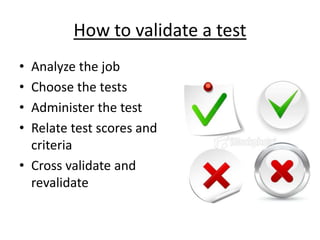
How to validate a test
• Analyze the job
• Choose the tests
• Administer the test
• Relate test scores and
criteria
• Cross validate and
revalidate
Testing program guidelines
• Use tests as supplements
• Validate the tests
• Monitor your
testing/selection program
• Keep accurate records
• Use a certified psychologist
• Manage test conditions
• Revalidate periodically
What tests do applicants like?
• Tests that are fair
• Good test practices
• Obviousness of the link of the test
to the job
• Fairness in selection
Types of tests
• Tests of cognitive Ability
Intelligence tests
Specific cognitive abilities
Types of tests
• Motor and physical abilities
Types of tests
• Achievement tests
Types of tests
• Work samples and simulations
Types of tests
• Personality tests
What do the tests measure?
The big five: extraversion,
emotional stability, agreeableness,
conscientiousness, openness to
experience
Do these tests predict
performance?
Types of tests
• Assessment centers –
The in basket
Leaderless group discussion
Management games
Individual presentations
Objective tests
The interview
Effectiveness
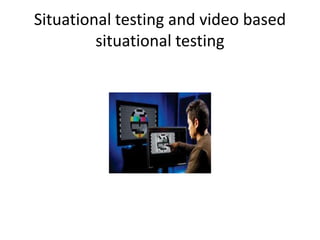
Situational testing and video based
situational testing
Background investigations
• Legal eligibility
• Dates of prior employment
• Education
• Identification
Background investigations
Legal dangers: Defamation, privacy
Making background checks more valuable:
Include in application form signature
authorizing background checks
Rely on telephone references
Persistence and attentiveness pays
Compare application to resume
Ask open ended questions
Use references of candidates to get further
references
Medical exam
• Does applicant meet physical requirements?
• Medical limitations
• Baseline for future medical or insurance
claims
Experiential exercise
• A test for a reservation clerk
Interviews
A selection interview is a selection procedure
designed to predict future job performance on
the applicants oral responses to oral inquiries.
Types of interviews
• Structured
• Unstructured
Types of interviews
Situational questions
Behavioral Questions
Types of interviews
Panel Interviews
Phone Interviews
Video/Web – assisted interviews
Ways to make the interview useful
• Structure the interview
• Be careful what sort of traits you try to assess
• Be aware of common interview errors:
First impressions
Not clarifying what the job requires
Contrast error
Pressure to hire
Non verbal behavior and impression
management
Effect of personal characteristics
Interviewer behavior
Designing the Interview
• Analyze the job
• Rate the jobs main duties
• Create interview questions
• Create benchmark answers
• Appoint the interview panel and conduct
interviews
Conducting an effective interview
• Make sure you know the job
• Structure the interview: Base questions on actual job
duties, use job knowledge, situational or behavioral
questions, use the same questions for all candidates,
use descriptive rating scales
• Get organized
• Establish rapport
• Ask questions
• Take brief unobtrusive notes
• Close the interview
• Review the interview
Do’s and Don’ts
Do’s Don’ts
Ask open ended questions Ask questions which a candidate can
answer
Listen to candidates and encourage them
to express thoughts clearly
Put words in the applicants mouth
Draw out the applicants and feelings by
repeating the person’s last comment as a
question
Interrogate the applicant as if the person
is on trial
Ask for examples Monopolize the interview
Streamlined Interview Process
• Prepare for the interview
Knowledge and experience
Motivation
Intellectual capacity
Personality factor
• Formulate questions to ask in the interview
Intellectual factor
Motivation factor
Personality factor
• Conduct the interview
Have a plan
Follow the plan
• Match the candidate to the job

Selection process in human resource management for MBA

  • 1.
  • 2.
    Why careful selectionis important • Performance • Cost • Legal Obligations
  • 3.
    Basic testing concepts •Reliability – stability of measurement over time • Validity – measures what it is supposed to measure
  • 4.
    How to validatea test • Analyze the job • Choose the tests • Administer the test • Relate test scores and criteria • Cross validate and revalidate
  • 5.
    Testing program guidelines •Use tests as supplements • Validate the tests • Monitor your testing/selection program • Keep accurate records • Use a certified psychologist • Manage test conditions • Revalidate periodically
  • 6.
    What tests doapplicants like? • Tests that are fair • Good test practices • Obviousness of the link of the test to the job • Fairness in selection
  • 7.
    Types of tests •Tests of cognitive Ability Intelligence tests Specific cognitive abilities
  • 8.
    Types of tests •Motor and physical abilities
  • 9.
    Types of tests •Achievement tests
  • 10.
    Types of tests •Work samples and simulations
  • 11.
    Types of tests •Personality tests What do the tests measure? The big five: extraversion, emotional stability, agreeableness, conscientiousness, openness to experience Do these tests predict performance?
  • 12.
    Types of tests •Assessment centers – The in basket Leaderless group discussion Management games Individual presentations Objective tests The interview Effectiveness
  • 13.
    Situational testing andvideo based situational testing
  • 14.
    Background investigations • Legaleligibility • Dates of prior employment • Education • Identification
  • 15.
    Background investigations Legal dangers:Defamation, privacy Making background checks more valuable: Include in application form signature authorizing background checks Rely on telephone references Persistence and attentiveness pays Compare application to resume Ask open ended questions Use references of candidates to get further references
  • 16.
    Medical exam • Doesapplicant meet physical requirements? • Medical limitations • Baseline for future medical or insurance claims
  • 17.
    Experiential exercise • Atest for a reservation clerk
  • 18.
    Interviews A selection interviewis a selection procedure designed to predict future job performance on the applicants oral responses to oral inquiries.
  • 19.
    Types of interviews •Structured • Unstructured
  • 20.
    Types of interviews Situationalquestions Behavioral Questions
  • 21.
    Types of interviews PanelInterviews Phone Interviews Video/Web – assisted interviews
  • 22.
    Ways to makethe interview useful • Structure the interview • Be careful what sort of traits you try to assess • Be aware of common interview errors: First impressions Not clarifying what the job requires Contrast error Pressure to hire Non verbal behavior and impression management Effect of personal characteristics Interviewer behavior
  • 23.
    Designing the Interview •Analyze the job • Rate the jobs main duties • Create interview questions • Create benchmark answers • Appoint the interview panel and conduct interviews
  • 24.
    Conducting an effectiveinterview • Make sure you know the job • Structure the interview: Base questions on actual job duties, use job knowledge, situational or behavioral questions, use the same questions for all candidates, use descriptive rating scales • Get organized • Establish rapport • Ask questions • Take brief unobtrusive notes • Close the interview • Review the interview
  • 25.
    Do’s and Don’ts Do’sDon’ts Ask open ended questions Ask questions which a candidate can answer Listen to candidates and encourage them to express thoughts clearly Put words in the applicants mouth Draw out the applicants and feelings by repeating the person’s last comment as a question Interrogate the applicant as if the person is on trial Ask for examples Monopolize the interview
  • 26.
    Streamlined Interview Process •Prepare for the interview Knowledge and experience Motivation Intellectual capacity Personality factor • Formulate questions to ask in the interview Intellectual factor Motivation factor Personality factor • Conduct the interview Have a plan Follow the plan • Match the candidate to the job

Editor's Notes

  • #15 Will give good refs if want to get rid Do not want to damage chances Legal