Seismic Stratigraphy Techniques
By: Nabaz Jawhar
Geologist
Seismic Stratigraphy Techniques &
Interpretation
• The first phase in seismic stratigraphic
studies of a basin fill is to delineate
genetically related units, which are called
Depositional Sequences.
The basic method for delineation depositional
sequence boundaries is the reflection
termination mapping technique.
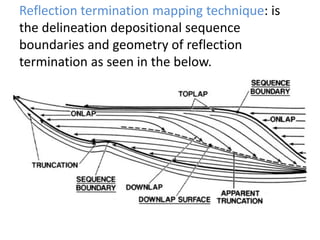
Reflection termination mapping technique: is
the delineation depositional sequence
boundaries and geometry of reflection
termination as seen in the below.
Seismic sequence analysis
• Seismic sequence analysis: The procedures for
interpreting stratigraphy from seismic data
involve three principle stages:
• (1) seismic sequence analysis,
• (2) seismic facies analysis, and
• (3)interpretation of depositional
• environments and lithofacies
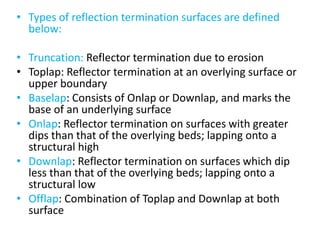
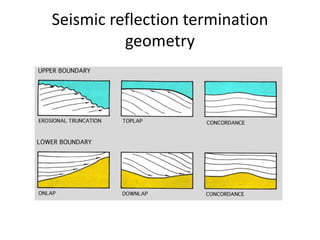
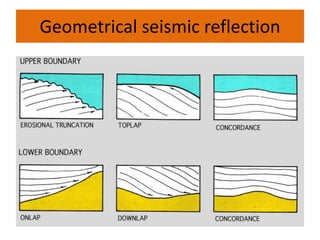
• Types of reflection termination surfaces are defined
below:
• Truncation: Reflector termination due to erosion
• Toplap: Reflector termination at an overlying surface or
upper boundary
• Baselap: Consists of Onlap or Downlap, and marks the
base of an underlying surface
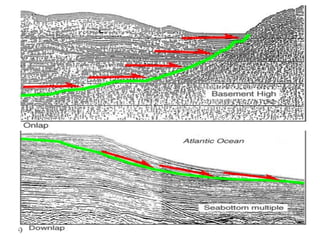
• Onlap: Reflector termination on surfaces with greater
dips than that of the overlying beds; lapping onto a
structural high
• Downlap: Reflector termination on surfaces which dip
less than that of the overlying beds; lapping onto a
structural low
• Offlap: Combination of Toplap and Downlap at both
surface
Seismic reflections
Seismic reflections occur due to acoustic impedance
variations in strata packages at interface boundaries.
Reflection Termination:
Reflection terminations indicate strata discontinuities that
separate depositional sequences and system tracts from
one another. Several types of reflection terminations occur
based on environmental indicators such as eustatic sea
level change, climate variation, tectonic subsidence, or
variations in sediment supply.
Seismic reflection termination
geometry
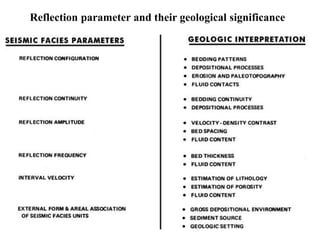
Reflection parameter and their geological significance
Basic Seismic Observations
Four major groups of systematic reflections are
distinguished
Sedimentary reflection representing bedding
planes.
Unconformities or discontinuities in the
geological record.
– Artefacts; like diffractions, multiples, etc.
Non-sedimentary reflections; like fault planes,
fluid contacts etc.
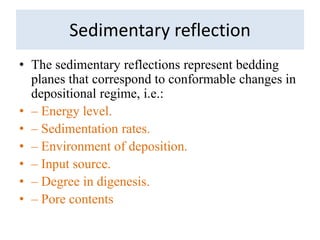
Sedimentary reflection
• The sedimentary reflections represent bedding
planes that correspond to conformable changes in
depositional regime, i.e.:
• – Energy level.
• – Sedimentation rates.
• – Environment of deposition.
• – Input source.
• – Degree in digenesis.
• – Pore contents
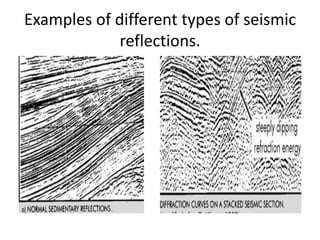
Examples of different types of seismic
reflections.
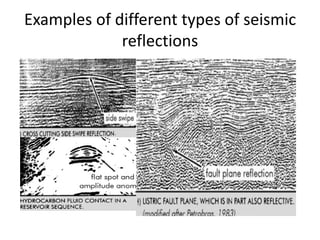
Examples of different types of seismic
reflections
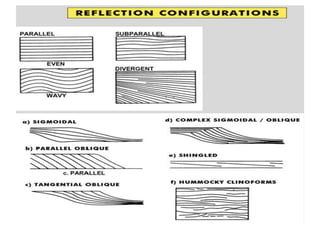
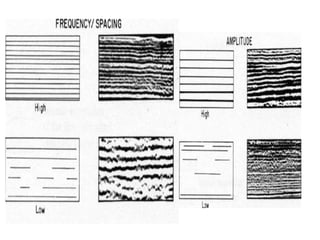
several features that help to describe the reflection character
of a seismic loop:
• – Reflection configuration, which is related to
the geometry of the bedding pattern resulting
from specific depositional processes, the original
paletopography and fluid contacts.
• – Reflection continuity, which describes
continuity of the layers. It is directly related to
sedimentary processes and therefore also to the
environment of deposition.
• – Reflection amplitude, providing a measure for
the reflection strength, lithological contrast,
bedding spacing and fluid contents.
• Reflection frequency, which gives an estimation
of the bed thickness and possibly also the fluid
contents.
• The interval velocities give additional information
on the gross lithology, the porosity distribution
and the fluid contents. In a wider context the
external and internal form of a group of seismic
reflections – i.e. seismic facies – together with the
spatial association is important to assess the
depositional environment, the position of the
input source and the overall geological setting of
the unit under study.
Unconformities
• Unconformities are surfaces of erosion and/on
deposition which constitute time-gaps in the
geological record (Dunbar and Rodgers 1957).
Unconformities generate reflections because
they separate beds with different physical
properties, lithology, and therefore different
acoustic impedance characteristics. Strata
below the unconformity are older and the beds
overlying the surface are younger than the
time-gap .
Several types of reflection relationships are
distinguished at these unconformable interfaces
(Vail et al. 1977). If the substratum is considered,
the following relations :
• Erosional truncation
• Toplap
• Concordance
• Downlap
• Onlap
Many unconformities are non-reflective and these
are more difficult to trace on the seismic sections.
In a lot of cases the reflectivity of an unconformity
varies laterally.
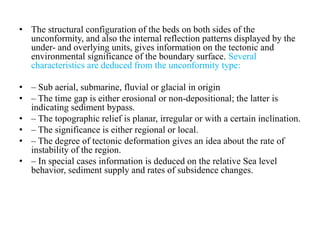
• The structural configuration of the beds on both sides of the
unconformity, and also the internal reflection patterns displayed by the
under- and overlying units, gives information on the tectonic and
environmental significance of the boundary surface. Several
characteristics are deduced from the unconformity type:
• – Sub aerial, submarine, fluvial or glacial in origin
• – The time gap is either erosional or non-depositional; the latter is
indicating sediment bypass.
• – The topographic relief is planar, irregular or with a certain inclination.
• – The significance is either regional or local.
• – The degree of tectonic deformation gives an idea about the rate of
instability of the region.
• – In special cases information is deduced on the relative Sea level
behavior, sediment supply and rates of subsidence changes.
Geometrical seismic reflection
Non-sedimentary reflections
• Non-sedimentary reflections:
Seismic data contains many non-geological
reflectors. These can be Artefacts like
diffractions, multiples etc. or non-sedimentary
reflections like fault planes, fluid contact etc.
These non-geological elements need to be
recognized before any seismic stratigraphic
analysis
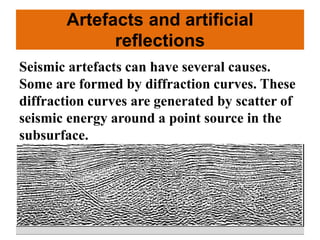
Artefacts and artificial
reflections
Seismic artefacts can have several causes.
Some are formed by diffraction curves. These
diffraction curves are generated by scatter of
seismic energy around a point source in the
subsurface.
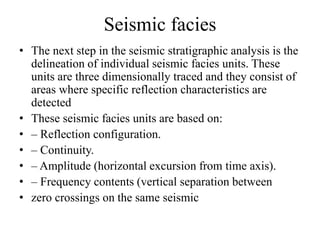
Seismic facies
• The next step in the seismic stratigraphic analysis is the
delineation of individual seismic facies units. These
units are three dimensionally traced and they consist of
areas where specific reflection characteristics are
detected
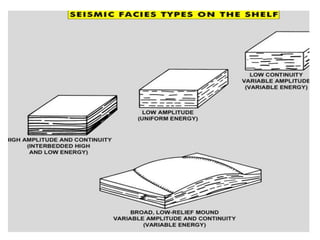
• These seismic facies units are based on:
• – Reflection configuration.
• – Continuity.
• – Amplitude (horizontal excursion from time axis).
• – Frequency contents (vertical separation between
• zero crossings on the same seismic
• The aim of seismic stratigraphic studies is to
interpret the elements of the seismic facie's
units in terms of environment of deposition
and lithofaces distribution.
• Seismic facies:
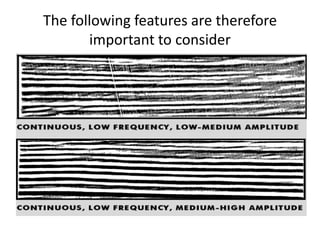
• Frequency .
• amplitude.
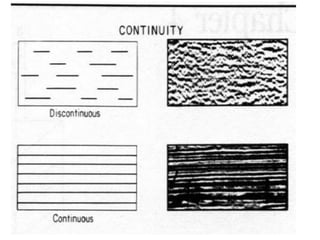
• Continues. Discontinues.
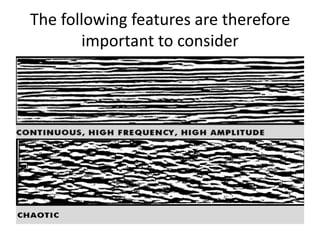
• Chaotic. Hummocky
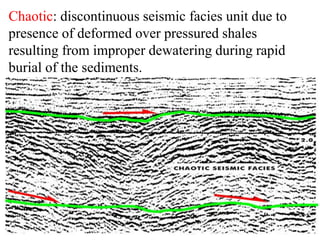
Chaotic: discontinuous seismic facies unit due to
presence of deformed over pressured shales
resulting from improper dewatering during rapid
burial of the sediments.
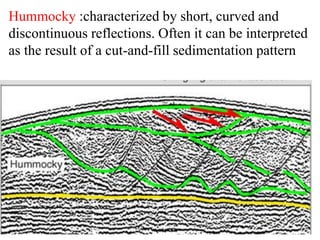
Hummocky :characterized by short, curved and
discontinuous reflections. Often it can be interpreted
as the result of a cut-and-fill sedimentation pattern
The following features are therefore
important to consider
The following features are therefore
important to consider
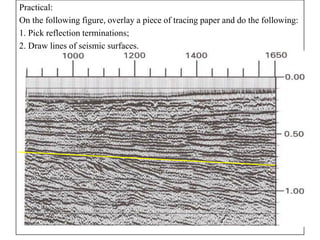
Practical:
On the following figure, overlay a piece of tracing paper and do the following:
1. Pick reflection terminations;
2. Draw lines of seismic surfaces.
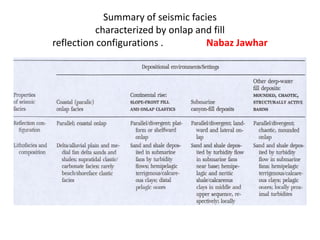
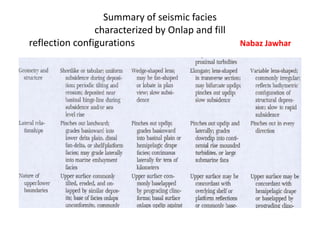
Summary of seismic facies
characterized by onlap and fill
reflection configurations . Nabaz Jawhar
Summary of seismic facies
characterized by Onlap and fill
reflection configurations Nabaz Jawhar

Seismic stratigraphy techniques

  • 1.
  • 2.
    Seismic Stratigraphy Techniques& Interpretation • The first phase in seismic stratigraphic studies of a basin fill is to delineate genetically related units, which are called Depositional Sequences. The basic method for delineation depositional sequence boundaries is the reflection termination mapping technique.
  • 3.
    Reflection termination mappingtechnique: is the delineation depositional sequence boundaries and geometry of reflection termination as seen in the below.
  • 4.
    Seismic sequence analysis •Seismic sequence analysis: The procedures for interpreting stratigraphy from seismic data involve three principle stages: • (1) seismic sequence analysis, • (2) seismic facies analysis, and • (3)interpretation of depositional • environments and lithofacies
  • 5.
    • Types ofreflection termination surfaces are defined below: • Truncation: Reflector termination due to erosion • Toplap: Reflector termination at an overlying surface or upper boundary • Baselap: Consists of Onlap or Downlap, and marks the base of an underlying surface • Onlap: Reflector termination on surfaces with greater dips than that of the overlying beds; lapping onto a structural high • Downlap: Reflector termination on surfaces which dip less than that of the overlying beds; lapping onto a structural low • Offlap: Combination of Toplap and Downlap at both surface
  • 6.
    Seismic reflections Seismic reflectionsoccur due to acoustic impedance variations in strata packages at interface boundaries. Reflection Termination: Reflection terminations indicate strata discontinuities that separate depositional sequences and system tracts from one another. Several types of reflection terminations occur based on environmental indicators such as eustatic sea level change, climate variation, tectonic subsidence, or variations in sediment supply.
  • 7.
  • 8.
    Reflection parameter andtheir geological significance
  • 9.
    Basic Seismic Observations Fourmajor groups of systematic reflections are distinguished Sedimentary reflection representing bedding planes. Unconformities or discontinuities in the geological record. – Artefacts; like diffractions, multiples, etc. Non-sedimentary reflections; like fault planes, fluid contacts etc.
  • 10.
    Sedimentary reflection • Thesedimentary reflections represent bedding planes that correspond to conformable changes in depositional regime, i.e.: • – Energy level. • – Sedimentation rates. • – Environment of deposition. • – Input source. • – Degree in digenesis. • – Pore contents
  • 11.
    Examples of differenttypes of seismic reflections.
  • 12.
    Examples of differenttypes of seismic reflections
  • 13.
    several features thathelp to describe the reflection character of a seismic loop: • – Reflection configuration, which is related to the geometry of the bedding pattern resulting from specific depositional processes, the original paletopography and fluid contacts. • – Reflection continuity, which describes continuity of the layers. It is directly related to sedimentary processes and therefore also to the environment of deposition. • – Reflection amplitude, providing a measure for the reflection strength, lithological contrast, bedding spacing and fluid contents.
  • 14.
    • Reflection frequency,which gives an estimation of the bed thickness and possibly also the fluid contents. • The interval velocities give additional information on the gross lithology, the porosity distribution and the fluid contents. In a wider context the external and internal form of a group of seismic reflections – i.e. seismic facies – together with the spatial association is important to assess the depositional environment, the position of the input source and the overall geological setting of the unit under study.
  • 16.
    Unconformities • Unconformities aresurfaces of erosion and/on deposition which constitute time-gaps in the geological record (Dunbar and Rodgers 1957). Unconformities generate reflections because they separate beds with different physical properties, lithology, and therefore different acoustic impedance characteristics. Strata below the unconformity are older and the beds overlying the surface are younger than the time-gap .
  • 17.
    Several types ofreflection relationships are distinguished at these unconformable interfaces (Vail et al. 1977). If the substratum is considered, the following relations : • Erosional truncation • Toplap • Concordance • Downlap • Onlap Many unconformities are non-reflective and these are more difficult to trace on the seismic sections. In a lot of cases the reflectivity of an unconformity varies laterally.
  • 18.
    • The structuralconfiguration of the beds on both sides of the unconformity, and also the internal reflection patterns displayed by the under- and overlying units, gives information on the tectonic and environmental significance of the boundary surface. Several characteristics are deduced from the unconformity type: • – Sub aerial, submarine, fluvial or glacial in origin • – The time gap is either erosional or non-depositional; the latter is indicating sediment bypass. • – The topographic relief is planar, irregular or with a certain inclination. • – The significance is either regional or local. • – The degree of tectonic deformation gives an idea about the rate of instability of the region. • – In special cases information is deduced on the relative Sea level behavior, sediment supply and rates of subsidence changes.
  • 19.
  • 21.
    Non-sedimentary reflections • Non-sedimentaryreflections: Seismic data contains many non-geological reflectors. These can be Artefacts like diffractions, multiples etc. or non-sedimentary reflections like fault planes, fluid contact etc. These non-geological elements need to be recognized before any seismic stratigraphic analysis
  • 22.
    Artefacts and artificial reflections Seismicartefacts can have several causes. Some are formed by diffraction curves. These diffraction curves are generated by scatter of seismic energy around a point source in the subsurface.
  • 23.
    Seismic facies • Thenext step in the seismic stratigraphic analysis is the delineation of individual seismic facies units. These units are three dimensionally traced and they consist of areas where specific reflection characteristics are detected • These seismic facies units are based on: • – Reflection configuration. • – Continuity. • – Amplitude (horizontal excursion from time axis). • – Frequency contents (vertical separation between • zero crossings on the same seismic
  • 24.
    • The aimof seismic stratigraphic studies is to interpret the elements of the seismic facie's units in terms of environment of deposition and lithofaces distribution. • Seismic facies: • Frequency . • amplitude. • Continues. Discontinues. • Chaotic. Hummocky
  • 27.
    Chaotic: discontinuous seismicfacies unit due to presence of deformed over pressured shales resulting from improper dewatering during rapid burial of the sediments.
  • 28.
    Hummocky :characterized byshort, curved and discontinuous reflections. Often it can be interpreted as the result of a cut-and-fill sedimentation pattern
  • 30.
    The following featuresare therefore important to consider
  • 31.
    The following featuresare therefore important to consider
  • 32.
    Practical: On the followingfigure, overlay a piece of tracing paper and do the following: 1. Pick reflection terminations; 2. Draw lines of seismic surfaces.
  • 33.
    Summary of seismicfacies characterized by onlap and fill reflection configurations . Nabaz Jawhar
  • 34.
    Summary of seismicfacies characterized by Onlap and fill reflection configurations Nabaz Jawhar