Segment Tree 
1
Presented BY: 
 Shohanur Rahman 
 ID# 1321368042 
 CSE 225 (Data Structure) 
 North South University 
 Email: shohan.nsu.cse@gmail.com 
2
Segment Tree 
Definition: 
In computer science, a segment tree is 
a tree data structure for storing intervals, 
or segments. It allows querying which of 
the stored segments contain a given point. 
It can be implemented as a 
dynamic structure. 
3
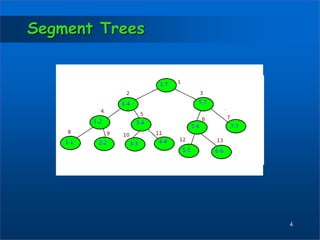
Segment Trees 
4
Sample Problem: 
 You are given n (1<=n<=100000) integers 
& 100000 query. Each query you have to 
change a value of an element Or you 
have to given the minimum value of a 
range. 
5
Function Of segment Tree 
6
Initial Functions: 
We start with a segment arr[1 . . . n]. 
and every time we divide the current 
segment into two halves(if it has not yet 
become a segment of length 1), and then 
call the same procedure on both halves, 
and for each such segment we store the 
sum in corresponding node. 
7
Initial Functions:
Initial Functions( in tree look): 
9
Initial Functions(Algorithm): 
#define mx 100001 
int arr[mx]; 
int tree[mx*3]; 
void init(int node,int b,int e) 
{ 
if(b==e) 
{ 
tree[node]=arr[b]; 
return; 
} 
int Left=node*2; 
int Right=node*2+1; 
int mid=(b+e)/2; 
init(Left,b,mid); 
init(Right,mid+1,e); 
tree[node]=tree[Left]+tree[Right]; 
} 10
Query Functions: 
11
Query Functions: 
 Once the tree is initialized, how to get 
the sum using the initialized segment 
tree.Now,we use Query function.Here 3 
types of cases can be happening. 
12
Query Functions: 
13
Query Functions: 
case A: 
if(b>=i&&e<=j);then the segment is :Releavent 
segment. 
case B: 
if (i > e || j < b);means current segment is 
outside of i-j,then its valuless. 
case C: 
if case A and case B are not true and some of 
the parts is included in i-j , then we need to 
break the segment and take some of the parts. 
14
Query Functions(Algorithm): 
int query(int node,int b,int e,int i,int j) 
{ 
if (i > e || j < b) return 0; 
if (b >= i && e <= j) return tree[node]; 
int Left=node*2; 
int Right=node*2+1; 
int mid=(b+e)/2; 
int p1=query(Left,b,mid,i,j); 
int p2=query(Right,mid+1,e,i,j); 
return p1+p2; 
} 
15
Update Function: 
 Like tree initialization and query operations, 
update can also be done recursively. We are 
given an index which needs to update. 
Let new value be the value to be added. We 
start from root of the segment tree, and 
add new value to all nodes which have given 
index in their range. If a node doesn’t have 
given index in its range, we don’t make any 
changes to that node. 
16
Update Function: 
17
Update Function(Algorithm): 
void update(int node,int b,int e,int i,int newvalue) { 
if (i > e || i < b) return; 
if (b >= i && e <= i) { 
tree[node]=newvalue; 
return; 
} 
int Left=node*2; 
int Right=node*2+1; 
int mid=(b+e)/2; 
update(Left,b,mid,i,newvalue); 
update(Right,mid+1,e,i,newvalue); 
tree[node]=tree[Left]+tree[Right]; 
} 18
Time Complexity: 
Function Name: Time: 
1.Initial Function O(n log n) 
2.Query Function O(log n) 
3.Update Function O(log n) 
19
Applications: 
 Using segment trees we get an <O(N), 
O(log N)> algorithm. Segment trees are 
very powerful, not only because they can be 
used for RMQ(Range Minimum Query). They 
are a very flexible data structure, can 
solve even the dynamic version of RMQ 
problem, and have numerous applications in 
range searching problems. 
20
21
Time to run code…….. 
22
Thank You ! 
23

Segment tree

  • 1.
  • 2.
    Presented BY: Shohanur Rahman  ID# 1321368042  CSE 225 (Data Structure)  North South University  Email: shohan.nsu.cse@gmail.com 2
  • 3.
    Segment Tree Definition: In computer science, a segment tree is a tree data structure for storing intervals, or segments. It allows querying which of the stored segments contain a given point. It can be implemented as a dynamic structure. 3
  • 4.
  • 5.
    Sample Problem: You are given n (1<=n<=100000) integers & 100000 query. Each query you have to change a value of an element Or you have to given the minimum value of a range. 5
  • 6.
  • 7.
    Initial Functions: Westart with a segment arr[1 . . . n]. and every time we divide the current segment into two halves(if it has not yet become a segment of length 1), and then call the same procedure on both halves, and for each such segment we store the sum in corresponding node. 7
  • 8.
  • 9.
    Initial Functions( intree look): 9
  • 10.
    Initial Functions(Algorithm): #definemx 100001 int arr[mx]; int tree[mx*3]; void init(int node,int b,int e) { if(b==e) { tree[node]=arr[b]; return; } int Left=node*2; int Right=node*2+1; int mid=(b+e)/2; init(Left,b,mid); init(Right,mid+1,e); tree[node]=tree[Left]+tree[Right]; } 10
  • 11.
  • 12.
    Query Functions: Once the tree is initialized, how to get the sum using the initialized segment tree.Now,we use Query function.Here 3 types of cases can be happening. 12
  • 13.
  • 14.
    Query Functions: caseA: if(b>=i&&e<=j);then the segment is :Releavent segment. case B: if (i > e || j < b);means current segment is outside of i-j,then its valuless. case C: if case A and case B are not true and some of the parts is included in i-j , then we need to break the segment and take some of the parts. 14
  • 15.
    Query Functions(Algorithm): intquery(int node,int b,int e,int i,int j) { if (i > e || j < b) return 0; if (b >= i && e <= j) return tree[node]; int Left=node*2; int Right=node*2+1; int mid=(b+e)/2; int p1=query(Left,b,mid,i,j); int p2=query(Right,mid+1,e,i,j); return p1+p2; } 15
  • 16.
    Update Function: Like tree initialization and query operations, update can also be done recursively. We are given an index which needs to update. Let new value be the value to be added. We start from root of the segment tree, and add new value to all nodes which have given index in their range. If a node doesn’t have given index in its range, we don’t make any changes to that node. 16
  • 17.
  • 18.
    Update Function(Algorithm): voidupdate(int node,int b,int e,int i,int newvalue) { if (i > e || i < b) return; if (b >= i && e <= i) { tree[node]=newvalue; return; } int Left=node*2; int Right=node*2+1; int mid=(b+e)/2; update(Left,b,mid,i,newvalue); update(Right,mid+1,e,i,newvalue); tree[node]=tree[Left]+tree[Right]; } 18
  • 19.
    Time Complexity: FunctionName: Time: 1.Initial Function O(n log n) 2.Query Function O(log n) 3.Update Function O(log n) 19
  • 20.
    Applications:  Usingsegment trees we get an <O(N), O(log N)> algorithm. Segment trees are very powerful, not only because they can be used for RMQ(Range Minimum Query). They are a very flexible data structure, can solve even the dynamic version of RMQ problem, and have numerous applications in range searching problems. 20
  • 21.
  • 22.
    Time to runcode…….. 22
  • 23.