Segment trees allow storing interval data and supporting efficient range update and query operations. A segment tree is a binary tree where each node represents an interval. It is constructed by recursively splitting intervals into two halves. This allows updating and querying intervals in O(log n) time. Operations include constructing the tree by inserting values, updating a value, and querying a range by traversing relevant nodes. Segment trees have applications in computational geometry and geographic information systems by supporting fast range minimum/maximum queries.
Overview of SegmentTree
• What is Segment Tree?
• Structure of Segment Tree
• Operations of Segment Tree
• Construct
• Update
• Query
• Deletion of Segment Tree
• Time complexity
• Application
3.
What is SegmentTree?
• The Segment Tree (or Tree intervals) is a data structure that
allows us to store information in the form of intervals, or
segments. It can be used for making update/query
operations upon array intervals in logarithmical time.
• Segment tree for the interval [i, j] in the following manner:
– The first node will hold the information for the interval
[i, j].
– If i<j the left and right son will hold the information for
the intervals [i, (i+j)/2] and [(i+j)/2+1, j].
4.
Structure of SegmentTree
• Segment tree is a rooted binary tree. Each node x is assigned a
static interval int[x]
• Recursive construction of T(L,R), where 1≤ L < R ≤ N are
integers:
– Root r : int[r] = [L,R]
– For each node x є Tr , if high[int[x]] – low[int[x]] > 1, then
• A left subtree Tleft[x] and a right subtree Tright[x] such that
int[left[x]] = [ low[int[x]] , mid[int[x]] ]
int[right[x]] = [ mid[int[x]] , high[int[x]] ] where
mid[int[x]] = (low[int[x]] + high[int[x]]) / 2
5.
Example of Segmenttree
• Segment Tree with array index 0 to 5
[0-5]
[3-5][0-2]
[2-2][0-1] [3-4] [5-5]
[0-0] [1-1] [3-3] [4-4]
6.
Example for Segmenttree
After the insertion of values in the tree..
36
9 27
4 5 16 11
1 3 7 9
[0-5]
[3-5][0-2]
[0-1]
[0-0] [1-1]
[3-4]
[3-3]
[5-5]
[4-4]
[2-2]
This node represent sum
of index from 0 to 5
Height of
the
segment
tree is
O(log 2 n)
7.
Operations of SegmentTree
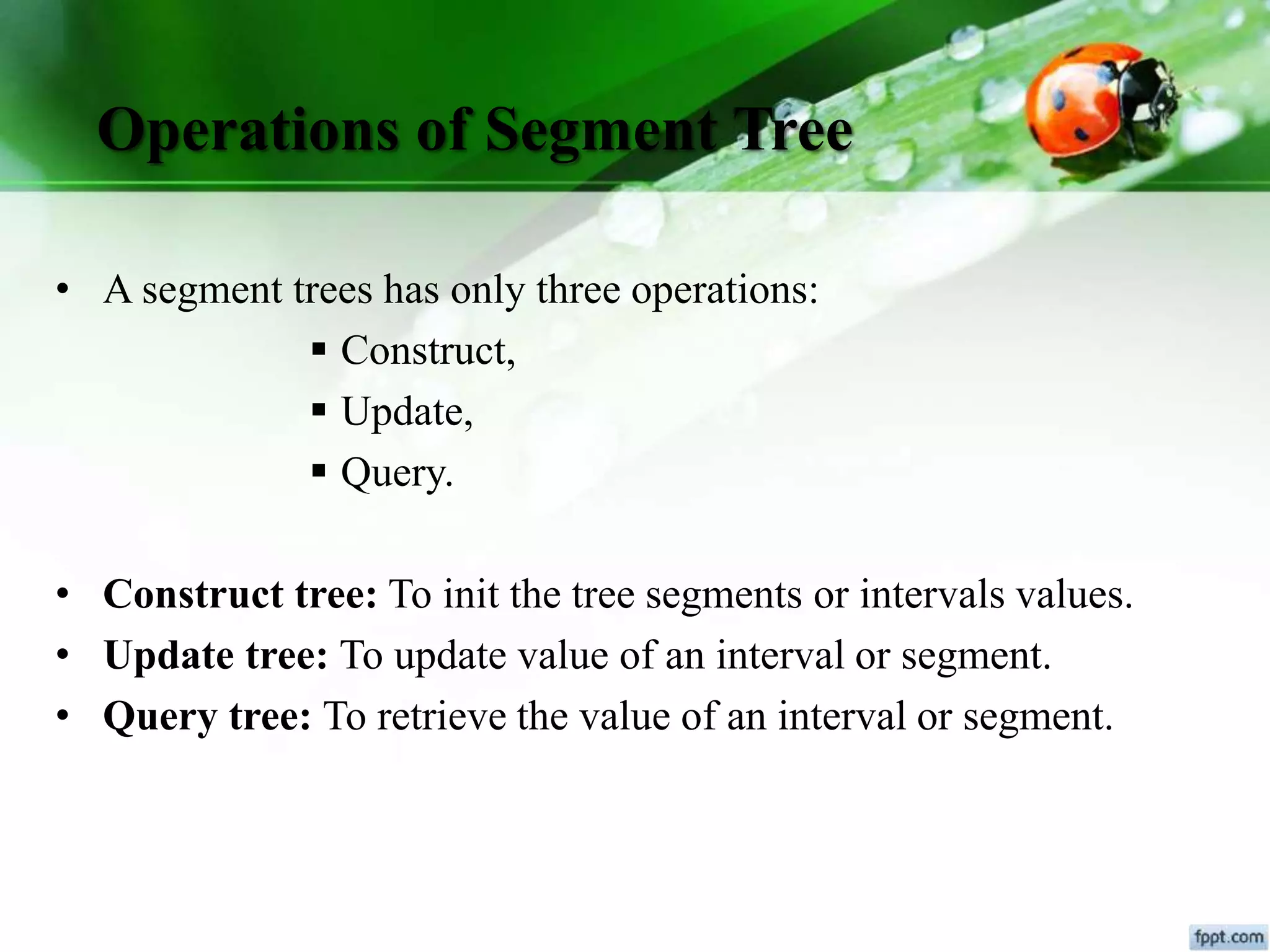
• A segment trees has only three operations:
Construct,
Update,
Query.
• Construct tree: To init the tree segments or intervals values.
• Update tree: To update value of an interval or segment.
• Query tree: To retrieve the value of an interval or segment.
8.
Construct operation
• Wecan construct a segment tree either top-down or bottom-
up. Top-down construction is recursive; the base cases are the
leaf nodes.
• All levels of the constructed segment tree will be completely
filled except the last level. Also, the tree will be a Full Binary
Tree because we always divide segments in two halves at
every level.
• Since the constructed tree is always full binary tree with n
leaves, there will be n-1 internal nodes. So total number of
nodes will be 2*n – 1.
9.
Condition for Insertingthe elements
• Initial Invocation : INSERT(root[T], i)
INSERT(x, i)
if low[i] ≤ low[int[x]] and high[i] ≥ high[int[x]] then
C[x] ← C[x] + 1
Z[x] ← Z[x] {i}
else
midx ← (low[int[x]] + high[int[x]]) / 2
if low[i] < midx then
INSERT( left[x], i)
if high[i] ≥ midx then
INSERT(right[x], i)
Case 1
Case 2
Case 3
Update Operation
• Liketree construction and query operations, update can also
be done recursively. We are given an index which needs to
updated.
• Let diff be the value to be added. We start from root of the
segment tree, and add diff to all nodes which have given
index in their range.
• If a node doesn’t have given index in its range, we don’t
make any changes to that node.
Query Operation
• Toquery a segment tree is to use it to determine a function
of a range in the underlying array (in this case, the
minimum element of that range).
• Condition:
• If the node lies in the query interval, add it to answer .
• If the node intersect with the query interval, go down.
15.
Pseudo-Code
Pseudo-Code for Queryoperation:
int query(node, l, r)
{
if range of node is within l and r
return value in node
elseif range of node is completely outside l and r
return 0
}
16.
Query operation (Example1)
• Query the value in index of (3-5)
36
9 27
4 5 16 11
1 3 7 9
[0-0] [1-1]
[2-2]
[3-3] [4-4]
[5-5]
[0-5]
[0-2]
[0-1]
[3-5]
[3-4]
Since the right child
contains the index (3-5),
the query operation is
performed in right sub-tree
Initially the query operation
is performed in the left child,
since its index is (0-2) no
further search is performed.
17.
Query operation (Example2)
• Query the value in index of (2-3)
36
9 27
4 5 16 11
1 3 7 9
[0-0] [1-1]
[2-2]
[3-3] [4-4]
[5-5]
[0-5]
[0-2]
[0-1]
[3-5]
[3-4]
Since the right child
contains the interval (3-3),
the query operation is also
performed in right sub-tree
Initially the query operation is
performed in the left child, it
is found that index (2-2) is
present in left sub tree so its
value is queried..
18.
Query operation (Example2)
• Cont..
36
9 27
4 5 16 11
1 3 7 9
[0-0] [1-1]
[2-2]
[3-3] [4-4]
[5-5]
[0-5]
[0-2]
[0-1]
[3-5]
[3-4]
In the next stage,
the value of (2,2) is
found in the right
child of left sub-tree
In the right sub-
tree, the left child
contain index (3-4)
so further the
query operation is
performed
19.
Query operation (Example2)
• Cont..
36
9 27
4 5 16 11
1 3 7 9
[0-0] [1-1]
[2-2]
[3-3] [4-4]
[5-5]
[0-5]
[0-2]
[0-1]
[3-5]
[3-4]
In the right sub-
tree, the index of
(3,3) is found
20.
Query operation (Example2)
• Cont..
36
9 27
4 5 16 11
1 3 7 9
[0-0] [1-1]
[2-2]
[3-3] [4-4]
[5-5]
[0-5]
[0-2]
[0-1]
[3-5]
[3-4]
The query value of
index (2-3) is 12
21.
Deletion in SegmentTrees
• Initial invocation : DELETE (root[T], i)
DELETE(x, i)
if low[i] ≤ low[int[x]] and high[i] ≥ high[int[x]] then
C[x] ← C[x] - 1
Z[x] ← Z[x] - {i}
else
midx ← (low[int[x]] + high[int[x]]) / 2
if low[i] < midx then
DELETE( left[x], i)
if high[i] ≥ midx then
DELETE(right[x], i)
22.
Delete operation
• Afterdeleting the values in the leaf node:
[0-5]
[3-5][0-2]
[2-2][0-1] [3-4] [5-5]
[0-0] [1-1] [3-3] [4-4]
23.
Time Complexity
• Constructoperation - Interval can be added/deleted in
O(n) time.
• Update operation – O(log n) time.
• Query operation – O(log n) time.
24.
Applications
• Applications ofthe segment tree are in the areas of
–computational geometry, and
–geographic information systems.
• Static and Dynamic RMQ(Range Minimum Query)

![What is Segment Tree?
• The Segment Tree (or Tree intervals) is a data structure that
allows us to store information in the form of intervals, or
segments. It can be used for making update/query
operations upon array intervals in logarithmical time.
• Segment tree for the interval [i, j] in the following manner:
– The first node will hold the information for the interval
[i, j].
– If i<j the left and right son will hold the information for
the intervals [i, (i+j)/2] and [(i+j)/2+1, j].](https://image.slidesharecdn.com/segmenttree-160115131346/75/Segment-tree-3-2048.jpg)
![Structure of Segment Tree
• Segment tree is a rooted binary tree. Each node x is assigned a
static interval int[x]
• Recursive construction of T(L,R), where 1≤ L < R ≤ N are
integers:
– Root r : int[r] = [L,R]
– For each node x є Tr , if high[int[x]] – low[int[x]] > 1, then
• A left subtree Tleft[x] and a right subtree Tright[x] such that
int[left[x]] = [ low[int[x]] , mid[int[x]] ]
int[right[x]] = [ mid[int[x]] , high[int[x]] ] where
mid[int[x]] = (low[int[x]] + high[int[x]]) / 2 ](https://image.slidesharecdn.com/segmenttree-160115131346/75/Segment-tree-4-2048.jpg)
![Example of Segment tree
• Segment Tree with array index 0 to 5
[0-5]
[3-5][0-2]
[2-2][0-1] [3-4] [5-5]
[0-0] [1-1] [3-3] [4-4]](https://image.slidesharecdn.com/segmenttree-160115131346/75/Segment-tree-5-2048.jpg)
![Example for Segment tree
After the insertion of values in the tree..
36
9 27
4 5 16 11
1 3 7 9
[0-5]
[3-5][0-2]
[0-1]
[0-0] [1-1]
[3-4]
[3-3]
[5-5]
[4-4]
[2-2]
This node represent sum
of index from 0 to 5
Height of
the
segment
tree is
O(log 2 n)](https://image.slidesharecdn.com/segmenttree-160115131346/75/Segment-tree-6-2048.jpg)
![Condition for Inserting the elements
• Initial Invocation : INSERT(root[T], i)
INSERT(x, i)
if low[i] ≤ low[int[x]] and high[i] ≥ high[int[x]] then
C[x] ← C[x] + 1
Z[x] ← Z[x] {i}
else
midx ← (low[int[x]] + high[int[x]]) / 2
if low[i] < midx then
INSERT( left[x], i)
if high[i] ≥ midx then
INSERT(right[x], i)
Case 1
Case 2
Case 3](https://image.slidesharecdn.com/segmenttree-160115131346/75/Segment-tree-9-2048.jpg)
![Construct operation (INSERT)
Example:
• Insert 1,3,5,7,9,11.
36
9 27
4 5 16 11
1 3 7 9
[0-0] [1-1]
[2-2]
[3-3] [4-4]
[5-5]
[0-5]
[0-2]
[0-1]
[3-5]
[3-4]](https://image.slidesharecdn.com/segmenttree-160115131346/75/Segment-tree-10-2048.jpg)
![Update operation
Example:
• Update the node 9 to 10.
36
9 27
4 5 16 11
1 3 7 9
[0-0] [1-1]
[2-2]
[3-3] [4-4]
[5-5]
[0-5]
[0-1]](https://image.slidesharecdn.com/segmenttree-160115131346/75/Segment-tree-12-2048.jpg)
![Update operation
• After updating of node 9 to 10
37
9 28
4 5 17 11
1 3 7 10
[0-0] [1-1]
[2-2]
[3-3] [4-4]
[5-5]
[0-5]](https://image.slidesharecdn.com/segmenttree-160115131346/75/Segment-tree-13-2048.jpg)
![Query operation (Example 1)
• Query the value in index of (3-5)
36
9 27
4 5 16 11
1 3 7 9
[0-0] [1-1]
[2-2]
[3-3] [4-4]
[5-5]
[0-5]
[0-2]
[0-1]
[3-5]
[3-4]
Since the right child
contains the index (3-5),
the query operation is
performed in right sub-tree
Initially the query operation
is performed in the left child,
since its index is (0-2) no
further search is performed.](https://image.slidesharecdn.com/segmenttree-160115131346/75/Segment-tree-16-2048.jpg)
![Query operation (Example 2)
• Query the value in index of (2-3)
36
9 27
4 5 16 11
1 3 7 9
[0-0] [1-1]
[2-2]
[3-3] [4-4]
[5-5]
[0-5]
[0-2]
[0-1]
[3-5]
[3-4]
Since the right child
contains the interval (3-3),
the query operation is also
performed in right sub-tree
Initially the query operation is
performed in the left child, it
is found that index (2-2) is
present in left sub tree so its
value is queried..](https://image.slidesharecdn.com/segmenttree-160115131346/75/Segment-tree-17-2048.jpg)
![Query operation (Example 2)
• Cont..
36
9 27
4 5 16 11
1 3 7 9
[0-0] [1-1]
[2-2]
[3-3] [4-4]
[5-5]
[0-5]
[0-2]
[0-1]
[3-5]
[3-4]
In the next stage,
the value of (2,2) is
found in the right
child of left sub-tree
In the right sub-
tree, the left child
contain index (3-4)
so further the
query operation is
performed](https://image.slidesharecdn.com/segmenttree-160115131346/75/Segment-tree-18-2048.jpg)
![Query operation (Example 2)
• Cont..
36
9 27
4 5 16 11
1 3 7 9
[0-0] [1-1]
[2-2]
[3-3] [4-4]
[5-5]
[0-5]
[0-2]
[0-1]
[3-5]
[3-4]
In the right sub-
tree, the index of
(3,3) is found](https://image.slidesharecdn.com/segmenttree-160115131346/75/Segment-tree-19-2048.jpg)
![Query operation (Example 2)
• Cont..
36
9 27
4 5 16 11
1 3 7 9
[0-0] [1-1]
[2-2]
[3-3] [4-4]
[5-5]
[0-5]
[0-2]
[0-1]
[3-5]
[3-4]
The query value of
index (2-3) is 12](https://image.slidesharecdn.com/segmenttree-160115131346/75/Segment-tree-20-2048.jpg)
![Deletion in Segment Trees
• Initial invocation : DELETE (root[T], i)
DELETE(x, i)
if low[i] ≤ low[int[x]] and high[i] ≥ high[int[x]] then
C[x] ← C[x] - 1
Z[x] ← Z[x] - {i}
else
midx ← (low[int[x]] + high[int[x]]) / 2
if low[i] < midx then
DELETE( left[x], i)
if high[i] ≥ midx then
DELETE(right[x], i)](https://image.slidesharecdn.com/segmenttree-160115131346/75/Segment-tree-21-2048.jpg)
![Delete operation
• After deleting the values in the leaf node:
[0-5]
[3-5][0-2]
[2-2][0-1] [3-4] [5-5]
[0-0] [1-1] [3-3] [4-4]](https://image.slidesharecdn.com/segmenttree-160115131346/75/Segment-tree-22-2048.jpg)