CLONAL SELECTION
INTRODUCTION
 Clone is the progeny of a single plant, produced by asexual
reproduction
 Clonal selection is the selection of the most desirable
members of a clone for continued vegetative propagation
rather than for sexual reproduction.
 The members of a clone keep up genetic constancy.
 So by clonal selection and continued vegetative
propagation, the desirable qualities of plants can be
maintained for long.
MAIN FEATURES OF CLONE
 All the members of a clone has identical genetic
constitution.
 Clones may have hybrid vigour, and it is conserved through
asexual reproduction.
 variations can occur in a clone by mutations, and
occasional sexual reproduction.
PROCEDURE OF CLONAL SELECTION
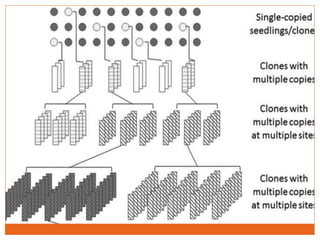
 Involves selection and multiplication of superior clones.
 Superior clones are isolated from 3 types of materials:
 Local variety
 Introduced variety
 Intercrossed population
 The general procedure is :
1. First year:
1. Superior plants are selected from a mixed population of vegetatively
propagated crops.
2. Such plants are selected on the basis of yield, maturity, disease
resistance etc.
2. JJ
PROCEDURE
2. Second year :
1. The progeny of each selected plant is asexually propagated and grown
separately for seed multiplication and evaluation.
2. Clones, superior to check variety is selected and evaluated.
3. Clones are evaluated for 3-4 years using standard variety
as a check.
 Clones which are superior to check variety in yield,
disease resistance and other qualities are identified for
release.
 Release of a new variety takes 9-10 years.
MERITS OF CLONAL SELECTION
 The variety evolved by clonal selection retains all the
characteristics of the parental clones for several years .
 Clonally propagated varieties are highly stable because
there is no risk of deterioration due to seggregation and
recombination.
 This is an effective method for isolating the best genotype
from a mixed population of asexually propagated crops.
DEMERITS
 Cannot create any new variability and therefore genetic
makeup cannot be improved by this method.
Clonal selection
Clonal selection

Clonal selection

  • 1.
  • 2.
    INTRODUCTION  Clone isthe progeny of a single plant, produced by asexual reproduction  Clonal selection is the selection of the most desirable members of a clone for continued vegetative propagation rather than for sexual reproduction.  The members of a clone keep up genetic constancy.  So by clonal selection and continued vegetative propagation, the desirable qualities of plants can be maintained for long.
  • 3.
    MAIN FEATURES OFCLONE  All the members of a clone has identical genetic constitution.  Clones may have hybrid vigour, and it is conserved through asexual reproduction.  variations can occur in a clone by mutations, and occasional sexual reproduction.
  • 4.
    PROCEDURE OF CLONALSELECTION  Involves selection and multiplication of superior clones.  Superior clones are isolated from 3 types of materials:  Local variety  Introduced variety  Intercrossed population  The general procedure is : 1. First year: 1. Superior plants are selected from a mixed population of vegetatively propagated crops. 2. Such plants are selected on the basis of yield, maturity, disease resistance etc. 2. JJ
  • 5.
    PROCEDURE 2. Second year: 1. The progeny of each selected plant is asexually propagated and grown separately for seed multiplication and evaluation. 2. Clones, superior to check variety is selected and evaluated. 3. Clones are evaluated for 3-4 years using standard variety as a check.  Clones which are superior to check variety in yield, disease resistance and other qualities are identified for release.  Release of a new variety takes 9-10 years.
  • 6.
    MERITS OF CLONALSELECTION  The variety evolved by clonal selection retains all the characteristics of the parental clones for several years .  Clonally propagated varieties are highly stable because there is no risk of deterioration due to seggregation and recombination.  This is an effective method for isolating the best genotype from a mixed population of asexually propagated crops.
  • 7.
    DEMERITS  Cannot createany new variability and therefore genetic makeup cannot be improved by this method.