Sediment Cells and SourcesAS Geography
Learning ObjectivesDemonstrate an understanding of wave refractionDevelop an awareness of littoral cells and different types of sedimentDemonstrate a knowledge of coastal processes including erosionEvaluate the concepts behind mass movement
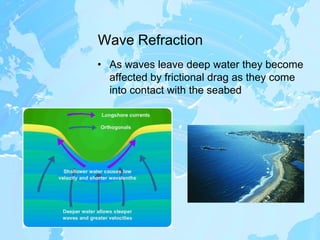
Wave RefractionAs waves leave deep water they become affected by frictional drag as they come into contact with the seabed
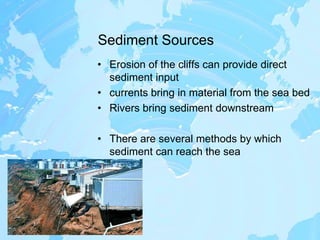
Sediment SourcesErosion of the cliffs can provide direct sediment inputcurrents bring in material from the sea bedRivers bring sediment downstreamThere are several methods by which sediment can reach the sea
What happens to sedimentSediment is either stored as a depositional landform As a nearshore feature such a bank or offshore bar. Alternatively it is transported as a throughput and become outputs from the system being deposited either in deeper water or away from the coastal area in question.
Types of SedimentClastic and Biogenic sedimentClastic sediments are from rock weathering and erosionBiogenicsediments are the shells and skeletons of marine organisms
Sediment Transport and DepositionWhat do you think is the main agent of moving sediment and depositation?Waves, currents, tides and wind move sediment from source areas and deposit it in the form of coastal land formsThese exist in a state of “Dynamic Equilibrium”
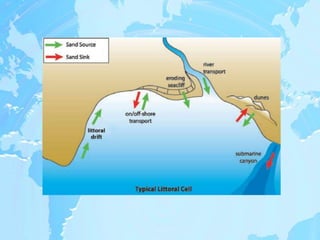
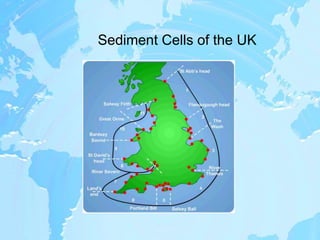
Sediment Cells/ Littoral CellsThese depositional landforms (such as beaches, sand dunes, salt marshes and mudflats) act as a dynamic sediment store and sediments are transported onshore, offshore, and alongshore to create them. These stores in turn provide sediment for stores further down the coast.The next slide explains this
Sediment Cells of the UK
DefinitionsThe movement of sand and shingle in the nearshore zone by longshore drift (littoral drift) has been found to occur in discrete, functionally separate sediment cells.There are 11around England and Wales. Smaller ones are within these. The main cells are defined as a length of coastline and its associated nearshore area within which the movement of coarse sediment (sand and shingle) is largely self contained. Interruptions to movement of sand and shingle within one cell should not affect beaches in an adjacent sediment Cell
TransportAs the particles are moved they become rounded by Attrition.Larger sediment is deposited during high energy and form beaches whilst some are also carried in suspension in areas of reduced energyAdjustments to these dynamic environments happen continuously to maintain the flux
Coastal ProcessesNow for the fun bitCoastlines differ due to differing erosionCoastal Erosion is the wearing away of the land by the sea.Different types of rocks wear away at different speeds and in different ways.
Types of erosionHydraulic Action. This is the force of water hitting the cliff and squeezing air into the cracks in the rockAbrasion. This is the force of the bits of rock carried in the water blasting into the cliff.Attrition. This is the process of rocks hitting each other and breaking into smaller rocksCorrosion. This is a chemical reaction between the sea water and the minerals in the rocks
The secret art of Coastal kung fu!Hydraulic Action: make punching movements with hand- demonstrates force of water hitting cliff. Abrasion: make a throwing gesture with hands like you are throwing dealing cards very rapidlyAttrition: make 2 fists, and then bring them towards each other, hitting each other, then open hand to resemble a stone breaking.Corrosion: have arms out stretched in front of you, waving fingers, and moving arms downwards. Sound effect of something dissolving is needed. Solution: Put arms out in front of you waving fingers and moving down.
Please Don’t be embarrassedOh OK be embarrassed thenHere we go:
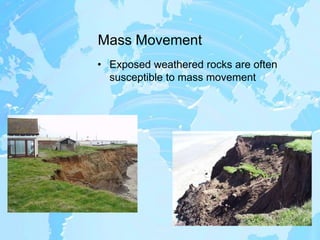
Mass MovementExposed weathered rocks are often susceptible to mass movement
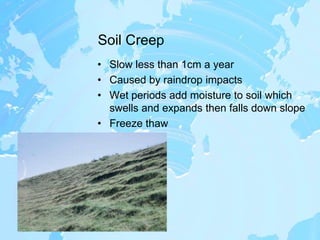
Soil CreepSlow less than 1cm a yearCaused by raindrop impactsWet periods add moisture to soil which swells and expands then falls down slopeFreeze thaw
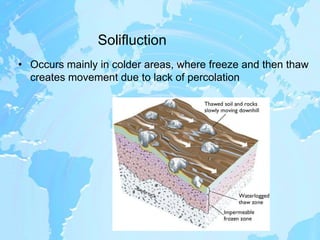
SolifluctionOccurs mainly in colder areas, where freeze and then thaw creates movement due to lack of percolation
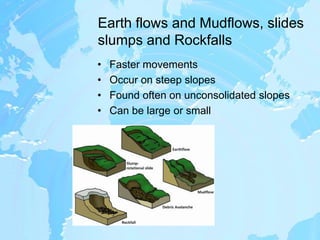
Earth flows and Mudflows, slides slumps and RockfallsFaster movements Occur on steep slopesFound often on unconsolidated slopesCan be large or small
Other Mass Movement ReasonsStudents are to write short paragraphs on the following separate into physical and human causesRunoffMarine ErosionWaves and BeachesGeologyHuman ActivitySea walls and Coastal DefencesLand reclamationDevelopment
Learning ObjectivesDemonstrate an understanding of wave refraction

Sediment Cells And Sources

  • 1.
    Sediment Cells andSourcesAS Geography
  • 2.
    Learning ObjectivesDemonstrate anunderstanding of wave refractionDevelop an awareness of littoral cells and different types of sedimentDemonstrate a knowledge of coastal processes including erosionEvaluate the concepts behind mass movement
  • 3.
    Wave RefractionAs wavesleave deep water they become affected by frictional drag as they come into contact with the seabed
  • 4.
    Sediment SourcesErosion ofthe cliffs can provide direct sediment inputcurrents bring in material from the sea bedRivers bring sediment downstreamThere are several methods by which sediment can reach the sea
  • 5.
    What happens tosedimentSediment is either stored as a depositional landform As a nearshore feature such a bank or offshore bar. Alternatively it is transported as a throughput and become outputs from the system being deposited either in deeper water or away from the coastal area in question.
  • 6.
    Types of SedimentClasticand Biogenic sedimentClastic sediments are from rock weathering and erosionBiogenicsediments are the shells and skeletons of marine organisms
  • 7.
    Sediment Transport andDepositionWhat do you think is the main agent of moving sediment and depositation?Waves, currents, tides and wind move sediment from source areas and deposit it in the form of coastal land formsThese exist in a state of “Dynamic Equilibrium”
  • 8.
    Sediment Cells/ LittoralCellsThese depositional landforms (such as beaches, sand dunes, salt marshes and mudflats) act as a dynamic sediment store and sediments are transported onshore, offshore, and alongshore to create them. These stores in turn provide sediment for stores further down the coast.The next slide explains this
  • 10.
  • 11.
    DefinitionsThe movement ofsand and shingle in the nearshore zone by longshore drift (littoral drift) has been found to occur in discrete, functionally separate sediment cells.There are 11around England and Wales. Smaller ones are within these. The main cells are defined as a length of coastline and its associated nearshore area within which the movement of coarse sediment (sand and shingle) is largely self contained. Interruptions to movement of sand and shingle within one cell should not affect beaches in an adjacent sediment Cell
  • 12.
    TransportAs the particlesare moved they become rounded by Attrition.Larger sediment is deposited during high energy and form beaches whilst some are also carried in suspension in areas of reduced energyAdjustments to these dynamic environments happen continuously to maintain the flux
  • 13.
    Coastal ProcessesNow forthe fun bitCoastlines differ due to differing erosionCoastal Erosion is the wearing away of the land by the sea.Different types of rocks wear away at different speeds and in different ways.
  • 14.
    Types of erosionHydraulicAction. This is the force of water hitting the cliff and squeezing air into the cracks in the rockAbrasion. This is the force of the bits of rock carried in the water blasting into the cliff.Attrition. This is the process of rocks hitting each other and breaking into smaller rocksCorrosion. This is a chemical reaction between the sea water and the minerals in the rocks
  • 15.
    The secret artof Coastal kung fu!Hydraulic Action: make punching movements with hand- demonstrates force of water hitting cliff. Abrasion: make a throwing gesture with hands like you are throwing dealing cards very rapidlyAttrition: make 2 fists, and then bring them towards each other, hitting each other, then open hand to resemble a stone breaking.Corrosion: have arms out stretched in front of you, waving fingers, and moving arms downwards. Sound effect of something dissolving is needed. Solution: Put arms out in front of you waving fingers and moving down.
  • 16.
    Please Don’t beembarrassedOh OK be embarrassed thenHere we go:
  • 17.
    Mass MovementExposed weatheredrocks are often susceptible to mass movement
  • 18.
    Soil CreepSlow lessthan 1cm a yearCaused by raindrop impactsWet periods add moisture to soil which swells and expands then falls down slopeFreeze thaw
  • 19.
    SolifluctionOccurs mainly incolder areas, where freeze and then thaw creates movement due to lack of percolation
  • 20.
    Earth flows andMudflows, slides slumps and RockfallsFaster movements Occur on steep slopesFound often on unconsolidated slopesCan be large or small
  • 21.
    Other Mass MovementReasonsStudents are to write short paragraphs on the following separate into physical and human causesRunoffMarine ErosionWaves and BeachesGeologyHuman ActivitySea walls and Coastal DefencesLand reclamationDevelopment
  • 22.
    Learning ObjectivesDemonstrate anunderstanding of wave refraction