Coast Recap
Profile of coast
Wave terminology
Wave terminology When wind blows across the sea and the ocean, it causes the water surface to rise and fall. This rising and falling of the water surface form the waves.
Wave energy Wind is the most important factor in shaping the coastlines. As wind blows from the sea to the land, it produces a lot of energy which is transferred to the waves as wave energy. Wave energy id seen in the rising and falling of the waves in the sea. Wind velocity and fetch are two factors that influence wave energy.
Wind velocity Wind velocity determine wind energy which in turn determine wave energy. The higher the wind velocity, the larger and more powerful the waves will be. Lower the wind velocity, the smaller and less powerful the waves will be.
Fetch Fetch refers to the distance in the open sea over which the wind blows as it moves towards land. The greater the fetch, the larger and more powerful the waves. Countries such as Japan and Australia  have coasts that face large open oceans and seas. These coasts are often battered by powerful waves due to large fetches.
Wave Waves are disturbance on the water surface by which energy is transferred from one place to another.
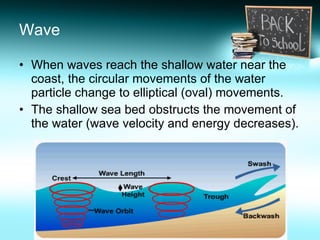
Wave  When waves reach the shallow water near the coast, the circular movements of the water particle change to elliptical (oval) movements. The shallow sea bed obstructs the movement of the water (wave velocity and energy decreases).
Wave (continue) The rapid travelling waves behind the first wave will push against it, causing the first wave’s height to be increased while its length to be shorten. The first wave then crashes onto the beach, its crest trapping air and causing foamy water to rush up the beach.
 
Swash Swash is the movement of the waves up the shore towards land. As the waves rush up the shore, they transport materials up the shore. However, the waves soon lose their energy and retreat under the pull of gravity.
Backwash Backwash is the movement of the waves down the shore towards the sea. As the waves move down the shore, they also transport materials down the sea.
Constructive waves Constructive waves are waves with strong swash and a weaker backwash. They are also known as spilling breakers because they spill over when they break on the shore. As they move up the beach they help to deposit sediments on the beach.
Destructive waves Destructive waves are waves with strong backwash and a weaker swash.  They are known as plunging breakers because they plunge when they break on the shore. As they retreat towards the sea, they erode and carry away a large amount of sediments from the beach.
 
Different coastal processes Erosion Transportation Deposition
Erosion Corrasion (abrasion) Waves carry rock fragments such as cobbles, pebbles and gravel. When these rock fragments are thrown against the coast, they are like chiselling tools, cutting up and breaking the rocks forming the coast.
Erosion Attrition  When rock fragments carried by the waves are thrown against one another, they gradually break up into smaller, smoother and more rounded pieces.
Erosion Solution (corrosion) Soluble minerals in coastal are dissolved in and removed by the seawater. E.g. calcium carbonate in limestone reacts chemically with the carbonic acid in the seawater and changes into soluble calcium hydrogen carbonate. When solution occurs the rocks are weakened and will ultimately disintegrate.
Erosion Hydraulic action The weight of the waves smashing against the coast repeatedly can weaken and loosen rocks so that ultimately they break off.
Transportation Agents  Wave & current Longshore drift
 
 
This movement of sediment along the coastline is called   longshore drift . Direction of movement swash Backwash Backwash is always at right angles to the beach Longshore drift
Longshore drift Waves approach the coast at an angle, depending on the wind direction. When waves reach the coast at angle, the swash carries sediments up onto the coast at that angle. The backwash then carries the sediments back to the sea at a right angle to the coast due to the influence of gravity.
Longshore drift This motion is repeated and gives rise to a zig-zag movement of sediments along the coast. This zig-zag movement is one way in which sediments are moved along the coast. The movement of sediment is sometimes helped by longshore currents. This result in longshore drift which is the movement of sediments parallel to the coast.
Deposition Deposition of sediments takes place along the coast when the waves lose their energy. The deposited sediments will remain in the same spot until the next wave picks it up and transport it further along the beach. In many instances the deposited sediments start to form depositional features along the coast. However, these features can be easily destroyed by large storms such as hurricanes.
Deposition (continue) One effect of the longshore drift is the sorting and depositing of sediment on the shore. In the course of moving the sediments up and down the shore by swash and backwash, the sediments are sorted and deposited according to size. Coarser and larger sediments are usually deposited further up the shore as they are transported and deposited at the highest point on the beach y strong swashes. The finer and smaller sediments are usually deposited nearer the shoreline. However, their size enable them to be easily transported up on the beach by swash and to be just easily eroded by backwash.
Homework Sec 3 NA Workbook pg 21 to 22

Sec 3 - Lesson 1 Coasts

  • 1.
  • 2.
  • 3.
  • 4.
    Wave terminology Whenwind blows across the sea and the ocean, it causes the water surface to rise and fall. This rising and falling of the water surface form the waves.
  • 5.
    Wave energy Windis the most important factor in shaping the coastlines. As wind blows from the sea to the land, it produces a lot of energy which is transferred to the waves as wave energy. Wave energy id seen in the rising and falling of the waves in the sea. Wind velocity and fetch are two factors that influence wave energy.
  • 6.
    Wind velocity Windvelocity determine wind energy which in turn determine wave energy. The higher the wind velocity, the larger and more powerful the waves will be. Lower the wind velocity, the smaller and less powerful the waves will be.
  • 7.
    Fetch Fetch refersto the distance in the open sea over which the wind blows as it moves towards land. The greater the fetch, the larger and more powerful the waves. Countries such as Japan and Australia have coasts that face large open oceans and seas. These coasts are often battered by powerful waves due to large fetches.
  • 8.
    Wave Waves aredisturbance on the water surface by which energy is transferred from one place to another.
  • 9.
    Wave Whenwaves reach the shallow water near the coast, the circular movements of the water particle change to elliptical (oval) movements. The shallow sea bed obstructs the movement of the water (wave velocity and energy decreases).
  • 10.
    Wave (continue) Therapid travelling waves behind the first wave will push against it, causing the first wave’s height to be increased while its length to be shorten. The first wave then crashes onto the beach, its crest trapping air and causing foamy water to rush up the beach.
  • 11.
  • 12.
    Swash Swash isthe movement of the waves up the shore towards land. As the waves rush up the shore, they transport materials up the shore. However, the waves soon lose their energy and retreat under the pull of gravity.
  • 13.
    Backwash Backwash isthe movement of the waves down the shore towards the sea. As the waves move down the shore, they also transport materials down the sea.
  • 14.
    Constructive waves Constructivewaves are waves with strong swash and a weaker backwash. They are also known as spilling breakers because they spill over when they break on the shore. As they move up the beach they help to deposit sediments on the beach.
  • 15.
    Destructive waves Destructivewaves are waves with strong backwash and a weaker swash. They are known as plunging breakers because they plunge when they break on the shore. As they retreat towards the sea, they erode and carry away a large amount of sediments from the beach.
  • 16.
  • 17.
    Different coastal processesErosion Transportation Deposition
  • 18.
    Erosion Corrasion (abrasion)Waves carry rock fragments such as cobbles, pebbles and gravel. When these rock fragments are thrown against the coast, they are like chiselling tools, cutting up and breaking the rocks forming the coast.
  • 19.
    Erosion Attrition When rock fragments carried by the waves are thrown against one another, they gradually break up into smaller, smoother and more rounded pieces.
  • 20.
    Erosion Solution (corrosion)Soluble minerals in coastal are dissolved in and removed by the seawater. E.g. calcium carbonate in limestone reacts chemically with the carbonic acid in the seawater and changes into soluble calcium hydrogen carbonate. When solution occurs the rocks are weakened and will ultimately disintegrate.
  • 21.
    Erosion Hydraulic actionThe weight of the waves smashing against the coast repeatedly can weaken and loosen rocks so that ultimately they break off.
  • 22.
    Transportation Agents Wave & current Longshore drift
  • 23.
  • 24.
  • 25.
    This movement ofsediment along the coastline is called longshore drift . Direction of movement swash Backwash Backwash is always at right angles to the beach Longshore drift
  • 26.
    Longshore drift Wavesapproach the coast at an angle, depending on the wind direction. When waves reach the coast at angle, the swash carries sediments up onto the coast at that angle. The backwash then carries the sediments back to the sea at a right angle to the coast due to the influence of gravity.
  • 27.
    Longshore drift Thismotion is repeated and gives rise to a zig-zag movement of sediments along the coast. This zig-zag movement is one way in which sediments are moved along the coast. The movement of sediment is sometimes helped by longshore currents. This result in longshore drift which is the movement of sediments parallel to the coast.
  • 28.
    Deposition Deposition ofsediments takes place along the coast when the waves lose their energy. The deposited sediments will remain in the same spot until the next wave picks it up and transport it further along the beach. In many instances the deposited sediments start to form depositional features along the coast. However, these features can be easily destroyed by large storms such as hurricanes.
  • 29.
    Deposition (continue) Oneeffect of the longshore drift is the sorting and depositing of sediment on the shore. In the course of moving the sediments up and down the shore by swash and backwash, the sediments are sorted and deposited according to size. Coarser and larger sediments are usually deposited further up the shore as they are transported and deposited at the highest point on the beach y strong swashes. The finer and smaller sediments are usually deposited nearer the shoreline. However, their size enable them to be easily transported up on the beach by swash and to be just easily eroded by backwash.
  • 30.
    Homework Sec 3NA Workbook pg 21 to 22