Security of Linux
containers in the cloud
       Dobrica Pavlinušić
      http://blog.rot13.org
 FSEC, FOI Varaždin, 2012-09-20
                    http://www.flickr.com/photos/21644167@N04/5879497600/
Security of Linux containers in the cloud

Linux container (LXC) seems to be preferred technology for
deployment of Platform as a service (PaaS) in cloud. Partly
because it's easy to install on top of existing visualization
platforms (KVM, VMware, VirtualBox), partly because it is
lightweight solution to provide separation and process
allocations between separate containers running under
single kernel.

In this talk we will take a look at LXC and try to explain how
to combine it with mandatory access control (MAC)
mechanisms within Linux kernel to provide secure
separation between different users of applications.
Presentation overview
● Containers
  ○ namespaces
  ○ cgroups resource management
● Why we need MAC to make LXC secure?
● Overview of security mechanisms
  ○   SELinux, pam_namespace
  ○   libvirt-lxc = API + LXC + SELinux
  ○   libvirt-sandbox, virt-sandbox-service
  ○   systemd
  ○   AppArmor
  ○   Smack
  ○   OpenVZ
● stackato PaaS with free micro cloud
Linux Namespaces
● Mount - mounting/unmounting filesystems
● UTS - hostname, domainname
● IPC - SysV message queues,
  semaphore/shared memory segments
● Network - IPv4/IPv6 stacks, routing, firewall,
  proc/net /sys/class/net directory trees, sock
● Pid - Own set of pids
● UID - Not implemented yet.

chroot is filesystem namespace
cgroups resource management
● limits
   ○ CPU (sched, cpu account, cpuset) - NUMA
   ○ Memory
   ○ Block I/O scheduling, limits
● Used to isolate different chunks of processes
   ○   Android - application isolation
   ○   Google Chrome - tabs isolation
   ○   systemd - services isolation
   ○   LXC - whole system (devices, network interfaces)
   ○   libvirt-lxc - incompatible with LXC

http://wiki.debian.org/LXC
GRUB_CMDLINE_LINUX="cgroup_enable=memory"
LXC security problems
● Root in container with /proc and /sys access
    ○ echo s > /proc/sysrq-trigger
    ○ removing capabilities from container
    ○ Mandatory access control (MAC) based on paths
● filesystem
    ○ devpts remount, securityfs, debugfs, bitfmt_misc
    ○ remount / on host if shared with container
● udev storm on host
    ○ udevadm trigger action=add

https://wiki.ubuntu.com/LxcSecurity
https://bugs.launchpad.net/ubuntu/+source/lxc/+bug/645625
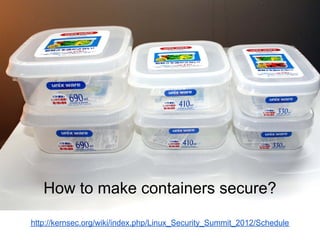
How to make containers secure?
http://kernsec.org/wiki/index.php/Linux_Security_Summit_2012/Schedule
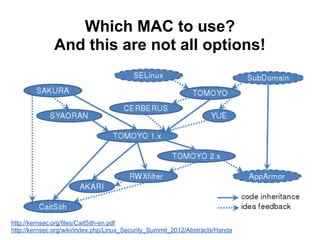
Which MAC to use?
              And this are not all options!


http://kernsec.org/files/CaitSith-en.pdf
http://kernsec.org/wiki/index.php/Linux_Security_Summit_2012/Abstracts/Handa
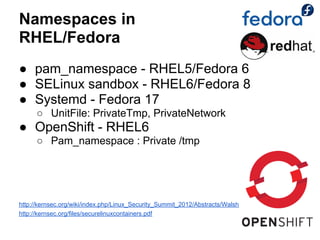
Namespaces in
RHEL/Fedora
● pam_namespace - RHEL5/Fedora 6
● SELinux sandbox - RHEL6/Fedora 8
● Systemd - Fedora 17
      ○ UnitFile: PrivateTmp, PrivateNetwork
● OpenShift - RHEL6
      ○ Pam_namespace : Private /tmp


http://kernsec.org/wiki/index.php/Linux_Security_Summit_2012/Abstracts/Walsh
http://kernsec.org/files/securelinuxcontainers.pdf
libvirt-lxc = API + LXC + SELinux
●   Container virtualization
●   Boot “init” binary
●   sVirt SELinux TE + MCS
●   Firewall ebtables/ip[6]tables
●   Host FS passthrough bind mounts
●   CGroups resource control

RadHat based distributions
libvirt-sandbox
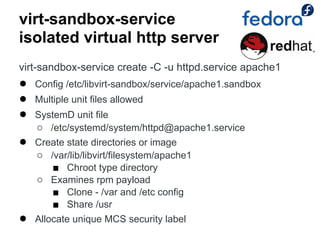
virt-sandbox-service
isolated virtual http server
virt-sandbox-service create -C -u httpd.service apache1
●   Config /etc/libvirt-sandbox/service/apache1.sandbox
●   Multiple unit files allowed
●   SystemD unit file
    ○ /etc/systemd/system/httpd@apache1.service
●   Create state directories or image
    ○ /var/lib/libvirt/filesystem/apache1
       ■ Chroot type directory
    ○ Examines rpm payload
       ■ Clone - /var and /etc config
       ■ Share /usr
●   Allocate unique MCS security label
Systemd
● systemctl start httpd@apache1.service
● systemctl reload httpd.service
  ○ Should trigger reload in all httpd@services
  ○ ReloadPropagatedFrom=httpd.service
● systemctl start httpd@.service
  ○ Should start all httpd services


● Systemd for the User Session
  ○ systemctl --user
  ○ http://linuxplumbers.ubicast.tv/videos/systemd-for-the-user-session/
AppArmor LSM Update

● basic lxc integration
● lot of userspace work
      ○    porting to python 3
      ○    simple policy language improvements/consistency
      ○    policy compiler improvements
      ○    refactoring

http://kernsec.org/files/apparmor-update.odp
Smack Veers Mobile

Tizen focused

# smack_label.py -w -r /srv/lxc/lxc1 lxc1
# echo "lxc1" > /proc/self/current/attr
# lxc-start -n lxc1
# echo "_" > /proc/self/current/attr

http://kernsec.org/files/SmackLinuxSecuritySummit2012.pdf
http://osdir.com/ml/lxc-chroot-linux-containers/2011-08/msg00004.html
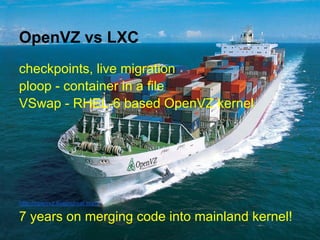
OpenVZ vs LXC
checkpoints, live migration
ploop - container in a file
VSwap - RHEL-6 based OpenVZ kernel


http://openvz.livejournal.com/

7 years on merging code into mainland kernel!
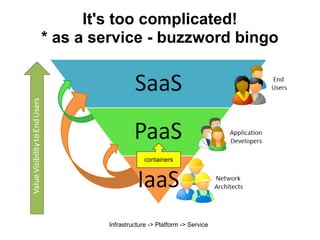
It's too complicated!
* as a service - buzzword bingo


                     containers


        Infrastructure -> Platform -> Service
Platform as a Service
It's not VM you have to administer but (proprietary)
      REST API and code push into container!
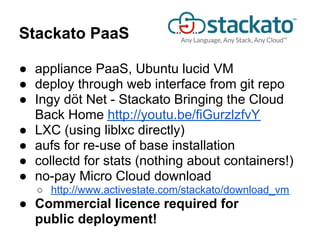
Stackato PaaS

● appliance PaaS, Ubuntu lucid VM
● deploy through web interface from git repo
● Ingy döt Net - Stackato Bringing the Cloud
  Back Home http://youtu.be/fiGurzlzfvY
● LXC (using liblxc directly)
● aufs for re-use of base installation
● collectd for stats (nothing about containers!)
● no-pay Micro Cloud download
   ○ http://www.activestate.com/stackato/download_vm
● Commercial licence required for
  public deployment!
Questions?

Are we there yet?
containers suffers from too many different
   incompoatible deployment options

         http://bit.ly/fsec2012-lxc
           http://blog.rot13.org
                            http://www.flickr.com/photos/bcnbits/2859509269/
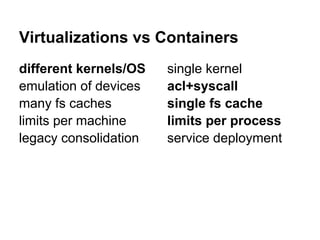
Virtualizations vs Containers
different kernels/OS   single kernel
emulation of devices   acl+syscall
many fs caches         single fs cache
limits per machine     limits per process
legacy consolidation   service deployment

Security of Linux containers in the cloud

  • 1.
    Security of Linux containersin the cloud Dobrica Pavlinušić http://blog.rot13.org FSEC, FOI Varaždin, 2012-09-20 http://www.flickr.com/photos/21644167@N04/5879497600/
  • 2.
    Security of Linuxcontainers in the cloud Linux container (LXC) seems to be preferred technology for deployment of Platform as a service (PaaS) in cloud. Partly because it's easy to install on top of existing visualization platforms (KVM, VMware, VirtualBox), partly because it is lightweight solution to provide separation and process allocations between separate containers running under single kernel. In this talk we will take a look at LXC and try to explain how to combine it with mandatory access control (MAC) mechanisms within Linux kernel to provide secure separation between different users of applications.
  • 3.
    Presentation overview ● Containers ○ namespaces ○ cgroups resource management ● Why we need MAC to make LXC secure? ● Overview of security mechanisms ○ SELinux, pam_namespace ○ libvirt-lxc = API + LXC + SELinux ○ libvirt-sandbox, virt-sandbox-service ○ systemd ○ AppArmor ○ Smack ○ OpenVZ ● stackato PaaS with free micro cloud
  • 4.
    Linux Namespaces ● Mount- mounting/unmounting filesystems ● UTS - hostname, domainname ● IPC - SysV message queues, semaphore/shared memory segments ● Network - IPv4/IPv6 stacks, routing, firewall, proc/net /sys/class/net directory trees, sock ● Pid - Own set of pids ● UID - Not implemented yet. chroot is filesystem namespace
  • 5.
    cgroups resource management ●limits ○ CPU (sched, cpu account, cpuset) - NUMA ○ Memory ○ Block I/O scheduling, limits ● Used to isolate different chunks of processes ○ Android - application isolation ○ Google Chrome - tabs isolation ○ systemd - services isolation ○ LXC - whole system (devices, network interfaces) ○ libvirt-lxc - incompatible with LXC http://wiki.debian.org/LXC GRUB_CMDLINE_LINUX="cgroup_enable=memory"
  • 6.
    LXC security problems ●Root in container with /proc and /sys access ○ echo s > /proc/sysrq-trigger ○ removing capabilities from container ○ Mandatory access control (MAC) based on paths ● filesystem ○ devpts remount, securityfs, debugfs, bitfmt_misc ○ remount / on host if shared with container ● udev storm on host ○ udevadm trigger action=add https://wiki.ubuntu.com/LxcSecurity https://bugs.launchpad.net/ubuntu/+source/lxc/+bug/645625
  • 7.
    How to makecontainers secure? http://kernsec.org/wiki/index.php/Linux_Security_Summit_2012/Schedule
  • 8.
    Which MAC touse? And this are not all options! http://kernsec.org/files/CaitSith-en.pdf http://kernsec.org/wiki/index.php/Linux_Security_Summit_2012/Abstracts/Handa
  • 9.
    Namespaces in RHEL/Fedora ● pam_namespace- RHEL5/Fedora 6 ● SELinux sandbox - RHEL6/Fedora 8 ● Systemd - Fedora 17 ○ UnitFile: PrivateTmp, PrivateNetwork ● OpenShift - RHEL6 ○ Pam_namespace : Private /tmp http://kernsec.org/wiki/index.php/Linux_Security_Summit_2012/Abstracts/Walsh http://kernsec.org/files/securelinuxcontainers.pdf
  • 10.
    libvirt-lxc = API+ LXC + SELinux ● Container virtualization ● Boot “init” binary ● sVirt SELinux TE + MCS ● Firewall ebtables/ip[6]tables ● Host FS passthrough bind mounts ● CGroups resource control RadHat based distributions libvirt-sandbox
  • 11.
    virt-sandbox-service isolated virtual httpserver virt-sandbox-service create -C -u httpd.service apache1 ● Config /etc/libvirt-sandbox/service/apache1.sandbox ● Multiple unit files allowed ● SystemD unit file ○ /etc/systemd/system/httpd@apache1.service ● Create state directories or image ○ /var/lib/libvirt/filesystem/apache1 ■ Chroot type directory ○ Examines rpm payload ■ Clone - /var and /etc config ■ Share /usr ● Allocate unique MCS security label
  • 12.
    Systemd ● systemctl starthttpd@apache1.service ● systemctl reload httpd.service ○ Should trigger reload in all httpd@services ○ ReloadPropagatedFrom=httpd.service ● systemctl start httpd@.service ○ Should start all httpd services ● Systemd for the User Session ○ systemctl --user ○ http://linuxplumbers.ubicast.tv/videos/systemd-for-the-user-session/
  • 13.
    AppArmor LSM Update ●basic lxc integration ● lot of userspace work ○ porting to python 3 ○ simple policy language improvements/consistency ○ policy compiler improvements ○ refactoring http://kernsec.org/files/apparmor-update.odp
  • 14.
    Smack Veers Mobile Tizenfocused # smack_label.py -w -r /srv/lxc/lxc1 lxc1 # echo "lxc1" > /proc/self/current/attr # lxc-start -n lxc1 # echo "_" > /proc/self/current/attr http://kernsec.org/files/SmackLinuxSecuritySummit2012.pdf http://osdir.com/ml/lxc-chroot-linux-containers/2011-08/msg00004.html
  • 15.
    OpenVZ vs LXC checkpoints,live migration ploop - container in a file VSwap - RHEL-6 based OpenVZ kernel http://openvz.livejournal.com/ 7 years on merging code into mainland kernel!
  • 16.
    It's too complicated! *as a service - buzzword bingo containers Infrastructure -> Platform -> Service
  • 17.
    Platform as aService It's not VM you have to administer but (proprietary) REST API and code push into container!
  • 18.
    Stackato PaaS ● appliancePaaS, Ubuntu lucid VM ● deploy through web interface from git repo ● Ingy döt Net - Stackato Bringing the Cloud Back Home http://youtu.be/fiGurzlzfvY ● LXC (using liblxc directly) ● aufs for re-use of base installation ● collectd for stats (nothing about containers!) ● no-pay Micro Cloud download ○ http://www.activestate.com/stackato/download_vm ● Commercial licence required for public deployment!
  • 19.
    Questions? Are we thereyet? containers suffers from too many different incompoatible deployment options http://bit.ly/fsec2012-lxc http://blog.rot13.org http://www.flickr.com/photos/bcnbits/2859509269/
  • 20.
    Virtualizations vs Containers differentkernels/OS single kernel emulation of devices acl+syscall many fs caches single fs cache limits per machine limits per process legacy consolidation service deployment