Kernel Recipes 2013 – Samir Bellabes
Linux Security Modules
SELinux, AppArmor & Tomoyo
trough security models
-
Kernel Recipes 2013
Kernel Recipes 2013 – Samir Bellabes
Previously on KR Season 1
Kernel Recipes 2013 – Samir Bellabes
Previously on KR Season 1
● Formal models for computer security
● Specify functional & assurance requirements → CC
● Implementation
● Testing → CC
CC = Common Criteria
Kernel Recipes 2013 – Samir Bellabes
Previously on KR Season 1
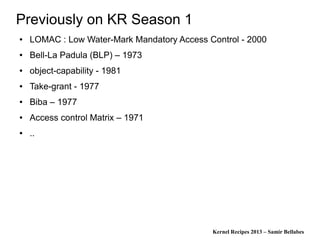
● LOMAC : Low Water-Mark Mandatory Access Control - 2000
● Bell-La Padula (BLP) – 1973
● object-capability - 1981
● Take-grant - 1977
● Biba – 1977
● Access control Matrix – 1971
● ..
Kernel Recipes 2013 – Samir Bellabes
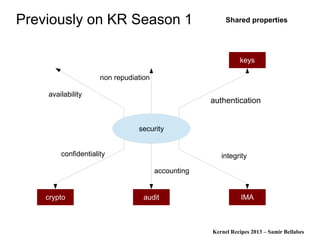
Previously on KR Season 1
security
integrity
authentication
IMA
keys
availability
confidentiality
auditcrypto
accounting
non repudiation
Shared properties
Kernel Recipes 2013 – Samir Bellabes
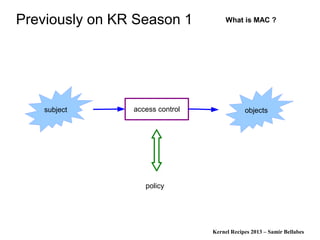
Previously on KR Season 1
access control objectssubject
policy
What is MAC ?
Kernel Recipes 2013 – Samir Bellabes
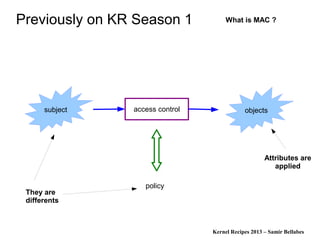
Previously on KR Season 1
access control objectssubject
policy
What is MAC ?
Attributes are
applied
They are
differents
Kernel Recipes 2013 – Samir Bellabes
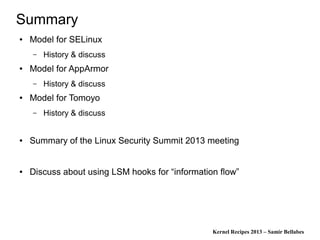
Summary
Kernel Recipes 2013 – Samir Bellabes
Summary
● Model for SELinux
– History & discuss
● Model for AppArmor
– History & discuss
● Model for Tomoyo
– History & discuss
● Summary of the Linux Security Summit 2013 meeting
● Discuss about using LSM hooks for “information flow”
Kernel Recipes 2013 – Samir Bellabes
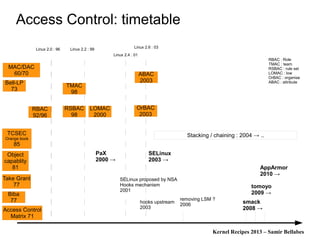
Access Control: timetable
SELinux proposed by NSA
Hooks mechanism
2001
hooks upstream
2003
removing LSM ?
2006
tomoyo
2009 →
AppArmor
2010 →
smack
2008 →
Stacking / chaining : 2004 → ..
RBAC
92/96
LOMAC
2000
PaX
2000 →
Linux 2.2 : 99 Linux 2.6 : 03
Linux 2.0 : 96
Linux 2.4 : 01
Take Grant
77
Biba
77
Access Control
Matrix 71
Object
capablity
81
OrBAC
2003
TCSEC
Orange book
85
RSBAC
98
TMAC
98
ABAC
2003
RBAC : Role
TMAC : team
RSBAC : rule set
LOMAC : low
OrBAC : organise
ABAC : attribute
MAC/DAC
60/70
Bell-LP
73
SELinux
2003 →
Kernel Recipes 2013 – Samir Bellabes
SELinux
Kernel Recipes 2013 – Samir Bellabes
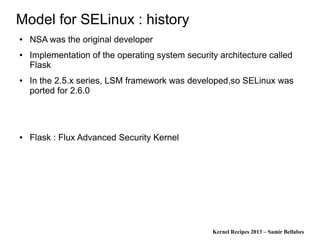
Model for SELinux : history
● NSA was the original developer
● Implementation of the operating system security architecture called
Flask
● In the 2.5.x series, LSM framework was developed,so SELinux was
ported for 2.6.0
● Flask : Flux Advanced Security Kernel
Kernel Recipes 2013 – Samir Bellabes
SELinux model : the Flask architecture
● Flask architecture simply implements MAC
● Principle of “least privilege”
● Objects and subjects are related to security attributes inside a
“security context”
● Dealing with security context is not easy, so we can refer to it with a
SID : security identifier, a kind or pointer, reference to the context.
Exemple : it's working well for persistent objects
● A security decision can be made with {SID(subject), SID(object)}.
● Two kind of decisions exist :
– Labeling decision : obj/sub transition → creating new file from directory
– Access decision : check permissions for operations using Access Vector
Cache (AVC) : access vector gives decisions for all permissions for a
object, or directly on the server policy
Kernel Recipes 2013 – Samir Bellabes
SELinux model : the Flask architecture
● Security policy over process and objects
● True innovation : splitting the technical architecture from the policy
(not only a modularity)
● Demonstration by implementing :
– Type enforcement (TE) 1980-1985
– Role Based Access Control (RBAC) 1992-1996
– Multi Level Security (MLS)
Kernel Recipes 2013 – Samir Bellabes
SELinux model : TE – type enforcement
● SAT : Secure Ada Target, 1st implementation, late 1980s
● Labels (security informations) on subjects and objects
● security context with labels on subjects → “domain label” (DTE)
● security context with labels on objects → “type label” (DTE)
● class exist for using objects directly:
– Same type, but different class → can manage the situation
● TE uses role for users, not domain.
– credentials mechanism → b6dff3 : separate task security context from
task_struct, so no more true label on subject
● TE enables the labeling decisions and the access decisions
Kernel Recipes 2013 – Samir Bellabes
SELinux model : TE – type enforcement
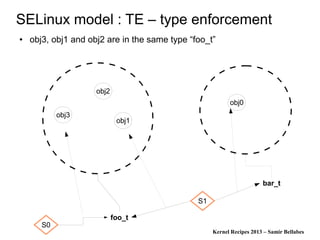
● obj3, obj1 and obj2 are in the same type “foo_t”
obj2
obj1
obj3
S1
S0
obj0
foo_t
bar_t
Kernel Recipes 2013 – Samir Bellabes
SELinux model : type enforcement
● “So it's all about classification ?”
– I think so, but it is not really a shared idea..
Kernel Recipes 2013 – Samir Bellabes
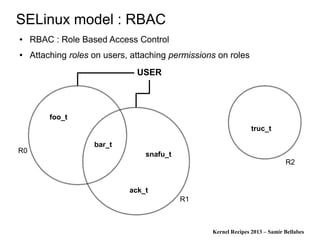
SELinux model : RBAC
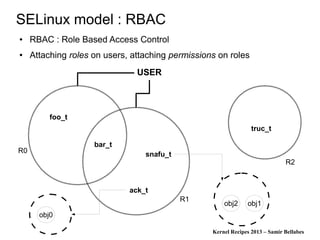
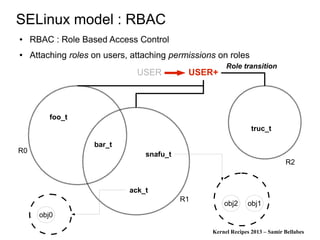
● RBAC : Role Based Access Control
● Attaching roles on users, attaching permissions on roles
Kernel Recipes 2013 – Samir Bellabes
SELinux model : RBAC
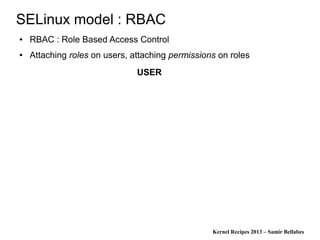
● RBAC : Role Based Access Control
● Attaching roles on users, attaching permissions on roles
USER
Kernel Recipes 2013 – Samir Bellabes
SELinux model : RBAC
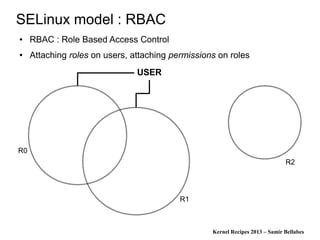
● RBAC : Role Based Access Control
● Attaching roles on users, attaching permissions on roles
USER
R0
R1
R2
Kernel Recipes 2013 – Samir Bellabes
SELinux model : RBAC
● RBAC : Role Based Access Control
● Attaching roles on users, attaching permissions on roles
USER
R0
R1
R2
bar_t
snafu_t
ack_t
truc_t
foo_t
Kernel Recipes 2013 – Samir Bellabes
SELinux model : RBAC
● RBAC : Role Based Access Control
● Attaching roles on users, attaching permissions on roles
USER
R0
R1
R2
foo_t
bar_t
snafu_t
ack_t
truc_t
obj2 obj1
obj0
Kernel Recipes 2013 – Samir Bellabes
SELinux model : RBAC
● RBAC : Role Based Access Control
● Attaching roles on users, attaching permissions on roles
USER
R0
R1
R2
foo_t
bar_t
snafu_t
ack_t
truc_t
obj2 obj1
obj0
USER+
Role transition
Kernel Recipes 2013 – Samir Bellabes
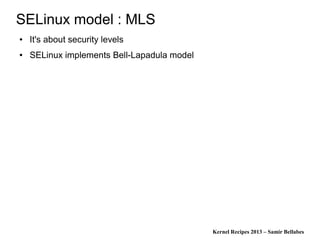
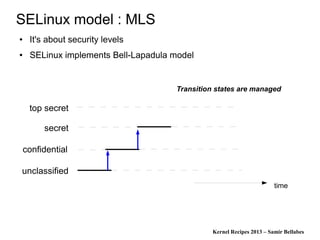
SELinux model : MLS
● It's about security levels
● SELinux implements Bell-Lapadula model
Kernel Recipes 2013 – Samir Bellabes
SELinux model : MLS
● It's about security levels
● SELinux implements Bell-Lapadula model
secret
top secret
confidential
unclassified
Transition states are managed
time
Kernel Recipes 2013 – Samir Bellabes
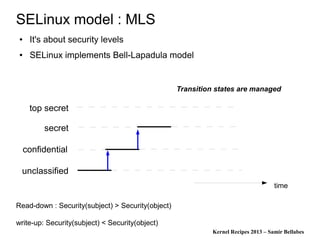
SELinux model : MLS
● It's about security levels
● SELinux implements Bell-Lapadula model
time
secret
top secret
confidential
unclassified
Transition states are managed
Read-down : Security(subject) > Security(object)
write-up: Security(subject) < Security(object)
Kernel Recipes 2013 – Samir Bellabes
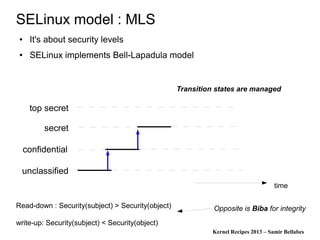
SELinux model : MLS
● It's about security levels
● SELinux implements Bell-Lapadula model
time
secret
top secret
confidential
unclassified
Transition states are managed
Read-down : Security(subject) > Security(object)
write-up: Security(subject) < Security(object)
Opposite is Biba for integrity
Kernel Recipes 2013 – Samir Bellabes
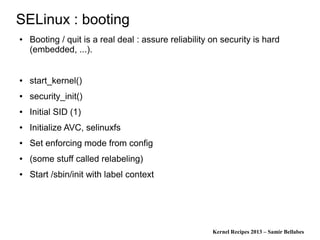
SELinux : booting
● Booting / quit is a real deal : assure reliability on security is hard
(embedded, ...).
● start_kernel()
● security_init()
● Initial SID (1)
● Initialize AVC, selinuxfs
● Set enforcing mode from config
● (some stuff called relabeling)
● Start /sbin/init with label context
Kernel Recipes 2013 – Samir Bellabes
AppArmor
Kernel Recipes 2013 – Samir Bellabes
Model for AppArmor : history
● Originally from 1998
● Upstream in 2.6.36
Kernel Recipes 2013 – Samir Bellabes
AppArmor model : type enforcement
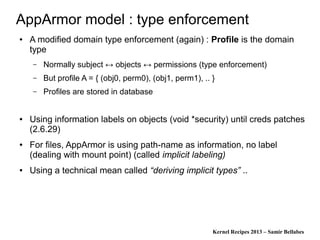
● A modified domain type enforcement (again) : Profile is the domain
type
– Normally subject ↔ objects ↔ permissions (type enforcement)
– But profile A = { (obj0, perm0), (obj1, perm1), .. }
– Profiles are stored in database
● Using information labels on objects (void *security) until creds patches
(2.6.29)
● For files, AppArmor is using path-name as information, no label
(dealing with mount point) (called implicit labeling)
● Using a technical mean called “deriving implicit types” ..
Kernel Recipes 2013 – Samir Bellabes
Tomoyo
Kernel Recipes 2013 – Samir Bellabes
Tomoyo model : type enforcement
● Process are attached a single domain
● If a process exec a program, divide or transit the domain
● Operations granularity on objects are “read/write/execute”
Kernel Recipes 2013 – Samir Bellabes
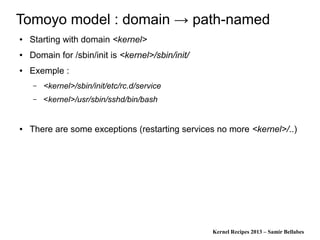
Tomoyo model : domain → path-named
● Starting with domain <kernel>
● Domain for /sbin/init is <kernel>/sbin/init/
● Exemple :
– <kernel>/sbin/init/etc/rc.d/service
– <kernel>/usr/sbin/sshd/bin/bash
● There are some exceptions (restarting services no more <kernel>/..)
Kernel Recipes 2013 – Samir Bellabes
Tomoyo model : type enforcement
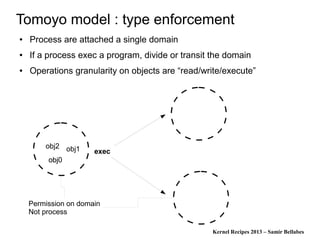
● Process are attached a single domain
● If a process exec a program, divide or transit the domain
● Operations granularity on objects are “read/write/execute”
exec
obj0
obj1
obj0
obj2
Permission on domain
Not process
Kernel Recipes 2013 – Samir Bellabes
Model for Tomoyo : history
● As far as I remember : Fighting
● Revive “void *security” : b6dff3
● Hook for network : post_accept
● Merging
● ..
Kernel Recipes 2013 – Samir Bellabes
Summary of Linux Security Summit 2013
Kernel Recipes 2013 – Samir Bellabes
Summary of LSS 2013
● Update on all security modules.
● Security mechanisms : ASLR, anti-patterns : using PaX plugins for
gcc (!), using Coccinelle (!!!!),
● Stacking (agaaaaain..) but now it's called multiple concurrent security
models
● technical papers for embedded
● http://kernsec.org/wiki/index.php/Linux_Security_Summit_2013
Kernel Recipes 2013 – Samir Bellabes
Using LSM hooks for
“information flow”
Kernel Recipes 2013 – Samir Bellabes
Using LSM hooks for
“information flow”
Entering #no_bullshit zone
Thanks Gandi for sponsoring Kernel Recipes
Kernel Recipes 2013 – Samir Bellabes
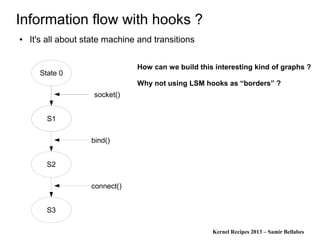
Information flow with hooks ?
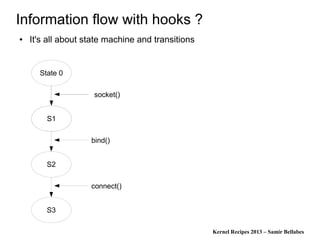
● It's all about state machine and transitions
State 0
S1
socket()
S2
bind()
S1S1
S3
connect()
Kernel Recipes 2013 – Samir Bellabes
Information flow with hooks ?
● It's all about state machine and transitions
State 0
S1
socket()
S2
bind()
S1S1
S3
connect()
How can we build this interesting kind of graphs ?
Why not using LSM hooks as “borders” ?
Kernel Recipes 2013 – Samir Bellabes
Information flow with hooks ?
because ghosts are among us !
Kernel Recipes 2013 – Samir Bellabes
Information flow with hooks ?
● Let's take a memory buffer
● There are lots of functions which can modify m
– write(m,..), mmap(m,..), str*(m,..)
● Let's say you can actually don't miss a function which can modify m
and you can put a trap (hook) inside all this functions.
● So now you can have the graph ..
Kernel Recipes 2013 – Samir Bellabes
Information flow with hooks ?
● Let's take a memory buffer
● There are lots of functions which can modify m
– write(m,..), mmap(m,..), str*(m,..)
● Let's say you can actually don't miss a function which can modify m
and you can put a trap (hook) inside all this functions.
● So now you can have the graph ..
● What about m[10] = 0; ??
● How can you hook this operation ?
Kernel Recipes 2013 – Samir Bellabes
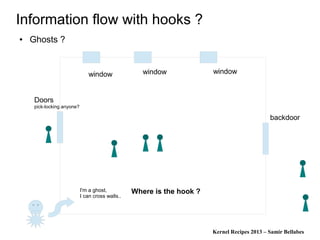
Information flow with hooks ?
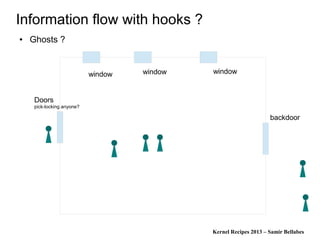
● Ghosts ?
window window window
Doors
pick-locking anyone?
backdoor
Kernel Recipes 2013 – Samir Bellabes
Information flow with hooks ?
● Ghosts ?
window window window
Doors
pick-locking anyone?
backdoor
I'm a ghost,
I can cross walls..
Where is the hook ?
Kernel Recipes 2013 – Samir Bellabes
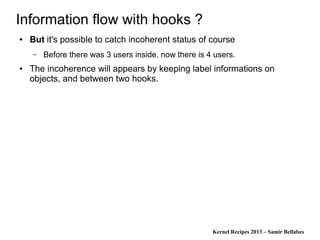
Information flow with hooks ?
● But it's possible to catch incoherent status of course
– Before there was 3 users inside, now there is 4 users.
● The incoherence will appears by keeping label informations on
objects, and between two hooks.
Kernel Recipes 2013 – Samir Bellabes
Exiting #no_bullshit zone
Kernel Recipes 2013 – Samir Bellabes
What's next ? Security at KR season 3 ?..
● what are “technical mechanism” for security implementation ?
● It's called “hardened kernel”
→ ASLR, PaX, PIE/SSP, RELRO, toolchain, …
→ KR Season 3 ?
Kernel Recipes 2013 – Samir Bellabes
Linux Security Modules
-
Thanks hupstream for this event !
Kernel Recipes 2013

Kernel Recipes 2013 - Linux Security Modules: different formal concepts

  • 1.
    Kernel Recipes 2013– Samir Bellabes Linux Security Modules SELinux, AppArmor & Tomoyo trough security models - Kernel Recipes 2013
  • 2.
    Kernel Recipes 2013– Samir Bellabes Previously on KR Season 1
  • 3.
    Kernel Recipes 2013– Samir Bellabes Previously on KR Season 1 ● Formal models for computer security ● Specify functional & assurance requirements → CC ● Implementation ● Testing → CC CC = Common Criteria
  • 4.
    Kernel Recipes 2013– Samir Bellabes Previously on KR Season 1 ● LOMAC : Low Water-Mark Mandatory Access Control - 2000 ● Bell-La Padula (BLP) – 1973 ● object-capability - 1981 ● Take-grant - 1977 ● Biba – 1977 ● Access control Matrix – 1971 ● ..
  • 5.
    Kernel Recipes 2013– Samir Bellabes Previously on KR Season 1 security integrity authentication IMA keys availability confidentiality auditcrypto accounting non repudiation Shared properties
  • 6.
    Kernel Recipes 2013– Samir Bellabes Previously on KR Season 1 access control objectssubject policy What is MAC ?
  • 7.
    Kernel Recipes 2013– Samir Bellabes Previously on KR Season 1 access control objectssubject policy What is MAC ? Attributes are applied They are differents
  • 8.
    Kernel Recipes 2013– Samir Bellabes Summary
  • 9.
    Kernel Recipes 2013– Samir Bellabes Summary ● Model for SELinux – History & discuss ● Model for AppArmor – History & discuss ● Model for Tomoyo – History & discuss ● Summary of the Linux Security Summit 2013 meeting ● Discuss about using LSM hooks for “information flow”
  • 10.
    Kernel Recipes 2013– Samir Bellabes Access Control: timetable SELinux proposed by NSA Hooks mechanism 2001 hooks upstream 2003 removing LSM ? 2006 tomoyo 2009 → AppArmor 2010 → smack 2008 → Stacking / chaining : 2004 → .. RBAC 92/96 LOMAC 2000 PaX 2000 → Linux 2.2 : 99 Linux 2.6 : 03 Linux 2.0 : 96 Linux 2.4 : 01 Take Grant 77 Biba 77 Access Control Matrix 71 Object capablity 81 OrBAC 2003 TCSEC Orange book 85 RSBAC 98 TMAC 98 ABAC 2003 RBAC : Role TMAC : team RSBAC : rule set LOMAC : low OrBAC : organise ABAC : attribute MAC/DAC 60/70 Bell-LP 73 SELinux 2003 →
  • 11.
    Kernel Recipes 2013– Samir Bellabes SELinux
  • 12.
    Kernel Recipes 2013– Samir Bellabes Model for SELinux : history ● NSA was the original developer ● Implementation of the operating system security architecture called Flask ● In the 2.5.x series, LSM framework was developed,so SELinux was ported for 2.6.0 ● Flask : Flux Advanced Security Kernel
  • 13.
    Kernel Recipes 2013– Samir Bellabes SELinux model : the Flask architecture ● Flask architecture simply implements MAC ● Principle of “least privilege” ● Objects and subjects are related to security attributes inside a “security context” ● Dealing with security context is not easy, so we can refer to it with a SID : security identifier, a kind or pointer, reference to the context. Exemple : it's working well for persistent objects ● A security decision can be made with {SID(subject), SID(object)}. ● Two kind of decisions exist : – Labeling decision : obj/sub transition → creating new file from directory – Access decision : check permissions for operations using Access Vector Cache (AVC) : access vector gives decisions for all permissions for a object, or directly on the server policy
  • 14.
    Kernel Recipes 2013– Samir Bellabes SELinux model : the Flask architecture ● Security policy over process and objects ● True innovation : splitting the technical architecture from the policy (not only a modularity) ● Demonstration by implementing : – Type enforcement (TE) 1980-1985 – Role Based Access Control (RBAC) 1992-1996 – Multi Level Security (MLS)
  • 15.
    Kernel Recipes 2013– Samir Bellabes SELinux model : TE – type enforcement ● SAT : Secure Ada Target, 1st implementation, late 1980s ● Labels (security informations) on subjects and objects ● security context with labels on subjects → “domain label” (DTE) ● security context with labels on objects → “type label” (DTE) ● class exist for using objects directly: – Same type, but different class → can manage the situation ● TE uses role for users, not domain. – credentials mechanism → b6dff3 : separate task security context from task_struct, so no more true label on subject ● TE enables the labeling decisions and the access decisions
  • 16.
    Kernel Recipes 2013– Samir Bellabes SELinux model : TE – type enforcement ● obj3, obj1 and obj2 are in the same type “foo_t” obj2 obj1 obj3 S1 S0 obj0 foo_t bar_t
  • 17.
    Kernel Recipes 2013– Samir Bellabes SELinux model : type enforcement ● “So it's all about classification ?” – I think so, but it is not really a shared idea..
  • 18.
    Kernel Recipes 2013– Samir Bellabes SELinux model : RBAC ● RBAC : Role Based Access Control ● Attaching roles on users, attaching permissions on roles
  • 19.
    Kernel Recipes 2013– Samir Bellabes SELinux model : RBAC ● RBAC : Role Based Access Control ● Attaching roles on users, attaching permissions on roles USER
  • 20.
    Kernel Recipes 2013– Samir Bellabes SELinux model : RBAC ● RBAC : Role Based Access Control ● Attaching roles on users, attaching permissions on roles USER R0 R1 R2
  • 21.
    Kernel Recipes 2013– Samir Bellabes SELinux model : RBAC ● RBAC : Role Based Access Control ● Attaching roles on users, attaching permissions on roles USER R0 R1 R2 bar_t snafu_t ack_t truc_t foo_t
  • 22.
    Kernel Recipes 2013– Samir Bellabes SELinux model : RBAC ● RBAC : Role Based Access Control ● Attaching roles on users, attaching permissions on roles USER R0 R1 R2 foo_t bar_t snafu_t ack_t truc_t obj2 obj1 obj0
  • 23.
    Kernel Recipes 2013– Samir Bellabes SELinux model : RBAC ● RBAC : Role Based Access Control ● Attaching roles on users, attaching permissions on roles USER R0 R1 R2 foo_t bar_t snafu_t ack_t truc_t obj2 obj1 obj0 USER+ Role transition
  • 24.
    Kernel Recipes 2013– Samir Bellabes SELinux model : MLS ● It's about security levels ● SELinux implements Bell-Lapadula model
  • 25.
    Kernel Recipes 2013– Samir Bellabes SELinux model : MLS ● It's about security levels ● SELinux implements Bell-Lapadula model secret top secret confidential unclassified Transition states are managed time
  • 26.
    Kernel Recipes 2013– Samir Bellabes SELinux model : MLS ● It's about security levels ● SELinux implements Bell-Lapadula model time secret top secret confidential unclassified Transition states are managed Read-down : Security(subject) > Security(object) write-up: Security(subject) < Security(object)
  • 27.
    Kernel Recipes 2013– Samir Bellabes SELinux model : MLS ● It's about security levels ● SELinux implements Bell-Lapadula model time secret top secret confidential unclassified Transition states are managed Read-down : Security(subject) > Security(object) write-up: Security(subject) < Security(object) Opposite is Biba for integrity
  • 28.
    Kernel Recipes 2013– Samir Bellabes SELinux : booting ● Booting / quit is a real deal : assure reliability on security is hard (embedded, ...). ● start_kernel() ● security_init() ● Initial SID (1) ● Initialize AVC, selinuxfs ● Set enforcing mode from config ● (some stuff called relabeling) ● Start /sbin/init with label context
  • 29.
    Kernel Recipes 2013– Samir Bellabes AppArmor
  • 30.
    Kernel Recipes 2013– Samir Bellabes Model for AppArmor : history ● Originally from 1998 ● Upstream in 2.6.36
  • 31.
    Kernel Recipes 2013– Samir Bellabes AppArmor model : type enforcement ● A modified domain type enforcement (again) : Profile is the domain type – Normally subject ↔ objects ↔ permissions (type enforcement) – But profile A = { (obj0, perm0), (obj1, perm1), .. } – Profiles are stored in database ● Using information labels on objects (void *security) until creds patches (2.6.29) ● For files, AppArmor is using path-name as information, no label (dealing with mount point) (called implicit labeling) ● Using a technical mean called “deriving implicit types” ..
  • 32.
    Kernel Recipes 2013– Samir Bellabes Tomoyo
  • 33.
    Kernel Recipes 2013– Samir Bellabes Tomoyo model : type enforcement ● Process are attached a single domain ● If a process exec a program, divide or transit the domain ● Operations granularity on objects are “read/write/execute”
  • 34.
    Kernel Recipes 2013– Samir Bellabes Tomoyo model : domain → path-named ● Starting with domain <kernel> ● Domain for /sbin/init is <kernel>/sbin/init/ ● Exemple : – <kernel>/sbin/init/etc/rc.d/service – <kernel>/usr/sbin/sshd/bin/bash ● There are some exceptions (restarting services no more <kernel>/..)
  • 35.
    Kernel Recipes 2013– Samir Bellabes Tomoyo model : type enforcement ● Process are attached a single domain ● If a process exec a program, divide or transit the domain ● Operations granularity on objects are “read/write/execute” exec obj0 obj1 obj0 obj2 Permission on domain Not process
  • 36.
    Kernel Recipes 2013– Samir Bellabes Model for Tomoyo : history ● As far as I remember : Fighting ● Revive “void *security” : b6dff3 ● Hook for network : post_accept ● Merging ● ..
  • 37.
    Kernel Recipes 2013– Samir Bellabes Summary of Linux Security Summit 2013
  • 38.
    Kernel Recipes 2013– Samir Bellabes Summary of LSS 2013 ● Update on all security modules. ● Security mechanisms : ASLR, anti-patterns : using PaX plugins for gcc (!), using Coccinelle (!!!!), ● Stacking (agaaaaain..) but now it's called multiple concurrent security models ● technical papers for embedded ● http://kernsec.org/wiki/index.php/Linux_Security_Summit_2013
  • 39.
    Kernel Recipes 2013– Samir Bellabes Using LSM hooks for “information flow”
  • 40.
    Kernel Recipes 2013– Samir Bellabes Using LSM hooks for “information flow” Entering #no_bullshit zone Thanks Gandi for sponsoring Kernel Recipes
  • 41.
    Kernel Recipes 2013– Samir Bellabes Information flow with hooks ? ● It's all about state machine and transitions State 0 S1 socket() S2 bind() S1S1 S3 connect()
  • 42.
    Kernel Recipes 2013– Samir Bellabes Information flow with hooks ? ● It's all about state machine and transitions State 0 S1 socket() S2 bind() S1S1 S3 connect() How can we build this interesting kind of graphs ? Why not using LSM hooks as “borders” ?
  • 43.
    Kernel Recipes 2013– Samir Bellabes Information flow with hooks ? because ghosts are among us !
  • 44.
    Kernel Recipes 2013– Samir Bellabes Information flow with hooks ? ● Let's take a memory buffer ● There are lots of functions which can modify m – write(m,..), mmap(m,..), str*(m,..) ● Let's say you can actually don't miss a function which can modify m and you can put a trap (hook) inside all this functions. ● So now you can have the graph ..
  • 45.
    Kernel Recipes 2013– Samir Bellabes Information flow with hooks ? ● Let's take a memory buffer ● There are lots of functions which can modify m – write(m,..), mmap(m,..), str*(m,..) ● Let's say you can actually don't miss a function which can modify m and you can put a trap (hook) inside all this functions. ● So now you can have the graph .. ● What about m[10] = 0; ?? ● How can you hook this operation ?
  • 46.
    Kernel Recipes 2013– Samir Bellabes Information flow with hooks ? ● Ghosts ? window window window Doors pick-locking anyone? backdoor
  • 47.
    Kernel Recipes 2013– Samir Bellabes Information flow with hooks ? ● Ghosts ? window window window Doors pick-locking anyone? backdoor I'm a ghost, I can cross walls.. Where is the hook ?
  • 48.
    Kernel Recipes 2013– Samir Bellabes Information flow with hooks ? ● But it's possible to catch incoherent status of course – Before there was 3 users inside, now there is 4 users. ● The incoherence will appears by keeping label informations on objects, and between two hooks.
  • 49.
    Kernel Recipes 2013– Samir Bellabes Exiting #no_bullshit zone
  • 50.
    Kernel Recipes 2013– Samir Bellabes What's next ? Security at KR season 3 ?.. ● what are “technical mechanism” for security implementation ? ● It's called “hardened kernel” → ASLR, PaX, PIE/SSP, RELRO, toolchain, … → KR Season 3 ?
  • 51.
    Kernel Recipes 2013– Samir Bellabes Linux Security Modules - Thanks hupstream for this event ! Kernel Recipes 2013