PREPARED BY:- SHIVANGI SINGH
Wireless Communication (2171004)
E.C DEPT.
 GSM is the most secured cellular telecommunications system available today.
GSM has its security methods standardized.
 GSM maintains end-to-end security by retaining the confidentiality of calls and
anonymity of the GSM subscriber.
 Temporary identification numbers are assigned to the subscriber’s number to
maintain the privacy of the user.
 The privacy of the communication is maintained by applying encryption
algorithms and frequency hopping that can be enabled using digital systems and
signalling.
 The security in GSM networks is area of research, as the fraudulent measures are
on an increase and the network needs to be secure from such kind of attacks. The
Security in GSM is broadly divided on the following levels:
i. Operator’s level.
ii. Customer’s level.
iii. Make a system at least as secure as PSTN.
 These three areas look for the following aspects i.e. correct billing to the people,
Avoid fraud, Protect Services, Privacy, and Anonymity.
 The GSM Security features describe how the security can be implemented in the
GSM Network. The GSM Network divides the security in the following features.
 Authentication: GSM Network operator can verify the identity of the subscriber
making it infeasible to clone someone else’s mobile phone.
 Confidentiality: GSM Network protects voice, data and sensitive signalling
information (e.g. dialled digits) against eavesdropping on the radio path.
 Anonymity: GSM Network protects against someone tracking the location of the
user or identifying calls made to or from the user by eavesdropping on the radio
path.
 The GSM Security Model implements the features in the following mechanisms:
 Authentication is achieved by the following processes :
i. Challenge-response authentication protocol
ii. Encryption of the radio channel
 Confidentiality:
i. Encryption of the Radio Channel
 Anonymity :
i. Using Temporary Identities
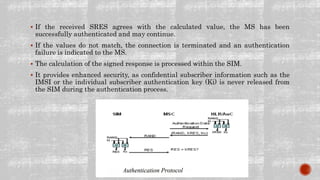
 The GSM network authenticates the identity of the subscriber through the use of
a challenge-response mechanism.
 A 128-bit Random Number (RAND) is sent to the MS.
 The MS computes the 32-bit Signed Response (SRES) based on the encryption of
the RAND with the authentication algorithm (A3) using the individual subscriber
authentication key (Ki).
 Upon receiving the SRES from the subscriber, the GSM network repeats the
calculation to verify the identity of the subscriber.
 The individual subscriber authentication key (Ki) is never transmitted over the
radio channel, as it is present in the subscriber's SIM, as well as the AUC, HLR,
and VLR databases.
 If the received SRES agrees with the calculated value, the MS has been
successfully authenticated and may continue.
 If the values do not match, the connection is terminated and an authentication
failure is indicated to the MS.
 The calculation of the signed response is processed within the SIM.
 It provides enhanced security, as confidential subscriber information such as the
IMSI or the individual subscriber authentication key (Ki) is never released from
the SIM during the authentication process.
 The SIM contains the ciphering key generating algorithm (A8) that is used to
produce the 64-bit ciphering key (Kc).
 This key is computed by applying the same random number (RAND) used in the
authentication process to ciphering key generating algorithm (A8) with the
individual subscriber authentication key (Ki).
 GSM provides an additional level of security by having a way to change the
ciphering key, making the system more resistant to eavesdropping.
 The ciphering key may be changed at regular intervals as required.
 As in case of the authentication process, the computation of the ciphering key (Kc)
takes place internally within the SIM.
 Sensitive information such as the individual subscriber authentication key (Ki) is
never revealed by the SIM.
 Encrypted voice and data communications between the MS and the network is
accomplished by using the ciphering algorithm A5.
 Encrypted communication is initiated by a ciphering mode request command from
the GSM network.
 Upon receipt of this command, the mobile station begins encryption and
decryption of data using the ciphering algorithm (A5) and the ciphering key (Kc).
 The Anonymity of the subscriber on the radio access link in the GSM Network can
be achieved by allocating Temporary Mobile Subscriber Identity (TMSIs) instead
of permanent identities
i.e. International Mobile Subscriber Identity which helps to protect against
tracking a user’s location and obtaining information about a user’s calling
pattern.
 When a user first arrives on a network he uses his IMSI to identify himself and
when the network has switched on encryption it assigns a temporary identity
TMSI 1 to the user, next accesses the network he uses TMSI 1 to identify himself
and the network assigns TMSI 2 once an encrypted channel has been established.
 To ensure subscriber identity confidentiality, the Temporary Mobile Subscriber
Identity (TMSI) is used.
 Once the authentication and encryption procedures are done, the TMSI is sent to
the mobile station.
 After the receipt, the mobile station responds. The TMSI is valid in the location
area in which it was issued.
 For communications outside the location area, the Location Area Identification
(LAI) is necessary in addition to the TMSI.
Security aspect in GSM

Security aspect in GSM

  • 1.
    PREPARED BY:- SHIVANGISINGH Wireless Communication (2171004) E.C DEPT.
  • 2.
     GSM isthe most secured cellular telecommunications system available today. GSM has its security methods standardized.  GSM maintains end-to-end security by retaining the confidentiality of calls and anonymity of the GSM subscriber.  Temporary identification numbers are assigned to the subscriber’s number to maintain the privacy of the user.  The privacy of the communication is maintained by applying encryption algorithms and frequency hopping that can be enabled using digital systems and signalling.
  • 3.
     The securityin GSM networks is area of research, as the fraudulent measures are on an increase and the network needs to be secure from such kind of attacks. The Security in GSM is broadly divided on the following levels: i. Operator’s level. ii. Customer’s level. iii. Make a system at least as secure as PSTN.  These three areas look for the following aspects i.e. correct billing to the people, Avoid fraud, Protect Services, Privacy, and Anonymity.
  • 4.
     The GSMSecurity features describe how the security can be implemented in the GSM Network. The GSM Network divides the security in the following features.  Authentication: GSM Network operator can verify the identity of the subscriber making it infeasible to clone someone else’s mobile phone.  Confidentiality: GSM Network protects voice, data and sensitive signalling information (e.g. dialled digits) against eavesdropping on the radio path.  Anonymity: GSM Network protects against someone tracking the location of the user or identifying calls made to or from the user by eavesdropping on the radio path.
  • 5.
     The GSMSecurity Model implements the features in the following mechanisms:  Authentication is achieved by the following processes : i. Challenge-response authentication protocol ii. Encryption of the radio channel  Confidentiality: i. Encryption of the Radio Channel  Anonymity : i. Using Temporary Identities
  • 6.
     The GSMnetwork authenticates the identity of the subscriber through the use of a challenge-response mechanism.  A 128-bit Random Number (RAND) is sent to the MS.  The MS computes the 32-bit Signed Response (SRES) based on the encryption of the RAND with the authentication algorithm (A3) using the individual subscriber authentication key (Ki).  Upon receiving the SRES from the subscriber, the GSM network repeats the calculation to verify the identity of the subscriber.  The individual subscriber authentication key (Ki) is never transmitted over the radio channel, as it is present in the subscriber's SIM, as well as the AUC, HLR, and VLR databases.
  • 7.
     If thereceived SRES agrees with the calculated value, the MS has been successfully authenticated and may continue.  If the values do not match, the connection is terminated and an authentication failure is indicated to the MS.  The calculation of the signed response is processed within the SIM.  It provides enhanced security, as confidential subscriber information such as the IMSI or the individual subscriber authentication key (Ki) is never released from the SIM during the authentication process.
  • 8.
     The SIMcontains the ciphering key generating algorithm (A8) that is used to produce the 64-bit ciphering key (Kc).  This key is computed by applying the same random number (RAND) used in the authentication process to ciphering key generating algorithm (A8) with the individual subscriber authentication key (Ki).  GSM provides an additional level of security by having a way to change the ciphering key, making the system more resistant to eavesdropping.  The ciphering key may be changed at regular intervals as required.
  • 9.
     As incase of the authentication process, the computation of the ciphering key (Kc) takes place internally within the SIM.  Sensitive information such as the individual subscriber authentication key (Ki) is never revealed by the SIM.  Encrypted voice and data communications between the MS and the network is accomplished by using the ciphering algorithm A5.  Encrypted communication is initiated by a ciphering mode request command from the GSM network.  Upon receipt of this command, the mobile station begins encryption and decryption of data using the ciphering algorithm (A5) and the ciphering key (Kc).
  • 10.
     The Anonymityof the subscriber on the radio access link in the GSM Network can be achieved by allocating Temporary Mobile Subscriber Identity (TMSIs) instead of permanent identities i.e. International Mobile Subscriber Identity which helps to protect against tracking a user’s location and obtaining information about a user’s calling pattern.  When a user first arrives on a network he uses his IMSI to identify himself and when the network has switched on encryption it assigns a temporary identity TMSI 1 to the user, next accesses the network he uses TMSI 1 to identify himself and the network assigns TMSI 2 once an encrypted channel has been established.
  • 11.
     To ensuresubscriber identity confidentiality, the Temporary Mobile Subscriber Identity (TMSI) is used.  Once the authentication and encryption procedures are done, the TMSI is sent to the mobile station.  After the receipt, the mobile station responds. The TMSI is valid in the location area in which it was issued.  For communications outside the location area, the Location Area Identification (LAI) is necessary in addition to the TMSI.