GSM Security Concerns
• Operators
– Bills right people
– Avoid fraud
– Protect Services
• Customers
– Privacy
– Anonymity
• Make a system at least secure as PSTN
z1
GSM Security Goals
• Confidentiality and Anonymity on the radio
path
• Strong client authentication to protect the
operator against the billing fraud
• Prevention of operators from compromising of
each others’ security
z2
GSM Security Design
Requirements
• The security mechanism
– MUST NOT
• Add significant overhead on call set up
• Increase bandwidth of the channel
• Increase error rate
• Add expensive complexity to the system
– MUST
• Cost effective scheme
– Define security procedures
• Generation and distribution of keys
• Exchange information between operators
• Confidentiality of algorithms
z3
GSM Security Features
• Key management is independent of equipment
– Subscribers can change handsets without compromising security
• Subscriber identity protection
– not easy to identify the user of the system intercepting a user data
• Detection of compromised equipment
– Detection mechanism whether a mobile device was compromised or
not
• Subscriber authentication
– The operator knows for billing purposes who is using the system
• Signaling and user data protection
– Signaling and data channels are protected over the radio path
z4
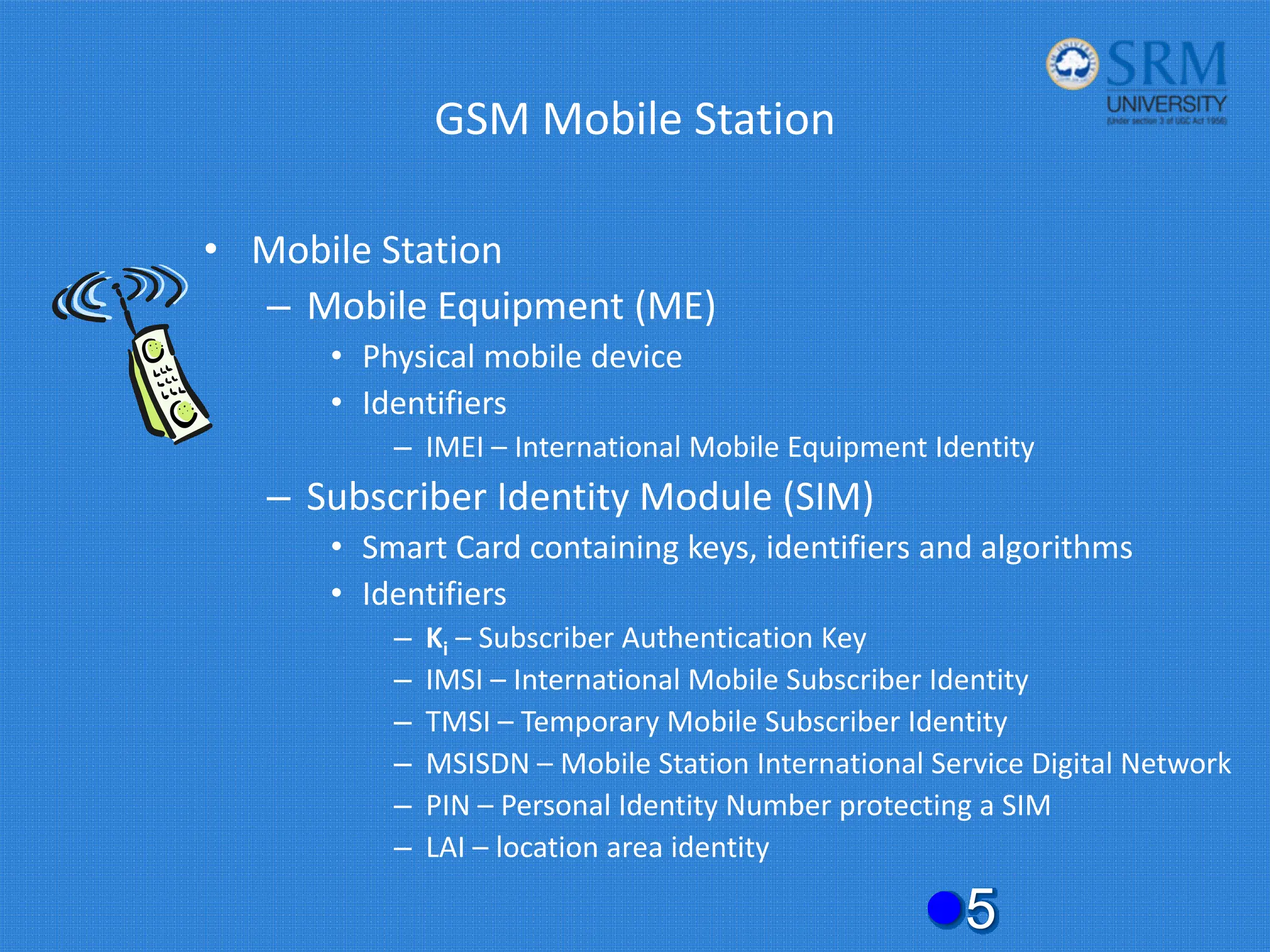
GSM Mobile Station
• Mobile Station
– Mobile Equipment (ME)
• Physical mobile device
• Identifiers
– IMEI – International Mobile Equipment Identity
– Subscriber Identity Module (SIM)
• Smart Card containing keys, identifiers and algorithms
• Identifiers
– Ki – Subscriber Authentication Key
– IMSI – International Mobile Subscriber Identity
– TMSI – Temporary Mobile Subscriber Identity
– MSISDN – Mobile Station International Service Digital Network
– PIN – Personal Identity Number protecting a SIM
– LAI – location area identity
z5
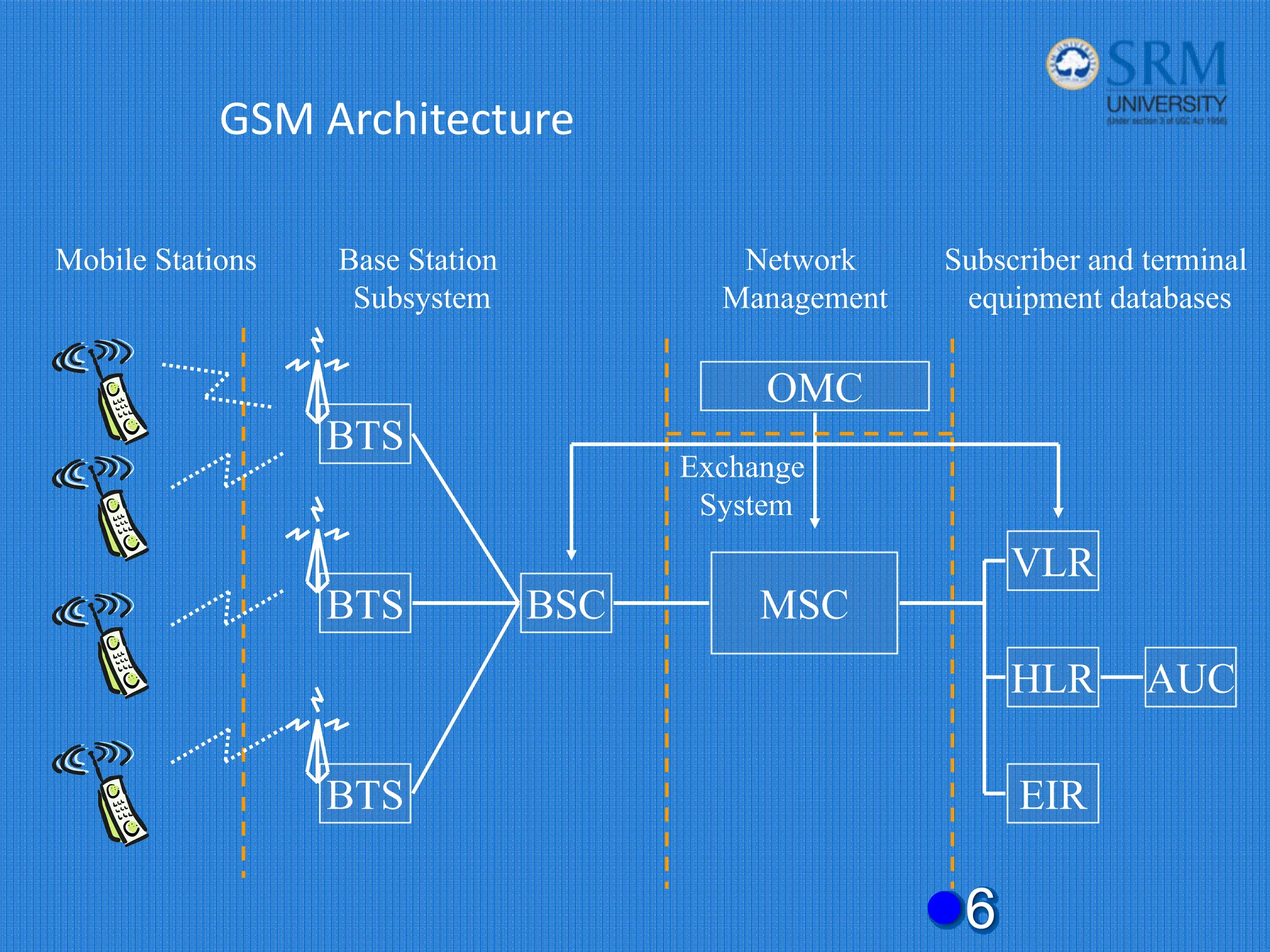
GSM Architecture
z6
Mobile Stations Base Station
Subsystem
Exchange
System
Network
Management
Subscriber and terminal
equipment databases
BSC MSC
VLR
HLR
EIR
AUC
OMC
BTS
BTS
BTS
Subscriber Identity Protection
• TMSI – Temporary Mobile Subscriber Identity
– Goals
• TMSI is used instead of IMSI as an a temporary subscriber identifier
• TMSI prevents an eavesdropper from identifying of subscriber
– Usage
• TMSI is assigned when IMSI is transmitted to AuC on the first phone
switch on
• Every time a location update (new MSC) occur the networks assigns a
new TMSI
• TMSI is used by the MS to report to the network or during a call
initialization
• Network uses TMSI to communicate with MS
• On MS switch off TMSI is stored on SIM card to be reused next time
– The Visitor Location Register (VLR) performs assignment,
administration and update of the TMSI
z7
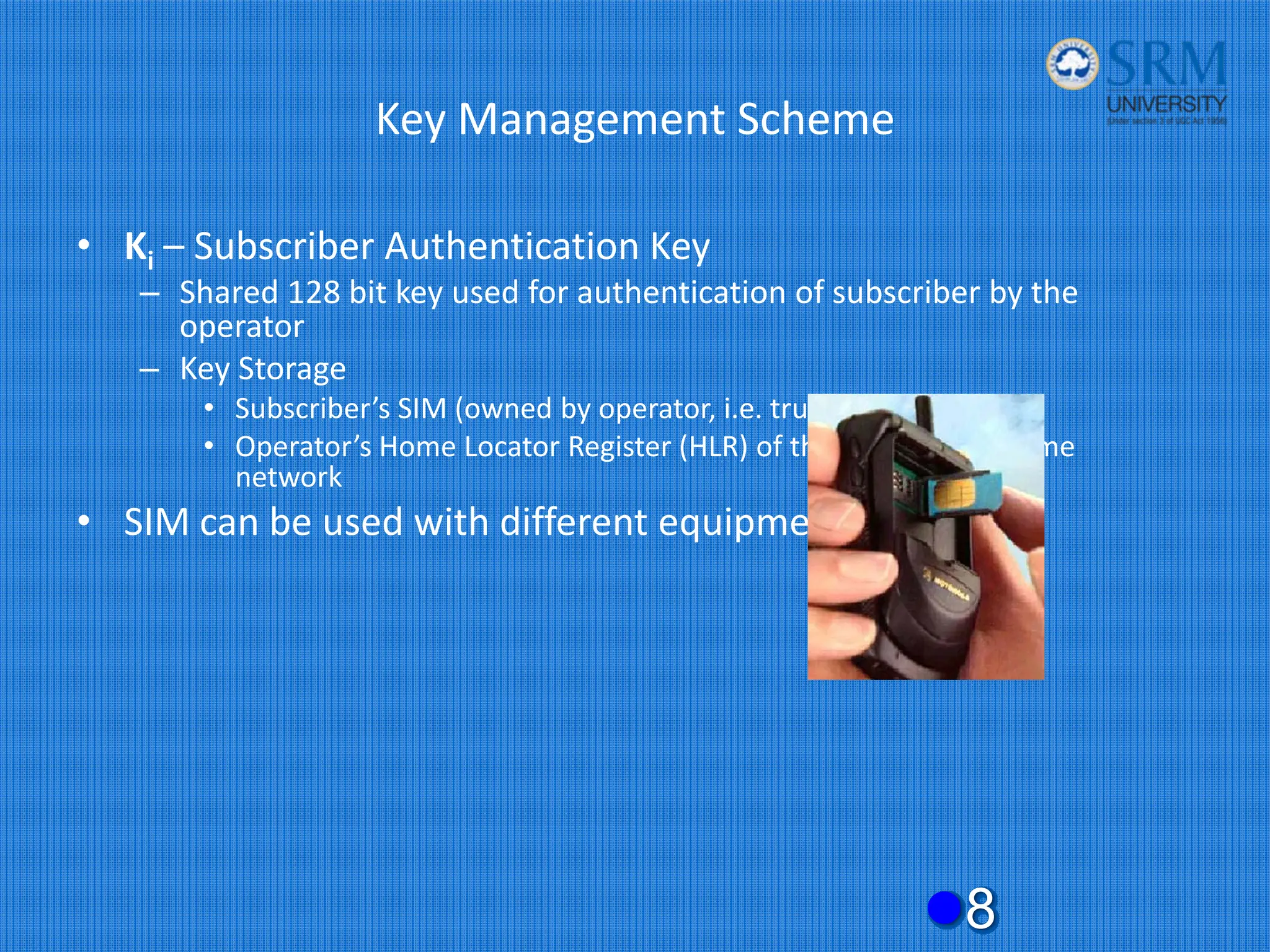
Key Management Scheme
• Ki – Subscriber Authentication Key
– Shared 128 bit key used for authentication of subscriber by the
operator
– Key Storage
• Subscriber’s SIM (owned by operator, i.e. trusted)
• Operator’s Home Locator Register (HLR) of the subscriber’s home
network
• SIM can be used with different equipment
z8
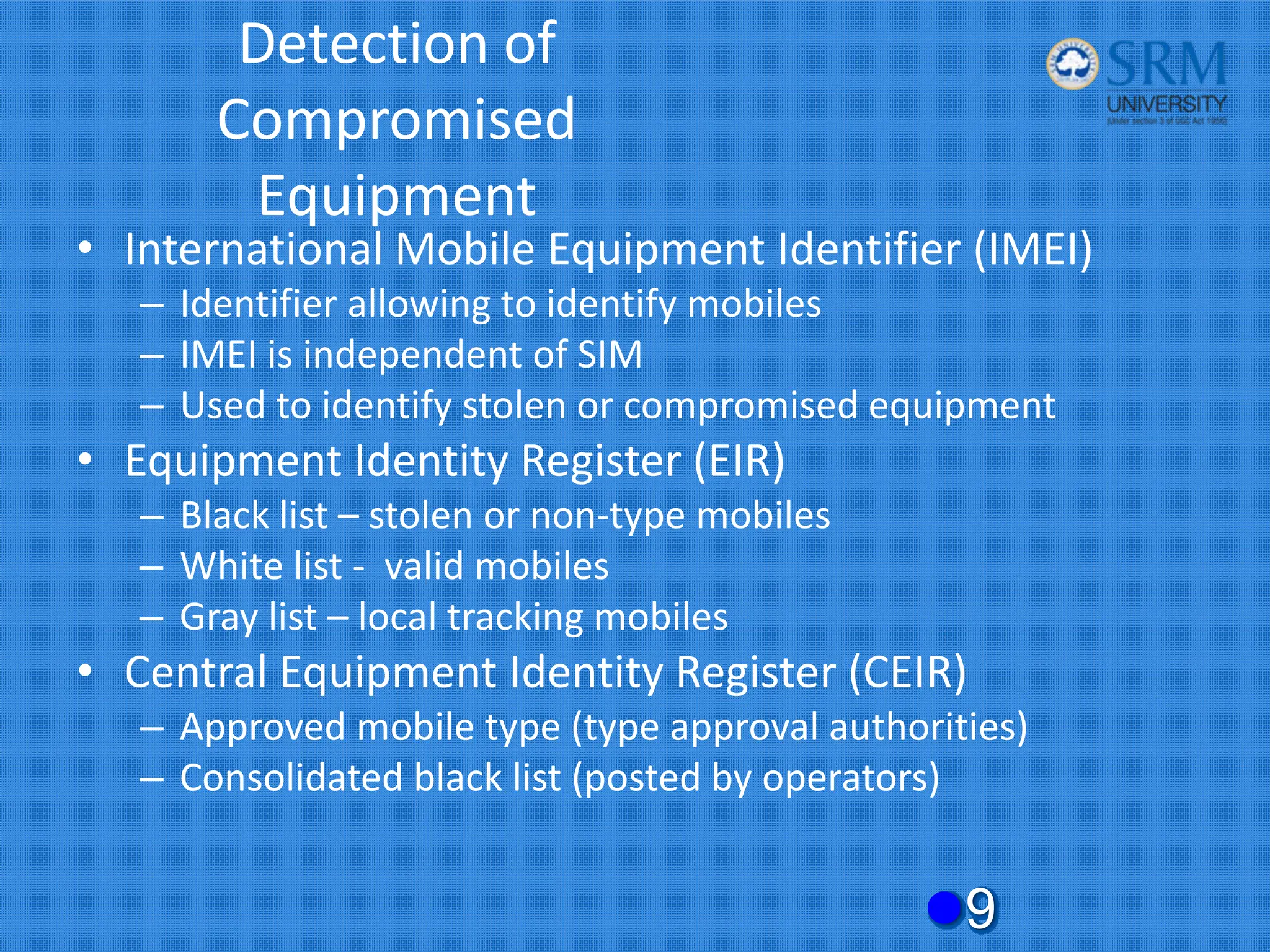
Detection of
Compromised
Equipment
• International Mobile Equipment Identifier (IMEI)
– Identifier allowing to identify mobiles
– IMEI is independent of SIM
– Used to identify stolen or compromised equipment
• Equipment Identity Register (EIR)
– Black list – stolen or non‐type mobiles
– White list ‐ valid mobiles
– Gray list – local tracking mobiles
• Central Equipment Identity Register (CEIR)
– Approved mobile type (type approval authorities)
– Consolidated black list (posted by operators)
z9
Authentication
• Authentication Goals
– Subscriber (SIM holder) authentication
– Protection of the network against unauthorized
use
– Create a session key
• Authentication Scheme
– Subscriber identification: IMSI or TMSI
– Challenge‐Response authentication of the
subscriber by the operator
z10
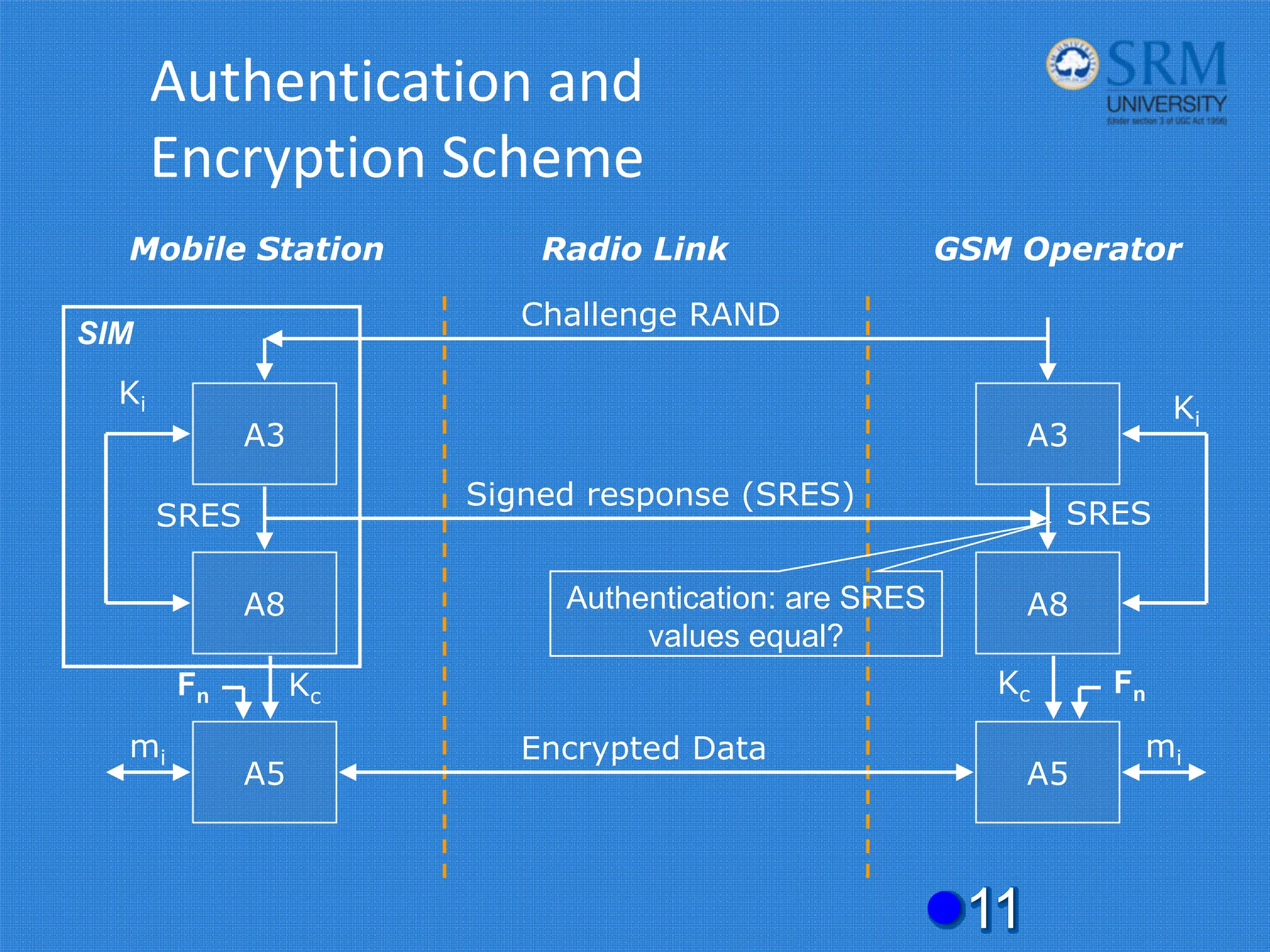
Authentication and
Encryption Scheme
z11
A3
Mobile Station Radio Link GSM Operator
A8
A5
A3
A8
A5
Ki Ki
Challenge RAND
Kc
Kc
mi Encrypted Data mi
SIM
Signed response (SRES)
SRES
SRES
Fn Fn
Authentication: are SRES
values equal?
Authentication
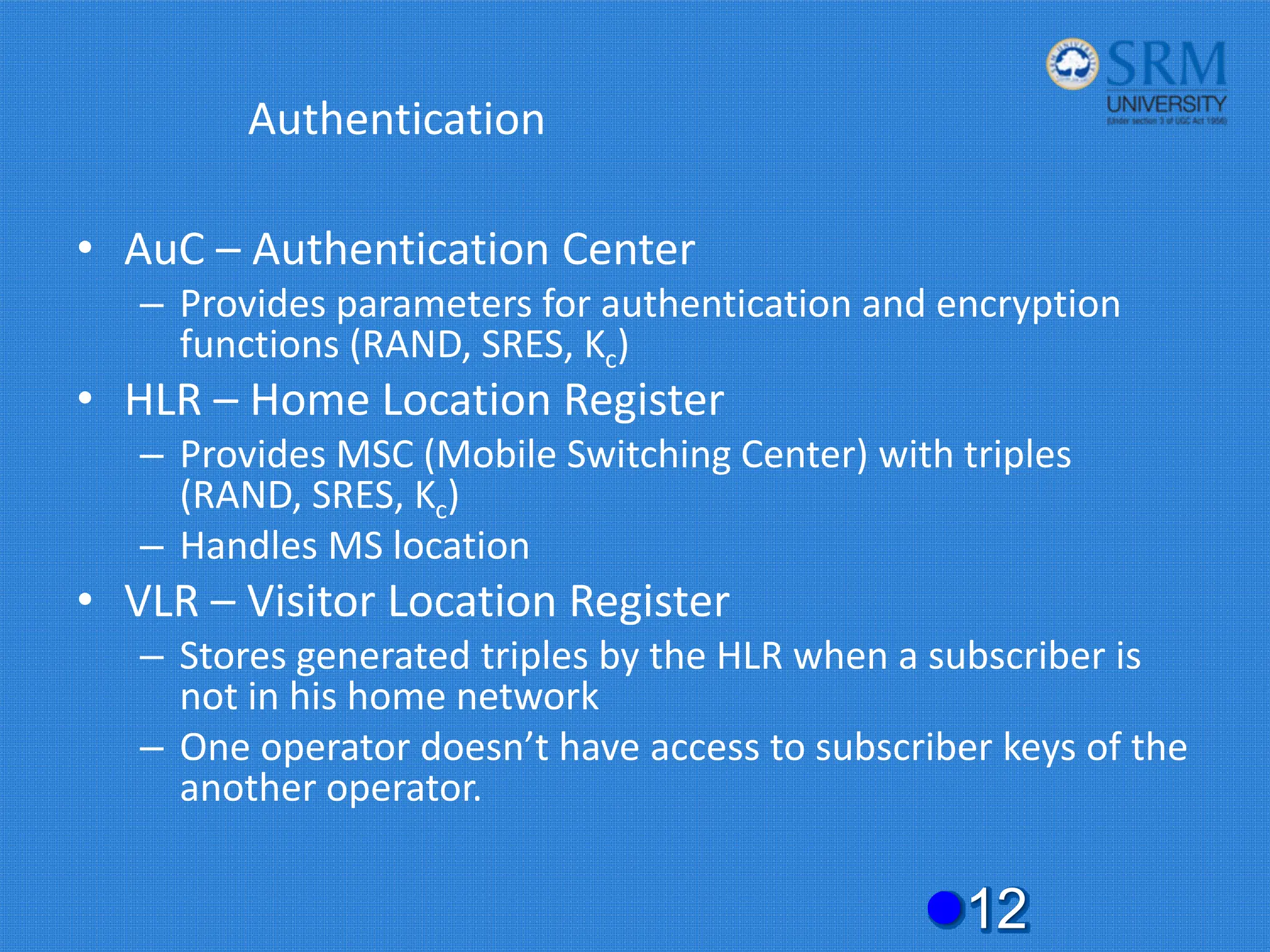
• AuC – Authentication Center
– Provides parameters for authentication and encryption
functions (RAND, SRES, Kc)
• HLR – Home Location Register
– Provides MSC (Mobile Switching Center) with triples
(RAND, SRES, Kc)
– Handles MS location
• VLR – Visitor Location Register
– Stores generated triples by the HLR when a subscriber is
not in his home network
– One operator doesn’t have access to subscriber keys of the
another operator.
z12
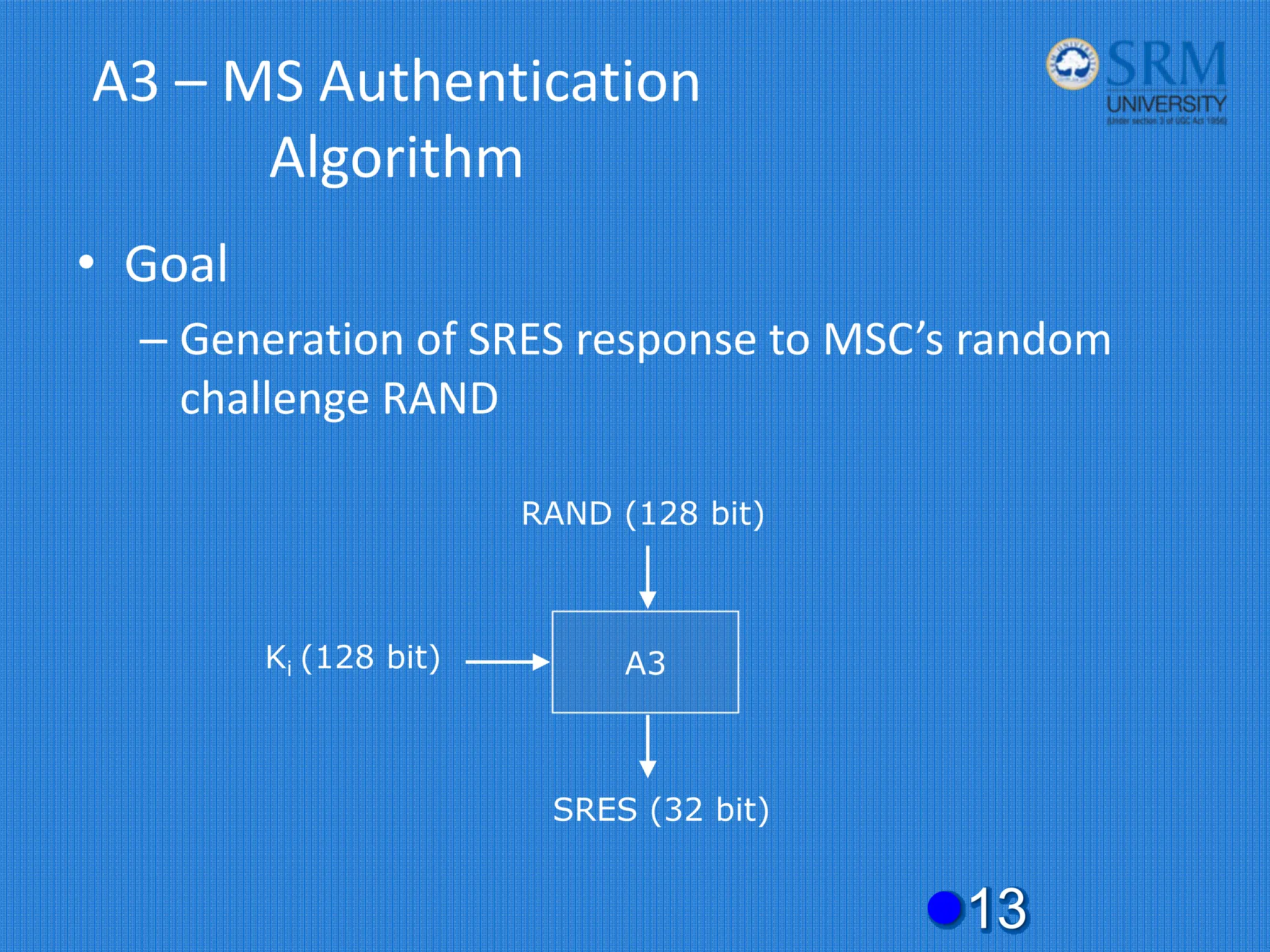
A3 – MS Authentication
Algorithm
• Goal
– Generation of SRES response to MSC’s random
challenge RAND
z13
A3
RAND (128 bit)
Ki (128 bit)
SRES (32 bit)
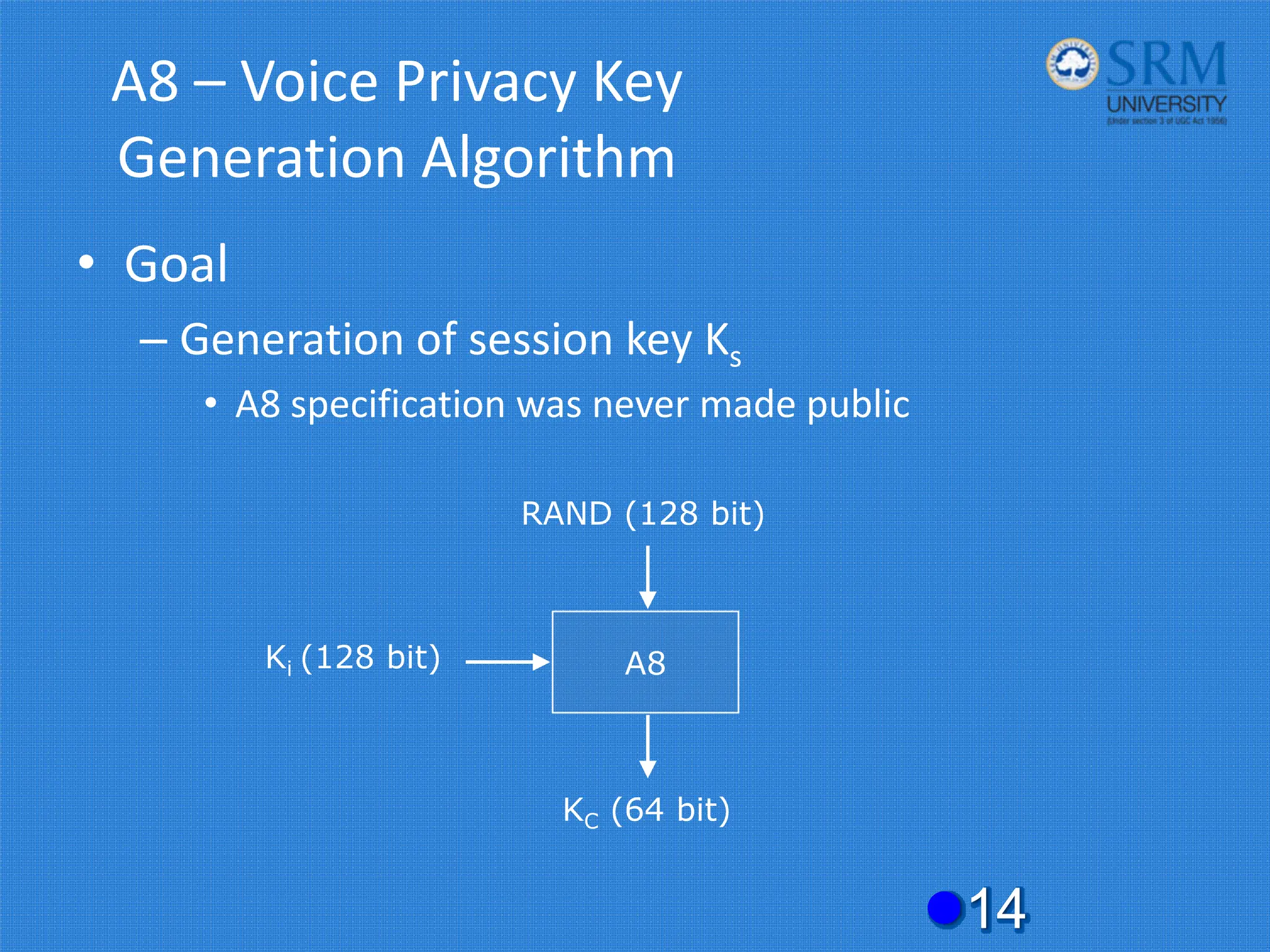
A8 – Voice Privacy Key
Generation Algorithm
• Goal
– Generation of session key Ks
• A8 specification was never made public
z14
A8
RAND (128 bit)
Ki (128 bit)
KC (64 bit)
Logical Implementation
of A3 and A8
• Both A3 and A8 algorithms are implemented
on the SIM
– Operator can decide, which algorithm to use.
– Algorithms implementation is independent of
hardware manufacturers and network operators.
z15
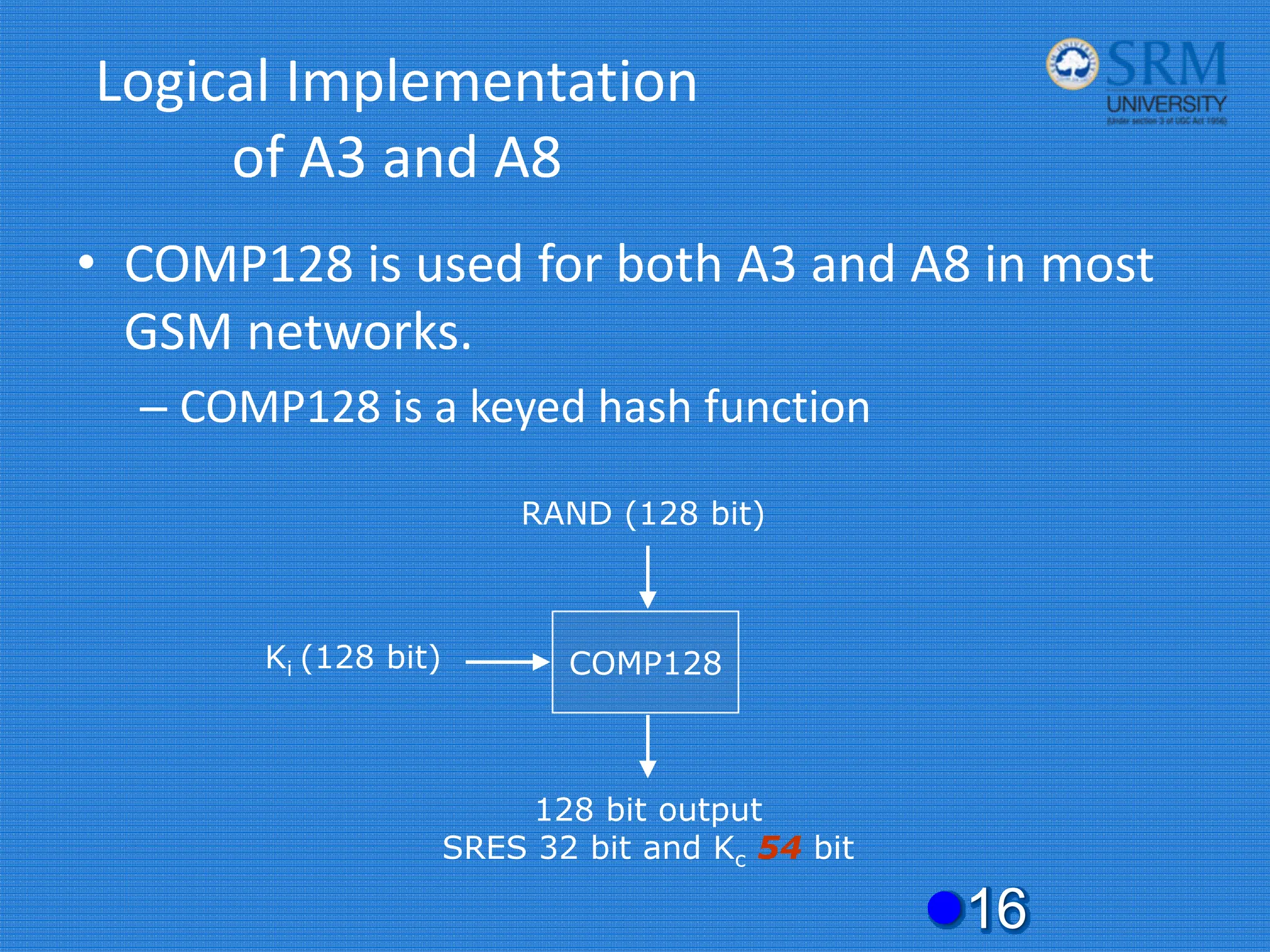
Logical Implementation
of A3 and A8
• COMP128 is used for both A3 and A8 in most
GSM networks.
– COMP128 is a keyed hash function
z16
COMP128
RAND (128 bit)
Ki (128 bit)
128 bit output
SRES 32 bit and Kc 54 bit
A5 – Encryption Algorithm
– A5 is a stream cipher
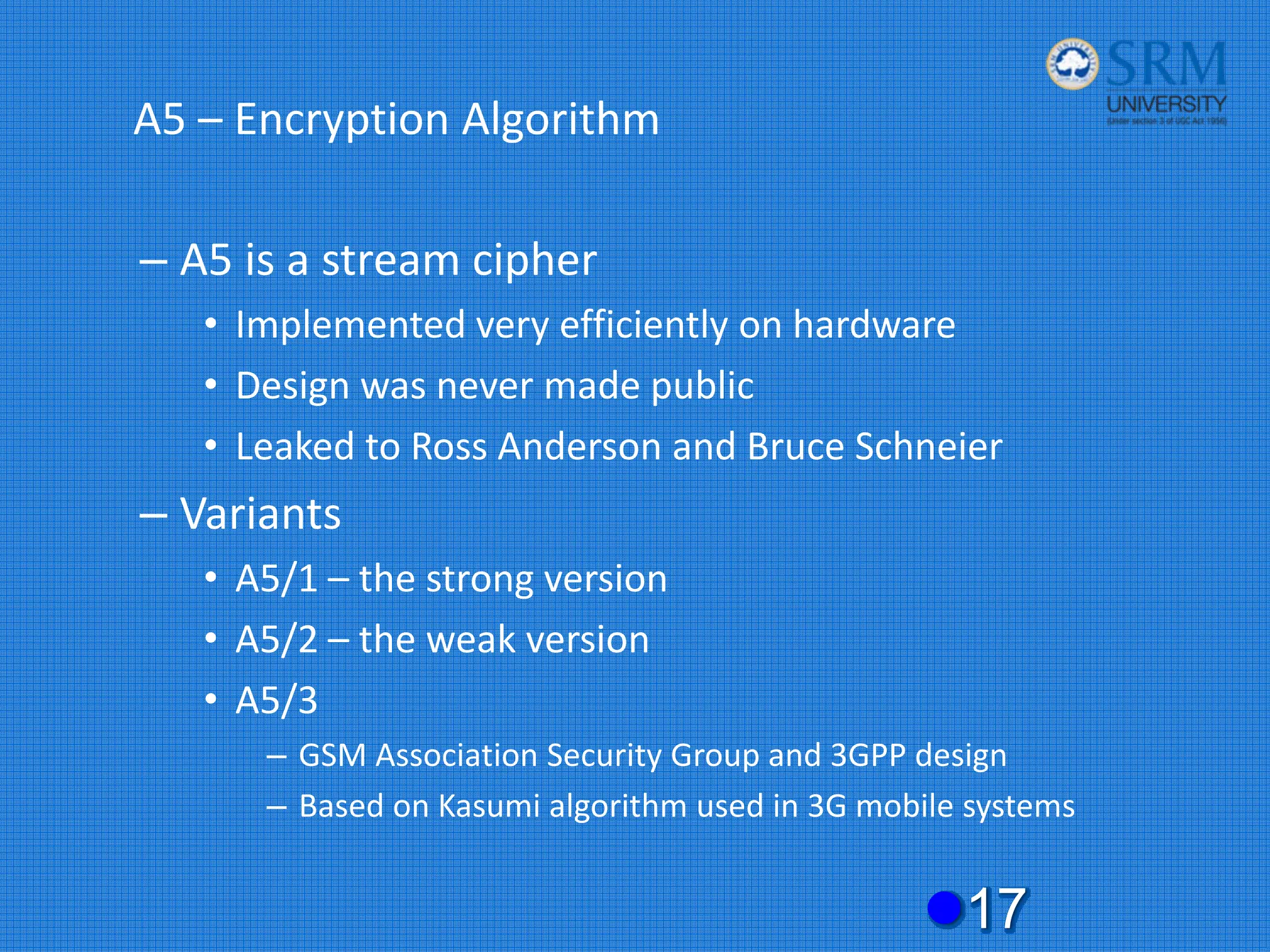
• Implemented very efficiently on hardware
• Design was never made public
• Leaked to Ross Anderson and Bruce Schneier
– Variants
• A5/1 – the strong version
• A5/2 – the weak version
• A5/3
– GSM Association Security Group and 3GPP design
– Based on Kasumi algorithm used in 3G mobile systems
z17
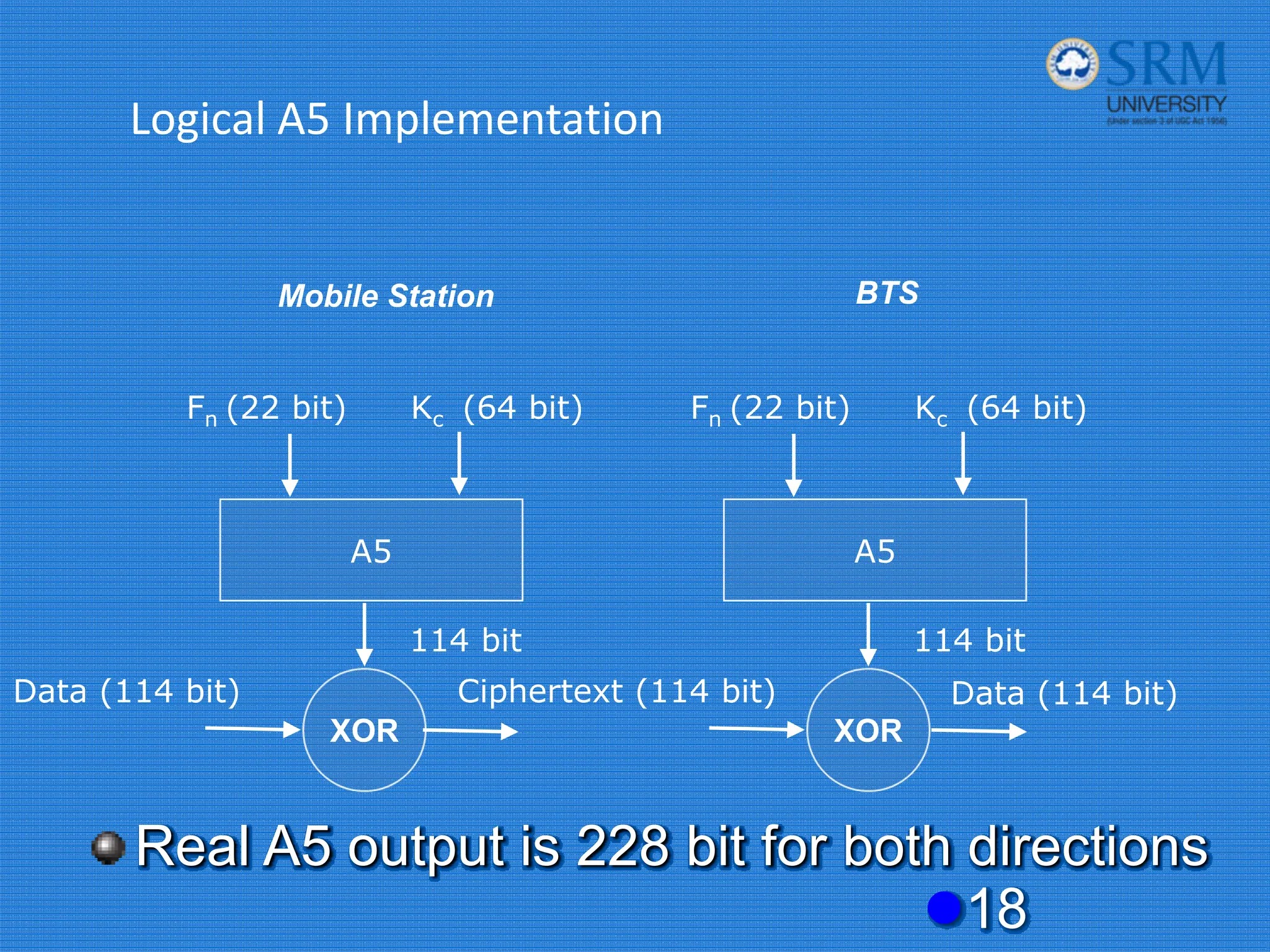
Logical A5 Implementation
z18
A5
Kc (64 bit)
Fn (22 bit)
114 bit
XOR
Data (114 bit)
A5
Kc (64 bit)
Fn (22 bit)
114 bit
XOR
Ciphertext (114 bit) Data (114 bit)
Mobile Station BTS
Real A5 output is 228 bit for both directions
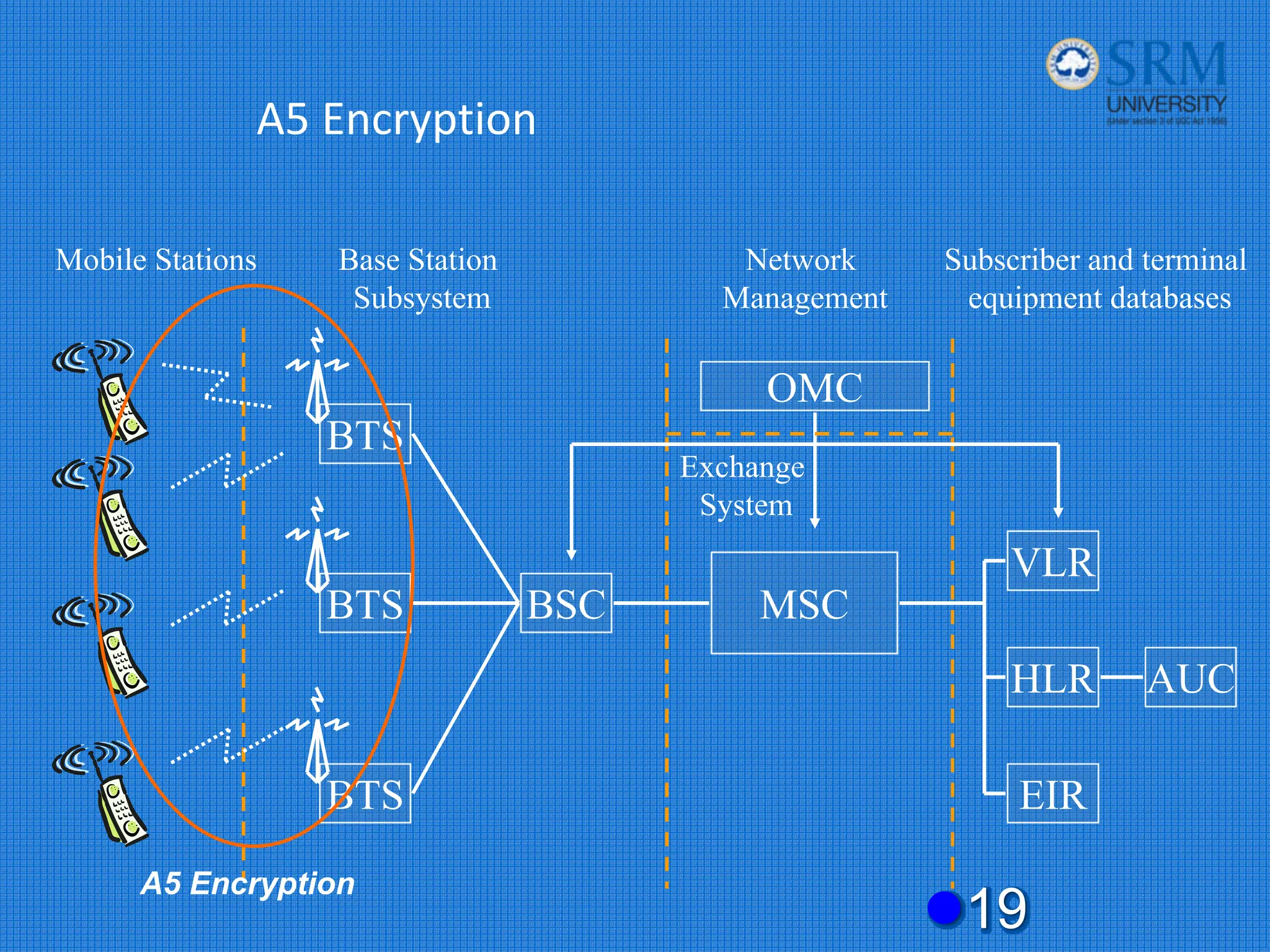
A5 Encryption
z19
Mobile Stations Base Station
Subsystem
Exchange
System
Network
Management
Subscriber and terminal
equipment databases
BSC MSC
VLR
HLR
EIR
AUC
OMC
BTS
BTS
BTS
A5 Encryption
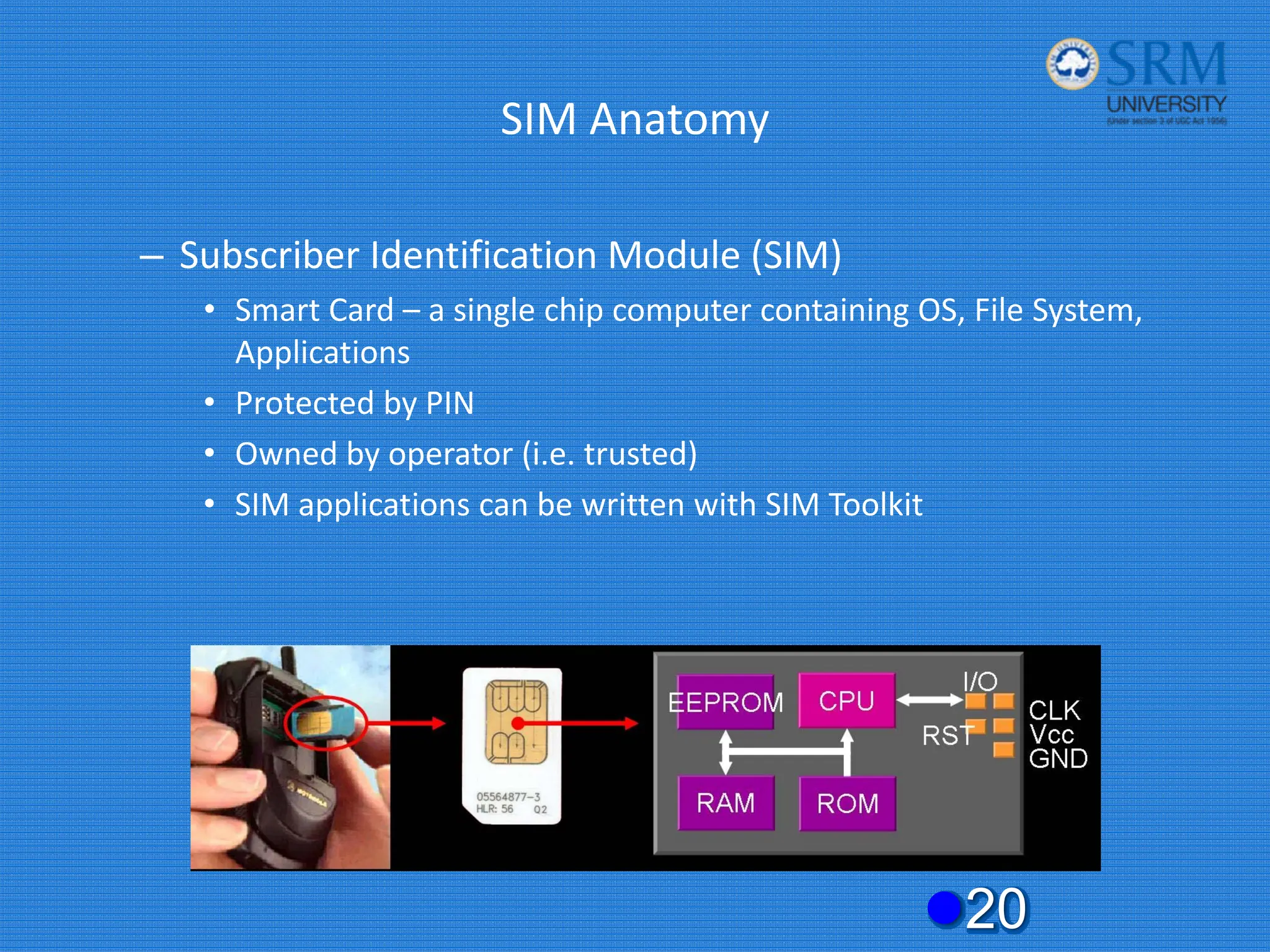
SIM Anatomy
– Subscriber Identification Module (SIM)
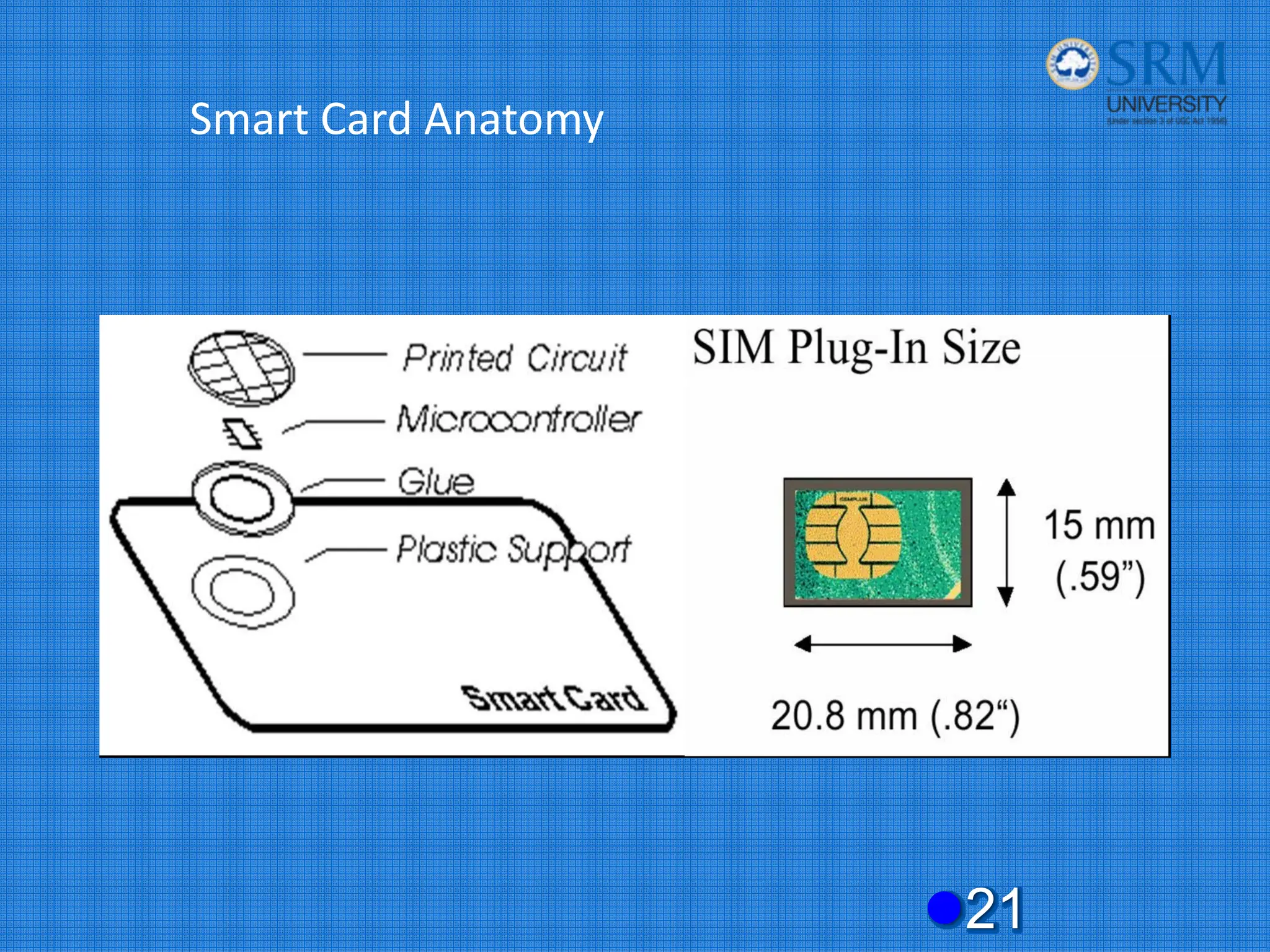
• Smart Card – a single chip computer containing OS, File System,
Applications
• Protected by PIN
• Owned by operator (i.e. trusted)
• SIM applications can be written with SIM Toolkit
z20
Smart Card Anatomy
z21
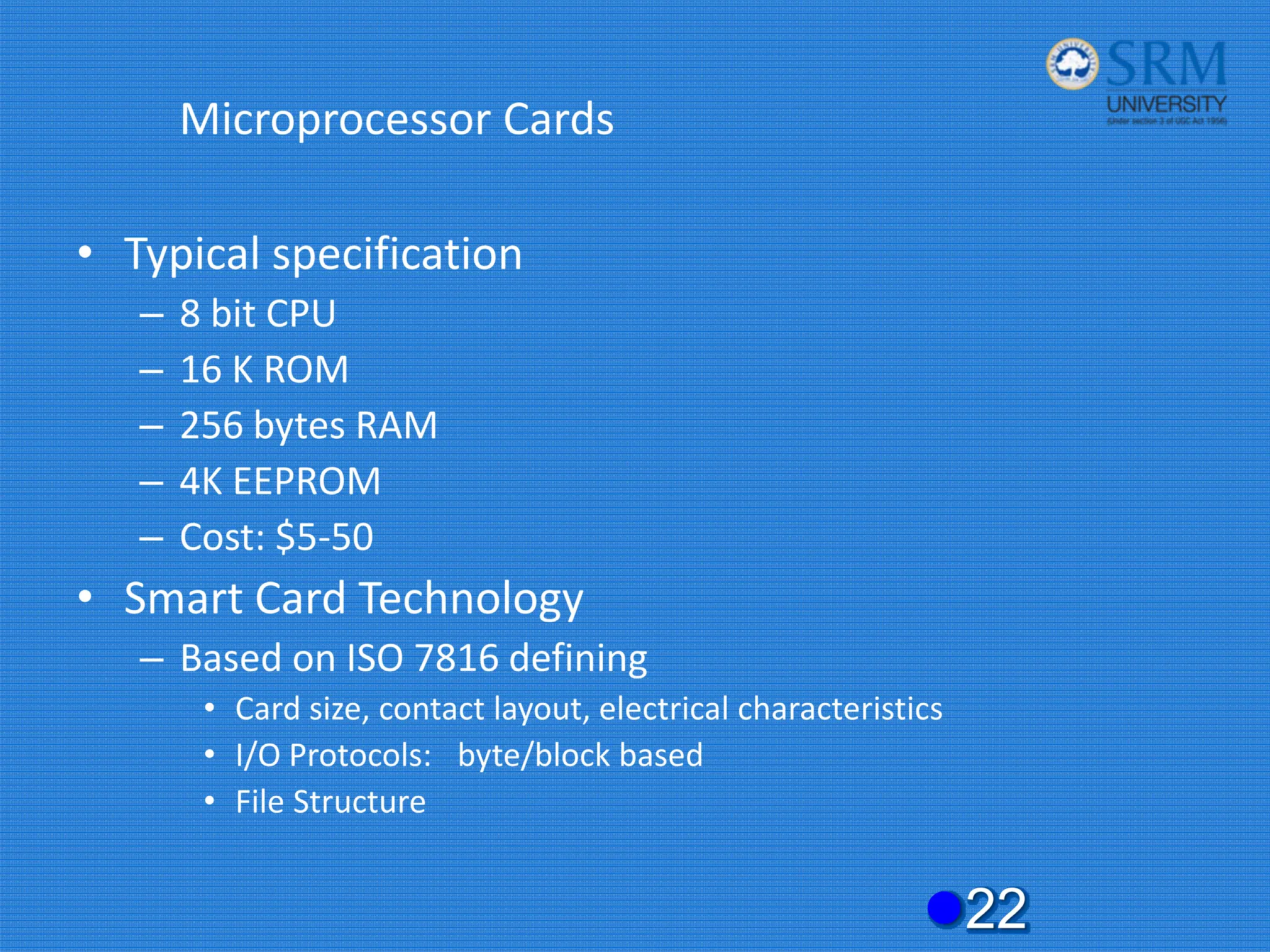
Microprocessor Cards
• Typical specification
– 8 bit CPU
– 16 K ROM
– 256 bytes RAM
– 4K EEPROM
– Cost: $5‐50
• Smart Card Technology
– Based on ISO 7816 defining
• Card size, contact layout, electrical characteristics
• I/O Protocols: byte/block based
• File Structure
z22
Algorithm Implementations and
Attacks
z23
Attack Categories
• SIM Attacks
• Radio‐link interception attacks
• Operator network attacks
– GSM does not protect an operator’s network
z24
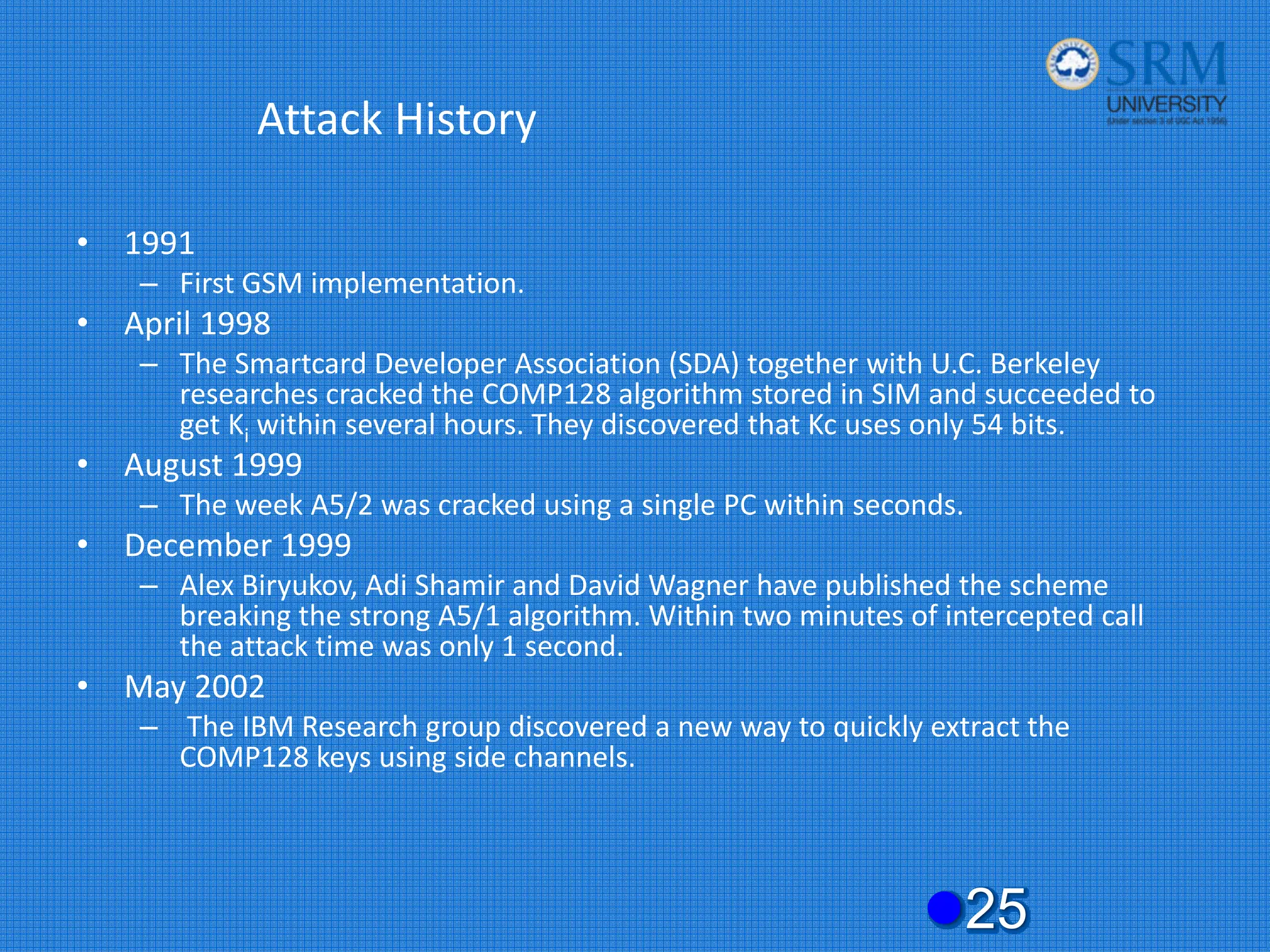
Attack History
• 1991
– First GSM implementation.
• April 1998
– The Smartcard Developer Association (SDA) together with U.C. Berkeley
researches cracked the COMP128 algorithm stored in SIM and succeeded to
get Ki within several hours. They discovered that Kc uses only 54 bits.
• August 1999
– The week A5/2 was cracked using a single PC within seconds.
• December 1999
– Alex Biryukov, Adi Shamir and David Wagner have published the scheme
breaking the strong A5/1 algorithm. Within two minutes of intercepted call
the attack time was only 1 second.
• May 2002
– The IBM Research group discovered a new way to quickly extract the
COMP128 keys using side channels.
z25
COMP128
Keyed hash function
z26
COMP128
z27
Pseudo-code of the compression in COMP128 algorithm
•X[0..15] = Ki; X[16..31] = RAND;
•Lookup tables: T0[512], T1[256], T2[128], T3[64], T4[32]
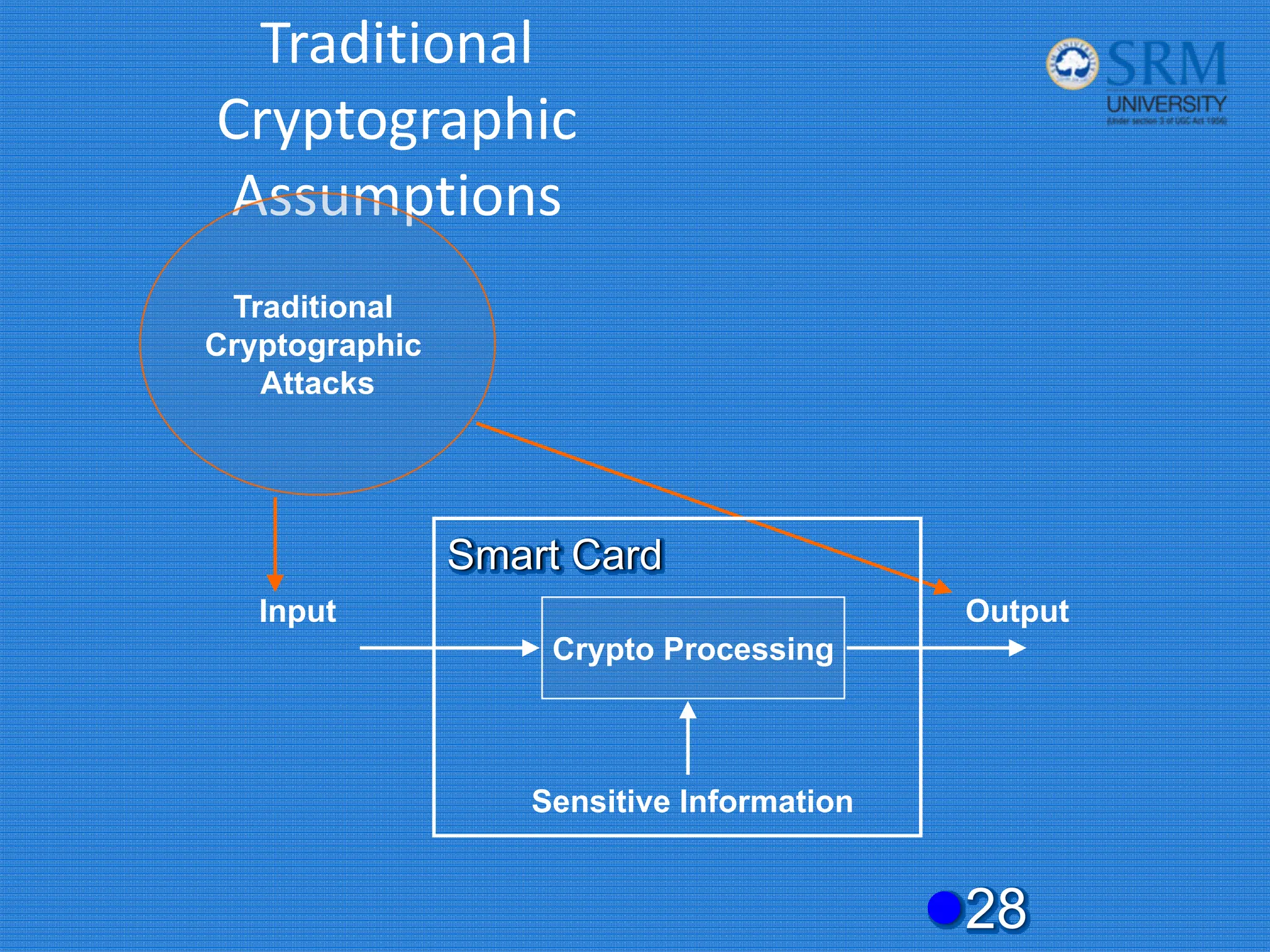
Traditional
Cryptographic
Assumptions
z28
Traditional
Cryptographic
Attacks
Input
Crypto Processing
Sensitive Information
Output
Smart Card
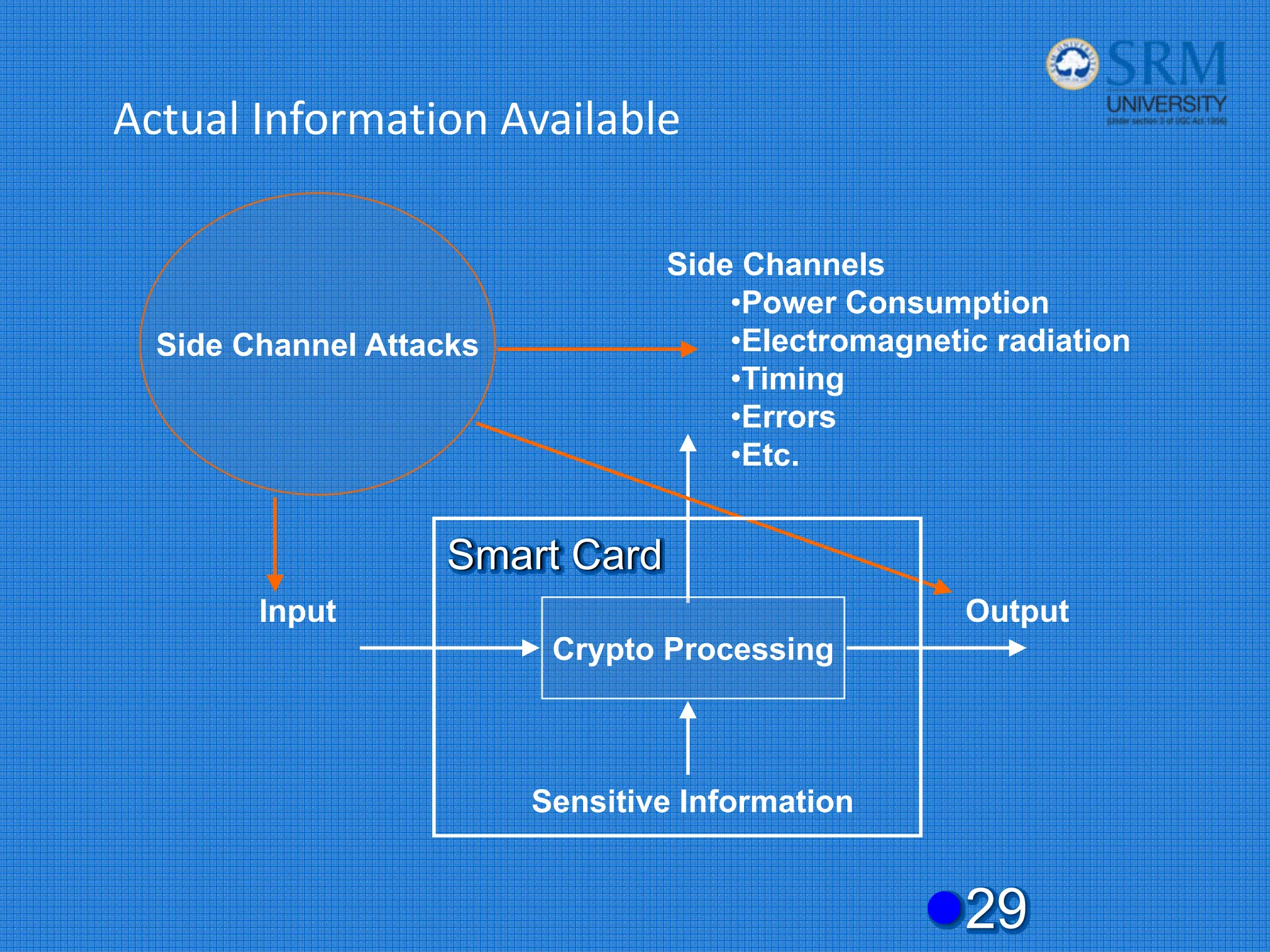
Actual Information Available
z29
Side Channels
•Power Consumption
•Electromagnetic radiation
•Timing
•Errors
•Etc.
Side Channel Attacks
Input
Crypto Processing
Sensitive Information
Output
Smart Card
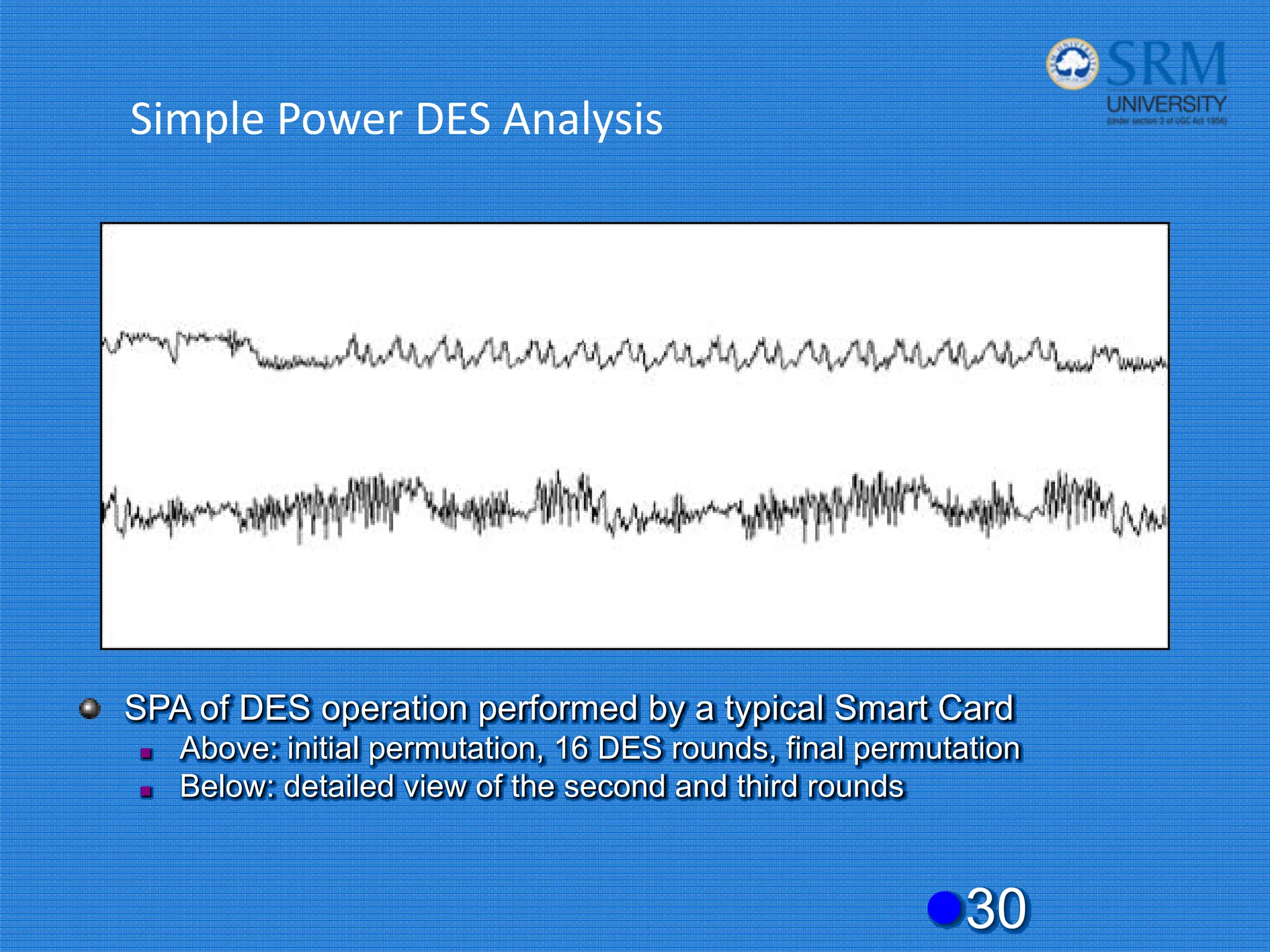
Simple Power DES Analysis
z30
SPA of DES operation performed by a typical Smart Card
„ Above: initial permutation, 16 DES rounds, final permutation
„ Below: detailed view of the second and third rounds
Partitioning Attack on
COMP128
• Attack Goal
– Ki stored on SIM card
– Knowing Ki it’s possible to clone SIM
• Cardinal Principle
– Relevant bits of all intermediate cycles and their values should be
statistically independent of the inputs, outputs, and sensitive
information.
• Attack Idea
– Find a violation of the Cardinal Principle, i.e. side channels with signals
does depend on input, outputs and sensitive information
– Try to exploit the statistical dependency in signals to extract a sensitive
information
z31
Partitioning Attack on
COMP128
• How to implement 512 element T0 table on 8
bit Smart Card (i.e. index is 0..255)?
• Split 512 element table into two 256 element tables
• It’s possible to detect access of different
tables via side channels!
– Power Consumption
– Electromagnetic radiation
z32
Partitioning Attack on
COMP128
z33
Pseudo-code of the compression in COMP128 algorithm
•X[0..15] = Ki; X[16..31] = RAND;
•Lookup tables: T0[512], T1[256], T2[128], T3[64], T4[32]
Partitioning Attack on COMP128
z34
K[0] K[1] K[15] R[0] R[15]
… …
R[0]
T0[y] K[1] K[15] T0[z] R[15]
… …
R[0]
y = K[0] + 2R[0] z = 2K[0] + R[0]
0 15 16 32
X
Values of y and z depend on the first bytes of K and R
It’s possible to detect via side channels whether values
of y and z are within [0..255] or [256..511].
Partitioning Attack on
COMP128
• All we need is…
– A) Find R[0] such that
K[0] + 2R[0] (mod 512) < 256
K[0] + 2(R[0]+1) (mod 512) >= 256
(There are only two options)
– B) Find R’[0] such that
2K[0] + R’[0] (mod 512) < 256
2K[0] + R’[0] + 1 (mod 512) >= 256
– C) One of K[0] from A) will match B)
• The key byte is always uniquely determined from partitioning
information.
• Computation of the others bytes of K is similar.
z35
Summary
• GSM Security Objectives
– Concerns, Goals, Requirements
• GSM Security Mechanisms
• SIM Anatomy
• Algorithms and Attacks
– COMP128
– Partitioning Attack on COMP128
z36

This chapter gives an outline of the security.

  • 1.
    GSM Security Concerns •Operators – Bills right people – Avoid fraud – Protect Services • Customers – Privacy – Anonymity • Make a system at least secure as PSTN z1
  • 2.
    GSM Security Goals •Confidentiality and Anonymity on the radio path • Strong client authentication to protect the operator against the billing fraud • Prevention of operators from compromising of each others’ security z2
  • 3.
    GSM Security Design Requirements •The security mechanism – MUST NOT • Add significant overhead on call set up • Increase bandwidth of the channel • Increase error rate • Add expensive complexity to the system – MUST • Cost effective scheme – Define security procedures • Generation and distribution of keys • Exchange information between operators • Confidentiality of algorithms z3
  • 4.
    GSM Security Features •Key management is independent of equipment – Subscribers can change handsets without compromising security • Subscriber identity protection – not easy to identify the user of the system intercepting a user data • Detection of compromised equipment – Detection mechanism whether a mobile device was compromised or not • Subscriber authentication – The operator knows for billing purposes who is using the system • Signaling and user data protection – Signaling and data channels are protected over the radio path z4
  • 5.
    GSM Mobile Station •Mobile Station – Mobile Equipment (ME) • Physical mobile device • Identifiers – IMEI – International Mobile Equipment Identity – Subscriber Identity Module (SIM) • Smart Card containing keys, identifiers and algorithms • Identifiers – Ki – Subscriber Authentication Key – IMSI – International Mobile Subscriber Identity – TMSI – Temporary Mobile Subscriber Identity – MSISDN – Mobile Station International Service Digital Network – PIN – Personal Identity Number protecting a SIM – LAI – location area identity z5
  • 6.
    GSM Architecture z6 Mobile StationsBase Station Subsystem Exchange System Network Management Subscriber and terminal equipment databases BSC MSC VLR HLR EIR AUC OMC BTS BTS BTS
  • 7.
    Subscriber Identity Protection •TMSI – Temporary Mobile Subscriber Identity – Goals • TMSI is used instead of IMSI as an a temporary subscriber identifier • TMSI prevents an eavesdropper from identifying of subscriber – Usage • TMSI is assigned when IMSI is transmitted to AuC on the first phone switch on • Every time a location update (new MSC) occur the networks assigns a new TMSI • TMSI is used by the MS to report to the network or during a call initialization • Network uses TMSI to communicate with MS • On MS switch off TMSI is stored on SIM card to be reused next time – The Visitor Location Register (VLR) performs assignment, administration and update of the TMSI z7
  • 8.
    Key Management Scheme •Ki – Subscriber Authentication Key – Shared 128 bit key used for authentication of subscriber by the operator – Key Storage • Subscriber’s SIM (owned by operator, i.e. trusted) • Operator’s Home Locator Register (HLR) of the subscriber’s home network • SIM can be used with different equipment z8
  • 9.
    Detection of Compromised Equipment • InternationalMobile Equipment Identifier (IMEI) – Identifier allowing to identify mobiles – IMEI is independent of SIM – Used to identify stolen or compromised equipment • Equipment Identity Register (EIR) – Black list – stolen or non‐type mobiles – White list ‐ valid mobiles – Gray list – local tracking mobiles • Central Equipment Identity Register (CEIR) – Approved mobile type (type approval authorities) – Consolidated black list (posted by operators) z9
  • 10.
    Authentication • Authentication Goals –Subscriber (SIM holder) authentication – Protection of the network against unauthorized use – Create a session key • Authentication Scheme – Subscriber identification: IMSI or TMSI – Challenge‐Response authentication of the subscriber by the operator z10
  • 11.
    Authentication and Encryption Scheme z11 A3 MobileStation Radio Link GSM Operator A8 A5 A3 A8 A5 Ki Ki Challenge RAND Kc Kc mi Encrypted Data mi SIM Signed response (SRES) SRES SRES Fn Fn Authentication: are SRES values equal?
  • 12.
    Authentication • AuC –Authentication Center – Provides parameters for authentication and encryption functions (RAND, SRES, Kc) • HLR – Home Location Register – Provides MSC (Mobile Switching Center) with triples (RAND, SRES, Kc) – Handles MS location • VLR – Visitor Location Register – Stores generated triples by the HLR when a subscriber is not in his home network – One operator doesn’t have access to subscriber keys of the another operator. z12
  • 13.
    A3 – MSAuthentication Algorithm • Goal – Generation of SRES response to MSC’s random challenge RAND z13 A3 RAND (128 bit) Ki (128 bit) SRES (32 bit)
  • 14.
    A8 – VoicePrivacy Key Generation Algorithm • Goal – Generation of session key Ks • A8 specification was never made public z14 A8 RAND (128 bit) Ki (128 bit) KC (64 bit)
  • 15.
    Logical Implementation of A3and A8 • Both A3 and A8 algorithms are implemented on the SIM – Operator can decide, which algorithm to use. – Algorithms implementation is independent of hardware manufacturers and network operators. z15
  • 16.
    Logical Implementation of A3and A8 • COMP128 is used for both A3 and A8 in most GSM networks. – COMP128 is a keyed hash function z16 COMP128 RAND (128 bit) Ki (128 bit) 128 bit output SRES 32 bit and Kc 54 bit
  • 17.
    A5 – EncryptionAlgorithm – A5 is a stream cipher • Implemented very efficiently on hardware • Design was never made public • Leaked to Ross Anderson and Bruce Schneier – Variants • A5/1 – the strong version • A5/2 – the weak version • A5/3 – GSM Association Security Group and 3GPP design – Based on Kasumi algorithm used in 3G mobile systems z17
  • 18.
    Logical A5 Implementation z18 A5 Kc(64 bit) Fn (22 bit) 114 bit XOR Data (114 bit) A5 Kc (64 bit) Fn (22 bit) 114 bit XOR Ciphertext (114 bit) Data (114 bit) Mobile Station BTS Real A5 output is 228 bit for both directions
  • 19.
    A5 Encryption z19 Mobile StationsBase Station Subsystem Exchange System Network Management Subscriber and terminal equipment databases BSC MSC VLR HLR EIR AUC OMC BTS BTS BTS A5 Encryption
  • 20.
    SIM Anatomy – SubscriberIdentification Module (SIM) • Smart Card – a single chip computer containing OS, File System, Applications • Protected by PIN • Owned by operator (i.e. trusted) • SIM applications can be written with SIM Toolkit z20
  • 21.
  • 22.
    Microprocessor Cards • Typicalspecification – 8 bit CPU – 16 K ROM – 256 bytes RAM – 4K EEPROM – Cost: $5‐50 • Smart Card Technology – Based on ISO 7816 defining • Card size, contact layout, electrical characteristics • I/O Protocols: byte/block based • File Structure z22
  • 23.
  • 24.
    Attack Categories • SIMAttacks • Radio‐link interception attacks • Operator network attacks – GSM does not protect an operator’s network z24
  • 25.
    Attack History • 1991 –First GSM implementation. • April 1998 – The Smartcard Developer Association (SDA) together with U.C. Berkeley researches cracked the COMP128 algorithm stored in SIM and succeeded to get Ki within several hours. They discovered that Kc uses only 54 bits. • August 1999 – The week A5/2 was cracked using a single PC within seconds. • December 1999 – Alex Biryukov, Adi Shamir and David Wagner have published the scheme breaking the strong A5/1 algorithm. Within two minutes of intercepted call the attack time was only 1 second. • May 2002 – The IBM Research group discovered a new way to quickly extract the COMP128 keys using side channels. z25
  • 26.
  • 27.
    COMP128 z27 Pseudo-code of thecompression in COMP128 algorithm •X[0..15] = Ki; X[16..31] = RAND; •Lookup tables: T0[512], T1[256], T2[128], T3[64], T4[32]
  • 28.
  • 29.
    Actual Information Available z29 SideChannels •Power Consumption •Electromagnetic radiation •Timing •Errors •Etc. Side Channel Attacks Input Crypto Processing Sensitive Information Output Smart Card
  • 30.
    Simple Power DESAnalysis z30 SPA of DES operation performed by a typical Smart Card „ Above: initial permutation, 16 DES rounds, final permutation „ Below: detailed view of the second and third rounds
  • 31.
    Partitioning Attack on COMP128 •Attack Goal – Ki stored on SIM card – Knowing Ki it’s possible to clone SIM • Cardinal Principle – Relevant bits of all intermediate cycles and their values should be statistically independent of the inputs, outputs, and sensitive information. • Attack Idea – Find a violation of the Cardinal Principle, i.e. side channels with signals does depend on input, outputs and sensitive information – Try to exploit the statistical dependency in signals to extract a sensitive information z31
  • 32.
    Partitioning Attack on COMP128 •How to implement 512 element T0 table on 8 bit Smart Card (i.e. index is 0..255)? • Split 512 element table into two 256 element tables • It’s possible to detect access of different tables via side channels! – Power Consumption – Electromagnetic radiation z32
  • 33.
    Partitioning Attack on COMP128 z33 Pseudo-codeof the compression in COMP128 algorithm •X[0..15] = Ki; X[16..31] = RAND; •Lookup tables: T0[512], T1[256], T2[128], T3[64], T4[32]
  • 34.
    Partitioning Attack onCOMP128 z34 K[0] K[1] K[15] R[0] R[15] … … R[0] T0[y] K[1] K[15] T0[z] R[15] … … R[0] y = K[0] + 2R[0] z = 2K[0] + R[0] 0 15 16 32 X Values of y and z depend on the first bytes of K and R It’s possible to detect via side channels whether values of y and z are within [0..255] or [256..511].
  • 35.
    Partitioning Attack on COMP128 •All we need is… – A) Find R[0] such that K[0] + 2R[0] (mod 512) < 256 K[0] + 2(R[0]+1) (mod 512) >= 256 (There are only two options) – B) Find R’[0] such that 2K[0] + R’[0] (mod 512) < 256 2K[0] + R’[0] + 1 (mod 512) >= 256 – C) One of K[0] from A) will match B) • The key byte is always uniquely determined from partitioning information. • Computation of the others bytes of K is similar. z35
  • 36.
    Summary • GSM SecurityObjectives – Concerns, Goals, Requirements • GSM Security Mechanisms • SIM Anatomy • Algorithms and Attacks – COMP128 – Partitioning Attack on COMP128 z36