Presentation by , 1] Sanket Yavalkar Sardar Patel   Institute of   Technology,Mumbai ME(EXTC) GSM SECURITY
Contents…. 1]INTRODUCTION 2] GSM Security Objectives 3]GSM Security Mechanisms 4]SIM Anatomy 5]Algorithms and Attacks 6]CONCLUSION
INTRODUCTION With GSM, systems for mobile communication reached a global scale. In the western world, it seems everyone has their own mobile phone, and GSM has taken more and more of the market.  GSM allows users to roam seamlessly between networks, and separate the user identity from the phone equipment. In addition the GSM system provides the functional basis for the 3rd generation mobile system, UMTS.
GSM Security Concerns Operators  Bills right people Avoid fraud Protect Services Customers Privacy Anonymity Make a system at least secure as PSTN
GSM Security Goals Confidentiality and Anonymity on the radio path Strong client authentication to protect the operator against the billing fraud Prevention of operators from compromising of each others’ security Inadvertently Competition pressure
GSM Security Design Requirements  The security mechanism  MUST NOT Add significant overhead on call set up Increase bandwidth of the channel Increase error rate Add expensive complexity to the system  MUST  Cost effective scheme Define security procedures Generation and distribution of keys Exchange information between operators Confidentiality of algorithms
Subscriber Identity Protection TMSI – Temporary Mobile Subscriber Identity Goals TMSI is used instead of IMSI as an a temporary subscriber identifier TMSI prevents an eavesdropper from identifying of subscriber Usage TMSI is assigned when IMSI is transmitted to AuC on the first phone switch on Every time a location update (new MSC) occur the networks assigns  a new TMSI TMSI is used by the MS to report to the network or during a call initialization Network uses TMSI to communicate with MS On MS switch off TMSI is stored on SIM card to be reused next time The Visitor Location Register (VLR) performs assignment, administration and update of the TMSI
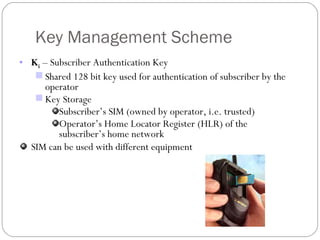
Key Management Scheme K i  – Subscriber Authentication Key Shared 128 bit key used for authentication of subscriber by the operator Key Storage Subscriber’s SIM (owned by operator, i.e. trusted) Operator’s Home Locator Register (HLR) of the subscriber’s home network SIM can be used with different equipment
Detection of Compromised Equipment International Mobile Equipment Identifier (IMEI) Identifier allowing to identify mobiles IMEI is independent of SIM Used to identify stolen or compromised equipment Equipment Identity Register (EIR) Black list – stolen or non-type mobiles White list -  valid mobiles Gray list – local tracking mobiles Central Equipment Identity Register (CEIR) Approved mobile type (type approval authorities) Consolidated black list (posted by operators)
Authentication Authentication Goals Subscriber (SIM holder) authentication Protection of the network against unauthorized use Create a session key Authentication Scheme Subscriber identification: IMSI or TMSI  Challenge-Response authentication of the subscriber by the operator
Authentication and Encryption Scheme A3 Mobile Station Radio Link GSM Operator A8 A5 A3 A8 A5 K i K c K c SIM Authentication: are SRES values equal? Challenge RAND m i Encrypted Data m i Signed response (SRES) SRES SRES F n F n
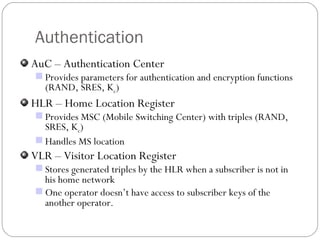
Authentication AuC – Authentication Center Provides parameters for authentication and encryption functions (RAND, SRES, K c ) HLR – Home Location Register Provides MSC (Mobile Switching Center) with triples (RAND, SRES, K c ) Handles MS location  VLR – Visitor Location Register Stores generated triples by the HLR when a subscriber is not in his home network One operator doesn’t have access to subscriber keys of the another operator.
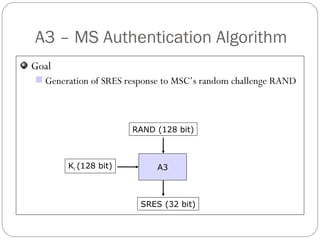
A3 – MS Authentication Algorithm Goal Generation of SRES response to MSC’s random challenge RAND A3 RAND (128 bit) K i  (128 bit) SRES (32 bit)
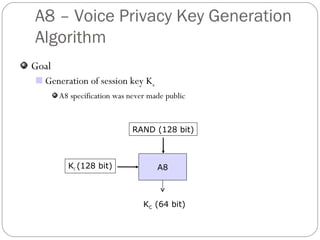
A8 – Voice Privacy Key Generation Algorithm Goal Generation of session key K s A8 specification was never made public A8 RAND (128 bit) K i  (128 bit) K C  (64 bit)
A5 – Encryption Algorithm A5 is a stream cipher Implemented very efficiently on hardware Design was never made public Leaked to Ross Anderson and Bruce Schneier Variants  A5/1 – the strong version A5/2 – the weak version A5/3 GSM Association Security Group and 3GPP design Based on Kasumi algorithm used in 3G mobile systems
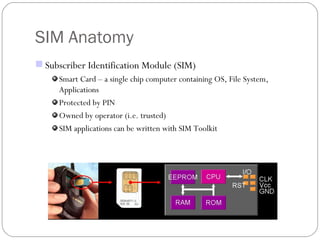
SIM Anatomy Subscriber Identification Module (SIM) Smart Card – a single chip computer containing OS, File System, Applications Protected by PIN Owned by operator (i.e. trusted) SIM applications can be written with SIM Toolkit
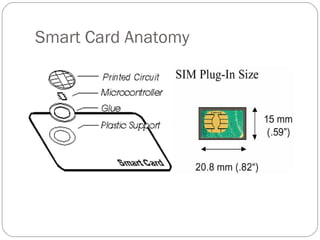
Smart Card Anatomy
Conclusion Trust assumptions are different in the Internet Enhanced levels of security services may be necessary Public-key cryptography can provide effective solutions Try not to preclude future provision of improved security services

Gsm security final

  • 1.
    Presentation by ,1] Sanket Yavalkar Sardar Patel Institute of Technology,Mumbai ME(EXTC) GSM SECURITY
  • 2.
    Contents…. 1]INTRODUCTION 2]GSM Security Objectives 3]GSM Security Mechanisms 4]SIM Anatomy 5]Algorithms and Attacks 6]CONCLUSION
  • 3.
    INTRODUCTION With GSM,systems for mobile communication reached a global scale. In the western world, it seems everyone has their own mobile phone, and GSM has taken more and more of the market. GSM allows users to roam seamlessly between networks, and separate the user identity from the phone equipment. In addition the GSM system provides the functional basis for the 3rd generation mobile system, UMTS.
  • 4.
    GSM Security ConcernsOperators Bills right people Avoid fraud Protect Services Customers Privacy Anonymity Make a system at least secure as PSTN
  • 5.
    GSM Security GoalsConfidentiality and Anonymity on the radio path Strong client authentication to protect the operator against the billing fraud Prevention of operators from compromising of each others’ security Inadvertently Competition pressure
  • 6.
    GSM Security DesignRequirements The security mechanism MUST NOT Add significant overhead on call set up Increase bandwidth of the channel Increase error rate Add expensive complexity to the system MUST Cost effective scheme Define security procedures Generation and distribution of keys Exchange information between operators Confidentiality of algorithms
  • 7.
    Subscriber Identity ProtectionTMSI – Temporary Mobile Subscriber Identity Goals TMSI is used instead of IMSI as an a temporary subscriber identifier TMSI prevents an eavesdropper from identifying of subscriber Usage TMSI is assigned when IMSI is transmitted to AuC on the first phone switch on Every time a location update (new MSC) occur the networks assigns a new TMSI TMSI is used by the MS to report to the network or during a call initialization Network uses TMSI to communicate with MS On MS switch off TMSI is stored on SIM card to be reused next time The Visitor Location Register (VLR) performs assignment, administration and update of the TMSI
  • 8.
    Key Management SchemeK i – Subscriber Authentication Key Shared 128 bit key used for authentication of subscriber by the operator Key Storage Subscriber’s SIM (owned by operator, i.e. trusted) Operator’s Home Locator Register (HLR) of the subscriber’s home network SIM can be used with different equipment
  • 9.
    Detection of CompromisedEquipment International Mobile Equipment Identifier (IMEI) Identifier allowing to identify mobiles IMEI is independent of SIM Used to identify stolen or compromised equipment Equipment Identity Register (EIR) Black list – stolen or non-type mobiles White list - valid mobiles Gray list – local tracking mobiles Central Equipment Identity Register (CEIR) Approved mobile type (type approval authorities) Consolidated black list (posted by operators)
  • 10.
    Authentication Authentication GoalsSubscriber (SIM holder) authentication Protection of the network against unauthorized use Create a session key Authentication Scheme Subscriber identification: IMSI or TMSI Challenge-Response authentication of the subscriber by the operator
  • 11.
    Authentication and EncryptionScheme A3 Mobile Station Radio Link GSM Operator A8 A5 A3 A8 A5 K i K c K c SIM Authentication: are SRES values equal? Challenge RAND m i Encrypted Data m i Signed response (SRES) SRES SRES F n F n
  • 12.
    Authentication AuC –Authentication Center Provides parameters for authentication and encryption functions (RAND, SRES, K c ) HLR – Home Location Register Provides MSC (Mobile Switching Center) with triples (RAND, SRES, K c ) Handles MS location VLR – Visitor Location Register Stores generated triples by the HLR when a subscriber is not in his home network One operator doesn’t have access to subscriber keys of the another operator.
  • 13.
    A3 – MSAuthentication Algorithm Goal Generation of SRES response to MSC’s random challenge RAND A3 RAND (128 bit) K i (128 bit) SRES (32 bit)
  • 14.
    A8 – VoicePrivacy Key Generation Algorithm Goal Generation of session key K s A8 specification was never made public A8 RAND (128 bit) K i (128 bit) K C (64 bit)
  • 15.
    A5 – EncryptionAlgorithm A5 is a stream cipher Implemented very efficiently on hardware Design was never made public Leaked to Ross Anderson and Bruce Schneier Variants A5/1 – the strong version A5/2 – the weak version A5/3 GSM Association Security Group and 3GPP design Based on Kasumi algorithm used in 3G mobile systems
  • 16.
    SIM Anatomy SubscriberIdentification Module (SIM) Smart Card – a single chip computer containing OS, File System, Applications Protected by PIN Owned by operator (i.e. trusted) SIM applications can be written with SIM Toolkit
  • 17.
  • 18.
    Conclusion Trust assumptionsare different in the Internet Enhanced levels of security services may be necessary Public-key cryptography can provide effective solutions Try not to preclude future provision of improved security services