Operationalizing Amazon EKS
Jim Bugwadia - @JimBugwadia
2
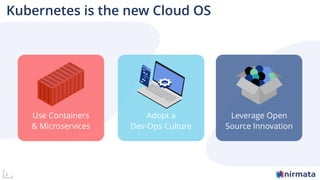
Kubernetes is the new Cloud OS
Use Containers
& Microservices
Leverage Open
Source Innovation
Adopt a
Dev-Ops Culture
3
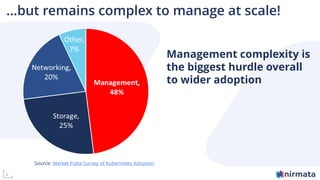
…but remains complex to manage at scale!
Source: Market Pulse Survey of Kubernetes Adoption
Management complexity is
the biggest hurdle overall
to wider adoption
4
Agenda
• Overview
• What Amazon EKS provides
• What else is needed
• Demo & discussion
5
About me
• Founder and CEO at Nirmata
• Developing large-scale distributed
systems since the early 90’s (Go,
Java, JS, C++)
• Core focus on centralized
management for complex systems
@JimBugwadia
jim@nirmata.com
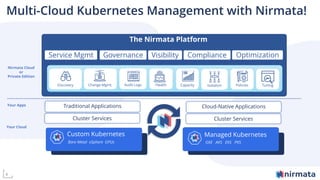
Multi-Cloud Kubernetes Management with Nirmata!
6
Service Mgmt VisibilityGovernance Compliance Optimization
The Nirmata Platform
Change Mgmt. Audit Logs Health Capacity Isolation Policies TuningDiscovery
Managed Kubernetes
GKE AKS EKS PKS
Custom Kubernetes
Bare Metal vSphere GPUs
Cloud-Native Applications
Cluster Services
Traditional Applications
Cluster Services
Your Cloud
Nirmata Cloud
or
Private Edition
Your Apps
Amazon EKS
7
8
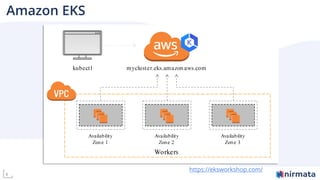
Amazon EKS
https://eksworkshop.com/
9
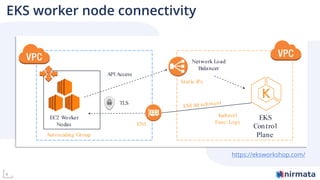
EKS worker node connectivity
https://eksworkshop.com/
10
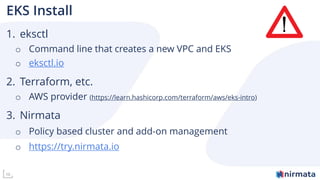
EKS Install
1. eksctl
o Command line that creates a new VPC and EKS
o eksctl.io
2. Terraform, etc.
o AWS provider (https://learn.hashicorp.com/terraform/aws/eks-intro)
3. Nirmata
o Policy based cluster and add-on management
o https://try.nirmata.io
11
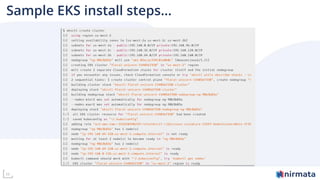
Sample EKS install steps…
Install demo
12
13
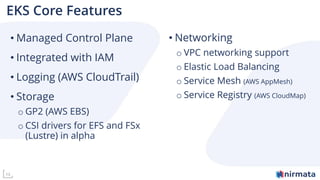
EKS Core Features
• Networking
o VPC networking support
o Elastic Load Balancing
o Service Mesh (AWS AppMesh)
o Service Registry (AWS CloudMap)
• Managed Control Plane
• Integrated with IAM
• Logging (AWS CloudTrail)
• Storage
o GP2 (AWS EBS)
o CSI drivers for EFS and FSx
(Lustre) in alpha
Operationalizing Kubernetes
14
15
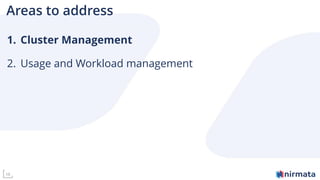
Areas to address
1. Cluster Management
2. Usage and Workload management
16
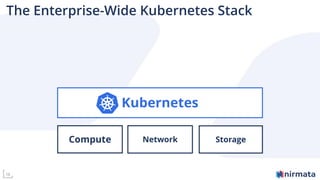
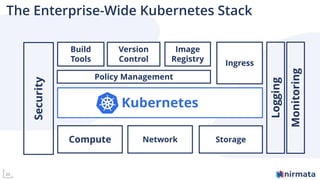
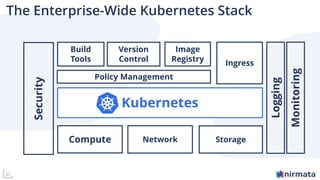
The Enterprise-Wide Kubernetes Stack
Compute
Kubernetes
StorageNetwork
17
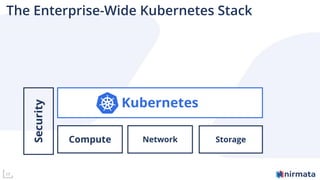
The Enterprise-Wide Kubernetes Stack
Compute
Kubernetes
StorageNetwork
Security
18
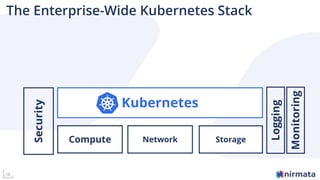
The Enterprise-Wide Kubernetes Stack
Compute
Kubernetes
StorageNetwork
Logging
Monitoring
Security
19
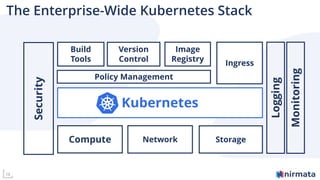
The Enterprise-Wide Kubernetes Stack
Compute
Kubernetes
StorageNetwork
Version
Control
Image
Registry
Ingress
Build
Tools
Logging
Monitoring
Security
Policy Management
20
The Enterprise-Wide Kubernetes Stack
Compute
Kubernetes
StorageNetwork
Version
Control
Image
Registry
Ingress
Build
Tools
Logging
Monitoring
Security
Policy Management
21
The Enterprise-Wide Kubernetes Stack
Compute
Kubernetes
StorageNetwork
Version
Control
Image
Registry
Ingress
Build
Tools
Logging
Monitoring
Security
Policy Management
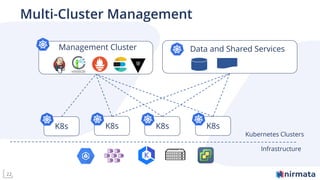
Multi-Cluster Management
22
K8s
Management Cluster
K8s K8s K8s
Kubernetes Clusters
Infrastructure
Data and Shared Services
23
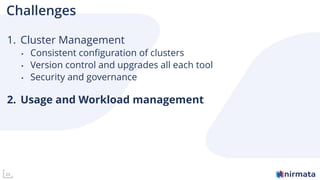
Challenges
1. Cluster Management
• Consistent configuration of clusters
• Version control and upgrades all each tool
• Security and governance
2. Usage and Workload management
24
25
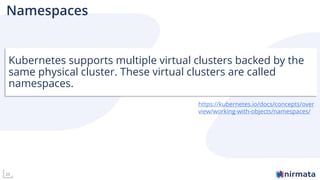
Namespaces
Kubernetes supports multiple virtual clusters backed by the
same physical cluster. These virtual clusters are called
namespaces.
https://kubernetes.io/docs/concepts/over
view/working-with-objects/namespaces/
26
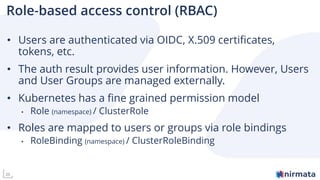
Role-based access control (RBAC)
• Users are authenticated via OIDC, X.509 certificates,
tokens, etc.
• The auth result provides user information. However, Users
and User Groups are managed externally.
• Kubernetes has a fine grained permission model
• Role (namespace) / ClusterRole
• Roles are mapped to users or groups via role bindings
• RoleBinding (namespace) / ClusterRoleBinding
27
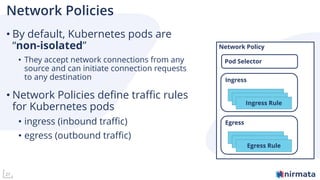
Network Policies
• By default, Kubernetes pods are
“non-isolated”
• They accept network connections from any
source and can initiate connection requests
to any destination
• Network Policies define traffic rules
for Kubernetes pods
• ingress (inbound traffic)
• egress (outbound traffic)
Network Policy
Pod Selector
Ingress
Ingress Rule
Ingress Rule
Ingress Rule
Egress
Ingress Rule
Ingress Rule
Egress Rule
28
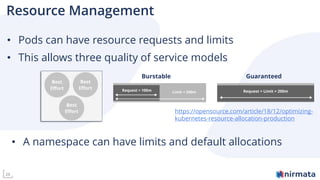
Resource Management
• Pods can have resource requests and limits
• This allows three quality of service models
GuaranteedBurstable
• A namespace can have limits and default allocations
https://opensource.com/article/18/12/optimizing-
kubernetes-resource-allocation-production
29
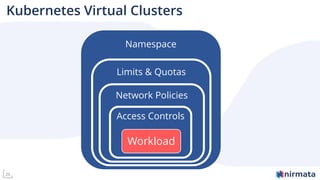
Kubernetes Virtual Clusters
Namespace
Limits & Quotas
Network Policies
Access Controls
Workload
30
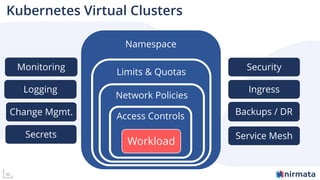
Kubernetes Virtual Clusters
Namespace
Limits & Quotas
Network Policies
Access Controls
Workload
Security
Backups / DR
Logging
Monitoring
Change Mgmt.
Ingress
Service MeshSecrets
31
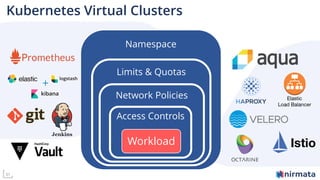
Kubernetes Virtual Clusters
Namespace
Limits & Quotas
Network Policies
Access Controls
Workload
32
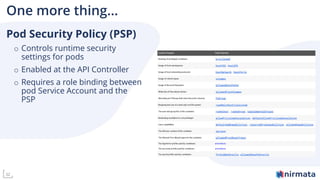
One more thing…
Pod Security Policy (PSP)
o Controls runtime security
settings for pods
o Enabled at the API Controller
o Requires a role binding between
pod Service Account and the
PSP
33
Policy Management
• Policies can provide common
configurations and enforce best
practices
• Kyverno is a open source policy
management tool designed for
Kubernetes
• Kyverno allows you to validate,
generate, and enforce
configurations per namespace /
workload
kyverno.io
34
Challenges (recap)
1. Cluster Management
• Consistent configuration of clusters
• Version control and upgrades all each tool
• Security and governance
2. Usage and Workload management
• Providing teams with virtual clusters
• Providing shared services per virtual cluster
• Securing workloads
Virtual Cluster Demo
35
36
Summary
• Amazon EKS provide a reliable way of provisioning and
managing the Kubernetes control plane
• For production enterprise Kubernetes managing cluster
add-ons, shared services, and Kubernetes configurations is
essential
• Nirmata provide an easy way to build self-service secure
virtual clusters on EKS (or any other managed K8s service).
Thank-You!
https://try.nirmata.io

Operationalizing Amazon EKS

  • 1.
    Operationalizing Amazon EKS JimBugwadia - @JimBugwadia
  • 2.
    2 Kubernetes is thenew Cloud OS Use Containers & Microservices Leverage Open Source Innovation Adopt a Dev-Ops Culture
  • 3.
    3 …but remains complexto manage at scale! Source: Market Pulse Survey of Kubernetes Adoption Management complexity is the biggest hurdle overall to wider adoption
  • 4.
    4 Agenda • Overview • WhatAmazon EKS provides • What else is needed • Demo & discussion
  • 5.
    5 About me • Founderand CEO at Nirmata • Developing large-scale distributed systems since the early 90’s (Go, Java, JS, C++) • Core focus on centralized management for complex systems @JimBugwadia jim@nirmata.com
  • 6.
    Multi-Cloud Kubernetes Managementwith Nirmata! 6 Service Mgmt VisibilityGovernance Compliance Optimization The Nirmata Platform Change Mgmt. Audit Logs Health Capacity Isolation Policies TuningDiscovery Managed Kubernetes GKE AKS EKS PKS Custom Kubernetes Bare Metal vSphere GPUs Cloud-Native Applications Cluster Services Traditional Applications Cluster Services Your Cloud Nirmata Cloud or Private Edition Your Apps
  • 7.
  • 8.
  • 9.
    9 EKS worker nodeconnectivity https://eksworkshop.com/
  • 10.
    10 EKS Install 1. eksctl oCommand line that creates a new VPC and EKS o eksctl.io 2. Terraform, etc. o AWS provider (https://learn.hashicorp.com/terraform/aws/eks-intro) 3. Nirmata o Policy based cluster and add-on management o https://try.nirmata.io
  • 11.
  • 12.
  • 13.
    13 EKS Core Features •Networking o VPC networking support o Elastic Load Balancing o Service Mesh (AWS AppMesh) o Service Registry (AWS CloudMap) • Managed Control Plane • Integrated with IAM • Logging (AWS CloudTrail) • Storage o GP2 (AWS EBS) o CSI drivers for EFS and FSx (Lustre) in alpha
  • 14.
  • 15.
    15 Areas to address 1.Cluster Management 2. Usage and Workload management
  • 16.
    16 The Enterprise-Wide KubernetesStack Compute Kubernetes StorageNetwork
  • 17.
    17 The Enterprise-Wide KubernetesStack Compute Kubernetes StorageNetwork Security
  • 18.
    18 The Enterprise-Wide KubernetesStack Compute Kubernetes StorageNetwork Logging Monitoring Security
  • 19.
    19 The Enterprise-Wide KubernetesStack Compute Kubernetes StorageNetwork Version Control Image Registry Ingress Build Tools Logging Monitoring Security Policy Management
  • 20.
    20 The Enterprise-Wide KubernetesStack Compute Kubernetes StorageNetwork Version Control Image Registry Ingress Build Tools Logging Monitoring Security Policy Management
  • 21.
    21 The Enterprise-Wide KubernetesStack Compute Kubernetes StorageNetwork Version Control Image Registry Ingress Build Tools Logging Monitoring Security Policy Management
  • 22.
    Multi-Cluster Management 22 K8s Management Cluster K8sK8s K8s Kubernetes Clusters Infrastructure Data and Shared Services
  • 23.
    23 Challenges 1. Cluster Management •Consistent configuration of clusters • Version control and upgrades all each tool • Security and governance 2. Usage and Workload management
  • 24.
  • 25.
    25 Namespaces Kubernetes supports multiplevirtual clusters backed by the same physical cluster. These virtual clusters are called namespaces. https://kubernetes.io/docs/concepts/over view/working-with-objects/namespaces/
  • 26.
    26 Role-based access control(RBAC) • Users are authenticated via OIDC, X.509 certificates, tokens, etc. • The auth result provides user information. However, Users and User Groups are managed externally. • Kubernetes has a fine grained permission model • Role (namespace) / ClusterRole • Roles are mapped to users or groups via role bindings • RoleBinding (namespace) / ClusterRoleBinding
  • 27.
    27 Network Policies • Bydefault, Kubernetes pods are “non-isolated” • They accept network connections from any source and can initiate connection requests to any destination • Network Policies define traffic rules for Kubernetes pods • ingress (inbound traffic) • egress (outbound traffic) Network Policy Pod Selector Ingress Ingress Rule Ingress Rule Ingress Rule Egress Ingress Rule Ingress Rule Egress Rule
  • 28.
    28 Resource Management • Podscan have resource requests and limits • This allows three quality of service models GuaranteedBurstable • A namespace can have limits and default allocations https://opensource.com/article/18/12/optimizing- kubernetes-resource-allocation-production
  • 29.
    29 Kubernetes Virtual Clusters Namespace Limits& Quotas Network Policies Access Controls Workload
  • 30.
    30 Kubernetes Virtual Clusters Namespace Limits& Quotas Network Policies Access Controls Workload Security Backups / DR Logging Monitoring Change Mgmt. Ingress Service MeshSecrets
  • 31.
    31 Kubernetes Virtual Clusters Namespace Limits& Quotas Network Policies Access Controls Workload
  • 32.
    32 One more thing… PodSecurity Policy (PSP) o Controls runtime security settings for pods o Enabled at the API Controller o Requires a role binding between pod Service Account and the PSP
  • 33.
    33 Policy Management • Policiescan provide common configurations and enforce best practices • Kyverno is a open source policy management tool designed for Kubernetes • Kyverno allows you to validate, generate, and enforce configurations per namespace / workload kyverno.io
  • 34.
    34 Challenges (recap) 1. ClusterManagement • Consistent configuration of clusters • Version control and upgrades all each tool • Security and governance 2. Usage and Workload management • Providing teams with virtual clusters • Providing shared services per virtual cluster • Securing workloads
  • 35.
  • 36.
    36 Summary • Amazon EKSprovide a reliable way of provisioning and managing the Kubernetes control plane • For production enterprise Kubernetes managing cluster add-ons, shared services, and Kubernetes configurations is essential • Nirmata provide an easy way to build self-service secure virtual clusters on EKS (or any other managed K8s service).
  • 37.