


Production ready tooling for
microservices on
Kubernetes
Chandresh Pancholi
Source: http://www.rafaelhart.com/2018/03/18/monolith-or-microservices.html
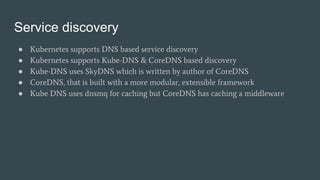
Service discovery
● Kubernetes supports DNS based service discovery
● Kubernetes supports Kube-DNS & CoreDNS based discovery
● Kube-DNS uses SkyDNS which is written by author of CoreDNS
● CoreDNS, that is built with a more modular, extensible framework
● Kube DNS uses dnsmq for caching but CoreDNS has caching a middleware
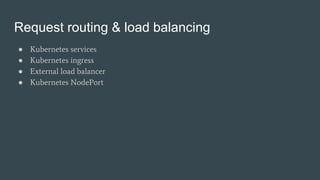
Request routing & load balancing
● Kubernetes services
● Kubernetes ingress
● External load balancer
● Kubernetes NodePort
Monitoring & Visualization
● Prometheus
● Prometheus operator
● cAdvisor
● Grafana
Edge server
● Ingress
○ Nginx
○ Kong
○ GCE
○ Traefik
● Ingress resource → The Ingress resource is a set of rules that map to Kubernetes
services.
● Ingress controller → Ingress controllers are applications that watch Ingresses in
the cluster and configure a balancer to apply those rules.
Configuration managements
● Config maps
● Secrets
● Etcd
● Hashicorp vault
Security
● RBAC
● Service account
● Istio
● Oauth 2.0/OpenId Connect
Centralised logging
● Fluentd
● Fluent bit
● Elasticsearch
● Kibana
● Elastalert
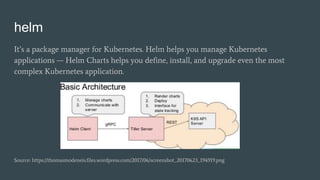
helm
It’s a package manager for Kubernetes. Helm helps you manage Kubernetes
applications — Helm Charts helps you define, install, and upgrade even the most
complex Kubernetes application.
Source: https://thomasmodeneis.files.wordpress.com/2017/06/screenshot_20170623_194919.png
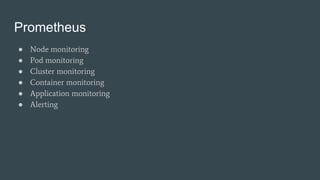
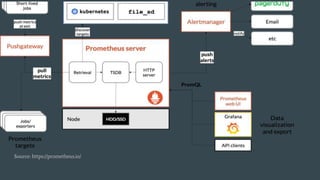
Prometheus
● Node monitoring
● Pod monitoring
● Cluster monitoring
● Container monitoring
● Application monitoring
● Alerting
Source: https://prometheus.io/
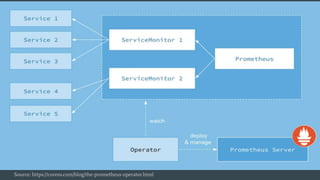
Prometheus operator
Source: https://coreos.com/blog/the-prometheus-operator.html
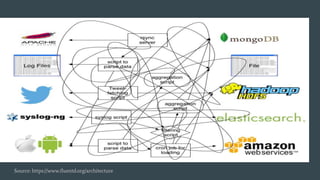
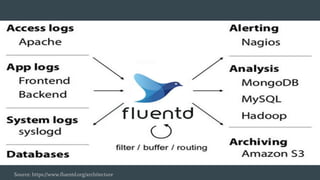
Fluentd
Fluentd is an open source data collector, which lets you unify the data collection and
consumption for a better use and understanding of data.
● Unified logging with Json
● Pluggable Architecture
● Minimum resources required
● Built-in reliability
Source: https://www.fluentd.org/architecture
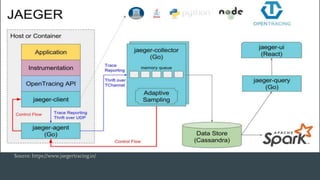
Jaeger/Open tracing
Jaeger, inspired by Dapper and OpenZipkin, is a distributed tracing system released as
open source by Uber Technologies. It is used for monitoring and troubleshooting
microservices-based distributed systems.
● Distributed context propagation
● Distributed transaction monitoring
● Root cause analysis
● Service dependency analysis
● Performance / latency optimization
Source: https://www.jaegertracing.io/
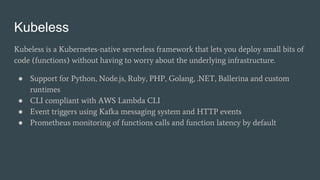
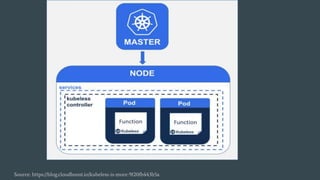
Kubeless
Kubeless is a Kubernetes-native serverless framework that lets you deploy small bits of
code (functions) without having to worry about the underlying infrastructure.
● Support for Python, Node.js, Ruby, PHP, Golang, .NET, Ballerina and custom
runtimes
● CLI compliant with AWS Lambda CLI
● Event triggers using Kafka messaging system and HTTP events
● Prometheus monitoring of functions calls and function latency by default
Source: https://blog.cloudboost.io/kubeless-is-more-9f20fb443b5a
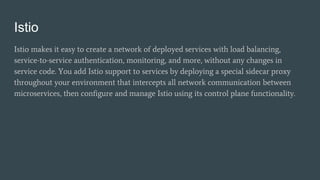
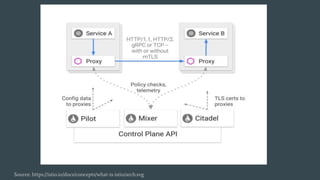
Istio
Istio makes it easy to create a network of deployed services with load balancing,
service-to-service authentication, monitoring, and more, without any changes in
service code. You add Istio support to services by deploying a special sidecar proxy
throughout your environment that intercepts all network communication between
microservices, then configure and manage Istio using its control plane functionality.
Source: https://istio.io/docs/concepts/what-is-istio/arch.svg
Kubewatch
kubewatch is a Kubernetes watcher that currently publishes notification to Slack. Run
it in your k8s cluster, and you will get event notifications in a slack channel.
Resources to watch
● Daemonsets
● Deployment
● Pod
● Replica sets
● Replication controller
● Services
● Secrets
● Config maps
Kube-monkey
An implementation of Netflix's Chaos Monkey for Kubernetes clusters.It randomly
deletes Kubernetes (k8s) pods in the cluster encouraging and validating the
development of failure-resilient services.
Questions?

Production ready tooling for microservices on kubernetes