Copyright @ 2017 Aqua Security Software Ltd. All Rights Reserved.
Securing Applications in
Kubernetes
Tsvi Korren, CISSP
April 2017
2
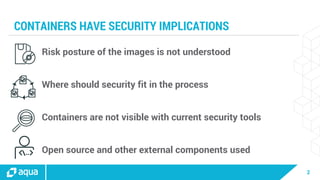
CONTAINERS HAVE SECURITY IMPLICATIONS
Risk posture of the images is not understood
Where should security fit in the process
Containers are not visible with current security tools
Open source and other external components used
3
WHAT SECURITY PEOPLE WANT?
 Safe images, from trusted sources, tamper-proof
 Common security practices in the container environment
 Networking segmentation
 Safeguard sensitive data
 Accountability and audit data of container usage
 Data for demonstrating compliance
4
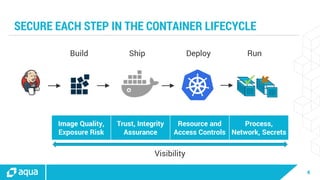
SECURE EACH STEP IN THE CONTAINER LIFECYCLE
Image Quality,
Exposure Risk
Trust, Integrity
Assurance
Resource and
Access Controls
Process,
Network, Secrets
Visibility
Build DeployShip
 
Run
5
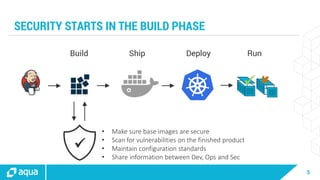
SECURITY STARTS IN THE BUILD PHASE
• Make sure base images are secure
• Scan for vulnerabilities on the finished product
• Maintain configuration standards
• Share information between Dev, Ops and Sec

Build DeployShip
 
Run
6
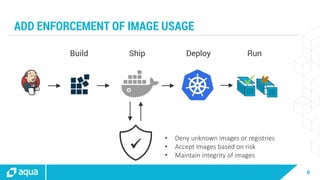
ADD ENFORCEMENT OF IMAGE USAGE
• Deny unknown images or registries
• Accept images based on risk
• Maintain integrity of images

Build DeployShip
 
Run
7
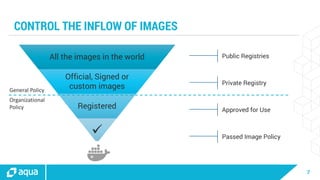
CONTROL THE INFLOW OF IMAGES
All the images in the world
Official, Signed or
custom images
Registered

Public Registries
Private Registry
Approved for Use
Passed Image Policy
General Policy
Organizational
Policy
8
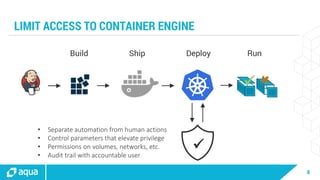
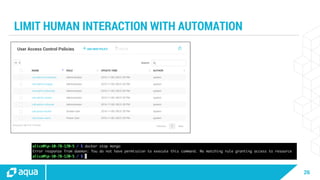
LIMIT ACCESS TO CONTAINER ENGINE

• Separate automation from human actions
• Control parameters that elevate privilege
• Permissions on volumes, networks, etc.
• Audit trail with accountable user
Build DeployShip
 
Run
9
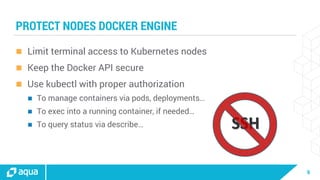
SSH
PROTECT NODES DOCKER ENGINE
 Limit terminal access to Kubernetes nodes
 Keep the Docker API secure
 Use kubectl with proper authorization
 To manage containers via pods, deployments…
 To exec into a running container, if needed…
 To query status via describe…
10
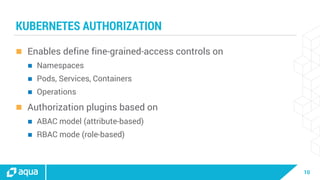
KUBERNETES AUTHORIZATION
 Enables define fine-grained-access controls on
 Namespaces
 Pods, Services, Containers
 Operations
 Authorization plugins based on
 ABAC model (attribute-based)
 RBAC mode (role-based)
11
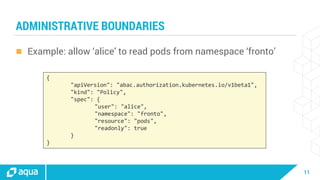
ADMINISTRATIVE BOUNDARIES
 Example: allow ‘alice’ to read pods from namespace ‘fronto’
{
"apiVersion": "abac.authorization.kubernetes.io/v1beta1",
"kind": "Policy",
"spec": {
"user": "alice",
"namespace": "fronto",
"resource": "pods",
"readonly": true
}
}
12
WHY AUTHORIZATION?
 Limits the damage of mistake or malicious intent
 Manage resources access by logical groups
 Resource segregation for multi-tenancy
 Compliance with regulations
13
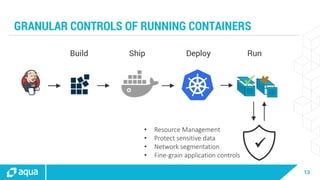
GRANULAR CONTROLS OF RUNNING CONTAINERS
• Resource Management
• Protect sensitive data
• Network segmentation
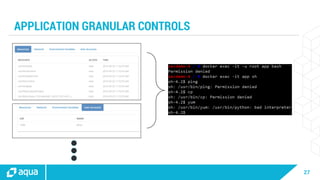
• Fine-grain application controls

Build DeployShip
 
Run
14
DEFINE RESOURCE QUOTA
 Avoid Resource-unbound containers in shared cluster
 Create resource quota policies
 Pods
 CPUs
 Memory ...
 Assigned to namespace
15
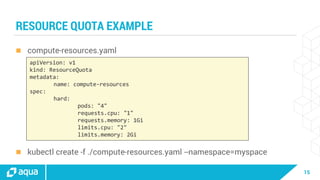
RESOURCE QUOTA EXAMPLE
 compute-resources.yaml
 kubectl create -f ./compute-resources.yaml --namespace=myspace
apiVersion: v1
kind: ResourceQuota
metadata:
name: compute-resources
spec:
hard:
pods: "4"
requests.cpu: "1"
requests.memory: 1Gi
limits.cpu: "2"
limits.memory: 2Gi
16
WHY RESOURCE QUOTAS?
 Unbound resources add risk of DoS by runaway container
 By default, all resources are created unbound
 Predictable performance of clusters
 Required for capacity planning and disaster recovery
17
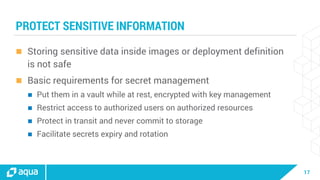
PROTECT SENSITIVE INFORMATION
 Storing sensitive data inside images or deployment definition
is not safe
 Basic requirements for secret management
 Put them in a vault while at rest, encrypted with key management
 Restrict access to authorized users on authorized resources
 Protect in transit and never commit to storage
 Facilitate secrets expiry and rotation
18
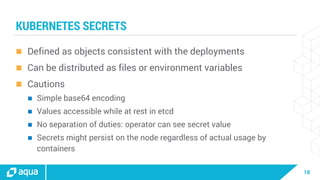
KUBERNETES SECRETS
 Defined as objects consistent with the deployments
 Can be distributed as files or environment variables
 Cautions
 Simple base64 encoding
 Values accessible while at rest in etcd
 No separation of duties: operator can see secret value
 Secrets might persist on the node regardless of actual usage by
containers
19
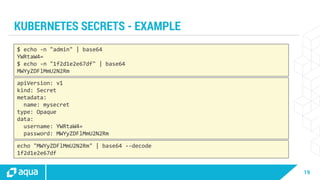
KUBERNETES SECRETS - EXAMPLE
$ echo -n "admin" | base64
YWRtaW4=
$ echo -n "1f2d1e2e67df" | base64
MWYyZDFlMmU2N2Rm
apiVersion: v1
kind: Secret
metadata:
name: mysecret
type: Opaque
data:
username: YWRtaW4=
password: MWYyZDFlMmU2N2Rm
echo "MWYyZDFlMmU2N2Rm" | base64 --decode
1f2d1e2e67df
20
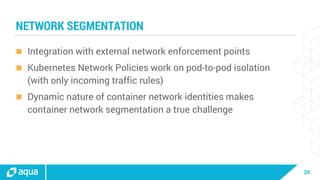
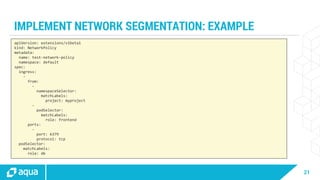
NETWORK SEGMENTATION
 Integration with external network enforcement points
 Kubernetes Network Policies work on pod-to-pod isolation
(with only incoming traffic rules)
 Dynamic nature of container network identities makes
container network segmentation a true challenge
21
IMPLEMENT NETWORK SEGMENTATION: EXAMPLE
apiVersion: extensions/v1beta1
kind: NetworkPolicy
metadata:
name: test-network-policy
namespace: default
spec:
ingress:
-
from:
-
namespaceSelector:
matchLabels:
project: myproject
-
podSelector:
matchLabels:
role: frontend
ports:
-
port: 6379
protocol: tcp
podSelector:
matchLabels:
role: db
22
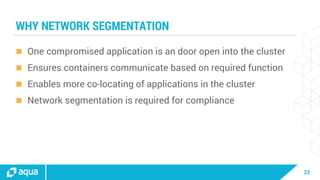
WHY NETWORK SEGMENTATION
 One compromised application is an door open into the cluster
 Ensures containers communicate based on required function
 Enables more co-locating of applications in the cluster
 Network segmentation is required for compliance
23
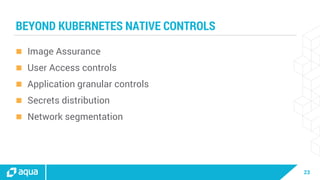
BEYOND KUBERNETES NATIVE CONTROLS
 Image Assurance
 User Access controls
 Application granular controls
 Secrets distribution
 Network segmentation
24
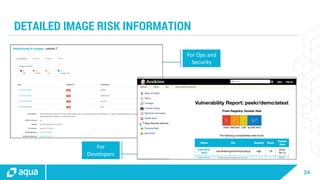
For
Developers
For Ops and
Security
DETAILED IMAGE RISK INFORMATION
25
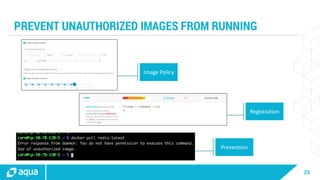
PREVENT UNAUTHORIZED IMAGES FROM RUNNING
Prevention
Image Policy
Registration
26
LIMIT HUMAN INTERACTION WITH AUTOMATION
27
APPLICATION GRANULAR CONTROLS
28
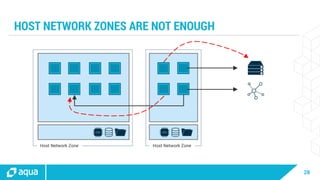
HOST NETWORK ZONES ARE NOT ENOUGH
Host Network Zone Host Network Zone
CPU CPU
29
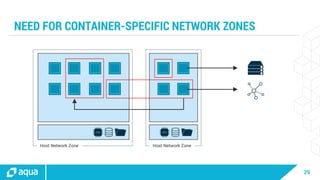
NEED FOR CONTAINER-SPECIFIC NETWORK ZONES
Host Network Zone Host Network Zone
CPU CPU
30
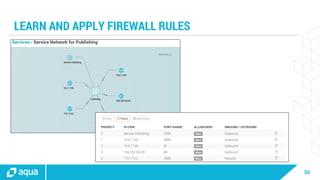
LEARN AND APPLY FIREWALL RULES
31
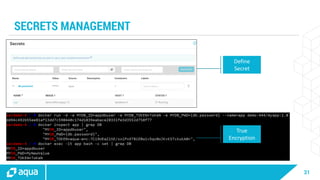
SECRETS MANAGEMENT
Define
Secret
True
Encryption
32
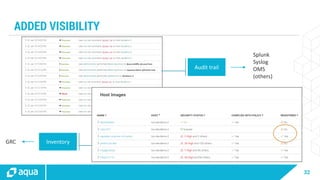
ADDED VISIBILITY
Inventory
Audit trail
Splunk
Syslog
OMS
(others)
GRC
33
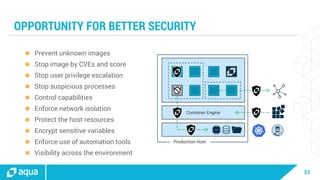
OPPORTUNITY FOR BETTER SECURITY
 Prevent unknown images
 Stop image by CVEs and score
 Stop user privilege escalation
 Stop suspicious processes
 Control capabilities
 Enforce network isolation
 Protect the host resources
 Encrypt sensitive variables
 Enforce use of automation tools
 Visibility across the environment
Container Engine
Production Host
CPU
WWW.AQUASEC.COM

Container Security Deep Dive & Kubernetes

  • 1.
    Copyright @ 2017Aqua Security Software Ltd. All Rights Reserved. Securing Applications in Kubernetes Tsvi Korren, CISSP April 2017
  • 2.
    2 CONTAINERS HAVE SECURITYIMPLICATIONS Risk posture of the images is not understood Where should security fit in the process Containers are not visible with current security tools Open source and other external components used
  • 3.
    3 WHAT SECURITY PEOPLEWANT?  Safe images, from trusted sources, tamper-proof  Common security practices in the container environment  Networking segmentation  Safeguard sensitive data  Accountability and audit data of container usage  Data for demonstrating compliance
  • 4.
    4 SECURE EACH STEPIN THE CONTAINER LIFECYCLE Image Quality, Exposure Risk Trust, Integrity Assurance Resource and Access Controls Process, Network, Secrets Visibility Build DeployShip   Run
  • 5.
    5 SECURITY STARTS INTHE BUILD PHASE • Make sure base images are secure • Scan for vulnerabilities on the finished product • Maintain configuration standards • Share information between Dev, Ops and Sec  Build DeployShip   Run
  • 6.
    6 ADD ENFORCEMENT OFIMAGE USAGE • Deny unknown images or registries • Accept images based on risk • Maintain integrity of images  Build DeployShip   Run
  • 7.
    7 CONTROL THE INFLOWOF IMAGES All the images in the world Official, Signed or custom images Registered  Public Registries Private Registry Approved for Use Passed Image Policy General Policy Organizational Policy
  • 8.
    8 LIMIT ACCESS TOCONTAINER ENGINE  • Separate automation from human actions • Control parameters that elevate privilege • Permissions on volumes, networks, etc. • Audit trail with accountable user Build DeployShip   Run
  • 9.
    9 SSH PROTECT NODES DOCKERENGINE  Limit terminal access to Kubernetes nodes  Keep the Docker API secure  Use kubectl with proper authorization  To manage containers via pods, deployments…  To exec into a running container, if needed…  To query status via describe…
  • 10.
    10 KUBERNETES AUTHORIZATION  Enablesdefine fine-grained-access controls on  Namespaces  Pods, Services, Containers  Operations  Authorization plugins based on  ABAC model (attribute-based)  RBAC mode (role-based)
  • 11.
    11 ADMINISTRATIVE BOUNDARIES  Example:allow ‘alice’ to read pods from namespace ‘fronto’ { "apiVersion": "abac.authorization.kubernetes.io/v1beta1", "kind": "Policy", "spec": { "user": "alice", "namespace": "fronto", "resource": "pods", "readonly": true } }
  • 12.
    12 WHY AUTHORIZATION?  Limitsthe damage of mistake or malicious intent  Manage resources access by logical groups  Resource segregation for multi-tenancy  Compliance with regulations
  • 13.
    13 GRANULAR CONTROLS OFRUNNING CONTAINERS • Resource Management • Protect sensitive data • Network segmentation • Fine-grain application controls  Build DeployShip   Run
  • 14.
    14 DEFINE RESOURCE QUOTA Avoid Resource-unbound containers in shared cluster  Create resource quota policies  Pods  CPUs  Memory ...  Assigned to namespace
  • 15.
    15 RESOURCE QUOTA EXAMPLE compute-resources.yaml  kubectl create -f ./compute-resources.yaml --namespace=myspace apiVersion: v1 kind: ResourceQuota metadata: name: compute-resources spec: hard: pods: "4" requests.cpu: "1" requests.memory: 1Gi limits.cpu: "2" limits.memory: 2Gi
  • 16.
    16 WHY RESOURCE QUOTAS? Unbound resources add risk of DoS by runaway container  By default, all resources are created unbound  Predictable performance of clusters  Required for capacity planning and disaster recovery
  • 17.
    17 PROTECT SENSITIVE INFORMATION Storing sensitive data inside images or deployment definition is not safe  Basic requirements for secret management  Put them in a vault while at rest, encrypted with key management  Restrict access to authorized users on authorized resources  Protect in transit and never commit to storage  Facilitate secrets expiry and rotation
  • 18.
    18 KUBERNETES SECRETS  Definedas objects consistent with the deployments  Can be distributed as files or environment variables  Cautions  Simple base64 encoding  Values accessible while at rest in etcd  No separation of duties: operator can see secret value  Secrets might persist on the node regardless of actual usage by containers
  • 19.
    19 KUBERNETES SECRETS -EXAMPLE $ echo -n "admin" | base64 YWRtaW4= $ echo -n "1f2d1e2e67df" | base64 MWYyZDFlMmU2N2Rm apiVersion: v1 kind: Secret metadata: name: mysecret type: Opaque data: username: YWRtaW4= password: MWYyZDFlMmU2N2Rm echo "MWYyZDFlMmU2N2Rm" | base64 --decode 1f2d1e2e67df
  • 20.
    20 NETWORK SEGMENTATION  Integrationwith external network enforcement points  Kubernetes Network Policies work on pod-to-pod isolation (with only incoming traffic rules)  Dynamic nature of container network identities makes container network segmentation a true challenge
  • 21.
    21 IMPLEMENT NETWORK SEGMENTATION:EXAMPLE apiVersion: extensions/v1beta1 kind: NetworkPolicy metadata: name: test-network-policy namespace: default spec: ingress: - from: - namespaceSelector: matchLabels: project: myproject - podSelector: matchLabels: role: frontend ports: - port: 6379 protocol: tcp podSelector: matchLabels: role: db
  • 22.
    22 WHY NETWORK SEGMENTATION One compromised application is an door open into the cluster  Ensures containers communicate based on required function  Enables more co-locating of applications in the cluster  Network segmentation is required for compliance
  • 23.
    23 BEYOND KUBERNETES NATIVECONTROLS  Image Assurance  User Access controls  Application granular controls  Secrets distribution  Network segmentation
  • 24.
  • 25.
    25 PREVENT UNAUTHORIZED IMAGESFROM RUNNING Prevention Image Policy Registration
  • 26.
  • 27.
  • 28.
    28 HOST NETWORK ZONESARE NOT ENOUGH Host Network Zone Host Network Zone CPU CPU
  • 29.
    29 NEED FOR CONTAINER-SPECIFICNETWORK ZONES Host Network Zone Host Network Zone CPU CPU
  • 30.
    30 LEARN AND APPLYFIREWALL RULES
  • 31.
  • 32.
  • 33.
    33 OPPORTUNITY FOR BETTERSECURITY  Prevent unknown images  Stop image by CVEs and score  Stop user privilege escalation  Stop suspicious processes  Control capabilities  Enforce network isolation  Protect the host resources  Encrypt sensitive variables  Enforce use of automation tools  Visibility across the environment Container Engine Production Host CPU
  • 34.