Data Protection in a
Kubernetes-Native World
@MichaelCade1
A community first technologist for
Kasten by Veeam Software. Based in
the UK with over 16 years of industry
experience with a key focus on
technologies such as cloud native,
automation & data management.
@MichaelCade1
Michael Cade
Kubernetes
Container Orchestration:
Automated Deployment, Scaling, &
Management
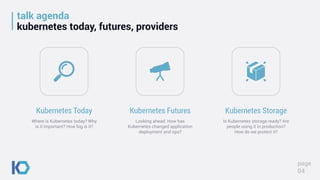
talk agenda
kubernetes today, futures, providers
page
04
Kubernetes Today
Where is Kubernetes today? Why
is it important? How big is it?
Kubernetes Futures
Looking ahead. How has
Kubernetes changed application
deployment and ops?
Kubernetes Storage
Is Kubernetes storage ready? Are
people using it in production?
How do we protect it?
Kubernetes Is
The Next Wave Of
Infrastructure!
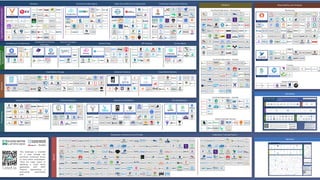
Noisy ecosystem but large
opportunity
Noisy ecosystem but large
opportunity
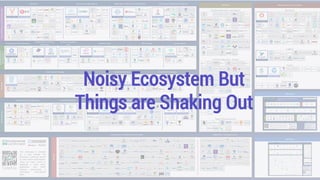
Noisy Ecosystem But
Things are Shaking Out
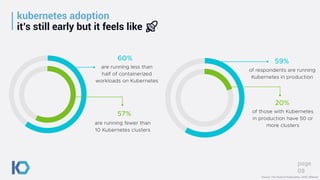
kubernetes adoption
it’s still early but it feels like 🚀
page
08
Source: The State of Kubernetes, 2020, VMware
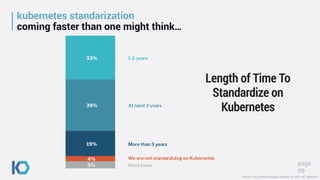
kubernetes standarization
coming faster than one might think…
page
09
Source: Voice of the Enterprise, DevOps, 2H 2019, 451 Research
Length of Time To
Standardize on
Kubernetes
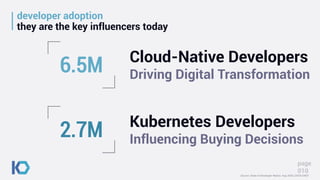
developer adoption
they are the key influencers today
page
010
Kubernetes Developers
Influencing Buying Decisions
2.7M
Cloud-Native Developers
Driving Digital Transformation
6.5M
Source: State of Developer Nation, Aug 2020, DATA/CNCF
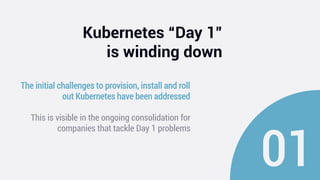
Kubernetes “Day 1”
is winding down
The initial challenges to provision, install and roll
out Kubernetes have been addressed
This is visible in the ongoing consolidation for
companies that tackle Day 1 problems
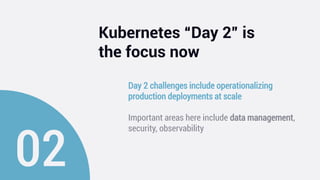
Kubernetes “Day 2” is
the focus now
Day 2 challenges include operationalizing
production deployments at scale
Important areas here include data management,
security, observability
Kubernetes: Storage and Data Management
Exploding Day 2 Use Case
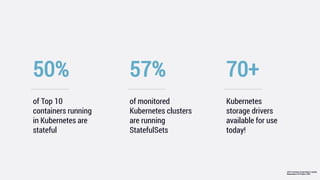
of Top 10
containers running
in Kubernetes are
stateful
50%
of monitored
Kubernetes clusters
are running
StatefulSets
57%
Kubernetes
storage drivers
available for use
today!
70+
2019 Container Usage Report, Sysdig
Kubernetes CSI Project, 2020
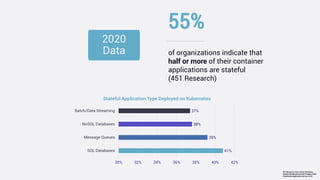
of organizations indicate that
half or more of their container
applications are stateful
(451 Research)
55%
41%
39%
38%
37%
30% 32% 34% 36% 38% 40% 42%
SQL Databases
Message Queues
NoSQL Databases
Batch/Data Streaming
Stateful Application Type Deployed on Kubernetes
451 Research, Voice of the Enterprise:
DevOps Workloads and Key Projects 2020
Kubernetes Application Survey, 2018
2020
Data
Talk Colored By
Shifting Dev and
Ops Roles
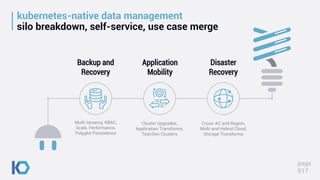
kubernetes-native data management
silo breakdown, self-service, use case merge
page
017
Multi-tenancy, RBAC,
Scale, Performance,
Polyglot Persistence
Cluster Upgrades,
Application Transforms,
Test/Dev Clusters
Cross-AZ and Region,
Multi and Hybrid Cloud,
Storage Transforms
Backup and
Recovery
Application
Mobility
Disaster
Recovery
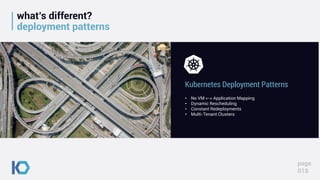
what’s different?
deployment patterns
page
018
• No VM <-> Application Mapping
• Dynamic Rescheduling
• Constant Redeployments
• Multi-Tenant Clusters
Kubernetes Deployment Patterns
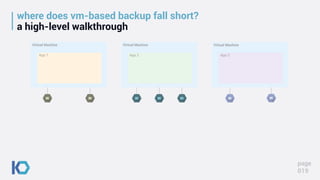
where does vm-based backup fall short?
a high-level walkthrough
page
019
Virtual Machine
App 1
Virtual Machine
App 2
Virtual Machine
App 3
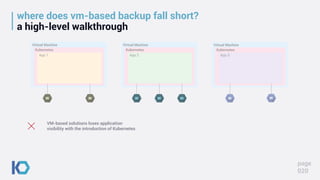
where does vm-based backup fall short?
a high-level walkthrough
page
020
Virtual Machine
Kubernetes
App 1
Virtual Machine
Kubernetes
App 2
Virtual Machine
Kubernetes
App 3
VM-based solutions loses application
visibility with the introduction of Kubernetes
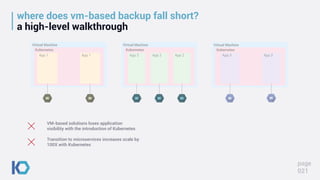
where does vm-based backup fall short?
a high-level walkthrough
page
021
Virtual Machine
Kubernetes
App 1
Virtual Machine
Kubernetes
App 2
Virtual Machine
Kubernetes
App 3
App 1 App 2 App 2 App 3
VM-based solutions loses application
visibility with the introduction of Kubernetes
Transition to microservices increases scale by
100X with Kubernetes
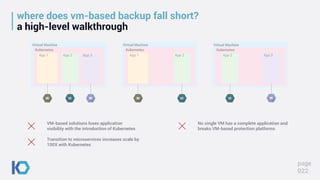
where does vm-based backup fall short?
a high-level walkthrough
page
022
Virtual Machine
Kubernetes
App 1
Virtual Machine
Kubernetes
App 2
Virtual Machine
Kubernetes
App 3 App 1 App 2
App 2 App 3
VM-based solutions loses application
visibility with the introduction of Kubernetes
Transition to microservices increases scale by
100X with Kubernetes
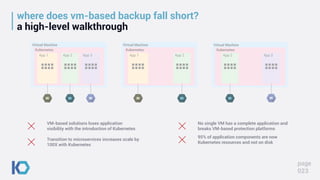
No single VM has a complete application and
breaks VM-based protection platforms
where does vm-based backup fall short?
a high-level walkthrough
page
023
Virtual Machine
Kubernetes
App 1
Virtual Machine
Kubernetes
App 2
Virtual Machine
Kubernetes
App 3 App 1 App 2
App 2 App 3
VM-based solutions loses application
visibility with the introduction of Kubernetes
Transition to microservices increases scale by
100X with Kubernetes
No single VM has a complete application and
breaks VM-based protection platforms
95% of application components are now
Kubernetes resources and not on disk
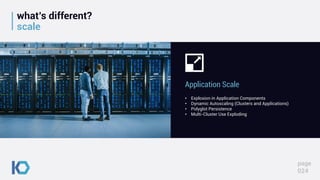
what’s different?
scale
page
024
• Explosion in Application Components
• Dynamic Autoscaling (Clusters and Applications)
• Polyglot Persistence
• Multi-Cluster Use Exploding
Application Scale
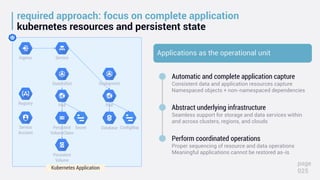
required approach: focus on complete application
kubernetes resources and persistent state
page
025
Automatic and complete application capture
Consistent data and application resources capture
Namespaced objects + non-namespaced dependencies
Perform coordinated operations
Proper sequencing of resource and data operations
Meaningful applications cannot be restored as-is
Applications as the operational unit
Abstract underlying infrastructure
Seamless support for storage and data services within
and across clusters, regions, and clouds
Ingress Service
Service
Account
Persistent
Volume
Registry
Database ConfigMap
Secret
StatefulSet Deployment
Pod
Pod
Persistent
VolumeClaim
Kubernetes Application
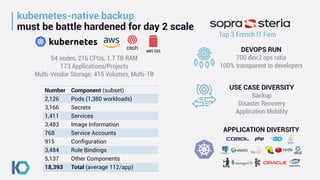
kubernetes-native backup
must be battle hardened for day 2 scale
DEVOPS RUN
700 dev:2 ops ratio
100% transparent to developers
APPLICATION DIVERSITY
54 nodes, 216 CPUs, 1.7 TB RAM
173 Applications/Projects
Multi-Vendor Storage: 415 Volumes, Multi-TB
Number Component (subset)
2,126 Pods (1,380 workloads)
3,166 Secrets
1,411 Services
3,483 Image Information
768 Service Accounts
915 Configuration
3,484 Role Bindings
5,137 Other Components
18,393 Total (average 112/app)
Top 3 French IT Firm
AWS EBS
USE CASE DIVERSITY
Backup
Disaster Recovery
Application Mobility
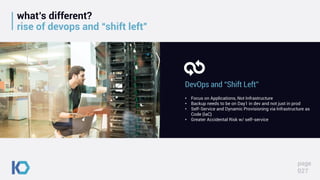
what’s different?
rise of devops and “shift left”
page
027
• Focus on Applications, Not Infrastructure
• Backup needs to be on Day1 in dev and not just in prod
• Self-Service and Dynamic Provisioning via Infrastructure as
Code (IaC)
• Greater Accidental Risk w/ self-service
DevOps and “Shift Left”
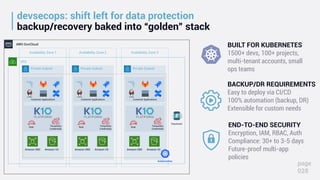
devsecops: shift left for data protection
backup/recovery baked into “golden” stack
page
028
AWS GovCloud
VPC
Private Subnet
Amazon S3
Availability Zone 1
Amazon EBS
Temporary
Credentials
Role
Customer Applications
Private Subnet
Amazon S3
Availability Zone 2
Amazon EBS
Temporary
Credentials
Role
Customer Applications
Private Subnet
Amazon S3
Availability Zone 3
Amazon EBS
Temporary
Credentials
Role
Customer Applications
Keycloack
BUILT FOR KUBERNETES
1500+ devs, 100+ projects,
multi-tenant accounts, small
ops teams
BACKUP/DR REQUIREMENTS
Easy to deploy via CI/CD
100% automation (backup, DR)
Extensible for custom needs
END-TO-END SECURITY
Encryption, IAM, RBAC, Auth
Compliance: 30+ to 3-5 days
Future-proof multi-app
policies
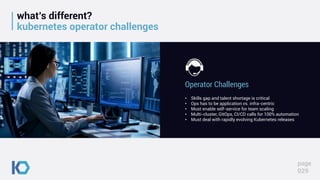
what’s different?
kubernetes operator challenges
page
029
• Skills gap and talent shortage is critical
• Ops has to be application vs. infra-centric
• Must enable self-service for team scaling
• Multi-cluster, GitOps, CI/CD calls for 100% automation
• Must deal with rapidly evolving Kubernetes releases
Operator Challenges
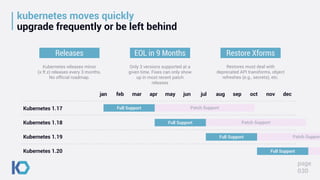
kubernetes moves quickly
upgrade frequently or be left behind
page
030
Kubernetes 1.17
Kubernetes 1.18
Kubernetes 1.19
jan feb mar apr may jun jul aug sep oct nov dec
01/08 31/12
Kubernetes releases minor
(x.Y.z) releases every 3 months.
No official roadmap.
Releases
Only 3 versions supported at a
given time. Fixes can only show
up in most recent patch
releases
EOL in 9 Months
Restores must deal with
deprecated API transforms, object
refreshes (e.g., secrets), etc.
Restore Xforms
Patch Support
Full Support
Patch Support
Full Support
Patch Support
Full Support
Full Support
Kubernetes 1.20
Other Data
Management
Concerns To
Watch Out For
data management
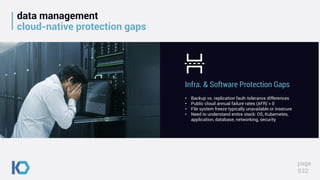
cloud-native protection gaps
page
032
• Backup vs. replication fault-tolerance differences
• Public cloud annual failure rates (AFR) > 0
• File system freeze typically unavailable or insecure
• Need to understand entire stack: OS, Kubernetes,
application, database, networking, security
Infra. & Software Protection Gaps
data management
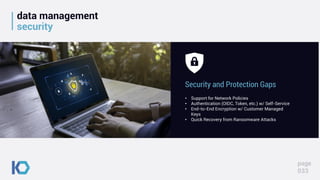
security
page
033
• Support for Network Policies
• Authentication (OIDC, Token, etc.) w/ Self-Service
• End-to-End Encryption w/ Customer Managed
Keys
• Quick Recovery from Ransomware Attacks
Security and Protection Gaps
data management
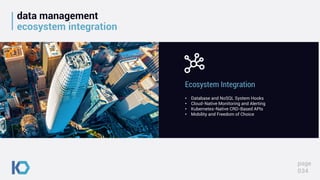
ecosystem integration
page
034
• Database and NoSQL System Hooks
• Cloud-Native Monitoring and Alerting
• Kubernetes-Native CRD-Based APIs
• Mobility and Freedom of Choice
Ecosystem Integration
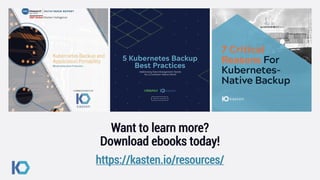
Want to learn more?
Download ebooks today!
https://kasten.io/resources/
Want to learn more?
Download “Phippy In Space” today!
https://kasten.io/resources/
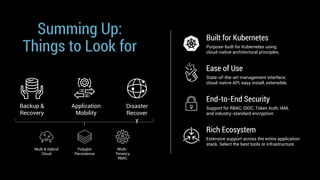
Summing Up:
Things to Look for
Backup &
Recovery
Disaster
Recover
y
Application
Mobility
Built for Kubernetes
Purpose-built for Kubernetes using
cloud-native architectural principles.
Rich Ecosystem
Extensive support across the entire application
stack. Select the best tools or infrastructure.
Ease of Use
State-of-the-art management interface;
cloud-native API, easy install, extensible.
End-to-End Security
Support for RBAC, OIDC, Token Auth, IAM,
and industry-standard encryption
Multi & Hybrid
Cloud
Polyglot
Persistence
Multi-
Tenancy
RBAC
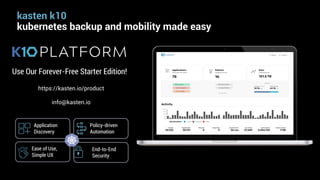
kasten k10
kubernetes backup and mobility made easy
Ease of Use,
Simple UX
Policy-driven
Automation
End-to-End
Security
Application
Discovery
Use Our Forever-Free Starter Edition!
https://kasten.io/product
info@kasten.io

Data protection in a kubernetes-native world

  • 1.
    Data Protection ina Kubernetes-Native World @MichaelCade1
  • 2.
    A community firsttechnologist for Kasten by Veeam Software. Based in the UK with over 16 years of industry experience with a key focus on technologies such as cloud native, automation & data management. @MichaelCade1 Michael Cade
  • 3.
  • 4.
    talk agenda kubernetes today,futures, providers page 04 Kubernetes Today Where is Kubernetes today? Why is it important? How big is it? Kubernetes Futures Looking ahead. How has Kubernetes changed application deployment and ops? Kubernetes Storage Is Kubernetes storage ready? Are people using it in production? How do we protect it?
  • 5.
    Kubernetes Is The NextWave Of Infrastructure!
  • 6.
    Noisy ecosystem butlarge opportunity
  • 7.
    Noisy ecosystem butlarge opportunity Noisy Ecosystem But Things are Shaking Out
  • 8.
    kubernetes adoption it’s stillearly but it feels like 🚀 page 08 Source: The State of Kubernetes, 2020, VMware
  • 9.
    kubernetes standarization coming fasterthan one might think… page 09 Source: Voice of the Enterprise, DevOps, 2H 2019, 451 Research Length of Time To Standardize on Kubernetes
  • 10.
    developer adoption they arethe key influencers today page 010 Kubernetes Developers Influencing Buying Decisions 2.7M Cloud-Native Developers Driving Digital Transformation 6.5M Source: State of Developer Nation, Aug 2020, DATA/CNCF
  • 11.
    Kubernetes “Day 1” iswinding down The initial challenges to provision, install and roll out Kubernetes have been addressed This is visible in the ongoing consolidation for companies that tackle Day 1 problems
  • 12.
    Kubernetes “Day 2”is the focus now Day 2 challenges include operationalizing production deployments at scale Important areas here include data management, security, observability
  • 13.
    Kubernetes: Storage andData Management Exploding Day 2 Use Case
  • 14.
    of Top 10 containersrunning in Kubernetes are stateful 50% of monitored Kubernetes clusters are running StatefulSets 57% Kubernetes storage drivers available for use today! 70+ 2019 Container Usage Report, Sysdig Kubernetes CSI Project, 2020
  • 15.
    of organizations indicatethat half or more of their container applications are stateful (451 Research) 55% 41% 39% 38% 37% 30% 32% 34% 36% 38% 40% 42% SQL Databases Message Queues NoSQL Databases Batch/Data Streaming Stateful Application Type Deployed on Kubernetes 451 Research, Voice of the Enterprise: DevOps Workloads and Key Projects 2020 Kubernetes Application Survey, 2018 2020 Data
  • 16.
    Talk Colored By ShiftingDev and Ops Roles
  • 17.
    kubernetes-native data management silobreakdown, self-service, use case merge page 017 Multi-tenancy, RBAC, Scale, Performance, Polyglot Persistence Cluster Upgrades, Application Transforms, Test/Dev Clusters Cross-AZ and Region, Multi and Hybrid Cloud, Storage Transforms Backup and Recovery Application Mobility Disaster Recovery
  • 18.
    what’s different? deployment patterns page 018 •No VM <-> Application Mapping • Dynamic Rescheduling • Constant Redeployments • Multi-Tenant Clusters Kubernetes Deployment Patterns
  • 19.
    where does vm-basedbackup fall short? a high-level walkthrough page 019 Virtual Machine App 1 Virtual Machine App 2 Virtual Machine App 3
  • 20.
    where does vm-basedbackup fall short? a high-level walkthrough page 020 Virtual Machine Kubernetes App 1 Virtual Machine Kubernetes App 2 Virtual Machine Kubernetes App 3 VM-based solutions loses application visibility with the introduction of Kubernetes
  • 21.
    where does vm-basedbackup fall short? a high-level walkthrough page 021 Virtual Machine Kubernetes App 1 Virtual Machine Kubernetes App 2 Virtual Machine Kubernetes App 3 App 1 App 2 App 2 App 3 VM-based solutions loses application visibility with the introduction of Kubernetes Transition to microservices increases scale by 100X with Kubernetes
  • 22.
    where does vm-basedbackup fall short? a high-level walkthrough page 022 Virtual Machine Kubernetes App 1 Virtual Machine Kubernetes App 2 Virtual Machine Kubernetes App 3 App 1 App 2 App 2 App 3 VM-based solutions loses application visibility with the introduction of Kubernetes Transition to microservices increases scale by 100X with Kubernetes No single VM has a complete application and breaks VM-based protection platforms
  • 23.
    where does vm-basedbackup fall short? a high-level walkthrough page 023 Virtual Machine Kubernetes App 1 Virtual Machine Kubernetes App 2 Virtual Machine Kubernetes App 3 App 1 App 2 App 2 App 3 VM-based solutions loses application visibility with the introduction of Kubernetes Transition to microservices increases scale by 100X with Kubernetes No single VM has a complete application and breaks VM-based protection platforms 95% of application components are now Kubernetes resources and not on disk
  • 24.
    what’s different? scale page 024 • Explosionin Application Components • Dynamic Autoscaling (Clusters and Applications) • Polyglot Persistence • Multi-Cluster Use Exploding Application Scale
  • 25.
    required approach: focuson complete application kubernetes resources and persistent state page 025 Automatic and complete application capture Consistent data and application resources capture Namespaced objects + non-namespaced dependencies Perform coordinated operations Proper sequencing of resource and data operations Meaningful applications cannot be restored as-is Applications as the operational unit Abstract underlying infrastructure Seamless support for storage and data services within and across clusters, regions, and clouds Ingress Service Service Account Persistent Volume Registry Database ConfigMap Secret StatefulSet Deployment Pod Pod Persistent VolumeClaim Kubernetes Application
  • 26.
    kubernetes-native backup must bebattle hardened for day 2 scale DEVOPS RUN 700 dev:2 ops ratio 100% transparent to developers APPLICATION DIVERSITY 54 nodes, 216 CPUs, 1.7 TB RAM 173 Applications/Projects Multi-Vendor Storage: 415 Volumes, Multi-TB Number Component (subset) 2,126 Pods (1,380 workloads) 3,166 Secrets 1,411 Services 3,483 Image Information 768 Service Accounts 915 Configuration 3,484 Role Bindings 5,137 Other Components 18,393 Total (average 112/app) Top 3 French IT Firm AWS EBS USE CASE DIVERSITY Backup Disaster Recovery Application Mobility
  • 27.
    what’s different? rise ofdevops and “shift left” page 027 • Focus on Applications, Not Infrastructure • Backup needs to be on Day1 in dev and not just in prod • Self-Service and Dynamic Provisioning via Infrastructure as Code (IaC) • Greater Accidental Risk w/ self-service DevOps and “Shift Left”
  • 28.
    devsecops: shift leftfor data protection backup/recovery baked into “golden” stack page 028 AWS GovCloud VPC Private Subnet Amazon S3 Availability Zone 1 Amazon EBS Temporary Credentials Role Customer Applications Private Subnet Amazon S3 Availability Zone 2 Amazon EBS Temporary Credentials Role Customer Applications Private Subnet Amazon S3 Availability Zone 3 Amazon EBS Temporary Credentials Role Customer Applications Keycloack BUILT FOR KUBERNETES 1500+ devs, 100+ projects, multi-tenant accounts, small ops teams BACKUP/DR REQUIREMENTS Easy to deploy via CI/CD 100% automation (backup, DR) Extensible for custom needs END-TO-END SECURITY Encryption, IAM, RBAC, Auth Compliance: 30+ to 3-5 days Future-proof multi-app policies
  • 29.
    what’s different? kubernetes operatorchallenges page 029 • Skills gap and talent shortage is critical • Ops has to be application vs. infra-centric • Must enable self-service for team scaling • Multi-cluster, GitOps, CI/CD calls for 100% automation • Must deal with rapidly evolving Kubernetes releases Operator Challenges
  • 30.
    kubernetes moves quickly upgradefrequently or be left behind page 030 Kubernetes 1.17 Kubernetes 1.18 Kubernetes 1.19 jan feb mar apr may jun jul aug sep oct nov dec 01/08 31/12 Kubernetes releases minor (x.Y.z) releases every 3 months. No official roadmap. Releases Only 3 versions supported at a given time. Fixes can only show up in most recent patch releases EOL in 9 Months Restores must deal with deprecated API transforms, object refreshes (e.g., secrets), etc. Restore Xforms Patch Support Full Support Patch Support Full Support Patch Support Full Support Full Support Kubernetes 1.20
  • 31.
  • 32.
    data management cloud-native protectiongaps page 032 • Backup vs. replication fault-tolerance differences • Public cloud annual failure rates (AFR) > 0 • File system freeze typically unavailable or insecure • Need to understand entire stack: OS, Kubernetes, application, database, networking, security Infra. & Software Protection Gaps
  • 33.
    data management security page 033 • Supportfor Network Policies • Authentication (OIDC, Token, etc.) w/ Self-Service • End-to-End Encryption w/ Customer Managed Keys • Quick Recovery from Ransomware Attacks Security and Protection Gaps
  • 34.
    data management ecosystem integration page 034 •Database and NoSQL System Hooks • Cloud-Native Monitoring and Alerting • Kubernetes-Native CRD-Based APIs • Mobility and Freedom of Choice Ecosystem Integration
  • 35.
    Want to learnmore? Download ebooks today! https://kasten.io/resources/
  • 36.
    Want to learnmore? Download “Phippy In Space” today! https://kasten.io/resources/
  • 37.
    Summing Up: Things toLook for Backup & Recovery Disaster Recover y Application Mobility Built for Kubernetes Purpose-built for Kubernetes using cloud-native architectural principles. Rich Ecosystem Extensive support across the entire application stack. Select the best tools or infrastructure. Ease of Use State-of-the-art management interface; cloud-native API, easy install, extensible. End-to-End Security Support for RBAC, OIDC, Token Auth, IAM, and industry-standard encryption Multi & Hybrid Cloud Polyglot Persistence Multi- Tenancy RBAC
  • 38.
    kasten k10 kubernetes backupand mobility made easy Ease of Use, Simple UX Policy-driven Automation End-to-End Security Application Discovery Use Our Forever-Free Starter Edition! https://kasten.io/product info@kasten.io