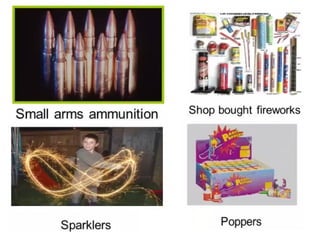
M. Tayfour 1
CLASSIFICATIOCLASSIFICATIO
NN
Instructor : TAYFOURInstructor : TAYFOUR
M. Tayfour 2
Section 3Section 3 : In this Section you will be to:: In this Section you will be to:
Identify the nine classes of dangerous goods byIdentify the nine classes of dangerous goods by
their principle criteria;their principle criteria;
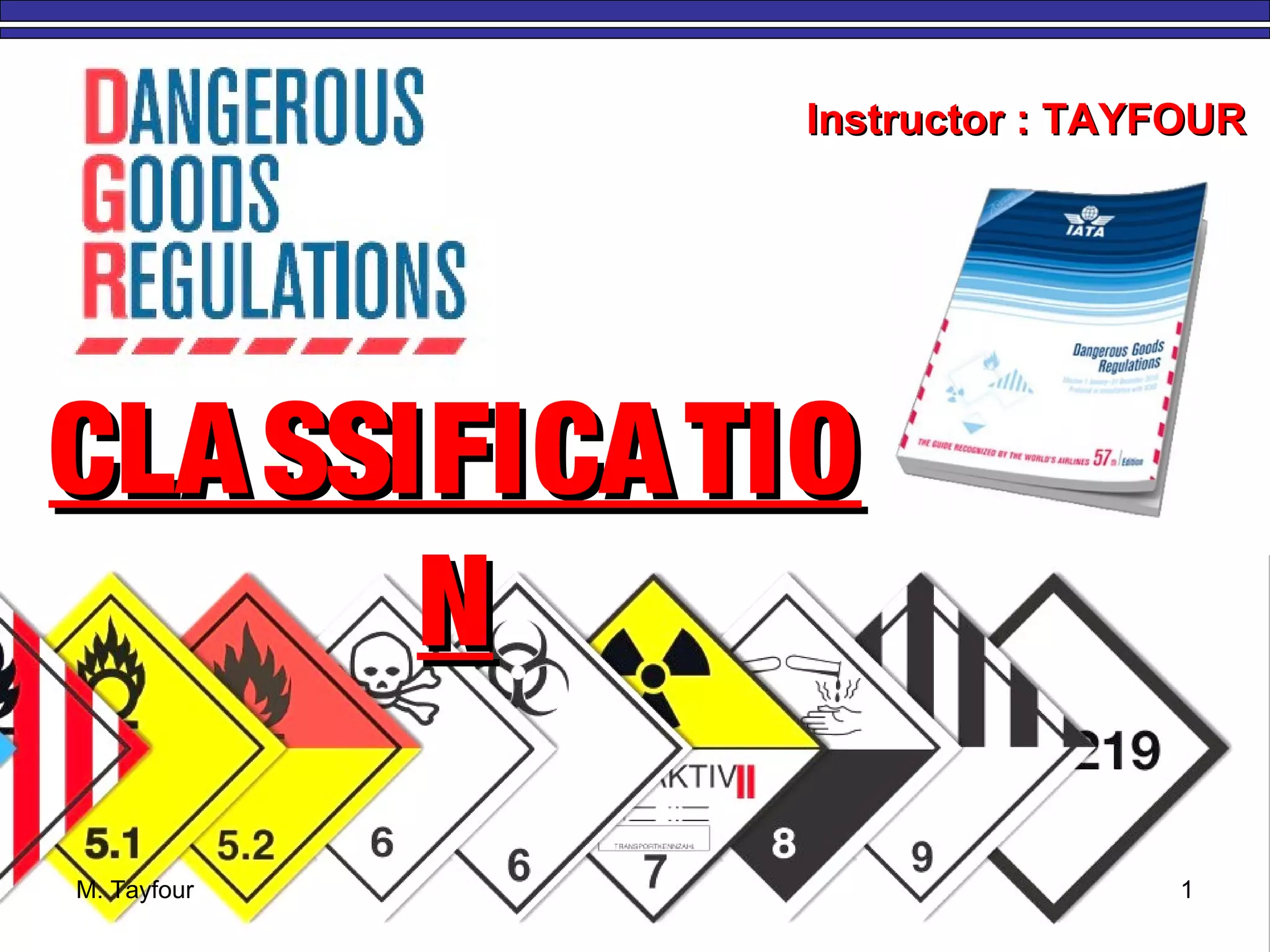
Recognize the hazard label for each class orRecognize the hazard label for each class or
division of dangerous goods;division of dangerous goods;
Understand and apply the principles of PackingUnderstand and apply the principles of Packing
Groups.Groups.
M. Tayfour 3
DGR Classification SystemDGR Classification System
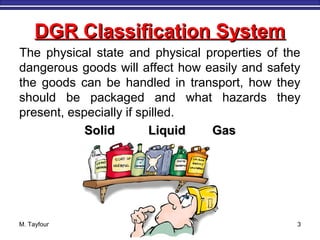
The physical state and physical properties of the
dangerous goods will affect how easily and safety
the goods can be handled in transport, how they
should be packaged and what hazards they
present, especially if spilled.
SolidSolid LiquidLiquid GasGas
M. Tayfour 4
DGR Classification SystemDGR Classification System
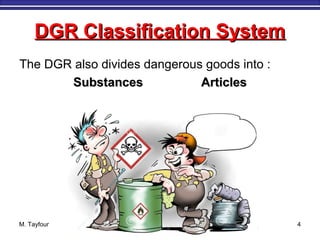
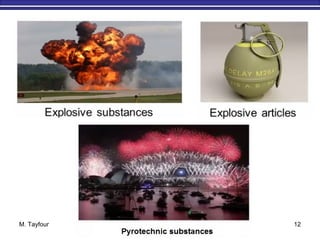
The DGR also divides dangerous goods into :
SubstancesSubstances ArticlesArticles
• Dangerous Goods are divided into 9
hazard groups called classes .
– Classes 1, 2, 4, 5 and 6 are broken down into
“Divisions” due to hazard variation within
these classes.
• Classes are expressed by single-digit
numbers. (Example Class 7).
• Divisions are expressed by 2-digit
numbers. The first digit identifies the class
number and the second identifies the
division number within that class.
M. Tayfour 5
ExampleExample
Class 1, Division 1Class 1, Division 1
would be expressed aswould be expressed as
Division 1.1Division 1.1
M. Tayfour 6
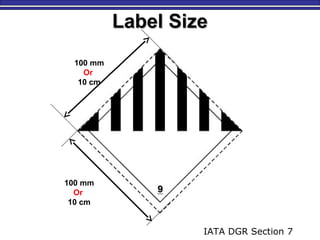
Label SizeLabel Size
IATA DGR Section 7
100 mm
Or
10 cm
100 mm
Or
10 cm
M. Tayfour 8
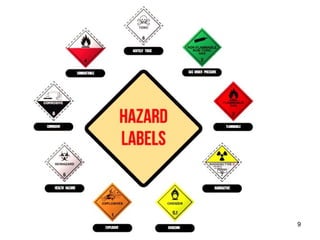
Hazard LabelHazard Label
CLASSIFICATIONCLASSIFICATION
M. Tayfour 9
M. Tayfour 10
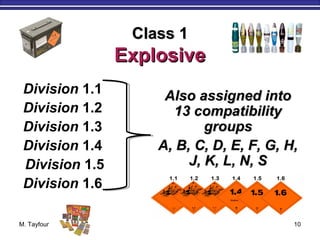
Class 1Class 1
ExplosiveExplosive
Division 1.1
Division 1.2
Division 1.3
Division 1.4
Division 1.5
Division 1.6
Also assigned intoAlso assigned into
13 compatibility13 compatibility
groupsgroups
A, B, C, D, E, F, G, H,A, B, C, D, E, F, G, H,
J, K, L, N, SJ, K, L, N, S
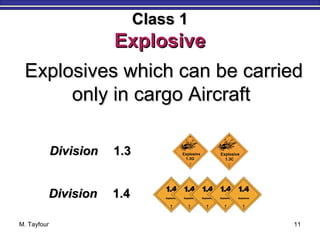
Class 1Class 1
ExplosiveExplosive
Explosives which can be carriedExplosives which can be carried
only in cargo Aircraftonly in cargo Aircraft
M. Tayfour 11
DivisionDivision 1.31.3
DivisionDivision 1.41.4
M. Tayfour 12
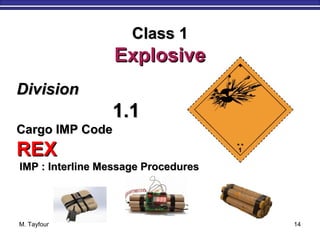
M. Tayfour 14
DivisionDivision
1.11.1
Cargo IMP CodeCargo IMP Code
REXREX
IMP : Interline Message ProceduresIMP : Interline Message Procedures
Class 1Class 1
ExplosiveExplosive
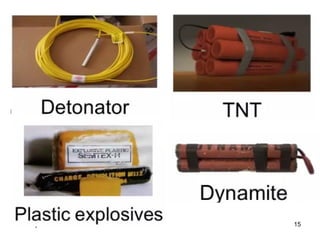
M. Tayfour 15
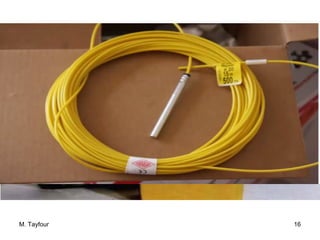
M. Tayfour 16
M. Tayfour 17
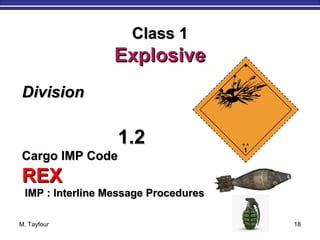
M. Tayfour 18
DivisionDivision
1.21.2
Cargo IMP CodeCargo IMP Code
REXREX
IMP : Interline Message ProceduresIMP : Interline Message Procedures
Class 1Class 1
ExplosiveExplosive
M. Tayfour 19
M. Tayfour 20
M. Tayfour 21
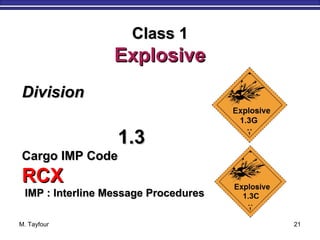
DivisionDivision
1.31.3
Cargo IMP CodeCargo IMP Code
RCXRCX
IMP : Interline Message ProceduresIMP : Interline Message Procedures
Class 1Class 1
ExplosiveExplosive
M. Tayfour 22
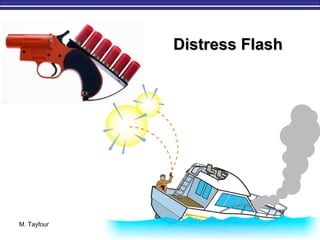
Distress FlashDistress Flash
M. Tayfour 23
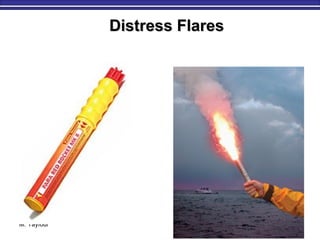
Distress FlaresDistress Flares
M. Tayfour 24
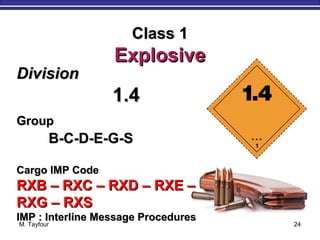
DivisionDivision
1.41.4
GroupGroup
B-C-D-E-G-SB-C-D-E-G-S
Cargo IMP CodeCargo IMP Code
RXB – RXC – RXD – RXE –RXB – RXC – RXD – RXE –
RXG – RXSRXG – RXS
IMP : Interline Message ProceduresIMP : Interline Message Procedures
Class 1Class 1
ExplosiveExplosive
M. Tayfour 25
Class 1Class 1
ExplosiveExplosive
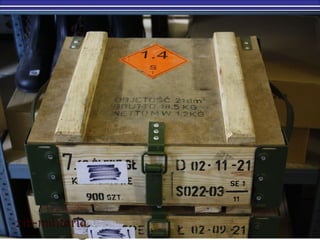
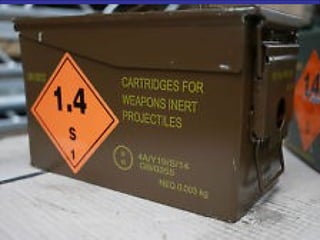
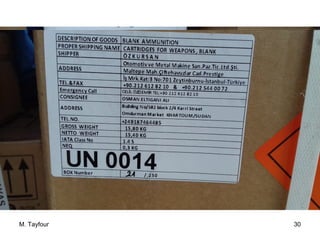
DivisionsDivisions 1.41.4
RXB RXC RXD RXE RXG RXSRXB RXC RXD RXE RXG RXS
M. Tayfour 26
Class 1Class 1
ExplosiveExplosive
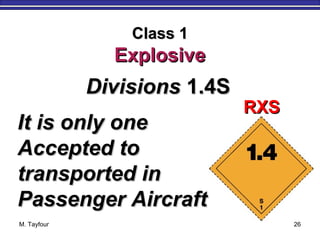
DivisionsDivisions 1.4S1.4S
RXSRXS
It is only oneIt is only one
Accepted toAccepted to
transported intransported in
Passenger AircraftPassenger Aircraft
M. Tayfour 27
M. Tayfour 28
Class 1Class 1
ExplosiveExplosive
M. Tayfour 29
Class 1Class 1
ExplosiveExplosive
M. Tayfour 30
M. Tayfour 31
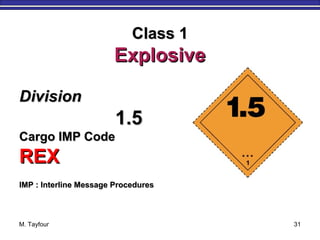
DivisionDivision
1.51.5
Cargo IMP CodeCargo IMP Code
REXREX
IMP : Interline Message ProceduresIMP : Interline Message Procedures
Class 1Class 1
ExplosiveExplosive
M. Tayfour 32
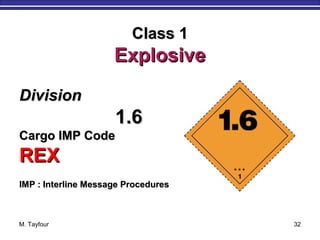
DivisionDivision
1.61.6
Cargo IMP CodeCargo IMP Code
REXREX
IMP : Interline Message ProceduresIMP : Interline Message Procedures
Class 1Class 1
ExplosiveExplosive
M. Tayfour 33
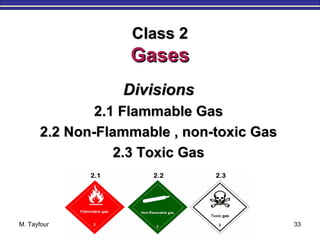
Class 2Class 2
GasesGases
DivisionsDivisions
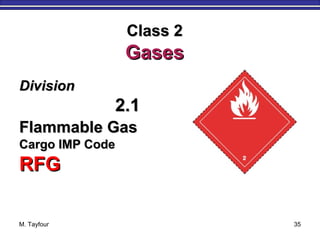
2.1 Flammable Gas2.1 Flammable Gas
2.2 Non-Flammable , non-toxic Gas2.2 Non-Flammable , non-toxic Gas
2.3 Toxic Gas2.3 Toxic Gas
M. Tayfour 34
M. Tayfour 35
DivisionDivision
2.12.1
Flammable GasFlammable Gas
Cargo IMP CodeCargo IMP Code
RFGRFG
Class 2Class 2
GasesGases
M. Tayfour 36
M. Tayfour 37
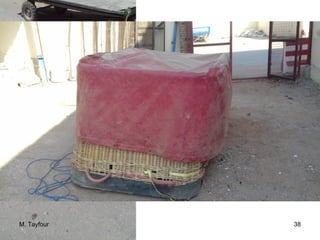
M. Tayfour 38
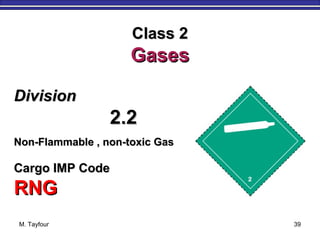
M. Tayfour 39
DivisionDivision
2.22.2
Non-Flammable , non-toxic GasNon-Flammable , non-toxic Gas
Cargo IMP CodeCargo IMP Code
RNGRNG
Class 2Class 2
GasesGases
M. Tayfour 40
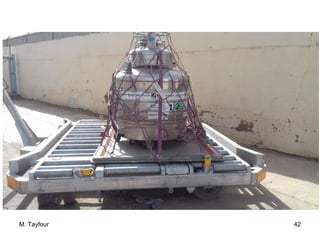
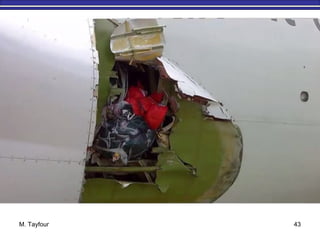
Aircraft Insecticide
M. Tayfour 41
M. Tayfour 42
M. Tayfour 43
M. Tayfour 44
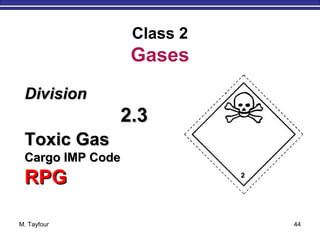
DivisionDivision
2.32.3
Toxic GasToxic Gas
Cargo IMP CodeCargo IMP Code
RPGRPG
Class 2
Gases
M. Tayfour 45
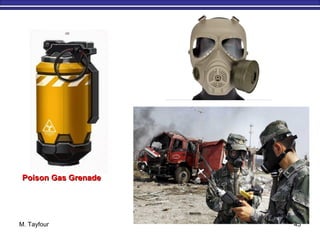
Poison Gas GrenadePoison Gas Grenade
M. Tayfour 46
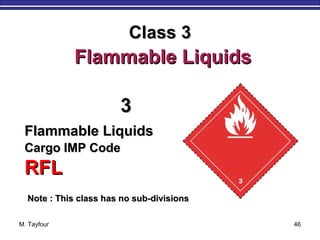
33
Flammable LiquidsFlammable Liquids
Cargo IMP CodeCargo IMP Code
RFLRFL
Note : This class has no sub-divisionsNote : This class has no sub-divisions
Class 3Class 3
Flammable LiquidsFlammable Liquids
M. Tayfour 47
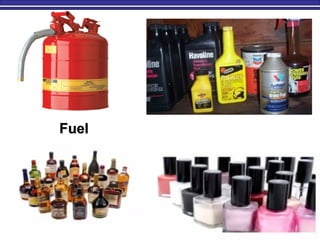
FuelFuel
M. Tayfour 48
M. Tayfour 49
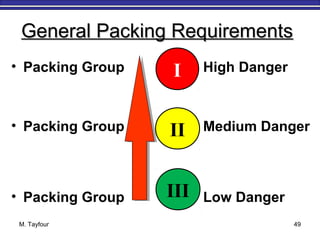
General Packing RequirementsGeneral Packing Requirements
• Packing Group High Danger
• Packing Group Medium Danger
• Packing Group Low Danger
I
II
III
M. Tayfour 50
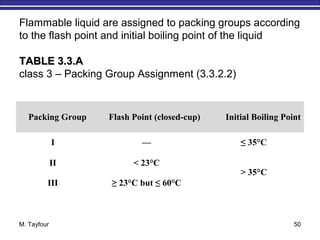
Flammable liquid are assigned to packing groups according
to the flash point and initial boiling point of the liquid
TABLE 3.3.ATABLE 3.3.A
class 3 – Packing Group Assignment (3.3.2.2)
Packing Group Flash Point (closed-cup) Initial Boiling Point
I — ≤ 35°C
II < 23°C
> 35°C
III ≥ 23°C but ≤ 60°C
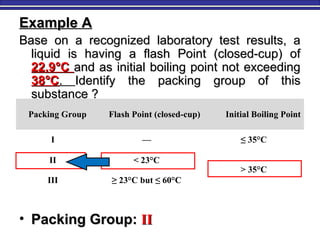
Example AExample A
Base on a recognized laboratory test results, aBase on a recognized laboratory test results, a
liquid is having a flash Point (closed-cup) ofliquid is having a flash Point (closed-cup) of
22.922.9°C°C and as initial boiling point not exceedingand as initial boiling point not exceeding
3838°C°C.. Identify the packing group of thisIdentify the packing group of this
substance ?substance ?
• Packing Group:Packing Group: IIII
Packing Group Flash Point (closed-cup) Initial Boiling Point
I — ≤ 35°C
II < 23°C
> 35°C
III ≥ 23°C but ≤ 60°C
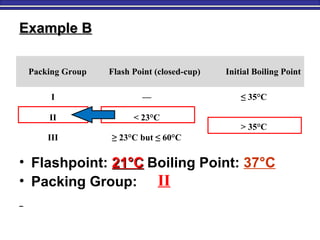
Example BExample B
• Flashpoint: 2121°C°C Boiling Point: 37°C
• Packing Group: II
Packing Group Flash Point (closed-cup) Initial Boiling Point
I — ≤ 35°C
II < 23°C
> 35°C
III ≥ 23°C but ≤ 60°C
Example CExample C
• Flashpoint: 4040°C°C Boiling Point: 5555°C°C
• Packing Group: IIIIII
Packing Group Flash Point (closed-cup) Initial Boiling Point
I — ≤ 35°C
II < 23°C
> 35°C
III ≥ 23°C but ≤ 60°C
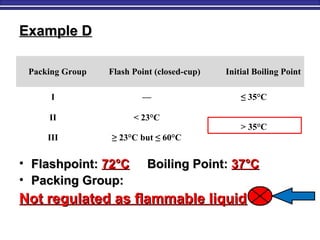
Example DExample D
• Flashpoint:Flashpoint: 7272°C°C Boiling Point:Boiling Point: 3737°C°C
• Packing Group:Packing Group:
Not regulated as flammable liquidNot regulated as flammable liquid
Packing Group Flash Point (closed-cup) Initial Boiling Point
I — ≤ 35°C
II < 23°C
> 35°C
III ≥ 23°C but ≤ 60°C
M. Tayfour 55
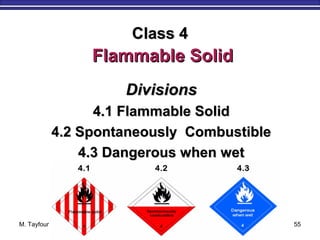
Class 4Class 4
Flammable SolidFlammable Solid
DivisionsDivisions
4.1 Flammable Solid4.1 Flammable Solid
4.2 Spontaneously Combustible4.2 Spontaneously Combustible
4.3 Dangerous when wet4.3 Dangerous when wet
M. Tayfour 56
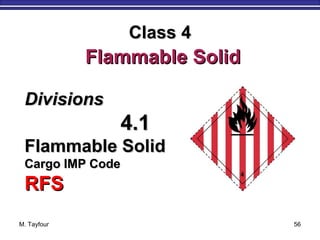
DivisionsDivisions
4.14.1
Flammable SolidFlammable Solid
Cargo IMP CodeCargo IMP Code
RFSRFS
Class 4Class 4
Flammable SolidFlammable Solid
M. Tayfour 57
M. Tayfour 58
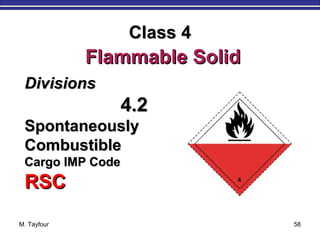
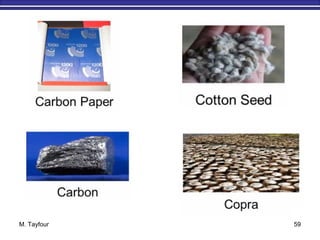
DivisionsDivisions
4.24.2
SpontaneouslySpontaneously
CombustibleCombustible
Cargo IMP CodeCargo IMP Code
RSCRSC
Class 4Class 4
Flammable SolidFlammable Solid
M. Tayfour 59
M. Tayfour 60
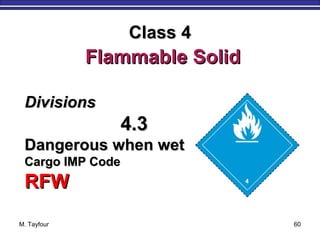
DivisionsDivisions
4.34.3
Dangerous when wetDangerous when wet
Cargo IMP CodeCargo IMP Code
RFWRFW
Class 4Class 4
Flammable SolidFlammable Solid
M. Tayfour 61
M. Tayfour 62
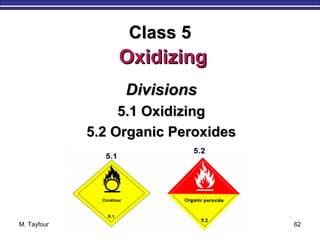
Class 5Class 5
OxidizingOxidizing
DivisionsDivisions
5.1 Oxidizing5.1 Oxidizing
5.2 Organic Peroxides5.2 Organic Peroxides
M. Tayfour 63
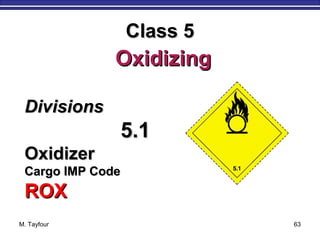
DivisionsDivisions
5.15.1
OxidizerOxidizer
Cargo IMP CodeCargo IMP Code
ROXROX
Class 5Class 5
OxidizingOxidizing
M. Tayfour 64
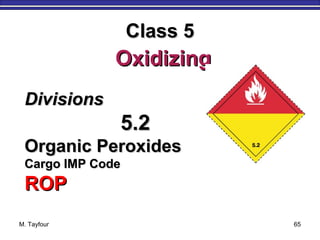
M. Tayfour 65
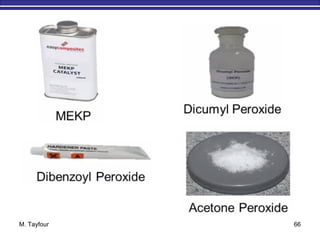
DivisionsDivisions
5.25.2
Organic PeroxidesOrganic Peroxides
Cargo IMP CodeCargo IMP Code
ROPROP
Class 5Class 5
OxidizingOxidizing
M. Tayfour 66
M. Tayfour 67
M. Tayfour 68
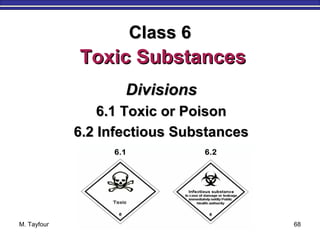
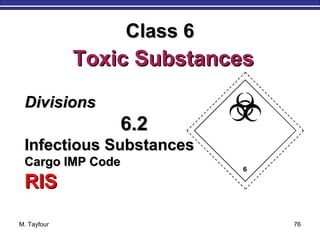
Class 6Class 6
Toxic SubstancesToxic Substances
DivisionsDivisions
6.1 Toxic or Poison6.1 Toxic or Poison
6.2 Infectious Substances6.2 Infectious Substances
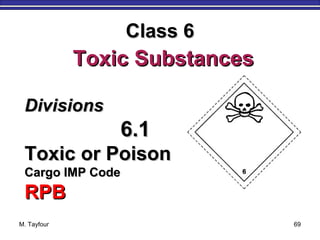
M. Tayfour 69
DivisionsDivisions
6.16.1
Toxic or PoisonToxic or Poison
Cargo IMP CodeCargo IMP Code
RPBRPB
Class 6Class 6
Toxic SubstancesToxic Substances
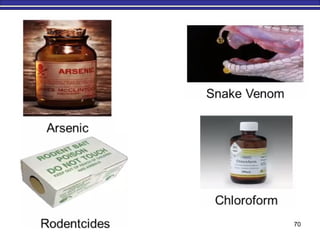
M. Tayfour 70
M. Tayfour 71
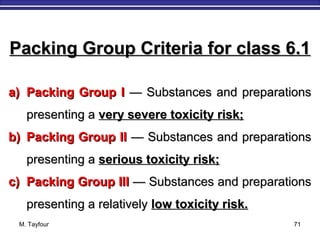
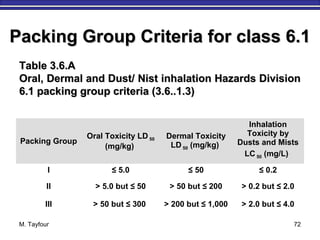
Packing Group Criteria for class 6.1Packing Group Criteria for class 6.1
a)a) Packing Group IPacking Group I — Substances and preparations— Substances and preparations
presenting apresenting a very severe toxicity risk;very severe toxicity risk;
b)b) Packing Group IIPacking Group II — Substances and preparations— Substances and preparations
presenting apresenting a serious toxicity risk;serious toxicity risk;
c)c) Packing Group IIIPacking Group III — Substances and preparations— Substances and preparations
presenting a relativelypresenting a relatively low toxicity risk.low toxicity risk.
M. Tayfour 72
Packing Group Criteria for class 6.1Packing Group Criteria for class 6.1
Packing Group
Oral Toxicity LD 50
(mg/kg)
Dermal Toxicity
LD 50 (mg/kg)
Inhalation
Toxicity by
Dusts and Mists
LC 50 (mg/L)
I ≤ 5.0 ≤ 50 ≤ 0.2
II > 5.0 but ≤ 50 > 50 but ≤ 200 > 0.2 but ≤ 2.0
III > 50 but ≤ 300 > 200 but ≤ 1,000 > 2.0 but ≤ 4.0
Table 3.6.ATable 3.6.A
Oral, Dermal and Dust/ Nist inhalation Hazards DivisionOral, Dermal and Dust/ Nist inhalation Hazards Division
6.1 packing group criteria (3.6..1.3)6.1 packing group criteria (3.6..1.3)
Class 6.2Class 6.2
•
M. Tayfour 73
Class 6.2Class 6.2
M. Tayfour 74
•
Class 6.2Class 6.2
M. Tayfour 75
•
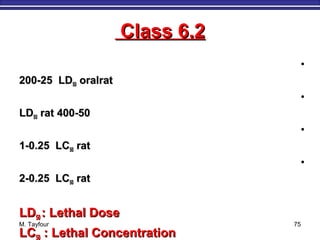
200-25200-25 LDLD5050 oraloralratrat
•
LDLD5050 ratrat 400-50400-50
•
1-0.251-0.25 LCLC5050 ratrat
•
2-0.252-0.25 LCLC5050 ratrat
LDLD5050 : Lethal Dose: Lethal Dose
LCLC50 : Lethal Concentration: Lethal Concentration
M. Tayfour 76
DivisionsDivisions
6.26.2
Infectious SubstancesInfectious Substances
Cargo IMP CodeCargo IMP Code
RISRIS
Class 6Class 6
Toxic SubstancesToxic Substances
M. Tayfour 77
M. Tayfour 78
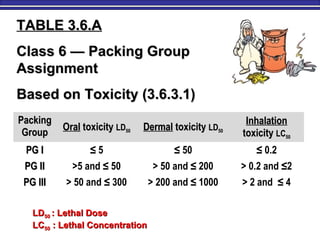
PackingPacking
GroupGroup OralOral toxicitytoxicity LDLD5050 DermalDermal toxicitytoxicity LDLD5050
InhalationInhalation
toxicitytoxicity LCLC5050
PG IPG I ≤ 5 ≤ 50 ≤ 0.2
PG IIPG II >5 and ≤ 50 > 50 and ≤ 200 > 0.2 and ≤2
PG IIIPG III > 50 and ≤ 300 > 200 and ≤ 1000 > 2 and ≤ 4
TABLE 3.6.ATABLE 3.6.A
Class 6 — Packing GroupClass 6 — Packing Group
AssignmentAssignment
Based onBased on ToxicityToxicity (3.6.3.1)(3.6.3.1)
LDLD5050 : Lethal Dose: Lethal Dose
LCLC5050 : Lethal Concentration: Lethal Concentration
M. Tayfour 80
Packing Group
Oral Toxicity LD 50
(mg/kg)
Dermal Toxicity
LD 50 (mg/kg)
Inhalation
Toxicity by
Dusts and Mists
LC 50 (mg/L)
I ≤ 5.0 ≤ 50 ≤ 0.2
II > 5.0 but ≤ 50 > 50 but ≤ 200 > 0.2 but ≤ 2.0
III > 50 but ≤ 300 > 200 but ≤ 1,000 > 2.0 but ≤ 4.0
Example AExample A
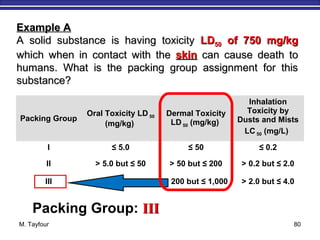
A solid substance is having toxicityA solid substance is having toxicity LDLD5050 of 750 mg/kgof 750 mg/kg
which when in contact with thewhich when in contact with the skinskin can cause death tocan cause death to
humans. What is the packing group assignment for thishumans. What is the packing group assignment for this
substance?substance?
Packing Group: IIIIII
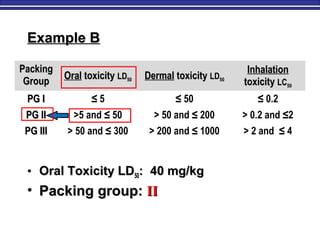
Example BExample B
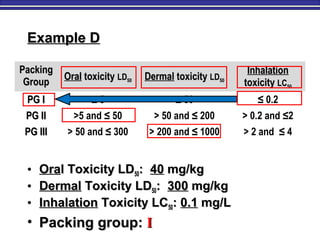
• Oral Toxicity LDOral Toxicity LD5050:: 40 mg/kg40 mg/kg
• Packing group:Packing group: IIII
PackingPacking
GroupGroup OralOral toxicitytoxicity LDLD5050 DermalDermal toxicitytoxicity LDLD5050
InhalationInhalation
toxicitytoxicity LCLC5050
PG IPG I ≤ 5 ≤ 50 ≤ 0.2
PG IIPG II >5 and ≤ 50 > 50 and ≤ 200 > 0.2 and ≤2
PG IIIPG III > 50 and ≤ 300 > 200 and ≤ 1000 > 2 and ≤ 4
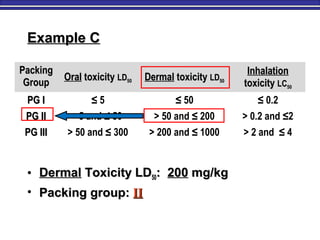
Example CExample C
• DermalDermal Toxicity LDToxicity LD5050:: 200200 mg/kgmg/kg
• Packing group:Packing group: IIII
PackingPacking
GroupGroup OralOral toxicitytoxicity LDLD5050 DermalDermal toxicitytoxicity LDLD5050
InhalationInhalation
toxicitytoxicity LCLC5050
PG IPG I ≤ 5 ≤ 50 ≤ 0.2
PG IIPG II >5 and ≤ 50 > 50 and ≤ 200 > 0.2 and ≤2
PG IIIPG III > 50 and ≤ 300 > 200 and ≤ 1000 > 2 and ≤ 4
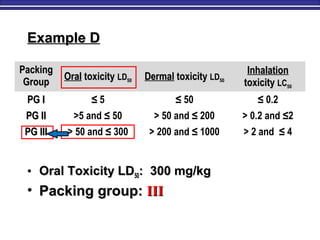
Example DExample D
• Oral Toxicity LDOral Toxicity LD5050:: 300 mg/kg300 mg/kg
• Packing group:Packing group: IIIIII
PackingPacking
GroupGroup OralOral toxicitytoxicity LDLD5050 DermalDermal toxicitytoxicity LDLD5050
InhalationInhalation
toxicitytoxicity LCLC5050
PG IPG I ≤ 5 ≤ 50 ≤ 0.2
PG IIPG II >5 and ≤ 50 > 50 and ≤ 200 > 0.2 and ≤2
PG IIIPG III > 50 and ≤ 300 > 200 and ≤ 1000 > 2 and ≤ 4
Example DExample D
• OraOral Toxicity LDl Toxicity LD5050:: 4040 mg/kgmg/kg
• DermalDermal ToxicityToxicity LDLD5050:: 300300 mg/kgmg/kg
• InhalationInhalation Toxicity LCToxicity LC5050:: 0.10.1 mg/Lmg/L
• Packing group:Packing group: II
PackingPacking
GroupGroup OralOral toxicitytoxicity LDLD5050 DermalDermal toxicitytoxicity LDLD5050
InhalationInhalation
toxicitytoxicity LCLC5050
PG IPG I ≤ 5 ≤ 50 ≤ 0.2
PG IIPG II >5 and ≤ 50 > 50 and ≤ 200 > 0.2 and ≤2
PG IIIPG III > 50 and ≤ 300 > 200 and ≤ 1000 > 2 and ≤ 4
M. Tayfour 85
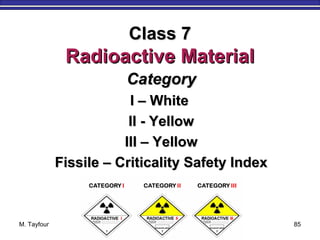
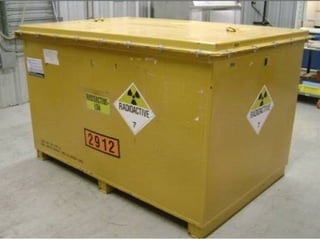
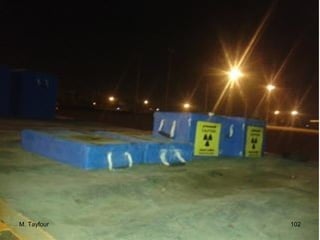
Class 7Class 7
Radioactive MaterialRadioactive Material
CategoryCategory
I – WhiteI – White
II - YellowII - Yellow
III – YellowIII – Yellow
Fissile – Criticality Safety IndexFissile – Criticality Safety Index
M. Tayfour 86
M. Tayfour 87
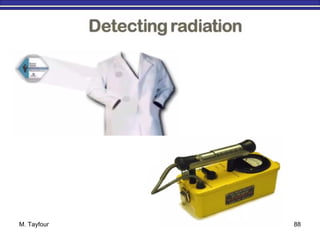
M. Tayfour 88
M. Tayfour 89
M. Tayfour 90
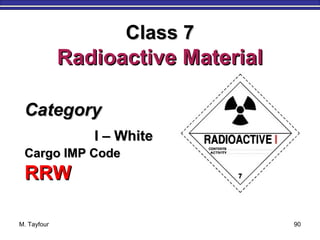
CategoryCategory
I – WhiteI – White
Cargo IMP CodeCargo IMP Code
RRWRRW
Class 7Class 7
Radioactive MaterialRadioactive Material
M. Tayfour 91
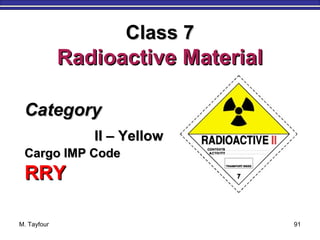
CategoryCategory
II – YellowII – Yellow
Cargo IMP CodeCargo IMP Code
RRYRRY
Class 7Class 7
Radioactive MaterialRadioactive Material
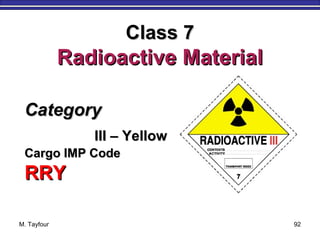
M. Tayfour 92
CategoryCategory
III – YellowIII – Yellow
Cargo IMP CodeCargo IMP Code
RRYRRY
Class 7Class 7
Radioactive MaterialRadioactive Material
M. Tayfour 93
M. Tayfour 94
M. Tayfour 95
M. Tayfour 96
M. Tayfour 97
M. Tayfour 98
M. Tayfour 99
M. Tayfour 100
M. Tayfour 101
M. Tayfour 102
M. Tayfour 103
M. Tayfour 104
M. Tayfour 105
M. Tayfour 106
M. Tayfour 107
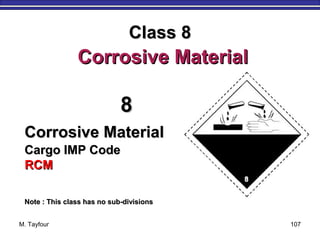
88
Corrosive MaterialCorrosive Material
Cargo IMP CodeCargo IMP Code
RCMRCM
Note : This class has no sub-divisionsNote : This class has no sub-divisions
Class 8Class 8
Corrosive MaterialCorrosive Material
M. Tayfour 108
109
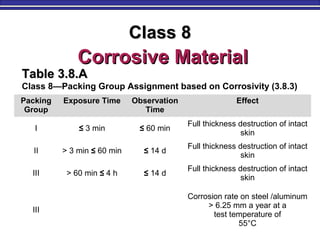
Class 8Class 8
Corrosive MaterialCorrosive Material
Packing
Group
Exposure Time Observation
Time
Effect
I ≤ 3 min ≤ 60 min
Full thickness destruction of intact
skin
II > 3 min ≤ 60 min ≤ 14 d
Full thickness destruction of intact
skin
III > 60 min ≤ 4 h ≤ 14 d
Full thickness destruction of intact
skin
III
Corrosion rate on steel /aluminum
> 6.25 mm a year at a
test temperature of
55°C
Table 3.8.ATable 3.8.A
Class 8—Packing Group Assignment based on Corrosivity (3.8.3)
110
Packing
Group
Exposure Time Observation
Time
Effect
I ≤ 3 min ≤ 60 min
Full thickness destruction of
intact skin
II > 3 min ≤ 60 min ≤ 14 d
Full thickness destruction of
intact skin
III > 60 min ≤ 4 h ≤ 14 d
Full thickness destruction of
intact skin
III
Corrosion rate on steel
/aluminum
> 6.25 mm a year at a
test temperature of
55°C
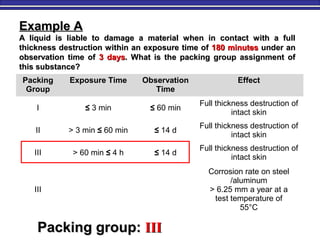
Example AExample A
A liquid is liable to damage a material when in contact with a fullA liquid is liable to damage a material when in contact with a full
thickness destruction within an exposure time ofthickness destruction within an exposure time of 180 minutes180 minutes under anunder an
observation time ofobservation time of 3 days3 days. What is the packing group assignment of. What is the packing group assignment of
this substance?this substance?
Packing group:Packing group: IIIIII
M. Tayfour 111
99
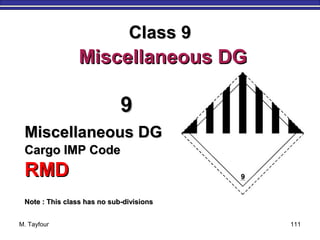
Miscellaneous DGMiscellaneous DG
Cargo IMP CodeCargo IMP Code
RMDRMD
Note : This class has no sub-divisionsNote : This class has no sub-divisions
Class 9Class 9
Miscellaneous DGMiscellaneous DG
M. Tayfour 112
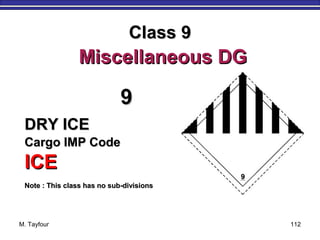
99
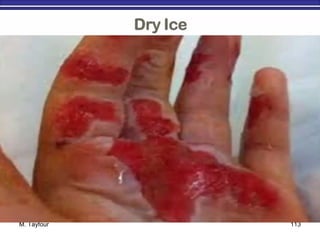
DRY ICEDRY ICE
Cargo IMP CodeCargo IMP Code
ICEICE
Note : This class has no sub-divisionsNote : This class has no sub-divisions
Class 9Class 9
Miscellaneous DGMiscellaneous DG
M. Tayfour 113
M. Tayfour 114
M. Tayfour 115
M. Tayfour 116
M. Tayfour 117
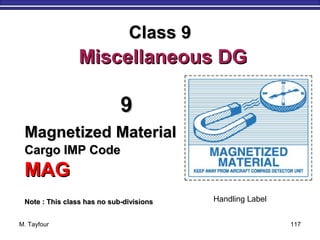
99
Magnetized MaterialMagnetized Material
Cargo IMP CodeCargo IMP Code
MAGMAG
Note : This class has no sub-divisionsNote : This class has no sub-divisions
Class 9Class 9
Miscellaneous DGMiscellaneous DG
Handling Label
M. Tayfour 118
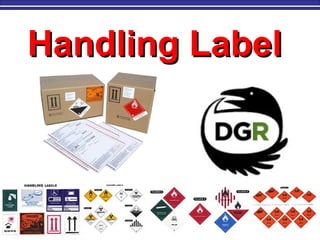
Handling LabelHandling Label
M. Tayfour 119
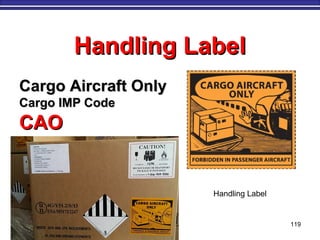
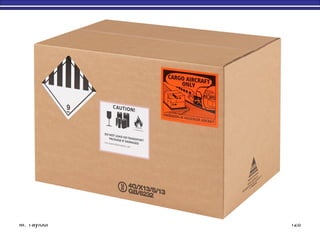
Cargo Aircraft OnlyCargo Aircraft Only
Cargo IMP CodeCargo IMP Code
CAOCAO
Handling LabelHandling Label
Handling Label
M. Tayfour 120
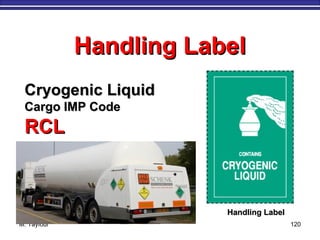
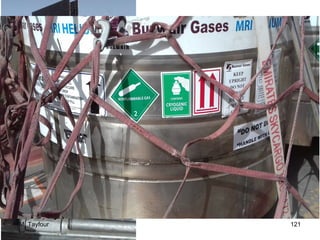
Cryogenic LiquidCryogenic Liquid
Cargo IMP CodeCargo IMP Code
RCLRCL
Handling LabelHandling Label
M. Tayfour 121
M. Tayfour 122
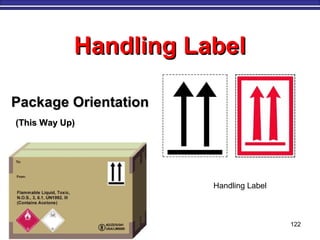
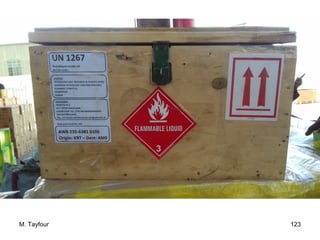
Package OrientationPackage Orientation
(This Way Up)(This Way Up)
Handling LabelHandling Label
Handling Label
M. Tayfour 123
M. Tayfour 124
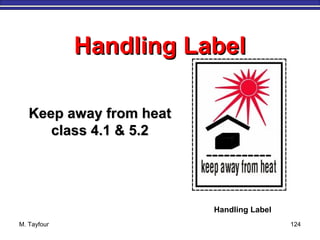
Keep away from heatKeep away from heat
class 4.1 & 5.2class 4.1 & 5.2
Handling LabelHandling Label
Handling Label
M. Tayfour 125
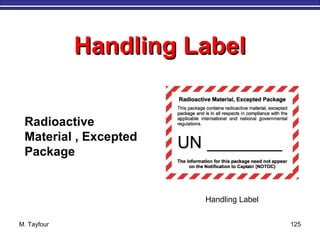
Radioactive
Material , Excepted
Package
Handling LabelHandling Label
Handling Label
M. Tayfour 126
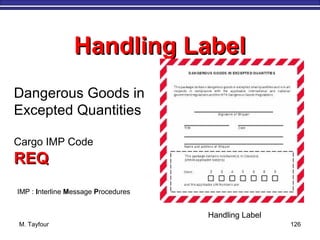
Dangerous Goods in
Excepted Quantities
Cargo IMP Code
REQREQ
IMP : Interline Message Procedures
Handling LabelHandling Label
Handling Label
M. Tayfour 127
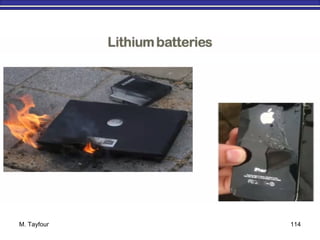
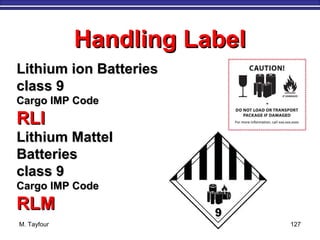
Lithium ion BatteriesLithium ion Batteries
class 9class 9
Cargo IMP CodeCargo IMP Code
RLIRLI
Lithium MattelLithium Mattel
BatteriesBatteries
class 9class 9
Cargo IMP CodeCargo IMP Code
RLMRLM
Handling LabelHandling Label
Handling Label
M. Tayfour 128
M. Tayfour 129
M. Tayfour 130
M. Tayfour 131
M. TayfourM. Tayfour 132132
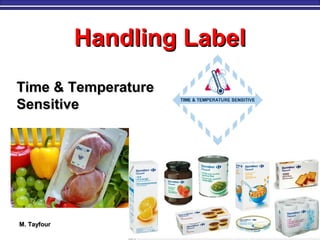
Time & TemperatureTime & Temperature
SensitiveSensitive
Handling LabelHandling Label
M. Tayfour 133
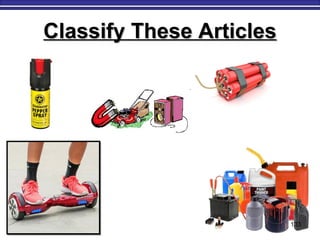
Classify These ArticlesClassify These Articles
M. Tayfour 134
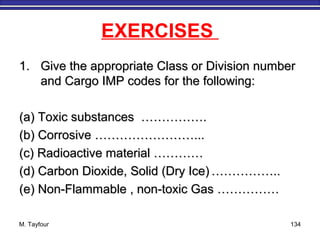
EXERCISES
1.1. Give the appropriate Class or Division numberGive the appropriate Class or Division number
and Cargo IMP codes for the following:and Cargo IMP codes for the following:
(a) Toxic substances …………….(a) Toxic substances …………….
(b) Corrosive ……………………...(b) Corrosive ……………………...
(c) Radioactive material …………(c) Radioactive material …………
(d) Carbon Dioxide, Solid (Dry Ice)(d) Carbon Dioxide, Solid (Dry Ice) ……………..……………..
(e) Non-Flammable , non-toxic Gas ……………(e) Non-Flammable , non-toxic Gas ……………
M. Tayfour 135
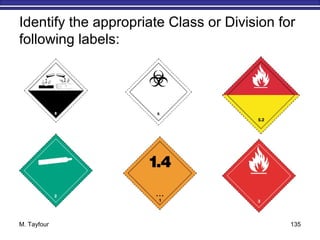
Identify the appropriate Class or Division for
following labels:
SummarySummary
• Describe the nine hazard classes of dangerous
goods and their divisions
• Describe the physical properties of each hazard
class/div and give examples
• Identify packing groups
• Determine the hazard class, subsidiary risk,
and packing group of a given material
M. Tayfour 137M. Tayfour 137
Any Question…

Section 3 IATA Classification

  • 1.
  • 2.
    M. Tayfour 2 Section3Section 3 : In this Section you will be to:: In this Section you will be to: Identify the nine classes of dangerous goods byIdentify the nine classes of dangerous goods by their principle criteria;their principle criteria; Recognize the hazard label for each class orRecognize the hazard label for each class or division of dangerous goods;division of dangerous goods; Understand and apply the principles of PackingUnderstand and apply the principles of Packing Groups.Groups.
  • 3.
    M. Tayfour 3 DGRClassification SystemDGR Classification System The physical state and physical properties of the dangerous goods will affect how easily and safety the goods can be handled in transport, how they should be packaged and what hazards they present, especially if spilled. SolidSolid LiquidLiquid GasGas
  • 4.
    M. Tayfour 4 DGRClassification SystemDGR Classification System The DGR also divides dangerous goods into : SubstancesSubstances ArticlesArticles
  • 5.
    • Dangerous Goodsare divided into 9 hazard groups called classes . – Classes 1, 2, 4, 5 and 6 are broken down into “Divisions” due to hazard variation within these classes. • Classes are expressed by single-digit numbers. (Example Class 7). • Divisions are expressed by 2-digit numbers. The first digit identifies the class number and the second identifies the division number within that class. M. Tayfour 5
  • 6.
    ExampleExample Class 1, Division1Class 1, Division 1 would be expressed aswould be expressed as Division 1.1Division 1.1 M. Tayfour 6
  • 7.
    Label SizeLabel Size IATADGR Section 7 100 mm Or 10 cm 100 mm Or 10 cm
  • 8.
    M. Tayfour 8 HazardLabelHazard Label CLASSIFICATIONCLASSIFICATION
  • 9.
  • 10.
    M. Tayfour 10 Class1Class 1 ExplosiveExplosive Division 1.1 Division 1.2 Division 1.3 Division 1.4 Division 1.5 Division 1.6 Also assigned intoAlso assigned into 13 compatibility13 compatibility groupsgroups A, B, C, D, E, F, G, H,A, B, C, D, E, F, G, H, J, K, L, N, SJ, K, L, N, S
  • 11.
    Class 1Class 1 ExplosiveExplosive Explosiveswhich can be carriedExplosives which can be carried only in cargo Aircraftonly in cargo Aircraft M. Tayfour 11 DivisionDivision 1.31.3 DivisionDivision 1.41.4
  • 12.
  • 13.
    M. Tayfour 14 DivisionDivision 1.11.1 CargoIMP CodeCargo IMP Code REXREX IMP : Interline Message ProceduresIMP : Interline Message Procedures Class 1Class 1 ExplosiveExplosive
  • 14.
  • 15.
  • 16.
  • 17.
    M. Tayfour 18 DivisionDivision 1.21.2 CargoIMP CodeCargo IMP Code REXREX IMP : Interline Message ProceduresIMP : Interline Message Procedures Class 1Class 1 ExplosiveExplosive
  • 18.
  • 19.
  • 20.
    M. Tayfour 21 DivisionDivision 1.31.3 CargoIMP CodeCargo IMP Code RCXRCX IMP : Interline Message ProceduresIMP : Interline Message Procedures Class 1Class 1 ExplosiveExplosive
  • 21.
    M. Tayfour 22 DistressFlashDistress Flash
  • 22.
    M. Tayfour 23 DistressFlaresDistress Flares
  • 23.
    M. Tayfour 24 DivisionDivision 1.41.4 GroupGroup B-C-D-E-G-SB-C-D-E-G-S CargoIMP CodeCargo IMP Code RXB – RXC – RXD – RXE –RXB – RXC – RXD – RXE – RXG – RXSRXG – RXS IMP : Interline Message ProceduresIMP : Interline Message Procedures Class 1Class 1 ExplosiveExplosive
  • 24.
    M. Tayfour 25 Class1Class 1 ExplosiveExplosive DivisionsDivisions 1.41.4 RXB RXC RXD RXE RXG RXSRXB RXC RXD RXE RXG RXS
  • 25.
    M. Tayfour 26 Class1Class 1 ExplosiveExplosive DivisionsDivisions 1.4S1.4S RXSRXS It is only oneIt is only one Accepted toAccepted to transported intransported in Passenger AircraftPassenger Aircraft
  • 26.
  • 27.
    M. Tayfour 28 Class1Class 1 ExplosiveExplosive
  • 28.
    M. Tayfour 29 Class1Class 1 ExplosiveExplosive
  • 29.
  • 30.
    M. Tayfour 31 DivisionDivision 1.51.5 CargoIMP CodeCargo IMP Code REXREX IMP : Interline Message ProceduresIMP : Interline Message Procedures Class 1Class 1 ExplosiveExplosive
  • 31.
    M. Tayfour 32 DivisionDivision 1.61.6 CargoIMP CodeCargo IMP Code REXREX IMP : Interline Message ProceduresIMP : Interline Message Procedures Class 1Class 1 ExplosiveExplosive
  • 32.
    M. Tayfour 33 Class2Class 2 GasesGases DivisionsDivisions 2.1 Flammable Gas2.1 Flammable Gas 2.2 Non-Flammable , non-toxic Gas2.2 Non-Flammable , non-toxic Gas 2.3 Toxic Gas2.3 Toxic Gas
  • 33.
  • 34.
    M. Tayfour 35 DivisionDivision 2.12.1 FlammableGasFlammable Gas Cargo IMP CodeCargo IMP Code RFGRFG Class 2Class 2 GasesGases
  • 35.
  • 36.
  • 37.
  • 38.
    M. Tayfour 39 DivisionDivision 2.22.2 Non-Flammable, non-toxic GasNon-Flammable , non-toxic Gas Cargo IMP CodeCargo IMP Code RNGRNG Class 2Class 2 GasesGases
  • 39.
  • 40.
  • 41.
  • 42.
  • 43.
    M. Tayfour 44 DivisionDivision 2.32.3 ToxicGasToxic Gas Cargo IMP CodeCargo IMP Code RPGRPG Class 2 Gases
  • 44.
    M. Tayfour 45 PoisonGas GrenadePoison Gas Grenade
  • 45.
    M. Tayfour 46 33 FlammableLiquidsFlammable Liquids Cargo IMP CodeCargo IMP Code RFLRFL Note : This class has no sub-divisionsNote : This class has no sub-divisions Class 3Class 3 Flammable LiquidsFlammable Liquids
  • 46.
  • 47.
  • 48.
    M. Tayfour 49 GeneralPacking RequirementsGeneral Packing Requirements • Packing Group High Danger • Packing Group Medium Danger • Packing Group Low Danger I II III
  • 49.
    M. Tayfour 50 Flammableliquid are assigned to packing groups according to the flash point and initial boiling point of the liquid TABLE 3.3.ATABLE 3.3.A class 3 – Packing Group Assignment (3.3.2.2) Packing Group Flash Point (closed-cup) Initial Boiling Point I — ≤ 35°C II < 23°C > 35°C III ≥ 23°C but ≤ 60°C
  • 50.
    Example AExample A Baseon a recognized laboratory test results, aBase on a recognized laboratory test results, a liquid is having a flash Point (closed-cup) ofliquid is having a flash Point (closed-cup) of 22.922.9°C°C and as initial boiling point not exceedingand as initial boiling point not exceeding 3838°C°C.. Identify the packing group of thisIdentify the packing group of this substance ?substance ? • Packing Group:Packing Group: IIII Packing Group Flash Point (closed-cup) Initial Boiling Point I — ≤ 35°C II < 23°C > 35°C III ≥ 23°C but ≤ 60°C
  • 51.
    Example BExample B •Flashpoint: 2121°C°C Boiling Point: 37°C • Packing Group: II Packing Group Flash Point (closed-cup) Initial Boiling Point I — ≤ 35°C II < 23°C > 35°C III ≥ 23°C but ≤ 60°C
  • 52.
    Example CExample C •Flashpoint: 4040°C°C Boiling Point: 5555°C°C • Packing Group: IIIIII Packing Group Flash Point (closed-cup) Initial Boiling Point I — ≤ 35°C II < 23°C > 35°C III ≥ 23°C but ≤ 60°C
  • 53.
    Example DExample D •Flashpoint:Flashpoint: 7272°C°C Boiling Point:Boiling Point: 3737°C°C • Packing Group:Packing Group: Not regulated as flammable liquidNot regulated as flammable liquid Packing Group Flash Point (closed-cup) Initial Boiling Point I — ≤ 35°C II < 23°C > 35°C III ≥ 23°C but ≤ 60°C
  • 54.
    M. Tayfour 55 Class4Class 4 Flammable SolidFlammable Solid DivisionsDivisions 4.1 Flammable Solid4.1 Flammable Solid 4.2 Spontaneously Combustible4.2 Spontaneously Combustible 4.3 Dangerous when wet4.3 Dangerous when wet
  • 55.
    M. Tayfour 56 DivisionsDivisions 4.14.1 FlammableSolidFlammable Solid Cargo IMP CodeCargo IMP Code RFSRFS Class 4Class 4 Flammable SolidFlammable Solid
  • 56.
  • 57.
    M. Tayfour 58 DivisionsDivisions 4.24.2 SpontaneouslySpontaneously CombustibleCombustible CargoIMP CodeCargo IMP Code RSCRSC Class 4Class 4 Flammable SolidFlammable Solid
  • 58.
  • 59.
    M. Tayfour 60 DivisionsDivisions 4.34.3 Dangerouswhen wetDangerous when wet Cargo IMP CodeCargo IMP Code RFWRFW Class 4Class 4 Flammable SolidFlammable Solid
  • 60.
  • 61.
    M. Tayfour 62 Class5Class 5 OxidizingOxidizing DivisionsDivisions 5.1 Oxidizing5.1 Oxidizing 5.2 Organic Peroxides5.2 Organic Peroxides
  • 62.
    M. Tayfour 63 DivisionsDivisions 5.15.1 OxidizerOxidizer CargoIMP CodeCargo IMP Code ROXROX Class 5Class 5 OxidizingOxidizing
  • 63.
  • 64.
    M. Tayfour 65 DivisionsDivisions 5.25.2 OrganicPeroxidesOrganic Peroxides Cargo IMP CodeCargo IMP Code ROPROP Class 5Class 5 OxidizingOxidizing
  • 65.
  • 66.
  • 67.
    M. Tayfour 68 Class6Class 6 Toxic SubstancesToxic Substances DivisionsDivisions 6.1 Toxic or Poison6.1 Toxic or Poison 6.2 Infectious Substances6.2 Infectious Substances
  • 68.
    M. Tayfour 69 DivisionsDivisions 6.16.1 Toxicor PoisonToxic or Poison Cargo IMP CodeCargo IMP Code RPBRPB Class 6Class 6 Toxic SubstancesToxic Substances
  • 69.
  • 70.
    M. Tayfour 71 PackingGroup Criteria for class 6.1Packing Group Criteria for class 6.1 a)a) Packing Group IPacking Group I — Substances and preparations— Substances and preparations presenting apresenting a very severe toxicity risk;very severe toxicity risk; b)b) Packing Group IIPacking Group II — Substances and preparations— Substances and preparations presenting apresenting a serious toxicity risk;serious toxicity risk; c)c) Packing Group IIIPacking Group III — Substances and preparations— Substances and preparations presenting a relativelypresenting a relatively low toxicity risk.low toxicity risk.
  • 71.
    M. Tayfour 72 PackingGroup Criteria for class 6.1Packing Group Criteria for class 6.1 Packing Group Oral Toxicity LD 50 (mg/kg) Dermal Toxicity LD 50 (mg/kg) Inhalation Toxicity by Dusts and Mists LC 50 (mg/L) I ≤ 5.0 ≤ 50 ≤ 0.2 II > 5.0 but ≤ 50 > 50 but ≤ 200 > 0.2 but ≤ 2.0 III > 50 but ≤ 300 > 200 but ≤ 1,000 > 2.0 but ≤ 4.0 Table 3.6.ATable 3.6.A Oral, Dermal and Dust/ Nist inhalation Hazards DivisionOral, Dermal and Dust/ Nist inhalation Hazards Division 6.1 packing group criteria (3.6..1.3)6.1 packing group criteria (3.6..1.3)
  • 72.
  • 73.
    Class 6.2Class 6.2 M.Tayfour 74 •
  • 74.
    Class 6.2Class 6.2 M.Tayfour 75 • 200-25200-25 LDLD5050 oraloralratrat • LDLD5050 ratrat 400-50400-50 • 1-0.251-0.25 LCLC5050 ratrat • 2-0.252-0.25 LCLC5050 ratrat LDLD5050 : Lethal Dose: Lethal Dose LCLC50 : Lethal Concentration: Lethal Concentration
  • 75.
    M. Tayfour 76 DivisionsDivisions 6.26.2 InfectiousSubstancesInfectious Substances Cargo IMP CodeCargo IMP Code RISRIS Class 6Class 6 Toxic SubstancesToxic Substances
  • 76.
  • 77.
  • 78.
    PackingPacking GroupGroup OralOral toxicitytoxicityLDLD5050 DermalDermal toxicitytoxicity LDLD5050 InhalationInhalation toxicitytoxicity LCLC5050 PG IPG I ≤ 5 ≤ 50 ≤ 0.2 PG IIPG II >5 and ≤ 50 > 50 and ≤ 200 > 0.2 and ≤2 PG IIIPG III > 50 and ≤ 300 > 200 and ≤ 1000 > 2 and ≤ 4 TABLE 3.6.ATABLE 3.6.A Class 6 — Packing GroupClass 6 — Packing Group AssignmentAssignment Based onBased on ToxicityToxicity (3.6.3.1)(3.6.3.1) LDLD5050 : Lethal Dose: Lethal Dose LCLC5050 : Lethal Concentration: Lethal Concentration
  • 79.
    M. Tayfour 80 PackingGroup Oral Toxicity LD 50 (mg/kg) Dermal Toxicity LD 50 (mg/kg) Inhalation Toxicity by Dusts and Mists LC 50 (mg/L) I ≤ 5.0 ≤ 50 ≤ 0.2 II > 5.0 but ≤ 50 > 50 but ≤ 200 > 0.2 but ≤ 2.0 III > 50 but ≤ 300 > 200 but ≤ 1,000 > 2.0 but ≤ 4.0 Example AExample A A solid substance is having toxicityA solid substance is having toxicity LDLD5050 of 750 mg/kgof 750 mg/kg which when in contact with thewhich when in contact with the skinskin can cause death tocan cause death to humans. What is the packing group assignment for thishumans. What is the packing group assignment for this substance?substance? Packing Group: IIIIII
  • 80.
    Example BExample B •Oral Toxicity LDOral Toxicity LD5050:: 40 mg/kg40 mg/kg • Packing group:Packing group: IIII PackingPacking GroupGroup OralOral toxicitytoxicity LDLD5050 DermalDermal toxicitytoxicity LDLD5050 InhalationInhalation toxicitytoxicity LCLC5050 PG IPG I ≤ 5 ≤ 50 ≤ 0.2 PG IIPG II >5 and ≤ 50 > 50 and ≤ 200 > 0.2 and ≤2 PG IIIPG III > 50 and ≤ 300 > 200 and ≤ 1000 > 2 and ≤ 4
  • 81.
    Example CExample C •DermalDermal Toxicity LDToxicity LD5050:: 200200 mg/kgmg/kg • Packing group:Packing group: IIII PackingPacking GroupGroup OralOral toxicitytoxicity LDLD5050 DermalDermal toxicitytoxicity LDLD5050 InhalationInhalation toxicitytoxicity LCLC5050 PG IPG I ≤ 5 ≤ 50 ≤ 0.2 PG IIPG II >5 and ≤ 50 > 50 and ≤ 200 > 0.2 and ≤2 PG IIIPG III > 50 and ≤ 300 > 200 and ≤ 1000 > 2 and ≤ 4
  • 82.
    Example DExample D •Oral Toxicity LDOral Toxicity LD5050:: 300 mg/kg300 mg/kg • Packing group:Packing group: IIIIII PackingPacking GroupGroup OralOral toxicitytoxicity LDLD5050 DermalDermal toxicitytoxicity LDLD5050 InhalationInhalation toxicitytoxicity LCLC5050 PG IPG I ≤ 5 ≤ 50 ≤ 0.2 PG IIPG II >5 and ≤ 50 > 50 and ≤ 200 > 0.2 and ≤2 PG IIIPG III > 50 and ≤ 300 > 200 and ≤ 1000 > 2 and ≤ 4
  • 83.
    Example DExample D •OraOral Toxicity LDl Toxicity LD5050:: 4040 mg/kgmg/kg • DermalDermal ToxicityToxicity LDLD5050:: 300300 mg/kgmg/kg • InhalationInhalation Toxicity LCToxicity LC5050:: 0.10.1 mg/Lmg/L • Packing group:Packing group: II PackingPacking GroupGroup OralOral toxicitytoxicity LDLD5050 DermalDermal toxicitytoxicity LDLD5050 InhalationInhalation toxicitytoxicity LCLC5050 PG IPG I ≤ 5 ≤ 50 ≤ 0.2 PG IIPG II >5 and ≤ 50 > 50 and ≤ 200 > 0.2 and ≤2 PG IIIPG III > 50 and ≤ 300 > 200 and ≤ 1000 > 2 and ≤ 4
  • 84.
    M. Tayfour 85 Class7Class 7 Radioactive MaterialRadioactive Material CategoryCategory I – WhiteI – White II - YellowII - Yellow III – YellowIII – Yellow Fissile – Criticality Safety IndexFissile – Criticality Safety Index
  • 85.
  • 86.
  • 87.
  • 88.
  • 89.
    M. Tayfour 90 CategoryCategory I– WhiteI – White Cargo IMP CodeCargo IMP Code RRWRRW Class 7Class 7 Radioactive MaterialRadioactive Material
  • 90.
    M. Tayfour 91 CategoryCategory II– YellowII – Yellow Cargo IMP CodeCargo IMP Code RRYRRY Class 7Class 7 Radioactive MaterialRadioactive Material
  • 91.
    M. Tayfour 92 CategoryCategory III– YellowIII – Yellow Cargo IMP CodeCargo IMP Code RRYRRY Class 7Class 7 Radioactive MaterialRadioactive Material
  • 92.
  • 93.
  • 94.
  • 95.
  • 96.
  • 97.
  • 98.
  • 99.
  • 100.
  • 101.
  • 102.
  • 103.
  • 104.
  • 105.
  • 106.
    M. Tayfour 107 88 CorrosiveMaterialCorrosive Material Cargo IMP CodeCargo IMP Code RCMRCM Note : This class has no sub-divisionsNote : This class has no sub-divisions Class 8Class 8 Corrosive MaterialCorrosive Material
  • 107.
  • 108.
    109 Class 8Class 8 CorrosiveMaterialCorrosive Material Packing Group Exposure Time Observation Time Effect I ≤ 3 min ≤ 60 min Full thickness destruction of intact skin II > 3 min ≤ 60 min ≤ 14 d Full thickness destruction of intact skin III > 60 min ≤ 4 h ≤ 14 d Full thickness destruction of intact skin III Corrosion rate on steel /aluminum > 6.25 mm a year at a test temperature of 55°C Table 3.8.ATable 3.8.A Class 8—Packing Group Assignment based on Corrosivity (3.8.3)
  • 109.
    110 Packing Group Exposure Time Observation Time Effect I≤ 3 min ≤ 60 min Full thickness destruction of intact skin II > 3 min ≤ 60 min ≤ 14 d Full thickness destruction of intact skin III > 60 min ≤ 4 h ≤ 14 d Full thickness destruction of intact skin III Corrosion rate on steel /aluminum > 6.25 mm a year at a test temperature of 55°C Example AExample A A liquid is liable to damage a material when in contact with a fullA liquid is liable to damage a material when in contact with a full thickness destruction within an exposure time ofthickness destruction within an exposure time of 180 minutes180 minutes under anunder an observation time ofobservation time of 3 days3 days. What is the packing group assignment of. What is the packing group assignment of this substance?this substance? Packing group:Packing group: IIIIII
  • 110.
    M. Tayfour 111 99 MiscellaneousDGMiscellaneous DG Cargo IMP CodeCargo IMP Code RMDRMD Note : This class has no sub-divisionsNote : This class has no sub-divisions Class 9Class 9 Miscellaneous DGMiscellaneous DG
  • 111.
    M. Tayfour 112 99 DRYICEDRY ICE Cargo IMP CodeCargo IMP Code ICEICE Note : This class has no sub-divisionsNote : This class has no sub-divisions Class 9Class 9 Miscellaneous DGMiscellaneous DG
  • 112.
  • 113.
  • 114.
  • 115.
  • 116.
    M. Tayfour 117 99 MagnetizedMaterialMagnetized Material Cargo IMP CodeCargo IMP Code MAGMAG Note : This class has no sub-divisionsNote : This class has no sub-divisions Class 9Class 9 Miscellaneous DGMiscellaneous DG Handling Label
  • 117.
    M. Tayfour 118 HandlingLabelHandling Label
  • 118.
    M. Tayfour 119 CargoAircraft OnlyCargo Aircraft Only Cargo IMP CodeCargo IMP Code CAOCAO Handling LabelHandling Label Handling Label
  • 119.
    M. Tayfour 120 CryogenicLiquidCryogenic Liquid Cargo IMP CodeCargo IMP Code RCLRCL Handling LabelHandling Label Handling LabelHandling Label
  • 120.
  • 121.
    M. Tayfour 122 PackageOrientationPackage Orientation (This Way Up)(This Way Up) Handling LabelHandling Label Handling Label
  • 122.
  • 123.
    M. Tayfour 124 Keepaway from heatKeep away from heat class 4.1 & 5.2class 4.1 & 5.2 Handling LabelHandling Label Handling Label
  • 124.
    M. Tayfour 125 Radioactive Material, Excepted Package Handling LabelHandling Label Handling Label
  • 125.
    M. Tayfour 126 DangerousGoods in Excepted Quantities Cargo IMP Code REQREQ IMP : Interline Message Procedures Handling LabelHandling Label Handling Label
  • 126.
    M. Tayfour 127 Lithiumion BatteriesLithium ion Batteries class 9class 9 Cargo IMP CodeCargo IMP Code RLIRLI Lithium MattelLithium Mattel BatteriesBatteries class 9class 9 Cargo IMP CodeCargo IMP Code RLMRLM Handling LabelHandling Label Handling Label
  • 127.
  • 128.
  • 129.
  • 130.
  • 131.
    M. TayfourM. Tayfour132132 Time & TemperatureTime & Temperature SensitiveSensitive Handling LabelHandling Label Handling LabelHandling Label
  • 132.
    M. Tayfour 133 ClassifyThese ArticlesClassify These Articles
  • 133.
    M. Tayfour 134 EXERCISES 1.1.Give the appropriate Class or Division numberGive the appropriate Class or Division number and Cargo IMP codes for the following:and Cargo IMP codes for the following: (a) Toxic substances …………….(a) Toxic substances ……………. (b) Corrosive ……………………...(b) Corrosive ……………………... (c) Radioactive material …………(c) Radioactive material ………… (d) Carbon Dioxide, Solid (Dry Ice)(d) Carbon Dioxide, Solid (Dry Ice) ……………..…………….. (e) Non-Flammable , non-toxic Gas ……………(e) Non-Flammable , non-toxic Gas ……………
  • 134.
    M. Tayfour 135 Identifythe appropriate Class or Division for following labels:
  • 135.
    SummarySummary • Describe thenine hazard classes of dangerous goods and their divisions • Describe the physical properties of each hazard class/div and give examples • Identify packing groups • Determine the hazard class, subsidiary risk, and packing group of a given material
  • 136.
    M. Tayfour 137M.Tayfour 137 Any Question…

Editor's Notes

  • #8 Go to paragraph 2.4 after the list of hazard classes. Packing groups are used to rank how dangerous an item is within its hazard class/division. Not all hazard classes/divisions have packing groups. (Classes 1, 2, 5.2, 6.2, 7, and self-reactive of Div 4.1 do not.) Packing Group I is the most hazardous, Packing Group 3 is the least hazardous—but is still a dangerous good. The packing group is used for just that—packing. It will determine how stringent the packaging must be and will dictate the allowable net quantity in the packagings. It will even help determine whether or not a dangerous good is allowed on passenger aircraft or cargo aircraft.