Dangerous Goods Regulations®2016 1
By: Sar Sulistyo
DANGEROUS GOODS REGULATIONS
Setting the Course to Safety
By Sarsulistyo, S.S., M.Psi
Dangerous Goods Regulations®2016
OBJECTIVES
 Able to identify dangerous goods;
 Have knowledge of the origin of the current regulations and be
aware of the general philosophy;
 Able to identify the classes of DGs;
 Able to refer to the List of DGs;
 Recognise and identify the hazard/handling labels applicable to
DGs;
 Able to identify potential hidden hazards in cargo;
 Be familiar with loading and storage procedures;
 Be aware of the provisions for DGs in baggage of passengers and
crew;
 Be familiar with DGs emergency response procedures.
2
Dangerous Goods Regulations®2016 3
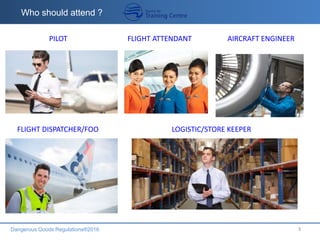
Who should attend ?
FLIGHT DISPATCHER/FOO LOGISTIC/STORE KEEPER
PILOT FLIGHT ATTENDANT AIRCRAFT ENGINEER
Dangerous Goods Regulations®2016 4
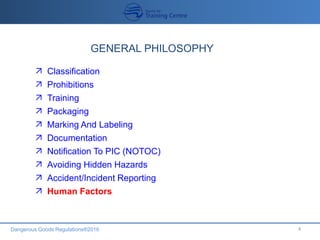
GENERAL PHILOSOPHY
 Classification
 Prohibitions
 Training
 Packaging
 Marking And Labeling
 Documentation
 Notification To PIC (NOTOC)
 Avoiding Hidden Hazards
 Accident/Incident Reporting
 Human Factors
Dangerous Goods Regulations®2016 5
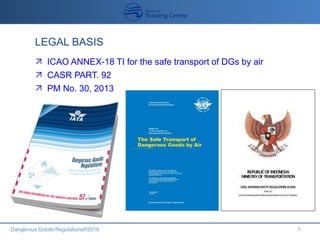
LEGAL BASIS
 ICAO ANNEX-18 TI for the safe transport of DGs by air
 CASR PART. 92
 PM No. 30, 2013
Dangerous Goods Regulations®2016 6
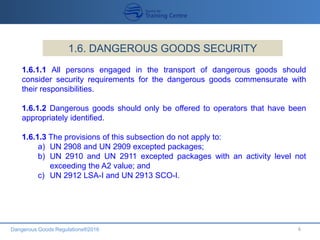
1.6. DANGEROUS GOODS SECURITY
1.6.1.1 All persons engaged in the transport of dangerous goods should
consider security requirements for the dangerous goods commensurate with
their responsibilities.
1.6.1.2 Dangerous goods should only be offered to operators that have been
appropriately identified.
1.6.1.3 The provisions of this subsection do not apply to:
a) UN 2908 and UN 2909 excepted packages;
b) UN 2910 and UN 2911 excepted packages with an activity level not
exceeding the A2 value; and
c) UN 2912 LSA-I and UN 2913 SCO-I.
Dangerous Goods Regulations®2016 7
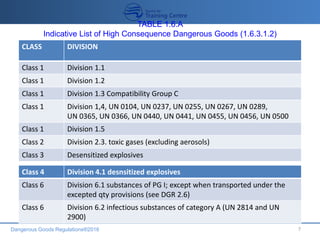
TABLE 1.6.A
Indicative List of High Consequence Dangerous Goods (1.6.3.1.2)
CLASS DIVISION
Class 1 Division 1.1
Class 1 Division 1.2
Class 1 Division 1.3 Compatibility Group C
Class 1 Division 1,4, UN 0104, UN 0237, UN 0255, UN 0267, UN 0289,
UN 0365, UN 0366, UN 0440, UN 0441, UN 0455, UN 0456, UN 0500
Class 1 Division 1.5
Class 2 Division 2.3. toxic gases (excluding aerosols)
Class 3 Desensitized explosives
Class 4 Division 4.1 desnsitized explosives
Class 6 Division 6.1 substances of PG I; except when transported under the
excepted qty provisions (see DGR 2.6)
Class 6 Division 6.2 infectious substances of category A (UN 2814 and UN
2900)
Dangerous Goods Regulations®2016 8
2.3.2.5 Camping Stoves and Fuel Containers that have Contained a Flammable
Liquid Fuel
With the approval of the operator, as checked baggage only, camping stoves and
fuel containers for camping stoves that have contained a flammable liquid fuel may
be carried provided the fuel tank of the camping stove and/or fuel container has
been completely drained of all liquid fuel and action has been taken to nullify the
danger. To nullify the danger, the empty fuel tank and/or container must be
allowed to drain for at least 1 hour, the fuel tank and/or container must then
be left uncapped for a minimum of 6 hours to allow any residual fuel to
evaporate. Alternative methods, such as adding cooking oil to the fuel tank and/or
container to elevate the flash point of any residual liquid above the flash point of
flammable liquid and then emptying the fuel tank and/or container, are equally
acceptable. The fuel tank and/or container must then have the cap securely
fastened and be wrapped in an absorbent material such as paper towel
and placed in a polyethylene or equivalent bag. The top of the bag must then be
sealed or gathered and closed with an elastic band or twine.
Dangerous Goods Regulations®2016 9
CLASSES AND LABELS (DGR 3.1 to 3.9; 7.3, 7.4)
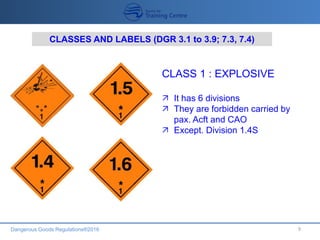
CLASS 1 : EXPLOSIVE
 It has 6 divisions
 They are forbidden carried by
pax. Acft and CAO
 Except. Division 1.4S
Dangerous Goods Regulations®2016 10
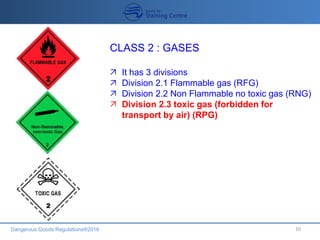
CLASS 2 : GASES
 It has 3 divisions
 Division 2.1 Flammable gas (RFG)
 Division 2.2 Non Flammable no toxic gas (RNG)
 Division 2.3 toxic gas (forbidden for
transport by air) (RPG)
Dangerous Goods Regulations®2016 11
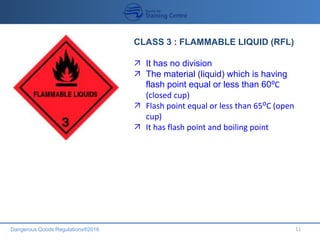
CLASS 3 : FLAMMABLE LIQUID (RFL)
 It has no division
 The material (liquid) which is having
flash point equal or less than 60⁰C
(closed cup)
 Flash point equal or less than 65ᴼC (open
cup)
 It has flash point and boiling point
Dangerous Goods Regulations®2016 12
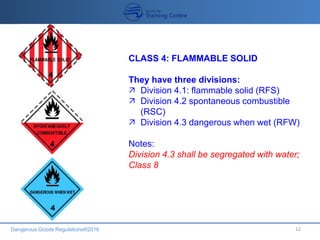
CLASS 4: FLAMMABLE SOLID
They have three divisions:
 Division 4.1: flammable solid (RFS)
 Division 4.2 spontaneous combustible
(RSC)
 Division 4.3 dangerous when wet (RFW)
Notes:
Division 4.3 shall be segregated with water;
Class 8
Dangerous Goods Regulations®2016 13
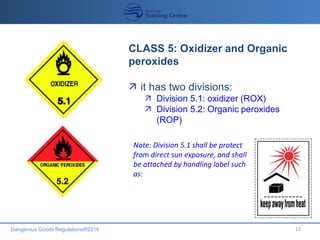
CLASS 5: Oxidizer and Organic
peroxides
 it has two divisions:
 Division 5.1: oxidizer (ROX)
 Division 5.2: Organic peroxides
(ROP)
Note: Division 5.1 shall be protect
from direct sun exposure, and shall
be attached by handling label such
as:
Dangerous Goods Regulations®2016 14
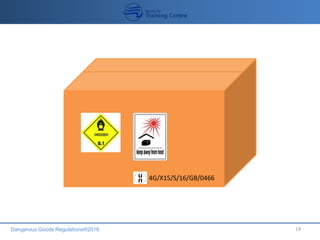
4G/X15/S/16/GB/0466
Dangerous Goods Regulations®2016 15
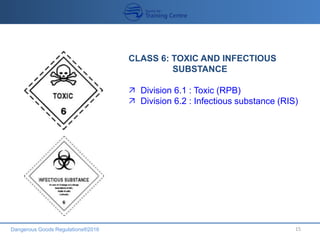
CLASS 6: TOXIC AND INFECTIOUS
SUBSTANCE
 Division 6.1 : Toxic (RPB)
 Division 6.2 : Infectious substance (RIS)
Dangerous Goods Regulations®2016 16
Dangerous Goods Regulations®2016 17
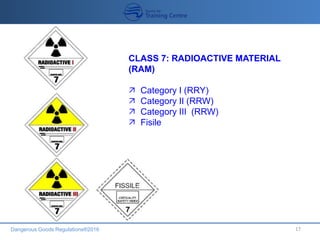
CLASS 7: RADIOACTIVE MATERIAL
(RAM)
 Category I (RRY)
 Category II (RRW)
 Category III (RRW)
 Fisile
Dangerous Goods Regulations®2016 18
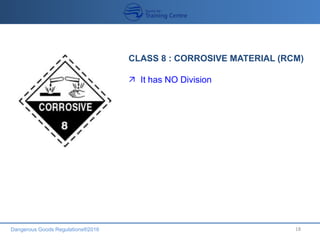
CLASS 8 : CORROSIVE MATERIAL (RCM)
 It has NO Division
Dangerous Goods Regulations®2016 19
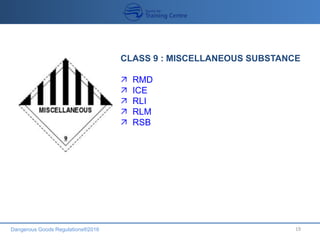
CLASS 9 : MISCELLANEOUS SUBSTANCE
 RMD
 ICE
 RLI
 RLM
 RSB
Dangerous Goods Regulations®2016 20
CHECK YOUR UNDERSTANDING
1. Toxic substances:
a) Class or Divisions: ……………………?
b) IMP codes: ……………..?
2. How many classes of dangerous goods?
3. Dangerous goods class 1 may not be allowed carry by
passenger and CAO, except?
4. Dangerous goods which does have Division, mentioned them.
5. Dangerous goods which has flash point point and boiling point?
6. Liquid which is categorized “Flammable Liquid”, how many flash
point?
7. May Dangerous Division Division 2.3 be carried by aircraft?
8. Can the bullets be carried by aircraft?
9. What is Division of Class 2 of DGs which may NOT be allowed
carry by passenger & CAO?
Dangerous Goods Regulations®2016 21
IDENTIFICATION
At the end of this session the participants will be able to:
 Identify the UN number or Proper Shipping Namae (PSN) of the
Dangerous Goods in the DGR manual
Dangerous Goods Regulations®2016 22
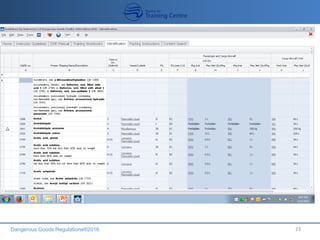
The function of IDENTIFICATION is:
 To look for UN number;
 Proper Shipping Name (PSN)
 Class or division
 Packing Group/PG (the degree of danger, there are 3 PG, I,
II, III)
 Packing Instructions (PI)
 Maximum net qty/pakcage
In the IATA DGR manual you can put on:
• Sub section 4.2 “LIST OF DANGEROUS GOODS”
• Sub section 4.3 ‘NUMERICAL CROSS REFERENCE”
Dangerous Goods Regulations®2016 23
A
Dangerous Goods Regulations®2016 24
CHECK YOUR UNDERSTANDING
1. Methanol
• UN number ?
• Class/Division = ………….?
• PG ?
• Max. net qty for passenger aircraft?
• Max. net qty for CAO?
2. UN 1546
• PSN ?
• Class/Division = ………….?
• PG ?
• Max. net qty for passenger aircraft?
• Max. net qty for CAO?
Dangerous Goods Regulations®2016 25
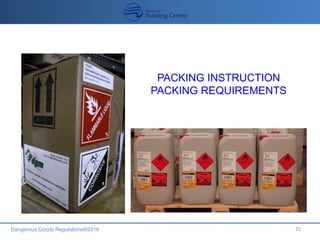
PACKING INSTRUCTION
PACKING REQUIREMENTS
Dangerous Goods Regulations®2016 26
Dangerous goods must be packed in good quality packagings which
must be strong enough to withstand the shocks and loadings
normally encountered in transport, including removal from a pallet,
unit load device or overpack for subsequent manual or mechanical
handling.
5.3.2. GENERAL PACKING REQUIREMENTS
Dangerous Goods Regulations®2016 27
The following types of packagings are used to ship dangerous
goods, other than radioactive material:
 UN Specification Packagings;
 Limited Quantity Packagings;
 Excepted quantity packagings (see Unit 2);
 Other Packagings.
5.0.2.1 Packing Groups
5.0.2.1.1 For packing purposes, Packing Group numbers I, II or III are
assigned to substances other than those in Classes 1, 2 and 7,
self-reactive substances of Division 4.1, Divisions 5.2 and 6.2, according
to the relative degree of danger presented by the substance.
 Packing Group I—Substances presenting high danger.
 Packing Group II—Substances presenting medium danger.
 Packing Group III—Substances presenting low danger.
Dangerous Goods Regulations®2016 28
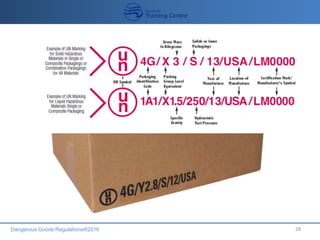
Dangerous Goods Regulations®2016 29
Dangerous Goods Regulations®2016 30
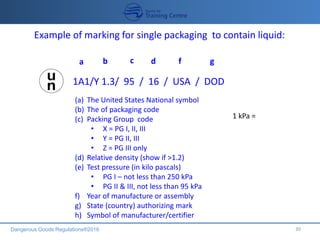
Example of marking for single packaging to contain liquid:
1A1/Y 1.3/ 95 / 16 / USA / DOD
a b c d f g
(a) The United States National symbol
(b) The of packaging code
(c) Packing Group code
• X = PG I, II, III
• Y = PG II, III
• Z = PG III only
(d) Relative density (show if >1.2)
(e) Test pressure (in kilo pascals)
• PG I – not less than 250 kPa
• PG II & III, not less than 95 kPa
f) Year of manufacture or assembly
g) State (country) authorizing mark
h) Symbol of manufacturer/certifier
1 kPa =
Dangerous Goods Regulations®2016 31
A
Dangerous Goods Regulations®2016 32
IMPORTANCE OF THE SHIPPER'S DECLARATION FOR
DANGEROUS GOODS
A Shipper's Declaration for Dangerous Goods is required from the shipper for
every dangerous goods that he ships — with very few exceptions which are
shown in the IATA DGR.
In completing one of these forms the shipper certifies that:
 the goods are not forbidden for transport by air;
 all goods listed are correctly classified;
 All goods listed are packed according to the applicable packing
instructions and are in the quantities shown;
 all packages are correctly marked and labelled;
 the shipments are in all respects in the proper condition for transport by air
according to applicable national and international regulations and operator
variations.
Dangerous Goods Regulations®2016 33
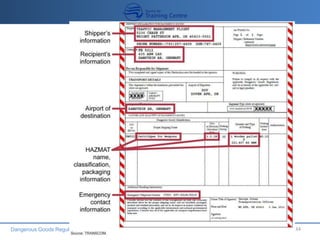
The Shipper's Declaration is a vital link in the safe transport of
dangerous goods by air. It indicates:
 which type of aircraft can be used for the shipment (e.g.
passenger or all-cargo aircraft);
 whether the shipment is radioactive or otherwise;
 the technical name of the commodity(ies);
 the hazards that are involved;
 the type of packaging used and the quantity enclosed;
 any special handling requirements;
 who made the declaration.
Dangerous Goods Regulations®2016 34
Dangerous Goods Regulations®2016 35
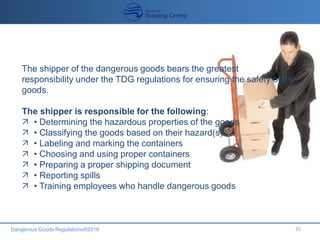
The shipper of the dangerous goods bears the greatest
responsibility under the TDG regulations for ensuring the safety of the
goods.
The shipper is responsible for the following:
 • Determining the hazardous properties of the goods
 • Classifying the goods based on their hazard(s)
 • Labeling and marking the containers
 • Choosing and using proper containers
 • Preparing a proper shipping document
 • Reporting spills
 • Training employees who handle dangerous goods
Dangerous Goods Regulations®2016 36
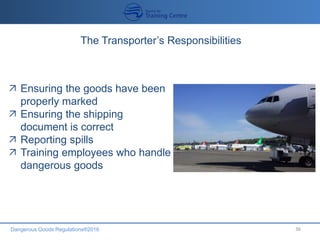
The Transporter’s Responsibilities
 Ensuring the goods have been
properly marked
 Ensuring the shipping
document is correct
 Reporting spills
 Training employees who handle
dangerous goods
Dangerous Goods Regulations®2016 37
1. Who is the most responsibility, when it comes to dangerous
goods?
2. What does this symbol mean?
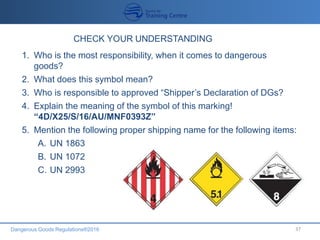
3. Who is responsible to approved “Shipper’s Declaration of DGs?
4. Explain the meaning of the symbol of this marking!
“4D/X25/S/16/AU/MNF0393Z”
5. Mention the following proper shipping name for the following items:
A. UN 1863
B. UN 1072
C. UN 2993
Dangerous Goods Regulations®2016 38
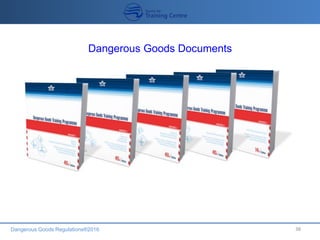
Dangerous Goods Documents
Dangerous Goods Regulations®2016 39
DANGEROUS GOODS DOCUMENTATION
 Dangerous Goods Shipper’s Declaration (SHIPDEC)
 Notification to Captain (NOTOC)
 Material Safety Data Sheet (MSDS)
 DGs Inspection checklist
Dangerous Goods Regulations®2016 40
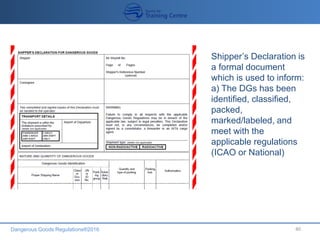
Shipper’s Declaration is
a formal document
which is used to inform:
a) The DGs has been
identified, classified,
packed,
marked/labeled, and
meet with the
applicable regulations
(ICAO or National)
Dangerous Goods Regulations®2016 41
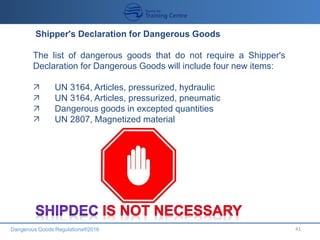
Shipper's Declaration for Dangerous Goods
The list of dangerous goods that do not require a Shipper's
Declaration for Dangerous Goods will include four new items:
 UN 3164, Articles, pressurized, hydraulic
 UN 3164, Articles, pressurized, pneumatic
 Dangerous goods in excepted quantities
 UN 2807, Magnetized material
Dangerous Goods Regulations®2016 42
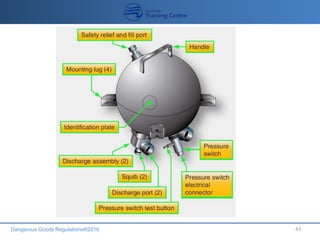
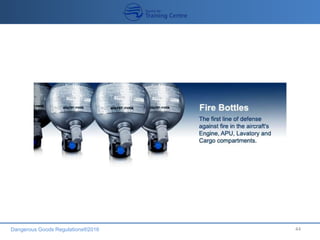
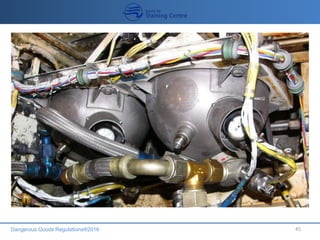
Fire extinguishers
Special provision 225 has been updated to specify the types of fire
extinguishers which fall under the entry UN 1044 FIRE
EXTINGUISHERS with compressed or liquefied gas:
• Portable fire extinguishers for small manual handling and
operation.
• Fire extinguishers for installation in aircraft.
• Fire extinguishers mounted on wheels for manual handling.
• Fire extinguishing equipment or machinery mounted on wheels or
wheeled platforms or units carried similar to (small) trailers.
• Fire extinguishers composed of a non-rollable pressure drum and
equipment, and handled e.g. by fork lift or crane when loaded or
unloaded
Dangerous Goods Regulations®2016 43
Dangerous Goods Regulations®2016 44
Dangerous Goods Regulations®2016 45
Dangerous Goods Regulations®2016 46
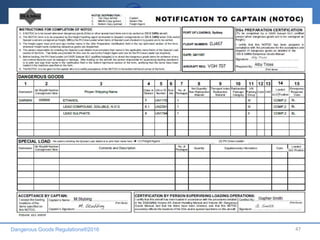
NOTIFICATION TO CAPTAIN (NOTOC)
Is a legal document which is issued by operators. This
document is used to give information to PIC, that his/her
aircraft loaded Dangerous Goods, and to request approval
from the PIC. If the PIC agrees, the NOTOC shall be
signed by the PIC.
NOTOC shall be:
 Attached with SHIPDEC
 Issued by FOO or HLO or Cargo staff
Dangerous Goods Regulations®2016 47
Dangerous Goods Regulations®2016 48
The substance and articles listed in DGR Table 9.5.A are not
required to be shown on the NOTOC
Dangerous Goods Regulations®2016 49
1. The function of NOTOC:
a. To give informal information to PIC that the A/C loads DGs
b. To give formal information to PIC that the A/C loads DGs
c. To request approval from the PIC
d. To meet the SOP
2. The function of SHIPDEC:
a. To make sure the DGs has been approved by the DGs specialist
b. To make sure that DGs has met with the classification
c. To make sure that DGs has meet with: identification,
classification, marking/labeling, proper packaging, and proper
documentation
Dangerous Goods Regulations®2016 50
INFORMATION BY THE PIC IN CASE OF IN FLIGHT
EMERGENCY:
 Proper Shipping Name (PSN) and/or UN/ID Number
 The class/Division (and for class 1 the compatibility Group)
 Any identified subsidiary risk (s)
 The quantity and the location on board the aircraft
Dangerous Goods Regulations®2016 51
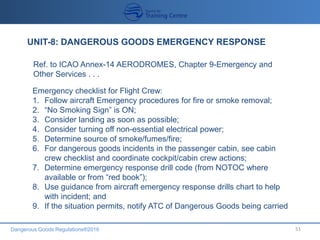
UNIT-8: DANGEROUS GOODS EMERGENCY RESPONSE
Ref. to ICAO Annex-14 AERODROMES, Chapter 9-Emergency and
Other Services . . .
Emergency checklist for Flight Crew:
1. Follow aircraft Emergency procedures for fire or smoke removal;
2. “No Smoking Sign” is ON;
3. Consider landing as soon as possible;
4. Consider turning off non-essential electrical power;
5. Determine source of smoke/fumes/fire;
6. For dangerous goods incidents in the passenger cabin, see cabin
crew checklist and coordinate cockpit/cabin crew actions;
7. Determine emergency response drill code (from NOTOC where
available or from “red book”);
8. Use guidance from aircraft emergency response drills chart to help
with incident; and
9. If the situation permits, notify ATC of Dangerous Goods being carried
Dangerous Goods Regulations®2016 52
After Landing:
1. Disembark passengers and crew before opening any cargo
compartment doors;

Dgr for crewmember 2016 recurrent

  • 1.
    Dangerous Goods Regulations®20161 By: Sar Sulistyo DANGEROUS GOODS REGULATIONS Setting the Course to Safety By Sarsulistyo, S.S., M.Psi
  • 2.
    Dangerous Goods Regulations®2016 OBJECTIVES Able to identify dangerous goods;  Have knowledge of the origin of the current regulations and be aware of the general philosophy;  Able to identify the classes of DGs;  Able to refer to the List of DGs;  Recognise and identify the hazard/handling labels applicable to DGs;  Able to identify potential hidden hazards in cargo;  Be familiar with loading and storage procedures;  Be aware of the provisions for DGs in baggage of passengers and crew;  Be familiar with DGs emergency response procedures. 2
  • 3.
    Dangerous Goods Regulations®20163 Who should attend ? FLIGHT DISPATCHER/FOO LOGISTIC/STORE KEEPER PILOT FLIGHT ATTENDANT AIRCRAFT ENGINEER
  • 4.
    Dangerous Goods Regulations®20164 GENERAL PHILOSOPHY  Classification  Prohibitions  Training  Packaging  Marking And Labeling  Documentation  Notification To PIC (NOTOC)  Avoiding Hidden Hazards  Accident/Incident Reporting  Human Factors
  • 5.
    Dangerous Goods Regulations®20165 LEGAL BASIS  ICAO ANNEX-18 TI for the safe transport of DGs by air  CASR PART. 92  PM No. 30, 2013
  • 6.
    Dangerous Goods Regulations®20166 1.6. DANGEROUS GOODS SECURITY 1.6.1.1 All persons engaged in the transport of dangerous goods should consider security requirements for the dangerous goods commensurate with their responsibilities. 1.6.1.2 Dangerous goods should only be offered to operators that have been appropriately identified. 1.6.1.3 The provisions of this subsection do not apply to: a) UN 2908 and UN 2909 excepted packages; b) UN 2910 and UN 2911 excepted packages with an activity level not exceeding the A2 value; and c) UN 2912 LSA-I and UN 2913 SCO-I.
  • 7.
    Dangerous Goods Regulations®20167 TABLE 1.6.A Indicative List of High Consequence Dangerous Goods (1.6.3.1.2) CLASS DIVISION Class 1 Division 1.1 Class 1 Division 1.2 Class 1 Division 1.3 Compatibility Group C Class 1 Division 1,4, UN 0104, UN 0237, UN 0255, UN 0267, UN 0289, UN 0365, UN 0366, UN 0440, UN 0441, UN 0455, UN 0456, UN 0500 Class 1 Division 1.5 Class 2 Division 2.3. toxic gases (excluding aerosols) Class 3 Desensitized explosives Class 4 Division 4.1 desnsitized explosives Class 6 Division 6.1 substances of PG I; except when transported under the excepted qty provisions (see DGR 2.6) Class 6 Division 6.2 infectious substances of category A (UN 2814 and UN 2900)
  • 8.
    Dangerous Goods Regulations®20168 2.3.2.5 Camping Stoves and Fuel Containers that have Contained a Flammable Liquid Fuel With the approval of the operator, as checked baggage only, camping stoves and fuel containers for camping stoves that have contained a flammable liquid fuel may be carried provided the fuel tank of the camping stove and/or fuel container has been completely drained of all liquid fuel and action has been taken to nullify the danger. To nullify the danger, the empty fuel tank and/or container must be allowed to drain for at least 1 hour, the fuel tank and/or container must then be left uncapped for a minimum of 6 hours to allow any residual fuel to evaporate. Alternative methods, such as adding cooking oil to the fuel tank and/or container to elevate the flash point of any residual liquid above the flash point of flammable liquid and then emptying the fuel tank and/or container, are equally acceptable. The fuel tank and/or container must then have the cap securely fastened and be wrapped in an absorbent material such as paper towel and placed in a polyethylene or equivalent bag. The top of the bag must then be sealed or gathered and closed with an elastic band or twine.
  • 9.
    Dangerous Goods Regulations®20169 CLASSES AND LABELS (DGR 3.1 to 3.9; 7.3, 7.4) CLASS 1 : EXPLOSIVE  It has 6 divisions  They are forbidden carried by pax. Acft and CAO  Except. Division 1.4S
  • 10.
    Dangerous Goods Regulations®201610 CLASS 2 : GASES  It has 3 divisions  Division 2.1 Flammable gas (RFG)  Division 2.2 Non Flammable no toxic gas (RNG)  Division 2.3 toxic gas (forbidden for transport by air) (RPG)
  • 11.
    Dangerous Goods Regulations®201611 CLASS 3 : FLAMMABLE LIQUID (RFL)  It has no division  The material (liquid) which is having flash point equal or less than 60⁰C (closed cup)  Flash point equal or less than 65ᴼC (open cup)  It has flash point and boiling point
  • 12.
    Dangerous Goods Regulations®201612 CLASS 4: FLAMMABLE SOLID They have three divisions:  Division 4.1: flammable solid (RFS)  Division 4.2 spontaneous combustible (RSC)  Division 4.3 dangerous when wet (RFW) Notes: Division 4.3 shall be segregated with water; Class 8
  • 13.
    Dangerous Goods Regulations®201613 CLASS 5: Oxidizer and Organic peroxides  it has two divisions:  Division 5.1: oxidizer (ROX)  Division 5.2: Organic peroxides (ROP) Note: Division 5.1 shall be protect from direct sun exposure, and shall be attached by handling label such as:
  • 14.
    Dangerous Goods Regulations®201614 4G/X15/S/16/GB/0466
  • 15.
    Dangerous Goods Regulations®201615 CLASS 6: TOXIC AND INFECTIOUS SUBSTANCE  Division 6.1 : Toxic (RPB)  Division 6.2 : Infectious substance (RIS)
  • 16.
  • 17.
    Dangerous Goods Regulations®201617 CLASS 7: RADIOACTIVE MATERIAL (RAM)  Category I (RRY)  Category II (RRW)  Category III (RRW)  Fisile
  • 18.
    Dangerous Goods Regulations®201618 CLASS 8 : CORROSIVE MATERIAL (RCM)  It has NO Division
  • 19.
    Dangerous Goods Regulations®201619 CLASS 9 : MISCELLANEOUS SUBSTANCE  RMD  ICE  RLI  RLM  RSB
  • 20.
    Dangerous Goods Regulations®201620 CHECK YOUR UNDERSTANDING 1. Toxic substances: a) Class or Divisions: ……………………? b) IMP codes: ……………..? 2. How many classes of dangerous goods? 3. Dangerous goods class 1 may not be allowed carry by passenger and CAO, except? 4. Dangerous goods which does have Division, mentioned them. 5. Dangerous goods which has flash point point and boiling point? 6. Liquid which is categorized “Flammable Liquid”, how many flash point? 7. May Dangerous Division Division 2.3 be carried by aircraft? 8. Can the bullets be carried by aircraft? 9. What is Division of Class 2 of DGs which may NOT be allowed carry by passenger & CAO?
  • 21.
    Dangerous Goods Regulations®201621 IDENTIFICATION At the end of this session the participants will be able to:  Identify the UN number or Proper Shipping Namae (PSN) of the Dangerous Goods in the DGR manual
  • 22.
    Dangerous Goods Regulations®201622 The function of IDENTIFICATION is:  To look for UN number;  Proper Shipping Name (PSN)  Class or division  Packing Group/PG (the degree of danger, there are 3 PG, I, II, III)  Packing Instructions (PI)  Maximum net qty/pakcage In the IATA DGR manual you can put on: • Sub section 4.2 “LIST OF DANGEROUS GOODS” • Sub section 4.3 ‘NUMERICAL CROSS REFERENCE”
  • 23.
  • 24.
    Dangerous Goods Regulations®201624 CHECK YOUR UNDERSTANDING 1. Methanol • UN number ? • Class/Division = ………….? • PG ? • Max. net qty for passenger aircraft? • Max. net qty for CAO? 2. UN 1546 • PSN ? • Class/Division = ………….? • PG ? • Max. net qty for passenger aircraft? • Max. net qty for CAO?
  • 25.
    Dangerous Goods Regulations®201625 PACKING INSTRUCTION PACKING REQUIREMENTS
  • 26.
    Dangerous Goods Regulations®201626 Dangerous goods must be packed in good quality packagings which must be strong enough to withstand the shocks and loadings normally encountered in transport, including removal from a pallet, unit load device or overpack for subsequent manual or mechanical handling. 5.3.2. GENERAL PACKING REQUIREMENTS
  • 27.
    Dangerous Goods Regulations®201627 The following types of packagings are used to ship dangerous goods, other than radioactive material:  UN Specification Packagings;  Limited Quantity Packagings;  Excepted quantity packagings (see Unit 2);  Other Packagings. 5.0.2.1 Packing Groups 5.0.2.1.1 For packing purposes, Packing Group numbers I, II or III are assigned to substances other than those in Classes 1, 2 and 7, self-reactive substances of Division 4.1, Divisions 5.2 and 6.2, according to the relative degree of danger presented by the substance.  Packing Group I—Substances presenting high danger.  Packing Group II—Substances presenting medium danger.  Packing Group III—Substances presenting low danger.
  • 28.
  • 29.
  • 30.
    Dangerous Goods Regulations®201630 Example of marking for single packaging to contain liquid: 1A1/Y 1.3/ 95 / 16 / USA / DOD a b c d f g (a) The United States National symbol (b) The of packaging code (c) Packing Group code • X = PG I, II, III • Y = PG II, III • Z = PG III only (d) Relative density (show if >1.2) (e) Test pressure (in kilo pascals) • PG I – not less than 250 kPa • PG II & III, not less than 95 kPa f) Year of manufacture or assembly g) State (country) authorizing mark h) Symbol of manufacturer/certifier 1 kPa =
  • 31.
  • 32.
    Dangerous Goods Regulations®201632 IMPORTANCE OF THE SHIPPER'S DECLARATION FOR DANGEROUS GOODS A Shipper's Declaration for Dangerous Goods is required from the shipper for every dangerous goods that he ships — with very few exceptions which are shown in the IATA DGR. In completing one of these forms the shipper certifies that:  the goods are not forbidden for transport by air;  all goods listed are correctly classified;  All goods listed are packed according to the applicable packing instructions and are in the quantities shown;  all packages are correctly marked and labelled;  the shipments are in all respects in the proper condition for transport by air according to applicable national and international regulations and operator variations.
  • 33.
    Dangerous Goods Regulations®201633 The Shipper's Declaration is a vital link in the safe transport of dangerous goods by air. It indicates:  which type of aircraft can be used for the shipment (e.g. passenger or all-cargo aircraft);  whether the shipment is radioactive or otherwise;  the technical name of the commodity(ies);  the hazards that are involved;  the type of packaging used and the quantity enclosed;  any special handling requirements;  who made the declaration.
  • 34.
  • 35.
    Dangerous Goods Regulations®201635 The shipper of the dangerous goods bears the greatest responsibility under the TDG regulations for ensuring the safety of the goods. The shipper is responsible for the following:  • Determining the hazardous properties of the goods  • Classifying the goods based on their hazard(s)  • Labeling and marking the containers  • Choosing and using proper containers  • Preparing a proper shipping document  • Reporting spills  • Training employees who handle dangerous goods
  • 36.
    Dangerous Goods Regulations®201636 The Transporter’s Responsibilities  Ensuring the goods have been properly marked  Ensuring the shipping document is correct  Reporting spills  Training employees who handle dangerous goods
  • 37.
    Dangerous Goods Regulations®201637 1. Who is the most responsibility, when it comes to dangerous goods? 2. What does this symbol mean? 3. Who is responsible to approved “Shipper’s Declaration of DGs? 4. Explain the meaning of the symbol of this marking! “4D/X25/S/16/AU/MNF0393Z” 5. Mention the following proper shipping name for the following items: A. UN 1863 B. UN 1072 C. UN 2993
  • 38.
    Dangerous Goods Regulations®201638 Dangerous Goods Documents
  • 39.
    Dangerous Goods Regulations®201639 DANGEROUS GOODS DOCUMENTATION  Dangerous Goods Shipper’s Declaration (SHIPDEC)  Notification to Captain (NOTOC)  Material Safety Data Sheet (MSDS)  DGs Inspection checklist
  • 40.
    Dangerous Goods Regulations®201640 Shipper’s Declaration is a formal document which is used to inform: a) The DGs has been identified, classified, packed, marked/labeled, and meet with the applicable regulations (ICAO or National)
  • 41.
    Dangerous Goods Regulations®201641 Shipper's Declaration for Dangerous Goods The list of dangerous goods that do not require a Shipper's Declaration for Dangerous Goods will include four new items:  UN 3164, Articles, pressurized, hydraulic  UN 3164, Articles, pressurized, pneumatic  Dangerous goods in excepted quantities  UN 2807, Magnetized material
  • 42.
    Dangerous Goods Regulations®201642 Fire extinguishers Special provision 225 has been updated to specify the types of fire extinguishers which fall under the entry UN 1044 FIRE EXTINGUISHERS with compressed or liquefied gas: • Portable fire extinguishers for small manual handling and operation. • Fire extinguishers for installation in aircraft. • Fire extinguishers mounted on wheels for manual handling. • Fire extinguishing equipment or machinery mounted on wheels or wheeled platforms or units carried similar to (small) trailers. • Fire extinguishers composed of a non-rollable pressure drum and equipment, and handled e.g. by fork lift or crane when loaded or unloaded
  • 43.
  • 44.
  • 45.
  • 46.
    Dangerous Goods Regulations®201646 NOTIFICATION TO CAPTAIN (NOTOC) Is a legal document which is issued by operators. This document is used to give information to PIC, that his/her aircraft loaded Dangerous Goods, and to request approval from the PIC. If the PIC agrees, the NOTOC shall be signed by the PIC. NOTOC shall be:  Attached with SHIPDEC  Issued by FOO or HLO or Cargo staff
  • 47.
  • 48.
    Dangerous Goods Regulations®201648 The substance and articles listed in DGR Table 9.5.A are not required to be shown on the NOTOC
  • 49.
    Dangerous Goods Regulations®201649 1. The function of NOTOC: a. To give informal information to PIC that the A/C loads DGs b. To give formal information to PIC that the A/C loads DGs c. To request approval from the PIC d. To meet the SOP 2. The function of SHIPDEC: a. To make sure the DGs has been approved by the DGs specialist b. To make sure that DGs has met with the classification c. To make sure that DGs has meet with: identification, classification, marking/labeling, proper packaging, and proper documentation
  • 50.
    Dangerous Goods Regulations®201650 INFORMATION BY THE PIC IN CASE OF IN FLIGHT EMERGENCY:  Proper Shipping Name (PSN) and/or UN/ID Number  The class/Division (and for class 1 the compatibility Group)  Any identified subsidiary risk (s)  The quantity and the location on board the aircraft
  • 51.
    Dangerous Goods Regulations®201651 UNIT-8: DANGEROUS GOODS EMERGENCY RESPONSE Ref. to ICAO Annex-14 AERODROMES, Chapter 9-Emergency and Other Services . . . Emergency checklist for Flight Crew: 1. Follow aircraft Emergency procedures for fire or smoke removal; 2. “No Smoking Sign” is ON; 3. Consider landing as soon as possible; 4. Consider turning off non-essential electrical power; 5. Determine source of smoke/fumes/fire; 6. For dangerous goods incidents in the passenger cabin, see cabin crew checklist and coordinate cockpit/cabin crew actions; 7. Determine emergency response drill code (from NOTOC where available or from “red book”); 8. Use guidance from aircraft emergency response drills chart to help with incident; and 9. If the situation permits, notify ATC of Dangerous Goods being carried
  • 52.
    Dangerous Goods Regulations®201652 After Landing: 1. Disembark passengers and crew before opening any cargo compartment doors;