Dangerous Goods Regulations 2020 Instructor Mohamed A. M. Tayfour | SCAA Approval # 49 1 / 61
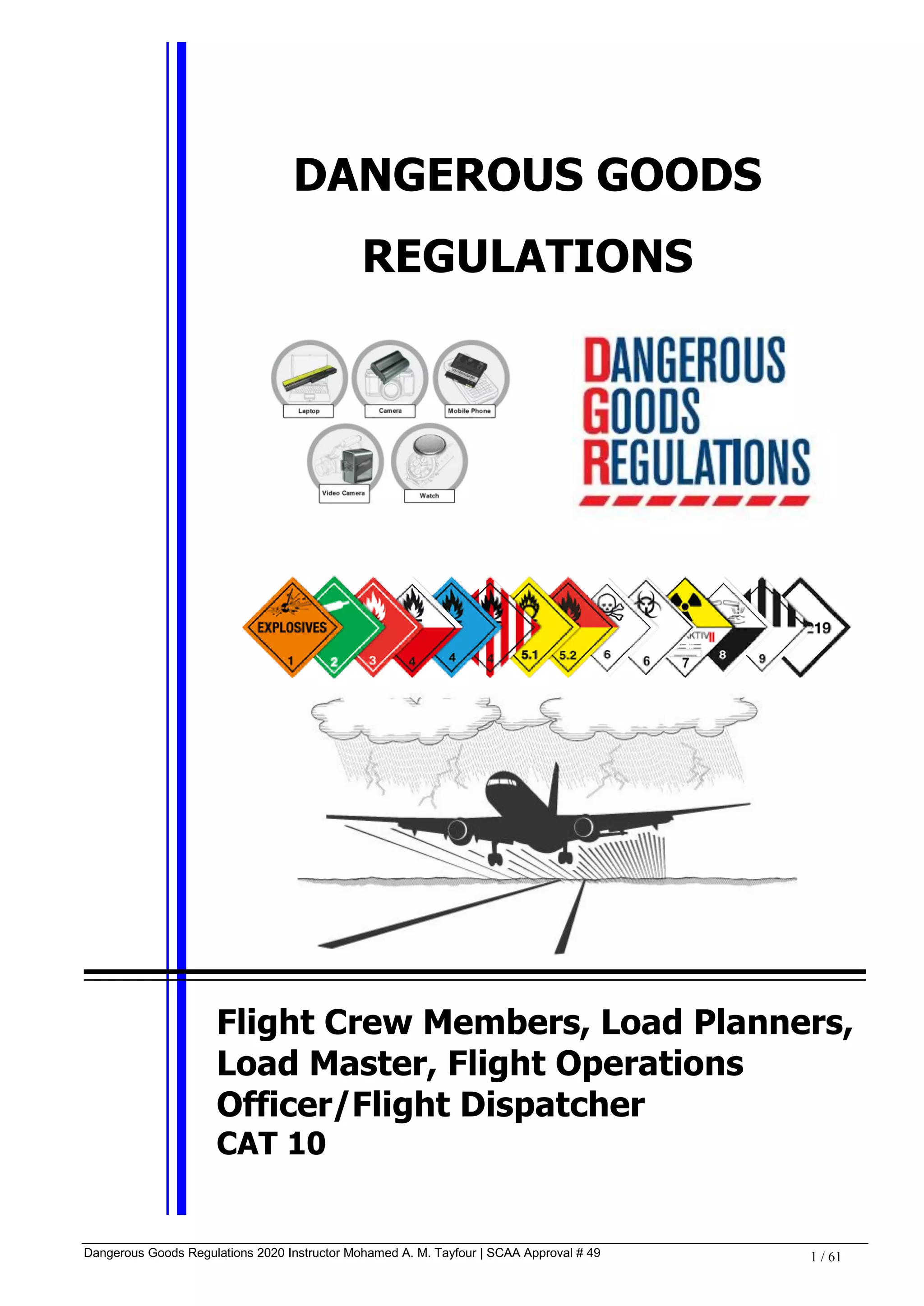
DANGEROUS GOODS
REGULATIONS
Flight Crew Members, Load Planners,
Load Master, Flight Operations
Officer/Flight Dispatcher
CAT 10
Dangerous Goods Regulations 2020 Instructor Mohamed A. M. Tayfour | SCAA Approval # 49 2 / 61
TABLE OF CONTENTS
 WELCOME MESSAGE ……………………………………………………………4
 QUALITY POLICY …………………………………………………………………5
 OBJECTIVES …………………………………………………………………………5
 SAFETY POLICY ……………………………………………………………………6
 Training Method …………………………………………………………………..7
 COURSE OBJECTIVES ……………………………………………………………9
 Introduction …………………………………………………………………………10
SECTION 1 – APPLICABILITY………………………………………….……………11
- General philosophy
- Definition
- Legal basis
- Shipper‘s responsibility
- Operator‘s responsibility
- Training requirements
- Dangerous goods security
- Information to passengers
SECTION 2 – LIMITATIONS………………………………………………………..16
- General
- Acceptable dangerous goods
- Forbidden dangerous goods
- Recognition of hidden dangerous goods
- Dangerous goods carried by passengers and crew
- Dangerous goods in air mail
- Dangerous goods in operator's property
- State and operator variations
SECTION 3 – CLASSIFICATION……………………………………………………22
- General principles
- Complete list of classes and divisions
SECTION 4 – Identification …………………………………………………………….31
- Selecting Proper Shipping Name
- Items Listed by Name
- List Of Dangerous Goods
Dangerous Goods Regulations 2020 Instructor Mohamed A. M. Tayfour | SCAA Approval # 49 3 / 61
SECTION 5 - MARKING AND LABELING………………………………………….34
- Marking
- Labelling
SECTION 6 – PACKING Requirements …………………………………………..41
- General Packing Requirements
- UN SPECIFICATION PACKAGINGS
- CHECKING THE PACKAGINGS OF DANGEROUS GOODS SHIPMENTS
- SPECIFICATION PACKAGING MARKINGS
SECTION 7 - STORAGE AND LOADING…………………………………………..45
- General
- Storage and handling
- Loading
- Commodity specific requirements
- Unit load devices (ULD) containing dangerous goods
SECTION 8 - PROVISION OF INFORMATION…………………………………….52
- Pilot-In-Command – notification to captain (NOTOC)
- Information by the pilot-in-command in case of in-flight emergency
SECTION 9 - DANGEROUS GOODS EMERGENCY………………………………55
- Introduction
- Dangerous Goods Emergency Response Information
- Incidents and Accidents
- Reporting of Undeclared or Mis-declared Dangerous Goods
- Dangerous goods emergency response chart (ground incidents)
- IATA Dangerous Goods Occurrence Report
- Dangerous Goods Occurrence Report
- Globally Harmonized System
Dangerous Goods Regulations 2020 Instructor Mohamed A. M. Tayfour | SCAA Approval # 49 4 / 61
WELCOME MESSAGE
Training Department welcomes you to this program. It is our pleasure to be a part on your learning
journey and we look forward to helping you realize your true potential.
This workbook provides you information that you will need to successfully achieve the learning objectives
of this program. This is your copy to encourage you to write on and reinforce the skills and knowledge
that have been introduced.
Training Department
Training Department provides technical and non-technical learning experiences to our employees and
outsources alike. The team is located at Training Department. We have a great team of trainers and
specialists that are focused on providing you with the best opportunity to learn and practice new skills in
a safe environment. The team uses interactive and experiential learning techniques to ensure that
participants develop the confidence to apply the new skills and knowledge as soon as they continue to
their work places.
This training is intended for Passenger Handling Personnel as stated in the IATA Dangerous Goods
Manual –Table 1.5.A (Category 10).
This workbook is to be used in conjunction with the current IATA DGR Manual to familiarize you with the
various sections and how to apply them. It is based on the practical application of the IATA DGR, which
include all the requirements of the ICAO Annex 18 and the current edition of the ICAO Technical
Instructions.
We trust that you will enjoy the program and look forward to any feedback you may have to help us
meet our objectives.
Happy learning!
Training Department
Dangerous Goods Regulations 2020 Instructor Mohamed A. M. Tayfour | SCAA Approval # 49 5 / 61
QUALITY POLICY
To achieve sustained and profitable growth by providing services that consistently
satisfy the needs and expectations of our internal and external customers.
OBJECTIVES
 Achieve and maintain a level of quality which enhances the Company.
 Reputation and brand with customers.
 To ensure compliance with relevant statutory and safety bodies.
 To endeavor at all times to maximize the Company market share in all
geographies.
Dangerous Goods Regulations 2020 Instructor Mohamed A. M. Tayfour | SCAA Approval # 49 6 / 61
SAFETY POLICY
Safety is the first priority in all our activities. We are committed to implementing, developing and
improving strategies, management systems and processes to ensure that all our activities uphold
the highest level of safety performance and meet national and international standards.
Our commitment is to:
a. Develop and embed a safety culture in all our aviation activities that recognizes the
importance and value of effective safety management and acknowledges at all times that
safety is paramount;
b. Clearly define for all staff their accountabilities and responsibilities for the development
and delivery of the safety strategy and performance;
c. Minimize the risks associated with aircraft operations and associated activities to a point
that is as low as reasonably practicable/achievable;
d. Ensure that externally supplied systems and services that impact the safety of our
operations meet appropriate safety standards;
e. Actively develop and improve our safety processes to conform to world-class standards;
f. Comply with and, wherever possible, exceed legislative and regulatory requirements and
standards;
g. Ensure that all staff are provided with adequate and appropriate aviation safety
information and training, are competent in safety matters and are only allocated tasks
commensurate with their skills;
h. Ensure that sufficient skilled and trained resources are available to implement safety
strategy and policy;
i. Establish and measure our safety performance against realistic objectives and/or targets;
j. Achieve the highest levels of safety standards and performance in all our aviation
activities;
k. Continually improve our safety performance;
l. Conduct safety and management reviews and ensure that relevant action is taken;
m. Ensure that the application of effective aviation safety management systems is integral to
all our aviation activities, with the objective of achieving the highest levels of safety
standards and performance.
Dangerous Goods Regulations 2020 Instructor Mohamed A. M. Tayfour | SCAA Approval # 49 7 / 61
Training Method
 Exercises
 Questions
 Home Work
 Final Assessment
Assessment Strategy:
To meet the legal requirement, a final test must be undertaken and
successfully completed following dangerous goods training to verify
understanding of the regulation. Confirmation is required of successful
completion of test (IATA DGR 1.5.0.4).
 Written exam (open book)
 Length of exam (2 hrs.)
 Minimum pass mark: 80
 Notification of successful completion
 Retest procedure
 DGR Certificate valid for 2 years
 Meets ICAO & IATA Requirements
 Recurrent Training within 24 months
Dangerous Goods Regulations 2020 Instructor Mohamed A. M. Tayfour | SCAA Approval # 49 8 / 61
INTENTIONALLY
LIFT BLANK
Dangerous Goods Regulations 2020 Instructor Mohamed A. M. Tayfour | SCAA Approval # 49 9 / 61
COURSE OBJECTIVES
After thorough study and use of this training workbook the student will:
 Be able to identify dangerous goods;
 Have knowledge of the origin of the current regulations and be aware of the general
philosophy;
 Be able to identify the classes of dangerous goods;
 Recognize and identify the hazard/handling labels applicable to dangerous goods;
 Recognize and identify dangerous goods package use and package specification
markings;
 Be able to identify the dangerous goods list.
 Be able to identify potential hidden hazards in cargo;
 Be familiar with loading and storage procedures;
 Be familiar with Packing procedures;
 Be aware of the provisions for dangerous goods in baggage of passengers and crew;
 Information by the pilot-in-command in case of in-flight emergency
 Be familiar with emergency procedures.
Dangerous Goods Regulations 2020 Instructor Mohamed A. M. Tayfour | SCAA Approval # 49 10 / 61
INTRODUCTION
IATA Dangerous Goods Regulations
This training is for the Flight crew members, load
planners and Flight Operations Officer/Flight
Dispatcher (Categories 10 from the IATA DGR
Table 1.5A). This manual is designed to be used in
conjunction with the IATA DGR to familiarize you
with the various sections and how to apply them.
It is based on the practical
application of the IATA DGR,
which include all the requirements of the ICAO
Annex 18 and current edition of the ICAO Technical
Instructions.
(ICAO Technical Instructions – Doc. 9284-AN/905)
The SUDAN CIVIL AVIATION AUTHORITY
(SCAA) has been delegated full authority be the
state of Sudan.
It has adopted the standard codes issued by the
International Civil Aviation Organization (ICAO)
concerning the safe transport of dangerous goods.
Dangerous Goods Regulations 2020 Instructor Mohamed A. M. Tayfour | SCAA Approval # 49 11 / 61
SECTION 1 — APPLICABILITY
By the end of this section, you will be able to:
 Define dangerous goods;
 Identify the general principles applicable to the air transport of dangerous
goods.
 Know the responsibilities of shipper & operator when transporting DG.
 Describe the importance of dangerous goods training;
 Identify Dangerous goods Security.
1.0 Definition of Dangerous Goods
Dangerous goods are articles or substances which are capable of posing a risk to health, safety,
property or the environment and which are shown in the list of dangerous goods in these
Regulations or which are classified according to these Regulations.
1.1 Basis of the Regulations
1.1.1 The UN Committee of Experts (CoE) develops recommended
procedures for the transport of all types of dangerous goods except
radioactive materials. These procedures, applicable to all modes of transport,
are published in the Recommendations on the Transport of Dangerous Goods.
1.1.2 The International Atomic Energy Agency (IAEA) develops
recommended procedures for the safe transport of radioactive materials.
These procedures are published in the Regulations for the Safe Transport of
Radioactive Material (IAEA TS-R-1). The requirements of these regulations as
they pertain to air transport are reflected in Section 10.
1.1.3 The International Civil Aviation Organization (ICAO) has used
these recommendations as the basis for developing the regulations for the safe
transport of dangerous goods by air. The ICAO regulations are codified in
Annex 18 to the Convention on International Civil Aviation and in its
Technical Instructions for the Safe Transport of Dangerous Goods by Air
(Doc 9284-AN/905 as amended) (Technical Instructions).
1.1.4 The International Air Transport Association (IATA) contains all
of the requirements of the Technical Instructions. IATA has included
additional requirements, which are more restrictive than the Technical
Instructions and reflect industry standard practices or operational
considerations. These are identified by the symbol ―‖ in the margin.
1.1.5 Sudan Civil Aviation Authority (SCAA) Regulations for Dangerous
Goods SUCAR Part 18, SCAP Part 11 and Sudan Safety ACT 2010 Article
49 and 50.
Dangerous Goods Regulations 2020 Instructor Mohamed A. M. Tayfour | SCAA Approval # 49 12 / 61
1.2 Application of these Regulations
1.2.1 Applicability
The IATA Dangerous Goods Regulations are applicable to:
 All airlines which are Members or Associate Members of IATA;
 All airlines which are party to the IATA Multilateral Interline Traffic Agreement — Cargo;
and
 All shippers and agents that offer consignments of dangerous goods to these operators.
1.2.2 Exceptions
1.2.2.1 Except for information provided to operator employees, as shown in 9.5.2, the provisions
of these Regulations do not apply to dangerous goods carried on an aircraft where the
dangerous goods are:
(a) To provide medical aid to a patient during flight when those dangerous goods:
1. Have been placed on board with the approval of the operator; or
2. Form part of the permanent equipment of the aircraft when it has been adapted for
specialized use; providing that;
3. Gas cylinders have been manufactured specifically for the purpose of containing and
transporting that particular gas;
4. Equipment containing wet cell batteries is kept and, when necessary secured, in an upright
position to prevent spillage of the electrolyte.
1.2.2.2 Dangerous Goods Packages opened by customs and other Authorities
Any package opened during an inspection must, before being forwarded to the consignee, be
restored by qualified persons to condition, which complies with these regulation.
1.3 Shipper's Responsibilities
Shipper must comply fully with the IATA DGR when a consignment of dangerous goods is
offered with an operator. Shipper must also comply with any regulations required by the state of
origin, transit and destination. For further details refer to IATA DGR 1.3.
1. Identified;
2. Classified;
3. Packed;
4. Marked;
5. Labeled;
6. Documented.
1.4 Operator's Responsibilities
When accepting cargo for transportation by air it is the operator‘s cargo acceptance staff that
has the responsibility to ensure, as far as possible, that the consignment does not contain
dangerous goods unless shipper has prepared the shipment of dangerous goods in accordance
with the Regulations. A checklist must be used to accept declared dangerous goods
consignments, the eight responsibilities for an operator IATA DGR 1.4.1
1. Acceptance;
2. Storage;
3. Loading;
4. Inspection;
5. Provision of Information, including emergency response information;
6. Reporting;
7. Retention of Records;
8. Training.
Dangerous Goods Regulations 2020 Instructor Mohamed A. M. Tayfour | SCAA Approval # 49 13 / 61
1.5 Training Requirements
1.5.0 Initial & Recurrent Training
1.5.1 The successful application of regulations concerning the transport of dangerous goods
and the achievement of their objectives are greatly dependent on the appreciation by all
individuals concerned of the risks involved and on a detailed understanding of the Regulations.
This can only be achieved by properly planned and maintained initial and recurrent training
programs for all persons concerned in the transport of dangerous goods.
1.5.2 Training must be provided or verified upon the employment of personnel identified in the
categories specified in Table 1.5.A.
1.5.3 All categories of staff involved in the movement of dangerous goods by air are legally
required to have mandated job-specific training. Training must be provided or verified when an
employer hires an individual who will be involved in the movement of dangerous goods.
Refresher or recurrent training must be received within 24 months of previous dangerous goods
training to make sure that the staff‘s knowledge is up to date.
1.5.4 A test must be undertaken following dangerous goods training to verify understanding of
the regulations. Confirmation is required of successful completion of the test.
1.5.5 A record of training must be maintained by the employer which must show the name of
each individual trained, the date of the most recent training, and description of the training and
the name and address of the organization providing this training.
TABLE 1.5.A
Minimum Requirements for Training Curricula (IATA DGR Ref. 1.5.2)
Aspects of transport of dangerous goods
by air with which they should be familiar,
as a minimum
Shippers
&
packers
Freight
Forwarders
Operators and ground
handling agents
Security
screeners
1 2 3 4 5 6 7 8 9 10 11 12
General philosophy            
Limitations           
General requirements for shippers   
Classification     
List of dangerous goods     
General packing requirements    
Packing instructions    
Labeling and marking            
Shipper's Declaration and other relevant
documentation
    
Acceptance procedures 
Recognition of Undeclared Dangerous
Goods
           
Storage and loading procedures    
Pilots' notification   
Provisions for passengers and crew            
Emergency procedures            
Dangerous Goods Regulations 2020 Instructor Mohamed A. M. Tayfour | SCAA Approval # 49 14 / 61
KEY CAT :
1. Shippers and persons undertaking the responsibilities of shippers', including operator's staff acting as shippers,
operator's staff preparing dangerous goods as Company Materials (COMAT)
2. Packers
3. Staff of freight forwarders involved in processing dangerous goods
4. Staff of freight forwarders involved in processing cargo, mail or stores (other than dangerous goods)
5. Staff of freight forwarders involved in the handling, storage and loading of cargo, mail or stores
6. Operator's and ground handling agent's staff accepting dangerous goods
7. Operator's and ground handling agent's staff accepting cargo, mail or stores (other than dangerous goods)
8. Operator's and ground handling agent's staff involved in the handling, storage and loading of cargo, mail or
stores and baggage
9. Passenger handling staff
10. Flight crew members, load planners and Flight Operations Officer/Flight Dispatcher
11. Crew members, loadmasters (other than flight crew members)
12. Security staff who deal with the screening of passengers and their baggage and cargo, mail or stores, e.g.
security screeners, their supervisors and staff involved in implementing security procedures.
Refer IATA DGR Table 1.5B & 1.5C for minimum requirements for training curricula for ―No
Carry‖ operator (Category 13 to 17) and for postal operator‘s.
1.6 Adequate instruction for shipping section II Lithium Batteries
1.6.1 At a minimum an employer should consider the following as being adequate instructions:
a. Classification of lithium batteries.
b. Documentation of lithium batteries.
c. Written work instructions.
d. Instructions records including dates.
e. Refresher instructions very 2 years.
f. Review of logistics including mode of transport.
1.7 Dangerous Goods Security
Annex 17 provides comprehensive requirements for implementation of security
measures by States to prevent unlawful interference with civil aviation or when
such interference has been committed. In addition, the Security Manual for
Safeguarding Civil Aviation against Acts of Unlawful Interference (Doc 8973 -
Restricted) provides procedures and guidance on aspects of aviation security and
is intended to assist States in the implementation of their respective national civil
aviation security programmes.
All persons engaged in the transport of DGR should consider security requirement
for the DGR commensurate with their responsibilities.
For further details refer IATA DGR 1.6.
Category 10 personnel need to be trained in aspects of transport of DGR.
Apart from covering:
a) General philosophy
b) Limitations
c) Labelling and Marking
What else must be covered as a minimum?
……………………………………………………………………………………………………………
Exercise -1
Dangerous Goods Regulations 2020 Instructor Mohamed A. M. Tayfour | SCAA Approval # 49 15 / 61
1.8 INFORMATION TO PASSENGERS
What about informing passengers of the Regulations?
It is not practical to give our passengers individual training on the Regulations. However, we can
and must bring to their attention an awareness of what must not be carried aboard an aircraft,
either as checked baggage or as carry-on articles.
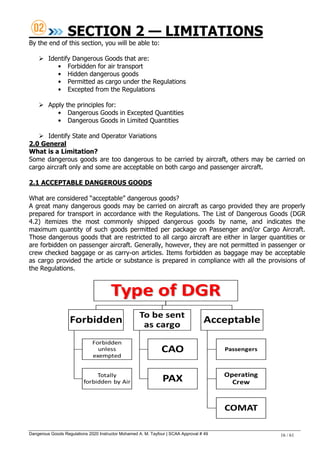
Information must be provided to passengers about the type of dangerous goods which they are
forbidden from transporting aboard an aircraft.
As a minimum, this information must consist of:
- information with the passenger ticket or made available in another manner such that prior
to or during the check-in process, the passenger receives the information;
- notices warning passengers as to the type of dangerous goods which are forbidden for
transport aboard an aircraft are:
 prominently displayed in sufficient number at each of the places at an airport
where tickets are issued, and where passengers check in, in aircraft boarding areas
and in baggage claim areas; and
- Notices clearly displayed at any other location where passengers are checked in.
Summary & Key Learning Point
 Dangerous goods are articles and substances capable of posing a risk to health, safety,
property or the environment.
 IATA DGR is field document based on the ICAO Technical Instructions and Annex18.
 Shipper are responsible for identification, classification, packing, marking, labelling and
documentation of dangerous goods (IATA ref. 1.3.2.c).
 Operators are responsible for acceptance, storage, loading, inspection, provision of
information, reporting, retention of records and training.
 Initial and recurrent trainings are mandatory.
 Dangerous goods security requirements are mandatory and be implemented by
operators, shippers, and others engaged in the transport of dangerous goods.
Dangerous Goods Regulations 2020 Instructor Mohamed A. M. Tayfour | SCAA Approval # 49 16 / 61
SECTION 2 — LIMITATIONS
By the end of this section, you will be able to:
 Identify Dangerous Goods that are:
• Forbidden for air transport
• Hidden dangerous goods
• Permitted as cargo under the Regulations
• Excepted from the Regulations
 Apply the principles for:
• Dangerous Goods in Excepted Quantities
• Dangerous Goods in Limited Quantities
 Identify State and Operator Variations
2.0 General
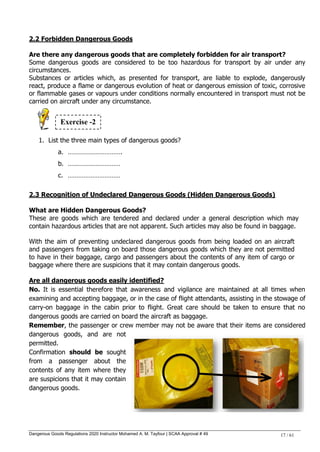
What is a Limitation?
Some dangerous goods are too dangerous to be carried by aircraft, others may be carried on
cargo aircraft only and some are acceptable on both cargo and passenger aircraft.
2.1 ACCEPTABLE DANGEROUS GOODS
What are considered ―acceptable‖ dangerous goods?
A great many dangerous goods may be carried on aircraft as cargo provided they are properly
prepared for transport in accordance with the Regulations. The List of Dangerous Goods (DGR
4.2) itemizes the most commonly shipped dangerous goods by name, and indicates the
maximum quantity of such goods permitted per package on Passenger and/or Cargo Aircraft.
Those dangerous goods that are restricted to all cargo aircraft are either in larger quantities or
are forbidden on passenger aircraft. Generally, however, they are not permitted in passenger or
crew checked baggage or as carry-on articles. Items forbidden as baggage may be acceptable
as cargo provided the article or substance is prepared in compliance with all the provisions of
the Regulations.
Dangerous Goods Regulations 2020 Instructor Mohamed A. M. Tayfour | SCAA Approval # 49 17 / 61
2.2 Forbidden Dangerous Goods
Are there any dangerous goods that are completely forbidden for air transport?
Some dangerous goods are considered to be too hazardous for transport by air under any
circumstances.
Substances or articles which, as presented for transport, are liable to explode, dangerously
react, produce a flame or dangerous evolution of heat or dangerous emission of toxic, corrosive
or flammable gases or vapours under conditions normally encountered in transport must not be
carried on aircraft under any circumstance.
1. List the three main types of dangerous goods?
a. ………………………….
b. …………………………
c. …………………………
2.3 Recognition of Undeclared Dangerous Goods (Hidden Dangerous Goods)
What are Hidden Dangerous Goods?
These are goods which are tendered and declared under a general description which may
contain hazardous articles that are not apparent. Such articles may also be found in baggage.
With the aim of preventing undeclared dangerous goods from being loaded on an aircraft
and passengers from taking on board those dangerous goods which they are not permitted
to have in their baggage, cargo and passengers about the contents of any item of cargo or
baggage where there are suspicions that it may contain dangerous goods.
Are all dangerous goods easily identified?
No. It is essential therefore that awareness and vigilance are maintained at all times when
examining and accepting baggage, or in the case of flight attendants, assisting in the stowage of
carry-on baggage in the cabin prior to flight. Great care should be taken to ensure that no
dangerous goods are carried on board the aircraft as baggage.
Remember, the passenger or crew member may not be aware that their items are considered
dangerous goods, and are not
permitted.
Confirmation should be sought
from a passenger about the
contents of any item where they
are suspicions that it may contain
dangerous goods.
Exercise -2
Dangerous Goods Regulations 2020 Instructor Mohamed A. M. Tayfour | SCAA Approval # 49 18 / 61
2.4 Dangerous Goods Carried by Passengers or Crew
2.4.1 Dangerous goods, including excepted packages of radioactive material, must not be
carried by passengers or crew:
 as or in checked baggage;
 as or in carry-on baggage; or
 on their person;
2.4.2 Notwithstanding any additional restrictions that may be implemented by States in the
interests of aviation security, except for the incident reporting requirements of 9.6.2, the
provisions of these Regulations do not apply to 2.3.4 to 2.3.5 when carried by passengers or
crew members or in baggage transported by the operator which has been separated from its
owner during transit (e.g. lost baggage or improperly routed baggage).
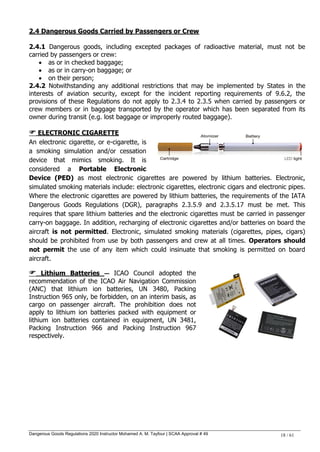
 ELECTRONIC CIGARETTE
An electronic cigarette, or e-cigarette, is
a smoking simulation and/or cessation
device that mimics smoking. It is
considered a Portable Electronic
Device ((PPEEDD)) as most electronic cigarettes are powered by lithium batteries. Electronic,
simulated smoking materials include: electronic cigarettes, electronic cigars and electronic pipes.
Where the electronic cigarettes are powered by lithium batteries, the requirements of the IATA
Dangerous Goods Regulations (DGR), paragraphs 2.3.5.9 and 2.3.5.17 must be met. This
requires that spare lithium batteries and the electronic cigarettes must be carried in passenger
carry-on baggage. In addition, recharging of electronic cigarettes and/or batteries on board the
aircraft is not permitted. Electronic, simulated smoking materials (cigarettes, pipes, cigars)
should be prohibited from use by both passengers and crew at all times. Operators should
not permit the use of any item which could insinuate that smoking is permitted on board
aircraft.
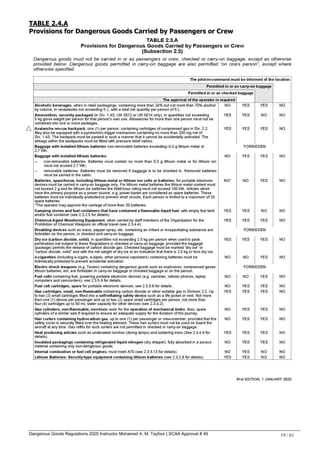
 Lithium Batteries — ICAO Council adopted the
recommendation of the ICAO Air Navigation Commission
(ANC) that lithium ion batteries, UN 3480, Packing
Instruction 965 only, be forbidden, on an interim basis, as
cargo on passenger aircraft. The prohibition does not
apply to lithium ion batteries packed with equipment or
lithium ion batteries contained in equipment, UN 3481,
Packing Instruction 966 and Packing Instruction 967
respectively.
Dangerous Goods Regulations 2020 Instructor Mohamed A. M. Tayfour | SCAA Approval # 49 19 / 61
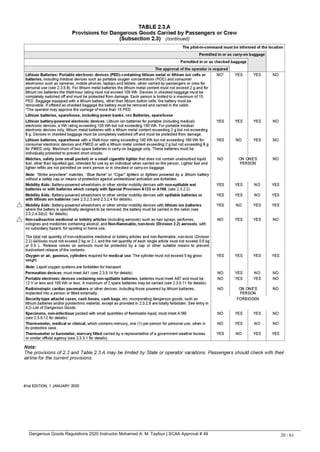
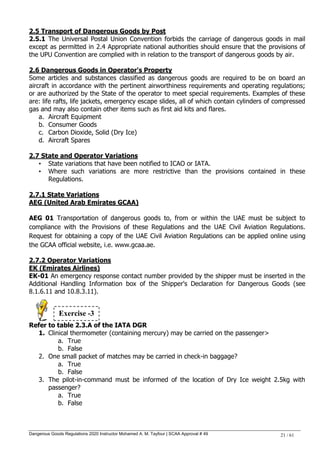
TABLE 2.4.A
Provisions for Dangerous Goods Carried by Passengers or Crew
Dangerous Goods Regulations 2020 Instructor Mohamed A. M. Tayfour | SCAA Approval # 49 20 / 61
Dangerous Goods Regulations 2020 Instructor Mohamed A. M. Tayfour | SCAA Approval # 49 21 / 61
2.5 Transport of Dangerous Goods by Post
2.5.1 The Universal Postal Union Convention forbids the carriage of dangerous goods in mail
except as permitted in 2.4 Appropriate national authorities should ensure that the provisions of
the UPU Convention are complied with in relation to the transport of dangerous goods by air.
2.6 Dangerous Goods in Operator's Property
Some articles and substances classified as dangerous goods are required to be on board an
aircraft in accordance with the pertinent airworthiness requirements and operating regulations;
or are authorized by the State of the operator to meet special requirements. Examples of these
are: life rafts, life jackets, emergency escape slides, all of which contain cylinders of compressed
gas and may also contain other items such as first aid kits and flares.
a. Aircraft Equipment
b. Consumer Goods
c. Carbon Dioxide, Solid (Dry Ice)
d. Aircraft Spares
2.7 State and Operator Variations
• State variations that have been notified to ICAO or IATA.
• Where such variations are more restrictive than the provisions contained in these
Regulations.
2.7.1 State Variations
AEG (United Arab Emirates GCAA)
AEG 01 Transportation of dangerous goods to, from or within the UAE must be subject to
compliance with the Provisions of these Regulations and the UAE Civil Aviation Regulations.
Request for obtaining a copy of the UAE Civil Aviation Regulations can be applied online using
the GCAA official website, i.e. www.gcaa.ae.
2.7.2 Operator Variations
EK (Emirates Airlines)
EK-01 An emergency response contact number provided by the shipper must be inserted in the
Additional Handling Information box of the Shipper's Declaration for Dangerous Goods (see
8.1.6.11 and 10.8.3.11).
Refer to table 2.3.A of the IATA DGR
1. Clinical thermometer (containing mercury) may be carried on the passenger>
a. True
b. False
2. One small packet of matches may be carried in check-in baggage?
a. True
b. False
3. The pilot-in-command must be informed of the location of Dry Ice weight 2.5kg with
passenger?
a. True
b. False
Exercise -3
Dangerous Goods Regulations 2020 Instructor Mohamed A. M. Tayfour | SCAA Approval # 49 22 / 61
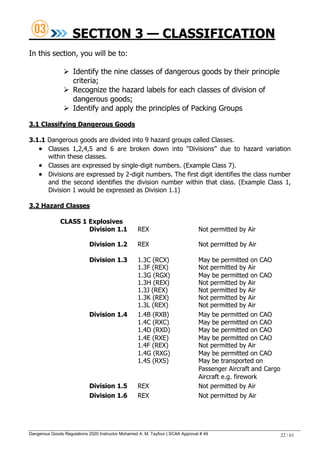
SECTION 3 — CLASSIFICATION
In this section, you will be to:
 Identify the nine classes of dangerous goods by their principle
criteria;
 Recognize the hazard labels for each classes of division of
dangerous goods;
 Identify and apply the principles of Packing Groups
3.1 Classifying Dangerous Goods
3.1.1 Dangerous goods are divided into 9 hazard groups called Classes.
 Classes 1,2,4,5 and 6 are broken down into ―Divisions‖ due to hazard variation
within these classes.
 Classes are expressed by single-digit numbers. (Example Class 7).
 Divisions are expressed by 2-digit numbers. The first digit identifies the class number
and the second identifies the division number within that class. (Example Class 1,
Division 1 would be expressed as Division 1.1)
3.2 Hazard Classes
CLASS 1 Explosives
Division 1.1 REX Not permitted by Air
Division 1.2 REX Not permitted by Air
Division 1.3 1.3C (RCX) May be permitted on CAO
1.3F (REX) Not permitted by Air
1.3G (RGX) May be permitted on CAO
1.3H (REX) Not permitted by Air
1.3J (REX) Not permitted by Air
1.3K (REX) Not permitted by Air
1.3L (REX) Not permitted by Air
Division 1.4 1.4B (RXB) May be permitted on CAO
1.4C (RXC) May be permitted on CAO
1.4D (RXD) May be permitted on CAO
1.4E (RXE) May be permitted on CAO
1.4F (REX) Not permitted by Air
1.4G (RXG) May be permitted on CAO
1.4S (RXS) May be transported on
Passenger Aircraft and Cargo
Aircraft e.g. firework
Division 1.5 REX Not permitted by Air
Division 1.6 REX Not permitted by Air
Dangerous Goods Regulations 2020 Instructor Mohamed A. M. Tayfour | SCAA Approval # 49 23 / 61
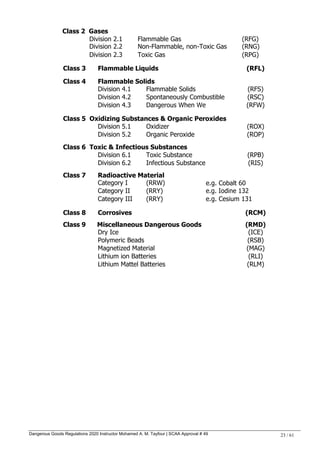
Class 2 Gases
Division 2.1 Flammable Gas (RFG)
Division 2.2 Non-Flammable, non-Toxic Gas (RNG)
Division 2.3 Toxic Gas (RPG)
Class 3 Flammable Liquids (RFL)
Class 4 Flammable Solids
Division 4.1 Flammable Solids (RFS)
Division 4.2 Spontaneously Combustible (RSC)
Division 4.3 Dangerous When Wet (RFW)
Class 5 Oxidizing Substances & Organic Peroxides
Division 5.1 Oxidizer (ROX)
Division 5.2 Organic Peroxide (ROP)
Class 6 Toxic & Infectious Substances
Division 6.1 Toxic Substance (RPB)
Division 6.2 Infectious Substance (RIS)
Class 7 Radioactive Material
Category I (RRW) e.g. Cobalt 60
Category II (RRY) e.g. Iodine 132
Category III (RRY) e.g. Cesium 131
Class 8 Corrosives (RCM)
Class 9 Miscellaneous Dangerous Goods (RMD)
Dry Ice (ICE)
Polymeric Beads (RSB)
Magnetized Material (MAG)
Lithium ion Batteries (RLI)
Lithium Mattel Batteries (RLM)
Dangerous Goods Regulations 2020 Instructor Mohamed A. M. Tayfour | SCAA Approval # 49 24 / 61
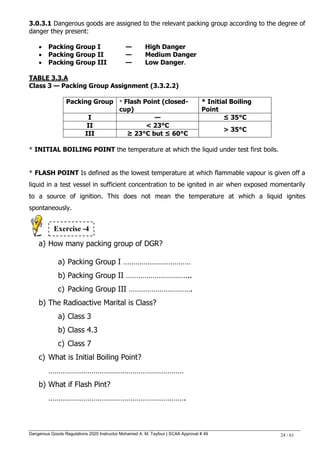
3.0.3.1 Dangerous goods are assigned to the relevant packing group according to the degree of
danger they present:
 Packing Group I — High Danger
 Packing Group II — Medium Danger
 Packing Group III — Low Danger.
TABLE 3.3.A
Class 3 — Packing Group Assignment (3.3.2.2)
Packing Group * Flash Point (closed-
cup)
* Initial Boiling
Point
I — ≤ 35°C
II < 23°C
> 35°C
III ≥ 23°C but ≤ 60°C
* INITIAL BOILING POINT the temperature at which the liquid under test first boils.
* FLASH POINT Is defined as the lowest temperature at which flammable vapour is given off a
liquid in a test vessel in sufficient concentration to be ignited in air when exposed momentarily
to a source of ignition. This does not mean the temperature at which a liquid ignites
spontaneously.
a) How many packing group of DGR?
a) Packing Group I ……………………………
b) Packing Group II …………………………..
c) Packing Group III ………………………….
b) The Radioactive Marital is Class?
a) Class 3
b) Class 4.3
c) Class 7
c) What is Initial Boiling Point?
…………………………………………………………
b) What if Flash Pint?
………………………………………………………….
Exercise -4
Dangerous Goods Regulations 2020 Instructor Mohamed A. M. Tayfour | SCAA Approval # 49 25 / 61
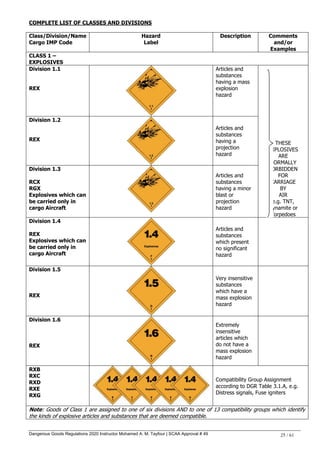
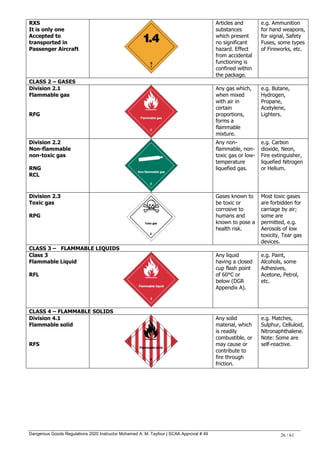
COMPLETE LIST OF CLASSES AND DIVISIONS
Class/Division/Name
Cargo IMP Code
Hazard
Label
Description Comments
and/or
Examples
CLASS 1 –
EXPLOSIVES
Division 1.1
REX
Articles and
substances
having a mass
explosion
hazard
THESE
EXPLOSIVES
ARE
NORMALLY
FORBIDDEN
FOR
CARRIAGE
BY
AIR
e.g. TNT,
Dynamite or
Torpedoes
Division 1.2
REX
Articles and
substances
having a
projection
hazard
Division 1.3
RCX
RGX
Explosives which can
be carried only in
cargo Aircraft
Articles and
substances
having a minor
blast or
projection
hazard
Division 1.4
REX
Explosives which can
be carried only in
cargo Aircraft
Articles and
substances
which present
no significant
hazard
Division 1.5
REX
Very insensitive
substances
which have a
mass explosion
hazard
Division 1.6
REX
Extremely
insensitive
articles which
do not have a
mass explosion
hazard
RXB
RXC
RXD
RXE
RXG
Compatibility Group Assignment
according to DGR Table 3.1.A, e.g.
Distress signals, Fuse igniters
Note: Goods of Class 1 are assigned to one of six divisions AND to one of 13 compatibility groups which identify
the kinds of explosive articles and substances that are deemed compatible.
Dangerous Goods Regulations 2020 Instructor Mohamed A. M. Tayfour | SCAA Approval # 49 26 / 61
RXS
It is only one
Accepted to
transported in
Passenger Aircraft
Articles and
substances
which present
no significant
hazard. Effect
from accidental
functioning is
confined within
the package.
e.g. Ammunition
for hand weapons,
for signal, Safety
Fuses, some types
of Fireworks, etc.
CLASS 2 – GASES
Division 2.1
Flammable gas
RFG
Any gas which,
when mixed
with air in
certain
proportions,
forms a
flammable
mixture.
e.g. Butane,
Hydrogen,
Propane,
Acetylene,
Lighters.
Division 2.2
Non-flammable
non-toxic gas
RNG
RCL
Any non-
flammable, non-
toxic gas or low-
temperature
liquefied gas.
e.g. Carbon
dioxide, Neon,
Fire extinguisher,
liquefied Nitrogen
or Helium.
Division 2.3
Toxic gas
RPG
Gases known to
be toxic or
corrosive to
humans and
known to pose a
health risk.
Most toxic gases
are forbidden for
carriage by air;
some are
permitted, e.g.
Aerosols of low
toxicity, Tear gas
devices.
CLASS 3 – FLAMMABLE LIQUIDS
Class 3
Flammable Liquid
RFL
Any liquid
having a closed
cup flash point
of 60°C or
below (DGR
Appendix A).
e.g. Paint,
Alcohols, some
Adhesives,
Acetone, Petrol,
etc.
CLASS 4 – FLAMMABLE SOLIDS
Division 4.1
Flammable solid
RFS
Any solid
material, which
is readily
combustible, or
may cause or
contribute to
fire through
friction.
e.g. Matches,
Sulphur, Celluloid,
Nitronaphthalene.
Note: Some are
self-reactive.
Dangerous Goods Regulations 2020 Instructor Mohamed A. M. Tayfour | SCAA Approval # 49 27 / 61
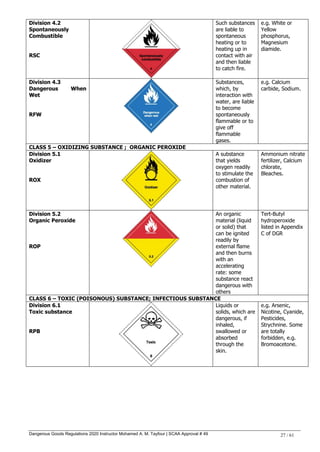
Division 4.2
Spontaneously
Combustible
RSC
Such substances
are liable to
spontaneous
heating or to
heating up in
contact with air
and then liable
to catch fire.
e.g. White or
Yellow
phosphorus,
Magnesium
diamide.
Division 4.3
Dangerous When
Wet
RFW
Substances,
which, by
interaction with
water, are liable
to become
spontaneously
flammable or to
give off
flammable
gases.
e.g. Calcium
carbide, Sodium.
CLASS 5 – OXIDIZING SUBSTANCE ; ORGANIC PEROXIDE
Division 5.1
Oxidizer
ROX
A substance
that yields
oxygen readily
to stimulate the
combustion of
other material.
Ammonium nitrate
fertilizer, Calcium
chlorate,
Bleaches.
Division 5.2
Organic Peroxide
ROP
An organic
material (liquid
or solid) that
can be ignited
readily by
external flame
and then burns
with an
accelerating
rate: some
substance react
dangerous with
others
Tert-Butyl
hydroperoxide
listed in Appendix
C of DGR
CLASS 6 – TOXIC (POISONOUS) SUBSTANCE; INFECTIOUS SUBSTANCE
Division 6.1
Toxic substance
RPB
Liquids or
solids, which are
dangerous, if
inhaled,
swallowed or
absorbed
through the
skin.
e.g. Arsenic,
Nicotine, Cyanide,
Pesticides,
Strychnine. Some
are totally
forbidden, e.g.
Bromoacetone.
Dangerous Goods Regulations 2020 Instructor Mohamed A. M. Tayfour | SCAA Approval # 49 28 / 61
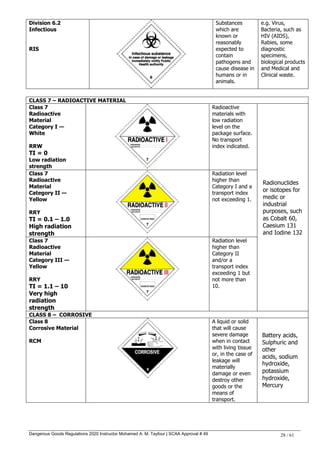
Division 6.2
Infectious
RIS
Substances
which are
known or
reasonably
expected to
contain
pathogens and
cause disease in
humans or in
animals.
e.g. Virus,
Bacteria, such as
HIV (AIDS),
Rabies, some
diagnostic
specimens,
biological products
and Medical and
Clinical waste.
CLASS 7 – RADIOACTIVE MATERIAL
Class 7
Radioactive
Material
Category I —
White
RRW
TI = 0
Low radiation
strength
Radioactive
materials with
low radiation
level on the
package surface.
No transport
index indicated.
Radionuclides
or isotopes for
medic or
industrial
purposes, such
as Cobalt 60,
Caesium 131
and Iodine 132
Class 7
Radioactive
Material
Category II —
Yellow
RRY
TI = 0.1 – 1.0
High radiation
strength
Radiation level
higher than
Category I and a
transport index
not exceeding 1.
Class 7
Radioactive
Material
Category III —
Yellow
RRY
TI = 1.1 – 10
Very high
radiation
strength
Radiation level
higher than
Category II
and/or a
transport index
exceeding 1 but
not more than
10.
CLASS 8 – CORROSIVE
Class 8
Corrosive Material
RCM
A liquid or solid
that will cause
severe damage
when in contact
with living tissue
or, in the case of
leakage will
materially
damage or even
destroy other
goods or the
means of
transport.
Battery acids,
Sulphuric and
other
acids, sodium
hydroxide,
potassium
hydroxide,
Mercury
Dangerous Goods Regulations 2020 Instructor Mohamed A. M. Tayfour | SCAA Approval # 49 29 / 61
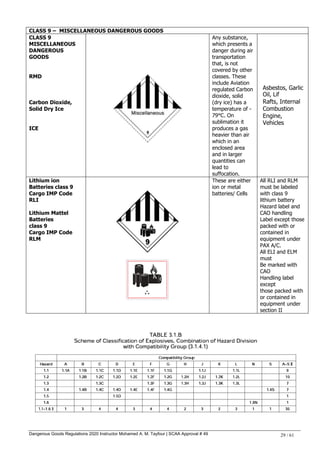
CLASS 9 – MISCELLANEOUS DANGEROUS GOODS
CLASS 9
MISCELLANEOUS
DANGEROUS
GOODS
RMD
Carbon Dioxide,
Solid Dry Ice
ICE
Any substance,
which presents a
danger during air
transportation
that, is not
covered by other
classes. These
include Aviation
regulated Carbon
dioxide, solid
(dry ice) has a
temperature of -
79°C. On
sublimation it
produces a gas
heavier than air
which in an
enclosed area
and in larger
quantities can
lead to
suffocation.
Asbestos, Garlic
Oil, Lif
Rafts, Internal
Combustion
Engine,
Vehicles
Lithium ion
Batteries class 9
Cargo IMP Code
RLI
Lithium Mattel
Batteries
class 9
Cargo IMP Code
RLM
These are either
ion or metal
batteries/ Cells
All RLI and RLM
must be labeled
with class 9
lithium battery
Hazard label and
CAO handling
Label except those
packed with or
contained in
equipment under
PAX A/C.
All ELI and ELM
must
Be marked with
CAO
Handling label
except
those packed with
or contained in
equipment under
section II
Dangerous Goods Regulations 2020 Instructor Mohamed A. M. Tayfour | SCAA Approval # 49 30 / 61
a) Write the appropriate name following Class/Division numbers:
(a) Class 6.1 ………………………. .
(b) Class 4.2 ……………………….
b) What do the following IMP codes represent?
a) RFL ………………………
b) RFG ………………………
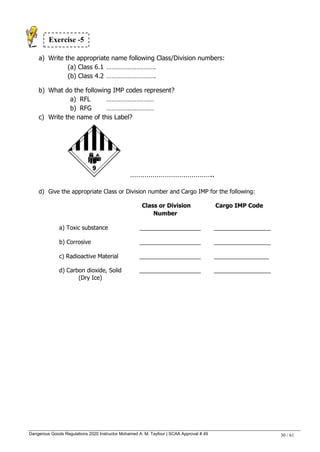
c) Write the name of this Label?
…………………………………..
d) Give the appropriate Class or Division number and Cargo IMP for the following:
Class or Division Cargo IMP Code
Number
a) Toxic substance ___________________ __________________
b) Corrosive ___________________ __________________
c) Radioactive Material ___________________ _________________
d) Carbon dioxide, Solid ___________________ __________________
(Dry Ice)
Exercise -5
Dangerous Goods Regulations 2020 Instructor Mohamed A. M. Tayfour | SCAA Approval # 49 31 / 61
SECTION 4 — Identification
Section 4 of the IATA DGR is divided into 4 Sub-sections
4.1 Proper Shipping Name
4.2 List of Dangerous Goods
4.3 Numerical Cross-Reference List
4.4 Special Provisions
 Addition of technical name(s) is required,
† Addition information can be found in Appendix A
Note: the  and † symbols are not part of the proper shipping name. See 4.1.2.1(d)
4.1 Selecting Proper Shipping Name
Dangerous Goods must be assigned to one of the standard names used in the transport of
dangerous goods. These names are called ―Proper Shipping Name‖ and are used to identify
the dangerous article or substance on the outside of the package and on the Shipper‘s
Declaration for Dangerous Goods‖.
4.1.1 Items Listed by Name
• If the name is known, go directly to the list of dangerous goods (subsection 4.2) it is in
alphabetical order
• If the UN or ID number is known, go to the Numerical Cross-Reference Index
(subsection 4.3) to find the name and page number in the List of Dangerous Goods.
• The Proper Shipping name is the part of the entry shown in bold face type in the blue
pages.
4.2 LIST OF DANGEROUS GOODS
Section 4.2 of the Regulations contains an alphabetical list of dangerous goods (DGR 4.2), most
commonly offered for transport by air. It contains information relating to the UN/ID number,
classes, labels, packing method, the permitted quantities per package on both passenger and
cargo aircraft and any Special Provision that may apply to that substance.
The absence of an article or substance from the list should not be interpreted as permitting its
unregulated carriage by air.
Dangerous Goods Regulations 2020 Instructor Mohamed A. M. Tayfour | SCAA Approval # 49 32 / 61
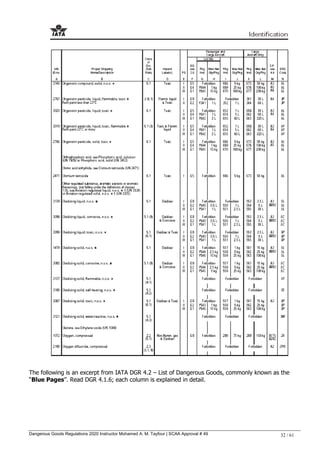
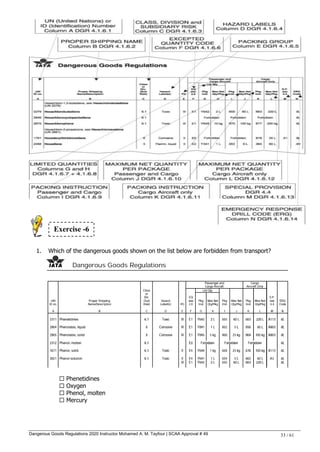
The following is an excerpt from IATA DGR 4.2 – List of Dangerous Goods, commonly known as the
―Blue Pages‖. Read DGR 4.1.6; each column is explained in detail.
Dangerous Goods Regulations 2020 Instructor Mohamed A. M. Tayfour | SCAA Approval # 49 33 / 61
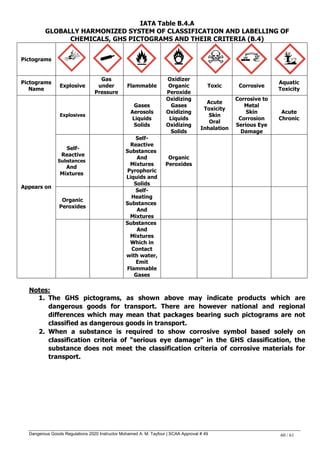
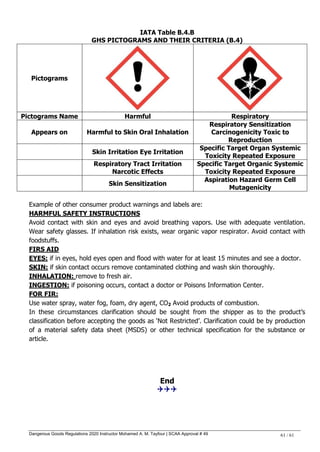
1. Which of the dangerous goods shown on the list below are forbidden from transport?
 Phenetidines
 Oxygen
 Phenol, molten
 Mercury
Exercise -6
Dangerous Goods Regulations 2020 Instructor Mohamed A. M. Tayfour | SCAA Approval # 49 34 / 61
SECTION 5 — MARKING and LABELING
5.1 MARKING
For each package and overpack containing dangerous goods that requires marking, the shipper
must:
1. check that the required marking is applied in the correct locations on the package and
that it meets the quality and specification requirements of the Regulations;
2. ensure that where specification packaging is required, the specification markings are as
specified;
3. remove or obliterate any irrelevant marking;
4. Ensure that all of the required markings have been applied when the package is
presented to the operator.
5.1.1 There are two types of Markings:
1. Packaging use markings (P.U.M)
2. Package specification markings (P.S.M)
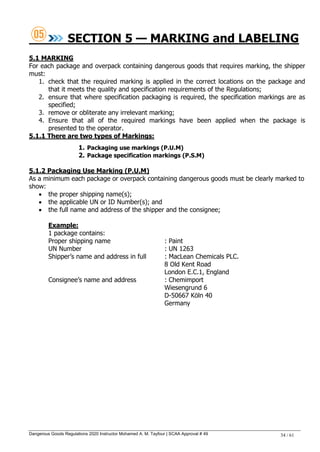
5.1.2 Packaging Use Marking (P.U.M)
As a minimum each package or overpack containing dangerous goods must be clearly marked to
show:
 the proper shipping name(s);
 the applicable UN or ID Number(s); and
 the full name and address of the shipper and the consignee;
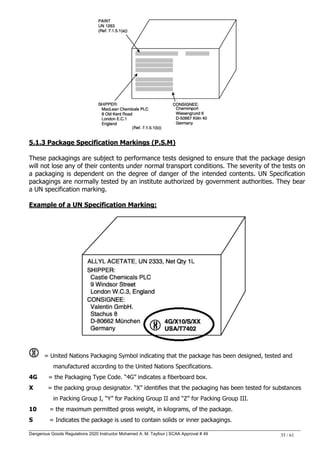
Example:
1 package contains:
Proper shipping name : Paint
UN Number : UN 1263
Shipper‘s name and address in full : MacLean Chemicals PLC.
8 Old Kent Road
London E.C.1, England
Consignee‘s name and address : Chemimport
Wiesengrund 6
D-50667 Köln 40
Germany
Dangerous Goods Regulations 2020 Instructor Mohamed A. M. Tayfour | SCAA Approval # 49 35 / 61
5.1.3 Package Specification Markings (P.S.M)
These packagings are subject to performance tests designed to ensure that the package design
will not lose any of their contents under normal transport conditions. The severity of the tests on
a packaging is dependent on the degree of danger of the intended contents. UN Specification
packagings are normally tested by an institute authorized by government authorities. They bear
a UN specification marking.
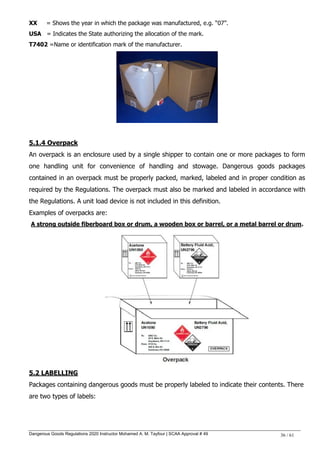
Example of a UN Specification Marking:
= United Nations Packaging Symbol indicating that the package has been designed, tested and
manufactured according to the United Nations Specifications.
4G = the Packaging Type Code. ―4G‖ indicates a fiberboard box.
X = the packing group designator. ―X‖ identifies that the packaging has been tested for substances
in Packing Group I, ―Y‖ for Packing Group II and ―Z‖ for Packing Group III.
10 = the maximum permitted gross weight, in kilograms, of the package.
S = Indicates the package is used to contain solids or inner packagings.
Dangerous Goods Regulations 2020 Instructor Mohamed A. M. Tayfour | SCAA Approval # 49 36 / 61
XX = Shows the year in which the package was manufactured, e.g. ―07‖.
USA = Indicates the State authorizing the allocation of the mark.
T7402 =Name or identification mark of the manufacturer.
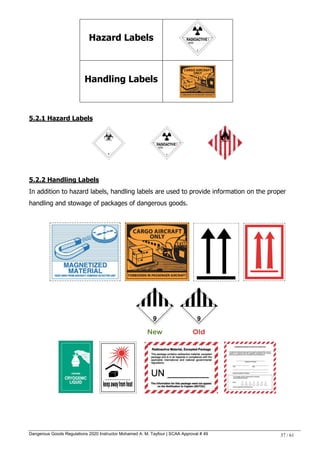
5.1.4 Overpack
An overpack is an enclosure used by a single shipper to contain one or more packages to form
one handling unit for convenience of handling and stowage. Dangerous goods packages
contained in an overpack must be properly packed, marked, labeled and in proper condition as
required by the Regulations. The overpack must also be marked and labeled in accordance with
the Regulations. A unit load device is not included in this definition.
Examples of overpacks are:
A strong outside fiberboard box or drum, a wooden box or barrel, or a metal barrel or drum.
5.2 LABELLING
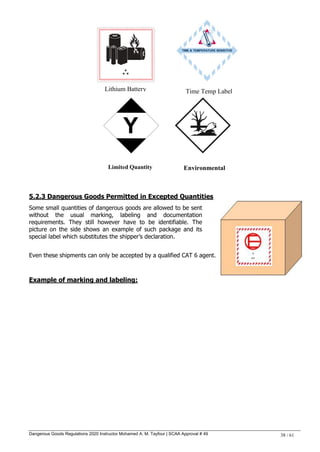
Packages containing dangerous goods must be properly labeled to indicate their contents. There
are two types of labels:
Dangerous Goods Regulations 2020 Instructor Mohamed A. M. Tayfour | SCAA Approval # 49 37 / 61
Hazard Labels
Handling Labels
5.2.1 Hazard Labels
5.2.2 Handling Labels
In addition to hazard labels, handling labels are used to provide information on the proper
handling and stowage of packages of dangerous goods.
Dangerous Goods Regulations 2020 Instructor Mohamed A. M. Tayfour | SCAA Approval # 49 38 / 61
5.2.3 Dangerous Goods Permitted in Excepted Quantities
Some small quantities of dangerous goods are allowed to be sent
without the usual marking, labeling and documentation
requirements. They still however have to be identifiable. The
picture on the side shows an example of such package and its
special label which substitutes the shipper‘s declaration.
Even these shipments can only be accepted by a qualified CAT 6 agent.
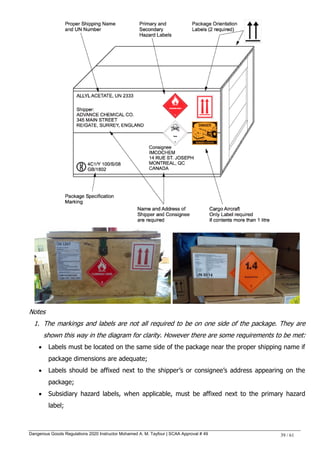
Example of marking and labeling:
Lithium Battery Time Temp Label
Limited Quantity Environmental
Dangerous Goods Regulations 2020 Instructor Mohamed A. M. Tayfour | SCAA Approval # 49 39 / 61
Notes
1. The markings and labels are not all required to be on one side of the package. They are
shown this way in the diagram for clarity. However there are some requirements to be met:
 Labels must be located on the same side of the package near the proper shipping name if
package dimensions are adequate;
 Labels should be affixed next to the shipper‘s or consignee‘s address appearing on the
package;
 Subsidiary hazard labels, when applicable, must be affixed next to the primary hazard
label;
Dangerous Goods Regulations 2020 Instructor Mohamed A. M. Tayfour | SCAA Approval # 49 40 / 61
 When a ―Cargo Aircraft Only‖ label is required, it must be affixed on the same surface of
the package near the hazard label(s);
 When package orientation ―This Way Up‖ labels are required, at least two of these labels
must be used. One label must be affixed to each of two opposite sides of the package,
with the arrows pointing in the correct direction;
 When a package requires the net quantity or gross weight of the dangerous goods to be
shown, it must be indicated adjacent to the UN number and proper shipping name.
2. Due to the size of packages it is not always possible to meet these requirements in full.
Note the use of ‗must‘ (mandatory) and ‗should‘ (optional).
UN specification markings are made independently by the manufacturer or testing agency and
may appear on a different side.
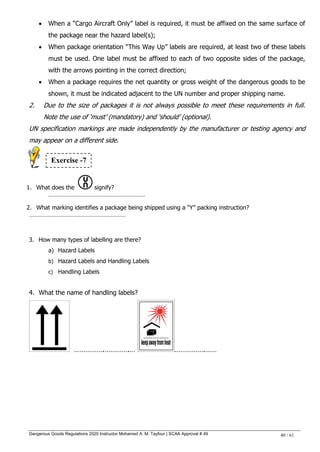
1. What does the signify?
……………………………………………………
2. What marking identifies a package being shipped using a ―Y‖ packing instruction?
……………………………………………………
3. How many types of labelling are there?
a) Hazard Labels
b) Hazard Labels and Handling Labels
c) Handling Labels
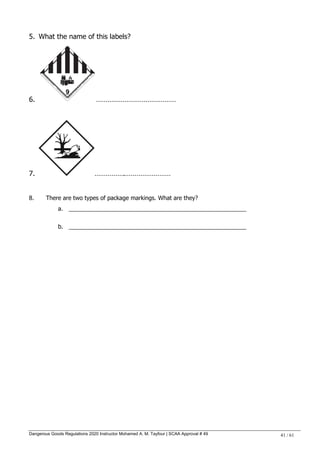
4. What the name of handling labels?
…………….………….… …………….……
Exercise -7
Dangerous Goods Regulations 2020 Instructor Mohamed A. M. Tayfour | SCAA Approval # 49 41 / 61
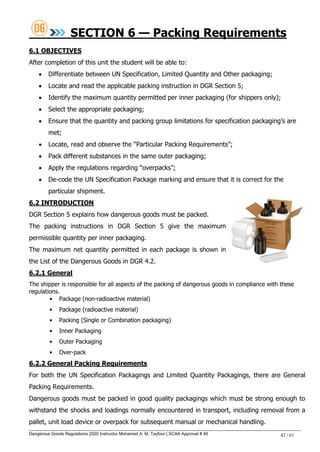
5. What the name of this labels?
6. ……………………………………
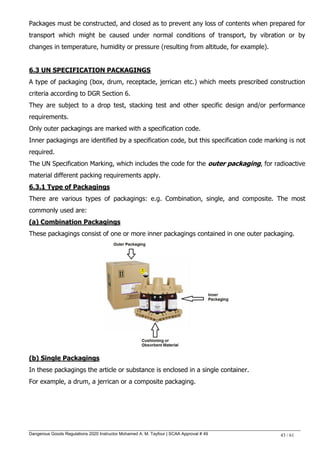
7. …………….……………………
8. There are two types of package markings. What are they?
a. _______________________________________________________
b. _______________________________________________________
Dangerous Goods Regulations 2020 Instructor Mohamed A. M. Tayfour | SCAA Approval # 49 42 / 61
SECTION 6 — Packing Requirements
6.1 OBJECTIVES
After completion of this unit the student will be able to:
 Differentiate between UN Specification, Limited Quantity and Other packaging;
 Locate and read the applicable packing instruction in DGR Section 5;
 Identify the maximum quantity permitted per inner packaging (for shippers only);
 Select the appropriate packaging;
 Ensure that the quantity and packing group limitations for specification packaging‘s are
met;
 Locate, read and observe the ―Particular Packing Requirements‖;
 Pack different substances in the same outer packaging;
 Apply the regulations regarding ―overpacks‖;
 De-code the UN Specification Package marking and ensure that it is correct for the
particular shipment.
6.2 INTRODUCTION
DGR Section 5 explains how dangerous goods must be packed.
The packing instructions in DGR Section 5 give the maximum
permissible quantity per inner packaging.
The maximum net quantity permitted in each package is shown in
the List of the Dangerous Goods in DGR 4.2.
6.2.1 General
The shipper is responsible for all aspects of the packing of dangerous goods in compliance with these
regulations.
• Package (non-radioactive material)
• Package (radioactive material)
• Packing (Single or Combination packaging)
• Inner Packaging
• Outer Packaging
• Over-pack
6.2.2 General Packing Requirements
For both the UN Specification Packagings and Limited Quantity Packagings, there are General
Packing Requirements.
Dangerous goods must be packed in good quality packagings which must be strong enough to
withstand the shocks and loadings normally encountered in transport, including removal from a
pallet, unit load device or overpack for subsequent manual or mechanical handling.
Dangerous Goods Regulations 2020 Instructor Mohamed A. M. Tayfour | SCAA Approval # 49 43 / 61
Packages must be constructed, and closed as to prevent any loss of contents when prepared for
transport which might be caused under normal conditions of transport, by vibration or by
changes in temperature, humidity or pressure (resulting from altitude, for example).
6.3 UN SPECIFICATION PACKAGINGS
A type of packaging (box, drum, receptacle, jerrican etc.) which meets prescribed construction
criteria according to DGR Section 6.
They are subject to a drop test, stacking test and other specific design and/or performance
requirements.
Only outer packagings are marked with a specification code.
Inner packagings are identified by a specification code, but this specification code marking is not
required.
The UN Specification Marking, which includes the code for the outer packaging, for radioactive
material different packing requirements apply.
6.3.1 Type of Packagings
There are various types of packagings: e.g. Combination, single, and composite. The most
commonly used are:
(a) Combination Packagings
These packagings consist of one or more inner packagings contained in one outer packaging.
(b) Single Packagings
In these packagings the article or substance is enclosed in a single container.
For example, a drum, a jerrican or a composite packaging.
Dangerous Goods Regulations 2020 Instructor Mohamed A. M. Tayfour | SCAA Approval # 49 44 / 61
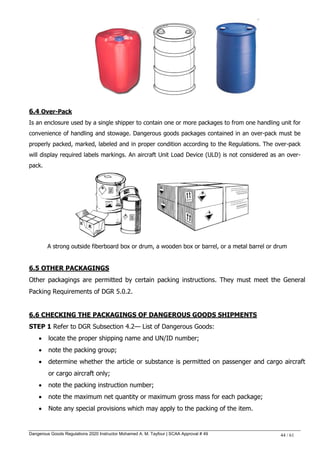
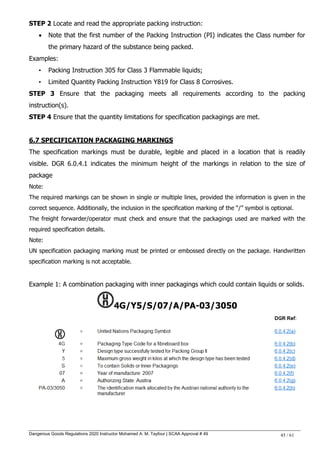
6.4 Over-Pack
Is an enclosure used by a single shipper to contain one or more packages to from one handling unit for
convenience of handling and stowage. Dangerous goods packages contained in an over-pack must be
properly packed, marked, labeled and in proper condition according to the Regulations. The over-pack
will display required labels markings. An aircraft Unit Load Device (ULD) is not considered as an over-
pack.
A strong outside fiberboard box or drum, a wooden box or barrel, or a metal barrel or drum
6.5 OTHER PACKAGINGS
Other packagings are permitted by certain packing instructions. They must meet the General
Packing Requirements of DGR 5.0.2.
6.6 CHECKING THE PACKAGINGS OF DANGEROUS GOODS SHIPMENTS
STEP 1 Refer to DGR Subsection 4.2— List of Dangerous Goods:
 locate the proper shipping name and UN/ID number;
 note the packing group;
 determine whether the article or substance is permitted on passenger and cargo aircraft
or cargo aircraft only;
 note the packing instruction number;
 note the maximum net quantity or maximum gross mass for each package;
 Note any special provisions which may apply to the packing of the item.
Dangerous Goods Regulations 2020 Instructor Mohamed A. M. Tayfour | SCAA Approval # 49 45 / 61
STEP 2 Locate and read the appropriate packing instruction:
 Note that the first number of the Packing Instruction (PI) indicates the Class number for
the primary hazard of the substance being packed.
Examples:
• Packing Instruction 305 for Class 3 Flammable liquids;
• Limited Quantity Packing Instruction Y819 for Class 8 Corrosives.
STEP 3 Ensure that the packaging meets all requirements according to the packing
instruction(s).
STEP 4 Ensure that the quantity limitations for specification packagings are met.
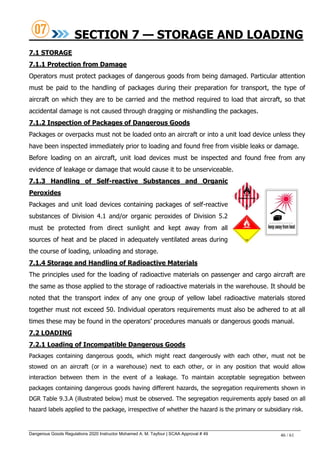
6.7 SPECIFICATION PACKAGING MARKINGS
The specification markings must be durable, legible and placed in a location that is readily
visible. DGR 6.0.4.1 indicates the minimum height of the markings in relation to the size of
package
Note:
The required markings can be shown in single or multiple lines, provided the information is given in the
correct sequence. Additionally, the inclusion in the specification marking of the ―/‖ symbol is optional.
The freight forwarder/operator must check and ensure that the packagings used are marked with the
required specification details.
Note:
UN specification packaging marking must be printed or embossed directly on the package. Handwritten
specification marking is not acceptable.
Example 1: A combination packaging with inner packagings which could contain liquids or solids.
4G/Y5/S/07/A/PA-03/3050
Dangerous Goods Regulations 2020 Instructor Mohamed A. M. Tayfour | SCAA Approval # 49 46 / 61
SECTION 7 — STORAGE AND LOADING
7.1 STORAGE
7.1.1 Protection from Damage
Operators must protect packages of dangerous goods from being damaged. Particular attention
must be paid to the handling of packages during their preparation for transport, the type of
aircraft on which they are to be carried and the method required to load that aircraft, so that
accidental damage is not caused through dragging or mishandling the packages.
7.1.2 Inspection of Packages of Dangerous Goods
Packages or overpacks must not be loaded onto an aircraft or into a unit load device unless they
have been inspected immediately prior to loading and found free from visible leaks or damage.
Before loading on an aircraft, unit load devices must be inspected and found free from any
evidence of leakage or damage that would cause it to be unserviceable.
7.1.3 Handling of Self-reactive Substances and Organic
Peroxides
Packages and unit load devices containing packages of self-reactive
substances of Division 4.1 and/or organic peroxides of Division 5.2
must be protected from direct sunlight and kept away from all
sources of heat and be placed in adequately ventilated areas during
the course of loading, unloading and storage.
7.1.4 Storage and Handling of Radioactive Materials
The principles used for the loading of radioactive materials on passenger and cargo aircraft are
the same as those applied to the storage of radioactive materials in the warehouse. It should be
noted that the transport index of any one group of yellow label radioactive materials stored
together must not exceed 50. Individual operators requirements must also be adhered to at all
times these may be found in the operators‘ procedures manuals or dangerous goods manual.
7.2 LOADING
7.2.1 Loading of Incompatible Dangerous Goods
Packages containing dangerous goods, which might react dangerously with each other, must not be
stowed on an aircraft (or in a warehouse) next to each other, or in any position that would allow
interaction between them in the event of a leakage. To maintain acceptable segregation between
packages containing dangerous goods having different hazards, the segregation requirements shown in
DGR Table 9.3.A (illustrated below) must be observed. The segregation requirements apply based on all
hazard labels applied to the package, irrespective of whether the hazard is the primary or subsidiary risk.
Dangerous Goods Regulations 2020 Instructor Mohamed A. M. Tayfour | SCAA Approval # 49 47 / 61
The extent to which explosives may be stowed together in an aircraft is determined by their
―compatibility‖. Explosives are considered to be compatible if they can be stowed together without
significantly increasing either the probability of an accident or, for a given quantity, the magnitude of the
effects of such an accident. Compatibility Group criteria are found in DGR Table 3.1.A. Full details of the
loading restrictions are shown in DGR 9.3.2.2.2.
Only explosives in Division 1.4, compatibility group S, are permitted to be transported on passenger
aircraft. Only the following explosives may be transported on a cargo aircraft:
 Division 1.3 Compatibility groups C, G;
 Division 1.4 Compatibility groups B, C, D, E, G, S.
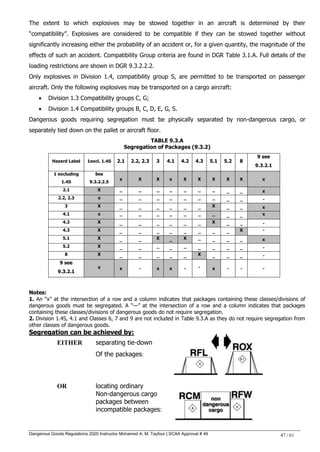
Dangerous goods requiring segregation must be physically separated by non-dangerous cargo, or
separately tied down on the pallet or aircraft floor.
TABLE 9.3.A
Segregation of Packages (9.3.2)
Hazard Label 1excl. 1.4S 2.1 2.2, 2.3 3 4.1 4.2 4.3 5.1 5.2 8
9 see
9.3.2.1
1 excluding
1.4S
See
9.3.2.2.5
x X X x X X X X X x
2.1 X _ _ _ _ _ _ _ _ _ x
2.2, 2.3 x _ _ _ _ _ _ _ _ _ -
3 X _ _ _ _ _ _ X _ _ x
4.1 x _ _ _ _ _ _ _ _ _ x
4.2 X _ _ _ _ _ _ X _ _ -
4.3 X _ _ _ _ _ _ _ _ X -
5.1 X _ _ X _ X _ _ _ _ x
5.2 X _ _ _ _ _ _ _ _ _ -
8 X _ _ _ _ _ X _ _ _ -
9 see
9.3.2.1
x x - x x - - x - - -
Notes:
1. An ―x‖ at the intersection of a row and a column indicates that packages containing these classes/divisions of
dangerous goods must be segregated. A ―—‖ at the intersection of a row and a column indicates that packages
containing these classes/divisions of dangerous goods do not require segregation.
2. Division 1.4S, 4.1 and Classes 6, 7 and 9 are not included in Table 9.3.A as they do not require segregation from
other classes of dangerous goods.
Segregation can be achieved by:
OR locating ordinary
Non-dangerous cargo
packages between
incompatible packages:
EITHER separating tie-down
Of the packages:
Dangerous Goods Regulations 2020 Instructor Mohamed A. M. Tayfour | SCAA Approval # 49 48 / 61
7.3 Loading on Cargo Aircraft
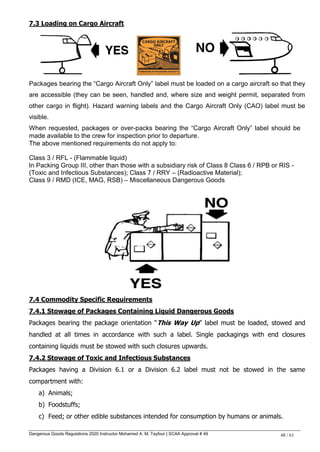
Packages bearing the “Cargo Aircraft Only” label must be loaded on a cargo aircraft so that they
are accessible (they can be seen, handled and, where size and weight permit, separated from
other cargo in flight). Hazard warning labels and the Cargo Aircraft Only (CAO) label must be
visible.
When requested, packages or over-packs bearing the “Cargo Aircraft Only” label should be
made available to the crew for inspection prior to departure.
The above mentioned requirements do not apply to:
Class 3 / RFL - (Flammable liquid)
In Packing Group III, other than those with a subsidiary risk of Class 8 Class 6 / RPB or RIS -
(Toxic and Infectious Substances); Class 7 / RRY – (Radioactive Material);
Class 9 / RMD (ICE, MAG, RSB) – Miscellaneous Dangerous Goods
7.4 Commodity Specific Requirements
7.4.1 Stowage of Packages Containing Liquid Dangerous Goods
Packages bearing the package orientation ―This Way Up‖ label must be loaded, stowed and
handled at all times in accordance with such a label. Single packagings with end closures
containing liquids must be stowed with such closures upwards.
7.4.2 Stowage of Toxic and Infectious Substances
Packages having a Division 6.1 or a Division 6.2 label must not be stowed in the same
compartment with:
a) Animals;
b) Foodstuffs;
c) Feed; or other edible substances intended for consumption by humans or animals.
Dangerous Goods Regulations 2020 Instructor Mohamed A. M. Tayfour | SCAA Approval # 49 49 / 61
Except where:
 the dangerous goods are loaded in one closed unit load device and the foodstuffs or
animals are loaded in another closed unit load device; or
 Where open unit load devices are used, the ULD‘s must not be stowed adjacent to each
other.
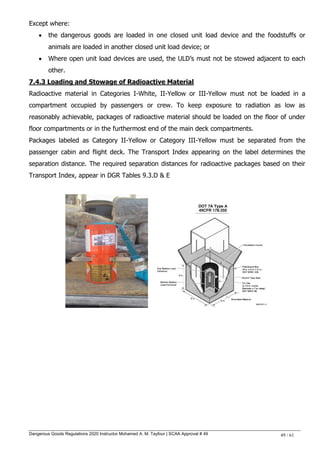
7.4.3 Loading and Stowage of Radioactive Material
Radioactive material in Categories I-White, II-Yellow or III-Yellow must not be loaded in a
compartment occupied by passengers or crew. To keep exposure to radiation as low as
reasonably achievable, packages of radioactive material should be loaded on the floor of under
floor compartments or in the furthermost end of the main deck compartments.
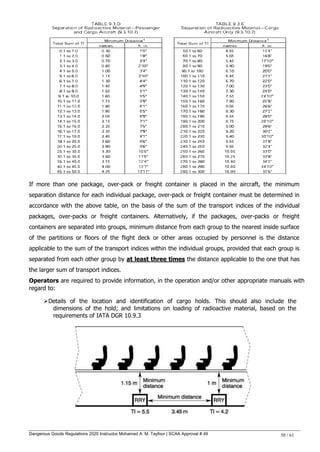
Packages labeled as Category II-Yellow or Category III-Yellow must be separated from the
passenger cabin and flight deck. The Transport Index appearing on the label determines the
separation distance. The required separation distances for radioactive packages based on their
Transport Index, appear in DGR Tables 9.3.D & E
Dangerous Goods Regulations 2020 Instructor Mohamed A. M. Tayfour | SCAA Approval # 49 50 / 61
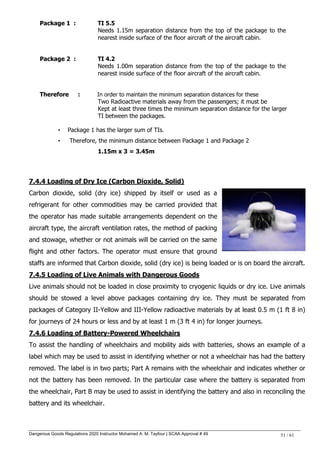
If more than one package, over-pack or freight container is placed in the aircraft, the minimum
separation distance for each individual package, over-pack or freight container must be determined in
accordance with the above table, on the basis of the sum of the transport indices of the individual
packages, over-packs or freight containers. Alternatively, if the packages, over-packs or freight
containers are separated into groups, minimum distance from each group to the nearest inside surface
of the partitions or floors of the flight deck or other areas occupied by personnel is the distance
applicable to the sum of the transport indices within the individual groups, provided that each group is
separated from each other group by at least three times the distance applicable to the one that has
the larger sum of transport indices.
Operators are required to provide information, in the operation and/or other appropriate manuals with
regard to:
Details of the location and identification of cargo holds. This should also include the
dimensions of the hold; and limitations on loading of radioactive material, based on the
requirements of IATA DGR 10.9.3
Dangerous Goods Regulations 2020 Instructor Mohamed A. M. Tayfour | SCAA Approval # 49 51 / 61
Package 1 : TI 5.5
Needs 1.15m separation distance from the top of the package to the
nearest inside surface of the floor aircraft of the aircraft cabin.
Package 2 : TI 4.2
Needs 1.00m separation distance from the top of the package to the
nearest inside surface of the floor aircraft of the aircraft cabin.
Therefore : In order to maintain the minimum separation distances for these
Two Radioactive materials away from the passengers; it must be
Kept at least three times the minimum separation distance for the larger
TI between the packages.
• Package 1 has the larger sum of TIs.
• Therefore, the minimum distance between Package 1 and Package 2
1.15m x 3 = 3.45m
7.4.4 Loading of Dry Ice (Carbon Dioxide, Solid)
Carbon dioxide, solid (dry ice) shipped by itself or used as a
refrigerant for other commodities may be carried provided that
the operator has made suitable arrangements dependent on the
aircraft type, the aircraft ventilation rates, the method of packing
and stowage, whether or not animals will be carried on the same
flight and other factors. The operator must ensure that ground
staffs are informed that Carbon dioxide, solid (dry ice) is being loaded or is on board the aircraft.
7.4.5 Loading of Live Animals with Dangerous Goods
Live animals should not be loaded in close proximity to cryogenic liquids or dry ice. Live animals
should be stowed a level above packages containing dry ice. They must be separated from
packages of Category II-Yellow and III-Yellow radioactive materials by at least 0.5 m (1 ft 8 in)
for journeys of 24 hours or less and by at least 1 m (3 ft 4 in) for longer journeys.
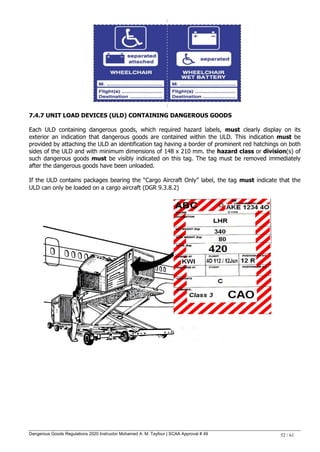
7.4.6 Loading of Battery-Powered Wheelchairs
To assist the handling of wheelchairs and mobility aids with batteries, shows an example of a
label which may be used to assist in identifying whether or not a wheelchair has had the battery
removed. The label is in two parts; Part A remains with the wheelchair and indicates whether or
not the battery has been removed. In the particular case where the battery is separated from
the wheelchair, Part B may be used to assist in identifying the battery and also in reconciling the
battery and its wheelchair.
Dangerous Goods Regulations 2020 Instructor Mohamed A. M. Tayfour | SCAA Approval # 49 52 / 61
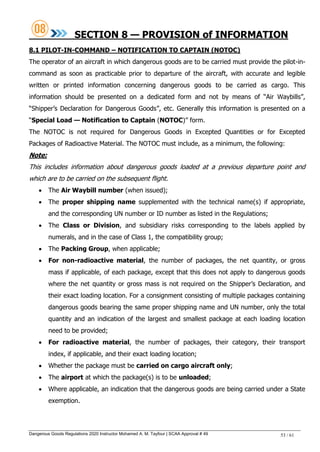
7.4.7 UNIT LOAD DEVICES (ULD) CONTAINING DANGEROUS GOODS
Each ULD containing dangerous goods, which required hazard labels, must clearly display on its
exterior an indication that dangerous goods are contained within the ULD. This indication must be
provided by attaching the ULD an identification tag having a border of prominent red hatchings on both
sides of the ULD and with minimum dimensions of 148 x 210 mm. the hazard class or division(s) of
such dangerous goods must be visibly indicated on this tag. The tag must be removed immediately
after the dangerous goods have been unloaded.
If the ULD contains packages bearing the ―Cargo Aircraft Only‖ label, the tag must indicate that the
ULD can only be loaded on a cargo aircraft (DGR 9.3.8.2)
Dangerous Goods Regulations 2020 Instructor Mohamed A. M. Tayfour | SCAA Approval # 49 53 / 61
SECTION 8 — PROVISION of INFORMATION
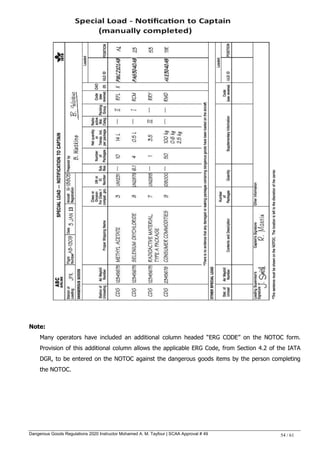
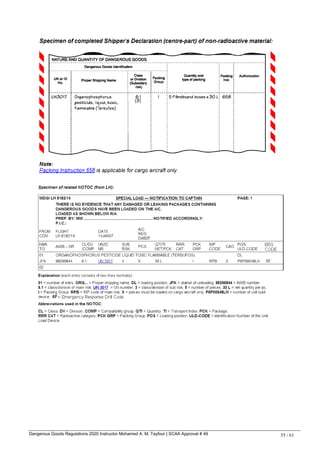
8.1 PILOT-IN-COMMAND – NOTIFICATION TO CAPTAIN (NOTOC)
The operator of an aircraft in which dangerous goods are to be carried must provide the pilot-in-
command as soon as practicable prior to departure of the aircraft, with accurate and legible
written or printed information concerning dangerous goods to be carried as cargo. This
information should be presented on a dedicated form and not by means of ―Air Waybills‖,
―Shipper‘s Declaration for Dangerous Goods‖, etc. Generally this information is presented on a
―Special Load — Notification to Captain (NOTOC)‖ form.
The NOTOC is not required for Dangerous Goods in Excepted Quantities or for Excepted
Packages of Radioactive Material. The NOTOC must include, as a minimum, the following:
Note:
This includes information about dangerous goods loaded at a previous departure point and
which are to be carried on the subsequent flight.
 The Air Waybill number (when issued);
 The proper shipping name supplemented with the technical name(s) if appropriate,
and the corresponding UN number or ID number as listed in the Regulations;
 The Class or Division, and subsidiary risks corresponding to the labels applied by
numerals, and in the case of Class 1, the compatibility group;
 The Packing Group, when applicable;
 For non-radioactive material, the number of packages, the net quantity, or gross
mass if applicable, of each package, except that this does not apply to dangerous goods
where the net quantity or gross mass is not required on the Shipper‘s Declaration, and
their exact loading location. For a consignment consisting of multiple packages containing
dangerous goods bearing the same proper shipping name and UN number, only the total
quantity and an indication of the largest and smallest package at each loading location
need to be provided;
 For radioactive material, the number of packages, their category, their transport
index, if applicable, and their exact loading location;
 Whether the package must be carried on cargo aircraft only;
 The airport at which the package(s) is to be unloaded;
 Where applicable, an indication that the dangerous goods are being carried under a State
exemption.
Dangerous Goods Regulations 2020 Instructor Mohamed A. M. Tayfour | SCAA Approval # 49 54 / 61
Note:
Many operators have included an additional column headed ―ERG CODE‖ on the NOTOC form.
Provision of this additional column allows the applicable ERG Code, from Section 4.2 of the IATA
DGR, to be entered on the NOTOC against the dangerous goods items by the person completing
the NOTOC.
Dangerous Goods Regulations 2020 Instructor Mohamed A. M. Tayfour | SCAA Approval # 49 55 / 61
Dangerous Goods Regulations 2020 Instructor Mohamed A. M. Tayfour | SCAA Approval # 49 56 / 61
SECTION 9 — Dangerous Goods Emergency Response
9.1 INTRODUCTION
Emergency procedures must be available wherever dangerous goods are handled. ICAO Annex
14 – Aerodromes, Chapter 9 – Emergency and Other Services, requires that procedures be
established by airport authorities to deal with emergencies involving dangerous goods. In
addition, requires that operators provide information to flight crew and other employees, in the
operator‘s operations or other appropriate manuals, on the action to be taken in the event of
emergencies involving dangerous goods.
An example of emergency information for flight crew in relation to dangerous goods is the ICAO
publication Emergency Response Guidance for Aircraft Incidents Involving Dangerous Goods
(Doc 9481-AN/928), generally referred to as the ―red book‖.
Emergency response training is required for all categories of personnel, as specified in DGR
Table 1.5.A. The following basic procedures are given as an example.
It is important that you are familiar with your local requirements and are aware of all emergency
contacts.
9.2 Legal Responsibilities
Both the operator and you have a legal responsibility to take all reasonable emergency
measures to reduce or eliminate any danger to public safety as soon as possible in
circumstances that result or may result from accidental release of dangerous goods. It is very
important that the proper procedures be applied.
9.3 Dangerous Goods Emergency Response Information
It is the responsibility of the operator to ensure
that whenever dangerous goods are handled or
transported on board an aircraft that appropriate
information is immediately available at all times
for use in emergency response to accidents and
incidents. This information must be available to
the pilot-in-command and can be provided by:
ICAO publication Emergency Response Guidance for Aircraft Incidents Involving
Dangerous Goods (Doc 9481-AN/928), generally referred to as the ―red book‖.
Dangerous Goods Regulations 2020 Instructor Mohamed A. M. Tayfour | SCAA Approval # 49 57 / 61
9.4 General procedures
The general procedures are to be followed which comprises of the following:
 Notify immediate supervisor first and get professional assistance
 Identify the dangerous goods (if safe to do so)
 Where safe to do so, isolate the package by removing other package or property
 Avoid contact with the contents of the package
Staff involved in such incidents should stay on site until their names are noted.
If the contents come in contact with your body or cloths:
 Thoroughly wash off your body with plenty of water,
 Remove contaminated clothing,
 Do not eat or smoke
 Keep hands away from eyes, mouth and nose,
 Seek medical assistance.
9.5 Reporting of Incidents and Accidents
In the event of:
1. an aircraft accident; or
2. serious incident, where dangerous goods carried as cargo may be involved,
the operator of the aircraft carrying dangerous goods as cargo must provide information,
without delay, to emergency services responding to the accident or serious incident about the
dangerous goods on board, as shown on the information to the pilot-in-command. As soon as
possible, the operator must also provide this information to the appropriate authorities of the
State of the Operator and the State in which the accident or serious incident occurred.
9.6.2 Reporting of Undeclared or Mis-declared Dangerous Goods
An operator must report any occasion when undeclared or mis-declared dangerous goods are
discovered in cargo. Such a report must be made to the appropriate authorities of the State of
the operator and the State in which this occurred. An operator must also report any occasion
when dangerous goods not permitted under DGR Section 2.3 are discovered in passengers‘
baggage. Such a report must be made to the appropriate authority of the State in which this
occurred.
Dangerous Goods Regulations 2020 Instructor Mohamed A. M. Tayfour | SCAA Approval # 49 58 / 61
9.7 Dangerous Goods Emergency Response Chart (Ground Incidents)
Hazard Class /
Division and
Compatibility
Group
Dangerous Goods
Class
Hazard Description
Immediate Action
Minimize leakage and
contact with other
cargo
1.3C
1.3G
Explosives
(acceptable on
Cargo Aircraft only)
Fire and minor blast
hazard and/or minor
propulsive hazard  Notify Fire
Department
 Guard against fire
1.4B , 1.4C ,
1.4D , 1.4E ,
1.4G
Fire, but no other
significant hazard
1.4S Explosives (safety) Small fire hazard
2.1
2.2
2.2
2.3
Flammable Gas
Non-Flammable Gas
Cryogenic Liquid
Ignites when leaking
High pressure cylinder
bursting
Sub cooling
 Notify Fire
Department
 Guard against fire
 Evacuate goods –
ventilate area
 Keep away
minimum 25 m
Toxic Gas
(acceptable on Cargo
Aircraft only)
High pressure cylinder
bursting and toxic
inhalation
3 Flammable Liquid Gives off flammable
vapour
 Notify Fire
Department
 Guard against fire
 Do NOT use water
under any
circumstances
4.1
4.2
4.3
Flammable Solid
Spontaneously
Combustible
Dangerous when wet
Combustible, contributes
to fire
Ignites in contact with air
Ignites in Contact with
water
5.1
5.2
Oxidizer
Organic Peroxide
Ignites combustibles on
contact
Reacts violently with other
substances
 Notify Fire
Department
 Guard against fire
 Do NOT use water
6.1
6.2
Toxic Substance
Infectious Substance
Harmful if swallowed,
inhaled or
in contact with skin
Causes disease in Humans
and Animals
 Isolate area
 Obtain qualified
assistance
 Do NOT touch
 Keep away minimum
25 m
7 Cat
I/II/III
Radioactive – White
Radioactive – Yellow
Radiation hazards and
harmful to health
8 Corrosive Hazardous to skin
and metal
 Notify Fire
Department
 Guard against fire
 Avoid contact with
skin
9 Polymeric Beads
Magnetized Material
Carbon dioxide, solid
(Dry Ice)
Miscellaneous
Dangerous
Goods
Evolves small quantities of
flammable gas
Affects navigation system
Causes sub
cooling/suffocation
Hazards not covered by
other classes
 Avoid contact with
skin
 No immediate action
required
Dangerous Goods Regulations 2020 Instructor Mohamed A. M. Tayfour | SCAA Approval # 49 59 / 61
9.8 IATA Dangerous Goods Occurrence Report Form
The form shown below as per IATA DGR figure 9.6.A is a standard form which is in use in
many parts of the world and may be used where the reporting format has not been specified
by the appropriate authority. In addition it is recommended that this format be used when
reporting incidents to another operator.
Dangerous Goods Occurrence Report:
The initial report must contain all the information known at the time it is complied, including:
• The date, location, flight number and flight date (when these are applicable).
• The reference number of the air waybill, pouch, baggage tag, ticket…etc.
• A description of the goods, including the proper shipping name and un number
(when applicable), class/division and any subsidiary risk;
• The type of packaging and the packaging specification marking (when these
are applicable) and quantity involved;
• The name and address of shipper, passenger, etc…
• The suspected cause of the accident or incident;
• The action taken, if any;
• Any other reporting action taken;
• Any other relevant details;
• The name, title, address and contact number of the person making the report. Copies
of the relevant documents and any photographs taken must be attached to the
report.
IATA DGR 9.6.1 requires that an operator report dangerous goods accidents and incidents to
the appropriate authority of the State of the operator and the State in which the accident or
incident occurred.
Note:
Individual States may require other reporting formats and carriers must ensure that they follow
local national protocols as appropriate.
Dangerous Goods Regulations 2020 Instructor Mohamed A. M. Tayfour | SCAA Approval # 49 60 / 61
IATA Table B.4.A
GLOBALLY HARMONIZED SYSTEM OF CLASSIFICATION AND LABELLING OF
CHEMICALS, GHS PICTOGRAMS AND THEIR CRITERIA (B.4)
Pictograms
Pictograms
Name
Explosive
Gas
under
Pressure
Flammable
Oxidizer
Organic
Peroxide
Toxic Corrosive
Aquatic
Toxicity
Appears on
Explosives
Gases
Aerosols
Liquids
Solids
Oxidizing
Gases
Oxidizing
Liquids
Oxidizing
Solids
Acute
Toxicity
Skin
Oral
Inhalation
Corrosive to
Metal
Skin
Corrosion
Serious Eye
Damage
Acute
Chronic
Self-
Reactive
Substances
And
Mixtures
Self-
Reactive
Substances
And
Mixtures
Pyrophoric
Liquids and
Solids
Organic
Peroxides
Organic
Peroxides
Self-
Heating
Substances
And
Mixtures
Substances
And
Mixtures
Which in
Contact
with water,
Emit
Flammable
Gases
Notes:
1. The GHS pictograms, as shown above may indicate products which are
dangerous goods for transport. There are however national and regional
differences which may mean that packages bearing such pictograms are not
classified as dangerous goods in transport.
2. When a substance is required to show corrosive symbol based solely on
classification criteria of ―serious eye damage‖ in the GHS classification, the
substance does not meet the classification criteria of corrosive materials for
transport.
Dangerous Goods Regulations 2020 Instructor Mohamed A. M. Tayfour | SCAA Approval # 49 61 / 61
IATA Table B.4.B
GHS PICTOGRAMS AND THEIR CRITERIA (B.4)
Pictograms
Pictograms Name Harmful Respiratory
Appears on Harmful to Skin Oral Inhalation
Respiratory Sensitization
Carcinogenicity Toxic to
Reproduction
Skin Irritation Eye Irritation
Specific Target Organ Systemic
Toxicity Repeated Exposure
Respiratory Tract Irritation
Narcotic Effects
Specific Target Organic Systemic
Toxicity Repeated Exposure
Skin Sensitization
Aspiration Hazard Germ Cell
Mutagenicity
Example of other consumer product warnings and labels are:
HARMFUL SAFETY INSTRUCTIONS
Avoid contact with skin and eyes and avoid breathing vapors. Use with adequate ventilation.
Wear safety glasses. If inhalation risk exists, wear organic vapor respirator. Avoid contact with
foodstuffs.
FIRS AID
EYES: if in eyes, hold eyes open and flood with water for at least 15 minutes and see a doctor.
SKIN: if skin contact occurs remove contaminated clothing and wash skin thoroughly.
INHALATION: remove to fresh air.
INGESTION: if poisoning occurs, contact a doctor or Poisons Information Center.
FOR FIR:
Use water spray, water fog, foam, dry agent, CO2 Avoid products of combustion.
In these circumstances clarification should be sought from the shipper as to the product‘s
classification before accepting the goods as ‗Not Restricted‘. Clarification could be by production
of a material safety data sheet (MSDS) or other technical specification for the substance or
article.
End


Dangerous goods regulations cat 10

  • 1.
    Dangerous Goods Regulations2020 Instructor Mohamed A. M. Tayfour | SCAA Approval # 49 1 / 61 DANGEROUS GOODS REGULATIONS Flight Crew Members, Load Planners, Load Master, Flight Operations Officer/Flight Dispatcher CAT 10
  • 2.
    Dangerous Goods Regulations2020 Instructor Mohamed A. M. Tayfour | SCAA Approval # 49 2 / 61 TABLE OF CONTENTS  WELCOME MESSAGE ……………………………………………………………4  QUALITY POLICY …………………………………………………………………5  OBJECTIVES …………………………………………………………………………5  SAFETY POLICY ……………………………………………………………………6  Training Method …………………………………………………………………..7  COURSE OBJECTIVES ……………………………………………………………9  Introduction …………………………………………………………………………10 SECTION 1 – APPLICABILITY………………………………………….……………11 - General philosophy - Definition - Legal basis - Shipper‘s responsibility - Operator‘s responsibility - Training requirements - Dangerous goods security - Information to passengers SECTION 2 – LIMITATIONS………………………………………………………..16 - General - Acceptable dangerous goods - Forbidden dangerous goods - Recognition of hidden dangerous goods - Dangerous goods carried by passengers and crew - Dangerous goods in air mail - Dangerous goods in operator's property - State and operator variations SECTION 3 – CLASSIFICATION……………………………………………………22 - General principles - Complete list of classes and divisions SECTION 4 – Identification …………………………………………………………….31 - Selecting Proper Shipping Name - Items Listed by Name - List Of Dangerous Goods
  • 3.
    Dangerous Goods Regulations2020 Instructor Mohamed A. M. Tayfour | SCAA Approval # 49 3 / 61 SECTION 5 - MARKING AND LABELING………………………………………….34 - Marking - Labelling SECTION 6 – PACKING Requirements …………………………………………..41 - General Packing Requirements - UN SPECIFICATION PACKAGINGS - CHECKING THE PACKAGINGS OF DANGEROUS GOODS SHIPMENTS - SPECIFICATION PACKAGING MARKINGS SECTION 7 - STORAGE AND LOADING…………………………………………..45 - General - Storage and handling - Loading - Commodity specific requirements - Unit load devices (ULD) containing dangerous goods SECTION 8 - PROVISION OF INFORMATION…………………………………….52 - Pilot-In-Command – notification to captain (NOTOC) - Information by the pilot-in-command in case of in-flight emergency SECTION 9 - DANGEROUS GOODS EMERGENCY………………………………55 - Introduction - Dangerous Goods Emergency Response Information - Incidents and Accidents - Reporting of Undeclared or Mis-declared Dangerous Goods - Dangerous goods emergency response chart (ground incidents) - IATA Dangerous Goods Occurrence Report - Dangerous Goods Occurrence Report - Globally Harmonized System
  • 4.
    Dangerous Goods Regulations2020 Instructor Mohamed A. M. Tayfour | SCAA Approval # 49 4 / 61 WELCOME MESSAGE Training Department welcomes you to this program. It is our pleasure to be a part on your learning journey and we look forward to helping you realize your true potential. This workbook provides you information that you will need to successfully achieve the learning objectives of this program. This is your copy to encourage you to write on and reinforce the skills and knowledge that have been introduced. Training Department Training Department provides technical and non-technical learning experiences to our employees and outsources alike. The team is located at Training Department. We have a great team of trainers and specialists that are focused on providing you with the best opportunity to learn and practice new skills in a safe environment. The team uses interactive and experiential learning techniques to ensure that participants develop the confidence to apply the new skills and knowledge as soon as they continue to their work places. This training is intended for Passenger Handling Personnel as stated in the IATA Dangerous Goods Manual –Table 1.5.A (Category 10). This workbook is to be used in conjunction with the current IATA DGR Manual to familiarize you with the various sections and how to apply them. It is based on the practical application of the IATA DGR, which include all the requirements of the ICAO Annex 18 and the current edition of the ICAO Technical Instructions. We trust that you will enjoy the program and look forward to any feedback you may have to help us meet our objectives. Happy learning! Training Department
  • 5.
    Dangerous Goods Regulations2020 Instructor Mohamed A. M. Tayfour | SCAA Approval # 49 5 / 61 QUALITY POLICY To achieve sustained and profitable growth by providing services that consistently satisfy the needs and expectations of our internal and external customers. OBJECTIVES  Achieve and maintain a level of quality which enhances the Company.  Reputation and brand with customers.  To ensure compliance with relevant statutory and safety bodies.  To endeavor at all times to maximize the Company market share in all geographies.
  • 6.
    Dangerous Goods Regulations2020 Instructor Mohamed A. M. Tayfour | SCAA Approval # 49 6 / 61 SAFETY POLICY Safety is the first priority in all our activities. We are committed to implementing, developing and improving strategies, management systems and processes to ensure that all our activities uphold the highest level of safety performance and meet national and international standards. Our commitment is to: a. Develop and embed a safety culture in all our aviation activities that recognizes the importance and value of effective safety management and acknowledges at all times that safety is paramount; b. Clearly define for all staff their accountabilities and responsibilities for the development and delivery of the safety strategy and performance; c. Minimize the risks associated with aircraft operations and associated activities to a point that is as low as reasonably practicable/achievable; d. Ensure that externally supplied systems and services that impact the safety of our operations meet appropriate safety standards; e. Actively develop and improve our safety processes to conform to world-class standards; f. Comply with and, wherever possible, exceed legislative and regulatory requirements and standards; g. Ensure that all staff are provided with adequate and appropriate aviation safety information and training, are competent in safety matters and are only allocated tasks commensurate with their skills; h. Ensure that sufficient skilled and trained resources are available to implement safety strategy and policy; i. Establish and measure our safety performance against realistic objectives and/or targets; j. Achieve the highest levels of safety standards and performance in all our aviation activities; k. Continually improve our safety performance; l. Conduct safety and management reviews and ensure that relevant action is taken; m. Ensure that the application of effective aviation safety management systems is integral to all our aviation activities, with the objective of achieving the highest levels of safety standards and performance.
  • 7.
    Dangerous Goods Regulations2020 Instructor Mohamed A. M. Tayfour | SCAA Approval # 49 7 / 61 Training Method  Exercises  Questions  Home Work  Final Assessment Assessment Strategy: To meet the legal requirement, a final test must be undertaken and successfully completed following dangerous goods training to verify understanding of the regulation. Confirmation is required of successful completion of test (IATA DGR 1.5.0.4).  Written exam (open book)  Length of exam (2 hrs.)  Minimum pass mark: 80  Notification of successful completion  Retest procedure  DGR Certificate valid for 2 years  Meets ICAO & IATA Requirements  Recurrent Training within 24 months
  • 8.
    Dangerous Goods Regulations2020 Instructor Mohamed A. M. Tayfour | SCAA Approval # 49 8 / 61 INTENTIONALLY LIFT BLANK
  • 9.
    Dangerous Goods Regulations2020 Instructor Mohamed A. M. Tayfour | SCAA Approval # 49 9 / 61 COURSE OBJECTIVES After thorough study and use of this training workbook the student will:  Be able to identify dangerous goods;  Have knowledge of the origin of the current regulations and be aware of the general philosophy;  Be able to identify the classes of dangerous goods;  Recognize and identify the hazard/handling labels applicable to dangerous goods;  Recognize and identify dangerous goods package use and package specification markings;  Be able to identify the dangerous goods list.  Be able to identify potential hidden hazards in cargo;  Be familiar with loading and storage procedures;  Be familiar with Packing procedures;  Be aware of the provisions for dangerous goods in baggage of passengers and crew;  Information by the pilot-in-command in case of in-flight emergency  Be familiar with emergency procedures.
  • 10.
    Dangerous Goods Regulations2020 Instructor Mohamed A. M. Tayfour | SCAA Approval # 49 10 / 61 INTRODUCTION IATA Dangerous Goods Regulations This training is for the Flight crew members, load planners and Flight Operations Officer/Flight Dispatcher (Categories 10 from the IATA DGR Table 1.5A). This manual is designed to be used in conjunction with the IATA DGR to familiarize you with the various sections and how to apply them. It is based on the practical application of the IATA DGR, which include all the requirements of the ICAO Annex 18 and current edition of the ICAO Technical Instructions. (ICAO Technical Instructions – Doc. 9284-AN/905) The SUDAN CIVIL AVIATION AUTHORITY (SCAA) has been delegated full authority be the state of Sudan. It has adopted the standard codes issued by the International Civil Aviation Organization (ICAO) concerning the safe transport of dangerous goods.
  • 11.
    Dangerous Goods Regulations2020 Instructor Mohamed A. M. Tayfour | SCAA Approval # 49 11 / 61 SECTION 1 — APPLICABILITY By the end of this section, you will be able to:  Define dangerous goods;  Identify the general principles applicable to the air transport of dangerous goods.  Know the responsibilities of shipper & operator when transporting DG.  Describe the importance of dangerous goods training;  Identify Dangerous goods Security. 1.0 Definition of Dangerous Goods Dangerous goods are articles or substances which are capable of posing a risk to health, safety, property or the environment and which are shown in the list of dangerous goods in these Regulations or which are classified according to these Regulations. 1.1 Basis of the Regulations 1.1.1 The UN Committee of Experts (CoE) develops recommended procedures for the transport of all types of dangerous goods except radioactive materials. These procedures, applicable to all modes of transport, are published in the Recommendations on the Transport of Dangerous Goods. 1.1.2 The International Atomic Energy Agency (IAEA) develops recommended procedures for the safe transport of radioactive materials. These procedures are published in the Regulations for the Safe Transport of Radioactive Material (IAEA TS-R-1). The requirements of these regulations as they pertain to air transport are reflected in Section 10. 1.1.3 The International Civil Aviation Organization (ICAO) has used these recommendations as the basis for developing the regulations for the safe transport of dangerous goods by air. The ICAO regulations are codified in Annex 18 to the Convention on International Civil Aviation and in its Technical Instructions for the Safe Transport of Dangerous Goods by Air (Doc 9284-AN/905 as amended) (Technical Instructions). 1.1.4 The International Air Transport Association (IATA) contains all of the requirements of the Technical Instructions. IATA has included additional requirements, which are more restrictive than the Technical Instructions and reflect industry standard practices or operational considerations. These are identified by the symbol ―‖ in the margin. 1.1.5 Sudan Civil Aviation Authority (SCAA) Regulations for Dangerous Goods SUCAR Part 18, SCAP Part 11 and Sudan Safety ACT 2010 Article 49 and 50.
  • 12.
    Dangerous Goods Regulations2020 Instructor Mohamed A. M. Tayfour | SCAA Approval # 49 12 / 61 1.2 Application of these Regulations 1.2.1 Applicability The IATA Dangerous Goods Regulations are applicable to:  All airlines which are Members or Associate Members of IATA;  All airlines which are party to the IATA Multilateral Interline Traffic Agreement — Cargo; and  All shippers and agents that offer consignments of dangerous goods to these operators. 1.2.2 Exceptions 1.2.2.1 Except for information provided to operator employees, as shown in 9.5.2, the provisions of these Regulations do not apply to dangerous goods carried on an aircraft where the dangerous goods are: (a) To provide medical aid to a patient during flight when those dangerous goods: 1. Have been placed on board with the approval of the operator; or 2. Form part of the permanent equipment of the aircraft when it has been adapted for specialized use; providing that; 3. Gas cylinders have been manufactured specifically for the purpose of containing and transporting that particular gas; 4. Equipment containing wet cell batteries is kept and, when necessary secured, in an upright position to prevent spillage of the electrolyte. 1.2.2.2 Dangerous Goods Packages opened by customs and other Authorities Any package opened during an inspection must, before being forwarded to the consignee, be restored by qualified persons to condition, which complies with these regulation. 1.3 Shipper's Responsibilities Shipper must comply fully with the IATA DGR when a consignment of dangerous goods is offered with an operator. Shipper must also comply with any regulations required by the state of origin, transit and destination. For further details refer to IATA DGR 1.3. 1. Identified; 2. Classified; 3. Packed; 4. Marked; 5. Labeled; 6. Documented. 1.4 Operator's Responsibilities When accepting cargo for transportation by air it is the operator‘s cargo acceptance staff that has the responsibility to ensure, as far as possible, that the consignment does not contain dangerous goods unless shipper has prepared the shipment of dangerous goods in accordance with the Regulations. A checklist must be used to accept declared dangerous goods consignments, the eight responsibilities for an operator IATA DGR 1.4.1 1. Acceptance; 2. Storage; 3. Loading; 4. Inspection; 5. Provision of Information, including emergency response information; 6. Reporting; 7. Retention of Records; 8. Training.
  • 13.
    Dangerous Goods Regulations2020 Instructor Mohamed A. M. Tayfour | SCAA Approval # 49 13 / 61 1.5 Training Requirements 1.5.0 Initial & Recurrent Training 1.5.1 The successful application of regulations concerning the transport of dangerous goods and the achievement of their objectives are greatly dependent on the appreciation by all individuals concerned of the risks involved and on a detailed understanding of the Regulations. This can only be achieved by properly planned and maintained initial and recurrent training programs for all persons concerned in the transport of dangerous goods. 1.5.2 Training must be provided or verified upon the employment of personnel identified in the categories specified in Table 1.5.A. 1.5.3 All categories of staff involved in the movement of dangerous goods by air are legally required to have mandated job-specific training. Training must be provided or verified when an employer hires an individual who will be involved in the movement of dangerous goods. Refresher or recurrent training must be received within 24 months of previous dangerous goods training to make sure that the staff‘s knowledge is up to date. 1.5.4 A test must be undertaken following dangerous goods training to verify understanding of the regulations. Confirmation is required of successful completion of the test. 1.5.5 A record of training must be maintained by the employer which must show the name of each individual trained, the date of the most recent training, and description of the training and the name and address of the organization providing this training. TABLE 1.5.A Minimum Requirements for Training Curricula (IATA DGR Ref. 1.5.2) Aspects of transport of dangerous goods by air with which they should be familiar, as a minimum Shippers & packers Freight Forwarders Operators and ground handling agents Security screeners 1 2 3 4 5 6 7 8 9 10 11 12 General philosophy             Limitations            General requirements for shippers    Classification      List of dangerous goods      General packing requirements     Packing instructions     Labeling and marking             Shipper's Declaration and other relevant documentation      Acceptance procedures  Recognition of Undeclared Dangerous Goods             Storage and loading procedures     Pilots' notification    Provisions for passengers and crew             Emergency procedures            
  • 14.
    Dangerous Goods Regulations2020 Instructor Mohamed A. M. Tayfour | SCAA Approval # 49 14 / 61 KEY CAT : 1. Shippers and persons undertaking the responsibilities of shippers', including operator's staff acting as shippers, operator's staff preparing dangerous goods as Company Materials (COMAT) 2. Packers 3. Staff of freight forwarders involved in processing dangerous goods 4. Staff of freight forwarders involved in processing cargo, mail or stores (other than dangerous goods) 5. Staff of freight forwarders involved in the handling, storage and loading of cargo, mail or stores 6. Operator's and ground handling agent's staff accepting dangerous goods 7. Operator's and ground handling agent's staff accepting cargo, mail or stores (other than dangerous goods) 8. Operator's and ground handling agent's staff involved in the handling, storage and loading of cargo, mail or stores and baggage 9. Passenger handling staff 10. Flight crew members, load planners and Flight Operations Officer/Flight Dispatcher 11. Crew members, loadmasters (other than flight crew members) 12. Security staff who deal with the screening of passengers and their baggage and cargo, mail or stores, e.g. security screeners, their supervisors and staff involved in implementing security procedures. Refer IATA DGR Table 1.5B & 1.5C for minimum requirements for training curricula for ―No Carry‖ operator (Category 13 to 17) and for postal operator‘s. 1.6 Adequate instruction for shipping section II Lithium Batteries 1.6.1 At a minimum an employer should consider the following as being adequate instructions: a. Classification of lithium batteries. b. Documentation of lithium batteries. c. Written work instructions. d. Instructions records including dates. e. Refresher instructions very 2 years. f. Review of logistics including mode of transport. 1.7 Dangerous Goods Security Annex 17 provides comprehensive requirements for implementation of security measures by States to prevent unlawful interference with civil aviation or when such interference has been committed. In addition, the Security Manual for Safeguarding Civil Aviation against Acts of Unlawful Interference (Doc 8973 - Restricted) provides procedures and guidance on aspects of aviation security and is intended to assist States in the implementation of their respective national civil aviation security programmes. All persons engaged in the transport of DGR should consider security requirement for the DGR commensurate with their responsibilities. For further details refer IATA DGR 1.6. Category 10 personnel need to be trained in aspects of transport of DGR. Apart from covering: a) General philosophy b) Limitations c) Labelling and Marking What else must be covered as a minimum? …………………………………………………………………………………………………………… Exercise -1
  • 15.
    Dangerous Goods Regulations2020 Instructor Mohamed A. M. Tayfour | SCAA Approval # 49 15 / 61 1.8 INFORMATION TO PASSENGERS What about informing passengers of the Regulations? It is not practical to give our passengers individual training on the Regulations. However, we can and must bring to their attention an awareness of what must not be carried aboard an aircraft, either as checked baggage or as carry-on articles. Information must be provided to passengers about the type of dangerous goods which they are forbidden from transporting aboard an aircraft. As a minimum, this information must consist of: - information with the passenger ticket or made available in another manner such that prior to or during the check-in process, the passenger receives the information; - notices warning passengers as to the type of dangerous goods which are forbidden for transport aboard an aircraft are:  prominently displayed in sufficient number at each of the places at an airport where tickets are issued, and where passengers check in, in aircraft boarding areas and in baggage claim areas; and - Notices clearly displayed at any other location where passengers are checked in. Summary & Key Learning Point  Dangerous goods are articles and substances capable of posing a risk to health, safety, property or the environment.  IATA DGR is field document based on the ICAO Technical Instructions and Annex18.  Shipper are responsible for identification, classification, packing, marking, labelling and documentation of dangerous goods (IATA ref. 1.3.2.c).  Operators are responsible for acceptance, storage, loading, inspection, provision of information, reporting, retention of records and training.  Initial and recurrent trainings are mandatory.  Dangerous goods security requirements are mandatory and be implemented by operators, shippers, and others engaged in the transport of dangerous goods.
  • 16.
    Dangerous Goods Regulations2020 Instructor Mohamed A. M. Tayfour | SCAA Approval # 49 16 / 61 SECTION 2 — LIMITATIONS By the end of this section, you will be able to:  Identify Dangerous Goods that are: • Forbidden for air transport • Hidden dangerous goods • Permitted as cargo under the Regulations • Excepted from the Regulations  Apply the principles for: • Dangerous Goods in Excepted Quantities • Dangerous Goods in Limited Quantities  Identify State and Operator Variations 2.0 General What is a Limitation? Some dangerous goods are too dangerous to be carried by aircraft, others may be carried on cargo aircraft only and some are acceptable on both cargo and passenger aircraft. 2.1 ACCEPTABLE DANGEROUS GOODS What are considered ―acceptable‖ dangerous goods? A great many dangerous goods may be carried on aircraft as cargo provided they are properly prepared for transport in accordance with the Regulations. The List of Dangerous Goods (DGR 4.2) itemizes the most commonly shipped dangerous goods by name, and indicates the maximum quantity of such goods permitted per package on Passenger and/or Cargo Aircraft. Those dangerous goods that are restricted to all cargo aircraft are either in larger quantities or are forbidden on passenger aircraft. Generally, however, they are not permitted in passenger or crew checked baggage or as carry-on articles. Items forbidden as baggage may be acceptable as cargo provided the article or substance is prepared in compliance with all the provisions of the Regulations.
  • 17.
    Dangerous Goods Regulations2020 Instructor Mohamed A. M. Tayfour | SCAA Approval # 49 17 / 61 2.2 Forbidden Dangerous Goods Are there any dangerous goods that are completely forbidden for air transport? Some dangerous goods are considered to be too hazardous for transport by air under any circumstances. Substances or articles which, as presented for transport, are liable to explode, dangerously react, produce a flame or dangerous evolution of heat or dangerous emission of toxic, corrosive or flammable gases or vapours under conditions normally encountered in transport must not be carried on aircraft under any circumstance. 1. List the three main types of dangerous goods? a. …………………………. b. ………………………… c. ………………………… 2.3 Recognition of Undeclared Dangerous Goods (Hidden Dangerous Goods) What are Hidden Dangerous Goods? These are goods which are tendered and declared under a general description which may contain hazardous articles that are not apparent. Such articles may also be found in baggage. With the aim of preventing undeclared dangerous goods from being loaded on an aircraft and passengers from taking on board those dangerous goods which they are not permitted to have in their baggage, cargo and passengers about the contents of any item of cargo or baggage where there are suspicions that it may contain dangerous goods. Are all dangerous goods easily identified? No. It is essential therefore that awareness and vigilance are maintained at all times when examining and accepting baggage, or in the case of flight attendants, assisting in the stowage of carry-on baggage in the cabin prior to flight. Great care should be taken to ensure that no dangerous goods are carried on board the aircraft as baggage. Remember, the passenger or crew member may not be aware that their items are considered dangerous goods, and are not permitted. Confirmation should be sought from a passenger about the contents of any item where they are suspicions that it may contain dangerous goods. Exercise -2
  • 18.
    Dangerous Goods Regulations2020 Instructor Mohamed A. M. Tayfour | SCAA Approval # 49 18 / 61 2.4 Dangerous Goods Carried by Passengers or Crew 2.4.1 Dangerous goods, including excepted packages of radioactive material, must not be carried by passengers or crew:  as or in checked baggage;  as or in carry-on baggage; or  on their person; 2.4.2 Notwithstanding any additional restrictions that may be implemented by States in the interests of aviation security, except for the incident reporting requirements of 9.6.2, the provisions of these Regulations do not apply to 2.3.4 to 2.3.5 when carried by passengers or crew members or in baggage transported by the operator which has been separated from its owner during transit (e.g. lost baggage or improperly routed baggage).  ELECTRONIC CIGARETTE An electronic cigarette, or e-cigarette, is a smoking simulation and/or cessation device that mimics smoking. It is considered a Portable Electronic Device ((PPEEDD)) as most electronic cigarettes are powered by lithium batteries. Electronic, simulated smoking materials include: electronic cigarettes, electronic cigars and electronic pipes. Where the electronic cigarettes are powered by lithium batteries, the requirements of the IATA Dangerous Goods Regulations (DGR), paragraphs 2.3.5.9 and 2.3.5.17 must be met. This requires that spare lithium batteries and the electronic cigarettes must be carried in passenger carry-on baggage. In addition, recharging of electronic cigarettes and/or batteries on board the aircraft is not permitted. Electronic, simulated smoking materials (cigarettes, pipes, cigars) should be prohibited from use by both passengers and crew at all times. Operators should not permit the use of any item which could insinuate that smoking is permitted on board aircraft.  Lithium Batteries — ICAO Council adopted the recommendation of the ICAO Air Navigation Commission (ANC) that lithium ion batteries, UN 3480, Packing Instruction 965 only, be forbidden, on an interim basis, as cargo on passenger aircraft. The prohibition does not apply to lithium ion batteries packed with equipment or lithium ion batteries contained in equipment, UN 3481, Packing Instruction 966 and Packing Instruction 967 respectively.
  • 19.
    Dangerous Goods Regulations2020 Instructor Mohamed A. M. Tayfour | SCAA Approval # 49 19 / 61 TABLE 2.4.A Provisions for Dangerous Goods Carried by Passengers or Crew
  • 20.
    Dangerous Goods Regulations2020 Instructor Mohamed A. M. Tayfour | SCAA Approval # 49 20 / 61
  • 21.
    Dangerous Goods Regulations2020 Instructor Mohamed A. M. Tayfour | SCAA Approval # 49 21 / 61 2.5 Transport of Dangerous Goods by Post 2.5.1 The Universal Postal Union Convention forbids the carriage of dangerous goods in mail except as permitted in 2.4 Appropriate national authorities should ensure that the provisions of the UPU Convention are complied with in relation to the transport of dangerous goods by air. 2.6 Dangerous Goods in Operator's Property Some articles and substances classified as dangerous goods are required to be on board an aircraft in accordance with the pertinent airworthiness requirements and operating regulations; or are authorized by the State of the operator to meet special requirements. Examples of these are: life rafts, life jackets, emergency escape slides, all of which contain cylinders of compressed gas and may also contain other items such as first aid kits and flares. a. Aircraft Equipment b. Consumer Goods c. Carbon Dioxide, Solid (Dry Ice) d. Aircraft Spares 2.7 State and Operator Variations • State variations that have been notified to ICAO or IATA. • Where such variations are more restrictive than the provisions contained in these Regulations. 2.7.1 State Variations AEG (United Arab Emirates GCAA) AEG 01 Transportation of dangerous goods to, from or within the UAE must be subject to compliance with the Provisions of these Regulations and the UAE Civil Aviation Regulations. Request for obtaining a copy of the UAE Civil Aviation Regulations can be applied online using the GCAA official website, i.e. www.gcaa.ae. 2.7.2 Operator Variations EK (Emirates Airlines) EK-01 An emergency response contact number provided by the shipper must be inserted in the Additional Handling Information box of the Shipper's Declaration for Dangerous Goods (see 8.1.6.11 and 10.8.3.11). Refer to table 2.3.A of the IATA DGR 1. Clinical thermometer (containing mercury) may be carried on the passenger> a. True b. False 2. One small packet of matches may be carried in check-in baggage? a. True b. False 3. The pilot-in-command must be informed of the location of Dry Ice weight 2.5kg with passenger? a. True b. False Exercise -3
  • 22.
    Dangerous Goods Regulations2020 Instructor Mohamed A. M. Tayfour | SCAA Approval # 49 22 / 61 SECTION 3 — CLASSIFICATION In this section, you will be to:  Identify the nine classes of dangerous goods by their principle criteria;  Recognize the hazard labels for each classes of division of dangerous goods;  Identify and apply the principles of Packing Groups 3.1 Classifying Dangerous Goods 3.1.1 Dangerous goods are divided into 9 hazard groups called Classes.  Classes 1,2,4,5 and 6 are broken down into ―Divisions‖ due to hazard variation within these classes.  Classes are expressed by single-digit numbers. (Example Class 7).  Divisions are expressed by 2-digit numbers. The first digit identifies the class number and the second identifies the division number within that class. (Example Class 1, Division 1 would be expressed as Division 1.1) 3.2 Hazard Classes CLASS 1 Explosives Division 1.1 REX Not permitted by Air Division 1.2 REX Not permitted by Air Division 1.3 1.3C (RCX) May be permitted on CAO 1.3F (REX) Not permitted by Air 1.3G (RGX) May be permitted on CAO 1.3H (REX) Not permitted by Air 1.3J (REX) Not permitted by Air 1.3K (REX) Not permitted by Air 1.3L (REX) Not permitted by Air Division 1.4 1.4B (RXB) May be permitted on CAO 1.4C (RXC) May be permitted on CAO 1.4D (RXD) May be permitted on CAO 1.4E (RXE) May be permitted on CAO 1.4F (REX) Not permitted by Air 1.4G (RXG) May be permitted on CAO 1.4S (RXS) May be transported on Passenger Aircraft and Cargo Aircraft e.g. firework Division 1.5 REX Not permitted by Air Division 1.6 REX Not permitted by Air
  • 23.
    Dangerous Goods Regulations2020 Instructor Mohamed A. M. Tayfour | SCAA Approval # 49 23 / 61 Class 2 Gases Division 2.1 Flammable Gas (RFG) Division 2.2 Non-Flammable, non-Toxic Gas (RNG) Division 2.3 Toxic Gas (RPG) Class 3 Flammable Liquids (RFL) Class 4 Flammable Solids Division 4.1 Flammable Solids (RFS) Division 4.2 Spontaneously Combustible (RSC) Division 4.3 Dangerous When Wet (RFW) Class 5 Oxidizing Substances & Organic Peroxides Division 5.1 Oxidizer (ROX) Division 5.2 Organic Peroxide (ROP) Class 6 Toxic & Infectious Substances Division 6.1 Toxic Substance (RPB) Division 6.2 Infectious Substance (RIS) Class 7 Radioactive Material Category I (RRW) e.g. Cobalt 60 Category II (RRY) e.g. Iodine 132 Category III (RRY) e.g. Cesium 131 Class 8 Corrosives (RCM) Class 9 Miscellaneous Dangerous Goods (RMD) Dry Ice (ICE) Polymeric Beads (RSB) Magnetized Material (MAG) Lithium ion Batteries (RLI) Lithium Mattel Batteries (RLM)
  • 24.
    Dangerous Goods Regulations2020 Instructor Mohamed A. M. Tayfour | SCAA Approval # 49 24 / 61 3.0.3.1 Dangerous goods are assigned to the relevant packing group according to the degree of danger they present:  Packing Group I — High Danger  Packing Group II — Medium Danger  Packing Group III — Low Danger. TABLE 3.3.A Class 3 — Packing Group Assignment (3.3.2.2) Packing Group * Flash Point (closed- cup) * Initial Boiling Point I — ≤ 35°C II < 23°C > 35°C III ≥ 23°C but ≤ 60°C * INITIAL BOILING POINT the temperature at which the liquid under test first boils. * FLASH POINT Is defined as the lowest temperature at which flammable vapour is given off a liquid in a test vessel in sufficient concentration to be ignited in air when exposed momentarily to a source of ignition. This does not mean the temperature at which a liquid ignites spontaneously. a) How many packing group of DGR? a) Packing Group I …………………………… b) Packing Group II ………………………….. c) Packing Group III …………………………. b) The Radioactive Marital is Class? a) Class 3 b) Class 4.3 c) Class 7 c) What is Initial Boiling Point? ………………………………………………………… b) What if Flash Pint? …………………………………………………………. Exercise -4
  • 25.
    Dangerous Goods Regulations2020 Instructor Mohamed A. M. Tayfour | SCAA Approval # 49 25 / 61 COMPLETE LIST OF CLASSES AND DIVISIONS Class/Division/Name Cargo IMP Code Hazard Label Description Comments and/or Examples CLASS 1 – EXPLOSIVES Division 1.1 REX Articles and substances having a mass explosion hazard THESE EXPLOSIVES ARE NORMALLY FORBIDDEN FOR CARRIAGE BY AIR e.g. TNT, Dynamite or Torpedoes Division 1.2 REX Articles and substances having a projection hazard Division 1.3 RCX RGX Explosives which can be carried only in cargo Aircraft Articles and substances having a minor blast or projection hazard Division 1.4 REX Explosives which can be carried only in cargo Aircraft Articles and substances which present no significant hazard Division 1.5 REX Very insensitive substances which have a mass explosion hazard Division 1.6 REX Extremely insensitive articles which do not have a mass explosion hazard RXB RXC RXD RXE RXG Compatibility Group Assignment according to DGR Table 3.1.A, e.g. Distress signals, Fuse igniters Note: Goods of Class 1 are assigned to one of six divisions AND to one of 13 compatibility groups which identify the kinds of explosive articles and substances that are deemed compatible.
  • 26.
    Dangerous Goods Regulations2020 Instructor Mohamed A. M. Tayfour | SCAA Approval # 49 26 / 61 RXS It is only one Accepted to transported in Passenger Aircraft Articles and substances which present no significant hazard. Effect from accidental functioning is confined within the package. e.g. Ammunition for hand weapons, for signal, Safety Fuses, some types of Fireworks, etc. CLASS 2 – GASES Division 2.1 Flammable gas RFG Any gas which, when mixed with air in certain proportions, forms a flammable mixture. e.g. Butane, Hydrogen, Propane, Acetylene, Lighters. Division 2.2 Non-flammable non-toxic gas RNG RCL Any non- flammable, non- toxic gas or low- temperature liquefied gas. e.g. Carbon dioxide, Neon, Fire extinguisher, liquefied Nitrogen or Helium. Division 2.3 Toxic gas RPG Gases known to be toxic or corrosive to humans and known to pose a health risk. Most toxic gases are forbidden for carriage by air; some are permitted, e.g. Aerosols of low toxicity, Tear gas devices. CLASS 3 – FLAMMABLE LIQUIDS Class 3 Flammable Liquid RFL Any liquid having a closed cup flash point of 60°C or below (DGR Appendix A). e.g. Paint, Alcohols, some Adhesives, Acetone, Petrol, etc. CLASS 4 – FLAMMABLE SOLIDS Division 4.1 Flammable solid RFS Any solid material, which is readily combustible, or may cause or contribute to fire through friction. e.g. Matches, Sulphur, Celluloid, Nitronaphthalene. Note: Some are self-reactive.
  • 27.
    Dangerous Goods Regulations2020 Instructor Mohamed A. M. Tayfour | SCAA Approval # 49 27 / 61 Division 4.2 Spontaneously Combustible RSC Such substances are liable to spontaneous heating or to heating up in contact with air and then liable to catch fire. e.g. White or Yellow phosphorus, Magnesium diamide. Division 4.3 Dangerous When Wet RFW Substances, which, by interaction with water, are liable to become spontaneously flammable or to give off flammable gases. e.g. Calcium carbide, Sodium. CLASS 5 – OXIDIZING SUBSTANCE ; ORGANIC PEROXIDE Division 5.1 Oxidizer ROX A substance that yields oxygen readily to stimulate the combustion of other material. Ammonium nitrate fertilizer, Calcium chlorate, Bleaches. Division 5.2 Organic Peroxide ROP An organic material (liquid or solid) that can be ignited readily by external flame and then burns with an accelerating rate: some substance react dangerous with others Tert-Butyl hydroperoxide listed in Appendix C of DGR CLASS 6 – TOXIC (POISONOUS) SUBSTANCE; INFECTIOUS SUBSTANCE Division 6.1 Toxic substance RPB Liquids or solids, which are dangerous, if inhaled, swallowed or absorbed through the skin. e.g. Arsenic, Nicotine, Cyanide, Pesticides, Strychnine. Some are totally forbidden, e.g. Bromoacetone.
  • 28.
    Dangerous Goods Regulations2020 Instructor Mohamed A. M. Tayfour | SCAA Approval # 49 28 / 61 Division 6.2 Infectious RIS Substances which are known or reasonably expected to contain pathogens and cause disease in humans or in animals. e.g. Virus, Bacteria, such as HIV (AIDS), Rabies, some diagnostic specimens, biological products and Medical and Clinical waste. CLASS 7 – RADIOACTIVE MATERIAL Class 7 Radioactive Material Category I — White RRW TI = 0 Low radiation strength Radioactive materials with low radiation level on the package surface. No transport index indicated. Radionuclides or isotopes for medic or industrial purposes, such as Cobalt 60, Caesium 131 and Iodine 132 Class 7 Radioactive Material Category II — Yellow RRY TI = 0.1 – 1.0 High radiation strength Radiation level higher than Category I and a transport index not exceeding 1. Class 7 Radioactive Material Category III — Yellow RRY TI = 1.1 – 10 Very high radiation strength Radiation level higher than Category II and/or a transport index exceeding 1 but not more than 10. CLASS 8 – CORROSIVE Class 8 Corrosive Material RCM A liquid or solid that will cause severe damage when in contact with living tissue or, in the case of leakage will materially damage or even destroy other goods or the means of transport. Battery acids, Sulphuric and other acids, sodium hydroxide, potassium hydroxide, Mercury
  • 29.
    Dangerous Goods Regulations2020 Instructor Mohamed A. M. Tayfour | SCAA Approval # 49 29 / 61 CLASS 9 – MISCELLANEOUS DANGEROUS GOODS CLASS 9 MISCELLANEOUS DANGEROUS GOODS RMD Carbon Dioxide, Solid Dry Ice ICE Any substance, which presents a danger during air transportation that, is not covered by other classes. These include Aviation regulated Carbon dioxide, solid (dry ice) has a temperature of - 79°C. On sublimation it produces a gas heavier than air which in an enclosed area and in larger quantities can lead to suffocation. Asbestos, Garlic Oil, Lif Rafts, Internal Combustion Engine, Vehicles Lithium ion Batteries class 9 Cargo IMP Code RLI Lithium Mattel Batteries class 9 Cargo IMP Code RLM These are either ion or metal batteries/ Cells All RLI and RLM must be labeled with class 9 lithium battery Hazard label and CAO handling Label except those packed with or contained in equipment under PAX A/C. All ELI and ELM must Be marked with CAO Handling label except those packed with or contained in equipment under section II
  • 30.
    Dangerous Goods Regulations2020 Instructor Mohamed A. M. Tayfour | SCAA Approval # 49 30 / 61 a) Write the appropriate name following Class/Division numbers: (a) Class 6.1 ………………………. . (b) Class 4.2 ………………………. b) What do the following IMP codes represent? a) RFL ……………………… b) RFG ……………………… c) Write the name of this Label? ………………………………….. d) Give the appropriate Class or Division number and Cargo IMP for the following: Class or Division Cargo IMP Code Number a) Toxic substance ___________________ __________________ b) Corrosive ___________________ __________________ c) Radioactive Material ___________________ _________________ d) Carbon dioxide, Solid ___________________ __________________ (Dry Ice) Exercise -5
  • 31.
    Dangerous Goods Regulations2020 Instructor Mohamed A. M. Tayfour | SCAA Approval # 49 31 / 61 SECTION 4 — Identification Section 4 of the IATA DGR is divided into 4 Sub-sections 4.1 Proper Shipping Name 4.2 List of Dangerous Goods 4.3 Numerical Cross-Reference List 4.4 Special Provisions  Addition of technical name(s) is required, † Addition information can be found in Appendix A Note: the  and † symbols are not part of the proper shipping name. See 4.1.2.1(d) 4.1 Selecting Proper Shipping Name Dangerous Goods must be assigned to one of the standard names used in the transport of dangerous goods. These names are called ―Proper Shipping Name‖ and are used to identify the dangerous article or substance on the outside of the package and on the Shipper‘s Declaration for Dangerous Goods‖. 4.1.1 Items Listed by Name • If the name is known, go directly to the list of dangerous goods (subsection 4.2) it is in alphabetical order • If the UN or ID number is known, go to the Numerical Cross-Reference Index (subsection 4.3) to find the name and page number in the List of Dangerous Goods. • The Proper Shipping name is the part of the entry shown in bold face type in the blue pages. 4.2 LIST OF DANGEROUS GOODS Section 4.2 of the Regulations contains an alphabetical list of dangerous goods (DGR 4.2), most commonly offered for transport by air. It contains information relating to the UN/ID number, classes, labels, packing method, the permitted quantities per package on both passenger and cargo aircraft and any Special Provision that may apply to that substance. The absence of an article or substance from the list should not be interpreted as permitting its unregulated carriage by air.
  • 32.
    Dangerous Goods Regulations2020 Instructor Mohamed A. M. Tayfour | SCAA Approval # 49 32 / 61 The following is an excerpt from IATA DGR 4.2 – List of Dangerous Goods, commonly known as the ―Blue Pages‖. Read DGR 4.1.6; each column is explained in detail.
  • 33.
    Dangerous Goods Regulations2020 Instructor Mohamed A. M. Tayfour | SCAA Approval # 49 33 / 61 1. Which of the dangerous goods shown on the list below are forbidden from transport?  Phenetidines  Oxygen  Phenol, molten  Mercury Exercise -6
  • 34.
    Dangerous Goods Regulations2020 Instructor Mohamed A. M. Tayfour | SCAA Approval # 49 34 / 61 SECTION 5 — MARKING and LABELING 5.1 MARKING For each package and overpack containing dangerous goods that requires marking, the shipper must: 1. check that the required marking is applied in the correct locations on the package and that it meets the quality and specification requirements of the Regulations; 2. ensure that where specification packaging is required, the specification markings are as specified; 3. remove or obliterate any irrelevant marking; 4. Ensure that all of the required markings have been applied when the package is presented to the operator. 5.1.1 There are two types of Markings: 1. Packaging use markings (P.U.M) 2. Package specification markings (P.S.M) 5.1.2 Packaging Use Marking (P.U.M) As a minimum each package or overpack containing dangerous goods must be clearly marked to show:  the proper shipping name(s);  the applicable UN or ID Number(s); and  the full name and address of the shipper and the consignee; Example: 1 package contains: Proper shipping name : Paint UN Number : UN 1263 Shipper‘s name and address in full : MacLean Chemicals PLC. 8 Old Kent Road London E.C.1, England Consignee‘s name and address : Chemimport Wiesengrund 6 D-50667 Köln 40 Germany
  • 35.
    Dangerous Goods Regulations2020 Instructor Mohamed A. M. Tayfour | SCAA Approval # 49 35 / 61 5.1.3 Package Specification Markings (P.S.M) These packagings are subject to performance tests designed to ensure that the package design will not lose any of their contents under normal transport conditions. The severity of the tests on a packaging is dependent on the degree of danger of the intended contents. UN Specification packagings are normally tested by an institute authorized by government authorities. They bear a UN specification marking. Example of a UN Specification Marking: = United Nations Packaging Symbol indicating that the package has been designed, tested and manufactured according to the United Nations Specifications. 4G = the Packaging Type Code. ―4G‖ indicates a fiberboard box. X = the packing group designator. ―X‖ identifies that the packaging has been tested for substances in Packing Group I, ―Y‖ for Packing Group II and ―Z‖ for Packing Group III. 10 = the maximum permitted gross weight, in kilograms, of the package. S = Indicates the package is used to contain solids or inner packagings.
  • 36.
    Dangerous Goods Regulations2020 Instructor Mohamed A. M. Tayfour | SCAA Approval # 49 36 / 61 XX = Shows the year in which the package was manufactured, e.g. ―07‖. USA = Indicates the State authorizing the allocation of the mark. T7402 =Name or identification mark of the manufacturer. 5.1.4 Overpack An overpack is an enclosure used by a single shipper to contain one or more packages to form one handling unit for convenience of handling and stowage. Dangerous goods packages contained in an overpack must be properly packed, marked, labeled and in proper condition as required by the Regulations. The overpack must also be marked and labeled in accordance with the Regulations. A unit load device is not included in this definition. Examples of overpacks are: A strong outside fiberboard box or drum, a wooden box or barrel, or a metal barrel or drum. 5.2 LABELLING Packages containing dangerous goods must be properly labeled to indicate their contents. There are two types of labels:
  • 37.
    Dangerous Goods Regulations2020 Instructor Mohamed A. M. Tayfour | SCAA Approval # 49 37 / 61 Hazard Labels Handling Labels 5.2.1 Hazard Labels 5.2.2 Handling Labels In addition to hazard labels, handling labels are used to provide information on the proper handling and stowage of packages of dangerous goods.
  • 38.
    Dangerous Goods Regulations2020 Instructor Mohamed A. M. Tayfour | SCAA Approval # 49 38 / 61 5.2.3 Dangerous Goods Permitted in Excepted Quantities Some small quantities of dangerous goods are allowed to be sent without the usual marking, labeling and documentation requirements. They still however have to be identifiable. The picture on the side shows an example of such package and its special label which substitutes the shipper‘s declaration. Even these shipments can only be accepted by a qualified CAT 6 agent. Example of marking and labeling: Lithium Battery Time Temp Label Limited Quantity Environmental
  • 39.
    Dangerous Goods Regulations2020 Instructor Mohamed A. M. Tayfour | SCAA Approval # 49 39 / 61 Notes 1. The markings and labels are not all required to be on one side of the package. They are shown this way in the diagram for clarity. However there are some requirements to be met:  Labels must be located on the same side of the package near the proper shipping name if package dimensions are adequate;  Labels should be affixed next to the shipper‘s or consignee‘s address appearing on the package;  Subsidiary hazard labels, when applicable, must be affixed next to the primary hazard label;
  • 40.
    Dangerous Goods Regulations2020 Instructor Mohamed A. M. Tayfour | SCAA Approval # 49 40 / 61  When a ―Cargo Aircraft Only‖ label is required, it must be affixed on the same surface of the package near the hazard label(s);  When package orientation ―This Way Up‖ labels are required, at least two of these labels must be used. One label must be affixed to each of two opposite sides of the package, with the arrows pointing in the correct direction;  When a package requires the net quantity or gross weight of the dangerous goods to be shown, it must be indicated adjacent to the UN number and proper shipping name. 2. Due to the size of packages it is not always possible to meet these requirements in full. Note the use of ‗must‘ (mandatory) and ‗should‘ (optional). UN specification markings are made independently by the manufacturer or testing agency and may appear on a different side. 1. What does the signify? …………………………………………………… 2. What marking identifies a package being shipped using a ―Y‖ packing instruction? …………………………………………………… 3. How many types of labelling are there? a) Hazard Labels b) Hazard Labels and Handling Labels c) Handling Labels 4. What the name of handling labels? …………….………….… …………….…… Exercise -7
  • 41.
    Dangerous Goods Regulations2020 Instructor Mohamed A. M. Tayfour | SCAA Approval # 49 41 / 61 5. What the name of this labels? 6. …………………………………… 7. …………….…………………… 8. There are two types of package markings. What are they? a. _______________________________________________________ b. _______________________________________________________
  • 42.
    Dangerous Goods Regulations2020 Instructor Mohamed A. M. Tayfour | SCAA Approval # 49 42 / 61 SECTION 6 — Packing Requirements 6.1 OBJECTIVES After completion of this unit the student will be able to:  Differentiate between UN Specification, Limited Quantity and Other packaging;  Locate and read the applicable packing instruction in DGR Section 5;  Identify the maximum quantity permitted per inner packaging (for shippers only);  Select the appropriate packaging;  Ensure that the quantity and packing group limitations for specification packaging‘s are met;  Locate, read and observe the ―Particular Packing Requirements‖;  Pack different substances in the same outer packaging;  Apply the regulations regarding ―overpacks‖;  De-code the UN Specification Package marking and ensure that it is correct for the particular shipment. 6.2 INTRODUCTION DGR Section 5 explains how dangerous goods must be packed. The packing instructions in DGR Section 5 give the maximum permissible quantity per inner packaging. The maximum net quantity permitted in each package is shown in the List of the Dangerous Goods in DGR 4.2. 6.2.1 General The shipper is responsible for all aspects of the packing of dangerous goods in compliance with these regulations. • Package (non-radioactive material) • Package (radioactive material) • Packing (Single or Combination packaging) • Inner Packaging • Outer Packaging • Over-pack 6.2.2 General Packing Requirements For both the UN Specification Packagings and Limited Quantity Packagings, there are General Packing Requirements. Dangerous goods must be packed in good quality packagings which must be strong enough to withstand the shocks and loadings normally encountered in transport, including removal from a pallet, unit load device or overpack for subsequent manual or mechanical handling.
  • 43.
    Dangerous Goods Regulations2020 Instructor Mohamed A. M. Tayfour | SCAA Approval # 49 43 / 61 Packages must be constructed, and closed as to prevent any loss of contents when prepared for transport which might be caused under normal conditions of transport, by vibration or by changes in temperature, humidity or pressure (resulting from altitude, for example). 6.3 UN SPECIFICATION PACKAGINGS A type of packaging (box, drum, receptacle, jerrican etc.) which meets prescribed construction criteria according to DGR Section 6. They are subject to a drop test, stacking test and other specific design and/or performance requirements. Only outer packagings are marked with a specification code. Inner packagings are identified by a specification code, but this specification code marking is not required. The UN Specification Marking, which includes the code for the outer packaging, for radioactive material different packing requirements apply. 6.3.1 Type of Packagings There are various types of packagings: e.g. Combination, single, and composite. The most commonly used are: (a) Combination Packagings These packagings consist of one or more inner packagings contained in one outer packaging. (b) Single Packagings In these packagings the article or substance is enclosed in a single container. For example, a drum, a jerrican or a composite packaging.
  • 44.
    Dangerous Goods Regulations2020 Instructor Mohamed A. M. Tayfour | SCAA Approval # 49 44 / 61 6.4 Over-Pack Is an enclosure used by a single shipper to contain one or more packages to from one handling unit for convenience of handling and stowage. Dangerous goods packages contained in an over-pack must be properly packed, marked, labeled and in proper condition according to the Regulations. The over-pack will display required labels markings. An aircraft Unit Load Device (ULD) is not considered as an over- pack. A strong outside fiberboard box or drum, a wooden box or barrel, or a metal barrel or drum 6.5 OTHER PACKAGINGS Other packagings are permitted by certain packing instructions. They must meet the General Packing Requirements of DGR 5.0.2. 6.6 CHECKING THE PACKAGINGS OF DANGEROUS GOODS SHIPMENTS STEP 1 Refer to DGR Subsection 4.2— List of Dangerous Goods:  locate the proper shipping name and UN/ID number;  note the packing group;  determine whether the article or substance is permitted on passenger and cargo aircraft or cargo aircraft only;  note the packing instruction number;  note the maximum net quantity or maximum gross mass for each package;  Note any special provisions which may apply to the packing of the item.
  • 45.
    Dangerous Goods Regulations2020 Instructor Mohamed A. M. Tayfour | SCAA Approval # 49 45 / 61 STEP 2 Locate and read the appropriate packing instruction:  Note that the first number of the Packing Instruction (PI) indicates the Class number for the primary hazard of the substance being packed. Examples: • Packing Instruction 305 for Class 3 Flammable liquids; • Limited Quantity Packing Instruction Y819 for Class 8 Corrosives. STEP 3 Ensure that the packaging meets all requirements according to the packing instruction(s). STEP 4 Ensure that the quantity limitations for specification packagings are met. 6.7 SPECIFICATION PACKAGING MARKINGS The specification markings must be durable, legible and placed in a location that is readily visible. DGR 6.0.4.1 indicates the minimum height of the markings in relation to the size of package Note: The required markings can be shown in single or multiple lines, provided the information is given in the correct sequence. Additionally, the inclusion in the specification marking of the ―/‖ symbol is optional. The freight forwarder/operator must check and ensure that the packagings used are marked with the required specification details. Note: UN specification packaging marking must be printed or embossed directly on the package. Handwritten specification marking is not acceptable. Example 1: A combination packaging with inner packagings which could contain liquids or solids. 4G/Y5/S/07/A/PA-03/3050
  • 46.
    Dangerous Goods Regulations2020 Instructor Mohamed A. M. Tayfour | SCAA Approval # 49 46 / 61 SECTION 7 — STORAGE AND LOADING 7.1 STORAGE 7.1.1 Protection from Damage Operators must protect packages of dangerous goods from being damaged. Particular attention must be paid to the handling of packages during their preparation for transport, the type of aircraft on which they are to be carried and the method required to load that aircraft, so that accidental damage is not caused through dragging or mishandling the packages. 7.1.2 Inspection of Packages of Dangerous Goods Packages or overpacks must not be loaded onto an aircraft or into a unit load device unless they have been inspected immediately prior to loading and found free from visible leaks or damage. Before loading on an aircraft, unit load devices must be inspected and found free from any evidence of leakage or damage that would cause it to be unserviceable. 7.1.3 Handling of Self-reactive Substances and Organic Peroxides Packages and unit load devices containing packages of self-reactive substances of Division 4.1 and/or organic peroxides of Division 5.2 must be protected from direct sunlight and kept away from all sources of heat and be placed in adequately ventilated areas during the course of loading, unloading and storage. 7.1.4 Storage and Handling of Radioactive Materials The principles used for the loading of radioactive materials on passenger and cargo aircraft are the same as those applied to the storage of radioactive materials in the warehouse. It should be noted that the transport index of any one group of yellow label radioactive materials stored together must not exceed 50. Individual operators requirements must also be adhered to at all times these may be found in the operators‘ procedures manuals or dangerous goods manual. 7.2 LOADING 7.2.1 Loading of Incompatible Dangerous Goods Packages containing dangerous goods, which might react dangerously with each other, must not be stowed on an aircraft (or in a warehouse) next to each other, or in any position that would allow interaction between them in the event of a leakage. To maintain acceptable segregation between packages containing dangerous goods having different hazards, the segregation requirements shown in DGR Table 9.3.A (illustrated below) must be observed. The segregation requirements apply based on all hazard labels applied to the package, irrespective of whether the hazard is the primary or subsidiary risk.
  • 47.
    Dangerous Goods Regulations2020 Instructor Mohamed A. M. Tayfour | SCAA Approval # 49 47 / 61 The extent to which explosives may be stowed together in an aircraft is determined by their ―compatibility‖. Explosives are considered to be compatible if they can be stowed together without significantly increasing either the probability of an accident or, for a given quantity, the magnitude of the effects of such an accident. Compatibility Group criteria are found in DGR Table 3.1.A. Full details of the loading restrictions are shown in DGR 9.3.2.2.2. Only explosives in Division 1.4, compatibility group S, are permitted to be transported on passenger aircraft. Only the following explosives may be transported on a cargo aircraft:  Division 1.3 Compatibility groups C, G;  Division 1.4 Compatibility groups B, C, D, E, G, S. Dangerous goods requiring segregation must be physically separated by non-dangerous cargo, or separately tied down on the pallet or aircraft floor. TABLE 9.3.A Segregation of Packages (9.3.2) Hazard Label 1excl. 1.4S 2.1 2.2, 2.3 3 4.1 4.2 4.3 5.1 5.2 8 9 see 9.3.2.1 1 excluding 1.4S See 9.3.2.2.5 x X X x X X X X X x 2.1 X _ _ _ _ _ _ _ _ _ x 2.2, 2.3 x _ _ _ _ _ _ _ _ _ - 3 X _ _ _ _ _ _ X _ _ x 4.1 x _ _ _ _ _ _ _ _ _ x 4.2 X _ _ _ _ _ _ X _ _ - 4.3 X _ _ _ _ _ _ _ _ X - 5.1 X _ _ X _ X _ _ _ _ x 5.2 X _ _ _ _ _ _ _ _ _ - 8 X _ _ _ _ _ X _ _ _ - 9 see 9.3.2.1 x x - x x - - x - - - Notes: 1. An ―x‖ at the intersection of a row and a column indicates that packages containing these classes/divisions of dangerous goods must be segregated. A ―—‖ at the intersection of a row and a column indicates that packages containing these classes/divisions of dangerous goods do not require segregation. 2. Division 1.4S, 4.1 and Classes 6, 7 and 9 are not included in Table 9.3.A as they do not require segregation from other classes of dangerous goods. Segregation can be achieved by: OR locating ordinary Non-dangerous cargo packages between incompatible packages: EITHER separating tie-down Of the packages:
  • 48.
    Dangerous Goods Regulations2020 Instructor Mohamed A. M. Tayfour | SCAA Approval # 49 48 / 61 7.3 Loading on Cargo Aircraft Packages bearing the “Cargo Aircraft Only” label must be loaded on a cargo aircraft so that they are accessible (they can be seen, handled and, where size and weight permit, separated from other cargo in flight). Hazard warning labels and the Cargo Aircraft Only (CAO) label must be visible. When requested, packages or over-packs bearing the “Cargo Aircraft Only” label should be made available to the crew for inspection prior to departure. The above mentioned requirements do not apply to: Class 3 / RFL - (Flammable liquid) In Packing Group III, other than those with a subsidiary risk of Class 8 Class 6 / RPB or RIS - (Toxic and Infectious Substances); Class 7 / RRY – (Radioactive Material); Class 9 / RMD (ICE, MAG, RSB) – Miscellaneous Dangerous Goods 7.4 Commodity Specific Requirements 7.4.1 Stowage of Packages Containing Liquid Dangerous Goods Packages bearing the package orientation ―This Way Up‖ label must be loaded, stowed and handled at all times in accordance with such a label. Single packagings with end closures containing liquids must be stowed with such closures upwards. 7.4.2 Stowage of Toxic and Infectious Substances Packages having a Division 6.1 or a Division 6.2 label must not be stowed in the same compartment with: a) Animals; b) Foodstuffs; c) Feed; or other edible substances intended for consumption by humans or animals.
  • 49.
    Dangerous Goods Regulations2020 Instructor Mohamed A. M. Tayfour | SCAA Approval # 49 49 / 61 Except where:  the dangerous goods are loaded in one closed unit load device and the foodstuffs or animals are loaded in another closed unit load device; or  Where open unit load devices are used, the ULD‘s must not be stowed adjacent to each other. 7.4.3 Loading and Stowage of Radioactive Material Radioactive material in Categories I-White, II-Yellow or III-Yellow must not be loaded in a compartment occupied by passengers or crew. To keep exposure to radiation as low as reasonably achievable, packages of radioactive material should be loaded on the floor of under floor compartments or in the furthermost end of the main deck compartments. Packages labeled as Category II-Yellow or Category III-Yellow must be separated from the passenger cabin and flight deck. The Transport Index appearing on the label determines the separation distance. The required separation distances for radioactive packages based on their Transport Index, appear in DGR Tables 9.3.D & E
  • 50.
    Dangerous Goods Regulations2020 Instructor Mohamed A. M. Tayfour | SCAA Approval # 49 50 / 61 If more than one package, over-pack or freight container is placed in the aircraft, the minimum separation distance for each individual package, over-pack or freight container must be determined in accordance with the above table, on the basis of the sum of the transport indices of the individual packages, over-packs or freight containers. Alternatively, if the packages, over-packs or freight containers are separated into groups, minimum distance from each group to the nearest inside surface of the partitions or floors of the flight deck or other areas occupied by personnel is the distance applicable to the sum of the transport indices within the individual groups, provided that each group is separated from each other group by at least three times the distance applicable to the one that has the larger sum of transport indices. Operators are required to provide information, in the operation and/or other appropriate manuals with regard to: Details of the location and identification of cargo holds. This should also include the dimensions of the hold; and limitations on loading of radioactive material, based on the requirements of IATA DGR 10.9.3
  • 51.
    Dangerous Goods Regulations2020 Instructor Mohamed A. M. Tayfour | SCAA Approval # 49 51 / 61 Package 1 : TI 5.5 Needs 1.15m separation distance from the top of the package to the nearest inside surface of the floor aircraft of the aircraft cabin. Package 2 : TI 4.2 Needs 1.00m separation distance from the top of the package to the nearest inside surface of the floor aircraft of the aircraft cabin. Therefore : In order to maintain the minimum separation distances for these Two Radioactive materials away from the passengers; it must be Kept at least three times the minimum separation distance for the larger TI between the packages. • Package 1 has the larger sum of TIs. • Therefore, the minimum distance between Package 1 and Package 2 1.15m x 3 = 3.45m 7.4.4 Loading of Dry Ice (Carbon Dioxide, Solid) Carbon dioxide, solid (dry ice) shipped by itself or used as a refrigerant for other commodities may be carried provided that the operator has made suitable arrangements dependent on the aircraft type, the aircraft ventilation rates, the method of packing and stowage, whether or not animals will be carried on the same flight and other factors. The operator must ensure that ground staffs are informed that Carbon dioxide, solid (dry ice) is being loaded or is on board the aircraft. 7.4.5 Loading of Live Animals with Dangerous Goods Live animals should not be loaded in close proximity to cryogenic liquids or dry ice. Live animals should be stowed a level above packages containing dry ice. They must be separated from packages of Category II-Yellow and III-Yellow radioactive materials by at least 0.5 m (1 ft 8 in) for journeys of 24 hours or less and by at least 1 m (3 ft 4 in) for longer journeys. 7.4.6 Loading of Battery-Powered Wheelchairs To assist the handling of wheelchairs and mobility aids with batteries, shows an example of a label which may be used to assist in identifying whether or not a wheelchair has had the battery removed. The label is in two parts; Part A remains with the wheelchair and indicates whether or not the battery has been removed. In the particular case where the battery is separated from the wheelchair, Part B may be used to assist in identifying the battery and also in reconciling the battery and its wheelchair.
  • 52.
    Dangerous Goods Regulations2020 Instructor Mohamed A. M. Tayfour | SCAA Approval # 49 52 / 61 7.4.7 UNIT LOAD DEVICES (ULD) CONTAINING DANGEROUS GOODS Each ULD containing dangerous goods, which required hazard labels, must clearly display on its exterior an indication that dangerous goods are contained within the ULD. This indication must be provided by attaching the ULD an identification tag having a border of prominent red hatchings on both sides of the ULD and with minimum dimensions of 148 x 210 mm. the hazard class or division(s) of such dangerous goods must be visibly indicated on this tag. The tag must be removed immediately after the dangerous goods have been unloaded. If the ULD contains packages bearing the ―Cargo Aircraft Only‖ label, the tag must indicate that the ULD can only be loaded on a cargo aircraft (DGR 9.3.8.2)
  • 53.
    Dangerous Goods Regulations2020 Instructor Mohamed A. M. Tayfour | SCAA Approval # 49 53 / 61 SECTION 8 — PROVISION of INFORMATION 8.1 PILOT-IN-COMMAND – NOTIFICATION TO CAPTAIN (NOTOC) The operator of an aircraft in which dangerous goods are to be carried must provide the pilot-in- command as soon as practicable prior to departure of the aircraft, with accurate and legible written or printed information concerning dangerous goods to be carried as cargo. This information should be presented on a dedicated form and not by means of ―Air Waybills‖, ―Shipper‘s Declaration for Dangerous Goods‖, etc. Generally this information is presented on a ―Special Load — Notification to Captain (NOTOC)‖ form. The NOTOC is not required for Dangerous Goods in Excepted Quantities or for Excepted Packages of Radioactive Material. The NOTOC must include, as a minimum, the following: Note: This includes information about dangerous goods loaded at a previous departure point and which are to be carried on the subsequent flight.  The Air Waybill number (when issued);  The proper shipping name supplemented with the technical name(s) if appropriate, and the corresponding UN number or ID number as listed in the Regulations;  The Class or Division, and subsidiary risks corresponding to the labels applied by numerals, and in the case of Class 1, the compatibility group;  The Packing Group, when applicable;  For non-radioactive material, the number of packages, the net quantity, or gross mass if applicable, of each package, except that this does not apply to dangerous goods where the net quantity or gross mass is not required on the Shipper‘s Declaration, and their exact loading location. For a consignment consisting of multiple packages containing dangerous goods bearing the same proper shipping name and UN number, only the total quantity and an indication of the largest and smallest package at each loading location need to be provided;  For radioactive material, the number of packages, their category, their transport index, if applicable, and their exact loading location;  Whether the package must be carried on cargo aircraft only;  The airport at which the package(s) is to be unloaded;  Where applicable, an indication that the dangerous goods are being carried under a State exemption.
  • 54.
    Dangerous Goods Regulations2020 Instructor Mohamed A. M. Tayfour | SCAA Approval # 49 54 / 61 Note: Many operators have included an additional column headed ―ERG CODE‖ on the NOTOC form. Provision of this additional column allows the applicable ERG Code, from Section 4.2 of the IATA DGR, to be entered on the NOTOC against the dangerous goods items by the person completing the NOTOC.
  • 55.
    Dangerous Goods Regulations2020 Instructor Mohamed A. M. Tayfour | SCAA Approval # 49 55 / 61
  • 56.
    Dangerous Goods Regulations2020 Instructor Mohamed A. M. Tayfour | SCAA Approval # 49 56 / 61 SECTION 9 — Dangerous Goods Emergency Response 9.1 INTRODUCTION Emergency procedures must be available wherever dangerous goods are handled. ICAO Annex 14 – Aerodromes, Chapter 9 – Emergency and Other Services, requires that procedures be established by airport authorities to deal with emergencies involving dangerous goods. In addition, requires that operators provide information to flight crew and other employees, in the operator‘s operations or other appropriate manuals, on the action to be taken in the event of emergencies involving dangerous goods. An example of emergency information for flight crew in relation to dangerous goods is the ICAO publication Emergency Response Guidance for Aircraft Incidents Involving Dangerous Goods (Doc 9481-AN/928), generally referred to as the ―red book‖. Emergency response training is required for all categories of personnel, as specified in DGR Table 1.5.A. The following basic procedures are given as an example. It is important that you are familiar with your local requirements and are aware of all emergency contacts. 9.2 Legal Responsibilities Both the operator and you have a legal responsibility to take all reasonable emergency measures to reduce or eliminate any danger to public safety as soon as possible in circumstances that result or may result from accidental release of dangerous goods. It is very important that the proper procedures be applied. 9.3 Dangerous Goods Emergency Response Information It is the responsibility of the operator to ensure that whenever dangerous goods are handled or transported on board an aircraft that appropriate information is immediately available at all times for use in emergency response to accidents and incidents. This information must be available to the pilot-in-command and can be provided by: ICAO publication Emergency Response Guidance for Aircraft Incidents Involving Dangerous Goods (Doc 9481-AN/928), generally referred to as the ―red book‖.
  • 57.
    Dangerous Goods Regulations2020 Instructor Mohamed A. M. Tayfour | SCAA Approval # 49 57 / 61 9.4 General procedures The general procedures are to be followed which comprises of the following:  Notify immediate supervisor first and get professional assistance  Identify the dangerous goods (if safe to do so)  Where safe to do so, isolate the package by removing other package or property  Avoid contact with the contents of the package Staff involved in such incidents should stay on site until their names are noted. If the contents come in contact with your body or cloths:  Thoroughly wash off your body with plenty of water,  Remove contaminated clothing,  Do not eat or smoke  Keep hands away from eyes, mouth and nose,  Seek medical assistance. 9.5 Reporting of Incidents and Accidents In the event of: 1. an aircraft accident; or 2. serious incident, where dangerous goods carried as cargo may be involved, the operator of the aircraft carrying dangerous goods as cargo must provide information, without delay, to emergency services responding to the accident or serious incident about the dangerous goods on board, as shown on the information to the pilot-in-command. As soon as possible, the operator must also provide this information to the appropriate authorities of the State of the Operator and the State in which the accident or serious incident occurred. 9.6.2 Reporting of Undeclared or Mis-declared Dangerous Goods An operator must report any occasion when undeclared or mis-declared dangerous goods are discovered in cargo. Such a report must be made to the appropriate authorities of the State of the operator and the State in which this occurred. An operator must also report any occasion when dangerous goods not permitted under DGR Section 2.3 are discovered in passengers‘ baggage. Such a report must be made to the appropriate authority of the State in which this occurred.
  • 58.
    Dangerous Goods Regulations2020 Instructor Mohamed A. M. Tayfour | SCAA Approval # 49 58 / 61 9.7 Dangerous Goods Emergency Response Chart (Ground Incidents) Hazard Class / Division and Compatibility Group Dangerous Goods Class Hazard Description Immediate Action Minimize leakage and contact with other cargo 1.3C 1.3G Explosives (acceptable on Cargo Aircraft only) Fire and minor blast hazard and/or minor propulsive hazard  Notify Fire Department  Guard against fire 1.4B , 1.4C , 1.4D , 1.4E , 1.4G Fire, but no other significant hazard 1.4S Explosives (safety) Small fire hazard 2.1 2.2 2.2 2.3 Flammable Gas Non-Flammable Gas Cryogenic Liquid Ignites when leaking High pressure cylinder bursting Sub cooling  Notify Fire Department  Guard against fire  Evacuate goods – ventilate area  Keep away minimum 25 m Toxic Gas (acceptable on Cargo Aircraft only) High pressure cylinder bursting and toxic inhalation 3 Flammable Liquid Gives off flammable vapour  Notify Fire Department  Guard against fire  Do NOT use water under any circumstances 4.1 4.2 4.3 Flammable Solid Spontaneously Combustible Dangerous when wet Combustible, contributes to fire Ignites in contact with air Ignites in Contact with water 5.1 5.2 Oxidizer Organic Peroxide Ignites combustibles on contact Reacts violently with other substances  Notify Fire Department  Guard against fire  Do NOT use water 6.1 6.2 Toxic Substance Infectious Substance Harmful if swallowed, inhaled or in contact with skin Causes disease in Humans and Animals  Isolate area  Obtain qualified assistance  Do NOT touch  Keep away minimum 25 m 7 Cat I/II/III Radioactive – White Radioactive – Yellow Radiation hazards and harmful to health 8 Corrosive Hazardous to skin and metal  Notify Fire Department  Guard against fire  Avoid contact with skin 9 Polymeric Beads Magnetized Material Carbon dioxide, solid (Dry Ice) Miscellaneous Dangerous Goods Evolves small quantities of flammable gas Affects navigation system Causes sub cooling/suffocation Hazards not covered by other classes  Avoid contact with skin  No immediate action required
  • 59.
    Dangerous Goods Regulations2020 Instructor Mohamed A. M. Tayfour | SCAA Approval # 49 59 / 61 9.8 IATA Dangerous Goods Occurrence Report Form The form shown below as per IATA DGR figure 9.6.A is a standard form which is in use in many parts of the world and may be used where the reporting format has not been specified by the appropriate authority. In addition it is recommended that this format be used when reporting incidents to another operator. Dangerous Goods Occurrence Report: The initial report must contain all the information known at the time it is complied, including: • The date, location, flight number and flight date (when these are applicable). • The reference number of the air waybill, pouch, baggage tag, ticket…etc. • A description of the goods, including the proper shipping name and un number (when applicable), class/division and any subsidiary risk; • The type of packaging and the packaging specification marking (when these are applicable) and quantity involved; • The name and address of shipper, passenger, etc… • The suspected cause of the accident or incident; • The action taken, if any; • Any other reporting action taken; • Any other relevant details; • The name, title, address and contact number of the person making the report. Copies of the relevant documents and any photographs taken must be attached to the report. IATA DGR 9.6.1 requires that an operator report dangerous goods accidents and incidents to the appropriate authority of the State of the operator and the State in which the accident or incident occurred. Note: Individual States may require other reporting formats and carriers must ensure that they follow local national protocols as appropriate.
  • 60.
    Dangerous Goods Regulations2020 Instructor Mohamed A. M. Tayfour | SCAA Approval # 49 60 / 61 IATA Table B.4.A GLOBALLY HARMONIZED SYSTEM OF CLASSIFICATION AND LABELLING OF CHEMICALS, GHS PICTOGRAMS AND THEIR CRITERIA (B.4) Pictograms Pictograms Name Explosive Gas under Pressure Flammable Oxidizer Organic Peroxide Toxic Corrosive Aquatic Toxicity Appears on Explosives Gases Aerosols Liquids Solids Oxidizing Gases Oxidizing Liquids Oxidizing Solids Acute Toxicity Skin Oral Inhalation Corrosive to Metal Skin Corrosion Serious Eye Damage Acute Chronic Self- Reactive Substances And Mixtures Self- Reactive Substances And Mixtures Pyrophoric Liquids and Solids Organic Peroxides Organic Peroxides Self- Heating Substances And Mixtures Substances And Mixtures Which in Contact with water, Emit Flammable Gases Notes: 1. The GHS pictograms, as shown above may indicate products which are dangerous goods for transport. There are however national and regional differences which may mean that packages bearing such pictograms are not classified as dangerous goods in transport. 2. When a substance is required to show corrosive symbol based solely on classification criteria of ―serious eye damage‖ in the GHS classification, the substance does not meet the classification criteria of corrosive materials for transport.
  • 61.
    Dangerous Goods Regulations2020 Instructor Mohamed A. M. Tayfour | SCAA Approval # 49 61 / 61 IATA Table B.4.B GHS PICTOGRAMS AND THEIR CRITERIA (B.4) Pictograms Pictograms Name Harmful Respiratory Appears on Harmful to Skin Oral Inhalation Respiratory Sensitization Carcinogenicity Toxic to Reproduction Skin Irritation Eye Irritation Specific Target Organ Systemic Toxicity Repeated Exposure Respiratory Tract Irritation Narcotic Effects Specific Target Organic Systemic Toxicity Repeated Exposure Skin Sensitization Aspiration Hazard Germ Cell Mutagenicity Example of other consumer product warnings and labels are: HARMFUL SAFETY INSTRUCTIONS Avoid contact with skin and eyes and avoid breathing vapors. Use with adequate ventilation. Wear safety glasses. If inhalation risk exists, wear organic vapor respirator. Avoid contact with foodstuffs. FIRS AID EYES: if in eyes, hold eyes open and flood with water for at least 15 minutes and see a doctor. SKIN: if skin contact occurs remove contaminated clothing and wash skin thoroughly. INHALATION: remove to fresh air. INGESTION: if poisoning occurs, contact a doctor or Poisons Information Center. FOR FIR: Use water spray, water fog, foam, dry agent, CO2 Avoid products of combustion. In these circumstances clarification should be sought from the shipper as to the product‘s classification before accepting the goods as ‗Not Restricted‘. Clarification could be by production of a material safety data sheet (MSDS) or other technical specification for the substance or article. End 