A-1
Each pilot should establish personal weather minimums,
which may be (and often are) above FAA legal minimums
for a VFR or IFR flight. Airlines and corporate flight
departments set individual minimums above FAA weather
minimums where pilot experience is limited. They also have
operational minimums that apply when the aircraft has less
than full operation of all systems for dealing with weather.
Similarly, pilot personal minimums should be based
on a clear assessment of pilot certification, experience,
proficiency, and currency.
Appendix A
Personal Assessment and Minimums
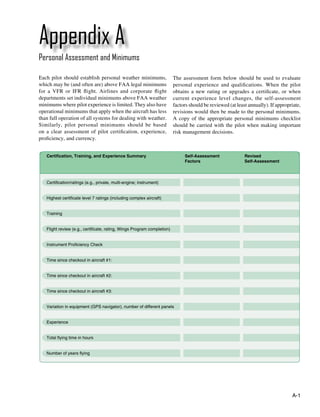
The assessment form below should be used to evaluate
personal experience and qualifications. When the pilot
obtains a new rating or upgrades a certificate, or when
current experience level changes, the self-assessment
factors should be reviewed (at least annually). If appropriate,
revisions would then be made to the personal minimums.
A copy of the appropriate personal minimums checklist
should be carried with the pilot when making important
risk management decisions.
Certification, Training, and Experience Summary Self-Assessment
Factors
Revised
Self-Assessment
Certification/ratings (e.g., private, multi-engine; instrument)
Highest certificate level 7 ratings (including complex aircraft)
Training
Flight review (e.g., certificate, rating, Wings Program completion)
Instrument Proficiency Check
Time since checkout in aircraft #1:
Time since checkout in aircraft #2:
Time since checkout in aircraft #3:
Variation in equipment (GPS navigator), number of different panels
Experience
Total flying time in hours
Number of years flying
A-2
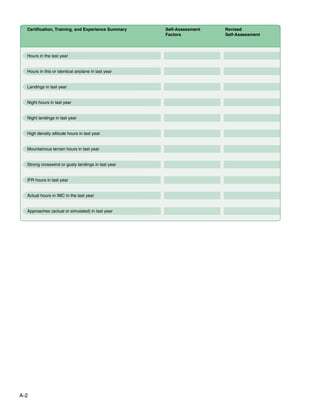
Certification, Training, and Experience Summary Self-Assessment
Factors
Revised
Self-Assessment
Hours in the last year
Hours in this or identical airplane in last year
Landings in last year
Night hours in last year
Night landings in last year
High density altitude hours in last year
Mountainous terrain hours in last year
Strong crosswind or gusty landings in last year
IFR hours in last year
Actual hours in IMC in the last year
Approaches (actual or simulated) in last year
A-3
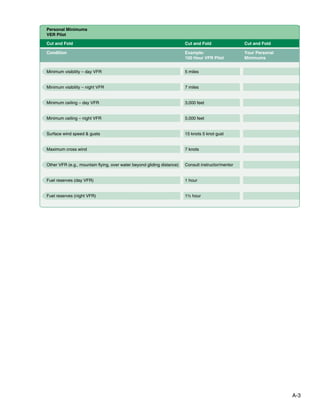
Personal Minimums
VER Pilot
Minimum visibility – day VFR
Minimum visibility – night VFR
Minimum ceiling – day VFR
Minimum ceiling – night VFR
Surface wind speed & gusts
Maximum cross wind
Other VFR (e.g., mountain flying, over water beyond gliding distance)
Fuel reserves (day VFR)
Fuel reserves (night VFR)
5 miles
7 miles
3,000 feet
5,000 feet
15 knots 5 knot gust
7 knots
Consult instructor/mentor
1 hour
1½ hour
Cut and Fold
Condition Example:
100 Hour VFR Pilot
Your Personal
Minimums
Cut and Fold Cut and Fold
A-4
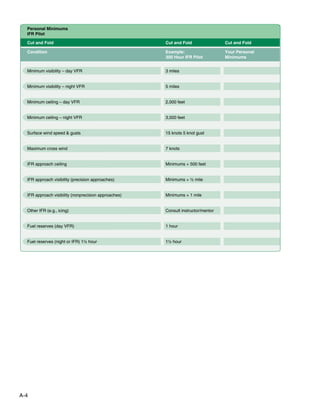
Personal Minimums
IFR Pilot
Minimum visibility – day VFR
Minimum visibility – night VFR
Minimum ceiling – day VFR
Minimum ceiling – night VFR
Surface wind speed & gusts
Maximum cross wind
IFR approach ceiling
IFR approach visibility (precision approaches)
IFR approach visibility (nonprecision approaches)
Other IFR (e.g., icing)
Fuel reserves (day VFR)
Fuel reserves (night or IFR) 1½ hour
3 miles
5 miles
2,000 feet
3,000 feet
15 knots 5 knot gust
7 knots
Minimums + 500 feet
Minimums + ½ mile
Minimums + 1 mile
Consult instructor/mentor
1 hour
1½ hour
Cut and Fold
Condition Example:
300 Hour IFR Pilot
Your Personal
Minimums
Cut and Fold Cut and Fold

FAA Risk Managment

  • 1.
    A-1 Each pilot shouldestablish personal weather minimums, which may be (and often are) above FAA legal minimums for a VFR or IFR flight. Airlines and corporate flight departments set individual minimums above FAA weather minimums where pilot experience is limited. They also have operational minimums that apply when the aircraft has less than full operation of all systems for dealing with weather. Similarly, pilot personal minimums should be based on a clear assessment of pilot certification, experience, proficiency, and currency. Appendix A Personal Assessment and Minimums The assessment form below should be used to evaluate personal experience and qualifications. When the pilot obtains a new rating or upgrades a certificate, or when current experience level changes, the self-assessment factors should be reviewed (at least annually). If appropriate, revisions would then be made to the personal minimums. A copy of the appropriate personal minimums checklist should be carried with the pilot when making important risk management decisions. Certification, Training, and Experience Summary Self-Assessment Factors Revised Self-Assessment Certification/ratings (e.g., private, multi-engine; instrument) Highest certificate level 7 ratings (including complex aircraft) Training Flight review (e.g., certificate, rating, Wings Program completion) Instrument Proficiency Check Time since checkout in aircraft #1: Time since checkout in aircraft #2: Time since checkout in aircraft #3: Variation in equipment (GPS navigator), number of different panels Experience Total flying time in hours Number of years flying
  • 2.
    A-2 Certification, Training, andExperience Summary Self-Assessment Factors Revised Self-Assessment Hours in the last year Hours in this or identical airplane in last year Landings in last year Night hours in last year Night landings in last year High density altitude hours in last year Mountainous terrain hours in last year Strong crosswind or gusty landings in last year IFR hours in last year Actual hours in IMC in the last year Approaches (actual or simulated) in last year
  • 3.
    A-3 Personal Minimums VER Pilot Minimumvisibility – day VFR Minimum visibility – night VFR Minimum ceiling – day VFR Minimum ceiling – night VFR Surface wind speed & gusts Maximum cross wind Other VFR (e.g., mountain flying, over water beyond gliding distance) Fuel reserves (day VFR) Fuel reserves (night VFR) 5 miles 7 miles 3,000 feet 5,000 feet 15 knots 5 knot gust 7 knots Consult instructor/mentor 1 hour 1½ hour Cut and Fold Condition Example: 100 Hour VFR Pilot Your Personal Minimums Cut and Fold Cut and Fold
  • 4.
    A-4 Personal Minimums IFR Pilot Minimumvisibility – day VFR Minimum visibility – night VFR Minimum ceiling – day VFR Minimum ceiling – night VFR Surface wind speed & gusts Maximum cross wind IFR approach ceiling IFR approach visibility (precision approaches) IFR approach visibility (nonprecision approaches) Other IFR (e.g., icing) Fuel reserves (day VFR) Fuel reserves (night or IFR) 1½ hour 3 miles 5 miles 2,000 feet 3,000 feet 15 knots 5 knot gust 7 knots Minimums + 500 feet Minimums + ½ mile Minimums + 1 mile Consult instructor/mentor 1 hour 1½ hour Cut and Fold Condition Example: 300 Hour IFR Pilot Your Personal Minimums Cut and Fold Cut and Fold