DANGEROUS GOODS
AWARENESS
AFC 212
Venue:
Class Hours: Tuesday ,
Instructor: SAYGIN GÖNÇ
Email:
Unit 3 – Classification
Classifying Dangerous Goods
 The shipper is responsible for correctly identifying and
classifying all dangerous goods including assigning the
correct hazard class and applicable packing group.
 Dangerous goods are defined as those goods which meet
the criteria of one or more of the nine UN hazard classes
and where applicable, to one of three UN Packing Groups.
 Hazard classes relate to the type of hazard
 Packing groups relate to the degree of hazard
 Articles are no longer assigned packing groups
3
Packing Groups and Performance
Level Packaging
 Substances are assigned to
packing groups based on the
degree of danger they present
for packing purposes.
Packing Group
Degree of
Danger
I High Danger
II Medium Danger
III Low Danger
4
Packing Groups and Performance
Level Packaging
 UN Specification packaging must meet the performance
level requirements of the assigned packing group
 Performance level packaging for articles is specified in the
packing instruction assigned to the article
Packing Group Performance Level
I X
II Y
III Z
5
DGR Classification System
 The physical state and physical properties of the dangerous
goods will affect how easily and safety the goods can be
handled in transport, how they should be packaged and
what hazards they present, especially if spilled.
Solid Liquid Gas
6
DGR Classification System
 The DGR also divides dangerous goods into:
Substances Articles
7
General Principles
 Dangerous Goods are divided into 9 hazard groups called
classes.
 Classes 1, 2, 4, 5 and 6 are broken down into “Divisions”
due to hazard variation within these classes.
 Classes are expressed by single-digit numbers.
 Example: Class 7
 Divisions are expressed by 2-digit numbers. The first digit
identifies the class number and the second identifies the
division number within that class.
 Example: Class 1, Division 1 would be expressed as
Division 1.1
8
General Principles
 Each class or division has specific criteria that are used to
determine whether an article or substance belongs to that
class or division.
 These criteria are technically detailed and classification of an
item requires specialist knowledge of the criteria.
9
General Principles
 These classes are:
 Class 1 – Explosives
 Class 2 – Gases
 Class 3 – Flammable Liquids
 Class 4 – Flammable Solids
 Class 5 – Oxidizing Substances and Organic Peroxides
 Class 6 – Toxic and Infectious Substances
 Class 7 – Radioactive Material
 Class 8 – Corrosives
 Class 9 – Miscellaneous Dangerous Substances and Articles
10
General Principles
 Some dangerous goods may have characteristics that meet
the classification criteria of more than one class or division.
 Under these circumstances the substances is said to have
both a primary and subsidiary risk.
 The classes have been arranged/numbered by the type of
hazard involved.
 The order in which the classes are shown does not imply a
relative degree of danger or the precedence of the hazard
involved.
11
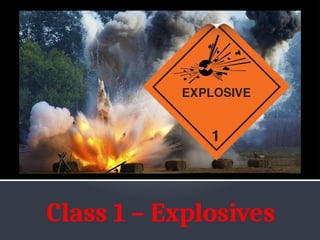
Class 1 – Explosives
Class 1 - Explosives
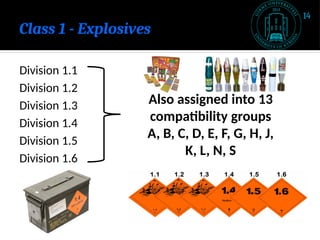
 Explosive articles and substances are assigned to one of six
divisions and to one of thirteen compatibility groups.
Division Hazard
1.1 Mass explosion hazard
1.2 Projectile but no mass explosion hazard
1.3
Fire hazard and either minor blast hazard or minor
projection hazard or both, but not mass explosion
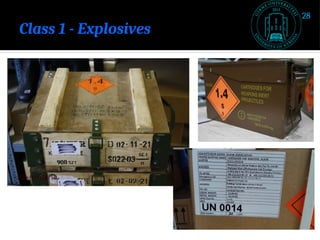
1.4 Minor explosion hazard and largely confined to the
package
1.5 Very insensitive explosives
1.6
Extremely insensitive articles with no mass explosion
hazard
13
Class 1 - Explosives
Division 1.1
Division 1.2
Division 1.3
Division 1.4
Division 1.5
Division 1.6
Also assigned into 13
compatibility groups
A, B, C, D, E, F, G, H, J,
K, L, N, S
14
Class 1 - Explosives
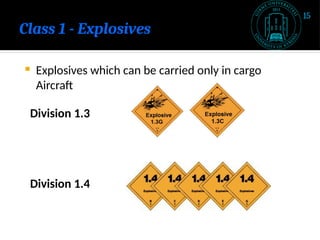
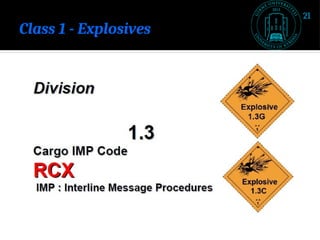
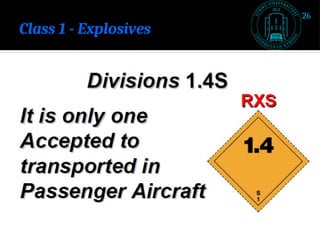
 Explosives which can be carried only in cargo
Aircraft
Division 1.3
Division 1.4
15
Class 1 - Explosives
16
Class 1 - Explosives
17
Class 1 - Explosives
18
Class 1 - Explosives
19
Class 1 - Explosives
20
Class 1 - Explosives
21
Class 1 - Explosives
22
Class 1 - Explosives
23
Class 1 - Explosives
24
Class 1 - Explosives
25
Class 1 - Explosives
26
Class 1 - Explosives
27
Class 1 - Explosives
28
Class 1 - Explosives
29
Class 1 - Explosives
30
Class 1 - Explosives
Class Category Label Example
1
Explosives
1.1 Mass explosion hazard Demolition
1.2 Projection hazard but not a mass
explosion hazard Fireworks
1.3 Fire hazard and either a minor blast
hazard or a minor projection hazard or
both, but not a mass explosion hazard
Flares
1.4 No significant blast hazard Safety Devices
1.5 Insensitive explosives with a mass
explosion hazard
Blasting Agent
1.6 Extremely insensitive articles which
do not have a mass explosion hazard
Explosive Extremely
Insensitive Article
31
Class 2 – Gases
Class 2 - Gases
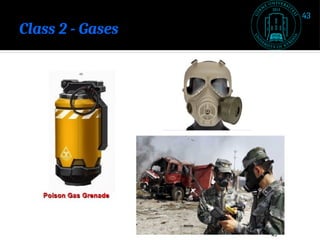
 Class 2 comprises compressed gases, liquefied gases,
dissolved gases, refrigerated liquefied gases, mixtures of
gases that contain vapors of substances of other classes,
articles charged with a gas, and aerosols.
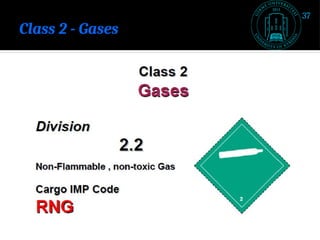
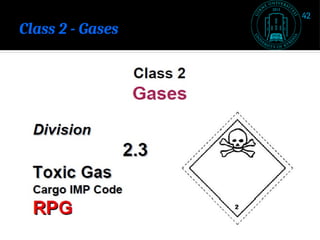
 Class 2 substances are assigned to one of three divisions:
 Division 2.1 – Flammable Gas
 Division 2.2 – Non flammable, Non-toxic Gas
 Division 2.3 – Toxic Gas
33
Class 2 - Gases
34
Class 2 - Gases
35
Class 2 - Gases
36
Class 2 - Gases
37
Class 2 - Gases
38
Class 2 - Gases
39
Class 2 - Gases
40
Class 2 - Gases
41
Class 2 - Gases
42
Class 2 - Gases
43
Class 2 - Gases
Class Category Label Example
2
Gases
2.1 Flammable gases Butane, Propane
2.2 Non flammable, non
‐ ‐
toxic gases
Argon, Oxygen
2.3 Toxic gases Insecticide,
Pesticide Gas
44
Class 3 – Flammable Liquids
Class 3 - Flammable Liquids
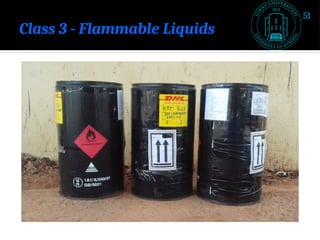
 Class 3 includes flammable liquids and liquid desensitized
explosives.
 Class 3 comprises liquids, mixtures of liquids, liquids
containing solids in solution or in suspension which have a
flash point of not more than 60° C closed-cup (65.5° C open-
cup test).
 Liquids offered for transport at or above their flashpoints
are regulated
 Substances transported at elevated temperatures in a
liquid state and which give off a flammable vapor at
temperatures encountered during transport are regulated
46
Class 3 - Flammable Liquids
 Liquids with a flash point exceeding 35° C which do not
sustain combustion are not regulated
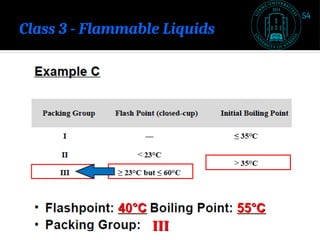
 Class 3 packing group: determined by its flash point and
boiling point
Packing
Group
Flash Point
(closed cup)
Initial Boiling
Point
I - ≤ 35°C
II < 23°C
>35°C
III ≥ 23°C but ≤ 60°C
47
Class 3 - Flammable Liquids
48
Class 3 - Flammable Liquids
49
Class 3 - Flammable Liquids
50
Class 3 - Flammable Liquids
51
Class 3 - Flammable Liquids
52
Class 3 - Flammable Liquids
53
Class 3 - Flammable Liquids
54
Class 3 - Flammable Liquids
55
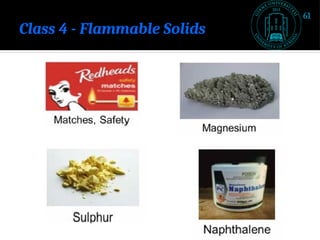
Class 4 – Flammable Solids
Class 4 - Flammable Solids
 Class 4 is assigned to three divisions:
 Division 4.1 – Flammable Solids
 Readily combustible or may cause
or contribute to fire through
friction, self-reactive substances,
or desensitized explosives
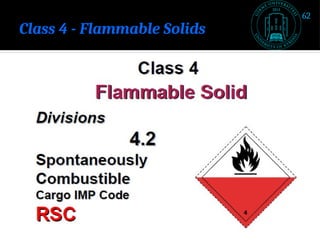
 Division 4.2 – Substances liable to
spontaneous combustion
 Liable to spontaneous heating or
to heating up when in contact
with air
57
Class 4 - Flammable Solids
 Division 4.3 – Substances which, in contact with water,
emit flammable gases (Dangerous when wet)
 By interaction with water are liable to become
spontaneously flammable or give off dangerous
quantities of flammable gases
58
Class 4 - Flammable Solids
59
Class 4 - Flammable Solids
60
Class 4 - Flammable Solids
61
Class 4 - Flammable Solids
62
Class 4 - Flammable Solids
63
Class 4 - Flammable Solids
64
Class 5 – Oxidizing Substances
and Organic Peroxides
Class 5 – Oxidizing Substances
and Organic Peroxides
 Class 5 is divided into two divisions:
 Division 5.1 – Oxidizing substances
 Cause or contribute to the combustion of other materials by
providing oxygen
 Division 5.2 – Organic Peroxides
 Thermally unstable and have one or more of these properties:
 Be liable to explosive decomposition
 Burn rapidly
 Be sensitive to impact or friction
 React dangerously with other substances
 Cause damage to the eyes
66
Class 5 – Oxidizing Substances
and Organic Peroxides
67
Class 5 – Oxidizing Substances
and Organic Peroxides
68
Class 5 – Oxidizing Substances
and Organic Peroxides
69
Class 5 – Oxidizing Substances
and Organic Peroxides
70
Class 5 – Oxidizing Substances
and Organic Peroxides
71
Class 5 – Oxidizing Substances
and Organic Peroxides
72
Class 6 - Toxic and Infectious
Substances
Class 6 - Toxic and Infectious
Substances
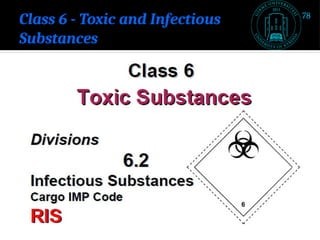
 Class 6 is divided into two divisions:
 Division 6.1 – Toxic Substances
 Substances liable to cause death, injury, or harm to human
health if swallowed, inhaled, or contacted by skin
 A Division 6.1 substance must be assigned a packing group
according to its degree of toxic hazard in transport
 To be classified a Division 6.1 Toxic Substance a substance
must meet at minimum the criteria for Packing Group III:
 Division 6.2 – Infectious Substances
 Substances known or reasonably expected to contain
pathogens
74
Class 6 - Toxic and Infectious
Substances
75
Class 6 - Toxic and Infectious
Substances
76
Class 6 - Toxic and Infectious
Substances
77
Class 6 - Toxic and Infectious
Substances
78
Class 6 - Toxic and Infectious
Substances
79
Class 7 - Radioactive Material
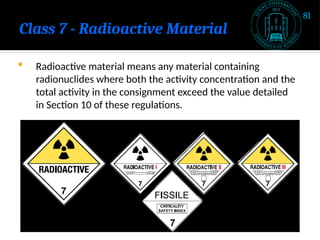
 Radioactive material means any material containing
radionuclides where both the activity concentration and the
total activity in the consignment exceed the value detailed
in Section 10 of these regulations.
81
Class 7 - Radioactive Material
82
Class 7 - Radioactive Material
83
Class 7 - Radioactive Material
84
Class 7 - Radioactive Material
85
Class 7 - Radioactive Material
86
Class 7 - Radioactive Material
87
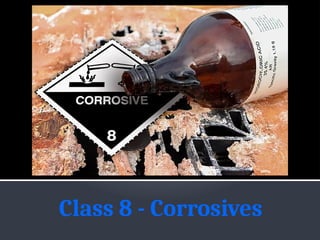
Class 8 - Corrosives
 Substances which by chemical action, can cause severe
damage when in contact with living tissue, or if leaked while
in transport will damage or destroy other goods.
 Assigned to packing groups based on the length of time of
contact necessary to produce full thickness destruction of
human skin
89
Class 8 - Corrosives
90
Class 8 - Corrosives
91
Class 9 - Miscellaneous
Substances & Articles
Class 9 - Miscellaneous Substances
and Articles
 Articles and substances, which during transport, present a
danger not covered by the other 8 hazard classes.
 Class 9 includes (but not limited to):
 Environmentally hazardous substances
 Magnetized materials
 Lithium batteries
 Elevated temperature substances
 Consumer Commodities
 Materials packaged and distributed in a form intended or suitable
for retail sale for the purpose of personal care or household use
 May be reclassified as ID8000 and shipped with less restrictions
93
Class 9 - Miscellaneous Substances
and Articles
94
Class 9 - Miscellaneous Substances
and Articles
95
Class 9 - Miscellaneous Substances
and Articles
Dry Ice
96
Class 9 - Miscellaneous Substances
and Articles
Lithium Batteries
97
Class 9 - Miscellaneous Substances
and Articles
Life Savings Appliances
98
Thank you for your attention!
Any Questions
Thank you for your attention
99

Dangerous Good Awareness Course AFC212 - Module (3)

  • 1.
    DANGEROUS GOODS AWARENESS AFC 212 Venue: ClassHours: Tuesday , Instructor: SAYGIN GÖNÇ Email:
  • 2.
    Unit 3 –Classification
  • 3.
    Classifying Dangerous Goods The shipper is responsible for correctly identifying and classifying all dangerous goods including assigning the correct hazard class and applicable packing group.  Dangerous goods are defined as those goods which meet the criteria of one or more of the nine UN hazard classes and where applicable, to one of three UN Packing Groups.  Hazard classes relate to the type of hazard  Packing groups relate to the degree of hazard  Articles are no longer assigned packing groups 3
  • 4.
    Packing Groups andPerformance Level Packaging  Substances are assigned to packing groups based on the degree of danger they present for packing purposes. Packing Group Degree of Danger I High Danger II Medium Danger III Low Danger 4
  • 5.
    Packing Groups andPerformance Level Packaging  UN Specification packaging must meet the performance level requirements of the assigned packing group  Performance level packaging for articles is specified in the packing instruction assigned to the article Packing Group Performance Level I X II Y III Z 5
  • 6.
    DGR Classification System The physical state and physical properties of the dangerous goods will affect how easily and safety the goods can be handled in transport, how they should be packaged and what hazards they present, especially if spilled. Solid Liquid Gas 6
  • 7.
    DGR Classification System The DGR also divides dangerous goods into: Substances Articles 7
  • 8.
    General Principles  DangerousGoods are divided into 9 hazard groups called classes.  Classes 1, 2, 4, 5 and 6 are broken down into “Divisions” due to hazard variation within these classes.  Classes are expressed by single-digit numbers.  Example: Class 7  Divisions are expressed by 2-digit numbers. The first digit identifies the class number and the second identifies the division number within that class.  Example: Class 1, Division 1 would be expressed as Division 1.1 8
  • 9.
    General Principles  Eachclass or division has specific criteria that are used to determine whether an article or substance belongs to that class or division.  These criteria are technically detailed and classification of an item requires specialist knowledge of the criteria. 9
  • 10.
    General Principles  Theseclasses are:  Class 1 – Explosives  Class 2 – Gases  Class 3 – Flammable Liquids  Class 4 – Flammable Solids  Class 5 – Oxidizing Substances and Organic Peroxides  Class 6 – Toxic and Infectious Substances  Class 7 – Radioactive Material  Class 8 – Corrosives  Class 9 – Miscellaneous Dangerous Substances and Articles 10
  • 11.
    General Principles  Somedangerous goods may have characteristics that meet the classification criteria of more than one class or division.  Under these circumstances the substances is said to have both a primary and subsidiary risk.  The classes have been arranged/numbered by the type of hazard involved.  The order in which the classes are shown does not imply a relative degree of danger or the precedence of the hazard involved. 11
  • 12.
    Class 1 –Explosives
  • 13.
    Class 1 -Explosives  Explosive articles and substances are assigned to one of six divisions and to one of thirteen compatibility groups. Division Hazard 1.1 Mass explosion hazard 1.2 Projectile but no mass explosion hazard 1.3 Fire hazard and either minor blast hazard or minor projection hazard or both, but not mass explosion 1.4 Minor explosion hazard and largely confined to the package 1.5 Very insensitive explosives 1.6 Extremely insensitive articles with no mass explosion hazard 13
  • 14.
    Class 1 -Explosives Division 1.1 Division 1.2 Division 1.3 Division 1.4 Division 1.5 Division 1.6 Also assigned into 13 compatibility groups A, B, C, D, E, F, G, H, J, K, L, N, S 14
  • 15.
    Class 1 -Explosives  Explosives which can be carried only in cargo Aircraft Division 1.3 Division 1.4 15
  • 16.
    Class 1 -Explosives 16
  • 17.
    Class 1 -Explosives 17
  • 18.
    Class 1 -Explosives 18
  • 19.
    Class 1 -Explosives 19
  • 20.
    Class 1 -Explosives 20
  • 21.
    Class 1 -Explosives 21
  • 22.
    Class 1 -Explosives 22
  • 23.
    Class 1 -Explosives 23
  • 24.
    Class 1 -Explosives 24
  • 25.
    Class 1 -Explosives 25
  • 26.
    Class 1 -Explosives 26
  • 27.
    Class 1 -Explosives 27
  • 28.
    Class 1 -Explosives 28
  • 29.
    Class 1 -Explosives 29
  • 30.
    Class 1 -Explosives 30
  • 31.
    Class 1 -Explosives Class Category Label Example 1 Explosives 1.1 Mass explosion hazard Demolition 1.2 Projection hazard but not a mass explosion hazard Fireworks 1.3 Fire hazard and either a minor blast hazard or a minor projection hazard or both, but not a mass explosion hazard Flares 1.4 No significant blast hazard Safety Devices 1.5 Insensitive explosives with a mass explosion hazard Blasting Agent 1.6 Extremely insensitive articles which do not have a mass explosion hazard Explosive Extremely Insensitive Article 31
  • 32.
  • 33.
    Class 2 -Gases  Class 2 comprises compressed gases, liquefied gases, dissolved gases, refrigerated liquefied gases, mixtures of gases that contain vapors of substances of other classes, articles charged with a gas, and aerosols.  Class 2 substances are assigned to one of three divisions:  Division 2.1 – Flammable Gas  Division 2.2 – Non flammable, Non-toxic Gas  Division 2.3 – Toxic Gas 33
  • 34.
    Class 2 -Gases 34
  • 35.
    Class 2 -Gases 35
  • 36.
    Class 2 -Gases 36
  • 37.
    Class 2 -Gases 37
  • 38.
    Class 2 -Gases 38
  • 39.
    Class 2 -Gases 39
  • 40.
    Class 2 -Gases 40
  • 41.
    Class 2 -Gases 41
  • 42.
    Class 2 -Gases 42
  • 43.
    Class 2 -Gases 43
  • 44.
    Class 2 -Gases Class Category Label Example 2 Gases 2.1 Flammable gases Butane, Propane 2.2 Non flammable, non ‐ ‐ toxic gases Argon, Oxygen 2.3 Toxic gases Insecticide, Pesticide Gas 44
  • 45.
    Class 3 –Flammable Liquids
  • 46.
    Class 3 -Flammable Liquids  Class 3 includes flammable liquids and liquid desensitized explosives.  Class 3 comprises liquids, mixtures of liquids, liquids containing solids in solution or in suspension which have a flash point of not more than 60° C closed-cup (65.5° C open- cup test).  Liquids offered for transport at or above their flashpoints are regulated  Substances transported at elevated temperatures in a liquid state and which give off a flammable vapor at temperatures encountered during transport are regulated 46
  • 47.
    Class 3 -Flammable Liquids  Liquids with a flash point exceeding 35° C which do not sustain combustion are not regulated  Class 3 packing group: determined by its flash point and boiling point Packing Group Flash Point (closed cup) Initial Boiling Point I - ≤ 35°C II < 23°C >35°C III ≥ 23°C but ≤ 60°C 47
  • 48.
    Class 3 -Flammable Liquids 48
  • 49.
    Class 3 -Flammable Liquids 49
  • 50.
    Class 3 -Flammable Liquids 50
  • 51.
    Class 3 -Flammable Liquids 51
  • 52.
    Class 3 -Flammable Liquids 52
  • 53.
    Class 3 -Flammable Liquids 53
  • 54.
    Class 3 -Flammable Liquids 54
  • 55.
    Class 3 -Flammable Liquids 55
  • 56.
    Class 4 –Flammable Solids
  • 57.
    Class 4 -Flammable Solids  Class 4 is assigned to three divisions:  Division 4.1 – Flammable Solids  Readily combustible or may cause or contribute to fire through friction, self-reactive substances, or desensitized explosives  Division 4.2 – Substances liable to spontaneous combustion  Liable to spontaneous heating or to heating up when in contact with air 57
  • 58.
    Class 4 -Flammable Solids  Division 4.3 – Substances which, in contact with water, emit flammable gases (Dangerous when wet)  By interaction with water are liable to become spontaneously flammable or give off dangerous quantities of flammable gases 58
  • 59.
    Class 4 -Flammable Solids 59
  • 60.
    Class 4 -Flammable Solids 60
  • 61.
    Class 4 -Flammable Solids 61
  • 62.
    Class 4 -Flammable Solids 62
  • 63.
    Class 4 -Flammable Solids 63
  • 64.
    Class 4 -Flammable Solids 64
  • 65.
    Class 5 –Oxidizing Substances and Organic Peroxides
  • 66.
    Class 5 –Oxidizing Substances and Organic Peroxides  Class 5 is divided into two divisions:  Division 5.1 – Oxidizing substances  Cause or contribute to the combustion of other materials by providing oxygen  Division 5.2 – Organic Peroxides  Thermally unstable and have one or more of these properties:  Be liable to explosive decomposition  Burn rapidly  Be sensitive to impact or friction  React dangerously with other substances  Cause damage to the eyes 66
  • 67.
    Class 5 –Oxidizing Substances and Organic Peroxides 67
  • 68.
    Class 5 –Oxidizing Substances and Organic Peroxides 68
  • 69.
    Class 5 –Oxidizing Substances and Organic Peroxides 69
  • 70.
    Class 5 –Oxidizing Substances and Organic Peroxides 70
  • 71.
    Class 5 –Oxidizing Substances and Organic Peroxides 71
  • 72.
    Class 5 –Oxidizing Substances and Organic Peroxides 72
  • 73.
    Class 6 -Toxic and Infectious Substances
  • 74.
    Class 6 -Toxic and Infectious Substances  Class 6 is divided into two divisions:  Division 6.1 – Toxic Substances  Substances liable to cause death, injury, or harm to human health if swallowed, inhaled, or contacted by skin  A Division 6.1 substance must be assigned a packing group according to its degree of toxic hazard in transport  To be classified a Division 6.1 Toxic Substance a substance must meet at minimum the criteria for Packing Group III:  Division 6.2 – Infectious Substances  Substances known or reasonably expected to contain pathogens 74
  • 75.
    Class 6 -Toxic and Infectious Substances 75
  • 76.
    Class 6 -Toxic and Infectious Substances 76
  • 77.
    Class 6 -Toxic and Infectious Substances 77
  • 78.
    Class 6 -Toxic and Infectious Substances 78
  • 79.
    Class 6 -Toxic and Infectious Substances 79
  • 80.
    Class 7 -Radioactive Material
  • 81.
    Class 7 -Radioactive Material  Radioactive material means any material containing radionuclides where both the activity concentration and the total activity in the consignment exceed the value detailed in Section 10 of these regulations. 81
  • 82.
    Class 7 -Radioactive Material 82
  • 83.
    Class 7 -Radioactive Material 83
  • 84.
    Class 7 -Radioactive Material 84
  • 85.
    Class 7 -Radioactive Material 85
  • 86.
    Class 7 -Radioactive Material 86
  • 87.
    Class 7 -Radioactive Material 87
  • 88.
    Class 8 -Corrosives
  • 89.
    Class 8 -Corrosives  Substances which by chemical action, can cause severe damage when in contact with living tissue, or if leaked while in transport will damage or destroy other goods.  Assigned to packing groups based on the length of time of contact necessary to produce full thickness destruction of human skin 89
  • 90.
    Class 8 -Corrosives 90
  • 91.
    Class 8 -Corrosives 91
  • 92.
    Class 9 -Miscellaneous Substances & Articles
  • 93.
    Class 9 -Miscellaneous Substances and Articles  Articles and substances, which during transport, present a danger not covered by the other 8 hazard classes.  Class 9 includes (but not limited to):  Environmentally hazardous substances  Magnetized materials  Lithium batteries  Elevated temperature substances  Consumer Commodities  Materials packaged and distributed in a form intended or suitable for retail sale for the purpose of personal care or household use  May be reclassified as ID8000 and shipped with less restrictions 93
  • 94.
    Class 9 -Miscellaneous Substances and Articles 94
  • 95.
    Class 9 -Miscellaneous Substances and Articles 95
  • 96.
    Class 9 -Miscellaneous Substances and Articles Dry Ice 96
  • 97.
    Class 9 -Miscellaneous Substances and Articles Lithium Batteries 97
  • 98.
    Class 9 -Miscellaneous Substances and Articles Life Savings Appliances 98
  • 99.
    Thank you foryour attention! Any Questions Thank you for your attention 99