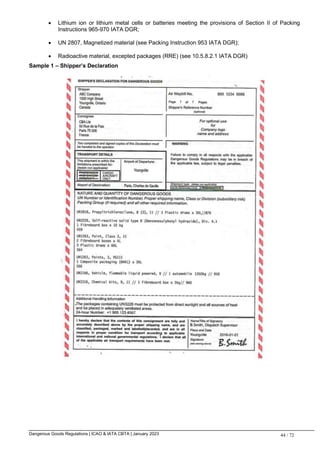
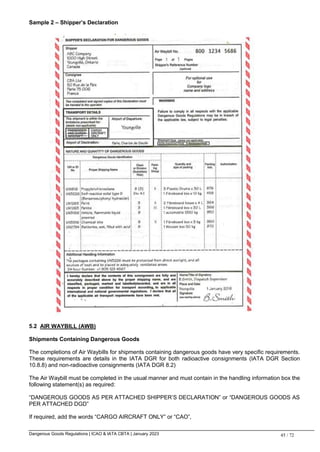
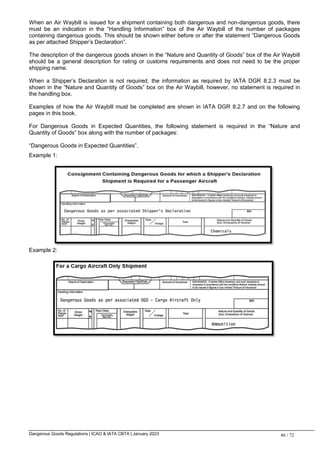
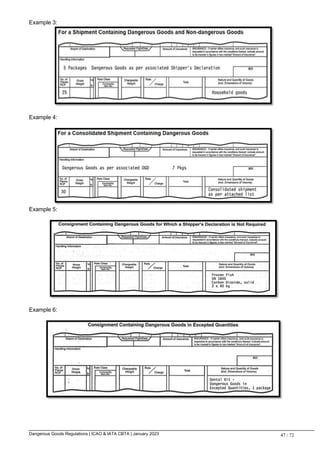
Dangerous Goods Regulations | ICAO & IATA CBTA | January 2023 1 / 72
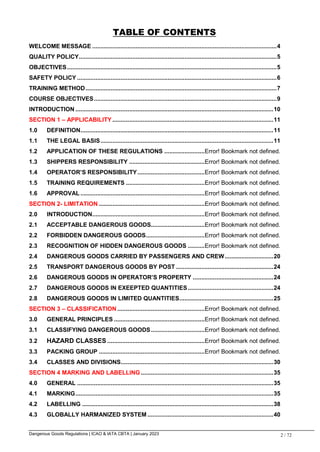
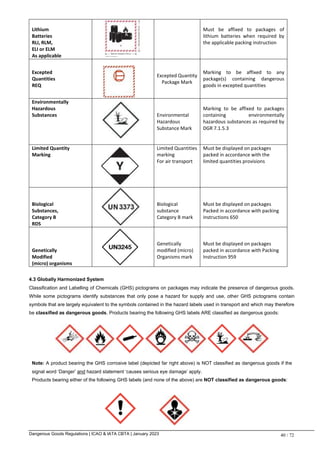
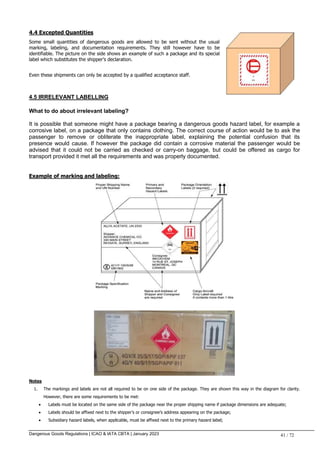
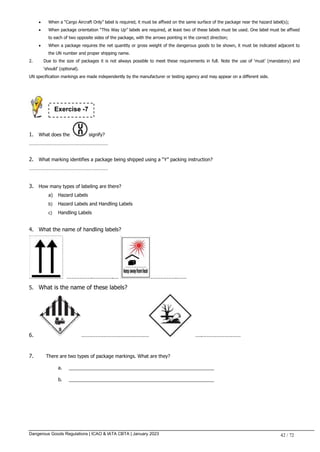
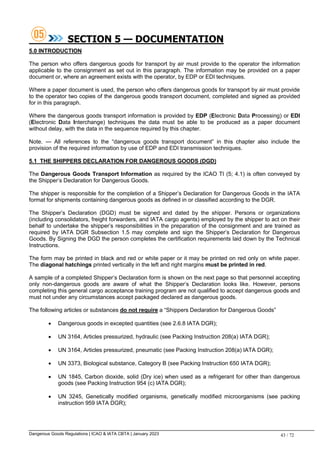
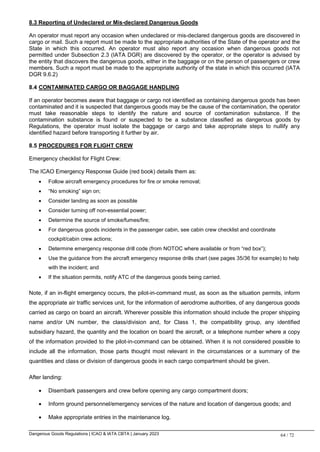
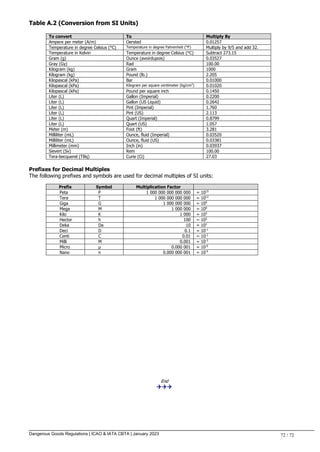
DANGEROUS GOODS
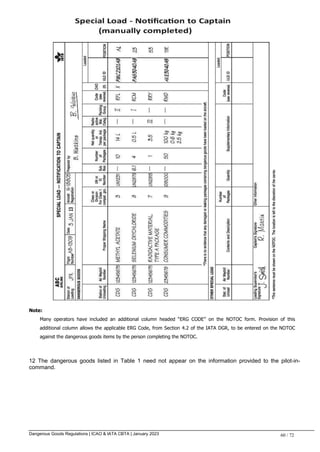
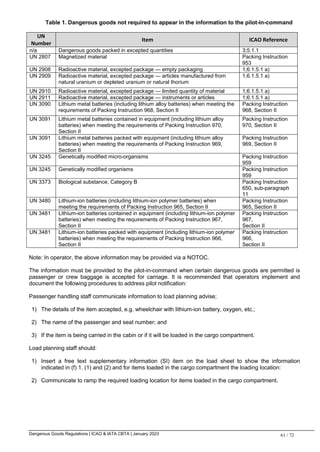
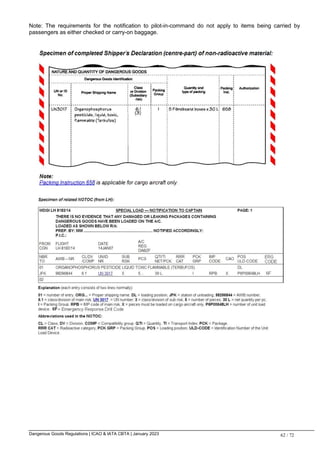
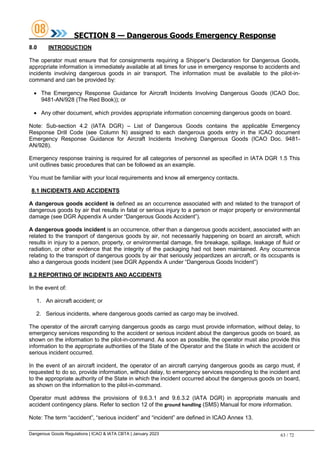
TRAINING MATERIAL
Flight Crew / FOO/ FD
Dangerous Goods Regulations | ICAO & IATA CBTA | January 2023 2 / 72
TABLE OF CONTENTS
WELCOME MESSAGE ..............................................................................................................4
QUALITY POLICY......................................................................................................................5
OBJECTIVES.............................................................................................................................5
SAFETY POLICY .......................................................................................................................6
TRAINING METHOD..................................................................................................................7
COURSE OBJECTIVES.............................................................................................................9
INTRODUCTION ......................................................................................................................10
SECTION 1 – APPLICABILITY ................................................................................................11
1.0 DEFINITION...................................................................................................................11
1.1 THE LEGAL BASIS.......................................................................................................11
1.2 APPLICATION OF THESE REGULATIONS ........................Error! Bookmark not defined.
1.3 SHIPPERS RESPONSIBILITY .............................................Error! Bookmark not defined.
1.4 OPERATOR’S RESPONSIBILITY........................................Error! Bookmark not defined.
1.5 TRAINING REQUIREMENTS ...............................................Error! Bookmark not defined.
1.6 APPROVAL ..........................................................................Error! Bookmark not defined.
SECTION 2- LIMITATION ...............................................................Error! Bookmark not defined.
2.0 INTRODUCTION...................................................................Error! Bookmark not defined.
2.1 ACCEPTABLE DANGEROUS GOODS................................Error! Bookmark not defined.
2.2 FORBIDDEN DANGEROUS GOODS...................................Error! Bookmark not defined.
2.3 RECOGNITION OF HIDDEN DANGEROUS GOODS ..........Error! Bookmark not defined.
2.4 DANGEROUS GOODS CARRIED BY PASSENGERS AND CREW.............................20
2.5 TRANSPORT DANGEROUS GOODS BY POST ..........................................................24
2.6 DANGEROUS GOODS IN OPERATOR’S PROPERTY ................................................24
2.7 DANGEROUS GOODS IN EXEEPTED QUANTITIES...................................................24
2.8 DANGEROUS GOODS IN LIMITED QUANTITIES........................................................25
SECTION 3 – CLASSIFICATION ....................................................Error! Bookmark not defined.
3.0 GENERAL PRINCIPLES ......................................................Error! Bookmark not defined.
3.1 CLASSIFYING DANGEROUS GOODS................................Error! Bookmark not defined.
3.2 HAZARD CLASSES ..........................................................Error! Bookmark not defined.
3.3 PACKING GROUP ...............................................................Error! Bookmark not defined.
3.4 CLASSES AND DIVISIONS...........................................................................................30
SECTION 4 MARKING AND LABELLING...............................................................................35
4.0 GENERAL .....................................................................................................................35
4.1 MARKING......................................................................................................................35
4.2 LABELLING ..................................................................................................................38
4.3 GLOBALLY HARMANIZED SYSTEM ...........................................................................40
Dangerous Goods Regulations | ICAO & IATA CBTA | January 2023 3 / 72
4.4 EXCEPTED QUANTITIES .............................................................................................41
4.5 IRRELEVANT LABELLING...........................................................................................41
SECTION 5 – DOCUMENTATION ...........................................................................................43
5.0 INTRODUCTION............................................................................................................43
5.1 THE SHIPPERS DECLARATION FOR DANGEROUS GOODS (DGD).........................43
5.2 AIR WAY BILL (AWB)...................................................................................................45
5.3 Articles and Substances not Subject to the Regulations (not restricted)...............48
5.4 ADDITIONAL DOCUMENTATION.................................................................................48
5.5 RETENTION OF DOCUMENTATION ............................................................................49
SECTION 6 – STORAGE AND LOADING ...............................................................................50
6.0 General..........................................................................................................................50
6.1 PROTECTION FROM DAMAGE....................................................................................50
6.2 INSPECTION OF PACKAGES OF DANGEROUS GOODS ..........................................50
6.3 HANDLING OF SELF REACTIVE SUBSTANCES AND ORGANIC PEROXIDES ........50
6.4 STORAGE AND HANDLING OF RADIOACTIVE MATERIALS ....................................50
6.5 LOADING ......................................................................................................................51
6.6 COMMODITY SPECIFIC REQUIREMENTS ..................................................................52
SECTION 7 – PROVISION OF INFORMATION ......................................................................57
7.0 PILOT IN COMMAND (NOTOC)....................................................................................57
7.1 INFORMATION BY THE PILOT IN COMMAND IN CASE OF IN FLIGHT EMERGENCY .........57
SECTION 8 – DANGEROUS GOODS EMERGENCY RESPONSE .........................................63
8.0 INTRODUCTION............................................................................................................63
8.1 INCIDENTS AND ACCIDENTS .....................................................................................63
8.2 REPORTING OF INCIDENTS AND ACCIDENTS..........................................................63
8.3 REPORTING OF UNDECLARED OR MIS-DECLARED DANGEROUS GOODS..........64
8.4 CONTAMINATED CARGO OR BAGGAGE HANDLING...............................................64
8.5 PROCEDURES FOR FLIGHT CREW............................................................................64
8.6 GENERAL PROCEDURES............................................................................................65
8.7 DANGEROUS GOODS EMERGENCY RESPONSE CHART GROUND INCIDENTS ...65
8.8 EMERGENCY PROCEDURSE ......................................................................................65
8.9 DANGEROUS GOODS OCCURRENCE REPORT........................................................70
APPENDIX A – CONVERSION FACTORS ..............................................................................71
Dangerous Goods Regulations | ICAO & IATA CBTA | January 2023 4 / 72
WELCOME MESSAGE
The Training Department welcomes you to this program. It is our pleasure to be a part of your learning journey and we look
forward to helping you realize your true potential.
This workbook provides information you will need to achieve the learning objectives of this program successfully. This is your
copy to encourage you to write on and reinforce the skills and knowledge introduced.
Training Department
Training Department provides technical and non-technical learning experiences to our employees and outsources. The team is
located in the Training Department. We have a great team of trainers and specialists focused on providing you with the best
opportunity to learn and practice new skills in a safe environment. The team uses interactive and experiential learning
techniques to ensure that participants develop the confidence to apply the new skills and knowledge as soon as they continue
to their workplaces.
This training is intended for Passenger Handling Personnel as stated in the ICAO CBAT and IATA Dangerous Goods
Manual – Flight Crew.
This workbook will be used with the current IATA DGR Manual to familiarize you with the various sections and how to apply
them. It is based on the practical application of the IATA DGR, which includes all the ICAO Annex 18 requirements and the
current edition of the ICAO Technical Instructions.
We trust that you will enjoy the program and look forward to any feedback you may have to help us meet our objectives.
Happy learning!
Training Department
Dangerous Goods Regulations | ICAO & IATA CBTA | January 2023 5 / 72
QUALITY POLICY
To achieve sustained and profitable growth by providing services that consistently satisfy the
needs and expectations of our internal and external customers.
OBJECTIVES
 Achieve and maintain a level of quality that enhances the Company.
 Reputation and brand with customers.
 To ensure compliance with relevant statutory and safety bodies.
 To endeavor at all times to maximize the Company's market share in all geographies.
Dangerous Goods Regulations | ICAO & IATA CBTA | January 2023 6 / 72
SAFETY POLICY
Safety is the priority in all our activities. We are committed to implementing, developing, and improving
strategies, management systems, and processes to ensure that all our activities uphold the highest level of safety
performance and meet national and international standards.
Our commitment is to:
a. Develop and embed a safety culture in all our aviation activities that recognizes the importance and value
of effective safety management and always acknowledges that safety is paramount;
b. Clearly define for all staff their accountabilities and responsibilities for the development and delivery of
the safety strategy and performance;
c. Minimize the Hazard associated with aircraft operations and associated activities to a point that is as low
as reasonably practicable/achievable;
d. Ensure that externally supplied systems and services that impact the safety of our operations meet
appropriate safety standards;
e. Actively develop and improve our safety processes to conform to world-class standards;
f. Comply with and, wherever possible, exceed legislative and regulatory requirements and standards;
g. Ensure that all staff are provided with adequate and appropriate aviation safety information and training,
are competent in safety matters, and are only allocated tasks commensurate with their skills;
h. Ensure that sufficient skilled and trained resources are available to implement safety strategy and policy;
i. Establish and measure our safety performance against realistic objectives and/or targets;
j. Achieve the highest levels of safety standards and performance in all our aviation activities;
k. Continually improve our safety performance;
l. Conduct safety and management reviews and ensure that relevant action is taken;
m. Ensure that the application of effective aviation safety management systems is integral to all our aviation
activities, to achieve the highest levels of safety standards and performance.
Dangerous Goods Regulations | ICAO & IATA CBTA | January 2023 7 / 72
Training Method
 Exercises
 Questions
 Final Assessment
Assessment Strategy:
To meet the legal requirement, a final test must be undertaken and successfully completed
following dangerous goods training to verify understanding of the regulation. Confirmation is
required of successful completion of the test (IATA DGR 1.5).
 Written exam (open book)
 Length of exam (2 hrs.)
 Minimum pass mark: 80
 Notification of successful completion
 Retest procedure
 DGR Certificate valid for 2 years
 Meets ICAO & IATA Requirements
 Recurrent Training within 24 months
Dangerous Goods Regulations | ICAO & IATA CBTA | January 2023 8 / 72
INTENTIONALLY
LIFT BLANK
Dangerous Goods Regulations | ICAO & IATA CBTA | January 2023 9 / 72
COURSE OBJECTIVES
After thorough study and use of this training workbook, the student will:
 Be able to identify dangerous goods;
 Know the origin of the current regulations and be aware of the general philosophy;
 Be able to identify the classes of dangerous goods;
 Recognize and identify the hazard/handling labels applicable to dangerous goods;
 Recognize and identify dangerous goods package use and package specification markings;
 Be able to identify potential hidden hazards in cargo;
 Be familiar with loading and storage procedures;
 Be familiar with Packing procedures;
 Be aware of the provisions for dangerous goods in the baggage of passengers and crew;
 Information by the pilot-in-command in case of in-flight emergency
 Be familiar with emergency procedures.
Dangerous Goods Regulations | ICAO & IATA CBTA | January 2023 10 / 72
INTRODUCTION
IATA Dangerous Goods Regulations
This training is for the Flight Crew (Flight Crew from the IATA DGR
Training Section). This manual is designed to be used in conjunction
with the IATA DGR to familiarize you with the various sections and
how to apply them, IATA Dangerous Goods Regulations are
published every 12 months.
It is based on the practical application of the IATA DGR,
which includes all the ICAO Annex 18 requirements and
the current edition of the ICAO Technical Instructions
published every 24 months. (ICAO Technical
Instructions – Doc. 9284-AN/905)
Dangerous Goods Regulations | ICAO & IATA CBTA | January 2023 11 / 72
SECTION 1 — APPLICABILITY
By the end of this section, you will be able to:
 Define dangerous goods;
 Identify the general principles applicable to the air transport of dangerous goods.
 Know the responsibilities of shipper & operator when transporting DG.
 Describe the importance of dangerous goods training;
 Identify Dangerous goods Security.
1.0 Definition of Dangerous Goods
Dangerous goods are articles or substances which are capable of posing a hazard to health, safety, property or
the environment and which are shown in the list of dangerous goods in these Regulations or which are classified
according to these Regulations.
1.1 Legal Basis
1.1.1 The UN Committee of Experts (CoE) develops recommended procedures for the
transport of all types of dangerous goods except radioactive materials. These procedures,
applicable to all modes of transport, are published in the Recommendations on the
Transport of Dangerous Goods.
1.1.2 The International Atomic Energy Agency (IAEA) develops recommended
procedures for the safe transport of radioactive materials. These procedures are published
in the Regulations for the Safe Transport of Radioactive Material (IAEA TS-R-1). The
requirements of these regulations as they pertain to air transport are reflected in Section
10.
1.1.3 The International Civil Aviation Organization (ICAO) has used these
recommendations as the basis for developing regulations for the safe transport of
dangerous goods by air. The ICAO regulations are codified in Annex 18 to the Convention
on International Civil Aviation and in its Technical Instructions for the Safe Transport of
Dangerous Goods by Air
(Doc 9284-AN/905 as amended) (Technical Instructions).
1.1.4 The International Air Transport Association (IATA) contains all the
requirements of the Technical Instructions. IATA has included additional requirements,
which are more restrictive than the Technical Instructions and reflect industry standard
practices or operational considerations. These are identified by the symbol “” in the
margin.
1.1.5 QATAR Civil Aviation Authority (QCAA) Regulations for Dangerous Goods.
Dangerous Goods Regulations | ICAO & IATA CBTA | January 2023 12 / 72
1.2 Application of these Regulations
1.2.1 Applicability
The IATA Dangerous Goods Regulations apply to:
 All airlines which Members or Associate Members of IATA are;
 All airlines that are party to the IATA Multilateral Interline Traffic Agreement — Cargo; and
 All shippers and agents that offer consignments of dangerous goods to these operators.
1.2.2 Exceptions
1.2.2.1 Except for information provided to operator employees, as shown in 9.5.2, the provisions of these
Regulations do not apply to dangerous goods carried on an aircraft where the dangerous goods are:
(a) To provide medical aid to a patient during flight when those dangerous goods:
1. Have been placed on board with the approval of the operator; or
2. Form part of the permanent equipment of the aircraft when it has been adapted for specialized use; providing
that;
3. Gas cylinders have been manufactured specifically for the purpose of containing and transporting that
particular gas;
4. Equipment containing wet cell batteries is kept and, when necessary secured, in an upright position to
prevent spillage of the electrolyte.
1.2.2.2 Dangerous Goods Packages opened by customs and other Authorities
Any package opened during an inspection must, before being forwarded to the consignee, be restored by
qualified persons to condition, which complies with these regulations.
1.3 Shipper's Responsibilities
Shipper must comply fully with the IATA DGR when a consignment of dangerous goods is offered with an
operator. Shippers must also comply with any regulations required by the state of origin, transit, and destination.
For further details refer to IATA DGR 1.3.
1. Identified;
2. Classified;
3. Packed;
4. Marked;
5. Labeled;
6. Documented.
1.4 Operator's Responsibilities
When accepting cargo for transportation by air it is the operator’s cargo acceptance staff that has the
responsibility to ensure, as far as possible, that the consignment does not contain dangerous goods unless
shipper has prepared the shipment of dangerous goods in accordance with the Regulations. A checklist must be
used to accept declared dangerous goods consignments, the eight responsibilities of an operator IATA DGR 1.4.1
1. Acceptance;
2. Storage;
3. Loading;
4. Inspection;
5. Provision of Information, including emergency response information;
6. Reporting;
7. Retention of Records;
8. Training.
1.4.1 INFORMATION TO OPERATOR EMPLOYEES
An operator must provide, in the operator’s operation and/or other appropriate manuals, information to
employees to enable flight crews and other employees to carry out their responsibilities regarding dangerous
goods. Where applicable, this information must also be provided to ground-handling agents. This information
must include:
a. For passenger handling staff and cabin crew the procedure to be followed to alert passengers that certain
items of dangerous goods are specifically prohibited from being in checked baggage, e.g. spare lithium
batteries (See Subsection 2.3 IATA DGR) and must be removed from baggage where items of carry-on
baggage cannot be accommodated in the cabin;
b. The action to be taken in the event of emergencies involving dangerous goods;
Dangerous Goods Regulations | ICAO & IATA CBTA | January 2023 13 / 72
c. Details of the location and identified of cargo compartments;
d. The maximum quantity of dry ice permitted in each compartment; and
e. If radioactive material is to be carried, instructions on the loading of such dangerous goods, based on the
requirements of 10.9.3 IATA DGR
In addition to the above, it is recommended that the operator’s operation and/or other appropriate manuals
should contain information specific to dangerous goods permitted in passenger and crew baggage as permitted
by Subsection 2.3 IATA DGR. The information in the operator’s manuals should address:
I. Approval process. It is recommended that a single company policy be set out that identifies the items
that have been approved and the person(s) or department(s) responsible for determining how dangerous
goods in passenger baggage may be approved.
II. Communication. It is recommended that the operator define how approvals for dangerous goods
requiring operator approval are communicated to the airport(s) of departure. It is recommended that
operators consider a process where such approval is included in the passenger(s) electronic record.
III. Limitations. The operator manuals should specify any limitations or procedural requirements that may
apply to particular commodities e.g. inspection at check-in by passenger service agents and/or security;
IV. Interlining. Where the operator has interlined agreements with codeshare and/or alliance partners the
operator should identify what the procedure is for obtaining the approval of the other airline(s) involved,
e.g. by advising the passenger that they must obtain approval from the other operator;
V. Awareness. The operator should ensure that all staff who have an interaction with passengers, (i.e.
reservations agents, passenger service agents, cabin crew, and flight crew) are made aware of the
process employed to ensure that the operator approval process remains effective.
1.4.2 INFORMATION TO PASSENGERS
What about informing passengers of the Regulations?
It is not practical to give our passengers individual training on the Regulations. However, we can and must bring
to their attention an awareness of what must not be carried aboard an aircraft, either as checked baggage or as
carry-on articles.
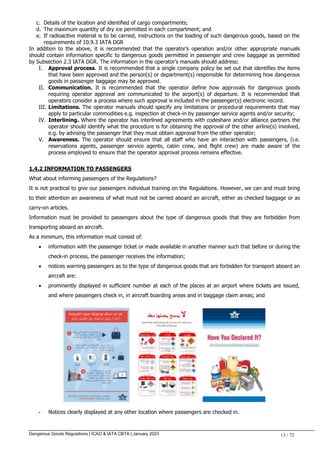
Information must be provided to passengers about the type of dangerous goods that they are forbidden from
transporting aboard an aircraft.
As a minimum, this information must consist of:
 information with the passenger ticket or made available in another manner such that before or during the
check-in process, the passenger receives the information;
 notices warning passengers as to the type of dangerous goods that are forbidden for transport aboard an
aircraft are:
 prominently displayed in sufficient number at each of the places at an airport where tickets are issued,
and where passengers check in, in aircraft boarding areas and in baggage claim areas; and
- Notices clearly displayed at any other location where passengers are checked in.
Dangerous Goods Regulations | ICAO & IATA CBTA | January 2023 14 / 72
1.5 Training Requirements
1.5.1 Initial & Recurrent Training
Personnel must receive recurrent training and assessment within 24 months of previous training and assessment
to ensure that competency has been maintained. However, if recurrent training and assessment is completed
within the final three months of validity of the previous training and assessment, the period of validity extends
from the month on which the recurrent training and assessment was completed until 24 months from the expiry
month of that previous training and assessment. For example, a person attends an initial course finishing on 14
April 2019; their training validity therefore expires on 30 April 2021. They may attend recurrent training any time
between 1 February and 30 April 2021 and their next recurrent training date will remain 30 April 2023. If,
however they complete recurrent training in January 2021, then as this is more than 3 months prior to the end of
April then their training expiry date becomes 31 January 2023.
All categories of staff involved in the movement of dangerous goods by air are legally required to have mandated
job-specific training. Training must be provided or verified when an employer hires an individual who will be
involved in the movement of dangerous goods. Refresher or recurrent training must be received within 24
months of previous dangerous goods training to make sure that the staff’s knowledge is up to date.
A test must be undertaken following dangerous goods training to verify understanding of the regulations.
Confirmation is required for successful completion of the test.
A record of training must be maintained by the employer which must show the name of each individual trained,
the date of the most recent training, and description of the training, and the name and address of the
organization providing this training.
1.5.2 Establishment and Maintenance
Note:
A training program includes elements such as design methodology, assessment, initial and recurrent training,
instructor qualifications and competencies, training records and evaluation of the effectiveness of training.
The employer of personnel that perform functions aimed at ensuring that dangerous goods are transported in
accordance with these Regulations must establish and maintain a dangerous goods training program.
Training must be provided or verified upon the employment of personnel identified in the
IATA Dangerous Goods Training Guidance Edition 1 2023 (Competency-based Training and
Assessment Approach) and ICAO Doc 10147 (Guidance on a Competency-based Approach to
Dangerous Goods Training and Assessment First Edition, 2021).
Notes:
1. An approach to ensuring personnel are competent to perform any function for which they are responsible
is provided in “DANGEROUS GOODS TRAINING PROGRAMS GUIDELINES - COMPETENCY-BASED
TRAINING ASSESSMENT APPROACH”, which is available on Website: www.iata.org/dangerousgoods
2. Security personnel who are involved with the screening of passengers and crew and their baggage and
cargo or mail are required to be trained irrespective of whether the operator on which the passenger or
cargo is to be transported carries dangerous goods as cargo.
a. All operators must establish a dangerous goods training program regardless of whether they are
approved to transport dangerous goods as cargo.
b. Training courses may be developed and delivered by or for the employer.
1.5.3 Training and Assessment Records
The employer must maintain a record of training and assessment for personnel.
The record of training and assessment must be maintained, which must include:
 The individual's name;
 The most recent training and assessment completion month;
 A description copies or reference to training and assessment materials used to meet the training and
assessment requirements;
 The name and address of the organization providing the training and assessment; and
 Evidence which shows that personnel have been assessed as competent to perform any function for
which they are responsible.
Dangerous Goods Regulations | ICAO & IATA CBTA | January 2023 15 / 72
Training and assessment records must be retained by the employer for a minimum period of 36 months from the
most recent training and assessment completion month and must be made available upon request to the
employee or appropriate national authority.
1.5.4 Review and Approval of Training Programs
Dangerous goods training programs for operators must be approved by the appropriate authority of the State of
the operator under the provisions of ICAO Annex 6—Operation of Aircraft.
Dangerous goods training programs required for entities other than operators and designated postal operators
should be approved as determined by the appropriate national authority.
1.6 APPROVAL
Where specifically provided for in the ICAO Technical Instructions, the State concerned may grant an
approval to permit the transport of dangerous goods, provided that in such instances an overall level of
safety in transport which is equivalent to the level of safety provided for in the instructions is achieved.
Acceptance of dangerous goods offered for transport under the provisions of an approval is at the
discretion of the operator(s) concerned. Shippers are encouraged to make advance arrangements with
the operator(s) as part of the planning process associated with any approval application.
Question 1: Articles, substances, capable of posing a hazard to health or property when transported by
air, are Definition for:
a) Dangerous Goods
b) Chemicals
c) Articles
Question 2: Operator’s Responsibility?
a) Loading
b) Classify
c) Marked
Exercise -1
Dangerous Goods Regulations | ICAO & IATA CBTA | January 2023 16 / 72
SECTION 2 — LIMITATIONS
By the end of this section, you will be able to:
 Identify Dangerous Goods that are:
• Forbidden for air transport
• Hidden dangerous goods
• Permitted as cargo under the Regulations
• Excepted from the Regulations
 Apply the principles for:
• Dangerous Goods in Excepted Quantities
• Dangerous Goods in Limited Quantities
 Identify State and Operator Variations
2.0 General
What is a Limitation?
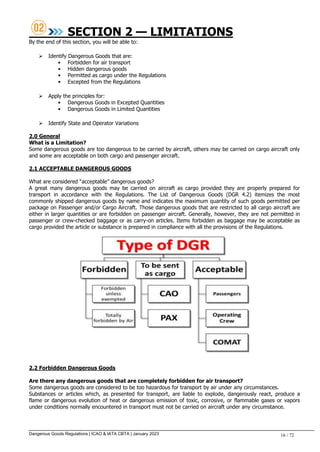
Some dangerous goods are too dangerous to be carried by aircraft, others may be carried on cargo aircraft only
and some are acceptable on both cargo and passenger aircraft.
2.1 ACCEPTABLE DANGEROUS GOODS
What are considered “acceptable” dangerous goods?
A great many dangerous goods may be carried on aircraft as cargo provided they are properly prepared for
transport in accordance with the Regulations. The List of Dangerous Goods (DGR 4.2) itemizes the most
commonly shipped dangerous goods by name and indicates the maximum quantity of such goods permitted per
package on Passenger and/or Cargo Aircraft. Those dangerous goods that are restricted to all cargo aircraft are
either in larger quantities or are forbidden on passenger aircraft. Generally, however, they are not permitted in
passenger or crew-checked baggage or as carry-on articles. Items forbidden as baggage may be acceptable as
cargo provided the article or substance is prepared in compliance with all the provisions of the Regulations.
2.2 Forbidden Dangerous Goods
Are there any dangerous goods that are completely forbidden for air transport?
Some dangerous goods are considered to be too hazardous for transport by air under any circumstances.
Substances or articles which, as presented for transport, are liable to explode, dangerously react, produce a
flame or dangerous evolution of heat or dangerous emission of toxic, corrosive, or flammable gases or vapors
under conditions normally encountered in transport must not be carried on aircraft under any circumstance.
Dangerous Goods Regulations | ICAO & IATA CBTA | January 2023 17 / 72
List the three main types of dangerous goods.
a. ………………………….
b. …………………………
c. …………………………
2.3 Recognition of Undeclared Dangerous Goods (Hidden Dangerous Goods)
What are Hidden Dangerous Goods?
These are goods which are tendered and declared under a general description which may contain hazardous
articles that are not apparent. Such articles may also be found in baggage.
To prevent undeclared dangerous goods from being loaded on an aircraft and passengers from taking on
board those dangerous goods which they are not permitted to have in their baggage, cargo, and passengers
about the contents of any item of cargo or baggage where there are suspicions that it may contain
dangerous goods.
Are all dangerous goods easily identified?
No. It is essential therefore that awareness and vigilance are maintained at all times when examining and
accepting baggage, or in the case of flight attendants, assisting in the stowage of carry-on baggage in the cabin
prior to flight. Great care should be taken to ensure that no dangerous goods are carried on board the aircraft as
baggage.
Remember, the passenger or crew member may not be aware that their items are considered dangerous goods
and are not permitted.
Confirmation should be sought from a passenger about the contents of any item where there are suspicions that
it may contain dangerous goods.
What kind of items should I be suspicious of?
Typical examples of items that may contain or indicate the presence of dangerous goods are:
Substance or Article Details of possible Dangerous Goods included
Aircraft Spare parts/
Aircraft Equipment/Aircraft
On Ground (AOG) Spares
May contain explosives (flares or other pyrotechnics), chemical oxygen,
generators, unserviceable tire assemblies, cylinders of compressed gas
(oxygen, carbon dioxide, nitrogen or fire extinguishers), paint adhesives,
aerosols, life-saving appliances, first aid kits, fuel in equipment, wet or
lithium batteries, matches; etc.
Automobiles, Automobile
Parts/Supplies
(car, motor, motorcycle)
May contain ferromagnetic material which may not meet the definition for magnetized but which
may be subject to special stowage requirements due to the possibility of affecting aircraft
instruments (see 3.9.2.2 DG Regs) may also contain engines, carburetors or fuel tanks which may
contain or have contained fuel, wet or lithium batteries, compressed gasses in the tire inhalation
devices, fire extinguishers, shocks/struts with nitrogen, airbag inflators/air bag modules flammable
adhesive, paints, sealants, and solvents, etc.
Exercise -2
Dangerous Goods Regulations | ICAO & IATA CBTA | January 2023 18 / 72
Substance or Article Details of possible Dangerous Goods included
Battery Powered Devices/
Equipment
May contain wet or lithium batteries
Breathing Apparatus
This may indicate cylinders of compressed air or oxygen, chemical
oxygen generators or refrigerated liquefied oxygen
Camping Equipment
May contain flammable gases (butane, propane, etc.), flammable liquids
(kerosene, gasoline, etc.) flammable solids (hexamine, matches, etc.) or
other dangerous goods
Chemicals
May contain items meeting any of the criteria for dangerous goods,
particularly flammable liquids, flammable solids, oxidizers, organic
peroxides, and toxic or corrosive substances.
COMAT (Company Materials)
Such as aircraft parts, may contain dangerous goods as an integral part
e.g. chemical oxygen generators in a passenger service unit (PSU),
various compressed gases such as oxygen, carbon dioxide, and nitrogen,
gas lighters, aerosols, fire extinguishers, flammable liquids such as fuels,
paints and adhesives and corrosive material such as batteries. Other
items such as flares, first aid kits, and life-saving appliances, match
magnetized material. Etc.
Consolidated Consignments
(Groupages)
May contain any of the defined classes of dangerous foods.
Cryogenic (Liquid)
Indicates refrigerated liquefied gases such as argon, helium, neon and
nitrogen
Cylinders May indicate compressed or liquefied gas
Dental Apparatus
May contain flammable resins or solvents, compressed or liquefied gas,
mercury and radioactive material
Diagnostic Specimens May contain infectious substances
Diving Equipment
May contain cylinders (such as scuba tanks, vest bottles, etc. of
compressed gas (air, oxygen, etc.) high intensity diving lamps which can
generate extremely high heat when operated by air in order to be
carried safely, the bulb or battery must be disconnected.
Drilling and Mining Equipment May contain explosive(s) and/or other dangerous goods
Dry Shipper (Vapour Shipper) May contain free liquid nitrogen. Dry shipper is subject to Regulations
when they permit the release of any free liquid nitrogen irrespective of
the orientation packaging.
Electrical Equipment/
Electronic Equipment
May contain magnetized materials or mercury in switch gear and
electron tubes, wet batteries, lithium batteries or fuel cell cartridges that
contain or have contained fuel.
Electrically Powered Apparatus
(Wheelchairs, lawn mowers,
golf carts, etc.)
May contain wet batteries, lithium batteries or fuel cells or fuel cell
cartridges that contain or have contained fuel
Expeditionary Equipment May contain explosives (flares), flammable liquids (gasoline), flammable
gas (propane, camping gas) or other dangerous goods.
Film Crew or Media Equipment May contain explosive pyrotechnic devices, generators incorporating
engines, wet batteries, lithium batteries, fuel heat producing item, etc.
Frozen Embryos May contain refrigerated liquefied gas or Carbon dioxide, solid (dry ice)
Frozen Fruit, Vegetables Etc. May be packed in Carbon dioxide, solid (dry ice)
Fuels May contain flammable liquids, flammable solids or flammable gases
Fuel Control Units May contain flammable liquids
Hot Air Balloon May contain cylinders with flammable gas, fire extinguishers, engines
internal combustion, batteries etc.
Household Goods May contain items meeting any of the criteria for dangerous goods
including flammable liquids such as solvent based paint, adhesives,
polishes, aerosols (for passengers, those not permitted under DGR 2.3)
bleach, corrosive oven or drain cleaners, ammunition, matches, etc.
Dangerous Goods Regulations | ICAO & IATA CBTA | January 2023 19 / 72
Substance or Article Details of possible Dangerous Goods included
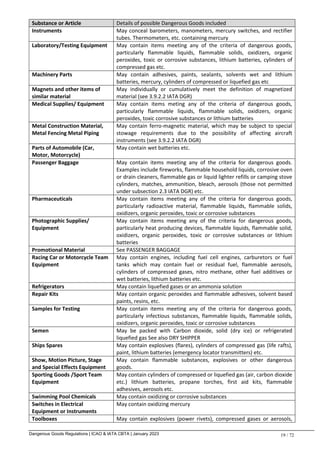
Instruments May conceal barometers, manometers, mercury switches, and rectifier
tubes. Thermometers, etc. containing mercury
Laboratory/Testing Equipment May contain items meeting any of the criteria of dangerous goods,
particularly flammable liquids, flammable solids, oxidizers, organic
peroxides, toxic or corrosive substances, lithium batteries, cylinders of
compressed gas etc.
Machinery Parts May contain adhesives, paints, sealants, solvents wet and lithium
batteries, mercury, cylinders of compressed or liquefied gas etc
Magnets and other items of
similar material
May individually or cumulatively meet the definition of magnetized
material (see 3.9.2.2 IATA DGR)
Medical Supplies/ Equipment May contain items meting any of the criteria of dangerous goods,
particularly flammable liquids, flammable solids, oxidizers, organic
peroxides, toxic corrosive substances or lithium batteries
Metal Construction Material,
Metal Fencing Metal Piping
May contain ferro-magnetic material, which may be subject to special
stowage requirements due to the possibility of affecting aircraft
instruments (see 3.9.2.2 IATA DGR)
Parts of Automobile (Car,
Motor, Motorcycle)
May contain wet batteries etc.
Passenger Baggage May contain items meeting any of the criteria for dangerous goods.
Examples include fireworks, flammable household liquids, corrosive oven
or drain cleaners, flammable gas or liquid lighter refills or camping stove
cylinders, matches, ammunition, bleach, aerosols (those not permitted
under subsection 2.3 IATA DGR) etc.
Pharmaceuticals May contain items meeting any of the criteria for dangerous goods,
particularly radioactive material, flammable liquids, flammable solids,
oxidizers, organic peroxides, toxic or corrosive substances
Photographic Supplies/
Equipment
May contain items meeting any of the criteria for dangerous goods,
particularly heat producing devices, flammable liquids, flammable solid,
oxidizers, organic peroxides, toxic or corrosive substances or lithium
batteries
Promotional Material See PASSENGER BAGGAGE
Racing Car or Motorcycle Team
Equipment
May contain engines, including fuel cell engines, carburetors or fuel
tanks which may contain fuel or residual fuel, flammable aerosols,
cylinders of compressed gases, nitro methane, other fuel additives or
wet batteries, lithium batteries etc.
Refrigerators May contain liquefied gases or an ammonia solution
Repair Kits May contain organic peroxides and flammable adhesives, solvent based
paints, resins, etc.
Samples for Testing May contain items meeting any of the criteria for dangerous goods,
particularly infectious substances, flammable liquids, flammable solids,
oxidizers, organic peroxides, toxic or corrosive substances
Semen May be packed with Carbon dioxide, solid (dry ice) or refrigerated
liquefied gas See also DRY SHIPPER
Ships Spares May contain explosives (flares), cylinders of compressed gas (life rafts),
paint, lithium batteries (emergency locator transmitters) etc.
Show, Motion Picture, Stage
and Special Effects Equipment
May contain flammable substances, explosives or other dangerous
goods.
Sporting Goods /Sport Team
Equipment
May contain cylinders of compressed or liquefied gas (air, carbon dioxide
etc.) lithium batteries, propane torches, first aid kits, flammable
adhesives, aerosols etc.
Swimming Pool Chemicals May contain oxidizing or corrosive substances
Switches in Electrical
Equipment or Instruments
May contain oxidizing mercury
Toolboxes May contain explosives (power rivets), compressed gases or aerosols,
Dangerous Goods Regulations | ICAO & IATA CBTA | January 2023 20 / 72
Substance or Article Details of possible Dangerous Goods included
flammable gases (butane cylinders or torches), flammable adhesives or
paints, corrosive liquids, lithium batteries, etc.
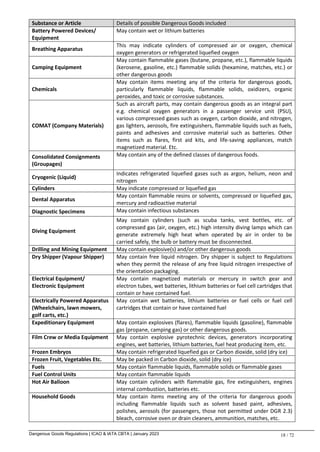
Torches Micro torches and utility lighters may contain flammable gas and be
equipped with an electronic starter. Larger torches may consist of a
torch head (often with a self-igniting switch) attached to a container or
cylinder of flammable gas
Unaccompanied Passengers
Baggage/ Personal Effects
May contain items meeting any of the criteria for dangerous goods, such
as fireworks, flammable gas or liquids, corrosive oven or drain cleaners,
flammable gas or liquid lighter refills or camping stove cylinders,
matches, bleach, aerosols, etc. (those not permitted under Subsection
2.3 IATA DGR)
Vaccines May be packed in Carbon Dioxide, solid (dry ice)
Note:
Articles and substances which do not fall within the definitions of dangerous goods as shown in these Regulations
and which in the event of leakage may cause a serious clean-up problem or corrosion to aluminum on a long-term
basis must be checked by the shipper to at least ensure that the packaging is adequate to prevent leakage during
transportation. These may include brine, powdered or liquid dyes, pickled foodstuffs etc.
2.4 Dangerous Goods Carried by Passengers or Crew
2.4.1 Dangerous goods, including excepted packages of radioactive material, must not be carried by passengers
or crew:
 as or in checked baggage;
 as or in carry-on baggage; or
 on their person;
2.4.2 Notwithstanding any additional restrictions that may be implemented by States in the interests of aviation
security, except for the incident reporting requirements of 9.6.2, the provisions of these Regulations do not apply
to 2.3.4 to 2.3.5 when carried by passengers or crew members or in baggage transported by the operator which
has been separated from its owner during transit (e.g. lost baggage or improperly routed baggage).
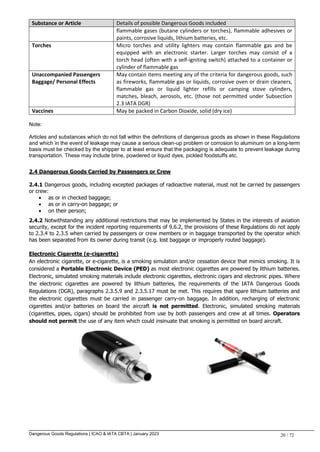
Electronic Cigarette (e-cigarette)
An electronic cigarette, or e-cigarette, is a smoking simulation and/or cessation device that mimics smoking. It is
considered a Portable Electronic Device (
(P
PE
ED
D)
) as most electronic cigarettes are powered by lithium batteries.
Electronic, simulated smoking materials include electronic cigarettes, electronic cigars and electronic pipes. Where
the electronic cigarettes are powered by lithium batteries, the requirements of the IATA Dangerous Goods
Regulations (DGR), paragraphs 2.3.5.9 and 2.3.5.17 must be met. This requires that spare lithium batteries and
the electronic cigarettes must be carried in passenger carry-on baggage. In addition, recharging of electronic
cigarettes and/or batteries on board the aircraft is not permitted. Electronic, simulated smoking materials
(cigarettes, pipes, cigars) should be prohibited from use by both passengers and crew at all times. Operators
should not permit the use of any item which could insinuate that smoking is permitted on board aircraft.
Dangerous Goods Regulations | ICAO & IATA CBTA | January 2023 21 / 72
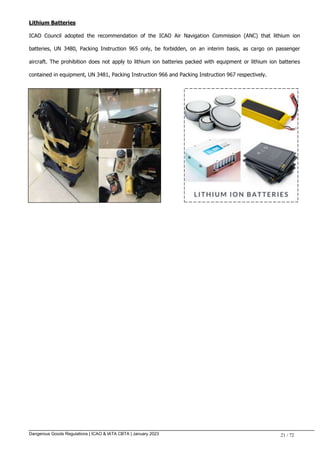
Lithium Batteries
ICAO Council adopted the recommendation of the ICAO Air Navigation Commission (ANC) that lithium ion
batteries, UN 3480, Packing Instruction 965 only, be forbidden, on an interim basis, as cargo on passenger
aircraft. The prohibition does not apply to lithium ion batteries packed with equipment or lithium ion batteries
contained in equipment, UN 3481, Packing Instruction 966 and Packing Instruction 967 respectively.
Dangerous Goods Regulations | ICAO & IATA CBTA | January 2023 22 / 72
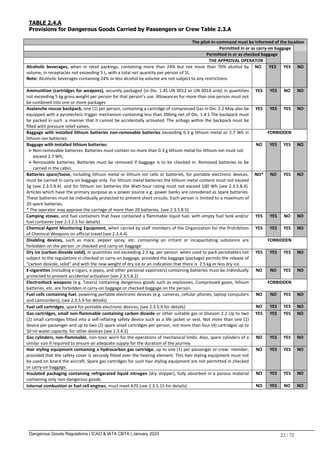
TABLE 2.4.A
Provisions for Dangerous Goods Carried by Passengers or Crew Table 2.3.A
The pilot-in-command must be informed of the location
Permitted in or as carry-on baggage
Permitted in or as checked baggage
THE APPROVAL OPERATOR
Alcoholic beverages, when in retail packings, containing more than 24% but not more than 70% alcohol by
volume, in receptacles not exceeding 5 L, with a total net quantity per person of 5L.
Note: Alcoholic beverages containing 24% or less alcohol by volume are not subject to any restrictions.
NO YES YES NO
Ammunition (cartridges for weapons), securely packaged (in Div. 1.4S UN 0012 or UN 0014 only) in quantities
not exceeding 5 kg gross weight per person for that person’s use. Allowances for more than one person must not
be combined into one or more packages
YES YES NO NO
Avalanche rescue backpack, one (1) per person, containing a cartridge of compressed Gas in Div. 2.2 May also be
equipped with a pyrotechnic trigger mechanism containing less than 200mg net of Div. 1.4 S The backpack must
be packed in such a manner that it cannot be accidentally activated. The airbags within the backpack must be
filled with pressure relief valves.
YES YES YES NO
Baggage with installed lithium batteries non-removable batteries exceeding 0.3 g lithium metal or 2.7 Wh in
lithium-ion batteries.
FORBIDDEN
Baggage with installed lithium batteries:
 Non-removable batteries. Batteries must contain no more than 0.3 g lithium metal for lithium-ion must not
exceed 2.7 Wh;
 Removable batteries. Batteries must be removed if baggage is to be checked in. Removed batteries to be
carried in the cabin.
NO YES YES NO
Batteries spare/loose, including lithium metal or lithium ion cells or batteries, for portable electronic devices,
must be carried in carry-on baggage only. For lithium metal batteries the lithium metal content must not exceed
2g (see 2.3.5.8.4). and for lithium ion batteries the Watt-hour rating must not exceed 100 Wh (see 2.3.5.8.4).
Articles which have the primary purpose as a power source e.g. power banks are considered as spare batteries.
These batteries must be individually protected to prevent short circuits. Each person is limited to a maximum of
20 spare batteries.
* The operator may approve the carriage of more than 20 batteries. (see 2.3.5.8.5)
NO* NO YES NO
Camping stoves, and fuel containers that have contained a flammable liquid fuel, with empty fuel tank and/or
fuel container (see 2.3.2.5 for details)
YES YES NO NO
Chemical Agent Monitoring Equipment, when carried by staff members of the Organization for the Prohibition
of Chemical Weapons on official travel (see 2.3.4.4)
YES YES YES NO
Disabling devices, such as mace, pepper spray, etc. containing an irritant or incapacitating substance are
forbidden on the person ,in checked and carry-on baggage
FORBIDDEN
Dry ice (carbon dioxide solid), In quantities not exceeding 2.5 kg. per person when used to pack perishables not
subject to the regulations in checked or carry-on baggage, provided the baggage (package) permits the release of
“carbon dioxide, solid” and with the new weight of dry ice or an indication that there is 2.5 kg or less dry ice.
YES YES YES NO
E-cigarettes (including e-cigars, e-pipes, and other personal vaporizers) containing batteries must be individually
protected to prevent accidental activation (see 2.3.5.8.2)
NO NO YES NO
Electroshock weapons (e.g. Tasers) containing dangerous goods such as explosives, Compressed gases, lithium
batteries, etc. are forbidden in carry-on baggage or checked baggage on the person.
FORBIDDEN
Fuel cells containing fuel, powering portable electronic devices (e.g. cameras, cellular phones, laptop computers
and camcorders), (see 2.3.5.9 for details)
NO NO YES NO
Fuel cell cartridges, spare for portable electronic devices, (see 2.3.5.9 for details) NO YES YES NO
Gas cartridges, small non-flammable containing carbon dioxide or other suitable gas in Division 2.2 Up to two
(2) small cartridges fitted into a self-inflating safety device such as a life jacket or vest. Not more than one (1)
device per passenger and up to two (2) spare small cartridges per person, not more than four (4) cartridges up to
50 ml water capacity for other devices (see 2.3.4.2)
YES YES YES NO
Gas cylinders, non-flammable, non-toxic worn for the operations of mechanical limbs. Also, spare cylinders of a
similar size if required to ensure an adequate supply for the duration of the journey
NO YES YES NO
Hair styling equipment containing a hydrocarbon gas cartridge, up to one (1) per passenger or crew- member,
provided that the safety cover is securely fitted over the heating element. This hair-styling equipment must not
be used on board the aircraft. Spare gas cartridges for such hair styling equipment are not permitted in checked
or carry-on baggage.
NO YES YES NO
Insulated packaging containing refrigerated liquid nitrogen (dry shipper), fully absorbed in a porous material
containing only non-dangerous goods.
NO YES YES NO
Internal combustion or fuel cell engines, must meet A70 (see 2.3.5.15 for details) NO YES NO NO
Dangerous Goods Regulations | ICAO & IATA CBTA | January 2023 23 / 72
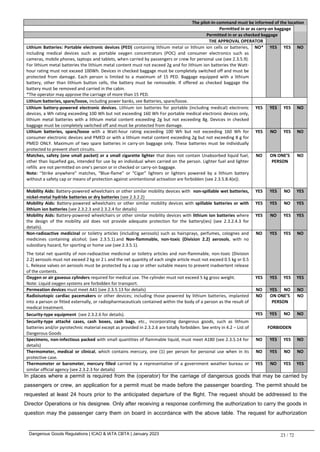
The pilot-in-command must be informed of the location
Permitted in or as carry-on baggage
Permitted in or as checked baggage
THE APPROVAL OPERATOR
Lithium Batteries: Portable electronic devices (PED) containing lithium metal or lithium ion cells or batteries,
including medical devices such as portable oxygen concentrators (POC) and consumer electronics such as
cameras, mobile phones, laptops and tablets, when carried by passengers or crew for personal use (see 2.3.5.9).
For lithium metal batteries the lithium metal content must not exceed 2g and for lithium ion batteries the Watt-
hour rating must not exceed 100Wh. Devices in checked baggage must be completely switched off and must be
protected from damage. Each person is limited to a maximum of 15 PED. Baggage equipped with a lithium
battery, other than lithium button cells, the battery must be removable. If offered as checked baggage the
battery must be removed and carried in the cabin.
*The operator may approve the carriage of more than 15 PED.
NO* YES YES NO
Lithium batteries, spare/loose, including power banks, see Batteries, spare/loose.
Lithium battery-powered electronic devices. Lithium ion batteries for portable (including medical) electronic
devices, a Wh rating exceeding 100 Wh but not exceeding 160 Wh For portable medical electronic devices only,
lithium metal batteries with a lithium metal content exceeding 2g but not exceeding 8g. Devices in checked
baggage must be completely switched off and must be protected from damage.
YES YES YES NO
Lithium batteries, spare/loose with a Watt-hour rating exceeding 100 Wh but not exceeding 160 Wh for
consumer electronic devices and PMED or with a lithium metal content exceeding 2g but not exceeding 8 g for
PMED ONLY. Maximum of two spare batteries in carry-on baggage only. These batteries must be individually
protected to prevent short circuits.
YES NO YES NO
Matches, safety (one small packet) or a small cigarette lighter that does not contain Unabsorbed liquid fuel,
other than liquefied gas, intended for use by an individual when carried on the person. Lighter fuel and lighter
refills are not permitted on one’s person or in checked or carry-on baggage.
Note: “Strike anywhere” matches, “Blue-flame” or “Cigar” lighters or lighters powered by a lithium battery
without a safety cap or means of protection against unintentional activation are forbidden (see 2.3.5.8.4(e)).
NO ON ONE’S
PERSON
NO
Mobility Aids: Battery-powered wheelchairs or other similar mobility devices with non-spillable wet batteries,
nickel-metal hydride batteries or dry batteries (see 2.3.2.2)
YES YES NO YES
Mobility Aids: Battery-powered wheelchairs or other similar mobility devices with spillable batteries or with
lithium ion batteries (see 2.3.2.3 and 2.3.2.4 for details)
YES YES NO YES
Mobility Aids: Battery-powered wheelchairs or other similar mobility devices with lithium ion batteries where
the design of the mobility aid does not provide adequate protection for the battery(ies) (see 2.3.2.4.3 for
details).
YES NO YES YES
Non-radioactive medicinal or toiletry articles (including aerosols) such as hairsprays, perfumes, colognes and
medicines containing alcohol; (see 2.3.5.1).and Non-flammable, non-toxic (Division 2.2) aerosols, with no
subsidiary hazard, for sporting or home use (see 2.3.5.1).
The total net quantity of non-radioactive medicinal or toiletry articles and non-flammable, non-toxic (Division
2.2) aerosols must not exceed 2 kg or 2 L and the net quantity of each single article must not exceed 0.5 kg or 0.5
L. Release valves on aerosols must be protected by a cap or other suitable means to prevent inadvertent release
of the contents.
NO YES YES NO
Oxygen or air gaseous cylinders required for medical use. The cylinder must not exceed 5 kg gross weight.
Note: Liquid oxygen systems are forbidden for transport.
YES YES YES YES
Permeation devices must meet A41 (see 2.3.5.13 for details) NO YES NO NO
Radioisotopic cardiac pacemakers or other devices; including those powered by lithium batteries, implanted
into a person or fitted externally, or radiopharmaceuticals contained within the body of a person as the result of
medical treatment.
NO ON ONE’S
PERSON
NO
Security-type equipment (see 2.3.2.6 for details). YES YES NO NO
Security-type attaché cases, cash boxes, cash bags, etc., incorporating dangerous goods, such as lithium
batteries and/or pyrotechnic material except as provided in 2.3.2.6 are totally forbidden. See entry in 4.2 – List of
Dangerous Goods
FORBIDDEN
Specimens, non-infectious packed with small quantities of flammable liquid, must meet A180 (see 2.3.5.14 for
details)
NO YES YES NO
Thermometer, medical or clinical, which contains mercury, one (1) per person for personal use when in its
protective case.
NO YES NO NO
Thermometer or barometer, mercury filled carried by a representative of a government weather bureau or
similar official agency (see 2.3.2.3 for details)
YES NO YES YES
In places where a permit is required from the (operator) for the carriage of dangerous goods that may be carried by
passengers or crew, an application for a permit must be made before the passenger boarding. The permit should be
requested at least 24 hours prior to the anticipated departure of the flight. The request should be addressed to the
Director Operations or his designee. Only after receiving a response confirming the authorization to carry the goods in
question may the passenger carry them on board in accordance with the above table. The request for authorization
Dangerous Goods Regulations | ICAO & IATA CBTA | January 2023 24 / 72
may be made by email to the Director Operations or his designee, clearly indicating the type of dangerous goods the
passenger wishes to carry on board in accordance with the above table.
2.5 Transport of Dangerous Goods by Post
2.5.1 The Universal Postal Union Convention forbids the carriage of dangerous goods in mail except as permitted
in 2.4 Appropriate national authorities should ensure that the provisions of the UPU Convention are complied with
in relation to the transport of dangerous goods by air.
The dangerous goods listed in this subsection may be accepted in mail for air carriage subject to the provisions of
the appropriate national authorities concerned and the parts of the Regulations which relate so such materials:
a) Infectious substances assigned to Biological substance, Category B (UN3373) only when packed
in accordance with the requirements of Packing Instruction 650 and carbon dioxide, solid (dry ice) when
used as a refrigerant for infectious substances (UN3373).
b) Patient specimens as defined in 3.6.2.1.4 (IATA DGR’s) provided that they are classified, packed and
marked as required by 3.6.2.2.3.8 (a) to (d) (IATA DGR).
c) Radioactive material in an expected package UN2910 and UN2911 only provided the activity does
not exceed one tenth of that permitted in table 10.3C and that does not meet the definitions and criteria
of classes, other than Class 7, or divisions as defined in Section 3 of the IATA DGR. The package must be
marked “radioactive material-quantities permitted for movement by post” and must bear the radioactive
material, excepted package label (Figure 7.4 G / 10.7.8.A IATA DGR); the provisions relating to
documentation (Subsection 10.8 IATA DGR) do not apply to such radioactive material.
d) Lithium ion batteries contained in equipment (UN3481) meeting the provisions of Section II of
Packing instruction 967 (IATA DGR). No more than four cells or two batteries may be mailed in any single
package and;
e) Lithium metal batteries contained in equipment (UN3091) meeting the provisions of section II
Packing Instruction 970 (IATA DGR). No more than four cells or two batteries may be mailed in any
single package.
2.6 Dangerous Goods in Operator's Property
Some articles and substances classified as dangerous goods are required to be on board an aircraft in accordance
with the pertinent airworthiness requirements and operating regulations; or are authorized by the State of the
operator to meet special requirements. Examples of these are: life rafts, life jackets, emergency escape slides, all
of which contain cylinders of compressed gas and may also contain other items such as first aid kits and flares.
a. Aircraft Equipment
b. Consumer Goods
c. Carbon Dioxide, Solid (Dry Ice)+
d. Hygiene Products (hand sanitizers)
e. Battery-Powered Electronic Equipment
f. Aircraft Spares
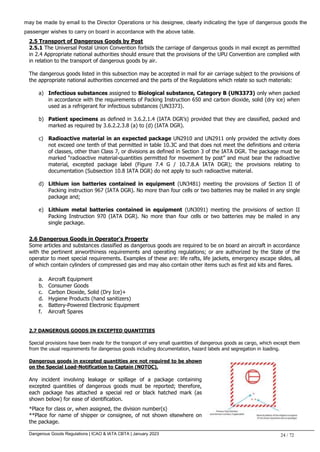
2.7 DANGEROUS GOODS IN EXCEPTED QUANTITIES
Special provisions have been made for the transport of very small quantities of dangerous goods as cargo, which except them
from the usual requirements for dangerous goods including documentation, hazard labels and segregation in loading.
Dangerous goods in excepted quantities are not required to be shown
on the Special Load-Notification to Captain (NOTOC).
Any incident involving leakage or spillage of a package containing
excepted quantities of dangerous goods must be reported; therefore,
each package has attached a special red or black hatched mark (as
shown below) for ease of identification.
*Place for class or, when assigned, the division number(s)
**Place for name of shipper or consignee, of not shown elsewhere on
the package.
Dangerous Goods Regulations | ICAO & IATA CBTA | January 2023 25 / 72
Table 2.6.A Excepted Quantity Codes for Table 4.2 (2.6.4.1 IATA DGR) details whether an item may be shipped
as excepted quantity and of so the quantity:
Table 2.6.A Excepted Quantity Codes for Table 4.2
EQ
Code
Maximum net quantity per
Inner packaging
Maximum net quantity per
Outer packaging
E0 Not permitted as Excepted Quantity
E1 30 g/30 ml 1 kg/1 L
E2 30 g/30 ml 500 g/500 ml
E3 30 g/30 ml 300 g/300 ml
E4 1 g/1 ml 500 g/500 ml
E5 1 g/1 ml 300 g/300 ml
2.8 DANGEROUS GOODS IN LIMITED QUANTITIES
a) General
The UN Recommendations contain provisions for limited quantities of dangerous goods. These recognize that
many dangerous goods when in reasonably limited quantities present a reduced hazard during transport and can
safely be carried in good quantity packaging of the types specified in the Recommendations, but which have not
been tested and marked accordingly. The provision is based in the packaging in the UN Recommendations and
allow limited quantities of dangerous goods to be transported in packaging’s which, although not tested and
marked in accordance with Section 6 of the IATA DG Regulations 64th
Edition, do not meet the construction
requirements of that section.
b) Applicability
It is recognized that many dangerous goods can be safely carried in good quality combination packaging’s which
meet the construction requirements of Subsection 6.1 and 6.2 (IATA DGR) but which have not been marked and
tested in accordance with the requirements of 6.0.4 and Subsection 6.3 (IATA DGR) Dangerous goods may be
carried as “Limited Quantity” only if they comply with the restrictions provided in paragraph 2.7.1 IATA DGR, in
the List of Dangerous Goods and in Section 5 IATA DGR. All requirements of the Regulations must be met unless
otherwise provided for.
The limitations and provisions of Subsection 2.7 IATA DGR for the transport of dangerous goods in Limited
Quantities apply identically for passenger and cargo aircraft.
Quantity Limitations: The net quantity per package must not exceed the quantity specified in Section 4 of
IATA DGR. The gross weight of a “Limited Quantity” package must not exceed 30kg.
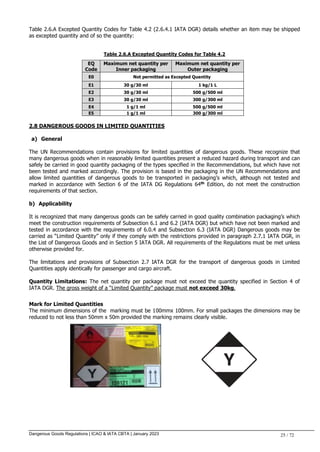
Mark for Limited Quantities
The minimum dimensions of the marking must be 100mmx 100mm. For small packages the dimensions may be
reduced to not less than 50mm x 50m provided the marking remains clearly visible.
Dangerous Goods Regulations | ICAO & IATA CBTA | January 2023 26 / 72
Refer to table 2.3.A of the IATA DGR
(a) For the following items, does the passenger need the approval of operator?
1. Chemical Agent Monitoring Equipment ________________________________
2. Dry ice as checked baggage ________________________________
3. Oxygen cylinder weight 5kg ________________________________
4. Spare Lithium Batteries ________________________________
5. Aerosols in Division 2.2 ________________________________
(b) What hazards might you suspect to find in the following types of baggage?
(Give one example for each)
a) Frozen Embryos ________________________________
b) Camping equipment ________________________________
c) Hot Air Balloon ________________________________
d) Unaccompanied Passenger Baggage ________________________________
e) Refrigerators ________________________________
(c) List 2 dangerous goods that can be transported by Post.
___________________________________________________________________________
(d) List 3 DG found in Operator’s property.
___________________________________________________________________________
Exercise -3
Dangerous Goods Regulations | ICAO & IATA CBTA | January 2023 27 / 72
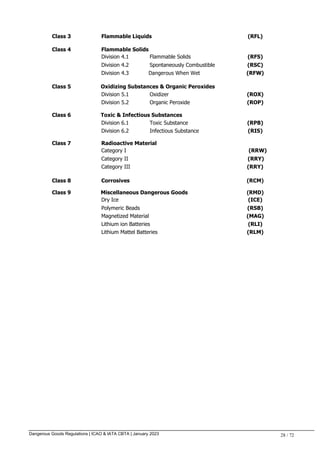
SECTION 3 — CLASSIFICATION
3.0 General Principles
In this section, you will be to:
 Identify the nine classes of dangerous goods by their principle criteria;
 Recognize the hazard labels for each classes of division of dangerous goods;
 Identify and apply the principles of Packing Groups
3.1 Classifying Dangerous Goods
3.1.1 Dangerous goods are divided into 9 hazard groups called Classes.
 Classes 1,2,4,5 and 6 are broken down into “Divisions” due to hazard variation within these classes.
 Classes are expressed by single-digit numbers. (Example Class 7).
 Divisions are expressed by 2-digit numbers. The first digit identifies the class number and the
second identifies the division number within that class. (Example Class 1, Division 1 would be
expressed as Division 1.1)
3.2 Hazard Classes
CLASS 1 Explosives
Division 1.1 REX Not permitted by Air
Division 1.2 REX Not permitted by Air
Division 1.3 1.3C (RCX) May be permitted on CAO
1.3F (REX) Not permitted by Air
1.3G (RGX) May be permitted on CAO
1.3H (REX) Not permitted by Air
1.3J (REX) Not permitted by Air
1.3K (REX) Not permitted by Air
1.3L (REX) Not permitted by Air
Division 1.4 1.4B (RXB) May be permitted on CAO
1.4C (RXC) May be permitted on CAO
1.4D (RXD) May be permitted on CAO
1.4E (RXE) May be permitted on CAO
1.4F (REX) Not permitted by Air
1.4G (RXG) May be permitted on CAO
1.4S (RXS) May be transported on
Passenger Aircraft and Cargo Aircraft
Division 1.5 REX Not permitted by Air
Division 1.6 REX Not permitted by Air
Class 2 Gases
Division 2.1 Flammable Gas (RFG)
Division 2.2 Non-Flammable, non-Toxic Gas (RNG)
Division 2.3 Toxic Gas (RPG)
Dangerous Goods Regulations | ICAO & IATA CBTA | January 2023 28 / 72
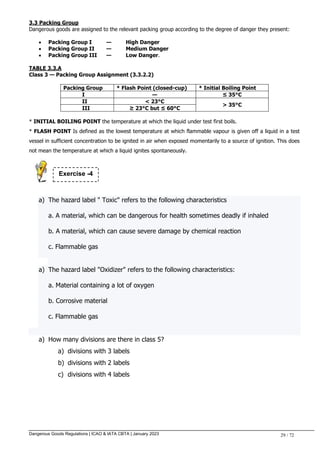
Class 3 Flammable Liquids (RFL)
Class 4 Flammable Solids
Division 4.1 Flammable Solids (RFS)
Division 4.2 Spontaneously Combustible (RSC)
Division 4.3 Dangerous When Wet (RFW)
Class 5 Oxidizing Substances & Organic Peroxides
Division 5.1 Oxidizer (ROX)
Division 5.2 Organic Peroxide (ROP)
Class 6 Toxic & Infectious Substances
Division 6.1 Toxic Substance (RPB)
Division 6.2 Infectious Substance (RIS)
Class 7 Radioactive Material
Category I (RRW)
Category II (RRY)
Category III (RRY)
Class 8 Corrosives (RCM)
Class 9 Miscellaneous Dangerous Goods (RMD)
Dry Ice (ICE)
Polymeric Beads (RSB)
Magnetized Material (MAG)
Lithium ion Batteries (RLI)
Lithium Mattel Batteries (RLM)
Dangerous Goods Regulations | ICAO & IATA CBTA | January 2023 29 / 72
3.3 Packing Group
Dangerous goods are assigned to the relevant packing group according to the degree of danger they present:
 Packing Group I — High Danger
 Packing Group II — Medium Danger
 Packing Group III — Low Danger.
TABLE 3.3.A
Class 3 — Packing Group Assignment (3.3.2.2)
Packing Group * Flash Point (closed-cup) * Initial Boiling Point
I — ≤ 35°C
II < 23°C
> 35°C
III ≥ 23°C but ≤ 60°C
* INITIAL BOILING POINT the temperature at which the liquid under test first boils.
* FLASH POINT Is defined as the lowest temperature at which flammable vapour is given off a liquid in a test
vessel in sufficient concentration to be ignited in air when exposed momentarily to a source of ignition. This does
not mean the temperature at which a liquid ignites spontaneously.
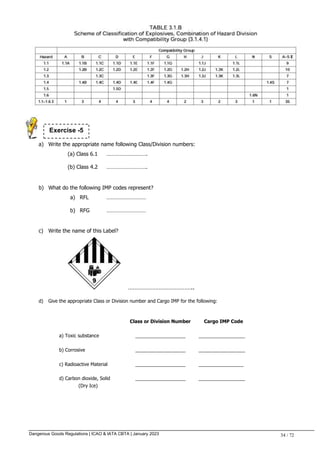
a) The hazard label " Toxic" refers to the following characteristics
a. A material, which can be dangerous for health sometimes deadly if inhaled
b. A material, which can cause severe damage by chemical reaction
c. Flammable gas
a) The hazard label "Oxidizer" refers to the following characteristics:
a. Material containing a lot of oxygen
b. Corrosive material
c. Flammable gas
a) How many divisions are there in class 5?
a) divisions with 3 labels
b) divisions with 2 labels
c) divisions with 4 labels
Exercise -4
Dangerous Goods Regulations | ICAO & IATA CBTA | January 2023 30 / 72
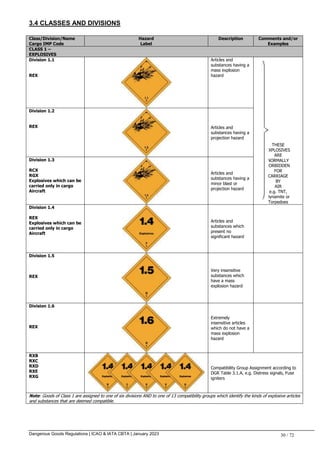
3.4 CLASSES AND DIVISIONS
Class/Division/Name
Cargo IMP Code
Hazard
Label
Description Comments and/or
Examples
CLASS 1 –
EXPLOSIVES
Division 1.1
REX
Articles and
substances having a
mass explosion
hazard
THESE
EXPLOSIVES
ARE
NORMALLY
FORBIDDEN
FOR
CARRIAGE
BY
AIR
e.g. TNT,
Dynamite or
Torpedoes
Division 1.2
REX Articles and
substances having a
projection hazard
Division 1.3
RCX
RGX
Explosives which can be
carried only in cargo
Aircraft
Articles and
substances having a
minor blast or
projection hazard
Division 1.4
REX
Explosives which can be
carried only in cargo
Aircraft
Articles and
substances which
present no
significant hazard
Division 1.5
REX
Very insensitive
substances which
have a mass
explosion hazard
Division 1.6
REX
Extremely
insensitive articles
which do not have a
mass explosion
hazard
RXB
RXC
RXD
RXE
RXG
Compatibility Group Assignment according to
DGR Table 3.1.A, e.g. Distress signals, Fuse
igniters
Note: Goods of Class 1 are assigned to one of six divisions AND to one of 13 compatibility groups which identify the kinds of explosive articles
and substances that are deemed compatible.
Dangerous Goods Regulations | ICAO & IATA CBTA | January 2023 31 / 72
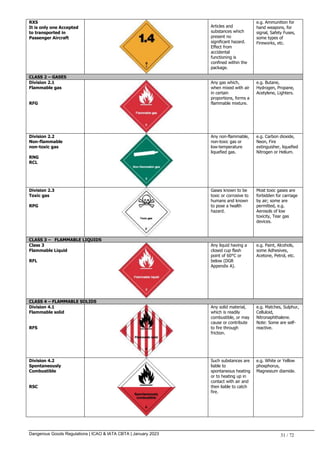
RXS
It is only one Accepted
to transported in
Passenger Aircraft
Articles and
substances which
present no
significant hazard.
Effect from
accidental
functioning is
confined within the
package.
e.g. Ammunition for
hand weapons, for
signal, Safety Fuses,
some types of
Fireworks, etc.
CLASS 2 – GASES
Division 2.1
Flammable gas
RFG
Any gas which,
when mixed with air
in certain
proportions, forms a
flammable mixture.
e.g. Butane,
Hydrogen, Propane,
Acetylene, Lighters.
Division 2.2
Non-flammable
non-toxic gas
RNG
RCL
Any non-flammable,
non-toxic gas or
low-temperature
liquefied gas.
e.g. Carbon dioxide,
Neon, Fire
extinguisher, liquefied
Nitrogen or Helium.
Division 2.3
Toxic gas
RPG
Gases known to be
toxic or corrosive to
humans and known
to pose a health
hazard.
Most toxic gases are
forbidden for carriage
by air; some are
permitted, e.g.
Aerosols of low
toxicity, Tear gas
devices.
CLASS 3 – FLAMMABLE LIQUIDS
Class 3
Flammable Liquid
RFL
Any liquid having a
closed cup flash
point of 60°C or
below (DGR
Appendix A).
e.g. Paint, Alcohols,
some Adhesives,
Acetone, Petrol, etc.
CLASS 4 – FLAMMABLE SOLIDS
Division 4.1
Flammable solid
RFS
Any solid material,
which is readily
combustible, or may
cause or contribute
to fire through
friction.
e.g. Matches, Sulphur,
Celluloid,
Nitronaphthalene.
Note: Some are self-
reactive.
Division 4.2
Spontaneously
Combustible
RSC
Such substances are
liable to
spontaneous heating
or to heating up in
contact with air and
then liable to catch
fire.
e.g. White or Yellow
phosphorus,
Magnesium diamide.
Dangerous Goods Regulations | ICAO & IATA CBTA | January 2023 32 / 72
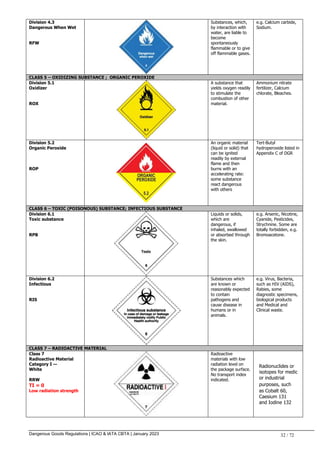
Division 4.3
Dangerous When Wet
RFW
Substances, which,
by interaction with
water, are liable to
become
spontaneously
flammable or to give
off flammable gases.
e.g. Calcium carbide,
Sodium.
CLASS 5 – OXIDIZING SUBSTANCE ; ORGANIC PEROXIDE
Division 5.1
Oxidizer
ROX
A substance that
yields oxygen readily
to stimulate the
combustion of other
material.
Ammonium nitrate
fertilizer, Calcium
chlorate, Bleaches.
Division 5.2
Organic Peroxide
ROP
An organic material
(liquid or solid) that
can be ignited
readily by external
flame and then
burns with an
accelerating rate:
some substance
react dangerous
with others
Tert-Butyl
hydroperoxide listed in
Appendix C of DGR
CLASS 6 – TOXIC (POISONOUS) SUBSTANCE; INFECTIOUS SUBSTANCE
Division 6.1
Toxic substance
RPB
Liquids or solids,
which are
dangerous, if
inhaled, swallowed
or absorbed through
the skin.
e.g. Arsenic, Nicotine,
Cyanide, Pesticides,
Strychnine. Some are
totally forbidden, e.g.
Bromoacetone.
Division 6.2
Infectious
RIS
Substances which
are known or
reasonably expected
to contain
pathogens and
cause disease in
humans or in
animals.
e.g. Virus, Bacteria,
such as HIV (AIDS),
Rabies, some
diagnostic specimens,
biological products
and Medical and
Clinical waste.
CLASS 7 – RADIOACTIVE MATERIAL
Class 7
Radioactive Material
Category I —
White
RRW
TI = 0
Low radiation strength
Radioactive
materials with low
radiation level on
the package surface.
No transport index
indicated.
Radionuclides or
isotopes for medic
or industrial
purposes, such
as Cobalt 60,
Caesium 131
and Iodine 132
Dangerous Goods Regulations | ICAO & IATA CBTA | January 2023 33 / 72
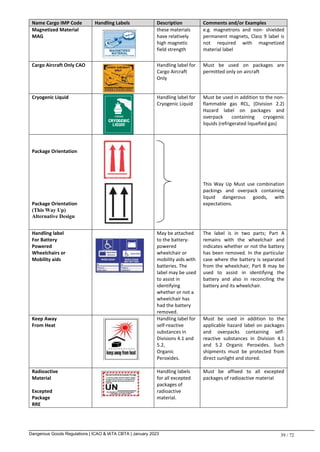
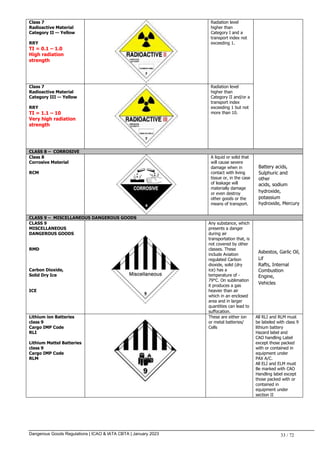
Class 7
Radioactive Material
Category II — Yellow
RRY
TI = 0.1 – 1.0
High radiation
strength
Radiation level
higher than
Category I and a
transport index not
exceeding 1.
Class 7
Radioactive Material
Category III — Yellow
RRY
TI = 1.1 – 10
Very high radiation
strength
Radiation level
higher than
Category II and/or a
transport index
exceeding 1 but not
more than 10.
CLASS 8 – CORROSIVE
Class 8
Corrosive Material
RCM
A liquid or solid that
will cause severe
damage when in
contact with living
tissue or, in the case
of leakage will
materially damage
or even destroy
other goods or the
means of transport.
Battery acids,
Sulphuric and
other
acids, sodium
hydroxide,
potassium
hydroxide, Mercury
CLASS 9 – MISCELLANEOUS DANGEROUS GOODS
CLASS 9
MISCELLANEOUS
DANGEROUS GOODS
RMD
Carbon Dioxide,
Solid Dry Ice
ICE
Any substance, which
presents a danger
during air
transportation that, is
not covered by other
classes. These
include Aviation
regulated Carbon
dioxide, solid (dry
ice) has a
temperature of -
79°C. On sublimation
it produces a gas
heavier than air
which in an enclosed
area and in larger
quantities can lead to
suffocation.
Asbestos, Garlic Oil,
Lif
Rafts, Internal
Combustion
Engine,
Vehicles
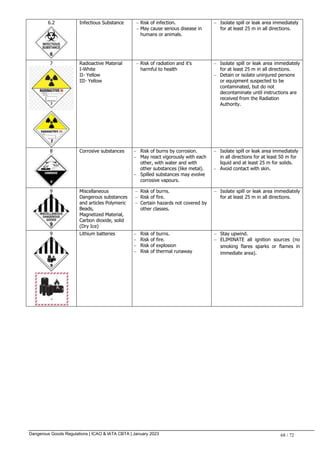
Lithium ion Batteries
class 9
Cargo IMP Code
RLI
Lithium Mattel Batteries
class 9
Cargo IMP Code
RLM
These are either ion
or metal batteries/
Cells
All RLI and RLM must
be labeled with class 9
lithium battery
Hazard label and
CAO handling Label
except those packed
with or contained in
equipment under
PAX A/C.
All ELI and ELM must
Be marked with CAO
Handling label except
those packed with or
contained in
equipment under
section II
Dangerous Goods Regulations | ICAO & IATA CBTA | January 2023 34 / 72
a) Write the appropriate name following Class/Division numbers:
(a) Class 6.1 ………………………. .
(b) Class 4.2 ……………………….
b) What do the following IMP codes represent?
a) RFL ………………………
b) RFG ………………………
c) Write the name of this Label?
…………………………………..
d) Give the appropriate Class or Division number and Cargo IMP for the following:
Class or Division Number Cargo IMP Code
a) Toxic substance ___________________ __________________
b) Corrosive ___________________ __________________
c) Radioactive Material ___________________ _________________
d) Carbon dioxide, Solid ___________________ __________________
(Dry Ice)
Exercise -5
Dangerous Goods Regulations | ICAO & IATA CBTA | January 2023 35 / 72
SECTION 4 — MARKING and LABELING
4.0 GENERAL
Are all dangerous goods marked and labelled in some way?
Yes, Packages containing dangerous goods are normally identified with specific marks and special
hazard labels, intended to alert you to hazard inherent to the contents. Correct marking and labelling of
dangerous goods packages is an important element in the safe transport process.
Marks and labels fulfil the following general purposes:
 They indicate the contents of the package;
 They indicate that the packaging meets approved standards;
 They provide safe handling and stowage information;
 They indicate the nature of hazard(s)
The shipper is responsible for all necessary marking and labelling of each package if dangerous goods
and each overpack containing dangerous goods, in compliance with the regulations. Each package
must be of such a size that there is adequate space to affix all required marks and labels (see
5.0.2.13.4 IATA DGR).
The cargo agent, and operator's dangerous goods acceptance staff are required to check and make
sure that all packages are correctly marked and labelled before accepting the consignment.
4.1 MARKING
For each package and overpack containing dangerous goods that requires marking, the shipper must:
1. check that the required marking is applied in the correct locations on the package and that it meets the
quality and specification requirements of the Regulations;
2. ensure that where specification packaging is required, the specification markings are as specified;
3. remove or obliterate any irrelevant marking;
4. Ensure that all the required markings have been applied when the package is presented to the operator.
4.1.1 There are two types of Markings:
1. Packaging use markings (P.U.M)
2. Package specification markings (P.S.M)
4.1.2 Packaging Use Marking (P.U.M)
As a minimum each package or overpack containing dangerous goods must be clearly marked to show:
 the proper shipping name(s);
 the applicable UN or ID Number(s); and
 the full name and address of the shipper and the consignee;
Example:
1 package contains:
Proper shipping name : Paint
UN Number : UN 1263
Shipper’s name and address in full : MacLean Chemicals PLC.
8 Old Kent Road
London E.C.1, England
Consignee’s name and address : Chemimport
Wiesengrund 6
D-50667 Köln 40
Germany
Dangerous Goods Regulations | ICAO & IATA CBTA | January 2023 36 / 72
4.1.3 Package Specification Markings (P.S.M)
These packagings are subject to performance tests designed to ensure that the package design will not lose any
of their contents under normal transport conditions. The severity of the tests on a packaging is dependent on the
degree of danger of the intended contents. UN Specification packagings are normally tested by an institute
authorized by government authorities. They bear a UN specification marking.
Example of a UN Specification Marking:
= United Nations Packaging Symbol indicating that the package has been designed, tested and manufactured according
to the United Nations Specifications.
4G = the Packaging Type Code. “4G” indicates a fiberboard box.
X = the packing group designator. “X” identifies that the packaging has been tested for substances in Packing Group I,
“Y” for Packing Group II and “Z” for Packing Group III.
10 = the maximum permitted gross weight, in kilograms, of the package.
S = Indicates the package is used to contain solids or inner packagings.
XX = Shows the year in which the package was manufactured, e.g. “07”.
USA = Indicates the State authorizing the allocation of the mark.
T7402 =Name or identification mark of the manufacturer.
Dangerous Goods Regulations | ICAO & IATA CBTA | January 2023 37 / 72
4.1.3.1 UN SPECIFICATION PACKAGING
A type of packaging (box, drum, receptacle, jerrycan, etc.) that meets prescribed construction criteria according
to DGR Section 6.
They are subject to a drop test, stacking test, and other specific design and/or performance requirements.
Only outer packaging’s marked with a specification code.
Inner packaging’s are identified by a specification code, but this specification code marking is not required.
The UN Specification Marking, which includes the code for the outer packaging, of radioactive material different
packing requirements apply.
Packaging Groups – Dangerous goods packing groups are divided into 3
4.1.4 Overpack
An overpack is an enclosure used by a single shipper to contain one or more packages to form one handling unit
for convenience of handling and stowage. Dangerous goods packages contained in an overpack must be properly
packed, marked, labeled, and in proper condition as required by the Regulations. The overpack must also be
marked and labeled following the Regulations. A unit load device is not included in this definition.
Examples of overpacks are:
LIST OF DANGEROUS
GOODS
ON THE BOX MEANS
PG I X High Danger
PG II Y Medium Danger
PG III Z Low Danger
Dangerous Goods Regulations | ICAO & IATA CBTA | January 2023 38 / 72
A strong outside fiberboard box or drum, a wooden box or barrel, or a metal barrel or drum
A strong outside fiberboard box or drum, a wooden box or barrel, or a metal barrel or drum.
4.2 LABELLING
Packages containing dangerous goods must be properly labeled to indicate their contents. There are two types of
labels:
Hazard Labels
Handling Labels
4.2.1 Hazard Labels
4.2.2 Handling Labels
In addition to hazard labels, handling labels are used to provide information on the proper handling and stowage
of packages of dangerous goods.
Dangerous Goods Regulations | ICAO & IATA CBTA | January 2023 39 / 72
Name Cargo IMP Code Handling Labels Description Comments and/or Examples
Magnetized Material
MAG
these materials
have relatively
high magnetic
field strength
e.g. magnetrons and non- shielded
permanent magnets, Class 9 label is
not required with magnetized
material label
Cargo Aircraft Only CAO Handling label for
Cargo Aircraft
Only
Must be used on packages are
permitted only on aircraft
Cryogenic Liquid Handling label for
Cryogenic Liquid
Must be used in addition to the non-
flammable gas RCL, (Division 2.2)
Hazard label on packages and
overpack containing cryogenic
liquids (refrigerated liquefied gas)
Package Orientation
Package Orientation
(This Way Up)
Alternative Design
This Way Up Must use combination
packings and overpack containing
liquid dangerous goods, with
expectations.
Handling label
For Battery
Powered
Wheelchairs or
Mobility aids
May be attached
to the battery-
powered
wheelchair or
mobility aids with
batteries. The
label may be used
to assist in
identifying
whether or not a
wheelchair has
had the battery
removed.
The label is in two parts; Part A
remains with the wheelchair and
indicates whether or not the battery
has been removed. In the particular
case where the battery is separated
from the wheelchair, Part B may be
used to assist in identifying the
battery and also in reconciling the
battery and its wheelchair.
Keep Away
From Heat
Handling label for
self-reactive
substances in
Divisions 4.1 and
5.2,
Organic
Peroxides.
Must be used in addition to the
applicable hazard label on packages
and overpacks containing self-
reactive substances in Division 4.1
and 5.2 Organic Peroxides. Such
shipments must be protected from
direct sunlight and stored.
Radioactive
Material
Excepted
Package
RRE
Handling labels
for all excepted
packages of
radioactive
material.
Must be affixed to all excepted
packages of radioactive material
Dangerous Goods Regulations | ICAO & IATA CBTA | January 2023 40 / 72
Lithium
Batteries
RLI, RLM,
ELI or ELM
As applicable
Must be affixed to packages of
lithium batteries when required by
the applicable packing instruction
Excepted
Quantities
REQ
Excepted Quantity
Package Mark
Marking to be affixed to any
package(s) containing dangerous
goods in excepted quantities
Environmentally
Hazardous
Substances Environmental
Hazardous
Substance Mark
Marking to be affixed to packages
containing environmentally
hazardous substances as required by
DGR 7.1.5.3
Limited Quantity
Marking
Limited Quantities
marking
For air transport
Must be displayed on packages
packed in accordance with the
limited quantities provisions
Biological
Substances,
Category B
RDS
Biological
substance
Category B mark
Must be displayed on packages
Packed in accordance with packing
instructions 650
Genetically
Modified
(micro) organisms
Genetically
modified (micro)
Organisms mark
Must be displayed on packages
packed in accordance with Packing
Instruction 959
4.3 Globally Harmonized System
Classification and Labelling of Chemicals (GHS) pictograms on packages may indicate the presence of dangerous goods.
While some pictograms identify substances that only pose a hazard for supply and use, other GHS pictograms contain
symbols that are largely equivalent to the symbols contained in the hazard labels used in transport and which may therefore
be classified as dangerous goods. Products bearing the following GHS labels ARE classified as dangerous goods:
Note: A product bearing the GHS corrosive label (depicted far right above) is NOT classified as dangerous goods if the
signal word ‘Danger’ and hazard statement ‘causes serious eye damage’ apply.
Products bearing either of the following GHS labels (and none of the above) are NOT classified as dangerous goods:
Dangerous Goods Regulations | ICAO & IATA CBTA | January 2023 41 / 72
4.4 Excepted Quantities
Some small quantities of dangerous goods are allowed to be sent without the usual
marking, labeling, and documentation requirements. They still however have to be
identifiable. The picture on the side shows an example of such a package and its special
label which substitutes the shipper’s declaration.
Even these shipments can only be accepted by a qualified acceptance staff.
4.5 IRRELEVANT LABELLING
What to do about irrelevant labeling?
It is possible that someone might have a package bearing a dangerous goods hazard label, for example a
corrosive label, on a package that only contains clothing. The correct course of action would be to ask the
passenger to remove or obliterate the inappropriate label, explaining the potential confusion that its
presence would cause. If however the package did contain a corrosive material the passenger would be
advised that it could not be carried as checked or carry-on baggage, but could be offered as cargo for
transport provided it met all the requirements and was properly documented.
Example of marking and labeling:
Notes
1. The markings and labels are not all required to be on one side of the package. They are shown this way in the diagram for clarity.
However, there are some requirements to be met:
 Labels must be located on the same side of the package near the proper shipping name if package dimensions are adequate;
 Labels should be affixed next to the shipper’s or consignee’s address appearing on the package;
 Subsidiary hazard labels, when applicable, must be affixed next to the primary hazard label;
Dangerous Goods Regulations | ICAO & IATA CBTA | January 2023 42 / 72
 When a “Cargo Aircraft Only” label is required, it must be affixed on the same surface of the package near the hazard label(s);
 When package orientation “This Way Up” labels are required, at least two of these labels must be used. One label must be affixed
to each of two opposite sides of the package, with the arrows pointing in the correct direction;
 When a package requires the net quantity or gross weight of the dangerous goods to be shown, it must be indicated adjacent to
the UN number and proper shipping name.
2. Due to the size of packages it is not always possible to meet these requirements in full. Note the use of ‘must’ (mandatory) and
‘should’ (optional).
UN specification markings are made independently by the manufacturer or testing agency and may appear on a different side.
1. What does the signify?
……………………………………………………
2. What marking identifies a package being shipped using a “Y” packing instruction?
……………………………………………………
3. How many types of labeling are there?
a) Hazard Labels
b) Hazard Labels and Handling Labels
c) Handling Labels
4. What the name of handling labels?
…………….………….… …………….……
5. What is the name of these labels?
6. …………………………………… ….……………………
7. There are two types of package markings. What are they?
a. _______________________________________________________
b. _______________________________________________________
Exercise -7
Dangerous Goods Regulations | ICAO & IATA CBTA | January 2023 43 / 72
SECTION 5 — DOCUMENTATION
5.0 INTRODUCTION
The person who offers dangerous goods for transport by air must provide to the operator the information
applicable to the consignment as set out in this paragraph. The information may be provided on a paper
document or, where an agreement exists with the operator, by EDP or EDI techniques.
Where a paper document is used, the person who offers dangerous goods for transport by air must provide
to the operator two copies of the dangerous goods transport document, completed and signed as provided
for in this paragraph.
Where the dangerous goods transport information is provided by EDP (Electronic Data Processing) or EDI
(Electronic Data Interchange) techniques the data must be able to be produced as a paper document
without delay, with the data in the sequence required by this chapter.
Note. — All references to the “dangerous goods transport document” in this chapter also include the
provision of the required information by use of EDP and EDI transmission techniques.
5.1 THE SHIPPERS DECLARATION FOR DANGEROUS GOODS (DGD)
The Dangerous Goods Transport Information as required by the ICAO TI (5; 4.1) is often conveyed by
the Shipper’s Declaration for Dangerous Goods.
The shipper is responsible for the completion of a Shipper’s Declaration for Dangerous Goods in the IATA
format for shipments containing dangerous goods as defined in or classified according to the DGR.
The Shipper’s Declaration (DGD) must be signed and dated by the shipper. Persons or organizations
(including consolidators, freight forwarders, and IATA cargo agents) employed by the shipper to act on their
behalf to undertake the shipper’s responsibilities in the preparation of the consignment and are trained as
required by IATA DGR Subsection 1.5 may complete and sign the Shipper’s Declaration for Dangerous
Goods. By Signing the DGD the person completes the certification requirements laid down by the Technical
Instructions.
The form may be printed in black and red or white paper or it may be printed on red only on white paper.
The diagonal hatchings printed vertically in the left and right margins must be printed in red.
A sample of a completed Shipper’s Declaration form is shown on the next page so that personnel accepting
only non-dangerous goods are aware of what the Shipper’s Declaration looks like. However, persons
completing this general cargo acceptance training program are not qualified to accept dangerous goods and
must not under any circumstances accept packaged declared as dangerous goods.
The following articles or substances do not require a “Shippers Declaration for Dangerous Goods”
 Dangerous goods in excepted quantities (see 2.6.8 IATA DGR);
 UN 3164, Articles pressurized, hydraulic (see Packing Instruction 208(a) IATA DGR);
 UN 3164, Articles pressurized, pneumatic (see Packing Instruction 208(a) IATA DGR);
 UN 3373, Biological substance, Category B (see Packing Instruction 650 IATA DGR);
 UN 1845, Carbon dioxide, solid (Dry ice) when used as a refrigerant for other than dangerous
goods (see Packing Instruction 954 (c) IATA DGR);
 UN 3245, Genetically modified organisms, genetically modified microorganisms (see packing
instruction 959 IATA DGR);
Dangerous Goods Regulations | ICAO & IATA CBTA | January 2023 44 / 72
 Lithium ion or lithium metal cells or batteries meeting the provisions of Section II of Packing
Instructions 965-970 IATA DGR;
 UN 2807, Magnetized material (see Packing Instruction 953 IATA DGR);
 Radioactive material, excepted packages (RRE) (see 10.5.8.2.1 IATA DGR)
Sample 1 – Shipper’s Declaration
Dangerous Goods Regulations | ICAO & IATA CBTA | January 2023 45 / 72
Sample 2 – Shipper’s Declaration
5.2 AIR WAYBILL (AWB)
Shipments Containing Dangerous Goods
The completions of Air Waybills for shipments containing dangerous goods have very specific requirements.
These requirements are details in the IATA DGR for both radioactive consignments (IATA DGR Section
10.8.8) and non-radioactive consignments (IATA DGR 8.2)
The Air Waybill must be completed in the usual manner and must contain in the handling information box the
following statement(s) as required:
“DANGEROUS GOODS AS PER ATTACHED SHIPPER’S DECLARATION” or “DANGEROUS GOODS AS
PER ATTACHED DGD”
If required, add the words “CARGO AIRCRAFT ONLY” or “CAO”,
Dangerous Goods Regulations | ICAO & IATA CBTA | January 2023 46 / 72
When an Air Waybill is issued for a shipment containing both dangerous and non-dangerous goods, there
must be an indication in the “Handling Information” box of the Air Waybill of the number of packages
containing dangerous goods. This should be shown either before or after the statement “Dangerous Goods
as per attached Shipper’s Declaration”.
The description of the dangerous goods shown in the “Nature and Quantity of Goods” box of the Air Waybill
should be a general description for rating or customs requirements and does not need to be the proper
shipping name.
When a Shipper’s Declaration is not required, the information as required by IATA DGR 8.2.3 must be
shown in the “Nature and Quantity of Goods” box on the Air Waybill, however, no statement is required in
the handling box.
Examples of how the Air Waybill must be completed are shown in IATA DGR 8.2.7 and on the following
pages in this book.
For Dangerous Goods in Expected Quantities, the following statement is required in the “Nature and
Quantity of Goods” box along with the number of packages:
“Dangerous Goods in Expected Quantities”.
Example 1:
Example 2:
Dangerous Goods Regulations | ICAO & IATA CBTA | January 2023 47 / 72
Example 3:
Example 4:
Example 5:
Example 6:
Dangerous Goods Regulations | ICAO & IATA CBTA | January 2023 48 / 72
Example 7:
5.3 ARTICLES AND SUBSTANCES NOT SUBJECT TO THE REGULATIONS (NOT RESTRICTED)
If an article or substance, could be suspected of being dangerous but does not meet the criteria for any of
the hazard classes or divisions, it may be offered for transport as not restricted if the words “Not restricted”
are included in the description of the article or substance on the Air Waybill to indicate that is has been
checked. Where an article fulfills the prerequisites of a Special Provision as being not subject to the
Regulations, the statement “Not restricted, as per Special Provision Axx” must be included in the description
of the article on the Air Waybill, to indicate that the applicable Special Provision applies (IATA DGR 8.2.6).
An example of this provision is as below.
5.4 ADDITIONAL DOCUMENTATION
a) When dangerous goods are shipped as authorized by special Provision A1, or A2, they must be
accompanied by a copy of the document(s) of approval, showing the quantity limitations, the packing
requirements, and in the case of A2, the labeling requirements.
b) When dangerous goods are transported in portable tanks as authorized by appropriate authority, they
must be accompanied by a copy of document(s) of approval.
c) When dangerous goods are shipped in packaging as authorized by 5.0.6.7 (of IATA DGR), they must be
accompanied by a copy of the documents(s) of approval.
d) When organic peroxides and self-reactive substances require an approval prior to transport under the
provisions of 3.5.2.3.1 or 3.4.1.2.4.1 (of IATA DGR), a copy of the approval must be attached to the
Shipper’s Declaration.
e) When dangerous goods are shipped under exemption (see IATA DGR 1.2.6), a copy of the exemption
must accompany the consignment. Where more than one state has granted an exemption for a
particular consignment, the documents that need to accompany it are the exemptions granted by the
State of Origin, transit (if relevant), and destination.
Dangerous Goods Regulations | ICAO & IATA CBTA | January 2023 49 / 72
5.5 RETENTION OF DOCUMENTATION
Shipper:
a) The shipper must retain a copy of the shipper’s declaration for dangerous goods and additional
information and documentation as specified in the IATA DGR, for a minimum period of 3 months after
the flight on which the dangerous goods were transported.
b) When the documents are kept electronically or in a computer system, the shipper must be able to
reproduce them in a printed form.
Operator:
a) The operator must ensure that at least one copy of the documents or information appropriate to the
transport by air of a consignment of dangerous goods is retained for a minimum period of three months
after the flight on which the dangerous goods were transported. As a minimum, the documents or
information which must be retained are the dangerous goods transport documents, the acceptance
checklist (when this is in a form which requires completion), the identification of person who performed
the acceptance check and the written information to the pilot-in-command. These documents or the
information must be made available to the appropriate national authority upon request.
b) For each package or overpack containing dangerous goods or freight container containing radioactive
material or unit load device containing dangerous goods as described in 1.4 that was not accepted by an
operator due to an error or omission by the shipper in packaging, labeling, marking or documentation, a
copy of the documentation as well as the acceptance checklist (when this is in a form which requires
completion) and the identification of the person who performed the acceptance check should be retained
for a minimum period of three months after completion of the acceptance checklist.
Note: Where the documents or information are kept electronically or in a computer system, they should be
capable of being reproduced in a printed manner.
1. What is the minimum retention period for documents by operators?
______________________________________________________________________
2. What does the abbreviation DGD stand for?
_______________________________________________________________________
3. How are dangerous goods mentioned in the AWB?
_______________________________________________________________________
4. Name one substance that does not require a DGD.
______________________________________________________________________
Exercise-8
Dangerous Goods Regulations | ICAO & IATA CBTA | January 2023 50 / 72
SECTION 6 — STORAGE AND LOADING
6.0 General
Dangerous goods must not be in an aircraft cabin occupied by passengers or on the flight deck of an
aircraft, except as permitted by 2.3.2 to 2.3.5 and 2.5.1 and for excepted packages or radioactive materials
(see 10.5.8). Dangerous goods may be carried in a main deck cargo compartment of a passenger aircraft
provided that the compartment meets all the certification requirements for a Class B or Class C aircraft
cargo compartment. Dangerous goods bearing the “Cargo Aircraft Only” label must not be carried on a
passenger aircraft. Dangerous goods that do not meet the requirements of 9.3.1.1 (IATA DGR) may be
approved for transport by the appropriate national authorities of the State of origin and the State of the
operator, under specified conditions in the main deck cargo compartments of passenger aircraft. For
additional requirements concerning the loading of dangerous goods for carriage by helicopters see
9.9 (IATA DGR). Dangerous goods are packaged to prevent the release of the contents in conditions normal
to air transport. However, conditions normal to air transport rely on proper warehouse storage and handling
and correct loading onto aircraft floors or Unit Load Devices. If handled improperly, the packaging containing
dangerous goods may fail.
6.1 Protection from Damage
Operators must protect packages of dangerous goods from being damaged. Particular attention must be paid to
the handling of packages during their preparation for transport, the type of aircraft on which they are to be
carried and the method required to load that aircraft, so that accidental damage is not caused through dragging
or mishandling the packages.
6.2 Inspection of Packages of Dangerous Goods
Packages or overpacks must not be loaded onto an aircraft or into a unit load device unless they have been
inspected immediately prior to loading and found free from visible leaks or damage.
Before loading on an aircraft, unit load devices must be inspected and found free from any evidence of leakage or
damage that would cause it to be unserviceable.
6.3 Handling of Self-reactive Substances and Organic Peroxides
Packages and unit load devices containing packages of self-reactive substances of
Division 4.1 and/or organic peroxides of Division 5.2 must be protected from direct
sunlight and kept away from all sources of heat and be placed in adequately ventilated
areas during the course of loading, unloading and storage.
6.4 Storage and Handling of Radioactive Materials
The principles used for the loading of radioactive materials on passenger and cargo aircraft are the same as those
applied to the storage of radioactive materials in the warehouse. It should be noted that the transport index of
any one group of yellow-label radioactive materials stored together must not exceed 50. Individual operators’
requirements must always also be adhered to these may be found in the operators’ procedures manuals or
dangerous goods manuals.
Dangerous Goods Regulations | ICAO & IATA CBTA | January 2023 51 / 72
6.5 LOADING
6.5.1 Loading of Incompatible Dangerous Goods
Packages containing dangerous goods, which might react dangerously with each other, must not be stowed on an aircraft (or
in a warehouse) next to each other, or in any position that would allow interaction between them in the event of a leakage.
To maintain acceptable segregation between packages containing dangerous goods having different hazards, the segregation
requirements shown in DGR Table 9.3.A (illustrated below) must be observed. The segregation requirements apply based on
all hazard labels applied to the package, irrespective of whether the hazard is the primary or subsidiary hazard.
The extent to which explosives may be stowed together in an aircraft is determined by their “compatibility”. Explosives are
considered to be compatible if they can be stowed together without significantly increasing either the probability of an
accident or, for a given quantity, the magnitude of the effects of such an accident. Compatibility Group criteria are found in
DGR Table 3.1.A. Full details of the loading restrictions are shown in DGR 9.3.2.2.2.
Only explosives in Division 1.4, compatibility group S, are permitted to be transported on passenger aircraft. Only the
following explosives may be transported on a cargo aircraft:
 Division 1.3 Compatibility groups C, G;
 Division 1.4 Compatibility groups B, C, D, E, G, S.
Dangerous goods requiring segregation must be physically separated by non-dangerous cargo, or separately tied down on the
pallet or aircraft floor.
IATA TABLE 9.3.A
Segregation of Packages (9.3.2)
Hazard Label 1excl. 1.4S 2.1 2.2, 2.3 3 4.1 4.2 4.3 5.1 5.2 8 9 see 9.3.2.1.3
1 excluding 1.4S See 9.3.2.2.5 x X X x X X X X X x
2.1 X _ _ _ _ _ _ _ _ _ x
2.2, 2.3 x _ _ _ _ _ _ _ _ _ -
3 X _ _ _ _ _ _ X _ _ x
4.1 x _ _ _ _ _ _ _ _ _ x
4.2 X _ _ _ _ _ _ X _ _ -
4.3 X _ _ _ _ _ _ _ _ X -
5.1 X _ _ X _ X _ _ _ _ x
5.2 X _ _ _ _ _ _ _ _ _ -
8 X _ _ _ _ _ X _ _ _ -
9 see 9.3.2.1.3 x x - x x - - x - - -
Notes:
1. An “x” at the intersection of a row and a column indicates that packages containing these classes/divisions of dangerous goods must be
segregated. A “—” at the intersection of a row and a column indicates that packages containing these classes/divisions of dangerous goods do
not require segregation.
2. Divisions 1.4S and Classes 6, 7 and 9 (other than lithium batteries, see 9.3.2.1.3) are not included in Table 9.3.A as they do not require
segregation from other classes of dangerous goods.
Segregation can be achieved by:
OR locating ordinary
Non-dangerous cargo
packages between
incompatible packages:
EITHER separating tie-down
Of the packages:
Dangerous Goods Regulations | ICAO & IATA CBTA | January 2023 52 / 72
6.5.2 Loading on Cargo Aircraft
Packages bearing the “Cargo Aircraft Only” label must be loaded on a cargo aircraft so that they are accessible
(they can be seen, handled, and, where size and weight permit, separated from other cargo in flight). Hazard
warning labels and the Cargo Aircraft Only (CAO) label must be visible.
When requested, packages or over-packs bearing the “Cargo Aircraft Only” label should be made available to
the crew for inspection before departure.
The above-mentioned requirements do not apply to:
Class 3 / RFL - (Flammable liquid)
In Packing Group III, other than those with a subsidiary hazard of Class 8 Class 6 / RPB or RIS - (Toxic and
Infectious Substances); Class 7 / RRY – (Radioactive Material);
Class 9 / RMD (ICE, MAG, RSB) – Miscellaneous Dangerous Goods
6.6 Commodity-Specific Requirements
6.6.1 Stowage of Packages Containing Liquid Dangerous Goods
Packages bearing the package orientation “This Way Up” label must be loaded, stowed, and handled at all times
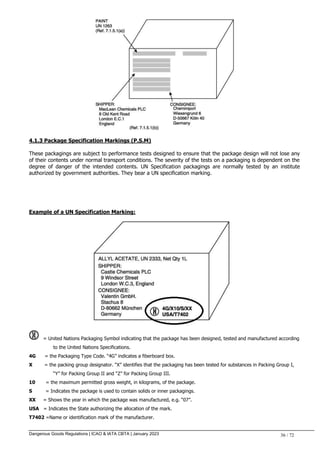
in accordance with such a label. Single packaging with end closures containing liquids must be stowed with such
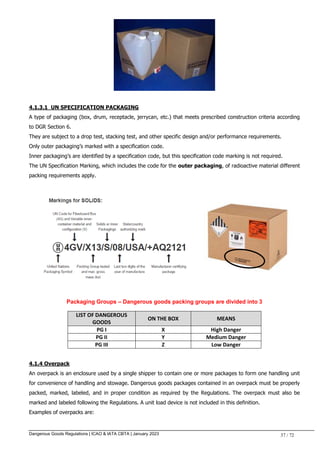
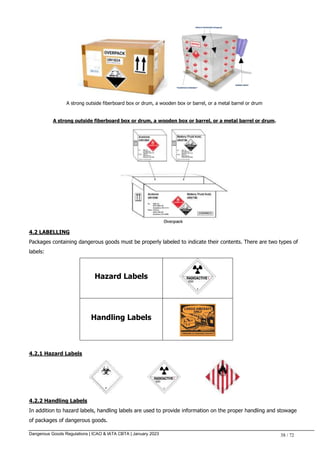
closures upwards.
6.6.2 Stowage of Toxic and Infectious Substances
Packages having a Division 6.1, or a Division 6.2 label must not be stowed in the same compartment with:
a) Animals;
b) Foodstuffs;
c) Feed; or other edible substances intended for consumption by humans or animals.
Except where:
 the dangerous goods are loaded in one closed unit load device and the foodstuffs or animals are loaded
in another closed unit load device; or
Dangerous Goods Regulations | ICAO & IATA CBTA | January 2023 53 / 72
 Where open unit load devices are used, the ULDs must not be stowed adjacent to each other.
6.6.3 Loading and Stowage of Radioactive Material
Radioactive material in Categories I-White, II-Yellow, or III-Yellow must is not loaded in a compartment occupied
by passengers or crew. To keep radiation exposure as low as reasonably achievable, packages of radioactive
material should be loaded on the floor of under-floor compartments or in the furthermost end of the main deck
compartments.
Packages labeled as Category II-Yellow or Category III-Yellow must be separated from the passenger cabin and
flight deck. The Transport Index appearing on the label determines the separation distance. The required
separation distances for radioactive packages based on their Transport Index, appear in DGR Tables 9.3.D & E
Table 10.9.C
Separation of Radioactive Material – Passenger
And Cargo Aircraft (10.9.3.7)
Total Sum of TI
Minimum Distance
Meters Feet/inches
0.1 to 1.0
1.1 to 2.0
2.1 to 3.0
3.1 to 4.0
4.1 to 5.0
5.1 to 6.0
6.1 to 7.0
7.1 to 8.0
8.1 to 9.0
9.1 to 10.0
10.1 to 11.0
11.1 to 12.0
12.1 to 13.0
13.1 to 14.0
14.1 to 15.0
15.1 to 16.0
16.1 to 17.0
17.1 to 18.0
18.1 to 20.0
20.1 to 25.0
25.1 to 30.0
30.1 to 35.0
35.1 to 40.0
40.1 to 45.0
45.1 to 50.0
0.30
0.50
0.70
0.85
1.00
1.15
1.30
1.45
1.55
1.65
1.75
1.85
1.95
2.05
2.15
2.25
2.35
2.45
2.60
2.90
3.20
3.50
3.75
4.00
4.25
1’0”
1’8”
2’4”
2’10”
3’4”
3’10”
4’4”
4’9”
5’1”
5’5”
5’9”
6’1”
6’5”
6’9”
7’1”
7’5”
7’9”
8’1”
8’6”
9”6”
10’6”
11’6”
12’4”
13’1”
13’11”
If more than one package, over-pack or freight container is placed in the aircraft, the minimum separation distance for
each individual package, over-pack or freight container must be determined in accordance with the above table, on the
basis of the sum of the transport indices of the individual packages, over-packs or freight containers. Alternatively, if the
Dangerous Goods Regulations | ICAO & IATA CBTA | January 2023 54 / 72
packages, over-packs or freight containers are separated into groups, minimum distance from each group to the nearest
inside surface of the partitions or floors of the flight deck or other areas occupied by personnel is the distance applicable to
the sum of the transport indices within the individual groups, provided that each group is separated from each other group
by at least three times the distance applicable to the one that has the larger sum of transport indices.
Operators are required to provide information, in the operation and/or other appropriate manuals with regard to:
 Details of the location and identification of cargo holds. This should also include the dimensions of the hold; and
limitations on loading of radioactive material, based on the requirements of IATA DGR 10.9.3
Package 1 : TI 5.5
Needs 1.15m separation distance from the top of the package to the nearest inside
surface of the floor aircraft of the aircraft cabin.
Package 2 : TI 4.2
Needs 1.00m separation distance from the top of the package to the nearest inside
surface of the floor aircraft of the aircraft cabin.
Therefore : In order to maintain the minimum separation distances for these
Two Radioactive materials away from the passengers; it must be
Kept at least three times the minimum separation distance for the larger
TI between the packages.
• Package 1 has the larger sum of TIs.
• Therefore, the minimum distance between Package 1 and Package 2
1.15m x 3 = 3.45m
6.6.4 Loading of Dry Ice (Carbon Dioxide, Solid)
Carbon dioxide, solid (dry ice) shipped by itself or used as a refrigerant for
other commodities may be carried provided that the operator has made
suitable arrangements dependent on the aircraft type, the aircraft ventilation
rates, the method of packing and stowage, whether or not animals will be
carried on the same flight and other factors. The operator must ensure that
ground staffs are informed that Carbon dioxide, solid (dry ice) is being
loaded or is on board the aircraft.
6.6.5 Loading of Live Animals with Dangerous Goods
Live animals should not be loaded in close proximity to cryogenic liquids or dry ice. Live animals should be stowed
a level above packages containing dry ice. They must be separated from packages of Category II-Yellow and III-
Yellow radioactive materials by at least 0.5 m (1 ft 8 in) for journeys of 24 hours or less and by at least 1 m (3 ft
4 in) for longer journeys.
Dangerous Goods Regulations | ICAO & IATA CBTA | January 2023 55 / 72
6.6.6 Loading of Battery-Powered Wheelchairs
To assist the handling of wheelchairs and mobility aids with batteries, shows an example of a label which may be
used to assist in identifying whether or not a wheelchair has had the battery removed. The label is in two parts;
Part A remains with the wheelchair and indicates whether or not the battery has been removed. In the particular
case where the battery is separated from the wheelchair, Part B may be used to assist in identifying the battery
and also in reconciling the battery and its wheelchair.
6.6.7 UNIT LOAD DEVICES (ULD) CONTAINING DANGEROUS GOODS
Each ULD containing dangerous goods, which required hazard labels, must clearly display on its exterior an indication that
dangerous goods are contained within the ULD. This indication must be provided by attaching the ULD an identification tag
having a border of prominent red hatchings on both sides of the ULD and with minimum dimensions of 148 x 210 mm. the
hazard class or division(s) of such dangerous goods must be visibly indicated on this tag. The tag must be removed
immediately after the dangerous goods have been unloaded.
If the ULD contains packages bearing the “Cargo Aircraft Only” label, the tag must indicate that the ULD can only be
loaded on a cargo aircraft (DGR 9.3.8.2)
Dangerous Goods Regulations | ICAO & IATA CBTA | January 2023 56 / 72
1. When should packages of dangerous goods be inspected for possible damage or leakage?
2. Why are the incompatible packages of dangerous good segregated when loaded on to the aircraft?
3. What aspects of the packaging do operators need to consider with regards aircraft operations when carrying
an DG?
4. Can the following packages of dangerous goods be loaded next to each other?
Package Compatible
a.) Division 6.1 and Class 3 YES / NO
b.) Division 4.3 and Class 8 YES / NO
c.) Division 3 and class 8 YES / NO
d.) Division 5.1 and Class 3 YES / NO
Exercise-9
Dangerous Goods Regulations | ICAO & IATA CBTA | January 2023 57 / 72
SECTION 7 — PROVISION of INFORMATION
7.0 PILOT-IN-COMMAND – NOTIFICATION TO CAPTAIN (NOTOC)
The operator of an aircraft in which dangerous goods are to be carried must provide the pilot-in-command as
soon as practicable before departure of the aircraft, with accurate and legible written or printed information
concerning dangerous goods to be carried as cargo. This information should be presented on a dedicated form
and not using “Air Waybills”, “Shipper’s Declaration for Dangerous Goods”, etc. Generally, this information is
presented on a “Special Load — Notification to Captain (NOTOC)” form.
The NOTOC is not required for Dangerous Goods in Excepted Quantities or for Excepted Packages of Radioactive
Material. The NOTOC must include, as a minimum, the following:
Note:
This includes information about dangerous goods loaded at a previous departure point and which are to be
carried on the subsequent flight.
 The Air Waybill number (when issued);
 The proper shipping name supplemented with the technical name(s) if appropriate, and the
corresponding UN number or ID number as listed in the Regulations;
 The Class or Division, and subsidiary hazard corresponding to the labels applied by numerals, and in
the case of Class 1, the compatibility group;
 The Packing Group, when applicable;
 For non-radioactive material, the number of packages, the net quantity, or gross mass if applicable,
of each package, except that this does not apply to dangerous goods where the net quantity or gross
mass is not required on the Shipper’s Declaration, and their exact loading location. For a consignment
consisting of multiple packages containing dangerous goods bearing the same proper shipping name and
UN number, only the total quantity and an indication of the largest and smallest package at each loading
location need to be provided;
 For radioactive material, the number of packages, their category, their transport index, if applicable,
and their exact loading location;
 Whether the package must be carried on cargo aircraft only;
 The airport at which the package(s) is to be unloaded;
 Where applicable, an indication that the dangerous goods are being carried under a State exemption.
7.1 NOTOC - INFORMATION TO THE PILOT-IN-COMMAND
As early as practicable before departure of the aircraft, but in no case later than when the aircraft moves
under its power, the operator of an aircraft in which dangerous goods are to be carried must:
Provide the pilot in command with accurate and legible written or printed information concerning dangerous
goods that are to be carried as cargo; and
Provide personnel with responsibilities of operation control of the aircraft (e.g. flight operations officer, flight
dispatcher, or designated ground personnel responsible for flight operations) with the same information that
is required to be provided to the pilot-in-command (e.g. a copy of the written information provided to the
pilot-in-command). Each operator must specify the personnel (job title or function) to be provided this
information in their operations manual and/or other appropriate manuals.
Dangerous Goods Regulations | ICAO & IATA CBTA | January 2023 58 / 72
For operations, with the approval of the State of the Operator, the information provided to the pilot-in-
command may be abbreviated or be by other means (e.g. radio communication, as part of the working flight
documentation such as a journey log or operational flight plan) where circumstances make it impractical to
produce written or printed information or on a dedicated form.
Note 1. — This includes information about dangerous goods loaded at a previous departure point and which
are to be carried on the subsequent flight.
Note 2. — Information required under 7; 4.1.1 (ICAO TI)
b) should be readily available to the operator’s personnel whose responsibilities most closely align with the
duties of the flight operations officer/flight dispatcher. These personnel are intended to provide the
information required by 7; 4.6 (ICAO TI) to facilitate emergency response.
The information required must include the following:
The air waybill number (when issued);
The proper shipping name (the technical name(s) shown on the dangerous goods transport document is not
required) and UN Number or ID number as listed in these Instructions. When chemical oxygen generators
contained in Protective Breathing Equipment (PBE) are being transported under Special Provision A144
(ICAO TI), the proper shipping name of “oxygen generator, chemical” must be supplemented with the
statement “Aircrew protective breathing equipment (smoke hood) in accordance with Special Provision
A144”.
c) The class or division, and subsidiary hazard corresponding to the subsidiary hazard label(s) applied, by
numerals, and in the case of Class 1, the compatibility group;
d) The packing group is shown on the dangerous goods transport document;
e) The number of packages and their exact loading location. For radioactive material see g) below;
f) The net quantity, or gross mass if applicable, of each package, except that this does not apply to
radioactive material or other dangerous goods where the net quantity or gross mass is not required on the
dangerous goods transport document or, when applicable, alternative written documentation. For a
consignment consisting of multiple packages containing dangerous goods bearing the same proper shipping
name and UN number or ID number, only the total quantity and an indication of the quantity of the largest
and smallest package at each loading location need to be provided. For unit load devices or other types of
pallets containing consumer commodities accepted from a single shipper, the number of packages and the
average gross mass need to be provided;
for radioactive material the number of packages, overpacks or freight containers, their category, their
transport index (if applicable), and their exact loading location;
h) Whether the package must be carried on cargo aircraft only;
i) The aerodrome at which the package(s) is to be unloaded;
j) where applicable, an indication that the dangerous goods are being carried under a State exemption; and
k) the telephone number where a copy of the information provided to the pilot-in-command can be obtained
during the flight if the operator allows the pilot-in-command to provide a telephone number instead of the
details about the dangerous goods on board the aircraft, as specified in 7; 4.3 (ICAO TI).
3 For UN 1845 — Carbon dioxide, solid (dry ice), the information required by 5; 4.1.1 (ICAO TI) may be
replaced by the UN number, proper shipping name, class, total quantity in each hold on the aircraft, and the
aerodrome at which the package(s) is to be unloaded.
4 For UN 3480 (Lithium-ion batteries) and UN 3090 (Lithium metal batteries), the information required by 5;
4.1.1 (ICAO TI) may be replaced by the UN number, proper shipping name, class, total quantity at each
specific loading location, and whether the package must be carried on cargo aircraft only. UN 3480 (Lithium-
Dangerous Goods Regulations | ICAO & IATA CBTA | January 2023 59 / 72
ion batteries) and UN 3090 (Lithium metal batteries) carried under a State exemption must meet all of the
requirements of 5; 4.1 (ICAO TI).
5 The information provided to the pilot-in-command must also include a signed confirmation, or some other
indication, from the person responsible for loading the aircraft that there was no evidence of any damage to
or leakage from the packages or any leakage from the unit load devices loaded on the aircraft.
6 The information provided to the pilot-in-command must be readily available to the pilot-in-command during
flight.
7 This information provided to the pilot-in-command should be presented on a dedicated form and should
not be by means of air waybills, dangerous goods transport documents, invoices, etc.
8 The pilot-in-command must indicate on a copy of the information provided to the pilot-in-command, or in
some other way, that the information has been received.
9 A legible copy of the information provided to the pilot-in-command must be retained on the ground. This
copy must have an indication on it, or with it, that the pilot-in-command has received the information. A copy,
or the information contained in it, must be readily accessible to the flight operations officer, flight dispatcher,
or designated ground personnel responsible for flight operations until after the arrival of the flight.
10 In addition to the languages which may be required by the State of the Operator, English should be used
for the information provided to the pilot-in-command.
11 In the event that the volume of information provided to the pilot-in-command is such that in-flight
radiotelephony transmission would be impracticable in an emergency situation, a summary of the
information should also be provided by the operator, containing at least the quantities and class or division
of the dangerous goods in each cargo compartment.
Dangerous Goods Regulations | ICAO & IATA CBTA | January 2023 60 / 72
Note:
Many operators have included an additional column headed “ERG CODE” on the NOTOC form. Provision of this
additional column allows the applicable ERG Code, from Section 4.2 of the IATA DGR, to be entered on the NOTOC
against the dangerous goods items by the person completing the NOTOC.
12 The dangerous goods listed in Table 1 need not appear on the information provided to the pilot-in-
command.
Dangerous Goods Regulations | ICAO & IATA CBTA | January 2023 61 / 72
Table 1. Dangerous goods not required to appear in the information to the pilot-in-command
UN
Number
Item ICAO Reference
n/a Dangerous goods packed in excepted quantities 3;5.1.1
UN 2807 Magnetized material Packing Instruction
953
UN 2908 Radioactive material, excepted package — empty packaging 1;6.1.5.1 a)
UN 2909 Radioactive material, excepted package — articles manufactured from
natural uranium or depleted uranium or natural thorium
1;6.1.5.1 a)
UN 2910 Radioactive material, excepted package — limited quantity of material 1;6.1.5.1 a)
UN 2911 Radioactive material, excepted package — instruments or articles 1;6.1.5.1 a)
UN 3090 Lithium metal batteries (including lithium alloy batteries) when meeting the
requirements of Packing Instruction 968, Section II
Packing Instruction
968, Section II
UN 3091 Lithium metal batteries contained in equipment (including lithium alloy
batteries) when meeting the requirements of Packing Instruction 970,
Section II
Packing Instruction
970, Section II
UN 3091 Lithium metal batteries packed with equipment (including lithium alloy
batteries) when meeting the requirements of Packing Instruction 969,
Section II
Packing Instruction
969, Section II
UN 3245 Genetically modified micro-organisms Packing Instruction
959
UN 3245 Genetically modified organisms Packing Instruction
959
UN 3373 Biological substance, Category B Packing Instruction
650, sub-paragraph
11
UN 3480 Lithium-ion batteries (including lithium-ion polymer batteries) when
meeting the requirements of Packing Instruction 965, Section II
Packing Instruction
965, Section II
UN 3481 Lithium-ion batteries contained in equipment (including lithium-ion polymer
batteries) when meeting the requirements of Packing Instruction 967,
Section II
Packing Instruction
967,
Section II
UN 3481 Lithium-ion batteries packed with equipment (including lithium-ion polymer
batteries) when meeting the requirements of Packing Instruction 966,
Section II
Packing Instruction
966,
Section II
Note: In operator, the above information may be provided via a NOTOC.
The information must be provided to the pilot-in-command when certain dangerous goods are permitted is
passenger or crew baggage is accepted for carriage. It is recommended that operators implement and
document the following procedures to address pilot notification:
Passenger handling staff communicate information to load planning advise;
1) The details of the item accepted, e.g. wheelchair with lithium-ion battery, oxygen, etc.;
2) The name of the passenger and seat number; and
3) If the item is being carried in the cabin or if it will be loaded in the cargo compartment.
Load planning staff should:
1) Insert a free text supplementary information (SI) item on the load sheet to show the information
indicated in (f) 1. (1) and (2) and for items loaded in the cargo compartment the loading location:
2) Communicate to ramp the required loading location for items loaded in the cargo compartment.
Dangerous Goods Regulations | ICAO & IATA CBTA | January 2023 62 / 72
Note: The requirements for the notification to pilot-in-command do not apply to items being carried by
passengers as either checked or carry-on baggage.
Dangerous Goods Regulations | ICAO & IATA CBTA | January 2023 63 / 72
SECTION 8 — Dangerous Goods Emergency Response
8.0 INTRODUCTION
The operator must ensure that for consignments requiring a Shipper’s Declaration for Dangerous Goods,
appropriate information is immediately available at all times for use in emergency response to accidents and
incidents involving dangerous goods in air transport. The information must be available to the pilot-in-
command and can be provided by:
 The Emergency Response Guidance for Aircraft Incidents Involving Dangerous Goods (ICAO Doc.
9481-AN/928 (The Red Book)); or
 Any other document, which provides appropriate information concerning dangerous goods on board.
Note: Sub-section 4.2 (IATA DGR) – List of Dangerous Goods contains the applicable Emergency
Response Drill Code (see Column N) assigned to each dangerous goods entry in the ICAO document
Emergency Response Guidance for Aircraft Incidents Involving Dangerous Goods (ICAO Doc. 9481-
AN/928).
Emergency response training is required for all categories of personnel as specified in IATA DGR 1.5 This
unit outlines basic procedures that can be followed as an example.
You must be familiar with your local requirements and know all emergency contacts.
8.1 INCIDENTS AND ACCIDENTS
A dangerous goods accident is defined as an occurrence associated with and related to the transport of
dangerous goods by air that results in fatal or serious injury to a person or major property or environmental
damage (see DGR Appendix A under “Dangerous Goods Accident”).
A dangerous goods incident is an occurrence, other than a dangerous goods accident, associated with an
related to the transport of dangerous goods by air, not necessarily happening on board an aircraft, which
results in injury to a person, property, or environmental damage, fire breakage, spillage, leakage of fluid or
radiation, or other evidence that the integrity of the packaging had not been maintained. Any occurrence
relating to the transport of dangerous goods by air that seriously jeopardizes an aircraft, or its occupants is
also a dangerous goods incident (see DGR Appendix A under “Dangerous Goods Incident”)
8.2 REPORTING OF INCIDENTS AND ACCIDENTS
In the event of:
1. An aircraft accident; or
2. Serious incidents, where dangerous goods carried as cargo may be involved.
The operator of the aircraft carrying dangerous goods as cargo must provide information, without delay, to
emergency services responding to the accident or serious incident about the dangerous goods on board, as
shown on the information to the pilot-in-command. As soon as possible, the operator must also provide this
information to the appropriate authorities of the State of the Operator and the State in which the accident or
serious incident occurred.
In the event of an aircraft incident, the operator of an aircraft carrying dangerous goods as cargo must, if
requested to do so, provide information, without delay, to emergency services responding to the incident and
to the appropriate authority of the State in which the incident occurred about the dangerous goods on board,
as shown on the information to the pilot-in-command.
Operator must address the provisions of 9.6.3.1 and 9.6.3.2 (IATA DGR) in appropriate manuals and
accident contingency plans. Refer to section 12 of the ground handling (SMS) Manual for more information.
Note: The term “accident”, “serious incident” and “incident” are defined in ICAO Annex 13.
Dangerous Goods Regulations | ICAO & IATA CBTA | January 2023 64 / 72
8.3 Reporting of Undeclared or Mis-declared Dangerous Goods
An operator must report any occasion when undeclared or mis-declared dangerous goods are discovered in
cargo or mail. Such a report must be made to the appropriate authorities of the State of the operator and the
State in which this occurred. An operator must also report any occasion when dangerous goods not
permitted under Subsection 2.3 (IATA DGR) are discovered by the operator, or the operator is advised by
the entity that discovers the dangerous goods, either in the baggage or on the person of passengers or crew
members. Such a report must be made to the appropriate authority of the state in which this occurred (IATA
DGR 9.6.2)
8.4 CONTAMINATED CARGO OR BAGGAGE HANDLING
If an operator becomes aware that baggage or cargo not identified as containing dangerous goods has been
contaminated and it is suspected that dangerous goods may be the cause of the contamination, the operator
must take reasonable steps to identify the nature and source of contamination substance. If the
contamination substance is found or suspected to be a substance classified as dangerous goods by
Regulations, the operator must isolate the baggage or cargo and take appropriate steps to nullify any
identified hazard before transporting it further by air.
8.5 PROCEDURES FOR FLIGHT CREW
Emergency checklist for Flight Crew:
The ICAO Emergency Response Guide (red book) details them as:
 Follow aircraft emergency procedures for fire or smoke removal;
 “No smoking” sign on;
 Consider landing as soon as possible
 Consider turning off non-essential power;
 Determine the source of smoke/fumes/fire;
 For dangerous goods incidents in the passenger cabin, see cabin crew checklist and coordinate
cockpit/cabin crew actions;
 Determine emergency response drill code (from NOTOC where available or from “red box”);
 Use the guidance from the aircraft emergency response drills chart (see pages 35/36 for example) to help
with the incident; and
 If the situation permits, notify ATC of the dangerous goods being carried.
Note, if an in-flight emergency occurs, the pilot-in-command must, as soon as the situation permits, inform
the appropriate air traffic services unit, for the information of aerodrome authorities, of any dangerous goods
carried as cargo on board an aircraft. Wherever possible this information should include the proper shipping
name and/or UN number, the class/division and, for Class 1, the compatibility group, any identified
subsidiary hazard, the quantity and the location on board the aircraft, or a telephone number where a copy
of the information provided to the pilot-in-command can be obtained. When it is not considered possible to
include all the information, those parts thought most relevant in the circumstances or a summary of the
quantities and class or division of dangerous goods in each cargo compartment should be given.
After landing:
 Disembark passengers and crew before opening any cargo compartment doors;
 Inform ground personnel/emergency services of the nature and location of dangerous goods; and
 Make appropriate entries in the maintenance log.
Dangerous Goods Regulations | ICAO & IATA CBTA | January 2023 65 / 72
Note: Some of these steps may not be relevant to GHC like the reference to the cabin crew checklist. These
must be skipped.
ICAO publication Emergency Response Guidance for Aircraft Incidents Involving Dangerous Goods
(Doc 9481-AN/928), generally referred to as the “red book”.
8.6 General Procedures
The general procedures to be followed comprise of the following:
 Notify the immediate supervisor first and get professional assistance
 Identify the dangerous goods (if safe to do so)
 Where safe to do so, isolate the package by removing other packages or property
 Avoid contact with the contents of the package
Staff involved in such incidents should stay on site until their names are noted.
If the contents come in contact with your body or clothes:
 Thoroughly wash off your body with plenty of water,
 Remove contaminated clothing,
 Do not eat or smoke
 Keep hands away from eyes, mouth, and nose,
 Seek medical assistance.
Dangerous Goods Regulations | ICAO & IATA CBTA | January 2023 66 / 72
8.7 Dangerous Goods Emergency Response Chart (Ground Incidents)
Hazard Class /
Division and
Compatibility Group
Dangerous Goods
Class
Hazard Characteristics Immediate Action
1.3C, 1.3G Explosives (acceptable
on Cargo Aircraft only)
Fire and minor blast hazard
and/or minor propulsive hazard
 Isolate spill or leak area immediately
for at least 500 m in all directions.
 Move people out of line of sight of
the scene and away from windows.
 Stay upwind.
 ELIMINATE all ignition sources (no
smoking flares sparks or flames in
the immediate area.
1.4B , 1.4C , 1.4D ,
1.4E , 1.4G
Explosives (acceptable
on Cargo Aircraft only)
Fire, but no other significant
hazard
 Isolate spill or leak area immediately
for at least 100 m in all directions.
 Move people out of line of sight of
the scene and away from windows.
 Stay upwind.
 ELIMINATE all ignition sources (no
smoking flares sparks or flames in
the immediate area.
1.4S Explosives Slight risk of explosion and fire
2.1 Flammable Gas  Risk of fire
 Risk of explosion
 Risk of asphyxiation
 May cause burns and/or
frostbite.
 Containments may explode
when heated.
 Isolate the spill or leak area
immediately for at least 100 m in all
directions.
 Stay upwind.
 ELIMINATE all ignition sources (no
smoking flares sparks or flames in
the immediate area.
2.2 Non-Flammable Gas
Non-toxic gas.
Cryogenic Liquid
 Risk of asphyxiation.
 May be under pressure.
 May cause frostbite.
Containments may explode
when heated.
 Isolate spill or leak area immediately
for at least 100 m in all directions.
2.3 Toxic Gas  Risk of intoxication.
 May be under pressure.
 May cause burns and/or
frostbite.
 Containments may explode
when heated.
 Isolate spill or leak area immediately
for at least 100 m in all directions.
 Use any PBEs/masks if available.
3 Flammable Liquid  Risk of fire.
 Risk of explosion.
 Containments may explode
when heated.
 Isolate spill or leak area immediately
for at least 50 m in all directions.
 Stay upwind.
 ELIMINATE all ignition sources (no
smoking flares sparks or flames in
immediate area).
Dangerous Goods Regulations | ICAO & IATA CBTA | January 2023 67 / 72
4.1 Flammable Solids;
Self-Reactive
substances;
Polymerizing
substances and solid
Desensitized
Explosives
 Risk of fire by spontaneous
combustion if packages are
damaged or contents are
spilled.
 May contain self-reactive
substances that are liable to
exothermic decomposition in
the case of heat supply, contact
with other substances (such as
acids heavy-metal compounds
or amines), friction or shock.
This may result in the evolution
of harmful and flammable gases
or vapours or self-ignition.
 Containments may explode
when heated.
 Risk of explosion of desensitized
explosives after loss of
desensitizer.
 Isolate spill or leak area immediately
for at least 25 m in all directions.
 Stay upwind.
 ELIMINATE all ignition sources (no
smoking flares sparks or flames in
immediate area).
4.2 Substances liable to
Spontaneously
Combustion
 Risk of fire by spontaneous
combustion if packages are
damaged or contents are
spilled.
 May react vigorously with
water.
4.3 Substances which in
contact with water,
emit flammable gases
 Risk of fire and explosion in
contact with water.
 Isolate spill or leak area immediately
for at least 50 m in all directions.
 Stay upwind.
 ELIMINATE all ignition sources (no
smoking flares sparks or flames in
immediate area).
 Do NOT use water under any
circumstances.
 Spilled substances should be kept dry
by covering the spillages with dry
non-combustible material.
5.1 Oxidizing substances  Risk of vigorous reaction,
ignition and explosion in contact
with combustible of or
flammable substances.
 Isolate spill or leak area immediately
in all directions for at least 50 m for
liquid and at least 25 m for solid.
 Stay upwind.
 Keep combustibles (wood, paper, oil,
etc.) away from spilled material.
5.2 Organic Peroxide  Risk of exothermic
decomposition at elevated
temperatures contact with other
substances (such as acids,
heavy metal compounds or
amines), friction or shock this
may result in the evolution of
harmful and flammable gases or
vapours or self-ignition.
 Containments may explode
when heated.
 Isolate spill or leak area immediately
in all directions for at least 50 m for
liquid and at least 25 m for solid.
 Stay upwind.
 ELIMINATE all ignition sources (no
smoking flares sparks or flames in
immediate area).
 Keep combustibles (wood, paper, oil,
etc.) away from spilled material.
6.1 Toxic Substance  Risk of intoxication by
inhalation, skin contact or
ingestion.
 Isolate spill or leak area immediately
in all directions for at least 50 m for
liquid and at least 25 m from solid.
Dangerous Goods Regulations | ICAO & IATA CBTA | January 2023 68 / 72
6.2 Infectious Substance  Risk of infection.
 May cause serious disease in
humans or animals.
 Isolate spill or leak area immediately
for at least 25 m in all directions.
7 Radioactive Material
I-White
II- Yellow
III- Yellow
 Risk of radiation and it's
harmful to health
 Isolate spill or leak area immediately
for at least 25 m in all directions.
 Detain or isolate uninjured persons
or equipment suspected to be
contaminated, but do not
decontaminate until instructions are
received from the Radiation
Authority.
8 Corrosive substances  Risk of burns by corrosion.
 May react vigorously with each
other, with water and with
other substances (like metal).
 Spilled substances may evolve
corrosive vapours.
 Isolate spill or leak area immediately
in all directions for at least 50 m for
liquid and at least 25 m for solids.
 Avoid contact with skin.
9 Miscellaneous
Dangerous substances
and articles Polymeric
Beads,
Magnetized Material,
Carbon dioxide, solid
(Dry Ice)
 Risk of burns.
 Risk of fire.
 Certain hazards not covered by
other classes.
 Isolate spill or leak area immediately
for at least 25 m in all directions.
9 Lithium batteries  Risk of burns.
 Risk of fire.
 Risk of explosion
 Risk of thermal runaway
 Stay upwind.
 ELIMINATE all ignition sources (no
smoking flares sparks or flames in
immediate area).
Dangerous Goods Regulations | ICAO & IATA CBTA | January 2023 69 / 72
8.8 Emergency Response Guidance
ICAO Table 4-1. Aircraft Emergency Response Drills
1. COMPLETE APPROPRIATE AIRCRAFT EMERGENCY PROCEDURES
2. CONSIDER LANDING AS SOON AS PRACTICABLE
3. USE DRILL FROM THE CHART BELOW
Drill
No.
Inherent hazard Hazard aircraft
hazard
occupants
Spill or leak
procedure
Firefighting
procedure
Additional
considerations
1 Explosion may
Cause structural
failure
Fire and/or
explosion
As indicated by
the drill letter(S)
Use 100% oxygen;
no smoking
All agents
according to
availability; use
standard fire
procedure
Possible abrupt
loss of
pressurization
2 Gas, non-
flammable,
pressure may
create hazard in
fire
Minimal As indicated as
indicated by the
drill letter (s)
Use 100% oxygen
establish and
maintain maximum
ventilation for “A”,
“i” or “P’ drill letter
All agents
according to
availability; use
standard fire
procedure
Possible abrupt
loss of
pressurization
3 Flammable liquid
or solid
Fire and/or
explosion
Smoke, fumes
and heat. And
as indicated by
the drill letter(s)
Use 100% oxygen
establish and
maintain maximum
ventilation; no
smoking minimum
electrics
All agents
according to
availability; no
water on “W” drill
letter
Possible abrupt
loss of
pressurization
4 Spontaneously
Combustible or
pyrophoric when
exposed to air
Fire and/or
explosion
Smokes, fumes
and heat, and
as indicated by
the drill
Letter(s)
Use 100% oxygen
establish and
maintain maximum
ventilation
All agents
according to
availability; no
water on “W” drill
letter
Possible abrupt
loss of
pressurization;
minimum electrics
if “F” or “H” drill
letter
5 Oxidizer, may
ignite other
materials, may
explode in heat of
a fire
Fire and/or
explosion,
possible
corrosion
damage
Eye, nose and
throat irritation;
skin damage on
contact
Use 100% oxygen;
establish and
maintain maximum
ventilation
All agents
according to
availability; no
water on “W” drill
letter
Possible abrupt
loss of
pressurization
6 Toxic, may be fatal
if inhaled ,
ingested, or
absorbed by skin
Contamination
With toxic
liquid or solid
Acute toxicity,
effects may be
delayed
Use 100% oxygen;
establish and
maintain
maximum,
ventilation; do not
touch without
gloves
All agents
according to
availability; no
water on “W” drill
letter
Possible abrupt
loss of
pressurization;
minimum electrics
if “F” or “H” drill
letter
7 Radiation from
broken/unshielded
packages
Contamination
with spilled
radioactive
material
Exposure to
radiation, and
personnel
contamination
Do not move
packages; avoid
contact
All agents
according to
availability
Call for a qualified
person to meet
the aircraft
8 Corrosive, fumes
disabling if
inhaled or in
contact with skin
Possible
corrosion
damage
Eye, nose and
throat irritation;
skin damage on
contact
Use 100% oxygen;
establish and
maintain maximum
ventilation, so not
touch without
gloves
All agents
according to
availability; no
water on “W” drill
letter
Possible abrupt
loss of
pressurization;
minimum electrics
if “F” or “H” drill
letter
9 No General
Inherent Hazard
As indicated
By the drill
letter
As indicated by
the drill letter
Use 100% oxygen
establish and
maintain maximum
ventilation if “A”
drill letter
All agents
according to
availability
None
10 Gas, flammable
high fire risk if any
ignition source
present
Fire and/or
explosion
Smoke, fumes
and heat as
indicated by the
drill letter
Use 100% oxygen
establish and
maintain maximum
ventilation; no
smoking minimum
electrics
All agents
according to
availability
Possible abrupt
loss of
pressurization
11 Infectious
Substances may
affect humans or
animals if inhaled,
ingested or
absorbed through
the mucous
membrane or an
open wound
Contamination
with infectious
substances
Delayed
infection to
Humans or
animals
Do not touch.
Minimum
recirculation
and ventilation
In affected area
All agents
according to
availability. No
water on “Y” drill
letter
Call for a qualified
person to meet
the aircraft.
Dangerous Goods Regulations | ICAO & IATA CBTA | January 2023 70 / 72
Drill
No.
Inherent hazard
Hazard
aircraft
Hazard
occupants
Spill or leak procedure
Firefighting
procedure
Additional
considerations
12 Fire, heat, smoke,
toxic and
flammable vapor
Fire and/or
explosion
Smoke, fumes,
heat
Use 100% oxygen
establish and maintain
maximum ventilation
All agents
according to
availability. Use
water if available
Possible abrupt
loss of
pressurization;
consider landing
immediately
Drill
Letter
Additional Hazard
Drill
Letter
Additional Hazard
A Anesthetic N Noxious
C Corrosive P Toxic * (Poison)
E Explosive S Spontaneously combustible or pyrophoric
F Flammable W If wet gives off poisonous flammable gas
H Highly ignitable X Oxidizer
I Irritant / tear producing
Y
DEPENDING ON THE TYPE OF INFECTIOUS SUBTANCE THE
APPROPRIATE NATIONAL AUTHORITY MAY BE REQUIRED TO
QUARANTINE INDIVIDUALS, ANIMALS, CARGO AND THE.
L Other risk low or none
M Magnetic
Z
AIRCRAFT CARGO FIRE SUPRESSION SYSTEM MAY NOT
EXTINGHUISH OR CONTAIN THE FIRE; CONSIDER LANDING
IMMEDIATELY.
-------------------------------------
* Toxic has the same meaning as poison
8.9 Dangerous Goods Occurrence Report:
An operator must report to the appropriate authorities of the State of the operator and the State of origin on any
occasion when:
Dangerous goods are discovered to have been carried when not loaded, segregated, separated, and secured in
accordance with IATA DGR 9.2 or 9.3; or
Dangerous are discovered to have been carried without information having been provided to the pilot-in-
command in accordance with IATA DGR 9.5.1.1
Note:
Entities other than operators who are in possession of dangerous goods at the time a dangerous goods accident
or incident occurs or at the time a dangerous goods incident is discovered to have occurred should follow the
reporting requirements of 9.6.1 (IATA DGR) entitle other than operators who discover undeclared or mis-declared
dangerous goods should follow the reporting requirements of 9.6.2 (IATA DGR). These entities may include, but
are not limited to, freight forwarders, customs authorities and security screening providers.
The initial report must contain all the information known at the time it is compiled, including:
• The date, location, flight number and flight date (when these are applicable).
• The reference number of the air waybill, pouch, baggage tag, ticket…etc.
• A description of the goods, including the proper shipping name and un number (when
applicable), class/division, and any subsidiary Hazard;
• The type of packaging and the packaging specification marking (when these are
applicable) and quantity involved;
• The name and address of shipper, passenger, etc…
• The suspected cause of the accident or incident;
• The action taken, if any;
• Any other reporting action taken;
• Any other relevant details;
• The name, title, address, and contact number of the person making the report. Copies of the
relevant documents and any photographs taken must be attached to the report.
IATA DGR 9.6.1 requires that an operator report dangerous goods accidents and incidents to the appropriate
authority of the State of the operator and the State in which the accident or incident occurred.
Dangerous Goods Regulations | ICAO & IATA CBTA | January 2023 71 / 72
Note:
Individual States may require other reporting formats and carriers must ensure that they follow local national
protocols as appropriate.
APPENDIX A – CONVERSION FACTORS
Precise conversion factors for the commonly used SI units are given in Annex 5 to the Chicago Convention on International
Civil Aviation. Tables A.1 and A.2 show conversion factors, to four significant figures, for some units widely used in dangerous
goods transport.
Table A.1 (Conversion to SI Units)
To Convert To Multiply By
Bar Kilopascal (kPa) 100.0
Curie (Ci) Giga-becquerel (GBq) 37.0
Temperature in degree Fahrenheit (°F) Temperature in degree Celsius (°C) Subtract 32 and multiply by 5/9
Temperature in degree Celsius (°C) Temperature in Kelvin Add 273.15
Foot (ft) Meter (m) 0.3048
Gallon (Imperial) Liter (L) 4.546
Gallon (US liquid) Liter (L) 3.785
Inch (in) Millimeter (mm) 25.40
Kilogram per square centimeter (kg/cm2
) Kilopascal (kPa) 98.07
Oersted Ampere per meter (A/m) 79.58
Ounce (avoirdupois) Gram (g) 28.35
Ounce, fluid (Imperial) Milliliter (mL) 28.41
Ounce, fluid (US) Milliliter (mL) 29.57
Pint (Imperial) Liter (L) 0.5683
Pint (US) Liter (L) 0.4732
Pound (avoirdupois) Kilogram (kg) 0.4536
Pound per square inch (lb./sq.in) Kilopascal (kPa) 6.895
Quart (Imperial) Liter (L) 1.137
Quart (US) Liter (L) 0.9464
Rad Gray (Gy) 0.01000
Rem Sievert (Sv) 0.01000
Dangerous Goods Regulations | ICAO & IATA CBTA | January 2023 72 / 72
Table A.2 (Conversion from SI Units)
To convert To Multiply By
Ampere per meter (A/m) Oersted 0.01257
Temperature in degree Celsius (°C) Temperature in degree Fahrenheit (°F) Multiply by 9/5 and add 32.
Temperature in Kelvin Temperature in degree Celsius (°C) Subtract 273.15
Gram (g) Ounce (avoirdupois) 0.03527
Gray (Gy) Rad 100.00
Kilogram (kg) Gram 1000
Kilogram (kg) Pound (lb.) 2.205
Kilopascal (kPa) Bar 0.01000
Kilopascal (kPa) Kilogram per square centimeter (kg/cm2
) 0.01020
Kilopascal (kPa) Pound per square inch 0.1450
Liter (L) Gallon (Imperial) 0.2200
Liter (L) Gallon (US Liquid) 0.2642
Liter (L) Pint (Imperial) 1.760
Liter (L) Pint (US) 2.113
Liter (L) Quart (Imperial) 0.8799
Liter (L) Quart (US) 1.057
Meter (m) Foot (ft) 3.281
Milliliter (mL) Ounce, fluid (Imperial) 0.03520
Milliliter (mL) Ounce, fluid (US) 0.03381
Millimeter (mm) Inch (in) 0.03937
Sievert (Sv) Rem 100.00
Tera-becquerel (TBq) Curie (Ci) 27.03
Prefixes for Decimal Multiples
The following prefixes and symbols are used for decimal multiples of SI units:
Prefix Symbol Multiplication Factor
Peta P 1 000 000 000 000 000 = 1015
Tera T 1 000 000 000 000 = 1012
Giga G 1 000 000 000 = 109
Mega M 1 000 000 = 106
Kilo K 1 000 = 103
Hector h 100 = 102
Deka Da 10 = 101
Deci D 0.1 = 10-1
Centi C 0.01 = 10-2
Milli M 0.001 = 10-3
Micro µ 0.000 001 = 10-6
Nano n 0.000 000 001 = 10-9
End


DGR Training Material Flight Crew & FOO.doc

  • 1.
    Dangerous Goods Regulations| ICAO & IATA CBTA | January 2023 1 / 72 DANGEROUS GOODS TRAINING MATERIAL Flight Crew / FOO/ FD
  • 2.
    Dangerous Goods Regulations| ICAO & IATA CBTA | January 2023 2 / 72 TABLE OF CONTENTS WELCOME MESSAGE ..............................................................................................................4 QUALITY POLICY......................................................................................................................5 OBJECTIVES.............................................................................................................................5 SAFETY POLICY .......................................................................................................................6 TRAINING METHOD..................................................................................................................7 COURSE OBJECTIVES.............................................................................................................9 INTRODUCTION ......................................................................................................................10 SECTION 1 – APPLICABILITY ................................................................................................11 1.0 DEFINITION...................................................................................................................11 1.1 THE LEGAL BASIS.......................................................................................................11 1.2 APPLICATION OF THESE REGULATIONS ........................Error! Bookmark not defined. 1.3 SHIPPERS RESPONSIBILITY .............................................Error! Bookmark not defined. 1.4 OPERATOR’S RESPONSIBILITY........................................Error! Bookmark not defined. 1.5 TRAINING REQUIREMENTS ...............................................Error! Bookmark not defined. 1.6 APPROVAL ..........................................................................Error! Bookmark not defined. SECTION 2- LIMITATION ...............................................................Error! Bookmark not defined. 2.0 INTRODUCTION...................................................................Error! Bookmark not defined. 2.1 ACCEPTABLE DANGEROUS GOODS................................Error! Bookmark not defined. 2.2 FORBIDDEN DANGEROUS GOODS...................................Error! Bookmark not defined. 2.3 RECOGNITION OF HIDDEN DANGEROUS GOODS ..........Error! Bookmark not defined. 2.4 DANGEROUS GOODS CARRIED BY PASSENGERS AND CREW.............................20 2.5 TRANSPORT DANGEROUS GOODS BY POST ..........................................................24 2.6 DANGEROUS GOODS IN OPERATOR’S PROPERTY ................................................24 2.7 DANGEROUS GOODS IN EXEEPTED QUANTITIES...................................................24 2.8 DANGEROUS GOODS IN LIMITED QUANTITIES........................................................25 SECTION 3 – CLASSIFICATION ....................................................Error! Bookmark not defined. 3.0 GENERAL PRINCIPLES ......................................................Error! Bookmark not defined. 3.1 CLASSIFYING DANGEROUS GOODS................................Error! Bookmark not defined. 3.2 HAZARD CLASSES ..........................................................Error! Bookmark not defined. 3.3 PACKING GROUP ...............................................................Error! Bookmark not defined. 3.4 CLASSES AND DIVISIONS...........................................................................................30 SECTION 4 MARKING AND LABELLING...............................................................................35 4.0 GENERAL .....................................................................................................................35 4.1 MARKING......................................................................................................................35 4.2 LABELLING ..................................................................................................................38 4.3 GLOBALLY HARMANIZED SYSTEM ...........................................................................40
  • 3.
    Dangerous Goods Regulations| ICAO & IATA CBTA | January 2023 3 / 72 4.4 EXCEPTED QUANTITIES .............................................................................................41 4.5 IRRELEVANT LABELLING...........................................................................................41 SECTION 5 – DOCUMENTATION ...........................................................................................43 5.0 INTRODUCTION............................................................................................................43 5.1 THE SHIPPERS DECLARATION FOR DANGEROUS GOODS (DGD).........................43 5.2 AIR WAY BILL (AWB)...................................................................................................45 5.3 Articles and Substances not Subject to the Regulations (not restricted)...............48 5.4 ADDITIONAL DOCUMENTATION.................................................................................48 5.5 RETENTION OF DOCUMENTATION ............................................................................49 SECTION 6 – STORAGE AND LOADING ...............................................................................50 6.0 General..........................................................................................................................50 6.1 PROTECTION FROM DAMAGE....................................................................................50 6.2 INSPECTION OF PACKAGES OF DANGEROUS GOODS ..........................................50 6.3 HANDLING OF SELF REACTIVE SUBSTANCES AND ORGANIC PEROXIDES ........50 6.4 STORAGE AND HANDLING OF RADIOACTIVE MATERIALS ....................................50 6.5 LOADING ......................................................................................................................51 6.6 COMMODITY SPECIFIC REQUIREMENTS ..................................................................52 SECTION 7 – PROVISION OF INFORMATION ......................................................................57 7.0 PILOT IN COMMAND (NOTOC)....................................................................................57 7.1 INFORMATION BY THE PILOT IN COMMAND IN CASE OF IN FLIGHT EMERGENCY .........57 SECTION 8 – DANGEROUS GOODS EMERGENCY RESPONSE .........................................63 8.0 INTRODUCTION............................................................................................................63 8.1 INCIDENTS AND ACCIDENTS .....................................................................................63 8.2 REPORTING OF INCIDENTS AND ACCIDENTS..........................................................63 8.3 REPORTING OF UNDECLARED OR MIS-DECLARED DANGEROUS GOODS..........64 8.4 CONTAMINATED CARGO OR BAGGAGE HANDLING...............................................64 8.5 PROCEDURES FOR FLIGHT CREW............................................................................64 8.6 GENERAL PROCEDURES............................................................................................65 8.7 DANGEROUS GOODS EMERGENCY RESPONSE CHART GROUND INCIDENTS ...65 8.8 EMERGENCY PROCEDURSE ......................................................................................65 8.9 DANGEROUS GOODS OCCURRENCE REPORT........................................................70 APPENDIX A – CONVERSION FACTORS ..............................................................................71
  • 4.
    Dangerous Goods Regulations| ICAO & IATA CBTA | January 2023 4 / 72 WELCOME MESSAGE The Training Department welcomes you to this program. It is our pleasure to be a part of your learning journey and we look forward to helping you realize your true potential. This workbook provides information you will need to achieve the learning objectives of this program successfully. This is your copy to encourage you to write on and reinforce the skills and knowledge introduced. Training Department Training Department provides technical and non-technical learning experiences to our employees and outsources. The team is located in the Training Department. We have a great team of trainers and specialists focused on providing you with the best opportunity to learn and practice new skills in a safe environment. The team uses interactive and experiential learning techniques to ensure that participants develop the confidence to apply the new skills and knowledge as soon as they continue to their workplaces. This training is intended for Passenger Handling Personnel as stated in the ICAO CBAT and IATA Dangerous Goods Manual – Flight Crew. This workbook will be used with the current IATA DGR Manual to familiarize you with the various sections and how to apply them. It is based on the practical application of the IATA DGR, which includes all the ICAO Annex 18 requirements and the current edition of the ICAO Technical Instructions. We trust that you will enjoy the program and look forward to any feedback you may have to help us meet our objectives. Happy learning! Training Department
  • 5.
    Dangerous Goods Regulations| ICAO & IATA CBTA | January 2023 5 / 72 QUALITY POLICY To achieve sustained and profitable growth by providing services that consistently satisfy the needs and expectations of our internal and external customers. OBJECTIVES  Achieve and maintain a level of quality that enhances the Company.  Reputation and brand with customers.  To ensure compliance with relevant statutory and safety bodies.  To endeavor at all times to maximize the Company's market share in all geographies.
  • 6.
    Dangerous Goods Regulations| ICAO & IATA CBTA | January 2023 6 / 72 SAFETY POLICY Safety is the priority in all our activities. We are committed to implementing, developing, and improving strategies, management systems, and processes to ensure that all our activities uphold the highest level of safety performance and meet national and international standards. Our commitment is to: a. Develop and embed a safety culture in all our aviation activities that recognizes the importance and value of effective safety management and always acknowledges that safety is paramount; b. Clearly define for all staff their accountabilities and responsibilities for the development and delivery of the safety strategy and performance; c. Minimize the Hazard associated with aircraft operations and associated activities to a point that is as low as reasonably practicable/achievable; d. Ensure that externally supplied systems and services that impact the safety of our operations meet appropriate safety standards; e. Actively develop and improve our safety processes to conform to world-class standards; f. Comply with and, wherever possible, exceed legislative and regulatory requirements and standards; g. Ensure that all staff are provided with adequate and appropriate aviation safety information and training, are competent in safety matters, and are only allocated tasks commensurate with their skills; h. Ensure that sufficient skilled and trained resources are available to implement safety strategy and policy; i. Establish and measure our safety performance against realistic objectives and/or targets; j. Achieve the highest levels of safety standards and performance in all our aviation activities; k. Continually improve our safety performance; l. Conduct safety and management reviews and ensure that relevant action is taken; m. Ensure that the application of effective aviation safety management systems is integral to all our aviation activities, to achieve the highest levels of safety standards and performance.
  • 7.
    Dangerous Goods Regulations| ICAO & IATA CBTA | January 2023 7 / 72 Training Method  Exercises  Questions  Final Assessment Assessment Strategy: To meet the legal requirement, a final test must be undertaken and successfully completed following dangerous goods training to verify understanding of the regulation. Confirmation is required of successful completion of the test (IATA DGR 1.5).  Written exam (open book)  Length of exam (2 hrs.)  Minimum pass mark: 80  Notification of successful completion  Retest procedure  DGR Certificate valid for 2 years  Meets ICAO & IATA Requirements  Recurrent Training within 24 months
  • 8.
    Dangerous Goods Regulations| ICAO & IATA CBTA | January 2023 8 / 72 INTENTIONALLY LIFT BLANK
  • 9.
    Dangerous Goods Regulations| ICAO & IATA CBTA | January 2023 9 / 72 COURSE OBJECTIVES After thorough study and use of this training workbook, the student will:  Be able to identify dangerous goods;  Know the origin of the current regulations and be aware of the general philosophy;  Be able to identify the classes of dangerous goods;  Recognize and identify the hazard/handling labels applicable to dangerous goods;  Recognize and identify dangerous goods package use and package specification markings;  Be able to identify potential hidden hazards in cargo;  Be familiar with loading and storage procedures;  Be familiar with Packing procedures;  Be aware of the provisions for dangerous goods in the baggage of passengers and crew;  Information by the pilot-in-command in case of in-flight emergency  Be familiar with emergency procedures.
  • 10.
    Dangerous Goods Regulations| ICAO & IATA CBTA | January 2023 10 / 72 INTRODUCTION IATA Dangerous Goods Regulations This training is for the Flight Crew (Flight Crew from the IATA DGR Training Section). This manual is designed to be used in conjunction with the IATA DGR to familiarize you with the various sections and how to apply them, IATA Dangerous Goods Regulations are published every 12 months. It is based on the practical application of the IATA DGR, which includes all the ICAO Annex 18 requirements and the current edition of the ICAO Technical Instructions published every 24 months. (ICAO Technical Instructions – Doc. 9284-AN/905)
  • 11.
    Dangerous Goods Regulations| ICAO & IATA CBTA | January 2023 11 / 72 SECTION 1 — APPLICABILITY By the end of this section, you will be able to:  Define dangerous goods;  Identify the general principles applicable to the air transport of dangerous goods.  Know the responsibilities of shipper & operator when transporting DG.  Describe the importance of dangerous goods training;  Identify Dangerous goods Security. 1.0 Definition of Dangerous Goods Dangerous goods are articles or substances which are capable of posing a hazard to health, safety, property or the environment and which are shown in the list of dangerous goods in these Regulations or which are classified according to these Regulations. 1.1 Legal Basis 1.1.1 The UN Committee of Experts (CoE) develops recommended procedures for the transport of all types of dangerous goods except radioactive materials. These procedures, applicable to all modes of transport, are published in the Recommendations on the Transport of Dangerous Goods. 1.1.2 The International Atomic Energy Agency (IAEA) develops recommended procedures for the safe transport of radioactive materials. These procedures are published in the Regulations for the Safe Transport of Radioactive Material (IAEA TS-R-1). The requirements of these regulations as they pertain to air transport are reflected in Section 10. 1.1.3 The International Civil Aviation Organization (ICAO) has used these recommendations as the basis for developing regulations for the safe transport of dangerous goods by air. The ICAO regulations are codified in Annex 18 to the Convention on International Civil Aviation and in its Technical Instructions for the Safe Transport of Dangerous Goods by Air (Doc 9284-AN/905 as amended) (Technical Instructions). 1.1.4 The International Air Transport Association (IATA) contains all the requirements of the Technical Instructions. IATA has included additional requirements, which are more restrictive than the Technical Instructions and reflect industry standard practices or operational considerations. These are identified by the symbol “” in the margin. 1.1.5 QATAR Civil Aviation Authority (QCAA) Regulations for Dangerous Goods.
  • 12.
    Dangerous Goods Regulations| ICAO & IATA CBTA | January 2023 12 / 72 1.2 Application of these Regulations 1.2.1 Applicability The IATA Dangerous Goods Regulations apply to:  All airlines which Members or Associate Members of IATA are;  All airlines that are party to the IATA Multilateral Interline Traffic Agreement — Cargo; and  All shippers and agents that offer consignments of dangerous goods to these operators. 1.2.2 Exceptions 1.2.2.1 Except for information provided to operator employees, as shown in 9.5.2, the provisions of these Regulations do not apply to dangerous goods carried on an aircraft where the dangerous goods are: (a) To provide medical aid to a patient during flight when those dangerous goods: 1. Have been placed on board with the approval of the operator; or 2. Form part of the permanent equipment of the aircraft when it has been adapted for specialized use; providing that; 3. Gas cylinders have been manufactured specifically for the purpose of containing and transporting that particular gas; 4. Equipment containing wet cell batteries is kept and, when necessary secured, in an upright position to prevent spillage of the electrolyte. 1.2.2.2 Dangerous Goods Packages opened by customs and other Authorities Any package opened during an inspection must, before being forwarded to the consignee, be restored by qualified persons to condition, which complies with these regulations. 1.3 Shipper's Responsibilities Shipper must comply fully with the IATA DGR when a consignment of dangerous goods is offered with an operator. Shippers must also comply with any regulations required by the state of origin, transit, and destination. For further details refer to IATA DGR 1.3. 1. Identified; 2. Classified; 3. Packed; 4. Marked; 5. Labeled; 6. Documented. 1.4 Operator's Responsibilities When accepting cargo for transportation by air it is the operator’s cargo acceptance staff that has the responsibility to ensure, as far as possible, that the consignment does not contain dangerous goods unless shipper has prepared the shipment of dangerous goods in accordance with the Regulations. A checklist must be used to accept declared dangerous goods consignments, the eight responsibilities of an operator IATA DGR 1.4.1 1. Acceptance; 2. Storage; 3. Loading; 4. Inspection; 5. Provision of Information, including emergency response information; 6. Reporting; 7. Retention of Records; 8. Training. 1.4.1 INFORMATION TO OPERATOR EMPLOYEES An operator must provide, in the operator’s operation and/or other appropriate manuals, information to employees to enable flight crews and other employees to carry out their responsibilities regarding dangerous goods. Where applicable, this information must also be provided to ground-handling agents. This information must include: a. For passenger handling staff and cabin crew the procedure to be followed to alert passengers that certain items of dangerous goods are specifically prohibited from being in checked baggage, e.g. spare lithium batteries (See Subsection 2.3 IATA DGR) and must be removed from baggage where items of carry-on baggage cannot be accommodated in the cabin; b. The action to be taken in the event of emergencies involving dangerous goods;
  • 13.
    Dangerous Goods Regulations| ICAO & IATA CBTA | January 2023 13 / 72 c. Details of the location and identified of cargo compartments; d. The maximum quantity of dry ice permitted in each compartment; and e. If radioactive material is to be carried, instructions on the loading of such dangerous goods, based on the requirements of 10.9.3 IATA DGR In addition to the above, it is recommended that the operator’s operation and/or other appropriate manuals should contain information specific to dangerous goods permitted in passenger and crew baggage as permitted by Subsection 2.3 IATA DGR. The information in the operator’s manuals should address: I. Approval process. It is recommended that a single company policy be set out that identifies the items that have been approved and the person(s) or department(s) responsible for determining how dangerous goods in passenger baggage may be approved. II. Communication. It is recommended that the operator define how approvals for dangerous goods requiring operator approval are communicated to the airport(s) of departure. It is recommended that operators consider a process where such approval is included in the passenger(s) electronic record. III. Limitations. The operator manuals should specify any limitations or procedural requirements that may apply to particular commodities e.g. inspection at check-in by passenger service agents and/or security; IV. Interlining. Where the operator has interlined agreements with codeshare and/or alliance partners the operator should identify what the procedure is for obtaining the approval of the other airline(s) involved, e.g. by advising the passenger that they must obtain approval from the other operator; V. Awareness. The operator should ensure that all staff who have an interaction with passengers, (i.e. reservations agents, passenger service agents, cabin crew, and flight crew) are made aware of the process employed to ensure that the operator approval process remains effective. 1.4.2 INFORMATION TO PASSENGERS What about informing passengers of the Regulations? It is not practical to give our passengers individual training on the Regulations. However, we can and must bring to their attention an awareness of what must not be carried aboard an aircraft, either as checked baggage or as carry-on articles. Information must be provided to passengers about the type of dangerous goods that they are forbidden from transporting aboard an aircraft. As a minimum, this information must consist of:  information with the passenger ticket or made available in another manner such that before or during the check-in process, the passenger receives the information;  notices warning passengers as to the type of dangerous goods that are forbidden for transport aboard an aircraft are:  prominently displayed in sufficient number at each of the places at an airport where tickets are issued, and where passengers check in, in aircraft boarding areas and in baggage claim areas; and - Notices clearly displayed at any other location where passengers are checked in.
  • 14.
    Dangerous Goods Regulations| ICAO & IATA CBTA | January 2023 14 / 72 1.5 Training Requirements 1.5.1 Initial & Recurrent Training Personnel must receive recurrent training and assessment within 24 months of previous training and assessment to ensure that competency has been maintained. However, if recurrent training and assessment is completed within the final three months of validity of the previous training and assessment, the period of validity extends from the month on which the recurrent training and assessment was completed until 24 months from the expiry month of that previous training and assessment. For example, a person attends an initial course finishing on 14 April 2019; their training validity therefore expires on 30 April 2021. They may attend recurrent training any time between 1 February and 30 April 2021 and their next recurrent training date will remain 30 April 2023. If, however they complete recurrent training in January 2021, then as this is more than 3 months prior to the end of April then their training expiry date becomes 31 January 2023. All categories of staff involved in the movement of dangerous goods by air are legally required to have mandated job-specific training. Training must be provided or verified when an employer hires an individual who will be involved in the movement of dangerous goods. Refresher or recurrent training must be received within 24 months of previous dangerous goods training to make sure that the staff’s knowledge is up to date. A test must be undertaken following dangerous goods training to verify understanding of the regulations. Confirmation is required for successful completion of the test. A record of training must be maintained by the employer which must show the name of each individual trained, the date of the most recent training, and description of the training, and the name and address of the organization providing this training. 1.5.2 Establishment and Maintenance Note: A training program includes elements such as design methodology, assessment, initial and recurrent training, instructor qualifications and competencies, training records and evaluation of the effectiveness of training. The employer of personnel that perform functions aimed at ensuring that dangerous goods are transported in accordance with these Regulations must establish and maintain a dangerous goods training program. Training must be provided or verified upon the employment of personnel identified in the IATA Dangerous Goods Training Guidance Edition 1 2023 (Competency-based Training and Assessment Approach) and ICAO Doc 10147 (Guidance on a Competency-based Approach to Dangerous Goods Training and Assessment First Edition, 2021). Notes: 1. An approach to ensuring personnel are competent to perform any function for which they are responsible is provided in “DANGEROUS GOODS TRAINING PROGRAMS GUIDELINES - COMPETENCY-BASED TRAINING ASSESSMENT APPROACH”, which is available on Website: www.iata.org/dangerousgoods 2. Security personnel who are involved with the screening of passengers and crew and their baggage and cargo or mail are required to be trained irrespective of whether the operator on which the passenger or cargo is to be transported carries dangerous goods as cargo. a. All operators must establish a dangerous goods training program regardless of whether they are approved to transport dangerous goods as cargo. b. Training courses may be developed and delivered by or for the employer. 1.5.3 Training and Assessment Records The employer must maintain a record of training and assessment for personnel. The record of training and assessment must be maintained, which must include:  The individual's name;  The most recent training and assessment completion month;  A description copies or reference to training and assessment materials used to meet the training and assessment requirements;  The name and address of the organization providing the training and assessment; and  Evidence which shows that personnel have been assessed as competent to perform any function for which they are responsible.
  • 15.
    Dangerous Goods Regulations| ICAO & IATA CBTA | January 2023 15 / 72 Training and assessment records must be retained by the employer for a minimum period of 36 months from the most recent training and assessment completion month and must be made available upon request to the employee or appropriate national authority. 1.5.4 Review and Approval of Training Programs Dangerous goods training programs for operators must be approved by the appropriate authority of the State of the operator under the provisions of ICAO Annex 6—Operation of Aircraft. Dangerous goods training programs required for entities other than operators and designated postal operators should be approved as determined by the appropriate national authority. 1.6 APPROVAL Where specifically provided for in the ICAO Technical Instructions, the State concerned may grant an approval to permit the transport of dangerous goods, provided that in such instances an overall level of safety in transport which is equivalent to the level of safety provided for in the instructions is achieved. Acceptance of dangerous goods offered for transport under the provisions of an approval is at the discretion of the operator(s) concerned. Shippers are encouraged to make advance arrangements with the operator(s) as part of the planning process associated with any approval application. Question 1: Articles, substances, capable of posing a hazard to health or property when transported by air, are Definition for: a) Dangerous Goods b) Chemicals c) Articles Question 2: Operator’s Responsibility? a) Loading b) Classify c) Marked Exercise -1
  • 16.
    Dangerous Goods Regulations| ICAO & IATA CBTA | January 2023 16 / 72 SECTION 2 — LIMITATIONS By the end of this section, you will be able to:  Identify Dangerous Goods that are: • Forbidden for air transport • Hidden dangerous goods • Permitted as cargo under the Regulations • Excepted from the Regulations  Apply the principles for: • Dangerous Goods in Excepted Quantities • Dangerous Goods in Limited Quantities  Identify State and Operator Variations 2.0 General What is a Limitation? Some dangerous goods are too dangerous to be carried by aircraft, others may be carried on cargo aircraft only and some are acceptable on both cargo and passenger aircraft. 2.1 ACCEPTABLE DANGEROUS GOODS What are considered “acceptable” dangerous goods? A great many dangerous goods may be carried on aircraft as cargo provided they are properly prepared for transport in accordance with the Regulations. The List of Dangerous Goods (DGR 4.2) itemizes the most commonly shipped dangerous goods by name and indicates the maximum quantity of such goods permitted per package on Passenger and/or Cargo Aircraft. Those dangerous goods that are restricted to all cargo aircraft are either in larger quantities or are forbidden on passenger aircraft. Generally, however, they are not permitted in passenger or crew-checked baggage or as carry-on articles. Items forbidden as baggage may be acceptable as cargo provided the article or substance is prepared in compliance with all the provisions of the Regulations. 2.2 Forbidden Dangerous Goods Are there any dangerous goods that are completely forbidden for air transport? Some dangerous goods are considered to be too hazardous for transport by air under any circumstances. Substances or articles which, as presented for transport, are liable to explode, dangerously react, produce a flame or dangerous evolution of heat or dangerous emission of toxic, corrosive, or flammable gases or vapors under conditions normally encountered in transport must not be carried on aircraft under any circumstance.
  • 17.
    Dangerous Goods Regulations| ICAO & IATA CBTA | January 2023 17 / 72 List the three main types of dangerous goods. a. …………………………. b. ………………………… c. ………………………… 2.3 Recognition of Undeclared Dangerous Goods (Hidden Dangerous Goods) What are Hidden Dangerous Goods? These are goods which are tendered and declared under a general description which may contain hazardous articles that are not apparent. Such articles may also be found in baggage. To prevent undeclared dangerous goods from being loaded on an aircraft and passengers from taking on board those dangerous goods which they are not permitted to have in their baggage, cargo, and passengers about the contents of any item of cargo or baggage where there are suspicions that it may contain dangerous goods. Are all dangerous goods easily identified? No. It is essential therefore that awareness and vigilance are maintained at all times when examining and accepting baggage, or in the case of flight attendants, assisting in the stowage of carry-on baggage in the cabin prior to flight. Great care should be taken to ensure that no dangerous goods are carried on board the aircraft as baggage. Remember, the passenger or crew member may not be aware that their items are considered dangerous goods and are not permitted. Confirmation should be sought from a passenger about the contents of any item where there are suspicions that it may contain dangerous goods. What kind of items should I be suspicious of? Typical examples of items that may contain or indicate the presence of dangerous goods are: Substance or Article Details of possible Dangerous Goods included Aircraft Spare parts/ Aircraft Equipment/Aircraft On Ground (AOG) Spares May contain explosives (flares or other pyrotechnics), chemical oxygen, generators, unserviceable tire assemblies, cylinders of compressed gas (oxygen, carbon dioxide, nitrogen or fire extinguishers), paint adhesives, aerosols, life-saving appliances, first aid kits, fuel in equipment, wet or lithium batteries, matches; etc. Automobiles, Automobile Parts/Supplies (car, motor, motorcycle) May contain ferromagnetic material which may not meet the definition for magnetized but which may be subject to special stowage requirements due to the possibility of affecting aircraft instruments (see 3.9.2.2 DG Regs) may also contain engines, carburetors or fuel tanks which may contain or have contained fuel, wet or lithium batteries, compressed gasses in the tire inhalation devices, fire extinguishers, shocks/struts with nitrogen, airbag inflators/air bag modules flammable adhesive, paints, sealants, and solvents, etc. Exercise -2
  • 18.
    Dangerous Goods Regulations| ICAO & IATA CBTA | January 2023 18 / 72 Substance or Article Details of possible Dangerous Goods included Battery Powered Devices/ Equipment May contain wet or lithium batteries Breathing Apparatus This may indicate cylinders of compressed air or oxygen, chemical oxygen generators or refrigerated liquefied oxygen Camping Equipment May contain flammable gases (butane, propane, etc.), flammable liquids (kerosene, gasoline, etc.) flammable solids (hexamine, matches, etc.) or other dangerous goods Chemicals May contain items meeting any of the criteria for dangerous goods, particularly flammable liquids, flammable solids, oxidizers, organic peroxides, and toxic or corrosive substances. COMAT (Company Materials) Such as aircraft parts, may contain dangerous goods as an integral part e.g. chemical oxygen generators in a passenger service unit (PSU), various compressed gases such as oxygen, carbon dioxide, and nitrogen, gas lighters, aerosols, fire extinguishers, flammable liquids such as fuels, paints and adhesives and corrosive material such as batteries. Other items such as flares, first aid kits, and life-saving appliances, match magnetized material. Etc. Consolidated Consignments (Groupages) May contain any of the defined classes of dangerous foods. Cryogenic (Liquid) Indicates refrigerated liquefied gases such as argon, helium, neon and nitrogen Cylinders May indicate compressed or liquefied gas Dental Apparatus May contain flammable resins or solvents, compressed or liquefied gas, mercury and radioactive material Diagnostic Specimens May contain infectious substances Diving Equipment May contain cylinders (such as scuba tanks, vest bottles, etc. of compressed gas (air, oxygen, etc.) high intensity diving lamps which can generate extremely high heat when operated by air in order to be carried safely, the bulb or battery must be disconnected. Drilling and Mining Equipment May contain explosive(s) and/or other dangerous goods Dry Shipper (Vapour Shipper) May contain free liquid nitrogen. Dry shipper is subject to Regulations when they permit the release of any free liquid nitrogen irrespective of the orientation packaging. Electrical Equipment/ Electronic Equipment May contain magnetized materials or mercury in switch gear and electron tubes, wet batteries, lithium batteries or fuel cell cartridges that contain or have contained fuel. Electrically Powered Apparatus (Wheelchairs, lawn mowers, golf carts, etc.) May contain wet batteries, lithium batteries or fuel cells or fuel cell cartridges that contain or have contained fuel Expeditionary Equipment May contain explosives (flares), flammable liquids (gasoline), flammable gas (propane, camping gas) or other dangerous goods. Film Crew or Media Equipment May contain explosive pyrotechnic devices, generators incorporating engines, wet batteries, lithium batteries, fuel heat producing item, etc. Frozen Embryos May contain refrigerated liquefied gas or Carbon dioxide, solid (dry ice) Frozen Fruit, Vegetables Etc. May be packed in Carbon dioxide, solid (dry ice) Fuels May contain flammable liquids, flammable solids or flammable gases Fuel Control Units May contain flammable liquids Hot Air Balloon May contain cylinders with flammable gas, fire extinguishers, engines internal combustion, batteries etc. Household Goods May contain items meeting any of the criteria for dangerous goods including flammable liquids such as solvent based paint, adhesives, polishes, aerosols (for passengers, those not permitted under DGR 2.3) bleach, corrosive oven or drain cleaners, ammunition, matches, etc.
  • 19.
    Dangerous Goods Regulations| ICAO & IATA CBTA | January 2023 19 / 72 Substance or Article Details of possible Dangerous Goods included Instruments May conceal barometers, manometers, mercury switches, and rectifier tubes. Thermometers, etc. containing mercury Laboratory/Testing Equipment May contain items meeting any of the criteria of dangerous goods, particularly flammable liquids, flammable solids, oxidizers, organic peroxides, toxic or corrosive substances, lithium batteries, cylinders of compressed gas etc. Machinery Parts May contain adhesives, paints, sealants, solvents wet and lithium batteries, mercury, cylinders of compressed or liquefied gas etc Magnets and other items of similar material May individually or cumulatively meet the definition of magnetized material (see 3.9.2.2 IATA DGR) Medical Supplies/ Equipment May contain items meting any of the criteria of dangerous goods, particularly flammable liquids, flammable solids, oxidizers, organic peroxides, toxic corrosive substances or lithium batteries Metal Construction Material, Metal Fencing Metal Piping May contain ferro-magnetic material, which may be subject to special stowage requirements due to the possibility of affecting aircraft instruments (see 3.9.2.2 IATA DGR) Parts of Automobile (Car, Motor, Motorcycle) May contain wet batteries etc. Passenger Baggage May contain items meeting any of the criteria for dangerous goods. Examples include fireworks, flammable household liquids, corrosive oven or drain cleaners, flammable gas or liquid lighter refills or camping stove cylinders, matches, ammunition, bleach, aerosols (those not permitted under subsection 2.3 IATA DGR) etc. Pharmaceuticals May contain items meeting any of the criteria for dangerous goods, particularly radioactive material, flammable liquids, flammable solids, oxidizers, organic peroxides, toxic or corrosive substances Photographic Supplies/ Equipment May contain items meeting any of the criteria for dangerous goods, particularly heat producing devices, flammable liquids, flammable solid, oxidizers, organic peroxides, toxic or corrosive substances or lithium batteries Promotional Material See PASSENGER BAGGAGE Racing Car or Motorcycle Team Equipment May contain engines, including fuel cell engines, carburetors or fuel tanks which may contain fuel or residual fuel, flammable aerosols, cylinders of compressed gases, nitro methane, other fuel additives or wet batteries, lithium batteries etc. Refrigerators May contain liquefied gases or an ammonia solution Repair Kits May contain organic peroxides and flammable adhesives, solvent based paints, resins, etc. Samples for Testing May contain items meeting any of the criteria for dangerous goods, particularly infectious substances, flammable liquids, flammable solids, oxidizers, organic peroxides, toxic or corrosive substances Semen May be packed with Carbon dioxide, solid (dry ice) or refrigerated liquefied gas See also DRY SHIPPER Ships Spares May contain explosives (flares), cylinders of compressed gas (life rafts), paint, lithium batteries (emergency locator transmitters) etc. Show, Motion Picture, Stage and Special Effects Equipment May contain flammable substances, explosives or other dangerous goods. Sporting Goods /Sport Team Equipment May contain cylinders of compressed or liquefied gas (air, carbon dioxide etc.) lithium batteries, propane torches, first aid kits, flammable adhesives, aerosols etc. Swimming Pool Chemicals May contain oxidizing or corrosive substances Switches in Electrical Equipment or Instruments May contain oxidizing mercury Toolboxes May contain explosives (power rivets), compressed gases or aerosols,
  • 20.
    Dangerous Goods Regulations| ICAO & IATA CBTA | January 2023 20 / 72 Substance or Article Details of possible Dangerous Goods included flammable gases (butane cylinders or torches), flammable adhesives or paints, corrosive liquids, lithium batteries, etc. Torches Micro torches and utility lighters may contain flammable gas and be equipped with an electronic starter. Larger torches may consist of a torch head (often with a self-igniting switch) attached to a container or cylinder of flammable gas Unaccompanied Passengers Baggage/ Personal Effects May contain items meeting any of the criteria for dangerous goods, such as fireworks, flammable gas or liquids, corrosive oven or drain cleaners, flammable gas or liquid lighter refills or camping stove cylinders, matches, bleach, aerosols, etc. (those not permitted under Subsection 2.3 IATA DGR) Vaccines May be packed in Carbon Dioxide, solid (dry ice) Note: Articles and substances which do not fall within the definitions of dangerous goods as shown in these Regulations and which in the event of leakage may cause a serious clean-up problem or corrosion to aluminum on a long-term basis must be checked by the shipper to at least ensure that the packaging is adequate to prevent leakage during transportation. These may include brine, powdered or liquid dyes, pickled foodstuffs etc. 2.4 Dangerous Goods Carried by Passengers or Crew 2.4.1 Dangerous goods, including excepted packages of radioactive material, must not be carried by passengers or crew:  as or in checked baggage;  as or in carry-on baggage; or  on their person; 2.4.2 Notwithstanding any additional restrictions that may be implemented by States in the interests of aviation security, except for the incident reporting requirements of 9.6.2, the provisions of these Regulations do not apply to 2.3.4 to 2.3.5 when carried by passengers or crew members or in baggage transported by the operator which has been separated from its owner during transit (e.g. lost baggage or improperly routed baggage). Electronic Cigarette (e-cigarette) An electronic cigarette, or e-cigarette, is a smoking simulation and/or cessation device that mimics smoking. It is considered a Portable Electronic Device ( (P PE ED D) ) as most electronic cigarettes are powered by lithium batteries. Electronic, simulated smoking materials include electronic cigarettes, electronic cigars and electronic pipes. Where the electronic cigarettes are powered by lithium batteries, the requirements of the IATA Dangerous Goods Regulations (DGR), paragraphs 2.3.5.9 and 2.3.5.17 must be met. This requires that spare lithium batteries and the electronic cigarettes must be carried in passenger carry-on baggage. In addition, recharging of electronic cigarettes and/or batteries on board the aircraft is not permitted. Electronic, simulated smoking materials (cigarettes, pipes, cigars) should be prohibited from use by both passengers and crew at all times. Operators should not permit the use of any item which could insinuate that smoking is permitted on board aircraft.
  • 21.
    Dangerous Goods Regulations| ICAO & IATA CBTA | January 2023 21 / 72 Lithium Batteries ICAO Council adopted the recommendation of the ICAO Air Navigation Commission (ANC) that lithium ion batteries, UN 3480, Packing Instruction 965 only, be forbidden, on an interim basis, as cargo on passenger aircraft. The prohibition does not apply to lithium ion batteries packed with equipment or lithium ion batteries contained in equipment, UN 3481, Packing Instruction 966 and Packing Instruction 967 respectively.
  • 22.
    Dangerous Goods Regulations| ICAO & IATA CBTA | January 2023 22 / 72 TABLE 2.4.A Provisions for Dangerous Goods Carried by Passengers or Crew Table 2.3.A The pilot-in-command must be informed of the location Permitted in or as carry-on baggage Permitted in or as checked baggage THE APPROVAL OPERATOR Alcoholic beverages, when in retail packings, containing more than 24% but not more than 70% alcohol by volume, in receptacles not exceeding 5 L, with a total net quantity per person of 5L. Note: Alcoholic beverages containing 24% or less alcohol by volume are not subject to any restrictions. NO YES YES NO Ammunition (cartridges for weapons), securely packaged (in Div. 1.4S UN 0012 or UN 0014 only) in quantities not exceeding 5 kg gross weight per person for that person’s use. Allowances for more than one person must not be combined into one or more packages YES YES NO NO Avalanche rescue backpack, one (1) per person, containing a cartridge of compressed Gas in Div. 2.2 May also be equipped with a pyrotechnic trigger mechanism containing less than 200mg net of Div. 1.4 S The backpack must be packed in such a manner that it cannot be accidentally activated. The airbags within the backpack must be filled with pressure relief valves. YES YES YES NO Baggage with installed lithium batteries non-removable batteries exceeding 0.3 g lithium metal or 2.7 Wh in lithium-ion batteries. FORBIDDEN Baggage with installed lithium batteries:  Non-removable batteries. Batteries must contain no more than 0.3 g lithium metal for lithium-ion must not exceed 2.7 Wh;  Removable batteries. Batteries must be removed if baggage is to be checked in. Removed batteries to be carried in the cabin. NO YES YES NO Batteries spare/loose, including lithium metal or lithium ion cells or batteries, for portable electronic devices, must be carried in carry-on baggage only. For lithium metal batteries the lithium metal content must not exceed 2g (see 2.3.5.8.4). and for lithium ion batteries the Watt-hour rating must not exceed 100 Wh (see 2.3.5.8.4). Articles which have the primary purpose as a power source e.g. power banks are considered as spare batteries. These batteries must be individually protected to prevent short circuits. Each person is limited to a maximum of 20 spare batteries. * The operator may approve the carriage of more than 20 batteries. (see 2.3.5.8.5) NO* NO YES NO Camping stoves, and fuel containers that have contained a flammable liquid fuel, with empty fuel tank and/or fuel container (see 2.3.2.5 for details) YES YES NO NO Chemical Agent Monitoring Equipment, when carried by staff members of the Organization for the Prohibition of Chemical Weapons on official travel (see 2.3.4.4) YES YES YES NO Disabling devices, such as mace, pepper spray, etc. containing an irritant or incapacitating substance are forbidden on the person ,in checked and carry-on baggage FORBIDDEN Dry ice (carbon dioxide solid), In quantities not exceeding 2.5 kg. per person when used to pack perishables not subject to the regulations in checked or carry-on baggage, provided the baggage (package) permits the release of “carbon dioxide, solid” and with the new weight of dry ice or an indication that there is 2.5 kg or less dry ice. YES YES YES NO E-cigarettes (including e-cigars, e-pipes, and other personal vaporizers) containing batteries must be individually protected to prevent accidental activation (see 2.3.5.8.2) NO NO YES NO Electroshock weapons (e.g. Tasers) containing dangerous goods such as explosives, Compressed gases, lithium batteries, etc. are forbidden in carry-on baggage or checked baggage on the person. FORBIDDEN Fuel cells containing fuel, powering portable electronic devices (e.g. cameras, cellular phones, laptop computers and camcorders), (see 2.3.5.9 for details) NO NO YES NO Fuel cell cartridges, spare for portable electronic devices, (see 2.3.5.9 for details) NO YES YES NO Gas cartridges, small non-flammable containing carbon dioxide or other suitable gas in Division 2.2 Up to two (2) small cartridges fitted into a self-inflating safety device such as a life jacket or vest. Not more than one (1) device per passenger and up to two (2) spare small cartridges per person, not more than four (4) cartridges up to 50 ml water capacity for other devices (see 2.3.4.2) YES YES YES NO Gas cylinders, non-flammable, non-toxic worn for the operations of mechanical limbs. Also, spare cylinders of a similar size if required to ensure an adequate supply for the duration of the journey NO YES YES NO Hair styling equipment containing a hydrocarbon gas cartridge, up to one (1) per passenger or crew- member, provided that the safety cover is securely fitted over the heating element. This hair-styling equipment must not be used on board the aircraft. Spare gas cartridges for such hair styling equipment are not permitted in checked or carry-on baggage. NO YES YES NO Insulated packaging containing refrigerated liquid nitrogen (dry shipper), fully absorbed in a porous material containing only non-dangerous goods. NO YES YES NO Internal combustion or fuel cell engines, must meet A70 (see 2.3.5.15 for details) NO YES NO NO
  • 23.
    Dangerous Goods Regulations| ICAO & IATA CBTA | January 2023 23 / 72 The pilot-in-command must be informed of the location Permitted in or as carry-on baggage Permitted in or as checked baggage THE APPROVAL OPERATOR Lithium Batteries: Portable electronic devices (PED) containing lithium metal or lithium ion cells or batteries, including medical devices such as portable oxygen concentrators (POC) and consumer electronics such as cameras, mobile phones, laptops and tablets, when carried by passengers or crew for personal use (see 2.3.5.9). For lithium metal batteries the lithium metal content must not exceed 2g and for lithium ion batteries the Watt- hour rating must not exceed 100Wh. Devices in checked baggage must be completely switched off and must be protected from damage. Each person is limited to a maximum of 15 PED. Baggage equipped with a lithium battery, other than lithium button cells, the battery must be removable. If offered as checked baggage the battery must be removed and carried in the cabin. *The operator may approve the carriage of more than 15 PED. NO* YES YES NO Lithium batteries, spare/loose, including power banks, see Batteries, spare/loose. Lithium battery-powered electronic devices. Lithium ion batteries for portable (including medical) electronic devices, a Wh rating exceeding 100 Wh but not exceeding 160 Wh For portable medical electronic devices only, lithium metal batteries with a lithium metal content exceeding 2g but not exceeding 8g. Devices in checked baggage must be completely switched off and must be protected from damage. YES YES YES NO Lithium batteries, spare/loose with a Watt-hour rating exceeding 100 Wh but not exceeding 160 Wh for consumer electronic devices and PMED or with a lithium metal content exceeding 2g but not exceeding 8 g for PMED ONLY. Maximum of two spare batteries in carry-on baggage only. These batteries must be individually protected to prevent short circuits. YES NO YES NO Matches, safety (one small packet) or a small cigarette lighter that does not contain Unabsorbed liquid fuel, other than liquefied gas, intended for use by an individual when carried on the person. Lighter fuel and lighter refills are not permitted on one’s person or in checked or carry-on baggage. Note: “Strike anywhere” matches, “Blue-flame” or “Cigar” lighters or lighters powered by a lithium battery without a safety cap or means of protection against unintentional activation are forbidden (see 2.3.5.8.4(e)). NO ON ONE’S PERSON NO Mobility Aids: Battery-powered wheelchairs or other similar mobility devices with non-spillable wet batteries, nickel-metal hydride batteries or dry batteries (see 2.3.2.2) YES YES NO YES Mobility Aids: Battery-powered wheelchairs or other similar mobility devices with spillable batteries or with lithium ion batteries (see 2.3.2.3 and 2.3.2.4 for details) YES YES NO YES Mobility Aids: Battery-powered wheelchairs or other similar mobility devices with lithium ion batteries where the design of the mobility aid does not provide adequate protection for the battery(ies) (see 2.3.2.4.3 for details). YES NO YES YES Non-radioactive medicinal or toiletry articles (including aerosols) such as hairsprays, perfumes, colognes and medicines containing alcohol; (see 2.3.5.1).and Non-flammable, non-toxic (Division 2.2) aerosols, with no subsidiary hazard, for sporting or home use (see 2.3.5.1). The total net quantity of non-radioactive medicinal or toiletry articles and non-flammable, non-toxic (Division 2.2) aerosols must not exceed 2 kg or 2 L and the net quantity of each single article must not exceed 0.5 kg or 0.5 L. Release valves on aerosols must be protected by a cap or other suitable means to prevent inadvertent release of the contents. NO YES YES NO Oxygen or air gaseous cylinders required for medical use. The cylinder must not exceed 5 kg gross weight. Note: Liquid oxygen systems are forbidden for transport. YES YES YES YES Permeation devices must meet A41 (see 2.3.5.13 for details) NO YES NO NO Radioisotopic cardiac pacemakers or other devices; including those powered by lithium batteries, implanted into a person or fitted externally, or radiopharmaceuticals contained within the body of a person as the result of medical treatment. NO ON ONE’S PERSON NO Security-type equipment (see 2.3.2.6 for details). YES YES NO NO Security-type attaché cases, cash boxes, cash bags, etc., incorporating dangerous goods, such as lithium batteries and/or pyrotechnic material except as provided in 2.3.2.6 are totally forbidden. See entry in 4.2 – List of Dangerous Goods FORBIDDEN Specimens, non-infectious packed with small quantities of flammable liquid, must meet A180 (see 2.3.5.14 for details) NO YES YES NO Thermometer, medical or clinical, which contains mercury, one (1) per person for personal use when in its protective case. NO YES NO NO Thermometer or barometer, mercury filled carried by a representative of a government weather bureau or similar official agency (see 2.3.2.3 for details) YES NO YES YES In places where a permit is required from the (operator) for the carriage of dangerous goods that may be carried by passengers or crew, an application for a permit must be made before the passenger boarding. The permit should be requested at least 24 hours prior to the anticipated departure of the flight. The request should be addressed to the Director Operations or his designee. Only after receiving a response confirming the authorization to carry the goods in question may the passenger carry them on board in accordance with the above table. The request for authorization
  • 24.
    Dangerous Goods Regulations| ICAO & IATA CBTA | January 2023 24 / 72 may be made by email to the Director Operations or his designee, clearly indicating the type of dangerous goods the passenger wishes to carry on board in accordance with the above table. 2.5 Transport of Dangerous Goods by Post 2.5.1 The Universal Postal Union Convention forbids the carriage of dangerous goods in mail except as permitted in 2.4 Appropriate national authorities should ensure that the provisions of the UPU Convention are complied with in relation to the transport of dangerous goods by air. The dangerous goods listed in this subsection may be accepted in mail for air carriage subject to the provisions of the appropriate national authorities concerned and the parts of the Regulations which relate so such materials: a) Infectious substances assigned to Biological substance, Category B (UN3373) only when packed in accordance with the requirements of Packing Instruction 650 and carbon dioxide, solid (dry ice) when used as a refrigerant for infectious substances (UN3373). b) Patient specimens as defined in 3.6.2.1.4 (IATA DGR’s) provided that they are classified, packed and marked as required by 3.6.2.2.3.8 (a) to (d) (IATA DGR). c) Radioactive material in an expected package UN2910 and UN2911 only provided the activity does not exceed one tenth of that permitted in table 10.3C and that does not meet the definitions and criteria of classes, other than Class 7, or divisions as defined in Section 3 of the IATA DGR. The package must be marked “radioactive material-quantities permitted for movement by post” and must bear the radioactive material, excepted package label (Figure 7.4 G / 10.7.8.A IATA DGR); the provisions relating to documentation (Subsection 10.8 IATA DGR) do not apply to such radioactive material. d) Lithium ion batteries contained in equipment (UN3481) meeting the provisions of Section II of Packing instruction 967 (IATA DGR). No more than four cells or two batteries may be mailed in any single package and; e) Lithium metal batteries contained in equipment (UN3091) meeting the provisions of section II Packing Instruction 970 (IATA DGR). No more than four cells or two batteries may be mailed in any single package. 2.6 Dangerous Goods in Operator's Property Some articles and substances classified as dangerous goods are required to be on board an aircraft in accordance with the pertinent airworthiness requirements and operating regulations; or are authorized by the State of the operator to meet special requirements. Examples of these are: life rafts, life jackets, emergency escape slides, all of which contain cylinders of compressed gas and may also contain other items such as first aid kits and flares. a. Aircraft Equipment b. Consumer Goods c. Carbon Dioxide, Solid (Dry Ice)+ d. Hygiene Products (hand sanitizers) e. Battery-Powered Electronic Equipment f. Aircraft Spares 2.7 DANGEROUS GOODS IN EXCEPTED QUANTITIES Special provisions have been made for the transport of very small quantities of dangerous goods as cargo, which except them from the usual requirements for dangerous goods including documentation, hazard labels and segregation in loading. Dangerous goods in excepted quantities are not required to be shown on the Special Load-Notification to Captain (NOTOC). Any incident involving leakage or spillage of a package containing excepted quantities of dangerous goods must be reported; therefore, each package has attached a special red or black hatched mark (as shown below) for ease of identification. *Place for class or, when assigned, the division number(s) **Place for name of shipper or consignee, of not shown elsewhere on the package.
  • 25.
    Dangerous Goods Regulations| ICAO & IATA CBTA | January 2023 25 / 72 Table 2.6.A Excepted Quantity Codes for Table 4.2 (2.6.4.1 IATA DGR) details whether an item may be shipped as excepted quantity and of so the quantity: Table 2.6.A Excepted Quantity Codes for Table 4.2 EQ Code Maximum net quantity per Inner packaging Maximum net quantity per Outer packaging E0 Not permitted as Excepted Quantity E1 30 g/30 ml 1 kg/1 L E2 30 g/30 ml 500 g/500 ml E3 30 g/30 ml 300 g/300 ml E4 1 g/1 ml 500 g/500 ml E5 1 g/1 ml 300 g/300 ml 2.8 DANGEROUS GOODS IN LIMITED QUANTITIES a) General The UN Recommendations contain provisions for limited quantities of dangerous goods. These recognize that many dangerous goods when in reasonably limited quantities present a reduced hazard during transport and can safely be carried in good quantity packaging of the types specified in the Recommendations, but which have not been tested and marked accordingly. The provision is based in the packaging in the UN Recommendations and allow limited quantities of dangerous goods to be transported in packaging’s which, although not tested and marked in accordance with Section 6 of the IATA DG Regulations 64th Edition, do not meet the construction requirements of that section. b) Applicability It is recognized that many dangerous goods can be safely carried in good quality combination packaging’s which meet the construction requirements of Subsection 6.1 and 6.2 (IATA DGR) but which have not been marked and tested in accordance with the requirements of 6.0.4 and Subsection 6.3 (IATA DGR) Dangerous goods may be carried as “Limited Quantity” only if they comply with the restrictions provided in paragraph 2.7.1 IATA DGR, in the List of Dangerous Goods and in Section 5 IATA DGR. All requirements of the Regulations must be met unless otherwise provided for. The limitations and provisions of Subsection 2.7 IATA DGR for the transport of dangerous goods in Limited Quantities apply identically for passenger and cargo aircraft. Quantity Limitations: The net quantity per package must not exceed the quantity specified in Section 4 of IATA DGR. The gross weight of a “Limited Quantity” package must not exceed 30kg. Mark for Limited Quantities The minimum dimensions of the marking must be 100mmx 100mm. For small packages the dimensions may be reduced to not less than 50mm x 50m provided the marking remains clearly visible.
  • 26.
    Dangerous Goods Regulations| ICAO & IATA CBTA | January 2023 26 / 72 Refer to table 2.3.A of the IATA DGR (a) For the following items, does the passenger need the approval of operator? 1. Chemical Agent Monitoring Equipment ________________________________ 2. Dry ice as checked baggage ________________________________ 3. Oxygen cylinder weight 5kg ________________________________ 4. Spare Lithium Batteries ________________________________ 5. Aerosols in Division 2.2 ________________________________ (b) What hazards might you suspect to find in the following types of baggage? (Give one example for each) a) Frozen Embryos ________________________________ b) Camping equipment ________________________________ c) Hot Air Balloon ________________________________ d) Unaccompanied Passenger Baggage ________________________________ e) Refrigerators ________________________________ (c) List 2 dangerous goods that can be transported by Post. ___________________________________________________________________________ (d) List 3 DG found in Operator’s property. ___________________________________________________________________________ Exercise -3
  • 27.
    Dangerous Goods Regulations| ICAO & IATA CBTA | January 2023 27 / 72 SECTION 3 — CLASSIFICATION 3.0 General Principles In this section, you will be to:  Identify the nine classes of dangerous goods by their principle criteria;  Recognize the hazard labels for each classes of division of dangerous goods;  Identify and apply the principles of Packing Groups 3.1 Classifying Dangerous Goods 3.1.1 Dangerous goods are divided into 9 hazard groups called Classes.  Classes 1,2,4,5 and 6 are broken down into “Divisions” due to hazard variation within these classes.  Classes are expressed by single-digit numbers. (Example Class 7).  Divisions are expressed by 2-digit numbers. The first digit identifies the class number and the second identifies the division number within that class. (Example Class 1, Division 1 would be expressed as Division 1.1) 3.2 Hazard Classes CLASS 1 Explosives Division 1.1 REX Not permitted by Air Division 1.2 REX Not permitted by Air Division 1.3 1.3C (RCX) May be permitted on CAO 1.3F (REX) Not permitted by Air 1.3G (RGX) May be permitted on CAO 1.3H (REX) Not permitted by Air 1.3J (REX) Not permitted by Air 1.3K (REX) Not permitted by Air 1.3L (REX) Not permitted by Air Division 1.4 1.4B (RXB) May be permitted on CAO 1.4C (RXC) May be permitted on CAO 1.4D (RXD) May be permitted on CAO 1.4E (RXE) May be permitted on CAO 1.4F (REX) Not permitted by Air 1.4G (RXG) May be permitted on CAO 1.4S (RXS) May be transported on Passenger Aircraft and Cargo Aircraft Division 1.5 REX Not permitted by Air Division 1.6 REX Not permitted by Air Class 2 Gases Division 2.1 Flammable Gas (RFG) Division 2.2 Non-Flammable, non-Toxic Gas (RNG) Division 2.3 Toxic Gas (RPG)
  • 28.
    Dangerous Goods Regulations| ICAO & IATA CBTA | January 2023 28 / 72 Class 3 Flammable Liquids (RFL) Class 4 Flammable Solids Division 4.1 Flammable Solids (RFS) Division 4.2 Spontaneously Combustible (RSC) Division 4.3 Dangerous When Wet (RFW) Class 5 Oxidizing Substances & Organic Peroxides Division 5.1 Oxidizer (ROX) Division 5.2 Organic Peroxide (ROP) Class 6 Toxic & Infectious Substances Division 6.1 Toxic Substance (RPB) Division 6.2 Infectious Substance (RIS) Class 7 Radioactive Material Category I (RRW) Category II (RRY) Category III (RRY) Class 8 Corrosives (RCM) Class 9 Miscellaneous Dangerous Goods (RMD) Dry Ice (ICE) Polymeric Beads (RSB) Magnetized Material (MAG) Lithium ion Batteries (RLI) Lithium Mattel Batteries (RLM)
  • 29.
    Dangerous Goods Regulations| ICAO & IATA CBTA | January 2023 29 / 72 3.3 Packing Group Dangerous goods are assigned to the relevant packing group according to the degree of danger they present:  Packing Group I — High Danger  Packing Group II — Medium Danger  Packing Group III — Low Danger. TABLE 3.3.A Class 3 — Packing Group Assignment (3.3.2.2) Packing Group * Flash Point (closed-cup) * Initial Boiling Point I — ≤ 35°C II < 23°C > 35°C III ≥ 23°C but ≤ 60°C * INITIAL BOILING POINT the temperature at which the liquid under test first boils. * FLASH POINT Is defined as the lowest temperature at which flammable vapour is given off a liquid in a test vessel in sufficient concentration to be ignited in air when exposed momentarily to a source of ignition. This does not mean the temperature at which a liquid ignites spontaneously. a) The hazard label " Toxic" refers to the following characteristics a. A material, which can be dangerous for health sometimes deadly if inhaled b. A material, which can cause severe damage by chemical reaction c. Flammable gas a) The hazard label "Oxidizer" refers to the following characteristics: a. Material containing a lot of oxygen b. Corrosive material c. Flammable gas a) How many divisions are there in class 5? a) divisions with 3 labels b) divisions with 2 labels c) divisions with 4 labels Exercise -4
  • 30.
    Dangerous Goods Regulations| ICAO & IATA CBTA | January 2023 30 / 72 3.4 CLASSES AND DIVISIONS Class/Division/Name Cargo IMP Code Hazard Label Description Comments and/or Examples CLASS 1 – EXPLOSIVES Division 1.1 REX Articles and substances having a mass explosion hazard THESE EXPLOSIVES ARE NORMALLY FORBIDDEN FOR CARRIAGE BY AIR e.g. TNT, Dynamite or Torpedoes Division 1.2 REX Articles and substances having a projection hazard Division 1.3 RCX RGX Explosives which can be carried only in cargo Aircraft Articles and substances having a minor blast or projection hazard Division 1.4 REX Explosives which can be carried only in cargo Aircraft Articles and substances which present no significant hazard Division 1.5 REX Very insensitive substances which have a mass explosion hazard Division 1.6 REX Extremely insensitive articles which do not have a mass explosion hazard RXB RXC RXD RXE RXG Compatibility Group Assignment according to DGR Table 3.1.A, e.g. Distress signals, Fuse igniters Note: Goods of Class 1 are assigned to one of six divisions AND to one of 13 compatibility groups which identify the kinds of explosive articles and substances that are deemed compatible.
  • 31.
    Dangerous Goods Regulations| ICAO & IATA CBTA | January 2023 31 / 72 RXS It is only one Accepted to transported in Passenger Aircraft Articles and substances which present no significant hazard. Effect from accidental functioning is confined within the package. e.g. Ammunition for hand weapons, for signal, Safety Fuses, some types of Fireworks, etc. CLASS 2 – GASES Division 2.1 Flammable gas RFG Any gas which, when mixed with air in certain proportions, forms a flammable mixture. e.g. Butane, Hydrogen, Propane, Acetylene, Lighters. Division 2.2 Non-flammable non-toxic gas RNG RCL Any non-flammable, non-toxic gas or low-temperature liquefied gas. e.g. Carbon dioxide, Neon, Fire extinguisher, liquefied Nitrogen or Helium. Division 2.3 Toxic gas RPG Gases known to be toxic or corrosive to humans and known to pose a health hazard. Most toxic gases are forbidden for carriage by air; some are permitted, e.g. Aerosols of low toxicity, Tear gas devices. CLASS 3 – FLAMMABLE LIQUIDS Class 3 Flammable Liquid RFL Any liquid having a closed cup flash point of 60°C or below (DGR Appendix A). e.g. Paint, Alcohols, some Adhesives, Acetone, Petrol, etc. CLASS 4 – FLAMMABLE SOLIDS Division 4.1 Flammable solid RFS Any solid material, which is readily combustible, or may cause or contribute to fire through friction. e.g. Matches, Sulphur, Celluloid, Nitronaphthalene. Note: Some are self- reactive. Division 4.2 Spontaneously Combustible RSC Such substances are liable to spontaneous heating or to heating up in contact with air and then liable to catch fire. e.g. White or Yellow phosphorus, Magnesium diamide.
  • 32.
    Dangerous Goods Regulations| ICAO & IATA CBTA | January 2023 32 / 72 Division 4.3 Dangerous When Wet RFW Substances, which, by interaction with water, are liable to become spontaneously flammable or to give off flammable gases. e.g. Calcium carbide, Sodium. CLASS 5 – OXIDIZING SUBSTANCE ; ORGANIC PEROXIDE Division 5.1 Oxidizer ROX A substance that yields oxygen readily to stimulate the combustion of other material. Ammonium nitrate fertilizer, Calcium chlorate, Bleaches. Division 5.2 Organic Peroxide ROP An organic material (liquid or solid) that can be ignited readily by external flame and then burns with an accelerating rate: some substance react dangerous with others Tert-Butyl hydroperoxide listed in Appendix C of DGR CLASS 6 – TOXIC (POISONOUS) SUBSTANCE; INFECTIOUS SUBSTANCE Division 6.1 Toxic substance RPB Liquids or solids, which are dangerous, if inhaled, swallowed or absorbed through the skin. e.g. Arsenic, Nicotine, Cyanide, Pesticides, Strychnine. Some are totally forbidden, e.g. Bromoacetone. Division 6.2 Infectious RIS Substances which are known or reasonably expected to contain pathogens and cause disease in humans or in animals. e.g. Virus, Bacteria, such as HIV (AIDS), Rabies, some diagnostic specimens, biological products and Medical and Clinical waste. CLASS 7 – RADIOACTIVE MATERIAL Class 7 Radioactive Material Category I — White RRW TI = 0 Low radiation strength Radioactive materials with low radiation level on the package surface. No transport index indicated. Radionuclides or isotopes for medic or industrial purposes, such as Cobalt 60, Caesium 131 and Iodine 132
  • 33.
    Dangerous Goods Regulations| ICAO & IATA CBTA | January 2023 33 / 72 Class 7 Radioactive Material Category II — Yellow RRY TI = 0.1 – 1.0 High radiation strength Radiation level higher than Category I and a transport index not exceeding 1. Class 7 Radioactive Material Category III — Yellow RRY TI = 1.1 – 10 Very high radiation strength Radiation level higher than Category II and/or a transport index exceeding 1 but not more than 10. CLASS 8 – CORROSIVE Class 8 Corrosive Material RCM A liquid or solid that will cause severe damage when in contact with living tissue or, in the case of leakage will materially damage or even destroy other goods or the means of transport. Battery acids, Sulphuric and other acids, sodium hydroxide, potassium hydroxide, Mercury CLASS 9 – MISCELLANEOUS DANGEROUS GOODS CLASS 9 MISCELLANEOUS DANGEROUS GOODS RMD Carbon Dioxide, Solid Dry Ice ICE Any substance, which presents a danger during air transportation that, is not covered by other classes. These include Aviation regulated Carbon dioxide, solid (dry ice) has a temperature of - 79°C. On sublimation it produces a gas heavier than air which in an enclosed area and in larger quantities can lead to suffocation. Asbestos, Garlic Oil, Lif Rafts, Internal Combustion Engine, Vehicles Lithium ion Batteries class 9 Cargo IMP Code RLI Lithium Mattel Batteries class 9 Cargo IMP Code RLM These are either ion or metal batteries/ Cells All RLI and RLM must be labeled with class 9 lithium battery Hazard label and CAO handling Label except those packed with or contained in equipment under PAX A/C. All ELI and ELM must Be marked with CAO Handling label except those packed with or contained in equipment under section II
  • 34.
    Dangerous Goods Regulations| ICAO & IATA CBTA | January 2023 34 / 72 a) Write the appropriate name following Class/Division numbers: (a) Class 6.1 ………………………. . (b) Class 4.2 ………………………. b) What do the following IMP codes represent? a) RFL ……………………… b) RFG ……………………… c) Write the name of this Label? ………………………………….. d) Give the appropriate Class or Division number and Cargo IMP for the following: Class or Division Number Cargo IMP Code a) Toxic substance ___________________ __________________ b) Corrosive ___________________ __________________ c) Radioactive Material ___________________ _________________ d) Carbon dioxide, Solid ___________________ __________________ (Dry Ice) Exercise -5
  • 35.
    Dangerous Goods Regulations| ICAO & IATA CBTA | January 2023 35 / 72 SECTION 4 — MARKING and LABELING 4.0 GENERAL Are all dangerous goods marked and labelled in some way? Yes, Packages containing dangerous goods are normally identified with specific marks and special hazard labels, intended to alert you to hazard inherent to the contents. Correct marking and labelling of dangerous goods packages is an important element in the safe transport process. Marks and labels fulfil the following general purposes:  They indicate the contents of the package;  They indicate that the packaging meets approved standards;  They provide safe handling and stowage information;  They indicate the nature of hazard(s) The shipper is responsible for all necessary marking and labelling of each package if dangerous goods and each overpack containing dangerous goods, in compliance with the regulations. Each package must be of such a size that there is adequate space to affix all required marks and labels (see 5.0.2.13.4 IATA DGR). The cargo agent, and operator's dangerous goods acceptance staff are required to check and make sure that all packages are correctly marked and labelled before accepting the consignment. 4.1 MARKING For each package and overpack containing dangerous goods that requires marking, the shipper must: 1. check that the required marking is applied in the correct locations on the package and that it meets the quality and specification requirements of the Regulations; 2. ensure that where specification packaging is required, the specification markings are as specified; 3. remove or obliterate any irrelevant marking; 4. Ensure that all the required markings have been applied when the package is presented to the operator. 4.1.1 There are two types of Markings: 1. Packaging use markings (P.U.M) 2. Package specification markings (P.S.M) 4.1.2 Packaging Use Marking (P.U.M) As a minimum each package or overpack containing dangerous goods must be clearly marked to show:  the proper shipping name(s);  the applicable UN or ID Number(s); and  the full name and address of the shipper and the consignee; Example: 1 package contains: Proper shipping name : Paint UN Number : UN 1263 Shipper’s name and address in full : MacLean Chemicals PLC. 8 Old Kent Road London E.C.1, England Consignee’s name and address : Chemimport Wiesengrund 6 D-50667 Köln 40 Germany
  • 36.
    Dangerous Goods Regulations| ICAO & IATA CBTA | January 2023 36 / 72 4.1.3 Package Specification Markings (P.S.M) These packagings are subject to performance tests designed to ensure that the package design will not lose any of their contents under normal transport conditions. The severity of the tests on a packaging is dependent on the degree of danger of the intended contents. UN Specification packagings are normally tested by an institute authorized by government authorities. They bear a UN specification marking. Example of a UN Specification Marking: = United Nations Packaging Symbol indicating that the package has been designed, tested and manufactured according to the United Nations Specifications. 4G = the Packaging Type Code. “4G” indicates a fiberboard box. X = the packing group designator. “X” identifies that the packaging has been tested for substances in Packing Group I, “Y” for Packing Group II and “Z” for Packing Group III. 10 = the maximum permitted gross weight, in kilograms, of the package. S = Indicates the package is used to contain solids or inner packagings. XX = Shows the year in which the package was manufactured, e.g. “07”. USA = Indicates the State authorizing the allocation of the mark. T7402 =Name or identification mark of the manufacturer.
  • 37.
    Dangerous Goods Regulations| ICAO & IATA CBTA | January 2023 37 / 72 4.1.3.1 UN SPECIFICATION PACKAGING A type of packaging (box, drum, receptacle, jerrycan, etc.) that meets prescribed construction criteria according to DGR Section 6. They are subject to a drop test, stacking test, and other specific design and/or performance requirements. Only outer packaging’s marked with a specification code. Inner packaging’s are identified by a specification code, but this specification code marking is not required. The UN Specification Marking, which includes the code for the outer packaging, of radioactive material different packing requirements apply. Packaging Groups – Dangerous goods packing groups are divided into 3 4.1.4 Overpack An overpack is an enclosure used by a single shipper to contain one or more packages to form one handling unit for convenience of handling and stowage. Dangerous goods packages contained in an overpack must be properly packed, marked, labeled, and in proper condition as required by the Regulations. The overpack must also be marked and labeled following the Regulations. A unit load device is not included in this definition. Examples of overpacks are: LIST OF DANGEROUS GOODS ON THE BOX MEANS PG I X High Danger PG II Y Medium Danger PG III Z Low Danger
  • 38.
    Dangerous Goods Regulations| ICAO & IATA CBTA | January 2023 38 / 72 A strong outside fiberboard box or drum, a wooden box or barrel, or a metal barrel or drum A strong outside fiberboard box or drum, a wooden box or barrel, or a metal barrel or drum. 4.2 LABELLING Packages containing dangerous goods must be properly labeled to indicate their contents. There are two types of labels: Hazard Labels Handling Labels 4.2.1 Hazard Labels 4.2.2 Handling Labels In addition to hazard labels, handling labels are used to provide information on the proper handling and stowage of packages of dangerous goods.
  • 39.
    Dangerous Goods Regulations| ICAO & IATA CBTA | January 2023 39 / 72 Name Cargo IMP Code Handling Labels Description Comments and/or Examples Magnetized Material MAG these materials have relatively high magnetic field strength e.g. magnetrons and non- shielded permanent magnets, Class 9 label is not required with magnetized material label Cargo Aircraft Only CAO Handling label for Cargo Aircraft Only Must be used on packages are permitted only on aircraft Cryogenic Liquid Handling label for Cryogenic Liquid Must be used in addition to the non- flammable gas RCL, (Division 2.2) Hazard label on packages and overpack containing cryogenic liquids (refrigerated liquefied gas) Package Orientation Package Orientation (This Way Up) Alternative Design This Way Up Must use combination packings and overpack containing liquid dangerous goods, with expectations. Handling label For Battery Powered Wheelchairs or Mobility aids May be attached to the battery- powered wheelchair or mobility aids with batteries. The label may be used to assist in identifying whether or not a wheelchair has had the battery removed. The label is in two parts; Part A remains with the wheelchair and indicates whether or not the battery has been removed. In the particular case where the battery is separated from the wheelchair, Part B may be used to assist in identifying the battery and also in reconciling the battery and its wheelchair. Keep Away From Heat Handling label for self-reactive substances in Divisions 4.1 and 5.2, Organic Peroxides. Must be used in addition to the applicable hazard label on packages and overpacks containing self- reactive substances in Division 4.1 and 5.2 Organic Peroxides. Such shipments must be protected from direct sunlight and stored. Radioactive Material Excepted Package RRE Handling labels for all excepted packages of radioactive material. Must be affixed to all excepted packages of radioactive material
  • 40.
    Dangerous Goods Regulations| ICAO & IATA CBTA | January 2023 40 / 72 Lithium Batteries RLI, RLM, ELI or ELM As applicable Must be affixed to packages of lithium batteries when required by the applicable packing instruction Excepted Quantities REQ Excepted Quantity Package Mark Marking to be affixed to any package(s) containing dangerous goods in excepted quantities Environmentally Hazardous Substances Environmental Hazardous Substance Mark Marking to be affixed to packages containing environmentally hazardous substances as required by DGR 7.1.5.3 Limited Quantity Marking Limited Quantities marking For air transport Must be displayed on packages packed in accordance with the limited quantities provisions Biological Substances, Category B RDS Biological substance Category B mark Must be displayed on packages Packed in accordance with packing instructions 650 Genetically Modified (micro) organisms Genetically modified (micro) Organisms mark Must be displayed on packages packed in accordance with Packing Instruction 959 4.3 Globally Harmonized System Classification and Labelling of Chemicals (GHS) pictograms on packages may indicate the presence of dangerous goods. While some pictograms identify substances that only pose a hazard for supply and use, other GHS pictograms contain symbols that are largely equivalent to the symbols contained in the hazard labels used in transport and which may therefore be classified as dangerous goods. Products bearing the following GHS labels ARE classified as dangerous goods: Note: A product bearing the GHS corrosive label (depicted far right above) is NOT classified as dangerous goods if the signal word ‘Danger’ and hazard statement ‘causes serious eye damage’ apply. Products bearing either of the following GHS labels (and none of the above) are NOT classified as dangerous goods:
  • 41.
    Dangerous Goods Regulations| ICAO & IATA CBTA | January 2023 41 / 72 4.4 Excepted Quantities Some small quantities of dangerous goods are allowed to be sent without the usual marking, labeling, and documentation requirements. They still however have to be identifiable. The picture on the side shows an example of such a package and its special label which substitutes the shipper’s declaration. Even these shipments can only be accepted by a qualified acceptance staff. 4.5 IRRELEVANT LABELLING What to do about irrelevant labeling? It is possible that someone might have a package bearing a dangerous goods hazard label, for example a corrosive label, on a package that only contains clothing. The correct course of action would be to ask the passenger to remove or obliterate the inappropriate label, explaining the potential confusion that its presence would cause. If however the package did contain a corrosive material the passenger would be advised that it could not be carried as checked or carry-on baggage, but could be offered as cargo for transport provided it met all the requirements and was properly documented. Example of marking and labeling: Notes 1. The markings and labels are not all required to be on one side of the package. They are shown this way in the diagram for clarity. However, there are some requirements to be met:  Labels must be located on the same side of the package near the proper shipping name if package dimensions are adequate;  Labels should be affixed next to the shipper’s or consignee’s address appearing on the package;  Subsidiary hazard labels, when applicable, must be affixed next to the primary hazard label;
  • 42.
    Dangerous Goods Regulations| ICAO & IATA CBTA | January 2023 42 / 72  When a “Cargo Aircraft Only” label is required, it must be affixed on the same surface of the package near the hazard label(s);  When package orientation “This Way Up” labels are required, at least two of these labels must be used. One label must be affixed to each of two opposite sides of the package, with the arrows pointing in the correct direction;  When a package requires the net quantity or gross weight of the dangerous goods to be shown, it must be indicated adjacent to the UN number and proper shipping name. 2. Due to the size of packages it is not always possible to meet these requirements in full. Note the use of ‘must’ (mandatory) and ‘should’ (optional). UN specification markings are made independently by the manufacturer or testing agency and may appear on a different side. 1. What does the signify? …………………………………………………… 2. What marking identifies a package being shipped using a “Y” packing instruction? …………………………………………………… 3. How many types of labeling are there? a) Hazard Labels b) Hazard Labels and Handling Labels c) Handling Labels 4. What the name of handling labels? …………….………….… …………….…… 5. What is the name of these labels? 6. …………………………………… ….…………………… 7. There are two types of package markings. What are they? a. _______________________________________________________ b. _______________________________________________________ Exercise -7
  • 43.
    Dangerous Goods Regulations| ICAO & IATA CBTA | January 2023 43 / 72 SECTION 5 — DOCUMENTATION 5.0 INTRODUCTION The person who offers dangerous goods for transport by air must provide to the operator the information applicable to the consignment as set out in this paragraph. The information may be provided on a paper document or, where an agreement exists with the operator, by EDP or EDI techniques. Where a paper document is used, the person who offers dangerous goods for transport by air must provide to the operator two copies of the dangerous goods transport document, completed and signed as provided for in this paragraph. Where the dangerous goods transport information is provided by EDP (Electronic Data Processing) or EDI (Electronic Data Interchange) techniques the data must be able to be produced as a paper document without delay, with the data in the sequence required by this chapter. Note. — All references to the “dangerous goods transport document” in this chapter also include the provision of the required information by use of EDP and EDI transmission techniques. 5.1 THE SHIPPERS DECLARATION FOR DANGEROUS GOODS (DGD) The Dangerous Goods Transport Information as required by the ICAO TI (5; 4.1) is often conveyed by the Shipper’s Declaration for Dangerous Goods. The shipper is responsible for the completion of a Shipper’s Declaration for Dangerous Goods in the IATA format for shipments containing dangerous goods as defined in or classified according to the DGR. The Shipper’s Declaration (DGD) must be signed and dated by the shipper. Persons or organizations (including consolidators, freight forwarders, and IATA cargo agents) employed by the shipper to act on their behalf to undertake the shipper’s responsibilities in the preparation of the consignment and are trained as required by IATA DGR Subsection 1.5 may complete and sign the Shipper’s Declaration for Dangerous Goods. By Signing the DGD the person completes the certification requirements laid down by the Technical Instructions. The form may be printed in black and red or white paper or it may be printed on red only on white paper. The diagonal hatchings printed vertically in the left and right margins must be printed in red. A sample of a completed Shipper’s Declaration form is shown on the next page so that personnel accepting only non-dangerous goods are aware of what the Shipper’s Declaration looks like. However, persons completing this general cargo acceptance training program are not qualified to accept dangerous goods and must not under any circumstances accept packaged declared as dangerous goods. The following articles or substances do not require a “Shippers Declaration for Dangerous Goods”  Dangerous goods in excepted quantities (see 2.6.8 IATA DGR);  UN 3164, Articles pressurized, hydraulic (see Packing Instruction 208(a) IATA DGR);  UN 3164, Articles pressurized, pneumatic (see Packing Instruction 208(a) IATA DGR);  UN 3373, Biological substance, Category B (see Packing Instruction 650 IATA DGR);  UN 1845, Carbon dioxide, solid (Dry ice) when used as a refrigerant for other than dangerous goods (see Packing Instruction 954 (c) IATA DGR);  UN 3245, Genetically modified organisms, genetically modified microorganisms (see packing instruction 959 IATA DGR);
  • 44.
    Dangerous Goods Regulations| ICAO & IATA CBTA | January 2023 44 / 72  Lithium ion or lithium metal cells or batteries meeting the provisions of Section II of Packing Instructions 965-970 IATA DGR;  UN 2807, Magnetized material (see Packing Instruction 953 IATA DGR);  Radioactive material, excepted packages (RRE) (see 10.5.8.2.1 IATA DGR) Sample 1 – Shipper’s Declaration
  • 45.
    Dangerous Goods Regulations| ICAO & IATA CBTA | January 2023 45 / 72 Sample 2 – Shipper’s Declaration 5.2 AIR WAYBILL (AWB) Shipments Containing Dangerous Goods The completions of Air Waybills for shipments containing dangerous goods have very specific requirements. These requirements are details in the IATA DGR for both radioactive consignments (IATA DGR Section 10.8.8) and non-radioactive consignments (IATA DGR 8.2) The Air Waybill must be completed in the usual manner and must contain in the handling information box the following statement(s) as required: “DANGEROUS GOODS AS PER ATTACHED SHIPPER’S DECLARATION” or “DANGEROUS GOODS AS PER ATTACHED DGD” If required, add the words “CARGO AIRCRAFT ONLY” or “CAO”,
  • 46.
    Dangerous Goods Regulations| ICAO & IATA CBTA | January 2023 46 / 72 When an Air Waybill is issued for a shipment containing both dangerous and non-dangerous goods, there must be an indication in the “Handling Information” box of the Air Waybill of the number of packages containing dangerous goods. This should be shown either before or after the statement “Dangerous Goods as per attached Shipper’s Declaration”. The description of the dangerous goods shown in the “Nature and Quantity of Goods” box of the Air Waybill should be a general description for rating or customs requirements and does not need to be the proper shipping name. When a Shipper’s Declaration is not required, the information as required by IATA DGR 8.2.3 must be shown in the “Nature and Quantity of Goods” box on the Air Waybill, however, no statement is required in the handling box. Examples of how the Air Waybill must be completed are shown in IATA DGR 8.2.7 and on the following pages in this book. For Dangerous Goods in Expected Quantities, the following statement is required in the “Nature and Quantity of Goods” box along with the number of packages: “Dangerous Goods in Expected Quantities”. Example 1: Example 2:
  • 47.
    Dangerous Goods Regulations| ICAO & IATA CBTA | January 2023 47 / 72 Example 3: Example 4: Example 5: Example 6:
  • 48.
    Dangerous Goods Regulations| ICAO & IATA CBTA | January 2023 48 / 72 Example 7: 5.3 ARTICLES AND SUBSTANCES NOT SUBJECT TO THE REGULATIONS (NOT RESTRICTED) If an article or substance, could be suspected of being dangerous but does not meet the criteria for any of the hazard classes or divisions, it may be offered for transport as not restricted if the words “Not restricted” are included in the description of the article or substance on the Air Waybill to indicate that is has been checked. Where an article fulfills the prerequisites of a Special Provision as being not subject to the Regulations, the statement “Not restricted, as per Special Provision Axx” must be included in the description of the article on the Air Waybill, to indicate that the applicable Special Provision applies (IATA DGR 8.2.6). An example of this provision is as below. 5.4 ADDITIONAL DOCUMENTATION a) When dangerous goods are shipped as authorized by special Provision A1, or A2, they must be accompanied by a copy of the document(s) of approval, showing the quantity limitations, the packing requirements, and in the case of A2, the labeling requirements. b) When dangerous goods are transported in portable tanks as authorized by appropriate authority, they must be accompanied by a copy of document(s) of approval. c) When dangerous goods are shipped in packaging as authorized by 5.0.6.7 (of IATA DGR), they must be accompanied by a copy of the documents(s) of approval. d) When organic peroxides and self-reactive substances require an approval prior to transport under the provisions of 3.5.2.3.1 or 3.4.1.2.4.1 (of IATA DGR), a copy of the approval must be attached to the Shipper’s Declaration. e) When dangerous goods are shipped under exemption (see IATA DGR 1.2.6), a copy of the exemption must accompany the consignment. Where more than one state has granted an exemption for a particular consignment, the documents that need to accompany it are the exemptions granted by the State of Origin, transit (if relevant), and destination.
  • 49.
    Dangerous Goods Regulations| ICAO & IATA CBTA | January 2023 49 / 72 5.5 RETENTION OF DOCUMENTATION Shipper: a) The shipper must retain a copy of the shipper’s declaration for dangerous goods and additional information and documentation as specified in the IATA DGR, for a minimum period of 3 months after the flight on which the dangerous goods were transported. b) When the documents are kept electronically or in a computer system, the shipper must be able to reproduce them in a printed form. Operator: a) The operator must ensure that at least one copy of the documents or information appropriate to the transport by air of a consignment of dangerous goods is retained for a minimum period of three months after the flight on which the dangerous goods were transported. As a minimum, the documents or information which must be retained are the dangerous goods transport documents, the acceptance checklist (when this is in a form which requires completion), the identification of person who performed the acceptance check and the written information to the pilot-in-command. These documents or the information must be made available to the appropriate national authority upon request. b) For each package or overpack containing dangerous goods or freight container containing radioactive material or unit load device containing dangerous goods as described in 1.4 that was not accepted by an operator due to an error or omission by the shipper in packaging, labeling, marking or documentation, a copy of the documentation as well as the acceptance checklist (when this is in a form which requires completion) and the identification of the person who performed the acceptance check should be retained for a minimum period of three months after completion of the acceptance checklist. Note: Where the documents or information are kept electronically or in a computer system, they should be capable of being reproduced in a printed manner. 1. What is the minimum retention period for documents by operators? ______________________________________________________________________ 2. What does the abbreviation DGD stand for? _______________________________________________________________________ 3. How are dangerous goods mentioned in the AWB? _______________________________________________________________________ 4. Name one substance that does not require a DGD. ______________________________________________________________________ Exercise-8
  • 50.
    Dangerous Goods Regulations| ICAO & IATA CBTA | January 2023 50 / 72 SECTION 6 — STORAGE AND LOADING 6.0 General Dangerous goods must not be in an aircraft cabin occupied by passengers or on the flight deck of an aircraft, except as permitted by 2.3.2 to 2.3.5 and 2.5.1 and for excepted packages or radioactive materials (see 10.5.8). Dangerous goods may be carried in a main deck cargo compartment of a passenger aircraft provided that the compartment meets all the certification requirements for a Class B or Class C aircraft cargo compartment. Dangerous goods bearing the “Cargo Aircraft Only” label must not be carried on a passenger aircraft. Dangerous goods that do not meet the requirements of 9.3.1.1 (IATA DGR) may be approved for transport by the appropriate national authorities of the State of origin and the State of the operator, under specified conditions in the main deck cargo compartments of passenger aircraft. For additional requirements concerning the loading of dangerous goods for carriage by helicopters see 9.9 (IATA DGR). Dangerous goods are packaged to prevent the release of the contents in conditions normal to air transport. However, conditions normal to air transport rely on proper warehouse storage and handling and correct loading onto aircraft floors or Unit Load Devices. If handled improperly, the packaging containing dangerous goods may fail. 6.1 Protection from Damage Operators must protect packages of dangerous goods from being damaged. Particular attention must be paid to the handling of packages during their preparation for transport, the type of aircraft on which they are to be carried and the method required to load that aircraft, so that accidental damage is not caused through dragging or mishandling the packages. 6.2 Inspection of Packages of Dangerous Goods Packages or overpacks must not be loaded onto an aircraft or into a unit load device unless they have been inspected immediately prior to loading and found free from visible leaks or damage. Before loading on an aircraft, unit load devices must be inspected and found free from any evidence of leakage or damage that would cause it to be unserviceable. 6.3 Handling of Self-reactive Substances and Organic Peroxides Packages and unit load devices containing packages of self-reactive substances of Division 4.1 and/or organic peroxides of Division 5.2 must be protected from direct sunlight and kept away from all sources of heat and be placed in adequately ventilated areas during the course of loading, unloading and storage. 6.4 Storage and Handling of Radioactive Materials The principles used for the loading of radioactive materials on passenger and cargo aircraft are the same as those applied to the storage of radioactive materials in the warehouse. It should be noted that the transport index of any one group of yellow-label radioactive materials stored together must not exceed 50. Individual operators’ requirements must always also be adhered to these may be found in the operators’ procedures manuals or dangerous goods manuals.
  • 51.
    Dangerous Goods Regulations| ICAO & IATA CBTA | January 2023 51 / 72 6.5 LOADING 6.5.1 Loading of Incompatible Dangerous Goods Packages containing dangerous goods, which might react dangerously with each other, must not be stowed on an aircraft (or in a warehouse) next to each other, or in any position that would allow interaction between them in the event of a leakage. To maintain acceptable segregation between packages containing dangerous goods having different hazards, the segregation requirements shown in DGR Table 9.3.A (illustrated below) must be observed. The segregation requirements apply based on all hazard labels applied to the package, irrespective of whether the hazard is the primary or subsidiary hazard. The extent to which explosives may be stowed together in an aircraft is determined by their “compatibility”. Explosives are considered to be compatible if they can be stowed together without significantly increasing either the probability of an accident or, for a given quantity, the magnitude of the effects of such an accident. Compatibility Group criteria are found in DGR Table 3.1.A. Full details of the loading restrictions are shown in DGR 9.3.2.2.2. Only explosives in Division 1.4, compatibility group S, are permitted to be transported on passenger aircraft. Only the following explosives may be transported on a cargo aircraft:  Division 1.3 Compatibility groups C, G;  Division 1.4 Compatibility groups B, C, D, E, G, S. Dangerous goods requiring segregation must be physically separated by non-dangerous cargo, or separately tied down on the pallet or aircraft floor. IATA TABLE 9.3.A Segregation of Packages (9.3.2) Hazard Label 1excl. 1.4S 2.1 2.2, 2.3 3 4.1 4.2 4.3 5.1 5.2 8 9 see 9.3.2.1.3 1 excluding 1.4S See 9.3.2.2.5 x X X x X X X X X x 2.1 X _ _ _ _ _ _ _ _ _ x 2.2, 2.3 x _ _ _ _ _ _ _ _ _ - 3 X _ _ _ _ _ _ X _ _ x 4.1 x _ _ _ _ _ _ _ _ _ x 4.2 X _ _ _ _ _ _ X _ _ - 4.3 X _ _ _ _ _ _ _ _ X - 5.1 X _ _ X _ X _ _ _ _ x 5.2 X _ _ _ _ _ _ _ _ _ - 8 X _ _ _ _ _ X _ _ _ - 9 see 9.3.2.1.3 x x - x x - - x - - - Notes: 1. An “x” at the intersection of a row and a column indicates that packages containing these classes/divisions of dangerous goods must be segregated. A “—” at the intersection of a row and a column indicates that packages containing these classes/divisions of dangerous goods do not require segregation. 2. Divisions 1.4S and Classes 6, 7 and 9 (other than lithium batteries, see 9.3.2.1.3) are not included in Table 9.3.A as they do not require segregation from other classes of dangerous goods. Segregation can be achieved by: OR locating ordinary Non-dangerous cargo packages between incompatible packages: EITHER separating tie-down Of the packages:
  • 52.
    Dangerous Goods Regulations| ICAO & IATA CBTA | January 2023 52 / 72 6.5.2 Loading on Cargo Aircraft Packages bearing the “Cargo Aircraft Only” label must be loaded on a cargo aircraft so that they are accessible (they can be seen, handled, and, where size and weight permit, separated from other cargo in flight). Hazard warning labels and the Cargo Aircraft Only (CAO) label must be visible. When requested, packages or over-packs bearing the “Cargo Aircraft Only” label should be made available to the crew for inspection before departure. The above-mentioned requirements do not apply to: Class 3 / RFL - (Flammable liquid) In Packing Group III, other than those with a subsidiary hazard of Class 8 Class 6 / RPB or RIS - (Toxic and Infectious Substances); Class 7 / RRY – (Radioactive Material); Class 9 / RMD (ICE, MAG, RSB) – Miscellaneous Dangerous Goods 6.6 Commodity-Specific Requirements 6.6.1 Stowage of Packages Containing Liquid Dangerous Goods Packages bearing the package orientation “This Way Up” label must be loaded, stowed, and handled at all times in accordance with such a label. Single packaging with end closures containing liquids must be stowed with such closures upwards. 6.6.2 Stowage of Toxic and Infectious Substances Packages having a Division 6.1, or a Division 6.2 label must not be stowed in the same compartment with: a) Animals; b) Foodstuffs; c) Feed; or other edible substances intended for consumption by humans or animals. Except where:  the dangerous goods are loaded in one closed unit load device and the foodstuffs or animals are loaded in another closed unit load device; or
  • 53.
    Dangerous Goods Regulations| ICAO & IATA CBTA | January 2023 53 / 72  Where open unit load devices are used, the ULDs must not be stowed adjacent to each other. 6.6.3 Loading and Stowage of Radioactive Material Radioactive material in Categories I-White, II-Yellow, or III-Yellow must is not loaded in a compartment occupied by passengers or crew. To keep radiation exposure as low as reasonably achievable, packages of radioactive material should be loaded on the floor of under-floor compartments or in the furthermost end of the main deck compartments. Packages labeled as Category II-Yellow or Category III-Yellow must be separated from the passenger cabin and flight deck. The Transport Index appearing on the label determines the separation distance. The required separation distances for radioactive packages based on their Transport Index, appear in DGR Tables 9.3.D & E Table 10.9.C Separation of Radioactive Material – Passenger And Cargo Aircraft (10.9.3.7) Total Sum of TI Minimum Distance Meters Feet/inches 0.1 to 1.0 1.1 to 2.0 2.1 to 3.0 3.1 to 4.0 4.1 to 5.0 5.1 to 6.0 6.1 to 7.0 7.1 to 8.0 8.1 to 9.0 9.1 to 10.0 10.1 to 11.0 11.1 to 12.0 12.1 to 13.0 13.1 to 14.0 14.1 to 15.0 15.1 to 16.0 16.1 to 17.0 17.1 to 18.0 18.1 to 20.0 20.1 to 25.0 25.1 to 30.0 30.1 to 35.0 35.1 to 40.0 40.1 to 45.0 45.1 to 50.0 0.30 0.50 0.70 0.85 1.00 1.15 1.30 1.45 1.55 1.65 1.75 1.85 1.95 2.05 2.15 2.25 2.35 2.45 2.60 2.90 3.20 3.50 3.75 4.00 4.25 1’0” 1’8” 2’4” 2’10” 3’4” 3’10” 4’4” 4’9” 5’1” 5’5” 5’9” 6’1” 6’5” 6’9” 7’1” 7’5” 7’9” 8’1” 8’6” 9”6” 10’6” 11’6” 12’4” 13’1” 13’11” If more than one package, over-pack or freight container is placed in the aircraft, the minimum separation distance for each individual package, over-pack or freight container must be determined in accordance with the above table, on the basis of the sum of the transport indices of the individual packages, over-packs or freight containers. Alternatively, if the
  • 54.
    Dangerous Goods Regulations| ICAO & IATA CBTA | January 2023 54 / 72 packages, over-packs or freight containers are separated into groups, minimum distance from each group to the nearest inside surface of the partitions or floors of the flight deck or other areas occupied by personnel is the distance applicable to the sum of the transport indices within the individual groups, provided that each group is separated from each other group by at least three times the distance applicable to the one that has the larger sum of transport indices. Operators are required to provide information, in the operation and/or other appropriate manuals with regard to:  Details of the location and identification of cargo holds. This should also include the dimensions of the hold; and limitations on loading of radioactive material, based on the requirements of IATA DGR 10.9.3 Package 1 : TI 5.5 Needs 1.15m separation distance from the top of the package to the nearest inside surface of the floor aircraft of the aircraft cabin. Package 2 : TI 4.2 Needs 1.00m separation distance from the top of the package to the nearest inside surface of the floor aircraft of the aircraft cabin. Therefore : In order to maintain the minimum separation distances for these Two Radioactive materials away from the passengers; it must be Kept at least three times the minimum separation distance for the larger TI between the packages. • Package 1 has the larger sum of TIs. • Therefore, the minimum distance between Package 1 and Package 2 1.15m x 3 = 3.45m 6.6.4 Loading of Dry Ice (Carbon Dioxide, Solid) Carbon dioxide, solid (dry ice) shipped by itself or used as a refrigerant for other commodities may be carried provided that the operator has made suitable arrangements dependent on the aircraft type, the aircraft ventilation rates, the method of packing and stowage, whether or not animals will be carried on the same flight and other factors. The operator must ensure that ground staffs are informed that Carbon dioxide, solid (dry ice) is being loaded or is on board the aircraft. 6.6.5 Loading of Live Animals with Dangerous Goods Live animals should not be loaded in close proximity to cryogenic liquids or dry ice. Live animals should be stowed a level above packages containing dry ice. They must be separated from packages of Category II-Yellow and III- Yellow radioactive materials by at least 0.5 m (1 ft 8 in) for journeys of 24 hours or less and by at least 1 m (3 ft 4 in) for longer journeys.
  • 55.
    Dangerous Goods Regulations| ICAO & IATA CBTA | January 2023 55 / 72 6.6.6 Loading of Battery-Powered Wheelchairs To assist the handling of wheelchairs and mobility aids with batteries, shows an example of a label which may be used to assist in identifying whether or not a wheelchair has had the battery removed. The label is in two parts; Part A remains with the wheelchair and indicates whether or not the battery has been removed. In the particular case where the battery is separated from the wheelchair, Part B may be used to assist in identifying the battery and also in reconciling the battery and its wheelchair. 6.6.7 UNIT LOAD DEVICES (ULD) CONTAINING DANGEROUS GOODS Each ULD containing dangerous goods, which required hazard labels, must clearly display on its exterior an indication that dangerous goods are contained within the ULD. This indication must be provided by attaching the ULD an identification tag having a border of prominent red hatchings on both sides of the ULD and with minimum dimensions of 148 x 210 mm. the hazard class or division(s) of such dangerous goods must be visibly indicated on this tag. The tag must be removed immediately after the dangerous goods have been unloaded. If the ULD contains packages bearing the “Cargo Aircraft Only” label, the tag must indicate that the ULD can only be loaded on a cargo aircraft (DGR 9.3.8.2)
  • 56.
    Dangerous Goods Regulations| ICAO & IATA CBTA | January 2023 56 / 72 1. When should packages of dangerous goods be inspected for possible damage or leakage? 2. Why are the incompatible packages of dangerous good segregated when loaded on to the aircraft? 3. What aspects of the packaging do operators need to consider with regards aircraft operations when carrying an DG? 4. Can the following packages of dangerous goods be loaded next to each other? Package Compatible a.) Division 6.1 and Class 3 YES / NO b.) Division 4.3 and Class 8 YES / NO c.) Division 3 and class 8 YES / NO d.) Division 5.1 and Class 3 YES / NO Exercise-9
  • 57.
    Dangerous Goods Regulations| ICAO & IATA CBTA | January 2023 57 / 72 SECTION 7 — PROVISION of INFORMATION 7.0 PILOT-IN-COMMAND – NOTIFICATION TO CAPTAIN (NOTOC) The operator of an aircraft in which dangerous goods are to be carried must provide the pilot-in-command as soon as practicable before departure of the aircraft, with accurate and legible written or printed information concerning dangerous goods to be carried as cargo. This information should be presented on a dedicated form and not using “Air Waybills”, “Shipper’s Declaration for Dangerous Goods”, etc. Generally, this information is presented on a “Special Load — Notification to Captain (NOTOC)” form. The NOTOC is not required for Dangerous Goods in Excepted Quantities or for Excepted Packages of Radioactive Material. The NOTOC must include, as a minimum, the following: Note: This includes information about dangerous goods loaded at a previous departure point and which are to be carried on the subsequent flight.  The Air Waybill number (when issued);  The proper shipping name supplemented with the technical name(s) if appropriate, and the corresponding UN number or ID number as listed in the Regulations;  The Class or Division, and subsidiary hazard corresponding to the labels applied by numerals, and in the case of Class 1, the compatibility group;  The Packing Group, when applicable;  For non-radioactive material, the number of packages, the net quantity, or gross mass if applicable, of each package, except that this does not apply to dangerous goods where the net quantity or gross mass is not required on the Shipper’s Declaration, and their exact loading location. For a consignment consisting of multiple packages containing dangerous goods bearing the same proper shipping name and UN number, only the total quantity and an indication of the largest and smallest package at each loading location need to be provided;  For radioactive material, the number of packages, their category, their transport index, if applicable, and their exact loading location;  Whether the package must be carried on cargo aircraft only;  The airport at which the package(s) is to be unloaded;  Where applicable, an indication that the dangerous goods are being carried under a State exemption. 7.1 NOTOC - INFORMATION TO THE PILOT-IN-COMMAND As early as practicable before departure of the aircraft, but in no case later than when the aircraft moves under its power, the operator of an aircraft in which dangerous goods are to be carried must: Provide the pilot in command with accurate and legible written or printed information concerning dangerous goods that are to be carried as cargo; and Provide personnel with responsibilities of operation control of the aircraft (e.g. flight operations officer, flight dispatcher, or designated ground personnel responsible for flight operations) with the same information that is required to be provided to the pilot-in-command (e.g. a copy of the written information provided to the pilot-in-command). Each operator must specify the personnel (job title or function) to be provided this information in their operations manual and/or other appropriate manuals.
  • 58.
    Dangerous Goods Regulations| ICAO & IATA CBTA | January 2023 58 / 72 For operations, with the approval of the State of the Operator, the information provided to the pilot-in- command may be abbreviated or be by other means (e.g. radio communication, as part of the working flight documentation such as a journey log or operational flight plan) where circumstances make it impractical to produce written or printed information or on a dedicated form. Note 1. — This includes information about dangerous goods loaded at a previous departure point and which are to be carried on the subsequent flight. Note 2. — Information required under 7; 4.1.1 (ICAO TI) b) should be readily available to the operator’s personnel whose responsibilities most closely align with the duties of the flight operations officer/flight dispatcher. These personnel are intended to provide the information required by 7; 4.6 (ICAO TI) to facilitate emergency response. The information required must include the following: The air waybill number (when issued); The proper shipping name (the technical name(s) shown on the dangerous goods transport document is not required) and UN Number or ID number as listed in these Instructions. When chemical oxygen generators contained in Protective Breathing Equipment (PBE) are being transported under Special Provision A144 (ICAO TI), the proper shipping name of “oxygen generator, chemical” must be supplemented with the statement “Aircrew protective breathing equipment (smoke hood) in accordance with Special Provision A144”. c) The class or division, and subsidiary hazard corresponding to the subsidiary hazard label(s) applied, by numerals, and in the case of Class 1, the compatibility group; d) The packing group is shown on the dangerous goods transport document; e) The number of packages and their exact loading location. For radioactive material see g) below; f) The net quantity, or gross mass if applicable, of each package, except that this does not apply to radioactive material or other dangerous goods where the net quantity or gross mass is not required on the dangerous goods transport document or, when applicable, alternative written documentation. For a consignment consisting of multiple packages containing dangerous goods bearing the same proper shipping name and UN number or ID number, only the total quantity and an indication of the quantity of the largest and smallest package at each loading location need to be provided. For unit load devices or other types of pallets containing consumer commodities accepted from a single shipper, the number of packages and the average gross mass need to be provided; for radioactive material the number of packages, overpacks or freight containers, their category, their transport index (if applicable), and their exact loading location; h) Whether the package must be carried on cargo aircraft only; i) The aerodrome at which the package(s) is to be unloaded; j) where applicable, an indication that the dangerous goods are being carried under a State exemption; and k) the telephone number where a copy of the information provided to the pilot-in-command can be obtained during the flight if the operator allows the pilot-in-command to provide a telephone number instead of the details about the dangerous goods on board the aircraft, as specified in 7; 4.3 (ICAO TI). 3 For UN 1845 — Carbon dioxide, solid (dry ice), the information required by 5; 4.1.1 (ICAO TI) may be replaced by the UN number, proper shipping name, class, total quantity in each hold on the aircraft, and the aerodrome at which the package(s) is to be unloaded. 4 For UN 3480 (Lithium-ion batteries) and UN 3090 (Lithium metal batteries), the information required by 5; 4.1.1 (ICAO TI) may be replaced by the UN number, proper shipping name, class, total quantity at each specific loading location, and whether the package must be carried on cargo aircraft only. UN 3480 (Lithium-
  • 59.
    Dangerous Goods Regulations| ICAO & IATA CBTA | January 2023 59 / 72 ion batteries) and UN 3090 (Lithium metal batteries) carried under a State exemption must meet all of the requirements of 5; 4.1 (ICAO TI). 5 The information provided to the pilot-in-command must also include a signed confirmation, or some other indication, from the person responsible for loading the aircraft that there was no evidence of any damage to or leakage from the packages or any leakage from the unit load devices loaded on the aircraft. 6 The information provided to the pilot-in-command must be readily available to the pilot-in-command during flight. 7 This information provided to the pilot-in-command should be presented on a dedicated form and should not be by means of air waybills, dangerous goods transport documents, invoices, etc. 8 The pilot-in-command must indicate on a copy of the information provided to the pilot-in-command, or in some other way, that the information has been received. 9 A legible copy of the information provided to the pilot-in-command must be retained on the ground. This copy must have an indication on it, or with it, that the pilot-in-command has received the information. A copy, or the information contained in it, must be readily accessible to the flight operations officer, flight dispatcher, or designated ground personnel responsible for flight operations until after the arrival of the flight. 10 In addition to the languages which may be required by the State of the Operator, English should be used for the information provided to the pilot-in-command. 11 In the event that the volume of information provided to the pilot-in-command is such that in-flight radiotelephony transmission would be impracticable in an emergency situation, a summary of the information should also be provided by the operator, containing at least the quantities and class or division of the dangerous goods in each cargo compartment.
  • 60.
    Dangerous Goods Regulations| ICAO & IATA CBTA | January 2023 60 / 72 Note: Many operators have included an additional column headed “ERG CODE” on the NOTOC form. Provision of this additional column allows the applicable ERG Code, from Section 4.2 of the IATA DGR, to be entered on the NOTOC against the dangerous goods items by the person completing the NOTOC. 12 The dangerous goods listed in Table 1 need not appear on the information provided to the pilot-in- command.
  • 61.
    Dangerous Goods Regulations| ICAO & IATA CBTA | January 2023 61 / 72 Table 1. Dangerous goods not required to appear in the information to the pilot-in-command UN Number Item ICAO Reference n/a Dangerous goods packed in excepted quantities 3;5.1.1 UN 2807 Magnetized material Packing Instruction 953 UN 2908 Radioactive material, excepted package — empty packaging 1;6.1.5.1 a) UN 2909 Radioactive material, excepted package — articles manufactured from natural uranium or depleted uranium or natural thorium 1;6.1.5.1 a) UN 2910 Radioactive material, excepted package — limited quantity of material 1;6.1.5.1 a) UN 2911 Radioactive material, excepted package — instruments or articles 1;6.1.5.1 a) UN 3090 Lithium metal batteries (including lithium alloy batteries) when meeting the requirements of Packing Instruction 968, Section II Packing Instruction 968, Section II UN 3091 Lithium metal batteries contained in equipment (including lithium alloy batteries) when meeting the requirements of Packing Instruction 970, Section II Packing Instruction 970, Section II UN 3091 Lithium metal batteries packed with equipment (including lithium alloy batteries) when meeting the requirements of Packing Instruction 969, Section II Packing Instruction 969, Section II UN 3245 Genetically modified micro-organisms Packing Instruction 959 UN 3245 Genetically modified organisms Packing Instruction 959 UN 3373 Biological substance, Category B Packing Instruction 650, sub-paragraph 11 UN 3480 Lithium-ion batteries (including lithium-ion polymer batteries) when meeting the requirements of Packing Instruction 965, Section II Packing Instruction 965, Section II UN 3481 Lithium-ion batteries contained in equipment (including lithium-ion polymer batteries) when meeting the requirements of Packing Instruction 967, Section II Packing Instruction 967, Section II UN 3481 Lithium-ion batteries packed with equipment (including lithium-ion polymer batteries) when meeting the requirements of Packing Instruction 966, Section II Packing Instruction 966, Section II Note: In operator, the above information may be provided via a NOTOC. The information must be provided to the pilot-in-command when certain dangerous goods are permitted is passenger or crew baggage is accepted for carriage. It is recommended that operators implement and document the following procedures to address pilot notification: Passenger handling staff communicate information to load planning advise; 1) The details of the item accepted, e.g. wheelchair with lithium-ion battery, oxygen, etc.; 2) The name of the passenger and seat number; and 3) If the item is being carried in the cabin or if it will be loaded in the cargo compartment. Load planning staff should: 1) Insert a free text supplementary information (SI) item on the load sheet to show the information indicated in (f) 1. (1) and (2) and for items loaded in the cargo compartment the loading location: 2) Communicate to ramp the required loading location for items loaded in the cargo compartment.
  • 62.
    Dangerous Goods Regulations| ICAO & IATA CBTA | January 2023 62 / 72 Note: The requirements for the notification to pilot-in-command do not apply to items being carried by passengers as either checked or carry-on baggage.
  • 63.
    Dangerous Goods Regulations| ICAO & IATA CBTA | January 2023 63 / 72 SECTION 8 — Dangerous Goods Emergency Response 8.0 INTRODUCTION The operator must ensure that for consignments requiring a Shipper’s Declaration for Dangerous Goods, appropriate information is immediately available at all times for use in emergency response to accidents and incidents involving dangerous goods in air transport. The information must be available to the pilot-in- command and can be provided by:  The Emergency Response Guidance for Aircraft Incidents Involving Dangerous Goods (ICAO Doc. 9481-AN/928 (The Red Book)); or  Any other document, which provides appropriate information concerning dangerous goods on board. Note: Sub-section 4.2 (IATA DGR) – List of Dangerous Goods contains the applicable Emergency Response Drill Code (see Column N) assigned to each dangerous goods entry in the ICAO document Emergency Response Guidance for Aircraft Incidents Involving Dangerous Goods (ICAO Doc. 9481- AN/928). Emergency response training is required for all categories of personnel as specified in IATA DGR 1.5 This unit outlines basic procedures that can be followed as an example. You must be familiar with your local requirements and know all emergency contacts. 8.1 INCIDENTS AND ACCIDENTS A dangerous goods accident is defined as an occurrence associated with and related to the transport of dangerous goods by air that results in fatal or serious injury to a person or major property or environmental damage (see DGR Appendix A under “Dangerous Goods Accident”). A dangerous goods incident is an occurrence, other than a dangerous goods accident, associated with an related to the transport of dangerous goods by air, not necessarily happening on board an aircraft, which results in injury to a person, property, or environmental damage, fire breakage, spillage, leakage of fluid or radiation, or other evidence that the integrity of the packaging had not been maintained. Any occurrence relating to the transport of dangerous goods by air that seriously jeopardizes an aircraft, or its occupants is also a dangerous goods incident (see DGR Appendix A under “Dangerous Goods Incident”) 8.2 REPORTING OF INCIDENTS AND ACCIDENTS In the event of: 1. An aircraft accident; or 2. Serious incidents, where dangerous goods carried as cargo may be involved. The operator of the aircraft carrying dangerous goods as cargo must provide information, without delay, to emergency services responding to the accident or serious incident about the dangerous goods on board, as shown on the information to the pilot-in-command. As soon as possible, the operator must also provide this information to the appropriate authorities of the State of the Operator and the State in which the accident or serious incident occurred. In the event of an aircraft incident, the operator of an aircraft carrying dangerous goods as cargo must, if requested to do so, provide information, without delay, to emergency services responding to the incident and to the appropriate authority of the State in which the incident occurred about the dangerous goods on board, as shown on the information to the pilot-in-command. Operator must address the provisions of 9.6.3.1 and 9.6.3.2 (IATA DGR) in appropriate manuals and accident contingency plans. Refer to section 12 of the ground handling (SMS) Manual for more information. Note: The term “accident”, “serious incident” and “incident” are defined in ICAO Annex 13.
  • 64.
    Dangerous Goods Regulations| ICAO & IATA CBTA | January 2023 64 / 72 8.3 Reporting of Undeclared or Mis-declared Dangerous Goods An operator must report any occasion when undeclared or mis-declared dangerous goods are discovered in cargo or mail. Such a report must be made to the appropriate authorities of the State of the operator and the State in which this occurred. An operator must also report any occasion when dangerous goods not permitted under Subsection 2.3 (IATA DGR) are discovered by the operator, or the operator is advised by the entity that discovers the dangerous goods, either in the baggage or on the person of passengers or crew members. Such a report must be made to the appropriate authority of the state in which this occurred (IATA DGR 9.6.2) 8.4 CONTAMINATED CARGO OR BAGGAGE HANDLING If an operator becomes aware that baggage or cargo not identified as containing dangerous goods has been contaminated and it is suspected that dangerous goods may be the cause of the contamination, the operator must take reasonable steps to identify the nature and source of contamination substance. If the contamination substance is found or suspected to be a substance classified as dangerous goods by Regulations, the operator must isolate the baggage or cargo and take appropriate steps to nullify any identified hazard before transporting it further by air. 8.5 PROCEDURES FOR FLIGHT CREW Emergency checklist for Flight Crew: The ICAO Emergency Response Guide (red book) details them as:  Follow aircraft emergency procedures for fire or smoke removal;  “No smoking” sign on;  Consider landing as soon as possible  Consider turning off non-essential power;  Determine the source of smoke/fumes/fire;  For dangerous goods incidents in the passenger cabin, see cabin crew checklist and coordinate cockpit/cabin crew actions;  Determine emergency response drill code (from NOTOC where available or from “red box”);  Use the guidance from the aircraft emergency response drills chart (see pages 35/36 for example) to help with the incident; and  If the situation permits, notify ATC of the dangerous goods being carried. Note, if an in-flight emergency occurs, the pilot-in-command must, as soon as the situation permits, inform the appropriate air traffic services unit, for the information of aerodrome authorities, of any dangerous goods carried as cargo on board an aircraft. Wherever possible this information should include the proper shipping name and/or UN number, the class/division and, for Class 1, the compatibility group, any identified subsidiary hazard, the quantity and the location on board the aircraft, or a telephone number where a copy of the information provided to the pilot-in-command can be obtained. When it is not considered possible to include all the information, those parts thought most relevant in the circumstances or a summary of the quantities and class or division of dangerous goods in each cargo compartment should be given. After landing:  Disembark passengers and crew before opening any cargo compartment doors;  Inform ground personnel/emergency services of the nature and location of dangerous goods; and  Make appropriate entries in the maintenance log.
  • 65.
    Dangerous Goods Regulations| ICAO & IATA CBTA | January 2023 65 / 72 Note: Some of these steps may not be relevant to GHC like the reference to the cabin crew checklist. These must be skipped. ICAO publication Emergency Response Guidance for Aircraft Incidents Involving Dangerous Goods (Doc 9481-AN/928), generally referred to as the “red book”. 8.6 General Procedures The general procedures to be followed comprise of the following:  Notify the immediate supervisor first and get professional assistance  Identify the dangerous goods (if safe to do so)  Where safe to do so, isolate the package by removing other packages or property  Avoid contact with the contents of the package Staff involved in such incidents should stay on site until their names are noted. If the contents come in contact with your body or clothes:  Thoroughly wash off your body with plenty of water,  Remove contaminated clothing,  Do not eat or smoke  Keep hands away from eyes, mouth, and nose,  Seek medical assistance.
  • 66.
    Dangerous Goods Regulations| ICAO & IATA CBTA | January 2023 66 / 72 8.7 Dangerous Goods Emergency Response Chart (Ground Incidents) Hazard Class / Division and Compatibility Group Dangerous Goods Class Hazard Characteristics Immediate Action 1.3C, 1.3G Explosives (acceptable on Cargo Aircraft only) Fire and minor blast hazard and/or minor propulsive hazard  Isolate spill or leak area immediately for at least 500 m in all directions.  Move people out of line of sight of the scene and away from windows.  Stay upwind.  ELIMINATE all ignition sources (no smoking flares sparks or flames in the immediate area. 1.4B , 1.4C , 1.4D , 1.4E , 1.4G Explosives (acceptable on Cargo Aircraft only) Fire, but no other significant hazard  Isolate spill or leak area immediately for at least 100 m in all directions.  Move people out of line of sight of the scene and away from windows.  Stay upwind.  ELIMINATE all ignition sources (no smoking flares sparks or flames in the immediate area. 1.4S Explosives Slight risk of explosion and fire 2.1 Flammable Gas  Risk of fire  Risk of explosion  Risk of asphyxiation  May cause burns and/or frostbite.  Containments may explode when heated.  Isolate the spill or leak area immediately for at least 100 m in all directions.  Stay upwind.  ELIMINATE all ignition sources (no smoking flares sparks or flames in the immediate area. 2.2 Non-Flammable Gas Non-toxic gas. Cryogenic Liquid  Risk of asphyxiation.  May be under pressure.  May cause frostbite. Containments may explode when heated.  Isolate spill or leak area immediately for at least 100 m in all directions. 2.3 Toxic Gas  Risk of intoxication.  May be under pressure.  May cause burns and/or frostbite.  Containments may explode when heated.  Isolate spill or leak area immediately for at least 100 m in all directions.  Use any PBEs/masks if available. 3 Flammable Liquid  Risk of fire.  Risk of explosion.  Containments may explode when heated.  Isolate spill or leak area immediately for at least 50 m in all directions.  Stay upwind.  ELIMINATE all ignition sources (no smoking flares sparks or flames in immediate area).
  • 67.
    Dangerous Goods Regulations| ICAO & IATA CBTA | January 2023 67 / 72 4.1 Flammable Solids; Self-Reactive substances; Polymerizing substances and solid Desensitized Explosives  Risk of fire by spontaneous combustion if packages are damaged or contents are spilled.  May contain self-reactive substances that are liable to exothermic decomposition in the case of heat supply, contact with other substances (such as acids heavy-metal compounds or amines), friction or shock. This may result in the evolution of harmful and flammable gases or vapours or self-ignition.  Containments may explode when heated.  Risk of explosion of desensitized explosives after loss of desensitizer.  Isolate spill or leak area immediately for at least 25 m in all directions.  Stay upwind.  ELIMINATE all ignition sources (no smoking flares sparks or flames in immediate area). 4.2 Substances liable to Spontaneously Combustion  Risk of fire by spontaneous combustion if packages are damaged or contents are spilled.  May react vigorously with water. 4.3 Substances which in contact with water, emit flammable gases  Risk of fire and explosion in contact with water.  Isolate spill or leak area immediately for at least 50 m in all directions.  Stay upwind.  ELIMINATE all ignition sources (no smoking flares sparks or flames in immediate area).  Do NOT use water under any circumstances.  Spilled substances should be kept dry by covering the spillages with dry non-combustible material. 5.1 Oxidizing substances  Risk of vigorous reaction, ignition and explosion in contact with combustible of or flammable substances.  Isolate spill or leak area immediately in all directions for at least 50 m for liquid and at least 25 m for solid.  Stay upwind.  Keep combustibles (wood, paper, oil, etc.) away from spilled material. 5.2 Organic Peroxide  Risk of exothermic decomposition at elevated temperatures contact with other substances (such as acids, heavy metal compounds or amines), friction or shock this may result in the evolution of harmful and flammable gases or vapours or self-ignition.  Containments may explode when heated.  Isolate spill or leak area immediately in all directions for at least 50 m for liquid and at least 25 m for solid.  Stay upwind.  ELIMINATE all ignition sources (no smoking flares sparks or flames in immediate area).  Keep combustibles (wood, paper, oil, etc.) away from spilled material. 6.1 Toxic Substance  Risk of intoxication by inhalation, skin contact or ingestion.  Isolate spill or leak area immediately in all directions for at least 50 m for liquid and at least 25 m from solid.
  • 68.
    Dangerous Goods Regulations| ICAO & IATA CBTA | January 2023 68 / 72 6.2 Infectious Substance  Risk of infection.  May cause serious disease in humans or animals.  Isolate spill or leak area immediately for at least 25 m in all directions. 7 Radioactive Material I-White II- Yellow III- Yellow  Risk of radiation and it's harmful to health  Isolate spill or leak area immediately for at least 25 m in all directions.  Detain or isolate uninjured persons or equipment suspected to be contaminated, but do not decontaminate until instructions are received from the Radiation Authority. 8 Corrosive substances  Risk of burns by corrosion.  May react vigorously with each other, with water and with other substances (like metal).  Spilled substances may evolve corrosive vapours.  Isolate spill or leak area immediately in all directions for at least 50 m for liquid and at least 25 m for solids.  Avoid contact with skin. 9 Miscellaneous Dangerous substances and articles Polymeric Beads, Magnetized Material, Carbon dioxide, solid (Dry Ice)  Risk of burns.  Risk of fire.  Certain hazards not covered by other classes.  Isolate spill or leak area immediately for at least 25 m in all directions. 9 Lithium batteries  Risk of burns.  Risk of fire.  Risk of explosion  Risk of thermal runaway  Stay upwind.  ELIMINATE all ignition sources (no smoking flares sparks or flames in immediate area).
  • 69.
    Dangerous Goods Regulations| ICAO & IATA CBTA | January 2023 69 / 72 8.8 Emergency Response Guidance ICAO Table 4-1. Aircraft Emergency Response Drills 1. COMPLETE APPROPRIATE AIRCRAFT EMERGENCY PROCEDURES 2. CONSIDER LANDING AS SOON AS PRACTICABLE 3. USE DRILL FROM THE CHART BELOW Drill No. Inherent hazard Hazard aircraft hazard occupants Spill or leak procedure Firefighting procedure Additional considerations 1 Explosion may Cause structural failure Fire and/or explosion As indicated by the drill letter(S) Use 100% oxygen; no smoking All agents according to availability; use standard fire procedure Possible abrupt loss of pressurization 2 Gas, non- flammable, pressure may create hazard in fire Minimal As indicated as indicated by the drill letter (s) Use 100% oxygen establish and maintain maximum ventilation for “A”, “i” or “P’ drill letter All agents according to availability; use standard fire procedure Possible abrupt loss of pressurization 3 Flammable liquid or solid Fire and/or explosion Smoke, fumes and heat. And as indicated by the drill letter(s) Use 100% oxygen establish and maintain maximum ventilation; no smoking minimum electrics All agents according to availability; no water on “W” drill letter Possible abrupt loss of pressurization 4 Spontaneously Combustible or pyrophoric when exposed to air Fire and/or explosion Smokes, fumes and heat, and as indicated by the drill Letter(s) Use 100% oxygen establish and maintain maximum ventilation All agents according to availability; no water on “W” drill letter Possible abrupt loss of pressurization; minimum electrics if “F” or “H” drill letter 5 Oxidizer, may ignite other materials, may explode in heat of a fire Fire and/or explosion, possible corrosion damage Eye, nose and throat irritation; skin damage on contact Use 100% oxygen; establish and maintain maximum ventilation All agents according to availability; no water on “W” drill letter Possible abrupt loss of pressurization 6 Toxic, may be fatal if inhaled , ingested, or absorbed by skin Contamination With toxic liquid or solid Acute toxicity, effects may be delayed Use 100% oxygen; establish and maintain maximum, ventilation; do not touch without gloves All agents according to availability; no water on “W” drill letter Possible abrupt loss of pressurization; minimum electrics if “F” or “H” drill letter 7 Radiation from broken/unshielded packages Contamination with spilled radioactive material Exposure to radiation, and personnel contamination Do not move packages; avoid contact All agents according to availability Call for a qualified person to meet the aircraft 8 Corrosive, fumes disabling if inhaled or in contact with skin Possible corrosion damage Eye, nose and throat irritation; skin damage on contact Use 100% oxygen; establish and maintain maximum ventilation, so not touch without gloves All agents according to availability; no water on “W” drill letter Possible abrupt loss of pressurization; minimum electrics if “F” or “H” drill letter 9 No General Inherent Hazard As indicated By the drill letter As indicated by the drill letter Use 100% oxygen establish and maintain maximum ventilation if “A” drill letter All agents according to availability None 10 Gas, flammable high fire risk if any ignition source present Fire and/or explosion Smoke, fumes and heat as indicated by the drill letter Use 100% oxygen establish and maintain maximum ventilation; no smoking minimum electrics All agents according to availability Possible abrupt loss of pressurization 11 Infectious Substances may affect humans or animals if inhaled, ingested or absorbed through the mucous membrane or an open wound Contamination with infectious substances Delayed infection to Humans or animals Do not touch. Minimum recirculation and ventilation In affected area All agents according to availability. No water on “Y” drill letter Call for a qualified person to meet the aircraft.
  • 70.
    Dangerous Goods Regulations| ICAO & IATA CBTA | January 2023 70 / 72 Drill No. Inherent hazard Hazard aircraft Hazard occupants Spill or leak procedure Firefighting procedure Additional considerations 12 Fire, heat, smoke, toxic and flammable vapor Fire and/or explosion Smoke, fumes, heat Use 100% oxygen establish and maintain maximum ventilation All agents according to availability. Use water if available Possible abrupt loss of pressurization; consider landing immediately Drill Letter Additional Hazard Drill Letter Additional Hazard A Anesthetic N Noxious C Corrosive P Toxic * (Poison) E Explosive S Spontaneously combustible or pyrophoric F Flammable W If wet gives off poisonous flammable gas H Highly ignitable X Oxidizer I Irritant / tear producing Y DEPENDING ON THE TYPE OF INFECTIOUS SUBTANCE THE APPROPRIATE NATIONAL AUTHORITY MAY BE REQUIRED TO QUARANTINE INDIVIDUALS, ANIMALS, CARGO AND THE. L Other risk low or none M Magnetic Z AIRCRAFT CARGO FIRE SUPRESSION SYSTEM MAY NOT EXTINGHUISH OR CONTAIN THE FIRE; CONSIDER LANDING IMMEDIATELY. ------------------------------------- * Toxic has the same meaning as poison 8.9 Dangerous Goods Occurrence Report: An operator must report to the appropriate authorities of the State of the operator and the State of origin on any occasion when: Dangerous goods are discovered to have been carried when not loaded, segregated, separated, and secured in accordance with IATA DGR 9.2 or 9.3; or Dangerous are discovered to have been carried without information having been provided to the pilot-in- command in accordance with IATA DGR 9.5.1.1 Note: Entities other than operators who are in possession of dangerous goods at the time a dangerous goods accident or incident occurs or at the time a dangerous goods incident is discovered to have occurred should follow the reporting requirements of 9.6.1 (IATA DGR) entitle other than operators who discover undeclared or mis-declared dangerous goods should follow the reporting requirements of 9.6.2 (IATA DGR). These entities may include, but are not limited to, freight forwarders, customs authorities and security screening providers. The initial report must contain all the information known at the time it is compiled, including: • The date, location, flight number and flight date (when these are applicable). • The reference number of the air waybill, pouch, baggage tag, ticket…etc. • A description of the goods, including the proper shipping name and un number (when applicable), class/division, and any subsidiary Hazard; • The type of packaging and the packaging specification marking (when these are applicable) and quantity involved; • The name and address of shipper, passenger, etc… • The suspected cause of the accident or incident; • The action taken, if any; • Any other reporting action taken; • Any other relevant details; • The name, title, address, and contact number of the person making the report. Copies of the relevant documents and any photographs taken must be attached to the report. IATA DGR 9.6.1 requires that an operator report dangerous goods accidents and incidents to the appropriate authority of the State of the operator and the State in which the accident or incident occurred.
  • 71.
    Dangerous Goods Regulations| ICAO & IATA CBTA | January 2023 71 / 72 Note: Individual States may require other reporting formats and carriers must ensure that they follow local national protocols as appropriate. APPENDIX A – CONVERSION FACTORS Precise conversion factors for the commonly used SI units are given in Annex 5 to the Chicago Convention on International Civil Aviation. Tables A.1 and A.2 show conversion factors, to four significant figures, for some units widely used in dangerous goods transport. Table A.1 (Conversion to SI Units) To Convert To Multiply By Bar Kilopascal (kPa) 100.0 Curie (Ci) Giga-becquerel (GBq) 37.0 Temperature in degree Fahrenheit (°F) Temperature in degree Celsius (°C) Subtract 32 and multiply by 5/9 Temperature in degree Celsius (°C) Temperature in Kelvin Add 273.15 Foot (ft) Meter (m) 0.3048 Gallon (Imperial) Liter (L) 4.546 Gallon (US liquid) Liter (L) 3.785 Inch (in) Millimeter (mm) 25.40 Kilogram per square centimeter (kg/cm2 ) Kilopascal (kPa) 98.07 Oersted Ampere per meter (A/m) 79.58 Ounce (avoirdupois) Gram (g) 28.35 Ounce, fluid (Imperial) Milliliter (mL) 28.41 Ounce, fluid (US) Milliliter (mL) 29.57 Pint (Imperial) Liter (L) 0.5683 Pint (US) Liter (L) 0.4732 Pound (avoirdupois) Kilogram (kg) 0.4536 Pound per square inch (lb./sq.in) Kilopascal (kPa) 6.895 Quart (Imperial) Liter (L) 1.137 Quart (US) Liter (L) 0.9464 Rad Gray (Gy) 0.01000 Rem Sievert (Sv) 0.01000
  • 72.
    Dangerous Goods Regulations| ICAO & IATA CBTA | January 2023 72 / 72 Table A.2 (Conversion from SI Units) To convert To Multiply By Ampere per meter (A/m) Oersted 0.01257 Temperature in degree Celsius (°C) Temperature in degree Fahrenheit (°F) Multiply by 9/5 and add 32. Temperature in Kelvin Temperature in degree Celsius (°C) Subtract 273.15 Gram (g) Ounce (avoirdupois) 0.03527 Gray (Gy) Rad 100.00 Kilogram (kg) Gram 1000 Kilogram (kg) Pound (lb.) 2.205 Kilopascal (kPa) Bar 0.01000 Kilopascal (kPa) Kilogram per square centimeter (kg/cm2 ) 0.01020 Kilopascal (kPa) Pound per square inch 0.1450 Liter (L) Gallon (Imperial) 0.2200 Liter (L) Gallon (US Liquid) 0.2642 Liter (L) Pint (Imperial) 1.760 Liter (L) Pint (US) 2.113 Liter (L) Quart (Imperial) 0.8799 Liter (L) Quart (US) 1.057 Meter (m) Foot (ft) 3.281 Milliliter (mL) Ounce, fluid (Imperial) 0.03520 Milliliter (mL) Ounce, fluid (US) 0.03381 Millimeter (mm) Inch (in) 0.03937 Sievert (Sv) Rem 100.00 Tera-becquerel (TBq) Curie (Ci) 27.03 Prefixes for Decimal Multiples The following prefixes and symbols are used for decimal multiples of SI units: Prefix Symbol Multiplication Factor Peta P 1 000 000 000 000 000 = 1015 Tera T 1 000 000 000 000 = 1012 Giga G 1 000 000 000 = 109 Mega M 1 000 000 = 106 Kilo K 1 000 = 103 Hector h 100 = 102 Deka Da 10 = 101 Deci D 0.1 = 10-1 Centi C 0.01 = 10-2 Milli M 0.001 = 10-3 Micro µ 0.000 001 = 10-6 Nano n 0.000 000 001 = 10-9 End 