DANGEROUS GOODS
REGULATIONS
BY MOUAFAK BRIGHECH
What are Dangerous Goods?
Definitions
 IATA: International Air Transportation Association
 ICAO: International Civil Aviation Organization
 FIATA: International Federation of Freight
Forwarders Association
 DGR: Dangerous Goods Regulations
Definitions
 OVERPACK: An enclosure such as a box or bag
which is used by a single consignor to contain one or
more packages in one handling unit for convenience
of handling, stowage and carriage
 HANDLING: means loading, unloading,
packaging or unpacking dangerous goods for the
purposes of (transportation, and storing)
Definitions
 CONSIGNOR = (Shipper)
 CARRIER = (Airline)
 CONSIGNEE = (Receiver)
 CONSIGNMENT = The package of goods
being transported
examples of Dangerous Goods
Gasoline
Bleaches
Aerosols
examples of Dangerous Goods
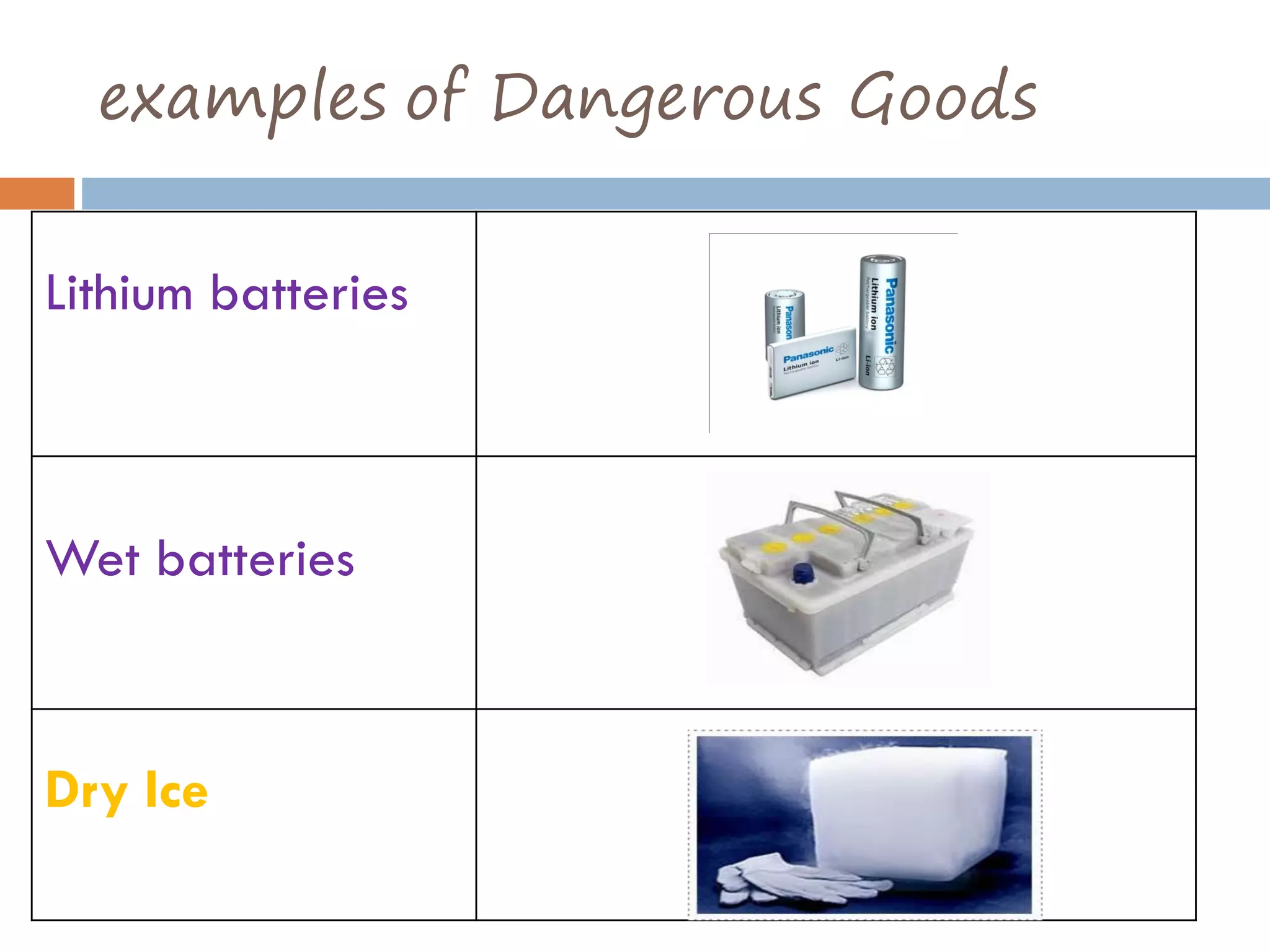
Lithium batteries
Wet batteries
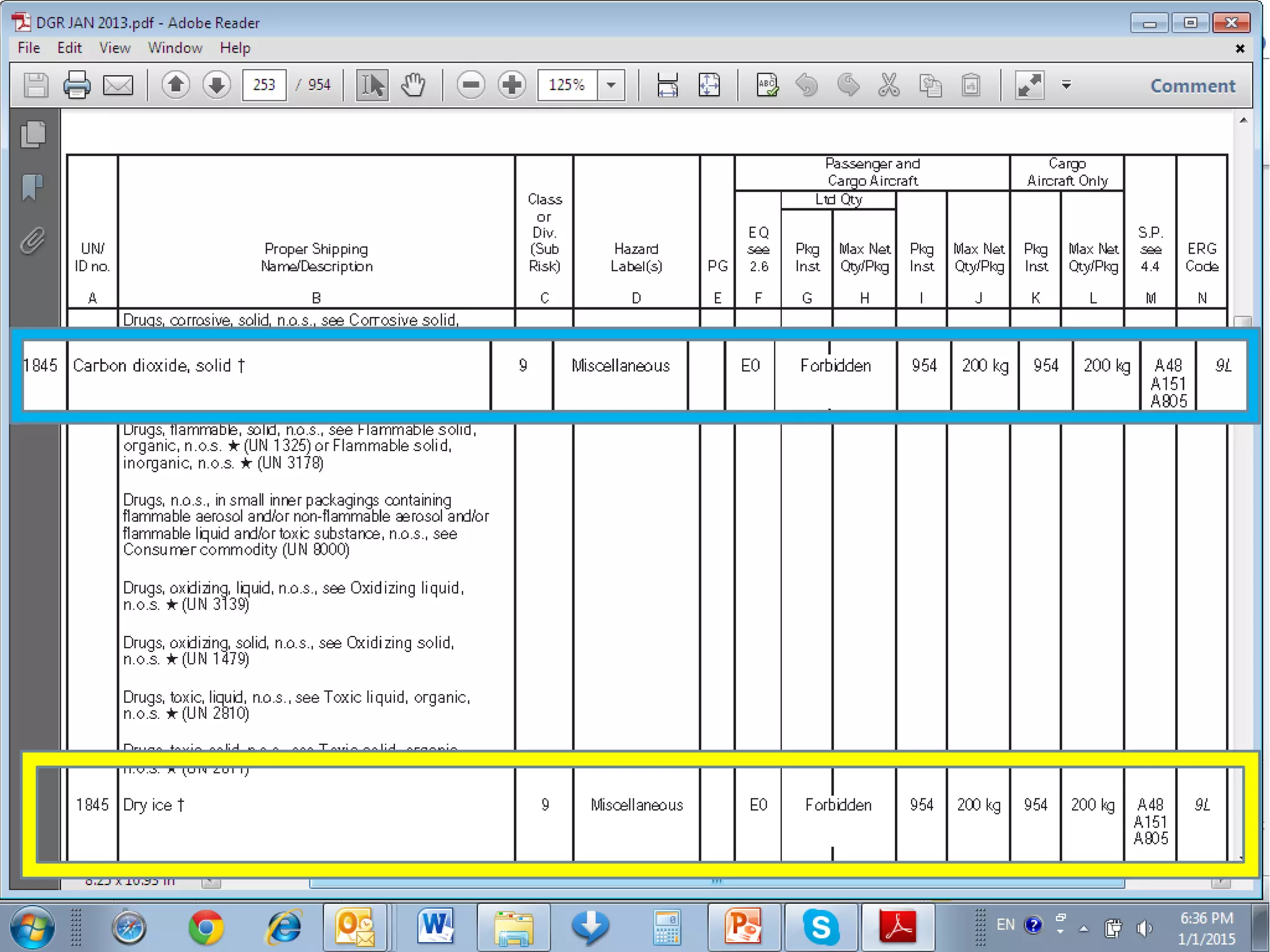
Dry Ice
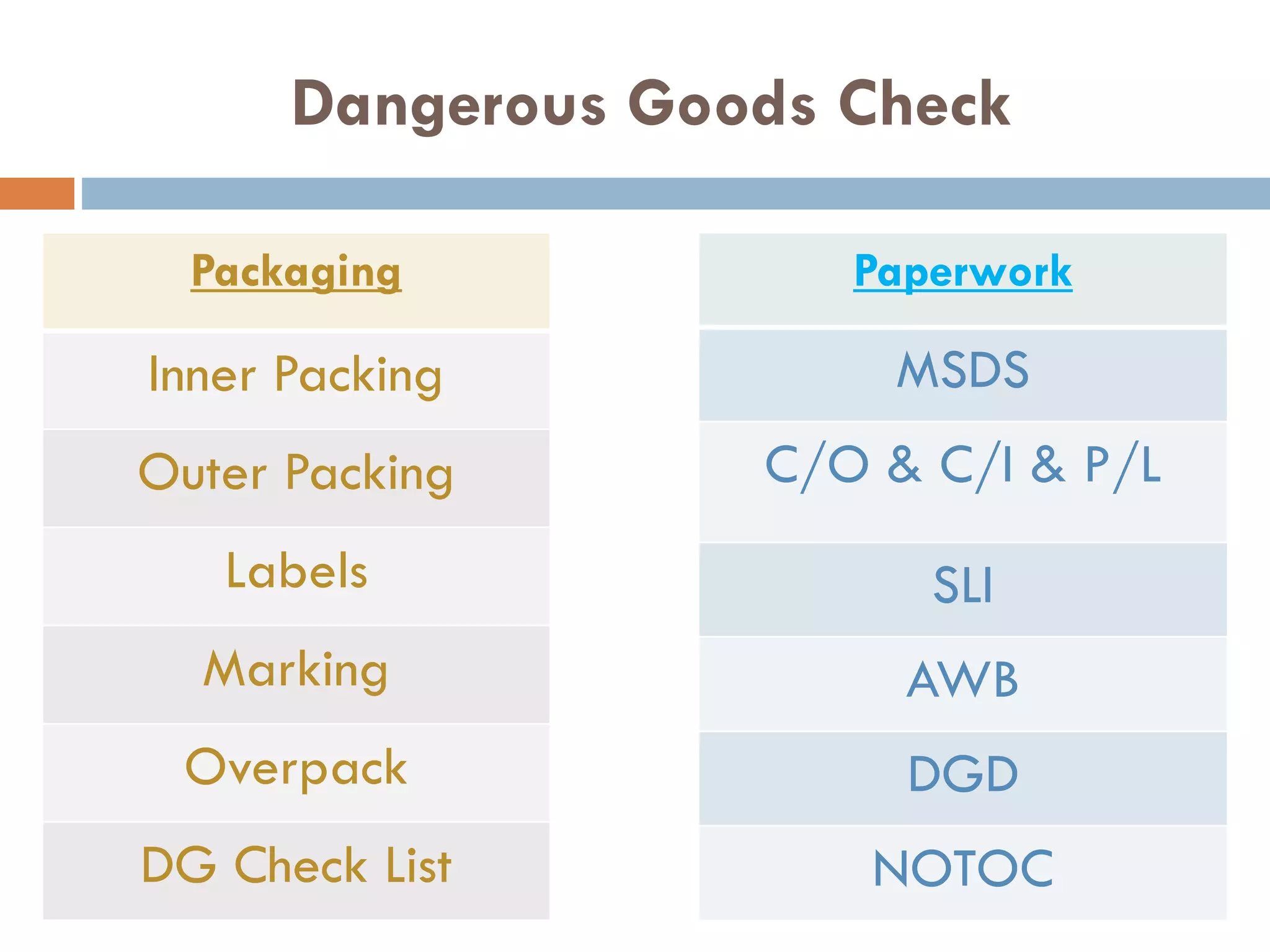
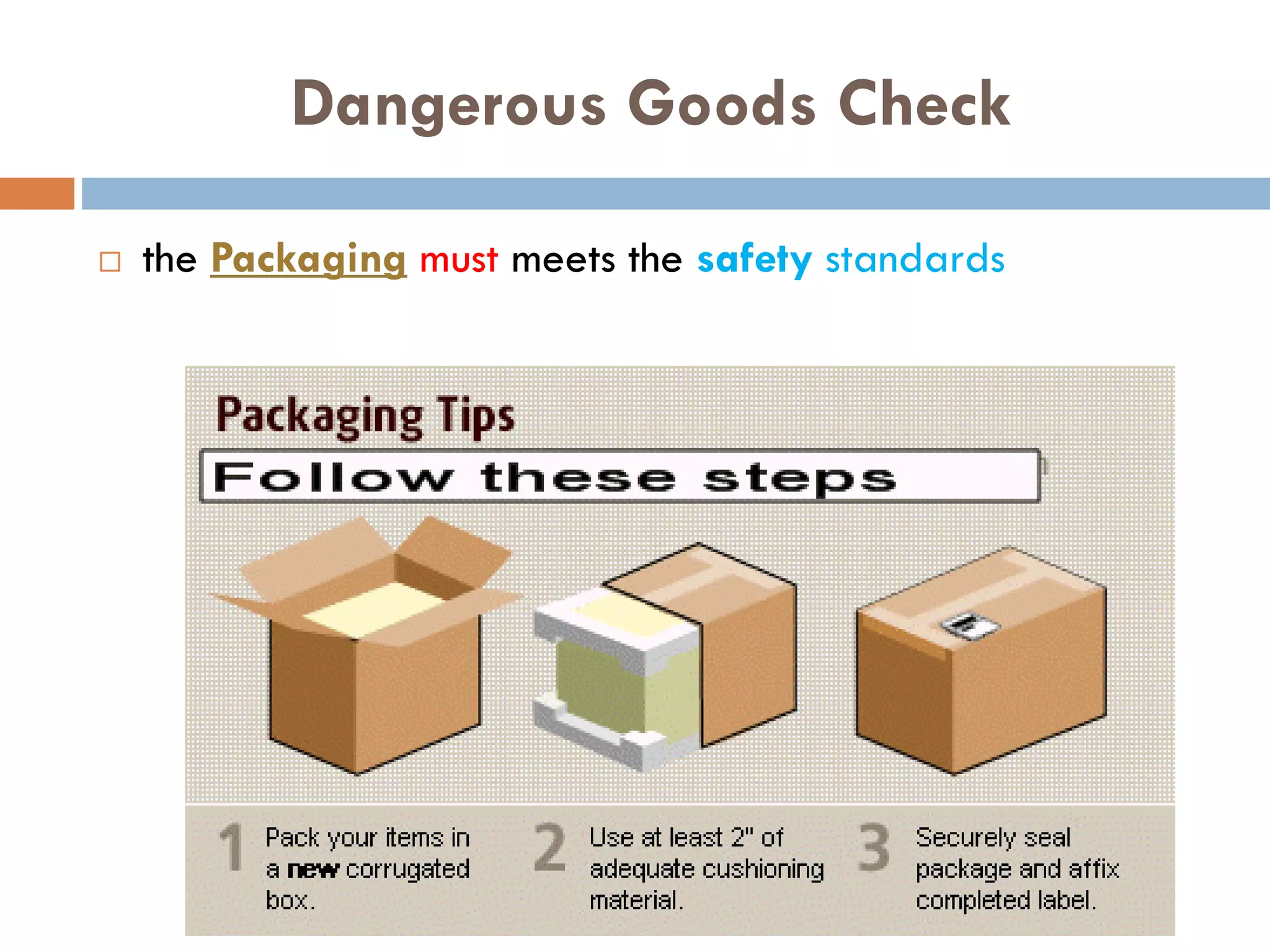
Dangerous Goods Check
Packaging
Inner Packing
Outer Packing
Labels
Marking
Overpack
DG Check List
Paperwork
MSDS
C/O & C/I & P/L
SLI
AWB
DGD
NOTOC
Dangerous Goods Check
 the Packaging must meets the safety standards
Dangerous Goods Check
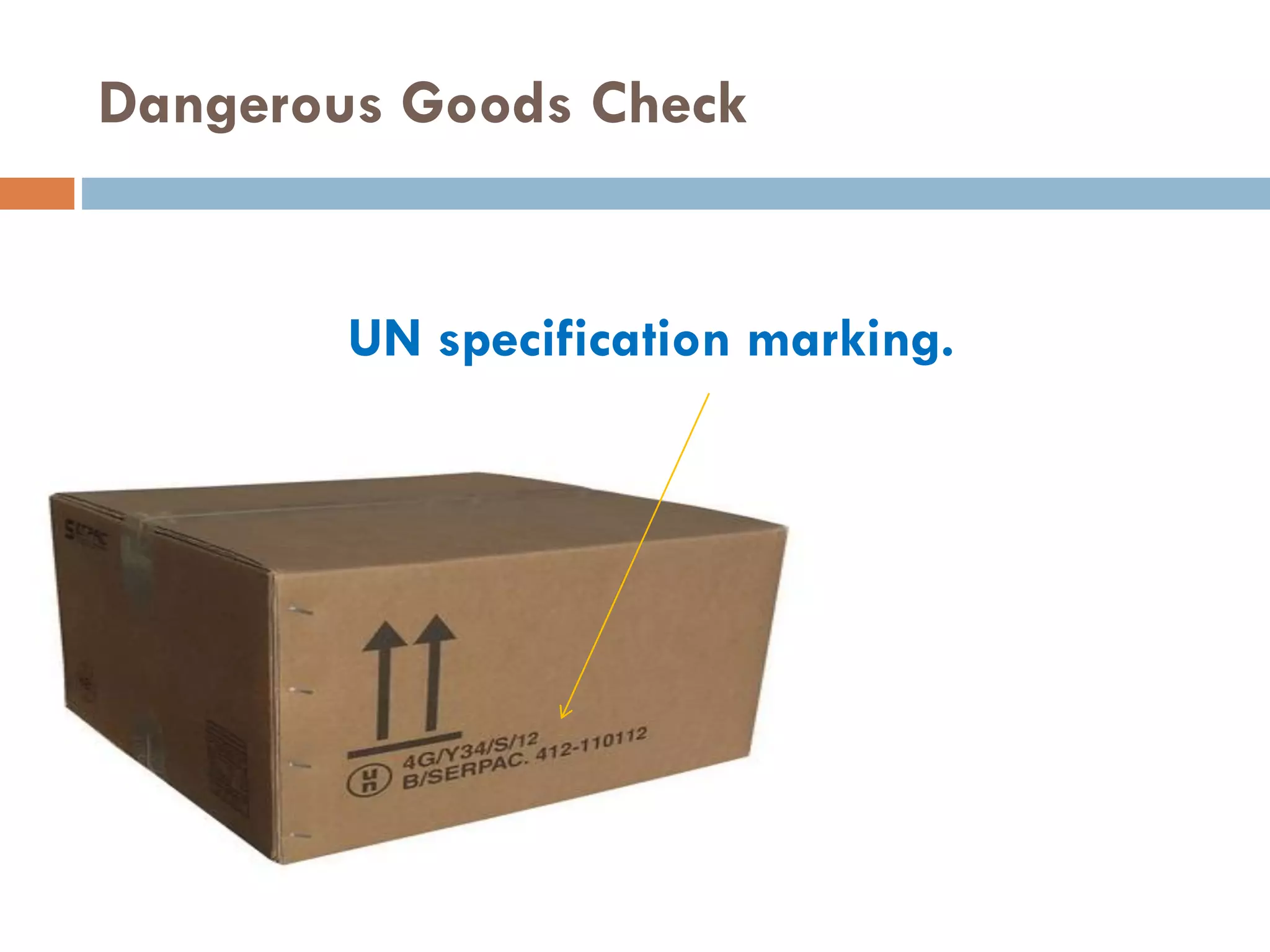
UN specification marking.
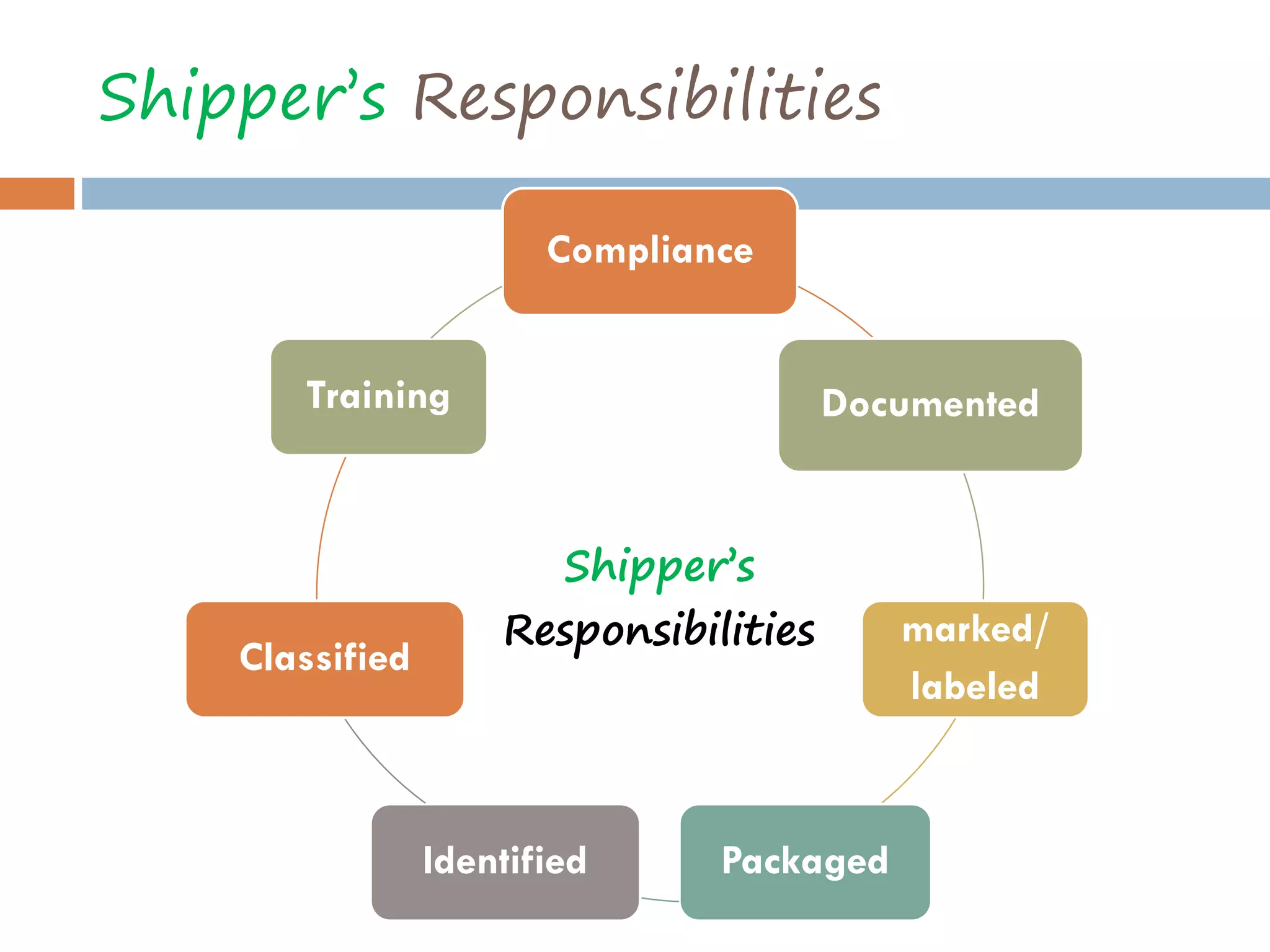
Shipper’s Responsibilities
Shipper’s
Responsibilities
Compliance
Documented
marked/
labeled
PackagedIdentified
Classified
Training
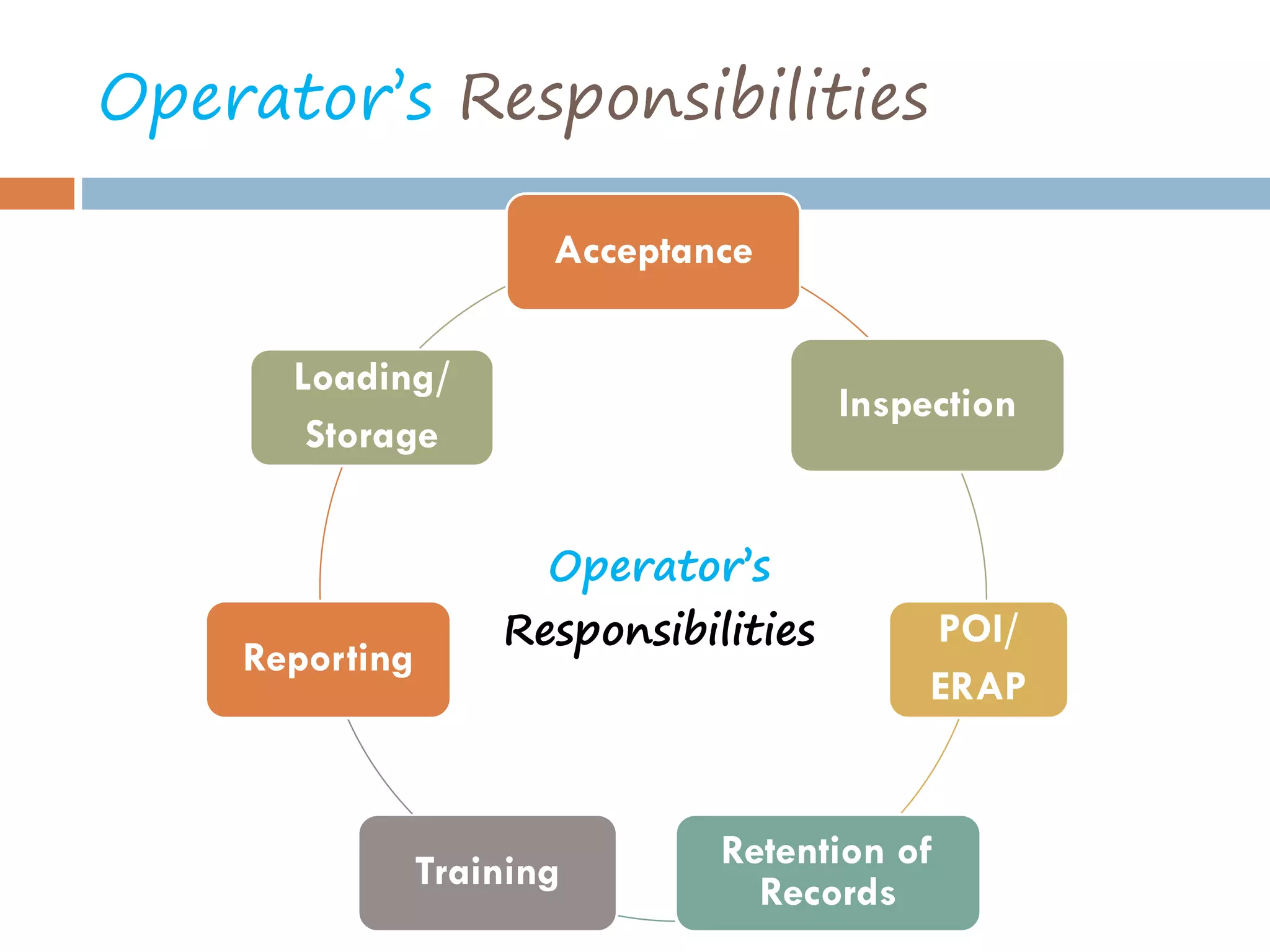
Operator’s Responsibilities
Operator’s
Responsibilities
Acceptance
Inspection
POI/
ERAP
Retention of
RecordsTraining
Reporting
Loading/
Storage
IATA Dangerous Goods Regulations
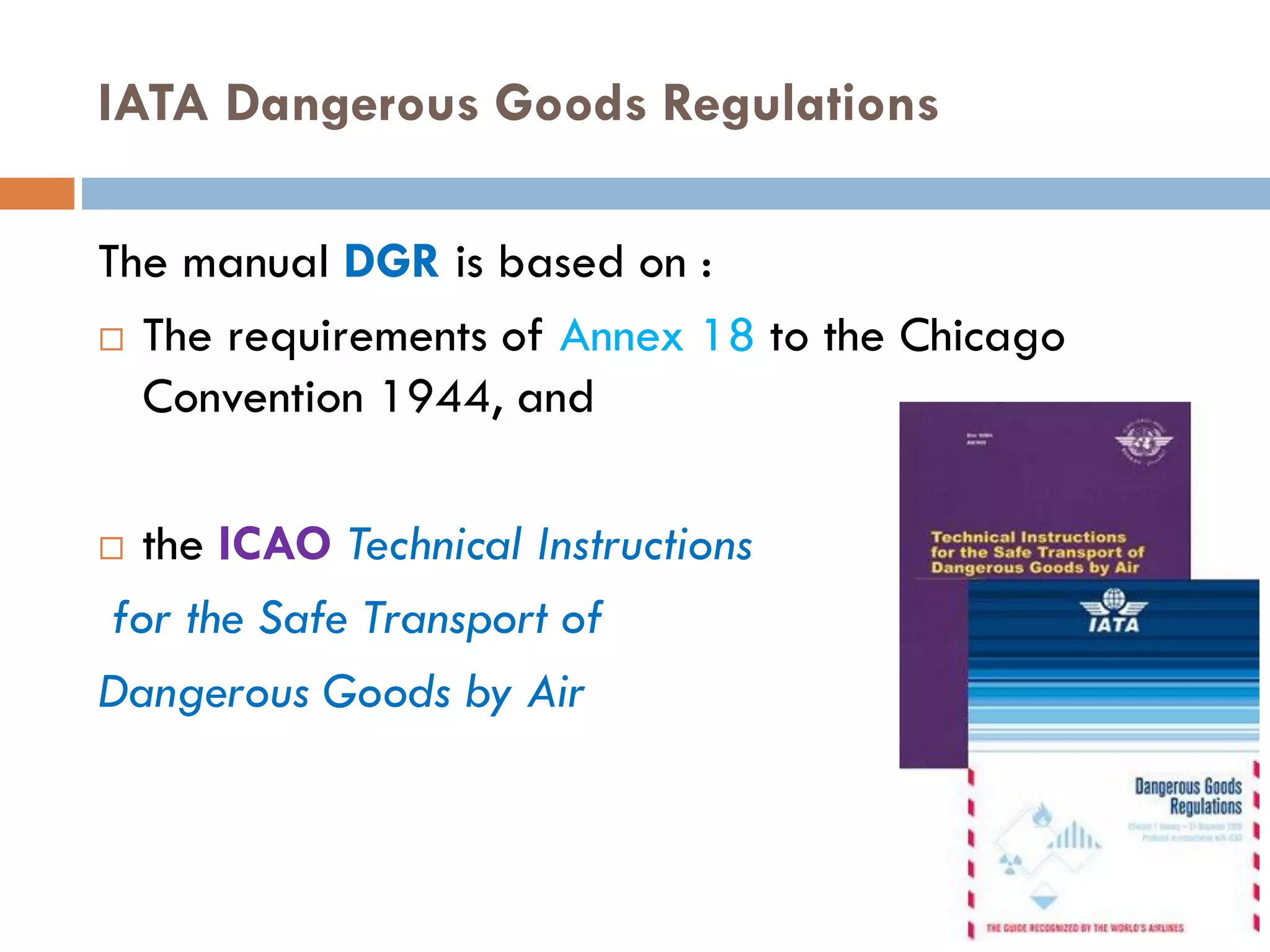
The manual DGR is based on :
 The requirements of Annex 18 to the Chicago
Convention 1944, and
 the ICAO Technical Instructions
for the Safe Transport of
Dangerous Goods by Air
CLASSIFICATION & IDENTIFICATION
 The NINE HAZARD CLASSES are assigned according
to the TYPE OF DANGER they present.
 Packing Groups assigned according to the
Degree of DANGER within a class/division.
CLASSIFICATION & IDENTIFICATION
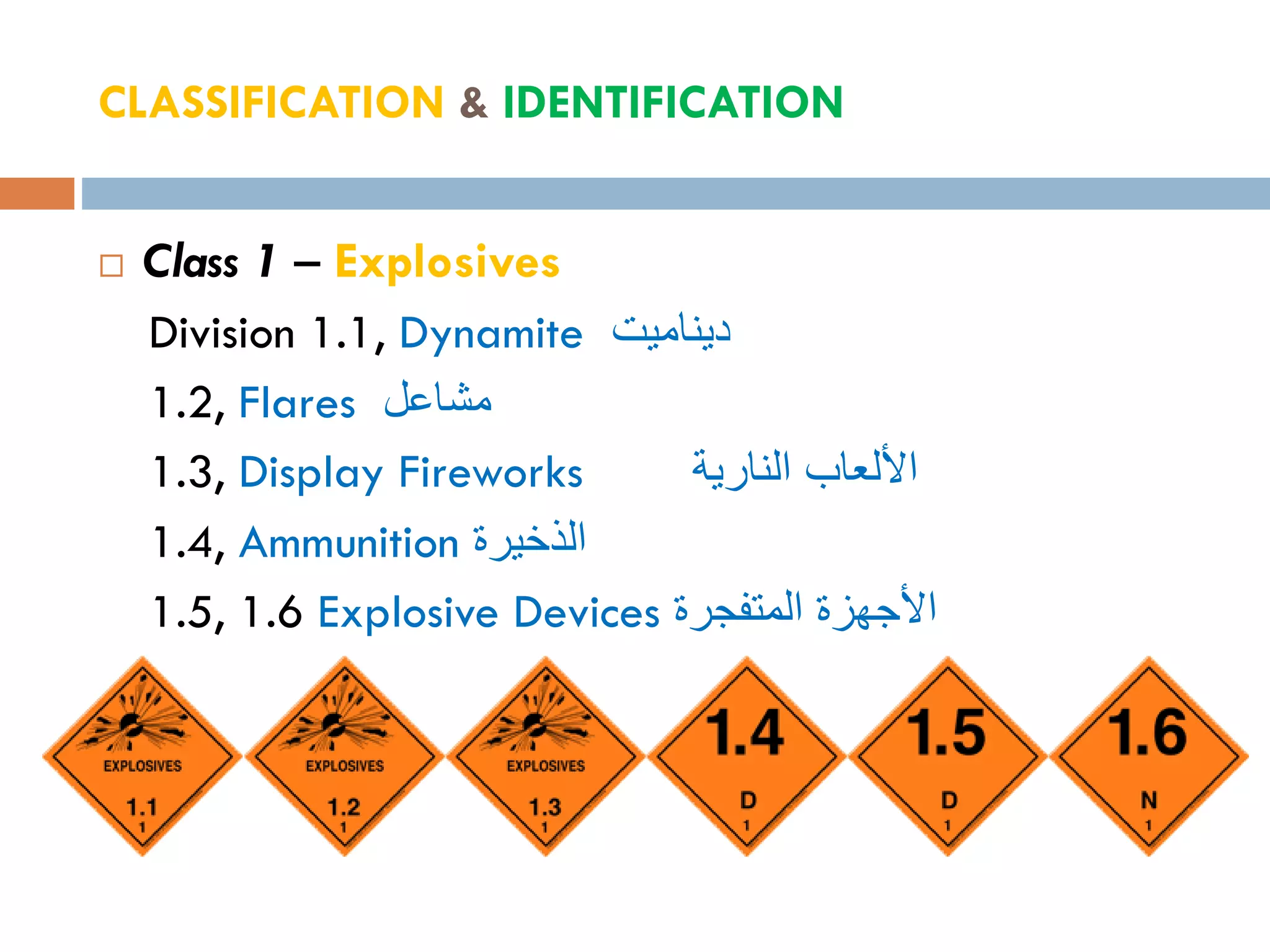
 Class 1 – Explosives
Division 1.1, Dynamite ‫ديناميت‬
1.2, Flares ‫مشاعل‬
1.3, Display Fireworks ‫النارية‬ ‫األلعاب‬
1.4, Ammunition ‫الذخيرة‬
1.5, 1.6 Explosive Devices ‫المتفجرة‬ ‫األجهزة‬
CLASSIFICATION & IDENTIFICATION
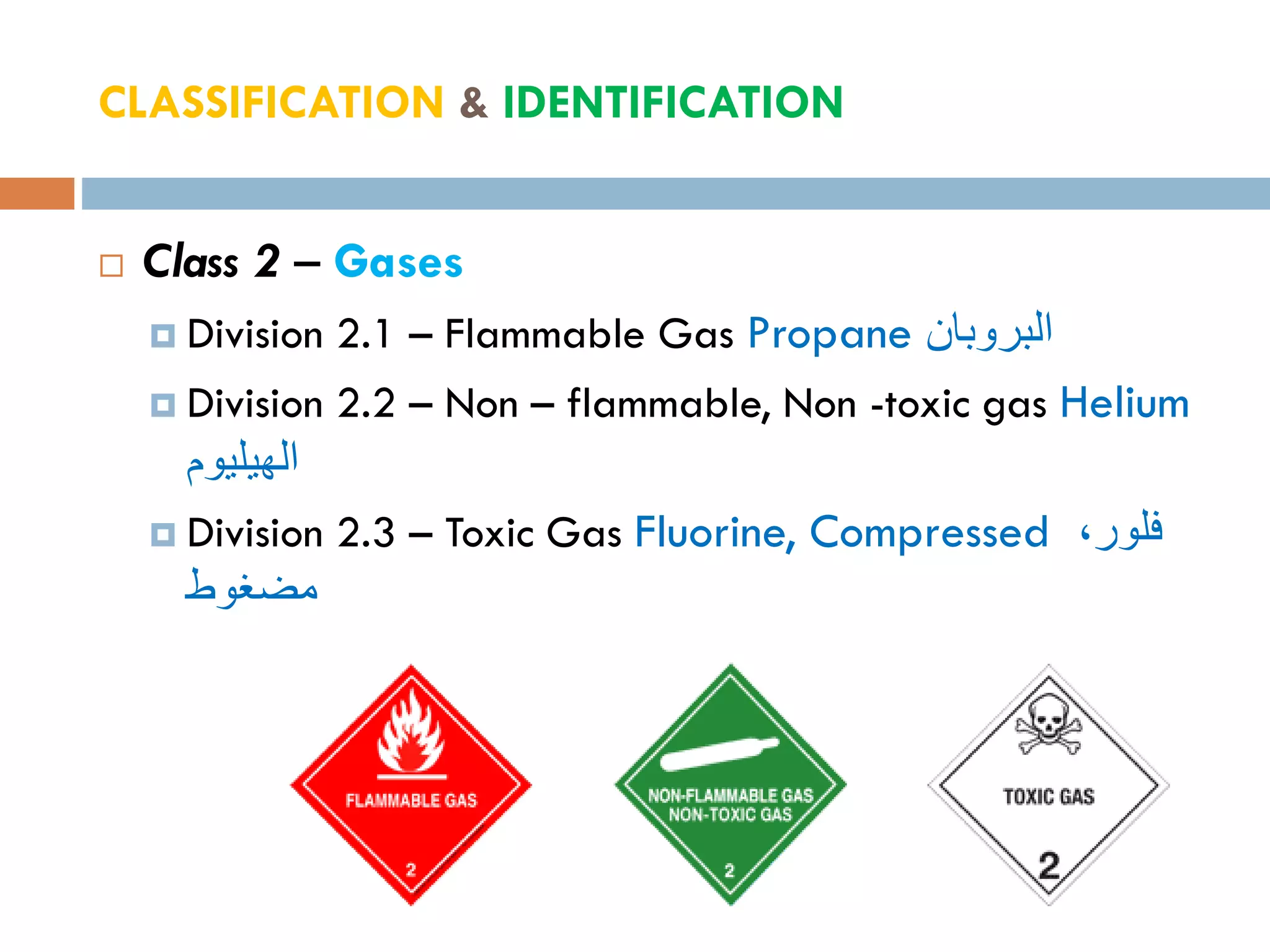
 Class 2 – Gases
 Division 2.1 – Flammable Gas Propane ‫البروبان‬
 Division 2.2 – Non – flammable, Non -toxic gas Helium
‫الهيليوم‬
 Division 2.3 – Toxic Gas Fluorine, Compressed ،‫فلور‬
‫مضغوط‬
CLASSIFICATION & IDENTIFICATION
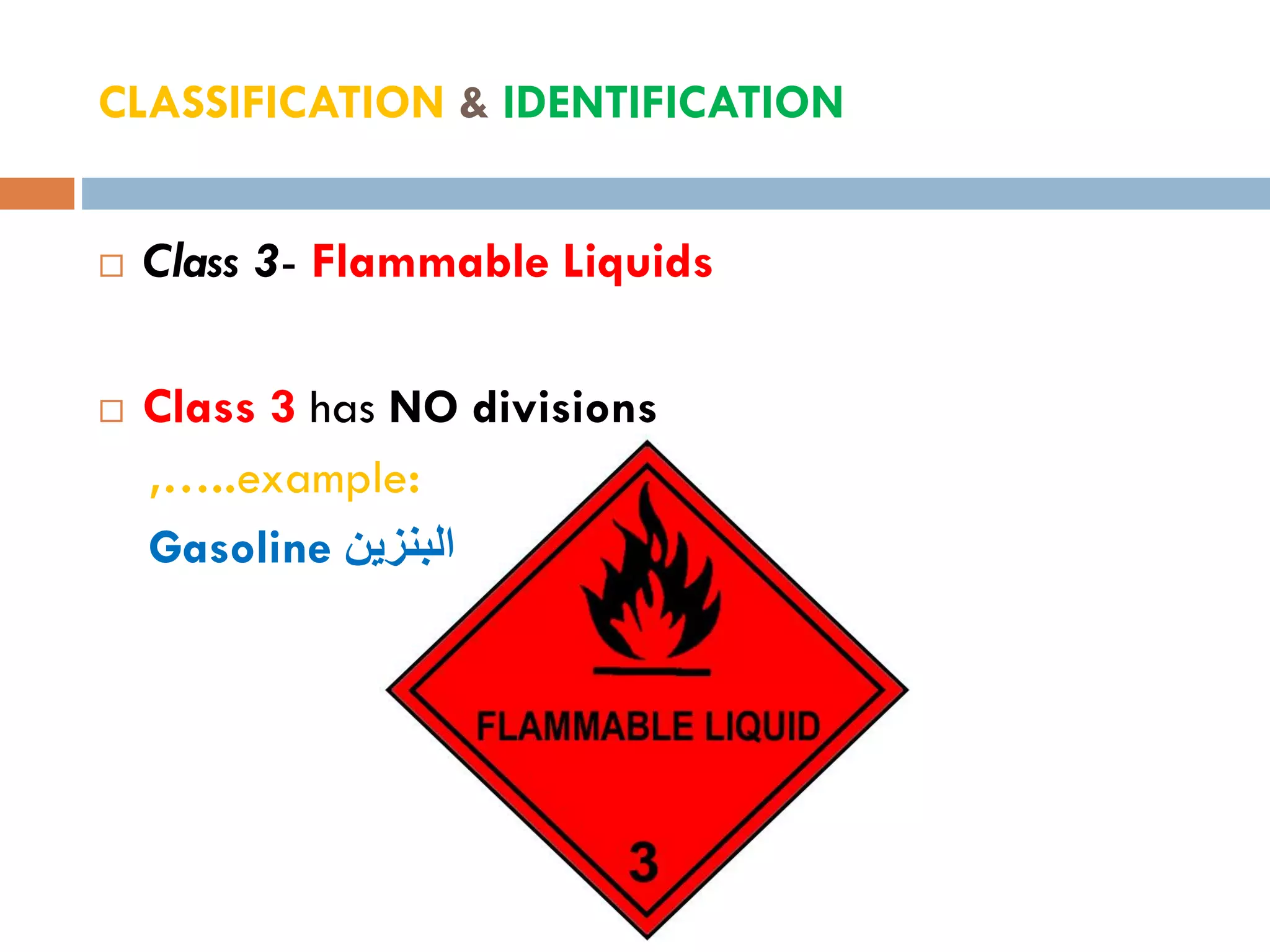
 Class 3- Flammable Liquids
 Class 3 has NO divisions
,…..example:
Gasoline ‫البنزين‬
CLASSIFICATION & IDENTIFICATION
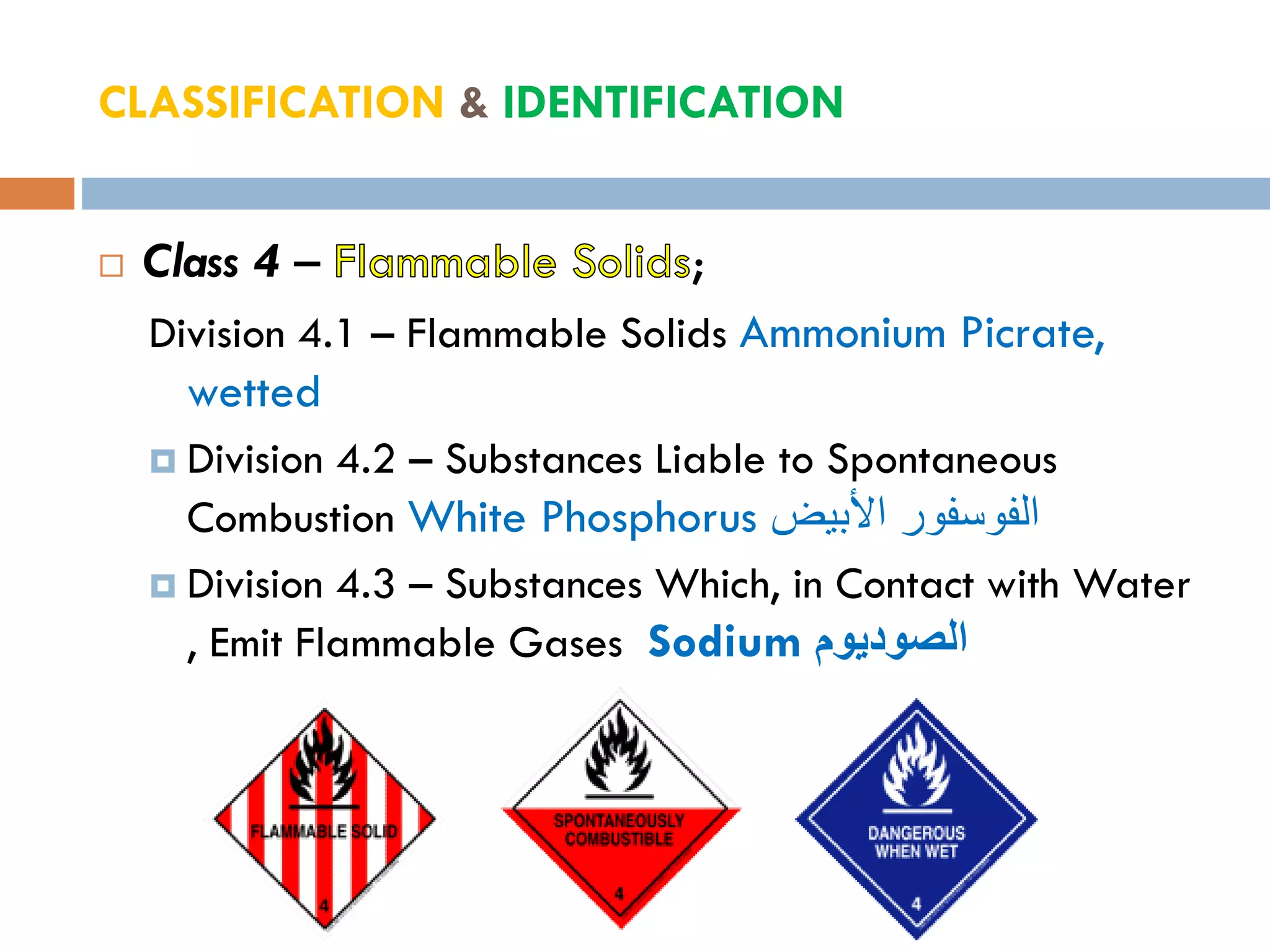
 Class 4 – ;
Division 4.1 – Flammable Solids Ammonium Picrate,
wetted
 Division 4.2 – Substances Liable to Spontaneous
Combustion White Phosphorus ‫الفوسفور‬‫األبيض‬
 Division 4.3 – Substances Which, in Contact with Water
, Emit Flammable Gases Sodium ‫الصوديوم‬
CLASSIFICATION & IDENTIFICATION
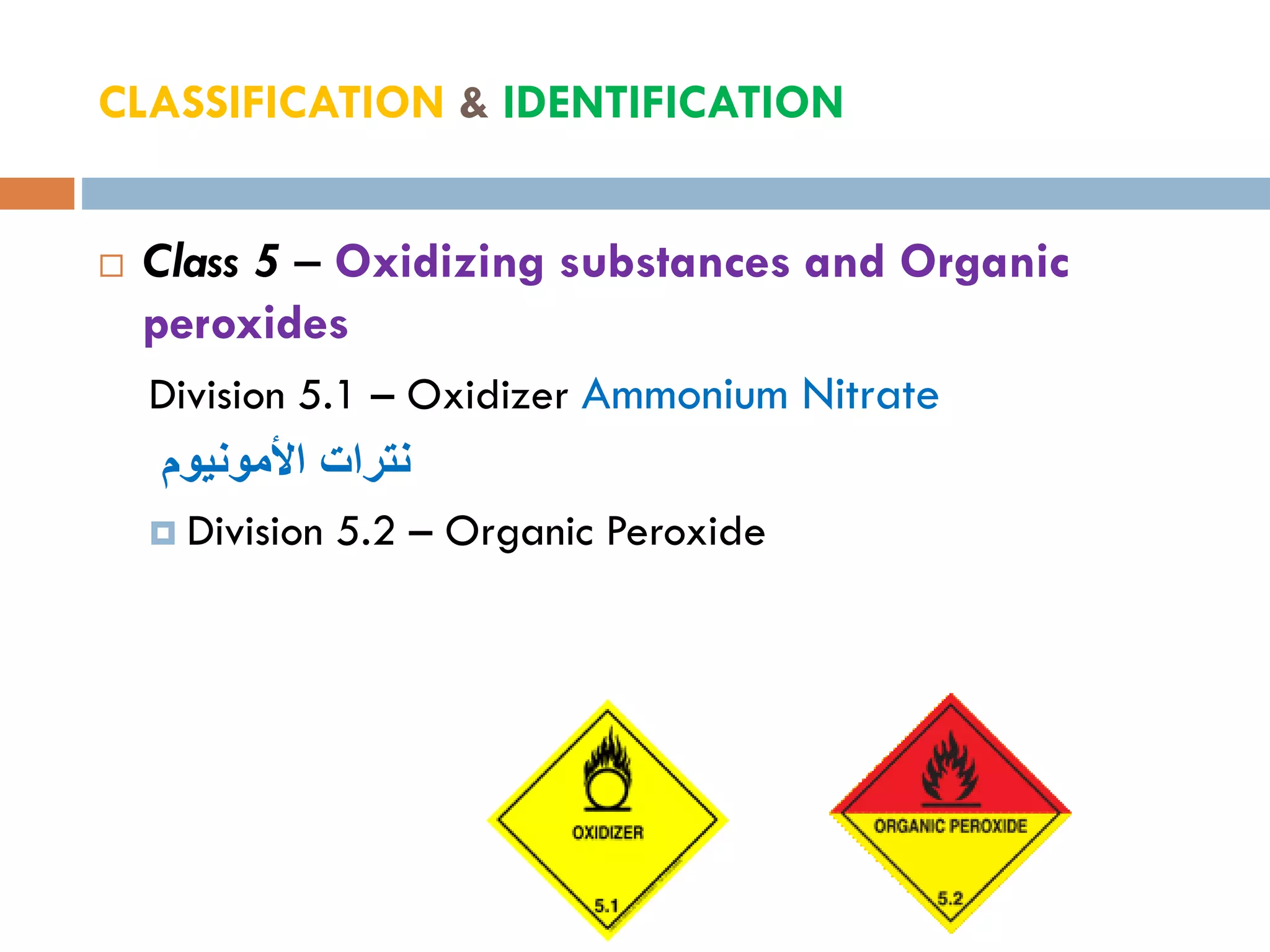
 Class 5 – Oxidizing substances and Organic
peroxides
Division 5.1 – Oxidizer Ammonium Nitrate
‫األمونيوم‬ ‫نترات‬
 Division 5.2 – Organic Peroxide
CLASSIFICATION & IDENTIFICATION
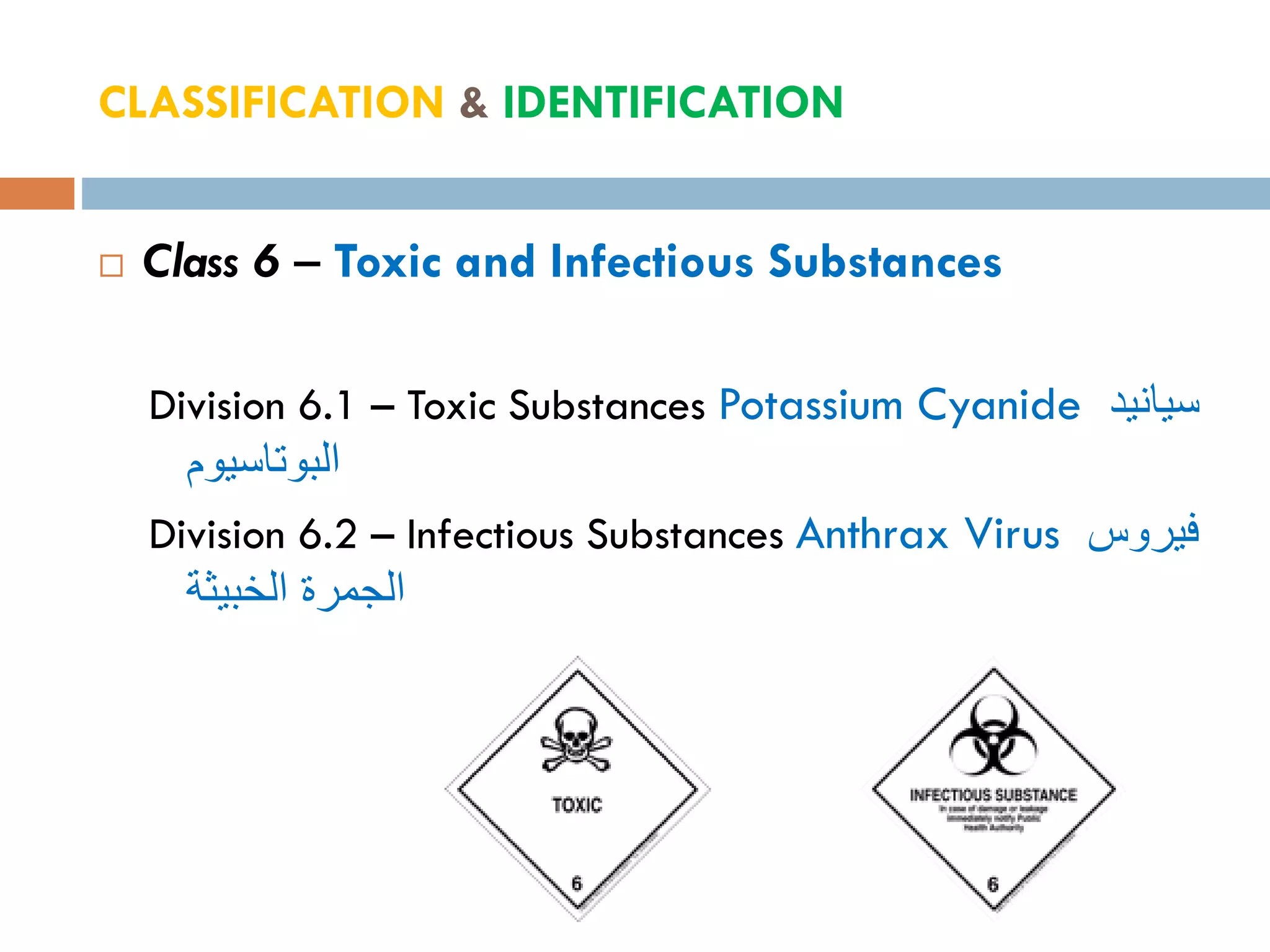
 Class 6 – Toxic and Infectious Substances
Division 6.1 – Toxic Substances Potassium Cyanide ‫سيانيد‬
‫البوتاسيوم‬
Division 6.2 – Infectious Substances Anthrax Virus ‫فيروس‬
‫الخبيثة‬ ‫الجمرة‬
CLASSIFICATION & IDENTIFICATION
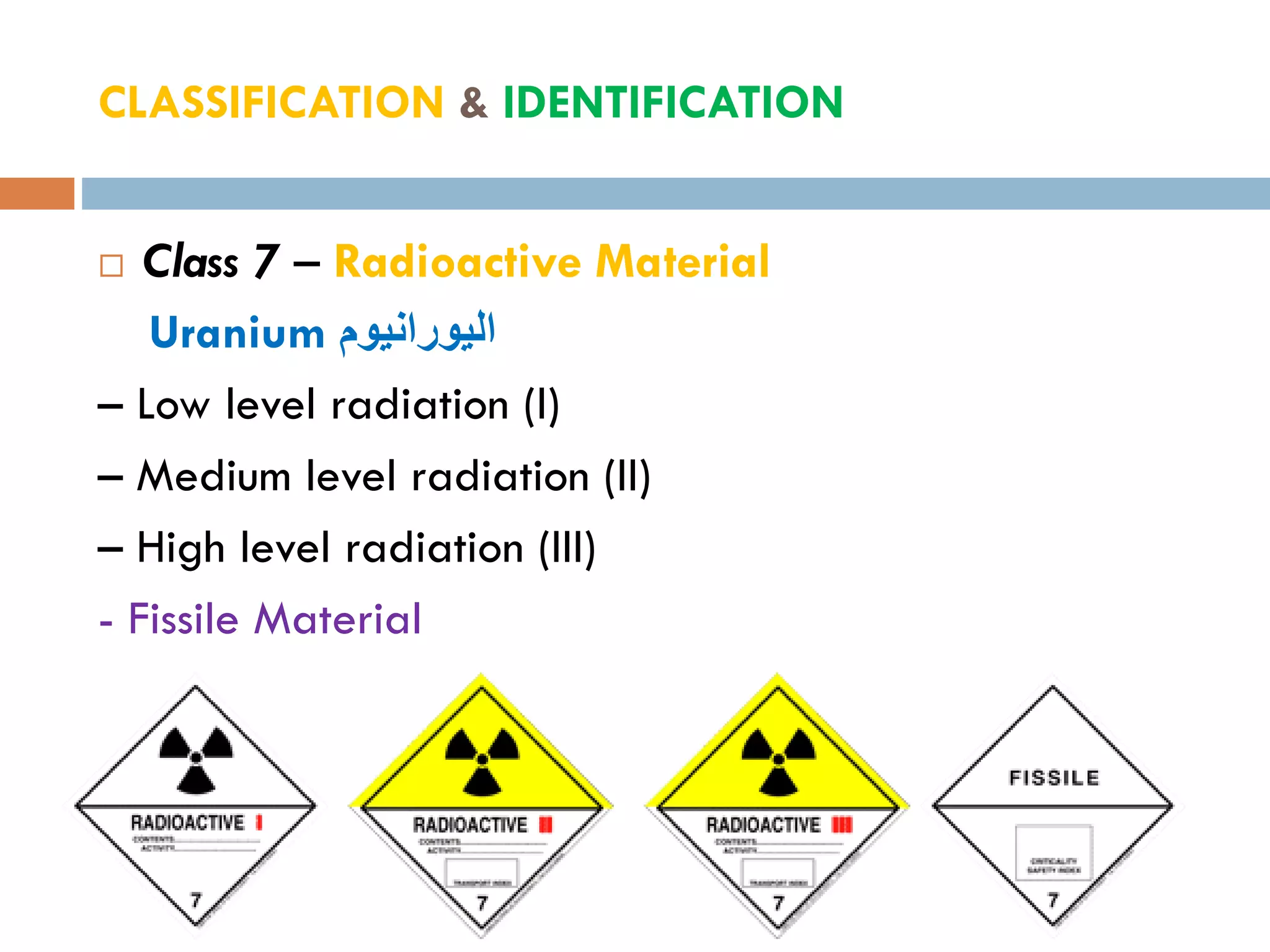
 Class 7 – Radioactive Material
Uranium ‫اليورانيوم‬
– Low level radiation (I)
– Medium level radiation (II)
– High level radiation (III)
- Fissile Material
CLASSIFICATION & IDENTIFICATION
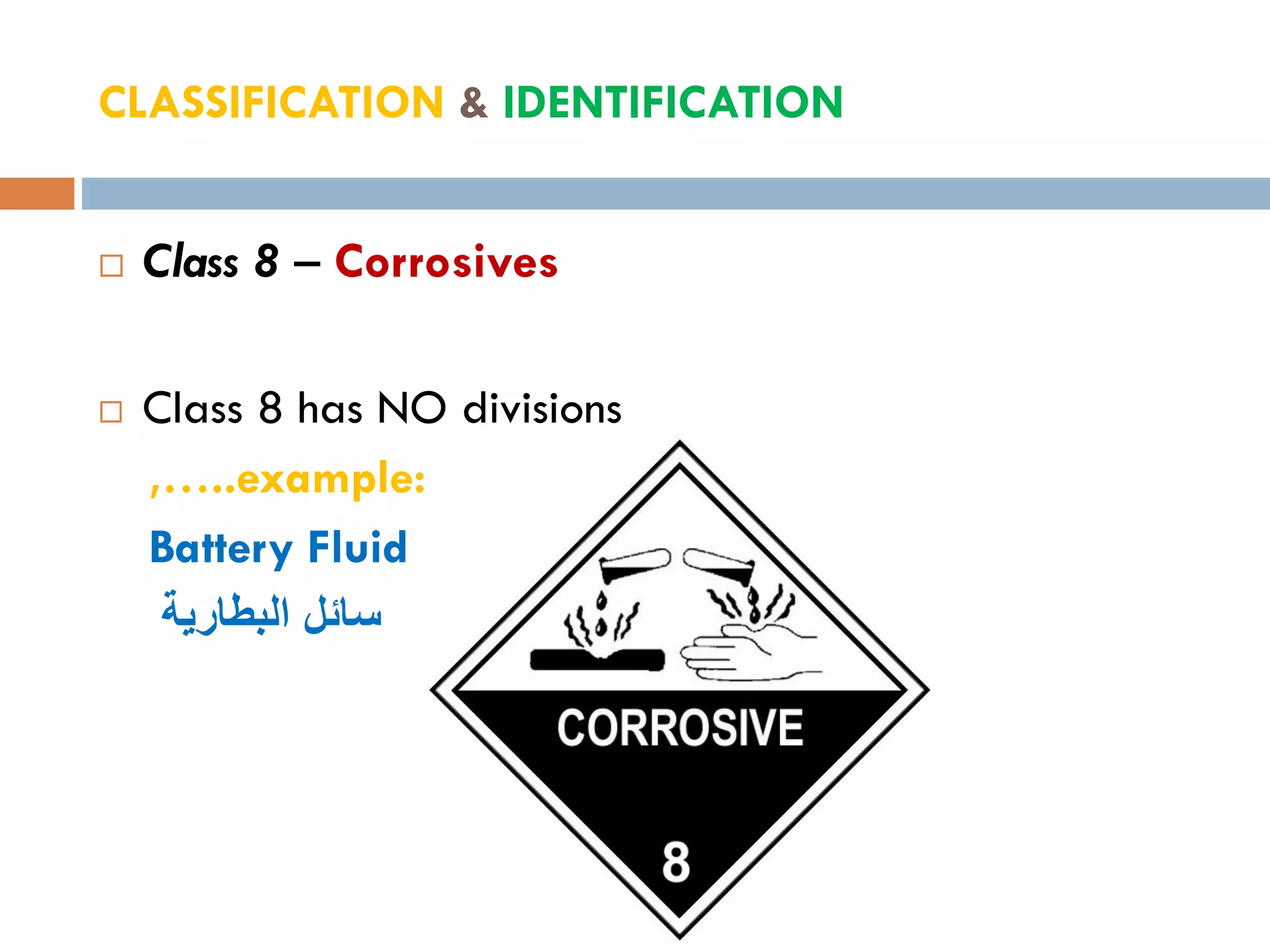
 Class 8 – Corrosives
 Class 8 has NO divisions
,…..example:
Battery Fluid
‫البطارية‬ ‫سائل‬
CLASSIFICATION & IDENTIFICATION
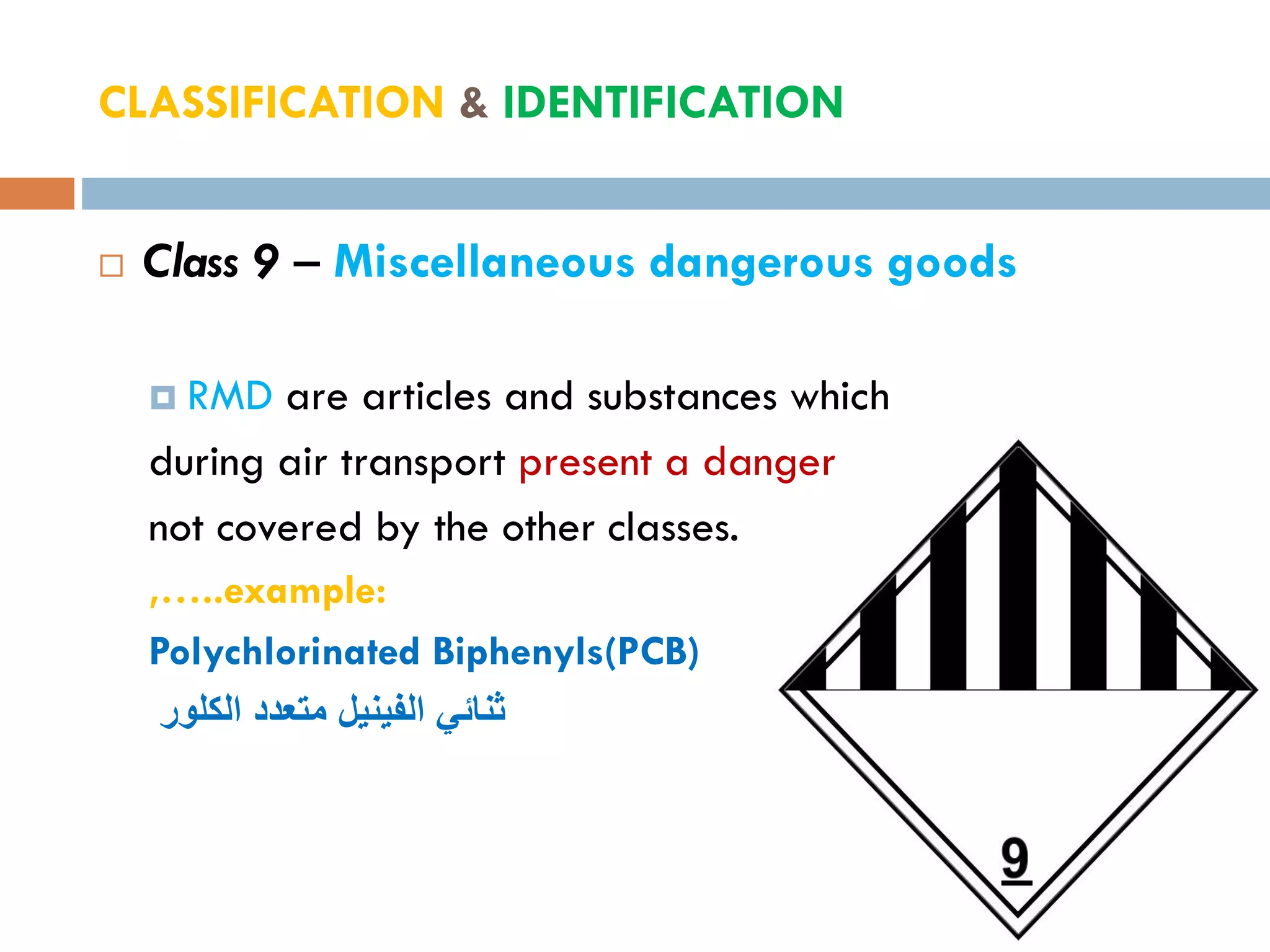
 Class 9 – Miscellaneous dangerous goods
 RMD are articles and substances which
during air transport present a danger
not covered by the other classes.
,…..example:
Polychlorinated Biphenyls(PCB)
‫الكلور‬ ‫متعدد‬ ‫الفينيل‬ ‫ثنائي‬
Handling Labels
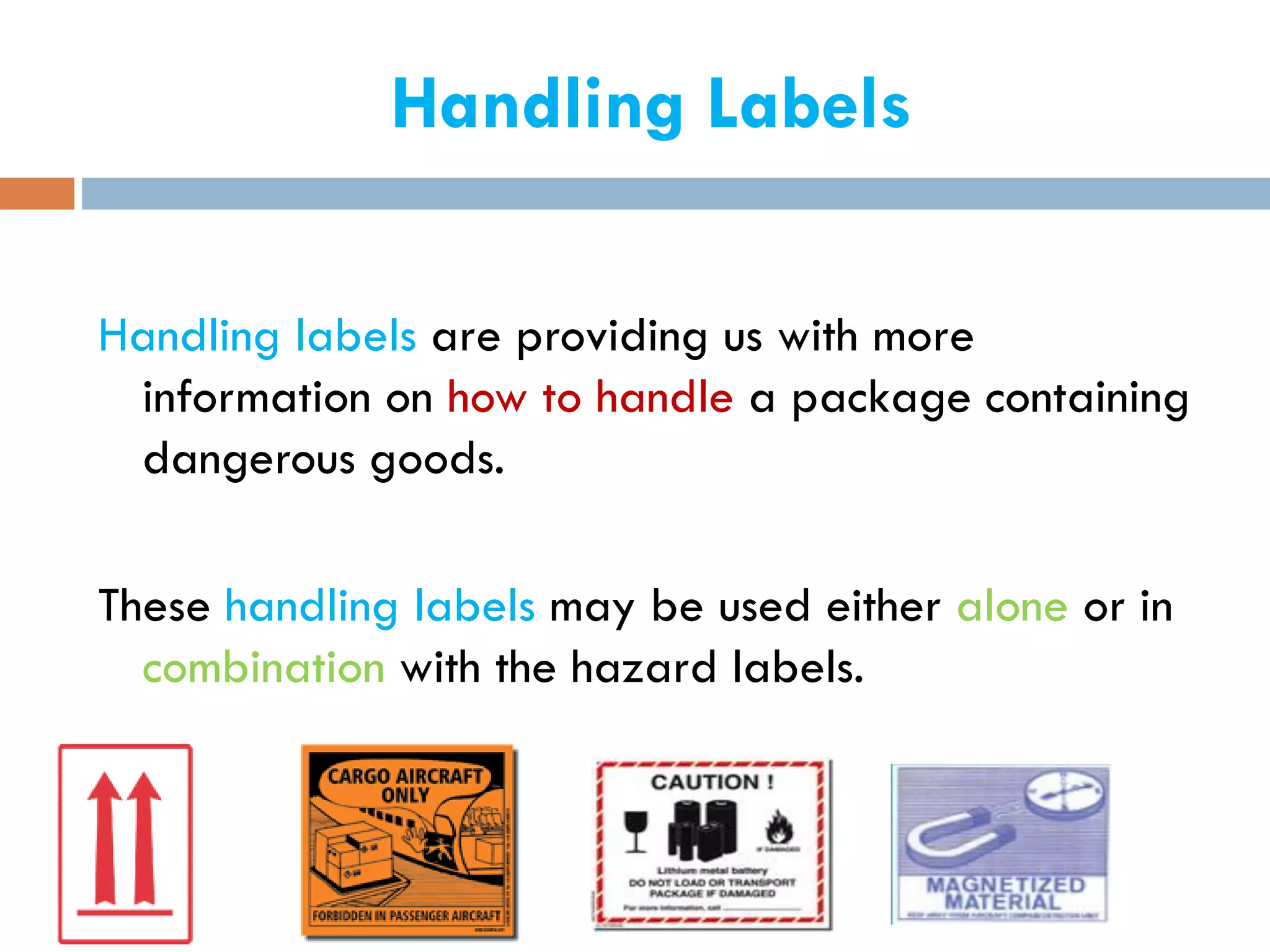
Handling labels are providing us with more
information on how to handle a package containing
dangerous goods.
These handling labels may be used either alone or in
combination with the hazard labels.
Documentation / Air waybill
 The Air Waybill (AWB) should mention the inclusion
of DGD.
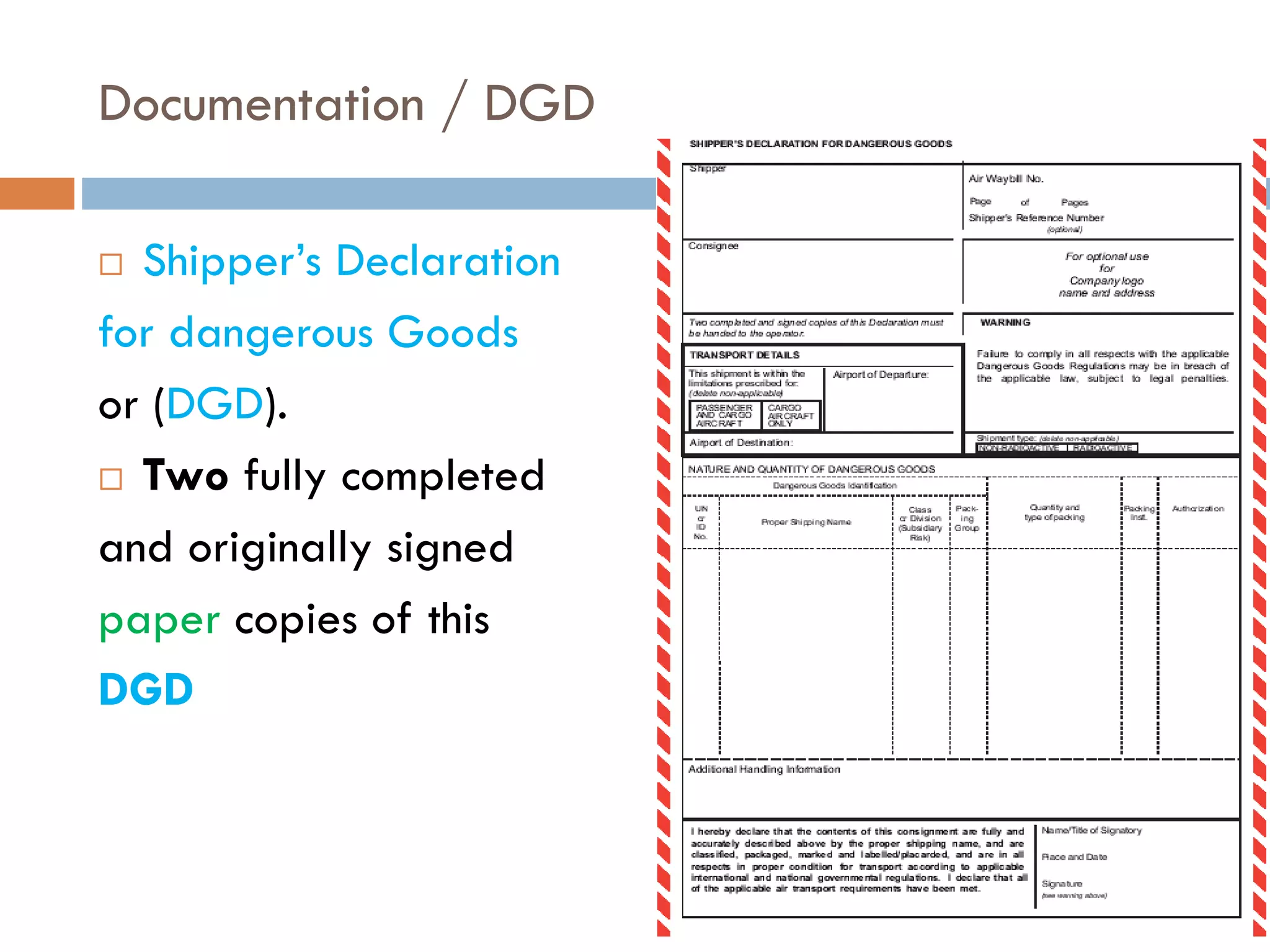
Documentation / DGD
 Shipper’s Declaration
for dangerous Goods
or (DGD).
 Two fully completed
and originally signed
paper copies of this
DGD
Dangerous Goods Carried by Passengers and
Crew
There are goods may be permitted to be carried by
passengers and crew either on:
 The person pocket,
 The checked baggage or
 The carry-on baggage,
(always in controlled quantities).
List Of
Dangerous
Goods Subsec.
4.2
Contains 3000
Articles and
Substance to be
shipped by Air
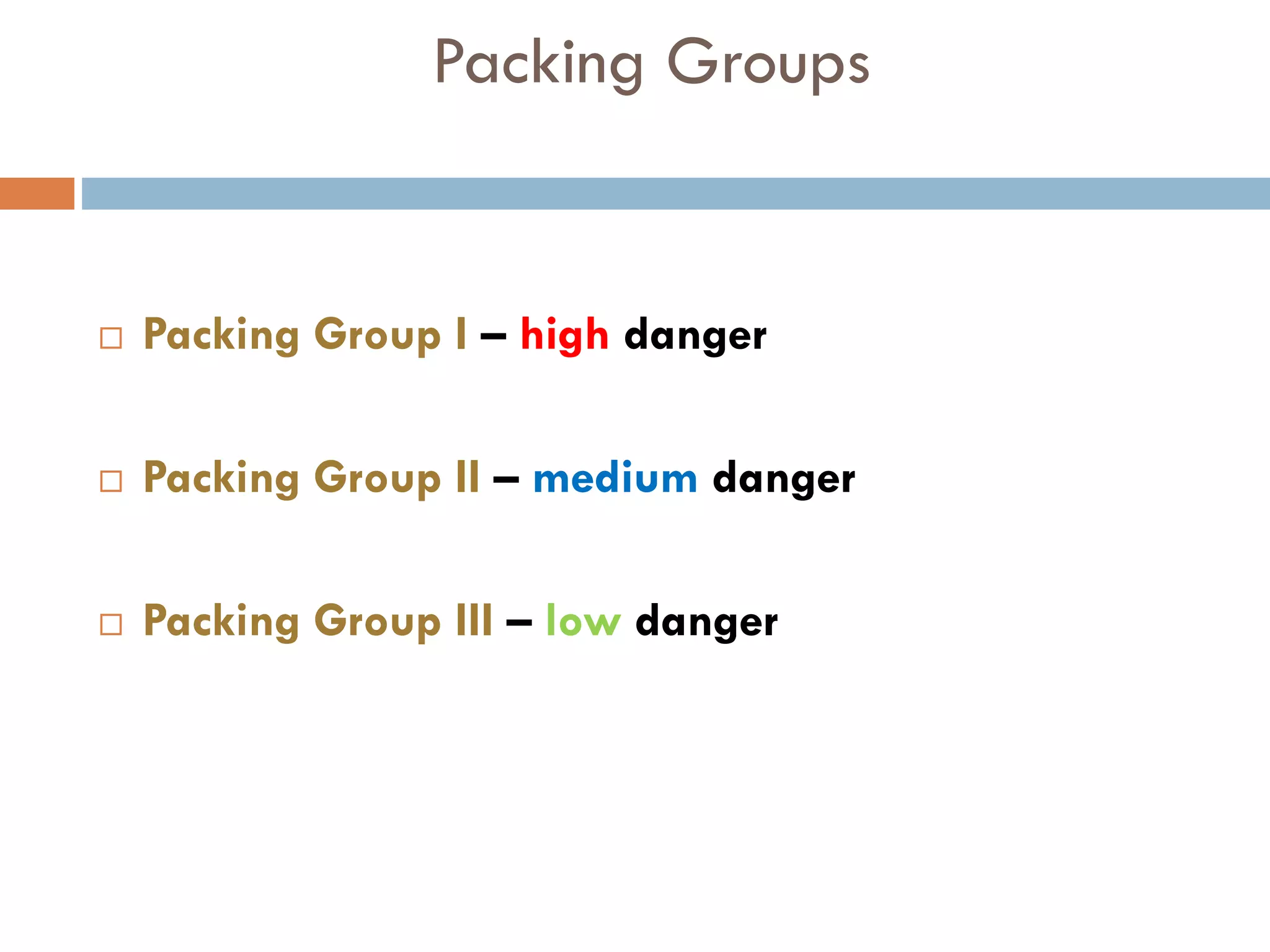
Packing Groups
 Packing Group I – high danger
 Packing Group II – medium danger
 Packing Group III – low danger
Methods of Packing
 There are two methods of packing dangerous goods:
 Single Packagings
 Combination Packagings
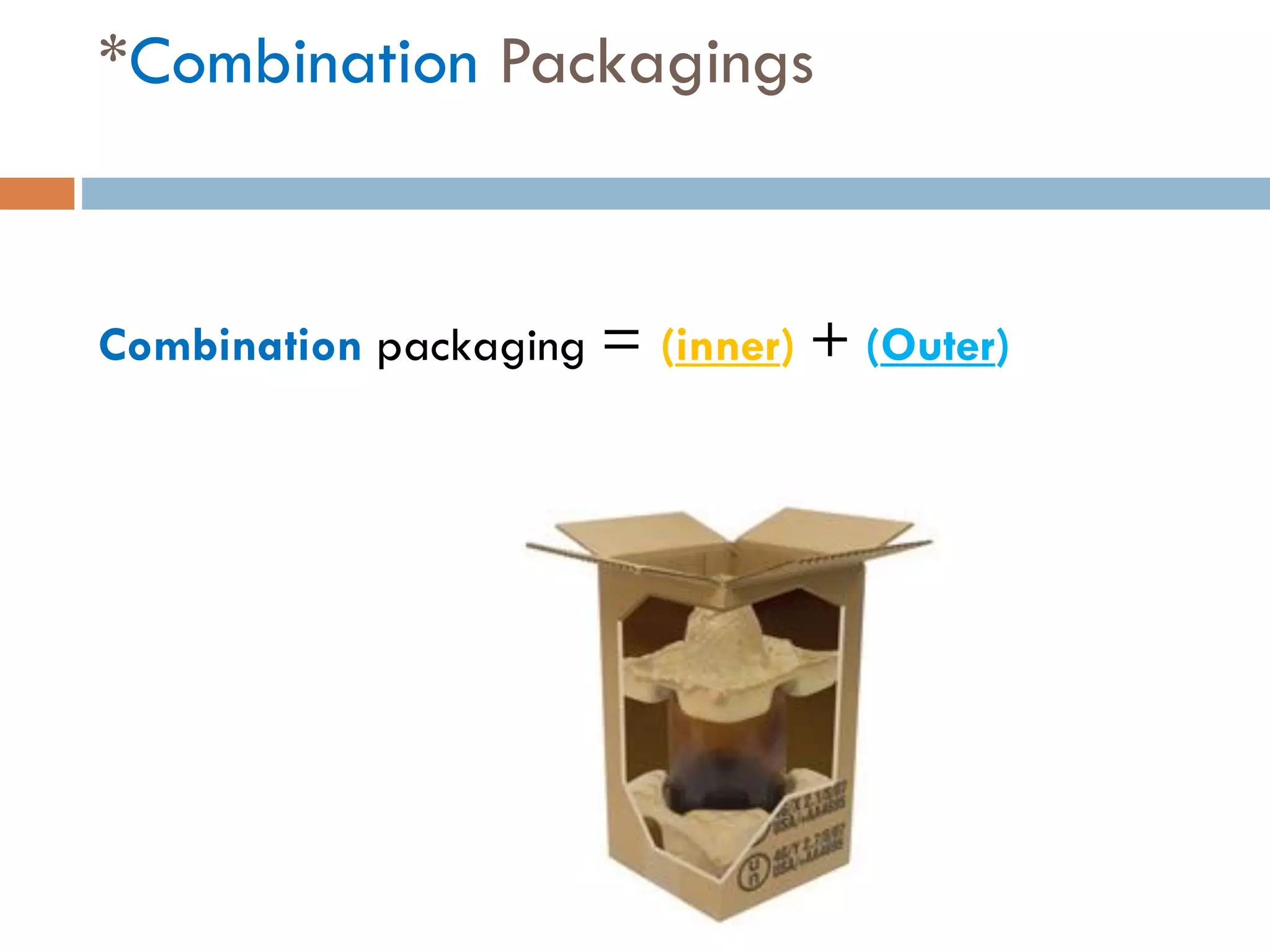
*Combination Packagings
Combination packaging = (inner) + (Outer)
*Single Packaging
Single packagings are:
 Packagings which do not require any inner
packagings in order to perform their containment
function during transport.
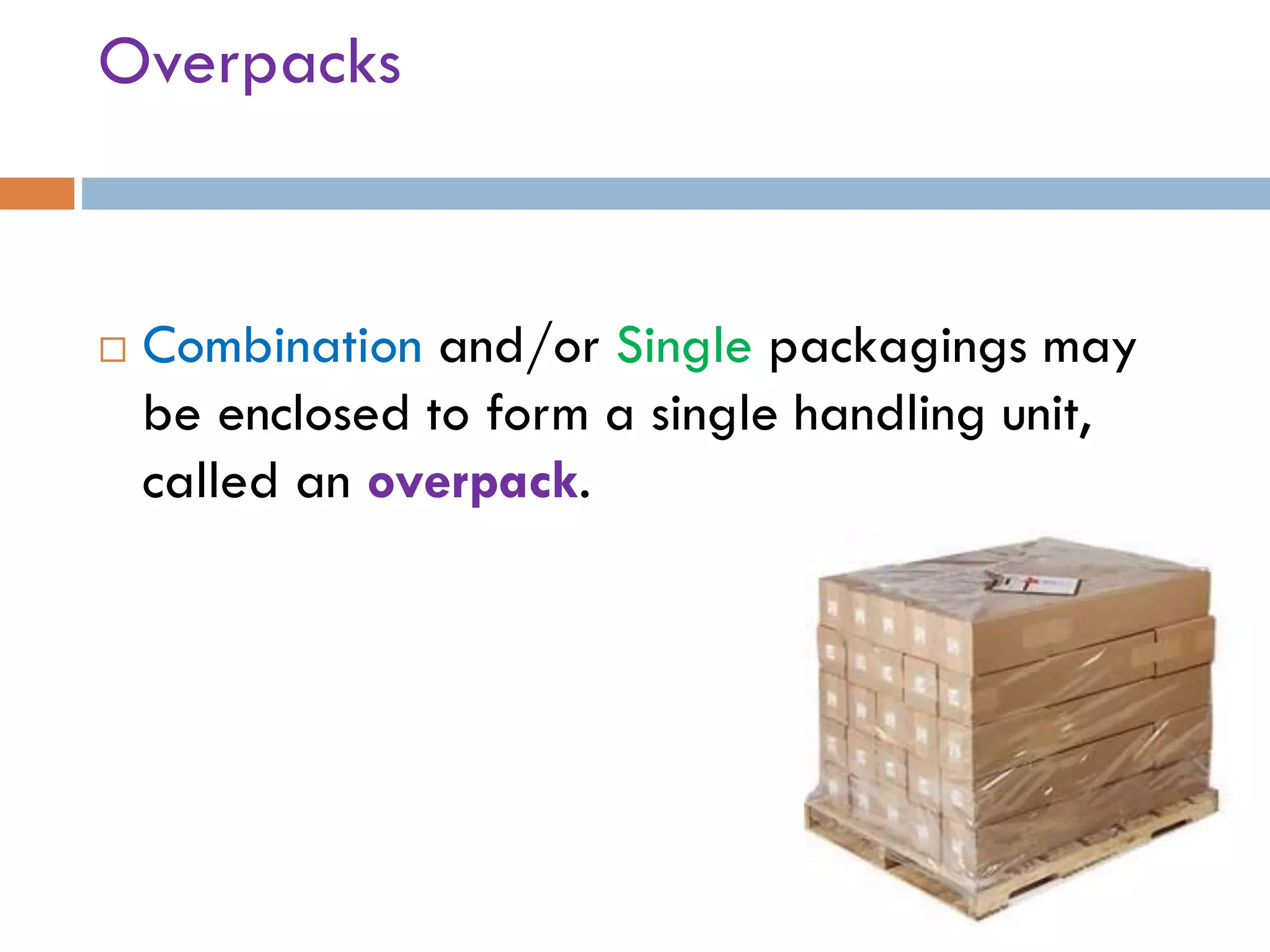
Overpacks
 Combination and/or Single packagings may
be enclosed to form a single handling unit,
called an overpack.
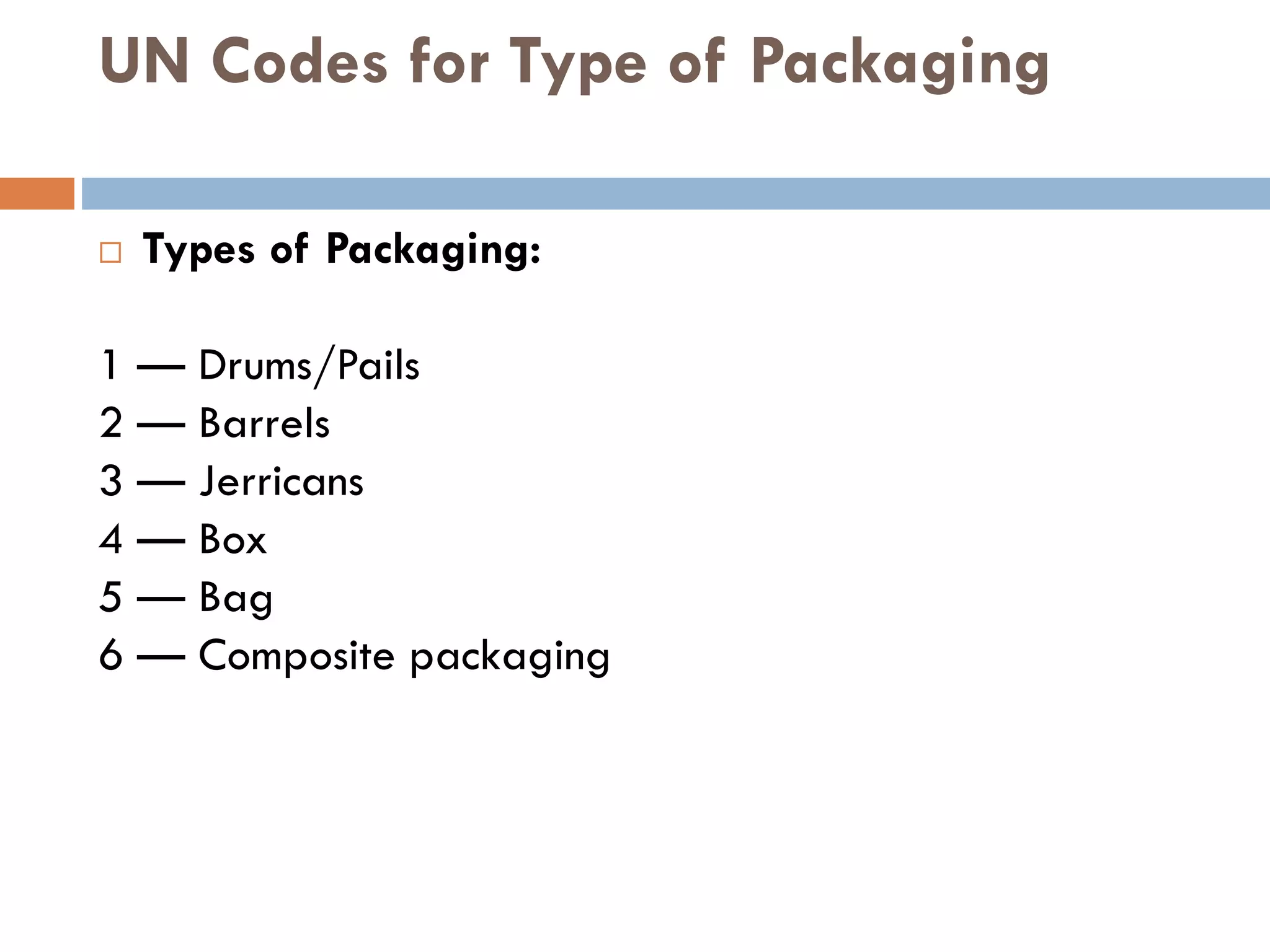
UN Codes for Type of Packaging
 Types of Packaging:
1 — Drums/Pails
2 — Barrels
3 — Jerricans
4 — Box
5 — Bag
6 — Composite packaging
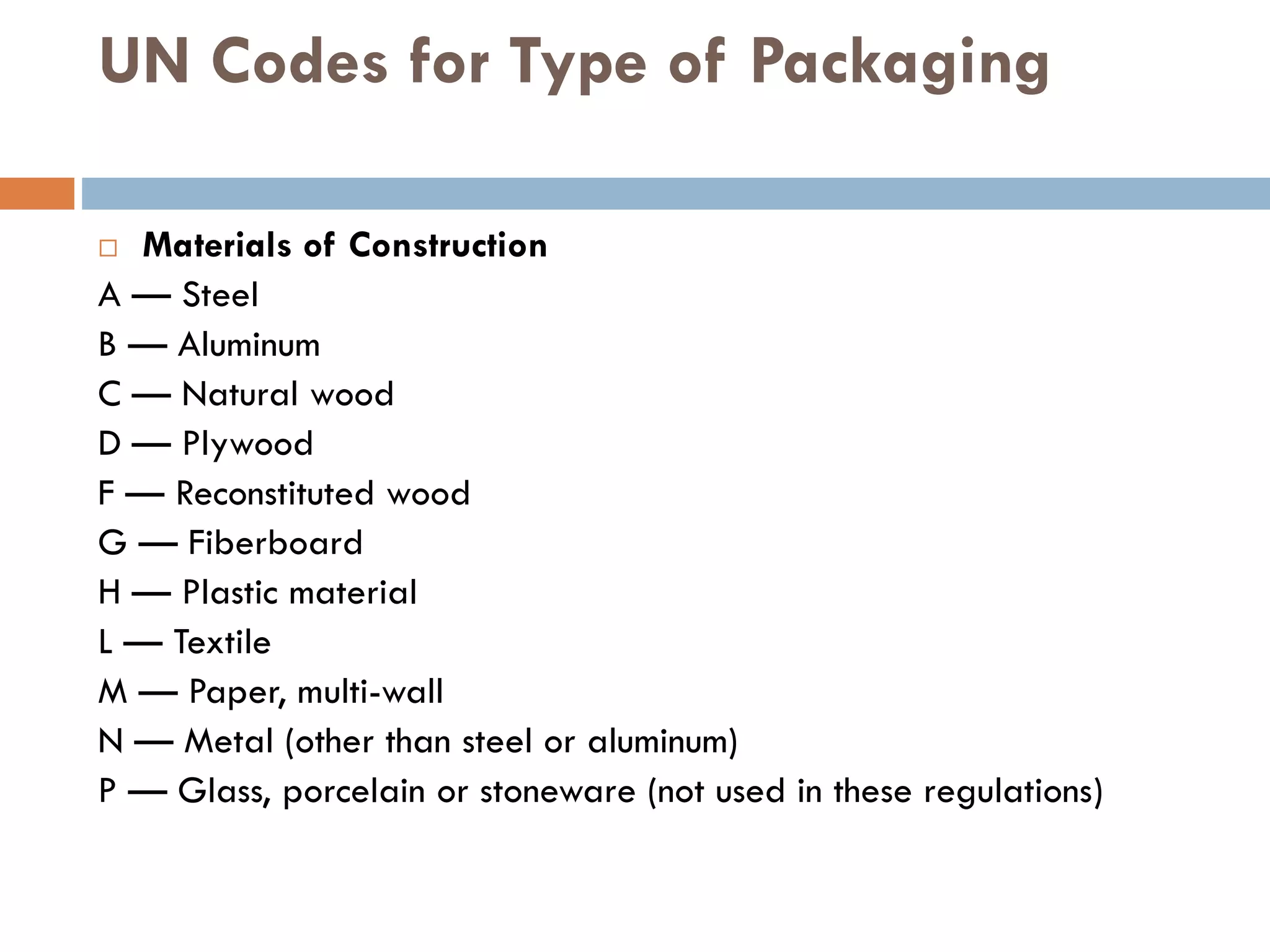
UN Codes for Type of Packaging
 Materials of Construction
A — Steel
B — Aluminum
C — Natural wood
D — Plywood
F — Reconstituted wood
G — Fiberboard
H — Plastic material
L — Textile
M — Paper, multi-wall
N — Metal (other than steel or aluminum)
P — Glass, porcelain or stoneware (not used in these regulations)
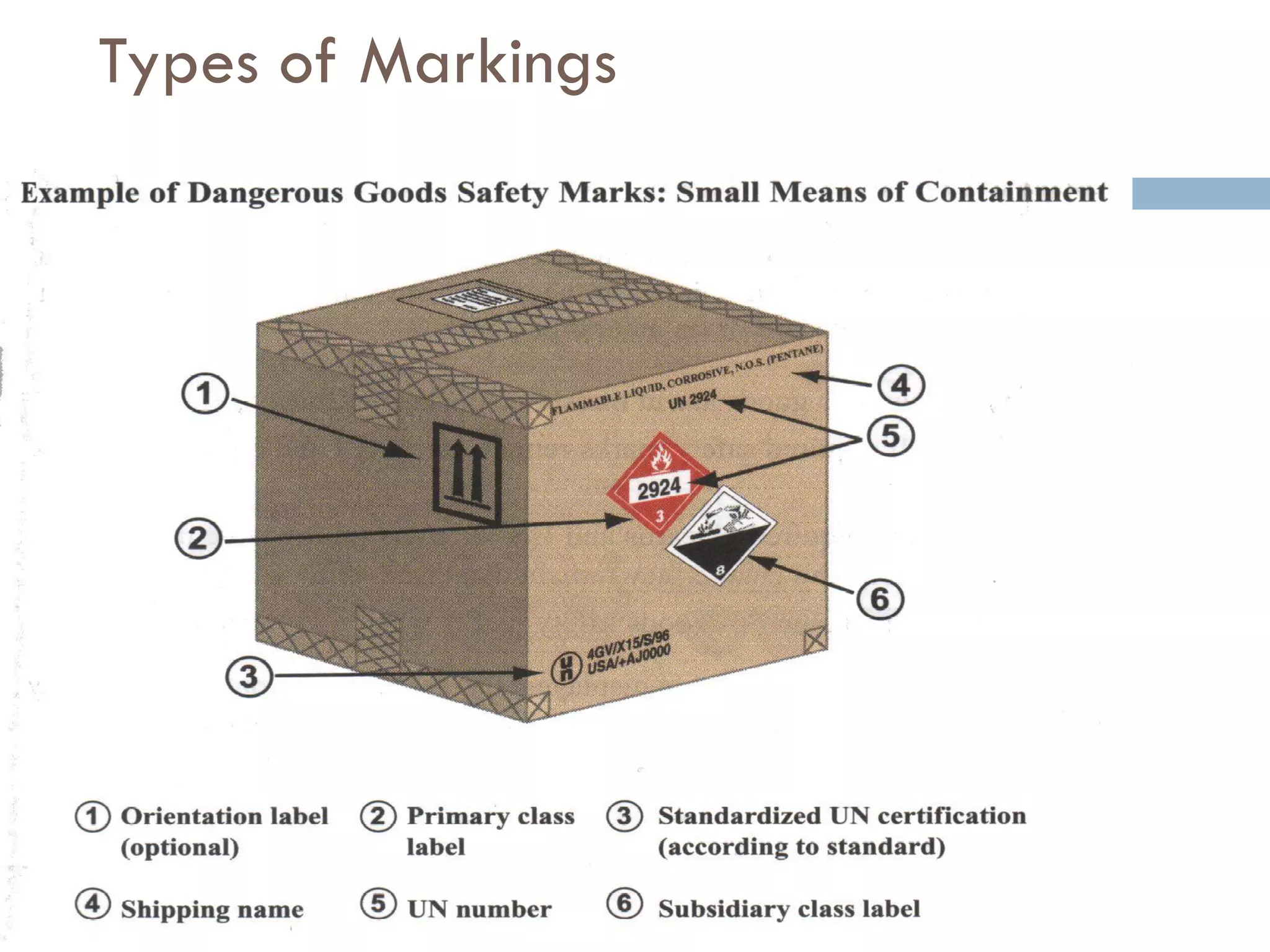
Types of Markings
Labelling - Types
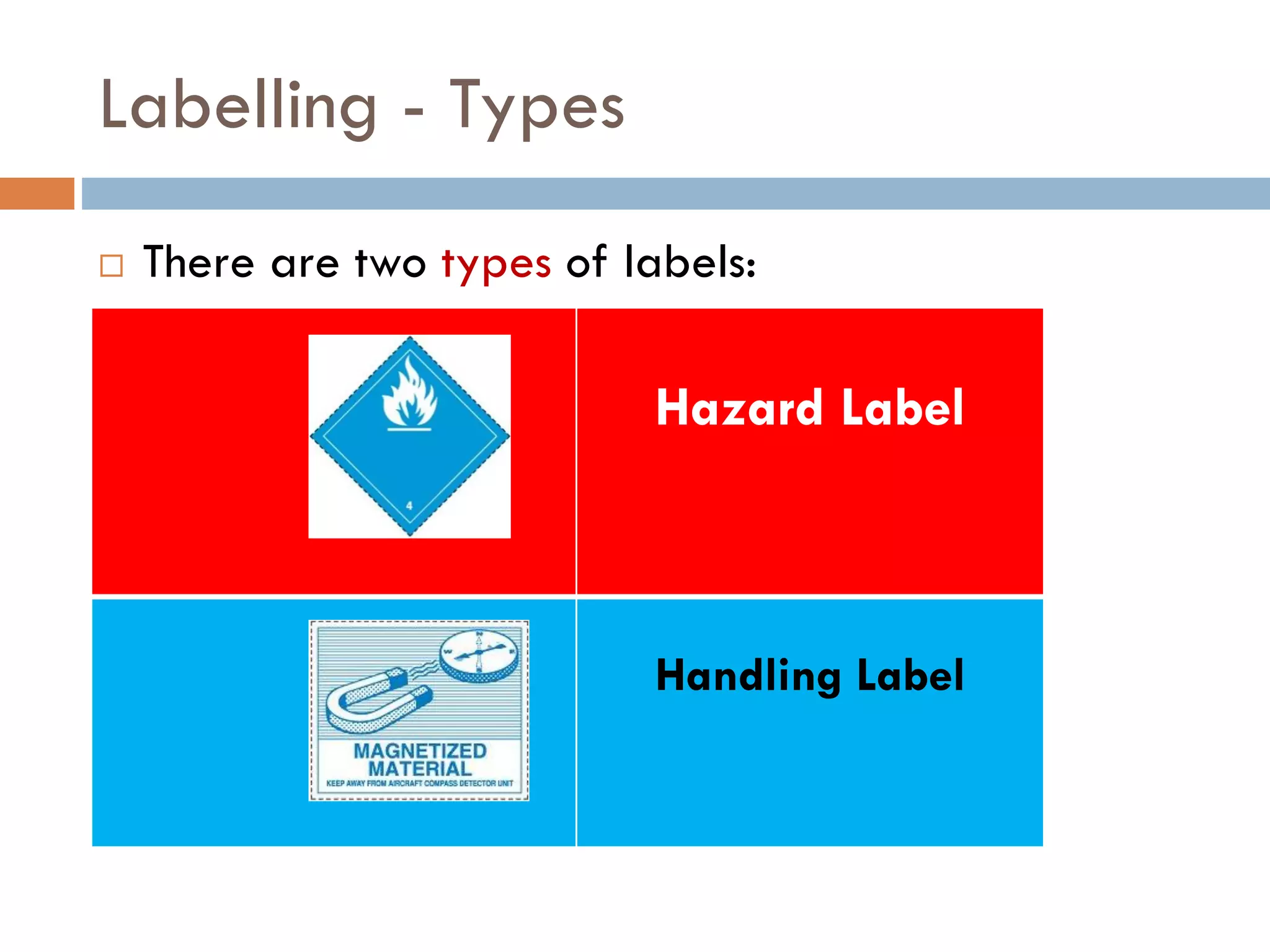
 There are two types of labels:
Hazard Label
Handling Label
Labelling - kinds
 Two kinds of Hazards labels:
Hazard Label
Hazard Placards
2-Hazard Label & PLACARDs:
.
Examples of Marking and Labelling
Dangerous Goods Regulations

Dangerous Goods Training- awareness