IMDG
• Introduction
• Classes of hazardous materials are used to categorize hazardous materials into groups with similar
properties and risks. The classes help identify dangerous goods that require specific precautions to
prevent mishandling and subsequent incidents. For example, placing explosive materials near a heat
source may result in an explosion, endangering life, property, and the environment.
• In this article, we will explore the nine classes of hazardous materials and understand their associated
risks with examples.
•
• Key Takeaways
• Classes of Hazards categorize hazardous materials into 9 distinct classes
• The distinction is based on the primary risk from the materials but they may have secondary risks that
need to be accounted for.
• The system facilitates quick identification of hazardous materials which is crucial for safe and reliable
handling, storage and transportation.
•
• Definition of Hazardous Material (HAZMAT)
• A hazardous material is any substance that poses unreasonable physical hazards or health hazards to
personnel, property, or the environment. This definition includes all hazardous substances, whether
they are raw materials, finished products, or waste.
• Thus, HAZMATs include all substances that pose a risk of explosion, fire, chemical burns, poisoning, or
radiation. It also includes many materials that we use daily, such as adhesives, alcohol, batteries,
cleaning chemicals, inks, oils, paints, perfumes, etc. These items may seem harmless but carry risks
during transportation.
IMDG
• Classification of Hazardous Materials
• The IMDG (International Maritime Dangerous Goods Code) has categorized hazardous materials
(HAZMATs) into nine classes. This classification ensures that vessel and port crews understand the
properties and risks of materials during storage, transportation, and handling.
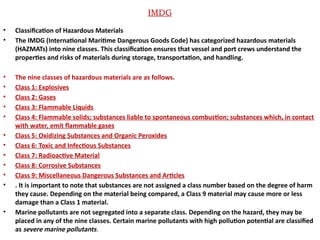
• The nine classes of hazardous materials are as follows.
• Class 1: Explosives
• Class 2: Gases
• Class 3: Flammable Liquids
• Class 4: Flammable solids; substances liable to spontaneous combustion; substances which, in contact
with water, emit flammable gases
• Class 5: Oxidizing Substances and Organic Peroxides
• Class 6: Toxic and Infectious Substances
• Class 7: Radioactive Material
• Class 8: Corrosive Substances
• Class 9: Miscellaneous Dangerous Substances and Articles
• . It is important to note that substances are not assigned a class number based on the degree of harm
they cause. Depending on the material being compared, a Class 9 material may cause more or less
damage than a Class 1 material.
• Marine pollutants are not segregated into a separate class. Depending on the hazard, they may be
placed in any of the nine classes. Certain marine pollutants with high pollution potential are classified
as severe marine pollutants.
IMDG
Hazardous Materials Identification
Placards
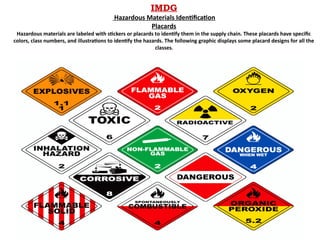
Hazardous materials are labeled with stickers or placards to identify them in the supply chain. These placards have specific
colors, class numbers, and illustrations to identify the hazards. The following graphic displays some placard designs for all the
classes.
IMDG
• The placards mention the class of the hazardous material at the bottom, with more
information about the type of hazard in the top half. These placards must be visible from
all four sides of the container in which the material is transported.
• In some cases, the UN number is also displayed in the center of the placard. If this is not
done, it is usually indicated by an independent sticker on the side of the placard.
• UN Number
• The UN number (United Nations number) is a four-digit code assigned to hazardous
chemicals that are explosive, flammable, oxidizing, or toxic to facilitate identification.
• While the HAZMAT placard provides a general hazard indication, the UN number
accurately identifies the material for all parties in the supply chain. One only needs to look
up the UN number in the United Nations Model Regulations on the Transport of Dangerous
Goods (also known as The Orange Book or UNMR).
• If you are connected to the internet, you can also search the UN Number online for instant
results. For example, a simple online search for “UN number 2024” reveals that the
chemical is a mercury compound classified belonging to class 6.1, with classification code
T4, and Packing Group 1. The UN number provides a lot more information, such as
instructions for portable tanks and bulk containers, packing instructions, quantity
limitations, excepted quantities, vehicle specifications, handling instructions, loading and
unloading instructions, and so on.
IMDG
• Description of Classes of Hazardous Materials
• In this section, let us delve deeper into each class to discuss their contents, and associated hazards,
and provide some examples for each.
• CLASS 1: Explosives
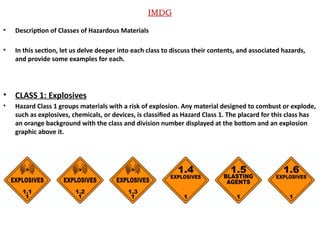
• Hazard Class 1 groups materials with a risk of explosion. Any material designed to combust or explode,
such as explosives, chemicals, or devices, is classified as Hazard Class 1. The placard for this class has
an orange background with the class and division number displayed at the bottom and an explosion
graphic above it.
IMDG
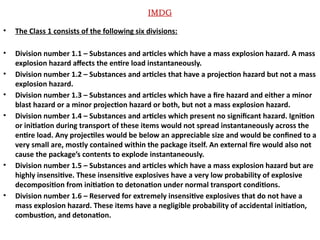
• The Class 1 consists of the following six divisions:
• Division number 1.1 – Substances and articles which have a mass explosion hazard. A mass
explosion hazard affects the entire load instantaneously.
• Division number 1.2 – Substances and articles that have a projection hazard but not a mass
explosion hazard.
• Division number 1.3 – Substances and articles which have a fire hazard and either a minor
blast hazard or a minor projection hazard or both, but not a mass explosion hazard.
• Division number 1.4 – Substances and articles which present no significant hazard. Ignition
or initiation during transport of these items would not spread instantaneously across the
entire load. Any projectiles would be below an appreciable size and would be confined to a
very small are, mostly contained within the package itself. An external fire would also not
cause the package’s contents to explode instantaneously.
• Division number 1.5 – Substances and articles which have a mass explosion hazard but are
highly insensitive. These insensitive explosives have a very low probability of explosive
decomposition from initiation to detonation under normal transport conditions.
• Division number 1.6 – Reserved for extremely insensitive explosives that do not have a
mass explosion hazard. These items have a negligible probability of accidental initiation,
combustion, and detonation.
IMDG
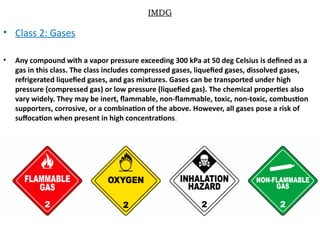
• Class 2: Gases
• Any compound with a vapor pressure exceeding 300 kPa at 50 deg Celsius is defined as a
gas in this class. The class includes compressed gases, liquefied gases, dissolved gases,
refrigerated liquefied gases, and gas mixtures. Gases can be transported under high
pressure (compressed gas) or low pressure (liquefied gas). The chemical properties also
vary widely. They may be inert, flammable, non-flammable, toxic, non-toxic, combustion
supporters, corrosive, or a combination of the above. However, all gases pose a risk of
suffocation when present in high concentrations.
IMDG
• Class 2 subdivides gases based on their primary hazard into three divisions. These are as
follows.
• Class 2.1 – Flammable Gases
• Flammable gases are defined as those that can ignite when present in a concentration of
13% or less by volume in air.
• A gas may also enter this category even if it has a higher lower flammability limit (LFL) but
is combustible for 12% percentage points with air. For example, if the lower flammability
limit is 40% and the higher flammability limit is 52%, it would be classified as a Class 2.1
gas.
• Class 2.2 – Non-flammable, non-toxic gases
• Non-flammable or non-toxic gases still pose a risk of asphyxiation. They may also be
oxidizing, i.e., providing oxygen and causing or contributing to the combustion of other
materials.
• These gases, which are neither toxic nor flammable, are classified as Class 2.2. Class 2.2
also accommodates any other gases that do not fall under Class 2.1 or 2.3.
• Class 2.3 – Toxic Gases
• Any gases that are corrosive or toxic to humans are classified as Class 2.3. Their LC50
(Lethal concentration 50) value must be equal to or less than 5000 ppm to be included in
this class.
• The order of precedence for gases with multiple properties is Class 2.3, Class 2.1, and Class
2.2. This means that if a gas is flammable and toxic, it must first be placed in Class 2.3.
IMDG
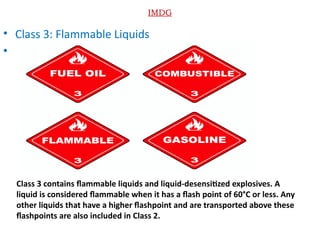
• Class 3: Flammable Liquids
•
Class 3 contains flammable liquids and liquid-desensitized explosives. A
liquid is considered flammable when it has a flash point of 60°C or less. Any
other liquids that have a higher flashpoint and are transported above these
flashpoints are also included in Class 2.
IMDG
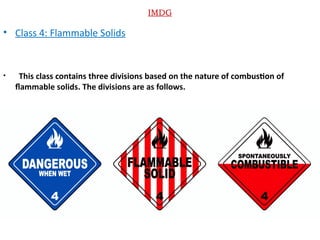
• Class 4: Flammable Solids
• This class contains three divisions based on the nature of combustion of
flammable solids. The divisions are as follows.
IMDG
• Class 4.1 – Flammable Solids
• Flammable solids are materials which, under normal conditions of transport, are
prone to combustion, and cause or contribute to fires through friction or self-
reactive substances. Solid desensitized explosives, which may explode without
adequate dilution are also classified in this division.
• Matches, sulfur, aluminum powder, and coal are examples of Class 4.1 materials.
• Class 4.2 – Substances Liable to Spontaneous Combustion
• These substances are prone to combustion without any external source of heat or
ignition. They may only require exposure to air, water vapor, or oxygen to start
burning. Examples of Class 4.2 materials are coal, fishmeal, and phosphorus.
• Class 4.3 – Substances which, in contact with water, emit flammable gases
• This class includes materials that may become spontaneously combustible or give
off flammable gases in dangerous quantities (>1 liter per kg per hour) when
exposed to water. Calcium, zinc dust, and sodium are examples of Class 4.3
materials.
•
IMDG
• Class 5: Oxidizing Substances and Organic Peroxides
• Oxidizing substances cause or support combustion by providing oxygen. As such, they may increase
the damage by fire in confined spaces such as cargo holds. Some examples of oxidizing agents include
potassium permanganate (used as a disinfectant) and nitric acid (a raw material for fertilizer
production).
•
Organic peroxides are derivatives of hydrogen peroxide that contain the bivalent -O-O- structure.
These materials are thermally unstable and can undergo strongly exothermic reactions. They may
have additional risks, such as rapid burning and explosive decomposition. Some of them can be
triggered by impact or friction. Organic peroxides can react dangerously with other substances and
cause eye damage upon exposure..
IMDG
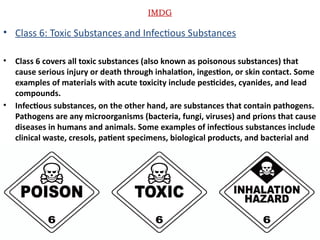
• Class 6: Toxic Substances and Infectious Substances
• Class 6 covers all toxic substances (also known as poisonous substances) that
cause serious injury or death through inhalation, ingestion, or skin contact. Some
examples of materials with acute toxicity include pesticides, cyanides, and lead
compounds.
• Infectious substances, on the other hand, are substances that contain pathogens.
Pathogens are any microorganisms (bacteria, fungi, viruses) and prions that cause
diseases in humans and animals. Some examples of infectious substances include
clinical waste, cresols, patient specimens, biological products, and bacterial and
viral cultures.
•
IMDG
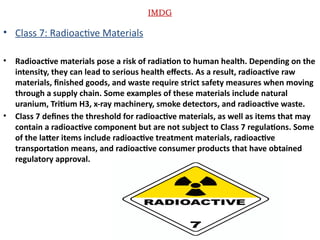
• Class 7: Radioactive Materials
• Radioactive materials pose a risk of radiation to human health. Depending on the
intensity, they can lead to serious health effects. As a result, radioactive raw
materials, finished goods, and waste require strict safety measures when moving
through a supply chain. Some examples of these materials include natural
uranium, Tritium H3, x-ray machinery, smoke detectors, and radioactive waste.
• Class 7 defines the threshold for radioactive materials, as well as items that may
contain a radioactive component but are not subject to Class 7 regulations. Some
of the latter items include radioactive treatment materials, radioactive
transportation means, and radioactive consumer products that have obtained
regulatory approval.
IMDG
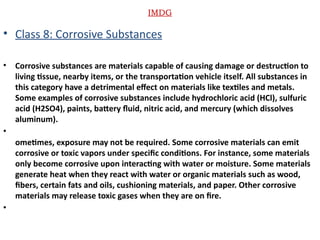
• Class 8: Corrosive Substances
• Corrosive substances are materials capable of causing damage or destruction to
living tissue, nearby items, or the transportation vehicle itself. All substances in
this category have a detrimental effect on materials like textiles and metals.
Some examples of corrosive substances include hydrochloric acid (HCl), sulfuric
acid (H2SO4), paints, battery fluid, nitric acid, and mercury (which dissolves
aluminum).
•
ometimes, exposure may not be required. Some corrosive materials can emit
corrosive or toxic vapors under specific conditions. For instance, some materials
only become corrosive upon interacting with water or moisture. Some materials
generate heat when they react with water or organic materials such as wood,
fibers, certain fats and oils, cushioning materials, and paper. Other corrosive
materials may release toxic gases when they are on fire.
•
IMDG
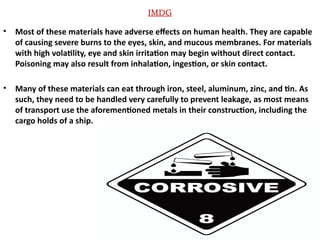
• Most of these materials have adverse effects on human health. They are capable
of causing severe burns to the eyes, skin, and mucous membranes. For materials
with high volatility, eye and skin irritation may begin without direct contact.
Poisoning may also result from inhalation, ingestion, or skin contact.
• Many of these materials can eat through iron, steel, aluminum, zinc, and tin. As
such, they need to be handled very carefully to prevent leakage, as most means
of transport use the aforementioned metals in their construction, including the
cargo holds of a ship.
IMDG
• Class 4.1 – Flammable Solids
• Flammable solids are materials which, under normal conditions of transport, are
prone to combustion, and cause or contribute to fires through friction or self-
reactive substances. Solid desensitized explosives, which may explode without
adequate dilution are also classified in this division.
• Matches, sulfur, aluminum powder, and coal are examples of Class 4.1 materials.
• Class 4.2 – Substances Liable to Spontaneous Combustion
• These substances are prone to combustion without any external source of heat or
ignition. They may only require exposure to air, water vapor, or oxygen to start
burning. Examples of Class 4.2 materials are coal, fishmeal, and phosphorus.
• Class 4.3 – Substances which, in contact with water, emit flammable gases
• This class includes materials that may become spontaneously combustible or give
off flammable gases in dangerous quantities (>1 liter per kg per hour) when
exposed to water. Calcium, zinc dust, and sodium are examples of Class 4.3
materials.
•
IMDG
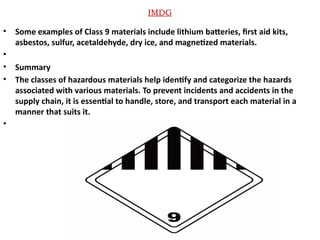
• Class 9: Miscellaneous Dangerous Substances and Articles
• If a material or substance poses a danger not covered by any of the first eight
classes, it is placed in Class 9 as miscellaneous dangerous goods.
• It includes four main types of articles:
• Articles that are not classified under any other class but still pose such a
significant danger, requiring the application of SOLAS Chapter VII Part A
provisions.
• Articles subject to MARPOL Annex III and not included in any of the other classes
of hazards.
• Liquid materials transported with temperatures at or above 100 deg C or solid
materials transported with temperatures at or above 240 deg C.
• Genetically modified microorganisms (GMMOs) and genetically modified
organisms (GMOs) that aren’t classified as infectious substances (Class 6) but can
alter the genetic structure of humans and animals. The only condition under
which they would not be subject to Class 9 regulations is if they have been
authorized for use by the countries of origin, transit, and destination.
IMDG
• Some examples of Class 9 materials include lithium batteries, first aid kits,
asbestos, sulfur, acetaldehyde, dry ice, and magnetized materials.
•
• Summary
• The classes of hazardous materials help identify and categorize the hazards
associated with various materials. To prevent incidents and accidents in the
supply chain, it is essential to handle, store, and transport each material in a
manner that suits it.
•
IMDG Code various classes intrduction.pptx

IMDG Code various classes intrduction.pptx

  • 1.
    IMDG • Introduction • Classesof hazardous materials are used to categorize hazardous materials into groups with similar properties and risks. The classes help identify dangerous goods that require specific precautions to prevent mishandling and subsequent incidents. For example, placing explosive materials near a heat source may result in an explosion, endangering life, property, and the environment. • In this article, we will explore the nine classes of hazardous materials and understand their associated risks with examples. • • Key Takeaways • Classes of Hazards categorize hazardous materials into 9 distinct classes • The distinction is based on the primary risk from the materials but they may have secondary risks that need to be accounted for. • The system facilitates quick identification of hazardous materials which is crucial for safe and reliable handling, storage and transportation. • • Definition of Hazardous Material (HAZMAT) • A hazardous material is any substance that poses unreasonable physical hazards or health hazards to personnel, property, or the environment. This definition includes all hazardous substances, whether they are raw materials, finished products, or waste. • Thus, HAZMATs include all substances that pose a risk of explosion, fire, chemical burns, poisoning, or radiation. It also includes many materials that we use daily, such as adhesives, alcohol, batteries, cleaning chemicals, inks, oils, paints, perfumes, etc. These items may seem harmless but carry risks during transportation.
  • 2.
    IMDG • Classification ofHazardous Materials • The IMDG (International Maritime Dangerous Goods Code) has categorized hazardous materials (HAZMATs) into nine classes. This classification ensures that vessel and port crews understand the properties and risks of materials during storage, transportation, and handling. • The nine classes of hazardous materials are as follows. • Class 1: Explosives • Class 2: Gases • Class 3: Flammable Liquids • Class 4: Flammable solids; substances liable to spontaneous combustion; substances which, in contact with water, emit flammable gases • Class 5: Oxidizing Substances and Organic Peroxides • Class 6: Toxic and Infectious Substances • Class 7: Radioactive Material • Class 8: Corrosive Substances • Class 9: Miscellaneous Dangerous Substances and Articles • . It is important to note that substances are not assigned a class number based on the degree of harm they cause. Depending on the material being compared, a Class 9 material may cause more or less damage than a Class 1 material. • Marine pollutants are not segregated into a separate class. Depending on the hazard, they may be placed in any of the nine classes. Certain marine pollutants with high pollution potential are classified as severe marine pollutants.
  • 3.
    IMDG Hazardous Materials Identification Placards Hazardousmaterials are labeled with stickers or placards to identify them in the supply chain. These placards have specific colors, class numbers, and illustrations to identify the hazards. The following graphic displays some placard designs for all the classes.
  • 4.
    IMDG • The placardsmention the class of the hazardous material at the bottom, with more information about the type of hazard in the top half. These placards must be visible from all four sides of the container in which the material is transported. • In some cases, the UN number is also displayed in the center of the placard. If this is not done, it is usually indicated by an independent sticker on the side of the placard. • UN Number • The UN number (United Nations number) is a four-digit code assigned to hazardous chemicals that are explosive, flammable, oxidizing, or toxic to facilitate identification. • While the HAZMAT placard provides a general hazard indication, the UN number accurately identifies the material for all parties in the supply chain. One only needs to look up the UN number in the United Nations Model Regulations on the Transport of Dangerous Goods (also known as The Orange Book or UNMR). • If you are connected to the internet, you can also search the UN Number online for instant results. For example, a simple online search for “UN number 2024” reveals that the chemical is a mercury compound classified belonging to class 6.1, with classification code T4, and Packing Group 1. The UN number provides a lot more information, such as instructions for portable tanks and bulk containers, packing instructions, quantity limitations, excepted quantities, vehicle specifications, handling instructions, loading and unloading instructions, and so on.
  • 5.
    IMDG • Description ofClasses of Hazardous Materials • In this section, let us delve deeper into each class to discuss their contents, and associated hazards, and provide some examples for each. • CLASS 1: Explosives • Hazard Class 1 groups materials with a risk of explosion. Any material designed to combust or explode, such as explosives, chemicals, or devices, is classified as Hazard Class 1. The placard for this class has an orange background with the class and division number displayed at the bottom and an explosion graphic above it.
  • 6.
    IMDG • The Class1 consists of the following six divisions: • Division number 1.1 – Substances and articles which have a mass explosion hazard. A mass explosion hazard affects the entire load instantaneously. • Division number 1.2 – Substances and articles that have a projection hazard but not a mass explosion hazard. • Division number 1.3 – Substances and articles which have a fire hazard and either a minor blast hazard or a minor projection hazard or both, but not a mass explosion hazard. • Division number 1.4 – Substances and articles which present no significant hazard. Ignition or initiation during transport of these items would not spread instantaneously across the entire load. Any projectiles would be below an appreciable size and would be confined to a very small are, mostly contained within the package itself. An external fire would also not cause the package’s contents to explode instantaneously. • Division number 1.5 – Substances and articles which have a mass explosion hazard but are highly insensitive. These insensitive explosives have a very low probability of explosive decomposition from initiation to detonation under normal transport conditions. • Division number 1.6 – Reserved for extremely insensitive explosives that do not have a mass explosion hazard. These items have a negligible probability of accidental initiation, combustion, and detonation.
  • 7.
    IMDG • Class 2:Gases • Any compound with a vapor pressure exceeding 300 kPa at 50 deg Celsius is defined as a gas in this class. The class includes compressed gases, liquefied gases, dissolved gases, refrigerated liquefied gases, and gas mixtures. Gases can be transported under high pressure (compressed gas) or low pressure (liquefied gas). The chemical properties also vary widely. They may be inert, flammable, non-flammable, toxic, non-toxic, combustion supporters, corrosive, or a combination of the above. However, all gases pose a risk of suffocation when present in high concentrations.
  • 8.
    IMDG • Class 2subdivides gases based on their primary hazard into three divisions. These are as follows. • Class 2.1 – Flammable Gases • Flammable gases are defined as those that can ignite when present in a concentration of 13% or less by volume in air. • A gas may also enter this category even if it has a higher lower flammability limit (LFL) but is combustible for 12% percentage points with air. For example, if the lower flammability limit is 40% and the higher flammability limit is 52%, it would be classified as a Class 2.1 gas. • Class 2.2 – Non-flammable, non-toxic gases • Non-flammable or non-toxic gases still pose a risk of asphyxiation. They may also be oxidizing, i.e., providing oxygen and causing or contributing to the combustion of other materials. • These gases, which are neither toxic nor flammable, are classified as Class 2.2. Class 2.2 also accommodates any other gases that do not fall under Class 2.1 or 2.3. • Class 2.3 – Toxic Gases • Any gases that are corrosive or toxic to humans are classified as Class 2.3. Their LC50 (Lethal concentration 50) value must be equal to or less than 5000 ppm to be included in this class. • The order of precedence for gases with multiple properties is Class 2.3, Class 2.1, and Class 2.2. This means that if a gas is flammable and toxic, it must first be placed in Class 2.3.
  • 9.
    IMDG • Class 3:Flammable Liquids • Class 3 contains flammable liquids and liquid-desensitized explosives. A liquid is considered flammable when it has a flash point of 60°C or less. Any other liquids that have a higher flashpoint and are transported above these flashpoints are also included in Class 2.
  • 10.
    IMDG • Class 4:Flammable Solids • This class contains three divisions based on the nature of combustion of flammable solids. The divisions are as follows.
  • 11.
    IMDG • Class 4.1– Flammable Solids • Flammable solids are materials which, under normal conditions of transport, are prone to combustion, and cause or contribute to fires through friction or self- reactive substances. Solid desensitized explosives, which may explode without adequate dilution are also classified in this division. • Matches, sulfur, aluminum powder, and coal are examples of Class 4.1 materials. • Class 4.2 – Substances Liable to Spontaneous Combustion • These substances are prone to combustion without any external source of heat or ignition. They may only require exposure to air, water vapor, or oxygen to start burning. Examples of Class 4.2 materials are coal, fishmeal, and phosphorus. • Class 4.3 – Substances which, in contact with water, emit flammable gases • This class includes materials that may become spontaneously combustible or give off flammable gases in dangerous quantities (>1 liter per kg per hour) when exposed to water. Calcium, zinc dust, and sodium are examples of Class 4.3 materials. •
  • 12.
    IMDG • Class 5:Oxidizing Substances and Organic Peroxides • Oxidizing substances cause or support combustion by providing oxygen. As such, they may increase the damage by fire in confined spaces such as cargo holds. Some examples of oxidizing agents include potassium permanganate (used as a disinfectant) and nitric acid (a raw material for fertilizer production). • Organic peroxides are derivatives of hydrogen peroxide that contain the bivalent -O-O- structure. These materials are thermally unstable and can undergo strongly exothermic reactions. They may have additional risks, such as rapid burning and explosive decomposition. Some of them can be triggered by impact or friction. Organic peroxides can react dangerously with other substances and cause eye damage upon exposure..
  • 13.
    IMDG • Class 6:Toxic Substances and Infectious Substances • Class 6 covers all toxic substances (also known as poisonous substances) that cause serious injury or death through inhalation, ingestion, or skin contact. Some examples of materials with acute toxicity include pesticides, cyanides, and lead compounds. • Infectious substances, on the other hand, are substances that contain pathogens. Pathogens are any microorganisms (bacteria, fungi, viruses) and prions that cause diseases in humans and animals. Some examples of infectious substances include clinical waste, cresols, patient specimens, biological products, and bacterial and viral cultures. •
  • 14.
    IMDG • Class 7:Radioactive Materials • Radioactive materials pose a risk of radiation to human health. Depending on the intensity, they can lead to serious health effects. As a result, radioactive raw materials, finished goods, and waste require strict safety measures when moving through a supply chain. Some examples of these materials include natural uranium, Tritium H3, x-ray machinery, smoke detectors, and radioactive waste. • Class 7 defines the threshold for radioactive materials, as well as items that may contain a radioactive component but are not subject to Class 7 regulations. Some of the latter items include radioactive treatment materials, radioactive transportation means, and radioactive consumer products that have obtained regulatory approval.
  • 15.
    IMDG • Class 8:Corrosive Substances • Corrosive substances are materials capable of causing damage or destruction to living tissue, nearby items, or the transportation vehicle itself. All substances in this category have a detrimental effect on materials like textiles and metals. Some examples of corrosive substances include hydrochloric acid (HCl), sulfuric acid (H2SO4), paints, battery fluid, nitric acid, and mercury (which dissolves aluminum). • ometimes, exposure may not be required. Some corrosive materials can emit corrosive or toxic vapors under specific conditions. For instance, some materials only become corrosive upon interacting with water or moisture. Some materials generate heat when they react with water or organic materials such as wood, fibers, certain fats and oils, cushioning materials, and paper. Other corrosive materials may release toxic gases when they are on fire. •
  • 16.
    IMDG • Most ofthese materials have adverse effects on human health. They are capable of causing severe burns to the eyes, skin, and mucous membranes. For materials with high volatility, eye and skin irritation may begin without direct contact. Poisoning may also result from inhalation, ingestion, or skin contact. • Many of these materials can eat through iron, steel, aluminum, zinc, and tin. As such, they need to be handled very carefully to prevent leakage, as most means of transport use the aforementioned metals in their construction, including the cargo holds of a ship.
  • 17.
    IMDG • Class 4.1– Flammable Solids • Flammable solids are materials which, under normal conditions of transport, are prone to combustion, and cause or contribute to fires through friction or self- reactive substances. Solid desensitized explosives, which may explode without adequate dilution are also classified in this division. • Matches, sulfur, aluminum powder, and coal are examples of Class 4.1 materials. • Class 4.2 – Substances Liable to Spontaneous Combustion • These substances are prone to combustion without any external source of heat or ignition. They may only require exposure to air, water vapor, or oxygen to start burning. Examples of Class 4.2 materials are coal, fishmeal, and phosphorus. • Class 4.3 – Substances which, in contact with water, emit flammable gases • This class includes materials that may become spontaneously combustible or give off flammable gases in dangerous quantities (>1 liter per kg per hour) when exposed to water. Calcium, zinc dust, and sodium are examples of Class 4.3 materials. •
  • 18.
    IMDG • Class 9:Miscellaneous Dangerous Substances and Articles • If a material or substance poses a danger not covered by any of the first eight classes, it is placed in Class 9 as miscellaneous dangerous goods. • It includes four main types of articles: • Articles that are not classified under any other class but still pose such a significant danger, requiring the application of SOLAS Chapter VII Part A provisions. • Articles subject to MARPOL Annex III and not included in any of the other classes of hazards. • Liquid materials transported with temperatures at or above 100 deg C or solid materials transported with temperatures at or above 240 deg C. • Genetically modified microorganisms (GMMOs) and genetically modified organisms (GMOs) that aren’t classified as infectious substances (Class 6) but can alter the genetic structure of humans and animals. The only condition under which they would not be subject to Class 9 regulations is if they have been authorized for use by the countries of origin, transit, and destination.
  • 19.
    IMDG • Some examplesof Class 9 materials include lithium batteries, first aid kits, asbestos, sulfur, acetaldehyde, dry ice, and magnetized materials. • • Summary • The classes of hazardous materials help identify and categorize the hazards associated with various materials. To prevent incidents and accidents in the supply chain, it is essential to handle, store, and transport each material in a manner that suits it. •