Class 6 Dangers Goods
What did the Employer Cover
First Responder and Worker Safety
They exist in almost all businesses, big and small. From the obvious ones like
warehousing, pharmaceutical, logistics and manufacturing, through to
furniture makers, workshops, pool shops, printers, supermarkets, hardware
stores and offices - the list goes on and on.
• Dangerous goods can explode or burst into flame. They can be poisonous,
corrosive or have the capacity for sudden decomposition. Many common
chemicals found in thousands of businesses look harmless, but if you don't
understand the risks - store them incorrectly, add heat, moisture or mix
them together - they can become deadly. And the worst part is that one
small mistake can be catastrophic.
• Most workplaces - offices and industrial - use and store a variety of
chemicals. The potential consequences may range from one person
burning their hand with flammable cleaning fluid, through to possible
death, destruction and loss caused by a large scale fire. Even simple things
such as poorly positioned electrical equipment or inadequate ventilation
can create an unthinkable catastrophe.
Dangerous Goods knowledge and
workers
Learning Dangerous Goods is easy all you have
to remember is all 9 Classes and 27 Hazard
Classes to Competent in TDG/Hazmat
In the USA
Regardless of County
• There are 740 Results for Class 6 Hazardous
Materials in the world of Dangerous Goods
GHS Health Hazard World
Most of health hazards in GHS are not covered
by dangerous goods regulations. Class 6 division
6.2 infectious substances and class 4 radioactive
substances in TDG are not covered by GHS.
TDG and GHS Knowledge
Class 6 is divided into two divisions as follows
• Division 6.1 Toxic substances
These are substances liable either to cause death or
serious injury or to harm human health if swallowed or
inhaled or by skin contact;
• Division 6.2 Infectious substances
These are substances known or reasonably expected to
contain pathogens. Pathogens are defined as micro-
organisms (including bacteria, viruses, rickettsiae,
parasites, fungi) and other agents such as prions, which
can cause disease in humans or animals.
Worker Risk
Canada and GHS
• Canada to date is only one to add the bio
hazard symbol (pictogram) to the GHS
language and risk grouping to workers in the
world!
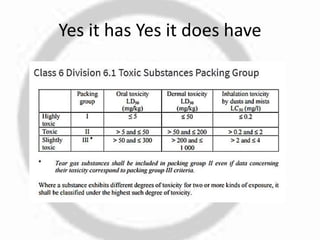
Yes it has Yes it does have
Compatibility table
for Transport did you check your tables
Worker & Employer Rights, Responsibilities &
Accountability
Determined federal & provincial laws:
The TDG Act & Regulations are federal laws that stipulate the
roles of the worker & the employer with respect to shipping
hazardous substances.
The Occupational Health & Safety Regulations stipulate the duties
and rights of the employer and the worker more generally.
Both laws hold the employer accountable for provision of training
& a safe work environment and the worker accountable for
following safe work practices as per training, and reporting
unsafe conditions.
Shipping by Ground
1.The Goal of the TDG Act
2.The 9 TDG Classes
3.General Overview
4.The Regulations Parts
5.The Regulations Schedules
6.Key Terms & Definitions
7.Roles & Responsibilities in
the Transport Chain
8. The Importance of Training
9. Documentation
10.ERAP
11.Reporting
12.Enforcement
13.Summary
• The 9 TDG Classes
1.Explosives
2.Gases
3.Flammable Liquides
4.Flammable Substances
5.Oxidizers & Organic Peroxides
6.Toxic & Infectious
Substances
7.Radioactive
8.Corrosives
9.Miscellaneous (includes Dry Ice)
Schedule 1
Col 1 Col 2 Col 3 Col 4 Col 5 Col 6 Col 7 Col 8 Col 9 Col 10
UN #
Shipping Name and
Description Class Packing Group
Special
Provisions
Explosive
Limit &
Limited
Quantity
Index
ERAP
Index
Passenger
Carrying
Ship Index
Passenger
Carrying
Road or
Rail Index
Marine
Pollutant
Oder in
Sch. 3 List
English
Oder in
Sch. 3 List
French
ERG
Number
UN 2814
INFECTIOUS SUBSTANCE,
AFFECTING HUMANS 6.2 Category A 84 0
See
SP84 0.05 0.05 1434 1688 158
UN 2900
INFECTIOUS SUBSTANCE,
AFFECTING ANIMALS only 6.2 Category A 84 0
See
SP84 0.05 0.05 1433 1687 158
UN 3373
BIOLOGICAL SUBSTANCE,
CATEGORY B 6.2 Category B 0 4 4 158
UN 1845
CARBON DIOXIDE, SOLID;
or DRY ICE 9 III 18, 81 5 200
528
1064
1049
1875 120
Schedule 3
Col 1 Col 2 Col 3 Col 4 Col 5 Col 6 Col 7 Col 8 Col 9 Col 10
Shipping Name and
Description UN # Class
Packing
Group
Special
Provision
s
Explosive
Limit &
Limited
Quantity
Index
ERAP
Index
Passenger
Carrying
Ship Index
Passenger
Carrying
Road or
Rail Index
Marine
Pollutant
Oder in
Sch. 3
List
English
Oder in
Sch. 3
List
French
ERG
Number
INFECTIOUS SUBSTANCE,
AFFECTING HUMANS UN 2814 6.2
Category
A 84 0
See
SP84 0.05 0.05 1434 1688 158
INFECTIOUS SUBSTANCE,
AFFECTING ANIMALS only UN 2900 6.2
Category
A 84 0
See
SP84 0.05 0.05 1433 1687 158
BIOLOGICAL SUBSTANCE,
CATEGORY B UN 3373 6.2
Category
B 0 4 4 158
CARBON DIOXIDE, SOLID; or
DRY ICE UN 1845 9 III 18, 81 5 200
528
1064
1049
1875 120
• Classification
Substance for Classification
• Have any pathogens been neutralized/inactivate?
• Is it known to be non-infectious?
• Are all microorganisms present nonpathogenic?
• Is it a dried blood spot/fecal occult blood?
• Is it an environmental sample that is not considered to pose a health
risk?
• Is it for transplantation or transfusion?
Does it meet the definition of a Category A
substance?
Not subject to DGR unless
meeting the criteria for
inclusion in another class or
division.
Yes to any
No to all
Does it meet the definition of a Category A
substance?
Is it a patient specimen for which there is
only a minimal likelihood that pathogens are
present?
Does it affect humans?
UN2900 Infectious
Substance
affecting animals
only.
UN3373 Biological
Substance Category B.
Subject to “Exempt
human (or animal)
specimen” provisions.
No to all
Yes
No
Yes
No
No
UN2814 Infectious
Substance affecting
humans.
Substance for Classification,
Con’t
• Shipping Name
The official name of a substance, as listed in the Schedules.
Not necessarily the technical name, especially for biological
materials.
• Example: Technical name: Mycobacterium Tuberculosis;
Shipping name: Infectious Substance, affecting humans
• Compare: Shipping name: Carbon Dioxide, Solid; or Dry Ice
Biological materials are listed under generic names, which often
end in N.O.S (Not Otherwise Specified)
The TDG Regulations Schedule 3 is a listing of all substances by
shipping name.
• Shipping Name
For shipping biological materials, the main shipping names are:
• Infectious substance affecting humans
• Infectious substance affecting animals
• Biological substance, Category B
• Exempt Specimen
• Clinical Waste, N.O.S.
• (BIO) Medical Waste, N.O.S.
• Regulated Medical Waste, N.O.S.
The TDG Regulations Schedule 3 is a listing of all substances by
shipping name.
• UN Number
The alpha numeric identifier for a substance.
UN Numbers are unique and internationally agreed upon.
For shipping biological materials, the main UN Numbers are:
• UN2814
• UN2900
• UN3373
• UN3291
The TDG Regulations Schedule 3 is a listing of all substances by
UN Number.
• Primary Class
Means, for dangerous goods, the primary hazard class found in
column 3 of Schedule 1.
For infectious substances, the Class is 6.2.
For dry ice (a ‘Miscellaneous’ substance), the Class is 9.
• Infectious Substance
A substance known or reasonably believed to contain viable
micro-organisms such as bacteria, viruses, rickettsia, parasites,
fungi, and other agents such as prions that are known or
reasonably believed to cause disease in humans or animals.
Some of these are listed in tables in the Regulations.
• Category A
An infectious substance that is being transported in a form such
that, when released outside its means of containment and
there is physical contact with humans or animals, it is capable of
causing permanent disability or life-threatening or fatal
disease in humans or animals.
• Category B
Infectious substances that do not meet the criteria for inclusion
in Category A.
• Exempt Specimens
Biological materials, collected directly from humans, animals or
the environment that are being transported for research,
diagnosis, investigational activities or prevention where you have
no reason to believe that the specimen contains an infectious
substance.
If you have reason to believe that the specimen contains an
infectious substance, it should be classified as a Class 6.2 and
assigned to Category A or B.
• Exempt Specimens
Includes excreta, secret, blood, blood components, tissues,
tissue swabs, and body parts.
4 types of Exempt Specimens:
1.Exempt Human Specimen
2.Exempt Animal Specimen
3.Exempt Biological Product
4.Exempt Environmental Samples
• Are all Specimens Exempt?
No.
If you have reason to believe that the specimen contains Class
6.2 micro-organisms, the specimens should be classified as Class
6.2 and assigned to either Category A or B.
Even if a person has no previous history or symptoms of infection,
a specimen should be classified as 6.2 when you are shipping it
for testing of a known and regulated infectious substance -
provided that the medical professional has valid reasons for
conducting the tests.
• Biological Product
A product derived from living organisms that is used to prevent,
treat or diagnose disease in humans or animals or in the
development, experimentation or investigation of disease. This
includes finished or unfinished products, live vaccines and
attenuated vaccines.
• Neutralized/Inactivated
Substances in a form that any pathogens present have been
treated such that they no longer pose a health risk.
These neutralized/inactivated/fixed materials are not subject to
the Regulations unless they meet the criteria for inclusion in
another class. For example, fixed samples are not infectious,
but the fixative is often flammable.
• Exposure
An exposure occurs when an infectious substance is released
outside of the protective packaging, resulting in physical contact
with humans or animals.
• Means of Containment
The shipping container.
Approved containers meet specific standards and have
undergone detailed testing (dropping, crushing, piercing) to
ensure that they will meet the rigours of shipping without
releasing the dangerous goods packed within them.
‘Small’ = less than 450 L or 500 kg
‘Large’ = more than 450 L or 500 kg
TDG Regulations Part 4 provide more information.
• Means of Containment
For biological materials, the shipping container is comprised of:
• a leak-proof or sift-proof primary receptacle
• absorbent material
• a leak-proof or sift-proof secondary receptacle
• rigid outer packaging
• Means of Containment
• Safety Marks - Labelling of the Container
The labels and other information that consignors are required to
put on the outside of the rigid outer packaging to indicate the
presence & type of hazard.
Also provides information about the construction and durability of
the shipping container.
• Safety Marks - Labelling of the Container
Shipments must be labeled prior to transport (4.4)
Labels must remain legible during transport (4.5)
Labels must be removed after hazard is removed from the
container (4.9)
Labels must be applied ‘on point’ and be 100 mm x 100 mm
(4.7)
• Safety Marks - Labelling of the Container
The container labelling requirements vary with the classification
of the shipment but always includes the shipping name, UN
Number, container specification marks and address of the
consignor.
See the Regulations Part 4 or the TDG Bulletin Shipping
Infectious Substances (May 2013) for more information.
• Safety Marks - Labels
Category A Category B Exempt Specimen
If you are shipping a Cat. A, you must
label the pack with an infectious
substance label. This label is
illustrated in the Appendix to Part 4
of the TDG Regulations.
When shipping a Category B
infectious substance, section
1.39 and 4.22.1 say you must
label the package with the
“Category B mark” illustrated
in the appendix to Part 4.
No label required.
The text on the (bilingual) label is:
INFECTIOUS
IN CASE OF DAMAGE
OR LEAKAGE
IMMEDIATELY
NOTIFY
LOCAL AUTHORITIES
AND
CANUTEC 613-996-6666
The text on the label is:
UN3373
24- Hour Telephone Number
Extra marking requirements:
The shipping name and UN number
 UN2814 – Infectious Substance,
Affecting Humans, or
 UN2900 – Infectious Substance,
Affecting Animals
Extra marking requirements:
The shipping name
 Shipping name is required if
you are using the exemption
under section 1.39
Extra marking requirements:
 Exempt Human Specimen
 Exempt Animal Specimen
• Always have guide 123 handy from the ERG book
POTENTIAL HAZARDS
HEALTH
- TOXIC; may be fatal if inhaled or absorbed through skin.
- Vapors may be irritating.
- Contact with gas or liquefied gas may cause burns, severe injury and/or frostbite.
- Fire will produce irritating, corrosive and/or toxic gases.
- Runoff from fire control may cause pollution.
FIRE OR EXPLOSION
- Some may burn but none ignite readily.
- Vapors from liquefied gas are initially heavier than air and spread along ground.
- Cylinders exposed to fire may vent and release toxic and/or corrosive gas through pressure relief devices.
- Containers may explode when heated.
- Ruptured cylinders may rocket.
PUBLIC SAFETY
CALL Emergency Response Telephone Number on Shipping Paper first. If Shipping Paper not available or no answer, refer to
appropriate telephone number listed on the inside back cover.
- As an immediate precautionary measure, isolate spill or leak area for at least 100 meters (330 feet) in all directions.
- Keep unauthorized personnel away.
- Stay upwind.
- Many gases are heavier than air and will spread along ground and collect in low or confined areas (sewers, basements, tanks).
- Keep out of low areas.
- Ventilate closed spaces before entering.
PROTECTIVE CLOTHING
- Wear positive pressure self-contained breathing apparatus (SCBA).
- Wear chemical protective clothing that is specifically recommended by the manufacturer. It may provide little or no thermal protection.
- Structural firefighters' protective clothing provides limited protection in fire situations ONLY; it is not effective in spill situations where
direct contact with the substance is possible.
EVACUATION
Spill
- See Table 1 - Initial Isolation and Protective Action Distances for highlighted materials. For non-highlighted materials, increase, in the
downwind direction, as necessary, the isolation distance shown under "PUBLIC SAFETY".
Fire
- If tank, rail car or tank truck is involved in a fire, ISOLATE for 800 meters (1/2 mile) in all directions; also, consider initial evacuation for
800 meters (1/2 mile) in all directions.
• Safety Marks - Placards
The placard that carriers or anyone loading the dangerous goods
into a means of transport are required to display on the vehicle.
Placards are required when:
• the gross mass of infectious substances >500 kg
• the shipment requires and ERAP (see Subsection 7.1(7))
• Responsibilities - Carrier
1.The carrier must not take possession of a dangerous good
unless it is packaged and labelled in accordance with
Regulations or if it is offered with an accompanying shipping
document.
2.A carrier must refuse possession of a dangerous goods where
the accompanying shipping document is incorrect or
incomplete or the packaging and labeling is incorrect.
3.A carrier must provide a copy of the shipping document with
the delivered dangerous goods.
4.Carriers must keep copies of shipping documentation for
inspection by federal inspectors for 2 years.
• Roles - Consignee
A person who receives dangerous goods.
The consignee has a duty to report damaged or lost shipments.
The consignee has a right to refuse those shipments.
Item Category A Category B Waste
Classification UN2814
Infectious Substance,
affecting humans
UN2900
Infectious Substance,
affecting animals
UN3373
Biological
Substance,
Category B
UN2814 or UN2900
if waste contains
Category A
UN3291 if waste
contains Category B
Packaging Selection Type 1A
Type 1B, if permitted in
Section 5.16
Type 1A or 1B Type 1A, 1B or 1C
Documentation Yes No, if meeting the
conditions of
Exemption 1.39.
Yes, unless meeting
the conditions of
Exemption 1.39.
Labels & Markings Yes. Class 6.2 Label
UN Number & Shipping
name.
Yes.
Category B mark &
24 hr number
Yes. Class 6.2 Label.
Placards Yes, if:
• ERAP is required 7.1(7)
• Over 500 kg
Yes, if:
• Over 500 kg
Yes, if:
• Over 500 kg
Training Yes Yes Yes
• Emergency Response Assistance Plan (ERAP)
Required for substances and/or quantities that are considered
beyond the risk capabilities of local first responders (usually the
fire department).
7.1(7) A person who offers for transport or imports any quantity
of the following dangerous goods, included in Class 6.2,
Infectious Substances, or any any substance that exhibits
characteristics similar to these dangerous goods, must have an
approved ERAP:
• Class 6.2 Substances requiring an ERAP
a. Crimean-Congo Hemorrhagic
Fever Virus
b. Ebola Virus
c. Foot and Mouth Virus Cultures
d. Guanarito Virus
e. Hendra Virus
f. Herpes B Virus
g. Junin VirusKyasanur Forest
Virus
h. Lassa Virus
i. Machupo Virus
j. Marburg Virus
k. Nipah Virus
l. Omsk Hemorrhagic Fever Virus
m.Russian Spring-Summer
Encephalitis Virus
n. Sabia Virus
o. Variola (Smallpox Virus)
• Emergency Response Assistance Plan (ERAP)
From the Schedules, Special Provision 84 stipulated that UN 2814
& UN 2900 require an ERAP.
An easy way to meet the ERAP requirement is to use CANUTEC,
the Canadian Transport Emergency Centre.
CANUTEC provides emergency response assistance.
• Reporting
A release (or imminent release) of any amount of Class 6.2
material is immediately reportable by whomever has possession
of the dangerous goods at the time of the release.
The incident must be reported to all of the following:
• Provincial authorities or local police
• The employer
• The consignor
• The owner of the road vehicle, if applicable
• CANUTEC if transporting by rail, ship or air.
• Reporting
Done twice:
1.The immediate report - includes the company name & address,
shipping name of the spilled substance, quantity, description of
the incident, any injuries and any evacuations that resulted.
2.The 30 day report - a summary of the incident must be
submitted to Transport Canada. The information provided in the
report is used to evaluate the effectiveness of the regulations
and may lead to regulatory change.
• Overview of the Shipping Steps
1.Personnel must be ‘trained’ and ‘certified’
2.Substances must be ‘classified’
3.Containers must be ‘in standard’
4.Containers must have ‘safety marks’
5.Documentation must be completed and accompany the
shipment
6.Packaging must follow instructions
7.Spills must be reported
Help is Available Canada
Contact CANUTEC 24 Hours/Day
Emergency:
• 1-888-CAN-UTEC (226-8832) or
(613) 996-6666 (collect calls are accepted)
Cellular:
• * 666 (Canada only)
Information:
• (613) 992-4624 (call collect)
Fax:
• (613) 954-5101
E-mail:
• canutec@tc.gc.ca
Help is Available USA

Class 6 dangers goods

  • 1.
    Class 6 DangersGoods What did the Employer Cover
  • 2.
    First Responder andWorker Safety They exist in almost all businesses, big and small. From the obvious ones like warehousing, pharmaceutical, logistics and manufacturing, through to furniture makers, workshops, pool shops, printers, supermarkets, hardware stores and offices - the list goes on and on. • Dangerous goods can explode or burst into flame. They can be poisonous, corrosive or have the capacity for sudden decomposition. Many common chemicals found in thousands of businesses look harmless, but if you don't understand the risks - store them incorrectly, add heat, moisture or mix them together - they can become deadly. And the worst part is that one small mistake can be catastrophic. • Most workplaces - offices and industrial - use and store a variety of chemicals. The potential consequences may range from one person burning their hand with flammable cleaning fluid, through to possible death, destruction and loss caused by a large scale fire. Even simple things such as poorly positioned electrical equipment or inadequate ventilation can create an unthinkable catastrophe.
  • 3.
    Dangerous Goods knowledgeand workers Learning Dangerous Goods is easy all you have to remember is all 9 Classes and 27 Hazard Classes to Competent in TDG/Hazmat
  • 4.
  • 5.
    Regardless of County •There are 740 Results for Class 6 Hazardous Materials in the world of Dangerous Goods
  • 6.
    GHS Health HazardWorld Most of health hazards in GHS are not covered by dangerous goods regulations. Class 6 division 6.2 infectious substances and class 4 radioactive substances in TDG are not covered by GHS.
  • 7.
    TDG and GHSKnowledge Class 6 is divided into two divisions as follows • Division 6.1 Toxic substances These are substances liable either to cause death or serious injury or to harm human health if swallowed or inhaled or by skin contact; • Division 6.2 Infectious substances These are substances known or reasonably expected to contain pathogens. Pathogens are defined as micro- organisms (including bacteria, viruses, rickettsiae, parasites, fungi) and other agents such as prions, which can cause disease in humans or animals.
  • 8.
  • 9.
    Canada and GHS •Canada to date is only one to add the bio hazard symbol (pictogram) to the GHS language and risk grouping to workers in the world!
  • 10.
    Yes it hasYes it does have
  • 11.
    Compatibility table for Transportdid you check your tables
  • 13.
    Worker & EmployerRights, Responsibilities & Accountability Determined federal & provincial laws: The TDG Act & Regulations are federal laws that stipulate the roles of the worker & the employer with respect to shipping hazardous substances. The Occupational Health & Safety Regulations stipulate the duties and rights of the employer and the worker more generally. Both laws hold the employer accountable for provision of training & a safe work environment and the worker accountable for following safe work practices as per training, and reporting unsafe conditions.
  • 14.
    Shipping by Ground 1.TheGoal of the TDG Act 2.The 9 TDG Classes 3.General Overview 4.The Regulations Parts 5.The Regulations Schedules 6.Key Terms & Definitions 7.Roles & Responsibilities in the Transport Chain 8. The Importance of Training 9. Documentation 10.ERAP 11.Reporting 12.Enforcement 13.Summary
  • 15.
    • The 9TDG Classes 1.Explosives 2.Gases 3.Flammable Liquides 4.Flammable Substances 5.Oxidizers & Organic Peroxides 6.Toxic & Infectious Substances 7.Radioactive 8.Corrosives 9.Miscellaneous (includes Dry Ice)
  • 16.
    Schedule 1 Col 1Col 2 Col 3 Col 4 Col 5 Col 6 Col 7 Col 8 Col 9 Col 10 UN # Shipping Name and Description Class Packing Group Special Provisions Explosive Limit & Limited Quantity Index ERAP Index Passenger Carrying Ship Index Passenger Carrying Road or Rail Index Marine Pollutant Oder in Sch. 3 List English Oder in Sch. 3 List French ERG Number UN 2814 INFECTIOUS SUBSTANCE, AFFECTING HUMANS 6.2 Category A 84 0 See SP84 0.05 0.05 1434 1688 158 UN 2900 INFECTIOUS SUBSTANCE, AFFECTING ANIMALS only 6.2 Category A 84 0 See SP84 0.05 0.05 1433 1687 158 UN 3373 BIOLOGICAL SUBSTANCE, CATEGORY B 6.2 Category B 0 4 4 158 UN 1845 CARBON DIOXIDE, SOLID; or DRY ICE 9 III 18, 81 5 200 528 1064 1049 1875 120
  • 17.
    Schedule 3 Col 1Col 2 Col 3 Col 4 Col 5 Col 6 Col 7 Col 8 Col 9 Col 10 Shipping Name and Description UN # Class Packing Group Special Provision s Explosive Limit & Limited Quantity Index ERAP Index Passenger Carrying Ship Index Passenger Carrying Road or Rail Index Marine Pollutant Oder in Sch. 3 List English Oder in Sch. 3 List French ERG Number INFECTIOUS SUBSTANCE, AFFECTING HUMANS UN 2814 6.2 Category A 84 0 See SP84 0.05 0.05 1434 1688 158 INFECTIOUS SUBSTANCE, AFFECTING ANIMALS only UN 2900 6.2 Category A 84 0 See SP84 0.05 0.05 1433 1687 158 BIOLOGICAL SUBSTANCE, CATEGORY B UN 3373 6.2 Category B 0 4 4 158 CARBON DIOXIDE, SOLID; or DRY ICE UN 1845 9 III 18, 81 5 200 528 1064 1049 1875 120
  • 18.
    • Classification Substance forClassification • Have any pathogens been neutralized/inactivate? • Is it known to be non-infectious? • Are all microorganisms present nonpathogenic? • Is it a dried blood spot/fecal occult blood? • Is it an environmental sample that is not considered to pose a health risk? • Is it for transplantation or transfusion? Does it meet the definition of a Category A substance? Not subject to DGR unless meeting the criteria for inclusion in another class or division. Yes to any No to all
  • 19.
    Does it meetthe definition of a Category A substance? Is it a patient specimen for which there is only a minimal likelihood that pathogens are present? Does it affect humans? UN2900 Infectious Substance affecting animals only. UN3373 Biological Substance Category B. Subject to “Exempt human (or animal) specimen” provisions. No to all Yes No Yes No No UN2814 Infectious Substance affecting humans. Substance for Classification, Con’t
  • 20.
    • Shipping Name Theofficial name of a substance, as listed in the Schedules. Not necessarily the technical name, especially for biological materials. • Example: Technical name: Mycobacterium Tuberculosis; Shipping name: Infectious Substance, affecting humans • Compare: Shipping name: Carbon Dioxide, Solid; or Dry Ice Biological materials are listed under generic names, which often end in N.O.S (Not Otherwise Specified) The TDG Regulations Schedule 3 is a listing of all substances by shipping name.
  • 21.
    • Shipping Name Forshipping biological materials, the main shipping names are: • Infectious substance affecting humans • Infectious substance affecting animals • Biological substance, Category B • Exempt Specimen • Clinical Waste, N.O.S. • (BIO) Medical Waste, N.O.S. • Regulated Medical Waste, N.O.S. The TDG Regulations Schedule 3 is a listing of all substances by shipping name.
  • 22.
    • UN Number Thealpha numeric identifier for a substance. UN Numbers are unique and internationally agreed upon. For shipping biological materials, the main UN Numbers are: • UN2814 • UN2900 • UN3373 • UN3291 The TDG Regulations Schedule 3 is a listing of all substances by UN Number.
  • 23.
    • Primary Class Means,for dangerous goods, the primary hazard class found in column 3 of Schedule 1. For infectious substances, the Class is 6.2. For dry ice (a ‘Miscellaneous’ substance), the Class is 9.
  • 24.
    • Infectious Substance Asubstance known or reasonably believed to contain viable micro-organisms such as bacteria, viruses, rickettsia, parasites, fungi, and other agents such as prions that are known or reasonably believed to cause disease in humans or animals. Some of these are listed in tables in the Regulations.
  • 25.
    • Category A Aninfectious substance that is being transported in a form such that, when released outside its means of containment and there is physical contact with humans or animals, it is capable of causing permanent disability or life-threatening or fatal disease in humans or animals.
  • 26.
    • Category B Infectioussubstances that do not meet the criteria for inclusion in Category A.
  • 27.
    • Exempt Specimens Biologicalmaterials, collected directly from humans, animals or the environment that are being transported for research, diagnosis, investigational activities or prevention where you have no reason to believe that the specimen contains an infectious substance. If you have reason to believe that the specimen contains an infectious substance, it should be classified as a Class 6.2 and assigned to Category A or B.
  • 28.
    • Exempt Specimens Includesexcreta, secret, blood, blood components, tissues, tissue swabs, and body parts. 4 types of Exempt Specimens: 1.Exempt Human Specimen 2.Exempt Animal Specimen 3.Exempt Biological Product 4.Exempt Environmental Samples
  • 29.
    • Are allSpecimens Exempt? No. If you have reason to believe that the specimen contains Class 6.2 micro-organisms, the specimens should be classified as Class 6.2 and assigned to either Category A or B. Even if a person has no previous history or symptoms of infection, a specimen should be classified as 6.2 when you are shipping it for testing of a known and regulated infectious substance - provided that the medical professional has valid reasons for conducting the tests.
  • 30.
    • Biological Product Aproduct derived from living organisms that is used to prevent, treat or diagnose disease in humans or animals or in the development, experimentation or investigation of disease. This includes finished or unfinished products, live vaccines and attenuated vaccines.
  • 31.
    • Neutralized/Inactivated Substances ina form that any pathogens present have been treated such that they no longer pose a health risk. These neutralized/inactivated/fixed materials are not subject to the Regulations unless they meet the criteria for inclusion in another class. For example, fixed samples are not infectious, but the fixative is often flammable.
  • 32.
    • Exposure An exposureoccurs when an infectious substance is released outside of the protective packaging, resulting in physical contact with humans or animals.
  • 33.
    • Means ofContainment The shipping container. Approved containers meet specific standards and have undergone detailed testing (dropping, crushing, piercing) to ensure that they will meet the rigours of shipping without releasing the dangerous goods packed within them. ‘Small’ = less than 450 L or 500 kg ‘Large’ = more than 450 L or 500 kg TDG Regulations Part 4 provide more information.
  • 34.
    • Means ofContainment For biological materials, the shipping container is comprised of: • a leak-proof or sift-proof primary receptacle • absorbent material • a leak-proof or sift-proof secondary receptacle • rigid outer packaging
  • 35.
    • Means ofContainment
  • 36.
    • Means ofContainment
  • 37.
    • Safety Marks- Labelling of the Container The labels and other information that consignors are required to put on the outside of the rigid outer packaging to indicate the presence & type of hazard. Also provides information about the construction and durability of the shipping container.
  • 38.
    • Safety Marks- Labelling of the Container Shipments must be labeled prior to transport (4.4) Labels must remain legible during transport (4.5) Labels must be removed after hazard is removed from the container (4.9) Labels must be applied ‘on point’ and be 100 mm x 100 mm (4.7)
  • 39.
    • Safety Marks- Labelling of the Container The container labelling requirements vary with the classification of the shipment but always includes the shipping name, UN Number, container specification marks and address of the consignor. See the Regulations Part 4 or the TDG Bulletin Shipping Infectious Substances (May 2013) for more information.
  • 40.
    • Safety Marks- Labels Category A Category B Exempt Specimen If you are shipping a Cat. A, you must label the pack with an infectious substance label. This label is illustrated in the Appendix to Part 4 of the TDG Regulations. When shipping a Category B infectious substance, section 1.39 and 4.22.1 say you must label the package with the “Category B mark” illustrated in the appendix to Part 4. No label required. The text on the (bilingual) label is: INFECTIOUS IN CASE OF DAMAGE OR LEAKAGE IMMEDIATELY NOTIFY LOCAL AUTHORITIES AND CANUTEC 613-996-6666 The text on the label is: UN3373 24- Hour Telephone Number Extra marking requirements: The shipping name and UN number  UN2814 – Infectious Substance, Affecting Humans, or  UN2900 – Infectious Substance, Affecting Animals Extra marking requirements: The shipping name  Shipping name is required if you are using the exemption under section 1.39 Extra marking requirements:  Exempt Human Specimen  Exempt Animal Specimen
  • 41.
    • Always haveguide 123 handy from the ERG book
  • 42.
    POTENTIAL HAZARDS HEALTH - TOXIC;may be fatal if inhaled or absorbed through skin. - Vapors may be irritating. - Contact with gas or liquefied gas may cause burns, severe injury and/or frostbite. - Fire will produce irritating, corrosive and/or toxic gases. - Runoff from fire control may cause pollution. FIRE OR EXPLOSION - Some may burn but none ignite readily. - Vapors from liquefied gas are initially heavier than air and spread along ground. - Cylinders exposed to fire may vent and release toxic and/or corrosive gas through pressure relief devices. - Containers may explode when heated. - Ruptured cylinders may rocket. PUBLIC SAFETY CALL Emergency Response Telephone Number on Shipping Paper first. If Shipping Paper not available or no answer, refer to appropriate telephone number listed on the inside back cover. - As an immediate precautionary measure, isolate spill or leak area for at least 100 meters (330 feet) in all directions. - Keep unauthorized personnel away. - Stay upwind. - Many gases are heavier than air and will spread along ground and collect in low or confined areas (sewers, basements, tanks). - Keep out of low areas. - Ventilate closed spaces before entering. PROTECTIVE CLOTHING - Wear positive pressure self-contained breathing apparatus (SCBA). - Wear chemical protective clothing that is specifically recommended by the manufacturer. It may provide little or no thermal protection. - Structural firefighters' protective clothing provides limited protection in fire situations ONLY; it is not effective in spill situations where direct contact with the substance is possible. EVACUATION Spill - See Table 1 - Initial Isolation and Protective Action Distances for highlighted materials. For non-highlighted materials, increase, in the downwind direction, as necessary, the isolation distance shown under "PUBLIC SAFETY". Fire - If tank, rail car or tank truck is involved in a fire, ISOLATE for 800 meters (1/2 mile) in all directions; also, consider initial evacuation for 800 meters (1/2 mile) in all directions.
  • 43.
    • Safety Marks- Placards The placard that carriers or anyone loading the dangerous goods into a means of transport are required to display on the vehicle. Placards are required when: • the gross mass of infectious substances >500 kg • the shipment requires and ERAP (see Subsection 7.1(7))
  • 44.
    • Responsibilities -Carrier 1.The carrier must not take possession of a dangerous good unless it is packaged and labelled in accordance with Regulations or if it is offered with an accompanying shipping document. 2.A carrier must refuse possession of a dangerous goods where the accompanying shipping document is incorrect or incomplete or the packaging and labeling is incorrect. 3.A carrier must provide a copy of the shipping document with the delivered dangerous goods. 4.Carriers must keep copies of shipping documentation for inspection by federal inspectors for 2 years.
  • 45.
    • Roles -Consignee A person who receives dangerous goods. The consignee has a duty to report damaged or lost shipments. The consignee has a right to refuse those shipments.
  • 46.
    Item Category ACategory B Waste Classification UN2814 Infectious Substance, affecting humans UN2900 Infectious Substance, affecting animals UN3373 Biological Substance, Category B UN2814 or UN2900 if waste contains Category A UN3291 if waste contains Category B Packaging Selection Type 1A Type 1B, if permitted in Section 5.16 Type 1A or 1B Type 1A, 1B or 1C Documentation Yes No, if meeting the conditions of Exemption 1.39. Yes, unless meeting the conditions of Exemption 1.39. Labels & Markings Yes. Class 6.2 Label UN Number & Shipping name. Yes. Category B mark & 24 hr number Yes. Class 6.2 Label. Placards Yes, if: • ERAP is required 7.1(7) • Over 500 kg Yes, if: • Over 500 kg Yes, if: • Over 500 kg Training Yes Yes Yes
  • 47.
    • Emergency ResponseAssistance Plan (ERAP) Required for substances and/or quantities that are considered beyond the risk capabilities of local first responders (usually the fire department). 7.1(7) A person who offers for transport or imports any quantity of the following dangerous goods, included in Class 6.2, Infectious Substances, or any any substance that exhibits characteristics similar to these dangerous goods, must have an approved ERAP:
  • 48.
    • Class 6.2Substances requiring an ERAP a. Crimean-Congo Hemorrhagic Fever Virus b. Ebola Virus c. Foot and Mouth Virus Cultures d. Guanarito Virus e. Hendra Virus f. Herpes B Virus g. Junin VirusKyasanur Forest Virus h. Lassa Virus i. Machupo Virus j. Marburg Virus k. Nipah Virus l. Omsk Hemorrhagic Fever Virus m.Russian Spring-Summer Encephalitis Virus n. Sabia Virus o. Variola (Smallpox Virus)
  • 49.
    • Emergency ResponseAssistance Plan (ERAP) From the Schedules, Special Provision 84 stipulated that UN 2814 & UN 2900 require an ERAP. An easy way to meet the ERAP requirement is to use CANUTEC, the Canadian Transport Emergency Centre. CANUTEC provides emergency response assistance.
  • 50.
    • Reporting A release(or imminent release) of any amount of Class 6.2 material is immediately reportable by whomever has possession of the dangerous goods at the time of the release. The incident must be reported to all of the following: • Provincial authorities or local police • The employer • The consignor • The owner of the road vehicle, if applicable • CANUTEC if transporting by rail, ship or air.
  • 51.
    • Reporting Done twice: 1.Theimmediate report - includes the company name & address, shipping name of the spilled substance, quantity, description of the incident, any injuries and any evacuations that resulted. 2.The 30 day report - a summary of the incident must be submitted to Transport Canada. The information provided in the report is used to evaluate the effectiveness of the regulations and may lead to regulatory change.
  • 52.
    • Overview ofthe Shipping Steps 1.Personnel must be ‘trained’ and ‘certified’ 2.Substances must be ‘classified’ 3.Containers must be ‘in standard’ 4.Containers must have ‘safety marks’ 5.Documentation must be completed and accompany the shipment 6.Packaging must follow instructions 7.Spills must be reported
  • 53.
    Help is AvailableCanada Contact CANUTEC 24 Hours/Day Emergency: • 1-888-CAN-UTEC (226-8832) or (613) 996-6666 (collect calls are accepted) Cellular: • * 666 (Canada only) Information: • (613) 992-4624 (call collect) Fax: • (613) 954-5101 E-mail: • canutec@tc.gc.ca
  • 54.