1
Marking &Marking & Labeling
2
Objectives
By the end of this section, you will be able to:
• Recognize package specification markings
and package use markings;
• Identify hazard labels and handling labels;
• Apply marking and labeling requirements
when shipping dangerous goods.
3
Objectives
• Identify when to use the hazard and
handling labels on a package of
dangerous goods
• Determine the proper application of
labels on packages of dangerous
goods
• Explain the specifications of hazard
and handling labels
Are all dangerous goods markedAre all dangerous goods marked
and labeled in some way?and labeled in some way?
Yes.
Packages containing dangerous goods are
normally identified with specific markings and
special hazard labels, intended to alert you to
the risks inherent to the contents. Correct
marking and labeling of dangerous goods
packages in an important element in the safe
transport process. Markings and labels fulfill
the following general purposes.
• They indicate the contents of the
package;
• They indicate that the packaging
meets approved standards;
• They provide safe handling and
stowage information;
• They indicate the nature of
hazard's.
• The shipper is responsible for all
necessary marking and labeling of
each package of dangerous goods,
and each overpack containing
dangerous goods, in compliance
with the IATA DGR. Each package
must be of such a size that there is
adequate space to affix all required
markings and labels (see
5.0.2.13.4).
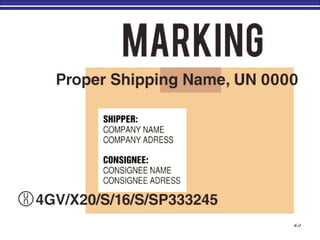
There are two types of markings
used in dangerous goods
transportation.
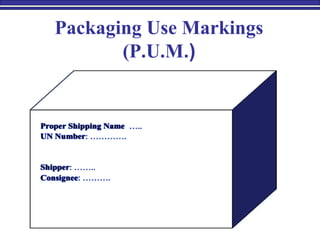
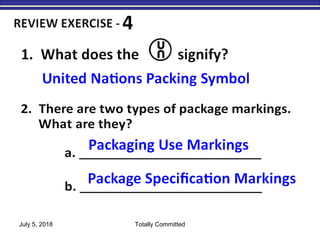
• Packaging use markings (P.U.M)
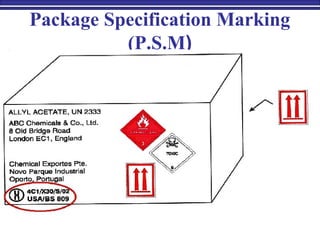
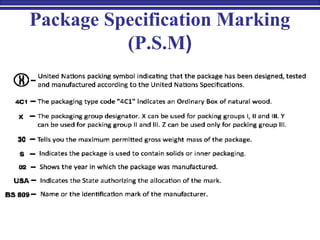
• Package specification markings
(P.S.M)
Packaging Use Markings
(P.U.M.)
Package Specification Marking
(P.S.M)
Package Specification Marking
(P.S.M)
12
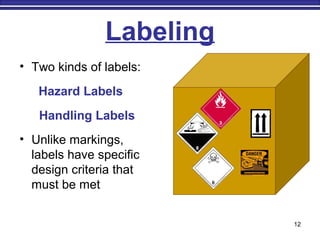
Labeling
• Two kinds of labels:
Hazard Labels
Handling Labels
• Unlike markings,
labels have specific
design criteria that
must be met
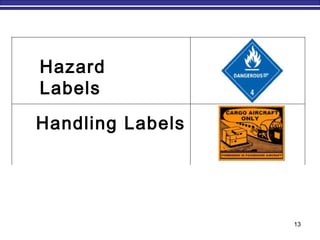
13
Hazard
Labels
Handling Labels
14
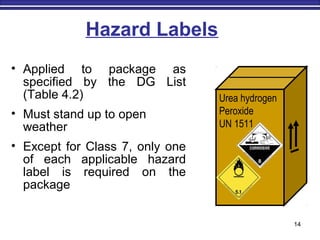
Hazard Labels
• Applied to package as
specified by the DG List
(Table 4.2)
• Must stand up to open
weather
• Except for Class 7, only one
of each applicable hazard
label is required on the
package
Urea hydrogen
Peroxide
UN 1511
15
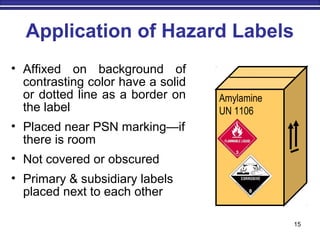
Application of Hazard Labels
• Affixed on background of
contrasting color have a solid
or dotted line as a border on
the label
• Placed near PSN marking—if
there is room
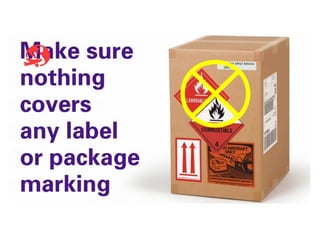
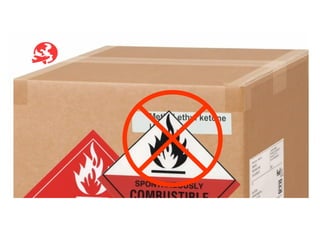
• Not covered or obscured
• Primary & subsidiary labels
placed next to each other
Amylamine
UN 1106
16
17
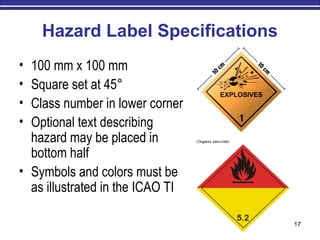
Hazard Label Specifications
• 100 mm x 100 mm
• Square set at 45°
• Class number in lower corner
• Optional text describing
hazard may be placed in
bottom half
• Symbols and colors must be
as illustrated in the ICAO TI
19
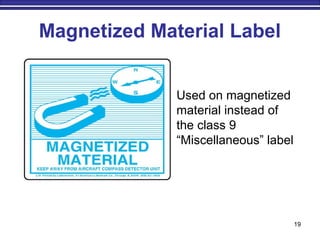
Magnetized Material Label
Used on magnetized
material instead of
the class 9
“Miscellaneous” label
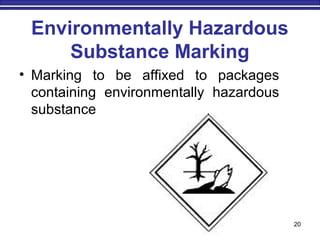
Environmentally Hazardous
Substance Marking
• Marking to be affixed to packages
containing environmentally hazardous
substance
20
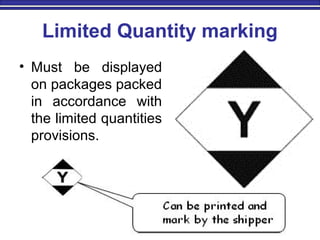
Limited Quantity marking
• Must be displayed
on packages packed
in accordance with
the limited quantities
provisions.
21
Biological Substances,
Category-B Marking
• Must be displayed
on packages packed
in accordance with
Packing Instruction
650.
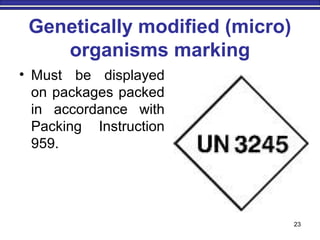
22
Genetically modified (micro)
organisms marking
• Must be displayed
on packages packed
in accordance with
Packing Instruction
959.
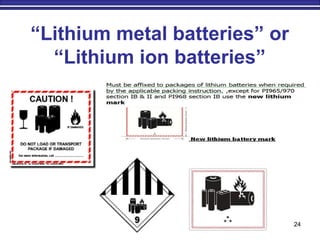
23
“Lithium metal batteries” or
“Lithium ion batteries”
24
25
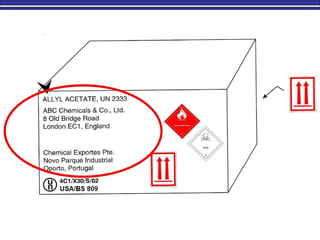
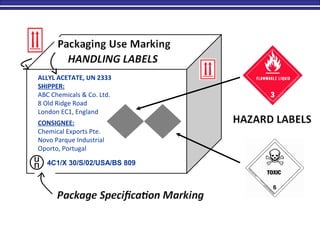
ALLYL ACETATE, UN 2333
SHIPPER:
ABC Chemicals & Co. Ltd.
8 Old Ridge Road
London EC1, England
CONSIGNEE:
Chemical Exports Pte.
Novo Parque Industrial
Oporto, Portugal
4C1/X 30/S/02/USA/BS 809
27
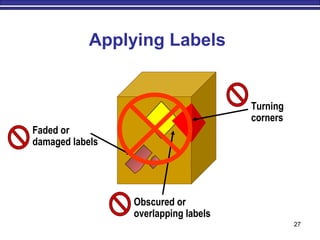
Applying Labels
Turning
corners
Obscured or
overlapping labels
Faded or
damaged labels
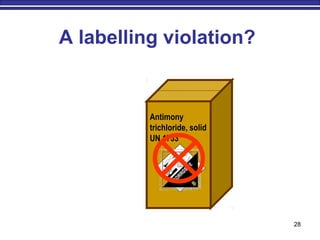
28
A labelling violation?
Antimony
trichloride, solid
UN 1733
31
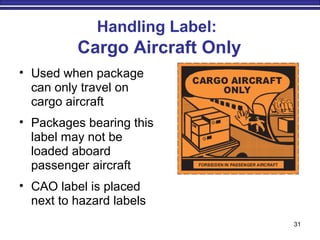
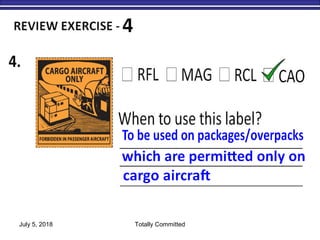
Handling Label:
Cargo Aircraft Only
• Used when package
can only travel on
cargo aircraft
• Packages bearing this
label may not be
loaded aboard
passenger aircraft
• CAO label is placed
next to hazard labels
32
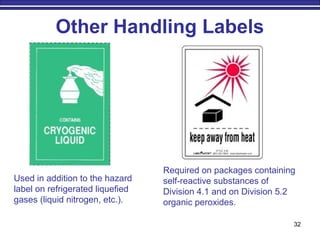
Other Handling Labels
Used in addition to the hazard
label on refrigerated liquefied
gases (liquid nitrogen, etc.).
Required on packages containing
self-reactive substances of
Division 4.1 and on Division 5.2
organic peroxides.
33
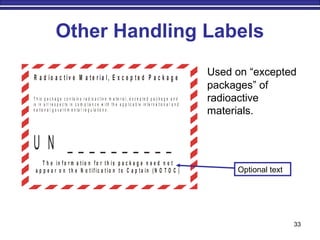
Other Handling Labels
Used on “excepted
packages” of
radioactive
materials.
R a d io a c t i v e M a t e r ia l, E x c e p t e d P a c k a g e
T h is p a c k a g e c o n ta in s r a d io a c t iv e m a t e r ia l, e x c e p t e d p a c k a g e a n d
is in a ll r e s p e c ts in c o m p lia n c e w it h t h e a p p lic a b le in t e r n a t io n a l a n d
n a t io n a l g o v e r n m e n ta l r e g u la tio n s .
T h e in f o r m a t io n f o r t h i s p a c k a g e n e e d n o t
a p p e a r o n t h e N o t if ic a t io n t o C a p t a in ( N O T O C )
U N _ _ _ _ _ _ _ _ _ _
Optional text
34
Potassium
Chlorate
UN 1485
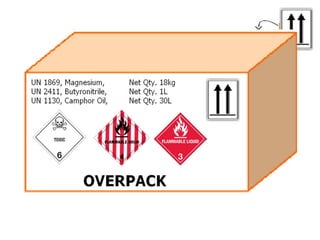
Labelling Overpacks
Potassium
Chlorate
UN 1485
4G/X5/S/03/
USA/M1234
4G/X5/S/03/
USA/M1234
OVERPACK
Unless the labels on inside packages are visible, hazard and handling labels
must be reproduced on the outside of overpacks.
M. Tayfour 37
Dangerous goods, which may be carried as
excepted quantities in accordance with the
provisions of this Subsection are shown in
Column F of the List of Dangerous Goods
Regulations Book.
Dangerous Goods Permitted inDangerous Goods Permitted in
Excepted QuantitiesExcepted Quantities
M. Tayfour 38
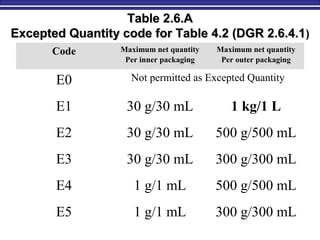
The quantities per package must be observed as stated on below table:
Table 2.6.ATable 2.6.A
Excepted Quantity code for Table 4.2 (DGR 2.6.4.1Excepted Quantity code for Table 4.2 (DGR 2.6.4.1))
Code Maximum net quantity
Per inner packaging
Maximum net quantity
Per outer packaging
E0 Not permitted as Excepted Quantity
E1 30 g/30 mL 1 kg/1 L
E2 30 g/30 mL 500 g/500 mL
E3 30 g/30 mL 300 g/300 mL
E4 1 g/1 mL 500 g/500 mL
E5 1 g/1 mL 300 g/300 mL
M. Tayfour 40
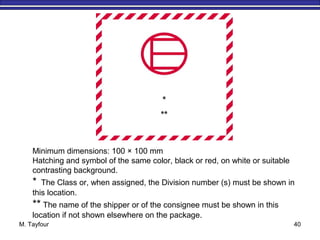
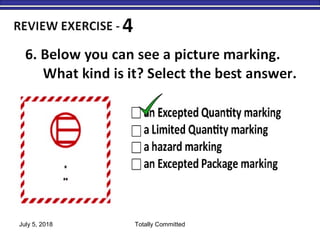
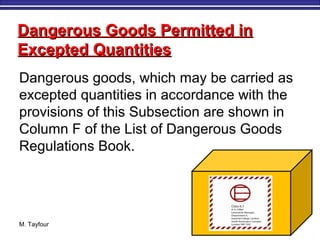
Minimum dimensions: 100 × 100 mm
Hatching and symbol of the same color, black or red, on white or suitable
contrasting background.
* The Class or, when assigned, the Division number (s) must be shown in
this location.
** The name of the shipper or of the consignee must be shown in this
location if not shown elsewhere on the package.
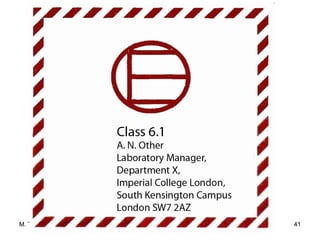
M. Tayfour 41
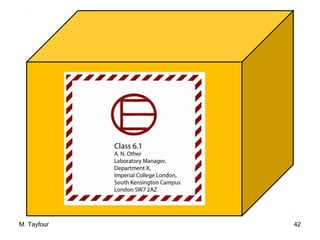
M. Tayfour 42
M. Tayfour 43
DGR 2.6 Excepted Quantities :DGR 2.6 Excepted Quantities :
•No shipper Declaration for Dangerous
Goods is not required (DGD).
•No (NOTOC).
•No use of Marking and Labelling.
•No use Acceptance Checklist.
•No use UN Specification Packing.
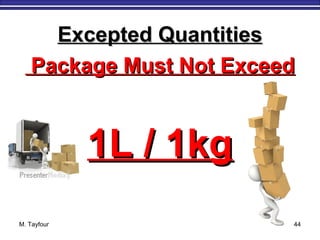
Excepted QuantitiesExcepted Quantities
Package Must Not ExceedPackage Must Not Exceed
1L / 1kg1L / 1kg
M. Tayfour 44
July 5, 2018 Totally Committed
50
Summary labels
• Identify when to use the hazard and
handling labels on a package of
dangerous goods.
• Determine proper application of labels
on packages of dangerous goods.
• Identify the specifications of hazard and
handling labels.
• Mark the package with the correct
Packaging Use Markings or check that the
Packaging Use Markings are correct
• Apply the correct labels for any given
shipment or check the correct labels have
applied
• Apply the correct overpack marking and
labels or check that correct markings and
labels have been applied.
Summary Marks

Section 6 IATA Marks and Labeling

  • 1.
  • 2.
    2 Objectives By the endof this section, you will be able to: • Recognize package specification markings and package use markings; • Identify hazard labels and handling labels; • Apply marking and labeling requirements when shipping dangerous goods.
  • 3.
    3 Objectives • Identify whento use the hazard and handling labels on a package of dangerous goods • Determine the proper application of labels on packages of dangerous goods • Explain the specifications of hazard and handling labels
  • 4.
    Are all dangerousgoods markedAre all dangerous goods marked and labeled in some way?and labeled in some way? Yes. Packages containing dangerous goods are normally identified with specific markings and special hazard labels, intended to alert you to the risks inherent to the contents. Correct marking and labeling of dangerous goods packages in an important element in the safe transport process. Markings and labels fulfill the following general purposes.
  • 5.
    • They indicatethe contents of the package; • They indicate that the packaging meets approved standards; • They provide safe handling and stowage information; • They indicate the nature of hazard's.
  • 6.
    • The shipperis responsible for all necessary marking and labeling of each package of dangerous goods, and each overpack containing dangerous goods, in compliance with the IATA DGR. Each package must be of such a size that there is adequate space to affix all required markings and labels (see 5.0.2.13.4).
  • 7.
    There are twotypes of markings used in dangerous goods transportation. • Packaging use markings (P.U.M) • Package specification markings (P.S.M)
  • 8.
  • 10.
  • 11.
  • 12.
    12 Labeling • Two kindsof labels: Hazard Labels Handling Labels • Unlike markings, labels have specific design criteria that must be met
  • 13.
  • 14.
    14 Hazard Labels • Appliedto package as specified by the DG List (Table 4.2) • Must stand up to open weather • Except for Class 7, only one of each applicable hazard label is required on the package Urea hydrogen Peroxide UN 1511
  • 15.
    15 Application of HazardLabels • Affixed on background of contrasting color have a solid or dotted line as a border on the label • Placed near PSN marking—if there is room • Not covered or obscured • Primary & subsidiary labels placed next to each other Amylamine UN 1106
  • 16.
  • 17.
    17 Hazard Label Specifications •100 mm x 100 mm • Square set at 45° • Class number in lower corner • Optional text describing hazard may be placed in bottom half • Symbols and colors must be as illustrated in the ICAO TI
  • 19.
    19 Magnetized Material Label Usedon magnetized material instead of the class 9 “Miscellaneous” label
  • 20.
    Environmentally Hazardous Substance Marking •Marking to be affixed to packages containing environmentally hazardous substance 20
  • 21.
    Limited Quantity marking •Must be displayed on packages packed in accordance with the limited quantities provisions. 21
  • 22.
    Biological Substances, Category-B Marking •Must be displayed on packages packed in accordance with Packing Instruction 650. 22
  • 23.
    Genetically modified (micro) organismsmarking • Must be displayed on packages packed in accordance with Packing Instruction 959. 23
  • 24.
    “Lithium metal batteries”or “Lithium ion batteries” 24
  • 25.
  • 26.
    ALLYL ACETATE, UN2333 SHIPPER: ABC Chemicals & Co. Ltd. 8 Old Ridge Road London EC1, England CONSIGNEE: Chemical Exports Pte. Novo Parque Industrial Oporto, Portugal 4C1/X 30/S/02/USA/BS 809
  • 27.
  • 28.
  • 31.
    31 Handling Label: Cargo AircraftOnly • Used when package can only travel on cargo aircraft • Packages bearing this label may not be loaded aboard passenger aircraft • CAO label is placed next to hazard labels
  • 32.
    32 Other Handling Labels Usedin addition to the hazard label on refrigerated liquefied gases (liquid nitrogen, etc.). Required on packages containing self-reactive substances of Division 4.1 and on Division 5.2 organic peroxides.
  • 33.
    33 Other Handling Labels Usedon “excepted packages” of radioactive materials. R a d io a c t i v e M a t e r ia l, E x c e p t e d P a c k a g e T h is p a c k a g e c o n ta in s r a d io a c t iv e m a t e r ia l, e x c e p t e d p a c k a g e a n d is in a ll r e s p e c ts in c o m p lia n c e w it h t h e a p p lic a b le in t e r n a t io n a l a n d n a t io n a l g o v e r n m e n ta l r e g u la tio n s . T h e in f o r m a t io n f o r t h i s p a c k a g e n e e d n o t a p p e a r o n t h e N o t if ic a t io n t o C a p t a in ( N O T O C ) U N _ _ _ _ _ _ _ _ _ _ Optional text
  • 34.
    34 Potassium Chlorate UN 1485 Labelling Overpacks Potassium Chlorate UN1485 4G/X5/S/03/ USA/M1234 4G/X5/S/03/ USA/M1234 OVERPACK Unless the labels on inside packages are visible, hazard and handling labels must be reproduced on the outside of overpacks.
  • 37.
    M. Tayfour 37 Dangerousgoods, which may be carried as excepted quantities in accordance with the provisions of this Subsection are shown in Column F of the List of Dangerous Goods Regulations Book. Dangerous Goods Permitted inDangerous Goods Permitted in Excepted QuantitiesExcepted Quantities
  • 38.
    M. Tayfour 38 Thequantities per package must be observed as stated on below table:
  • 39.
    Table 2.6.ATable 2.6.A ExceptedQuantity code for Table 4.2 (DGR 2.6.4.1Excepted Quantity code for Table 4.2 (DGR 2.6.4.1)) Code Maximum net quantity Per inner packaging Maximum net quantity Per outer packaging E0 Not permitted as Excepted Quantity E1 30 g/30 mL 1 kg/1 L E2 30 g/30 mL 500 g/500 mL E3 30 g/30 mL 300 g/300 mL E4 1 g/1 mL 500 g/500 mL E5 1 g/1 mL 300 g/300 mL
  • 40.
    M. Tayfour 40 Minimumdimensions: 100 × 100 mm Hatching and symbol of the same color, black or red, on white or suitable contrasting background. * The Class or, when assigned, the Division number (s) must be shown in this location. ** The name of the shipper or of the consignee must be shown in this location if not shown elsewhere on the package.
  • 41.
  • 42.
  • 43.
    M. Tayfour 43 DGR2.6 Excepted Quantities :DGR 2.6 Excepted Quantities : •No shipper Declaration for Dangerous Goods is not required (DGD). •No (NOTOC). •No use of Marking and Labelling. •No use Acceptance Checklist. •No use UN Specification Packing.
  • 44.
    Excepted QuantitiesExcepted Quantities PackageMust Not ExceedPackage Must Not Exceed 1L / 1kg1L / 1kg M. Tayfour 44
  • 45.
    July 5, 2018Totally Committed
  • 46.
    July 5, 2018Totally Committed
  • 47.
    July 5, 2018Totally Committed
  • 48.
    July 5, 2018Totally Committed
  • 50.
    50 Summary labels • Identifywhen to use the hazard and handling labels on a package of dangerous goods. • Determine proper application of labels on packages of dangerous goods. • Identify the specifications of hazard and handling labels.
  • 51.
    • Mark thepackage with the correct Packaging Use Markings or check that the Packaging Use Markings are correct • Apply the correct labels for any given shipment or check the correct labels have applied • Apply the correct overpack marking and labels or check that correct markings and labels have been applied. Summary Marks

Editor's Notes

  • #13 Go to Part 5, Chapter 3 Unlike markings, labels have exact standards for appearance. They don’t have to be in adhesive “label” form. They can be printed, stamped, stenciled, etc, if size, shape, color, and design specifications are adhered to.
  • #15 3.1.1 – Column 5 of the DG List tells us which hazard labels are required on a package (Col. 3 & 4 do also since they specify the hazard classes/divisions). 3.1.3 – Like markings, labels must stand up to open weather Only one label per hazard is required —except for Radioactive (two labels). Review 3.2.7 on applying labels 3.2.8 – labels must not be folded—no turning corners. If it doesn’t fit, get a bigger box. 3.2.9 – Labels can be put on tags for irregular-shaped packages.
  • #16 Review 3.2.7 on applying labels 3.2.8 – labels must not be folded—no turning corners. If it doesn’t fit, get a bigger box. 3.2.9 – Labels can be put on tags for irregular-shaped packages.
  • #18 Look at paragraph 5; 3.4 …then look at the illustrations of each label at the back of the chapter. Infectious substance label may be shrunk to 50 mm x 50 mm if package is too small to bear larger labels. All labels get the class number—years ago subsidiary labels didn’t require it. Class 5 labels get the full division number. Text such as “flammable liquid” or “organic peroxide” is optional. ICAO doesn’t specify the exact text, just that it must indicate the nature of the risk. Therefore a class 3 label could say “inflammable” which means the same thing as flammable or could say “extremely flammable” or “very flammable”. Also, this text can be in any language (unless a state variation requires otherwise) since no language is specified by ICAO.
  • #20 Large audio speakers are the most common example of magnetized materials that require this label.
  • #28 These are common labeling violations.
  • #29 Though paragraph 3.4.1 covering hazard label specifications calls for these labels to be a square set at 45°, the label application paragraph, 3.2, does not indicate that labels must be applied to packages this way. In the US, the FAA interprets the regulations to allow this type of label application. In the case of solids, like the example above, there is no required correct orientation for the package itself. So even if a label that was applied “square on point” it would no longer be that way when the box was laid on its side—as is allowed with solids.
  • #32 Go to 3.2.11.a CAO label must be on same side of package as hazard labels. May be half-size for small packages of infectious substances.
  • #33 Go to pictures of labels at end of Chapter.
  • #34 No Class 7 hazard label is required on “excepted packages” nor is any documentation. This label is it. 3.2.11.e. -- This label “should” be used. It is anticipated that it will be “required” as of 1 Jan 2007. The specific UN number must be entered legibly in the blank spot.
  • #35 Go to 5; 3.3.1 When those of the inside packages can’t be seen, labels must be reproduced on the outside of the overpack. This also applies to DG markings. Inside packages still need to be labeled even if the shipper knows the packages will be put into a labeled overpack.