TRANSPORTATION OF
DANGEROUS GOODS BY AIR
LEARNING FROM THE MISFORTUNES
          OF OTHERS
OBJECTIVES

• To give a brief overview of the requirements for the
  transport of dangerous goods by air
• To identify deficiencies in the supply chain that could
  lead to serious accidents/incidents
• To demonstrate the challenges facing industry in
  ensuring compliance with the regulations
DEFINITION OF DANGEROUS GOODS


 Dangerous Goods are articles or substances which
 are capable of posing a risk to health, safety,
 property or the environment, and which are
 shown in the list of Dangerous Goods in the
 Dangerous Goods Regulations or which are
 classified according to these Regulations.
ENABLING LEGISLATION FOR THE SAFE
TRANSPORT BY AIR OF DANGEROUS
GOODS
• Annex 18 to the Convention
• Aviation Act No. 74 of 1962
• ICAO Technical Instructions
• ICAO Technical Instruction Supplement
• Civil Aviation Regulations of 1997; Part 92
• SA-CATS-DG
• ICAO Emergency Response Guidance for aircraft
  incidents involving dangerous goods
• Part 141 Dangerous Goods Training
• IATA Dangerous Goods Regulations – used by
  industry (mostly IATA Members) – contains all the
  requirements in the ICAO Technical Standards
USE OF THE ICAO TECHNICAL
INSTRUCTIONS and IATA DGR Manual

• Classify & identify proper shipping name
• Check if permitted on passenger/cargo aircraft or
  if forbidden
• If forbidden, check if subject to exemption
• Check quantity and packaging
• Prepare consignment – mark/label/document
• Sign Transport Document and offer for transport
• State Variation Requirements
• Operator Variations
LIMITATIONS OF DANGEROUS GOODS ON
AIRCRAFT

• Forbidden for air transport under any circumstances
  - certain explosives
  - substances liable to produce dangerous evolution of
  heat
• Forbidden for transport unless exempted by various
  States
• Acceptable for transport on both Passenger and Cargo
  Aircraft
• Forbidden for transport on a Passenger Aircraft,
  but acceptable on Cargo Aircraft only
LEARNING FROM THE MISFORTUNES OF
OTHERS
PROBABLE CAUSE
• Valujet 592; Chemical Oxygen Generators
• Pan American B-707; Onboard nitric acid fire
• American Airlines DC-10; Chemical Oxygen
  Generators
• Fed-Ex DC-10; Flammable Liquids in Lab
  Machine
• Continental Airlines B-727; Safety Matches
• DC-8 Freighter in Dallas; Carbon Dioxide
  fumes
• American Airlines DC-9; Hydrogen Peroxide
CONTRIBUTING FACTORS


• Lack of training
• Negligence
• Reluctance to declare correct contents - Shippers
• Undeclared dangerous goods
• Mis-declared dangerous goods
• Lack of communication
• Incorrect packaging
UNDECLARED/HIDDEN DANGEROUS GOODS
A MAJOR RISK TO THE SAFETY OF CIVIL
AVIATION
• Risk to the safety of passengers & crew
• Risk of explosion
• Risk of smoke or fire
• Risk of incapacitation of crew – toxic inhalation
• Exposure to Ionizing Radiation
• Exposure to contaminated substances/liquids
• Risk to aircraft radiation contamination
• Incompatible dangerous goods - a ticking
  time bomb
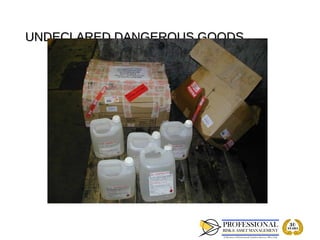
UNDECLARED DANGEROUS GOODS
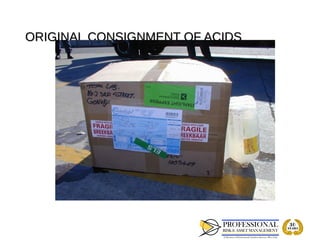
ORIGINAL CONSIGNMENT OF ACIDS
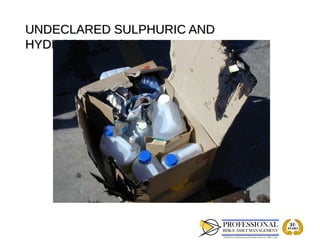
UNDECLARED SULPHURIC AND
HYDROCHLORIC ACID
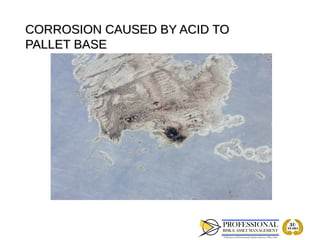
CORROSION CAUSED BY ACID TO
PALLET BASE
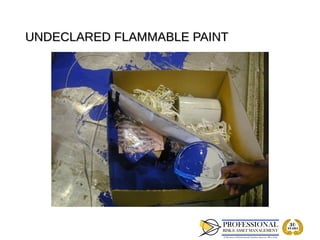
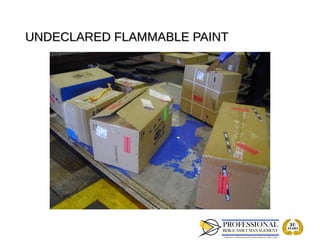
UNDECLARED FLAMMABLE PAINT
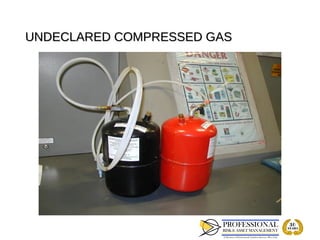
UNDECLARED COMPRESSED GAS
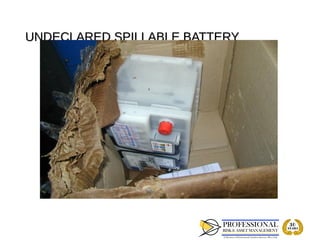
UNDECLARED SPILLABLE BATTERY
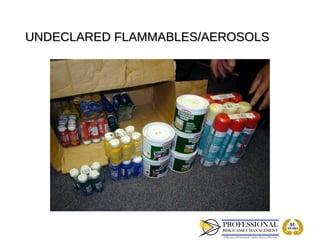
UNDECLARED FLAMMABLES/AEROSOLS
How Could They Have Been Prevented


• Correct content declaration
• Correct classification
• Adequately trained personnel
• Educated clients
• Documented and packed as dangerous goods
• UN Specification packaging
• Concerted effort by all to ensure an overall
 level of safety (Don’t buck the system)
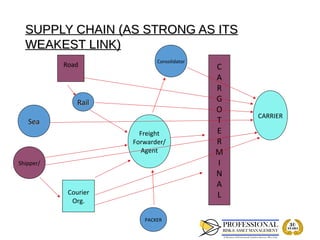
SUPPLY CHAIN (AS STRONG AS ITS
  WEAKEST LINK)
                             Consolidator
           Road                             C
                                            A
                                            R
               Rail                         G
                                            O
                                                CARRIER
   Sea                                      T
                        Freight             E
                      Forwarder/            R
                        Agent               M
Shipper/                                    I
                                            N
                                            A
            Courier                         L
             Org.

                         PACKER
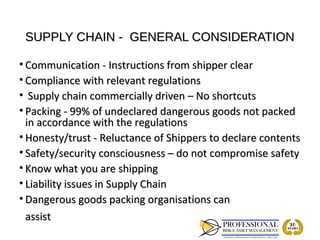
SUPPLY CHAIN - GENERAL CONSIDERATION

• Communication - Instructions from shipper clear
• Compliance with relevant regulations
• Supply chain commercially driven – No shortcuts
• Packing - 99% of undeclared dangerous goods not packed
  in accordance with the regulations
• Honesty/trust - Reluctance of Shippers to declare contents
• Safety/security consciousness – do not compromise safety
• Know what you are shipping
• Liability issues in Supply Chain
• Dangerous goods packing organisations can
  assist
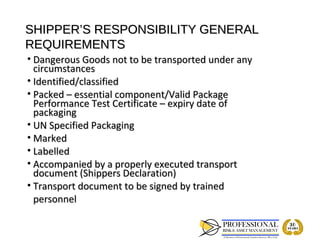
SHIPPER’S RESPONSIBILITY GENERAL
REQUIREMENTS
• Dangerous Goods not to be transported under any
  circumstances
• Identified/classified
• Packed – essential component/Valid Package
  Performance Test Certificate – expiry date of
  packaging
• UN Specified Packaging
• Marked
• Labelled
• Accompanied by a properly executed transport
  document (Shippers Declaration)
• Transport document to be signed by trained
  personnel
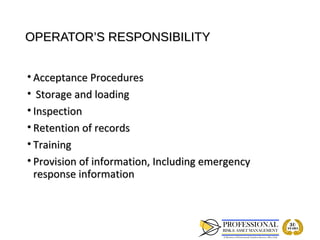
OPERATOR’S RESPONSIBILITY


• Acceptance Procedures
• Storage and loading
• Inspection
• Retention of records
• Training
• Provision of information, Including emergency
  response information
DANGEROUS GOODS TRAINING
• Requirement of regulations – ICAO/CARS and
  IATA DGR
• Job Specific
• Different categories of training
  oShippers personnel involved in the preparation
   of a dangerous goods shipment and contractors
  oAir Operators personnel/aircrew/cabin
   crew/acceptance personnel/warehouse/drivers
  oRamp personnel/security screening personnel
  oFreight Forwarders/processing dangerous
   goods

• Training by a CAA accredited organisation
ENFORCEMENT BY THE APPROPRIATE
AUTHORITY (SACAA)

• CAR 185 & Section 19 of the Aviation Act of 1962
• Criminal charges - on conviction; fine or
  imprisonment or to both fine & imprisonment
• First Time Offender – if not serious - warning
• Injury to persons or damage to property; SAPS
  will consider findings before moving for possible
  prosecution
• Safety/security is a co-operative venture
ROLE OF SHIPPERS IN TRANSPORTING
DANGEROUS GOODS BY AIR

• Transported in accordance with Regulations
• Overall level of safety maintained at all times
• Security of dangerous goods
• Personnel current in dangerous goods training
• Ongoing training
• Educate clients &personnel about dangerous
  goods
• If a chemical is forbidden for transportation by
  Air check with CAA if Exemption is applicable
TODAY’S CHALLENGES


• Multi-modal transport – stake holders acting in silos?
• Vision for the future – key role players
• Fragmented regulations
• Proper management
• Identification of critical issues
• International requirements
• Complexities in compliance
• Harmonisation – A distant dream?

Presentation on dgr

  • 1.
    TRANSPORTATION OF DANGEROUS GOODSBY AIR LEARNING FROM THE MISFORTUNES OF OTHERS
  • 2.
    OBJECTIVES • To givea brief overview of the requirements for the transport of dangerous goods by air • To identify deficiencies in the supply chain that could lead to serious accidents/incidents • To demonstrate the challenges facing industry in ensuring compliance with the regulations
  • 3.
    DEFINITION OF DANGEROUSGOODS Dangerous Goods are articles or substances which are capable of posing a risk to health, safety, property or the environment, and which are shown in the list of Dangerous Goods in the Dangerous Goods Regulations or which are classified according to these Regulations.
  • 4.
    ENABLING LEGISLATION FORTHE SAFE TRANSPORT BY AIR OF DANGEROUS GOODS • Annex 18 to the Convention • Aviation Act No. 74 of 1962 • ICAO Technical Instructions • ICAO Technical Instruction Supplement • Civil Aviation Regulations of 1997; Part 92 • SA-CATS-DG • ICAO Emergency Response Guidance for aircraft incidents involving dangerous goods • Part 141 Dangerous Goods Training • IATA Dangerous Goods Regulations – used by industry (mostly IATA Members) – contains all the requirements in the ICAO Technical Standards
  • 5.
    USE OF THEICAO TECHNICAL INSTRUCTIONS and IATA DGR Manual • Classify & identify proper shipping name • Check if permitted on passenger/cargo aircraft or if forbidden • If forbidden, check if subject to exemption • Check quantity and packaging • Prepare consignment – mark/label/document • Sign Transport Document and offer for transport • State Variation Requirements • Operator Variations
  • 6.
    LIMITATIONS OF DANGEROUSGOODS ON AIRCRAFT • Forbidden for air transport under any circumstances - certain explosives - substances liable to produce dangerous evolution of heat • Forbidden for transport unless exempted by various States • Acceptable for transport on both Passenger and Cargo Aircraft • Forbidden for transport on a Passenger Aircraft, but acceptable on Cargo Aircraft only
  • 7.
    LEARNING FROM THEMISFORTUNES OF OTHERS PROBABLE CAUSE • Valujet 592; Chemical Oxygen Generators • Pan American B-707; Onboard nitric acid fire • American Airlines DC-10; Chemical Oxygen Generators • Fed-Ex DC-10; Flammable Liquids in Lab Machine • Continental Airlines B-727; Safety Matches • DC-8 Freighter in Dallas; Carbon Dioxide fumes • American Airlines DC-9; Hydrogen Peroxide
  • 8.
    CONTRIBUTING FACTORS • Lackof training • Negligence • Reluctance to declare correct contents - Shippers • Undeclared dangerous goods • Mis-declared dangerous goods • Lack of communication • Incorrect packaging
  • 9.
    UNDECLARED/HIDDEN DANGEROUS GOODS AMAJOR RISK TO THE SAFETY OF CIVIL AVIATION • Risk to the safety of passengers & crew • Risk of explosion • Risk of smoke or fire • Risk of incapacitation of crew – toxic inhalation • Exposure to Ionizing Radiation • Exposure to contaminated substances/liquids • Risk to aircraft radiation contamination • Incompatible dangerous goods - a ticking time bomb
  • 10.
  • 11.
  • 12.
  • 13.
    CORROSION CAUSED BYACID TO PALLET BASE
  • 14.
  • 15.
  • 16.
  • 17.
  • 18.
  • 19.
    How Could TheyHave Been Prevented • Correct content declaration • Correct classification • Adequately trained personnel • Educated clients • Documented and packed as dangerous goods • UN Specification packaging • Concerted effort by all to ensure an overall level of safety (Don’t buck the system)
  • 20.
    SUPPLY CHAIN (ASSTRONG AS ITS WEAKEST LINK) Consolidator Road C A R Rail G O CARRIER Sea T Freight E Forwarder/ R Agent M Shipper/ I N A Courier L Org. PACKER
  • 21.
    SUPPLY CHAIN -GENERAL CONSIDERATION • Communication - Instructions from shipper clear • Compliance with relevant regulations • Supply chain commercially driven – No shortcuts • Packing - 99% of undeclared dangerous goods not packed in accordance with the regulations • Honesty/trust - Reluctance of Shippers to declare contents • Safety/security consciousness – do not compromise safety • Know what you are shipping • Liability issues in Supply Chain • Dangerous goods packing organisations can assist
  • 22.
    SHIPPER’S RESPONSIBILITY GENERAL REQUIREMENTS •Dangerous Goods not to be transported under any circumstances • Identified/classified • Packed – essential component/Valid Package Performance Test Certificate – expiry date of packaging • UN Specified Packaging • Marked • Labelled • Accompanied by a properly executed transport document (Shippers Declaration) • Transport document to be signed by trained personnel
  • 23.
    OPERATOR’S RESPONSIBILITY • AcceptanceProcedures • Storage and loading • Inspection • Retention of records • Training • Provision of information, Including emergency response information
  • 24.
    DANGEROUS GOODS TRAINING •Requirement of regulations – ICAO/CARS and IATA DGR • Job Specific • Different categories of training oShippers personnel involved in the preparation of a dangerous goods shipment and contractors oAir Operators personnel/aircrew/cabin crew/acceptance personnel/warehouse/drivers oRamp personnel/security screening personnel oFreight Forwarders/processing dangerous goods • Training by a CAA accredited organisation
  • 25.
    ENFORCEMENT BY THEAPPROPRIATE AUTHORITY (SACAA) • CAR 185 & Section 19 of the Aviation Act of 1962 • Criminal charges - on conviction; fine or imprisonment or to both fine & imprisonment • First Time Offender – if not serious - warning • Injury to persons or damage to property; SAPS will consider findings before moving for possible prosecution • Safety/security is a co-operative venture
  • 26.
    ROLE OF SHIPPERSIN TRANSPORTING DANGEROUS GOODS BY AIR • Transported in accordance with Regulations • Overall level of safety maintained at all times • Security of dangerous goods • Personnel current in dangerous goods training • Ongoing training • Educate clients &personnel about dangerous goods • If a chemical is forbidden for transportation by Air check with CAA if Exemption is applicable
  • 27.
    TODAY’S CHALLENGES • Multi-modaltransport – stake holders acting in silos? • Vision for the future – key role players • Fragmented regulations • Proper management • Identification of critical issues • International requirements • Complexities in compliance • Harmonisation – A distant dream?

Editor's Notes

  • #5 In 1953 the member Airlines of IATA recognised the growing need of transportation by Air of Dangerous Goods ( articles and Substances having Harzadous properties) which if not properly controlled could adversely affect the safety of passengers, crew and or Aircraft on which they are carried. Eperience in other modes of transport had demosntrated that this articles can be transported provided that they are properly packed and the quantities in each package were properly limited. Using this experience together with the industry knowledge, IATA developed the first Regulations for Dangerous Gooods Transpotation by Air, and the first edition of the DGR manual was published in 1956 as the IATA Restricted Articles Regulations.
  • #26 for period not exceeding 10 years