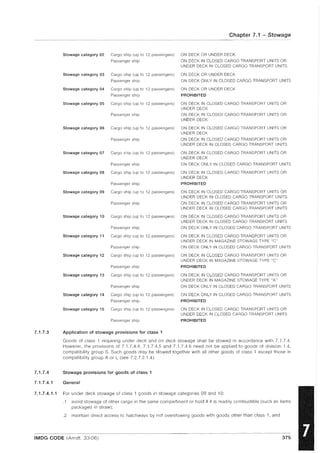
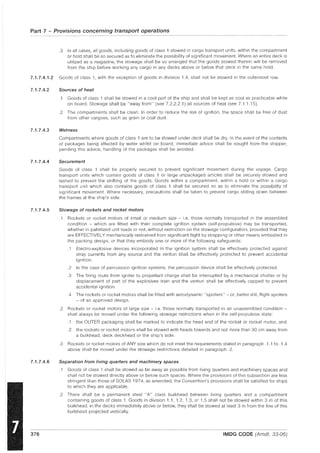
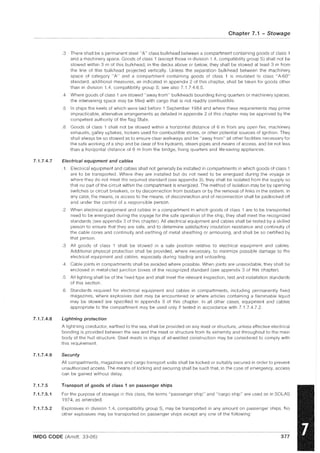
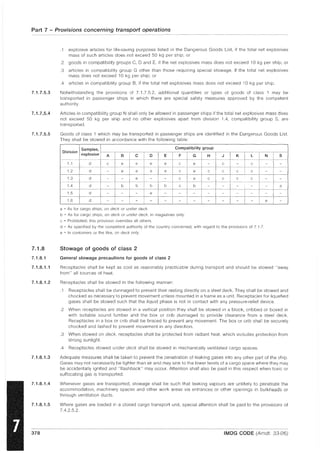
By Authority Of
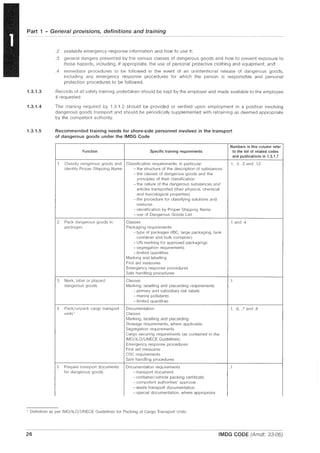
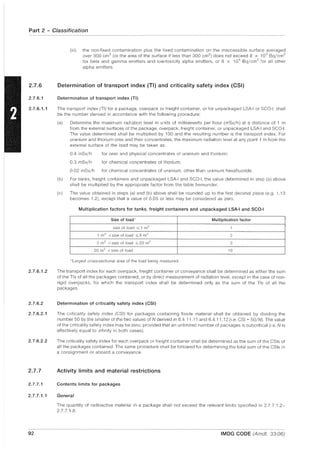
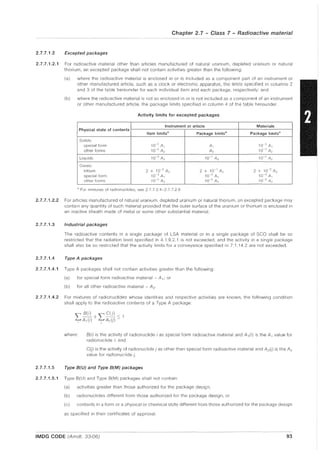
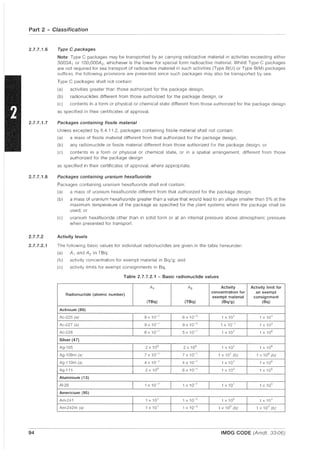
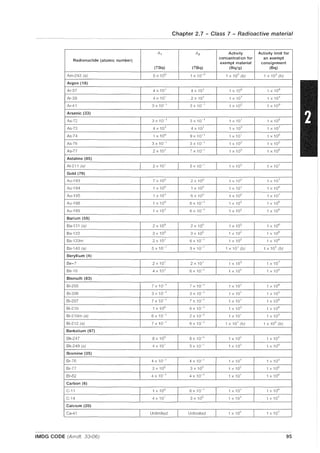
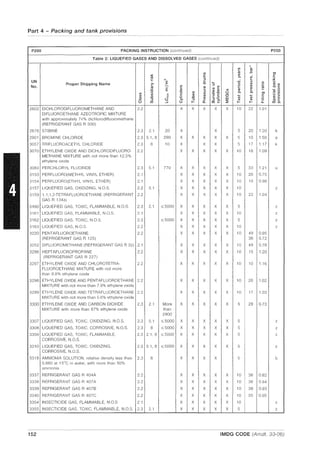
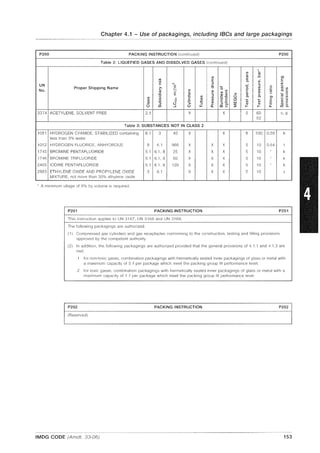
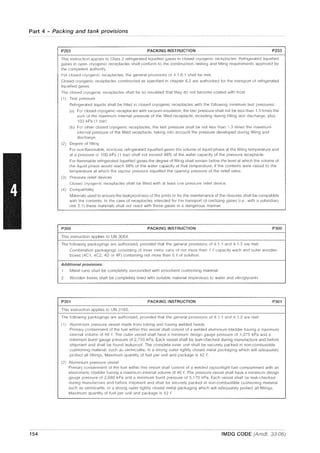
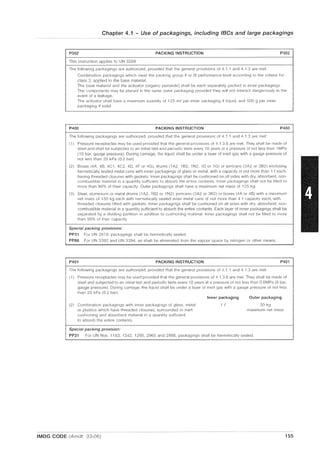
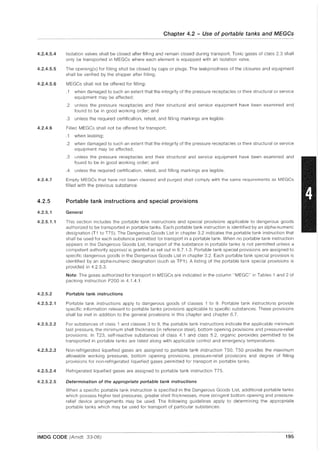
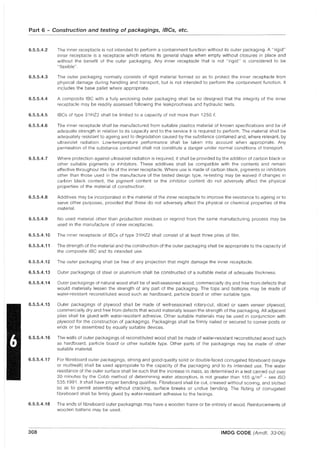
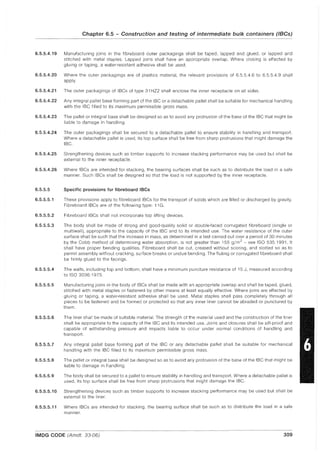
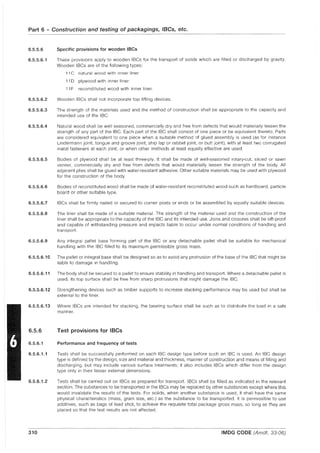
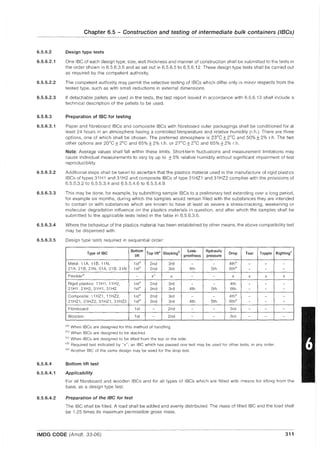
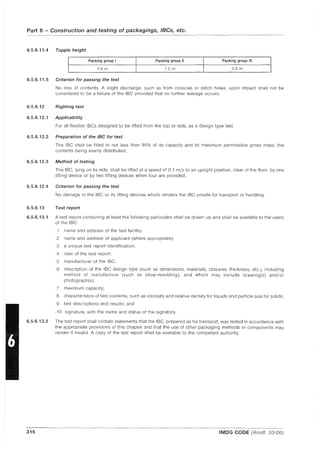
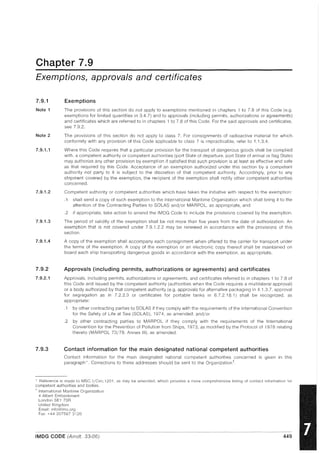
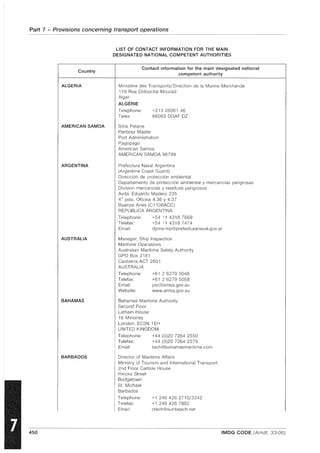
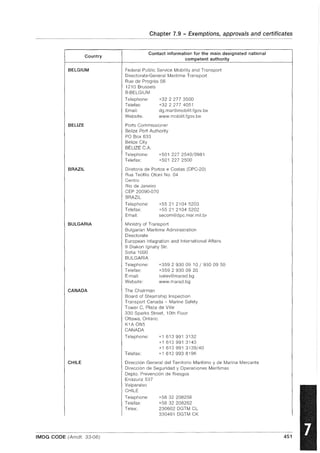
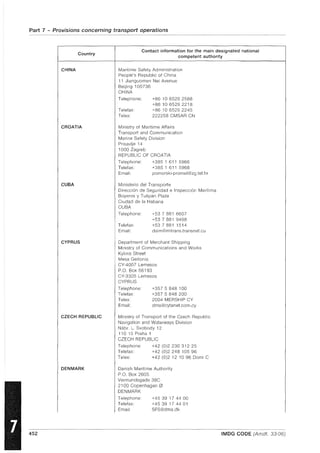
THE UNITED STATES OF AMERICA
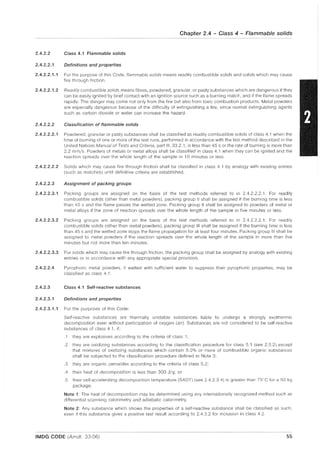
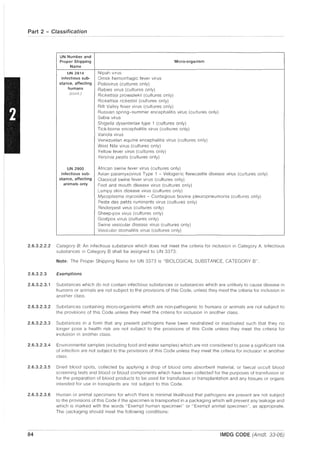
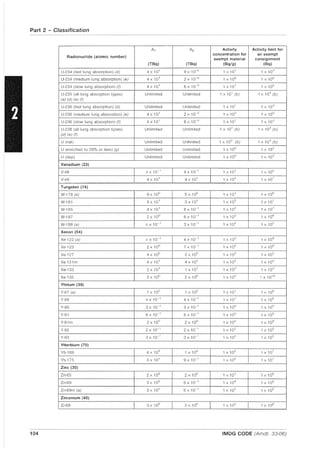
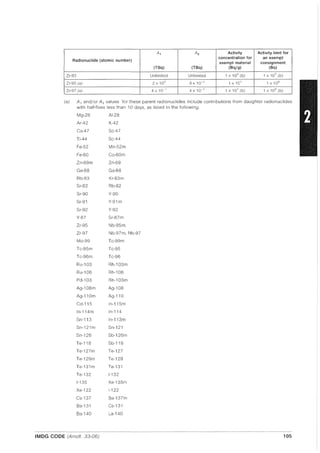
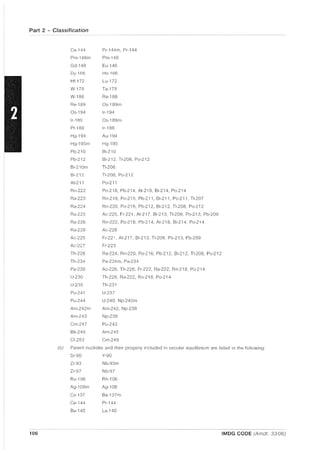
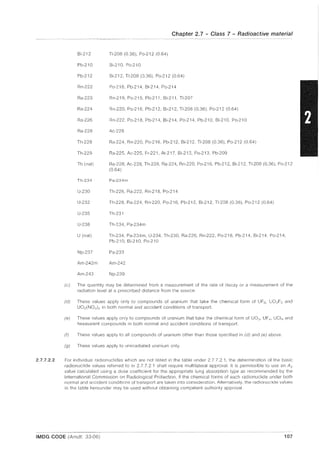
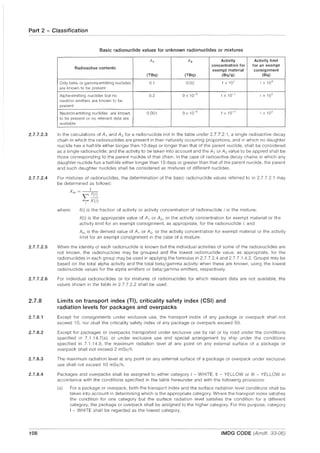
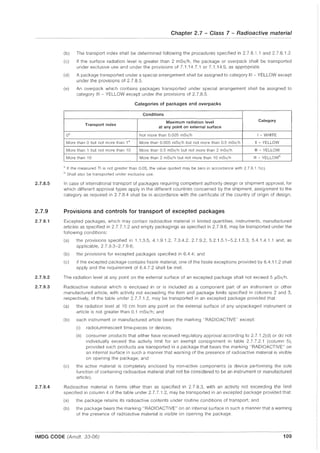
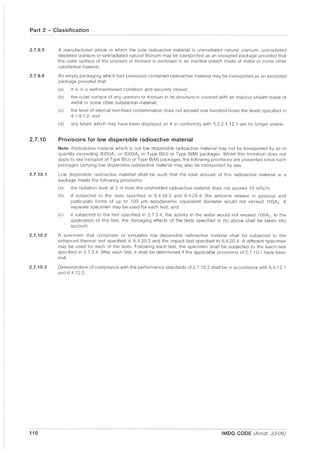
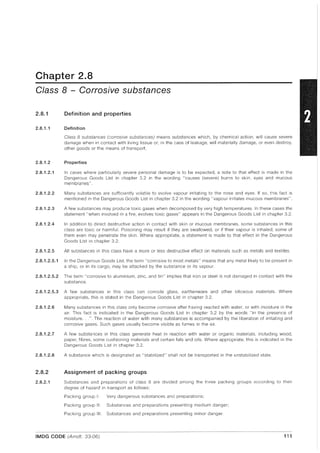
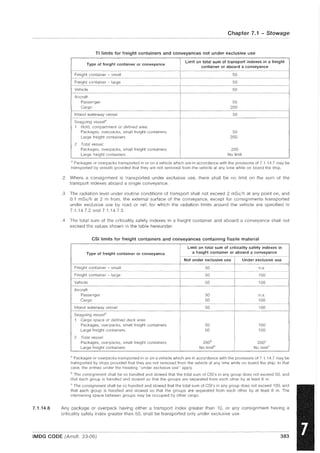
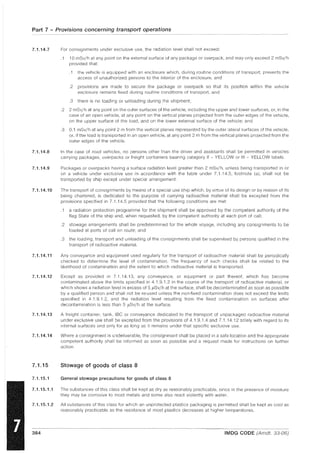
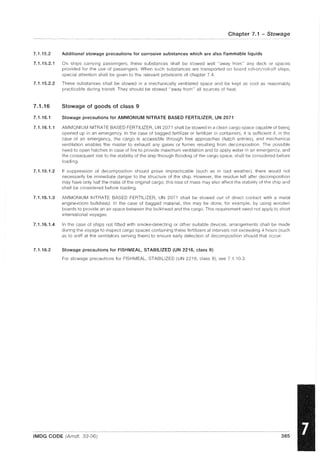
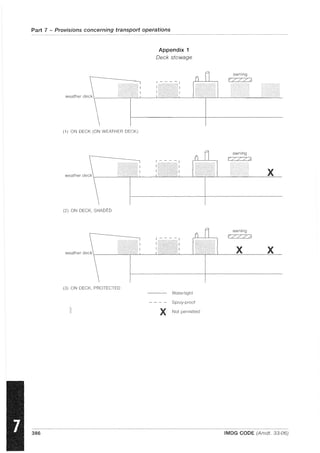
Legally Binding Document
By the Authority Vested By Part 5 of the United States Code § 552(a) and
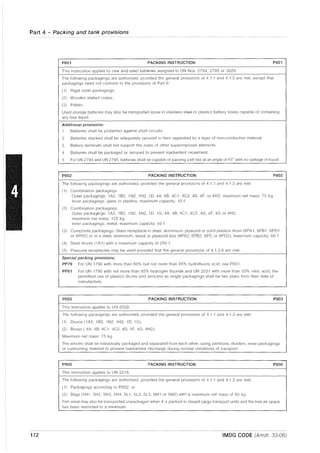
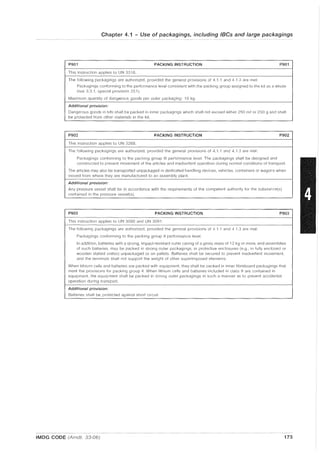
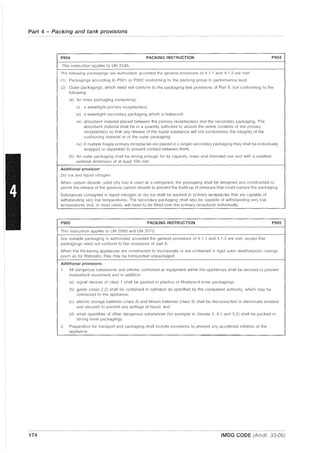
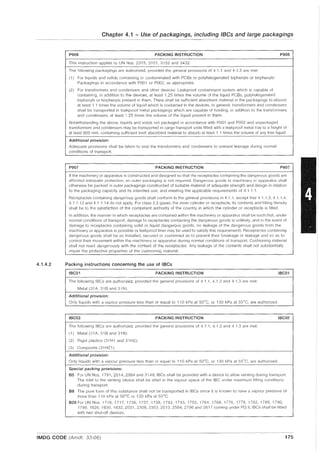
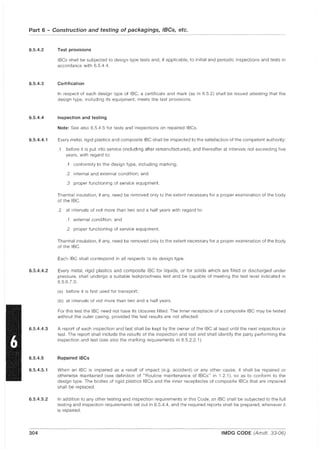
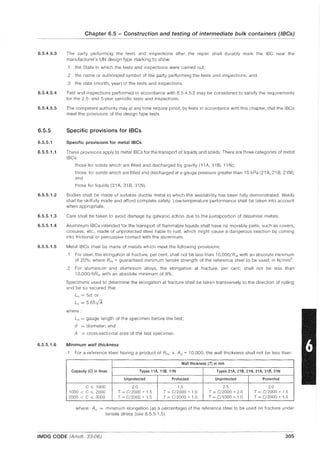
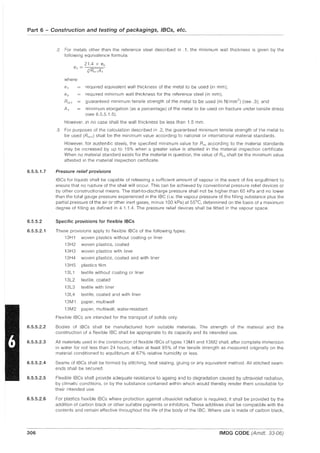
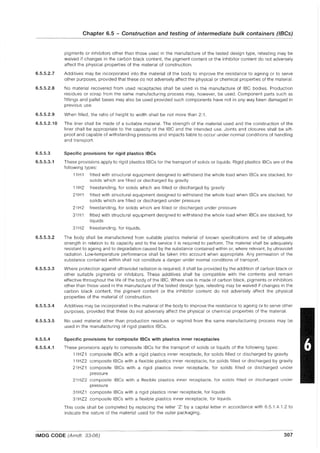
Part 1 of the Code of Regulations § 51 the attached document has been duly
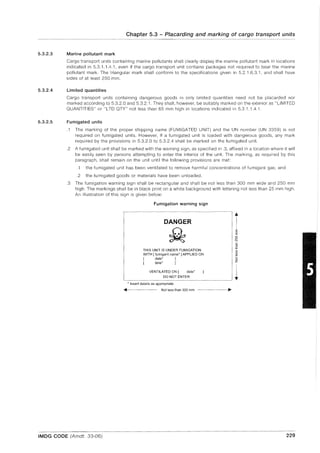
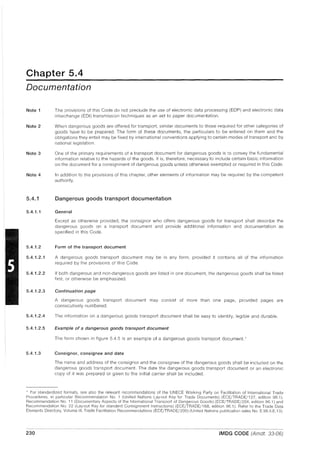
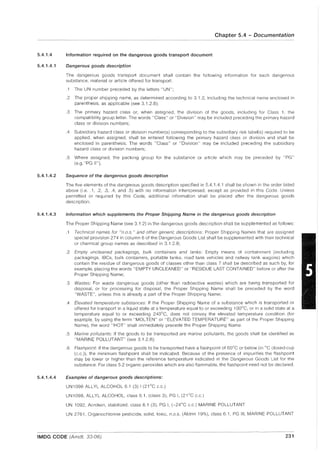
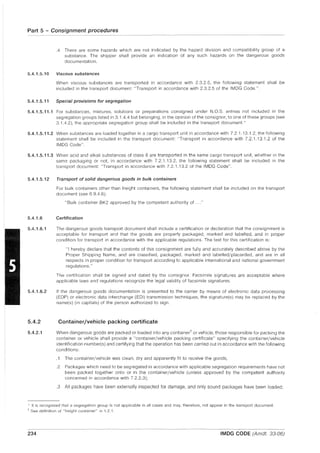
INCORPORATED BY REFERENCE and shall be considered legally
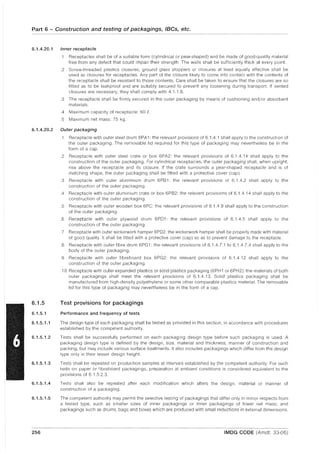
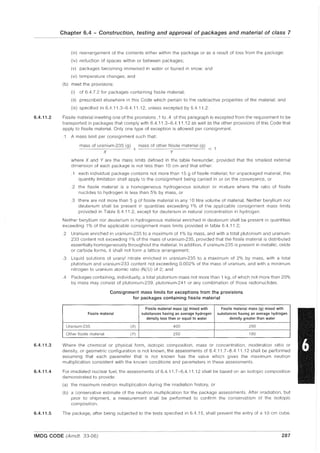
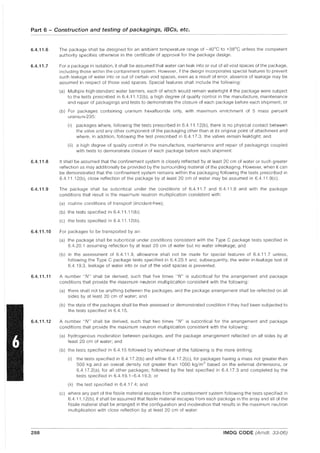
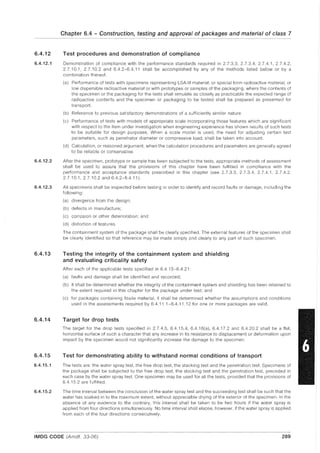
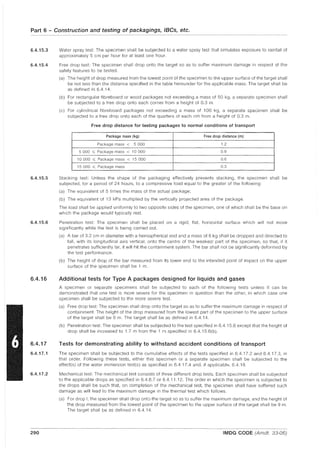
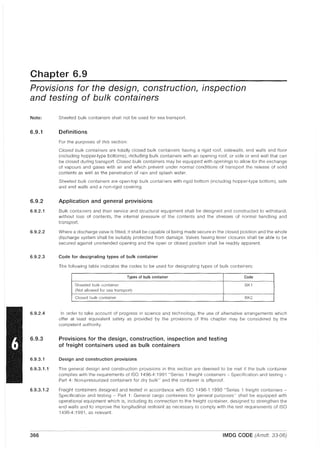
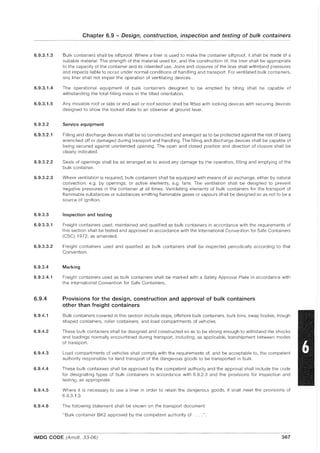
binding upon all citizens and residents of the United States of America.
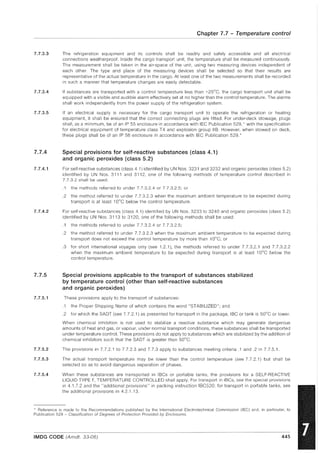
HEED THIS NOTICE: Criminal penalties may apply for noncompliance.
Official Incorporator:
THE EXECUTIVE DIRECTOR
OFFICE OF THE FEDERAL REGISTER
WASHINGTON, D.C.
Document Name:
CFR Section(s):
Standards Body:
e
International Maritime Organization
49 CFR 172.519(f)
IMO IMDG.1: International Maritime Dangerous
Goods Code (Volume 1)
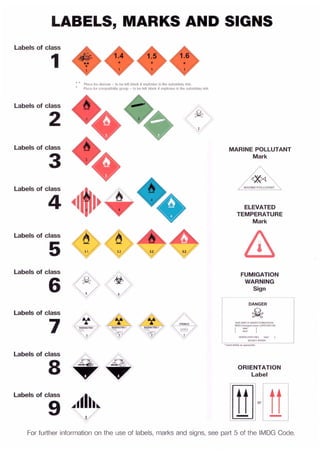
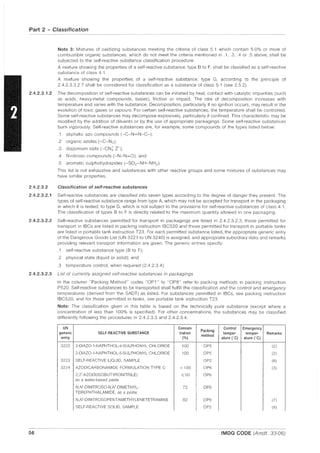
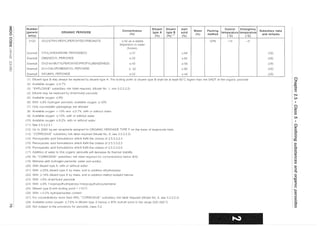
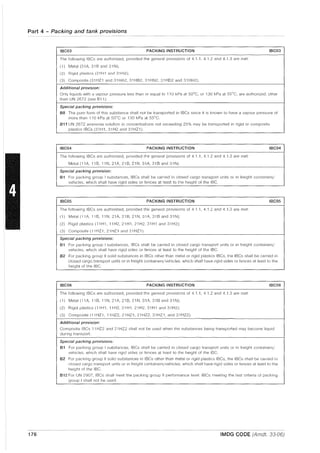
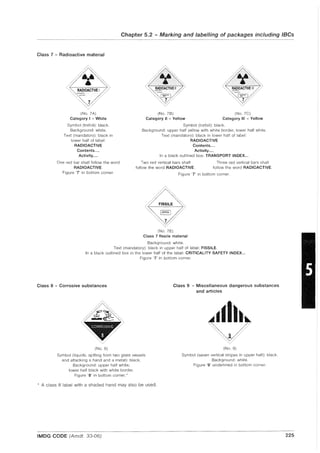
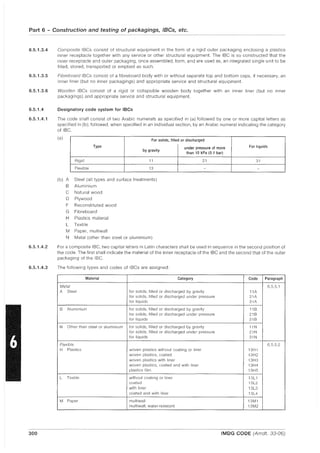
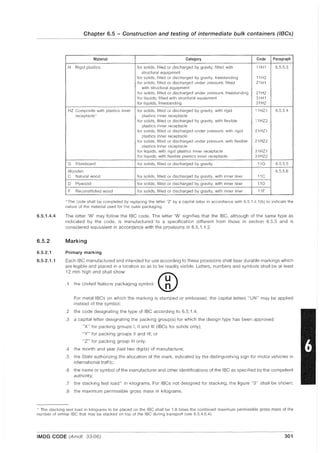
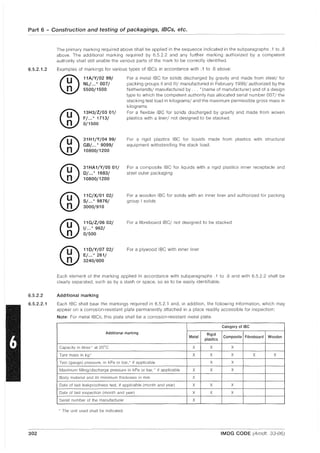
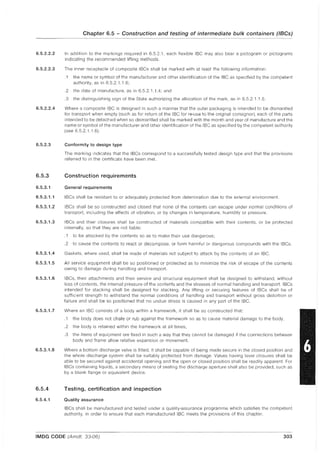
LABELS, MARKS AND SIGNS
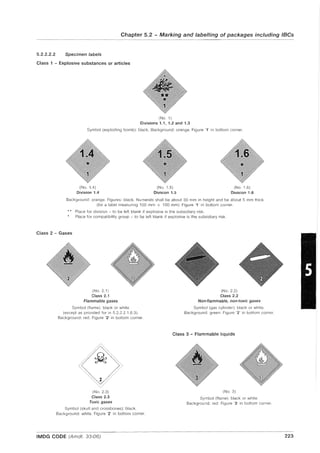
Labels of class
1
* * Place for division - to be left blank if explosive is the subsidiary risk.
Place for oompatibility group - to be left blank if explosive is the subsidiary risk
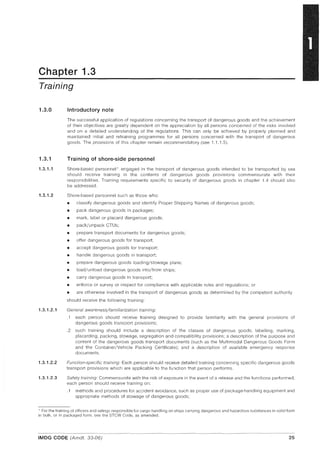
Labels of class
2
Labels of class
3
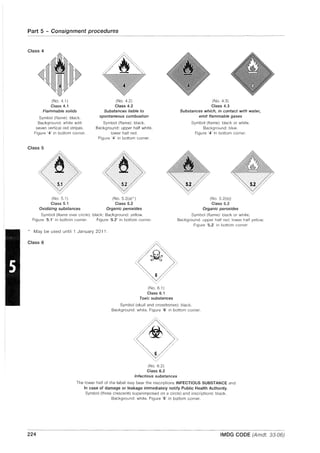
Labels of class
4
Labels of class
5 ·•···••..... 5.2..........
......
Labels of class
6
Labels of class
7
............
• •
Labels of class
8
Labels of class
9 ~
..
. .
.... ....
···...1 / /
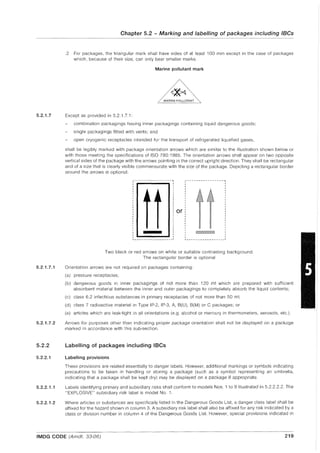
MARINE POLLUTANT
Mark
MARINE POLLUTANT
ELEVATED
TEMPERATURE
Mark
FUMIGATION
WARNING
Sign
DANGER
THIS UNIT IS UNDER FUMIGATION
WITH ( fum9lint 1lIIm8' JAPPLIED ON
I date' I
I time· I
VENTILATED ON ( date' I
DO NOT ENTER
ORIENTATION
Label
----------------,
Hoe H- -----------_.. _..-
For further information on the use of labels, marks and signs, see part 5 of the IMDG Code.
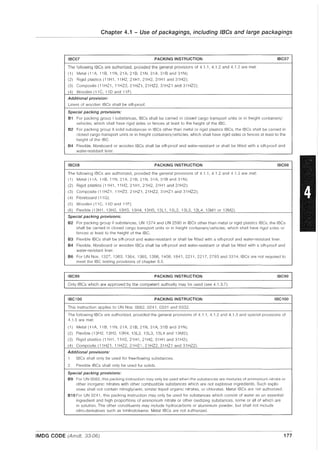
volume 1
I
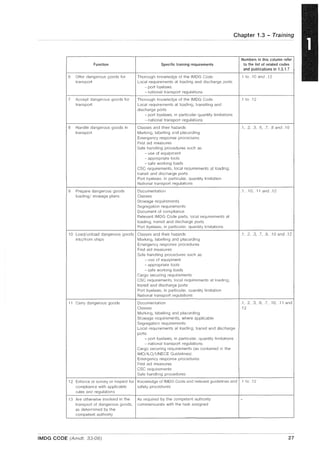
CODE
2006 Edition
INTERNATIONAL MARITIME
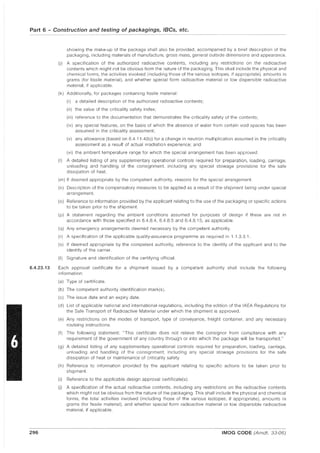
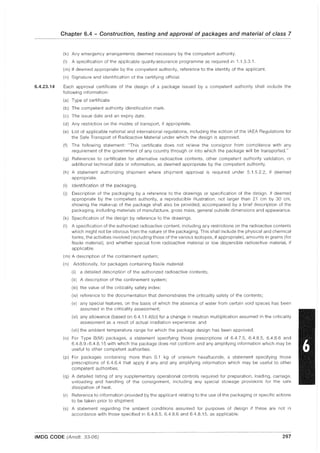
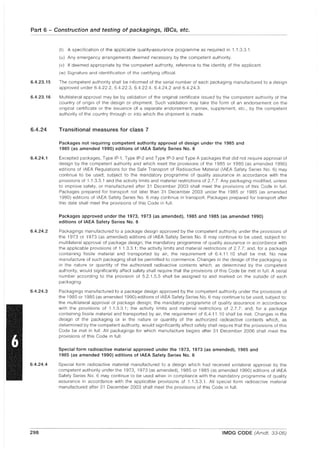
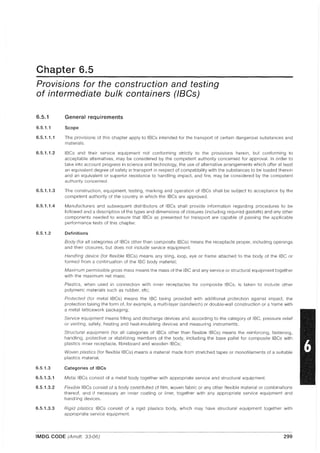
DANGEROUS GOODS CODE
Incorporating Amendment 33-06
INTERNATIONAL
MARITIME
ORGANIZATION
London, 2006
Published in 2006
by the INTERNATIONAL MARITIME ORGANIZATION
4 Albert Embankment, London SE1 7SR
Printed in the United Kingdom by Polestar Wheatons Ltd, Exeter
2 4 6 8 10 9 7 5 3
ISBN-13: 978-92-801-4214-3
ISBN-10: 92-801-4214-3
IMO PUBLICATION
Sales number: IF200E
Copyright (i~ International Maritime Organization 2006
All rights reserveel.
No part of this publication may be reproduced,
stored in a retrieval system or transmitted in any form
or by any means without prior permission in writing
from the International Maritime Organization.
Foreword
The International Convention for the Safety of Life at Sea, 1974 (SOlAS), as amended, deals with various aspects of
maritime safety and contains in part A of chapter VII the mandatory provisions governing the carriage of dangerous goods in
packaged form or in solid form in bulk. Regulation VII/1.3 prohibits the carriage of dangerous goods except in accordance
with the provisions of part A of chapter VII, which are amplified by the International Maritime Dangerous Goods (IMDG)
Code.
Regulation 11-2/19 of the SOlAS Convention, as amended, specifies the special requirements for a ship intended to carry
dangerous goods, the keel of which was laid or which was at a similar stage of construction on or after 1 July 2002.
The International Convention for the Prevention of Pollution from Ships, 1973, as modified by the Protocol of 1978 relating
thereto (MAR POL 73/78), deals with various aspects of prevention of marine pollution, and contains in its Annex III the
mandatory provisions for the prevention of pollution by harmful substances carried by sea in packaged form. Regulation 1(2)
prohibits the carriage of harmful substances in ships except in accordance with the provisions of Annex III, which are also
amplified by the IMDG Code.
In accordance with the Provisions concerning Reports on Incidents Involving Harmful Substances (Protocol I to MAR POL
73/78), incidents involving losses of such substances from ships must be reported by the master or otiler person having
charge of the ship concerned. Each substance defined as harmful to the marine environment is identified as a marine
pollutant or a severe marine pollutant in column 4 of its entry in the Dangerous Goods List and in the Index of the IMDG
Code by the letters I' or 1'1'. Substances which may be considered harmful to the marine environment only if they contain
certain quantities of marine pollutants or severe marine pollutants are identified by the symbol. in the Dangerous Goods
List and in the Index.
The IMDG Code that was adopted by resolution A.716(17) and amended by Amendments 27 to 30 was recommended to
Governments for adoption or for use as the basis for national regulations in pursuance of their obligations under regulation
VII/1.4 of the 1974 SOlAS Convention, as amended, and regulation 1(3) of Annex III of MAR POL 73/78. The IMDG Code, as
amended, attained mandatory status from 1 January 2004 under the umbrella of SOlAS, 1974; however, some parts of the
Code continue to be recommendatory. Observance of the Code harmonizes the practices and procedures followed in the
carriage of dangerous goods by sea and ensures compliance with the mandatory provisions of the SOlAS Convention and
of Annex III of MAR POL 73/78
The Code, which sets out in detail the requirements applicable to each individual substance, material or article, has
undergone many changes, both in layout and content, in order to keep pace with the expansion and progress of industry.
IMO's Maritime Safety Committee (MSC) is authorized by the Organization's Assembly to adopt amendments to the Code,
thus enabling IMO to respond promptly to developments in transport.
The MSC at its eighty-first session agreed that, in order to faCilitate the multimodal transport of dangerous goods, the
provisions of the IMDG Code, 2006, may be applied from 1 January 2007 on a voluntary basis, pending their official entry
into force on 1 January 2008 without any transitional period. This is described in resolution MSC.205(81) and the Preamble
to this Code. It needs to be emphasized that, in the context of the language of the Code, the words "shall", "should" and
"may", when used in the Code, mean that the relevant provisions are "mandatory", "recommendatory" and "optional",
respectively.
The IMDG Code is also available as a fully searchable database on CD-ROM (including the items within its Supplement).
Intranet and Internet (subscription) versions are also available. For more information, please visit the IMO Publishing Service
website at www.imo.org to see a live demonstration of the CD-ROM version and obtain details of how online subscription to
the IMDG Code will work. If and when required, the IMO website will also include any files that show errata or corrigenda to
this edition of the IMDG Code.
IMDG CODE (Amdt. 33-06) iii
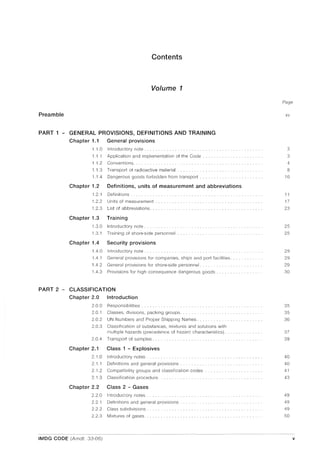
Contents
Volume 1
Preamble
PART 1 - GENERAL PROVISIONS, DEFINITIONS AND TRAINING
Chapter 1.1 General provisions
1.1.0 Introductory note ..
1.1.1 Application and implementation of the Code.
1.1.2 Conventions.
1.1.3 Transport of radioactive material
1.1.4 Dangerous goods forbidden from transport
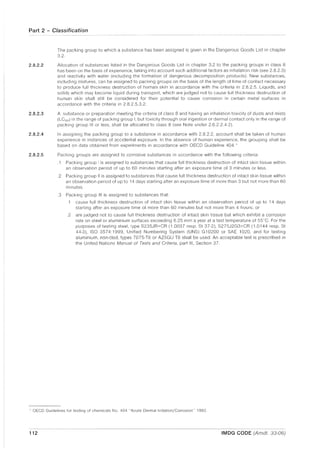
Chapter 1.2 Definitions, units of measurement and abbreviations
1.2.1 Definitions.
1.2.2 Units of measurement
1.2.3 List of abbreviations ..
Chapter 1.3 Training
1.3.0 Introductory note ..
1.3.1 Training of shore-side personnel
Chapter 1.4 Security provisions
1.4.0
1.4.1
1.4.2
1.4.3
Introductory note ......... .
General provisions for companies, ships and port facilities.
General provisions for shore-side personnel ..
Provisions for high consequence dangerous goods.
PART 2 - CLASSIFICATION
Chapter 2.0 Introduction
2.0.0 Responsibilities.
2.0.1
2.0.2
Classes, divisions, packing groups.
UN Numbers and Proper Shipping Names ......... .
2.0.3 Classification of substances, mixtures and solutions with
multiple hazards (precedence of hazard characteristics).
2.0.4 Transport of samples ...
Chapter 2.1
2.1.0
2.1.1
Class 1 - Explosives
Introductory notes.
Definitions and general provisions ........ .
2.1.2 Compatibility groups and classification codes
2.1.3 Classification procedure.
Chapter 2.2 Class 2 - Gases
2.2.0
2.2.1
2.2.2
2.2.3
Introductory notes.
Definitions and general provisions.
Class subdivisions.
Mixtures of gases.
-_.... __.....__......................... ....... ...... ..... - -----_..__._.._--------_..._.__._.
IMDG CODE (Amdt. 33-06)
Page
xv
3
3
4
8
10
11
17
23
25
25
29
29
29
30
35
35
36
37
39
40
40
41
43
49
49
49
50
v
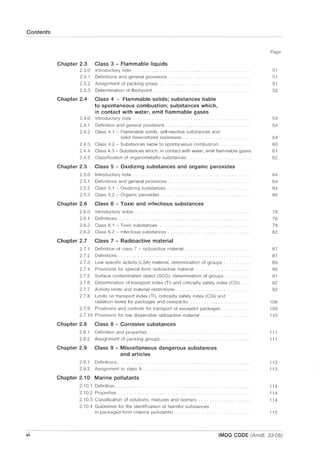
Contents
vi
Chapter 2.3 Class 3 - Flammable liquids
2.3.0 Introductory note.
2.3.1 Definitions and general provisions ..
2.3.2 Assignment of packing group ............... .
2.3.3 Determination of flash point
Chapter 2.4 Class 4 - Flammable solids; substances liable
to spontaneous combustion; substances which,
in contact with water, emit flammable gases
2.4.0 Introductory note ............................. .
Page
51
51
51
52
54
2.4.1 Definition and general provisions. . . . . . . 54
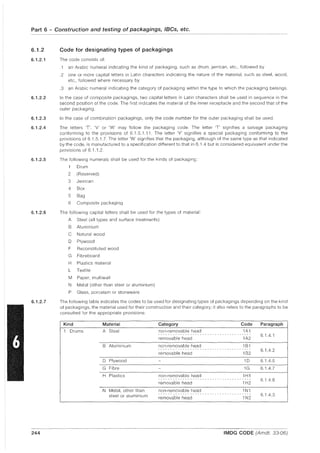
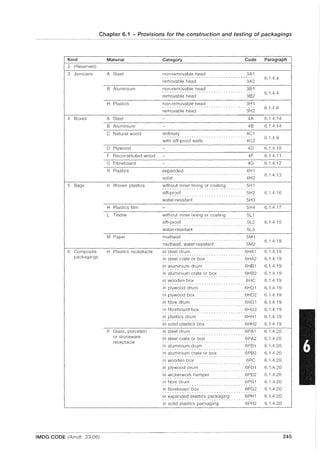
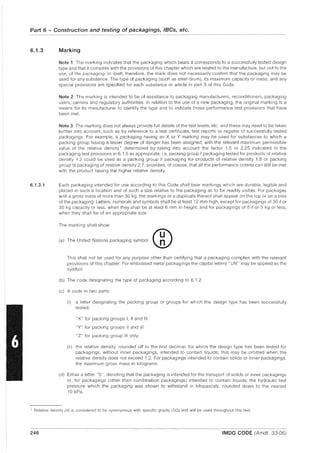
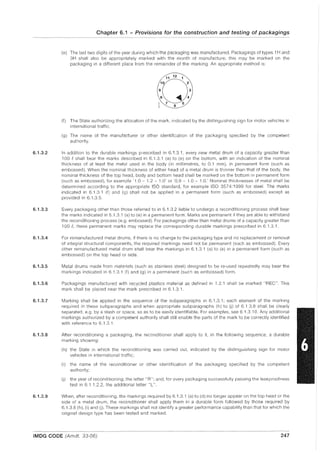
2.4.2 Class 4.1 - Flammable solids, self-reactive substances and
solid desensitized explosives. . . . 54
2.4.3 Class 4.2 - Substances liable to spontaneous combustion. 60
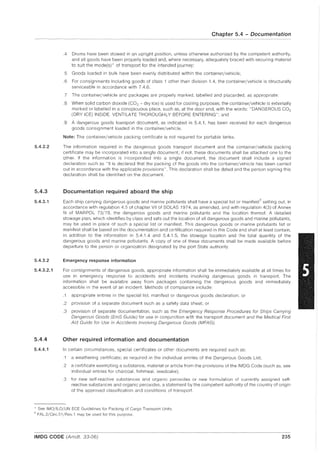
2.4.4 Class 4.3 - Substances which, in contact with water, emit flammable gases 61
2.4.5 Classification of organometallic substances. 62
Chapter 2.5 Class 5 - Oxidizing substances and organic peroxides
2.5.0
2.5.1
2.5.2
2.5.3
Introductory note .......................... .
Definitions and general provisions.
Class 5.1 - Oxidizing substances.............. .
Class 5.2 - Organic peroxides.
Chapter 2.6 Class 6 - Toxic and infectious substances
2.6.0 Introductory notes ......................................... .
2.6.1 Definitions.
2.6.2 Class 6.1 - Toxic substances..................... .
2.6.3 Class 6.2 - Infectious substances
Chapter 2.7 Class 7 - Radioactive material
2.7.1
2.7.2
2.7.3
2.7.4
2.7.5
2.7.6
2.7.7
2.7.8
2.7.9
Definition of class 7 - radioactive material ................ .
Definitions ............................. .
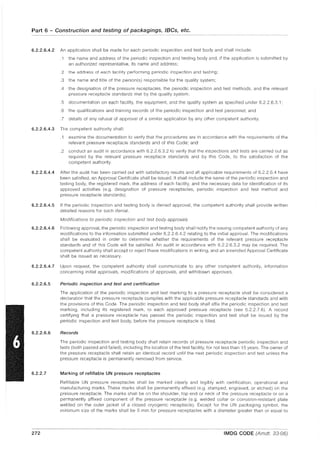
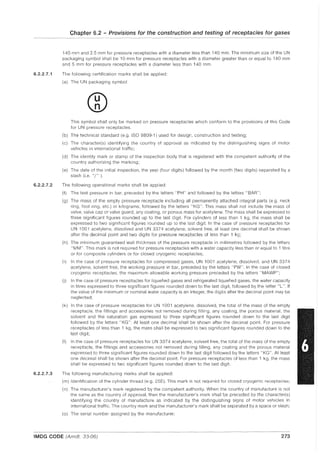
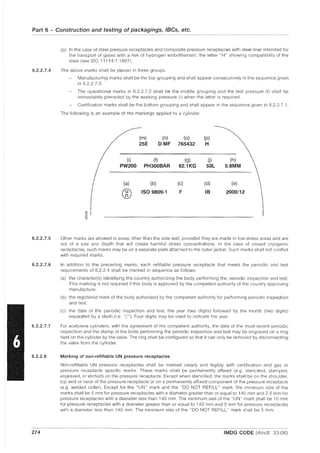
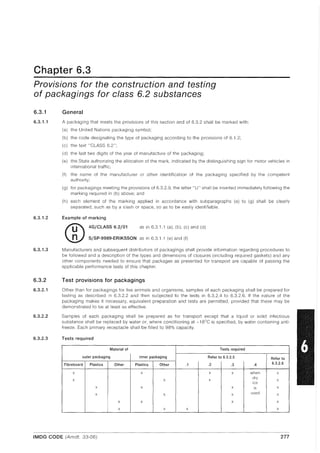
Low specific activity (LSA) material, determination of groups.
Provisions for special form radioactive material ................. .
Surface contaminated object (SCO), determination of groups.
Determination of transport index (TI) and criticality safety index (CSI) .
Activity limits and material restrictions ................. .
Limits on transport index (TI), criticality safety index (CSI) and
radiation levels for packages and overpacks
Provisions and controls for transport of excepted packages.
2.7.10 Provisions for low dispersible radioactive material
Chapter 2.8 Class 8 - Corrosive substances
2.8.1
2.8.2
Definition and properties.
Assignment of packing groups.......... .
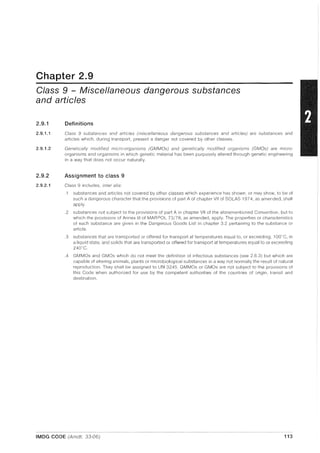
Chapter 2.9 Class 9 - Miscellaneous dangerous substances
and articles
2.9.1 Definitions.
2.9.2 Assignment to class 9 ........................... .
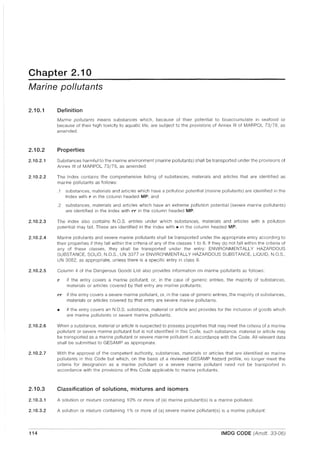
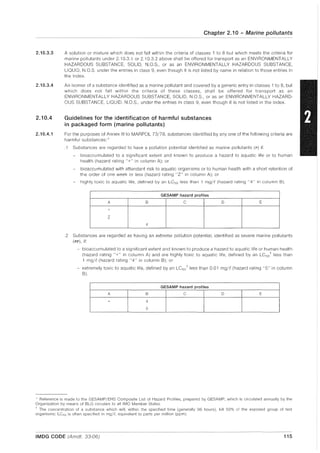
Chapter 2.10 Marine pollutants
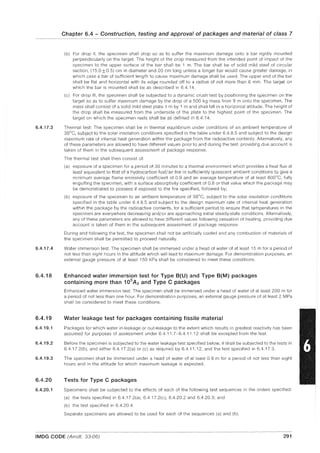
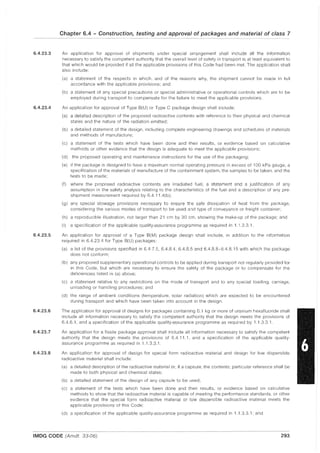
2.10.1 Definition.
2.10.2 Properties
2.10.3 Classification of solutions, mixtures and isomers ..
2.10.4 Guidelines for the identification of harmful substances
in packaged form (marine pollutants) ...
64
64
64
66
78
78
78
82
87
87
89
90
91
92
92
108
109
110
111
111
113
113
114
114
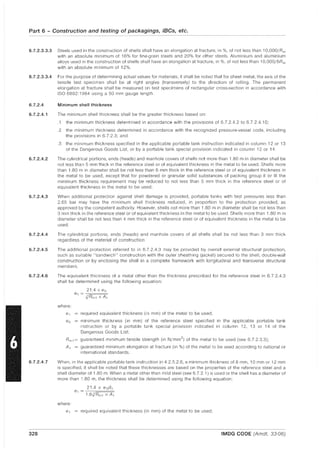
114
115
IMDG CODE (Amdt. 33-06)
PART 3 - DANGEROUS GOODS LIST AND LIMITED QUANTITIES EXCEPTIONS
See Volume 2
PART 4 - PACKING AND TANK PROVISIONS
Chapter 4.1
4.1.0
4.1.1
4.1.2
4.1.3
4.1.4
Use of packagings, including intermediate bulk
containers (IBCs) and large packagings
Definitions.
General provisions for the packing of dangerous goods,
in packagings, including IBCs and large packagings .
Additional general provisions for the use of IBCs ....
General provisions concerning packing instructions ........... .
List of packing instructions ..
Packing instructions concerning the use of packagings
(except IBCs and large packagings) ..
Packing instructions concerning the use of IBCs
Packing instructions concerning the use of large packagings
4.1.5 Special packing provisions for goods of class 1.
4.1.6 Special packing provisions for dangerous goods of class 2 ..
4.1.7 Special packing provisions for organic peroxides (class 5.2)
and self-reactive substances of class 4.1
4.1.8 Special packing provisions for infectious substances (class 6.2).
4.1.9 Special packing provisions for class 7 .
Chapter 4.2 Use of portable tanks and multiple-element
gas containers (MEGCs)
4.2.0 Transitional provision.
4.2.1 General provisions for the use of portable tanks for the transport
of substances of class 1 and classes 3 to 9.
4.2.2 General provisions for the use of portable tanks for the transport
of non-refrigerated liquefied gases.
4.2.3 General provisions for the use of portable tanks for the transport
of refrigerated liquefied gases of class 2
4.2.4 General provisions for the use of multiple-element
gas containers (MEGCs)
4.2.5 Portable tank instructions and special provisions.
Portable tank instructions
Portable tank special provisions . ........ .
4.2.6 Additional provisions for the use of road tank vehicles.
Chapter 4.3 Use of bulk containers
4.3.1
4.3.2
General provisions.
Additional provisions applicable to bulk goods of classes 4.2, 4.3, 5.1, 6.2,
7 and 8 ...
PART 5 - CONSIGNMENT PROCEDURES
Chapter 5.1
5.1.1
5.1.2
5.1.3
5.1.4
General provisions
Application and general provisions.
Use of overpacks and unit loads.
Empty uncleaned packagings or units ............ .
Mixed packing.
5.1.5 General provisions for class 7 .............. .
5.1.6 Packages packed into a cargo transport unit.
IMDG CODE (Amdt. 33-06)
Contents
Page
121
121
124
125
128
128
175
179
181
183
184
186
186
188
188
192
193
194
195
197
204
206
207
208
213
213
213
214
214
216
vii
Contents
Chapter 5.2 Marking and labelling of packages including IBCs
5.2.1
5.2.2
Marking of packages including IBCs .
Labelling of packages including IBCs.
Chapter 5.3 Placarding and marking of cargo transport units
5.3.1 Placarding.
5.3.2 Marking of cargo transport units
Chapter 5.4 Documentation
5.4.1 Dangerous goods transport documentation
5.4.2 Container/vehicle packing certificate.
5.4.3 Documentation required aboard the ship ..
5.4.4 Other required information and documentation
5.4.5 Multimodal Dangerous Goods Form.
PART 6 - CONSTRUCTION AND TESTING OF PACKAGINGS, INTERMEDIATE BULK
CONTAINERS (IBCs), LARGE PACKAGINGS, PORTABLE TANKS,
MULTIPLE-ELEMENT GAS CONTAINERS (MEGCs) AND
ROAD TANK VEHICLES
Chapter 6.1 Provisions for the construction and testing of packagings
(other than for class 6.2 substances)
6.1.1 Applicability and general provisions ...... . . . . . . .
6.1.2 Code for designating types of packagings ..
6.1.3 Marking.
6.1.4 Provisions for packagings
6.1.5 Test provisions for packagings.
Chapter 6.2 Provisions for the construction and testing of pressure
receptacles, aerosol dispensers and small receptacles
containing gas (gas cartridges)
6.2.1
6.2.2
6.2.3
General provisions ...................... .
Provisions for UN pressure receptacles ...... .
Provisions for non-UN pressure receptacles ....... .
6.2.4 Provisions for aerosol dispensers and small receptacles
containing gas (gas cartridges) ........................ .
Chapter 6.3 Provisions for the construction and testing
of packagings for class 6.2 substances
6.3.1
6.3.2
6.3.3
General ............................................... .
Test provisions for packagings........... .
Test report.
Chapter 6.4 Provisions for the construction, testing and approval
of packages and material of class 7
6.4.1 [reserved]
6.4.2 General provisions .............. .
6.4.3 Additional provisions for packages transported by air.
6.4.4 Provisions for excepted packages .
6.4.5 Provisions for industrial packages ...... .
6.4.6 Provisions for packages containing uranium hexafluoride.
6.4.7 Provisions for Type A packages.
6.4.8 Provisions for Type B(U) packages.
Page
217
219
226
227
230
234
235
235
236
243
244
246
248
256
262
265
275
275
277
277
279
281
281
282
282
282
283
283
284
viii IMDG CODE (Amdt. 33-06)
6.4.9 Provisions for Type B(M) packages
6.4.10 Provisions for Type C packages .....
6.4.11 Provisions for packages containing fissile material.
6.4.12 Test procedures and demonstration of compliance
6.4.13 Testing the integrity of the containment system and shielding
and evaluating criticality safety.
6.4.14 Target for drop tests
6.4.15 Test for demonstrating ability to withstand normal conditions
of transport .............. .
6.4.16 Additional tests for Type A packages designed for liquids
and gases.
6.4.17 Tests for demonstrating ability to withstand accident conditions
of transport ...
6.4.18 Enhanced water immersion test for Type B(U) and Type B(M)
packages containing more than 105
A2 and Type C packages
6.4.19 Water leakage test for packages containing fissile material ..
6.4.20 Tests for Type C packages
6.4.21 Tests for packagings designed to contain uranium hexafluoride.
6.4.22 Approvals of package designs and materials ......... .
6.4.23 Applications for approval and approvals for radioactive material
transport.
6.4.24 Transitional measures for class 7.
Chapter 6.5 Provisions for the construction and testing of intermediate
bulk containers (IBCs)
6.5.1 General requirements.
6.5.2 Marking.
6.5.3 Construction requirements.
6.5.4 Testing, certification and inspection.
6.5.5 Specific provisions for IBCs ..
6.5.6 Test provisions for IBCs ............ .
Chapter 6.6 Provisions for the construction and testing of large packagings
6.6.1 General.
6.6.2 Code for designating types of large packagings.
6.6.3 Marking.
6.6.4 Specific provisions for large packagings
6.6.5 Test provisions for large packagings
Chapter 6.7 Provisions for the design, construction, inspection
and testing of portable tanks and multiple-element
gas containers (MEGCs)
6.7.1 Application and general provisions
6.7.2 Provisions for the design, construction, inspection and testin9
of portable tanks intended for the transport of substances
of class 1 and classes 3 to 9 .
6.7.3 Provisions for the design, construction, inspection and testing
of portable tanks intended for the transport of non-refrigerated
liquefied gases of class 2.
6.7.4 Provisions for the design, construction, inspection and testing
of portable tanks intended for the transport of refrigerated
liquefied gases of class 2.
6.7.5 Provisions for the design, construction, inspection and testing
of multiple-element gas containers (MEGCs) intended
for the transport of non-refrigerated gases.
IMDG CODE (Amdt. 33-06)
Contents
Page
286
286
286
288
289
289
289
290
290
291
291
291
292
292
292
298
299
301
303
303
305
310
317
317
317
318
320
324
324
337
347
356
ix
Contents
Chapter 6.8 Provisions for road tank vehicles
6.8.1
6.8.2
6.8.3
General
Road tank vehicles for long international voyages for substances
of classes 3 to 9 ............ .
Road tank vehicles for short international voyages ......... .
Chapter 6.9 Provisions for the design, construction, inspection
and testing of bulk containers
6.9.1
6.9.2
Definitions.
Application and general provisions ....................... .
6.9.3 Provisions for the design, construction, inspection and testing
of freight containers used as bulk containers.
6.9.4 Provisions for the design, construction and approval of bulk containers
other than freight containers .......................... .
PART 7 - PROVISIONS CONCERNING TRANSPORT OPERATIONS
Chapter 7.1 Stowage
7.1.1 General provisions.
7.1.2 Stowage in relation to living quarters.
7.1.3 Stowage in relation to undeveloped films and plates, and mailbags.
7.1.4
7.1.5
7.1.6
7.1.7
7.1.8
7.1.9
Stowage of marine pollutants ...
Stowage in relation to foodstuffs
Stowage of solutions and mixtures ............................. .
Stowage and handling of goods of class 1.
Stowage of goods of class 2
Stowage of goods of class 3 ....
7.1.10 Stowage of goods of classes 4.1, 4.2 and 4.3
7.1.11 Stowage of goods of class 5.1 .......... .
7.1.12 Stowage of goods of class 5.2.
7.1.13 Stowage of goods of class 6.1 ............. .
7.1.14 Stowage of goods of class 7 .
7.1.15 Stowage of goods of class 8 .
7.1.16 Stowage of goods of class 9 .
Chapter 7.2 Segregation
7.2.1 General ..
7.2.2 Segregation of packages.
7.2.3 Segregation of cargo transport units on board container ships.
Illustrations of segregation of cargo transport units on board
container ships. . ........................ .
Illustrations of segregation of cargo transport units on board
hatchless container ships.
7.2.4 Segregation of cargo transport units on board roll-on/roll-off ships ..
Illustrations of segregation of cargo transport units on board
ro-ro ships. . . . . . . . . .................. .
7.2.5 Segregation in shipborne barges and on board barge-carrying ships ..
7.2.6 Segregation between bulk materials possessing chemical hazards
and dangerous goods in packaged form ......... .
7.2.7 Segregation of goods of class 1.......... .
7.2.8 Segregation provisions for goods of class 4.1 and class 5.2.
7.2.9 Segregation for 900ds of class 7 ...
Page
362
362
362
366
366
366
367
371
372
373
373
373
373
373
378
379
379
381
381
382
382
384
385
388
391
393
394
402
416
416
423
423
425
427
427
x IMDG CODE (Amdt. 33-06)
Contents
Page
Chapter 7.3 Special provisions in the event of an incident and
fire precautions involving dangerous goods
7.3.1 General ..
7.3.2 General provisions in the event of incidents.
7.3.3 Special provisions for incidents involving infectious substances.
7.3.4 Special provisions for incidents involving radioactive material ..
7.3.5 General fire precautions.
7.3.6 Special fire precautions for class 1.
7.3.7 Special fire precautions for class 2.
7.3.S Special fire precautions for class 3.
7.3.9 Special fire precautions and fire fighting for class 7 .
Chapter 7.4 Transport of cargo transport units on board ships
7.4.1 Applicability.
7.4.2 General provisions for cargo transport units.
7.4.3 Fumigated units ...................... .
7.4.4 Stowage of cargo transport units in cargo spaces other than
ro-ro cargo spaces.
7.4.5 Stowage of cargo transport units in ro-ro cargo spaces.
7.4.6 Transport of dangerous goods of class 1 in cargo transport units
Chapter 7.5 Packing of cargo transport units
7.5.1
7.5.2
7.5.3
General provisions for cargo transport units ..
Packing of cargo transport units
Empty cargo transport units ..
Chapter 7.6 Transport of dangerous goods in shipborne barges
on barge-carrying ships
7.6.1
7.6.2
Applicability .......... .
Definitions.
7.6.3 Permitted shipments
7.6.4
7.6.5
7.6.6
7.6.7
7.6.S
Barge loading ......... .
Stowage of shipborne barges.................... .
Ventilation and condensation.
Fire protection.
Transport of goods of class 1 in shipborne barges................. .
Chapter 7.7 Temperature control provisions
432
432
432
433
433
434
434
434
434
435
435
436
436
436
438
439
439
439
440
440
440
441
441
441
441
442
7.7.1 Preamble. 443
7.7.2 General provisions .. 443
7.7.3 Methods of temperature control. 444
7.7.4 Special provisions for self-reactive substances (class 4.1)
and organic peroxides (class 5.2). . . . . . . . . . . . . . . . . . . . . . . . . . . 445
7.7.5 Special provisions applicable to the transport of substances
stabilized by temperature control (other than self-reactive substances
and organic peroxides) . . . . . . . . . . . . . . . . . . . . . . . . . . . . . 445
7.7.6 Special provisions for flammable gases or liquids having a flashpoint below
23°C c.c. transported under temperature control. 446
7.7.7 Special provisions for vehicles transported on ships. 446
7.7.S Approval 446
Chapter 7.8 Transport of wastes
7.S.1 Preamble ............................. .
7.8.2 Applicability.
7.8.3 Transboundary movements under the Basel Convention
7.S.4 Classification of wastes ...... .
IMDG CODE (Amdt. 33-06)
447
447
447
447
xi
Contents
xii
Page
Chapter 7.9 Exemptions, approvals and certificates
7,9,1
7,9,2
7,9,3
Exemptions, , , , , , , , , , , , , , , , 449
Approvals (including permits, authorizations or agreements)
and certificates 449
Contact information for the main designated national competent authorities 449
IMDG CODE (Amdt. 33-06)
Contents
Volume 2
PART 3 - DANGEROUS GOODS LIST AND LIMITED QUANTITIES EXCEPTIONS
APPENDIX A
APPENDIX B
INDEX
IMDG CODE (Amdt. 33-06) xiii
Preamble
Carriage of dangerous goods by sea is regulated in order reasonably to prevent injury to persons or damage to
ships and their cargoes. Carriage of marine pollutants is primarily regulated to prevent harm to the marine
environment. The objective of the IMDG Code is to enhance the safe carriage of dangerous goods while facilitating
the free unrestricted movement of such goods.
2 Over the years, many maritime countries have taken measures to regulate the transport of dangerous goods by
sea. The various regulations, codes and practices, however, differed in their framework and, in particular, in the
identification and labelling of such goods. Both the terminology used and the provisions for packaging and
stowage varied from country to country and created difficulties for all directly or indirectly concerned with the
transport of dangerous goods by sea.
3 The need for international regulation of the transport of dangerous goods by sea was recognized by the 1929
International Conference on Safety of Life at Sea (SOlAS), which recommended that rules on the subject shall
have international effect. The classification of dangerous goods and certain general provisions concerning their
transport in ships were adopted by the 1948 SOlAS Conference. This Conference also recommended further
study with the object of developing international regulations.
4 Meanwhile, the Economic and Social Council of the United Nations had appointed an ad hoc Committee of Experts
on the Transport of Dangerous Goods (UN Committee of Experts), which had been actively considering the
international aspect of the transport of dangerous goods by all modes of transport. This committee completed a
report in 1956 dealing with classification, listing and labelling of dangerous goods and with the transport
documents required for such goods. This report, with subsequent modifications, offered a general framework to
which existing regulations could be harmonized and within which they could be further developed. The primary
goal being world-wide uniformity for regulations concerning the transport of dangerous goods by sea as well as
other modes of transport.
5 As a further step towards meeting the need for international rules governing the transport of dangerous goods in
ships, the 1960 SOlAS Conference, in addition to laying down a general framework of provisions in chapter VII of
the SOlAS Convention, invited IMO (Recommendation 56) to undertake a study with a view to establishing a
unified international code for the transport of dangerous goods by sea. This study would be pursued in co-
operation with the UN Committee of Experts and should take account of existing maritime practices and
procedures. The Conference further recommended that the unified code be prepared by IMO and that it be
adopted by the Governments that were Parties to the 1960 Convention.
6 To implement Recommendation 56, IMO's Maritime Safety Committee (MSC) appointed a working group drawn
from those countries having considerable experience in the transport of dangerous goods by sea. Preliminary
drafts for each class of substances, materials and articles were subsequently brought under close scrutiny by the
working group to take into account throughout the practices and procedures of a number of maritime countries in
order to make the Code as widely acceptable as possible. ThiS new International Maritime Dangerous Goods
(IMDG) Code was approved by the MSC and recommended to Governments by the Assembly of IMO in 1965.
7 During another SOlAS Conference held in 1974, chapter VII of the Convention remained essentially unchanged.
Since that date, revisions and amendments to chapter VII adopted by the MSC entered into force in 1986, 1992,
1994, 1996, 2001, 2003,2004 and 2006. Although invoked by a footnote reference in regulation 1 of chapter VII,
the IMDG Code itself had only recommendatory status until 31 December 2003.
8 All the substances, material and articles set out by class in a series of individual schedules and all the supporting
recommendations prepared by the UN Committee of Experts were regularly reviewed by the MSC and its
subsidiary bodies for inclusion in the IMDG Code with necessary modifications for the sea mode. The questions of
excluding goods not in fact transported by sea, of including further goods, or of transferring goods between
classes, as necessary, of prescribing suitable packagings, of marking, labelling and placarding, of documentation
and of transport in portable tanks have been dealt with in continuous consultation with the UN Committee of
Experts.
9 At the International Conference on Manne Pollution, 1973, the need was recognized to preserve the marine
environment. It was further recognized that negligent or accidental release of marine pollutants transported by sea
in packaged form should be minimized. Consequently, provisions were established and adopted by the
Conference, and are contained in Annex III of the International Convention for the Prevention of Pollution from
Ships, 1973, as modified by the Protocol of 1978 relating thereto (MAR POL 73/78). The Marine Environment
Protection Committee (MEPC) decided in 1985 that Annex III should be implemented through the IMDG Code.
This decision was also endorsed by the MSC in 1985. Amendments agreed by the MEPC and MSC to Annex III to
MAR POL 73/78 entered into force in 1994, 1996 and 2002.
IMDG CODE (Amdt. 33-06) xv
Preamble
10 The UN Committee of Experts has continued to meet until the present day and its published "Recommendations
on the Transport of Dangerous Goods" ("Orange Book") are updated biennially. In 1996, the MSC agreed that the
IMDG Code should be reformatted consistent with the format of the UN Recommendations on the Transport of
Dangerous Goods. The consistency in format of the UN Recommendations, the IMDG Code and other dangerous
goods transport regulations is intended to enhance user-friendliness, compliance with the regulations, and the safe
transport of dangerous goods.
11 The reformatted IMDG Code lays down basic principles. Detailed provisions for individual substances, material and
articles and for good practice are included in a "Dangerous Goods List". This list shall be consulted when
attempting to locate relevant transport information for any substance, material or article.
12 At its seventy-fiftll session in May 2002, the MSC confirmed its earlier decision to make the IMDG Code mandatory
with the Issue of Amendment 31. This second revision in reformatted style entered into force from 1 January 2004
and became mandatory without any transitional period. However, Governments could apply that Amendment in
whole or in part on a voluntary basis from 1 January 2003. Accordingly, the MSC adopted resolution MSC.123(75)
with the appropriate amendments to chapters VI and VII of SOlAS 74, as amended, denoting the changed status
of the IMDG Code.
12bis At its seventy-eighth session in May 2004, the MSC adopted Amendment 32 to the mandatory IMDG Code which
entered into force from 1 January 2006 without any transitional period. However, in accordance with resolution
MSC.157(78), Governments were encouraged to apply this Amendment in whole or in part on a voluntary basis
from 1 January 2005.
12tris At its eighty-first session in May 2006, the MSC adopted Amendment 33 to the mandatory IMDG Code which will
enter into force from 1 January 2008 without any transitional period. However, in accordance with resolution
MSC.205(81), Governments are encouraged to apply this Amendment in whole or part on a voluntary basis from 1
January 2007.
13 In order to keep the Code up to date from the maritime transport operational aspect, it will be necessary for the
MSC to continue to take into account technological developments, as well as changes to chemical classifications
and the related consignment provisions that primarily concern the shipper/consignor. The two-year periodicity of
amendments to the UN Recommendations on Transport of Dangerous Goods, which it is expected will continue,
will thus provide the source of most future updating of the IMDG Code, also on a two-year basis.
14 The MSC will also have regard to future implications for the carriage of dangerous goods by sea, in particular,
arising from any acceptance by the UN Conference on Environmental Development (UNCED) of common criteria
for the classification of chemicals for all human purposes on the basis of a Global Harmonization System (GHS).
15 Attention is drawn to IMO document FAl.6/Circ.14, a list of existing publications relevant to areas and topics
relating to ship/port interface matters.
16 Advice on emergency procedures and for initial management of chemical poisoning and diagnosis that may be
used in conjunction with the IMDG Code is published separately in "The EmS Guide: Emergency Response
Procedures for Ships Carrying Dangerous Goods" (see MSC/Circ.1025 and MSC/Circ.1 025/Add.1) and in the
"Medical First Aid Guide for Use in Accidents Involving Dangerous Goods" (see MSC/Circ.857 and DSC 3/15/
Add.2), respectively.
17 In addition, referring to Part D of chapter VII of the SOlAS Convention, a ship transporting INF cargo, as defined in
regulation VII/14.2, shall comply with the requirements of the International Code for the Safe Carriage of Packaged
Irradiated Nuclear Fuel, Plutonium and High-level Radioactive Wastes on board Ships (INF Code).
xvi IMDG CODE (Amdt. 33-06)
PART 1
GENERAL PROVISIONS,
DEFINITIONS AND TRAINING
Chapter 1.1
General provisions
1.1.0
1.1.1
1.1.1.1
1.1.1.2
1.1.1.3
1.1.1.4
1.1.1.5
Introductory note
It should be noted that other international and national modal regulations exist and that those regulations may
recognize all or part of the provisions of this Code. In addition, port authorities and other bodies and
organizations should recognize the Code and may use it as a basis for their storage and handling bye-laws
within loading and discharge areas.
Application and implementation of the Code
The provisions contained in this Code are applicable to all ships to which the International Convention for the
Safety of life at Sea, 1974 (SOlAS 74), as amended, applies and which are carrying dangerous goods as
defined in regulation 1 of part A of chapter VII of that Convention.
The provisions of regulation 11-2/19 of that Convention apply to passenger ships and to cargo ships con-
structed on or after 1 July 2002.
For:
.1 a passenger ship constructed on or after 1 September 1984 but before 1 July 2002; or
.2 a cargo ship of SOO gross tons or over constructed on or after 1 September 1984 but before 1 July 2002; or
.3 a cargo ship of less than SOO gross tons constructed on or after 1 February 1992 but before 1 July 2002,
the requirements of regulation 11-2/S4 of SOlAS, 1974, as amended by resolutions MSC.1(XlV), MSC.6(48),
MSC13(S7), MSC.22(S9), MSC.24(60), MSC.27(61), MSC.31(63) and MSG.S7(67), apply (see 11-2/1.2).
For cargo ships of less than 500 gross tons constructed on or after 1 September 1984 and before 1 February
1992, it is recommended that Contracting Governments extend such application to these cargo ships as far as
possible.
All ships, irrespective of type and size, carrying substances, material or articles identified in this Code as
marine pollutants are subject to the provisions of this Code.
In certain parts of this Code, a particular action is prescribed, but the responsibility for carrying out the action
is not specifically assigned to any particular person. Such responsibility may vary according to the laws and
customs of different countries and the international conventions into which these countries have entered. For
the purpose of this Code, it is not necessary to make this assignment, but only to identify the action itself. It
remains the prerogative of each Government to assign this responsibility.
Although this Code is legally treated as a mandatory instrument under chapter VII of SOlAS 74, as amended,
the following provisions of the Code remain recommendatory:
.1 chapter 1.3 (Training);
.2 chapter 1.4 (Security provisions) except 1.4.1.1, which will be mandatory;
.3 section 2.1.0 of chapter 2.1 (class 1 - explosives, Introductory notes);
.4 section 2.3.3 of chapter 2.3 (Determination of flashpoint);
.5 columns (1S) and (17) of the Dangerous Goods List in chapter 3.2;
.6 section 5.4.5 of chapter 5.4 (Multimodal Dangerous Goods Form), insofar as the layout of the form is
concerned;
.7 chapter 7.3 (Special provisions in the event of an incident and fire precautions involving dangerous goods
only);
.8 section 7.9.3 (Contact information of competent authorities); and
.9 appendix B.
IMDG CODE (Amdt. 33-06) 3
Part 1 - General provisions, definitions and training
1.1.2 Conventions
1.1.2.1 International Convention for the Safety of Life at Sea, 1974
I~cf;:r to:
Part A of chapter VII of the International Convention for the Safety of Life at Sea, 1974 (SOlAS 1974), as
amended, deals with the carriage of dangerous goods in packaged form, and is reproduced in full:
Regulation 1
D0flnitions
CHAPTER VII
Carriage of Dangerous Goods
Part A
Carria,~e of Dal1,<.;eraus Goods il1 Packaged Forni
For the purpose of this chapter, unless expressly provided otherwise:
l!vlDC Code mcans the International Maritime Dangerous Goods (IMDG) Code adopted by the
Maritime Safety COlllmittee of the Organization by resolution MSC.122(7S), as may be amended by
the Organization, provided that such amendments are adopted, brought into force and take effect in
accordance with the provisions of article VIII of the present Convention concerning the amendment
procedures applicable to the annex other than chapter I.
2 Dangerous gO(lds mean the substances, materi::ds and articles covered by the IMDG Code.
3 Packay,edjimn means the form of containment specified in the lMDG Code.
Regulation 2
Application *
1 Unless expressly provided otherwise, this part applies to the carriage of dangerous goods in
packaged form in all ships to which the present regulations apply and in cargo ships of less than SO(J
gross tonn;lge.
2 Tile provisions of this part do not apply to ships' stores and equipment.
3 The carriage of dangerous goods in packaged form is prohibited except in accordance with the
provisions of this ch:lpter.
4 To supplement the provisions of this part, each Contracting Covernment shall issue, or cause to
be issued, detailed instructions on emergency response and medical tlrst aid rclev:lnt to incidents in-
volving dangerous goods in packaged form, taking into :lccount the guidelines developed by the
Organization.·I·
Regulation 3
R..equirements j(n the carriac!?e (if dangerous ,goods
The carriage of dangerous goods in packaged form shall comply with the relevant provisions of the
IMDC Code.
Regulation 4
Documents
In all documents relating to the carriage ofdangerous goods in packaged form by sea, the Proper
Shipping Narne of the goods shall be used (trade names alone shall not be used) and the correct
description given in accordance with the classification set out in the IMDG Code.
.1 p:lrt J) which cont:lins spcci:ll rcquirellents for the carriage of INF clrgo; and
? regubtion 11-2/1 '! which contains speci:l! requirements fi)r ships carrying dangerous goods.
I"dcr to:
. I the r:'IICI:~l'IICy /<.esl1OlISt' Procedlll'es!<,,' Silips Carryinx DanxeYOlis Coods (lc'mS Gllide) (MSCjCirc. 11125, as :llllcnded); and
.2 the Medicol hl'si .'Iid Gllidc!,'l' Usc ill .~((ide/lls III/lo//liIlX Dangel'o"s Coods (iVlFAG) (MSC/Circ.H57),
published by the Org:lllization.
4 IMDG CODE (Amdt, 33-06)
1.1.2.2
1.1.2.2.1
Chapter 1.1 - General provisions
2 The transport doculllents prepared by the shipper shall include, or be accompanied by, a signed
certificate or a declaration that the consignment, as offered for carriage, is properly packaged, ll1arked,
labelled or placarded, as appropriate, and in proper condition for carriage.
3 The person(s) responsible for the packing/loading of dangerous goods in a cargo tLl1lSport unit*
shall provide a signed container/vehicle packing certificate stating that the cargo in the unit has been
properly packed and secured and that all applic:lble transport requirements have been met. Such a
certificate may be combined with the document referred to in paragraph 2.
4 Where there is due C:luse to suspect that a cargo transport unit in which dangerous goods are
packed is not in compliance with the requirements of paragraph 2 or 3, or where a container/vehicle
packing certificate is not available, the cargo transport unit shall not be accepted for carriage.
5 Each ship carrying dangerous goods in packaged form shall have a speci::d list or manifest setting
forth, in accordance with the cbssificatioll set out in the IMDG Code, the dangerous goods on board
and the location thereof. A detailed stowage plan, which identifies by class and sets out the location of
all dangerous goods on board, may be used in pbce of such a special list or manifest. A copy of one of
these documents shall be made available before departure to the person or organizJtion designated by
the port State authority.
Regulation 5
Ca~~o Securin,~ Manual
Cargo, cargo units'" and cargo transport units, shall be loaded, stowed and secured throughout the
voyage in accordance with the Cargo Securing Manual approved by the Administration. The Cargo
Securing Man~JJl shall be drawn up to a standard at least equivalent to the guidelines developed by the
Organization. +
Regulation 6
Reporting of incidents i1l1/Olvin,<? danJ.;erous goods
When an incident takes place involving the loss or likely loss overboard of dangerous goods in
packaged form into the sea, the master, or other person having charge of the ship, shall report the
particulars of such an incident without delay and to the fullest extent possible to the nearest coastal
State. The report shall be drawn up based on general principles and guidelines developed by the
OrganizationS
2 In the event of the ship referred to in paragraph 1 being abandoned, or in the event of a report
frol11 sllch ;] ship being incomplete or unobtainable, the cOl11p:my, as defined in regulation IX/1.2,
shall, to the fullest extent possible, aSSllme the obligations placed upon the I11Jster by this regulation.
International Convention for the Prevention of Pollution from Ships, 1973/78
Annex III of the International Convention for the Prevention of Pollution from Ships, 1973, as modified by the
Protocol of 1978 relating thereto (MAR POL 73/78), deals with the prevention of pollution by harmful
substances carried by sea in packaged form and is reproduced in full, as revised by the Marine Environment
Protection Committee.'
, Refer to the lnterJutiollal Maritil11e J)angerous Coods (IMJ)C) Code, adopted by the Organizatioll by resolution MSC.122(7S) ']S
amended.
, As defined in the Code of Safe Practice for Cargo Stowage and Securing (CSS Code), 'Idopted by the Orgallization by resolution
A.715(17), "s "lllcndcd.
; Refer to Cuidelines for the prepaLltioll of the Cargo Securing M'1I111,]1 (MSCjCire.745).
*R.cfcr to the C;cllcr~d principles f(n ship reporting systems ;Illd ship reporting rcquin.'lllcllts, illcludillg guidelines f()J- reporting incidellts
involving d'1I1gerous goods, harmful substances and/or Imrine pollutants, adopted by the Org'H1ization by resolution A.S:; 1(20) .
• The original text of Annex III entered into force on 1 July 1992. Since the original text prepared in 1973 was based on the corresponding
regulations of the International Convention for the Safety of Life at Sea (SOlAS), 1960, the MEPC agreed to revise and formally adopt a new
text, taking into account the SOlAS 1974 provisions and explicitly referring to the IMDG Code. The revised text of Annex III was adopted by
resolution MEPC.58(33) and entered into force on 28 February 1994.
IMDG CODE (Amdt. 33-06) 5
Part 1 - General provisions, definitions and training
Annex III
Regulations for the Prevention of Pollution by Harmful Substances
Carried by Sea in Packaged Form
Regulation 1
Application
Unless expressly provided otherwise, the regulations of this Annex apply to all ships carrying
harmful substances in packaged form.
1.1 For the purpose of this Annex, //(//"111/141 slfbstancfs are those substances which are identified as
marine pollutants ill the International Maritime Dangerous Goods (IMDG) Code. A
1.2 Guidelines for the identification of harmful substances in packaged form are given in the
appendix to this Annex.
1.3 For the purposes of this Annex, packagcd.fimn is defined as the forms ofcontainment specified for
harmful substances in the IMDG Code.
2 The transport of h;mnful substances is prohibited except in accordance with the provisions of
this Annex.
3 To supplernent the provisions of this Annex, the Govermnent of each Party to the Convention
shall issue, or cause to be issued, detailed requirements on packing, rnarking, labelling,
documentation, stowage, quantity limitations and exceptions for preventing or minimizing
pollution of the marine environment by harmful substances. *
4 For the purposes of this Annex, empty packagings which have been used previously for the
transport of harmful substances shall themselves be treated as harmful substances unless adequate
precautions have been taken to ensure that they contain no residue that is harmful to the marine
environl11ent.
5 The requirements of this Annex do not apply to ships' stores :l11d equipment.
Regulation 2
Packing
Packages shall be adequate to rninirnize the hazard to the lTlarine environmcnt, having regard to their
specific contents.
Regulation 3
Marking and labelling
Packages containing a harmful substance shall be durably m;lrked with the correct technical
narne (trade names alone shall not be used) and, further, shall be durably marked or labelled to
indicate that the substance is a marine pollutant. Such identification shall be supplemented where
possible by any other means, for example by the use of the relevant United Nations number.
2 The method of marking the correct technical name and affixing labels on packages containing a
harmful substance shall be such that this information will still be identifiable on packages
surviving at least three months' immersion in the sea. In considering suitable marking and
labelling, account shall be taken of the durability of the materials used and of the surtlce of the
package.
3 Packages conttlining small quantities of harmful substances may be excmpted from the marking
requIrements.
, I(efer to the InterIl:ltion:d M:lritillle i):lngerolls Coods (IMDC) Code, as :ldopted by resolution MSC.122(75), as alllClldcd.
I' I(eferellee is Illade to the specific exelllptions provided f(H in the International M:lririllle Dangerolls Coods (IM])C) Code.
6 IMDG CODE (Amdt. 33·06)
Regulation 4
Documentation*
Chapter 1.1 - General provisions
In all documents relating to the transport ofh3r111ful substances by sea where such substances are
named, the correct technical narne of each such substance shall be used (trade names alone shall
not be used) and the substance further identified by the addition of the words "MARINE
POLLUTANT".
2 The shipping documents supplied by the shipper shall include, or be accompanied by, a signed
certificate or declaration tint the shipment offered for transport is properly packaged and
marked, labelled or placarded as appropriate ;md in proper condition for transport to Illinimize
the hazard to the marine environment.
3 Each ship carrying harmful substances shall have a special list or rnanifest setting f()rth the
harmful substances on board and the location thereof. A detailed stowage plan which sets out the
location of the harmful substances on board may be used in place of such special list or manifest.
Copies of such documents shall also be retained on shore by the owner of the ship or his
representative until the harmful substances arc unloaded. A copy ofone of these docllments shall
be rnade available before departure to the person or organization designated by the Port State
authority.
4 When the ship c:1rries a special list or manifest or a detailed stowage plan, required for the
transport ofdangerous goods by the International Convention for the Safety of Life at Sea, 1<)74,
as amended, the documents required by this regulation may be combined with those for
dangerous goods. Where documents arc combined, a clear distinetion shall be made between
dangerous goods and harmful substances covered by this Annex.
Regulation 5
Stowage
Harmful substances shall be properly stowed and secured so as to minimize the hazards to the marine
environment without impairing the safety of the ship and persons on board.
Regulation 6
Quantity limitations
Certain harlllful substances n13Y, for sound scientific and technical reasons, need to be prohibited f()r
transport or be limited as to the quantity which may be carried aboard anyone ship. In limiting the
quantity, due consideration sh:11l be given to size, construction and equipment of the ship, as well as
the packaging and the inherent nature of the substances.
Regulation 7
Exceptions
Jettisoning of hannful substances carried in packaged form shall be prohibited except where
necessary for the purpose of securing the safety of the ship or saving life at sea.
2 Subject to the provisions of the present Convention, appropriate measures based on the physical,
chemical, and biological properties of harmful substances shall be taken to regulate the washing
ofleakages overboard, provided that compliance with such measures would not il11p:Jir the safety
of the ship and persons on board.
Regulation 8
Port State c(mtrol on operational requirementst
A ship when in a port of another Party is subject to inspection by officers duly authorized by
snch Party concerning operational reqnirements under this Annex, where there arc clear
grounds for believing that the master or crew arc not (1I11iliar with essential shipboard procedures
relating to the prevention of pollution by harmful substances.
, ReferellCC to docllilleli!s in this rcgulation docs not preclude the usc 01- electronic data proccssing (EI)I') :lllCl electronic dat;] interch:lngc
(EDI) tr:lllsmission techniqucs CIS an aid to p"per documentation.
,. Refer to the Procedures for port Statc control adopted by the Org3nizatioll by resolution A.787(1 ()), as ;ullendcci by resolution A)':-:2(21).
IMDG CODE (Amdt. 33-06) 7
Part 1 - General provisions, definitions and training
1.1.3
1.1.3.1
1.1.3.1.1
1.1.3.1.2
1.1.3.1.3
1.1.3.2
1.1.3.2.1
8
2 In the circuIllstances given in paragraph (1) of this regulation, the Party shall take steps as will
ensure that the ship shall not sail until the situation has been brought to order in accordance with
the requirements of this Annex.
3 Procedures relating to the port State control prescribed in article 5 of the present Convention
shall apply to this regulation.
4 Nothing in this regulation shall be construed to limit the rights and obligations of a Party
carrying out control over operational requirements specifically provided for in the present
Convention.
Unified interpretation of Annex III
Regulation 4.3 1.0 At any stopover, where any loading or unloading operations, even partial, arc
carried out, a revision of the documents listing the harmful substances taken on
board, indicating their location on board or showing a detailed stowage plan, shall
be made avaibble before departure to the person or org:mization designated by the
port State authority.
Transport of radioactive material
General
These provisions establish standards of safety which provide an acceptable level of control of the radiation,
criticality and thermal hazards to persons, property and the environment that are associated with the transport
of radioactive material. These provisions, which are based upon the International Atomic Energy Agency's
(IAEA's) Regulations for the Safe Transport of Radioactive Material, 1996 edition, (Re'iised) Safety Standards
Series No. TS-R-1 (ST-1, Revised) (ISBN 92-0-104996-X), establish requirements particularly for shipowners
and for those handling packages containing radioactive materials in ports and on board ships without
necessarily consulting IAEA regulations. However, the published IAEA regulations also include Schedules of
requirements for transport of specified types of radioactive material consignments, which are not included in
this Code. These schedules summarize the requirements of those regulations, but do not contain any
additional provisions. Schedules may be consulted for quick reference, but do not take precedence over the
provisions of TS-R-1 or of this Code.
The objective of these provisions is to protect persons, property and the environment from the effects of
radiation during the transport of radioactive material. This protection is achieved by requiring:
.1 containment of the radioactive contents;
.2 control of external radiation levels;
.3 prevention of criticality; and
.4 prevention of damage caused by heat.
These provisions are satisfied firstly by applying a graded approach to contents limits for packages and
conveyances and to performance standards applied to package designs depending upon the hazard of the
radioactive contents. Secondly, they are satisfied by imposing provisions on the design and operation of
packages and on the maintenance of packagings, including a consideration of the nature of the radioactive
contents. Finally, they are satisfied by requiring administrative controls, including, where appropriate, approval
by competent authorities.
This Code applies to the transport of radioactive material by sea, including transport which is incidental to the
use of the radioactive material. Transport comprises all operations and conditions associated with and
involved in the movement of radioactive material; these include the design, manufacture, maintenance and
repair of packaging, and the preparation, consigning, loading, transport including in-transit storage, unloading
and receipt at the final destination of loads of radioactive material and packages. Transport severity levels, in
applying a graded approach to the performance standards in this Code, shall be characterized by the general
severity levels:
.1 routine conditions of transport (incident-free);
.2 normal conditions of transport (minor mishaps);
.3 accident conditions of transport.
Radiation protection programme
The transport of radioactive material shall be subject to a radiation protection programme which shall consist
of systematic arrangements aimed at providing adequate consideration of radiation protection measures.
IMDG CODE (Amdt. 33-06)
1.1.3.2.2
1.1.3.2.3
1.1.3.2.4
1.1.3.2.5
1.1.3.2.6
1.1.3.3
1.1.3.3.1
1.1.3.3.2
1.1.3.4
1.1.3.4.1
1.1.3.4.2
Chapter 1.1 - General provisions
The nature and extent of the measures to be employed in the programme shall be related to the magnitude
and likelihood of radiation exposures. The programme shall incorporate the provisions of 1.1.3.2.3, 1.1.3.2.4,
1.1.3.2.5, 7.2.9.1, 7.2.9.2 and applicable emergency response procedures of 7.3.9. Programme documents
shall be available, on request, for inspection by the relevant competent authority.
Doses to persons shall be below the relevant dose limits. Protection and safety shall be optimized in order that
the magnitude of individual doses, the number of persons exposed, and the likelihood of incurring exposure
shall be kept as low as reasonably achievable, economic and social factors being taken into account, within
the restriction that the doses to individuals be subject to dose constraints. A structured and systematic
approach shall be adopted and shall include consideration of the interfaces between transport and other
activities.
Those involved in the transport shall receive appropriate training concerning radiation protection including the
precautions to be observed in order to restrictict their occupational exposure and the exposure of other
persons who might be affected by their actions.
For occupational exposures arising from transport activities, where it is assessed that the effective dose:
.1 is likely to be between 1 and 6 mSv in a year, a dose assessment programme via workplace monitoring or
individual monitoring shall be conducted;
.2 is likely to exceed 6 mSv in a year, individual monitoring shall be conducted.
When individual monitoring or workplace monitoring is conducted, appropriate records shall be kept.
The relevant competent authority shall arrange for periodic assessments of the radiation doses to persons due
to the transport of radioactive material, to ensure that the system of protection and safety complies with the
International Basic Safety Standards for Protection against Ionizing Radiation and for the Safety of Radiation
Sources, Safety Series No. 115, IAEA, Vienna (1996).
Quality assurance and compliance assurance
Quality assurance programmes based on international, national or other standards acceptable to the
competent authority shall be established and implemented for the design, manufacture, testing,
documentation, use, maintenance and inspection of all special form radioactive material, low dispersible
radioactive material and packages and for transport and in-transit storage operations to ensure compliance
with the relevant provisions of this Code. Certification that the design specification has been fully implemented
shall be available to the competent authority. The manufacturer, consignor or user shall be prepared to
provide facilities for competent authority inspection during manufacture and use and to demonstrate to any
cognizant competent authority that:
.1 the manufacturing methods and materials used are in accordance with the approved design
specifications; and
.2 all packagings are periodically inspected and, as necessary, repaired and maintained in good condition so
that they continue to comply with all relevant provisions and specifications, even after repeated use.
Where competent authority approval is required, such approval shall take into account and be contingent
upon the adequacy of the quality assurance programme.
The competent authority shall ensure compliance with this Code. Means to discharge this responsibility
include the establishment and execution of a compliance assurance programme for monitoring the design,
manufacture, testing, inspection and maintenance of packaging, the classification of dangerous goods and
the preparation, documentation, handling and stowage of packages by consignors and carriers, to provide
evidence that the provisions of this Code are being met in practice.
Special arrangement
SpeCial arrangement means those provisions, approved by the competent authority, under which consign-
ments of radioctive material which do not satisfy all the applicable provisions of this Code may be transported.
ConSignments for which conformity with any provision applicable to class 7 is impracticable shall not be
transported except under special arrangement. Provided the competent authority is satisfied that conformity
with the class 7 provisions of this Code is impracticable and that the requisite standards of safety established
by this Code have been demonstrated through alternative means, the competent authority may approve
special arrangement transport operations for single or a planned series of multiple consignments. The overall
level of safety in transport shall be at least equivalent to that which would be provided if all the applicable
provisions had been met. For consignments of this type, multilateral approval shall be required.
IMDG CODE (Amdt. 33-06) 9
Part 1 - General provisions, definitions and training
1.1.3.5
1.1.3.5.1
1.1.3.6
1.1.3.6.1
1.1.4
1.1.4.1
10
Radioactive material possessing other dangerous properties
In addition to the radioactive and fissile properties, any other subsidiary risk of the contents of a package, such
as explosiveness, flammability, pyrophoriclty, chemical toxicity and corrosiveness, shall also be taken into
account in the documentation, packing, labelling, marking, placarding, stowage, segregation and transport in
order to be in compliance with all relevant provisions for dangerous goods of this Code. Account shall be
taken of the formation of otller dangerous substances that may result from the reaction between the contents
of a consignment and the atmosphere or water in the event of breaking of the containment system caused by
an accident, such as uranium hexafluoride (UF6 ) decomposition in a humid atmosphere.
Non-compliance
In the event of non-compliance with any limit in this Code applicable to radiation level or contamination:
.1 the consignor shall be informed of the non-compliance by the carrier if the non-compliance IS identified
during transport; or by the consignee if the non-compliance is identified on receipt;
.2 the carrier, consignor or consignee, as appropriate shall:
(i) take immediate steps to mitigate the consequences of the non-compliance;
(ii) investigate the non-compliance and its causes, circumstances and consequences;
(iii) take appropriate action to remedy the causes and circumstances that led to the non-compliance
and to prevent a recurrence of similar circumstances that led to the non-compliance; and
(iv) communicate to the relevant competent authority(ies) the causes of the non-compliance and on
corrective or preventive actions taken or to be taken; and
.3 communication of the non-compliance to the consignor and relevant competent authority(ies),
respectively, shall be made as soon as practicable and shall be immediate whenever emergency
exposure has developed or is developing.
Dangerous goods forbidden from transport
Unless provided otherwise by this Code, the following are forbidden from transport:
Any substance or article which, as presented for transport, is liable to explode, dangerously react,
produce a flame or dangerous evolution of heat or dangerous emission of toxic, corrosive or flammable
gases or vapours under normal conditions of transport.
In chapter 3.3, special provision 900 lists certain substances, which are forbidden for transport.
IMDG CODE (Amdt. 33-06)
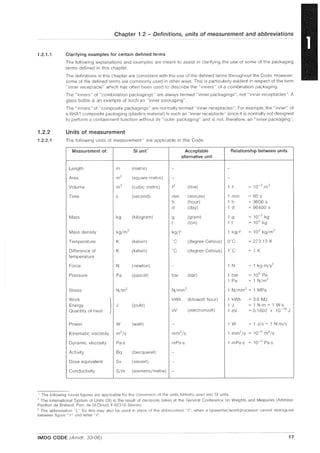
Chapter 1.2
Definitions, units of measurement and abbreviations
1.2.1 Definitions
The following is a list of definitions of general applicability that are used throughout this Code. Additional
definitions of a highly specific nature are presented in the relevant chapters.
For the purposes of this Code:
Aerosols or aerosol dispensers means non-refillable receptacles meeting the provisions of 6.2.4, made of
metal, glass or plastics and containing a gas compressed, liquefied or dissolved under pressure, with or
without a liquid, paste or powder, and fitted with a release device allowing the contents to be ejected as solid
or liquid particles in suspension in a gas, as a foam, paste or powder or in a liquid state or in a gaseous state.
Alternative arrangement means an approval granted by the competent authority for a portable tank or MEGC
that has been designed, constructed or tested to technical requirements or testing methods other than those
specified in this Code (see, for instance, 6.7.5.11.1).
Bags means flexible packagings made of paper, plastic film, textiles, woven material, or other suitable
materials.
Barge-carrying ship means a ship specially designed and equipped to transport shipborne barges.
Barge feeder vessel means a vessel specially designed and equipped to transport shipborne barges to or from
a barge-carrying ship.
Boxes means packagings with complete rectangular or polygonal faces, made of metal, wood, plywood,
reconstituted wood, fibreboard, plastics, or other suitable material. Small holes for purposes such as ease of
the handling or opening of the box or to meet classification provisions are permitted as long as they do not
compromise the integrity of the packaging during transport.
Bulk containers are containment systems (including any liner or coating) intended for the transport of solid
substances which are in direct contact with the containment system. Packagings, intermediate bulk
containers (IBCs), large packagings and portable tanks are not included.
Bulk containers:
- are of a permanent character and accordingly strong enough to be suitable for repeated use;
- are specially designed to facilitate the transport of goods by one or more means of transport without
intermediate reloading;
- are fitted with devices permitting ready handling; and
- have a capacity of not less than 1 cubic metre.
Examples of bulk containers are freight containers, offshore bulk containers, skips, bulk bins, swap bodies,
trough-shaped containers, roller containers, load compartments of vehicles.
Bundles of cylinders are assemblies of cylinders that are fastened together and which are interconnected by a
manifold and transported as a unit. The total water capacity shall not exceed 3000 litres except that bundles
intended for the transport of gases of class 2.3 shall be limited to 1000 litres water capacity.
Cargo transport unit means a road freight vehicle, a railway freight wagon, a freight container, a road tank
vehicle, a railway tank wagon or a portable tank.
Carrier means any person, organization or Government undertaking the transport of dangerous goods by any
means of transport. The term includes both carriers for hire or reward (known as common or contract carriers
in some countries) and carriers on own account (known as private carriers in some countries).
Cellular ship means a ship in which containers are loaded under deck into specially designed slots giving a
permanent stowage of the container during sea transport. Containers loaded on deck in such a ship are
specially stacked and secured on fittings.
Closed cargo transport unit, with the exception of class 1, means a unit which totally encloses the contents by
permanent structures. Cargo transport units with fabric sides or tops are not closed cargo transport units; for
definition of class 1 cargo transport unit see 7.1.7.1.1
IMDG CODE (Amdt. 33-06) 11
Part 1 - General provisions, definitions and training
12
Closed ro-ro cargo space means a ro-ro cargo space which is neither an open ro-ro cargo space nor a
weather deck.
Closure means a device which closes an opening in a receptacle.
Combination packagings means a combination of packagings for transport purposes, consisting of one or
more inner packagings secured in an outer packaging in accordance with 4.1.1.5.
Competent authority means any national regulatory body or authority designated or otherwise recognized as
such for any purpose in connection with this Code.
Compliance assurance means a systematic programme of measures applied by a competent authority which
is aimed at ensuring that the provisions of this Code concerning the transport of radioactive material are met in
practice; see paragraph 1.1.3.3.2,
Composite packagings means packagings consisting of an outer packaging and an inner receptacle so
constructed that the inner receptacle and the outer packaging form an integral packaging, Once assembled, it
remains thereafter an integrated single unit; it is filled, stored, transported and emptied as such.
Consignee means any person, organization or Government which is entitled to take delivery of a consignment.
Consignment means any package or packages, or load of dangerous goods, presented by a consignor for
transport.
Consignor means any person, organization or Government which prepares a consignment for transport.
Control temperature means the maximum temperature at which certain substances (such as organic
peroxides and self"reactive and related substances) can be safely transported during a prolonged period of
time.
Conveyance means:
.1 for transport by road or rail: any vehicle,
.2 for transport by water: any ship, or any cargo space or defined deck area of a ship,
.3 for transport by air: any aircraft.
Crates are outer packagings with incomplete surfaces.
Critical temperature is the temperature above which the substance cannot exist in the liquid state.
Cryogenic receptacles are transportable thermally insulated receptacles for refrigerated liquefied gases, of a
water capacity of not more than 1000 litres,
Cylinders are transportable pressure receptacles of a water capacity not exceeding 150 litres.
Defined deck area means the area, of the weather deck of a ship, or of a vehicle deck of a roll-on/roll-off ship,
which is allocated for the stowage of dangerous goods,
Drums means flat-ended or convex-ended cylindrical packagings made of metal, fibreboard, plastics, plywood
or other suitable materials This definition also includes packagings of other shapes, such as round taper-
necked packagings, or pail-shaped packagings. Wooden barrels and jerricans are not covered by this
definition.
Elevated temperature substance means a substance which is transported or offered for transport:
- in the liquid state at a temperature at or above 10G'C
- in the liquid state with a flashpoint above 60n
C that is intentionally heated to a temperature above its
flash point; or
- in the solid state at a temperature at or above 240"C,
Emergency temperature means the temperature at which emergency procedures shall be implemented.
Filling ratio means the ratio of the mass of gas to the mass of water at 15"C that would fill completely a
pressure receptacle fitted ready for use.
Flashpoint means the lowest temperature of a liquid at which its vapour forms an ignitable mixture with air.
Freight container means an article of transport equipment that is of a permanent character and accordingly
strong enough to be suitable for repeated use; specially designed to facilitate the transport of goods, by one or
more modes of transport, without intermediate reloading; designed to be secured and/or readily handled,
having fittings for these purposes, and approved in accordance with the International Convention for Safe
Containers (CSC), 1972, as amended, The term "freight container" includes neither vehicle nor packaging,
However, a freight container that is carried on a chassis is included. For freight containers for the transport of
radioactive material, see 2.7,2,
GHS means the first edition of the Globally Harmonized System of Classification and Labelling of Chemicals,
published by the United Nations as document ST/SG/AC.10/30/Rev,1
IMDG CODE (Amdt. 33-06)
Chapter 1.2 - Definitions, units of measurement and abbreviations
IMO type 4 tank means a road tank vehicle for the transport of dangerous goods of classes 3 to 9 and includes
a semi-trailer with a permanently attached tank or a tank attached to a chassis, with at least four twist locks
that take account of ISO standards, (i.e. ISO International Standard 1161: 1984).
IMO type 6 tank means a road tank vehicle for the transport of non-refrigerated liquefied gases of class 2 and
includes a semi-trailer with a permanently attached tank or a tank attached to a chassis which is fitted with
items of service equipment and structural equipment necessary for the transport of gases.
IMO type 8 tank means a road tank vehicle for the transport of refrigerated liquefied gases of class 2 and
includes a semi-trailer with a permanently attached thermally insulated tank fitted with items of service
equipment and structural equipment necessary for the transport of refrigerated liquefied gases.
Inner packagings means packagings for which an outer packaging is required for transport.
Inner receptacles means receptacles which require an outer packaging in order to perform their containment
function.
Inspection body means an independent inspection and testing body approved by the competent authority.
Intermediate bulk containers (IBCs) means rigid or flexible portable packagings, other than specified in
chapter 6.1, that:
.1 have a capacity of:
.1 not more than 3.0 m3
(3000 litres) for solids and liquids of packing groups II and III;
.2 not more than 1.5 m3
for solids of packing group I when packed in flexible, rigid plastics, composite,
fibreboard or wooden IBCs;
.3 not more than 3.0 m3
for solids of packing group I when packed in metal IBCs;
.4 not more than 3.0 m3
for radioactive matenal of class 7;
.2 are designed for mechanical handling; and
.3 are resistant to the stresses produced in handling and transport, as determined by tests.
Remanufactured IBCs are metal, rigid plastics or composite IBCs that:
.1 are produced as a UN type from a non-UN type; or
.2 are converted from one UN deSign type to another UN design type.
Remanufactured IBCs are subject to the same provisions of this Code that apply to new IBCs of the same type
(see also design type definition in 6.5.6.1.1).
Repaired IBCs are metal, rigid plastics or composite IBCs that, as a result of impact or for any other cause (e.g.
corrosion, embrittlement or other evidence of reduced strength as compared to the design type) are restored
so as to conform to the design type and to be able to withstand the design type tests. For the purposes of this
Code, the replacement of the rigid inner receptacle of a composite IBC with a receptacle conforming to the
original manufacturer's specification is considered repair. However, routine maintenance of rigid IBCs (see
definition below) is not considered repair. The bodies of rigid plastics IBCs and the inner receptacles of
composite IBCs are not repairable. Flexible IBCs are not repairable, unless approved by the competent
authority.
Routine maintenance of flexible IBCs is the routine performance on plastics or textile flexible IBCs of
operations, such as:
.1 cleaning; or
.2 replacement of non-integral components, such as non-integral liners and closure ties, with components
conforming to the original manufacturer's specification;
provided that these operations do not adversely affect the containment function of the flexible IBC or alter the
design type
Note: For rigid IBCs, see "Routine maintenance of rigid IBCs".
Routine maintenance of rigid IBCs is the routine performance on metal, rigid plastics or composite IBCs of
operations such as:
.1 cleaning;
.2 removal and reinstallation or replacement of body closures (including associated gaskets), or of service
equipment, conforming to the original manufacturer's specifications, provided that the leaktightness of the
IBC is verified; or
.3 restoration of structural equipment not directly performing a dangerous goods containment or discharge
pressure retention function so as to conform to the design type (e.g. the straightening of legs or lifting
attachments) provided that the containment function of the IBC is not affected.
Note: For flexible IBCs, see "Routine maintenance of flexible IBCs".
IMDG CODE (Amdt. 33-06) 13
Part 1 - General provisions, definitions and training
Intermediate packagings means packagings placed between inner packagings, or articles, and an outer
packaging.
Jerricans means metal or plastics packagings of rectangular or polygonal cross-section.
Large packagings means packagings consisting of an outer packaging which contains articles or inner
packagings and which:
.1 are designed for mechanical handling; and
.2 exceed 400 kg net mass or 450 ecapacity but have a volume of not more than 3 m3
.
Liner means a separate tube or bag inserted into a packaging (including IBCs and large packagings) but not
forming an integral part of it, including the closures of its openings.
Liquids are dangerous goods which at 50°C have a vapour pressure of not more than 300 kPa (3 bar), which
are not completely gaseous at 20°C and at a pressure of 101.3 kPa, and which have a melting point or initial
melting point of 20°C or less at a pressure of 101.3 kPa. A viscous substance for which a specific melting
point cannot be determined shall be subjected to the ASTM D 4359-90 test; or to the test for determining
fluidity (penetrometer test) prescribed in section 2.3.4 of Annex A of the European Agreement concerning the
International Carriage of Dangerous Goods by Road (ADR). *
Long international voyage means an international voyage that is not a short international voyage.
Manual of Tests and Criteria means the United Nations publication entitled "Recommendations on the
Transport of Dangerous Goods, Manual of Tests and Criteria" as amended.
Maximum capacity as used in 6.1.4 means the maximum inner volume of receptacles or packagings
expressed in litres.
Maximum net mass as used in 6.1.4 means the maximum net mass of contents in a single packaging or
maximum combined mass of inner packagings and the contents thereof and is expressed in kilograms.
Multiple-element gas containers (MEGCs) are multimodal assemblies of cylinders, tubes and bundles of
cylinders which are interconnected by a manifold and which are assembled within a framework. The MEGC
includes service equipment and structural equipment necessary for the transport of gases.
Offshore bulk container means a bulk container specially designed for repeated use for the transport of
dangerous goods to, from and between offshore facilities. An offshore bulk container is designed and
constructed in accordance with MSC/Circ.860 "Guidelines for the approval of containers handled in open seas".
Open cargo transport unit means a unit which is not a closed cargo transport unit.
Open ro-ro cargo space means a ro-ro cargo space either open at both ends, or open at one end and
provided with adequate natural ventilation effective over its entire length through permanent openings in the
side plating or deckhead to the satisfaction of the Administration.
Outer packaging means the outer protection of a composite or combination packaging together with any
absorbent materials, cushioning and any other components necessary to contain and protect inner
receptacles or inner packagings.
Overpack means an enclosure used by a single consignor to contain one or more packages and to form one
unit for the convenience of handling and stowage during transport. Examples of overpacks are a number of
packages either:
.1 placed or stacked on to a load board, such as a pallet, and secured by strapping, shrink-wrapping, stretch-
wrapping, or other suitable means; or
.2 placed in a protective outer packaging such as a box or crate.
Overstowed means that a package or container is directly stowed on top of another.
Packages means the complete product of the packing operation, consisting of the packaging and its contents
prepared for transport. For packages for radioactive material, see 2.7.2.
Packagings means receptacles and any other components or materials necessary for the receptacle to
perform its containment function. For packagings for radioactive material, see 2.7.2.
Pressure drums are welded transportable pressure receptacles of a water capacity exceeding 150 litres and of
not more than 1000 litres (e.g. cylindrical receptacles equipped with rolling hoops, spheres on skids).
Pressure receptacles is a collective term that includes cylinders, tubes, pressure drums, closed cryogenic
receptacles and bundles of cylinders.
Quality assurance means a systematic programme of controls and inspections applied by any organization or
body which is aimed at providing adequate confidence that the standard of safety prescribed in this Code is
achieved in practice. For radioactive material, see 1.1.3.3.1.
, United Nations publication ECE/TRANS/175.
14 IMDG CODE (Amdt. 33-06)
Chapter 1.2 - Definitions, units of measurement and abbreviations
Receptacles means containment vessels for receiving and holding substances or articles, including any
means of closing.
Reconditioned packagings include:
.1 metal drums that:
.1 are cleaned to original materials of construction, with all former contents, internal and external
corrosion, and external coatings and labels removed;
.2 are restored to original shape and contour, with chimes (if any) straightened and sealed, and all non-
integral gaskets replaced; and
.3 are inspected after cleaning, but before painting, with rejection of packagings with visible pitting,
significant reduction in material thickness, metal fatigue, damaged threads or closures, or other
significant defects;
.2 plastic drums and jerricans that:
.1 are cleaned to original materials of construction, with all former contents, external coatings and labels
removed;
.2 have all non-integral gaskets replaced; and
.3 are inspected after cleaning, with rejection of packagings with visible damage such as tears, creases
or cracks, or damaged threads or closures, or other significant defects.
Recycled plastics material means material recovered from used industrial packagings that has been cleaned
and prepared for processing into new packagings. The specific properties of the recycled material used for
production of new packagings shall be assured and documented regularly as part of a quality assurance
programme recognized by the competent authority. The quality assurance programme shall include a record
of proper pre-sorting and verification that each batch of recycled plastics material has the proper melt flow
rate, density, and tensile yield strength, consistent with that of the design type manufactured from such
recycled material. This necessarily includes knowledge about the packaging material from which the recycled
plastics have been derived, as well as awareness of the prior contents of those packaglngs if those prior
contents might reduce the capability of new packagings produced using that material. In addition, the
packaging manufacturer's quality assurance programme under 6.1.1.3 shall include performance of the
mechanical design type test in 6.1.5 on packagings manufactured from each batch of recycled plastiCS
material. In this testing, stacking performance may be verified by appropriate dynamic compression testing
rather than static load testing.
Remanufactured IBCs (see Intermediate bulk containers (IBCs)).
Remanufactured packagings include:
.1 metal drums that:
.1 are produced as a UN type from a non-UN type;
.2 are converted from one UN type to another UN type; or
.3 undergo the replacement of integral structural components (such as non-removable heads); or
.2 plastic drums that:
.1 are converted from one UN type to another UN type (such as 1H1 to 1H2); or
.2 undergo the replacement of integral structural components.
Remanufactured drums are subject to the same provisions of this Code that apply to a new drum of the same
type.
Repaired IBCs (see Intermediate bulk containers (lBCs)).
Re-used packagings means packagings to be refilled which have been examined and found free of defects
affecting the ability to withstand the performance tests; the term includes those which are refilled with the
same or similar compatible contents and are transported within distribution chains controlled by the consignor
of the product.
Road tank vehicle means a vehicle equipped with a tank with a capacity of more than 450 litres, fitted with
pressure-relief devices.
Ro-ro cargo space means spaces not normally subdivided in any way and extending to either a substantial
length or the entire length of the ship in which goods (packaged or in bulk, in or on rail or road cars, vehicles
(including road or rail tankers), trailers, containers, pallets, demountable tanks or in or on similar stowage units
or other receptaclesl can be loaded and unloaded normally in a horizontal direction.
Ro-ro ship (roll-on/roll-off ship) means a ship which has one or more decks, either closed or open, not
normally subdivided in any way and generally running the entire length of the ship, carrying goods which are
normally loaded and unloaded in a horizontal direction.
Routine maintenance of IBCs (see Intermediate bulk containers (lBCs)).
IMDG CODE (Amdt. 33-06) 15
Part 1 - General provisions, definitions and training
16
Salvage packagings are special packagings into which damaged, defective, leaking or non-conforming
dangerous goods packages, or dangerous goods that have spilled or leaked, are placed for purposes of
transport for recovery or disposal.
Self-accelerating decomposition temperature (SAOT) means the lowest temperature at which self-accelerating
decomposition may occur for a substance in the packaging as used in transport The self-accelerating
decomposition temperature (SADT) shall be determined in accordance with the latest version of the United
Nations Manual of Tests and Criteria.
Settled pressure means the pressure of the contents of a pressure receptacle in thermal and diffusive
equilibrium.
Shipborne barge or barge means an independent, non-self-propelled vessel, specially designed and equipped
to be lifted in a loaded condition and stowed aboard a barge-carrying ship or barge feeder vessel.
Shipment means the specific movement of a consignment from origin to destination.
Shipper, for the purpose of this Code, has the same meaning as consignor.
Short international voyage means an international voyage in the course of which a ship is not more than 200
miles from a port or place in which the passengers and crew could be placed in safety. Neither the distance
between the last port of call in the country in which the voyage begins and the final port of destination nor the
return voyage shall exceed 600 miles. The final port of destination is the last port of call in the scheduled
voyage at which the ship commences its return voyage to the country in which the voyage began.
Sift-proof packagings are packagings impermeable to dry contents, including fine solid material produced
during transport.
Solid bulk cargo means any material, other than liquid or gas, consisting of a combination of particles,
granules or any larger pieces of material, generally uniform in composition, which is loaded directly into the
cargo spaces of a ship without any intermediate form of containment (this includes a material loaded in a
barge on a barge-carrying ship).
Solids are dangerous goods, other than gases, that do not meet the definition of liquids in this chapter.
Special category space means an enclosed space, above or below deck, intended for the transport of motor
vehicles with fuel in their tanks for their own propulsion, into and from which such vehicles can be driven and
to which passengers have access.
Tank means a portable tank (including a tank-container), a road tank vehicle, a rail tank wagon or a receptacle
to contain solids, liquids, or liquefied gases and has a capacity of not less than 450 litres when used for the
transport of gases of class 2.
Test pressure means the required pressure applied during a pressure test for qualification or requalification
(for portable tanks, see 6.7.2.1).
Transboundary movement of wastes means any shipment of wastes from an area under the national
jurisdiction of one country to or through an area under the national jurisdiction of another country, or to or
through an area not under the national jurisdiction of any country, provided at least two countries are
concerned by the movement
Tubes are seamless transportable pressure receptacles of a water capacity exceeding 150 litres and of not
more than 3000 litres.
Unit load means that a number of packages are either:
.1 placed or stacked on and secured by strapping, shrink-wrapping, or other suitable means to a load board,
such as a pallet;
.2 placed in a protective outer enclosure, such as a pallet box;
.3 permanently secured together in a sling.
Vehicle means a road vehicle (including an articulated vehicle, i.e. a tractor and semi-trailer combination) or
railroad car or railway wagon. Each trailer shall be considered as a separate vehicle.
Wastes means substances, solutions, mixtures, or articles containing or contaminated with one or more
constituents which are subject to the provisions of this Code and for which no direct use is envisaged but
which are transported for dumping, incineration, or other methods of disposal.
Water-reactive means a substance which, in contact with water, emits flammable gas.
Weather deck means a deck which is completely exposed to the weather from above and from at least two
sides.
Wooden barrels means packagings made of natural wood, of round cross-section, having convex walls,
consisting of staves and heads and fitted with hoops.
Working pressure means the settled pressure of a compressed gas at a reference temperature of 15°C in a full
pressure receptacle
IMDG CODE (Amdt. 33-06)
1.2.1.1
1.2.2
1.2.2.1
Chapter 1.2 - Definitions, units of measurement and abbreviations
Clarifying examples for certain defined terms
The following explanations and examples are meant to assist in clarifying the use of some of the packaging
terms defined in this chapter.
The definitions in this chapter are consistent with the use of the defined terms throughout the Code. However,
some of the defined terms are commonly used in other ways. This is particularly evident in respect of the term
"inner receptacle" which has often been used to describe the "inners" of a combination packaging.
The "inners" of "combination packagings" are always termed "inner packagings", not "inner receptacles". A
glass bottle is an example of such an "inner packaging".
The "inners" of "composite packagings" are normally termed "inner receptacles". For example, the "inner" of
a 6HA1 composite packaging (plastics material) is such an "inner receptacle" since it is normally not designed
to perform a containment function without its "outer packaging" and is not, therefore, an "inner packaging".
Units of measurement
The following units of measurement' are applicable in this Code:
Measurement of: SI unitl Acceptable Relationship between units
alternative unit
Length m (metre) - -
Area m2
(square metre) - -
Volume m3
(cubic metre) I:~ (litre) 1 f = 10-3 m3
Time s (second) min (minute) 1 min = 60 s
h (hour) 1 h = 3600 s
d (day) 1 d = 86400 s
Mass kg (kilogram) g (gram) 1 g = lO<l kg
t (ton) 1 t = 103
kg
Mass density kg/m
3
kg/f 1 kg/(i = 103
kg/m~J
Temperature K (kelvin) C (degree Celsius) O'C = 273.15 K
Difference of K (kelvin) 'c (degree Celsius) 1'C = 1 K
temperature
Force N (newton) - 1 N = 1 kg.m/s2
Pressure Pa (pascal) bar (bar) 1 bar = 1O!5 Pa
1 Pa = 1 N/m2
Stress N/m2 N/mm2 1 N/mm2 = 1 MPa
Work
)
kWh (kilowatt hour) 1 kWh = 3.6 MJ
Energy J (joule) 1 J = 1 N·m = 1 W·s
Quantity of heat eV (electronvolt) 1 eV = 0.1602 x 10- 18
J
Power W (watt) - 1W = 1 J/s = 1 N·m/s
Kinematic viscosity m
2
/s mm
2
/s 1 mm
2
/s = 10-6
m2/s
Dynamic viscosity Pa·s mPa·s 1 mPa·s = 10-3
Pa·s
Activity 8q (becquerel) -
Dose equivalent Sv (sievert) -
Conductivity S/m (siemens/metre) -
, The following round figures are applicable for the conversion of the units hitherto used into SI units.
·r The International System of Units (SI) is the result of clecisions taken at the General Conference on Weights and Measures (Address:
Pavilion de Breteuil, Pare de St-Cloud, F-9231 0 Sevres).
I The abbreviation "L" for litre may also be used in place of tile ahbreviation " ()", when a typewriter/word-processor cannot distinguish
between figure "1" and letter "C'.
IMDG CODE (Amdt. 33-06) 17
Part 1 - General provisions, definitions and training
1.2.2.2
1.2.2.3
1.2.2.4
18
Force
1 kg = 9.807 N
1 N = 0.102 kg
Pressure
Stress
1 kg/mm2
= 9.807 N/mm2
1 N/mm2 = 0.102 kg/mm2
1 Pa = 1 N/m2 = 10-5
bar
1 bar = 105
Pa
= 1.02 x 10⁻⁵
kg/cm2
= 1.02 kg/cm
2
= 0.75 X 10⁻²
torr
= 750 torr
1 kg/cm
2
= 9.807 x 10
4
Pa
1 torr = 1.33 x 10²
Pa
= 0.9807 bar
= 1.33 x 10⁻³
bar
Energy, work, quantity of heat
1 J = 1 N·m = 0.278 x 10⁻⁶
kWh
1 kWh = 3.6 x 10⁶
J = 367 X 103
kg·m
kg·m = 9.807 J = 2.72 X 10⁻⁶
kWh
kcal = 4.19 x 10³
J = 1.16 X 10⁻³
kWh
Power
1 W = 0.102 kg·mjs
1 kg·m/s = 9.807 W
1 kcaljh = 1.16 W
Dynamic viscosity
1 Pa·s = 1 N·s/m
2
P = 0.1 Pa·s
kg·s/m2 = 9.807 Pa·s
= 0.86 kcaljh
= 8.43 kcaljh
= 0.119 kg·m/s
= 10 P (poise)
= 0.1 N·s/m
2
= 9.807 N·s/m2
= 736 torr
= 1.36 x 10⁻³
kg/cm2
=0.102kg·m
= 860 kcal
= 2.34 x 10⁻³
kcal
= 427 kg·m
Kinematic viscosity
1 m2
/s = 104
St (stokes)
1 St = 10-
4
m2
/s
= 0.102 kg·s/m
2
= 1.02 x 10⁻²
kgs/m2
= 98.07 P
= 0.239 X 10⁻³
kcal
The decimal multiples and sub-multiples of a unit may be formed by prefixes or symbols, having the following
meanings, placed before the name or symbol of the unit:
Multiplying factor Prefix Symbol
1 000 000 000 000 000 000 1018
quintillion exa E
000 000 000 000 000 10 15
quadrillion peta P
000 000 000 000 10 12
trillion tera T
000000000 109
billion giga G
1 000000 10
6
million mega M
1 000 10
3
thousand kilo k
100 102
hundred hecto h
10 101
ten deca da
0.1 10-1
tenth deci d
0.01 10-2
hundredth centi c
0.001 10-3
thousandth milli m
0.000001 10-6
millionth micro II
0.000000 001 10-9
billionth nano n
0.000 000 000 001 10-12
trillionth pico p
0.000 000 000 000 001 10.. 15
quadrillionth femto f
0.000 000 000 000 000 001 10-18
quintillionth atto a
Note: 109
= 1 billion is United Nations usage in English. By analogy, so is 10-
9
= 1 billionth.
Whenever the word "weight" is used, it means "mass".
Whenever the mass of a package is mentioned, the gross mass is meant unless otherwise stated. The mass of
containers or tanks used for the transport of goods is not included in the gross mass.
Unless expressly stated otherwise, the sign "%" represents:
.1 in the case of mixtures of solids or of liquids, and also in the case of solutions and of solids wetted by a
liquid: a percentage mass based on the total mass of the mixture, the solution or the wetted solid;
.2 in the case of mixtures of compressed gases: when filled by pressure, the proportion of the volume
indicated as a percentage of the total volume of the gaseous mixture, or, when filled by mass, the
proportion of the mass indicated as a percentage of the total mass of the mixture;
.3 in the case of mixtures of liquefied gases and gases dissolved under pressure: the proportion of the mass
indicated as a percentage of the total mass of the mixture.
IMDG CODE (Amdt. 33-06)
1.2.2.5
1.2.2.6
1.2.2.6.1
1.2.2.6.1.1
1.2.2.6.1.2
Chapter 1.2 - Definitions, units of measurement and abbreviations
Pressures of all kinds relating to receptacles (such as test pressure, internal pressure, safety-valve opening
pressure) are always indicated in gauge pressure (pressure in excess of atmospheric pressure); however, the
vapour pressure of substances is always expressed in absolute pressure.
Tables of equivalence
Mass conversion tables
Conversion factors
Multiply by to obtain
Grams 0.03527 Ounces
Grams 0.002205 Pounds
Kilograms 35.2736 Ounces
Kilograms 2.2046 Pounds
Ounces 28.3495 Grams
Pounds 16 Ounces
Pounds 453.59 Grams
Pounds 0.45359 Kilograms
Hundredweight 112 Pounds
Hundredweight 50.802 Kilograms
Pounds to kilograms and vice versa
When the central value in any row of these mass conversion tables is taken to be in pounds, its equivalent
value in kilograms is shown on the left; when the central value is in kilograms, its equivalent in pounds is
shown on the right.
+- -> +- -> +- ->
kg Ib kg Ib kg Ib kg Ib kg Ib kg Ib
0.227 0.5 110 22.7 50 110 90.7 200 441
0454 1 2.20 24.9 55 121 95.3 210 463
0.907 2 4.41 27.2 60 132 99.8 220 485
1.36 3 6.61 29.5 65 143 102 225 496
1.81 4 8.82 31.8 70 154 104 230 507
2.27 5 11.0 34.0 75 165 109 240 529
2.72 6 13.2 36.3 80 176 113 250 551
3.18 7 154 38.6 85 187 118 260 573
3.63 8 17.6 40.8 90 198 122 270 595
4.08 9 19.8 43.1 95 209 125 275 606
4.54 10 22.0 45.4 100 220 127 280 617
4.99 11 24.3 47.6 105 231 132 290 639
5.44 12 26.5 49.9 110 243 136 300 661
5.90 13 28.7 52.2 115 254 159 350 772
6.35 14 30.9 544 120 265 181 400 882
6.80 15 33.1 56.7 125 276 204 450 992
7.26 16 35.3 59.0 130 287 227 500 1102
7.71 17 37.5 61.2 135 298 247 545 1202
8.16 18 39.7 63.5 140 309 249 550 1213
8.62 19 41.9 65.8 145 320 272 600 1323
907 20 44.1 68.0 150 331 318 700 1543
11.3 25 55.1 72.6 160 353 363 800 1764
13.6 30 66.1 77.1 170 375 408 900 1984
15.9 35 77.2 794 175 386 454 1000 2205
18.1 40 88.2 81.6 180 397
204 45 99.2 86.2 190 419
IMDG CODE (Amdt. 33-06) 19
Part 1 - General provisions, definitions and training
1.2.2.6.2
1.2.2.6.2.1
1.2.2.6.2.2
20
Liquid measure conversion tables
Conversion factors
Multiply by to obtain
Litres 0,2199 Imperial gallons
Litres 1.759 Imperial pints
Litres 0,2643 US gallons
Litres 2,113 US pints
Gallons 8 Pints
Imperial gallons 4,546 Litres
Imperial gallons
}Imperial pints 1,20095 {
US gallons
US pints
Imperial pints 0,568 Litres
US gallons 3.7853 Litres
US gallons
}US pints
0,83268 {Imperial gallons
Imperial pints
US pints 0.473 Litres
Imperial pints to Iitres and vice versa
When the central value in any row of these liquid measure conversion tables is taken to be in pints, its
equivalent value in litres is shown on the left; when the central value is in litres, its equivalent in pints is shown
on the right.
..... ->
f pt fI pt
0,28 0,5 0,88
0,57 1 1.76
0,85 1,5 2,64
1,14 2 3,52
1.42 2,5 4.40
1.70 3 5,28
1,99 3,5 6,16
2,27 4 7,04
2,56 4,5 7,92
2,84 5 8,80
3,12 5,5 9,68
3.41 6 10,56
3,69 6,5 11.44
3,98 7 12,32
4,26 7.5 13,20
4,55 8 14,08
IMDG CODE (Amdt. 33-06)
Chapter 1.2 - Definitions, units of measurement and abbreviations
1.2.2.6.2.3 Imperial gallons to litres and vice versa
When the central value in any row of these liquid measure conversion tables is taken to be in gallons, its
equivalent value in litres is shown on the left; when the central value is in litres, its equivalent in gallons is
shown on the right
<- -+ <- -+
f gal f gal e gal e gal
2.27 0.5 0.11 159.11 35 7.70
4.55 1 0.22 163.65 36 7.92
909 2 0.44 168.20 37 8.14
13.64 3 0.66 172.75 38 8.36
18.18 4 0.88 177.29 39 8.58
22.73 5 1.10 181.84 40 8.80
27.28 6 1.32 186.38 41 9.02
31.82 7 1.54 190.93 42 9.24
36.37 8 1.76 195.48 43 9.46
40.91 9 1.98 200.02 44 9.68
45.46 10 2.20 204.57 45 9.90
50.01 11 2.42 209.11 46 10.12
54.55 12 2.64 213.66 47 10.34
59.10 13 2.86 218.21 48 10.56
63.64 14 3.08 222.75 49 10.78
68.19 15 3.30 227.30 50 11.00
72.74 16 3.52 250.03 55 12.09
77.28 17 3.74 272.76 60 13.20
81.83 18 3.96 295.49 65 14.29
86.37 19 4.18 318.22 70 15.40
90.92 20 4.40 340.95 75 16.49
95.47 21 4.62 363.68 80 17.60
100.01 22 4.84 386.41 85 18.69
104.56 23 506 409.14 90 19.80
109.10 24 5.28 431.87 95 20.89
113.65 25 5.50 454.60 100 22.00
118.19 26 5.72 613.71 135 29.69
122.74 27 5.94 681.90 150 32.98
127.29 28 6.16 909.20 200 43.99
131.83 29 6.38 1022.85 225 49.48
136.38 30 6.60 1136.50 250 54.97
140.92 31 6.82 1363.80 300 65.99
145.47 32 7.04 1591.10 350 76.96
150.02 33 7.26 1818.40 400 87.99
154.56 34 7.48 2045.70 450 98.95
IMDG CODE (Amdt. 33-06) 21
Part 1 - General provisions, definitions and training
1.2.2.6.3
22
Temperature conversion tables
Oegrees Fahrenheit to degrees Celsius and vice versa
When the central value in any row of these temperature conversion tables is taken to be in uF, its equivalent
value in "C is shown on the left; when the central value is in "C, its equivalent in "F is shown on the right.
General formula: 'F = ('C x ~ ) + 32; 'C = (OF - 32) x 8
<- -> <- -> <- ->
"G OF "G of °G 'T "G 'F "G uF 'C "F
-73.3 -100 -148 -21,1 -6 21.2 1.1 34 93.2
-67,8 -90 -130 -20,6 -5 23.0 1.7 35 95
-62,2 -80 -112 -20,0 -4 24,8 2.2 36 96,8
-56.7 -70 -94 -19.4 -3 26,6 2.8 37 98,6
-51,1 -60 -76 -18,9 -2 28.4 3.3 38 100,4
-45.6 -50 -58 -18,3 -1 30,2 3,9 39 102,2
-40 -40 -40 -17,8 0 32.0 4.4 40 104
-39.4 -39 -38.2 -17,2 1 338 5 41 105.8
-38,9 -38 -36.4 -16,7 2 35.6 5,6 42 107,6
-38,3 -37 -34,6 -16,1 3 37,4 6,1 43 109,4
-37,8 -36 -32,8 -156 4 39,2 6,7 44 111,2
-37,2 -35 -31 -15,0 5 41,0 7,2 45 113
-36,7 -34 -29,2 -14.4 6 42,8 7,8 46 114,8
-36,1 -33 -27,4 -13,9 7 44,6 8,3 47 116,6
-35,6 -32 -25,6 -13,3 8 46.4 8,9 48 118.4
-35 -31 -23,8 -12,8 9 482 9.4 49 1202
-34,4 -30 -22 -12,2 10 50,0 10,0 50 122,0
-33,9 -29 -20,2 -11.7 11 518 10,6 51 123,8
-33,3 -28 -18.4 -11,1 12 53,6 11,1 52 125,6
-32,8 -27 -16,6 -10,6 13 55,4 11.7 53 127,4
-32,2 -26 -14,8 -10,0 14 57,2 12,2 54 129,2
-31.7 -25 -13 -9.4 15 59,0 12,8 55 131,0
-31,1 -24 -11,2 -8,9 16 60,8 13,3 56 132,8
-30,6 -23 -9,4 -8,3 17 62,6 13,9 57 134,6
-30 -22 -7,6 -7,8 18 64.4 14,4 58 136,4
-29.4 -21 -5,8 -7,2 19 66,2 15,0 59 138,2
-28,9 -20 -4 -6.7 20 68 15,6 60 140,0
-28,3 -19 -2,2 -6,1 21 698 16,1 61 141,8
-27,8 -18 -0.4 -5,6 22 71,6 16,7 62 143,6
-27,2 -17 1.4 -5 23 73.4 17,2 63 145.4
-26.7 -16 3,2 -4.4 24 75,2 17,8 64 147,2
-26,1 -15 5 -3,9 25 77 18,3 65 149,0
-25,6 -14 6,8 -3,3 26 78,8 18,9 66 150,8
-25,0 -13 8,6 -2,8 27 80,6 19,4 67 152,6
-24.4 -12 10.4 -2,2 28 82.4 20,0 68 154.4
-23,9 -11 12,2 -1.7 29 842 20,6 69 1562
-23,3 -10 14,0 -1,1 30 86 21,1 70 158,0
-22,8 -9 15,8 -0,6 31 87,8 21.7 71 159,8
-22,2 -8 17,6 0 32 89,6 22,2 72 161,6
-21.7 -7 19.4 0,6 33 91.4 22,8 73 163.4
IMDG CODE (Amdt, 33-06)
1.2.3
Chapter 1.2 - Definitions, units of measurement and abbreviations
<- -> <- -> <- ->
'C "F 'C OF c'C of 'C 'F "C 'F C of
23,3 74 165,2 37,8 100 212 52,2 126 258,8
23,9 75 167,0 38,3 101 213,8 52,8 127 260,6
24,4 76 168,8 38,9 102 215,6 53,3 128 262,4
25,0 77 170,6 39,4 103 217,4 53,9 129 264,2
25,6 78 172,4 40 104 219,2 54,4 130 266,0
26,1 79 174,2 40,6 105 221 55,0 131 267,8
26.7 80 176,0 41,1 106 222,8 55,6 132 269,6
27,2 81 177,8 41.7 107 224,6 56,1 133 271,4
27,8 82 179,6 42,2 108 226,4 56.7 134 273,2
28,3 83 181,4 42,8 109 228,2 57,2 135 275,0
28,9 84 183,2 43,3 110 230 57,8 136 276,8
29,4 85 185 43,9 111 231,8 58,3 137 278,6
30 86 186,8 44.4 112 233,6 58,9 138 280.4
30,6 87 188,6 45 113 235,4 59,4 139 282,2
31,1 88 190.4 45,6 114 237,2 60,0 140 284,0
31,7 89 192,2 46,1 115 239,0 65,6 150 302,0
32,2 90 194 46.7 116 240,8 71,1 160 320,0
32,8 91 195,8 47,2 117 242,6 76.7 170 338,0
33,3 92 197,6 47,8 118 244,4 82,2 180 356,0
33,9 93 199,4 48,3 119 246,2 87,8 190 374,0
34.4 94 201,2 48,9 120 248,0 93,3 200 392,0
35 95 203 49.4 121 249,8 98,9 210 410,0
35,6 96 204,8 50,0 122 251,6 104.4 220 428,0
36,1 97 206,6 50,6 123 253.4 110,0 230 446,0
36.7 98 208.4 51,1 124 255,2 115,6 240 464,0
37,2 99 210,2 51.7 125 257,0 121,1 250 482,0
List of abbreviations
ASTM American Society for Testing and Materials (ASTM International, 100 Barr Harbor Drive,
P,O Box C700, West Conshohocken, PA, 19428-2959, United States of America)
BC Code Code of Safe Practice for Solid Bulk Cargoes
CGA Compressed Gas Association (CGA, 4221 Walney Road, 5th Floor, Chantilly VA 20151-
2923, United States of America)
CSC International Convention for Safe Containers, 1972, as amended
DSC IMO Sub-Committee on Dangerous Goods, Solid Cargoes and Containers
ECOSOC Economic and Social Council (UN)
EmS The EmS Guide: Emergency Response Procedures for Ships Carrying Dangerous Goods
EN (standard) European standard published by the European Committee for Standardization (CEN) (CEN -
36 rue de Stassart, B-1050 Brussels, Belgium)
FAO Food and Agriculture Organization (FAO; Viale delle Terme di Caracalla, 00100 Rome, Italy)
GESAMP Joint Group of Experts on the Scientific Aspects of Marine Environmental Protection (IMOj
FAOjUNESCO-IOCjWMO/WHOjIAEA/UNjUNEP)
HNS International Convention on Liability and Compensation for Damage in Connection with the
Convention Transport of Hazardous and Noxious Substances (IMO)
IAEA International Atomic Energy Agency (IAEA, P,O, Box 100 - A -1400 Vienna, Austria)
IMDG CODE (Amdt 33-06) 23
Part 1 - General provisions, definitions and training
ICAO International Civil Aviation Organization (ICAO, 999 University Street, Montreal, Ouebec H3C
5H7, Canada)
IEC International Electrotechnical Commission (IEC, 3 rue de Varembe, P.O. Box 131, CH-1211
Geneva 20, Switzerland)
IlO International labour Organization/Office (llO, 4 route des Morillons, CH-1211 Geneva 22,
Switzerland)
IMGS International Medical Guide for Ships
IMO International Maritime Organization (IMO, 4 Albert Embankment, london SE1 7SR,
United Kingdom)
IMDG Code International Maritime Dangerous Goods Code
INF Code International Code for the Safe Carriage of Packaged Irradiated Nuclear Fuel, Plutonium and
High-level Radioactive Wastes on board Ships
ISO (standard) An international standard published by the International Organization for Standardization
(ISO 1 rue de Varembe, CH-1204 Geneva 20, Switzerland)
MARPOL 73/78 International Convention for the Prevention of Pollution from Ships, 1973/78, as amended
MAWP Maximum allowable working pressure
MEPC Marine Environment Protection Committee (IMO)
MFAG Medical First Aid Guide for Use in Accidents Involving Dangerous Goods
MSC Maritime Safety Committee (IMO)
N.O.S. not otherwise specified
SADT Self-accelerating decomposition temperature
SOlAS 74 International Convention for the Safety of Life at Sea, 1974, as amended
UNECE United Nations Economic Commission for Europe (UNECE, Palais des Nations, 8-14 avenue
de la Paix, CH-1211 Geneva 10, Switzerland)
UN Number Four-digit United Nations Number is assigned to dangerous, hazardous and harmful
substances, materials and articles most commonly transported
UNEP United Nations Environment Programme (United Nations Avenue, Gigin, PO Box 30552,
00100, Nairobi, Kenya)
UNESCO/IOC UN Educational, Scientific and Cultural Organization/Intergovernmental Oceanographic
Commission (UNESCO/IOC, 1 rue Miollis, 75732 Paris Cedex 15, France)
WHO World Health Organization (Avenue Appia 20, 1211 Geneva 27, Switzerland)
WMO World Meteorological Organization (WMO, 7 bis, avenue de la Paix, CP2300, CH-1211
Geneva 2, Switzerland)
24 IMDG CODE (Amdt. 33-06)
Chapter 1.3
Training
1.3.0
1.3.1
1.3.1.1
1.3.1.2
1.3.1.2.1
1.3.1.2.2
1.3.1.2.3
Introductory note
The successful application of regulations concerning the transport of dangerous goods and the achievement
of their objectives are greatly dependent on the appreciation by all persons concerned of the risks involved
and on a detailed understanding of the regulations. This can only be achieved by properly planned and
maintained initial and retraining programmes for all persons concerned with the transport of dangerous
goods. The provisions of this chapter remain recommendatory (see 1.1.1.5).
Training of shore-side personnel
Shore-based personnel * engaged in the transport of dangerous goods intended to be transported by sea
should receive training in the contents of dangerous goods provisions commensurate with their
responsibilities. Training requirements specific to security of dangerous goods in chapter 1.4 should also
be addressed.
Shore-based personnel such as those who:
III classify dangerous goods and identify Proper Shipping Names of dangerous goods;
III pack dangerous goods in packages;
III mark, label or placard dangerous goods;
III pack/unpack CTUs;
• prepare transport documents for dangerous goods;
• offer dangerous goods for transport;
III accept dangerous goods for transport;
III handle dangerous goods in transport;
III prepare dangerous goods loading/stowage plans;
III load/unload dangerous goods into/from ships;
III carry dangerous goods in transport;
III enforce or surveyor inspect for compliance with applicable rules and regulations; or
III are otherwise involved in the transport of dangerous goods as determined by the competent authority
should receive the following training:
General awareness/familiarization training:
.1 each person should receive training designed to provide familiarity with the general provisions of
dangerous goods transport provisions;
.2 such training should include a description of the classes of dangerous goods; labelling, marking,
placarding, packing, stowage, segregation and compatibility provisions; a description of the purpose and
content of the dangerous goods transport documents (such as the Multimodal Dangerous Goods Form
and the Container/Vehicle Packing Certificate); and a description of available emergency response
documents.
Function-specific training: Each person should receive detailed training concerning specific dangerous goods
transport provisions which are applicable to the function that person performs.
Safety training: Commensurate with the risk of exposure in the event of a release and the functions performed,
each person should receive training on:
.1 methods and procedures for accident avoidance, such as proper use of package-handling equipment and
appropriate methods of stowage of dangerous goods;
* For the training of officers and ratings responsible for cargo handling on ships carrying dangerous and hazardous substances in solid form
in bulk, or in packaged form, see the STCW Code, as amended.
IMDG CODE (Amdt, 33-06) 25
Part 1 - General provisions, definitions and training
1.3.1.3
1.3.1.4
1.3.1.5
.2 available emergency response information and how to use it;
.3 general dangers presented by the various classes of dangerous goods and how to prevent exposure to
those hazards, including, if appropriate, the use of personal protective clothing and equipment; and
.4 immediate procedures to be followed in the event of an unintentional release of dangerous goods,
including any emergency response procedures for which the person is responsible and personal
protection procedures to be followed.
Records of all safety training undertaken should be kept by the employer and made available to the employee
if requested.
The training required by 1.3.1.2 should be provided or verified upon employment in a position involving
dangerous goods transport and should be periodically supplemented with retraining as deemed appropriate
by the competent authority.
Recommended training needs for shore-side personnel involved in the transport
of dangerous goods under the IMDG Code
Numbers in this column refer
Function Specific training requirements to the list of related codes
and publications in 1.3.1.7
1 Classify dangerous goods and Classification requirements, in particular 1, .4, .5 and .12
identify Proper Shipping Name - the structure of the description of substances
- the classes of dangerous goods and the
principles of their classification
- the nature of the dangerous substances and
articles transported (their physical, chemical
and toxicological properties)
- the procedure for classifying solutions and
mixtures
- identification by Proper Shipping Name
- use of Dangerous Goods List
2 Pack dangerous goods in Classes .1 and .4
packages Packaging requirements
- type of packages (IBC, large packaging, tank
container and bulk container)
- UN marking for approved packagings
- segregation requirements
- limited quantities
Marking and labelling
First aid measures
Emergency response procedures
Safe handling procedures
3 Mark, label or placard Classes .1
dangerous goods Marking, labelling and placarding requirements
- primary and subsidiary risk labels
- marine pollutants
- limited quantities
4 Pack/unpack cargo transport Documentation .1, .6, .7 and .8
units' Classes
Marking, labelling and placarding
Stowage requirements, where applicable
Segregation requirements
Cargo securing requirements (as contained in the
IMO/ILO/UNECE Guidelines)
Emergency response procedures
First aid measures
CSC requirements
Safe handling procedures
5 Prepare tr8nsport documents Documentation requirements .1
for dangerous goods - transport document
- container/vehicle packing certificate
- competent authorities' approval
- waste transport documentation
- special documentation, where appropriate
, Definition as per IMO/ILO/UNECE Guidelines for Packing of Cargo Transport Units.
26 IMDG CODE (Amdt. 33-06)
Chapter 1.3 - Training
Numbers in this column refer
Function Specific training requirements to the list of related codes
and publications in 1.3.1.7
6 Offer dangerous goods for Thorough knowledge of the IMDG Code .1 to .10 and .12
transport Local requirements at loading and discharge ports
- port byelaws
- national transport regulations
7 Accept dangerous goods for Thorough knowledge of the IMDG Code .1 to .12
transport Local requirements at loading, transiting and
discharge ports
- port byelaws, in particular quantity limitations
- national transport regulations
8 Handle dangerous goods in Classes and their hazards .1, .2, .3,6, .7,.8 and .10
transport Marking, labelling and placarding
Emergency response procedures
First aid measures
Safe handling procedures such as
- use of equipment
- appropriate tools
- safe working loads
CSC requirements, local requirements at loading,
transit and discharge ports
Port byelaws, in particular, quantity limitation
National transport regulations
9 Prepare dangerous goods Documentation .1, .10, .11 and .12
loading/ stowage plans Classes
Stowage requirements
Segregation requirements
Document of compliance
Relevant IMDG Code parts, local requirements at
loading, transit and discharge ports
Port byelaws, in particular, quantity limitations
10 Load/unload dangerous goods Classes and their hazards .1, .2, .3,.7, .9, .10 and ,12
into/from ships Marking, labelling and placarding
Emergency response procedures
First aid measures
Safe handling procedures such as
- use of equipment
- appropriate tools
- safe working loads
Cargo securing requirements
CSC requirements, local requirements at loading,
transit and discharge ports
Port byelaws, in particular, quantity limitation
National transport regulations
11 Carry dangerous goods Documentation .1, .2, .3, .6, .7, .10, .11 and
Classes .12
Marking, labelling and placarding
Stowage requirements, where applicable
Segregation requirements
Local requirements at loading, transit and discharge
ports
- port byelaws, in particular, quantity limitations
- national transport regulations
Cargo securing requirements (as contained in the
IMO/ILO/UNECE Guidelines)
Emergency response procedures
First aid measures
CSC requirements
Safe handling procedures
12 Enforce or surveyor inspect for Knowledge of IMDG Code and relevant guidelines and .1 to .12
compliance with applicable safety procedures
rules and regulations
13 Are otherwise involved in the As required by the competent authority -
transport of dangerous goods, commensurate with the task assigned
as determined by the
competent authority
IMDG CODE (Amdt. 33-06) 27
Part 1 - General provisions, definitions and training
1.3.1.6 Sections of the IMDG Code or other relevant instruments to be included in the function-specific training
for the transport of dangerous goods
'"
'"
~
0 "0C
Ol Q)
.~
ro u
}§ 0
'"0
a: Q)
::> ::;
'" Ol
Ol
Q)
.<::: "0
-- ~ -'" ~ Q)
~ t:: u 0
'"
u
0
- 0
co a. ~
a.Function Q; a. 0..",
'" ::>
'"
>--:'!::::: Q)
rn Ol
a. rn c o c a: co
co ;;:
~
-:::> >.
Q) .<:::
-.s:: co ~t:: u E "0
U a;
co co C
"0
C
(j) >. Q) co
IMDG Code part / section CD c :..= C. Ol 'co .s::
« 0
Q) rn
Q;-' t::
~
0 "Oc
~
Q)
1 2 2.0 3 4 5 6 6' 7.1 7.2 7.3 7.4 7.5 7.6 7.7 7.8 7.9 0 0 (j) "5 ~ E ro(j) 0.. Z 0 (!)I- W u:: (j)
1 Classify X X X X X X
2 Pack in packages X X X X X X X X X X X X X
3 Mark. label. placard X X X
4 Pack/unpack cargo transport X X X X X X X X X X X X X X X X X
units
5 Prepare transport documents X X X X X X X X
6 Offer for transport X X X X X X X X X X X X X X X X X X X X X
7 Accept for transport X X X X X X X X X X X X X X X X X X X X X X
8 Handle in transport X X X X X X X X X X X
9 Prepare loading/ X X X X X X X X X X X X X X X X X
stowage plans
10 Load/unload trom ships X X X X X X X X X X X
11 Carry X X X X X X X X X X X X X X X X X X X X X X X
Remarks:
* Only sections 6.1.2. 6.1.3, 6.5.2, 6.6.3, 6.7.2.20, 6.7.3.16 and 6.7.4.15 apply
1.3.1.7
28
Related Codes and publications for function-specific training
.1 International Maritime Dangerous Goods (IMDG) Code, as amended
.2 The EmS Guide: Emergency Response Procedures for Ships Carrying Dangerous Goods (EmS), as
amended
.3 Medical First Aid Guide for Use in Accidents Involving Dangerous Goods (MFAG), as amended
.4 United Nations Recommendations on the Transport of Dangerous Goods - Model Regulations, as
amended
.5 United Nations Recommendations on the Transport of Dangerous Goods - Manual of Tests and Criteria,
as amended
.6 IMO/llO/UNECE Guidelines for Packing of Cargo Transport Units (CTUs)
.7 Recommendations on the Safe Transport of Dangerous Cargoes and Related Activities in Port Areas
.8 International Convention for Safe Containers (CSC), 1972, as amended
.9 Code of Safe Practice for Cargo Stowage and Securing (CSS Code), as amended
.10 Recommendations on the Safe Use of Pesticides in Ships, as amended
.11 International Convention for the Safety of Life at Sea (SOlAS) 1974, as amended
.12 International Convention for the Prevention of Pollution from Ships 1973 as modified by the Protocol of
1978 (MAR POL 73/78), as amended.
IMDG CODE (Amdt. 33-06)
Chapter 1.4
Security provisions
1.4.0
1.4.1
1.4.1.1
1.4.1.2
1.4.1.3
1.4.1.4
1.4.1.5
1.4.2
1.4.2.1
1.4.2.2
1.4.2.3
1.4.2.3.1
1.4.2.3.2
Introductory note
The provisions of this chapter address the security of dangerous goods in transport by sea. National
competent authorities may apply additional security provisions, which should be considered when offering or
transporting dangerous goods. The provisions of this chapter remain recommendatory except 1.4.1.1 (see
1.1.15).
General provisions for companies, ships and port facilities
The relevant provisions of chapter XI-2 of SOlAS 74, as amended, and of part A of the International Ship and
Port Facility Security (ISPS) Code apply to companies, ships and port facilities engaged in the transport of
dangerous goods and to which regulation XI-2 of SOlAS 74, as amended, apply taking into account the
guidance given in part B of the ISPS Code.
For cargo ships of less than 500 gross tons engaged in the transport of dangerous goods, it is recommended
that Contracting Governments to SOlAS 74, as amended, consider security provisions for these cargo ships.
Any shore-based company personnel, ship based personnel and port facility personnel engaged in the
transport of dangerous goods should be aware of the security requirements for such goods, in addition to
those specified in the ISPS Code, and commensurate with their responsibilities
The training of the company security officer, shore-based company personnel having specific security duties,
port facility security officer and port facility personnel having specific duties, engaged in the transport of
dangerous goods, should also include elements of security awareness related to those goods.
All shipboard personnel and port facility personnel who are not mentioned in 1.4.1.4 and are engaged in the
transport of dangerous goods should be familiar with the provisions of the relevant security plans related to
those goods, commensurate with their responsibilities.
General provisions for shore-side personnel
For the purpose of this subsection, Shore-side personnel covers individuals mentioned in 1.3.1.2. However,
the provisions of 1.4.2 do not apply to:
the company security officer and appropriate shore-based company personnel mentioned in 13.1 of part A
of the ISPS Code,
the ship security officer and the shipboard personnel mentioned in 13.2 and 13.3 of part A of the ISPS
Code,
the port facility security officer, the appropriate port facility security personnel and the port facility
personnel having specific security duties mentioned in 18.1 and 18.2 of part A of the ISPS Code.
For the training of those officers and personnel, refer to the International Ship and Port Facility Security (ISPS)
Code.
Shore-side personnel engaged in transport by sea of dangerous goods should consider security provisions for
the transport of dangerous goods commensurate with their responsibilities.
Security training
The training of shore·side personnel, as specified in chapter 1.3, shall also include elements of security
awareness.
Security awareness training should address the nature of security risks, recognizing security risks, methods to
address and reduce risks and actions to be taken in the event of a security breach. It should include
awareness of security plans (if appropriate, refer to 1.4.3) commensurate with the responsibilities of
individuals and their part in implementing security plans.
IMDG CODE (Amdt. 33-06) 29
Part 1 - General provisions, definitions and training
1.4.2.3.3
1.4.2.3.4
1.4.3
1.4.3.1
1.4.3.2
1.4.3.3
1.4.3.4
30
Such training should be provided or verified upon employment in a position involving dangerous goods
transport and should be periodically supplemented with retraining.
Records of all security training undertaken should be kept by the employer and made available to the
employee if requested
Provisions for high consequence dangerous goods
For the purposes of this section, high consequence dangerous goods are those which have the potential for
misuse in a terrorist incident and which may, as a result, produce serious consequences such as mass
casualties or mass destruction. The following is an indicative list of high consequence dangerous goods:
Class 1
Class 1
Class 1
Class 1
Class 2.1
Class 2.3
Class 3
Class 3
Class 4.1
Class 4.2
Class 4.3
Class 5.1
Class 5.1
Class 6.1
Class 6.2
Class 7
Class 8
Division 1.1 explosives
Division 1.2 explosives
Division 1.3 compatibility group C explosives
Division 1.5 explosives
Flammable gases in quantities greater than 3000 f in a road tank vehicle, a railway tank wagon
or a portable tank
Toxic gases
Flammable liquids of packing groups I and II in quantities greater than 3000 ein a road tank
vehicle, a railway tank wagon or a portable tank
Desensitized liquid explosives
Desensitized solid explosives
Goods of packing group I in quantities greater than 3000 kg or 3000 ein a road tank vehicle, a
railway tank wagon, a portable tank or a bulk container
Goods of packing group I in quantities greater than 3000 kg or 3000 f in a road tank vehicle, a
railway tank wagon, a portable tank or a bulk container
Oxidizing liquids of packing group I in quantities greater than 3000 f in a road tank vehicle, a
railway tank wagon or a portable tank
Perchlorates, ammonium nitrate and ammonium nitrate fertilizers in quantities greater than
3000 kg or 3000 f in a road tank vehicle, a railway tank wagon, a portable tank or a bulk
container
Toxic substances of packing group I
Infectious substances of category A (Un Nos 2814 and 2900)
Radioactive material in quantities greater than 3000A1 (special form) or 3000A2 , as applicable,
in Type B(U) or Type B(M) or Type C packages
Corrosive substances of packing group I in quantities greater than 3000 kg or 3000 f. in a road
tank vehicle, a railway tank wagon, a portable tank or a bulk container
The provisions of this section do not apply to ships and to port facilities (see the ISPS Code for ship security
plan and for port facility security plan).
Consignors and others engaged in the transport of high consequence dangerous goods should adopt,
implement and comply with a security plan that addresses at least the elements specified in 1.4.3.4.
The security plan should comprise at least the following elements:
.1 specific allocation of responsibilities for security to competent and qualified persons with appropriate
authority to carry out their responsibilities;
.2 records of dangerous goods or types of dangerous goods transported;
.3 review of current operations and assessment of vulnerabilities, including intermodal transfer, temporary
transit storage, handling and distribution, as appropriate;
.4 clear statements of measures, including training, policies (including response to higher threat conditions,
new employee/employment verification, etc.), operating practices (e.g. choice/use of routes where known,
access to dangerous goods in temporary storage, proximity to vulnerable infrastructure, etc.), equipment
and resources that are to be used to reduce security risks;
.5 effective and up-to-date procedures for reporting and dealing with security threats, breaches of security or
security-related incidents;
IMDG CODE (Amdt. 33-06)
1.4.3.5
Chapter 1.4 - Security provisions
.6 procedures for the evaluation and testing of security plans and procedures for periodic review and update
of the plans;
.7 measures to ensure the security of transport information contained in the plan; and
.8 measures to ensure that the distribution of transport information is limited as far as possible. (Such
measures shall not preclude provision of transport documentation required by chapter 5.4 of this Code.)
For radioactive material, the provisions of this chapter are deemed to be complied with when the provisions of
the Convention on Physical Protection of Nuclear Material and of IAEA INFCIRC/225 (Rev.4) are applied.
---~..--..--~~ ...__..-.---
IMDG CODE (Amdt. 33-06) 31
PART 2
CLASSIFICATION
Chapter 2.0
Introduction
Note:
2.0.0
2.0.1
2.0.1.1
For the purposes of this Code, it has been necessary to classify dangerous goods in different classes, to
subdivide a number of these classes and to define and describe characteristics and properties of the
substances, materials and articles which would fall within each class or division. Moreover, in accordance with
the criteria for the selection of marine pollutants for the purposes of Annex III of the International Convention
for the Prevention of Pollution from Ships, 1973, as modified by the Protocol of 1978 relating thereto
(MARPOL 73/78), a number of dangerous substances in the various classes have also been identified as
substances harmful to the marine environment (MARINE POLLUTANTS).
Responsibilities
The classification shall be made by the shipper/consignor or by the appropriate competent authority where
specified in this Code.
Classes, divisions, packing groups
Definitions
Substances (including mixtures and solutions) and articles subject to the provisions of this Code are assigned
to one of the classes 1-9 according to the hazard or the most predominant of the hazards they present. Some
of these classes are subdivided into divisions. These classes or divisions are as listed below:
Class 1: Explosives
Division 1.1: substances and articles which have a mass explosion hazard
Division 1.2: substances and articles which have a projection hazard but not a mass explosion hazard
Division 1.3: substances and articles which have a fire hazard and either a minor blast hazard or a minor
projection hazard or both, but not a mass explosion hazard
Division 1.4: substances and articles which present no significant hazard
Division 1.5: very insensitive substances which have a mass explosion hazard
Division 1.6: extremely insensitive articles which do not have a mass explosion hazard
Class 2: Gases
Class 2.1: flammable gases
Class 2.2: non-flammable, non-toxic gases
Class 2.3: toxic gases
Class 3: Flammable liquids
Class 4: Flammable solids; substances liable to spontaneous combustion; substances which, in contact with
water, emit flammable gases
Class 4.1: flammable solids, self-reactive substances and desensitized explosives
Class 4.2: substances liable to spontaneous combustion
Class 4.3: substances which, in contact with water, emit flammable gases
Class 5: Oxidizing substances and organic peroxides
Class 5.1: oxidizing substances
Class 5.2: organic peroxides
Class 6: Toxic and infectious substances
Class 6.1: toxic substances
Class 6.2: infectious substances
Class 7: Radioactive material
IMDG CODE (Amdt. 33-06) 35
Part 2 - Classification
2.0.1.2
2.0.1.2.1
2.0.1.2.2
2.0.1.3
2.0.1.4
2.0.1.5
2.0.1.6
2.0.1.7
2.0.2
2.0.2.1
2.0.2.2
Class 8: Corrosive substances
Class 9: Miscellaneous dangerous substances and articles
The numerical order of the classes and divisions is not that of the degree of danger.
Marine pollutants and wastes
Many of the substances assigned to classes 1 to 9 are deemed as being marine pollutants (see chapter 2.10).
Certain marine pollutants have an extreme pollution potential and are identified as severe marine pollutants
(see chapter 2.10).
Wastes shall be transported under the provisions of the appropriate class, considering their hazards and the
criteria in the Code. Wastes not otherwise subject to the Code but covered under the Basel Convention * may
be transported under class 9. Alternatively, the classification may be in accordance with 7.8.4.
For packing purposes, subsiances other than those of classes 1, 2,5.2,6.2 and 7, and other than self-reactive
substances of class 4.1, are assigned to three packing groups in accordance with the degree of danger they
present:
Packing group I: substances presenting high danger;
Packing group II: substances presenting medium danger; and
Packing group III: substances presenting low danger.
The packing group to which a substance is assigned is indicated in the Dangerous Goods List in chapter 3.2.
Dangerous goods are determined to present one or more of the dangers represented by classes 1 to 9, marine
pollutants and, if applicable, the degree of danger (packing group) on the basis of the provisions in chapters
2.1 to 2.10.
Dangerous goods presenting a danger of a single class or division are assigned to that class or division and
the packing group, if applicable, determined. When an article or substance is specifically listed by name in the
Dangerous Goods List in chapter 3.2, its class or division, its subsidiary risk(s) and, when applicable, its
packing group are taken from this list.
Dangerous goods meeting the defining criteria of more than one hazard class or division and which are not
listed by name in the Dangerous Goods List are assigned to a class or division and subsidiary risk(s) on the
basis of the precedence of hazard provisions prescribed in 2.0.3.
Marine pollutants and severe marine pollutants are noted in the Dangerous Goods List and identified in the
Index.
UN Numbers and Proper Shipping Names
Dangerous goods are assigned to UN Numbers and Proper Shipping Names according to their hazard
classification and their composition.
Dangerous goods commonly transported are listed in the Dangerous Goods List in chapter 3.2. Where an
article or substance is specifically listed by name, it shall be identified in transport by the Proper Shipping
Name in the Dangerous Goods List. For dangerous goods not specifically listed by name, "generic" or "not
otherwise specified" entries are provided (see 2.0.2.7) to identify the article or substance in transport.
Each entry in the Dangerous Goods List is assigned a UN Number. This list also contains relevant Information
for each entry, such as hazard class, subsidiary risk(s) (if any), packing group (where assigned), packing and
tank transport provisions, EmS, segregation and stowage, properties and observations, etc.
Entries in the Dangerous Goods List are of the following four types:
.1 single entries for well-defined substances or articles:
e.g. UN 1090 acetone
UN 1194 ethyl nitrite solution
.2 generic entries for well-defined groups of substances or articles:
e.g. UN 1133 adhesives
UN 1266 perfumery product
UN 2757 carbamate pesticide, solid, toxic
UN 3101 organic peroxide type B, liquid
* Basel Convention on the Control of Transboundary Movements of Hazardous Wastes and their Disposal i 1989).
36 IMDG CODE (Amdt. 33-06)
2.0.2.3
2.0.2.4
2.0.2.5
2.0.2.6
2.0.2.7
2.0.2.8
2.0.2.9
2.0.3
2.0.3.1
2.0.3.2
Chapter 2.0 - Introduction
.3 specific N.O.S. entries covering a group of substances or articles of a particular chemical or technical
nature:
e.g. UN 1477
UN 1987
nitrates, inorganic, N.O.S.
alcohols, N.O.S.
.4 general N.O.S. entries covering a group of substances or articles meeting the criteria of one or more
classes:
e.g. UN 1325
UN 1993
flammable solid, organic, N.O.S.
flammable liquid, N.O.S.
All self-reactive substances of class 4.1 are assigned to one of twenty generic entries in accordance with the
classification principles described in 2.4.2.3.3.
All organic peroxides of class 5.2 are assigned to one of twenty generic entries in accordance with the
classification principles described in 2.5.3.3.
A mixture or solution containing a single dangerous substance specifically listed by name in the Dangerous
Goods List and one or more substances not subject to this Code shall be assigned a UN Number and Proper
Shipping Name of the dangerous substance, except when:
.1 the mixture or solution is specifically identified by name in this Code; or
.2 the entry in this Code specifically indicates that it applies only to the pure or technically pure substance; or
.3 the hazard class or division, physical state or packing group of the solution or mixture is different from that
of the dangerous substances; or
.4 there is a significant change in the measures to be taken in emergencies.
In those other cases. except the one described in .1, the mixture or solution shall be treated as a dangerous
substance not specifically listed by name in the Dangerous Goods List.
When the class, physical state or packing group has changed in comparison with the pure substance, the
solution or mixture shall be shipped in accordance with the provisions for the changed hazard under an
appropriate N.O.S. entry.
Substances or articles which are not specifically listed by name in the Dangerous Goods List shall be classified
under a "generic" or "not otherwise specified" (N.O.S.) Proper Shipping Name. The substance or article shall
be classified according to the class definitions and test criteria in this part, and the article or substance
classified under the generic or "N.O.S." Proper Shipping Name in the Dangerous Goods List which most
appropriately describes the article or substance. This means that a substance is only to be assigned to an
entry of type .3 - as defined in 2.0.2.2 - if it cannot be assigned to an entry of type .2, and to an entry of type .4
if it cannot be assigned to an entry of type .2 or .3. *
When considering a solution or mixture in accordance with 2.0.2.5, due account shall be given to whether the
dangerous constituent comprising the solution or mixture has been identified as a marine pollutant. If this is
the case, the provisions of chapter 2.10 are also applicable.
A mixture or solution, containing one or more substances identified by name in this Code or classified under
an N.O.S. or generic entry and one or more substances not subject to the provisions of this Code, is not
subject to the provisions of this Code if the hazard characteristics of the mixture or solution are such that they
do not meet the criteria (including human experience criteria) for any class.
Classification of substances, mixtures and solutions with multiple hazards
(precedence of hazard characteristics)
The table of precedence of hazard characteristics in 2.0.3.6 shall be used to determine the class of a
substance, mixture or solution having more than one hazard when it is not specifically listed by name in this
Code. For substances, mixtures or solutions having multiple hazards which are not specifically listed by name,
the most stringent packing group of those assigned to the respective hazards of the goods takes precedence
over other packing groups, irrespective of the precedence of hazard table in 2.0.3.6.
The precedence of hazard table indicates which of the hazards shall be regarded as the primary hazard. The
class which appears at the intersection of the horizontal line and the vertical column is the primary hazard and
* See also the generic or N.O.S. Proper Shipping Name in appendix A.
IMDG CODE (Amdt. 33-06) 37
Part 2 - Classification
2.0.3.3
2.0.3.4
2.0.3.5
2.0.3.6
38
the remaining class is the subsidiary hazard. The packing groups for each of the hazards associated with the
substance, mixture or solution shall be determined by reference to the appropriate criteria. The most stringent
of the groups so indicated shall then become the packing group of the substance, mixture or solution.
The Proper Shipping Name (see 3.1.2) of a substance, mixture or solution when classified in accordance with
2.0.3.1 and 2.0.3.2 shall be the most appropriate N.O.S. ("not otherwise specified") entry in this Code for the
class shown as the primary hazard.
The precedence of hazard characteristics of the following substances, materials and articles have not been
dealt with in the precedence of hazard table, as these primary hazards always take precedence:
.1 su bstances and articles of class 1;
.2 gases of class 2;
.3 liquid desensitized explosives of class 3;
.4 self-reactive substances and solid desensitized explosives of class 4.1;
.5 pyrophoric substances of class 4.2;
.6 substances of class 5.2;
.7 substances of class 6.1 with a packing group I vapour inhalation toxicity;
.8 substances of class 6.2; and
.9 materials of class 7.
Apart from excepted radioactive material (where the other hazardous properties take precedence), radioactive
material having other hazardous properties shall always be classified in class 7, with the greatest of the
additional hazards being identified.
Precedence of hazards
Class and 4.2 4.3 5.1 5.1 5.1 6.1, I 6.1, I 6.1 6.1 8, I 8, I 8, II 8, II 8, III 8, III
Packing Group I II III Dermal Oral II III Liquid Solid Liquid Solid Liquid Solid
3 I' 4.3 3 3 3 3 3 - 3 - 3 -
3 II' 4.3 3 3 3 3 8 - 3 - 3 -
3 III' 4.3 6.1 6.1 6.1 3'" 8 8 - 3 -
4.1 II' 4.2 4.3 5.1 4.1 4.1 6.1 6.1 4.1 4.1 - 8 - 4.1 - 4.1
4.1 III' 4.2 4.3 5.1 4.1 4.1 6.1 6.1 6.1 4.1 - 8 - 8 - 4.1
4.2 II 4.3 5.1 4.2 4.2 6.1 6.1 4.2 4.2 8 8 4.2 4.2 4.2 4.2
4.2 III 4.3 5.1 5.1 4.2 6.1 6.1 6.1 4.2 8 8 8 8 4.2 4.2
4.3 5.1 4.3 4.3 6.1 4.3 4.3 4.3 4.3 4.3 4.3 4.3 4.3 4.3
4.3 5.1 4.3 4.3 6.1 4.3 4.3 4.3 8 8 4.3 4.3 4.3 4.3
4.3 5.1 5.1 4.3 6.1 6.1 6.1 4.3 8 8 8 8 4.3 4.3
5.1 5.1 5.1 5.1 5.1 5.1 5.1 5.1 5.1 5.1 5.1
5.1 6.1 5.1 5.1 5.1 8 8 5.1 5.1 5.1 5.1
5.1 I 6.1 6.1 6.1 5.1 8 8 8 8 5.1 5.1
6.1 , Dermal 8 6.1 6.1 6.1 6.1 6.1
6.1 I, Oral 8 6.1 6.1 6.1 6.1 6.1
6.1 II, Inhalation 8 6.1 6.1 6.1 6.1 6.1
6.1 II, Dermal 8 6.1 8 6.1 6.1 6.1
6.1 II, Oral 8 8 8 6.1 6.1 6.1
6.1 III 8 8 8 8 8 8
, Substances of class 4.1 other than self-reactive substances and solid desensitized explosives and substances of class 3
other than liquid desensitized explosives.
'I 6.1 for pesticides.
- Denotes an impossible combination.
For hazards not shown in this table, see 2.0.3.
IMDG CODE (Amdt. 33-06)
2.0.4
2.0.4.1
2.0.4.2
Chapter 2.0 - Introduction
Transport of samples
When the hazard class of a substance is uncertain and it is being transported for further testing, a tentative
hazard class, Proper Shipping Name and identification number shall be assigned on the basis of the
consignor's knowledge of the substances and application of:
.1 the classification criteria of this Code; and
.2 the precedence of hazards given in 2.0.3.
The most severe packing group possible for the Proper Shipping Name chosen shall be used.
Where this provision is used, the Proper Shipping Name shall be supplemented with the word "SAMPLE"
(such as FLAMMABLE LlOUID, NO.S, SAMPLE). In certain instances, where a specific Proper Shipping Name
is provided for a sample of a substance considered to meet certain classification criteria (such as GAS
SAMPLE, NON-PRESSURIZED, FLAMMABLE, UN 3167), that Proper Shipping Name shall be used. When an
N.O.S. entry is used to transport the sample, the Proper Shipping Name need not be supplemented with the
technical name as required by special provision 274.
Samples of the substance shall be transported in accordance with the provisions applicable to the tentative
assigned Proper Shipping Name provided:
.1 the substance is not considered to be a substance prohibited for transport by 1.1.4;
.2 the substance is not considered to meet the criteria for class 1 or considered to be an infectious
substance or a radioactive material;
.3 the substance is in compliance with 2.4.2.3.2.4.2 or 2.5.3.2.5.1 if it is a self-reactive substance or an
organic peroxide, respectively;
.4 the sample is transported in a combination packaging with a net mass per package not exceeding 2.5 kg;
and
.5 the sample is not packed together with other goods.
IMDG CODE (Amdt. 33-06) 39
Chapter 2.1
Class 1 - Explosives
2.1.0
Note 1:
Note 2:
Note 3:
Note 4:
2.1.1
2.1.1.1
2.1.1.2
2.1.1.3
2.1.1.4
40
Introductory notes (these notes are not mandatory)
Class 1 is a restricted class, that is, only those explosive substances and articles that are listed in the
Dangerous Goods List in chapter 3.2 may be accepted for transport. However, the competent authorities
retain the right by mutual agreement to approve transport of explosive substances and articles for special
purposes under special conditions. Therefore entries have been included in the Dangerous Goods List for
"Substances, explosive, not otherwise specified" and "Articles, explosive, not otherwise specified". It is
intended that these entries should only be used when no other method of operation is possible.
General entries such as "Explosive, blasting, type A" are used to allow for the transport of new substances. In
preparing these provisions, military ammunition and explosives have been taken into consideration to the
extent that they are likely to be transported by commercial carriers.
A number of substances and articles in class 1 are described in appendix B. These descriptions are given
because a term may not be well-known or may be at variance with its usage for regulatory purposes.
Class 1 is unique in that the type of packaging frequently has a decisive effect on the hazard and therefore on
the assignment to a particular division. The correct division is determined by use of the procedures provided in
this chapter.
Definitions and general provisions
Class 1 comprises:
.1 explosive substances (a substance which is not itself an explosive but which can form an explosive
atmosphere of gas, vapour or dust is not included in class 1), except those which are too dangerous to
transport or those where the predominant hazard is one appropriate to another class;
.2 explosive articles, except devices containing explosive substances in such quantity or of such a character
that their inadvertent or accidental ignition or initiation during transport shall not cause any effect external
to the device either by projection, fire, smoke, heat or loud nOise; and
.3 substances and articles not mentioned under .1 and .2 which are manufactured with a view to producing a
practical, explosive or pyrotechnic effect.
Transport of explosive substances which are unduly sensitive, or so reactive as to be subject to spontaneous
reaction, is prohibited.
Definitions
For the purposes of this Code, the following definitions apply:
.1 Explosive substance means a solid or liquid substance (or a mixture of substances) which is in itself
capable by chemical reaction of producing gas at such a temperature and pressure and at such a speed
as to cause damage to the surroundings. Pyrotechnic substances are included even when they do not
evolve gases.
.2 Pyrotechnic substance means a substance or a mixture of substances designed to produce an effect by
heat, light, sound, gas or smoke or a combination of these as the result of non-detonative self-sustaining
exothermic chemical reactions .
.3 Explosive article means an article containing one or more explosive substances.
.4 Mass explosion means one which affects almost the entire load virtually instantaneously.
Hazard divisions
The six hazard divisions of class 1 are:
Division 1.1 Substances and articles which have a mass explosion hazard
IMDG CODE (Amdt. 33-06)
2.1.1.5
2.1.2
2.1.2.1
Chapter 2.1 - Class 1 - Explosives
Division 1.2 Substances and articles which have a projection hazard but not a mass explosion hazard
Division 1.3 Substances and articles which have a fire hazard and either a minor blast hazard or a minor
projection hazard or both, but not a mass explosion hazard
This division comprises substances and articles:
.1 which give rise to considerable radiant heat; or
.2 which burn one after another, producing minor blast or projection effects or both.
Division 1.4 Substances and articles which present no significant hazard
This division comprises substances and articles which present only a small hazard in the event
of ignition or initiation during transport. The effects are largely confined to the package and no
projection of fragments of appreciable size or range is to be expected. An external fire must not
cause virtually instantaneous explosion of almost the entire contents of the package.
Note: Substances and articles in this division are in compatibility group S if they are so
packaged or designed that any hazardous effects arising from the accidental functioning are
confined within the package unless the package has been degraded by fire, in which case all
blast or projection effects are limited to the extent that they do not significantly hinder fire
fighting or other emergency response efforts in the immediate vicinity of the package.
Division 1.5 Very insensitive substances which have a mass explosion hazard
This division comprises substances which have a mass explosion hazard but are so insensitive
that there is very little probability of initiation or of transition from burning to detonation under
normal conditions of transport.
Note: The probability of transition from burning to detonation is greater when large quantities
are transported in a ship. As a consequence, the stowage provisions for explosive substances in
division 1.1 and for those in division 1.5 are identical.
Division 1.6 Extremely insensitive articles which do not have a mass explosion hazard
This division comprises articles which contain only extremely insensitive detonating substances
and which demonstrate a negligible probability of accidental initiation or propagation.
Note: The risk from articles of division 1.6 is limited to the explosion of a single article.
Any substance or article having or suspected of having explosive characteristics shall first be considered for
classification in class 1 in accordance with the procedures in 2.1.3. Goods are not classified in class 1 when:
.1 unless specially authorized, the transport of an explosive substance is prohibited because sensitivity of the
substance is excessive;
.2 the substance or article comes within the scope of those explosive substances and articles which are
specifically excluded from class 1 by the definition of this class; or
.3 the substance or article has no explosive properties.
Compatibility groups and classification codes
Goods of class 1 are considered to be "compatible" if they can be safely stowed or transported together
without significantly increasing either the probability of an accident or, for a given quantity, the magnitude of
the effects of such an accident. By this criterion, goods listed in this class have been divided into a number of
compatibility groups, each denoted by a letter from A to L (excluding I), Nand S. These are described in
2.1.2.2 and 2.1.2.3.
IMDG CODE (Amdt. 33-06) 41
Part 2 - Classification
2.1.2.2 Compatibility groups and classification codes
Description of substance or articles to be classified Compatibility group Classification code
Primary explosive substance A 1.1A
Article containing a primary explosive substance and not containing two B 1.1B
or more effective protective features. Some articles, such as detonators 1.2B
for blasting, detonator assemblies for blasting and primers, cap·type, are 1.4B
included even though they do not contain primary explosives
Propellant explosive substance or other deflagrating explosive C 1.1C
substance or article containing such explosive substance 1.2C
1.3C
1.4C
Secondary detonating explosive substance or black powder or article 0 1.10
containing a secondary detonating explosive substance, in each case 1.20
without means of 'Initiation and without a propelling charge, or article 1.40
containing a primary explosive substance and containing two or more 1.50
effective protective features
Article containing a secondary detonating explosive substance, without E 1.1E
means of initiation, with a propelling charge (other than one containing a 1.2E
flammable liquid or gel or hypergolic liquids) 1.4E
Article containing a secondary detonating explosive substance with its F 1.1 F
own means of initiation, with a propelling charge (other than one 1.2F
containing a flammable liquid or gel or hypergolic liquids) or without a 1.3F
propelling charge 1.4F
PyrotechniC substance, or article containing a pyrotechnic substance, or G 1.1G
article containing both an explosive substance and an illuminating, 1.2G
incendiary, tear- or smoke-producing substance (other than a water· 1.3G
activated article or one containing white phosphorus, phosphides, a 1.4G
pyrophoric substance, a flammable liquid or gel, or hypergolic liquids)
Article containing both an explosive substance and white phosphorus H 1.2H
1.3H
Article containing both an explosive substance and a flammable liquid or J 1.1J
gel 1.2J
1.3J
Article containing both an explosive substance and a toxic chemical K 12K
agent 1.3K
Explosive substance or article containing an explosive substance and l 1.1l
presenting a special risk (such as due to water-activation or presence of 1.2l
hypergolic liquids, phosphides or a pyrophoric substance) and needing 1.3L
isolation of each type (see 7.2.7.2.1.4, Note 2)
Articles containing only extremely insensitive detonating substances N 1.6N
Substance or article so packaged or designed that any hazardous S 1.4S
effects arising from accidental functioning are confined within the
package unless the package has been degraded by fire, in which case
all blast or projection effects are limited to the extent that they do not
significantly hinder or prohibit fire fighting or other emergency response
efforts in the immediate vicinity of the package
2.1.2.3 Scheme of classification of explosives, combination of hazard division with compatibility group
Hazard Compatibility group
:E A-S
division A B C D E F G H J K L N S
1.1 1.1A 1.1B 1.1C 1.10 11E 1.1 F 1.1G 1.1J 1.1L 9
1.2 1.2B 1.2C 1.20 1.2E 1.2F 1.2G 1.2H 1.2J 1.2K 12L 10
1.3 1.3C 1.3F 1.3G 1.3H 1.3J 1.3K 1.3L 7
1.4 1.4B 1.4C 1.40 1.4E 1.4F 1.4G 1.4S 7
1.5 1.50 1
1.6 1.6N 1
:E1.1-1.6 1 3 4 4 3 4 4 2 3 2 3 1 1 35
42 IMDG CODE (Amdt. 33-06)
2.1.2.4
2.1.3
2.1.3.1
2.1.3.2
2.1.3.3
2.1.3.4
2.1.3.5
2.1.3.5.1
2.1.3.5.2
2.1.3.5.3
2.1.3.5.4
2.1.3.5.5
Chapter 2.1 - Class 1 - Explosives
The definitions of compatibility groups in 2.1.2.2 are intended to be mutually exclusive, except for a substance
or article which qualifies for compatibility group S. Since the criterion of compatibility group S is an empirical
one, assignment to this group is necessarily linked to the tests for assignment to division 1.4.
Classification procedure
Any substance or article having or suspected of having explosive characteristics shall be considered for
classification in class 1. Substances and articles classified in class 1 shall be assigned to the appropriate
division and compatibility group. Goods of class 1 shall be classified in accordance with the latest version of
the United Nations Manual of Tests and Criteria.
Prior to transport, the classification of all explosive substances and articles, together with the compatibility
group assignment and the Proper Shipping Name under which the substance or article is to be transported,
shall have been approved by the competent authority of the country of manufacture. A new approval would be
required for:
.1 a new explosive substance; or
.2 a new combination or mixture of explosive substances which is significantly different from other
combinations or mixtures previously manufactured and approved; or
.3 a new deSign of an explosive article, an article containing a new explosive substance, or an article
containing a new combination or mixture of explosive substances; or
.4 an explosive substance or article with a new design or type of packaging, including a new type of inner
packaging.
Assessment of the hazard division is usually made on the basis of test results. A substance or article shall be
assigned to the hazard division which corresponds to the results of the tests to which the substance or article,
as offered for transport, has been subjected. Other test results, and data assembled from accidents which
have occurred, may also be taken into account
The competent authority may exclude an article or substance from class 1 by virtue of test results and the
class 1 definition.
Assignment of fireworks to hazard divisions
Fireworks shall normally be assigned to hazard divisions 1.1, 1.2, 1.3, and 1.4 on the basis of test data derived
from Test Series 6 of the United Nations Manual of Tests and Criteria. However, since the range of such
articles is very extensive and the availability of test facilities may be limited, aSSignment to hazard divisions may
also be made in accordance with the procedure in 2.1.3.5.2.
Assignment of fireworks to UN Nos. 0333, 0334, 0335 or 0336 may be made on the basis of analogy, without
the need for Test Series 6 testing, in accordance with the default fireworks classification table in 2.1.3.5.5.
Such assignment shall be made with the agreement of the competent authority. Items not specified in the table
shall be classified on the basis of test data derived from Test Series 6 of the United Nations Manual of Tests
and Criteria.
Note: The addition of other types of fireworks to column 1 of the table in 2.1.3.5.5 shall only be made on the
basis of full test data submitted to the UN Sub-Committee of Experts on the Transport of Dangerous Goods for
consideration.
Where fireworks of more than one hazard division are packed in the same package they shall be classified on
the basis of the highest hazard diVision unless test data derived from Test Series 6 of the United Nations
Manual of Tests and Criteria indicate otherwise.
The classification shown in the table in 2.1.3.5.5 applies only for articles packed in fibreboard boxes (4G).
Default fireworks classification table *
Note 1: References to percentages in the table, unless otherwise stated, are to the mass of all pyrotechniC
composition (e.g., rocket motors, lifting charge, bursting charge and effect charge).
, This table contains a list of firework classificatons that may be used in the absence of Test Series 6, of the United Nations Manual of Tests
and Criteria, data (see 2.13.5.2).
IMDG CODE (Amdt. 33-06) 43
Part 2 - Classification
44
Note 2: "Flash composition" in this table refers to pyrotechnic compositions containing an oxidizing
substance, or black powder, and a metal powder fuel that are used to produce an aural report effect or used
as a bursting charge in fireworks devices.
Note 3: Dimensions in mm refers to:
- for spherical and peanut shells the diameter of the sphere of the shell;
- for cylinder shells the length of the shell;
- for a shell in mortar, Roman candle, shot tube firework or mine the inside diameter of the tube comprising or
containing the firework;
- for a bag mine or cylinder mine, the inside diameter of the mortar intended to contain the mine.
IMDG CODE (Amdt. 33-06)
:s:o
G>
o
o
o
m
i:
:3
~
CD
CD
6
~
01'0
(]I
Type
Shell, spherical
or cylindrical
Includes: / Synonym:
Spherical display shell: aerial shell, colour
shell, dye shell, multi-break shell, multi-
effect shell, nautical shell, parachute shell,
smoke shell, star shell; report shell:
maroon, salute, sound shell, thunderclap,
aerial shell kit
Peanut shell
Preloaded mortar, shell in mortar
Shell of shells (spherical)
(Reference to percentages for shell of
shells are to the gross mass of the
fireworks article)
Definition
Device with or without propellant charge, with delay fuse and
bursting charge, pyrotechnic unit(s) or loose pyrotechnic
composition and designed to be projected from a mortar
Device with two or more spherical aerial shells in a common
wrapper propelled by the same propellant charge with separate
external delay fuses
Assembly comprising a spherical or cylindrical shell inside a
mortar from which the shell is designed to be projected
Device without propellant charge, with delay fuse and bursting
charge, containing report shells and inert materials and designed
to be projected from a mortar
Device without propellant charge, with delay fuse and bursting
charge, containing report shells ~ 25 g flash composition per
report unit, with ~ 33% flash composition and;:, 60% inert
materials and designed to be projected from a mortar
Device without propellant charge, with delay fuse and bursting
charge, containing colour shells and/or pyrotechnic units and
designed to be projected from a mortar
Device without propellant charge, with delay fuse and bursting
charge, containing colour shells ~ 70 mm and/or pyrotechnic
units, with ~ 25% flash composition and ~ 60% pyrotechnic
composition and designed to be projected from a mortar
Device with propellant charge, with delay fuse and bursting
charge, containing colour shells ~ 70 mm and/or pyrotechnic
units, with ~ 25% flash composition and ~ 60% pyrotechnic
composition and designed to be projected from a mortar
Specification Classification
All report shells 1.1G
Colour shell: ;:, 180 mm 1.1G
Colour shell: < 180 mm with> 25% flash 1.1G
composition, as loose powder and/or
report effects
Colour shell: < 180 mm with ~ 25% flash 1.3G
composition, as loose powder and/or
report effects
Colour shell: ~ 50 mm, or ~ 60 g 1.4G
pyrotechnic composition, with ~ 2% flash
composition as loose powder and/or
report effects
The most hazardous spherical aerial shell determines the
classification
All report shells 1.1G
Colour shell: ;:, 180 mm 1.1G
Colour shell: > 50 mm and < 180 mm 1.28
Colour shell: ~ 50 mm, or < 60 g 1.3G
pyrotechnic composition, with ~ 25%
flash composition as loose powder
and/or report effects
> 120 mm 1.1G
~ 120 mm 1.3G
> 300 mm 1.1G
> 200 mm and ~ 300 mm 1.3G
~ 200 mm 1.3G
(')
:r
OJ
-C
-CD
.....
IJ
......
(')
til
en
en
.....
I
~"'0
0-en
~.
en
.j::.
Ol
~
o
G)
()
o
o
m
:;
:J
~
w
w
6
~
Type
Battery/
combination
Roman candle
Shot tube
Rocket
Mine
Fountain
Includes: / Synonym:
Barrage, bombardos, cakes, finale box,
flowerbed, hybrid, multiple tubes, shell
cakes, banger batteries, flash banger
batteries
Exhibition candle, candle, bombettes
Single shot Roman candle, small
preloaded mortar
Avalanche rocket, signal rocket, whistling
rocket, boltle rocket, sky rocket, missile
type rocket. table rocket
Pot-a-feu, ground mine, bag mine, cylinder
mine
Volcanos, gerbs, showers, lances, Bengal
fire, flitter sparkle, cylindrical fountains,
cone fountains, illuminating torch
Definition
Assembly including several elements either containing the same
type or several types each corresponding to one of the types of
fireworks listed in this table, with one or two points of ignition
Tube containing a series of pyrotechnic units consisting of
alternate pyrotechnic composition, propellant charge, and
transmitti ng fuse
Tube containing a pyrotechnic unit consisting of pyrotechnic
composition, propellant charge with or without transmitting fuse
Tube containing pyrotechnic composition and/or pyrotechnic
units, equipped with stick(s) or other means for stabilization of
flight, and designed to be propelled into the air
Tube containing propellant charge and pyrotechnic units and
designed to be placed on the ground or to be fixed in the ground,
The principal effect is ejection of all the pyrotechnic units in a
single burst producing a widely dispersed visual and/or aural
effect in the air or:
Cloth or paper bag or cloth or paper cylinder containing
propellant charge and pyrotechnic units, designed to be placed in
a mortar and to function as a mine
Non-metallic case containing pressed or consolidated
pyrotechnic composition producing sparks and flame
Specification Classification
The most hazardous firework type determines the
classification
:;, 50 mm inner diameter, containing flash 1,1G
composition, or < 50 mm with> 25% flash
composition
:;, 50 mm inner diameter, containing no 1,2G
flash composition
< 50 mm inner diameter and ~ 25% flash 1,3G
composition
~ 30 mm inner diameter, each 1AG
pyrotechnic unit ~ 25 g and ~ 5% flash
composition
~ 30 mm inner diameter and pyrotechnic 1,3G
unit> 25 g, or > 5% and ~ 25% flash
composition
~ 30 mm inner diameter, pyrotechnic unit 1AG
~ 25 g and ~ 5% flash composition
Flash composition effects only 1,1G
Flash composition> 25% of the 1,1G
pyrotechnic composition
> 20 g pyrotechnic composition and flash 1,3G
composition ~ 25 %
~ 20 g pyrotechnic composition, black 1AG
powder bursting charge and ~ 0,13 g
flRsh comrosition rer rerort Rnd ~ 1 g in
total
> 25% flash composition, as loose 1,1G
powder and/or report effects
:;, 180 mm and ~ 25% flash composition, 1,1G
as loose powder and/or report effects
< 180 mm and ~ 25% flash composition, 1,3G
as loose powder and/or report effects
~ 150 g pyrotechnic composition, 1AG
containing ~ 5% flash composition as
loose powder and/or report effects, Each
pyrotechnic unit ~ 25 g, each report effect
< 2 g ; each whistle, if any, ~ 3 g
:;, 1 kg pyrotechnic composition 1,3G
< 1 kg pyrotechnic composition 1AG
"U
~
~
~
(")
iiiC/)
~,
~
(")
III
.....
o·
::J
~
o
G)
()
o
o
m
);:
=j
~
GJ
GJ
6
~
.j::>.
-..j
Type
Sparkler
Bengal stick
Low hazard
fireworks and
novelties
Spinner
Wheels
Aerial wheel
Selection pack
Includes: / Synonym:
Handheld sparklers, non-handheld
sparklers, wire sparklers
Dipped stick
Table bombs, throwdowns, crackling
granules, smokes, fog, snakes, glow worm,
serpents, snaps, party poppers
Aerial spinner, helicopter, chaser. ground
spinner
Catherine wheels, Saxon
Flying Saxon, UFOs, rising crown
Display selection box, display selection
pack, garden selection box, indoor
selection box; assortment
Definition
Rigid wire partially coated (along one end) with slow-burning
pyrotechnic composition with or without an ignition tip
Non-metallic stick partially coated (along one end) with slow-
burning pyrotechnic composition and designed to be held in the
hand
DfwicA dAsignAd to rrndlJCA vAry limitAd visible and/or audible
effect which contains small amounts of pyrotechnic and/or
explosive composition
Non-metallic tube or tubes containing gas- or spark-producing
pyrotechnic composition, with or without noise producing
composition, with or without aerofoils attached
Assembly including drivers containing pyrotechnic composition
and provided with a means of attaching it to a support so that it
can rotate
Tubes containing propellant charges and sparks- flame- and/or
noise producing pyrotechnic compositions, the tubes being fixed
to a supporting ring
A pack of more than one type each corresponding to one of the
types of fireworks listed in this table
- -
Specification Classification
Perchlorate based sparklers: > 5 g per 1.3G
item or > 10 items per pack
Perchlorate based sparklers: ~ 5 g per 1AG
item and ~ 10 items per pack
Nitrate based sparklers: ~ 30 g per item
Perchlorate based items: > 5 g per item or 1.3 G
> 10 items per pack
Perchlorate based items: ~ 5 g per item 1AG
and ~ 10 items per pack; nitrate based
items: ~ 30 g per item
Throwdowns and snaps may contain up to 1AG
1.6 mg of silver fulminate; snaps and party
poppers may contain up to 16 mg of
potassium chlorate/red phosphorus
mixture; other articles may contain up to
5 g of pyrotechnic composition, but no
flash composition
Pyrotechnic composition per item> 20 g, 1.3G
containing ~ 3% flash composition as
report effects, or whistle composition
~ 5 g
Pyrotechnic composition per item ~ 20 g, 1AG
containing ~ 3% fl8sh comjlosition 8S
report effects, or whistle composition
~ 5 g
~ 1 kg total pyrotechnic composition, no 1.3G
report effect, each whistle (if any) ~ 25 g
and ~ 50 g whistle composition per wheel
< 1 kg total pyrotechnic composition, no 1AG
report effect, each whistle (if any) ~ 5 g
and ~ 10 g whistle composition per wheel
> 200 g total pyrotechnic composition or 1.3G
> 60 g pyrotechnic composition per
driver, ~ 3% flash composition as report
effects, each whistle (if any) ~ 25 g and
~ 50 g whistle composition per wheel
~ 200 g total pyrotechnic composition 1AG
and ~ 60 g pyrotechnic composition per
driver, ~ 3% flash composition as report
effects, each whistle (if any) ~ 5 g and
~ 10 g whistle composition per wheel
The most hazardous firework type determines the
classification
-
(")
::::r
tll
"0....CD
"""rv
.....
(")
iii"C/)
C/)
I
~"0
0-C/)
~.
C/)
"'"co
s:o
G)
(')
o
o
m
);:
=:J
~
w
w
6
-2:
Type
Firecracker
Banger
-
Includes: / Synonym: Definition
Celebration cracker, celebration roll, string Assembly of tubes (paper or cardboard) linked by a pyrotechnic
cracker fuse, each tube intended to produce an aural effect
Salute, flash banger, lady cracker Non-metallic tube containing report composition intended to
produce an aural effect
L.
Specification
Each tube ~ 140 mg of flash composition
or ~ 1 g black powder
> 2 g flash composition per item
~ 2 g flash composition per item and
~ 10 g per inner packaging
~ 1 g flash compOSition per item and
~ 10 g per inner packaging or ~ 10 g
black powder per item
Classification ;
1.4G
1.1G
1.3G
1.4G
1""0
Ql
::4-
f)
(")
til
en
S!?
~
()
III
.....
o·
:::J
Chapter 2.2
Class 2 - Gases
2.2.0
Note 1:
Note 2:
2.2.1
2.2.1.1
2.2.1.2
2.2.1.3
2.2.1.4
2.2.1.5
2.2.1.5.1
2.2.1.5.2
2.2.1.5.3
2.2.2
2.2.2.1
Introductory notes
"Toxic" has the same meaning as "poisonous".
Carbonated beverages are not subject to the provisions of this Code.
Definitions and general provisions
A gas is a substance which:
.1 at 50"C has a vapour pressure greater than 300 kPa; or
.2 is completely gaseous at 20"C at a standard pressure of 101.3 kPa.
The transport condition of a gas is described according to its physical state as:
.1 Compressed gas: a gas which when packaged under pressure for transport is entirely gaseous at -50"C;
this category includes all gases with a critical temperature less than or equal to -50"C;
.2 Liquefied gas: a gas which when packaged under pressure for transport is partially liquid at temperatures
above -50 "C. A distinction is made between:
high pressure liquefied gas: a gas with a critical temperature between -50"C and +65"C, and
low pressure liquefied gas: a gas with a critical temperature above +65"C;
.3 Refrigerated liquefied gas: a gas which when packaged for transport is made partially liquid because of its
low temperature; or
.4 Dissolved gas: a gas which when packaged under pressure for transport is dissolved in a liquid phase
solvent.
The class comprises compressed gases, liquefied gases, dissolved gases, refrigerated liquefied gases,
mixtures of one or more gases with one or more vapours of substances of other classes, articles charged with
a gas and aerosols.
Gases are normally transported under pressure varying from high pressure in the case of compressed gases
to low pressure in the case of refrigerated gases.
According to their chemical properties or physiological effects, which may vary widely, gases may be:
flammable; non-flammable; non-toxic; toxic; supporters of combustion; corrosive; or may possess two or more
of these properties simultaneously.
Some gases are chemically and physiologically inert. Such gases as well as other gases, normally accepted as
non-toxic, will nevertheless be suffocating in high concentrations.
Many gases of this class have narcotic effects which may occur at comparatively low concentrations or may
evolve highly toxic gases when involved in a fire.
All gases which are heavier than air will present a potential danger If allowed to accumulate in the bottom of
cargo spaces.
Class subdivisions
Class 2 is subdivided further according to the primary hazard of the gas during transport:
Note: For UN 1950 AEROSOLS, see also the criteria in special provision 63 and for UN 2037 RECEPTACLES,
SMALL, CONTAINING GAS (GAS CARTRIDGES) see also special provision 303.
Class 2.1 Flammable gases
Gases which at 20'~C and a standard pressure of 101.3 kPa:
.1 are ignitable when in a mixture of 13% or less by volume with air; or
.2 have a flammable range with air of at least 12 percentage points regardless of the lower flammable limit.
Flammability shall be determined by tests or calculation in accordance with methods adopted by the
IMDG CODE (Amdt. 33-06) 49
Part 2 - Classification
2.2.2.2
2.2.2.3
2.2.2.4
2.2.2.5
2.2.3
50
International Organization for Standardization (see ISO Standard 10156:1996). Where insufficient data are
available to use these methods, tests by a comparable method recognized by a national competent
authority may be used.
Class 2.2 Non-flammable, non-toxic gases
Gases which:
.1 are asphyxiant - gases which dilute or replace the oxygen normally in the atmosphere; or
.2 are oxidizing - gases which may, generally by providing oxygen, cause or contribute to the combustion of
other material more than air does; or
.3 do not come under the other classes.
Class 2.3 Toxic gases
Gases which:
.1 are known to be so toxic or corrosive to humans as to pose a hazard to health; or
.2 are presumed to be toxic or corrosive to humans because they have a LC50 value (as defined in 2.6.2.1)
equal to or less than 5,000 me/m3
(ppm).
Note: Gases meeting the above criteria owing to their corrosivity are to be classified as toxic with a subsidiary
corrosive risk.
Gases and gas mixtures with hazards associated with more than one division take the following precedence:
.1 class 2.3 takes precedence over all other classes;
.2 class 2.1 takes precedence over class 2.2.
Gases of class 2.2, other than refrigerated liquefied gases, are not subject to the provisions of this Code if they
are transported at an absolute pressure less than 280 kPa at 20c
C.
Mixtures of gases
For the classification of gas mixtures (including vapours of substances from other classes), the following
principles shall be used:
.1 Flammability shall be determined by tests or calculation in accordance with methods adopted by the
International Organization for Standardization (see ISO Standard 10156:1996). Where Insufficient data are
available to use these methods, tests by a comparable method recognized by a national competent
authority may be used.
.2 The level of toxicity is determined either by tests to measure the LCso value (as defined in 2.6.2.1) or by a
calculation method using the following formula:
1
LCso Toxic (mixture) = - -
n f
'Ly1=1 I
where: fl mole fraction of the /h component substance of the mixture;
T; = toxicity index of the /h component substance of the mixture (the T; equals the LCso
value when available).
When LCso values are unknown, the toxicity index is determined by using the lowest LCso value of
substances of similar physiological and chemical effects, or through testing if this is the only practical
possibility.
.3 A gas mixture has a subsidiary risk of corrosivity when the mixture is known by human experience to be
destructive to the skin, eyes or mucous membranes or when the LCso value of the corrosive components
of the mixture is equal to or less than 5,000 m£/m3
(ppm) when the LCso is calculated by the formula:
where:
1
Corrosive (mixture) = - -
t;1i= 1 CI
mole fraction of the r corrosive component substance of the mixture;
toxicity index of the r corrosive component substance of the mixture (the Tel equals
the LC50 value when available).
.4 Oxidizing ability is determined either by tests or by calculation methods adopted by the International
Organization for Standardization.
IMDG CODE (Amdt. 33-06)
Chapter 2.3
Class 3 - Flammable liquids
2.3.0
2.3.1
2.3.1.1
2.3.1.2
2.3.1.3
2.3.1.4
2.3.2
2.3.2.1
2.3.2.1.1
2.3.2.1.2
2.3.2.2
Introductory note
The flashpoint of a flammable liquid may be altered by the presence of an impurity. The substances listed in
class 3 in the Dangerous Goods List in chapter 3.2 shall generally be regarded as chemically pure. Since
commercial products may contain added substances or impurities, flashpoints may vary, and this may have an
effect on classification or determination of the packing group for the product. In the event of doubt regarding
the classification or packing group of a substance, the flashpoint of the substance shall be determined
experimentally.
Definitions and general provisions
Class 3 includes the following substances:
.1 flammable liquids (see 2.3.1.2 and 2.3.1.3);
.2 liquid desensitized explosives (see 2.3.1.4).
Flammable liquids are liquids, or mixtures of liquids, or liquids containing solids In solution or suspension
(such as paints, varnishes, lacquers, etc., but not including substances which, on account of their other
dangerous characteristics, have been included in other classes) which give off a flammable vapour at or below
60°C closed-cup test (corresponding to 65.6"C open-cup test), normally referred to as the "flashpoint". This
also includes:
.1 liquids offered for transport at temperatures at or above their flashpoint; and
.2 substances transported or offered for transport at elevated temperatures in a liquid state, which give off a
flammable vapour at temperatures equal to or below the maximum transport temperature.
However, the provisions of this Code need not apply to such liquids with a flashpoint of more than 35"C which
do not sustain combustion. Liquids are considered to be unable to sustain combustion for the purposes of the
Code if:
.1 they have passed the suitable combustibility test (see the Sustained Combustibility Test prescribed in
part III, 32.5.2 of the United Nations Manual of Tests and Criteria); or
.2 their fire point according to ISO 2592:1973 is greater than 100°C; or
.3 they are water-miscible solutions with a water content of more than 90%, by mass.
Liquid desensitized explosives are explosive substances which are dissolved or suspended in water or other
liquid substances, to form a homogeneous liquid mixture to suppress their explosive properties. Entries in the
Dangerous Goods List for liquid desensitized explosives are UN 1204, UN 2059, UN 3064, UN 3343, UN 3357
and UN 3379.
Assignment of packing group
The criteria in 2.3.2.6 are used to determine the hazard grouping of a liquid that presents a risk due to
flammability.
For liquids whose only risk is flammability, the packing group for the substance is the hazard grouping shown
in 2.3.2.6.
For a liquid with additional risk(s), the hazard group determined from 2.3.2.6 and the hazard group based on
the severity of the additional risk(s) shall be considered, and the classification and packing group determined
in accordance with the provisions in chapter 2.0.
Viscous substances such as paints, enamels, lacquers, varnishes, adhesives and polishes having a flash point
of less than 23°C may be placed in packing group III in conformity with the procedures prescribed in part III,
chapter 32.3, of the United Nations Manual of Tests and Criteria on the basis of:
.1 the viscosity, expressed as the flowtime in seconds;
IMDG CODE (Amdt. 33-06) 51
Part 2 - Classification
2.3.2.3
2.3.2.4
2.3.2.5
2.3.2.6
2.3.3
2.3.3.1
52
.2 the closed-cup flashpoint;
.3 a solvent separation test.
Viscous flammable liquids such as paints, enamels, varnishes, adhesives and polishes with a flashpoint of less
than 23"C are included in packing group III provided that:
.1 less than 3% of the clear solvent layer separates in the solvent separation test;
.2 the mixture or any separated solvent does not meet the criteria for class 6.1 or class 8.
.3 the viscosity and flashpoint are in accordance with the following table:
Flow time t in seconds Jet diameter in mm Flashpoint in "C C.c.
20 < t ~ 60 4 above 17
60 < t ~ 100 4 above 10
20 < t ~ 32 6 above 5
32 < t ~ 44 6 above -1
44 < t ~ 100 6 above -5
100 < t 6 -5 an::J below
.4 the capacity of the receptacle used does not exceed 30 f.
Substances classified as flammable liquids due to their being transported or offered for transport at elevated
temperatures are included in packing group III.
Viscous substances which:
- have a flash point of 23°C or above and less than or equal to 60n
C;
- are not toxic or corrosive;
- contain not more than 20% nitrocellulose, provided the nitrocellulose contains not more than 12.6%
nitrogen by dry mass; and
- are packed in receptacles not exceeding 30 ji capacity
are not subject to the provisions for the marking, labelling and testing of packages in chapters 4.1, 5.2 and
6.1, if:
.1 in the solvent separation test (see part III, 32.5.1 of the United Nations Manual of Tests and Criteria) the
height of the separated layer of solvent is less than 3% of the total height; and
.2 the flowtime in the viscosity test (see part III, 32.4.3 of the United Nations Manual of Tests and Criteria)
with a jet diameter of 6 mm is equal to or greater than:
.1 60 s; or
.2 40 s if the viscous substance contains not more than 60% of class 3 substances.
The following statement shall be included in the transport document: "Transport in accordance with 2.3.2.5 of
the IMDG Code" (see 5.4.1.5.10).
Hazard grouping based on flammability
Flammable liquids are grouped for packing purposes according to their flash point, their boiling point, and
their viscosity. This table shows the relationship between two of these characteristics.
Packing group Flashpoint in "C closed cup (c.c.) Initial boiling point in'C
I - ~35
II <23 >35
III ~23 to ~60 >35
Determination of flash point
Note: The provisions of this section are not mandatory.
The flash point of a flammable liquid is the lowest temperature of the liquid at which its vapour forms an
ignitable mixture with air. It gives a measure of the risk of formation of explosive or ignitable mixtures when the
liquid escapes from its packing. A flammable liquid cannot be ignited so long as its temperature remains
below the flashpoint.
IMDG CODE (Amdt. 33-06)
2.3.3.2
2.3.3.3
2.3.3.4
2.3.3.5
2.3.3.5.1
2.3.3.5.2
2.3.3.6
Chapter 2.3 - Class 3 - Flammable liquids
Note: Do not confuse the flashpoint with the ignition temperature, which is the temperature to which an
explosive vapour-air mixture must be heated to cause actual explosion. There is no relationship between the
flashpoint and the ignition temperature.
The flash point is not an exact physical constant for a given liquid. It depends to some extent on the
construction of the test apparatus used and on the testing procedure. Therefore, when providing flash point
data, specify the name of the test apparatus.
Several standard apparatuses are in current use. They all operate on the same principle: a specified quantity of
the liquid is introduced into a receptacle at a temperature well below the flashpoint to be expected, then slowly
heated; periodically, a small flame is brought near to the surface of the liquid. The flashpoint is the lowest
temperature at which a "flash" is observed.
The test methods can be divided into two groups, depending on the use in an apparatus of an open receptacle
(open-cup methods) or a closed one which is only opened to admit the flame (closed-cup methods). As a rule,
the flash points found in an open-cup test are a few degrees higher than in a closed-cup test.
In general, reproducibility in closed-cup apparatus is better than in open-cup.
It is therefore recommended that flashpoints, especially in the range around 23"C, shall be determined by
means of closed-cup (c.c) methods.
Flashpoint data in this Code are generally based on closed-cup methods. In countries where it is customary to
determine flashpoints by the open-cup method, the temperatures given by that method would need to be
reduced to correspond with those in this Code.
The following list of documents describe methods used in certain countries to determine the flash point of
substances in class 3:
France
Germany
Netherlands
Russian
Federation
United
Kingdom
United
States of
America
(Association franc;;aise de normalisation, AFNOR,
Tour Europe, 92049 Paris La Defense):
French Standard NF M 07 - 019
French Standards NF M 07 011 / NF T 30 - 050 / NF T 66 - 009
French Standard NF M 07 036
(Deutsches Institut fUr Normung,
Burggrafenstr. 6, D-10787 Berlin):
Standard DIN 51755 (flashpoints below 65°C)
Standard DIN EN 22719 (flashpoints above 5°C)
Standard DIN 53213 (for varnishes, lacquers and similar viscous liquids
with flashpoints below 65°C)
ASTM D93-96
ASTM D3278-96
ISO 1516
ISO 1523
ISO 3679
ISO 3680
(State Committee of the Council of Ministers for Standardization,
113813, GSP, Moscow, M-49, Leninsky Prospect, 9):
GOST 12.1.044-84
(British Standards Institution, Linford Wood, Milton Keynes, MK14 6LE):
British Standard BS EN 22719
British Standard BS 2000 Part 170
(American Society for Testing and Materials,
1916 Race Street, Philadelphia, PA 19103):
ASTM D 3828-93, Standard Test Methods for Flash Point by Small Scale Closed Tester
ASTM D 56-93, Standard Test Method for Flash Point by Tag Closed Tester
ASTM D 3278-96, Standard Test Methods for Flash Point of Liquids by Setaflash
Closed Cup Apparatus
ASTM D 0093-96, Standard Test Methods for Flash Point by Pensky-Martens
Closed Cup Tester
IMDG CODE (Amdt. 33-06) 53
Chapter 2.4
Class 4 Flammable solids;
substances liable to spontaneous combustion;
substances which, in contact with water,
emit flammable gases
2.4.0
2.4.1
2.4.1.1
2.4.1.2
2.4.2
2.4.2.1
54
Introductory note
Since organometallic substances can be classified in classes 4.2 or 4.3 with additional su bsidiary risks,
depending on their properties, a specific classification flowchart for these substances is given in 2.4.5.
Definition and general provisions
In this Code, class 4 deals with substances. other than those classified as explosives, which, under conditions
of transport, are readily combustible or may cause or contribute to a fire. Class 4 is subdivided as follows:
Class 4.1 - Flammable solids
Solids which, under conditions encountered in transport, are readily combustible or may cause or contribute
to fire through friction; self-reactive substances (solids and liquids) which are liable to undergo a strongly
exothermic reaction; solid desensitized explosives which may explode if not diluted sufficiently;
Class 4.2 - Substances liable to spontaneous combustion
Substances (solids and liquids) which are liable to spontaneous heating under normal conditions encountered
in transport, or to heating up in contact with air, and being then liable to catch fire;
Class 4.3 - Substances which, in contact with water, emit flammable gases
Substances (solids and liquids) which, by interaction with water, are liable to become spontaneously
flammable or to give off flammable gases in dangerous quantities.
As referenced in this chapter, test methods and criteria, with advice on application of the tests, are given in the
United Nations Manual of Tests and Criteria for the classification of following types of substances of class 4:
.1 flammable solids (class 4.1);
.2 self-reactive substances (class 4.1);
.3 pyrophoric solids (class 4.2);
.4 pyrophoric liquids (class 4.2);
.5 self-heating substances (class 4.2); and
.6 substances which, in contact with water, emit flammable gases (class 4.3).
Test methods and criteria for self-reactive substances are given in part II of the United Nations Manual of Tests
and Criteria, and test methods and criteria for the other types of substances of class 4 are given in the United
Nations Manual of Tests and Criteria, part III, chapter 33.
Class 4.1 - Flammable solids, self-reactive substances and
solid desensitized explosives
General
Class 4.1 includes the following types of substances:
.1 flammable solids (see 2.4.2.2);
.2 self-reactive substances (see 2.4.2.3); and
.3 solid desensitized explosives (see 2.4.2.4).
Some substances (such as celluloid) may evolve toxic and flammable gases when heated or if involved in a
fire.
IMDG CODE (Amdt. 33-06)
Chapter 2.4 - Class 4 - Flammable solids
2.4.2.2 Class 4.1 Flammable solids
2.4.2.2.1 Definitions and properties
2.4.2.2.1.1 For the purpose of this Code, flammable solids means readily combustible solids and solids which may cause
fire through friction.
2.4.2.2.1.2 Readily combustible solids means fibres, powdered, granular, or pasty substances which are dangerous if they
can be easily ignited by brief contact with an ignition source such as a burning match, and if the flame spreads
rapidly. The danger may come not only from the fire but also from toxic combustion products. Metal powders
are especially dangerous because of the difficulty of extinguishing a fire, since normal extinguishing agents
such as carbon dioxide or water can increase the hazard,
2.4.2.2.2 Classification of flammable solids
2.4.2.2.2.1 Powdered, granular or pasty substances shall be classified as readily combustible solids of class 4.1 when the
time of burning of one or more of the test runs, performed in accordance with the test method described in the
United Nations Manual of Tests and Criteria, part III, 33.2.1, is less than 45 s or the rate of burning is more than
2,2 mm/s. Powders of metals or metal alloys shall be classified in class 4.1 when they can be ignited and the
reaction spreads over the whole length of the sample in 10 minutes or less.
2.4.2.2.2.2 Solids which may cause fire through friction shall be classified in class 4.1 by analogy with existing entries
(such as matches) until definitive criteria are established.
2.4.2.2.3 Assignment of packing groups
2.4.2.2.3.1 Packing groups are assigned on the basis of the test methods referred to in 2.4,2,2,2,1, For readily
combustible solids (other than metal powders), packing group II shall be assigned if the burning time is less
than 45 s and the flame passes the wetted zone, Packing group II shall be assigned to powders of metal or
metal alloys if the zone of reaction spreads over the whole length of the sample in five minutes or less.
2.4.2.2.3.2 Packing groups are assigned on the basis of the test methods referred to in 2.4.2.2.2.1, For readily
combustible solids (other than metal powders), packing group III shall be assigned if the burning time is less
than 45 s and the wetted zone stops the flame propagation for at least four minutes, Packing group III shall be
assigned to metal powders if the reaction spreads over the whole length of the sample in more than five
minutes but not more than ten minutes.
2.4.2.2.3.3 For solids which may cause fire through friction, the packing group shall be assigned by analogy with existing
entries or in accordance with any appropriate special provision.
2.4.2.2.4 Pyrophoric metal powders, if wetted with sufficient water to suppress their pyrophoric properties, may be
classified as class 4,1,
2.4.2.3 Class 4.1 Self-reactive substances
2.4.2.3.1 Definitions and properties
2.4.2.3.1.1 For the purposes of this Code:
Self-reactive substances are thermally unstable substances liable to undergo a strongly exothermic
decomposition even without participation of oxygen (air). Substances are not considered to be self-reactive
substances of class 4,1, if:
.1 they are explosives according to the criteria of class 1;
.2 they are oxidizing substances according to the classification procedure for class 5.1 (see 2.5.2) except
that mixtures of oxidizing substances which contain 5,0% or more of combustible organic substances
shall be subjected to the classification procedure defined in Note 3;
.3 they are organic peroxides according to the criteria of class 5.2;
.4 their heat of decomposition is less than 300 Jig; or
.5 their self-accelerating decompOSition temperature (SADT) (see 2.4.2.3.4) is greater than 75°C for a 50 kg
package,
Note 1: The heat of decomposition may be determined using any internationally recognized method such as
differential scanning calorimetry and adiabatic calorimetry.
Note 2: Any substance which shows the properties of a self-reactive substance shall be classified as such,
even if this substance gives a positive test result according to 2.4.3,2 for inclusion in class 4.2.
IMDG CODE (Amdt. 33-06) 55
Part 2 - Classification
Note 3: Mixtures of oxidizing substances meeting the criteria of class 5.1 which contain 5.0% or more of
combustible organic substances, which do not meet the criteria mentioned in .1, .3, .4 or .5 above, shall be
subjected to the self-reactive substance classification procedure.
A mixture showing the properties of a self-reactive substance, type B to F, shall be classified as a self-reactive
substance of class 4.1.
A mixture showing the properties of a self-reactive substance, type G, according to the principle of
2.4.2.3.3.2.7 shall be considered for classification as a substance of class 5.1 (see 2.5.2).
2.4.2.3.1.2 The decomposition of self-reactive substances can be initiated by heat, contact with catalytic impurities (such
as acids, heavy-metal compounds, bases), friction or impact. The rate of decomposition increases with
temperature and varies with the substance. Decomposition, particularly if no ignition occurs, may result in the
evolution of toxic gases or vapours. For certain self-reactive substances, the temperature shall be controlled.
Some self-reactive substances may decompose explosively, particularly if confined. This characteristic may be
modified by the addition of diluents or by the use of appropriate packagings. Some self-reactive substances
burn vigorously. Self-reactive substances are, for example, some compounds of the types listed below:
.1 aliphatic azo compounds (-C-N=N-C-);
.2 organic azides (-C-N3);
.3 diazonium salts (-CN; r);
.4 N-nitroso compounds (-N-N=O); and
.5 aromatic sulphohydrazides (-S02-NH-NH2)'
This list is not exhaustive and substances with other reactive groups and some mixtures of substances may
have similar properties.
2.4.2.3.2 Classification of self-reactive substances
2.4.2.3.2.1 Self·reactive substances are classified into seven types according to the degree of danger they present. The
types of self-reactive substance range from type A, which may not be accepted for transport in the packaging
in which it is tested, to type G, which is not subject to the provisions for self-reactive substances of class 4.1.
The classification of types B to F is directly related to the maximum quantity allowed in one packaging.
2.4.2.3.2.2 Self·reactive substances permitted for transport in packagings are listed in 2.4.2.3.2.3, those permitted for
transport in IBCs are listed in packing instruction IBC520 and those permitted for transport in portable tanks
are listed in portable tank instruction T23. For each permitted substance listed, the appropriate generic entry
of the Dangerous Goods List (UN 3221 to UN 3240) is assigned, and appropriate subsidiary risks and remarks
providing relevant transport information are given. The generic entries specify:
.1 self·reactive substance type (B to F);
.2 physical state (liquid or solid); and
.3 temperature control, when required (2.4.2.3.4).
2.4.2.3.2.3 List of currently assigned self-reactive substances in packagings
56
In the column "Packing Method" codes "OP1" to "OP8" refer to packing methods in packing instruction
P520. Self-reactive substances to be transported shall fulfill the classification and the control and emergency
temperatures (derived from the SADT) as listed. For substances permitted in IBCs, see packing instruction
IBC520, and for those permitted in tanks, see portable tank instruction T23.
Note: The classification given in this table is based on the technically pure substance (except where a
concentration of less than 100% is specified). For other concentrations, the substances may be classified
differently following the procedures in 2.4.2.3.3 and 2.4.2.3.4.
UN Concen·
Packing
Control Emergency
generic SELF·REACTIVE SUBSTANCE tration temper· temper· Remarks
entry (%)
method
ature (ec) ature ('C)
3222 2-DIAZO-1-NAPHTHOL-4-SULPHONYL CHLORIDE 100 OP5 (2)
2-DIAZO-1-NAPHTHOL-5-SULPHONYL CHLORIDE 100 OP5 (2)
3223 SELF-REACTIVE LlOUID, SAMPLE OP2 (8)
3224 AZODICARBONAMIDE FORMULATION TYPE C <100 OP6 (3)
2,2'-AZODI(ISOBUTYRONITRILE) ~50 OP6
as a water-based paste
N,N'-DINITROSO-N,N'-DIMETHYL- 72 OP6
TEREPHTHALAMIDE, as a paste
N,N'-DINITROSOPENTAMETHYLENETETRAMINE 82 OP6 (7)
SELF-REACTIVE SOLID, SAMPLE OP2 (8)
IMDG CODE (Amdt. 33-06)
Chapter 2.4 - Class 4 - Flammable solids
UN Concen-
Packing
Control Emergency
generic SELF-REACTIVE SUBSTANCE tration temper- temper- Remarks
entry (%)
method
ature eC) ature ("C)
3226 AZODICARBONAMIDE FORMULATION TYPE D <100 OP7 (5)
1,1'-AZODI(HEXAHYDROBENZONITRILE) 100 OP7
BENZENE-1 ,3-DISULPHONYL HYDRAZIDE 52 OP7
as a paste
BENZENESULPHONYL HYDRAZIDE 100 OP7
4-(BENZYL(ETHYL)AMINO)-3-ETHOXY- 100 OP7
BENZENEDIAZONIUM ZINC CHLORIDE
3-CHLORO-4-DIETHYLAMINOBENZENE- 100 OP7
DIAZONIUM ZINC CHLORIDE
2-DIAZO-1-NAPHTHOL-4-SULPHONIC ACID ESTER 100 OP7
2-DIAZO-1-NAPHTHOL-5-SULPHONIC ACID ESTER 100 OP7
2-DIAZO-1-NAPHTHOLSULPHONIC ACID ESTER <100% OP7 (9)
MIXTURE TYPE 0
2,5-DIETHOXY-4-(4-MORPHOLlNYL)- 100 OP7
BENZENEDIAZONIUM SULPHATE
DIPHENYLOXIDE-4,4'-DISULPHONYL HYDRAZIDE 100 OP7
4-DIPROPYLAMINOBENZENEDIAZONIUM ZINC 100 OP7
CHLORIDE
4-METHYLBENZENESULPHONYLHYDRAZIDE 100 OP7
SODIUM 2-DIAZO-1-NAPHTHOL-4-SULPHONATE 100 OP7
SODIUM 2-DIAZO-1-NAPHTHOL-5-SULPHONATE 100 OP7
3228 ACETONE-PYROGALLOL COPOLYMER 2-DIAZO- 100 OP8
1-NAPHTHOL-5-SULPHONATE
4-(DIMETHYLAMINO)BENZENEDIAZONIUM 100 OP8
TRICHLOROZINCATE(-1 )
2,5-DIBUTOXY-4-(4-MORPHOLlNYL)- 100 OP8
BENZENEDIAZONIUM
TETRACHLOROZINCATE(21 )
3232 AZODICARBONAMIDE FORMULATION <100 OP5 (1) (2)
TYPE B, TEMPERATURE CONTROLLED
3233 SELF-REACTIVE LIQUID, SAMPLE, OP2 (8)
TEMPERATURE CONTROLLED
3234 AZODICARBONAMIDE FORMULATION <100 OP6 (4)
TYPE C, TEMPERATURE CONTROLLED
2,2'-AZODI(ISOBUTYRONITRILE) 100 OP6 +40 +45
3-METHYL-4-(PYRROLIDI N-1-YL)-BENZENE- 95 OP6 +45 +50
DIAZONIUM TETRAFLUOROBORATE
SELF-REACTIVE SOLID, SAMPLE, OP2 (8)
TEMPERATURE CONTROLLED
TETRAMINEPALLADIUM(II) NITRATE 100 OP6 +30 +35
3235 2,2'-AZODI(ETHYL-2-METHYLPROPIONATE) 100 OP7 +20 +25
3236 AZODICARBONAMIDE FORMULATION <100 OP7 (6)
TYPE D, TEMPERATURE CONTROLLED
2,2'-AZODI(2,4-DIMETHYL-4-METHOXY- 100 OP7 -5 +5
VALERONITRILE)
2,2'-AZODI(2,4-DIMETHYLVALERONITRILE) 100 OP7 +10 +15
2,2'-AZODI(2-METHYLBUTYRONITRILE) 100 OP7 +35 +40
4-(BEIjZYL(METHYL)AMINO)-3-ETHOXY- 100 OP7 +40 +45
BENZENEDIAZONIUM ZINC CHLORIDE
2,5-DIETHOXY-4-MORPHOLlNO- 67-100 OP7 +35 +40
BENZENEDIAZONIUM ZINC CHLORIDE
2,5-DIETHOXY-4-MORPHOLlNO- 66 OP7 +40 +45
BENZENEDIAZONIUM ZINC CHLORIDE
-~~~~~~~~~~~-.- ---_._.._-_..-
IMDG CODE (Amdt. 33·06) 57
Part 2 - Classification
UN Concen-
Packing
Control Emergency
generic SELF-REACTIVE SUBSTANCE tration
method
temper- temper- Remarks
entry (%l ature eCl ature (,Cl
3236 2,5-DIETHOXY-4-MORPHOLINOBENZENE- 100 OP7 +30 +35
(cont.) OIAZONIUM TETRAFLUOROBORATE
2,5-DIETHOXY-4-(PHENYLSULPHONYLl- 67 OP7 +40 +45
BENZENEDIAZONIUM ZINC CHLORIDE
2,5-DIMETHOXY-4-(4-METHYLPHENYL- 79 OP7 +40 +45
SULPHONYLlBENZENEDIAZONIUM ZINC
CHLORIDE
4-DIMETHYLAMINO-6-(2-DIMETHYLAMINO- 100 OP7 +40 +45
ETHOXYjTOLUENE-2-DIAZONIUM ZINC
CHLORIDE
2-(N,N-ETHOXYCARBONYLPHENYLAMINOl-3- 63-92 OP7 +40 +45
METHOXY-4-(N-METHYL-N-CYCLOHEXYLAMINOl-
BENZENEDIAZONIUM ZINC CHLORIDE
2-(N,N-ETHOXYCARBONYLPHENYLAMINO)-3- 62 OP7 +35 +40
METHOXY-4-(N-METHYL-N-CYCLOHEXYLAMINOl-
BEIJZENEDIAZONIUM ZINC CHLORIDE
N-FORMYL-2-(NITROMETHYLENE)- 100 OP7 +45 +50
1,3-PERHYDROTHIAZINE
2-(2-HYDROXYETHOXYl-1-(PYRROLIDIN-1-YL)- 100 OP7 +45 +50
BENZENE-4-DIAZONIUM ZINC CHLORIDE
3-(2-HYDROXYETHOXYl-4-(PYRROLIDIN-1-YL)- 100 OP7 +40 +45
BENZENEDIAZONIUM ZINC CHLORIDE
2-(N,N-METHYLAMINOETHYLCARBONYLl- 96 OP7 +45 +50
4-(3,4-DIMETHYLPHENYLSULPHONYL)-
BENZENEDIAZONIUM HYDROGEN SULPHATE
4-NITROSOPHENOL 100 OP7 +35 +40
3237 01 ETHYLENEGLYCOL BIS(ALLYLCARBONATE) -I- ~88 -I- OP8 -10 0
DI-ISOPROPYL PEROXYDICARBONATE ~12
Remarks
(1 l Azodicarbonamide formulations which fulfil the criteria of 2.4.2.3.3.2.2. The control and emergency temperatures shall
be determined by the procedure given in 7.7.2.
(2) "EXPLOSIVE" subsidiary risk label (Model No 1, see 5.2.2.2.2) required.
(3) Azodicarbonamide formulations which fulfil the criteria of 2.4.2.3.3.2.3.
(4l Azodicarbonamide formulations which fulfil the criteria of 2.4.2.3.3.2.3. The control and emergency temperatures shall
be determined by the procedure given in 7.7.2.
(5) Azodicarbonamide formulations which fulfil the criteria of 2.4.2.3.3.2.4.
(6) Azodicarbonamide formulations which fulfil the criteria of 2.4.2.3.3.2.4. The control and emergency temperatures shall
be determined by the procedure given in 7.7.2
(7) With a compatible diluent having a boiling point of not less than 150"C.
(8) See 2.4.2.3.2.4.2.
(9) This entry applies to mixtures of esters of 2-diazo-1-naphthol-4-sulphonic acid and 2-diazo-1-naphthol-5-sulphonic acid
meeting the criteria of 2.4.2.3.3.2.4.
2.4.2.3.2.4 Classification of self-reactive substances not listed in 2.4.2.3.2.3, packing instruction IBC520 or portable tank
instruction T23 and assignment to a generic entry shall be made by the competent authority of the country of
origin on the basis of a test report. Principles applying to the classification of such substances are provided in
2.4.2.3.3. The applicable classification procedures, test methods and criteria, and an example of a suitable
test report, are given in the Manual of Tests and Criteria, part II. The statement of approval shall contain the
classification and the relevant transport conditions.
58
.1 Activators, such as zinc compounds, may be added to some self-reactive substances to change their
reactivity. Depending on both the type and the concentration of the activator, this may result in a decrease
in thermal stability and a change in explosive properties. If either of these properties is altered, the new
formulation shall be assessed In accordance with this classification procedure.
.2 Samples of self-reactive substances or formulations of self-reactive substances not listed in 2.4.2.3.2.3, for
which a complete set of test results is not available and which are to be transported for further testing or
evaluation, may be assigned to one of the appropriate entries for self-reactive substances type C provided
the following conditions are met:
IMDG CODE (Amdt. 33-06)
2.4.2.3.3
Chapter 2.4 - Class 4 - Flammable solids
.1 the available data indicate that the sample would be no more dangerous than self-reactive
substances type B;
.2 the sample is packaged in accordance with packing method OP2 (see applicable packing
instruction) and the quantity per cargo transport unit is limited to 10 kg; and
.3 the available data indicate that the control temperature, if any, is sufficiently low to prevent any
dangerous decomposition and sufficiently high to prevent any dangerous phase separation.
Principles for classification of self-reactive substances
Note: This section refers only to those properties of self-reactive substances which are decisive for their
classification. A flow chart, presenting the classification principles in the form of a graphically arranged
scheme of questions concerning the decisive properties together with the possible answers, is given in Figure
2.1 (a) in chapter 2.4 of the United Nations Recommendations on the Transport of Dangerous Goods. These
properties shall be determined experimentally. Suitable test methods with pertinent evaluation criteria are
given in the United Nations Manual of Tests and Cnteria, part II.
2.4.2.3.3.1 A self-reactive substance is regarded as possessing explosive properties when, in laboratory testing, the
formulation is liable to detonate, to deflagrate rapidly or to show a violent effect when heated under
confinement.
2.4.2.3.3.2 The following principles apply to the classification of self-reactive substances not listed in 2.4.2.3.2.3:
.1 Any substance which can detonate or deflagrate rapidly, as packaged for transport, is prohibited from
transport under the provisions for self-reactive substances of class 4.1 in that packaging (defined as SELF-
REACTIVE SUBSTANCE TYPE A);
.2 Any substance possessing explosive properties and which, as packaged for transport, neither detonates
nor deflagrates rapidly, but is liable to undergo a thermal explosion in that package, shall also bear an
"EXPLOSIVE" subsidiary risk label (Model No.1, see 5.2.2.22). Such a substance may be packaged in
amounts of up to 25 kg unless the maximum quantity has to be limited to a lower amount to preclude
detonation or rapid deflagration in the package (defined as SELF-REACTIVE SUBSTANCE TYPE B);
.3 Any substance possessing explosive properties may be transported without an "EXPLOSIVE" subsidiary
risk label when the substance as packaged (maximum 50 kg) for transport cannot detonate or deflagrate
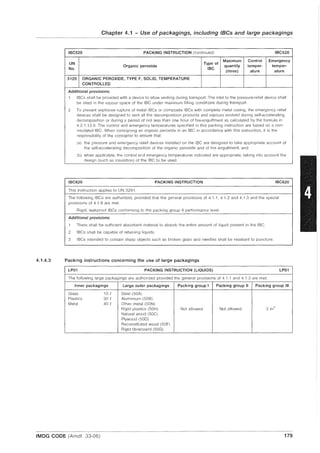
rapidly or undergo a thermal explosion (defined as SELF-REACTIVE SUBSTANCE TYPE C);
.4 Any substance which, in laboratory testing:
.1 detonates partially, does not deflagrate rapidly and shows no violent effect when heated under
confinement; or
.2 does not detonate at all, deflagrates slowly and shows no violent effect when heated under
confinement; or
.3 does not detonate or deflagrate at all and shows a medium effect when heated under confinement
may be accepted for transport in packages of not more than 50 kg net mass (defined as SELF-REACTIVE
SUBSTANCE TYPE D);
.5 Any substance which, in laboratory testing, neither detonates nor deflagrates at all and shows low or no
effect when heated under confinement may be accepted for transport in packages of not more than
400 kg/450 {I (defined as SELF-REACTIVE SUBSTANCE TYPE E);
.6 Any substance which, in laboratory testing, neither detonates in the cavitated state nor deflagrates at all
and shows only a low or no effect when heated under confinement as well as low or no explosive power
may be considered for transport in IBCs (defined as SELF·REACTIVE SUBSTANCE TYPE F); (for
additional provisions see 4.1.7.2.2);
.7 Any substance which, in laboratory testing, neither detonates in the cavitated state nor deflagrates at all
and shows no effect when heated under confinement nor any explosive power shall be exempted from
classification as a self·reactive substance of class 4.1 provided that the formulation is thermally stable
(self·accelerating decompOSition temperature 60°C to 75°C for a 50 kg package) and any diluent meets
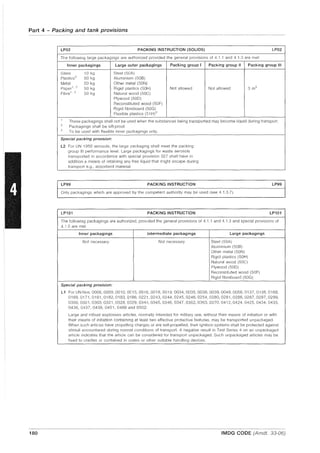
the provisions of 2.4.2.3.5 (defined as SELF·REACTIVE SUBSTANCE TYPE G). If the formulation is not
thermally stable or a compatible diluent having a boiling point less than 150°C is used for desensitization,
the formulation shall be defined as SELF-REACTIVE LlOUID/SOLID TYPE F.
2.4.2.3.4 Temperature control provisions
2.4.2.3.4.1 Self·reactive substances are subject to temperature control in transport if their self·accelerating decomposition
temperature (SADT) is less than or equal to 55"C. For currently assigned self·reactive substances, the control
and emergency temperatures are shown in 2.4.2.3.2.3. Test methods for determining the SADT are given in
IMDG CODE (Amdt. 33-06) 59
Part 2 - Classification
the United Nations Manual of Tests and Criteria, part II, chapter 28. The test selected shall be conducted in a
manner which is representative, both in size and material, of the package to be transported. The temperature
control provisions are given in chapter 7.7.
2.4.2.3.5 Desensitization of self-reactive substances
2.4.2.3.5.1 In order to ensure safety during transport, self-reactive substances may be desensitized til rough the use of a
diluent. If a diluent is used, the self-reactive substance shall be tested with the diluent present in the
concentration and form used in transport.
2.4.2.3.5.2 Diluents which may allow a self-reactive substance to concentrate to a dangerous extent in the event of
leakage from a package shall not be used.
2.4.2.3.5.3 The diluent shall be compatible with the self-reactive substance. In this regard, compatible diluents are those
solids or liquids which have no detrimental influence on the thermal stability and hazard type of the self-
reactive substance.
2.4.2.3.5.4 Liquid diluents in liquid formulations requiring temperature control shall have a boiling point of at least 60'C
and a flash point not less than 5°C. The boiling point of the liquid shall be at least 50G
C higher than the control
temperature of the self·reactive substance (see 7.7.2).
2.4.2.4 Class 4.1 Solid desensitized explosives
2.4.2.4.1 Definitions and properties
2.4.2.4.1.1 Solid desensitized explosives are explosive substances which are wetted with water or alcohols or are diluted
with other substances to form a homogeneous solid mixture to suppress their explosive properties. The
desensitizing agent shall be distributed uniformly throughout the substance in the state in which it is to be
transported. Where transport under conditions of low temperature is anticipated for substances containing or
wetted with water, a suitable and compatible solvent, such as alcohol, may have to be added to lower the
freezing point of the liquid. Some of these substances, when in a dry state, are classified as explosives. Where
reference is made to a substance which is wetted with water, or some other liquid, it shall be permitted for
transport as a class 4.1 substance only when in the wetted condition specified. Entries in the Dangerous
Goods List In chapter 3.2 for solid desensitized explosives are UN 1310, UN 1320, UN 1321, UN 1322, UN
1336, UN 1337, UN 1344, UN 1347, UN 1348, UN 1349, UN 1354, UN 1355, UN 1356, UN 1357, UN 1517,
UN 1571, UN 2555, UN 2556, UN 2557, UN 2852, UN 2907, UN 3317, UN 3319, UN 3344, UN 3364, UN
3365, UN 3366, UN 3367, UN 3368, UN 3369, UN 3370, UN 3376 and UN 3380.
2.4.2.4.2 Substances that:
2.4.3
2.4.3.1
2.4.3.1.1
2.4.3.1.2
2.4.3.1.3
60
.1 have been provisionally accepted into class 1 according to Test Series 1 and 2 but exempted from class 1
by Test Series 6;
.2 are not self-reactive substances of class 4.1 ;
.3 are not substances of class 5
are also assigned to class 4.1. UN 2956, UN 3241, UN 3242 and UN 3251 are such entries.
Class 4.2 - Substances liable to spontaneous combustion
Definitions and properties
Class 4.2 comprises:
.1 Pyrophoric substances, which are substances, including mixtures and solutions (liquid or solid), which,
even in small quantities, ignite within 5 minutes of coming into contact with air. These substances are the
most liable to spontaneous combustion; and
.2 Self-heating substances, which are substances, other than pyrophoric substances, which, in contact with
air without energy supply, are liable to self-heating. These substances will ignite only when in large
amounts (kilograms) and after long periods of time (hours or days).
Self·heating of substances, leading to spontaneous combustion, is caused by reaction of the substance with
oxygen (in the air) and the heat developed not being conducted away rapidly enough to the surroundings.
Spontaneous combustion occurs when the rate of heat production exceeds the rate of heat loss and the
autoignition temperature is reached.
Some substances may also give off toxic gases if Involved in a fire.
IMDG CODE (Amdt. 33-06)
Chapter 2.4 - Class 4 - Flammable solids
2.4.3.2 Classification of class 4.2 substances
2.4.3.2.1 Solids are considered pyrophoric solids which shall be classified in class 4.2 if, in tests performed in
accordance with the test method given in the United Nations Manual of Tests and Criteria, part III, 33.3.1.4, the
sample ignites in one of the tests.
2.4.3.2.2 Liquids are considered pyrophoric liquids which shall be classified in class 4.2 if, in tests performed in
accordance with the test method given in the United Nations Manual of Tests and Criteria, part III, 33.3.1.5, the
liquid ignites in the first part of the test, or if it ignites or chars the filter paper.
2.4.3.2.3 Self-heating substances
2.4.3.2.3.1 A substance shall be classified as a self-heating substance of class 4.2 if, in tests performed in accordance
with the test method given in the United Nations Manual of Tests and Criteria, part III, 33.3.1.6
.1 a positive result is obtained using a 25 mm cube sample at 140°C;
.2 a positive result is obtained in a test using a 100 mm cube sample at 140°C and a negative result is
obtained in a test using a 100 mm cube sample at 120°C and the substance is to be transported in
packages with a volume of more than 3 m3
; -
.3 a positive result is obtained in a test using a 100 mm cube sample at 140"C and a negative result is
obtained in a test using a 100 mm cube sample at 100°C and the substance is to be transported in
packages with a volume of more than 450 e; -
.4 a positive result is obtained in a test using a 100 mm cube sample at 140°C and a positive result is
obtained using a 100 mm cube sample at 100°C. -
Note: Self-reactive substances, except for type G, giving also a positive result with this test method shall not be
classified in class 4.2 but in class 4.1 (see 2.4.2.3.1.1).
2.4.3.2.3.2 A substance shall not be classified in class 4.2 if:
2.4.3.3
2.4.3.3.1
2.4.3.3.2
2.4.3.3.3
2.4.4
2.4.4.1
2.4.4.1.1
.1 a negative result is obtained in a test using a 100 mm cube sample at 140°C;
.2 a positive result is obtained in a test using a 100 mm cube sample at 140°C and a negative result is
obtained in a test using a 25 mm cube sample at 140°C, a negative result is obtained in a test using a
100 mm cube sample at 120°C and the substance is to be transported in packages with a volume not
more than 3 m3
; - -
.3 a positive result is obtained in a test using a 100 mm cube sample at 140"C and a negative result is
obtained in a test using a 25 mm cube sample at 140°C, a negative result is obtained in a test using a
100 mm cube sample at 100°C and the substance is to be transported in packages with a volume not
more than 450 f!. --
Assignment of packing groups
Packing group I shall be assigned to all pyrophoric solids and liquids.
Packing group II shall be assigned to self-heating substances which give a positive result in a test using a
25 mm cube sample at 140°C.
Packing group III shall be assigned to self-heating substances if:
.1 a positive result is obtained in a test using a 100 mm cube sample at 140°C and a negative result is
obtained in a test using a 25 mm cube sample at 140°C and the substance is to be transported in
packages with a volume of more than 3 m3
; -
.2 a positive result is obtained in a test using a 100 mm cube sample at 140°C and a negative result is
obtained in a test using a 25 mm cube sample at 140°C, a positive result is obtained in a test using a
100 mm cube sample at 120°C and the substance is to be transported in packages with a volume of more
than 450 f; -
.3 a positive result is obtained in a test using a 100 mm cube sample at 140°C and a negative result is
obtained in a test using a 25 mm cube sample at 140°C and a positive result is obtained in a test using a
100 mm cube sample at 100·'C.
Class 4.3 - Substances which, in contact with water, emit flammable gases
Definitions and properties
For the purpose of thiS Code, the substances in this class are either liquids or solids which, by interaction with
water, are liable to become spontaneously flammable or to give off flammable gases in dangerous quantities.
IMDG CODE (Amdt. 33-06) 61
Part 2 - Classification
2.4.4.1.2
2.4.4.2
2.4.4.2.1
2.4.4.3
2.4.4.3.1
2.4.4.3.2
2.4.4.3.3
2.4.5
62
Certain substances, in contact with water, may emit flammable gases that can form explosive mixtures with air.
Such mixtures are easily ignited by all ordinary sources of ignition, for example naked lights, sparking
handtools or unprotected light bulbs. The resulting blast wave and flames may endanger people and the
environment. The test method referred to in 2.4.4.2 is used to determine whether the reaction of a substance
with water leads to the development of a dangerous amount of gases which may be flammable. This test
method shall not be applied to pyrophoric substances.
Classification of class 4.3 substances
Substances which, in contact with water, emit flammable gases shall be classified in class 4.3 if, in tests
performed in accordance with the test method given in the United Nations Manual of Tests and Criteria,
part III, 33.4.1:
.1 spontaneous ignition takes place in any step of the test procedure; or
.2 there is an evolution of a flammable gas at a rate greater than 1 litre per kilogram of the substance per
hour.
Assignment of packing groups
Packing group I shall be assigned to any substance which reacts vigorously with water at ambient
temperatures and demonstrates generally a tendency for the gas produced to ignite spontaneously, or which
reacts readily with water at ambient temperatures such that the rate of evolution of flammable gas is equal to
or greater than 10 litres per kilogram of substance over anyone minute.
Packing group II shall be assigned to any substance which reacts readily with water at ambient temperatures
such that the maximum rate of evolution of flammable gas is equal to or greater than 20 litres per kilogram of
substance per hour, and which does not meet the criteria for packing group I.
Packing group III shall be assigned to any substance which reacts slowly with water at ambient temperatures
such that the maximum rate of evolution of flammable gas is equal to or greater than 1 litre per kilogram of
substance per hour, and which does not meet the criteria for packing groups I or II.
Classification of organometallic substances
Depending on their properties, organometallic substances may be classified in classes 4.2 or 4.3, as
appropriate, in accordance with the following flowchart:
IMDG CODE (Amdt. 33-06)
Chapter 2.4 - Class 4 - Flammable solids
Flowchart scheme for organometallic substances1,2
Organometallic
substance!formulation!
solution
'
Is the substance
pyrophoric?
test N.2 (solid)
test N.3 (liquid)
No
Is the substance
water-reactive?
test N.5
No
Is the substance a
self-heating solid?
test NA
No
Substance does not have to be
classified in class 4.2
or class 4.3
Yes
Yes
Yes
No
Is the substance
water-reactive?
test N.5
Yes
Yes
Class 4.3, PG I or
II or III.
Is the substance
a solid?
No
solid
liquid
solid
liquid
No
Is the substance
a flammable solid?
test N.1
No
Is the SUbstance
self-heating?
test NA
No
Does the substance
contain a diluent with
a flashpoint :;60"C?
Organometallic substance,
solid, pyrophoric
UN 3391
Organometallic substance,
liquid, pyrophoric
UN 3392
Organometallic substance,
solid, pyrophoric,
water-reactive
UN 3393
Organometallic substance,
liquid, pyrophoric,
water-reactive
UN 3394
Organometallic substance,
solid, water-reactive
UN 3395
Organometallic substance,
solid, water-reactive,
Yes flammable
UN 3396
Yes Organometallic substance,
solid, water-reactive,
self-heating
Yes
UN 3397
Organometallic substance,
liquid, water-reactive
UN 3398
Organometallic substance,
liquid, water-reactive,
flammable
UN 3399
Organometallic substance,
solid, self-heating
UN 3400
1 If applicable and testing is relevant, taking into account reactivity properties, class 6.1 and class 8 properties shall be considered according to the
Precedence of hazards table 2.0.3.6.
2 Test methods N.1 to N.S can be found in the United Nations Manual of Tests and Criteria, part III, section 33
IMDG CODE (Amdt. 33-06) 63
Chapter 2.5
Class 5 - Oxidizing substances and organic peroxides
2.5.0
2.5.1
2.5.2
Introductory note
Note: Because of the differing properties exhibited by dangerous goods within classes 5.1 and 5.2, it is
impracticable to establish a single criterion for classification in either class. Tests and criteria for assignment to
the two classes are addressed in this chapter.
Definitions and general provisions
In this Code, class 5 is divided into two classes as follows:
Class 5.1 - Oxidizing substances
Substances which, while in themselves not necessarily combustible, may, generally by yielding oxygen, cause,
or contribute to, the combustion of other material. Such substances may be contained in an article;
Class 5.2 - Organic peroxides
Organic substances which contain the bivalent -0-0- structure and may be considered derivatives of
hydrogen peroxide, where one or both of the hydrogen atoms have been replaced by organic radicals.
Organic peroxides are thermally unstable substances which may undergo exothermic self-accelerating
decomposition. In addition, they may have one or more of the following properties:
- be liable to explosive decomposition;
- burn rapidly;
- be sensitive to impact or friction;
- react dangerously with other substances;
- cause damage to the eyes.
Class 5.1 - Oxidizing substances
Note: For the classification of oxidizing substances to class 5.1, in the event of divergence between test results
and known experience, judgement based on known experience shall take precedence over test results.
2.5.2.1 Properties
2.5.2.1.1 Substances of class 5.1 in certain circumstances directly or indirectly evolve oxygen. For this reason, oxidizing
substances increase the risk and intensity of fire in combustible material with which they come into contact.
2.5.2.1.2 Mixtures of oxidizing substances with combustible material and even with material such as sugar, flour, edible
oils, mineral oils, etc., are dangerous. These mixtures are readily ignited, in some cases by friction or impact.
They may burn violently and may lead to explosion.
2.5.2.1.3 There will be a violent reaction between most oxidizing substances and liquid acids, evolving toxic gases.
Toxic gases may also be evolved when certain oxidizing substances are involved in a fire.
2.5.2.1.4 The above-mentioned properties are, in general, common to all substances in this class. Additionally, some
substances possess specific properties, which shall be taken into account in transport. These properties are
shown in the Dangerous Goods List in chapter 3.2.
2.5.2.2 Oxidizing solids
2.5.2.2.1 Classification of solid substances of class 5.1
2.5.2.2.1.1 Tests are performed to measure the potential for the solid substance to increase the burning rate or burning
intensity of a combustible substance when the two are thoroughly mixed. The procedure is given in the United
Nations Manual of Tests and Criteria, part III, 34.4.1. Tests are conducted on the substance to be evaluated
mixed with dry fibrous cellulose in mixing ratios of 1: 1 and 4: 1, by mass, of sample to cellulose. The burning
64 IMDG CODE (Amdt. 33-06)
Chapter 2.5 - Class 5 - Oxidizing substances and organic peroxides
characteristics of the mixtures are compared with the standard 3:7 mixture, by mass, of potassium bromate to
cellulose. If the burning time is equal to or less than this standard mixture, the burning times shall be
compared with those from the packing group I or II reference standards, 3:2 and 2:3 ratios, by mass, of
potassium bromate to cellulose respectively.
2.5.2.2.1.2 The classification test results are assessed on the basis of:
.1 the comparison of the mean burning time with those of the reference mixtures; and
.2 whether the mixture of substance and cellulose ignites and burns.
2.5.2.2.1.3 A solid substance is classified in class 5.1 if the 4: 1 or 1: 1 sample-to-cellulose ratio (by mass) tested exhibits a
mean burning time equal to or less than the mean burning time of a 3:7 mixture (by mass) of potassium
bromate and cellulose.
2.5.2.2.2 Assignment of packing groups
2.5.2.2.2.1 Solid oxidizing substances are assigned to a packing group according to the test procedure in the United
Nations Manual of Tests and Criteria, part III, 34.4.1, in accordance with the following criteria:
.1 Packing group I: any substance which, in the 4:1 or 1:1 sample-to-cellulose ratio (by mass) tested, exhibits
a mean burning time less than the mean burning time of a 3:2 mixture (by mass) of potassium bromate
and cellulose;
.2 Packing group II: any substance which, in the 4:1 or 1:1 sample-to-cellulose ratio (by mass) tested,
exhibits a mean burning time equal to or less than the mean burning time of a 2:3 mixture (by mass) of
potassium bromate and cellulose and the criteria for packing group I are not met;
.3 Packing group III: any substance which, in the 4:1 or 1:1 sample-to-cellulose ratio (by mass) tested,
exhibits a mean burning time equal to or less than the mean burning time of a 3:7 mixture (by mass) of
potassium bromate and cellulose and the criteria for packing groups I and II are not met;
.4 Not classified as class 5.1: any substance which, in both the 4: 1 and 1: 1 sample-to-cellulose ratio (by
mass) tested, does not ignite and burn, or exhibits mean burning times greater than that of a 3:7 mixture
(by mass) of potassium bromate and cellulose.
2.5.2.3 Oxidizing liquids
2.5.2.3.1 Classification of liquid substances of class 5.1
2.5.2.3.1.1 A test is performed to determine the potential for a liquid substance to increase the burning rate or burning
intensity of a combustible substance or for spontaneous ignition to occur when the two are thoroughly mixed.
The procedure is given in the United Nations Manual of Tests and Criteria, part III, 34.4.2. It measures the
pressure rise time during combustion. Whether a liquid is an oxidizing substance of class 5.1 and, if so,
whether packing group I, II or III shall be assigned, is decided on the basis of the test result (see also
Precedence of hazard characteristics in 2.0.3).
2.5.2.3.1.2 The classification test results are assessed on the basis of:
.1 whether the mixture of substance and cellulose spontaneously ignites;
.2 the comparison of the mean time taken for the pressure to rise from 690 kPa to 2070 kPa gauge with
those of the reference substances.
2.5.2.3.1.3 A liquid substance is classified in class 5.1 if the 1: 1 mixture, by mass, of substance and cellulose tested
exhibits a mean pressure rise time less than or equal to the mean pressure rise time of a 1:1 mixture, by mass,
of 65% aqueous nitric acid and cellulose.
2.5.2.3.2 Assignment of packing groups
2.5.2.3.2.1 Liquid oxidizing substances are assigned to a packing group according to the test procedure in the United
Nations Manual of Tests and Criteria, part III, 34.4.2, in accordance with the following criteria:
.1 Packing group I: any substance which, in the 1:1 mixture (by mass) of substance and cellulose tested,
spontaneously ignites; or the mean pressure rise time of a 1: 1 mixture (by mass) of substance and
cellulose is less than that of a 1:1 mixture (by mass) of 50% perchloric acid and cellulose;
.2 Packing group II: any substance which, in the 1:1 mixture (by mass) of substance and cellulose tested,
exhibits a mean pressure rise time less than or equal to the mean pressure rise time of a 1: 1 mixture (by
mass) of 40% aqueous sodium chlorate solution and cellulose; and the criteria for packing group I are not
met;
IMDG CODE (Amdt. 33-06) 65
Part 2 - Classification
2.5.3
2.5.3.1
2.5.3.1.1
2.5.3.1.2
2.5.3.2
2.5.3.2.1
2.5.3.2.2
2.5.3.2.3
.3 Packing group III: any substance which, in the 1:1 mixture (by mass) of substance and cellulose tested,
exhibits a mean pressure rise time less than or equal to the mean pressure rise time of a 1: 1 mixture (by
mass) of 65% aqueous nitric acid and cellulose; and the criteria for packing groups I and II are not met;
.4 Not classified as class 5.1: any substance which, in the 1:1 mixture (by mass) of substance and cellulose
tested, exhibits a pressure rise of less than 2070 kPa gauge; or exhibits a mean pressure rise time greater
than the mean pressure rise time of a 1: 1 mixture (by mass) of 65% aqueous nitric acid and cellulose.
Class 5.2 - Organic peroxides
Properties
Organic peroxides are liable to exothermic decomposition at normal or elevated temperatures. The decom-
position can be initiated by heat, contact with impurities (such as acids, heavy-metal compounds, amines),
friction or impact. The rate of decomposition increases with temperature and varies with the organic peroxide
formulation. Decomposition may result in the evolution of harmful, or flammable, gases or vapours. For certain
organic peroxides the temperature shall be controlled during transport. Some organic peroxides may
decompose explosively, particularly if confined. This characteristic may be modified by the addition of diluents
or by the use of appropriate packagings. Many organic peroxides burn vigorously.
Contact of organic peroxides with tile eyes is to be avoided. Some organic peroxides will cause serious injury
to the cornea, even after brief contact, or will be corrosive to the skin.
Classification of organic peroxides
Any organic peroxide shall be considered for classification in class 5.2, unless the organic peroxide
formulation contains:
.1 not more than 1.0% available oxygen from the organic peroxides when containing not more than 1.0%
hydrogen peroxide; or
.2 not more than 0.5% available oxygen from the organic peroxides when containing more than 1.0% but not
more than 7.0% hydrogen peroxide.
Note: The available oxygen content (%) of an organic peroxide formulation is given by the formula:
16 x 2:.(n, x c;/m,)
where
n, number of peroxygen groups per molecule of organic peroxide i;
c, concentration (mass %) of organic peroxide i;
m; molecular mass of organic peroxide i.
Organic peroxides are classified into seven types according to the degree of danger they present. The types of
organic peroxide range from type A, which may not be accepted for transport in the packaging in which it is
tested, to type G, which is not subject to the provisions for organic peroxides of class 5.2. The classification of
types B to F is directly related to the maximum quantity allowed in one packaging.
Organic peroxides permitted for transport in packagings are listed in 2.5.3.2.4, those permitted for transport in
IBCs are listed in packing instruction IBC520 and those permitted for transport in portable tanks are listed in
portable tank instruction T23. For each permitted substance listed, the generic entry of the Dangerous Goods
List (UN 3101 to UN 3120) is assigned, appropriate subsidiary risks and remarks providing relevant transport
information are given. The generic entries specify:
.1 organic peroxide type (B to F);
.2 physical state (liquid or solid); and
.3 temperature control, when required (see 2.5.3.4).
2.5.3.2.3.1 Mixtures of the listed formulations may be classified as the same type of organic peroxide as that of the most
dangerous component and be transported under the conditions of transport given for this type. However, as
two stable components can form a thermally less stable mixture, the self-accelerating decomposition
temperature (SADT) of the mixture shall be determined and, if necessary, temperature control applied as
required by 2.5.3.4.
66 IMDG CODE (Amdt. 33-06)
~I0,
G)
()
o
o
m
);:
:3
Q
;-<-
W
Cf!
o
~
(1)
-...J
2.5.3.2.4 List of currently assigned organic peroxides in packagings
Note: Packing Method codes "OP1" to "OP8" refer to packing methods in packing instruction P520, Peroxides to be transported shall fulfil the classification and the control
and emergency temperatures (derived from the SADT) as listed, For substances permitted in IBCs, see packing instruction IBC520, and for those permitted in tanks, see
portable tank instruction T23,
Number
Concentration
Diluent Diluent Inert
Water Packing
Control Emergency
Subsidiary risks
(generic ORGANIC PEROXIDE type A type B solid temperature temperature
entry)
(%)
(%) (%)(1 i
(%)
(%) method
(OC) rC)
and remarks
3101 ten-AMYL PEROXY-3,5,5-TRIMETHYLHEXANOATE ~100 OP5 (3)
ten-BUTYL PEROXYACETATE > 52 - 77 ",23 OP5 (3)
1,1-DI-(ten-BUTYLPEROXY)CYCLOHEXANE >80 - 100 OP5 (3)
1,1-DI-(tRr1-BLJTYLPEROXY)-3,3,5-TRIMETHYL- >90 - 100 OP5 (3)
CYCLOHEXANE
METHYL ETHYL KETONE PEROXIDE(S) see remark (8) ",48 OP5 (3) (8) (13)
2,5-DIMETHYL-2,5-DI-(ten-BUTYLPEROXY)- >86 - 100 OP5 (3) I
HEXYNE-3
3102 tert-BUTYL MONOPEROXYMALEATE >52 - 100 OP5 (3)
3-CHLOROPEROXYBENZOIC ACID > 57 - 86
'" 14
OP1 (3)
DIBENZOYL PEROXIDE >51 - 100 ~48 OP2 (3)
DIBENZOYL PEROXIDE > 77 - 94 ",6 OP4 (3)
DI-4-CHLOROBENZOYL PEROXIDE ~77 ",23 OP5 (3)
DI-2,4-DICHLOROBENZOYL PEROXIDE ~77 ",23 OP5 (3)
2,2-DIHYDROPEROXYPROPANE ~27
'" 73
OP5 (3)
2,5-DIMETHYL-2,5-DI-(BENZOYLPEROXY)HEXANE >82 - 100 OP5 (3)
DI-(2-PHENOXYETHYL) PEROXYDICARBONATE >85 - 100 OP5 (3)
DISUCCINIC ACID PEROXIDE >72 - 100 OP4 (3) (17)
3103 ten-AMYL PEROXYBENZOATE ~ 100 OP5
tert-AMYLPEROXY ISOPROPYL CARBONATE ~77 ",23 OP5
n-BUTYL-4,4-DI-(ten-BUTYLPEROXY)VALERATE >52 - 100 OP5
tert-BUTYL HYDROPEROXIDE > 79 - 90 ",10 OP5 (13)
tert-BUTYL HYDROPEROXIDE + DI-ten-BUTYL <82 + >9 ",7 OP5 (13)
PEROXIDE
tert-BUTYL MONOPEROXYMALEATE ~52 ",48 OP6
ten-BUTYL PEROXYACETATE > 32 - 52 ",48 OP6
tert-BUTYL PEROXYBENZOATE > 77 - 100 OP5
ten-BUTYLPEROXY ISOPROPYLCARBONATE ~77 ",23 OP5
tert-BUTYLPEROXY-2-METHYLBENZOATE ~ 100 OP5
()
::T
Q)
'0
-('1)
....
'"01
C)
til
en
en
01
I
~
a:N'
S·
<.Q
en
c::
0-
en
or:::J
(')
('1)
en
Q)
:::J
Q..
o
t3III
:::J
C).
"0
('1)
~
a:('1)
en
Ol
(Xl
~
o
G')
()
o
o
m
-s;
:3
Sl:
w
w
6
2l
Number
(generic
entry)
3103
(cont.)
3104
3105
Concentration
ORGANIC PEROXIDE
(%)
1,1-DI-(tert-AMYLPEROXY)CYCLOHEXANE ~G2
2, 2-DI-(tert-BUTYLPEROXY)BUTAN E ~52
1,6-DI-(tert-BUTYLPEROXYCARBONYLOXY)- <?2
HEXANE
1,1-DI-(tert-BUTYLPEROXY)CYCLOHEXANE >52 - 80
1,1-DI-(tert-BUTYLPEROXY)-3,3,5-TRIMETHYL- ~77
CYCLOHEXANE
1,1-DI-(tert-BUTYLPEROXY)-3,3,5-TRIMETHYL- >5? - 90
CYCLOHEXANE
2,5-DIMETHYL-2,5-DI-(tert-BUTYLPEROXY)- >52 - 86
HEXYNE-3
ETHYL 3,3-DI-(tert-BUTYLPEROXY)BUTYRATE > 77 - 100
ORGANIC PEROXIDE, LIQUID, SAMPLE
CYCLOHEXANONE PEROXIDE(S) ~91
DIBENZOYL PEROXIDE ~77
2,5-DIMETHYL-2,5-DI(BENZOYLPEROXY)HEXANE ~82
2,5-DIMETHYL-2,5-DIHYDROPEROXYHEXANE -( 82
ORGANIC PEROXIDE, SOLID, SAMPLE
ACETYL ACETONE PEROXIDE ~42
tert-AMYL PEROXYACETATE ~62
tert-AMYL PEROXY-2-ETHYLHEXYL CARBONATE ~100
tert-BUTYL HYDROPEROXIDE ~80
tert-BUTYL PEROXYBENZOATE > 52 - 77
tert-BUTYL PEROXYBUTYL FUMARATE ~52
tert-BUTYL PEROXYCROTONATE ~77
tert-BUTYL PEROXY-2-ETHYLHEXYLCARBONATE ~100
1-(2-tert-BUTYLPEROXY ISOPROPYL)-3- ~77
ISOPROPENYLGENZENE
ten-BUTYL PEROXY-3,5,5-TRIMETHYL- >32 - 100
HEXANOATE
CYCLOHEXANONE PEROXIDE(S) ~?2
oI-ter/-BUTYL PEROXYAZELATE ~52
1,1-DI-(ter/-BUTYLPEROXY)CYCLOHEXANE >42 - 52
Diluent Diluent Inert
Water
type A type B solid
(%) (%}(1) (%)
(%)
~1G
~48
~28
~20
~23
~10
~14
~9
~23
~18
~18
~48 ~8
~38
~20
~23
~48
~23
~23
~28
~48
~48
Packing
Control Emergency
temperature temperature
method
('C) ('C)
OP6
OP6
OP5
OP5
OP5
OP5
OP5
OP5
OP2
OP6
OP6
OP5
OP6
OP2
OP?
OP?
OP?
OP?
OP?
OP?
OP?
OP?
OP?
OP?
OP?
OP?
OP?
Subsidiary risks
and remarks
(26)
(11)
(13)
(11)
(2)
(4) (13)
(5)
"U
~
~
I.)
()
Qi
C/)
~­
~
(')
III
......
o·::J
~
o
G')
()
o
o
m
'i:
:3
~
w
w
6
~
0')
<D
Number
(generic
entry)
3105
(cont.)
3106
ORGANIC PEROXIDE
DI-(tert-BUTYLPEROXY)PHTHALATE
2,2-DI-(tert-BUTYLPEROXY)PROPANE
2,5-DIMETHYL-2,5-DI-(tert-BUTYLPEROXY)HEXANE
2,5-DIMETHYL-2,5-DI-(3,5,5-TRIMETHYL-
HEXANOYLPEROXY)HEXANE
ETHYL 3,3-DI-(tert-AMYLPEROXY)BUTYRATE
ETHYL 3,3-DI-(tert-BUTYLPEROXY)BUTYRATE
p-MENTHYL HYDROPEROXIDE
METHYL ETHYL KETONE PEROXIDE(S)
METHYL ISOBUTYL KETONE PEROXIDE(S)
PEROXYACETIC ACID, TYPE D, stabilized
PINANYL HYDROPEROXIDE
1,1 ,3,3-TETRAMETHYLBUTYL HYDROPEROXIDE
3,6,9-TRIETHYL-3,6,9-TRIMETHYL-1 ,4,7-
TRIPEROXONANE
ACETYL ACETONE PEROXIDE
tort-BUTYL PEROXYBENZOATE
tert-BUTYL PEROXY-2-ETHYLHEXANOATE +
2,2-DI-(tert-BUTYLPEROXY)BUTANE
tert-BUTYLPEROXY STEARYLCARBONATE
3-CHLOROPEROXYBENZOIC ACID
CYCLOHEXANONE PEROXIDE(S)
DIBENZOYL PEROXIDE
DIBENZOYL PEROXIDE
DIBENZOYL PEROXIDE
1,1-DI-(tert-BUTYLPEROXY)CYCLOHEXANE
DI-(2-tert-BUTYLPEROXYISOPROPYL)BENZENE(S)
DI-(tert-BUTYLPEROXY)PHTHALATE
2,2-DI-(tert-BUTYLPEROXY)PROPANE
DI-4-CHLOROBENZOYL PEROXIDE
2,2-DI-(4,4-DI-(tert-BUTYLPEROXY)CYCLOHEXYL)-
PROPANE
Concentration
(%)
>42-52
~52
>52 - 100
~77
~G7
~77
>72 - 100
see remark (9)
~62
~43
>56 - 100
~100
~42
~ 32 as a paste
~52
~12+~14
~100
~57
~77
~ 72 as a paste
~o2
>52 - 62 as a paste
> 35 - 52
~42
>42 - 100
~ 52 as a paste
~42
~ 52 as a paste
~42
Diluent Diluent Inert
Water Packing
type A type B solid
(%) (%)(1) (%)
(%) method
~48 OP7
~48 OP7
OP7
~23 OP7
~33 OP7
~23 OP7
OP7
~55 OP7
~19 OP7
OP7
OP7
OP7
~58 OP7
OP7
~48 OP7
~14 ~60 OP7
OP7
~3 ~40 OP7
~6 ~17 OP7
OP7
~28 ~10 OP7
OP7
~48 OP7
~13 ~45 OP7
~57 OP7
OP7
~ 13 ~45 OP7
OP7
~58 OP7
Control Emergency
Subsidiary risks
temperature temperature
eC) ('C)
and remarks
(18)
(9)
(22)
(13) (14) (19)
(13)
(28)
(20)
(5) (20)
(20)
(20)
(20)
()
::J"
III
"0
-CD
....
I:)
, c.n
I I
'e)
s:uen
en
,c.n
I I
~
is:
ij'
5'
to
en
c::
0-
en
6i
:J
(')
CD
en
III
:J
Q..
o
~
III
:J
0'
"'0
CD
~
g:(J)
-...j
o
s::o
G)
()
o
o
m
);:
:3
~
w
w
6
-2?
Number
(generic
entry)
3106
(cont,)
3107
3108
ORGANIC PEROXIDE
DI-2,4-DICHLOROBENZOYL PEROXIDE
01-( 1-HYDROXYCYCLOHEXYL)PEROXIDE
DIISOPROPYLBENZENE DIHYDROPEROXIDE
DILAUROYL PEROXIDE
DI-(4-METHYLBENZOYL) PEROXIDE
2,5-01 METHYL-2 ,5-01-( BENZOYLPEROXY)HEXA NE
2,5-01 METHYL-2 ,5-DI-(tert-BUTYLPEROXY)-
HEXYNE-3
DI-(:2-PHENOXYETHYL)PEROXYDICARBONATE
ETHYL 3,3-DI-(tert-BUTYLPEROXY)BUTYRATE
tert-AMYL HYDROPEROXIDE
tert-BUTYL CUMYL PEROXIDE
tert-BUTYLHYDROPEROXIDE
CUMYL HYDROPEROXIDE
DI-tert-AMYLPEROXIDE
DIBENZOYL PEROXIDE
DI-tert-BUTYL PEROXIDE
1,1-DI-(tert-BUTYLPEROXY)CYCLOHEXANE
DI-(tert-BUTYLPEROXY)PHTHALATE
1,1-DI-(tert-BUTYLPEROXY)-3,3,5-
TRIMETHYLCYCLOHEXANE
1,1-DI-(tert-BUTYLPEROXY)-3,3,5-
TRIMETHYLCYCLOHEXANE
2,2-DI-(4,4-DI-(BUTYLPEROXY)CYCLOHEXYL)-
PROPANE
METHYL ETHYL KETONE PEROXIDE(S)
PEROXYACETIC ACID, TYPE E, stabilized
POLYETHER POLY-tert-BUTYLPEROXY-
CARBONATE
ten-BUTYL CUMYL PEROXIDE
n-BUTYL-4,4-DI-( BUTYLPEROXY)VALERATE
ten-BUTYL MONOPEROXYMALEATE
Concentration
(%)
~ 52 as a pastc with
silicon oil
~ 100
~82
~ 100
~ 52 as paste
with silicon oil
~82
~52
~85
~52
~88
>42 - 100
~79
>90 - 98
~100
>36 - 42
>52 - 100
~27
~42
~57
~32
~22
see remark (10)
~43
~52
~52
~52
~52
Diluent Diluent Inert
Water
type A type 8 solid
(%) (%)(1) (%)
(%)
~5 ~5
~18
~48
~15
~48
~6 ~6
> 14
~1O
~ 18 ~40
~25
~58
~43
~26 ~42
~78
~60
~48
~48
~48
!
~48
Packing
Control Emergency
temperature temperature
method
eC) (,C)
OP7
OP7
OP7
OP7
OP7
OP7
OP7
OP7
OP7
OP8
OP8
OP8
OP8
OP8
OP8
OP8
OP8
OP8
OP8
OP8
OP8
OP8
OP8
OP8
OP8
OP8
OP8
Subsidiary risks
and remarks
(24)
(13) (23)
(13)
(21 )
(10)
(13) (15) (19)
"'C
Ql
::l.
I:)
o
tilC/)
~.
~
()
III
.....
o·::J
s:o
G')
()
o
o
m
);:
::J
~
GJ
GJ
6
2:
"'-J
......
Number
(generic
entry)
310S
(cont.)
3109
3110
3111
3112
ORGANIC PEROXIDE
ten-BUTYL MONOPEROXYMALEATE
1-(2-ten-BUTYLPEROXYISOPROPYL)-3-
ISOPROPENYLBENZENE
DIBENZOYL PEROXIDE
DIBENZOYL PEROXIDE
2,5-DIMETHYL-2,5-DI-(ten-BUTYLPEROXY)HEXANE
ten-BUTYL HYDROPEROXIDE
ten-BUTYL PEROXYACETATE
ten-BUTYL PEROXY-3,5,5-TRIMETHYL-
HEXANOATE
CUMYL HYDROPEROXIDE
DIBENZOYL PEROXIDE
DI-ten-BUTYL PEROXI DE
1,1-DI-(ten-BUTYLPEROXY)CYCLOHEXANE
1,1-DI-(tert-BUTYLPEROXY)CYCLOHEXANE
DILAUROYL PEROXIDE
2,5-DIMETHYL-2,5-DI-(ter1-BUTYLPEROXY)HEXANE
ISOPROPYLCUMYL HYDROPEROXIDE
p-MENTHYL HYDROPEROXIDE
PEROXYACETIC ACID, TYPE F, stabilized
PINANYL HYDROPEROXIDE
DICUMYL PEROXIDE
1,1-DI-(ten-BUTYLPEROXY)-3,3,5-
TRIMETHYLCYCLOHEXANE
ten-BUTYL PEROXYISOBUTYRATE
DIISOBUTYRYL PEROXIDE
ISOPROPYL sec-BUTYL PEROXYDICARBONATE +
DI-see-BUTYL PEROXYDICARBONATE +
DIISOPROPYL PEROXYDICARBONATE
ACETYL CYCLOHEXANESULPHONYL PEROXIDE
DICYCLOHEXYL PEROXYDICARBONATE
Concentration
(%)
~ 52 as a paste
~42
~ 56,5 as a paste
~ 52 as a paste
~ 47 a~ a pa~te
~77
~72
~32
~32
~90
~ 42 as a stable
dispersion in water
~52
~42
~13
~ 42 as a stable
dispersion in water
~52
~72
<72
~43
~56
>52 - 100
~57
>52 - 77
> 32 - 52
~52 +
~2S +
~22
~S2
>91 - 100
Diluent Diluent Inert
Water Packing
type A type B solid
(%) method
(%) (%)(1) (%)
OPS
;:,5S OPS
;:, 15 OPS
OPS
OPS
;:,23 OPS
;:'2S OPS
;:,6S OPS
;:,6S OPS
;:'10 OPS
OPS
;:'4S OPS
;:,5S OPS
;:, 13 ;:, 74 OPS
OPS
;:'48 OPS
;:,2S OPS
;:'2S OPS
OPS
;:,44 OPS
~4S OPS
;:,43 OPS
;:,23 OP5
;:,4S OP5
OP5
;:, 12 OP4
OP3
Control Emergency
temperature temperature
('C) ('C)
+15 +20
-20 -10
-20 -10
-10 0
+10 +15
Subsidiary risks
and remarks
(20)
(13)
(13) (1S)
(25)
(13)
(27)
(13) (16) (19)
(12)
(3)
(3)
(3)
(3)
(3)
(')
=r
OJ
"0
....CD
....
I)
CJ1
(')
ill(I)
(I)
CJ1
I
~
Q
N"
5"
to
(I)
t::
0-
(I)
......
OJ
::J
C)
CD
(I)
OJ
::J
Q.
o
<3III
::J
n"
"0
CD
a><
Q
CD
(I)
-..J
I')
s:
o
G)
()
o
o
m
);
::J
~
GJ
GJ
6
-2:
Number
(generic
entry)
3112
(eont.)
3113
3114
3115
ORGANIC PEROXIDE
DIISOPROPYL PEROXYDICARBONATE
DI-(2-METHYLBENZOYL) PEROXIDE
tert-AMYL PEROXYPIVALATE
tert-BUTYL PEROXYDIETHYLACETATE
tert-BUTYL PEROXY-2-ETHYLHEXANOATE
tert-BUTYL PEROXYPIVALATE
DI-see-BUTYL PEROXYDICARBONATE
DI-(2-ETHYLH EXYL)PEROXYDICAR BONATE
2,5-DIMETHYL-2,5-DI-(2-ETHYLHEXANOYLPEROXY)-
HEXANE
DI-n-PROPYL PEROXYDICARBONATE
ORGANIC PEROXIDE, LIQUID, SAMPLE,
TEMPERATURE CONTROLLED
DI-(4-tert-BUTYLCYCLOHEXYL)-
PEROXYDICARBONATE
DICYCLOHEXYL PEROXYDICARBONATE
DIDECANOYL PEROXIDE
DI-n-OCTANOYL PEROXIDE
ORGANIC PEROXIDE, SOLID, SAMPLE.
TEMPERATURE CONTROLLED
ACETYL CYCLOHEXANESULPHONYL PEROXIDE
tert-AMYL PEROXY-2-ETHYLHEXANOATE
tert-AMYL PEROXYNEODECANOATE
tert-BUTYL PEROXY-2-ETHYLHEXANOATE + 2,2-DI-
(tert-BUTYLPEROXY)BUTANE
tert-BUTYL PEROXYISOBUTYRATE
tert-BUTYL PEROXYNEODECANOATE
tert-BUTYL PEROXYNEOHEPTANOATE
tert-BUTYL PEROXYPIVALATE
CUMYLPEROXYNEODECANOATE
CUMYLPEROXYNEOHEPTANOATE
Concentration
(%)
>52 - 100
~87
~77
~100
> 52 - 100
>67 - 77
>52 - 100
> 77 - 100
~100
~100
~77
~100
~91
~100
~100
~32
~100
~77
~31 + ~36
~52
> 77 - 100
~77
~77
> 2? - 6?
~77
~77
Diluent Diluent Inert
Water Packing
type A type B solid
(%) (%)111 (%)
(%) method
OP2
?13 OP5
?23 OP5
OP5
OP6
?23 OP5
OP4
OP5
OP5
OP3
?23 OP5
OP2
OP6
?9 OP5
OP6
OP5
OP2
?68 OP7
OP?
?23 OP?
?33 OP7
?48 OP7
OP7
?23 OP?
?23 OP?
?33 OP?
?23 OP7
?23 OP7
Control Emergency
temperature temperature
('e) ('C)
-15 -5
+30 +35
+10 +15
+20 +25
+20 +25
0 +10
-20 -10
-20 -10
+20 +25
-25 -15
-20 -10
+30 +35
+10 +15
+30 +35
+10 +15
-10 0
+20 +25
0 +10
+35 +40
+15 +20
-5 +5
0 +10
0 +10
0 +10
-10 0
-10 0
Subsidiary risks !
and remarks
(3)
(3)
(11)
(11)
"U
OJ
::+
I:)
I
o
iii
en
en
S(")
III
.....
o·:J
s:o
G)
()
o
o
m
-s;:
:3
~
w
w
6
-2?
-...j
w
Number
(generic
entry)
3115
(eont.)
3116
311?
ORGANIC PEROXIDE
CUMYL PEROXYPIVALATE
DIACETONE ALCOHOL PEROXIDES
DIACETYLPEROXIDE
DI-n-8UTYL PEROXYDICARBONATE
DI-see-BUTYL PEROXYDICARBONATE
DI-(2-ETHOXYETHYL)PEROXYDICARBONATE
DI-(2-ETHYLH EXYL)PEROXYDICAR BONATE
DIISOBUTYRYL PEROXIDE
DIISOPROPYL PEROXYDICARBONATE
DI-(3-METHOXYBUTYL) PEROXYDICAR BONATE
DI-(3-METHYLBENZOYL) PEROXIDE + BENZOYL
(3-METHYLBENZOYL) PEROXIDE + DIBENZOYL
PEROXIDE
OI-(2-NEODECANOYLPEROXYISOPROPYL)-
BENZENE
DI-(3,5,5-TRIMETHYLHEXANOYL) PEROXIDE
1-(2-ETHYLHEXANOYLPEROXY)-1,3-
DIMETHYLBUTYL PEROXYPIVALATE
ten-HEXYL PEROXYNEODECANOATE
ten-HEXYL PEROXYPIVALATE
ISOPROPYL sec-BUTYL PEROXYDICARBONATE +
DI-see-BUTYL PEROXYDICARBONATE +
Ol-ISOPROPYL PEROXYDICARBONATE
METHYLCYCLOHEXANONE PEROXIDE(S)
1,1 ,3,3-TETRAMETHYLBUTYL PEROXY-2-
ETHYLHEXANOATE
1,1,3,3-TETRAMETHYLBUTYL PEROXY-
NEODECANOATE
1,1,3,3-TETRAMETHYLBUTYL PEROXYPIVALATE
DICETYL PEROXYDICARBONATE
DIMYRISTYL PEROXYDICARBONATE
DI-n-NONANOYL PEROXIDE
DISUCCINIC ACID PEROXIDE
ten-BUTYL PEROXY-2-ETHYLHEXANOATE
Concentration
(%)
~77
~5?
~2?
>2? - 52
~52
~52
~77
~32
~52
~28
~52
~20 + ~ 18 + ~4
~52
>38 - 82
~52
~?1
~?2
~32 +
,:; 15 - 18 +
,:; 12 - 15
~6?
,:; 100
~?2
':;77
~100
~100
,:; 100
~?2
>32 - 52
Diluent Diluent Inert
Water Packing
type A type B solid
(%) (%)(1) (%)
(%) method
~23 OP?
~26 ~8 OP?
~?3 OP?
~48 OP?
~48 OP?
~48 OP?
~23 OP?
~68 OP?
~48 OP?
~?2 OP?
~48 OP?
~58 OP?
~48 OP?
~18 OP?
~45 ~10 OP?
~29 OP?
~28 OP?
~38 OP?
~33 OP?
OP?
~28 OP?
~23 OP?
OP?
OP?
OP?
~28 OP?
~48 OP8
Control
temperature
(ee)
-5
+40
+20
-15
-15
-10
-15
-20
-20
-15
-5
+35
-10
0
-20
0
+10
-20
+35
+15
-5
0
+30
+20
0
+10
+30
Emergency
temperature
eC)
+5
+45
+25
-5
-5
0
-5
-10
-10
-5
+5
+40
0
+10
-10
+10
+15
-10
+40
+20
+5
+10
+35
+25
+10
+15
+35
Subsidiary risks
and remarks
(6)
(?) (13)
(")
::r
Pl
"0.-+
CD
""'IJ
c.n
(")
ili
en
en
01
I
~
a:t::j'
S'
to
en
c::
0-
en
Qj
::J
()
CD
en
III
::J
0..
o
t3III
::J
n'
:)
CD
~
~en
-..,J
~
s:
o
G>
(')
o
o
m
);
3
~
GJ
GJ
6
-2:
Number
(generic
entry)
3117
(cont.)
3118
3119
ORGANIC PEROXIDE
DI-n-BUTYL PEROXYDICARBONATE
ten-BUTYL PEROXYNEOHEPTANOATE
DI-(2-ETHYLHEXYL)PEROXYDICARBONATE
1,1-DIMETHYL-3-HYDROXYBUTYLPEROXY-
NEOHEPTANOATE
DIPROPIONYL PEROXIDE
ten-BUTYL PEROXY-2-ETHYLHEXANOATE
ten-BUTYL PEROXYNEODECANOATE
DI-n-BUTYL PEROXYDICARBONATE
PEROXYLAURIC ACID
ten-BUTYL PEROXY-2-ETHYLHEXANOATE
ten-BUTYL PEROXYNEODECANOATE
ten-BUTYL PEROXYPIVALATE
CUMYLPEROXYNEODECANOATE
DI-(4-ten-BUTYLCYCLOHEXYL)-
PEROXYDICARBONATE
DICETYL PEROXYDICARBONATE
DICYCLOHEXYL PEROXYDICARBONATE
DI-(2-ETHYLH EXYL)PEROXYDICAR BONATE
DIMYRISTYL PEROXYDICARBONATE
DI-(3,5,5-TRIMETHYLHEXANOYL) PEROXIDE
1,1 ,3,3-TETRAMETHYLBUTYL PEROXY-
NEODECANOATE
Concentration
Diluent
(%)
type A
(%)
~27
~ 42 as a stable
dispersion in water
~ 62 as a stable
dispersion in water
~52 ;>-48
~27
~52
~ 42 as a stable
dispersion in water
(frozen)
~ 42 as a stable
dispersion in water
(frozen)
~100
~32
~ 52 as a stable
dispersion in water
~32 ;>-68
~27
~ 52 as a stable
dispersion in water
~ 42 as a stable
dispersion in water
~ 42 as a stable
dispersion in water
~ 42 as a stable
dispersion in water
~ 52 as a stable
dispersion in water
~ 42 as a stable
dispersion in water
~ 52 as a stable
dispersion in WElter
~38 ;>-62
~ 52 as a stable
dispersion in water
Diluent Inert
Water Packing
type B solid
(%) method(%)(1) (%)
;>- 73 OP8
OP8
OP8
OP8
;>-73 OP8
;>-48 OP8
OP8
OP8
OP8
;>-68 OP8
OP8
OP8
;>-73 OP8
OP8
OP8
OP8
OP8
OP8
OP8
OP8
OP8
OP8
Control
temperature
(ec)
-10
0
-15
0
+15
+20
0
-15
+35
+40
0
0
+30
-10
+30
+30
+15
-15
+20
+10
+20
-5
Emergency
temperature
(ec)
0
+10
-5
+10
+20
+25
+10
-5
+40
+45
+10
+10
+35
0
+35
+35
+20
-5
+25
+15
+25
+5
Subsidiary risks
and remarks
'1J
i OJ
::l
I)
o
~
C/)
~.
~
(')
III
....
O·
::J
~I
o
G)
(')
o
o
m
);:
:3
Q
""c.v
CfJ
o
-2?
""U1
Number
Concentration
Diluent Diluent Inert
Water Packing
Control Emergency
(generic ORGANIC PEROXIDE type A type B solid temperature temperature
entry)
(%)
(%) (%)(1) (%)
(%) method
(CC) (CC)
3120 DI-(2-ETHYLH EXYL)PEROXYDICARBONATE ,0; 52 as a stable OP8 -15 -5
dispersion in water
(frozen)
Exempt CYCLOHEXANONE PEROXIDE(S) ,o;3? ;0,68
Exempt DIBENZOYL PEROXIDE ,0;35 ;0,65
Exempt DH2-tert-BUTYLPEROXYISOPROPYL)BENZENE(S) ,0;42 ;0,58
Exempt DI+CHLOROBENZOYL PEROXIDE ,0; 32 ;0,68
Exempt DICUMYL PEROXIDE ,0;52 ;0,48
-
(1) Diluent type B may always be replaced by diluent type A. The boiling point of diluent type B shall be at least 60G
C higher than the SADT of the organic peroxide
(2) Available oxygen ,0; 4.7%
(3) "EXPLOSIVE" subsidiary risk label required. (Model No.1, see 5.2.2.2.2)
(4) Diluent may be replaced by di-tert-butyl peroxide
(5) Available oxygen ~ 9%
(6) With ,0; 9% hydrogen peroxide; available oxygen ,0; 10%
(7) Only non-metallic packagings are allowed
(8) Available oxygen> 10% and ,0; O. 7%, with or without water
(9) Available oxygen ,0; 10%, with or without water
(10) Available oxygen ,0; 8.2%. with or without water
(11) See 2.5.3.2.5.1
(12) Up to 2000 kg per receptacle assigned to ORGANIC PEROXIDE TYPE F on the basis of large-scale trials
(13) "CORROSIVE" subsidiary risk label required (Model No.8, see 5.2.2.2.2)
(14) Peroxyacetic acid formulations which fulfil the criteria of 2.5.3.3.2.4
(15) Peroxyacetic acid formulations which fulfil the criteria of 2.5.3.3.2.5
(16) Peroxyacetic acid formulations which fulfil the criteria of 2.5.3.3.2.6
(17) Addition of water to this organic peroxide will decrease its thermal stability
(18) No "CORROSIVE" subsidiary risk label required for concentrations below 80%
(19) Mixtures with hydrogen peroxide, water and acid(s)
(20) With diluent type A, with or without water
(21) With ;0, 25% diluent type A by mass, and in addition ethylbenzene
(22) With ;0, 19% diluent type A by mass, and in addition methyl isobutyl ketone
(23) With < 6% di-tert-butyl peroxide
(24) With ,0; 8% 1-isopropylhydroperoxy-4-isopropylhydroxybenzene
(25) Diluent type B with boiling point> 11 GCC
(26) With < 0.5% hydroperoxides content
(27) For concentrations more than 56%, "CORROSIVE" subsidiary risk label required (Model No.8, see 5.2.2.2.2)
(28) Available active oxygen ,0; 7.6% in diluent type A having a 95% boil-off point in the range 200-260 C
(29) Not subject to the provisions for peroxide, class 5.2
Subsidiary risks
and remarks
(29)
(29)
(29)
(29)
(29)
()
~
Ql
"0
r+
CD
.....
I)
01
()
Q)
(I)
(I)
CJ1
I
~
0.:
i':j'
5'
(Q
(I)
c:::
0-
(I)
cr::J
o
CD
(I)
Q)
::J
Q.
o
tdQ)
::J
C).
"0
CD
~
0.:CD
(I)
Part 2 - Classification
2.5.3.2.5 Classification of organic peroxides not listed in 2.5.3.2.4, packing instruction IBC520 or portable tank
instruction T23 and assignment to a generic entry shall be made by the competent authority of the country of
origin on the basis of a test report Principles applying to the classification of such substances are provided in
2.5.3.3. Test methods and criteria and an example of a report are given in the current edition of the United
Nations Manual of Tests and Criteria, part II. The statement of approval shall contain the classification and the
relevant transport conditions (see 5.4.4.1.3).
2.5.3.2.5.1 Samples of new organic peroxides or new formulations of currently assigned organic peroxides for which
complete test data are not available and which are to be transported for further testing or evaluation may be
assigned to one of the appropriate entries for ORGANIC PEROXIDE TYPE C provided the following conditions
are met:
2.5.3.3
2.5.3.3.1
2.5.3.3.2
76
.1 the available data indicate that the sample would be no more dangerous than ORGANIC PEROXIDE
TYPE B;
.2 the sample is packaged in accordance with packing method OP2 and the quantity per cargo transport unit
is limited to 10 kg; and
.3 the available data indicate that the control temperature, if any, is sufficiently low to prevent any dangerous
decomposition and sufficiently high to prevent any dangerous phase separation.
Principles for classification of organic peroxides
Note: This section refers only to those properties of organic peroxides which are decisive for their
classification. A flow chart, presenting the classification principles in the form of a graphically arranged
scheme of questions concerning the decisive properties together with the possible answers, is given in Figure
2.2(a) in chapter 2.5 of the United Nations Recommendations on the Transport of Dangerous Goods. These
properties shall be determined experimentally. SUitable test methods with pertinent evaluation criteria are
given in the United Nations Manual of Tests and Criteria, part II.
Any organic peroxide formulation shall be regarded as possessing explosive properties when, in laboratory
testing, the formulation is liable to detonate, to deflagrate rapidly or to show a violent effect when heated under
confinement
The following principles apply to the classification of organic peroxide formulations not listed in 2.5.3.2.4:
.1 Any organic peroxide formulation which can detonate or deflagrate rapidly, as packaged for transport, is
prohibited from transport in that packaging under class 5.2 (defined as ORGANIC PEROXIDE TYPE A);
.2 Any organic peroxide formulation possessing explosive properties and which, as packaged for transport,
neither detonates nor deflagrates rapidly, but is liable to undergo a thermal explosion in that package,
shall bear an "EXPLOSIVE" subsidiary risk label (Model No.1, see 5.2.2.2.2). Such an organic peroxide
may be packaged in amounts of up to 25 kg unless the maximum quantity has to be limited to a lower
amount to preclude detonation or rapid deflagration in the package (defined as ORGANIC PEROXIDE
TYPE B);
.3 Any organic peroxide formulation possessing explosive properties may be transported without an
"EXPLOSIVE" subsidiary risk label when the substance as packaged (maximum 50 kg) for transport
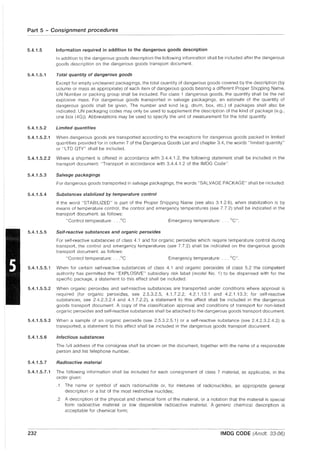
cannot detonate or deflagrate rapidly or undergo a thermal explosion (defined as ORGANIC PEROXIDE
TYPE C);
.4 Any organic peroxide formulation which in laboratory testing:
.1 detonates partially, does not deflagrate rapidly and shows no violent effect when heated under
confinement; or
2 does not detonate at all, deflagrates slowly and shows no violent effect when heated under
confinement; or
.3 does not detonate or deflagrate at all and shows a medium effect when heated under confinement
is acceptable for transport in packages of not more than 50 kg net mass (defined as ORGANIC PEROXIDE
TYPE D);
.5 Any organic peroxide formulation which, in laboratory testing, neither detonates nor deflagrates at all and
shows low or no effect when heated under confinement is acceptable for transport in packages of not
more than 400 kg/450 e(defined as ORGANIC PEROXIDE TYPE E);
.6 Any organic peroxide formulation which, in laboratory testing, neither detonates in the cavitated state nor
deflagrates at all and shows only a low or no effect when heated under confinement as well as low or no
explosive power may be considered for transport in IBCs or tanks (defined as ORGANIC PEROXIDE TYPE
F); for additional provisions see 4.1.7 and 4.2.1.13;
.7 Any organic peroxide formulation which, in laboratory testing, neither detonates in the cavitated state nor
deflagrates at all and shows no effect when heated under confinement nor any explosive power shall be
IMDG CODE (Amdt. 33-06)
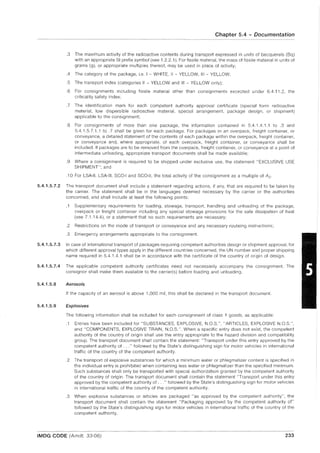
2.5.3.4
2.5.3.4.0
2.5.3.4.1
2.5.3.4.2
2.5.3.4.3
2.5.3.5
2.5.3.5.1
2.5.3.5.2
2.5.3.5.3
2.5.3.5.4
2.5.3.5.5
2.5.3.5.6
Chapter 2.5 - Class 5 - Oxidizing substances and organic peroxides
exempted from class 5.2, provided that the formulation is thermally stable (self-accelerating decomposi-
tion temperature is 60"C or higher for a 50 kg package) and for liquid formulations diluent type A is used
for desensitization (defined as ORGANIC PEROXIDE TYPE G). If the formulation is not thermally stable or
a diluent other than type A is used for desensitization, the formulation shall be defined as ORGANIC
PEROXIDE TYPE F.
Temperature control provisions
The properties of some organic peroxides require that they be transported under temperature control. Control
and emergency temperatures for currently assigned organic peroxides are shown in the list 2.5.3.2.4. The
controlled temperature provisions are given in chapter 7.7.
The following organic peroxides shall be subjected to temperature control during transport:
.1 organic peroxides type Band C with a SADT ~ 50n
C;
.2 organic peroxides type D showing a medium effect when heated under confinement' with a SADT ~ 50"C
or showing a low or no effect when heated under confinement with a SADT ~ 45'C; and
.3 organic peroxides types E and F with a SADT ~ 45'C.
Test methods for determining the SADT are given in the United Nations Manual of Tests and Criteria, part II,
chapter 28. The test selected shall be conducted in a manner which is representative, both in size and
material, of the package to be transported.
Test methods for determining the flammability are given in the United Nations Manual of Tests and Criteria,
part III, chapter 32.4. Because organic peroxides may react vigorously when heated, it is recommended to
determine their flashpoint using small sample sizes such as described in ISO 3679.
Desensitization of organic peroxides
In order to ensure safety during transport, organic peroxides are in many cases desensitized by organic liquids
or solids, inorganic solids or water. Where a percentage of a substance is stipulated, this refers to the
percentage by mass, rounded to the nearest whole number. In general, desensitization shall be such that, in
case of spillage or fire, the organic peroxide will not concentrate to a dangerous extent.
Unless otherwise stated for the individual organic peroxide formulation, the following definitions apply for
diluents used for desensitization:
.1 Diluents type A are organic liquids which are compatible with the organic peroxide and which have a
boiling point of not less than 150'C. Type A diluents may be used for desensitizing all organic peroxides.
.2 Diluents type B are organic liquids which are compatible with the organic peroxide and which have a
boiling point of less than 150"C but not less than 60'C and a flashpoint of not less than 5°C. Type B
diluents may be used for desensitization of all organic peroxides provided that the boiling point is at least
60
G
C higher than the SADT in a 50 kg package.
Diluents, other than type A or type B, may be added to organic peroxide formulations as listed in 2.5.3.2.4
provided that they are compatible. However, replacement of all or part of a type A or type B diluent by another
diluent with differing properties requires that the organic peroxide formulation be re-assessed in accordance
with the normal acceptance procedure for class 5.2.
Water may only be used for the desensitization of organic peroxides which are shown in 2.5.3.2.4 or in the
statement of approval according to 2.5.3.2.5 as being with water or as a stable dispersion in water.
Organic and inorganic solids may be used for desensitization of organic peroxides provided that they are
compatible.
Compatible liquids and solids are those which have no detrimental influence on the thermal stability and
hazard type of the organic peroxide formulation.
, As determined by test series E as prescribed in the United Nations Manual of Tests aile! Criteria, part II.
IMDG CODE (Amdt. 33-06) 77
Chapter 2.6
Class 6 - Toxic and infectious substances
2.6.0
Note 1:
Note 2:
Note 3:
2.6.1
2.6.2
2.6.2.1
2.6.2.1.1
2.6.2.1.2
2.6.2.1.3
2.6.2.1.4
78
Introductory notes
The word "toxic" has the same meaning as "poisonous".
Genetically modified micro-organisms which do not meet the definition of an infectious substance shall be
considered for classification in class 9 and assigned to UN 3245.
Toxins from plant, animal or bacterial sources which do not contain any infectious substances, or toxins that
are contained in substances which are not infectious substances, shall be considered for classification in class
6.1 and assigned to UN 3172.
Definitions
Class 6 is subdivided into two classes as follows:
Class 6.1 - Toxic substances
These are substances liable either to cause death or serious injury or to harm human health if swallowed or
inhaled, or by skin contact.
Class 6.2 - Infectious substances
These are substances known or reasonably expected to contain pathogens. Pathogens are defined as micro-
organisms (including bacteria, viruses, rickettsiae, parasites, fungi) and other agents such as prions, which
can cause disease in humans or animals.
Class 6.1 - Toxic substances
Definitions and properties
L050 (median lethal dose) for acute oral toxicity is the statistically derived single dose of a substance that can
be expected to cause death within 14 days in 50 per cent of young adult albino rats when administered by the
oral route. The LD50 value is expressed in terms of mass of test substance per mass of test animal (mgjkg).
L050 for acute dermal toxicity is that dose of the substance which, administered by continuous contact for 24
hours with the bare skin of the albino rabbit, is most likely to cause death within 14 days in one half of the
animals tested. The number of animals tested shall be sufficient to give a statistically significant result and be
in conformity with good pharmacological practices. The result is expressed in milligrams per kilogram body
mass.
LC50 for acute toxicity on inhalation is that concentration of vapour, mist or dust which, administered by
continuous inhalation to both male and female young adult albino rats for one hour, is most likely to cause
death within 14 days in one half of the animals tested. A solid substance shall be tested if at least 10% (by
mass) of its total mass is likely to be dust in the respirable range, such as the aerodynamic diameter of that
particle fraction is 10 microns or less. A liquid substance shall be tested if a mist is likely to be generated in a
leakage of the transport containment. For both solid and liquid substances, more than 90% (by mass) of a
specimen prepared for inhalation toxicity testing shall be in the respirable range as defined above. The result
is expressed in milligrams per litre of air for dusts and mists or in millilitres per cubic metre of air (parts per
million) for vapours.
Properties
.1 The dangers of poisoning which are inherent in these substances depend upon contact with the human
body, that is by inhalation of vapours by unsuspecting persons at some distance from the cargo or the
immediate dangers of physical contact with the substance. These have been considered in the context of
the probability of accident occurring during transport by sea.
.2 Nearly all toxic substances evolve toxic gases when involved in a fire or when heated to decomposition.
.3 A substance specified as "stabilized" shall not be transported in an unstabilized condition.
IMDG CODE (Amdt. 33-06)
Chapter 2.6 - Class 6 - Toxic and infectious substances
2.6.2.2 Assignment of packing groups to toxic substances
2.6.2.2.1 Toxic substances have for packing purposes been apportioned among packing groups according to the
degree of their toxic hazards in transport:
2.6.2.2.2
2.6.2.2.3
.1 Packing group I: substances and preparations presenting a high toxicity risk;
.2 Packing group II: substances and preparations presenting a medium toxicity risk;
.3 Packing group III: substances and preparations presenting a low toxicity risk.
In making this grouping, account has been taken of human experience in Instances of accidental poisoning,
and of special properties possessed by any individual substance, such as liquid state, high volatility, any
special likelihood of penetration, and special biological effects.
In the absence of human experience, the grouping has been based on data obtained from animal
experiments. Three possible routes of administration have been examined. These routes are exposure
through:
- oral ingestion:
- dermal contact; and
- inhalation of dusts, mists or vapours.
2.6.2.2.3.1 For appropriate animal test data for the various routes of exposure, see 2.6.2.1. When a substance exhibited a
different order of toxicity by two or more routes of administration, the highest degree of danger indicated by
the tests has been used in assigning the packing group.
2.6.2.2.4 The criteria to be applied for grouping a substance according to the toxicity it exhibits by all three routes of
administration are presented in the following paragraphs.
2.6.2.2.4.1 The grouping criteria for the oral and dermal routes as well as for inhalation of dusts and mists are shown in
the following table:
Packing group
I
II
III *
Grouping criteria for administration through oral ingestion,
dermal contact and inhalation of dusts and mists
Oral toxicity Dermal toxicity
LDso LDso
(mgjkg) (mgjkg)
~50 ~50
> 5.0 and ~50 >50 and ~200
> 50 and ~300 > 200 and ~1000
Inhalation toxicity
by dusts and mists
Leso
(mgjt)
~02
> 0.2 and ~ 2.0
> 2.0 and ~ 4.0
* Tear gas substances shall be included in packing group II even if their toxicity data correspond to packing group III values.
2.6.2.2.4.2 The criteria for inhalation toxicity of dusts and mists in 2.6.2.2.4.1 are based on LC50 data relating to one hour
exposures, and where such information is available it shall be used. However, where only LC50 data relating to
4 hour exposures to dusts and mists are available, such figures can be multiplied by four and the product
substituted in the above criteria, i.e. LC50 (4 hours) x 4 is considered the equivalent of LCso (1 hour).
Note: Substances meeting the criteria of class 8 and with an inhalation toxicity of dusts and mists (LC50 )
leading to packing group I are only accepted for an allocation to class 6.1 if the toxicity through oral ingestion
or dermal contact is at least in the range of packing group I or II. Otherwise an allocation to class 8 is made
when appropriate (see 2.8.2.2).
2.6.2.2.4.3 Liquids having toxic vapours shall be assigned to the following packing groups, where "V" is the saturated
vapour concentration in mf'jm
3
air at 20°C and standard atmospheric pressure:
Packing group I if V ?: 10 LCso and LCso ~ 1000 mf'/m3.
Packing group II: if V ?: LC50 and LC50 ~ 3000 mf'/m
3
, and do not meet the criteria for packing group I.
Packing group III: if V ?: ~ LCso and LCso ~ 5000 mf'/m
3
, and do not meet the criteria for packing groups I
or II.
Note: Tear gas substances shall be included in packing group II even if their toxicity data correspond to
packing group III values.
IMDG CODE (Amdt. 33-06) 79
Part 2 - Classification
2.6.2.2.4.4 In figure 2-3 the criteria according to 2.6.2.2.4.3 are expressed in graphical form, as an aid to easy
classification. Because of approximations inherent in the use of graphs, substances falling on or near packing
group borderlines shall be checked using numerical criteria.
10,000
1,000
'~
E 100
0'
-'
10
.........
. ...
..
/'1 /
/.
)' / /
.... / /
/ /
10 100
.. +.
.. FOR
...
/.
/ I
1/
/. /.
/
" ..
/.
,
1,000
VOLATILITY mOm'
-~.-- ~
GROUP III
II j UtiGROUPII
I III
r~ t-.~ ...1:11 II
10,000 100,000
Figure 2-3 - Inhalation toxicity: packing group borderlines
, ,
,
2.6.2.2.4.5 The criteria for inhalation toxicity of vapours in 2.6.2.2.4.3 are based on LC50 data relating to one hour
exposures, and where such information is available it shall be used. However, where only LC50 data relating to
4 hour exposures to the vapours are available, such figures can be multiplied by two and the product
substituted in the above criteria, i.e. LC50 (4 hours) x 2 is considered the equivalent of LC50 (1 hour).
2.6.2.2.4.6 Mixtures of liquids that are toxic by inhalation shall be assigned to packing groups according to 2.6.2.2.4.7 or
2.6.2.2.4.8.
2.6.2.2.4.7 If LCso data are available for each of the toxic substances comprising a mixture, the packing group may be
determined as follows:
80
.1 Estimate the LCso of the mixture using the formula:
1
LC50 (mixture) = -n----
8(L~50J
where: mole fraction of the /h component substance of the mixture
mean lethal concentration of the /h component substance in m€/m3
.
.2 Estimate the volatility of each component substance comprising the mixture using the formula:
(
PI x 10
6
) e 3
VI = 101.3 m./m
where: PI = the partial pressure of the /h component substance in kPa at 20°C and one
atmosphere pressure.
.3 Calculate the ratio of the volatility to the LCso using the formula:
R=L _I.n ( V )
h 1 LC501
.4 Using the calculated values of LCso (mixture) and R, the packing group for the mixture is determined:
Packing group I: R ~ 10 and LC50 (mixture) ~ 1000 me/m3
.
Packing group II: R ~ 1 and LC50 (mixture) ~ 3000 me/m3
and not meeting criteria for packing group I.
Packing group III: R ~ 6and LC50 (mixture) ~ 5000 me/m3
and not meeting criteria for packing groups I
or II.
IMDG CODE (Amdt. 33-06)
Chapter 2.6 - Class 6 - Toxic and infectious substances
2.6.2.2.4.8 In the absence of LC50 data on the toxic constituent substances, the mixture may be assigned a packing
group based on the following simplified threshold toxicity tests. When these threshold tests are used, the most
restrictive packing group shall be determined and used for transporting the mixture.
2.6.2.3
2.6.2.3.1
2.6.2.3.2
2.6.2.3.3
.1 A mixture is assigned to packing group I only if it meets both of the following criteria:
- A sample of the liquid mixture is vaporized and diluted with air to create a test atmosphere of
1000 mUm
3
vaporized mixture in air. Ten albino rats (five male and five female) are exposed to the test
atmosphere for one hour and observed for 14 days. If five or more of the animals die within the 14-day
observation period, the mixture is presumed to have an LC50 equal to or less than 1000 mf/m3
- A sample of the vapour in equilibrium with the liquid mixture at 20"C is diluted with 9 equal volumes of
air to form a test atmosphere. Ten albino rats (five male and five female) are exposed to the test
atmosphere for one hour and observed for 14 days. If five or more of the animals die within the 14-day
observation period, the mixture is presumed to have a volatility equal to or greater than 10 times the
mixture LCso.
.2 A mixture is assigned to packing group II only if it meets both of the following criteria, and the mixture
does not meet the criteria for packing group I:
- A sample of the liquid mixture is vaporized and diluted with air to create a test atmosphere of
3000 mf/m3 vaporized mixture in air. Ten albino rats (five male and five female) are exposed to the test
atmosphere for one hour and observed for 14 days. If five or more of the animals die within the 14-day
observation period, the mixture is presumed to have an LCso equal to or less than 3000 mf/m3
- A sample of the vapour in equilibrium with the liquid mixture at 20"C is used to form a test atmosphere.
Ten albino rats (five male and five female) are exposed to the test atmosphere for one hour and
observed for 14 days. If five or more of the animals die within the 14 day observation period, the mixture
is presumed to have a volatility equal to or greater than the mixture LCso.
.3 A mixture is assigned to packing group III only if it meets both of the following criteria, and the mixture
does not meet the criteria for packing groups I or II:
A sample of the liquid mixture is vaporized and diluted with air to create a test atmosphere of
5000 mf/m3 vaporized mixture in air. Ten albino rats (five male and five female) are exposed to the test
atmosphere for one hour and observed for 14 days. If five or more of the animals die within the 14-day
observation period, the mixture is presumed to have an LCso equal to or less than 5000 mf/m]
- The vapour pressure of the liquid mixture is measured and if the vapour concentration is equal to or
greater than 1000 mf/m3, the mixture is presumed to have a volatility equal to or greater than ~ the
mixture LC50. .)
Methods for determining oral and dermal toxicity of mixtures
When classifying and assigning the appropriate packing group to mixtures in class 6.1, in accordance with the
oral and dermal toxicity criteria in 2.6.2.2, it is necessary to determine the acute LDso of the mixture.
If a mixture contains only one active substance, and the LDso of that constituent is known, in the absence of
reliable acute oral and dermal toxicity data on the actual mixture to be transported, the oral or dermal LD50
may be obtained by the following method:
LD'iO value of active substance x 100
LD50 value of preparation = ---'.-"-----:-----------,-----
percentage of active substance by mass
If a mixture contains more than one active constituent, there are three possible approaches that may be used
to determine the oral or dermal LD50 of the mixture. The preferred method is to obtain reliable acute oral and
dermal toxicity data on the actual mixture to be transported. If reliable, accurate data are not available, then
either of the following methods may be performed:
.1 Classify the formulation according to the most hazardous constituent of the mixture as if that constituent
were present in the same concentration as the total concentration of all active constituents; or
.2 Apply the formula:
where: C = the % concentration of constituent A, B ... Z in the mixture;
T = the oral LDso value of constituent A, B ... Z;
TM = the oral LD50 value of the mixture.
IMDG CODE (Amdt. 33-06) 81
Part 2 - Classification
2.6.2.4
2.6.2.4.1
2.6.2.4.2
2.6.2.4.3
2.6.3
2.6.3.1
2.6.3.1.1
2.6.3.1.2
2.6.3.1.3
2.6.3.1.4
2.6.3.1.5
2.6.3.1.6
2.6.3.2
2.6.3.2.1
82
Note: This formula can also be used for dermal toxicities provided that this information is available on the
same species for all constituents. The use of this formula does not take into account any potentiation or
protective phenomena.
Classification of pesticides
All active pesticide substances and their preparations for which the LC50 and/or LD50 values are known and
which are classified in class 6.1 shall be classified under appropriate packing groups in accordance with the
criteria given in 2.6.2.2. Substances and preparations which are characterized by subsidiary risks shall be
classified according to the precedence of hazard table in 2.0.3 with the assignment of appropriate packing
groups.
If the oral or dermal LDso value for a pesticide preparation is not known, but the LDso value of its active
substance(s) is known, the LD50 value for the preparation may be obtained by applying the procedures in
2.6.2.3.
Note: LDso toxicity data for a number of common pesticides may be obtained from the most current edition of
"The WHO Recommended Classification of Pesticides by Hazard and Guidelines to Classification", available
from the International Programme on Chemical Safety, World Health Organization (WHO), 1211 Geneva 27,
Switzerland. While that publication may be used as a source of LD50 data for pesticides, its classification
system shall not be used for purposes of transport classification of, or assignment of packing groups to,
pesticides, which shall be in accordance with the provisions of this Code.
The Proper Shipping Name used in the transport of the pesticide shall be selected from those referenced on
the basis of the active ingredient, of the physical state of the pesticide and any subsidiary risks which it may
exhibit.
Class 6.2 - Infectious substances
Definitions
For the purposes of this Code:
Infectious substances are substances which are known or are reasonably expected to contain pathogens.
Pathogens are defined as micro-organisms (including bacteria, viruses, rickettsiae, parasites, fungi) and other
agents such as prions, which can cause disease in humans or animals.
Biological products are those products derived from living organisms which are manufactured and distributed
in accordance with the requirements of appropriate national authorities, which may have special licensing
requirements, and are used either for prevention, treatment, or diagnosis of disease in humans or animals, or
for development, experimental or investigation purposes related thereto. They include, but are not limited to,
finished or unfinished products such as vaccines.
Cultures are the result of a process by which pathogens are intentionally propagated. This definition does not
include human or animal patient specimens as defined in 2.6.3.1.4.
Patient specimens are human or animal materials, collected directly from humans or animals, including, but
not limited to, excreta, secreta, blood and its components, tissue and tissue fluid swabs, and body parts being
transported for purposes such as research, diagnosis, investigational activities, disease treatment and
prevention.
Genetically modified micro-organisms and organisms are micro-organisms and organisms in which genetic
material has been purposely altered through genetic engineering in a way that does not occur naturally.
Medical or clinical wastes are wastes derived from the medical treatment of animals or humans or from bio-
research.
Classification of infectious substances
Infectious substances shall be classified in class 6.2 and assigned to UN 2814, UN 2900, UN 3291 or UN
3373, as appropriate.
IMDG CODE (Amdt. 33-06)
Chapter 2.6 - Class 6 - Toxic and infectious substances
2.6.3.2.2 Infectious substances are divided into the following categories:
2.6.3.2.2.1 Category A: An infectious substance which is transported in a form that, when exposure to it occurs, is
capable of causing permanent disability, life-threatening or fatal disease in otherwise healthy humans or
animals. Indicative examples of substances that meet these criteria are given in the table in this paragraph.
Note: An exposure occurs when an infectious substance is released outside the protective packaging,
resulting in physical contact with humans or animals.
(a) Infectious substances meeting these criteria which cause disease in humans or in both humans and
animals shall be assigned to UN 2814. Infectious substances which cause disease only in animals shall
be assigned to UN 2900.
(b) Assignment to UN 2814 or UN 2900 shall be based on the known medical history and symptoms of the
source human or animal, endemic local conditions, or professional judgement concerning individual
circumstances of the human or animal source.
Note 1: The Proper Shipping Name for UN 2814 is INFECTIOUS SUBSTANCE, AFFECTING HUMANS. The
Proper Shipping Name for UN 2900 is INFECTIOUS SUBSTANCE, AFFECTING ANIMALS only.
Note 2: The following table is not exhaustive. Infectious substances, including new or emerging pathogens,
which do not appear in the table but which meet the same criteria shall be assigned to Category A.
In addition, if there is doubt as to whether or not a substance meets the criteria It shall be included
in Category A.
Note 3: In the following table. the micro-organism names written in italics are bacteria, mycoplasmas,
rickettsia or fungi.
Indicative examples of infectious substances included in category A in any form
unless otherwise indicated (2.6.3.2.2.1 (a))
UN Number and
Proper Shipping Micro-organism
Name
UN 2814 Bacillus anthracis (cultures only)
Infectious sub- Brucella abortus (cultures only)
stance, affecting Brucella melitensis (cultures only)
humans Brucella suis (cultures only)
Burkholderia mallei - Pseudomonas mallei - Glanders (cultures only)
Burkholderia pseudomallei - Pseudomonas pseudomailei (cultures only)
Chlamydia psittaci - avian strains (cultures only)
Clostridium botulinum (cultures only)
Coccidioides immitis (cultures only)
Coxiella burnetii (cultures only)
Crimean-Congo hemorrhagic fever virus
Dengue virus (cultures only)
Eastern equine encephalitis virus (cultures only)
Escherichia coli, verotoxigenic (cultures only)
Ebola virus
Flexal virus
Francisella tularensis (cultures only)
Guanarito virus
Hantaan virus
Hantavirus causing hemorragic fever with renal syndrome
Hendra virus
Hepatitis B virus (cultures only)
Herpes B virus (cultures only)
Human immunodeficiency virus (cultures only)
Highly pathogenic avian influenza virus (cultures only)
Japanese Encephalitis virus (cultures only)
Junin virus
Kyasanur Forest disease virus
Lassa virus
Machupo virus
Marburg virus
Monkeypox virus
Mycobacterium tubercuiosis (cultures only)
IMDG CODE (Amdt. 33-06) 83
Part 2 - Classification
UN Number and
Proper Shipping Micro-organism
Name
UN 2814 Nipah virus
Infectious sub- Omsk hemorrhagic fever virus
stance, affecting Poliovirus (cultures only)
humans Rabies virus (cultures only)
(cont.) Rickettsia prowazekii (cultures only)
Rickettsia rickettsii (cultures only)
Rift Valley fever virus (cultures only)
Russian spring-summer encephalitis virus (cultures only)
Sabia virus
Shigella dysenteriae type 1 (cultures only)
Tick-borne encephalitis virus (cultures only)
Variola virus
Venezuelan equine encephalitis virus (cultures only)
West Nile virus (cultures only)
Yellow fever virus (cultures only)
Yersinia pestis (cultures only)
UN 2900 African swine fever virus (cultures only)
Infectious sub- Avian paramyxovirus Type 1 - Velogenic Newcastle disease virus (cultures only)
stance, affecting Classical swine fever virus (cultures only)
animals only Foot and mouth disease virus (cultures only)
Lumpy skin disease virus (cultures only)
Mycoplasma mycoides - Contagious bovine pleuropneumonia (cultures only)
Peste des petits ruminants virus (cultures only)
Rinderpest virus (cultures only)
Sheep-pox virus (cultures only)
Goatpox virus (cultures only)
Swine vesicular disease virus (cultures only)
Vesicular stomatitis virus (cultures only)
2.6.3.2.2.2 Category B: An infectious substance which does not meet the criteria for inclusion in Category A Infectious
substances In Category B shall be assigned to UN 3373.
Note: The Proper Shipping Name for UN 3373 is "BIOLOGICAL SUBSTANCE, CATEGORY B".
2.6.3.2.3 Exemptions
2.6.3.2.3.1 Substances which do not contain infectious substances or substances which are unlikely to cause disease in
humans or animals are not subject to the provisions of this Code, unless they meet the criteria for inclusion in
another class.
2.6.3.2.3.2 Substances containing micro-organisms which are non-pathogenic to humans or animals are not subject to
the provisions of this Code unless they meet the criteria for inclusion in another class.
2.6.3.2.3.3 Substances in a form that any present pathogens have been neutralized or inactivated such that they no
longer pose a health risk are not subject to the provisions of this Code unless they meet the criteria for
inclusion in another class.
2.6.3.2.3.4 Environmental samples (including food and water samples) which are not considered to pose a significant risk
of infection are not subject to the provisions of this Code unless they meet the criteria for inclusion in another
class.
2.6.3.2.3.5 Dried blood spots, collected by applying a drop of blood onto absorbent material, or faecal occult blood
screening tests and blood or blood components which have been collected for the purposes of transfusion or
for the preparation of blood products to be used for transfusion or transplantation and any tissues or organs
intended for use in transplants are not subject to this Code.
2.6.3.2.3.6 Human or animal specimens for which there is minimal likelihood that pathogens are present are not subject
to the provisions of this Code if the specimen is transported in a packaging which will prevent any leakage and
which is marked with the words "Exempt human specimen" or "Exempt animal specimen", as appropriate.
The packaging should meet the following conditions:
84 IMDG CODE (Amdt. 33-06)
2.6.3.3
2.6.3.3.1
2.6.3.4
2.6.3.4.1
2.6.3.5
2.6.3.5.1
2.6.3.5.2
2.6.3.5.3
2.6.3.6
2.6.3.6.1
Chapter 2.6 - Class 6 - Toxic and infectious substances
(a) The packaging should consist of three components:
(i) a leak-proof primary receptacle(s);
(ii) a leak-proof secondary packaging; and
(iii) an outer packaging of adequate strength for its capacity, mass and intended use, and with at least
one surface having minimum dimensions of 100 mm x 100 mm;
(b) For liquids, absorbent material in sufficient quantity to absorb the entire contents should be placed
between the primary receptacle(s) and the secondary packaging so that, during transport, any release or
leak of a liquid substance will not reach the outer packaging and will not compromise the integrity of the
cushioning material;
(c) When multiple fragile primary receptacles are placed in a single secondary packaging, they should be
either individually wrapped or separated to prevent contact between them
Note: An element of professional judgment is required to determine if a substance is exempt under this
paragraph. That judgment should be based on the known medical history, symptoms and individual
circumstances of the source, human or animal, and endemic local conditions. Examples of specimens
which may be transported under this paragraph include the blood or urine tests to monitor cholesterol
levels, blood glucose levels, hormone levels, or prostate specific antibodies (PSA); those required to
monitor organ function such as heart, liver or kidney function for humans or animals with non-infectious
diseases, or therapeutic drug monitoring; those conducted for insurance or employment purposes and
are intended to determine the presence of drugs or alcohol; pregnancy test; biopsies to detect cancer;
and antibody detection in humans or animals.
Biological products
For the purposes of this Code, biological products are divided into the following groups:
(a) those which are manufactured and packaged in accordance with the requirements of appropriate
national authorities and transported for the purposes of final packaging or distribution, and use for
personal health care by medical professionals or individuals. Substances in this group are not subject to
the provisions of this Code.
(b) those which do not fall under (a) and are known or reasonably believed to contain infectious substances
and which meet the criteria for inclusion in Category A or Category B. Substances in this group shall be
assigned to UN 2814, UN 2900 or UN 3373, as appropriate.
Note: Some licensed biological products may present a biohazard only in certain parts of the world.
Competent authorities may require that such biological products comply with local requirements for
infectious substances or may impose other restrictions.
Genetically modified micro-organisms and organisms
Genetically modified micro-organisms not meeting the definition of infectious substance shall be classified in
accordance with chapter 2.9.
Medical or clinical wastes
Medical or clinical wastes containing Category A infectious substances shall be assigned to UN 2814 or
UN 2900, as appropriate. Medical or clinical wastes containing infectious substances in Category B shall be
assigned to UN 3291.
Medical or clinical wastes which are reasonably believed to have a low probability of containing infectious
substances shall be assigned to UN 3291.
Note: The Proper Shipping Name for UN 3291 is CLINICAL WASTE, UNSPECIFIED, N.O.S. or (BIO) MEDICAL
WASTE, N.O.S. or REGULATED MEDICAL WASTE, N.O.S.
Decontaminated medical or clinical wastes which previously contained infectious substances are not subject
to the provisions of this Code unless they meet the criteria for inclusion in another class.
Infected animals
Unless an infectious substance cannot be consigned by any other means, live animals shall not be used to
consign such a substance. A live animal which has been intentionally infected and is known or suspected to
contain an infectious substance shall only be transported under terms and conditions approved by the
competent authority.
IMDG CODE (Amdt. 33-06) 85
Part 2 - Classification
2.6.3.6.2
86
Animal carcasses affected by pathogens of category A or which would be assigned to Category A in cultures
only, shall be assigned to UN 2814 or UN 2900 as appropriate.
Other animal carcasses affected by pathogens included in Category B shall be transported in accordance with
provisions determined by the competent authority.
IMDG CODE (Amdt. 33-06)
Chapter 2.7
Class 7 - Radioactive material
2.7.1
2.7.1.1
2.7.1.2
2.7.2
Definition of class 7 - Radioactive material
Radioactive material means any material containing radionuclides where both the activity concentration and
the total activity in the consignment exceed the values specified in 2.7.7,2,1-2.7.7.2,6,
The following radioactive materials are not included in class 7 for the purposes of this Code:
(a) radioactive material that is an integral part of the means of transport;
(b) radioactive material moved within an establishment which is subject to appropriate safety regulations in
force in the establishment and where the movement does not involve public roads or railways;
(c) radioactive material implanted or incorporated into a person or live animal for diagnosis or treatment;
(d) radioactive material in consumer products which have received regulatory approval, following their sale
to the end user;
(e) natural material and ores containing naturally occurring radionuclides which are either in their natural
state, or have only been processed for purposes other than for extraction of the radionuclides, and
which are not intended to be processed for use of these radionuclides provided the activity
concentration of the material does not exceed 10 times the values specified in 2.7.7,2,1 (b), or calculated
in accordance with 2,7.7.2.2 to 2.7.7.2,6;
(f) non-radioactive solid objects with radioactive substances present on any surfaces in quantities not
exceeding the limit set out in the definition for "contamination" in 2.7.2,
Definitions
A1 and A2
A1 means the activity value of special form radioactive material which is listed in the table of 2,7.7.2.1 or
derived in 2.7.7,2 and is used to determine the activity limits for the provisions of this Code,
A2 means the activity value of radioactive material, other than special form radioactive material, which is
listed in the table of 2.7,7,2,1 or derived in 2.7.7,2 and is used to determine the activity limits for the
provisions of this Code.
Approval - multilateral, unilateral
Multilateral approval means approval by the relevant competent authority of the country of origin of the
design or shipment, as applicable and also, where the consignment is to be transported through or into
any other country, approval by the competent authority of that country.
Unilateral approval means an approval of a design which is required to be given by the competent
authority of the country of origin of the design only.
Confinement system means the assembly of fissile material and packaging components specified by the
designer and agreed to by the competent authority as intended to preserve criticality safety,
Containment system means the assembly of components of the packaging specified by the designer as
intended to retain the radioactive material during transport,
Contamination - non-fixed, fixed
Contamination means the presence of a radioactive substance on a surface in quantities in excess of
0.4 Bq/cm 2
for beta and gamma emitters and low-toxicity alpha emitters, or 0,04 Bq/cm2
for all other
alpha emitters,
Non-fixed contamination means contamination that can be removed from a surface during routine
conditions of transport.
Fixed contamination means contamination other than non·fixed contamination.
Criticality safety index (CSI) assigned to a package, overpack or freight container containing fissile material
means a number which is used to provide control over the accumulation of packages, overpacks or freight
containers containing fissile material,
IMDG CODE (Amdt. 33-06) 87
Part 2 - Classification
88
Oesign means the description of special form radioactive material, low dispersible radioactive material,
package or packaging which enables such an item to be fully identified. The description may include
specifications, engineering drawings, reports demonstrating compliance with regulatory provisions, and other
relevant documentation.
Exclusive use means the sole use, by a single consignor, of a conveyance or of a large freight container, in
respect of which all initial, intermediate and final loading and unloading is carried out in accordance with the
directions of the consignor or consignee.
Fissile material means uranium-233. uranium-235, plutonium-239, plutonium-241, or any combination of these
radionuclides. Excepted from this definition is:
(a) natural uranium or depleted uranium which is unirradiated, and
(b) natural uranium or depleted uranium which has been irradiated in thermal reactors only.
Freight container in the case of radioactive material transport means an article of transport equipment
designed to facilitate the transport of goods, either packaged or unpackaged, by one or more modes of
transport without intermediate reloading which is of a permanent enclosed character, rigid and strong enough
for repeated use, and must be fitted with devices facilitating its handling, particularly in transfer between
conveyances and from one mode of transport to another. A small freight container is that which has either any
overall outer dimension less than 1.5 m or an internal volume of not more than 3 m3
. Any other freight
container is considered to be a large freight container.
Low dispersible radIOactive material means either a solid radioactive material or a solid radioactive material in
a sealed capsule that has limited dispersibility and is not in powder form (see 2.7.10).
Low specific activity (LSA) material, see 2.7.3.
Low-toxicity alpha emitters are: natural uranium; depleted uranium; natural thorium; uranium-235 or uranium-
238; thorium-232; thorium-228 and thorium-230 when contained in ores or phYSical and chemical
concentrates; or alpha emitters with a half-life of less than 10 days.
Maximum normal operating pressure means the maximum pressure above atmospheric pressure at mean sea-
level that would develop in the containment system in a period of one year under the conditions of
temperature and solar radiation corresponding to environmental conditions in the absence of venting, external
cooling by an ancillary system, or operational controls during transport.
Package means the packaging with its radioactive contents as presented for transport. The types of packages
covered by these provisions, which are subject to the activity limits and material restrictions of 2.7.7 and meet
the corresponding provisions, are:
(a) Excepted package;
(b) Industrial package Type 1 (Type IP-1 package);
(c) Industrial package Type 2 (Type IP-2 package);
(d) Industrial package Type 3 (Type IP-3 package);
(e) Type A package;
(f) Type B(U) package;
(g) Type B(M) package;
(h) Type C package.
Packaging means the assembly of components necessary to enclose the radioactive contents completely. It
may, in particular, consist of one or more receptacles, absorbent materials, spacing structures, radiation
shielding and service equipment for filling, emptying, venting and pressure relief; devices for cooling,
absorbing mechanical shocks, handling and tie-down, thermal insulation; and service devices integral to the
package. The packaging may be a box, drum or similar receptacle, or may also be a freight container, tank or
intermediate bulk container.
Radiation level means the corresponding dose rate expressed in millisieverts per hour.
Radioactive contents means the radioactive material together with any contaminated or activated solids,
liquids, and gases within the packaging.
Special form radioactive material, see 2.7.4.
Specific activity of a radionuclide means the activity per unit mass of that nuclide. The specific activity of a
material means the activity per unit mass of the material in which the radionuclides are essentially uniformly
distributed.
Surface contaminated object (SeO), see 2.7.5.
IMDG CODE (Amdt. 33-06)
2.7.3
2.7.3.1
2.7.3.2
2.7.3.3
2.7.3.4
Chapter 2.7 - Class 7 - Radioactive material
Transport index (Tf) assigned to a package, overpack or freight container, or to unpackaged LSA-I or SeQ-I,
means a number which is used to provide control over radiation exposure.
Unirradiated thorium means thorium containing not more than 10-
7
g of uranium-233 per gram of thorium-
232.
Unirradiated uranium means uranium containing not more than 2 x 10³
8q of plutonium per gram of uranium-
235, not more than 9 x 10⁶
Bq of fission products per gram of uranium-235 and not more than 5 x 10⁻³
g of
uranium-236 per gram of uranium-235.
Uranium - natural, depleted, enriched
Natural uranium means uranium (which may be chemically separated) containing the naturally occurring
distribution of uranium isotopes (approximately 99.28% uranium-238 and 0.72% uranium-235 by mass).
Oepleted uranium means uranium containing a lesser mass percentage of uranium-235 than in natural
uranium.
Enriched uranium means uranium containing a greater mass percentage of uranium-235 than 0.72%. In
all cases, a very small mass percentage of uranium-234 is present.
Low specific activity (LSA) material, determination of groups
Low specific activity (LSA) material means radioactive material which by its nature has a limited specific
activity, or radioactive material for which limits of estimated average specific activity apply. External shielding
materials surrounding the LSA material shall not be considered in determining the estimated average specific
activity.
LSA material shall be in one of three groups:
(a) LSA-I
(i)
(ii)
(iii)
(iv)
(b) LSA-II
(i)
(ii)
uranium and thorium ores and concentrates of such ores, and other ores containing naturally
occurring radionuclides which are intended to be processed for the use of these radionuclides;
natural uranium, depleted uranium, natural thorium or their compounds or mixtures, providing
they are unirradiated and in solid or liquid form:
radioactive material for which the A2 value is unlimited, excluding fissile material in quantities not
excepted under 6.4.11.2; or
other radioactive material in which the activity is distributed throughout and the estimated average
specific activity does not exceed 30 times the values for activity concentration specified in
2.7.7.2.1-2.7.7.2.6, excluding fissile material in quantities not excepted under 6.4.11.2.
water with tritium concentration up to 0.8 TBq/E; or
other material in which the activity is distributed throughout and the estimated average specific
activity does not exceed 1O-4
A2/g for solids and gases, and 1O-5
A2/g for liquids.
(c) LSA-III: Solids (such as consolidated wastes, activated materials), excluding powders, in which:
(i) the radioactive material is distributed throughout a solid or a collection of solid objects, or is
essentially uniformly distributed in a solid compact binding agent (such as concrete, bitumen,
ceramic, etc.);
(ii) the radioactive material is relatively insoluble, or it is intrinsically contained in a relatively insoluble
matrix, so that, even under loss of packaging, the loss of radioactive material per package by
leaching when placed in water for seven days would not exceed 0.1A2; and
(iii) the estimated average specific activity of the solid, excluding any shielding material, does not
exceed 2 x 1O-3
A2/g.
LSA-III material shall be a solid of such a nature that if the entire contents of a package were subjected to the
test specified in 2.7.3.4 the activity in the water would not exceed 0.1 A2 .
LSA-III material shall be tested as follows:
A solid material sample representing the entire contents of the package shall be immersed for 7 days in water
at ambient temperature. The volume of water to be used in the test shall be sufficient to ensure that at the end
of the 7-day test period the free volume of the unabsorbed and unreacted water remaining shall be at least
10% of the volume of the solid test sample itself. The water shall have an initial pH of 6-8 and a maximum
conductivity of 1 mS/m at 20"e. The total activity of the free volume of water shall be measured following the
7-day immersion of the test sample.
IMDG CODE (Amdt. 33-06) 89
Part 2 - Classification
2.7.3.5
2.7.4
2.7.4.1
2.7.4.2
2.7.4.3
2.7.4.4
2.7.4.5
2.7.4.6
90
Demonstration of compliance with the performance standards in 2.7.3.4 shall be in accordance with 6.4.12.1
and 6.4.12.2.
Provisions for special form radioactive material
Special form radioactive material means either:
(a) an indispersible solid radioactive material; or
(b) a sealed capsule containing radioactive material that is so manufactured that it can be opened only by
destroying the capsule.
Special form radioactive material shall have at least one dimension not less than 5 mm
Special form radioactive material shall be of such a nature or shall be so designed that, if it is subjected to the
tests specified in 2.7.4.4-2.7.4.8, it meets the following provisions:
(a) it would not break or shatter under the impact, percussion and bending tests in 2.7.4.5(a), (b) and (c)
and 2.7.4.6(a), as applicable;
(b) it would not melt or disperse in the applicable heat test 2.7.4.5(d) or 2.7.4.6(b); and
(c) the activity in the water from the leaching tests specified in 2.7.4.7 and 2.7.4.8 would not exceed 2 kBq;
or alternatively for sealed sources, the leakage rate for the volumetric leakage assessment test specified
in the International Organization for Standardization document ISO 9978:1992(E) "Radiation
Protection - Sealed radioactive sources Leakage test methods" would not exceed the applicable
acceptance threshold acceptable to the competent authority.
Demonstration of compliance with the performance standards required in 2.7.4.2 shall be in accordance with
6.4.12.1 and 6.4.12.2.
Specimens that comprise or simulate special form radioactive material shall be subjected to the impact test,
the percussion test, the bending test, and the heat test specified in 2.7.4.5 or alternative tests as authorized in
2.7.4.6. A different specimen may be used for each of the tests. Following each test, a leaching assessment or
volumetric leakage test shall be performed on the specimen by a method no less sensitive than the methods
given in 2.7.4.7 for indispersible solid material or 2.7.4.8 for encapsulated material.
The relevant test methods are:
(a) Impact test: The specimen shall drop onto the target from a height of 9 m. The target shall be as defined
in 6.4.14.
(b) Percussion test: The specimen shall be placed on a sheet of lead which is supported by a smooth solid
surface and struck by the flat face of a mild steel bar so as to cause an impact equivalent to that
resulting from a free drop of 1.4 kg through 1 m. The lower part of the bar shall be 25 mm in diameter
with the edges rounded off to a radius of (3.0 ± 0.3) mm. The lead, of hardness number 3.5 to 4.5 on
the Vickers scale and not more than 25 mm thick, shall cover an area greater than that covered by the
specimen. A fresh surface of lead shall be used for each impact. The bar shall strike the specimen so as
to cause maximum damage.
(c) Bending test: The test shall apply only to long, slender sources with both a minimum length of 10 cm
and a length to minimum width ratio of not less than 10. The specimen shall be rigidly clamped in a
horizontal position so that one half of its length protrudes from the face of the clamp. The orientation of
the specimen shall be such that the specimen will suffer maximum damage when its free end is struck
by the flat face of a steel bar. The bar shall strike the specimen so as to cause an impact equivalent to
that resulting from a free vertical drop of 1.4 kg through 1 m. The lower part of the bar shall be 25 mm in
diameter with the edges rounded off to a radius of (30 ± 0.3) mm.
(d) Heat test: The specimen shall be heated in air to a temperature of 800"C and held at that temperature
for a period of 10 minutes and shall then be allowed to cool.
Specimens that comprise or simulate radioactive material enclosed in a sealed capsule may be excepted from:
(a) The tests prescribed in 2.7.4.5 (a) and 2.7.4.5 (b) provided the mass of the special form radioactive
material
(i) is less than 200 9 and they are alternatively subjected to the class 4 impact test prescribed in ISO
2919: 1999 "Radiation protection - Sealed radioactive sources - General requirements and
classification"; or
(ii) is less than 500 g and they are alternatively subjected to the class 5 impact test prescribed in ISO
2919: 1980 "Sealed Radioactive Sources - Classification"; and
IMDG CODE (Amdt. 33-06)
2.7.4.7
2.7.4.8
2.7.5
Chapter 2.7 - Class 7 - Radioactive material
(b) the test prescribed in 2.7.4.5(d) provided they are alternatively subjected to the class 6 temperature test
specified in the International Organization for Standardization document ISO 2919:1980(E) "Sealed
radioactive sources - Classification".
For specimens which comprise or simulate indispersible solid material, a leaching assessment shall be
performed as follows:
(a) The specimen shall be immersed for 7 days in water at ambient temperature. The volume of water to be
used in the test shall be sufficient to ensure that at the end of the 7-day test period the free volume of the
unabsorbed and unreacted water remaining shall be at least 10% of the volume of the solid test sample
itself. The water shall have an initial pH of 6-8 and a maximum conductivity of 1 mS/m at 20"C.
(b) The water with specimen shall then be heated to a temperature of (50 ± 5)"C and maintained at this
temperature for 4 hours.
(c) The activity of the water shall then be determined.
(d) The specimen shall then be kept for at least 7 days in still air at not less than 30
n
C and relative humidity
not less than 90%.
(e) The specimen shall then be immersed in water of the same specification as in (a) above and the water
with the specimen heated to (50 ± 5tC and maintained at this temperature for 4 hours.
(f) The activity of the water shall then be determined.
For specimens which comprise or simulate radioactive material enclosed in a sealed capsule, either a leaching
assessment or a volumetric leakage assessment shall be performed as follows:
(a) The leaching assessment shall consist of the following steps:
(i) The specimen shall be immersed in water at ambient temperature. The water shall have an initial
pH of 6-8 with a maximum conductivity of 1 mS/m at 20°C.
(ii) The water and specimen shall be heated to a temperature of (50 ± 5)'C and maintained at this
temperature for 4 hours.
(iii) The activity of the water shall then be determined.
(iv) The specimen shall then be kept for at least 7 days in still air at not less than 30"C and relative
humidity of not less than 90%.
(v) The process in (i), (ii) and (iii) shall be repeated.
(b) The alternative volumetric leakage assessment shall comprise any of the tests prescribed in the
International Organization for Standardization document ISO 9978: 1992(E), "Radiation Protection -
Sealed radioactive sources - Leakage test methods", which are acceptable to the competent authority.
Surface contaminated object (SCQ), determination of groups
Surface contaminated object (Seo) means a solid object which is not itself radioactive but which has
radioactive material distributed on its surfaces. SCO is classified in one of two groups:
(a) SCO-I A solid object on which:
(i) the non-fixed contamination on the accessible surface averaged over 300 cm2
(or the area of the
surface if less than 300 cm 2
) does not exceed 4 Bq/cm2
for beta and gamma emitters and low-
toxicity alpha emitters, or 0.4 Bq/cm
2
for all other alpha emitters; and
(ii) the fixed contamination on the accessible surface averaged over 300 cm2
(or the area of the
surface if less than 300 cm 2
) does not exceed 4 x 10⁴
Bq/cm 2
for beta and gamma emitters and
low-toxicity alpha emitters, or 4 x 10³
Bq/cm2
for all other alpha emitters; and
(iii) the non-fixed contamination plus the fixed contamination on the inaccessible surface averaged
over 300 cm
2
(or the area of the surface if less than 300 cm
2
) does not exceed 4 x 10
4
Bq/cm
2
for beta and gamma emitters and low-toxicity alpha emitters, or 4 x 10
3
Bq/cm2
for all other
alpha emitters.
(b) SCO-II: A solid object on which either the fixed or non-fixed contamination on the surface exceeds the
applicable limits specified for SCO-I in (a) above and on which:
(i) the non-fixed contamination on the accessible surface averaged over 300 cm
2
(or the area of the
surface if less than 300 cm2
) does not exceed 400 Bq/cm 2
for beta and gamma emitters and low-
toxicity alpha emitters, or 40 Bq/cm 2
for all other alpha emitters; and
(ii) the fixed contamination on the accessible surface, averaged over 300 cm
2
(or the area of the
surface if less than 300 cm2
) does not exceed 8 x 10⁵
Bq/cm2
for beta and gamma emitters and
low-toxicity alpha emitters, or 8 x 10
4
Bq/cm
2
for all other alpha emitters; and
IMDG CODE (Amdt. 33-06) 91
Part 2 - Classification
2.7.6
2.7.6.1
2.7.6.1.1
2.7.6.1.2
2.7.6.2
2.7.6.2.1
2.7.6.2.2
2.7.7
2.7.7.1
2.7.7.1.1
92
(iii) the non-fixed contamination plus the fixed contamination on the inaccessible surface averaged
over 300 cm2
(or the area of the surface if less than 300 cm2
) does not exceed 8 x 10⁵
Bq/cm2
for beta and gamma emitters and low-toxicity alpha emitters, or 8 x 10
4
Bq/cm2
for all other
alpha emitters.
Determination of transport index (TI) and criticality safety index (CSI)
Determination of transport index (TI)
The transport index (T/) for a package, overpack or freight container, or for unpackaged LSA-I or SeQ-I, shall
be the number derived in accordance with the following procedure:
(a) Determine the maximum radiation level in units of millisieverts per hour (mSv/h) at a distance of 1 m
from the external surfaces of the package, overpack, freight container, or unpackaged LSA-I and SeQ-I.
The value determined shall be multiplied by 100 and the resulting number is the transport index. For
uranium and thorium ores and their concentrates, the maximum radiation level at any point 1 m from the
external surface of the load may be taken as:
0.4 mSv/h for ores and physical concentrates of uranium and thorium;
0.3 mSv/h for chemical concentrates of thorium;
0.02 mSv/h for chemical concentrates of uranium, other than uranium hexafluoride.
(b) For tanks, freight containers and unpackaged LSA-I and SeQ-I, the value determined in step (a) above
shall be multiplied by the appropriate factor from the table hereunder.
(c) The value obtained in steps (a) and (b) above shall be rounded up to the first decimal place (e.g. 1.13
becomes 1.2), except that a value of 0.05 or less may be considered as zero.
Multiplication factors for tanks, freight containers and unpackaged LSA-I and SCO-I
Size of load' Multiplication factor
size of load :s; 1 m2
1
1 m2
< size of load :s; 5 m2
2
5 m2
< size of load :s; 20 m2
3
20 m2
< size of load 10
'Largest cross·sectional area of the load being measured.
The transport index for each overpack, freight container or conveyance shall be determined as either the sum
of the Tis of all the packages contained, or by direct measurement of radiation level, except in the case of non-
rigid overpacks, for which the transport index shall be determined only as the sum of the Tis of all the
packages.
Determination of criticality safety index (CSI)
The criticality safety index (CSI) for packages containing fissile material shall be obtained by dividing the
number 50 by the smaller of the two values of N derived in 6.4.11.11 and 6.4.11.12 (i.e. eSI ~ 50/N). The value
of the criticality safety index may be zero, provided that an unlimited number of packages is subcritical (i.e. N is
effectively equal to Infinity in both cases).
The criticality safety index for each overpack or freight container shall be determined as the sum of the eSls of
all the packages contained. The same procedure shall be followed for determining the total sum of the eSls in
a consignment or aboard a conveyance.
Activity limits and material restrictions
Contents limits for packages
General
The quantity of radioactive material in a package shall not exceed the relevant limits specified in 2.7.7.1.2-
2.7.7.1.8.
IMDG CODE (Amdt. 33-06)
Chapter 2.7 - Class 7 - Radioactive material
2.7.7.1.2 Excepted packages
2.7.7.1.2.1 For radioactive material other than articles manufactured of natural uranium, depleted uranium or natural
thorium, an excepted package shall not contain activities greater than the following:
(a) where the radioactive material is enclosed in or is included as a component part of an instrument or
other manufactured article, such as a clock or electronic apparatus, the limits specified in columns 2
and 3 of the table hereunder for each individual item and each package, respectively: and
(b) where the radioactive material is not so enclosed in or is not included as a component of an instrument
or other manufactured article, the package limits specified in column 4 of the table hereunder
Activity limits for excepted packages
Instrument or article Materials
Physical state of contents
Item limitsa Package limits
a
Package limits
a
Solids:
special form 10-" A, A, 10<' A,
other forms 10-2 A2 A2 10<1 A2
Liquids 10-3 A2 10-1
A2 10-" A2
Gases:
tritium 2 x 10~2 A2 2 X 10- 1 A2 2 x 10~2 A2
special form 10-3
A, 10-2
A I lO<J A,
other forms 10~3 A2 10- 2
A2 10,,3 A2
8 For mixtures of radionuclides, see 2.7.7,2A-2.7.726
2.7.7.1.2.2 For articles manufactured of natural uranium, depleted uranium or natural thorium, an excepted package may
contain any quantity of such material provided that the outer surface of the uranium or thorium is enclosed in
an inactive sheath made of metal or some other substantial material.
2.7.7.1.3 Industrial packages
The radioactive contents in a Single package of LSA material or in a single package of SCQ shall be so
restricted that the radiation level specified in 4.1.9.2.1 is not exceeded, and the activity in a single package
shall also be so restricted that the activity limits for a conveyance specified in 7.1.14.2 are not exceeded.
2.7.7.1.4 Type A packages
2.7.7.1.4.1 Type A packages shall not contain activities greater than the following:
(a) for special form radioactive material - A,; or
(b) for all other radioactive material - A 2 .
2.7.7.1.4.2 For mixtures of radionuclides whose identities and respective activities are known, the following condition
shall apply to the radioactive contents of a Type A package:
where: B(i) is the activity of radionuclide i as special form radioactive material and A,(i) is the A, value for
radionuclide i; and
C(j) is the activity of radionuclide j as other than special form radioactive material and A2(j) is the A2
value for radionuclide j.
2.7.7.1.5 Type B(U) and Type B(M) packages
2.7.7.1.5.1 Type 8(U) and Type 8(M) packages shall not contain:
(a) activities greater than those authorized for the package design,
(b) radionuclides different from those authorized for the package design, or
(c) contents in a form or a physical or chemical state different from those authorized for the package design
as specified in their certificates of approval.
IMDG CODE (Amdt. 33-06) 93
Part 2 - Classification
2.7.7.1.6
2.7.7.1.7
2.7.7.1.8
2.7.7.2
2.7.7.2.1
94
Type C packages
Note: Type C packages may be transported by air carrying radioactive material in activities exceeding either
3000A , or 100,OOOA2 , whichever is the lower for special form radioactive material. Whilst Type C packages
are not required for sea transport of radioactive material in such activities (Type B(U) or Type B(M) packages
suffice), the following provisions are presented since such packages may also be transported by sea.
Type C packages shall not contain:
(a) activities greater than those authorized for the package design,
(b) radionuclides different from those authorized for the package design, or
(c) contents in a form or physical or chemical state different from those authorized for the package design
as specified in their certificates of approval.
Packages containing fissile material
Unless excepted by 6.4.11.2, packages containing fissile material shall not contain
(a) a mass of fissile material different from that authorized for the package design,
(b) any radionuclide or fissile material different from those authorized for the package design, or
(c) contents in a form or physical or chemical state, or in a spatial arrangement, different from those
authorized for the package design
as specified in their certificates of approval, where appropriate.
Packages containing uranium hexafluoride
Packages containing uranium hexafluoride shall not contain:
(a) a mass of uranium hexafluoride different from that authorized for the package design;
(b) a mass of uranium hexafluoride greater than a value that would lead to an ullage smaller than 5% at the
maximum temperature of the package as specified for the plant systems where the package shall be
used; or
(c) uranium hexafluoride other than in solid form or at an internal pressure above atmospheric pressure
when presented for transport.
Activity levels
The following basic values for individual radionuclides are given in the table hereunder:
(a) A, and A2 in TBq;
(b) activity concentration for exempt material in Bq/g; and
(c) activity limits for exempt consignments in Bq.
Table 2.7.7.2.1 - Basic radionuclide values
A, A2 Activity Activity limit for
Radionuclide (atomic number)
concentration for an exempt
exempt material consignment
(TBq) (TBq) (Bq/g) (Bq)
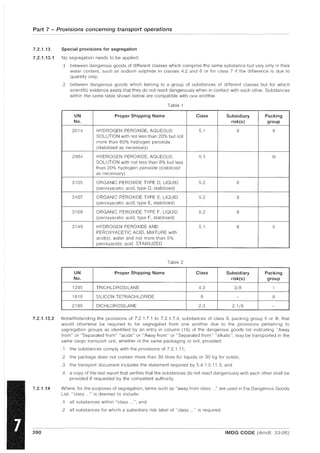
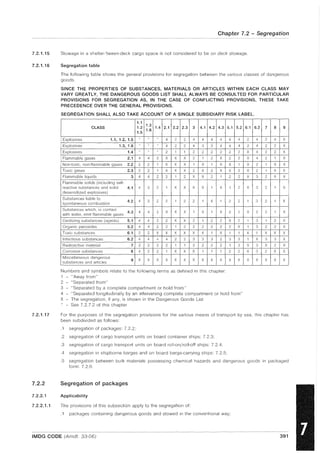
Actinium (89)
Ac-225 (a) 8 x 10" 6 x 10'3 1 x 10' 1 X 10"
Ac-227 (a) 9 xi 0" 9 X 10'5 1 X 10" 1 X 10³
Ac-228 6 x 10" 5 X 10" 1 X 10' 1 x 10"
Silver (47)
Ag-105 2 xi 0° 2 xi 0° 1 xi 02
1 X 10⁶
Ag-108m (a) 7 x 10" 7 X 10" 1 X 10' (b) 1x10⁶(b)
Ag-110m (a) 4 x 10" 4 X 10" 1 X 10' 1 xi 06
Ag-111 2 x 10° 6 X 10" 1 X 10³
1 X 10⁶
Aluminium (13)
AI-26 1 x 10" 1 X 10" 1 X 10' 1 x 10"
Americium (95)
Am-241 1 x 10' 1 x 10'3 1 x 10° 1 x 10"
Am-242m (a) 1 x 10' 1 X 10'3 1 x 10° (b) 1 x 10⁴
(Lj)
IMDG CODE (Amdt. 33,06)
Chapter 2.7 - Class 7 - Radioactive material
A, A2 Activity Activity limit for
Radionuclide (atomic number)
concentration for an exempt
exempt material consignment
(TBq) (TBq) (Bqjg) (Bq)
Am-243 (a) 5 x 10° 1 X 10⁻³
1x100(b) 1 x 10³
(b)
Argon (18)
Ar-37 4 x 10' 4 X 10' 1 x 10⁶
1 x 10⁸
Ar-39 4x 10' 2 X 10' 1 x 10
7
1 x 10
4
Ar-41 3 x 10-' 3 x 10-' 1 x 10²
1 X 10⁹
Arsenic (33)
As-72 3 x 10⁻¹
3 X 10⁻¹
1 X 10' 1 X 10⁵
As-73 4 x 10' 4 X 10' 1 x 10³
1 X 10⁷
As-74 1 x 10° 9 X 10⁻¹
1 X 10' 1 X 10G
As-76 3 x 10⁻¹
3 X 10⁻¹
1 x 10²
1 x 10
5
As-77 2 x 10' 7 X 10- 1
1 x 10³
1 X 10
G
Astatine (85)
At-211 (a) 2 x 10' 5 X 10⁻¹
1 x 10³
1 x 10
7
Gold (79)
Au-193 7 x 100
2 x 10° 1 x 10²
1 x 10⁷
Au-194 1 x 10° 1 x 10° 1 X 10' 1 x 10
6
Au-195 1 x 10' 6 x 10° 1 x 10²
1 x 10
7
Au-198 1 x 10° 6 x 10-' 1 x 10²
1 x 10⁶
Au-199 1 x 10' 6 X 10⁻¹
1 x 10²
1 x 10⁶
Barium (56)
Ba-131 (a) 2 x 100
2 x 10° 1 x 10
2
1 X 10⁶
Ba-133 3 x 10° 3 x 10° 1 x 10²
1 X 10⁶
Ba-133m 2 x 10' 6 X 10- 1
1 x 10²
1 X 10⁶
Ba-140 (a) 5 x 10- 1
3 X 10- 1
1x10'(b) 1x10⁵(b)
Beryllium (4)
Be-7 2 x 10 ' 2 X 10' 1 x 10³
1 x 10
7
Be-10 4 x 10 ' 6 x 10-' 1 x 10
4
1 x 10
6
Bismuth (83)
Bi-205 7 x 10⁻¹ 7 X 10- 1
1 X 10' 1 x 10⁶
Bi-206 3 x 10-' 3 X 10--' 1 X 10' 1 x 10⁵
Bi-207 7 x 10⁻¹
7 x 10-' 1 X 10' 1 x 10
6
Bi-210 1 x 10° 6 X 10⁻¹
1 x 10³
1 x 10⁶
Bi-210m (a) 6 x 10- 1
2 x 10⁻²
1 X 10 ' 1 X 10
5
Bi-212 (a) 7 x 10⁻¹
6 x 10⁻¹
1 x 10' (b) 1 x 10⁵
(b)
Berkelium (97)
Bk-247 8 x 10° 8 X 10⁻⁴
1 x 10° 1 x 10
4
Bk-249 (a) 4 x 10' 3 X 10⁻¹ 1 x 1O~I 1 x 10⁶
Bromine (35)
6r-76 4 x 10-' 4 X 10⁻¹
1 X 10' 1 x 10⁵
6r-77 3 x 10° 3 x 100
1 x 10
2
1 x 10
6
Br-82 4 x 10' 4 X 10-' 1 X 10 ' 1 x 10
6
Carbon (6)
C-11 1 x 10° 6 X 10⁻¹
1 X 10' 1 x 10⁶
C-14 4 x 10' 3 x 100
1 x 10⁴
1 x 10⁷
Calcium (20)
Ca-41 Unlimited Unlimited 1 x 10'5 1 x 10
7
IMDG CODE (Amdt. 33-06) 95
Part 2 - Classification
A, A2 Activity Activity limit for
Radionuclide (atomic number)
concentration for an exempt
exempt material consignment
(TBq) (TBq) (Bq/g) (Bq)
Ca-45 4 x 10' 1 x 100
1 x 1O~ 1 x 10⁷
Ca-47 (a) 3 x 10° 3 x 10-' 1 X 10' 1 x 10⁶
Cadmium (48)
Cd-109 3 x 10' 2 x 10° 1 x 10⁴
1 x 10⁶
Cd-113m Lx 10' 5 X 10-' 1 x 10³
1 x 10⁶
Cd-115 (a) 3 x 10° 4 X 10⁻¹
1 x 10²
1 x 1ali
Cd-115m 5 x 10⁻¹
5 X 10⁻¹
1 x 10³
1 X 10⁵
Cerium (58)
Ce-139 7 x 10° 2 x 10° 1 x 10² 1 x 10A
Ce-141 2 x 10' 6 X 10⁻¹
1 x 10²
1 X 10⁷
Ce-143 9 x 10⁻¹
6 X 10- 1
1 x 10²
1 X 10⁶
Ce-144 (a) 2 x 10- 1
2 X 10- 1
1x10²(b) 1x10⁵(b)
Californium (98)
Cf-248 4 x 10' 6 x 10.3
1 X 10' 1 x 10⁴
Cf-249 3 x 10° 8 x 10 4
1 x 10° 1 x 10³
Cf-250 2 x 10' 2 x 10⁻³
1 X 10' 1 x 10⁴
Cf-251 7 x 10° 7 x 10.4
1 x 10° 1 x 10~1
Cf-252 1 x 10⁻¹
3 X 10⁻³
1 X la' 1 x 10⁴
Cf-253 (a) 4 x 10' 4 X 10⁻²
1 xl 02
1 x 10"
Cf-254 1 x 10-:3
1 xl 0-3
1 x 10° 1 x 10³
Chlorine (17)
CI-36 1 x 10' 6 X 10- 1
1 x 10⁴
1 x 10⁶
CI-38 2 x 10⁻¹
2 X 10⁻¹
1 X 10 ' 1 X 10"
Curium (96)
Cm-240 4 x 10' 2 X 10⁻²
1 x 10²
1 x 10⁵
Cm-241 2 x 10° 1 x 10° 1 x 10²
1 x 10⁶
Cm-242 4 x 10 ' 1 X 10⁻²
1 xl 02
1 X 10⁶
Cm-243 9 x 10° 1 x 10-CJ 1 x 10° 1 x 1O~
Cm-244 2 x 10 ' 2 X 10- 3
1 X 10' 1 x 1O~
Cm-245 9 x 10° g X 10-4
1 x 10° 1 X 10³
Cm-246 9 x 10° 9 X 10⁻⁴
1 x 10° 1 X 10³
Cm-247 (a) 3 x 10° 1 X 10⁻³
1 x 10° 1 X 10
4
Cm-248 2 x 10- 2
3 X 10⁻⁴
1 x 10° 1 X 10³
Cobalt (27)
Co-55 5 xl 0-' 5 x 10⁻¹
1 X 10' 1 xl 06
Co-56 3 x 10⁻¹
3 xl 0-' 1 X 10' 1 xl 05
Co-57 1 x 10' 1 x 10 1 x 10²
1 xl 06
Co-58 1 x 10° 1 x 10° 1 X 10 ' 1 x 10⁶
Co-58m 4 x 10 ' 4 x 10 1 x 10⁴
1 X 10 1
Co-60 4 x 10⁻¹
4 X 10- 1
1 X 10 ' 1 X 10⁶
Chromium (24)
Cr-51 3 x 10' 3 X 10' 1 x 10³
1 x 10⁷
Caesium (55)
Cs-129 4 x 10° 4 x 10° 1 x 10²
1 x 10⁵
Cs-131 3 x 10' 3 x 10 1 xl 03
1 x 1ali
Cs-132 1 x 10° 1 xl 0° 1 X 10 1
1 x 10⁵
96 IMDG CODE (Amdt. 33-06)
Chapter 2.7 - Class 7 - Radioactive material
A1 A2 Activity Activity limit for
Radionuclide (atomic number)
concentration for an exempt
exempt material consignment
(TBq) (TBq) (Bqjg) (Bq)
Cs-134 7 x 10- 1
7 x 10-' 1 X 10' 1 X 10⁴
Cs-134rn 4 x 10' 6 x 10-' 1 X 10'l 1 x 10"
Cs-135 4 x 10' 1 x 10° 1 xi 04
1 xi 07
Cs-136 5 x 10-' 5 X 10- 1
1 X 10' 1 x 10⁵
Cs-137 (aJ 2 x 10° 6 X 10⁻¹
1 X 10' (bJ 1 x 10⁴
(bJ
Copper (29)
Cu-6L 6 x 10° 1 x 10° 1 xi 02
1 X 10⁶
Cu-67 1 x 10' 7 X 10-' 1 xi 02
1 xi 06
Dysprosium (66)
Dy-159 2 x 10 ' 2 X 10' 1 x 10J
1 xi 07
Dy-165 9 x 10-' 6 x 10-' 1 xi 03
1 X 10⁶
Dy-166(aJ 9 x 10⁻¹
3 xi 0-' 1 xi 03
1 X 10°
Erbium (68)
Er-169 4 x 10' 1 x 10° 1 X 10" 1 xi 07
Er-171 8 x 10.. 1
5 X 10-' 1 xi 02
1 xi OC
Europium (63)
Eu-147 2 x 10° 2 x 10° 1 xi 02
1 xi 06
Eu-148 5 xi 0-' 5 xi 0-' 1 X 10 ' 1 X 10G
Eu-149 2 x 10' 2 X 10 ' 1 xi 02
1 xi 07
Eu-150 (short-lived) 2 x 10° 7 X 10⁻¹
1 x 1O~ 1 X 10⁶
Eu-150 (long-lived) 7 x 10⁻¹
7 X 10. 1
1 x 10' 1 X 10
6
Eu-152 1 x 10° 1 x 10° 1 X 10 ' 1 xi 06
Eu-152rn 8 x 10- 1
8 x 10-' 1 x 10²
1 xi 06
Eu-154 9 xi 0-' 6 X 10⁻¹
1 X 10 ' 1 X 10⁶
Eu-155 2 x 10' 3 x 10° 1 xi 02
1 x 10⁷
Eu-156 7 x 10- 1
7 x 10-' 1 X 10' 1 X 10⁶
Fluorine (9)
F-18 1 x 10° 6 x 10- 1
1 X 10' 1 xi 06
Iron (26)
Fe-52 (aJ 3 x 10⁻¹
3 X 10- 1
1 X 10' 1 X 10"
Fe-55 4 x 10' 4 X 10 ' 1 x 10
4
1 x 10c;
Fe-59 9 x 10" 9 X 10⁻¹
1 X 10 ' 1 xi 06
Fe-60 (aJ 4 x 10' 2 xi 0-' 1 xi 02
1 X 10⁵
Gallium (31)
Ga-67 7 x 10° 3 x 10° 1 x 10²
1 X 10G
Ga-68 5 x 10- 1
5 X 10-' 1 X 10 ' 1 X 10"
Ga-72 4 x 10⁻¹
4 x 10' 1 X 10 ' 1 X 10⁵
Gadolinium (64)
Gd-146 (aJ 5 x 10⁻¹
5 X 10-' 1 X 10' 1 X 10⁶
Gd-148 2 x 10' 2 X 10- 3
1 x 10' 1 x 10⁴
Gd-153 1 x 10' 9 x 10° 1 x 10²
1 x 10
7
Gd-159 3 x 10" 6 X 10⁻¹
1 x 10" 1 x 10"
Germanium (32)
Ge-68 (aJ 5 x 10⁻¹
5 X 10- 1
1 X 10 ' 1 X 10⁵
Ge-71 4 x 10' 4 X 10' 1 x 10⁴
1 X lOB
Ge-77 3 x 10-' 3 X 10-' 1 X 10' 1 x 10"
IMDG CODE (Amdt. 33-06) 97
Part 2 - Classification
A1 A2 Activity Activity limit for
Radionuclide (atomic number)
concentration for an exempt
exempt material consignment
(TBq) (TBq) (Bq/g) (Bq)
Hafnium (72)
Hf-172 (a) 6 x 10-' 6 X 10⁻¹
1 X 10' 1 X 10⁶
Hf-175 3 x 10° 3 x 10° 1 X 10²
1 X 10⁶
Hf-181 2 x 10° 5 X 10⁻¹
1 X 10' 1 X 10⁶
Hf-182 Unlimited Unlimited 1 x 10²
1 X 10⁶
Mercury (80)
Hg-194 (a) 1 x 10° 1 x 10° 1 X 10' 1 xl 06
Hg-195m (a) 3 x 100 7 X 10-' 1 X 10²
1 X 10⁶
Hg-197 2 x 10' 1 X 10' 1 xl 02
1 xl 07
Hg-197m 1 x la' 4 x 10⁻¹
1 xl 02
1 X 10⁶
Hg-203 5 x 10° 1 x 10° 1 xl 02
1 Xl 05
Holmium (67)
Ho-166 4 x 10⁻¹
4 X 10- 1
1 xl 03
1 xl 05
Ho-166m 6 x 10⁻¹
5 X 10--1
1 X 10' 1 X 10⁶
Iodine (53)
1-123 6 x 10° 3 x 10° 1 xl 02
1 x 10
7
1-124 1 x 10° 1 x 100 1 X 10' 1 X 10⁶
1-125 2 x 10' 3 x 10° 1 xl 03
1 X 10⁶
1-126 2 x 10° 1 x 10° 1 xl 02
1 X 10⁶
1-129 Unlimited Unlimited 1 Xl 02
1 x 10⁵
1-131 3 x 10° 7 X 10- 1
1 xl 02
1 X 10⁶
1-132 4 x 10⁻¹
4 X 10⁻¹
1 X 10' 1 xl 05
1-133 7 x 10⁻¹ 6 X 10⁻¹
1 X 10' 1 xl 06
1-134 3 x 10⁻¹
3 X 10⁻¹
1 X 10' 1 xl 05
1-135 (a) 6 x 10⁻¹
6 X 10⁻¹
1 X 10' 1 X 10⁶
Indium (49)
In-lll 3 x 10° 3 x 10° 1 X 10²
1 X 10⁶
In-113m 4 x 10° 2 x 10° 1 X 10²
1 X 10⁶
In-114m (a) 1 x 10' 5 X 10⁻¹
1 X 10²
1 X 10⁶
In-115m 7 x 100 1 x 10° 1 X 10²
1 xl 06
Iridium (77)
Ir-189 (a) 1 x 10' 1 X 10' 1 X 10
2
1 xl 0
7
Ir-190 7 xl 0-' 7 xl 0-' 1 X la' 1 xl 06
Ir-192 1 x 100
(e) 6 x 10⁻¹
1 X 10' 1 xl 0
4
Ir-194 3 x 10⁻¹
3 X 10⁻¹
1 xl 02
1 xl 05
Potassium (19)
K-40 9 xl 0-' 9 X 10⁻¹
1 xl 02
1 x 10⁶
K-42 2 xl 0-' 2 X 10-' 1 xl 02
1 xl 06
K-43 7 x 10⁻¹
6 X 10⁻¹
1 X 10' 1 Xl 0
6
Krypton (36)
Kr-81 4 x 10' 4 X la' 1 x 10
4
1 X 10
7
Kr-85 1 x 10' 1 X 10' 1 X 10⁵
1 X 10
4
Kr-85m 8 x 10° 3 x 100 1 xl 03
1 x 10¹⁰
Kr-87 2 xl 0- 1
2 X 10-' 1 xl 02
1 X 10⁹
Lanthanum (57)
La-137 3 x 10' 6 x 10° 1 X 10³
1 X 10
7
98 IMDG CODE (Amdt. 33-06)
Chapter 2.7 - Class 7 - Radioactive material
A, A2 Activity Activity limit for
Radionuclide (atomic number)
concentration for an exempt
exempt material consignment
(T8q) (T8q) (Bq/g) (8q)
La-140 4 x 10- 1
4 x 10-' 1 X 10 ' 1 x 10⁵
Lutetium (71)
Lu-172 6 x 10-' 6 X 10- 1
1 X 10' 1 x 10⁶
Lu-173 8 x 10° 8 x 10° 1 x 10²
1 x 10
7
Lu-174 9 x 10° 9 x 10° 1 x 10²
1 X 10!
Lu-174m 2 x 10' 1 X 10' 1 X 10²
1 x 10⁷
Lu-177 3 x 10' 7 X 10-' 1 x 10³
1 X 10
7
Magnesium (12)
Mg-28 (a) 3 x 10- 1
3 X 10-' 1 X 10 ' 1 x 10s
Manganese (25)
Mn-52 3 x 10-' 3 X 10-' 1 X 10' 1 x 10⁵
Mn-53 Unlimited Unlimited 1 x 10⁴
1 x 10°
Mn-54 1 x 10° 1 x 10° 1 X 10' 1 x 10⁶
Mn-56 3 x 10' 3 X 10-' 1 X 10' 1 X 10!;
Molybdenum (42)
Mo-93 4 x 10' 2 X 10' 1 x 10³
1 X lOfJ
Mo-99 (a) 1 x 10° 6 X 10-' 1 x 10²
1 x 10"
Nitrogen (7)
N-13 9 x 10-' 6 X 10-' 1 x 10²
1 x 10⁹
Sodium (11)
Na-22 5 x 10-' 5 X 10-' 1 X 10' 1 x 10c
Na-24 2 x 10' 2 X 10-' 1 X 10' 1 : 105
Niobium (41)
Nb-93m 4 x 10' 3 X 10' 1 x 10⁴
1 X 10⁷
Nb-94 7 x 10-' 7 X 10-' 1 X 10' 1 x 10
6
Nb-95 1 x 10° 1 x 10° 1 x 10' 1 x 10
6
Nb-97 9 x 10-' 6 X 10-' 1 X 10' 1 x 10°
Neodymium (60)
Nd-147 6 x 10° 6 X 10-' 1 x 10²
1 x 10Ci
Nd-149 6 x 10-' 5 xl 0-' 1 xl 02
1 x 10G
Nickel (28)
Ni-59 Unlimited Unlimited 1 x 10⁴
1 >! 10ll
Ni-63 4 x 10' 3 X 10' 1 x 10⁵
1 X 1O"
Ni-65 4 x 10-·' 4 x 10-' 1 X 10 ' 1 x 10c
Neptunium (93)
Np-235 4 x la' 4 x 10' 1 x 10³
1 x 10
7
Np-236 (short-lived) 2 x 10 ' 2 x 10° 1 X 10:3
1 x 10
7
Np-236 (long-lived) 9 x 10° 2 X 10⁻²
1 x 10²
1 X 10⁵
Np-237 2 x 10' 2 X 10⁻³
1 x 10° (b) 1 x 10³
(b)
Np-239 7 x 10° 4 X 10--' 1 x 10²
1 x 10⁷
Osmium (76)
05-185 1 x 100
1 x 10° 1 x 10' 1 x 10⁶
05-191 1 x 10' 2 x 10° 1 x 10²
1 x 10
7
Os-191m 4 x 10' 3 X 10 ' 1 x 10³
1 X 10
7
05-193 2 x 10° 6 x 10-' 1 x 10²
1 x 10°
05-194 (a) 3 x 10- 1
3 X 10-' 1 x 10²
1 x 10"
IMDG CODE (Amdt. 33-06) 99
Part 2 - Classification
A, A2 Activity Activity limit for
Radionuclide (atomic number)
concentration for an exempt
exempt material consignment
(TBq) (TBq) (Bq/g) (Bq)
Phosphorus (15)
P-32 5 x 10⁻¹
5 X 10- 1
1 X 10
3
1 x 10⁵
P-33 4 x 10' 1 x 100 1 xl 05
1 X 10⁸
Protactinium (91)
Pa-230 (a) 2 xl 00 7 X 10⁻²
1 X 10' 1 X 10⁶
Pa-231 4 x 100 4 X 10⁻⁴
1 x 100 1 xl 03
Pa-233 5 x 100 7 X 10-' 1 x 10²
1 X 10
7
Lead (82)
Pb-201 1 x 10° 1 x 10
0
1 X 10 ' 1 x 10⁶
Pb-202 Ll x 10' 2 X 10 ' 1 xl 03
1 xl 06
Pb-203 4 xl 00 3 x 100 1 xl 02
1 X 10⁶
Pb-205 Unlimited Unlimited 1 xl 04
1 X 10⁷
Pb-210 (a) 1 x 100 5 X 10⁻²
1 X 10' (b) 1 x 10" (b)
Pb-212 (a) 7 x 10⁻¹
2 X 10-' lxl0'(b) 1 x 10⁵
(b)
Palladium (46)
Pd-103 (a) 4 x 10' 4 X 10' 1 x 10³
1 X 10⁸
Pd-l07 Unlimited Unlimited 1 x 10⁵
1 xl 08
Pd-l09 2 x 10° 5 X 10-' 1 xl 03
1 xl 06
Promethium (61)
Pm-143 3 x 100 3 x 100 1 xl 02
1 x 10⁶
Pm-144 7 x 10⁻¹
7 X 10⁻¹
1 X 10 ' 1 x 10°
Pm-145 3 xl 0' 1 X 10' 1 x 10³
1 X 10
7
Pm-147 4 x 10' 2 x 10° 1 xl 0
4
1 x 10⁷
Pm-148m (a) 8 x 10⁻¹ 7 X 10⁻¹
1 X 10' 1 X lOG
Pm-149 2 x 100 6 X 10- ' 1 xl 0
3
1 X 10
6
Pm-151 2 x 100 6 X 10⁻¹
1 X 10²
1 xl 06
Polonium (84)
Po-210 4 x 10' 2 X 10⁻²
1 X 10' 1 X 10'1
Praseodymium (59)
Pr-142 4 x 10⁻¹
4 X 10⁻¹
1 xl 0
2
1 xl 05
Pr-143 3 x 10° 6 xl 0- ' 1 xl 04
1 xl 06
Platinum (78)
Pt-188 (a) 1 x 10° 8 X 10-' 1 X 10' 1 X 10⁶
Pt-191 4 x 100 3 x 10c 1 xl 02
1 x 10⁶
Pl-193 4 x 10' 4 X 10' 1 xl 0
4
1 xl 07
Pt-193m 4 x 10 ' 5 X 10- 1
1 xl 03
1 X 10
7
Pt-195m 1 x 10 1
5 X 10⁻¹
1 X 10²
1 xl 06
Pt-197 2 x 10' 6 xl 0- ' 1 xl 03
1 xl 06
PI-197m 1 x 10' 6 X 10⁻¹
1 xl 0
2
1 X 10
6
Plutonium (94)
Pu-236 3 x 10' 3 X 10⁻³
1 X 10' 1 x 10
4
Pu-237 2 x 10' 2 X 10' 1 xl 0
3
1 x 10
1
Pu-238 1 x 10' 1 X 10⁻³
1 x 10° 1 X 10'1
Pu-239 1 x 10 1
1 X 10⁻³
1 x 10° 1 X 10⁴
Pu-240 1 x 10' 1 Xl 0-3
1 x 100 1 xl 03
Pu-241 (a) 4 x 10
1
6 X 10⁻²
1 X 10²
1 x 10⁵
100 IMDG CODE (Amdt. 33-06)
Chapter 2.7 - Class 7 - Radioactive material
A, A2 Activity Activity limit for
Radionuclide (atomic number)
concentration for an exempt
exempt material consignment
(TBq) (TBq) (Bq/g) (Bq)
Pu-242 1 x 10' 1 X 10⁻³
1 x 100
1 X 10
4
Pu-244 (a) 4 x 10⁻¹
1 x 10⁻³
1 x 100
1 x 1O~
Radium (88)
Ra-223 (a) 4 x 10⁻¹
7 X 10⁻³
1 X 10²
(b) 1x10
5
(b)
Ra-224 (a) 4 x 10⁻¹
2 X 10⁻²
1 x 10' (b) 1x10⁵(b)
Ra-225 (a) 2 x 10⁻¹
4 X 10⁻³
1 x 10
2
1 x 10
5
Ra-226 (a) 2 x 10- 1
3 X 10⁻³
1 x 10 ' (b) 1 x 10" (b)
Ra-228 (a) 6 x 10- 1
2 X 10⁻²
1 X 10' (b) 1 x 10⁵
(b)
Rubidium (37)
Rb-81 2 x 10° 8 X 10- 1
1 X 10' 1 X 10⁶
Rb-83 (a) 2 x 10° 2 x 10° 1 x 10
2
1 x 10
6
Rb-84 1 x 10° 1 x 10° 1 X 10' -1 x 10⁶
Rb-86 5 x 10⁻¹
5 x 10- 1
1 x 10²
1 x 10⁵
Rb-87 Unlimited Unlimited 1 x 10
4
1 x 10⁷
Rb (nat) Unlimited Unlimited 1 X 10⁴
1 x 10⁷
Rhenium (75)
Re-184 1 x 10° 1 x 10° 1 X 10 ' 1 X 10⁶
Re-184m 3 x 10° 1 x 10° 1 x 10²
1 X 10G
Re-186 2 x 10° 6 x 10- 1
1 x 10³
1 x 10⁶
Re-187 Unlimited Unlimited 1 x 10⁶
1 x 10⁹
Re-188 4 x 10⁻¹ 4 X 10-. 1
1 x 10
2
1 x 10
5
Re-189 (a) 3 x 10° 6 X 10⁻¹
1 x 10²
1 x 10⁶
Re (nat) Unlimited Unlimited 1 x 10⁶
1 x 10⁹
Rhodium (45)
Rh-99 2 x 10° 2 x 10° 1 X 10' 1 x 10⁶
Rh-101 4 x 10° 3 x 10° 1 x 10
2
1 x 10
7
Rh-102 5 x 10- 1
5 X 10⁻¹
1 X 10 ' 1 X 10⁶
Rh-102m 2 x 10° 2 x 10° 1 x 10²
1 x 10
6
Rh-103m 4 x 10 ' 4 X 10' 1 x 10
4
1 x 10⁸
Rh-105 1 x 10' 8 X 10-- 1
1 x 10²
1 x 10
7
Radon (86)
Rn-222 (a) 3 x 10⁻¹
4 X 10- 3
1 X 10 ' (b) 1 x lOll (b)
Ruthenium (44)
Ru-97 5 x 10° 5 x 10° 1 x 10²
1 x 10
7
Ru-103 (a) 2 x 10° 2 x 10° 1 x 10²
1 x 10⁶
Ru-105 1 x 10° 6 x 10- 1
1 X 10 ' 1 x 10
6
Ru-106 (a) 2 x 10⁻¹
2 x 10- 1
1 X 10²
(b) 1x10⁵(b)
Sulphur (16)
S-35 4 x 10 ' 3 x 10° 1 x 10⁵
1 X 10ll
Antimony (51)
Sb-122 4 x 10⁻¹
4 X 10- 1
1 x 10
2
1 x 10
4
Sb-124 6 x 10- 1
6 X 10⁻¹
1 X 10' 1 X 10
G
Sb-125 2 x 10° 1 x 10° 1 x 10²
1 X 10G
Sb-126 4 x 10- 1
4 X 10- 1
1 X 10 ' 1 x 10⁵
Scandium (21)
Sc-44 5 x 10- 1
5 X 10- 1
1 X 10' 1 x 10⁵
IMDG CODE (Amdt_ 33-06) 101
Part 2 - Classification
A, A2 Activity Activity limit for
Radionuclide (atomic number)
concentration for an exempt
exempt material consignment
(TBq) (TBq) (8q/g) (8q)
Se-46 5 x 10⁻¹
5 X 10-' 1 X 10' 1 X 10⁶
SeA7 1 x 10' 7 X 10-' 1 xl 02
1 xl 06
Se-~8 3 xl 0-' 3 X 10-' 1 X 10' 1 xl 05
Selenium (34)
Se-75 3 xl 00
3 x 10° 1 xl 02
1 xl 06
Se-79 4 x 10' 2 x 10° 1 xl 0" 1 xl 07
Silicon (14)
Si-31 6 x 10⁻¹
6 X 10- 1
1 X 10³
1 X 10⁶
Si-32 4 xl 0'
5 X 10- 1
1 X 10³
1 xl 06
Samarium (62)
Sm-145 1 x 10' 1 X 10' 1 xl 02
1 xl 07
Sm-147 Unlimited Unlimited 1 x 10' 1 xl 0"
Sm-151 4 xl 0' 1 X 10' 1 xl 0" 1 X lOB
Sm-153 9 x 10° 6 X 10-' 1 X 10²
1 X 10⁶
Tin (50)
Sn-113 (a) 4 xl 0° 2 x 10° 1 X 10³
1 X 10⁷
Sn-117m 7 xl 0° 4 X 10-' 1 xl 02
1 X 10⁶
Sn-119m 4 xl 0' 3 X 10' 1 X 10³
1 xl 07
Sn-121m (a) 4 x 10' 9 X 10- 1
1 xl 03
1 X 10
7
Sn-123 8 x 10- 1
6 X 10- 1
1 X 10³
1 X 10⁶
Sn-125 4 x 10- 1
4 X 10- 1
1 xl 02 1 x lOei
Sn-126 (a) 6 x 10- 1
4 X 10- 1
1 X 10' 1 x 10"
Strontium (38)
Sr-82 (a) 2 x 10⁻¹
2 X 10- 1
1 X 10' 1 X 10⁵
Sr-85 2 xl 0° 2 x 10° 1 X 10²
1 X 10⁶
Sr-85m 5 x 10° 5 x 10° 1 X 10²
1 xl 0
7
Sr-87m 3 x 100
3 x 10° 1 xl 02
1 X 10⁶
Sr-89 6 xl 0- 1
6 xl 0- 1
1 xl 03
1 xl 06
Sr-90 (a) 3 x 10- 1
3 x 10 1
1 X 10²
(b) 1 >( 10" (b)
Sr-91 (a) 3 xl 0- 1
3 x 10
,
1>( 10' 1>( 105
Sr-92 (a) 1 x 10° 3 X 10--' 1>( 10 ' 1 >( 106
Tritium (1)
T (H-3) 4 x 10' 4 X 10' 1 X 10⁶
1 xl 09
Tantalum (73)
Ta-178 (long-lived) 1 x 10° 8 xl 0- 1
1 X 10 ' 1 xl 06
Ta-179 3 x 10' 3 X 10' 1 xl 03
1 x 10
7
Ta-182 9 x 10⁻¹
5 xl 0- 1
1 X 10' 1 xl 0"
Terbium (65)
Tb-157 4 x 10 ' 4 X 10' 1 xl 0
4
1 x 10
7
Tb-158 1 x 10° 1 x 100 1 X 10' 1 X 10⁶
Tb-160 1 x 10° 6 X 10- 1
1 X 10' 1 xl 06
Technetium (43)
Tc-95m (a) 2 x 10° 2 x 10° 1 X 10' 1 x 10
6
Tc-96 4 x 10⁻¹
4 X 10- 1
1 X 10' 1 X 10⁶
Tc-96m (a) 4 x 10⁻¹
4 xl 0- ' 1 xl 03
1 xl 07
Tc-97 Unlimited Unlimited 1 xl 03 1 X 10[;
102 IMDG CODE (Amdt. 33-06)
A, A2 Activity Activity limit for
Radionuclide (atomic number)
concentration for an exempt
exempt material consignment
(TBq) (TBq) (Bqjg) (Bq)
Tc-97m 4 x 10' 1 x 10° 1 x 10³
1 X 10
7
Tc-98 8 xi 0- 1
7 X 10-' 1 X 10' 1 x iOn
Tc-99 4 x 10' 9 X 10-' 1 X 10' 1 xi 0
7
Tc-99m 1 x 10 ' 4 xi 0° 1 xi 02
1 xi 0'-
Tellurium (52)
Te-121 2 x 10° 2 x 10° 1 X 10' 1 X 10G
Te-121m 5 x 10° 3 x 10° 1 xi 02
1 xi 06
Te-123m 8 x 10° 1 x 10° 1 xi 0
2
1 xi 0'
Te-125m 2 x 10' g X 10-1
1 xi 03
1 X 10⁷
Te-127 2 x 10' 7 X 10-' 1 x 10:1
1 xi 0"
Te-127m (a) 2 x 10' 5 x 10-' 1 x 10
3
1 xi 0
7
Te-129 7 x 10⁻¹
6 xi 0- 1
1 xi 0" 1 x 10°
Te-129m (a) 8 x 10-' 4 X 10⁻¹
1 xi 03
1 xi 06
Te-131m (a) 7 xi 0-' 5 xi 0- 1
1 X 10 ' 1 X 10⁶
Te-132 (a) 5 x 10- 1
4 xi 0-' 1 xi 0" 1 X 10'
Thorium (90)
Th-227 1 x 10' 5 X 10-" 1 X 10' 1 x 10"
Th-228 (a) 5 x 10- 1 1 X 10<1 1 x 10° (b) 1 x 10" (b)
Th-229 5 x 10° 5 X 10⁻⁴
1 x 10° (b) 1 x 10:3 (b)
Th-230 1 x 10' 1 x 10<1 1 X 10" 1 xi 0
4
Th-231 4 x 10' 2 X 10⁻²
1 X 10³
1 xi 07
Th-232 Unlimited Unlimited 1 x 10' 1 xi 0
4
Th-234 (a) 3 x 10-' 3 X 10⁻¹
1x10³(b) 1x10"(b)
Th (nat) Unlimited Unlimited 1 x 10° (b) 1 x 10" (b)
Titanium (22)
Ti-44 (a) 5xlO-' 4 x 10⁻¹
1 X 10' 1 xi 05
Thallium (81)
TI-200 g x 10-1
9 xi 0- 1
1 X 10' 1 X 10G
TI-201 1 x 10' 4 x 10° 1 xi 02
1 X 10⁶
TI-202 2 x 10° 2 x 10° 1 x 10" 1 x 10⁶
TI-204 1 x 10' 7 X 10- 1
1 x 10
4
1 x 10
4
Thulium (69)
Tm-167 7 x 10° 8 X 10⁻¹
1 x 10²
1 X 10⁶
Tm-170 3 x 10° 6 X 10⁻¹
1 xi 03
1 X 10⁶
Tm-171 4 x 10' 4 X 10 ' 1 x 10
4
1 X 10B
Uranium (92)
U-230 (fast lung absorption) (a) (d) 4 x 10 ' 1 X 10⁻¹
1 X 10' (b) 1 x 10" (b)
U-230 (medium lung absorption) 4 x 10 ' 4 X 10⁻³
1 X 10' 1 X 10
4
(a) (e)
U-230 (slow lung absorption) (a) (f) 3 x 10' 3 X 10⁻³
1 X 10' 1 xi 0
4
U-232 (fast lung absorption) (d) 4 x 10 ' 1 X 10⁻²
1x100(b) 1 x 10³
(b)
U-232 (medium lung absorption) (e) 4 x 10' 7 X 10⁻³
1 X 10' 1 x 10⁴
U-232 (slow lung absorption) (f) 1 x 10' 1 x 10⁻³
1 X 10' 1 x 10
4
U-233 (fast lung absorption) (d) 4 x 10' 9 x 10⁻²
1 X 10' 1 xi 0
4
U-233 (medium lung absorption) (e) 4 x 10' 2 X 10⁻²
1 x 10²
1 X 10S
U-233 (slow lung absorption) (f) 4 x 10 ' 6 x 10<1 1 X 10' 1 x 10⁵
IMDG CODE (Amdt. 33-06) 103
Part 2 - Classification
A, A2 Activity Activity limit for
Radionuclide (atomic number)
concentration for an exempt
exempt material consignment
(TBq) (TBq) (8q/g) (8q)
U-234 (fast lung absorption) (d) 4 x 10' 9 X 10⁻²
1 X 10' 1 x 10"
U-234 (medium lung absorption) (e) 4 x 10'
2 X 10⁻²
1 x 10²
1 X 10⁵
U-234 (slow lung absorption) (f) 4 x 10' 6 X 10⁻³
1 X 10' 1 X 10⁵
U-235 (all lung absorption types) Unlimited Unlimited 1 x 10' (b) 1 x 10
4
(b)
(a) (d) (e) (f)
U-236 (fast lung absorption) (d) Unlimited Unlimited 1 x 10' 1 x 10⁴
U-236 (medium lung absorption) (e) 4 x 10'
2 X 10⁻²
1 X 10²
1 x 10⁵
U-236 (slow lung absorption) (f) 4 x 10' 6 X 10⁻³
1 X 10' 1 x 10
4
U-238 (all lung absorption types) Unlimited Unlimited 1xlO' (b) 1 x 10" (b)
(d) (e) (f)
U inat) Unlimited Unlimited 1x100 (b) 1x10³(b)
U (enriched to 20% or less) (g) Unlimited Unlimited 1 x 10° 1 x 10³
U (dep) Unlimited Unlimited 1 x 10° 1 X 10³
Vanadium (23)
V-48 4 x 10⁻¹
4 x 10-' 1 X 10' 1 x 10
b
V-49 4 x 10' 4 X 10' 1 X 10⁴
1 X 10⁷
Tungsten (74)
W-178 (a) 9 x 10° 5 x 10° 1 X 10' 1 X 10⁶
W-181 3 x 10' 3 X 10' 1 X 10³
1 X 10
7
W-185 4 x 10' 8 x 10⁻¹
1 x 10" 1 X 10⁷
W-187 2 x 10° 6 X 10⁻¹
1 X 10
2
1 X 10
6
W-188 (a) Lx 10- 1
3 X 10⁻¹
1 X 10²
1 X 10⁵
Xenon (54)
Xe-122 (a) "X 10- 1
4 x 10⁻¹
1 X 10²
1 X 10⁹
Xe-123 2 x 10° 7 x 10-' 1 X 10²
1 X 10⁹
Xe-127 4 x 10° 2 x 10° 1 x 10³
1 x 10⁵
Xe-131m 4 x 10' 4 X 10' 1 x 10⁴
1 X 10
4
Xe-133 2 x 10' 1 X 10' 1 X 10
3
1 X 10
4
Xe-135 3 x 10° 2 x 10° 1 X 10³
1 x 10¹⁰
Yttrium (39)
Y-87 (a) 1 x 10° 1 x 10° 1 X 10' 1 x 10⁶
Y-88 4 x 10⁻¹
4 X 10⁻¹
1 X 10' 1 x 10⁶
Y-90 3 x 10⁻¹
3 X 10⁻¹
1 X 10³
1 x 10⁵
Y-91 6 x 10-' 6 X 10⁻¹
1 x 10³
1 X 10⁶
Y-91m 2 x 10° 2 x 10° 1 x 10
2
1 X 10
6
Y-92 2 x 10⁻¹
2 X 10⁻¹
1 x 10²
1 x 10⁵
Y-93 3 x 10⁻¹
3 X 10⁻¹
1 x 10²
1 x 10⁵
Ytterbium (70)
Yb-169 4 x 10° 1 x 10° 1 x 10²
1 x 10⁷
Yb-175 3 x 10' 9 x 10- 1
1 x 10³
1 X 10
7
Zinc (30)
Zn-65 2 x 10° 2 x 10° 1 X 10' 1 x 10⁶
Zn-69 3 x 10° 6 X 10⁻¹
1 x 10⁴ 1 X 10(l
Zn-69m (a) 3 x 10° 6 x 10-' 1 x 10²
1 x 10⁶
Zirconium (40)
Zr-88 3 x 10° 3 x 10° 1 X 10²
1 X 10⁶
104 IMDG CODE (Amdt. 33-06)
A, A2 Activity Activity limit for
Radionuclide (atomic number)
concentration for an exempt
exempt material consignment
(TBq) (TBq) (Bq/g) (Bq)
Zr-93 Unlilllited Unlimited 1x10³(b) 1x10⁷(b)
Zr-95 (a) 2 x 10° 8 X 10⁻¹
1 X 10' 1 xi 06
Zr-97 (a) 4 x 10--' 4 X 10⁻¹
1 X 10' (b) 1x10⁵(b)
(a) A, and/or A2 values for these parent radionuclides include contributions from daughter radionuclides
with half-fives less than 10 days, as listed in the following:
Mg-28 AI-28
Ar-42 K-42
Ca-47 8c-47
Ti-44 8c-44
Fe-52 Mn-52m
Fe-60 Co-60m
Zn-69m Zn-69
Ge-68 Ga-68
Rb-83 Kr-83m
Sr-82 Rb-82
Sr-90 Y-90
Sr-91 Y-91 m
Sr-92 Y-92
Y-87 Sr-87m
Zr-95 Nb-95m
Zr-97 Nb-97m, Nb-97
Mo-99 Tc-99m
Tc-95m Tc-95
Tc-96m Tc-96
Ru-103 Rh-103m
Ru-106 Rh-106
Pd-103 Rh-103m
Ag-108m Ag-108
Ag-110m Ag-11O
Cd-115 In-115m
In-114m In-114
Sn-113 In-113m
Sn-121m Sn-121
Sn-126 Sb-126m
Te-118 Sb-118
Te-127m Te-127
Te-129m Te-129
Te-131m Te-131
Te-132 1-132
1-135 Xe-135m
Xe-122 1-122
Cs-137 Ba-137m
Ba-131 Cs-131
Ba-140 La-140
IMDG CODE (Amdt. 33-06) 105
Part 2 - Classification
Ce-144
Pm-148m
Gd-146
Dy-166
Hf-172
W-178
W-188
Re-189
Os-194
Ir-189
Pt-188
Hg-194
Hg-195m
Pb-21O
Pb-212
Bi-210m
Bi-212
At-211
Rn-222
Ra-223
Ra-224
Ra-225
Ra-226
Ra-228
Ac-225
Ac-227
Th-228
Th-234
Pa-230
U-230
U-235
Pu-241
Pu-244
Am-242m
Am-243
Cm-247
Bk-249
Cf-253
Pr-144m, Pr-144
Pm-148
Eu-146
Ho-166
Lu-172
Ta-178
Re-188
Os-189m
Ir-194
Os-189m
Ir-188
Au-194
Hg-195
Bi-210
Bi-212, TI-208, Po-212
TI-206
TI-208, Po-212
Po-211
Po-218, Pb-214, At-218, Bi-214, Po-214
Rn-219, Po-215, Pb-211, Bi-211, Po-211, TI-207
Rn-220, Po-216, Pb-212, Bi-212, TI-208, Po-212
Ac-225, Fr-221, At-217, Bi-213, TI-209, Po-213, Pb-209
Rn-222, Po-218, Pb-214, At-218, Bi-214, Po-214
Ac-228
Fr-221, At-217, Bi-213, TI-209, Po-213, Pb-209
Fr-223
Ra-224, Rn-220, Po-216, Pb-212, Bi-212, TI-208, Po-212
Pa-234m, Pa-234
Ac-226, Th-226, Fr-222, Ra-222, Rn-218, Po-214
Th-226, Ra-222, Rn-218, Po-214
Th-231
U-237
U-240, Np-240m
Am-242, Np-238
Np-239
Pu-243
Am-245
Cm-249
(b) Parent nuclides and their progeny included in secular equilibrium are listed in the following:
Sr-90 Y-90
Zr-93 Nb-93m
Zr-97 Nb-97
Ru-106 Rh-106
Ag-108m Ag-108
Cs-137 Ba-137m
Ce-144 Pr-144
8a-140 La-140
106 IMDG CODE (Amdt. 33-06)
2.7.7.2.2
Bi-212
Pb-210
Pb-212
Rn-222
Ra-223
Ra-224
Ra-226
Ra-22S
Th-22S
Th-229
Th (nat)
Th-234
U-230
U-232
U-235
U-23S
U (nat)
Np-237
Am-242m
Am-243
Chapter 2.7 - Class 7 - Radioactive material
TI-20S (0.36), Po-212 (0.64)
Bi-210, Po-210
Bi-212, TI-20S (0.36), Po-212 (064)
Po-21S, Pb-214, Bi-214, Po-214
Rn-219, Po-215, Pb-211, Bi-211, TI-207
Rn-220, Po-216, Pb-212, Bi-212, TI-20S (0.36), Po-212 (064)
Rn-222, Po-21S, Pb-214, Bi-214, Po-214, Pb-210, Bi-210, Po-210
Ac-228
Ra-224, Rn-220, Po-216, Pb-212, Bi-212, TI-208 (0.36), Po-212 (0.64)
Ra-225, Ac-225, Fr-221, At-217, Bi-213, Po-213, Pb-209
Ra-22S, Ac-228, Th-22S, Ra-224, Rn-220, Po-216, Pb-212, Bi-212, TI-20S (0.36), Po-212
(0.64)
Pa-234m
Th-226, Ra-222, Rn-21S, Po-214
Th-22S, Ra-224, Rn-220, Po-216, Pb-212, Bi-212, TI-20S (0.36), Po-212 (0.64)
Th-231
Th-234, Pa-234m
Th-234, Pa-234m, U-234, Th-230, Ra-226, Rn-222, Po-218, Pb-214, Bi-214, Po-214,
Pb-210, Bi-210, Po-210
Pa-233
Am-242
Np-239
(c) The quantity may be determined from a measurement of the rate of decay or a measurement of the
radiation level at a prescribed distance from the source.
(d) These values apply only to compounds of uranium that take the chemical form of UF6 , U02 F2 and
U02(NO:J b in both normal and accident conditions of transport.
(e) These values apply only to compounds of uranium that take the chemical form of U03 , UF~, UCI~ and
hexavalent compounds in both normal and accident conditions of transport.
(f) These values apply to all compounds of uranium other than those specified in (d) and (e) above
(g) These values apply to unirradiated uranium only.
For individual radionuclides which are not listed in the table under 2.7.7.2.1, the determination of the basic
radionuclide values referred to in 2.7.7,2.1 shall require multilateral approval. It is permissible to use an A2
value calculated using a dose coefficient for the appropriate lung absorption type as recommended by the
International Commission on Radiological Protection, if the chemical forms of each radionuclide under both
normal and accident conditions of transport are taken into consideration. Alternatively, the radionuclide values
in the table hereunder may be used without obtaining competent authority approval.
IMDG CODE (Amdt. 33-06) 107
Part 2 - Classification
2.7.7.2.3
2.7.7.2.4
2.7.7.2.5
2.7.7.2.6
2.7.8
2.7.8.1
2.7.8.2
2.7.8.3
2.7.8.4
108
Basic radionuclide values for unknown radionuclides or mixtures
A, A2 Activity Activity limit
Radioactive contents
concentration for for an exempt
exempt material consignment
(TBq) (TBq) (Bq/g) (Bq)
Only beta· or gamma·emitting nuclides 0.1 0.02 1 x 10' 1 x 1O~
are known to be present
Alpha·emitting nuclides but no 0.2 9 x 10⁻⁵
1 X 10⁻¹
1 x 10³
neutron emitters are known to be
present
Neutron·emitting nuclides are known 0.001 9 x 10⁻⁵ 1 X 10- 1
1 X 10³
to be present or no relevant data are
available
In the calculations of A, and A2 for a radionuclide not in the table under 2.7.7.2.1, a single radioactive decay
chain in which the radionuclides are present in their naturally occurring proportions, and in which no daughter
nuclide has a half-life either longer than 10 days or longer than that of the parent nuclide, shall be considered
as a single radionuclide; and the activity to be taken into account and the A, or A2 value to be applied shall be
those corresponding to the parent nuclide of that chain. In the case of radioactive decay chains in which any
daughter nuclide has a half-life either longer than 10 days or greater than that of the parent nuclide, the parent
and such daughter nuclides shall be considered as mixtures of different nuclides.
For mixtures of radionuclides, the determination of the basic radionuclide values referred to in 2.7.7.2.1 may
be determined as follows:
X - 1
m ----rr))
where:
~ XU)
f(i) is the fraction of activity or activity concentration of radionuclide i in the mixture;
Xli) is the appropriate value of A, or A2 , or the activity concentration for exempt material or the
activity limit for an exempt consignment, as appropriate, for the radionuclide i; and
Xrn is the derived value of A, or A2 , or the activity concentration for exempt material or the activity
limit for an exempt consignment in the case of a mixture.
When the identity of each radionuclide is known but the individual activities of some of the radionuclides are
not known, the radionuclides may be grouped and the lowest radionuclide value, as appropriate, for the
radionuclides in each group may be used in applying the formulas in 2.7.7.2.4 and 2.7.7.1.4.2. Groups may be
based on the total alpha activity and the total beta/gamma activity when these are known, using the lowest
radionuclide values for the alpha emitters or beta/gamma emitters, respectively.
For individual radionuclides or for mixtures of radionuclides for which relevant data are not available, the
values shown in the table in 2.7.7.2.2 shall be used.
Limits on transport index (TI), criticality safety index (CSI) and
radiation levels for packages and overpacks
Except for consignments under exclusive use, the transport index of any package or overpack shall not
exceed 10, nor shall the criticality safety index of any package or overpack exceed 50.
Except for packages or overpacks transported under exclusive use by rail or by road under the conditions
specified in 7.1.14.7(a), or under exclusive use and special arrangement by ship under the conditions
specified in 7.1.14.9, the maximum radiation level at any point on any external surface of a package or
overpack shall not exceed 2 mSv/h.
The maximum radiation level at any point on any external surface of a package or overpack under exclusive
use shall not exceed 10 mSv/h.
Packages and overpacks shall be assigned to either category I - WHITE, II - YELLOW or III - YELLOW in
accordance with the conditions specified in the table hereunder and with the following provisions:
(a) For a package or overpack, both the transport index and the surface radiation level conditions shall be
taken into account in determining which is the appropriate category. Where the transport index satisfies
the condition for one category but the surface radiation level satisfies the condition for a different
category, the package or overpack shall be assigned to the higher category. For this purpose, category
I - WHITE shall be regarded as the lowest category.
IMDG CODE (Amdt. 33-06)
2.7.8.5
2.7.9
2.7.9.1
2.7.9.2
2.7.9.3
2.7.9.4
Chapter 2.7 - Class 7 - Radioactive material
(b) The transport index shall be determined following the procedures specified in 2.7.6.1.1 and 2.7.6.1.2.
(c) If the surface radiation level is greater than 2 mSv/h, the package or overpack shall be transported
under exclusive use and under the provisions of 7.1.14.7.1 or 7.1.14.9, as appropriate.
(d) A package transported under a special arrangement shall be assigned to category III - YELLOW except
under the provisions of 2.7.8.5.
(e) An overpack which contains packages transported under special arrangement shall be assigned to
category III - YELLOW except under the provisions of 2.7.8.5.
Categories of packages and overpacks
Conditions
Maximum radiation level Category
Transport index
at any point on external surface
0" Not more than 0.005 mSv/h I WHITE
More than 0 but not more than 1a More than 0.005 mSv/h but not more than 0.5 mSv/h II - YELLOW
More than 1 but not more than 10 More than 0.5 mSv/h but not more than 2 mSv/h III - YELLOW
More than 10 More than 2 mSv/h but not more than 10 mSv/h III - YELLOW"
a If the measured TI is not greater than 0.05, the value quoted may be zero in accordance with 2.7.6.1.1 (c).
" Shall also be transported under exclusive use.
In case of international transport of packages requiring competent authority design or shipment approval, for
which different approval types apply in the different countries concerned by the shipment, aSSignment to the
category as required in 2.7.8.4 shall be in accordance with the certificate of the country of origin of design.
Provisions and controls for transport of excepted packages
Excepted packages, which may contain radioactive material in limited quantities, instruments, manufactured
articles as specified in 2.7.7.1.2 and empty packagings as specified in 2.7.9.6, may be transported under the
following conditions:
(a) the provisions specified in 1.1.3.5, 4.1.9.1.2, 7.3.4.2, 2.7.9.2, 5.2.1.5.1-5.2.1.5.3, 5.4.1.4.1.1 and, as
applicable, 2.7.9.3-2.7.9.6;
(b) the provisions for excepted packages specified in 6.4.4; and
(c) if the excepted package contains fissile material, one of the fissile exceptions provided by 6.4.11.2 shall
apply and the requirement of 6.4.7.2 shall be met.
The radiation level at any point on the external surface of an excepted package shall not exceed 5 IlSv/h.
Radioactive material which is enclosed in or is included as a component part of an instrument or other
manufactured article, with activity not exceeding the item and package limits specified in columns 2 and 3,
respectively, of the table under 2.7.7.1.2, may be transported in an excepted package provided that:
(a) the radiation level at 10 cm from any point on the external surface of any unpackaged instrument or
article is not greater than 0.1 mSv/h; and
(b) each instrument or manufactured article bears the marking "RADIOACTIVE" except:
(i) radioluminescent time-pieces or devices;
(ii) consumer products that either have received regulatory approval according to 2.7.1.2(d) or do not
individually exceed the activity limit for an exempt consignment in table 2.7.7.2.1 (column 5),
provided such products are transported in a package that bears the marking "RADIOACTIVE" on
an internal surface in such a manner that warning of the presence of radioactive material is visible
on opening the package; and
(c) the active material is completely enclosed by non-active components (a device performing the sole
function of containing radioactive material shall not be considered to be an instrument or manufactured
article).
Radioactive material in forms other than as specified in 2.7.9.3, with an activity not exceeding the limit
specified in column 4 of the table under 2.7.7.1.2, may be transported in an excepted package provided that:
(a) the package retains its radioactive contents under routine conditions of transport; and
(b) the package bears the marking "RADIOACTIVE" on an internal surface in such a manner that a warning
of the presence of radioactive material is visible on opening the package.
IMDG CODE (Amdt. 33-06) 109
Part 2 - Classification
2.7.9.5
2.7.9.6
2.7.10
2.7.10.1
2.7.10.2
2.7.10.3
110
A manufactured article in which the sole radioactive material is unirradiated natural uranium. unirradiated
depleted uranium or unirradiated natural thorium may be transported as an excepted package provided that
the outer surface of the uranium or thorium is enclosed in an inactive sheath made of metal or some other
substantial material.
An empty packaging which had previously contained radioactive material may be transported as an excepted
package provided that:
(a) it is in a well·maintained condition and securely closed;
(b) the outer surface of any uranium or thorium in its structure is covered with an inactive sheath made of
metal or some other substantial material;
(c) the level of internal non-fixed contamination does not exceed one hundred times the levels specified in
4.1.9.1.2; and
(d) any labels which may have been displayed on it in conformity with 5.2.2.1.12.1 are no longer visible.
Provisions for low dispersible radioactive material
Note: Radioactive material which is not low dispersible radioactive material may not be transported by air in
quantity exceeding 3000A 1 or 3000A2 in Type 8(U) or Type 8(M) packages. Whilst this limitation does not
apply to sea transport of Type 8(U) or Type 8(M) packages, the following provisions are presented since such
packages carrying low dispersible radioactive material may also be transported by sea.
Low dispersible radioactive material shall be such that the total amount of this radioactive material in a
package meets the following provisions:
(a) the radiation level at 3 m from the unshielded radioactive material does not exceed 10 mSv/h;
(b) if subjected to the tests specified in 6.4.20.3 and 6.4.20.4, the airborne release in gaseous and
particulate forms of up to 100 pm aerodynamic equivalent diameter would not exceed 100A2 . A
separate specimen may be used for each test; and
(c) if subjected to the test specified in 2.7.3.4, the activity in the water would not exceed 100A2 . In the
application of this test, the damaging effects of the tests specified in (b) above shall be taken into
account.
A specimen that comprises or simulates low dispersible radioactive material shall be subjected to the
enhanced thermal test specified in 6.4.20.3 and the impact test specified in 6.4.20.4. A different specimen
may be used for each of the tests. Following each test, the specimen shall be subjected to the leach test
specified in 2.7.3.4. After each test, it shall be determined if the applicable provisions of 2.7.10.1 have been
met.
Demonstration of compliance with the performance standards of 2.7.10.2 shall be In accordance with 6.4.12.1
and 6.4.12.2.
IMDG CODE (Amdt. 33-06)
Chapter 2.8
Class 8 - Corrosive substances
2.8.1 Definition and properties
2.8.1.1 Definition
Class 8 substances (corrosive substances) means substances which, by chemical action, will cause severe
damage when in contact with living tissue or, in the case of leakage, will materially damage, or even destroy,
other goods or the means of transport.
2.8.1.2 Properties
2.8.1.2.1 In cases where particularly severe personal damage is to be expected, a note to that effect is made in the
Dangerous Goods List in chapter 3.2 in the wording "causes (severe) burns to skin, eyes and mucous
membranes".
2.8.1.2.2 Many substances are sufficiently volatile to evolve vapour irritating to the nose and eyes. If so, this fact is
mentioned in the Dangerous Goods List in chapter 3.2 in the wording "vapour irritates mucous membranes".
2.8.1.2.3 A few substances may produce toxic gases when decomposed by very high temperatures. In these cases the
statement "when involved in a fire, evolves toxic gases" appears in the Dangerous Goods List in chapter 3.2.
2.8.1.2.4 In addition to direct destructive action in contact with skin or mucous membranes, some substances in this
class are toxic or harmful. Poisoning may result if they are swallowed, or if their vapour is inhaled; some of
them even may penetrate the skin. Where appropriate, a statement is made to that effect in the Dangerous
Goods List in chapter 3.2.
2.8.1.2.5 All substances in this class have a more or less destructive effect on materials such as metals and textiles.
2.8.1.2.5.1 In the Dangerous Goods List, the term "corrosive to most metals" means that any metal likely to be present in
a ship, or in its cargo, may be attacked by the substance or its vapour.
2.8.1.2.5.2 The term "corrosive to aluminium, zinc, and tin" implies that iron or steel is not damaged in contact with the
substance.
2.8.1.2.5.3 A few substances in this class can corrode glass, earthenware and other siliceous materials. Where
appropriate, this is stated in the Dangerous Goods List in chapter 3.2.
2.8.1.2.6 Many substances in this class only become corrosive after having reacted with water, or with moisture in the
air. This fact is indicated in the Dangerous Goods List in chapter 3.2 by the words "in the presence of
moisture...". The reaction of water with many substances is accompanied by the liberation of irritating and
corrosive gases. Such gases usually become visible as fumes in the air.
2.8.1.2.7 A few substances in this class generate heat in reaction with water or organic materials. including wood,
paper, fibres, some cushioning materials and certain fats and oils. Where appropriate, this is indicated in the
Dangerous Goods List in chapter 3.2.
2.8.1.2.8 A substance which is designated as "stabilized" shall not be transported in the unstabilized state.
2.8.2 Assignment of packing groups
2.8.2.1 Substances and preparations of class 8 are divided among the three packing groups according to their
degree of hazard in transport as follows:
Packing group I: Very dangerous substances and preparations;
Packing group II: Substances and preparations presenting medium danger;
Packing group III: Substances and preparations presenting minor danger.
IMDG CODE (Amdt. 33-06) 111
Part 2 - Classification
2.8.2.2
2.8.2.3
2.8.2.4
2.8.2.5
The packing group to which a substance has been assigned is given in the Dangerous Goods List in chapter
3.2.
Allocation of substances listed in the Dangerous Goods List in chapter 3.2 to the packing groups in class 8
has been on the basis of experience, taking into account such additional factors as inhalation risk (see 2.8.2.3)
and reactivity with water (including the formation of dangerous decomposition products). New substances,
including mixtures, can be assigned to packing groups on the basis of the length of time of contact necessary
to produce full thickness destruction of human skin in accordance with the criteria in 2.8.2.5. Liquids, and
solids which may become liquid during transport, which are judged not to cause full thickness destruction of
human skin shall still be considered for their potential to cause corrosion in certain metal surfaces in
accordance with the criteria in 2.8.2.5.3.2.
A substance or preparation meeting the Criteria of class 8 and having an inhalation toxicity of dusts and mists
(LC"o) in the range of packing group I, but toxicity through oral ingestion or dermal contact only in the range of
packing group III or less, shall be allocated to class 8 (see Note under 2.6.2.2.4.2).
In assigning the packing group to a substance in accordance with 2.8.2.2, account shall be taken of human
experience in instances of accidental exposure. In the absence of human experience, the grouping shall be
based on data obtained from experiments in accordance with OECD Guideline 404. *
Packing groups are assigned to corrosive substances in accordance with the following criteria:
.1 Packing group I is assigned to substances that cause full thickness destruction of intact skin tissue within
an observation period of up to 60 minutes starting after an exposure time of 3 minutes or less.
.2 Packing group II is assigned to substances that cause full thickness destruction of intact skin tissue within
an observation period of up to 14 days starting after an exposure time of more than 3 but not more than 60
minutes.
.3 Packing group III is assigned to substances that:
.1 cause full thickness destruction of intact skin tissue within an observation period of up to 14 days
starting after an exposure time of more than 60 minutes but not more than 4 hours; or
.2 are judged not to cause full thickness destruction of intact skin tissue but which exhibit a corrosion
rate on steel or aluminium surfaces exceeding 6.25 mm a year at a test temperature of 55~C. For the
purposes of testing steel, type S235JR+CR (1.0037 resp. St 37~2), S275J2G3+CR (1.0144 resp. St
44~3), ISO 3574:1999, Unified Numbering System (UNS) G10200 or SAE 1020, and for testing
aluminium, non~clad, types 7075~T6 or AZ5GU T6 shall be used. An acceptable test is prescribed in
the United Nations Manual of Tests and Criteria, part III, Section 37 .
• OECD Guidelines for testing of chemicals No. 404 "Acute Dermal Irritation/Corrosion" 1992.
112 IMDG CODE (Amdt. 33~06)
Chapter 2.9
Class 9 - Miscellaneous dangerous substances
and articles
2.9.1
2.9.1.1
2.9.1.2
2.9.2
2.9.2.1
Definitions
Class 9 substances and articles (miscellaneous dangerous substances and articles) are substances and
articles which, during transport, present a danger not covered by other classes.
Genetically modified micro-organisms (GMMOs) and genetically modified organisms (GMOs) are micro-
organisms and organisms in which genetic material has been purposely altered through genetic engineering
in a way that does not occur naturally.
Assignment to class 9
Class 9 includes, inter alia:
.1 substances and articles not covered by other classes which experience has shown, or may show, to be of
such a dangerous character that the provisions of part A of chapter VII of SOlAS 1974, as amended, shall
apply.
.2 substances not subject to the provisions of part A in chapter VII of the aforementioned Convention, but to
which the provisions of Annex III of MAR POL 73/78, as amended, apply. The properties or characteristics
of each substance are given in the Dangerous Goods List in chapter 3.2 pertaining to the substance or
article.
.3 substances that are transported or offered for transport at temperatures equal to, or exceeding, 1OO"C, in
a liquid state, and solids that are transported or offered for transport at temperatures equal to or exceeding
240C.
.4 GMMOs and GMOs w~lich do not meet the definition of infectious substances (see 2.6.3) but which are
capable of altering animals, plants or microbiological substances in a way not normally the result of natural
reproduction. They shall be assigned to UN 3245. GMMOs or GMOs are not subject to the provisions of
this Code when authorized for use by the competent authorities of the countries of origin, transit and
destination.
IMDG CODE (Amdt. 33-06) 113
Chapter 2.10
Marine pollutants
2.10.1
2.10.2
2.10.2.1
2.10.2.2
2.10.2.3
2.10.2.4
2.10.2.5
2.10.2.6
2.10.2.7
2.10.3
2.10.3.1
2.10.3.2
114
Definition
Marine pollutants means substances which, because of their potential to bioaccumulate in seafood or
because of their high toxicity to aquatic life, are subject to the provisions of Annex III of MAR POL 73/78, as
amended.
Properties
Substances harmful to the marine environment (marine pollutants) shall be transported under the provisions of
Annex III of MAR POL 73/78, as amended.
The Index contains the comprehensive listing of substances, materials and articles that are identified as
marine pollutants as follows:
.1 substances, materials and articles which have a pollution potential (marine pollutants) are identified in the
Index with I' in the column headed MP; and
.2 substances, materials and articles which have an extreme pollution potential (severe marine pollutants)
are identified in the Index with PI' in the column headed MP.
The index also contains N.O.S. entries under which substances, materials and articles with a pollution
potential may fall. These are identified in the Index with II in the column headed MP.
Marine pollutants and severe marine pollutants shall be transported under the appropriate entry according to
their properties if they fall within the criteria of any of the classes 1 to 8. If they do not fall within the criteria of
any of these classes, they shall be transported under the entry: ENVIRONMENTALLY HAZARDOUS
SUBSTANCE, SOLID, N.O.S., UN 3077 or ENVIRONMENTALLY HAZARDOUS SUBSTANCE, LIQUID, N.O.S.,
UN 3082, as appropriate, unless there is a specific entry in class 9.
Column 4 of the Dangerous Goods List also provides information on marine pollutants as follows:
I' if the entry covers a marine pollutant, or, in the case of generic entries, tile majority of substances,
materials or articles covered by that entry are marine pollutants;
PI' if the entry covers a severe marine pollutant, or, in the case of generic entries, the majority of substances,
materials or articles covered by that entry are severe marine pollutants.
II if the entry covers an N.O.S. substance, material or article and provides for the inclusion of goods which
are marine pollutants or severe marine pollutants.
When a substance, material or article is suspected to possess properties that may meet the criteria of a marine
pollutant or severe marine pollutant but is not identified in this Code, such substance, material or article may
be transported as a marine pollutant or severe marine pollutant in accordance with the Code. All relevant data
shall be submitted to GESAMP as appropriate.
With the approval of the competent authority, substances, materials or articles that are identified as marine
pollutants in this Code but which, on the basis of a reviewed GESAMP hazard profile, no longer meet the
criteria for designation as a marine pollutant or a severe marine pollutant need not be transported in
accordance with the provisions of this Code applicable to marine pollutants.
Classification of solutions, mixtures and isomers
A solution or mixture containing 10% or more of (a) marine pollutant(s) is a marine pollutant.
A solution or mixture containing 1% or more of (a) severe marine pollutant(s) is a marine pollutant.
IMDG CODE (Amdt. 33-06)
2.10.3.3
2.10.3.4
2.10.4
2.10.4.1
Chapter 2.10 - Marine pollutants
A solution or mixture which does not fall within the criteria of classes 1 to 8 but which meets the criteria for
marine pollutants under 2,10,3,1 or 2,10,3,2 above shall be offered for transport as an ENVIRONMENTALLY
HAZARDOUS SUBSTANCE, SOLID, N,O,S" or as an ENVIRONMENTALLY HAZARDOUS SUBSTANCE,
LIQUID, N,O,S, under the entries in class 9, even though it is not listed by name in relation to those entries in
the Index,
An isomer of a substance identified as a marine pollutant and covered by a generic entry in classes 1 to 8, but
which does not fall within the criteria of these classes, shall be offered for transport as an
ENVIRONMENTALLY HAZARDOUS SUBSTANCE, SOLID, NO,S, or as an ENVIRONMENTALLY HAZARD-
OUS SUBSTANCE, LIQUID, N,O,S" under the entries in class 9, even though it is not listed in the Index,
Guidelines for the identification of harmful substances
in packaged form (marine pollutants)
For the purposes of Annex III to MARPOL 73/78, substances identified by anyone of the following criteria are
harmfu I su bstances: *
,1 Substances are regarded to have a pollution potential identified as marine pollutants (I') if:
- bioaccumulated to a significant extent and known to produce a hazard to aquatic life or to human
health (hazard rating "+" in column A); or
- bioaccumulated with attendant risk to aquatic organisms or to human health with a short retention of
the order of one week or less (hazard rating "Z" in column A); or
- highly toxic to aquatic life, defined by an LC50 less than 1 mg/e (hazard rating "4" in column B),
GESAMP hazard profiles
A B C 0 E
+
Z
4
,2 Substances are regarded as having an extreme pollution potential, identified as severe marine pollutants
(pp), if:
- bioaccumulated to a significant extent and known to produce a hazard to aquatic life or human health
(hazard rating "+" in column A) and are highly toxic to aquatic life, defined by an LC50
1- less than
1 mg/f (hazard rating "4" in column B); or
- extremely toxic to aquatic life, defined by an LC50
i
less than 0,01 mg/f (hazard rating "5" in column
B),
GESAMP hazard profiles
A B C 0 E
- 4
5
* Reference is made to the GESAMP/EHS Composite List of Hazard Profiles, prepared by GESAMP, which is circulated annually by the
Organization by means of BLG circulars to all IMO Member States,
t The concentration of a substance which will, within the specified time (generally 96 hours), kill 50% of the exposed group of test
organisms; LCso is often speCified in mg/e, equivalent to parts per million (ppm),
IMDG CODE (Amdt, 33-06) 115
Part 3 is in Volume 2
PART 4
PACKING AND TANK PROVISIONS
Chapter 4.1
Use of packagings, including intermediate bulk
containers (laCs) and large packagings
4.1.0
4.1.1
4.1.1.1
4.1.1.2
4.1.1.3
4.1.1.4
Definitions
Effectively closed: liquid-tight closure.
Hermetically sealed: vapour-tight closure.
Securely closed: so closed that dry contents cannot escape during normal handling; the minimum provisions
for any closure.
General provisions for the packing of dangerous goods in packagings,
including IBCs and large packagings
Note: The general provisions of this section apply to the packing of goods of classes 2, 6.2 and 7 only as
indicated in 4.1.8.2 (class 6.2), 4.1.9.1.5 (class 7) and in the applicable packing instructions of 4.1.4 (packing
instructions P201 for class 2 and P620, P621, P650, IBC620 and LP621 for class 6.2).
Dangerous goods shall be packed in good quality packagings, including IBCs and large packagings, which
shall be strong enough to withstand the shocks and loadings normally encountered during transport,
including trans-shipment between cargo transport units and between cargo transport units and warehouses as
well as any removal from a pallet or overpack for subsequent manual or mechanical handling. Packagings,
including IBCs and large packagings, shall be constructed and closed so as to prevent any loss of contents
when prepared for transport which may be caused under normal conditions of transport, by vibration, or by
changes in temperature, humidity or pressure (resulting from altitude, for example). Packagings, including
IBCs and large packagings, shall be closed in accordance with the information provided by the manufacturer.
No dangerous residue shall adhere to the outside of packages, IBCs and large packagings during transport.
These provisions apply, as appropriate, to new, re-used, reconditioned or remanufactured packagings, and to
new, re-used, repaired or remanufactured IBCs, and to new or re-used large packagings.
Parts of packagings, including IBCs and large packagings, which are in direct contact with dangerous goods:
.1 shall not be affected or significantly weakened by those dangerous goods; and
.2 shall not cause a dangerous effect, such as catalysing a reaction or reacting with the dangerous goods.
Where necessary, they shall be provided with a suitable inner coating or treatment.
Unless provided elsewhere in this Code, each packaging, including IBCs and large packagings, except inner
packagings, shall conform to a design type successfully tested in accordance with the provisions of 6.1.5,
6.3.2, 6.5.4 or 6.6.5, as applicable.
When filling packagings, including IBCs and large packagings, with liquids, * sufficient ullage (outage) shall be
left to ensure that neither leakage nor permanent distortion of the packaging occurs as a result of an
expansion of the liquid caused by temperatures likely to occur during transport. Unless specific provisions are
prescribed, liquids shall not completely fill a packaging at a temperature of 55°C. However, sufficient ullage
shall be left in an IBC to ensure that at the mean bulk temperature of 50°C it is not filled to more than 98% of
its water capacity.t
* With respect to ullage limits only, the provisions applicable for packagings for solid substances may be used if the viscous substance has
an outflow time via a DIN-cup with a 4 mm diameter outlet exceeding 10 minutes at 20°C (corresponding to an outflow time via a Ford cup 4
of more than 690 seconds at 20°C, or to a viscosity of more than 2680 centistokes at 20°C).
t For a differing temperature, the maximum deqree of fillinq may be determined as follows:
98
Degree of filling = ( ) per cent of the capacity of the IBC
1 +- (Y 50 - IF
In this formula" represents the mean coefficient of cubic expansion of the liquid substance between 15°C and 50°C; that is to say, for a
maximum rise in the temperature of 35°C, "n" is calculated according to the formula:
d,s - d50
ev =
35 x dso
where d ,s and dso are the relative densities of the liquid at 15°C and 50°C and IF is the mean temperature of the liquid at the time of filling.
IMDG CODE (Amdt. 33-06) 121
Part 4 - Packing and tank provisions
4.1.1.4.1
4.1.1.5
4.1.1.5.1
4.1.1.5.2
4.1.1.5.3
4.1.1.6
4.1.1.7
4.1.1.7.1
4.1.1.7.2
4.1.1.8
122
For air transport, packagings intended to contain liquids shall also be capable of withstanding a pressure
differential without leakage as specified in the international regulations for air transport.
Inner packagings shall be packed in an outer packaging in such a way that, under normal conditions of
transport, they cannot break, be punctured or leak their contents into the outer packaging. Inner packagings
containing liquids shall be packaged with their closures upward and placed within outer packagings
consistent with the orientation markings prescribed in 5.2.1.7 of this Code. Inner packagings that are liable to
break or be punctured easily, sucll as those made of glass, porcelain or stoneware or of certain plastics
materials, etc., shall be secured in outer packagings with suitable cushioning material. Any leakage of the
contents shall not substantially impair the protective properties of the cushioning material or of the outer
packaging.
Where an outer packaging of a combination packaging or a large packaging has been successfully tested with
different types of inner packagings, a variety of such different inner packagings may also be assembled in this
outer packaging or large packagings. In addition, provided an equivalent level of performance is maintained,
the following variations in inner packagings are allowed without further testing of the package:
.1 Inner packagings of equivalent or smaller size may be used provided:
the inner packagings are of similar design to the tested inner packagings (such as shape - round,
rectangular, etc.);
the material of construction of inner packagings (glass, plastics, metal, etc.) offers resistance to
impact and stacking forces equal to or greater than that of the originally tested inner packaging;
the inner packagings have the same or smaller openings and the closure is of similar design (such
as screw cap, friction lid, etc.);
sufficient additional cushioning material is used to take up void spaces and to prevent significant
movement of the inner packagings;
inner packagings are oriented within the outer packaging in the same manner as in the tested
package; and
.2 A lesser number of the tested inner packagings or of the alternative types of inner packagings identified in
.1 above may be used, provided sufficient cushioning is added to fill the void space(s) and to prevent
significant movement of the inner packagings.
Cushioning and absorbent material shall be inert and suited to the nature of the contents.
The nature and the thickness of the outer packagings shall be such that friction during transport does not
generate any heating likely to alter dangerously the chemical stability of the contents.
Dangerous goods shall not be packed together in the same outer packaging, or in large packagings, with
dangerous or other goods if they react dangerously with each other and cause:
.1 combustion and/or evolution of considerable heat;
.2 evolution of flammable, toxic or asphyxiant gases;
.3 the formation of corrosive substances; or
.4 the formation of unstable substances.
The closures of packagings containing wetted or diluted substances shall be such that the percentage of
liquid (water, solvent or phlegmatizer) does not fall below the prescribed limits during transport.
Where two or more closure systems are fitted in series on an IBC, that nearest to the substance being
transported shall be closed first.
Unless otherwise specified in the Dangerous Goods List, packages containing substances which:
.1 evolve flammable gases or vapour;
.2 may become explosive if allowed to dry;
.3 evolve toxic gases or vapour;
.4 evolve corrosive gases or vapour; or
.5 may react dangerously with the atmosphere
should be hermetically sealed.
Where pressure may develop in a package by the emission of gas from the contents (as a result of temperature
increase or other causes), the packaging or IBC may be fitted with a vent provided that the gas emitted will not
cause danger on account of its toxicity, its flammability, the quantity released, etc.
- - - - - - - _... --~-----.
IMDG CODE (Amdt. 33-06)
4.1.1.8.1
4.1.1.9
4.1.1.10
4.1.1.11
4.1.1.12
Chapter 4.1 - Use of packagings, including IBCs and large packagings
A venting device shall be fitted if dangerous overpressure may develop due to normal decomposition of
substances. The vent shall be so designed that, when the packaging or IBC is in the attitude in which it is
intended to be transported, leakages of liquid and the penetration of foreign substances are prevented under
normal conditions of transport.
Liquids may only be filled into inner packagings which have an appropriate resistance to internal pressure that
may be developed under normal conditions of transport.
New, remanufactured or re-used packagings, including IBCs and large packagings, or reconditioned
packagings and repaired or routinely maintained IBCs shall be capable of passing the tests prescribed in
6.1.5, 6.3.2, 6.5.4 or 6.6.5, as applicable. Before being filled and handed over for transport, every packaging,
including IBCs and large packagings, shall be inspected to ensure that it is free from corrosion, contamination
or other damage and every IBC shall be inspected with regard to the proper functioning of any service
equipment. Any packaging which shows signs of reduced strength as compared with the approved design
type shall no longer be used or shall be so reconditioned that it is able to withstand the design type tests. Any
IBC which shows signs of reduced strength as compared with the tested design type shall no longer be used
or shall be so repaired or routinely maintained that it is able to withstand the design type tests.
Liquids shall be filled only Into packagings, including IBCs, which have an appropriate resistance to the
internal pressure that may develop under normal conditions of transport. As the vapour pressure of low-
boiling-point liquids is usually high, the strength of receptacles for these liquids shall be sufficient to withstand,
with an ample factor of safety, the internal pressure likely to be generated. Packagings and IBCs marked with
the hydraulic test pressure prescribed in 6.1.3.1 (d) and 6.5.2.2.1, respectively, shall be filled only with a liquid
having a vapour pressure:
.1 such that the total gauge pressure in the packaging or IBC (i.e. the vapour pressure of the filling substance
plus the partial pressure of air or other inert gases, less 100 kPa) at 55°C, determined on the basis of a
maximum degree of filling in accordance with 4.1.1.4 and a filling temperature of 15°C, will not exceed
two thirds of the marked test pressure; or
.2 at 50°C, less than four sevenths of the sum of the marked test pressure plus 100 kPa; or
.3 at 55°C, less than two thirds of the sum of the marked test pressure plus 100 kPa.
IBCs intended for the transport of liquids shall not be used to carry liquids having a vapour pressure of more
than 110 kPa (1.1 bar) at 50°C or 130 kPa (1.3 bar) at 55°C.
UN No.
2056
2247
1593
1155
Examples of required marked test pressures for packagings, including IBCs,
calculated as in 4.1.1.10.3
Required
Minimum test
(VPss x 1.5)
minimum
pressure (gauge)
Name Class
Packing VPss VPss x 1.5
minus 100
test pressure
to be marked on
group (kPa) (kPa)
(kPa)
(gauge) under
the packaging
6.1.5.5.4.3
(kPa)
(kPa)
Tetrahydrofuran 3 II 70 105 5 100 100
n-Decane 3 III 1.4 2.1 -97.9 100 100
Dichloromethane 6.1 III 164 246 146 146 150
Diethyl ether 3 I 199 299 199 199 250
Note 1: For pure liquids, the vapour pressure at ssoe (VPssl can often be obtained from scientific tables.
Note 2: The table refers to the use of 4.1.1.10.3 only, which means that the marked test pressure shall exceed 1.5 times the
vapour pressure at 55°e less 100 kPa. When, for example, the test pressure for n-decane is determined according to
6.1.5.5.4.1, the minimum marked test pressure may be lower.
Note 3: For diethyl ether, the required minimum test pressure under 6.1.5.5.5 is 250 kPa.
Empty packagings, including IBCs and large packagings, that have contained a dangerous substance shall be
treated in the same manner as is required by this Code for a filled packaging, unless adequate measures have
been taken to nullify any hazard.
Every packaging, as specified in chapter 6.1, intended to contain liquids shall successfully undergo a suitable
leakproofness test, and be capable of meeting the appropriate test level indicated in 6.1.5.4.3:
.1 before it is first used for transport;
.2 after remanufacturing or reconditioning of any packaging, before it is re-used for transport.
For this test, the packaging need not have its closures fitted. The inner receptacle of a composite packaging
may be tested without the outer packaging, provided the test results are not affected. This test is not
necessary for inner packagings of combination packagings or large packagings.
.-_._----------_._..._-_. - - - - - - _.._------ --.-- -_._--_..__.- -----.-------
IMDG CODE (Amdt. 33-06) 123
Part 4 - Packing and tank provisions
4.1.1.13
4.1.1.14
4.1.1.15
4.1.1.16
Packagings, including IBCs, used for solids which may become liquid at temperatures likely to be
encountered during transport shall also be capable of containing the substance in the liquid state.
Packagings, including IBCs, used for powdery or granular substances shall be sift-proof or shall be provided
with a liner.
For plastics drums and jerricans, rigid plastics IBCs and composite IBCs with plastics inner receptacles,
unless otherwise approved by the competent authority, the period of use permitted for the transport of
dangerous substances shall be five years from the date of manufacture of the receptacles, except where a
shorter period of use is prescribed because of the nature of the substance to be transported.
Explosives, self-reactive substances and organic peroxides
Unless specific provision to the contrary is made in this Code, the packagings, including IBCs and large
packagings, used for goods of class I, self-reactive substances of class 4.1 and organic peroxides of class 5,2
shall comply with the provisions for the medium danger group (packing group II).
4.1.1.17 Use of salvage packagings
4.1.1.17.1 Damaged, defective, leaking or non-conforming packages, or dangerous goods that have spilled or leaked
may be transported in salvage packagings mentioned in 6.1,5.1,11. This does not prevent the use of a bigger
size packaging of appropriate type and performance level under the conditions of 4.1.1.17,2,
4.1.1.17.2 Appropriate measures shall be taken to prevent excessive movement of the damaged or leaking packages
within a salvage packaging. When the salvage packaging contains liquids, sufficient inert absorbent material
shall be added to eliminate the presence of free liquid.
4.1.1.17.3 Salvage packagings shall not be used as packagings for shipment from premises where the substances or
materials are produced.
4.1.1.17.4 The use of salvage packagings for other than emergency purposes during transport (land or sea) requires
approval by the competent authority.
4.1.1.17.5 In addition to the general provisions of the Code, the following paragraphs apply specifically to salvage
packagings: 5,2.1.3, 5.4.1.5.3, 6.1.2.4, 6.1.5.1.11 and 6,1.5,7,
4.1.1.17.6 Appropriate measures shall be taken to ensure there is no dangerous build up of pressure.
4.1.1.18 During transport, packagings, including IBCs and large packagings, shall be securely fastened to or contained
within the cargo transport unit, so that lateral or longitudinal movement or impact is prevented and adequate
external support is provided,
4.1.2 Additional general provisions for the use of IBCs
4.1.2.1 When IBCs are used for the transport of liquids with a flashpoint of 60°C (closed cup) or lower, or of powders
liable to dust explosion, measures shall be taken to prevent a dangerous electrostatic discharge.
4.1.2.2 Every metal, rigid plastics and composite IBC, shall be inspected and tested, as relevant, in accordance with
6.5.4.4 or 6.5.4.5:
4.1.2.3
124
.1 before it is put into service;
.2 thereafter at intervals not exceeding two and a half and five years, as appropriate;
.3 after the repair or remanufacture, before it is re-used for transport.
An IBC shall not be filled and offered for transport after the date of expiry of the last periodic test or inspection,
However, an IBC filled prior to the date of expiry of the last periodic test or inspection may be transported for a
period not to exceed three months beyond the date of expiry of the last periodic test or inspection, In addition,
an IBC may be transported after the date of expiry of the last periodic test or inspection:
,1 after emptying but before cleaning, for purposes of performing the required test or inspection prior to
refilling; and
.2 unless otherwise approved by the competent authority, for a period not to exceed six months beyond the
date of expiry of the last periodic test or inspection in order to allow the return of dangerous goods or
residues for proper disposal or recycling, Reference to this exemption shall be entered in the transport
document.
IBCs of type 31 HZ2 when transporting liquids shall be filled to at least 80% of the volume of the outer casing
and shall be transported in closed cargo transport units.
IMDG CODE (Amdt. 33-06)
4.1.2.4
4.1.3
4.1.3.1
4.1.3.2
4.1.3.3
4.1.3.4
4.1.3.5
Chapter 4.1 - Use of packagings, including IBCs and large packagings
Except for routine maintenance of metal, rigid plastics, composite and flexible IBCs performed by the owner of
the IBC, whose State and name or authorized symbol is durably marked on the IBC, the party performing
routine maintenance shall durably mark the IBC near the manufacturer's UN design type marking to show:
.1 the State in which the routine maintenance was carried out; and
.2 the name or authorized symbol of the party performing the routine maintenance.
General provisions concerning packing instructions
Packing instructions applicable to dangerous goods of classes 1 to 9 are specified in 4.1.4. They are
subdivided in three sub-sections depending on the type of packagings to which they apply:
sub-section 4.1.4.1 for packagings other than IBCs and large packagings; these packing instructions are
designated by an alphanumeric code comprising the letter "P";
sub-section 4.1.4.2 for IBCs; these are designated by an alphanumeric code comprising the letters "IBC";
sub-section 4.1.4.3 for large packagings; these are designated by an alphanumeric code comprising the
letters "LP".
Generally, packing instructions specify that the general provisions of 4.1.1,4.1.2 and/or 4.1.3, as appropriate,
are applicable. They may also require compliance with the special provisions of 4.1.5, 4.1.6, 4.1.7, 4.1.8 or
4.1.9 when appropriate. Special packing provisions may also be specified in the packing instruction for
individual substances or articles. They are also designated by an alphanumeric code comprising the letters:
"PP" for packagings other than IBCs and large packagings
"B" for IBCs
"L" for large packagings.
Unless otherwise specified, each packaging shall conform to the applicable provisions of part 6. Generally,
packing instructions do not provide guidance on compatibility and the user shall not select a packaging
without checking that the substance is compatible with the packaging material selected (such as, most
fluorides are unsuitable for glass receptacles). Where glass receptacles are permitted in the packing
instructions, porcelain, earthenware and stoneware packagings are also allowed.
Column 8 of the Dangerous Goods List shows for each article or substance the packing instruction(s) that
shall be used. Column 9 indicates the special packing provisions applicable to specific substances or articles.
Each packing instruction shows, where applicable, the acceptable single and combination packagings. For
combination packagings, the acceptable outer packagings, inner packagings and, when applicable, the
maximum quantity permitted in each inner or outer packaging are shown. Maximum net mass and maximum
capacity are as defined in 1.2.1.
The following packagings shall not be used when the substances being transported are liable to become
liquid during transport:
Packagings
Drums:
Boxes:
Bags:
Composite:
1D and 1G
4C1, 4C2, 4D, 4F, 4G and 4H1
5L1, 5L2, 5L3, 5H1, 5H2, 5H3, 5H4, 5M1 and 5M2
6HC, 6HD2, 6HG1, 6HG2, 6HD1, 6PC, 6PD1, 6PD2, 6PG1, 6PG2 and 6PH1
Large packagings
Flexible plastics 51 H (outer packaging)
IBCs
For substances of packing group I:
All types of IBCs
For substances of packing groups II and III:
Wooden: 11 C, 11 D and 11 F
Fibreboard 11 G
Flexible: 13H1, 13H2, 13H3, 13H4, 13H5, 13L1, 13L2, 13L3, 13L4, 13M1 and 13M2
Composite 11 HZ2 and 21 HZ2
Where the packing instructions in this chapter authorize the use of a particular type of packaging (such as 4G;
1A2). packagings bearing the same packaging identification code followed by the letters "V", "U" or "W"
marked in accordance with the provisions of part 6 (such as "4GV", "4GU" or "4GW"; "1A2V", "1A2U" or
"1A2W") may also be used under the same conditions and limitations applicable to the use of that type of
packaging according to the relevant packing instructions. For example, a combination packaging marked with
IMDG CODE (Amdt. 33-06) 125
Part 4 - Packing and tank provisions
4.1.3.6
4.1.3.6.1
4.1.3.6.2
4.1.3.6.3
4.1.3.6.4
4.1.3.6.5
4.1.3.6.6
4.1.3.6.7
4.1.3.6.8
4.1.3.6.9
4.1.3.7
126
the packaging code "4GV" may be used whenever a combination packaging marked "4G" is authorized.
provided the provisions in the relevant packing instruction regarding types of inner packagings and quantity
limitations are respected.
Pressure receptacles for liquids and solids
Unless otherwise indicated In this Code, pressure receptacles conforming to:
(a) the applicable requirements of chapter 6.2; or
(b) the National or International standards on the design, construction, testing, manufacturing and inspection,
as applied by the country in which the pressure receptacles are manufactured, provided that the
provisions of 4.1.3.6 and 6.2.3.3 are met,
are authorized for the transport of any liquid or solid substance other than explosives, thermally unstable
substances, organic peroxides, self-reactive substances, substances where significant pressure may develop
by evolution of chemical reaction and radioactive material (unless permitted in 4.1.9).
This sub-section is not applicable to the substances mentioned in 4.1.4.1, packing instruction P200, table 3.
Every design type of pressure receptacle shall be approved by the competent authority of the country of
manufacture or as indicated in chapter 6.2.
Unless otherwise indicated, pressure receptacles having a minimum test pressure of 0.6 MPa shall be used.
Unless otherwise indicated, pressures receptacles may be provided with an emergency pressure relief device
designed to avoid bursting in case of overfill or fire accidents.
Pressure receptacle valves shall be designed and constructed in such a way that they are inherently able to
withstand damage without release of the contents or shall be protected from damage which could cause
inadvertent release of the contents of the pressure receptacle, by one of the methods as given in 4.1.6.1.8 (.1)
to (.5).
The level of filling shall not exceed 95% of the capacity of the pressure receptacle at 50°C. Sufficient ullage
(outage) shall be left to ensure that the pressure receptacle will not be liquid full at a temperature of 55°C.
Unless otherwise indicated pressure receptacles shall be subjected to a periodic inspection and test every 5
years. The periodic inspection shall include an external examination, an internal examination or alternative
method as approved by the competent authority, a pressure test or equivalent effective non-destructive testing
with the agreement of the competent authority including an inspection of all accessories (e.g., tightness of
valves, emergency relief valves of fusible elements). Pressure receptacles shall not be filled after they become
due for periodic inspection and test but may be transported after the expiry of the time limit. Pressure
receptacle repairs shall meet the requirements of 4.1.6.1.11.
Prior to filling, the filler shall perform an inspection of the pressure receptacle and ensure that the pressure
receptacle is authorized for the substances to be transported and that the provisions of thiS Code have been
met. Shut-off valves shall be closed after filling and remain closed during transport. The consignor shall verify
that the closures and equipment are not leaking.
Refillable pressure receptacles shall not be filled with a substance different from that previously contained
unless the necessary operations for change of service have been performed.
Marking of pressure receptacles for liquids and solids according to 4.1.3.6 (not conforming to the
requirements of chapter 6.2) shall be in accordance with the requirements of the competent authority of the
country of manufacturing.
Packagings, including IBCs and large packagings, not specifically authorized in the applicable packing
instruction shall not be used for the transport of a substance or article unless specifically approved by the
competent authority and provided:
.1 the alternative packaging complies with the general provisions of this chapter;
.2 when the packing instruction indicated in the Dangerous Goods List so specifies, the alternative
packaging meets the provisions of part 6;
.3 the competent authority determines that the alternative packaging provides at least the same level of
safety as if the substance were packed in accordance with a method specified in the particular packing
instruction indicated in the Dangerous Goods List; and
IMDG CODE (Amdt. 33-06)
4.1.3.8
4.1.3.8.1
4.1.3.8.2
4.1.3.9
Chapter 4.1 - Use of packagings, including IBCs and large packagings
-----~~- -- - -~--~~..-...- ---~.........-.-----.~-.----~--.--...-
.4 a copy of the competent authority approval accompanies each consignment or the transport document
includes an indication that alternative packaging was approved by the competent authority.
Note: The competent authorities granting such approvals shall take action to amend the Code to include the
provisions covered by the approval as appropriate.
Unpackaged articles other than class 1 articles
Where large and robust articles cannot be packaged in accordance with the requirements of chapter 6.1 or
6.6 and they have to be transported empty, uncleaned and unpackaged, the competent authority may approve
such transport. In doing so the competent authority shall take into account that:
.1 Large and robust articles shall be strong enough to withstand the shocks and loadings normally
encountered during transport including trans-shipment between cargo transport units and between cargo
transport units and warehouses, as well as any removal from a pallet for subsequent manual or
mechanical handling;
.2 All closures and openings shall be sealed so that there can be no loss of contents which might be caused
under normal conditions of transport, by vibration, or by changes in temperature, humidity or pressure
(resulting from altitude, for example). No dangerous residue shall adhere to the outside of the large and
robust articles;
.3 Parts of large and robust articles, which are in direct contact with dangerous goods:
.3.1 shall not be affected or significantly weakened by those dangerous goods; and
.3.2 shall not cause a dangerous effect, e.g. catalysing a reaction or reacting with the dangerous goods;
.4 Large and robust articles containing liquids shall be stowed and secured to ensure that neither leakage
nor permanent distortion of the article occurs during transport;
.5 They shall be fixed in cradles or crates or other handling devices in such a way that they will not become
loose during normal conditions of transport.
Unpackaged articles approved by the competent authority in accordance with the provisions of 4.1.3.8.1 shall
be subject to the consignment procedures of part 5. In addition the consignor of such articles shall ensure that
a copy of any such approval is transported with the large and robust articles.
Note: A large and robust article may include flexible fuel containment systems, military equipment, machinery
or equipment containing dangerous goods above the limited quantity thresholds.
Where in 4.1.3.6 and in the individual packing instructions, cylinders and other pressure receptacles for gases
are authorized for the transport of any liquid or solid substance, use is also authorized of cylinders and
pressure receptacles of a kind normally used for gases which conform to the requirements of the competent
authority of the country in which the cylinder or pressure receptacle is filled. Valves shall be suitably protected.
Pressure receptacles with capacities of 1 fI or less shall be packed in outer packagings constructed of suitable
material of adequate strength and design in relation to the capacity of the packaging and its intended use and
secured or cushioned so as to prevent significant movement within the outer packaging during normal
conditions of transport.
---~ --..-----~.-- ..-- - - - _ . ---~-----.--~~--- - - -
IMDG CODE (Amdt. 33-06) 127
Part 4 - Packing and tank provisions
4.1.4
4.1.4.1
128
List of packing instructions
Packing instructions concerning the use of packagings (except IBCs and large packagings)
POO1 PACKING INSTRUCTION (LIQUIDS) POO1
The following packagings are authorized provided the general provisions of 4.1 1 and 4.1.3 are met:
Combination packagings Maximum capacity/net mass (see 4.1.3.3)
Inner packagings Outer packagings Packing group I Packing group II Packing group III
Glass 10 e Drums
Plastics 30 (I steel (1 A2) 75 kg 400 kg 400 kg
Metal 40 e aluminium (1 B2) 75 kg 400 kg 400 kg
other metal (1N2) 75 kg 400 kg 400 kg
plastics (1 H2) 75 kg 400 kg 400 kg
plywood (10) 75 kg 400 kg 400 kg
fibre (1G) 75 kg 400 kg 400 kg
Boxes
steel (4A) 75 kg 400 kg 400 kg
aluminium (4B) 75 kg 400 kg 400 kg
natural wood (4C1, 4C2) 75 kg 400 kg 400 kg
plywood (40) 75 kg 400 kg 400 kg
reconstituted wood (4F) 75 kg 400 kg 400 kg
fibreboard (4G) 75 kg 400 kg 400 kg
expanded plastics (4H1) 40 kg 60 kg 60 kg
solid plastics (4H2) 75 kg 400 kg 400 kg
Jerricans
steel (3A2) 60 kg 120 kg 120 kg
aluminium (3B2) 60 kg 120 kg 120 kg
plastics (3H2) 30 kg 120 kg 120 kg
Single packagings
Drums
steel, non-removable head (1 A1) 250 e 450 e 450 (!
steel, removable head (1A2) prohibited 250 (! 250 f
aluminium, non-removable head (1 B1) 250 e 450 e 450 (i
aluminium, removable head (1 B2) prohibited 250 f 250 {I
other metal, non-removable head (1 N1) 250 e 450 e 450 f
other metal, removable head (1 N2) prohibited 250 e 250 e
plastics, non-removable head (1 H1) 250 r 450 e 450 f
plastics, removable head (1 H2) prohibited 250 f 250 f
Jerricans
steel, non-removable head (3A 1) 60 I' 60 e 60 e
steel, removable head (3A2) prohibited 60 f 60 e
aluminium, non-removable head (3B 1) 60 f 60 € 60 €
aluminium, removable head (3B2) prohibited 60 e 60 (i
plastics, non-removable head (3H1) 60 e' 60 e 60 f
plastics, removable head (3H2) prohibited 60 e 60 (I
Composite packagings
Pressure receptacles may be used provided that the general
provisions of 4.1.3.6 are met.
Plastics receptacle in steel or aluminium drum 250 t' 250 f 250 {I
(6HA1,6HB1)
Plastics receptacle in fibre, plastics or plywood drum 120 (i' 250 e 250 (I
(6HG1, 6HH1, 6H01)
Plastics receptacle in steel or aluminium crate or box or 60 e' 60 e 60 e
plastics receptacle in wood, plywood, fibreboard or
solid plastics box (6HA2, 6HB2, 6HC, 6H02, 6HG2
or 6HH2)
Glass receptacle in steel, aluminium, fibre, plywood, solid 60 e 60 e 60 e
plastics or expanded plastics drum (6PA 1, 6PB 1, 6PG1,
6P01, 6PH1 or 6PH2) or in a steel, aluminium, wood or
fibreboard box or in a wickerwork hamper (6PA2, 6PB2,
6PC, 6PG2 or 6P02)
, Not permitted for class 3, packing group I
IMDG CODE (Amdt. 33-06)
Chapter 4.1 - Use of packagings, including IBCs and large packagings
P001 PACKING INSTRUCTION (LIQUIDS) (continued) P001
Special packing provisions:
PP1 For UN 1133, UN 1210, UN 1263 and UN 1866, packagings for substances of packing groups II and III in
quantities of 5 f or less per metal or plastics packaging are not required to meet the performance tests in
chapter 6.1 when transported:
(a) in palletized loads, a pallet box or a unit load device, such as individual packagings placed or stacked
and secured by strapping, shrink- or stretch-wrapping or other suitable means to a pallet. For sea
transport, the palletized loads, pallet boxes or unit load devices shall be firmly packed and secured in
closed cargo transport units; or
(b) as an inner packaging of a combination packaging with a maximum net mass of 40 kg.
PP2 For UN 3065, wooden barrels with a maximum capacity of 250 litres and which do not meet the provisions of
chapter 6.1 may be used.
PP4 For UN 1774, packagings shall meet the packing group II performance level.
PP5 For UN 1204, packagings shall be so constructed that explosion is not possible by reason of increased internal
pressure. Gas cylinders and gas receptacles shall not be used for these substances.
PP6 For UN 1851 and UN 3248, the maximum net quantity per inner packaging of combination packagings shall
be 5 (i
PP10 For UN 1791, for packing group II, the packaging shall be vented.
PP31 For UN Nos. 1131, 1553, 1693, 1694, 1699, 1701,2478,2604,2785,3148,3183,3184,3185,3186,3187,
3188, 3207, 3413 and 3414, packagings shall be hermetically sealed.
PP33 For UN 1308. for packing groups I and II, only combination packagings with a maximum gross mass of 75 kg
are allowed.
PP81 For UN 1790 with more than 60% but not more than 85% hydrofluoric acid and UN 2031 with more than 55%
nitric acid, the permitted use of plastics drums and jerricans as single packagings shall be two years from their
date of manufacture.
IMDG CODE (Amdt. 33-06) 129
Part 4 - Packing and tank provisions
POO2 PACKING INSTRUCTION (SOLIDS) POO2
The following packagings are authorized provided the general provisions of 4.1 .1 and 4.1.3 are met:
Combination packagings Maximum net mass (see 4.1.3.3)
Inner packagings Outer packagings Packing group I Packing group II Packing group III
Glass 10 kg Drums
Plastics 1 30 kg steel (1 A2) 125 kg 400 kg 400 kg
Metal 40 kg aluminium (182) 125 kg 400 kg 400 kg
Paper'
Cl
50 kg other metal (1 N2) 125 kg 400 kg 400 kg
Fibre 1.2.3 50 kg plastics (1 H2) 125 kg 400 kg 400 kg
plywood (10) 125 kg 400 kg 400 kg
fibre (1G) 125 kg 400 kg 400 kg
Boxes
steel (4A) 125 kg 400 kg 400 kg
aluminium (48) 125 kg 400 kg 400 kg
natural wood (4C1) 125 kg 400 kg 400 kg
natural wood with 250 kg 400 kg 400 kg
sift-proof walls (4C2)
1 These inner packagings shall be plywood (40) 125 kg 400 kg 400 kg
sift-proof. reconstituted wood (4F) 125 kg 400 kg 400 kg
:' These inner paCkagings shall not fibreboard (4G) 75 kg 400 kg 400 kg
be used when tile substances expanded plastics (4H1) 40 kg 60 kg 60 kg
being transported may become solid plastics (4H2) 125 kg 400 kg 400 kg
liquid during transport.
Jerricans
" Paper and fibre inner packaglllgs steel (3A2) 75 kg 120 kg 120 kg
shall not be used for substances of aluminium (382) 75 kg 120 kg 120 kg
packing group I.
plastics (3H2) 75 kg 120 kg 120 kg
Single packagings
Drums
steel (1A1 or 1A2") 400 kg 400 kg 400 kg
aluminium (181 or 182~) 400 kg 400 kg 400 kg
metal. other than steel or aluminium (1 N1 or 1N24) 400 kg 400 kg 400 kg
plastics (1 Hi or 1H2") 400 kg 400 kg 400 kg
fibre (1G
5
) 400 kg 400 kg 400 kg
plywood (105) 400 kg 400 kg 400 kg
Jerricans
steel (3A 1 or 3A2
4
) 120 kg 120 kg 120 kg
aluminium (381 or 382~) 120 kg 120 kg 120 kg
plastics (3H 1 or 3H2
4
) 120 kg 120 kg 120 kg
Boxes
steel (4A)5 Not allowed 400 kg 400 kg
aluminium (48)" Not allowed 400 kg 400 kg
natural wood (4C1 (, Not allowed 400 kg 400 kg
natural wood with sift-proof walls (4C2)5 Not allowed 400 kg 400 kg
plywood (40)5 Not allowed 400 kg 400 kg
reconstituted wood (4F)5 Not allowed 400 kg 400 kg
fibreboard (4G)5 Not allowed 400 kg 400 kg
solid plastics (4H2)5 Not allowed 400 kg 400 kg
Bags
bags (5H3, 5H4, 5L3, 5M2)5 Not allowed 50 kg 50 kg
Composite packagings
Pressure receptacles may be used provided that the general
provisions of 4.1.3.6 are met.
Plastics receptacle in steel. aluminium, plywood, fibre or
plastics drum (6HA1, 6H81, 6HG1
5
, 6H01 5
, or 6HH1) 400 kg 400 kg 400 kg
Plastics receptacle in steel or aluminium crate or box,
wooden box, plywood box, fibreboard box or solid plastics 75 kg 75 kg 75 kg
box (6HA2, 6H82, 6HC, 6H025
, 6HG25
or 6HH2)
Glass receptacle in steel, aluminium, plywood or fibre drum
(6PA 1, 6PS 1, 6POl 5 or 6PG1 5
) or in steel, aluminium, wood, 75 kg 75 kg 75 kg
or fibreboard box or in wickerwork hamper (6PA2, 6P82,
6PC, 6PG25
or 6P025
) or in solid or expanded plastics
packaging (6PH2 or 6PH1
5
)
4 These packagings shall not be used for substances of packing
group I that may become liquid during transport (see 4.1.3.4).
" These packagings shall not be used when the substances being
transported may become liquid during transport (see 4.1.3.4).
130 IMDG CODE (Amdt. 33-06)
Chapter 4.1 - Use of packagings, including IBCs and large packagings
P002 PACKING INSTRUCTION (SOLIDS) (continued) P002
Special packing provisions:
PP6 For UN 3249, the maximum net mass per package shall be 5 kg.
PP7 For UN 2000, celluloid may be transported unpacked on pallets, wrapped in plastic film and secured by
appropriate means, such as steel bands, as a single commodity in closed cargo transport units. Each pallet
shall not exceed 1000 kg.
PP8 For UN 2002, packagings shall be so constructed that explosion is not possible by reason of increased internal
pressure. Gas cylinders and gas receptacles shall not be used for these substances
PP9 For UN 3175, UN 3243 and UN 3244, packagings shall conform to a design type that has passed a
leakproofness test at the packing group II performance level. For UN 3175 the leakproofness test is not
required when the the liquids are fully absorbed in solid material contained in sealed bags.
PP11 For UN 1309, packing group III, and UN 1361 and UN 1362, 5M1 bags are allowed if they are overpacked in
plastic bags and are wrapped in shrink or stretch wrap on pallets.
PP12 For UN 1361, UN 2213 and UN 3077, 5H 1, 5L 1 and 5M1 bags are allowed when transported in closed cargo
transport units.
PP13 For articles classified under UN 2870, only combination packagings meeting the packing grcup I performance
level are authorized.
PP14 For UN 2211, UN 2698 and UN 3314, packagings are not required to meet the performance tests in
chapter 6.1.
PP15 For UN 1324 and UN 2623, packagings shall meet the packing group III performance level.
PP20 For UN 2217, any sift-proof, tearproof receptacle may be used
PP30 For UN 2471, paper or fibre inner packagings are not permitted.
PP31 For UN Nos. 1362, 1463, 1565, 1575, 1626, 1680, 1689, 1698, 1868, 1889, 1932,2471,2545,2546,2881,
3048,3088,3170,3174,3181,3182,3189,3190,3205, 3206, 3341. 3342, 3448, 3449 and 3450,
packagings shall be hermetically sealed.
PP34 For UN 2969 (as whole beans), 5H1, 5L1 and 5M 1 bags are permitted
PP37 For UN 2590 and UN 2212, 5M 1 bags are permitted. All bags of any type shall be transported in closed cargo
transport units or be placed in closed rigid overpacks.
PP38 For UN 1309, bags are permitted only in closed cargo transport units or as unit loads.
PP84 For UN 1057, rigid outer packagings meeting the packing group II performance level shall be used. The
packagings shall be designed and constructed and arranged to prevent movement, inadvertent ignition of the
devices or inadvertent release of flammable gas or liquid.
PP85 For UN 1748, UN 2208 and UN 2880, bags are not allowed.
P003 PACKING INSTRUCTION P003
Dangerous goods shall be placed in suitable outer packagings. The packagings shall meet the provisions of 4.1.1.1,
4.1.1.2, 4.1.1.4, 4.1.1.8 and 4.1.3 and be so designed that they meet the construction provisions of 6.1.4. Outer
packagings constructed of suitable material of adequate strength and design in relation to the packaging capacity and
its intended use shall be used. Where this packing instruction is used for the transport of articles or inner packagings
of combination packagings, the packaging shall be designed and constructed to prevent inadvertent discharge of
articles during normal conditions of transport.
Special packing provisions:
PP16 For LIN 2800, batteries shall be protected from short circuit within the packagings
PP17 For UN Nos. 1950 and 2037, packagings shall not exceed 55 kg net mass for fibreboard or 125 kg net mass
for other packagings.
PP18 For LIN 1845, packagings shall be designed and constructed to permit the release of carbon dioxide gas to
prevent a build-up of pressure that could rupture the packagings
PP19 For LIN Nos. 1327, 1364, 1365, 1856 and 3360, transport as bales is authorized.
PP20 For LIN Nos. 1363, 1386, 1408 and 2793, any sift-proof, temproof receptacle may be used
PP32 LIN Nos. 2857 and 3358 may be transported unpackaged. in crates or in appropriate overpacks.
PP87 For UN 1950 waste aerosols transported in accordance with special proviSion 327, the packagings shall have
a means of retaining any free liquid that might escape during transport, e.g. absorbent material. The packaging
shall be adequately ventilated to prevent the creation of flammable atmosphere and the build-up of pressure.
PP88 For LIN 3473 when fuel cell cartridges are packed with equipment, they shall be packed in inner packagings or
placed in the outer packaging with cushioning material so that the cartridges are protected against damage
that may be caused by the movement or placement of the equipment and the cartridges within the outer
packaging.
P099 PACKING INSTRUCTION P099
Only packagings which me approved by the competent authority may be used (see 4.1.3.7).
IMDG CODE (Amdt. 33-06) 131
Part 4 - Packing and tank provisions
132
P101 PACKING INSTRUCTION P101
Only packagings which are approved by the competent authority may be used. The State's distinguishing sign for
motor vehicles in international traffic of the country for which the authority acts sllall be marked on the transport
documents as follows:
"Packaging approved by the competent authority of .
P110(a) PACKING INSTRUCTION P110(a)
The following packagings are authorized, provided the general packing provisions of 4.1 .1,4.1.3 and special packing
provisions of 4.1.5 are mel.
Inner packagings Intermediate packagings Outer packagings
Bags Bags Drums
plastics plastics steel, removable head (1 A2)
textile, plastic coated or lined textile, plastic coated or lined plastics. removable head (1 H2)
rubber rubber
textile, rubberized textile, rubberized
textile
Receptacles
plastics
metal
Additional provisions:
1 The intermediate packagings shall be filled with water-saturated material such as an anti-freeze solution or wetted
cushioning.
2 Outer packagings shall be filled with water-saturated material such as an anti-freeze solution or wetted cushioning
Outer packagings shall be constructed and sealed to prevent evaporation of the wetting solution, except for UN
0224 when transported dry.
P110(b) PACKING INSTRUCTION P110(b)
The following packagings are authorized, provided the general packing provisions of 4.1 .1, 4.1.3 and special packing
provisions of 4.1.5 are met.
Inner packagings Intermediate packagings Outer packagings
Receptacles Dividing partitions Boxes
metal metal natural wood, sift-proof wall (4C2)
wood wood plywood (40)
rubber, conductive plastiCS reconstituted wood (4F)
plastics, conductive fibreboard
Bags
rubber, conductive
plastics, conductive
Special packing provisions:
PP42 For UN Nos. 0074, 0113, 0114, 0129, 0130, 0135 and 0224, the following conditions shall be mel:
.1 inner packagings shall not contain more than 50 g of explosive substance (quantity corresponding to dry
substance);
2 compartments between dividing partitions shall not contain more than one inner packaging, firmly fitted;
and
.3 the outer packaging may be partitioned into up to 25 compartments.
IMDG CODE (Amdt. 33-06)
Chapter 4.1 - Use of packagings, including IBCs and large packagings
P111 PACKING INSTRUCTION P111
The following packagings are authorized, provided the general packing provisions of 4.1 .1, 4.1.3 and special packing
provisions of 4.1.5 are met.
Inner packagings Intermediate packagings Outer packagings
Bags Boxes
paper, waterproofed Not necessary steel (4A)
plastics aluminium (48)
textile, rubberized natural wood, ordinary (4C1)
Sheets
natural wood, sift-proof (4C2)
plastics
plywood (40)
textile, rubberized
reconstituted wood (4F)
fibreboard (4G)
plastics, expanded (4H 1)
plastics, solid (4H2)
Drums
steel, removable head (1A2)
aluminium, removable head (182)
plywood (10)
fibreboard (1G)
plastics, removable head (1 H2)
Special packing provisions:
PP43 For UN 0159, inner packagings are not required when metal (1 A2 or 182) or plastics (1 H2) drums are used as
outer packagings.
P112(a) PACKING INSTRUCTION P112(a)
(Solid wetted, 1.1 D)
The following packagings are authorized, provided the general packing provisions of 4.1 .1, 4.1.3 and special packing
provisions of 4.1.5 are met.
Inner packagings Intermediate packagings Outer packagings
Bags Bags Boxes
paper, multiwall, water-resistant plastics steel (4A)
plastics textile, plastic coated or lined aluminium (48)
textile
Receptacles
natural wood, ordinary (4C1)
textile, rubberized
metal
natural wood, sift-proof (4C2)
woven plastics
plastics
plywood (40)
Receptacles
reconstituted wood (4F)
metal
fibreboard (48)
plastics
plastics, expanded (4H 1)
plastics, solid (4H2)
Drums
steel, removable head (1A2)
aluminium, removable head (182)
plywood (10)
fibre (18)
plastics, removable head (1 H2)
Additional provision:
Intermediate packagings are not required if leakproof removable-head drums are used as the outer packaging.
Special packing provisions:
PP26 For UN Nos. 0004, 0076, 0078, 0154, 021 9 and 0394, packagings shall be lead-free.
PP45 For UN 0072 and UN 0226, intermediate packagings are not required
IMDG CODE (Amdt. 33-06) 133
Part 4 - Packing and tank provisions
134
P112(b) PACKING INSTRUCTION
(Solid dry, other than powder 1.10)
P112(b)
The following packagings are authorized, provided the general packing provisions of 4.1.1, 4.1.3 and special packing
provisions of 4.1.5 are met.
Inner packagings
Bags
paper, krait
paper, multiwall, water-resistant
plastics
textile
textile, rubberized
woven plastics
Special packing provisions:
Intermediate packagings
Bags (for UN 0150 only)
plastics
textile, plastic coated or lined
Outer packagings
Bags
woven plastics, sift-proof (5H2)
woven plastics, water-resistant
(5H3)
plastics. film (5H4)
textile, sift-proof (5L2)
textile, water-resistant (5L3)
paper, multiwall, water-resistant
(5M2)
Boxes
steel (4A)
aluminium (46)
natural wood, ordinary (4C1)
natural wood, sift-proof (4C2)
plywood (40)
reconstituted wood (4F)
fibreboard (4G)
plastics, expanded (4H1)
plastics, solid (4H2)
Drums
steel, removable head (1 A2)
aluminium, removable head (162)
plywood (10)
fibre (1G)
plastics, removable head (1 H2)
PP26 For UN Nos. 0004, 0076, 0078, 0154, 0216, 0219 and 0386, packagings shall be lead-free.
PP46 For UN 0209, bags. sift-proof (5H2) are recommended for flake or prilled TNT in the dry state and a maximum
net mass of 30 kg.
PP47 For UN 0222, inner packagings are not required when the outer packaging is a bag.
P112(c) PACKING INSTRUCTION P112(c)
(Solid dry powder 1.1 D)
The following packagings are authorized, provided the general packing provisions of 4.1 .1,4.1.3 and special packing
provisions of 4.1.5 are met.
Inner packagings Intermediate packagings Outer packagings
Bags Bags Boxes
paper, multiwall, water-resistant paper, multiwall, water-resistant steel (4A)
plastics with inner lining aluminium (48)
woven plastiCS plastics natural wood, ordinary (4C1)
Receptacles Receptacles
natural wood, sift-proof (4C2)
fibreboard metal
plywood (40)
metal plastics
reconstituted wood (4F)
plastics
fibreboard (4G)
wood
plastics, solid (4H2)
Drums
steel, removable head (1 A2)
aluminium, removable head (162)
plywood (10)
fibre (1G)
plastics, removable head (1 H2)
Additional provisions:
1 Inner packagings are not required if drums are used as the outer packaging.
2 The packaging shall be sift-proof.
Special packing provisions:
PP26 For UN Nos. 0004, 0076, 0078, 0154, 0216, 0219 and 0386, packagings shall be lead-free.
PP46 For UN 0209, bags, sift-proof (5H2) are recommended for flake or prilled TNT in the dry state and a maximum
net mass of 30 kg.
PP48 For UN 0504, metal packagings shall not be used.
IMDG CODE (Amdt. 33-06)
Chapter 4.1 - Use of packagings, including IBCs and large packagings
P113 PACKING INSTRUCTION P113
The following packagings are authorized, provided the general packing provisions of 4.1 .1, 4.1.3 and special packing
provisions of 4.1.5 are met.
Inner packagings Intermediate packagings Outer packagings
Bags Boxes
paper Not necessary steel (4A)
plastics aluminium (48)
textile, rubberized natural wood, ordinary (4C1)
Receptacles
natural wood, sift-proof walls (4C2)
fibreboard
plywood (40)
metal
reconstituted wood (4F)
plastics
fibreboard (4G)
wood
plastics, solid (41-12)
Drums
steel, removable head (1 A2)
aluminium, removable head (182)
plywood (10)
fibre (1G)
plastics, removable head (11-12)
Additional provision:
The packaging shall be sift-proof.
Special packing provisions:
PP49 For UN 0094 and UN 0305, no more than 50 g of substance shall be packed in an inner packaging.
PP50 For UN 0027, inner packagings are not necessary when drums are used as the outer packaging.
PP51 For UN 0028, paper kraft or waxed paper sheets may be used as inner packagings.
P114(a) PACKING INSTRUCTION P114(a)
(Solid wetted)
The following packagings are authorized. provided the general packing provisions of 4.1 1, 4.1.3 and special packing
provisions of 4.1.5 are met.
Inner packagings Intermediate packagings Outer packagings
Bags Bags Boxes
plastics plastics steel (4A)
textile textile, plastic coated or lined natural wood, ordinary (4C1)
woven plastics
Receptacles
natural wood, sift-proof walls (4C2)
Receptacles metal
plywood (40)
metal plastics
reconstituted wood (4F)
plastics
fibreboard (4G)
plastics, solid (41-12)
Drums
steel, removable head (1 A2)
aluminium, removable head (182)
plywood (10)
fibre (1G)
plastics, removable head (11-12)
Additional provision:
Intermediate packagings are not required if leakproof removable-head drums are used as the outer packaging.
Special packing provisions:
PP26 For UN Nos. 0077, 0132, 0234, 0235 and 0236, packagings shall be lead-free.
PP43 For UN 0342, inner packagings are not required when metal (1 A2 or 182) or plastics (11-12) drums are used as
outer packagings.
IMDG CODE (Amdt. 33-06) 135
Part 4 - Packing and tank provisions
136
P114(b) PACKING INSTRUCTION P114(b)
(Solid dry)
The following packagings are authorized, provided the general packing provisions of 4.1 1, 4.1.3 and special packing
provisions of 4.1.5 are met
Inner packagings Intermediate packagings Outer packagings
Bags Boxes
paper, kraft Not necessary natural wood, ordinary (4C1)
plastics natural wood, sift-proof walls (4C2)
textile, sif1-proof plywood (40)
woven plastics, sif1-proof reconstituted wood (4F)
Receptacles
fibreboard (4G)
fibreboard Drums
metal steel, removable head (1A2)
paper aluminium, removable head (1 B2)
plastics plywood (10)
woven plastics, sift-proof fibre (1G)
plastics, removable head (1 H2)
Special packing provisions:
PP26 For UN Nos. 0077, 0132, 0234, 0235 and 0236, packagings shall be lead-free.
PP50 For UN 0160 and UN 0161, inner packagings are not necessary when drums are used as the outer packaging
PP52 For UN 0160 and UN 0161, when metal drums (1 A2 or 1B2) are used as the outer packaging, metal
packagings shall be so constructed that the risk of explosion, by reason of increase in internal pressure from
internal or external causes, is prevented.
P115 PACKING INSTRUCTION P115
The following packagings are authorized, provided the general packing provisions of 4.1.1, 4.1.3 and special packing
provisions of 4.1.5 are met.
Inner packagings
Receptacles
plastics
Special packing provisions:
Intermediate packagings
Bags
plastiCS in metal receptacles
Drums
metal
PP45 For UN 0144, intermediate packagings are not required.
Outer packagings
Boxes
natural wood, ordinary (4C1)
natural wood, sift-proof walls (4C2)
plywood (40)
reconstituted wood (4F)
Drums
steel, removable head (1A2)
aluminium, removable head (1 B2)
plywood (10)
fibre (1G)
plastiCS, removable head (1 H2)
PP53 For UN Nos. 0075, 0143, 0495 and 0497, when boxes are used as the outer packaging, inner packagings shall
have taped screw-cap closures and be not more than 5 P capacity each. Inner packagings shall be surrounded
with non-combustible absorbent cushioning materials. The amount of absorbent cushioning material shall be
sufficient to absorb the liquid contents. Metal receptacles shall be cushioned from each other. Net mass of
propellant is limited to 3D kg for each package when outer packagings are boxes.
PP54 For UN Nos. 0075, 0143, 0495 and 0497, when drums are used as the outer packaging and when intermediate
packagings are drums, they shall be surrounded with non-combustible cushioning material in a quantity
sufficient to absorb the liquid contents. A composite packaging consisting of a plastics receptacle in a metal
drum may be used instead of the inner and intermediate packagings. The net volume of propellent in each
package shall not exceed 120 f..
PP55 For UN 0144, absorbent cushioning material shall be inserted.
PP56 For UN 0144, metal receptacles may be used as inner packagings.
PP57 For UN Nos. 0075, 0143, 0495 and 0497, bags shall be used as intermediate packagings when boxes are used
as outer packagings.
PP58 For UN Nos. 0075, 0143, 0495 and 0497, drums shall be used as intermediate packagings when drums are
used as outer packagi ngs.
PP59 For UN 0144, fibreboard boxes (4G) may be used as outer packagings.
PP60 For UN 0144, aluminium drums, removable head (1 B2) shall not be used.
IMDG CODE (Amdt. 33-06)
Chapter 4.1 Use of packagings, including IBCs and large packagings
P116 PACKING INSTRUCTION P116
The following packagings are authorized, provided the general packing provisions of 4.1.1, 4.1.3 and special packing
provisions of 4.1.S are met.
Inner packagings
Bags
paper, water- and oil-resistant
plastics
textile, plastic coated or lined
woven plastics, sift-proof
Receptacles
fibreboard, water-resistant
metal
plastics
wood. sift-proof
Sheets
paper, water-resistant
paper, waxed
plastics
Special packing proviSions:
Intermediate packagings
Not rJecessary
Outer packagings
Bags
woven plastics (SH 1)
paper, multiwall, water-resistant
(SM2)
plastiCS, film (SH4)
textile, sift-proof (SL2)
textile, water-resistant (SL3)
Boxes
steel (4.1)
aluminium (4B)
natural wood, ordinary (4C1)
natural wood, sift-proof walls (4C2)
plywood (40)
reconstituted wood (4F)
fibreboard (4G)
plastiCS, solid (4H2)
Drums
steel, removable head (1A2)
aluminium, removable head (1 B2)
plywood (10)
fibre (1G)
plastics, removable head (1 H2)
Jerricans
steel, removable head (3A2)
plastiCS. removable head (3H2)
PP61 For UN Nos. 0082, 0241, 0331 and 0332, inner packagings are not required if leakproof removable-head
drums are used as the outer packaging.
PP62 For UN Nos. 0082, 0241,0331 and 0332, inner packagings are not required when the explosive is contained in
a material impervious to liquid.
PP63 For UN 0081, inner packagings are not required when contained in rigid plastiC which is impervious to nitric
esters
PP64 For UN 0331 ,Inner packagings are not required when bags (SH2, 5H3 or 5H4) are used as outer packagings.
PP65 For UN Nos. 0082, 0241, 0331 and 0332, bags (SH2 or SH3) may be used as outer packagings.
PP66 For UN 0081, bags shall not be used as outer packagings.
IMDG CODE (Amdt. 33-06) 137
Part 4 - Packing and tank provisions
P130 PACKING INSTRUCTION P130
The following packagings are authorized, provided the general packing provisions of 4.1 .1, 4.1.3 and special packing
provisions of 4.1.5 are met.
Inner packagings Intermediate packagings Outer packagings
Boxes
Not necessary Not necessary steel (4A)
aluminium (4B)
natural wood, ordinary (4Cl)
natural wood, sift-proof walls (4C2)
plywood (40)
reconstituted wood (4F)
fibreboard (4G)
plastics, expanded (4H 1)
plastics, solid (4H2)
Drums
steel, removable head (1 A2)
aluminium, removable head (1 B2)
plywood (10)
fibre (IG)
plastics, removable head (1 H2)
Special packing provision:
PP67 The following applies 10 UN Nos. 0006, 0009, 0010, 0015, 0016, 0018, 0019, 0034, 0035, 0038, 0039, 0048,
0056,0137,0138,0168,0169,0171,0181,0182,0183, 0186, 0221, 0243, 0244, 0245, 0246, 0254, 0280,
0281,0286,0287,0297,0299,0300,0301,0303,0321, 0328, 0329, 0344, 0345, 0346, 0347, 0362, 0363,
0370, 0412, 0424, 0425, 0434, 0435, 0436, 0437, 0438, 0451, 0488, and 0502: Large and robust explosives
articles, normally intended for military use, without their means of initiation or with their means of initiation
containing at least two effective protective features, may be transported unpackaged. When such articles have
propelling charges or are self-propelled, their ignition systems shall be protected against stimuli encountered
during normal conditions of transport. A negative result in Test Series 4 on an unpackaged article indicates that
the article can be considered for transport unpackaged. Such unpackaged articles may be fixed to cradles or
contained in crates or other suitable handling devices.
P131 PACKING INSTRUCTION P131
The following packagings are authorized, provided the general packing provisions of 4.1 .1,4.1.3 and special packing
provisions of 4.1.5 are met.
Inner packagings Intermediate packagings Outer packagings
Bags Boxes
paper Not necessary steel (4A)
plastics aluminium (4B)
Receptacles
natural wood, ordinary (4Cl)
fibreboard
natural wood, sift-proof walls (4C2)
metal
plywood (40)
plastics
reconstituted wood (4F)
wood
fibreboard (4G)
Reels
Drums
steel, removable head (1 A2)
aluminium, removable head (1 B2)
plywood (10)
fibre (IG)
plastics, removable head (1 H2)
Special packing provision:
PP68 For UN Nos. 0029, 0267 and 0455, bags and reels shall not be used as inner packagings.
138 IMDG CODE (Amdt. 33-06)
Chapter 4.1 - Use of packagings, including IBCs and large packagings
P132(a) PACKING INSTRUCTION P132(a)
(Articles consisting of closed metal, plastics or fibreboard casings that contain
a detonating explosive, or consisting of plastics-bonded detonating explosives)
The following packagings are authorized, provided the general packing provisions of 4.1 .1, 4.1.3 and special packing
provisions of 4.1.5 are met.
Inner packagings Intermediate packagings Outer packagings
Boxes
Not necessary Not necessary steel (4A)
aluminium (48)
natural wood, ordinary (4C1)
natural wood, sift-proof walls (4C2)
plywood (40)
reconstituted wood (4F)
fibreboard (4G)
plastics, solid (4H2)
P132(b) PACKING INSTRUCTION P132(b)
(Articles without closed casings)
The following packagings are authorized, provided the general packing provisions of 4.1 .1, 4.1.3 and special packing
provisions cf 4.1.5 are met.
Inner packagings Intermediate packagings Outer packagings
Receptacles Boxes
fibreboard Not necessary steel (4A)
metal aluminium (48)
plastics natural wood, ordinary (4C1)
Sheets
natural wood, sift-proof walls (4C2)
paper
plywood (40)
plastics
reconstituted wood (4F)
fibreboard (4G)
plastics, solid (4H2)
P133 PACKING INSTRUCTION P133
The following packagings are authorized, provided the general packing provisions of 4.1 .1, 4.1.3 and special packing
provisions of 4.1.5 are met.
Inner packagings Intermediate packagings Outer packagings
Receptacles Receptacles Boxes
fibreboard fibreboard steel (4A)
metal metal aluminium (48)
plastics plastics natural wood, ordinary (4C1)
wood wood natural wood, sift-proof walls (4C2)
Trays, fitted with dividing partitions
plywood (40)
fibreboard
reconstituted wood (4F)
plastics
fibreboard (4G)
wood
plastics, solid (4H2)
Additional provision:
Receptacles are only required as intermediate packagings when the inner packagings are trays.
Special packing provision:
PP69 For UN Nos. 0043, 0212, 0225, 0268 and 0306, trays shall not be used as inner packagings.
IMDG CODE (Amdt. 33-06) 139
Part 4 Packing and tank provisions
P134 PACKING INSTRUCTION P134
The following packagings are authorized, provided the general packing provisions of 4,1 ,1, 4,1,3 and special packing
provisions of 4,1,5 are met
Inner packagings Intermediate packagings Outer packagings
Bags Boxes
water-resistant Not necessary steel (4A)
Receptacles
aluminium (4B)
fibreboard
natural wood, ordinary (4C1)
metal
natural wood, sift-proof walls (4C2)
plastics
plywood (40)
wood
reconstituted wood (4F)
fibreboard (4G)
Sheets plastics, expanded (4H1)
fibreboard, corrugated plastics, solid (4H2)
Tubes Drums
fibreboard steel, removable head (1A2)
aluminium, removable head (1 B2)
plywood (to)
fibre (1G)
plastics, removable head (1 H2)
P135 PACKING INSTRUCTION P135
The following packagings are authorized, provided the general packing provisions of 4,1 1, 4,1,3 and special packing
provisions of 4.1.5 are met
Inner packagings Intermediate packagings Outer packagings
Bags Boxes
paper Not necessary steel (4A)
plastics aluminium (4B)
Receptacles
natural wood, ordinary (4C1)
fibreboard
natural wood, sift-proof walls (4C2)
metal
plywood (4D)
plastics
reconstituted wood (4F)
wood
fibreboard (4G)
plastics, expanded (4H 1)
Sheets plastics, solid (4H2)
paper
Drums
plastics
steel, removable head (1A2)
aluminium, removable head (1 B2)
plywood (10)
fibre (1G)
plastics, removable head (1 H2)
P136 PACKING INSTRUCTION P136
The following packagings are authorized, provided the general packing provisions of 4.1 1, 4.1.3 and special packing
provisions of 4.1.5 are met.
Inner packagings Intermediate packagings Outer packagings
Bags Boxes
plastics Not necessary steel (4A)
textile aluminium (4B)
Boxes
natural wood, ordinary (4C1)
fibreboard
natural wood, sift-proof walls (4C2)
plastics
plywood (40)
wood
reconstituted wood (4F)
fibreboard (4G)
Dividing partitions in the outer plastics, solid (4H2)
packagings
Drums
steel, removable head (1 A2)
aluminium, removable head (1 B2)
plywood (to)
fibre (1G)
plastics, removable head (1 H2)
140 IMDG CODE (Amdt. 33-06)
Chapter 4.1 - Use of packagings, including IBCs and large packagings
P137 PACKING INSTRUCTION P137
The following packagings are authorized, provided the general packing provisions of 4.1 .1,4.1.3 and special packing
provisions of 4.1.5 are met.
Inner packagings Intermediate packagings Outer packagings
Bags Boxes
plastics Not necessary steel (4A)
Boxes
aluminium (48)
fibreboard
natural wood, ordinary (4C1)
natural wood, siit-proof walls (4C2)
Tubes plywood (40)
fibreboard reconstituted wood (4F)
metal fibreboard (4G)
plastics
Drums
Dividing partitions in the outer steel, removable head (1A2)
packagings aluminium, removable head (1 B21
plywood (1 D)
fibre (1G)
plastics, removable Ilead (1 H2)
Special packing provision:
PP70 For UN Nos. 0059, 0439, 0440 and 0441, when the shaped charges are packed singly, the conical cavity shall
face downwards and the package shall be marked "THIS SIDE UP" When the shaped charges are packed in
pairs, the conical cavities shall face inwards to minimize the jetting effect in the event of accidental initiation.
P138 PACKING INSTRUCTION P138
The following packagings are authorized, provided the general packing provisions of 4.1 .1, 4.1.3 and special packing
provisions of 4.1.5 are met.
Inner packagings Intermediate packagings Outer packagings
Bags Boxes
plastics Not necessary steel (4A)
aluminium (48)
natural wood, ordinary (4C1)
natural wood, sift-proof walls (4C2)
plywood (40)
reconstituted wood (4F)
fibreboard (4G)
plastics, solid (4H2)
Drums
steel, removable head (1 A2)
aluminium, removable head (182)
plywood (1 D)
fibre (1G)
plastics, removable head (1 H2)
Additional provision:
If the ends of the articles are sealed, inner packagings are not necessary.
IMDG CODE (Amdt. 33-06) 141
Part 4 - Packing and tank provisions
P139 PACKING INSTRUCTION P139
The following packagings are authorized, provided the general packing provisions of 4.1 .1, 4.1.3 and special packing
provisions of 4.1.5 are met.
Inner packagings Intermediate packagings Outer packagings
Bags Boxes
plastics Not necessary steel (4A)
Receptacles
aluminium (48)
fibreboard
natural wood, ordinary (4C1)
metal
natural wood, sift-proof walls (4C2)
plastics
plywoocJ (40)
wood
reconstituted wood (4F)
fibreboard (4G)
Reels plastics, solid (4H2)
Sheets Drums
paper steel, removable head (1A2)
plastics aluminium, removable head (162)
plywood (10)
fibre (1G)
plastics, removable head (1 H2)
Special packing provisions:
PP71 For UN Nos. 0065, 0102,0104,0289 and 0290, the ends of the detonating cord shall be sealed; for example,
by a plug firmly fixed so that the explosive cannot escape. The ends of flexible detonating cord shall be
fastened securely.
PP72 For UN 0065 and UN 0289, inner packagings are not required when they are in coils.
P140 PACKING INSTRUCTION P140
The following packagings are authorized, provided the general packing provisions of 4.1 .1,4.1.3 and special packing
provisions of 4.1.5 are met.
Inner packagings Intermediate packagings Outer packagings
Bags Boxes
plastics Not necessary steel (4A)
Reels
aluminium (46)
natural wood, ordinary (4C1)
Sheets natural wood, sift-proof walls (4C2)
paper, kraft plywood (40)
plastics reconstituted wood (4F)
fibreboard (4G)
plastics, solid (4H2)
Drums
steel, removable head (1A2)
aluminium, removable head (162)
plywood (10)
fibre (1G)
plastics, removable head (1 H2)
Special packing provisions:
PP73 For UN 0105. no inner packagings are required if the ends are sealed.
PP74 For UN 0101, the packaging shall be sift-proof except when the fuse is covered by a paper tube and both ends
of the tube are covered with removable caps.
PP75 For UN 0101, steel or aluminium boxes or drums shall not be used.
142 IMDG CODE (Amdt. 33-06)
Chapter 4.1 Use of packagings, including IBCs and large packagings
P141 PACKING INSTRUCTION P141
The following packagings are authorized, provided the general packing provisions of ~.1 .1, ~.1.3 and special packing
provisions of 4.1.5 are met.
Inner packagings Intermediate packagings Outer packagings
Receptacles Boxes
fibreboard Not necessary steel (4A)
metal aluminium (48)
plastics natural wood, ordinary (4C1)
wood natural wood, sift-proof walls (4C2)
Trays, fitted with dividing partitions plywood (40)
plastics reconstituted wood (4F)
wood fibreboard (4G)
Dividing partitions in the outer
plastics. solid (4H2)
packagings Drums
sleel, removable head (1 A2)
aluminium, removable head (182)
plywood (10)
fibre (1G)
plastics, removable head (1 H2)
P142 PACKING INSTRUCTION P142
The following packagings are authorized, provided the general packing provisions of 4.1 .1, 4.1.3 and special packing
provisions of 4.1.5 are met.
Inner packagings Intermediate packagings Outer packagings
Bags Boxes
paper Not necessary steel (4A)
plastics aluminium (48)
Receptacles natural wood, ordinary (4C1)
fibreboard natural wood, sift-proof walls (4C2)
metal plywood (4D)
plastics reconstituted wood (4F)
wood fibreboard (4G)
Sheets
plastics, solid (4H2)
paper Drums
Trays, fitted with dividing partitions
steel, removable head (1 A2)
plastics
aluminium, removable head (182)
plywood (10)
fibre (1G)
plastics, removable head (1 H2)
IMDG CODE (Amdt. 33-06) 143
Part 4 - Packing and tank provisions
P143 PACKING INSTRUCTION P143
The following packagings are authorized, provided the general packing provisions of 4.1 .1, 4.1.3 and special packing
provisions of 4.1.5 are met.
Inner packagings Intermediate packagings Outer packagings
Bags Boxes
paper, kraft Not necessary steel (4A)
plastics aluminium (48)
textile natural wood, ordinary (4C1)
textile, rubberized natural wood, sift~proof walls (4C2)
Receptacles
plywood (4D)
fibreboard
reconstituted wood (4F)
metal
fibreboard (4G)
plastics
plastics, solid (4H2)
Trays, fitted with dividing partitions
Drums
plastics
steel, removable head (1A2)
wood
aluminium, removable head (182)
plywood (10)
fibre (1G)
plastics, removable head (1 H2)
Additional provision:
Instead of the above inner and outer packagings, composite packagings (6HH2) (plastics receptacle with outer solid
box) may be used.
Special packing provisions:
PP76 For UN Nos. 0271, 0272, 0415 and 0491, when metal packagings are used, metal packaglngs shall be so
constructed that the risk of explosion, by reason of increase in internal pressure from internal or external
causes, is prevented.
P144 PACKING INSTRUCTION P144
The following packagings are authorized, provided the general packing provisions of 4.1 .1, 4.1.3 and special packing
provisions of 4.1.5 are met.
Inner packagings Intermediate packagings Outer packagings
Receptacles Not necessary Boxes
fibreboard steel (4A)
metal aluminium (48)
plastics natural wood, ordinary with
Dividing partitions in the outer
metal liner (4C1)
packagings
plywocd (4D) with metal liner
reconstituted wood with
metal liner (4F)
plastics expanded (4H1)
plastics, solid (L1H2)
Drums
steel, removable head (1 A2)
aluminium, removable head (182)
plastics, removable head (1 H2)
Special packing provision:
PP 77 For UN 0248 and UN 0249, packagings shall be protected against the ingress of water. When water~activated
contrivances are transported unpackaged, they shall be provided with at least two independent protective
features which prevent the ingress of water.
144 IMDG CODE (Amdt. 33-06)
Chapter 4.1 - Use of packagings, including IBCs and large packagings
P200 PACKING INSTRUCTION P200
For pressure receptacles, the general packing provisions of 4.1.6.1 shall be met. In addition, for MEGCs, the general
requirements of 4.2.4 shall be met.
Cylinders, tubes, pressure drums, bundles of cylinders constructed as specified in 6.2 and MEGCs constructed as
specified in 6.7.5 are authorized for the transport of a specific substance when specified in the following tables. For
some substances, the special packing provisions may prohibit a particular type of cylinder, tube, pressure drum or
bundle of cylinders.
(1) Pressure receptacles containing toxic substances with an LCso less than or equal to 200 me/m" (ppm) as
specified in the table shall not be equipped with any pressure-relief device. Pressure-relief devices shall be fitted
on pressure receptacles used for the transport of UN 1013 carbon dioxide and UN 1070 nitrous oxide Other
pressure receptacles shall be fitted with a pressure relief device if specified by the competent authority of the
country of use. The type of pressure-relief device, the set-to-discharge pressure and relief capacity of pressure-
relief devices, if required, shall be specified by the competent authority of the country of use.
(2) The following three tables cover compressed gases (table 1), liquefied and dissolved gases (table 2) and
substances not in class 2 (table 3). They provide:
(a) the UN Number, Proper Shipping Name and description, and classification of the substance;
(b) the LCso for toxic substances;
(c) the types of pressure receptacles authorized for the substance, shown by the letter "X";
(d) the maximum test period for periodic inspection of the pressure receptacles;
Note: For pressure receptacles which make use of composite materials, the periodic inspection frequencies
shall be as determined by the competent authority which approved the receptacles;
(e) the minimum test pressure of the pressure receptacles;
(f) the maximum working pressure of the pressure receptacles for compressed gases (where no value is given,
the working pressure shall not exceed two thirds of the test pressure) or the maximum filling ratio(s)
dependent on the test pressure(s) for liquefied and dissolved gases;
(g) special packing provisions that are specific to a substance.
(3) In no case shall pressure receptacles be filled in excess of the limit permitted in the following requirements.
(a) For compressed gases, the working pressure shall be not more than two thirds of the test pressure of the
pressure receptacles. Restrictions to this upper limit on working pressure are imposed by special packing
provision "0" in (4) below. In no case shall the internal pressure at 65°C exceed the test pressure.
(b) For high pressure liquefied gases, the filling ratio shall be such that the settled pressure at 65°C does not
exceed the test pressure of the pressure receptacles.
The use of test pressures and filling ratios other than those in the table is permitted provided that the above
criterion is met, except where special packing provision "0" applies
For high pressure liquefied gases and gas mixtures for which relevant data are not available, the maximum
filling ratio (FR) shall be determined as follows:
FR = 8.5 x 10-' x dg X Ph
where FR = maximum filling ratio
do = gas density (at 15°C, 1 bar) (in gin
Ph = minimum test pressure (in bar)
If the density of the gas is unknown, the maximum filling ratio shall be determined as follows:
where FR
Ph x MM X 10'-3
FR=---'------
= maximum filling ratio
R x 338
= minimum test pressure (in bar)
= molecular mass (in g/mol)
= 8.31451 x 10-
2
bar-t/mol·K (gas constant)
For gas mixtures, the average molecular mass is to be taken, taking into account the volumetric
concentrations of the various components.
(c) For low pressure liquefied gases, the maximum mass of contents per litre of water capacity (filling factor) shall
equal 0.95 times the density of the liquid phase at 50°C; in addition, the liquid phase shall not fill the pressure
receptacle at any temperature up to 60
n
C. The test pressure of the pressure receptacle shall be at least equal
to the vapour pressure (absolute) of the liquid at 65°C, minus 100 kPa (1 bar).
For low pressure liquefied gases and gas mixtures for which relevant data are not available, the maximum
filling ratio shall be determined as follows:
FR = (0.0032 x BP - 0.24) x d
where FR = maximum filling ratio
BP == boiling point (in kelvin)
d, = density of the liquid at boiling point (in kg/Ii)
(d) For UN 1001, acetylene, dissolved, and UN 3374 acetylene, solvent free, see (4), special packing
provision "p"
(4) Keys for the column "Special packing provisions":
Material compatibility (for gases see ISO 11114-1:1997 and ISO 11114-2:2000)
a: Aluminium alloy pressure receptacles are not authorized.
b: Copper valves shall not be used.
c: Metal parts in contact with the contents shall not contain more than 65% copper.
d: When steel pressure receptacles are used, only those bearing the "H" mark shall be authorized.
IMDG CODE (Amdt. 33-06) 145
Part 4 - Packing and tank provisions
146
P200 PACKING INSTRUCTION (continued) P200
Requirements for toxic substances with an LC50 less than or equal to 200 mi;m
3
(ppm)
k: Valve outlets shall be fitted with gas-tight plugs or caps.
Each cylinder within a bundle shall be fitted with an Individual valve that shall be closed during transport.
After filling, the manifold shall be evacuated, purged and plugged.
Bundles containing UN 1045 Fluorine, compressed, may be constructed with isolation valves on
assemblies (groups) of cylinders not exceeding 150 litres total water capacity instead of isolation valves
on every cylinder.
Cylinders and individual cylinders in a bundle shall have a test pressure greater than or equal to 200 bar
and a minimum wall thickness of 3.5 mm for aluminium alloy or 2 mm for steel. Individual cylinders not
complying with this requirement shall be transported in a rigid outer packaging that will adequately
protect the cylinder and its fittings and meeting the packing group I performance level. Pressure drums
shall have a minimum wall thickness as specified by the competent authority.
Pressure receptacles shall not be fitted with a pressure-relief device.
Cylinders and individual cylinders in a bundle shall be limited to a maximum water capacity of 85 e
Each valve shall have a taper threaded connection directly to the pressure receptacle and be capable of
withstanding the test pressure of the pressure receptacle.
Each valve shall either be of the packless type with non-perforated diaphragm, or be of a type which
prevents leakage through or past the packing.
Each pressure receptacle shall be tested for leakage after filling.
Gas specific provisions
I: UN 1040 ethylene oxide may also be packed in hermetically sealed glass or metal inner packagings
suitably cushioned in fibreboard, wooden or metal boxes meeting the packing group I performance level.
The maximum quantity permitted in any glass inner packaging is 30 g, and the maximum quantity
permitted in any metal inner packaging is 200 g. After filling, each inner packaging shall be determined to
be leaktight by placing the inner packaging in a hot water bath at a temperature, and for a period of time,
sufficient to ensure that an internal pressure equal to the vapour pressure of ethylene oxide at 55°C is
achieved. The maximum net mass in any outer packaging shall not exceed 2.5 kg.
m: Pressure receptacles shall be filled to a working pressure not exceeding 5 bar.
n: Individual cylinders and assemblies of cylinders within a bundle shall contain not more than 5 kg of UN
1045 Fluorine compressed. Bundles containing UN 1045 Fluorine, compressed, may be divided in
assemblies (groups) of cylinders not exceeding 150 litres total water capacity
o· In no case shall the working pressure or filling ratio shown in the table be exceeded.
p: For UN 1001 acetylene, dissolved and UN 3374 acetylene, solvent free: cylinders shall be filled with a
homogeneous monolithic porous material; the working pressure and the quantity of acetylene shall not
exceed the values prescribed in the approval or in ISO 3807-1 :2000 or ISO 3807-2:2000, as applicable.
For UN 1001 acetylene, dissolved: cylinders shall contain a quantity of acetone or suitable solvent as
specified in the approval (see ISO 3807-1 :2000 or ISO 3807-2:2000, as applicable); cylinders fitted with
pressure-relief devices or manifolded together shall be transported vertically.
The test pressure of 52 bar applies only to cylinders conforming to ISO 3807-2:2000
q: The valves of pressure receptacles for pyrophoric gases or flammable mixtures of gases containing more than
1% of pyrophoric compounds shall be fitted with gas-tight plugs or caps. When these pressure receptacles
are manifolded in a bundle, each of the pressure receptacles shall be fitted with an individual valve that shall
be closed during transport, and the manifold outlet valve shall be fitted with a gas-tight plug or cap.
s: Aluminium alloy pressure receptacles shall be:
- equipped only with brass or stainless steel valves; and
- cleaned in accordance with ISO 11621: 1997 and not contaminated with oil.
l' (i) The wall thickness of pressure receptacles shall be not less than 3 mm.
(ii) Prior to transport, it shall be ensured that the pressure has not risen due to potential hydrogen generation.
Periodic inspection
u: The interval between periodic tests may be extended to 10 years for aluminium alloy pressure receptacles
when the alloy of the pressure receptacle has been subjected to stress corrOSion testing as specified in
ISO 78661999.
v: The interval between periodiC inspections for steel cylinders may be extended to 15 years if approved by
the competent authority of the country of use.
Requirements for N.O.S. descriptions and for mixtures
z: The construction materials of the pressure receptacles and their accessories shall be compatible with the
contents and shall not react to form harmful or dangerous compounds therewith.
The test pressure and filling ratio shall be calculated in accordance with the relevant requirements of (3).
Toxic substances with an LC50 less than or equal to 200 mfjm3
shall not be transported in tubes,
pressure drums or MEGCs and shall meet the requirements of special packing provision "k". However,
UN 1975 Nitric oxide and dinitrogen tetroxide mixtures may be transported in pressure drums.
For pressure receptacles containing pyrophoric gases or flammable mixtures of gases containing more
than 1% pyrophoric compounds, the requirements of special packing provision "q" shall be met.
The necessary steps shall be taken to prevent dangerous reactions (i.e. polymerization or decomposition)
during transport. If necessary, stabilization or addition of an inhibitor shall be required.
Mixtures containing UN 1911 diborane shall be filled to a pressure sllch that, if complete decomposition
of the diborane occurs, two thirds of the test pressure of the pressure receptacle shall not be exceeded.
However, UN 1975 Nitric Oxide and dinitrogen tetroxide mixtures may be transported in pressure drums
IMDG CODE (Amdt. 33-06)
Chapter 4.1 - Use of packagings, including IBCs and large packagings
P200 PACKING INSTRUCTION (continued) P200
Table 1: COMPRESSED GASES
.<Il
ro rn
ro .0 c
rn<Il
~~-'" E Ql
ai .'=<Il >- o ~
UN
.;::
"E
;: -c:i OJ ~2
-'"()
Proper Shipping Name ~
"0 0 0 <Il ell <Il
No. ell ~ <Il
~
<Il .~
<Il E ai c.c
i5 E (j; (/J ~
<Il
Q)
:::J ~ - 0
:::J Ql Q)
0. E :::J .~ ·iii<Il ·iii "0 <Il <Il -"0 U C.
0 .'= Q) "0 C Cl
._ <Il () .-
<Il <Il U; U; X <Il Ql >
ell .0
c.5' >-
.0 Q)
C ._
UJ ell Q)
c.E:::J :::J
~~
Ql Q)
U (f) ...J U l- e: :2: l- I- :2:0. (f)c.
1002 AIR, COMPRESSED 2.2 X X X X X 10
1006 ARGON, COMPRESSED 22 X X X X X 10
1016 CARBON MONOXIDE, COMPRESSED 2.3 2.1 3760 X X X X X 5 u
1023 COAL GAS, COMPRESSED 2.3 2.1 X X X X X 5
1045 FLUORINE, COMPRESSED 2.3 5.1,8 185 X X 5 200 30 a, k,
n, 0
1046 HELIUM, COMPRESSED 22 X X X X X 10
1049 HYDROGEN, COMPRESSED 2.1 X X X X X 10 d
1056 KRYPTON, COMPRESSED 22 X X X X X 10
1065 NEON, COMPRESSED 2.2 X X X X X 10
1066 NITROGEN, COMPRESSED 22 X X X X X 10
1071 OIL GAS, COMPRESSED 2.3 2.1 X X X X X 5
1072 OXYGEN, COMPRESSED 2.2 5.1 X X X X 10 s
1612 HEXAETHYL TETRAPHOSPHATE AND 2.3 X X X X 5 z
COMPRESSED GAS MIXTURE
1660 NITRIC OXIDE, COMPRESSED 2.3 5.1,8 115 X X 5 200 50 k, 0
1953 COMPRESSED GAS, TOXIC, FLAMMABLE, 2.3 2.1 ~5000 X X X X X 5 z
N.O.S.
1954 COMPRESSED GAS, FLAMMABLE, N.O.S 2.1 X X X X X 10 z
1955 COMPRESSED GAS, TOXIC, N.O.S. 2.3 ~5000 X X X X X 5 z
1956 COMPRESSED GAS, N.O.S. 2.2 X X X X X 10 z
1957 DEUTERIUM, COMPRESSED 2.1 X X X X X 10 d
1964 HYDROCARBON GAS MIXTURE, COMPRESSED, 2.1 X X X X X 10 z
N.O.S
1971 METHANE, COMPRESSED or NATURAL GAS, 2.1 X X X X X 10
COMPRESSED with high methane content
2034 HYDROGEN AND METHANE MIXTURE, 21 X X X X X 10 d
COMPRESSED
2190 OXYGEN DIFLUORIDE. COMPRESSED 2.3 5.1,8 2.6 X X 5 200 30 a, k,
n. 0
3156 COMPRESSED GAS, OXIDIZING, N.O.S. 22 5.1 X X X X X 10 z
3303 COMPRESSED GAS, TOXIC, OXIDIZING, N.O.S. 2.3 5.1 ~5000 X X X X X 5 z
3304 COMPRESSED GAS, TOXIC, CORROSIVE, N.O.S. 2.3 8 ~5000 X X X X X 5 z
3305 COMPRESSED GAS, TOXIC, FLAMMABLE, 2.3 2.1,8 ~5000 X X X X X 5 z
CORROSIVE, N.O.S.
3306 COMPRESSED GAS, TOXIC, OXIDIZING, 2.3 5.1,8 ~5000 X X X X X 5 z
CORROSIVE, N.O.S.
, Where the entries are blank, the maximum working pressure shall not exceed two thirds of the test pressure.
IMDG CODE (Amdt. 33-06) 147
Part 4 - Packing and tank provisions
P200 PACKING INSTRUCTION (continued)
Table 2: LIQUEFIED GASES AND DISSOLVED GASES
UN
No.
Proper Shipping Name
1001 ACETYLENE, DISSOLVED
1005 AMMONIA, ANHYDROUS
1008 BORON TRIFI_UORIDE
1009 BROMOTRIFLUOROMETHANE
(REFRIGERANT GAS R 13B1)
1010 BUTADIENES, STABILIZED
(1 ,2·butadiene), or
1010 BUTADIENES, STABILIZED
(1,3·butadiene), or
'"'"ro
o
2.1
2.3 8
2.3 8
2.2
2.1
2.1
1010 BUTADIENES AND HYDROCARBON MIXTURE, 2.1
STABILIZED with more than 40% butadienes
1011 BUTANE
1012 BUTYLENE (butylenes mixture) or
1012 BUTYLENE (1-butylene) or
1012 BUTYLENE (cis-2-butylene) or
1012 BUTYLENE (trans-2 butylene)
1013 CARBON DIOXIDE
1017 CHLORINE
2.1
21
2.1
2.1
2.1
2.2
2.3 8
1018 CHLORODIFLUOROMETHANE (REFRIGERANT 2.2
GAS R 22)
1020 CHLOROPENTAFLUOROETHANE 22
(REFRIGERANT GAS R 115)
1021 1-CHLORO-1,2,2,2-TETRAFLUOROETHANE 2.2
(REFRIGERANT GAS R 124)
1022 CHLOROTRIFLUOROMETHANE
(REFRIGERANT GAS R 13)
1026 CYANOGEN
1027 CYCLOPROPANE
1028 DICHLORODIFLUOROMETHANE
(REFRIGERANT GAS R 12)
1029 DICHLOROFLUOROMETHANE
(REFRIGERANT GAS R 21)
1030 1, 1-DIFLUOROETHANE
(REFRIGERANT GAS R 152a)
1032 DIMETHYLAMINE, ANHYDROUS
1033 DIMETHYL ETHER
1035 ETHANE
1036 ETHYLAMINE
1037 ETHYL CHLORIDE
1039 ETHYL METHYL ETHER
148
2.2
2.3 2.1
21
22
22
2.1
2.1
2.1
2.1
2.1
2.1
2.1
'"E
;;;:;.
E
o
cS...J
4000
387
293
350
'"Q;
"0
.~
>.
u
X
X
X
X
X
X
X
X
X
X
X
X
X
X
X
X
X
X
X
X
X
X
X
X
X
X
X
X
X
'"Q)
..a
::J
I-
X
X
X
X
X
X
X
X
X
X
X
X
X
X
X
X
X
X
X
X
X
X
X
X
X
X
X
X
'"E
2
"0
Q)
:;
'"'"Q)
D::
X
X
X
X
X
X
X
X
X
X
X
X
X
X
X
X
X
X
X
X
X
X
X
X
X
X
X
X
X
X
X
X
X
X
X
X
X
X
X
X
X
X
X
X
X
X
X
X
X
X
X
X
X
X
X
X
X
x
X
X
X
X
X
X
X
X
X
X
X
X
X
X
X
X
X
X
X
X
X
X
X
X
X
X
X
10 60
52
.2
'§
Q)
c
5 33 0.53
5 225 0.715
300 0.86
10 42 1.13
120 1.44
250 1.60
10 10 0.59
10 10 0.55
10
10 10 0.51
10 10 050
10 10 0.53
10 10 055
10 10 0.54
10 190 0.66
250 0.75
5 22 1.25
10 29 1.03
10 25 108
10 12 1.20
10 100 0.83
120 0.90
190 1.04
250 1.10
5 100 0.70
10 20 0.53
10 18 1.15
10 10 123
10 18 0.79
10 10 0.59
10 18 0.58
10 95 0.25
120 029
300 0.39
10 10 0.61
10 10 0.80
10 10 064
P200
Q)
.~
.::s:.
u
ro '"o.c
- a
.~ '00
al>o.~
(flo.
c, p
b
v, z
v
z
a
b
b
a
IMDG CODE (Amdt. 33-06)
Chapter 4.1 - Use of packagings, including IBCs and large packagings
P200 PACKING INSTRUCTION (continued)
Table 2: LIQUEFIED GASES AND DISSOLVED GASES (continued)
UN
No.
Proper Shipping Name
en(J)
ro
o
>-
.~
:Q
(J)
.0
::J
(IJ
1040 ETHYLENE OXIDE, or ETHYLENE OXIDE WITH 2.3 2.1
NITROGEN up to a total pressure of 1 MPa
(10 bar) at 50°C
1041 ETHYLENE OXIDE AND CARBON DIOXIDE
MIXTURE with more than 9% ethylene oxide
but not more than 87%
1043 FERTILIZER AMMONIATING SOLUTION
with free ammonia
1048 HYDROGEN BROMIDE, ANHYDROUS
1050 HYDROGEN CHLORIDE, ANHYDROUS
1053 HYDROGEN SULPHIDE
1055 ISOBUTYLENE
1058 LlOUEFIED GASES, non-flammable,
charged with nitrogen, carbon dioxide or air
1060 METHYLACETYLENE AND PROPADIENE
MIXTURE, STABILIZED or
1060 METHYLACETYLENE AND PROPADIENE
MIXTURE, STABILIZED (Propadiene
with 1% to 4% methylacetylene)
1061 METHYLAMINE, ANHYDROUS
1062 METHYL BROMIDE with not more than 2%
chloropicrin
2.1
2.2
2.3 8
2.3 8
2.3 2.1
2.1
2.2
2.1
2.1
2.1
2.3
1063 METHYL CHLORIDE (REFRIGERANT GAS R 40) 21
1064 METHYL MERCAPTAN 2.3 2.1
<3
rS..J
2900
2860
2810
712
850
1350
1067 DINITROGEN TETROXIDE (NITROGEN DIOXIDE) 2.3 5.1, 8 115
1069 NITROSYL CHLORIDE 2.3 8 35
1070 NITROUS OXIDE 22 5.1
1075 PETROLEUM GASES, LlOUEFIED
1076 PHOSGENE
1077 PROPYLENE
1078 REFRIGERANT GAS, N.O.S.
1079 SULPHUR DIOXIDE
1080 SULPHUR HEXAFLUORIDE
1081 TETRAFLUOROETHYLENE, STABILIZED
1082 TRIFLUOROCHLOROETHYLENE, STABILIZED
1083 TRIMETHYLAMINE, ANHYDROUS
1085 VINYL BROMIDE, STABILIZED
1086 VINYL CHLORIDE, STABILIZED
1087 VINYL METHYL ETHER, STABILIZED
IMDG CODE (Amdt. 33-06)
2.1
2.3 8
2.1
22
2.3 8
22
2.1
2.3 2.1
2.1
21
2.1
2.1
5
2520
2000
X
X
X
X
x
x
X
X
X
X
X
X
X
X
X
X
X
X
X
X
X
X
X
X
X
X
X
X
X
(J)
Q)
.0
::J
~
X
X
X
X
X
X
X
X
X
X
X
X
X
X
X
X
X
X
X
X
X
X
X
X
X
en
E
::J
-0
Q)
=:i
en(J)
Q)
a:
X
X
X
X
X
X
X
X
X
X
X
X
X
X
X
X
X
X
X
X
X
X
X
X
X
X
X
X
(J)
en ~
Q) Q)
-"0
"0 cc ._
~~
X
X
X
X
X
X
X
X
X
X
X
X
X
X
X
X
X
X
X
X
X
X
X
X
X
X
X
X
X
en
U
CJ
w
~
X
X
X
X
X
X
X
X
X
X
X
X
X
X
X
X
X
X
X
X
X
X
X
X
X
(J)
Co
Q)
>-
"0
o
.~
0.
iiiQ)
~
5
o
:;:;
~
OJ
c
15 0.78
10 190 0.66
250 0.75
5
P200
OJ
c
~
o
ro (J)
o.c
- 0
.~ '00o .-
Q) >
o.e
(lJo.
b, z
5 60 1.54 a, d
5 100 0.30 a, d
120 0.56 a, d
150 0.67 a, d
200 0.74 a, d
5 55 0.67 d, u
10 10 0.52
10 Test
10
pressure
= 1.5 x
working
pressure
10 22 0.52
10 13 0.58
5
10
5
10 1.51
17 0.81
10 0.78
5 10 1.30
5 13 1.10
10 180 0.68
225 0.74
250 0.75
c, z
c
b
a
a
d, u
k
k
10 v, z
5 20 1.23 k
10 30 0.43
10
5 14 1.23
10 70 1.04
140 1.33
160 1.37
10 200
5 19 1.13
10 10 0.56
10 10 1.37
10 12 0.81
10 10 0.67
m,o
u
b
a
a
149
Part 4 - Packing and tank provisions
P200 PACKING INSTRUCTION (continued) P200
Table 2: LIQUEFIED GASES AND DISSOLVED GASES (continued)
(/)
~
(/) ~ .0 Ol
-" E
Q)
i
c(/) >- :;;:
UN
.;::
"'E 2 -0 OJ '-'
Proper Shipping Name ~
""0
'0 0 (/) 0 ell (/)
No. .~
;;;;- (/)
~ (/) ~ .~
(/)
~ o.c
E Q; (/)
Q)
- 0
""0 ""0 (/) OJ Q) Q)
() 0. 0. .~ 'w(/) ·iii (/) -""0 Q)
0 C Q) ""0 C (!J '-' .-(/)
..c
0' ..c (/)
c ._ U; U; .:: OJ >ell OJ >- OJ
Q)
~~
LU Q) Q) = o.e
(3 (/) ...J () I-- 0: ::2: I-- I-- ii: (/)0.
1581 CHLOROPICRIN AND METHYL BROMIDE 2.3 850 X X X X X 5 10 1.51 a
MIXTURE with more than 2% chloropicrin
1582 CHLOROPICRIN AND METHYL CHLORIDE 2.3 X X X X X 5 17 081 a
MIXTURE
1589 CYANOGEN CHLORIDE, STABILIZED 2.3 8 80 X X 5 20 103 k
1741 BORON TRICHLORIDE 2.3 8 2541 X X X X X 5 10 1.19
1749 CHLORINE TRIFLUORIDE 2.3 5.1,8 299 X X X X X 5 30 1.40 a
1858 HEXAFLUOROPROPYLENE 22 X X X X X 10 22 1.11
(REFRIGERANT GAS R 1216)
1859 SILICON TETRAFLUORIDE 2.3 8 450 X X X X X 5 200 0.74
300 1.10
1860 VINYL FLUORIDE, STABILIZED 2.1 X X X X X 10 250 0.64 a
1911 DIBORANE 2.3 2.1 80 X X 5 250 0.07 d, k, 0
1912 METHYL CHLORIDE AND METHYLENE 2.1 X X X X X 10 17 081 a
CHLORIDE MIXTURE
1952 ETHYLENE OXIDE AND CARBON DIOXIDE 2.2 X X X X X 10 190 0.66
MIXTURE with not more than 9% ethylene oxide 250 0.75
1958 1,2-DICHWRO-1, 1,2,2-TETRAFLUOROETHANE 22 X X X X X 10 10 1.30
(REFRIGERANT GAS R 114)
1959 1,1-DIFLUOROETHYLENE 2.1 X X X X X 10 250 0.77
(REFRIGERANT GAS R 1132a)
1962 ETHYLENE 2.1 X X X X X 10 225 0.34
300 0.37
1965 HYDROCARBON GAS MIXTURE, LIQUEFIED, 2.1 X X X X X 10 v, z
N.O.S.
1967 INSECTICIDE GAS, TOXIC, N.O.S. 2.3 X X X X X 5 z
1968 INSECTICIDE GAS, N.O.S. 2.2 X X X X X 10 z
1969 ISOBUTANE 21 X X X X X 10 10 0.49 v
1973 CHLORODIFLUOROMETHANE AND 22 X X X X X 10 31 1.05
CHLOROPENTAFLUOROETHANE MIXTURE
with fixed boiling point, with approximately
49% chlorodifluoromethane
(REFRIGERANT GAS R 502)
1974 CHLORODIFLUOROBROMOMETHANE 22 X X X X 10 10 1.61
(REFRIGERANT GAS R 12B1)
1975 NITRIC OXIDE AND DINITROGEN TETROXIDE 2.3 5.1,8 115 X X X 5 k, Z
MIXTURE (NITRIC OXIDE AND NITROGEN
DIOXIDE MIXTURE)
1976 OCTAFLUOROCYCLOBUTANE 2.2 X X X X X 10 11 1.34
(REFRIGERANT GAS RC 318)
1978 PROPANE 2.1 X X X X X 10 25 0.42 v
1982 TETRAFLUOROMETHANE 2.2 X X X X X 10 200 0.62
(REFRIGERANT GAS R 14) 300 0.94
1983 1-CHLORO-2,2,2-TRIFLUOROETHANE 2.2 X X X X X 10 10 118
(REFRIGERANT GAS R 133a)
1984 TRIFLUOROMETHANE 2.2 X X X X X 10 190 0.87
(REFRIGERANT GAS R 23) 250 0.95
2035 1,1,1-TRIFLUOROETHANE 2.1 X X X X X 10 35 0.75
(REFRIGERANT GAS R 143a)
2036 XENON 22 X X X X X 10 130 1.24
2044 2,2-DIMETHYLPROPANE 2.1 X X X X X 10 10 053
150 IMDG CODE (Amdt. 33-06)
Chapter 4.1 - Use of packagings, including IBCs and large packagings
P200 PACKING INSTRUCTION (continued)
Table 2: LIQUEFIED GASES AND DISSOLVED GASES (continued)
UN
No.
Proper Shipping Name
(fl
(fl
co
U
2073 AMMONIA SOLUTION. relative density less 2.2
than 0.880 at 15"C in water.
with more than 35% but not more than 40%
ammonia
with more than 40% but not more than 50%
ammonia
~
co
'6
'iii
.0
::l
(f)
2188 ARSINE 2.3 2.1 20
2189 DICHLOROSILANE 2.3 2.1,8 314
2191 SULPHURYL FLUORIDE
2192 GERMANE
2193 HEXAFLUOROETHANE
(REFRIGERANT GAS R 116)
2194 SELENIUM HEXAFLUORIDE
2195 TELLURIUM HEXAFLUORIDE
2196 TUNGSTEN HEXAFLUORIDE
2197 HYDROGEN IODIDE. ANHYDROUS
2198 PHOSPHORUS PENTAFLUORIDE
2199 PHOSPHINE
2200 PROPADIENE. STABILIZED
2202 HYDROGEN SELENIDE. ANHYDROUS
2203 SILANE
2204 CARBONYL SULPHIDE
2417 CARBONYI_ FLUORIDE
2418 SULPHUR TETRAFLUORIDE
2419 BROMOTRIFLUOROETHYLENE
2420 HEXAFLUOROACETONE
2421 NITROGEN TRIOXIDE
2422 OCTAFLUOROBUT-2-ENE
(REFRIGERANT GAS R 1318)
2424 OCTAFLUOROPROPANE
(REFRIGERANT GAS R 218)
2.3
2.3 2.1
2.2
2.3 8
2.3 8
2.3 8
2.3 8
2.3 8
2.3 2.1
2.1
2.3 2.1
21
2.3 2.1
2.3 8
2.3 8
21
2.3 8
2.3 5.1,8
2.2
2.2
2451 NITROGEN TRIFLUORIDE 2.2 5.1
2452 ETHYLACETYLENE. STABILIZED 2.1
2453 ETHYL FLUORIDE (REFRIGERANT GAS R 161) 2.1
3020
620
50
25
160
2860
190
20
2
1700
360
40
470
57
x
x
x
X
X
X
X
X
X
X
X
X
X
X
X
X
X
X
X
X
X
X
X
X
X
X
X
X
(fl
QJ
.0
::l
f-
X
X
X
X
X
X
X
X
X
X
X
X
X
X
X
X
X
X
X
til
E
::l
-0
~
::l
(fl
(fl
QJ
a:
X
X
X
X
X
X
X
X
X
X
X
X
X
X
X
X
X
X
X
(fl
(/) ~
QJ QJ
--0
-0 CC ._
~%
X
X
X
X
X
X
X
X
X
X
X
X
X
X
X
X
X
X
X
X
X
X
X
X
X
X
X
X
X
X
X
X
X
X
X
X
X
X
X
X
X
X
X
X
X
X
X
til
Co
QJ
>-
-0
o
.~
Q.
(fl
QJ
f-
5
5
i::l
(fl
(fl
QJ
C.
(fl
QJ
f-
°~
10 0.80
12 077
P200
Ol
c
:;::
()
co (fl
Q.c
- 0
.~ 'iii
~ "S:
Q.e
(f)Q.
b
b
5
5
42 1.10 d, k
10 0.90
5 50 1.10 u
5 250 102 d, q
10 200 1.10
36 1.46
20 1.00
k
k
5
5
5
5
10 2.70 a, k
23 2.25 a, d
5 200 0.90 k
300 1.34 k
5 225 0.30 d, k, q
250 0.45 d, k, q
10 22 0.50
5 31 1.60 k
10 225 0.32 d, q
250 0.36 d, q
5 26 0.84 u
5 200 0.47
300 0.70
5 30 0.91
10 10 1.19
5 22 1.08
5
10 12 1.34
10 25 1.09
10
10
10
10
200 0.50
10 0.57
30 0.57
300 0.36
k
k
c
2454 METHYL FLUORIDE (REFRIGERANT GAS R 41) 2.1
2455 METHYL NITRITE 2.2 (see special provision 900)
2517 1-CHLORO-l,1-DIFLUOROETHANE
(REFRIGERANT GAS R 142b)
2534 METHYLCHLOROSILANE
2.1
2.3 2.1, 8 600
2548 CHLORINE PENTAFLUORIDE 2.3 5.1, 8 122
2599 CHLOROTRIFLUOROMETHANE AND 2.2
TRIFLUOROMETHANE AZEOTROPIC MIXTURE
with approximately 60% chlorotrifluoromethane
(REFRIGERANT GAS R 503)
2601 CYCLOBUTANE
IMDG CODE (Amdt. 33-06)
2.1
X
X
X
X
X
X
X
X
X
X
X
X
X
X
X
X
X
X
X
X
X
X
10 10 0.99
5 z
5 13 1.49 a, k
10 31 0.11
42 0.20
100 0.66
10 10 0.63
151
Part 4 - Packing and tank provisions
P200 PACKING INSTRUCTION (continued) P200
Table 2: LIQUEFIED GASES AND DISSOLVED GASES (continued)
Ul
ro
Ul ro .0 01
-'" E
ill
i
c
Ul >- :.;;:
UN
.;::
"'E 2 ,j ::> ()
Proper Shipping Name >- "0 '0 0 Ul .~ <1l Ul
No. .~
;;:;- Ul
~
Ul .~
Ul
'§ Q.c
E Q; Ul ~
Ul
ill - 0
:Q ::> <l) ill
C. .~ "00Ul
"0 Ul
Ul -"0 U Q. 01
Ul 03 c ill "0 c t} .~
() .-
Ul Ul
Cii Cii <l) ><1l .0
U >. .0 ill
C ._
W = Q.e::> ::>
~~
ill ill
U (/) ....J U l- e: :2: l- I- ii: (/)Q.
2602 DICHLORODIFLUOROMETHANE AND 2.2 X X X X X 10 22 1.01
DIFLUOROETHANE AZEOTROPIC MIXTURE
with approximately 74% dichlorodifluoromethane
(REFRIGERANT GAS R 500)
2676 STIBINE 2.3 2.1 20 X X 5 20 120 k
2901 BROMINE CHLORIDE 2.3 5.1,8 290 X X X X X 5 10 1.50 a
3057 TRIFLUOROACETYL CHLORIDE 2.3 8 10 X X X 5 17 1.17 k
3070 ETHYLENE OXIDE AND DICHLORODIFLUORO· 22 X X X X X 10 18 1.09
METHANE MIXTURE with not more than 12.5%
ethylene oxide
3083 PERCHLORYL FLUORIDE 2.3 5.1 770 X X X X X 5 33 121 u
3153 PERFLUORO(METHYL VINYL ETHER) 2.1 X X X X X 10 20 075
3154 PERFLUORO(ETHYL VINYL ETHER) 2.1 X X X X X 10 10 098
3157 LIQUEFIED GAS, OXIDIZING, IJ.O.S. 2.2 5.1 X X X X X 10 z
3159 1,1,1 ,2·TETRAFLUOROETHANE (REFRIGERANT 2.2 X X X X X 10 22 1.04
GAS R 134a)
3160 LIQUEFIED GAS, TOXIC, FLAMMABLE, N.O.S. 2.3 2.1 ~5000 X X X X X 5 z
3161 LIQUEFIED GAS, FLAMMABLE, N.O.S. 2.1 X X X X X 10 z
3162 LIQUEFIED GAS, TOXIC, N.O.S. 2.3 ~5000 X X X X X 5 z
3163 LIQUEFIED GAS, N.O.S. 2.2 X X X X X 10 z
3220 PENTAFLUOROETHANE 2.2 X X X X X 10 49 0.95
(REFRIGERANT GAS R 125) 36 0.72
3252 DIFLUOROMETHANE (REFRIGERANT GAS R 32) 2.1 X X X X X 10 48 078
3296 HEPTAFLUOROPROPANE 22 X X X X X 10 15 1.20
(REFRIGERANT GAS R 227)
3297 ETHYLENE OXIDE AND CHLOROTETRA· 2.2 X X X X X 10 10 1.16
FLUOROETHANE MIXTURE with not more
than 8.8% ethylene oxide
3298 ETHYLENE OXIDE AND PENTAFLUOROETHANE 22 X X X X X 10 26 1.02
MIXTURE with not more than 7.9% ethylene oxide
3299 ETHYLENE OXIDE AND TETRAFLUOROETHANE 22 X X X X X 10 17 1.03
MIXTURE with not more than 5.6% ethylene oxide
3300 ETHYLENE OXIDE AND CARBON DIOXIDE 2.3 2.1 More X X X X X 5 28 0.73
MIXTURE with more than 87% ethylene oxide than
2900
3307 L10UEFIED GAS, TOXIC, OXIDIZING, N.O.S. 2.3 5.1 ~5000 X X X X X 5 z
3308 LIQUEFIED GAS, TOXIC, CORROSIVE, N.O.S. 2.3 8 ~5000 X X X X X 5 z
3309 LIQUEFIED GAS. TOXIC, FLAMMABLE, 2.3 2.1,8 ~5000 X X X X X 5 z
CORROSIVE. N.O.S.
3310 LIQUEFIED GAS, TOXIC, OXIDIZING, 2.3 5.1,8 ~5000 X X X X X 5 z
CORROSIVE, N.O.S.
3318 AMMONIA SOLUTION, relative density less than 2.3 8 X X X X 5 b
0.880 at 15"C in water, with more than 50%
ammonia
3337 REFRIGERANT GAS R 404A 2.2 X X X X X 10 36 0.82
3338 REFRIGERAJT GAS R 407A 2.2 X X X X X 10 36 0.94
3339 REFRIGERANT GAS R 407B 2.2 X X X X X 10 38 0.93
3340 REFRIGERAJT GAS R 407C 2.2 X X X X X 10 35 0.95
3354 INSECTICIDE GAS, FLAMMABLE, N.O.S 2.1 X X X X X 10 z
3355 INSECTICIDE GAS, TOXIC, FLAMMABLE, N.O.S. 2.3 21 X X X X X 5 z
152 IMDG CODE (Amdt. 33-06)
Chapter 4.1 - Use of packagings, including IBCs and large packagings
P200 PACKING INSTRUCTION (continued) P200
Table 2: LIQUEFIED GASES AND DISSOLVED GASES (continued)
,
If)
ro
If) ro .n !J)
-" E
Q)
i .",~
>-
"'E
::J ...:
UN
Proper Shipping Name -0 '0
-0 ::J
.<:!
()
~ 0 If) <1l If)
No. :::;;. If) If)
If)
"§ Q.c<1l
E Q; ~ If) ~ .~ Q)
- 0
'6 ::J Q) Q) If)
a. .~ '00If) 'iii 1::> If)
If) -1::> 0 Q. 01
If) <5
." Q)
If) 1::> c CJ iii iii ~ ~ "S:
<1l .n
0 >.
.n Q)
c ._
w Q.2::J ::J
cii% Q) Q) -
0 CIl ..J 0 I-- a: ~ I-- I-- ii: CIlQ.
3374 ACETYLENE,SOLVENTFREE 2.1 X X 5 60 c, P
52
Table 3: SUBSTANCES NOT IN CLASS 2
1051 HYDROGEN CYANIDE, STABILIZED containing 6.1 3 40 X X 5 100 0.55 k
less than 3% water
1052 HYDROGEN FLUORIDE, ANHYDROUS 8 6.1 966 X X X 5 10 0.84 t
1745 BROMINE PENTAFLUORIDE 5.1 6.1,8 25 X X X 5 10 k
1746 BROMINE TRIFLUORIDE 5.1 6.1,8 50 X X X 5 10 k
2495 IODINE PENTAFLUORIDE 5.1 6.1,8 120 X X X 5 10 k
2983 ETHYLENE OXIDE AND PROPYLENE OXIDE 3 6.1 X X X 5 10 z
MIXTURE, not more than 30% ethylene oxide
, A minimum ullage of 8% by volume is required.
P201 PACKING INSTRUCTION P201
This instruction applies to UN 3167, UN 3168 and UN 3169.
The following packagings are authorized:
(1) Compressed gas cylinders and gas receptacles conforming to the construction, testing and filling provisions
approved by the competent authority.
(2) In addition, the following packagings are authorized provided that the general provisions of 4.1.1 and 4.1.3 are
met:
.1 for non-toxic gases, combination packagings with hermetically sealed inner packagings of glass or metal with
a maximum capacity of 5 eper package which meet the packing group III pertormance level;
.2 for toxic gases, combination packagings with hermetically sealed inner packagings of glass or metal with a
maximum capacity of 1 f per package which meet the packing group III pertormance level.
P202 PACKING INSTRUCTION P202
(Reserved)
IMDG CODE (Amdt. 33-06) 153
Part 4 - Packing and tank provisions
154
P203 PACKING INSTRUCTION P203
This instruction applies to Class 2 refrigerated liquefied gases in closed cryogenic receptacles. Refrigerated liquefied
gases in open cryogenic receptacles shall conform to the construction, testing and filling requirements approved by
the competent authority
For closed cryogenic receptacles, the general provisions of 4.1.6.1 shall be met.
Closed cryogenic receptacles constructed as specified in chapter 6.2 are authorized for the transport of refrigerated
liquefied gases.
The closed cryogenic receptacles shall be so insulated that they do not become coated with frost
(1) Test pressure
Refrigerated liquids shall be filled in closed cryogenic receptacles with the following minimum test pressures'
(a) For closed cryogenic receptacles with vacuum insulation, the test pressure shall not be less than 1.3 times the
sum of the maximum internal pressure of the filled receptacle, including during filling and discharge, plus
100 kPa (1 bar);
(b) For otller closed cryogenic receptacles, the test pressure shall be not less than 1.3 times the maximum
inlernal pressure of the filled receptacle, taking into account the pressure developed during filling and
discharge.
(2) Degree of filling
For non-flammable, non-toxic refrigerated liquefied gases the volume of liquid phase at the filling temperature and
at a pressure 0,100 kPa (1 bar) shall not exceed 98% of the water capacity of the pressure receptacle.
For flammable refrigerated liquefied gases the degree of filling shall remain below the level at which the volume of
the liquid phase would reach 98% of the water capacity at that temperature, if the contents were raised to the
temperature at which the vapour pressure equalled the opening pressure of the relief valve.
(3) Pressure relief devices
Closed cryogenic receptacles shall be fitted with at least one pressure relief device.
(4) Compatibility
Materials used to ensure the leakproofness of the joints or for the maintenance of the closures shall be compatible
with the contents. In the case of receptacles intended for the transport of oxidizing gases (i.e., with a subsidiary
risk 5.1) these materials shall not react with these gases in a dangerous manner.
P300 PACKING INSTRUCTION P300
This instruction applies to UN 3064.
The following packagings are authorized, provided that the general provisions of 4.1 .1 and 4.1.3 are met:
Combination packagings consisting of inner metal cans of not more than 1 t capacity each and outer wooden
boxes (4C1, 4C2, 40 or 4F) containing not more than 5 i of solution.
Additional provisions:
1 Metal cans shall be completely surrounded with absorbent cushioning material.
2 Wooden boxes shall be cornpletely lined with suitable material impervious to water and nitroglycerin
P301 PACKING INSTRUCTION P301
This instruction applies to UN 3165.
The following packagings are authorized, provided that the general provisions of 4.1 1 and 4.1.3 are met:
(1) Alurniniurn pressure vessel made from tubing and having welded heads
Primary containment of the fuel within this vessel shall consist of a welded aluminium bladder having a maximum
internal volume of 46 I'. The outer vessel shall have a minimum design gauge pressure of 1,275 kPa and a
rninimum burst gauge pressure of 2,755 kPa. Each vessel shall be leak-checked during manufacture and before
shipment and shall be found leakproof. The complete inner unit shall be securely packed in non-combustible
cushioning material, such as vermiculite, in a strong outer tightly closed metal packaging which will adequately
protect all fittings. Maximum quantity of fuel per unit and package is 42 f.
(2) Aluminium pressure vessel
Prirnary containment of the fuel within this vessel shall consist of a welded vapourtight fuel compartment with an
elastomeric bladder having a maximum internal volume of 46 f. The pressure vessel shall have a minimum design
gauge pressure of 2,680 kPa and a minimum burst pressure of 5,170 kPa. Each vessel shall be leak-checked
during rnanufacture and before shipment and shall be securely packed in non-combustible cushioning material
such as vermiculite, in a strong outer tightly closed metal packaging which will adequately protect all fittings.
Maximum quantity of fuel per unit and package is 42 f
IMDG CODE (Amdt. 33-06)
Chapter 4.1 - Use of packagings, including IBCs and large packagings
P302 PACKING INSTRUCTION P302
This instruction applies to UN 3269
The followin9 packagings are authorized, provided that the general provisions of 4.1 .1 and4.1.3 are met:
Combination packagings which meet the packing group II or III performance level according to the criteria for
class 3, applied to the base material.
The base material and the activator (organic peroxide) shall be each separately pilcked in inner packagings.
The components may be plilced in the same outer packaging provided they will nol interact dangerously in the
event of a leakage.
The activator shall have a maximum quantity of 125 me per inner packaging if liquid, and 500 g per inner
packaging if solid.
P400 PACKING INSTRUCTION P400
The following packagings are authorized. provided that the general provisions of 4.1 .1 and 4.1.3 are met:
(1) Pressure receptacles may be used provided that the general provisions of 4.1.3.6 are met. They shall be made of
steel and shall be subjected to an initial test and periodic tests every 10 years at a pressure of not less than 1MPa
(10 bar, gauge pressure). During carriage, the liquid shall be under a layer of inert gas with a gauge pressure of
not less than 20 kPa (0.2 bar)
(2) Boxes (4A, 4B, 4C 1, 4C2, 4D, 4F or 4G), drums (1 A2, 1B2, 1N2, 1D or 1G) or jerricans (3A2 or 3B2) enclosing
hermetically sealed metal cans with inner packagings of glass or metal, with a capacity of not more than 1 eeach,
having threaded closures with gaskets. Inner packagings shall be cushioned on all sides with dry, absorbent, non-
combustible material in a quantity sufficient to absorb the entire contents. Inner packagings shall not be filled to
more than 90% of their capacity. Outer packagings shall have a maximum net mass of 125 kg
(3) Steel, aluminium or metal drums (1 A2, 1B2 or 1N2) jerricans (3A2 or 3B2) or boxes (4A or 4B) with a maximum
net mass of 150 kg each with hermetically sealed inner metal cans of not more than 4 (i capacity each, with
threaded closures fitted with gaskets. Inner packagings shall be cushioned on all sides with dry, absorbent, non-
combustible material in a quantity sufficient to absorb the entire contents. Each layer of inner packagings shall be
separated by a dividing partition in addition to cushioning material Inner packagings shall not be filled to more
than 90% of their capacity.
Special packing provisions:
PP31 For UN 2870, packagings shall be hermetically sealed
PP86 For UN 3392 and UN 3394, air shall be eliminated from the vapour space by nitrogen or other means.
P401 PACKING INSTRUCTION P401
The following packagings are authorized, provided that the general provisions of 4.1 .1 and 4.1.3 are met:
(1) Pressure receptacles may be used provided that the general provisions of 4.1.3.6 are met. They shall be made of
steel and subjected to an initial test and periodic tests every 10 years at a pressure of not less than 0.6MPa (6 bar,
gauge pressure). During carriage, the liquid shall be under a layer of inert gas with a gauge pressure of not less
than 20 kPa (02 bar)
Inner packaging Outer packaging
(2) Combination packagings With inner packagings of glass, metal 1 I' 30 kg
or plastics which have threaded closures, surrounded in inert maximum net mass
cushioning and absorbent material in a quantity sufficient
to absorb the entire contents
Special packing provision:
PP31 For UN Nos. 1183, 1242, 1295, 2965 and 2988, packagings shall be hermetically sealed.
IMDG CODE (Amdt. 33-06) 155
Part 4 - Packing and tank provisions
P402 PACKING INSTRUCTION P402
The following packagings are authorized, provided that the general provisions of 4.1 .1 and 4.1.3 are met:
(1) Pressure receptacles may be used provided that the general provisions of 4.1.3.6 are met. They shall be made of
steel and subjected to an initial test and periodic tests every 10 years at a pressure of not less than 0.6MPa (6 bar,
gauge pressure). During carriage, the liquid shall be under a layer of inert gas with a gauge pressure of not less
than 20 kPa (0.2 bar).
Inner packaging Outer packaging
maximum net mass
(2) Combination packagings with inner packagings of glass, metal 10 kg (glass) 125 kg
or plastics which have threaded closures, surrouncled in inert 15 kg (metal or plastics) 125 kg
cushioning and absorbent material in a quantity sufficient
to absorb the entire contents.
(3) Steel drums (1 A1) with a maximum capacity of 250 i'.
(4) Composite packagings consisting of plastics receptacle in a steel or aluminium drum (6HA 1 or 6HB1) with a
maximum capacity of 250 f.
Special packing provision:
PP31 For UN Nos.1389, 1391,1392. 1420, 1421, 1422,3184 (PG II), 3185 (PG II), 3187 (PG II), 3188 (PG II) and
3207 (PG I), packagings shall be hermetically sealed.
156 IMDG CODE (Amdt. 33-06)
Chapter 4.1 - Use of packagings, including IBCs and large packagings
P403 PACKING INSTRUCTION P403
The following packagings are authorized, provided tllat the general provisions of 4.1 .1 and 4.1.3 are met:
Combination packagings
Maximum net mass
Inner packagings Outer packagings
Glass 2 kg Drums
Plastic 15 kg steel (1A2) 400 kg
Metal 20 kg aluminium (182) 400 kg
other metal (1 N2) 400 kg
Inner packagings shall be hermetically plastics (1 H2) 400 kg
sealed (e.g., by taping or by threaded plywood (10) 400 kg
closures). fibre (1G) 400 kg
Boxes
steel (4A) 400 kg
aluminium (48) 400 kg
natural wood (4C1) 250 kg
natural wood with sift-proof walls 250 kg
(4C2)
plywood (4D) 250 kg
reconstitutecl wood (4F) 125 kg
fibreboard (4G) 125 kg
expanclecl plastics (4H1) 60 kg
solid plastics (4H2)
}---.
250 kg
Jerricans
steel (3A2) 120 kg
aluminium (362) 120 kg
plastics (3H2) 120 kg
Single packagings
Drums
steel (IAI, 1A2) 250 kg
aluminium (161, 182) 250 kg
metal other than steel or aluminium (1 N1, 1N2) 250 kg
plastics (IH1, 1H2) 250 kg
-'-
Jerricans
steel (3A 1, 3A2) 120 kg
aluminium (361, 382) 120 kg
plastics (3H1, 3H2) 120 kg
Composite packagings
Pressure receptacles may be usecl proviclecl that the general provisions of
4.1.3.6 are met.
Plastics receptacle in steel or aluminium clrum (6HA 1 or 6H61) 250 kg
Plastics receptacle in fibre, plastics or plywood drum (6HG1, 6HH 1 or 6HD1) 75 kg
Plastics receptacle in steel, aluminium. wood, plywoocl, fibreboard or solid 75 kg
plastics box (6HA2, 6H62, 6HC, 6H02, 6HG2 or 6HH2)
Special packing provisions:
PP31 For UN Nos. 1360, 1397, 1402 (PG I), 1404, 1407, 1409, 1410, 1413, 1414, 1415, 1418 (PG 1),1419,1423,
1426, 1427, 1428, 1432, 14<33,1714, 1870, 2010, 2011, 2012, 2013, 2257, 2463, 2806, 2813 (PG I), 3208,
3209, 3401, 3402, 3403 and 3404, packagings sllall I)e hermetically sealed, except for solicl fusecl material.
PP83 For l.Jr~ 2813, waterproof bags containing not more than 20 g of substance for the purposes of heat formation
may be packaged for transpNt. Each waterproof bag shall be sealed in a plastics bag and placecl within an
intermediate packaging. No outter packaging shall contain more than 400 g of substance. Water or liquid which
may react with the water-reactive substance shall not be included in the packaging.
IMDG CODE (Arndt. 33-06) 157
Part 4 - Packing and tank provisions
P404 PACKING INSTRUCTION P404
This instruction applies to pyrophoric solids: UN Nos. 1383, 1854, 1855, 2008, 2441, 2545, 2546,2846, 2881, 3200,
3391 and 3393.
The following packagings are authorized, provided that the general provisions of 4.1 1 and 4.1.3 are met:
(1) Combination packagings
Outer packagings: (1 A2, 182, 1N2, 1H2, 1D, 4A, 48, 4C1, 4C2, 4D, 4F or 4H2)
Inner packagings: Metal packagings with a maximum net mass of 15 kg each. Inner packagings shall be
hermetically sealed and have threaded closures.
(2) Metal packagings: (1A1, 1A2, 181, 1N1, 1N2, 3A1, 3A2, 381 and 382)
Maximum gross mass: 150 kg
(3) Composite packagings: Pressure receptacles may be used provided that the general provisions of 4.1.3.6 are met.
Plastics receptacles in a steel or aluminium drum (6HA 1 or 6H81)
Maximum gross mass: 150 kg
Special packing provisions:
PP31 For UN Nos. 1383, 1854, 1855, 2008, 2441, 2545, 2546, 2846, 2881 and 3200, packagings shall be
hermetically sealed.
PP86 For UN 3391 and UN 3393, air shall be eliminated from the vapour space by nitrogen or other means.
P405 PACKING INSTRUCTION P405
This instruction applies to UN 1381.
The following packagings are authorized, provided that the general provisions of 4.1 .1 and 4.1.3 are met:
(1) For UN 1381, wet phosphorus:
.1 Combination packagings
Outer packagings: (4A, 48, 4C1, 4C2, 4D or 4F); maximum net mass: 75 kg
Inner packa,~ings:
(i) hermetically sealed metal cans, with a maximum net mass of 15 kg; or
(ii) glass inner packagings cushioned on all sides with dry, absorbent, non-combustible material in a quantity
sufficient to absorb the entire contents with a maximum net mass of 2 kg; or
2 Drums (IA1, lA2, 181, 182, 1N1 or lN2); maximum net mass: 400 kg
Jerricans (3A1 or 381); maximum net mass: 120 kg.
These packagings shall be capable of passing the leakproofness test specified in 6.1.5.4 at the packing group II
performance level.
(2) For UN 1381, dry phosphorus:
1 When fused. drums (1 A2, 182 or 1N2) with a maximum net mass of 400 kg; or
2 In projectiles or hard-cased articles when transported without class 1 components, as specified by the
C0l11petent authority.
Special packing provision:
PP31 For UN 1381, packagings shall be hermetically sealed.
158 IMDG CODE (Amdt. 33-06)
Chapter 4.1 Use of packagings, including IBCs and large packagings
P406 PACKING INSTRUCTION
The following packagings are authorized, provided that the general provisions of 4.1 1 and 4.1.3 are met:
(1) Combination packagings
Outer packagings: (4C1, 4C2, 40, 4F, 4G, 4H1, 4H2, 1G, 10, 1H2 or 3H2)
Inner packagings shall be water-resistant.
P406
(2) Plastics, plywood or fibreboard drums (1 H2, 10 or 1G) or boxes (4A, 4B, 4C1, 40, 4F, 4C2, 4G and 4H2) with a
water-resistant inner bag, plastics film lining or water-resistant coating.
(3) Metal drums (1A1, lA2, 1B1, 1B2, 1N1 or 1N2), plastics drums (1H1 or 1H2), metal jerricans (3A1, 3A2, 3B1 or
3B2), plastics jerricans (3H1 or 3H2), plastics receptacle in steel or aluminium drums (6HA1 or 6HB1), plastics
receptacle in fibre, plastics or plywood drums (6HG1, 6HH1 or 6H01), plastics receptacle in steel, aluminium,
wood, plywood, fibreboard or solid plastics boxes (6HA2, 6HB2, 6HC, 6H02, 6HG2 or 6HH2).
Additional provisions:
1 Packagings shall be designed and constructed to prevent the loss of water or alcohol content or the content of the
phlegmatizer.
2 Packagings shall be so constructed and closed as to avoid an explosive overpressure or pressure build-up of more
than 300 kPa (3 bar).
3 The type of packaging and maximum permitted quantity per packaging are limited by the provisions of 2.1.3.4.
Special packing provisions:
PP24 UN Nos. 2852, 3364, 3365, 3366, 3367, 3368 and 3369 shall not be transported in quantities of more than
500 g per package
PP25 UN 1347 shall not be transported in quantities of more than 15 kg per package.
PP26 For UN Nos. 1310, 1320, 1321, 1322, 1344, 1347, 1348, 1349, 1517, 2907, 3317, 3344 and 3376,
packagings shall be lead-free.
PP31 For UN Nos. 1310,1320,1321,1322,1336.1337.1344,1347,1348, 1349,1354,1355,1356,1357,1517,
1571,2555,2556,2557,2852,3317,3364,3365,3366, 3367, 3368, 3369, 3370 and 3376, packagings shall
be hermetically sealed.
PP78 UN 3370 shall not be transported in quantities of more than 11.5 kg per package.
PP80 For UN 2907 and UN 33Ll 4, packagings shall meet the packing group II performance level. Packagings
meeting the test criteria of packing group I shall not be used.
P407 PACKING INSTRUCTION
This instruction applies to UN Nos. 1331, 1944, 1945 and 2254.
The following packagings are authorized, provided that the general provisions of 4.1 1 and 4.1.3 are met:
Combinat;on packagings comprising securely closed inner packagings to prevent accidental ignition under
P407
normal conditions of transport. The maximum gross mass of the package shall not exceed 45 kg except for
fibreboard boxes, which shall not exceed 30 kg.
Additional provision:
Matches shall be tightly packed.
Special packing provision:
PP27 UN 1331, Strike-anywhere matches, shall not be packed in the same outer packaging with any other
dangerous goods other than safety matches or wax Vesta matches, which shall be packed in separate inner
packagings. Inner packagings shall not contain more than 700 strike-anywhere matches.
P408 PACKING INSTRUCTION P408
This instruction applies to UN 3292.
The following packagings are authorized, provided that the general provisions of 4.1 .1 and 4.1.3 are met:
(1) For cells:
Outer packagings with sufficient cushioning material to prevent contact between cells and the internal surfaces of
the outer packaging and to ensure that no dangerous movement of the cells within the outer packaging occurs in
transport. Packagings shall conform to the packing group II performance level.
(2) For batteries:
Batteries may be transported unpacked or in protective enclosures (such as in fully enclosed or wooden slatted
crates). The terminals shall not support the mass of other batteries or materials packed with the batteries.
Additional provision:
Batteries shall be protected against short circuit and shall be isolated in such a manner as to prevent short circuits.
IMDG CODE (Amdt. 33-06) 159
Part 4 - Packing and tank provisions
P409 PACKING INSTRUCTION P409
This instruction applies to UN Nos. 2956, 3242 and 3251.
The following pacf;agings are authorized, provided that the general provisions of 4.1 .1 and 4.1.3 are met:
(1) Fibre drum (1G) which may be fitted with a liner or coating; maximum net mass: 50 kg.
(2) Combination packagings; Fibreboard box (4G) with a single inner plastic bag; maximum net mass; 50 kg.
(3) Combination packagings; Fibreboard box (4G) or fibre drum (1 G) with inner plastic packagings each containing a
maximum of 5 kg; maximum net mass; 25 kg.
160 IMDG CODE (Amdt. 33-06)
Chapter 4.1 - Use of packagings, including IBCs and large packagings
P410 PACKING INSTRUCTION P410
The following packagings are authorized, provided that the general provisions of 4.1 .1 and 4.1.3 are mel.
Combination packagings Maximum net mass
Inner packagings Outer packagings Packing group II Packing group III
Glass 10 kg Drums
Plastics I 30 kg steel (lA2) 400 kg 400 ~g
Metal 40 kg aluminium (1 B2) 400 kg 400 kg
Paper I. 2 10 kg other metal (1 N2) 400 kg 400 kg
Fibre 1 2 10 kg plastics (1 H2) 400 kg 400 kg
plywood (10) 400 kg 400 kg
fibre (lG)1 400 kg 400 kg
Boxes
steel (4A) 400 kg 400 kg
aluminium (4B) 400 kg 400 kg
natural wood (4C1) 400 kg 400 kg
natural wood with sift-proof 400 kg 400 kg
walls (4C2)
plywood (40) 400 kg 400 kg
reconstituted wood (4F) 400 kg 400 kg
fibreboard (4G)' 400 kg 400 kg
Packagings shall be sift-proof expanded plastics (4H 1) 60 kg 60 kg
These inner packagings shall not be llsed when
SOlid plastics (4H2) 400 kg 400 kg
the substances being transported may become Jerricans
liquid during transporl steel (3A2) 120 kg 120 kg
aluminium (3B2) 120 kg 120 kg
plastics (3H2) 120 kg 120 kg
Single packagings
Drums
steel (lA1 or 1A2) 400 kg 400 kg
aluminium (1 B1 or 1B2) 400 kg 400 kg
metal other than steel or aluminium (1 N1 or 1N2) 400 kg 400 kg
plastics (1H1 or 1H2) 400 kg 400 kg
Jerricans
steel (3A 1 or 3A2) 120 kg 120 kg
aluminium 13B1 or 3B2) 120 kg 120 kg
plastics (3H1 or 3H2) 120 kg 120 kg
Boxes
steel (4A)3 400 kg 400 kg
aluminium (4B)3 400 kg 400 kg
natural wood (4C1 ):1 400 kg 400 kg
natural wood with sift-proof walls (4C2):1 400 kg 400 kg
plywood (40)3 400 kg 400 kg
reconstituted wood (4F)3 400 kg 400 kg
fibreboard (4G)3 400 kg 400 kg
solid plastics (4H2)J 400 kg 400 kg
Bags
Bags (5H3, 5H4, 5L3, 5M2):i. ~ 50 kg 50 kg
Composite packagings
Pressure receptacles may be used provided that the general provisions of
4.1.3.6 are met.
Plastics receptacle in steel, aluminium, plywood, fibre or plastics drum 400 kg 400 kg
(6HA1, 6HB1, 6HG1, 6H01 or 6HH1)
Plastics receptacle in steel or aluminium crate cr box, wooden box, 75 kg 75 kg
plywood box, fibreboard box or solid plastics box (6HA2, 6HB2,
6HC, 6H02, 6HG2 or 6HH2)
Glass receptacle in steel, aluminium, plywood or fibre drum 75 kg 75 kg
(6PA1, 6PB1, 6P01 or 6PG1) or in steel, aluminium, wooden,
wickerwork hamper or fibreboard box (6PA2, 6PB2, 6PC, 6P02 or
6PG2) or in solid or expanded plastics packaging (6PH 1 or 6PH2)
, These packaglngs shall not be used when the substaoces tJeing transported may
become liquid during trarsport
These packag·ngs shall only be used for packing group II substances when
transported in a closed cargo transport unit.
IMDG CODE (Amdt. 33-06) 161
Part 4 - Packing and tank provisions
162
P410 PACKING INSTRUCTION (continued) P410
Special packing provisions:
PP31 For UN Nos 1326,1339,1340,1341,1343,1352,1358,1373,1374, 1378, 1379, 1382, 1384, 1385, 1390,
1393,1394,1400,1401,1405,1417,1431,1437,1871, 1923, 1929,2004,2008,2318,2545,2546,2624,
2805, 2813, 2830, 2835, 2844, 2881, 2940, 3078, 3088, 3170 (PG II), 3182, 3189, 3190, 3205, 3206, 3208
and 3209, packagings shall be hermetically sealed,
PP39 For UN 1378, for metal packagings a venting device is required.
PP40 For the following UN Nos., falling in PG II, bags are not allowed: 1326, 1340, 1352, 1358. 1374, 1378, 1382,
1390,1393,1394,1396,1400,1401,1402,1405,1409, 1417,1418,1436,1437,1871,2624,2805,2813,
2830,2835,3078,3131,3132,3134,3170,3182,3208 and 3209.
PP83 For UN 2813, waterproof bags containing not more than 20 g of substance for the purposes of heat formation
may be packaged for transport. Each waterproof bag shall be sealed in a plastics bag and placed within an
intermediate packaging. No outer packaging shall contain more than 400 g of substance. Water or liquid
which may react with the water-reactive substance shall not be included in the packaging.
P411 PACKING INSTRUCTION P411
This instruction applies to UN 3270.
The following packagings are authorized, provided that the general provisions of 4.1 1 and 4.1.3 are met:
(1) Fibreboard box with a maximum gross mass of 30 kg.
(2) Other packagings, provided that explosion is not possible by reason of increased internal pressure. Maximum net
mass shall not exceed 30 kg.
P500 PACKING INSTRUCTION P500
This instruction applies to UN 3356.
The following packagings are authorized, provided that the general provisions of 4.1.1 and 4.1.3 are met:
Packagings shall conform to the packing group II performance level.
The generator(s) shall be transported in a package which meets the following proviSions when one generator in the
package is actuated:
(a) other generators in the package will not be actuated;
(bl packaging material will not ignite; and
(c) the outside surface temperature of the completed package shall not exceed 100o
e.
IMDG CODE (Amdt. 33-06)
Chapter 4.1 - Use of packagings, including IBCs and large packagings
P501 PACKING INSTRUCTION P501
This instruction applies to UN 2015.
The following packagings are authorized, provided that the general provisions of 4.1 .1 and 4.1.3 are met:
Combination packagings
Inner packagings Outer packagings
maximum capacity maximum net mass
(1) 80xes (4A, 48, 4C1, 4C2, 40, 4H2) or drums 5 e 125 kg
(1 A2, 182, 1N2, 1H2, 10) or jerricans (3A2, 382,
3H2) with glass, plastics or metal inner
packagings
(2) Fibreboard box (4G) or fibre drum (1G), with 2 e 50 kg
plastics or metal inner packagings each in a
plastics bag
Single packagings Maximum capacity
Drums
steel (1A1) 250 e
aluminium (181) 250 e
metal other than steel or aluminium (1 N1) 250 e
plastics (1 H1) 250 (,
Jerricans
steel (3A1) 60 e
aluminium (381) 60 e
plastics (3H 1) 60 e
Composite packagings
Plastics receptacle in steel or aluminium drum (6HA1, 6H81) 250 P
Plastics receptacle in fibre, plastics or plywood drum (6HG1, 6HH1, 6HD1) 250 (i
Plastics receptacle in steel or aluminium crate or box or plastics receptacle in wood, 60 (i
plywood, fibreboard or solid plastics box (6HA2, 6H82, 6HC, 6HD2, 6HG2
or 6HH2)
Glass receptacle in steel, aluminium, fibre, plywood, solid plastics or expanded 60 (i
plastics drum (6PA 1, 6P81, 6PG1, 6P01, 6PH1 or 6PH2) or in a steel, aluminium,
wood, fibreboard or plywood box (6PA2, 6P82, 6PC. 6PG2 or 6PD2)
Additional provisions:
1 Packagings shall have a minimum ullage of 10%.
2 Packagings shall be vented.
IMDG CODE (Amdt. 33-06) 163
Part 4 - Packing and tank provisions
P502 PACKING INSTRUCTION P502
Tile following packagings are autllorized, provided tllat tile general provisions of 4.1 .1 and 4.1.3 are met:
Combination packagings
Maximum net mass
Inner packagings Outer packagings
Glass 5 (I Drums
Metal 5 e steel (1A2) 125 kg
Plastic 5 f aluminium (182) 125 kg
otller metal (1 N2) 125 kg
plastics (1 H2) 125 kg
plywood (10) 125 kg
fibre (1G) 125 kg
Boxes
steel (4A) 125 kg
aluminium (48) 125 kg
natural wood (4C1) 125 kg
natural wood witll sift-proof walls 125 kg
(4C2)
plywood (40) 125 kg
reconstituted wood (4F) 125 kg
fibreboard (4G) 125 kg
expanded plastics (4H1) 60 kg
solid plastics (4H2) 125 kg
Single packagings Maximum capacity
Drums
steel (1A1) 250 e
aluminium (181) 250 (I
plastics (1H1) 250 e
Jerricans
steel (3A1) 60 e
aluminium (381) 60 e
plastics (3H 1) 60 e
Composite packagings
Plastics receptacle in steel or aluminium drum (6HA 1, 6H81) 250 f
Plastics receptacle in fibre, plastics or plywood drum (6HG1, 6HH1, 6H01) 250 (I
Plastics receptacle in steel or aluminium crate or box or plastics receptacle 60 f
in wood, plywood, fibreboard or solid plastics box (6HA2, 6H82, 6HC, 6H02,
6HG2 or 6HH2)
Glass receptacle in steel, aluminium, fibre, plywood, solid plastics or 60 (i
expanded plastics drum (6PA1, 6P81, 6PG1, 6P01, 6PH1 or 6PH2)
or in a steel, aluminium, wood, fibreboard or plywood box
(6PA2, 6PB2, 6PC, 6PG2 or 6P02)
Special packing provision:
PP28 For UN 1873, only glass inner packagings or receptacles are authorized for combination and composite
packagings.
164 IMDG CODE (Amdt. 33-06)
Chapter 4.1 - Use of packagings, including IBCs and large packagings
P503 PACKING INSTRUCTION P503
-
The following packagings are authorized, provided that the general provisions of 4.1.1 and 4.1.3 are met:
Combination packagings
'-----' Maximum net mass
Inner packagings Outer packagings
Glass 5 kg Drums
Metal 5 kg steel (1A2) 125 kg
Plastic 5 kg aluminium (182) 125 kg
other metal (1 N2) 125 kg
plastics (1 H2) 125 kg
plywood (10) 125 kg
fibre (1G) 125 kg
Boxes
steel (4A) 125 kg
aluminium (48) 125 kg
natural wood (4C1) 125 kg
natural wood with sift·proof walls 125 kg
(4C2)
plywood (40) 125 kg
reconstituted wood (4F) 125 kg
fibreboard (4G) 40 kg
expanded plastics (4H 1) 60 kg
solid plastics (4H2) 125 kg
Single packagings
Metal drums (1 A2. 182 or 1N2) with a maximum net mass of 250 kg.
Fibreboard (1 G) or plywood drums (10) fitted with inner liners with a maximum net mass of 200 kg
P504 PACKING INSTRUCTION P504
The following packagings are authorized, provided that the general provisions of 4.1 .1 and 4.1.3 are met:
Combination packagings Maximum net mass
(1) Outer packagings (1A2, 182, 1N2, 1H2, 10, 1G, 4A, 48, 4C1, 4C2, 4D, 4F, 4G, 4H2) 75 kg
Inner packagings: Glass receptacles with a maximum capacity of 5 P
(2) Outer packagings: Plastics receptacles with a maximum capacity of 30 f. in 75 kg
1A2, 182, 1N2, lH2, 10, 1G, 4A, 48, 4C1, 4C2, 40, 4F, 4G, 4H2
(3) Metal receptacles with a maximum capacity of 40 ein 1G, 4F or 4G 125 kg
(4) Metal receptacles with a maximum capacity of 40 Pin 1A2, 182, 1N2, 1H2, 10, 4A, 225 kg
48, 4C1. 4C2, 40. 4H2 outer packagings
Single packagings Maximum capacity
Drums
steel, non·removable head (1 A1) 250 I
aluminium, non·removable head (181: 250 (i
other metal, non·removable head (1 N1) 250 I:
plastics, non·removable head (1 H1) 250 (i
Jerricans
steel, non·removable head (3A 1) 60 (i
aluminium, non·removable head (381) 60 f
plastics, non·removable head (3H 1) 601
Composite packagings
Plastics receptacle in steel or aluminium drum (6HA 1, 6H81) 250 I
Plastics receptacle in fibre, plastiCS or plywood drum (6HG1, 6HH1, 6H01) 120 I'
Plastics receptacle in steel or aluminium crate or box or plastics receptacle in wood, 60 I
plywood, fibreboard or solid plastics box (6HA2, 6H82, 6HC, 6H02, 6HG2 or 6HH2)
Glass receptacle in steel, aluminium, fibre, plywood, solid plastics or expanded plastics drum 60 t
(6PA1, 6P81, 6PG1, 6P01, 6PH1 or 6PH2) or In a steel, aluminium, wood or fibreboard box
or in a wickerwork hamper (6PA2, 6P82, 6PC, 6PG2 or 6P02)
Special packing provisions:
PP10 For UN 2014 and UN 3149, the packaging shall be vented.
PP31 For UN 2626, packagings shall be hermetically sealed.
IMDG CODE (Amdt. 33·06) 165
Part 4 - Packing and tank provisions
PS20 PACKING INSTRUCTION PS20
This instruction applies to organic peroxides of class 5.2 and self-reactive substances of class 4.1.
The packagings listed below are authorized provided the general provisions of 4.1.1 and 4.1.3 and special provisions
of 4.1.7 are met.
The packing methods are designated OP1 to OP8. The packing methods appropriate for the individual currently
assigned organic peroxides and self-reactive substances are listed in 2.4.2.3.2.3 and 2.5.3.2.4. The quantities
specified for each packing method are the maximum quantities authorized per package. The following packagings are
authorized:
(1) Combination packagings with outer packagings comprising boxes (4A, 4B, 4C1, 4C2, 40, 4F, 4G, 4H1 and 4H2),
drums (1A2, 1B2, 1G, 1H2 and 10) or jerricans (3A2, 3B2 and 3H2);
(2) Single packagings consisting of drums (1A 1, 1A2, 1B1, 1B2, 1G, 1H1, 1H2 and 10) and jerricans (3A 1, 3A2, 3B1,
3B2, 3H 1 and 3H2);
(3) Composite packagings with plastics inner receptacles (6HA 1, 6HA2, 6HB1, 6HB2, 6HC, 6H01, 6H02, 6HG1,
6HG2, 6HH 1 and 6HH2).
Maximum quantity per packaging/package1 for packing methods OP1 to OPS
d
OP2
1
OP4
1
OP1 OP3 OPS OP6 OP7 OP8
Maximum quantity
Maximum mass (kg) for solids and for 0.5 0.5/10 5 5/25 25 50 50 4002
combination packagings (liquid and solid)
Maximum contents in litres for liquids
CJ
0.5 - 5 - 30 60 60 225"
I If two values are given, the first applies to the maximum net mass per inner packaging and the second to the maximum
net mass of the complete package.
2 60 kg for jerricans/200 kg for boxes and, for solids, 400 kg in combination packagings with outer packagings
compriSing boxes (4C 1, 4C2, 40, 4F, 4G, 4H 1 and 4H2) and with inner packagings of plastics or fibre with a maximum
net mass of 25 kg
il Viscous liquids shall be treated as solids when they do not meet the criteria provided in the definition for liquids
presented in 1.2.1
" 60 Ii for jerricans.
Additional provisions:
1 Metal packagings, inclu,jing inner packagings of combination packagings and outer packagings of combination
or composite packagings, may only be used for packing methods OP7 and OP8
2 In combination packagings, glass receptacles may only be used as Inner packagings with a maximum content of
0.5 kg for solids or 0.5 f for liquids.
3 In combination packagings, cushioning materials shall not be readily combustible.
4 The packaging of an organic peroxide or self-reactive substance required to bear an EXPLOSIVE subsidiary risk
label (Model No.1, see 5.2.2.2.2) shall also comply with the provisions given in 4.1.5.10 and 4.1.5.11.
Special packing provisions:
PP21 For certain self-reactive substances of types B or C, UN Nos. 3221,3222,3223,3224,3231,3232,3233 and
3234, a smaller packaging than that allowed by packing methods OP5 or OP6 respectively shall be used (see
4.1.6 and 242.3.2.3).
PP22 UN 3241, 2-bromo-2-nitropropane-1,3-diol, shall be packed in accordance with packing method OP6.
P600 PACKING INSTRUCTION P600
This instruction applies to UN Nos. 1700,2016 and 2017.
The following packagings are authorized, provided the general provisions of 4.1.1 and 4.1.3 are met:
Outer packagings: (1A2, 182, 1N2, 1H2, 1D, 1G, 4A, 48, 4C1, 4C2, 40, 4F, 4G, 4H2) meeting the packing group II
performance level. The articles shall be individually packaged and separated from each other using partitions,
dividers, inner packagings or cushioning material to prevent inadvertent discharge during normal conditions of
transport.
Maximum net mass: 75 kg
166 IMDG CODE (Amdt. 33-06)
Chapter 4.1 - Use of packagings, including IBCs and large packagings
P601 PACKING INSTRUCTION
The following packagings are authorized provided the general provisions of 4.1.1 and 4.1.3 are met and the
packagings are hermetically sealed:
(1) Combination packagings with a maximum gross mass of 15 kg, consisting of'
P601
one or more glass inner packaging(s) with a maximum quantity of 1 litre each and filled to not more than 90°1r,
of their capacily; the closure(s) of which shall be physically held in place by any mealls capable of preventing
back·off or loosening by impact or vibration during transport, individually placed in
metal receptacles together with cushioning and absorbent material sufficient to absorb the entire contents of
the glass inner packaging(s), further packed in
1A2, 162, 1N2, 1H2, 10, 1G, 4A, 46, 4C1, 4C2, 40, 4F, 4G or 4H2 outer packagings.
(2) Combination packagings consisting of metal inner packagings or additionally. for UN 1744 only, in polyvinylidene
fluoride (PVOF) inner packagings. not exceeding 5 f in capacity individually packed with absorbent material
sufficient to absorb the contents and inert cushioning material in 1A2, 1B2, 1N2, 1H2, 10, 1G, 4A, 4B, 4C1, 4C2,
40, 4F, 4G or 4H2 outer packagings with a maximum gross mass of 75 kg. Inner packagings shall not be filled to
more than 90% of their capacity. The closure of each inner packaging shall be physically held in place by any
means capable of preventing back-off or loosening of the closure by impact or vibration during transport.
(3) Packagings consisting of:
Outer packagings: Steel or plastics drums, removable head (1 A2 or 1H2), tested in accordance with the test
provisions in 6.1.5 at a mass corresponding to the mass of the assembled package either as a packaging
intended to contain inner packagings, or as a single packaging intended to contain solids or liquids, and marked
accordingly.
Inner packagings: Drums and composite packagings (1A1, 1B1, 1N1, 1H1 or SHA1), meeting the provisions of
chapter 6.1 for single packagings, subject to the following conditions:
.1 the hydraulic pressure test shall be conducted at a pressure of at least 3 bar (gauge pressure);
.2 the design and production leakproofness tests shall be conducted at a test pressure of 0.30 bar;
3 they shall be Isolated from the outer drum by the use of Inert shock-mitigating cushioning material which
surrounds the inner packaging on all sides:
.4 their capacity shall not exceed 125 e;
5 closures shall be of a screw-cap type that are:
(i) physically held in place by any means capable of preventing back-off or loosening of the closure by impact
or vibration during transport; and
(ii) provided with a cap seal.
.6 The outer and inner packagings shall be subjected periodically to a leakproofness test according to .2 at
intervals of not more than two and a half years; and
.7 The outer and inner packagings shall bear in clearly legible and durable characters:
(i) the date (month, year) of the initial testing and the latest periodic test;
(ii) the name or authorized symbol of the party performing the tests and inspections.
(4) Pressure receptacles may be used provided that the general provisions of 4.1.3.6 are mel. Tiley shall be subjected
to an initial test and periodic tests every 10 years at a pressure of not less than 1 MPa (lObar) (gauge pressure).
Pressure receptacles may not be equipped with any pressure relief device. Each pressure receptacle containing a
toxic by inhalation liquid with an LCso less than or equal to 200 m(i/m3
(ppm) shall be closed with a plug or valve
conforming to the following:
(a) Each plug or valve shall have a taper-threaded connection directly to the pressure receptacle and be capable
of withstanding the test pressure of the pressure receptacle without damage or leakage;
(b) Each valve shall be of the packless type with non-perforated diaphragm, except that, for corrosive materials, a
valve may be of the packed type with an assembly made gas-tight by means of a seal cap with gasket joint
attached to the valve body or the pressure receptacle to prevent loss of material through or past the packing;
(c) Each valve outlet shall be sealed by a threaded cap or threaded solid plug and inert gasket material;
(d) The materials of construction for the pressure receptacle, valves, plugs, outlet caps, luting and gaskets shall
be compatible with each other and with the lading.
Each pressure receptacle with a wall thickness at any pOint of less than 20 mm and each pressure receptacle that
does not have fitted valve protection shall be transported in an outer packaging Pressure receptacles shall not be
manifolded or interconnected
Special packing provisions:
PP82 For UN 1744, glass inner packagings with a capacity of not more than 1.3 litres may be used in a permitted
outer packaging with a maximum gross mass of 25 kg.
IMDG CODE (Amdt. 33-06) 167
Part 4 - Packing and tank provisions
168
P602 PACKING INSTRUCTION P602
The following packagings are authorized provided the general provisions of 4.1.1 and 4.1.3 are met and the
packagings are hermetically sealed:
(1) Combination packagings with a maximum gross mass of 15 kg, consisting of'
one or more glass inner packaging(s) with a maximum quantity of 1 litre each and filled to not more than 90%
of their capacity; the closure(s) of which shall be physically held in place by any means capable of preventing
back-off or loosening by impact or vibration during transport, individually placed in
metal receptacles together with cushioning and absorbent material sufficient to absorb the entire contents of
the glass inner packaging(s), further packed in
11'12, 1B2, 1N2, 1H2, 1D, 1G, 4A, 48, 4C1, 4C2, 4D, 4F, 4G or 4H2 outer packagings.
(2) Combination packagings consisting of metal inner packagings individually packed with absorbent material
sufficient to absorb the contents and inert cushioning material in 1A2, 1B2, 1N2, 1H2, 1D, 1G, 4A, 4B, 4C1, 4C2,
4D, 4F, 4G or 4H2 outer packagings with a maximum gross mass of 75 kg. Inner packagings shall not be filled to
more than 90% of their capacity. The closure of each inner packaging shall be physically held in place by any
means capable of preventing back-off or loosening of the closure by impact or vibration during transport. Inner
packagings shall not exceed 5 { in capacity.
(3) Drums and composite packagings (1A1, 1B1, 1N1, 1H1, 6HA1 or 6HH1), subject to the following conditions'
.1 the hydraulic pressure test shall be conducted at a pressure of at least 3 bar (gauge pressure);
.2 the design and production leakproofness tests shall be conducted at a test pressure of 0.30 bar; and
.3 closures sr,all be of a screw-cap type that are:
(i) physically held in place by any means capable of preventing back-off or loosening of the closure by impact
or vibration during transport; and
(ii) provided with a cap seal.
(4) Pressure receptacles may be used provided that the general provisions of 4.1.3.6 are met. They shall be subjected
to an initial test and periodic tests every 10 years at a pressure of not less than 1 MPa (10 bar) (gauge pressure).
Pressure receptacles may not be equipped with any pressure relief device. Each pressure receptacle containing a
toxic by inhalation liquid with an LC50 less than or equal to 200 mf/m0 (ppm) shall be closed with a plug or valve
conforming to the following:
(a) Each plug or valve shall have a taper-threaded connection directly to the pressure receptacle and be capable
of withstanding the test pressure of the pressure receptacle without damage or leakage;
(b) Each valve shall be of the packless type with non-perforated diaphragm, except that, for corrosive materials, a
valve may be of the packed type with an assembly made gas-tight by means of a seal cap with gasket joint
attached to the valve body or the pressure receptacle to prevent loss of material through or past the packing;
(c) Each valve outlet shall be sealed by a threaded cap or threaded solid plug and inert gasket material;
(d) The materials of construction for the pressure receptacle, valves, plugs, outlet caps, luting and gaskets shall
be compatible with each other and with the lading
Each pressure receptacle with a wall thickness at any point of less than 2.0 mm and each pressure receptacle that
does not have fitted valve protection shall be transported in an outer packaging. Pressure receptacles shall not be
manifolded or interconnected.
IMDG CODE (Amdt. 33-06)
Chapter 4.1 - Use of packagings, including IBCs and large packagings
P620 PACKING INSTRUCTION P620
This Instruction applies to UN 2814 and UN 2900.
The following packagings are authorized provided the special packing provisions of 4.1.8 are met:
Packagings meeting the provisions of chapter 6.3 and approved accordingly consisting of:
.1 Inner packagings comprising:
(i) watertight primary receptacle(s);
(ii) a watertight secondary packaging;
(iii) other than for solid infectious substances, an absorbent material in sufficient quantity to absorb the entire
contents placed between the primary receptacle(s) and the secondary packaging; if multiple primary
receptacles are placed in a single secondary packaging, they shall be either individually wrapped or
separated so as to prevent contact between them;
.2 A rigid outer packaging of adequate strength for its capacity, mass and intended use. The smallest 8xter1lal
dimension shall be not less than 100 mm
Additional provisions:
1 Inner packagings containing infectious substances shall not be consolidated with inner packagings containing
unrelated types of goods. Complete packages may be overpacked in accordance with the provisions of 1.2.1 and
5.1.2: such an overpack may contain dry ice.
2 Other than for exceptional conSignments, such as whole organs which require special packaging, the following
additional provisions shall apply:
ia) Substances consigned at ambient temperatures or at a higher temperature. Primary receptacles shall be of
glass, metal or plastics. Positive means of ensunng a leakproof seal shall be provided, e.g. a heat seal, a
skirted stopper or a metal crimp seal. If screw caps are used, they shall be secured by positive means, e.g.,
tape, paraffin sealing tape or a manufactured locking closure;
(b) Substances consigned refrigerated or frozen. Ice, dry ice or other refrigerant shall be placed around the
secondary packaging(s) or alternatively in an overpack with one or more complete packages marked in
accordance with 6.3.1.1. Interior supports shall be provided to secure secondary packaging(s) or packages in
position after the ice or dry ice has dissipated. If ice is used, the outer packaging or overpack shall be
leakproof. If dry ice is used, the outer packaging or overpack shall permit the release of carbon dioxide gas.
The primary receptacle and the secondary packaging shall maintain their integrity at the temperature of the
refrigerant used;
(c) Substances consigned in liquid nitrogen. Plastics primary receptacles capable of withstanding very low
temperature shall be used. The secondary packaging shall also be capable of withstanding very low
temperatures, and in most cases will need to be fitted over the primary receptacle individually. Provisions for
the consignment of liquid nitrogen shall also be fulfilled. The primary receptacle and the secondary packaging
shall maintain their integrity at the temperature of the liquid nitrogen.
(d) Lyophilized substances may also be transported in primary receptacles that are flame-sealed glass ampoules
or rubber-stoppered glass vials fitted with metal seals.
3 Whatever the intended temperature of the consignment, the primary receptacle or the secondary packaging shall
be capable of withstanding, without leakage, an internal pressure producing a pressure differential of not less than
95 kPa and temperatures in the range -40°C to +55°C.
P621 PACKING INSTRUCTION P621
This instruction applies to UN 3291.
The following packagings are authorized, provided that the general provisions of 4.1 1 and 4.1.3 and the special
provisions of 4.1.8 are met:
(1) Rigid, leakproof packagings meeting the provisions of chapter 6.1 for solids, at the packing group II performance
level, provided there is sufficient absorbent material to absorb the entire amount of liquid present and the
packaging is capable of retaining liquids.
(2) For packages containing larger quantities of liquid, rigid packagings meeting the provisions of chapter 6.1 at the
packing group II performance level for liquids.
Additional provision:
Packagings intended to contain sharp objects such as broken glass and needles shall be resistant to puncture and
retain liquids under the performance test conditions in chapter 6.1 .
.--..~--.- ..... - - - - _ ..------_...._--_.. _.---- ..- - -...._----_.._-_..........- _ .
IMDG CODE (Amdt. 33-06) 169
Part 4 - Packing and tank provisions
170
P650 PACKING INSTRUCTION P650
This instruction applies to UN 3373.
(1) The packaging shall be of good qual·lty. strong enough to withstand the shocks and loadings normally
encountered during transport, including transhipment between cargo transport units and between cargo transport
units and warehouses as well as any removal from a pallet or overpack for subsequent manual or mechanical
handling. Packagings shall be constructed and closed to prevent any loss of contents that might be caused under
normal conditions of transport by vibration or by changes in temperature, humidity or pressure.
(21 The packaging shall consist of at least three components:
(a) a primary receptacle;
(b) a secondary packaging; and
(c) an outer packaging.
of which either the secondary or the outer packaging shall be rigid.
(3) Primary receptacles shall be packed in secondary packagings in such a way that, under normal conditions of
transport, they cannot break, be punctured or leak their contents into the secondary packaging. Secondary
packagings shall be secured in outer packagings with suitable cushioning material. Any leakage of the contents
shall not compromise the integrity of the cushioning material or of the outer packaging.
(4) For transport, the mark illustrated below shall be displayed on the external surface of the outer packaging on a
background of a contrasting colour and shall be clearly visible and legible. The mark shall be in the form of a
square set at an angle of 45° (diamond-shaped) with each side having a length of at least 50 mm, the width of the
line shall be at least 2 mm and the lelters and numbers shall be at least 6 mm high. The proper shipping name
"BIOLOGICAL SUBSTANCE, CATEGORY 8" in letters at least 6 mm high shall be marked on the outer package
adjacent to the diamond-shaped mark.
(5) At least one surface of the outer packaging shall have a minimum dimension of 100 mm x 100 mm.
(6) The completed package shall be capable of successfully passing the drop test in 6.3.2.5 as specified in 6.3.2.2 to
6.3.2.4 of this Code at a height of 1.2 m. Following the appropriate drop sequence, there shall be no leakage from
the primary receptacle(s) which shall remain protected by absorbent material, when required, in the secondary
packaging.
(7) For liquid substances
(a) The primary receptacle(s) shall be leakproof;
(b) The secondary packaging shall be leakproof;
(c) If multiple fragile primary receptacles are placed in a single secondary packaging, they shall either be
individually wrapped or separated to prevent contact between them;
(d) Absorbent material shall be placed between the primary receptacle(s) and the secondary packaging. The
absorbent material shall be in a quantity sufficient to absorb the entire contents of the primary receptacle(s) so
that any release of the liquid substance will not compromise the integrity of the cushioning material or of the
ouler packaging.
(e) The primary receptacle or the secondary packaging shall be capable of withstanding, without leakage, an
internal pressure of 95 kPa (0.95 bar).
(8) For solid substances
(a) The primary receptacle(s) shall be siftproof;
(b) The secondary packaging shall be siftproof;
(c) If multiple fragile primary receptacles are placed in a single secondary packaging, they shall either be
individually wrapped or separated to prevent contact between them.
(d) If there is any doubt as to whether or not residual liquid may be present in the primary receptacle during
transport then a packaging suitable for liquids, including absorbent materials, shall be used.
IMDG CODE (Amdt. 33-06)
Chapter 4.1 - Use of packagings, including IBCs and large packagings
P650 PACKING INSTRUCTION (continued) P650
(9) Refrigerated or frozen specimens: Ice, dry ice and liquid nitrogen
(a) Whell dry ice cr liquid nitrogen is used to keep specimens cold, all applicable provisions of the Code shall be
met. When used, ice or dry ice shall be placed outside the secondary packagings or in the outer packaging or
an overpack. Interior supports shall be provided to secure the secondary packagings in the original position
after the ice or dry ice has dissipated. If ice is used, the outside packaging or overpack shall be leakproof If
carbon dioxide, solid (dry ice) is used, the packaging shall be designed and constructed to permit the release
of carbon dioxide gas to prevent a build-up of pressure that could rupture the packagings and the package
(the outer packaging or the overpack) shall be marked "Carbon dioxide, solid" or "Dry ice".
(b) The primary receptacle and the secondary packaging shall maintain their integrity at the temperature of the
refrigerant used as well as the temperatures and the pressures which could result if refrigeration were lost.
(10) When packages are placed in an overpack, the package markings required by this packing instruction shall either
be clearly visible cr be reproduced on the outside of the overpack.
(11) Infectious substances assigned to UN 3373 which are packed and marked in accordance with this packing
instruction are not subject to any other proVisions of this Code.
(12) Clear instructions on filling and closing suer, packages shall be provided by packaging manufacturers and
subsequent distributors to the consignor or to the person who prepares the package (e.g., patient) to enable the
package to be correctly prepared for transport.
(13) Other dangerous goods shall not be packed in the same packaging as class 6.2 infectious substances unless
they are necessary for maintaining the viability, stabilizing or preventing degradation or neutralizing the hazards of
the infectious substances. A quantity of 30 ml or less of dangerous goods included in Classes 3, 8 or 9 may be
packed in each primary receptacle containing infectious substances. When these small quantities of dangerous
goods are packed with infectious substances in accordance with this packing instruction no other provisions of
the Code neecl be met.
P800 PACKING INSTRUCTION P800
- - - -
This instruction applies to UN 2803 and UN 2809
The following packagings are authorized, provided the general provisions of 4.1 1 and 4.1.3 are met·
(1) Pressure receptacles may be used provided that the general provisions of 4.1.3.6 are met.
(2) Steel flasks or bottles with threaded closures with a capacity not exceeding 3.0 1'; or
(3) Combination packagings which conform to the following provisions:
(a) Illner packagings shall comprise glass, metal or rigid plastiCS intended to contain liquids with a maximum net
mass of 15 kg each.
(b) The inner packagings shall be packed with sufficient cushioning material to prevent breakage.
(c) Either the inner packagings or the outer packagings shall have inner liners or bags of strong leakproof and
puncture-resistant material impervious to the contents and completely surrounding the contents to prevent it
from escaping from the package irrespective of its position or orientation.
(d) The followillg outer packagings and maximum net masses are authorized:
Outer packaging: Maximum net mass
Drums
steel (1 A2) 400 kg
other metal (1 N2) 400 kg
plastiCS (1 H2) 400 kg
plywood (1 D) 400 kg
fibre (1GI 400 kg
Boxes
steel (4A) 400 kg
natural wood (4C1) 250 kg
natural wood with sift-proof walls (4C2) 250 kg
plywood (40) 250 kg
reconstituted wood (4F) 125 kg
fibreboard (4G) 125 kg
expanded plastics (4H 1) 60 kg
solid plastics (4H2) 125 kg
Special packing provisions:
PP41 For UN 2803, when it is necessary to transport gallium at low temperatures in order to maintain it in a
completely solid state, the above packagings may be overpacked in a stron;), water-resistant outer packaging
which contains dry ice or other means of refrigeration. If a refrigerant is used, all of the above materials used in
the packaging of gallium shall be chemically and physically resistant to the refrigerant and shall have impact
resistance at the low temperatures of the refrigerant employed. If dry ice is used, the outer packaging shall
permit the release of carbon dioxide gas.
IMDG CODE (Amdt. 33-06) 171
Part 4 - Packing and tank provisions
P801 PACKING INSTRUCTION P801
This instruction applies to new and used batieries assigned to UN Nos. 2794, 2795 or 3028.
The following packagings are authorized, provided the general provisions of 4.1 1 and 4.1.3 are met, except that
packagings need (lot conform to the provisions of Part 6'
(1) Rigid outer packagings;
(2) Wooden slatted crates;
(3) Pallets.
Used storage batteries may also be transported loose in stainless steel or plastics battery boxes capable of containing
any free liquid.
Additional provisions:
1 Batteries shall be protected against short circuits
2 Batteries stacked shall be adequately secured in tiers separated by a layer of non-conductive material.
3 Battery terminals shall not support the mass of other superimposed elements.
4 Batteries shall be packaged or secured to prevent inadvertent movement.
5 For UN 2794 and UN 2795, batteries shall be capable of passing a tilt test at an angle of 45° with no spillage of liquid.
P802 PACKING INSTRUCTION P802
The following packagings are authorized, provided the general provisions of 4.1.1 and 4.1.3 are met:
(1) Combination packagings
Outer packagings: 1A2, 1B2, 11'~2, 1H2, 10, 4A, 4B, 4Cl, 4C2. 40, 4F, or 4H2; maximum net mass: 75 kg.
Inner packagings: glass or plastics; maximum capacity: 10 f.
(2) Combination packagings
Outer packagings: 1A2, 1B2, lN2, 1H2, 10, 1G, 4A, 4B, 4Cl,4C2, 40, 4F, 4G or 4H2;
maximum net mass: 125 kg.
Inner packagings: metal; maximum capacity: 40 f
(3) Composite packagings: Glass receptacle in steel, aluminium, plywood or solid plastics drum (6PA 1, 6PB1, 6P01
or 6PH2) or in a steel, aluminium, wood or plywood box (6PA2, 6PB2, 6PC or 6P02); maximum capacity: 60 f.
(4) Steel drums (1 A1) with a maximum capacity of 250 I'
(5) Pressure receptacles may be used provided that the general provisions of 4.1.3.6 are met.
Special packing provisions:
PP79 For UN 1790 with more than 60% but not more than 85% hydrofluoric acid, see POO 1.
PP81 For UN 1790 with not more than 85% hydrogen fluoride and UN 2031 with more than 55% nitric acid, the
permitted use of plastics drums and Jerricans as single packagings shall be two years from their date of
manufacture.
P803 PACKING INSTRUCTION P803
This instruction applies to UIJ 2028.
The following packagings are authorized, provided the general provisions of 4.1 .1 and 4.1.3 are met:
(1) Drums (1 A2, 182, 1N2, 1H2, 10, 1G);
(2) Boxes ( 4A, 4B, 4C1, 4C2, 40, 4F,4G, 4H2);
Maximum net mass: 75 kg.
The articles shall be indiVidually packaged and separated from each other, using partitions, dividers, inner packagings
or cushioning material to prevent inadvertent discharge during normal conditions of transport.
P900 PACKING INSTRUCTION P900
This instruction applies to UN 2216.
The following packagings are authorized, provided the general provisions of 4.1 .1 and 4.1.3 are met:
(1) Packagings according to P002; or
(2) Bags (5H1, 5H2, 5H3, 5H4, 5L1, 5L2, 5L3, 5M1 or 5M2) with a maximum net mass of 50 kg.
Fish meal may also be transported unpackaged when it is packed in closed cargo transport units and the free air space
has been restricted to a minimum.
172 IMDG CODE (Amdt. 33-06)
Chapter 4.1 - Use of packagings, including IBCs and large packagings
P901 PACKING INSTRUCTION P901
This instruction applies to UN 3316.
The following packagings are authorized, provided the general provisions of 4.1 .1 and 4.1.3 are met:
Packagings conforming to the performance level consistent with the packing group assigned to the kit as a whole
(see 3.3.1, special provision 251).
Maximum quantity of dangerous goods per outer packaging: 10 kg.
Additional provision:
Dangerous goods in kits shall be packed in inner packagings which shall not exceed either 250 m(l or 250 g and shall
be protected from other materials in the kit.
P902 PACKING INSTRUCTiON P902
This instruction applies to UN 3268.
The following packagings are authorized, provided the general provisions of 4.1 1 and 4.1.3 are met:
Packagings conforming to the packing group III performance level. The packagings shall be designed and
constructed to prevent movement of the articles and inadvertent operation during normal conditions of transport.
The articles may also be transported unpackaged in dedicated handling devices, vehicles, containers or wagons when
moved from where they are manufactured to an assembly plant.
Additional provision:
Any pressure vessel shall be in accordance with the requirements of t.he competent authority for the substance(s)
contained in the pressure vessel(s).
P903 PACKING INSTRUCTION P903
This instruction applies to UN 3090 and UN 3091.
The following packagings are authorized, provided the general provisions of 4.1 .1 and 4.1.3 are met:
Packagings conforming to the packing group II performance level.
In addition, batteries with a strong, impact-resistant outer casing of a gross mass of 12 kg or more, and assemblies
of such batteries, may be packed in strong outer packagings, in protective enclosures (e.g., in fully enclosed or
wooden slatted crates) unpackaged or on pallets. Batteries shall be secured to prevent inadvertent movement,
and the terminals shall not support the weight of other superimposed elements.
When lithium cells and batteries are packed with equipment, they shall be packed in inner fibreboard packagings that
meet the provisions for packing group II. When lithium cells and batteries included in class 9 are contained in
equipment, the equipment shall be packed in strong outer packagings in such a manner as to prevent accidental
operation during transport.
Additional provision:
Batteries shall be protected against short circuit
IMDG CODE (Amdt. 33-06) 173
Part 4 - Packing and tank provisions
P904 PACKING INSTRUCTION P904
This instruction applies to UN 3245.
The following packagings are authorized, provided the general provisions of 4.1 1 and 4.1.3 are met:
(11 Packagings according to P001 or P002 conforming to the packing group III performance level.
(2) Outer packagings, which need not conform to the packaging test provisions of Part 6, but conforming to the
fOllowing:
(a) An inner packaging comprising:
(i) a watertight primary receptacle(s);
(ii) a watertight secondary packaging which is leakproof;
(iii) absorbent material placed between the primary receptacle(s) and the secondary packaging. The
absorbent material shall be in a quantity sufficient to absorb the entire contents of the primary
receptacle(s) so that any release of the liquid substance will not compromise the integrity of the
cushioning material or of the outer packaging;
(iv) if multiple fragile primary receptacles are placed in a single secondary packaging they shall be individually
wrapped or separated to prevent contact between them.
(b) An outer packaging shall be strong enough for its capacity, mass and intended use and with a smallest
external dimension of at least 100 mm.
Additional provision:
Dry ice and liquid mtrogen
When carbon dioxide, solid (dry ice) is used as a refrigerant, the packaging shall be designed and constructed to
permit the release oj the gaseous carbon dioxide to prevent the build-up of pressure that could rupture the packaging.
Substances consigned in liquid nitrogen or dry ice shall be packed in primary receptacles that are capable of
withstanding very low temperatures. The secondary packaging shall also be capable of withstanding very low
temperatures and, in most cases, will need to be fitted over the primary receptacle individually.
P905 PACKING INSTRUCTION P905
This instruct"lon applies to UN 2990 and UN 3072.
Any suitable packaging is authorized, provided the general provisions of 4.1 .1 and 4.1.3 are met, except that
packagings need not conform to the provisions of part 6.
When the life-saving appliances are constructed to incorporate or are contained In rigid outer weatherproof casings
(such as for lifeboats), they may be transported unpackaged.
Additional provisions:
1 All dangerous substances and articles contained as equipment within the appliances shall be secured to prevent
inadvertent movement and in addition:
(a) signal devices of class 1 shall be packed in plastics or fibreboard inner packagings;
(b) gases (class 2.2) shall be contained in cylinders as specified by the competent authority, which may be
connected to the appliance;
(c) electric storage batteries (class 8) and lithium batteries (class 9) shall be disconnected or electrically isolated
and secured to prevent any spillage of liquid; and
(d) small quantities of other dangerous substances (for example in classes 3, 4.1 and 5.2) shall be packed in
strong inner packagings.
2 Preparation for transport and packaging shall include provisions to prevent any accidental inflation of the
appliance.
174 IMDG CODE (Amdt. 33-06)
4.1.4.2
Chapter 4.1 - Use of packagings, including IBCs and large packagings
P906 PACKING INSTRUCTION P906
This instruction applies to UN Nos. 2315,3151,3152 and 3432.
The following packagings are authorized, provided the general provisions of 4.1 .1 and 4.1.3 are met:
(1) For liquids and solids containing or contaminated with PCBs or polyhalogenated biphenyls or terphenyls:
Packagings in accordance with POOl or P002, as appropriate.
(2) For transformers and condensers and other devices: Leakproof containment system which is capable of
containing, in addition to the devices, at least 1.25 times the volume of the liquid PCBs, polyhalogenated
biphenyls or terphenyls present in them. There shall be sufficient absorbent material in the packagings to absorb
at least 1.1 times the volume of liquid which is contained in the devices. In general, transformers and condensers
shall be transported in leakproof metal packagings which are capable of holding, in addition to the transformers
and condensers, at least 1.25 times the volume of the liquid present in them.
Notwithstanding the above, liquids and sOlids not packaged in accordance with POOl and P002 and unpackaged
transformers and condensers may be transported in cargo transport units fitted with a leakproof metal tray to a height of
at least 800 mm, containing sufficient inert absorbent material to absorb at least 1.1 times the vOlume of any free liquid
Additional provision:
Adequate provisions shall be taken to seal the transformers and condensers to prevent leakage during normal
conditions of transport
P907 PACKING INSTRUCTION P907
If the machinery or apparatus is constructed and designed so that the receptacles containing the dangerous goods are
afforded adequate protection, an outer packaging is not required. Dangerous goods in machinery or apparatus shall
otherwise be packed in outer packagings constructed of suitable material of adequate strength and design in relation
to the packaging capacity and its intended use, and meeting the applicable requirements of 4.1.1.1.
Receptacles containing dangerous goods shall conform to the general provisions in 4.1.1, except that 4.1.1.3, 4.1.1.4,
4.1.1.12 and 4.1.1.14 do not apply. For class 2.2 gases, the inner cylinder or receptacle, its contents and filling density
shall be to the satisfaction of the competent authority of the country in which the cylinder or receptacle is filled.
In addition, the manner in which receptacles are contained within the machinery or apparatus shall be such that, under
normal conditions of transport, damage to receptacles containing the dangerous goods is unlikely; and in the event of
damage to receptacles containing solid or liquid dangerous goods, no leakage of the dangerous goods from the
machinery or apparatus is possible (a leakproof liner may be used to satisfy this requirement). Receptacles containing
dangerous goods shall be so installed, secured or cushioned as to prevent their breakage or leakage and so as to
control their movement within the machinery or apparatus during normal conditions of transport. Cushioning material
shall not react dangerously with the content of the receptacles. Any leakage of the contents shall not substantially
impair the protective properties of the cushioning material.
Packing instructions concerning the use of IBGs
IBCOt PACKING INSTRUCTION IBCOt
The following IBCs are authorized, provided the general provisions of 4.1 1, 4.1.2 and 4.1.3 are met:
Metal (31A, 31B and 31N).
Additional provision:
Only liquids with a vapour pressure less than or equal to 110 kPa at 50°C, or 130 kPa at 55°C, are authorized
IBC02 PACKING INSTRUCTION IBC02
The following IBCs are authorized, provided the general provisions of 4.1.1, 4.1.2 and 4.1.3 are met:
(1) Metal (31A, 31B and 31N);
(2) Rigid plastics (31Hl and31H2);
(3) Composite (31 HZ1).
Additional provision:
Only liquids with a vapour pressure less than or equal to 110 kPa at 50°C, or 130 kPa at 55°C, are authorized.
Special packing provisions:
B5 For UN Nos. 1791, 2014, 2984 and 3149, IBCs shall be provided with a device to allow venting during transport.
The inlet to the venting device shall be sited in the vapour space of the IBC under maximum filling conditions
during transport.
B8 The pure form of this substance shall not be transported in IBCs since it is known to have a vapour pressure of
more than 110 kPa at SO°C or 130 kPa at 55°C.
B20 For UN Nos. 1716, 1717, 1736, 1737, 1738, 1742, 1743, 1755, 1764, 1768, 1776, 1778, 1782, 1789, 1790,
1796, 1826, 1830, 1832,2031, 2308, 2353, 2513, 2584, 2796 and 2817 coming under PG II, IBCs shall be fitted
with two shut-off devices.
IMDG CODE (Amdt. 33-06) 175
Part 4 - Packing and tank provisions
IBC03 PACKING INSTRUCTION IBC03
The following IBCs are authorized, provided the general provisions of 4.1 .1, 4.1.2 and 4.1.3 are met·
(1) Metal (31A, 31B and 31N);
(2) Rigid plastics (31H1 and 31H2);
(3) Composite (31HZ1 and 31HA2, 31HB2, 31HN2, 31H02 and 31HH2).
Additional provision:
Only liquids with a vapour pressure less than or equal to 110 kPa at 50°C, or 130 kPa at 55°C, are authorized, other
than UN 2672 (see B11).
Special packing provisions:
B8 The pure form of this substance shall not be transported in IBCs since it is known to have a vapour pressure of
more than 110 kPa at 50°C or 130 kPa at 55°C.
811 UN 2672 ammonia solution in concentrations not exceeding 25% may be transported in rigid or composite
plastics IBCs (31H1, 31H2 and 31HZ1).
IBC04 PACKING INSTRUCTION IBCD4
The following IBCs are authorized, provided the general provisions of 4.1 .1, 4.1.2 and 4.1.3 are met·
Metal (11A, 11 B, 11 N, 21A, 21 B, 21 N, 31A, 31 Band 31 N).
Special packing provision:
B1 For packing group I substances, IBCs shall be carried in closed cargo transport units or in freight containers/
vehicles, which shall have rigid sides or fences at least to the height of the IBC.
IBCD5 PACKING INSTRUCTION IBCDS
The following IBCs are authorized, provided the general provisions of 4.1 .1,4.1.2 and 4.1.3 are met
(1) Metal (11A, 11 B, 11 N, 21A, 21 B, 21 N, 31A, 31 Band 31 N);
(2) Rigid plastics (11H1, 11H2, 21H1, 21H2, 31H1 and 31H2);
(3) Composite (11HZ1, 21HZ1 and 31HZ1).
Special packing provisions:
B1 For packing group I substances, IBCs shall be carried in closed cargo transport units or in freight containers/
vehicles, which shall have rigid sides or fences at least to the height of the IBC.
B2 For packing group II solid substances in IBCs other than metal or rigid plastics IBCs, the IBCs shall be carried in
closed cargo transport units or in freight containers/vehicles. which shall have rigid sides or fences at least to the
height of the IBC.
IBCD6 PACKING INSTRUCTION IBCD6
The following IBCs are authorized, provided the general provisions of 4.1 1, 4.1.2 and 4.1.3 are met
(1) Metal (11 A, 11B, 11N, 21A, 21B, 21N, 31A, 31B and 31N);
(2) Rigid plastics (11H1, 11H2, 21H1, 21H2, 31H1 and 31H2);
(3) Composite (11HZ1, 11HZ2, 21HZ1, 21HZ2, 31HZ1, and 31HZ2).
Additional provision:
Composite IBCs 11 HZ2 and 21 HZ2 shall not be used when the substances being transported may become liquid
dUring transport.
Special packing provisions:
B1 For packing group I substances, IBCs shall be carried in closed cargo transport units or in freight containers/
vehicles, which shall have rigid sides or fences at least to the height of the IBC.
B2 For packing group II solid substances in IBCs other than metal or rigid plastics IBCs, the IBCs shall be carried in
closed cargo transport units or in freight containers/vehicles, which shall have rigid sides or fences at least to the
height of the IBC.
B12 For UN 2907, IBCs shall meet the packing group II performance level. IBCs meeting the test criteria of packing
group I shall not be used.
176 IMDG CODE (Amdt. 33-06)
Chapter 4.1 - Use of packagings, including IBCs and large packagings
IBCOl PACKING INSTRUCTION IBCOl
The following IBCs are authorized, provided the general provisions of 4.1.1, 4.1.2 and 4.1.3 are met:
(1) Metal (11A, 11B, 11N, 21A, 21B, 21N, 31A, 31B and 31N);
(2) Rigid plastics (11H1, 11H2, 21H1, 21H2, 31H1 and 31H2);
(3) Composite (11HZ1, 11HZ2, 21HZ1, 21HZ2, 31HZ1 and 31HZ2);
(4) Wooden (11 C, 110 and 11 F).
Additional provision:
Liners of wooden IBCs shall be sift-proof.
Special packing provisions:
B1 For packing group I substances, IBCs shall be carried in closed cargo transport units or in freight containers/
vehicles, which shall have rigid sides or fences at least to the height of the IBC.
B2 For packing group II solid sUbstances in IBCs other than metal or rigid plastics IBCs, the IBCs shall be carried in
closed cargo transport units or in freight containers/vehicles, which shall have rigid sides or fences at least to the
height of the IBC.
B4 Flexible, fibreboard or wooden IBCs shall be sift-proof and water-resistant or shall be fitted with a sift-proof and
water-resistant liner.
IBC08 PACKING INSTRUCTION IBC08
The following IBCs are authorized, provided the general provisions of 4.1.1, 4.1.2 and 4.1.3 are met:
(1) Metal (11A, 11B, 11N, 21A, 21B, 21N, 31A, 31B and 31N);
(2) Rigid plastics (11H1, 11H2, 21H1, 21H2, 31H1 and 31H2);
(3) Composite (11HZ1, 11HZ2, 21HZ1, 21HZ2, 31HZ1 and 31HZ2);
(4) Fibreboard (11 G);
(5) Wooden (11 C, 110 and 11 F);
(6) Flexible (13H1, 13H2, 13H3, 13H4, 13H5, 13L1, 13L2, 13L3, 13L~, 13M1 or 13M2).
Special packing provisions:
B2 For packing group II substances, UN 1374 and UN 2590 in IBCs other than metal or rigid plastics IBCs, the IBCs
shall be carried in closed cargo transport units or in freight containers/vehicles, which shall have rigid sides or
fences at least to the height of the IBC.
B3 Flexible IBCs shall be sift-proof and water-resistant or shall be fitted with a sift-proof and water-resistant liner.
B4 Flexible, fibreboard or wooden IBCs shall be sift-proof and water-resistant or shall be fitted with a sift-proof and
water-resistant liner.
B6 For UN Nos. 1327, 1363, 1364, 1365, 1386, 1408, 1841, 2211, 2217, 2793 and 3314, IBCs are not required to
meet the IBC testing provisions of chapter 6.5.
IBC99 PACKING INSTRUCTION IBC99
Only IBCs which are approved by the competent authority may be used (see 4.1.3.7).
IBC100 PACKING INSTRUCTION IBC100
This instruction applies to UN Nos. 0082, 0241, 0331 and 0332.
The following IBCs are authorized, provided the general provisions of 4.1 .1, 4.1.2 and 4.1.3 and special provisions of
4.1.5 are met:
(1) Metal (11A, 11B, 11N, 21A, 21B, 21N, 31A, 31B and 31N);
(2) Flexible (13H2, 13H3, 13H4, 13L2. 13L3, 13L4 and 13M2);
(3) Rigid plastics (11H1, 11H2, 21H1, 21H2, 31H1 and 31H2);
(4) Composite (11HZ1, 11HZ2, 21HZ1, 21HZ2, 31HZ1 and 31HZ2).
Additional provisions:
1 IBCs shall only be used for free-flowing substances.
2 Flexible IBCs shall only be used for solids.
Special packing provisions:
89 For UN 0082, this packing instruction may only be used when the substances are mixtures of ammonium nitrate or
other inorganic nitrates with other combustible substances which are not explosive ingredients. Such explo-
sives shall not contain nitroglycerin, similar liquid organic nitrates, or chlorates. Metal IBCs are not authorized.
B10 For UN 0241, this packing instruction may only be used for substances which consist of water as an essential
ingredient and high proportions of ammonium nitrate or other oxidizing substances, some or all of which are
in solution. The other constituents may include hydrocarbons or aluminium powder, but shall not include
nitro-derivatives such as trinitrotoluene. Metal IBCs are not authorized.
IMDG CODE (Amdt. 33-06) 177
Part 4 - Packing and tank provisions
IBC520 PACKING INSTRUCTION IBC520
This instruction applies to organic peroxides and self-reactive substances of type F.
The IBCs listed below are authorized for the formulations listed, provided the general provisions of 4.1 .1,4.1.2 and 4.1.3
and special provisions of 4.1.7.2 are met.
For formulations not listed below, only IBCs which are approved by the competent authority may be used (see 4.1.7.2.2).
UN Type of
Maximum Control Emergency
No.
Organic peroxide
IBC
quantity temper- temper-
(Iitres) ature ature
3109 ORGANIC PEROXIDE TYPE F, LIQUID
tert-Butyl hydroperoxide, not more than 72% with water 31A 1250
tert-Butyl peroxyacetate, not more than 32% in diluent type A 31HA1 1000
tert-Butyl peroxy-3,5,5-trimethylhexanoate, not more than 32% 31A 1250
in diluent type A 31HA1 1000
Cumyl hydroperoxide, not more than 90% in diluent type A 31HA1 1250
Dibenzoyl peroxide, not more than 42% as a stable dispersion 31H1 1000
Di-tert-butyl peroxide, not more than 52% in diluent type A 31A 1250
31HA1 1000
1,1-Di-(ten-butylperoxy)cyclohexane, not more than 42% in 31H1 1000
diluent type A
Dilauroyl peroxide, not more than 42%, stable dispersion, in 31HA1 1000
water
Isopropyl cumyl hydroperoxide, not more than 72% in diluent 31HA1 1250
type A
p-Menthyl hydroperoxide, not more than 72% in diluent type A 31HA1 1250
Peroxyacetic acid, stabilized, not more than 17% 31H1 1500
31HA1
31A
3110 ORGANIC PEROXIDE TYPE F, SOLID
Dicumyl peroxide 31A 2000
31H1
31HA1
3119 ORGANIC PEROXIDE TYPE F, LIQUID, TEMPERATURE
CONTROLLED
tert-Butyl peroxy-2-ethylhexanoate, not more than 32% in 31HA1 1000 +30o
C +35°e
diluent type B 31A 1250 +30°C +35°e
tert-Butyl peroxypivalate, not more than 27% in diluent type B 31HA1 1000 +10o
C +15°e
31A 1250 +10°C +15°e
Di-(4-ten-butylcyclohexyl) peroxydicarbonate, not more than 31HA1 1000 +30o
C +35°e
42%, stable dispersion, in water
Dicetyl peroxydicarbonate, not more than 42%, stable 31HA1 1000 +30°C +35°e
dispersion, in water
Dimyristyl peroxydicarbonate, not more than 42%, stable 31HA1 1000 +15°C +20
o
e
dispersion, in water
Di-(3,5,5-trimethylhexanoyl) peroxide, not more than 38% in 31HA1 1000 +10°C +15°e
diluent type A 31A 1250 +10°C +15°e
ten-Butyl peroxyneodecanoate, not more than 32% in diluent 31A 1250 O°C +10o
e
type A
ten-Butyl peroxyneodecanoate, not more than 42%, stable 31A 1250 -5°C +5°C
dispersion, in water
Cumyl peroxyneodecanoate, not more than 52%, stable 31A 1250 -15°C -5°C
dispersion, in water
Dicyclohexyl peroxydicarbonate, not more than 42% as 31A 1250 +10o
C +15°C
a stable dispersion, in water
Di-(2-ethylhexyl)peroxydicarbonate, not more than 52%, stable 31A 1250 -20°C -10o
e
dispersion, in water
Di-(3,5,5-trimethylhexanoyl) peroxide, not more than 52%, 31A 1250 +10°C +15°e
stable dispersion in water
1,1,3,3-Tetramethylbutyl peroxyneodecanoate, not more than 31A 1250 _5°C +5°C
52%, stable dispersion in water
178 IMDG CODE (Amdt. 33-06)
Chapter 4.1 - Use of packagings, including IBCs and large packagings
IBC520 PACKING INSTRUCTION (continued) IBC520
UN Type of
Maximum Control Emergency
No.
Organic peroxide
IBC
quantity temper- temper-
(Iitres) ature ature
3120 ORGANIC PEROXIDE, TYPE F, SOLID, TEMPERATURE
CONTROLLED
Additional provisions;
1 IBCs shall be provided with a device to allow venting during transport. The inlet to the pressure-relief device shall
be sited in the vapour space of the IBC under maximum filling conditions during transport.
2 To prevent explosive rupture of metal IBCs or composite IBCs with complete metal casing, the emergency relief
devices shall be designed to vent all the decomposition products and vapours evolved during self-accelerating
decomposition or during a period of not less than one hour of fire-engulfment as calculated by the formula in
4.2.1.13.8. The control and emergency temperatures specified in this packing instruction are based on a non-
insulated IBC. When consigning an organic peroxide in an IBC in accordance with this instruction, it is the
responsibility of the consignor to ensure that:
(a) the pressure and emergency relief devices installed on the IBC are designed to take appropriate account of
the self-accelerating decomposition of the organic peroxide and of fire engulfment; and
(b) when applicable, the control and emergency temperatures indicated are appropriate, taking into account the
design (such as insulation) of the IBC to be used.
IBC620 PACKING INSTRUCTION IBC620
This instruction applies to UN 3291.
The following IBCs are authorized, provided that the general provisions of 4.1 .1, 4.1.2 and 4.1.3 and the special
provisions of 4.1.8 are met:
Rigid, leakproof IBCs conforming to the packing group II performance level.
Additional provisions:
1 There shall be sufficient absorbent material to absorb the entire amount of liquid present in the IBC.
2 IBCs shall be capable of retaining liquids.
3 IBCs intended to contain sharp objects such as broken glass and needles shall be resistant to puncture.
4.1.4.3 Packing instructions concerning the use of large packagings
LPOI PACKING INSTRUCTION (LIQUIDS) LPOI
The following large packagings are authorized provided the general provisions of 4.1 .1 and 4.1.3 are met:
Inner packagings Large outer packagings Packing group I Packing group II Packing group III
Glass 10 £ Steel (50AI
Plastics 30 £ Aluminium (50B)
Metal 40 e Other metal (50N)
Rigid plastics (50HI Not allowed Not allowed 3 m3
Natural wood (50C)
Plywood (500)
Reconstituted wood (50F)
Rigid fibreboard (50G)
IMDG CODE (Amdt. 33-06) 179
Part 4 - Packing and tank provisions
LP02 PACKING INSTRUCTION (SOLIDS) LP02
The following large packagings are authorized provided the general provisions of 4.1 .1 and 4.1.3 are met:
Inner packagings Large outer packagings Packing group I Packing group II Packing group III
Glass 10 kg Steel (50A)
Plastics2
50 kg Aluminium (50B)
Metal 50 kg Other metal (50N)
Paper" 2
50 kg Rigid plastics (50H) Not allowed Not allowed 3 m3
Fibre" 50 kg Natural wood (50C)
Plywood (500)
Reconstituted wood (50F)
Rigid fibreboard (50G)
Flexible plastics (51H)3
, These packagings shall not be used when the substances being transported may become liquid during transport.
2
Packagings shall be sift-proof.
CJ
To be used with flexible inner packagings only.
Special packing provision:
L2 For UN 1950 aerosols, the large packaging shall meet the packing
group III performance level. Large packagings for waste aerosols
transported in accordance with special provision 327 shall have in
addition a means of retaining any free liquid that might escape during
transport e.g., absorbent material.
LP99 PACKING INSTRUCTION LP99
Only packagings which are approved by the competent authority may be used (see 4.1.3.7).
LP101 PACKING INSTRUCTION LP101
The following packagings are authorized, prOVided the general provisions of 4.1 .1 and 4.1.3 and special provisions of
4.1.5 are met.
Inner packagings Intermediate packagings Large packagings
Not necessary Not necessary Steel (50A)
Aluminium (50B)
Other metal (50N)
Rigid plastics (50H)
Natural wood (50C)
Plywood (500)
Reconstituted wood (50F)
Rigid fibreboard (50G)
Special packing provision:
L1 ForUN Nos. 0006, 0009, 0010, 0015,0016, 0018, 0019, 0034, 0035, 0038,0039,0048,0056,0137,0138,0168,
0169,0171,0181,0182,0183,0186,0221,0243,0244,0245,0246,0254,0280,0281,0286,0287,0297,0299,
0300,0301,0303,0321,0328,0329,0344,0345,0346,0347,0362,0363,0370,0412,0424,0425,0434,0435,
0436,0437,0438,0451,0488 and 0502:
Large and robust explosives articles, normally intended for military use, without their means of initiation or with
their means of initiation containing at least two effective protective features, may be transported unpackaged.
When such articles have propelling charges or are self-propelled, their ignition systems shall be protected against
stimuli encountered during normal conditions of transport. A negative result in Test Series 4 on an unpackaged
article indicates that the article can be considered for transport unpackaged. Such unpackaged articles may be
fixed to cradles or contained in crates or other suitable handling devices.
180 IMDG CODE (Amdt. 33-06)
4.1.5
4.1.5.1
4.1.5.2
Chapter 4.1 - Use of packagings, including IBCs and large packagings
LP102 PACKING INSTRUCTION LP102
The following packagings are authorized, provided the general provisions of 4.1 .1 and 4.1.3 and special provisions of
4.1.5 are met
Inner packagings Intermediate packagings Outer packagings
Bags Steel (50A)
water-resistant Not necessary Aluminium (50B)
Receptacles
Other metal (50N)
fibreboard Rigid plastics (50H)
metal
Natural wood (50C)
plastics Plywood (500)
wood
Reconstituted wood (50F)
Rigid fibreboard (50G)
Sheets
fibreboard, corrugated
Tubes
fibreboard
LP621 PACKING INSTRUCTION LP621
This instruction applies to UN 3291.
The following large packagings are authorized, provided the general provisions of 4.1 .1 and 4.1.3 and the special
provisions of 4.1.8 are met:
(1) For clinical waste placed in inner packagings: Rigid, leakproof large packagings conforming to the provisions of
chapter 6.6 for solids, at the packing group II performance level, provided there is sufficient absorbent material to
absorb the entire amount of liquid present and the large packaging is capable of retaining liquids.
(2) For packages containing larger quantities of liquid: Large rigid packagings conforming to the provisions of
chapter 6.6, at the packing group II performance level, for liquids.
Additional provision:
Large packagings intended to contain sharp objects such as broken glass and needles shall be resistant to puncture
and retain liquids under the performance test conditions in chapter 6.6.
LP902 PACKING INSTRUCTION LP902
This instruction applies to UN 3268.
The following packagings are authorized, provided the general provisions of 4.1 .1 and 4.1.3 are met:
Packagings conforming to the packing group III petiormance level. The packagings shall be designed and constructed
to prevent movement of the articles and inadvertent operation during normal conditions of transport.
The articles may also be transported unpackaged in dedicated handling devices, vehicles, containers or wagons when
moved from where they are manufactured to an assembly plant.
Additional provision:
Any pressure vessel shall be in accordance with the requirements of the competent authority for the substance(s)
contained in the pressure vessel(s).
Special packing provisions for goods of class 1
The general provisions of 4.1.1 shall be met.
All packagings for class 1 goods shall be so designed and constructed that:
.1 they will protect the explosives, prevent them escaping and cause no increase in the risk of unintended
ignition or initiation when subjected to normal conditions of transport, including foreseeable changes in
temperature, humidity and pressure;
.2 the complete package can be handled safely in normal conditions of transport: and
.3 the packages will withstand any loading imposed on them by foreseeable stacking to which they will be
subject during transport so that they do not add to the risk presented by the explosives, the containment
function of the packagings is not harmed, and they are not distorted in a way or to an extent which will
reduce their strength or cause instability of a stack.
IMDG CODE (Amdt. 33-06) 181
Part 4 - Packing and tank provisions
4.1.5.3
4.1.5.4
4.1.5.5
4.1.5.6
4.1.5.7
4.1.5.8
4.1.5.9
4.1.5.10
4.1.5.11
All explosive substances and articles, as prepared for transport, shall have been classified in accordance with
the procedures detailed in 2.1.3.
Class 1 goods shall be packed in accordance with the appropriate packing instruction shown in columns 8
and 9 of the Dangerous Goods List, as detailed in 4.1.4.
Packagings, including IBCs and large packagings, shall conform to the provisions of chapter 6.1, 6.5 or 6.6,
respectively, and shall meet the test provisions of 6.1.5, 6.5.6 or 6.6.5, respectively, for packing group II,
subject to 4.1.1.13, 6.1.2.4 and 6.5.1.4.4. Packagings other than metal packagings meeting the test criteria of
packing group I may be used. To avoid unnecessary confinement, metal packagings of packing group I shall
not be used.
The closure device of packagings containing liquid explosives shall ensure a double protection against
leakage.
The closure device of metal drums shall include a suitable gasket; if a closure device includes a screw-thread,
the ingress of explosive substances into the screw-thread shall be prevented.
Packagings for water-soluble substances shall be water-resistant. Packagings for desensitized or
phlegmatized substances shall be closed to prevent changes in concentration during transport.
When the packaging includes a double envelope filled with water which may freeze during transport, a
sufficient quantity of an anti-freeze agent shall be added to the water to prevent freezing. Anti-freeze that could
create a fire hazard because of its inherent flammability shall not be used.
Nails, staples and other closure devices made of metal without protective covering shall not penetrate to the
inside of the outer packaging unless the inner packaging adequately protects the explosives against contact
with the metal.
Inner packagings, fittings and cushioning materials and the placing of explosive substances or articles in
packages shall be accomplished in a manner which prevents the explosive substances or articles from
becoming loose in the outer packaging under normal conditions of transport. Metallic components of articles
shall be prevented from making contact with metal packagings. Articles containing explosive substances not
enclosed in an outer casing shall be separated from each other in order to prevent friction and impact.
Padding, trays, partitioning in the inner or outer packaging, mouldings or receptacles may be used for this
purpose.
4.1.5.12 Packagings shall be made of materials compatible with, and impermeable to, the explosives contained in the
package, so that neither interaction between the explosives and the packaging materials nor leakage causes
the explosive to become unsafe to transport, or the hazard division or compatibility group to change.
4.1.5.13 The ingress of explosive substances into the recesses of seamed metal packagings shall be prevented.
4.1.5.14 Plastics packagings shall not be liable to generate or accumulate sufficient static electricity so that a discharge
could cause the packaged explosive substances or articles to initiate, ignite or function.
4.1.5.15 Large and robust explosives articles, normally intended for military use, without their means of initiation or with
their means of initiation containing at least two effective protective features may be transported unpackaged.
When such articles have propelling charges or are self-propelled, their ignition systems shall be protected
against stimuli encountered during normal conditions of transport. A negative result in Test Series 4 on an
unpackaged article indicates that the article can be considered for transport unpackaged. Such unpackaged
articles may be fixed to cradles or contained in crates or other suitable handling, storage or launching devices
in such a way that they will not become loose during normal conditions of transport. Where such large
explosive articles are, as part of their operational safety and suitability tests, subjected to test regimes that
meet the provisions of this Code and such tests have been successfully undertaken, the competent authority
may approve such articles to be transported under this Code.
4.1.5.16 Explosive substances shall not be packed in inner or outer packagings where the differences in internal and
external pressures, due to thermal or other effects, could cause an explosion or rupture of the package.
4.1.5.17 Whenever loose explosive substances or the explosive substance of an uncased or partly cased article may
come into contact with the inner surface of metal packagings (1 A2, 182, 4A, 48 and metal receptacles), the
metal packaging shall be provided with an inner liner or coating (see 4.1.1.2).
4.1.5.18 Packing instruction P1 01 may be used for any explosive provided the package has been approved by a
competent authority regardless of whether the packaging complies with the packing instruction assignment in
the Dangerous Goods List.
182 IMDG CODE (Amdt. 33-06)
4.1.5.19
4.1.6
4.1.6.1
4.1.6.1.1
4.1.6.1.2
4.1.6.1.3
4.1.6.1.4
4.1.6.1.5
4.1.6.1.6
4.1.6.1.7
4.1.6.1.8
Chapter 4.1 - Use of packagings, including IBCs and large packagings
Government-owned military dangerous goods, packaged prior to 1 January 1990 in accordance with the
provisions of the IMDG Code in effect at that time, may be transported provided the packagings maintain their
integrity and the goods are declared as government-owned goods packaged prior to 1 January 1990.
Special packing provisions for dangerous goods of class 2
General provisions
This section provides general requirements applicable to the use of pressure receptacles for the transport of
class 2 gases and other dangerous goods in pressure receptacles (e.g. UN 1051 Hydrogen cyanide,
stabilized). Pressure receptacles shall be constructed and closed so as to prevent any loss of contents which
might be caused under normal conditions of transport, including by vibration, or by changes in temperature,
humidity or pressure (resulting from change in altitude, for example).
Parts of pressure receptacles which are in direct contact with dangerous goods shall not be affected or
weakened by those dangerous goods and shall not cause a dangerous effect (e.g. catalysing a reaction or
reacting with the dangerous goods). The provisions of ISO 11114-1: 1997 and ISO 11114-2:2000 shall be met
as applicable. Pressure receptacles for UN 1001 acetylene, dissolved, and UN 3374 acetylene, solvent free,
shall be filled with a porous material, uniformly distributed, of a type that conforms to the requirements and
testing specified by the competent authority and which:
.1 is compatible with the pressure receptacle and does not form harmful or dangerous compounds either
with the acetylene or with the solvent in the case of UN 1001; and
.2 is capable of preventing the spread of decomposition of the acetylene in the porous material.
In the case of UN 1001, the solvent shall be compatible with the pressure receptacles.
Pressure receptacles, including their closures, shall be selected to contain a gas or a mixture of gases
according to the requirements of 6.2.1.2 and the requirements of the specific packing instructions of 4.1.4.1.
This section also applies to pressure receptacles which are elements of MEGCs.
Refillable pressure receptacles shall not be filled with a gas or gas mixture different from that previously
contained unless the necessary operations for change of gas service have been performed. The change of
service for compressed and liquefied gases shall be in accordance with ISO 11621:1997, as applicable. In
addition, a pressure receptacle that previously contained a class 8 corrosive substance or a substance of
another class with a corrosive subsidiary risk shall not be authorized for the transport of a class 2 substance
unless the necessary inspection and testing as specified in 6.2.1.5 have been performed.
Prior to filling, the filler shall perform an inspection of the pressure receptacle and ensure that the pressure
receptacle is authorized for the gas to be transported and that the provisions of this Code have been met.
Shut-off valves shall be closed after filling and remain closed during transport. The consignor shall verify that
the closures and equipment are not leaking.
Pressure receptacles shall be filled according to the working pressures, filling ratios and provisions specified
in the appropriate packing instruction for the specific substance being filled. Reactive gases and gas mixtures
shall be filled to a pressure such that if complete decomposition of the gas occurs, the working pressure of the
pressure receptacle shall not be exceeded. Bundles of cylinders shall not be filled in excess of the lowest
working pressure of any given cylinder in the bundle.
Pressure receptacles, including their closures, shall conform to the design, construction, inspection and
testing requirements detailed in chapter 6.2. When outer packagings are prescribed, the pressure receptacles
shall be firmly secured therein. Unless otherwise specified in the detailed packing instructions, one or more
inner packagings may be enclosed in an outer packaging.
Valves shall be designed and constructed in such a way that they are inherently able to withstand damage
without release of the contents or shall be protected from damage which could cause inadvertent release of
the contents of the pressure receptacle, by one of the following methods:
.1 Valves are placed inside the neck of the pressure receptacle and protected by a threaded plug or cap;
.2 Valves are protected by caps. Caps shall possess vent-holes of sufficient cross-sectional area to evacuate
the gas if leakage occurs at the valves;
.3 Valves are protected by shrouds or guards;
.4 Pressure receptacles are transported in frames (e.g. bundles); or
.5 Pressure receptacles are transported in an outer packaging. The packaging as prepared for transport
shall be capable of meeting the drop test specified in 6.1.5.3 at the packing group I performance level.
IMDG CODE (Amdt. 33-06) 183
Part 4 - Packing and tank provisions
4.1.6.1.9
For pressure receptacles with valves as described in .2 and .3, the requirements of ISO 11117:1998 shall be
met; for valves with inherent protection, the provisions of annex B of ISO 10297:1999 shall be met.
Non-refillable pressure receptacles shall:
.1 be transported in an outer packaging, such as a box, or crate, or in shrink-wrapped trays or stretch-
wrapped trays;
.2 be of a water capacity less than or equal to 1.25 f. when filled with flammable or toxic gas;
.3 not be used for toxic gases with an LC50 less than or equal to 200 mf./m3
; and
.4 not be repaired after being put into service.
4.1.6.1.10 Refillable pressure receptacles, other than cryogenic receptacles, shall be periodically inspected in
accordance with 6.2.1.5 and packing instruction P200. Pressure receptacles shall not be filled after they
become due for periodic inspection but may be transported after the expiry of the time limit.
4.1.6.1.11 Repairs shall be consistent with the manufacture and testing requirements of the applicable design and
construction standards and are only permitted as indicated in the relevant periodic inspection standards
specified in 6.2.2.4. Pressure receptacles, other than the jacket of closed cryogenic receptacles, shall not be
subjected to repairs of any of the following:
.1 weld cracks or other weld defects;
.2 cracks In walls;
.3 leaks or defects in the material of the wall, head or bottom.
4.1.6.1.12 Pressure receptacles shall not be offered for filling:
.1 when damaged to such an extent that the integrity of the pressure receptacle or its service equipment may
be affected;
.2 unless the pressure receptacle and its service equipment has been examined and found to be in good
working order; or
.3 unless the required certification, retest, and filling markings are legible.
4.1.6.1.13 Filled pressure receptacles shall not be offered for transport:
.1 when leaking;
.2 when damaged to such an extent that the integrity of the pressure receptacle or its service equipment may
be affected;
.3 unless the pressure receptacle and its service equipment has been examined and found to be in good
working order; or
.4 unless the required certification, retest, and filling markings are legible.
4.1.6.1.14 Where in packing instruction P200 cylinders and other pressure receptacles for gases conforming to the
requirements of this sub-section and chapter 6.2 are authorized, use is also authorized of cylinders and
pressure receptacles which conform to the requirements of the competent authority of the country in which
the cylinder or pressure receptacle is filled. Valves shall be suitably protected. Pressure receptacles with
capacities of 1 f. or less shall be packed in outer packagings constructed of suitable material of adequate
strength and design in relation to the capacity of the packaging and its intended use and secured or
cushioned so as to prevent significant movement within the outer packaging during normal conditions of
transport.
4.1.7 Special packing provisions for organic peroxides (class 5.2)
and self-reactive substances of class 4.1
4.1.7.0 General
4.1.7.0.1 For organic peroxides, all receptacles shall be "effectively closed". Where significant internal pressure may
develop in a package by the evolution of gas, a vent may be fitted, provided the gas emitted will not cause
danger, otherwise the degree of filling shall be limited. Any venting device shall be so constructed that liquid
will not escape when the package is in an upright position and it shall be able to prevent ingress of impurities.
The outer packaging, if any, shall be so designed as not to interfere with the operation of the venting device.
184 IMDG CODE (Amdt. 33-06)
4.1.7.1
4.1.7.1.1
4.1.7.1.2
4.1.7.1.3
4.1.7.1.4
4.1.7.2
4.1.7.2.1
4.1.7.2.2
4.1.7.2.3
4.1.7.2.4
Chapter 4.1 - Use of packagings, including IBCs and large packagings
Use of packagings
Packagings for organic peroxides and self-reactive substances shall meet the provisions of chapter 6.1 or of
chapter 6.6 at the packing group II performance level. To avoid unnecessary confinement, metal packaging
meeting the test criteria of packing group I shall not be used.
The packing methods for organic peroxides and self-reactive substances are listed in packing
instruction P520 and are designated OP1 to OP8. The quantities specified for each packing method are
the maximum quantities authorized per package.
The packing methods appropriate for the individual currently assigned self-reactive substances and organic
peroxides are listed in 2.4.2.3.2.3 and 2.5.3.2.4.
For new organic peroxides, new self-reactive substances or new formulations of currently assigned organic
peroxides or self-reactive substances, the following procedure shall be used to assign the appropriate packing
method:
.1 ORGANIC PEROXIDE TYPE B or SELF-REACTIVE SUBSTANCE TYPE B:
Packing method OP5 shall be assigned, provided that the organic peroxide (or self-reactive substance)
satisfies the criteria of 2.4.2.3.2.3) (resp. 2.4.2.3.3.2.2) in a packaging authorized by the packing method.
If the organic peroxide (or self-reactive substance) can only satisfy these criteria in a smaller packaging
than those authorized by packing method OP5 (viz. one of the packagings listed for OP1 to OP4), then the
corresponding packing method with the lower OP number is assigned;
.2 ORGANIC PEROXIDE TYPE C or SELF-REACTIVE SUBSTANCE TYPE C
Packing method OP6 shall be assigned, provided that the organic peroxide (or self-reactive substance)
satisfies the criteria of 2.5.3.3.2.3 (resp. 2.4.2.3.3.2.3) in packaging authorized by the packing method. If
the organic peroxide (or self-reactive substance) can only satisfy these criteria in a smaller packaging than
those authorized by packing method OP6, then the corresponding packing method with the lower OP
number is assigned;
.3 ORGANIC PEROXIDE TYPE D or SELF-REACTIVE SUBSTANCE TYPE D:
Packing method OP7 shall be assigned to this type of organic peroxide or self-reactive substance;
.4 ORGANIC PEROXIDE TYPE E or SELF-REACTIVE SUBSTANCE TYPE E:
Packing method OP8 shall be assigned to this type of organic peroxide or self-reactive substance;
.5 ORGANIC PEROXIDE TYPE F or SELF-REACTIVE SUBSTANCE TYPE F:
Packing method OP8 shall be assigned to this type of organic peroxide or self-reactive substance.
Use of intermediate bulk containers
The currently assigned organic peroxides specifically listed in packing instruction IBC520 may be transported
in IBCs in accordance with this packing instruction.
Other organic peroxides and self-reactive substances of type F may be transported in IBCs under conditions
established by the competent authority of the country of origin when, on the basis of the appropriate tests, that
competent authority is satisfied that such transport may be safely conducted. The tests undertaken shall
include those necessary:
.1 to prove that the organic peroxide (or self-reactive substance) complies with the principles for classification;
.2 to prove the compatibility of all materials normally in contact with the substance during the transport;
.3 to determine, when applicable, the control and emergency temperatures associated with the transport of
the product in the IBC concerned as derived from the SADT;
.4 to design, when applicable, pressure and emergency relief devices; and
.5 to determine if any special provisions are necessary for safe transport of the substance.
For self-reactive substances, temperature control is required according to 2.4.2.3.4. For organic peroxides,
temperature control is required according to 2.5.3.4.1. Temperature control provisions are given in chapter
7.7.
Emergencies to be taken into account are self-accelerating decomposition and fire engulfment. To prevent
explosive rupture of metal or composite IBCs with a complete metal casing, the emergency relief devices shall
be designed to vent all the decomposition products and vapours evolved during self-accelerating
decomposition or during a period of not less than one hour of complete fire engulfment calculated by the
equations given in 4.2.1.13.8.
IMDG CODE (Amdt. 33-06) 185
Chapter 4.2
Use of portable tanks and multiple-element
gas containers (MEGGs)
4.2.0
4.2.0.1
4.2.0.2
4.2.1
4.2.1.1
188
The provisions of this chapter also apply to road tank vehicles to the extent indicated in chapter 6.8.
Transitional provisions
The provisions for the use and construction of portable tanks in this chapter and chapter 6.7 are based on the
United Nations Recommendations on the transport of dangerous goods. IMO type portable tanks and road
tank vehicles may continue to be constructed in accordance with the provisions of the IMDG Code in force on
1 July 1999 (amendment 29) until 1 January 2003. Tanks certified and approved prior to 1 January 2003 may
continue to be used provided that they are found to meet the applicable periodic inspections and test
provisions. They shall meet the provisions set out in columns (13) and (14) of chapter 3.2. However, the
provisions of column (12) may be used instead of the provisions of column (13) until 1 January 2010. Detailed
explanation and construction provisions may be found in DSC/Circ.12 (Guidance on the continued use of
existing IMO type portable tanks and road tank vehicles for the transport of dangerous goods).
Note: For ease of reference, the following descriptions of existing IMO type tanks are included:
IMO type 1 tank means a portable tank for the transport of substances of classes 3 to 9 fitted with pressure-
relief devices, having a maximum allowable working pressure of 1.75 bar and above.
IMO type 2 tank means a portable tank fitted with pressure-relief devices, having a maximum allowable
working pressure equal to or above 1.0 bar but below 1.75 bar, intended for the transport of certain dangerous
liquids of low hazard and certain solids.
IMO type 4 tank means a road tank vehicle for the transport of dangerous goods of classes 3 to g and includes
a semi-trailer with a permanently attached tank or a tank attached to a chassis, with at least four twist locks
which comply with ISO standards, (e.g. ISO International Standard 1161:1984).
IMO type 5 tank means a portable tank fitted with pressure-relief devices which is used for non-refrigerated
gases of class 2.
IMO type 6 tank means a road tank vehicle for the transport of non-refrigerated liquefied gases of class 2 and
includes a semi-trailer with a permanently attached tank or a tank attached to a chassis which is fitted with
items of service equipment and structural equipment necessary for the transport of gases.
IMO type 7 tank means a thermally insulated portable tank fitted with items of service and structural equipment
necessary for the transport of refrigerated liquefied gases. The portable tank shall be capable of being
transported, loaded and discharged without the need of removal of its structural equipment, and shall be
capable of being lifted when full. It shall not be permanently secured on board the ship.
IMO type 8 tank means a road tank vehicle for the transport of refrigerated liquefied gases of class 2 and
includes a semi-trailer with a permanently attached thermally insulated tank fitted with items of service
equipment and structural equipment necessary for the transport of refrigerated liquefied gases.
Note: IMO type 4,6 and 8 road tank vehicles may be constructed after 1 January 2003 in accordance with the
provisions of chapter 6.8.
UN portable tanks and MEGCs constructed according to a design approval certificate which has been issued
before 1 January 2008 may continue to be used provided that they are found to meet the applicable periodic
inspection and test provisions.
General provisions for the use of portable tanks for the transport
of substances of class 1 and classes 3 to 9
This section provides general provisions applicable to the use of portable tanks for the transport of substances
of classes 1,3,4, 5, 6, 7, 8 and 9. In addition to these general provisions, portable tanks shall conform to the
design, construction, inspection and testing provisions detailed in 6.7.2. Substances shall be transported in
portable tanks conforming to the applicable portable tank instruction and the portable tank special provisions
assigned to each substance in the Dangerous Goods List.
IMDG CODE (Amdt. 33-06)
4.2.1.2
4.2.1.3
4.2.1.4
4.2.1.5
4.2.1.6
Chapter 4.2 - Use of portable tanks and MEGCs
During transport, portable tanks shall be adequately protected against damage to the shell and service
equipment resulting from lateral and longitudinal impact and overturning. If the shell and service equipment
are so constructed as to withstand impact or overturning, it need not be protected in this way. Examples of
such protection are given in 6.7.2.17.5.
Certain substances are chemically unstable. They are accepted for transport only when the necessary steps
have been taken to prevent their dangerous decomposition, transformation or polymerization during transport.
To this end, care shall in particular be taken to ensure that shells do not contain any substances liable to
promote these reactions.
The temperature of the outer surface of the shell, excluding openings and their closures, or of the thermal
insulation shall not exceed 70°C during transport. When necessary, the shell shall be thermally insulated.
Empty portable tanks not cleaned and not gas-free shall comply with the same provisions as portable tanks
filled with the previous substance.
Substances shall not be transported in adjoining compartments of shells when they may react dangerously
with each other and cause:
.1 combustion and/or evolution of considerable heat;
.2 evolution of flammable, toxic or asphyxiant gases;
.3 the formation of corrosive substances;
.4 the formation of unstable substances;
.5 dangerous rise in pressure.
4.2.1.7 The design approval certificate, the test report and the certificate showing the results of the initial inspection
and test for each portable tank issued by the competent authority or its authorized body shall be retained by
the authority or body and the owner. Owners shall be able to provide this documentation upon the request of
any competent authority.
4.2.1.8 Unless the name of the substance(s) being transported appears on the metal plate described in 6.7.2.20.2, a
copy of the certificate specified in 6.7.2.18.1 shall be made available upon the request of a competent
authority or its authorized body and readily provided by the consignor, consignee or agent, as appropriate.
4.2.1.9 Degree of filling
4.2.1.9.1 Prior to filling, the shipper shall ensure that the appropriate portable tank is used and that the portable tank is
not loaded with substances which, in contact with the materials of the shell, gaskets, service equipment and
any protective linings, are likely to react dangerously with them to form dangerous products or appreciably
weaken these materials. The shipper may need to consult the manufacturer of the substance in conjunction
with the competent authority for guidance on the compatibility of the substance with the portable tank
materials.
4.2.1.9.1.1 Portable tanks shall not be filled in excess of the maximum degree of filling specified in 4.2.1.9.2 to 4.2.1.9.6.
The applicability of 4.2.1.9.2, 4.2.1.9.3 or 4.2.1.9.5.1 to individual substances is specified in the applicable
portable tank instructions or special provisions in 4.2.5.2.6 or 4.2.5.3 and columns 12, 13 and 14 of the
Dangerous Goods List.
4.2.1.9.2 The maximum degree of filling (in 'Yo) for general use is determined by the formula:
97
Degree of filling = ( )
1 + Ct Ir - If
4.2.1.9.3 The maximum degree of filling (in %) for liquids of class 6.1 and class 8, in packing groups I and II, and liquids
with an absolute vapour pressure of more than 175 kPa (1.75 bar) at 65°C, or for liquids identified as marine
pollutants is determined by the formula:
4.2.1.9.4
95
Degree of filling = ( )
1 +IY Ir - If
In these formulae, Ct is the mean coefficient of cubical expansion of the liquid between the mean temperature
of the liquid during filling (If) and the maximum mean bulk temperature during transport (lr) (both in DC). For
liquids transported under ambient conditions, (y could be calculated by the formula:
d15 - d50
(Y=
35d50
in which d 15 and d50 are the densities of the liquid at 15°C and 50°C, respectively.
IMDG CODE (Amdt. 33-06) 189
Part 4 - Packing and tank provisions
4.2.1.14
4.2.1.15
Additional provisions applicable to the transport of class 6.1 substances in portable tanks
[Reserved]
Additional provisions applicable to the transport of class 6.2 substances in portable tanks
[Reserved]
4.2.1.16 Additional provisions applicable to the transport of class 7 substances in portable tanks
4.2.1.16.1 Portable tanks used for the transport of radioactive material shall not be used for the transport of other goods.
4.2.1.16.2 The degree of filling for portable tanks shall not exceed 90% or, alternatively, any other value approved by the
competent authority.
4.2.1.17 Additional provisions applicable to the transport of class 8 substances in portable tanks
4.2.1.17.1 Pressure-relief devices of portable tanks used for the transport of class 8 substances shall be inspected at
intervals not exceeding one year.
4.2.1.18 Additional provisions applicable to the transport of class 9 substances in portable tanks
[Reserved]
4.2.1.19 Additional provisions applicable to the transport of solid substances
transported above their melting point
4.2.1.19.1 Solid substances transported or offered for transport above their melting point which are not assigned a
portable tank instruction in column (13) of the Dangerous Goods List of chapter 3.2 or when the assigned
portable tank instruction does not apply to transport at temperatures above their melting point may be
transported in portable tanks provided that the solid substances are classified in classes 4.1,4.2,4.3, 5.1,6.1,
8 or 9 and have no subsidiary risk other than that of class 6.1 or class 8 and are in packing group II or III.
4.2.1.19.2 Unless otherwise indicated in the Dangerous Goods List, portable tanks used for the transport of these solid
substances above their melting point shall conform to the provisions of portable tank instruction T4 for solid
substances of packing group III or T7 for solid substances of packing group II. A portable tank that affords an
equivalent or greater level of safety may be selected in accordance with 4.2.5.2.5. The maximum degree of
filling (in %) shall be determined according to 4.2.1.9.5 (TP3).
4.2.2 General provisions for the use of portable tanks for the transport
of non-refrigerated liquefied gases
4.2.2.1 This section provides general provisions applicable to the use of portable tanks for the transport of non-
refrigerated liquefied gases of class 2.
4.2.2.2 Portable tanks shall conform to the deSign, construction, inspection and testing provisions detailed in 6.7.3.
Non-refrigerated liquefied gases shall be transported in portable tanks conforming to portable tank instruction
T50 as described in 4.2.5.2.6 and any portable tank special provisions assigned to specific non-refrigerated
liquefied gases in the Dangerous Goods List and described in 4.2.5.3.
4.2.2.3 During transport, portable tanks shall be adequately protected against damage to the shell and service
equipment resulting from lateral and longitudinal impact and overturning. If the shell and service equipment
are so constructed as to withstand impact or overturning, it need not be protected in this way. Examples of
such protection are given in 6.7.3.13.5.
4.2.2.4 Certain non-refrigerated liquefied gases are chemically unstable. They are accepted for transport only when
the necessary steps have been taken to prevent their dangerous decomposition, transformation or
polymerization during transport. To this end, care shall be taken to ensure that portable tanks do not
contain any non-refrigerated liquefied gases liable to promote these reactions.
4.2.2.5 Unless the name of the gas(es) being transported appears on the metal plate described in 6.7.3.16.2, a copy
of the certificate specified in 6.7.3.14.1 shall be made available upon a competent authority request and
readily provided by the consignor, consignee or agent, as appropriate.
4.2.2.6 Empty portable tanks not cleaned and not gas-free shall comply with the same provisions as portable tanks
filled with the previous non-refrigerated liquefied gas.
192 IMDG CODE (Amdt. 33-06)
4.2.2.7
4.2.2.7.1
4.2.2.7.2
4.2.2.7.3
4.2.2.7.4
4.2.2.8
4.2.2.9
4.2.3
4.2.3.1
4.2.3.2
4.2.3.3
4.2.3.4
4.2.3.5
4.2.3.6
4.2.3.6.1
4.2.3.6.2
Chapter 4.2 - Use of portable tanks and MEGCs
Filling
Prior to filling, the shipper shall ensure that the portable tank is approved for the non-refrigerated liquefied gas
to be transported and that the portable tank is not loaded with non-refrigerated liquefied gases which, in
contact with the materials of the shell, gaskets and service equipment, are likely to react dangerously with
them to form dangerous products or appreciably weaken these materials. During filling, the temperature of the
non-refrigerated liquefied gas shall fall within the limits of the design temperature range.
The maximum mass of non·refrigerated liquefied gas per litre of shell capacity (kg/E) shall not exceed the
density of the non-refrigerated liquefied gas at 50
0
e multiplied by 0.95. Furthermore, the shell shall not be
liquid-full at 60o
e.
Portable tanks shall not be filled above their maximum permissible gross mass and the maximum permissible
load mass specified for each gas to be transported.
Portable tanks shall not be filled or discharged while they remain on board.
Portable tanks shall not be offered for transport:
.1 in an ullage condition liable to produce an unacceptable hydraulic force due to surge within the portable
tank;
.2 when leaking;
.3 when damaged to such an extent that the integrity of the tank or its lifting or securing arrangements may
be affected; and
.4 unless the service equipment has been examined and found to be in good working order.
Forklift pockets of portable tanks shall be closed off when the tank is filled. This provision does not apply to
portable tanks which, according to 6.7.3.13.4, need not be provided with a means of closing off the forklift
pockets.
General provisions for the use of portable tanks for the transport
of refrigerated liquefied gases of class 2
This section provides general provisions applicable to the use of portable tanks for the transport of
refrigerated liquefied gases.
Portable tanks shall conform to the design, construction, inspection and testing provisions detailed in 6.7.4.
Refrigerated liquefied gases shall be transported in portable tanks conforming to portable tank instruction T75
as described in 4.2.5.2.6 and the portable tank special provisions assigned to each substance in columns 12
and 14 of the Dangerous Goods List and described in 4.2.5.3.
During transport, portable tanks shall be adequately protected against damage to the shell and service
equipment resulting from lateral and longitudinal impact and overturning. If the shell and service equipment
are so constructed as to withstand impact or overturning, it need not be protected in this way. Examples of
such protection are provided in 6.7.4.12.5.
Unless the name of the gas(es) being transported appears on the metal plate described in 6.7.4.15.2, a copy
of the certificate specified in 6.7.4.13.1 shall be made available upon a competent authority request and
readily provided by the consignor, consignee or agent, as appropriate.
Empty portable tanks not cleaned and not gas-free shall comply with the same provisions as portable tanks
filled with the previous substance.
Filling
Prior to filling, the shipper shall ensure that the portable tank is approved for the refrigerated liquefied gas to
be transported and that the portable tank is not loaded with refrigerated liquefied gases which, in contact with
the materials of the shell, gaskets and service equipment, are likely to react dangerously with them to form
dangerous products or appreciably weaken these materials. During filling, the temperature of the refrigerated
liquefied gas shall be within the limits of the design temperature range.
In estimating the initial degree of filling, the necessary holding time for the intended journey, including any
delays which might be encountered, shall be taken into consideration. The initial degree of filling of the shell,
except as provided for in 4.2.3.6.3 and 4.2.3.6.4, shall be such that if the contents, except helium, were to be
raised to a temperature at which the vapour pressure is equal to the maximum allowable working pressure
(MAWP) the volume occupied by liquid would not exceed 98%.
IMDG CODE (Amdt. 33-06) 193
Part 4 - Packing and tank provisions
4.2.3.6.3
4.2.3.6.4
4.2.3.6.5
4.2.3.7
4.2.3.7.1
4.2.3.7.2
4.2.3.8
Shells intended for the transport of helium can be filled up to but not above the inlet of the pressure-relief
device.
A higher initial degree of filling may be allowed, subject to approval by the competent authority, when the
intended duration of transport is considerably shorter than the holding time.
Portable tanks shall not be filled or discharged while they remain on board.
Actual holding time
The actual holding time shall be calculated for each journey in accordance with a procedure recognized by the
competent authority, on the basis of the following:
.1 the reference holding time for the refrigerated liquefied gas to be transported (see 6.7.4.2.8.1) (as
indicated on the plate referred to in 6.7.4.15.1);
.2 the actual filling density;
.3 the actual filling pressure;
.4 the lowest set pressure of the pressure-limiting device(s).
The actual holding time shall be marked either on the portable tank itself or on a metal plate firmly secured to
the portable tank, in accordance with 6.7.4.15.2.
Portable tanks shall not be offered for transport:
.1 in an ullage condition liable to produce an unacceptable hydraulic force due to surge within the shell;
.2 when leaking;
.3 when damaged to such an extent that the integrity of the portable tank or its lifting or securing
arrangements may be affected;
.4 unless the service equipment has been examined and found to be in good working order;
.5 unless the actual holding time for the refrigerated liquefied gas being transported has been determined in
accordance with 4.2.3.7 and the portable tank is marked in accordance with 6.7.4.15.2; and
.6 unless the duration of transport, after taking into consideration any delays which might be encountered,
does not exceed the actual holding time.
4.2.3.9 Forklift pockets of portable tanks shall be closed off when the tank is filled. This provision does not apply to
portable tanks which, according to 6.7.4.12.4, need not be provided with a means of closing off the forklift
pockets.
4.2.4 General provisions for the use of multiple-element gas containers (MEGCs)
4.2.4.1 This section provides general requirements applicable to the use of multiple-element gas containers (MEGGs)
for the transport of non-refrigerated gases.
4.2.4.2 MEGGs shall conform to the design, construction, inspection and testing requirements detailed in 6.7.5. The
elements of MEGGs shall be periodically inspected according to the provisions set out in packing instruction
P200 and in 6.2.1.5.
4.2.4.3 During transport, MEGGs shall be protected against damage to the elements and service equipment resulting
from lateral and longitudinal Impact and overturning. If the elements and service equipment are so constructed
as to withstand impact or overturning, they need not be protected in this way. Examples of such protection are
given in 6.7.5.10.4.
4.2.4.4 The periodic testing and inspection requirements for MEGGs are specified in 6.7.5.12. MEGGs or their
elements shall not be charged or filled after they become due for periodic inspection but may be transported
after the expiry of the time limit.
4.2.4.5 Filling
4.2.4.5.1 Prior to filling, the MEGG shall be inspected to ensure that it is authorized for the gas to be transported and
that the applicable provisions of this Gode have been met.
4.2.4.5.2 Elements of MEGGs shall be filled according to the working pressures, filling ratios and filling provisions
specified in packing instruction P200 for the specific gas being filled into each element. In no case shall a
MEGG or group of elements be filled as a unit in excess of the lowest working pressure of any given element.
4.2.4.5.3 MEGGs shall not be filled above their maximum permissible gross mass.
194 IMDG CODE (Amdt. 33-06)
4.2.4.5.4
4.2.4.5.5
4.2.4.5.6
4.2.4.6
4.2.4.7
4.2.5
4.2.5.1
4.2.5.1.1
4.2.5.2
4.2.5.2.1
4.2.5.2.2
4.2.5.2.3
4.2.5.2.4
4.2.5.2.5
Chapter 4.2 - Use of portable tanks and MEGCs
.~~~~~
Isolation valves shall be closed after filling and remain closed during transport. Toxic gases of class 2.3 shall
only be transported in MEGCs where each element is equipped with an isolation valve.
The opening(s) for filling shall be closed by caps or plugs. The leakproofness of the closures and equipment
shall be verified by the shipper after filling.
MEGCs shall not be offered for filling:
.1 when damaged to such an extent that the integrity of the pressure receptacles or their structural or service
equipment may be affected;
.2 unless the pressure receptacles and their structural and service equipment have been examined and
found to be in good working order; and
.3 unless the required certification, retest, and filling markings are legible.
Filled MEGCs shall not be offered for transport;
.1 when leaking;
.2 when damaged to such an extent that the integrity of the pressure receptacles or their structural or service
equipment may be affected;
.3 unless the pressure receptacles and their structural and service equipment have been examined and
found to be in good working order; and
.4 unless the required certification, retest, and filling markings are legible.
Empty MEGCs that have not been cleaned and purged shall comply with the same requirements as MEGCs
filled with the previous substance.
Portable tank instructions and special provisions
General
This section includes the portable tank instructions and special provisions applicable to dangerous goods
authorized to be transported in portable tanks. Each portable tank instruction is identified by an alpha-numeric
designation (T1 to T75). The Dangerous Goods List in chapter 3.2 indicates the portable tank instruction that
shall be used for each substance permitted for transport in a portable tank. When no portable tank instruction
appears in the Dangerous Goods List, transport of the substance in portable tanks is not permitted unless a
competent authority approval is granted as set out in 6.7.1.3. Portable tank special provisions are assigned to
specific dangerous goods in the Dangerous Goods List in chapter 3.2. Each portable tank special provision is
identified by an alpha-numeric designation (such as TP1). A listing of the portable tank special provisions is
provided in 4.2.5.3.
Note: The gases authorized for transport in MEGCs are indicated in the column "MEGC" in Tables 1 and 2 of
packing instruction P200 in 4.1.4.1.
Portable tank instructions
Portable tank instructions apply to dangerous goods of classes 1 to 9. Portable tank instructions provide
specific information relevant to portable tanks provisions applicable to specific substances. These provisions
shall be met in addition to the general provisions in this chapter and chapter 6.7.
For substances of class 1 and classes 3 to 9, the portable tank instructions indicate the applicable minimum
test pressure, the minimum shell thickness (in reference steel), bottom opening provisions and pressure-relief
provisions. In T23, self-reactive substances of class 4.1 and class 5.2, organic peroxides permitted to be
transported in portable tanks are listed along with applicable control and emergency temperatures.
Non-refrigerated liquefied gases are assigned to portable tank instruction T50. T50 provides the maximum
allowable working pressures, bottom opening provisions, pressure-relief provisions and degree of filling
provisions for non-refrigerated liquefied gases permitted for transport in portable tanks.
Refrigerated liquefied gases are assigned to portable tank instruction T75.
Determination of the appropriate portable tank instructions
When a specific portable tank instruction is specified in the Dangerous Goods List, additional portable tanks
which possess higher test pressures, greater shell thicknesses, more stringent bottom opening and pressure-
relief device arrangements may be used. The following guidelines apply to determining the appropriate
portable tanks which may be used for transport of particular substances:
IMDG CODE (Arndt. 33-06) 195
Part 4 - Packing and tank provisions
Portable tank
instruction Portable tank instructions also permitted
specified
T1 T2, T3, T4, T5, T6, T7, T8, T9, T10, T11, T12, T13, T14, T15, T16, T17, T18, T19, T20, T21, T22
T2 T4, T5, T7, T8, T9, T10, T11, T12, T13, T14, T15, T16, T17, T18, T19, T20, T21, T22
T3 T4, T5, T6, T7, T8, T9, T10, T11, T12, T13, T14, T15, T16, T17, T18, T19, T20, T21, T22
T4 T5, T7, T8, T9, T1 0, T11, T12, T13, T14, T15, T16, T17, T18, T19, T20, T21, T22
T5 T10, T14, T19, T20, T22
T6 Tl, T8, T9, TlO, T11, T12, T13, T14, T15, T16, T17, T18, T19, T20, T21, T22
Tl T8, T9, TlO, T11, T12, T13, T14, T15, T16, T17, T18, T19, T20, T21, T22
T8 T9, T10, T13, T14, T19, T20, T21, T22
T9 T10, T13, T14, T19, T20, T21, T22
TlO T14, T19, T20, T22
T11 T12, T13, T14, T15, T16, T17, T18, T19, T20, T21, T22
T12 T14, T16, T18, T19, T20, T22
T13 T14, T19, T20, T21, T22
T14 T19, T20, T22
T15 T16, T17, T18, T19, T20, T21, T22
T16 T18, T19, T20, T22
T17 T18 , T19, T20, T21, T22
T18 T19, T20, T22
T19 T20, T22
T20 T22
T21 T22
T22 None
T23 None
T50 None
196 IMDG CODE (Amdt, 33-06)
4.2.5.2.6
Chapter 4.2 - Use of portable tanks and MEGCs
Portable tank instructions
Portable tank instructions specify the provisions applicable to a portable tank when used for the transport of
specific substances, Portable tank instructions T1 to T22 specify the applicable minimum test pressure, the
minimum shell thickness (in mm reference steel), and the pressure relief and bottom-opening provisions,
T1 - T22 PORTABLE TANK INSTRUCTIONS T1 - T22
These portable tank instructions apply to liquid and solid substances of classes 3 to 9. The general provisions of 6.7.2
shall be met.
Minimum shell
Portable tank Minimum test
thickness Pressure-relief Bottom opening
instruction pressure (bar)
(in mm - reference provisions
a
provisions
steel) (see 6.7.2.8) (see 6.7.2.6)
(see 6.7.2.4)
T1 1.5 See 6.7.2.4.2 Normal See 6.7.2.6.2
T2 1.5 See 6.7.2.4.2 Normal See 6.7.2.6.3
T3 2.65 See 6.7.2.4.2 Normal See 6.7.2.6.2
T4 2.65 See 6.7.2.4.2 Normal See 6.7.2.6.3
T5 2.65 See 6.7.2.4.2 See 6.7.2.8.3 Not allowed
T6 4 See 6.7.2.4.2 Normal See 6.7.2.6.2
T7 4 See 6.7.2.4.2 Normal See 6.7.2.6.3
T8 4 See 6.7.2.4.2 Normal Not allowed
T9 4 6 mm Normal Not allowed
T10 4 6 mm See 6.7.2.8.3 Not allowed
T11 6 See 6.7.2.4.2 Normal See 6.7.2.6.3
T12 6 See 6.7.2.4.2 See 6.7.2.8.3 See 6.7.2.6.3
T13 6 6 mm Normal Not allowed
T14 6 6 mm See 6.7,2,8,3 Not allowed
T15 10 See 6.7.2.4.2 Normal See 6.7.2.6.3
T16 10 See 6.7.2.4.2 See 6.7.2.8.3 See 6.7.2.6.3
T17 10 6 mm Normal See 6.7.2.6.3
T18 10 6 mm See 6.7.2.8.3 See 6.7.2.6.3
T19 10 6 mm See 6.7.2.8.3 Not allowed
T20 10 8 mm See 6.7.2.8.3 Not allowed
T21 10 10 mm Normal Not allowed
T22 10 10 mm See 6.7.2.8.3 Not allowed
a When the word "Normal" is indicated, all the provisions of 6.7.2.8 apply except for 6.7.2.8.3.
IMDG CODE (Amdt. 33-06) 197
Part 4 - Packing and tank provisions
198
T23 PORTABLE TANK INSTRUCTION T23
This portable tank instruction applies to substances of class 4.1 and class 5.2, organic peroxides. The general provisions
of 4.2.1 and the provisions of 6.7.2 shall be met. The provisions specific to self-reactive substances of class 4.1 and
organic peroxides of class 5.2 in 4.2.1.13 shall also be met.
Minimum
Minimum shell Bottom Pressure-
Control
UN
Substance
test thickness opening relief Degree of
tempe-
Emergency
No. pressure (mm - require- require- filling
rature
temperature
(bar) reference ments ments
steel)
3109 ORGANIC PEROXIDE TYPE F, 4 See See See See
LIQUID 6.7.2.4.2 6.7.2.6.3 6.7.2.8.2, 4.2.1.13.13
tert-Butyl hydroperoxide.' not 4.2.1.13.6,
more than 72% with water 4.2.1.13.7,
4.2.1.13.8
Cumyl hydroperoxide, not more
than 90% in diluent type A
Di-tert-butyl peroxide, not more
than 32% in diluent type A
Isopropyl cumyl hydroperoxide,
not more than 72% in diluent
type A
p-Menthyl hydroperoxide, not
more than 72% in diluent type A
Pinanyl hydroperoxide, not more
than 56% in diluent type A
3110 ORGANIC PEROXIDE TYPE F, 4 See See See See
SOLID 6.7.2.4.2 6.7.2.6.3 6.7.2.8.2, 4.2.1.13.13
Dicumyl peroxide" 4.2.1.13.6,
4.2.1.13.7,
4.2.1.13.8
3119 ORGANIC PEROXIDE TYPE F, 4 See See See See ;
LIQUID, TEMPERATURE 6.7.2.4.2 6.7.2.6.3 6.7.2.8.2, 4.2.1.13.13
CONTROLLED 4.2.1.13.6,
4.2.1.13.7,
tert-Butyl peroxyacetate, 4.2.1.13.8
+300
C +35°C
not more than 32% in diluent
type B
tert-Butyl peroxy-2- +15°C +20o
e
ethylhexanoate, not more
than 32% in diluent type B
tert-Butyl peroxypivalate, not +5°e +10o
C
more than 27% in diluent type B
tert-Butyl peroxy-3,5,5- -35°e +40°C
trimethylhexanoate, not more
than 32% in diluent type B
Di-(3,5,5-trimethyl hexanoyl) oOe +5°e
peroxide, not more than 38%
in diluent type A
Peroxyacetic acid, distilled, +30° +35°e
stabilized'
3120 ORGANIC PEROXIDE TYPE F, 4 See See See See ~
SOLID, TEMPERATURE 6.7.2.4.2 6.7.2.6.3 6.7.2.8.2, 4.2.1.13.13
CONTROLLED 4.2.1.13.6,
4.2.1.13.7,
4.2.1.13.8
, Provided that steps have been taken to achieve the safety equivalence of 65% tert-butyl hydroperoxide and 35% water.
,. Maximum quantity per portable tank: 2000 kg.
1 As approved by the competent authority.
~ Formulation derived from distillation of peroxyacetic acid originating from peroxyacetic acid in concentration of not more
than 41 % with water, total active oxygen (peroxyacetic acid + H2 0 2 ) ~ 9.5%, which fulfils the criteria of 2.5.3.3.2.6.
IMDG CODE (Amdt. 33-06)
Chapter 4.2 - Use of portable tanks and MEGGs
T23 PORTABLE TANK INSTRUCTION (continued) T23
Minimum
Minimum shell Bottom Pressure-
Control
UN
Substance
test thickness opening relief Degree of
tempe-
Emergency
No. pressure (mm - require- require- filling temperature
(bar) reference ments ements
rature
steel)
3229 SELF-REACTIVE LIQUID 4 See See See See
TYPE F 6.7.2.4.2 6.72.6.3 6.7.2.8.2, 4.2.1.13.13
4.2.1.13.6,
4.2.1.13.7,
4.2.1.13.8
3230 SELF-REACTIVE SOLID 4 See See See See
TYPE F 6.7.2.4.2 6.7.2.6.3 6.6.2.8.2, 4.2.1.13.13
4.2.1.13.6,
4.2.1.13.7,
4.2.1.13.8
3239 SELF-REACTIVE LIQUID 4 See See See See
TYPEF,TEMPERATURE 6.7.2.4.2 6.7.2.6.3 6.6.2.8.2, 4.2.1.13.13
CONTROLLED 4.2.1.13.6,
4.2.1.13.7,
4.2.1.13.8
3240 SELF-REACTIVE SOLID 4 See See See See
TYPE F, TEMPERATURE 6.7.2.4.2 6.7.2.6.3 6.7.2.8.2, 4.2.1.13.13
CONTROLLED 4.2.1.13.6,
4.2.1.13.7,
4.2.1.13.8
* As approved by the competent authority.
T50 PORTABLE TANK INSTRUCTION T50
This portable tank instruction applies to non-refrigerated liquefied gases. The general provisions of 4.2.2 and the
provisions of 6.7.3 shall be met.
Maximum
allowable working
Openings Pressure-relief Maximum
UN Non-refrigerated pressure (bar)
below provisionsb
filling density
No. liquefied gases Small; Bare;
Sunshield; Insulated
liquid level (see 6.7.3.7) (kg/p)
respectivelya
1005 Ammonia, anhydrous 29.0 Allowed See 6.7.3.7.3 0.53
25.7
22.0
19.7
1009 Bromotrifluoromethane 38.0 Allowed Normal 1.13
(Refrigerant gas R 13B1) 34.0
30.0
27.5
1010 Butadienes, stabilized 7.5 Allowed Normal 0.55
7.0
7.0
7.0
1010 Butadienes and hydrocarbon mixture, See MAWP definition Allowed Normal See 4.2.2.7
stabilized with more than 40% butadienes in 6.7.3.1
1011 Butane 7.0 Allowed Normal 0.51
7.0
7.0
7.0
a "Small" means tanks having a shell with a diameter of 1.5 metres or less; "Bare" means tanks having a shell with a
diameter of more than 1.5 metres without insulation or sun shield (see 6.7.3.2.12); "Sunshield" means tanks having a sllell
with a diameter of more than 1.5 metres with sun shield (see 6.7.3.2.12); "Insulated" means tanks having a shell with a
diameter of more than 1.5 metres with insulation (see 6.7.3.2.12); (See definition of "Design reference temperature" in
6.7.3.1 ).
b The word "Normal" in the pressure relief column indicates that a frangible disc as specified in 6.7.3.7.3 is not required.
IMDG CODE (Amdt. 33-06) 199
Part 4 - Packing and tank provisions
200
T50 PORTABLE TANK INSTRUCTION (continued) T50
Maximum
allowable working
Openings Pressure relief Maximum
UN Non-refrigerated pressure (bar)
below provisionsb
filling density
No. liquefied gases Small; Bare;
liquid level (see 6.7.3.7) (kg/fJ
Sunshield; Insulated
respectivelya
1012 Butylene 8.0 Allowed Normal 0.53
7.0
7.0
7.0
1017 Chlorine 19.0 Not allowed See 6.7.3.7.3 1.25
17.0
15.0
13.5
1018 Chlorodifluoromethane 26.0 Allowed Normal 1.03
(Refrigerant gas R 22) 24.0
21.0
19.0
1020 Chloropentafluoroethane 23.0 Allowed Normal 1.06
(Refrigerant gas R 115) 20.0
18.0
16.0
1021 1-Chloro-1,2,2,2-tetrafluoroethane 10.3 Allowed Normal 1.20
(Refrigerant gas R 124) 9.8
7.9
7.0
1027 Cyclopropane 18.0 Allowed Normal 0.53
16.0
14.5
13.0
1028 Dichlorodifluoromethane 16.0 Allowed Normal 1.15
(Refrigerant gas R 12) 15.0
13.0
11.5
1029 Dichlorofluoromethane 7.0 Allowed Normal 1.23
(Refrigerant gas R 21) 7.0
7.0
7.0
1030 1,1-Difluoroethane 16.0 Allowed Normal 0.79
(Refrigerant gas R 152a) 14.0
12.4
11.0
1032 Dimethylamine, anhydrous 7.0 Allowed Normal 0.59
7.0
7.0
7.0
1033 Dimethyl ether 15.5 Allowed Normal 0.58
13.8
12.0
10.6
1036 Ethylamine 7.0 Allowed Normal 0.61
7.0
7.0
7.0
1037 Ethyl chloride 7.0 Allowed Normal 0.80
7.0
7.0
7.0
" "Small" means tanks having a shell with a diameter of 1.5 metres or less; "Bare" means tanks having a shell with a
diameter of more than 1.5 metres without insulation or sun shield (see 6.7.3.2.12); "Sunshield" means tanks having a shell
with a diameter of more than 1.5 metres with sun shield (see 6.7.3.2.12); "Insulated" means tanks having a shell with a
diameter of more than 1.5 metres with insulation (see 6.7.3.2.12); (See definition of "Design reference temperature" in
6.7.3.1 )
b The word "Normal" in the pressure relief column indicates that a frangible disc as specified in 6.7.3.7.3 is not required.
IMDG CODE (Amdt. 33-06)
Chapter 4.2 - Use of portable tanks and MEGCs
T50 PORTABLE TANK INSTRUCTION (continued) T50
Maximum
allowable working
Openings Pressure-relief Maximum
UN Non-refrigerated pressure (bar)
below provisionsb
filling density
No. liquefied gases Small; Bare;
Sunshield; Insulated
liquid level (see 6.7.3.7) (kg/e)
respectivelya
1040 Ethylene oxide with nitrogen up to a total - Not allowed See 6.7.3.7.3 0.78
pressure of 1 MPa (10 bar) at 500
e -
-
10.0
1041 Ethylene oxide and carbon dioxide See MAWP definition Allowed Normal See 4.2.2.7
mixture with more than 9% but in 6.7.3.1
not more than 87% ethylene oxide
1055 Isobutylene 8.1 Allowed Normal 0.52
7.0
7.0
7.0
1060 Methylacetylene and propadiene mixture, 28.0 Allowed Normal 0.43
stabilized 24.5
22.0
20.0
1061 Methylamine, anhydrous 10.8 Allowed Normal 0.58
9.6
7.8
7.0
1062 Methyl bromide with not more than 2% 7.0 Not allowed See 6.7.3.7.3 1.51
chloropicrin 7.0
7.0
7.0
1063 Methyl chloride 14.5 Allowed Normal 0.81
(Refrigerant gas R40) 12.7
11.3
10.0
1064 Methyl mercaptan 7.0 Not allowed See 6.7.3.7.3 0.78
7.0
7.0
7.0
1067 Dinitrogen tetroxide 7.0 Not allowed See 6.7.3.7.3 1.30
7.0
7.0
7.0
1075 Petroleum gas, liquefied See MAWP definition Allowed Normal See 4.2.2.7
in 6.7.3.1
1077 Propylene 28.0 Allowed Normal 0.43
24.5
22.0
20.0
1078 Refrigerant gas. N.O.S. See MAWP definition Allowed Normal See 4.2.2.7
in 6.7.3.1
1079 Sulphur dioxide 11.6 Not allowed See 6.7.3.7.3 1.23
10.3
8.5
7.6
1082 Trifluorochloroethylene, stabilized 17.0 Not allowed See 6.7.3.7.3 1.13
(Refrigerant gas R 1113) 15.0
13.1
11.6
a "Small" means tanks having a shell with a diameter of 1.5 metres or less; "Bare" means tanks having a shell with a
diameter of more than 1.5 metres without insulation or sun shield (see 6.7.3.2.12); "Sunshield" means tanks having a shell
with a diameter of more than 1.5 metres with sun shield (see 6.7.3.2.12); "Insulated" means tanks having a shell with a
diameter of more than 1.5 metres with insulation (see 6.7.3.2.12); (See definition of "Design reference temperature" in
6.7.3.1).
b The word "Normal" in the pressure relief column indicates that a frangible disc as specified in 6.7.3.7.3 is not required.
IMDG CODE (Amdt. 33-06) 201
Part 4 - Packing and tank provisions
202
T50 PORTABLE TANK INSTRUCTION (continued) T50
Maximum
allowable working
Openings Pressure-relief Maximum
UN Non-refrigerated pressure (bar)
below provisionsb
filling density
No. liquefied gases Small; Bare;
liquid level (see 6.7.3.7) (kg/e)
Sunshield; Insulated
respectivelya
1083 Trimethylamine, anhydrous 7.0 Allowed Normal 0.56
7.0
7.0
7.0
1085 Vinyl bromide, stabilized 7.0 Allowed Normal 1.37
7.0
7.0
7.0
1086 Vinyl chloride, stabilized 10.6 Allowed Normal 0.81
9.3
8.0
7.0
1087 Vinyl methyl ether, stabilized 7.0 Allowed Normal 0.67
7.0
7.0
7.0
1581 Chloropicrin and methyl bromide mixture 7.0 Not allowed See 6.7.3.7.3 1.51
with more than 2% chloropicrin 7.0
7.0
7.0
1582 Chloropicrin and methyl chloride mixture 19.2 Not allowed See 6.7.3.7.3 0.81
16.9
15.1
13.1
1858 Hexafluoropropylene 19.2 Allowed Normal 1.11
(Refrigerant gas R 1216) 16.9
15.1
13.1
1912 Methyl chloride and methylene chloride 15.2 Allowed Normal 0.81
mixture 13.0
11.6
10.1
1958 1,2-Dichloro-1, 1,2,2-tetrafluoroethane 7.0 Allowed Normal 1.30
(Refrigerant gas R 114) 7.0
7.0
7.0
1965 Hydrocarbon gas, mixture liquefied, See MAWP definition Allowed Normal See 4.2.2.7
N.O.S. in 6.7.3.1
1969 Isobutane 8.5 Allowed Normal 0.49
7.5
7.0
7.0
1973 Chlorodifluoromethane and 28.3 Allowed Normal 1.05
chloropentafluoroethane mixture with 25.3
fixed boiling point, with approximately 22.8
49% chlorodifluoromethane 20.3
(Refrigerant gas R 502)
1974 Chlorodifluorobromomethane 7.4 Allowed Normal 1.61
(Refrigerant gas R 1281) 7,0
7,0
7,0
a "Small" means tanks having a shell with a diameter of 1,5 metres or less; "Bare" means tanks having a shell with a
diameter of more than 1,5 metres without insulation or sun shield (see 6.7,3,2,12); "Sunshield" means tanks having a shell
with a diameter of more than 1.5 metres with sun shield (see 6.7.3,212); "Insulated" means tanks having a shell with a
diameter of more than 1.5 metres with insulation (see 6.7,3,2,12); (See definition of "Design reference temperature" in
6.7.3,1),
b The word "Normal" in the pressure relief column indicates that a frangible disc as specified in 6.7.3.7,3 is not required,
IMDG CODE (Amdt. 33-06)
Chapter 4.2 - Use of portable tanks and MEGCs
--------------------------------------------.
T50 PORTABLE TANK INSTRUCTION (continued) T50
Maximum
allowable working
Openings Pressure-relief Maximum
UN Non-refrigerated pressure (bar)
below provisions
b
filling density
No. liquefied gases Small; Bare;
liquid level (see 6.7.3.7) (kg/f)
Sunshield; Insulated
respectivelya
1976 Octafluorocyclobutane 8.8 Allowed Normal 1.34
(Refrigerant gas RC 318) 7.8
7.0
7.0
1978 Propane 22.5 Allowed Normal 0.42
20.4
18.0
16.5
1983 1-Chloro-2,2,2-trifluoroethane 7.0 Allowed Normal 1.18
(Refrigerant gas R 133a) 7.0
7.0
7.0
2035 1,1,1-Trifluoroethane 31.0 Allowed Normal 0.76
(Refrigerant gas R 143a) 27.5
24.2
21.8
2424 Octafluoropropane 23.1 Allowed Normal 1.07
(Refrigerant gas R 218) 20.8
18.6
16.6
2517 1-Chloro-1 ,1-difluoroethane 8.9 Allowed Normal 0.99
(Refrigerant gas R 142b) 7.8
7.0
7.0
2602 Dichlorodifluoromethane and 20.0 Allowed Normal 1.01
difluoroethane azeotropic mixture with 18.0
approximately 74% dichlorodifluoro- 16.0
methane (Refrigerant gas R 500) 14.5
3057 Trifluoroacetyl chloride 14.6 Not allowed See 6.7.3.7.3 1.17
12.9
11.3
9.9
3070 Ethylene oxide and dichlorodifluoro- 14.0 Allowed See 6.7.3.7.3 1.09
methane mixture, with not more 12.0
than 12.5% ethylene oxide 11.0
9.0
3153 Perfluoro(methyl vinyl ether) 14.3 Allowed Normal 1.14
13.4
11.2
10.2
3159 1,1,1,2-Tetrafluoroethane 17.7 Allowed Normal 1.04
(Refrigerant gas R 134a) 15.7
13.8
12.1
3161 Liquefied gas, flammable, N.O.S. See MAWP definition Allowed Normal See 4.2.2.7
in 6.7.3.1
3163 Liquefied gas, N.O.S. See MAWP definition Allowed Normal See 4.2.2.7
in 6.7.3.1
3220 Pentafluoroethane 34.4 Allowed Normal 0.95
(Refrigerant gas R 125) 30.8
27.5
24.5
a "Small" means tanks having a shell with a diameter of 1.5 metres or less; "Bare" means tanks having a shell with a
diameter of more than 1.5 metres without insulation or sun shield (see 6.7.3.2.12); "Sunshield" means tanks having a shell
with a diameter of more than 1.5 metres with sun shield (see 6.7.3.2.12); "Insulated" means tanks having a shell with a
diameter of more than 1.5 metres with insulation (see 6.7.3.2.12); (See definition of "Design reference temperature" in
67.3.1 ).
b The word "Normal" in the pressure relief column indicates that a frangible disc as specified in 6.7.3.7.3 is not required.
IMDG CODE (Amdt. 33-06) 203
Part 4 - Packing and tank provisions
4.2.5.3
204
T50 PORTABLE TANK INSTRUCTION (continued) T50
Maximum
allowable working
Openings Pressure-relief Maximum
UN Non-refrigerated pressure (bar)
below provisions
b
filling density
No. liquefied gases Small; Bare;
liquid level (see 6.7.3.7) (kg/e)
Sunshield; Insulated
respectivelya
3252 Difluoromethane 43.0 Allowed Normal 0.78
(Refrigerant gas R 32) 39.0
34.4
30.5
3296 Heptafluoropropane 16.0 Allowed Normal 1.20
(Refrigerant gas R 2271 14.0
12.5
11.0
3297 Ethylene oxide and chlorotetrafluoro- 8.1 Allowed Normal 1.16
ethane mixture, with not more 7.0
than 8.8% ethylene oxide 7.0
7.0
3298 Ethylene oxide and pentafluoroethane 25.9 Allowed Normal 102
mixture, with not more than 7.9% ethylene 23.4
oxide 20.9
18.6
3299 Ethylene oxide and tetrafluoroethane 16.7 Allowed Normal 1.03
mixture, with not more than 5.6% ethylene 14.7
oxide 12.9
11.2
3318 Ammonia solution, relative density less See MAWP definition Allowed See 6.7.3.7.3 See 4.2.2.7
than 0.880 at 15°C in water, with more in 6.7.3.1
than 50% ammonia
3337 Refrigerant gas R 404A 31.6 Allowed Normal 0.82
28.3
25.3
22.5
3338 Refrigerant gas R 407A 31.3 Allowed Normal 0.94
28.1
25.1
22.4
3339 Refrigerant gas R 4078 33.0 Allowed Normal 0.93
29.6
26.5
23.6
3340 Refrigerant gas R 407C 29.9 Allowed Normal 0.95
26.8
23.9
21.3
a "Small" means tanks having a shell with a diameter of 1.5 metres or less; "Bare" means tanks having a shell with a
diameter of more than 1.5 metres without insulation or sun shield (see 6.7.3.2.12); "Sunshield" means tanks having a shell
with a diameter of more than 1.5 metres with sun shield (see 6.7.3.2.12); "Insulated" means tanks having a shell with a
diameter of more than 1.5 metres with insulation (see 6.7.3.2.12); (See definition of "Design reference temperature" in
6.7.3.1).
b The word "Normal" in the pressure relief column indicates that a frangible disc as specified in 6.7.3.7.3 is not required.
T75 PORTABLE TANK INSTRUCTION T75
This portable tank instruction applies to refrigerated liquefied gases. The general provisions of 4.2.3 and 6.7.4 shall be
met.
Portable tank special provisions
Portable tank special provisions are assigned to certain substances to indicate provisions which are in
addition to or in lieu of those provided by the portable tank instructions or the provisions in chapter 6.7.
Portable tank special provisions are identified by an alpha-numeric designation beginning with the letters "TP"
IMDG CODE (Amdt. 33-06)
Chapter 4.2 - Use of portable tanks and MEGGs
(tank provision) and are assigned to specific substances in column 14 of the Dangerous Goods List in chapter
3.2. The following is a list of the portable tank special provisions:
TP1
TP2
TP3
TP4
TP5
TP6
TP7
TP8
TP9
TP10
TP11
TP12
TP13
TP14
TP15
TP16
TP17
TP18
TP19
TP20
TP21
TP22
TP23
TP24
TP25
TP26
TP27
TP28
TP29
The degree of filling prescribed in 4.2.1.9.2 shall not be exceeded.
The degree of filling prescribed in 4.2.1.9.3 shall not be exceeded.
The maximum degree of filling (in %) for solids transported above their melting points and for
elevated temperature liquids shall be determined in accordance with 4.2.1.9.5.
The degree of filling shall not exceed 90% or, alternatively, any other value approved by the
competent authority (see 4.2.1.16.2).
The degree of filling prescribed in 4.2.3.6 shall be met.
To prevent the tank bursting in any event, including fire engulfment, it shall be provided with
pressure-relief devices which are adequate in relation to the capacity of the tank and to the nature
of the substance transported. The device shall also be compatible with the substance.
Air shall be eliminated from the vapour space by nitrogen or other means.
The test pressure for the portable tank may be reduced to 1.5 bar when the flash point of the
substances transported is greater than DoC.
A substance under this description shall only be transported in a portable tank under an approval
granted by the competent authority.
A lead lining, not less than 5 mm thick, which shall be tested annually, or another suitable lining
material approved by the competent authority is required.
[Reserved).
This substance is highly corrosive to steel.
Self-contained breathing apparatus shall be provided when this substance is transported.
[Reserved).
[Reserved).
The tank shall be fitted with a special device to prevent under-pressure and excess pressure during
normal transport conditions. This device shall be approved by the competent authority. Pressure-
relief provisions are as indicated in 6.7.2.8.3 to prevent crystallization of the product in the pressure-
relief valve.
Only inorganic non-combustible materials shall be used for thermal insulation of the tank.
Temperature shall be maintained between 18°C and 40°C. Portable tanks containing solidified
methacrylic acid shall not be reheated during transport.
The calculated shell thickness shall be increased by 3 mm. Shell thickness shall be verified
ultrasonically at intervals midway between periodic hydraulic tests.
This substance shall only be transported in insulated tanks under a nitrogen blanket.
The shell thickness shall be not less than 8 mm. Tanks shall be hydraulically tested and internally
inspected at intervals not exceeding 2.5 years.
Lubricant for joints or other devices shall be oxygen-compatible.
Transport permitted under special conditions prescribed by the competent authorities.
The portable tank may be fitted with a device located, under maximum filling conditions, in the
vapour space of the shell to prevent the build-up of excess pressure due to the slow decomposition
of the substance transported. This device shall also prevent an unacceptable amount of leakage of
liquid in the case of overturning or entry of foreign matter into the tank. This device shall be
approved by the competent authority or its authorized body.
Sulphur trioxide 99.95% pure and above may be transported in tanks without an inhibitor provided
that it is maintained at a temperature equal to or above 32.5°C.
When transported under heated conditions, the heating device shall be fitted outside the shell. For
UN 3176, this provision only applies when the substance reacts dangerously with water.
A portable tank having a minimum test pressure of 4 bar may be used if it is shown that a test
pressure of 4 bar or less is acceptable according to the test pressure definition in 6.7.2.1.
A portable tank having a minimum test pressure of 2.65 bar may be used if it is shown that a test
pressure of 2.65 bar or less is acceptable according to the test pressure definition in 6.7.2.1.
A portable tank having a minimum test pressure of 1.5 bar may be used if it is shown that a test
pressure of 1.5 bar or less is acceptable according to the test pressure definition in 6.7.2.1.
IMDG CODE (Amdt. 33-06) 205
Part 4 - Packing and tank provisions
4.2.6
4.2.6.1
4.2.6.2
206
TP30 This substance shall be transported in insulated tanks.
TP31 This substance shall be transported in tanks in solid state.
TP32 For UN 0331, UN 0332 and UN 3375, portable tanks may be used subject to the following
conditions:
TP33
TP34
TP 90
TP 91
(a) To avoid unnecessary confinement, each portable tank constructed of metal shall be fitted with
a pressure relief device that may be of the reclosing spring loaded type, a frangible disc or a
fusible element. The set to discharge or burst pressure, as applicable, shall not be greater than
2.65 bar for portable tanks with minimum test pressures greater than 4 bar.
(b) Suitability for transport in tanks shall be demonstrated. One method to evaluate this suitability
is test 8 (d) in Test Series 8 (see United Nations Manual of Tests and Criteria, Part 1, Sub-
section 18.7).
(c) Substances shall not be allowed to remain in the portable tank for any period that could result
in caking. Appropriate measures shall be taken to avoid accumulation and packing of
substances in the tank (e.g. cleaning, etc).
The portable tank instruction assigned for this substance applies for granular and powdered solids
and for solids which are filled and discharged at temperatures above their melting point and which
are cooled and transported as a solid mass. For solids which are transported above their melting
point, see 4.2.1.19.
Portable tanks need not be subjected to the impact test in 6.7.4.14.1 if the portable tank is marked
"NOT FOR RAIL TRANSPORT" on the plate specified in 6.7.4.15.1 and also in letters at least 10 cm
high on both sides of the outer jacket.
Tanks with bottom openings may be used on short international voyages.
Portable tanks with bottom openings may also be used on long international voyages.
Additional provisions for the use of road tank vehicles
The tank of a road tank vehicle shall be attached to the vehicle during normal operations of filling, discharge
and transport. IMO type 4 tanks shall be attached to the chassis when transported on board ships. Road tank
vehicles shall not be filled or discharged while they remain on board. A road tank vehicle shall be driven on
board on its own wheels and be fitted with permanent tie-down attachments for securing on board the ship.
Road tank vehicles shall comply with the provisions of chapter 6.8. IMO type 4, 6 and 8 tanks may be used
according to the provisions of chapter 6.8 for short international voyages only.
IMDG CODE (Amdt. 33-06)
Chapter 4.3
Use of bulk containers
4.3.1
4.3.1.1
4.3.1.2
4.3.1.3
4.3.1.4
4.3.1.5
4.3.1.6
4.3.1.7
4.3.1.8
4.3.1.9
4.3.1.10
4.3.1.11
4.3.1.12
4.3.1.13
Note: Sheeted bulk containers shall not be used for sea transport.
General provisions
These general provisions are applicable to the use of containers for the transport of solid substances in bulk.
Substances shall be transported in closed bulk containers conforming to the applicable bulk container
instruction identified by the code BK2 in column 13 of the Dangerous Goods List in chapter 3.2. The closed
bulk container used shall conform to the requirements of chapter 6.9.
Except as provided in 4.3.1.3, bulk containers shall only be used when a substance is assigned a bulk
container code in column 13 of the Dangerous Goods List.
When a substance is not assigned a bulk container code in column 13 of the Dangerous Goods List, interim
approval for transport may be issued by the competent authority of the country of origin. The approval shall be
included in the documentation of the consignment and contain, as a minimum, the information normally
provided in the bulk container instruction and the conditions under which the substance shall be transported.
Appropriate measures should be initiated by the competent authority to have the assignment included in the
Dangerous Goods List.
Substances which may become liquid at temperatures likely to be encountered during transport are not
permitted in bulk containers.
Bulk containers shall be siftproof and shall be so closed that none of the contents can escape under normal
conditions of transport including the effect of vibration, or by changes of temperature, humidity or pressure.
Bulk solids shall be loaded into bulk containers and evenly distributed in a manner that minimizes movement
that could result in damage to the container or leakage of the dangerous goods.
Where venting devices are fitted, they shall be kept clear and operable.
Bulk solids shall not react dangerously with the material of the bulk container, gaskets, equipment including
lids and tarpaulins, or with protective coatings, which are in contact with the contents, or significantly weaken
them. Bulk containers shall be so constructed or adapted that the goods cannot penetrate between wooden
floor coverings or come into contact with those parts of the bulk containers that may be affected by the
dangerous goods or residues thereof.
Before being filled and offered for transport, each bulk container shall be inspected and cleaned to ensure that
it does not contain any residue on the interior or exterior that could:
cause a dangerous reaction with the substance intended for transport;
detrimentally affect the structural integrity of the bulk container; or
affect the dangerous goods retention capabilities of the bulk container.
During transport, no dangerous residues shall adhere to the outer surfaces of a bulk container.
If several closure systems are fitted in series, the system which is located nearest to the dangerous goods to
be transported shall be closed first before filling.
Empty bulk containers that have contained dangerous goods shall be treated in the same manner as is
prescribed in this Code for a filled bulk container, unless adequate measures have been taken to nullify any
hazard.
If bulk containers are used for the carriage of bulk goods liable to cause a dust explosion, or evolve flammable
vapours (e.g., for certain wastes), measures shall be taken to exclude sources of ignition and to prevent
dangerous electrostatic discharge during transport loading or unloading of the goods.
IMDG CODE (Amdt. 33-06) 207
Part 4 - Packing and tank provisions
4.3.1.14
4.3.1.15
4.3.2
4.3.2.1
4.3.2.2
4.3.2.3
4.3.2.4
4.3.2.4.1
4.3.2.4.2
208
--------------------------------------------------.
Substances, for example wastes, which may react dangerously with one another and substances of different
classes and goods not subject to this Code, which are liable to react dangerously with one another shall not be
mixed together in the same bulk container. Dangerous reactions are:
.1 combustion and/or evolution of considerable heat;
.2 emission of flammable and/or toxic gases;
.3 formation of corrosive liquids; or
.4 formation of unstable substances.
Before a bulk container is filled, it shall be visually examined to ensure it is structurally serviceable, its interior
walls, ceiling and floors are free from protrusions or damage and that any inner liners or substance retaining
equipment are free from rips, tears or any damage that would compromise its cargo retention capabilities.
Structurally serviceable means the bulk container does not have major defects in its structural components,
such as top and bottom side rails, top and bottom end rails, door sill and header, floor cross members, corner
posts, and corner fittings in a freight container. Major defects include:
.1 bends, cracks or breaks in the structural or supporting members that affect the integrity of the container;
.2 more than one splice or an improper splice (such as a lapped splice) in top or bottom end rails or door
headers;
.3 more than two splices in anyone top or bottom side rail;
.4 any splice in a door sill or corner post;
.5 door hinges and hardware that are seized, twisted, broken, missing, or otherwise inoperative;
.6 gaskets and seals that do not seal;
.7 any distortion of the overall configuration great enough to prevent proper alignment of handling
equipment, mounting and securing chassis or vehicle, or insertion into ships' cargo spaces;
.8 any damage to lifting attachments or handling equipment interface features; or
.9 any damage to service or operational equipment.
Additional provisions applicable to bulk goods
of classes 4.2, 4.3, 5.1, 6.2, 7 and 8
Bulk goods of class 4.2
The total mass carried in a bulk container shall be such that its spontaneous ignition temperature is greater
than 55°C.
Bulk goods of class 4.3
Such goods shall be transported in bulk containers which are watertight.
Bulk goods of class 5.1
Bulk containers shall be so constructed or adapted that the goods cannot come into contact with wood or any
other incompatible material.
Bulk waste goods of class 6.2
Bulk waste goods of class 6.2 (UN Nos. 2814 and 2900 (animal carcasses only))
.1 Closed bulk containers, and their openings, shall be leakproof by design or by the fitting of a suitable liner.
.2 Waste goods UN 2814 and 2900 shall be thoroughly treated with an appropriate disinfectant before
loading prior to transport.
.3 Closed bulk containers used for the transport of waste goods UN 2814 and 2900 shall not be re-used until
they have been thoroughly cleaned and disinfected.
Bulk wastes of class 6.2 (UN 3291)
.1 only closed bulk containers (BK2) shall be permitted;
.2 closed bulk containers, and their openings, shall be leakproof by design. These bulk containers shall have
non-porous interior surfaces and shall be free from cracks or other features that could damage
packagings inside, impede disinfection or permit inadvertent release;
IMDG CODE (Amdt. 33-06)
4.3.2.5
4.3.2.6
Chapter 4.3 - Use of bulk packagings
.3 wastes of UN 3291 shall be contained within the closed bulk container in UN type tested and approved
sealed leakproof plastics bags tested for solids of packing group II and marked in accordance with
6.1.3.1. Such plastiCS bags shall be capable of passing the tests for tear and impact resistance according
to ISO 7765-1: 1988 "Plastics film and sheeting. Determination of impact resistance by the free-falling dart
method. Part 1: Staircase methods" and ISO 6383-2:1983 "Plastics. Film and sheeting. Determination of
tear resistance. Part 2: Elmendorf method". Each bag shall have an impact resistance of at least 165 g
and a tear resistance of at least 480 g in both parallel and perpendicular planes with respect to the length
of the bag. The maximum net mass of each plastics bag shall be 30 kg;
.4 single articles exceeding 30 kg such as soiled mattresses may be transported without the need for a
plastics bag when authorized by the competent authority;
.5 wastes of UN 3291 which contain liquids shall only be transported in plastics bags containing sufficient
absorbent material to absorb the entire amount of liquid without it spilling in the bulk container;
.6 wastes of UN 3291 containing sharp objects shall only be transported in UN type tested and approved
rigid packagings meeting the provisions of packing instructions P621, IBC620 or LP621 .
.7 rigid packagings specified in packing instructions P621, IBC620 or LP621 may also be used. They shall
be properly secured to prevent damage during normal conditions of transport. Wastes transported in rigid
packagings and plastics bags together in the same closed bulk container shall be adequately segregated
from each other, e.g., by suitable rigid barriers or dividers, mesh nets or otherwise securing the
packagings, such that they prevent damage to the packagings during normal conditions of transport;
.8 wastes of UN 3291 in plastics bags shall not be compressed in a closed bulk container in such a way that
bags may be rendered no longer leakproof;
.9 the closed bulk container shall be inspected for leakage or spillage after each journey. If any wastes of UN
3291 have leaked or been spilled in the closed bulk container, it shall not be re-used until after it has been
thoroughly cleaned and, if necessary, disinfected or decontaminated with an appropriate agent. No other
goods shall be transported together with UN 3291 other than medical or veterinary wastes. Any such
other wastes transported in the same closed bulk container shall be inspected for possible contamination.
Bulk material of class 7
For the transport of unpackaged radioactive material, see 4.1.9.2.3.
Bulk goods of class 8
Such goods shall be transported in closed bulk containers which are watertight.
IMDG CODE (Amdt. 33-06) 209
PART 5
CONSIGNMENT PROCEDURES
Chapter 5.1
General provisions
5.1.1
5.1.1.1
5.1.1.2
5.1.1.3
5.1.2
5.1.2.1
5.1.2.2
5.1.2.3
5.1.3
5.1.3.1
5.1.3.2
5.1.3.3
Application and general provisions
This part sets forth the provisions for dangerous goods consignments relative to authorization of
consignments and advance notifications, marking, labelling, documentation (by manual, electronic data
processing (EDP) or electronic data interchange (EDI) techniques) and placarding.
Except as otherwise provided in this Code, no person may offer dangerous goods for transport unless those
goods are properly marked, labelled, placarded, described and certified on a transport document, and
otherwise in a condition for transport as required by this part.
The purpose of indicating the Proper Shipping Name (see 3.1.2.1 and 3.1.2.2) and the UN Number of a
substance, material or article offered for transport and, in the case of a marine pollutant, of the addition of
"marine pollutant" on documentation accompanying the consignment, and of marking the Proper Shipping
Name in accordance with 5.2.1 on the package, including IBCs containing the goods, is to ensure that the
substance, material or article can be readily identified during transport. This ready identification is particularly
important in the case of an accident involving these goods, in order to determine what emergency procedures
are necessary to deal properly with the situation and, in the case of marine pollutants, for the master to comply
with the reporting requirements of Protocol I of MARPOL 73/78.
Use of overpacks and unit loads
An overpack and unit load shall be marked with the Proper Shipping Name and the UN Number and marked
and labelled, as required for packages by chapter 5.2, for each item of dangerous goods contained in the
overpack or unit load unless markings and labels representative of all dangerous goods in the overpack or unit
load are visible. An overpack, in addition, shall be marked with the word "OVERPACK" unless markings and
labels representatives of all dangerous goods, as required by chapter 5.2, in the overpack are visible.
The individual packages comprising a unit load or an overpack shall be marked and labelled in accordance
with chapter 5.2. Each package of dangerous goods contained in the unit load or overpack shall comply with
all applicable provisions of the Code. The "OVERPACK" marking on an overpack is an indication of
compliance with this provision. The intended function of each package shall not be impaired by the unit load
or overpack.
Each package bearing package orientation markings as prescribed in 5.2.1.7 of this Code and which is
overpacked, placed in a unit load or used as an inner packaging in a large packaging shall be oriented in
accordance with such markings.
Empty uncleaned packagings or units
Other than for class 7, a packaging, including an IBC, which previously contained dangerous goods shall be
identified, marked, labelled and placarded as required for those dangerous goods unless steps such as
cleaning, purging of vapours or refilling with a non-dangerous substance are taken to nullify any hazard.
Tanks and IBCs used for the transport of radioactive material shall not be used for the transport of other goods
unless decontaminated below the level of 0.4 Bq/cm2
for beta and gamma emitters and low-toxicity alpha
emitters and 0.04 Bq/cm2
for all other alpha emitters.
Empty cargo transport units still containing residues of dangerous goods, or loaded with empty uncleaned
packages or empty uncleaned bulk containers, shall comply with the provisions applicable to the goods last
contained in the unit, packagings or bulk container.
IMDG CODE (Amdt. 33-06) 213
Part 5 - Consignment procedures
5.1.4
5.1.5
Note:
5.1.5.1
5.1.5.1.1
5.1.5.1.2
5.1.5.2
5.1.5.2.1
5.1.5.2.2
214
Mixed packing
When two or more dangerous goods are packed within the same outer packaging, the package shall be
labelled and marked as required for each substance. Subsidiary risk labels need not be applied if the hazard is
already represented by a primary risk label.
General provisions for class 7
The provisions of chapter 5.2 apply to all class 7 packages as defined in 2.7.2.
Provisions before shipments
Provisions before first shipment of a package
Before the first shipment of any package, the following provisions shall be fulfilled:
.1 If the design pressure of the containment system exceeds 35 kPa (gauge), it shall be ensured that the
containment system of each package conforms to the approved design provisions relating to the
capability of that system to maintain its integrity under that pressure.
.2 For each Type B(U), Type B(M) and Type C package and for each package containing fissile material, it
shall be ensured that the effectiveness of its shielding and containment and, where necessary, the heat
transfer characteristics and the effectiveness of the confinement system are within the limits applicable to
or specified for the approved design .
.3 For packages containing fissile material, where, in order to comply with the provisions of 6.4.11.1, neutron
poisons are specifically included as components of the package, checks shall be performed to confirm
the presence and distribution of those neutron poisons.
Provisions before each shipment
Before each shipment of any package, the following provisions shall be fulfilled:
.1 For any package, it shall be ensured that all the provisions specified in the relevant provisions of this Code
have been satisfied.
.2 It shall be ensured that lifting attachments which do not meet the provisions of 6.4.2.2 have been removed
or otherwise rendered incapable of being used for lifting the package, in accordance with 6.4.2.3.
.3 For each package requiring competent authority approval, it shall be ensured that all the requirements
specified in the approval certificates have been satisfied.
.4 Each Type B(U), Type B(M) and Type C package shall be held until equilibrium conditions have been
approached closely enough to demonstrate compliance with the provisions for temperature and pressure
unless an exemption from these provisions has received unilateral approval.
.5 For each Type B(U), Type B(M) and Type C package, it shall be ensured by inspection and/or appropriate
tests that all closures, valves, and other openings of the containment system through which the radioactive
contents might escape are properly closed and, where appropriate, sealed in the manner for which the
demonstrations of compliance with the provisions of 6.4.8.7 and 6.4.10.3 were made.
.6 For each special form radioactive material, it shall be ensured that all the provisions specified in the
approval certificate and the relevant provisions of this Code have been satisfied.
.7 For packages containing fissile material, the measurement specified in 6.4.11.4(b) and the tests to
demonstrate closure of each package as specified in 6.4.11.7 shall be performed where applicable.
.8 For each low dispersible radioactive material, it shall be ensured that all the provisions specified in the
approval certificate and the relevant provisions of this Code have been satisfied.
Approval of shipments and notification
General
In addition to the approval for package designs described in chapter 6.4, multilateral shipment approval is also
required in certain circumstances (5.1.5.2.2 and 5.1.5.2.3). In some circumstances it is also necessary to notify
competent authorities of a shipment (5.1.5.2.4).
Shipment approvals
Multilateral approval shall be required for:
.1 the shipment of Type B(M) packages not conforming with the provisions of 6.4.7.5 or designed to allow
controlled intermittent venting;
IMDG CODE (Amdt. 33-06)
5.1.5.2.3
5.1.5.2.4
5.1.5.3
5.1.5.3.1
Chapter 5.1 - General provisions
.2 the shipment of Type 8(M) packages containing radioactive material with an activity greater than 3000A 1
or 3000A2 , as appropriate, or 1000 T8q, whichever is the lower;
.3 the shipment of packages containing fissile materials if the sum of the criticality safety indexes of the
packages in a single freight container or in a single conveyance exceeds 50. Excluded from this
requirement shall be shipments by seagoing vessels, if the sum of the criticality safety indexes does not
exceed 50 for any hold, compartment or defined deck area and the distance of 6 m between groups of
packages or overpacks as required in table 7.1.14.5.4 is met; and
.4 radiation protection programmes for shipments by special use vessels according to 7.1.14.9
except that a competent authority may authorize transport into or through its country without shipment
approval, by a specific provision in its design approval (see 5.1.5.3.1).
Shipment approval by special arrangement
Provisions may be approved by a competent authority under which a consignment which does not satisfy all of
the applicable provisions of this Code may be transported under special arrangement (see 1.1.3.4).
Notifications
Notification to competent authorities is required as follows:
.1 Before the first shipment of any package requiring competent authority approval, the consignor shall
ensure that copies of each applicable competent authority certificate applying to that package design have
been submitted to the competent authority of each country through or into which the consignment is to be
transported. The consignor is not required to await an acknowledgement from the competent authority, nor
is the competent authority required to make such acknowledgement of receipt of the certificate.
.2 For each of the following types of shipments:
.1 Type C packages containing radioactive material with an activity greater than 3000A 1 or 3000A2 , as
appropriate, or 1000 TBq, whichever is the lower;
.2 Type B(U) packages containing radioactive material with an activity greater than 3000A 1 or 3000A2 ,
as appropriate, or 1000 TBq, whichever is the lower;
.3 Type 8(M) packages;
.4 shipment under special arrangement
the consignor shall notify the competent authority of each country through or into which the consignment
is to be transported. This notification shall be in the hands of each competent authority prior to the
commencement of the shipment, and preferably at least 7 days in advance.
.3 The consignor is not required to send a separate notification if the required information has been included
in the application for shipment approval.
.4 The consignment notification shall include:
.1 sufficient information to enable the identification of the package or packages, including all applicable
certificate numbers and identification marks;
.2 information on the date of shipment, the expected date of arrival and proposed routeing;
.3 the names of the radioactive material or nuclides;
.4 descriptions of the physical and chemical forms of the radioactive material, or whether it is special
form radioactive material or low dispersible radioactive material; and
.5 the maximum activity of the radioactive contents during transport, expressed in units of becquerels
(Bq) with an appropriate SI prefix symbol (see 1.2.2.1). For fissile material, the mass of fissile material
in units of grams (g), or multiples thereof, may be used in place of activity.
Certificates issued by competent authority
Certificates issued by the competent authority are required for the following:
.1 Designs for:
.1 special form radioactive material;
.2 low dispersible radioactive material;
.3 packages containing 0.1 kg or more of uranium hexafluoride;
.4 all packages containing fissile material unless excepted by 6.4.11.2;
.5 Type 8(U) packages and Type 8(M) packages;
.6 Type C packages;
IMDG CODE (Amdt. 33-06) 215
Part 5 - Consignment procedures
5.1.5.3.2
5.1.5.3.3
5.1.6
5.1.6.1
216
.2 Special arrangements;
.3 Certain shipments (see 5.1.5.2.2).
The certificates shall confirm that the applicable provisions are met, and for design approvals shall attribute to
the design an identification mark.
The package design and shipment approval certificates may be combined into a single certificate.
Certificates and applications for these certificates shall be in accordance with the provisions in 6.4.23.
The consignor shall be in possession of a copy of each applicable certificate. The consignor shall also have a
copy of any instructions with regard to the proper closing of the package and any preparation for shipment
before making any shipment under the terms of the certificates.
For package designs where a competent authority issued certificate is not required, the consignor shall, on
request, make available, for inspection by the relevant competent authority, documentary evidence of the
compliance of the package design with all the applicable provisions.
Packages packed into a cargo transport unit
Regardless of the placarding and marking provisions for cargo transport units, each package containing
dangerous goods packed into a cargo transport unit shall be marked and labelled in accordance with the
requirements of chapter 5.2.
IMDG CODE (Amdt. 33-06)
Chapter 5.2
Marking and labelling of packages including IBCs
Note:
5.2.1
5.2.1.1
5.2.1.2
5.2.1.3
5.2.1.4
5.2.1.5
5.2.1.5.1
5.2.1.5.2
5.2.1.5.3
5.2.1.5.4
These provisions relate essentially to the marking and labelling of dangerous goods according to their
properties. However, additional markings or symbols indicating precautions to be taken in handling or storing
a package (such as a symbol representing an umbrella, indicating that a package shall be kept dry) may be
displayed on a package if appropriate.
Marking of packages including IBCs
Unless provided otherwise in this Code, the Proper Shipping Name for the dangerous goods as determined In
accordance with 3.1.2 and the corresponding UN Number, preceded by the letters "UN", shall be displayed
on each package. In the case of unpackaged articles, the marking shall be displayed on the article, on its
cradle or on its handling, storage or launching device. For goods of division 1.4, compatibility group S, the
division and compatibility group letter shall also be marked unless the label for 1.4S is displayed. A typical
package marking is:
CORROSIVE LIQUID, ACIDIC, ORGANIC, N.O.S. (caprylyl chloride) UN 3265.
All package markings required by 5.2.1.1:
.1 shall be readily visible and legible;
.2 shall be such that this information will still be identifiable on packages surviving at least three months'
immersion in the sea. In considering suitable marking methods, account shall be taken of the durability of
the packaging materials used and the surface of the package;
.3 shall be displayed on a background of contrasting colour on the external surface of the package; and
.4 shall not be located with other package markings that could substantially reduce their effectiveness.
Salvage packagings shall additionally be marked with the word "SALVAGE".
Intermediate bulk containers of more than 450 ecapacity and large packagings shall be marked on two
opposing sides.
Special marking proviSions for class 7
Each package shall be legibly and durably marked on the outside of the packaging with an identification of
either the consignor or consignee, or both.
For each package, other than excepted packages, the United Nations Number (see chapter 3.2), preceded by
the letters "UN", and the Proper Shipping Name shall be legibly and durably marked on the outside of the
packaging. In the case of excepted packages, only the United Nations Number, preceded by the letters "UN",
shall be required.
Each package of gross mass exceeding 50 kg shall have its permissible gross mass legibly and durably
marked on the outside of the packaging.
Each package which conforms to:
1 a Type IP-1 package, a Type IP-2 package or a Type IP-3 package design shall be legibly and durably
marked on the outside of the packaging with "TYPE IP-1 ", "TYPE IP-2" or "TYPE IP-3" as appropriate;
.2 a Type A package design shall be legibly and durably marked on the outside of the packaging with
"TYPE A";
.3 a Type IP-2 package, a Type IP-3 package or a Type A package design shall be legibly and durably
marked on the outside of the packaging with the international vehicle registration code (VRI code) of the
country of origin of design and either the name of the manufacturer or other identification of the packaging
specified by the competent authority of the country of origin of design.
IMDG CODE (Amdt. 33-06) 217
Part 5 - Consignment procedures
5.2.1.5.5
5.2.1.5.6
5.2.1.5.7
5.2.1.5.8
5.2.1.6
5.2.1.6.1
5.2.1.6.2
5.2.1.6.3
- -.--.--~---..._--
Each package which conforms to a design approved by the competent authority under 6.4.22.1-6.4.22.5 or
6.4.24.2·-6.4.24.3 shall be legibly and durably marked on the outside of the packaging with:
.1 the ident'lfication mark allocated to that design by the competent author'lty;
.2 a serial number to uniquely identify each packaging which conforms to that design;
.3 in the case of a Type 8(U) or Type 8(M) package design, with "TYPE 8(U)" or "TYPE 8(M)"; and
.4 in the case of a Type C package design, with "TYPE C".
Each package which conforms to a Type 8(U), Type B(M) or Type C package design shall have the outside of
the outermost receptacle which is resistant to the effects of fire and water plainly marked by embossing,
stamping or other means resistant to the effects of fire and water with the trefoil symbol shown below.
Basic trefoil symbol with proportions based on a central circle of radius X.
The minimum allowable size of X shall be 4 mm.
-x
5X-
Where LSA·I or SCO·I material is contained in receptacles or wrapping materials and is transported under
exclusive use as permitted by 4.1.9.2.3, the outer surface of these receptacles or wrapping materials may bear
the markillg "RADIOACTIVE LSA·I" or "RADIOACTIVE SeO·I", as appropriate.
In case of intemational transport of packages requiring competent authority design or shipment approval, for
which different approval types apply in the different countries concemed, marking shall be in accordance with
the certificate of the country of origin of the design.
Special marking provisions for marine pollutants
Packages containing a marine pollutant (for solutions, mixtures and isomers, see 2.10.3) shall be durably
marked with the marine pollutant mark with the exception of:
.1 packages containing marine pollutants in inner packagings with:
- contents of 5 g or less for liquids; or
contents of 5 kg or less for solids; or
.2 packages containing severe marine pollutants in inner packagings with:
- contents of 0.5 g or less for liquids; or
contents of 500 g or less for solids.
The marine pollutant mark shall be placed or stencilled adjacent to the dangerous goods label or labels, or, in
the absence of such label or labels, in an appropriate place.
Specification of the marine pollutant mark
.1 The marine pollutant mark, of which a specimen is given in the figure, shall be in contrasting colour to the
packaging, or, when used as a sticker, coloured black and white.
218 IMDG CODE (Amdt. 33-06)
5.2.1.7
5.2.1.7.1
5.2.1.7.2
5.2.2
5.2.2.1
5.2.2.1.1
5.2.2.1.2
Chapter 5.2 - Marking and labelling of packages including IBCs
- - - - - - - - - - - - - - - - - - - - - - - - - - - - - - - - - - --------------
.2 For packages, the triangular mark shall have sides of at least 100 mm except in the case of packages
which, because of their size, can only bear smaller marks.
Marine pollutant mark
MARINE POLLUTANT
Except as provided in 5.2.1.7.1:
combination packagings having inner packagings containing liquid dangerous goods;
single packagings fitted with vents; and
open cryogenic receptacles intended for the transport of refrigerated liquefied gases,
shall be legibly marked with package orientation arrows which are similar to the illustration shown below or
with those meeting the specifications of ISO 780: 1985. The orientation arrows shall appear on two opposite
vertical sides of the package with the arrows pointing in the correct upright direction. They shall be rectangular
and of a size that is clearly visible commensurate with the size of the package. Depicting a rectangular border
around the arrows is optional.
----------------, ----------------,
or
, 'L _______________ __ I L _________________ I
Two black or red arrows on white or suitable contrasting background.
The rectangular border is optional
Orientation arrows are not required on packages containing:
(a) pressure receptacles;
(b) dangerous goods in inner packagings of not more than 120 ml which are prepared with sufficient
absorbent material between the inner and outer packagings to completely absorb the liquid contents;
(c) class 6.2 infectious substances in primary receptacles of not more than 50 ml;
(d) class 7 radioactive material in Type IP-2, IP-3, A, 8(U), 8(M) or C packages; or
(e) articles which are leak-tight in all orientations (e.g. alcohol or mercury in thermometers, aerosols, etc.).
Arrows for purposes other than indicating proper package orientation shall not be displayed on a package
marked in accordance with this sub-section.
Labelling of packages including IBCs
Labelling provisions
These provisions are related essentially to danger labels. However, additional markings or symbols indicating
precautions to be taken in handling or storing a package (such as a symbol representing an umbrella,
indicating that a package shall be kept dry) may be displayed on a package if appropriate.
Labels identifying primary and subsidiary risks shall conform to models Nos. 1 to 9 illustrated in 5.2.2.2.2. The
"EXPLOSIVE" subsidiary risk label is model NO.1.
Where articles or substances are specifically listed in the Dangerous Goods List, a danger class label shall be
affixed for the hazard shown in column 3. A subsidiary risk label shall also be affixed for any risk indicated by a
class or division number in column 4 of the Dangerous Goods List. However, special provisions indicated in
IMDG CODE (Amdt. 33-06) 219
Part 5 - Consignment procedures
- - - -
5.2.2.1.12.3 Each label conforming to the model No. 7E shall be completed with the criticality safety index (CSI) as stated in
the certificate of approval for special arrangement or the certificate of approval for the package design issued
by the competent authority.
5.2.2.1.12.4 For overpacks and freight containers, the criticality safety index (CSI) on the label shall bear the information
required in 5.2.2.1.12.3 totalled together for the fissile contents of the overpack or freight container.
5.2.2.1.12.5 In case of international transport of packages requiring competent authority design or shipment approval, for
which different approval types apply in the different countries concerned, labelling shall be in accordance with
the certificate of the country of origin of design.
5.2.2.2
5.2.2.2.1
Provisions for labels
Labels shall satisfy the provisions of this section and conform, in terms of colour, symbols, numbers and
general format, to the specimen labels shown in 5.2.2.2.2.
Note: Where appropriate, labels in 5.2.2.2.2 are shown with a dotted outer boundary as provided for in
5.2.2.2.1.1. This is not required when the label is applied on a background of contrasting colour.
5.2.2.2.1.1 Labels shall be in the form of a square set at an angle of 45° (diamond-shaped) with minimum dimensions of
100 mm by 100 mm, except in the case of packages of such dimensions that they can only bear smaller labels
and as provided in 5.2.2.2.1.2. They shall have a line of the same colour as the symbol, 5 mm inside the edge
and running parallel with it. Labels shall be displayed on a background of contrasting colour, or shall have
either a dotted or solid outer boundary line.
5.2.2.2.1.2 Cylinders for class 2 may, on account of their shape, orientation and securing mechanisms for transport, bear
labels representative of those specified in this section, which have been reduced in size, according to ISO
7225: 1994, for display on the non-cylindrical part (shoulder) of such cylinders. Labels may overlap to the
extent provided for by ISO 7225: 1994 "Gas cylinders - Precautionary labels", however, in all cases, the labels
representing the primary hazard and the numbers appearing on any label shall remain fully visible and the
symbols recognizable.
5.2.2.2.1.3 Labels are divided into halves. With the exception of divisions 1.4, 1.5 and 1.6, the upper half of the label is
reserved for the pictorial symbol and the lower half for texts and the class or division number and the
compatibility group letter as appropriate.
5.2.2.2.1.4 Except for divisions 1.4, 1.5 and 1.6, labels for class 1 show in the lower half the division number and
compatibility group letter for the substance or article. Labels for divisions 1.4, 1.5 and 1.6 show in the upper
half the division number and in the lower half the compatibility group letter. For division 1.4, compatibility
group S, no label is generally required. However, in cases where a label is considered necessary for such
goods, it shall be based on model No. 1.4.
5.2.2.2.1.5 On labels other than those for material of class 7, the insertion of any text (other than the class or division
number) in the space below the symbol shall be confined to particulars indicating the nature of the risk and
precautions to be taken in handling.
5.2.2.2.1.6 The symbols, text and numbers shall be shown in black on all labels except for:
.1 the class 8 label, where the text (if any) and class number shall appear in white;
.2 labels with entirely green, red or blue backgrounds, where they may be shown in white; and
.3 class 2.1 labels displayed on cylinders and gas cartridges for liquefied petroleum gases, where they may
be shown in the background colour of the receptacle if adequate contrast is provided
5.2.2.2.1.7 The method of affixing the label(s) or applying stencil(s) of label(s) on packages containing dangerous goods
shall be such that the label(s) or stencil(s) will still be identifiable on packages surviving at least three months'
immersion in the sea. In considering suitable labelling methods, account shall be taken of the durability of the
packaging materials used and the surface of the package.
222 IMDG CODE (Amdt. 33-06)
Chapter 5.2 - Marking and labelling of packages including IBCs
5.2.2.2.2 Specimen labels
Class 1 - Explosive substances or articles
(No.1)
Divisions 1.1, 1.2 and 1.3
Symbol (exploding bomb): black. Background: orange. Figure '1' in bottom corner.
(No. 1.4)
Division 1.4
(No. 1.5)
Division 1.5
(No. 1.6)
Division 1.6
Background: orange. Figures: black. Numerals shall be about 30 mm in height and be about 5 mm thick
(for a label measuring 100 mm x 100 mm). Figure '1' in bottom corner.
Place for division - to be left blank if explosive is the subsidiary risk.
Place for compatibility group - to be left blank if explosive is the subsidiary risk.
Class 2 - Gases
(No. 2.1)
Class 2.1
Flammable gases
Symbol (flame): black or white
(except as provided for in 5.2.2.2.1.6.3).
Background: red. Figure '2' in bottom corner.
2
(No. 2.3)
Class 2.3
Toxic gases
Symbol (skull and crossbones): black.
Background: white. Figure '2' in bottom corner.
IMDG CODE (Amdt. 33-06)
(No. 2.2)
Class 2.2
Non-flammable, non-toxic gases
Symbol (gas cylinder): black or white.
Background: green. Figure '2' in bottom corner.
Class 3 - Flammable liquids
(No.3)
Symbol (flame): black or white.
Background: red. Figure '3 in bottom corner.
223
Part 5 - Consignment procedures
Class 4
(No,41)
Class 4,1
Flammable solids
Symbol (flame): black,
Background: white with
seven vertical red stripes,
Figure '4' in bottom corner,
Class 5
5.1
(No, 5,1)
Class 5,1
(No, 4,2)
Class 4,2
Substances liable to
spontaneous combustion
Symbol (flame): black,
Background: upper half white,
lower half red,
Figure '4' in bottom corner,
(No,5,2(a)*)
Class 5.2
Oxidizing substances Organic peroxides
Symbol (flame over circle): black; Background: yellow,
Figure '5.1' in bottom corner, Figure '5.2' in bottom corner.
* May be used until 1 January 2011,
Class 6
6
(No, 6,1)
Class 6.1
Toxic substances
(No,43)
Class 4,3
Substances which, in contact with water,
emit flammable gases
5.2
Symbol (flame): black or white,
Background: blue,
Figure '4' in bottom corner,
(No, 5,2(b))
Class 5.2
Organic peroxides
5.2
Symbol (flame): black or white;
Background: upper half red; lower half yellow;
Figure '5.2' in bottom corner
Symbol (skull and crossbones): black.
224
Background: white, Figure '6' in bottom corner,
6
(No,62)
Class 6.2
Infectious substances
The lower half of the label may bear the inscriptions INFECTIOUS SUBSTANCE and
In case of damage or leakage immediately notify Public Health Authority,
Symbol (three crescents superimposed on a circle) and inscriptions: black,
Background: white, Figure '6' in bottom corner,
IMDG CODE (Amdt. 33-06)
Chapter 5.2 - Marking and labelling of packages including IBCs
Class 7 - Radioactive material
RADIOACTIVE j
7
(No.7A)
Category I - White
Symbol (trefoil): black.
Background: white.
Text (mandatory): black in
lower half of label:
RADIOACTIVE
Contents....
Activity....
One red bar shall follow the word
RADIOACTIVE.
Figure '7' in bottom corner.
o~,~R!OACTIVE II
I :~~r" I
7
~g,tOACTIVE III
I C""-' I
7
(No. 7B) (No. 7C)
Category II - Yellow Category III - Yellow
Symbol (trefoil): black.
Background: upper half yellow with white border, lower half white.
Text (mandatory): black in lower half of label:
RADIOACTIVE
Contents....
Activity... .
In a black outlined box: TRANSPORT INDEX...
Two red vertical bars shall
follow the word RADIOACTIVE.
Three red vertical bars shall
follow the word RADIOACTIVE.
Figure '7' in bottom corner.
7
(No.7E)
Class 7 fissile material
Background: white.
Text (mandatory): black in upper half of label: FISSILE.
In a black outlined box in the lower half of the label: CRITICALITY SAFETY INDEX...
Figure '7' in bottom corner.
Class 8 - Corrosive substances
(No 8)
Symbol (liquids, spilling from two glass vessels
and attacking a hand and a metal): black.
Background: upper half white;
lower half black with white border.
Figure '8' in bottom corner. *
* A class 8 label with a shaded hand may also be used.
IMDG CODE (Amdt. 33-06)
Class 9 - Miscellaneous dangerous substances
and articles
(No.9)
Symbol (seven vertical stripes in upper half): black.
Background: white.
Figure '9' underlined in bottom corner.
225
Chapter 5.3
Placarding and marking of cargo transport units
5.3.1
5.3.1.1
5.3.1.1.1
5.3.1.1.2
Placarding
Placarding provisions
General provisions
.1 Enlarged labels (placards) and marks and signs shall be affixed to the exterior surfaces of a cargo
transport unit to provide a warning that the contents of the unit are dangerous goods and present risks,
unless the labels and/or marks affixed to the packages are clearly visible from the exterior of the cargo
transport unit;
.2 the methods of placarding and marking as required in 5.3.1.1.4 and 5.3.2 on cargo transport units shall be
such that this information will still be identifiable on cargo transport units surviving at least three months'
immersion in the sea. In considering suitable marking methods, account shall be taken of the ease with
which the surface of the cargo transport unit can be marked; and
.3 all placards, orange panels, marks and signs shall be removed from cargo transport units or masked as
soon as both the dangerous goods or their residues which led to the application of those placards, orange
panels, marks or signs are discharged.
Placards shall be affixed to the exterior surface of cargo transport units to provide a warning that the contents
of the unit are dangerous goods and present risks. Placards shall correspond to the primary risk of the goods
contained in the cargo transport unit except that:
.1 placards are not required on cargo transport units carrying any quantity of explosives of division 1.4,
compatibility group S, dangerous goods packed in limited quantities, or excepted packages of radioactive
material (class 7); and
.2 placards indicating the highest risk only need be affixed on cargo transport units carrying substances and
articles of more than one division in class 1.
Placards shall be displayed on a background of contrasting colour, or shall have either a dotted or solid outer
boundary line.
5.3.1.1.3 Placards shall also be displayed for those subsidiary risks for which a subsidiary risk label is required
according to 5.2.2.1.2. However, cargo transport units containing goods of more than one class need not bear
a subsidiary risk placard if the hazard represented by that placard is already indicated by a primary risk
placard.
5.3.1.1.4 Placarding requirements
5.3.1.1.4.1 A cargo transport unit containing dangerous goods or residues of dangerous goods shall clearly display
placards as follows:
.1 a freight container, semi-trailer or portable tank: one on each side and one on each end of the unit;
.2 a railway wagon: at least on each side;
.3 a multiple-compartment tank containing more than one dangerous substance or their residues: along each
side at the positions of the relevant compartments; and
.4 any other cargo transport unit: at least on both sides and on the back of the unit.
5.3.1.1.5 Special provisions for class 7
5.3.1.1.5.1 Large freight containers carrying packages other than excepted packages, and tanks, shall bear four placards
which conform with the model No. 70 given in the figure. The placards shall be affixed in a vertical orientation
to each side wall and each end wall of the large freight container or tank. Any placards which do not relate to
the contents shall be removed. Instead of using both labels and placards, it is permitted as an alternative to
use enlarged labels only, as shown in label model Nos. 7A, 78 and 7C, and where appropriate 7E, with
dimensions as required for the placard in the figure.
5.3.1.1.5.2 Rail and road vehicles carrying packages, overpacks or freight containers labelled with any of the labels
shown in 5.2.2.2.2 as models Nos. 7A, 7B, 7C or 7E, or carrying consignments under exclusive use, shall
display the placard shown in the figure (model No. 70) on each of:
.1 the two external lateral walls, in the case of a rail vehicle;
.2 the two external lateral walls and the external rear wall, in the case of a road vehicle.
226 IMDG CODE (Amdt. 33-06)
5.3.1.2
5.3.1.2.1
5.3.1.2.2
5.3.1.3
5.3.2
5.3.2.0
Chapter 5.3 - Placarding and marking of cargo transport units
In the case of a vehicle without sides, the placards may be affixed directly on the cargo-carrying unit provided
that they are readily visible; in the case of physically large tanks or freight containers, the placards on the tanks
or freight containers shall suffice. In the case of vehicles which have insufficient area to allow the fixing of
larger placards, the dimensions of the placard as described in the figure may be reduced to 100 mm. Any
placards which do not relate to the contents shall be removed.
Specifications for placards
Except as provided in 5.3.1.2.2 for the class 7 placard, a placard shall:
.1 be not less than 250 mm by 250 mm, with a line of the same colour as the symbol running 12.5 mm inside
the edge and parallel with it;
.2 correspond to the label for the class of the dangerous goods in question with respect to colour and
symbol; and
.3 display the number of the class or division (and for goods in class 1, the compatibility group letter) of the
dangerous goods in question in the manner prescribed in 5.2.2.2 for the corresponding label, in digits not
less than 25 mm high.
For class 7, the placard shall have minimum overall dimensions of 250 mm by 250 mm (except as permitted by
5.3.1.1.5.2) with a black line running 5 mm inside the edge and parallel with it, and shall be otherwise as
shown in the figure below. When different dimensions are used, the relative proportions shall be maintained.
The number "7" shall not be less than 25 mm high. The background colour of the upper half of the placard
shall be yellow and of the lower half white; the colour of the trefoil and the printing shall be black. The use of
the word "RADIOACTIVE" in the bottom half is optional to allow the use of this placard to display the
appropriate United Nations Number for the consignment.
Placard for radioactive material of class 7
(No.7D)
Symbol (trefoil): black.
Background: upper half yellow with white border, lower half white
The lower half shall show the word RADIOACTIVE or
alternatively, when required (see 5.3.2.1), the appropriate UN Number
and the figure '7' in the bottom corner.
Fumigated units
Class 9 placards shall not be affixed to a fumigated unit except as required for other class 9 substances or
articles packed therein.
Marking of cargo transport units
Display of Proper Shipping Name
The Proper Shipping Name of the contents shall be durably marked on at least both sides of:
.1 tank transport units containing dangerous goods;
IMDG CODE (Amdt. 33-06) 227
Part 5 - Consignment procedures
5.3.2.1
5.3.2.1.1
5.3.2.1.2
5.3.2.1.3
5.3.2.2
5.3.2.2.1
5.3.2.2.2
228
-.---.~--~~-~-- ...- ....-.--- ~---~ .
.2 bulk containers containing dangerous goods; or
.3 any other cargo transport unit containing packaged dangerous goods of a single commodity for which no
placard, UN Number or marine pollutant mark is required. Alternatively, the UN Number may be displayed.
Display of UN Numbers
Except for goods of class 1, the UN Number shall be displayed as required by this chapter on consignments
of:
.1
.2
solids, liquids or gases transported in tank cargo transport units, including on each compartment of a
multi-compartment tank cargo transport unit;
packaged dangerous goods loaded in excess of 4000 kg gross mass, to which only one UN Number has
been assigned and which are the only dangerous goods in the cargo transport unit;
.3 unpackaged LSA-I or SCQ-I material of class 7 in or on a vehicle, or in a freight container, or in a tank;
.4 packaged radioactive material with a single UN Number under exclusive use in or on a vehicle, or in a
freight container;
.5 solid dangerous goods in bulk containers.
The UN Number for the goods shall be displayed in black digits not less then 65 mm high, either:
.1 against a white background in the lower half of each primary hazard class placard; or
.2 on an orange rectangular panel not less than 120 mm high and 300 mm wide, with a 10 mm black border,
to be placed immediately adjacent to each placard or marine pollutant mark (see 5.3.2.1.3). When no
placard or marine pollutant mark is required, the UN Number shall be displayed immediately adjacent to
the Proper Shipping Name.
Examples of display of UN Numbers
or
or
or
location of class or division number
location of UN Number
Elevated temperature substances
or
Cargo transport units containing a substance that is transported or offered for transport in a liquid state at a
temperature equal to or exceeding 1000
e or in a solid state at a temperature equal to or exceeding 240°C
shall bear on each side and on each end the mark shown in the figure. The triangular shaped mark shall have
sides of at least 250 mm and shall be shown in red.
Mark for transport at elevated temperature
In addition to the elevated temperature mark, the maximum temperature of the substance expected to be
reached during transport shall be durably marked on both sides of the portable tank or insulation jacket,
immediately adjacent to the elevated temperature mark, in characters at least 100 mm high.
IMDG CODE (Amdt. 33-06)
5.3.2.3
5.3.2.4
5.3.2.5
Chapter 5.3 - Placarding and marking of cargo transport units
Marine pollutant mark
Cargo transport units containing marine pollutants shall clearly display the marine pollutant mark in locations
indicated in 5.3.1.1.4.1, even if the cargo transport unit contains packages not required to bear the marine
pollutant mark. The triangular mark shall conform to the specifications given in 5.2.1.6.3.1, and shall have
sides of at least 250 mm.
Limited quantities
Cargo transport units containing dangerous goods in only limited quantities need not be placarded nor
marked according to 5.3.2.0 and 5.3.2.1. They shall, however, be suitably marked on the exterior as "LIMITED
QUANTITIES" or "LTD QTY" not less than 65 mm high in locations indicated in 5.3.1.1.4.1.
Fumigated units
.1 The marking of the proper shipping name (FUMIGATED UNIT) and the UN number (UN 3359) is not
required on fumigated units. However, if a fumigated unit is loaded with dangerous goods, any mark
required by the provisions in 5.3.2.0 to 5.3.2.4 shall be marked on the fumigated unit.
.2 A fumigated unit shall be marked with the warning sign, as specified in .3, affixed in a location where it will
be easily seen by persons attempting to enter the interior of the unit. The marking, as required by this
paragraph, shall remain on the unit until the following provisions are met:
.1 the fumigated unit has been ventilated to remove harmful concentrations of fumigant gas; and
.2 the fumigated goods or materials have been unloaded .
.3 The fumigation warning sign shall be rectangular and shall be not less than 300 mm wide and 250 mm
high. The markings shall be in black print on a white background with lettering not less than 25 mm high.
An illustration of this sign is given below:
Fumigation warning sign
DANGER
THIS UNIT IS UNDER FUMIGATION
WITH [ fumigant name' J APPLIED ON
[ date* J
[ time* J
VENTILATED ON [ date'
DO NOT ENTER
* Insert details as appropriate
~----- Not less than 300 mm
iE
E
o
"'N
c:
~
if>
if>
.!!<
oz
1
IMDG CODE (Amdt. 33-06) 229
Chapter 5.4
Documentation
Note 1
Note 2
Note 3
Note 4
5.4.1
5.4.1.1
5.4.1.2
5.4.1.2.1
5.4.1.2.2
5.4.1.2.3
5.4.1.2.4
5.4.1.2.5
5.4.1.3
The provisions of this Code do not preclude the use of electronic data processing (EDP) and electronic data
interchange (EDI) transmission techniques as an aid to paper documentation.
When dangerous goods are offered for transport, similar documents to those required for other categories of
goods have to be prepared. The form of these documents, the particulars to be entered on them and the
obligations they entail may be fixed by international conventions applying to certain modes of transport and by
national legislation.
One of the primary requirements of a transport document for dangerous goods is to convey the fundamental
information relative to the hazards of the goods. It is, therefore, necessary to include certain basic information
on the document for a conSignment of dangerous goods unless otherwise exempted or required in this Code.
In addition to the provisions of this chapter, other elements of information may be required by the competent
authority.
Dangerous goods transport documentation
General
Except as otherwise provided, the consignor who offers dangerous goods for transport shall describe the
dangerous goods on a transport document and provide additional information and documentation as
specified in this Code.
Form of the transport document
A dangerous goods transport document may be in any form, provided it contains all of the information
required by the provisions of this Code.
If both dangerous and non-dangerous goods are listed in one document, the dangerous goods shall be listed
first, or otherwise be emphasized.
Continuation page
A dangerous goods transport document may consist of more than one page, provided pages are
consecutively numbered.
The information on a dangerous goods transport document shall be easy to identify, legible and durable.
Example of a dangerous goods transport document
The form shown in figure 5.4.5 is an example of a dangerous goods transport document. '
Consignor, consignee and date
The name and address of the consignor and the consignee of the dangerous goods shall be included on the
dangerous goods transport document. The date the dangerous goods transport document or an electronic
copy of it was prepared or given to the initial carrier shall be included.
• For standardized formats, see also the relevant recommendations of the UNECE Working Party on Facilitation of International Trade
Procedures, in particular Recommendation No.1 (United Nations Lay-out Key for Trade Documents) (ECE/TRADE/137, edition 96.1),
Recommendation No. 11 (Documentary Aspects of the International Transport of Dangerous Goods) (ECE/TRADE/204, edition 96.1) and
Recommendation No. 22 (Lay-out Key for standard ConSignment Instructions) (ECE/TRADE/168, edition 96.1). Refer to the Trade Data
Elements Directory, Volume III, Trade Facilitation Recommendations (ECE/TRADE/200) (United Nations publication sales No. E.96.II.E.13).
230 IMDG CODE (Amdt. 33-06)
5.4.1.4
5.4.1.4.1
5.4.1.4.2
5.4.1.4.3
5.4.1.4.4
Chapter 5.4 - Documentation
Information required on the dangerous goods transport document
Dangerous goods description
The dangerous goods transport document shall contain the following information for each dangerous
su bstance, material or article offered for transport:
.1 The UN number preceded by the letters "UN";
.2 The proper shipping name, as determined according to 3.1.2, including the technical name enclosed in
parenthesis, as applicable (see 3.1.2.8);
.3 The primary hazard class or, when assigned, the division of the goods, including for Class 1, the
compatibility group letter. The words "Class" or "Division" may be included preceding the primary hazard
class or division numbers;
.4 Subsidiary hazard class or division number(s) corresponding to the subsidiary risk label(s) required to be
applied, when assigned, shall be entered following the primary hazard class or division and shall be
enclosed in parenthesiS. The words "Class" or "Division" may be included preceding the subsidiary
hazard class or division numbers;
.5 Where assigned, the packing group for the substance or article which may be preceded by "PG"
(e.g."PG II").
Sequence of the dangerous goods description
The five elements of the dangerous goods description specified in 5.4.1.4.1 shall be shown in the order listed
above (i.e.. 1, .2, .3, .4, and .5) with no information interspersed, except as provided in this Code. Unless
permitted or required by this Code, additional information shall be placed after the dangerous goods
description.
Information which supplements the Proper Shipping Name in the dangerous goods description
The Proper Shipping Name (see 3.1.2) in the dangerous goods description shall be supplemented as follows:
.1 Technical names for "n.o.s." and other generic descriptions: Proper Shipping Names that are assigned
special provision 274 in column 6 of the Dangerous Goods List shall be supplemented with their technical
or chemical group names as described in 3.1.2.8;
.2 Empty uncleaned packagings, bulk containers and tanks: Empty means of containment (including
packagings, IBCs, bulk containers, portable tanks, road tank vehicles and railway tank wagons) which
contain the residue of dangerous goods of classes other than class 7 shall be described as such by, for
example, placing the words "EMPTY UNCLEANED" or "RESIDUE LAST CONTAINED" before or after the
Proper Shipping Name;
.3 Wastes: For waste dangerous goods (other than radioactive wastes) which are being transported for
disposal, or for processing for disposal, the Proper Shipping Name shall be preceded by the word
"WASTE", unless this is already a part of the Proper Shipping Name;
.4 Elevated temperature substances: If the Proper Shipping Name of a substance which is transported or
offered for transport in a liquid state at a temperature equal to or exceeding 100°C, or in a solid state at a
temperature equal to or exceeding 240°C, does not convey the elevated temperature condition (for
example, by using the term "MOLTEN" or "ELEVATED TEMPERATURE" as part of the Proper Shipping
Name), the word "HOT" shall immediately precede the Proper Shipping Name.
.5 Marine pollutants: If the goods to be transported are marine pollutants, the goods shall be identified as
"MARINE POLLUTANT" (see 3.1.2.8);
.6 Flashpoint: If the dangerous goods to be transported have a flashpoint of 60°C or below (in °C closed-cup
(c.c.)), the minimum flash point shall be indicated. Because of the presence of impurities the flashpoint
may be lower or higher than the reference temperature indicated in the Dangerous Goods List for the
substance. For class 5.2 organic peroxides which are also flammable, the flashpoint need not be declared.
Examples of dangerous goods descriptions:
UN1098 ALLYL ALCOHOL 6.1 (3) I (21°C c.c.)
UN1098, ALLYL ALCOHOL, class 6.1, (class 3), PG I, (21°C c.c.)
UN 1092, Acrolein, stabilized, class 6.1 (3), PG I, (-24°C c.c.) MARINE POLLUTANT
UN 2761, Organochlorine pesticide, solid, toxic, n.o.s. (Aldrin 19%), class 6.1, PG III, MARINE POLLUTANT
IMDG CODE (Amdt. 33-06) 231
Part 5 - Consignment procedures
- - - - - - - -
5.4.1.5 Information required in addition to the dangerous goods description
5.4.1.5.1
In addition to the dangerous goods description the following information shall be included after the dangerous
goods description on the dangerous goods transport document.
Total quantity of dangerous goods
Except for empty uncleaned packagings, the total quantity of dangerous goods covered by the description (by
volume or mass as appropriate) of each item of dangerous goods bearing a different Proper Shipping Name,
UN Number or packing group shall be included. For class 1 dangerous goods, the quantity shall be the net
explosive mass. For dangerous goods transported in salvage packagings, an estimate of the quantity of
dangerous goods shall be given. The number and kind (e.g. drum, box, etc.) of packages shall also be
indicated. UN packaging codes may only be used to supplement the description of the kind of package (e.g.,
one box (4G)). Abbreviations may be used to specify the unit of measurement for the total quantity.
5.4.1.5.2 Limited quantities
5.4.1.5.2.1 When dangerous goods are transported according to the exceptions for dangerous goods packed in limited
quantities provided for in column 7 of the Dangerous Goods List and chapter 3.4, the words "limited quantity"
or "LTD QTY" shall be included.
5.4.1.5.2.2 Where a shipment is offered in accordance with 3.4.4.1.2, the following statement shall be included in the
transport document: "Transport in accordance with 3.4.4.1.2 of the IMDG Code".
5.4.1.5.3 Salvage packagings
5.4.1.5.4
5.4.1.5.5
For dangerous goods transported in salvage packagings, the words "SALVAGE PACKAGE" shall be included.
Substances stabilized by temperature control
If the word "STABILIZED" is part of the Proper Shipping Name (see also 3.1.2.6), when stabilization is by
means of temperature control, the control and emergency temperatures (see 7.7.2) shall be indicated in the
transport document, as follows:
"Control temperature: ...oC Emergency temperature: ... °C".
Self-reactive substances and organic peroxides
For self-reactive substances of class 4.1 and for organic peroxides which require temperature control during
transport, the control and emergency temperatures (see 7.7.2) shall be indicated on the dangerous goods
transport document, as follows:
"Control temperature: ...oC Emergency temperature: ... °C".
5.4.1.5.5.1 When for certain self-reactive substances of class 4.1 and organic peroxides of class 5.2 the competent
authority has permitted the "EXPLOSIVE" subsidiary risk label (model No.1) to be dispensed with for the
specific package, a statement to this effect shall be included.
5.4.1.5.5.2 When organic peroxides and self-reactive substances are transported under conditions where approval is
required (for organic peroxides, see 2.5.3.2.5, 4.1.7.2.2, 4.2.1.13.1 and 4.2.1.13.3; for self-reactive
substances, see 2.4.2.3.2.4 and 4.1.7.2.2), a statement to this effect shall be included in the dangerous
goods transport document. A copy of the classification approval and conditions of transport for non-listed
organic peroxides and self-reactive substances shall be attached to the dangerous goods transport document.
5.4.1.5.5.3 When a sample of an organic peroxide (see 2.5.3.2.5.1) or a self-reactive substance (see 2.4.2.3.2.4.2) is
transported, a statement to this effect shall be included in the dangerous goods transport document.
5.4.1.5.6 Infectious substances
The full address of the consignee shall be shown on the document, together with the name of a responsible
person and his telephone number.
5.4.1.5.7 Radioactive material
5.4.1.5.7.1 The following information shall be included for each consignment of class 7 material, as applicable, in the
order given:
232
.1 The name or symbol of each radionuclide or, for mixtures of radionuclides, an appropriate general
description or a list of the most restrictive nuclides;
.2 A description of the physical and chemical form of the material, or a notation that the material is special
form radioactive material or low dispersible radioactive material. A generic chemical description is
acceptable for chemical form;
IMDG CODE (Amdt. 33-06)
Chapter 5.4 - Documentation
.3 The maximum activity of the radioactive contents during transport expressed in units of becquerels (8q)
with an appropriate SI prefix symbol (see 1.2.2.1). For fissile material, the mass of fissile material in units of
grams (g), or appropriate multiples thereof, may be used in place of activity;
.4 The category of the package, i.e. I - WHITE, II - YELLOW, III - YELLOW;
.5 The transport index (categories II - YELLOW and III - YELLOW only);
.6 For consignments including fissile material other than consignments excepted under 6.4.11.2, the
criticality safety index;
.7 The identification mark for each competent authority approval certificate (special form radioactive
material, low dispersible radioactive material, special arrangement, package design, or shipment)
applicable to the consignment;
.8 For consignments of more than one package, the information contained in 5.4.1.4.1.1 to .3 and
5.4.1.5.7.1.1 to .7 shall be given for each package. For packages in an overpack, freight container, or
conveyance, a detailed statement of the contents of each package within the overpack, freight container,
or conveyance and, where appropriate, of each overpack, freight container, or conveyance shall be
included. If packages are to be removed from the overpack, freight container, or conveyance at a point of
intermediate unloading, appropriate transport documents shall be made available;
.9 Where a consignment is required to be shipped under exclusive use, the statement "EXCLUSIVE USE
SHIPMENT"; and
.10 For LSA-II, LSA-III, SCO-I and SCO-II, the total activity of the consignment as a multiple of A 2.
5.4.1.5.7.2 The transport document shall include a statement regarding actions, if any, that are required to be taken by
the carrier. The statement shall be in the languages deemed necessary by the carrier or the authorities
concerned, and shall include at least the following points:
.1 Supplementary requirements for loading, stowage, transport, handling and unloading of the package,
overpack or freight container including any special stowage provisions for the safe dissipation of heat
(see 7.1.14.4), or a statement that no such requirements are necessary;
.2 Restrictions on the mode of transport or conveyance and any necessary routeing instructions;
.3 Emergency arrangements appropriate to the consignment.
5.4.1.5.7.3 In case of international transport of packages requiring competent authorities design or shipment approval, for
which different approval types apply in the different countries concerned, the UN number and proper shipping
name required in 5.4.1.4.1 shall be in accordance with the certificate of the country of origin of design.
5.4.1.5.7.4 The applicable competent authority certificates need not necessarily accompany the consignment. The
consignor shall make them available to the carrier(s) before loading and unloading.
5.4.1.5.8 Aerosols
5.4.1.5.9
If the capacity of an aerosol is above 1,000 mi', this shall be declared in the transport document.
Explosives
The following information shall be included for each consignment of class 1 goods, as applicable:
.1 Entries have been included for "SUBSTANCES, EXPLOSIVE, N.O.S.", "ARTICLES, EXPLOSIVE N.O.S.",
and "COMPONENTS, EXPLOSIVE TRAIN, N.O.S.". When a specific entry does not exist, the competent
authority of the country of origin shall use the entry appropriate to the hazard division and compatibility
group. The transport document shall contain the statement: "Transport under this entry approved by the
competent authority of ..." followed by the State's distinguishing sign for motor vehicles in international
traffic of the country of the competent authority.
.2 The transport of explosive substances for which a minimum water or phlegmatizer content is specified in
the individual entry is prohibited when containing less water or phlegmatizer than the specified minimum.
Such substances shall only be transported with special authorization granted by the competent authority
of the country of origin. The transport document shall contain the statement "Transport under this entry
approved by the competent authority of ... " followed by the State's distinguishing sign for motor vehicles
in international traffic of the country of the competent authority.
.3 When explosive substances or articles are packaged "as approved by the competent authority", the
transport document shall contain the statement "Packaging approved by the competent authority of"
followed by the State's distinguishing sign for motor vehicles in international traffic of the country of the
competent authority.
IMDG CODE (Amdt. 33-06) 233
Part 5 - Consignment procedures
.4 There are some hazards which are not indicated by the hazard division and compatibility group of a
substance. The shipper shall provide an indication of any such hazards on the dangerous goods
documentation.
5.4.1.5.10 Viscous substances
When viscous substances are transported in accordance with 2.3.2.5, the following statement shall be
included in the transport document: "Transport in accordance with 2.3.2.5 of the IMDG Code.".
5.4.1.5.11 Special provisions for segregation
5.4.1.5.11.1 For substances, mixtures, solutions or preparations consigned under N.O.S. entries not included in the
segregation groups listed in 3.1.4.4 but belonging, in the opinion of the consignor, to one of these groups (see
3.1.4.2), the appropriate segregation group shall be included in the transport document. *
5.4.1.5.11.2 When substances are loaded together in a cargo transport unit in accordance with 7.2.1.13.1.2, the following
statement shall be included in the transport document: "Transport in accordance with 7.2.1.13,1,2 of the
IMDG Code",
5.4.1.5.11.3 When acid and alkali substances of class 8 are transported in the same cargo transport unit, whether in the
same packaging or not, in accordance with 7,2.1.13.2, the following statement shall be included in the
transport document: "Transport in accordance with 7.2.1,13,2 of the IMDG Code",
5.4.1.5.12 Transport of solid dangerous goods in bulk containers
5.4.1.6
5.4.1.6.1
5.4.1.6.2
5.4.2
5.4.2.1
For bulk containers other than freight containers, the following statement shall be included on the transport
document (see 6.9.4.6):
"Bulk container BK2 approved by the competent authority of
Certification
The dangerous goods transport document shall include a certification or declaration that the consignment is
acceptable for transport and that the goods are properly packaged, marked and labelled, and in proper
condition for transport in accordance with the applicable regulations. The text for this certification is:
"I hereby declare that the contents of this consignment are fully and accurately described above by the
Proper Shipping Name, and are classified, packaged, marked and labelled/placarded, and are in all
respects in proper condition for transport according to applicable international and national government
regulations."
The certification shall be signed and dated by the consignor. Facsimile signatures are acceptable where
applicable laws and regulations recognize the legal validity of facsimile signatures.
If the dangerous goods documentation is presented to the carrier by means of electronic data processing
(EDP) or electronic data interchange (EDI) transmission techniques, the signature(s) may be replaced by the
name(s) (in capitals) of the person authorized to sign.
Container/vehicle packing certificate
When dangerous goods are packed or loaded into any container'! or vehicle, those responsible for packing the
container or vehicle shall provide a "container/vehicle packing certificate" speCifying the container/vehicle
identification number(s) and certifying that the operation has been carried out in accordance with the following
conditions:
,1 The container/vehicle was clean, dry and apparently fit to receive the goods;
.2 Packages which need to be segregated in accordance with applicable segregation requirements have not
been packed together onto or in the container/vehicle (unless approved by the competent authority
concerned in accordance with 7.2.2.3);
,3 All packages have been externally inspected for damage, and only sound packages have been loaded;
* It is recognized that a segregation group is not applicable in all cases and may, therefore, not appear in the transport document.
'I' See definition of "freight container" in 1.2.1.
234 IMDG CODE (Amdt, 33-06)
5.4.2.2
5.4.3
5.4.3.1
5.4.3.2
5.4.3.2.1
5.4.4
5.4.4.1
Chapter 5.4 - Documentation
.4 Drums have been stowed in an upright position, unless otherwise authorized by the competent authority,
and all goods have been properly loaded and, where necessary, adequately braced with securing material
to suit the mode(s)* of transport for the intended journey;
5 Goods loaded in bulk have been evenly distributed within the container/vehicle;
.6 For consignments including goods of class 1 other than division 1.4, the container/vehicle is structurally
serviceable in accordance with 7.4.6;
.7 The container/vehicle and packages are properly marked, labelled and placarded, as appropriate;
.8 When solid carbon dioxide (C02 - dry ice) is used for cooling purposes, the container/vehicle is externally
marked or labelled in a conspicuous place, such as, at the door end, with the words: "DANGEROUS CO2
(DRY ICE) INSIDE. VENTilATE THOROUGHLY BEFORE ENTERING"; and
.9 A dangerous goods transport document, as indicated in 5.4.1, has been received for each dangerous
goods conSignment loaded in the container/vehicle.
Note: The container/vehicle packing certificate is not required for portable tanks.
The information required in the dangerous goods transport document and the container/vehicle packing
certificate may be incorporated into a single document; if not, these documents shall be attached one to the
other. If the information is incorporated into a single document, the document shall include a signed
declaration such as "It is declared that the packing of the goods into the container/vehicle has been carried
out in accordance with the applicable provisions". This declaration shall be dated and the person signing this
declaration shall be identified on the document.
Documentation required aboard the ship
Each ship carrying dangerous goods and marine pollutants shall have a special list or manifesti- setting out, in
accordance with regulation 4.5 of chapter VII of SOlAS 1974, as amended, and with regulation 4(3) of Annex
III of MAR POL 73/78, the dangerous goods and marine pollutants and the location thereof. A detailed
stowage plan, which identifies by class and sets out the location of all dangerous goods and marine pollutants,
may be used in place of such a special list or manifest. This dangerous goods or marine pollutants list or
manifest shall be based on the documentation and certification required in this Code and shall at least contain,
in addition to the information in 5.4.1.4 and 5.4.1.5, the stowage location and the total quantity of the
dangerous goods and marine pollutants. A copy of one of these documents shall be made available before
departure to the person or organization designated by the port State authority.
Emergency response information
For conSignments of dangerous goods, appropriate information shall be immediately available at all times for
use in emergency response to accidents and incidents involving dangerous goods in transport. The
information shall be available away from packages containing the dangerous goods and immediately
accessible in the event of an incident. Methods of compliance include:
.1 appropriate entries in the special list, manifest or dangerous goods declaration; or
.2 provision of a separate document such as a safety data sheet; or
.3 provision of separate documentation, such as the Emergency Response Procedures for Ships Carrying
Dangerous Goods (EmS Guide) for use in conjunction With the transport document and the Medical First
Aid Guide for Use in Accidents Involving Dangerous Goods (MFA G).
Other required information and documentation
In certain circumstances, special certificates or other documents are required such as:
.1 a weathering certificate; as required in the individual entries of the Dangerous Goods List;
.2 a certificate exempting a substance, material or article from the provisions of the IMDG Code (such as, see
individual entries for charcoal, fishmeal, seedcake);
.3 for new self-reactive substances and organic peroxides or new formulation of currently assigned self-
reactive substances and organic peroxides, a statement by the competent authority of the country of origin
of the approved classification and conditions of transport.
, See IMOjlLOjUN ECE Guidelines for Packing of Cargo Transport Units.
"I" FAL.2jCirc.51jRev.1 may be used for this purpose.
IMDG CODE (Amdt. 33-06) 235
Part 5 - Consignment procedures
5.4.4.2
5.4.5
5.4.5.1
236
Fumigated units
The transport document for a fumigated unit shall show the type and amount of fumigant used and the date
and time of fumigation. In addition, instructions for disposal of any residual fumigant, including fumigation
devices, if used, shall be provided.
Multimodal Dangerous Goods Form
This form meets the requirements of SOlAS 74, chapter VII, regulation 4, MAR POL 73/78, Annex III,
regulation 4 and the provisions of this chapter. The information required by the provisions of this chapter is
mandatory; however the layout of this form is not mandatory.
IMDG CODE (Amdt. 33-06)
Chapter 5.4 - Documentation
MULTIMODAL DANGEROUS GOODS FORM
This form may be used as a dangerous goods declaration as it meets the requirements of SOlAS 74, chapter
VII, regulation 4; MARPOl 73/78, Annex III, regulation 4.
1 Shipper/Consignor/Sender 2 Transport document number
3 Page 1 of pages 4 Shipper's reference
5 Freight forwarder's reference
6 Consignee 7 Carrier Ito be completed by the cmrier)
SHIPPER'S DECLARATION
 hereby declare that ttle contents of this consignment are fully and
below by the Proper Shipping Name, and are classified, packaged,
placarded and in all respects in proper condition for transport according . applicable
international national governmental regulations
8 This shipment the limitations prescnbed for 9 Additional handling Information
(Delete
PASSENGER AND CARGO CARGO AIRCRAFT
AIRCRAFT ONLY
10 Vessel/flight No. and date 11 POIt/place of loading
12 Port/place of discharge 13 Destination
14 Shipping marks ' Number and kind of packages; description of goods Gross mass (kg) Net mass (k,]) Cube (m:l)
15 Container No./ 16 Seal number(s)
vehicle registratiOi No.
CONTAINER/VEHICLE PACKING CERTIFICATE
I hereby declare Ihat the goods described above have been
packed/loaded into the container/vehicle identified above In
accordance with the applicable provislons.·I
·
MUST BE COMPLETED AND SIGNED FOR ALL CONTAINER/
VEHICLE LOADS BY PERSON RESPONSIBLE FOR PACKING/
LOADING
20 Name of company
Name/status of declarant
Place and date
Signature of declarant
DANGEROUS GOODS:
You must specify: UN No.,
under applicable national
For the purposes of the IMDG Code, see 5.4.2
IMDG CODE (Amdt. 33-06)
17 Container/vehicle size & 18 Tare mass 19 Total gross mass (inclL.-ding tare)
type (kg) (kg)
21 RECEIVING ORGANISATION RECEIPT
the above number of packages/containers/trailers in apr~arent good order and
unless stated hereon: RECEIVING ORGANIS"TION REMARKS:
Haulier's name 22 Name of company (OF SHIPPER
PREPARING THIS NOTE)
Vehicle reg. no.
Signature and dale
Name/status of declarant
Place and dale
DRIVER·S SIGNATUI'iE Signature of declarant
observe the mandatory requlremenls
237
Part 5 - Consignment procedures
238
Documentary Aspects of the International Transport of Dangerous Goods
Container/Vehicle Packing Certificate
The signature given overleaf in Box 20 must be that
of the person controlling the container/vehicle
operation.
It is certified that:
The container/vehicle was clean, dry and apparently
fit to receive the goods.
If the consignments include goods of class 1, other
than division 1.4, the container is structurally
serviceable.
No incompatible goods have been packed into the
container/vehicle unless specially authorized by the
Competent Authority.
All packages have been externally inspected for
damage and only sound packages packed.
Drums have been stowed in an upright position
unless otherwise authorized by the Competent
Authority.
All packages have been properly packed and
secured in the container/vehicle.
When materials are transported in bulk packagings
the cargo has been evenly distributed in the
container/vehicle.
The packages and the container/vehicle have been
properly marked, labelled and placarded. Any
irrelevant mark, labels and placards have been
removed.
When solid carbon dioxide (C02 - dry ice) is used
for cooling purposes, the vehicle or freight container
is externally marked or labelled in a conspicuous
place, e.g. at the door end, with the words:
DANGEROUS CO2 GAS (DRY ICE) INSIDE -
VENTILATE THOROUGHLY BEFORE ENTERING.
When this Dangerous Goods Form is used as a
container/vehicle packing certificate only, not a
combined document, a dangerous goods
declaration signed by the shipper or supplier must
have been issued/received to cover each dangerous
goods consignment packed in the container.
Note: The container packing certificate is not
required for tanks
IMDG CODE (Amdt. 33-06)
Chapter 5.4 - Documentation
1 Shipper/Consignor/Sender 2 Transpcrt document number
3 Page of pages ! 4 Shipper's rejerence
15 Freight !orwarder's reference
14 ShiPPing marks ' Number and kind of packages; description of goods Gross mass (kg) Net rnass (kg) Cube (rn:!)
IMDG CODE (Amdt. 33-06) 239
PART 6
CONSTRUCTION AND TESTING OF PACKAGINGS,
INTERMEDIATE BULK CONTAINERS (IBCs),
LARGE PACKAGINGS, PORTABLE TANKS,
MULTIPLE-ELEMENT GAS CONTAINERS (MEGCs)
AND ROAD TANK VEHICLES
Chapter 6.1
Provisions for the construction and testing of packagings
(other than for class 6.2 substances)
6.1.1
6.1.1.1
6.1.1.2
6.1.1.2.1
6.1.1.2.2
6.1.1.2.3
6.1.1.2.4
6.1.1.3
6.1.1.4
Applicability and general provisions
Applicability
The provisions in this chapter do not apply to:
.1 pressure receptacles;
.2 packages containing radioactive material, which shall comply with the Regulations of the International
Atomic Energy Agency (IAEA), except that:
(i) radioactive material possessing other dangerous properties (subsidiary risks) shall also comply with
special provision 172 in chapter 3.3; and
(ii) low specific activity (LSA) material and surface contaminated objects (SCO) may be carried in certain
packagings defined in this Code provided that the supplementary provisions set out in the IAEA
Regulations are also met;
.3 packages whose net mass exceeds 400 kg; and
.4 packages with a capacity exceeding 450 fl.
General provisions
The provisions for packagings in 6.1.4 are based on packagings currently used. In order to take into account
progress in science and technology, there is no objection to the use of packagings having specifications
different from those in 6.1.4, provided that they are equally effective, acceptable to the competent authority
and able successfully to withstand the tests described in 6.1.1.2 and 6.1.5. Methods of testing other than
those described in this chapter are acceptable, provided that they are equivalent.
Every packaging intended to contain liquids shall successfully undergo a suitable leakproofness test and be
capable of meeting the appropriate test level indicated in 6.1.5.4.4
.1 before it is first used for transport;
.2 after remanufacturing or reconditioning, before it is re-used for transport.
For this test, packagings need not have their own closures fitted.
The inner receptacle of a composite packaging may be tested without the outer packaging provided the test
results are not affected. This test is not necessary for an inner packaging of a combination packaging.
Receptacles, parts of receptacles and closures (stoppers) made of plastics which may be directly in contact
with a dangerous substance shall be resistant to it and shall not incorporate materials which may react
dangerously or form hazardous compounds or lead to softening, weakening or failure of the receptacle or
closure.
Plastics packagings shall be adequately resistant to ageing and to degradation caused either by the
substance contained or by ultraviolet radiation. Any permeation of the substance contained shall not
constitute a danger under normal conditions of transport.
Packagings shall be manufactured, reconditioned and tested under a quality-assurance programme which
satisfies the competent authority in order to ensure that each packaging meets the provisions of this chapter.
Manufacturers and subsequent distributors of packagings shall provide information regarding procedures to
be followed and a description of the types and dimensions of closures (including required gaskets) and any
other components needed to ensure that packages as presented for transport are capable of passing the
applicable performance tests of this chapter.
IMDG CODE (Amdt. 33-06) 243
Part 6 - Construction and testing of packagings, IBCs, etc.
6.1.2
6.1.2.1
6.1.2.2
6.1.2.3
6.1.2.4
6.1.2.5
6.1.2.6
6.1.2.7
244
Code for designating types of packagings
The code consists of:
.1 an Arabic numeral indicating the kind of packaging, such as drum, jerrican, etc., followed by
.2 one or more capital letters in Latin characters indicating the nature of the material, such as steel, wood,
etc., followed where necessary by
.3 an Arabic numeral indicating the category of packaging within the type to which the packaging belongs.
In the case of composite packagings, two capital letters in Latin characters shall be used in sequence in the
second position of the code. The first indicates the material of the inner receptacle and the second that of the
outer packaging.
In the case of combination packagings, only the code number for the outer packaging shall be used.
The letters 'T, 'V' or 'W' may follow the packaging code. The letter 'T signifies a salvage packaging
conforming to the provisions of 6.1.5.1.11. The letter 'V' signifies a special packaging conforming to the
provisions of 6.1.5.1.7. The letter 'W' signifies that the packaging, although of the same type as that indicated
by the code, is manufactured to a specification different to that in 6.1.4 but is considered equivalent under the
provisions of 6.1.1.2.
The following numerals shall be used for the kinds of packaging:
1 Drum
2 (Reserved)
3 Jerrican
4 Box
5 Bag
6 Composite packaging
The following capital letters shall be used for the types of material:
A Steel (all types and surface treatments)
B Aluminium
C Natural wood
D Plywood
F Reconstituted wood
G Fibreboard
H Plastics material
L Textile
M Paper, multiwall
N Metal (other than steel or aluminium)
P Glass, porcelain or stoneware
The following table indicates the codes to be used for designating types of packagings depending on the kind
of packagings, the material used for their construction and their category; it also refers to the paragraphs to be
consulted for the appropriate provisions:
Kind Material Category Code Paragraph
1 Drums A Steel non-removable head 1Ai
----- --- -- --- ------ - - - - --- --- -- --- ---
6.1.4.1
removable head 1A2
B Aluminium non-removable head 1B1
- - - - ---- --- --- -- --- --- -- -------- ----
6.1.4.2
removable head 1B2
D Plywood - 10 6.1.4.5
G Fibre - 1G 6.1.4.7
H Plastics non-removable head 1Hi
-- --- --- - - - - - - ----- ----- ------------
6.1.4.8
removable head 1H2
N Metal, other than non-removable head 1N1
steel or aluminium
-- --- ---- ----- --- ----- -- --------- ---
6.1.4.3
removable head 1N2
IMDG CODE (Amdt. 33-06)
Chapter 6.1 - Provisions for the construction and testing of packagings
Kind
2 (Reserved)
3 Jerricans
4 Boxes
5 Bags
6 Composite
packagings
IMDG CODE (Amdt. 33-06)
Material
A Steel
B Aluminium
H Plastics
A Steel
B Aluminium
C Natural wood
o Plywood
F Reconstituted wood
G Fibreboard
H Plastics
H Woven plastics
H Plastics film
L Textile
M Paper
H Plastics receptacle
P Glass, porcelain
or stoneware
receptacle
Category Code Paragraph
non-removable head 3A1
removable head 3A2
non-removable head 3B 1
---.- ---.- --- .-- ---.----- -- - --- --- -.--
removable head 3B2
non-removable head 3H 1
-- ------ -- --- --- ---.- --- .----. - -- - -.--
removable head 3H2
4A
4B
ordinary 4C 1
--------------- - --. --- ----- --- --- - .--
with sift-proof walls 4C2
40
4F
4G
expanded 4H 1
------ --- -------- .-. --- ----- ---
solid 4H2
without inner lining or coating 5H 1_ _ h ~ _ _ _ _ _ _ _ _ _ _ _ _ _ _ _ _ _ _ _ _ _ _ _ _ _ _ _ _ _ _ _ _ _ _
sift-proof 5H2
- .-. --- ------- -------- ----- ---
water-resistant 5H3
5H4
without inner lining or coating 5L1
-- -.----.- --- .-- ---.- --- .----. --- - ----
sift-proof 5L2
------ ----------- --- --- ----- - -- - -- ---
water-resistant 5L3
multiwall 5M1
--- -- -- ----. --- ----------- --- --- ----
multiwall, water-resistant 5M2
in steel drum 6HA1
in steel crate or box 6HA2
-------------- --- .-. -------- --- --- ----
in aluminium drum 6HB1
6.1.4.4
6.1.4.4
6.1.4.8
6.1.4.14
6.1.4.14
6.1.4.9
6.1.4.10
6.1.4.11
6.1.4.12
6.1.4.13
6.1.4.16
6.1.417
6.1.4.15
6.1.4.18
6.14.19
6.1.4.19
6.14.19
in aluminium crate or box 6HB2 6.1.4.19
in wooden box 6HC
in plywood drum 6H01
- --- -- - - --- .----
in plywood box 6H02
-- ------ -- --- ----- -- ------ --- --- -----
in fibre drum 6HG1
in fibreboard box 6HG2
in plastiCS drum 6HH1
- ----- ----------- -- .. -- -. --- - ---------
6.1.4.19
6.1.4.19
6.1.4.19
6.1.4.19
6.1.4.19
6.1.4.19
in solid plastics box 6HH2 6.1.4.19
in steel drum 6PA1
-------- -------------- --- --- ----
in steel crate or box 6PA2
in aluminium drum 6PB1
-- ------ ----- --------- --- --------- ----
in aluminium crate or box 6PB2
in wooden box 6PC
in plywood drum 6P01
- --- -- --- --- ----- -- --- ---- --- ----
in wickerwork hamper 6P02
--------------------- -- ------- ----- ---
in fibre drum 6PG1
-- --- --- -- --------- ----- -- ----- - ----
in fibreboard box 6PG2
in expanded plastiCS packaging 6PH1
---------- --- -- ------------ --- -- -----
in solid plastics packaging 6PH2
6.1.4.20
6.1.4.20
6.1.4.20
6.1.4.20
6.1.4.20
6.1.4.20
6.1.4.20
6.1.4.20
6.1.4.20
6.1.4.20
6.1.4.20
245
Part 6 - Construction and testing of packagings, IBCs, etc.
6.1.3
6.1.3.1
Marking
Note 1: The marking indicates that the packaging which bears it corresponds to a successfully tested design
type and that it complies with the provisions of this chapter which are related to the manufacture, but not to the
use, of the packaging. In itself, therefore, the mark does not necessarily confirm that the packaging may be
used for any substance. The type of packaging (such as steel drum), its maximum capacity or mass, and any
special provisions are specified for each substance or article in part 3 of this Code.
Note 2: The marking is intended to be of assistance to packaging manufacturers, reconditioners, packaging
users, carriers and regulatory authorities. In relation to the use of a new packaging, the original marking is a
means for its manufacturer to identify the type and to indicate those performance test provisions that have
been met.
Note 3: The marking does not always provide full details of the test levels, etc. and these may need to be taken
further into account, such as by reference to a test certificate, test reports or register of successfully tested
packagings. For example, a packaging having an X or Y marking may be used for substances to which a
packing group having a lesser degree of danger has been assigned, with the relevant maximum permissible
value of the relative density* determined by taking into account the factor 1.5 or 2.25 indicated in the
packaging test provisions in 6.1.5 as appropriate, i.e. packing group I packaging tested for products of relative
density 1.2 could be used as a packing group II packaging for products of relative density 1.8 or packing
group III packaging of relative density 2.7, provided, of course, that all the performance criteria can still be met
with the product having the higher relative density.
Each packaging intended for use according to this Code shall bear markings which are durable, legible and
placed in such a location and of such a size relative to the packaging as to be readily visible. For packages
with a gross mass of more than 30 kg, the markings or a duplicate thereof shall appear on the top or on a side
of the packaging. Letters, numerals and symbols shall be at least 12 mm high, except for packagings of 30 eor
30 kg capacity or less, when they shall be at least 6 mm in height, and for packagings of 5 eor 5 kg or less,
when they shall be of an appropriate size.
The marking shall show:
(a) The Uolted Natloo, peckaglog ,ymbol ®
This shall not be used for any purpose other than certifying that a packaging complies with the relevant
provisions of this chapter. For embossed metal packagings the capital letters "UN" may be applied as the
symbol.
(b) The code deSignating the type of packaging according to 6.1.2.
(c) A code in two parts:
(i) a letter designating the packing group or groups for which the design type has been successfully
tested:
"X" for packing groups I, II and III
"Y" for packing groups II and III
"Z" for packing group III only;
(ii) the relative density, rounded off to the first decimal, for which the design type has been tested for
packagings, without inner packagings, intended to contain liquids; this may be omitted when the
relative density does not exceed 1.2. For packagings intended to contain solids or inner packagings,
the maximum gross mass in kilograms.
(d) Either a letter "S", denoting that the packaging is intended for the transport of solids or inner packagings
or, for packagings (other than combination packagings) intended to contain liquids, the hydraulic test
pressure which the packaging was shown to withstand in kilopascals, rounded down to the nearest
10 kPa.
* Relative density (d) is considered to be synonymous with specific gravity (SG) and will be used throughout this text.
246 IMDG CODE (Amdt. 33-06)
6.1.3.2
6.1.3.3
6.1.3.4
6.1.3.5
6.1.3.6
6.1.3.7
6.1.3.8
6.1.3.9
Chapter 6.1 - Provisions for the construction and testing of packagings
(e) The last two digits of the year during which the packaging was manufactured. Packagings of types 1Hand
3H shall also be appropriately marked with the month of manufacture; this may be marked on the
packaging in a different place from the remainder of the marking. An appropriate method is:
1Q111212
9 3
~8
7 .....5 4
~ 6
(f) The State authorizing the allocation of the mark, indicated by the distinguishing sign for motor vehicles in
international traffic.
(g) The name of the manufacturer or other identification of the packaging specified by the competent
authority.
In addition to the durable markings prescribed in 6.1.3.1, every new metal drum of a capacity greater than
100 P shall bear the marks described in 6.1.3.1 (a) to (e) on the bottom, with an indication of the nominal
thickness of at least the metal used in the body (in millimetres, to 0.1 mm), in permanent form (such as
embossed). When the nominal thickness of either head of a metal drum is thinner than that of the body, the
nominal thickness of the top head, body and bottom head shall be marked on the bottom in permanent form
(such as embossed), for example '1.0 - 1.2 - 1.0' or '0.9 - 1.0 - 1.0.' Nominal thicknesses of metal shall be
determined according to the appropriate ISO standard, for example ISO 3574: 1999 for steel. The marks
indicated in 6.1.3.1 (f) and (9) shall not be applied in a permanent form (such as embossed) except as
provided in 6.1.3.5.
Every packaging other than those referred to in 6.1.3.2 liable to undergo a reconditioning process shall bear
the marks indicated in 6.1.3.1 (a) to (e) in a permanent form. Marks are permanent if they are able to withstand
the reconditioning process (e.g. embossed). For packagings other than metal drums of a capacity greater than
100 P, these permanent marks may replace the corresponding durable markings prescribed in 6.1.3.1.
For remanufactured metal drums, if there is no change to the packaging type and no replacement or removal
of integral structural components, the required markings need not be permanent (such as embossed). Every
other remanufactured metal drum shall bear the markings in 6.1.3.1 (a) to (e) in a permanent form (such as
embossed) on the top head or side.
Metal drums made from materials (such as stainless steel) designed to be re-used repeatedly may bear the
markings indicated in 6.1.3.1 (f) and (g) in a permanent (such as embossed) form.
Packagings manufactured with recycled plastics material as defined in 1.2.1 shall be marked "REC". This
mark shall be placed near the mark prescribed in 6.1.3.1.
Marking shall be applied in the sequence of the subparagraphs in 6.1.3.1; each element of the marking
required in these subparagraphs and when appropriate subparagraphs (h) to (j) of 6.1.3.8 shall be clearly
separated, e.g. by a slash or space, so as to be easily identifiable. For examples, see 6.1.3.10. Any additional
markings authorized by a competent authority shall still enable the parts of the mark to be correctly identified
with reference to 6.1.3.1.
After reconditioning a packaging, the reconditioner shall apply to it, in the following sequence, a durable
marking showing:
(h) the State In which the reconditioning was carried out, indicated by the distinguishing sign for motor
vehicles in international traffic;
(i) the name of the reconditioner or other identification of the packaging specified by the competent
authority;
(j) the year of reconditioning; the letter "R"; and, for every packaging successfully passing the leakproofness
test in 6.1.1.2.2, the additional letter "L".
When, after reconditioning, the markings required by 6.1.3.1 (a) to (d) no longer appear on the top head or the
side of a metal drum, the reconditioner shall apply them in a durable form followed by those required by
6.1.3.8 (h), (i) and (j). These markings shall not identify a greater performance capability than that for which the
original design type has been tested and marked.
IMDG CODE (Amdt. 33-06) 247
Part 6 - Construction and testing of packagings, laCs, etc.
6.1.3.10
6.1.3.11
6.1.3.12
6.1.4
6.1.4.1
6.1.4.1.1
248
Examples of markings for NEW packagings
®
4G/Y145/S/02 as in 6.1.3.1 (a), (b), (c), (d) and (e)
NL/VL823 as in 6.1.3.1 (f) and (9)
®
1A1/Y1.4/150/98 as in 6.1.3.1 (a), (b), (c), (d) and (e)
NL/VL824 as in 6.1.3.1 (f) and (g)
®
1A2/Y150/S/0 1 as in 6.1.3.1 (a), (b), (c), (d) and (e)
NL/VL825 as in 6.1.3.1 (f) and (g)
®
4HW/Y136/S/98 as in 6.1.3.1 (a), (b), (c), (d) and (e)
NL/VL826 as in 6.1.3.1 (f) and (g)
®
1A2/Y/100/01 as in 6.1.31 (a), (b), (c), (d) and (e)
USA/MM5 as in 6.1.3.1 (f) and (g)
Examples of markings for RECONDITIONED packagings
®
®
1A1/Y1.4/150/97 as in 6.1.31 (a), (b), (c), (d) and (e)
NL/RB/01 RL as in 6.1.3.8 (h), (i) and (j)
1A2/Y150/S/99 as in 6.1.3.1 (a), (b), (c), (d) and (e)
USA/RB/OO R as in 6.1.38 (h), (i) and (j)
Examples of markings for SALVAGE packagings
fli 1A2T/Y300/S/01
.!!J USA/abc
as in 6.1.3.1 (a). (b), (c), (d) and (e)
as in 6.1.3.1 (f) and (g)
For a new fibreboard box
For a new steel drum to contain
liquids
For a new steel drum to contain
solids or inner packaglngs
For a new plastics box of a specifi-
cation equivalent to that indicated by
the packaging code
For a remanufactured steel drum to
contain liquids of relative density not
exceeding 1.2
Note: For liquids, the marking of
relative density not exceeding 1.2
is optional; see 6.1.3.1 (c)(ii)
Note: The markings, for which examples are given in 6.1.3.10, 6.1.3.11 and 6.1.3.12, may be applied in a
single line or in multiple lines provided the correct sequence is respected.
Provisions for packagings
Steel drums
1A1 non-removable head
1A2 removable head
Body and heads shall be constructed of steel sheet of suitable type and adequate thickness in relation to the
capacity of the drum and the intended use.
Note: For carbon steel drums, "suitable" steels are identified in ISO 3573: 1999 "Hot rolled carbon steel sheet
of commercial and drawing qualities" and ISO 3574: 1999 "Cold-reduced carbon steel sheet of commercial
and drawing qualities".
For carbon steel drums below 100 litres "suitable" steels in addition to the above standards are also identified
in ISO 11949: 1995 "Cold-reduced electrolytic tinplate", ISO 11950:1995 "Cold-reduced electrolytic
chromium/chromium oxide-coated steel" and ISO 11951 :1995 "Cold-reduced blackplate in coil form for
the production of tinplate or electrolytic chromium/chromium-oxide coated steel."
IMDG CODE (Amdt. 33-06)
6.1.4.1.2
6.1.4.1.3
6.1.4.1.4
6.1.4.1.5
6.1.4.1.6
6.1.4.1.7
6.1.4.1.8
6.1.4.1.9
6.1.4.2
6.1.4.2.1
6.1.4.2.2
6.1.4.2.3
6.1.4.2.4
6.1.4.2.5
6.1.4.2.6
6.1.4.2.7
6.1.4.3
6.1.4.3.1
6.1.4.3.2
Chapter 6.1 - Provisions for the construction and testing of packagings
Body seams of drums intended to contain more than 40 eof liquid shall be welded. Body seams of drums
intended to contain solids or 40 eor less of liquids shall be mechanically seamed or welded.
Chimes shall be mechanically seamed or welded. Separate reinforcing rings may be applied.
The body of a drum of a capacity greater than 60 eshall, in general, have at least two expanded rolling hoops
or, alternatively, at least two separate rolling hoops. If there are separate rolling hoops, they shall be fitted
tightly on the body and so secured that they cannot shift. Rolling hoops shall not be spot-welded.
Openings for filling, emptying and venting in the bodies or heads of drums with a non-removable head (1A1)
shall not exceed 7 cm in diameter. Drums with larger openings are considered to be of the removable-head
type (1 A2). Closures for openings in the bodies and heads of drums shall be so designed and applied that they
will remain secure and leakproof under normal conditions of transport. Closure flanges may be mechanically
seamed or welded in place. Gaskets or other sealing elements shall be used with closures, unless the closure
is inherently leakproof.
Closure devices for removable-head drums shall be so designed and applied that they will remain secure and
drums will remain leakproof under normal conditions of transport. Gaskets or other sealing elements shall be
used with all removable heads.
If materials used for body, heads, closures and fittings are not in themselves compatible with the contents to
be transported, suitable internal protective coatings or treatments shall be applied. These coatings or
treatments shall retain their properties under normal conditions of transport.
Maximum capacity of drum: 450 e.
Maximum net mass: 400 kg.
Aluminium drums
1B1 non-removable head
1B2 removable head
Body and heads shall be constructed of aluminium at least 99% pure or of an aluminium-based alloy. Material
shall be of a suitable type and of adequate thickness in relation to the capacity of the drum and the intended
use.
All seams shall be welded. Chime seams, if any, shall be reinforced by the application of separate reinforcing
rings.
The body of a drum of a capacity greater than 60 eshall, in general, have at least two expanded rolling hoops
or, alternatively, at least two separate rolling hoops. If there are separate rolling hoops, they shall be fitted
tightly on the body and so secured that they cannot shift. Rolling hoops shall not be spot-welded.
Openings for filling, emptying and venting in the bodies or heads of drums with a non-removable head (1 B1)
shall not exceed 7 cm in diameter. Drums with larger openings are considered to be of the removable-head
type (1 B2). Closures for openings in the bodies and heads of drums shall be so designed and applied that
they will remain secure and leakproof under normal conditions of transport. Closure flanges shall be welded in
place so that the weld provides a leakproof seam. Gaskets or other sealing elements shall be used with
closures, unless the closure is inherently leakproof.
Closure devices for removable-head drums shall be so designed and applied that they will remain secure and
drums will remain leakproof under normal conditions of transport. Gaskets or other sealing elements shall be
used with all removable heads.
Maximum capacity of drum: 450 e.
Maximum net mass: 400 kg.
Drums of metal other than aluminium or steel
1Ninon-removable head
1N2 removable head
The body and heads shall be constructed of metal or metal alloy other than steel or aluminium. Material shall
be of a suitable type and of adequate thickness in relation to the capacity of the drum and to its intended use.
Chime seams, if any, shall be reinforced by the application of separate reinforcing rings. All seams, if any, shall
be joined (welded, soldered, etc.) in accordance with the technical state of the art for the used metal or metal
alloy.
-----"-----------------~.----"------------ --------_.._--_.
IMDG CODE (Amdt. 33-06) 249
Part 6 - Construction and testing of packagings, IBCs, etc.
6.1.4.3.3
6.1.4.3.4
6.1.4.3.5
6.1.4.3.6
6.1.4.3.7
6.1.4.4
6.1.4.4.1
6.1.4.4.2
6.1.4.4.3
6.1.4.4.4
6.1.4.4.5
6.1.4.4.6
6.1.4.5
6.1.4.5.1
6.1.4.5.2
6.1.4.5.3
6.1.4.5.4
6.1.4.5.5
6.1.4.5.6
250
The body of a drum of a capacity greater than 60 f' shall, in general, have at least two expanded rolling hoops
or, alternatively, at least two separate rolling hoops. If there are separate rolling hoops, they shall be fitted
tightly on the body and so secured that they cannot shift. Rolling hoops shall not be spot-welded.
Openings for filling, emptying and venting in the bodies or heads of non-removable-head (1 N1) drums shall
not exceed 7 cm in diameter. Drums with larger openings are considered to be of the removable-head type
(1 N2). Closures for openings in the bodies and heads of drums shall be so designed and applied that they will
remain secure and leakproof under normal conditions of transport. Closure flanges shall be joined in place
(welded, soldered, etc.) in accordance with the technical state of the art for the used metal or metal alloy so
that the seam join is leakproof. Gaskets or other sealing elements shall be used with closures, unless the
closure is inherently leakproof.
Closure devices for removable-head drums shall be so designed and applied that they will remain secure and
drums will remain leakproof under normal conditions of transport. Gaskets or other sealing elements shall be
used with all removable heads.
Maximum capacity of drum: 450 e.
Maximum net mass: 400 kg.
Steel or aluminium jerricans
3A1 steel, non-removable head
3A2 steel, removable head
3B1 aluminium, non-removable head
3B2 aluminium, removable head
Body and heads shall be constructed of steel sheet, of aluminium at least 99% pure or of an aluminium-based
alloy. Material shall be of a suitable type and of adequate thickness in relation to the capacity of the jerrican
and to its intended use.
Chimes of steel jerricans shall be mechanically seamed or welded. Body seams of steel jerricans intended to
contain more than 40 f' of liquid shall be welded. Body seams of steel jerricans intended to contain 40 f' or less
shall be mechanically seamed or welded. For aluminium jerricans, all seams shall be welded. Chime seams, if
any, shall be reinforced by the application of a separate reinforcing ring.
Openings in jerricans (3A 1 and 3B1) shall not exceed 7 cm in diameter. Jerricans with larger openings are
considered to be of the removable-head type (3A2 and 362). Closures shall be so designed that they will
remain secure and leakproof under normal conditions of transport. Gaskets or other sealing elements shall be
used with closures, unless the closure is inherently leakproof.
If materials used for body, heads, closures and fittings are not in themselves compatible with the contents to
be transported, suitable internal protective coatings or treatments shall be applied. These coatings or
treatments shall retain their protective properties under normal conditions of transport.
Maximum capacity of jerrican: 60 f'.
Maximum net mass: 120 kg.
Plywood drums
10
The wood used shall be well seasoned, commercially dry and free from any defect likely to lessen the
effectiveness of the drum for the purpose intended If a material other than plywood is used for the
manufacture of the heads, it shall be of a quality equivalent to the plywood.
At least two-ply plywood shall be used for the body and at least three-ply plywood for the heads; the plies shall
be firmly glued together by a water-resistant adhesive with their grain crosswise.
The body and heads of the drum and their joins shall be of a design appropriate to the capacity of the drum
and its intended use.
In order to prevent sifting of the contents, lids shall be lined with kraft paper or some other equivalent material,
which shall be securely fastened to the lid and extend to the outside along its full circumference.
Maximum capacity of drum: 250 f'.
Maximum net mass: 400 kg.
IMDG CODE (Amdt. 33-06)
6.1.4.6
6.1.4.7
6.1.4.7.1
6.1.4.7.2
6.1.4.7.3
6.1.4.7.4
6.1.4.7.5
6.1.4.7.6
6.1.4.8
6.1.4.8.1
6.1.4.8.2
6.1.4.8.3
6.1.4.8.4
6.1.4.8.5
6.1.4.8.6
6.1.4.8.7
6.1.4.8.8
(Deleted)
Fibre drums
1G
Chapter 6.1 - Provisions for the construction and testing of packagings
The body of the drum shall consist of multiple plies of heavy paper or fibreboard (without corrugations) firmly
glued or laminated together and may include one or more protective layers of bitumen, waxed kraft paper,
metal foil, plastics material, etc.
Heads shall be of natural wood, fibreboard, metal, plywood, plastics or other suitable material and may include
one or more protective layers of bitumen, waxed kraft paper, metal foil, plastics material, etc.
The body and heads of the drum and their joins shall be of a design appropriate to the capacity of the drum
and its intended use.
The assembled packaging shall be sufficiently water-resistant so as not to delaminate under normal conditions
of transport.
Maximum capacity of drum: 450 €.
Maximum net mass: 400 kg.
Plastics drums and jerricans
1Hi drums, non-removable head
1H2 drums, removable head
3H 1 jerricans, non-removable head
3H2 jerricans, removable head
The packaging shall be manufactured from suitable plastics material and be of adequate strength in relation to
its capacity and intended use. Except for recycled plastics material as defined in.1.2.1, no used material other
than production residues or regrind from the same manufacturing process may be used. The packaging shall
be adequately resistant to ageing and to degradation caused by the substance contained or by ultraviolet
radiation.
If protection against ultraviolet radiation is required, it shall be provided by the addition of carbon black or
other suitable pigments or inhibitors. These additives shall be compatible with the contents and remain
effective throughout the life of the packaging. Where use is made of carbon black, pigments or inhibitors other
than those used in the manufacture of the tested design type, retesting may be waived if the carbon black
content does not exceed 2% by mass or if the pigment content does not exceed 3% by mass; the content of
inhibitors of ultraviolet radiation is not limited.
Additives serving purposes other than protection against ultraviolet radiation may be included in the
composition of the plastics material, provided that they do not adversely affect the chemical and physical
properties of the material of the packaging. In such circumstances, retesting may be waived.
The wall thickness at every point of the packaging shall be appropriate to its capacity and intended use, taking
into account the stresses to which each point is liable to be exposed.
Openings for filling, emptying and venting in the bodies or heads of non-removable-head drums (1 Hi) and
jerricans (3H1) shall not exceed 7 cm in diameter. Drums and jerricans with larger openings are considered to
be of the removable-head type (1 H2 and 3H2). Closures for openings in the bodies or heads of drums and
jerricans shall be so designed and applied that they will remain secure and leakproof under normal conditions
of transport. Gaskets or other sealing elements shall be used with closures, unless the closure is inherently
leakproof.
Closure devices for removable-head drums and jerricans shall be so designed and applied that they will
remain secure and leakproof under normal conditions of transport. Gaskets shall be used with all removable
heads unless the drum or jerrican design is such that, where the removable head is properly secured, the
drum or jerrican is inherently leakproof.
Maximum capacity of drums and jerricans: 1Hi, 1H2: 450 ji
3H1,3H2 60 ji
Maximum net mass: 1H1, 1H2 400 kg
3H1, 3H2: 120 kg
IMDG CODE (Amdt. 33-06) 251
Part 6 - Construction and testing of packagings, IBCs, etc.
6.1.4.9
6.1.4.9.1
6.1.4.9.2
6.1.4.9.3
6.1.4.9.4
6.1.4.10
Boxes of natural wood
4C1 ordinary
4C2 with sift-proof walls
The wood used shall be well seasoned, commercially dry and free from defects that would materially lessen
the strength of any part of the box. The strength of the material used and the method of construction shall be
appropriate to the capacity and intended use of the box. The tops and bottoms may be made of water-resistant
reconstituted wood such as hardboard, particle board or other suitable type.
Fastenings shall be resistant to vibration experienced under normal conditions of transport. Nailing into the
end shall be avoided whenever practicable. Joins which are likely to be highly stressed shall be made using
clenched or annular-ring nails or equivalent fastenings.
Box 4C2: each part shall consist of one piece or be equivalent thereto. Parts are considered equivalent to one
piece when one of the following methods of glued assembly is used: Lindermann joint, tongue and groove
joint, ship lap or rabbet joint or butt joint, all with at least two corrugated metal fasteners at each joint.
Maximum net mass: 400 kg.
Plywood boxes
40
6.1.4.10.1 Plywood used shall be at least three-ply. It shall be made from well-seasoned rotary-cut, sliced or sawn veneer,
commercially dry and free from defects that would materially lessen the strength of the box. The strength of
the material used and the method of construction shall be appropriate to the capacity and intended use of the
box. All adjacent plies shall be glued with water-resistant adhesive. Other suitable materials may be used
together with plywood in the construction of boxes. Boxes shall be firmly nailed or secured to corner posts or
ends or be assembled by equally suitable devices.
6.1.4.10.2 Maximum net mass: 400 kg.
6.1.4.11 Reconstituted wood boxes
4F
6.1.4.11.1 The walls of boxes shall be made of water-resistant reconstituted wood such as hardboard, particle board or
other suitable type. The strength of the material used and the method of construction shall be appropriate to
the capacity of the boxes and their intended use.
6.1.4.11.2 Other parts of the boxes may be made of other suitable material.
6.1.4.11.3 Boxes shall be securely assembled by means of suitable devices.
6.1.4.11.4 Maximum net mass: 400 kg.
6.1.4.12 Fibreboard boxes
4G
6.1.4.12.1 Strong and good-quality solid or double-faced corrugated fibreboard (single or multiwall) shall be used,
appropriate to the capacity of the box and to its intended use. The water resistance of the outer surface shall
be such that the increase in mass, as determined in a test carried out over a period of 30 minutes by the Cobb
method of determining water absorption, is not greater than 155 g/m2
- see ISO 535:1991. It shall have
proper bending qualities. Fibreboard shall be cut, creased without scoring, and slotted so as to permit
assembly without cracking, surface breaks or undue bending. The fluting of corrugated fibreboard shall be
firmly glued to the facings.
6.1.4.12.2 The ends of boxes may have a wooden frame or be entirely of wood or other suitable material. Reinforcements
of wooden battens or other suitable material may be used.
6.1.4.12.3 Manufacturing joins in the body of boxes shall be taped, lapped and glued or lapped and stitched with metal
staples. Lapped joins shall have an appropriate overlap.
6.1.4.12.4 Where closing is effected by gluing or taping, a water-resistant adhesive shall be used.
6.1.4.12.5 Boxes shall be designed so as to provide a good fit to the contents.
6.1.4.12.6 Maximum net mass: 400 kg.
252 IMDG CODE (Amdt. 33-06)
Chapter 6.1 - Provisions for the construction and testing of packagings
6.1.4.13 Plastics boxes
4H 1 expanded plastics boxes
4H2 solid plastics boxes
6.1.4.13.1 The box shall be manufactured from suitable plastics material and be of adequate strength in relation to its
capacity and intended use. The box shall be adequately resistant to ageing and to degradation caused either
by the substance contained or by ultraviolet radiation.
6.1.4.13.2 An expanded plastics box shall comprise two parts made of a moulded expanded plastics material, a bottom
section containing cavities for the inner packagings and a top section covering and interlocking with the
bottom section. The top and bottom sections shall be designed so that the inner packagings fit snugly. The
closure cap for any inner packaging shall not be in contact with the inside of the top section of this box.
6.1.4.13.3 For dispatch, an expanded plastics box shall be closed with a self-adhesive tape having sufficient tensile
strength to prevent the box from opening. The adhesive tape shall be weather-resistant and its adhesive
compatible with the expanded plastics material of the box. Other closing devices at least equally effective may
be used.
6.1.4.13.4 For solid plastics boxes, protection against ultraviolet radiation, if required, shall be provided by the addition of
carbon black or other suitable pigments or inhibitors. These additives shall be compatible with the contents
and remain effective throughout the life of the box. Where use is made of carbon black, pigments or inhibitors
other than those used in the manufacture of the tested design type, retesting may be waived if the carbon
black content does not exceed 2% by mass or if the pigment content does not exceed 3% by mass; the
content of in hibitors of ultraviolet radiation is not limited.
6.1.4.13.5 Additives serving purposes other than protection against ultraviolet radiation may be included in the
composition of the plastics material provided that they do not adversely affect the chemical and physical
properties of the material of the box. In such circumstances, retesting may be waived.
6.1.4.13.6 Solid plastics boxes shall have closure devices made of a suitable material of adequate strength and be so
designed as to prevent the box from unintentional opening.
6.1.4.13.7 Maximum net mass: 4H1: 60 kg.
4H2: 400 kg.
6.1.4.14 Steel or aluminium boxes
4A steel
4B aluminium
6.1.4.14.1 The strength of the metal and the construction of the box shall be appropriate to the capacity of the box and to
its intended use.
6.1.4.14.2 Boxes shall be lined with fibreboard or felt packing pieces or shall have an inner liner or coating of suitable
material, as required. If a double-seamed metal liner is used, steps shall be taken to prevent the ingress of
substances, particularly explosives, into the recesses of the seams.
6.1.4.14.3 Closures may be of any su itable type; they shall remain secured under normal conditions of transport.
6.1.4.14.4 Maximum net mass: 400 kg.
6.1.4.15 Textile bags
5L1 without inner lining or coating
5L2 sift-proof
5L3 water-resistant
6.1.4.15.1 The textiles used shall be of good quality. The strength of the fabric and the construction of the bag shall be
appropriate to the capacity of the bag and its intended use.
6.1.4.15.2 Bags, sift-proof, 5L2: the bag shall be made sift-proof, for example by the use of:
.1 paper bonded to the inner surface of the bag by a water-resistant adhesive such as bitumen; or
.2 plastics film bonded to the inner surface of the bag; or
.3 one or more inner liners made of paper or plastics material.
IMDG CODE (Amdt. 33-06) 253
Part 6 - Construction and testing of packagings, IBCs, etc.
6.1.4.15.3 Bags, water-resistant, 5L3: to prevent the entry of moisture, the bag shall be made waterproof, for example by
the use of:
.1 separate inner liners of water-resistant paper (such as waxed kraft paper, tarred paper or plastics-coated
kraft paper); or
.2 plastics film bonded to the inner surface of the bag; or
.3 one or more inner liners made of plastics material.
6.1.4.15.4 Maximum net mass: 50 kg.
6.1.4.16 Woven plastics bags
5H 1 without inner liner or coating
5H2 sift-proof
5H3 water-resistant
6.1.4.16.1 Bags shall be made from stretched tapes or monofilaments of a suitable plastics material. The strength of the
material used and the construction of the bag shall be appropriate to the capacity of the bag and its intended
use.
6.1.4.16.2 If the fabric is woven flat, the bags shall be made by sewing or some other method ensuring closure of the
bottom and one side. If the fabric is tubular, the bag shall be closed by sewing, weaving or some other equally
strong method of closure.
6.1.4.16.3 Bags, sift-proof, 5H2: the bag shall be made sift-proof, for example by means of:
.1 paper or a plastics film bonded to the inner surface of the bag; or
.2 one or more separate inner liners made of paper or plastics material.
6.1.4.16.4 Bags, water-resistant, 5H3: to prevent the entry of moisture, the bag shall be made waterproof, for example by
means of:
.1 separate inner liners of water-resistant paper (such as waxed kraft paper, double-tarred kraft paper or
plastics-coated kraft paper); or
.2 plastics film bonded to the inner or outer surface of the bag; or
.3 one or more inner plastics liners.
6.1.4.16.5 Maximum net mass: 50 kg.
6.1.4.17 Plastics film bags
5H4
6.1.4.17.1 Bags shall be made of a suitable plastics material. The strength of the material used and the construction of
the bag shall be appropriate to the capacity of the bag and its intended use. Joins and closures shall withstand
pressures and impacts liable to occur under normal conditions of transport.
6.1.4.17.2 Maximum net mass: 50 kg.
6.1.4.18 Paper bags
5M 1 multiwall
5M2 multiwall, water-resistant
6.1.4.18.1 Bags shall be made of a suitable kraft paper or of an equivalent paper with at least three plies, the middle ply of
which may be net-cloth with adhesive bonding to the outermost ply. The strength of the paper and the
construction of the bags shall be appropriate to the capacity of the bag and its intended use. Joins and
closures shall be sift-proof.
6.1.4.18.2 Bags 5M2: to prevent the entry of moisture, a bag of four plies or more shall be made waterproof by the use of
either a water-resistant ply as one of the two outermost plies or a water-resistant barrier made of a suitable
protective material between the two outermost plies; a bag of three plies shall be made waterproof by the use
of a water-resistant ply as the outermost ply. Where there is a danger of the substance contained reacting with
moisture or where it is packed damp, a waterproof ply or barrier, such as double-tarred kraft paper, plastics-
coated kraft paper, plastics film bonded to the inner surface of the bag, or one or more inner plastics liners,
shall also be placed next to the substance. Joins and closures shall be waterproof.
6.1.4.18.3 Maximum net mass: 50 kg.
254 IMDG CODE (Amdt. 33-06)
6.1.4.19
6.1.4.19.1
Chapter 6.1 - Provisions for the construction and testing of packagings
Composite packagings (plastics material)
6HA 1 plastics receptacle with outer steel drum
6HA2 plastics receptacle with outer steel crate or box
6HB1 plastics receptacle with outer aluminium drum
6HB2 plastics receptacle with outer aluminium crate or box
6HC plastics receptacle with outer wooden box
6HD1
6HD2
6HG1
6HG2
6HH1
6HH2
plastics receptacle with outer plywood drum
plastics receptacle with outer plywood box
plastics receptacle with outer fibre drum
plastics receptacle with outer fibreboard box
plastics receptacle with outer plastics drum
plastics receptacle with outer solid plastics box
Inner receptacle
.1 The provisions of 6.1.4.8.1 and 6.1.4.8.3 to 6.1.4.8.6 shall apply to inner plastics receptacles.
.2 The inner plastics receptacle shall fit snugly inside the outer packaging, which shall be free of any
projection that might abrade the plastics material.
.3 Maximum capacity of inner receptacle:
6HA1, 6HB1, 6HD1, 6HG1, 6HH1
6HA2, 6HB2, 6HC, 6HD2, 6HG2, 6HH2
.4 Maximum net mass:
6HA1,6HB1, 6HD1, 6HG1, 6HH1
6HA2, 6HB2, 6HC, 6HD2, 6HG2, 6HH2
250 t
60 f!
400 kg
75 kg
6.1.4.19.2 Outer packaging
6.1.4.20
.1 Plastics receptacle with outer steel or aluminium drum (6HA1 or 6HB 1): the relevant provisions of 6.1.4.1
or 6.1.4.2, as appropriate, shall apply to the construction of the outer packaging.
.2 Plastics receptacle with outer steel or aluminium crate or box (6HA2 or 6HB2): the relevant provisions of
6.1.4.14 shall apply to the construction of the outer packaging.
.3 Plastics receptacle with outer wooden box 6HC: the relevant provisions of 6.1.4.9 shall apply to the
construction of the outer packaging.
.4 Plastics receptacle with outer plywood drum 6HD1: the relevant provisions of 6.1.4.5 shall apply to the
construction of the outer packaging.
.5 Plastics receptacle with outer plywood box 6HD2: the relevant provisions of 6.1.4.10 shall apply to the
construction of the outer packaging.
.6 Plastics receptacle with outer fibre drum 6HG 1: the provisions of 6.1.4.7.1 to 6.1.4.7.4 shall apply to the
construction of the outer packaging .
.7 Plastics receptacle with outer fibreboard box 6HG2: the relevant provisions of 6.1.4.12 shall apply to the
construction of the outer packaging .
.8 Plastics receptacle with outer plastics drum 6HH1: the provisions of 6.1.4.8.1 and 6.1.4.8.2 to 6.1.4.8.6
shall apply to the construction of the outer packaging.
.9 Plastics receptacle with outer solid plastics box (including corrugated plastics material) 6HH2; the provisions
of 6.14.13.1 and 6.1.4.13.4 to 6.1.4.13.6 shall apply to the construction of the outer packaging.
Composite packagings (glass, porcelain or stoneware)
6PA1 receptacle with outer steel drum
6PA2 receptacle with outer steel crate or box
6PB1
6PB2
6PC
6PD1
6PD2
6PG1
6PG2
6PH1
6PH2
receptacle with outer aluminium drum
receptacle with outer aluminium crate or box
receptacle with outer wooden box
receptacle with outer plywood drum
receptacle with outer wickerwork hamper
receptacle with outer fibre drum
receptacle with outer fibreboard box
receptacle with outer expanded plastics packaging
receptacle with outer solid plastics packaging
IMDG CODE (Amdt. 33-06) 255
Part 6 - Construction and testing of packagings, IBCs, etc.
6.1.4.20.1 Inner receptacle
.1 Receptacles shall be of a suitable form (cylindrical or pear-shaped) and be made of good-quality material
free from any defect that could impair their strength. The walls shall be sufficiently thick at every point.
.2 Screw-threaded plastics closures, ground glass stoppers or closures at least equally effective shall be
used as closures for receptacles. Any part of the closure likely to come into contact with the contents of
the receptacle shall be resistant to those contents. Care shall be taken to ensure that the closures are so
fitted as to be leakproof and are suitably secured to prevent any loosening during transport. If vented
closures are necessary, they shall comply with 4.1.1.8.
.3 The receptacle shall be firmly secured in the outer packaging by means of cushioning and/or absorbent
materials.
.4 Maximum capacity of receptacle: 60 e.
.5 Maximum net mass: 75 kg.
6.1.4.20.2 Outer packaging
6.1.5
6.1.5.1
6.1.5.1.1
6.1.5.1.2
6.1.5.1.3
6.1.5.1.4
6.1.5.1.5
256
.1 Receptacle with outer steel drum 6PA1: the relevant provisions of 6.1.4.1 shall apply to the construction of
the outer packaging. The removable lid required for this type of packaging may nevertheless be in the
form of a cap.
.2 Receptacle with outer steel crate or box 6PA2: the relevant provisions of 6.1.4.14 shall apply to the
construction of the outer packaging. For cylindrical receptacles, the outer packaging shall, when upright,
rise above the receptacle and its closure. If the crate surrounds a pear-shaped receptacle and is of
matching shape, the outer packaging shall be fitted with a protective cover (cap).
.3 Receptacle with outer aluminium drum 6PB 1: the relevant provisions of 6.1.4.2 shall apply to the
construction of the outer packaging .
.4 Receptacle with outer aluminium crate or box 6PB2: the relevant provisions of 6.1.4.14 shall apply to the
construction of the outer packaging.
.5 Receptacle with outer wooden box 6PC: the relevant provisions of 6.1.4.9 shall apply to the construction
of the outer packaging.
.6 Receptacle with outer plywood drum 6PD1: the relevant provisions of 6.1.4.5 shall apply to the
construction of the outer packaging.
.7 Receptacle with outer wickerwork hamper 6PD2: the wickerwork hamper shall be properly made with material
of good quality. It shall be fitted with a protective cover (cap) so as to prevent damage to the receptacle.
.8 Receptacle with outer fibre drum 6PG1: the relevant provisions of 6.1.4.7.1 to 6.1.4.7.4 shall apply to the
body of the outer packaging.
.9 Receptacle with outer fibreboard box 6PG2: the relevant provisions of 6.1.4.12 shall apply to the
construction of the outer packaging.
.10 Receptacle with outer expanded plastics or solid plastics packaging (6PH 1 or 6PH2): the materials of both
outer packagings shall meet the relevant provisions of 6.1.4.13. Solid plastics packaging shall be
manufactured from high-density polyethylene or some other comparable plastics material. The removable
lid for this type of packaging may nevertheless be in the form of a cap.
Test provisions for packagings
Performance and frequency of tests
The design type of each packaging shall be tested as provided in this section, in accordance with procedures
established by the competent authority.
Tests shall be successfully performed on each packaging design type before such packaging is used. A
packaging design type is defined by the design, size, material and thickness, manner of construction and
packing, but may include various surface treatments. It also includes packagings which differ from the design
type only in their lesser design height.
Tests shall be repeated on production samples at intervals established by the competent authority. For such
tests on paper or fibreboard packagings, preparation at ambient conditions is considered equivalent to the
provisions of 6.1.5.2.3.
Tests shall also be repeated after each modification which alters the design, material or manner of
construction of a packaging.
The competent authority may permit the selective testing of packagings that differ only in minor respects from
a tested type, such as smaller sizes of inner packagings or inner packagings of lower net mass; and
packagings such as drums, bags and boxes which are produced with small reductions in external dimensions.
IMDG CODE (Amdt. 33-06)
6.1.5.1.6
6.1.5.1.7
Chapter 6.1 - Provisions for the construction and testing of packagings
(Reserved)
Note: For the conditions for assembling different inner packagings in an outer packaging and permissible
variations in inner packagings. see 4.1.1.5.1.
Articles or inner packagings of any type for solids or liquids may be assembled and transported without testing
in an outer packaging under the following conditions:
.1 The outer packaging shall have been successfully tested in accordance with 6.1.5.3 with fragile (such as
glass) inner packagings containing liquids, using the drop height for packing group I.
.2 The total combined gross mass of inner packagings shall not exceed one half the gross mass of inner
packagings used for the drop test in .1 above.
.3 The thickness of the cushioning material between inner packagings and between inner packagings and
the outside of the packaging shall not be reduced below the corresponding thicknesses in the originally
tested packaging; and when a single inner packaging was used in the original test, the thicknesses of the
cushioning between inner packagings shall not be less than the thickness of cushioning between the
outside of the packaging and the inner packaging in the original test. When either fewer or smaller inner
packagings are used (as compared to the inner packagings used in the drop test), sufficient additional
cushioning material shall be used to take up void spaces.
.4 The outer packaging shall have successfully passed the stacking test in 6.1.5.6 while empty. The total
mass of identical packages shall be based on the combined mass of inner packagings used in the drop
test in .1 above.
.5 Inner packagings containing liquids shall be completely surrounded with a sufficient quantity of absorbent
material to absorb the entire liquid contents of the inner packagings.
.6 When the outer packaging is intended to contain inner packagings for liquids and is not leakproof, or is
intended to contain inner packagings for solids and is not sift-proof, a means of containing any liquid or
solid contents in the event of leakage shall be provided in the form of a leakproof liner, plastics bag or
other equally efficient means of containment. For packagings containing liquids, the absorbent material
required in .5 above shall be placed inside the means of containing the liquid contents.
.7 Packagings shall be marked in accordance with section 6.1.3 as having been tested to packing group I
performance for combination packagings. The marked gross mass, in kilograms, shall be the sum of the
mass of the outer packaging plus one half of the mass of the inner packaging(s) as used for the drop test
referred to in .1 above. Such a packaging mark shall also contain the letter 'V' as described in 6.1.2.4.
6.1.5.1.8 The competent authority may at any time require proof, by tests in accordance with this section, that serially
produced packagings meet the provisions of the design type tests.
6.1.5.1.9 If an inner treatment or coating is required for safety reasons, it shall retain its protective properties after the
tests.
6.1.5.1.10 Provided the validity of the test results is not affected, and with the approval of the competent authority, several
tests may be made on one sample.
6.1.5.1.11 Salvage packagings
6.1.5.1.11.1 Salvage packagings (see 1.2.1) shall be tested and marked in accordance with the provisions applicable to
packing group II packagings intended for the transport of solids or inner packagings, except as follows:
.1 The test substance used in performing the tests shall be water and the packagings shall be filled to not
less than 98% of their maximum capacity. It is permissible to use additives, such as bags of lead shot, to
achieve the requisite total package mass so long as they are placed in such a way that the test results are
not affected. Alternatively, in performing the drop test, the drop height may be varied in accordance with
61.5.3.4 (b);
.2 Packagings shall, in addition, have been successfully subjected to the leakproofness test at 30 kPa, with
the results of this test reflected in the test report required by 6.1.5.7; and
3 Packagings shall be marked with the letter 'T' as described in 6.1.2.4.
6.1.5.2 Preparation of packagings for testing
6.1.5.2.1 Tests shall be carried out on packagings prepared as for transport, including, with respect to combination
packagings, the inner packagings used. Inner or single receptacles or packagings, other than bags, shall be
filled to not less than 98% of their maximum capacity for liquids or 95% for solids. Bags shall be filled to the
maximum mass at which they may be used. For combination packagings where the inner packaging is
designed to carry liquids and solids, separate testing is required for both solid and liquid contents. The
substances or articles to be transported in the packagings may be replaced by other substances or articles
IMDG CODE (Amdt. 33-06) 257
Part 6 - Construction and testing of packagings, IBCs, etc.
6.1.5.2.2
6.1.5.2.3
6.1.5.2.4
6.1.5.3
6.1.5.3.1
258
except where this would invalidate the results of the tests. For solids, when another substance is used, it shall
have the same physical characteristics (mass, grain size, etc.) as the substance to be carried. It is permissible
to use additives, such as bags of lead shot, to achieve the requisite total package mass, so long as they are
placed so that the test results are not affected.
In the drop tests for liquids, when another substance is used, it shall be of similar relative density and viscosity
to those of the substance being transported. Water may also be used for the liquid drop test under the
conditions in 6.1.5.3.5.
Paper or fibreboard packagings shall be conditioned for at least 24 hours in an atmosphere having controlled
temperature and relative humidity (r.h.). There are three options, one of which shall be chosen. The preferred
atmosphere is 23°C ±2°C and 50% ± 2% r.h. The two other options are 20°C ±2°C and 65% ± 2% r.h. or
27°C ±2°C and 65% ± 2% r.h.
Note: Average values shall fall within these limits. Short-term fluctuations and measurement limitations may
cause individual measurements to vary by up to ±5% relative humidity without significant 'Impairment of test
reproducibility.
Additional steps shall be taken to ascertain that the plastics material used in the manufacture of plastics
drums, plastics jerricans and composite packagings (plastics material) intended to contain liquids complies
with the provisions in 6.1.1.2, 6.1.4.8.1 and 6.1.4.8.3. This may be done, for example, by submitting sample
receptacles or packagings to a preliminary test extending over a long period, for example six months, during
which the samples would remain filled with the substances they are intended to contain and after which the
samples shall be submitted to the applicable tests listed in 6.1.5.3, 6.1.5.4, 6.1.5.5, and 6.1.5.6. For
substances which may cause stress cracking or weakening in plastics drums or jerricans, the sample, filled
with the substance or another substance that is known to have at least as severe stress cracking influence on
the plastics matenals in question, shall be subjected to a superimposed load equivalent to the total mass of
identical packages which might be stacked on it during transport. The minimum height of the stack including
the test sample shall be 3 m.
Drop test
Number of test samples (per design type and manufacturer) and drop orientation
For other than flat drops, the centre of gravity shall be vertically over the point of impact.
Packaging No. of test samples Drop orientation
Steel drums Six First drop (using three samples): the
Aluminium drums (three for each drop) packaging shall strike the target diagonally
Metal drums, other than steel or aluminium on the chime or, if the packaging has no
drums chime, on a circumferential seam or an
Steel jerricans edge
Aluminium jerricans
Second drop (using the other three
Plywood drums samples): the packaging shall strike the
Fibre drums
target on the weakest part not tested by
Plastics drums and jerricans the first drop, for example a closure or, for
Composite packagings which are in the
some cylindrical drums, the welded
shape of a drum longitudinal seam of the body.
Boxes of natural wood Five First drop: flat on the bottom
Plywood boxes (one for each drop) Second drop: flat on the top
Reconstituted wood boxes Third drop: flat on the long side
Fibreboard boxes Fourth drop: flat on the short side
Plastics boxes Fifth drop: on a corner
Steel or aluminium boxes
Composite packagings which are in the
shape of a box
Bags - single-ply with a side seam Three First drop: flat on a wide face
(three drops per bag) Second drop: flat on a narrow face
Third drop: on the end of the bag
Bags - single-ply without a side seam or Three First drop: flat on a wide face
multi-ply (two drops per bag) Second drop: on an end of the bag
Where more than one orientation is possible for a given drop test, the orientation most likely to result in failure
of the packaging shall be used.
IMDG CODE (Amdt. 33-06)
6.1.5.3.2
6.1.5.3.3
6.1.5.3.4
6.1.5.3.5
6.1.5.3.6
Chapter 6.1 - Provisions for the construction and testing of packagings
Special preparation of test samples for the drop test
The temperature of the test sample and its contents shall be reduced to -18°C or lower for the following
packagings:
.1 plastics drums (see 6.1.4.8);
.2 plastics jerricans (see 6.1.48);
.3 plastics boxes other than expanded plastics boxes (see 6.1.4.13);
.4 composite packagings (plastics material) (see 6.1.4.19); and
.5 combination packagings with plastics inner packagings, other than plastics bags intended to contain
solids or articles.
Where the test samples are prepared in this way, the conditioning in 6.1.5.2.3 may be waived. Test liquids
shall be kept in the liquid state by the addition of anti-freeze if necessary.
Removable head packagings for liquids shall not be dropped until at least 24 hours after filling and closing to
allow for any possible gasket relaxation.
Target
The target shall be a rigid, non-resilient, flat and horizontal surface.
Drop height
For solids and liquids, if the test is performed with the solid or liquid to be carried or with another substance
having essentially the same physical characteristics:
I Packing group I Packing group II Packing group III
I 1.8 m 1.2 m 0.8 m
For liquids in single packagings and for inner packagings of combination packagings, if the test is performed
with water:
Note: The term "water" includes water/antifreeze solutions with a minimum specific gravity of 0.95 for testing
at -18°C.
(a) where the substances to be transported have a relative density not exceeding 1.2:
I Packing group I Packing group II Packing group III
I
I 1.8 m 1.2 m 08 m
I
(b) where the substances to be transported have a relative density exceeding 1.2, the drop height shall be
calculated on the basis of the relative density (d) of the substance to be carried, rounded up to the first
decimal, as follows:
Packing group I
I Packing group II
I Packing group III
d x 1.5 m I d x 1.0 m d x 0.67 m
Criteria for passing the test
.1 Each packaging containing liquid shall be leakproof when equilibrium has been reached between the
internal and external pressures, except for inner packagings of combination packagings, when it is not
necessary that the pressures be equalized.
.2 Where a packaging for solids undergoes a drop test and its upper face strikes the target, the test sample
passes the test if the entire contents are retained by an inner packaging or inner receptacle (such as a
plastics bag), even if the closure, while retaining its containment function, is no longer sift-proof.
.3 The packaging or outer packaging of a composite or combination packaging shall not exhibit any damage
liable to affect safety during transport. There shall be no leakage of the filling substance from the inner
receptacle or inner packagings.
.4 Neither the outermost ply of a bag nor an outer packaging shall exhibit any damage liable to affect safety
during transport.
.5 A slight discharge from the closures upon impact shall not be considered to be a failure of the packaging
provided that no further leakage occurs.
IMDG CODE (Amdt. 33-06) 259
Part 6 - Construction and testing of packagings, IBCs, etc.
6.1.5.4
6.1.5.4.1
6.1.5.4.2
6.1.5.4.3
6.1.5.4.4
6.1.5.4.5
6.1.5.5
6.1.5.5.1
6.1.5.5.2
6.1.5.5.3
6.1.5.5.4
6.1.5.5.5
6.1.5.5.6
6.1.5.6
6.1.5.6.1
260
.6 No rupture is permitted in packagings for goods of class 1 which would permit the spillage of loose
explosive substances or articles from the outer packaging.
Leakproofness test
The leakproofness test shall be performed on all design types of packagings intended to contain liquids;
however, this test is not required for the inner packagings of combination packagings.
Number of test samples: three test samples per design type and manufacturer.
Special preparation of test samples for the test: vented closures shall either be replaced by similar non-vented
closures or the vent shall be sealed.
Test method and pressure to be applied: the packagings, including their closures, shall be restrained under
water for 5 minutes while an internal air pressure is applied. The method of restraint shall not affect the results
of the test.
The air pressure (gauge) to be applied shall be:
Packing group I Packing group II Packing group III
Not less than Not less than Not less than
30 kPa (0.3 bar) 20 kPa (0.2 bar) 20 kPa (0.2 bar)
Other methods at least equally as effective may be used.
Criterion for passing the test: there shall be no leakage.
Internal pressure (hydraulic) test
Packagings to be tested: the internal pressure (hydraulic) test shall be carried out on all design types of metal,
plastics and composite packagings intended to contain liquids. This test is not required for inner packagings
of combination packagings.
Number of test samples: three test samples per design type and manufacture.
Special preparation of packagings for testing: vented closures shall either be replaced by similar non-vented
closures or the vent shall be sealed.
Test method and pressure to be applied: metal packagings and composite packagings (glass, porcelain or
stoneware), including their closures, shall be subjected to the test pressure for 5 minutes. Plastics packagings
and composite packagings (plastics material), including their closures, shall be subjected to the test pressure
for 30 minutes. This pressure is the one to be included in the marking required by 6.1.3.1 (d). The manner in
which the packagings are supported shall not invalidate the test. The test pressure shall be applied
continuously and evenly; it shall be kept constant throughout the test period. The hydraulic pressure (gauge)
applied, as determined by anyone of the following methods, shall be:
.1 not less than the total gauge pressure measured in the packaging (i.e. the vapour pressure of the filling
liquid and the partial pressure of the air or other inert gases, minus 100 kPa) at 55°C, multiplied by a safety
factor of 1.5; this total gauge pressure shall be determined on the basis of a maximum degree of filling in
accordance with 4.1.1.4 and a filling temperature of 15°C;
.2 not less than 1.75 times the vapour pressure at 50°C of the liquid to be transported, minus 100 kPa, but
with a minimum test pressure of 100 kPa;
.3 not less than 1.5 times the vapour pressure at 55°C of the liquid to be transported minus 100 kPa, but with
a minimum test pressure of 100 kPa.
In addition, packagings intended to contain liquids of packing group I shall be tested to a minimum test
pressure of 250 kPa (gauge) for a test period of 5 or 30 minutes, depending upon the material of construction
of the packaging.
Criterion for passing the test: no packaging shall leak.
Stacking test
All design types of packagings other than bags shall be subjected to a stacking test.
Number of test samples: three test samples per design type and manufacturer.
IMDG CODE (Amdt. 33-06)
6.1.5.6.2
6.1.5.6.3
6.1.5.7
6.1.5.7.1
6.1.5.7.2
Chapter 6.1 - Provisions for the construction and testing of packagings
Test method: the test sample shall be subjected to a force applied to the top surface of the test sample
equivalent to the total mass of identical packages which might be stacked on it during transport: where the
contents of the test sample are liquids with relative density different from that of the liquid to be transported,
the force shall be calculated in relation to the latter. The minimum height of the stack including the test sample
shall be 3 m. The duration of the test shall be 24 hours except that plastics drums, jerricans, and composite
packagings 6HH 1 and 6HH2 intended for liquids shall be subjected to the stacking test for a period of 28 days
at a temperature of not less than 40°C.
Criteria for passing the test: no test sample shall leak. In composite packagings or combination packagings,
there shall be no leakage of the filling substance from the inner receptacle or inner packaging. No test sample
shall show any deterioration which could adversely affect transport safety or any distortion liable to reduce its
strength or cause instability in stacks of packages. Plastics packagings shall be cooled to ambient
temperature before the assessment.
Test report
A test report containing at least the following particulars shall be drawn up and shall be available to the users
of the packaging:
.1 name and address of the test facility;
.2 name and address of applicant (where applicable);
.3 a unique test report identification;
.4 date of the test report;
.5 manufacturer of the packaging;
.6 description of the packaging design type (such as dimensions, materials, closures, thickness, etc.),
including method of manufacture (such as blow·moulding), and which may include drawing(s) and/or
photograph(s);
.7 maximum capacity;
.8 characteristics of test contents, such as viscosity and relative density for liquids and particle size for solids;
.9 test descriptions and results;
.10 signature, with the name and status of the signatory.
The test report shall contain statements that the packaging prepared as for transport was tested in
accordance with the appropriate provisions of this chapter and that the use of other packaging methods or
components may render it invalid. A copy of the test report shall be available to the competent authority.
IMDG CODE (Amdt. 33-06) 261
Chapter 6.2
Provisions for the construction and testing
of pressure receptacles, aerosol dispensers
and small receptacles containing gas
(gas cartridges)
6.2.1
6.2.1.1
6.2.1.1.1
6.2.1.1.2
6.2.1.1.3
6.2.1.1.4
6.2.1.1.5
6.2.1.1.6
6.2.1.1.7
6.2.1.1.8
General provisions
Note: For aerosol dispensers and small receptacles containing gas (gas cartridges) see 6.2.4.
Design and construction
Pressure receptacles and their closures shall be designed, manufactured, tested and equipped in such a way
as to withstand all conditions, including fatigue, to which they will be subjected during normal conditions of
transport.
In recognition of scientific and technological advances, and recognizing that pressure receptacles other than
those that are marked with a UN certification marking may be used on a national or regional baSis, pressure
receptacles conforming to requirements other than those specified in this Code may be used if approved by
the competent authorities in the countries of transport and use.
In no case shall the minimum wall thickness be less than that specified in the design and construction
technical standards.
For welded pressure receptacles, only metals of weldable quality shall be used.
The test pressure of cylinders, tubes, pressure drums and bundles of cylinders shall be in accordance with
packing instruction P200. The test pressure for closed cryogenic receptacles shall be in accordance with
packing instruction P203.
Pressure receptacles assembled in bundles shall be structurally supported and held together as a unit.
Pressure receptacles shall be secured in a manner that prevents movement in relation to the structural
assembly and movement that would result in the concentration of harmful local stresses. Manifolds shall be
designed such that they are protected from impact. For toxic liquefied gases, means shall be provided to
ensure that each pressure receptacle can be filled separately and that no interchange of pressure receptacle
contents can occur during transport.
Contact between dissimilar metals which could result in damage by galvanic action shall be avoided.
The following additional provisions apply to the construction of closed cryogenic receptacles for refrigerated
liquefied gases:
.1 The mechanical properties of the metal used shall be established for each pressure receptacle, including
the impact strength and the bending coefficient;
.2 The pressure receptacles shall be thermally insulated. The thermal insulation shall be protected against
impact by means of a jacket. If the space between the pressure receptacle and the jacket is evacuated of
air (vacuum insulation), the jacket shall be designed to withstand without permanent deformation an
external pressure of at least 100 kPa (1 bar) calculated in accordance with a recognized technical code or
a calculated critical collapsing pressure of not less than 200 kPa (2 bar) gauge pressure. If the jacket is so
closed as to be gas-tight (e.g. in the case of vacuum insulation), a device shall be provided to prevent any
dangerous pressure from developing in the insulating layer in the event of inadequate gas-tightness of the
pressure receptacle or its fittings. The device shall prevent moisture from penetrating into the insulation.
.3 Closed cryogenic receptacles intended for the transport of refrigerated liquefied gases having a bo·ding
point below -182°C at atmospheric pressure shall not include materials which may react with oxygen or
oxygen-enriched atmospheres in a dangerous manner, when located in parts of the thermal insulation
where there is a risk of contact with oxygen or with oxygen-enriched liquid.
262 IMDG CODE (Amdt. 33-06)
Chapter 6.2 - Provisions for the construction and testing of receptacles for gases
.4 Closed cryogenic receptacles shall be designed and constructed with suitable lifting and securing
arrangements.
6.2.1.2 Materials
6.2.1.2.1 Construction materials of pressure receptacles and their closures which are in direct contact with dangerous
goods shall not be affected or weakened by the dangerous goods intended and shall not cause a dangerous
effect, e.g. catalysing a reaction or reacting with the dangerous goods.
6.2.1.2.2 Pressure receptacles and their closures shall be made of the materials specified in the design and
construction technical standards and the applicable packing instruction for the substances intended for
transport in the pressure receptacle. The materials shall be resistant to brittle fracture and to stress corrosion
cracking as indicated in the design and construction technical standards.
6.2.1.3 Service equipment
6.2.1.3.1 Except for pressure relief devices, valves, piping, fittings and other equipment subjected to pressure shall be
designed and constructed to withstand at least 1.5 times the test pressure of the pressure receptacles.
6.2.1.3.2 Service equipment shall be configured or designed to prevent damage that could result in the release of the
pressure receptacle contents during normal conditions of handling and transport. Manifold piping leading to
shut-off valves shall be sufficiently flexible to protect the valves and the piping from shearing or releasing the
pressure receptacle contents. The filling and discharge valves and any protective caps shall be capable of
being secured against unintended opening. Valves shall be protected as specified in 4.1.6.1.8.
6.2.1.3.3 Pressure receptacles which are not capable of being handled manually or rolled shall be fitted with devices
(skids, rings, straps) ensuring that they can be safely handled by mechanical means and so arranged as not to
impair the strength of, nor cause undue stresses in, the pressure receptacle.
6.2.1.3.4 Individual pressure receptacles shall be equipped with pressure relief devices as specified in packing
instruction P200(1) or in 6.2.1.3.6.4 and 6.2.1.3.6.5. Pressure relief devices shall be designed to prevent the
entry of foreign matter, the leakage of gas and the development of any dangerous excess pressure. When
fitted, pressure relief devices on manifolded horizontal pressure receptacles filled with flammable gas shall be
arranged to discharge freely to the open air in such a manner as to prevent any impingement of escaping gas
upon the pressure receptacle itself under normal conditions of transport.
6.2.1.3.5 Pressure receptacles where filling is measured by volume shall be provided with a level indicator.
6.2.1.3.6 Additional provisions for closed cryogenic receptacles
6.2.1.3.6.1 Each filling and discharge opening in a closed cryogenic receptacle used for the transport of flammable
refrigerated liquefied gases shall be fitted with at least two mutually independent shut-off devices in series, the
first being a stop-valve, the second being a cap or equivalent device.
6.2.1.3.6.2 For sections of piping which can be closed at both ends and where liquid product can be trapped, a method of
automatic pressure relief shall be provided to prevent excess pressure build-up within the piping.
6.2.1.3.6.3 Each connection on a closed cryogenic receptacle shall be clearly marked to indicate its function (e.g. vapour
or liquid phase).
6.2.1.3.6.4 Pressure relief devices
6.2.1.3.6.4.1 Each closed cryogenic receptacle shall be provided with at least one pressure relief device. The pressure relief
device shall be of the type that will resist dynamic forces including surge.
6.2.1.3.6.4.2 Closed cryogenic receptacles may, in addition, have a frangible disc in parallel with the spring-loaded
device(s) in order to meet the provisions of 6.2.1.3.6.5.
6.2.1.3.6.4.3 Connections to pressure relief devices shall be of sufficient size to enable the required discharge to pass
unrestricted to the pressure relief device.
6.2.1.3.6.4.4 All pressure relief device inlets shall under maximum filling conditions be situated in the vapour space of the
closed cryogenic receptacle and the devices shall be so arranged as to ensure that the escaping vapour is
discharged unrestricted Iy.
6.2.1.3.6.5 Capacity and setting of pressure relief devices
Note: In relation to pressure relief devices of closed cryogenic receptacles, "MAWP" means the maximum effective gauge
pressure permissible at the top of a loaded closed cryogenic receptacle in its operating position including the highest
effective pressure during filling and discharge.
IMDG CODE (Amdt. 33-06) 263
Part 6 - Construction and testing of packagings, IBCs, etc.
6.2.1.3.6.5.1 The pressure relief device shall open automatically at a pressure not less than the MAWP and be fully open at
a pressure equal to 110% of the MAWP. It shall, after discharge, close at a pressure not lower than 10% below
the pressure at which discharge starts and shall remain closed at all lower pressures.
6.2.1.3.6.5.2 Frangible discs shall be set to rupture at a nominal pressure which is the lower of either the test pressure or
150% of the MAWP.
6.2.1.3.6.5.3 In the case of the loss of vacuum in a vacuum-insulated closed cryogenic receptacle the combined capacity of
all pressure relief devices installed shall be sufficient so that the pressure (including accumulation) inside the
closed cryogenic receptacle does not exceed 120% of the MAWP.
6.2.1.3.6.5.4 The required capacity of the pressure relief devices shall be calculated in accordance with an established
technical code recognized by the competent authority*.
6.2.1.4
6.2.1.4.1
6.2.1.4.2
6.2.1.5
6.2.1.5.1
Initial inspection and test
New pressure receptacles, other than closed cryogenic receptacles, shall be subjected to testing and
inspection during and after manufacture in accordance with the applicable design standards including the
following:
On an adequate sample of pressure receptacles:
.1 testing of the mechanical characteristics of the material of construction;
.2 verification of the minimum wall thickness;
.3 verification of the homogeneity of the material for each manufacturing batch;
.4 inspection of the external and internal conditions of the pressure receptacles;
.5 inspection of the neck threads;
.6 verification of the conformance with the design standard;
For all pressure receptacles:
.7 a hydraulic pressure test. Pressure receptacles shall withstand the test pressure without expansion greater
than that allowed in the design specification;
Note: With the agreement of the competent authority, the hydraulic pressure test may be replaced by a
test using a gas, where such an operation does not entail any danger.
.8 inspection and assessment of manufacturing defects and either reparring them or rendering the pressure
receptacles unserviceable. In the case of welded pressure receptacles, particular attention shall be paid to
the quality of the welds;
.9 an inspection of the markings on the pressure receptacles;
.10 in addition, pressure receptacles intended for the transport of UN 1001 acetylene, dissolved, and UN 3374
acetylene, solvent free, shall be inspected to ensure proper installation and condition of the porous
material and, if applicable, the quantity of solvent.
On an adequate sample of closed cryogenic receptacles, the inspections and tests specified in 6.2.1.4.1.1, .2,
.4, and .6 shall be performed. In addition, welds shall be inspected by radiographic, ultrasonic or another
suitable non-destructive test method on a sample of closed cryogenic receptacles, according to the applicable
design and construction standard. This weld inspection does not apply to the jacket.
Additionally, all closed cryogenic receptacles shall undergo the inspections and tests specified in 6.2.1.4.1 .7,
.8, and .9, as well as a leakproofness test and a test of the satisfactory operation of the service equipment after
assembly.
Periodic inspection and test
Refillable pressure receptacles, other than cryogenic receptacles, shall be subjected to periodic inspections
and tests by a body authorized by the competent authority, in accordance with the following
.1 Check of the external conditions of the pressure receptacle and verification of the equipment and the
external markings;
.2 Check of the internal conditions of the pressure receptacle (e.g. internal inspection, verification of
minimum wall thickness);
.3 Check of the threads if there is evidence of corrosion or if the fittings are removed;
* See for example CGA Publications S-1.2-2003 "Pressure Relief Device Standards - Part 2 - Cargo and Portable Tanks for Compressed
Gases" and S-1.1-2003 "Pressure Relief Device Standards - Part 1 - Cylinders for Compressed Gases".
264 IMDG CODE (Amdt. 33-06)
6.2.1.5.2
6.2.1.6
6.2.1.6.1
6.2.1.6.2
6.2.1.7
6.2.1.7.1
6.2.1.7.2
6.2.1.8
6.2.1.8.1
6.2.2
6.2.2.1
6.2.2.1.1
Chapter 6.2 - Provisions for the construction and testing of receptacles for gases
.4 A hydraulic pressure test and, if necessary, verification of the characteristics of the material by suitable
tests.
Note 1: With the agreement of the competent authority, the hydraulic pressure test may be replaced by a test
using a gas, where such an operation does not entail any danger.
Note 2: With the agreement of the competent authority, the hydraulic pressure test of cylinders or tubes may
be replaced by an equivalent method based on acoustic emission testing, ultrasonic examination or a
combination of acoustic emission testing and ultrasonic examination.
For pressure receptacles intended for the transport of UN 1001 acetylene, dissolved, and UN 3374 acetylene,
solvent free, only the external condition (corrosion, deformation) and the condition of the porous material
(loosening, settlement) shall be required to be examined.
Approval of pressure receptacles
The conformity of pressure receptacles shall be assessed at time of manufacture as required by the competent
authority. Pressure receptacles shall be inspected, tested and approved by an inspection body. The technical
documentation shall include full specifications on design and construction, and full documentation on the
manufacturing and testing.
Quality assurance systems shall conform to the requirements of the competent authority.
Requirements for manufacturers
The manufacturer shall be technically able and shall possess all resources required for the satisfactory
manufacture of pressure receptacles; this relates in particular to qualified personnel:
.1 to supervise the entire manufacturing process;
.2 to carry out joining of materials; and
.3 to carry out the relevant tests.
The proficiency test of a manufacturer shall in all instances be carried out by an inspection body approved by
the competent authority of the country of approval.
Requirements for inspection bodies
Inspection bodies shall be independent from manufacturing enterprises and competent to perform the tests.
inspections and approvals required.
Provisions for UN pressure receptacles
In addition to the general requirements of 6.2.1, UN pressure receptacles shall comply with the provisions of
this section, including the standards, as applicable.
Note: With the agreement of the competent authority, more recently published versions of the standards, if
available, may be used.
Design, construction and initial inspection and test
The following standards apply for the design, construction, and initial inspection and test of UN cylinders,
except that inspection requirements related to the conformity assessment system and approval shall be in
accordance with 6.2.2.5:
ISO 9809-1: 1999 Gas cylinders - Refillable seamless steel gas cylinders - Design, construction and testing - Part 1:
Quenched and tempered steel cylinders with tensile strength less than 1100 MPa.
Note: The note concerning the F factor in section 7.3 of this standard shall not be applied for UN
cylinders.
ISO 9809-22000 Gas cylinders - Refillable seamless steel gas cylinders - Design. construction and testing - Part 2:
Quenched and tempered steel cylinders with tensile strength greater than or equal to 1100 MPa
ISO 9809-3:2000 Gas cylinders - Refillable seamless steel gas cylinders - Design. construction and testing - Part 3:
Normalized steel cylinders
ISO 7866: 1999 Gas cylinders - Refillable seamless aluminium alloy gas cylinders - Design, construction and testing
Note: The note concerning the F factor in section 7.2 of this standard shall not be applied for UN
cylinders.
Aluminium alloy 6351 A-T6 or equivalent shall not be authorized.
ISO 11118:1999 Gas cylinders - Non-refillable metallic gas cylinders - Specification and test methods
IMDG CODE (Amdt. 33-06) 265
Part 6 - Construction and testing of packagings, IBCs, etc.
6.2.2.1.2
6.2.2.1.3
6.2.2.1.4
6.2.2.2
6.2.2.3
266
ISO 11119-1 :2002 Gas cylinders of composite construction - Specification and test methods Part 1: Hoop wrapped
composite gas cylinders
ISO 11119-2:2002 Gas cylinders of composite construction - Specification and test methods - Part 2: Fully wrapped
fibre reinforced composite gas cylinders with load-sharing metal liners
ISO 11119-3:2002 Gas cylinders of composite construction - Specification and test methods - Part 3: Fully wrapped
fibre reinforced composite gas cylinders with non-load-sharing metallic or non-metallic liners
Note 1: In the above referenced standards, composite cylinders shall be designed for unlimited service life.
Note 2: After the first 15 years of service, composite cylinders manufactured according to these standards
may be approved for extended service by the competent authority which was responsible for the original
approval of the cylinders and which will base its decision on the test information supplied by the manufacturer
or owner or user.
The following standards apply for the design, construction, and initial inspection and test of UN tubes, except
that inspection requirements related to the conformity assessment system and approval shall be in
accordance with 6.2.2.5:
ISO 11120: 1999 Gas cylinders - Refillable seamless steel tubes for compressed gas transport, of water capacity
between 150 eand 3000 Ji - Design, construction and testing
Note: The note concerning the F factor in section 7.1 of this standard shall not be applied for UN
tubes
The following standards apply for the deSign, construction and initial inspection and test of UN acetylene
cylinders, except that inspection requirements related to the conformity assessment system and approval shall
be in accordance with 6.2.2.5:
For the cylinder shell:
ISO 9809-1: 1999 Gas cylinders - Refillable seamless steel gas cylinders - Design, construction and testing -
Part 1. Quenched and tempered steel cylinders with tensile strength less than 1100 MPa
Note: The note concerning the F factor in section 7.3 of this standard shall not be aoplied for UN
cylinders.
ISO 9809-3:2000 Gas cylinders - Refillab!e seamless steel gas cylinders - Design, construction and testing -
Part 3: Normalized steel cylinders
ISO 11118:1999 Gas cylinders - Non-refillable metallic gas cylinders - Specification and test methods
For the porous material in the cylinder:
ISO 3807-1 :2000 Cylinders for acetylene - Basic requirements - Part 1: Cylinders without fusible plugs
ISO 3807-2:2000 Cylinders for acetylene - Basic requirements - Part 2: Cylinders with fusible plugs
The following standard applies for the design, construction and initial inspection and test of UN cryogenic
receptacles, except that inspection requirements related to the conformity assessment system and approval
shall be in accordance with 6.2.2.5:
ISO 21029-1 :2004 Cryogenic vessels - Transportable vacuum insulated vessels of not more than 1000 litres volume -
Part 1: Design, fabrication, inspection and tests
Materials
In addition to the material requirements specified in the pressure receptacle design and construction
standards, and any restrictions specified in the applicable packing instruction forthe gas(es) to be transported
(e.g. packing instruction P200), the following standards apply to material compatibility:
ISO 11114-1:1997 Transportable gas cylinders - Compatibility of cylinder and valve materials with gas contents -
Part 1: Metallic materials
ISO 11114-2:2000 Transportable gas cylinders - Compatibility of cylinder and valve materials with gas contents -
Part 2: Non-metallic materials
Service equipment
The following standards apply to closures and their protection:
ISO 11117: 1998 Gas cylinders - Valve protection caps and valve guards for industrial and medical gas cylinders -
Design, construction and tests
ISOl 0297: 1999 Gas cylinders - Refillable gas cylinder valves - Specification and type testing.
IMDG CODE (Amdt. 33-06)
6.2.2.4
6.2.2.5
6.2.2.5.1
6.2.2.5.2
Chapter 6.2 - Provisions for the construction and testing of receptacles for gases
Periodic inspection and test
The following standards apply to the periodic inspection and testing of UN cylinders:
ISO 64061992 Periodic inspection and testing of seamless steel gas cylinders
ISO 10461:1993 Seamless aluminium-alloy gas cylinders - Periodic inspection and testing
ISO 10462:1994 Cylinders for dissolved acetylene - Periodic inspection and maintenance
ISO 11623:2002 Transportable gas cylinders - Periodic inspection and testing of composite gas cylinders
Conformity assessment system and approval for manufacture of pressure receptacles
Definitions
For the purposes of this section:
Conformity assessment system means a system for competent authority approval of a manufacturer, by
pressure receptacle design type approval, approval of manufacturer's quality system and approval of
inspection bodies;
Design type means a pressure receptacle design as specified by a particular pressure receptacle standard;
Verify means confirm by examination or provision of objective eVidence that specified requirements have been
fulfilled.
General requirements
Competent authority
6.2.2.5.2.1 The competent authority that approves the pressure receptacle shall approve the conformity assessment
system for the purpose of ensuring that pressure receptacles conform to the provisions of this Code. In
instances where the competent authority that approves a pressure receptacle is not the competent authority in
the country of manufacture, the marks of the approval country and the country of manufacture shall be
indicated in the pressure receptacle marking (see 6.2.2.7 and 6.2.2.8).
The competent authority of the country of approval shall supply, upon request, evidence demonstrating
compliance of this conformity assessment system to its counterpart in a country of use.
6.2.2.5.2.2 The competent authority may delegate its functions in this conformity assessment system in whole or in part.
6.2.2.5.2.3 The competent authority shall ensure that a current list of approved inspection bodies and their identity marks
and approved manufacturers and their identity marks is available.
inspection body
6.2.2.5.2.4 The inspection body shall be approved by the competent authority for the inspection of pressure receptacles
and shall:
.1 have a staff with an organizational structure, capable, trained, competent, and skilled, to satisfactorily
perform its technical functions;
.2 have access to suitable and adequate facilities and equipment;
.3 operate in an impartial manner and be free from any influence which could prevent it from doing so;
.4 ensure commercial confidentiality of the commercial and proprietary activities of the manufacturer and
other bodies;
.5 maintain clear demarcation between actual inspection body functions and unrelated functions;
.6 operate a documented quality system;
.7 ensure that the tests and inspections specified in the relevant pressure receptacle standard and in this
Code are performed; and
.8 maintain an effective and appropriate report and record system in accordance with 6.2.2.5.6.
6.2.2.5.2.5 The inspection body shall perform design type approval, pressure receptacle production testing and
inspection, and certification to verify conformity with the relevant pressure receptacle standard (see 6.2.2.5.4
and 6.2.2.5.5).
Manufacturer
6.2.2.5.2.6 The manufacturer shall:
.1 operate a documented quality system in accordance with 6.2.2.5.3;
IMDG CODE (Amdt. 33-06) 267
Part 6 - Construction and testing of packagings, IBCs, etc.
.2 apply for design type approvals in accordance with 6.2.2.5.4;
.3 select an inspection body from the list of approved inspection bodies maintained by the competent
authority in the country of approval; and
.4 maintain records in accordance with 6.2.2.5.6.
Testing laboratory
6.2.2.5.2.7 The testing laboratory shall have:
.1 staff with an organizational structure. sufficient in number, competence, and skill; and
.2 suitable and adequate facilities and equipment to perform the tests required by the manufacturing
standard to the satisfaction of the inspection body.
6.2.2.5.3 Manufacturer's quality system
6.2.2.5.3.1 The quality system shall contain all the elements, requirements, and provisions adopted by the manufacturer.
It shall be documented in a systematic and orderly manner in the form of written policies, procedures and
instructions.
The contents shall in panicular include adequate descriptions of:
.1 the organizational structure and responsibilities of personnel with regard to design and product quality;
.2 the design control and design verification techniques, processes, and procedures that will be used when
designing the pressure receptacles;
.3 the relevant pressure receptacle manufacturing, quality control, quality assurance and process operation
instructions that will be used;
.4 quality records, such as inspection repons, test data and calibration data;
.5 management reviews to ensure the effective operation of the quality system arising from the audits in
accordance with 6.2.2.5.3.2;
.6 the process describing how customer requirements are met;
.7 the process for control of documents and their revision;
.8 the means for control of non-conforming pressure receptacles, purchased components, in-process and
final materials; and
.9 training programmes and qualification procedures for relevant personnel.
6.2.2.5.3.2 Audit of the quality system
The quality system shall be initially assessed to determine whether it meets the requirements in 6.2.2.5.3.1 to
the satisfaction of the competent authority.
The manufacturer shall be notified of the results of the audit. The notification shall contain the conclusions of
the audit and any corrective actions required.
Periodic audits shall be carried out, to the satisfaction of the competent authority, to ensure that the
manufacturer maintains and applies the quality system. Repons of the periodic audits shall be provided to the
manufacturer.
6.2.2.5.3.3 Maintenance of the quality system
6.2.2.5.4
The manufacturer shall maintain the quality system as approved in order that it remains adequate and efficient.
The manufacturer shall notify the competent authority that approved the quality system of any intended
changes. The proposed changes shall be evaluated in order to determine whether the amended quality
system will still satisfy the requirements in 6.2.2.5.3.1.
Approval process
Initial design type approval
6.2.2.5.4.1 The initial design type approval shall consist of approval of the manufacturer's quality system and approval of
the pressure receptacle design to be produced. An application for an initial design type approval shall meet
the requirements of 6.2.2.5.3, 6.22.5.4.2 to 6.2.2.5.4.6 and 6.2.2.5.4.9.
6.2.2.5.4.2 A manufacturer desiring to produce pressure receptacles in accordance with a pressure receptacle standard
and this Code shall apply for, obtain, and retain a Design Type Approval Cenificate issued by the competent
authority in the country of approval for at least one pressure receptacle design type in accordance with the
procedure given in 6.2.2.5.4.9. This cenificate shall, on request, be submitted to the competent authority of
the country of use.
---_._-----_._----
268 IMDG CODE (Amdt. 33-06)
Chapter 6.2 - Provisions for the construction and testing of receptacles for gases
6.2.2.5.4.3 An application shall be made for each manufacturing facility and shall include:
.1 the name and registered address of the manufacturer and in addition, if the application is submitted by an
authorized representative, its name and address;
.2 the address of the manufacturing facility (if different from the above);
,3 the name and title of the person(s) responsible for the quality system;
.4 the designation of the pressure receptacle and the relevant pressure receptacle standard;
,5 details of any refusal of approval of a similar application by any other competent authority;
.6 the identity of the inspection body for design type approval;
,7 documentation on the manufacturing facility as specified under 6.2,2,5,3,1; and
,8 the technical documentation required for design type approval, which shall enable verification of the
conformity of the pressure receptacles with the requirements of the relevant pressure receptacle design
standard, The technical documentation shall cover the design and method of manufacture and shall
contain, as far as is relevant for assessment, at least the following:
,1 pressure receptacle design standard, design and manufacturing drawings, showing components and
sub-assemblies, if any;
,2 descriptions and explanations necessary for the understanding of the drawings and intended use of
the pressure receptacles;
,3 a list of the standards necessary to fully define the manufacturing process;
.4 design calculations and material specifications; and
,5 design type approval test reports, describing the results of examinations and tests carried out in
accordance with 6,2,2,5.4.9,
6.2.2.5.4.4 An initial audit in accordance with 6,2.2,5,3.2 shall be performed to the satisfaction of the competent authority,
6.2.2.5.4.5 If the manufacturer is denied approval, the competent authority shall provide written detailed reasons for such
denial,
6.2.2.5.4.6 Following approval, changes to the information submitted under 6,2,2.5.4.3 relating to the initial approval shall
be provided to the competent authority,
Subsequent deSign type approvals
6.2.2.5.4.7 An application for a subsequent design type approval shall encompass the requirements of 6,2,2,5.4.8 and
6,2.2,5.4.9, provided a manufacturer is in the possession of an initial design type approval. In such a case, the
manufacturer's quality system according to 6.2,2.5,3 shall have been approved during the initial design type
approval and shall be applicable for the new design.
6.2.2.5.4.8 The application shall include:
,1 the name and address of the manufacturer and in addition, if the application is submitted by an authorized
representative, its name and address;
,2 details of any refusal of approval of a similar application by any other competent authority;
,3 evidence that initial design type approval has been granted; and
.4 the technical documentation, as described in 6,2,2.5.4.3.8,
Procedure for design type approval
6.2.2.5.4.9 The inspection body shall:
,1 examine the technical documentation to verify that:
.1 the design is in accordance with the relevant provisions of the standard, and
,2 the prototype lot has been manufactured in conformity with the technical documentation and is
representative of the design;
,2 verify that the production inspections have been carried out as required in accordance with 6,2,2,5,5;
,3 select pressure receptacles from a prototype production lot and supervise the tests of these pressure
receptacles as required for design type approval;
.4 perform or have performed the examinations and tests specified in the pressure receptacle standard to
determine that:
,1 the standard has been applied and fulfilled, and
.2 the procedures adopted by the manufacturer meet the requirements of the standard; and
IMDG CODE (Amdt. 33-06) 269
Part 6 - Construction and testing of packagings, IBCs, etc.
.5 ensure that the various type approval examinations and tests are correctly and competently carried out.
After prototype testing has been carried out with satisfactory results and all applicable requirements of
6.2.2.5.4 have been satisfied, a Design Type Approval Certificate shall be issued which shall include the name
and address of the manufacturer, results and conclusions of the examination, and the necessary data for
identification of the design type.
If the manufacturer is denied a design type approval, the competent authority shall provide written detailed
reasons for such denial.
6.2.2.5.4.10 Modifications to approved design types
The manufacturer shall either:
(a) inform the issuing competent authority of modifications to the approved design type, where such
modifications do not constitute a new design, as specified in the pressure receptacle standard; or
(b) request a subsequent design type approval where such modifications constitute a new design according
to the relevant pressure receptacle standard. This additional approval shall be given in the form of an
amendment to the original design type approval certificate.
6.2.2.5.4.11 Upon request, the competent authority shall communicate to any other competent authority information
concerning design type approval, modifications of approvals, and withdrawn approvals.
6.2.2.5.5
6.2.2.5.6
6.2.2.6
6.2.2.6.1
6.2.2.6.2
Production inspection and certification
An inspection body, or its delegate, shall carry out the inspection and certification of each pressure receptacle.
The inspection body selected by the manufacturer for inspection and testing during production may be
different from the inspection body used for the design type approval testing.
Where it can be demonstrated to the satisfaction of the inspection body that the manufacturer has trained and
competent inspectors, independent of the manufacturing operations, inspection may be performed by those
inspectors. In such a case, the manufacturer shall maintain training records of the inspectors.
The inspection body shall verify that the inspections by the manufacturer and tests performed on those
pressure receptacles fully conform to the standard and the provisions of this Code. Should non-conformance
in conjunction with this inspection and testing be determined, the permission to have inspection performed by
the manufacturer's inspectors may be withdrawn.
The manufacturer shall, after approval by the inspection body, make a declaration of conformity with the
certified design type. The application of the pressure receptacle certification marking shall be considered a
declaration that the pressure receptacle complies with the applicable pressure receptacle standards and the
requirements of this conformity assessment system and with the provisions of this Code. The inspection body
shall affix or delegate the manufacturer to affix the pressure receptacle certification marking and the registered
mark of the inspection body to each approved pressure receptacle.
A certificate of compliance, signed by the inspection body and the manufacturer, shall be issued before the
pressure receptacles are filled.
Records
Design type approval and certificate of compliance records shall be retained by the manufacturer and the
inspection body for not less than 20 years
Approval system for periodic inspection and testing of pressure receptacles
Definitions
For the purposes of this section:
Approval system means a system for competent authority approval of a body performing periodic inspection
and testing of pressure receptacles (hereinafter referred to as "periodic inspection and test body"), including
approval of that body's quality system.
General provisions
Competent authority
6.2.2.6.2.1 The competent authority shall establish an approval system for the purpose of ensuring that the periodic
inspection and testing of pressure receptacles conform to the provisions of this Code. In instances where the
competent authority that approves a body performing periodic inspection and testing of a pressure receptacle
is not the competent authority of the country approving the manufacture of the pressure receptacle, the marks
of the approval country of periodic inspection and testing shall be indicated in the pressure receptacle
270 IMDG CODE (Amdt. 33-06)
Chapter 6.2 - Provisions for the construction and testing of receptacles for gases
marking (see 6.2.2.7). The competent authority of the country of approval for the periodic inspection and
testing shall supply, upon request, evidence demonstrating compliance with this approval system, including
the records of the periodic inspection and testing, to its counterpart in a country of use. The competent
authority of the country of approval may terminate the approval certificate referred to in 6.2.2.6.4.1, upon
evidence demonstrating non-compliance with the approval system.
6.2.2.6.2.2 The competent authority may delegate its functions in this approval system, in whole or in part.
6.2.2.6.2.3 The competent authority shall ensure that a current list of approved periodic inspection and testing bodies and
their identity marks is available.
Periodic inspection and testing body
6.2.2.6.2.4 The periodic inspection and testing body shall be approved by the competent authority and shall:
.1 have a staff with an organizational structure, capable, trained, competent, and skilled, satisfactorily to
perform its technical functions;
.2 have access to suitable and adequate facilities and equipment;
.3 operate in an impartial manner and be free from any influence which could prevent it from doing so;
.4 ensure commercial confidentiality:
.5 maintain clear demarcation between actual periodic inspection and testing body functions and unrelated
functions;
.6 operate a documented quality system in accordance with 6.2.2.6.3;
.7 apply for approval in accordance with 6.2.2.6.4;
.8 ensure that the periodic inspections and tests are performed in accordance with 6.2.2.6.5; and
.9 maintain an effective and appropriate report and record system in accordance with 6.2.2.6.6.
6.2.2.6.3 Quality system and audit of the periodic inspection and testing body
6.2.2.6.3.1 Quality system. The quality system shall contain all the elements, requirements, and provisions adopted by the
periodic inspection and test body. It shall be documented in a systematic and orderly manner in the form of
written policies, procedures, and instructions. The quality system shall include:
.1 a description of the organizational structure and responsibilities;
.2 the relevant inspection and test, quality control, quality assurance, and process operation instructions that
will be used;
.3 quality records, such as inspection reports, test data, calibration data and certificates;
.4 management reviews to ensure the effective operation of the quality system arising from the audits
performed in accordance with 6.2.2.6.3.2;
.5 a process for control of documents and their revision;
.6 a means for control of non-conforming pressure receptacles; and
.7 training programmes and qualification procedures for relevant personnel.
6.2.2.6.3.2 Audit. The periodic inspection and testing body and its quality system shall be audited in order to determine
whether it meets the requirements of this Code to the satisfaction of the competent authority. An audit shall be
conducted as part of the initial approval process (see 6.2.2.6.4.3). An audit may be required as part of the
process to modify an approval (see 6.2.2.6.4.6). Periodic audits shall be conducted, to the satisfaction of the
competent authority, to ensure that the periodic inspection and test body continues to meet the provisions of
this Code. The periodic inspection and testing body shall be notified of the results of any audit. The notification
shall contain the conclusions of the audit and any corrective actions required.
6.2.2.6.3.3 Maintenance of the quality system. The periodic inspection and testing body shall maintain the quality system
as approved in order that it remains adequate and efficient. The periodic inspection and testing body shall
notify the competent authority that approved the quality system of any intended changes, in accordance with
the process for modification of an approval in 6.2.2.6.4.6.
6.2.2.6.4 Approval process for periodic inspection and test bodies
Initial approval
6.2.2.6.4.1 A body desiring to perform periodic inspection and testing of pressure receptacles in accordance with a
pressure receptacle standard and with this Code shall apply for, obtain, and retain an Approval Certificate
issued by the competent authority. This written approval shall, on request, be submitted to the competent
authority of a country of use.
IMDG CODE (Amdt. 33-06) 271
Part 6 - Construction and testing of packagings, IBCs, etc.
6.2.2.6.4.2 An application shall be made for each periodic inspection and test body and shall include:
.1 the name and address of the periodic inspection and testing body and, if the application is submitted by
an authorized representative, its name and address;
.2 the address of each facility performing periodic inspection and testing;
.3 the name and title of the person(s) responsible for the quality system;
.4 the designation of the pressure receptacles, the periodic inspection and test methods, and the relevant
pressure receptacle standards met by the quality system;
.5 documentation on each facility, the equipment, and the quality system as specified under 6.2.2.6.3.1;
.6 the qualifications and training records of the periodic inspection and test personnel; and
.7 details of any refusal of approval of a similar application by any other competent authority.
6.2.2.6.4.3 The competent authority shall:
.1 examine the documentation to verify that the procedures are in accordance with the requirements of the
relevant pressure receptacle standards and of this Code; and
.2 conduct an audit in accordance with 6.2.2.6.3.2 to verify that the inspections and tests are carried out as
required by the relevant pressure receptacle standards and by this Code, to the satisfaction of the
competent authority.
6.2.2.6.4.4 After the audit has been carried out with satisfactory results and all applicable requirements of 6.2.2.6.4 have
been satisfied, an Approval Certificate shall be issued. It shall include the name of the periodic inspection and
testing body, the registered mark, the address of each facility, and the necessary data for identification of its
approved activities (e.g. designation of pressure receptacles, periodic inspection and test method and
pressure receptacle standards).
6.2.2.6.4.5 If the periodic inspection and testing body is denied approval, the competent authority shall provide written
detailed reasons for such denial.
Modifications to periodic inspection and test body approvals
6.2.2.6.4.6 Following approval, the periodic inspection and testing body shall notify the issuing competent authority of any
modifications to the information submitted under 6.2.2.6.4.2 relating to the initial approval. The modifications
shall be evaluated in order to determine whether the requirements of the relevant pressure receptacle
standards and of this Code will be satisfied. An audit in accordance with 6.2.2.6.3.2 may be required. The
competent authority shall accept or reject these modifications in writing, and an amended Approval Certificate
shall be issued as necessary.
6.2.2.6.4.7 Upon request, the competent authority shall communicate to any other competent authority, information
concerning initial approvals, modifications of approvals, and withdrawn approvals.
6.2.2.6.5 Periodic inspection and test and certification
6.2.2.6.6
6.2.2.7
272
The application of the periodic inspection and test marking to a pressure receptacle shall be considered a
declaration that the pressure receptacle complies with the applicable pressure receptacle standards and with
the provisions of this Code. The periodic inspection and test body shall affix the periodic inspection and test
marking, including its registered mark, to each approved pressure receptacle (see 6.2.2.7.6). A record
certifying that a pressure receptacle has passed the periodic inspection and test shall be issued by the
periodic inspection and test body, before the pressure receptacle is filled.
Records
The periodic inspection and testing body shall retain records of pressure receptacle periodic inspection and
tests (both passed and failed), including the location of the test facility, for not less than 15 years. The owner of
the pressure receptacle shall retain an identical record until the next periodic inspection and test unless the
pressure receptacle is permanently removed from service.
Marking of refillable UN pressure receptacles
Refillable UN pressure receptacles shall be marked clearly and legibly with certification, operational and
manufacturing marks. These marks shall be permanently affixed (e.g. stamped, engraved, or etched) on the
pressure receptacle. The marks shall be on the shoulder, top end or neck of the pressure receptacle or on a
permanently affixed component of the pressure receptacle (e.g. welded collar or corrosion-resistant plate
welded on the outer jacket of a closed cryogenic receptacle). Except for the UN packaging symbol, the
minimum size of the marks shall be 5 mm for pressure receptacles with a diameter greater than or equal to
IMDG CODE (Amdt. 33-06)
6.2.2.7.1
6.2.2.7.2
6.2.2.7.3
Chapter 6.2 - Provisions for the construction and testing of receptacles for gases
140 mm and 2.5 mm for pressure receptacles with a diameter less than 140 mm. The minimum size of the UN
packaging symbol shall be 10 mm for pressure receptacles with a diameter greater than or equal to 140 mm
and 5 mm for pressure receptacles with a diameter less than 140 mm.
The following certification marks shall be applied:
(a) The UN packaging symbol
This symbol shall only be marked on pressure receptacles which conform to the provisions of this Code
for UN pressure receptacles.
(b) The technical standard (e.g. ISO 9809-1) used for design, construction and testing;
(c) The character(s) identifying the country of approval as indicated by the distinguishing signs of motor
vehicles in international traffic;
(d) The identity mark or stamp of the inspection body that is registered with the competent authority of the
country authorizing the marking;
(e) The date of the initial inspection, the year (four digits) followed by the month (two digits) separated by a
slash (i.e. "/" ).
The following operational marks shall be applied:
(f) The test pressure in bar, preceded by the letters "PH" and followed by the letters "BAR";
(g) The mass of the empty pressure receptacle including all permanently attached integral parts (e.g. neck
ring, foot ring, etc.) in kilograms, followed by the letters "KG". This mass shall not include the mass of
valve, valve cap or valve guard, any coating, or porous mass for acetylene. The mass shall be expressed to
three significant figures rounded up to the last digit. For cylinders of less than 1 kg, the mass shall be
expressed to two significant figures rounded up to the last digit. In the case of pressure receptacles for
UN 1001 acetylene, dissolved and UN 3374 acetylene, solvent free, at least one decimal shall be shown
after the decimal point and two digits for pressure receptacles of less than 1 kg;
(h) The minimum guaranteed wall thickness of the pressure receptacle in millimetres followed by the letters
"MM". This mark is not required for pressure receptacles with a water capacity less than or equal to 1 litre
or for composite cylinders or for closed cryogenic receptacles;
(i) In the case of pressure receptacles for compressed gases, UN 1001 acetylene, dissolved, and UN 3374
acetylene, solvent free, the working pressure in bar, preceded by the letters "PW". In the case of closed
cryogenic receptacles, the maximum allowable working pressure preceded by the letters "MAWP";
(j) In the case of pressure receptacles for liquefied gases and refrigerated liquefied gases, the water capacity
in litres expressed to three significant figures rounded down to the last digit, followed by the letter "L". If
the value of the minimum or nominal water capacity is an integer, the digits after the decimal point may be
neglected;
(k) In the case of pressure receptacles for UN 1001 acetylene, dissolved, the total of the mass of the empty
receptacle, the fittings and accessories not removed during filling, any coating, the porous material, the
solvent and the saturation gas expressed to three significant figures rounded down to the last digit
followed by the letters "KG". At least one decimal shall be shown after the decimal point. For pressure
receptacles of less than 1 kg, the mass shall be expressed to two significant figures rounded down to the
last digit;
(I) In the case of pressure receptacles for UN 3374 acetylene, solvent free, the total of the mass of the empty
receptacle, the fittings and accessories not removed during filling, any coating and the porous material
expressed to three significant figures rounded down to the last digit followed by the letters "KG". At least
one decimal shall be shown after the decimal point. For pressure receptacles of less than 1 kg, the mass
shall be expressed to two significant figures rounded down to the last digit.
The following manufacturing marks shall be applied:
(m) Identification of the cylinder thread (e.g. 25E). This mark is not required for closed cryogenic receptacles;
(n) The manufacturer'S mark registered by the competent authority. When the country of manufacture is not
the same as the country of approval, then the manufacturer's mark shall be preceded by the character(s)
identifying the country of manufacture as indicated by the distinguishing signs of motor vehicles in
international traffic. The country mark and the manufacturer's mark shall be separated by a space or slash;
(0) The serial number assigned by the manufacturer;
IMDG CODE (Amdt. 33-06) 273
Part 6 - Construction and testing of packagings, IBCs, etc.
6.2.2.7.4
6.2.2.7.5
6.2.2.7.6
6.2.2.7.7
6.2.2.8
274
(p) In the case of steel pressure receptacles and composite pressure receptacles with steel liner intended for
the transport of gases with a risk of hydrogen embrittlement, the letter "H" showing compatibility of the
steel (see ISO 11114-1: 1997).
The above marks shall be placed in three groups.
Manufacturing marks shall be the top grouping and shall appear consecutively in the sequence given
in 6.2.2.7.3.
The operational marks in 6.2.2.7.2 shall be the middle grouping and the test pressure (f) shall be
immediately preceded by the working pressure (i) when the latter is required.
Certification marks shall be the bottom grouping and shall appear in the sequence given in 6.2.2.7.1.
The following is an example of the markings applied to a cylinder.
(m) (n) (0) (p)
25E DMF 765432 H
(i) (f) (g) U) (h)
PW200 PH300BAR 62.1KG SOL 5.8MM
(a) (b) (c) (d) (e)
® ISO 9809-1 F IB 2000/12
ro
'"0
OJ
0
Other marks are allowed in areas other than the side wall, provided they are made in low stress areas and are
not of a size and depth that will create harmful stress concentrations. In the case of closed cryogenic
receptacles, such marks may be on a separate plate attached to the outer jacket. Such marks shall not conflict
with required marks.
In addition to the preceding marks, each refillable pressure receptacle that meets the periodic and test
requirements of 6.2.2.4 shall be marked in sequence as follows:
(a) the character(s) identifying the country authorizing the body performing the periodic inspection and test.
This marking is not required if this body is approved by the competent authority of the country approving
manufacture;
(b) the registered mark of the body authorized by the competent authority for performing periodic inspection
and test;
(c) the date of the periodic inspection and test, the year (two digits) followed by the month (two digits)
separated by a slash (i.e. "/,,). Four digits may be used to indicate the year.
For acetylene cylinders, with the agreement of the competent authority, the date of the most recent periodic
inspection and the stamp of the body performing the periodic inspection and test may be engraved on a ring
held on the cylinder by the valve. The ring shall be configured so that it can only be removed by disconnecting
the valve from the cylinder.
Marking of non-refillable UN pressure receptacles
Non-refillable UN pressure receptacles shall be marked clearly and legibly with certification and gas or
pressure receptacle specific marks. These marks shall be permanently affixed (e.g. stencilled, stamped,
engraved, or etched) on the pressure receptacle. Except when stencilled, the marks shall be on the shoulder,
top end or neck of the pressure receptacle or on a permanently affixed component of the pressure receptacle
(e.g. welded collar). Except for the "UN" mark and the "DO NOT REFILL" mark, the minimum size of the
marks shall be 5 mm for pressure receptacles with a diameter greater than or equal to 140 mm and 2.5 mm for
pressure receptacles with a diameter less than 140 mm. The minimum size of the "UN" mark shall be 10 mm
for pressure receptacles with a diameter greater than or equal to 140 mm and 5 mm for pressure receptacles
with a diameter less than 140 mm. The minimum size of the "DO NOT REFILL" mark shall be 5 mm.
IMDG CODE (Amdt. 33-06)
6.2.2.8.1
6.2.2.8.2
6.2.2.8.3
6.2.3
6.2.3.1
6.2.3.2
6.2.3.3
6.2.3.4
6.2.4
6.2.4.1
6.2.4.1.1
6.2.4.1.2
6.2.4.2
Chapter 6.2 - Provisions for the construction and testing of receptacles for gases
The marks listed in 6.2.2.7.1 to 6.22.7.3 shall be applied with the exception of (g), (h) and (m). The serial
number (0) may be replaced by the batch number. In addition, the words "DO NOT REFILL" in letters of at
least 5 mm in height are required.
The requirements of 6.2.2.7.4 shall apply.
Note: Non-refillable pressure receptacles may, on account of their size, substitute this marking by a label.
Other marks are allowed provided they are made in low stress areas other than the side wall and are not of a
size and depth that will create harmful stress concentrations. Such marks shall not conflict with required
marks.
Provisions for non-UN pressure receptacles
Pressure receptacles not designed, constructed, inspected, tested and approved according to 6.2.2 shall be
designed, constructed, inspected, tested and approved in accordance with a technical code recognized by
the competent authority and the general provisions of 6.2.1.
Pressure receptacles designed, constructed, inspected, tested and approved under the provisions of this
section shall not be marked with the UN packaging symbol.
For metallic cylinders, tubes, pressure drums and bundles of cylinders, the construction shall be such that the
minimum burst ratio (burst pressure divided by test pressure) is:
1.50 for refillable pressure receptacles,
2.00 for non-refillable pressure receptacles.
Marking shall be in accordance with the requirements of the competent authority of the country of use.
Provisions for aerosol dispensers and small receptacles containing gas
(gas cartridges)
Small receptacles containing gas (gas cartridges)
Each receptacle shall be subjected to a test performed in a hot water bath. The temperature of the bath and
the duration of the test shall be such that the internal pressure reaches that which would be reached at 55°e
(50
0
e if the liquid phase does not exceed 95% of the capacity of the receptacle at 50°C). If the contents are
sensitive to heat or if the receptacles are made of plastics material which softens at this test temperature, the
temperature of the bath shall be set at between 200
e and 30o
e, but in addition one receptacle in 2,000 shall
be tested at the higher temperature.
No leakage or permanent deformation of a receptacle shall occur, except that a plastics receptacle may be
deformed through softening provided that it does not leak.
Aerosol dispensers
Each filled aerosol dispenser shall be subjected to a test performed in a hot water bath or an approved water
bath alternative.
6.2.4.2.1 Hot water bath test
6.2.4.2.1.1 The temperature of the water bath and the duration of the test shall be such that the internal pressure reaches
that which would be reached at 55°e (50
0
e if the liquid phase does not exceed 95% of the capacity of the
aerosol dispenser at 50°C). If the contents are sensitive to heat or if the aerosol dispensers are made of
plastics material which softens at this test temperature, the temperature of the bath shall be set at between
20
0
e and 30
D
e but, in addition, one aerosol dispenser in 2000 shall be tested at the higher temperature.
6.2.4.2.1.2 No leakage or permanent deformation of an aerosol dispenser may occur, except that a plastic aerosol
dispenser may be deformed through softening provided that it does not leak.
6.2.4.2.2 Alternative methods
With the approval of the competent authority alternative methods which provide an equivalent level of safety
may be used provided that the requirements of 6.2.4.2.2.1, 6.2.4.2.2.2 and 6.2.4.2.2.3 are met.
IMDG CODE (Amdt. 33-06) 275
Part 6 - Construction and testing of packagings, IBCs, etc.
6.2.4.2.2.1 Quality system
Aerosol dispenser fillers and component manufacturers shall have a quality system. The quality system shall
implement procedures to ensure that all aerosol dispensers that leak or that are deformed are rejected and not
offered for transport,
The quality system shall include:
(a) a description of the organizational structure and responsibilities;
(b) the relevant inspection and test, quality control, quality assurance, and process operation instructions that
will be used;
(c) quality records, such as inspection reports, test data, calibration data and certificates;
(d) management reviews to ensure the effective operation of the quality system;
(e) a process for control of documents and their revision;
(f) a means for control of non-conforming aerosol dispensers;
(g) training programmes and qualification procedures for relevant personnel; and
(h) procedures to ensure that there is no damage to the final product.
An initial audit and periodic audits shall be conducted to the satisfaction of the competent authority, These
audits shall ensure the approved system is and remains adequate and efficient. Any proposed changes to the
approved system shall be notified to the competent authority in advance,
6.2.4.2.2.2 Pressure and leak testing of aerosol dispensers before filling
Every empty aerosol dispenser shall be subjected to a pressure equal to or in excess of the maximum expected
in the filled aerosol dispensers at 55°C (50°C if the liquid phase does not exceed 95% of the capacity of the
receptacle at 50°C), This shall be at least two-thirds of the design pressure of the aerosol dispenser, If any
aerosol dispenser shows evidence of leakage at a rate equal to or greater than 3,3 x 10⁻²
mbarIs-
1
at the test
pressure, distortion or other defect, it shall be rejected,
6,2.4.2.2.3 Testing of the aerosol dispensers after filling
6.2.4.3
Prior to filling, the filler shall ensure that the crimping equipment is set appropriately and the specified
propellant is used,
Each filled aerosol dispenser shall be weighed and leak tested, The leak detection equipment shall be
sufficiently sensitive to detect at least a leak rate of 2,0 x 10⁻³
mbarIs-1
at 20°C,
Any filled aerosol dispenser which shows evidence of leakage, deformation or excessive weight shall be
rejected,
With the approval of the competent authority, aerosols and receptacles, small, containing pharmaceutical
products and non flammable gases which are required to be sterile, but may be adversely affected by water
bath testing, are not subject to 6,2.4.1 and 6,2.4,2 if:
(a) They are manufactured under the authority of a national health administration and, if required by the
competent authority, follow the principles of Good Manufacturing Practice (GMP) established by the
World Health Organization (WHO) *; and
(b) An equivalent level of safety is achieved by the manufacturer's use of alternative methods for leak
detection and pressure resistance, such as helium detection and water bathing a statistical sample of at
least 1 in 2000 from each production batch,
* WHO Publication: "Quality assurance of pharmaceuticals, A compendium of guidelines and related materials, Volume 2: Good
manufacturing practices and inspection"
276 IMDG CODE (Amdt, 33-06)
Chapter 6.3
Provisions for the construction and testing
of packagings for class 6.2 substances
6.3.1
6.3.1.1
6.3.1.2
6.3.1.3
6.3.2
6.3.2.1
6.3.2.2
6.3.2.3
General
A packaging that meets the provisions of this section and of 6.3.2 shall be marked with:
(a) the United Nations packaging symbol;
(b) the code designating the type of packaging according to the provisions of 6.1.2;
(c) the text "CLASS 6.2";
(d) the last two digits of the year of manufacture of the packaging;
(e) the State authorizing the allocation of the mark, indicated by the distinguishing sign for motor vehicles in
international traffic;
(f) the name of the manufacturer or other identification of the packaging specified by the competent
authority;
(g) for packagings meeting the provisions of 6.3.2.9, the letter "U" shall be inserted immediately following the
marking required in (b) above; and
(h) each element of the marking applied in accordance with subparagraphs (a) to (g) shall be clearly
separated, such as by a slash or space, so as to be easily identifiable.
Example of marking
(li' 4G/CLASS 6.2/01
!!J S/SP-9989-ERIKSSON
as in 6.3.1.1 (a), (b), (c) and (d)
as in 6.3.1.1 (e) and (f)
Manufacturers and subsequent distributors of packagings shall provide information regarding procedures to
be followed and a description of the types and dimensions of closures (including required gaskets) and any
other components needed to ensure that packages as presented for transport are capable of passing the
applicable performance tests of this chapter.
Test provisions for packagings
Other than for packagings for live animals and organisms, samples of each packaging shall be prepared for
testing as described In 6.3.2.2 and then subjected to the tests in 6.3.2.4 to 6.3.2.6. If the nature of the
packaging makes it necessary, equivalent preparation and tests are permitted, provided that these may be
demonstrated to be at least as effective.
Samples of each packaging shall be prepared as for transport except that a liquid or solid infectious
substance shall be replaced by water or, where conditioning at -18°C is specified, by water containing anti-
freeze. Each primary receptacle shall be filled to 98% capacity.
Tests required
Material of Tests required
outer packaging inner packaging Refer to 6.3.2.5 Refer to
Fibreboard Plastics Other Plastics Other .1 .2 .3 .4 6.3.2.6
x x x x when x
x x x dry
ice
x
x x x is x
x x x used x
x x x x
x x x x
IMDG CODE (Amdt. 33-06) 277
Part 6 - Construction and testing of packagings, IBCs, etc.
6.3.2.4
6.3.2.5
6.3.2.5.1
6.3.2.5.2
6.3.2.5.3
6.3.2.5.4
6.3.2.6
278
Packagings prepared as for transport shall be subjected to the tests in 6.3.2.3, which, for test purposes,
categorizes packagings according to their material characteristics. For outer packagings, the headings in the
table relate to fibreboard or similar materials whose performance may be rapidly affected by moisture; plastics
which may embrittle at low temperature; and other materials, such as metal, whose performance IS not
affected by moisture or temperature. If a primary receptacle and a secondary packaging of an inner packaging
are made of different materials, the material of the primary receptacle determines the appropriate test. In
instances where a primary receptacle is made of two materials, the material most liable to damage shall
determine the appropriate test.
Samples shall be subjected to free-fall drops on to a rigid, non-resilient, flat, horizontal surface from a height of
9 m. Where the samples are in the shape of a box, five shall be dropped, in sequence:
flat on to the base,
flat on to the top,
flat on to the longest side,
flat on to the shortest side,
on to a corner.
Where the samples are in the shape of a drum, three shall be dropped, in sequence:
diagonally on to the top chime, with the centre of gravity directly above the paint of impact,
diagonally on to the base chime,
flat on to the side.
Following the appropriate drop sequence, there shall be no leakage from the primary receptacle(s), which
shall remain protected by the absorbent material in the secondary packaging.
Note: While the sample shall be released in the required orientation, it is accepted that for aerodynamic
reasons the impact may not take place in that orientation.
The sample shall be subjected to a water spray that simulates exposure to rainfall of approximately 5 cm per
hour for at least one hour. It shall then be subjected to the test described in 6.3.2.5.1.
The sample shall be conditioned in an atmosphere of 18°C or less for a period of at least 24 hours and within
15 minutes of removal from that atmosphere be subjected to the test described in 6.3.2.5.1. Where the sample
contains dry ice, the conditioning period may be reduced to 4 hours.
Where the packaging is intended to contain dry ice, a test additional to that specified in 6.3.2.5.1 or 6.3.2.52
or 6.3.2.5.3 shall be carried out. One sample shall be stored so that all the dry ice dissipates and then be
subjected to the test described in 6.3.2.5.1.
Packagings with a gross mass of 7 kg or less shall be subjected to the tests described in .1 below and
packagings with a gross mass exceeding 7 kg to the tests in .2 below:
.1 Samples shall be placed on a level hard surface. A cylindrical steel rod with a mass of at least 7 kg, a
diameter not exceeding 38 mm and the impact end edges having a radius not exceeding 6 mm shall be
dropped in a vertical free fall from a height of 1 m, measured from the impact end to the impact surface of
a sample. One sample shall be placed on its base. A second sample shall be placed in an orientation
perpendicular to that used for the first. In each instance, the steel rod shall be aimed to impact the primary
receptacle. Following each impact, penetration of the secondary packaging is acceptable, provided that
there is no leakage from the primary receptacle(s).
.2 Samples shall be dropped on to the end of a cylindrical steel rod. The rod shall be set vertically in a level
hard surface. It shall have a diameter of 38 mm and the edges of the upper end a radius not exceeding
6 mm. The rod shall protrude from the surface a distance at least equal to that between the primary
receptacle(s) and the outer surface of the outer packaging with a minimum of 200 mm. One sample shall
be dropped in a vertical free fall from a height of 1 m, measured from the top of the steel rod. A second
sample shall be dropped from the same height in an orientation perpendicular to that used for the first. In
each instance, the packaging shall be so orientated that the steel rod would penetrate the primary
receptacle(s). Following each impact, penetration of the secondary packaging is acceptable, provided that
there is no leakage from the primary receptacle(s). Following each impact, there shall be no leakage from
the primary receptacle(s).
IMDG CODE (Amdt. 33-06)
6.3.2.7
6.3.2.8
6.3.2.9
6.3.3
6.3.3.1
Chapter 6.3 - Construction and testing of packagings for class 6.2 substances
The competent authority may permit the selective testing of packagings that differ only in minor respects from
a tested type, such as smaller sizes of inner packagings or inner packagings of lower net mass; and
packagings such as drums, bags and boxes which are produced with small reductions in external
dimension(s).
Provided an equivalent level of performance is maintained, the following variations in the primary receptacles
placed within an intermediate packaging are allowed without further testing of the completed package:
.1 Primary receptacles of equivalent or smaller size as compared to the tested primary receptacles may be
used provided:
(a) the primary receptacles are of similar design to the tested primary receptacle (such as shape: round,
rectangular, etc.);
(b the material of construction of the primary receptacle (glass, plastics, metal, etc.) offers resistance to
impact and stacking forces equal to or greater than that of the originally tested primary receptacle;
(c) the primary receptacles have the same or smaller openings and the closure is of similar design (such
as screw cap, friction lid, etc.);
(d) sufficient additional cushioning material is used to take up void spaces and to prevent significant
movement of the primary receptacles; and
(e) primary receptacles are oriented within the intermediate packaging in the same manner as in the
tested package.
.2 A lesser number of the tested primary receptacles, or of the alternative types of primary receptacles
identified in .1 above, may be used provided sufficient cushioning is added to fill the void space(s) and to
prevent significant movement of the primary receptacles.
Inner receptacles of any type may be assembled within an intermediate (secondary) packaging and
transported without testing in the outer packaging under the following conditions:
.1 the intermediate/outer packaging combination shall have been successfully tested in accordance with
6.3.2.3 with fragile (such as glass) inner receptacles;
.2 the total combined gross mass of inner receptacles shall not exceed one half of the gross mass of inner
receptacles used for the drop test in .1 above;
.3 the thickness of cushioning between inner receptacles and between inner receptacles and the outside of
the intermediate packaging shall not be reduced below the corresponding thicknesses in the originally
tested packaging; and if a single inner receptacle was used in the original test, the thickness of cushioning
between inner receptacles shall not be less than the thickness of cushioning between the outside of the
intermediate packaging and the inner receptacle in the original test. When either fewer or smaller inner
receptacles are used (as compared to the inner receptacles used in the drop test), sufficient additional
cushioning material shall be used to take up the void;
.4 the outer packaging shall have successfully passed the stacking test in 6.1.5.6 while empty. The total
mass of identical packages shall be based on the combined mass of inner receptacles used in the drop
test in .1 above;
.5 for inner receptacles containing liquids, an adequate quantity of absorbent material to absorb the entire
liquid content of the inner receptacles shall be present;
.6 if the outer packaging is intended to contain inner receptacles for liquids and is not leakproof, or is
intended to contain inner receptacles for solids and is not sift-proof, a means of containing any liquid or
solid contents in the event of leakage shall be provided in the form of a leakproof liner, plastics bag or
other equally effective means of containment; and
.7 in addition to the markings prescribed in 6.3.1.1 (a) to (f), packagings shall be marked in accordance with
6.3.1.1 (g).
Test report
A test report containing at least the following particulars shall be drawn up and shall be available to the users
of the packaging:
.1 Name and address of the test facility;
.2 Name and address of applicant (where appropriate);
.3 A unique test report identification;
.4 Date of the test report;
.5 Manufacturer of the packaging;
IMDG CODE (Amdt. 33-06) 279
Part 6 - Construction and testing of packagings, IBCs, etc.
6.3.3.2
280
.6 Description of the packaging design type (e.g. dimensions, materials, closures, thickness, etc.), including
method of manufacture (e.g. blow moulding) and which may include drawing(s) and/or photograph(s);
.7 Maximum capacity;
.8 Characteristics of test contents, e.g. viscosity and relative density for liquids and particle size for solids;
.9 Test descriptions and results;
.10 The test report shall be signed with the name and status of the signatory.
The test report shall contain statements that the packaging prepared as for transport was tested in
accordance with the appropriate requirements of this chapter and that the use of other packaging methods or
components may render it invalid. A copy of the test report shall be available to the competent authority.
IMDG CODE (Amdt. 33-06)
Chapter 6.4
Provisions for the construction, testing and approval
of packages and material of class 7
Note:
6.4.1
6.4.2
6.4.2.1
6.4.2.2
6.4.2.3
6.4.2.4
6.4.2.5
6.4.2.6
6.4.2.7
6.4.2.8
6.4.2.9
6.4.2.10
6.4.2.11
6.4.2.12
This chapter includes provisions which apply to the construction, testing and approval of certain packages
and material only when transported by air. Whilst these provisions do not apply to packages/material
transported by sea, the provisions are reproduced for information/identification purposes, since such
packages/material, designed, tested and approved for air transport, may also be transported by sea.
[reserved]
General provisions
The package shall be so designed in relation to its mass, volume and shape that it can be easily and safely
transported In addition, the package shall be so designed that it can be properly secured in or on the
conveyance during transport.
The design shall be such that any lifting attachments on the package will not fail when used in the intended
manner and that, if failure of the attachments shall occur, the ability of the package to meet other provisions of
this Code would not be impaired. The design shall take account of appropriate safety factors to cover snatch
lifting.
Attachments and any other features on the outer surface of the package which could be used to lift it shall be
designed either to support its mass in accordance with the provisions of 6.4.2.2 or shall be removable or
otherwise rendered incapable of being used during transport.
As far as practicable, the packaging shall be so designed and finished that the external surfaces are free from
protruding features and can be easily decontaminated.
As far as practicable, the outer layer of the package shall be so designed as to prevent the collection and the
retention of water.
Any features added to the package at the time of transport which are not part of the package shall not reduce
its safety.
The package shall be capable of withstanding the effects of any acceleration, vibration or vibration resonance
which may arise under routine conditions of transport without any deterioration in the effectiveness of the
closing devices on the various receptacles or in the integrity of the package as a whole. In particular, nuts,
bolts and other securing devices shall be so designed as to prevent them from becoming loose or being
released unintentionally, even after repeated use.
The materials of the packaging and any components or structures shall be physically and chemically
compatible with each other and with the radioactive contents. Account shall be taken of their behaviour under
irradiation.
All valves through which the radioactive contents could otherwise escape shall be protected against
unauthorized operation.
The design of the package shall take into account ambient temperatures and pressures that are likely to be
encountered in routine conditions of transport.
For radioactive material having other dangerous properties, the package design shall take into account those
properties; see 4.1.9.1.5, 2.0.3.1 and 2.03.2.
Manufacturers and subsequent distributors of packagings shall provide information regarding procedures to
be followed and a description of the types and dimensions of closures (including required gaskets) and any
other components needed to ensure that packages as presented for transport are capable of passing the
applicable performance tests of this chapter.
IMDG CODE (Amdt. 33-06) 281
Part 6 - Construction and testing of packagings, IBCs, etc.
6.4.3
6.4.3.1
6.4.3.2
6.4.3.3
6.4.4
6.4.5
6.4.5.1
6.4.5.2
6.4.5.3
6.4.5.4
6.4.5.4.1
6.4.5.4.2
6.4.5.4.3
6.4.5.4.4
282
Additional provisions for packages transported by air
For packages to be transported by air, the temperature of the accessible surfaces shall not exceed 50DC at an
ambient temperature of 3SDC with no account taken for insolation.
Packages to be transported by air shall be so designed that, if they were exposed to ambient temperatures
ranging from _40DC to +55DC, the integrity of containment would not be impaired.
Packages containing radioactive material, to be transported by air, shall be capable of withstanding, without
leakage, an internal pressure which produces a pressure differential of not less than maximum normal
operating pressure plus 95 kPa.
Provisions for excepted packages
An excepted package shall be designed to meet the provisions specified in 6.4.2 and, in addition, shall meet
the provisions of 6.4.3 if carried by air.
Provisions for industrial packages
A Type IP-1 package shall be designed to meet the provisions specified in 6.4.2 and 6.4.7.2, and, in addition,
shall meet the provisions of 6.4.3 if carried by air.
A package, to be qualified as a Type IP-2 package, shall be designed to meet the provisions for Type IP-1 as
specified in 6.4.5.1 and, in addition, if it were subjected to the tests specified in 6.4.15.4 and 6.4.15.5, it would
prevent:
.1 loss or dispersal of the radioactive contents, and
.2 more than a 20% increase in the maximum radiation level at any external surface of the package.
A package, to be qualified as a Type IP-3 package, shall be designed to meet the provisions for Type IP-1 as
specified in 6.4.5.1 and, in addition, the provisions specified in 6.4.7.2-6.4.7.15.
Alternative provisions for Type IP-2 and Type IP-3 packages
Packages may be used as Type IP-2 package provided that:
.1 they satisfy the provisions for Type IP-1 specified in 6.4.5.1;
.2 they are designed to conform to the standards prescribed in chapter 6.1, or other provisions at least
equivalent to those standards; and
.3 when subjected to the tests for UN packing group I or II in chapter 6.1, they would prevent:
(i) loss or dispersal of the radioactive contents; and
(ii) more than a 20% increase in the maximum radiation level at any external surface of the package.
Portable tanks may also be used as Type IP-2 or Type IP-3 packages provided that:
.1 they satisfy the provisions for Type IP-1 specified in 6.4.5.1;
.2 they are designed to conform to the standards prescribed in chapter 6.7, or other provisions at least
equivalent to those standards, and are capable of withstanding a test pressure of 265 kPa; and
.3 they are designed so that any shielding which is provided shall be capable of withstanding the static and
dynamic stresses resulting from handling and routine conditions of transport and of preventing an
increase of more than 20% in the maximum radiation level at any external surface of the portable tanks.
Tanks, other than portable tanks, may also be used as Type IP-2 or Type IP-3 packages for transporting LSA-I
and LSA-II liquids and gases as prescribed in the table under 4.1.9.2.4, provided that they conform to
standards at least equivalent to those prescribed in 6.4.5.4.2.
Freight containers may also be used as Type IP-2 or Type IP-3 packages provided that:
.1 the radioactive contents are restricted to solid materials;
.2 they satisfy the provisions for Type IP-1 specified in 6.4.5.1; and
.3 they are designed to conform to the standards prescribed in the International Organization for
Standardization document ISO 1496-1:1990(E), "Series 1 Freight Containers - Specifications and
Testing - Part 1: General Cargo Containers", excluding dimensions and ratings. They shall be designed
such that, if subjected to the tests prescribed in that document and the accelerations occurring during
routine conditions of transport, they would prevent:
.1 loss or dispersal of the radioactive contents; and
IMDG CODE (Amdt. 33-06)
6.4.5.4.5
6.4.6
6.4.6.1
6.4.6.2
6.4.6.3
6.4.6.4
6.4.7
6.4.7.1
6.4.7.2
6.4.7.3
6.4.7.4
6.4.7.5
6.4.7.6
Chapter 6.4 - Construction, testing and approval of packages and material of class 7
.2 more than a 20% increase in the maximum radiation level at any external surface of the package.
Metal intermediate bulk containers may also be used as Type IP-2 or Type IP-3 packages provided that:
.1 they satisfy the provisions for Type IP-1 specified in 6.4.5.1; and
.2 they are designed to conform to the standards and test prescribed in chapter 6.5, for packing group I or II,
and if they were subjected to the tests prescribed, but with the drop test conducted in the most damaging
orientation, they would prevent:
.1 loss or dispersal of the radioactive contents; and
.2 loss of shielding integrity which would result in more than a 20% increase in the maximum radiation
level at any external surface of the package.
Provisions for packages containing uranium hexafluoride
Packages deSigned to contain uranium hexafluoride shall meet the requirements prescribed elsewhere in this
Code which pertain to the radioactive and fissile properties of the material. Except as allowed in 6.4.6.4,
uranium hexafluoride in quantities of 0.1 kg or more shall also be packaged and transported in accordance
with ISO 7195:1993(E), "Packaging of uranium hexafluoride (UF6) for transport", and the provisions of
6.4.6.2-6.4.6.3.
Each package designed to contain 0.1 kg or more of uranium hexafluoride shall be designed so that it would
meet the following provisions:
.1 withstand, without leakage and without unacceptable stress, as specified in ISO 7195: 1993(E), the
structural test as specified in 6.4.21;
.2 withstand, without loss or dispersal of the uranium hexafluoride, the free drop test specified in 6.4.15.4;
and
.3 withstand, without rupture of the containment system, the thermal test specified in 6.417,3
Packages designed to contain 0,1 kg or more of uranium hexafluoride shall not be provided with pressure
relief devices.
Subject to the approval of the competent authority, packages designed to contain 0.1 kg or more of uranium
hexafluoride may be transported if:
(a) the packages are designed to international or national standards other than ISO 7195: 1993, provided an
equivalent level of safety is maintained;
(b) the packages are designed to withstand, without leakage and without unacceptable stress, a test pressure
of less than 2.76 MPa as specified in 6.4,21; or
(c) for packages designed to contain 9000 kg or more of uranium hexafluoride, the packages do not meet the
requirement of 6.4.6.2,3.
In all other respects, the proviSions of 6.4.6.1 to 6.4,6,3 shall be satisfied,
Provisions for Type A packages
Type A packages shall be designed to meet the general provisions of 6.4.2, shall meet the provisions of 6.4.3 if
carried by air, and shall meet the provisions of 6.4.7.2-6.4.7.17.
The smallest overall external dimension of the package shall not be less than 10 cm.
The outside of the package shall incorporate a feature, such as a seal, which is not readily breakable and
which, while intact, will be evidence that it has not been opened.
Any tie-down attachments on the package shall be so designed that, under normal and accident conditions of
transport, the forces in those attachments shall not impair the ability of the package to meet the provisions of
this Code.
The design of the package shall take into account temperatures ranging from -40°C to +70
G
C for the
components of the packaging. Attention shall be given to freezing temperatures for liquids and to the potential
degradation of packaging materials within the given temperature range.
The design and manufacturing techniques shall be in accordance with national or international standards, or
other provisions, acceptable to the competent authority.
IMDG CODE (Amdt. 33-06) 283
Part 6 - Construction and testing of packagings, IBCs, etc.
6.4.7.7
6.4.7.8
6.4.7.9
6.4.7.10
6.4.7.11
6.4.7.12
6.4.7.13
6.4.7.14
6.4.7.15
6.4.7.16
6.4.7.17
6.4.8
6.4.8.1
6.4.8.2
284
The design shall include a containment system securely closed by a positive fastening device which cannot be
opened unintentionally or by a pressure which may arise within the package.
Special form radioactive material may be considered as a component of the containment system.
If the containment system forms a separate unit of the package, it shall be capable of being securely closed by
a positive fastening device which is independent of any other part of the packaging.
The design of any component of the containment system shall take into account, where applicable, the
radiolytic decomposition of liquids and other vulnerable materials and the generation of gas by chemical
reaction and radiolysis.
The containment system shall retain its radioactive contents under a reduction of ambient pressure to 60 kPa.
All valves, other than pressure relief valves, shall be provided with an enclosure to retain any leakage from the
valve.
A radiation shield which encloses a component of the package specified as a part of the containment system
shall be so designed as to prevent the unintentional release of that component from the shield. Where the
radiation shield and such component within it form a separate unit, the radiation shield shall be capable of
being securely closed by a positive fastening device which is independent of any other packaging structure.
A package shall be so designed that if it were subjected to the tests specified in 6.4.15, it would prevent:
(a) loss or dispersal of the radioactive contents; and
(b) more than a 20% increase in the maximum radiation level at any external surface of the package,
The design of a package intended for liquid radioactive material shall make provision for ullage to
accommodate variations in the temperature of the contents, dynamic effects and filling dynamics,
Type A packages to contain liquids
A Type A package designed to contain liquid radioactive material shall, in addition:
.1 be adequate to meet the conditions specified in 6.4. 7.14(a) above if the package is subjected to the tests
specified in 6.4.16; and
,2 either
(i) be provided with sufficient absorbent material to absorb twice the volume of the liquid contents, Such
absorbent material must be suitably positioned so as to contact the liquid in the event of leakage; or
(ii) be provided with a containment system composed of primary inner and secondary outer containment
components designed to ensure retention of the liquid contents within the secondary outer contain-
ment components even if the primary inner components leak.
Type A packages to contain gas
A package designed for gases shall prevent loss or dispersal of the radioactive contents if the package were
subjected to the tests specified in 6.4.16, A Type A package designed for tritium gas or for noble gases shall
be excepted from this requirement.
Provisions for Type 8(U) packages
Type 8(U) packages shall be designed to meet the provisions specified in 6.4,2, shall also meet the provisions
of 6.4.3 if carried by air, and shall meet the provisions of 6.4.7-6.4.8 except as specified in 6.4.7, 14(a). and, in
addition, the provisions specified in 6.4,8,2-6.4,8,15.
A package shall be so designed that, under the ambient conditions specified in 6.4,8,5 and 6.4.8.6, heat
generated within the package by the radioactive contents shall not, under normal conditions of transport, as
demonstrated by the tests in 6.4.15, adversely affect the package in such a way that it would fail to meet the
applicable provisions for containment and shielding if left unattended for a period of one week, Particular
attention shall be paid to the effects of heat, which may:
(a) alter the arrangement, the geometrical form or the physical state of the radioactive contents or, if the
radioactive material is enclosed in a can or receptacle (for example, clad fuel elements), cause the can,
receptacle or radioactive material to deform or melt; or
(b) lessen the efficiency of the packaging through differential thermal expansion or cracking or melting of the
radiation shielding material; or
IMDG CODE (Amdt. 33-06)
6.4.8.3
6.4.8.4
6.4.8.5
6.4.8.6
6.4.8.7
6.4.8.8
6.4.8.9
6.4.8.10
Chapter 6.4 - Construction, testing and approval of packages and material of class 7
(c) in combination with moisture, accelerate corrosion.
A package shall be so designed that, under the ambient condition specified in 6.4.8.5 and in the absence of
insolation, the temperature of the accessible surfaces of a package shall not exceed 50°C, unless the package
is transported under exclusive use.
Except as required in 6.4.3.1 for a package transported by air, the maximum temperature of any surface
readily accessible during transport of a package under exclusive use shall not exceed 85°C in the absence of
insolation under the ambient conditions specified in 6.4.8.5. Account may be taken of barriers or screens
intended to give protection to persons without the need for the barriers or screens being subject to any test.
The ambient temperature shall be assumed to be 38°C.
The solar insolation conditions shall be assumed to be as specified in the table hereunder.
Insolation data
Case Form and location of surface Insolation for 12 hours per day (W/m2)
1 Flat surfaces transported
horizontally - downward facing 0
2 Flat surfaces transported
horizontally - upward facing 800
3 Surfaces transported vertically 200*
4 Other downward facing
(not horizontal) surfaces 200*
5 All other surfaces 400'
Alternatively, a sine function may be used. with an absorption coefficient adopted and the effects of possible reflection
from neighbouring objects neglected.
A package which includes thermal protection for the purpose of satisfying the provisions of the thermal test
specified in 6.4.17.3 shall be so designed that such protection will remain effective if the package is subjected
to the tests specified in 6.4.15 and 6.4.17.2(a) and (b) or 6.4.17.2(b) and (c), as appropriate. Any such
protection on the exterior of the package shall not be rendered ineffective by ripping, cutting, skidding,
abrasion or rough handling.
A package shall be so designed that, if it were subjected to:
.1 the tests specified in 6.4.15, it would restrict the loss of radioactive contents to not more than 10-6
A2 per
hour; and
.2 the tests specified in 6.4.17.1, 6.4.17.2(b), 6.4.17.3 and 6.4.17.4 and the tests in:
(i) 6.4.17.2 (c), when the package has a mass not greater than 500 kg, an overall density not greater than
1000 kg/m3
based on the external dimensions, and radioactive contents greater than 1000A2 not as
special form radioactive material, or
(ii) 6.4.17.2 (a), for all other packages,
it would meet the following provisions:
• retain sufficient shielding to ensure that the radiation level at 1 m from the surface of the package
would not exceed 10 mSv/h with the maximum radioactive contents which the package is designed
to contain; and
• restrict the accumulated loss of radioactive contents in a period of one week to not more than 10A 2
for krypton-85 and not more than A2 for all other radionuclides.
Where mixtures of different radionuclides are present, the provisions of 2.7.7.2.4-2.7.7.2.6 shall apply except
that for krypton-85 an effective A2(i) value equal to 10A 2 may be used. For case (.1) above, the assessment
shall take into account the external contamination limits of 4.1.9.1.2.
A package for radioactive contents with activity greater than 105
A2 shall be so designed that, if it were
subjected to the enhanced water immersion test specified in 6.4.18, there would be no rupture of the
containment system.
Compliance with the permitted activity release limits shall depend neither upon filters nor upon a mechanical
cooling system.
IMDG CODE (Amdt. 33-06) 285
Part 6 - Construction and testing of packagings, IBCs, etc.
6.4.8.11
6.4.8.12
6.4.8.13
6.4.8.14
6.4.8.15
6.4.9
6.4.9.1
6.4.9.2
6.4.10
6.4.10.1
6.4.10.2
6.4.10.3
6.4.10.4
6.4.11
6.4.11.1
286
A package shall not include a pressure relief system from the containment system which would allow the
release of radioactive material to the environment under the conditions of the tests specified in 6.4.15 and
6.417.
A package shall be so designed that if it were at the maximum normal operating pressure and it were
subjected to the tests specified in 6.4.15 and 6.4.17, the level of strains in the containment system would not
attain values which would adversely affect the package in such a way that it would fail to meet the applicable
provisions.
A package shall not have a maximum normal operating pressure in excess of a gauge pressure of 700 kPa.
A package containing low dispersible radioactive material shall be so designed that any features added to the
low dispersible radioactive material that are not part of it, or any internal components of the packaging, shall
not adversely affect the performance of the low dispersible radioactive material.
A package shall be designed for an ambient temperature range from -40°C to +38°C.
Provisions for Type B(M) packages
Type B(M) packages shall meet the provisions for Type B(U) packages specified in 6.4.8.1, except that, for
packages to be transported solely within a specified country or solely between specified countries, conditions
other than those given in 6.4.7.5, 6.4.8.4, 6.4.8.5 and 6.4.8.8-6.48.15 above may be assumed, with the
approval of the competent authorities of these countries. Notwithstanding, the provisions for Type 8(U)
packages specified in 6.4.8.8-6.4.8.15 shall be met as far as practicable.
Intermittent venting of Type 8(M) packages may be permitted during transport, provided that the operational
controls for venting are acceptable to the relevant competent authorities.
Provisions for Type C packages
Type C packages shall be designed to meet the provisions specified in 6.4.2 and 6.4.3, and of 6.4.7.2-
6.4.7.15, except as specified in 6.4.7.14, and of the provisions specified in 6.48.2-6.4.8.5, 6.48.9-6.4.8.15,
and, in addition, of 6.4.10.2-6.4.10.4.
A package shall be capable of meeting the assessment criteria prescribed for tests in 6.4.8.7.2 and 6.4.8.11
after burial in an environment defined by a thermal conductivity of 0.33 W/m·K and a temperature of 38°C in
the steady state. Initial conditions for the assessment shall assume that any thermal insulation of the package
remains intact, the package is at the maximum normal operating pressure and the ambient temperature is
38°C.
A package shall be so designed that, if it were at the maximum normal operating pressure and subjected to:
(a) the tests specified in 6.4.15, it would restrict the loss of radioactive contents to not more than 1O~6A2 per
hour; and
(b) the test sequences in 6.4.20.1, it would meet the following provisions:
(i) retain sufficient shielding to ensure that the radiation level at 1 m from the surface of the package
would not exceed 10 mSv/h with the maximum radioactive contents which the package is designed to
contain; and
(ii) restrict the accumulated loss of radioactive contents in a period of 1 week to not more than 1OA z for
krypton-85 and not more than A2 for all other radionuclides.
Where mixtures of different radionuclides are present, the provisions of 2.7.7.2.4-2.7.7.2.6 shall apply except
that for krypton-85 an effective A2 (i) value equal to 10A2 may be used. For case (a) above, the assessment
shall take into account the external contamination limits of 4.1.9.1.2.
A package shall be so designed that there will be no rupture of the containment system following performance
of the enhanced water immersion test specified in 6.4.18.
Provisions for packages containing fissile material
Fissile material shall be transported so as to:
(a) maintain subcriticality during normal and accident conditions of transport; in particular, the following
contingencies shall be considered:
(i) water leaking into or out of packages;
(ii) the loss of efficiency of built-'In neutron absorbers or moderators;
IMDG CODE (Amdt. 33-06)
6.4.11.2
6.4.11.3
6.4.11.4
6.4.11.5
Chapter 6.4 - Construction, testing and approval of packages and material of class 7
(iii) rearrangement of the contents either within the package or as a result of loss from the package;
(iv) reduction of spaces within or between packages;
(v) packages becoming immersed in water or buried in snow; and
(vi) temperature changes; and
(b) meet the provisions:
(i) of 6.4.7.2 for packages containing fissile material;
(ii) prescribed elsewhere in this Code which pertain to the radioactive properties of the material; and
(iii) specified in 6.4.11.3-6.4.11.12, unless excepted by 6.4.11.2.
Fissile material meeting one of the provisions .1 to.4 of this paragraph is excepted from the requirement to be
transported in packages that comply with 6.4.11.3-6.4.11.12 as well as the other provisions of this Code that
apply to fissile material. Only one type of exception is allowed per consignment.
.1 A mass limit per consignment such that:
mass of uranium-235 (g) mass of other fissile material (g)
X + Y < 1
where X and Yare the mass limits defined in the table hereunder, provided that the smallest external
dimension of each package is not less than 10 cm and that either:
.1 each individual package contains not more than 15 g of fissile material; for unpackaged material, this
quantity limitation shall apply to the consignment being carried in or on the conveyance, or
.2 the fissile material is a homogeneous hydrogenous solution or mixture where the ratio of fissile
nuclides to hydrogen is less than 5% by mass, or
.3 there are not more than 5 g of fissile material in any 10 litre volume of material. Neither beryllium nor
deuterium shall be present in quantities exceeding 1% of the applicable consignment mass limits
provided in Table 6.4.11.2, except for deuterium in natural concentration in hydrogen.
Neither beryllium nor deuterium in hydrogenous material enriched in deuterium shall be present in quantities
exceeding 1% of the applicable consignment mass limits provided in table 6.4.11.2;
.2 Uranium enriched in uranium-235 to a maximum of 1% by mass, and with a total plutonium and uranium-
233 content not exceeding 1% of the mass of uranium-235, provided that the fissile material is distributed
essentially homogeneously throughout the material. In addition, if uranium-235 is present in metallic, oxide
or carbide forms, it shall not form a lattice arrangement;
.3 Liquid solutions of uranyl nitrate enriched in uranium-235 to a maximum of 2% by mass, with a total
plutonium and uranium-233 content not exceeding 0.002% of the mass of uranium, and with a minimum
nitrogen to uranium atomic ratio (N/U) of 2; and
.4 Packages containing, individually, a total plutonium mass not more than 1 kg, of which not more than 20%
by mass may consist of plutonium-239, plutonium-241 or any combination of those radionuclides.
Consignment mass limits for exceptions from the provisions
for packages containing fissile material
Fissile material mass (g) mixed with Fissile material mass (g) mixed with
Fissile material substances having an average hydrogen substances having an average hydrogen
density less than or equal to water density greater than water
Uranium-235 (X) 400 290
Other fissile material (Y) 250 180
Where the chemical or physical form, isotopic composition, mass or concentration, moderation ratio or
density, or geometric configuration is not known, the assessments of 6.4.11.7-6.4.11.12 shall be performed
assuming that each parameter that is not known has the value which gives the maximum neutron
multiplication consistent with the known conditions and parameters in these assessments.
For irradiated nuclear fuel, the assessments of 6.4.11.7 -6.4.11.12 shall be based on an isotopic composition
demonstrated to provide:
(a) the maximum neutron multiplication during the irradiation history, or
(b) a conservative estimate of the neutron multiplication for the package assessments. After irradiation, but
prior to shipment, a measurement shall be performed to confirm the conservatism of the isotopic
composition.
The package, after being subjected to the tests specified in 6.4.15, shall prevent the entry of a 10 cm cube.
IMDG CODE (Amdt. 33-06) 287
Part 6 - Construction and testing of packagings, IBCs, etc.
6.4.11.6
6.4.11.7
6.4.11.8
6.4.11.9
6.4.11.10
6.4.11.11
6.4.11.12
288
The package shall be designed for an ambient temperature range of -40°C to +38°C unless the competent
authority specifies otherwise in the certificate of approval for the package design.
For a package in isolation, it shall be assumed that water can leak into or out of all void spaces of the package,
including those within the containment system. However, If the design incorporates special features to prevent
such leakage of water into or out of certain void spaces, even as a result of error, absence of leakage may be
assumed in respect of those void spaces. Special features shall include the following:
(a) Multiple high-standard water barriers, each of which would remain watertight if the package were subject
to the tests prescribed in 6.4.11.12(b), a high degree of quality control in the manufacture, maintenance
and repair of packagings and tests to demonstrate the closure of each package before each shipment; or
(b) For packages containing uranium hexafluoride only, with maximum enrichment of 5 mass percent
uranium-235:
(i) packages where, following the tests prescribed in 6.4.11.12(b), there is no physical contact between
the valve and any other component of the packaging other than at its original point of attachment and
where, in addition, following the test prescribed in 6.4.17.3, the valves remain leaktight; and
(ii) a high degree of quality control in the manufacture, maintenance and repair of packagings coupled
with tests to demonstrate closure of each package before each shipment.
It shall be assumed that the confinement system is closely reflected by at least 20 cm of water or such greater
reflection as may additionally be provided by the surrounding material of the packaging. However, when it can
be demonstrated that the confinement system remains within the packaging following the tests prescribed in
6.4.11.12(b), close reflection of the package by at least 20 cm of water may be assumed in 6.4.11.9(c).
The package shall be subcritical under the conditions of 6.4.11.7 and 6.4.11.8 and with the package
conditions that result in the maximum neutron multiplication consistent with:
(a) routine conditions of transport (incident-free);
(b) the tests specified in 6.4.11.11 (b);
(c) the tests specified in 6.4.11.12(b).
For packages to be transported by air:
(a) the package shall be subcritical under conditions consistent with the Type C package tests specified in
6.4.20.1 assuming reflection by at least 20 cm of water but no water inleakage; and
(b) in the assessment of 6.4.11.9, allowance shall not be made for special features of 6.4.11.7 unless,
following the Type C package tests specified in 6.4.20.1 and, subsequently, the water in-leakage test of
6.4.19.3, leakage of water into or out of the void spaces is prevented.
A number UN" shall be derived, such that five times UN" is subcritical for the arrangement and package
conditions that provide the maximum neutron multiplication consistent with the following:
(a) there shall not be anything between the packages, and the package arrangement shall be reflected on all
sides by at least 20 cm of water; and
(b) the state of the packages shall be their assessed or demonstrated condition if they had been subjected to
the tests specified in 6.4.15.
A number UN" shall be derived, such that two times UN" is subcritical for the arrangement and package
conditions that provide the maximum neutron multiplication consistent with the following:
(a) hydrogenous moderation between packages, and the package arrangement reflected on all sides by at
least 20 cm of water; and
(b) the tests specified in 6.4.15 followed by whichever of the following is the more limiting:
(i) the tests specified in 6.4.17.2(b) and either 6.4.17.2(c), for packages having a mass not greater than
500 kg and an overall density not greater than 1000 kg/m
3
based on the external dimensions, or
6.4.17.2(a), for all other packages; followed by the test specified in 6.4.17.3 and completed by the
tests specified in 6.4.19.1-6.4.19.3: or
(ii) the test specified in 6.4.17.4; and
(c) where any part of the fissile material escapes from the containment system following the tests specified in
6.4.11.12(b), it shall be assumed that fissile material escapes from each package in the array and all of the
fissile material shall be arranged in the configuration and moderation that results in the maximum neutron
multiplication with close reflection by at least 20 cm of water.
IMDG CODE (Amdt. 33-06)
6.4.12
6.4.12.1
6.4.12.2
6.4.12.3
6.4.13
6.4.14
6.4.15
6.4.15.1
6.4.15.2
Chapter 6.4 - Construction, testing and approval of packages and material of class 7
Test procedures and demonstration of compliance
Demonstration of compliance with the performance standards required in 2.7.3.3, 2.7.3.4, 2.7.4.1, 2.7.4.2,
2.7.10.1,2.7.10.2 and 6.4.2-6.4.11 shall be accomplished by any of the methods listed below or by a
combination thereof.
(a) Performance of tests with specimens representing LSA-III material, or special form radioactive material, or
low dispersible radioactive material or with prototypes or samples of the packaging, where the contents of
the specimen or the packaging for the tests shall simulate as closely as practicable the expected range of
radioactive contents and the specimen or packaging to be tested shall be prepared as presented for
transport.
(b) Reference to previous satisfactory demonstrations of a sufficiently similar nature.
(c) Performance of tests with models of appropriate scale incorporating those features which are significant
with respect to the item under investigation when engineering experience has shown results of such tests
to be suitable for design purposes. When a scale model is used, the need for adjusting certain test
parameters, such as penetrator diameter or compressive load, shall be taken into account.
(d) Calculation, or reasoned argument, when the calculation procedures and parameters are generally agreed
to be reliable or conservative.
After the specimen, prototype or sample has been subjected to the tests, appropriate methods of assessment
shall be used to assure that the provisions of this chapter have been fulfilled in compliance with the
performance and acceptance standards prescribed in this chapter (see 2.7.3.3, 2.7.3.4, 2.7.4.1, 2.7.4.2,
2.7.10.1, 2.7.10.2 and 6.4.2-6.411).
All specimens shall be inspected before testing in order to identify and record faults or damage, including the
following:
(a) divergence from the design;
(b) defects in manufacture;
(c) corrosion or other deterioration; and
(d) distortion of features.
The containment system of the package shall be clearly specified. The external features of the specimen shall
be clearly identified so that reference may be made simply and clearly to any part of such specimen.
Testing the integrity of the containment system and shielding
and evaluating criticality safety
After each of the applicable tests specified in 6.4.15-6.4.21:
(a) faults and damage shall be identified and recorded;
(b) it shall be determined whether the integrity of the containment system and shielding has been retained to
the extent required in this chapter for the package under test; and
(c) for packages containing fissile material, it shall be determined whether the assumptions and conditions
used in the assessments required by 6.4.11.1-6.4.11.12 for one or more packages are valid.
Target for drop tests
The target for the drop tests specified in 2.7.4.5, 6.4.15.4, 6.4.16(a), 6.4.17.2 and 6.4.20.2 shall be a flat,
horizontal surface of such a character that any increase in its resistance to displacement or deformation upon
impact by the specimen would not significantly increase the damage to the specimen.
Test for demonstrating ability to withstand normal conditions of transport
The tests are: the water spray test, the free drop test, the stacking test and the penetration test. Specimens of
the package shall be subjected to the free drop test, the stacking test and the penetration test, preceded in
each case by the water spray test. One specimen may be used for all the tests, provided that the provisions of
6.4.15.2 are fulfilled.
The time interval between the conclusion of the water spray test and the succeeding test shall be such that the
water has soaked in to the maximum extent, without appreciable drying of the exterior of the specimen. In the
absence of any evidence to the contrary, this interval shall be taken to be two hours if the water spray is
applied from four directions simultaneously. No time interval shall elapse, however, if the water spray is applied
from each of the four directions consecutively.
IMDG CODE (Amdt. 33-06) 289
Part 6 - Construction and testing of packagings, IBCs, etc.
6.4.15.3
6.4.15.4
6.4.15.5
6.4.15.6
6.4.16
6.4.17
6.4.17.1
6.4.17.2
290
Water spray test: The specimen shall be subjected to a water spray test that simulates exposure to rainfall of
approximately 5 cm per hour for at least one hour.
Free drop test: The specimen shall drop onto the target so as to suffer maximum damage in respect of the
safety features to be tested.
(a) The height of drop measured from the lowest point of the specimen to the upper surface of the target shall
be not less than the distance specified in the table hereunder for the applicable mass. The target shall be
as defined in 6.4.14.
(b) For rectangular fibreboard or wood packages not exceeding a mass of 50 kg, a separate specimen shall
be subjected to a free drop onto each corner from a height of 0.3 m.
(c) For cylindrical fibreboard packages not exceeding a mass of 100 kg, a separate specimen shall be
subjected to a free drop onto each of the quarters of each rim from a height of 0.3 m.
Free drop distance for testing packages to normal conditions of transport
Package mass (kg) Free drop distance (m)
Package mass < 5 000 1.2
5 000 ~ Package mass < 10 000 0.9
10 000 ~ Package mass < 15 000 0.6
15 000 ~ Package mass 0.3
Stacking test: Unless the shape of the packaging effectively prevents stacking, the specimen shall be
subjected, for a period of 24 hours, to a compressive load equal to the greater of the following:
(a) The equivalent of 5 times the mass of the actual package;
(b) The equivalent of 13 kPa multiplied by the vertically projected area of the package.
The load shall be applied uniformly to two opposite sides of the specimen, one of which shall be the base on
which the package would typically rest
Penetration test: The specimen shall be placed on a rigid, flat, horizontal surface which will not move
significantly while the test is being carried out
(a) A bar of 3.2 cm in diameter with a hemispherical end and a mass of 6 kg shall be dropped and directed to
fall, with its longitudinal axis vertical, onto the centre of the weakest part of the specimen, so that, if it
penetrates sufficiently far, it will hit the containment system. The bar shall not be significantly deformed by
the test performance.
(b) The height of drop of the bar measured from its lower end to the intended point of impact on the upper
surface of the specimen shall be 1 m.
Additional tests for Type A packages designed for liquids and gases
A specimen or separate specimens shall be subjected to each of the following tests unless it can be
demonstrated that one test is more severe for the specimen in question than the other, in which case one
specimen shall be subjected to the more severe test
(a) Free drop test: The specimen shall drop onto the target so as to suffer the maximum damage in respect of
containment The height of the drop measured from the lowest part of the specimen to the upper surface
of the target shall be 9 m. The target shall be as defined in 6.4.14.
(b) Penetration test: The specimen shall be subjected to the test specified in 6.4.15.6 except that the height of
drop shall be increased to 1.7 m from the 1 m specified in 6.4.15.6(b).
Tests for demonstrating ability to withstand accident conditions of transport
The specimen shall be subjected to the cumulative effects of the tests specified in 6.4.17.2 and 6.4.17.3, in
that order. Following these tests, either this specimen or a separate specimen shall be subjected to the
effect(s) of the water immersion testIs) as specified in 6.4.17.4 and, if applicable, 6.4.18.
Mechanical test: The mechanical test consists of three different drop tests. Each specimen shall be subjected
to the applicable drops as specified in 6.4.8.7 or 6.4.11.12. The order in which the specimen is subjected to
the drops shall be such that, on completion of the mechanical test, the specimen shall have suffered such
damage as will lead to the maximum damage in the thermal test which follows.
(a) For drop I, the specimen shall drop onto the target so as to suffer the maximum damage, and the height of
the drop measured from the lowest point of the specimen to the upper surface of the target shall be 9 m.
The target shall be as defined in 6.4.14.
IMDG CODE (Amdt. 33-06)
6.4.17.3
6.4.17.4
6.4.18
6.4.19
6.4.19.1
6.4.19.2
6.4.19.3
6.4.20
6.4.20.1
Chapter 6.4 - Construction, testing and approval of packages and material of class 7
(b) For drop II, the specimen shall drop so as to suffer the maximum damage onto a bar rigidly mounted
perpendicularly on the target. The height of the drop measured from the intended point of impact of the
specimen to the upper surface of the bar shall be 1 m. The bar shall be of solid mild steel of circular
section, (15.0 ±0.5) cm in diameter and 20 cm long unless a longer bar would cause greater damage, in
which case a bar of sufficient length to cause maximum damage shall be used. The upper end of the bar
shall be flat and horizontal with its edge rounded off to a radius of not more than 6 mm. The target on
which the bar is mounted shall be as described in 6.4.14.
(c) For drop III, the specimen shall be subjected to a dynamic crush test by positioning the specimen on the
target so as to suffer maximum damage by the drop of a 500 kg mass from 9 m onto the specimen. The
mass shall consist of a solid mild steel plate 1 m by 1 m and shall fall in a horizontal attitude. The height of
the drop shall be measured from the underside of the plate to the highest point of the specimen. The
target on which the specimen rests shall be as defined in 6.414.
Thermal test: The specimen shall be in thermal equilibrium under conditions of an ambient temperature of
3Boe, subject to the solar insolation conditions specified in the table under 6.4.8.5 and subject to the design
maximum rate of internal heat generation within the package from the radioactive contents. Alternatively, any
of these parameters are allowed to have different values prior to and during the test, providing due account is
taken of them in the subsequent assessment of package response.
The thermal test shall then consist of:
(a) exposure of a specimen for a period of 30 minutes to a thermal environment which provides a heat flux at
least equivalent to that of a hydrocarbon fuel/air fire in sufficiently quiescent ambient conditions to give a
minimum average flame emissivity coefficient of 0.9 and an average temperature of at least BOOoe, fully
engulfing the specimen, with a surface absorptivity coefficient of O.B or that value which the package may
be demonstrated to possess if exposed to the fire specified, followed by;
(b) exposure of the specimen to an ambient temperature of 3Boe, subject to the solar insolation conditions
specified in the table under 6.4.8.5 and subject to the design maximum rate of internal heat generation
within the package by the radioactive contents, for a sufficient period to ensure that temperatures in the
specimen are everywhere decreasing and/or are approaching initial steady-state conditions. Alternatively,
any of these parameters are allowed to have different values following cessation of heating, providing due
account is taken of them in the subsequent assessment of package response.
During and following the test, the specimen shall not be artificially cooled and any combustion of materials of
the specimen shall be permitted to proceed naturally.
Water immersion test: The specimen shall be immersed under a head of water of at least 15 m for a period of
not less than eight hours in the attitude which will lead to maximum damage. For demonstration purposes, an
external gauge pressure of at least 150 kPa shall be considered to meet these conditions.
Enhanced water immersion test for Type 8(U) and Type 8(M) packages
containing more than 105
A2 and Type C packages
Enhanced water immersion test: The specimen shall be immersed under a head of water of at least 200 m for
a period of not less than one hour. For demonstration purposes, an external gauge pressure of at least 2 MPa
shall be considered to meet these conditions.
Water leakage test for packages containing fissile material
Packages for which water in-leakage or out-leakage to the extent which results in greatest reactivity has been
assumed for purposes of assessment under 6.4.11.7-6.4.11.12 shall be excepted from the test.
Before the specimen is subjected to the water leakage test specified below, it shall be subjected to the tests in
6.4.17.2(b), and either 6.4.17.2(a) or (c) as required by 6.4.11.12, and the test specified in 6.4.17.3.
The specimen shall be immersed under a head of water of at least 0.9 m for a period of not less than eight
hours and in the attitude for which maximum leakage is expected.
Tests for Type C packages
Specimens shall be subjected to the effects of each of the following test sequences in the orders specified:
(a) the tests specified in 6.4.172(a), 6.4.17.2(c), 6.4.20.2 and 6.4.20.3; and
(b) the test specified in 6.4.20.4.
Separate specimens are allowed to be used for each of the sequences (a) and (b).
IMDG CODE (Amdt. 33-06) 291
Part 6 - Construction and testing of packagings, IBCs, etc.
6.4.20.2
6.4.20.3
6.4.20.4
6.4.21
6.4.22
6.4.22.1
6.4.22.2
6.4.22.3
6.4.22.4
6.4.22.5
6.4.23
6.4.23.1
6.4.23.2
292
Puncture/tearing test: The specimen shall be subjected to the damaging effects of a solid probe made of mild
steel. The orientation of the probe to the surface of the specimen shall be as to cause maximum damage at the
conclusion of the test sequence specified in 6.4.20.1 (a).
(a) The specimen. representing a package having a mass less than 250 kg, shall be placed on a target and
subjected to a probe having a mass of 250 kg falling from a height of 3 m above the intended impact
point. For this test. the probe shall be a 20 cm diameter cylindrical bar with the striking end forming a
frustum of a right circular cone with the following dimensions: 30 cm height and 2.5 em in diameter at the
top with its edge rounded off to a radius of not more than 6 mm. The target on which the specimen is
placed shall be as specified in 6.4.14.
(b) For packages having a mass of 250 kg or more. the base of the probe shall be placed on a target and the
specimen dropped onto the probe. The height of the drop. measured from the point of impact with the
specimen to the upper surface of the probe, shall be 3 m. For this test, the probe shall have the same
properties and dimensions as specified in (a) above, except that the length and mass of the probe shall be
such as to incur maximum damage to the specimen. The target on which the base of the probe is placed
shall be as specified in 6.4.14.
Enhanced thermal test: The conditions for this test shall be as specified in 6.4.17.3, except that the exposure
to the thermal environment shall be for a period of 60 minutes.
Impact test: The specimen shall be subject to an impact on a target at a velocity of not less than 90 mis, at
such an orientation as to suffer maximum damage. The target shall be as defined in 6.4.14, except that the
target surface may be at any orientation provided that the surface is normal to the specimen path.
Tests for packagings designed to contain uranium hexafluoride
Specimens that comprise or simulate packagings designed to contain 0.1 kg or more of uranium hexafluoride
shall be tested hydraulically at an internal pressure of at least 1.38 MPa but, when the test pressure is less than
2.76 MPa, the design will require multilateral approval. For retesting packagings, any other equivalent non-
destructive testing may be applied, subject to multilateral approval.
Approvals of package designs and materials
The approval of designs for packages containing 0.1 kg or more of uranium hexafluoride requires that:
(a) Each design that meets the provisions of 6.4.6.4 shall require multilateral approval;
(b) Each design that meets the provisions of 6.4.6.1 to 6.4.6.3 shall require unilateral approval by the
competent authority of the country of origin of the design, unless multilateral approval is otherwise
required by th is Code.
Each Type 8(U) and Type C package design will require unilateral approval, except that:
(a) a package design for fissile material which is also subject to 6.4.22.4, 6.4.23.7 and 5.1.5.3.1 will require
multilateral approval; and
(b) a Type 8(U) package design for low dispersible radioactive material will require multilateral approval.
Each Type 8(M) package design, including those for fissile material which are also subject to 6.4.22.4,
6.4.23.7 and 5.1.5.3.1 and those for low dispersible radioactive material, will require multilateral approval.
Each package design for fissile material which is not excepted according to 6.4.11.2 from the provisions that
apply specifically to packages containing fissile material will require multilateral approval.
The design for special form radioactive material will require unilateral approval. The design for low dispersible
radioactive material will require multilateral approval (see also 6.4.23.8).
Applications for approval and approvals for radioactive material transport
[reserved]
An application for shipment approval shall include:
(a) the period of time, related to the shipment, for which the approval is sought;
(b) the actual radioactive contents, the expected modes of transport, the type of conveyance, and the
probable or proposed route; and
(c) the details of how the precautions and administrative or operational controls referred to in the package
design approval certificates issued under 5.1.5.3.1 are to be put into effect.
IMDG CODE (Amdt. 33-06)
6.4.23.3
6.4.23.4
6.4.23.5
6.4.23.6
6.4.23.7
6.4.23.8
Chapter 6.4 - Construction, testing and approval of packages and material of class 7
An application for approval of shipments under special arrangement shall include all the information
necessary to satisfy the competent authority that the overall level of safety in transport is at least equivalent to
that which would be provided if all the applicable provisions of this Code had been met. The application shall
also include:
(a) a statement of the respects in which, and of the reasons why, the shipment cannot be made in full
accordance with the applicable provisions; and
(b) a statement of any special precautions or special administrative or operational controls which are to be
employed during transport to compensate for the failure to meet the applicable provisions.
An application for approval of Type 8(U) or Type C package design shall include:
(a) a detailed description of the proposed radioactive contents with reference to their physical and chemical
states and the nature of the radiation emitted;
(b) a detailed statement of the design, including complete engineering drawings and schedules of materials
and methods of manufacture;
(c) a statement of the tests which have been done and their results, or evidence based on calculative
methods or other evidence that the design is adequate to meet the applicable provisions;
(d) the proposed operating and maintenance instructions for the use of the packaging;
(e) if the package is designed to have a maximum normal operating pressure in excess of 100 kPa gauge, a
specification of the materials of manufacture of the containment system, the samples to be taken, and the
tests to be made;
(f) where the proposed radioactive contents are irradiated fuel, a statement and a justification of any
assumption in the safety analysis relating to the characteristics of the fuel and a description of any pre-
shipment measurement required by 6.4.11.4(b);
(g) any special stowage provisions necessary to ensure the safe dissipation of heat from the package,
considering the various modes of transport to be used and type of conveyance or freight container;
(h) a reproducible illustration, not larger than 21 cm by 30 cm, showing the make-up of the package; and
(i) a specification of the applicable quality-assurance programme as required in 1.1.3,3.1.
An application for approval of a Type 8(M) package design shall include, in addition to the information
required in 6.4.23.4 for Type 8(U) packages:
(a) a list of the provisions specified in 6.4.7.5, 6,4,8.4, 6.4,8.5 and 6.4.8.8-6.4.8,15 with which the package
does not conform;
(b) any proposed supplementary operational controls to be applied during transport not regularly provided for
in this Code, but which are necessary to ensure the safety of the package or to compensate for the
deficiencies listed in (a) above;
(c) a statement relative to any restrictions on the mode of transport and to any special loading, carriage,
unloading or handling procedures; and
(d) the range of ambient conditions (temperature, solar radiation) which are expected to be encountered
during transport and which have been taken into account in the design.
The application for approval of designs for packages containing 0,1 kg or more of uranium hexafluoride shall
include all information necessary to satisfy the competent authority that the design meets the provisions of
6.4.6.1, and a specification of the applicable quality-assurance programme as required by 1.1.3.3.1.
An application for a fissile package approval shall include all information necessary to satisfy the competent
authority that the design meets the provisions of 6.4.11,1, and a specification of the applicable quality-
assurance programme as required in 1,1,3.3.1.
An application for approval of design for special form radioactive material and design for low dispersible
radioactive material shall include:
(a) a detailed description of the radioactive material or, if a capsule, the contents; particular reference shall be
made to both physical and chemical states;
(b) a detailed statement of the design of any capsule to be used;
(c) a statement of the tests which have been done and their results, or evidence based on calculative
methods to show that the radioactive material is capable of meeting the performance standards, or other
evidence that the special form radioactive material or low dispersible radioactive material meets the
applicable provisions of this Code;
(d) a specification of the applicable quality-assurance programme as required in 1.1,3.3.1; and
IMDG CODE (Amdt. 33-06) 293
Part 6 - Construction and testing of packagings, IBCs, etc.
6.4.23.9
6.4.23.10
(e) any proposed pre-shipment actions for use in the consignment of special form radioactive material or low
dispersible radioactive material.
Each approval certificate issued by a competent authority shall be assigned an identification mark. The mark
shall be of the following generalized type:
VRljnumber/type code
(a) Except as provided in 6.4.23.10(b), "VRI" represents the international vehicle registration identification
code of the country issuing the certificate. *
(b) The number shall be assigned by the competent author"lty, and shall be unique and specific with regard to
the particular design or shipment. The shipment approval identification mark shall be clearly related to the
design approval identification mark.
(c) The following type codes shall be used, in the order listed, to indicate the types of approval certificates
issued:
AF Type A package design for fissile material
B(U) Type B(U) package design ("B(U)F" if for fissile material)
B(M) Type B(M) package design ("B(M)F" if for fissile material)
C Type C package design ("CF" if for fissile material)
IF industrial package design for fissile material
S special form radioactive material
LD low dispersible radioactive material
T shipment
X special arrangement.
In the case of package designs for non-fissile or fissile excepted uranium hexafluoride, where none of the
above codes apply, then the following type codes shall be used:
H(U) unilateral approval
H(M) multilateral approval
(d) For package design and special form radioactive material approval certificates, other than those issued
under the provisions of 6.4.24.2-6.4.24.4, and for low dispersible radioactive material approval
certificates, the symbols "-96" shall be added to the type code.
These type codes shall be applied as follows:
(a) Each certificate and each package shall bear the appropriate identification mark, comprising the symbols
prescribed in 6.4.23.9(a), (b), (c) and (d) above, except that, for packages, only the applicable design type
codes, including, if applicable, the symbols '-96', shall appear following the second stroke; that is, the 'T'
or 'X' shall not appear in the identification marking on the package. Where the design approval and
shipment approval are combined, the applicable type codes do not need to be repeated. For example:
A/132/B(M)F-96: A Type B(M) package design approved for fissile material, requiring multilateral
approval, for which the competent authority of Austria has assigned the design number 132 (to be
marked on both the package and on the package design approval certificate);
A/132/B(M)F-96T: The shipment approval issued for a package bearing the identification mark
elaborated above (to be marked on the certificate only);
A/137/X: A special arrangement approval issued by the competent authority of Austria, to which the
number 137 has been assigned (to be marked on the certificate only);
A/139/IF-96: An Industrial package design for fissile material approved by the competent authority of
Austria, to which package design number 139 has been assigned (to be marked on both the package
and on the package design approval certificate); and
A/145/H(U)-96: A package design for fissile excepted uranium hexafluoride approved by the
competent authority of Austria, to which package design number 145 has been assigned (to be
marked on both the package and on the package design approval certificate);
(b) Where multilateral approval is effected by validation according to 6.4.23.16, only the identification mark
issued by the country of origin of the design or shipment shall be used. Where multilateral approval is
effected by issue of certificates by successive countries, each certificate shall bear the appropriate
identification mark and the package whose design was so approved shall bear all appropriate
identification marks. For example:
* See Convention on Road Traffic, Vienna, 1968.
294 IMDG CODE (Amdt. 33-06)
6.4.23.11
6.4.23.12
Chapter 6.4 - Construction, testing and approval of packages and material of class 7
A/132/B(M)F-96
CH/28/B(M)F-96
would be the identification mark of a package which was originally approved by Austria and was
subsequently approved, by separate certificate, by Switzerland. Additional identification marks would be
tabulated in a similar manner on the package;
(c) The revision of a certificate shall be indicated by a parenthetical expression following the identification
mark on the certificate. For example, A/132/B(M)F-96(Rev.2) would indicate revision 2 of the Austrian
package design approval certificate; or A/132/B(M)F-96(Rev.O) would indicate the original issuance of
the Austrian package design approval certificate. For original issuances, the parenthetical entry is optional
and other words such as 'original issuance' may also be used in place of 'Rev.O'. Certificate revision
numbers may only be issued by the country issuing the original approval certificate;
(d) Additional symbols (as may be necessitated by national provisions) may be added in parentheses to the
end of the identification mark. For example, A/132/B(M)F-96(SP503); and
(e) It is not necessary to alter the identification mark on the packaging each time that a revision to the design
certificate is made. Such re-marking shall be required only in those cases where the revision to the
package design certificate involves a change in the letter type codes for the package design following the
second stroke.
Each approval certificate issued by a competent authority for special form radioactive material or low
dispersible radioactive material shall include the following information:
(a) Type of certificate.
(b) The competent authority identification mark.
(c) The issue date and an expiry date.
(d) List of applicable national and international regulations, including the edition of the IAEA Regulations for
the Safe Transport of Radioactive Material under which the special form radioactive material or low
dispersible radioactive material is approved.
(e) The identification of the special form radioactive material or low dispersible radioactive material.
(f) A description of the special form radioactive material or low dispersible radioactive material.
(g) Design specifications for the special form radioactive material or low dispersible radioactive material,
which may include references to drawings.
(h) A specification of the radioactive contents which includes the activities involved and which may include
the physical and chemical form.
(i) A specification of the applicable quality-assurance programme as required in 1.1.3.3.1.
(j) Reference to information provided by the applicant relating to specific actions to be taken prior to
shipment.
(k) If deemed appropriate by the competent authority, reference to the identity of the applicant.
(I) Signature and identification of the certifying official.
Each approval certificate issued by a competent authority for a special arrangement shall include the following
information:
(a) Type of certificate.
(b) The competent authority identification mark.
(c) The issue date and an expiry date.
(d) Mode(s) of transport.
(e) Any restrictions on the modes of transport, type of conveyance, freight container, and any necessary
routeing instructions.
(f) List of applicable national and international regulations, including the edition of the IAEA Regulations for
the Safe Transport of Radioactive Material under which the special arrangement is approved.
(g) The following statement: "This certificate does not relieve the consignor from compliance with any
requirement of the government of any country through or into which the package will be transported."
(h) References to certificates for alternative radioactive contents, other competent authority validation, or
additional technical data or information, as deemed appropriate by the competent authority.
(i) Description of the packaging by a reference to the drawings or a specification of the design. If deemed
appropriate by the competent authority, a reproducible illustration, not larger than 21 cm by 30 cm,
IMDG CODE (Amdt. 33-06) 295
Part 6 - Construction and testing of packagings, IBCs, etc.
6.4.23.13
296
showing the make-up of the package shall also be provided, accompanied by a brief description of the
packaging, including materials of manufacture, gross mass, general outside dimensions and appearance.
(j) A specification of the authorized radioactive contents, including any restrictions on the radioactive
contents which might not be obvious from the nature of the packaging. This shall include the physical and
chemical forms, the activities involved (including those of the various isotopes, if appropriate). amounts in
grams (for fissile material), and whether special form radioactive material or low dispersible radioactive
material, if applicable.
(k) Additionally, for packages containing fissile material:
(i) a detailed description of the authorized radioactive contents;
(ii) the value of the criticality safety index;
(iii) reference to the documentation that demonstrates the criticality safety of the contents;
(iv) any special features, on the basis of which the absence of water from certain void spaces has been
assumed in the criticality assessment;
(v) any allowance (based on 6.4.11.4(b)) for a change in neutron multiplication assumed in the criticality
assessment as a result of actual irradiation experience; and
(vi) the ambient temperature range for which the special arrangement has been approved.
(I) A detailed listing of any supplementary operational controls required for preparation, loading, carriage,
unloading and handling of the consignment, including any special stowage provisions for the safe
dissipation of heat.
(m) If deemed appropriate by the competent authority, reasons for the special arrangement.
(n) Description of the compensatory measures to be applied as a result of the shipment being under special
arrangement.
(0) Reference to information provided by the applicant relating to the use of the packaging or specific actions
to be taken prior to the shipment.
(p) A statement regarding the ambient conditions assumed for purposes of design if these are not in
accordance with those specified in 6.4.8.4, 6.4.8.5 and 6.4.8.15, as applicable.
(q) Any emergency arrangements deemed necessary by the competent authority.
(r) A specification of the applicable quality-assurance programme as required in 1.1.3.3.1.
(s) If deemed appropriate by the competent authority, reference to the Identity of the applicant and to the
identity of the carrier.
(t) Signature and identification of the certifying official.
Each approval certificate for a shipment issued by a competent authority shall include the following
information:
(a) Type of certificate.
(b) The competent authority identification mark(s).
(c) The issue date and an expiry date.
(d) List of applicable national and international regulations, including the edition of the IAEA Regulations for
the Safe Transport of Radioactive Material under which the shipment is approved.
(e) Any restrictions on the modes of transport, type of conveyance, freight container, and any necessary
routeing instructions.
(f) The following statement: "This certificate does not relieve the consignor from compliance with any
requirement of the government of any country through or into which the package will be transported."
(g) A detailed listing of any supplementary operational controls required for preparation, loading, carriage,
unloading and handling of the consignment, including any special stowage provisions for the safe
dissipation of heat or maintenance of criticality safety.
(h) Reference to information provided by the applicant relating to specific actions to be taken prior to
shipment.
(i) Reference to the applicable design approval certificate(s).
(j) A specification of the actual radioactive contents, including any restrictions on the radioactive contents
which might not be obvious from the nature of the packaging. This shall include the physical and chemical
forms, the total activities involved (including those of the various isotopes, if appropriate), amounts in
grams (for fissile material), and whether special form radioactive material or low dispersible radioactive
material, if applicable.
IMDG CODE (Amdt. 33-06)
6.4.23.14
Chapter 6.4 - Construction, testing and approval of packages and material of class 7
(k) Any emergency arrangements deemed necessary by the competent authority.
(I) A specification of the applicable quality-assurance programme as required in 1.1.3.3.1.
(m) If deemed appropriate by the competent authority, reference to the identity of the applicant.
(n) Signature and identification of the certifying official.
Each approval certificate of the design of a package issued by a competent authority shall include the
following information:
(a) Type of certificate.
(b) The competent authority identification mark.
(c) The issue date and an expiry date.
(d) Any restriction on the modes of transport, if appropriate.
(e) List of applicable national and international regulations, including the edition of the IAEA Regulations for
the Safe Transport of Radioactive Material under which the design is approved.
(f) The following statement: "This certificate does not relieve the consignor from compliance with any
requirement of the government of any country through or into which the package will be transported."
(g) References to certificates for alternative radioactive contents, other competent authority validation, or
additional technical data or information, as deemed appropriate by the competent authority.
(h) A statement authorizing shipment where shipment approval is required under 5.1.5.2.2, if deemed
appropriate.
(i) Identification of the packaging.
(j) Description of the packaging by a reference to the drawings or specification of the design. If deemed
appropriate by the competent authority, a reproducible illustration, not larger than 21 cm by 30 cm,
showing the make-up of the package shall also be provided, accompanied by a brief description of the
packaging, including materials of manufacture, gross mass, general outside dimensions and appearance.
(k) Specification of the design by reference to the drawings.
(I) A specification of the authorized radioactive content, including any restrictions on the radioactive contents
which might not be obvious from the nature of the packaging. This shall include the physical and chemical
forms, the activities involved (including those of the various isotopes, if appropriate), amounts in grams (for
fissile material), and whether special form radioactive material or low dispersible radioactive material, if
applicable.
(m) A description of the containment system;
(n) Additionally, for packages containing fissile material:
(i) a detailed description of the authorized radioactive contents;
(ii) A description of the confinement system;
(iii) the value of the criticality safety index;
(iv) reference to the documentation that demonstrates the criticality safety of the contents;
(v) any special features, on the basis of which the absence of water from certain void spaces has been
assumed in the criticality assessment;
(vi) any allowance (based on 6.4.11.4(b)) for a change in neutron multiplication assumed in the criticality
assessment as a result of actual irradiation experience; and
(vii) the ambient temperature range for which the package design has been approved.
(0) For Type 8(M) packages, a statement specifying those prescriptions of 6.4.7.5, 6.4.8.5, 6.4.8.6 and
6.4.8.9-6.4.8.15 with which the package does not conform and any amplifying information which may be
useful to other competent authorities.
(p) For packages containing more than 0.1 kg of uranium hexafluoride, a statement specifying those
prescriptions of 6.4.6.4 that apply if any and any amplifying information which may be useful to other
competent authorities.
(q) A detailed listing of any supplementary operational controls required for preparation, loading, carriage,
unloading and handling of the consignment, including any special stowage provisions for the safe
dissipation of heat.
(r) Reference to information provided by the applicant relating to the use of the packaging or specific actions
to be taken prior to shipment
(s) A statement regarding the ambient conditions assumed for purposes of design if these are not in
accordance with those specified in 6.4.8.5, 6.4.8.6 and 64.8.15, as applicable.
IMDG CODE (Amdt. 33-06) 297
Part 6 - Construction and testing of packagings, IBCs, etc.
6.4.23.15
6.4.23.16
6.4.24
6.4.24.1
6.4.24.2
6.4.24.3
6.4.24.4
298
(t) A specification of the applicable quality-assurance programme as required in 1.1.3.3.1.
(u) Any emergency arrangements deemed necessary by the competent authority.
(v) If deemed appropriate by the competent authority, reference to the identity of the applicant.
(w) Signature and identification of the certifying official.
The competent authority shall be informed of the serial number of each packaging manufactured to a design
approved under 6.4.22.2, 6.4.22.3, 6.4.22.4, 6.4.24.2 and 6.4.24.3.
Multilateral approval may be by validation of the original certificate issued by the competent authority of the
country of origin of the design or shipment. Such validation may take the form of an endorsement on the
original certificate or the issuance of a separate endorsement, annex, supplement, etc., by the competent
authority of the country through or into which the shipment is made.
Transitional measures for class 7
Packages not requiring competent authority approval of design under the 1985 and
1985 (as amended 1990) editions of IAEA Safety Series No.6
Excepted packages, Type IP-1, Type IP-2 and Type IP-3 and Type A packages that did not require approval of
design by the competent authority and which meet the provisions of the 1985 or 1985 (as amended 1990)
editions of IAEA Regulations for the Safe Transport of Radioactive Material (IAEA Safety Series No.6) may
continue to be used, subject to the mandatory programme of quality assurance in accordance with the
provisions of 1.1.3.3.1 and the activity limits and material restrictions of 2.7.7. Any packaging modified, unless
to improve safety, or manufactured after 31 December 2003 shall meet the provisions of this Code in full.
Packages prepared for transport not later than 31 December 2003 under the 1985 or 1985 (as amended
1990) editions of IAEA Safety Series NO.6 may continue in transport. Packages prepared for transport after
this date shall meet the provisions of this Code in full.
Packages approved under the 1973, 1973 (as amended), 1985 and 1985 (as amended 1990)
editions of IAEA Safety Series No.6
Packagings manufactured to a package design approved by the competent authority under the provisions of
the 1973 or 1973 (as amended) editions of IAEA Safety Series NO.6 may continue to be used, subject to:
multilateral approval of package design; the mandatory programme of quality assurance in accordance with
the applicable provisions of 1.1.3.3.1; the activity limits and material restrictions of 2.7.7; and, for a package
containing fissile material and transported by air, the requirement of 6.4.11.10 shall be met. No new
manufacture of such packaging shall be permitted to commence. Changes in the design of the packaging or
in the nature or quantity of the authorized radioactive contents which, as determined by the competent
authority, would significantly affect safety shall require that the provisions of this Code be met in full. A serial
number according to the provision of 5.2.1.5.5 shall be assigned to and marked on the outside of each
packaging.
Packagings manufactured to a package design approved by the competent authority under the provisions of
the 1985 or 1985 (as amended 1990) editions of IAEA Safety Series NO.6 may continue to be used, subject to:
the multilateral approval of package design; the mandatory programme of quality assurance in accordance
with the provisions of 1.1.3.3.1; the activity limits and material restrictions of 2.7.7; and, for a package
containing fissile material and transported by air, the requirement of 6.4.11.10 shall be met. Changes in the
design of the packaging or in the nature or quantity of the authorized radioactive contents which, as
determined by the competent authority, would significantly affect safety shall require that the provisions of this
Code be met in full. All packagings for which manufacture begins after 31 December 2006 shall meet the
provisions of this Code in full.
Special form radioactive material approved under the 1973, 1973 (as amended), 1985 and
1985 (as amended 1990) editions of IAEA Safety Series NO.6
Special form radioactive material manufactured to a design which had received unilateral approval by the
competent authority under the 1973, 1973 (as amended), 1985 or 1985 (as amended 1990) editions of IAEA
Safety Series NO.6 may continue to be used when in compliance with the mandatory programme of quality
assurance in accordance with the applicable provisions of 1.1.3.3.1. All special form radioactive material
manufactured after 31 December 2003 shall meet the provisions of this Code in full.
IMDG CODE (Amdt. 33-06)
Chapter 6.5
Provisions for the construction and testing
of intermediate bulk containers (IBCs)
6.5.1
6.5.1.1
6.5.1.1.1
6.5.1.1.2
6.5.1.1.3
6.5.1.1.4
6.5.1.2
6.5.1.3
6.5.1.3.1
6.5.1.3.2
6.5.1.3.3
General requirements
Scope
The provisions of this chapter apply to IBCs intended for the transport of certain dangerous substances and
materials,
IBCs and their service equipment not conforming strictly to the provisions herein, but conforming to
acceptable alternatives, may be considered by the competent authority concerned for approval, In order to
take into account progress in science and technology, the use of alternative arrangements which offer at least
an equivalent degree of safety in transport in respect of compatibility with the substances to be loaded therein
and an equivalent or superior resistance to handling impact, and fire, may be considered by the competent
authority concerned,
The construction, equipment, testing, marking and operation of IBCs shall be subject to acceptance by the
competent authority of the country in which the IBCs are approved,
Manufacturers and subsequent distributors of IBCs shall provide information regarding procedures to be
followed and a description of the types and dimensions of closures (including required gaskets) and any other
components needed to ensure that IBCs as presented for transport are capable of passing the applicable
performance tests of this chapter,
Definitions
Body (for all categories of IBCs other than composite IBCs) means the receptacle proper, including openings
and their closures, but does not include service equipment:
Handling device (for flexible IBCs) means any sling, loop, eye or frame attached to the body of the IBC or
formed from a continuation of the IBC body material;
Maximum permissible gross mass means the mass of the IBC and any service or structural equipment together
with the maximum net mass;
Plastics, when used in connection with inner receptacles for composite IBCs, is taken to include other
polymeric materials such as rubber, etc;
Protected (for metal IBCs) means the IBC being provided with additional protection against impact, the
protection taking the form of, for example, a multi-layer (sandwich) or double-wall construction or a frame with
a metal latticework packaging;
Service equipment means filling and discharge devices and, according to the category of IBC, pressure relief
or venting, safety, heating and heat-insulating devices and measuring instruments;
Structural equipment (for all categories of IBCs other than flexible IBCs) means the reinforcing, fastening,
handling, protective or stabilizing members of the body, including the base pallet for composite IBCs with
plastics inner receptacle, fibreboard and wooden IBCs;
Woven plastics (for flexible IBCs) means a material made from stretched tapes or monofilaments of a suitable
plastics material.
Categories of IBCs
Metal IBCs consist of a metal body together with appropriate service and structural equipment.
Flexible IBCs consist of a body constituted of film, woven fabric or any other flexible material or combinations
thereof, and if necessary an inner coating or liner, together with any appropriate service equipment and
handling devices,
Rigid plastics IBCs consist of a rigid plastics body, which may have structural equipment together with
appropriate service equipment.
IMDG CODE (Amdt. 33-06) 299
Part 6 - Construction and testing of packagings, IBCs, etc.
6.5.1.3.4
6.5.1.3.5
6.5.1.3.6
6.5.1.4
6.5.1.4.1
6.5.1.4.2
6.5.1.4.3
300
Composite IBCs consist of structural equipment in the form of a rigid outer packaging enclosing a plastics
inner receptacle together with any service or other structural equipment. The IBC is so constructed that the
inner receptacle and outer packaging, once assembled, form, and are used as, an integrated single unit to be
filled, stored, transported or emptied as such.
Fibreboard IBCs consist of a fibreboard body with or without separate top and bottom caps, if necessary, an
inner liner (but no inner packagings) and appropriate service and structural equipment.
Wooden IBCs consist of a rigid or collapsible wooden body together with an inner liner (but no inner
packagings) and appropriate service and structural equipment.
Designatory code system for IBes
The code shall consist of two Arabic numerals as specified in (a) followed by one or more capital letters as
specified in (b); followed, when specified in an individual section, by an Arabic numeral indicating the category
of IBC.
(a)
For solids, filled or discharged
Type
by gravity
under pressure of more For liquids
than 10 kPa (0.1 bar)
Rigid 11 21 31
Flexible 13 - -
(b) A Steel (all types and surface treatments)
B Aluminium
C Natural wood
0 Plywood
F Reconstituted wood
G Fibreboard
H Plastics material
L Textile
M Paper, multiwall
N Metal (other than steel or aluminium)
For a composite IBC, two capital letters in Latin characters shall be used in sequence in the second position of
the code. The first shall indicate the material of the inner receptacle of the IBC and the second that of the outer
packaging of the IBC.
The following types and codes of IBCs are assigned:
Material Category Code Paragraph
Metal 6.5.5.1
A Steel for solids, filled or discharged by gravity 11A
for solids, filled or discharged under pressure 21A
for liquids 31A
6 Aluminium for solids, filled or discharged by gravity 116
for solids, filled or discharged under pressure 216
for liquids 316
N Other than steel or aluminium for solids, filled or discharged by gravity 11N
for solids, filled or discharged under pressure 21N
for liquids 31N
Flexible 6.5.5.2
H Plastics woven plastics without coating or liner 13H1
woven plastics, coated 13H2
woven plastics with liner 13H3
woven plastics, coated and with liner 13H4
plastics film 13H5
L Textile without coating or liner 13L1
coated 13L2
with liner 13L3
coated and with liner 13L4
M Paper multiwall 13M1
multiwall, water-resistant 13M2
- - - - - - - ----~---
IMDG CODE (Amdt. 33-06)
6.5.1.4.4
6.5.2
6.5.2.1
6.5.2.1.1
Chapter 6.5 - Construction and testing of intermediate bulk containers (l8Cs)
Material Category Code Paragraph
H Rigid plastics for solids, filled or discharged by gravity, fitted with 11H1 6.5.5.3
structural equipment
for solids, filled or discharged by gravity, freestanding 11H2
for solids, filled or discharged under pressure, fitted 21H1
with structural equipment
for solids, filled or discharged under pressure, freestanding 21H2
for liquids, fitted with structural equipment 31H1
for liquids, freestanding 31H2
HZ Composite with plastics inner for solids, filled or discharged by gravity, with rigid 11HZ1 6.5.5.4
receptacle' plastics inner receptacle
for solids, filled or discharged by gravity, with flexible 11HZ2
plastics inner receptacle
for solids, filled or discharged under pressure, with rigid 21HZ1
plastics inner receptacle
for solids, filled or discharged under pressure, with flexible 21HZ2
plastics inner receptacle
for liquids, with rigid plastics inner receptacle 31HZ1
for liquids, with flexible plastics inner receptacle 31HZ2
G Fibreboard for solids, filled or discharged by gravity 11G 6.5.5.5
Wooden 6.5.5.6
C Natural wood for solids, filled or discharged by gravity, with inner liner 11C
0 Plywood for solids, filled or discharged by gravity, with inner liner 110
F Reconstituted wood for solids, filled or discharged by gravity, with inner liner 11 F
'The code shall be completed by replacing the letter 'z' by a capital letter in accordance with 6.5.1.4.1 (b) to indicate the
nature of the material used for the outer packaging.
The letter 'W' may follow the IBC code. The letter 'W' signifies that the IBC, although of the same type as
indicated by the code, is manufactured to a specification different from those in section 6.5.3 and is
considered equivalent in accordance with the provisions in 6.5.1.1.2.
Marking
Primary marking
Each IBC manufactured and intended for use according to these provisions shall bear durable markings which
are legible and placed in a location so as to be readily visible. Letters, numbers and symbols shall be at least
12 mm high and shall show
.1 tho Uollod N,tloo, 0"k,gI09 cymbal ®
For metal IBCs on which the marking is stamped or embossed, the capital letters "UN" may be applied
instead of the symbol;
.2 the code designating the type of IBC according to 6.5.1.4;
.3 a capital letter deSignating the packing group(s) for which the design type has been approved:
"X" for packing groups I, II and III (IBCs for solids only);
"Y" for packing groups II and III; or
"Z" for packing group III only;
.4 the month and year (last two digits) of manufacture;
.5 the State authorizing the allocation of the mark, indicated by the distinguishing sign for motor vehicles in
international traffic;
.6 the name or symbol of the manufacturer and other identifications of the IBC as specified by the competent
authority;
.7 the stacking test load' in kilograms. For IBCs not designed for stacking, the figure "0" shall be shown;
.8 the maximum permissible gross mass in kilograms.
, The stacking test load in kilograms to be placed on the IBC shall be 1.8 times the combined maximum permissible gross mass of the
number of similar IBC that may be stacked on top of the IBe during transport (see 6.5.4.6.4).
IMDG CODE (Amdt. 33-06) 301
Part 6 - Construction and testing of packagings, IBCs, etc.
6.5.2.1.2
6.5.2.2
6.5.2.2.1
302
The primary marking required above shall be applied in the sequence indicated in the subparagraphs .1 to .8
above. The additional marking required by 6.5.2.2 and any further marking authorized by a competent
authority shall still enable the various parts of the mark to be correctly identified.
Examples of markings for various types of IBCs in accordance with .1 to .8 above:
®
11A/Y/0299/ For a metal IBC for solids discharged by gravity and made from steel/ for
NL/... * 007/ packing groups II and IIIf manufactured in February 1999/ authorized by the
n 5500/1500 Netherlands/ manufactured by ... *(name of manufacturer) and of a design
type to which the competent authority has allocated serial number 007/ the
stacking test load in kilograms/ and the maximum permissible gross mass in
®
®
®
®
®
13H3/Z/0301/
F/... * 1713/
0/1500
31H1/Y/0499/
GB/... * 9099/
10800/1200
31HA1/Y/0501/
D/... * 1683/
10800/1200
11 C/X/01 02/
S/... * 9876/
3000/910
11 G/Z/06 02/
If... * 962/
0/500
®
11D/Y/0702/
E/... * 261/
n 3240/600
kilograms
For a flexible IBC for solids discharged by gravity and made from woven
plastics with a liner/ not designed to be stacked.
For a rigid plastics IBC for liquids made from plastics with structural
equipment withstanding the stack load.
For a composite IBC for liquids with a rigid plastics inner receptacle and
steel outer packaging
For a wooden IBC for solids with an inner liner and authorized for packing
group I solids
For a fibreboard IBC/ not designed to be stacked
For a plywood IBC with inner liner
Each element of the marking applied in accordance with subparagraphs .1 to .8 and with 6.5.2.2 shall be
clearly separated, such as by a slash or space, so as to be easily identifiable.
Additional marking
Each IBC shall bear the markings required in 6.5.2.1 and, in addition, the following information, which may
appear on a corrosion-resistant plate permanently attached in a place readily accessible for inspection:
Note: For metal IBCs, this plate shall be a corrosion-resistant metal plate.
Category of IBC
Additional marking Rigid
Metal
plastics
Composite Fibreboard Wooden
Capacity in litres' at 20°C X X X
Tare mass in kg' X X X X X
Test (gauge) pressure, in kPa or bar,' if applicable X X
Maximum filling/discharge pressure in kPa or bar,' if applicable X X X
Body material and its minimum thickness in mm X
Date of last leakproofness test, if applicable (month and year) X X X
Date of last inspection (month and year) X X X
Serial number of the manufacturer X
, The unit used shall be indicated.
IMDG CODE (Amdt. 33-06)
6.5.2.2.2
6.5.2.2.3
6.5.2.2.4
6.5.2.3
6.5.3
6.5.3.1
6.5.3.1.1
6.5.3.1.2
6.5.3.1.3
6.5.3.1.4
6.5.3.1.5
6.5.3.1.6
6.5.3.1.7
6.5.3.1.8
6.5.4
6.5.4.1
Chapter 6.5 - Construction and testing of intermediate bulk containers (lBCs)
In addition to the markings required in 6.5.2.1, each flexible IBC may also bear a pictogram or pictograms
indicating the recommended lifting methods.
The inner receptacle of composite IBCs shall be marked with at least the following information:
.1 the name or symbol of the manufacturer and other identification of the IBC as specified by the competent
authority, as in 6.5.2.1.1.6;
.2 the date of manufacture, as in 6.5.2.1.1.4; and
.3 the distinguishing sign of the State authorizing the allocation of the mark, as in 6.5.2.1.1.5.
Where a composite IBC is designed in such a manner that the outer packaging is intended to be dismantled
for transport when empty (such as for return of the IBC for re·use to the original consignor), each of the parts
intended to be detached when so dismantled shall be marked with the month and year of manufacture and the
name or symbol of the manufacturer and other identification of the IBC as specified by the competent authority
(see 6.5.2.1.1.6).
Conformity to design type
The marking Indicates that the IBCs correspond to a successfully tested design type and that the provisions
referred to in the certificate have been met.
Construction requirements
General requirements
IBCs shall be resistant to or adequately protected from deterioration due to the external environment.
IBCs shall be so constructed and closed that none of the contents can escape under normal conditions of
transport, including the effects of vibration, or by changes in temperature, humidity or pressure.
IBCs and their closures shall be constructed of materials compatible with their contents, or be protected
internally, so that they are not liable:
.1 to be attacked by the contents so as to make their use dangerous;
.2 to cause the contents to react or decompose, or form harmful or dangerous compounds with the IBCs.
Gaskets, where used, shall be made of materials not subject to attack by the contents of an IBC.
All service equipment shall be so positioned or protected as to minimize the risk of escape of the contents
owing to damage during handling and transport.
IBCs, their attachments and their service and structural equipment shall be designed to withstand, without
loss of contents, the internal pressure of the contents and the stresses of normal handling and transport. IBCs
intended for stacking shall be designed for stacking. Any lifting or securing features of IBCs shall be of
suffiCient strength to withstand the normal conditions of handling and transport without gross distortion or
failure and shall be so positioned that no undue stress is caused in any part of the IBC.
Where an IBe consists of a body within a framework, it shall be so constructed that:
.1 the body does not chafe or rub against the framework so as to cause material damage to the body,
.2 the body is retained within the framework at all times,
.3 the items of equipment are fixed in such a way that they cannot be damaged if the connections between
body and frame allow relative expansion or movement.
Where a bottom discharge valve is fitted, it shall be capable of being made secure in the closed position and
the whole discharge system shall be suitably protected from damage. Valves having lever closures shall be
able to be secured against accidental opening and the open or closed position shall be readily apparent. For
IBCs containing liquids, a secondary means of sealing the discharge aperture shall also be provided, such as
by a blank flange or equivalent device.
Testing, certification and inspection
Quality assurance
IBCs shall be manufactured and tested under a quality-assurance programme which satisfies the competent
authority, in order to ensure that each manufactured IBC meets the provisions of this chapter.
IMDG CODE (Amdt. 33-06) 303
Part 6 - Construction and testing of packagings, IBCs, etc.
6.5.4.2
6.5.4.3
6.5.4.4
6.5.4.4.1
6.5.4.4.2
6.5.4.4.3
6.5.4.5
6.5.4.5.1
6.5.4.5.2
304
Test provisions
IBCs shall be subjected to design type tests and, if applicable, to initial and periodic inspections and tests in
accordance with 6.5.4.4.
Certification
In respect of each design type of IBC, a certificate and mark (as in 6.5.2) shall be issued attesting that the
design type, including its equipment, meets the test provisions.
Inspection and testing
Note: See also 6.5.4.5 for tests and inspections on repaired IBCs.
Every metal, rigid plastics and composite IBC shall be inspected to the satisfaction of the competent authority:
.1 before it is put into service (including after remanufactured), and thereafter at intervals not exceeding five
years, with regard to:
.1 conformity to the design type, including marking;
.2 internal and external condition; and
.3 proper functioning of service equipment.
Thermal insulation, if any, need be removed only to the extent necessary for a proper examination of the body
of the IBC.
.2 at intervals of not more than two and a half years with regard to:
.1 external condition; and
.2 proper functioning of service equipment.
Thermal insulation, if any, need be removed only to the extent necessary for a proper examination of the body
of the IBC.
Each IBC shall correspond in all respects to its design type.
Every metal, rigid plastics and composite IBC for liquids, or for solids which are filled or discharged under
pressure, shall undergo a suitable leakproofness test and be capable of meeting the test level indicated in
6.5.6.7.3:
(a) before it is first used for transport;
(b) at intervals of not more than two and a half years.
For this test the IBC need not have its closures fitted. The inner receptacle of a composite IBC may be tested
without the outer casing, provided the test results are not affected.
A report of each inspection and test shall be kept by the owner of the IBC at least until the next inspection or
test. The report shall include the results of the inspection and test and shall identify the party performing the
inspection and test (see also the marking requirements in 6.5.2.2.1).
Repaired IBCs
When an IBC is impaired as a result of impact (e.g. accident) or any other cause, it shall be repaired or
otherwise maintained (see definition of "Routine maintenance of IBCs" in 1.2.1), so as to conform to the
design type. The bodies of rigid plastics IBCs and the inner receptacles of composite IBCs that are impaired
shall be replaced.
In addition to any other testing and inspection requirements in this Code, an IBC shall be subjected to the full
testing and inspection requirements set out in 6.5.4.4, and the required reports shall be prepared, whenever it
is repaired.
IMDG CODE (Amdt. 33-06)
Chapter 6.5 - Construction and testing of intermediate bulk containers (IBCs)
6.5.4.5.3 The party performing the tests and inspections after the repair shall durably mark the IBC near the
manufacturer's UN design type marking to show:
6.5.4.5.4
6.5.4.5.5
6.5.5
6.5.5.1
6.5.5.1.1
6.5.5.1.2
6.5.5.1.3
6.5.5.1.4
6.5.5.1.5
6.5.5.1.6
.1 the State in which the tests and inspections were carried out;
.2 the name or authorized symbol of the party performing the tests and inspections; and
.3 the date (month, year) of the tests and inspections.
Test and inspections performed in accordance with 6.5.4.5.2 may be considered to satisfy the requirements
for the 2.5- and 5-year periodic tests and inspections.
The competent authority may at any time require proof, by tests in accordance with this chapter, that the IBCs
meet the provisions of the design type tests.
Specific provisions for IBCs
Specific provisions for metal IBCs
These provisions apply to metallBCs for the transport of liquids and solids. There are three categories of metal
IBCs
those for solids which are filled and discharged by gravity (11 A, 11 B, 11 N);
those for solids which are filled and discharged at a gauge pressure greater than 10 kPa (21 A, 21 B, 21 N);
and
those for liquids (31 A, 31 B, 31 N).
Bodies shall be made of suitable ductile metal in which the weldability has been fully demonstrated. Welds
shall be skilfully made and afford complete safety. Low-temperature performance shall be taken into account
when appropriate.
Care shall be taken to avoid damage by galvanic action due to the juxtaposition of dissimilar metals.
Aluminium IBCs intended for the transport of flammable liquids shall have no movable parts, such as covers,
closures, etc., made of unprotected steel liable to rust, which might cause a dangerous reaction by coming
into frictional or percussive contact with the aluminium.
Metal IBCs shall be made of metals which meet the following provisions:
.1 For steel, the elongation at fracture, per cent, shall not be less than 1O,OOO/Rm with an absolute minimum
of 20%, where Rm = guaranteed minimum tensile strength of the reference steel to be used, in N/mm2.
.2 For aluminium and aluminium alloys, the elongation at fracture, per cent, shall not be less than
10,OOO/6Rm with an absolute minimum of 8%.
Specimens used to determine the elongation at fracture shall be taken transversely to the direction of rolling
and be so secured that:
Lo = 5d, or
Lo = 565VA
where:
Lo = gauge length of the specimen before the test;
d = diameter; and
A = cross-sectional area of the test specimen.
Minimum wall thickness
.1 For a reference steel having a product of Rm x Ao = 10,000, the wall thickness shall not be less than:
Wall thickness (n in mm
Capacity (C) in litres Types 11A, 11B, 11N Types 21A, 21B, 21N, 31A, 31B, 31N
Unprotected Protected Unprotected Protected
C ,;; 1000 2.0 1.5 2.5 2.0
1000 < C ,;; 2000 T = C/2000 + 1.5 T = C/2000 + 1.0 T = C/2000 + 2.0 T = C/2000 + 1.5
2000 < C ,;; 3000 T = C/2000 + 1.5 T = C/2000 + 1.0 T = C/1000 + 1.0 T = C/2000 + 1.5
where: Ao = minimum elongation (as a percentage) of the reference steel to be used on fracture under
tensile stress (see 6.5.5.1.5).
IMDG CODE (Amdt. 33-06) 305
Part 6 - Construction and testing of packagings, IBCs, etc.
6.5.5.1.7
6.5.5.2
6.5.5.2.1
6.5.5.2.2
6.5.5.2.3
6.5.5.2.4
6.5.5.2.5
6.5.5.2.6
306
.2 For metals other than the reference steel described in .1, the minimum wall thickness is given by the
following equivalence formula:
21.4 x 8 0
81 = --:-==~
~Rm1A1
where:
81 required equivalent wall thickness of the metal to be used (in mm);
8 0 required minimum wall thickness for the reference steel (in mm);
Rml guaranteed minimum tensile strength of the metal to be used (in N/mm2) (see .3); and
AI minimum elongation (as a percentage) of the metal to be used on fracture under tensile stress
(see 6.5.5.1.5).
However, in no case shall the wall thickness be less than 1.5 mm.
.3 For purposes of the calculation described in .2, the guaranteed minimum tensile strength of the metal to
be used (Rm1 ) shall be the minimum value according to national or international material standards.
However, for austenitic steels, the specified minimum value for Rm according to the material standards
may be increased by up to 15% when a greater value is attested in the material inspection certificate.
When no material standard exists for the material in question, the value of Rm shall be the minimum value
attested in the material inspection certificate.
Pressure relief provisions
IBCs for liquids shall be capable of releasing a sufficient amount of vapour in the event of fire engulfment to
ensure that no rupture of the shell will occur. This can be achieved by conventional pressure relief devices or
by other constructional means. The start-to-discharge pressure shall not be higher than 65 kPa and no lower
than the total gauge pressure experienced in the IBC (i.e. the vapour pressure of the filling substance plus the
partial pressure of the air or other inert gases, minus 100 kPa) at 55°C, determined on the basis of a maximum
degree of filling as defined in 4.1.1.4. The pressure relief devices shall be fitted in the vapour space.
Specific provisions for flexible IBes
These provisions apply to flexible IBCs of the following types:
13H1 woven plastics without coating or liner
13H2 woven plastics, coated
13H3
13H4
13H5
13L1
13L2
13L3
13L4
13M1
13M2
woven plastics with liner
woven plastics, coated and with liner
plastics film
textile without coating or liner
textile, coated
textile with liner
textile, coated and with liner
paper, multiwall
paper, multiwall, water-resistant.
Flexible IBCs are intended for the transport of solids only.
Bodies of IBCs shall be manufactured from suitable materials. The strength of the material and the
construction of a flexible IBC shall be appropriate to its capacity and its intended use.
All materials used in the construction of flexible IBCs of types 13M1 and 13M2 shall, after complete immersion
in water for not less than 24 hours, retain at least 85% of the tensile strength as measured originally on the
material conditioned to equilibrium at 67% relative humidity or less.
Seams of IBCs shall be formed by stitching, heat sealing, gluing or any equivalent method. All stitched seam-
ends shall be secured.
Flexible IBCs shall provide adequate resistance to ageing and to degradation caused by ultraviolet radiation,
by climatic conditions, or by the substance contained within which would thereby render them unsuitable for
their intended use.
For plastics flexible IBCs where protection against ultraviolet radiation is required, it shall be provided by the
addition of carbon black or other suitable pigments or inhibitors. These additives shall be compatible with the
contents and remain effective throughout the life of the body of the IBC. Where use is made of carbon black,
IMDG CODE (Amdt. 33-06)
6.5.5.2.7
6.5.5.2.8
Chapter 6.5 - Construction and testing of intermediate bulk containers (lBCs)
pigments or inhibitors other than those used in the manufacture of the tested design type, retesting may be
waived if changes in the carbon black content, the pigment content or the inhibitor content do not adversely
affect the physical properties of the material of construction.
Additives may be incorporated into the material of the body to improve the resistance to ageing or to serve
other purposes, provided that these do not adversely affect the physical or chemical properties of the material.
No material recovered from used receptacles shall be used in the manufacture of IBC bodies. Production
residues or scrap from the same manufacturing process may, however, be used. Component parts such as
fittings and pallet bases may also be used provided such components have not in any way been damaged in
previous use.
6.5.5.2.9 When filled, the ratio of height to width shall be not more than 2:1.
6.5.5.2.10 The liner shall be made of a suitable material. The strength of the material used and the construction of the
liner shall be appropriate to the capacity of the IBC and the intended use. Joints and closures shall be sift-
proof and capable of withstanding pressures and impacts liable to occur under normal conditions of handling
and transport.
6.5.5.3 Specific provisions for rigid plastics IBGs
6.5.5.3.1 These provisions apply to rigid plastics IBCs for the transport of solids or liquids. Rigid plastics IBCs are of the
following types:
6.5.5.3.2
6.5.5.3.3
6.5.5.3.4
6.5.5.3.5
6.5.5.4
6.5.5.4.1
11 Hi fitted with structural equipment designed to withstand the whole load when IBCs are stacked, for
solids which are filled or discharged by gravity
11 H2 freestanding, for solids which are filled or discharged by gravity
21H1
21H2
31H1
31H2
fitted with structural equipment designed to withstand the whole load when IBCs are stacked, for
solids which are filled or discharged under pressure
freestanding, for solids which are filled or discharged under pressure
fitted with structural equipment designed to withstand the whole load when IBCs are stacked, for
liquids
freestanding, for liquids.
The body shall be manufactured from suitable plastics material of known specifications and be of adequate
strength in relation to its capacity and to the service it is required to perform. The material shall be adequately
resistant to ageing and to degradation caused by the substance contained within or, where relevant, by ultraviolet
radiation. Low-temperature performance shall be taken into account when appropriate. Any permeation of the
substance contained within shall not constitute a danger under normal conditions of transport.
Where protection against ultraviolet radiation is required, it shall be provided by the addition of carbon black or
other suitable pigments or inhibitors. These additives shall be compatible with the contents and remain
effective throughout the life of the body of the IBC. Where use is made of carbon black, pigments or inhibitors
other than those used in the manufacture of the tested design type, retesting may be waived if changes in the
carbon black content, the pigment content or the inhibitor content do not adversely affect the physical
properties of the material of construction.
Additives may be incorporated in the material of the body to improve the resistance to ageing or to serve other
purposes, provided that these do not adversely affect the physical or chemical properties of the material.
No used material other than production residues or regrind from the same manufacturing process may be
used in the manufacturing of rigid plastics IBCs.
Specific provisions for composite IBGs with plastics inner receptacles
These provisions apply to composite IBCs for the transport of solids or liquids of the following types:
11 HZ1 composite IBCs with a rigid plastics inner receptacle, for solids filled or discharged by gravity
11 HZ2 composite IBCs with a flexible plastics inner receptacle, for solids filled or discharged by gravity
21 HZ1 composite IBCs with a rigid plastics inner receptacle, for solids filled or discharged under
pressure
21 HZ2 composite IBCs with a flexible plastics inner receptacle, for solids filled or discharged under
pressure
31 HZ1 composite IBCs with a rigid plastics inner receptacle, for liquids
31 HZ2 composite IBCs with a flexible plastics inner receptacle, for liquids.
This code shall be completed by replacing the letter 'Z' by a capital letter in accordance with 6.5.1.4.1.2 to
indicate the nature of the material used for the outer packaging.
IMDG CODE (Amdt. 33-06) 307
Part 6 - Construction and testing of packagings, laCs, etc.
6.5.5.4.2 The inner receptacle is not intended to perform a containment function without its outer packaging. A "rigid"
inner receptacle is a receptacle which retains its general shape when empty without closures in place and
without the benefit of the outer packaging. Any inner receptacle that is not "rigid" is considered to be
"flexible" .
6.5.5.4.3 The outer packaging normally consists of rigid material formed so as to protect the inner receptacle from
physical damage during handling and transport, but is not intended to perform the containment function. It
includes the base pallet where appropriate.
6.5.5.4.4 A composite IBC with a fully enclosing outer packaging shall be so designed that the integrity of the inner
receptacle may be readily assessed following the leakproofness and hydraulic tests.
6.5.5.4.5 IBCs of type 31 HZ2 shall be limited to a capacity of not more than 1250 £.
6.5.5.4.6 The inner receptacle shall be manufactured from suitable plastics material of known specifications and be of
adequate strength in relation to its capacity and to the service it is required to perform. The material shall be
adequately resistant to ageing and to degradation caused by the substance contained and, where relevant, by
ultraviolet radiation. Low-temperature performance shall be taken into account when appropriate. Any
permeation of the substance contained shall not constitute a danger under normal conditions of transport.
6.5.5.4.7 Where protection against ultraviolet radiation is required, it shall be provided by the addition of carbon black or
other suitable pigments or inhibitors. These additives shall be compatible with the contents and remain
effective throughout the life of the inner receptacle. Where use is made of carbon black, pigments or inhibitors
other than those used in the manufacture of the tested design type, re-testing may be waived if changes in
carbon black content, the pigment content or the inhibitor content do not adversely affect the physical
properties of the material of construction.
6.5.5.4.8 Additives may be incorporated in the material of the inner receptacle to improve the res'lstance to ageing or to
serve other purposes, provided that these do not adversely affect the physical or chemical properties of the
material.
6.5.5.4.9 No used material other than production residues or regrind from the same manufacturing process may be
used in the manufacture of inner receptacles.
6.5.5.4.10 The inner receptacle of IBCs of type 31 HZ2 shall consist of at least three plies of film.
6.5.5.4.11 The strength of the material and the construction of the outer packaging shall be appropriate to the capacity of
the composite IBC and its intended use.
6.5.5.4.12 The outer packaging shall be free of any projection that might damage the inner receptacle.
6.5.5.4.13 Outer packagings of steel or aluminium shall be constructed of a suitable metal of adequate thickness.
6.5.5.4.14 Outer packagings of natural wood shall be of well-seasoned wood, commercially dry and free from defects that
would materially lessen the strength of any part of the packaging. The tops and bottoms may be made of
water-resistant reconstituted wood such as hardboard, particle board or other suitable type.
6.5.5.4.15 Outer packagings of plywood shall be made of well-seasoned rotary-cut, sliced or sawn veneer plywood,
commercially dry and free from defects that would materially lessen the strength of the packaging. All adjacent
plies shall be glued with water-resistant adhesive. Other suitable materials may be used in conjunction with
plywood for the construction of packagings. Packagings shall be firmly nailed or secured to corner posts or
ends or be assembled by equally suitable devices.
6.5.5.4.16 The walls of outer packagings of reconstituted wood shall be made of water-resistant reconstituted wood such
as hardboard, particle board or other suitable type. Other parts of the packagings may be made of other
suitable material.
6.5.5.4.17 For fibreboard outer packagings, strong and good-quality solid or double-faced corrugated fibreboard (single
or multiwall) shall be used appropriate to the capacity of the packaging and to its intended use. The water
resistance of the outer surface shall be such that the increase in mass, as determined in a test carried out over
30 minutes by the Cobb method of determining water absorption, is not greater than 155 g/m2
- see ISO
535:1991. It shall have proper bending qualities. Fibreboard shall be cut, creased without scoring, and slotted
so as to permit assembly without cracking, surface breaks or undue bending. The fluting of corrugated
fibreboard shall be firmly glued by water-resistant adhesive to the facings.
6.5.5.4.18 The ends of fibreboard outer packagings may have a wooden frame or be entirely of wood. Reinforcements of
wooden battens may be used.
308 IMDG CODE (Amdt. 33-06)
Chapter 6.5 - Construction and testing of intermediate bulk containers (laCs)
6.5.5.4.19 Manufacturing joins in the fibreboard outer packagings shall be taped, lapped and glued, or lapped and
stitched with metal staples. Lapped joins shall have an appropriate overlap. Where closing is effected by
gluing or taping, a water-resistant adhesive shall be used.
6.5.5.4.20 Where the outer packagings are of plastics material, the relevant provisions of 6.5.5.4.6 to 6.5.5.4.9 shall
apply.
6.5.5.4.21 The outer packagings of IBCs of type 31 HZ2 shall enclose the inner receptacle on all sides.
6.5.5.4.22 Any integral pallet base forming part of the IBC or a detachable pallet shall be suitable for mechanical handling
with the IBC filled to its maximum permissible gross mass.
6.5.5.4.23 The pallet or integral base shall be designed so as to avoid any protrusion of the base of the IBC that might be
liable to damage in handling.
6.5.5.4.24 The outer packagings shall be secured to a detachable pallet to ensure stability in handling and transport.
Where a detachable pallet is used, its top surface shall be free from sharp protrusions that might damage the
IBC.
6.5.5.4.25 Strengthening devices such as timber supports to increase stacking performance may be used but shall be
external to the inner receptacle.
6.5.5.4.26 Where IBCs are intended for stacking, the bearing surfaces shall be such as to distribute the load in a safe
manner. Such IBCs shall be designed so that the load is not supported by the inner receptacle.
6.5.5.5 Specific provisions for fibreboard IBCs
6.5.5.5.1 These provisions apply to fibreboard IBCs for the transport of solids which are filled or discharged by gravity.
Fibreboard IBCs are of the following type: 11 G.
6.5.5.5.2 Fibreboard IBCs shall not incorporate top lifting devices.
6.5.5.5.3 The body shall be made of strong and good-quality solid or double-faced corrugated fibreboard (single or
multiwall), appropriate to the capacity of the IBC and to its intended use. The water resistance of the outer
surface shall be such that the increase in mass, as determined in a test carried out over a period of 30 minutes
by the Cobb method of determining water absorption, is not greater than 155 g/m 2
- see ISO 535: 1991. It
shall have proper bending qualities. Fibreboard shall be cut, creased without scoring, and slotted so as to
permit assembly without cracking, surface breaks or undue bending. The fluting or corrugated fibreboard shall
be firmly glued to the facings.
6.5.5.5.4 The walls, including top and bottom, shall have a minimum puncture resistance of 15 J, measured according
to ISO 3036:1975
6.5.5.5.5 Manufacturing joins in the body of IBCs shall be made with an appropriate overlap and shall be taped, glued,
stitched with metal staples or fastened by other means at least equally effective. Where joins are effected by
gluing or taping, a water-resistant adhesive shall be used. Metal staples shall pass completely through all
pieces to be fastened and be formed or protected so that any inner liner cannot be abraded or punctured by
them.
6.5.5.5.6 The liner shall be made of suitable material. The strength of the material used and the construction of the liner
shall be appropriate to the capacity of the IBC and its intended use. Joins and closures shall be sift-proof and
capable of withstanding pressure and impacts liable to occur under normal conditions of handling and
transport.
6.5.5.5.7 Any integral pallet base forming part of the IBC or any detachable pallet shall be suitable for mechanical
handling with the IBC filled to its maximum permiSSible gross mass.
6.5.5.5.8 The pallet or integral base shall be designed so as to avoid any protrusion of the base of the IBC that might be
liable to damage in handling.
6.5.5.5.9 The body shall be secured to a pallet to ensure stability in handling and transport. Where a detachable pallet is
used, its top surface shall be free from sharp protrusions that might damage the IBC.
6.5.5.5.10 Strengthening devices such as timber supports to increase stacking performance may be used but shall be
external to the liner.
6.5.5.5.11 Where IBCs are intended for stacking, the bearing surface shall be such as to distribute the load in a safe
manner.
IMDG CODE (Amdt. 33-06) 309
Part 6 - Construction and testing of packagings, IBCs, etc.
6.5.5.6
6.5.5.6.1
Specific provisions for wooden IBCs
These provisions apply to wooden IBCs for the transport of solids which are filled or discharged by gravity.
Wooden IBCs are of the following types:
11 C natural wood with inner liner
11 D plywood with inner liner
11 F reconstituted wood with inner liner.
6.5.5.6.2 Wooden IBCs shall not incorporate top lifting devices.
6.5.5.6.3 The strength of the materials used and the method of construction shall be appropriate to the capacity and
intended use of the IBC.
6.5.5.6.4 Natural wood shall be well seasoned, commercially dry and free from defects that would materially lessen the
strength of any part of the IBC. Each part of the IBC shall consist of one piece or be equivalent thereto. Parts
are considered equivalent to one piece when a suitable method of glued assembly is used (as for instance
Lindermann joint, tongue and groove joint, ship lap or rabbet joint, or butt joint), with at least two corrugated
metal fasteners at each joint, or when other methods at least equally effective are used.
6.5.5.6.5 Bodies of plywood shall be at least three·ply. It shall be made of well-seasoned rotary-cut, sliced or sawn
veneer, commercially dry and free from defects that would materially lessen the strength of the body. All
adjacent plies shall be glued with water-resistant adhesive. Other suitable materials may be used with plywood
for the construction of the body.
6.5.5.6.6 Bodies of reconstituted wood shall be made of water-resistant reconstituted wood such as hardboard, particle
board or other suitable type.
6.5.5.6.7 IBCs shall be firmly nailed or secured to corner posts or ends or be assembled by equally suitable devices.
6.5.5.6.8 The liner shall be made of a suitable material. The strength of the material used and the construction of the
liner shall be appropriate to the capacity of the IBC and its intended use. Joins and closures shall be sift-proof
and capable of withstanding pressure and impacts liable to occur under normal conditions of handling and
transport.
6.5.5.6.9 Any integral pallet base forming part of the IBC or any detachable pallet shall be suitable for mechanical
handling with the IBC filled to its maximum permissible gross mass.
6.5.5.6.10 The pallet or integral base shall be designed so as to avoid any protrusion of the base of the IBC that might be
liable to damage in handling.
6.5.5.6.11 The body shall be secured to a pallet to ensure stability in handling and transport. Where a detachable pallet is
used, its top surface shall be free from sharp protrusions that might damage the IBC.
6.5.5.6.12 Strengthening devices such as timber supports to increase stacking performance may be used but shall be
external to the liner.
6.5.5.6.13 Where IBCs are intended for stacking, the bearing surface shall be such as to distribute the load in a safe
manner.
6.5.6
6.5.6.1
6.5.6.1.1
6.5.6.1.2
Test provisions for IBCs
Performance and frequency of tests
Tests shall be successfully performed on each IBC design type before such an IBC is used. An IBC design
type is defined by the design, size and material and thickness, manner of construction and means of filling and
discharging, but may include various surface treatments; it also includes IBCs which differ from the design
type only in their lesser external dimensions.
Tests shall be carried out on IBCs as prepared for transport. IBCs shall be filled as indicated in the relevant
section. The substances to be transported in the IBCs may be replaced by other substances except where this
would invalidate the results of the tests. For solids, when another substance is used, it shall have the same
phySical characteristics (mass, grain size, etc.) as the substance to be transported. It is permissible to use
additives, such as bags of lead shot, to achieve the requisite total package gross mass, so long as they are
placed so that the test results are not affected.
.~~-~~-.----- .-----.-------.--~
310 IMDG CODE (Amdt. 33-06)
6.5.6.2
6.5.6.2.1
6.5.6.2.2
6.5.6.2.3
6.5.6.3
6.5.6.3.1
6.5.6.3.2
6.5.6.3.3
6.5.6.3.4
6.5.6.3.5
6.5.6.4
6.5.6.4.1
6.5.6.4.2
Chapter 6.5 - Construction and testing of intermediate bulk containers (lBCs)
Design type tests
One IBC of each design type, size, wall thickness and manner of construction shall be submitted to the tests in
the order shown in 6,5,6,3,5 and as set out in 6,5,6,5 to 6,5,6,12, These design type tests shall be carried out
as required by the competent authority,
The competent authority may permit the selective testing of IBCs which differ only in minor respects from the
tested type, such as with small reductions in external dimensions,
If detachable pallets are used in the tests, the test report issued in accordance with 6,5,6,13 shall include a
technical description of the pallets to be used,
Preparation of IBe for testing
Paper and fibreboard IBCs and composite IBCs with fibreboard outer packagings shall be conditioned for at
least 24 hours in an atmosphere having a controlled temperature and relative humidity (r,h,), There are three
options, one of which shall be chosen, The preferred atmosphere is 23°C ±2°C and 50% ± 2% r,h, The two
other options are 20°C ± 2°C and 65% ± 2% r,h, or 27°C ± 2°C and 65% ± 2% r,h,
Note: Average values shall fall within these limits, Short-term fluctuations and measurement limitations may
cause individual measurements to vary by up to ±5% relative humidity without significant impairment of test
reproducibility,
Additional steps shall be taken to ascertain that the plastics material used in the manufacture of rigid plastics
IBCs of types 31 H1 and 31 H2 and composite IBCs of type 31 HZ1 and 31 HZ2 complies with the provisions of
6,5,5,3,2 to 6,5,5,3.4 and 6,5,5.4,6 to 6,5,5.4,9,
This may be done, for example, by submitting sample IBCs to a preliminary test extending over a long period,
for example six months, during which the samples would remain filled with the substances they are intended
to contain or with substances which are known to have at least as severe a stress-cracking, weakening or
molecular degradation influence on the plastics materials in question, and after which the samples shall be
submitted to the applicable tests listed in the table in 6,5,6,3,5,
Where the behaviour of the plastics material has been established by other means, the above compatibility test
may be dispensed with,
Design type tests required in sequential order:
Type of IBe
Bottom
Top lifta
Stacking
b
lift
Metal: 11 A, 11 B, 11 N, 1sta
2nd 3rd
21A, 21B, 21N, 31A, 31B, 31N 1sta
2nd 3rd
Flexibled
- XC x
Rigid plastics: 11 H1, 11 H2, 1sta
2nd 3rd
21H1, 21H2, 31H1, 31H2 1st" 2nd 3rd
Composite: 11 HZ1, 11 HZ2, 1sta
2nd 3rd
21HZ1, 21HZ2, 31HZ1, 31HZ2 1sta
2nd 3rd
Fibreboard 1st - 2nd
Wooden 1st - 2nd
(a) When IBCs are designed for this method of handling,
(b) When IBCs are designed to be stacked,
Leak·
proofness
-
4th
-
-
4th
-
4th
-
-
(c) When IBCs are designed to be lifted from the top or the side,
Hydraulic
Drop Tear Topple
pressure
- 4the
- -
5th 6the
- -
- x x x
- 4th - -
5th 6th - -
- 4the - -
5th 6the - -
- 3rd - -
- 3rd - -
(d) Required test indicated by "x"; an IBC which has passed one lest may be used for other tests, in any order,
(e) Another IBC of the same design may be used for the drop test.
Bottom lift test
Applicability
RightingC
-
-
x
-
-
-
-
-
-
For all fibreboard and wooden IBCs and for all types of IBes which are fitted with means for lifting from the
base, as a design type test.
Preparation of the IBC for test
The IBC shall be filled, A load shall be added and evenly distributed, The mass of filled IBC and the load shall
be 1,25 times its maximum permissible gross mass.
IMDG CODE (Amdt, 33-06) 311
Part 6 - Construction and testing of packagings, IBCs, etc.
6.5.6.4.3
6.5.6.4.4
6.5.6.5
6.5.6.5.1
6.5.6.5.2
6.5.6.5.3
6.5.6.5.4
6.5.6.5.5
6.5.6.6
6.5.6.6.1
6.5.6.6.2
6.5.6.6.3
312
Method of testing
The IBC shall be raised and lowered twice by a forklift truck with the forks centrally positioned so that the
space between them is three quarters of the length of the side of entry (unless the pOints of entry are fixed),
The forks shall penetrate to three quarters of the depth in the direction of entry, The test shall be repeated from
each possible direction of entry,
Criteria for passing the test
No permanent deformation which renders the IBC, including the base pallet, if any, unsafe for transport and no
loss of contents,
Top lift test
Applicability
For all types of IBCs which are designed to be lifted from the top, and for flexible IBCs designed to be lifted
from the top or the side, as a design type test.
Preparation of the IBC for test
Metal, rigid plastics and composite IBCs shall be filled, A load shall be added and evenly distributed, The mass
of filled IBC and the load shall be twice the maximum permisSible gross mass, Flexible IBCs shall be filled with
a representative material and then shall be loaded to six times their maximum permissible gross mass, the
load being evenly distributed,
Method of testing
Metal and flexible IBCs shall be lifted in the manner for which they are designed until clear of the floor and
maintained in that position for a period of five minutes,
Rigid plastics and composite IBCs shall be lifted:
,1 by each pair of diagonally opposite lifting devices, so that the hoisting forces are applied vertically, for a
period of five minutes; and
,2 by each pair of diagonally opposite lifting devices, so that the hoisting forces are applied towards the
centre at 45° to the vertical, for a period of five minutes,
Other methods of top-lift testing and preparation at least equally effective may be used for flexible IBCs,
Criteria for passing the test
,1 Metal, rigid plastics and composite IBCs: no permanent deformation which renders the IBC, including the
base pallet, if any, unsafe for transport and no loss of contents,
,2 Flexible IBCs: no damage to the IBC or its lifting devices which renders the IBC unsafe for transport or
handling and no loss of contents,
Stacking test
Applicability
For all types of IBCs which are designed to be stacked on each other, as a design type test.
Preparation of the IBC for test
The IBC shall be filled to its maximum permissible gross mass, If the specific gravity of the product being used
for testing makes this impracticable, the IBC shall additionally be loaded so that it is tested at its maximum
permissible gross mass, the load being evenly distributed,
Method of testing
,1 The IBC shall be placed on its base on level hard ground and subjected to a uniformly distributed
superimposed test load (see 6,5,6,6.4), IBCs shall be subjected to the test load for a period of at least:
5 minutes, for metal IBCs;
28 days at 40°C, for rigid plastics IBCs of types 11 H2, 21 H2 and 31 H2 and for composite IBCs with
outer packagings of plastics material which bear the stacking load (i.e" types 11 HH1, 11 HH2, 21 HH 1,
21 HH2, 31 HH1 and 31 HH2);
24 hours, for all other types of IBCs,
IMDG CODE (Amdt, 33-06)
6.5.6.6.4
6.5.6.6.5
6.5.6.7
6.5.6.7.1
6.5.6.7.2
6.5.6.7.3
6.5.6.7.4
6.5.6.8
6.5.6.8.1
6.5.6.8.2
6.5.6.8.3
Chapter 6.5 - Construction and testing of intermediate bulk containers (IBGs)
.2 The load shall be applied by one of the following methods:
one or more IBCs of the same type, filled to the maximum permissible gross mass, stacked on the test
IBC;
appropriate mass loaded on to either a flat plate or a reproduction of the base of the IBC, which is
stacked on the test IBC.
Calculation of superimposed test load
The load to be placed on the IBC shall be 1.8 times the combined maximum permissible gross mass of the
number of similar IBCs that may be stacked on top of the IBC during transport.
Criteria for passing the test
.1 All types of IBCs other than flexible IBCs: no permanent deformation which renders the IBC, including the
base pallet, if any, unsafe for transport and no loss of contents.
.2 Flexible IBCs: no deterioration of the body which renders the IBC unsafe for transport and no loss of
contents.
Leakproofness test
Applicability
For those types of IBCs used for liquids, or for solids filled or discharged under pressure, as a design type test
and a periodic test.
Preparation of the IBC for test
The test shall be carried out before the fitting of any thermal insulation equipment. Vented closures shall either
be replaced by similar non-vented closures or the vent shall be sealed.
Method of testing and pressure to be applied
The test shall be carried out for a period of at least 10 minutes, using air at a gauge pressure of not less than
20 kPa (0.2 bar). The airtightness of the metal IBC shall be determined by a suitable method such as coating
the seams and joints with a soap solution or by air-pressure differential test or by immersing the IBC in water.
In the latter case, a correction factor shall be applied for the hydrostatic pressure. Other methods at least
equally effective may be used.
Criterion for passing the test
No leakage of air.
Hydraulic pressure test
Applicability
For those types of IBCs used for liquids or for solids filled or discharged under pressure, as a design type test.
Preparation of the IBC for test
The test shall be carried out before the fitting of any thermal insulation equipment. Pressure relief devices shall
be removed and their apertures plugged, or shall be rendered inoperative.
Method of testing
The test shall be carried out for a period of at least ten minutes, applying a hydraulic pressure of not less than
that indicated in 6.5.6.8.4. The IBC shall not be mechanically restrained during the test.
6.5.6.8.4 Pressures to be applied
6.5.6.8.4.1 Metal IBCs:
.1 For IBCs of types 21 A, 21 Band 21 N, for packing group I solids, a 250 kPa (2.5 bar) gauge pressure;
.2 For IBCs of types 21A, 21B, 21N, 31A, 31B and 31N, for packing groups liar III substances, a 200 kPa
(2 bar) gauge pressure;
.3 In addition, for IBCs of types 31 A, 31 Band 31 N, a 65 kPa (0.65 bar) gauge pressure. This test shall be
performed before the 200 kPa (2 bar) test.
6.5.6.8.4.2 Rigid plastics and composite IBCs:
.1 For IBCs of types 21H1, 21H2, 21HZ1 and 21HZ2: 75 kPa (0.75 bar) gauge;
IMDG CODE (Arndt. 33-06) 313
Part 6 - Construction and testing of packagings, laCs, etc.
6.5.6.B.5
6.5.6.9
6.5.6.9.1
6.5.6.9.2
6.5.6.9.3
6.5.6.9.4
314
.2 For IBCs of types 31H1, 31H2, 31HZ1 and 31HZ2: whichever is the greater of two values, the first as
determined by one of the following methods:
the total gauge pressure measured in the IBC (i.e. the vapour pressure of the filling substance and the
partial pressure of the air or other inert gases, minus 100 kPa) at 55°C multiplied by a safety factor of
1.5; this total gauge pressure shall be determined on the basis of a maximum degree of filling in
accordance with 4.1.1.4 and a filling temperature of 15°C; or
1.75 times the vapour pressure at 50°C of the substance to be transported minus 100 kPa, but with a
minimum test pressure of 100 kPa; or
1.5 times the vapour pressure at 55°C of the substance to be transported minus 100 kPa, but with a
minimum test pressure of 100 kPa;
and the second as determined by the following method:
twice the static pressure of the substance to be transported, with a minimum of twice the static
pressure of water.
Criteria for passing the test(s)
.1 For IBCs of types 21 A, 21 B, 21 N, 31 A, 31 Band 31 N, when subjected to the test pressure specified in
6.5.6.8.4.1.1 or .2: no leakage;
.2 For IBCs of types 31 A, 31 Band 31 N, when subjected to the test pressure specified in 6.5.6.8.4.1.3:
neither permanent deformation which would render the IBC unsafe for transport nor leakage; and
.3 For rigid plastics and composite IBCs: no permanent deformation which would render the IBC unsafe for
transport and no leakage.
Drop test
Applicability
For all types of IBCs, as a design type test.
Preparation of the IBC for test
.1 Metal IBCs: the IBC shall be filled to not less than 95% of its maximum capacity for solids or 98% of its
maximum capacity for liquids. Pressure relief devices shall be rendered inoperative or shall be removed
and their apertures sealed.
.2 Flexible IBCs: the IBC shall be filled to the maximum permissible gross mass, the contents being evenly
distributed.
.3 Rigid plastics and composite IBCs: the IBC shall be filled to not less than 95% of its maximum capacity for
solids or 98% of its maximum capacity for liquids. Arrangements provided for pressure relief may be
removed and sealed or rendered inoperative. Testing of IBCs shall be carried out when the temperature of
the test sample and its contents has been reduced to -18°C or lower. Where test samples of composite
IBCs are prepared in this way, the conditioning specified in 6.5.6.3.1 may be waived. Test liquids shall be
kept in the liquid state, if necessary by the addition of anti-freeze. This conditioning may be disregarded if
the materials in question are of sufficient ductility and tensile strength at low temperatures.
.4 Fibreboard and wooden IBCs: the IBC shall be filled to not less than 95% of its maximum capacity.
Method of testing
The IBC shall be dropped on its base onto a rigid, non-resilient, smooth, flat and horizontal surface, in such a
manner so as to ensure that the point of impact is on that part of the base of the IBC considered to be the most
vulnerable. IBCs of 0.45 m3
or less capacity shall also be dropped:
.1 Metal IBCs: on the most vulnerable part other than the part of the base of the IBC tested in the first drop;
.2 Flexible IBCs: on the most vulnerable side;
.3 Rigid plastics, composite, fibreboard and wooden IBCs: flat on a side, flat on the top and on a corner.
The same or different IBCs may be used for each drop.
Drop height
For solids and liquids, if the test is performed with the solid or liquid to be transported or with another
substance having essentially the same physical characteristics:
IMDG CODE (Amdt. 33-06)
6.5.6.9.5
Chapter 6.5 - Construction and testing of intermediate bulk containers (IBCs)
Packing group I Packing group II Packing group III
1.8 m 1.2 m 0.8 m
For liquids if the test is performed with water:
(a) Where the substances to be transported have a relative density not exceeding 1.2:
Packing group II Packing group III
1.2 m 0.8 m
(b) Where the substances to be transported have a relative density exceeding 1.2, the drop heights shall be
calculated on the basis of the relative density (d) of the substance to be transported rounded up to the first
decimal as follows:
Packing group II Packing group III
d x 1.0 m d x 0.67 m
Criterion for passing the testes)
.1 Metal IBCs: no loss of contents.
.2 Flexible IBCs: no loss of contents. A slight discharge, such as from closures or stitch holes, upon impact
shall not be considered to be a failure of the IBe provided that no further leakage occurs after the IBe has
been raised clear of the ground.
.3 Rigid plastics, composite, fibreboard and wooden IBCs: no loss of contents. A slight discharge from a closure
upon impact shall not be considered to be a failure of the IBC provided that no further leakage occurs.
6.5.6.10 Tear test
6.5.6.10.1 Applicability
For all types of flexible IBCs, as a design type test.
6.5.6.10.2 Preparation of the IBC for test
The IBC shall be filled to not less than 95% of its capacity and to its maximum permissible gross mass, the
contents being evenly distributed.
6.5.6.10.3 Method of testing
Once the IBC is placed on the ground, a 100 mm knife score, completely penetrating the wall of a wide face, is
made at a 45° angle to the principal axis of the IBC, halfway between the bottom surface and the top level of
the contents. The IBC shall then be subjected to a uniformly distributed superimposed load equivalent to twice
the maximum permissible gross mass. The load shall be applied for at least five minutes. An IBC which is
designed to be lifted from the top or the side shall then, after removal of the superimposed load, be lifted until
it is clear of the floor and maintained in that position for a period of five minutes.
6.5.6.10.4 Criterion for passing the test
The cut shall not propagate more than 25% of its original length.
6.5.6.11 Topple test
6.5.6.11.1 Applicability
For all types of flexible IBCs, as a design type test.
6.5.6.11.2 Preparation of the IBC for test
The IBe shall be filled to not less than 95% of its capacity and to its maximum permissible gross mass, the
contents being evenly distributed.
6.5.6.11.3 Method of testing
The IBC shall be caused to topple onto any part of its top onto a rigid, non-resilient, smooth, flat and horizontal
surface.
IMDG CODE (Amdt. 33-06) 315
Part 6 - Construction and testing of packagings, IBCs, etc.
6.5.6.11.4 Topple height
Packing group I Packing group II Packing group III
J
1.8 m 1.2 m 0.8 m
J
6.5.6.11.5 Criterion for passing the test
No loss of contents. A slight discharge, such as from closures or stitch holes, upon impact shall not be
considered to be a failure of the IBe provided that no further leakage occurs.
6.5.6.12 Righting test
6.5.6.12.1 Applicability
For all flexible IBCs designed to be lifted from the top or side, as a deSign type test.
6.5.6.12.2 Preparation of the IBC for test
The IBe shall be filled to not less than 95% of its capacity and its maximum permissible gross mass, the
contents being evenly distributed.
6.5.6.12.3 Method of testing
The IBe, lying on its side, shall be lifted at a speed of 0.1 m/s to an upright position, clear of the floor, by one
lifting device or by two lifting devices when four are provided.
6.5.6.12.4 Criterion for passing the test
No damage to the IBe or its lifting devices which renders the IBe unsafe for transport or handling.
6.5.6.13 Test report
6.5.6.13.1 A test report containing at least the following particulars shall be drawn up and shall be available to the users
of the IBe:
.1 name and address of the test facility;
.2 name and address of applicant (where appropriate);
.3 a unique test report identification;
.4 date of the test report;
.5 manufacturer of the IBe;
.6 description of the IBe design type (such as dimensions, materials, closures, thickness, etc.), including
method of manufacture (such as blow-moulding), and which may include drawing(s) and/or
photograph(s);
.7 maximum capacity;
.8 characteristics of test contents, such as viscosity and relative density for liquids and particle size for solids;
.9 test descriptions and results; and
.10 signature, with the name and status of the signatory.
6.5.6.13.2 The test report shall contain statements that the IBe, prepared as for transport, was tested in accordance with
the appropriate provisions of this chapter and that the use of other packaging methods or components may
render it invalid. A copy of the test report shall be available to the competent authority.
316 IMDG CODE (Amdt. 33-06)
Chapter 6.6
Provisions for the construction and testing
of large packagings
6.6.1
6.6.1.1
6.6.1.2
6.6.1.3
6.6.1.4
6.6.2
6.6.2.1
6.6.2.2
6.6.3
6.6.3.1
General
The provisions of this chapter do not apply to:
class 2, except articles including aerosols;
class 6.2, except clinical waste of UN 3291;
class 7 packages containing radioactive material.
Large packagings shall be manufactured and tested under a quality-assurance programme which satisfies the
competent authority in order to ensure that each manufactured packaging meets the provisions of this
chapter.
The specific requirements for large packagings in 6.6.4 are based on large packagings currently used. In
order to take into account progress in science and technology, there is no objection to the use of large
packagings having specifications different from those in 6.6.4 provided they are equally effective, acceptable
to the competent authority and able successfully to withstand the tests described in 6.6.5. Methods of testing
other than those prescribed in this Code are acceptable provided they are equivalent.
Manufacturers and subsequent distributors of packagings shall provide information regarding procedures to
be followed and a description of the types and dimensions of closures (including required gaskets) and any
other components needed to ensure that packages as presented for transport are capable of passing the
applicable performance tests of this chapter.
Code for designating types of large packagings
The code used for large packagings consists of:
(a) two Arabic numerals:
"50" for rigid large packagings; or
"51" for flexible large packagings; and
(b) capital letters in Latin characters indicating the nature of the material, such as wood, steel, etc. The capital
letters used shall be those shown in 6.1.2.6.
The letter "W" may follow the large packaging code. The letter "W" signifies that the large packaging,
although of the same type as indicated by the code, is manufactured to a specification different from those in
6.6.4 and is considered equivalent in accordance with the requirements in 6.6.1.3.
Marking
Primary marking
Each large packaging manufactured and intended for the use according to this Code shall bear durable and
legible markings showing:
('J The Uci'ed N,'ioc, p,ck'9i09 cymbal ®For metal large packagings on which the marking is stamped or embossed, the capital letters "UN" may
be applied instead of the symbol;
(b) the code "50" designating a large rigid packaging or "51" for flexible large packagin9s, followed by the
material type in accordance with 6.5.1.4.1 (b);
(c) a capital letter designating the packing group(s) for which the design type has been approved:
"X" for packing groups I, II and III
"Y" for packing groups II and III
"Z" for packing group III only;
- - - - - - - - - - - - - - - - - - - - - - - - - - - - - - - - - - - - - - - - - - - -
IMDG CODE (Amdt. 33-06) 317
Part 6 - Construction and testing of packagings, IBCs, etc.
6.6.3.2
6.6.4
6.6.4.1
6.6.4.1.1
6.6.4.1.2
6.6.4.2
6.6.4.2.1
6.6.4.2.2
6.6.4.2.3
(d) the month and year (last two digits) of manufacture;
(e) the State authorizing the allocation of the marks, indicated by the distinguishing sign for motor vehicles in
international traffic;
(f) the name or symbol of the manufacturer and other identification of the large packagings as specified by
the competent authority;
(g) the stacking test load * in kilograms. For large packagings not designed for stacking, the figure "0" shall
be shown;
(h) the maximum permissible gross mass in kilograms.
The primary marking required above shall be applied in the sequence of the subparagraphs. Each element of
the marking applied in accordance with subparagraphs (a) to (h) shall be clearly separated, such as by a slash
or space, so as to be easily identifiable.
Examples of the marking
50A/X/05 01/N/PQRS
2500/1000
50H/Y/04 02/0/ABeD 987
0/800
51H/Z/0601/S/1999
0/500
Specific provisions for large packagings
Specific provisions for metal large packagings
50A steel
50B aluminium
50N metal (other than steel or aluminium)
For a large steel packaging suitable for stacking;
stacking load: 2,500 kg; maximum gross mass:
1,000 kg.
For a large plastics packaging not suitable for
stacking; maximum gross mass: 800 kg.
For a large flexible packaging not suitable for
stacking; maximum gross mass: 500 kg
The large packaging shall be made of suitable ductile metal in which the weldability has been fully
demonstrated. Welds shall be skillfully made and afford complete safety. Low-temperature performance shall
be taken into account when appropriate.
Care shall be taken to avoid damage by galvanic action due to the juxtaposition of dissimilar metals.
Specific provisions for flexible material large packagings
51 H flexible plastics
51 M flexible paper
The large packaging shall be manufactured from suitable materials. The strength of the material and the
construction of the flexible large packaging shall be appropriate to its capacity and its intended use.
All materials used in the construction of flexible large packagings of types 51 M shall, after complete
immersion in water for not less than 24 hours, retain at least 85% of the tensile strength as measured originally
on the material conditioned to equilibrium at 67% relative humidity or less.
Seams shall be formed by stitching, heat sealing, gluing or any equivalent method. All stitched seam-ends
shall be secured.
, The stacking test load in kilograms to be placed on the large packaging shall be 1.8 times the combined maximum permissible gross
mass of the number of similar large packagings that may be stacked on top of the large packaging during transport (see 6.6.5.3.3.4).
318 IMDG CODE (Amdt. 33-06)
6.6.4.2.4
6.6.4.2.5
6.6.4.2.6
6.6.4.2.7
6.6.4.3
6.6.4.3.1
6.6.4.3.2
6.6.4.3.3
6.6.4.4
6.6.4.4.1
6.6.4.4.2
6.6.4.4.3
6.6.4.4.4
6.6.4.4.5
6.6.4.4.6
Chapter 6.6 - Construction and testing of large packagings
Flexible large packagings shall provide adequate resistance to ageing and to degradation caused by
ultraviolet radiation or the climatic conditions, or by the substance contained, thereby rendering them
appropriate to their intended use.
For plastics flexible large packagings where protection against ultraviolet radiation is required, it shall be
provided by the addition of carbon black or other suitable pigments or inhibitors. These additives shall be
compatible with the contents and remain effective throughout the life of the large packaging. Where use is
made of carbon black, pigments or inhibitors other than those used in the manufacture of the tested design
type, re-testing may be waived if changes in the carbon black content, the pig ment content or the inhibitor
content do not adversely affect the physical properties of the material of construction.
Additives may be incorporated into the material of the large packaging to improve the resistance to ageing or
to serve other purposes, provided that these do not adversely affect the physical or chemical properties of the
material.
When filled, the ratio of height to width shall be not more than 2:1.
Specific provisions for plastics large packagings
50H rigid plastics
The large packaging shall be manufactured from suitable plastics material of known specifications and be of
adequate strength in relation to its capacity and its intended use. The material shall be adequately resistant to
ageing and to degradation caused by the substance contained or, where relevant, by ultraviolet radiation. Low-
temperature performance shall be taken into account when appropriate. Any permeation of the substance
contained shall not constitute a danger under normal conditions of transport.
Where protection against ultraviolet radiation is required, it shall be provided by the addition of carbon black or
other suitable pigments or inhibitors. These additives shall be compatible with the contents and remain
effective throughout the life of the outer packaging. Where use is made of carbon black, pigments or inhibitors
other than those used in the manufacture of the tested design type, re-testing may be waived if changes in the
carbon black content, the pigment content or the inhibitor content do not adversely affect the physical
properties of the material of construction.
Additives may be incorporated into the material of the large packaging to improve the resistance to ageing or
to serve other purposes, provided that these do not adversely affect the physical or chemical properties of the
material.
Specific provisions for fibreboard large packagings
50G rigid fibreboard
Strong and good-quality solid or double-faced corrugated fibreboard (single or multiwall) shall be used,
appropriate to the capacity of the large packagings and to their intended use. The water resistance of the outer
surface shall be such that the increase in mass, as determined in a test carried out over a period of 30 minutes
by the Cobb method of determining water absorption, is not greater than 155 g/m2
- see ISO 535: 1991. It
shall have proper bending qualities. Fibreboard shall be cut, creased without scoring, and slotted so as to
permit assembly without cracking, surface breaks or undue bending. The fluting of corrugated fibreboard shall
be firmly glued to the facings.
The walls, including top and bottom, shall have a minimum puncture resistance of 15 J, measured according
to ISO 30361975.
Manufacturing joins in the outer packaging of large packagings shall be made with an appropriate overlap and
shall be taped, glued, stitched with metal staples or fastened by other means at least equally effective. Where
joins are effected by gluing or taping, a water-resistant adhesive shall be used. Metal staples shall pass
completely through all pieces to be fastened and be formed or protected so that any inner liner cannot be
abraded or punctured by them.
Any integral pallet base forming part of a large packaging or any detachable pallet shall be suitable for
mechanical handling with the large packaging filled to its maximum permissible gross mass.
The pallet or integral base shall be designed so as to avoid any protrusion of the base of the large packaging
that might be liable to damage in handling.
The body shall be secured to any detachable pallet to ensure stability in handling and transport. Where a
detachable pallet is used, its top surface shall be free from sharp protrusions that might damage the large
packaging.
IMDG CODE (Amdt. 33-06) 319
Part 6 - Construction and testing of packagings, IBCs, etc.
6.6.4.4.7
6.6.4.4.8
6.6.4.5
Strengthening devices such as timber supports to increase stacking performance may be used but shall be
external to the liner.
Where large packagings are intended for stacking, the bearing surface shall be such as to distribute the load
in a safe manner.
Specific provisions for wooden large packagings
50C natural wood
50D plywood
50F reconstituted wood
6.6.4.5.1 The strength of the materials used and the method of construction shall be appropriate to the capacity and
intended use of the large packagings.
6.6.4.5.2 Natural wood shall be well seasoned, commercially dry and free from defects that would materially lessen the
strength of any part of the large packaging. Each part of the large packaging shall consist of one piece or be
equivalent thereto. Parts are considered equivalent to one piece when a suitable method of glued assembly is
used, as for instance Lindermann joint, tongue and groove joint, ship lap or rabbet joint, or butt joint with at
least two corrugated metal fasteners at each joint, or when other methods at least equally effective are used.
6.6.4.5.3 Large packagings of plywood shall be at least three-ply. They shall be made of well-seasoned rotary-cut, sliced
or sawn veneer, commercially dry and free from defects that would materially lessen the strength of the large
packaging. All adjacent plies shall be glued with water-resistant adhesive. Other suitable materials may be
used with plywood for the construction of the large packaging.
6.6.4.5.4 Large packagings of reconstituted wood shall be made of water-resistant reconstituted wood such as
hardboard, particle board or other suitable type.
6.6.4.5.5 Large packagings shall be firmly nailed or secured to corner posts or ends or be assembled by equally
suitable devices.
6.6.4.5.6 Any integral pallet base forming part of a large packaging or any detachable pallet shall be suitable for
mechanical handling with the large packaging filled to its maximum permissible gross mass.
6.6.4.5.7 The pallet or integral base shall be deSigned so as to avoid any protrusion of the base of the large packaging
that might be liable to damage in handling.
6.6.4.5.8 The body shall be secured to any detachable pallet to ensure stability in handling and transport. Where a
detachable pallet is used, its top surface shall be free from sharp protrusions that might damage the large
packaging.
6.6.4.5.9 Strengthening devices such as timber supports to increase stacking performance may be used but shall be
external to the liner.
6.6.4.5.10 Where large packagings are intended for stacking, the bearing surface shall be such as to distribute the load
in a safe manner.
6.6.5 Test provisions for large packagings
6.6.5.1 Performance and frequency of test
6.6.5.1.1 The design type of each large packaging shall be tested as provided in 6.6.5.3 in accordance with procedures
established by the competent authority.
6.6.5.1.2 Tests shall be successfully performed on each large packaging design type before such a packaging is used.
A large packaging design type is defined by the design, size, material and thickness, manner of construction
and packing, but may include various surface treatments. It also includes large packagings that differ from the
design type only in their lesser design height.
6.6.5.1.3 Tests shall be repeated on production samples at intervals established by the competent authority. For such
tests on fibreboard large packagings, preparation at ambient conditions is considered equivalent to the
provisions of 6.6.5.2.3.
6.6.5.1.4 Tests shall also be repeated after each modification which alters the deSign, material or manner of
construction of large packagings.
320 IMDG CODE (Amdt. 33-06)
6.6.5.1.5
6.6.5.1.6
6.6.5.1.7
6.6.5.1.8
6.6.5.2
6.6.5.2.1
6.6.5.2.2
6.6.5.2.3
6.6.5.2.4
Chapter 6.6 - Construction and testing of large packagings
The competent authority may permit the selective testing of large packagings that differ only in minor respects
from a tested type, such as smaller sizes of inner packagings or inner packagings of lower net mass, and large
packagings which are produced with small reductions in external dimension(s).
(Reserved)
Note: For the conditions for assembling different inner packagings in a large packaging and permissible
variations in inner packagings, see 4.1.1.5.1,
The competent authority may at any time require proof, by tests in accordance with this section, that serially
produced large packagings meet the provisions of the design type tests.
Provided the validity of the test results is not affected, and with the approval of the competent authority, several
tests may be made on one sample,
Preparation for testing
Tests shall be carried out on large packagings prepared as for transport, including the inner packagings or
articles used, Inner packagings shall be filled to not less than 98% of their maximum capacity for liquids or
95% for solids. For large packagings where the inner packagings are designed to carry liquids and solids,
separate testing is required for both liquid and solid contents. The substances in the inner packagings or the
articles to be transported in the large packagings may be replaced by other material or articles except where
this would invalidate the results of the tests. When other inner packagings or articles are used, they shall have
the same physical characteristics (mass, etc.) as the inner packagings or articles to be carried. It is permissible
to use additives, such as bags of lead shot, to achieve the requisite total package mass, so long as they are
placed so that the test results are not affected.
In the drop tests for liquids, when another substance is used, its relative density and viscosity shall be similar
to those of the substances being transported. Water may also be used for the drop tests for liquids under the
following conditions:
,1 where the substances to be carried have a relative density not exceeding 1.2, the drop heights shall be
those shown in the table in 6,6,5,3.4.4;
.2 where the substances to be transported have a relative density exceeding 1,2, the drop height shall be
calculated on the basis of the relative density (d) of the substance to be transported, rounded up to the
first decimal, as follows:
Packing group I
I
Packing group II Packing group III
I d x 1.5 m I
d x 1.0 m d x 0.67 m
Large packagings made of plastics materials and large packagings containing inner packagings of plastic
materials - other than bags intended to contain solids or articles - shall be drop tested when the temperature
of the test sample and its contents has been reduced to -1SoC or lower. This conditioning may be disregarded
if the materials in question are of sufficient ductility and tensile strength at low temperatures. Where test
samples are prepared in this way, the conditioning in 6,6.5.2.4 may be waived. Test liquids shall be kept in the
liquid state by the addition of anti-freeze if necessary.
Large packagings of fibreboard shall be conditiolled for at least 24 hours in an atmosphere having a
controlled temperature and relative humidity (r.h). There are three options, one of which shall be chosen, The
preferred atmosphere is 23°C ± 2°C and 50% ± 2% r.h. The two other options are 20°C ± 2°C and
65% ± 2% r.h. or 27°C ± 2°C and 65% ± 2% r.h.
Note: Average values shall fall within these limits. Short-term fluctuation and measurement limitations may
cause individual measuremellts to vary by up to ±5% relative humidity without significant impairment of test
reproducibility,
6.6.5.3 Test provisions
6.6.5.3.1 Bottom lift test
6.6.5.3.1.1 Applicability
For all types of large packagings which are fitted with means of lifting from the base, as a design type test.
6.6.5.3.1.2 Preparation of large packaging for test
The large packaging shall be filled to 1.25 times its maximum permissible gross mass, the load being eveilly
distributed.
IMDG CODE (Amdt, 33-06) 321
Part 6 - Construction and testing of packagings, IBCs, etc.
~~~
6.6.5.3.1.3 Method of testing
The large packaging shall be raised and lowered twice by a lift truck with the forks centrally positioned and
spaced at three quarters of the dimension of the side of entry (unless the points of entry are fixed). The forks
shall penetrate to three quarters of the depth in the direction of entry. The test shall be repeated from each
possible direction of entry.
6.6.5.3.1.4 Criteria for passing the test
No permanent deformation which renders the large packaging unsafe for transport and no loss of contents.
6.6.5.3.2 Top lift test
6.6.5.3.2.1 Applicability
For types of large packaging which are intended to be lifted from the top and fitted with means of lifting, as a
design type test.
6.6.5.3.2.2 Preparation of large packaging for test
The large packaging shall be loaded to twice its maximum permissible gross mass. A flexible large packaging
shall be loaded to six times its maximum permissible gross mass, the load being evenly distributed.
6.6.5.3.2.3 Method of testing
The large packaging shall be lifted in the manner for which it is designed until clear of the floor and maintained
in that position for a period of five minutes.
6.6.5.3.2.4 Criteria for passing the test
.1 Metal, rigid plastics and composite large packagings: no permanent deformation which renders the large
packaging, including the base pallet, if any, unsafe for transport and no loss of contents.
.2 Flexible large packagings: no damage to the large packaging or its lifting devices which renders the large
packaging unsafe for transport or handling and no loss of contents.
6.6.5.3.3 Stacking test
6.6.5.3.3.1 Applicability
For all types of large packaging which are designed to be stacked on each other, as a design type test.
6.6.5.3.3.2 Preparation of large packaging for test
The large packaging shall be filled to its maximum permissible gross mass.
6.6.5.3.3.3 Method of testing
The large packaging shall be placed on its base on level hard ground and subjected to a uniformly distributed
superimposed test load (see 6.6.5.3.3.4) for a period of at least five minutes: for large packaging of wood,
fibreboard and plastics materials for a period of 24 h.
6.6.5.3.3.4 Calculation of superimposed test load
The load to be placed on the large packaging shall be 1.8 times the combined maximum permissible gross
mass of the number of similar large packagings that may be stacked on top of the large packaging during
transport.
6.6.5.3.3.5 Criteria for passing the test
.1 All types of large packagings other than flexible large packagings: no permanent deformation which
renders the large packaging, including the base pallet, if any, unsafe for transport and no loss of contents.
.2 Flexible large packagings: no deterioration of the body which renders the large packaging unsafe for
transport and no loss of contents.
6.6.5.3.4 Drop test
6.6.5.3.4.1 Applicability
For all types of large packaging as a design type test.
6.6.5.3.4.2 Preparation of large packaging for testing
The large packaging shall be filled in accordance with 6.6.5.2.1.
322 IMDG CODE (Amdt. 33-06)
Chapter 6.6 - Construction and testing of large packagings
6.6.5.3.4.3 Method of testing
The large packaging shall be dropped onto a rigid, non-resilient, smooth, flat and horizontal surface, in such a
manner as to ensure that the point of impact is that part of the base of the large packaging considered to be
the most vulnerable.
6.6.5.3.4.4 Drop height
I Packing group I Packing group II Packing group III
I 1.8 m 1.2 m 0.8 m
Note: Packaging for substances and articles of class 1, self-reactive substances of class 4.1 and organic
peroxides of class 5.2 shall be tested at the packing group II performance level.
6.6.5.3.4.5 Criteria for passing the test
6.6.5.3.4.5.1 The large packaging shall not exhibit any damage liable to affect safety during transport. There shall be no
leakage of the filling substance from inner packaging(s) or article(s).
6.6.5.3.4.5.2 No rupture is permitted in a large packaging for articles of class 1 which would permit the spillage of loose
explosive substances or articles from the large packaging.
6.6.5.3.4.5.3 Where a large packaging undergoes a drop test, the sample passes the test if the entire contents are retained
even if the closure is no longer sift-proof.
6.6.5.4
6.6.5.4.1
6.6.5.4.2
6.6.5.4.3
Certification and test report
In respect of each design type of large packaging, a certificate and mark (as in 6.6.3) shall be issued attesting
that the design type, including its equipment, meets the test provisions.
A test report containing at least the following particulars shall be drawn up and shall be available to the users
of the large packaging:
.1 name and address of the test facility;
.2 name and address of applicant (where appropriate);
.3 a unique test report identification;
.4 date of the test report;
.5 manufacturer of the large packaging;
.6 description of the large packaging design type (such as dimensions, materials, closures, thickness, etc.)
and/or photograph(s);
.7 maximum capacity/maximum permissible gross mass;
.8 characteristics of test contents, such as types and descriptions of inner packaging or articles used;
.9 test descriptions and results;
.10 the test report shall be signed with the name and status of the signatory.
The test report shall contain statements that the large packaging prepared as for transport was tested in
accordance with the appropriate provisions of this chapter and that the use of other packaging methods or
components may render it invalid. A copy of the test report shall be available to the competent authority.
IMDG CODE (Amdt. 33-06) 323
Chapter 6.7
Provisions for the design, construction,
inspection and testing of portable tanks
and multiple-element gas containers (MEGGs)
Note:
6.7.1
6.7.1.1
6.7.1.1.1
6.7.1.2
6.7.1.3
6.7.2
6.7.2.1
324
The provisions of this chapter also apply to road tank vehicles to the extent indicated in chapter 6.8.
Application and general provisions
The provisions of this chapter apply to portable tanks intended for the transport of dangerous goods of
classes 1, 2, 3, 4, 5, 6, 8 and 9, and to MEGCs intended for the transport of non-refrigerated gases of class 2,
by all modes of transport. In addition to the provisions of this chapter, unless otherwise specified, the
applicable provisions of the International Convention for Safe Containers (CSC) 1972, as amended, shall be
fulfilled by any multimodal portable tank or MEGC which meets the definition of a "container" within the terms
of that Convention. Additional provisions may apply to offshore portable tanks that are handled in open seas.
The International Convention for Safe Containers does not apply to offshore tank-containers that are handled
in open seas. The design and testing of offshore tank-containers shall take into account the dynamic lifting
and impact forces that may occur when a tank is handled in open seas in adverse weather and sea conditions.
The provisions for such tanks shall be determined by the approving competent authority (see also MSC/Circ.
860 "Guidelines for the approval of offshore containers handled in open seas").
In recognition of scientific and technological advances, the technical provisions of this chapter may be varied
by alternative arrangements. These alternative arrangements shall offer a level of safety not less than that given
by the provisions of this chapter with respect to the compatibility with substances transported and the ability of
the portable tank to withstand impact, loading and fire conditions. For international transport, alternative
arrangement portable tanks or MEGCs shall be approved by the applicable competent authorities.
When a substance is not assigned a portable tank instruction (T1 to T75) in the Dangerous Goods List in
chapter 3.2, interim approval for transport may be issued by the competent authority of the country of origin.
The approval shall be included in the documentation of the consignment and contain, as a minimum, the
information normally provided in the portable tank Instructions and the conditions under which the substance
shall be transported. Appropriate measures shall be initiated by the competent authority to include the
assignment in the Dangerous Goods List.
Provisions for the design, construction, inspection and testing of portable tanks
intended for the transport of substances of class 1 and classes 3 to 9
Definitions
For the purposes of this section:
Design pressure means the pressure to be used in calculations required by a recognized pressure-vessel
code. The design pressure shall be not less than the highest of the following pressures:
.1 the maximum effective gauge pressure allowed in the shell during filling or discharge; or
.2 the sum of:
.1 the absolute vapour pressure (in bar) of the substance at 65°C (at the highest temperature during
filling, discharge or transport for substances which are filled, discharged or transported over 65°C),
minus 1 bar;
.2 the partial pressure (in bar) of air or other gases in the ullage space, being determined by a maximum
ullage temperature of 65°C and a liquid expansion due to an increase in mean bulk temperature of
t, - tr (tf = filling temperature, usually 15°C; t, ~ 50°C, maximum mean bulk temperature); and
IMDG CODE (Amdt. 33-06)
6.7.2.2
6.7.2.2.1
Chapter 6.7 - Design, construction, inspection and testing of portable tanks & MEGCs
.3 a head pressure determined on the basis of the static forces specified in 6.7.2.2.12, but not less than
0.35 bar.
.3 two thirds of the minimum test pressure specified in the applicable portable tank instruction in 4.2.5.2.6;
Design temperature range for the shell shall be -40°C to 50°C for substances transported under ambient
conditions. For the other substances filled, discharged or transported above 50°C, the design temperature
shall not be less than the maximum temperature of the substance during filling, discharge or transport. More
severe design temperatures shall be considered for portable tanks subjected to severe climatic conditions;
Fine grain steel means steel which has a ferritic grain size of 6 or finer when determined in accordance with
ASTM E 112-96 or as defined in EN 10028-3, Part 3;
Fusible element means a non-reclosable pressure relief deVice that is thermally actuated;
Leakproofness test means a test using gas, subjecting the shell and its service equipment to an effective
internal pressure of not less than 25% of the MAWP;
Maximum allowable working pressure (MAWP) means a pressure that shall be not less than the highest of the
following pressures measured at the top of the shell while in operating position:
.1 the maximum effective gauge pressure allowed in the shell during filling or discharge; or
.2 the maximum effective gauge pressure to which the shell is designed, which shall be not less than the sum
of:
.1 the absolute vapour pressure (in bar) of the substance at 65°C (at the highest temperature during
filling. discharge or transport for substances which are filled, discharged or transported over 65°C)
minus 1 bar; and
.2 the partial pressure (in bar) of air or other gases in the ullage space, being determined by a maximum
ullage temperature of 65°C and a liquid expansion due to an increase in mean bulk temperature of
tr - tf (tf ~ filling temperature, usually 15°C; tr ~ 50°C, maximum mean bulk temperature);
Maximum permissible gross mass (MPGM) means the sum of the tare mass of the portable tank and the
heaviest load authorized for transport;
Mild steel means a steel with a guaranteed minimum tensile strength of 360 N/mm2 to 440 N/mm2 and a
guaranteed minimum elongation at fracture conforming to 6.7.2.3.3.3;
Offshore portable tank means a portable tank specially designed for repeated use for transport of dangerous
goods to, from and between offshore facilities. An offshore portable tank is designed and constructed in
accordance with MSC/Circ.860 "GUidelines for the Approval of Containers Handled in Open Seas";
Portable tank means a multimodal tank used for the transport of substances of class 1 and classes 3 to 9. The
portable tank includes a shell fitted with service equipment and structural equipment necessary for the
transport of dangerous substances. The portable tank shall be capable of being filled and discharged without
the removal of its structural equipment. It shall possess stabilizing members external to the shell, and shall be
capable of being lifted when full. It shall be designed primarily to be loaded onto a transport vehicle or ship
and shall be equipped with skids, mountings or accessories to facilitate mechanical handling. Road tank-
vehicles, rail tank-wagons, non-metallic tanks and intermediate bulk containers (IBCs) are not considered to
fall within the definition for portable tanks;
Reference steel means a steel with a tensile strength of 370 N/mm2 and an elongation at fracture of 27%;
Service equipment means measuring instruments and filling, discharge, venting, safety, heating, cooling and
insulating devices;
Shell means the part of the portable tank which retains the substance intended for transport (tank proper),
including openings and their closures, but does not include service equipment or external structural
equipment;
Structural equipment means the reinforcing, fastening, protective and stabilizing members external to the
shell;
Test pressure means the maximum gauge pressure at the top of the shell during the hydraulic pressure test,
equal to not less than 1.5 times the design pressure. The minimum test pressure for portable tanks intended
for specific substances is specified in the applicable portable tank instruction in 4.2.5.2.6.
General design and construction provisions
Shells shall be designed and constructed in accordance with the provisions of a pressure-vessel code
recognized by the competent authority. Shells shall be made of metallic materials suitable for forming. The
materials shall, in principle, conform to national or international material standards. For welded shells, only a
material whose weldability has been fully demonstrated shall be used. Welds shall be skillfully made and afford
complete safety. When the manufacturing process or the materials make it necessary, the shells shall be
IMDG CODE (Amdt. 33-06) 325
Part 6 - Construction and testing of packagings, IBCs, etc.
6.7.2.2.2
6.7.2.2.3
6.7.2.2.4
6.7.2.2.5
suitably heat-treated to guarantee adequate toughness in the weld and in the heat-affected zones. In choosing
the material, the design temperature range shall be taken into account with respect to risk of brittle fracture, to
stress corrosion cracking and to resistance to impact. When fine grain-steel is used, the guaranteed value of
the yield strength shall be not more than 460 N/mm2 and the guaranteed value of the upper limit of the tensile
strength shall be not more than 725 N/mm2 according to the material specification. Aluminium may only be
used as a construction material when indicated in a portable tank special provision assigned to a specific
substance in the Dangerous Goods List or when approved by the competent authority. When aluminium is
authorized, it shall be insulated to prevent significant loss of physical properties when subjected to a heat load
of 110 kW/m2
for a period of not less than 30 minutes. The insulation shall remain effective at all temperatures
less than 649°C and shall be jacketed with a material with a melting point of not less than lOO°C. Portable
tank materials shall be suitable for the external environment in which they may be transported.
Portable tank shells, fittings, and pipework shall be constructed from materials which are:
.1 substantially immune to attack by the substance(s) intended to be transported; or
.2 properly passivated or neutralized by chemical reaction; or
.3 lined with corrosion-resistant material directly bonded to the shell or attached by equivalent means.
Gaskets shall be made of materials not subject to attack by the substance(s) intended to be transported.
When shells are lined, the lining shall be substantially immune to attack by the substance(s) intended to be
transported, homogeneous, non-porous, free from perforations, sufficiently elastic and compatible with the
thermal expansion characteristics of the shell. The lining of every shell, shell fittings and piping shall be
continuous, and shall extend around the face of any flange. Where external fittings are welded to the tank. the
lining shall be continuous through the fitting and around the face of external flanges.
Joints and seams in the lining shall be made by fusing the material together or by other equally effective
means.
6.7.2.2.6 Contact between dissimilar metals which could result in damage by galvanic action shall be avoided.
6.7.2.2.7 The materials of the portable tank, including any devices, gaskets, linings and accessories, shall not adversely
affect the substance(s) intended to be transported in the portable tank.
6.7.2.2.8 Portable tanks shall be designed and constructed with supports to provide a secure base during transport and
with suitable lifting and tie-down attachments.
6.7.2.2.9 Portable tanks shall be designed to withstand, without loss of contents, at least the internal pressure due to
the contents and the static, dynamic and thermal loads during normal conditions of handling and transport.
The design shall demonstrate that the effects of fatigue, caused by repeated application of these loads
through the expected life of the portable tank, have been taken into account.
6.7.2.2.9.1 For portable tanks that are intended for use as offshore tank-containers, the dynamic stresses Imposed by
handling in open seas shall be taken into account.
6.7.2.2.10 A shell which is to be equipped with a vacuum-relief device shall be designed to withstand, without permanent
deformation, an external pressure of not less than 0.21 bar above the internal pressure. The vacuum-relief
device shall be set to relieve at a vacuum setting not greater than -0.21 bar unless the shell is designed for a
higher external overpressure, in which case the vacuum-relief pressure of the device to be fitted shall be not
greater than the tank design vacuum pressure. A shell used for the transport of solid substances of packing
groups II or III only which do not liquefy during transport may be designed for a lower external pressure,
subject to competent authority's approval. In this case, the vacuum-relief device shall be set to relieve at this
lower pressure. A shell that is not to be fitted with a vacuum-relief device shall be designed to withstand,
without permanent deformation, an external pressure of not less than 0.4 bar above the internal pressure.
6.7.2.2.11 Vacuum-relief devices used on portable tanks intended for the transport of substances meeting the flashpoint
criteria of class 3, including elevated-temperature substances transported at or above their flashpoint, shall
prevent the immediate passage of flame into the shell, or the portable tank shall have a shell capable of
withstanding, without leakage, an internal explosion resulting from the passage of flame into the shell.
6.7.2.2.12 Portable tanks and Hleir fastenings shall, under the maximum permissible load, be capable of absorbing the
following separately applied static forces:
.1 in the direction of travel: twice the MPGM multiplied by the acceleration due to gravity (g);*
* For calculation purposes, 9 = 9.81 m/s2.
326 IMDG CODE (Amdt. 33-06)
Chapter 6.7 - Design, construction, inspection and testing of portable tanks & MEGCs
.2 horizontally at right angles to the direction of travel: the MPGM (when the direction of travel is not clearly
determined, the forces shall be equal to twice the MPGM) multiplied by the acceleration due to gravity
(g);*
.3 vertically upwards: the MPGM multiplied by the acceleration due to gravity (g);* and
.4 vertically downwards: twice the MPGM (total loading including the effect of gravity) multiplied by the
acceleration due to gravity (g). *
6.7.2.2.13 Under each of the forces in 6.7.2.2.12, the safety factor to be observed shall be as follows:
.1 for metals having a clearly defined yield point, a safety factor of 1.5 in relation to the guaranteed yield
strength; or
.2 for metals with no clearly defined yield point, a safety factor of 1.5 in relation to the guaranteed 0.2% proof
strength and, for austenitic steels, the 1% proof strength.
6.7.2.2.14 The value of yield strength or proof strength shall be the value according to national or international material
standards. When austenitic steels are used, the specified minimum values of yield strength or proof strength
according to the material standards may be increased by up to 15% when these greater values are attested in
the material inspection certificate. When no material standard exists for the metal in question, the value of yield
strength or proof strength used shall be approved by the competent authority.
6.7.2.2.15 Portable tanks shall be capable of being electrically earthed when intended for the transport of substances
meeting the flash point criteria of class 3, including elevated-temperature substances transported above their
flashpoint. Measures shall be taken to prevent dangerous electrostatic discharge.
6.7.2.2.16 When required for certain substances by the applicable portable tank instruction indicated in column 12 or 13
of the Dangerous Goods List, or by a portable tank special provision indicated in column 12 or 14, portable
tanks shall be provided with additional protection, which may take the form of additional shell thickness or a
higher test pressure, the additional shell thickness or higher test pressure being determined in the light of the
inherent risks associated with the transport of the substances concerned.
6.7.2.2.17 Thermal insulation directly in contact with the shell intended for substances transported at elevated
temperature shall have an ignition temperature at least 50°C higher than the maximum designed temperature
of the tank.
6.7.2.3 Design criteria
6.7.2.3.1 Shells shall be of a design capable of being stress-analysed mathematically or experimentally by resistance
strain gauges, or by other methods approved by the competent authority.
6.7.2.3.2 Shells shall be designed and constructed to withstand a hydraulic test pressure not less than 1.5 times the
design pressure. Specific provisions are laid down for certain substances in the applicable portable tank
instruction indicated in the Dangerous Goods List and described in 4.2.5 or by a portable tank special
provision indicated in column 13 of the Dangerous Goods List and described in 4.2.5.3. The minimum shell
thickness shall not be less than that specified for these tanks in 6.7.2.4.1 to 6.7.2.4.10.
6.7.2.3.3 For metals exhibiting a clearly defined yield point or characterized by a guaranteed proof strength (0.2% proof
strength, generally, or 1% proof strength for austenitic steels), the primary membrane stress (J (Sigma) in the
shell shall not exceed 0.75Re or 0.50Rm, whichever is lower, at the test pressure, where:
Re = yield strength in N/mm2, or 0.2% proof strength or, for austenitic steels, 1% proof strength;
Rm = minimum tensile strength in N/mm2
6.7.2.3.3.1 The values of Re and Rm to be used shall be the specified minimum values according to national or
international material standards. When austenitic steels are used, the specified minimum values for Re and Rm
according to the material standards may be increased by up to 15% when greater values are attested in the
material inspection certificate. When no material standard exists for the metal in question, the values of Re and
Rrn used shall be approved by the competent authority or its authorized body.
6.7.2.3.3.2 Steels which have a Re/Rrn ratio of more than 0.85 are not allowed for the construction of welded shells. The
values of Re and Rm to be used in determining this ratio shall be the values specified in the material inspection
certificate.
* For calculation purposes, g ~ 9.81 m/s2
IMDG CODE (Amdt. 33-06) 327
Part 6 - Construction and testing of packagings, IBCs, etc.
6.7.2.3.3.3 Steels used in the construction of shells shall have an elongation at fracture, in %, of not less than 10,000/Rrn
with an absolute minimum of 16% for fine-grain steels and 20% for other steels. Aluminium and aluminium
alloys used in the construction of shells shall have an elongation at fracture, in %, of not less than 10,000/6Rm
with an absolute minimum of 12%.
6.7.2.3.3.4 For the purpose of determining actual values for materials, it shall be noted that for sheet metal, the axis of the
tensile test specimen shall be at right angles (transversely) to the direction of rolling. The permanent
elongation at fracture shall be measured on test specimens of rectangular cross-section in accordance with
ISO 6892:1984 using a 50 mm gauge length.
6.7.2.4 Minimum shell thickness
6.7.2.4.1 The minimum shell thickness shall be the greater thickness based on:
6.7.2.4.2
6.7.2.4.3
6.7.2.4.4
6.7.2.4.5
6.7.2.4.6
6.7.2.4.7
328
.1 the minimum thickness determined in accordance with the provisions of 6.7.2.4.2 to 6.7.2.4.10;
.2 the minimum thickness determined in accordance with the recognized pressure-vessel code, including
the provisions in 6.7.2.3; and
.3 the minimum thickness specified in the applicable portable tank instruction indicated in column 12 or 13
of the Dangerous Goods List, or by a portable tank special provision indicated in column 12 or 14.
The cylindrical portions, ends (heads) and manhole covers of shells not more than 1.80 m in diameter shall be
not less than 5 mm thick in the reference steel or of equivalent thickness in the metal to be used. Shells more
than 1.80 m in diameter shall be not less than 6 mm thick in the reference steel or of equivalent thickness in
the metal to be used, except that for powdered or granular solid substances of packing group II or III the
minimum thickness requirement may be reduced to not less than 5 mm thick in the reference steel or of
equivalent thickness in the metal to be used.
When additional protection against shell damage is provided, portable tanks with test pressures less than
2.65 bar may have the minimum shell thickness reduced, in proportion to the protection provided, as
approved by the competent authority. However, shells not more than 1.80 m in diameter shall be not less than
3 mm thick in the reference steel or of equivalent thickness in the metal to be used. Shells more than 1.80 m in
diameter shall be not less than 4 mm thick in the reference steel or of equivalent thickness in the metal to be
used.
The cylindrical portions, ends (heads) and manhole covers of all shells shall be not less than 3 mm thick
regardless of the material of construction.
The additional protection referred to in 6.7.2.4.3 may be provided by overall external structural protection,
such as suitable "sandwich" construction with the outer sheathing (jacket) secured to the shell, double-wall
construction or by enclosing the shell in a complete framework with longitudinal and transverse structural
members.
The equivalent thickness of a metal other than the thickness prescribed for the reference steel in 6.7.2.4.3
shall be determined using the following equation:
21.4 xe o
e, = --:;-;;~==i:=
.;:!Rm, x A,
where:
e, required equivalent thickness (in mm) of the metal to be used;
eo minimum thickness (in mm) of the reference steel specified in the applicable portable tank
instruction or by a portable tank special provision indicated in column 12, 13 or 14 of the
Dangerous Goods List;
R rn ,= guaranteed minimum tensile strength (in N/mm2) of the metal to be used (see 6.7.2.3.3);
AI = guaranteed minimum elongation at fracture (in %) of the metal to be used according to national or
international standards.
When, in the applicable portable tank instruction in 4.2.5.2.6, a minimum thickness of 8 mm, 10 mm or 12 mm
is specified, it shall be noted that these thicknesses are based on the properties of the reference steel and a
shell diameter of 1.80 m. When a metal other than mild steel (see 6.7.2.1) is used or the shell has a diameter of
more than 1.80 m, the thickness shall be determined using the following equation:
where:
21.4 x eod,
e, = -:-;:::-;;;~===;;=
1.8';:!Rrn , x A,
e, required equivalent thickness (in mm) of the metal to be used;
IMDG CODE (Amdt. 33-06)
6.7.2.4.8
Chapter 6.7 - Design, construction, inspection and testing of portable tanks &MEGGs
eo minimum thickness (in mm) of the reference steel specified in the applicable portable tank
instruction or by a portable tank special provision indicated in column 12, 13 or 14 of the
Dangerous Goods List;
d 1 = diameter of the shell (in m), but not less than 1.80 m;
Rm1 = guaranteed minimum tensile strength (in N/mm2) of the metal to be used (see 6.7.2.3.3);
A 1 = guaranteed minimum elongation at fracture (in %) of the metal to be used according to national or
international standards.
In no case shall the wall thickness be less than that prescribed in 6.7.2.4.2, 67.2.4.3 and 6.7.2.4.4. All parts of
the shell shall have a minimum thickness as determined by 6.7.2.4.2 to 6.7.2.4.4. This thickness shall be
exclusive of any corrosion allowance.
6.7.2.4.9 When mild steel is used (see 6.7.2.1), calculation using the equation in 6.7.2.4.6 is not required.
6.7.2.4.10 There shall be no sudden change of plate thickness at the attachment of the ends (heads) to the cylindrical
portion of the shell.
6.7.2.5 Service equipment
6.7.2.5.1 Service equipment shall be so arranged as to be protected against the risk of being wrenched off or damaged
during handling and transport. When the connection between the frame and the shell allows relative
movement between the sub-assemblies, the equipment shall be so fastened as to permit such movement
without risk of damage to working parts. The external discharge fittings (pipe sockets, shut-off devices), the
internal stop-valve and its seating shall be protected against the danger of being wrenched off by external
forces (for example, by using shear sections). The filling and discharge devices (including flanges or threaded
plugs) and any protective caps shall be capable of being secured against unintended opening.
6.7.2.5.1.1 For offshore tank-containers, where positioning of service equipment and the design and strength of
protection for such equipment is concerned, the increased danger of impact damage when handling such
tanks in open seas shall be taken into account.
6.7.2.5.2 All openings in the shell, intended for filling or discharging the portable tank, shall be fitted with a manually
operated stop-valve located as close to the shell as reasonably practicable. Other openings, except for
openings leading to venting or pressure relief devices, shall be equipped with either a stop-valve or another
suitable means of closure located as close to the shell as reasonably practicable.
6.7.2.5.3 All portable tanks shall be fitted with a manhole or other inspection openings of a suitable size to allow for
internal inspection and adequate access for maintenance and repair of the interior. Compartmented portable
tanks shall have a manhole or other inspection openings for each compartment.
6.7.2.5.4 As far as reasonably practicable, external fittings shall be grouped together. For insulated portable tanks, top
fittings shall be surrounded by a spill-collection reservoir with suitable drains.
6.7.2.5.5 Each connection to a portable tank shall be clearly marked to indicate its function.
6.7.2.5.6 Each stop-valve or other means of closure shall be designed and constructed to a rated pressure not less than
the MAWP of the shell, taking into account the temperatures expected during transport. All stop-valves with
screwed spindles shall close by a clockwise motion of the handwheel. For other stop-valves, the position
(open and closed) and direction of closure shall be clearly indicated. All stop-valves shall be designed to
prevent unintentional opening.
6.7.2.5.7
6.7.2.5.8
6.7.2.5.9
No moving parts, such as covers, components of closures, etc., shall be made of unprotected corrodible steel
when they are liable to come into frictional or percussive contact with aluminium portable tanks intended for
the transport of substances meeting the flash point criteria of class 3, including elevated-temperature
substances transported above their flash point.
Piping shall be designed, constructed and installed so as to avoid the risk of damage due to thermal
expansion and contraction, mechanical shock and vibration. All piping shall be of a suitable metallic material.
Welded pipe joints shall be used wherever possible.
Joints in copper tubing shall be brazed or have an equally strong metal union. The melting point of brazing
materials shall be no lower than 525°C. The joints shall not decrease the strength of the tubing, as may
happen when cutting threads.
6.7.2.5.10 The burst pressure of all piping and pipe fittings shall be not less than the highest of four times the MAWP of
the shell or four times the pressure to which it may be subjected in service by the action of a pump or other
device (except pressure relief devices).
IMDG CODE (Amdt. 33-06) 329
Part 6 - Construction and testing of packagings, IBCs, etc.
6.7.2.5.11 Ductile metals shall be used in the construction of valves and accessories.
6.7.2.5.12 The heating system shall be designed or controlled so that a substance cannot reach a temperature at which
the pressure in the tank exceeds its MAWP or causes other hazards (e.g. dangerous thermal decomposition).
6.7.2.5.13 The heating system shall be designed or controlled so that power for internal heating elements is not available
unless the heating elements are completely submerged. The temperature at the surface of the heating
elements for internal heating equipment or the temperature at the shell for external heating equipment shall, in
no case, exceed 80% of the auto-ignition temperature (in °c ) of the substances carried.
6.7.2.5.14 If an electrical heating system is installed inside the tank, it shall be equipped with an earth leakage circuit
breaker with a releasing current of less than 100 mAo
6.7.2.5.15 Electrical switch cabinets mounted to tanks shall not have a direct connection to the tank interior and shall
provide protection of at least the equivalent of IP 56 according to IEC 144 or IEC 529.
6.7.2.6
6.7.2.6.1
6.7.2.6.2
6.7.2.6.3
6.7.2.6.4
6.7.2.7
6.7.2.7.1
6.7.2.8
6.7.2.8.1
330
Bottom openings
Certain substances shall not be transported in portable tanks with bottom openings. When the applicable
portable tank instruction identified in the Dangerous Goods List and described in 4.2.5.2.6 indicates that
bottom openings are prohibited, there shall be no openings below the liquid level of the shell when it is filled to
its maximum permissible filling limit. When an existing opening is closed, it shall be accomplished by internally
and externally welding one plate to the shell.
Bottom discharge outlets for portable tanks carrying certain solid, crystallizable or highly viscous substances
shall be equipped with not less than two serially fitted and mutually independent shut-off devices. The design
of the equipment shall be to the satisfaction of the competent authority or its authorized body and shall
include
.1 an external stop-valve fitted as close to the shell as reasonably practicable; and
.2 a liquid-tight closure at the end of the discharge pipe, which may be a bolted blank flange or a screw cap.
Every bottom discharge outlet, except as provided in 6.7.2.6.2, shall be equipped with three serially fitted and
mutually independent shut-off devices. The design of the equipment shall be to the satisfaction of the
competent authority or its authorized body and include:
.1 a self-closing internal stop-valve, that is a stop-valve within the shell or within a welded flange or its
companion flange, such that:
.1 the control devices for the operation of the valve are designed so as to prevent any unintended
opening through impact or other inadvertent act;
.2 the valve may be operable from above or below;
.3 if possible, the setting of the valve (open or closed) shall be capable of being verified from the ground;
.4 except for portable tanks having a capacity of not more than 1,000 e, it shall be possible to close the
valve from an accessible position of the portable tank that is remote from the valve itself; and
.5 the valve shall continue to be effective in the event of damage to the external device for controlling the
operation of the valve;
.2 an external stop-valve fitted as close to the shell as reasonably practicable; and
.3 a liquid-tight closure at the end of the discharge pipe, which may be a bolted blank flange or a screw cap.
For a lined shell, the internal stop-valve required by 6.7.2.6.3.1 may be replaced by an additional external stop-
valve. The manufacturer shall satisfy the provisions of the competent authority or its authorized body.
Safety relief devices
All portable tanks shall be fitted with at least one pressure relief device. All relief devices shall be designed,
constructed and marked to the satisfaction of the competent authority or its authorized body.
Pressure relief devices
Every portable tank with a capacity not less than 1,900 eand every independent compartment of a portable
tank with a similar capacity shall be provided with one or more pressure relief devices of the spring-loaded
type and may in addition have a frangible disc or fusible element in parallel with the spring-loaded devices
except when prohibited by reference to 6.7.2.8.3 in the applicable portable tank instruction in 4.2.5.2.6. The
pressure relief devices shall have sufficient capacity to prevent rupture of the shell due to over-pressurization
or vacuum resulting from filling, from discharging, or from heating of the contents.
IMDG CODE (Amdt. 33-06)
Chapter 6.7 - Design, construction, inspection and testing of portable tanks & MEGGs
6.7.2.8.2 Pressure relief devices shall be designed to prevent the entry of foreign matter, the leakage of liquid and the
development of any dangerous excess pressure.
6.7.2.8.3 When required for certain substances by the applicable portable tank instruction identified in the Dangerous
Goods List and described in 4.2.5.2.6, portable tanks shall have a pressure relief device approved by the
competent authority. Unless a portable tank in dedicated service is fitted with an approved relief device
constructed of materials compatible with the load, the relief device shall comprise a frangible disc preceding a
spring-loaded pressure relief device. When a frangible disc is inserted in series with the required pressure
relief device, the space between the frangible disc and the pressure relief device shall be provided with a
pressure gauge or suitable tell-tale indicator for the detection of disc rupture, pinholing, or leakage which
could cause a malfunction of the pressure relief system. The frangible disc shall rupture at a nominal pressure
10% above the start-to-discharge pressure of the relief device.
6.7.2.8.4 Every portable tank with a capacity less than 1,900 g shall be fitted with a pressure relief device, which may be
a frangible disc when this disc complies with the provisions of 6.7.2.11.1. When no spring-loaded pressure
relief device is used, the frangible disc shall be set to rupture at a nominal pressure equal to the test pressure.
6.7.2.8.5 When the shell is fitted for pressure discharge, the inlet line shall be provided with a suitable pressure relief
device set to operate at a pressure not higher than the MAWP of the shell, and a stop-valve shall be fitted as
close to the shell as reasonably practicable.
6.7.2.9 Setting of pressure relief devices
6.7.2.9.1 It shall be noted that the pressure relief devices shall operate only in conditions of excessive rise in
temperature, since the shell shall not be subject to undue fluctuations of pressure during normal conditions of
transport (see 6.7.2.12.2).
6.7.2.9.2 The required pressure relief device shall be set to start to discharge at a nominal pressure of five sixths of the
test pressure for shells having a test pressure of not more than 4.5 bar and 110% of two thirds of the test
pressure for shells having a test pressure of more than 4.5 bar. After discharge, the device shall close at a
pressure not more than 10% below the pressure at which the discharge starts. The device shall remain closed
at all lower pressures. This requirement does not prevent the use of vacuum relief or combination pressure
relief and vacuum relief devices.
6.7.2.10 Fusible elements
6.7.2.10.1 Fusible elements shall operate at a temperature between 110°C and 149°C on condition that the pressure in
the shell at the fusing temperature will be not more than the test pressure. They shall be placed at the top of
the shell with their inlets in the vapour space, and in no case shall they be shielded from external heat. Fusible
elements shall not be utilized on portable tanks with a test pressure which exceeds 2.65 bar. Fusible elements
used on portable tanks intended for the transport of elevated-temperature substances shall be designed to
operate at a temperature higher than the maximum temperature that will be experienced during transport and
shall be to the satisfaction of the competent authority or its authorized body.
6.7.2.11 Frangible discs
6.7.2.11.1 Except as specified in 6.7.2.8.3, frangible discs shall be set to rupture at a nominal pressure equal to the test
pressure throughout the design temperature range. Particular attention shall be given to the provisions of
6.7.2.5.1 and 6.7.2.8.3 if frangible discs are used.
6.7.2.11.2 Frangible discs shall be appropriate for the vacuum pressures which may be produced in the portable tank.
6.7.2.12 Capacity of pressure relief devices
6.7.2.12.1 The spring-loaded pressure relief device required by 6.7.2.8.1 shall have a minimum cross-sectional flow area
equivalent to an orifice of 31.75 mm diameter. Vacuum-relief devices, when used, shall have a cross-sectional
flow area not less than 284 mm2
.
6.7.2.12.2 The combined delivery capacity of the pressure relief system (taking into account the reduction of the flow
when the portable tank is fitted with frangible-discs preceding spring-loaded pressure relief devices or when
the spring-loaded pressure relief devices are provided with a device to prevent the passage of the flame), in
conditions of complete fire engulfment of the portable tank shall be sufficient to limit the pressure in the shell
to 20% above the start-to-discharge pressure of the pressure-limiting device. Emergency pressure relief
devices may be used to achieve the full relief capacity prescribed. These devices may be fusible, spring-loaded
or frangible disc components, or a combination of spring-loaded and frangible disc devices. The total required
capacity of the relief devices may be determined using the formula in 6.7.2.12.2.1 or the table in 6.7.2.12.2.3.
IMDG CODE (Amdt. 33-06) 331
Part 6 - Construction and testing of packagings, IBCs, etc.
6.7.2.12.2.1 To determine the total required capacity of the relief devices, which shall be regarded as being the sum of the
individual capacities of all the contributing devices, the following formula shall be used:
332
FAo 82 (ZT
Q= 12.4
LC
VAi
where:
Q minimum required rate of discharge in cubic metres of air per second (m
3
/s) at standard
conditions: 1 bar and DoC (273 K);
F a coefficient with the following value:
for uninsulated shells, F = 1
for insulated shells, F = U(649 - 1)/13.6 but in no case is less than 0.25
where:
U = thermal conductance of the insulation, in kW·m-2. K-1, at 3SoC;
1 = actual temperature of the substance during filling (in °C) (when this temperature is
unknown, let t = 15°C);
The value of F given above for insulated shells may be taken provided that the insulation is in
conformance with 6.7.2.12.2.4;
A total external surface area of shell in square metres;
Z the gas compressibility factor in the accumulating condition (when this factor is unknown, let Z
equal 1.0);
T absolute temperature in kelvin (OC + 273) above the pressure relief devices in the accumulating
condition;
L the latent heat of vaporization of the liquid, in kJ/kg, in the accumulating condition;
M molecular mass of the discharged gas;
C a constant which is derived from one of the following formulae as a function of the ratio k of
specific heats:
k = Cp
Cv
where:
Cp = specific heat at constant pressure; and
Cv = speCific heat at constant volume.
When k > 1:
C=
k+1
k(_2_))(=-1k+1
When k = 1 or k is unknown:
1
C=-=O 607Fe .
where e is the mathematical constant 2.7183.
C may also be taken from the following table:
k C k
1.00 0.607 1.26
102 0.611 1.28
1.04 0.615 1.30
1.06 0.620 1.32
1.08 0.624 1.34
1.10 0.628 1.36
1.12 0.633 1.38
1.14 0.637 1.40
1.16 0.641 1.42
1.18 0.645 1.44
1.20 0.649 1.46
1.22 0.652 1.48
1.24 0.656 1.50
C k C
0.660 1.52 0.704
0.664 1.54 0.707
0.667 1.56 0.710
0.671 1.58 0.713
0.674 1.60 0.716
0.678 1.62 0.719
0.681 1.64 0.722
0685 1.66 0.725
0.688 1.68 0.728
0.691 1.70 0.731
0695 2.00 0.770
0.698 2.20 0.793
0.701
-------------~ ......._ .........-
IMDG CODE (Amdt. 33·06)
Chapter 6.7 - Design, construction, inspection and testing of portable tanks & MEGGs
-----_._-------_.._ - - - - - - - - - -
6.7.2.12.2.2 As an alternative to the formula above, shells designed for the transport of liquids may have their relief devices
sized in accordance with the table in 6.7.2.12.2.3. This table assumes an insulation value of F =1 and shall be
adjusted accordingly when the shell is insulated. Other values used in determining this table are:
M = 86.7; T = 394 K; L = 334.94 kJ/kg; C = 0.607; Z = 1
6.7.2.12.2.3 Minimum required rate of discharge, Q, in cubic metres of air per second at 1 bar and ooe (273 K):
A Q A Q
Exposed area (cubic metres of Exposed area (cubic metres of
(square metres) air per second) (square metres) air per second)
.-~ -~--.---~
2 0.230 37.5 2.539
3 0.320 40 2.677
4 0.405 42.5 2.814
5 0.487 45 2.949
6 0.565 47.5 3.082
7 0.641 50 3.215
8 0.715 52.5 3.346
9 0.788 55 3476
10 0.859 57.5 3.605
12 0.998 60 3.733
14 1.132 62.5 3.860
16 1.263 65 3987
18 1.391 67.5 4.112
20 1.517 70 4.236
22.5 1.670 75 4.483
25 1.821 80 4.726
27.5 1.969 85 4.967
30 2115 90 5.206
32.5 2.258 95 5.442
35 2.400 100 5.676
6.7.2.12.2.4 Insulation systems, used for the purpose of reducing venting capacity, shall be approved by the competent
authority or its authorized body. In all cases, insulation systems approved for this purpose shall:
6.7.2.13
6.7.2.13.1
(a) remain effective at all temperatures up to 649°C; and
(b) be jacketed with a material having a melting point of 700°C or greater.
Marking of pressure relief devices
Every pressure relief device shall be clearly and permanently marked with the following:
.1 the pressure (in bar or kPa) or temperature (in 0c) at which it is set to discharge;
.2 the allowable tolerance at the discharge pressure for spring-loaded devices;
.3 the reference temperature corresponding to the rated pressure for frangible discs;
.4 the allowable temperature tolerance for fusible elements; and
.5 the rated flow capacity of the spring-loaded pressure relief devices, frangible discs or fusible elements in
standard cubic metres of air per second (m
3
/s).
When practicable, the following information shall also be shown:
.6 the manufacturer's name and relevant catalogue number.
6.7.2.13.2 The rated flow capacity marked on the spring-loaded pressure relief devices shall be determined according to
ISO 4126-1 :1996.
6.7.2.14 Connections to pressure relief devices
6.7.2.14.1 Connections to pressure relief devices shall be of sufficient size to enable the required discharge to pass
unrestricted to the safety device. No stop-valve shall be installed between the shell and the pressure relief
devices except where duplicate devices are provided for maintenance or other reasons and the stop-valves
serving the devices actually in use are locked open or the stop-valves are interlocked so that at least one of the
duplicate devices is always in use. There shall be no obstruction in an opening leading to a vent or pressure
relief device which might restrict or cut off the flow from the shell to that device. Vents or pipes from the
pressure relief device outlets, when used, shall deliver the relieved vapour or liquid to the atmosphere in
conditions of minimum back-pressure on the relieving devices.
---------_._-----
IMDG CODE (Amdt. 33-06) 333
Part 6 - Construction and testing of packagings, IBCs, etc.
6.7.2.15 Siting of pressure relief devices
6.7.2.15.1 Each pressure relief device inlet shall be situated on top of the shell in a position as near the longitudinal and
transverse centre of the shell as reasonably practicable. All pressure relief device inlets shall, under maximum
filling conditions, be situated in the vapour space of the shell and the devices shall be so arranged as to
ensure the escaping vapour is discharged unrestrictedly. For flammable substances, the escaping vapour
shall be directed away from the shell in such a manner that it cannot impinge upon the shell. Protective
devices which deflect the flow of vapour are permissible provided the required relief-device capacity is not
reduced.
6.7.2.15.2 Arrangements shall be made to prevent access to the pressure relief devices by unauthorized persons and to
protect the devices from damage caused by the portable tank overturning.
6.7.2.16 Gauging devices
6.7.2.16.1 Glass level-gauges and gauges made of other fragile material, which are in direct communication with the
contents of the tank, shall not be used.
6.7.2.17 Portable tank supports, frameworks, lifting and tie-down attachments
6.7.2.17.1 Portable tanks shall be designed and constructed with a support structure to provide a secure base during
transport. The forces specified in 6.7.2.2.12 and the safety factor specified in 6.7.2.2.13 shall be considered in
this aspect of the design. Skids, frameworks, cradles or other similar structures are acceptable.
6.7.2.17.2 The combined stresses caused by portable tank mountings (such as cradles, framework, etc.) and portable
tank lifting and tie-down attachments shall not cause excessive stress in any portion of the shell. Permanent
lifting and tie-down attachments shall be fitted to all portable tanks. Preferably they shall be fitted to the
portable tank supports but may be secured to reinforcing plates located on the shell at the points of support.
6.7.2.17.3 In the design of supports and frameworks, the effects of environmental corrosion shall be taken into account.
6.7.2.17.4 Forklift pockets shall be capable of being closed off. The means of closing forklift pockets shall be a
permanent part of the framework or permanently attached to the framework. Single-compartment portable
tanks with a length less than 3.65 m need not have closed-off forklift pockets provided that:
.1 the shell, including all the fittings, is well protected from being hit by the forklift blades; and
.2 the distance between the centres of the forklift pockets is at least half of the maximum length of the
portable tank.
6.7.2.17.5 When portable tanks are not protected during transport, according to 4.2.1.2, the shells and service
equipment shall be protected against damage to the shell and service equipment resulting from lateral or
longitudinal impact or overturning. External fittings shall be protected so as to preclude the release of the shell
contents upon impact or overturning of the portable tank on its fittings. Examples of protection include:
.1 protection against lateral impact, which may consist of longitudinal bars protecting the shell on both sides
at the level of the median line;
.2 protection of the portable tank against overturning, which may consist of reinforcement rings or bars fixed
across the frame;
.3 protection against rear impact, which may consist of a bumper or frame;
.4 protection of the shell against damage from impact or overturning by use of an ISO frame in accordance
with ISO 1496-3:1995.
6.7.2.18 Design approval
6.7.2.18.1 The competent authority or its authorized body shall issue a design approval certificate for any new design of a
portable tank. This certificate shall attest that a portable tank has been surveyed by that authority, is suitable
for its intended purpose and meets the provisions of this chapter and, where appropriate, the provisions for
substances provided in chapter 4.2 and in the Dangerous Goods List in chapter 3.2. When a series of portable
tanks are manufactured without change in the design, the certificate shall be valid for the entire series. The
certificate shall refer to the prototype test report the substances or group of substances allowed to be
transported, the materials of construction of the shell and lining (when applicable) and an approval number.
The approval number shall consist of the distinguishing sign or mark of the State in whose territory the
approval was granted, i.e. the distinguishing sign for use in international traffic as prescribed by the
Convention on Road Traffic, Vienna, 1968, and a registration number. Any alternative arrangements according
334 IMDG CODE (Amdt. 33-06)
Chapter 6.7 - Design, construction, inspection and testing of portable tanks & MEGGs
to 6.7.1.2 shall be indicated on the certificate. A design approval may serve for the approval of smaller portable
tanks made of materials of the same kind and thickness, by the same fabrication techniques and with identical
supports, equivalent closures and other appurtenances.
6.7.2.18.2 The prototype test report for the design approval shall include at least the following:
.1 the results of the applicable framework test specified in ISO 1496-3: 1995;
.2 the results of the initial inspection and test in 6.7.2.19.3; and
.3 the results of the impact test in 6.7.2.19.1, when applicable.
6.7.2.19 Inspection and testing
6.7.2.19.1 Portable tanks meeting the definition of container in the International Convention for Safe Containers (CSC),
1972, as amended, shall not be used unless they are successfully qualified by subjecting a representative
prototype of each design to the Dynamic, Longitudinal Impact Test prescribed in the United Nations Manual of
Tests and Cnteria, Part IV, Section 41. This provision only applies to portable tanks which are constructed
according to a design approval certificate which has been issued on or after 1 January 2008.
6.7.2.19.2 The shell and items of equipment of each portable tank shall be inspected and tested before being put into
service for the first time (initial inspection and test) and thereafter at not more than five-year intervals (5-year
periodic inspection and test) with an intermediate periodic inspection and test (2.5-year periodic inspection
and test) midway between the 5-year periodiC inspections and tests. The 2.5-year periodic inspection and test
may be performed within 3 months of the specified date. An exceptional inspection and test shall be
performed regardless of the date of the last periodic inspection and test when necessary according to
6.7.2.19.7.
6.7.2.19.3 The initial inspection and test of a portable tank shall include a check of the design characteristics, an internal
and external examination of the portable tank and its fittings with due regard to the substances to be
transported, and a pressure test. Before the portable tank is placed into service, a leakproofness test and a
test of the satisfactory operation of all service equipment shall also be performed. When the shell and its
fittings have been pressure-tested separately, they shall be subjected together after assembly to a
leakproofness test.
6.7.2.19.4 The 5-year periodic inspection and test shall include an internal and external examination and, as a general
rule, a hydraulic pressure test. For tanks only used for the transport of solid substances other than toxic or
corrosive substances, which do not liquefy during transport, the hydraulic pressure test may be replaced by a
suitable pressure test at 1.5 times MAWP, subject to competent authority approval. Sheathing, thermal
insulation and the like shall be removed only to the extent required for reliable appraisal of the condition of the
portable tank. When the shell and equipment have been pressure-tested separately, they shall be subjected
together after assembly to a leakproofness test.
6.7.2.19.4.1 The heating system shall be subject to inspection and tests including pressure tests on heating coils or ducts
during the 5-year periodic inspection.
6.7.2.19.5 The intermediate 2.5-year periodic inspection and test shall at least include an internal and external
examination of the portable tank and its fittings with due regard to the substances intended to be transported,
a leakproofness test and a test of the satisfactory operation of all service equipment. Sheathing, thermal
insulation and the like shall be removed only to the extent required for reliable appraisal of the condition of the
portable tank. For portable tanks dedicated to the transport of a single substance, the 2.5-year internal
examination may be waived or substituted by other test methods or inspection procedures specified by the
competent authority or its authorized body.
6.7.2.19.6 A portable tank may not be filled and offered for transport after the date of expiry of the last 5-year or 2.5-year
periodic inspection and test as required by 6.7.2.19.2. However, a portable tank filled prior to the date of
expiry of the last periodic inspection and test may be transported for a period not to exceed three months
beyond the date of expiry of the last periodic test or inspection. In addition, a portable tank may be transported
after the date of expiry of the last periodic test and inspection:
.1 after emptying but before cleaning, for purposes of performing the next required test or inspection prior to
refilling; and
.2 unless otherwise approved by the competent authority, for a period not to exceed six months beyond the
date of expiry of the last periodic test or inspection, in order to allow the return of dangerous goods for
proper disposal or recycling. Reference to this exemption shall be mentioned in the transport document.
IMDG CODE (Amdt. 33-06) 335
Part 6 - Construction and testing of packagings, IBCs, etc.
6.7.2.19.7 The exceptional inspection and test is necessary when the portable t
Imo.imdg.1.2006
Imo.imdg.1.2006
Imo.imdg.1.2006
Imo.imdg.1.2006
Imo.imdg.1.2006
Imo.imdg.1.2006
Imo.imdg.1.2006
Imo.imdg.1.2006
Imo.imdg.1.2006
Imo.imdg.1.2006
Imo.imdg.1.2006
Imo.imdg.1.2006
Imo.imdg.1.2006
Imo.imdg.1.2006
Imo.imdg.1.2006
Imo.imdg.1.2006
Imo.imdg.1.2006
Imo.imdg.1.2006
Imo.imdg.1.2006
Imo.imdg.1.2006
Imo.imdg.1.2006
Imo.imdg.1.2006
Imo.imdg.1.2006
Imo.imdg.1.2006
Imo.imdg.1.2006
Imo.imdg.1.2006
Imo.imdg.1.2006
Imo.imdg.1.2006
Imo.imdg.1.2006
Imo.imdg.1.2006
Imo.imdg.1.2006
Imo.imdg.1.2006
Imo.imdg.1.2006
Imo.imdg.1.2006
Imo.imdg.1.2006
Imo.imdg.1.2006
Imo.imdg.1.2006
Imo.imdg.1.2006
Imo.imdg.1.2006
Imo.imdg.1.2006
Imo.imdg.1.2006
Imo.imdg.1.2006
Imo.imdg.1.2006
Imo.imdg.1.2006
Imo.imdg.1.2006
Imo.imdg.1.2006
Imo.imdg.1.2006
Imo.imdg.1.2006
Imo.imdg.1.2006
Imo.imdg.1.2006
Imo.imdg.1.2006
Imo.imdg.1.2006
Imo.imdg.1.2006
Imo.imdg.1.2006
Imo.imdg.1.2006
Imo.imdg.1.2006
Imo.imdg.1.2006
Imo.imdg.1.2006
Imo.imdg.1.2006
Imo.imdg.1.2006
Imo.imdg.1.2006
Imo.imdg.1.2006
Imo.imdg.1.2006
Imo.imdg.1.2006
Imo.imdg.1.2006
Imo.imdg.1.2006
Imo.imdg.1.2006
Imo.imdg.1.2006
Imo.imdg.1.2006
Imo.imdg.1.2006
Imo.imdg.1.2006
Imo.imdg.1.2006
Imo.imdg.1.2006
Imo.imdg.1.2006
Imo.imdg.1.2006
Imo.imdg.1.2006
Imo.imdg.1.2006
Imo.imdg.1.2006
Imo.imdg.1.2006
Imo.imdg.1.2006
Imo.imdg.1.2006
Imo.imdg.1.2006
Imo.imdg.1.2006
Imo.imdg.1.2006
Imo.imdg.1.2006
Imo.imdg.1.2006
Imo.imdg.1.2006
Imo.imdg.1.2006
Imo.imdg.1.2006
Imo.imdg.1.2006
Imo.imdg.1.2006
Imo.imdg.1.2006
Imo.imdg.1.2006
Imo.imdg.1.2006
Imo.imdg.1.2006
Imo.imdg.1.2006
Imo.imdg.1.2006
Imo.imdg.1.2006
Imo.imdg.1.2006
Imo.imdg.1.2006
Imo.imdg.1.2006
Imo.imdg.1.2006
Imo.imdg.1.2006
Imo.imdg.1.2006
Imo.imdg.1.2006
Imo.imdg.1.2006
Imo.imdg.1.2006
Imo.imdg.1.2006
Imo.imdg.1.2006
Imo.imdg.1.2006
Imo.imdg.1.2006
Imo.imdg.1.2006
Imo.imdg.1.2006
Imo.imdg.1.2006
Imo.imdg.1.2006
Imo.imdg.1.2006
Imo.imdg.1.2006
Imo.imdg.1.2006
Imo.imdg.1.2006
Imo.imdg.1.2006
Imo.imdg.1.2006
Imo.imdg.1.2006
Imo.imdg.1.2006
Imo.imdg.1.2006
Imo.imdg.1.2006
Imo.imdg.1.2006
Imo.imdg.1.2006
Imo.imdg.1.2006

Imo.imdg.1.2006

  • 1.
    By Authority Of THEUNITED STATES OF AMERICA Legally Binding Document By the Authority Vested By Part 5 of the United States Code § 552(a) and Part 1 of the Code of Regulations § 51 the attached document has been duly INCORPORATED BY REFERENCE and shall be considered legally binding upon all citizens and residents of the United States of America. HEED THIS NOTICE: Criminal penalties may apply for noncompliance. Official Incorporator: THE EXECUTIVE DIRECTOR OFFICE OF THE FEDERAL REGISTER WASHINGTON, D.C. Document Name: CFR Section(s): Standards Body: e International Maritime Organization 49 CFR 172.519(f) IMO IMDG.1: International Maritime Dangerous Goods Code (Volume 1)
  • 4.
    LABELS, MARKS ANDSIGNS Labels of class 1 * * Place for division - to be left blank if explosive is the subsidiary risk. Place for oompatibility group - to be left blank if explosive is the subsidiary risk Labels of class 2 Labels of class 3 Labels of class 4 Labels of class 5 ·•···••..... 5.2.......... ...... Labels of class 6 Labels of class 7 ............ • • Labels of class 8 Labels of class 9 ~ .. . . .... .... ···...1 / / MARINE POLLUTANT Mark MARINE POLLUTANT ELEVATED TEMPERATURE Mark FUMIGATION WARNING Sign DANGER THIS UNIT IS UNDER FUMIGATION WITH ( fum9lint 1lIIm8' JAPPLIED ON I date' I I time· I VENTILATED ON ( date' I DO NOT ENTER ORIENTATION Label ----------------, Hoe H- -----------_.. _..- For further information on the use of labels, marks and signs, see part 5 of the IMDG Code.
  • 5.
    volume 1 I CODE 2006 Edition INTERNATIONALMARITIME DANGEROUS GOODS CODE Incorporating Amendment 33-06 INTERNATIONAL MARITIME ORGANIZATION London, 2006
  • 6.
    Published in 2006 bythe INTERNATIONAL MARITIME ORGANIZATION 4 Albert Embankment, London SE1 7SR Printed in the United Kingdom by Polestar Wheatons Ltd, Exeter 2 4 6 8 10 9 7 5 3 ISBN-13: 978-92-801-4214-3 ISBN-10: 92-801-4214-3 IMO PUBLICATION Sales number: IF200E Copyright (i~ International Maritime Organization 2006 All rights reserveel. No part of this publication may be reproduced, stored in a retrieval system or transmitted in any form or by any means without prior permission in writing from the International Maritime Organization.
  • 7.
    Foreword The International Conventionfor the Safety of Life at Sea, 1974 (SOlAS), as amended, deals with various aspects of maritime safety and contains in part A of chapter VII the mandatory provisions governing the carriage of dangerous goods in packaged form or in solid form in bulk. Regulation VII/1.3 prohibits the carriage of dangerous goods except in accordance with the provisions of part A of chapter VII, which are amplified by the International Maritime Dangerous Goods (IMDG) Code. Regulation 11-2/19 of the SOlAS Convention, as amended, specifies the special requirements for a ship intended to carry dangerous goods, the keel of which was laid or which was at a similar stage of construction on or after 1 July 2002. The International Convention for the Prevention of Pollution from Ships, 1973, as modified by the Protocol of 1978 relating thereto (MAR POL 73/78), deals with various aspects of prevention of marine pollution, and contains in its Annex III the mandatory provisions for the prevention of pollution by harmful substances carried by sea in packaged form. Regulation 1(2) prohibits the carriage of harmful substances in ships except in accordance with the provisions of Annex III, which are also amplified by the IMDG Code. In accordance with the Provisions concerning Reports on Incidents Involving Harmful Substances (Protocol I to MAR POL 73/78), incidents involving losses of such substances from ships must be reported by the master or otiler person having charge of the ship concerned. Each substance defined as harmful to the marine environment is identified as a marine pollutant or a severe marine pollutant in column 4 of its entry in the Dangerous Goods List and in the Index of the IMDG Code by the letters I' or 1'1'. Substances which may be considered harmful to the marine environment only if they contain certain quantities of marine pollutants or severe marine pollutants are identified by the symbol. in the Dangerous Goods List and in the Index. The IMDG Code that was adopted by resolution A.716(17) and amended by Amendments 27 to 30 was recommended to Governments for adoption or for use as the basis for national regulations in pursuance of their obligations under regulation VII/1.4 of the 1974 SOlAS Convention, as amended, and regulation 1(3) of Annex III of MAR POL 73/78. The IMDG Code, as amended, attained mandatory status from 1 January 2004 under the umbrella of SOlAS, 1974; however, some parts of the Code continue to be recommendatory. Observance of the Code harmonizes the practices and procedures followed in the carriage of dangerous goods by sea and ensures compliance with the mandatory provisions of the SOlAS Convention and of Annex III of MAR POL 73/78 The Code, which sets out in detail the requirements applicable to each individual substance, material or article, has undergone many changes, both in layout and content, in order to keep pace with the expansion and progress of industry. IMO's Maritime Safety Committee (MSC) is authorized by the Organization's Assembly to adopt amendments to the Code, thus enabling IMO to respond promptly to developments in transport. The MSC at its eighty-first session agreed that, in order to faCilitate the multimodal transport of dangerous goods, the provisions of the IMDG Code, 2006, may be applied from 1 January 2007 on a voluntary basis, pending their official entry into force on 1 January 2008 without any transitional period. This is described in resolution MSC.205(81) and the Preamble to this Code. It needs to be emphasized that, in the context of the language of the Code, the words "shall", "should" and "may", when used in the Code, mean that the relevant provisions are "mandatory", "recommendatory" and "optional", respectively. The IMDG Code is also available as a fully searchable database on CD-ROM (including the items within its Supplement). Intranet and Internet (subscription) versions are also available. For more information, please visit the IMO Publishing Service website at www.imo.org to see a live demonstration of the CD-ROM version and obtain details of how online subscription to the IMDG Code will work. If and when required, the IMO website will also include any files that show errata or corrigenda to this edition of the IMDG Code. IMDG CODE (Amdt. 33-06) iii
  • 9.
    Contents Volume 1 Preamble PART 1- GENERAL PROVISIONS, DEFINITIONS AND TRAINING Chapter 1.1 General provisions 1.1.0 Introductory note .. 1.1.1 Application and implementation of the Code. 1.1.2 Conventions. 1.1.3 Transport of radioactive material 1.1.4 Dangerous goods forbidden from transport Chapter 1.2 Definitions, units of measurement and abbreviations 1.2.1 Definitions. 1.2.2 Units of measurement 1.2.3 List of abbreviations .. Chapter 1.3 Training 1.3.0 Introductory note .. 1.3.1 Training of shore-side personnel Chapter 1.4 Security provisions 1.4.0 1.4.1 1.4.2 1.4.3 Introductory note ......... . General provisions for companies, ships and port facilities. General provisions for shore-side personnel .. Provisions for high consequence dangerous goods. PART 2 - CLASSIFICATION Chapter 2.0 Introduction 2.0.0 Responsibilities. 2.0.1 2.0.2 Classes, divisions, packing groups. UN Numbers and Proper Shipping Names ......... . 2.0.3 Classification of substances, mixtures and solutions with multiple hazards (precedence of hazard characteristics). 2.0.4 Transport of samples ... Chapter 2.1 2.1.0 2.1.1 Class 1 - Explosives Introductory notes. Definitions and general provisions ........ . 2.1.2 Compatibility groups and classification codes 2.1.3 Classification procedure. Chapter 2.2 Class 2 - Gases 2.2.0 2.2.1 2.2.2 2.2.3 Introductory notes. Definitions and general provisions. Class subdivisions. Mixtures of gases. -_.... __.....__......................... ....... ...... ..... - -----_..__._.._--------_..._.__._. IMDG CODE (Amdt. 33-06) Page xv 3 3 4 8 10 11 17 23 25 25 29 29 29 30 35 35 36 37 39 40 40 41 43 49 49 49 50 v
  • 10.
    Contents vi Chapter 2.3 Class3 - Flammable liquids 2.3.0 Introductory note. 2.3.1 Definitions and general provisions .. 2.3.2 Assignment of packing group ............... . 2.3.3 Determination of flash point Chapter 2.4 Class 4 - Flammable solids; substances liable to spontaneous combustion; substances which, in contact with water, emit flammable gases 2.4.0 Introductory note ............................. . Page 51 51 51 52 54 2.4.1 Definition and general provisions. . . . . . . 54 2.4.2 Class 4.1 - Flammable solids, self-reactive substances and solid desensitized explosives. . . . 54 2.4.3 Class 4.2 - Substances liable to spontaneous combustion. 60 2.4.4 Class 4.3 - Substances which, in contact with water, emit flammable gases 61 2.4.5 Classification of organometallic substances. 62 Chapter 2.5 Class 5 - Oxidizing substances and organic peroxides 2.5.0 2.5.1 2.5.2 2.5.3 Introductory note .......................... . Definitions and general provisions. Class 5.1 - Oxidizing substances.............. . Class 5.2 - Organic peroxides. Chapter 2.6 Class 6 - Toxic and infectious substances 2.6.0 Introductory notes ......................................... . 2.6.1 Definitions. 2.6.2 Class 6.1 - Toxic substances..................... . 2.6.3 Class 6.2 - Infectious substances Chapter 2.7 Class 7 - Radioactive material 2.7.1 2.7.2 2.7.3 2.7.4 2.7.5 2.7.6 2.7.7 2.7.8 2.7.9 Definition of class 7 - radioactive material ................ . Definitions ............................. . Low specific activity (LSA) material, determination of groups. Provisions for special form radioactive material ................. . Surface contaminated object (SCO), determination of groups. Determination of transport index (TI) and criticality safety index (CSI) . Activity limits and material restrictions ................. . Limits on transport index (TI), criticality safety index (CSI) and radiation levels for packages and overpacks Provisions and controls for transport of excepted packages. 2.7.10 Provisions for low dispersible radioactive material Chapter 2.8 Class 8 - Corrosive substances 2.8.1 2.8.2 Definition and properties. Assignment of packing groups.......... . Chapter 2.9 Class 9 - Miscellaneous dangerous substances and articles 2.9.1 Definitions. 2.9.2 Assignment to class 9 ........................... . Chapter 2.10 Marine pollutants 2.10.1 Definition. 2.10.2 Properties 2.10.3 Classification of solutions, mixtures and isomers .. 2.10.4 Guidelines for the identification of harmful substances in packaged form (marine pollutants) ... 64 64 64 66 78 78 78 82 87 87 89 90 91 92 92 108 109 110 111 111 113 113 114 114 114 115 IMDG CODE (Amdt. 33-06)
  • 11.
    PART 3 -DANGEROUS GOODS LIST AND LIMITED QUANTITIES EXCEPTIONS See Volume 2 PART 4 - PACKING AND TANK PROVISIONS Chapter 4.1 4.1.0 4.1.1 4.1.2 4.1.3 4.1.4 Use of packagings, including intermediate bulk containers (IBCs) and large packagings Definitions. General provisions for the packing of dangerous goods, in packagings, including IBCs and large packagings . Additional general provisions for the use of IBCs .... General provisions concerning packing instructions ........... . List of packing instructions .. Packing instructions concerning the use of packagings (except IBCs and large packagings) .. Packing instructions concerning the use of IBCs Packing instructions concerning the use of large packagings 4.1.5 Special packing provisions for goods of class 1. 4.1.6 Special packing provisions for dangerous goods of class 2 .. 4.1.7 Special packing provisions for organic peroxides (class 5.2) and self-reactive substances of class 4.1 4.1.8 Special packing provisions for infectious substances (class 6.2). 4.1.9 Special packing provisions for class 7 . Chapter 4.2 Use of portable tanks and multiple-element gas containers (MEGCs) 4.2.0 Transitional provision. 4.2.1 General provisions for the use of portable tanks for the transport of substances of class 1 and classes 3 to 9. 4.2.2 General provisions for the use of portable tanks for the transport of non-refrigerated liquefied gases. 4.2.3 General provisions for the use of portable tanks for the transport of refrigerated liquefied gases of class 2 4.2.4 General provisions for the use of multiple-element gas containers (MEGCs) 4.2.5 Portable tank instructions and special provisions. Portable tank instructions Portable tank special provisions . ........ . 4.2.6 Additional provisions for the use of road tank vehicles. Chapter 4.3 Use of bulk containers 4.3.1 4.3.2 General provisions. Additional provisions applicable to bulk goods of classes 4.2, 4.3, 5.1, 6.2, 7 and 8 ... PART 5 - CONSIGNMENT PROCEDURES Chapter 5.1 5.1.1 5.1.2 5.1.3 5.1.4 General provisions Application and general provisions. Use of overpacks and unit loads. Empty uncleaned packagings or units ............ . Mixed packing. 5.1.5 General provisions for class 7 .............. . 5.1.6 Packages packed into a cargo transport unit. IMDG CODE (Amdt. 33-06) Contents Page 121 121 124 125 128 128 175 179 181 183 184 186 186 188 188 192 193 194 195 197 204 206 207 208 213 213 213 214 214 216 vii
  • 12.
    Contents Chapter 5.2 Markingand labelling of packages including IBCs 5.2.1 5.2.2 Marking of packages including IBCs . Labelling of packages including IBCs. Chapter 5.3 Placarding and marking of cargo transport units 5.3.1 Placarding. 5.3.2 Marking of cargo transport units Chapter 5.4 Documentation 5.4.1 Dangerous goods transport documentation 5.4.2 Container/vehicle packing certificate. 5.4.3 Documentation required aboard the ship .. 5.4.4 Other required information and documentation 5.4.5 Multimodal Dangerous Goods Form. PART 6 - CONSTRUCTION AND TESTING OF PACKAGINGS, INTERMEDIATE BULK CONTAINERS (IBCs), LARGE PACKAGINGS, PORTABLE TANKS, MULTIPLE-ELEMENT GAS CONTAINERS (MEGCs) AND ROAD TANK VEHICLES Chapter 6.1 Provisions for the construction and testing of packagings (other than for class 6.2 substances) 6.1.1 Applicability and general provisions ...... . . . . . . . 6.1.2 Code for designating types of packagings .. 6.1.3 Marking. 6.1.4 Provisions for packagings 6.1.5 Test provisions for packagings. Chapter 6.2 Provisions for the construction and testing of pressure receptacles, aerosol dispensers and small receptacles containing gas (gas cartridges) 6.2.1 6.2.2 6.2.3 General provisions ...................... . Provisions for UN pressure receptacles ...... . Provisions for non-UN pressure receptacles ....... . 6.2.4 Provisions for aerosol dispensers and small receptacles containing gas (gas cartridges) ........................ . Chapter 6.3 Provisions for the construction and testing of packagings for class 6.2 substances 6.3.1 6.3.2 6.3.3 General ............................................... . Test provisions for packagings........... . Test report. Chapter 6.4 Provisions for the construction, testing and approval of packages and material of class 7 6.4.1 [reserved] 6.4.2 General provisions .............. . 6.4.3 Additional provisions for packages transported by air. 6.4.4 Provisions for excepted packages . 6.4.5 Provisions for industrial packages ...... . 6.4.6 Provisions for packages containing uranium hexafluoride. 6.4.7 Provisions for Type A packages. 6.4.8 Provisions for Type B(U) packages. Page 217 219 226 227 230 234 235 235 236 243 244 246 248 256 262 265 275 275 277 277 279 281 281 282 282 282 283 283 284 viii IMDG CODE (Amdt. 33-06)
  • 13.
    6.4.9 Provisions forType B(M) packages 6.4.10 Provisions for Type C packages ..... 6.4.11 Provisions for packages containing fissile material. 6.4.12 Test procedures and demonstration of compliance 6.4.13 Testing the integrity of the containment system and shielding and evaluating criticality safety. 6.4.14 Target for drop tests 6.4.15 Test for demonstrating ability to withstand normal conditions of transport .............. . 6.4.16 Additional tests for Type A packages designed for liquids and gases. 6.4.17 Tests for demonstrating ability to withstand accident conditions of transport ... 6.4.18 Enhanced water immersion test for Type B(U) and Type B(M) packages containing more than 105 A2 and Type C packages 6.4.19 Water leakage test for packages containing fissile material .. 6.4.20 Tests for Type C packages 6.4.21 Tests for packagings designed to contain uranium hexafluoride. 6.4.22 Approvals of package designs and materials ......... . 6.4.23 Applications for approval and approvals for radioactive material transport. 6.4.24 Transitional measures for class 7. Chapter 6.5 Provisions for the construction and testing of intermediate bulk containers (IBCs) 6.5.1 General requirements. 6.5.2 Marking. 6.5.3 Construction requirements. 6.5.4 Testing, certification and inspection. 6.5.5 Specific provisions for IBCs .. 6.5.6 Test provisions for IBCs ............ . Chapter 6.6 Provisions for the construction and testing of large packagings 6.6.1 General. 6.6.2 Code for designating types of large packagings. 6.6.3 Marking. 6.6.4 Specific provisions for large packagings 6.6.5 Test provisions for large packagings Chapter 6.7 Provisions for the design, construction, inspection and testing of portable tanks and multiple-element gas containers (MEGCs) 6.7.1 Application and general provisions 6.7.2 Provisions for the design, construction, inspection and testin9 of portable tanks intended for the transport of substances of class 1 and classes 3 to 9 . 6.7.3 Provisions for the design, construction, inspection and testing of portable tanks intended for the transport of non-refrigerated liquefied gases of class 2. 6.7.4 Provisions for the design, construction, inspection and testing of portable tanks intended for the transport of refrigerated liquefied gases of class 2. 6.7.5 Provisions for the design, construction, inspection and testing of multiple-element gas containers (MEGCs) intended for the transport of non-refrigerated gases. IMDG CODE (Amdt. 33-06) Contents Page 286 286 286 288 289 289 289 290 290 291 291 291 292 292 292 298 299 301 303 303 305 310 317 317 317 318 320 324 324 337 347 356 ix
  • 14.
    Contents Chapter 6.8 Provisionsfor road tank vehicles 6.8.1 6.8.2 6.8.3 General Road tank vehicles for long international voyages for substances of classes 3 to 9 ............ . Road tank vehicles for short international voyages ......... . Chapter 6.9 Provisions for the design, construction, inspection and testing of bulk containers 6.9.1 6.9.2 Definitions. Application and general provisions ....................... . 6.9.3 Provisions for the design, construction, inspection and testing of freight containers used as bulk containers. 6.9.4 Provisions for the design, construction and approval of bulk containers other than freight containers .......................... . PART 7 - PROVISIONS CONCERNING TRANSPORT OPERATIONS Chapter 7.1 Stowage 7.1.1 General provisions. 7.1.2 Stowage in relation to living quarters. 7.1.3 Stowage in relation to undeveloped films and plates, and mailbags. 7.1.4 7.1.5 7.1.6 7.1.7 7.1.8 7.1.9 Stowage of marine pollutants ... Stowage in relation to foodstuffs Stowage of solutions and mixtures ............................. . Stowage and handling of goods of class 1. Stowage of goods of class 2 Stowage of goods of class 3 .... 7.1.10 Stowage of goods of classes 4.1, 4.2 and 4.3 7.1.11 Stowage of goods of class 5.1 .......... . 7.1.12 Stowage of goods of class 5.2. 7.1.13 Stowage of goods of class 6.1 ............. . 7.1.14 Stowage of goods of class 7 . 7.1.15 Stowage of goods of class 8 . 7.1.16 Stowage of goods of class 9 . Chapter 7.2 Segregation 7.2.1 General .. 7.2.2 Segregation of packages. 7.2.3 Segregation of cargo transport units on board container ships. Illustrations of segregation of cargo transport units on board container ships. . ........................ . Illustrations of segregation of cargo transport units on board hatchless container ships. 7.2.4 Segregation of cargo transport units on board roll-on/roll-off ships .. Illustrations of segregation of cargo transport units on board ro-ro ships. . . . . . . . . .................. . 7.2.5 Segregation in shipborne barges and on board barge-carrying ships .. 7.2.6 Segregation between bulk materials possessing chemical hazards and dangerous goods in packaged form ......... . 7.2.7 Segregation of goods of class 1.......... . 7.2.8 Segregation provisions for goods of class 4.1 and class 5.2. 7.2.9 Segregation for 900ds of class 7 ... Page 362 362 362 366 366 366 367 371 372 373 373 373 373 373 378 379 379 381 381 382 382 384 385 388 391 393 394 402 416 416 423 423 425 427 427 x IMDG CODE (Amdt. 33-06)
  • 15.
    Contents Page Chapter 7.3 Specialprovisions in the event of an incident and fire precautions involving dangerous goods 7.3.1 General .. 7.3.2 General provisions in the event of incidents. 7.3.3 Special provisions for incidents involving infectious substances. 7.3.4 Special provisions for incidents involving radioactive material .. 7.3.5 General fire precautions. 7.3.6 Special fire precautions for class 1. 7.3.7 Special fire precautions for class 2. 7.3.S Special fire precautions for class 3. 7.3.9 Special fire precautions and fire fighting for class 7 . Chapter 7.4 Transport of cargo transport units on board ships 7.4.1 Applicability. 7.4.2 General provisions for cargo transport units. 7.4.3 Fumigated units ...................... . 7.4.4 Stowage of cargo transport units in cargo spaces other than ro-ro cargo spaces. 7.4.5 Stowage of cargo transport units in ro-ro cargo spaces. 7.4.6 Transport of dangerous goods of class 1 in cargo transport units Chapter 7.5 Packing of cargo transport units 7.5.1 7.5.2 7.5.3 General provisions for cargo transport units .. Packing of cargo transport units Empty cargo transport units .. Chapter 7.6 Transport of dangerous goods in shipborne barges on barge-carrying ships 7.6.1 7.6.2 Applicability .......... . Definitions. 7.6.3 Permitted shipments 7.6.4 7.6.5 7.6.6 7.6.7 7.6.S Barge loading ......... . Stowage of shipborne barges.................... . Ventilation and condensation. Fire protection. Transport of goods of class 1 in shipborne barges................. . Chapter 7.7 Temperature control provisions 432 432 432 433 433 434 434 434 434 435 435 436 436 436 438 439 439 439 440 440 440 441 441 441 441 442 7.7.1 Preamble. 443 7.7.2 General provisions .. 443 7.7.3 Methods of temperature control. 444 7.7.4 Special provisions for self-reactive substances (class 4.1) and organic peroxides (class 5.2). . . . . . . . . . . . . . . . . . . . . . . . . . . 445 7.7.5 Special provisions applicable to the transport of substances stabilized by temperature control (other than self-reactive substances and organic peroxides) . . . . . . . . . . . . . . . . . . . . . . . . . . . . . 445 7.7.6 Special provisions for flammable gases or liquids having a flashpoint below 23°C c.c. transported under temperature control. 446 7.7.7 Special provisions for vehicles transported on ships. 446 7.7.S Approval 446 Chapter 7.8 Transport of wastes 7.S.1 Preamble ............................. . 7.8.2 Applicability. 7.8.3 Transboundary movements under the Basel Convention 7.S.4 Classification of wastes ...... . IMDG CODE (Amdt. 33-06) 447 447 447 447 xi
  • 16.
    Contents xii Page Chapter 7.9 Exemptions,approvals and certificates 7,9,1 7,9,2 7,9,3 Exemptions, , , , , , , , , , , , , , , , 449 Approvals (including permits, authorizations or agreements) and certificates 449 Contact information for the main designated national competent authorities 449 IMDG CODE (Amdt. 33-06)
  • 17.
    Contents Volume 2 PART 3- DANGEROUS GOODS LIST AND LIMITED QUANTITIES EXCEPTIONS APPENDIX A APPENDIX B INDEX IMDG CODE (Amdt. 33-06) xiii
  • 19.
    Preamble Carriage of dangerousgoods by sea is regulated in order reasonably to prevent injury to persons or damage to ships and their cargoes. Carriage of marine pollutants is primarily regulated to prevent harm to the marine environment. The objective of the IMDG Code is to enhance the safe carriage of dangerous goods while facilitating the free unrestricted movement of such goods. 2 Over the years, many maritime countries have taken measures to regulate the transport of dangerous goods by sea. The various regulations, codes and practices, however, differed in their framework and, in particular, in the identification and labelling of such goods. Both the terminology used and the provisions for packaging and stowage varied from country to country and created difficulties for all directly or indirectly concerned with the transport of dangerous goods by sea. 3 The need for international regulation of the transport of dangerous goods by sea was recognized by the 1929 International Conference on Safety of Life at Sea (SOlAS), which recommended that rules on the subject shall have international effect. The classification of dangerous goods and certain general provisions concerning their transport in ships were adopted by the 1948 SOlAS Conference. This Conference also recommended further study with the object of developing international regulations. 4 Meanwhile, the Economic and Social Council of the United Nations had appointed an ad hoc Committee of Experts on the Transport of Dangerous Goods (UN Committee of Experts), which had been actively considering the international aspect of the transport of dangerous goods by all modes of transport. This committee completed a report in 1956 dealing with classification, listing and labelling of dangerous goods and with the transport documents required for such goods. This report, with subsequent modifications, offered a general framework to which existing regulations could be harmonized and within which they could be further developed. The primary goal being world-wide uniformity for regulations concerning the transport of dangerous goods by sea as well as other modes of transport. 5 As a further step towards meeting the need for international rules governing the transport of dangerous goods in ships, the 1960 SOlAS Conference, in addition to laying down a general framework of provisions in chapter VII of the SOlAS Convention, invited IMO (Recommendation 56) to undertake a study with a view to establishing a unified international code for the transport of dangerous goods by sea. This study would be pursued in co- operation with the UN Committee of Experts and should take account of existing maritime practices and procedures. The Conference further recommended that the unified code be prepared by IMO and that it be adopted by the Governments that were Parties to the 1960 Convention. 6 To implement Recommendation 56, IMO's Maritime Safety Committee (MSC) appointed a working group drawn from those countries having considerable experience in the transport of dangerous goods by sea. Preliminary drafts for each class of substances, materials and articles were subsequently brought under close scrutiny by the working group to take into account throughout the practices and procedures of a number of maritime countries in order to make the Code as widely acceptable as possible. ThiS new International Maritime Dangerous Goods (IMDG) Code was approved by the MSC and recommended to Governments by the Assembly of IMO in 1965. 7 During another SOlAS Conference held in 1974, chapter VII of the Convention remained essentially unchanged. Since that date, revisions and amendments to chapter VII adopted by the MSC entered into force in 1986, 1992, 1994, 1996, 2001, 2003,2004 and 2006. Although invoked by a footnote reference in regulation 1 of chapter VII, the IMDG Code itself had only recommendatory status until 31 December 2003. 8 All the substances, material and articles set out by class in a series of individual schedules and all the supporting recommendations prepared by the UN Committee of Experts were regularly reviewed by the MSC and its subsidiary bodies for inclusion in the IMDG Code with necessary modifications for the sea mode. The questions of excluding goods not in fact transported by sea, of including further goods, or of transferring goods between classes, as necessary, of prescribing suitable packagings, of marking, labelling and placarding, of documentation and of transport in portable tanks have been dealt with in continuous consultation with the UN Committee of Experts. 9 At the International Conference on Manne Pollution, 1973, the need was recognized to preserve the marine environment. It was further recognized that negligent or accidental release of marine pollutants transported by sea in packaged form should be minimized. Consequently, provisions were established and adopted by the Conference, and are contained in Annex III of the International Convention for the Prevention of Pollution from Ships, 1973, as modified by the Protocol of 1978 relating thereto (MAR POL 73/78). The Marine Environment Protection Committee (MEPC) decided in 1985 that Annex III should be implemented through the IMDG Code. This decision was also endorsed by the MSC in 1985. Amendments agreed by the MEPC and MSC to Annex III to MAR POL 73/78 entered into force in 1994, 1996 and 2002. IMDG CODE (Amdt. 33-06) xv
  • 20.
    Preamble 10 The UNCommittee of Experts has continued to meet until the present day and its published "Recommendations on the Transport of Dangerous Goods" ("Orange Book") are updated biennially. In 1996, the MSC agreed that the IMDG Code should be reformatted consistent with the format of the UN Recommendations on the Transport of Dangerous Goods. The consistency in format of the UN Recommendations, the IMDG Code and other dangerous goods transport regulations is intended to enhance user-friendliness, compliance with the regulations, and the safe transport of dangerous goods. 11 The reformatted IMDG Code lays down basic principles. Detailed provisions for individual substances, material and articles and for good practice are included in a "Dangerous Goods List". This list shall be consulted when attempting to locate relevant transport information for any substance, material or article. 12 At its seventy-fiftll session in May 2002, the MSC confirmed its earlier decision to make the IMDG Code mandatory with the Issue of Amendment 31. This second revision in reformatted style entered into force from 1 January 2004 and became mandatory without any transitional period. However, Governments could apply that Amendment in whole or in part on a voluntary basis from 1 January 2003. Accordingly, the MSC adopted resolution MSC.123(75) with the appropriate amendments to chapters VI and VII of SOlAS 74, as amended, denoting the changed status of the IMDG Code. 12bis At its seventy-eighth session in May 2004, the MSC adopted Amendment 32 to the mandatory IMDG Code which entered into force from 1 January 2006 without any transitional period. However, in accordance with resolution MSC.157(78), Governments were encouraged to apply this Amendment in whole or in part on a voluntary basis from 1 January 2005. 12tris At its eighty-first session in May 2006, the MSC adopted Amendment 33 to the mandatory IMDG Code which will enter into force from 1 January 2008 without any transitional period. However, in accordance with resolution MSC.205(81), Governments are encouraged to apply this Amendment in whole or part on a voluntary basis from 1 January 2007. 13 In order to keep the Code up to date from the maritime transport operational aspect, it will be necessary for the MSC to continue to take into account technological developments, as well as changes to chemical classifications and the related consignment provisions that primarily concern the shipper/consignor. The two-year periodicity of amendments to the UN Recommendations on Transport of Dangerous Goods, which it is expected will continue, will thus provide the source of most future updating of the IMDG Code, also on a two-year basis. 14 The MSC will also have regard to future implications for the carriage of dangerous goods by sea, in particular, arising from any acceptance by the UN Conference on Environmental Development (UNCED) of common criteria for the classification of chemicals for all human purposes on the basis of a Global Harmonization System (GHS). 15 Attention is drawn to IMO document FAl.6/Circ.14, a list of existing publications relevant to areas and topics relating to ship/port interface matters. 16 Advice on emergency procedures and for initial management of chemical poisoning and diagnosis that may be used in conjunction with the IMDG Code is published separately in "The EmS Guide: Emergency Response Procedures for Ships Carrying Dangerous Goods" (see MSC/Circ.1025 and MSC/Circ.1 025/Add.1) and in the "Medical First Aid Guide for Use in Accidents Involving Dangerous Goods" (see MSC/Circ.857 and DSC 3/15/ Add.2), respectively. 17 In addition, referring to Part D of chapter VII of the SOlAS Convention, a ship transporting INF cargo, as defined in regulation VII/14.2, shall comply with the requirements of the International Code for the Safe Carriage of Packaged Irradiated Nuclear Fuel, Plutonium and High-level Radioactive Wastes on board Ships (INF Code). xvi IMDG CODE (Amdt. 33-06)
  • 21.
  • 23.
    Chapter 1.1 General provisions 1.1.0 1.1.1 1.1.1.1 1.1.1.2 1.1.1.3 1.1.1.4 1.1.1.5 Introductorynote It should be noted that other international and national modal regulations exist and that those regulations may recognize all or part of the provisions of this Code. In addition, port authorities and other bodies and organizations should recognize the Code and may use it as a basis for their storage and handling bye-laws within loading and discharge areas. Application and implementation of the Code The provisions contained in this Code are applicable to all ships to which the International Convention for the Safety of life at Sea, 1974 (SOlAS 74), as amended, applies and which are carrying dangerous goods as defined in regulation 1 of part A of chapter VII of that Convention. The provisions of regulation 11-2/19 of that Convention apply to passenger ships and to cargo ships con- structed on or after 1 July 2002. For: .1 a passenger ship constructed on or after 1 September 1984 but before 1 July 2002; or .2 a cargo ship of SOO gross tons or over constructed on or after 1 September 1984 but before 1 July 2002; or .3 a cargo ship of less than SOO gross tons constructed on or after 1 February 1992 but before 1 July 2002, the requirements of regulation 11-2/S4 of SOlAS, 1974, as amended by resolutions MSC.1(XlV), MSC.6(48), MSC13(S7), MSC.22(S9), MSC.24(60), MSC.27(61), MSC.31(63) and MSG.S7(67), apply (see 11-2/1.2). For cargo ships of less than 500 gross tons constructed on or after 1 September 1984 and before 1 February 1992, it is recommended that Contracting Governments extend such application to these cargo ships as far as possible. All ships, irrespective of type and size, carrying substances, material or articles identified in this Code as marine pollutants are subject to the provisions of this Code. In certain parts of this Code, a particular action is prescribed, but the responsibility for carrying out the action is not specifically assigned to any particular person. Such responsibility may vary according to the laws and customs of different countries and the international conventions into which these countries have entered. For the purpose of this Code, it is not necessary to make this assignment, but only to identify the action itself. It remains the prerogative of each Government to assign this responsibility. Although this Code is legally treated as a mandatory instrument under chapter VII of SOlAS 74, as amended, the following provisions of the Code remain recommendatory: .1 chapter 1.3 (Training); .2 chapter 1.4 (Security provisions) except 1.4.1.1, which will be mandatory; .3 section 2.1.0 of chapter 2.1 (class 1 - explosives, Introductory notes); .4 section 2.3.3 of chapter 2.3 (Determination of flashpoint); .5 columns (1S) and (17) of the Dangerous Goods List in chapter 3.2; .6 section 5.4.5 of chapter 5.4 (Multimodal Dangerous Goods Form), insofar as the layout of the form is concerned; .7 chapter 7.3 (Special provisions in the event of an incident and fire precautions involving dangerous goods only); .8 section 7.9.3 (Contact information of competent authorities); and .9 appendix B. IMDG CODE (Amdt. 33-06) 3
  • 24.
    Part 1 -General provisions, definitions and training 1.1.2 Conventions 1.1.2.1 International Convention for the Safety of Life at Sea, 1974 I~cf;:r to: Part A of chapter VII of the International Convention for the Safety of Life at Sea, 1974 (SOlAS 1974), as amended, deals with the carriage of dangerous goods in packaged form, and is reproduced in full: Regulation 1 D0flnitions CHAPTER VII Carriage of Dangerous Goods Part A Carria,~e of Dal1,<.;eraus Goods il1 Packaged Forni For the purpose of this chapter, unless expressly provided otherwise: l!vlDC Code mcans the International Maritime Dangerous Goods (IMDG) Code adopted by the Maritime Safety COlllmittee of the Organization by resolution MSC.122(7S), as may be amended by the Organization, provided that such amendments are adopted, brought into force and take effect in accordance with the provisions of article VIII of the present Convention concerning the amendment procedures applicable to the annex other than chapter I. 2 Dangerous gO(lds mean the substances, materi::ds and articles covered by the IMDG Code. 3 Packay,edjimn means the form of containment specified in the lMDG Code. Regulation 2 Application * 1 Unless expressly provided otherwise, this part applies to the carriage of dangerous goods in packaged form in all ships to which the present regulations apply and in cargo ships of less than SO(J gross tonn;lge. 2 Tile provisions of this part do not apply to ships' stores and equipment. 3 The carriage of dangerous goods in packaged form is prohibited except in accordance with the provisions of this ch:lpter. 4 To supplement the provisions of this part, each Contracting Covernment shall issue, or cause to be issued, detailed instructions on emergency response and medical tlrst aid rclev:lnt to incidents in- volving dangerous goods in packaged form, taking into :lccount the guidelines developed by the Organization.·I· Regulation 3 R..equirements j(n the carriac!?e (if dangerous ,goods The carriage of dangerous goods in packaged form shall comply with the relevant provisions of the IMDC Code. Regulation 4 Documents In all documents relating to the carriage ofdangerous goods in packaged form by sea, the Proper Shipping Narne of the goods shall be used (trade names alone shall not be used) and the correct description given in accordance with the classification set out in the IMDG Code. .1 p:lrt J) which cont:lins spcci:ll rcquirellents for the carriage of INF clrgo; and ? regubtion 11-2/1 '! which contains speci:l! requirements fi)r ships carrying dangerous goods. I"dcr to: . I the r:'IICI:~l'IICy /<.esl1OlISt' Procedlll'es!<,,' Silips Carryinx DanxeYOlis Coods (lc'mS Gllide) (MSCjCirc. 11125, as :llllcnded); and .2 the Medicol hl'si .'Iid Gllidc!,'l' Usc ill .~((ide/lls III/lo//liIlX Dangel'o"s Coods (iVlFAG) (MSC/Circ.H57), published by the Org:lllization. 4 IMDG CODE (Amdt, 33-06)
  • 25.
    1.1.2.2 1.1.2.2.1 Chapter 1.1 -General provisions 2 The transport doculllents prepared by the shipper shall include, or be accompanied by, a signed certificate or a declaration that the consignment, as offered for carriage, is properly packaged, ll1arked, labelled or placarded, as appropriate, and in proper condition for carriage. 3 The person(s) responsible for the packing/loading of dangerous goods in a cargo tLl1lSport unit* shall provide a signed container/vehicle packing certificate stating that the cargo in the unit has been properly packed and secured and that all applic:lble transport requirements have been met. Such a certificate may be combined with the document referred to in paragraph 2. 4 Where there is due C:luse to suspect that a cargo transport unit in which dangerous goods are packed is not in compliance with the requirements of paragraph 2 or 3, or where a container/vehicle packing certificate is not available, the cargo transport unit shall not be accepted for carriage. 5 Each ship carrying dangerous goods in packaged form shall have a speci::d list or manifest setting forth, in accordance with the cbssificatioll set out in the IMDG Code, the dangerous goods on board and the location thereof. A detailed stowage plan, which identifies by class and sets out the location of all dangerous goods on board, may be used in pbce of such a special list or manifest. A copy of one of these documents shall be made available before departure to the person or organizJtion designated by the port State authority. Regulation 5 Ca~~o Securin,~ Manual Cargo, cargo units'" and cargo transport units, shall be loaded, stowed and secured throughout the voyage in accordance with the Cargo Securing Manual approved by the Administration. The Cargo Securing Man~JJl shall be drawn up to a standard at least equivalent to the guidelines developed by the Organization. + Regulation 6 Reporting of incidents i1l1/Olvin,<? danJ.;erous goods When an incident takes place involving the loss or likely loss overboard of dangerous goods in packaged form into the sea, the master, or other person having charge of the ship, shall report the particulars of such an incident without delay and to the fullest extent possible to the nearest coastal State. The report shall be drawn up based on general principles and guidelines developed by the OrganizationS 2 In the event of the ship referred to in paragraph 1 being abandoned, or in the event of a report frol11 sllch ;] ship being incomplete or unobtainable, the cOl11p:my, as defined in regulation IX/1.2, shall, to the fullest extent possible, aSSllme the obligations placed upon the I11Jster by this regulation. International Convention for the Prevention of Pollution from Ships, 1973/78 Annex III of the International Convention for the Prevention of Pollution from Ships, 1973, as modified by the Protocol of 1978 relating thereto (MAR POL 73/78), deals with the prevention of pollution by harmful substances carried by sea in packaged form and is reproduced in full, as revised by the Marine Environment Protection Committee.' , Refer to the lnterJutiollal Maritil11e J)angerous Coods (IMJ)C) Code, adopted by the Organizatioll by resolution MSC.122(7S) ']S amended. , As defined in the Code of Safe Practice for Cargo Stowage and Securing (CSS Code), 'Idopted by the Orgallization by resolution A.715(17), "s "lllcndcd. ; Refer to Cuidelines for the prepaLltioll of the Cargo Securing M'1I111,]1 (MSCjCire.745). *R.cfcr to the C;cllcr~d principles f(n ship reporting systems ;Illd ship reporting rcquin.'lllcllts, illcludillg guidelines f()J- reporting incidellts involving d'1I1gerous goods, harmful substances and/or Imrine pollutants, adopted by the Org'H1ization by resolution A.S:; 1(20) . • The original text of Annex III entered into force on 1 July 1992. Since the original text prepared in 1973 was based on the corresponding regulations of the International Convention for the Safety of Life at Sea (SOlAS), 1960, the MEPC agreed to revise and formally adopt a new text, taking into account the SOlAS 1974 provisions and explicitly referring to the IMDG Code. The revised text of Annex III was adopted by resolution MEPC.58(33) and entered into force on 28 February 1994. IMDG CODE (Amdt. 33-06) 5
  • 26.
    Part 1 -General provisions, definitions and training Annex III Regulations for the Prevention of Pollution by Harmful Substances Carried by Sea in Packaged Form Regulation 1 Application Unless expressly provided otherwise, the regulations of this Annex apply to all ships carrying harmful substances in packaged form. 1.1 For the purpose of this Annex, //(//"111/141 slfbstancfs are those substances which are identified as marine pollutants ill the International Maritime Dangerous Goods (IMDG) Code. A 1.2 Guidelines for the identification of harmful substances in packaged form are given in the appendix to this Annex. 1.3 For the purposes of this Annex, packagcd.fimn is defined as the forms ofcontainment specified for harmful substances in the IMDG Code. 2 The transport of h;mnful substances is prohibited except in accordance with the provisions of this Annex. 3 To supplernent the provisions of this Annex, the Govermnent of each Party to the Convention shall issue, or cause to be issued, detailed requirements on packing, rnarking, labelling, documentation, stowage, quantity limitations and exceptions for preventing or minimizing pollution of the marine environment by harmful substances. * 4 For the purposes of this Annex, empty packagings which have been used previously for the transport of harmful substances shall themselves be treated as harmful substances unless adequate precautions have been taken to ensure that they contain no residue that is harmful to the marine environl11ent. 5 The requirements of this Annex do not apply to ships' stores :l11d equipment. Regulation 2 Packing Packages shall be adequate to rninirnize the hazard to the lTlarine environmcnt, having regard to their specific contents. Regulation 3 Marking and labelling Packages containing a harmful substance shall be durably m;lrked with the correct technical narne (trade names alone shall not be used) and, further, shall be durably marked or labelled to indicate that the substance is a marine pollutant. Such identification shall be supplemented where possible by any other means, for example by the use of the relevant United Nations number. 2 The method of marking the correct technical name and affixing labels on packages containing a harmful substance shall be such that this information will still be identifiable on packages surviving at least three months' immersion in the sea. In considering suitable marking and labelling, account shall be taken of the durability of the materials used and of the surtlce of the package. 3 Packages conttlining small quantities of harmful substances may be excmpted from the marking requIrements. , I(efer to the InterIl:ltion:d M:lritillle i):lngerolls Coods (IMDC) Code, as :ldopted by resolution MSC.122(75), as alllClldcd. I' I(eferellee is Illade to the specific exelllptions provided f(H in the International M:lririllle Dangerolls Coods (IM])C) Code. 6 IMDG CODE (Amdt. 33·06)
  • 27.
    Regulation 4 Documentation* Chapter 1.1- General provisions In all documents relating to the transport ofh3r111ful substances by sea where such substances are named, the correct technical narne of each such substance shall be used (trade names alone shall not be used) and the substance further identified by the addition of the words "MARINE POLLUTANT". 2 The shipping documents supplied by the shipper shall include, or be accompanied by, a signed certificate or declaration tint the shipment offered for transport is properly packaged and marked, labelled or placarded as appropriate ;md in proper condition for transport to Illinimize the hazard to the marine environment. 3 Each ship carrying harmful substances shall have a special list or rnanifest setting f()rth the harmful substances on board and the location thereof. A detailed stowage plan which sets out the location of the harmful substances on board may be used in place of such special list or manifest. Copies of such documents shall also be retained on shore by the owner of the ship or his representative until the harmful substances arc unloaded. A copy ofone of these docllments shall be rnade available before departure to the person or organization designated by the Port State authority. 4 When the ship c:1rries a special list or manifest or a detailed stowage plan, required for the transport ofdangerous goods by the International Convention for the Safety of Life at Sea, 1<)74, as amended, the documents required by this regulation may be combined with those for dangerous goods. Where documents arc combined, a clear distinetion shall be made between dangerous goods and harmful substances covered by this Annex. Regulation 5 Stowage Harmful substances shall be properly stowed and secured so as to minimize the hazards to the marine environment without impairing the safety of the ship and persons on board. Regulation 6 Quantity limitations Certain harlllful substances n13Y, for sound scientific and technical reasons, need to be prohibited f()r transport or be limited as to the quantity which may be carried aboard anyone ship. In limiting the quantity, due consideration sh:11l be given to size, construction and equipment of the ship, as well as the packaging and the inherent nature of the substances. Regulation 7 Exceptions Jettisoning of hannful substances carried in packaged form shall be prohibited except where necessary for the purpose of securing the safety of the ship or saving life at sea. 2 Subject to the provisions of the present Convention, appropriate measures based on the physical, chemical, and biological properties of harmful substances shall be taken to regulate the washing ofleakages overboard, provided that compliance with such measures would not il11p:Jir the safety of the ship and persons on board. Regulation 8 Port State c(mtrol on operational requirementst A ship when in a port of another Party is subject to inspection by officers duly authorized by snch Party concerning operational reqnirements under this Annex, where there arc clear grounds for believing that the master or crew arc not (1I11iliar with essential shipboard procedures relating to the prevention of pollution by harmful substances. , ReferellCC to docllilleli!s in this rcgulation docs not preclude the usc 01- electronic data proccssing (EI)I') :lllCl electronic dat;] interch:lngc (EDI) tr:lllsmission techniqucs CIS an aid to p"per documentation. ,. Refer to the Procedures for port Statc control adopted by the Org3nizatioll by resolution A.787(1 ()), as ;ullendcci by resolution A)':-:2(21). IMDG CODE (Amdt. 33-06) 7
  • 28.
    Part 1 -General provisions, definitions and training 1.1.3 1.1.3.1 1.1.3.1.1 1.1.3.1.2 1.1.3.1.3 1.1.3.2 1.1.3.2.1 8 2 In the circuIllstances given in paragraph (1) of this regulation, the Party shall take steps as will ensure that the ship shall not sail until the situation has been brought to order in accordance with the requirements of this Annex. 3 Procedures relating to the port State control prescribed in article 5 of the present Convention shall apply to this regulation. 4 Nothing in this regulation shall be construed to limit the rights and obligations of a Party carrying out control over operational requirements specifically provided for in the present Convention. Unified interpretation of Annex III Regulation 4.3 1.0 At any stopover, where any loading or unloading operations, even partial, arc carried out, a revision of the documents listing the harmful substances taken on board, indicating their location on board or showing a detailed stowage plan, shall be made avaibble before departure to the person or org:mization designated by the port State authority. Transport of radioactive material General These provisions establish standards of safety which provide an acceptable level of control of the radiation, criticality and thermal hazards to persons, property and the environment that are associated with the transport of radioactive material. These provisions, which are based upon the International Atomic Energy Agency's (IAEA's) Regulations for the Safe Transport of Radioactive Material, 1996 edition, (Re'iised) Safety Standards Series No. TS-R-1 (ST-1, Revised) (ISBN 92-0-104996-X), establish requirements particularly for shipowners and for those handling packages containing radioactive materials in ports and on board ships without necessarily consulting IAEA regulations. However, the published IAEA regulations also include Schedules of requirements for transport of specified types of radioactive material consignments, which are not included in this Code. These schedules summarize the requirements of those regulations, but do not contain any additional provisions. Schedules may be consulted for quick reference, but do not take precedence over the provisions of TS-R-1 or of this Code. The objective of these provisions is to protect persons, property and the environment from the effects of radiation during the transport of radioactive material. This protection is achieved by requiring: .1 containment of the radioactive contents; .2 control of external radiation levels; .3 prevention of criticality; and .4 prevention of damage caused by heat. These provisions are satisfied firstly by applying a graded approach to contents limits for packages and conveyances and to performance standards applied to package designs depending upon the hazard of the radioactive contents. Secondly, they are satisfied by imposing provisions on the design and operation of packages and on the maintenance of packagings, including a consideration of the nature of the radioactive contents. Finally, they are satisfied by requiring administrative controls, including, where appropriate, approval by competent authorities. This Code applies to the transport of radioactive material by sea, including transport which is incidental to the use of the radioactive material. Transport comprises all operations and conditions associated with and involved in the movement of radioactive material; these include the design, manufacture, maintenance and repair of packaging, and the preparation, consigning, loading, transport including in-transit storage, unloading and receipt at the final destination of loads of radioactive material and packages. Transport severity levels, in applying a graded approach to the performance standards in this Code, shall be characterized by the general severity levels: .1 routine conditions of transport (incident-free); .2 normal conditions of transport (minor mishaps); .3 accident conditions of transport. Radiation protection programme The transport of radioactive material shall be subject to a radiation protection programme which shall consist of systematic arrangements aimed at providing adequate consideration of radiation protection measures. IMDG CODE (Amdt. 33-06)
  • 29.
    1.1.3.2.2 1.1.3.2.3 1.1.3.2.4 1.1.3.2.5 1.1.3.2.6 1.1.3.3 1.1.3.3.1 1.1.3.3.2 1.1.3.4 1.1.3.4.1 1.1.3.4.2 Chapter 1.1 -General provisions The nature and extent of the measures to be employed in the programme shall be related to the magnitude and likelihood of radiation exposures. The programme shall incorporate the provisions of 1.1.3.2.3, 1.1.3.2.4, 1.1.3.2.5, 7.2.9.1, 7.2.9.2 and applicable emergency response procedures of 7.3.9. Programme documents shall be available, on request, for inspection by the relevant competent authority. Doses to persons shall be below the relevant dose limits. Protection and safety shall be optimized in order that the magnitude of individual doses, the number of persons exposed, and the likelihood of incurring exposure shall be kept as low as reasonably achievable, economic and social factors being taken into account, within the restriction that the doses to individuals be subject to dose constraints. A structured and systematic approach shall be adopted and shall include consideration of the interfaces between transport and other activities. Those involved in the transport shall receive appropriate training concerning radiation protection including the precautions to be observed in order to restrictict their occupational exposure and the exposure of other persons who might be affected by their actions. For occupational exposures arising from transport activities, where it is assessed that the effective dose: .1 is likely to be between 1 and 6 mSv in a year, a dose assessment programme via workplace monitoring or individual monitoring shall be conducted; .2 is likely to exceed 6 mSv in a year, individual monitoring shall be conducted. When individual monitoring or workplace monitoring is conducted, appropriate records shall be kept. The relevant competent authority shall arrange for periodic assessments of the radiation doses to persons due to the transport of radioactive material, to ensure that the system of protection and safety complies with the International Basic Safety Standards for Protection against Ionizing Radiation and for the Safety of Radiation Sources, Safety Series No. 115, IAEA, Vienna (1996). Quality assurance and compliance assurance Quality assurance programmes based on international, national or other standards acceptable to the competent authority shall be established and implemented for the design, manufacture, testing, documentation, use, maintenance and inspection of all special form radioactive material, low dispersible radioactive material and packages and for transport and in-transit storage operations to ensure compliance with the relevant provisions of this Code. Certification that the design specification has been fully implemented shall be available to the competent authority. The manufacturer, consignor or user shall be prepared to provide facilities for competent authority inspection during manufacture and use and to demonstrate to any cognizant competent authority that: .1 the manufacturing methods and materials used are in accordance with the approved design specifications; and .2 all packagings are periodically inspected and, as necessary, repaired and maintained in good condition so that they continue to comply with all relevant provisions and specifications, even after repeated use. Where competent authority approval is required, such approval shall take into account and be contingent upon the adequacy of the quality assurance programme. The competent authority shall ensure compliance with this Code. Means to discharge this responsibility include the establishment and execution of a compliance assurance programme for monitoring the design, manufacture, testing, inspection and maintenance of packaging, the classification of dangerous goods and the preparation, documentation, handling and stowage of packages by consignors and carriers, to provide evidence that the provisions of this Code are being met in practice. Special arrangement SpeCial arrangement means those provisions, approved by the competent authority, under which consign- ments of radioctive material which do not satisfy all the applicable provisions of this Code may be transported. ConSignments for which conformity with any provision applicable to class 7 is impracticable shall not be transported except under special arrangement. Provided the competent authority is satisfied that conformity with the class 7 provisions of this Code is impracticable and that the requisite standards of safety established by this Code have been demonstrated through alternative means, the competent authority may approve special arrangement transport operations for single or a planned series of multiple consignments. The overall level of safety in transport shall be at least equivalent to that which would be provided if all the applicable provisions had been met. For consignments of this type, multilateral approval shall be required. IMDG CODE (Amdt. 33-06) 9
  • 30.
    Part 1 -General provisions, definitions and training 1.1.3.5 1.1.3.5.1 1.1.3.6 1.1.3.6.1 1.1.4 1.1.4.1 10 Radioactive material possessing other dangerous properties In addition to the radioactive and fissile properties, any other subsidiary risk of the contents of a package, such as explosiveness, flammability, pyrophoriclty, chemical toxicity and corrosiveness, shall also be taken into account in the documentation, packing, labelling, marking, placarding, stowage, segregation and transport in order to be in compliance with all relevant provisions for dangerous goods of this Code. Account shall be taken of the formation of otller dangerous substances that may result from the reaction between the contents of a consignment and the atmosphere or water in the event of breaking of the containment system caused by an accident, such as uranium hexafluoride (UF6 ) decomposition in a humid atmosphere. Non-compliance In the event of non-compliance with any limit in this Code applicable to radiation level or contamination: .1 the consignor shall be informed of the non-compliance by the carrier if the non-compliance IS identified during transport; or by the consignee if the non-compliance is identified on receipt; .2 the carrier, consignor or consignee, as appropriate shall: (i) take immediate steps to mitigate the consequences of the non-compliance; (ii) investigate the non-compliance and its causes, circumstances and consequences; (iii) take appropriate action to remedy the causes and circumstances that led to the non-compliance and to prevent a recurrence of similar circumstances that led to the non-compliance; and (iv) communicate to the relevant competent authority(ies) the causes of the non-compliance and on corrective or preventive actions taken or to be taken; and .3 communication of the non-compliance to the consignor and relevant competent authority(ies), respectively, shall be made as soon as practicable and shall be immediate whenever emergency exposure has developed or is developing. Dangerous goods forbidden from transport Unless provided otherwise by this Code, the following are forbidden from transport: Any substance or article which, as presented for transport, is liable to explode, dangerously react, produce a flame or dangerous evolution of heat or dangerous emission of toxic, corrosive or flammable gases or vapours under normal conditions of transport. In chapter 3.3, special provision 900 lists certain substances, which are forbidden for transport. IMDG CODE (Amdt. 33-06)
  • 31.
    Chapter 1.2 Definitions, unitsof measurement and abbreviations 1.2.1 Definitions The following is a list of definitions of general applicability that are used throughout this Code. Additional definitions of a highly specific nature are presented in the relevant chapters. For the purposes of this Code: Aerosols or aerosol dispensers means non-refillable receptacles meeting the provisions of 6.2.4, made of metal, glass or plastics and containing a gas compressed, liquefied or dissolved under pressure, with or without a liquid, paste or powder, and fitted with a release device allowing the contents to be ejected as solid or liquid particles in suspension in a gas, as a foam, paste or powder or in a liquid state or in a gaseous state. Alternative arrangement means an approval granted by the competent authority for a portable tank or MEGC that has been designed, constructed or tested to technical requirements or testing methods other than those specified in this Code (see, for instance, 6.7.5.11.1). Bags means flexible packagings made of paper, plastic film, textiles, woven material, or other suitable materials. Barge-carrying ship means a ship specially designed and equipped to transport shipborne barges. Barge feeder vessel means a vessel specially designed and equipped to transport shipborne barges to or from a barge-carrying ship. Boxes means packagings with complete rectangular or polygonal faces, made of metal, wood, plywood, reconstituted wood, fibreboard, plastics, or other suitable material. Small holes for purposes such as ease of the handling or opening of the box or to meet classification provisions are permitted as long as they do not compromise the integrity of the packaging during transport. Bulk containers are containment systems (including any liner or coating) intended for the transport of solid substances which are in direct contact with the containment system. Packagings, intermediate bulk containers (IBCs), large packagings and portable tanks are not included. Bulk containers: - are of a permanent character and accordingly strong enough to be suitable for repeated use; - are specially designed to facilitate the transport of goods by one or more means of transport without intermediate reloading; - are fitted with devices permitting ready handling; and - have a capacity of not less than 1 cubic metre. Examples of bulk containers are freight containers, offshore bulk containers, skips, bulk bins, swap bodies, trough-shaped containers, roller containers, load compartments of vehicles. Bundles of cylinders are assemblies of cylinders that are fastened together and which are interconnected by a manifold and transported as a unit. The total water capacity shall not exceed 3000 litres except that bundles intended for the transport of gases of class 2.3 shall be limited to 1000 litres water capacity. Cargo transport unit means a road freight vehicle, a railway freight wagon, a freight container, a road tank vehicle, a railway tank wagon or a portable tank. Carrier means any person, organization or Government undertaking the transport of dangerous goods by any means of transport. The term includes both carriers for hire or reward (known as common or contract carriers in some countries) and carriers on own account (known as private carriers in some countries). Cellular ship means a ship in which containers are loaded under deck into specially designed slots giving a permanent stowage of the container during sea transport. Containers loaded on deck in such a ship are specially stacked and secured on fittings. Closed cargo transport unit, with the exception of class 1, means a unit which totally encloses the contents by permanent structures. Cargo transport units with fabric sides or tops are not closed cargo transport units; for definition of class 1 cargo transport unit see 7.1.7.1.1 IMDG CODE (Amdt. 33-06) 11
  • 32.
    Part 1 -General provisions, definitions and training 12 Closed ro-ro cargo space means a ro-ro cargo space which is neither an open ro-ro cargo space nor a weather deck. Closure means a device which closes an opening in a receptacle. Combination packagings means a combination of packagings for transport purposes, consisting of one or more inner packagings secured in an outer packaging in accordance with 4.1.1.5. Competent authority means any national regulatory body or authority designated or otherwise recognized as such for any purpose in connection with this Code. Compliance assurance means a systematic programme of measures applied by a competent authority which is aimed at ensuring that the provisions of this Code concerning the transport of radioactive material are met in practice; see paragraph 1.1.3.3.2, Composite packagings means packagings consisting of an outer packaging and an inner receptacle so constructed that the inner receptacle and the outer packaging form an integral packaging, Once assembled, it remains thereafter an integrated single unit; it is filled, stored, transported and emptied as such. Consignee means any person, organization or Government which is entitled to take delivery of a consignment. Consignment means any package or packages, or load of dangerous goods, presented by a consignor for transport. Consignor means any person, organization or Government which prepares a consignment for transport. Control temperature means the maximum temperature at which certain substances (such as organic peroxides and self"reactive and related substances) can be safely transported during a prolonged period of time. Conveyance means: .1 for transport by road or rail: any vehicle, .2 for transport by water: any ship, or any cargo space or defined deck area of a ship, .3 for transport by air: any aircraft. Crates are outer packagings with incomplete surfaces. Critical temperature is the temperature above which the substance cannot exist in the liquid state. Cryogenic receptacles are transportable thermally insulated receptacles for refrigerated liquefied gases, of a water capacity of not more than 1000 litres, Cylinders are transportable pressure receptacles of a water capacity not exceeding 150 litres. Defined deck area means the area, of the weather deck of a ship, or of a vehicle deck of a roll-on/roll-off ship, which is allocated for the stowage of dangerous goods, Drums means flat-ended or convex-ended cylindrical packagings made of metal, fibreboard, plastics, plywood or other suitable materials This definition also includes packagings of other shapes, such as round taper- necked packagings, or pail-shaped packagings. Wooden barrels and jerricans are not covered by this definition. Elevated temperature substance means a substance which is transported or offered for transport: - in the liquid state at a temperature at or above 10G'C - in the liquid state with a flashpoint above 60n C that is intentionally heated to a temperature above its flash point; or - in the solid state at a temperature at or above 240"C, Emergency temperature means the temperature at which emergency procedures shall be implemented. Filling ratio means the ratio of the mass of gas to the mass of water at 15"C that would fill completely a pressure receptacle fitted ready for use. Flashpoint means the lowest temperature of a liquid at which its vapour forms an ignitable mixture with air. Freight container means an article of transport equipment that is of a permanent character and accordingly strong enough to be suitable for repeated use; specially designed to facilitate the transport of goods, by one or more modes of transport, without intermediate reloading; designed to be secured and/or readily handled, having fittings for these purposes, and approved in accordance with the International Convention for Safe Containers (CSC), 1972, as amended, The term "freight container" includes neither vehicle nor packaging, However, a freight container that is carried on a chassis is included. For freight containers for the transport of radioactive material, see 2.7,2, GHS means the first edition of the Globally Harmonized System of Classification and Labelling of Chemicals, published by the United Nations as document ST/SG/AC.10/30/Rev,1 IMDG CODE (Amdt. 33-06)
  • 33.
    Chapter 1.2 -Definitions, units of measurement and abbreviations IMO type 4 tank means a road tank vehicle for the transport of dangerous goods of classes 3 to 9 and includes a semi-trailer with a permanently attached tank or a tank attached to a chassis, with at least four twist locks that take account of ISO standards, (i.e. ISO International Standard 1161: 1984). IMO type 6 tank means a road tank vehicle for the transport of non-refrigerated liquefied gases of class 2 and includes a semi-trailer with a permanently attached tank or a tank attached to a chassis which is fitted with items of service equipment and structural equipment necessary for the transport of gases. IMO type 8 tank means a road tank vehicle for the transport of refrigerated liquefied gases of class 2 and includes a semi-trailer with a permanently attached thermally insulated tank fitted with items of service equipment and structural equipment necessary for the transport of refrigerated liquefied gases. Inner packagings means packagings for which an outer packaging is required for transport. Inner receptacles means receptacles which require an outer packaging in order to perform their containment function. Inspection body means an independent inspection and testing body approved by the competent authority. Intermediate bulk containers (IBCs) means rigid or flexible portable packagings, other than specified in chapter 6.1, that: .1 have a capacity of: .1 not more than 3.0 m3 (3000 litres) for solids and liquids of packing groups II and III; .2 not more than 1.5 m3 for solids of packing group I when packed in flexible, rigid plastics, composite, fibreboard or wooden IBCs; .3 not more than 3.0 m3 for solids of packing group I when packed in metal IBCs; .4 not more than 3.0 m3 for radioactive matenal of class 7; .2 are designed for mechanical handling; and .3 are resistant to the stresses produced in handling and transport, as determined by tests. Remanufactured IBCs are metal, rigid plastics or composite IBCs that: .1 are produced as a UN type from a non-UN type; or .2 are converted from one UN deSign type to another UN design type. Remanufactured IBCs are subject to the same provisions of this Code that apply to new IBCs of the same type (see also design type definition in 6.5.6.1.1). Repaired IBCs are metal, rigid plastics or composite IBCs that, as a result of impact or for any other cause (e.g. corrosion, embrittlement or other evidence of reduced strength as compared to the design type) are restored so as to conform to the design type and to be able to withstand the design type tests. For the purposes of this Code, the replacement of the rigid inner receptacle of a composite IBC with a receptacle conforming to the original manufacturer's specification is considered repair. However, routine maintenance of rigid IBCs (see definition below) is not considered repair. The bodies of rigid plastics IBCs and the inner receptacles of composite IBCs are not repairable. Flexible IBCs are not repairable, unless approved by the competent authority. Routine maintenance of flexible IBCs is the routine performance on plastics or textile flexible IBCs of operations, such as: .1 cleaning; or .2 replacement of non-integral components, such as non-integral liners and closure ties, with components conforming to the original manufacturer's specification; provided that these operations do not adversely affect the containment function of the flexible IBC or alter the design type Note: For rigid IBCs, see "Routine maintenance of rigid IBCs". Routine maintenance of rigid IBCs is the routine performance on metal, rigid plastics or composite IBCs of operations such as: .1 cleaning; .2 removal and reinstallation or replacement of body closures (including associated gaskets), or of service equipment, conforming to the original manufacturer's specifications, provided that the leaktightness of the IBC is verified; or .3 restoration of structural equipment not directly performing a dangerous goods containment or discharge pressure retention function so as to conform to the design type (e.g. the straightening of legs or lifting attachments) provided that the containment function of the IBC is not affected. Note: For flexible IBCs, see "Routine maintenance of flexible IBCs". IMDG CODE (Amdt. 33-06) 13
  • 34.
    Part 1 -General provisions, definitions and training Intermediate packagings means packagings placed between inner packagings, or articles, and an outer packaging. Jerricans means metal or plastics packagings of rectangular or polygonal cross-section. Large packagings means packagings consisting of an outer packaging which contains articles or inner packagings and which: .1 are designed for mechanical handling; and .2 exceed 400 kg net mass or 450 ecapacity but have a volume of not more than 3 m3 . Liner means a separate tube or bag inserted into a packaging (including IBCs and large packagings) but not forming an integral part of it, including the closures of its openings. Liquids are dangerous goods which at 50°C have a vapour pressure of not more than 300 kPa (3 bar), which are not completely gaseous at 20°C and at a pressure of 101.3 kPa, and which have a melting point or initial melting point of 20°C or less at a pressure of 101.3 kPa. A viscous substance for which a specific melting point cannot be determined shall be subjected to the ASTM D 4359-90 test; or to the test for determining fluidity (penetrometer test) prescribed in section 2.3.4 of Annex A of the European Agreement concerning the International Carriage of Dangerous Goods by Road (ADR). * Long international voyage means an international voyage that is not a short international voyage. Manual of Tests and Criteria means the United Nations publication entitled "Recommendations on the Transport of Dangerous Goods, Manual of Tests and Criteria" as amended. Maximum capacity as used in 6.1.4 means the maximum inner volume of receptacles or packagings expressed in litres. Maximum net mass as used in 6.1.4 means the maximum net mass of contents in a single packaging or maximum combined mass of inner packagings and the contents thereof and is expressed in kilograms. Multiple-element gas containers (MEGCs) are multimodal assemblies of cylinders, tubes and bundles of cylinders which are interconnected by a manifold and which are assembled within a framework. The MEGC includes service equipment and structural equipment necessary for the transport of gases. Offshore bulk container means a bulk container specially designed for repeated use for the transport of dangerous goods to, from and between offshore facilities. An offshore bulk container is designed and constructed in accordance with MSC/Circ.860 "Guidelines for the approval of containers handled in open seas". Open cargo transport unit means a unit which is not a closed cargo transport unit. Open ro-ro cargo space means a ro-ro cargo space either open at both ends, or open at one end and provided with adequate natural ventilation effective over its entire length through permanent openings in the side plating or deckhead to the satisfaction of the Administration. Outer packaging means the outer protection of a composite or combination packaging together with any absorbent materials, cushioning and any other components necessary to contain and protect inner receptacles or inner packagings. Overpack means an enclosure used by a single consignor to contain one or more packages and to form one unit for the convenience of handling and stowage during transport. Examples of overpacks are a number of packages either: .1 placed or stacked on to a load board, such as a pallet, and secured by strapping, shrink-wrapping, stretch- wrapping, or other suitable means; or .2 placed in a protective outer packaging such as a box or crate. Overstowed means that a package or container is directly stowed on top of another. Packages means the complete product of the packing operation, consisting of the packaging and its contents prepared for transport. For packages for radioactive material, see 2.7.2. Packagings means receptacles and any other components or materials necessary for the receptacle to perform its containment function. For packagings for radioactive material, see 2.7.2. Pressure drums are welded transportable pressure receptacles of a water capacity exceeding 150 litres and of not more than 1000 litres (e.g. cylindrical receptacles equipped with rolling hoops, spheres on skids). Pressure receptacles is a collective term that includes cylinders, tubes, pressure drums, closed cryogenic receptacles and bundles of cylinders. Quality assurance means a systematic programme of controls and inspections applied by any organization or body which is aimed at providing adequate confidence that the standard of safety prescribed in this Code is achieved in practice. For radioactive material, see 1.1.3.3.1. , United Nations publication ECE/TRANS/175. 14 IMDG CODE (Amdt. 33-06)
  • 35.
    Chapter 1.2 -Definitions, units of measurement and abbreviations Receptacles means containment vessels for receiving and holding substances or articles, including any means of closing. Reconditioned packagings include: .1 metal drums that: .1 are cleaned to original materials of construction, with all former contents, internal and external corrosion, and external coatings and labels removed; .2 are restored to original shape and contour, with chimes (if any) straightened and sealed, and all non- integral gaskets replaced; and .3 are inspected after cleaning, but before painting, with rejection of packagings with visible pitting, significant reduction in material thickness, metal fatigue, damaged threads or closures, or other significant defects; .2 plastic drums and jerricans that: .1 are cleaned to original materials of construction, with all former contents, external coatings and labels removed; .2 have all non-integral gaskets replaced; and .3 are inspected after cleaning, with rejection of packagings with visible damage such as tears, creases or cracks, or damaged threads or closures, or other significant defects. Recycled plastics material means material recovered from used industrial packagings that has been cleaned and prepared for processing into new packagings. The specific properties of the recycled material used for production of new packagings shall be assured and documented regularly as part of a quality assurance programme recognized by the competent authority. The quality assurance programme shall include a record of proper pre-sorting and verification that each batch of recycled plastics material has the proper melt flow rate, density, and tensile yield strength, consistent with that of the design type manufactured from such recycled material. This necessarily includes knowledge about the packaging material from which the recycled plastics have been derived, as well as awareness of the prior contents of those packaglngs if those prior contents might reduce the capability of new packagings produced using that material. In addition, the packaging manufacturer's quality assurance programme under 6.1.1.3 shall include performance of the mechanical design type test in 6.1.5 on packagings manufactured from each batch of recycled plastiCS material. In this testing, stacking performance may be verified by appropriate dynamic compression testing rather than static load testing. Remanufactured IBCs (see Intermediate bulk containers (IBCs)). Remanufactured packagings include: .1 metal drums that: .1 are produced as a UN type from a non-UN type; .2 are converted from one UN type to another UN type; or .3 undergo the replacement of integral structural components (such as non-removable heads); or .2 plastic drums that: .1 are converted from one UN type to another UN type (such as 1H1 to 1H2); or .2 undergo the replacement of integral structural components. Remanufactured drums are subject to the same provisions of this Code that apply to a new drum of the same type. Repaired IBCs (see Intermediate bulk containers (lBCs)). Re-used packagings means packagings to be refilled which have been examined and found free of defects affecting the ability to withstand the performance tests; the term includes those which are refilled with the same or similar compatible contents and are transported within distribution chains controlled by the consignor of the product. Road tank vehicle means a vehicle equipped with a tank with a capacity of more than 450 litres, fitted with pressure-relief devices. Ro-ro cargo space means spaces not normally subdivided in any way and extending to either a substantial length or the entire length of the ship in which goods (packaged or in bulk, in or on rail or road cars, vehicles (including road or rail tankers), trailers, containers, pallets, demountable tanks or in or on similar stowage units or other receptaclesl can be loaded and unloaded normally in a horizontal direction. Ro-ro ship (roll-on/roll-off ship) means a ship which has one or more decks, either closed or open, not normally subdivided in any way and generally running the entire length of the ship, carrying goods which are normally loaded and unloaded in a horizontal direction. Routine maintenance of IBCs (see Intermediate bulk containers (lBCs)). IMDG CODE (Amdt. 33-06) 15
  • 36.
    Part 1 -General provisions, definitions and training 16 Salvage packagings are special packagings into which damaged, defective, leaking or non-conforming dangerous goods packages, or dangerous goods that have spilled or leaked, are placed for purposes of transport for recovery or disposal. Self-accelerating decomposition temperature (SAOT) means the lowest temperature at which self-accelerating decomposition may occur for a substance in the packaging as used in transport The self-accelerating decomposition temperature (SADT) shall be determined in accordance with the latest version of the United Nations Manual of Tests and Criteria. Settled pressure means the pressure of the contents of a pressure receptacle in thermal and diffusive equilibrium. Shipborne barge or barge means an independent, non-self-propelled vessel, specially designed and equipped to be lifted in a loaded condition and stowed aboard a barge-carrying ship or barge feeder vessel. Shipment means the specific movement of a consignment from origin to destination. Shipper, for the purpose of this Code, has the same meaning as consignor. Short international voyage means an international voyage in the course of which a ship is not more than 200 miles from a port or place in which the passengers and crew could be placed in safety. Neither the distance between the last port of call in the country in which the voyage begins and the final port of destination nor the return voyage shall exceed 600 miles. The final port of destination is the last port of call in the scheduled voyage at which the ship commences its return voyage to the country in which the voyage began. Sift-proof packagings are packagings impermeable to dry contents, including fine solid material produced during transport. Solid bulk cargo means any material, other than liquid or gas, consisting of a combination of particles, granules or any larger pieces of material, generally uniform in composition, which is loaded directly into the cargo spaces of a ship without any intermediate form of containment (this includes a material loaded in a barge on a barge-carrying ship). Solids are dangerous goods, other than gases, that do not meet the definition of liquids in this chapter. Special category space means an enclosed space, above or below deck, intended for the transport of motor vehicles with fuel in their tanks for their own propulsion, into and from which such vehicles can be driven and to which passengers have access. Tank means a portable tank (including a tank-container), a road tank vehicle, a rail tank wagon or a receptacle to contain solids, liquids, or liquefied gases and has a capacity of not less than 450 litres when used for the transport of gases of class 2. Test pressure means the required pressure applied during a pressure test for qualification or requalification (for portable tanks, see 6.7.2.1). Transboundary movement of wastes means any shipment of wastes from an area under the national jurisdiction of one country to or through an area under the national jurisdiction of another country, or to or through an area not under the national jurisdiction of any country, provided at least two countries are concerned by the movement Tubes are seamless transportable pressure receptacles of a water capacity exceeding 150 litres and of not more than 3000 litres. Unit load means that a number of packages are either: .1 placed or stacked on and secured by strapping, shrink-wrapping, or other suitable means to a load board, such as a pallet; .2 placed in a protective outer enclosure, such as a pallet box; .3 permanently secured together in a sling. Vehicle means a road vehicle (including an articulated vehicle, i.e. a tractor and semi-trailer combination) or railroad car or railway wagon. Each trailer shall be considered as a separate vehicle. Wastes means substances, solutions, mixtures, or articles containing or contaminated with one or more constituents which are subject to the provisions of this Code and for which no direct use is envisaged but which are transported for dumping, incineration, or other methods of disposal. Water-reactive means a substance which, in contact with water, emits flammable gas. Weather deck means a deck which is completely exposed to the weather from above and from at least two sides. Wooden barrels means packagings made of natural wood, of round cross-section, having convex walls, consisting of staves and heads and fitted with hoops. Working pressure means the settled pressure of a compressed gas at a reference temperature of 15°C in a full pressure receptacle IMDG CODE (Amdt. 33-06)
  • 37.
    1.2.1.1 1.2.2 1.2.2.1 Chapter 1.2 -Definitions, units of measurement and abbreviations Clarifying examples for certain defined terms The following explanations and examples are meant to assist in clarifying the use of some of the packaging terms defined in this chapter. The definitions in this chapter are consistent with the use of the defined terms throughout the Code. However, some of the defined terms are commonly used in other ways. This is particularly evident in respect of the term "inner receptacle" which has often been used to describe the "inners" of a combination packaging. The "inners" of "combination packagings" are always termed "inner packagings", not "inner receptacles". A glass bottle is an example of such an "inner packaging". The "inners" of "composite packagings" are normally termed "inner receptacles". For example, the "inner" of a 6HA1 composite packaging (plastics material) is such an "inner receptacle" since it is normally not designed to perform a containment function without its "outer packaging" and is not, therefore, an "inner packaging". Units of measurement The following units of measurement' are applicable in this Code: Measurement of: SI unitl Acceptable Relationship between units alternative unit Length m (metre) - - Area m2 (square metre) - - Volume m3 (cubic metre) I:~ (litre) 1 f = 10-3 m3 Time s (second) min (minute) 1 min = 60 s h (hour) 1 h = 3600 s d (day) 1 d = 86400 s Mass kg (kilogram) g (gram) 1 g = lO<l kg t (ton) 1 t = 103 kg Mass density kg/m 3 kg/f 1 kg/(i = 103 kg/m~J Temperature K (kelvin) C (degree Celsius) O'C = 273.15 K Difference of K (kelvin) 'c (degree Celsius) 1'C = 1 K temperature Force N (newton) - 1 N = 1 kg.m/s2 Pressure Pa (pascal) bar (bar) 1 bar = 1O!5 Pa 1 Pa = 1 N/m2 Stress N/m2 N/mm2 1 N/mm2 = 1 MPa Work ) kWh (kilowatt hour) 1 kWh = 3.6 MJ Energy J (joule) 1 J = 1 N·m = 1 W·s Quantity of heat eV (electronvolt) 1 eV = 0.1602 x 10- 18 J Power W (watt) - 1W = 1 J/s = 1 N·m/s Kinematic viscosity m 2 /s mm 2 /s 1 mm 2 /s = 10-6 m2/s Dynamic viscosity Pa·s mPa·s 1 mPa·s = 10-3 Pa·s Activity 8q (becquerel) - Dose equivalent Sv (sievert) - Conductivity S/m (siemens/metre) - , The following round figures are applicable for the conversion of the units hitherto used into SI units. ·r The International System of Units (SI) is the result of clecisions taken at the General Conference on Weights and Measures (Address: Pavilion de Breteuil, Pare de St-Cloud, F-9231 0 Sevres). I The abbreviation "L" for litre may also be used in place of tile ahbreviation " ()", when a typewriter/word-processor cannot distinguish between figure "1" and letter "C'. IMDG CODE (Amdt. 33-06) 17
  • 38.
    Part 1 -General provisions, definitions and training 1.2.2.2 1.2.2.3 1.2.2.4 18 Force 1 kg = 9.807 N 1 N = 0.102 kg Pressure Stress 1 kg/mm2 = 9.807 N/mm2 1 N/mm2 = 0.102 kg/mm2 1 Pa = 1 N/m2 = 10-5 bar 1 bar = 105 Pa = 1.02 x 10⁻⁵ kg/cm2 = 1.02 kg/cm 2 = 0.75 X 10⁻² torr = 750 torr 1 kg/cm 2 = 9.807 x 10 4 Pa 1 torr = 1.33 x 10² Pa = 0.9807 bar = 1.33 x 10⁻³ bar Energy, work, quantity of heat 1 J = 1 N·m = 0.278 x 10⁻⁶ kWh 1 kWh = 3.6 x 10⁶ J = 367 X 103 kg·m kg·m = 9.807 J = 2.72 X 10⁻⁶ kWh kcal = 4.19 x 10³ J = 1.16 X 10⁻³ kWh Power 1 W = 0.102 kg·mjs 1 kg·m/s = 9.807 W 1 kcaljh = 1.16 W Dynamic viscosity 1 Pa·s = 1 N·s/m 2 P = 0.1 Pa·s kg·s/m2 = 9.807 Pa·s = 0.86 kcaljh = 8.43 kcaljh = 0.119 kg·m/s = 10 P (poise) = 0.1 N·s/m 2 = 9.807 N·s/m2 = 736 torr = 1.36 x 10⁻³ kg/cm2 =0.102kg·m = 860 kcal = 2.34 x 10⁻³ kcal = 427 kg·m Kinematic viscosity 1 m2 /s = 104 St (stokes) 1 St = 10- 4 m2 /s = 0.102 kg·s/m 2 = 1.02 x 10⁻² kgs/m2 = 98.07 P = 0.239 X 10⁻³ kcal The decimal multiples and sub-multiples of a unit may be formed by prefixes or symbols, having the following meanings, placed before the name or symbol of the unit: Multiplying factor Prefix Symbol 1 000 000 000 000 000 000 1018 quintillion exa E 000 000 000 000 000 10 15 quadrillion peta P 000 000 000 000 10 12 trillion tera T 000000000 109 billion giga G 1 000000 10 6 million mega M 1 000 10 3 thousand kilo k 100 102 hundred hecto h 10 101 ten deca da 0.1 10-1 tenth deci d 0.01 10-2 hundredth centi c 0.001 10-3 thousandth milli m 0.000001 10-6 millionth micro II 0.000000 001 10-9 billionth nano n 0.000 000 000 001 10-12 trillionth pico p 0.000 000 000 000 001 10.. 15 quadrillionth femto f 0.000 000 000 000 000 001 10-18 quintillionth atto a Note: 109 = 1 billion is United Nations usage in English. By analogy, so is 10- 9 = 1 billionth. Whenever the word "weight" is used, it means "mass". Whenever the mass of a package is mentioned, the gross mass is meant unless otherwise stated. The mass of containers or tanks used for the transport of goods is not included in the gross mass. Unless expressly stated otherwise, the sign "%" represents: .1 in the case of mixtures of solids or of liquids, and also in the case of solutions and of solids wetted by a liquid: a percentage mass based on the total mass of the mixture, the solution or the wetted solid; .2 in the case of mixtures of compressed gases: when filled by pressure, the proportion of the volume indicated as a percentage of the total volume of the gaseous mixture, or, when filled by mass, the proportion of the mass indicated as a percentage of the total mass of the mixture; .3 in the case of mixtures of liquefied gases and gases dissolved under pressure: the proportion of the mass indicated as a percentage of the total mass of the mixture. IMDG CODE (Amdt. 33-06)
  • 39.
    1.2.2.5 1.2.2.6 1.2.2.6.1 1.2.2.6.1.1 1.2.2.6.1.2 Chapter 1.2 -Definitions, units of measurement and abbreviations Pressures of all kinds relating to receptacles (such as test pressure, internal pressure, safety-valve opening pressure) are always indicated in gauge pressure (pressure in excess of atmospheric pressure); however, the vapour pressure of substances is always expressed in absolute pressure. Tables of equivalence Mass conversion tables Conversion factors Multiply by to obtain Grams 0.03527 Ounces Grams 0.002205 Pounds Kilograms 35.2736 Ounces Kilograms 2.2046 Pounds Ounces 28.3495 Grams Pounds 16 Ounces Pounds 453.59 Grams Pounds 0.45359 Kilograms Hundredweight 112 Pounds Hundredweight 50.802 Kilograms Pounds to kilograms and vice versa When the central value in any row of these mass conversion tables is taken to be in pounds, its equivalent value in kilograms is shown on the left; when the central value is in kilograms, its equivalent in pounds is shown on the right. +- -> +- -> +- -> kg Ib kg Ib kg Ib kg Ib kg Ib kg Ib 0.227 0.5 110 22.7 50 110 90.7 200 441 0454 1 2.20 24.9 55 121 95.3 210 463 0.907 2 4.41 27.2 60 132 99.8 220 485 1.36 3 6.61 29.5 65 143 102 225 496 1.81 4 8.82 31.8 70 154 104 230 507 2.27 5 11.0 34.0 75 165 109 240 529 2.72 6 13.2 36.3 80 176 113 250 551 3.18 7 154 38.6 85 187 118 260 573 3.63 8 17.6 40.8 90 198 122 270 595 4.08 9 19.8 43.1 95 209 125 275 606 4.54 10 22.0 45.4 100 220 127 280 617 4.99 11 24.3 47.6 105 231 132 290 639 5.44 12 26.5 49.9 110 243 136 300 661 5.90 13 28.7 52.2 115 254 159 350 772 6.35 14 30.9 544 120 265 181 400 882 6.80 15 33.1 56.7 125 276 204 450 992 7.26 16 35.3 59.0 130 287 227 500 1102 7.71 17 37.5 61.2 135 298 247 545 1202 8.16 18 39.7 63.5 140 309 249 550 1213 8.62 19 41.9 65.8 145 320 272 600 1323 907 20 44.1 68.0 150 331 318 700 1543 11.3 25 55.1 72.6 160 353 363 800 1764 13.6 30 66.1 77.1 170 375 408 900 1984 15.9 35 77.2 794 175 386 454 1000 2205 18.1 40 88.2 81.6 180 397 204 45 99.2 86.2 190 419 IMDG CODE (Amdt. 33-06) 19
  • 40.
    Part 1 -General provisions, definitions and training 1.2.2.6.2 1.2.2.6.2.1 1.2.2.6.2.2 20 Liquid measure conversion tables Conversion factors Multiply by to obtain Litres 0,2199 Imperial gallons Litres 1.759 Imperial pints Litres 0,2643 US gallons Litres 2,113 US pints Gallons 8 Pints Imperial gallons 4,546 Litres Imperial gallons }Imperial pints 1,20095 { US gallons US pints Imperial pints 0,568 Litres US gallons 3.7853 Litres US gallons }US pints 0,83268 {Imperial gallons Imperial pints US pints 0.473 Litres Imperial pints to Iitres and vice versa When the central value in any row of these liquid measure conversion tables is taken to be in pints, its equivalent value in litres is shown on the left; when the central value is in litres, its equivalent in pints is shown on the right. ..... -> f pt fI pt 0,28 0,5 0,88 0,57 1 1.76 0,85 1,5 2,64 1,14 2 3,52 1.42 2,5 4.40 1.70 3 5,28 1,99 3,5 6,16 2,27 4 7,04 2,56 4,5 7,92 2,84 5 8,80 3,12 5,5 9,68 3.41 6 10,56 3,69 6,5 11.44 3,98 7 12,32 4,26 7.5 13,20 4,55 8 14,08 IMDG CODE (Amdt. 33-06)
  • 41.
    Chapter 1.2 -Definitions, units of measurement and abbreviations 1.2.2.6.2.3 Imperial gallons to litres and vice versa When the central value in any row of these liquid measure conversion tables is taken to be in gallons, its equivalent value in litres is shown on the left; when the central value is in litres, its equivalent in gallons is shown on the right <- -+ <- -+ f gal f gal e gal e gal 2.27 0.5 0.11 159.11 35 7.70 4.55 1 0.22 163.65 36 7.92 909 2 0.44 168.20 37 8.14 13.64 3 0.66 172.75 38 8.36 18.18 4 0.88 177.29 39 8.58 22.73 5 1.10 181.84 40 8.80 27.28 6 1.32 186.38 41 9.02 31.82 7 1.54 190.93 42 9.24 36.37 8 1.76 195.48 43 9.46 40.91 9 1.98 200.02 44 9.68 45.46 10 2.20 204.57 45 9.90 50.01 11 2.42 209.11 46 10.12 54.55 12 2.64 213.66 47 10.34 59.10 13 2.86 218.21 48 10.56 63.64 14 3.08 222.75 49 10.78 68.19 15 3.30 227.30 50 11.00 72.74 16 3.52 250.03 55 12.09 77.28 17 3.74 272.76 60 13.20 81.83 18 3.96 295.49 65 14.29 86.37 19 4.18 318.22 70 15.40 90.92 20 4.40 340.95 75 16.49 95.47 21 4.62 363.68 80 17.60 100.01 22 4.84 386.41 85 18.69 104.56 23 506 409.14 90 19.80 109.10 24 5.28 431.87 95 20.89 113.65 25 5.50 454.60 100 22.00 118.19 26 5.72 613.71 135 29.69 122.74 27 5.94 681.90 150 32.98 127.29 28 6.16 909.20 200 43.99 131.83 29 6.38 1022.85 225 49.48 136.38 30 6.60 1136.50 250 54.97 140.92 31 6.82 1363.80 300 65.99 145.47 32 7.04 1591.10 350 76.96 150.02 33 7.26 1818.40 400 87.99 154.56 34 7.48 2045.70 450 98.95 IMDG CODE (Amdt. 33-06) 21
  • 42.
    Part 1 -General provisions, definitions and training 1.2.2.6.3 22 Temperature conversion tables Oegrees Fahrenheit to degrees Celsius and vice versa When the central value in any row of these temperature conversion tables is taken to be in uF, its equivalent value in "C is shown on the left; when the central value is in "C, its equivalent in "F is shown on the right. General formula: 'F = ('C x ~ ) + 32; 'C = (OF - 32) x 8 <- -> <- -> <- -> "G OF "G of °G 'T "G 'F "G uF 'C "F -73.3 -100 -148 -21,1 -6 21.2 1.1 34 93.2 -67,8 -90 -130 -20,6 -5 23.0 1.7 35 95 -62,2 -80 -112 -20,0 -4 24,8 2.2 36 96,8 -56.7 -70 -94 -19.4 -3 26,6 2.8 37 98,6 -51,1 -60 -76 -18,9 -2 28.4 3.3 38 100,4 -45.6 -50 -58 -18,3 -1 30,2 3,9 39 102,2 -40 -40 -40 -17,8 0 32.0 4.4 40 104 -39.4 -39 -38.2 -17,2 1 338 5 41 105.8 -38,9 -38 -36.4 -16,7 2 35.6 5,6 42 107,6 -38,3 -37 -34,6 -16,1 3 37,4 6,1 43 109,4 -37,8 -36 -32,8 -156 4 39,2 6,7 44 111,2 -37,2 -35 -31 -15,0 5 41,0 7,2 45 113 -36,7 -34 -29,2 -14.4 6 42,8 7,8 46 114,8 -36,1 -33 -27,4 -13,9 7 44,6 8,3 47 116,6 -35,6 -32 -25,6 -13,3 8 46.4 8,9 48 118.4 -35 -31 -23,8 -12,8 9 482 9.4 49 1202 -34,4 -30 -22 -12,2 10 50,0 10,0 50 122,0 -33,9 -29 -20,2 -11.7 11 518 10,6 51 123,8 -33,3 -28 -18.4 -11,1 12 53,6 11,1 52 125,6 -32,8 -27 -16,6 -10,6 13 55,4 11.7 53 127,4 -32,2 -26 -14,8 -10,0 14 57,2 12,2 54 129,2 -31.7 -25 -13 -9.4 15 59,0 12,8 55 131,0 -31,1 -24 -11,2 -8,9 16 60,8 13,3 56 132,8 -30,6 -23 -9,4 -8,3 17 62,6 13,9 57 134,6 -30 -22 -7,6 -7,8 18 64.4 14,4 58 136,4 -29.4 -21 -5,8 -7,2 19 66,2 15,0 59 138,2 -28,9 -20 -4 -6.7 20 68 15,6 60 140,0 -28,3 -19 -2,2 -6,1 21 698 16,1 61 141,8 -27,8 -18 -0.4 -5,6 22 71,6 16,7 62 143,6 -27,2 -17 1.4 -5 23 73.4 17,2 63 145.4 -26.7 -16 3,2 -4.4 24 75,2 17,8 64 147,2 -26,1 -15 5 -3,9 25 77 18,3 65 149,0 -25,6 -14 6,8 -3,3 26 78,8 18,9 66 150,8 -25,0 -13 8,6 -2,8 27 80,6 19,4 67 152,6 -24.4 -12 10.4 -2,2 28 82.4 20,0 68 154.4 -23,9 -11 12,2 -1.7 29 842 20,6 69 1562 -23,3 -10 14,0 -1,1 30 86 21,1 70 158,0 -22,8 -9 15,8 -0,6 31 87,8 21.7 71 159,8 -22,2 -8 17,6 0 32 89,6 22,2 72 161,6 -21.7 -7 19.4 0,6 33 91.4 22,8 73 163.4 IMDG CODE (Amdt, 33-06)
  • 43.
    1.2.3 Chapter 1.2 -Definitions, units of measurement and abbreviations <- -> <- -> <- -> 'C "F 'C OF c'C of 'C 'F "C 'F C of 23,3 74 165,2 37,8 100 212 52,2 126 258,8 23,9 75 167,0 38,3 101 213,8 52,8 127 260,6 24,4 76 168,8 38,9 102 215,6 53,3 128 262,4 25,0 77 170,6 39,4 103 217,4 53,9 129 264,2 25,6 78 172,4 40 104 219,2 54,4 130 266,0 26,1 79 174,2 40,6 105 221 55,0 131 267,8 26.7 80 176,0 41,1 106 222,8 55,6 132 269,6 27,2 81 177,8 41.7 107 224,6 56,1 133 271,4 27,8 82 179,6 42,2 108 226,4 56.7 134 273,2 28,3 83 181,4 42,8 109 228,2 57,2 135 275,0 28,9 84 183,2 43,3 110 230 57,8 136 276,8 29,4 85 185 43,9 111 231,8 58,3 137 278,6 30 86 186,8 44.4 112 233,6 58,9 138 280.4 30,6 87 188,6 45 113 235,4 59,4 139 282,2 31,1 88 190.4 45,6 114 237,2 60,0 140 284,0 31,7 89 192,2 46,1 115 239,0 65,6 150 302,0 32,2 90 194 46.7 116 240,8 71,1 160 320,0 32,8 91 195,8 47,2 117 242,6 76.7 170 338,0 33,3 92 197,6 47,8 118 244,4 82,2 180 356,0 33,9 93 199,4 48,3 119 246,2 87,8 190 374,0 34.4 94 201,2 48,9 120 248,0 93,3 200 392,0 35 95 203 49.4 121 249,8 98,9 210 410,0 35,6 96 204,8 50,0 122 251,6 104.4 220 428,0 36,1 97 206,6 50,6 123 253.4 110,0 230 446,0 36.7 98 208.4 51,1 124 255,2 115,6 240 464,0 37,2 99 210,2 51.7 125 257,0 121,1 250 482,0 List of abbreviations ASTM American Society for Testing and Materials (ASTM International, 100 Barr Harbor Drive, P,O Box C700, West Conshohocken, PA, 19428-2959, United States of America) BC Code Code of Safe Practice for Solid Bulk Cargoes CGA Compressed Gas Association (CGA, 4221 Walney Road, 5th Floor, Chantilly VA 20151- 2923, United States of America) CSC International Convention for Safe Containers, 1972, as amended DSC IMO Sub-Committee on Dangerous Goods, Solid Cargoes and Containers ECOSOC Economic and Social Council (UN) EmS The EmS Guide: Emergency Response Procedures for Ships Carrying Dangerous Goods EN (standard) European standard published by the European Committee for Standardization (CEN) (CEN - 36 rue de Stassart, B-1050 Brussels, Belgium) FAO Food and Agriculture Organization (FAO; Viale delle Terme di Caracalla, 00100 Rome, Italy) GESAMP Joint Group of Experts on the Scientific Aspects of Marine Environmental Protection (IMOj FAOjUNESCO-IOCjWMO/WHOjIAEA/UNjUNEP) HNS International Convention on Liability and Compensation for Damage in Connection with the Convention Transport of Hazardous and Noxious Substances (IMO) IAEA International Atomic Energy Agency (IAEA, P,O, Box 100 - A -1400 Vienna, Austria) IMDG CODE (Amdt 33-06) 23
  • 44.
    Part 1 -General provisions, definitions and training ICAO International Civil Aviation Organization (ICAO, 999 University Street, Montreal, Ouebec H3C 5H7, Canada) IEC International Electrotechnical Commission (IEC, 3 rue de Varembe, P.O. Box 131, CH-1211 Geneva 20, Switzerland) IlO International labour Organization/Office (llO, 4 route des Morillons, CH-1211 Geneva 22, Switzerland) IMGS International Medical Guide for Ships IMO International Maritime Organization (IMO, 4 Albert Embankment, london SE1 7SR, United Kingdom) IMDG Code International Maritime Dangerous Goods Code INF Code International Code for the Safe Carriage of Packaged Irradiated Nuclear Fuel, Plutonium and High-level Radioactive Wastes on board Ships ISO (standard) An international standard published by the International Organization for Standardization (ISO 1 rue de Varembe, CH-1204 Geneva 20, Switzerland) MARPOL 73/78 International Convention for the Prevention of Pollution from Ships, 1973/78, as amended MAWP Maximum allowable working pressure MEPC Marine Environment Protection Committee (IMO) MFAG Medical First Aid Guide for Use in Accidents Involving Dangerous Goods MSC Maritime Safety Committee (IMO) N.O.S. not otherwise specified SADT Self-accelerating decomposition temperature SOlAS 74 International Convention for the Safety of Life at Sea, 1974, as amended UNECE United Nations Economic Commission for Europe (UNECE, Palais des Nations, 8-14 avenue de la Paix, CH-1211 Geneva 10, Switzerland) UN Number Four-digit United Nations Number is assigned to dangerous, hazardous and harmful substances, materials and articles most commonly transported UNEP United Nations Environment Programme (United Nations Avenue, Gigin, PO Box 30552, 00100, Nairobi, Kenya) UNESCO/IOC UN Educational, Scientific and Cultural Organization/Intergovernmental Oceanographic Commission (UNESCO/IOC, 1 rue Miollis, 75732 Paris Cedex 15, France) WHO World Health Organization (Avenue Appia 20, 1211 Geneva 27, Switzerland) WMO World Meteorological Organization (WMO, 7 bis, avenue de la Paix, CP2300, CH-1211 Geneva 2, Switzerland) 24 IMDG CODE (Amdt. 33-06)
  • 45.
    Chapter 1.3 Training 1.3.0 1.3.1 1.3.1.1 1.3.1.2 1.3.1.2.1 1.3.1.2.2 1.3.1.2.3 Introductory note Thesuccessful application of regulations concerning the transport of dangerous goods and the achievement of their objectives are greatly dependent on the appreciation by all persons concerned of the risks involved and on a detailed understanding of the regulations. This can only be achieved by properly planned and maintained initial and retraining programmes for all persons concerned with the transport of dangerous goods. The provisions of this chapter remain recommendatory (see 1.1.1.5). Training of shore-side personnel Shore-based personnel * engaged in the transport of dangerous goods intended to be transported by sea should receive training in the contents of dangerous goods provisions commensurate with their responsibilities. Training requirements specific to security of dangerous goods in chapter 1.4 should also be addressed. Shore-based personnel such as those who: III classify dangerous goods and identify Proper Shipping Names of dangerous goods; III pack dangerous goods in packages; III mark, label or placard dangerous goods; III pack/unpack CTUs; • prepare transport documents for dangerous goods; • offer dangerous goods for transport; III accept dangerous goods for transport; III handle dangerous goods in transport; III prepare dangerous goods loading/stowage plans; III load/unload dangerous goods into/from ships; III carry dangerous goods in transport; III enforce or surveyor inspect for compliance with applicable rules and regulations; or III are otherwise involved in the transport of dangerous goods as determined by the competent authority should receive the following training: General awareness/familiarization training: .1 each person should receive training designed to provide familiarity with the general provisions of dangerous goods transport provisions; .2 such training should include a description of the classes of dangerous goods; labelling, marking, placarding, packing, stowage, segregation and compatibility provisions; a description of the purpose and content of the dangerous goods transport documents (such as the Multimodal Dangerous Goods Form and the Container/Vehicle Packing Certificate); and a description of available emergency response documents. Function-specific training: Each person should receive detailed training concerning specific dangerous goods transport provisions which are applicable to the function that person performs. Safety training: Commensurate with the risk of exposure in the event of a release and the functions performed, each person should receive training on: .1 methods and procedures for accident avoidance, such as proper use of package-handling equipment and appropriate methods of stowage of dangerous goods; * For the training of officers and ratings responsible for cargo handling on ships carrying dangerous and hazardous substances in solid form in bulk, or in packaged form, see the STCW Code, as amended. IMDG CODE (Amdt, 33-06) 25
  • 46.
    Part 1 -General provisions, definitions and training 1.3.1.3 1.3.1.4 1.3.1.5 .2 available emergency response information and how to use it; .3 general dangers presented by the various classes of dangerous goods and how to prevent exposure to those hazards, including, if appropriate, the use of personal protective clothing and equipment; and .4 immediate procedures to be followed in the event of an unintentional release of dangerous goods, including any emergency response procedures for which the person is responsible and personal protection procedures to be followed. Records of all safety training undertaken should be kept by the employer and made available to the employee if requested. The training required by 1.3.1.2 should be provided or verified upon employment in a position involving dangerous goods transport and should be periodically supplemented with retraining as deemed appropriate by the competent authority. Recommended training needs for shore-side personnel involved in the transport of dangerous goods under the IMDG Code Numbers in this column refer Function Specific training requirements to the list of related codes and publications in 1.3.1.7 1 Classify dangerous goods and Classification requirements, in particular 1, .4, .5 and .12 identify Proper Shipping Name - the structure of the description of substances - the classes of dangerous goods and the principles of their classification - the nature of the dangerous substances and articles transported (their physical, chemical and toxicological properties) - the procedure for classifying solutions and mixtures - identification by Proper Shipping Name - use of Dangerous Goods List 2 Pack dangerous goods in Classes .1 and .4 packages Packaging requirements - type of packages (IBC, large packaging, tank container and bulk container) - UN marking for approved packagings - segregation requirements - limited quantities Marking and labelling First aid measures Emergency response procedures Safe handling procedures 3 Mark, label or placard Classes .1 dangerous goods Marking, labelling and placarding requirements - primary and subsidiary risk labels - marine pollutants - limited quantities 4 Pack/unpack cargo transport Documentation .1, .6, .7 and .8 units' Classes Marking, labelling and placarding Stowage requirements, where applicable Segregation requirements Cargo securing requirements (as contained in the IMO/ILO/UNECE Guidelines) Emergency response procedures First aid measures CSC requirements Safe handling procedures 5 Prepare tr8nsport documents Documentation requirements .1 for dangerous goods - transport document - container/vehicle packing certificate - competent authorities' approval - waste transport documentation - special documentation, where appropriate , Definition as per IMO/ILO/UNECE Guidelines for Packing of Cargo Transport Units. 26 IMDG CODE (Amdt. 33-06)
  • 47.
    Chapter 1.3 -Training Numbers in this column refer Function Specific training requirements to the list of related codes and publications in 1.3.1.7 6 Offer dangerous goods for Thorough knowledge of the IMDG Code .1 to .10 and .12 transport Local requirements at loading and discharge ports - port byelaws - national transport regulations 7 Accept dangerous goods for Thorough knowledge of the IMDG Code .1 to .12 transport Local requirements at loading, transiting and discharge ports - port byelaws, in particular quantity limitations - national transport regulations 8 Handle dangerous goods in Classes and their hazards .1, .2, .3,6, .7,.8 and .10 transport Marking, labelling and placarding Emergency response procedures First aid measures Safe handling procedures such as - use of equipment - appropriate tools - safe working loads CSC requirements, local requirements at loading, transit and discharge ports Port byelaws, in particular, quantity limitation National transport regulations 9 Prepare dangerous goods Documentation .1, .10, .11 and .12 loading/ stowage plans Classes Stowage requirements Segregation requirements Document of compliance Relevant IMDG Code parts, local requirements at loading, transit and discharge ports Port byelaws, in particular, quantity limitations 10 Load/unload dangerous goods Classes and their hazards .1, .2, .3,.7, .9, .10 and ,12 into/from ships Marking, labelling and placarding Emergency response procedures First aid measures Safe handling procedures such as - use of equipment - appropriate tools - safe working loads Cargo securing requirements CSC requirements, local requirements at loading, transit and discharge ports Port byelaws, in particular, quantity limitation National transport regulations 11 Carry dangerous goods Documentation .1, .2, .3, .6, .7, .10, .11 and Classes .12 Marking, labelling and placarding Stowage requirements, where applicable Segregation requirements Local requirements at loading, transit and discharge ports - port byelaws, in particular, quantity limitations - national transport regulations Cargo securing requirements (as contained in the IMO/ILO/UNECE Guidelines) Emergency response procedures First aid measures CSC requirements Safe handling procedures 12 Enforce or surveyor inspect for Knowledge of IMDG Code and relevant guidelines and .1 to .12 compliance with applicable safety procedures rules and regulations 13 Are otherwise involved in the As required by the competent authority - transport of dangerous goods, commensurate with the task assigned as determined by the competent authority IMDG CODE (Amdt. 33-06) 27
  • 48.
    Part 1 -General provisions, definitions and training 1.3.1.6 Sections of the IMDG Code or other relevant instruments to be included in the function-specific training for the transport of dangerous goods '" '" ~ 0 "0C Ol Q) .~ ro u }§ 0 '"0 a: Q) ::> ::; '" Ol Ol Q) .<::: "0 -- ~ -'" ~ Q) ~ t:: u 0 '" u 0 - 0 co a. ~ a.Function Q; a. 0..", '" ::> '" >--:'!::::: Q) rn Ol a. rn c o c a: co co ;;: ~ -:::> >. Q) .<::: -.s:: co ~t:: u E "0 U a; co co C "0 C (j) >. Q) co IMDG Code part / section CD c :..= C. Ol 'co .s:: « 0 Q) rn Q;-' t:: ~ 0 "Oc ~ Q) 1 2 2.0 3 4 5 6 6' 7.1 7.2 7.3 7.4 7.5 7.6 7.7 7.8 7.9 0 0 (j) "5 ~ E ro(j) 0.. Z 0 (!)I- W u:: (j) 1 Classify X X X X X X 2 Pack in packages X X X X X X X X X X X X X 3 Mark. label. placard X X X 4 Pack/unpack cargo transport X X X X X X X X X X X X X X X X X units 5 Prepare transport documents X X X X X X X X 6 Offer for transport X X X X X X X X X X X X X X X X X X X X X 7 Accept for transport X X X X X X X X X X X X X X X X X X X X X X 8 Handle in transport X X X X X X X X X X X 9 Prepare loading/ X X X X X X X X X X X X X X X X X stowage plans 10 Load/unload trom ships X X X X X X X X X X X 11 Carry X X X X X X X X X X X X X X X X X X X X X X X Remarks: * Only sections 6.1.2. 6.1.3, 6.5.2, 6.6.3, 6.7.2.20, 6.7.3.16 and 6.7.4.15 apply 1.3.1.7 28 Related Codes and publications for function-specific training .1 International Maritime Dangerous Goods (IMDG) Code, as amended .2 The EmS Guide: Emergency Response Procedures for Ships Carrying Dangerous Goods (EmS), as amended .3 Medical First Aid Guide for Use in Accidents Involving Dangerous Goods (MFAG), as amended .4 United Nations Recommendations on the Transport of Dangerous Goods - Model Regulations, as amended .5 United Nations Recommendations on the Transport of Dangerous Goods - Manual of Tests and Criteria, as amended .6 IMO/llO/UNECE Guidelines for Packing of Cargo Transport Units (CTUs) .7 Recommendations on the Safe Transport of Dangerous Cargoes and Related Activities in Port Areas .8 International Convention for Safe Containers (CSC), 1972, as amended .9 Code of Safe Practice for Cargo Stowage and Securing (CSS Code), as amended .10 Recommendations on the Safe Use of Pesticides in Ships, as amended .11 International Convention for the Safety of Life at Sea (SOlAS) 1974, as amended .12 International Convention for the Prevention of Pollution from Ships 1973 as modified by the Protocol of 1978 (MAR POL 73/78), as amended. IMDG CODE (Amdt. 33-06)
  • 49.
    Chapter 1.4 Security provisions 1.4.0 1.4.1 1.4.1.1 1.4.1.2 1.4.1.3 1.4.1.4 1.4.1.5 1.4.2 1.4.2.1 1.4.2.2 1.4.2.3 1.4.2.3.1 1.4.2.3.2 Introductorynote The provisions of this chapter address the security of dangerous goods in transport by sea. National competent authorities may apply additional security provisions, which should be considered when offering or transporting dangerous goods. The provisions of this chapter remain recommendatory except 1.4.1.1 (see 1.1.15). General provisions for companies, ships and port facilities The relevant provisions of chapter XI-2 of SOlAS 74, as amended, and of part A of the International Ship and Port Facility Security (ISPS) Code apply to companies, ships and port facilities engaged in the transport of dangerous goods and to which regulation XI-2 of SOlAS 74, as amended, apply taking into account the guidance given in part B of the ISPS Code. For cargo ships of less than 500 gross tons engaged in the transport of dangerous goods, it is recommended that Contracting Governments to SOlAS 74, as amended, consider security provisions for these cargo ships. Any shore-based company personnel, ship based personnel and port facility personnel engaged in the transport of dangerous goods should be aware of the security requirements for such goods, in addition to those specified in the ISPS Code, and commensurate with their responsibilities The training of the company security officer, shore-based company personnel having specific security duties, port facility security officer and port facility personnel having specific duties, engaged in the transport of dangerous goods, should also include elements of security awareness related to those goods. All shipboard personnel and port facility personnel who are not mentioned in 1.4.1.4 and are engaged in the transport of dangerous goods should be familiar with the provisions of the relevant security plans related to those goods, commensurate with their responsibilities. General provisions for shore-side personnel For the purpose of this subsection, Shore-side personnel covers individuals mentioned in 1.3.1.2. However, the provisions of 1.4.2 do not apply to: the company security officer and appropriate shore-based company personnel mentioned in 13.1 of part A of the ISPS Code, the ship security officer and the shipboard personnel mentioned in 13.2 and 13.3 of part A of the ISPS Code, the port facility security officer, the appropriate port facility security personnel and the port facility personnel having specific security duties mentioned in 18.1 and 18.2 of part A of the ISPS Code. For the training of those officers and personnel, refer to the International Ship and Port Facility Security (ISPS) Code. Shore-side personnel engaged in transport by sea of dangerous goods should consider security provisions for the transport of dangerous goods commensurate with their responsibilities. Security training The training of shore·side personnel, as specified in chapter 1.3, shall also include elements of security awareness. Security awareness training should address the nature of security risks, recognizing security risks, methods to address and reduce risks and actions to be taken in the event of a security breach. It should include awareness of security plans (if appropriate, refer to 1.4.3) commensurate with the responsibilities of individuals and their part in implementing security plans. IMDG CODE (Amdt. 33-06) 29
  • 50.
    Part 1 -General provisions, definitions and training 1.4.2.3.3 1.4.2.3.4 1.4.3 1.4.3.1 1.4.3.2 1.4.3.3 1.4.3.4 30 Such training should be provided or verified upon employment in a position involving dangerous goods transport and should be periodically supplemented with retraining. Records of all security training undertaken should be kept by the employer and made available to the employee if requested Provisions for high consequence dangerous goods For the purposes of this section, high consequence dangerous goods are those which have the potential for misuse in a terrorist incident and which may, as a result, produce serious consequences such as mass casualties or mass destruction. The following is an indicative list of high consequence dangerous goods: Class 1 Class 1 Class 1 Class 1 Class 2.1 Class 2.3 Class 3 Class 3 Class 4.1 Class 4.2 Class 4.3 Class 5.1 Class 5.1 Class 6.1 Class 6.2 Class 7 Class 8 Division 1.1 explosives Division 1.2 explosives Division 1.3 compatibility group C explosives Division 1.5 explosives Flammable gases in quantities greater than 3000 f in a road tank vehicle, a railway tank wagon or a portable tank Toxic gases Flammable liquids of packing groups I and II in quantities greater than 3000 ein a road tank vehicle, a railway tank wagon or a portable tank Desensitized liquid explosives Desensitized solid explosives Goods of packing group I in quantities greater than 3000 kg or 3000 ein a road tank vehicle, a railway tank wagon, a portable tank or a bulk container Goods of packing group I in quantities greater than 3000 kg or 3000 f in a road tank vehicle, a railway tank wagon, a portable tank or a bulk container Oxidizing liquids of packing group I in quantities greater than 3000 f in a road tank vehicle, a railway tank wagon or a portable tank Perchlorates, ammonium nitrate and ammonium nitrate fertilizers in quantities greater than 3000 kg or 3000 f in a road tank vehicle, a railway tank wagon, a portable tank or a bulk container Toxic substances of packing group I Infectious substances of category A (Un Nos 2814 and 2900) Radioactive material in quantities greater than 3000A1 (special form) or 3000A2 , as applicable, in Type B(U) or Type B(M) or Type C packages Corrosive substances of packing group I in quantities greater than 3000 kg or 3000 f. in a road tank vehicle, a railway tank wagon, a portable tank or a bulk container The provisions of this section do not apply to ships and to port facilities (see the ISPS Code for ship security plan and for port facility security plan). Consignors and others engaged in the transport of high consequence dangerous goods should adopt, implement and comply with a security plan that addresses at least the elements specified in 1.4.3.4. The security plan should comprise at least the following elements: .1 specific allocation of responsibilities for security to competent and qualified persons with appropriate authority to carry out their responsibilities; .2 records of dangerous goods or types of dangerous goods transported; .3 review of current operations and assessment of vulnerabilities, including intermodal transfer, temporary transit storage, handling and distribution, as appropriate; .4 clear statements of measures, including training, policies (including response to higher threat conditions, new employee/employment verification, etc.), operating practices (e.g. choice/use of routes where known, access to dangerous goods in temporary storage, proximity to vulnerable infrastructure, etc.), equipment and resources that are to be used to reduce security risks; .5 effective and up-to-date procedures for reporting and dealing with security threats, breaches of security or security-related incidents; IMDG CODE (Amdt. 33-06)
  • 51.
    1.4.3.5 Chapter 1.4 -Security provisions .6 procedures for the evaluation and testing of security plans and procedures for periodic review and update of the plans; .7 measures to ensure the security of transport information contained in the plan; and .8 measures to ensure that the distribution of transport information is limited as far as possible. (Such measures shall not preclude provision of transport documentation required by chapter 5.4 of this Code.) For radioactive material, the provisions of this chapter are deemed to be complied with when the provisions of the Convention on Physical Protection of Nuclear Material and of IAEA INFCIRC/225 (Rev.4) are applied. ---~..--..--~~ ...__..-.--- IMDG CODE (Amdt. 33-06) 31
  • 53.
  • 55.
    Chapter 2.0 Introduction Note: 2.0.0 2.0.1 2.0.1.1 For thepurposes of this Code, it has been necessary to classify dangerous goods in different classes, to subdivide a number of these classes and to define and describe characteristics and properties of the substances, materials and articles which would fall within each class or division. Moreover, in accordance with the criteria for the selection of marine pollutants for the purposes of Annex III of the International Convention for the Prevention of Pollution from Ships, 1973, as modified by the Protocol of 1978 relating thereto (MARPOL 73/78), a number of dangerous substances in the various classes have also been identified as substances harmful to the marine environment (MARINE POLLUTANTS). Responsibilities The classification shall be made by the shipper/consignor or by the appropriate competent authority where specified in this Code. Classes, divisions, packing groups Definitions Substances (including mixtures and solutions) and articles subject to the provisions of this Code are assigned to one of the classes 1-9 according to the hazard or the most predominant of the hazards they present. Some of these classes are subdivided into divisions. These classes or divisions are as listed below: Class 1: Explosives Division 1.1: substances and articles which have a mass explosion hazard Division 1.2: substances and articles which have a projection hazard but not a mass explosion hazard Division 1.3: substances and articles which have a fire hazard and either a minor blast hazard or a minor projection hazard or both, but not a mass explosion hazard Division 1.4: substances and articles which present no significant hazard Division 1.5: very insensitive substances which have a mass explosion hazard Division 1.6: extremely insensitive articles which do not have a mass explosion hazard Class 2: Gases Class 2.1: flammable gases Class 2.2: non-flammable, non-toxic gases Class 2.3: toxic gases Class 3: Flammable liquids Class 4: Flammable solids; substances liable to spontaneous combustion; substances which, in contact with water, emit flammable gases Class 4.1: flammable solids, self-reactive substances and desensitized explosives Class 4.2: substances liable to spontaneous combustion Class 4.3: substances which, in contact with water, emit flammable gases Class 5: Oxidizing substances and organic peroxides Class 5.1: oxidizing substances Class 5.2: organic peroxides Class 6: Toxic and infectious substances Class 6.1: toxic substances Class 6.2: infectious substances Class 7: Radioactive material IMDG CODE (Amdt. 33-06) 35
  • 56.
    Part 2 -Classification 2.0.1.2 2.0.1.2.1 2.0.1.2.2 2.0.1.3 2.0.1.4 2.0.1.5 2.0.1.6 2.0.1.7 2.0.2 2.0.2.1 2.0.2.2 Class 8: Corrosive substances Class 9: Miscellaneous dangerous substances and articles The numerical order of the classes and divisions is not that of the degree of danger. Marine pollutants and wastes Many of the substances assigned to classes 1 to 9 are deemed as being marine pollutants (see chapter 2.10). Certain marine pollutants have an extreme pollution potential and are identified as severe marine pollutants (see chapter 2.10). Wastes shall be transported under the provisions of the appropriate class, considering their hazards and the criteria in the Code. Wastes not otherwise subject to the Code but covered under the Basel Convention * may be transported under class 9. Alternatively, the classification may be in accordance with 7.8.4. For packing purposes, subsiances other than those of classes 1, 2,5.2,6.2 and 7, and other than self-reactive substances of class 4.1, are assigned to three packing groups in accordance with the degree of danger they present: Packing group I: substances presenting high danger; Packing group II: substances presenting medium danger; and Packing group III: substances presenting low danger. The packing group to which a substance is assigned is indicated in the Dangerous Goods List in chapter 3.2. Dangerous goods are determined to present one or more of the dangers represented by classes 1 to 9, marine pollutants and, if applicable, the degree of danger (packing group) on the basis of the provisions in chapters 2.1 to 2.10. Dangerous goods presenting a danger of a single class or division are assigned to that class or division and the packing group, if applicable, determined. When an article or substance is specifically listed by name in the Dangerous Goods List in chapter 3.2, its class or division, its subsidiary risk(s) and, when applicable, its packing group are taken from this list. Dangerous goods meeting the defining criteria of more than one hazard class or division and which are not listed by name in the Dangerous Goods List are assigned to a class or division and subsidiary risk(s) on the basis of the precedence of hazard provisions prescribed in 2.0.3. Marine pollutants and severe marine pollutants are noted in the Dangerous Goods List and identified in the Index. UN Numbers and Proper Shipping Names Dangerous goods are assigned to UN Numbers and Proper Shipping Names according to their hazard classification and their composition. Dangerous goods commonly transported are listed in the Dangerous Goods List in chapter 3.2. Where an article or substance is specifically listed by name, it shall be identified in transport by the Proper Shipping Name in the Dangerous Goods List. For dangerous goods not specifically listed by name, "generic" or "not otherwise specified" entries are provided (see 2.0.2.7) to identify the article or substance in transport. Each entry in the Dangerous Goods List is assigned a UN Number. This list also contains relevant Information for each entry, such as hazard class, subsidiary risk(s) (if any), packing group (where assigned), packing and tank transport provisions, EmS, segregation and stowage, properties and observations, etc. Entries in the Dangerous Goods List are of the following four types: .1 single entries for well-defined substances or articles: e.g. UN 1090 acetone UN 1194 ethyl nitrite solution .2 generic entries for well-defined groups of substances or articles: e.g. UN 1133 adhesives UN 1266 perfumery product UN 2757 carbamate pesticide, solid, toxic UN 3101 organic peroxide type B, liquid * Basel Convention on the Control of Transboundary Movements of Hazardous Wastes and their Disposal i 1989). 36 IMDG CODE (Amdt. 33-06)
  • 57.
    2.0.2.3 2.0.2.4 2.0.2.5 2.0.2.6 2.0.2.7 2.0.2.8 2.0.2.9 2.0.3 2.0.3.1 2.0.3.2 Chapter 2.0 -Introduction .3 specific N.O.S. entries covering a group of substances or articles of a particular chemical or technical nature: e.g. UN 1477 UN 1987 nitrates, inorganic, N.O.S. alcohols, N.O.S. .4 general N.O.S. entries covering a group of substances or articles meeting the criteria of one or more classes: e.g. UN 1325 UN 1993 flammable solid, organic, N.O.S. flammable liquid, N.O.S. All self-reactive substances of class 4.1 are assigned to one of twenty generic entries in accordance with the classification principles described in 2.4.2.3.3. All organic peroxides of class 5.2 are assigned to one of twenty generic entries in accordance with the classification principles described in 2.5.3.3. A mixture or solution containing a single dangerous substance specifically listed by name in the Dangerous Goods List and one or more substances not subject to this Code shall be assigned a UN Number and Proper Shipping Name of the dangerous substance, except when: .1 the mixture or solution is specifically identified by name in this Code; or .2 the entry in this Code specifically indicates that it applies only to the pure or technically pure substance; or .3 the hazard class or division, physical state or packing group of the solution or mixture is different from that of the dangerous substances; or .4 there is a significant change in the measures to be taken in emergencies. In those other cases. except the one described in .1, the mixture or solution shall be treated as a dangerous substance not specifically listed by name in the Dangerous Goods List. When the class, physical state or packing group has changed in comparison with the pure substance, the solution or mixture shall be shipped in accordance with the provisions for the changed hazard under an appropriate N.O.S. entry. Substances or articles which are not specifically listed by name in the Dangerous Goods List shall be classified under a "generic" or "not otherwise specified" (N.O.S.) Proper Shipping Name. The substance or article shall be classified according to the class definitions and test criteria in this part, and the article or substance classified under the generic or "N.O.S." Proper Shipping Name in the Dangerous Goods List which most appropriately describes the article or substance. This means that a substance is only to be assigned to an entry of type .3 - as defined in 2.0.2.2 - if it cannot be assigned to an entry of type .2, and to an entry of type .4 if it cannot be assigned to an entry of type .2 or .3. * When considering a solution or mixture in accordance with 2.0.2.5, due account shall be given to whether the dangerous constituent comprising the solution or mixture has been identified as a marine pollutant. If this is the case, the provisions of chapter 2.10 are also applicable. A mixture or solution, containing one or more substances identified by name in this Code or classified under an N.O.S. or generic entry and one or more substances not subject to the provisions of this Code, is not subject to the provisions of this Code if the hazard characteristics of the mixture or solution are such that they do not meet the criteria (including human experience criteria) for any class. Classification of substances, mixtures and solutions with multiple hazards (precedence of hazard characteristics) The table of precedence of hazard characteristics in 2.0.3.6 shall be used to determine the class of a substance, mixture or solution having more than one hazard when it is not specifically listed by name in this Code. For substances, mixtures or solutions having multiple hazards which are not specifically listed by name, the most stringent packing group of those assigned to the respective hazards of the goods takes precedence over other packing groups, irrespective of the precedence of hazard table in 2.0.3.6. The precedence of hazard table indicates which of the hazards shall be regarded as the primary hazard. The class which appears at the intersection of the horizontal line and the vertical column is the primary hazard and * See also the generic or N.O.S. Proper Shipping Name in appendix A. IMDG CODE (Amdt. 33-06) 37
  • 58.
    Part 2 -Classification 2.0.3.3 2.0.3.4 2.0.3.5 2.0.3.6 38 the remaining class is the subsidiary hazard. The packing groups for each of the hazards associated with the substance, mixture or solution shall be determined by reference to the appropriate criteria. The most stringent of the groups so indicated shall then become the packing group of the substance, mixture or solution. The Proper Shipping Name (see 3.1.2) of a substance, mixture or solution when classified in accordance with 2.0.3.1 and 2.0.3.2 shall be the most appropriate N.O.S. ("not otherwise specified") entry in this Code for the class shown as the primary hazard. The precedence of hazard characteristics of the following substances, materials and articles have not been dealt with in the precedence of hazard table, as these primary hazards always take precedence: .1 su bstances and articles of class 1; .2 gases of class 2; .3 liquid desensitized explosives of class 3; .4 self-reactive substances and solid desensitized explosives of class 4.1; .5 pyrophoric substances of class 4.2; .6 substances of class 5.2; .7 substances of class 6.1 with a packing group I vapour inhalation toxicity; .8 substances of class 6.2; and .9 materials of class 7. Apart from excepted radioactive material (where the other hazardous properties take precedence), radioactive material having other hazardous properties shall always be classified in class 7, with the greatest of the additional hazards being identified. Precedence of hazards Class and 4.2 4.3 5.1 5.1 5.1 6.1, I 6.1, I 6.1 6.1 8, I 8, I 8, II 8, II 8, III 8, III Packing Group I II III Dermal Oral II III Liquid Solid Liquid Solid Liquid Solid 3 I' 4.3 3 3 3 3 3 - 3 - 3 - 3 II' 4.3 3 3 3 3 8 - 3 - 3 - 3 III' 4.3 6.1 6.1 6.1 3'" 8 8 - 3 - 4.1 II' 4.2 4.3 5.1 4.1 4.1 6.1 6.1 4.1 4.1 - 8 - 4.1 - 4.1 4.1 III' 4.2 4.3 5.1 4.1 4.1 6.1 6.1 6.1 4.1 - 8 - 8 - 4.1 4.2 II 4.3 5.1 4.2 4.2 6.1 6.1 4.2 4.2 8 8 4.2 4.2 4.2 4.2 4.2 III 4.3 5.1 5.1 4.2 6.1 6.1 6.1 4.2 8 8 8 8 4.2 4.2 4.3 5.1 4.3 4.3 6.1 4.3 4.3 4.3 4.3 4.3 4.3 4.3 4.3 4.3 4.3 5.1 4.3 4.3 6.1 4.3 4.3 4.3 8 8 4.3 4.3 4.3 4.3 4.3 5.1 5.1 4.3 6.1 6.1 6.1 4.3 8 8 8 8 4.3 4.3 5.1 5.1 5.1 5.1 5.1 5.1 5.1 5.1 5.1 5.1 5.1 5.1 6.1 5.1 5.1 5.1 8 8 5.1 5.1 5.1 5.1 5.1 I 6.1 6.1 6.1 5.1 8 8 8 8 5.1 5.1 6.1 , Dermal 8 6.1 6.1 6.1 6.1 6.1 6.1 I, Oral 8 6.1 6.1 6.1 6.1 6.1 6.1 II, Inhalation 8 6.1 6.1 6.1 6.1 6.1 6.1 II, Dermal 8 6.1 8 6.1 6.1 6.1 6.1 II, Oral 8 8 8 6.1 6.1 6.1 6.1 III 8 8 8 8 8 8 , Substances of class 4.1 other than self-reactive substances and solid desensitized explosives and substances of class 3 other than liquid desensitized explosives. 'I 6.1 for pesticides. - Denotes an impossible combination. For hazards not shown in this table, see 2.0.3. IMDG CODE (Amdt. 33-06)
  • 59.
    2.0.4 2.0.4.1 2.0.4.2 Chapter 2.0 -Introduction Transport of samples When the hazard class of a substance is uncertain and it is being transported for further testing, a tentative hazard class, Proper Shipping Name and identification number shall be assigned on the basis of the consignor's knowledge of the substances and application of: .1 the classification criteria of this Code; and .2 the precedence of hazards given in 2.0.3. The most severe packing group possible for the Proper Shipping Name chosen shall be used. Where this provision is used, the Proper Shipping Name shall be supplemented with the word "SAMPLE" (such as FLAMMABLE LlOUID, NO.S, SAMPLE). In certain instances, where a specific Proper Shipping Name is provided for a sample of a substance considered to meet certain classification criteria (such as GAS SAMPLE, NON-PRESSURIZED, FLAMMABLE, UN 3167), that Proper Shipping Name shall be used. When an N.O.S. entry is used to transport the sample, the Proper Shipping Name need not be supplemented with the technical name as required by special provision 274. Samples of the substance shall be transported in accordance with the provisions applicable to the tentative assigned Proper Shipping Name provided: .1 the substance is not considered to be a substance prohibited for transport by 1.1.4; .2 the substance is not considered to meet the criteria for class 1 or considered to be an infectious substance or a radioactive material; .3 the substance is in compliance with 2.4.2.3.2.4.2 or 2.5.3.2.5.1 if it is a self-reactive substance or an organic peroxide, respectively; .4 the sample is transported in a combination packaging with a net mass per package not exceeding 2.5 kg; and .5 the sample is not packed together with other goods. IMDG CODE (Amdt. 33-06) 39
  • 60.
    Chapter 2.1 Class 1- Explosives 2.1.0 Note 1: Note 2: Note 3: Note 4: 2.1.1 2.1.1.1 2.1.1.2 2.1.1.3 2.1.1.4 40 Introductory notes (these notes are not mandatory) Class 1 is a restricted class, that is, only those explosive substances and articles that are listed in the Dangerous Goods List in chapter 3.2 may be accepted for transport. However, the competent authorities retain the right by mutual agreement to approve transport of explosive substances and articles for special purposes under special conditions. Therefore entries have been included in the Dangerous Goods List for "Substances, explosive, not otherwise specified" and "Articles, explosive, not otherwise specified". It is intended that these entries should only be used when no other method of operation is possible. General entries such as "Explosive, blasting, type A" are used to allow for the transport of new substances. In preparing these provisions, military ammunition and explosives have been taken into consideration to the extent that they are likely to be transported by commercial carriers. A number of substances and articles in class 1 are described in appendix B. These descriptions are given because a term may not be well-known or may be at variance with its usage for regulatory purposes. Class 1 is unique in that the type of packaging frequently has a decisive effect on the hazard and therefore on the assignment to a particular division. The correct division is determined by use of the procedures provided in this chapter. Definitions and general provisions Class 1 comprises: .1 explosive substances (a substance which is not itself an explosive but which can form an explosive atmosphere of gas, vapour or dust is not included in class 1), except those which are too dangerous to transport or those where the predominant hazard is one appropriate to another class; .2 explosive articles, except devices containing explosive substances in such quantity or of such a character that their inadvertent or accidental ignition or initiation during transport shall not cause any effect external to the device either by projection, fire, smoke, heat or loud nOise; and .3 substances and articles not mentioned under .1 and .2 which are manufactured with a view to producing a practical, explosive or pyrotechnic effect. Transport of explosive substances which are unduly sensitive, or so reactive as to be subject to spontaneous reaction, is prohibited. Definitions For the purposes of this Code, the following definitions apply: .1 Explosive substance means a solid or liquid substance (or a mixture of substances) which is in itself capable by chemical reaction of producing gas at such a temperature and pressure and at such a speed as to cause damage to the surroundings. Pyrotechnic substances are included even when they do not evolve gases. .2 Pyrotechnic substance means a substance or a mixture of substances designed to produce an effect by heat, light, sound, gas or smoke or a combination of these as the result of non-detonative self-sustaining exothermic chemical reactions . .3 Explosive article means an article containing one or more explosive substances. .4 Mass explosion means one which affects almost the entire load virtually instantaneously. Hazard divisions The six hazard divisions of class 1 are: Division 1.1 Substances and articles which have a mass explosion hazard IMDG CODE (Amdt. 33-06)
  • 61.
    2.1.1.5 2.1.2 2.1.2.1 Chapter 2.1 -Class 1 - Explosives Division 1.2 Substances and articles which have a projection hazard but not a mass explosion hazard Division 1.3 Substances and articles which have a fire hazard and either a minor blast hazard or a minor projection hazard or both, but not a mass explosion hazard This division comprises substances and articles: .1 which give rise to considerable radiant heat; or .2 which burn one after another, producing minor blast or projection effects or both. Division 1.4 Substances and articles which present no significant hazard This division comprises substances and articles which present only a small hazard in the event of ignition or initiation during transport. The effects are largely confined to the package and no projection of fragments of appreciable size or range is to be expected. An external fire must not cause virtually instantaneous explosion of almost the entire contents of the package. Note: Substances and articles in this division are in compatibility group S if they are so packaged or designed that any hazardous effects arising from the accidental functioning are confined within the package unless the package has been degraded by fire, in which case all blast or projection effects are limited to the extent that they do not significantly hinder fire fighting or other emergency response efforts in the immediate vicinity of the package. Division 1.5 Very insensitive substances which have a mass explosion hazard This division comprises substances which have a mass explosion hazard but are so insensitive that there is very little probability of initiation or of transition from burning to detonation under normal conditions of transport. Note: The probability of transition from burning to detonation is greater when large quantities are transported in a ship. As a consequence, the stowage provisions for explosive substances in division 1.1 and for those in division 1.5 are identical. Division 1.6 Extremely insensitive articles which do not have a mass explosion hazard This division comprises articles which contain only extremely insensitive detonating substances and which demonstrate a negligible probability of accidental initiation or propagation. Note: The risk from articles of division 1.6 is limited to the explosion of a single article. Any substance or article having or suspected of having explosive characteristics shall first be considered for classification in class 1 in accordance with the procedures in 2.1.3. Goods are not classified in class 1 when: .1 unless specially authorized, the transport of an explosive substance is prohibited because sensitivity of the substance is excessive; .2 the substance or article comes within the scope of those explosive substances and articles which are specifically excluded from class 1 by the definition of this class; or .3 the substance or article has no explosive properties. Compatibility groups and classification codes Goods of class 1 are considered to be "compatible" if they can be safely stowed or transported together without significantly increasing either the probability of an accident or, for a given quantity, the magnitude of the effects of such an accident. By this criterion, goods listed in this class have been divided into a number of compatibility groups, each denoted by a letter from A to L (excluding I), Nand S. These are described in 2.1.2.2 and 2.1.2.3. IMDG CODE (Amdt. 33-06) 41
  • 62.
    Part 2 -Classification 2.1.2.2 Compatibility groups and classification codes Description of substance or articles to be classified Compatibility group Classification code Primary explosive substance A 1.1A Article containing a primary explosive substance and not containing two B 1.1B or more effective protective features. Some articles, such as detonators 1.2B for blasting, detonator assemblies for blasting and primers, cap·type, are 1.4B included even though they do not contain primary explosives Propellant explosive substance or other deflagrating explosive C 1.1C substance or article containing such explosive substance 1.2C 1.3C 1.4C Secondary detonating explosive substance or black powder or article 0 1.10 containing a secondary detonating explosive substance, in each case 1.20 without means of 'Initiation and without a propelling charge, or article 1.40 containing a primary explosive substance and containing two or more 1.50 effective protective features Article containing a secondary detonating explosive substance, without E 1.1E means of initiation, with a propelling charge (other than one containing a 1.2E flammable liquid or gel or hypergolic liquids) 1.4E Article containing a secondary detonating explosive substance with its F 1.1 F own means of initiation, with a propelling charge (other than one 1.2F containing a flammable liquid or gel or hypergolic liquids) or without a 1.3F propelling charge 1.4F PyrotechniC substance, or article containing a pyrotechnic substance, or G 1.1G article containing both an explosive substance and an illuminating, 1.2G incendiary, tear- or smoke-producing substance (other than a water· 1.3G activated article or one containing white phosphorus, phosphides, a 1.4G pyrophoric substance, a flammable liquid or gel, or hypergolic liquids) Article containing both an explosive substance and white phosphorus H 1.2H 1.3H Article containing both an explosive substance and a flammable liquid or J 1.1J gel 1.2J 1.3J Article containing both an explosive substance and a toxic chemical K 12K agent 1.3K Explosive substance or article containing an explosive substance and l 1.1l presenting a special risk (such as due to water-activation or presence of 1.2l hypergolic liquids, phosphides or a pyrophoric substance) and needing 1.3L isolation of each type (see 7.2.7.2.1.4, Note 2) Articles containing only extremely insensitive detonating substances N 1.6N Substance or article so packaged or designed that any hazardous S 1.4S effects arising from accidental functioning are confined within the package unless the package has been degraded by fire, in which case all blast or projection effects are limited to the extent that they do not significantly hinder or prohibit fire fighting or other emergency response efforts in the immediate vicinity of the package 2.1.2.3 Scheme of classification of explosives, combination of hazard division with compatibility group Hazard Compatibility group :E A-S division A B C D E F G H J K L N S 1.1 1.1A 1.1B 1.1C 1.10 11E 1.1 F 1.1G 1.1J 1.1L 9 1.2 1.2B 1.2C 1.20 1.2E 1.2F 1.2G 1.2H 1.2J 1.2K 12L 10 1.3 1.3C 1.3F 1.3G 1.3H 1.3J 1.3K 1.3L 7 1.4 1.4B 1.4C 1.40 1.4E 1.4F 1.4G 1.4S 7 1.5 1.50 1 1.6 1.6N 1 :E1.1-1.6 1 3 4 4 3 4 4 2 3 2 3 1 1 35 42 IMDG CODE (Amdt. 33-06)
  • 63.
    2.1.2.4 2.1.3 2.1.3.1 2.1.3.2 2.1.3.3 2.1.3.4 2.1.3.5 2.1.3.5.1 2.1.3.5.2 2.1.3.5.3 2.1.3.5.4 2.1.3.5.5 Chapter 2.1 -Class 1 - Explosives The definitions of compatibility groups in 2.1.2.2 are intended to be mutually exclusive, except for a substance or article which qualifies for compatibility group S. Since the criterion of compatibility group S is an empirical one, assignment to this group is necessarily linked to the tests for assignment to division 1.4. Classification procedure Any substance or article having or suspected of having explosive characteristics shall be considered for classification in class 1. Substances and articles classified in class 1 shall be assigned to the appropriate division and compatibility group. Goods of class 1 shall be classified in accordance with the latest version of the United Nations Manual of Tests and Criteria. Prior to transport, the classification of all explosive substances and articles, together with the compatibility group assignment and the Proper Shipping Name under which the substance or article is to be transported, shall have been approved by the competent authority of the country of manufacture. A new approval would be required for: .1 a new explosive substance; or .2 a new combination or mixture of explosive substances which is significantly different from other combinations or mixtures previously manufactured and approved; or .3 a new deSign of an explosive article, an article containing a new explosive substance, or an article containing a new combination or mixture of explosive substances; or .4 an explosive substance or article with a new design or type of packaging, including a new type of inner packaging. Assessment of the hazard division is usually made on the basis of test results. A substance or article shall be assigned to the hazard division which corresponds to the results of the tests to which the substance or article, as offered for transport, has been subjected. Other test results, and data assembled from accidents which have occurred, may also be taken into account The competent authority may exclude an article or substance from class 1 by virtue of test results and the class 1 definition. Assignment of fireworks to hazard divisions Fireworks shall normally be assigned to hazard divisions 1.1, 1.2, 1.3, and 1.4 on the basis of test data derived from Test Series 6 of the United Nations Manual of Tests and Criteria. However, since the range of such articles is very extensive and the availability of test facilities may be limited, aSSignment to hazard divisions may also be made in accordance with the procedure in 2.1.3.5.2. Assignment of fireworks to UN Nos. 0333, 0334, 0335 or 0336 may be made on the basis of analogy, without the need for Test Series 6 testing, in accordance with the default fireworks classification table in 2.1.3.5.5. Such assignment shall be made with the agreement of the competent authority. Items not specified in the table shall be classified on the basis of test data derived from Test Series 6 of the United Nations Manual of Tests and Criteria. Note: The addition of other types of fireworks to column 1 of the table in 2.1.3.5.5 shall only be made on the basis of full test data submitted to the UN Sub-Committee of Experts on the Transport of Dangerous Goods for consideration. Where fireworks of more than one hazard division are packed in the same package they shall be classified on the basis of the highest hazard diVision unless test data derived from Test Series 6 of the United Nations Manual of Tests and Criteria indicate otherwise. The classification shown in the table in 2.1.3.5.5 applies only for articles packed in fibreboard boxes (4G). Default fireworks classification table * Note 1: References to percentages in the table, unless otherwise stated, are to the mass of all pyrotechniC composition (e.g., rocket motors, lifting charge, bursting charge and effect charge). , This table contains a list of firework classificatons that may be used in the absence of Test Series 6, of the United Nations Manual of Tests and Criteria, data (see 2.13.5.2). IMDG CODE (Amdt. 33-06) 43
  • 64.
    Part 2 -Classification 44 Note 2: "Flash composition" in this table refers to pyrotechnic compositions containing an oxidizing substance, or black powder, and a metal powder fuel that are used to produce an aural report effect or used as a bursting charge in fireworks devices. Note 3: Dimensions in mm refers to: - for spherical and peanut shells the diameter of the sphere of the shell; - for cylinder shells the length of the shell; - for a shell in mortar, Roman candle, shot tube firework or mine the inside diameter of the tube comprising or containing the firework; - for a bag mine or cylinder mine, the inside diameter of the mortar intended to contain the mine. IMDG CODE (Amdt. 33-06)
  • 65.
    :s:o G> o o o m i: :3 ~ CD CD 6 ~ 01'0 (]I Type Shell, spherical or cylindrical Includes:/ Synonym: Spherical display shell: aerial shell, colour shell, dye shell, multi-break shell, multi- effect shell, nautical shell, parachute shell, smoke shell, star shell; report shell: maroon, salute, sound shell, thunderclap, aerial shell kit Peanut shell Preloaded mortar, shell in mortar Shell of shells (spherical) (Reference to percentages for shell of shells are to the gross mass of the fireworks article) Definition Device with or without propellant charge, with delay fuse and bursting charge, pyrotechnic unit(s) or loose pyrotechnic composition and designed to be projected from a mortar Device with two or more spherical aerial shells in a common wrapper propelled by the same propellant charge with separate external delay fuses Assembly comprising a spherical or cylindrical shell inside a mortar from which the shell is designed to be projected Device without propellant charge, with delay fuse and bursting charge, containing report shells and inert materials and designed to be projected from a mortar Device without propellant charge, with delay fuse and bursting charge, containing report shells ~ 25 g flash composition per report unit, with ~ 33% flash composition and;:, 60% inert materials and designed to be projected from a mortar Device without propellant charge, with delay fuse and bursting charge, containing colour shells and/or pyrotechnic units and designed to be projected from a mortar Device without propellant charge, with delay fuse and bursting charge, containing colour shells ~ 70 mm and/or pyrotechnic units, with ~ 25% flash composition and ~ 60% pyrotechnic composition and designed to be projected from a mortar Device with propellant charge, with delay fuse and bursting charge, containing colour shells ~ 70 mm and/or pyrotechnic units, with ~ 25% flash composition and ~ 60% pyrotechnic composition and designed to be projected from a mortar Specification Classification All report shells 1.1G Colour shell: ;:, 180 mm 1.1G Colour shell: < 180 mm with> 25% flash 1.1G composition, as loose powder and/or report effects Colour shell: < 180 mm with ~ 25% flash 1.3G composition, as loose powder and/or report effects Colour shell: ~ 50 mm, or ~ 60 g 1.4G pyrotechnic composition, with ~ 2% flash composition as loose powder and/or report effects The most hazardous spherical aerial shell determines the classification All report shells 1.1G Colour shell: ;:, 180 mm 1.1G Colour shell: > 50 mm and < 180 mm 1.28 Colour shell: ~ 50 mm, or < 60 g 1.3G pyrotechnic composition, with ~ 25% flash composition as loose powder and/or report effects > 120 mm 1.1G ~ 120 mm 1.3G > 300 mm 1.1G > 200 mm and ~ 300 mm 1.3G ~ 200 mm 1.3G (') :r OJ -C -CD ..... IJ ...... (') til en en ..... I ~"'0 0-en ~. en
  • 66.
    .j::. Ol ~ o G) () o o m :; :J ~ w w 6 ~ Type Battery/ combination Roman candle Shot tube Rocket Mine Fountain Includes:/ Synonym: Barrage, bombardos, cakes, finale box, flowerbed, hybrid, multiple tubes, shell cakes, banger batteries, flash banger batteries Exhibition candle, candle, bombettes Single shot Roman candle, small preloaded mortar Avalanche rocket, signal rocket, whistling rocket, boltle rocket, sky rocket, missile type rocket. table rocket Pot-a-feu, ground mine, bag mine, cylinder mine Volcanos, gerbs, showers, lances, Bengal fire, flitter sparkle, cylindrical fountains, cone fountains, illuminating torch Definition Assembly including several elements either containing the same type or several types each corresponding to one of the types of fireworks listed in this table, with one or two points of ignition Tube containing a series of pyrotechnic units consisting of alternate pyrotechnic composition, propellant charge, and transmitti ng fuse Tube containing a pyrotechnic unit consisting of pyrotechnic composition, propellant charge with or without transmitting fuse Tube containing pyrotechnic composition and/or pyrotechnic units, equipped with stick(s) or other means for stabilization of flight, and designed to be propelled into the air Tube containing propellant charge and pyrotechnic units and designed to be placed on the ground or to be fixed in the ground, The principal effect is ejection of all the pyrotechnic units in a single burst producing a widely dispersed visual and/or aural effect in the air or: Cloth or paper bag or cloth or paper cylinder containing propellant charge and pyrotechnic units, designed to be placed in a mortar and to function as a mine Non-metallic case containing pressed or consolidated pyrotechnic composition producing sparks and flame Specification Classification The most hazardous firework type determines the classification :;, 50 mm inner diameter, containing flash 1,1G composition, or < 50 mm with> 25% flash composition :;, 50 mm inner diameter, containing no 1,2G flash composition < 50 mm inner diameter and ~ 25% flash 1,3G composition ~ 30 mm inner diameter, each 1AG pyrotechnic unit ~ 25 g and ~ 5% flash composition ~ 30 mm inner diameter and pyrotechnic 1,3G unit> 25 g, or > 5% and ~ 25% flash composition ~ 30 mm inner diameter, pyrotechnic unit 1AG ~ 25 g and ~ 5% flash composition Flash composition effects only 1,1G Flash composition> 25% of the 1,1G pyrotechnic composition > 20 g pyrotechnic composition and flash 1,3G composition ~ 25 % ~ 20 g pyrotechnic composition, black 1AG powder bursting charge and ~ 0,13 g flRsh comrosition rer rerort Rnd ~ 1 g in total > 25% flash composition, as loose 1,1G powder and/or report effects :;, 180 mm and ~ 25% flash composition, 1,1G as loose powder and/or report effects < 180 mm and ~ 25% flash composition, 1,3G as loose powder and/or report effects ~ 150 g pyrotechnic composition, 1AG containing ~ 5% flash composition as loose powder and/or report effects, Each pyrotechnic unit ~ 25 g, each report effect < 2 g ; each whistle, if any, ~ 3 g :;, 1 kg pyrotechnic composition 1,3G < 1 kg pyrotechnic composition 1AG "U ~ ~ ~ (") iiiC/) ~, ~ (") III ..... o· ::J
  • 67.
    ~ o G) () o o m );: =j ~ GJ GJ 6 ~ .j::>. -..j Type Sparkler Bengal stick Low hazard fireworksand novelties Spinner Wheels Aerial wheel Selection pack Includes: / Synonym: Handheld sparklers, non-handheld sparklers, wire sparklers Dipped stick Table bombs, throwdowns, crackling granules, smokes, fog, snakes, glow worm, serpents, snaps, party poppers Aerial spinner, helicopter, chaser. ground spinner Catherine wheels, Saxon Flying Saxon, UFOs, rising crown Display selection box, display selection pack, garden selection box, indoor selection box; assortment Definition Rigid wire partially coated (along one end) with slow-burning pyrotechnic composition with or without an ignition tip Non-metallic stick partially coated (along one end) with slow- burning pyrotechnic composition and designed to be held in the hand DfwicA dAsignAd to rrndlJCA vAry limitAd visible and/or audible effect which contains small amounts of pyrotechnic and/or explosive composition Non-metallic tube or tubes containing gas- or spark-producing pyrotechnic composition, with or without noise producing composition, with or without aerofoils attached Assembly including drivers containing pyrotechnic composition and provided with a means of attaching it to a support so that it can rotate Tubes containing propellant charges and sparks- flame- and/or noise producing pyrotechnic compositions, the tubes being fixed to a supporting ring A pack of more than one type each corresponding to one of the types of fireworks listed in this table - - Specification Classification Perchlorate based sparklers: > 5 g per 1.3G item or > 10 items per pack Perchlorate based sparklers: ~ 5 g per 1AG item and ~ 10 items per pack Nitrate based sparklers: ~ 30 g per item Perchlorate based items: > 5 g per item or 1.3 G > 10 items per pack Perchlorate based items: ~ 5 g per item 1AG and ~ 10 items per pack; nitrate based items: ~ 30 g per item Throwdowns and snaps may contain up to 1AG 1.6 mg of silver fulminate; snaps and party poppers may contain up to 16 mg of potassium chlorate/red phosphorus mixture; other articles may contain up to 5 g of pyrotechnic composition, but no flash composition Pyrotechnic composition per item> 20 g, 1.3G containing ~ 3% flash composition as report effects, or whistle composition ~ 5 g Pyrotechnic composition per item ~ 20 g, 1AG containing ~ 3% fl8sh comjlosition 8S report effects, or whistle composition ~ 5 g ~ 1 kg total pyrotechnic composition, no 1.3G report effect, each whistle (if any) ~ 25 g and ~ 50 g whistle composition per wheel < 1 kg total pyrotechnic composition, no 1AG report effect, each whistle (if any) ~ 5 g and ~ 10 g whistle composition per wheel > 200 g total pyrotechnic composition or 1.3G > 60 g pyrotechnic composition per driver, ~ 3% flash composition as report effects, each whistle (if any) ~ 25 g and ~ 50 g whistle composition per wheel ~ 200 g total pyrotechnic composition 1AG and ~ 60 g pyrotechnic composition per driver, ~ 3% flash composition as report effects, each whistle (if any) ~ 5 g and ~ 10 g whistle composition per wheel The most hazardous firework type determines the classification - (") ::::r tll "0....CD """rv ..... (") iii"C/) C/) I ~"0 0-C/) ~. C/)
  • 68.
    "'"co s:o G) (') o o m );: =:J ~ w w 6 -2: Type Firecracker Banger - Includes: / Synonym:Definition Celebration cracker, celebration roll, string Assembly of tubes (paper or cardboard) linked by a pyrotechnic cracker fuse, each tube intended to produce an aural effect Salute, flash banger, lady cracker Non-metallic tube containing report composition intended to produce an aural effect L. Specification Each tube ~ 140 mg of flash composition or ~ 1 g black powder > 2 g flash composition per item ~ 2 g flash composition per item and ~ 10 g per inner packaging ~ 1 g flash compOSition per item and ~ 10 g per inner packaging or ~ 10 g black powder per item Classification ; 1.4G 1.1G 1.3G 1.4G 1""0 Ql ::4- f) (") til en S!? ~ () III ..... o· :::J
  • 69.
    Chapter 2.2 Class 2- Gases 2.2.0 Note 1: Note 2: 2.2.1 2.2.1.1 2.2.1.2 2.2.1.3 2.2.1.4 2.2.1.5 2.2.1.5.1 2.2.1.5.2 2.2.1.5.3 2.2.2 2.2.2.1 Introductory notes "Toxic" has the same meaning as "poisonous". Carbonated beverages are not subject to the provisions of this Code. Definitions and general provisions A gas is a substance which: .1 at 50"C has a vapour pressure greater than 300 kPa; or .2 is completely gaseous at 20"C at a standard pressure of 101.3 kPa. The transport condition of a gas is described according to its physical state as: .1 Compressed gas: a gas which when packaged under pressure for transport is entirely gaseous at -50"C; this category includes all gases with a critical temperature less than or equal to -50"C; .2 Liquefied gas: a gas which when packaged under pressure for transport is partially liquid at temperatures above -50 "C. A distinction is made between: high pressure liquefied gas: a gas with a critical temperature between -50"C and +65"C, and low pressure liquefied gas: a gas with a critical temperature above +65"C; .3 Refrigerated liquefied gas: a gas which when packaged for transport is made partially liquid because of its low temperature; or .4 Dissolved gas: a gas which when packaged under pressure for transport is dissolved in a liquid phase solvent. The class comprises compressed gases, liquefied gases, dissolved gases, refrigerated liquefied gases, mixtures of one or more gases with one or more vapours of substances of other classes, articles charged with a gas and aerosols. Gases are normally transported under pressure varying from high pressure in the case of compressed gases to low pressure in the case of refrigerated gases. According to their chemical properties or physiological effects, which may vary widely, gases may be: flammable; non-flammable; non-toxic; toxic; supporters of combustion; corrosive; or may possess two or more of these properties simultaneously. Some gases are chemically and physiologically inert. Such gases as well as other gases, normally accepted as non-toxic, will nevertheless be suffocating in high concentrations. Many gases of this class have narcotic effects which may occur at comparatively low concentrations or may evolve highly toxic gases when involved in a fire. All gases which are heavier than air will present a potential danger If allowed to accumulate in the bottom of cargo spaces. Class subdivisions Class 2 is subdivided further according to the primary hazard of the gas during transport: Note: For UN 1950 AEROSOLS, see also the criteria in special provision 63 and for UN 2037 RECEPTACLES, SMALL, CONTAINING GAS (GAS CARTRIDGES) see also special provision 303. Class 2.1 Flammable gases Gases which at 20'~C and a standard pressure of 101.3 kPa: .1 are ignitable when in a mixture of 13% or less by volume with air; or .2 have a flammable range with air of at least 12 percentage points regardless of the lower flammable limit. Flammability shall be determined by tests or calculation in accordance with methods adopted by the IMDG CODE (Amdt. 33-06) 49
  • 70.
    Part 2 -Classification 2.2.2.2 2.2.2.3 2.2.2.4 2.2.2.5 2.2.3 50 International Organization for Standardization (see ISO Standard 10156:1996). Where insufficient data are available to use these methods, tests by a comparable method recognized by a national competent authority may be used. Class 2.2 Non-flammable, non-toxic gases Gases which: .1 are asphyxiant - gases which dilute or replace the oxygen normally in the atmosphere; or .2 are oxidizing - gases which may, generally by providing oxygen, cause or contribute to the combustion of other material more than air does; or .3 do not come under the other classes. Class 2.3 Toxic gases Gases which: .1 are known to be so toxic or corrosive to humans as to pose a hazard to health; or .2 are presumed to be toxic or corrosive to humans because they have a LC50 value (as defined in 2.6.2.1) equal to or less than 5,000 me/m3 (ppm). Note: Gases meeting the above criteria owing to their corrosivity are to be classified as toxic with a subsidiary corrosive risk. Gases and gas mixtures with hazards associated with more than one division take the following precedence: .1 class 2.3 takes precedence over all other classes; .2 class 2.1 takes precedence over class 2.2. Gases of class 2.2, other than refrigerated liquefied gases, are not subject to the provisions of this Code if they are transported at an absolute pressure less than 280 kPa at 20c C. Mixtures of gases For the classification of gas mixtures (including vapours of substances from other classes), the following principles shall be used: .1 Flammability shall be determined by tests or calculation in accordance with methods adopted by the International Organization for Standardization (see ISO Standard 10156:1996). Where Insufficient data are available to use these methods, tests by a comparable method recognized by a national competent authority may be used. .2 The level of toxicity is determined either by tests to measure the LCso value (as defined in 2.6.2.1) or by a calculation method using the following formula: 1 LCso Toxic (mixture) = - - n f 'Ly1=1 I where: fl mole fraction of the /h component substance of the mixture; T; = toxicity index of the /h component substance of the mixture (the T; equals the LCso value when available). When LCso values are unknown, the toxicity index is determined by using the lowest LCso value of substances of similar physiological and chemical effects, or through testing if this is the only practical possibility. .3 A gas mixture has a subsidiary risk of corrosivity when the mixture is known by human experience to be destructive to the skin, eyes or mucous membranes or when the LCso value of the corrosive components of the mixture is equal to or less than 5,000 m£/m3 (ppm) when the LCso is calculated by the formula: where: 1 Corrosive (mixture) = - - t;1i= 1 CI mole fraction of the r corrosive component substance of the mixture; toxicity index of the r corrosive component substance of the mixture (the Tel equals the LC50 value when available). .4 Oxidizing ability is determined either by tests or by calculation methods adopted by the International Organization for Standardization. IMDG CODE (Amdt. 33-06)
  • 71.
    Chapter 2.3 Class 3- Flammable liquids 2.3.0 2.3.1 2.3.1.1 2.3.1.2 2.3.1.3 2.3.1.4 2.3.2 2.3.2.1 2.3.2.1.1 2.3.2.1.2 2.3.2.2 Introductory note The flashpoint of a flammable liquid may be altered by the presence of an impurity. The substances listed in class 3 in the Dangerous Goods List in chapter 3.2 shall generally be regarded as chemically pure. Since commercial products may contain added substances or impurities, flashpoints may vary, and this may have an effect on classification or determination of the packing group for the product. In the event of doubt regarding the classification or packing group of a substance, the flashpoint of the substance shall be determined experimentally. Definitions and general provisions Class 3 includes the following substances: .1 flammable liquids (see 2.3.1.2 and 2.3.1.3); .2 liquid desensitized explosives (see 2.3.1.4). Flammable liquids are liquids, or mixtures of liquids, or liquids containing solids In solution or suspension (such as paints, varnishes, lacquers, etc., but not including substances which, on account of their other dangerous characteristics, have been included in other classes) which give off a flammable vapour at or below 60°C closed-cup test (corresponding to 65.6"C open-cup test), normally referred to as the "flashpoint". This also includes: .1 liquids offered for transport at temperatures at or above their flashpoint; and .2 substances transported or offered for transport at elevated temperatures in a liquid state, which give off a flammable vapour at temperatures equal to or below the maximum transport temperature. However, the provisions of this Code need not apply to such liquids with a flashpoint of more than 35"C which do not sustain combustion. Liquids are considered to be unable to sustain combustion for the purposes of the Code if: .1 they have passed the suitable combustibility test (see the Sustained Combustibility Test prescribed in part III, 32.5.2 of the United Nations Manual of Tests and Criteria); or .2 their fire point according to ISO 2592:1973 is greater than 100°C; or .3 they are water-miscible solutions with a water content of more than 90%, by mass. Liquid desensitized explosives are explosive substances which are dissolved or suspended in water or other liquid substances, to form a homogeneous liquid mixture to suppress their explosive properties. Entries in the Dangerous Goods List for liquid desensitized explosives are UN 1204, UN 2059, UN 3064, UN 3343, UN 3357 and UN 3379. Assignment of packing group The criteria in 2.3.2.6 are used to determine the hazard grouping of a liquid that presents a risk due to flammability. For liquids whose only risk is flammability, the packing group for the substance is the hazard grouping shown in 2.3.2.6. For a liquid with additional risk(s), the hazard group determined from 2.3.2.6 and the hazard group based on the severity of the additional risk(s) shall be considered, and the classification and packing group determined in accordance with the provisions in chapter 2.0. Viscous substances such as paints, enamels, lacquers, varnishes, adhesives and polishes having a flash point of less than 23°C may be placed in packing group III in conformity with the procedures prescribed in part III, chapter 32.3, of the United Nations Manual of Tests and Criteria on the basis of: .1 the viscosity, expressed as the flowtime in seconds; IMDG CODE (Amdt. 33-06) 51
  • 72.
    Part 2 -Classification 2.3.2.3 2.3.2.4 2.3.2.5 2.3.2.6 2.3.3 2.3.3.1 52 .2 the closed-cup flashpoint; .3 a solvent separation test. Viscous flammable liquids such as paints, enamels, varnishes, adhesives and polishes with a flashpoint of less than 23"C are included in packing group III provided that: .1 less than 3% of the clear solvent layer separates in the solvent separation test; .2 the mixture or any separated solvent does not meet the criteria for class 6.1 or class 8. .3 the viscosity and flashpoint are in accordance with the following table: Flow time t in seconds Jet diameter in mm Flashpoint in "C C.c. 20 < t ~ 60 4 above 17 60 < t ~ 100 4 above 10 20 < t ~ 32 6 above 5 32 < t ~ 44 6 above -1 44 < t ~ 100 6 above -5 100 < t 6 -5 an::J below .4 the capacity of the receptacle used does not exceed 30 f. Substances classified as flammable liquids due to their being transported or offered for transport at elevated temperatures are included in packing group III. Viscous substances which: - have a flash point of 23°C or above and less than or equal to 60n C; - are not toxic or corrosive; - contain not more than 20% nitrocellulose, provided the nitrocellulose contains not more than 12.6% nitrogen by dry mass; and - are packed in receptacles not exceeding 30 ji capacity are not subject to the provisions for the marking, labelling and testing of packages in chapters 4.1, 5.2 and 6.1, if: .1 in the solvent separation test (see part III, 32.5.1 of the United Nations Manual of Tests and Criteria) the height of the separated layer of solvent is less than 3% of the total height; and .2 the flowtime in the viscosity test (see part III, 32.4.3 of the United Nations Manual of Tests and Criteria) with a jet diameter of 6 mm is equal to or greater than: .1 60 s; or .2 40 s if the viscous substance contains not more than 60% of class 3 substances. The following statement shall be included in the transport document: "Transport in accordance with 2.3.2.5 of the IMDG Code" (see 5.4.1.5.10). Hazard grouping based on flammability Flammable liquids are grouped for packing purposes according to their flash point, their boiling point, and their viscosity. This table shows the relationship between two of these characteristics. Packing group Flashpoint in "C closed cup (c.c.) Initial boiling point in'C I - ~35 II <23 >35 III ~23 to ~60 >35 Determination of flash point Note: The provisions of this section are not mandatory. The flash point of a flammable liquid is the lowest temperature of the liquid at which its vapour forms an ignitable mixture with air. It gives a measure of the risk of formation of explosive or ignitable mixtures when the liquid escapes from its packing. A flammable liquid cannot be ignited so long as its temperature remains below the flashpoint. IMDG CODE (Amdt. 33-06)
  • 73.
    2.3.3.2 2.3.3.3 2.3.3.4 2.3.3.5 2.3.3.5.1 2.3.3.5.2 2.3.3.6 Chapter 2.3 -Class 3 - Flammable liquids Note: Do not confuse the flashpoint with the ignition temperature, which is the temperature to which an explosive vapour-air mixture must be heated to cause actual explosion. There is no relationship between the flashpoint and the ignition temperature. The flash point is not an exact physical constant for a given liquid. It depends to some extent on the construction of the test apparatus used and on the testing procedure. Therefore, when providing flash point data, specify the name of the test apparatus. Several standard apparatuses are in current use. They all operate on the same principle: a specified quantity of the liquid is introduced into a receptacle at a temperature well below the flashpoint to be expected, then slowly heated; periodically, a small flame is brought near to the surface of the liquid. The flashpoint is the lowest temperature at which a "flash" is observed. The test methods can be divided into two groups, depending on the use in an apparatus of an open receptacle (open-cup methods) or a closed one which is only opened to admit the flame (closed-cup methods). As a rule, the flash points found in an open-cup test are a few degrees higher than in a closed-cup test. In general, reproducibility in closed-cup apparatus is better than in open-cup. It is therefore recommended that flashpoints, especially in the range around 23"C, shall be determined by means of closed-cup (c.c) methods. Flashpoint data in this Code are generally based on closed-cup methods. In countries where it is customary to determine flashpoints by the open-cup method, the temperatures given by that method would need to be reduced to correspond with those in this Code. The following list of documents describe methods used in certain countries to determine the flash point of substances in class 3: France Germany Netherlands Russian Federation United Kingdom United States of America (Association franc;;aise de normalisation, AFNOR, Tour Europe, 92049 Paris La Defense): French Standard NF M 07 - 019 French Standards NF M 07 011 / NF T 30 - 050 / NF T 66 - 009 French Standard NF M 07 036 (Deutsches Institut fUr Normung, Burggrafenstr. 6, D-10787 Berlin): Standard DIN 51755 (flashpoints below 65°C) Standard DIN EN 22719 (flashpoints above 5°C) Standard DIN 53213 (for varnishes, lacquers and similar viscous liquids with flashpoints below 65°C) ASTM D93-96 ASTM D3278-96 ISO 1516 ISO 1523 ISO 3679 ISO 3680 (State Committee of the Council of Ministers for Standardization, 113813, GSP, Moscow, M-49, Leninsky Prospect, 9): GOST 12.1.044-84 (British Standards Institution, Linford Wood, Milton Keynes, MK14 6LE): British Standard BS EN 22719 British Standard BS 2000 Part 170 (American Society for Testing and Materials, 1916 Race Street, Philadelphia, PA 19103): ASTM D 3828-93, Standard Test Methods for Flash Point by Small Scale Closed Tester ASTM D 56-93, Standard Test Method for Flash Point by Tag Closed Tester ASTM D 3278-96, Standard Test Methods for Flash Point of Liquids by Setaflash Closed Cup Apparatus ASTM D 0093-96, Standard Test Methods for Flash Point by Pensky-Martens Closed Cup Tester IMDG CODE (Amdt. 33-06) 53
  • 74.
    Chapter 2.4 Class 4Flammable solids; substances liable to spontaneous combustion; substances which, in contact with water, emit flammable gases 2.4.0 2.4.1 2.4.1.1 2.4.1.2 2.4.2 2.4.2.1 54 Introductory note Since organometallic substances can be classified in classes 4.2 or 4.3 with additional su bsidiary risks, depending on their properties, a specific classification flowchart for these substances is given in 2.4.5. Definition and general provisions In this Code, class 4 deals with substances. other than those classified as explosives, which, under conditions of transport, are readily combustible or may cause or contribute to a fire. Class 4 is subdivided as follows: Class 4.1 - Flammable solids Solids which, under conditions encountered in transport, are readily combustible or may cause or contribute to fire through friction; self-reactive substances (solids and liquids) which are liable to undergo a strongly exothermic reaction; solid desensitized explosives which may explode if not diluted sufficiently; Class 4.2 - Substances liable to spontaneous combustion Substances (solids and liquids) which are liable to spontaneous heating under normal conditions encountered in transport, or to heating up in contact with air, and being then liable to catch fire; Class 4.3 - Substances which, in contact with water, emit flammable gases Substances (solids and liquids) which, by interaction with water, are liable to become spontaneously flammable or to give off flammable gases in dangerous quantities. As referenced in this chapter, test methods and criteria, with advice on application of the tests, are given in the United Nations Manual of Tests and Criteria for the classification of following types of substances of class 4: .1 flammable solids (class 4.1); .2 self-reactive substances (class 4.1); .3 pyrophoric solids (class 4.2); .4 pyrophoric liquids (class 4.2); .5 self-heating substances (class 4.2); and .6 substances which, in contact with water, emit flammable gases (class 4.3). Test methods and criteria for self-reactive substances are given in part II of the United Nations Manual of Tests and Criteria, and test methods and criteria for the other types of substances of class 4 are given in the United Nations Manual of Tests and Criteria, part III, chapter 33. Class 4.1 - Flammable solids, self-reactive substances and solid desensitized explosives General Class 4.1 includes the following types of substances: .1 flammable solids (see 2.4.2.2); .2 self-reactive substances (see 2.4.2.3); and .3 solid desensitized explosives (see 2.4.2.4). Some substances (such as celluloid) may evolve toxic and flammable gases when heated or if involved in a fire. IMDG CODE (Amdt. 33-06)
  • 75.
    Chapter 2.4 -Class 4 - Flammable solids 2.4.2.2 Class 4.1 Flammable solids 2.4.2.2.1 Definitions and properties 2.4.2.2.1.1 For the purpose of this Code, flammable solids means readily combustible solids and solids which may cause fire through friction. 2.4.2.2.1.2 Readily combustible solids means fibres, powdered, granular, or pasty substances which are dangerous if they can be easily ignited by brief contact with an ignition source such as a burning match, and if the flame spreads rapidly. The danger may come not only from the fire but also from toxic combustion products. Metal powders are especially dangerous because of the difficulty of extinguishing a fire, since normal extinguishing agents such as carbon dioxide or water can increase the hazard, 2.4.2.2.2 Classification of flammable solids 2.4.2.2.2.1 Powdered, granular or pasty substances shall be classified as readily combustible solids of class 4.1 when the time of burning of one or more of the test runs, performed in accordance with the test method described in the United Nations Manual of Tests and Criteria, part III, 33.2.1, is less than 45 s or the rate of burning is more than 2,2 mm/s. Powders of metals or metal alloys shall be classified in class 4.1 when they can be ignited and the reaction spreads over the whole length of the sample in 10 minutes or less. 2.4.2.2.2.2 Solids which may cause fire through friction shall be classified in class 4.1 by analogy with existing entries (such as matches) until definitive criteria are established. 2.4.2.2.3 Assignment of packing groups 2.4.2.2.3.1 Packing groups are assigned on the basis of the test methods referred to in 2.4,2,2,2,1, For readily combustible solids (other than metal powders), packing group II shall be assigned if the burning time is less than 45 s and the flame passes the wetted zone, Packing group II shall be assigned to powders of metal or metal alloys if the zone of reaction spreads over the whole length of the sample in five minutes or less. 2.4.2.2.3.2 Packing groups are assigned on the basis of the test methods referred to in 2.4.2.2.2.1, For readily combustible solids (other than metal powders), packing group III shall be assigned if the burning time is less than 45 s and the wetted zone stops the flame propagation for at least four minutes, Packing group III shall be assigned to metal powders if the reaction spreads over the whole length of the sample in more than five minutes but not more than ten minutes. 2.4.2.2.3.3 For solids which may cause fire through friction, the packing group shall be assigned by analogy with existing entries or in accordance with any appropriate special provision. 2.4.2.2.4 Pyrophoric metal powders, if wetted with sufficient water to suppress their pyrophoric properties, may be classified as class 4,1, 2.4.2.3 Class 4.1 Self-reactive substances 2.4.2.3.1 Definitions and properties 2.4.2.3.1.1 For the purposes of this Code: Self-reactive substances are thermally unstable substances liable to undergo a strongly exothermic decomposition even without participation of oxygen (air). Substances are not considered to be self-reactive substances of class 4,1, if: .1 they are explosives according to the criteria of class 1; .2 they are oxidizing substances according to the classification procedure for class 5.1 (see 2.5.2) except that mixtures of oxidizing substances which contain 5,0% or more of combustible organic substances shall be subjected to the classification procedure defined in Note 3; .3 they are organic peroxides according to the criteria of class 5.2; .4 their heat of decomposition is less than 300 Jig; or .5 their self-accelerating decompOSition temperature (SADT) (see 2.4.2.3.4) is greater than 75°C for a 50 kg package, Note 1: The heat of decomposition may be determined using any internationally recognized method such as differential scanning calorimetry and adiabatic calorimetry. Note 2: Any substance which shows the properties of a self-reactive substance shall be classified as such, even if this substance gives a positive test result according to 2.4.3,2 for inclusion in class 4.2. IMDG CODE (Amdt. 33-06) 55
  • 76.
    Part 2 -Classification Note 3: Mixtures of oxidizing substances meeting the criteria of class 5.1 which contain 5.0% or more of combustible organic substances, which do not meet the criteria mentioned in .1, .3, .4 or .5 above, shall be subjected to the self-reactive substance classification procedure. A mixture showing the properties of a self-reactive substance, type B to F, shall be classified as a self-reactive substance of class 4.1. A mixture showing the properties of a self-reactive substance, type G, according to the principle of 2.4.2.3.3.2.7 shall be considered for classification as a substance of class 5.1 (see 2.5.2). 2.4.2.3.1.2 The decomposition of self-reactive substances can be initiated by heat, contact with catalytic impurities (such as acids, heavy-metal compounds, bases), friction or impact. The rate of decomposition increases with temperature and varies with the substance. Decomposition, particularly if no ignition occurs, may result in the evolution of toxic gases or vapours. For certain self-reactive substances, the temperature shall be controlled. Some self-reactive substances may decompose explosively, particularly if confined. This characteristic may be modified by the addition of diluents or by the use of appropriate packagings. Some self-reactive substances burn vigorously. Self-reactive substances are, for example, some compounds of the types listed below: .1 aliphatic azo compounds (-C-N=N-C-); .2 organic azides (-C-N3); .3 diazonium salts (-CN; r); .4 N-nitroso compounds (-N-N=O); and .5 aromatic sulphohydrazides (-S02-NH-NH2)' This list is not exhaustive and substances with other reactive groups and some mixtures of substances may have similar properties. 2.4.2.3.2 Classification of self-reactive substances 2.4.2.3.2.1 Self·reactive substances are classified into seven types according to the degree of danger they present. The types of self-reactive substance range from type A, which may not be accepted for transport in the packaging in which it is tested, to type G, which is not subject to the provisions for self-reactive substances of class 4.1. The classification of types B to F is directly related to the maximum quantity allowed in one packaging. 2.4.2.3.2.2 Self·reactive substances permitted for transport in packagings are listed in 2.4.2.3.2.3, those permitted for transport in IBCs are listed in packing instruction IBC520 and those permitted for transport in portable tanks are listed in portable tank instruction T23. For each permitted substance listed, the appropriate generic entry of the Dangerous Goods List (UN 3221 to UN 3240) is assigned, and appropriate subsidiary risks and remarks providing relevant transport information are given. The generic entries specify: .1 self·reactive substance type (B to F); .2 physical state (liquid or solid); and .3 temperature control, when required (2.4.2.3.4). 2.4.2.3.2.3 List of currently assigned self-reactive substances in packagings 56 In the column "Packing Method" codes "OP1" to "OP8" refer to packing methods in packing instruction P520. Self-reactive substances to be transported shall fulfill the classification and the control and emergency temperatures (derived from the SADT) as listed. For substances permitted in IBCs, see packing instruction IBC520, and for those permitted in tanks, see portable tank instruction T23. Note: The classification given in this table is based on the technically pure substance (except where a concentration of less than 100% is specified). For other concentrations, the substances may be classified differently following the procedures in 2.4.2.3.3 and 2.4.2.3.4. UN Concen· Packing Control Emergency generic SELF·REACTIVE SUBSTANCE tration temper· temper· Remarks entry (%) method ature (ec) ature ('C) 3222 2-DIAZO-1-NAPHTHOL-4-SULPHONYL CHLORIDE 100 OP5 (2) 2-DIAZO-1-NAPHTHOL-5-SULPHONYL CHLORIDE 100 OP5 (2) 3223 SELF-REACTIVE LlOUID, SAMPLE OP2 (8) 3224 AZODICARBONAMIDE FORMULATION TYPE C <100 OP6 (3) 2,2'-AZODI(ISOBUTYRONITRILE) ~50 OP6 as a water-based paste N,N'-DINITROSO-N,N'-DIMETHYL- 72 OP6 TEREPHTHALAMIDE, as a paste N,N'-DINITROSOPENTAMETHYLENETETRAMINE 82 OP6 (7) SELF-REACTIVE SOLID, SAMPLE OP2 (8) IMDG CODE (Amdt. 33-06)
  • 77.
    Chapter 2.4 -Class 4 - Flammable solids UN Concen- Packing Control Emergency generic SELF-REACTIVE SUBSTANCE tration temper- temper- Remarks entry (%) method ature eC) ature ("C) 3226 AZODICARBONAMIDE FORMULATION TYPE D <100 OP7 (5) 1,1'-AZODI(HEXAHYDROBENZONITRILE) 100 OP7 BENZENE-1 ,3-DISULPHONYL HYDRAZIDE 52 OP7 as a paste BENZENESULPHONYL HYDRAZIDE 100 OP7 4-(BENZYL(ETHYL)AMINO)-3-ETHOXY- 100 OP7 BENZENEDIAZONIUM ZINC CHLORIDE 3-CHLORO-4-DIETHYLAMINOBENZENE- 100 OP7 DIAZONIUM ZINC CHLORIDE 2-DIAZO-1-NAPHTHOL-4-SULPHONIC ACID ESTER 100 OP7 2-DIAZO-1-NAPHTHOL-5-SULPHONIC ACID ESTER 100 OP7 2-DIAZO-1-NAPHTHOLSULPHONIC ACID ESTER <100% OP7 (9) MIXTURE TYPE 0 2,5-DIETHOXY-4-(4-MORPHOLlNYL)- 100 OP7 BENZENEDIAZONIUM SULPHATE DIPHENYLOXIDE-4,4'-DISULPHONYL HYDRAZIDE 100 OP7 4-DIPROPYLAMINOBENZENEDIAZONIUM ZINC 100 OP7 CHLORIDE 4-METHYLBENZENESULPHONYLHYDRAZIDE 100 OP7 SODIUM 2-DIAZO-1-NAPHTHOL-4-SULPHONATE 100 OP7 SODIUM 2-DIAZO-1-NAPHTHOL-5-SULPHONATE 100 OP7 3228 ACETONE-PYROGALLOL COPOLYMER 2-DIAZO- 100 OP8 1-NAPHTHOL-5-SULPHONATE 4-(DIMETHYLAMINO)BENZENEDIAZONIUM 100 OP8 TRICHLOROZINCATE(-1 ) 2,5-DIBUTOXY-4-(4-MORPHOLlNYL)- 100 OP8 BENZENEDIAZONIUM TETRACHLOROZINCATE(21 ) 3232 AZODICARBONAMIDE FORMULATION <100 OP5 (1) (2) TYPE B, TEMPERATURE CONTROLLED 3233 SELF-REACTIVE LIQUID, SAMPLE, OP2 (8) TEMPERATURE CONTROLLED 3234 AZODICARBONAMIDE FORMULATION <100 OP6 (4) TYPE C, TEMPERATURE CONTROLLED 2,2'-AZODI(ISOBUTYRONITRILE) 100 OP6 +40 +45 3-METHYL-4-(PYRROLIDI N-1-YL)-BENZENE- 95 OP6 +45 +50 DIAZONIUM TETRAFLUOROBORATE SELF-REACTIVE SOLID, SAMPLE, OP2 (8) TEMPERATURE CONTROLLED TETRAMINEPALLADIUM(II) NITRATE 100 OP6 +30 +35 3235 2,2'-AZODI(ETHYL-2-METHYLPROPIONATE) 100 OP7 +20 +25 3236 AZODICARBONAMIDE FORMULATION <100 OP7 (6) TYPE D, TEMPERATURE CONTROLLED 2,2'-AZODI(2,4-DIMETHYL-4-METHOXY- 100 OP7 -5 +5 VALERONITRILE) 2,2'-AZODI(2,4-DIMETHYLVALERONITRILE) 100 OP7 +10 +15 2,2'-AZODI(2-METHYLBUTYRONITRILE) 100 OP7 +35 +40 4-(BEIjZYL(METHYL)AMINO)-3-ETHOXY- 100 OP7 +40 +45 BENZENEDIAZONIUM ZINC CHLORIDE 2,5-DIETHOXY-4-MORPHOLlNO- 67-100 OP7 +35 +40 BENZENEDIAZONIUM ZINC CHLORIDE 2,5-DIETHOXY-4-MORPHOLlNO- 66 OP7 +40 +45 BENZENEDIAZONIUM ZINC CHLORIDE -~~~~~~~~~~~-.- ---_._.._-_..- IMDG CODE (Amdt. 33·06) 57
  • 78.
    Part 2 -Classification UN Concen- Packing Control Emergency generic SELF-REACTIVE SUBSTANCE tration method temper- temper- Remarks entry (%l ature eCl ature (,Cl 3236 2,5-DIETHOXY-4-MORPHOLINOBENZENE- 100 OP7 +30 +35 (cont.) OIAZONIUM TETRAFLUOROBORATE 2,5-DIETHOXY-4-(PHENYLSULPHONYLl- 67 OP7 +40 +45 BENZENEDIAZONIUM ZINC CHLORIDE 2,5-DIMETHOXY-4-(4-METHYLPHENYL- 79 OP7 +40 +45 SULPHONYLlBENZENEDIAZONIUM ZINC CHLORIDE 4-DIMETHYLAMINO-6-(2-DIMETHYLAMINO- 100 OP7 +40 +45 ETHOXYjTOLUENE-2-DIAZONIUM ZINC CHLORIDE 2-(N,N-ETHOXYCARBONYLPHENYLAMINOl-3- 63-92 OP7 +40 +45 METHOXY-4-(N-METHYL-N-CYCLOHEXYLAMINOl- BENZENEDIAZONIUM ZINC CHLORIDE 2-(N,N-ETHOXYCARBONYLPHENYLAMINO)-3- 62 OP7 +35 +40 METHOXY-4-(N-METHYL-N-CYCLOHEXYLAMINOl- BEIJZENEDIAZONIUM ZINC CHLORIDE N-FORMYL-2-(NITROMETHYLENE)- 100 OP7 +45 +50 1,3-PERHYDROTHIAZINE 2-(2-HYDROXYETHOXYl-1-(PYRROLIDIN-1-YL)- 100 OP7 +45 +50 BENZENE-4-DIAZONIUM ZINC CHLORIDE 3-(2-HYDROXYETHOXYl-4-(PYRROLIDIN-1-YL)- 100 OP7 +40 +45 BENZENEDIAZONIUM ZINC CHLORIDE 2-(N,N-METHYLAMINOETHYLCARBONYLl- 96 OP7 +45 +50 4-(3,4-DIMETHYLPHENYLSULPHONYL)- BENZENEDIAZONIUM HYDROGEN SULPHATE 4-NITROSOPHENOL 100 OP7 +35 +40 3237 01 ETHYLENEGLYCOL BIS(ALLYLCARBONATE) -I- ~88 -I- OP8 -10 0 DI-ISOPROPYL PEROXYDICARBONATE ~12 Remarks (1 l Azodicarbonamide formulations which fulfil the criteria of 2.4.2.3.3.2.2. The control and emergency temperatures shall be determined by the procedure given in 7.7.2. (2) "EXPLOSIVE" subsidiary risk label (Model No 1, see 5.2.2.2.2) required. (3) Azodicarbonamide formulations which fulfil the criteria of 2.4.2.3.3.2.3. (4l Azodicarbonamide formulations which fulfil the criteria of 2.4.2.3.3.2.3. The control and emergency temperatures shall be determined by the procedure given in 7.7.2. (5) Azodicarbonamide formulations which fulfil the criteria of 2.4.2.3.3.2.4. (6) Azodicarbonamide formulations which fulfil the criteria of 2.4.2.3.3.2.4. The control and emergency temperatures shall be determined by the procedure given in 7.7.2 (7) With a compatible diluent having a boiling point of not less than 150"C. (8) See 2.4.2.3.2.4.2. (9) This entry applies to mixtures of esters of 2-diazo-1-naphthol-4-sulphonic acid and 2-diazo-1-naphthol-5-sulphonic acid meeting the criteria of 2.4.2.3.3.2.4. 2.4.2.3.2.4 Classification of self-reactive substances not listed in 2.4.2.3.2.3, packing instruction IBC520 or portable tank instruction T23 and assignment to a generic entry shall be made by the competent authority of the country of origin on the basis of a test report. Principles applying to the classification of such substances are provided in 2.4.2.3.3. The applicable classification procedures, test methods and criteria, and an example of a suitable test report, are given in the Manual of Tests and Criteria, part II. The statement of approval shall contain the classification and the relevant transport conditions. 58 .1 Activators, such as zinc compounds, may be added to some self-reactive substances to change their reactivity. Depending on both the type and the concentration of the activator, this may result in a decrease in thermal stability and a change in explosive properties. If either of these properties is altered, the new formulation shall be assessed In accordance with this classification procedure. .2 Samples of self-reactive substances or formulations of self-reactive substances not listed in 2.4.2.3.2.3, for which a complete set of test results is not available and which are to be transported for further testing or evaluation, may be assigned to one of the appropriate entries for self-reactive substances type C provided the following conditions are met: IMDG CODE (Amdt. 33-06)
  • 79.
    2.4.2.3.3 Chapter 2.4 -Class 4 - Flammable solids .1 the available data indicate that the sample would be no more dangerous than self-reactive substances type B; .2 the sample is packaged in accordance with packing method OP2 (see applicable packing instruction) and the quantity per cargo transport unit is limited to 10 kg; and .3 the available data indicate that the control temperature, if any, is sufficiently low to prevent any dangerous decomposition and sufficiently high to prevent any dangerous phase separation. Principles for classification of self-reactive substances Note: This section refers only to those properties of self-reactive substances which are decisive for their classification. A flow chart, presenting the classification principles in the form of a graphically arranged scheme of questions concerning the decisive properties together with the possible answers, is given in Figure 2.1 (a) in chapter 2.4 of the United Nations Recommendations on the Transport of Dangerous Goods. These properties shall be determined experimentally. Suitable test methods with pertinent evaluation criteria are given in the United Nations Manual of Tests and Cnteria, part II. 2.4.2.3.3.1 A self-reactive substance is regarded as possessing explosive properties when, in laboratory testing, the formulation is liable to detonate, to deflagrate rapidly or to show a violent effect when heated under confinement. 2.4.2.3.3.2 The following principles apply to the classification of self-reactive substances not listed in 2.4.2.3.2.3: .1 Any substance which can detonate or deflagrate rapidly, as packaged for transport, is prohibited from transport under the provisions for self-reactive substances of class 4.1 in that packaging (defined as SELF- REACTIVE SUBSTANCE TYPE A); .2 Any substance possessing explosive properties and which, as packaged for transport, neither detonates nor deflagrates rapidly, but is liable to undergo a thermal explosion in that package, shall also bear an "EXPLOSIVE" subsidiary risk label (Model No.1, see 5.2.2.22). Such a substance may be packaged in amounts of up to 25 kg unless the maximum quantity has to be limited to a lower amount to preclude detonation or rapid deflagration in the package (defined as SELF-REACTIVE SUBSTANCE TYPE B); .3 Any substance possessing explosive properties may be transported without an "EXPLOSIVE" subsidiary risk label when the substance as packaged (maximum 50 kg) for transport cannot detonate or deflagrate rapidly or undergo a thermal explosion (defined as SELF-REACTIVE SUBSTANCE TYPE C); .4 Any substance which, in laboratory testing: .1 detonates partially, does not deflagrate rapidly and shows no violent effect when heated under confinement; or .2 does not detonate at all, deflagrates slowly and shows no violent effect when heated under confinement; or .3 does not detonate or deflagrate at all and shows a medium effect when heated under confinement may be accepted for transport in packages of not more than 50 kg net mass (defined as SELF-REACTIVE SUBSTANCE TYPE D); .5 Any substance which, in laboratory testing, neither detonates nor deflagrates at all and shows low or no effect when heated under confinement may be accepted for transport in packages of not more than 400 kg/450 {I (defined as SELF-REACTIVE SUBSTANCE TYPE E); .6 Any substance which, in laboratory testing, neither detonates in the cavitated state nor deflagrates at all and shows only a low or no effect when heated under confinement as well as low or no explosive power may be considered for transport in IBCs (defined as SELF·REACTIVE SUBSTANCE TYPE F); (for additional provisions see 4.1.7.2.2); .7 Any substance which, in laboratory testing, neither detonates in the cavitated state nor deflagrates at all and shows no effect when heated under confinement nor any explosive power shall be exempted from classification as a self·reactive substance of class 4.1 provided that the formulation is thermally stable (self·accelerating decompOSition temperature 60°C to 75°C for a 50 kg package) and any diluent meets the provisions of 2.4.2.3.5 (defined as SELF·REACTIVE SUBSTANCE TYPE G). If the formulation is not thermally stable or a compatible diluent having a boiling point less than 150°C is used for desensitization, the formulation shall be defined as SELF-REACTIVE LlOUID/SOLID TYPE F. 2.4.2.3.4 Temperature control provisions 2.4.2.3.4.1 Self·reactive substances are subject to temperature control in transport if their self·accelerating decomposition temperature (SADT) is less than or equal to 55"C. For currently assigned self·reactive substances, the control and emergency temperatures are shown in 2.4.2.3.2.3. Test methods for determining the SADT are given in IMDG CODE (Amdt. 33-06) 59
  • 80.
    Part 2 -Classification the United Nations Manual of Tests and Criteria, part II, chapter 28. The test selected shall be conducted in a manner which is representative, both in size and material, of the package to be transported. The temperature control provisions are given in chapter 7.7. 2.4.2.3.5 Desensitization of self-reactive substances 2.4.2.3.5.1 In order to ensure safety during transport, self-reactive substances may be desensitized til rough the use of a diluent. If a diluent is used, the self-reactive substance shall be tested with the diluent present in the concentration and form used in transport. 2.4.2.3.5.2 Diluents which may allow a self-reactive substance to concentrate to a dangerous extent in the event of leakage from a package shall not be used. 2.4.2.3.5.3 The diluent shall be compatible with the self-reactive substance. In this regard, compatible diluents are those solids or liquids which have no detrimental influence on the thermal stability and hazard type of the self- reactive substance. 2.4.2.3.5.4 Liquid diluents in liquid formulations requiring temperature control shall have a boiling point of at least 60'C and a flash point not less than 5°C. The boiling point of the liquid shall be at least 50G C higher than the control temperature of the self·reactive substance (see 7.7.2). 2.4.2.4 Class 4.1 Solid desensitized explosives 2.4.2.4.1 Definitions and properties 2.4.2.4.1.1 Solid desensitized explosives are explosive substances which are wetted with water or alcohols or are diluted with other substances to form a homogeneous solid mixture to suppress their explosive properties. The desensitizing agent shall be distributed uniformly throughout the substance in the state in which it is to be transported. Where transport under conditions of low temperature is anticipated for substances containing or wetted with water, a suitable and compatible solvent, such as alcohol, may have to be added to lower the freezing point of the liquid. Some of these substances, when in a dry state, are classified as explosives. Where reference is made to a substance which is wetted with water, or some other liquid, it shall be permitted for transport as a class 4.1 substance only when in the wetted condition specified. Entries in the Dangerous Goods List In chapter 3.2 for solid desensitized explosives are UN 1310, UN 1320, UN 1321, UN 1322, UN 1336, UN 1337, UN 1344, UN 1347, UN 1348, UN 1349, UN 1354, UN 1355, UN 1356, UN 1357, UN 1517, UN 1571, UN 2555, UN 2556, UN 2557, UN 2852, UN 2907, UN 3317, UN 3319, UN 3344, UN 3364, UN 3365, UN 3366, UN 3367, UN 3368, UN 3369, UN 3370, UN 3376 and UN 3380. 2.4.2.4.2 Substances that: 2.4.3 2.4.3.1 2.4.3.1.1 2.4.3.1.2 2.4.3.1.3 60 .1 have been provisionally accepted into class 1 according to Test Series 1 and 2 but exempted from class 1 by Test Series 6; .2 are not self-reactive substances of class 4.1 ; .3 are not substances of class 5 are also assigned to class 4.1. UN 2956, UN 3241, UN 3242 and UN 3251 are such entries. Class 4.2 - Substances liable to spontaneous combustion Definitions and properties Class 4.2 comprises: .1 Pyrophoric substances, which are substances, including mixtures and solutions (liquid or solid), which, even in small quantities, ignite within 5 minutes of coming into contact with air. These substances are the most liable to spontaneous combustion; and .2 Self-heating substances, which are substances, other than pyrophoric substances, which, in contact with air without energy supply, are liable to self-heating. These substances will ignite only when in large amounts (kilograms) and after long periods of time (hours or days). Self·heating of substances, leading to spontaneous combustion, is caused by reaction of the substance with oxygen (in the air) and the heat developed not being conducted away rapidly enough to the surroundings. Spontaneous combustion occurs when the rate of heat production exceeds the rate of heat loss and the autoignition temperature is reached. Some substances may also give off toxic gases if Involved in a fire. IMDG CODE (Amdt. 33-06)
  • 81.
    Chapter 2.4 -Class 4 - Flammable solids 2.4.3.2 Classification of class 4.2 substances 2.4.3.2.1 Solids are considered pyrophoric solids which shall be classified in class 4.2 if, in tests performed in accordance with the test method given in the United Nations Manual of Tests and Criteria, part III, 33.3.1.4, the sample ignites in one of the tests. 2.4.3.2.2 Liquids are considered pyrophoric liquids which shall be classified in class 4.2 if, in tests performed in accordance with the test method given in the United Nations Manual of Tests and Criteria, part III, 33.3.1.5, the liquid ignites in the first part of the test, or if it ignites or chars the filter paper. 2.4.3.2.3 Self-heating substances 2.4.3.2.3.1 A substance shall be classified as a self-heating substance of class 4.2 if, in tests performed in accordance with the test method given in the United Nations Manual of Tests and Criteria, part III, 33.3.1.6 .1 a positive result is obtained using a 25 mm cube sample at 140°C; .2 a positive result is obtained in a test using a 100 mm cube sample at 140°C and a negative result is obtained in a test using a 100 mm cube sample at 120°C and the substance is to be transported in packages with a volume of more than 3 m3 ; - .3 a positive result is obtained in a test using a 100 mm cube sample at 140"C and a negative result is obtained in a test using a 100 mm cube sample at 100°C and the substance is to be transported in packages with a volume of more than 450 e; - .4 a positive result is obtained in a test using a 100 mm cube sample at 140°C and a positive result is obtained using a 100 mm cube sample at 100°C. - Note: Self-reactive substances, except for type G, giving also a positive result with this test method shall not be classified in class 4.2 but in class 4.1 (see 2.4.2.3.1.1). 2.4.3.2.3.2 A substance shall not be classified in class 4.2 if: 2.4.3.3 2.4.3.3.1 2.4.3.3.2 2.4.3.3.3 2.4.4 2.4.4.1 2.4.4.1.1 .1 a negative result is obtained in a test using a 100 mm cube sample at 140°C; .2 a positive result is obtained in a test using a 100 mm cube sample at 140°C and a negative result is obtained in a test using a 25 mm cube sample at 140°C, a negative result is obtained in a test using a 100 mm cube sample at 120°C and the substance is to be transported in packages with a volume not more than 3 m3 ; - - .3 a positive result is obtained in a test using a 100 mm cube sample at 140"C and a negative result is obtained in a test using a 25 mm cube sample at 140°C, a negative result is obtained in a test using a 100 mm cube sample at 100°C and the substance is to be transported in packages with a volume not more than 450 f!. -- Assignment of packing groups Packing group I shall be assigned to all pyrophoric solids and liquids. Packing group II shall be assigned to self-heating substances which give a positive result in a test using a 25 mm cube sample at 140°C. Packing group III shall be assigned to self-heating substances if: .1 a positive result is obtained in a test using a 100 mm cube sample at 140°C and a negative result is obtained in a test using a 25 mm cube sample at 140°C and the substance is to be transported in packages with a volume of more than 3 m3 ; - .2 a positive result is obtained in a test using a 100 mm cube sample at 140°C and a negative result is obtained in a test using a 25 mm cube sample at 140°C, a positive result is obtained in a test using a 100 mm cube sample at 120°C and the substance is to be transported in packages with a volume of more than 450 f; - .3 a positive result is obtained in a test using a 100 mm cube sample at 140°C and a negative result is obtained in a test using a 25 mm cube sample at 140°C and a positive result is obtained in a test using a 100 mm cube sample at 100·'C. Class 4.3 - Substances which, in contact with water, emit flammable gases Definitions and properties For the purpose of thiS Code, the substances in this class are either liquids or solids which, by interaction with water, are liable to become spontaneously flammable or to give off flammable gases in dangerous quantities. IMDG CODE (Amdt. 33-06) 61
  • 82.
    Part 2 -Classification 2.4.4.1.2 2.4.4.2 2.4.4.2.1 2.4.4.3 2.4.4.3.1 2.4.4.3.2 2.4.4.3.3 2.4.5 62 Certain substances, in contact with water, may emit flammable gases that can form explosive mixtures with air. Such mixtures are easily ignited by all ordinary sources of ignition, for example naked lights, sparking handtools or unprotected light bulbs. The resulting blast wave and flames may endanger people and the environment. The test method referred to in 2.4.4.2 is used to determine whether the reaction of a substance with water leads to the development of a dangerous amount of gases which may be flammable. This test method shall not be applied to pyrophoric substances. Classification of class 4.3 substances Substances which, in contact with water, emit flammable gases shall be classified in class 4.3 if, in tests performed in accordance with the test method given in the United Nations Manual of Tests and Criteria, part III, 33.4.1: .1 spontaneous ignition takes place in any step of the test procedure; or .2 there is an evolution of a flammable gas at a rate greater than 1 litre per kilogram of the substance per hour. Assignment of packing groups Packing group I shall be assigned to any substance which reacts vigorously with water at ambient temperatures and demonstrates generally a tendency for the gas produced to ignite spontaneously, or which reacts readily with water at ambient temperatures such that the rate of evolution of flammable gas is equal to or greater than 10 litres per kilogram of substance over anyone minute. Packing group II shall be assigned to any substance which reacts readily with water at ambient temperatures such that the maximum rate of evolution of flammable gas is equal to or greater than 20 litres per kilogram of substance per hour, and which does not meet the criteria for packing group I. Packing group III shall be assigned to any substance which reacts slowly with water at ambient temperatures such that the maximum rate of evolution of flammable gas is equal to or greater than 1 litre per kilogram of substance per hour, and which does not meet the criteria for packing groups I or II. Classification of organometallic substances Depending on their properties, organometallic substances may be classified in classes 4.2 or 4.3, as appropriate, in accordance with the following flowchart: IMDG CODE (Amdt. 33-06)
  • 83.
    Chapter 2.4 -Class 4 - Flammable solids Flowchart scheme for organometallic substances1,2 Organometallic substance!formulation! solution ' Is the substance pyrophoric? test N.2 (solid) test N.3 (liquid) No Is the substance water-reactive? test N.5 No Is the substance a self-heating solid? test NA No Substance does not have to be classified in class 4.2 or class 4.3 Yes Yes Yes No Is the substance water-reactive? test N.5 Yes Yes Class 4.3, PG I or II or III. Is the substance a solid? No solid liquid solid liquid No Is the substance a flammable solid? test N.1 No Is the SUbstance self-heating? test NA No Does the substance contain a diluent with a flashpoint :;60"C? Organometallic substance, solid, pyrophoric UN 3391 Organometallic substance, liquid, pyrophoric UN 3392 Organometallic substance, solid, pyrophoric, water-reactive UN 3393 Organometallic substance, liquid, pyrophoric, water-reactive UN 3394 Organometallic substance, solid, water-reactive UN 3395 Organometallic substance, solid, water-reactive, Yes flammable UN 3396 Yes Organometallic substance, solid, water-reactive, self-heating Yes UN 3397 Organometallic substance, liquid, water-reactive UN 3398 Organometallic substance, liquid, water-reactive, flammable UN 3399 Organometallic substance, solid, self-heating UN 3400 1 If applicable and testing is relevant, taking into account reactivity properties, class 6.1 and class 8 properties shall be considered according to the Precedence of hazards table 2.0.3.6. 2 Test methods N.1 to N.S can be found in the United Nations Manual of Tests and Criteria, part III, section 33 IMDG CODE (Amdt. 33-06) 63
  • 84.
    Chapter 2.5 Class 5- Oxidizing substances and organic peroxides 2.5.0 2.5.1 2.5.2 Introductory note Note: Because of the differing properties exhibited by dangerous goods within classes 5.1 and 5.2, it is impracticable to establish a single criterion for classification in either class. Tests and criteria for assignment to the two classes are addressed in this chapter. Definitions and general provisions In this Code, class 5 is divided into two classes as follows: Class 5.1 - Oxidizing substances Substances which, while in themselves not necessarily combustible, may, generally by yielding oxygen, cause, or contribute to, the combustion of other material. Such substances may be contained in an article; Class 5.2 - Organic peroxides Organic substances which contain the bivalent -0-0- structure and may be considered derivatives of hydrogen peroxide, where one or both of the hydrogen atoms have been replaced by organic radicals. Organic peroxides are thermally unstable substances which may undergo exothermic self-accelerating decomposition. In addition, they may have one or more of the following properties: - be liable to explosive decomposition; - burn rapidly; - be sensitive to impact or friction; - react dangerously with other substances; - cause damage to the eyes. Class 5.1 - Oxidizing substances Note: For the classification of oxidizing substances to class 5.1, in the event of divergence between test results and known experience, judgement based on known experience shall take precedence over test results. 2.5.2.1 Properties 2.5.2.1.1 Substances of class 5.1 in certain circumstances directly or indirectly evolve oxygen. For this reason, oxidizing substances increase the risk and intensity of fire in combustible material with which they come into contact. 2.5.2.1.2 Mixtures of oxidizing substances with combustible material and even with material such as sugar, flour, edible oils, mineral oils, etc., are dangerous. These mixtures are readily ignited, in some cases by friction or impact. They may burn violently and may lead to explosion. 2.5.2.1.3 There will be a violent reaction between most oxidizing substances and liquid acids, evolving toxic gases. Toxic gases may also be evolved when certain oxidizing substances are involved in a fire. 2.5.2.1.4 The above-mentioned properties are, in general, common to all substances in this class. Additionally, some substances possess specific properties, which shall be taken into account in transport. These properties are shown in the Dangerous Goods List in chapter 3.2. 2.5.2.2 Oxidizing solids 2.5.2.2.1 Classification of solid substances of class 5.1 2.5.2.2.1.1 Tests are performed to measure the potential for the solid substance to increase the burning rate or burning intensity of a combustible substance when the two are thoroughly mixed. The procedure is given in the United Nations Manual of Tests and Criteria, part III, 34.4.1. Tests are conducted on the substance to be evaluated mixed with dry fibrous cellulose in mixing ratios of 1: 1 and 4: 1, by mass, of sample to cellulose. The burning 64 IMDG CODE (Amdt. 33-06)
  • 85.
    Chapter 2.5 -Class 5 - Oxidizing substances and organic peroxides characteristics of the mixtures are compared with the standard 3:7 mixture, by mass, of potassium bromate to cellulose. If the burning time is equal to or less than this standard mixture, the burning times shall be compared with those from the packing group I or II reference standards, 3:2 and 2:3 ratios, by mass, of potassium bromate to cellulose respectively. 2.5.2.2.1.2 The classification test results are assessed on the basis of: .1 the comparison of the mean burning time with those of the reference mixtures; and .2 whether the mixture of substance and cellulose ignites and burns. 2.5.2.2.1.3 A solid substance is classified in class 5.1 if the 4: 1 or 1: 1 sample-to-cellulose ratio (by mass) tested exhibits a mean burning time equal to or less than the mean burning time of a 3:7 mixture (by mass) of potassium bromate and cellulose. 2.5.2.2.2 Assignment of packing groups 2.5.2.2.2.1 Solid oxidizing substances are assigned to a packing group according to the test procedure in the United Nations Manual of Tests and Criteria, part III, 34.4.1, in accordance with the following criteria: .1 Packing group I: any substance which, in the 4:1 or 1:1 sample-to-cellulose ratio (by mass) tested, exhibits a mean burning time less than the mean burning time of a 3:2 mixture (by mass) of potassium bromate and cellulose; .2 Packing group II: any substance which, in the 4:1 or 1:1 sample-to-cellulose ratio (by mass) tested, exhibits a mean burning time equal to or less than the mean burning time of a 2:3 mixture (by mass) of potassium bromate and cellulose and the criteria for packing group I are not met; .3 Packing group III: any substance which, in the 4:1 or 1:1 sample-to-cellulose ratio (by mass) tested, exhibits a mean burning time equal to or less than the mean burning time of a 3:7 mixture (by mass) of potassium bromate and cellulose and the criteria for packing groups I and II are not met; .4 Not classified as class 5.1: any substance which, in both the 4: 1 and 1: 1 sample-to-cellulose ratio (by mass) tested, does not ignite and burn, or exhibits mean burning times greater than that of a 3:7 mixture (by mass) of potassium bromate and cellulose. 2.5.2.3 Oxidizing liquids 2.5.2.3.1 Classification of liquid substances of class 5.1 2.5.2.3.1.1 A test is performed to determine the potential for a liquid substance to increase the burning rate or burning intensity of a combustible substance or for spontaneous ignition to occur when the two are thoroughly mixed. The procedure is given in the United Nations Manual of Tests and Criteria, part III, 34.4.2. It measures the pressure rise time during combustion. Whether a liquid is an oxidizing substance of class 5.1 and, if so, whether packing group I, II or III shall be assigned, is decided on the basis of the test result (see also Precedence of hazard characteristics in 2.0.3). 2.5.2.3.1.2 The classification test results are assessed on the basis of: .1 whether the mixture of substance and cellulose spontaneously ignites; .2 the comparison of the mean time taken for the pressure to rise from 690 kPa to 2070 kPa gauge with those of the reference substances. 2.5.2.3.1.3 A liquid substance is classified in class 5.1 if the 1: 1 mixture, by mass, of substance and cellulose tested exhibits a mean pressure rise time less than or equal to the mean pressure rise time of a 1:1 mixture, by mass, of 65% aqueous nitric acid and cellulose. 2.5.2.3.2 Assignment of packing groups 2.5.2.3.2.1 Liquid oxidizing substances are assigned to a packing group according to the test procedure in the United Nations Manual of Tests and Criteria, part III, 34.4.2, in accordance with the following criteria: .1 Packing group I: any substance which, in the 1:1 mixture (by mass) of substance and cellulose tested, spontaneously ignites; or the mean pressure rise time of a 1: 1 mixture (by mass) of substance and cellulose is less than that of a 1:1 mixture (by mass) of 50% perchloric acid and cellulose; .2 Packing group II: any substance which, in the 1:1 mixture (by mass) of substance and cellulose tested, exhibits a mean pressure rise time less than or equal to the mean pressure rise time of a 1: 1 mixture (by mass) of 40% aqueous sodium chlorate solution and cellulose; and the criteria for packing group I are not met; IMDG CODE (Amdt. 33-06) 65
  • 86.
    Part 2 -Classification 2.5.3 2.5.3.1 2.5.3.1.1 2.5.3.1.2 2.5.3.2 2.5.3.2.1 2.5.3.2.2 2.5.3.2.3 .3 Packing group III: any substance which, in the 1:1 mixture (by mass) of substance and cellulose tested, exhibits a mean pressure rise time less than or equal to the mean pressure rise time of a 1: 1 mixture (by mass) of 65% aqueous nitric acid and cellulose; and the criteria for packing groups I and II are not met; .4 Not classified as class 5.1: any substance which, in the 1:1 mixture (by mass) of substance and cellulose tested, exhibits a pressure rise of less than 2070 kPa gauge; or exhibits a mean pressure rise time greater than the mean pressure rise time of a 1: 1 mixture (by mass) of 65% aqueous nitric acid and cellulose. Class 5.2 - Organic peroxides Properties Organic peroxides are liable to exothermic decomposition at normal or elevated temperatures. The decom- position can be initiated by heat, contact with impurities (such as acids, heavy-metal compounds, amines), friction or impact. The rate of decomposition increases with temperature and varies with the organic peroxide formulation. Decomposition may result in the evolution of harmful, or flammable, gases or vapours. For certain organic peroxides the temperature shall be controlled during transport. Some organic peroxides may decompose explosively, particularly if confined. This characteristic may be modified by the addition of diluents or by the use of appropriate packagings. Many organic peroxides burn vigorously. Contact of organic peroxides with tile eyes is to be avoided. Some organic peroxides will cause serious injury to the cornea, even after brief contact, or will be corrosive to the skin. Classification of organic peroxides Any organic peroxide shall be considered for classification in class 5.2, unless the organic peroxide formulation contains: .1 not more than 1.0% available oxygen from the organic peroxides when containing not more than 1.0% hydrogen peroxide; or .2 not more than 0.5% available oxygen from the organic peroxides when containing more than 1.0% but not more than 7.0% hydrogen peroxide. Note: The available oxygen content (%) of an organic peroxide formulation is given by the formula: 16 x 2:.(n, x c;/m,) where n, number of peroxygen groups per molecule of organic peroxide i; c, concentration (mass %) of organic peroxide i; m; molecular mass of organic peroxide i. Organic peroxides are classified into seven types according to the degree of danger they present. The types of organic peroxide range from type A, which may not be accepted for transport in the packaging in which it is tested, to type G, which is not subject to the provisions for organic peroxides of class 5.2. The classification of types B to F is directly related to the maximum quantity allowed in one packaging. Organic peroxides permitted for transport in packagings are listed in 2.5.3.2.4, those permitted for transport in IBCs are listed in packing instruction IBC520 and those permitted for transport in portable tanks are listed in portable tank instruction T23. For each permitted substance listed, the generic entry of the Dangerous Goods List (UN 3101 to UN 3120) is assigned, appropriate subsidiary risks and remarks providing relevant transport information are given. The generic entries specify: .1 organic peroxide type (B to F); .2 physical state (liquid or solid); and .3 temperature control, when required (see 2.5.3.4). 2.5.3.2.3.1 Mixtures of the listed formulations may be classified as the same type of organic peroxide as that of the most dangerous component and be transported under the conditions of transport given for this type. However, as two stable components can form a thermally less stable mixture, the self-accelerating decomposition temperature (SADT) of the mixture shall be determined and, if necessary, temperature control applied as required by 2.5.3.4. 66 IMDG CODE (Amdt. 33-06)
  • 87.
    ~I0, G) () o o m );: :3 Q ;-<- W Cf! o ~ (1) -...J 2.5.3.2.4 List ofcurrently assigned organic peroxides in packagings Note: Packing Method codes "OP1" to "OP8" refer to packing methods in packing instruction P520, Peroxides to be transported shall fulfil the classification and the control and emergency temperatures (derived from the SADT) as listed, For substances permitted in IBCs, see packing instruction IBC520, and for those permitted in tanks, see portable tank instruction T23, Number Concentration Diluent Diluent Inert Water Packing Control Emergency Subsidiary risks (generic ORGANIC PEROXIDE type A type B solid temperature temperature entry) (%) (%) (%)(1 i (%) (%) method (OC) rC) and remarks 3101 ten-AMYL PEROXY-3,5,5-TRIMETHYLHEXANOATE ~100 OP5 (3) ten-BUTYL PEROXYACETATE > 52 - 77 ",23 OP5 (3) 1,1-DI-(ten-BUTYLPEROXY)CYCLOHEXANE >80 - 100 OP5 (3) 1,1-DI-(tRr1-BLJTYLPEROXY)-3,3,5-TRIMETHYL- >90 - 100 OP5 (3) CYCLOHEXANE METHYL ETHYL KETONE PEROXIDE(S) see remark (8) ",48 OP5 (3) (8) (13) 2,5-DIMETHYL-2,5-DI-(ten-BUTYLPEROXY)- >86 - 100 OP5 (3) I HEXYNE-3 3102 tert-BUTYL MONOPEROXYMALEATE >52 - 100 OP5 (3) 3-CHLOROPEROXYBENZOIC ACID > 57 - 86 '" 14 OP1 (3) DIBENZOYL PEROXIDE >51 - 100 ~48 OP2 (3) DIBENZOYL PEROXIDE > 77 - 94 ",6 OP4 (3) DI-4-CHLOROBENZOYL PEROXIDE ~77 ",23 OP5 (3) DI-2,4-DICHLOROBENZOYL PEROXIDE ~77 ",23 OP5 (3) 2,2-DIHYDROPEROXYPROPANE ~27 '" 73 OP5 (3) 2,5-DIMETHYL-2,5-DI-(BENZOYLPEROXY)HEXANE >82 - 100 OP5 (3) DI-(2-PHENOXYETHYL) PEROXYDICARBONATE >85 - 100 OP5 (3) DISUCCINIC ACID PEROXIDE >72 - 100 OP4 (3) (17) 3103 ten-AMYL PEROXYBENZOATE ~ 100 OP5 tert-AMYLPEROXY ISOPROPYL CARBONATE ~77 ",23 OP5 n-BUTYL-4,4-DI-(ten-BUTYLPEROXY)VALERATE >52 - 100 OP5 tert-BUTYL HYDROPEROXIDE > 79 - 90 ",10 OP5 (13) tert-BUTYL HYDROPEROXIDE + DI-ten-BUTYL <82 + >9 ",7 OP5 (13) PEROXIDE tert-BUTYL MONOPEROXYMALEATE ~52 ",48 OP6 ten-BUTYL PEROXYACETATE > 32 - 52 ",48 OP6 tert-BUTYL PEROXYBENZOATE > 77 - 100 OP5 ten-BUTYLPEROXY ISOPROPYLCARBONATE ~77 ",23 OP5 tert-BUTYLPEROXY-2-METHYLBENZOATE ~ 100 OP5 () ::T Q) '0 -('1) .... '"01 C) til en en 01 I ~ a:N' S· <.Q en c:: 0- en or:::J (') ('1) en Q) :::J Q.. o t3III :::J C). "0 ('1) ~ a:('1) en
  • 88.
    Ol (Xl ~ o G') () o o m -s; :3 Sl: w w 6 2l Number (generic entry) 3103 (cont.) 3104 3105 Concentration ORGANIC PEROXIDE (%) 1,1-DI-(tert-AMYLPEROXY)CYCLOHEXANE ~G2 2,2-DI-(tert-BUTYLPEROXY)BUTAN E ~52 1,6-DI-(tert-BUTYLPEROXYCARBONYLOXY)- <?2 HEXANE 1,1-DI-(tert-BUTYLPEROXY)CYCLOHEXANE >52 - 80 1,1-DI-(tert-BUTYLPEROXY)-3,3,5-TRIMETHYL- ~77 CYCLOHEXANE 1,1-DI-(tert-BUTYLPEROXY)-3,3,5-TRIMETHYL- >5? - 90 CYCLOHEXANE 2,5-DIMETHYL-2,5-DI-(tert-BUTYLPEROXY)- >52 - 86 HEXYNE-3 ETHYL 3,3-DI-(tert-BUTYLPEROXY)BUTYRATE > 77 - 100 ORGANIC PEROXIDE, LIQUID, SAMPLE CYCLOHEXANONE PEROXIDE(S) ~91 DIBENZOYL PEROXIDE ~77 2,5-DIMETHYL-2,5-DI(BENZOYLPEROXY)HEXANE ~82 2,5-DIMETHYL-2,5-DIHYDROPEROXYHEXANE -( 82 ORGANIC PEROXIDE, SOLID, SAMPLE ACETYL ACETONE PEROXIDE ~42 tert-AMYL PEROXYACETATE ~62 tert-AMYL PEROXY-2-ETHYLHEXYL CARBONATE ~100 tert-BUTYL HYDROPEROXIDE ~80 tert-BUTYL PEROXYBENZOATE > 52 - 77 tert-BUTYL PEROXYBUTYL FUMARATE ~52 tert-BUTYL PEROXYCROTONATE ~77 tert-BUTYL PEROXY-2-ETHYLHEXYLCARBONATE ~100 1-(2-tert-BUTYLPEROXY ISOPROPYL)-3- ~77 ISOPROPENYLGENZENE ten-BUTYL PEROXY-3,5,5-TRIMETHYL- >32 - 100 HEXANOATE CYCLOHEXANONE PEROXIDE(S) ~?2 oI-ter/-BUTYL PEROXYAZELATE ~52 1,1-DI-(ter/-BUTYLPEROXY)CYCLOHEXANE >42 - 52 Diluent Diluent Inert Water type A type B solid (%) (%}(1) (%) (%) ~1G ~48 ~28 ~20 ~23 ~10 ~14 ~9 ~23 ~18 ~18 ~48 ~8 ~38 ~20 ~23 ~48 ~23 ~23 ~28 ~48 ~48 Packing Control Emergency temperature temperature method ('C) ('C) OP6 OP6 OP5 OP5 OP5 OP5 OP5 OP5 OP2 OP6 OP6 OP5 OP6 OP2 OP? OP? OP? OP? OP? OP? OP? OP? OP? OP? OP? OP? OP? Subsidiary risks and remarks (26) (11) (13) (11) (2) (4) (13) (5) "U ~ ~ I.) () Qi C/) ~­ ~ (') III ...... o·::J
  • 89.
    ~ o G') () o o m 'i: :3 ~ w w 6 ~ 0') <D Number (generic entry) 3105 (cont.) 3106 ORGANIC PEROXIDE DI-(tert-BUTYLPEROXY)PHTHALATE 2,2-DI-(tert-BUTYLPEROXY)PROPANE 2,5-DIMETHYL-2,5-DI-(tert-BUTYLPEROXY)HEXANE 2,5-DIMETHYL-2,5-DI-(3,5,5-TRIMETHYL- HEXANOYLPEROXY)HEXANE ETHYL 3,3-DI-(tert-AMYLPEROXY)BUTYRATE ETHYL3,3-DI-(tert-BUTYLPEROXY)BUTYRATE p-MENTHYL HYDROPEROXIDE METHYL ETHYL KETONE PEROXIDE(S) METHYL ISOBUTYL KETONE PEROXIDE(S) PEROXYACETIC ACID, TYPE D, stabilized PINANYL HYDROPEROXIDE 1,1 ,3,3-TETRAMETHYLBUTYL HYDROPEROXIDE 3,6,9-TRIETHYL-3,6,9-TRIMETHYL-1 ,4,7- TRIPEROXONANE ACETYL ACETONE PEROXIDE tort-BUTYL PEROXYBENZOATE tert-BUTYL PEROXY-2-ETHYLHEXANOATE + 2,2-DI-(tert-BUTYLPEROXY)BUTANE tert-BUTYLPEROXY STEARYLCARBONATE 3-CHLOROPEROXYBENZOIC ACID 3-CHLOROPEROXYBENZOIC ACID CYCLOHEXANONE PEROXIDE(S) DIBENZOYL PEROXIDE DIBENZOYL PEROXIDE DIBENZOYL PEROXIDE 1,1-DI-(tert-BUTYLPEROXY)CYCLOHEXANE DI-(2-tert-BUTYLPEROXYISOPROPYL)BENZENE(S) DI-(tert-BUTYLPEROXY)PHTHALATE 2,2-DI-(tert-BUTYLPEROXY)PROPANE DI-4-CHLOROBENZOYL PEROXIDE 2,2-DI-(4,4-DI-(tert-BUTYLPEROXY)CYCLOHEXYL)- PROPANE Concentration (%) >42-52 ~52 >52 - 100 ~77 ~G7 ~77 >72 - 100 see remark (9) ~62 ~43 >56 - 100 ~100 ~42 ~ 32 as a paste ~52 ~12+~14 ~100 ~57 ~77 ~ 72 as a paste ~o2 >52 - 62 as a paste > 35 - 52 ~42 >42 - 100 ~ 52 as a paste ~42 ~ 52 as a paste ~42 Diluent Diluent Inert Water Packing type A type B solid (%) (%)(1) (%) (%) method ~48 OP7 ~48 OP7 OP7 ~23 OP7 ~33 OP7 ~23 OP7 OP7 ~55 OP7 ~19 OP7 OP7 OP7 OP7 ~58 OP7 OP7 ~48 OP7 ~14 ~60 OP7 OP7 ~3 ~40 OP7 ~6 ~17 OP7 OP7 ~28 ~10 OP7 OP7 ~48 OP7 ~13 ~45 OP7 ~57 OP7 OP7 ~ 13 ~45 OP7 OP7 ~58 OP7 Control Emergency Subsidiary risks temperature temperature eC) ('C) and remarks (18) (9) (22) (13) (14) (19) (13) (28) (20) (5) (20) (20) (20) (20) () ::J" III "0 -CD .... I:) , c.n I I 'e) s:uen en ,c.n I I ~ is: ij' 5' to en c:: 0- en 6i :J (') CD en III :J Q.. o ~ III :J 0' "'0 CD ~ g:(J)
  • 90.
    -...j o s::o G) () o o m );: :3 ~ w w 6 -2? Number (generic entry) 3106 (cont,) 3107 3108 ORGANIC PEROXIDE DI-2,4-DICHLOROBENZOYL PEROXIDE 01-(1-HYDROXYCYCLOHEXYL)PEROXIDE DIISOPROPYLBENZENE DIHYDROPEROXIDE DILAUROYL PEROXIDE DI-(4-METHYLBENZOYL) PEROXIDE 2,5-01 METHYL-2 ,5-01-( BENZOYLPEROXY)HEXA NE 2,5-01 METHYL-2 ,5-DI-(tert-BUTYLPEROXY)- HEXYNE-3 DI-(:2-PHENOXYETHYL)PEROXYDICARBONATE ETHYL 3,3-DI-(tert-BUTYLPEROXY)BUTYRATE tert-AMYL HYDROPEROXIDE tert-BUTYL CUMYL PEROXIDE tert-BUTYLHYDROPEROXIDE CUMYL HYDROPEROXIDE DI-tert-AMYLPEROXIDE DIBENZOYL PEROXIDE DI-tert-BUTYL PEROXIDE 1,1-DI-(tert-BUTYLPEROXY)CYCLOHEXANE DI-(tert-BUTYLPEROXY)PHTHALATE 1,1-DI-(tert-BUTYLPEROXY)-3,3,5- TRIMETHYLCYCLOHEXANE 1,1-DI-(tert-BUTYLPEROXY)-3,3,5- TRIMETHYLCYCLOHEXANE 2,2-DI-(4,4-DI-(BUTYLPEROXY)CYCLOHEXYL)- PROPANE METHYL ETHYL KETONE PEROXIDE(S) PEROXYACETIC ACID, TYPE E, stabilized POLYETHER POLY-tert-BUTYLPEROXY- CARBONATE ten-BUTYL CUMYL PEROXIDE n-BUTYL-4,4-DI-( BUTYLPEROXY)VALERATE ten-BUTYL MONOPEROXYMALEATE Concentration (%) ~ 52 as a pastc with silicon oil ~ 100 ~82 ~ 100 ~ 52 as paste with silicon oil ~82 ~52 ~85 ~52 ~88 >42 - 100 ~79 >90 - 98 ~100 >36 - 42 >52 - 100 ~27 ~42 ~57 ~32 ~22 see remark (10) ~43 ~52 ~52 ~52 ~52 Diluent Diluent Inert Water type A type 8 solid (%) (%)(1) (%) (%) ~5 ~5 ~18 ~48 ~15 ~48 ~6 ~6 > 14 ~1O ~ 18 ~40 ~25 ~58 ~43 ~26 ~42 ~78 ~60 ~48 ~48 ~48 ! ~48 Packing Control Emergency temperature temperature method eC) (,C) OP7 OP7 OP7 OP7 OP7 OP7 OP7 OP7 OP7 OP8 OP8 OP8 OP8 OP8 OP8 OP8 OP8 OP8 OP8 OP8 OP8 OP8 OP8 OP8 OP8 OP8 OP8 Subsidiary risks and remarks (24) (13) (23) (13) (21 ) (10) (13) (15) (19) "'C Ql ::l. I:) o tilC/) ~. ~ () III ..... o·::J
  • 91.
    s:o G') () o o m );: ::J ~ GJ GJ 6 2: "'-J ...... Number (generic entry) 310S (cont.) 3109 3110 3111 3112 ORGANIC PEROXIDE ten-BUTYL MONOPEROXYMALEATE 1-(2-ten-BUTYLPEROXYISOPROPYL)-3- ISOPROPENYLBENZENE DIBENZOYLPEROXIDE DIBENZOYL PEROXIDE 2,5-DIMETHYL-2,5-DI-(ten-BUTYLPEROXY)HEXANE 2,5-DIMETHYL-2,5-DI-(ten-BUTYLPEROXY)HEXANE ten-BUTYL HYDROPEROXIDE ten-BUTYL PEROXYACETATE ten-BUTYL PEROXY-3,5,5-TRIMETHYL- HEXANOATE CUMYL HYDROPEROXIDE DIBENZOYL PEROXIDE DI-ten-BUTYL PEROXI DE 1,1-DI-(ten-BUTYLPEROXY)CYCLOHEXANE 1,1-DI-(tert-BUTYLPEROXY)CYCLOHEXANE DILAUROYL PEROXIDE 2,5-DIMETHYL-2,5-DI-(ter1-BUTYLPEROXY)HEXANE ISOPROPYLCUMYL HYDROPEROXIDE p-MENTHYL HYDROPEROXIDE PEROXYACETIC ACID, TYPE F, stabilized PINANYL HYDROPEROXIDE DICUMYL PEROXIDE 1,1-DI-(ten-BUTYLPEROXY)-3,3,5- TRIMETHYLCYCLOHEXANE ten-BUTYL PEROXYISOBUTYRATE DIISOBUTYRYL PEROXIDE ISOPROPYL sec-BUTYL PEROXYDICARBONATE + DI-see-BUTYL PEROXYDICARBONATE + DIISOPROPYL PEROXYDICARBONATE ACETYL CYCLOHEXANESULPHONYL PEROXIDE DICYCLOHEXYL PEROXYDICARBONATE Concentration (%) ~ 52 as a paste ~42 ~ 56,5 as a paste ~ 52 as a paste ~ 47 a~ a pa~te ~77 ~72 ~32 ~32 ~90 ~ 42 as a stable dispersion in water ~52 ~42 ~13 ~ 42 as a stable dispersion in water ~52 ~72 <72 ~43 ~56 >52 - 100 ~57 >52 - 77 > 32 - 52 ~52 + ~2S + ~22 ~S2 >91 - 100 Diluent Diluent Inert Water Packing type A type B solid (%) method (%) (%)(1) (%) OPS ;:,5S OPS ;:, 15 OPS OPS OPS ;:,23 OPS ;:'2S OPS ;:,6S OPS ;:,6S OPS ;:'10 OPS OPS ;:'4S OPS ;:,5S OPS ;:, 13 ;:, 74 OPS OPS ;:'48 OPS ;:,2S OPS ;:'2S OPS OPS ;:,44 OPS ~4S OPS ;:,43 OPS ;:,23 OP5 ;:,4S OP5 OP5 ;:, 12 OP4 OP3 Control Emergency temperature temperature ('C) ('C) +15 +20 -20 -10 -20 -10 -10 0 +10 +15 Subsidiary risks and remarks (20) (13) (13) (1S) (25) (13) (27) (13) (16) (19) (12) (3) (3) (3) (3) (3) (') =r OJ "0 ....CD .... I) CJ1 (') ill(I) (I) CJ1 I ~ Q N" 5" to (I) t:: 0- (I) ...... OJ ::J C) CD (I) OJ ::J Q. o <3III ::J n" "0 CD a>< Q CD (I)
  • 92.
    -..J I') s: o G) () o o m ); ::J ~ GJ GJ 6 -2: Number (generic entry) 3112 (eont.) 3113 3114 3115 ORGANIC PEROXIDE DIISOPROPYL PEROXYDICARBONATE DI-(2-METHYLBENZOYL)PEROXIDE tert-AMYL PEROXYPIVALATE tert-BUTYL PEROXYDIETHYLACETATE tert-BUTYL PEROXY-2-ETHYLHEXANOATE tert-BUTYL PEROXYPIVALATE DI-see-BUTYL PEROXYDICARBONATE DI-(2-ETHYLH EXYL)PEROXYDICAR BONATE 2,5-DIMETHYL-2,5-DI-(2-ETHYLHEXANOYLPEROXY)- HEXANE DI-n-PROPYL PEROXYDICARBONATE DI-n-PROPYL PEROXYDICARBONATE ORGANIC PEROXIDE, LIQUID, SAMPLE, TEMPERATURE CONTROLLED DI-(4-tert-BUTYLCYCLOHEXYL)- PEROXYDICARBONATE DICYCLOHEXYL PEROXYDICARBONATE DIDECANOYL PEROXIDE DI-n-OCTANOYL PEROXIDE ORGANIC PEROXIDE, SOLID, SAMPLE. TEMPERATURE CONTROLLED ACETYL CYCLOHEXANESULPHONYL PEROXIDE tert-AMYL PEROXY-2-ETHYLHEXANOATE tert-AMYL PEROXYNEODECANOATE tert-BUTYL PEROXY-2-ETHYLHEXANOATE + 2,2-DI- (tert-BUTYLPEROXY)BUTANE tert-BUTYL PEROXYISOBUTYRATE tert-BUTYL PEROXYNEODECANOATE tert-BUTYL PEROXYNEODECANOATE tert-BUTYL PEROXYNEOHEPTANOATE tert-BUTYL PEROXYPIVALATE CUMYLPEROXYNEODECANOATE CUMYLPEROXYNEOHEPTANOATE Concentration (%) >52 - 100 ~87 ~77 ~100 > 52 - 100 >67 - 77 >52 - 100 > 77 - 100 ~100 ~100 ~77 ~100 ~91 ~100 ~100 ~32 ~100 ~77 ~31 + ~36 ~52 > 77 - 100 ~77 ~77 > 2? - 6? ~77 ~77 Diluent Diluent Inert Water Packing type A type B solid (%) (%)111 (%) (%) method OP2 ?13 OP5 ?23 OP5 OP5 OP6 ?23 OP5 OP4 OP5 OP5 OP3 ?23 OP5 OP2 OP6 ?9 OP5 OP6 OP5 OP2 ?68 OP7 OP? ?23 OP? ?33 OP7 ?48 OP7 OP7 ?23 OP? ?23 OP? ?33 OP? ?23 OP7 ?23 OP7 Control Emergency temperature temperature ('e) ('C) -15 -5 +30 +35 +10 +15 +20 +25 +20 +25 0 +10 -20 -10 -20 -10 +20 +25 -25 -15 -20 -10 +30 +35 +10 +15 +30 +35 +10 +15 -10 0 +20 +25 0 +10 +35 +40 +15 +20 -5 +5 0 +10 0 +10 0 +10 -10 0 -10 0 Subsidiary risks ! and remarks (3) (3) (11) (11) "U OJ ::+ I:) I o iii en en S(") III ..... o·:J
  • 93.
    s:o G) () o o m -s;: :3 ~ w w 6 -2? -...j w Number (generic entry) 3115 (eont.) 3116 311? ORGANIC PEROXIDE CUMYL PEROXYPIVALATE DIACETONEALCOHOL PEROXIDES DIACETYLPEROXIDE DI-n-8UTYL PEROXYDICARBONATE DI-see-BUTYL PEROXYDICARBONATE DI-(2-ETHOXYETHYL)PEROXYDICARBONATE DI-(2-ETHYLH EXYL)PEROXYDICAR BONATE DIISOBUTYRYL PEROXIDE DIISOPROPYL PEROXYDICARBONATE DIISOPROPYL PEROXYDICARBONATE DI-(3-METHOXYBUTYL) PEROXYDICAR BONATE DI-(3-METHYLBENZOYL) PEROXIDE + BENZOYL (3-METHYLBENZOYL) PEROXIDE + DIBENZOYL PEROXIDE OI-(2-NEODECANOYLPEROXYISOPROPYL)- BENZENE DI-(3,5,5-TRIMETHYLHEXANOYL) PEROXIDE 1-(2-ETHYLHEXANOYLPEROXY)-1,3- DIMETHYLBUTYL PEROXYPIVALATE ten-HEXYL PEROXYNEODECANOATE ten-HEXYL PEROXYPIVALATE ISOPROPYL sec-BUTYL PEROXYDICARBONATE + DI-see-BUTYL PEROXYDICARBONATE + Ol-ISOPROPYL PEROXYDICARBONATE METHYLCYCLOHEXANONE PEROXIDE(S) 1,1 ,3,3-TETRAMETHYLBUTYL PEROXY-2- ETHYLHEXANOATE 1,1,3,3-TETRAMETHYLBUTYL PEROXY- NEODECANOATE 1,1,3,3-TETRAMETHYLBUTYL PEROXYPIVALATE DICETYL PEROXYDICARBONATE DIMYRISTYL PEROXYDICARBONATE DI-n-NONANOYL PEROXIDE DISUCCINIC ACID PEROXIDE ten-BUTYL PEROXY-2-ETHYLHEXANOATE Concentration (%) ~77 ~5? ~2? >2? - 52 ~52 ~52 ~77 ~32 ~52 ~28 ~52 ~20 + ~ 18 + ~4 ~52 >38 - 82 ~52 ~?1 ~?2 ~32 + ,:; 15 - 18 + ,:; 12 - 15 ~6? ,:; 100 ~?2 ':;77 ~100 ~100 ,:; 100 ~?2 >32 - 52 Diluent Diluent Inert Water Packing type A type B solid (%) (%)(1) (%) (%) method ~23 OP? ~26 ~8 OP? ~?3 OP? ~48 OP? ~48 OP? ~48 OP? ~23 OP? ~68 OP? ~48 OP? ~?2 OP? ~48 OP? ~58 OP? ~48 OP? ~18 OP? ~45 ~10 OP? ~29 OP? ~28 OP? ~38 OP? ~33 OP? OP? ~28 OP? ~23 OP? OP? OP? OP? ~28 OP? ~48 OP8 Control temperature (ee) -5 +40 +20 -15 -15 -10 -15 -20 -20 -15 -5 +35 -10 0 -20 0 +10 -20 +35 +15 -5 0 +30 +20 0 +10 +30 Emergency temperature eC) +5 +45 +25 -5 -5 0 -5 -10 -10 -5 +5 +40 0 +10 -10 +10 +15 -10 +40 +20 +5 +10 +35 +25 +10 +15 +35 Subsidiary risks and remarks (6) (?) (13) (") ::r Pl "0.-+ CD ""'IJ c.n (") ili en en 01 I ~ a:t::j' S' to en c:: 0- en Qj ::J () CD en III ::J 0.. o t3III ::J n' :) CD ~ ~en
  • 94.
    -..,J ~ s: o G> (') o o m ); 3 ~ GJ GJ 6 -2: Number (generic entry) 3117 (cont.) 3118 3119 ORGANIC PEROXIDE DI-n-BUTYL PEROXYDICARBONATE ten-BUTYLPEROXYNEOHEPTANOATE DI-(2-ETHYLHEXYL)PEROXYDICARBONATE 1,1-DIMETHYL-3-HYDROXYBUTYLPEROXY- NEOHEPTANOATE DIPROPIONYL PEROXIDE ten-BUTYL PEROXY-2-ETHYLHEXANOATE ten-BUTYL PEROXYNEODECANOATE DI-n-BUTYL PEROXYDICARBONATE PEROXYLAURIC ACID ten-BUTYL PEROXY-2-ETHYLHEXANOATE ten-BUTYL PEROXYNEODECANOATE ten-BUTYL PEROXYNEODECANOATE ten-BUTYL PEROXYPIVALATE CUMYLPEROXYNEODECANOATE DI-(4-ten-BUTYLCYCLOHEXYL)- PEROXYDICARBONATE DICETYL PEROXYDICARBONATE DICYCLOHEXYL PEROXYDICARBONATE DI-(2-ETHYLH EXYL)PEROXYDICAR BONATE DIMYRISTYL PEROXYDICARBONATE DI-(3,5,5-TRIMETHYLHEXANOYL) PEROXIDE DI-(3,5,5-TRIMETHYLHEXANOYL) PEROXIDE 1,1 ,3,3-TETRAMETHYLBUTYL PEROXY- NEODECANOATE Concentration Diluent (%) type A (%) ~27 ~ 42 as a stable dispersion in water ~ 62 as a stable dispersion in water ~52 ;>-48 ~27 ~52 ~ 42 as a stable dispersion in water (frozen) ~ 42 as a stable dispersion in water (frozen) ~100 ~32 ~ 52 as a stable dispersion in water ~32 ;>-68 ~27 ~ 52 as a stable dispersion in water ~ 42 as a stable dispersion in water ~ 42 as a stable dispersion in water ~ 42 as a stable dispersion in water ~ 52 as a stable dispersion in water ~ 42 as a stable dispersion in water ~ 52 as a stable dispersion in WElter ~38 ;>-62 ~ 52 as a stable dispersion in water Diluent Inert Water Packing type B solid (%) method(%)(1) (%) ;>- 73 OP8 OP8 OP8 OP8 ;>-73 OP8 ;>-48 OP8 OP8 OP8 OP8 ;>-68 OP8 OP8 OP8 ;>-73 OP8 OP8 OP8 OP8 OP8 OP8 OP8 OP8 OP8 OP8 Control temperature (ec) -10 0 -15 0 +15 +20 0 -15 +35 +40 0 0 +30 -10 +30 +30 +15 -15 +20 +10 +20 -5 Emergency temperature (ec) 0 +10 -5 +10 +20 +25 +10 -5 +40 +45 +10 +10 +35 0 +35 +35 +20 -5 +25 +15 +25 +5 Subsidiary risks and remarks '1J i OJ ::l I) o ~ C/) ~. ~ (') III .... O· ::J
  • 95.
    ~I o G) (') o o m );: :3 Q ""c.v CfJ o -2? ""U1 Number Concentration Diluent Diluent Inert WaterPacking Control Emergency (generic ORGANIC PEROXIDE type A type B solid temperature temperature entry) (%) (%) (%)(1) (%) (%) method (CC) (CC) 3120 DI-(2-ETHYLH EXYL)PEROXYDICARBONATE ,0; 52 as a stable OP8 -15 -5 dispersion in water (frozen) Exempt CYCLOHEXANONE PEROXIDE(S) ,o;3? ;0,68 Exempt DIBENZOYL PEROXIDE ,0;35 ;0,65 Exempt DH2-tert-BUTYLPEROXYISOPROPYL)BENZENE(S) ,0;42 ;0,58 Exempt DI+CHLOROBENZOYL PEROXIDE ,0; 32 ;0,68 Exempt DICUMYL PEROXIDE ,0;52 ;0,48 - (1) Diluent type B may always be replaced by diluent type A. The boiling point of diluent type B shall be at least 60G C higher than the SADT of the organic peroxide (2) Available oxygen ,0; 4.7% (3) "EXPLOSIVE" subsidiary risk label required. (Model No.1, see 5.2.2.2.2) (4) Diluent may be replaced by di-tert-butyl peroxide (5) Available oxygen ~ 9% (6) With ,0; 9% hydrogen peroxide; available oxygen ,0; 10% (7) Only non-metallic packagings are allowed (8) Available oxygen> 10% and ,0; O. 7%, with or without water (9) Available oxygen ,0; 10%, with or without water (10) Available oxygen ,0; 8.2%. with or without water (11) See 2.5.3.2.5.1 (12) Up to 2000 kg per receptacle assigned to ORGANIC PEROXIDE TYPE F on the basis of large-scale trials (13) "CORROSIVE" subsidiary risk label required (Model No.8, see 5.2.2.2.2) (14) Peroxyacetic acid formulations which fulfil the criteria of 2.5.3.3.2.4 (15) Peroxyacetic acid formulations which fulfil the criteria of 2.5.3.3.2.5 (16) Peroxyacetic acid formulations which fulfil the criteria of 2.5.3.3.2.6 (17) Addition of water to this organic peroxide will decrease its thermal stability (18) No "CORROSIVE" subsidiary risk label required for concentrations below 80% (19) Mixtures with hydrogen peroxide, water and acid(s) (20) With diluent type A, with or without water (21) With ;0, 25% diluent type A by mass, and in addition ethylbenzene (22) With ;0, 19% diluent type A by mass, and in addition methyl isobutyl ketone (23) With < 6% di-tert-butyl peroxide (24) With ,0; 8% 1-isopropylhydroperoxy-4-isopropylhydroxybenzene (25) Diluent type B with boiling point> 11 GCC (26) With < 0.5% hydroperoxides content (27) For concentrations more than 56%, "CORROSIVE" subsidiary risk label required (Model No.8, see 5.2.2.2.2) (28) Available active oxygen ,0; 7.6% in diluent type A having a 95% boil-off point in the range 200-260 C (29) Not subject to the provisions for peroxide, class 5.2 Subsidiary risks and remarks (29) (29) (29) (29) (29) () ~ Ql "0 r+ CD ..... I) 01 () Q) (I) (I) CJ1 I ~ 0.: i':j' 5' (Q (I) c::: 0- (I) cr::J o CD (I) Q) ::J Q. o tdQ) ::J C). "0 CD ~ 0.:CD (I)
  • 96.
    Part 2 -Classification 2.5.3.2.5 Classification of organic peroxides not listed in 2.5.3.2.4, packing instruction IBC520 or portable tank instruction T23 and assignment to a generic entry shall be made by the competent authority of the country of origin on the basis of a test report Principles applying to the classification of such substances are provided in 2.5.3.3. Test methods and criteria and an example of a report are given in the current edition of the United Nations Manual of Tests and Criteria, part II. The statement of approval shall contain the classification and the relevant transport conditions (see 5.4.4.1.3). 2.5.3.2.5.1 Samples of new organic peroxides or new formulations of currently assigned organic peroxides for which complete test data are not available and which are to be transported for further testing or evaluation may be assigned to one of the appropriate entries for ORGANIC PEROXIDE TYPE C provided the following conditions are met: 2.5.3.3 2.5.3.3.1 2.5.3.3.2 76 .1 the available data indicate that the sample would be no more dangerous than ORGANIC PEROXIDE TYPE B; .2 the sample is packaged in accordance with packing method OP2 and the quantity per cargo transport unit is limited to 10 kg; and .3 the available data indicate that the control temperature, if any, is sufficiently low to prevent any dangerous decomposition and sufficiently high to prevent any dangerous phase separation. Principles for classification of organic peroxides Note: This section refers only to those properties of organic peroxides which are decisive for their classification. A flow chart, presenting the classification principles in the form of a graphically arranged scheme of questions concerning the decisive properties together with the possible answers, is given in Figure 2.2(a) in chapter 2.5 of the United Nations Recommendations on the Transport of Dangerous Goods. These properties shall be determined experimentally. SUitable test methods with pertinent evaluation criteria are given in the United Nations Manual of Tests and Criteria, part II. Any organic peroxide formulation shall be regarded as possessing explosive properties when, in laboratory testing, the formulation is liable to detonate, to deflagrate rapidly or to show a violent effect when heated under confinement The following principles apply to the classification of organic peroxide formulations not listed in 2.5.3.2.4: .1 Any organic peroxide formulation which can detonate or deflagrate rapidly, as packaged for transport, is prohibited from transport in that packaging under class 5.2 (defined as ORGANIC PEROXIDE TYPE A); .2 Any organic peroxide formulation possessing explosive properties and which, as packaged for transport, neither detonates nor deflagrates rapidly, but is liable to undergo a thermal explosion in that package, shall bear an "EXPLOSIVE" subsidiary risk label (Model No.1, see 5.2.2.2.2). Such an organic peroxide may be packaged in amounts of up to 25 kg unless the maximum quantity has to be limited to a lower amount to preclude detonation or rapid deflagration in the package (defined as ORGANIC PEROXIDE TYPE B); .3 Any organic peroxide formulation possessing explosive properties may be transported without an "EXPLOSIVE" subsidiary risk label when the substance as packaged (maximum 50 kg) for transport cannot detonate or deflagrate rapidly or undergo a thermal explosion (defined as ORGANIC PEROXIDE TYPE C); .4 Any organic peroxide formulation which in laboratory testing: .1 detonates partially, does not deflagrate rapidly and shows no violent effect when heated under confinement; or 2 does not detonate at all, deflagrates slowly and shows no violent effect when heated under confinement; or .3 does not detonate or deflagrate at all and shows a medium effect when heated under confinement is acceptable for transport in packages of not more than 50 kg net mass (defined as ORGANIC PEROXIDE TYPE D); .5 Any organic peroxide formulation which, in laboratory testing, neither detonates nor deflagrates at all and shows low or no effect when heated under confinement is acceptable for transport in packages of not more than 400 kg/450 e(defined as ORGANIC PEROXIDE TYPE E); .6 Any organic peroxide formulation which, in laboratory testing, neither detonates in the cavitated state nor deflagrates at all and shows only a low or no effect when heated under confinement as well as low or no explosive power may be considered for transport in IBCs or tanks (defined as ORGANIC PEROXIDE TYPE F); for additional provisions see 4.1.7 and 4.2.1.13; .7 Any organic peroxide formulation which, in laboratory testing, neither detonates in the cavitated state nor deflagrates at all and shows no effect when heated under confinement nor any explosive power shall be IMDG CODE (Amdt. 33-06)
  • 97.
    2.5.3.4 2.5.3.4.0 2.5.3.4.1 2.5.3.4.2 2.5.3.4.3 2.5.3.5 2.5.3.5.1 2.5.3.5.2 2.5.3.5.3 2.5.3.5.4 2.5.3.5.5 2.5.3.5.6 Chapter 2.5 -Class 5 - Oxidizing substances and organic peroxides exempted from class 5.2, provided that the formulation is thermally stable (self-accelerating decomposi- tion temperature is 60"C or higher for a 50 kg package) and for liquid formulations diluent type A is used for desensitization (defined as ORGANIC PEROXIDE TYPE G). If the formulation is not thermally stable or a diluent other than type A is used for desensitization, the formulation shall be defined as ORGANIC PEROXIDE TYPE F. Temperature control provisions The properties of some organic peroxides require that they be transported under temperature control. Control and emergency temperatures for currently assigned organic peroxides are shown in the list 2.5.3.2.4. The controlled temperature provisions are given in chapter 7.7. The following organic peroxides shall be subjected to temperature control during transport: .1 organic peroxides type Band C with a SADT ~ 50n C; .2 organic peroxides type D showing a medium effect when heated under confinement' with a SADT ~ 50"C or showing a low or no effect when heated under confinement with a SADT ~ 45'C; and .3 organic peroxides types E and F with a SADT ~ 45'C. Test methods for determining the SADT are given in the United Nations Manual of Tests and Criteria, part II, chapter 28. The test selected shall be conducted in a manner which is representative, both in size and material, of the package to be transported. Test methods for determining the flammability are given in the United Nations Manual of Tests and Criteria, part III, chapter 32.4. Because organic peroxides may react vigorously when heated, it is recommended to determine their flashpoint using small sample sizes such as described in ISO 3679. Desensitization of organic peroxides In order to ensure safety during transport, organic peroxides are in many cases desensitized by organic liquids or solids, inorganic solids or water. Where a percentage of a substance is stipulated, this refers to the percentage by mass, rounded to the nearest whole number. In general, desensitization shall be such that, in case of spillage or fire, the organic peroxide will not concentrate to a dangerous extent. Unless otherwise stated for the individual organic peroxide formulation, the following definitions apply for diluents used for desensitization: .1 Diluents type A are organic liquids which are compatible with the organic peroxide and which have a boiling point of not less than 150'C. Type A diluents may be used for desensitizing all organic peroxides. .2 Diluents type B are organic liquids which are compatible with the organic peroxide and which have a boiling point of less than 150"C but not less than 60'C and a flashpoint of not less than 5°C. Type B diluents may be used for desensitization of all organic peroxides provided that the boiling point is at least 60 G C higher than the SADT in a 50 kg package. Diluents, other than type A or type B, may be added to organic peroxide formulations as listed in 2.5.3.2.4 provided that they are compatible. However, replacement of all or part of a type A or type B diluent by another diluent with differing properties requires that the organic peroxide formulation be re-assessed in accordance with the normal acceptance procedure for class 5.2. Water may only be used for the desensitization of organic peroxides which are shown in 2.5.3.2.4 or in the statement of approval according to 2.5.3.2.5 as being with water or as a stable dispersion in water. Organic and inorganic solids may be used for desensitization of organic peroxides provided that they are compatible. Compatible liquids and solids are those which have no detrimental influence on the thermal stability and hazard type of the organic peroxide formulation. , As determined by test series E as prescribed in the United Nations Manual of Tests aile! Criteria, part II. IMDG CODE (Amdt. 33-06) 77
  • 98.
    Chapter 2.6 Class 6- Toxic and infectious substances 2.6.0 Note 1: Note 2: Note 3: 2.6.1 2.6.2 2.6.2.1 2.6.2.1.1 2.6.2.1.2 2.6.2.1.3 2.6.2.1.4 78 Introductory notes The word "toxic" has the same meaning as "poisonous". Genetically modified micro-organisms which do not meet the definition of an infectious substance shall be considered for classification in class 9 and assigned to UN 3245. Toxins from plant, animal or bacterial sources which do not contain any infectious substances, or toxins that are contained in substances which are not infectious substances, shall be considered for classification in class 6.1 and assigned to UN 3172. Definitions Class 6 is subdivided into two classes as follows: Class 6.1 - Toxic substances These are substances liable either to cause death or serious injury or to harm human health if swallowed or inhaled, or by skin contact. Class 6.2 - Infectious substances These are substances known or reasonably expected to contain pathogens. Pathogens are defined as micro- organisms (including bacteria, viruses, rickettsiae, parasites, fungi) and other agents such as prions, which can cause disease in humans or animals. Class 6.1 - Toxic substances Definitions and properties L050 (median lethal dose) for acute oral toxicity is the statistically derived single dose of a substance that can be expected to cause death within 14 days in 50 per cent of young adult albino rats when administered by the oral route. The LD50 value is expressed in terms of mass of test substance per mass of test animal (mgjkg). L050 for acute dermal toxicity is that dose of the substance which, administered by continuous contact for 24 hours with the bare skin of the albino rabbit, is most likely to cause death within 14 days in one half of the animals tested. The number of animals tested shall be sufficient to give a statistically significant result and be in conformity with good pharmacological practices. The result is expressed in milligrams per kilogram body mass. LC50 for acute toxicity on inhalation is that concentration of vapour, mist or dust which, administered by continuous inhalation to both male and female young adult albino rats for one hour, is most likely to cause death within 14 days in one half of the animals tested. A solid substance shall be tested if at least 10% (by mass) of its total mass is likely to be dust in the respirable range, such as the aerodynamic diameter of that particle fraction is 10 microns or less. A liquid substance shall be tested if a mist is likely to be generated in a leakage of the transport containment. For both solid and liquid substances, more than 90% (by mass) of a specimen prepared for inhalation toxicity testing shall be in the respirable range as defined above. The result is expressed in milligrams per litre of air for dusts and mists or in millilitres per cubic metre of air (parts per million) for vapours. Properties .1 The dangers of poisoning which are inherent in these substances depend upon contact with the human body, that is by inhalation of vapours by unsuspecting persons at some distance from the cargo or the immediate dangers of physical contact with the substance. These have been considered in the context of the probability of accident occurring during transport by sea. .2 Nearly all toxic substances evolve toxic gases when involved in a fire or when heated to decomposition. .3 A substance specified as "stabilized" shall not be transported in an unstabilized condition. IMDG CODE (Amdt. 33-06)
  • 99.
    Chapter 2.6 -Class 6 - Toxic and infectious substances 2.6.2.2 Assignment of packing groups to toxic substances 2.6.2.2.1 Toxic substances have for packing purposes been apportioned among packing groups according to the degree of their toxic hazards in transport: 2.6.2.2.2 2.6.2.2.3 .1 Packing group I: substances and preparations presenting a high toxicity risk; .2 Packing group II: substances and preparations presenting a medium toxicity risk; .3 Packing group III: substances and preparations presenting a low toxicity risk. In making this grouping, account has been taken of human experience in Instances of accidental poisoning, and of special properties possessed by any individual substance, such as liquid state, high volatility, any special likelihood of penetration, and special biological effects. In the absence of human experience, the grouping has been based on data obtained from animal experiments. Three possible routes of administration have been examined. These routes are exposure through: - oral ingestion: - dermal contact; and - inhalation of dusts, mists or vapours. 2.6.2.2.3.1 For appropriate animal test data for the various routes of exposure, see 2.6.2.1. When a substance exhibited a different order of toxicity by two or more routes of administration, the highest degree of danger indicated by the tests has been used in assigning the packing group. 2.6.2.2.4 The criteria to be applied for grouping a substance according to the toxicity it exhibits by all three routes of administration are presented in the following paragraphs. 2.6.2.2.4.1 The grouping criteria for the oral and dermal routes as well as for inhalation of dusts and mists are shown in the following table: Packing group I II III * Grouping criteria for administration through oral ingestion, dermal contact and inhalation of dusts and mists Oral toxicity Dermal toxicity LDso LDso (mgjkg) (mgjkg) ~50 ~50 > 5.0 and ~50 >50 and ~200 > 50 and ~300 > 200 and ~1000 Inhalation toxicity by dusts and mists Leso (mgjt) ~02 > 0.2 and ~ 2.0 > 2.0 and ~ 4.0 * Tear gas substances shall be included in packing group II even if their toxicity data correspond to packing group III values. 2.6.2.2.4.2 The criteria for inhalation toxicity of dusts and mists in 2.6.2.2.4.1 are based on LC50 data relating to one hour exposures, and where such information is available it shall be used. However, where only LC50 data relating to 4 hour exposures to dusts and mists are available, such figures can be multiplied by four and the product substituted in the above criteria, i.e. LC50 (4 hours) x 4 is considered the equivalent of LCso (1 hour). Note: Substances meeting the criteria of class 8 and with an inhalation toxicity of dusts and mists (LC50 ) leading to packing group I are only accepted for an allocation to class 6.1 if the toxicity through oral ingestion or dermal contact is at least in the range of packing group I or II. Otherwise an allocation to class 8 is made when appropriate (see 2.8.2.2). 2.6.2.2.4.3 Liquids having toxic vapours shall be assigned to the following packing groups, where "V" is the saturated vapour concentration in mf'jm 3 air at 20°C and standard atmospheric pressure: Packing group I if V ?: 10 LCso and LCso ~ 1000 mf'/m3. Packing group II: if V ?: LC50 and LC50 ~ 3000 mf'/m 3 , and do not meet the criteria for packing group I. Packing group III: if V ?: ~ LCso and LCso ~ 5000 mf'/m 3 , and do not meet the criteria for packing groups I or II. Note: Tear gas substances shall be included in packing group II even if their toxicity data correspond to packing group III values. IMDG CODE (Amdt. 33-06) 79
  • 100.
    Part 2 -Classification 2.6.2.2.4.4 In figure 2-3 the criteria according to 2.6.2.2.4.3 are expressed in graphical form, as an aid to easy classification. Because of approximations inherent in the use of graphs, substances falling on or near packing group borderlines shall be checked using numerical criteria. 10,000 1,000 '~ E 100 0' -' 10 ......... . ... .. /'1 / /. )' / / .... / / / / 10 100 .. +. .. FOR ... /. / I 1/ /. /. / " .. /. , 1,000 VOLATILITY mOm' -~.-- ~ GROUP III II j UtiGROUPII I III r~ t-.~ ...1:11 II 10,000 100,000 Figure 2-3 - Inhalation toxicity: packing group borderlines , , , 2.6.2.2.4.5 The criteria for inhalation toxicity of vapours in 2.6.2.2.4.3 are based on LC50 data relating to one hour exposures, and where such information is available it shall be used. However, where only LC50 data relating to 4 hour exposures to the vapours are available, such figures can be multiplied by two and the product substituted in the above criteria, i.e. LC50 (4 hours) x 2 is considered the equivalent of LC50 (1 hour). 2.6.2.2.4.6 Mixtures of liquids that are toxic by inhalation shall be assigned to packing groups according to 2.6.2.2.4.7 or 2.6.2.2.4.8. 2.6.2.2.4.7 If LCso data are available for each of the toxic substances comprising a mixture, the packing group may be determined as follows: 80 .1 Estimate the LCso of the mixture using the formula: 1 LC50 (mixture) = -n---- 8(L~50J where: mole fraction of the /h component substance of the mixture mean lethal concentration of the /h component substance in m€/m3 . .2 Estimate the volatility of each component substance comprising the mixture using the formula: ( PI x 10 6 ) e 3 VI = 101.3 m./m where: PI = the partial pressure of the /h component substance in kPa at 20°C and one atmosphere pressure. .3 Calculate the ratio of the volatility to the LCso using the formula: R=L _I.n ( V ) h 1 LC501 .4 Using the calculated values of LCso (mixture) and R, the packing group for the mixture is determined: Packing group I: R ~ 10 and LC50 (mixture) ~ 1000 me/m3 . Packing group II: R ~ 1 and LC50 (mixture) ~ 3000 me/m3 and not meeting criteria for packing group I. Packing group III: R ~ 6and LC50 (mixture) ~ 5000 me/m3 and not meeting criteria for packing groups I or II. IMDG CODE (Amdt. 33-06)
  • 101.
    Chapter 2.6 -Class 6 - Toxic and infectious substances 2.6.2.2.4.8 In the absence of LC50 data on the toxic constituent substances, the mixture may be assigned a packing group based on the following simplified threshold toxicity tests. When these threshold tests are used, the most restrictive packing group shall be determined and used for transporting the mixture. 2.6.2.3 2.6.2.3.1 2.6.2.3.2 2.6.2.3.3 .1 A mixture is assigned to packing group I only if it meets both of the following criteria: - A sample of the liquid mixture is vaporized and diluted with air to create a test atmosphere of 1000 mUm 3 vaporized mixture in air. Ten albino rats (five male and five female) are exposed to the test atmosphere for one hour and observed for 14 days. If five or more of the animals die within the 14-day observation period, the mixture is presumed to have an LC50 equal to or less than 1000 mf/m3 - A sample of the vapour in equilibrium with the liquid mixture at 20"C is diluted with 9 equal volumes of air to form a test atmosphere. Ten albino rats (five male and five female) are exposed to the test atmosphere for one hour and observed for 14 days. If five or more of the animals die within the 14-day observation period, the mixture is presumed to have a volatility equal to or greater than 10 times the mixture LCso. .2 A mixture is assigned to packing group II only if it meets both of the following criteria, and the mixture does not meet the criteria for packing group I: - A sample of the liquid mixture is vaporized and diluted with air to create a test atmosphere of 3000 mf/m3 vaporized mixture in air. Ten albino rats (five male and five female) are exposed to the test atmosphere for one hour and observed for 14 days. If five or more of the animals die within the 14-day observation period, the mixture is presumed to have an LCso equal to or less than 3000 mf/m3 - A sample of the vapour in equilibrium with the liquid mixture at 20"C is used to form a test atmosphere. Ten albino rats (five male and five female) are exposed to the test atmosphere for one hour and observed for 14 days. If five or more of the animals die within the 14 day observation period, the mixture is presumed to have a volatility equal to or greater than the mixture LCso. .3 A mixture is assigned to packing group III only if it meets both of the following criteria, and the mixture does not meet the criteria for packing groups I or II: A sample of the liquid mixture is vaporized and diluted with air to create a test atmosphere of 5000 mf/m3 vaporized mixture in air. Ten albino rats (five male and five female) are exposed to the test atmosphere for one hour and observed for 14 days. If five or more of the animals die within the 14-day observation period, the mixture is presumed to have an LCso equal to or less than 5000 mf/m] - The vapour pressure of the liquid mixture is measured and if the vapour concentration is equal to or greater than 1000 mf/m3, the mixture is presumed to have a volatility equal to or greater than ~ the mixture LC50. .) Methods for determining oral and dermal toxicity of mixtures When classifying and assigning the appropriate packing group to mixtures in class 6.1, in accordance with the oral and dermal toxicity criteria in 2.6.2.2, it is necessary to determine the acute LDso of the mixture. If a mixture contains only one active substance, and the LDso of that constituent is known, in the absence of reliable acute oral and dermal toxicity data on the actual mixture to be transported, the oral or dermal LD50 may be obtained by the following method: LD'iO value of active substance x 100 LD50 value of preparation = ---'.-"-----:-----------,----- percentage of active substance by mass If a mixture contains more than one active constituent, there are three possible approaches that may be used to determine the oral or dermal LD50 of the mixture. The preferred method is to obtain reliable acute oral and dermal toxicity data on the actual mixture to be transported. If reliable, accurate data are not available, then either of the following methods may be performed: .1 Classify the formulation according to the most hazardous constituent of the mixture as if that constituent were present in the same concentration as the total concentration of all active constituents; or .2 Apply the formula: where: C = the % concentration of constituent A, B ... Z in the mixture; T = the oral LDso value of constituent A, B ... Z; TM = the oral LD50 value of the mixture. IMDG CODE (Amdt. 33-06) 81
  • 102.
    Part 2 -Classification 2.6.2.4 2.6.2.4.1 2.6.2.4.2 2.6.2.4.3 2.6.3 2.6.3.1 2.6.3.1.1 2.6.3.1.2 2.6.3.1.3 2.6.3.1.4 2.6.3.1.5 2.6.3.1.6 2.6.3.2 2.6.3.2.1 82 Note: This formula can also be used for dermal toxicities provided that this information is available on the same species for all constituents. The use of this formula does not take into account any potentiation or protective phenomena. Classification of pesticides All active pesticide substances and their preparations for which the LC50 and/or LD50 values are known and which are classified in class 6.1 shall be classified under appropriate packing groups in accordance with the criteria given in 2.6.2.2. Substances and preparations which are characterized by subsidiary risks shall be classified according to the precedence of hazard table in 2.0.3 with the assignment of appropriate packing groups. If the oral or dermal LDso value for a pesticide preparation is not known, but the LDso value of its active substance(s) is known, the LD50 value for the preparation may be obtained by applying the procedures in 2.6.2.3. Note: LDso toxicity data for a number of common pesticides may be obtained from the most current edition of "The WHO Recommended Classification of Pesticides by Hazard and Guidelines to Classification", available from the International Programme on Chemical Safety, World Health Organization (WHO), 1211 Geneva 27, Switzerland. While that publication may be used as a source of LD50 data for pesticides, its classification system shall not be used for purposes of transport classification of, or assignment of packing groups to, pesticides, which shall be in accordance with the provisions of this Code. The Proper Shipping Name used in the transport of the pesticide shall be selected from those referenced on the basis of the active ingredient, of the physical state of the pesticide and any subsidiary risks which it may exhibit. Class 6.2 - Infectious substances Definitions For the purposes of this Code: Infectious substances are substances which are known or are reasonably expected to contain pathogens. Pathogens are defined as micro-organisms (including bacteria, viruses, rickettsiae, parasites, fungi) and other agents such as prions, which can cause disease in humans or animals. Biological products are those products derived from living organisms which are manufactured and distributed in accordance with the requirements of appropriate national authorities, which may have special licensing requirements, and are used either for prevention, treatment, or diagnosis of disease in humans or animals, or for development, experimental or investigation purposes related thereto. They include, but are not limited to, finished or unfinished products such as vaccines. Cultures are the result of a process by which pathogens are intentionally propagated. This definition does not include human or animal patient specimens as defined in 2.6.3.1.4. Patient specimens are human or animal materials, collected directly from humans or animals, including, but not limited to, excreta, secreta, blood and its components, tissue and tissue fluid swabs, and body parts being transported for purposes such as research, diagnosis, investigational activities, disease treatment and prevention. Genetically modified micro-organisms and organisms are micro-organisms and organisms in which genetic material has been purposely altered through genetic engineering in a way that does not occur naturally. Medical or clinical wastes are wastes derived from the medical treatment of animals or humans or from bio- research. Classification of infectious substances Infectious substances shall be classified in class 6.2 and assigned to UN 2814, UN 2900, UN 3291 or UN 3373, as appropriate. IMDG CODE (Amdt. 33-06)
  • 103.
    Chapter 2.6 -Class 6 - Toxic and infectious substances 2.6.3.2.2 Infectious substances are divided into the following categories: 2.6.3.2.2.1 Category A: An infectious substance which is transported in a form that, when exposure to it occurs, is capable of causing permanent disability, life-threatening or fatal disease in otherwise healthy humans or animals. Indicative examples of substances that meet these criteria are given in the table in this paragraph. Note: An exposure occurs when an infectious substance is released outside the protective packaging, resulting in physical contact with humans or animals. (a) Infectious substances meeting these criteria which cause disease in humans or in both humans and animals shall be assigned to UN 2814. Infectious substances which cause disease only in animals shall be assigned to UN 2900. (b) Assignment to UN 2814 or UN 2900 shall be based on the known medical history and symptoms of the source human or animal, endemic local conditions, or professional judgement concerning individual circumstances of the human or animal source. Note 1: The Proper Shipping Name for UN 2814 is INFECTIOUS SUBSTANCE, AFFECTING HUMANS. The Proper Shipping Name for UN 2900 is INFECTIOUS SUBSTANCE, AFFECTING ANIMALS only. Note 2: The following table is not exhaustive. Infectious substances, including new or emerging pathogens, which do not appear in the table but which meet the same criteria shall be assigned to Category A. In addition, if there is doubt as to whether or not a substance meets the criteria It shall be included in Category A. Note 3: In the following table. the micro-organism names written in italics are bacteria, mycoplasmas, rickettsia or fungi. Indicative examples of infectious substances included in category A in any form unless otherwise indicated (2.6.3.2.2.1 (a)) UN Number and Proper Shipping Micro-organism Name UN 2814 Bacillus anthracis (cultures only) Infectious sub- Brucella abortus (cultures only) stance, affecting Brucella melitensis (cultures only) humans Brucella suis (cultures only) Burkholderia mallei - Pseudomonas mallei - Glanders (cultures only) Burkholderia pseudomallei - Pseudomonas pseudomailei (cultures only) Chlamydia psittaci - avian strains (cultures only) Clostridium botulinum (cultures only) Coccidioides immitis (cultures only) Coxiella burnetii (cultures only) Crimean-Congo hemorrhagic fever virus Dengue virus (cultures only) Eastern equine encephalitis virus (cultures only) Escherichia coli, verotoxigenic (cultures only) Ebola virus Flexal virus Francisella tularensis (cultures only) Guanarito virus Hantaan virus Hantavirus causing hemorragic fever with renal syndrome Hendra virus Hepatitis B virus (cultures only) Herpes B virus (cultures only) Human immunodeficiency virus (cultures only) Highly pathogenic avian influenza virus (cultures only) Japanese Encephalitis virus (cultures only) Junin virus Kyasanur Forest disease virus Lassa virus Machupo virus Marburg virus Monkeypox virus Mycobacterium tubercuiosis (cultures only) IMDG CODE (Amdt. 33-06) 83
  • 104.
    Part 2 -Classification UN Number and Proper Shipping Micro-organism Name UN 2814 Nipah virus Infectious sub- Omsk hemorrhagic fever virus stance, affecting Poliovirus (cultures only) humans Rabies virus (cultures only) (cont.) Rickettsia prowazekii (cultures only) Rickettsia rickettsii (cultures only) Rift Valley fever virus (cultures only) Russian spring-summer encephalitis virus (cultures only) Sabia virus Shigella dysenteriae type 1 (cultures only) Tick-borne encephalitis virus (cultures only) Variola virus Venezuelan equine encephalitis virus (cultures only) West Nile virus (cultures only) Yellow fever virus (cultures only) Yersinia pestis (cultures only) UN 2900 African swine fever virus (cultures only) Infectious sub- Avian paramyxovirus Type 1 - Velogenic Newcastle disease virus (cultures only) stance, affecting Classical swine fever virus (cultures only) animals only Foot and mouth disease virus (cultures only) Lumpy skin disease virus (cultures only) Mycoplasma mycoides - Contagious bovine pleuropneumonia (cultures only) Peste des petits ruminants virus (cultures only) Rinderpest virus (cultures only) Sheep-pox virus (cultures only) Goatpox virus (cultures only) Swine vesicular disease virus (cultures only) Vesicular stomatitis virus (cultures only) 2.6.3.2.2.2 Category B: An infectious substance which does not meet the criteria for inclusion in Category A Infectious substances In Category B shall be assigned to UN 3373. Note: The Proper Shipping Name for UN 3373 is "BIOLOGICAL SUBSTANCE, CATEGORY B". 2.6.3.2.3 Exemptions 2.6.3.2.3.1 Substances which do not contain infectious substances or substances which are unlikely to cause disease in humans or animals are not subject to the provisions of this Code, unless they meet the criteria for inclusion in another class. 2.6.3.2.3.2 Substances containing micro-organisms which are non-pathogenic to humans or animals are not subject to the provisions of this Code unless they meet the criteria for inclusion in another class. 2.6.3.2.3.3 Substances in a form that any present pathogens have been neutralized or inactivated such that they no longer pose a health risk are not subject to the provisions of this Code unless they meet the criteria for inclusion in another class. 2.6.3.2.3.4 Environmental samples (including food and water samples) which are not considered to pose a significant risk of infection are not subject to the provisions of this Code unless they meet the criteria for inclusion in another class. 2.6.3.2.3.5 Dried blood spots, collected by applying a drop of blood onto absorbent material, or faecal occult blood screening tests and blood or blood components which have been collected for the purposes of transfusion or for the preparation of blood products to be used for transfusion or transplantation and any tissues or organs intended for use in transplants are not subject to this Code. 2.6.3.2.3.6 Human or animal specimens for which there is minimal likelihood that pathogens are present are not subject to the provisions of this Code if the specimen is transported in a packaging which will prevent any leakage and which is marked with the words "Exempt human specimen" or "Exempt animal specimen", as appropriate. The packaging should meet the following conditions: 84 IMDG CODE (Amdt. 33-06)
  • 105.
    2.6.3.3 2.6.3.3.1 2.6.3.4 2.6.3.4.1 2.6.3.5 2.6.3.5.1 2.6.3.5.2 2.6.3.5.3 2.6.3.6 2.6.3.6.1 Chapter 2.6 -Class 6 - Toxic and infectious substances (a) The packaging should consist of three components: (i) a leak-proof primary receptacle(s); (ii) a leak-proof secondary packaging; and (iii) an outer packaging of adequate strength for its capacity, mass and intended use, and with at least one surface having minimum dimensions of 100 mm x 100 mm; (b) For liquids, absorbent material in sufficient quantity to absorb the entire contents should be placed between the primary receptacle(s) and the secondary packaging so that, during transport, any release or leak of a liquid substance will not reach the outer packaging and will not compromise the integrity of the cushioning material; (c) When multiple fragile primary receptacles are placed in a single secondary packaging, they should be either individually wrapped or separated to prevent contact between them Note: An element of professional judgment is required to determine if a substance is exempt under this paragraph. That judgment should be based on the known medical history, symptoms and individual circumstances of the source, human or animal, and endemic local conditions. Examples of specimens which may be transported under this paragraph include the blood or urine tests to monitor cholesterol levels, blood glucose levels, hormone levels, or prostate specific antibodies (PSA); those required to monitor organ function such as heart, liver or kidney function for humans or animals with non-infectious diseases, or therapeutic drug monitoring; those conducted for insurance or employment purposes and are intended to determine the presence of drugs or alcohol; pregnancy test; biopsies to detect cancer; and antibody detection in humans or animals. Biological products For the purposes of this Code, biological products are divided into the following groups: (a) those which are manufactured and packaged in accordance with the requirements of appropriate national authorities and transported for the purposes of final packaging or distribution, and use for personal health care by medical professionals or individuals. Substances in this group are not subject to the provisions of this Code. (b) those which do not fall under (a) and are known or reasonably believed to contain infectious substances and which meet the criteria for inclusion in Category A or Category B. Substances in this group shall be assigned to UN 2814, UN 2900 or UN 3373, as appropriate. Note: Some licensed biological products may present a biohazard only in certain parts of the world. Competent authorities may require that such biological products comply with local requirements for infectious substances or may impose other restrictions. Genetically modified micro-organisms and organisms Genetically modified micro-organisms not meeting the definition of infectious substance shall be classified in accordance with chapter 2.9. Medical or clinical wastes Medical or clinical wastes containing Category A infectious substances shall be assigned to UN 2814 or UN 2900, as appropriate. Medical or clinical wastes containing infectious substances in Category B shall be assigned to UN 3291. Medical or clinical wastes which are reasonably believed to have a low probability of containing infectious substances shall be assigned to UN 3291. Note: The Proper Shipping Name for UN 3291 is CLINICAL WASTE, UNSPECIFIED, N.O.S. or (BIO) MEDICAL WASTE, N.O.S. or REGULATED MEDICAL WASTE, N.O.S. Decontaminated medical or clinical wastes which previously contained infectious substances are not subject to the provisions of this Code unless they meet the criteria for inclusion in another class. Infected animals Unless an infectious substance cannot be consigned by any other means, live animals shall not be used to consign such a substance. A live animal which has been intentionally infected and is known or suspected to contain an infectious substance shall only be transported under terms and conditions approved by the competent authority. IMDG CODE (Amdt. 33-06) 85
  • 106.
    Part 2 -Classification 2.6.3.6.2 86 Animal carcasses affected by pathogens of category A or which would be assigned to Category A in cultures only, shall be assigned to UN 2814 or UN 2900 as appropriate. Other animal carcasses affected by pathogens included in Category B shall be transported in accordance with provisions determined by the competent authority. IMDG CODE (Amdt. 33-06)
  • 107.
    Chapter 2.7 Class 7- Radioactive material 2.7.1 2.7.1.1 2.7.1.2 2.7.2 Definition of class 7 - Radioactive material Radioactive material means any material containing radionuclides where both the activity concentration and the total activity in the consignment exceed the values specified in 2.7.7,2,1-2.7.7.2,6, The following radioactive materials are not included in class 7 for the purposes of this Code: (a) radioactive material that is an integral part of the means of transport; (b) radioactive material moved within an establishment which is subject to appropriate safety regulations in force in the establishment and where the movement does not involve public roads or railways; (c) radioactive material implanted or incorporated into a person or live animal for diagnosis or treatment; (d) radioactive material in consumer products which have received regulatory approval, following their sale to the end user; (e) natural material and ores containing naturally occurring radionuclides which are either in their natural state, or have only been processed for purposes other than for extraction of the radionuclides, and which are not intended to be processed for use of these radionuclides provided the activity concentration of the material does not exceed 10 times the values specified in 2.7.7,2,1 (b), or calculated in accordance with 2,7.7.2.2 to 2.7.7.2,6; (f) non-radioactive solid objects with radioactive substances present on any surfaces in quantities not exceeding the limit set out in the definition for "contamination" in 2.7.2, Definitions A1 and A2 A1 means the activity value of special form radioactive material which is listed in the table of 2,7.7.2.1 or derived in 2.7.7,2 and is used to determine the activity limits for the provisions of this Code, A2 means the activity value of radioactive material, other than special form radioactive material, which is listed in the table of 2.7,7,2,1 or derived in 2.7.7,2 and is used to determine the activity limits for the provisions of this Code. Approval - multilateral, unilateral Multilateral approval means approval by the relevant competent authority of the country of origin of the design or shipment, as applicable and also, where the consignment is to be transported through or into any other country, approval by the competent authority of that country. Unilateral approval means an approval of a design which is required to be given by the competent authority of the country of origin of the design only. Confinement system means the assembly of fissile material and packaging components specified by the designer and agreed to by the competent authority as intended to preserve criticality safety, Containment system means the assembly of components of the packaging specified by the designer as intended to retain the radioactive material during transport, Contamination - non-fixed, fixed Contamination means the presence of a radioactive substance on a surface in quantities in excess of 0.4 Bq/cm 2 for beta and gamma emitters and low-toxicity alpha emitters, or 0,04 Bq/cm2 for all other alpha emitters, Non-fixed contamination means contamination that can be removed from a surface during routine conditions of transport. Fixed contamination means contamination other than non·fixed contamination. Criticality safety index (CSI) assigned to a package, overpack or freight container containing fissile material means a number which is used to provide control over the accumulation of packages, overpacks or freight containers containing fissile material, IMDG CODE (Amdt. 33-06) 87
  • 108.
    Part 2 -Classification 88 Oesign means the description of special form radioactive material, low dispersible radioactive material, package or packaging which enables such an item to be fully identified. The description may include specifications, engineering drawings, reports demonstrating compliance with regulatory provisions, and other relevant documentation. Exclusive use means the sole use, by a single consignor, of a conveyance or of a large freight container, in respect of which all initial, intermediate and final loading and unloading is carried out in accordance with the directions of the consignor or consignee. Fissile material means uranium-233. uranium-235, plutonium-239, plutonium-241, or any combination of these radionuclides. Excepted from this definition is: (a) natural uranium or depleted uranium which is unirradiated, and (b) natural uranium or depleted uranium which has been irradiated in thermal reactors only. Freight container in the case of radioactive material transport means an article of transport equipment designed to facilitate the transport of goods, either packaged or unpackaged, by one or more modes of transport without intermediate reloading which is of a permanent enclosed character, rigid and strong enough for repeated use, and must be fitted with devices facilitating its handling, particularly in transfer between conveyances and from one mode of transport to another. A small freight container is that which has either any overall outer dimension less than 1.5 m or an internal volume of not more than 3 m3 . Any other freight container is considered to be a large freight container. Low dispersible radIOactive material means either a solid radioactive material or a solid radioactive material in a sealed capsule that has limited dispersibility and is not in powder form (see 2.7.10). Low specific activity (LSA) material, see 2.7.3. Low-toxicity alpha emitters are: natural uranium; depleted uranium; natural thorium; uranium-235 or uranium- 238; thorium-232; thorium-228 and thorium-230 when contained in ores or phYSical and chemical concentrates; or alpha emitters with a half-life of less than 10 days. Maximum normal operating pressure means the maximum pressure above atmospheric pressure at mean sea- level that would develop in the containment system in a period of one year under the conditions of temperature and solar radiation corresponding to environmental conditions in the absence of venting, external cooling by an ancillary system, or operational controls during transport. Package means the packaging with its radioactive contents as presented for transport. The types of packages covered by these provisions, which are subject to the activity limits and material restrictions of 2.7.7 and meet the corresponding provisions, are: (a) Excepted package; (b) Industrial package Type 1 (Type IP-1 package); (c) Industrial package Type 2 (Type IP-2 package); (d) Industrial package Type 3 (Type IP-3 package); (e) Type A package; (f) Type B(U) package; (g) Type B(M) package; (h) Type C package. Packaging means the assembly of components necessary to enclose the radioactive contents completely. It may, in particular, consist of one or more receptacles, absorbent materials, spacing structures, radiation shielding and service equipment for filling, emptying, venting and pressure relief; devices for cooling, absorbing mechanical shocks, handling and tie-down, thermal insulation; and service devices integral to the package. The packaging may be a box, drum or similar receptacle, or may also be a freight container, tank or intermediate bulk container. Radiation level means the corresponding dose rate expressed in millisieverts per hour. Radioactive contents means the radioactive material together with any contaminated or activated solids, liquids, and gases within the packaging. Special form radioactive material, see 2.7.4. Specific activity of a radionuclide means the activity per unit mass of that nuclide. The specific activity of a material means the activity per unit mass of the material in which the radionuclides are essentially uniformly distributed. Surface contaminated object (SeO), see 2.7.5. IMDG CODE (Amdt. 33-06)
  • 109.
    2.7.3 2.7.3.1 2.7.3.2 2.7.3.3 2.7.3.4 Chapter 2.7 -Class 7 - Radioactive material Transport index (Tf) assigned to a package, overpack or freight container, or to unpackaged LSA-I or SeQ-I, means a number which is used to provide control over radiation exposure. Unirradiated thorium means thorium containing not more than 10- 7 g of uranium-233 per gram of thorium- 232. Unirradiated uranium means uranium containing not more than 2 x 10³ 8q of plutonium per gram of uranium- 235, not more than 9 x 10⁶ Bq of fission products per gram of uranium-235 and not more than 5 x 10⁻³ g of uranium-236 per gram of uranium-235. Uranium - natural, depleted, enriched Natural uranium means uranium (which may be chemically separated) containing the naturally occurring distribution of uranium isotopes (approximately 99.28% uranium-238 and 0.72% uranium-235 by mass). Oepleted uranium means uranium containing a lesser mass percentage of uranium-235 than in natural uranium. Enriched uranium means uranium containing a greater mass percentage of uranium-235 than 0.72%. In all cases, a very small mass percentage of uranium-234 is present. Low specific activity (LSA) material, determination of groups Low specific activity (LSA) material means radioactive material which by its nature has a limited specific activity, or radioactive material for which limits of estimated average specific activity apply. External shielding materials surrounding the LSA material shall not be considered in determining the estimated average specific activity. LSA material shall be in one of three groups: (a) LSA-I (i) (ii) (iii) (iv) (b) LSA-II (i) (ii) uranium and thorium ores and concentrates of such ores, and other ores containing naturally occurring radionuclides which are intended to be processed for the use of these radionuclides; natural uranium, depleted uranium, natural thorium or their compounds or mixtures, providing they are unirradiated and in solid or liquid form: radioactive material for which the A2 value is unlimited, excluding fissile material in quantities not excepted under 6.4.11.2; or other radioactive material in which the activity is distributed throughout and the estimated average specific activity does not exceed 30 times the values for activity concentration specified in 2.7.7.2.1-2.7.7.2.6, excluding fissile material in quantities not excepted under 6.4.11.2. water with tritium concentration up to 0.8 TBq/E; or other material in which the activity is distributed throughout and the estimated average specific activity does not exceed 1O-4 A2/g for solids and gases, and 1O-5 A2/g for liquids. (c) LSA-III: Solids (such as consolidated wastes, activated materials), excluding powders, in which: (i) the radioactive material is distributed throughout a solid or a collection of solid objects, or is essentially uniformly distributed in a solid compact binding agent (such as concrete, bitumen, ceramic, etc.); (ii) the radioactive material is relatively insoluble, or it is intrinsically contained in a relatively insoluble matrix, so that, even under loss of packaging, the loss of radioactive material per package by leaching when placed in water for seven days would not exceed 0.1A2; and (iii) the estimated average specific activity of the solid, excluding any shielding material, does not exceed 2 x 1O-3 A2/g. LSA-III material shall be a solid of such a nature that if the entire contents of a package were subjected to the test specified in 2.7.3.4 the activity in the water would not exceed 0.1 A2 . LSA-III material shall be tested as follows: A solid material sample representing the entire contents of the package shall be immersed for 7 days in water at ambient temperature. The volume of water to be used in the test shall be sufficient to ensure that at the end of the 7-day test period the free volume of the unabsorbed and unreacted water remaining shall be at least 10% of the volume of the solid test sample itself. The water shall have an initial pH of 6-8 and a maximum conductivity of 1 mS/m at 20"e. The total activity of the free volume of water shall be measured following the 7-day immersion of the test sample. IMDG CODE (Amdt. 33-06) 89
  • 110.
    Part 2 -Classification 2.7.3.5 2.7.4 2.7.4.1 2.7.4.2 2.7.4.3 2.7.4.4 2.7.4.5 2.7.4.6 90 Demonstration of compliance with the performance standards in 2.7.3.4 shall be in accordance with 6.4.12.1 and 6.4.12.2. Provisions for special form radioactive material Special form radioactive material means either: (a) an indispersible solid radioactive material; or (b) a sealed capsule containing radioactive material that is so manufactured that it can be opened only by destroying the capsule. Special form radioactive material shall have at least one dimension not less than 5 mm Special form radioactive material shall be of such a nature or shall be so designed that, if it is subjected to the tests specified in 2.7.4.4-2.7.4.8, it meets the following provisions: (a) it would not break or shatter under the impact, percussion and bending tests in 2.7.4.5(a), (b) and (c) and 2.7.4.6(a), as applicable; (b) it would not melt or disperse in the applicable heat test 2.7.4.5(d) or 2.7.4.6(b); and (c) the activity in the water from the leaching tests specified in 2.7.4.7 and 2.7.4.8 would not exceed 2 kBq; or alternatively for sealed sources, the leakage rate for the volumetric leakage assessment test specified in the International Organization for Standardization document ISO 9978:1992(E) "Radiation Protection - Sealed radioactive sources Leakage test methods" would not exceed the applicable acceptance threshold acceptable to the competent authority. Demonstration of compliance with the performance standards required in 2.7.4.2 shall be in accordance with 6.4.12.1 and 6.4.12.2. Specimens that comprise or simulate special form radioactive material shall be subjected to the impact test, the percussion test, the bending test, and the heat test specified in 2.7.4.5 or alternative tests as authorized in 2.7.4.6. A different specimen may be used for each of the tests. Following each test, a leaching assessment or volumetric leakage test shall be performed on the specimen by a method no less sensitive than the methods given in 2.7.4.7 for indispersible solid material or 2.7.4.8 for encapsulated material. The relevant test methods are: (a) Impact test: The specimen shall drop onto the target from a height of 9 m. The target shall be as defined in 6.4.14. (b) Percussion test: The specimen shall be placed on a sheet of lead which is supported by a smooth solid surface and struck by the flat face of a mild steel bar so as to cause an impact equivalent to that resulting from a free drop of 1.4 kg through 1 m. The lower part of the bar shall be 25 mm in diameter with the edges rounded off to a radius of (3.0 ± 0.3) mm. The lead, of hardness number 3.5 to 4.5 on the Vickers scale and not more than 25 mm thick, shall cover an area greater than that covered by the specimen. A fresh surface of lead shall be used for each impact. The bar shall strike the specimen so as to cause maximum damage. (c) Bending test: The test shall apply only to long, slender sources with both a minimum length of 10 cm and a length to minimum width ratio of not less than 10. The specimen shall be rigidly clamped in a horizontal position so that one half of its length protrudes from the face of the clamp. The orientation of the specimen shall be such that the specimen will suffer maximum damage when its free end is struck by the flat face of a steel bar. The bar shall strike the specimen so as to cause an impact equivalent to that resulting from a free vertical drop of 1.4 kg through 1 m. The lower part of the bar shall be 25 mm in diameter with the edges rounded off to a radius of (30 ± 0.3) mm. (d) Heat test: The specimen shall be heated in air to a temperature of 800"C and held at that temperature for a period of 10 minutes and shall then be allowed to cool. Specimens that comprise or simulate radioactive material enclosed in a sealed capsule may be excepted from: (a) The tests prescribed in 2.7.4.5 (a) and 2.7.4.5 (b) provided the mass of the special form radioactive material (i) is less than 200 9 and they are alternatively subjected to the class 4 impact test prescribed in ISO 2919: 1999 "Radiation protection - Sealed radioactive sources - General requirements and classification"; or (ii) is less than 500 g and they are alternatively subjected to the class 5 impact test prescribed in ISO 2919: 1980 "Sealed Radioactive Sources - Classification"; and IMDG CODE (Amdt. 33-06)
  • 111.
    2.7.4.7 2.7.4.8 2.7.5 Chapter 2.7 -Class 7 - Radioactive material (b) the test prescribed in 2.7.4.5(d) provided they are alternatively subjected to the class 6 temperature test specified in the International Organization for Standardization document ISO 2919:1980(E) "Sealed radioactive sources - Classification". For specimens which comprise or simulate indispersible solid material, a leaching assessment shall be performed as follows: (a) The specimen shall be immersed for 7 days in water at ambient temperature. The volume of water to be used in the test shall be sufficient to ensure that at the end of the 7-day test period the free volume of the unabsorbed and unreacted water remaining shall be at least 10% of the volume of the solid test sample itself. The water shall have an initial pH of 6-8 and a maximum conductivity of 1 mS/m at 20"C. (b) The water with specimen shall then be heated to a temperature of (50 ± 5)"C and maintained at this temperature for 4 hours. (c) The activity of the water shall then be determined. (d) The specimen shall then be kept for at least 7 days in still air at not less than 30 n C and relative humidity not less than 90%. (e) The specimen shall then be immersed in water of the same specification as in (a) above and the water with the specimen heated to (50 ± 5tC and maintained at this temperature for 4 hours. (f) The activity of the water shall then be determined. For specimens which comprise or simulate radioactive material enclosed in a sealed capsule, either a leaching assessment or a volumetric leakage assessment shall be performed as follows: (a) The leaching assessment shall consist of the following steps: (i) The specimen shall be immersed in water at ambient temperature. The water shall have an initial pH of 6-8 with a maximum conductivity of 1 mS/m at 20°C. (ii) The water and specimen shall be heated to a temperature of (50 ± 5)'C and maintained at this temperature for 4 hours. (iii) The activity of the water shall then be determined. (iv) The specimen shall then be kept for at least 7 days in still air at not less than 30"C and relative humidity of not less than 90%. (v) The process in (i), (ii) and (iii) shall be repeated. (b) The alternative volumetric leakage assessment shall comprise any of the tests prescribed in the International Organization for Standardization document ISO 9978: 1992(E), "Radiation Protection - Sealed radioactive sources - Leakage test methods", which are acceptable to the competent authority. Surface contaminated object (SCQ), determination of groups Surface contaminated object (Seo) means a solid object which is not itself radioactive but which has radioactive material distributed on its surfaces. SCO is classified in one of two groups: (a) SCO-I A solid object on which: (i) the non-fixed contamination on the accessible surface averaged over 300 cm2 (or the area of the surface if less than 300 cm 2 ) does not exceed 4 Bq/cm2 for beta and gamma emitters and low- toxicity alpha emitters, or 0.4 Bq/cm 2 for all other alpha emitters; and (ii) the fixed contamination on the accessible surface averaged over 300 cm2 (or the area of the surface if less than 300 cm 2 ) does not exceed 4 x 10⁴ Bq/cm 2 for beta and gamma emitters and low-toxicity alpha emitters, or 4 x 10³ Bq/cm2 for all other alpha emitters; and (iii) the non-fixed contamination plus the fixed contamination on the inaccessible surface averaged over 300 cm 2 (or the area of the surface if less than 300 cm 2 ) does not exceed 4 x 10 4 Bq/cm 2 for beta and gamma emitters and low-toxicity alpha emitters, or 4 x 10 3 Bq/cm2 for all other alpha emitters. (b) SCO-II: A solid object on which either the fixed or non-fixed contamination on the surface exceeds the applicable limits specified for SCO-I in (a) above and on which: (i) the non-fixed contamination on the accessible surface averaged over 300 cm 2 (or the area of the surface if less than 300 cm2 ) does not exceed 400 Bq/cm 2 for beta and gamma emitters and low- toxicity alpha emitters, or 40 Bq/cm 2 for all other alpha emitters; and (ii) the fixed contamination on the accessible surface, averaged over 300 cm 2 (or the area of the surface if less than 300 cm2 ) does not exceed 8 x 10⁵ Bq/cm2 for beta and gamma emitters and low-toxicity alpha emitters, or 8 x 10 4 Bq/cm 2 for all other alpha emitters; and IMDG CODE (Amdt. 33-06) 91
  • 112.
    Part 2 -Classification 2.7.6 2.7.6.1 2.7.6.1.1 2.7.6.1.2 2.7.6.2 2.7.6.2.1 2.7.6.2.2 2.7.7 2.7.7.1 2.7.7.1.1 92 (iii) the non-fixed contamination plus the fixed contamination on the inaccessible surface averaged over 300 cm2 (or the area of the surface if less than 300 cm2 ) does not exceed 8 x 10⁵ Bq/cm2 for beta and gamma emitters and low-toxicity alpha emitters, or 8 x 10 4 Bq/cm2 for all other alpha emitters. Determination of transport index (TI) and criticality safety index (CSI) Determination of transport index (TI) The transport index (T/) for a package, overpack or freight container, or for unpackaged LSA-I or SeQ-I, shall be the number derived in accordance with the following procedure: (a) Determine the maximum radiation level in units of millisieverts per hour (mSv/h) at a distance of 1 m from the external surfaces of the package, overpack, freight container, or unpackaged LSA-I and SeQ-I. The value determined shall be multiplied by 100 and the resulting number is the transport index. For uranium and thorium ores and their concentrates, the maximum radiation level at any point 1 m from the external surface of the load may be taken as: 0.4 mSv/h for ores and physical concentrates of uranium and thorium; 0.3 mSv/h for chemical concentrates of thorium; 0.02 mSv/h for chemical concentrates of uranium, other than uranium hexafluoride. (b) For tanks, freight containers and unpackaged LSA-I and SeQ-I, the value determined in step (a) above shall be multiplied by the appropriate factor from the table hereunder. (c) The value obtained in steps (a) and (b) above shall be rounded up to the first decimal place (e.g. 1.13 becomes 1.2), except that a value of 0.05 or less may be considered as zero. Multiplication factors for tanks, freight containers and unpackaged LSA-I and SCO-I Size of load' Multiplication factor size of load :s; 1 m2 1 1 m2 < size of load :s; 5 m2 2 5 m2 < size of load :s; 20 m2 3 20 m2 < size of load 10 'Largest cross·sectional area of the load being measured. The transport index for each overpack, freight container or conveyance shall be determined as either the sum of the Tis of all the packages contained, or by direct measurement of radiation level, except in the case of non- rigid overpacks, for which the transport index shall be determined only as the sum of the Tis of all the packages. Determination of criticality safety index (CSI) The criticality safety index (CSI) for packages containing fissile material shall be obtained by dividing the number 50 by the smaller of the two values of N derived in 6.4.11.11 and 6.4.11.12 (i.e. eSI ~ 50/N). The value of the criticality safety index may be zero, provided that an unlimited number of packages is subcritical (i.e. N is effectively equal to Infinity in both cases). The criticality safety index for each overpack or freight container shall be determined as the sum of the eSls of all the packages contained. The same procedure shall be followed for determining the total sum of the eSls in a consignment or aboard a conveyance. Activity limits and material restrictions Contents limits for packages General The quantity of radioactive material in a package shall not exceed the relevant limits specified in 2.7.7.1.2- 2.7.7.1.8. IMDG CODE (Amdt. 33-06)
  • 113.
    Chapter 2.7 -Class 7 - Radioactive material 2.7.7.1.2 Excepted packages 2.7.7.1.2.1 For radioactive material other than articles manufactured of natural uranium, depleted uranium or natural thorium, an excepted package shall not contain activities greater than the following: (a) where the radioactive material is enclosed in or is included as a component part of an instrument or other manufactured article, such as a clock or electronic apparatus, the limits specified in columns 2 and 3 of the table hereunder for each individual item and each package, respectively: and (b) where the radioactive material is not so enclosed in or is not included as a component of an instrument or other manufactured article, the package limits specified in column 4 of the table hereunder Activity limits for excepted packages Instrument or article Materials Physical state of contents Item limitsa Package limits a Package limits a Solids: special form 10-" A, A, 10<' A, other forms 10-2 A2 A2 10<1 A2 Liquids 10-3 A2 10-1 A2 10-" A2 Gases: tritium 2 x 10~2 A2 2 X 10- 1 A2 2 x 10~2 A2 special form 10-3 A, 10-2 A I lO<J A, other forms 10~3 A2 10- 2 A2 10,,3 A2 8 For mixtures of radionuclides, see 2.7.7,2A-2.7.726 2.7.7.1.2.2 For articles manufactured of natural uranium, depleted uranium or natural thorium, an excepted package may contain any quantity of such material provided that the outer surface of the uranium or thorium is enclosed in an inactive sheath made of metal or some other substantial material. 2.7.7.1.3 Industrial packages The radioactive contents in a Single package of LSA material or in a single package of SCQ shall be so restricted that the radiation level specified in 4.1.9.2.1 is not exceeded, and the activity in a single package shall also be so restricted that the activity limits for a conveyance specified in 7.1.14.2 are not exceeded. 2.7.7.1.4 Type A packages 2.7.7.1.4.1 Type A packages shall not contain activities greater than the following: (a) for special form radioactive material - A,; or (b) for all other radioactive material - A 2 . 2.7.7.1.4.2 For mixtures of radionuclides whose identities and respective activities are known, the following condition shall apply to the radioactive contents of a Type A package: where: B(i) is the activity of radionuclide i as special form radioactive material and A,(i) is the A, value for radionuclide i; and C(j) is the activity of radionuclide j as other than special form radioactive material and A2(j) is the A2 value for radionuclide j. 2.7.7.1.5 Type B(U) and Type B(M) packages 2.7.7.1.5.1 Type 8(U) and Type 8(M) packages shall not contain: (a) activities greater than those authorized for the package design, (b) radionuclides different from those authorized for the package design, or (c) contents in a form or a physical or chemical state different from those authorized for the package design as specified in their certificates of approval. IMDG CODE (Amdt. 33-06) 93
  • 114.
    Part 2 -Classification 2.7.7.1.6 2.7.7.1.7 2.7.7.1.8 2.7.7.2 2.7.7.2.1 94 Type C packages Note: Type C packages may be transported by air carrying radioactive material in activities exceeding either 3000A , or 100,OOOA2 , whichever is the lower for special form radioactive material. Whilst Type C packages are not required for sea transport of radioactive material in such activities (Type B(U) or Type B(M) packages suffice), the following provisions are presented since such packages may also be transported by sea. Type C packages shall not contain: (a) activities greater than those authorized for the package design, (b) radionuclides different from those authorized for the package design, or (c) contents in a form or physical or chemical state different from those authorized for the package design as specified in their certificates of approval. Packages containing fissile material Unless excepted by 6.4.11.2, packages containing fissile material shall not contain (a) a mass of fissile material different from that authorized for the package design, (b) any radionuclide or fissile material different from those authorized for the package design, or (c) contents in a form or physical or chemical state, or in a spatial arrangement, different from those authorized for the package design as specified in their certificates of approval, where appropriate. Packages containing uranium hexafluoride Packages containing uranium hexafluoride shall not contain: (a) a mass of uranium hexafluoride different from that authorized for the package design; (b) a mass of uranium hexafluoride greater than a value that would lead to an ullage smaller than 5% at the maximum temperature of the package as specified for the plant systems where the package shall be used; or (c) uranium hexafluoride other than in solid form or at an internal pressure above atmospheric pressure when presented for transport. Activity levels The following basic values for individual radionuclides are given in the table hereunder: (a) A, and A2 in TBq; (b) activity concentration for exempt material in Bq/g; and (c) activity limits for exempt consignments in Bq. Table 2.7.7.2.1 - Basic radionuclide values A, A2 Activity Activity limit for Radionuclide (atomic number) concentration for an exempt exempt material consignment (TBq) (TBq) (Bq/g) (Bq) Actinium (89) Ac-225 (a) 8 x 10" 6 x 10'3 1 x 10' 1 X 10" Ac-227 (a) 9 xi 0" 9 X 10'5 1 X 10" 1 X 10³ Ac-228 6 x 10" 5 X 10" 1 X 10' 1 x 10" Silver (47) Ag-105 2 xi 0° 2 xi 0° 1 xi 02 1 X 10⁶ Ag-108m (a) 7 x 10" 7 X 10" 1 X 10' (b) 1x10⁶(b) Ag-110m (a) 4 x 10" 4 X 10" 1 X 10' 1 xi 06 Ag-111 2 x 10° 6 X 10" 1 X 10³ 1 X 10⁶ Aluminium (13) AI-26 1 x 10" 1 X 10" 1 X 10' 1 x 10" Americium (95) Am-241 1 x 10' 1 x 10'3 1 x 10° 1 x 10" Am-242m (a) 1 x 10' 1 X 10'3 1 x 10° (b) 1 x 10⁴ (Lj) IMDG CODE (Amdt. 33,06)
  • 115.
    Chapter 2.7 -Class 7 - Radioactive material A, A2 Activity Activity limit for Radionuclide (atomic number) concentration for an exempt exempt material consignment (TBq) (TBq) (Bqjg) (Bq) Am-243 (a) 5 x 10° 1 X 10⁻³ 1x100(b) 1 x 10³ (b) Argon (18) Ar-37 4 x 10' 4 X 10' 1 x 10⁶ 1 x 10⁸ Ar-39 4x 10' 2 X 10' 1 x 10 7 1 x 10 4 Ar-41 3 x 10-' 3 x 10-' 1 x 10² 1 X 10⁹ Arsenic (33) As-72 3 x 10⁻¹ 3 X 10⁻¹ 1 X 10' 1 X 10⁵ As-73 4 x 10' 4 X 10' 1 x 10³ 1 X 10⁷ As-74 1 x 10° 9 X 10⁻¹ 1 X 10' 1 X 10G As-76 3 x 10⁻¹ 3 X 10⁻¹ 1 x 10² 1 x 10 5 As-77 2 x 10' 7 X 10- 1 1 x 10³ 1 X 10 G Astatine (85) At-211 (a) 2 x 10' 5 X 10⁻¹ 1 x 10³ 1 x 10 7 Gold (79) Au-193 7 x 100 2 x 10° 1 x 10² 1 x 10⁷ Au-194 1 x 10° 1 x 10° 1 X 10' 1 x 10 6 Au-195 1 x 10' 6 x 10° 1 x 10² 1 x 10 7 Au-198 1 x 10° 6 x 10-' 1 x 10² 1 x 10⁶ Au-199 1 x 10' 6 X 10⁻¹ 1 x 10² 1 x 10⁶ Barium (56) Ba-131 (a) 2 x 100 2 x 10° 1 x 10 2 1 X 10⁶ Ba-133 3 x 10° 3 x 10° 1 x 10² 1 X 10⁶ Ba-133m 2 x 10' 6 X 10- 1 1 x 10² 1 X 10⁶ Ba-140 (a) 5 x 10- 1 3 X 10- 1 1x10'(b) 1x10⁵(b) Beryllium (4) Be-7 2 x 10 ' 2 X 10' 1 x 10³ 1 x 10 7 Be-10 4 x 10 ' 6 x 10-' 1 x 10 4 1 x 10 6 Bismuth (83) Bi-205 7 x 10⁻¹ 7 X 10- 1 1 X 10' 1 x 10⁶ Bi-206 3 x 10-' 3 X 10--' 1 X 10' 1 x 10⁵ Bi-207 7 x 10⁻¹ 7 x 10-' 1 X 10' 1 x 10 6 Bi-210 1 x 10° 6 X 10⁻¹ 1 x 10³ 1 x 10⁶ Bi-210m (a) 6 x 10- 1 2 x 10⁻² 1 X 10 ' 1 X 10 5 Bi-212 (a) 7 x 10⁻¹ 6 x 10⁻¹ 1 x 10' (b) 1 x 10⁵ (b) Berkelium (97) Bk-247 8 x 10° 8 X 10⁻⁴ 1 x 10° 1 x 10 4 Bk-249 (a) 4 x 10' 3 X 10⁻¹ 1 x 1O~I 1 x 10⁶ Bromine (35) 6r-76 4 x 10-' 4 X 10⁻¹ 1 X 10' 1 x 10⁵ 6r-77 3 x 10° 3 x 100 1 x 10 2 1 x 10 6 Br-82 4 x 10' 4 X 10-' 1 X 10 ' 1 x 10 6 Carbon (6) C-11 1 x 10° 6 X 10⁻¹ 1 X 10' 1 x 10⁶ C-14 4 x 10' 3 x 100 1 x 10⁴ 1 x 10⁷ Calcium (20) Ca-41 Unlimited Unlimited 1 x 10'5 1 x 10 7 IMDG CODE (Amdt. 33-06) 95
  • 116.
    Part 2 -Classification A, A2 Activity Activity limit for Radionuclide (atomic number) concentration for an exempt exempt material consignment (TBq) (TBq) (Bq/g) (Bq) Ca-45 4 x 10' 1 x 100 1 x 1O~ 1 x 10⁷ Ca-47 (a) 3 x 10° 3 x 10-' 1 X 10' 1 x 10⁶ Cadmium (48) Cd-109 3 x 10' 2 x 10° 1 x 10⁴ 1 x 10⁶ Cd-113m Lx 10' 5 X 10-' 1 x 10³ 1 x 10⁶ Cd-115 (a) 3 x 10° 4 X 10⁻¹ 1 x 10² 1 x 1ali Cd-115m 5 x 10⁻¹ 5 X 10⁻¹ 1 x 10³ 1 X 10⁵ Cerium (58) Ce-139 7 x 10° 2 x 10° 1 x 10² 1 x 10A Ce-141 2 x 10' 6 X 10⁻¹ 1 x 10² 1 X 10⁷ Ce-143 9 x 10⁻¹ 6 X 10- 1 1 x 10² 1 X 10⁶ Ce-144 (a) 2 x 10- 1 2 X 10- 1 1x10²(b) 1x10⁵(b) Californium (98) Cf-248 4 x 10' 6 x 10.3 1 X 10' 1 x 10⁴ Cf-249 3 x 10° 8 x 10 4 1 x 10° 1 x 10³ Cf-250 2 x 10' 2 x 10⁻³ 1 X 10' 1 x 10⁴ Cf-251 7 x 10° 7 x 10.4 1 x 10° 1 x 10~1 Cf-252 1 x 10⁻¹ 3 X 10⁻³ 1 X la' 1 x 10⁴ Cf-253 (a) 4 x 10' 4 X 10⁻² 1 xl 02 1 x 10" Cf-254 1 x 10-:3 1 xl 0-3 1 x 10° 1 x 10³ Chlorine (17) CI-36 1 x 10' 6 X 10- 1 1 x 10⁴ 1 x 10⁶ CI-38 2 x 10⁻¹ 2 X 10⁻¹ 1 X 10 ' 1 X 10" Curium (96) Cm-240 4 x 10' 2 X 10⁻² 1 x 10² 1 x 10⁵ Cm-241 2 x 10° 1 x 10° 1 x 10² 1 x 10⁶ Cm-242 4 x 10 ' 1 X 10⁻² 1 xl 02 1 X 10⁶ Cm-243 9 x 10° 1 x 10-CJ 1 x 10° 1 x 1O~ Cm-244 2 x 10 ' 2 X 10- 3 1 X 10' 1 x 1O~ Cm-245 9 x 10° g X 10-4 1 x 10° 1 X 10³ Cm-246 9 x 10° 9 X 10⁻⁴ 1 x 10° 1 X 10³ Cm-247 (a) 3 x 10° 1 X 10⁻³ 1 x 10° 1 X 10 4 Cm-248 2 x 10- 2 3 X 10⁻⁴ 1 x 10° 1 X 10³ Cobalt (27) Co-55 5 xl 0-' 5 x 10⁻¹ 1 X 10' 1 xl 06 Co-56 3 x 10⁻¹ 3 xl 0-' 1 X 10' 1 xl 05 Co-57 1 x 10' 1 x 10 1 x 10² 1 xl 06 Co-58 1 x 10° 1 x 10° 1 X 10 ' 1 x 10⁶ Co-58m 4 x 10 ' 4 x 10 1 x 10⁴ 1 X 10 1 Co-60 4 x 10⁻¹ 4 X 10- 1 1 X 10 ' 1 X 10⁶ Chromium (24) Cr-51 3 x 10' 3 X 10' 1 x 10³ 1 x 10⁷ Caesium (55) Cs-129 4 x 10° 4 x 10° 1 x 10² 1 x 10⁵ Cs-131 3 x 10' 3 x 10 1 xl 03 1 x 1ali Cs-132 1 x 10° 1 xl 0° 1 X 10 1 1 x 10⁵ 96 IMDG CODE (Amdt. 33-06)
  • 117.
    Chapter 2.7 -Class 7 - Radioactive material A1 A2 Activity Activity limit for Radionuclide (atomic number) concentration for an exempt exempt material consignment (TBq) (TBq) (Bqjg) (Bq) Cs-134 7 x 10- 1 7 x 10-' 1 X 10' 1 X 10⁴ Cs-134rn 4 x 10' 6 x 10-' 1 X 10'l 1 x 10" Cs-135 4 x 10' 1 x 10° 1 xi 04 1 xi 07 Cs-136 5 x 10-' 5 X 10- 1 1 X 10' 1 x 10⁵ Cs-137 (aJ 2 x 10° 6 X 10⁻¹ 1 X 10' (bJ 1 x 10⁴ (bJ Copper (29) Cu-6L 6 x 10° 1 x 10° 1 xi 02 1 X 10⁶ Cu-67 1 x 10' 7 X 10-' 1 xi 02 1 xi 06 Dysprosium (66) Dy-159 2 x 10 ' 2 X 10' 1 x 10J 1 xi 07 Dy-165 9 x 10-' 6 x 10-' 1 xi 03 1 X 10⁶ Dy-166(aJ 9 x 10⁻¹ 3 xi 0-' 1 xi 03 1 X 10° Erbium (68) Er-169 4 x 10' 1 x 10° 1 X 10" 1 xi 07 Er-171 8 x 10.. 1 5 X 10-' 1 xi 02 1 xi OC Europium (63) Eu-147 2 x 10° 2 x 10° 1 xi 02 1 xi 06 Eu-148 5 xi 0-' 5 xi 0-' 1 X 10 ' 1 X 10G Eu-149 2 x 10' 2 X 10 ' 1 xi 02 1 xi 07 Eu-150 (short-lived) 2 x 10° 7 X 10⁻¹ 1 x 1O~ 1 X 10⁶ Eu-150 (long-lived) 7 x 10⁻¹ 7 X 10. 1 1 x 10' 1 X 10 6 Eu-152 1 x 10° 1 x 10° 1 X 10 ' 1 xi 06 Eu-152rn 8 x 10- 1 8 x 10-' 1 x 10² 1 xi 06 Eu-154 9 xi 0-' 6 X 10⁻¹ 1 X 10 ' 1 X 10⁶ Eu-155 2 x 10' 3 x 10° 1 xi 02 1 x 10⁷ Eu-156 7 x 10- 1 7 x 10-' 1 X 10' 1 X 10⁶ Fluorine (9) F-18 1 x 10° 6 x 10- 1 1 X 10' 1 xi 06 Iron (26) Fe-52 (aJ 3 x 10⁻¹ 3 X 10- 1 1 X 10' 1 X 10" Fe-55 4 x 10' 4 X 10 ' 1 x 10 4 1 x 10c; Fe-59 9 x 10" 9 X 10⁻¹ 1 X 10 ' 1 xi 06 Fe-60 (aJ 4 x 10' 2 xi 0-' 1 xi 02 1 X 10⁵ Gallium (31) Ga-67 7 x 10° 3 x 10° 1 x 10² 1 X 10G Ga-68 5 x 10- 1 5 X 10-' 1 X 10 ' 1 X 10" Ga-72 4 x 10⁻¹ 4 x 10' 1 X 10 ' 1 X 10⁵ Gadolinium (64) Gd-146 (aJ 5 x 10⁻¹ 5 X 10-' 1 X 10' 1 X 10⁶ Gd-148 2 x 10' 2 X 10- 3 1 x 10' 1 x 10⁴ Gd-153 1 x 10' 9 x 10° 1 x 10² 1 x 10 7 Gd-159 3 x 10" 6 X 10⁻¹ 1 x 10" 1 x 10" Germanium (32) Ge-68 (aJ 5 x 10⁻¹ 5 X 10- 1 1 X 10 ' 1 X 10⁵ Ge-71 4 x 10' 4 X 10' 1 x 10⁴ 1 X lOB Ge-77 3 x 10-' 3 X 10-' 1 X 10' 1 x 10" IMDG CODE (Amdt. 33-06) 97
  • 118.
    Part 2 -Classification A1 A2 Activity Activity limit for Radionuclide (atomic number) concentration for an exempt exempt material consignment (TBq) (TBq) (Bq/g) (Bq) Hafnium (72) Hf-172 (a) 6 x 10-' 6 X 10⁻¹ 1 X 10' 1 X 10⁶ Hf-175 3 x 10° 3 x 10° 1 X 10² 1 X 10⁶ Hf-181 2 x 10° 5 X 10⁻¹ 1 X 10' 1 X 10⁶ Hf-182 Unlimited Unlimited 1 x 10² 1 X 10⁶ Mercury (80) Hg-194 (a) 1 x 10° 1 x 10° 1 X 10' 1 xl 06 Hg-195m (a) 3 x 100 7 X 10-' 1 X 10² 1 X 10⁶ Hg-197 2 x 10' 1 X 10' 1 xl 02 1 xl 07 Hg-197m 1 x la' 4 x 10⁻¹ 1 xl 02 1 X 10⁶ Hg-203 5 x 10° 1 x 10° 1 xl 02 1 Xl 05 Holmium (67) Ho-166 4 x 10⁻¹ 4 X 10- 1 1 xl 03 1 xl 05 Ho-166m 6 x 10⁻¹ 5 X 10--1 1 X 10' 1 X 10⁶ Iodine (53) 1-123 6 x 10° 3 x 10° 1 xl 02 1 x 10 7 1-124 1 x 10° 1 x 100 1 X 10' 1 X 10⁶ 1-125 2 x 10' 3 x 10° 1 xl 03 1 X 10⁶ 1-126 2 x 10° 1 x 10° 1 xl 02 1 X 10⁶ 1-129 Unlimited Unlimited 1 Xl 02 1 x 10⁵ 1-131 3 x 10° 7 X 10- 1 1 xl 02 1 X 10⁶ 1-132 4 x 10⁻¹ 4 X 10⁻¹ 1 X 10' 1 xl 05 1-133 7 x 10⁻¹ 6 X 10⁻¹ 1 X 10' 1 xl 06 1-134 3 x 10⁻¹ 3 X 10⁻¹ 1 X 10' 1 xl 05 1-135 (a) 6 x 10⁻¹ 6 X 10⁻¹ 1 X 10' 1 X 10⁶ Indium (49) In-lll 3 x 10° 3 x 10° 1 X 10² 1 X 10⁶ In-113m 4 x 10° 2 x 10° 1 X 10² 1 X 10⁶ In-114m (a) 1 x 10' 5 X 10⁻¹ 1 X 10² 1 X 10⁶ In-115m 7 x 100 1 x 10° 1 X 10² 1 xl 06 Iridium (77) Ir-189 (a) 1 x 10' 1 X 10' 1 X 10 2 1 xl 0 7 Ir-190 7 xl 0-' 7 xl 0-' 1 X la' 1 xl 06 Ir-192 1 x 100 (e) 6 x 10⁻¹ 1 X 10' 1 xl 0 4 Ir-194 3 x 10⁻¹ 3 X 10⁻¹ 1 xl 02 1 xl 05 Potassium (19) K-40 9 xl 0-' 9 X 10⁻¹ 1 xl 02 1 x 10⁶ K-42 2 xl 0-' 2 X 10-' 1 xl 02 1 xl 06 K-43 7 x 10⁻¹ 6 X 10⁻¹ 1 X 10' 1 Xl 0 6 Krypton (36) Kr-81 4 x 10' 4 X la' 1 x 10 4 1 X 10 7 Kr-85 1 x 10' 1 X 10' 1 X 10⁵ 1 X 10 4 Kr-85m 8 x 10° 3 x 100 1 xl 03 1 x 10¹⁰ Kr-87 2 xl 0- 1 2 X 10-' 1 xl 02 1 X 10⁹ Lanthanum (57) La-137 3 x 10' 6 x 10° 1 X 10³ 1 X 10 7 98 IMDG CODE (Amdt. 33-06)
  • 119.
    Chapter 2.7 -Class 7 - Radioactive material A, A2 Activity Activity limit for Radionuclide (atomic number) concentration for an exempt exempt material consignment (T8q) (T8q) (Bq/g) (8q) La-140 4 x 10- 1 4 x 10-' 1 X 10 ' 1 x 10⁵ Lutetium (71) Lu-172 6 x 10-' 6 X 10- 1 1 X 10' 1 x 10⁶ Lu-173 8 x 10° 8 x 10° 1 x 10² 1 x 10 7 Lu-174 9 x 10° 9 x 10° 1 x 10² 1 X 10! Lu-174m 2 x 10' 1 X 10' 1 X 10² 1 x 10⁷ Lu-177 3 x 10' 7 X 10-' 1 x 10³ 1 X 10 7 Magnesium (12) Mg-28 (a) 3 x 10- 1 3 X 10-' 1 X 10 ' 1 x 10s Manganese (25) Mn-52 3 x 10-' 3 X 10-' 1 X 10' 1 x 10⁵ Mn-53 Unlimited Unlimited 1 x 10⁴ 1 x 10° Mn-54 1 x 10° 1 x 10° 1 X 10' 1 x 10⁶ Mn-56 3 x 10' 3 X 10-' 1 X 10' 1 X 10!; Molybdenum (42) Mo-93 4 x 10' 2 X 10' 1 x 10³ 1 X lOfJ Mo-99 (a) 1 x 10° 6 X 10-' 1 x 10² 1 x 10" Nitrogen (7) N-13 9 x 10-' 6 X 10-' 1 x 10² 1 x 10⁹ Sodium (11) Na-22 5 x 10-' 5 X 10-' 1 X 10' 1 x 10c Na-24 2 x 10' 2 X 10-' 1 X 10' 1 : 105 Niobium (41) Nb-93m 4 x 10' 3 X 10' 1 x 10⁴ 1 X 10⁷ Nb-94 7 x 10-' 7 X 10-' 1 X 10' 1 x 10 6 Nb-95 1 x 10° 1 x 10° 1 x 10' 1 x 10 6 Nb-97 9 x 10-' 6 X 10-' 1 X 10' 1 x 10° Neodymium (60) Nd-147 6 x 10° 6 X 10-' 1 x 10² 1 x 10Ci Nd-149 6 x 10-' 5 xl 0-' 1 xl 02 1 x 10G Nickel (28) Ni-59 Unlimited Unlimited 1 x 10⁴ 1 >! 10ll Ni-63 4 x 10' 3 X 10' 1 x 10⁵ 1 X 1O" Ni-65 4 x 10-·' 4 x 10-' 1 X 10 ' 1 x 10c Neptunium (93) Np-235 4 x la' 4 x 10' 1 x 10³ 1 x 10 7 Np-236 (short-lived) 2 x 10 ' 2 x 10° 1 X 10:3 1 x 10 7 Np-236 (long-lived) 9 x 10° 2 X 10⁻² 1 x 10² 1 X 10⁵ Np-237 2 x 10' 2 X 10⁻³ 1 x 10° (b) 1 x 10³ (b) Np-239 7 x 10° 4 X 10--' 1 x 10² 1 x 10⁷ Osmium (76) 05-185 1 x 100 1 x 10° 1 x 10' 1 x 10⁶ 05-191 1 x 10' 2 x 10° 1 x 10² 1 x 10 7 Os-191m 4 x 10' 3 X 10 ' 1 x 10³ 1 X 10 7 05-193 2 x 10° 6 x 10-' 1 x 10² 1 x 10° 05-194 (a) 3 x 10- 1 3 X 10-' 1 x 10² 1 x 10" IMDG CODE (Amdt. 33-06) 99
  • 120.
    Part 2 -Classification A, A2 Activity Activity limit for Radionuclide (atomic number) concentration for an exempt exempt material consignment (TBq) (TBq) (Bq/g) (Bq) Phosphorus (15) P-32 5 x 10⁻¹ 5 X 10- 1 1 X 10 3 1 x 10⁵ P-33 4 x 10' 1 x 100 1 xl 05 1 X 10⁸ Protactinium (91) Pa-230 (a) 2 xl 00 7 X 10⁻² 1 X 10' 1 X 10⁶ Pa-231 4 x 100 4 X 10⁻⁴ 1 x 100 1 xl 03 Pa-233 5 x 100 7 X 10-' 1 x 10² 1 X 10 7 Lead (82) Pb-201 1 x 10° 1 x 10 0 1 X 10 ' 1 x 10⁶ Pb-202 Ll x 10' 2 X 10 ' 1 xl 03 1 xl 06 Pb-203 4 xl 00 3 x 100 1 xl 02 1 X 10⁶ Pb-205 Unlimited Unlimited 1 xl 04 1 X 10⁷ Pb-210 (a) 1 x 100 5 X 10⁻² 1 X 10' (b) 1 x 10" (b) Pb-212 (a) 7 x 10⁻¹ 2 X 10-' lxl0'(b) 1 x 10⁵ (b) Palladium (46) Pd-103 (a) 4 x 10' 4 X 10' 1 x 10³ 1 X 10⁸ Pd-l07 Unlimited Unlimited 1 x 10⁵ 1 xl 08 Pd-l09 2 x 10° 5 X 10-' 1 xl 03 1 xl 06 Promethium (61) Pm-143 3 x 100 3 x 100 1 xl 02 1 x 10⁶ Pm-144 7 x 10⁻¹ 7 X 10⁻¹ 1 X 10 ' 1 x 10° Pm-145 3 xl 0' 1 X 10' 1 x 10³ 1 X 10 7 Pm-147 4 x 10' 2 x 10° 1 xl 0 4 1 x 10⁷ Pm-148m (a) 8 x 10⁻¹ 7 X 10⁻¹ 1 X 10' 1 X lOG Pm-149 2 x 100 6 X 10- ' 1 xl 0 3 1 X 10 6 Pm-151 2 x 100 6 X 10⁻¹ 1 X 10² 1 xl 06 Polonium (84) Po-210 4 x 10' 2 X 10⁻² 1 X 10' 1 X 10'1 Praseodymium (59) Pr-142 4 x 10⁻¹ 4 X 10⁻¹ 1 xl 0 2 1 xl 05 Pr-143 3 x 10° 6 xl 0- ' 1 xl 04 1 xl 06 Platinum (78) Pt-188 (a) 1 x 10° 8 X 10-' 1 X 10' 1 X 10⁶ Pt-191 4 x 100 3 x 10c 1 xl 02 1 x 10⁶ Pl-193 4 x 10' 4 X 10' 1 xl 0 4 1 xl 07 Pt-193m 4 x 10 ' 5 X 10- 1 1 xl 03 1 X 10 7 Pt-195m 1 x 10 1 5 X 10⁻¹ 1 X 10² 1 xl 06 Pt-197 2 x 10' 6 xl 0- ' 1 xl 03 1 xl 06 PI-197m 1 x 10' 6 X 10⁻¹ 1 xl 0 2 1 X 10 6 Plutonium (94) Pu-236 3 x 10' 3 X 10⁻³ 1 X 10' 1 x 10 4 Pu-237 2 x 10' 2 X 10' 1 xl 0 3 1 x 10 1 Pu-238 1 x 10' 1 X 10⁻³ 1 x 10° 1 X 10'1 Pu-239 1 x 10 1 1 X 10⁻³ 1 x 10° 1 X 10⁴ Pu-240 1 x 10' 1 Xl 0-3 1 x 100 1 xl 03 Pu-241 (a) 4 x 10 1 6 X 10⁻² 1 X 10² 1 x 10⁵ 100 IMDG CODE (Amdt. 33-06)
  • 121.
    Chapter 2.7 -Class 7 - Radioactive material A, A2 Activity Activity limit for Radionuclide (atomic number) concentration for an exempt exempt material consignment (TBq) (TBq) (Bq/g) (Bq) Pu-242 1 x 10' 1 X 10⁻³ 1 x 100 1 X 10 4 Pu-244 (a) 4 x 10⁻¹ 1 x 10⁻³ 1 x 100 1 x 1O~ Radium (88) Ra-223 (a) 4 x 10⁻¹ 7 X 10⁻³ 1 X 10² (b) 1x10 5 (b) Ra-224 (a) 4 x 10⁻¹ 2 X 10⁻² 1 x 10' (b) 1x10⁵(b) Ra-225 (a) 2 x 10⁻¹ 4 X 10⁻³ 1 x 10 2 1 x 10 5 Ra-226 (a) 2 x 10- 1 3 X 10⁻³ 1 x 10 ' (b) 1 x 10" (b) Ra-228 (a) 6 x 10- 1 2 X 10⁻² 1 X 10' (b) 1 x 10⁵ (b) Rubidium (37) Rb-81 2 x 10° 8 X 10- 1 1 X 10' 1 X 10⁶ Rb-83 (a) 2 x 10° 2 x 10° 1 x 10 2 1 x 10 6 Rb-84 1 x 10° 1 x 10° 1 X 10' -1 x 10⁶ Rb-86 5 x 10⁻¹ 5 x 10- 1 1 x 10² 1 x 10⁵ Rb-87 Unlimited Unlimited 1 x 10 4 1 x 10⁷ Rb (nat) Unlimited Unlimited 1 X 10⁴ 1 x 10⁷ Rhenium (75) Re-184 1 x 10° 1 x 10° 1 X 10 ' 1 X 10⁶ Re-184m 3 x 10° 1 x 10° 1 x 10² 1 X 10G Re-186 2 x 10° 6 x 10- 1 1 x 10³ 1 x 10⁶ Re-187 Unlimited Unlimited 1 x 10⁶ 1 x 10⁹ Re-188 4 x 10⁻¹ 4 X 10-. 1 1 x 10 2 1 x 10 5 Re-189 (a) 3 x 10° 6 X 10⁻¹ 1 x 10² 1 x 10⁶ Re (nat) Unlimited Unlimited 1 x 10⁶ 1 x 10⁹ Rhodium (45) Rh-99 2 x 10° 2 x 10° 1 X 10' 1 x 10⁶ Rh-101 4 x 10° 3 x 10° 1 x 10 2 1 x 10 7 Rh-102 5 x 10- 1 5 X 10⁻¹ 1 X 10 ' 1 X 10⁶ Rh-102m 2 x 10° 2 x 10° 1 x 10² 1 x 10 6 Rh-103m 4 x 10 ' 4 X 10' 1 x 10 4 1 x 10⁸ Rh-105 1 x 10' 8 X 10-- 1 1 x 10² 1 x 10 7 Radon (86) Rn-222 (a) 3 x 10⁻¹ 4 X 10- 3 1 X 10 ' (b) 1 x lOll (b) Ruthenium (44) Ru-97 5 x 10° 5 x 10° 1 x 10² 1 x 10 7 Ru-103 (a) 2 x 10° 2 x 10° 1 x 10² 1 x 10⁶ Ru-105 1 x 10° 6 x 10- 1 1 X 10 ' 1 x 10 6 Ru-106 (a) 2 x 10⁻¹ 2 x 10- 1 1 X 10² (b) 1x10⁵(b) Sulphur (16) S-35 4 x 10 ' 3 x 10° 1 x 10⁵ 1 X 10ll Antimony (51) Sb-122 4 x 10⁻¹ 4 X 10- 1 1 x 10 2 1 x 10 4 Sb-124 6 x 10- 1 6 X 10⁻¹ 1 X 10' 1 X 10 G Sb-125 2 x 10° 1 x 10° 1 x 10² 1 X 10G Sb-126 4 x 10- 1 4 X 10- 1 1 X 10 ' 1 x 10⁵ Scandium (21) Sc-44 5 x 10- 1 5 X 10- 1 1 X 10' 1 x 10⁵ IMDG CODE (Amdt_ 33-06) 101
  • 122.
    Part 2 -Classification A, A2 Activity Activity limit for Radionuclide (atomic number) concentration for an exempt exempt material consignment (TBq) (TBq) (8q/g) (8q) Se-46 5 x 10⁻¹ 5 X 10-' 1 X 10' 1 X 10⁶ SeA7 1 x 10' 7 X 10-' 1 xl 02 1 xl 06 Se-~8 3 xl 0-' 3 X 10-' 1 X 10' 1 xl 05 Selenium (34) Se-75 3 xl 00 3 x 10° 1 xl 02 1 xl 06 Se-79 4 x 10' 2 x 10° 1 xl 0" 1 xl 07 Silicon (14) Si-31 6 x 10⁻¹ 6 X 10- 1 1 X 10³ 1 X 10⁶ Si-32 4 xl 0' 5 X 10- 1 1 X 10³ 1 xl 06 Samarium (62) Sm-145 1 x 10' 1 X 10' 1 xl 02 1 xl 07 Sm-147 Unlimited Unlimited 1 x 10' 1 xl 0" Sm-151 4 xl 0' 1 X 10' 1 xl 0" 1 X lOB Sm-153 9 x 10° 6 X 10-' 1 X 10² 1 X 10⁶ Tin (50) Sn-113 (a) 4 xl 0° 2 x 10° 1 X 10³ 1 X 10⁷ Sn-117m 7 xl 0° 4 X 10-' 1 xl 02 1 X 10⁶ Sn-119m 4 xl 0' 3 X 10' 1 X 10³ 1 xl 07 Sn-121m (a) 4 x 10' 9 X 10- 1 1 xl 03 1 X 10 7 Sn-123 8 x 10- 1 6 X 10- 1 1 X 10³ 1 X 10⁶ Sn-125 4 x 10- 1 4 X 10- 1 1 xl 02 1 x lOei Sn-126 (a) 6 x 10- 1 4 X 10- 1 1 X 10' 1 x 10" Strontium (38) Sr-82 (a) 2 x 10⁻¹ 2 X 10- 1 1 X 10' 1 X 10⁵ Sr-85 2 xl 0° 2 x 10° 1 X 10² 1 X 10⁶ Sr-85m 5 x 10° 5 x 10° 1 X 10² 1 xl 0 7 Sr-87m 3 x 100 3 x 10° 1 xl 02 1 X 10⁶ Sr-89 6 xl 0- 1 6 xl 0- 1 1 xl 03 1 xl 06 Sr-90 (a) 3 x 10- 1 3 x 10 1 1 X 10² (b) 1 >( 10" (b) Sr-91 (a) 3 xl 0- 1 3 x 10 , 1>( 10' 1>( 105 Sr-92 (a) 1 x 10° 3 X 10--' 1>( 10 ' 1 >( 106 Tritium (1) T (H-3) 4 x 10' 4 X 10' 1 X 10⁶ 1 xl 09 Tantalum (73) Ta-178 (long-lived) 1 x 10° 8 xl 0- 1 1 X 10 ' 1 xl 06 Ta-179 3 x 10' 3 X 10' 1 xl 03 1 x 10 7 Ta-182 9 x 10⁻¹ 5 xl 0- 1 1 X 10' 1 xl 0" Terbium (65) Tb-157 4 x 10 ' 4 X 10' 1 xl 0 4 1 x 10 7 Tb-158 1 x 10° 1 x 100 1 X 10' 1 X 10⁶ Tb-160 1 x 10° 6 X 10- 1 1 X 10' 1 xl 06 Technetium (43) Tc-95m (a) 2 x 10° 2 x 10° 1 X 10' 1 x 10 6 Tc-96 4 x 10⁻¹ 4 X 10- 1 1 X 10' 1 X 10⁶ Tc-96m (a) 4 x 10⁻¹ 4 xl 0- ' 1 xl 03 1 xl 07 Tc-97 Unlimited Unlimited 1 xl 03 1 X 10[; 102 IMDG CODE (Amdt. 33-06)
  • 123.
    A, A2 ActivityActivity limit for Radionuclide (atomic number) concentration for an exempt exempt material consignment (TBq) (TBq) (Bqjg) (Bq) Tc-97m 4 x 10' 1 x 10° 1 x 10³ 1 X 10 7 Tc-98 8 xi 0- 1 7 X 10-' 1 X 10' 1 x iOn Tc-99 4 x 10' 9 X 10-' 1 X 10' 1 xi 0 7 Tc-99m 1 x 10 ' 4 xi 0° 1 xi 02 1 xi 0'- Tellurium (52) Te-121 2 x 10° 2 x 10° 1 X 10' 1 X 10G Te-121m 5 x 10° 3 x 10° 1 xi 02 1 xi 06 Te-123m 8 x 10° 1 x 10° 1 xi 0 2 1 xi 0' Te-125m 2 x 10' g X 10-1 1 xi 03 1 X 10⁷ Te-127 2 x 10' 7 X 10-' 1 x 10:1 1 xi 0" Te-127m (a) 2 x 10' 5 x 10-' 1 x 10 3 1 xi 0 7 Te-129 7 x 10⁻¹ 6 xi 0- 1 1 xi 0" 1 x 10° Te-129m (a) 8 x 10-' 4 X 10⁻¹ 1 xi 03 1 xi 06 Te-131m (a) 7 xi 0-' 5 xi 0- 1 1 X 10 ' 1 X 10⁶ Te-132 (a) 5 x 10- 1 4 xi 0-' 1 xi 0" 1 X 10' Thorium (90) Th-227 1 x 10' 5 X 10-" 1 X 10' 1 x 10" Th-228 (a) 5 x 10- 1 1 X 10<1 1 x 10° (b) 1 x 10" (b) Th-229 5 x 10° 5 X 10⁻⁴ 1 x 10° (b) 1 x 10:3 (b) Th-230 1 x 10' 1 x 10<1 1 X 10" 1 xi 0 4 Th-231 4 x 10' 2 X 10⁻² 1 X 10³ 1 xi 07 Th-232 Unlimited Unlimited 1 x 10' 1 xi 0 4 Th-234 (a) 3 x 10-' 3 X 10⁻¹ 1x10³(b) 1x10"(b) Th (nat) Unlimited Unlimited 1 x 10° (b) 1 x 10" (b) Titanium (22) Ti-44 (a) 5xlO-' 4 x 10⁻¹ 1 X 10' 1 xi 05 Thallium (81) TI-200 g x 10-1 9 xi 0- 1 1 X 10' 1 X 10G TI-201 1 x 10' 4 x 10° 1 xi 02 1 X 10⁶ TI-202 2 x 10° 2 x 10° 1 x 10" 1 x 10⁶ TI-204 1 x 10' 7 X 10- 1 1 x 10 4 1 x 10 4 Thulium (69) Tm-167 7 x 10° 8 X 10⁻¹ 1 x 10² 1 X 10⁶ Tm-170 3 x 10° 6 X 10⁻¹ 1 xi 03 1 X 10⁶ Tm-171 4 x 10' 4 X 10 ' 1 x 10 4 1 X 10B Uranium (92) U-230 (fast lung absorption) (a) (d) 4 x 10 ' 1 X 10⁻¹ 1 X 10' (b) 1 x 10" (b) U-230 (medium lung absorption) 4 x 10 ' 4 X 10⁻³ 1 X 10' 1 X 10 4 (a) (e) U-230 (slow lung absorption) (a) (f) 3 x 10' 3 X 10⁻³ 1 X 10' 1 xi 0 4 U-232 (fast lung absorption) (d) 4 x 10 ' 1 X 10⁻² 1x100(b) 1 x 10³ (b) U-232 (medium lung absorption) (e) 4 x 10' 7 X 10⁻³ 1 X 10' 1 x 10⁴ U-232 (slow lung absorption) (f) 1 x 10' 1 x 10⁻³ 1 X 10' 1 x 10 4 U-233 (fast lung absorption) (d) 4 x 10' 9 x 10⁻² 1 X 10' 1 xi 0 4 U-233 (medium lung absorption) (e) 4 x 10' 2 X 10⁻² 1 x 10² 1 X 10S U-233 (slow lung absorption) (f) 4 x 10 ' 6 x 10<1 1 X 10' 1 x 10⁵ IMDG CODE (Amdt. 33-06) 103
  • 124.
    Part 2 -Classification A, A2 Activity Activity limit for Radionuclide (atomic number) concentration for an exempt exempt material consignment (TBq) (TBq) (8q/g) (8q) U-234 (fast lung absorption) (d) 4 x 10' 9 X 10⁻² 1 X 10' 1 x 10" U-234 (medium lung absorption) (e) 4 x 10' 2 X 10⁻² 1 x 10² 1 X 10⁵ U-234 (slow lung absorption) (f) 4 x 10' 6 X 10⁻³ 1 X 10' 1 X 10⁵ U-235 (all lung absorption types) Unlimited Unlimited 1 x 10' (b) 1 x 10 4 (b) (a) (d) (e) (f) U-236 (fast lung absorption) (d) Unlimited Unlimited 1 x 10' 1 x 10⁴ U-236 (medium lung absorption) (e) 4 x 10' 2 X 10⁻² 1 X 10² 1 x 10⁵ U-236 (slow lung absorption) (f) 4 x 10' 6 X 10⁻³ 1 X 10' 1 x 10 4 U-238 (all lung absorption types) Unlimited Unlimited 1xlO' (b) 1 x 10" (b) (d) (e) (f) U inat) Unlimited Unlimited 1x100 (b) 1x10³(b) U (enriched to 20% or less) (g) Unlimited Unlimited 1 x 10° 1 x 10³ U (dep) Unlimited Unlimited 1 x 10° 1 X 10³ Vanadium (23) V-48 4 x 10⁻¹ 4 x 10-' 1 X 10' 1 x 10 b V-49 4 x 10' 4 X 10' 1 X 10⁴ 1 X 10⁷ Tungsten (74) W-178 (a) 9 x 10° 5 x 10° 1 X 10' 1 X 10⁶ W-181 3 x 10' 3 X 10' 1 X 10³ 1 X 10 7 W-185 4 x 10' 8 x 10⁻¹ 1 x 10" 1 X 10⁷ W-187 2 x 10° 6 X 10⁻¹ 1 X 10 2 1 X 10 6 W-188 (a) Lx 10- 1 3 X 10⁻¹ 1 X 10² 1 X 10⁵ Xenon (54) Xe-122 (a) "X 10- 1 4 x 10⁻¹ 1 X 10² 1 X 10⁹ Xe-123 2 x 10° 7 x 10-' 1 X 10² 1 X 10⁹ Xe-127 4 x 10° 2 x 10° 1 x 10³ 1 x 10⁵ Xe-131m 4 x 10' 4 X 10' 1 x 10⁴ 1 X 10 4 Xe-133 2 x 10' 1 X 10' 1 X 10 3 1 X 10 4 Xe-135 3 x 10° 2 x 10° 1 X 10³ 1 x 10¹⁰ Yttrium (39) Y-87 (a) 1 x 10° 1 x 10° 1 X 10' 1 x 10⁶ Y-88 4 x 10⁻¹ 4 X 10⁻¹ 1 X 10' 1 x 10⁶ Y-90 3 x 10⁻¹ 3 X 10⁻¹ 1 X 10³ 1 x 10⁵ Y-91 6 x 10-' 6 X 10⁻¹ 1 x 10³ 1 X 10⁶ Y-91m 2 x 10° 2 x 10° 1 x 10 2 1 X 10 6 Y-92 2 x 10⁻¹ 2 X 10⁻¹ 1 x 10² 1 x 10⁵ Y-93 3 x 10⁻¹ 3 X 10⁻¹ 1 x 10² 1 x 10⁵ Ytterbium (70) Yb-169 4 x 10° 1 x 10° 1 x 10² 1 x 10⁷ Yb-175 3 x 10' 9 x 10- 1 1 x 10³ 1 X 10 7 Zinc (30) Zn-65 2 x 10° 2 x 10° 1 X 10' 1 x 10⁶ Zn-69 3 x 10° 6 X 10⁻¹ 1 x 10⁴ 1 X 10(l Zn-69m (a) 3 x 10° 6 x 10-' 1 x 10² 1 x 10⁶ Zirconium (40) Zr-88 3 x 10° 3 x 10° 1 X 10² 1 X 10⁶ 104 IMDG CODE (Amdt. 33-06)
  • 125.
    A, A2 ActivityActivity limit for Radionuclide (atomic number) concentration for an exempt exempt material consignment (TBq) (TBq) (Bq/g) (Bq) Zr-93 Unlilllited Unlimited 1x10³(b) 1x10⁷(b) Zr-95 (a) 2 x 10° 8 X 10⁻¹ 1 X 10' 1 xi 06 Zr-97 (a) 4 x 10--' 4 X 10⁻¹ 1 X 10' (b) 1x10⁵(b) (a) A, and/or A2 values for these parent radionuclides include contributions from daughter radionuclides with half-fives less than 10 days, as listed in the following: Mg-28 AI-28 Ar-42 K-42 Ca-47 8c-47 Ti-44 8c-44 Fe-52 Mn-52m Fe-60 Co-60m Zn-69m Zn-69 Ge-68 Ga-68 Rb-83 Kr-83m Sr-82 Rb-82 Sr-90 Y-90 Sr-91 Y-91 m Sr-92 Y-92 Y-87 Sr-87m Zr-95 Nb-95m Zr-97 Nb-97m, Nb-97 Mo-99 Tc-99m Tc-95m Tc-95 Tc-96m Tc-96 Ru-103 Rh-103m Ru-106 Rh-106 Pd-103 Rh-103m Ag-108m Ag-108 Ag-110m Ag-11O Cd-115 In-115m In-114m In-114 Sn-113 In-113m Sn-121m Sn-121 Sn-126 Sb-126m Te-118 Sb-118 Te-127m Te-127 Te-129m Te-129 Te-131m Te-131 Te-132 1-132 1-135 Xe-135m Xe-122 1-122 Cs-137 Ba-137m Ba-131 Cs-131 Ba-140 La-140 IMDG CODE (Amdt. 33-06) 105
  • 126.
    Part 2 -Classification Ce-144 Pm-148m Gd-146 Dy-166 Hf-172 W-178 W-188 Re-189 Os-194 Ir-189 Pt-188 Hg-194 Hg-195m Pb-21O Pb-212 Bi-210m Bi-212 At-211 Rn-222 Ra-223 Ra-224 Ra-225 Ra-226 Ra-228 Ac-225 Ac-227 Th-228 Th-234 Pa-230 U-230 U-235 Pu-241 Pu-244 Am-242m Am-243 Cm-247 Bk-249 Cf-253 Pr-144m, Pr-144 Pm-148 Eu-146 Ho-166 Lu-172 Ta-178 Re-188 Os-189m Ir-194 Os-189m Ir-188 Au-194 Hg-195 Bi-210 Bi-212, TI-208, Po-212 TI-206 TI-208, Po-212 Po-211 Po-218, Pb-214, At-218, Bi-214, Po-214 Rn-219, Po-215, Pb-211, Bi-211, Po-211, TI-207 Rn-220, Po-216, Pb-212, Bi-212, TI-208, Po-212 Ac-225, Fr-221, At-217, Bi-213, TI-209, Po-213, Pb-209 Rn-222, Po-218, Pb-214, At-218, Bi-214, Po-214 Ac-228 Fr-221, At-217, Bi-213, TI-209, Po-213, Pb-209 Fr-223 Ra-224, Rn-220, Po-216, Pb-212, Bi-212, TI-208, Po-212 Pa-234m, Pa-234 Ac-226, Th-226, Fr-222, Ra-222, Rn-218, Po-214 Th-226, Ra-222, Rn-218, Po-214 Th-231 U-237 U-240, Np-240m Am-242, Np-238 Np-239 Pu-243 Am-245 Cm-249 (b) Parent nuclides and their progeny included in secular equilibrium are listed in the following: Sr-90 Y-90 Zr-93 Nb-93m Zr-97 Nb-97 Ru-106 Rh-106 Ag-108m Ag-108 Cs-137 Ba-137m Ce-144 Pr-144 8a-140 La-140 106 IMDG CODE (Amdt. 33-06)
  • 127.
    2.7.7.2.2 Bi-212 Pb-210 Pb-212 Rn-222 Ra-223 Ra-224 Ra-226 Ra-22S Th-22S Th-229 Th (nat) Th-234 U-230 U-232 U-235 U-23S U (nat) Np-237 Am-242m Am-243 Chapter2.7 - Class 7 - Radioactive material TI-20S (0.36), Po-212 (0.64) Bi-210, Po-210 Bi-212, TI-20S (0.36), Po-212 (064) Po-21S, Pb-214, Bi-214, Po-214 Rn-219, Po-215, Pb-211, Bi-211, TI-207 Rn-220, Po-216, Pb-212, Bi-212, TI-20S (0.36), Po-212 (064) Rn-222, Po-21S, Pb-214, Bi-214, Po-214, Pb-210, Bi-210, Po-210 Ac-228 Ra-224, Rn-220, Po-216, Pb-212, Bi-212, TI-208 (0.36), Po-212 (0.64) Ra-225, Ac-225, Fr-221, At-217, Bi-213, Po-213, Pb-209 Ra-22S, Ac-228, Th-22S, Ra-224, Rn-220, Po-216, Pb-212, Bi-212, TI-20S (0.36), Po-212 (0.64) Pa-234m Th-226, Ra-222, Rn-21S, Po-214 Th-22S, Ra-224, Rn-220, Po-216, Pb-212, Bi-212, TI-20S (0.36), Po-212 (0.64) Th-231 Th-234, Pa-234m Th-234, Pa-234m, U-234, Th-230, Ra-226, Rn-222, Po-218, Pb-214, Bi-214, Po-214, Pb-210, Bi-210, Po-210 Pa-233 Am-242 Np-239 (c) The quantity may be determined from a measurement of the rate of decay or a measurement of the radiation level at a prescribed distance from the source. (d) These values apply only to compounds of uranium that take the chemical form of UF6 , U02 F2 and U02(NO:J b in both normal and accident conditions of transport. (e) These values apply only to compounds of uranium that take the chemical form of U03 , UF~, UCI~ and hexavalent compounds in both normal and accident conditions of transport. (f) These values apply to all compounds of uranium other than those specified in (d) and (e) above (g) These values apply to unirradiated uranium only. For individual radionuclides which are not listed in the table under 2.7.7.2.1, the determination of the basic radionuclide values referred to in 2.7.7,2.1 shall require multilateral approval. It is permissible to use an A2 value calculated using a dose coefficient for the appropriate lung absorption type as recommended by the International Commission on Radiological Protection, if the chemical forms of each radionuclide under both normal and accident conditions of transport are taken into consideration. Alternatively, the radionuclide values in the table hereunder may be used without obtaining competent authority approval. IMDG CODE (Amdt. 33-06) 107
  • 128.
    Part 2 -Classification 2.7.7.2.3 2.7.7.2.4 2.7.7.2.5 2.7.7.2.6 2.7.8 2.7.8.1 2.7.8.2 2.7.8.3 2.7.8.4 108 Basic radionuclide values for unknown radionuclides or mixtures A, A2 Activity Activity limit Radioactive contents concentration for for an exempt exempt material consignment (TBq) (TBq) (Bq/g) (Bq) Only beta· or gamma·emitting nuclides 0.1 0.02 1 x 10' 1 x 1O~ are known to be present Alpha·emitting nuclides but no 0.2 9 x 10⁻⁵ 1 X 10⁻¹ 1 x 10³ neutron emitters are known to be present Neutron·emitting nuclides are known 0.001 9 x 10⁻⁵ 1 X 10- 1 1 X 10³ to be present or no relevant data are available In the calculations of A, and A2 for a radionuclide not in the table under 2.7.7.2.1, a single radioactive decay chain in which the radionuclides are present in their naturally occurring proportions, and in which no daughter nuclide has a half-life either longer than 10 days or longer than that of the parent nuclide, shall be considered as a single radionuclide; and the activity to be taken into account and the A, or A2 value to be applied shall be those corresponding to the parent nuclide of that chain. In the case of radioactive decay chains in which any daughter nuclide has a half-life either longer than 10 days or greater than that of the parent nuclide, the parent and such daughter nuclides shall be considered as mixtures of different nuclides. For mixtures of radionuclides, the determination of the basic radionuclide values referred to in 2.7.7.2.1 may be determined as follows: X - 1 m ----rr)) where: ~ XU) f(i) is the fraction of activity or activity concentration of radionuclide i in the mixture; Xli) is the appropriate value of A, or A2 , or the activity concentration for exempt material or the activity limit for an exempt consignment, as appropriate, for the radionuclide i; and Xrn is the derived value of A, or A2 , or the activity concentration for exempt material or the activity limit for an exempt consignment in the case of a mixture. When the identity of each radionuclide is known but the individual activities of some of the radionuclides are not known, the radionuclides may be grouped and the lowest radionuclide value, as appropriate, for the radionuclides in each group may be used in applying the formulas in 2.7.7.2.4 and 2.7.7.1.4.2. Groups may be based on the total alpha activity and the total beta/gamma activity when these are known, using the lowest radionuclide values for the alpha emitters or beta/gamma emitters, respectively. For individual radionuclides or for mixtures of radionuclides for which relevant data are not available, the values shown in the table in 2.7.7.2.2 shall be used. Limits on transport index (TI), criticality safety index (CSI) and radiation levels for packages and overpacks Except for consignments under exclusive use, the transport index of any package or overpack shall not exceed 10, nor shall the criticality safety index of any package or overpack exceed 50. Except for packages or overpacks transported under exclusive use by rail or by road under the conditions specified in 7.1.14.7(a), or under exclusive use and special arrangement by ship under the conditions specified in 7.1.14.9, the maximum radiation level at any point on any external surface of a package or overpack shall not exceed 2 mSv/h. The maximum radiation level at any point on any external surface of a package or overpack under exclusive use shall not exceed 10 mSv/h. Packages and overpacks shall be assigned to either category I - WHITE, II - YELLOW or III - YELLOW in accordance with the conditions specified in the table hereunder and with the following provisions: (a) For a package or overpack, both the transport index and the surface radiation level conditions shall be taken into account in determining which is the appropriate category. Where the transport index satisfies the condition for one category but the surface radiation level satisfies the condition for a different category, the package or overpack shall be assigned to the higher category. For this purpose, category I - WHITE shall be regarded as the lowest category. IMDG CODE (Amdt. 33-06)
  • 129.
    2.7.8.5 2.7.9 2.7.9.1 2.7.9.2 2.7.9.3 2.7.9.4 Chapter 2.7 -Class 7 - Radioactive material (b) The transport index shall be determined following the procedures specified in 2.7.6.1.1 and 2.7.6.1.2. (c) If the surface radiation level is greater than 2 mSv/h, the package or overpack shall be transported under exclusive use and under the provisions of 7.1.14.7.1 or 7.1.14.9, as appropriate. (d) A package transported under a special arrangement shall be assigned to category III - YELLOW except under the provisions of 2.7.8.5. (e) An overpack which contains packages transported under special arrangement shall be assigned to category III - YELLOW except under the provisions of 2.7.8.5. Categories of packages and overpacks Conditions Maximum radiation level Category Transport index at any point on external surface 0" Not more than 0.005 mSv/h I WHITE More than 0 but not more than 1a More than 0.005 mSv/h but not more than 0.5 mSv/h II - YELLOW More than 1 but not more than 10 More than 0.5 mSv/h but not more than 2 mSv/h III - YELLOW More than 10 More than 2 mSv/h but not more than 10 mSv/h III - YELLOW" a If the measured TI is not greater than 0.05, the value quoted may be zero in accordance with 2.7.6.1.1 (c). " Shall also be transported under exclusive use. In case of international transport of packages requiring competent authority design or shipment approval, for which different approval types apply in the different countries concerned by the shipment, aSSignment to the category as required in 2.7.8.4 shall be in accordance with the certificate of the country of origin of design. Provisions and controls for transport of excepted packages Excepted packages, which may contain radioactive material in limited quantities, instruments, manufactured articles as specified in 2.7.7.1.2 and empty packagings as specified in 2.7.9.6, may be transported under the following conditions: (a) the provisions specified in 1.1.3.5, 4.1.9.1.2, 7.3.4.2, 2.7.9.2, 5.2.1.5.1-5.2.1.5.3, 5.4.1.4.1.1 and, as applicable, 2.7.9.3-2.7.9.6; (b) the provisions for excepted packages specified in 6.4.4; and (c) if the excepted package contains fissile material, one of the fissile exceptions provided by 6.4.11.2 shall apply and the requirement of 6.4.7.2 shall be met. The radiation level at any point on the external surface of an excepted package shall not exceed 5 IlSv/h. Radioactive material which is enclosed in or is included as a component part of an instrument or other manufactured article, with activity not exceeding the item and package limits specified in columns 2 and 3, respectively, of the table under 2.7.7.1.2, may be transported in an excepted package provided that: (a) the radiation level at 10 cm from any point on the external surface of any unpackaged instrument or article is not greater than 0.1 mSv/h; and (b) each instrument or manufactured article bears the marking "RADIOACTIVE" except: (i) radioluminescent time-pieces or devices; (ii) consumer products that either have received regulatory approval according to 2.7.1.2(d) or do not individually exceed the activity limit for an exempt consignment in table 2.7.7.2.1 (column 5), provided such products are transported in a package that bears the marking "RADIOACTIVE" on an internal surface in such a manner that warning of the presence of radioactive material is visible on opening the package; and (c) the active material is completely enclosed by non-active components (a device performing the sole function of containing radioactive material shall not be considered to be an instrument or manufactured article). Radioactive material in forms other than as specified in 2.7.9.3, with an activity not exceeding the limit specified in column 4 of the table under 2.7.7.1.2, may be transported in an excepted package provided that: (a) the package retains its radioactive contents under routine conditions of transport; and (b) the package bears the marking "RADIOACTIVE" on an internal surface in such a manner that a warning of the presence of radioactive material is visible on opening the package. IMDG CODE (Amdt. 33-06) 109
  • 130.
    Part 2 -Classification 2.7.9.5 2.7.9.6 2.7.10 2.7.10.1 2.7.10.2 2.7.10.3 110 A manufactured article in which the sole radioactive material is unirradiated natural uranium. unirradiated depleted uranium or unirradiated natural thorium may be transported as an excepted package provided that the outer surface of the uranium or thorium is enclosed in an inactive sheath made of metal or some other substantial material. An empty packaging which had previously contained radioactive material may be transported as an excepted package provided that: (a) it is in a well·maintained condition and securely closed; (b) the outer surface of any uranium or thorium in its structure is covered with an inactive sheath made of metal or some other substantial material; (c) the level of internal non-fixed contamination does not exceed one hundred times the levels specified in 4.1.9.1.2; and (d) any labels which may have been displayed on it in conformity with 5.2.2.1.12.1 are no longer visible. Provisions for low dispersible radioactive material Note: Radioactive material which is not low dispersible radioactive material may not be transported by air in quantity exceeding 3000A 1 or 3000A2 in Type 8(U) or Type 8(M) packages. Whilst this limitation does not apply to sea transport of Type 8(U) or Type 8(M) packages, the following provisions are presented since such packages carrying low dispersible radioactive material may also be transported by sea. Low dispersible radioactive material shall be such that the total amount of this radioactive material in a package meets the following provisions: (a) the radiation level at 3 m from the unshielded radioactive material does not exceed 10 mSv/h; (b) if subjected to the tests specified in 6.4.20.3 and 6.4.20.4, the airborne release in gaseous and particulate forms of up to 100 pm aerodynamic equivalent diameter would not exceed 100A2 . A separate specimen may be used for each test; and (c) if subjected to the test specified in 2.7.3.4, the activity in the water would not exceed 100A2 . In the application of this test, the damaging effects of the tests specified in (b) above shall be taken into account. A specimen that comprises or simulates low dispersible radioactive material shall be subjected to the enhanced thermal test specified in 6.4.20.3 and the impact test specified in 6.4.20.4. A different specimen may be used for each of the tests. Following each test, the specimen shall be subjected to the leach test specified in 2.7.3.4. After each test, it shall be determined if the applicable provisions of 2.7.10.1 have been met. Demonstration of compliance with the performance standards of 2.7.10.2 shall be In accordance with 6.4.12.1 and 6.4.12.2. IMDG CODE (Amdt. 33-06)
  • 131.
    Chapter 2.8 Class 8- Corrosive substances 2.8.1 Definition and properties 2.8.1.1 Definition Class 8 substances (corrosive substances) means substances which, by chemical action, will cause severe damage when in contact with living tissue or, in the case of leakage, will materially damage, or even destroy, other goods or the means of transport. 2.8.1.2 Properties 2.8.1.2.1 In cases where particularly severe personal damage is to be expected, a note to that effect is made in the Dangerous Goods List in chapter 3.2 in the wording "causes (severe) burns to skin, eyes and mucous membranes". 2.8.1.2.2 Many substances are sufficiently volatile to evolve vapour irritating to the nose and eyes. If so, this fact is mentioned in the Dangerous Goods List in chapter 3.2 in the wording "vapour irritates mucous membranes". 2.8.1.2.3 A few substances may produce toxic gases when decomposed by very high temperatures. In these cases the statement "when involved in a fire, evolves toxic gases" appears in the Dangerous Goods List in chapter 3.2. 2.8.1.2.4 In addition to direct destructive action in contact with skin or mucous membranes, some substances in this class are toxic or harmful. Poisoning may result if they are swallowed, or if their vapour is inhaled; some of them even may penetrate the skin. Where appropriate, a statement is made to that effect in the Dangerous Goods List in chapter 3.2. 2.8.1.2.5 All substances in this class have a more or less destructive effect on materials such as metals and textiles. 2.8.1.2.5.1 In the Dangerous Goods List, the term "corrosive to most metals" means that any metal likely to be present in a ship, or in its cargo, may be attacked by the substance or its vapour. 2.8.1.2.5.2 The term "corrosive to aluminium, zinc, and tin" implies that iron or steel is not damaged in contact with the substance. 2.8.1.2.5.3 A few substances in this class can corrode glass, earthenware and other siliceous materials. Where appropriate, this is stated in the Dangerous Goods List in chapter 3.2. 2.8.1.2.6 Many substances in this class only become corrosive after having reacted with water, or with moisture in the air. This fact is indicated in the Dangerous Goods List in chapter 3.2 by the words "in the presence of moisture...". The reaction of water with many substances is accompanied by the liberation of irritating and corrosive gases. Such gases usually become visible as fumes in the air. 2.8.1.2.7 A few substances in this class generate heat in reaction with water or organic materials. including wood, paper, fibres, some cushioning materials and certain fats and oils. Where appropriate, this is indicated in the Dangerous Goods List in chapter 3.2. 2.8.1.2.8 A substance which is designated as "stabilized" shall not be transported in the unstabilized state. 2.8.2 Assignment of packing groups 2.8.2.1 Substances and preparations of class 8 are divided among the three packing groups according to their degree of hazard in transport as follows: Packing group I: Very dangerous substances and preparations; Packing group II: Substances and preparations presenting medium danger; Packing group III: Substances and preparations presenting minor danger. IMDG CODE (Amdt. 33-06) 111
  • 132.
    Part 2 -Classification 2.8.2.2 2.8.2.3 2.8.2.4 2.8.2.5 The packing group to which a substance has been assigned is given in the Dangerous Goods List in chapter 3.2. Allocation of substances listed in the Dangerous Goods List in chapter 3.2 to the packing groups in class 8 has been on the basis of experience, taking into account such additional factors as inhalation risk (see 2.8.2.3) and reactivity with water (including the formation of dangerous decomposition products). New substances, including mixtures, can be assigned to packing groups on the basis of the length of time of contact necessary to produce full thickness destruction of human skin in accordance with the criteria in 2.8.2.5. Liquids, and solids which may become liquid during transport, which are judged not to cause full thickness destruction of human skin shall still be considered for their potential to cause corrosion in certain metal surfaces in accordance with the criteria in 2.8.2.5.3.2. A substance or preparation meeting the Criteria of class 8 and having an inhalation toxicity of dusts and mists (LC"o) in the range of packing group I, but toxicity through oral ingestion or dermal contact only in the range of packing group III or less, shall be allocated to class 8 (see Note under 2.6.2.2.4.2). In assigning the packing group to a substance in accordance with 2.8.2.2, account shall be taken of human experience in instances of accidental exposure. In the absence of human experience, the grouping shall be based on data obtained from experiments in accordance with OECD Guideline 404. * Packing groups are assigned to corrosive substances in accordance with the following criteria: .1 Packing group I is assigned to substances that cause full thickness destruction of intact skin tissue within an observation period of up to 60 minutes starting after an exposure time of 3 minutes or less. .2 Packing group II is assigned to substances that cause full thickness destruction of intact skin tissue within an observation period of up to 14 days starting after an exposure time of more than 3 but not more than 60 minutes. .3 Packing group III is assigned to substances that: .1 cause full thickness destruction of intact skin tissue within an observation period of up to 14 days starting after an exposure time of more than 60 minutes but not more than 4 hours; or .2 are judged not to cause full thickness destruction of intact skin tissue but which exhibit a corrosion rate on steel or aluminium surfaces exceeding 6.25 mm a year at a test temperature of 55~C. For the purposes of testing steel, type S235JR+CR (1.0037 resp. St 37~2), S275J2G3+CR (1.0144 resp. St 44~3), ISO 3574:1999, Unified Numbering System (UNS) G10200 or SAE 1020, and for testing aluminium, non~clad, types 7075~T6 or AZ5GU T6 shall be used. An acceptable test is prescribed in the United Nations Manual of Tests and Criteria, part III, Section 37 . • OECD Guidelines for testing of chemicals No. 404 "Acute Dermal Irritation/Corrosion" 1992. 112 IMDG CODE (Amdt. 33~06)
  • 133.
    Chapter 2.9 Class 9- Miscellaneous dangerous substances and articles 2.9.1 2.9.1.1 2.9.1.2 2.9.2 2.9.2.1 Definitions Class 9 substances and articles (miscellaneous dangerous substances and articles) are substances and articles which, during transport, present a danger not covered by other classes. Genetically modified micro-organisms (GMMOs) and genetically modified organisms (GMOs) are micro- organisms and organisms in which genetic material has been purposely altered through genetic engineering in a way that does not occur naturally. Assignment to class 9 Class 9 includes, inter alia: .1 substances and articles not covered by other classes which experience has shown, or may show, to be of such a dangerous character that the provisions of part A of chapter VII of SOlAS 1974, as amended, shall apply. .2 substances not subject to the provisions of part A in chapter VII of the aforementioned Convention, but to which the provisions of Annex III of MAR POL 73/78, as amended, apply. The properties or characteristics of each substance are given in the Dangerous Goods List in chapter 3.2 pertaining to the substance or article. .3 substances that are transported or offered for transport at temperatures equal to, or exceeding, 1OO"C, in a liquid state, and solids that are transported or offered for transport at temperatures equal to or exceeding 240C. .4 GMMOs and GMOs w~lich do not meet the definition of infectious substances (see 2.6.3) but which are capable of altering animals, plants or microbiological substances in a way not normally the result of natural reproduction. They shall be assigned to UN 3245. GMMOs or GMOs are not subject to the provisions of this Code when authorized for use by the competent authorities of the countries of origin, transit and destination. IMDG CODE (Amdt. 33-06) 113
  • 134.
    Chapter 2.10 Marine pollutants 2.10.1 2.10.2 2.10.2.1 2.10.2.2 2.10.2.3 2.10.2.4 2.10.2.5 2.10.2.6 2.10.2.7 2.10.3 2.10.3.1 2.10.3.2 114 Definition Marinepollutants means substances which, because of their potential to bioaccumulate in seafood or because of their high toxicity to aquatic life, are subject to the provisions of Annex III of MAR POL 73/78, as amended. Properties Substances harmful to the marine environment (marine pollutants) shall be transported under the provisions of Annex III of MAR POL 73/78, as amended. The Index contains the comprehensive listing of substances, materials and articles that are identified as marine pollutants as follows: .1 substances, materials and articles which have a pollution potential (marine pollutants) are identified in the Index with I' in the column headed MP; and .2 substances, materials and articles which have an extreme pollution potential (severe marine pollutants) are identified in the Index with PI' in the column headed MP. The index also contains N.O.S. entries under which substances, materials and articles with a pollution potential may fall. These are identified in the Index with II in the column headed MP. Marine pollutants and severe marine pollutants shall be transported under the appropriate entry according to their properties if they fall within the criteria of any of the classes 1 to 8. If they do not fall within the criteria of any of these classes, they shall be transported under the entry: ENVIRONMENTALLY HAZARDOUS SUBSTANCE, SOLID, N.O.S., UN 3077 or ENVIRONMENTALLY HAZARDOUS SUBSTANCE, LIQUID, N.O.S., UN 3082, as appropriate, unless there is a specific entry in class 9. Column 4 of the Dangerous Goods List also provides information on marine pollutants as follows: I' if the entry covers a marine pollutant, or, in the case of generic entries, tile majority of substances, materials or articles covered by that entry are marine pollutants; PI' if the entry covers a severe marine pollutant, or, in the case of generic entries, the majority of substances, materials or articles covered by that entry are severe marine pollutants. II if the entry covers an N.O.S. substance, material or article and provides for the inclusion of goods which are marine pollutants or severe marine pollutants. When a substance, material or article is suspected to possess properties that may meet the criteria of a marine pollutant or severe marine pollutant but is not identified in this Code, such substance, material or article may be transported as a marine pollutant or severe marine pollutant in accordance with the Code. All relevant data shall be submitted to GESAMP as appropriate. With the approval of the competent authority, substances, materials or articles that are identified as marine pollutants in this Code but which, on the basis of a reviewed GESAMP hazard profile, no longer meet the criteria for designation as a marine pollutant or a severe marine pollutant need not be transported in accordance with the provisions of this Code applicable to marine pollutants. Classification of solutions, mixtures and isomers A solution or mixture containing 10% or more of (a) marine pollutant(s) is a marine pollutant. A solution or mixture containing 1% or more of (a) severe marine pollutant(s) is a marine pollutant. IMDG CODE (Amdt. 33-06)
  • 135.
    2.10.3.3 2.10.3.4 2.10.4 2.10.4.1 Chapter 2.10 -Marine pollutants A solution or mixture which does not fall within the criteria of classes 1 to 8 but which meets the criteria for marine pollutants under 2,10,3,1 or 2,10,3,2 above shall be offered for transport as an ENVIRONMENTALLY HAZARDOUS SUBSTANCE, SOLID, N,O,S" or as an ENVIRONMENTALLY HAZARDOUS SUBSTANCE, LIQUID, N,O,S, under the entries in class 9, even though it is not listed by name in relation to those entries in the Index, An isomer of a substance identified as a marine pollutant and covered by a generic entry in classes 1 to 8, but which does not fall within the criteria of these classes, shall be offered for transport as an ENVIRONMENTALLY HAZARDOUS SUBSTANCE, SOLID, NO,S, or as an ENVIRONMENTALLY HAZARD- OUS SUBSTANCE, LIQUID, N,O,S" under the entries in class 9, even though it is not listed in the Index, Guidelines for the identification of harmful substances in packaged form (marine pollutants) For the purposes of Annex III to MARPOL 73/78, substances identified by anyone of the following criteria are harmfu I su bstances: * ,1 Substances are regarded to have a pollution potential identified as marine pollutants (I') if: - bioaccumulated to a significant extent and known to produce a hazard to aquatic life or to human health (hazard rating "+" in column A); or - bioaccumulated with attendant risk to aquatic organisms or to human health with a short retention of the order of one week or less (hazard rating "Z" in column A); or - highly toxic to aquatic life, defined by an LC50 less than 1 mg/e (hazard rating "4" in column B), GESAMP hazard profiles A B C 0 E + Z 4 ,2 Substances are regarded as having an extreme pollution potential, identified as severe marine pollutants (pp), if: - bioaccumulated to a significant extent and known to produce a hazard to aquatic life or human health (hazard rating "+" in column A) and are highly toxic to aquatic life, defined by an LC50 1- less than 1 mg/f (hazard rating "4" in column B); or - extremely toxic to aquatic life, defined by an LC50 i less than 0,01 mg/f (hazard rating "5" in column B), GESAMP hazard profiles A B C 0 E - 4 5 * Reference is made to the GESAMP/EHS Composite List of Hazard Profiles, prepared by GESAMP, which is circulated annually by the Organization by means of BLG circulars to all IMO Member States, t The concentration of a substance which will, within the specified time (generally 96 hours), kill 50% of the exposed group of test organisms; LCso is often speCified in mg/e, equivalent to parts per million (ppm), IMDG CODE (Amdt, 33-06) 115
  • 137.
    Part 3 isin Volume 2
  • 139.
    PART 4 PACKING ANDTANK PROVISIONS
  • 141.
    Chapter 4.1 Use ofpackagings, including intermediate bulk containers (laCs) and large packagings 4.1.0 4.1.1 4.1.1.1 4.1.1.2 4.1.1.3 4.1.1.4 Definitions Effectively closed: liquid-tight closure. Hermetically sealed: vapour-tight closure. Securely closed: so closed that dry contents cannot escape during normal handling; the minimum provisions for any closure. General provisions for the packing of dangerous goods in packagings, including IBCs and large packagings Note: The general provisions of this section apply to the packing of goods of classes 2, 6.2 and 7 only as indicated in 4.1.8.2 (class 6.2), 4.1.9.1.5 (class 7) and in the applicable packing instructions of 4.1.4 (packing instructions P201 for class 2 and P620, P621, P650, IBC620 and LP621 for class 6.2). Dangerous goods shall be packed in good quality packagings, including IBCs and large packagings, which shall be strong enough to withstand the shocks and loadings normally encountered during transport, including trans-shipment between cargo transport units and between cargo transport units and warehouses as well as any removal from a pallet or overpack for subsequent manual or mechanical handling. Packagings, including IBCs and large packagings, shall be constructed and closed so as to prevent any loss of contents when prepared for transport which may be caused under normal conditions of transport, by vibration, or by changes in temperature, humidity or pressure (resulting from altitude, for example). Packagings, including IBCs and large packagings, shall be closed in accordance with the information provided by the manufacturer. No dangerous residue shall adhere to the outside of packages, IBCs and large packagings during transport. These provisions apply, as appropriate, to new, re-used, reconditioned or remanufactured packagings, and to new, re-used, repaired or remanufactured IBCs, and to new or re-used large packagings. Parts of packagings, including IBCs and large packagings, which are in direct contact with dangerous goods: .1 shall not be affected or significantly weakened by those dangerous goods; and .2 shall not cause a dangerous effect, such as catalysing a reaction or reacting with the dangerous goods. Where necessary, they shall be provided with a suitable inner coating or treatment. Unless provided elsewhere in this Code, each packaging, including IBCs and large packagings, except inner packagings, shall conform to a design type successfully tested in accordance with the provisions of 6.1.5, 6.3.2, 6.5.4 or 6.6.5, as applicable. When filling packagings, including IBCs and large packagings, with liquids, * sufficient ullage (outage) shall be left to ensure that neither leakage nor permanent distortion of the packaging occurs as a result of an expansion of the liquid caused by temperatures likely to occur during transport. Unless specific provisions are prescribed, liquids shall not completely fill a packaging at a temperature of 55°C. However, sufficient ullage shall be left in an IBC to ensure that at the mean bulk temperature of 50°C it is not filled to more than 98% of its water capacity.t * With respect to ullage limits only, the provisions applicable for packagings for solid substances may be used if the viscous substance has an outflow time via a DIN-cup with a 4 mm diameter outlet exceeding 10 minutes at 20°C (corresponding to an outflow time via a Ford cup 4 of more than 690 seconds at 20°C, or to a viscosity of more than 2680 centistokes at 20°C). t For a differing temperature, the maximum deqree of fillinq may be determined as follows: 98 Degree of filling = ( ) per cent of the capacity of the IBC 1 +- (Y 50 - IF In this formula" represents the mean coefficient of cubic expansion of the liquid substance between 15°C and 50°C; that is to say, for a maximum rise in the temperature of 35°C, "n" is calculated according to the formula: d,s - d50 ev = 35 x dso where d ,s and dso are the relative densities of the liquid at 15°C and 50°C and IF is the mean temperature of the liquid at the time of filling. IMDG CODE (Amdt. 33-06) 121
  • 142.
    Part 4 -Packing and tank provisions 4.1.1.4.1 4.1.1.5 4.1.1.5.1 4.1.1.5.2 4.1.1.5.3 4.1.1.6 4.1.1.7 4.1.1.7.1 4.1.1.7.2 4.1.1.8 122 For air transport, packagings intended to contain liquids shall also be capable of withstanding a pressure differential without leakage as specified in the international regulations for air transport. Inner packagings shall be packed in an outer packaging in such a way that, under normal conditions of transport, they cannot break, be punctured or leak their contents into the outer packaging. Inner packagings containing liquids shall be packaged with their closures upward and placed within outer packagings consistent with the orientation markings prescribed in 5.2.1.7 of this Code. Inner packagings that are liable to break or be punctured easily, sucll as those made of glass, porcelain or stoneware or of certain plastics materials, etc., shall be secured in outer packagings with suitable cushioning material. Any leakage of the contents shall not substantially impair the protective properties of the cushioning material or of the outer packaging. Where an outer packaging of a combination packaging or a large packaging has been successfully tested with different types of inner packagings, a variety of such different inner packagings may also be assembled in this outer packaging or large packagings. In addition, provided an equivalent level of performance is maintained, the following variations in inner packagings are allowed without further testing of the package: .1 Inner packagings of equivalent or smaller size may be used provided: the inner packagings are of similar design to the tested inner packagings (such as shape - round, rectangular, etc.); the material of construction of inner packagings (glass, plastics, metal, etc.) offers resistance to impact and stacking forces equal to or greater than that of the originally tested inner packaging; the inner packagings have the same or smaller openings and the closure is of similar design (such as screw cap, friction lid, etc.); sufficient additional cushioning material is used to take up void spaces and to prevent significant movement of the inner packagings; inner packagings are oriented within the outer packaging in the same manner as in the tested package; and .2 A lesser number of the tested inner packagings or of the alternative types of inner packagings identified in .1 above may be used, provided sufficient cushioning is added to fill the void space(s) and to prevent significant movement of the inner packagings. Cushioning and absorbent material shall be inert and suited to the nature of the contents. The nature and the thickness of the outer packagings shall be such that friction during transport does not generate any heating likely to alter dangerously the chemical stability of the contents. Dangerous goods shall not be packed together in the same outer packaging, or in large packagings, with dangerous or other goods if they react dangerously with each other and cause: .1 combustion and/or evolution of considerable heat; .2 evolution of flammable, toxic or asphyxiant gases; .3 the formation of corrosive substances; or .4 the formation of unstable substances. The closures of packagings containing wetted or diluted substances shall be such that the percentage of liquid (water, solvent or phlegmatizer) does not fall below the prescribed limits during transport. Where two or more closure systems are fitted in series on an IBC, that nearest to the substance being transported shall be closed first. Unless otherwise specified in the Dangerous Goods List, packages containing substances which: .1 evolve flammable gases or vapour; .2 may become explosive if allowed to dry; .3 evolve toxic gases or vapour; .4 evolve corrosive gases or vapour; or .5 may react dangerously with the atmosphere should be hermetically sealed. Where pressure may develop in a package by the emission of gas from the contents (as a result of temperature increase or other causes), the packaging or IBC may be fitted with a vent provided that the gas emitted will not cause danger on account of its toxicity, its flammability, the quantity released, etc. - - - - - - - _... --~-----. IMDG CODE (Amdt. 33-06)
  • 143.
    4.1.1.8.1 4.1.1.9 4.1.1.10 4.1.1.11 4.1.1.12 Chapter 4.1 -Use of packagings, including IBCs and large packagings A venting device shall be fitted if dangerous overpressure may develop due to normal decomposition of substances. The vent shall be so designed that, when the packaging or IBC is in the attitude in which it is intended to be transported, leakages of liquid and the penetration of foreign substances are prevented under normal conditions of transport. Liquids may only be filled into inner packagings which have an appropriate resistance to internal pressure that may be developed under normal conditions of transport. New, remanufactured or re-used packagings, including IBCs and large packagings, or reconditioned packagings and repaired or routinely maintained IBCs shall be capable of passing the tests prescribed in 6.1.5, 6.3.2, 6.5.4 or 6.6.5, as applicable. Before being filled and handed over for transport, every packaging, including IBCs and large packagings, shall be inspected to ensure that it is free from corrosion, contamination or other damage and every IBC shall be inspected with regard to the proper functioning of any service equipment. Any packaging which shows signs of reduced strength as compared with the approved design type shall no longer be used or shall be so reconditioned that it is able to withstand the design type tests. Any IBC which shows signs of reduced strength as compared with the tested design type shall no longer be used or shall be so repaired or routinely maintained that it is able to withstand the design type tests. Liquids shall be filled only Into packagings, including IBCs, which have an appropriate resistance to the internal pressure that may develop under normal conditions of transport. As the vapour pressure of low- boiling-point liquids is usually high, the strength of receptacles for these liquids shall be sufficient to withstand, with an ample factor of safety, the internal pressure likely to be generated. Packagings and IBCs marked with the hydraulic test pressure prescribed in 6.1.3.1 (d) and 6.5.2.2.1, respectively, shall be filled only with a liquid having a vapour pressure: .1 such that the total gauge pressure in the packaging or IBC (i.e. the vapour pressure of the filling substance plus the partial pressure of air or other inert gases, less 100 kPa) at 55°C, determined on the basis of a maximum degree of filling in accordance with 4.1.1.4 and a filling temperature of 15°C, will not exceed two thirds of the marked test pressure; or .2 at 50°C, less than four sevenths of the sum of the marked test pressure plus 100 kPa; or .3 at 55°C, less than two thirds of the sum of the marked test pressure plus 100 kPa. IBCs intended for the transport of liquids shall not be used to carry liquids having a vapour pressure of more than 110 kPa (1.1 bar) at 50°C or 130 kPa (1.3 bar) at 55°C. UN No. 2056 2247 1593 1155 Examples of required marked test pressures for packagings, including IBCs, calculated as in 4.1.1.10.3 Required Minimum test (VPss x 1.5) minimum pressure (gauge) Name Class Packing VPss VPss x 1.5 minus 100 test pressure to be marked on group (kPa) (kPa) (kPa) (gauge) under the packaging 6.1.5.5.4.3 (kPa) (kPa) Tetrahydrofuran 3 II 70 105 5 100 100 n-Decane 3 III 1.4 2.1 -97.9 100 100 Dichloromethane 6.1 III 164 246 146 146 150 Diethyl ether 3 I 199 299 199 199 250 Note 1: For pure liquids, the vapour pressure at ssoe (VPssl can often be obtained from scientific tables. Note 2: The table refers to the use of 4.1.1.10.3 only, which means that the marked test pressure shall exceed 1.5 times the vapour pressure at 55°e less 100 kPa. When, for example, the test pressure for n-decane is determined according to 6.1.5.5.4.1, the minimum marked test pressure may be lower. Note 3: For diethyl ether, the required minimum test pressure under 6.1.5.5.5 is 250 kPa. Empty packagings, including IBCs and large packagings, that have contained a dangerous substance shall be treated in the same manner as is required by this Code for a filled packaging, unless adequate measures have been taken to nullify any hazard. Every packaging, as specified in chapter 6.1, intended to contain liquids shall successfully undergo a suitable leakproofness test, and be capable of meeting the appropriate test level indicated in 6.1.5.4.3: .1 before it is first used for transport; .2 after remanufacturing or reconditioning of any packaging, before it is re-used for transport. For this test, the packaging need not have its closures fitted. The inner receptacle of a composite packaging may be tested without the outer packaging, provided the test results are not affected. This test is not necessary for inner packagings of combination packagings or large packagings. .-_._----------_._..._-_. - - - - - - _.._------ --.-- -_._--_..__.- -----.------- IMDG CODE (Amdt. 33-06) 123
  • 144.
    Part 4 -Packing and tank provisions 4.1.1.13 4.1.1.14 4.1.1.15 4.1.1.16 Packagings, including IBCs, used for solids which may become liquid at temperatures likely to be encountered during transport shall also be capable of containing the substance in the liquid state. Packagings, including IBCs, used for powdery or granular substances shall be sift-proof or shall be provided with a liner. For plastics drums and jerricans, rigid plastics IBCs and composite IBCs with plastics inner receptacles, unless otherwise approved by the competent authority, the period of use permitted for the transport of dangerous substances shall be five years from the date of manufacture of the receptacles, except where a shorter period of use is prescribed because of the nature of the substance to be transported. Explosives, self-reactive substances and organic peroxides Unless specific provision to the contrary is made in this Code, the packagings, including IBCs and large packagings, used for goods of class I, self-reactive substances of class 4.1 and organic peroxides of class 5,2 shall comply with the provisions for the medium danger group (packing group II). 4.1.1.17 Use of salvage packagings 4.1.1.17.1 Damaged, defective, leaking or non-conforming packages, or dangerous goods that have spilled or leaked may be transported in salvage packagings mentioned in 6.1,5.1,11. This does not prevent the use of a bigger size packaging of appropriate type and performance level under the conditions of 4.1.1.17,2, 4.1.1.17.2 Appropriate measures shall be taken to prevent excessive movement of the damaged or leaking packages within a salvage packaging. When the salvage packaging contains liquids, sufficient inert absorbent material shall be added to eliminate the presence of free liquid. 4.1.1.17.3 Salvage packagings shall not be used as packagings for shipment from premises where the substances or materials are produced. 4.1.1.17.4 The use of salvage packagings for other than emergency purposes during transport (land or sea) requires approval by the competent authority. 4.1.1.17.5 In addition to the general provisions of the Code, the following paragraphs apply specifically to salvage packagings: 5,2.1.3, 5.4.1.5.3, 6.1.2.4, 6.1.5.1.11 and 6,1.5,7, 4.1.1.17.6 Appropriate measures shall be taken to ensure there is no dangerous build up of pressure. 4.1.1.18 During transport, packagings, including IBCs and large packagings, shall be securely fastened to or contained within the cargo transport unit, so that lateral or longitudinal movement or impact is prevented and adequate external support is provided, 4.1.2 Additional general provisions for the use of IBCs 4.1.2.1 When IBCs are used for the transport of liquids with a flashpoint of 60°C (closed cup) or lower, or of powders liable to dust explosion, measures shall be taken to prevent a dangerous electrostatic discharge. 4.1.2.2 Every metal, rigid plastics and composite IBC, shall be inspected and tested, as relevant, in accordance with 6.5.4.4 or 6.5.4.5: 4.1.2.3 124 .1 before it is put into service; .2 thereafter at intervals not exceeding two and a half and five years, as appropriate; .3 after the repair or remanufacture, before it is re-used for transport. An IBC shall not be filled and offered for transport after the date of expiry of the last periodic test or inspection, However, an IBC filled prior to the date of expiry of the last periodic test or inspection may be transported for a period not to exceed three months beyond the date of expiry of the last periodic test or inspection, In addition, an IBC may be transported after the date of expiry of the last periodic test or inspection: ,1 after emptying but before cleaning, for purposes of performing the required test or inspection prior to refilling; and .2 unless otherwise approved by the competent authority, for a period not to exceed six months beyond the date of expiry of the last periodic test or inspection in order to allow the return of dangerous goods or residues for proper disposal or recycling, Reference to this exemption shall be entered in the transport document. IBCs of type 31 HZ2 when transporting liquids shall be filled to at least 80% of the volume of the outer casing and shall be transported in closed cargo transport units. IMDG CODE (Amdt. 33-06)
  • 145.
    4.1.2.4 4.1.3 4.1.3.1 4.1.3.2 4.1.3.3 4.1.3.4 4.1.3.5 Chapter 4.1 -Use of packagings, including IBCs and large packagings Except for routine maintenance of metal, rigid plastics, composite and flexible IBCs performed by the owner of the IBC, whose State and name or authorized symbol is durably marked on the IBC, the party performing routine maintenance shall durably mark the IBC near the manufacturer's UN design type marking to show: .1 the State in which the routine maintenance was carried out; and .2 the name or authorized symbol of the party performing the routine maintenance. General provisions concerning packing instructions Packing instructions applicable to dangerous goods of classes 1 to 9 are specified in 4.1.4. They are subdivided in three sub-sections depending on the type of packagings to which they apply: sub-section 4.1.4.1 for packagings other than IBCs and large packagings; these packing instructions are designated by an alphanumeric code comprising the letter "P"; sub-section 4.1.4.2 for IBCs; these are designated by an alphanumeric code comprising the letters "IBC"; sub-section 4.1.4.3 for large packagings; these are designated by an alphanumeric code comprising the letters "LP". Generally, packing instructions specify that the general provisions of 4.1.1,4.1.2 and/or 4.1.3, as appropriate, are applicable. They may also require compliance with the special provisions of 4.1.5, 4.1.6, 4.1.7, 4.1.8 or 4.1.9 when appropriate. Special packing provisions may also be specified in the packing instruction for individual substances or articles. They are also designated by an alphanumeric code comprising the letters: "PP" for packagings other than IBCs and large packagings "B" for IBCs "L" for large packagings. Unless otherwise specified, each packaging shall conform to the applicable provisions of part 6. Generally, packing instructions do not provide guidance on compatibility and the user shall not select a packaging without checking that the substance is compatible with the packaging material selected (such as, most fluorides are unsuitable for glass receptacles). Where glass receptacles are permitted in the packing instructions, porcelain, earthenware and stoneware packagings are also allowed. Column 8 of the Dangerous Goods List shows for each article or substance the packing instruction(s) that shall be used. Column 9 indicates the special packing provisions applicable to specific substances or articles. Each packing instruction shows, where applicable, the acceptable single and combination packagings. For combination packagings, the acceptable outer packagings, inner packagings and, when applicable, the maximum quantity permitted in each inner or outer packaging are shown. Maximum net mass and maximum capacity are as defined in 1.2.1. The following packagings shall not be used when the substances being transported are liable to become liquid during transport: Packagings Drums: Boxes: Bags: Composite: 1D and 1G 4C1, 4C2, 4D, 4F, 4G and 4H1 5L1, 5L2, 5L3, 5H1, 5H2, 5H3, 5H4, 5M1 and 5M2 6HC, 6HD2, 6HG1, 6HG2, 6HD1, 6PC, 6PD1, 6PD2, 6PG1, 6PG2 and 6PH1 Large packagings Flexible plastics 51 H (outer packaging) IBCs For substances of packing group I: All types of IBCs For substances of packing groups II and III: Wooden: 11 C, 11 D and 11 F Fibreboard 11 G Flexible: 13H1, 13H2, 13H3, 13H4, 13H5, 13L1, 13L2, 13L3, 13L4, 13M1 and 13M2 Composite 11 HZ2 and 21 HZ2 Where the packing instructions in this chapter authorize the use of a particular type of packaging (such as 4G; 1A2). packagings bearing the same packaging identification code followed by the letters "V", "U" or "W" marked in accordance with the provisions of part 6 (such as "4GV", "4GU" or "4GW"; "1A2V", "1A2U" or "1A2W") may also be used under the same conditions and limitations applicable to the use of that type of packaging according to the relevant packing instructions. For example, a combination packaging marked with IMDG CODE (Amdt. 33-06) 125
  • 146.
    Part 4 -Packing and tank provisions 4.1.3.6 4.1.3.6.1 4.1.3.6.2 4.1.3.6.3 4.1.3.6.4 4.1.3.6.5 4.1.3.6.6 4.1.3.6.7 4.1.3.6.8 4.1.3.6.9 4.1.3.7 126 the packaging code "4GV" may be used whenever a combination packaging marked "4G" is authorized. provided the provisions in the relevant packing instruction regarding types of inner packagings and quantity limitations are respected. Pressure receptacles for liquids and solids Unless otherwise indicated In this Code, pressure receptacles conforming to: (a) the applicable requirements of chapter 6.2; or (b) the National or International standards on the design, construction, testing, manufacturing and inspection, as applied by the country in which the pressure receptacles are manufactured, provided that the provisions of 4.1.3.6 and 6.2.3.3 are met, are authorized for the transport of any liquid or solid substance other than explosives, thermally unstable substances, organic peroxides, self-reactive substances, substances where significant pressure may develop by evolution of chemical reaction and radioactive material (unless permitted in 4.1.9). This sub-section is not applicable to the substances mentioned in 4.1.4.1, packing instruction P200, table 3. Every design type of pressure receptacle shall be approved by the competent authority of the country of manufacture or as indicated in chapter 6.2. Unless otherwise indicated, pressure receptacles having a minimum test pressure of 0.6 MPa shall be used. Unless otherwise indicated, pressures receptacles may be provided with an emergency pressure relief device designed to avoid bursting in case of overfill or fire accidents. Pressure receptacle valves shall be designed and constructed in such a way that they are inherently able to withstand damage without release of the contents or shall be protected from damage which could cause inadvertent release of the contents of the pressure receptacle, by one of the methods as given in 4.1.6.1.8 (.1) to (.5). The level of filling shall not exceed 95% of the capacity of the pressure receptacle at 50°C. Sufficient ullage (outage) shall be left to ensure that the pressure receptacle will not be liquid full at a temperature of 55°C. Unless otherwise indicated pressure receptacles shall be subjected to a periodic inspection and test every 5 years. The periodic inspection shall include an external examination, an internal examination or alternative method as approved by the competent authority, a pressure test or equivalent effective non-destructive testing with the agreement of the competent authority including an inspection of all accessories (e.g., tightness of valves, emergency relief valves of fusible elements). Pressure receptacles shall not be filled after they become due for periodic inspection and test but may be transported after the expiry of the time limit. Pressure receptacle repairs shall meet the requirements of 4.1.6.1.11. Prior to filling, the filler shall perform an inspection of the pressure receptacle and ensure that the pressure receptacle is authorized for the substances to be transported and that the provisions of thiS Code have been met. Shut-off valves shall be closed after filling and remain closed during transport. The consignor shall verify that the closures and equipment are not leaking. Refillable pressure receptacles shall not be filled with a substance different from that previously contained unless the necessary operations for change of service have been performed. Marking of pressure receptacles for liquids and solids according to 4.1.3.6 (not conforming to the requirements of chapter 6.2) shall be in accordance with the requirements of the competent authority of the country of manufacturing. Packagings, including IBCs and large packagings, not specifically authorized in the applicable packing instruction shall not be used for the transport of a substance or article unless specifically approved by the competent authority and provided: .1 the alternative packaging complies with the general provisions of this chapter; .2 when the packing instruction indicated in the Dangerous Goods List so specifies, the alternative packaging meets the provisions of part 6; .3 the competent authority determines that the alternative packaging provides at least the same level of safety as if the substance were packed in accordance with a method specified in the particular packing instruction indicated in the Dangerous Goods List; and IMDG CODE (Amdt. 33-06)
  • 147.
    4.1.3.8 4.1.3.8.1 4.1.3.8.2 4.1.3.9 Chapter 4.1 -Use of packagings, including IBCs and large packagings -----~~- -- - -~--~~..-...- ---~.........-.-----.~-.----~--.--...- .4 a copy of the competent authority approval accompanies each consignment or the transport document includes an indication that alternative packaging was approved by the competent authority. Note: The competent authorities granting such approvals shall take action to amend the Code to include the provisions covered by the approval as appropriate. Unpackaged articles other than class 1 articles Where large and robust articles cannot be packaged in accordance with the requirements of chapter 6.1 or 6.6 and they have to be transported empty, uncleaned and unpackaged, the competent authority may approve such transport. In doing so the competent authority shall take into account that: .1 Large and robust articles shall be strong enough to withstand the shocks and loadings normally encountered during transport including trans-shipment between cargo transport units and between cargo transport units and warehouses, as well as any removal from a pallet for subsequent manual or mechanical handling; .2 All closures and openings shall be sealed so that there can be no loss of contents which might be caused under normal conditions of transport, by vibration, or by changes in temperature, humidity or pressure (resulting from altitude, for example). No dangerous residue shall adhere to the outside of the large and robust articles; .3 Parts of large and robust articles, which are in direct contact with dangerous goods: .3.1 shall not be affected or significantly weakened by those dangerous goods; and .3.2 shall not cause a dangerous effect, e.g. catalysing a reaction or reacting with the dangerous goods; .4 Large and robust articles containing liquids shall be stowed and secured to ensure that neither leakage nor permanent distortion of the article occurs during transport; .5 They shall be fixed in cradles or crates or other handling devices in such a way that they will not become loose during normal conditions of transport. Unpackaged articles approved by the competent authority in accordance with the provisions of 4.1.3.8.1 shall be subject to the consignment procedures of part 5. In addition the consignor of such articles shall ensure that a copy of any such approval is transported with the large and robust articles. Note: A large and robust article may include flexible fuel containment systems, military equipment, machinery or equipment containing dangerous goods above the limited quantity thresholds. Where in 4.1.3.6 and in the individual packing instructions, cylinders and other pressure receptacles for gases are authorized for the transport of any liquid or solid substance, use is also authorized of cylinders and pressure receptacles of a kind normally used for gases which conform to the requirements of the competent authority of the country in which the cylinder or pressure receptacle is filled. Valves shall be suitably protected. Pressure receptacles with capacities of 1 fI or less shall be packed in outer packagings constructed of suitable material of adequate strength and design in relation to the capacity of the packaging and its intended use and secured or cushioned so as to prevent significant movement within the outer packaging during normal conditions of transport. ---~ --..-----~.-- ..-- - - - _ . ---~-----.--~~--- - - - IMDG CODE (Amdt. 33-06) 127
  • 148.
    Part 4 -Packing and tank provisions 4.1.4 4.1.4.1 128 List of packing instructions Packing instructions concerning the use of packagings (except IBCs and large packagings) POO1 PACKING INSTRUCTION (LIQUIDS) POO1 The following packagings are authorized provided the general provisions of 4.1 1 and 4.1.3 are met: Combination packagings Maximum capacity/net mass (see 4.1.3.3) Inner packagings Outer packagings Packing group I Packing group II Packing group III Glass 10 e Drums Plastics 30 (I steel (1 A2) 75 kg 400 kg 400 kg Metal 40 e aluminium (1 B2) 75 kg 400 kg 400 kg other metal (1N2) 75 kg 400 kg 400 kg plastics (1 H2) 75 kg 400 kg 400 kg plywood (10) 75 kg 400 kg 400 kg fibre (1G) 75 kg 400 kg 400 kg Boxes steel (4A) 75 kg 400 kg 400 kg aluminium (4B) 75 kg 400 kg 400 kg natural wood (4C1, 4C2) 75 kg 400 kg 400 kg plywood (40) 75 kg 400 kg 400 kg reconstituted wood (4F) 75 kg 400 kg 400 kg fibreboard (4G) 75 kg 400 kg 400 kg expanded plastics (4H1) 40 kg 60 kg 60 kg solid plastics (4H2) 75 kg 400 kg 400 kg Jerricans steel (3A2) 60 kg 120 kg 120 kg aluminium (3B2) 60 kg 120 kg 120 kg plastics (3H2) 30 kg 120 kg 120 kg Single packagings Drums steel, non-removable head (1 A1) 250 e 450 e 450 (! steel, removable head (1A2) prohibited 250 (! 250 f aluminium, non-removable head (1 B1) 250 e 450 e 450 (i aluminium, removable head (1 B2) prohibited 250 f 250 {I other metal, non-removable head (1 N1) 250 e 450 e 450 f other metal, removable head (1 N2) prohibited 250 e 250 e plastics, non-removable head (1 H1) 250 r 450 e 450 f plastics, removable head (1 H2) prohibited 250 f 250 f Jerricans steel, non-removable head (3A 1) 60 I' 60 e 60 e steel, removable head (3A2) prohibited 60 f 60 e aluminium, non-removable head (3B 1) 60 f 60 € 60 € aluminium, removable head (3B2) prohibited 60 e 60 (i plastics, non-removable head (3H1) 60 e' 60 e 60 f plastics, removable head (3H2) prohibited 60 e 60 (I Composite packagings Pressure receptacles may be used provided that the general provisions of 4.1.3.6 are met. Plastics receptacle in steel or aluminium drum 250 t' 250 f 250 {I (6HA1,6HB1) Plastics receptacle in fibre, plastics or plywood drum 120 (i' 250 e 250 (I (6HG1, 6HH1, 6H01) Plastics receptacle in steel or aluminium crate or box or 60 e' 60 e 60 e plastics receptacle in wood, plywood, fibreboard or solid plastics box (6HA2, 6HB2, 6HC, 6H02, 6HG2 or 6HH2) Glass receptacle in steel, aluminium, fibre, plywood, solid 60 e 60 e 60 e plastics or expanded plastics drum (6PA 1, 6PB 1, 6PG1, 6P01, 6PH1 or 6PH2) or in a steel, aluminium, wood or fibreboard box or in a wickerwork hamper (6PA2, 6PB2, 6PC, 6PG2 or 6P02) , Not permitted for class 3, packing group I IMDG CODE (Amdt. 33-06)
  • 149.
    Chapter 4.1 -Use of packagings, including IBCs and large packagings P001 PACKING INSTRUCTION (LIQUIDS) (continued) P001 Special packing provisions: PP1 For UN 1133, UN 1210, UN 1263 and UN 1866, packagings for substances of packing groups II and III in quantities of 5 f or less per metal or plastics packaging are not required to meet the performance tests in chapter 6.1 when transported: (a) in palletized loads, a pallet box or a unit load device, such as individual packagings placed or stacked and secured by strapping, shrink- or stretch-wrapping or other suitable means to a pallet. For sea transport, the palletized loads, pallet boxes or unit load devices shall be firmly packed and secured in closed cargo transport units; or (b) as an inner packaging of a combination packaging with a maximum net mass of 40 kg. PP2 For UN 3065, wooden barrels with a maximum capacity of 250 litres and which do not meet the provisions of chapter 6.1 may be used. PP4 For UN 1774, packagings shall meet the packing group II performance level. PP5 For UN 1204, packagings shall be so constructed that explosion is not possible by reason of increased internal pressure. Gas cylinders and gas receptacles shall not be used for these substances. PP6 For UN 1851 and UN 3248, the maximum net quantity per inner packaging of combination packagings shall be 5 (i PP10 For UN 1791, for packing group II, the packaging shall be vented. PP31 For UN Nos. 1131, 1553, 1693, 1694, 1699, 1701,2478,2604,2785,3148,3183,3184,3185,3186,3187, 3188, 3207, 3413 and 3414, packagings shall be hermetically sealed. PP33 For UN 1308. for packing groups I and II, only combination packagings with a maximum gross mass of 75 kg are allowed. PP81 For UN 1790 with more than 60% but not more than 85% hydrofluoric acid and UN 2031 with more than 55% nitric acid, the permitted use of plastics drums and jerricans as single packagings shall be two years from their date of manufacture. IMDG CODE (Amdt. 33-06) 129
  • 150.
    Part 4 -Packing and tank provisions POO2 PACKING INSTRUCTION (SOLIDS) POO2 The following packagings are authorized provided the general provisions of 4.1 .1 and 4.1.3 are met: Combination packagings Maximum net mass (see 4.1.3.3) Inner packagings Outer packagings Packing group I Packing group II Packing group III Glass 10 kg Drums Plastics 1 30 kg steel (1 A2) 125 kg 400 kg 400 kg Metal 40 kg aluminium (182) 125 kg 400 kg 400 kg Paper' Cl 50 kg other metal (1 N2) 125 kg 400 kg 400 kg Fibre 1.2.3 50 kg plastics (1 H2) 125 kg 400 kg 400 kg plywood (10) 125 kg 400 kg 400 kg fibre (1G) 125 kg 400 kg 400 kg Boxes steel (4A) 125 kg 400 kg 400 kg aluminium (48) 125 kg 400 kg 400 kg natural wood (4C1) 125 kg 400 kg 400 kg natural wood with 250 kg 400 kg 400 kg sift-proof walls (4C2) 1 These inner packagings shall be plywood (40) 125 kg 400 kg 400 kg sift-proof. reconstituted wood (4F) 125 kg 400 kg 400 kg :' These inner paCkagings shall not fibreboard (4G) 75 kg 400 kg 400 kg be used when tile substances expanded plastics (4H1) 40 kg 60 kg 60 kg being transported may become solid plastics (4H2) 125 kg 400 kg 400 kg liquid during transport. Jerricans " Paper and fibre inner packaglllgs steel (3A2) 75 kg 120 kg 120 kg shall not be used for substances of aluminium (382) 75 kg 120 kg 120 kg packing group I. plastics (3H2) 75 kg 120 kg 120 kg Single packagings Drums steel (1A1 or 1A2") 400 kg 400 kg 400 kg aluminium (181 or 182~) 400 kg 400 kg 400 kg metal. other than steel or aluminium (1 N1 or 1N24) 400 kg 400 kg 400 kg plastics (1 Hi or 1H2") 400 kg 400 kg 400 kg fibre (1G 5 ) 400 kg 400 kg 400 kg plywood (105) 400 kg 400 kg 400 kg Jerricans steel (3A 1 or 3A2 4 ) 120 kg 120 kg 120 kg aluminium (381 or 382~) 120 kg 120 kg 120 kg plastics (3H 1 or 3H2 4 ) 120 kg 120 kg 120 kg Boxes steel (4A)5 Not allowed 400 kg 400 kg aluminium (48)" Not allowed 400 kg 400 kg natural wood (4C1 (, Not allowed 400 kg 400 kg natural wood with sift-proof walls (4C2)5 Not allowed 400 kg 400 kg plywood (40)5 Not allowed 400 kg 400 kg reconstituted wood (4F)5 Not allowed 400 kg 400 kg fibreboard (4G)5 Not allowed 400 kg 400 kg solid plastics (4H2)5 Not allowed 400 kg 400 kg Bags bags (5H3, 5H4, 5L3, 5M2)5 Not allowed 50 kg 50 kg Composite packagings Pressure receptacles may be used provided that the general provisions of 4.1.3.6 are met. Plastics receptacle in steel. aluminium, plywood, fibre or plastics drum (6HA1, 6H81, 6HG1 5 , 6H01 5 , or 6HH1) 400 kg 400 kg 400 kg Plastics receptacle in steel or aluminium crate or box, wooden box, plywood box, fibreboard box or solid plastics 75 kg 75 kg 75 kg box (6HA2, 6H82, 6HC, 6H025 , 6HG25 or 6HH2) Glass receptacle in steel, aluminium, plywood or fibre drum (6PA 1, 6PS 1, 6POl 5 or 6PG1 5 ) or in steel, aluminium, wood, 75 kg 75 kg 75 kg or fibreboard box or in wickerwork hamper (6PA2, 6P82, 6PC, 6PG25 or 6P025 ) or in solid or expanded plastics packaging (6PH2 or 6PH1 5 ) 4 These packagings shall not be used for substances of packing group I that may become liquid during transport (see 4.1.3.4). " These packagings shall not be used when the substances being transported may become liquid during transport (see 4.1.3.4). 130 IMDG CODE (Amdt. 33-06)
  • 151.
    Chapter 4.1 -Use of packagings, including IBCs and large packagings P002 PACKING INSTRUCTION (SOLIDS) (continued) P002 Special packing provisions: PP6 For UN 3249, the maximum net mass per package shall be 5 kg. PP7 For UN 2000, celluloid may be transported unpacked on pallets, wrapped in plastic film and secured by appropriate means, such as steel bands, as a single commodity in closed cargo transport units. Each pallet shall not exceed 1000 kg. PP8 For UN 2002, packagings shall be so constructed that explosion is not possible by reason of increased internal pressure. Gas cylinders and gas receptacles shall not be used for these substances PP9 For UN 3175, UN 3243 and UN 3244, packagings shall conform to a design type that has passed a leakproofness test at the packing group II performance level. For UN 3175 the leakproofness test is not required when the the liquids are fully absorbed in solid material contained in sealed bags. PP11 For UN 1309, packing group III, and UN 1361 and UN 1362, 5M1 bags are allowed if they are overpacked in plastic bags and are wrapped in shrink or stretch wrap on pallets. PP12 For UN 1361, UN 2213 and UN 3077, 5H 1, 5L 1 and 5M1 bags are allowed when transported in closed cargo transport units. PP13 For articles classified under UN 2870, only combination packagings meeting the packing grcup I performance level are authorized. PP14 For UN 2211, UN 2698 and UN 3314, packagings are not required to meet the performance tests in chapter 6.1. PP15 For UN 1324 and UN 2623, packagings shall meet the packing group III performance level. PP20 For UN 2217, any sift-proof, tearproof receptacle may be used PP30 For UN 2471, paper or fibre inner packagings are not permitted. PP31 For UN Nos. 1362, 1463, 1565, 1575, 1626, 1680, 1689, 1698, 1868, 1889, 1932,2471,2545,2546,2881, 3048,3088,3170,3174,3181,3182,3189,3190,3205, 3206, 3341. 3342, 3448, 3449 and 3450, packagings shall be hermetically sealed. PP34 For UN 2969 (as whole beans), 5H1, 5L1 and 5M 1 bags are permitted PP37 For UN 2590 and UN 2212, 5M 1 bags are permitted. All bags of any type shall be transported in closed cargo transport units or be placed in closed rigid overpacks. PP38 For UN 1309, bags are permitted only in closed cargo transport units or as unit loads. PP84 For UN 1057, rigid outer packagings meeting the packing group II performance level shall be used. The packagings shall be designed and constructed and arranged to prevent movement, inadvertent ignition of the devices or inadvertent release of flammable gas or liquid. PP85 For UN 1748, UN 2208 and UN 2880, bags are not allowed. P003 PACKING INSTRUCTION P003 Dangerous goods shall be placed in suitable outer packagings. The packagings shall meet the provisions of 4.1.1.1, 4.1.1.2, 4.1.1.4, 4.1.1.8 and 4.1.3 and be so designed that they meet the construction provisions of 6.1.4. Outer packagings constructed of suitable material of adequate strength and design in relation to the packaging capacity and its intended use shall be used. Where this packing instruction is used for the transport of articles or inner packagings of combination packagings, the packaging shall be designed and constructed to prevent inadvertent discharge of articles during normal conditions of transport. Special packing provisions: PP16 For LIN 2800, batteries shall be protected from short circuit within the packagings PP17 For UN Nos. 1950 and 2037, packagings shall not exceed 55 kg net mass for fibreboard or 125 kg net mass for other packagings. PP18 For LIN 1845, packagings shall be designed and constructed to permit the release of carbon dioxide gas to prevent a build-up of pressure that could rupture the packagings PP19 For LIN Nos. 1327, 1364, 1365, 1856 and 3360, transport as bales is authorized. PP20 For LIN Nos. 1363, 1386, 1408 and 2793, any sift-proof, temproof receptacle may be used PP32 LIN Nos. 2857 and 3358 may be transported unpackaged. in crates or in appropriate overpacks. PP87 For UN 1950 waste aerosols transported in accordance with special proviSion 327, the packagings shall have a means of retaining any free liquid that might escape during transport, e.g. absorbent material. The packaging shall be adequately ventilated to prevent the creation of flammable atmosphere and the build-up of pressure. PP88 For LIN 3473 when fuel cell cartridges are packed with equipment, they shall be packed in inner packagings or placed in the outer packaging with cushioning material so that the cartridges are protected against damage that may be caused by the movement or placement of the equipment and the cartridges within the outer packaging. P099 PACKING INSTRUCTION P099 Only packagings which me approved by the competent authority may be used (see 4.1.3.7). IMDG CODE (Amdt. 33-06) 131
  • 152.
    Part 4 -Packing and tank provisions 132 P101 PACKING INSTRUCTION P101 Only packagings which are approved by the competent authority may be used. The State's distinguishing sign for motor vehicles in international traffic of the country for which the authority acts sllall be marked on the transport documents as follows: "Packaging approved by the competent authority of . P110(a) PACKING INSTRUCTION P110(a) The following packagings are authorized, provided the general packing provisions of 4.1 .1,4.1.3 and special packing provisions of 4.1.5 are mel. Inner packagings Intermediate packagings Outer packagings Bags Bags Drums plastics plastics steel, removable head (1 A2) textile, plastic coated or lined textile, plastic coated or lined plastics. removable head (1 H2) rubber rubber textile, rubberized textile, rubberized textile Receptacles plastics metal Additional provisions: 1 The intermediate packagings shall be filled with water-saturated material such as an anti-freeze solution or wetted cushioning. 2 Outer packagings shall be filled with water-saturated material such as an anti-freeze solution or wetted cushioning Outer packagings shall be constructed and sealed to prevent evaporation of the wetting solution, except for UN 0224 when transported dry. P110(b) PACKING INSTRUCTION P110(b) The following packagings are authorized, provided the general packing provisions of 4.1 .1, 4.1.3 and special packing provisions of 4.1.5 are met. Inner packagings Intermediate packagings Outer packagings Receptacles Dividing partitions Boxes metal metal natural wood, sift-proof wall (4C2) wood wood plywood (40) rubber, conductive plastiCS reconstituted wood (4F) plastics, conductive fibreboard Bags rubber, conductive plastics, conductive Special packing provisions: PP42 For UN Nos. 0074, 0113, 0114, 0129, 0130, 0135 and 0224, the following conditions shall be mel: .1 inner packagings shall not contain more than 50 g of explosive substance (quantity corresponding to dry substance); 2 compartments between dividing partitions shall not contain more than one inner packaging, firmly fitted; and .3 the outer packaging may be partitioned into up to 25 compartments. IMDG CODE (Amdt. 33-06)
  • 153.
    Chapter 4.1 -Use of packagings, including IBCs and large packagings P111 PACKING INSTRUCTION P111 The following packagings are authorized, provided the general packing provisions of 4.1 .1, 4.1.3 and special packing provisions of 4.1.5 are met. Inner packagings Intermediate packagings Outer packagings Bags Boxes paper, waterproofed Not necessary steel (4A) plastics aluminium (48) textile, rubberized natural wood, ordinary (4C1) Sheets natural wood, sift-proof (4C2) plastics plywood (40) textile, rubberized reconstituted wood (4F) fibreboard (4G) plastics, expanded (4H 1) plastics, solid (4H2) Drums steel, removable head (1A2) aluminium, removable head (182) plywood (10) fibreboard (1G) plastics, removable head (1 H2) Special packing provisions: PP43 For UN 0159, inner packagings are not required when metal (1 A2 or 182) or plastics (1 H2) drums are used as outer packagings. P112(a) PACKING INSTRUCTION P112(a) (Solid wetted, 1.1 D) The following packagings are authorized, provided the general packing provisions of 4.1 .1, 4.1.3 and special packing provisions of 4.1.5 are met. Inner packagings Intermediate packagings Outer packagings Bags Bags Boxes paper, multiwall, water-resistant plastics steel (4A) plastics textile, plastic coated or lined aluminium (48) textile Receptacles natural wood, ordinary (4C1) textile, rubberized metal natural wood, sift-proof (4C2) woven plastics plastics plywood (40) Receptacles reconstituted wood (4F) metal fibreboard (48) plastics plastics, expanded (4H 1) plastics, solid (4H2) Drums steel, removable head (1A2) aluminium, removable head (182) plywood (10) fibre (18) plastics, removable head (1 H2) Additional provision: Intermediate packagings are not required if leakproof removable-head drums are used as the outer packaging. Special packing provisions: PP26 For UN Nos. 0004, 0076, 0078, 0154, 021 9 and 0394, packagings shall be lead-free. PP45 For UN 0072 and UN 0226, intermediate packagings are not required IMDG CODE (Amdt. 33-06) 133
  • 154.
    Part 4 -Packing and tank provisions 134 P112(b) PACKING INSTRUCTION (Solid dry, other than powder 1.10) P112(b) The following packagings are authorized, provided the general packing provisions of 4.1.1, 4.1.3 and special packing provisions of 4.1.5 are met. Inner packagings Bags paper, krait paper, multiwall, water-resistant plastics textile textile, rubberized woven plastics Special packing provisions: Intermediate packagings Bags (for UN 0150 only) plastics textile, plastic coated or lined Outer packagings Bags woven plastics, sift-proof (5H2) woven plastics, water-resistant (5H3) plastics. film (5H4) textile, sift-proof (5L2) textile, water-resistant (5L3) paper, multiwall, water-resistant (5M2) Boxes steel (4A) aluminium (46) natural wood, ordinary (4C1) natural wood, sift-proof (4C2) plywood (40) reconstituted wood (4F) fibreboard (4G) plastics, expanded (4H1) plastics, solid (4H2) Drums steel, removable head (1 A2) aluminium, removable head (162) plywood (10) fibre (1G) plastics, removable head (1 H2) PP26 For UN Nos. 0004, 0076, 0078, 0154, 0216, 0219 and 0386, packagings shall be lead-free. PP46 For UN 0209, bags. sift-proof (5H2) are recommended for flake or prilled TNT in the dry state and a maximum net mass of 30 kg. PP47 For UN 0222, inner packagings are not required when the outer packaging is a bag. P112(c) PACKING INSTRUCTION P112(c) (Solid dry powder 1.1 D) The following packagings are authorized, provided the general packing provisions of 4.1 .1,4.1.3 and special packing provisions of 4.1.5 are met. Inner packagings Intermediate packagings Outer packagings Bags Bags Boxes paper, multiwall, water-resistant paper, multiwall, water-resistant steel (4A) plastics with inner lining aluminium (48) woven plastiCS plastics natural wood, ordinary (4C1) Receptacles Receptacles natural wood, sift-proof (4C2) fibreboard metal plywood (40) metal plastics reconstituted wood (4F) plastics fibreboard (4G) wood plastics, solid (4H2) Drums steel, removable head (1 A2) aluminium, removable head (162) plywood (10) fibre (1G) plastics, removable head (1 H2) Additional provisions: 1 Inner packagings are not required if drums are used as the outer packaging. 2 The packaging shall be sift-proof. Special packing provisions: PP26 For UN Nos. 0004, 0076, 0078, 0154, 0216, 0219 and 0386, packagings shall be lead-free. PP46 For UN 0209, bags, sift-proof (5H2) are recommended for flake or prilled TNT in the dry state and a maximum net mass of 30 kg. PP48 For UN 0504, metal packagings shall not be used. IMDG CODE (Amdt. 33-06)
  • 155.
    Chapter 4.1 -Use of packagings, including IBCs and large packagings P113 PACKING INSTRUCTION P113 The following packagings are authorized, provided the general packing provisions of 4.1 .1, 4.1.3 and special packing provisions of 4.1.5 are met. Inner packagings Intermediate packagings Outer packagings Bags Boxes paper Not necessary steel (4A) plastics aluminium (48) textile, rubberized natural wood, ordinary (4C1) Receptacles natural wood, sift-proof walls (4C2) fibreboard plywood (40) metal reconstituted wood (4F) plastics fibreboard (4G) wood plastics, solid (41-12) Drums steel, removable head (1 A2) aluminium, removable head (182) plywood (10) fibre (1G) plastics, removable head (11-12) Additional provision: The packaging shall be sift-proof. Special packing provisions: PP49 For UN 0094 and UN 0305, no more than 50 g of substance shall be packed in an inner packaging. PP50 For UN 0027, inner packagings are not necessary when drums are used as the outer packaging. PP51 For UN 0028, paper kraft or waxed paper sheets may be used as inner packagings. P114(a) PACKING INSTRUCTION P114(a) (Solid wetted) The following packagings are authorized. provided the general packing provisions of 4.1 1, 4.1.3 and special packing provisions of 4.1.5 are met. Inner packagings Intermediate packagings Outer packagings Bags Bags Boxes plastics plastics steel (4A) textile textile, plastic coated or lined natural wood, ordinary (4C1) woven plastics Receptacles natural wood, sift-proof walls (4C2) Receptacles metal plywood (40) metal plastics reconstituted wood (4F) plastics fibreboard (4G) plastics, solid (41-12) Drums steel, removable head (1 A2) aluminium, removable head (182) plywood (10) fibre (1G) plastics, removable head (11-12) Additional provision: Intermediate packagings are not required if leakproof removable-head drums are used as the outer packaging. Special packing provisions: PP26 For UN Nos. 0077, 0132, 0234, 0235 and 0236, packagings shall be lead-free. PP43 For UN 0342, inner packagings are not required when metal (1 A2 or 182) or plastics (11-12) drums are used as outer packagings. IMDG CODE (Amdt. 33-06) 135
  • 156.
    Part 4 -Packing and tank provisions 136 P114(b) PACKING INSTRUCTION P114(b) (Solid dry) The following packagings are authorized, provided the general packing provisions of 4.1 1, 4.1.3 and special packing provisions of 4.1.5 are met Inner packagings Intermediate packagings Outer packagings Bags Boxes paper, kraft Not necessary natural wood, ordinary (4C1) plastics natural wood, sift-proof walls (4C2) textile, sif1-proof plywood (40) woven plastics, sif1-proof reconstituted wood (4F) Receptacles fibreboard (4G) fibreboard Drums metal steel, removable head (1A2) paper aluminium, removable head (1 B2) plastics plywood (10) woven plastics, sift-proof fibre (1G) plastics, removable head (1 H2) Special packing provisions: PP26 For UN Nos. 0077, 0132, 0234, 0235 and 0236, packagings shall be lead-free. PP50 For UN 0160 and UN 0161, inner packagings are not necessary when drums are used as the outer packaging PP52 For UN 0160 and UN 0161, when metal drums (1 A2 or 1B2) are used as the outer packaging, metal packagings shall be so constructed that the risk of explosion, by reason of increase in internal pressure from internal or external causes, is prevented. P115 PACKING INSTRUCTION P115 The following packagings are authorized, provided the general packing provisions of 4.1.1, 4.1.3 and special packing provisions of 4.1.5 are met. Inner packagings Receptacles plastics Special packing provisions: Intermediate packagings Bags plastiCS in metal receptacles Drums metal PP45 For UN 0144, intermediate packagings are not required. Outer packagings Boxes natural wood, ordinary (4C1) natural wood, sift-proof walls (4C2) plywood (40) reconstituted wood (4F) Drums steel, removable head (1A2) aluminium, removable head (1 B2) plywood (10) fibre (1G) plastiCS, removable head (1 H2) PP53 For UN Nos. 0075, 0143, 0495 and 0497, when boxes are used as the outer packaging, inner packagings shall have taped screw-cap closures and be not more than 5 P capacity each. Inner packagings shall be surrounded with non-combustible absorbent cushioning materials. The amount of absorbent cushioning material shall be sufficient to absorb the liquid contents. Metal receptacles shall be cushioned from each other. Net mass of propellant is limited to 3D kg for each package when outer packagings are boxes. PP54 For UN Nos. 0075, 0143, 0495 and 0497, when drums are used as the outer packaging and when intermediate packagings are drums, they shall be surrounded with non-combustible cushioning material in a quantity sufficient to absorb the liquid contents. A composite packaging consisting of a plastics receptacle in a metal drum may be used instead of the inner and intermediate packagings. The net volume of propellent in each package shall not exceed 120 f.. PP55 For UN 0144, absorbent cushioning material shall be inserted. PP56 For UN 0144, metal receptacles may be used as inner packagings. PP57 For UN Nos. 0075, 0143, 0495 and 0497, bags shall be used as intermediate packagings when boxes are used as outer packagings. PP58 For UN Nos. 0075, 0143, 0495 and 0497, drums shall be used as intermediate packagings when drums are used as outer packagi ngs. PP59 For UN 0144, fibreboard boxes (4G) may be used as outer packagings. PP60 For UN 0144, aluminium drums, removable head (1 B2) shall not be used. IMDG CODE (Amdt. 33-06)
  • 157.
    Chapter 4.1 Useof packagings, including IBCs and large packagings P116 PACKING INSTRUCTION P116 The following packagings are authorized, provided the general packing provisions of 4.1.1, 4.1.3 and special packing provisions of 4.1.S are met. Inner packagings Bags paper, water- and oil-resistant plastics textile, plastic coated or lined woven plastics, sift-proof Receptacles fibreboard, water-resistant metal plastics wood. sift-proof Sheets paper, water-resistant paper, waxed plastics Special packing proviSions: Intermediate packagings Not rJecessary Outer packagings Bags woven plastics (SH 1) paper, multiwall, water-resistant (SM2) plastiCS, film (SH4) textile, sift-proof (SL2) textile, water-resistant (SL3) Boxes steel (4.1) aluminium (4B) natural wood, ordinary (4C1) natural wood, sift-proof walls (4C2) plywood (40) reconstituted wood (4F) fibreboard (4G) plastiCS, solid (4H2) Drums steel, removable head (1A2) aluminium, removable head (1 B2) plywood (10) fibre (1G) plastics, removable head (1 H2) Jerricans steel, removable head (3A2) plastiCS. removable head (3H2) PP61 For UN Nos. 0082, 0241, 0331 and 0332, inner packagings are not required if leakproof removable-head drums are used as the outer packaging. PP62 For UN Nos. 0082, 0241,0331 and 0332, inner packagings are not required when the explosive is contained in a material impervious to liquid. PP63 For UN 0081, inner packagings are not required when contained in rigid plastiC which is impervious to nitric esters PP64 For UN 0331 ,Inner packagings are not required when bags (SH2, 5H3 or 5H4) are used as outer packagings. PP65 For UN Nos. 0082, 0241, 0331 and 0332, bags (SH2 or SH3) may be used as outer packagings. PP66 For UN 0081, bags shall not be used as outer packagings. IMDG CODE (Amdt. 33-06) 137
  • 158.
    Part 4 -Packing and tank provisions P130 PACKING INSTRUCTION P130 The following packagings are authorized, provided the general packing provisions of 4.1 .1, 4.1.3 and special packing provisions of 4.1.5 are met. Inner packagings Intermediate packagings Outer packagings Boxes Not necessary Not necessary steel (4A) aluminium (4B) natural wood, ordinary (4Cl) natural wood, sift-proof walls (4C2) plywood (40) reconstituted wood (4F) fibreboard (4G) plastics, expanded (4H 1) plastics, solid (4H2) Drums steel, removable head (1 A2) aluminium, removable head (1 B2) plywood (10) fibre (IG) plastics, removable head (1 H2) Special packing provision: PP67 The following applies 10 UN Nos. 0006, 0009, 0010, 0015, 0016, 0018, 0019, 0034, 0035, 0038, 0039, 0048, 0056,0137,0138,0168,0169,0171,0181,0182,0183, 0186, 0221, 0243, 0244, 0245, 0246, 0254, 0280, 0281,0286,0287,0297,0299,0300,0301,0303,0321, 0328, 0329, 0344, 0345, 0346, 0347, 0362, 0363, 0370, 0412, 0424, 0425, 0434, 0435, 0436, 0437, 0438, 0451, 0488, and 0502: Large and robust explosives articles, normally intended for military use, without their means of initiation or with their means of initiation containing at least two effective protective features, may be transported unpackaged. When such articles have propelling charges or are self-propelled, their ignition systems shall be protected against stimuli encountered during normal conditions of transport. A negative result in Test Series 4 on an unpackaged article indicates that the article can be considered for transport unpackaged. Such unpackaged articles may be fixed to cradles or contained in crates or other suitable handling devices. P131 PACKING INSTRUCTION P131 The following packagings are authorized, provided the general packing provisions of 4.1 .1,4.1.3 and special packing provisions of 4.1.5 are met. Inner packagings Intermediate packagings Outer packagings Bags Boxes paper Not necessary steel (4A) plastics aluminium (4B) Receptacles natural wood, ordinary (4Cl) fibreboard natural wood, sift-proof walls (4C2) metal plywood (40) plastics reconstituted wood (4F) wood fibreboard (4G) Reels Drums steel, removable head (1 A2) aluminium, removable head (1 B2) plywood (10) fibre (IG) plastics, removable head (1 H2) Special packing provision: PP68 For UN Nos. 0029, 0267 and 0455, bags and reels shall not be used as inner packagings. 138 IMDG CODE (Amdt. 33-06)
  • 159.
    Chapter 4.1 -Use of packagings, including IBCs and large packagings P132(a) PACKING INSTRUCTION P132(a) (Articles consisting of closed metal, plastics or fibreboard casings that contain a detonating explosive, or consisting of plastics-bonded detonating explosives) The following packagings are authorized, provided the general packing provisions of 4.1 .1, 4.1.3 and special packing provisions of 4.1.5 are met. Inner packagings Intermediate packagings Outer packagings Boxes Not necessary Not necessary steel (4A) aluminium (48) natural wood, ordinary (4C1) natural wood, sift-proof walls (4C2) plywood (40) reconstituted wood (4F) fibreboard (4G) plastics, solid (4H2) P132(b) PACKING INSTRUCTION P132(b) (Articles without closed casings) The following packagings are authorized, provided the general packing provisions of 4.1 .1, 4.1.3 and special packing provisions cf 4.1.5 are met. Inner packagings Intermediate packagings Outer packagings Receptacles Boxes fibreboard Not necessary steel (4A) metal aluminium (48) plastics natural wood, ordinary (4C1) Sheets natural wood, sift-proof walls (4C2) paper plywood (40) plastics reconstituted wood (4F) fibreboard (4G) plastics, solid (4H2) P133 PACKING INSTRUCTION P133 The following packagings are authorized, provided the general packing provisions of 4.1 .1, 4.1.3 and special packing provisions of 4.1.5 are met. Inner packagings Intermediate packagings Outer packagings Receptacles Receptacles Boxes fibreboard fibreboard steel (4A) metal metal aluminium (48) plastics plastics natural wood, ordinary (4C1) wood wood natural wood, sift-proof walls (4C2) Trays, fitted with dividing partitions plywood (40) fibreboard reconstituted wood (4F) plastics fibreboard (4G) wood plastics, solid (4H2) Additional provision: Receptacles are only required as intermediate packagings when the inner packagings are trays. Special packing provision: PP69 For UN Nos. 0043, 0212, 0225, 0268 and 0306, trays shall not be used as inner packagings. IMDG CODE (Amdt. 33-06) 139
  • 160.
    Part 4 Packingand tank provisions P134 PACKING INSTRUCTION P134 The following packagings are authorized, provided the general packing provisions of 4,1 ,1, 4,1,3 and special packing provisions of 4,1,5 are met Inner packagings Intermediate packagings Outer packagings Bags Boxes water-resistant Not necessary steel (4A) Receptacles aluminium (4B) fibreboard natural wood, ordinary (4C1) metal natural wood, sift-proof walls (4C2) plastics plywood (40) wood reconstituted wood (4F) fibreboard (4G) Sheets plastics, expanded (4H1) fibreboard, corrugated plastics, solid (4H2) Tubes Drums fibreboard steel, removable head (1A2) aluminium, removable head (1 B2) plywood (to) fibre (1G) plastics, removable head (1 H2) P135 PACKING INSTRUCTION P135 The following packagings are authorized, provided the general packing provisions of 4,1 1, 4,1,3 and special packing provisions of 4.1.5 are met Inner packagings Intermediate packagings Outer packagings Bags Boxes paper Not necessary steel (4A) plastics aluminium (4B) Receptacles natural wood, ordinary (4C1) fibreboard natural wood, sift-proof walls (4C2) metal plywood (4D) plastics reconstituted wood (4F) wood fibreboard (4G) plastics, expanded (4H 1) Sheets plastics, solid (4H2) paper Drums plastics steel, removable head (1A2) aluminium, removable head (1 B2) plywood (10) fibre (1G) plastics, removable head (1 H2) P136 PACKING INSTRUCTION P136 The following packagings are authorized, provided the general packing provisions of 4.1 1, 4.1.3 and special packing provisions of 4.1.5 are met. Inner packagings Intermediate packagings Outer packagings Bags Boxes plastics Not necessary steel (4A) textile aluminium (4B) Boxes natural wood, ordinary (4C1) fibreboard natural wood, sift-proof walls (4C2) plastics plywood (40) wood reconstituted wood (4F) fibreboard (4G) Dividing partitions in the outer plastics, solid (4H2) packagings Drums steel, removable head (1 A2) aluminium, removable head (1 B2) plywood (to) fibre (1G) plastics, removable head (1 H2) 140 IMDG CODE (Amdt. 33-06)
  • 161.
    Chapter 4.1 -Use of packagings, including IBCs and large packagings P137 PACKING INSTRUCTION P137 The following packagings are authorized, provided the general packing provisions of 4.1 .1,4.1.3 and special packing provisions of 4.1.5 are met. Inner packagings Intermediate packagings Outer packagings Bags Boxes plastics Not necessary steel (4A) Boxes aluminium (48) fibreboard natural wood, ordinary (4C1) natural wood, siit-proof walls (4C2) Tubes plywood (40) fibreboard reconstituted wood (4F) metal fibreboard (4G) plastics Drums Dividing partitions in the outer steel, removable head (1A2) packagings aluminium, removable head (1 B21 plywood (1 D) fibre (1G) plastics, removable Ilead (1 H2) Special packing provision: PP70 For UN Nos. 0059, 0439, 0440 and 0441, when the shaped charges are packed singly, the conical cavity shall face downwards and the package shall be marked "THIS SIDE UP" When the shaped charges are packed in pairs, the conical cavities shall face inwards to minimize the jetting effect in the event of accidental initiation. P138 PACKING INSTRUCTION P138 The following packagings are authorized, provided the general packing provisions of 4.1 .1, 4.1.3 and special packing provisions of 4.1.5 are met. Inner packagings Intermediate packagings Outer packagings Bags Boxes plastics Not necessary steel (4A) aluminium (48) natural wood, ordinary (4C1) natural wood, sift-proof walls (4C2) plywood (40) reconstituted wood (4F) fibreboard (4G) plastics, solid (4H2) Drums steel, removable head (1 A2) aluminium, removable head (182) plywood (1 D) fibre (1G) plastics, removable head (1 H2) Additional provision: If the ends of the articles are sealed, inner packagings are not necessary. IMDG CODE (Amdt. 33-06) 141
  • 162.
    Part 4 -Packing and tank provisions P139 PACKING INSTRUCTION P139 The following packagings are authorized, provided the general packing provisions of 4.1 .1, 4.1.3 and special packing provisions of 4.1.5 are met. Inner packagings Intermediate packagings Outer packagings Bags Boxes plastics Not necessary steel (4A) Receptacles aluminium (48) fibreboard natural wood, ordinary (4C1) metal natural wood, sift-proof walls (4C2) plastics plywoocJ (40) wood reconstituted wood (4F) fibreboard (4G) Reels plastics, solid (4H2) Sheets Drums paper steel, removable head (1A2) plastics aluminium, removable head (162) plywood (10) fibre (1G) plastics, removable head (1 H2) Special packing provisions: PP71 For UN Nos. 0065, 0102,0104,0289 and 0290, the ends of the detonating cord shall be sealed; for example, by a plug firmly fixed so that the explosive cannot escape. The ends of flexible detonating cord shall be fastened securely. PP72 For UN 0065 and UN 0289, inner packagings are not required when they are in coils. P140 PACKING INSTRUCTION P140 The following packagings are authorized, provided the general packing provisions of 4.1 .1,4.1.3 and special packing provisions of 4.1.5 are met. Inner packagings Intermediate packagings Outer packagings Bags Boxes plastics Not necessary steel (4A) Reels aluminium (46) natural wood, ordinary (4C1) Sheets natural wood, sift-proof walls (4C2) paper, kraft plywood (40) plastics reconstituted wood (4F) fibreboard (4G) plastics, solid (4H2) Drums steel, removable head (1A2) aluminium, removable head (162) plywood (10) fibre (1G) plastics, removable head (1 H2) Special packing provisions: PP73 For UN 0105. no inner packagings are required if the ends are sealed. PP74 For UN 0101, the packaging shall be sift-proof except when the fuse is covered by a paper tube and both ends of the tube are covered with removable caps. PP75 For UN 0101, steel or aluminium boxes or drums shall not be used. 142 IMDG CODE (Amdt. 33-06)
  • 163.
    Chapter 4.1 Useof packagings, including IBCs and large packagings P141 PACKING INSTRUCTION P141 The following packagings are authorized, provided the general packing provisions of ~.1 .1, ~.1.3 and special packing provisions of 4.1.5 are met. Inner packagings Intermediate packagings Outer packagings Receptacles Boxes fibreboard Not necessary steel (4A) metal aluminium (48) plastics natural wood, ordinary (4C1) wood natural wood, sift-proof walls (4C2) Trays, fitted with dividing partitions plywood (40) plastics reconstituted wood (4F) wood fibreboard (4G) Dividing partitions in the outer plastics. solid (4H2) packagings Drums sleel, removable head (1 A2) aluminium, removable head (182) plywood (10) fibre (1G) plastics, removable head (1 H2) P142 PACKING INSTRUCTION P142 The following packagings are authorized, provided the general packing provisions of 4.1 .1, 4.1.3 and special packing provisions of 4.1.5 are met. Inner packagings Intermediate packagings Outer packagings Bags Boxes paper Not necessary steel (4A) plastics aluminium (48) Receptacles natural wood, ordinary (4C1) fibreboard natural wood, sift-proof walls (4C2) metal plywood (4D) plastics reconstituted wood (4F) wood fibreboard (4G) Sheets plastics, solid (4H2) paper Drums Trays, fitted with dividing partitions steel, removable head (1 A2) plastics aluminium, removable head (182) plywood (10) fibre (1G) plastics, removable head (1 H2) IMDG CODE (Amdt. 33-06) 143
  • 164.
    Part 4 -Packing and tank provisions P143 PACKING INSTRUCTION P143 The following packagings are authorized, provided the general packing provisions of 4.1 .1, 4.1.3 and special packing provisions of 4.1.5 are met. Inner packagings Intermediate packagings Outer packagings Bags Boxes paper, kraft Not necessary steel (4A) plastics aluminium (48) textile natural wood, ordinary (4C1) textile, rubberized natural wood, sift~proof walls (4C2) Receptacles plywood (4D) fibreboard reconstituted wood (4F) metal fibreboard (4G) plastics plastics, solid (4H2) Trays, fitted with dividing partitions Drums plastics steel, removable head (1A2) wood aluminium, removable head (182) plywood (10) fibre (1G) plastics, removable head (1 H2) Additional provision: Instead of the above inner and outer packagings, composite packagings (6HH2) (plastics receptacle with outer solid box) may be used. Special packing provisions: PP76 For UN Nos. 0271, 0272, 0415 and 0491, when metal packagings are used, metal packaglngs shall be so constructed that the risk of explosion, by reason of increase in internal pressure from internal or external causes, is prevented. P144 PACKING INSTRUCTION P144 The following packagings are authorized, provided the general packing provisions of 4.1 .1, 4.1.3 and special packing provisions of 4.1.5 are met. Inner packagings Intermediate packagings Outer packagings Receptacles Not necessary Boxes fibreboard steel (4A) metal aluminium (48) plastics natural wood, ordinary with Dividing partitions in the outer metal liner (4C1) packagings plywocd (4D) with metal liner reconstituted wood with metal liner (4F) plastics expanded (4H1) plastics, solid (L1H2) Drums steel, removable head (1 A2) aluminium, removable head (182) plastics, removable head (1 H2) Special packing provision: PP 77 For UN 0248 and UN 0249, packagings shall be protected against the ingress of water. When water~activated contrivances are transported unpackaged, they shall be provided with at least two independent protective features which prevent the ingress of water. 144 IMDG CODE (Amdt. 33-06)
  • 165.
    Chapter 4.1 -Use of packagings, including IBCs and large packagings P200 PACKING INSTRUCTION P200 For pressure receptacles, the general packing provisions of 4.1.6.1 shall be met. In addition, for MEGCs, the general requirements of 4.2.4 shall be met. Cylinders, tubes, pressure drums, bundles of cylinders constructed as specified in 6.2 and MEGCs constructed as specified in 6.7.5 are authorized for the transport of a specific substance when specified in the following tables. For some substances, the special packing provisions may prohibit a particular type of cylinder, tube, pressure drum or bundle of cylinders. (1) Pressure receptacles containing toxic substances with an LCso less than or equal to 200 me/m" (ppm) as specified in the table shall not be equipped with any pressure-relief device. Pressure-relief devices shall be fitted on pressure receptacles used for the transport of UN 1013 carbon dioxide and UN 1070 nitrous oxide Other pressure receptacles shall be fitted with a pressure relief device if specified by the competent authority of the country of use. The type of pressure-relief device, the set-to-discharge pressure and relief capacity of pressure- relief devices, if required, shall be specified by the competent authority of the country of use. (2) The following three tables cover compressed gases (table 1), liquefied and dissolved gases (table 2) and substances not in class 2 (table 3). They provide: (a) the UN Number, Proper Shipping Name and description, and classification of the substance; (b) the LCso for toxic substances; (c) the types of pressure receptacles authorized for the substance, shown by the letter "X"; (d) the maximum test period for periodic inspection of the pressure receptacles; Note: For pressure receptacles which make use of composite materials, the periodic inspection frequencies shall be as determined by the competent authority which approved the receptacles; (e) the minimum test pressure of the pressure receptacles; (f) the maximum working pressure of the pressure receptacles for compressed gases (where no value is given, the working pressure shall not exceed two thirds of the test pressure) or the maximum filling ratio(s) dependent on the test pressure(s) for liquefied and dissolved gases; (g) special packing provisions that are specific to a substance. (3) In no case shall pressure receptacles be filled in excess of the limit permitted in the following requirements. (a) For compressed gases, the working pressure shall be not more than two thirds of the test pressure of the pressure receptacles. Restrictions to this upper limit on working pressure are imposed by special packing provision "0" in (4) below. In no case shall the internal pressure at 65°C exceed the test pressure. (b) For high pressure liquefied gases, the filling ratio shall be such that the settled pressure at 65°C does not exceed the test pressure of the pressure receptacles. The use of test pressures and filling ratios other than those in the table is permitted provided that the above criterion is met, except where special packing provision "0" applies For high pressure liquefied gases and gas mixtures for which relevant data are not available, the maximum filling ratio (FR) shall be determined as follows: FR = 8.5 x 10-' x dg X Ph where FR = maximum filling ratio do = gas density (at 15°C, 1 bar) (in gin Ph = minimum test pressure (in bar) If the density of the gas is unknown, the maximum filling ratio shall be determined as follows: where FR Ph x MM X 10'-3 FR=---'------ = maximum filling ratio R x 338 = minimum test pressure (in bar) = molecular mass (in g/mol) = 8.31451 x 10- 2 bar-t/mol·K (gas constant) For gas mixtures, the average molecular mass is to be taken, taking into account the volumetric concentrations of the various components. (c) For low pressure liquefied gases, the maximum mass of contents per litre of water capacity (filling factor) shall equal 0.95 times the density of the liquid phase at 50°C; in addition, the liquid phase shall not fill the pressure receptacle at any temperature up to 60 n C. The test pressure of the pressure receptacle shall be at least equal to the vapour pressure (absolute) of the liquid at 65°C, minus 100 kPa (1 bar). For low pressure liquefied gases and gas mixtures for which relevant data are not available, the maximum filling ratio shall be determined as follows: FR = (0.0032 x BP - 0.24) x d where FR = maximum filling ratio BP == boiling point (in kelvin) d, = density of the liquid at boiling point (in kg/Ii) (d) For UN 1001, acetylene, dissolved, and UN 3374 acetylene, solvent free, see (4), special packing provision "p" (4) Keys for the column "Special packing provisions": Material compatibility (for gases see ISO 11114-1:1997 and ISO 11114-2:2000) a: Aluminium alloy pressure receptacles are not authorized. b: Copper valves shall not be used. c: Metal parts in contact with the contents shall not contain more than 65% copper. d: When steel pressure receptacles are used, only those bearing the "H" mark shall be authorized. IMDG CODE (Amdt. 33-06) 145
  • 166.
    Part 4 -Packing and tank provisions 146 P200 PACKING INSTRUCTION (continued) P200 Requirements for toxic substances with an LC50 less than or equal to 200 mi;m 3 (ppm) k: Valve outlets shall be fitted with gas-tight plugs or caps. Each cylinder within a bundle shall be fitted with an Individual valve that shall be closed during transport. After filling, the manifold shall be evacuated, purged and plugged. Bundles containing UN 1045 Fluorine, compressed, may be constructed with isolation valves on assemblies (groups) of cylinders not exceeding 150 litres total water capacity instead of isolation valves on every cylinder. Cylinders and individual cylinders in a bundle shall have a test pressure greater than or equal to 200 bar and a minimum wall thickness of 3.5 mm for aluminium alloy or 2 mm for steel. Individual cylinders not complying with this requirement shall be transported in a rigid outer packaging that will adequately protect the cylinder and its fittings and meeting the packing group I performance level. Pressure drums shall have a minimum wall thickness as specified by the competent authority. Pressure receptacles shall not be fitted with a pressure-relief device. Cylinders and individual cylinders in a bundle shall be limited to a maximum water capacity of 85 e Each valve shall have a taper threaded connection directly to the pressure receptacle and be capable of withstanding the test pressure of the pressure receptacle. Each valve shall either be of the packless type with non-perforated diaphragm, or be of a type which prevents leakage through or past the packing. Each pressure receptacle shall be tested for leakage after filling. Gas specific provisions I: UN 1040 ethylene oxide may also be packed in hermetically sealed glass or metal inner packagings suitably cushioned in fibreboard, wooden or metal boxes meeting the packing group I performance level. The maximum quantity permitted in any glass inner packaging is 30 g, and the maximum quantity permitted in any metal inner packaging is 200 g. After filling, each inner packaging shall be determined to be leaktight by placing the inner packaging in a hot water bath at a temperature, and for a period of time, sufficient to ensure that an internal pressure equal to the vapour pressure of ethylene oxide at 55°C is achieved. The maximum net mass in any outer packaging shall not exceed 2.5 kg. m: Pressure receptacles shall be filled to a working pressure not exceeding 5 bar. n: Individual cylinders and assemblies of cylinders within a bundle shall contain not more than 5 kg of UN 1045 Fluorine compressed. Bundles containing UN 1045 Fluorine, compressed, may be divided in assemblies (groups) of cylinders not exceeding 150 litres total water capacity o· In no case shall the working pressure or filling ratio shown in the table be exceeded. p: For UN 1001 acetylene, dissolved and UN 3374 acetylene, solvent free: cylinders shall be filled with a homogeneous monolithic porous material; the working pressure and the quantity of acetylene shall not exceed the values prescribed in the approval or in ISO 3807-1 :2000 or ISO 3807-2:2000, as applicable. For UN 1001 acetylene, dissolved: cylinders shall contain a quantity of acetone or suitable solvent as specified in the approval (see ISO 3807-1 :2000 or ISO 3807-2:2000, as applicable); cylinders fitted with pressure-relief devices or manifolded together shall be transported vertically. The test pressure of 52 bar applies only to cylinders conforming to ISO 3807-2:2000 q: The valves of pressure receptacles for pyrophoric gases or flammable mixtures of gases containing more than 1% of pyrophoric compounds shall be fitted with gas-tight plugs or caps. When these pressure receptacles are manifolded in a bundle, each of the pressure receptacles shall be fitted with an individual valve that shall be closed during transport, and the manifold outlet valve shall be fitted with a gas-tight plug or cap. s: Aluminium alloy pressure receptacles shall be: - equipped only with brass or stainless steel valves; and - cleaned in accordance with ISO 11621: 1997 and not contaminated with oil. l' (i) The wall thickness of pressure receptacles shall be not less than 3 mm. (ii) Prior to transport, it shall be ensured that the pressure has not risen due to potential hydrogen generation. Periodic inspection u: The interval between periodic tests may be extended to 10 years for aluminium alloy pressure receptacles when the alloy of the pressure receptacle has been subjected to stress corrOSion testing as specified in ISO 78661999. v: The interval between periodiC inspections for steel cylinders may be extended to 15 years if approved by the competent authority of the country of use. Requirements for N.O.S. descriptions and for mixtures z: The construction materials of the pressure receptacles and their accessories shall be compatible with the contents and shall not react to form harmful or dangerous compounds therewith. The test pressure and filling ratio shall be calculated in accordance with the relevant requirements of (3). Toxic substances with an LC50 less than or equal to 200 mfjm3 shall not be transported in tubes, pressure drums or MEGCs and shall meet the requirements of special packing provision "k". However, UN 1975 Nitric oxide and dinitrogen tetroxide mixtures may be transported in pressure drums. For pressure receptacles containing pyrophoric gases or flammable mixtures of gases containing more than 1% pyrophoric compounds, the requirements of special packing provision "q" shall be met. The necessary steps shall be taken to prevent dangerous reactions (i.e. polymerization or decomposition) during transport. If necessary, stabilization or addition of an inhibitor shall be required. Mixtures containing UN 1911 diborane shall be filled to a pressure sllch that, if complete decomposition of the diborane occurs, two thirds of the test pressure of the pressure receptacle shall not be exceeded. However, UN 1975 Nitric Oxide and dinitrogen tetroxide mixtures may be transported in pressure drums IMDG CODE (Amdt. 33-06)
  • 167.
    Chapter 4.1 -Use of packagings, including IBCs and large packagings P200 PACKING INSTRUCTION (continued) P200 Table 1: COMPRESSED GASES .<Il ro rn ro .0 c rn<Il ~~-'" E Ql ai .'=<Il >- o ~ UN .;:: "E ;: -c:i OJ ~2 -'"() Proper Shipping Name ~ "0 0 0 <Il ell <Il No. ell ~ <Il ~ <Il .~ <Il E ai c.c i5 E (j; (/J ~ <Il Q) :::J ~ - 0 :::J Ql Q) 0. E :::J .~ ·iii<Il ·iii "0 <Il <Il -"0 U C. 0 .'= Q) "0 C Cl ._ <Il () .- <Il <Il U; U; X <Il Ql > ell .0 c.5' >- .0 Q) C ._ UJ ell Q) c.E:::J :::J ~~ Ql Q) U (f) ...J U l- e: :2: l- I- :2:0. (f)c. 1002 AIR, COMPRESSED 2.2 X X X X X 10 1006 ARGON, COMPRESSED 22 X X X X X 10 1016 CARBON MONOXIDE, COMPRESSED 2.3 2.1 3760 X X X X X 5 u 1023 COAL GAS, COMPRESSED 2.3 2.1 X X X X X 5 1045 FLUORINE, COMPRESSED 2.3 5.1,8 185 X X 5 200 30 a, k, n, 0 1046 HELIUM, COMPRESSED 22 X X X X X 10 1049 HYDROGEN, COMPRESSED 2.1 X X X X X 10 d 1056 KRYPTON, COMPRESSED 22 X X X X X 10 1065 NEON, COMPRESSED 2.2 X X X X X 10 1066 NITROGEN, COMPRESSED 22 X X X X X 10 1071 OIL GAS, COMPRESSED 2.3 2.1 X X X X X 5 1072 OXYGEN, COMPRESSED 2.2 5.1 X X X X 10 s 1612 HEXAETHYL TETRAPHOSPHATE AND 2.3 X X X X 5 z COMPRESSED GAS MIXTURE 1660 NITRIC OXIDE, COMPRESSED 2.3 5.1,8 115 X X 5 200 50 k, 0 1953 COMPRESSED GAS, TOXIC, FLAMMABLE, 2.3 2.1 ~5000 X X X X X 5 z N.O.S. 1954 COMPRESSED GAS, FLAMMABLE, N.O.S 2.1 X X X X X 10 z 1955 COMPRESSED GAS, TOXIC, N.O.S. 2.3 ~5000 X X X X X 5 z 1956 COMPRESSED GAS, N.O.S. 2.2 X X X X X 10 z 1957 DEUTERIUM, COMPRESSED 2.1 X X X X X 10 d 1964 HYDROCARBON GAS MIXTURE, COMPRESSED, 2.1 X X X X X 10 z N.O.S 1971 METHANE, COMPRESSED or NATURAL GAS, 2.1 X X X X X 10 COMPRESSED with high methane content 2034 HYDROGEN AND METHANE MIXTURE, 21 X X X X X 10 d COMPRESSED 2190 OXYGEN DIFLUORIDE. COMPRESSED 2.3 5.1,8 2.6 X X 5 200 30 a, k, n. 0 3156 COMPRESSED GAS, OXIDIZING, N.O.S. 22 5.1 X X X X X 10 z 3303 COMPRESSED GAS, TOXIC, OXIDIZING, N.O.S. 2.3 5.1 ~5000 X X X X X 5 z 3304 COMPRESSED GAS, TOXIC, CORROSIVE, N.O.S. 2.3 8 ~5000 X X X X X 5 z 3305 COMPRESSED GAS, TOXIC, FLAMMABLE, 2.3 2.1,8 ~5000 X X X X X 5 z CORROSIVE, N.O.S. 3306 COMPRESSED GAS, TOXIC, OXIDIZING, 2.3 5.1,8 ~5000 X X X X X 5 z CORROSIVE, N.O.S. , Where the entries are blank, the maximum working pressure shall not exceed two thirds of the test pressure. IMDG CODE (Amdt. 33-06) 147
  • 168.
    Part 4 -Packing and tank provisions P200 PACKING INSTRUCTION (continued) Table 2: LIQUEFIED GASES AND DISSOLVED GASES UN No. Proper Shipping Name 1001 ACETYLENE, DISSOLVED 1005 AMMONIA, ANHYDROUS 1008 BORON TRIFI_UORIDE 1009 BROMOTRIFLUOROMETHANE (REFRIGERANT GAS R 13B1) 1010 BUTADIENES, STABILIZED (1 ,2·butadiene), or 1010 BUTADIENES, STABILIZED (1,3·butadiene), or '"'"ro o 2.1 2.3 8 2.3 8 2.2 2.1 2.1 1010 BUTADIENES AND HYDROCARBON MIXTURE, 2.1 STABILIZED with more than 40% butadienes 1011 BUTANE 1012 BUTYLENE (butylenes mixture) or 1012 BUTYLENE (1-butylene) or 1012 BUTYLENE (cis-2-butylene) or 1012 BUTYLENE (trans-2 butylene) 1013 CARBON DIOXIDE 1017 CHLORINE 2.1 21 2.1 2.1 2.1 2.2 2.3 8 1018 CHLORODIFLUOROMETHANE (REFRIGERANT 2.2 GAS R 22) 1020 CHLOROPENTAFLUOROETHANE 22 (REFRIGERANT GAS R 115) 1021 1-CHLORO-1,2,2,2-TETRAFLUOROETHANE 2.2 (REFRIGERANT GAS R 124) 1022 CHLOROTRIFLUOROMETHANE (REFRIGERANT GAS R 13) 1026 CYANOGEN 1027 CYCLOPROPANE 1028 DICHLORODIFLUOROMETHANE (REFRIGERANT GAS R 12) 1029 DICHLOROFLUOROMETHANE (REFRIGERANT GAS R 21) 1030 1, 1-DIFLUOROETHANE (REFRIGERANT GAS R 152a) 1032 DIMETHYLAMINE, ANHYDROUS 1033 DIMETHYL ETHER 1035 ETHANE 1036 ETHYLAMINE 1037 ETHYL CHLORIDE 1039 ETHYL METHYL ETHER 148 2.2 2.3 2.1 21 22 22 2.1 2.1 2.1 2.1 2.1 2.1 2.1 '"E ;;;:;. E o cS...J 4000 387 293 350 '"Q; "0 .~ >. u X X X X X X X X X X X X X X X X X X X X X X X X X X X X X '"Q) ..a ::J I- X X X X X X X X X X X X X X X X X X X X X X X X X X X X '"E 2 "0 Q) :; '"'"Q) D:: X X X X X X X X X X X X X X X X X X X X X X X X X X X X X X X X X X X X X X X X X X X X X X X X X X X X X X X X X x X X X X X X X X X X X X X X X X X X X X X X X X X X X 10 60 52 .2 '§ Q) c 5 33 0.53 5 225 0.715 300 0.86 10 42 1.13 120 1.44 250 1.60 10 10 0.59 10 10 0.55 10 10 10 0.51 10 10 050 10 10 0.53 10 10 055 10 10 0.54 10 190 0.66 250 0.75 5 22 1.25 10 29 1.03 10 25 108 10 12 1.20 10 100 0.83 120 0.90 190 1.04 250 1.10 5 100 0.70 10 20 0.53 10 18 1.15 10 10 123 10 18 0.79 10 10 0.59 10 18 0.58 10 95 0.25 120 029 300 0.39 10 10 0.61 10 10 0.80 10 10 064 P200 Q) .~ .::s:. u ro '"o.c - a .~ '00 al>o.~ (flo. c, p b v, z v z a b b a IMDG CODE (Amdt. 33-06)
  • 169.
    Chapter 4.1 -Use of packagings, including IBCs and large packagings P200 PACKING INSTRUCTION (continued) Table 2: LIQUEFIED GASES AND DISSOLVED GASES (continued) UN No. Proper Shipping Name en(J) ro o >- .~ :Q (J) .0 ::J (IJ 1040 ETHYLENE OXIDE, or ETHYLENE OXIDE WITH 2.3 2.1 NITROGEN up to a total pressure of 1 MPa (10 bar) at 50°C 1041 ETHYLENE OXIDE AND CARBON DIOXIDE MIXTURE with more than 9% ethylene oxide but not more than 87% 1043 FERTILIZER AMMONIATING SOLUTION with free ammonia 1048 HYDROGEN BROMIDE, ANHYDROUS 1050 HYDROGEN CHLORIDE, ANHYDROUS 1053 HYDROGEN SULPHIDE 1055 ISOBUTYLENE 1058 LlOUEFIED GASES, non-flammable, charged with nitrogen, carbon dioxide or air 1060 METHYLACETYLENE AND PROPADIENE MIXTURE, STABILIZED or 1060 METHYLACETYLENE AND PROPADIENE MIXTURE, STABILIZED (Propadiene with 1% to 4% methylacetylene) 1061 METHYLAMINE, ANHYDROUS 1062 METHYL BROMIDE with not more than 2% chloropicrin 2.1 2.2 2.3 8 2.3 8 2.3 2.1 2.1 2.2 2.1 2.1 2.1 2.3 1063 METHYL CHLORIDE (REFRIGERANT GAS R 40) 21 1064 METHYL MERCAPTAN 2.3 2.1 <3 rS..J 2900 2860 2810 712 850 1350 1067 DINITROGEN TETROXIDE (NITROGEN DIOXIDE) 2.3 5.1, 8 115 1069 NITROSYL CHLORIDE 2.3 8 35 1070 NITROUS OXIDE 22 5.1 1075 PETROLEUM GASES, LlOUEFIED 1076 PHOSGENE 1077 PROPYLENE 1078 REFRIGERANT GAS, N.O.S. 1079 SULPHUR DIOXIDE 1080 SULPHUR HEXAFLUORIDE 1081 TETRAFLUOROETHYLENE, STABILIZED 1082 TRIFLUOROCHLOROETHYLENE, STABILIZED 1083 TRIMETHYLAMINE, ANHYDROUS 1085 VINYL BROMIDE, STABILIZED 1086 VINYL CHLORIDE, STABILIZED 1087 VINYL METHYL ETHER, STABILIZED IMDG CODE (Amdt. 33-06) 2.1 2.3 8 2.1 22 2.3 8 22 2.1 2.3 2.1 2.1 21 2.1 2.1 5 2520 2000 X X X X x x X X X X X X X X X X X X X X X X X X X X X X X (J) Q) .0 ::J ~ X X X X X X X X X X X X X X X X X X X X X X X X X en E ::J -0 Q) =:i en(J) Q) a: X X X X X X X X X X X X X X X X X X X X X X X X X X X X (J) en ~ Q) Q) -"0 "0 cc ._ ~~ X X X X X X X X X X X X X X X X X X X X X X X X X X X X X en U CJ w ~ X X X X X X X X X X X X X X X X X X X X X X X X X (J) Co Q) >- "0 o .~ 0. iiiQ) ~ 5 o :;:; ~ OJ c 15 0.78 10 190 0.66 250 0.75 5 P200 OJ c ~ o ro (J) o.c - 0 .~ '00o .- Q) > o.e (lJo. b, z 5 60 1.54 a, d 5 100 0.30 a, d 120 0.56 a, d 150 0.67 a, d 200 0.74 a, d 5 55 0.67 d, u 10 10 0.52 10 Test 10 pressure = 1.5 x working pressure 10 22 0.52 10 13 0.58 5 10 5 10 1.51 17 0.81 10 0.78 5 10 1.30 5 13 1.10 10 180 0.68 225 0.74 250 0.75 c, z c b a a d, u k k 10 v, z 5 20 1.23 k 10 30 0.43 10 5 14 1.23 10 70 1.04 140 1.33 160 1.37 10 200 5 19 1.13 10 10 0.56 10 10 1.37 10 12 0.81 10 10 0.67 m,o u b a a 149
  • 170.
    Part 4 -Packing and tank provisions P200 PACKING INSTRUCTION (continued) P200 Table 2: LIQUEFIED GASES AND DISSOLVED GASES (continued) (/) ~ (/) ~ .0 Ol -" E Q) i c(/) >- :;;: UN .;:: "'E 2 -0 OJ '-' Proper Shipping Name ~ ""0 '0 0 (/) 0 ell (/) No. .~ ;;;;- (/) ~ (/) ~ .~ (/) ~ o.c E Q; (/) Q) - 0 ""0 ""0 (/) OJ Q) Q) () 0. 0. .~ 'w(/) ·iii (/) -""0 Q) 0 C Q) ""0 C (!J '-' .-(/) ..c 0' ..c (/) c ._ U; U; .:: OJ >ell OJ >- OJ Q) ~~ LU Q) Q) = o.e (3 (/) ...J () I-- 0: ::2: I-- I-- ii: (/)0. 1581 CHLOROPICRIN AND METHYL BROMIDE 2.3 850 X X X X X 5 10 1.51 a MIXTURE with more than 2% chloropicrin 1582 CHLOROPICRIN AND METHYL CHLORIDE 2.3 X X X X X 5 17 081 a MIXTURE 1589 CYANOGEN CHLORIDE, STABILIZED 2.3 8 80 X X 5 20 103 k 1741 BORON TRICHLORIDE 2.3 8 2541 X X X X X 5 10 1.19 1749 CHLORINE TRIFLUORIDE 2.3 5.1,8 299 X X X X X 5 30 1.40 a 1858 HEXAFLUOROPROPYLENE 22 X X X X X 10 22 1.11 (REFRIGERANT GAS R 1216) 1859 SILICON TETRAFLUORIDE 2.3 8 450 X X X X X 5 200 0.74 300 1.10 1860 VINYL FLUORIDE, STABILIZED 2.1 X X X X X 10 250 0.64 a 1911 DIBORANE 2.3 2.1 80 X X 5 250 0.07 d, k, 0 1912 METHYL CHLORIDE AND METHYLENE 2.1 X X X X X 10 17 081 a CHLORIDE MIXTURE 1952 ETHYLENE OXIDE AND CARBON DIOXIDE 2.2 X X X X X 10 190 0.66 MIXTURE with not more than 9% ethylene oxide 250 0.75 1958 1,2-DICHWRO-1, 1,2,2-TETRAFLUOROETHANE 22 X X X X X 10 10 1.30 (REFRIGERANT GAS R 114) 1959 1,1-DIFLUOROETHYLENE 2.1 X X X X X 10 250 0.77 (REFRIGERANT GAS R 1132a) 1962 ETHYLENE 2.1 X X X X X 10 225 0.34 300 0.37 1965 HYDROCARBON GAS MIXTURE, LIQUEFIED, 2.1 X X X X X 10 v, z N.O.S. 1967 INSECTICIDE GAS, TOXIC, N.O.S. 2.3 X X X X X 5 z 1968 INSECTICIDE GAS, N.O.S. 2.2 X X X X X 10 z 1969 ISOBUTANE 21 X X X X X 10 10 0.49 v 1973 CHLORODIFLUOROMETHANE AND 22 X X X X X 10 31 1.05 CHLOROPENTAFLUOROETHANE MIXTURE with fixed boiling point, with approximately 49% chlorodifluoromethane (REFRIGERANT GAS R 502) 1974 CHLORODIFLUOROBROMOMETHANE 22 X X X X 10 10 1.61 (REFRIGERANT GAS R 12B1) 1975 NITRIC OXIDE AND DINITROGEN TETROXIDE 2.3 5.1,8 115 X X X 5 k, Z MIXTURE (NITRIC OXIDE AND NITROGEN DIOXIDE MIXTURE) 1976 OCTAFLUOROCYCLOBUTANE 2.2 X X X X X 10 11 1.34 (REFRIGERANT GAS RC 318) 1978 PROPANE 2.1 X X X X X 10 25 0.42 v 1982 TETRAFLUOROMETHANE 2.2 X X X X X 10 200 0.62 (REFRIGERANT GAS R 14) 300 0.94 1983 1-CHLORO-2,2,2-TRIFLUOROETHANE 2.2 X X X X X 10 10 118 (REFRIGERANT GAS R 133a) 1984 TRIFLUOROMETHANE 2.2 X X X X X 10 190 0.87 (REFRIGERANT GAS R 23) 250 0.95 2035 1,1,1-TRIFLUOROETHANE 2.1 X X X X X 10 35 0.75 (REFRIGERANT GAS R 143a) 2036 XENON 22 X X X X X 10 130 1.24 2044 2,2-DIMETHYLPROPANE 2.1 X X X X X 10 10 053 150 IMDG CODE (Amdt. 33-06)
  • 171.
    Chapter 4.1 -Use of packagings, including IBCs and large packagings P200 PACKING INSTRUCTION (continued) Table 2: LIQUEFIED GASES AND DISSOLVED GASES (continued) UN No. Proper Shipping Name (fl (fl co U 2073 AMMONIA SOLUTION. relative density less 2.2 than 0.880 at 15"C in water. with more than 35% but not more than 40% ammonia with more than 40% but not more than 50% ammonia ~ co '6 'iii .0 ::l (f) 2188 ARSINE 2.3 2.1 20 2189 DICHLOROSILANE 2.3 2.1,8 314 2191 SULPHURYL FLUORIDE 2192 GERMANE 2193 HEXAFLUOROETHANE (REFRIGERANT GAS R 116) 2194 SELENIUM HEXAFLUORIDE 2195 TELLURIUM HEXAFLUORIDE 2196 TUNGSTEN HEXAFLUORIDE 2197 HYDROGEN IODIDE. ANHYDROUS 2198 PHOSPHORUS PENTAFLUORIDE 2199 PHOSPHINE 2200 PROPADIENE. STABILIZED 2202 HYDROGEN SELENIDE. ANHYDROUS 2203 SILANE 2204 CARBONYL SULPHIDE 2417 CARBONYI_ FLUORIDE 2418 SULPHUR TETRAFLUORIDE 2419 BROMOTRIFLUOROETHYLENE 2420 HEXAFLUOROACETONE 2421 NITROGEN TRIOXIDE 2422 OCTAFLUOROBUT-2-ENE (REFRIGERANT GAS R 1318) 2424 OCTAFLUOROPROPANE (REFRIGERANT GAS R 218) 2.3 2.3 2.1 2.2 2.3 8 2.3 8 2.3 8 2.3 8 2.3 8 2.3 2.1 2.1 2.3 2.1 21 2.3 2.1 2.3 8 2.3 8 21 2.3 8 2.3 5.1,8 2.2 2.2 2451 NITROGEN TRIFLUORIDE 2.2 5.1 2452 ETHYLACETYLENE. STABILIZED 2.1 2453 ETHYL FLUORIDE (REFRIGERANT GAS R 161) 2.1 3020 620 50 25 160 2860 190 20 2 1700 360 40 470 57 x x x X X X X X X X X X X X X X X X X X X X X X X X X X (fl QJ .0 ::l f- X X X X X X X X X X X X X X X X X X X til E ::l -0 ~ ::l (fl (fl QJ a: X X X X X X X X X X X X X X X X X X X (fl (/) ~ QJ QJ --0 -0 CC ._ ~% X X X X X X X X X X X X X X X X X X X X X X X X X X X X X X X X X X X X X X X X X X X X X X X til Co QJ >- -0 o .~ Q. (fl QJ f- 5 5 i::l (fl (fl QJ C. (fl QJ f- °~ 10 0.80 12 077 P200 Ol c :;:: () co (fl Q.c - 0 .~ 'iii ~ "S: Q.e (f)Q. b b 5 5 42 1.10 d, k 10 0.90 5 50 1.10 u 5 250 102 d, q 10 200 1.10 36 1.46 20 1.00 k k 5 5 5 5 10 2.70 a, k 23 2.25 a, d 5 200 0.90 k 300 1.34 k 5 225 0.30 d, k, q 250 0.45 d, k, q 10 22 0.50 5 31 1.60 k 10 225 0.32 d, q 250 0.36 d, q 5 26 0.84 u 5 200 0.47 300 0.70 5 30 0.91 10 10 1.19 5 22 1.08 5 10 12 1.34 10 25 1.09 10 10 10 10 200 0.50 10 0.57 30 0.57 300 0.36 k k c 2454 METHYL FLUORIDE (REFRIGERANT GAS R 41) 2.1 2455 METHYL NITRITE 2.2 (see special provision 900) 2517 1-CHLORO-l,1-DIFLUOROETHANE (REFRIGERANT GAS R 142b) 2534 METHYLCHLOROSILANE 2.1 2.3 2.1, 8 600 2548 CHLORINE PENTAFLUORIDE 2.3 5.1, 8 122 2599 CHLOROTRIFLUOROMETHANE AND 2.2 TRIFLUOROMETHANE AZEOTROPIC MIXTURE with approximately 60% chlorotrifluoromethane (REFRIGERANT GAS R 503) 2601 CYCLOBUTANE IMDG CODE (Amdt. 33-06) 2.1 X X X X X X X X X X X X X X X X X X X X X X 10 10 0.99 5 z 5 13 1.49 a, k 10 31 0.11 42 0.20 100 0.66 10 10 0.63 151
  • 172.
    Part 4 -Packing and tank provisions P200 PACKING INSTRUCTION (continued) P200 Table 2: LIQUEFIED GASES AND DISSOLVED GASES (continued) Ul ro Ul ro .0 01 -'" E ill i c Ul >- :.;;: UN .;:: "'E 2 ,j ::> () Proper Shipping Name >- "0 '0 0 Ul .~ <1l Ul No. .~ ;;:;- Ul ~ Ul .~ Ul '§ Q.c E Q; Ul ~ Ul ill - 0 :Q ::> <l) ill C. .~ "00Ul "0 Ul Ul -"0 U Q. 01 Ul 03 c ill "0 c t} .~ () .- Ul Ul Cii Cii <l) ><1l .0 U >. .0 ill C ._ W = Q.e::> ::> ~~ ill ill U (/) ....J U l- e: :2: l- I- ii: (/)Q. 2602 DICHLORODIFLUOROMETHANE AND 2.2 X X X X X 10 22 1.01 DIFLUOROETHANE AZEOTROPIC MIXTURE with approximately 74% dichlorodifluoromethane (REFRIGERANT GAS R 500) 2676 STIBINE 2.3 2.1 20 X X 5 20 120 k 2901 BROMINE CHLORIDE 2.3 5.1,8 290 X X X X X 5 10 1.50 a 3057 TRIFLUOROACETYL CHLORIDE 2.3 8 10 X X X 5 17 1.17 k 3070 ETHYLENE OXIDE AND DICHLORODIFLUORO· 22 X X X X X 10 18 1.09 METHANE MIXTURE with not more than 12.5% ethylene oxide 3083 PERCHLORYL FLUORIDE 2.3 5.1 770 X X X X X 5 33 121 u 3153 PERFLUORO(METHYL VINYL ETHER) 2.1 X X X X X 10 20 075 3154 PERFLUORO(ETHYL VINYL ETHER) 2.1 X X X X X 10 10 098 3157 LIQUEFIED GAS, OXIDIZING, IJ.O.S. 2.2 5.1 X X X X X 10 z 3159 1,1,1 ,2·TETRAFLUOROETHANE (REFRIGERANT 2.2 X X X X X 10 22 1.04 GAS R 134a) 3160 LIQUEFIED GAS, TOXIC, FLAMMABLE, N.O.S. 2.3 2.1 ~5000 X X X X X 5 z 3161 LIQUEFIED GAS, FLAMMABLE, N.O.S. 2.1 X X X X X 10 z 3162 LIQUEFIED GAS, TOXIC, N.O.S. 2.3 ~5000 X X X X X 5 z 3163 LIQUEFIED GAS, N.O.S. 2.2 X X X X X 10 z 3220 PENTAFLUOROETHANE 2.2 X X X X X 10 49 0.95 (REFRIGERANT GAS R 125) 36 0.72 3252 DIFLUOROMETHANE (REFRIGERANT GAS R 32) 2.1 X X X X X 10 48 078 3296 HEPTAFLUOROPROPANE 22 X X X X X 10 15 1.20 (REFRIGERANT GAS R 227) 3297 ETHYLENE OXIDE AND CHLOROTETRA· 2.2 X X X X X 10 10 1.16 FLUOROETHANE MIXTURE with not more than 8.8% ethylene oxide 3298 ETHYLENE OXIDE AND PENTAFLUOROETHANE 22 X X X X X 10 26 1.02 MIXTURE with not more than 7.9% ethylene oxide 3299 ETHYLENE OXIDE AND TETRAFLUOROETHANE 22 X X X X X 10 17 1.03 MIXTURE with not more than 5.6% ethylene oxide 3300 ETHYLENE OXIDE AND CARBON DIOXIDE 2.3 2.1 More X X X X X 5 28 0.73 MIXTURE with more than 87% ethylene oxide than 2900 3307 L10UEFIED GAS, TOXIC, OXIDIZING, N.O.S. 2.3 5.1 ~5000 X X X X X 5 z 3308 LIQUEFIED GAS, TOXIC, CORROSIVE, N.O.S. 2.3 8 ~5000 X X X X X 5 z 3309 LIQUEFIED GAS. TOXIC, FLAMMABLE, 2.3 2.1,8 ~5000 X X X X X 5 z CORROSIVE. N.O.S. 3310 LIQUEFIED GAS, TOXIC, OXIDIZING, 2.3 5.1,8 ~5000 X X X X X 5 z CORROSIVE, N.O.S. 3318 AMMONIA SOLUTION, relative density less than 2.3 8 X X X X 5 b 0.880 at 15"C in water, with more than 50% ammonia 3337 REFRIGERANT GAS R 404A 2.2 X X X X X 10 36 0.82 3338 REFRIGERAJT GAS R 407A 2.2 X X X X X 10 36 0.94 3339 REFRIGERANT GAS R 407B 2.2 X X X X X 10 38 0.93 3340 REFRIGERAJT GAS R 407C 2.2 X X X X X 10 35 0.95 3354 INSECTICIDE GAS, FLAMMABLE, N.O.S 2.1 X X X X X 10 z 3355 INSECTICIDE GAS, TOXIC, FLAMMABLE, N.O.S. 2.3 21 X X X X X 5 z 152 IMDG CODE (Amdt. 33-06)
  • 173.
    Chapter 4.1 -Use of packagings, including IBCs and large packagings P200 PACKING INSTRUCTION (continued) P200 Table 2: LIQUEFIED GASES AND DISSOLVED GASES (continued) , If) ro If) ro .n !J) -" E Q) i .",~ >- "'E ::J ...: UN Proper Shipping Name -0 '0 -0 ::J .<:! () ~ 0 If) <1l If) No. :::;;. If) If) If) "§ Q.c<1l E Q; ~ If) ~ .~ Q) - 0 '6 ::J Q) Q) If) a. .~ '00If) 'iii 1::> If) If) -1::> 0 Q. 01 If) <5 ." Q) If) 1::> c CJ iii iii ~ ~ "S: <1l .n 0 >. .n Q) c ._ w Q.2::J ::J cii% Q) Q) - 0 CIl ..J 0 I-- a: ~ I-- I-- ii: CIlQ. 3374 ACETYLENE,SOLVENTFREE 2.1 X X 5 60 c, P 52 Table 3: SUBSTANCES NOT IN CLASS 2 1051 HYDROGEN CYANIDE, STABILIZED containing 6.1 3 40 X X 5 100 0.55 k less than 3% water 1052 HYDROGEN FLUORIDE, ANHYDROUS 8 6.1 966 X X X 5 10 0.84 t 1745 BROMINE PENTAFLUORIDE 5.1 6.1,8 25 X X X 5 10 k 1746 BROMINE TRIFLUORIDE 5.1 6.1,8 50 X X X 5 10 k 2495 IODINE PENTAFLUORIDE 5.1 6.1,8 120 X X X 5 10 k 2983 ETHYLENE OXIDE AND PROPYLENE OXIDE 3 6.1 X X X 5 10 z MIXTURE, not more than 30% ethylene oxide , A minimum ullage of 8% by volume is required. P201 PACKING INSTRUCTION P201 This instruction applies to UN 3167, UN 3168 and UN 3169. The following packagings are authorized: (1) Compressed gas cylinders and gas receptacles conforming to the construction, testing and filling provisions approved by the competent authority. (2) In addition, the following packagings are authorized provided that the general provisions of 4.1.1 and 4.1.3 are met: .1 for non-toxic gases, combination packagings with hermetically sealed inner packagings of glass or metal with a maximum capacity of 5 eper package which meet the packing group III pertormance level; .2 for toxic gases, combination packagings with hermetically sealed inner packagings of glass or metal with a maximum capacity of 1 f per package which meet the packing group III pertormance level. P202 PACKING INSTRUCTION P202 (Reserved) IMDG CODE (Amdt. 33-06) 153
  • 174.
    Part 4 -Packing and tank provisions 154 P203 PACKING INSTRUCTION P203 This instruction applies to Class 2 refrigerated liquefied gases in closed cryogenic receptacles. Refrigerated liquefied gases in open cryogenic receptacles shall conform to the construction, testing and filling requirements approved by the competent authority For closed cryogenic receptacles, the general provisions of 4.1.6.1 shall be met. Closed cryogenic receptacles constructed as specified in chapter 6.2 are authorized for the transport of refrigerated liquefied gases. The closed cryogenic receptacles shall be so insulated that they do not become coated with frost (1) Test pressure Refrigerated liquids shall be filled in closed cryogenic receptacles with the following minimum test pressures' (a) For closed cryogenic receptacles with vacuum insulation, the test pressure shall not be less than 1.3 times the sum of the maximum internal pressure of the filled receptacle, including during filling and discharge, plus 100 kPa (1 bar); (b) For otller closed cryogenic receptacles, the test pressure shall be not less than 1.3 times the maximum inlernal pressure of the filled receptacle, taking into account the pressure developed during filling and discharge. (2) Degree of filling For non-flammable, non-toxic refrigerated liquefied gases the volume of liquid phase at the filling temperature and at a pressure 0,100 kPa (1 bar) shall not exceed 98% of the water capacity of the pressure receptacle. For flammable refrigerated liquefied gases the degree of filling shall remain below the level at which the volume of the liquid phase would reach 98% of the water capacity at that temperature, if the contents were raised to the temperature at which the vapour pressure equalled the opening pressure of the relief valve. (3) Pressure relief devices Closed cryogenic receptacles shall be fitted with at least one pressure relief device. (4) Compatibility Materials used to ensure the leakproofness of the joints or for the maintenance of the closures shall be compatible with the contents. In the case of receptacles intended for the transport of oxidizing gases (i.e., with a subsidiary risk 5.1) these materials shall not react with these gases in a dangerous manner. P300 PACKING INSTRUCTION P300 This instruction applies to UN 3064. The following packagings are authorized, provided that the general provisions of 4.1 .1 and 4.1.3 are met: Combination packagings consisting of inner metal cans of not more than 1 t capacity each and outer wooden boxes (4C1, 4C2, 40 or 4F) containing not more than 5 i of solution. Additional provisions: 1 Metal cans shall be completely surrounded with absorbent cushioning material. 2 Wooden boxes shall be cornpletely lined with suitable material impervious to water and nitroglycerin P301 PACKING INSTRUCTION P301 This instruction applies to UN 3165. The following packagings are authorized, provided that the general provisions of 4.1 1 and 4.1.3 are met: (1) Alurniniurn pressure vessel made from tubing and having welded heads Primary containment of the fuel within this vessel shall consist of a welded aluminium bladder having a maximum internal volume of 46 I'. The outer vessel shall have a minimum design gauge pressure of 1,275 kPa and a rninimum burst gauge pressure of 2,755 kPa. Each vessel shall be leak-checked during manufacture and before shipment and shall be found leakproof. The complete inner unit shall be securely packed in non-combustible cushioning material, such as vermiculite, in a strong outer tightly closed metal packaging which will adequately protect all fittings. Maximum quantity of fuel per unit and package is 42 f. (2) Aluminium pressure vessel Prirnary containment of the fuel within this vessel shall consist of a welded vapourtight fuel compartment with an elastomeric bladder having a maximum internal volume of 46 f. The pressure vessel shall have a minimum design gauge pressure of 2,680 kPa and a minimum burst pressure of 5,170 kPa. Each vessel shall be leak-checked during rnanufacture and before shipment and shall be securely packed in non-combustible cushioning material such as vermiculite, in a strong outer tightly closed metal packaging which will adequately protect all fittings. Maximum quantity of fuel per unit and package is 42 f IMDG CODE (Amdt. 33-06)
  • 175.
    Chapter 4.1 -Use of packagings, including IBCs and large packagings P302 PACKING INSTRUCTION P302 This instruction applies to UN 3269 The followin9 packagings are authorized, provided that the general provisions of 4.1 .1 and4.1.3 are met: Combination packagings which meet the packing group II or III performance level according to the criteria for class 3, applied to the base material. The base material and the activator (organic peroxide) shall be each separately pilcked in inner packagings. The components may be plilced in the same outer packaging provided they will nol interact dangerously in the event of a leakage. The activator shall have a maximum quantity of 125 me per inner packaging if liquid, and 500 g per inner packaging if solid. P400 PACKING INSTRUCTION P400 The following packagings are authorized. provided that the general provisions of 4.1 .1 and 4.1.3 are met: (1) Pressure receptacles may be used provided that the general provisions of 4.1.3.6 are met. They shall be made of steel and shall be subjected to an initial test and periodic tests every 10 years at a pressure of not less than 1MPa (10 bar, gauge pressure). During carriage, the liquid shall be under a layer of inert gas with a gauge pressure of not less than 20 kPa (0.2 bar) (2) Boxes (4A, 4B, 4C 1, 4C2, 4D, 4F or 4G), drums (1 A2, 1B2, 1N2, 1D or 1G) or jerricans (3A2 or 3B2) enclosing hermetically sealed metal cans with inner packagings of glass or metal, with a capacity of not more than 1 eeach, having threaded closures with gaskets. Inner packagings shall be cushioned on all sides with dry, absorbent, non- combustible material in a quantity sufficient to absorb the entire contents. Inner packagings shall not be filled to more than 90% of their capacity. Outer packagings shall have a maximum net mass of 125 kg (3) Steel, aluminium or metal drums (1 A2, 1B2 or 1N2) jerricans (3A2 or 3B2) or boxes (4A or 4B) with a maximum net mass of 150 kg each with hermetically sealed inner metal cans of not more than 4 (i capacity each, with threaded closures fitted with gaskets. Inner packagings shall be cushioned on all sides with dry, absorbent, non- combustible material in a quantity sufficient to absorb the entire contents. Each layer of inner packagings shall be separated by a dividing partition in addition to cushioning material Inner packagings shall not be filled to more than 90% of their capacity. Special packing provisions: PP31 For UN 2870, packagings shall be hermetically sealed PP86 For UN 3392 and UN 3394, air shall be eliminated from the vapour space by nitrogen or other means. P401 PACKING INSTRUCTION P401 The following packagings are authorized, provided that the general provisions of 4.1 .1 and 4.1.3 are met: (1) Pressure receptacles may be used provided that the general provisions of 4.1.3.6 are met. They shall be made of steel and subjected to an initial test and periodic tests every 10 years at a pressure of not less than 0.6MPa (6 bar, gauge pressure). During carriage, the liquid shall be under a layer of inert gas with a gauge pressure of not less than 20 kPa (02 bar) Inner packaging Outer packaging (2) Combination packagings With inner packagings of glass, metal 1 I' 30 kg or plastics which have threaded closures, surrounded in inert maximum net mass cushioning and absorbent material in a quantity sufficient to absorb the entire contents Special packing provision: PP31 For UN Nos. 1183, 1242, 1295, 2965 and 2988, packagings shall be hermetically sealed. IMDG CODE (Amdt. 33-06) 155
  • 176.
    Part 4 -Packing and tank provisions P402 PACKING INSTRUCTION P402 The following packagings are authorized, provided that the general provisions of 4.1 .1 and 4.1.3 are met: (1) Pressure receptacles may be used provided that the general provisions of 4.1.3.6 are met. They shall be made of steel and subjected to an initial test and periodic tests every 10 years at a pressure of not less than 0.6MPa (6 bar, gauge pressure). During carriage, the liquid shall be under a layer of inert gas with a gauge pressure of not less than 20 kPa (0.2 bar). Inner packaging Outer packaging maximum net mass (2) Combination packagings with inner packagings of glass, metal 10 kg (glass) 125 kg or plastics which have threaded closures, surrouncled in inert 15 kg (metal or plastics) 125 kg cushioning and absorbent material in a quantity sufficient to absorb the entire contents. (3) Steel drums (1 A1) with a maximum capacity of 250 i'. (4) Composite packagings consisting of plastics receptacle in a steel or aluminium drum (6HA 1 or 6HB1) with a maximum capacity of 250 f. Special packing provision: PP31 For UN Nos.1389, 1391,1392. 1420, 1421, 1422,3184 (PG II), 3185 (PG II), 3187 (PG II), 3188 (PG II) and 3207 (PG I), packagings shall be hermetically sealed. 156 IMDG CODE (Amdt. 33-06)
  • 177.
    Chapter 4.1 -Use of packagings, including IBCs and large packagings P403 PACKING INSTRUCTION P403 The following packagings are authorized, provided tllat the general provisions of 4.1 .1 and 4.1.3 are met: Combination packagings Maximum net mass Inner packagings Outer packagings Glass 2 kg Drums Plastic 15 kg steel (1A2) 400 kg Metal 20 kg aluminium (182) 400 kg other metal (1 N2) 400 kg Inner packagings shall be hermetically plastics (1 H2) 400 kg sealed (e.g., by taping or by threaded plywood (10) 400 kg closures). fibre (1G) 400 kg Boxes steel (4A) 400 kg aluminium (48) 400 kg natural wood (4C1) 250 kg natural wood with sift-proof walls 250 kg (4C2) plywood (4D) 250 kg reconstitutecl wood (4F) 125 kg fibreboard (4G) 125 kg expanclecl plastics (4H1) 60 kg solid plastics (4H2) }---. 250 kg Jerricans steel (3A2) 120 kg aluminium (362) 120 kg plastics (3H2) 120 kg Single packagings Drums steel (IAI, 1A2) 250 kg aluminium (161, 182) 250 kg metal other than steel or aluminium (1 N1, 1N2) 250 kg plastics (IH1, 1H2) 250 kg -'- Jerricans steel (3A 1, 3A2) 120 kg aluminium (361, 382) 120 kg plastics (3H1, 3H2) 120 kg Composite packagings Pressure receptacles may be usecl proviclecl that the general provisions of 4.1.3.6 are met. Plastics receptacle in steel or aluminium clrum (6HA 1 or 6H61) 250 kg Plastics receptacle in fibre, plastics or plywood drum (6HG1, 6HH 1 or 6HD1) 75 kg Plastics receptacle in steel, aluminium. wood, plywoocl, fibreboard or solid 75 kg plastics box (6HA2, 6H62, 6HC, 6H02, 6HG2 or 6HH2) Special packing provisions: PP31 For UN Nos. 1360, 1397, 1402 (PG I), 1404, 1407, 1409, 1410, 1413, 1414, 1415, 1418 (PG 1),1419,1423, 1426, 1427, 1428, 1432, 14<33,1714, 1870, 2010, 2011, 2012, 2013, 2257, 2463, 2806, 2813 (PG I), 3208, 3209, 3401, 3402, 3403 and 3404, packagings sllall I)e hermetically sealed, except for solicl fusecl material. PP83 For l.Jr~ 2813, waterproof bags containing not more than 20 g of substance for the purposes of heat formation may be packaged for transpNt. Each waterproof bag shall be sealed in a plastics bag and placecl within an intermediate packaging. No outter packaging shall contain more than 400 g of substance. Water or liquid which may react with the water-reactive substance shall not be included in the packaging. IMDG CODE (Arndt. 33-06) 157
  • 178.
    Part 4 -Packing and tank provisions P404 PACKING INSTRUCTION P404 This instruction applies to pyrophoric solids: UN Nos. 1383, 1854, 1855, 2008, 2441, 2545, 2546,2846, 2881, 3200, 3391 and 3393. The following packagings are authorized, provided that the general provisions of 4.1 1 and 4.1.3 are met: (1) Combination packagings Outer packagings: (1 A2, 182, 1N2, 1H2, 1D, 4A, 48, 4C1, 4C2, 4D, 4F or 4H2) Inner packagings: Metal packagings with a maximum net mass of 15 kg each. Inner packagings shall be hermetically sealed and have threaded closures. (2) Metal packagings: (1A1, 1A2, 181, 1N1, 1N2, 3A1, 3A2, 381 and 382) Maximum gross mass: 150 kg (3) Composite packagings: Pressure receptacles may be used provided that the general provisions of 4.1.3.6 are met. Plastics receptacles in a steel or aluminium drum (6HA 1 or 6H81) Maximum gross mass: 150 kg Special packing provisions: PP31 For UN Nos. 1383, 1854, 1855, 2008, 2441, 2545, 2546, 2846, 2881 and 3200, packagings shall be hermetically sealed. PP86 For UN 3391 and UN 3393, air shall be eliminated from the vapour space by nitrogen or other means. P405 PACKING INSTRUCTION P405 This instruction applies to UN 1381. The following packagings are authorized, provided that the general provisions of 4.1 .1 and 4.1.3 are met: (1) For UN 1381, wet phosphorus: .1 Combination packagings Outer packagings: (4A, 48, 4C1, 4C2, 4D or 4F); maximum net mass: 75 kg Inner packa,~ings: (i) hermetically sealed metal cans, with a maximum net mass of 15 kg; or (ii) glass inner packagings cushioned on all sides with dry, absorbent, non-combustible material in a quantity sufficient to absorb the entire contents with a maximum net mass of 2 kg; or 2 Drums (IA1, lA2, 181, 182, 1N1 or lN2); maximum net mass: 400 kg Jerricans (3A1 or 381); maximum net mass: 120 kg. These packagings shall be capable of passing the leakproofness test specified in 6.1.5.4 at the packing group II performance level. (2) For UN 1381, dry phosphorus: 1 When fused. drums (1 A2, 182 or 1N2) with a maximum net mass of 400 kg; or 2 In projectiles or hard-cased articles when transported without class 1 components, as specified by the C0l11petent authority. Special packing provision: PP31 For UN 1381, packagings shall be hermetically sealed. 158 IMDG CODE (Amdt. 33-06)
  • 179.
    Chapter 4.1 Useof packagings, including IBCs and large packagings P406 PACKING INSTRUCTION The following packagings are authorized, provided that the general provisions of 4.1 1 and 4.1.3 are met: (1) Combination packagings Outer packagings: (4C1, 4C2, 40, 4F, 4G, 4H1, 4H2, 1G, 10, 1H2 or 3H2) Inner packagings shall be water-resistant. P406 (2) Plastics, plywood or fibreboard drums (1 H2, 10 or 1G) or boxes (4A, 4B, 4C1, 40, 4F, 4C2, 4G and 4H2) with a water-resistant inner bag, plastics film lining or water-resistant coating. (3) Metal drums (1A1, lA2, 1B1, 1B2, 1N1 or 1N2), plastics drums (1H1 or 1H2), metal jerricans (3A1, 3A2, 3B1 or 3B2), plastics jerricans (3H1 or 3H2), plastics receptacle in steel or aluminium drums (6HA1 or 6HB1), plastics receptacle in fibre, plastics or plywood drums (6HG1, 6HH1 or 6H01), plastics receptacle in steel, aluminium, wood, plywood, fibreboard or solid plastics boxes (6HA2, 6HB2, 6HC, 6H02, 6HG2 or 6HH2). Additional provisions: 1 Packagings shall be designed and constructed to prevent the loss of water or alcohol content or the content of the phlegmatizer. 2 Packagings shall be so constructed and closed as to avoid an explosive overpressure or pressure build-up of more than 300 kPa (3 bar). 3 The type of packaging and maximum permitted quantity per packaging are limited by the provisions of 2.1.3.4. Special packing provisions: PP24 UN Nos. 2852, 3364, 3365, 3366, 3367, 3368 and 3369 shall not be transported in quantities of more than 500 g per package PP25 UN 1347 shall not be transported in quantities of more than 15 kg per package. PP26 For UN Nos. 1310, 1320, 1321, 1322, 1344, 1347, 1348, 1349, 1517, 2907, 3317, 3344 and 3376, packagings shall be lead-free. PP31 For UN Nos. 1310,1320,1321,1322,1336.1337.1344,1347,1348, 1349,1354,1355,1356,1357,1517, 1571,2555,2556,2557,2852,3317,3364,3365,3366, 3367, 3368, 3369, 3370 and 3376, packagings shall be hermetically sealed. PP78 UN 3370 shall not be transported in quantities of more than 11.5 kg per package. PP80 For UN 2907 and UN 33Ll 4, packagings shall meet the packing group II performance level. Packagings meeting the test criteria of packing group I shall not be used. P407 PACKING INSTRUCTION This instruction applies to UN Nos. 1331, 1944, 1945 and 2254. The following packagings are authorized, provided that the general provisions of 4.1 1 and 4.1.3 are met: Combinat;on packagings comprising securely closed inner packagings to prevent accidental ignition under P407 normal conditions of transport. The maximum gross mass of the package shall not exceed 45 kg except for fibreboard boxes, which shall not exceed 30 kg. Additional provision: Matches shall be tightly packed. Special packing provision: PP27 UN 1331, Strike-anywhere matches, shall not be packed in the same outer packaging with any other dangerous goods other than safety matches or wax Vesta matches, which shall be packed in separate inner packagings. Inner packagings shall not contain more than 700 strike-anywhere matches. P408 PACKING INSTRUCTION P408 This instruction applies to UN 3292. The following packagings are authorized, provided that the general provisions of 4.1 .1 and 4.1.3 are met: (1) For cells: Outer packagings with sufficient cushioning material to prevent contact between cells and the internal surfaces of the outer packaging and to ensure that no dangerous movement of the cells within the outer packaging occurs in transport. Packagings shall conform to the packing group II performance level. (2) For batteries: Batteries may be transported unpacked or in protective enclosures (such as in fully enclosed or wooden slatted crates). The terminals shall not support the mass of other batteries or materials packed with the batteries. Additional provision: Batteries shall be protected against short circuit and shall be isolated in such a manner as to prevent short circuits. IMDG CODE (Amdt. 33-06) 159
  • 180.
    Part 4 -Packing and tank provisions P409 PACKING INSTRUCTION P409 This instruction applies to UN Nos. 2956, 3242 and 3251. The following pacf;agings are authorized, provided that the general provisions of 4.1 .1 and 4.1.3 are met: (1) Fibre drum (1G) which may be fitted with a liner or coating; maximum net mass: 50 kg. (2) Combination packagings; Fibreboard box (4G) with a single inner plastic bag; maximum net mass; 50 kg. (3) Combination packagings; Fibreboard box (4G) or fibre drum (1 G) with inner plastic packagings each containing a maximum of 5 kg; maximum net mass; 25 kg. 160 IMDG CODE (Amdt. 33-06)
  • 181.
    Chapter 4.1 -Use of packagings, including IBCs and large packagings P410 PACKING INSTRUCTION P410 The following packagings are authorized, provided that the general provisions of 4.1 .1 and 4.1.3 are mel. Combination packagings Maximum net mass Inner packagings Outer packagings Packing group II Packing group III Glass 10 kg Drums Plastics I 30 kg steel (lA2) 400 kg 400 ~g Metal 40 kg aluminium (1 B2) 400 kg 400 kg Paper I. 2 10 kg other metal (1 N2) 400 kg 400 kg Fibre 1 2 10 kg plastics (1 H2) 400 kg 400 kg plywood (10) 400 kg 400 kg fibre (lG)1 400 kg 400 kg Boxes steel (4A) 400 kg 400 kg aluminium (4B) 400 kg 400 kg natural wood (4C1) 400 kg 400 kg natural wood with sift-proof 400 kg 400 kg walls (4C2) plywood (40) 400 kg 400 kg reconstituted wood (4F) 400 kg 400 kg fibreboard (4G)' 400 kg 400 kg Packagings shall be sift-proof expanded plastics (4H 1) 60 kg 60 kg These inner packagings shall not be llsed when SOlid plastics (4H2) 400 kg 400 kg the substances being transported may become Jerricans liquid during transporl steel (3A2) 120 kg 120 kg aluminium (3B2) 120 kg 120 kg plastics (3H2) 120 kg 120 kg Single packagings Drums steel (lA1 or 1A2) 400 kg 400 kg aluminium (1 B1 or 1B2) 400 kg 400 kg metal other than steel or aluminium (1 N1 or 1N2) 400 kg 400 kg plastics (1H1 or 1H2) 400 kg 400 kg Jerricans steel (3A 1 or 3A2) 120 kg 120 kg aluminium 13B1 or 3B2) 120 kg 120 kg plastics (3H1 or 3H2) 120 kg 120 kg Boxes steel (4A)3 400 kg 400 kg aluminium (4B)3 400 kg 400 kg natural wood (4C1 ):1 400 kg 400 kg natural wood with sift-proof walls (4C2):1 400 kg 400 kg plywood (40)3 400 kg 400 kg reconstituted wood (4F)3 400 kg 400 kg fibreboard (4G)3 400 kg 400 kg solid plastics (4H2)J 400 kg 400 kg Bags Bags (5H3, 5H4, 5L3, 5M2):i. ~ 50 kg 50 kg Composite packagings Pressure receptacles may be used provided that the general provisions of 4.1.3.6 are met. Plastics receptacle in steel, aluminium, plywood, fibre or plastics drum 400 kg 400 kg (6HA1, 6HB1, 6HG1, 6H01 or 6HH1) Plastics receptacle in steel or aluminium crate cr box, wooden box, 75 kg 75 kg plywood box, fibreboard box or solid plastics box (6HA2, 6HB2, 6HC, 6H02, 6HG2 or 6HH2) Glass receptacle in steel, aluminium, plywood or fibre drum 75 kg 75 kg (6PA1, 6PB1, 6P01 or 6PG1) or in steel, aluminium, wooden, wickerwork hamper or fibreboard box (6PA2, 6PB2, 6PC, 6P02 or 6PG2) or in solid or expanded plastics packaging (6PH 1 or 6PH2) , These packaglngs shall not be used when the substaoces tJeing transported may become liquid during trarsport These packag·ngs shall only be used for packing group II substances when transported in a closed cargo transport unit. IMDG CODE (Amdt. 33-06) 161
  • 182.
    Part 4 -Packing and tank provisions 162 P410 PACKING INSTRUCTION (continued) P410 Special packing provisions: PP31 For UN Nos 1326,1339,1340,1341,1343,1352,1358,1373,1374, 1378, 1379, 1382, 1384, 1385, 1390, 1393,1394,1400,1401,1405,1417,1431,1437,1871, 1923, 1929,2004,2008,2318,2545,2546,2624, 2805, 2813, 2830, 2835, 2844, 2881, 2940, 3078, 3088, 3170 (PG II), 3182, 3189, 3190, 3205, 3206, 3208 and 3209, packagings shall be hermetically sealed, PP39 For UN 1378, for metal packagings a venting device is required. PP40 For the following UN Nos., falling in PG II, bags are not allowed: 1326, 1340, 1352, 1358. 1374, 1378, 1382, 1390,1393,1394,1396,1400,1401,1402,1405,1409, 1417,1418,1436,1437,1871,2624,2805,2813, 2830,2835,3078,3131,3132,3134,3170,3182,3208 and 3209. PP83 For UN 2813, waterproof bags containing not more than 20 g of substance for the purposes of heat formation may be packaged for transport. Each waterproof bag shall be sealed in a plastics bag and placed within an intermediate packaging. No outer packaging shall contain more than 400 g of substance. Water or liquid which may react with the water-reactive substance shall not be included in the packaging. P411 PACKING INSTRUCTION P411 This instruction applies to UN 3270. The following packagings are authorized, provided that the general provisions of 4.1 1 and 4.1.3 are met: (1) Fibreboard box with a maximum gross mass of 30 kg. (2) Other packagings, provided that explosion is not possible by reason of increased internal pressure. Maximum net mass shall not exceed 30 kg. P500 PACKING INSTRUCTION P500 This instruction applies to UN 3356. The following packagings are authorized, provided that the general provisions of 4.1.1 and 4.1.3 are met: Packagings shall conform to the packing group II performance level. The generator(s) shall be transported in a package which meets the following proviSions when one generator in the package is actuated: (a) other generators in the package will not be actuated; (bl packaging material will not ignite; and (c) the outside surface temperature of the completed package shall not exceed 100o e. IMDG CODE (Amdt. 33-06)
  • 183.
    Chapter 4.1 -Use of packagings, including IBCs and large packagings P501 PACKING INSTRUCTION P501 This instruction applies to UN 2015. The following packagings are authorized, provided that the general provisions of 4.1 .1 and 4.1.3 are met: Combination packagings Inner packagings Outer packagings maximum capacity maximum net mass (1) 80xes (4A, 48, 4C1, 4C2, 40, 4H2) or drums 5 e 125 kg (1 A2, 182, 1N2, 1H2, 10) or jerricans (3A2, 382, 3H2) with glass, plastics or metal inner packagings (2) Fibreboard box (4G) or fibre drum (1G), with 2 e 50 kg plastics or metal inner packagings each in a plastics bag Single packagings Maximum capacity Drums steel (1A1) 250 e aluminium (181) 250 e metal other than steel or aluminium (1 N1) 250 e plastics (1 H1) 250 (, Jerricans steel (3A1) 60 e aluminium (381) 60 e plastics (3H 1) 60 e Composite packagings Plastics receptacle in steel or aluminium drum (6HA1, 6H81) 250 P Plastics receptacle in fibre, plastics or plywood drum (6HG1, 6HH1, 6HD1) 250 (i Plastics receptacle in steel or aluminium crate or box or plastics receptacle in wood, 60 (i plywood, fibreboard or solid plastics box (6HA2, 6H82, 6HC, 6HD2, 6HG2 or 6HH2) Glass receptacle in steel, aluminium, fibre, plywood, solid plastics or expanded 60 (i plastics drum (6PA 1, 6P81, 6PG1, 6P01, 6PH1 or 6PH2) or in a steel, aluminium, wood, fibreboard or plywood box (6PA2, 6P82, 6PC. 6PG2 or 6PD2) Additional provisions: 1 Packagings shall have a minimum ullage of 10%. 2 Packagings shall be vented. IMDG CODE (Amdt. 33-06) 163
  • 184.
    Part 4 -Packing and tank provisions P502 PACKING INSTRUCTION P502 Tile following packagings are autllorized, provided tllat tile general provisions of 4.1 .1 and 4.1.3 are met: Combination packagings Maximum net mass Inner packagings Outer packagings Glass 5 (I Drums Metal 5 e steel (1A2) 125 kg Plastic 5 f aluminium (182) 125 kg otller metal (1 N2) 125 kg plastics (1 H2) 125 kg plywood (10) 125 kg fibre (1G) 125 kg Boxes steel (4A) 125 kg aluminium (48) 125 kg natural wood (4C1) 125 kg natural wood witll sift-proof walls 125 kg (4C2) plywood (40) 125 kg reconstituted wood (4F) 125 kg fibreboard (4G) 125 kg expanded plastics (4H1) 60 kg solid plastics (4H2) 125 kg Single packagings Maximum capacity Drums steel (1A1) 250 e aluminium (181) 250 (I plastics (1H1) 250 e Jerricans steel (3A1) 60 e aluminium (381) 60 e plastics (3H 1) 60 e Composite packagings Plastics receptacle in steel or aluminium drum (6HA 1, 6H81) 250 f Plastics receptacle in fibre, plastics or plywood drum (6HG1, 6HH1, 6H01) 250 (I Plastics receptacle in steel or aluminium crate or box or plastics receptacle 60 f in wood, plywood, fibreboard or solid plastics box (6HA2, 6H82, 6HC, 6H02, 6HG2 or 6HH2) Glass receptacle in steel, aluminium, fibre, plywood, solid plastics or 60 (i expanded plastics drum (6PA1, 6P81, 6PG1, 6P01, 6PH1 or 6PH2) or in a steel, aluminium, wood, fibreboard or plywood box (6PA2, 6PB2, 6PC, 6PG2 or 6P02) Special packing provision: PP28 For UN 1873, only glass inner packagings or receptacles are authorized for combination and composite packagings. 164 IMDG CODE (Amdt. 33-06)
  • 185.
    Chapter 4.1 -Use of packagings, including IBCs and large packagings P503 PACKING INSTRUCTION P503 - The following packagings are authorized, provided that the general provisions of 4.1.1 and 4.1.3 are met: Combination packagings '-----' Maximum net mass Inner packagings Outer packagings Glass 5 kg Drums Metal 5 kg steel (1A2) 125 kg Plastic 5 kg aluminium (182) 125 kg other metal (1 N2) 125 kg plastics (1 H2) 125 kg plywood (10) 125 kg fibre (1G) 125 kg Boxes steel (4A) 125 kg aluminium (48) 125 kg natural wood (4C1) 125 kg natural wood with sift·proof walls 125 kg (4C2) plywood (40) 125 kg reconstituted wood (4F) 125 kg fibreboard (4G) 40 kg expanded plastics (4H 1) 60 kg solid plastics (4H2) 125 kg Single packagings Metal drums (1 A2. 182 or 1N2) with a maximum net mass of 250 kg. Fibreboard (1 G) or plywood drums (10) fitted with inner liners with a maximum net mass of 200 kg P504 PACKING INSTRUCTION P504 The following packagings are authorized, provided that the general provisions of 4.1 .1 and 4.1.3 are met: Combination packagings Maximum net mass (1) Outer packagings (1A2, 182, 1N2, 1H2, 10, 1G, 4A, 48, 4C1, 4C2, 4D, 4F, 4G, 4H2) 75 kg Inner packagings: Glass receptacles with a maximum capacity of 5 P (2) Outer packagings: Plastics receptacles with a maximum capacity of 30 f. in 75 kg 1A2, 182, 1N2, lH2, 10, 1G, 4A, 48, 4C1, 4C2, 40, 4F, 4G, 4H2 (3) Metal receptacles with a maximum capacity of 40 ein 1G, 4F or 4G 125 kg (4) Metal receptacles with a maximum capacity of 40 Pin 1A2, 182, 1N2, 1H2, 10, 4A, 225 kg 48, 4C1. 4C2, 40. 4H2 outer packagings Single packagings Maximum capacity Drums steel, non·removable head (1 A1) 250 I aluminium, non·removable head (181: 250 (i other metal, non·removable head (1 N1) 250 I: plastics, non·removable head (1 H1) 250 (i Jerricans steel, non·removable head (3A 1) 60 (i aluminium, non·removable head (381) 60 f plastics, non·removable head (3H 1) 601 Composite packagings Plastics receptacle in steel or aluminium drum (6HA 1, 6H81) 250 I Plastics receptacle in fibre, plastiCS or plywood drum (6HG1, 6HH1, 6H01) 120 I' Plastics receptacle in steel or aluminium crate or box or plastics receptacle in wood, 60 I plywood, fibreboard or solid plastics box (6HA2, 6H82, 6HC, 6H02, 6HG2 or 6HH2) Glass receptacle in steel, aluminium, fibre, plywood, solid plastics or expanded plastics drum 60 t (6PA1, 6P81, 6PG1, 6P01, 6PH1 or 6PH2) or In a steel, aluminium, wood or fibreboard box or in a wickerwork hamper (6PA2, 6P82, 6PC, 6PG2 or 6P02) Special packing provisions: PP10 For UN 2014 and UN 3149, the packaging shall be vented. PP31 For UN 2626, packagings shall be hermetically sealed. IMDG CODE (Amdt. 33·06) 165
  • 186.
    Part 4 -Packing and tank provisions PS20 PACKING INSTRUCTION PS20 This instruction applies to organic peroxides of class 5.2 and self-reactive substances of class 4.1. The packagings listed below are authorized provided the general provisions of 4.1.1 and 4.1.3 and special provisions of 4.1.7 are met. The packing methods are designated OP1 to OP8. The packing methods appropriate for the individual currently assigned organic peroxides and self-reactive substances are listed in 2.4.2.3.2.3 and 2.5.3.2.4. The quantities specified for each packing method are the maximum quantities authorized per package. The following packagings are authorized: (1) Combination packagings with outer packagings comprising boxes (4A, 4B, 4C1, 4C2, 40, 4F, 4G, 4H1 and 4H2), drums (1A2, 1B2, 1G, 1H2 and 10) or jerricans (3A2, 3B2 and 3H2); (2) Single packagings consisting of drums (1A 1, 1A2, 1B1, 1B2, 1G, 1H1, 1H2 and 10) and jerricans (3A 1, 3A2, 3B1, 3B2, 3H 1 and 3H2); (3) Composite packagings with plastics inner receptacles (6HA 1, 6HA2, 6HB1, 6HB2, 6HC, 6H01, 6H02, 6HG1, 6HG2, 6HH 1 and 6HH2). Maximum quantity per packaging/package1 for packing methods OP1 to OPS d OP2 1 OP4 1 OP1 OP3 OPS OP6 OP7 OP8 Maximum quantity Maximum mass (kg) for solids and for 0.5 0.5/10 5 5/25 25 50 50 4002 combination packagings (liquid and solid) Maximum contents in litres for liquids CJ 0.5 - 5 - 30 60 60 225" I If two values are given, the first applies to the maximum net mass per inner packaging and the second to the maximum net mass of the complete package. 2 60 kg for jerricans/200 kg for boxes and, for solids, 400 kg in combination packagings with outer packagings compriSing boxes (4C 1, 4C2, 40, 4F, 4G, 4H 1 and 4H2) and with inner packagings of plastics or fibre with a maximum net mass of 25 kg il Viscous liquids shall be treated as solids when they do not meet the criteria provided in the definition for liquids presented in 1.2.1 " 60 Ii for jerricans. Additional provisions: 1 Metal packagings, inclu,jing inner packagings of combination packagings and outer packagings of combination or composite packagings, may only be used for packing methods OP7 and OP8 2 In combination packagings, glass receptacles may only be used as Inner packagings with a maximum content of 0.5 kg for solids or 0.5 f for liquids. 3 In combination packagings, cushioning materials shall not be readily combustible. 4 The packaging of an organic peroxide or self-reactive substance required to bear an EXPLOSIVE subsidiary risk label (Model No.1, see 5.2.2.2.2) shall also comply with the provisions given in 4.1.5.10 and 4.1.5.11. Special packing provisions: PP21 For certain self-reactive substances of types B or C, UN Nos. 3221,3222,3223,3224,3231,3232,3233 and 3234, a smaller packaging than that allowed by packing methods OP5 or OP6 respectively shall be used (see 4.1.6 and 242.3.2.3). PP22 UN 3241, 2-bromo-2-nitropropane-1,3-diol, shall be packed in accordance with packing method OP6. P600 PACKING INSTRUCTION P600 This instruction applies to UN Nos. 1700,2016 and 2017. The following packagings are authorized, provided the general provisions of 4.1.1 and 4.1.3 are met: Outer packagings: (1A2, 182, 1N2, 1H2, 1D, 1G, 4A, 48, 4C1, 4C2, 40, 4F, 4G, 4H2) meeting the packing group II performance level. The articles shall be individually packaged and separated from each other using partitions, dividers, inner packagings or cushioning material to prevent inadvertent discharge during normal conditions of transport. Maximum net mass: 75 kg 166 IMDG CODE (Amdt. 33-06)
  • 187.
    Chapter 4.1 -Use of packagings, including IBCs and large packagings P601 PACKING INSTRUCTION The following packagings are authorized provided the general provisions of 4.1.1 and 4.1.3 are met and the packagings are hermetically sealed: (1) Combination packagings with a maximum gross mass of 15 kg, consisting of' P601 one or more glass inner packaging(s) with a maximum quantity of 1 litre each and filled to not more than 90°1r, of their capacily; the closure(s) of which shall be physically held in place by any mealls capable of preventing back·off or loosening by impact or vibration during transport, individually placed in metal receptacles together with cushioning and absorbent material sufficient to absorb the entire contents of the glass inner packaging(s), further packed in 1A2, 162, 1N2, 1H2, 10, 1G, 4A, 46, 4C1, 4C2, 40, 4F, 4G or 4H2 outer packagings. (2) Combination packagings consisting of metal inner packagings or additionally. for UN 1744 only, in polyvinylidene fluoride (PVOF) inner packagings. not exceeding 5 f in capacity individually packed with absorbent material sufficient to absorb the contents and inert cushioning material in 1A2, 1B2, 1N2, 1H2, 10, 1G, 4A, 4B, 4C1, 4C2, 40, 4F, 4G or 4H2 outer packagings with a maximum gross mass of 75 kg. Inner packagings shall not be filled to more than 90% of their capacity. The closure of each inner packaging shall be physically held in place by any means capable of preventing back-off or loosening of the closure by impact or vibration during transport. (3) Packagings consisting of: Outer packagings: Steel or plastics drums, removable head (1 A2 or 1H2), tested in accordance with the test provisions in 6.1.5 at a mass corresponding to the mass of the assembled package either as a packaging intended to contain inner packagings, or as a single packaging intended to contain solids or liquids, and marked accordingly. Inner packagings: Drums and composite packagings (1A1, 1B1, 1N1, 1H1 or SHA1), meeting the provisions of chapter 6.1 for single packagings, subject to the following conditions: .1 the hydraulic pressure test shall be conducted at a pressure of at least 3 bar (gauge pressure); .2 the design and production leakproofness tests shall be conducted at a test pressure of 0.30 bar; 3 they shall be Isolated from the outer drum by the use of Inert shock-mitigating cushioning material which surrounds the inner packaging on all sides: .4 their capacity shall not exceed 125 e; 5 closures shall be of a screw-cap type that are: (i) physically held in place by any means capable of preventing back-off or loosening of the closure by impact or vibration during transport; and (ii) provided with a cap seal. .6 The outer and inner packagings shall be subjected periodically to a leakproofness test according to .2 at intervals of not more than two and a half years; and .7 The outer and inner packagings shall bear in clearly legible and durable characters: (i) the date (month, year) of the initial testing and the latest periodic test; (ii) the name or authorized symbol of the party performing the tests and inspections. (4) Pressure receptacles may be used provided that the general provisions of 4.1.3.6 are mel. Tiley shall be subjected to an initial test and periodic tests every 10 years at a pressure of not less than 1 MPa (lObar) (gauge pressure). Pressure receptacles may not be equipped with any pressure relief device. Each pressure receptacle containing a toxic by inhalation liquid with an LCso less than or equal to 200 m(i/m3 (ppm) shall be closed with a plug or valve conforming to the following: (a) Each plug or valve shall have a taper-threaded connection directly to the pressure receptacle and be capable of withstanding the test pressure of the pressure receptacle without damage or leakage; (b) Each valve shall be of the packless type with non-perforated diaphragm, except that, for corrosive materials, a valve may be of the packed type with an assembly made gas-tight by means of a seal cap with gasket joint attached to the valve body or the pressure receptacle to prevent loss of material through or past the packing; (c) Each valve outlet shall be sealed by a threaded cap or threaded solid plug and inert gasket material; (d) The materials of construction for the pressure receptacle, valves, plugs, outlet caps, luting and gaskets shall be compatible with each other and with the lading. Each pressure receptacle with a wall thickness at any pOint of less than 20 mm and each pressure receptacle that does not have fitted valve protection shall be transported in an outer packaging Pressure receptacles shall not be manifolded or interconnected Special packing provisions: PP82 For UN 1744, glass inner packagings with a capacity of not more than 1.3 litres may be used in a permitted outer packaging with a maximum gross mass of 25 kg. IMDG CODE (Amdt. 33-06) 167
  • 188.
    Part 4 -Packing and tank provisions 168 P602 PACKING INSTRUCTION P602 The following packagings are authorized provided the general provisions of 4.1.1 and 4.1.3 are met and the packagings are hermetically sealed: (1) Combination packagings with a maximum gross mass of 15 kg, consisting of' one or more glass inner packaging(s) with a maximum quantity of 1 litre each and filled to not more than 90% of their capacity; the closure(s) of which shall be physically held in place by any means capable of preventing back-off or loosening by impact or vibration during transport, individually placed in metal receptacles together with cushioning and absorbent material sufficient to absorb the entire contents of the glass inner packaging(s), further packed in 11'12, 1B2, 1N2, 1H2, 1D, 1G, 4A, 48, 4C1, 4C2, 4D, 4F, 4G or 4H2 outer packagings. (2) Combination packagings consisting of metal inner packagings individually packed with absorbent material sufficient to absorb the contents and inert cushioning material in 1A2, 1B2, 1N2, 1H2, 1D, 1G, 4A, 4B, 4C1, 4C2, 4D, 4F, 4G or 4H2 outer packagings with a maximum gross mass of 75 kg. Inner packagings shall not be filled to more than 90% of their capacity. The closure of each inner packaging shall be physically held in place by any means capable of preventing back-off or loosening of the closure by impact or vibration during transport. Inner packagings shall not exceed 5 { in capacity. (3) Drums and composite packagings (1A1, 1B1, 1N1, 1H1, 6HA1 or 6HH1), subject to the following conditions' .1 the hydraulic pressure test shall be conducted at a pressure of at least 3 bar (gauge pressure); .2 the design and production leakproofness tests shall be conducted at a test pressure of 0.30 bar; and .3 closures sr,all be of a screw-cap type that are: (i) physically held in place by any means capable of preventing back-off or loosening of the closure by impact or vibration during transport; and (ii) provided with a cap seal. (4) Pressure receptacles may be used provided that the general provisions of 4.1.3.6 are met. They shall be subjected to an initial test and periodic tests every 10 years at a pressure of not less than 1 MPa (10 bar) (gauge pressure). Pressure receptacles may not be equipped with any pressure relief device. Each pressure receptacle containing a toxic by inhalation liquid with an LC50 less than or equal to 200 mf/m0 (ppm) shall be closed with a plug or valve conforming to the following: (a) Each plug or valve shall have a taper-threaded connection directly to the pressure receptacle and be capable of withstanding the test pressure of the pressure receptacle without damage or leakage; (b) Each valve shall be of the packless type with non-perforated diaphragm, except that, for corrosive materials, a valve may be of the packed type with an assembly made gas-tight by means of a seal cap with gasket joint attached to the valve body or the pressure receptacle to prevent loss of material through or past the packing; (c) Each valve outlet shall be sealed by a threaded cap or threaded solid plug and inert gasket material; (d) The materials of construction for the pressure receptacle, valves, plugs, outlet caps, luting and gaskets shall be compatible with each other and with the lading Each pressure receptacle with a wall thickness at any point of less than 2.0 mm and each pressure receptacle that does not have fitted valve protection shall be transported in an outer packaging. Pressure receptacles shall not be manifolded or interconnected. IMDG CODE (Amdt. 33-06)
  • 189.
    Chapter 4.1 -Use of packagings, including IBCs and large packagings P620 PACKING INSTRUCTION P620 This Instruction applies to UN 2814 and UN 2900. The following packagings are authorized provided the special packing provisions of 4.1.8 are met: Packagings meeting the provisions of chapter 6.3 and approved accordingly consisting of: .1 Inner packagings comprising: (i) watertight primary receptacle(s); (ii) a watertight secondary packaging; (iii) other than for solid infectious substances, an absorbent material in sufficient quantity to absorb the entire contents placed between the primary receptacle(s) and the secondary packaging; if multiple primary receptacles are placed in a single secondary packaging, they shall be either individually wrapped or separated so as to prevent contact between them; .2 A rigid outer packaging of adequate strength for its capacity, mass and intended use. The smallest 8xter1lal dimension shall be not less than 100 mm Additional provisions: 1 Inner packagings containing infectious substances shall not be consolidated with inner packagings containing unrelated types of goods. Complete packages may be overpacked in accordance with the provisions of 1.2.1 and 5.1.2: such an overpack may contain dry ice. 2 Other than for exceptional conSignments, such as whole organs which require special packaging, the following additional provisions shall apply: ia) Substances consigned at ambient temperatures or at a higher temperature. Primary receptacles shall be of glass, metal or plastics. Positive means of ensunng a leakproof seal shall be provided, e.g. a heat seal, a skirted stopper or a metal crimp seal. If screw caps are used, they shall be secured by positive means, e.g., tape, paraffin sealing tape or a manufactured locking closure; (b) Substances consigned refrigerated or frozen. Ice, dry ice or other refrigerant shall be placed around the secondary packaging(s) or alternatively in an overpack with one or more complete packages marked in accordance with 6.3.1.1. Interior supports shall be provided to secure secondary packaging(s) or packages in position after the ice or dry ice has dissipated. If ice is used, the outer packaging or overpack shall be leakproof. If dry ice is used, the outer packaging or overpack shall permit the release of carbon dioxide gas. The primary receptacle and the secondary packaging shall maintain their integrity at the temperature of the refrigerant used; (c) Substances consigned in liquid nitrogen. Plastics primary receptacles capable of withstanding very low temperature shall be used. The secondary packaging shall also be capable of withstanding very low temperatures, and in most cases will need to be fitted over the primary receptacle individually. Provisions for the consignment of liquid nitrogen shall also be fulfilled. The primary receptacle and the secondary packaging shall maintain their integrity at the temperature of the liquid nitrogen. (d) Lyophilized substances may also be transported in primary receptacles that are flame-sealed glass ampoules or rubber-stoppered glass vials fitted with metal seals. 3 Whatever the intended temperature of the consignment, the primary receptacle or the secondary packaging shall be capable of withstanding, without leakage, an internal pressure producing a pressure differential of not less than 95 kPa and temperatures in the range -40°C to +55°C. P621 PACKING INSTRUCTION P621 This instruction applies to UN 3291. The following packagings are authorized, provided that the general provisions of 4.1 1 and 4.1.3 and the special provisions of 4.1.8 are met: (1) Rigid, leakproof packagings meeting the provisions of chapter 6.1 for solids, at the packing group II performance level, provided there is sufficient absorbent material to absorb the entire amount of liquid present and the packaging is capable of retaining liquids. (2) For packages containing larger quantities of liquid, rigid packagings meeting the provisions of chapter 6.1 at the packing group II performance level for liquids. Additional provision: Packagings intended to contain sharp objects such as broken glass and needles shall be resistant to puncture and retain liquids under the performance test conditions in chapter 6.1 . .--..~--.- ..... - - - - _ ..------_...._--_.. _.---- ..- - -...._----_.._-_..........- _ . IMDG CODE (Amdt. 33-06) 169
  • 190.
    Part 4 -Packing and tank provisions 170 P650 PACKING INSTRUCTION P650 This instruction applies to UN 3373. (1) The packaging shall be of good qual·lty. strong enough to withstand the shocks and loadings normally encountered during transport, including transhipment between cargo transport units and between cargo transport units and warehouses as well as any removal from a pallet or overpack for subsequent manual or mechanical handling. Packagings shall be constructed and closed to prevent any loss of contents that might be caused under normal conditions of transport by vibration or by changes in temperature, humidity or pressure. (21 The packaging shall consist of at least three components: (a) a primary receptacle; (b) a secondary packaging; and (c) an outer packaging. of which either the secondary or the outer packaging shall be rigid. (3) Primary receptacles shall be packed in secondary packagings in such a way that, under normal conditions of transport, they cannot break, be punctured or leak their contents into the secondary packaging. Secondary packagings shall be secured in outer packagings with suitable cushioning material. Any leakage of the contents shall not compromise the integrity of the cushioning material or of the outer packaging. (4) For transport, the mark illustrated below shall be displayed on the external surface of the outer packaging on a background of a contrasting colour and shall be clearly visible and legible. The mark shall be in the form of a square set at an angle of 45° (diamond-shaped) with each side having a length of at least 50 mm, the width of the line shall be at least 2 mm and the lelters and numbers shall be at least 6 mm high. The proper shipping name "BIOLOGICAL SUBSTANCE, CATEGORY 8" in letters at least 6 mm high shall be marked on the outer package adjacent to the diamond-shaped mark. (5) At least one surface of the outer packaging shall have a minimum dimension of 100 mm x 100 mm. (6) The completed package shall be capable of successfully passing the drop test in 6.3.2.5 as specified in 6.3.2.2 to 6.3.2.4 of this Code at a height of 1.2 m. Following the appropriate drop sequence, there shall be no leakage from the primary receptacle(s) which shall remain protected by absorbent material, when required, in the secondary packaging. (7) For liquid substances (a) The primary receptacle(s) shall be leakproof; (b) The secondary packaging shall be leakproof; (c) If multiple fragile primary receptacles are placed in a single secondary packaging, they shall either be individually wrapped or separated to prevent contact between them; (d) Absorbent material shall be placed between the primary receptacle(s) and the secondary packaging. The absorbent material shall be in a quantity sufficient to absorb the entire contents of the primary receptacle(s) so that any release of the liquid substance will not compromise the integrity of the cushioning material or of the ouler packaging. (e) The primary receptacle or the secondary packaging shall be capable of withstanding, without leakage, an internal pressure of 95 kPa (0.95 bar). (8) For solid substances (a) The primary receptacle(s) shall be siftproof; (b) The secondary packaging shall be siftproof; (c) If multiple fragile primary receptacles are placed in a single secondary packaging, they shall either be individually wrapped or separated to prevent contact between them. (d) If there is any doubt as to whether or not residual liquid may be present in the primary receptacle during transport then a packaging suitable for liquids, including absorbent materials, shall be used. IMDG CODE (Amdt. 33-06)
  • 191.
    Chapter 4.1 -Use of packagings, including IBCs and large packagings P650 PACKING INSTRUCTION (continued) P650 (9) Refrigerated or frozen specimens: Ice, dry ice and liquid nitrogen (a) Whell dry ice cr liquid nitrogen is used to keep specimens cold, all applicable provisions of the Code shall be met. When used, ice or dry ice shall be placed outside the secondary packagings or in the outer packaging or an overpack. Interior supports shall be provided to secure the secondary packagings in the original position after the ice or dry ice has dissipated. If ice is used, the outside packaging or overpack shall be leakproof If carbon dioxide, solid (dry ice) is used, the packaging shall be designed and constructed to permit the release of carbon dioxide gas to prevent a build-up of pressure that could rupture the packagings and the package (the outer packaging or the overpack) shall be marked "Carbon dioxide, solid" or "Dry ice". (b) The primary receptacle and the secondary packaging shall maintain their integrity at the temperature of the refrigerant used as well as the temperatures and the pressures which could result if refrigeration were lost. (10) When packages are placed in an overpack, the package markings required by this packing instruction shall either be clearly visible cr be reproduced on the outside of the overpack. (11) Infectious substances assigned to UN 3373 which are packed and marked in accordance with this packing instruction are not subject to any other proVisions of this Code. (12) Clear instructions on filling and closing suer, packages shall be provided by packaging manufacturers and subsequent distributors to the consignor or to the person who prepares the package (e.g., patient) to enable the package to be correctly prepared for transport. (13) Other dangerous goods shall not be packed in the same packaging as class 6.2 infectious substances unless they are necessary for maintaining the viability, stabilizing or preventing degradation or neutralizing the hazards of the infectious substances. A quantity of 30 ml or less of dangerous goods included in Classes 3, 8 or 9 may be packed in each primary receptacle containing infectious substances. When these small quantities of dangerous goods are packed with infectious substances in accordance with this packing instruction no other provisions of the Code neecl be met. P800 PACKING INSTRUCTION P800 - - - - This instruction applies to UN 2803 and UN 2809 The following packagings are authorized, provided the general provisions of 4.1 1 and 4.1.3 are met· (1) Pressure receptacles may be used provided that the general provisions of 4.1.3.6 are met. (2) Steel flasks or bottles with threaded closures with a capacity not exceeding 3.0 1'; or (3) Combination packagings which conform to the following provisions: (a) Illner packagings shall comprise glass, metal or rigid plastiCS intended to contain liquids with a maximum net mass of 15 kg each. (b) The inner packagings shall be packed with sufficient cushioning material to prevent breakage. (c) Either the inner packagings or the outer packagings shall have inner liners or bags of strong leakproof and puncture-resistant material impervious to the contents and completely surrounding the contents to prevent it from escaping from the package irrespective of its position or orientation. (d) The followillg outer packagings and maximum net masses are authorized: Outer packaging: Maximum net mass Drums steel (1 A2) 400 kg other metal (1 N2) 400 kg plastiCS (1 H2) 400 kg plywood (1 D) 400 kg fibre (1GI 400 kg Boxes steel (4A) 400 kg natural wood (4C1) 250 kg natural wood with sift-proof walls (4C2) 250 kg plywood (40) 250 kg reconstituted wood (4F) 125 kg fibreboard (4G) 125 kg expanded plastics (4H 1) 60 kg solid plastics (4H2) 125 kg Special packing provisions: PP41 For UN 2803, when it is necessary to transport gallium at low temperatures in order to maintain it in a completely solid state, the above packagings may be overpacked in a stron;), water-resistant outer packaging which contains dry ice or other means of refrigeration. If a refrigerant is used, all of the above materials used in the packaging of gallium shall be chemically and physically resistant to the refrigerant and shall have impact resistance at the low temperatures of the refrigerant employed. If dry ice is used, the outer packaging shall permit the release of carbon dioxide gas. IMDG CODE (Amdt. 33-06) 171
  • 192.
    Part 4 -Packing and tank provisions P801 PACKING INSTRUCTION P801 This instruction applies to new and used batieries assigned to UN Nos. 2794, 2795 or 3028. The following packagings are authorized, provided the general provisions of 4.1 1 and 4.1.3 are met, except that packagings need (lot conform to the provisions of Part 6' (1) Rigid outer packagings; (2) Wooden slatted crates; (3) Pallets. Used storage batteries may also be transported loose in stainless steel or plastics battery boxes capable of containing any free liquid. Additional provisions: 1 Batteries shall be protected against short circuits 2 Batteries stacked shall be adequately secured in tiers separated by a layer of non-conductive material. 3 Battery terminals shall not support the mass of other superimposed elements. 4 Batteries shall be packaged or secured to prevent inadvertent movement. 5 For UN 2794 and UN 2795, batteries shall be capable of passing a tilt test at an angle of 45° with no spillage of liquid. P802 PACKING INSTRUCTION P802 The following packagings are authorized, provided the general provisions of 4.1.1 and 4.1.3 are met: (1) Combination packagings Outer packagings: 1A2, 1B2, 11'~2, 1H2, 10, 4A, 4B, 4Cl, 4C2. 40, 4F, or 4H2; maximum net mass: 75 kg. Inner packagings: glass or plastics; maximum capacity: 10 f. (2) Combination packagings Outer packagings: 1A2, 1B2, lN2, 1H2, 10, 1G, 4A, 4B, 4Cl,4C2, 40, 4F, 4G or 4H2; maximum net mass: 125 kg. Inner packagings: metal; maximum capacity: 40 f (3) Composite packagings: Glass receptacle in steel, aluminium, plywood or solid plastics drum (6PA 1, 6PB1, 6P01 or 6PH2) or in a steel, aluminium, wood or plywood box (6PA2, 6PB2, 6PC or 6P02); maximum capacity: 60 f. (4) Steel drums (1 A1) with a maximum capacity of 250 I' (5) Pressure receptacles may be used provided that the general provisions of 4.1.3.6 are met. Special packing provisions: PP79 For UN 1790 with more than 60% but not more than 85% hydrofluoric acid, see POO 1. PP81 For UN 1790 with not more than 85% hydrogen fluoride and UN 2031 with more than 55% nitric acid, the permitted use of plastics drums and Jerricans as single packagings shall be two years from their date of manufacture. P803 PACKING INSTRUCTION P803 This instruction applies to UIJ 2028. The following packagings are authorized, provided the general provisions of 4.1 .1 and 4.1.3 are met: (1) Drums (1 A2, 182, 1N2, 1H2, 10, 1G); (2) Boxes ( 4A, 4B, 4C1, 4C2, 40, 4F,4G, 4H2); Maximum net mass: 75 kg. The articles shall be indiVidually packaged and separated from each other, using partitions, dividers, inner packagings or cushioning material to prevent inadvertent discharge during normal conditions of transport. P900 PACKING INSTRUCTION P900 This instruction applies to UN 2216. The following packagings are authorized, provided the general provisions of 4.1 .1 and 4.1.3 are met: (1) Packagings according to P002; or (2) Bags (5H1, 5H2, 5H3, 5H4, 5L1, 5L2, 5L3, 5M1 or 5M2) with a maximum net mass of 50 kg. Fish meal may also be transported unpackaged when it is packed in closed cargo transport units and the free air space has been restricted to a minimum. 172 IMDG CODE (Amdt. 33-06)
  • 193.
    Chapter 4.1 -Use of packagings, including IBCs and large packagings P901 PACKING INSTRUCTION P901 This instruction applies to UN 3316. The following packagings are authorized, provided the general provisions of 4.1 .1 and 4.1.3 are met: Packagings conforming to the performance level consistent with the packing group assigned to the kit as a whole (see 3.3.1, special provision 251). Maximum quantity of dangerous goods per outer packaging: 10 kg. Additional provision: Dangerous goods in kits shall be packed in inner packagings which shall not exceed either 250 m(l or 250 g and shall be protected from other materials in the kit. P902 PACKING INSTRUCTiON P902 This instruction applies to UN 3268. The following packagings are authorized, provided the general provisions of 4.1 1 and 4.1.3 are met: Packagings conforming to the packing group III performance level. The packagings shall be designed and constructed to prevent movement of the articles and inadvertent operation during normal conditions of transport. The articles may also be transported unpackaged in dedicated handling devices, vehicles, containers or wagons when moved from where they are manufactured to an assembly plant. Additional provision: Any pressure vessel shall be in accordance with the requirements of t.he competent authority for the substance(s) contained in the pressure vessel(s). P903 PACKING INSTRUCTION P903 This instruction applies to UN 3090 and UN 3091. The following packagings are authorized, provided the general provisions of 4.1 .1 and 4.1.3 are met: Packagings conforming to the packing group II performance level. In addition, batteries with a strong, impact-resistant outer casing of a gross mass of 12 kg or more, and assemblies of such batteries, may be packed in strong outer packagings, in protective enclosures (e.g., in fully enclosed or wooden slatted crates) unpackaged or on pallets. Batteries shall be secured to prevent inadvertent movement, and the terminals shall not support the weight of other superimposed elements. When lithium cells and batteries are packed with equipment, they shall be packed in inner fibreboard packagings that meet the provisions for packing group II. When lithium cells and batteries included in class 9 are contained in equipment, the equipment shall be packed in strong outer packagings in such a manner as to prevent accidental operation during transport. Additional provision: Batteries shall be protected against short circuit IMDG CODE (Amdt. 33-06) 173
  • 194.
    Part 4 -Packing and tank provisions P904 PACKING INSTRUCTION P904 This instruction applies to UN 3245. The following packagings are authorized, provided the general provisions of 4.1 1 and 4.1.3 are met: (11 Packagings according to P001 or P002 conforming to the packing group III performance level. (2) Outer packagings, which need not conform to the packaging test provisions of Part 6, but conforming to the fOllowing: (a) An inner packaging comprising: (i) a watertight primary receptacle(s); (ii) a watertight secondary packaging which is leakproof; (iii) absorbent material placed between the primary receptacle(s) and the secondary packaging. The absorbent material shall be in a quantity sufficient to absorb the entire contents of the primary receptacle(s) so that any release of the liquid substance will not compromise the integrity of the cushioning material or of the outer packaging; (iv) if multiple fragile primary receptacles are placed in a single secondary packaging they shall be individually wrapped or separated to prevent contact between them. (b) An outer packaging shall be strong enough for its capacity, mass and intended use and with a smallest external dimension of at least 100 mm. Additional provision: Dry ice and liquid mtrogen When carbon dioxide, solid (dry ice) is used as a refrigerant, the packaging shall be designed and constructed to permit the release oj the gaseous carbon dioxide to prevent the build-up of pressure that could rupture the packaging. Substances consigned in liquid nitrogen or dry ice shall be packed in primary receptacles that are capable of withstanding very low temperatures. The secondary packaging shall also be capable of withstanding very low temperatures and, in most cases, will need to be fitted over the primary receptacle individually. P905 PACKING INSTRUCTION P905 This instruct"lon applies to UN 2990 and UN 3072. Any suitable packaging is authorized, provided the general provisions of 4.1 .1 and 4.1.3 are met, except that packagings need not conform to the provisions of part 6. When the life-saving appliances are constructed to incorporate or are contained In rigid outer weatherproof casings (such as for lifeboats), they may be transported unpackaged. Additional provisions: 1 All dangerous substances and articles contained as equipment within the appliances shall be secured to prevent inadvertent movement and in addition: (a) signal devices of class 1 shall be packed in plastics or fibreboard inner packagings; (b) gases (class 2.2) shall be contained in cylinders as specified by the competent authority, which may be connected to the appliance; (c) electric storage batteries (class 8) and lithium batteries (class 9) shall be disconnected or electrically isolated and secured to prevent any spillage of liquid; and (d) small quantities of other dangerous substances (for example in classes 3, 4.1 and 5.2) shall be packed in strong inner packagings. 2 Preparation for transport and packaging shall include provisions to prevent any accidental inflation of the appliance. 174 IMDG CODE (Amdt. 33-06)
  • 195.
    4.1.4.2 Chapter 4.1 -Use of packagings, including IBCs and large packagings P906 PACKING INSTRUCTION P906 This instruction applies to UN Nos. 2315,3151,3152 and 3432. The following packagings are authorized, provided the general provisions of 4.1 .1 and 4.1.3 are met: (1) For liquids and solids containing or contaminated with PCBs or polyhalogenated biphenyls or terphenyls: Packagings in accordance with POOl or P002, as appropriate. (2) For transformers and condensers and other devices: Leakproof containment system which is capable of containing, in addition to the devices, at least 1.25 times the volume of the liquid PCBs, polyhalogenated biphenyls or terphenyls present in them. There shall be sufficient absorbent material in the packagings to absorb at least 1.1 times the volume of liquid which is contained in the devices. In general, transformers and condensers shall be transported in leakproof metal packagings which are capable of holding, in addition to the transformers and condensers, at least 1.25 times the volume of the liquid present in them. Notwithstanding the above, liquids and sOlids not packaged in accordance with POOl and P002 and unpackaged transformers and condensers may be transported in cargo transport units fitted with a leakproof metal tray to a height of at least 800 mm, containing sufficient inert absorbent material to absorb at least 1.1 times the vOlume of any free liquid Additional provision: Adequate provisions shall be taken to seal the transformers and condensers to prevent leakage during normal conditions of transport P907 PACKING INSTRUCTION P907 If the machinery or apparatus is constructed and designed so that the receptacles containing the dangerous goods are afforded adequate protection, an outer packaging is not required. Dangerous goods in machinery or apparatus shall otherwise be packed in outer packagings constructed of suitable material of adequate strength and design in relation to the packaging capacity and its intended use, and meeting the applicable requirements of 4.1.1.1. Receptacles containing dangerous goods shall conform to the general provisions in 4.1.1, except that 4.1.1.3, 4.1.1.4, 4.1.1.12 and 4.1.1.14 do not apply. For class 2.2 gases, the inner cylinder or receptacle, its contents and filling density shall be to the satisfaction of the competent authority of the country in which the cylinder or receptacle is filled. In addition, the manner in which receptacles are contained within the machinery or apparatus shall be such that, under normal conditions of transport, damage to receptacles containing the dangerous goods is unlikely; and in the event of damage to receptacles containing solid or liquid dangerous goods, no leakage of the dangerous goods from the machinery or apparatus is possible (a leakproof liner may be used to satisfy this requirement). Receptacles containing dangerous goods shall be so installed, secured or cushioned as to prevent their breakage or leakage and so as to control their movement within the machinery or apparatus during normal conditions of transport. Cushioning material shall not react dangerously with the content of the receptacles. Any leakage of the contents shall not substantially impair the protective properties of the cushioning material. Packing instructions concerning the use of IBGs IBCOt PACKING INSTRUCTION IBCOt The following IBCs are authorized, provided the general provisions of 4.1 1, 4.1.2 and 4.1.3 are met: Metal (31A, 31B and 31N). Additional provision: Only liquids with a vapour pressure less than or equal to 110 kPa at 50°C, or 130 kPa at 55°C, are authorized IBC02 PACKING INSTRUCTION IBC02 The following IBCs are authorized, provided the general provisions of 4.1.1, 4.1.2 and 4.1.3 are met: (1) Metal (31A, 31B and 31N); (2) Rigid plastics (31Hl and31H2); (3) Composite (31 HZ1). Additional provision: Only liquids with a vapour pressure less than or equal to 110 kPa at 50°C, or 130 kPa at 55°C, are authorized. Special packing provisions: B5 For UN Nos. 1791, 2014, 2984 and 3149, IBCs shall be provided with a device to allow venting during transport. The inlet to the venting device shall be sited in the vapour space of the IBC under maximum filling conditions during transport. B8 The pure form of this substance shall not be transported in IBCs since it is known to have a vapour pressure of more than 110 kPa at SO°C or 130 kPa at 55°C. B20 For UN Nos. 1716, 1717, 1736, 1737, 1738, 1742, 1743, 1755, 1764, 1768, 1776, 1778, 1782, 1789, 1790, 1796, 1826, 1830, 1832,2031, 2308, 2353, 2513, 2584, 2796 and 2817 coming under PG II, IBCs shall be fitted with two shut-off devices. IMDG CODE (Amdt. 33-06) 175
  • 196.
    Part 4 -Packing and tank provisions IBC03 PACKING INSTRUCTION IBC03 The following IBCs are authorized, provided the general provisions of 4.1 .1, 4.1.2 and 4.1.3 are met· (1) Metal (31A, 31B and 31N); (2) Rigid plastics (31H1 and 31H2); (3) Composite (31HZ1 and 31HA2, 31HB2, 31HN2, 31H02 and 31HH2). Additional provision: Only liquids with a vapour pressure less than or equal to 110 kPa at 50°C, or 130 kPa at 55°C, are authorized, other than UN 2672 (see B11). Special packing provisions: B8 The pure form of this substance shall not be transported in IBCs since it is known to have a vapour pressure of more than 110 kPa at 50°C or 130 kPa at 55°C. 811 UN 2672 ammonia solution in concentrations not exceeding 25% may be transported in rigid or composite plastics IBCs (31H1, 31H2 and 31HZ1). IBC04 PACKING INSTRUCTION IBCD4 The following IBCs are authorized, provided the general provisions of 4.1 .1, 4.1.2 and 4.1.3 are met· Metal (11A, 11 B, 11 N, 21A, 21 B, 21 N, 31A, 31 Band 31 N). Special packing provision: B1 For packing group I substances, IBCs shall be carried in closed cargo transport units or in freight containers/ vehicles, which shall have rigid sides or fences at least to the height of the IBC. IBCD5 PACKING INSTRUCTION IBCDS The following IBCs are authorized, provided the general provisions of 4.1 .1,4.1.2 and 4.1.3 are met (1) Metal (11A, 11 B, 11 N, 21A, 21 B, 21 N, 31A, 31 Band 31 N); (2) Rigid plastics (11H1, 11H2, 21H1, 21H2, 31H1 and 31H2); (3) Composite (11HZ1, 21HZ1 and 31HZ1). Special packing provisions: B1 For packing group I substances, IBCs shall be carried in closed cargo transport units or in freight containers/ vehicles, which shall have rigid sides or fences at least to the height of the IBC. B2 For packing group II solid substances in IBCs other than metal or rigid plastics IBCs, the IBCs shall be carried in closed cargo transport units or in freight containers/vehicles. which shall have rigid sides or fences at least to the height of the IBC. IBCD6 PACKING INSTRUCTION IBCD6 The following IBCs are authorized, provided the general provisions of 4.1 1, 4.1.2 and 4.1.3 are met (1) Metal (11 A, 11B, 11N, 21A, 21B, 21N, 31A, 31B and 31N); (2) Rigid plastics (11H1, 11H2, 21H1, 21H2, 31H1 and 31H2); (3) Composite (11HZ1, 11HZ2, 21HZ1, 21HZ2, 31HZ1, and 31HZ2). Additional provision: Composite IBCs 11 HZ2 and 21 HZ2 shall not be used when the substances being transported may become liquid dUring transport. Special packing provisions: B1 For packing group I substances, IBCs shall be carried in closed cargo transport units or in freight containers/ vehicles, which shall have rigid sides or fences at least to the height of the IBC. B2 For packing group II solid substances in IBCs other than metal or rigid plastics IBCs, the IBCs shall be carried in closed cargo transport units or in freight containers/vehicles, which shall have rigid sides or fences at least to the height of the IBC. B12 For UN 2907, IBCs shall meet the packing group II performance level. IBCs meeting the test criteria of packing group I shall not be used. 176 IMDG CODE (Amdt. 33-06)
  • 197.
    Chapter 4.1 -Use of packagings, including IBCs and large packagings IBCOl PACKING INSTRUCTION IBCOl The following IBCs are authorized, provided the general provisions of 4.1.1, 4.1.2 and 4.1.3 are met: (1) Metal (11A, 11B, 11N, 21A, 21B, 21N, 31A, 31B and 31N); (2) Rigid plastics (11H1, 11H2, 21H1, 21H2, 31H1 and 31H2); (3) Composite (11HZ1, 11HZ2, 21HZ1, 21HZ2, 31HZ1 and 31HZ2); (4) Wooden (11 C, 110 and 11 F). Additional provision: Liners of wooden IBCs shall be sift-proof. Special packing provisions: B1 For packing group I substances, IBCs shall be carried in closed cargo transport units or in freight containers/ vehicles, which shall have rigid sides or fences at least to the height of the IBC. B2 For packing group II solid sUbstances in IBCs other than metal or rigid plastics IBCs, the IBCs shall be carried in closed cargo transport units or in freight containers/vehicles, which shall have rigid sides or fences at least to the height of the IBC. B4 Flexible, fibreboard or wooden IBCs shall be sift-proof and water-resistant or shall be fitted with a sift-proof and water-resistant liner. IBC08 PACKING INSTRUCTION IBC08 The following IBCs are authorized, provided the general provisions of 4.1.1, 4.1.2 and 4.1.3 are met: (1) Metal (11A, 11B, 11N, 21A, 21B, 21N, 31A, 31B and 31N); (2) Rigid plastics (11H1, 11H2, 21H1, 21H2, 31H1 and 31H2); (3) Composite (11HZ1, 11HZ2, 21HZ1, 21HZ2, 31HZ1 and 31HZ2); (4) Fibreboard (11 G); (5) Wooden (11 C, 110 and 11 F); (6) Flexible (13H1, 13H2, 13H3, 13H4, 13H5, 13L1, 13L2, 13L3, 13L~, 13M1 or 13M2). Special packing provisions: B2 For packing group II substances, UN 1374 and UN 2590 in IBCs other than metal or rigid plastics IBCs, the IBCs shall be carried in closed cargo transport units or in freight containers/vehicles, which shall have rigid sides or fences at least to the height of the IBC. B3 Flexible IBCs shall be sift-proof and water-resistant or shall be fitted with a sift-proof and water-resistant liner. B4 Flexible, fibreboard or wooden IBCs shall be sift-proof and water-resistant or shall be fitted with a sift-proof and water-resistant liner. B6 For UN Nos. 1327, 1363, 1364, 1365, 1386, 1408, 1841, 2211, 2217, 2793 and 3314, IBCs are not required to meet the IBC testing provisions of chapter 6.5. IBC99 PACKING INSTRUCTION IBC99 Only IBCs which are approved by the competent authority may be used (see 4.1.3.7). IBC100 PACKING INSTRUCTION IBC100 This instruction applies to UN Nos. 0082, 0241, 0331 and 0332. The following IBCs are authorized, provided the general provisions of 4.1 .1, 4.1.2 and 4.1.3 and special provisions of 4.1.5 are met: (1) Metal (11A, 11B, 11N, 21A, 21B, 21N, 31A, 31B and 31N); (2) Flexible (13H2, 13H3, 13H4, 13L2. 13L3, 13L4 and 13M2); (3) Rigid plastics (11H1, 11H2, 21H1, 21H2, 31H1 and 31H2); (4) Composite (11HZ1, 11HZ2, 21HZ1, 21HZ2, 31HZ1 and 31HZ2). Additional provisions: 1 IBCs shall only be used for free-flowing substances. 2 Flexible IBCs shall only be used for solids. Special packing provisions: 89 For UN 0082, this packing instruction may only be used when the substances are mixtures of ammonium nitrate or other inorganic nitrates with other combustible substances which are not explosive ingredients. Such explo- sives shall not contain nitroglycerin, similar liquid organic nitrates, or chlorates. Metal IBCs are not authorized. B10 For UN 0241, this packing instruction may only be used for substances which consist of water as an essential ingredient and high proportions of ammonium nitrate or other oxidizing substances, some or all of which are in solution. The other constituents may include hydrocarbons or aluminium powder, but shall not include nitro-derivatives such as trinitrotoluene. Metal IBCs are not authorized. IMDG CODE (Amdt. 33-06) 177
  • 198.
    Part 4 -Packing and tank provisions IBC520 PACKING INSTRUCTION IBC520 This instruction applies to organic peroxides and self-reactive substances of type F. The IBCs listed below are authorized for the formulations listed, provided the general provisions of 4.1 .1,4.1.2 and 4.1.3 and special provisions of 4.1.7.2 are met. For formulations not listed below, only IBCs which are approved by the competent authority may be used (see 4.1.7.2.2). UN Type of Maximum Control Emergency No. Organic peroxide IBC quantity temper- temper- (Iitres) ature ature 3109 ORGANIC PEROXIDE TYPE F, LIQUID tert-Butyl hydroperoxide, not more than 72% with water 31A 1250 tert-Butyl peroxyacetate, not more than 32% in diluent type A 31HA1 1000 tert-Butyl peroxy-3,5,5-trimethylhexanoate, not more than 32% 31A 1250 in diluent type A 31HA1 1000 Cumyl hydroperoxide, not more than 90% in diluent type A 31HA1 1250 Dibenzoyl peroxide, not more than 42% as a stable dispersion 31H1 1000 Di-tert-butyl peroxide, not more than 52% in diluent type A 31A 1250 31HA1 1000 1,1-Di-(ten-butylperoxy)cyclohexane, not more than 42% in 31H1 1000 diluent type A Dilauroyl peroxide, not more than 42%, stable dispersion, in 31HA1 1000 water Isopropyl cumyl hydroperoxide, not more than 72% in diluent 31HA1 1250 type A p-Menthyl hydroperoxide, not more than 72% in diluent type A 31HA1 1250 Peroxyacetic acid, stabilized, not more than 17% 31H1 1500 31HA1 31A 3110 ORGANIC PEROXIDE TYPE F, SOLID Dicumyl peroxide 31A 2000 31H1 31HA1 3119 ORGANIC PEROXIDE TYPE F, LIQUID, TEMPERATURE CONTROLLED tert-Butyl peroxy-2-ethylhexanoate, not more than 32% in 31HA1 1000 +30o C +35°e diluent type B 31A 1250 +30°C +35°e tert-Butyl peroxypivalate, not more than 27% in diluent type B 31HA1 1000 +10o C +15°e 31A 1250 +10°C +15°e Di-(4-ten-butylcyclohexyl) peroxydicarbonate, not more than 31HA1 1000 +30o C +35°e 42%, stable dispersion, in water Dicetyl peroxydicarbonate, not more than 42%, stable 31HA1 1000 +30°C +35°e dispersion, in water Dimyristyl peroxydicarbonate, not more than 42%, stable 31HA1 1000 +15°C +20 o e dispersion, in water Di-(3,5,5-trimethylhexanoyl) peroxide, not more than 38% in 31HA1 1000 +10°C +15°e diluent type A 31A 1250 +10°C +15°e ten-Butyl peroxyneodecanoate, not more than 32% in diluent 31A 1250 O°C +10o e type A ten-Butyl peroxyneodecanoate, not more than 42%, stable 31A 1250 -5°C +5°C dispersion, in water Cumyl peroxyneodecanoate, not more than 52%, stable 31A 1250 -15°C -5°C dispersion, in water Dicyclohexyl peroxydicarbonate, not more than 42% as 31A 1250 +10o C +15°C a stable dispersion, in water Di-(2-ethylhexyl)peroxydicarbonate, not more than 52%, stable 31A 1250 -20°C -10o e dispersion, in water Di-(3,5,5-trimethylhexanoyl) peroxide, not more than 52%, 31A 1250 +10°C +15°e stable dispersion in water 1,1,3,3-Tetramethylbutyl peroxyneodecanoate, not more than 31A 1250 _5°C +5°C 52%, stable dispersion in water 178 IMDG CODE (Amdt. 33-06)
  • 199.
    Chapter 4.1 -Use of packagings, including IBCs and large packagings IBC520 PACKING INSTRUCTION (continued) IBC520 UN Type of Maximum Control Emergency No. Organic peroxide IBC quantity temper- temper- (Iitres) ature ature 3120 ORGANIC PEROXIDE, TYPE F, SOLID, TEMPERATURE CONTROLLED Additional provisions; 1 IBCs shall be provided with a device to allow venting during transport. The inlet to the pressure-relief device shall be sited in the vapour space of the IBC under maximum filling conditions during transport. 2 To prevent explosive rupture of metal IBCs or composite IBCs with complete metal casing, the emergency relief devices shall be designed to vent all the decomposition products and vapours evolved during self-accelerating decomposition or during a period of not less than one hour of fire-engulfment as calculated by the formula in 4.2.1.13.8. The control and emergency temperatures specified in this packing instruction are based on a non- insulated IBC. When consigning an organic peroxide in an IBC in accordance with this instruction, it is the responsibility of the consignor to ensure that: (a) the pressure and emergency relief devices installed on the IBC are designed to take appropriate account of the self-accelerating decomposition of the organic peroxide and of fire engulfment; and (b) when applicable, the control and emergency temperatures indicated are appropriate, taking into account the design (such as insulation) of the IBC to be used. IBC620 PACKING INSTRUCTION IBC620 This instruction applies to UN 3291. The following IBCs are authorized, provided that the general provisions of 4.1 .1, 4.1.2 and 4.1.3 and the special provisions of 4.1.8 are met: Rigid, leakproof IBCs conforming to the packing group II performance level. Additional provisions: 1 There shall be sufficient absorbent material to absorb the entire amount of liquid present in the IBC. 2 IBCs shall be capable of retaining liquids. 3 IBCs intended to contain sharp objects such as broken glass and needles shall be resistant to puncture. 4.1.4.3 Packing instructions concerning the use of large packagings LPOI PACKING INSTRUCTION (LIQUIDS) LPOI The following large packagings are authorized provided the general provisions of 4.1 .1 and 4.1.3 are met: Inner packagings Large outer packagings Packing group I Packing group II Packing group III Glass 10 £ Steel (50AI Plastics 30 £ Aluminium (50B) Metal 40 e Other metal (50N) Rigid plastics (50HI Not allowed Not allowed 3 m3 Natural wood (50C) Plywood (500) Reconstituted wood (50F) Rigid fibreboard (50G) IMDG CODE (Amdt. 33-06) 179
  • 200.
    Part 4 -Packing and tank provisions LP02 PACKING INSTRUCTION (SOLIDS) LP02 The following large packagings are authorized provided the general provisions of 4.1 .1 and 4.1.3 are met: Inner packagings Large outer packagings Packing group I Packing group II Packing group III Glass 10 kg Steel (50A) Plastics2 50 kg Aluminium (50B) Metal 50 kg Other metal (50N) Paper" 2 50 kg Rigid plastics (50H) Not allowed Not allowed 3 m3 Fibre" 50 kg Natural wood (50C) Plywood (500) Reconstituted wood (50F) Rigid fibreboard (50G) Flexible plastics (51H)3 , These packagings shall not be used when the substances being transported may become liquid during transport. 2 Packagings shall be sift-proof. CJ To be used with flexible inner packagings only. Special packing provision: L2 For UN 1950 aerosols, the large packaging shall meet the packing group III performance level. Large packagings for waste aerosols transported in accordance with special provision 327 shall have in addition a means of retaining any free liquid that might escape during transport e.g., absorbent material. LP99 PACKING INSTRUCTION LP99 Only packagings which are approved by the competent authority may be used (see 4.1.3.7). LP101 PACKING INSTRUCTION LP101 The following packagings are authorized, prOVided the general provisions of 4.1 .1 and 4.1.3 and special provisions of 4.1.5 are met. Inner packagings Intermediate packagings Large packagings Not necessary Not necessary Steel (50A) Aluminium (50B) Other metal (50N) Rigid plastics (50H) Natural wood (50C) Plywood (500) Reconstituted wood (50F) Rigid fibreboard (50G) Special packing provision: L1 ForUN Nos. 0006, 0009, 0010, 0015,0016, 0018, 0019, 0034, 0035, 0038,0039,0048,0056,0137,0138,0168, 0169,0171,0181,0182,0183,0186,0221,0243,0244,0245,0246,0254,0280,0281,0286,0287,0297,0299, 0300,0301,0303,0321,0328,0329,0344,0345,0346,0347,0362,0363,0370,0412,0424,0425,0434,0435, 0436,0437,0438,0451,0488 and 0502: Large and robust explosives articles, normally intended for military use, without their means of initiation or with their means of initiation containing at least two effective protective features, may be transported unpackaged. When such articles have propelling charges or are self-propelled, their ignition systems shall be protected against stimuli encountered during normal conditions of transport. A negative result in Test Series 4 on an unpackaged article indicates that the article can be considered for transport unpackaged. Such unpackaged articles may be fixed to cradles or contained in crates or other suitable handling devices. 180 IMDG CODE (Amdt. 33-06)
  • 201.
    4.1.5 4.1.5.1 4.1.5.2 Chapter 4.1 -Use of packagings, including IBCs and large packagings LP102 PACKING INSTRUCTION LP102 The following packagings are authorized, provided the general provisions of 4.1 .1 and 4.1.3 and special provisions of 4.1.5 are met Inner packagings Intermediate packagings Outer packagings Bags Steel (50A) water-resistant Not necessary Aluminium (50B) Receptacles Other metal (50N) fibreboard Rigid plastics (50H) metal Natural wood (50C) plastics Plywood (500) wood Reconstituted wood (50F) Rigid fibreboard (50G) Sheets fibreboard, corrugated Tubes fibreboard LP621 PACKING INSTRUCTION LP621 This instruction applies to UN 3291. The following large packagings are authorized, provided the general provisions of 4.1 .1 and 4.1.3 and the special provisions of 4.1.8 are met: (1) For clinical waste placed in inner packagings: Rigid, leakproof large packagings conforming to the provisions of chapter 6.6 for solids, at the packing group II performance level, provided there is sufficient absorbent material to absorb the entire amount of liquid present and the large packaging is capable of retaining liquids. (2) For packages containing larger quantities of liquid: Large rigid packagings conforming to the provisions of chapter 6.6, at the packing group II performance level, for liquids. Additional provision: Large packagings intended to contain sharp objects such as broken glass and needles shall be resistant to puncture and retain liquids under the performance test conditions in chapter 6.6. LP902 PACKING INSTRUCTION LP902 This instruction applies to UN 3268. The following packagings are authorized, provided the general provisions of 4.1 .1 and 4.1.3 are met: Packagings conforming to the packing group III petiormance level. The packagings shall be designed and constructed to prevent movement of the articles and inadvertent operation during normal conditions of transport. The articles may also be transported unpackaged in dedicated handling devices, vehicles, containers or wagons when moved from where they are manufactured to an assembly plant. Additional provision: Any pressure vessel shall be in accordance with the requirements of the competent authority for the substance(s) contained in the pressure vessel(s). Special packing provisions for goods of class 1 The general provisions of 4.1.1 shall be met. All packagings for class 1 goods shall be so designed and constructed that: .1 they will protect the explosives, prevent them escaping and cause no increase in the risk of unintended ignition or initiation when subjected to normal conditions of transport, including foreseeable changes in temperature, humidity and pressure; .2 the complete package can be handled safely in normal conditions of transport: and .3 the packages will withstand any loading imposed on them by foreseeable stacking to which they will be subject during transport so that they do not add to the risk presented by the explosives, the containment function of the packagings is not harmed, and they are not distorted in a way or to an extent which will reduce their strength or cause instability of a stack. IMDG CODE (Amdt. 33-06) 181
  • 202.
    Part 4 -Packing and tank provisions 4.1.5.3 4.1.5.4 4.1.5.5 4.1.5.6 4.1.5.7 4.1.5.8 4.1.5.9 4.1.5.10 4.1.5.11 All explosive substances and articles, as prepared for transport, shall have been classified in accordance with the procedures detailed in 2.1.3. Class 1 goods shall be packed in accordance with the appropriate packing instruction shown in columns 8 and 9 of the Dangerous Goods List, as detailed in 4.1.4. Packagings, including IBCs and large packagings, shall conform to the provisions of chapter 6.1, 6.5 or 6.6, respectively, and shall meet the test provisions of 6.1.5, 6.5.6 or 6.6.5, respectively, for packing group II, subject to 4.1.1.13, 6.1.2.4 and 6.5.1.4.4. Packagings other than metal packagings meeting the test criteria of packing group I may be used. To avoid unnecessary confinement, metal packagings of packing group I shall not be used. The closure device of packagings containing liquid explosives shall ensure a double protection against leakage. The closure device of metal drums shall include a suitable gasket; if a closure device includes a screw-thread, the ingress of explosive substances into the screw-thread shall be prevented. Packagings for water-soluble substances shall be water-resistant. Packagings for desensitized or phlegmatized substances shall be closed to prevent changes in concentration during transport. When the packaging includes a double envelope filled with water which may freeze during transport, a sufficient quantity of an anti-freeze agent shall be added to the water to prevent freezing. Anti-freeze that could create a fire hazard because of its inherent flammability shall not be used. Nails, staples and other closure devices made of metal without protective covering shall not penetrate to the inside of the outer packaging unless the inner packaging adequately protects the explosives against contact with the metal. Inner packagings, fittings and cushioning materials and the placing of explosive substances or articles in packages shall be accomplished in a manner which prevents the explosive substances or articles from becoming loose in the outer packaging under normal conditions of transport. Metallic components of articles shall be prevented from making contact with metal packagings. Articles containing explosive substances not enclosed in an outer casing shall be separated from each other in order to prevent friction and impact. Padding, trays, partitioning in the inner or outer packaging, mouldings or receptacles may be used for this purpose. 4.1.5.12 Packagings shall be made of materials compatible with, and impermeable to, the explosives contained in the package, so that neither interaction between the explosives and the packaging materials nor leakage causes the explosive to become unsafe to transport, or the hazard division or compatibility group to change. 4.1.5.13 The ingress of explosive substances into the recesses of seamed metal packagings shall be prevented. 4.1.5.14 Plastics packagings shall not be liable to generate or accumulate sufficient static electricity so that a discharge could cause the packaged explosive substances or articles to initiate, ignite or function. 4.1.5.15 Large and robust explosives articles, normally intended for military use, without their means of initiation or with their means of initiation containing at least two effective protective features may be transported unpackaged. When such articles have propelling charges or are self-propelled, their ignition systems shall be protected against stimuli encountered during normal conditions of transport. A negative result in Test Series 4 on an unpackaged article indicates that the article can be considered for transport unpackaged. Such unpackaged articles may be fixed to cradles or contained in crates or other suitable handling, storage or launching devices in such a way that they will not become loose during normal conditions of transport. Where such large explosive articles are, as part of their operational safety and suitability tests, subjected to test regimes that meet the provisions of this Code and such tests have been successfully undertaken, the competent authority may approve such articles to be transported under this Code. 4.1.5.16 Explosive substances shall not be packed in inner or outer packagings where the differences in internal and external pressures, due to thermal or other effects, could cause an explosion or rupture of the package. 4.1.5.17 Whenever loose explosive substances or the explosive substance of an uncased or partly cased article may come into contact with the inner surface of metal packagings (1 A2, 182, 4A, 48 and metal receptacles), the metal packaging shall be provided with an inner liner or coating (see 4.1.1.2). 4.1.5.18 Packing instruction P1 01 may be used for any explosive provided the package has been approved by a competent authority regardless of whether the packaging complies with the packing instruction assignment in the Dangerous Goods List. 182 IMDG CODE (Amdt. 33-06)
  • 203.
    4.1.5.19 4.1.6 4.1.6.1 4.1.6.1.1 4.1.6.1.2 4.1.6.1.3 4.1.6.1.4 4.1.6.1.5 4.1.6.1.6 4.1.6.1.7 4.1.6.1.8 Chapter 4.1 -Use of packagings, including IBCs and large packagings Government-owned military dangerous goods, packaged prior to 1 January 1990 in accordance with the provisions of the IMDG Code in effect at that time, may be transported provided the packagings maintain their integrity and the goods are declared as government-owned goods packaged prior to 1 January 1990. Special packing provisions for dangerous goods of class 2 General provisions This section provides general requirements applicable to the use of pressure receptacles for the transport of class 2 gases and other dangerous goods in pressure receptacles (e.g. UN 1051 Hydrogen cyanide, stabilized). Pressure receptacles shall be constructed and closed so as to prevent any loss of contents which might be caused under normal conditions of transport, including by vibration, or by changes in temperature, humidity or pressure (resulting from change in altitude, for example). Parts of pressure receptacles which are in direct contact with dangerous goods shall not be affected or weakened by those dangerous goods and shall not cause a dangerous effect (e.g. catalysing a reaction or reacting with the dangerous goods). The provisions of ISO 11114-1: 1997 and ISO 11114-2:2000 shall be met as applicable. Pressure receptacles for UN 1001 acetylene, dissolved, and UN 3374 acetylene, solvent free, shall be filled with a porous material, uniformly distributed, of a type that conforms to the requirements and testing specified by the competent authority and which: .1 is compatible with the pressure receptacle and does not form harmful or dangerous compounds either with the acetylene or with the solvent in the case of UN 1001; and .2 is capable of preventing the spread of decomposition of the acetylene in the porous material. In the case of UN 1001, the solvent shall be compatible with the pressure receptacles. Pressure receptacles, including their closures, shall be selected to contain a gas or a mixture of gases according to the requirements of 6.2.1.2 and the requirements of the specific packing instructions of 4.1.4.1. This section also applies to pressure receptacles which are elements of MEGCs. Refillable pressure receptacles shall not be filled with a gas or gas mixture different from that previously contained unless the necessary operations for change of gas service have been performed. The change of service for compressed and liquefied gases shall be in accordance with ISO 11621:1997, as applicable. In addition, a pressure receptacle that previously contained a class 8 corrosive substance or a substance of another class with a corrosive subsidiary risk shall not be authorized for the transport of a class 2 substance unless the necessary inspection and testing as specified in 6.2.1.5 have been performed. Prior to filling, the filler shall perform an inspection of the pressure receptacle and ensure that the pressure receptacle is authorized for the gas to be transported and that the provisions of this Code have been met. Shut-off valves shall be closed after filling and remain closed during transport. The consignor shall verify that the closures and equipment are not leaking. Pressure receptacles shall be filled according to the working pressures, filling ratios and provisions specified in the appropriate packing instruction for the specific substance being filled. Reactive gases and gas mixtures shall be filled to a pressure such that if complete decomposition of the gas occurs, the working pressure of the pressure receptacle shall not be exceeded. Bundles of cylinders shall not be filled in excess of the lowest working pressure of any given cylinder in the bundle. Pressure receptacles, including their closures, shall conform to the design, construction, inspection and testing requirements detailed in chapter 6.2. When outer packagings are prescribed, the pressure receptacles shall be firmly secured therein. Unless otherwise specified in the detailed packing instructions, one or more inner packagings may be enclosed in an outer packaging. Valves shall be designed and constructed in such a way that they are inherently able to withstand damage without release of the contents or shall be protected from damage which could cause inadvertent release of the contents of the pressure receptacle, by one of the following methods: .1 Valves are placed inside the neck of the pressure receptacle and protected by a threaded plug or cap; .2 Valves are protected by caps. Caps shall possess vent-holes of sufficient cross-sectional area to evacuate the gas if leakage occurs at the valves; .3 Valves are protected by shrouds or guards; .4 Pressure receptacles are transported in frames (e.g. bundles); or .5 Pressure receptacles are transported in an outer packaging. The packaging as prepared for transport shall be capable of meeting the drop test specified in 6.1.5.3 at the packing group I performance level. IMDG CODE (Amdt. 33-06) 183
  • 204.
    Part 4 -Packing and tank provisions 4.1.6.1.9 For pressure receptacles with valves as described in .2 and .3, the requirements of ISO 11117:1998 shall be met; for valves with inherent protection, the provisions of annex B of ISO 10297:1999 shall be met. Non-refillable pressure receptacles shall: .1 be transported in an outer packaging, such as a box, or crate, or in shrink-wrapped trays or stretch- wrapped trays; .2 be of a water capacity less than or equal to 1.25 f. when filled with flammable or toxic gas; .3 not be used for toxic gases with an LC50 less than or equal to 200 mf./m3 ; and .4 not be repaired after being put into service. 4.1.6.1.10 Refillable pressure receptacles, other than cryogenic receptacles, shall be periodically inspected in accordance with 6.2.1.5 and packing instruction P200. Pressure receptacles shall not be filled after they become due for periodic inspection but may be transported after the expiry of the time limit. 4.1.6.1.11 Repairs shall be consistent with the manufacture and testing requirements of the applicable design and construction standards and are only permitted as indicated in the relevant periodic inspection standards specified in 6.2.2.4. Pressure receptacles, other than the jacket of closed cryogenic receptacles, shall not be subjected to repairs of any of the following: .1 weld cracks or other weld defects; .2 cracks In walls; .3 leaks or defects in the material of the wall, head or bottom. 4.1.6.1.12 Pressure receptacles shall not be offered for filling: .1 when damaged to such an extent that the integrity of the pressure receptacle or its service equipment may be affected; .2 unless the pressure receptacle and its service equipment has been examined and found to be in good working order; or .3 unless the required certification, retest, and filling markings are legible. 4.1.6.1.13 Filled pressure receptacles shall not be offered for transport: .1 when leaking; .2 when damaged to such an extent that the integrity of the pressure receptacle or its service equipment may be affected; .3 unless the pressure receptacle and its service equipment has been examined and found to be in good working order; or .4 unless the required certification, retest, and filling markings are legible. 4.1.6.1.14 Where in packing instruction P200 cylinders and other pressure receptacles for gases conforming to the requirements of this sub-section and chapter 6.2 are authorized, use is also authorized of cylinders and pressure receptacles which conform to the requirements of the competent authority of the country in which the cylinder or pressure receptacle is filled. Valves shall be suitably protected. Pressure receptacles with capacities of 1 f. or less shall be packed in outer packagings constructed of suitable material of adequate strength and design in relation to the capacity of the packaging and its intended use and secured or cushioned so as to prevent significant movement within the outer packaging during normal conditions of transport. 4.1.7 Special packing provisions for organic peroxides (class 5.2) and self-reactive substances of class 4.1 4.1.7.0 General 4.1.7.0.1 For organic peroxides, all receptacles shall be "effectively closed". Where significant internal pressure may develop in a package by the evolution of gas, a vent may be fitted, provided the gas emitted will not cause danger, otherwise the degree of filling shall be limited. Any venting device shall be so constructed that liquid will not escape when the package is in an upright position and it shall be able to prevent ingress of impurities. The outer packaging, if any, shall be so designed as not to interfere with the operation of the venting device. 184 IMDG CODE (Amdt. 33-06)
  • 205.
    4.1.7.1 4.1.7.1.1 4.1.7.1.2 4.1.7.1.3 4.1.7.1.4 4.1.7.2 4.1.7.2.1 4.1.7.2.2 4.1.7.2.3 4.1.7.2.4 Chapter 4.1 -Use of packagings, including IBCs and large packagings Use of packagings Packagings for organic peroxides and self-reactive substances shall meet the provisions of chapter 6.1 or of chapter 6.6 at the packing group II performance level. To avoid unnecessary confinement, metal packaging meeting the test criteria of packing group I shall not be used. The packing methods for organic peroxides and self-reactive substances are listed in packing instruction P520 and are designated OP1 to OP8. The quantities specified for each packing method are the maximum quantities authorized per package. The packing methods appropriate for the individual currently assigned self-reactive substances and organic peroxides are listed in 2.4.2.3.2.3 and 2.5.3.2.4. For new organic peroxides, new self-reactive substances or new formulations of currently assigned organic peroxides or self-reactive substances, the following procedure shall be used to assign the appropriate packing method: .1 ORGANIC PEROXIDE TYPE B or SELF-REACTIVE SUBSTANCE TYPE B: Packing method OP5 shall be assigned, provided that the organic peroxide (or self-reactive substance) satisfies the criteria of 2.4.2.3.2.3) (resp. 2.4.2.3.3.2.2) in a packaging authorized by the packing method. If the organic peroxide (or self-reactive substance) can only satisfy these criteria in a smaller packaging than those authorized by packing method OP5 (viz. one of the packagings listed for OP1 to OP4), then the corresponding packing method with the lower OP number is assigned; .2 ORGANIC PEROXIDE TYPE C or SELF-REACTIVE SUBSTANCE TYPE C Packing method OP6 shall be assigned, provided that the organic peroxide (or self-reactive substance) satisfies the criteria of 2.5.3.3.2.3 (resp. 2.4.2.3.3.2.3) in packaging authorized by the packing method. If the organic peroxide (or self-reactive substance) can only satisfy these criteria in a smaller packaging than those authorized by packing method OP6, then the corresponding packing method with the lower OP number is assigned; .3 ORGANIC PEROXIDE TYPE D or SELF-REACTIVE SUBSTANCE TYPE D: Packing method OP7 shall be assigned to this type of organic peroxide or self-reactive substance; .4 ORGANIC PEROXIDE TYPE E or SELF-REACTIVE SUBSTANCE TYPE E: Packing method OP8 shall be assigned to this type of organic peroxide or self-reactive substance; .5 ORGANIC PEROXIDE TYPE F or SELF-REACTIVE SUBSTANCE TYPE F: Packing method OP8 shall be assigned to this type of organic peroxide or self-reactive substance. Use of intermediate bulk containers The currently assigned organic peroxides specifically listed in packing instruction IBC520 may be transported in IBCs in accordance with this packing instruction. Other organic peroxides and self-reactive substances of type F may be transported in IBCs under conditions established by the competent authority of the country of origin when, on the basis of the appropriate tests, that competent authority is satisfied that such transport may be safely conducted. The tests undertaken shall include those necessary: .1 to prove that the organic peroxide (or self-reactive substance) complies with the principles for classification; .2 to prove the compatibility of all materials normally in contact with the substance during the transport; .3 to determine, when applicable, the control and emergency temperatures associated with the transport of the product in the IBC concerned as derived from the SADT; .4 to design, when applicable, pressure and emergency relief devices; and .5 to determine if any special provisions are necessary for safe transport of the substance. For self-reactive substances, temperature control is required according to 2.4.2.3.4. For organic peroxides, temperature control is required according to 2.5.3.4.1. Temperature control provisions are given in chapter 7.7. Emergencies to be taken into account are self-accelerating decomposition and fire engulfment. To prevent explosive rupture of metal or composite IBCs with a complete metal casing, the emergency relief devices shall be designed to vent all the decomposition products and vapours evolved during self-accelerating decomposition or during a period of not less than one hour of complete fire engulfment calculated by the equations given in 4.2.1.13.8. IMDG CODE (Amdt. 33-06) 185
  • 206.
    Chapter 4.2 Use ofportable tanks and multiple-element gas containers (MEGGs) 4.2.0 4.2.0.1 4.2.0.2 4.2.1 4.2.1.1 188 The provisions of this chapter also apply to road tank vehicles to the extent indicated in chapter 6.8. Transitional provisions The provisions for the use and construction of portable tanks in this chapter and chapter 6.7 are based on the United Nations Recommendations on the transport of dangerous goods. IMO type portable tanks and road tank vehicles may continue to be constructed in accordance with the provisions of the IMDG Code in force on 1 July 1999 (amendment 29) until 1 January 2003. Tanks certified and approved prior to 1 January 2003 may continue to be used provided that they are found to meet the applicable periodic inspections and test provisions. They shall meet the provisions set out in columns (13) and (14) of chapter 3.2. However, the provisions of column (12) may be used instead of the provisions of column (13) until 1 January 2010. Detailed explanation and construction provisions may be found in DSC/Circ.12 (Guidance on the continued use of existing IMO type portable tanks and road tank vehicles for the transport of dangerous goods). Note: For ease of reference, the following descriptions of existing IMO type tanks are included: IMO type 1 tank means a portable tank for the transport of substances of classes 3 to 9 fitted with pressure- relief devices, having a maximum allowable working pressure of 1.75 bar and above. IMO type 2 tank means a portable tank fitted with pressure-relief devices, having a maximum allowable working pressure equal to or above 1.0 bar but below 1.75 bar, intended for the transport of certain dangerous liquids of low hazard and certain solids. IMO type 4 tank means a road tank vehicle for the transport of dangerous goods of classes 3 to g and includes a semi-trailer with a permanently attached tank or a tank attached to a chassis, with at least four twist locks which comply with ISO standards, (e.g. ISO International Standard 1161:1984). IMO type 5 tank means a portable tank fitted with pressure-relief devices which is used for non-refrigerated gases of class 2. IMO type 6 tank means a road tank vehicle for the transport of non-refrigerated liquefied gases of class 2 and includes a semi-trailer with a permanently attached tank or a tank attached to a chassis which is fitted with items of service equipment and structural equipment necessary for the transport of gases. IMO type 7 tank means a thermally insulated portable tank fitted with items of service and structural equipment necessary for the transport of refrigerated liquefied gases. The portable tank shall be capable of being transported, loaded and discharged without the need of removal of its structural equipment, and shall be capable of being lifted when full. It shall not be permanently secured on board the ship. IMO type 8 tank means a road tank vehicle for the transport of refrigerated liquefied gases of class 2 and includes a semi-trailer with a permanently attached thermally insulated tank fitted with items of service equipment and structural equipment necessary for the transport of refrigerated liquefied gases. Note: IMO type 4,6 and 8 road tank vehicles may be constructed after 1 January 2003 in accordance with the provisions of chapter 6.8. UN portable tanks and MEGCs constructed according to a design approval certificate which has been issued before 1 January 2008 may continue to be used provided that they are found to meet the applicable periodic inspection and test provisions. General provisions for the use of portable tanks for the transport of substances of class 1 and classes 3 to 9 This section provides general provisions applicable to the use of portable tanks for the transport of substances of classes 1,3,4, 5, 6, 7, 8 and 9. In addition to these general provisions, portable tanks shall conform to the design, construction, inspection and testing provisions detailed in 6.7.2. Substances shall be transported in portable tanks conforming to the applicable portable tank instruction and the portable tank special provisions assigned to each substance in the Dangerous Goods List. IMDG CODE (Amdt. 33-06)
  • 207.
    4.2.1.2 4.2.1.3 4.2.1.4 4.2.1.5 4.2.1.6 Chapter 4.2 -Use of portable tanks and MEGCs During transport, portable tanks shall be adequately protected against damage to the shell and service equipment resulting from lateral and longitudinal impact and overturning. If the shell and service equipment are so constructed as to withstand impact or overturning, it need not be protected in this way. Examples of such protection are given in 6.7.2.17.5. Certain substances are chemically unstable. They are accepted for transport only when the necessary steps have been taken to prevent their dangerous decomposition, transformation or polymerization during transport. To this end, care shall in particular be taken to ensure that shells do not contain any substances liable to promote these reactions. The temperature of the outer surface of the shell, excluding openings and their closures, or of the thermal insulation shall not exceed 70°C during transport. When necessary, the shell shall be thermally insulated. Empty portable tanks not cleaned and not gas-free shall comply with the same provisions as portable tanks filled with the previous substance. Substances shall not be transported in adjoining compartments of shells when they may react dangerously with each other and cause: .1 combustion and/or evolution of considerable heat; .2 evolution of flammable, toxic or asphyxiant gases; .3 the formation of corrosive substances; .4 the formation of unstable substances; .5 dangerous rise in pressure. 4.2.1.7 The design approval certificate, the test report and the certificate showing the results of the initial inspection and test for each portable tank issued by the competent authority or its authorized body shall be retained by the authority or body and the owner. Owners shall be able to provide this documentation upon the request of any competent authority. 4.2.1.8 Unless the name of the substance(s) being transported appears on the metal plate described in 6.7.2.20.2, a copy of the certificate specified in 6.7.2.18.1 shall be made available upon the request of a competent authority or its authorized body and readily provided by the consignor, consignee or agent, as appropriate. 4.2.1.9 Degree of filling 4.2.1.9.1 Prior to filling, the shipper shall ensure that the appropriate portable tank is used and that the portable tank is not loaded with substances which, in contact with the materials of the shell, gaskets, service equipment and any protective linings, are likely to react dangerously with them to form dangerous products or appreciably weaken these materials. The shipper may need to consult the manufacturer of the substance in conjunction with the competent authority for guidance on the compatibility of the substance with the portable tank materials. 4.2.1.9.1.1 Portable tanks shall not be filled in excess of the maximum degree of filling specified in 4.2.1.9.2 to 4.2.1.9.6. The applicability of 4.2.1.9.2, 4.2.1.9.3 or 4.2.1.9.5.1 to individual substances is specified in the applicable portable tank instructions or special provisions in 4.2.5.2.6 or 4.2.5.3 and columns 12, 13 and 14 of the Dangerous Goods List. 4.2.1.9.2 The maximum degree of filling (in 'Yo) for general use is determined by the formula: 97 Degree of filling = ( ) 1 + Ct Ir - If 4.2.1.9.3 The maximum degree of filling (in %) for liquids of class 6.1 and class 8, in packing groups I and II, and liquids with an absolute vapour pressure of more than 175 kPa (1.75 bar) at 65°C, or for liquids identified as marine pollutants is determined by the formula: 4.2.1.9.4 95 Degree of filling = ( ) 1 +IY Ir - If In these formulae, Ct is the mean coefficient of cubical expansion of the liquid between the mean temperature of the liquid during filling (If) and the maximum mean bulk temperature during transport (lr) (both in DC). For liquids transported under ambient conditions, (y could be calculated by the formula: d15 - d50 (Y= 35d50 in which d 15 and d50 are the densities of the liquid at 15°C and 50°C, respectively. IMDG CODE (Amdt. 33-06) 189
  • 208.
    Part 4 -Packing and tank provisions 4.2.1.14 4.2.1.15 Additional provisions applicable to the transport of class 6.1 substances in portable tanks [Reserved] Additional provisions applicable to the transport of class 6.2 substances in portable tanks [Reserved] 4.2.1.16 Additional provisions applicable to the transport of class 7 substances in portable tanks 4.2.1.16.1 Portable tanks used for the transport of radioactive material shall not be used for the transport of other goods. 4.2.1.16.2 The degree of filling for portable tanks shall not exceed 90% or, alternatively, any other value approved by the competent authority. 4.2.1.17 Additional provisions applicable to the transport of class 8 substances in portable tanks 4.2.1.17.1 Pressure-relief devices of portable tanks used for the transport of class 8 substances shall be inspected at intervals not exceeding one year. 4.2.1.18 Additional provisions applicable to the transport of class 9 substances in portable tanks [Reserved] 4.2.1.19 Additional provisions applicable to the transport of solid substances transported above their melting point 4.2.1.19.1 Solid substances transported or offered for transport above their melting point which are not assigned a portable tank instruction in column (13) of the Dangerous Goods List of chapter 3.2 or when the assigned portable tank instruction does not apply to transport at temperatures above their melting point may be transported in portable tanks provided that the solid substances are classified in classes 4.1,4.2,4.3, 5.1,6.1, 8 or 9 and have no subsidiary risk other than that of class 6.1 or class 8 and are in packing group II or III. 4.2.1.19.2 Unless otherwise indicated in the Dangerous Goods List, portable tanks used for the transport of these solid substances above their melting point shall conform to the provisions of portable tank instruction T4 for solid substances of packing group III or T7 for solid substances of packing group II. A portable tank that affords an equivalent or greater level of safety may be selected in accordance with 4.2.5.2.5. The maximum degree of filling (in %) shall be determined according to 4.2.1.9.5 (TP3). 4.2.2 General provisions for the use of portable tanks for the transport of non-refrigerated liquefied gases 4.2.2.1 This section provides general provisions applicable to the use of portable tanks for the transport of non- refrigerated liquefied gases of class 2. 4.2.2.2 Portable tanks shall conform to the deSign, construction, inspection and testing provisions detailed in 6.7.3. Non-refrigerated liquefied gases shall be transported in portable tanks conforming to portable tank instruction T50 as described in 4.2.5.2.6 and any portable tank special provisions assigned to specific non-refrigerated liquefied gases in the Dangerous Goods List and described in 4.2.5.3. 4.2.2.3 During transport, portable tanks shall be adequately protected against damage to the shell and service equipment resulting from lateral and longitudinal impact and overturning. If the shell and service equipment are so constructed as to withstand impact or overturning, it need not be protected in this way. Examples of such protection are given in 6.7.3.13.5. 4.2.2.4 Certain non-refrigerated liquefied gases are chemically unstable. They are accepted for transport only when the necessary steps have been taken to prevent their dangerous decomposition, transformation or polymerization during transport. To this end, care shall be taken to ensure that portable tanks do not contain any non-refrigerated liquefied gases liable to promote these reactions. 4.2.2.5 Unless the name of the gas(es) being transported appears on the metal plate described in 6.7.3.16.2, a copy of the certificate specified in 6.7.3.14.1 shall be made available upon a competent authority request and readily provided by the consignor, consignee or agent, as appropriate. 4.2.2.6 Empty portable tanks not cleaned and not gas-free shall comply with the same provisions as portable tanks filled with the previous non-refrigerated liquefied gas. 192 IMDG CODE (Amdt. 33-06)
  • 209.
    4.2.2.7 4.2.2.7.1 4.2.2.7.2 4.2.2.7.3 4.2.2.7.4 4.2.2.8 4.2.2.9 4.2.3 4.2.3.1 4.2.3.2 4.2.3.3 4.2.3.4 4.2.3.5 4.2.3.6 4.2.3.6.1 4.2.3.6.2 Chapter 4.2 -Use of portable tanks and MEGCs Filling Prior to filling, the shipper shall ensure that the portable tank is approved for the non-refrigerated liquefied gas to be transported and that the portable tank is not loaded with non-refrigerated liquefied gases which, in contact with the materials of the shell, gaskets and service equipment, are likely to react dangerously with them to form dangerous products or appreciably weaken these materials. During filling, the temperature of the non-refrigerated liquefied gas shall fall within the limits of the design temperature range. The maximum mass of non·refrigerated liquefied gas per litre of shell capacity (kg/E) shall not exceed the density of the non-refrigerated liquefied gas at 50 0 e multiplied by 0.95. Furthermore, the shell shall not be liquid-full at 60o e. Portable tanks shall not be filled above their maximum permissible gross mass and the maximum permissible load mass specified for each gas to be transported. Portable tanks shall not be filled or discharged while they remain on board. Portable tanks shall not be offered for transport: .1 in an ullage condition liable to produce an unacceptable hydraulic force due to surge within the portable tank; .2 when leaking; .3 when damaged to such an extent that the integrity of the tank or its lifting or securing arrangements may be affected; and .4 unless the service equipment has been examined and found to be in good working order. Forklift pockets of portable tanks shall be closed off when the tank is filled. This provision does not apply to portable tanks which, according to 6.7.3.13.4, need not be provided with a means of closing off the forklift pockets. General provisions for the use of portable tanks for the transport of refrigerated liquefied gases of class 2 This section provides general provisions applicable to the use of portable tanks for the transport of refrigerated liquefied gases. Portable tanks shall conform to the design, construction, inspection and testing provisions detailed in 6.7.4. Refrigerated liquefied gases shall be transported in portable tanks conforming to portable tank instruction T75 as described in 4.2.5.2.6 and the portable tank special provisions assigned to each substance in columns 12 and 14 of the Dangerous Goods List and described in 4.2.5.3. During transport, portable tanks shall be adequately protected against damage to the shell and service equipment resulting from lateral and longitudinal impact and overturning. If the shell and service equipment are so constructed as to withstand impact or overturning, it need not be protected in this way. Examples of such protection are provided in 6.7.4.12.5. Unless the name of the gas(es) being transported appears on the metal plate described in 6.7.4.15.2, a copy of the certificate specified in 6.7.4.13.1 shall be made available upon a competent authority request and readily provided by the consignor, consignee or agent, as appropriate. Empty portable tanks not cleaned and not gas-free shall comply with the same provisions as portable tanks filled with the previous substance. Filling Prior to filling, the shipper shall ensure that the portable tank is approved for the refrigerated liquefied gas to be transported and that the portable tank is not loaded with refrigerated liquefied gases which, in contact with the materials of the shell, gaskets and service equipment, are likely to react dangerously with them to form dangerous products or appreciably weaken these materials. During filling, the temperature of the refrigerated liquefied gas shall be within the limits of the design temperature range. In estimating the initial degree of filling, the necessary holding time for the intended journey, including any delays which might be encountered, shall be taken into consideration. The initial degree of filling of the shell, except as provided for in 4.2.3.6.3 and 4.2.3.6.4, shall be such that if the contents, except helium, were to be raised to a temperature at which the vapour pressure is equal to the maximum allowable working pressure (MAWP) the volume occupied by liquid would not exceed 98%. IMDG CODE (Amdt. 33-06) 193
  • 210.
    Part 4 -Packing and tank provisions 4.2.3.6.3 4.2.3.6.4 4.2.3.6.5 4.2.3.7 4.2.3.7.1 4.2.3.7.2 4.2.3.8 Shells intended for the transport of helium can be filled up to but not above the inlet of the pressure-relief device. A higher initial degree of filling may be allowed, subject to approval by the competent authority, when the intended duration of transport is considerably shorter than the holding time. Portable tanks shall not be filled or discharged while they remain on board. Actual holding time The actual holding time shall be calculated for each journey in accordance with a procedure recognized by the competent authority, on the basis of the following: .1 the reference holding time for the refrigerated liquefied gas to be transported (see 6.7.4.2.8.1) (as indicated on the plate referred to in 6.7.4.15.1); .2 the actual filling density; .3 the actual filling pressure; .4 the lowest set pressure of the pressure-limiting device(s). The actual holding time shall be marked either on the portable tank itself or on a metal plate firmly secured to the portable tank, in accordance with 6.7.4.15.2. Portable tanks shall not be offered for transport: .1 in an ullage condition liable to produce an unacceptable hydraulic force due to surge within the shell; .2 when leaking; .3 when damaged to such an extent that the integrity of the portable tank or its lifting or securing arrangements may be affected; .4 unless the service equipment has been examined and found to be in good working order; .5 unless the actual holding time for the refrigerated liquefied gas being transported has been determined in accordance with 4.2.3.7 and the portable tank is marked in accordance with 6.7.4.15.2; and .6 unless the duration of transport, after taking into consideration any delays which might be encountered, does not exceed the actual holding time. 4.2.3.9 Forklift pockets of portable tanks shall be closed off when the tank is filled. This provision does not apply to portable tanks which, according to 6.7.4.12.4, need not be provided with a means of closing off the forklift pockets. 4.2.4 General provisions for the use of multiple-element gas containers (MEGCs) 4.2.4.1 This section provides general requirements applicable to the use of multiple-element gas containers (MEGGs) for the transport of non-refrigerated gases. 4.2.4.2 MEGGs shall conform to the design, construction, inspection and testing requirements detailed in 6.7.5. The elements of MEGGs shall be periodically inspected according to the provisions set out in packing instruction P200 and in 6.2.1.5. 4.2.4.3 During transport, MEGGs shall be protected against damage to the elements and service equipment resulting from lateral and longitudinal Impact and overturning. If the elements and service equipment are so constructed as to withstand impact or overturning, they need not be protected in this way. Examples of such protection are given in 6.7.5.10.4. 4.2.4.4 The periodic testing and inspection requirements for MEGGs are specified in 6.7.5.12. MEGGs or their elements shall not be charged or filled after they become due for periodic inspection but may be transported after the expiry of the time limit. 4.2.4.5 Filling 4.2.4.5.1 Prior to filling, the MEGG shall be inspected to ensure that it is authorized for the gas to be transported and that the applicable provisions of this Gode have been met. 4.2.4.5.2 Elements of MEGGs shall be filled according to the working pressures, filling ratios and filling provisions specified in packing instruction P200 for the specific gas being filled into each element. In no case shall a MEGG or group of elements be filled as a unit in excess of the lowest working pressure of any given element. 4.2.4.5.3 MEGGs shall not be filled above their maximum permissible gross mass. 194 IMDG CODE (Amdt. 33-06)
  • 211.
    4.2.4.5.4 4.2.4.5.5 4.2.4.5.6 4.2.4.6 4.2.4.7 4.2.5 4.2.5.1 4.2.5.1.1 4.2.5.2 4.2.5.2.1 4.2.5.2.2 4.2.5.2.3 4.2.5.2.4 4.2.5.2.5 Chapter 4.2 -Use of portable tanks and MEGCs .~~~~~ Isolation valves shall be closed after filling and remain closed during transport. Toxic gases of class 2.3 shall only be transported in MEGCs where each element is equipped with an isolation valve. The opening(s) for filling shall be closed by caps or plugs. The leakproofness of the closures and equipment shall be verified by the shipper after filling. MEGCs shall not be offered for filling: .1 when damaged to such an extent that the integrity of the pressure receptacles or their structural or service equipment may be affected; .2 unless the pressure receptacles and their structural and service equipment have been examined and found to be in good working order; and .3 unless the required certification, retest, and filling markings are legible. Filled MEGCs shall not be offered for transport; .1 when leaking; .2 when damaged to such an extent that the integrity of the pressure receptacles or their structural or service equipment may be affected; .3 unless the pressure receptacles and their structural and service equipment have been examined and found to be in good working order; and .4 unless the required certification, retest, and filling markings are legible. Empty MEGCs that have not been cleaned and purged shall comply with the same requirements as MEGCs filled with the previous substance. Portable tank instructions and special provisions General This section includes the portable tank instructions and special provisions applicable to dangerous goods authorized to be transported in portable tanks. Each portable tank instruction is identified by an alpha-numeric designation (T1 to T75). The Dangerous Goods List in chapter 3.2 indicates the portable tank instruction that shall be used for each substance permitted for transport in a portable tank. When no portable tank instruction appears in the Dangerous Goods List, transport of the substance in portable tanks is not permitted unless a competent authority approval is granted as set out in 6.7.1.3. Portable tank special provisions are assigned to specific dangerous goods in the Dangerous Goods List in chapter 3.2. Each portable tank special provision is identified by an alpha-numeric designation (such as TP1). A listing of the portable tank special provisions is provided in 4.2.5.3. Note: The gases authorized for transport in MEGCs are indicated in the column "MEGC" in Tables 1 and 2 of packing instruction P200 in 4.1.4.1. Portable tank instructions Portable tank instructions apply to dangerous goods of classes 1 to 9. Portable tank instructions provide specific information relevant to portable tanks provisions applicable to specific substances. These provisions shall be met in addition to the general provisions in this chapter and chapter 6.7. For substances of class 1 and classes 3 to 9, the portable tank instructions indicate the applicable minimum test pressure, the minimum shell thickness (in reference steel), bottom opening provisions and pressure-relief provisions. In T23, self-reactive substances of class 4.1 and class 5.2, organic peroxides permitted to be transported in portable tanks are listed along with applicable control and emergency temperatures. Non-refrigerated liquefied gases are assigned to portable tank instruction T50. T50 provides the maximum allowable working pressures, bottom opening provisions, pressure-relief provisions and degree of filling provisions for non-refrigerated liquefied gases permitted for transport in portable tanks. Refrigerated liquefied gases are assigned to portable tank instruction T75. Determination of the appropriate portable tank instructions When a specific portable tank instruction is specified in the Dangerous Goods List, additional portable tanks which possess higher test pressures, greater shell thicknesses, more stringent bottom opening and pressure- relief device arrangements may be used. The following guidelines apply to determining the appropriate portable tanks which may be used for transport of particular substances: IMDG CODE (Arndt. 33-06) 195
  • 212.
    Part 4 -Packing and tank provisions Portable tank instruction Portable tank instructions also permitted specified T1 T2, T3, T4, T5, T6, T7, T8, T9, T10, T11, T12, T13, T14, T15, T16, T17, T18, T19, T20, T21, T22 T2 T4, T5, T7, T8, T9, T10, T11, T12, T13, T14, T15, T16, T17, T18, T19, T20, T21, T22 T3 T4, T5, T6, T7, T8, T9, T10, T11, T12, T13, T14, T15, T16, T17, T18, T19, T20, T21, T22 T4 T5, T7, T8, T9, T1 0, T11, T12, T13, T14, T15, T16, T17, T18, T19, T20, T21, T22 T5 T10, T14, T19, T20, T22 T6 Tl, T8, T9, TlO, T11, T12, T13, T14, T15, T16, T17, T18, T19, T20, T21, T22 Tl T8, T9, TlO, T11, T12, T13, T14, T15, T16, T17, T18, T19, T20, T21, T22 T8 T9, T10, T13, T14, T19, T20, T21, T22 T9 T10, T13, T14, T19, T20, T21, T22 TlO T14, T19, T20, T22 T11 T12, T13, T14, T15, T16, T17, T18, T19, T20, T21, T22 T12 T14, T16, T18, T19, T20, T22 T13 T14, T19, T20, T21, T22 T14 T19, T20, T22 T15 T16, T17, T18, T19, T20, T21, T22 T16 T18, T19, T20, T22 T17 T18 , T19, T20, T21, T22 T18 T19, T20, T22 T19 T20, T22 T20 T22 T21 T22 T22 None T23 None T50 None 196 IMDG CODE (Amdt, 33-06)
  • 213.
    4.2.5.2.6 Chapter 4.2 -Use of portable tanks and MEGCs Portable tank instructions Portable tank instructions specify the provisions applicable to a portable tank when used for the transport of specific substances, Portable tank instructions T1 to T22 specify the applicable minimum test pressure, the minimum shell thickness (in mm reference steel), and the pressure relief and bottom-opening provisions, T1 - T22 PORTABLE TANK INSTRUCTIONS T1 - T22 These portable tank instructions apply to liquid and solid substances of classes 3 to 9. The general provisions of 6.7.2 shall be met. Minimum shell Portable tank Minimum test thickness Pressure-relief Bottom opening instruction pressure (bar) (in mm - reference provisions a provisions steel) (see 6.7.2.8) (see 6.7.2.6) (see 6.7.2.4) T1 1.5 See 6.7.2.4.2 Normal See 6.7.2.6.2 T2 1.5 See 6.7.2.4.2 Normal See 6.7.2.6.3 T3 2.65 See 6.7.2.4.2 Normal See 6.7.2.6.2 T4 2.65 See 6.7.2.4.2 Normal See 6.7.2.6.3 T5 2.65 See 6.7.2.4.2 See 6.7.2.8.3 Not allowed T6 4 See 6.7.2.4.2 Normal See 6.7.2.6.2 T7 4 See 6.7.2.4.2 Normal See 6.7.2.6.3 T8 4 See 6.7.2.4.2 Normal Not allowed T9 4 6 mm Normal Not allowed T10 4 6 mm See 6.7.2.8.3 Not allowed T11 6 See 6.7.2.4.2 Normal See 6.7.2.6.3 T12 6 See 6.7.2.4.2 See 6.7.2.8.3 See 6.7.2.6.3 T13 6 6 mm Normal Not allowed T14 6 6 mm See 6.7,2,8,3 Not allowed T15 10 See 6.7.2.4.2 Normal See 6.7.2.6.3 T16 10 See 6.7.2.4.2 See 6.7.2.8.3 See 6.7.2.6.3 T17 10 6 mm Normal See 6.7.2.6.3 T18 10 6 mm See 6.7.2.8.3 See 6.7.2.6.3 T19 10 6 mm See 6.7.2.8.3 Not allowed T20 10 8 mm See 6.7.2.8.3 Not allowed T21 10 10 mm Normal Not allowed T22 10 10 mm See 6.7.2.8.3 Not allowed a When the word "Normal" is indicated, all the provisions of 6.7.2.8 apply except for 6.7.2.8.3. IMDG CODE (Amdt. 33-06) 197
  • 214.
    Part 4 -Packing and tank provisions 198 T23 PORTABLE TANK INSTRUCTION T23 This portable tank instruction applies to substances of class 4.1 and class 5.2, organic peroxides. The general provisions of 4.2.1 and the provisions of 6.7.2 shall be met. The provisions specific to self-reactive substances of class 4.1 and organic peroxides of class 5.2 in 4.2.1.13 shall also be met. Minimum Minimum shell Bottom Pressure- Control UN Substance test thickness opening relief Degree of tempe- Emergency No. pressure (mm - require- require- filling rature temperature (bar) reference ments ments steel) 3109 ORGANIC PEROXIDE TYPE F, 4 See See See See LIQUID 6.7.2.4.2 6.7.2.6.3 6.7.2.8.2, 4.2.1.13.13 tert-Butyl hydroperoxide.' not 4.2.1.13.6, more than 72% with water 4.2.1.13.7, 4.2.1.13.8 Cumyl hydroperoxide, not more than 90% in diluent type A Di-tert-butyl peroxide, not more than 32% in diluent type A Isopropyl cumyl hydroperoxide, not more than 72% in diluent type A p-Menthyl hydroperoxide, not more than 72% in diluent type A Pinanyl hydroperoxide, not more than 56% in diluent type A 3110 ORGANIC PEROXIDE TYPE F, 4 See See See See SOLID 6.7.2.4.2 6.7.2.6.3 6.7.2.8.2, 4.2.1.13.13 Dicumyl peroxide" 4.2.1.13.6, 4.2.1.13.7, 4.2.1.13.8 3119 ORGANIC PEROXIDE TYPE F, 4 See See See See ; LIQUID, TEMPERATURE 6.7.2.4.2 6.7.2.6.3 6.7.2.8.2, 4.2.1.13.13 CONTROLLED 4.2.1.13.6, 4.2.1.13.7, tert-Butyl peroxyacetate, 4.2.1.13.8 +300 C +35°C not more than 32% in diluent type B tert-Butyl peroxy-2- +15°C +20o e ethylhexanoate, not more than 32% in diluent type B tert-Butyl peroxypivalate, not +5°e +10o C more than 27% in diluent type B tert-Butyl peroxy-3,5,5- -35°e +40°C trimethylhexanoate, not more than 32% in diluent type B Di-(3,5,5-trimethyl hexanoyl) oOe +5°e peroxide, not more than 38% in diluent type A Peroxyacetic acid, distilled, +30° +35°e stabilized' 3120 ORGANIC PEROXIDE TYPE F, 4 See See See See ~ SOLID, TEMPERATURE 6.7.2.4.2 6.7.2.6.3 6.7.2.8.2, 4.2.1.13.13 CONTROLLED 4.2.1.13.6, 4.2.1.13.7, 4.2.1.13.8 , Provided that steps have been taken to achieve the safety equivalence of 65% tert-butyl hydroperoxide and 35% water. ,. Maximum quantity per portable tank: 2000 kg. 1 As approved by the competent authority. ~ Formulation derived from distillation of peroxyacetic acid originating from peroxyacetic acid in concentration of not more than 41 % with water, total active oxygen (peroxyacetic acid + H2 0 2 ) ~ 9.5%, which fulfils the criteria of 2.5.3.3.2.6. IMDG CODE (Amdt. 33-06)
  • 215.
    Chapter 4.2 -Use of portable tanks and MEGGs T23 PORTABLE TANK INSTRUCTION (continued) T23 Minimum Minimum shell Bottom Pressure- Control UN Substance test thickness opening relief Degree of tempe- Emergency No. pressure (mm - require- require- filling temperature (bar) reference ments ements rature steel) 3229 SELF-REACTIVE LIQUID 4 See See See See TYPE F 6.7.2.4.2 6.72.6.3 6.7.2.8.2, 4.2.1.13.13 4.2.1.13.6, 4.2.1.13.7, 4.2.1.13.8 3230 SELF-REACTIVE SOLID 4 See See See See TYPE F 6.7.2.4.2 6.7.2.6.3 6.6.2.8.2, 4.2.1.13.13 4.2.1.13.6, 4.2.1.13.7, 4.2.1.13.8 3239 SELF-REACTIVE LIQUID 4 See See See See TYPEF,TEMPERATURE 6.7.2.4.2 6.7.2.6.3 6.6.2.8.2, 4.2.1.13.13 CONTROLLED 4.2.1.13.6, 4.2.1.13.7, 4.2.1.13.8 3240 SELF-REACTIVE SOLID 4 See See See See TYPE F, TEMPERATURE 6.7.2.4.2 6.7.2.6.3 6.7.2.8.2, 4.2.1.13.13 CONTROLLED 4.2.1.13.6, 4.2.1.13.7, 4.2.1.13.8 * As approved by the competent authority. T50 PORTABLE TANK INSTRUCTION T50 This portable tank instruction applies to non-refrigerated liquefied gases. The general provisions of 4.2.2 and the provisions of 6.7.3 shall be met. Maximum allowable working Openings Pressure-relief Maximum UN Non-refrigerated pressure (bar) below provisionsb filling density No. liquefied gases Small; Bare; Sunshield; Insulated liquid level (see 6.7.3.7) (kg/p) respectivelya 1005 Ammonia, anhydrous 29.0 Allowed See 6.7.3.7.3 0.53 25.7 22.0 19.7 1009 Bromotrifluoromethane 38.0 Allowed Normal 1.13 (Refrigerant gas R 13B1) 34.0 30.0 27.5 1010 Butadienes, stabilized 7.5 Allowed Normal 0.55 7.0 7.0 7.0 1010 Butadienes and hydrocarbon mixture, See MAWP definition Allowed Normal See 4.2.2.7 stabilized with more than 40% butadienes in 6.7.3.1 1011 Butane 7.0 Allowed Normal 0.51 7.0 7.0 7.0 a "Small" means tanks having a shell with a diameter of 1.5 metres or less; "Bare" means tanks having a shell with a diameter of more than 1.5 metres without insulation or sun shield (see 6.7.3.2.12); "Sunshield" means tanks having a sllell with a diameter of more than 1.5 metres with sun shield (see 6.7.3.2.12); "Insulated" means tanks having a shell with a diameter of more than 1.5 metres with insulation (see 6.7.3.2.12); (See definition of "Design reference temperature" in 6.7.3.1 ). b The word "Normal" in the pressure relief column indicates that a frangible disc as specified in 6.7.3.7.3 is not required. IMDG CODE (Amdt. 33-06) 199
  • 216.
    Part 4 -Packing and tank provisions 200 T50 PORTABLE TANK INSTRUCTION (continued) T50 Maximum allowable working Openings Pressure relief Maximum UN Non-refrigerated pressure (bar) below provisionsb filling density No. liquefied gases Small; Bare; liquid level (see 6.7.3.7) (kg/fJ Sunshield; Insulated respectivelya 1012 Butylene 8.0 Allowed Normal 0.53 7.0 7.0 7.0 1017 Chlorine 19.0 Not allowed See 6.7.3.7.3 1.25 17.0 15.0 13.5 1018 Chlorodifluoromethane 26.0 Allowed Normal 1.03 (Refrigerant gas R 22) 24.0 21.0 19.0 1020 Chloropentafluoroethane 23.0 Allowed Normal 1.06 (Refrigerant gas R 115) 20.0 18.0 16.0 1021 1-Chloro-1,2,2,2-tetrafluoroethane 10.3 Allowed Normal 1.20 (Refrigerant gas R 124) 9.8 7.9 7.0 1027 Cyclopropane 18.0 Allowed Normal 0.53 16.0 14.5 13.0 1028 Dichlorodifluoromethane 16.0 Allowed Normal 1.15 (Refrigerant gas R 12) 15.0 13.0 11.5 1029 Dichlorofluoromethane 7.0 Allowed Normal 1.23 (Refrigerant gas R 21) 7.0 7.0 7.0 1030 1,1-Difluoroethane 16.0 Allowed Normal 0.79 (Refrigerant gas R 152a) 14.0 12.4 11.0 1032 Dimethylamine, anhydrous 7.0 Allowed Normal 0.59 7.0 7.0 7.0 1033 Dimethyl ether 15.5 Allowed Normal 0.58 13.8 12.0 10.6 1036 Ethylamine 7.0 Allowed Normal 0.61 7.0 7.0 7.0 1037 Ethyl chloride 7.0 Allowed Normal 0.80 7.0 7.0 7.0 " "Small" means tanks having a shell with a diameter of 1.5 metres or less; "Bare" means tanks having a shell with a diameter of more than 1.5 metres without insulation or sun shield (see 6.7.3.2.12); "Sunshield" means tanks having a shell with a diameter of more than 1.5 metres with sun shield (see 6.7.3.2.12); "Insulated" means tanks having a shell with a diameter of more than 1.5 metres with insulation (see 6.7.3.2.12); (See definition of "Design reference temperature" in 6.7.3.1 ) b The word "Normal" in the pressure relief column indicates that a frangible disc as specified in 6.7.3.7.3 is not required. IMDG CODE (Amdt. 33-06)
  • 217.
    Chapter 4.2 -Use of portable tanks and MEGCs T50 PORTABLE TANK INSTRUCTION (continued) T50 Maximum allowable working Openings Pressure-relief Maximum UN Non-refrigerated pressure (bar) below provisionsb filling density No. liquefied gases Small; Bare; Sunshield; Insulated liquid level (see 6.7.3.7) (kg/e) respectivelya 1040 Ethylene oxide with nitrogen up to a total - Not allowed See 6.7.3.7.3 0.78 pressure of 1 MPa (10 bar) at 500 e - - 10.0 1041 Ethylene oxide and carbon dioxide See MAWP definition Allowed Normal See 4.2.2.7 mixture with more than 9% but in 6.7.3.1 not more than 87% ethylene oxide 1055 Isobutylene 8.1 Allowed Normal 0.52 7.0 7.0 7.0 1060 Methylacetylene and propadiene mixture, 28.0 Allowed Normal 0.43 stabilized 24.5 22.0 20.0 1061 Methylamine, anhydrous 10.8 Allowed Normal 0.58 9.6 7.8 7.0 1062 Methyl bromide with not more than 2% 7.0 Not allowed See 6.7.3.7.3 1.51 chloropicrin 7.0 7.0 7.0 1063 Methyl chloride 14.5 Allowed Normal 0.81 (Refrigerant gas R40) 12.7 11.3 10.0 1064 Methyl mercaptan 7.0 Not allowed See 6.7.3.7.3 0.78 7.0 7.0 7.0 1067 Dinitrogen tetroxide 7.0 Not allowed See 6.7.3.7.3 1.30 7.0 7.0 7.0 1075 Petroleum gas, liquefied See MAWP definition Allowed Normal See 4.2.2.7 in 6.7.3.1 1077 Propylene 28.0 Allowed Normal 0.43 24.5 22.0 20.0 1078 Refrigerant gas. N.O.S. See MAWP definition Allowed Normal See 4.2.2.7 in 6.7.3.1 1079 Sulphur dioxide 11.6 Not allowed See 6.7.3.7.3 1.23 10.3 8.5 7.6 1082 Trifluorochloroethylene, stabilized 17.0 Not allowed See 6.7.3.7.3 1.13 (Refrigerant gas R 1113) 15.0 13.1 11.6 a "Small" means tanks having a shell with a diameter of 1.5 metres or less; "Bare" means tanks having a shell with a diameter of more than 1.5 metres without insulation or sun shield (see 6.7.3.2.12); "Sunshield" means tanks having a shell with a diameter of more than 1.5 metres with sun shield (see 6.7.3.2.12); "Insulated" means tanks having a shell with a diameter of more than 1.5 metres with insulation (see 6.7.3.2.12); (See definition of "Design reference temperature" in 6.7.3.1). b The word "Normal" in the pressure relief column indicates that a frangible disc as specified in 6.7.3.7.3 is not required. IMDG CODE (Amdt. 33-06) 201
  • 218.
    Part 4 -Packing and tank provisions 202 T50 PORTABLE TANK INSTRUCTION (continued) T50 Maximum allowable working Openings Pressure-relief Maximum UN Non-refrigerated pressure (bar) below provisionsb filling density No. liquefied gases Small; Bare; liquid level (see 6.7.3.7) (kg/e) Sunshield; Insulated respectivelya 1083 Trimethylamine, anhydrous 7.0 Allowed Normal 0.56 7.0 7.0 7.0 1085 Vinyl bromide, stabilized 7.0 Allowed Normal 1.37 7.0 7.0 7.0 1086 Vinyl chloride, stabilized 10.6 Allowed Normal 0.81 9.3 8.0 7.0 1087 Vinyl methyl ether, stabilized 7.0 Allowed Normal 0.67 7.0 7.0 7.0 1581 Chloropicrin and methyl bromide mixture 7.0 Not allowed See 6.7.3.7.3 1.51 with more than 2% chloropicrin 7.0 7.0 7.0 1582 Chloropicrin and methyl chloride mixture 19.2 Not allowed See 6.7.3.7.3 0.81 16.9 15.1 13.1 1858 Hexafluoropropylene 19.2 Allowed Normal 1.11 (Refrigerant gas R 1216) 16.9 15.1 13.1 1912 Methyl chloride and methylene chloride 15.2 Allowed Normal 0.81 mixture 13.0 11.6 10.1 1958 1,2-Dichloro-1, 1,2,2-tetrafluoroethane 7.0 Allowed Normal 1.30 (Refrigerant gas R 114) 7.0 7.0 7.0 1965 Hydrocarbon gas, mixture liquefied, See MAWP definition Allowed Normal See 4.2.2.7 N.O.S. in 6.7.3.1 1969 Isobutane 8.5 Allowed Normal 0.49 7.5 7.0 7.0 1973 Chlorodifluoromethane and 28.3 Allowed Normal 1.05 chloropentafluoroethane mixture with 25.3 fixed boiling point, with approximately 22.8 49% chlorodifluoromethane 20.3 (Refrigerant gas R 502) 1974 Chlorodifluorobromomethane 7.4 Allowed Normal 1.61 (Refrigerant gas R 1281) 7,0 7,0 7,0 a "Small" means tanks having a shell with a diameter of 1,5 metres or less; "Bare" means tanks having a shell with a diameter of more than 1,5 metres without insulation or sun shield (see 6.7,3,2,12); "Sunshield" means tanks having a shell with a diameter of more than 1.5 metres with sun shield (see 6.7.3,212); "Insulated" means tanks having a shell with a diameter of more than 1.5 metres with insulation (see 6.7,3,2,12); (See definition of "Design reference temperature" in 6.7.3,1), b The word "Normal" in the pressure relief column indicates that a frangible disc as specified in 6.7.3.7,3 is not required, IMDG CODE (Amdt. 33-06)
  • 219.
    Chapter 4.2 -Use of portable tanks and MEGCs --------------------------------------------. T50 PORTABLE TANK INSTRUCTION (continued) T50 Maximum allowable working Openings Pressure-relief Maximum UN Non-refrigerated pressure (bar) below provisions b filling density No. liquefied gases Small; Bare; liquid level (see 6.7.3.7) (kg/f) Sunshield; Insulated respectivelya 1976 Octafluorocyclobutane 8.8 Allowed Normal 1.34 (Refrigerant gas RC 318) 7.8 7.0 7.0 1978 Propane 22.5 Allowed Normal 0.42 20.4 18.0 16.5 1983 1-Chloro-2,2,2-trifluoroethane 7.0 Allowed Normal 1.18 (Refrigerant gas R 133a) 7.0 7.0 7.0 2035 1,1,1-Trifluoroethane 31.0 Allowed Normal 0.76 (Refrigerant gas R 143a) 27.5 24.2 21.8 2424 Octafluoropropane 23.1 Allowed Normal 1.07 (Refrigerant gas R 218) 20.8 18.6 16.6 2517 1-Chloro-1 ,1-difluoroethane 8.9 Allowed Normal 0.99 (Refrigerant gas R 142b) 7.8 7.0 7.0 2602 Dichlorodifluoromethane and 20.0 Allowed Normal 1.01 difluoroethane azeotropic mixture with 18.0 approximately 74% dichlorodifluoro- 16.0 methane (Refrigerant gas R 500) 14.5 3057 Trifluoroacetyl chloride 14.6 Not allowed See 6.7.3.7.3 1.17 12.9 11.3 9.9 3070 Ethylene oxide and dichlorodifluoro- 14.0 Allowed See 6.7.3.7.3 1.09 methane mixture, with not more 12.0 than 12.5% ethylene oxide 11.0 9.0 3153 Perfluoro(methyl vinyl ether) 14.3 Allowed Normal 1.14 13.4 11.2 10.2 3159 1,1,1,2-Tetrafluoroethane 17.7 Allowed Normal 1.04 (Refrigerant gas R 134a) 15.7 13.8 12.1 3161 Liquefied gas, flammable, N.O.S. See MAWP definition Allowed Normal See 4.2.2.7 in 6.7.3.1 3163 Liquefied gas, N.O.S. See MAWP definition Allowed Normal See 4.2.2.7 in 6.7.3.1 3220 Pentafluoroethane 34.4 Allowed Normal 0.95 (Refrigerant gas R 125) 30.8 27.5 24.5 a "Small" means tanks having a shell with a diameter of 1.5 metres or less; "Bare" means tanks having a shell with a diameter of more than 1.5 metres without insulation or sun shield (see 6.7.3.2.12); "Sunshield" means tanks having a shell with a diameter of more than 1.5 metres with sun shield (see 6.7.3.2.12); "Insulated" means tanks having a shell with a diameter of more than 1.5 metres with insulation (see 6.7.3.2.12); (See definition of "Design reference temperature" in 67.3.1 ). b The word "Normal" in the pressure relief column indicates that a frangible disc as specified in 6.7.3.7.3 is not required. IMDG CODE (Amdt. 33-06) 203
  • 220.
    Part 4 -Packing and tank provisions 4.2.5.3 204 T50 PORTABLE TANK INSTRUCTION (continued) T50 Maximum allowable working Openings Pressure-relief Maximum UN Non-refrigerated pressure (bar) below provisions b filling density No. liquefied gases Small; Bare; liquid level (see 6.7.3.7) (kg/e) Sunshield; Insulated respectivelya 3252 Difluoromethane 43.0 Allowed Normal 0.78 (Refrigerant gas R 32) 39.0 34.4 30.5 3296 Heptafluoropropane 16.0 Allowed Normal 1.20 (Refrigerant gas R 2271 14.0 12.5 11.0 3297 Ethylene oxide and chlorotetrafluoro- 8.1 Allowed Normal 1.16 ethane mixture, with not more 7.0 than 8.8% ethylene oxide 7.0 7.0 3298 Ethylene oxide and pentafluoroethane 25.9 Allowed Normal 102 mixture, with not more than 7.9% ethylene 23.4 oxide 20.9 18.6 3299 Ethylene oxide and tetrafluoroethane 16.7 Allowed Normal 1.03 mixture, with not more than 5.6% ethylene 14.7 oxide 12.9 11.2 3318 Ammonia solution, relative density less See MAWP definition Allowed See 6.7.3.7.3 See 4.2.2.7 than 0.880 at 15°C in water, with more in 6.7.3.1 than 50% ammonia 3337 Refrigerant gas R 404A 31.6 Allowed Normal 0.82 28.3 25.3 22.5 3338 Refrigerant gas R 407A 31.3 Allowed Normal 0.94 28.1 25.1 22.4 3339 Refrigerant gas R 4078 33.0 Allowed Normal 0.93 29.6 26.5 23.6 3340 Refrigerant gas R 407C 29.9 Allowed Normal 0.95 26.8 23.9 21.3 a "Small" means tanks having a shell with a diameter of 1.5 metres or less; "Bare" means tanks having a shell with a diameter of more than 1.5 metres without insulation or sun shield (see 6.7.3.2.12); "Sunshield" means tanks having a shell with a diameter of more than 1.5 metres with sun shield (see 6.7.3.2.12); "Insulated" means tanks having a shell with a diameter of more than 1.5 metres with insulation (see 6.7.3.2.12); (See definition of "Design reference temperature" in 6.7.3.1). b The word "Normal" in the pressure relief column indicates that a frangible disc as specified in 6.7.3.7.3 is not required. T75 PORTABLE TANK INSTRUCTION T75 This portable tank instruction applies to refrigerated liquefied gases. The general provisions of 4.2.3 and 6.7.4 shall be met. Portable tank special provisions Portable tank special provisions are assigned to certain substances to indicate provisions which are in addition to or in lieu of those provided by the portable tank instructions or the provisions in chapter 6.7. Portable tank special provisions are identified by an alpha-numeric designation beginning with the letters "TP" IMDG CODE (Amdt. 33-06)
  • 221.
    Chapter 4.2 -Use of portable tanks and MEGGs (tank provision) and are assigned to specific substances in column 14 of the Dangerous Goods List in chapter 3.2. The following is a list of the portable tank special provisions: TP1 TP2 TP3 TP4 TP5 TP6 TP7 TP8 TP9 TP10 TP11 TP12 TP13 TP14 TP15 TP16 TP17 TP18 TP19 TP20 TP21 TP22 TP23 TP24 TP25 TP26 TP27 TP28 TP29 The degree of filling prescribed in 4.2.1.9.2 shall not be exceeded. The degree of filling prescribed in 4.2.1.9.3 shall not be exceeded. The maximum degree of filling (in %) for solids transported above their melting points and for elevated temperature liquids shall be determined in accordance with 4.2.1.9.5. The degree of filling shall not exceed 90% or, alternatively, any other value approved by the competent authority (see 4.2.1.16.2). The degree of filling prescribed in 4.2.3.6 shall be met. To prevent the tank bursting in any event, including fire engulfment, it shall be provided with pressure-relief devices which are adequate in relation to the capacity of the tank and to the nature of the substance transported. The device shall also be compatible with the substance. Air shall be eliminated from the vapour space by nitrogen or other means. The test pressure for the portable tank may be reduced to 1.5 bar when the flash point of the substances transported is greater than DoC. A substance under this description shall only be transported in a portable tank under an approval granted by the competent authority. A lead lining, not less than 5 mm thick, which shall be tested annually, or another suitable lining material approved by the competent authority is required. [Reserved). This substance is highly corrosive to steel. Self-contained breathing apparatus shall be provided when this substance is transported. [Reserved). [Reserved). The tank shall be fitted with a special device to prevent under-pressure and excess pressure during normal transport conditions. This device shall be approved by the competent authority. Pressure- relief provisions are as indicated in 6.7.2.8.3 to prevent crystallization of the product in the pressure- relief valve. Only inorganic non-combustible materials shall be used for thermal insulation of the tank. Temperature shall be maintained between 18°C and 40°C. Portable tanks containing solidified methacrylic acid shall not be reheated during transport. The calculated shell thickness shall be increased by 3 mm. Shell thickness shall be verified ultrasonically at intervals midway between periodic hydraulic tests. This substance shall only be transported in insulated tanks under a nitrogen blanket. The shell thickness shall be not less than 8 mm. Tanks shall be hydraulically tested and internally inspected at intervals not exceeding 2.5 years. Lubricant for joints or other devices shall be oxygen-compatible. Transport permitted under special conditions prescribed by the competent authorities. The portable tank may be fitted with a device located, under maximum filling conditions, in the vapour space of the shell to prevent the build-up of excess pressure due to the slow decomposition of the substance transported. This device shall also prevent an unacceptable amount of leakage of liquid in the case of overturning or entry of foreign matter into the tank. This device shall be approved by the competent authority or its authorized body. Sulphur trioxide 99.95% pure and above may be transported in tanks without an inhibitor provided that it is maintained at a temperature equal to or above 32.5°C. When transported under heated conditions, the heating device shall be fitted outside the shell. For UN 3176, this provision only applies when the substance reacts dangerously with water. A portable tank having a minimum test pressure of 4 bar may be used if it is shown that a test pressure of 4 bar or less is acceptable according to the test pressure definition in 6.7.2.1. A portable tank having a minimum test pressure of 2.65 bar may be used if it is shown that a test pressure of 2.65 bar or less is acceptable according to the test pressure definition in 6.7.2.1. A portable tank having a minimum test pressure of 1.5 bar may be used if it is shown that a test pressure of 1.5 bar or less is acceptable according to the test pressure definition in 6.7.2.1. IMDG CODE (Amdt. 33-06) 205
  • 222.
    Part 4 -Packing and tank provisions 4.2.6 4.2.6.1 4.2.6.2 206 TP30 This substance shall be transported in insulated tanks. TP31 This substance shall be transported in tanks in solid state. TP32 For UN 0331, UN 0332 and UN 3375, portable tanks may be used subject to the following conditions: TP33 TP34 TP 90 TP 91 (a) To avoid unnecessary confinement, each portable tank constructed of metal shall be fitted with a pressure relief device that may be of the reclosing spring loaded type, a frangible disc or a fusible element. The set to discharge or burst pressure, as applicable, shall not be greater than 2.65 bar for portable tanks with minimum test pressures greater than 4 bar. (b) Suitability for transport in tanks shall be demonstrated. One method to evaluate this suitability is test 8 (d) in Test Series 8 (see United Nations Manual of Tests and Criteria, Part 1, Sub- section 18.7). (c) Substances shall not be allowed to remain in the portable tank for any period that could result in caking. Appropriate measures shall be taken to avoid accumulation and packing of substances in the tank (e.g. cleaning, etc). The portable tank instruction assigned for this substance applies for granular and powdered solids and for solids which are filled and discharged at temperatures above their melting point and which are cooled and transported as a solid mass. For solids which are transported above their melting point, see 4.2.1.19. Portable tanks need not be subjected to the impact test in 6.7.4.14.1 if the portable tank is marked "NOT FOR RAIL TRANSPORT" on the plate specified in 6.7.4.15.1 and also in letters at least 10 cm high on both sides of the outer jacket. Tanks with bottom openings may be used on short international voyages. Portable tanks with bottom openings may also be used on long international voyages. Additional provisions for the use of road tank vehicles The tank of a road tank vehicle shall be attached to the vehicle during normal operations of filling, discharge and transport. IMO type 4 tanks shall be attached to the chassis when transported on board ships. Road tank vehicles shall not be filled or discharged while they remain on board. A road tank vehicle shall be driven on board on its own wheels and be fitted with permanent tie-down attachments for securing on board the ship. Road tank vehicles shall comply with the provisions of chapter 6.8. IMO type 4, 6 and 8 tanks may be used according to the provisions of chapter 6.8 for short international voyages only. IMDG CODE (Amdt. 33-06)
  • 223.
    Chapter 4.3 Use ofbulk containers 4.3.1 4.3.1.1 4.3.1.2 4.3.1.3 4.3.1.4 4.3.1.5 4.3.1.6 4.3.1.7 4.3.1.8 4.3.1.9 4.3.1.10 4.3.1.11 4.3.1.12 4.3.1.13 Note: Sheeted bulk containers shall not be used for sea transport. General provisions These general provisions are applicable to the use of containers for the transport of solid substances in bulk. Substances shall be transported in closed bulk containers conforming to the applicable bulk container instruction identified by the code BK2 in column 13 of the Dangerous Goods List in chapter 3.2. The closed bulk container used shall conform to the requirements of chapter 6.9. Except as provided in 4.3.1.3, bulk containers shall only be used when a substance is assigned a bulk container code in column 13 of the Dangerous Goods List. When a substance is not assigned a bulk container code in column 13 of the Dangerous Goods List, interim approval for transport may be issued by the competent authority of the country of origin. The approval shall be included in the documentation of the consignment and contain, as a minimum, the information normally provided in the bulk container instruction and the conditions under which the substance shall be transported. Appropriate measures should be initiated by the competent authority to have the assignment included in the Dangerous Goods List. Substances which may become liquid at temperatures likely to be encountered during transport are not permitted in bulk containers. Bulk containers shall be siftproof and shall be so closed that none of the contents can escape under normal conditions of transport including the effect of vibration, or by changes of temperature, humidity or pressure. Bulk solids shall be loaded into bulk containers and evenly distributed in a manner that minimizes movement that could result in damage to the container or leakage of the dangerous goods. Where venting devices are fitted, they shall be kept clear and operable. Bulk solids shall not react dangerously with the material of the bulk container, gaskets, equipment including lids and tarpaulins, or with protective coatings, which are in contact with the contents, or significantly weaken them. Bulk containers shall be so constructed or adapted that the goods cannot penetrate between wooden floor coverings or come into contact with those parts of the bulk containers that may be affected by the dangerous goods or residues thereof. Before being filled and offered for transport, each bulk container shall be inspected and cleaned to ensure that it does not contain any residue on the interior or exterior that could: cause a dangerous reaction with the substance intended for transport; detrimentally affect the structural integrity of the bulk container; or affect the dangerous goods retention capabilities of the bulk container. During transport, no dangerous residues shall adhere to the outer surfaces of a bulk container. If several closure systems are fitted in series, the system which is located nearest to the dangerous goods to be transported shall be closed first before filling. Empty bulk containers that have contained dangerous goods shall be treated in the same manner as is prescribed in this Code for a filled bulk container, unless adequate measures have been taken to nullify any hazard. If bulk containers are used for the carriage of bulk goods liable to cause a dust explosion, or evolve flammable vapours (e.g., for certain wastes), measures shall be taken to exclude sources of ignition and to prevent dangerous electrostatic discharge during transport loading or unloading of the goods. IMDG CODE (Amdt. 33-06) 207
  • 224.
    Part 4 -Packing and tank provisions 4.3.1.14 4.3.1.15 4.3.2 4.3.2.1 4.3.2.2 4.3.2.3 4.3.2.4 4.3.2.4.1 4.3.2.4.2 208 --------------------------------------------------. Substances, for example wastes, which may react dangerously with one another and substances of different classes and goods not subject to this Code, which are liable to react dangerously with one another shall not be mixed together in the same bulk container. Dangerous reactions are: .1 combustion and/or evolution of considerable heat; .2 emission of flammable and/or toxic gases; .3 formation of corrosive liquids; or .4 formation of unstable substances. Before a bulk container is filled, it shall be visually examined to ensure it is structurally serviceable, its interior walls, ceiling and floors are free from protrusions or damage and that any inner liners or substance retaining equipment are free from rips, tears or any damage that would compromise its cargo retention capabilities. Structurally serviceable means the bulk container does not have major defects in its structural components, such as top and bottom side rails, top and bottom end rails, door sill and header, floor cross members, corner posts, and corner fittings in a freight container. Major defects include: .1 bends, cracks or breaks in the structural or supporting members that affect the integrity of the container; .2 more than one splice or an improper splice (such as a lapped splice) in top or bottom end rails or door headers; .3 more than two splices in anyone top or bottom side rail; .4 any splice in a door sill or corner post; .5 door hinges and hardware that are seized, twisted, broken, missing, or otherwise inoperative; .6 gaskets and seals that do not seal; .7 any distortion of the overall configuration great enough to prevent proper alignment of handling equipment, mounting and securing chassis or vehicle, or insertion into ships' cargo spaces; .8 any damage to lifting attachments or handling equipment interface features; or .9 any damage to service or operational equipment. Additional provisions applicable to bulk goods of classes 4.2, 4.3, 5.1, 6.2, 7 and 8 Bulk goods of class 4.2 The total mass carried in a bulk container shall be such that its spontaneous ignition temperature is greater than 55°C. Bulk goods of class 4.3 Such goods shall be transported in bulk containers which are watertight. Bulk goods of class 5.1 Bulk containers shall be so constructed or adapted that the goods cannot come into contact with wood or any other incompatible material. Bulk waste goods of class 6.2 Bulk waste goods of class 6.2 (UN Nos. 2814 and 2900 (animal carcasses only)) .1 Closed bulk containers, and their openings, shall be leakproof by design or by the fitting of a suitable liner. .2 Waste goods UN 2814 and 2900 shall be thoroughly treated with an appropriate disinfectant before loading prior to transport. .3 Closed bulk containers used for the transport of waste goods UN 2814 and 2900 shall not be re-used until they have been thoroughly cleaned and disinfected. Bulk wastes of class 6.2 (UN 3291) .1 only closed bulk containers (BK2) shall be permitted; .2 closed bulk containers, and their openings, shall be leakproof by design. These bulk containers shall have non-porous interior surfaces and shall be free from cracks or other features that could damage packagings inside, impede disinfection or permit inadvertent release; IMDG CODE (Amdt. 33-06)
  • 225.
    4.3.2.5 4.3.2.6 Chapter 4.3 -Use of bulk packagings .3 wastes of UN 3291 shall be contained within the closed bulk container in UN type tested and approved sealed leakproof plastics bags tested for solids of packing group II and marked in accordance with 6.1.3.1. Such plastiCS bags shall be capable of passing the tests for tear and impact resistance according to ISO 7765-1: 1988 "Plastics film and sheeting. Determination of impact resistance by the free-falling dart method. Part 1: Staircase methods" and ISO 6383-2:1983 "Plastics. Film and sheeting. Determination of tear resistance. Part 2: Elmendorf method". Each bag shall have an impact resistance of at least 165 g and a tear resistance of at least 480 g in both parallel and perpendicular planes with respect to the length of the bag. The maximum net mass of each plastics bag shall be 30 kg; .4 single articles exceeding 30 kg such as soiled mattresses may be transported without the need for a plastics bag when authorized by the competent authority; .5 wastes of UN 3291 which contain liquids shall only be transported in plastics bags containing sufficient absorbent material to absorb the entire amount of liquid without it spilling in the bulk container; .6 wastes of UN 3291 containing sharp objects shall only be transported in UN type tested and approved rigid packagings meeting the provisions of packing instructions P621, IBC620 or LP621 . .7 rigid packagings specified in packing instructions P621, IBC620 or LP621 may also be used. They shall be properly secured to prevent damage during normal conditions of transport. Wastes transported in rigid packagings and plastics bags together in the same closed bulk container shall be adequately segregated from each other, e.g., by suitable rigid barriers or dividers, mesh nets or otherwise securing the packagings, such that they prevent damage to the packagings during normal conditions of transport; .8 wastes of UN 3291 in plastics bags shall not be compressed in a closed bulk container in such a way that bags may be rendered no longer leakproof; .9 the closed bulk container shall be inspected for leakage or spillage after each journey. If any wastes of UN 3291 have leaked or been spilled in the closed bulk container, it shall not be re-used until after it has been thoroughly cleaned and, if necessary, disinfected or decontaminated with an appropriate agent. No other goods shall be transported together with UN 3291 other than medical or veterinary wastes. Any such other wastes transported in the same closed bulk container shall be inspected for possible contamination. Bulk material of class 7 For the transport of unpackaged radioactive material, see 4.1.9.2.3. Bulk goods of class 8 Such goods shall be transported in closed bulk containers which are watertight. IMDG CODE (Amdt. 33-06) 209
  • 227.
  • 229.
    Chapter 5.1 General provisions 5.1.1 5.1.1.1 5.1.1.2 5.1.1.3 5.1.2 5.1.2.1 5.1.2.2 5.1.2.3 5.1.3 5.1.3.1 5.1.3.2 5.1.3.3 Applicationand general provisions This part sets forth the provisions for dangerous goods consignments relative to authorization of consignments and advance notifications, marking, labelling, documentation (by manual, electronic data processing (EDP) or electronic data interchange (EDI) techniques) and placarding. Except as otherwise provided in this Code, no person may offer dangerous goods for transport unless those goods are properly marked, labelled, placarded, described and certified on a transport document, and otherwise in a condition for transport as required by this part. The purpose of indicating the Proper Shipping Name (see 3.1.2.1 and 3.1.2.2) and the UN Number of a substance, material or article offered for transport and, in the case of a marine pollutant, of the addition of "marine pollutant" on documentation accompanying the consignment, and of marking the Proper Shipping Name in accordance with 5.2.1 on the package, including IBCs containing the goods, is to ensure that the substance, material or article can be readily identified during transport. This ready identification is particularly important in the case of an accident involving these goods, in order to determine what emergency procedures are necessary to deal properly with the situation and, in the case of marine pollutants, for the master to comply with the reporting requirements of Protocol I of MARPOL 73/78. Use of overpacks and unit loads An overpack and unit load shall be marked with the Proper Shipping Name and the UN Number and marked and labelled, as required for packages by chapter 5.2, for each item of dangerous goods contained in the overpack or unit load unless markings and labels representative of all dangerous goods in the overpack or unit load are visible. An overpack, in addition, shall be marked with the word "OVERPACK" unless markings and labels representatives of all dangerous goods, as required by chapter 5.2, in the overpack are visible. The individual packages comprising a unit load or an overpack shall be marked and labelled in accordance with chapter 5.2. Each package of dangerous goods contained in the unit load or overpack shall comply with all applicable provisions of the Code. The "OVERPACK" marking on an overpack is an indication of compliance with this provision. The intended function of each package shall not be impaired by the unit load or overpack. Each package bearing package orientation markings as prescribed in 5.2.1.7 of this Code and which is overpacked, placed in a unit load or used as an inner packaging in a large packaging shall be oriented in accordance with such markings. Empty uncleaned packagings or units Other than for class 7, a packaging, including an IBC, which previously contained dangerous goods shall be identified, marked, labelled and placarded as required for those dangerous goods unless steps such as cleaning, purging of vapours or refilling with a non-dangerous substance are taken to nullify any hazard. Tanks and IBCs used for the transport of radioactive material shall not be used for the transport of other goods unless decontaminated below the level of 0.4 Bq/cm2 for beta and gamma emitters and low-toxicity alpha emitters and 0.04 Bq/cm2 for all other alpha emitters. Empty cargo transport units still containing residues of dangerous goods, or loaded with empty uncleaned packages or empty uncleaned bulk containers, shall comply with the provisions applicable to the goods last contained in the unit, packagings or bulk container. IMDG CODE (Amdt. 33-06) 213
  • 230.
    Part 5 -Consignment procedures 5.1.4 5.1.5 Note: 5.1.5.1 5.1.5.1.1 5.1.5.1.2 5.1.5.2 5.1.5.2.1 5.1.5.2.2 214 Mixed packing When two or more dangerous goods are packed within the same outer packaging, the package shall be labelled and marked as required for each substance. Subsidiary risk labels need not be applied if the hazard is already represented by a primary risk label. General provisions for class 7 The provisions of chapter 5.2 apply to all class 7 packages as defined in 2.7.2. Provisions before shipments Provisions before first shipment of a package Before the first shipment of any package, the following provisions shall be fulfilled: .1 If the design pressure of the containment system exceeds 35 kPa (gauge), it shall be ensured that the containment system of each package conforms to the approved design provisions relating to the capability of that system to maintain its integrity under that pressure. .2 For each Type B(U), Type B(M) and Type C package and for each package containing fissile material, it shall be ensured that the effectiveness of its shielding and containment and, where necessary, the heat transfer characteristics and the effectiveness of the confinement system are within the limits applicable to or specified for the approved design . .3 For packages containing fissile material, where, in order to comply with the provisions of 6.4.11.1, neutron poisons are specifically included as components of the package, checks shall be performed to confirm the presence and distribution of those neutron poisons. Provisions before each shipment Before each shipment of any package, the following provisions shall be fulfilled: .1 For any package, it shall be ensured that all the provisions specified in the relevant provisions of this Code have been satisfied. .2 It shall be ensured that lifting attachments which do not meet the provisions of 6.4.2.2 have been removed or otherwise rendered incapable of being used for lifting the package, in accordance with 6.4.2.3. .3 For each package requiring competent authority approval, it shall be ensured that all the requirements specified in the approval certificates have been satisfied. .4 Each Type B(U), Type B(M) and Type C package shall be held until equilibrium conditions have been approached closely enough to demonstrate compliance with the provisions for temperature and pressure unless an exemption from these provisions has received unilateral approval. .5 For each Type B(U), Type B(M) and Type C package, it shall be ensured by inspection and/or appropriate tests that all closures, valves, and other openings of the containment system through which the radioactive contents might escape are properly closed and, where appropriate, sealed in the manner for which the demonstrations of compliance with the provisions of 6.4.8.7 and 6.4.10.3 were made. .6 For each special form radioactive material, it shall be ensured that all the provisions specified in the approval certificate and the relevant provisions of this Code have been satisfied. .7 For packages containing fissile material, the measurement specified in 6.4.11.4(b) and the tests to demonstrate closure of each package as specified in 6.4.11.7 shall be performed where applicable. .8 For each low dispersible radioactive material, it shall be ensured that all the provisions specified in the approval certificate and the relevant provisions of this Code have been satisfied. Approval of shipments and notification General In addition to the approval for package designs described in chapter 6.4, multilateral shipment approval is also required in certain circumstances (5.1.5.2.2 and 5.1.5.2.3). In some circumstances it is also necessary to notify competent authorities of a shipment (5.1.5.2.4). Shipment approvals Multilateral approval shall be required for: .1 the shipment of Type B(M) packages not conforming with the provisions of 6.4.7.5 or designed to allow controlled intermittent venting; IMDG CODE (Amdt. 33-06)
  • 231.
    5.1.5.2.3 5.1.5.2.4 5.1.5.3 5.1.5.3.1 Chapter 5.1 -General provisions .2 the shipment of Type 8(M) packages containing radioactive material with an activity greater than 3000A 1 or 3000A2 , as appropriate, or 1000 T8q, whichever is the lower; .3 the shipment of packages containing fissile materials if the sum of the criticality safety indexes of the packages in a single freight container or in a single conveyance exceeds 50. Excluded from this requirement shall be shipments by seagoing vessels, if the sum of the criticality safety indexes does not exceed 50 for any hold, compartment or defined deck area and the distance of 6 m between groups of packages or overpacks as required in table 7.1.14.5.4 is met; and .4 radiation protection programmes for shipments by special use vessels according to 7.1.14.9 except that a competent authority may authorize transport into or through its country without shipment approval, by a specific provision in its design approval (see 5.1.5.3.1). Shipment approval by special arrangement Provisions may be approved by a competent authority under which a consignment which does not satisfy all of the applicable provisions of this Code may be transported under special arrangement (see 1.1.3.4). Notifications Notification to competent authorities is required as follows: .1 Before the first shipment of any package requiring competent authority approval, the consignor shall ensure that copies of each applicable competent authority certificate applying to that package design have been submitted to the competent authority of each country through or into which the consignment is to be transported. The consignor is not required to await an acknowledgement from the competent authority, nor is the competent authority required to make such acknowledgement of receipt of the certificate. .2 For each of the following types of shipments: .1 Type C packages containing radioactive material with an activity greater than 3000A 1 or 3000A2 , as appropriate, or 1000 TBq, whichever is the lower; .2 Type B(U) packages containing radioactive material with an activity greater than 3000A 1 or 3000A2 , as appropriate, or 1000 TBq, whichever is the lower; .3 Type 8(M) packages; .4 shipment under special arrangement the consignor shall notify the competent authority of each country through or into which the consignment is to be transported. This notification shall be in the hands of each competent authority prior to the commencement of the shipment, and preferably at least 7 days in advance. .3 The consignor is not required to send a separate notification if the required information has been included in the application for shipment approval. .4 The consignment notification shall include: .1 sufficient information to enable the identification of the package or packages, including all applicable certificate numbers and identification marks; .2 information on the date of shipment, the expected date of arrival and proposed routeing; .3 the names of the radioactive material or nuclides; .4 descriptions of the physical and chemical forms of the radioactive material, or whether it is special form radioactive material or low dispersible radioactive material; and .5 the maximum activity of the radioactive contents during transport, expressed in units of becquerels (Bq) with an appropriate SI prefix symbol (see 1.2.2.1). For fissile material, the mass of fissile material in units of grams (g), or multiples thereof, may be used in place of activity. Certificates issued by competent authority Certificates issued by the competent authority are required for the following: .1 Designs for: .1 special form radioactive material; .2 low dispersible radioactive material; .3 packages containing 0.1 kg or more of uranium hexafluoride; .4 all packages containing fissile material unless excepted by 6.4.11.2; .5 Type 8(U) packages and Type 8(M) packages; .6 Type C packages; IMDG CODE (Amdt. 33-06) 215
  • 232.
    Part 5 -Consignment procedures 5.1.5.3.2 5.1.5.3.3 5.1.6 5.1.6.1 216 .2 Special arrangements; .3 Certain shipments (see 5.1.5.2.2). The certificates shall confirm that the applicable provisions are met, and for design approvals shall attribute to the design an identification mark. The package design and shipment approval certificates may be combined into a single certificate. Certificates and applications for these certificates shall be in accordance with the provisions in 6.4.23. The consignor shall be in possession of a copy of each applicable certificate. The consignor shall also have a copy of any instructions with regard to the proper closing of the package and any preparation for shipment before making any shipment under the terms of the certificates. For package designs where a competent authority issued certificate is not required, the consignor shall, on request, make available, for inspection by the relevant competent authority, documentary evidence of the compliance of the package design with all the applicable provisions. Packages packed into a cargo transport unit Regardless of the placarding and marking provisions for cargo transport units, each package containing dangerous goods packed into a cargo transport unit shall be marked and labelled in accordance with the requirements of chapter 5.2. IMDG CODE (Amdt. 33-06)
  • 233.
    Chapter 5.2 Marking andlabelling of packages including IBCs Note: 5.2.1 5.2.1.1 5.2.1.2 5.2.1.3 5.2.1.4 5.2.1.5 5.2.1.5.1 5.2.1.5.2 5.2.1.5.3 5.2.1.5.4 These provisions relate essentially to the marking and labelling of dangerous goods according to their properties. However, additional markings or symbols indicating precautions to be taken in handling or storing a package (such as a symbol representing an umbrella, indicating that a package shall be kept dry) may be displayed on a package if appropriate. Marking of packages including IBCs Unless provided otherwise in this Code, the Proper Shipping Name for the dangerous goods as determined In accordance with 3.1.2 and the corresponding UN Number, preceded by the letters "UN", shall be displayed on each package. In the case of unpackaged articles, the marking shall be displayed on the article, on its cradle or on its handling, storage or launching device. For goods of division 1.4, compatibility group S, the division and compatibility group letter shall also be marked unless the label for 1.4S is displayed. A typical package marking is: CORROSIVE LIQUID, ACIDIC, ORGANIC, N.O.S. (caprylyl chloride) UN 3265. All package markings required by 5.2.1.1: .1 shall be readily visible and legible; .2 shall be such that this information will still be identifiable on packages surviving at least three months' immersion in the sea. In considering suitable marking methods, account shall be taken of the durability of the packaging materials used and the surface of the package; .3 shall be displayed on a background of contrasting colour on the external surface of the package; and .4 shall not be located with other package markings that could substantially reduce their effectiveness. Salvage packagings shall additionally be marked with the word "SALVAGE". Intermediate bulk containers of more than 450 ecapacity and large packagings shall be marked on two opposing sides. Special marking proviSions for class 7 Each package shall be legibly and durably marked on the outside of the packaging with an identification of either the consignor or consignee, or both. For each package, other than excepted packages, the United Nations Number (see chapter 3.2), preceded by the letters "UN", and the Proper Shipping Name shall be legibly and durably marked on the outside of the packaging. In the case of excepted packages, only the United Nations Number, preceded by the letters "UN", shall be required. Each package of gross mass exceeding 50 kg shall have its permissible gross mass legibly and durably marked on the outside of the packaging. Each package which conforms to: 1 a Type IP-1 package, a Type IP-2 package or a Type IP-3 package design shall be legibly and durably marked on the outside of the packaging with "TYPE IP-1 ", "TYPE IP-2" or "TYPE IP-3" as appropriate; .2 a Type A package design shall be legibly and durably marked on the outside of the packaging with "TYPE A"; .3 a Type IP-2 package, a Type IP-3 package or a Type A package design shall be legibly and durably marked on the outside of the packaging with the international vehicle registration code (VRI code) of the country of origin of design and either the name of the manufacturer or other identification of the packaging specified by the competent authority of the country of origin of design. IMDG CODE (Amdt. 33-06) 217
  • 234.
    Part 5 -Consignment procedures 5.2.1.5.5 5.2.1.5.6 5.2.1.5.7 5.2.1.5.8 5.2.1.6 5.2.1.6.1 5.2.1.6.2 5.2.1.6.3 - -.--.--~---..._-- Each package which conforms to a design approved by the competent authority under 6.4.22.1-6.4.22.5 or 6.4.24.2·-6.4.24.3 shall be legibly and durably marked on the outside of the packaging with: .1 the ident'lfication mark allocated to that design by the competent author'lty; .2 a serial number to uniquely identify each packaging which conforms to that design; .3 in the case of a Type 8(U) or Type 8(M) package design, with "TYPE 8(U)" or "TYPE 8(M)"; and .4 in the case of a Type C package design, with "TYPE C". Each package which conforms to a Type 8(U), Type B(M) or Type C package design shall have the outside of the outermost receptacle which is resistant to the effects of fire and water plainly marked by embossing, stamping or other means resistant to the effects of fire and water with the trefoil symbol shown below. Basic trefoil symbol with proportions based on a central circle of radius X. The minimum allowable size of X shall be 4 mm. -x 5X- Where LSA·I or SCO·I material is contained in receptacles or wrapping materials and is transported under exclusive use as permitted by 4.1.9.2.3, the outer surface of these receptacles or wrapping materials may bear the markillg "RADIOACTIVE LSA·I" or "RADIOACTIVE SeO·I", as appropriate. In case of intemational transport of packages requiring competent authority design or shipment approval, for which different approval types apply in the different countries concemed, marking shall be in accordance with the certificate of the country of origin of the design. Special marking provisions for marine pollutants Packages containing a marine pollutant (for solutions, mixtures and isomers, see 2.10.3) shall be durably marked with the marine pollutant mark with the exception of: .1 packages containing marine pollutants in inner packagings with: - contents of 5 g or less for liquids; or contents of 5 kg or less for solids; or .2 packages containing severe marine pollutants in inner packagings with: - contents of 0.5 g or less for liquids; or contents of 500 g or less for solids. The marine pollutant mark shall be placed or stencilled adjacent to the dangerous goods label or labels, or, in the absence of such label or labels, in an appropriate place. Specification of the marine pollutant mark .1 The marine pollutant mark, of which a specimen is given in the figure, shall be in contrasting colour to the packaging, or, when used as a sticker, coloured black and white. 218 IMDG CODE (Amdt. 33-06)
  • 235.
    5.2.1.7 5.2.1.7.1 5.2.1.7.2 5.2.2 5.2.2.1 5.2.2.1.1 5.2.2.1.2 Chapter 5.2 -Marking and labelling of packages including IBCs - - - - - - - - - - - - - - - - - - - - - - - - - - - - - - - - - - -------------- .2 For packages, the triangular mark shall have sides of at least 100 mm except in the case of packages which, because of their size, can only bear smaller marks. Marine pollutant mark MARINE POLLUTANT Except as provided in 5.2.1.7.1: combination packagings having inner packagings containing liquid dangerous goods; single packagings fitted with vents; and open cryogenic receptacles intended for the transport of refrigerated liquefied gases, shall be legibly marked with package orientation arrows which are similar to the illustration shown below or with those meeting the specifications of ISO 780: 1985. The orientation arrows shall appear on two opposite vertical sides of the package with the arrows pointing in the correct upright direction. They shall be rectangular and of a size that is clearly visible commensurate with the size of the package. Depicting a rectangular border around the arrows is optional. ----------------, ----------------, or , 'L _______________ __ I L _________________ I Two black or red arrows on white or suitable contrasting background. The rectangular border is optional Orientation arrows are not required on packages containing: (a) pressure receptacles; (b) dangerous goods in inner packagings of not more than 120 ml which are prepared with sufficient absorbent material between the inner and outer packagings to completely absorb the liquid contents; (c) class 6.2 infectious substances in primary receptacles of not more than 50 ml; (d) class 7 radioactive material in Type IP-2, IP-3, A, 8(U), 8(M) or C packages; or (e) articles which are leak-tight in all orientations (e.g. alcohol or mercury in thermometers, aerosols, etc.). Arrows for purposes other than indicating proper package orientation shall not be displayed on a package marked in accordance with this sub-section. Labelling of packages including IBCs Labelling provisions These provisions are related essentially to danger labels. However, additional markings or symbols indicating precautions to be taken in handling or storing a package (such as a symbol representing an umbrella, indicating that a package shall be kept dry) may be displayed on a package if appropriate. Labels identifying primary and subsidiary risks shall conform to models Nos. 1 to 9 illustrated in 5.2.2.2.2. The "EXPLOSIVE" subsidiary risk label is model NO.1. Where articles or substances are specifically listed in the Dangerous Goods List, a danger class label shall be affixed for the hazard shown in column 3. A subsidiary risk label shall also be affixed for any risk indicated by a class or division number in column 4 of the Dangerous Goods List. However, special provisions indicated in IMDG CODE (Amdt. 33-06) 219
  • 236.
    Part 5 -Consignment procedures - - - - 5.2.2.1.12.3 Each label conforming to the model No. 7E shall be completed with the criticality safety index (CSI) as stated in the certificate of approval for special arrangement or the certificate of approval for the package design issued by the competent authority. 5.2.2.1.12.4 For overpacks and freight containers, the criticality safety index (CSI) on the label shall bear the information required in 5.2.2.1.12.3 totalled together for the fissile contents of the overpack or freight container. 5.2.2.1.12.5 In case of international transport of packages requiring competent authority design or shipment approval, for which different approval types apply in the different countries concerned, labelling shall be in accordance with the certificate of the country of origin of design. 5.2.2.2 5.2.2.2.1 Provisions for labels Labels shall satisfy the provisions of this section and conform, in terms of colour, symbols, numbers and general format, to the specimen labels shown in 5.2.2.2.2. Note: Where appropriate, labels in 5.2.2.2.2 are shown with a dotted outer boundary as provided for in 5.2.2.2.1.1. This is not required when the label is applied on a background of contrasting colour. 5.2.2.2.1.1 Labels shall be in the form of a square set at an angle of 45° (diamond-shaped) with minimum dimensions of 100 mm by 100 mm, except in the case of packages of such dimensions that they can only bear smaller labels and as provided in 5.2.2.2.1.2. They shall have a line of the same colour as the symbol, 5 mm inside the edge and running parallel with it. Labels shall be displayed on a background of contrasting colour, or shall have either a dotted or solid outer boundary line. 5.2.2.2.1.2 Cylinders for class 2 may, on account of their shape, orientation and securing mechanisms for transport, bear labels representative of those specified in this section, which have been reduced in size, according to ISO 7225: 1994, for display on the non-cylindrical part (shoulder) of such cylinders. Labels may overlap to the extent provided for by ISO 7225: 1994 "Gas cylinders - Precautionary labels", however, in all cases, the labels representing the primary hazard and the numbers appearing on any label shall remain fully visible and the symbols recognizable. 5.2.2.2.1.3 Labels are divided into halves. With the exception of divisions 1.4, 1.5 and 1.6, the upper half of the label is reserved for the pictorial symbol and the lower half for texts and the class or division number and the compatibility group letter as appropriate. 5.2.2.2.1.4 Except for divisions 1.4, 1.5 and 1.6, labels for class 1 show in the lower half the division number and compatibility group letter for the substance or article. Labels for divisions 1.4, 1.5 and 1.6 show in the upper half the division number and in the lower half the compatibility group letter. For division 1.4, compatibility group S, no label is generally required. However, in cases where a label is considered necessary for such goods, it shall be based on model No. 1.4. 5.2.2.2.1.5 On labels other than those for material of class 7, the insertion of any text (other than the class or division number) in the space below the symbol shall be confined to particulars indicating the nature of the risk and precautions to be taken in handling. 5.2.2.2.1.6 The symbols, text and numbers shall be shown in black on all labels except for: .1 the class 8 label, where the text (if any) and class number shall appear in white; .2 labels with entirely green, red or blue backgrounds, where they may be shown in white; and .3 class 2.1 labels displayed on cylinders and gas cartridges for liquefied petroleum gases, where they may be shown in the background colour of the receptacle if adequate contrast is provided 5.2.2.2.1.7 The method of affixing the label(s) or applying stencil(s) of label(s) on packages containing dangerous goods shall be such that the label(s) or stencil(s) will still be identifiable on packages surviving at least three months' immersion in the sea. In considering suitable labelling methods, account shall be taken of the durability of the packaging materials used and the surface of the package. 222 IMDG CODE (Amdt. 33-06)
  • 237.
    Chapter 5.2 -Marking and labelling of packages including IBCs 5.2.2.2.2 Specimen labels Class 1 - Explosive substances or articles (No.1) Divisions 1.1, 1.2 and 1.3 Symbol (exploding bomb): black. Background: orange. Figure '1' in bottom corner. (No. 1.4) Division 1.4 (No. 1.5) Division 1.5 (No. 1.6) Division 1.6 Background: orange. Figures: black. Numerals shall be about 30 mm in height and be about 5 mm thick (for a label measuring 100 mm x 100 mm). Figure '1' in bottom corner. Place for division - to be left blank if explosive is the subsidiary risk. Place for compatibility group - to be left blank if explosive is the subsidiary risk. Class 2 - Gases (No. 2.1) Class 2.1 Flammable gases Symbol (flame): black or white (except as provided for in 5.2.2.2.1.6.3). Background: red. Figure '2' in bottom corner. 2 (No. 2.3) Class 2.3 Toxic gases Symbol (skull and crossbones): black. Background: white. Figure '2' in bottom corner. IMDG CODE (Amdt. 33-06) (No. 2.2) Class 2.2 Non-flammable, non-toxic gases Symbol (gas cylinder): black or white. Background: green. Figure '2' in bottom corner. Class 3 - Flammable liquids (No.3) Symbol (flame): black or white. Background: red. Figure '3 in bottom corner. 223
  • 238.
    Part 5 -Consignment procedures Class 4 (No,41) Class 4,1 Flammable solids Symbol (flame): black, Background: white with seven vertical red stripes, Figure '4' in bottom corner, Class 5 5.1 (No, 5,1) Class 5,1 (No, 4,2) Class 4,2 Substances liable to spontaneous combustion Symbol (flame): black, Background: upper half white, lower half red, Figure '4' in bottom corner, (No,5,2(a)*) Class 5.2 Oxidizing substances Organic peroxides Symbol (flame over circle): black; Background: yellow, Figure '5.1' in bottom corner, Figure '5.2' in bottom corner. * May be used until 1 January 2011, Class 6 6 (No, 6,1) Class 6.1 Toxic substances (No,43) Class 4,3 Substances which, in contact with water, emit flammable gases 5.2 Symbol (flame): black or white, Background: blue, Figure '4' in bottom corner, (No, 5,2(b)) Class 5.2 Organic peroxides 5.2 Symbol (flame): black or white; Background: upper half red; lower half yellow; Figure '5.2' in bottom corner Symbol (skull and crossbones): black. 224 Background: white, Figure '6' in bottom corner, 6 (No,62) Class 6.2 Infectious substances The lower half of the label may bear the inscriptions INFECTIOUS SUBSTANCE and In case of damage or leakage immediately notify Public Health Authority, Symbol (three crescents superimposed on a circle) and inscriptions: black, Background: white, Figure '6' in bottom corner, IMDG CODE (Amdt. 33-06)
  • 239.
    Chapter 5.2 -Marking and labelling of packages including IBCs Class 7 - Radioactive material RADIOACTIVE j 7 (No.7A) Category I - White Symbol (trefoil): black. Background: white. Text (mandatory): black in lower half of label: RADIOACTIVE Contents.... Activity.... One red bar shall follow the word RADIOACTIVE. Figure '7' in bottom corner. o~,~R!OACTIVE II I :~~r" I 7 ~g,tOACTIVE III I C""-' I 7 (No. 7B) (No. 7C) Category II - Yellow Category III - Yellow Symbol (trefoil): black. Background: upper half yellow with white border, lower half white. Text (mandatory): black in lower half of label: RADIOACTIVE Contents.... Activity... . In a black outlined box: TRANSPORT INDEX... Two red vertical bars shall follow the word RADIOACTIVE. Three red vertical bars shall follow the word RADIOACTIVE. Figure '7' in bottom corner. 7 (No.7E) Class 7 fissile material Background: white. Text (mandatory): black in upper half of label: FISSILE. In a black outlined box in the lower half of the label: CRITICALITY SAFETY INDEX... Figure '7' in bottom corner. Class 8 - Corrosive substances (No 8) Symbol (liquids, spilling from two glass vessels and attacking a hand and a metal): black. Background: upper half white; lower half black with white border. Figure '8' in bottom corner. * * A class 8 label with a shaded hand may also be used. IMDG CODE (Amdt. 33-06) Class 9 - Miscellaneous dangerous substances and articles (No.9) Symbol (seven vertical stripes in upper half): black. Background: white. Figure '9' underlined in bottom corner. 225
  • 240.
    Chapter 5.3 Placarding andmarking of cargo transport units 5.3.1 5.3.1.1 5.3.1.1.1 5.3.1.1.2 Placarding Placarding provisions General provisions .1 Enlarged labels (placards) and marks and signs shall be affixed to the exterior surfaces of a cargo transport unit to provide a warning that the contents of the unit are dangerous goods and present risks, unless the labels and/or marks affixed to the packages are clearly visible from the exterior of the cargo transport unit; .2 the methods of placarding and marking as required in 5.3.1.1.4 and 5.3.2 on cargo transport units shall be such that this information will still be identifiable on cargo transport units surviving at least three months' immersion in the sea. In considering suitable marking methods, account shall be taken of the ease with which the surface of the cargo transport unit can be marked; and .3 all placards, orange panels, marks and signs shall be removed from cargo transport units or masked as soon as both the dangerous goods or their residues which led to the application of those placards, orange panels, marks or signs are discharged. Placards shall be affixed to the exterior surface of cargo transport units to provide a warning that the contents of the unit are dangerous goods and present risks. Placards shall correspond to the primary risk of the goods contained in the cargo transport unit except that: .1 placards are not required on cargo transport units carrying any quantity of explosives of division 1.4, compatibility group S, dangerous goods packed in limited quantities, or excepted packages of radioactive material (class 7); and .2 placards indicating the highest risk only need be affixed on cargo transport units carrying substances and articles of more than one division in class 1. Placards shall be displayed on a background of contrasting colour, or shall have either a dotted or solid outer boundary line. 5.3.1.1.3 Placards shall also be displayed for those subsidiary risks for which a subsidiary risk label is required according to 5.2.2.1.2. However, cargo transport units containing goods of more than one class need not bear a subsidiary risk placard if the hazard represented by that placard is already indicated by a primary risk placard. 5.3.1.1.4 Placarding requirements 5.3.1.1.4.1 A cargo transport unit containing dangerous goods or residues of dangerous goods shall clearly display placards as follows: .1 a freight container, semi-trailer or portable tank: one on each side and one on each end of the unit; .2 a railway wagon: at least on each side; .3 a multiple-compartment tank containing more than one dangerous substance or their residues: along each side at the positions of the relevant compartments; and .4 any other cargo transport unit: at least on both sides and on the back of the unit. 5.3.1.1.5 Special provisions for class 7 5.3.1.1.5.1 Large freight containers carrying packages other than excepted packages, and tanks, shall bear four placards which conform with the model No. 70 given in the figure. The placards shall be affixed in a vertical orientation to each side wall and each end wall of the large freight container or tank. Any placards which do not relate to the contents shall be removed. Instead of using both labels and placards, it is permitted as an alternative to use enlarged labels only, as shown in label model Nos. 7A, 78 and 7C, and where appropriate 7E, with dimensions as required for the placard in the figure. 5.3.1.1.5.2 Rail and road vehicles carrying packages, overpacks or freight containers labelled with any of the labels shown in 5.2.2.2.2 as models Nos. 7A, 7B, 7C or 7E, or carrying consignments under exclusive use, shall display the placard shown in the figure (model No. 70) on each of: .1 the two external lateral walls, in the case of a rail vehicle; .2 the two external lateral walls and the external rear wall, in the case of a road vehicle. 226 IMDG CODE (Amdt. 33-06)
  • 241.
    5.3.1.2 5.3.1.2.1 5.3.1.2.2 5.3.1.3 5.3.2 5.3.2.0 Chapter 5.3 -Placarding and marking of cargo transport units In the case of a vehicle without sides, the placards may be affixed directly on the cargo-carrying unit provided that they are readily visible; in the case of physically large tanks or freight containers, the placards on the tanks or freight containers shall suffice. In the case of vehicles which have insufficient area to allow the fixing of larger placards, the dimensions of the placard as described in the figure may be reduced to 100 mm. Any placards which do not relate to the contents shall be removed. Specifications for placards Except as provided in 5.3.1.2.2 for the class 7 placard, a placard shall: .1 be not less than 250 mm by 250 mm, with a line of the same colour as the symbol running 12.5 mm inside the edge and parallel with it; .2 correspond to the label for the class of the dangerous goods in question with respect to colour and symbol; and .3 display the number of the class or division (and for goods in class 1, the compatibility group letter) of the dangerous goods in question in the manner prescribed in 5.2.2.2 for the corresponding label, in digits not less than 25 mm high. For class 7, the placard shall have minimum overall dimensions of 250 mm by 250 mm (except as permitted by 5.3.1.1.5.2) with a black line running 5 mm inside the edge and parallel with it, and shall be otherwise as shown in the figure below. When different dimensions are used, the relative proportions shall be maintained. The number "7" shall not be less than 25 mm high. The background colour of the upper half of the placard shall be yellow and of the lower half white; the colour of the trefoil and the printing shall be black. The use of the word "RADIOACTIVE" in the bottom half is optional to allow the use of this placard to display the appropriate United Nations Number for the consignment. Placard for radioactive material of class 7 (No.7D) Symbol (trefoil): black. Background: upper half yellow with white border, lower half white The lower half shall show the word RADIOACTIVE or alternatively, when required (see 5.3.2.1), the appropriate UN Number and the figure '7' in the bottom corner. Fumigated units Class 9 placards shall not be affixed to a fumigated unit except as required for other class 9 substances or articles packed therein. Marking of cargo transport units Display of Proper Shipping Name The Proper Shipping Name of the contents shall be durably marked on at least both sides of: .1 tank transport units containing dangerous goods; IMDG CODE (Amdt. 33-06) 227
  • 242.
    Part 5 -Consignment procedures 5.3.2.1 5.3.2.1.1 5.3.2.1.2 5.3.2.1.3 5.3.2.2 5.3.2.2.1 5.3.2.2.2 228 -.---.~--~~-~-- ...- ....-.--- ~---~ . .2 bulk containers containing dangerous goods; or .3 any other cargo transport unit containing packaged dangerous goods of a single commodity for which no placard, UN Number or marine pollutant mark is required. Alternatively, the UN Number may be displayed. Display of UN Numbers Except for goods of class 1, the UN Number shall be displayed as required by this chapter on consignments of: .1 .2 solids, liquids or gases transported in tank cargo transport units, including on each compartment of a multi-compartment tank cargo transport unit; packaged dangerous goods loaded in excess of 4000 kg gross mass, to which only one UN Number has been assigned and which are the only dangerous goods in the cargo transport unit; .3 unpackaged LSA-I or SCQ-I material of class 7 in or on a vehicle, or in a freight container, or in a tank; .4 packaged radioactive material with a single UN Number under exclusive use in or on a vehicle, or in a freight container; .5 solid dangerous goods in bulk containers. The UN Number for the goods shall be displayed in black digits not less then 65 mm high, either: .1 against a white background in the lower half of each primary hazard class placard; or .2 on an orange rectangular panel not less than 120 mm high and 300 mm wide, with a 10 mm black border, to be placed immediately adjacent to each placard or marine pollutant mark (see 5.3.2.1.3). When no placard or marine pollutant mark is required, the UN Number shall be displayed immediately adjacent to the Proper Shipping Name. Examples of display of UN Numbers or or or location of class or division number location of UN Number Elevated temperature substances or Cargo transport units containing a substance that is transported or offered for transport in a liquid state at a temperature equal to or exceeding 1000 e or in a solid state at a temperature equal to or exceeding 240°C shall bear on each side and on each end the mark shown in the figure. The triangular shaped mark shall have sides of at least 250 mm and shall be shown in red. Mark for transport at elevated temperature In addition to the elevated temperature mark, the maximum temperature of the substance expected to be reached during transport shall be durably marked on both sides of the portable tank or insulation jacket, immediately adjacent to the elevated temperature mark, in characters at least 100 mm high. IMDG CODE (Amdt. 33-06)
  • 243.
    5.3.2.3 5.3.2.4 5.3.2.5 Chapter 5.3 -Placarding and marking of cargo transport units Marine pollutant mark Cargo transport units containing marine pollutants shall clearly display the marine pollutant mark in locations indicated in 5.3.1.1.4.1, even if the cargo transport unit contains packages not required to bear the marine pollutant mark. The triangular mark shall conform to the specifications given in 5.2.1.6.3.1, and shall have sides of at least 250 mm. Limited quantities Cargo transport units containing dangerous goods in only limited quantities need not be placarded nor marked according to 5.3.2.0 and 5.3.2.1. They shall, however, be suitably marked on the exterior as "LIMITED QUANTITIES" or "LTD QTY" not less than 65 mm high in locations indicated in 5.3.1.1.4.1. Fumigated units .1 The marking of the proper shipping name (FUMIGATED UNIT) and the UN number (UN 3359) is not required on fumigated units. However, if a fumigated unit is loaded with dangerous goods, any mark required by the provisions in 5.3.2.0 to 5.3.2.4 shall be marked on the fumigated unit. .2 A fumigated unit shall be marked with the warning sign, as specified in .3, affixed in a location where it will be easily seen by persons attempting to enter the interior of the unit. The marking, as required by this paragraph, shall remain on the unit until the following provisions are met: .1 the fumigated unit has been ventilated to remove harmful concentrations of fumigant gas; and .2 the fumigated goods or materials have been unloaded . .3 The fumigation warning sign shall be rectangular and shall be not less than 300 mm wide and 250 mm high. The markings shall be in black print on a white background with lettering not less than 25 mm high. An illustration of this sign is given below: Fumigation warning sign DANGER THIS UNIT IS UNDER FUMIGATION WITH [ fumigant name' J APPLIED ON [ date* J [ time* J VENTILATED ON [ date' DO NOT ENTER * Insert details as appropriate ~----- Not less than 300 mm iE E o "'N c: ~ if> if> .!!< oz 1 IMDG CODE (Amdt. 33-06) 229
  • 244.
    Chapter 5.4 Documentation Note 1 Note2 Note 3 Note 4 5.4.1 5.4.1.1 5.4.1.2 5.4.1.2.1 5.4.1.2.2 5.4.1.2.3 5.4.1.2.4 5.4.1.2.5 5.4.1.3 The provisions of this Code do not preclude the use of electronic data processing (EDP) and electronic data interchange (EDI) transmission techniques as an aid to paper documentation. When dangerous goods are offered for transport, similar documents to those required for other categories of goods have to be prepared. The form of these documents, the particulars to be entered on them and the obligations they entail may be fixed by international conventions applying to certain modes of transport and by national legislation. One of the primary requirements of a transport document for dangerous goods is to convey the fundamental information relative to the hazards of the goods. It is, therefore, necessary to include certain basic information on the document for a conSignment of dangerous goods unless otherwise exempted or required in this Code. In addition to the provisions of this chapter, other elements of information may be required by the competent authority. Dangerous goods transport documentation General Except as otherwise provided, the consignor who offers dangerous goods for transport shall describe the dangerous goods on a transport document and provide additional information and documentation as specified in this Code. Form of the transport document A dangerous goods transport document may be in any form, provided it contains all of the information required by the provisions of this Code. If both dangerous and non-dangerous goods are listed in one document, the dangerous goods shall be listed first, or otherwise be emphasized. Continuation page A dangerous goods transport document may consist of more than one page, provided pages are consecutively numbered. The information on a dangerous goods transport document shall be easy to identify, legible and durable. Example of a dangerous goods transport document The form shown in figure 5.4.5 is an example of a dangerous goods transport document. ' Consignor, consignee and date The name and address of the consignor and the consignee of the dangerous goods shall be included on the dangerous goods transport document. The date the dangerous goods transport document or an electronic copy of it was prepared or given to the initial carrier shall be included. • For standardized formats, see also the relevant recommendations of the UNECE Working Party on Facilitation of International Trade Procedures, in particular Recommendation No.1 (United Nations Lay-out Key for Trade Documents) (ECE/TRADE/137, edition 96.1), Recommendation No. 11 (Documentary Aspects of the International Transport of Dangerous Goods) (ECE/TRADE/204, edition 96.1) and Recommendation No. 22 (Lay-out Key for standard ConSignment Instructions) (ECE/TRADE/168, edition 96.1). Refer to the Trade Data Elements Directory, Volume III, Trade Facilitation Recommendations (ECE/TRADE/200) (United Nations publication sales No. E.96.II.E.13). 230 IMDG CODE (Amdt. 33-06)
  • 245.
    5.4.1.4 5.4.1.4.1 5.4.1.4.2 5.4.1.4.3 5.4.1.4.4 Chapter 5.4 -Documentation Information required on the dangerous goods transport document Dangerous goods description The dangerous goods transport document shall contain the following information for each dangerous su bstance, material or article offered for transport: .1 The UN number preceded by the letters "UN"; .2 The proper shipping name, as determined according to 3.1.2, including the technical name enclosed in parenthesis, as applicable (see 3.1.2.8); .3 The primary hazard class or, when assigned, the division of the goods, including for Class 1, the compatibility group letter. The words "Class" or "Division" may be included preceding the primary hazard class or division numbers; .4 Subsidiary hazard class or division number(s) corresponding to the subsidiary risk label(s) required to be applied, when assigned, shall be entered following the primary hazard class or division and shall be enclosed in parenthesiS. The words "Class" or "Division" may be included preceding the subsidiary hazard class or division numbers; .5 Where assigned, the packing group for the substance or article which may be preceded by "PG" (e.g."PG II"). Sequence of the dangerous goods description The five elements of the dangerous goods description specified in 5.4.1.4.1 shall be shown in the order listed above (i.e.. 1, .2, .3, .4, and .5) with no information interspersed, except as provided in this Code. Unless permitted or required by this Code, additional information shall be placed after the dangerous goods description. Information which supplements the Proper Shipping Name in the dangerous goods description The Proper Shipping Name (see 3.1.2) in the dangerous goods description shall be supplemented as follows: .1 Technical names for "n.o.s." and other generic descriptions: Proper Shipping Names that are assigned special provision 274 in column 6 of the Dangerous Goods List shall be supplemented with their technical or chemical group names as described in 3.1.2.8; .2 Empty uncleaned packagings, bulk containers and tanks: Empty means of containment (including packagings, IBCs, bulk containers, portable tanks, road tank vehicles and railway tank wagons) which contain the residue of dangerous goods of classes other than class 7 shall be described as such by, for example, placing the words "EMPTY UNCLEANED" or "RESIDUE LAST CONTAINED" before or after the Proper Shipping Name; .3 Wastes: For waste dangerous goods (other than radioactive wastes) which are being transported for disposal, or for processing for disposal, the Proper Shipping Name shall be preceded by the word "WASTE", unless this is already a part of the Proper Shipping Name; .4 Elevated temperature substances: If the Proper Shipping Name of a substance which is transported or offered for transport in a liquid state at a temperature equal to or exceeding 100°C, or in a solid state at a temperature equal to or exceeding 240°C, does not convey the elevated temperature condition (for example, by using the term "MOLTEN" or "ELEVATED TEMPERATURE" as part of the Proper Shipping Name), the word "HOT" shall immediately precede the Proper Shipping Name. .5 Marine pollutants: If the goods to be transported are marine pollutants, the goods shall be identified as "MARINE POLLUTANT" (see 3.1.2.8); .6 Flashpoint: If the dangerous goods to be transported have a flashpoint of 60°C or below (in °C closed-cup (c.c.)), the minimum flash point shall be indicated. Because of the presence of impurities the flashpoint may be lower or higher than the reference temperature indicated in the Dangerous Goods List for the substance. For class 5.2 organic peroxides which are also flammable, the flashpoint need not be declared. Examples of dangerous goods descriptions: UN1098 ALLYL ALCOHOL 6.1 (3) I (21°C c.c.) UN1098, ALLYL ALCOHOL, class 6.1, (class 3), PG I, (21°C c.c.) UN 1092, Acrolein, stabilized, class 6.1 (3), PG I, (-24°C c.c.) MARINE POLLUTANT UN 2761, Organochlorine pesticide, solid, toxic, n.o.s. (Aldrin 19%), class 6.1, PG III, MARINE POLLUTANT IMDG CODE (Amdt. 33-06) 231
  • 246.
    Part 5 -Consignment procedures - - - - - - - - 5.4.1.5 Information required in addition to the dangerous goods description 5.4.1.5.1 In addition to the dangerous goods description the following information shall be included after the dangerous goods description on the dangerous goods transport document. Total quantity of dangerous goods Except for empty uncleaned packagings, the total quantity of dangerous goods covered by the description (by volume or mass as appropriate) of each item of dangerous goods bearing a different Proper Shipping Name, UN Number or packing group shall be included. For class 1 dangerous goods, the quantity shall be the net explosive mass. For dangerous goods transported in salvage packagings, an estimate of the quantity of dangerous goods shall be given. The number and kind (e.g. drum, box, etc.) of packages shall also be indicated. UN packaging codes may only be used to supplement the description of the kind of package (e.g., one box (4G)). Abbreviations may be used to specify the unit of measurement for the total quantity. 5.4.1.5.2 Limited quantities 5.4.1.5.2.1 When dangerous goods are transported according to the exceptions for dangerous goods packed in limited quantities provided for in column 7 of the Dangerous Goods List and chapter 3.4, the words "limited quantity" or "LTD QTY" shall be included. 5.4.1.5.2.2 Where a shipment is offered in accordance with 3.4.4.1.2, the following statement shall be included in the transport document: "Transport in accordance with 3.4.4.1.2 of the IMDG Code". 5.4.1.5.3 Salvage packagings 5.4.1.5.4 5.4.1.5.5 For dangerous goods transported in salvage packagings, the words "SALVAGE PACKAGE" shall be included. Substances stabilized by temperature control If the word "STABILIZED" is part of the Proper Shipping Name (see also 3.1.2.6), when stabilization is by means of temperature control, the control and emergency temperatures (see 7.7.2) shall be indicated in the transport document, as follows: "Control temperature: ...oC Emergency temperature: ... °C". Self-reactive substances and organic peroxides For self-reactive substances of class 4.1 and for organic peroxides which require temperature control during transport, the control and emergency temperatures (see 7.7.2) shall be indicated on the dangerous goods transport document, as follows: "Control temperature: ...oC Emergency temperature: ... °C". 5.4.1.5.5.1 When for certain self-reactive substances of class 4.1 and organic peroxides of class 5.2 the competent authority has permitted the "EXPLOSIVE" subsidiary risk label (model No.1) to be dispensed with for the specific package, a statement to this effect shall be included. 5.4.1.5.5.2 When organic peroxides and self-reactive substances are transported under conditions where approval is required (for organic peroxides, see 2.5.3.2.5, 4.1.7.2.2, 4.2.1.13.1 and 4.2.1.13.3; for self-reactive substances, see 2.4.2.3.2.4 and 4.1.7.2.2), a statement to this effect shall be included in the dangerous goods transport document. A copy of the classification approval and conditions of transport for non-listed organic peroxides and self-reactive substances shall be attached to the dangerous goods transport document. 5.4.1.5.5.3 When a sample of an organic peroxide (see 2.5.3.2.5.1) or a self-reactive substance (see 2.4.2.3.2.4.2) is transported, a statement to this effect shall be included in the dangerous goods transport document. 5.4.1.5.6 Infectious substances The full address of the consignee shall be shown on the document, together with the name of a responsible person and his telephone number. 5.4.1.5.7 Radioactive material 5.4.1.5.7.1 The following information shall be included for each consignment of class 7 material, as applicable, in the order given: 232 .1 The name or symbol of each radionuclide or, for mixtures of radionuclides, an appropriate general description or a list of the most restrictive nuclides; .2 A description of the physical and chemical form of the material, or a notation that the material is special form radioactive material or low dispersible radioactive material. A generic chemical description is acceptable for chemical form; IMDG CODE (Amdt. 33-06)
  • 247.
    Chapter 5.4 -Documentation .3 The maximum activity of the radioactive contents during transport expressed in units of becquerels (8q) with an appropriate SI prefix symbol (see 1.2.2.1). For fissile material, the mass of fissile material in units of grams (g), or appropriate multiples thereof, may be used in place of activity; .4 The category of the package, i.e. I - WHITE, II - YELLOW, III - YELLOW; .5 The transport index (categories II - YELLOW and III - YELLOW only); .6 For consignments including fissile material other than consignments excepted under 6.4.11.2, the criticality safety index; .7 The identification mark for each competent authority approval certificate (special form radioactive material, low dispersible radioactive material, special arrangement, package design, or shipment) applicable to the consignment; .8 For consignments of more than one package, the information contained in 5.4.1.4.1.1 to .3 and 5.4.1.5.7.1.1 to .7 shall be given for each package. For packages in an overpack, freight container, or conveyance, a detailed statement of the contents of each package within the overpack, freight container, or conveyance and, where appropriate, of each overpack, freight container, or conveyance shall be included. If packages are to be removed from the overpack, freight container, or conveyance at a point of intermediate unloading, appropriate transport documents shall be made available; .9 Where a consignment is required to be shipped under exclusive use, the statement "EXCLUSIVE USE SHIPMENT"; and .10 For LSA-II, LSA-III, SCO-I and SCO-II, the total activity of the consignment as a multiple of A 2. 5.4.1.5.7.2 The transport document shall include a statement regarding actions, if any, that are required to be taken by the carrier. The statement shall be in the languages deemed necessary by the carrier or the authorities concerned, and shall include at least the following points: .1 Supplementary requirements for loading, stowage, transport, handling and unloading of the package, overpack or freight container including any special stowage provisions for the safe dissipation of heat (see 7.1.14.4), or a statement that no such requirements are necessary; .2 Restrictions on the mode of transport or conveyance and any necessary routeing instructions; .3 Emergency arrangements appropriate to the consignment. 5.4.1.5.7.3 In case of international transport of packages requiring competent authorities design or shipment approval, for which different approval types apply in the different countries concerned, the UN number and proper shipping name required in 5.4.1.4.1 shall be in accordance with the certificate of the country of origin of design. 5.4.1.5.7.4 The applicable competent authority certificates need not necessarily accompany the consignment. The consignor shall make them available to the carrier(s) before loading and unloading. 5.4.1.5.8 Aerosols 5.4.1.5.9 If the capacity of an aerosol is above 1,000 mi', this shall be declared in the transport document. Explosives The following information shall be included for each consignment of class 1 goods, as applicable: .1 Entries have been included for "SUBSTANCES, EXPLOSIVE, N.O.S.", "ARTICLES, EXPLOSIVE N.O.S.", and "COMPONENTS, EXPLOSIVE TRAIN, N.O.S.". When a specific entry does not exist, the competent authority of the country of origin shall use the entry appropriate to the hazard division and compatibility group. The transport document shall contain the statement: "Transport under this entry approved by the competent authority of ..." followed by the State's distinguishing sign for motor vehicles in international traffic of the country of the competent authority. .2 The transport of explosive substances for which a minimum water or phlegmatizer content is specified in the individual entry is prohibited when containing less water or phlegmatizer than the specified minimum. Such substances shall only be transported with special authorization granted by the competent authority of the country of origin. The transport document shall contain the statement "Transport under this entry approved by the competent authority of ... " followed by the State's distinguishing sign for motor vehicles in international traffic of the country of the competent authority. .3 When explosive substances or articles are packaged "as approved by the competent authority", the transport document shall contain the statement "Packaging approved by the competent authority of" followed by the State's distinguishing sign for motor vehicles in international traffic of the country of the competent authority. IMDG CODE (Amdt. 33-06) 233
  • 248.
    Part 5 -Consignment procedures .4 There are some hazards which are not indicated by the hazard division and compatibility group of a substance. The shipper shall provide an indication of any such hazards on the dangerous goods documentation. 5.4.1.5.10 Viscous substances When viscous substances are transported in accordance with 2.3.2.5, the following statement shall be included in the transport document: "Transport in accordance with 2.3.2.5 of the IMDG Code.". 5.4.1.5.11 Special provisions for segregation 5.4.1.5.11.1 For substances, mixtures, solutions or preparations consigned under N.O.S. entries not included in the segregation groups listed in 3.1.4.4 but belonging, in the opinion of the consignor, to one of these groups (see 3.1.4.2), the appropriate segregation group shall be included in the transport document. * 5.4.1.5.11.2 When substances are loaded together in a cargo transport unit in accordance with 7.2.1.13.1.2, the following statement shall be included in the transport document: "Transport in accordance with 7.2.1.13,1,2 of the IMDG Code", 5.4.1.5.11.3 When acid and alkali substances of class 8 are transported in the same cargo transport unit, whether in the same packaging or not, in accordance with 7,2.1.13.2, the following statement shall be included in the transport document: "Transport in accordance with 7.2.1,13,2 of the IMDG Code", 5.4.1.5.12 Transport of solid dangerous goods in bulk containers 5.4.1.6 5.4.1.6.1 5.4.1.6.2 5.4.2 5.4.2.1 For bulk containers other than freight containers, the following statement shall be included on the transport document (see 6.9.4.6): "Bulk container BK2 approved by the competent authority of Certification The dangerous goods transport document shall include a certification or declaration that the consignment is acceptable for transport and that the goods are properly packaged, marked and labelled, and in proper condition for transport in accordance with the applicable regulations. The text for this certification is: "I hereby declare that the contents of this consignment are fully and accurately described above by the Proper Shipping Name, and are classified, packaged, marked and labelled/placarded, and are in all respects in proper condition for transport according to applicable international and national government regulations." The certification shall be signed and dated by the consignor. Facsimile signatures are acceptable where applicable laws and regulations recognize the legal validity of facsimile signatures. If the dangerous goods documentation is presented to the carrier by means of electronic data processing (EDP) or electronic data interchange (EDI) transmission techniques, the signature(s) may be replaced by the name(s) (in capitals) of the person authorized to sign. Container/vehicle packing certificate When dangerous goods are packed or loaded into any container'! or vehicle, those responsible for packing the container or vehicle shall provide a "container/vehicle packing certificate" speCifying the container/vehicle identification number(s) and certifying that the operation has been carried out in accordance with the following conditions: ,1 The container/vehicle was clean, dry and apparently fit to receive the goods; .2 Packages which need to be segregated in accordance with applicable segregation requirements have not been packed together onto or in the container/vehicle (unless approved by the competent authority concerned in accordance with 7.2.2.3); ,3 All packages have been externally inspected for damage, and only sound packages have been loaded; * It is recognized that a segregation group is not applicable in all cases and may, therefore, not appear in the transport document. 'I' See definition of "freight container" in 1.2.1. 234 IMDG CODE (Amdt, 33-06)
  • 249.
    5.4.2.2 5.4.3 5.4.3.1 5.4.3.2 5.4.3.2.1 5.4.4 5.4.4.1 Chapter 5.4 -Documentation .4 Drums have been stowed in an upright position, unless otherwise authorized by the competent authority, and all goods have been properly loaded and, where necessary, adequately braced with securing material to suit the mode(s)* of transport for the intended journey; 5 Goods loaded in bulk have been evenly distributed within the container/vehicle; .6 For consignments including goods of class 1 other than division 1.4, the container/vehicle is structurally serviceable in accordance with 7.4.6; .7 The container/vehicle and packages are properly marked, labelled and placarded, as appropriate; .8 When solid carbon dioxide (C02 - dry ice) is used for cooling purposes, the container/vehicle is externally marked or labelled in a conspicuous place, such as, at the door end, with the words: "DANGEROUS CO2 (DRY ICE) INSIDE. VENTilATE THOROUGHLY BEFORE ENTERING"; and .9 A dangerous goods transport document, as indicated in 5.4.1, has been received for each dangerous goods conSignment loaded in the container/vehicle. Note: The container/vehicle packing certificate is not required for portable tanks. The information required in the dangerous goods transport document and the container/vehicle packing certificate may be incorporated into a single document; if not, these documents shall be attached one to the other. If the information is incorporated into a single document, the document shall include a signed declaration such as "It is declared that the packing of the goods into the container/vehicle has been carried out in accordance with the applicable provisions". This declaration shall be dated and the person signing this declaration shall be identified on the document. Documentation required aboard the ship Each ship carrying dangerous goods and marine pollutants shall have a special list or manifesti- setting out, in accordance with regulation 4.5 of chapter VII of SOlAS 1974, as amended, and with regulation 4(3) of Annex III of MAR POL 73/78, the dangerous goods and marine pollutants and the location thereof. A detailed stowage plan, which identifies by class and sets out the location of all dangerous goods and marine pollutants, may be used in place of such a special list or manifest. This dangerous goods or marine pollutants list or manifest shall be based on the documentation and certification required in this Code and shall at least contain, in addition to the information in 5.4.1.4 and 5.4.1.5, the stowage location and the total quantity of the dangerous goods and marine pollutants. A copy of one of these documents shall be made available before departure to the person or organization designated by the port State authority. Emergency response information For conSignments of dangerous goods, appropriate information shall be immediately available at all times for use in emergency response to accidents and incidents involving dangerous goods in transport. The information shall be available away from packages containing the dangerous goods and immediately accessible in the event of an incident. Methods of compliance include: .1 appropriate entries in the special list, manifest or dangerous goods declaration; or .2 provision of a separate document such as a safety data sheet; or .3 provision of separate documentation, such as the Emergency Response Procedures for Ships Carrying Dangerous Goods (EmS Guide) for use in conjunction With the transport document and the Medical First Aid Guide for Use in Accidents Involving Dangerous Goods (MFA G). Other required information and documentation In certain circumstances, special certificates or other documents are required such as: .1 a weathering certificate; as required in the individual entries of the Dangerous Goods List; .2 a certificate exempting a substance, material or article from the provisions of the IMDG Code (such as, see individual entries for charcoal, fishmeal, seedcake); .3 for new self-reactive substances and organic peroxides or new formulation of currently assigned self- reactive substances and organic peroxides, a statement by the competent authority of the country of origin of the approved classification and conditions of transport. , See IMOjlLOjUN ECE Guidelines for Packing of Cargo Transport Units. "I" FAL.2jCirc.51jRev.1 may be used for this purpose. IMDG CODE (Amdt. 33-06) 235
  • 250.
    Part 5 -Consignment procedures 5.4.4.2 5.4.5 5.4.5.1 236 Fumigated units The transport document for a fumigated unit shall show the type and amount of fumigant used and the date and time of fumigation. In addition, instructions for disposal of any residual fumigant, including fumigation devices, if used, shall be provided. Multimodal Dangerous Goods Form This form meets the requirements of SOlAS 74, chapter VII, regulation 4, MAR POL 73/78, Annex III, regulation 4 and the provisions of this chapter. The information required by the provisions of this chapter is mandatory; however the layout of this form is not mandatory. IMDG CODE (Amdt. 33-06)
  • 251.
    Chapter 5.4 -Documentation MULTIMODAL DANGEROUS GOODS FORM This form may be used as a dangerous goods declaration as it meets the requirements of SOlAS 74, chapter VII, regulation 4; MARPOl 73/78, Annex III, regulation 4. 1 Shipper/Consignor/Sender 2 Transport document number 3 Page 1 of pages 4 Shipper's reference 5 Freight forwarder's reference 6 Consignee 7 Carrier Ito be completed by the cmrier) SHIPPER'S DECLARATION hereby declare that ttle contents of this consignment are fully and below by the Proper Shipping Name, and are classified, packaged, placarded and in all respects in proper condition for transport according . applicable international national governmental regulations 8 This shipment the limitations prescnbed for 9 Additional handling Information (Delete PASSENGER AND CARGO CARGO AIRCRAFT AIRCRAFT ONLY 10 Vessel/flight No. and date 11 POIt/place of loading 12 Port/place of discharge 13 Destination 14 Shipping marks ' Number and kind of packages; description of goods Gross mass (kg) Net mass (k,]) Cube (m:l) 15 Container No./ 16 Seal number(s) vehicle registratiOi No. CONTAINER/VEHICLE PACKING CERTIFICATE I hereby declare Ihat the goods described above have been packed/loaded into the container/vehicle identified above In accordance with the applicable provislons.·I · MUST BE COMPLETED AND SIGNED FOR ALL CONTAINER/ VEHICLE LOADS BY PERSON RESPONSIBLE FOR PACKING/ LOADING 20 Name of company Name/status of declarant Place and date Signature of declarant DANGEROUS GOODS: You must specify: UN No., under applicable national For the purposes of the IMDG Code, see 5.4.2 IMDG CODE (Amdt. 33-06) 17 Container/vehicle size & 18 Tare mass 19 Total gross mass (inclL.-ding tare) type (kg) (kg) 21 RECEIVING ORGANISATION RECEIPT the above number of packages/containers/trailers in apr~arent good order and unless stated hereon: RECEIVING ORGANIS"TION REMARKS: Haulier's name 22 Name of company (OF SHIPPER PREPARING THIS NOTE) Vehicle reg. no. Signature and dale Name/status of declarant Place and dale DRIVER·S SIGNATUI'iE Signature of declarant observe the mandatory requlremenls 237
  • 252.
    Part 5 -Consignment procedures 238 Documentary Aspects of the International Transport of Dangerous Goods Container/Vehicle Packing Certificate The signature given overleaf in Box 20 must be that of the person controlling the container/vehicle operation. It is certified that: The container/vehicle was clean, dry and apparently fit to receive the goods. If the consignments include goods of class 1, other than division 1.4, the container is structurally serviceable. No incompatible goods have been packed into the container/vehicle unless specially authorized by the Competent Authority. All packages have been externally inspected for damage and only sound packages packed. Drums have been stowed in an upright position unless otherwise authorized by the Competent Authority. All packages have been properly packed and secured in the container/vehicle. When materials are transported in bulk packagings the cargo has been evenly distributed in the container/vehicle. The packages and the container/vehicle have been properly marked, labelled and placarded. Any irrelevant mark, labels and placards have been removed. When solid carbon dioxide (C02 - dry ice) is used for cooling purposes, the vehicle or freight container is externally marked or labelled in a conspicuous place, e.g. at the door end, with the words: DANGEROUS CO2 GAS (DRY ICE) INSIDE - VENTILATE THOROUGHLY BEFORE ENTERING. When this Dangerous Goods Form is used as a container/vehicle packing certificate only, not a combined document, a dangerous goods declaration signed by the shipper or supplier must have been issued/received to cover each dangerous goods consignment packed in the container. Note: The container packing certificate is not required for tanks IMDG CODE (Amdt. 33-06)
  • 253.
    Chapter 5.4 -Documentation 1 Shipper/Consignor/Sender 2 Transpcrt document number 3 Page of pages ! 4 Shipper's rejerence 15 Freight !orwarder's reference 14 ShiPPing marks ' Number and kind of packages; description of goods Gross mass (kg) Net rnass (kg) Cube (rn:!) IMDG CODE (Amdt. 33-06) 239
  • 255.
    PART 6 CONSTRUCTION ANDTESTING OF PACKAGINGS, INTERMEDIATE BULK CONTAINERS (IBCs), LARGE PACKAGINGS, PORTABLE TANKS, MULTIPLE-ELEMENT GAS CONTAINERS (MEGCs) AND ROAD TANK VEHICLES
  • 257.
    Chapter 6.1 Provisions forthe construction and testing of packagings (other than for class 6.2 substances) 6.1.1 6.1.1.1 6.1.1.2 6.1.1.2.1 6.1.1.2.2 6.1.1.2.3 6.1.1.2.4 6.1.1.3 6.1.1.4 Applicability and general provisions Applicability The provisions in this chapter do not apply to: .1 pressure receptacles; .2 packages containing radioactive material, which shall comply with the Regulations of the International Atomic Energy Agency (IAEA), except that: (i) radioactive material possessing other dangerous properties (subsidiary risks) shall also comply with special provision 172 in chapter 3.3; and (ii) low specific activity (LSA) material and surface contaminated objects (SCO) may be carried in certain packagings defined in this Code provided that the supplementary provisions set out in the IAEA Regulations are also met; .3 packages whose net mass exceeds 400 kg; and .4 packages with a capacity exceeding 450 fl. General provisions The provisions for packagings in 6.1.4 are based on packagings currently used. In order to take into account progress in science and technology, there is no objection to the use of packagings having specifications different from those in 6.1.4, provided that they are equally effective, acceptable to the competent authority and able successfully to withstand the tests described in 6.1.1.2 and 6.1.5. Methods of testing other than those described in this chapter are acceptable, provided that they are equivalent. Every packaging intended to contain liquids shall successfully undergo a suitable leakproofness test and be capable of meeting the appropriate test level indicated in 6.1.5.4.4 .1 before it is first used for transport; .2 after remanufacturing or reconditioning, before it is re-used for transport. For this test, packagings need not have their own closures fitted. The inner receptacle of a composite packaging may be tested without the outer packaging provided the test results are not affected. This test is not necessary for an inner packaging of a combination packaging. Receptacles, parts of receptacles and closures (stoppers) made of plastics which may be directly in contact with a dangerous substance shall be resistant to it and shall not incorporate materials which may react dangerously or form hazardous compounds or lead to softening, weakening or failure of the receptacle or closure. Plastics packagings shall be adequately resistant to ageing and to degradation caused either by the substance contained or by ultraviolet radiation. Any permeation of the substance contained shall not constitute a danger under normal conditions of transport. Packagings shall be manufactured, reconditioned and tested under a quality-assurance programme which satisfies the competent authority in order to ensure that each packaging meets the provisions of this chapter. Manufacturers and subsequent distributors of packagings shall provide information regarding procedures to be followed and a description of the types and dimensions of closures (including required gaskets) and any other components needed to ensure that packages as presented for transport are capable of passing the applicable performance tests of this chapter. IMDG CODE (Amdt. 33-06) 243
  • 258.
    Part 6 -Construction and testing of packagings, IBCs, etc. 6.1.2 6.1.2.1 6.1.2.2 6.1.2.3 6.1.2.4 6.1.2.5 6.1.2.6 6.1.2.7 244 Code for designating types of packagings The code consists of: .1 an Arabic numeral indicating the kind of packaging, such as drum, jerrican, etc., followed by .2 one or more capital letters in Latin characters indicating the nature of the material, such as steel, wood, etc., followed where necessary by .3 an Arabic numeral indicating the category of packaging within the type to which the packaging belongs. In the case of composite packagings, two capital letters in Latin characters shall be used in sequence in the second position of the code. The first indicates the material of the inner receptacle and the second that of the outer packaging. In the case of combination packagings, only the code number for the outer packaging shall be used. The letters 'T, 'V' or 'W' may follow the packaging code. The letter 'T signifies a salvage packaging conforming to the provisions of 6.1.5.1.11. The letter 'V' signifies a special packaging conforming to the provisions of 6.1.5.1.7. The letter 'W' signifies that the packaging, although of the same type as that indicated by the code, is manufactured to a specification different to that in 6.1.4 but is considered equivalent under the provisions of 6.1.1.2. The following numerals shall be used for the kinds of packaging: 1 Drum 2 (Reserved) 3 Jerrican 4 Box 5 Bag 6 Composite packaging The following capital letters shall be used for the types of material: A Steel (all types and surface treatments) B Aluminium C Natural wood D Plywood F Reconstituted wood G Fibreboard H Plastics material L Textile M Paper, multiwall N Metal (other than steel or aluminium) P Glass, porcelain or stoneware The following table indicates the codes to be used for designating types of packagings depending on the kind of packagings, the material used for their construction and their category; it also refers to the paragraphs to be consulted for the appropriate provisions: Kind Material Category Code Paragraph 1 Drums A Steel non-removable head 1Ai ----- --- -- --- ------ - - - - --- --- -- --- --- 6.1.4.1 removable head 1A2 B Aluminium non-removable head 1B1 - - - - ---- --- --- -- --- --- -- -------- ---- 6.1.4.2 removable head 1B2 D Plywood - 10 6.1.4.5 G Fibre - 1G 6.1.4.7 H Plastics non-removable head 1Hi -- --- --- - - - - - - ----- ----- ------------ 6.1.4.8 removable head 1H2 N Metal, other than non-removable head 1N1 steel or aluminium -- --- ---- ----- --- ----- -- --------- --- 6.1.4.3 removable head 1N2 IMDG CODE (Amdt. 33-06)
  • 259.
    Chapter 6.1 -Provisions for the construction and testing of packagings Kind 2 (Reserved) 3 Jerricans 4 Boxes 5 Bags 6 Composite packagings IMDG CODE (Amdt. 33-06) Material A Steel B Aluminium H Plastics A Steel B Aluminium C Natural wood o Plywood F Reconstituted wood G Fibreboard H Plastics H Woven plastics H Plastics film L Textile M Paper H Plastics receptacle P Glass, porcelain or stoneware receptacle Category Code Paragraph non-removable head 3A1 removable head 3A2 non-removable head 3B 1 ---.- ---.- --- .-- ---.----- -- - --- --- -.-- removable head 3B2 non-removable head 3H 1 -- ------ -- --- --- ---.- --- .----. - -- - -.-- removable head 3H2 4A 4B ordinary 4C 1 --------------- - --. --- ----- --- --- - .-- with sift-proof walls 4C2 40 4F 4G expanded 4H 1 ------ --- -------- .-. --- ----- --- solid 4H2 without inner lining or coating 5H 1_ _ h ~ _ _ _ _ _ _ _ _ _ _ _ _ _ _ _ _ _ _ _ _ _ _ _ _ _ _ _ _ _ _ _ _ _ _ sift-proof 5H2 - .-. --- ------- -------- ----- --- water-resistant 5H3 5H4 without inner lining or coating 5L1 -- -.----.- --- .-- ---.- --- .----. --- - ---- sift-proof 5L2 ------ ----------- --- --- ----- - -- - -- --- water-resistant 5L3 multiwall 5M1 --- -- -- ----. --- ----------- --- --- ---- multiwall, water-resistant 5M2 in steel drum 6HA1 in steel crate or box 6HA2 -------------- --- .-. -------- --- --- ---- in aluminium drum 6HB1 6.1.4.4 6.1.4.4 6.1.4.8 6.1.4.14 6.1.4.14 6.1.4.9 6.1.4.10 6.1.4.11 6.1.4.12 6.1.4.13 6.1.4.16 6.1.417 6.1.4.15 6.1.4.18 6.14.19 6.1.4.19 6.14.19 in aluminium crate or box 6HB2 6.1.4.19 in wooden box 6HC in plywood drum 6H01 - --- -- - - --- .---- in plywood box 6H02 -- ------ -- --- ----- -- ------ --- --- ----- in fibre drum 6HG1 in fibreboard box 6HG2 in plastiCS drum 6HH1 - ----- ----------- -- .. -- -. --- - --------- 6.1.4.19 6.1.4.19 6.1.4.19 6.1.4.19 6.1.4.19 6.1.4.19 in solid plastics box 6HH2 6.1.4.19 in steel drum 6PA1 -------- -------------- --- --- ---- in steel crate or box 6PA2 in aluminium drum 6PB1 -- ------ ----- --------- --- --------- ---- in aluminium crate or box 6PB2 in wooden box 6PC in plywood drum 6P01 - --- -- --- --- ----- -- --- ---- --- ---- in wickerwork hamper 6P02 --------------------- -- ------- ----- --- in fibre drum 6PG1 -- --- --- -- --------- ----- -- ----- - ---- in fibreboard box 6PG2 in expanded plastiCS packaging 6PH1 ---------- --- -- ------------ --- -- ----- in solid plastics packaging 6PH2 6.1.4.20 6.1.4.20 6.1.4.20 6.1.4.20 6.1.4.20 6.1.4.20 6.1.4.20 6.1.4.20 6.1.4.20 6.1.4.20 6.1.4.20 245
  • 260.
    Part 6 -Construction and testing of packagings, IBCs, etc. 6.1.3 6.1.3.1 Marking Note 1: The marking indicates that the packaging which bears it corresponds to a successfully tested design type and that it complies with the provisions of this chapter which are related to the manufacture, but not to the use, of the packaging. In itself, therefore, the mark does not necessarily confirm that the packaging may be used for any substance. The type of packaging (such as steel drum), its maximum capacity or mass, and any special provisions are specified for each substance or article in part 3 of this Code. Note 2: The marking is intended to be of assistance to packaging manufacturers, reconditioners, packaging users, carriers and regulatory authorities. In relation to the use of a new packaging, the original marking is a means for its manufacturer to identify the type and to indicate those performance test provisions that have been met. Note 3: The marking does not always provide full details of the test levels, etc. and these may need to be taken further into account, such as by reference to a test certificate, test reports or register of successfully tested packagings. For example, a packaging having an X or Y marking may be used for substances to which a packing group having a lesser degree of danger has been assigned, with the relevant maximum permissible value of the relative density* determined by taking into account the factor 1.5 or 2.25 indicated in the packaging test provisions in 6.1.5 as appropriate, i.e. packing group I packaging tested for products of relative density 1.2 could be used as a packing group II packaging for products of relative density 1.8 or packing group III packaging of relative density 2.7, provided, of course, that all the performance criteria can still be met with the product having the higher relative density. Each packaging intended for use according to this Code shall bear markings which are durable, legible and placed in such a location and of such a size relative to the packaging as to be readily visible. For packages with a gross mass of more than 30 kg, the markings or a duplicate thereof shall appear on the top or on a side of the packaging. Letters, numerals and symbols shall be at least 12 mm high, except for packagings of 30 eor 30 kg capacity or less, when they shall be at least 6 mm in height, and for packagings of 5 eor 5 kg or less, when they shall be of an appropriate size. The marking shall show: (a) The Uolted Natloo, peckaglog ,ymbol ® This shall not be used for any purpose other than certifying that a packaging complies with the relevant provisions of this chapter. For embossed metal packagings the capital letters "UN" may be applied as the symbol. (b) The code deSignating the type of packaging according to 6.1.2. (c) A code in two parts: (i) a letter designating the packing group or groups for which the design type has been successfully tested: "X" for packing groups I, II and III "Y" for packing groups II and III "Z" for packing group III only; (ii) the relative density, rounded off to the first decimal, for which the design type has been tested for packagings, without inner packagings, intended to contain liquids; this may be omitted when the relative density does not exceed 1.2. For packagings intended to contain solids or inner packagings, the maximum gross mass in kilograms. (d) Either a letter "S", denoting that the packaging is intended for the transport of solids or inner packagings or, for packagings (other than combination packagings) intended to contain liquids, the hydraulic test pressure which the packaging was shown to withstand in kilopascals, rounded down to the nearest 10 kPa. * Relative density (d) is considered to be synonymous with specific gravity (SG) and will be used throughout this text. 246 IMDG CODE (Amdt. 33-06)
  • 261.
    6.1.3.2 6.1.3.3 6.1.3.4 6.1.3.5 6.1.3.6 6.1.3.7 6.1.3.8 6.1.3.9 Chapter 6.1 -Provisions for the construction and testing of packagings (e) The last two digits of the year during which the packaging was manufactured. Packagings of types 1Hand 3H shall also be appropriately marked with the month of manufacture; this may be marked on the packaging in a different place from the remainder of the marking. An appropriate method is: 1Q111212 9 3 ~8 7 .....5 4 ~ 6 (f) The State authorizing the allocation of the mark, indicated by the distinguishing sign for motor vehicles in international traffic. (g) The name of the manufacturer or other identification of the packaging specified by the competent authority. In addition to the durable markings prescribed in 6.1.3.1, every new metal drum of a capacity greater than 100 P shall bear the marks described in 6.1.3.1 (a) to (e) on the bottom, with an indication of the nominal thickness of at least the metal used in the body (in millimetres, to 0.1 mm), in permanent form (such as embossed). When the nominal thickness of either head of a metal drum is thinner than that of the body, the nominal thickness of the top head, body and bottom head shall be marked on the bottom in permanent form (such as embossed), for example '1.0 - 1.2 - 1.0' or '0.9 - 1.0 - 1.0.' Nominal thicknesses of metal shall be determined according to the appropriate ISO standard, for example ISO 3574: 1999 for steel. The marks indicated in 6.1.3.1 (f) and (9) shall not be applied in a permanent form (such as embossed) except as provided in 6.1.3.5. Every packaging other than those referred to in 6.1.3.2 liable to undergo a reconditioning process shall bear the marks indicated in 6.1.3.1 (a) to (e) in a permanent form. Marks are permanent if they are able to withstand the reconditioning process (e.g. embossed). For packagings other than metal drums of a capacity greater than 100 P, these permanent marks may replace the corresponding durable markings prescribed in 6.1.3.1. For remanufactured metal drums, if there is no change to the packaging type and no replacement or removal of integral structural components, the required markings need not be permanent (such as embossed). Every other remanufactured metal drum shall bear the markings in 6.1.3.1 (a) to (e) in a permanent form (such as embossed) on the top head or side. Metal drums made from materials (such as stainless steel) designed to be re-used repeatedly may bear the markings indicated in 6.1.3.1 (f) and (g) in a permanent (such as embossed) form. Packagings manufactured with recycled plastics material as defined in 1.2.1 shall be marked "REC". This mark shall be placed near the mark prescribed in 6.1.3.1. Marking shall be applied in the sequence of the subparagraphs in 6.1.3.1; each element of the marking required in these subparagraphs and when appropriate subparagraphs (h) to (j) of 6.1.3.8 shall be clearly separated, e.g. by a slash or space, so as to be easily identifiable. For examples, see 6.1.3.10. Any additional markings authorized by a competent authority shall still enable the parts of the mark to be correctly identified with reference to 6.1.3.1. After reconditioning a packaging, the reconditioner shall apply to it, in the following sequence, a durable marking showing: (h) the State In which the reconditioning was carried out, indicated by the distinguishing sign for motor vehicles in international traffic; (i) the name of the reconditioner or other identification of the packaging specified by the competent authority; (j) the year of reconditioning; the letter "R"; and, for every packaging successfully passing the leakproofness test in 6.1.1.2.2, the additional letter "L". When, after reconditioning, the markings required by 6.1.3.1 (a) to (d) no longer appear on the top head or the side of a metal drum, the reconditioner shall apply them in a durable form followed by those required by 6.1.3.8 (h), (i) and (j). These markings shall not identify a greater performance capability than that for which the original design type has been tested and marked. IMDG CODE (Amdt. 33-06) 247
  • 262.
    Part 6 -Construction and testing of packagings, laCs, etc. 6.1.3.10 6.1.3.11 6.1.3.12 6.1.4 6.1.4.1 6.1.4.1.1 248 Examples of markings for NEW packagings ® 4G/Y145/S/02 as in 6.1.3.1 (a), (b), (c), (d) and (e) NL/VL823 as in 6.1.3.1 (f) and (9) ® 1A1/Y1.4/150/98 as in 6.1.3.1 (a), (b), (c), (d) and (e) NL/VL824 as in 6.1.3.1 (f) and (g) ® 1A2/Y150/S/0 1 as in 6.1.3.1 (a), (b), (c), (d) and (e) NL/VL825 as in 6.1.3.1 (f) and (g) ® 4HW/Y136/S/98 as in 6.1.3.1 (a), (b), (c), (d) and (e) NL/VL826 as in 6.1.3.1 (f) and (g) ® 1A2/Y/100/01 as in 6.1.31 (a), (b), (c), (d) and (e) USA/MM5 as in 6.1.3.1 (f) and (g) Examples of markings for RECONDITIONED packagings ® ® 1A1/Y1.4/150/97 as in 6.1.31 (a), (b), (c), (d) and (e) NL/RB/01 RL as in 6.1.3.8 (h), (i) and (j) 1A2/Y150/S/99 as in 6.1.3.1 (a), (b), (c), (d) and (e) USA/RB/OO R as in 6.1.38 (h), (i) and (j) Examples of markings for SALVAGE packagings fli 1A2T/Y300/S/01 .!!J USA/abc as in 6.1.3.1 (a). (b), (c), (d) and (e) as in 6.1.3.1 (f) and (g) For a new fibreboard box For a new steel drum to contain liquids For a new steel drum to contain solids or inner packaglngs For a new plastics box of a specifi- cation equivalent to that indicated by the packaging code For a remanufactured steel drum to contain liquids of relative density not exceeding 1.2 Note: For liquids, the marking of relative density not exceeding 1.2 is optional; see 6.1.3.1 (c)(ii) Note: The markings, for which examples are given in 6.1.3.10, 6.1.3.11 and 6.1.3.12, may be applied in a single line or in multiple lines provided the correct sequence is respected. Provisions for packagings Steel drums 1A1 non-removable head 1A2 removable head Body and heads shall be constructed of steel sheet of suitable type and adequate thickness in relation to the capacity of the drum and the intended use. Note: For carbon steel drums, "suitable" steels are identified in ISO 3573: 1999 "Hot rolled carbon steel sheet of commercial and drawing qualities" and ISO 3574: 1999 "Cold-reduced carbon steel sheet of commercial and drawing qualities". For carbon steel drums below 100 litres "suitable" steels in addition to the above standards are also identified in ISO 11949: 1995 "Cold-reduced electrolytic tinplate", ISO 11950:1995 "Cold-reduced electrolytic chromium/chromium oxide-coated steel" and ISO 11951 :1995 "Cold-reduced blackplate in coil form for the production of tinplate or electrolytic chromium/chromium-oxide coated steel." IMDG CODE (Amdt. 33-06)
  • 263.
    6.1.4.1.2 6.1.4.1.3 6.1.4.1.4 6.1.4.1.5 6.1.4.1.6 6.1.4.1.7 6.1.4.1.8 6.1.4.1.9 6.1.4.2 6.1.4.2.1 6.1.4.2.2 6.1.4.2.3 6.1.4.2.4 6.1.4.2.5 6.1.4.2.6 6.1.4.2.7 6.1.4.3 6.1.4.3.1 6.1.4.3.2 Chapter 6.1 -Provisions for the construction and testing of packagings Body seams of drums intended to contain more than 40 eof liquid shall be welded. Body seams of drums intended to contain solids or 40 eor less of liquids shall be mechanically seamed or welded. Chimes shall be mechanically seamed or welded. Separate reinforcing rings may be applied. The body of a drum of a capacity greater than 60 eshall, in general, have at least two expanded rolling hoops or, alternatively, at least two separate rolling hoops. If there are separate rolling hoops, they shall be fitted tightly on the body and so secured that they cannot shift. Rolling hoops shall not be spot-welded. Openings for filling, emptying and venting in the bodies or heads of drums with a non-removable head (1A1) shall not exceed 7 cm in diameter. Drums with larger openings are considered to be of the removable-head type (1 A2). Closures for openings in the bodies and heads of drums shall be so designed and applied that they will remain secure and leakproof under normal conditions of transport. Closure flanges may be mechanically seamed or welded in place. Gaskets or other sealing elements shall be used with closures, unless the closure is inherently leakproof. Closure devices for removable-head drums shall be so designed and applied that they will remain secure and drums will remain leakproof under normal conditions of transport. Gaskets or other sealing elements shall be used with all removable heads. If materials used for body, heads, closures and fittings are not in themselves compatible with the contents to be transported, suitable internal protective coatings or treatments shall be applied. These coatings or treatments shall retain their properties under normal conditions of transport. Maximum capacity of drum: 450 e. Maximum net mass: 400 kg. Aluminium drums 1B1 non-removable head 1B2 removable head Body and heads shall be constructed of aluminium at least 99% pure or of an aluminium-based alloy. Material shall be of a suitable type and of adequate thickness in relation to the capacity of the drum and the intended use. All seams shall be welded. Chime seams, if any, shall be reinforced by the application of separate reinforcing rings. The body of a drum of a capacity greater than 60 eshall, in general, have at least two expanded rolling hoops or, alternatively, at least two separate rolling hoops. If there are separate rolling hoops, they shall be fitted tightly on the body and so secured that they cannot shift. Rolling hoops shall not be spot-welded. Openings for filling, emptying and venting in the bodies or heads of drums with a non-removable head (1 B1) shall not exceed 7 cm in diameter. Drums with larger openings are considered to be of the removable-head type (1 B2). Closures for openings in the bodies and heads of drums shall be so designed and applied that they will remain secure and leakproof under normal conditions of transport. Closure flanges shall be welded in place so that the weld provides a leakproof seam. Gaskets or other sealing elements shall be used with closures, unless the closure is inherently leakproof. Closure devices for removable-head drums shall be so designed and applied that they will remain secure and drums will remain leakproof under normal conditions of transport. Gaskets or other sealing elements shall be used with all removable heads. Maximum capacity of drum: 450 e. Maximum net mass: 400 kg. Drums of metal other than aluminium or steel 1Ninon-removable head 1N2 removable head The body and heads shall be constructed of metal or metal alloy other than steel or aluminium. Material shall be of a suitable type and of adequate thickness in relation to the capacity of the drum and to its intended use. Chime seams, if any, shall be reinforced by the application of separate reinforcing rings. All seams, if any, shall be joined (welded, soldered, etc.) in accordance with the technical state of the art for the used metal or metal alloy. -----"-----------------~.----"------------ --------_.._--_. IMDG CODE (Amdt. 33-06) 249
  • 264.
    Part 6 -Construction and testing of packagings, IBCs, etc. 6.1.4.3.3 6.1.4.3.4 6.1.4.3.5 6.1.4.3.6 6.1.4.3.7 6.1.4.4 6.1.4.4.1 6.1.4.4.2 6.1.4.4.3 6.1.4.4.4 6.1.4.4.5 6.1.4.4.6 6.1.4.5 6.1.4.5.1 6.1.4.5.2 6.1.4.5.3 6.1.4.5.4 6.1.4.5.5 6.1.4.5.6 250 The body of a drum of a capacity greater than 60 f' shall, in general, have at least two expanded rolling hoops or, alternatively, at least two separate rolling hoops. If there are separate rolling hoops, they shall be fitted tightly on the body and so secured that they cannot shift. Rolling hoops shall not be spot-welded. Openings for filling, emptying and venting in the bodies or heads of non-removable-head (1 N1) drums shall not exceed 7 cm in diameter. Drums with larger openings are considered to be of the removable-head type (1 N2). Closures for openings in the bodies and heads of drums shall be so designed and applied that they will remain secure and leakproof under normal conditions of transport. Closure flanges shall be joined in place (welded, soldered, etc.) in accordance with the technical state of the art for the used metal or metal alloy so that the seam join is leakproof. Gaskets or other sealing elements shall be used with closures, unless the closure is inherently leakproof. Closure devices for removable-head drums shall be so designed and applied that they will remain secure and drums will remain leakproof under normal conditions of transport. Gaskets or other sealing elements shall be used with all removable heads. Maximum capacity of drum: 450 e. Maximum net mass: 400 kg. Steel or aluminium jerricans 3A1 steel, non-removable head 3A2 steel, removable head 3B1 aluminium, non-removable head 3B2 aluminium, removable head Body and heads shall be constructed of steel sheet, of aluminium at least 99% pure or of an aluminium-based alloy. Material shall be of a suitable type and of adequate thickness in relation to the capacity of the jerrican and to its intended use. Chimes of steel jerricans shall be mechanically seamed or welded. Body seams of steel jerricans intended to contain more than 40 f' of liquid shall be welded. Body seams of steel jerricans intended to contain 40 f' or less shall be mechanically seamed or welded. For aluminium jerricans, all seams shall be welded. Chime seams, if any, shall be reinforced by the application of a separate reinforcing ring. Openings in jerricans (3A 1 and 3B1) shall not exceed 7 cm in diameter. Jerricans with larger openings are considered to be of the removable-head type (3A2 and 362). Closures shall be so designed that they will remain secure and leakproof under normal conditions of transport. Gaskets or other sealing elements shall be used with closures, unless the closure is inherently leakproof. If materials used for body, heads, closures and fittings are not in themselves compatible with the contents to be transported, suitable internal protective coatings or treatments shall be applied. These coatings or treatments shall retain their protective properties under normal conditions of transport. Maximum capacity of jerrican: 60 f'. Maximum net mass: 120 kg. Plywood drums 10 The wood used shall be well seasoned, commercially dry and free from any defect likely to lessen the effectiveness of the drum for the purpose intended If a material other than plywood is used for the manufacture of the heads, it shall be of a quality equivalent to the plywood. At least two-ply plywood shall be used for the body and at least three-ply plywood for the heads; the plies shall be firmly glued together by a water-resistant adhesive with their grain crosswise. The body and heads of the drum and their joins shall be of a design appropriate to the capacity of the drum and its intended use. In order to prevent sifting of the contents, lids shall be lined with kraft paper or some other equivalent material, which shall be securely fastened to the lid and extend to the outside along its full circumference. Maximum capacity of drum: 250 f'. Maximum net mass: 400 kg. IMDG CODE (Amdt. 33-06)
  • 265.
    6.1.4.6 6.1.4.7 6.1.4.7.1 6.1.4.7.2 6.1.4.7.3 6.1.4.7.4 6.1.4.7.5 6.1.4.7.6 6.1.4.8 6.1.4.8.1 6.1.4.8.2 6.1.4.8.3 6.1.4.8.4 6.1.4.8.5 6.1.4.8.6 6.1.4.8.7 6.1.4.8.8 (Deleted) Fibre drums 1G Chapter 6.1- Provisions for the construction and testing of packagings The body of the drum shall consist of multiple plies of heavy paper or fibreboard (without corrugations) firmly glued or laminated together and may include one or more protective layers of bitumen, waxed kraft paper, metal foil, plastics material, etc. Heads shall be of natural wood, fibreboard, metal, plywood, plastics or other suitable material and may include one or more protective layers of bitumen, waxed kraft paper, metal foil, plastics material, etc. The body and heads of the drum and their joins shall be of a design appropriate to the capacity of the drum and its intended use. The assembled packaging shall be sufficiently water-resistant so as not to delaminate under normal conditions of transport. Maximum capacity of drum: 450 €. Maximum net mass: 400 kg. Plastics drums and jerricans 1Hi drums, non-removable head 1H2 drums, removable head 3H 1 jerricans, non-removable head 3H2 jerricans, removable head The packaging shall be manufactured from suitable plastics material and be of adequate strength in relation to its capacity and intended use. Except for recycled plastics material as defined in.1.2.1, no used material other than production residues or regrind from the same manufacturing process may be used. The packaging shall be adequately resistant to ageing and to degradation caused by the substance contained or by ultraviolet radiation. If protection against ultraviolet radiation is required, it shall be provided by the addition of carbon black or other suitable pigments or inhibitors. These additives shall be compatible with the contents and remain effective throughout the life of the packaging. Where use is made of carbon black, pigments or inhibitors other than those used in the manufacture of the tested design type, retesting may be waived if the carbon black content does not exceed 2% by mass or if the pigment content does not exceed 3% by mass; the content of inhibitors of ultraviolet radiation is not limited. Additives serving purposes other than protection against ultraviolet radiation may be included in the composition of the plastics material, provided that they do not adversely affect the chemical and physical properties of the material of the packaging. In such circumstances, retesting may be waived. The wall thickness at every point of the packaging shall be appropriate to its capacity and intended use, taking into account the stresses to which each point is liable to be exposed. Openings for filling, emptying and venting in the bodies or heads of non-removable-head drums (1 Hi) and jerricans (3H1) shall not exceed 7 cm in diameter. Drums and jerricans with larger openings are considered to be of the removable-head type (1 H2 and 3H2). Closures for openings in the bodies or heads of drums and jerricans shall be so designed and applied that they will remain secure and leakproof under normal conditions of transport. Gaskets or other sealing elements shall be used with closures, unless the closure is inherently leakproof. Closure devices for removable-head drums and jerricans shall be so designed and applied that they will remain secure and leakproof under normal conditions of transport. Gaskets shall be used with all removable heads unless the drum or jerrican design is such that, where the removable head is properly secured, the drum or jerrican is inherently leakproof. Maximum capacity of drums and jerricans: 1Hi, 1H2: 450 ji 3H1,3H2 60 ji Maximum net mass: 1H1, 1H2 400 kg 3H1, 3H2: 120 kg IMDG CODE (Amdt. 33-06) 251
  • 266.
    Part 6 -Construction and testing of packagings, IBCs, etc. 6.1.4.9 6.1.4.9.1 6.1.4.9.2 6.1.4.9.3 6.1.4.9.4 6.1.4.10 Boxes of natural wood 4C1 ordinary 4C2 with sift-proof walls The wood used shall be well seasoned, commercially dry and free from defects that would materially lessen the strength of any part of the box. The strength of the material used and the method of construction shall be appropriate to the capacity and intended use of the box. The tops and bottoms may be made of water-resistant reconstituted wood such as hardboard, particle board or other suitable type. Fastenings shall be resistant to vibration experienced under normal conditions of transport. Nailing into the end shall be avoided whenever practicable. Joins which are likely to be highly stressed shall be made using clenched or annular-ring nails or equivalent fastenings. Box 4C2: each part shall consist of one piece or be equivalent thereto. Parts are considered equivalent to one piece when one of the following methods of glued assembly is used: Lindermann joint, tongue and groove joint, ship lap or rabbet joint or butt joint, all with at least two corrugated metal fasteners at each joint. Maximum net mass: 400 kg. Plywood boxes 40 6.1.4.10.1 Plywood used shall be at least three-ply. It shall be made from well-seasoned rotary-cut, sliced or sawn veneer, commercially dry and free from defects that would materially lessen the strength of the box. The strength of the material used and the method of construction shall be appropriate to the capacity and intended use of the box. All adjacent plies shall be glued with water-resistant adhesive. Other suitable materials may be used together with plywood in the construction of boxes. Boxes shall be firmly nailed or secured to corner posts or ends or be assembled by equally suitable devices. 6.1.4.10.2 Maximum net mass: 400 kg. 6.1.4.11 Reconstituted wood boxes 4F 6.1.4.11.1 The walls of boxes shall be made of water-resistant reconstituted wood such as hardboard, particle board or other suitable type. The strength of the material used and the method of construction shall be appropriate to the capacity of the boxes and their intended use. 6.1.4.11.2 Other parts of the boxes may be made of other suitable material. 6.1.4.11.3 Boxes shall be securely assembled by means of suitable devices. 6.1.4.11.4 Maximum net mass: 400 kg. 6.1.4.12 Fibreboard boxes 4G 6.1.4.12.1 Strong and good-quality solid or double-faced corrugated fibreboard (single or multiwall) shall be used, appropriate to the capacity of the box and to its intended use. The water resistance of the outer surface shall be such that the increase in mass, as determined in a test carried out over a period of 30 minutes by the Cobb method of determining water absorption, is not greater than 155 g/m2 - see ISO 535:1991. It shall have proper bending qualities. Fibreboard shall be cut, creased without scoring, and slotted so as to permit assembly without cracking, surface breaks or undue bending. The fluting of corrugated fibreboard shall be firmly glued to the facings. 6.1.4.12.2 The ends of boxes may have a wooden frame or be entirely of wood or other suitable material. Reinforcements of wooden battens or other suitable material may be used. 6.1.4.12.3 Manufacturing joins in the body of boxes shall be taped, lapped and glued or lapped and stitched with metal staples. Lapped joins shall have an appropriate overlap. 6.1.4.12.4 Where closing is effected by gluing or taping, a water-resistant adhesive shall be used. 6.1.4.12.5 Boxes shall be designed so as to provide a good fit to the contents. 6.1.4.12.6 Maximum net mass: 400 kg. 252 IMDG CODE (Amdt. 33-06)
  • 267.
    Chapter 6.1 -Provisions for the construction and testing of packagings 6.1.4.13 Plastics boxes 4H 1 expanded plastics boxes 4H2 solid plastics boxes 6.1.4.13.1 The box shall be manufactured from suitable plastics material and be of adequate strength in relation to its capacity and intended use. The box shall be adequately resistant to ageing and to degradation caused either by the substance contained or by ultraviolet radiation. 6.1.4.13.2 An expanded plastics box shall comprise two parts made of a moulded expanded plastics material, a bottom section containing cavities for the inner packagings and a top section covering and interlocking with the bottom section. The top and bottom sections shall be designed so that the inner packagings fit snugly. The closure cap for any inner packaging shall not be in contact with the inside of the top section of this box. 6.1.4.13.3 For dispatch, an expanded plastics box shall be closed with a self-adhesive tape having sufficient tensile strength to prevent the box from opening. The adhesive tape shall be weather-resistant and its adhesive compatible with the expanded plastics material of the box. Other closing devices at least equally effective may be used. 6.1.4.13.4 For solid plastics boxes, protection against ultraviolet radiation, if required, shall be provided by the addition of carbon black or other suitable pigments or inhibitors. These additives shall be compatible with the contents and remain effective throughout the life of the box. Where use is made of carbon black, pigments or inhibitors other than those used in the manufacture of the tested design type, retesting may be waived if the carbon black content does not exceed 2% by mass or if the pigment content does not exceed 3% by mass; the content of in hibitors of ultraviolet radiation is not limited. 6.1.4.13.5 Additives serving purposes other than protection against ultraviolet radiation may be included in the composition of the plastics material provided that they do not adversely affect the chemical and physical properties of the material of the box. In such circumstances, retesting may be waived. 6.1.4.13.6 Solid plastics boxes shall have closure devices made of a suitable material of adequate strength and be so designed as to prevent the box from unintentional opening. 6.1.4.13.7 Maximum net mass: 4H1: 60 kg. 4H2: 400 kg. 6.1.4.14 Steel or aluminium boxes 4A steel 4B aluminium 6.1.4.14.1 The strength of the metal and the construction of the box shall be appropriate to the capacity of the box and to its intended use. 6.1.4.14.2 Boxes shall be lined with fibreboard or felt packing pieces or shall have an inner liner or coating of suitable material, as required. If a double-seamed metal liner is used, steps shall be taken to prevent the ingress of substances, particularly explosives, into the recesses of the seams. 6.1.4.14.3 Closures may be of any su itable type; they shall remain secured under normal conditions of transport. 6.1.4.14.4 Maximum net mass: 400 kg. 6.1.4.15 Textile bags 5L1 without inner lining or coating 5L2 sift-proof 5L3 water-resistant 6.1.4.15.1 The textiles used shall be of good quality. The strength of the fabric and the construction of the bag shall be appropriate to the capacity of the bag and its intended use. 6.1.4.15.2 Bags, sift-proof, 5L2: the bag shall be made sift-proof, for example by the use of: .1 paper bonded to the inner surface of the bag by a water-resistant adhesive such as bitumen; or .2 plastics film bonded to the inner surface of the bag; or .3 one or more inner liners made of paper or plastics material. IMDG CODE (Amdt. 33-06) 253
  • 268.
    Part 6 -Construction and testing of packagings, IBCs, etc. 6.1.4.15.3 Bags, water-resistant, 5L3: to prevent the entry of moisture, the bag shall be made waterproof, for example by the use of: .1 separate inner liners of water-resistant paper (such as waxed kraft paper, tarred paper or plastics-coated kraft paper); or .2 plastics film bonded to the inner surface of the bag; or .3 one or more inner liners made of plastics material. 6.1.4.15.4 Maximum net mass: 50 kg. 6.1.4.16 Woven plastics bags 5H 1 without inner liner or coating 5H2 sift-proof 5H3 water-resistant 6.1.4.16.1 Bags shall be made from stretched tapes or monofilaments of a suitable plastics material. The strength of the material used and the construction of the bag shall be appropriate to the capacity of the bag and its intended use. 6.1.4.16.2 If the fabric is woven flat, the bags shall be made by sewing or some other method ensuring closure of the bottom and one side. If the fabric is tubular, the bag shall be closed by sewing, weaving or some other equally strong method of closure. 6.1.4.16.3 Bags, sift-proof, 5H2: the bag shall be made sift-proof, for example by means of: .1 paper or a plastics film bonded to the inner surface of the bag; or .2 one or more separate inner liners made of paper or plastics material. 6.1.4.16.4 Bags, water-resistant, 5H3: to prevent the entry of moisture, the bag shall be made waterproof, for example by means of: .1 separate inner liners of water-resistant paper (such as waxed kraft paper, double-tarred kraft paper or plastics-coated kraft paper); or .2 plastics film bonded to the inner or outer surface of the bag; or .3 one or more inner plastics liners. 6.1.4.16.5 Maximum net mass: 50 kg. 6.1.4.17 Plastics film bags 5H4 6.1.4.17.1 Bags shall be made of a suitable plastics material. The strength of the material used and the construction of the bag shall be appropriate to the capacity of the bag and its intended use. Joins and closures shall withstand pressures and impacts liable to occur under normal conditions of transport. 6.1.4.17.2 Maximum net mass: 50 kg. 6.1.4.18 Paper bags 5M 1 multiwall 5M2 multiwall, water-resistant 6.1.4.18.1 Bags shall be made of a suitable kraft paper or of an equivalent paper with at least three plies, the middle ply of which may be net-cloth with adhesive bonding to the outermost ply. The strength of the paper and the construction of the bags shall be appropriate to the capacity of the bag and its intended use. Joins and closures shall be sift-proof. 6.1.4.18.2 Bags 5M2: to prevent the entry of moisture, a bag of four plies or more shall be made waterproof by the use of either a water-resistant ply as one of the two outermost plies or a water-resistant barrier made of a suitable protective material between the two outermost plies; a bag of three plies shall be made waterproof by the use of a water-resistant ply as the outermost ply. Where there is a danger of the substance contained reacting with moisture or where it is packed damp, a waterproof ply or barrier, such as double-tarred kraft paper, plastics- coated kraft paper, plastics film bonded to the inner surface of the bag, or one or more inner plastics liners, shall also be placed next to the substance. Joins and closures shall be waterproof. 6.1.4.18.3 Maximum net mass: 50 kg. 254 IMDG CODE (Amdt. 33-06)
  • 269.
    6.1.4.19 6.1.4.19.1 Chapter 6.1 -Provisions for the construction and testing of packagings Composite packagings (plastics material) 6HA 1 plastics receptacle with outer steel drum 6HA2 plastics receptacle with outer steel crate or box 6HB1 plastics receptacle with outer aluminium drum 6HB2 plastics receptacle with outer aluminium crate or box 6HC plastics receptacle with outer wooden box 6HD1 6HD2 6HG1 6HG2 6HH1 6HH2 plastics receptacle with outer plywood drum plastics receptacle with outer plywood box plastics receptacle with outer fibre drum plastics receptacle with outer fibreboard box plastics receptacle with outer plastics drum plastics receptacle with outer solid plastics box Inner receptacle .1 The provisions of 6.1.4.8.1 and 6.1.4.8.3 to 6.1.4.8.6 shall apply to inner plastics receptacles. .2 The inner plastics receptacle shall fit snugly inside the outer packaging, which shall be free of any projection that might abrade the plastics material. .3 Maximum capacity of inner receptacle: 6HA1, 6HB1, 6HD1, 6HG1, 6HH1 6HA2, 6HB2, 6HC, 6HD2, 6HG2, 6HH2 .4 Maximum net mass: 6HA1,6HB1, 6HD1, 6HG1, 6HH1 6HA2, 6HB2, 6HC, 6HD2, 6HG2, 6HH2 250 t 60 f! 400 kg 75 kg 6.1.4.19.2 Outer packaging 6.1.4.20 .1 Plastics receptacle with outer steel or aluminium drum (6HA1 or 6HB 1): the relevant provisions of 6.1.4.1 or 6.1.4.2, as appropriate, shall apply to the construction of the outer packaging. .2 Plastics receptacle with outer steel or aluminium crate or box (6HA2 or 6HB2): the relevant provisions of 6.1.4.14 shall apply to the construction of the outer packaging. .3 Plastics receptacle with outer wooden box 6HC: the relevant provisions of 6.1.4.9 shall apply to the construction of the outer packaging. .4 Plastics receptacle with outer plywood drum 6HD1: the relevant provisions of 6.1.4.5 shall apply to the construction of the outer packaging. .5 Plastics receptacle with outer plywood box 6HD2: the relevant provisions of 6.1.4.10 shall apply to the construction of the outer packaging. .6 Plastics receptacle with outer fibre drum 6HG 1: the provisions of 6.1.4.7.1 to 6.1.4.7.4 shall apply to the construction of the outer packaging . .7 Plastics receptacle with outer fibreboard box 6HG2: the relevant provisions of 6.1.4.12 shall apply to the construction of the outer packaging . .8 Plastics receptacle with outer plastics drum 6HH1: the provisions of 6.1.4.8.1 and 6.1.4.8.2 to 6.1.4.8.6 shall apply to the construction of the outer packaging. .9 Plastics receptacle with outer solid plastics box (including corrugated plastics material) 6HH2; the provisions of 6.14.13.1 and 6.1.4.13.4 to 6.1.4.13.6 shall apply to the construction of the outer packaging. Composite packagings (glass, porcelain or stoneware) 6PA1 receptacle with outer steel drum 6PA2 receptacle with outer steel crate or box 6PB1 6PB2 6PC 6PD1 6PD2 6PG1 6PG2 6PH1 6PH2 receptacle with outer aluminium drum receptacle with outer aluminium crate or box receptacle with outer wooden box receptacle with outer plywood drum receptacle with outer wickerwork hamper receptacle with outer fibre drum receptacle with outer fibreboard box receptacle with outer expanded plastics packaging receptacle with outer solid plastics packaging IMDG CODE (Amdt. 33-06) 255
  • 270.
    Part 6 -Construction and testing of packagings, IBCs, etc. 6.1.4.20.1 Inner receptacle .1 Receptacles shall be of a suitable form (cylindrical or pear-shaped) and be made of good-quality material free from any defect that could impair their strength. The walls shall be sufficiently thick at every point. .2 Screw-threaded plastics closures, ground glass stoppers or closures at least equally effective shall be used as closures for receptacles. Any part of the closure likely to come into contact with the contents of the receptacle shall be resistant to those contents. Care shall be taken to ensure that the closures are so fitted as to be leakproof and are suitably secured to prevent any loosening during transport. If vented closures are necessary, they shall comply with 4.1.1.8. .3 The receptacle shall be firmly secured in the outer packaging by means of cushioning and/or absorbent materials. .4 Maximum capacity of receptacle: 60 e. .5 Maximum net mass: 75 kg. 6.1.4.20.2 Outer packaging 6.1.5 6.1.5.1 6.1.5.1.1 6.1.5.1.2 6.1.5.1.3 6.1.5.1.4 6.1.5.1.5 256 .1 Receptacle with outer steel drum 6PA1: the relevant provisions of 6.1.4.1 shall apply to the construction of the outer packaging. The removable lid required for this type of packaging may nevertheless be in the form of a cap. .2 Receptacle with outer steel crate or box 6PA2: the relevant provisions of 6.1.4.14 shall apply to the construction of the outer packaging. For cylindrical receptacles, the outer packaging shall, when upright, rise above the receptacle and its closure. If the crate surrounds a pear-shaped receptacle and is of matching shape, the outer packaging shall be fitted with a protective cover (cap). .3 Receptacle with outer aluminium drum 6PB 1: the relevant provisions of 6.1.4.2 shall apply to the construction of the outer packaging . .4 Receptacle with outer aluminium crate or box 6PB2: the relevant provisions of 6.1.4.14 shall apply to the construction of the outer packaging. .5 Receptacle with outer wooden box 6PC: the relevant provisions of 6.1.4.9 shall apply to the construction of the outer packaging. .6 Receptacle with outer plywood drum 6PD1: the relevant provisions of 6.1.4.5 shall apply to the construction of the outer packaging. .7 Receptacle with outer wickerwork hamper 6PD2: the wickerwork hamper shall be properly made with material of good quality. It shall be fitted with a protective cover (cap) so as to prevent damage to the receptacle. .8 Receptacle with outer fibre drum 6PG1: the relevant provisions of 6.1.4.7.1 to 6.1.4.7.4 shall apply to the body of the outer packaging. .9 Receptacle with outer fibreboard box 6PG2: the relevant provisions of 6.1.4.12 shall apply to the construction of the outer packaging. .10 Receptacle with outer expanded plastics or solid plastics packaging (6PH 1 or 6PH2): the materials of both outer packagings shall meet the relevant provisions of 6.1.4.13. Solid plastics packaging shall be manufactured from high-density polyethylene or some other comparable plastics material. The removable lid for this type of packaging may nevertheless be in the form of a cap. Test provisions for packagings Performance and frequency of tests The design type of each packaging shall be tested as provided in this section, in accordance with procedures established by the competent authority. Tests shall be successfully performed on each packaging design type before such packaging is used. A packaging design type is defined by the design, size, material and thickness, manner of construction and packing, but may include various surface treatments. It also includes packagings which differ from the design type only in their lesser design height. Tests shall be repeated on production samples at intervals established by the competent authority. For such tests on paper or fibreboard packagings, preparation at ambient conditions is considered equivalent to the provisions of 6.1.5.2.3. Tests shall also be repeated after each modification which alters the design, material or manner of construction of a packaging. The competent authority may permit the selective testing of packagings that differ only in minor respects from a tested type, such as smaller sizes of inner packagings or inner packagings of lower net mass; and packagings such as drums, bags and boxes which are produced with small reductions in external dimensions. IMDG CODE (Amdt. 33-06)
  • 271.
    6.1.5.1.6 6.1.5.1.7 Chapter 6.1 -Provisions for the construction and testing of packagings (Reserved) Note: For the conditions for assembling different inner packagings in an outer packaging and permissible variations in inner packagings. see 4.1.1.5.1. Articles or inner packagings of any type for solids or liquids may be assembled and transported without testing in an outer packaging under the following conditions: .1 The outer packaging shall have been successfully tested in accordance with 6.1.5.3 with fragile (such as glass) inner packagings containing liquids, using the drop height for packing group I. .2 The total combined gross mass of inner packagings shall not exceed one half the gross mass of inner packagings used for the drop test in .1 above. .3 The thickness of the cushioning material between inner packagings and between inner packagings and the outside of the packaging shall not be reduced below the corresponding thicknesses in the originally tested packaging; and when a single inner packaging was used in the original test, the thicknesses of the cushioning between inner packagings shall not be less than the thickness of cushioning between the outside of the packaging and the inner packaging in the original test. When either fewer or smaller inner packagings are used (as compared to the inner packagings used in the drop test), sufficient additional cushioning material shall be used to take up void spaces. .4 The outer packaging shall have successfully passed the stacking test in 6.1.5.6 while empty. The total mass of identical packages shall be based on the combined mass of inner packagings used in the drop test in .1 above. .5 Inner packagings containing liquids shall be completely surrounded with a sufficient quantity of absorbent material to absorb the entire liquid contents of the inner packagings. .6 When the outer packaging is intended to contain inner packagings for liquids and is not leakproof, or is intended to contain inner packagings for solids and is not sift-proof, a means of containing any liquid or solid contents in the event of leakage shall be provided in the form of a leakproof liner, plastics bag or other equally efficient means of containment. For packagings containing liquids, the absorbent material required in .5 above shall be placed inside the means of containing the liquid contents. .7 Packagings shall be marked in accordance with section 6.1.3 as having been tested to packing group I performance for combination packagings. The marked gross mass, in kilograms, shall be the sum of the mass of the outer packaging plus one half of the mass of the inner packaging(s) as used for the drop test referred to in .1 above. Such a packaging mark shall also contain the letter 'V' as described in 6.1.2.4. 6.1.5.1.8 The competent authority may at any time require proof, by tests in accordance with this section, that serially produced packagings meet the provisions of the design type tests. 6.1.5.1.9 If an inner treatment or coating is required for safety reasons, it shall retain its protective properties after the tests. 6.1.5.1.10 Provided the validity of the test results is not affected, and with the approval of the competent authority, several tests may be made on one sample. 6.1.5.1.11 Salvage packagings 6.1.5.1.11.1 Salvage packagings (see 1.2.1) shall be tested and marked in accordance with the provisions applicable to packing group II packagings intended for the transport of solids or inner packagings, except as follows: .1 The test substance used in performing the tests shall be water and the packagings shall be filled to not less than 98% of their maximum capacity. It is permissible to use additives, such as bags of lead shot, to achieve the requisite total package mass so long as they are placed in such a way that the test results are not affected. Alternatively, in performing the drop test, the drop height may be varied in accordance with 61.5.3.4 (b); .2 Packagings shall, in addition, have been successfully subjected to the leakproofness test at 30 kPa, with the results of this test reflected in the test report required by 6.1.5.7; and 3 Packagings shall be marked with the letter 'T' as described in 6.1.2.4. 6.1.5.2 Preparation of packagings for testing 6.1.5.2.1 Tests shall be carried out on packagings prepared as for transport, including, with respect to combination packagings, the inner packagings used. Inner or single receptacles or packagings, other than bags, shall be filled to not less than 98% of their maximum capacity for liquids or 95% for solids. Bags shall be filled to the maximum mass at which they may be used. For combination packagings where the inner packaging is designed to carry liquids and solids, separate testing is required for both solid and liquid contents. The substances or articles to be transported in the packagings may be replaced by other substances or articles IMDG CODE (Amdt. 33-06) 257
  • 272.
    Part 6 -Construction and testing of packagings, IBCs, etc. 6.1.5.2.2 6.1.5.2.3 6.1.5.2.4 6.1.5.3 6.1.5.3.1 258 except where this would invalidate the results of the tests. For solids, when another substance is used, it shall have the same physical characteristics (mass, grain size, etc.) as the substance to be carried. It is permissible to use additives, such as bags of lead shot, to achieve the requisite total package mass, so long as they are placed so that the test results are not affected. In the drop tests for liquids, when another substance is used, it shall be of similar relative density and viscosity to those of the substance being transported. Water may also be used for the liquid drop test under the conditions in 6.1.5.3.5. Paper or fibreboard packagings shall be conditioned for at least 24 hours in an atmosphere having controlled temperature and relative humidity (r.h.). There are three options, one of which shall be chosen. The preferred atmosphere is 23°C ±2°C and 50% ± 2% r.h. The two other options are 20°C ±2°C and 65% ± 2% r.h. or 27°C ±2°C and 65% ± 2% r.h. Note: Average values shall fall within these limits. Short-term fluctuations and measurement limitations may cause individual measurements to vary by up to ±5% relative humidity without significant 'Impairment of test reproducibility. Additional steps shall be taken to ascertain that the plastics material used in the manufacture of plastics drums, plastics jerricans and composite packagings (plastics material) intended to contain liquids complies with the provisions in 6.1.1.2, 6.1.4.8.1 and 6.1.4.8.3. This may be done, for example, by submitting sample receptacles or packagings to a preliminary test extending over a long period, for example six months, during which the samples would remain filled with the substances they are intended to contain and after which the samples shall be submitted to the applicable tests listed in 6.1.5.3, 6.1.5.4, 6.1.5.5, and 6.1.5.6. For substances which may cause stress cracking or weakening in plastics drums or jerricans, the sample, filled with the substance or another substance that is known to have at least as severe stress cracking influence on the plastics matenals in question, shall be subjected to a superimposed load equivalent to the total mass of identical packages which might be stacked on it during transport. The minimum height of the stack including the test sample shall be 3 m. Drop test Number of test samples (per design type and manufacturer) and drop orientation For other than flat drops, the centre of gravity shall be vertically over the point of impact. Packaging No. of test samples Drop orientation Steel drums Six First drop (using three samples): the Aluminium drums (three for each drop) packaging shall strike the target diagonally Metal drums, other than steel or aluminium on the chime or, if the packaging has no drums chime, on a circumferential seam or an Steel jerricans edge Aluminium jerricans Second drop (using the other three Plywood drums samples): the packaging shall strike the Fibre drums target on the weakest part not tested by Plastics drums and jerricans the first drop, for example a closure or, for Composite packagings which are in the some cylindrical drums, the welded shape of a drum longitudinal seam of the body. Boxes of natural wood Five First drop: flat on the bottom Plywood boxes (one for each drop) Second drop: flat on the top Reconstituted wood boxes Third drop: flat on the long side Fibreboard boxes Fourth drop: flat on the short side Plastics boxes Fifth drop: on a corner Steel or aluminium boxes Composite packagings which are in the shape of a box Bags - single-ply with a side seam Three First drop: flat on a wide face (three drops per bag) Second drop: flat on a narrow face Third drop: on the end of the bag Bags - single-ply without a side seam or Three First drop: flat on a wide face multi-ply (two drops per bag) Second drop: on an end of the bag Where more than one orientation is possible for a given drop test, the orientation most likely to result in failure of the packaging shall be used. IMDG CODE (Amdt. 33-06)
  • 273.
    6.1.5.3.2 6.1.5.3.3 6.1.5.3.4 6.1.5.3.5 6.1.5.3.6 Chapter 6.1 -Provisions for the construction and testing of packagings Special preparation of test samples for the drop test The temperature of the test sample and its contents shall be reduced to -18°C or lower for the following packagings: .1 plastics drums (see 6.1.4.8); .2 plastics jerricans (see 6.1.48); .3 plastics boxes other than expanded plastics boxes (see 6.1.4.13); .4 composite packagings (plastics material) (see 6.1.4.19); and .5 combination packagings with plastics inner packagings, other than plastics bags intended to contain solids or articles. Where the test samples are prepared in this way, the conditioning in 6.1.5.2.3 may be waived. Test liquids shall be kept in the liquid state by the addition of anti-freeze if necessary. Removable head packagings for liquids shall not be dropped until at least 24 hours after filling and closing to allow for any possible gasket relaxation. Target The target shall be a rigid, non-resilient, flat and horizontal surface. Drop height For solids and liquids, if the test is performed with the solid or liquid to be carried or with another substance having essentially the same physical characteristics: I Packing group I Packing group II Packing group III I 1.8 m 1.2 m 0.8 m For liquids in single packagings and for inner packagings of combination packagings, if the test is performed with water: Note: The term "water" includes water/antifreeze solutions with a minimum specific gravity of 0.95 for testing at -18°C. (a) where the substances to be transported have a relative density not exceeding 1.2: I Packing group I Packing group II Packing group III I I 1.8 m 1.2 m 08 m I (b) where the substances to be transported have a relative density exceeding 1.2, the drop height shall be calculated on the basis of the relative density (d) of the substance to be carried, rounded up to the first decimal, as follows: Packing group I I Packing group II I Packing group III d x 1.5 m I d x 1.0 m d x 0.67 m Criteria for passing the test .1 Each packaging containing liquid shall be leakproof when equilibrium has been reached between the internal and external pressures, except for inner packagings of combination packagings, when it is not necessary that the pressures be equalized. .2 Where a packaging for solids undergoes a drop test and its upper face strikes the target, the test sample passes the test if the entire contents are retained by an inner packaging or inner receptacle (such as a plastics bag), even if the closure, while retaining its containment function, is no longer sift-proof. .3 The packaging or outer packaging of a composite or combination packaging shall not exhibit any damage liable to affect safety during transport. There shall be no leakage of the filling substance from the inner receptacle or inner packagings. .4 Neither the outermost ply of a bag nor an outer packaging shall exhibit any damage liable to affect safety during transport. .5 A slight discharge from the closures upon impact shall not be considered to be a failure of the packaging provided that no further leakage occurs. IMDG CODE (Amdt. 33-06) 259
  • 274.
    Part 6 -Construction and testing of packagings, IBCs, etc. 6.1.5.4 6.1.5.4.1 6.1.5.4.2 6.1.5.4.3 6.1.5.4.4 6.1.5.4.5 6.1.5.5 6.1.5.5.1 6.1.5.5.2 6.1.5.5.3 6.1.5.5.4 6.1.5.5.5 6.1.5.5.6 6.1.5.6 6.1.5.6.1 260 .6 No rupture is permitted in packagings for goods of class 1 which would permit the spillage of loose explosive substances or articles from the outer packaging. Leakproofness test The leakproofness test shall be performed on all design types of packagings intended to contain liquids; however, this test is not required for the inner packagings of combination packagings. Number of test samples: three test samples per design type and manufacturer. Special preparation of test samples for the test: vented closures shall either be replaced by similar non-vented closures or the vent shall be sealed. Test method and pressure to be applied: the packagings, including their closures, shall be restrained under water for 5 minutes while an internal air pressure is applied. The method of restraint shall not affect the results of the test. The air pressure (gauge) to be applied shall be: Packing group I Packing group II Packing group III Not less than Not less than Not less than 30 kPa (0.3 bar) 20 kPa (0.2 bar) 20 kPa (0.2 bar) Other methods at least equally as effective may be used. Criterion for passing the test: there shall be no leakage. Internal pressure (hydraulic) test Packagings to be tested: the internal pressure (hydraulic) test shall be carried out on all design types of metal, plastics and composite packagings intended to contain liquids. This test is not required for inner packagings of combination packagings. Number of test samples: three test samples per design type and manufacture. Special preparation of packagings for testing: vented closures shall either be replaced by similar non-vented closures or the vent shall be sealed. Test method and pressure to be applied: metal packagings and composite packagings (glass, porcelain or stoneware), including their closures, shall be subjected to the test pressure for 5 minutes. Plastics packagings and composite packagings (plastics material), including their closures, shall be subjected to the test pressure for 30 minutes. This pressure is the one to be included in the marking required by 6.1.3.1 (d). The manner in which the packagings are supported shall not invalidate the test. The test pressure shall be applied continuously and evenly; it shall be kept constant throughout the test period. The hydraulic pressure (gauge) applied, as determined by anyone of the following methods, shall be: .1 not less than the total gauge pressure measured in the packaging (i.e. the vapour pressure of the filling liquid and the partial pressure of the air or other inert gases, minus 100 kPa) at 55°C, multiplied by a safety factor of 1.5; this total gauge pressure shall be determined on the basis of a maximum degree of filling in accordance with 4.1.1.4 and a filling temperature of 15°C; .2 not less than 1.75 times the vapour pressure at 50°C of the liquid to be transported, minus 100 kPa, but with a minimum test pressure of 100 kPa; .3 not less than 1.5 times the vapour pressure at 55°C of the liquid to be transported minus 100 kPa, but with a minimum test pressure of 100 kPa. In addition, packagings intended to contain liquids of packing group I shall be tested to a minimum test pressure of 250 kPa (gauge) for a test period of 5 or 30 minutes, depending upon the material of construction of the packaging. Criterion for passing the test: no packaging shall leak. Stacking test All design types of packagings other than bags shall be subjected to a stacking test. Number of test samples: three test samples per design type and manufacturer. IMDG CODE (Amdt. 33-06)
  • 275.
    6.1.5.6.2 6.1.5.6.3 6.1.5.7 6.1.5.7.1 6.1.5.7.2 Chapter 6.1 -Provisions for the construction and testing of packagings Test method: the test sample shall be subjected to a force applied to the top surface of the test sample equivalent to the total mass of identical packages which might be stacked on it during transport: where the contents of the test sample are liquids with relative density different from that of the liquid to be transported, the force shall be calculated in relation to the latter. The minimum height of the stack including the test sample shall be 3 m. The duration of the test shall be 24 hours except that plastics drums, jerricans, and composite packagings 6HH 1 and 6HH2 intended for liquids shall be subjected to the stacking test for a period of 28 days at a temperature of not less than 40°C. Criteria for passing the test: no test sample shall leak. In composite packagings or combination packagings, there shall be no leakage of the filling substance from the inner receptacle or inner packaging. No test sample shall show any deterioration which could adversely affect transport safety or any distortion liable to reduce its strength or cause instability in stacks of packages. Plastics packagings shall be cooled to ambient temperature before the assessment. Test report A test report containing at least the following particulars shall be drawn up and shall be available to the users of the packaging: .1 name and address of the test facility; .2 name and address of applicant (where applicable); .3 a unique test report identification; .4 date of the test report; .5 manufacturer of the packaging; .6 description of the packaging design type (such as dimensions, materials, closures, thickness, etc.), including method of manufacture (such as blow·moulding), and which may include drawing(s) and/or photograph(s); .7 maximum capacity; .8 characteristics of test contents, such as viscosity and relative density for liquids and particle size for solids; .9 test descriptions and results; .10 signature, with the name and status of the signatory. The test report shall contain statements that the packaging prepared as for transport was tested in accordance with the appropriate provisions of this chapter and that the use of other packaging methods or components may render it invalid. A copy of the test report shall be available to the competent authority. IMDG CODE (Amdt. 33-06) 261
  • 276.
    Chapter 6.2 Provisions forthe construction and testing of pressure receptacles, aerosol dispensers and small receptacles containing gas (gas cartridges) 6.2.1 6.2.1.1 6.2.1.1.1 6.2.1.1.2 6.2.1.1.3 6.2.1.1.4 6.2.1.1.5 6.2.1.1.6 6.2.1.1.7 6.2.1.1.8 General provisions Note: For aerosol dispensers and small receptacles containing gas (gas cartridges) see 6.2.4. Design and construction Pressure receptacles and their closures shall be designed, manufactured, tested and equipped in such a way as to withstand all conditions, including fatigue, to which they will be subjected during normal conditions of transport. In recognition of scientific and technological advances, and recognizing that pressure receptacles other than those that are marked with a UN certification marking may be used on a national or regional baSis, pressure receptacles conforming to requirements other than those specified in this Code may be used if approved by the competent authorities in the countries of transport and use. In no case shall the minimum wall thickness be less than that specified in the design and construction technical standards. For welded pressure receptacles, only metals of weldable quality shall be used. The test pressure of cylinders, tubes, pressure drums and bundles of cylinders shall be in accordance with packing instruction P200. The test pressure for closed cryogenic receptacles shall be in accordance with packing instruction P203. Pressure receptacles assembled in bundles shall be structurally supported and held together as a unit. Pressure receptacles shall be secured in a manner that prevents movement in relation to the structural assembly and movement that would result in the concentration of harmful local stresses. Manifolds shall be designed such that they are protected from impact. For toxic liquefied gases, means shall be provided to ensure that each pressure receptacle can be filled separately and that no interchange of pressure receptacle contents can occur during transport. Contact between dissimilar metals which could result in damage by galvanic action shall be avoided. The following additional provisions apply to the construction of closed cryogenic receptacles for refrigerated liquefied gases: .1 The mechanical properties of the metal used shall be established for each pressure receptacle, including the impact strength and the bending coefficient; .2 The pressure receptacles shall be thermally insulated. The thermal insulation shall be protected against impact by means of a jacket. If the space between the pressure receptacle and the jacket is evacuated of air (vacuum insulation), the jacket shall be designed to withstand without permanent deformation an external pressure of at least 100 kPa (1 bar) calculated in accordance with a recognized technical code or a calculated critical collapsing pressure of not less than 200 kPa (2 bar) gauge pressure. If the jacket is so closed as to be gas-tight (e.g. in the case of vacuum insulation), a device shall be provided to prevent any dangerous pressure from developing in the insulating layer in the event of inadequate gas-tightness of the pressure receptacle or its fittings. The device shall prevent moisture from penetrating into the insulation. .3 Closed cryogenic receptacles intended for the transport of refrigerated liquefied gases having a bo·ding point below -182°C at atmospheric pressure shall not include materials which may react with oxygen or oxygen-enriched atmospheres in a dangerous manner, when located in parts of the thermal insulation where there is a risk of contact with oxygen or with oxygen-enriched liquid. 262 IMDG CODE (Amdt. 33-06)
  • 277.
    Chapter 6.2 -Provisions for the construction and testing of receptacles for gases .4 Closed cryogenic receptacles shall be designed and constructed with suitable lifting and securing arrangements. 6.2.1.2 Materials 6.2.1.2.1 Construction materials of pressure receptacles and their closures which are in direct contact with dangerous goods shall not be affected or weakened by the dangerous goods intended and shall not cause a dangerous effect, e.g. catalysing a reaction or reacting with the dangerous goods. 6.2.1.2.2 Pressure receptacles and their closures shall be made of the materials specified in the design and construction technical standards and the applicable packing instruction for the substances intended for transport in the pressure receptacle. The materials shall be resistant to brittle fracture and to stress corrosion cracking as indicated in the design and construction technical standards. 6.2.1.3 Service equipment 6.2.1.3.1 Except for pressure relief devices, valves, piping, fittings and other equipment subjected to pressure shall be designed and constructed to withstand at least 1.5 times the test pressure of the pressure receptacles. 6.2.1.3.2 Service equipment shall be configured or designed to prevent damage that could result in the release of the pressure receptacle contents during normal conditions of handling and transport. Manifold piping leading to shut-off valves shall be sufficiently flexible to protect the valves and the piping from shearing or releasing the pressure receptacle contents. The filling and discharge valves and any protective caps shall be capable of being secured against unintended opening. Valves shall be protected as specified in 4.1.6.1.8. 6.2.1.3.3 Pressure receptacles which are not capable of being handled manually or rolled shall be fitted with devices (skids, rings, straps) ensuring that they can be safely handled by mechanical means and so arranged as not to impair the strength of, nor cause undue stresses in, the pressure receptacle. 6.2.1.3.4 Individual pressure receptacles shall be equipped with pressure relief devices as specified in packing instruction P200(1) or in 6.2.1.3.6.4 and 6.2.1.3.6.5. Pressure relief devices shall be designed to prevent the entry of foreign matter, the leakage of gas and the development of any dangerous excess pressure. When fitted, pressure relief devices on manifolded horizontal pressure receptacles filled with flammable gas shall be arranged to discharge freely to the open air in such a manner as to prevent any impingement of escaping gas upon the pressure receptacle itself under normal conditions of transport. 6.2.1.3.5 Pressure receptacles where filling is measured by volume shall be provided with a level indicator. 6.2.1.3.6 Additional provisions for closed cryogenic receptacles 6.2.1.3.6.1 Each filling and discharge opening in a closed cryogenic receptacle used for the transport of flammable refrigerated liquefied gases shall be fitted with at least two mutually independent shut-off devices in series, the first being a stop-valve, the second being a cap or equivalent device. 6.2.1.3.6.2 For sections of piping which can be closed at both ends and where liquid product can be trapped, a method of automatic pressure relief shall be provided to prevent excess pressure build-up within the piping. 6.2.1.3.6.3 Each connection on a closed cryogenic receptacle shall be clearly marked to indicate its function (e.g. vapour or liquid phase). 6.2.1.3.6.4 Pressure relief devices 6.2.1.3.6.4.1 Each closed cryogenic receptacle shall be provided with at least one pressure relief device. The pressure relief device shall be of the type that will resist dynamic forces including surge. 6.2.1.3.6.4.2 Closed cryogenic receptacles may, in addition, have a frangible disc in parallel with the spring-loaded device(s) in order to meet the provisions of 6.2.1.3.6.5. 6.2.1.3.6.4.3 Connections to pressure relief devices shall be of sufficient size to enable the required discharge to pass unrestricted to the pressure relief device. 6.2.1.3.6.4.4 All pressure relief device inlets shall under maximum filling conditions be situated in the vapour space of the closed cryogenic receptacle and the devices shall be so arranged as to ensure that the escaping vapour is discharged unrestricted Iy. 6.2.1.3.6.5 Capacity and setting of pressure relief devices Note: In relation to pressure relief devices of closed cryogenic receptacles, "MAWP" means the maximum effective gauge pressure permissible at the top of a loaded closed cryogenic receptacle in its operating position including the highest effective pressure during filling and discharge. IMDG CODE (Amdt. 33-06) 263
  • 278.
    Part 6 -Construction and testing of packagings, IBCs, etc. 6.2.1.3.6.5.1 The pressure relief device shall open automatically at a pressure not less than the MAWP and be fully open at a pressure equal to 110% of the MAWP. It shall, after discharge, close at a pressure not lower than 10% below the pressure at which discharge starts and shall remain closed at all lower pressures. 6.2.1.3.6.5.2 Frangible discs shall be set to rupture at a nominal pressure which is the lower of either the test pressure or 150% of the MAWP. 6.2.1.3.6.5.3 In the case of the loss of vacuum in a vacuum-insulated closed cryogenic receptacle the combined capacity of all pressure relief devices installed shall be sufficient so that the pressure (including accumulation) inside the closed cryogenic receptacle does not exceed 120% of the MAWP. 6.2.1.3.6.5.4 The required capacity of the pressure relief devices shall be calculated in accordance with an established technical code recognized by the competent authority*. 6.2.1.4 6.2.1.4.1 6.2.1.4.2 6.2.1.5 6.2.1.5.1 Initial inspection and test New pressure receptacles, other than closed cryogenic receptacles, shall be subjected to testing and inspection during and after manufacture in accordance with the applicable design standards including the following: On an adequate sample of pressure receptacles: .1 testing of the mechanical characteristics of the material of construction; .2 verification of the minimum wall thickness; .3 verification of the homogeneity of the material for each manufacturing batch; .4 inspection of the external and internal conditions of the pressure receptacles; .5 inspection of the neck threads; .6 verification of the conformance with the design standard; For all pressure receptacles: .7 a hydraulic pressure test. Pressure receptacles shall withstand the test pressure without expansion greater than that allowed in the design specification; Note: With the agreement of the competent authority, the hydraulic pressure test may be replaced by a test using a gas, where such an operation does not entail any danger. .8 inspection and assessment of manufacturing defects and either reparring them or rendering the pressure receptacles unserviceable. In the case of welded pressure receptacles, particular attention shall be paid to the quality of the welds; .9 an inspection of the markings on the pressure receptacles; .10 in addition, pressure receptacles intended for the transport of UN 1001 acetylene, dissolved, and UN 3374 acetylene, solvent free, shall be inspected to ensure proper installation and condition of the porous material and, if applicable, the quantity of solvent. On an adequate sample of closed cryogenic receptacles, the inspections and tests specified in 6.2.1.4.1.1, .2, .4, and .6 shall be performed. In addition, welds shall be inspected by radiographic, ultrasonic or another suitable non-destructive test method on a sample of closed cryogenic receptacles, according to the applicable design and construction standard. This weld inspection does not apply to the jacket. Additionally, all closed cryogenic receptacles shall undergo the inspections and tests specified in 6.2.1.4.1 .7, .8, and .9, as well as a leakproofness test and a test of the satisfactory operation of the service equipment after assembly. Periodic inspection and test Refillable pressure receptacles, other than cryogenic receptacles, shall be subjected to periodic inspections and tests by a body authorized by the competent authority, in accordance with the following .1 Check of the external conditions of the pressure receptacle and verification of the equipment and the external markings; .2 Check of the internal conditions of the pressure receptacle (e.g. internal inspection, verification of minimum wall thickness); .3 Check of the threads if there is evidence of corrosion or if the fittings are removed; * See for example CGA Publications S-1.2-2003 "Pressure Relief Device Standards - Part 2 - Cargo and Portable Tanks for Compressed Gases" and S-1.1-2003 "Pressure Relief Device Standards - Part 1 - Cylinders for Compressed Gases". 264 IMDG CODE (Amdt. 33-06)
  • 279.
    6.2.1.5.2 6.2.1.6 6.2.1.6.1 6.2.1.6.2 6.2.1.7 6.2.1.7.1 6.2.1.7.2 6.2.1.8 6.2.1.8.1 6.2.2 6.2.2.1 6.2.2.1.1 Chapter 6.2 -Provisions for the construction and testing of receptacles for gases .4 A hydraulic pressure test and, if necessary, verification of the characteristics of the material by suitable tests. Note 1: With the agreement of the competent authority, the hydraulic pressure test may be replaced by a test using a gas, where such an operation does not entail any danger. Note 2: With the agreement of the competent authority, the hydraulic pressure test of cylinders or tubes may be replaced by an equivalent method based on acoustic emission testing, ultrasonic examination or a combination of acoustic emission testing and ultrasonic examination. For pressure receptacles intended for the transport of UN 1001 acetylene, dissolved, and UN 3374 acetylene, solvent free, only the external condition (corrosion, deformation) and the condition of the porous material (loosening, settlement) shall be required to be examined. Approval of pressure receptacles The conformity of pressure receptacles shall be assessed at time of manufacture as required by the competent authority. Pressure receptacles shall be inspected, tested and approved by an inspection body. The technical documentation shall include full specifications on design and construction, and full documentation on the manufacturing and testing. Quality assurance systems shall conform to the requirements of the competent authority. Requirements for manufacturers The manufacturer shall be technically able and shall possess all resources required for the satisfactory manufacture of pressure receptacles; this relates in particular to qualified personnel: .1 to supervise the entire manufacturing process; .2 to carry out joining of materials; and .3 to carry out the relevant tests. The proficiency test of a manufacturer shall in all instances be carried out by an inspection body approved by the competent authority of the country of approval. Requirements for inspection bodies Inspection bodies shall be independent from manufacturing enterprises and competent to perform the tests. inspections and approvals required. Provisions for UN pressure receptacles In addition to the general requirements of 6.2.1, UN pressure receptacles shall comply with the provisions of this section, including the standards, as applicable. Note: With the agreement of the competent authority, more recently published versions of the standards, if available, may be used. Design, construction and initial inspection and test The following standards apply for the design, construction, and initial inspection and test of UN cylinders, except that inspection requirements related to the conformity assessment system and approval shall be in accordance with 6.2.2.5: ISO 9809-1: 1999 Gas cylinders - Refillable seamless steel gas cylinders - Design, construction and testing - Part 1: Quenched and tempered steel cylinders with tensile strength less than 1100 MPa. Note: The note concerning the F factor in section 7.3 of this standard shall not be applied for UN cylinders. ISO 9809-22000 Gas cylinders - Refillable seamless steel gas cylinders - Design. construction and testing - Part 2: Quenched and tempered steel cylinders with tensile strength greater than or equal to 1100 MPa ISO 9809-3:2000 Gas cylinders - Refillable seamless steel gas cylinders - Design. construction and testing - Part 3: Normalized steel cylinders ISO 7866: 1999 Gas cylinders - Refillable seamless aluminium alloy gas cylinders - Design, construction and testing Note: The note concerning the F factor in section 7.2 of this standard shall not be applied for UN cylinders. Aluminium alloy 6351 A-T6 or equivalent shall not be authorized. ISO 11118:1999 Gas cylinders - Non-refillable metallic gas cylinders - Specification and test methods IMDG CODE (Amdt. 33-06) 265
  • 280.
    Part 6 -Construction and testing of packagings, IBCs, etc. 6.2.2.1.2 6.2.2.1.3 6.2.2.1.4 6.2.2.2 6.2.2.3 266 ISO 11119-1 :2002 Gas cylinders of composite construction - Specification and test methods Part 1: Hoop wrapped composite gas cylinders ISO 11119-2:2002 Gas cylinders of composite construction - Specification and test methods - Part 2: Fully wrapped fibre reinforced composite gas cylinders with load-sharing metal liners ISO 11119-3:2002 Gas cylinders of composite construction - Specification and test methods - Part 3: Fully wrapped fibre reinforced composite gas cylinders with non-load-sharing metallic or non-metallic liners Note 1: In the above referenced standards, composite cylinders shall be designed for unlimited service life. Note 2: After the first 15 years of service, composite cylinders manufactured according to these standards may be approved for extended service by the competent authority which was responsible for the original approval of the cylinders and which will base its decision on the test information supplied by the manufacturer or owner or user. The following standards apply for the design, construction, and initial inspection and test of UN tubes, except that inspection requirements related to the conformity assessment system and approval shall be in accordance with 6.2.2.5: ISO 11120: 1999 Gas cylinders - Refillable seamless steel tubes for compressed gas transport, of water capacity between 150 eand 3000 Ji - Design, construction and testing Note: The note concerning the F factor in section 7.1 of this standard shall not be applied for UN tubes The following standards apply for the deSign, construction and initial inspection and test of UN acetylene cylinders, except that inspection requirements related to the conformity assessment system and approval shall be in accordance with 6.2.2.5: For the cylinder shell: ISO 9809-1: 1999 Gas cylinders - Refillable seamless steel gas cylinders - Design, construction and testing - Part 1. Quenched and tempered steel cylinders with tensile strength less than 1100 MPa Note: The note concerning the F factor in section 7.3 of this standard shall not be aoplied for UN cylinders. ISO 9809-3:2000 Gas cylinders - Refillab!e seamless steel gas cylinders - Design, construction and testing - Part 3: Normalized steel cylinders ISO 11118:1999 Gas cylinders - Non-refillable metallic gas cylinders - Specification and test methods For the porous material in the cylinder: ISO 3807-1 :2000 Cylinders for acetylene - Basic requirements - Part 1: Cylinders without fusible plugs ISO 3807-2:2000 Cylinders for acetylene - Basic requirements - Part 2: Cylinders with fusible plugs The following standard applies for the design, construction and initial inspection and test of UN cryogenic receptacles, except that inspection requirements related to the conformity assessment system and approval shall be in accordance with 6.2.2.5: ISO 21029-1 :2004 Cryogenic vessels - Transportable vacuum insulated vessels of not more than 1000 litres volume - Part 1: Design, fabrication, inspection and tests Materials In addition to the material requirements specified in the pressure receptacle design and construction standards, and any restrictions specified in the applicable packing instruction forthe gas(es) to be transported (e.g. packing instruction P200), the following standards apply to material compatibility: ISO 11114-1:1997 Transportable gas cylinders - Compatibility of cylinder and valve materials with gas contents - Part 1: Metallic materials ISO 11114-2:2000 Transportable gas cylinders - Compatibility of cylinder and valve materials with gas contents - Part 2: Non-metallic materials Service equipment The following standards apply to closures and their protection: ISO 11117: 1998 Gas cylinders - Valve protection caps and valve guards for industrial and medical gas cylinders - Design, construction and tests ISOl 0297: 1999 Gas cylinders - Refillable gas cylinder valves - Specification and type testing. IMDG CODE (Amdt. 33-06)
  • 281.
    6.2.2.4 6.2.2.5 6.2.2.5.1 6.2.2.5.2 Chapter 6.2 -Provisions for the construction and testing of receptacles for gases Periodic inspection and test The following standards apply to the periodic inspection and testing of UN cylinders: ISO 64061992 Periodic inspection and testing of seamless steel gas cylinders ISO 10461:1993 Seamless aluminium-alloy gas cylinders - Periodic inspection and testing ISO 10462:1994 Cylinders for dissolved acetylene - Periodic inspection and maintenance ISO 11623:2002 Transportable gas cylinders - Periodic inspection and testing of composite gas cylinders Conformity assessment system and approval for manufacture of pressure receptacles Definitions For the purposes of this section: Conformity assessment system means a system for competent authority approval of a manufacturer, by pressure receptacle design type approval, approval of manufacturer's quality system and approval of inspection bodies; Design type means a pressure receptacle design as specified by a particular pressure receptacle standard; Verify means confirm by examination or provision of objective eVidence that specified requirements have been fulfilled. General requirements Competent authority 6.2.2.5.2.1 The competent authority that approves the pressure receptacle shall approve the conformity assessment system for the purpose of ensuring that pressure receptacles conform to the provisions of this Code. In instances where the competent authority that approves a pressure receptacle is not the competent authority in the country of manufacture, the marks of the approval country and the country of manufacture shall be indicated in the pressure receptacle marking (see 6.2.2.7 and 6.2.2.8). The competent authority of the country of approval shall supply, upon request, evidence demonstrating compliance of this conformity assessment system to its counterpart in a country of use. 6.2.2.5.2.2 The competent authority may delegate its functions in this conformity assessment system in whole or in part. 6.2.2.5.2.3 The competent authority shall ensure that a current list of approved inspection bodies and their identity marks and approved manufacturers and their identity marks is available. inspection body 6.2.2.5.2.4 The inspection body shall be approved by the competent authority for the inspection of pressure receptacles and shall: .1 have a staff with an organizational structure, capable, trained, competent, and skilled, to satisfactorily perform its technical functions; .2 have access to suitable and adequate facilities and equipment; .3 operate in an impartial manner and be free from any influence which could prevent it from doing so; .4 ensure commercial confidentiality of the commercial and proprietary activities of the manufacturer and other bodies; .5 maintain clear demarcation between actual inspection body functions and unrelated functions; .6 operate a documented quality system; .7 ensure that the tests and inspections specified in the relevant pressure receptacle standard and in this Code are performed; and .8 maintain an effective and appropriate report and record system in accordance with 6.2.2.5.6. 6.2.2.5.2.5 The inspection body shall perform design type approval, pressure receptacle production testing and inspection, and certification to verify conformity with the relevant pressure receptacle standard (see 6.2.2.5.4 and 6.2.2.5.5). Manufacturer 6.2.2.5.2.6 The manufacturer shall: .1 operate a documented quality system in accordance with 6.2.2.5.3; IMDG CODE (Amdt. 33-06) 267
  • 282.
    Part 6 -Construction and testing of packagings, IBCs, etc. .2 apply for design type approvals in accordance with 6.2.2.5.4; .3 select an inspection body from the list of approved inspection bodies maintained by the competent authority in the country of approval; and .4 maintain records in accordance with 6.2.2.5.6. Testing laboratory 6.2.2.5.2.7 The testing laboratory shall have: .1 staff with an organizational structure. sufficient in number, competence, and skill; and .2 suitable and adequate facilities and equipment to perform the tests required by the manufacturing standard to the satisfaction of the inspection body. 6.2.2.5.3 Manufacturer's quality system 6.2.2.5.3.1 The quality system shall contain all the elements, requirements, and provisions adopted by the manufacturer. It shall be documented in a systematic and orderly manner in the form of written policies, procedures and instructions. The contents shall in panicular include adequate descriptions of: .1 the organizational structure and responsibilities of personnel with regard to design and product quality; .2 the design control and design verification techniques, processes, and procedures that will be used when designing the pressure receptacles; .3 the relevant pressure receptacle manufacturing, quality control, quality assurance and process operation instructions that will be used; .4 quality records, such as inspection repons, test data and calibration data; .5 management reviews to ensure the effective operation of the quality system arising from the audits in accordance with 6.2.2.5.3.2; .6 the process describing how customer requirements are met; .7 the process for control of documents and their revision; .8 the means for control of non-conforming pressure receptacles, purchased components, in-process and final materials; and .9 training programmes and qualification procedures for relevant personnel. 6.2.2.5.3.2 Audit of the quality system The quality system shall be initially assessed to determine whether it meets the requirements in 6.2.2.5.3.1 to the satisfaction of the competent authority. The manufacturer shall be notified of the results of the audit. The notification shall contain the conclusions of the audit and any corrective actions required. Periodic audits shall be carried out, to the satisfaction of the competent authority, to ensure that the manufacturer maintains and applies the quality system. Repons of the periodic audits shall be provided to the manufacturer. 6.2.2.5.3.3 Maintenance of the quality system 6.2.2.5.4 The manufacturer shall maintain the quality system as approved in order that it remains adequate and efficient. The manufacturer shall notify the competent authority that approved the quality system of any intended changes. The proposed changes shall be evaluated in order to determine whether the amended quality system will still satisfy the requirements in 6.2.2.5.3.1. Approval process Initial design type approval 6.2.2.5.4.1 The initial design type approval shall consist of approval of the manufacturer's quality system and approval of the pressure receptacle design to be produced. An application for an initial design type approval shall meet the requirements of 6.2.2.5.3, 6.22.5.4.2 to 6.2.2.5.4.6 and 6.2.2.5.4.9. 6.2.2.5.4.2 A manufacturer desiring to produce pressure receptacles in accordance with a pressure receptacle standard and this Code shall apply for, obtain, and retain a Design Type Approval Cenificate issued by the competent authority in the country of approval for at least one pressure receptacle design type in accordance with the procedure given in 6.2.2.5.4.9. This cenificate shall, on request, be submitted to the competent authority of the country of use. ---_._-----_._---- 268 IMDG CODE (Amdt. 33-06)
  • 283.
    Chapter 6.2 -Provisions for the construction and testing of receptacles for gases 6.2.2.5.4.3 An application shall be made for each manufacturing facility and shall include: .1 the name and registered address of the manufacturer and in addition, if the application is submitted by an authorized representative, its name and address; .2 the address of the manufacturing facility (if different from the above); ,3 the name and title of the person(s) responsible for the quality system; .4 the designation of the pressure receptacle and the relevant pressure receptacle standard; ,5 details of any refusal of approval of a similar application by any other competent authority; .6 the identity of the inspection body for design type approval; ,7 documentation on the manufacturing facility as specified under 6.2,2,5,3,1; and ,8 the technical documentation required for design type approval, which shall enable verification of the conformity of the pressure receptacles with the requirements of the relevant pressure receptacle design standard, The technical documentation shall cover the design and method of manufacture and shall contain, as far as is relevant for assessment, at least the following: ,1 pressure receptacle design standard, design and manufacturing drawings, showing components and sub-assemblies, if any; ,2 descriptions and explanations necessary for the understanding of the drawings and intended use of the pressure receptacles; ,3 a list of the standards necessary to fully define the manufacturing process; .4 design calculations and material specifications; and ,5 design type approval test reports, describing the results of examinations and tests carried out in accordance with 6,2,2,5.4.9, 6.2.2.5.4.4 An initial audit in accordance with 6,2.2,5,3.2 shall be performed to the satisfaction of the competent authority, 6.2.2.5.4.5 If the manufacturer is denied approval, the competent authority shall provide written detailed reasons for such denial, 6.2.2.5.4.6 Following approval, changes to the information submitted under 6,2,2.5.4.3 relating to the initial approval shall be provided to the competent authority, Subsequent deSign type approvals 6.2.2.5.4.7 An application for a subsequent design type approval shall encompass the requirements of 6,2,2,5.4.8 and 6,2.2,5.4.9, provided a manufacturer is in the possession of an initial design type approval. In such a case, the manufacturer's quality system according to 6.2,2.5,3 shall have been approved during the initial design type approval and shall be applicable for the new design. 6.2.2.5.4.8 The application shall include: ,1 the name and address of the manufacturer and in addition, if the application is submitted by an authorized representative, its name and address; ,2 details of any refusal of approval of a similar application by any other competent authority; ,3 evidence that initial design type approval has been granted; and .4 the technical documentation, as described in 6,2,2.5.4.3.8, Procedure for design type approval 6.2.2.5.4.9 The inspection body shall: ,1 examine the technical documentation to verify that: .1 the design is in accordance with the relevant provisions of the standard, and ,2 the prototype lot has been manufactured in conformity with the technical documentation and is representative of the design; ,2 verify that the production inspections have been carried out as required in accordance with 6,2,2,5,5; ,3 select pressure receptacles from a prototype production lot and supervise the tests of these pressure receptacles as required for design type approval; .4 perform or have performed the examinations and tests specified in the pressure receptacle standard to determine that: ,1 the standard has been applied and fulfilled, and .2 the procedures adopted by the manufacturer meet the requirements of the standard; and IMDG CODE (Amdt. 33-06) 269
  • 284.
    Part 6 -Construction and testing of packagings, IBCs, etc. .5 ensure that the various type approval examinations and tests are correctly and competently carried out. After prototype testing has been carried out with satisfactory results and all applicable requirements of 6.2.2.5.4 have been satisfied, a Design Type Approval Certificate shall be issued which shall include the name and address of the manufacturer, results and conclusions of the examination, and the necessary data for identification of the design type. If the manufacturer is denied a design type approval, the competent authority shall provide written detailed reasons for such denial. 6.2.2.5.4.10 Modifications to approved design types The manufacturer shall either: (a) inform the issuing competent authority of modifications to the approved design type, where such modifications do not constitute a new design, as specified in the pressure receptacle standard; or (b) request a subsequent design type approval where such modifications constitute a new design according to the relevant pressure receptacle standard. This additional approval shall be given in the form of an amendment to the original design type approval certificate. 6.2.2.5.4.11 Upon request, the competent authority shall communicate to any other competent authority information concerning design type approval, modifications of approvals, and withdrawn approvals. 6.2.2.5.5 6.2.2.5.6 6.2.2.6 6.2.2.6.1 6.2.2.6.2 Production inspection and certification An inspection body, or its delegate, shall carry out the inspection and certification of each pressure receptacle. The inspection body selected by the manufacturer for inspection and testing during production may be different from the inspection body used for the design type approval testing. Where it can be demonstrated to the satisfaction of the inspection body that the manufacturer has trained and competent inspectors, independent of the manufacturing operations, inspection may be performed by those inspectors. In such a case, the manufacturer shall maintain training records of the inspectors. The inspection body shall verify that the inspections by the manufacturer and tests performed on those pressure receptacles fully conform to the standard and the provisions of this Code. Should non-conformance in conjunction with this inspection and testing be determined, the permission to have inspection performed by the manufacturer's inspectors may be withdrawn. The manufacturer shall, after approval by the inspection body, make a declaration of conformity with the certified design type. The application of the pressure receptacle certification marking shall be considered a declaration that the pressure receptacle complies with the applicable pressure receptacle standards and the requirements of this conformity assessment system and with the provisions of this Code. The inspection body shall affix or delegate the manufacturer to affix the pressure receptacle certification marking and the registered mark of the inspection body to each approved pressure receptacle. A certificate of compliance, signed by the inspection body and the manufacturer, shall be issued before the pressure receptacles are filled. Records Design type approval and certificate of compliance records shall be retained by the manufacturer and the inspection body for not less than 20 years Approval system for periodic inspection and testing of pressure receptacles Definitions For the purposes of this section: Approval system means a system for competent authority approval of a body performing periodic inspection and testing of pressure receptacles (hereinafter referred to as "periodic inspection and test body"), including approval of that body's quality system. General provisions Competent authority 6.2.2.6.2.1 The competent authority shall establish an approval system for the purpose of ensuring that the periodic inspection and testing of pressure receptacles conform to the provisions of this Code. In instances where the competent authority that approves a body performing periodic inspection and testing of a pressure receptacle is not the competent authority of the country approving the manufacture of the pressure receptacle, the marks of the approval country of periodic inspection and testing shall be indicated in the pressure receptacle 270 IMDG CODE (Amdt. 33-06)
  • 285.
    Chapter 6.2 -Provisions for the construction and testing of receptacles for gases marking (see 6.2.2.7). The competent authority of the country of approval for the periodic inspection and testing shall supply, upon request, evidence demonstrating compliance with this approval system, including the records of the periodic inspection and testing, to its counterpart in a country of use. The competent authority of the country of approval may terminate the approval certificate referred to in 6.2.2.6.4.1, upon evidence demonstrating non-compliance with the approval system. 6.2.2.6.2.2 The competent authority may delegate its functions in this approval system, in whole or in part. 6.2.2.6.2.3 The competent authority shall ensure that a current list of approved periodic inspection and testing bodies and their identity marks is available. Periodic inspection and testing body 6.2.2.6.2.4 The periodic inspection and testing body shall be approved by the competent authority and shall: .1 have a staff with an organizational structure, capable, trained, competent, and skilled, satisfactorily to perform its technical functions; .2 have access to suitable and adequate facilities and equipment; .3 operate in an impartial manner and be free from any influence which could prevent it from doing so; .4 ensure commercial confidentiality: .5 maintain clear demarcation between actual periodic inspection and testing body functions and unrelated functions; .6 operate a documented quality system in accordance with 6.2.2.6.3; .7 apply for approval in accordance with 6.2.2.6.4; .8 ensure that the periodic inspections and tests are performed in accordance with 6.2.2.6.5; and .9 maintain an effective and appropriate report and record system in accordance with 6.2.2.6.6. 6.2.2.6.3 Quality system and audit of the periodic inspection and testing body 6.2.2.6.3.1 Quality system. The quality system shall contain all the elements, requirements, and provisions adopted by the periodic inspection and test body. It shall be documented in a systematic and orderly manner in the form of written policies, procedures, and instructions. The quality system shall include: .1 a description of the organizational structure and responsibilities; .2 the relevant inspection and test, quality control, quality assurance, and process operation instructions that will be used; .3 quality records, such as inspection reports, test data, calibration data and certificates; .4 management reviews to ensure the effective operation of the quality system arising from the audits performed in accordance with 6.2.2.6.3.2; .5 a process for control of documents and their revision; .6 a means for control of non-conforming pressure receptacles; and .7 training programmes and qualification procedures for relevant personnel. 6.2.2.6.3.2 Audit. The periodic inspection and testing body and its quality system shall be audited in order to determine whether it meets the requirements of this Code to the satisfaction of the competent authority. An audit shall be conducted as part of the initial approval process (see 6.2.2.6.4.3). An audit may be required as part of the process to modify an approval (see 6.2.2.6.4.6). Periodic audits shall be conducted, to the satisfaction of the competent authority, to ensure that the periodic inspection and test body continues to meet the provisions of this Code. The periodic inspection and testing body shall be notified of the results of any audit. The notification shall contain the conclusions of the audit and any corrective actions required. 6.2.2.6.3.3 Maintenance of the quality system. The periodic inspection and testing body shall maintain the quality system as approved in order that it remains adequate and efficient. The periodic inspection and testing body shall notify the competent authority that approved the quality system of any intended changes, in accordance with the process for modification of an approval in 6.2.2.6.4.6. 6.2.2.6.4 Approval process for periodic inspection and test bodies Initial approval 6.2.2.6.4.1 A body desiring to perform periodic inspection and testing of pressure receptacles in accordance with a pressure receptacle standard and with this Code shall apply for, obtain, and retain an Approval Certificate issued by the competent authority. This written approval shall, on request, be submitted to the competent authority of a country of use. IMDG CODE (Amdt. 33-06) 271
  • 286.
    Part 6 -Construction and testing of packagings, IBCs, etc. 6.2.2.6.4.2 An application shall be made for each periodic inspection and test body and shall include: .1 the name and address of the periodic inspection and testing body and, if the application is submitted by an authorized representative, its name and address; .2 the address of each facility performing periodic inspection and testing; .3 the name and title of the person(s) responsible for the quality system; .4 the designation of the pressure receptacles, the periodic inspection and test methods, and the relevant pressure receptacle standards met by the quality system; .5 documentation on each facility, the equipment, and the quality system as specified under 6.2.2.6.3.1; .6 the qualifications and training records of the periodic inspection and test personnel; and .7 details of any refusal of approval of a similar application by any other competent authority. 6.2.2.6.4.3 The competent authority shall: .1 examine the documentation to verify that the procedures are in accordance with the requirements of the relevant pressure receptacle standards and of this Code; and .2 conduct an audit in accordance with 6.2.2.6.3.2 to verify that the inspections and tests are carried out as required by the relevant pressure receptacle standards and by this Code, to the satisfaction of the competent authority. 6.2.2.6.4.4 After the audit has been carried out with satisfactory results and all applicable requirements of 6.2.2.6.4 have been satisfied, an Approval Certificate shall be issued. It shall include the name of the periodic inspection and testing body, the registered mark, the address of each facility, and the necessary data for identification of its approved activities (e.g. designation of pressure receptacles, periodic inspection and test method and pressure receptacle standards). 6.2.2.6.4.5 If the periodic inspection and testing body is denied approval, the competent authority shall provide written detailed reasons for such denial. Modifications to periodic inspection and test body approvals 6.2.2.6.4.6 Following approval, the periodic inspection and testing body shall notify the issuing competent authority of any modifications to the information submitted under 6.2.2.6.4.2 relating to the initial approval. The modifications shall be evaluated in order to determine whether the requirements of the relevant pressure receptacle standards and of this Code will be satisfied. An audit in accordance with 6.2.2.6.3.2 may be required. The competent authority shall accept or reject these modifications in writing, and an amended Approval Certificate shall be issued as necessary. 6.2.2.6.4.7 Upon request, the competent authority shall communicate to any other competent authority, information concerning initial approvals, modifications of approvals, and withdrawn approvals. 6.2.2.6.5 Periodic inspection and test and certification 6.2.2.6.6 6.2.2.7 272 The application of the periodic inspection and test marking to a pressure receptacle shall be considered a declaration that the pressure receptacle complies with the applicable pressure receptacle standards and with the provisions of this Code. The periodic inspection and test body shall affix the periodic inspection and test marking, including its registered mark, to each approved pressure receptacle (see 6.2.2.7.6). A record certifying that a pressure receptacle has passed the periodic inspection and test shall be issued by the periodic inspection and test body, before the pressure receptacle is filled. Records The periodic inspection and testing body shall retain records of pressure receptacle periodic inspection and tests (both passed and failed), including the location of the test facility, for not less than 15 years. The owner of the pressure receptacle shall retain an identical record until the next periodic inspection and test unless the pressure receptacle is permanently removed from service. Marking of refillable UN pressure receptacles Refillable UN pressure receptacles shall be marked clearly and legibly with certification, operational and manufacturing marks. These marks shall be permanently affixed (e.g. stamped, engraved, or etched) on the pressure receptacle. The marks shall be on the shoulder, top end or neck of the pressure receptacle or on a permanently affixed component of the pressure receptacle (e.g. welded collar or corrosion-resistant plate welded on the outer jacket of a closed cryogenic receptacle). Except for the UN packaging symbol, the minimum size of the marks shall be 5 mm for pressure receptacles with a diameter greater than or equal to IMDG CODE (Amdt. 33-06)
  • 287.
    6.2.2.7.1 6.2.2.7.2 6.2.2.7.3 Chapter 6.2 -Provisions for the construction and testing of receptacles for gases 140 mm and 2.5 mm for pressure receptacles with a diameter less than 140 mm. The minimum size of the UN packaging symbol shall be 10 mm for pressure receptacles with a diameter greater than or equal to 140 mm and 5 mm for pressure receptacles with a diameter less than 140 mm. The following certification marks shall be applied: (a) The UN packaging symbol This symbol shall only be marked on pressure receptacles which conform to the provisions of this Code for UN pressure receptacles. (b) The technical standard (e.g. ISO 9809-1) used for design, construction and testing; (c) The character(s) identifying the country of approval as indicated by the distinguishing signs of motor vehicles in international traffic; (d) The identity mark or stamp of the inspection body that is registered with the competent authority of the country authorizing the marking; (e) The date of the initial inspection, the year (four digits) followed by the month (two digits) separated by a slash (i.e. "/" ). The following operational marks shall be applied: (f) The test pressure in bar, preceded by the letters "PH" and followed by the letters "BAR"; (g) The mass of the empty pressure receptacle including all permanently attached integral parts (e.g. neck ring, foot ring, etc.) in kilograms, followed by the letters "KG". This mass shall not include the mass of valve, valve cap or valve guard, any coating, or porous mass for acetylene. The mass shall be expressed to three significant figures rounded up to the last digit. For cylinders of less than 1 kg, the mass shall be expressed to two significant figures rounded up to the last digit. In the case of pressure receptacles for UN 1001 acetylene, dissolved and UN 3374 acetylene, solvent free, at least one decimal shall be shown after the decimal point and two digits for pressure receptacles of less than 1 kg; (h) The minimum guaranteed wall thickness of the pressure receptacle in millimetres followed by the letters "MM". This mark is not required for pressure receptacles with a water capacity less than or equal to 1 litre or for composite cylinders or for closed cryogenic receptacles; (i) In the case of pressure receptacles for compressed gases, UN 1001 acetylene, dissolved, and UN 3374 acetylene, solvent free, the working pressure in bar, preceded by the letters "PW". In the case of closed cryogenic receptacles, the maximum allowable working pressure preceded by the letters "MAWP"; (j) In the case of pressure receptacles for liquefied gases and refrigerated liquefied gases, the water capacity in litres expressed to three significant figures rounded down to the last digit, followed by the letter "L". If the value of the minimum or nominal water capacity is an integer, the digits after the decimal point may be neglected; (k) In the case of pressure receptacles for UN 1001 acetylene, dissolved, the total of the mass of the empty receptacle, the fittings and accessories not removed during filling, any coating, the porous material, the solvent and the saturation gas expressed to three significant figures rounded down to the last digit followed by the letters "KG". At least one decimal shall be shown after the decimal point. For pressure receptacles of less than 1 kg, the mass shall be expressed to two significant figures rounded down to the last digit; (I) In the case of pressure receptacles for UN 3374 acetylene, solvent free, the total of the mass of the empty receptacle, the fittings and accessories not removed during filling, any coating and the porous material expressed to three significant figures rounded down to the last digit followed by the letters "KG". At least one decimal shall be shown after the decimal point. For pressure receptacles of less than 1 kg, the mass shall be expressed to two significant figures rounded down to the last digit. The following manufacturing marks shall be applied: (m) Identification of the cylinder thread (e.g. 25E). This mark is not required for closed cryogenic receptacles; (n) The manufacturer'S mark registered by the competent authority. When the country of manufacture is not the same as the country of approval, then the manufacturer's mark shall be preceded by the character(s) identifying the country of manufacture as indicated by the distinguishing signs of motor vehicles in international traffic. The country mark and the manufacturer's mark shall be separated by a space or slash; (0) The serial number assigned by the manufacturer; IMDG CODE (Amdt. 33-06) 273
  • 288.
    Part 6 -Construction and testing of packagings, IBCs, etc. 6.2.2.7.4 6.2.2.7.5 6.2.2.7.6 6.2.2.7.7 6.2.2.8 274 (p) In the case of steel pressure receptacles and composite pressure receptacles with steel liner intended for the transport of gases with a risk of hydrogen embrittlement, the letter "H" showing compatibility of the steel (see ISO 11114-1: 1997). The above marks shall be placed in three groups. Manufacturing marks shall be the top grouping and shall appear consecutively in the sequence given in 6.2.2.7.3. The operational marks in 6.2.2.7.2 shall be the middle grouping and the test pressure (f) shall be immediately preceded by the working pressure (i) when the latter is required. Certification marks shall be the bottom grouping and shall appear in the sequence given in 6.2.2.7.1. The following is an example of the markings applied to a cylinder. (m) (n) (0) (p) 25E DMF 765432 H (i) (f) (g) U) (h) PW200 PH300BAR 62.1KG SOL 5.8MM (a) (b) (c) (d) (e) ® ISO 9809-1 F IB 2000/12 ro '"0 OJ 0 Other marks are allowed in areas other than the side wall, provided they are made in low stress areas and are not of a size and depth that will create harmful stress concentrations. In the case of closed cryogenic receptacles, such marks may be on a separate plate attached to the outer jacket. Such marks shall not conflict with required marks. In addition to the preceding marks, each refillable pressure receptacle that meets the periodic and test requirements of 6.2.2.4 shall be marked in sequence as follows: (a) the character(s) identifying the country authorizing the body performing the periodic inspection and test. This marking is not required if this body is approved by the competent authority of the country approving manufacture; (b) the registered mark of the body authorized by the competent authority for performing periodic inspection and test; (c) the date of the periodic inspection and test, the year (two digits) followed by the month (two digits) separated by a slash (i.e. "/,,). Four digits may be used to indicate the year. For acetylene cylinders, with the agreement of the competent authority, the date of the most recent periodic inspection and the stamp of the body performing the periodic inspection and test may be engraved on a ring held on the cylinder by the valve. The ring shall be configured so that it can only be removed by disconnecting the valve from the cylinder. Marking of non-refillable UN pressure receptacles Non-refillable UN pressure receptacles shall be marked clearly and legibly with certification and gas or pressure receptacle specific marks. These marks shall be permanently affixed (e.g. stencilled, stamped, engraved, or etched) on the pressure receptacle. Except when stencilled, the marks shall be on the shoulder, top end or neck of the pressure receptacle or on a permanently affixed component of the pressure receptacle (e.g. welded collar). Except for the "UN" mark and the "DO NOT REFILL" mark, the minimum size of the marks shall be 5 mm for pressure receptacles with a diameter greater than or equal to 140 mm and 2.5 mm for pressure receptacles with a diameter less than 140 mm. The minimum size of the "UN" mark shall be 10 mm for pressure receptacles with a diameter greater than or equal to 140 mm and 5 mm for pressure receptacles with a diameter less than 140 mm. The minimum size of the "DO NOT REFILL" mark shall be 5 mm. IMDG CODE (Amdt. 33-06)
  • 289.
    6.2.2.8.1 6.2.2.8.2 6.2.2.8.3 6.2.3 6.2.3.1 6.2.3.2 6.2.3.3 6.2.3.4 6.2.4 6.2.4.1 6.2.4.1.1 6.2.4.1.2 6.2.4.2 Chapter 6.2 -Provisions for the construction and testing of receptacles for gases The marks listed in 6.2.2.7.1 to 6.22.7.3 shall be applied with the exception of (g), (h) and (m). The serial number (0) may be replaced by the batch number. In addition, the words "DO NOT REFILL" in letters of at least 5 mm in height are required. The requirements of 6.2.2.7.4 shall apply. Note: Non-refillable pressure receptacles may, on account of their size, substitute this marking by a label. Other marks are allowed provided they are made in low stress areas other than the side wall and are not of a size and depth that will create harmful stress concentrations. Such marks shall not conflict with required marks. Provisions for non-UN pressure receptacles Pressure receptacles not designed, constructed, inspected, tested and approved according to 6.2.2 shall be designed, constructed, inspected, tested and approved in accordance with a technical code recognized by the competent authority and the general provisions of 6.2.1. Pressure receptacles designed, constructed, inspected, tested and approved under the provisions of this section shall not be marked with the UN packaging symbol. For metallic cylinders, tubes, pressure drums and bundles of cylinders, the construction shall be such that the minimum burst ratio (burst pressure divided by test pressure) is: 1.50 for refillable pressure receptacles, 2.00 for non-refillable pressure receptacles. Marking shall be in accordance with the requirements of the competent authority of the country of use. Provisions for aerosol dispensers and small receptacles containing gas (gas cartridges) Small receptacles containing gas (gas cartridges) Each receptacle shall be subjected to a test performed in a hot water bath. The temperature of the bath and the duration of the test shall be such that the internal pressure reaches that which would be reached at 55°e (50 0 e if the liquid phase does not exceed 95% of the capacity of the receptacle at 50°C). If the contents are sensitive to heat or if the receptacles are made of plastics material which softens at this test temperature, the temperature of the bath shall be set at between 200 e and 30o e, but in addition one receptacle in 2,000 shall be tested at the higher temperature. No leakage or permanent deformation of a receptacle shall occur, except that a plastics receptacle may be deformed through softening provided that it does not leak. Aerosol dispensers Each filled aerosol dispenser shall be subjected to a test performed in a hot water bath or an approved water bath alternative. 6.2.4.2.1 Hot water bath test 6.2.4.2.1.1 The temperature of the water bath and the duration of the test shall be such that the internal pressure reaches that which would be reached at 55°e (50 0 e if the liquid phase does not exceed 95% of the capacity of the aerosol dispenser at 50°C). If the contents are sensitive to heat or if the aerosol dispensers are made of plastics material which softens at this test temperature, the temperature of the bath shall be set at between 20 0 e and 30 D e but, in addition, one aerosol dispenser in 2000 shall be tested at the higher temperature. 6.2.4.2.1.2 No leakage or permanent deformation of an aerosol dispenser may occur, except that a plastic aerosol dispenser may be deformed through softening provided that it does not leak. 6.2.4.2.2 Alternative methods With the approval of the competent authority alternative methods which provide an equivalent level of safety may be used provided that the requirements of 6.2.4.2.2.1, 6.2.4.2.2.2 and 6.2.4.2.2.3 are met. IMDG CODE (Amdt. 33-06) 275
  • 290.
    Part 6 -Construction and testing of packagings, IBCs, etc. 6.2.4.2.2.1 Quality system Aerosol dispenser fillers and component manufacturers shall have a quality system. The quality system shall implement procedures to ensure that all aerosol dispensers that leak or that are deformed are rejected and not offered for transport, The quality system shall include: (a) a description of the organizational structure and responsibilities; (b) the relevant inspection and test, quality control, quality assurance, and process operation instructions that will be used; (c) quality records, such as inspection reports, test data, calibration data and certificates; (d) management reviews to ensure the effective operation of the quality system; (e) a process for control of documents and their revision; (f) a means for control of non-conforming aerosol dispensers; (g) training programmes and qualification procedures for relevant personnel; and (h) procedures to ensure that there is no damage to the final product. An initial audit and periodic audits shall be conducted to the satisfaction of the competent authority, These audits shall ensure the approved system is and remains adequate and efficient. Any proposed changes to the approved system shall be notified to the competent authority in advance, 6.2.4.2.2.2 Pressure and leak testing of aerosol dispensers before filling Every empty aerosol dispenser shall be subjected to a pressure equal to or in excess of the maximum expected in the filled aerosol dispensers at 55°C (50°C if the liquid phase does not exceed 95% of the capacity of the receptacle at 50°C), This shall be at least two-thirds of the design pressure of the aerosol dispenser, If any aerosol dispenser shows evidence of leakage at a rate equal to or greater than 3,3 x 10⁻² mbarIs- 1 at the test pressure, distortion or other defect, it shall be rejected, 6,2.4.2.2.3 Testing of the aerosol dispensers after filling 6.2.4.3 Prior to filling, the filler shall ensure that the crimping equipment is set appropriately and the specified propellant is used, Each filled aerosol dispenser shall be weighed and leak tested, The leak detection equipment shall be sufficiently sensitive to detect at least a leak rate of 2,0 x 10⁻³ mbarIs-1 at 20°C, Any filled aerosol dispenser which shows evidence of leakage, deformation or excessive weight shall be rejected, With the approval of the competent authority, aerosols and receptacles, small, containing pharmaceutical products and non flammable gases which are required to be sterile, but may be adversely affected by water bath testing, are not subject to 6,2.4.1 and 6,2.4,2 if: (a) They are manufactured under the authority of a national health administration and, if required by the competent authority, follow the principles of Good Manufacturing Practice (GMP) established by the World Health Organization (WHO) *; and (b) An equivalent level of safety is achieved by the manufacturer's use of alternative methods for leak detection and pressure resistance, such as helium detection and water bathing a statistical sample of at least 1 in 2000 from each production batch, * WHO Publication: "Quality assurance of pharmaceuticals, A compendium of guidelines and related materials, Volume 2: Good manufacturing practices and inspection" 276 IMDG CODE (Amdt, 33-06)
  • 291.
    Chapter 6.3 Provisions forthe construction and testing of packagings for class 6.2 substances 6.3.1 6.3.1.1 6.3.1.2 6.3.1.3 6.3.2 6.3.2.1 6.3.2.2 6.3.2.3 General A packaging that meets the provisions of this section and of 6.3.2 shall be marked with: (a) the United Nations packaging symbol; (b) the code designating the type of packaging according to the provisions of 6.1.2; (c) the text "CLASS 6.2"; (d) the last two digits of the year of manufacture of the packaging; (e) the State authorizing the allocation of the mark, indicated by the distinguishing sign for motor vehicles in international traffic; (f) the name of the manufacturer or other identification of the packaging specified by the competent authority; (g) for packagings meeting the provisions of 6.3.2.9, the letter "U" shall be inserted immediately following the marking required in (b) above; and (h) each element of the marking applied in accordance with subparagraphs (a) to (g) shall be clearly separated, such as by a slash or space, so as to be easily identifiable. Example of marking (li' 4G/CLASS 6.2/01 !!J S/SP-9989-ERIKSSON as in 6.3.1.1 (a), (b), (c) and (d) as in 6.3.1.1 (e) and (f) Manufacturers and subsequent distributors of packagings shall provide information regarding procedures to be followed and a description of the types and dimensions of closures (including required gaskets) and any other components needed to ensure that packages as presented for transport are capable of passing the applicable performance tests of this chapter. Test provisions for packagings Other than for packagings for live animals and organisms, samples of each packaging shall be prepared for testing as described In 6.3.2.2 and then subjected to the tests in 6.3.2.4 to 6.3.2.6. If the nature of the packaging makes it necessary, equivalent preparation and tests are permitted, provided that these may be demonstrated to be at least as effective. Samples of each packaging shall be prepared as for transport except that a liquid or solid infectious substance shall be replaced by water or, where conditioning at -18°C is specified, by water containing anti- freeze. Each primary receptacle shall be filled to 98% capacity. Tests required Material of Tests required outer packaging inner packaging Refer to 6.3.2.5 Refer to Fibreboard Plastics Other Plastics Other .1 .2 .3 .4 6.3.2.6 x x x x when x x x x dry ice x x x x is x x x x used x x x x x x x x x IMDG CODE (Amdt. 33-06) 277
  • 292.
    Part 6 -Construction and testing of packagings, IBCs, etc. 6.3.2.4 6.3.2.5 6.3.2.5.1 6.3.2.5.2 6.3.2.5.3 6.3.2.5.4 6.3.2.6 278 Packagings prepared as for transport shall be subjected to the tests in 6.3.2.3, which, for test purposes, categorizes packagings according to their material characteristics. For outer packagings, the headings in the table relate to fibreboard or similar materials whose performance may be rapidly affected by moisture; plastics which may embrittle at low temperature; and other materials, such as metal, whose performance IS not affected by moisture or temperature. If a primary receptacle and a secondary packaging of an inner packaging are made of different materials, the material of the primary receptacle determines the appropriate test. In instances where a primary receptacle is made of two materials, the material most liable to damage shall determine the appropriate test. Samples shall be subjected to free-fall drops on to a rigid, non-resilient, flat, horizontal surface from a height of 9 m. Where the samples are in the shape of a box, five shall be dropped, in sequence: flat on to the base, flat on to the top, flat on to the longest side, flat on to the shortest side, on to a corner. Where the samples are in the shape of a drum, three shall be dropped, in sequence: diagonally on to the top chime, with the centre of gravity directly above the paint of impact, diagonally on to the base chime, flat on to the side. Following the appropriate drop sequence, there shall be no leakage from the primary receptacle(s), which shall remain protected by the absorbent material in the secondary packaging. Note: While the sample shall be released in the required orientation, it is accepted that for aerodynamic reasons the impact may not take place in that orientation. The sample shall be subjected to a water spray that simulates exposure to rainfall of approximately 5 cm per hour for at least one hour. It shall then be subjected to the test described in 6.3.2.5.1. The sample shall be conditioned in an atmosphere of 18°C or less for a period of at least 24 hours and within 15 minutes of removal from that atmosphere be subjected to the test described in 6.3.2.5.1. Where the sample contains dry ice, the conditioning period may be reduced to 4 hours. Where the packaging is intended to contain dry ice, a test additional to that specified in 6.3.2.5.1 or 6.3.2.52 or 6.3.2.5.3 shall be carried out. One sample shall be stored so that all the dry ice dissipates and then be subjected to the test described in 6.3.2.5.1. Packagings with a gross mass of 7 kg or less shall be subjected to the tests described in .1 below and packagings with a gross mass exceeding 7 kg to the tests in .2 below: .1 Samples shall be placed on a level hard surface. A cylindrical steel rod with a mass of at least 7 kg, a diameter not exceeding 38 mm and the impact end edges having a radius not exceeding 6 mm shall be dropped in a vertical free fall from a height of 1 m, measured from the impact end to the impact surface of a sample. One sample shall be placed on its base. A second sample shall be placed in an orientation perpendicular to that used for the first. In each instance, the steel rod shall be aimed to impact the primary receptacle. Following each impact, penetration of the secondary packaging is acceptable, provided that there is no leakage from the primary receptacle(s). .2 Samples shall be dropped on to the end of a cylindrical steel rod. The rod shall be set vertically in a level hard surface. It shall have a diameter of 38 mm and the edges of the upper end a radius not exceeding 6 mm. The rod shall protrude from the surface a distance at least equal to that between the primary receptacle(s) and the outer surface of the outer packaging with a minimum of 200 mm. One sample shall be dropped in a vertical free fall from a height of 1 m, measured from the top of the steel rod. A second sample shall be dropped from the same height in an orientation perpendicular to that used for the first. In each instance, the packaging shall be so orientated that the steel rod would penetrate the primary receptacle(s). Following each impact, penetration of the secondary packaging is acceptable, provided that there is no leakage from the primary receptacle(s). Following each impact, there shall be no leakage from the primary receptacle(s). IMDG CODE (Amdt. 33-06)
  • 293.
    6.3.2.7 6.3.2.8 6.3.2.9 6.3.3 6.3.3.1 Chapter 6.3 -Construction and testing of packagings for class 6.2 substances The competent authority may permit the selective testing of packagings that differ only in minor respects from a tested type, such as smaller sizes of inner packagings or inner packagings of lower net mass; and packagings such as drums, bags and boxes which are produced with small reductions in external dimension(s). Provided an equivalent level of performance is maintained, the following variations in the primary receptacles placed within an intermediate packaging are allowed without further testing of the completed package: .1 Primary receptacles of equivalent or smaller size as compared to the tested primary receptacles may be used provided: (a) the primary receptacles are of similar design to the tested primary receptacle (such as shape: round, rectangular, etc.); (b the material of construction of the primary receptacle (glass, plastics, metal, etc.) offers resistance to impact and stacking forces equal to or greater than that of the originally tested primary receptacle; (c) the primary receptacles have the same or smaller openings and the closure is of similar design (such as screw cap, friction lid, etc.); (d) sufficient additional cushioning material is used to take up void spaces and to prevent significant movement of the primary receptacles; and (e) primary receptacles are oriented within the intermediate packaging in the same manner as in the tested package. .2 A lesser number of the tested primary receptacles, or of the alternative types of primary receptacles identified in .1 above, may be used provided sufficient cushioning is added to fill the void space(s) and to prevent significant movement of the primary receptacles. Inner receptacles of any type may be assembled within an intermediate (secondary) packaging and transported without testing in the outer packaging under the following conditions: .1 the intermediate/outer packaging combination shall have been successfully tested in accordance with 6.3.2.3 with fragile (such as glass) inner receptacles; .2 the total combined gross mass of inner receptacles shall not exceed one half of the gross mass of inner receptacles used for the drop test in .1 above; .3 the thickness of cushioning between inner receptacles and between inner receptacles and the outside of the intermediate packaging shall not be reduced below the corresponding thicknesses in the originally tested packaging; and if a single inner receptacle was used in the original test, the thickness of cushioning between inner receptacles shall not be less than the thickness of cushioning between the outside of the intermediate packaging and the inner receptacle in the original test. When either fewer or smaller inner receptacles are used (as compared to the inner receptacles used in the drop test), sufficient additional cushioning material shall be used to take up the void; .4 the outer packaging shall have successfully passed the stacking test in 6.1.5.6 while empty. The total mass of identical packages shall be based on the combined mass of inner receptacles used in the drop test in .1 above; .5 for inner receptacles containing liquids, an adequate quantity of absorbent material to absorb the entire liquid content of the inner receptacles shall be present; .6 if the outer packaging is intended to contain inner receptacles for liquids and is not leakproof, or is intended to contain inner receptacles for solids and is not sift-proof, a means of containing any liquid or solid contents in the event of leakage shall be provided in the form of a leakproof liner, plastics bag or other equally effective means of containment; and .7 in addition to the markings prescribed in 6.3.1.1 (a) to (f), packagings shall be marked in accordance with 6.3.1.1 (g). Test report A test report containing at least the following particulars shall be drawn up and shall be available to the users of the packaging: .1 Name and address of the test facility; .2 Name and address of applicant (where appropriate); .3 A unique test report identification; .4 Date of the test report; .5 Manufacturer of the packaging; IMDG CODE (Amdt. 33-06) 279
  • 294.
    Part 6 -Construction and testing of packagings, IBCs, etc. 6.3.3.2 280 .6 Description of the packaging design type (e.g. dimensions, materials, closures, thickness, etc.), including method of manufacture (e.g. blow moulding) and which may include drawing(s) and/or photograph(s); .7 Maximum capacity; .8 Characteristics of test contents, e.g. viscosity and relative density for liquids and particle size for solids; .9 Test descriptions and results; .10 The test report shall be signed with the name and status of the signatory. The test report shall contain statements that the packaging prepared as for transport was tested in accordance with the appropriate requirements of this chapter and that the use of other packaging methods or components may render it invalid. A copy of the test report shall be available to the competent authority. IMDG CODE (Amdt. 33-06)
  • 295.
    Chapter 6.4 Provisions forthe construction, testing and approval of packages and material of class 7 Note: 6.4.1 6.4.2 6.4.2.1 6.4.2.2 6.4.2.3 6.4.2.4 6.4.2.5 6.4.2.6 6.4.2.7 6.4.2.8 6.4.2.9 6.4.2.10 6.4.2.11 6.4.2.12 This chapter includes provisions which apply to the construction, testing and approval of certain packages and material only when transported by air. Whilst these provisions do not apply to packages/material transported by sea, the provisions are reproduced for information/identification purposes, since such packages/material, designed, tested and approved for air transport, may also be transported by sea. [reserved] General provisions The package shall be so designed in relation to its mass, volume and shape that it can be easily and safely transported In addition, the package shall be so designed that it can be properly secured in or on the conveyance during transport. The design shall be such that any lifting attachments on the package will not fail when used in the intended manner and that, if failure of the attachments shall occur, the ability of the package to meet other provisions of this Code would not be impaired. The design shall take account of appropriate safety factors to cover snatch lifting. Attachments and any other features on the outer surface of the package which could be used to lift it shall be designed either to support its mass in accordance with the provisions of 6.4.2.2 or shall be removable or otherwise rendered incapable of being used during transport. As far as practicable, the packaging shall be so designed and finished that the external surfaces are free from protruding features and can be easily decontaminated. As far as practicable, the outer layer of the package shall be so designed as to prevent the collection and the retention of water. Any features added to the package at the time of transport which are not part of the package shall not reduce its safety. The package shall be capable of withstanding the effects of any acceleration, vibration or vibration resonance which may arise under routine conditions of transport without any deterioration in the effectiveness of the closing devices on the various receptacles or in the integrity of the package as a whole. In particular, nuts, bolts and other securing devices shall be so designed as to prevent them from becoming loose or being released unintentionally, even after repeated use. The materials of the packaging and any components or structures shall be physically and chemically compatible with each other and with the radioactive contents. Account shall be taken of their behaviour under irradiation. All valves through which the radioactive contents could otherwise escape shall be protected against unauthorized operation. The design of the package shall take into account ambient temperatures and pressures that are likely to be encountered in routine conditions of transport. For radioactive material having other dangerous properties, the package design shall take into account those properties; see 4.1.9.1.5, 2.0.3.1 and 2.03.2. Manufacturers and subsequent distributors of packagings shall provide information regarding procedures to be followed and a description of the types and dimensions of closures (including required gaskets) and any other components needed to ensure that packages as presented for transport are capable of passing the applicable performance tests of this chapter. IMDG CODE (Amdt. 33-06) 281
  • 296.
    Part 6 -Construction and testing of packagings, IBCs, etc. 6.4.3 6.4.3.1 6.4.3.2 6.4.3.3 6.4.4 6.4.5 6.4.5.1 6.4.5.2 6.4.5.3 6.4.5.4 6.4.5.4.1 6.4.5.4.2 6.4.5.4.3 6.4.5.4.4 282 Additional provisions for packages transported by air For packages to be transported by air, the temperature of the accessible surfaces shall not exceed 50DC at an ambient temperature of 3SDC with no account taken for insolation. Packages to be transported by air shall be so designed that, if they were exposed to ambient temperatures ranging from _40DC to +55DC, the integrity of containment would not be impaired. Packages containing radioactive material, to be transported by air, shall be capable of withstanding, without leakage, an internal pressure which produces a pressure differential of not less than maximum normal operating pressure plus 95 kPa. Provisions for excepted packages An excepted package shall be designed to meet the provisions specified in 6.4.2 and, in addition, shall meet the provisions of 6.4.3 if carried by air. Provisions for industrial packages A Type IP-1 package shall be designed to meet the provisions specified in 6.4.2 and 6.4.7.2, and, in addition, shall meet the provisions of 6.4.3 if carried by air. A package, to be qualified as a Type IP-2 package, shall be designed to meet the provisions for Type IP-1 as specified in 6.4.5.1 and, in addition, if it were subjected to the tests specified in 6.4.15.4 and 6.4.15.5, it would prevent: .1 loss or dispersal of the radioactive contents, and .2 more than a 20% increase in the maximum radiation level at any external surface of the package. A package, to be qualified as a Type IP-3 package, shall be designed to meet the provisions for Type IP-1 as specified in 6.4.5.1 and, in addition, the provisions specified in 6.4.7.2-6.4.7.15. Alternative provisions for Type IP-2 and Type IP-3 packages Packages may be used as Type IP-2 package provided that: .1 they satisfy the provisions for Type IP-1 specified in 6.4.5.1; .2 they are designed to conform to the standards prescribed in chapter 6.1, or other provisions at least equivalent to those standards; and .3 when subjected to the tests for UN packing group I or II in chapter 6.1, they would prevent: (i) loss or dispersal of the radioactive contents; and (ii) more than a 20% increase in the maximum radiation level at any external surface of the package. Portable tanks may also be used as Type IP-2 or Type IP-3 packages provided that: .1 they satisfy the provisions for Type IP-1 specified in 6.4.5.1; .2 they are designed to conform to the standards prescribed in chapter 6.7, or other provisions at least equivalent to those standards, and are capable of withstanding a test pressure of 265 kPa; and .3 they are designed so that any shielding which is provided shall be capable of withstanding the static and dynamic stresses resulting from handling and routine conditions of transport and of preventing an increase of more than 20% in the maximum radiation level at any external surface of the portable tanks. Tanks, other than portable tanks, may also be used as Type IP-2 or Type IP-3 packages for transporting LSA-I and LSA-II liquids and gases as prescribed in the table under 4.1.9.2.4, provided that they conform to standards at least equivalent to those prescribed in 6.4.5.4.2. Freight containers may also be used as Type IP-2 or Type IP-3 packages provided that: .1 the radioactive contents are restricted to solid materials; .2 they satisfy the provisions for Type IP-1 specified in 6.4.5.1; and .3 they are designed to conform to the standards prescribed in the International Organization for Standardization document ISO 1496-1:1990(E), "Series 1 Freight Containers - Specifications and Testing - Part 1: General Cargo Containers", excluding dimensions and ratings. They shall be designed such that, if subjected to the tests prescribed in that document and the accelerations occurring during routine conditions of transport, they would prevent: .1 loss or dispersal of the radioactive contents; and IMDG CODE (Amdt. 33-06)
  • 297.
    6.4.5.4.5 6.4.6 6.4.6.1 6.4.6.2 6.4.6.3 6.4.6.4 6.4.7 6.4.7.1 6.4.7.2 6.4.7.3 6.4.7.4 6.4.7.5 6.4.7.6 Chapter 6.4 -Construction, testing and approval of packages and material of class 7 .2 more than a 20% increase in the maximum radiation level at any external surface of the package. Metal intermediate bulk containers may also be used as Type IP-2 or Type IP-3 packages provided that: .1 they satisfy the provisions for Type IP-1 specified in 6.4.5.1; and .2 they are designed to conform to the standards and test prescribed in chapter 6.5, for packing group I or II, and if they were subjected to the tests prescribed, but with the drop test conducted in the most damaging orientation, they would prevent: .1 loss or dispersal of the radioactive contents; and .2 loss of shielding integrity which would result in more than a 20% increase in the maximum radiation level at any external surface of the package. Provisions for packages containing uranium hexafluoride Packages deSigned to contain uranium hexafluoride shall meet the requirements prescribed elsewhere in this Code which pertain to the radioactive and fissile properties of the material. Except as allowed in 6.4.6.4, uranium hexafluoride in quantities of 0.1 kg or more shall also be packaged and transported in accordance with ISO 7195:1993(E), "Packaging of uranium hexafluoride (UF6) for transport", and the provisions of 6.4.6.2-6.4.6.3. Each package designed to contain 0.1 kg or more of uranium hexafluoride shall be designed so that it would meet the following provisions: .1 withstand, without leakage and without unacceptable stress, as specified in ISO 7195: 1993(E), the structural test as specified in 6.4.21; .2 withstand, without loss or dispersal of the uranium hexafluoride, the free drop test specified in 6.4.15.4; and .3 withstand, without rupture of the containment system, the thermal test specified in 6.417,3 Packages designed to contain 0,1 kg or more of uranium hexafluoride shall not be provided with pressure relief devices. Subject to the approval of the competent authority, packages designed to contain 0.1 kg or more of uranium hexafluoride may be transported if: (a) the packages are designed to international or national standards other than ISO 7195: 1993, provided an equivalent level of safety is maintained; (b) the packages are designed to withstand, without leakage and without unacceptable stress, a test pressure of less than 2.76 MPa as specified in 6.4,21; or (c) for packages designed to contain 9000 kg or more of uranium hexafluoride, the packages do not meet the requirement of 6.4.6.2,3. In all other respects, the proviSions of 6.4.6.1 to 6.4,6,3 shall be satisfied, Provisions for Type A packages Type A packages shall be designed to meet the general provisions of 6.4.2, shall meet the provisions of 6.4.3 if carried by air, and shall meet the provisions of 6.4.7.2-6.4.7.17. The smallest overall external dimension of the package shall not be less than 10 cm. The outside of the package shall incorporate a feature, such as a seal, which is not readily breakable and which, while intact, will be evidence that it has not been opened. Any tie-down attachments on the package shall be so designed that, under normal and accident conditions of transport, the forces in those attachments shall not impair the ability of the package to meet the provisions of this Code. The design of the package shall take into account temperatures ranging from -40°C to +70 G C for the components of the packaging. Attention shall be given to freezing temperatures for liquids and to the potential degradation of packaging materials within the given temperature range. The design and manufacturing techniques shall be in accordance with national or international standards, or other provisions, acceptable to the competent authority. IMDG CODE (Amdt. 33-06) 283
  • 298.
    Part 6 -Construction and testing of packagings, IBCs, etc. 6.4.7.7 6.4.7.8 6.4.7.9 6.4.7.10 6.4.7.11 6.4.7.12 6.4.7.13 6.4.7.14 6.4.7.15 6.4.7.16 6.4.7.17 6.4.8 6.4.8.1 6.4.8.2 284 The design shall include a containment system securely closed by a positive fastening device which cannot be opened unintentionally or by a pressure which may arise within the package. Special form radioactive material may be considered as a component of the containment system. If the containment system forms a separate unit of the package, it shall be capable of being securely closed by a positive fastening device which is independent of any other part of the packaging. The design of any component of the containment system shall take into account, where applicable, the radiolytic decomposition of liquids and other vulnerable materials and the generation of gas by chemical reaction and radiolysis. The containment system shall retain its radioactive contents under a reduction of ambient pressure to 60 kPa. All valves, other than pressure relief valves, shall be provided with an enclosure to retain any leakage from the valve. A radiation shield which encloses a component of the package specified as a part of the containment system shall be so designed as to prevent the unintentional release of that component from the shield. Where the radiation shield and such component within it form a separate unit, the radiation shield shall be capable of being securely closed by a positive fastening device which is independent of any other packaging structure. A package shall be so designed that if it were subjected to the tests specified in 6.4.15, it would prevent: (a) loss or dispersal of the radioactive contents; and (b) more than a 20% increase in the maximum radiation level at any external surface of the package, The design of a package intended for liquid radioactive material shall make provision for ullage to accommodate variations in the temperature of the contents, dynamic effects and filling dynamics, Type A packages to contain liquids A Type A package designed to contain liquid radioactive material shall, in addition: .1 be adequate to meet the conditions specified in 6.4. 7.14(a) above if the package is subjected to the tests specified in 6.4.16; and ,2 either (i) be provided with sufficient absorbent material to absorb twice the volume of the liquid contents, Such absorbent material must be suitably positioned so as to contact the liquid in the event of leakage; or (ii) be provided with a containment system composed of primary inner and secondary outer containment components designed to ensure retention of the liquid contents within the secondary outer contain- ment components even if the primary inner components leak. Type A packages to contain gas A package designed for gases shall prevent loss or dispersal of the radioactive contents if the package were subjected to the tests specified in 6.4.16, A Type A package designed for tritium gas or for noble gases shall be excepted from this requirement. Provisions for Type 8(U) packages Type 8(U) packages shall be designed to meet the provisions specified in 6.4,2, shall also meet the provisions of 6.4.3 if carried by air, and shall meet the provisions of 6.4.7-6.4.8 except as specified in 6.4.7, 14(a). and, in addition, the provisions specified in 6.4,8,2-6.4,8,15. A package shall be so designed that, under the ambient conditions specified in 6.4,8,5 and 6.4.8.6, heat generated within the package by the radioactive contents shall not, under normal conditions of transport, as demonstrated by the tests in 6.4.15, adversely affect the package in such a way that it would fail to meet the applicable provisions for containment and shielding if left unattended for a period of one week, Particular attention shall be paid to the effects of heat, which may: (a) alter the arrangement, the geometrical form or the physical state of the radioactive contents or, if the radioactive material is enclosed in a can or receptacle (for example, clad fuel elements), cause the can, receptacle or radioactive material to deform or melt; or (b) lessen the efficiency of the packaging through differential thermal expansion or cracking or melting of the radiation shielding material; or IMDG CODE (Amdt. 33-06)
  • 299.
    6.4.8.3 6.4.8.4 6.4.8.5 6.4.8.6 6.4.8.7 6.4.8.8 6.4.8.9 6.4.8.10 Chapter 6.4 -Construction, testing and approval of packages and material of class 7 (c) in combination with moisture, accelerate corrosion. A package shall be so designed that, under the ambient condition specified in 6.4.8.5 and in the absence of insolation, the temperature of the accessible surfaces of a package shall not exceed 50°C, unless the package is transported under exclusive use. Except as required in 6.4.3.1 for a package transported by air, the maximum temperature of any surface readily accessible during transport of a package under exclusive use shall not exceed 85°C in the absence of insolation under the ambient conditions specified in 6.4.8.5. Account may be taken of barriers or screens intended to give protection to persons without the need for the barriers or screens being subject to any test. The ambient temperature shall be assumed to be 38°C. The solar insolation conditions shall be assumed to be as specified in the table hereunder. Insolation data Case Form and location of surface Insolation for 12 hours per day (W/m2) 1 Flat surfaces transported horizontally - downward facing 0 2 Flat surfaces transported horizontally - upward facing 800 3 Surfaces transported vertically 200* 4 Other downward facing (not horizontal) surfaces 200* 5 All other surfaces 400' Alternatively, a sine function may be used. with an absorption coefficient adopted and the effects of possible reflection from neighbouring objects neglected. A package which includes thermal protection for the purpose of satisfying the provisions of the thermal test specified in 6.4.17.3 shall be so designed that such protection will remain effective if the package is subjected to the tests specified in 6.4.15 and 6.4.17.2(a) and (b) or 6.4.17.2(b) and (c), as appropriate. Any such protection on the exterior of the package shall not be rendered ineffective by ripping, cutting, skidding, abrasion or rough handling. A package shall be so designed that, if it were subjected to: .1 the tests specified in 6.4.15, it would restrict the loss of radioactive contents to not more than 10-6 A2 per hour; and .2 the tests specified in 6.4.17.1, 6.4.17.2(b), 6.4.17.3 and 6.4.17.4 and the tests in: (i) 6.4.17.2 (c), when the package has a mass not greater than 500 kg, an overall density not greater than 1000 kg/m3 based on the external dimensions, and radioactive contents greater than 1000A2 not as special form radioactive material, or (ii) 6.4.17.2 (a), for all other packages, it would meet the following provisions: • retain sufficient shielding to ensure that the radiation level at 1 m from the surface of the package would not exceed 10 mSv/h with the maximum radioactive contents which the package is designed to contain; and • restrict the accumulated loss of radioactive contents in a period of one week to not more than 10A 2 for krypton-85 and not more than A2 for all other radionuclides. Where mixtures of different radionuclides are present, the provisions of 2.7.7.2.4-2.7.7.2.6 shall apply except that for krypton-85 an effective A2(i) value equal to 10A 2 may be used. For case (.1) above, the assessment shall take into account the external contamination limits of 4.1.9.1.2. A package for radioactive contents with activity greater than 105 A2 shall be so designed that, if it were subjected to the enhanced water immersion test specified in 6.4.18, there would be no rupture of the containment system. Compliance with the permitted activity release limits shall depend neither upon filters nor upon a mechanical cooling system. IMDG CODE (Amdt. 33-06) 285
  • 300.
    Part 6 -Construction and testing of packagings, IBCs, etc. 6.4.8.11 6.4.8.12 6.4.8.13 6.4.8.14 6.4.8.15 6.4.9 6.4.9.1 6.4.9.2 6.4.10 6.4.10.1 6.4.10.2 6.4.10.3 6.4.10.4 6.4.11 6.4.11.1 286 A package shall not include a pressure relief system from the containment system which would allow the release of radioactive material to the environment under the conditions of the tests specified in 6.4.15 and 6.417. A package shall be so designed that if it were at the maximum normal operating pressure and it were subjected to the tests specified in 6.4.15 and 6.4.17, the level of strains in the containment system would not attain values which would adversely affect the package in such a way that it would fail to meet the applicable provisions. A package shall not have a maximum normal operating pressure in excess of a gauge pressure of 700 kPa. A package containing low dispersible radioactive material shall be so designed that any features added to the low dispersible radioactive material that are not part of it, or any internal components of the packaging, shall not adversely affect the performance of the low dispersible radioactive material. A package shall be designed for an ambient temperature range from -40°C to +38°C. Provisions for Type B(M) packages Type B(M) packages shall meet the provisions for Type B(U) packages specified in 6.4.8.1, except that, for packages to be transported solely within a specified country or solely between specified countries, conditions other than those given in 6.4.7.5, 6.4.8.4, 6.4.8.5 and 6.4.8.8-6.48.15 above may be assumed, with the approval of the competent authorities of these countries. Notwithstanding, the provisions for Type 8(U) packages specified in 6.4.8.8-6.4.8.15 shall be met as far as practicable. Intermittent venting of Type 8(M) packages may be permitted during transport, provided that the operational controls for venting are acceptable to the relevant competent authorities. Provisions for Type C packages Type C packages shall be designed to meet the provisions specified in 6.4.2 and 6.4.3, and of 6.4.7.2- 6.4.7.15, except as specified in 6.4.7.14, and of the provisions specified in 6.48.2-6.4.8.5, 6.48.9-6.4.8.15, and, in addition, of 6.4.10.2-6.4.10.4. A package shall be capable of meeting the assessment criteria prescribed for tests in 6.4.8.7.2 and 6.4.8.11 after burial in an environment defined by a thermal conductivity of 0.33 W/m·K and a temperature of 38°C in the steady state. Initial conditions for the assessment shall assume that any thermal insulation of the package remains intact, the package is at the maximum normal operating pressure and the ambient temperature is 38°C. A package shall be so designed that, if it were at the maximum normal operating pressure and subjected to: (a) the tests specified in 6.4.15, it would restrict the loss of radioactive contents to not more than 1O~6A2 per hour; and (b) the test sequences in 6.4.20.1, it would meet the following provisions: (i) retain sufficient shielding to ensure that the radiation level at 1 m from the surface of the package would not exceed 10 mSv/h with the maximum radioactive contents which the package is designed to contain; and (ii) restrict the accumulated loss of radioactive contents in a period of 1 week to not more than 1OA z for krypton-85 and not more than A2 for all other radionuclides. Where mixtures of different radionuclides are present, the provisions of 2.7.7.2.4-2.7.7.2.6 shall apply except that for krypton-85 an effective A2 (i) value equal to 10A2 may be used. For case (a) above, the assessment shall take into account the external contamination limits of 4.1.9.1.2. A package shall be so designed that there will be no rupture of the containment system following performance of the enhanced water immersion test specified in 6.4.18. Provisions for packages containing fissile material Fissile material shall be transported so as to: (a) maintain subcriticality during normal and accident conditions of transport; in particular, the following contingencies shall be considered: (i) water leaking into or out of packages; (ii) the loss of efficiency of built-'In neutron absorbers or moderators; IMDG CODE (Amdt. 33-06)
  • 301.
    6.4.11.2 6.4.11.3 6.4.11.4 6.4.11.5 Chapter 6.4 -Construction, testing and approval of packages and material of class 7 (iii) rearrangement of the contents either within the package or as a result of loss from the package; (iv) reduction of spaces within or between packages; (v) packages becoming immersed in water or buried in snow; and (vi) temperature changes; and (b) meet the provisions: (i) of 6.4.7.2 for packages containing fissile material; (ii) prescribed elsewhere in this Code which pertain to the radioactive properties of the material; and (iii) specified in 6.4.11.3-6.4.11.12, unless excepted by 6.4.11.2. Fissile material meeting one of the provisions .1 to.4 of this paragraph is excepted from the requirement to be transported in packages that comply with 6.4.11.3-6.4.11.12 as well as the other provisions of this Code that apply to fissile material. Only one type of exception is allowed per consignment. .1 A mass limit per consignment such that: mass of uranium-235 (g) mass of other fissile material (g) X + Y < 1 where X and Yare the mass limits defined in the table hereunder, provided that the smallest external dimension of each package is not less than 10 cm and that either: .1 each individual package contains not more than 15 g of fissile material; for unpackaged material, this quantity limitation shall apply to the consignment being carried in or on the conveyance, or .2 the fissile material is a homogeneous hydrogenous solution or mixture where the ratio of fissile nuclides to hydrogen is less than 5% by mass, or .3 there are not more than 5 g of fissile material in any 10 litre volume of material. Neither beryllium nor deuterium shall be present in quantities exceeding 1% of the applicable consignment mass limits provided in Table 6.4.11.2, except for deuterium in natural concentration in hydrogen. Neither beryllium nor deuterium in hydrogenous material enriched in deuterium shall be present in quantities exceeding 1% of the applicable consignment mass limits provided in table 6.4.11.2; .2 Uranium enriched in uranium-235 to a maximum of 1% by mass, and with a total plutonium and uranium- 233 content not exceeding 1% of the mass of uranium-235, provided that the fissile material is distributed essentially homogeneously throughout the material. In addition, if uranium-235 is present in metallic, oxide or carbide forms, it shall not form a lattice arrangement; .3 Liquid solutions of uranyl nitrate enriched in uranium-235 to a maximum of 2% by mass, with a total plutonium and uranium-233 content not exceeding 0.002% of the mass of uranium, and with a minimum nitrogen to uranium atomic ratio (N/U) of 2; and .4 Packages containing, individually, a total plutonium mass not more than 1 kg, of which not more than 20% by mass may consist of plutonium-239, plutonium-241 or any combination of those radionuclides. Consignment mass limits for exceptions from the provisions for packages containing fissile material Fissile material mass (g) mixed with Fissile material mass (g) mixed with Fissile material substances having an average hydrogen substances having an average hydrogen density less than or equal to water density greater than water Uranium-235 (X) 400 290 Other fissile material (Y) 250 180 Where the chemical or physical form, isotopic composition, mass or concentration, moderation ratio or density, or geometric configuration is not known, the assessments of 6.4.11.7-6.4.11.12 shall be performed assuming that each parameter that is not known has the value which gives the maximum neutron multiplication consistent with the known conditions and parameters in these assessments. For irradiated nuclear fuel, the assessments of 6.4.11.7 -6.4.11.12 shall be based on an isotopic composition demonstrated to provide: (a) the maximum neutron multiplication during the irradiation history, or (b) a conservative estimate of the neutron multiplication for the package assessments. After irradiation, but prior to shipment, a measurement shall be performed to confirm the conservatism of the isotopic composition. The package, after being subjected to the tests specified in 6.4.15, shall prevent the entry of a 10 cm cube. IMDG CODE (Amdt. 33-06) 287
  • 302.
    Part 6 -Construction and testing of packagings, IBCs, etc. 6.4.11.6 6.4.11.7 6.4.11.8 6.4.11.9 6.4.11.10 6.4.11.11 6.4.11.12 288 The package shall be designed for an ambient temperature range of -40°C to +38°C unless the competent authority specifies otherwise in the certificate of approval for the package design. For a package in isolation, it shall be assumed that water can leak into or out of all void spaces of the package, including those within the containment system. However, If the design incorporates special features to prevent such leakage of water into or out of certain void spaces, even as a result of error, absence of leakage may be assumed in respect of those void spaces. Special features shall include the following: (a) Multiple high-standard water barriers, each of which would remain watertight if the package were subject to the tests prescribed in 6.4.11.12(b), a high degree of quality control in the manufacture, maintenance and repair of packagings and tests to demonstrate the closure of each package before each shipment; or (b) For packages containing uranium hexafluoride only, with maximum enrichment of 5 mass percent uranium-235: (i) packages where, following the tests prescribed in 6.4.11.12(b), there is no physical contact between the valve and any other component of the packaging other than at its original point of attachment and where, in addition, following the test prescribed in 6.4.17.3, the valves remain leaktight; and (ii) a high degree of quality control in the manufacture, maintenance and repair of packagings coupled with tests to demonstrate closure of each package before each shipment. It shall be assumed that the confinement system is closely reflected by at least 20 cm of water or such greater reflection as may additionally be provided by the surrounding material of the packaging. However, when it can be demonstrated that the confinement system remains within the packaging following the tests prescribed in 6.4.11.12(b), close reflection of the package by at least 20 cm of water may be assumed in 6.4.11.9(c). The package shall be subcritical under the conditions of 6.4.11.7 and 6.4.11.8 and with the package conditions that result in the maximum neutron multiplication consistent with: (a) routine conditions of transport (incident-free); (b) the tests specified in 6.4.11.11 (b); (c) the tests specified in 6.4.11.12(b). For packages to be transported by air: (a) the package shall be subcritical under conditions consistent with the Type C package tests specified in 6.4.20.1 assuming reflection by at least 20 cm of water but no water inleakage; and (b) in the assessment of 6.4.11.9, allowance shall not be made for special features of 6.4.11.7 unless, following the Type C package tests specified in 6.4.20.1 and, subsequently, the water in-leakage test of 6.4.19.3, leakage of water into or out of the void spaces is prevented. A number UN" shall be derived, such that five times UN" is subcritical for the arrangement and package conditions that provide the maximum neutron multiplication consistent with the following: (a) there shall not be anything between the packages, and the package arrangement shall be reflected on all sides by at least 20 cm of water; and (b) the state of the packages shall be their assessed or demonstrated condition if they had been subjected to the tests specified in 6.4.15. A number UN" shall be derived, such that two times UN" is subcritical for the arrangement and package conditions that provide the maximum neutron multiplication consistent with the following: (a) hydrogenous moderation between packages, and the package arrangement reflected on all sides by at least 20 cm of water; and (b) the tests specified in 6.4.15 followed by whichever of the following is the more limiting: (i) the tests specified in 6.4.17.2(b) and either 6.4.17.2(c), for packages having a mass not greater than 500 kg and an overall density not greater than 1000 kg/m 3 based on the external dimensions, or 6.4.17.2(a), for all other packages; followed by the test specified in 6.4.17.3 and completed by the tests specified in 6.4.19.1-6.4.19.3: or (ii) the test specified in 6.4.17.4; and (c) where any part of the fissile material escapes from the containment system following the tests specified in 6.4.11.12(b), it shall be assumed that fissile material escapes from each package in the array and all of the fissile material shall be arranged in the configuration and moderation that results in the maximum neutron multiplication with close reflection by at least 20 cm of water. IMDG CODE (Amdt. 33-06)
  • 303.
    6.4.12 6.4.12.1 6.4.12.2 6.4.12.3 6.4.13 6.4.14 6.4.15 6.4.15.1 6.4.15.2 Chapter 6.4 -Construction, testing and approval of packages and material of class 7 Test procedures and demonstration of compliance Demonstration of compliance with the performance standards required in 2.7.3.3, 2.7.3.4, 2.7.4.1, 2.7.4.2, 2.7.10.1,2.7.10.2 and 6.4.2-6.4.11 shall be accomplished by any of the methods listed below or by a combination thereof. (a) Performance of tests with specimens representing LSA-III material, or special form radioactive material, or low dispersible radioactive material or with prototypes or samples of the packaging, where the contents of the specimen or the packaging for the tests shall simulate as closely as practicable the expected range of radioactive contents and the specimen or packaging to be tested shall be prepared as presented for transport. (b) Reference to previous satisfactory demonstrations of a sufficiently similar nature. (c) Performance of tests with models of appropriate scale incorporating those features which are significant with respect to the item under investigation when engineering experience has shown results of such tests to be suitable for design purposes. When a scale model is used, the need for adjusting certain test parameters, such as penetrator diameter or compressive load, shall be taken into account. (d) Calculation, or reasoned argument, when the calculation procedures and parameters are generally agreed to be reliable or conservative. After the specimen, prototype or sample has been subjected to the tests, appropriate methods of assessment shall be used to assure that the provisions of this chapter have been fulfilled in compliance with the performance and acceptance standards prescribed in this chapter (see 2.7.3.3, 2.7.3.4, 2.7.4.1, 2.7.4.2, 2.7.10.1, 2.7.10.2 and 6.4.2-6.411). All specimens shall be inspected before testing in order to identify and record faults or damage, including the following: (a) divergence from the design; (b) defects in manufacture; (c) corrosion or other deterioration; and (d) distortion of features. The containment system of the package shall be clearly specified. The external features of the specimen shall be clearly identified so that reference may be made simply and clearly to any part of such specimen. Testing the integrity of the containment system and shielding and evaluating criticality safety After each of the applicable tests specified in 6.4.15-6.4.21: (a) faults and damage shall be identified and recorded; (b) it shall be determined whether the integrity of the containment system and shielding has been retained to the extent required in this chapter for the package under test; and (c) for packages containing fissile material, it shall be determined whether the assumptions and conditions used in the assessments required by 6.4.11.1-6.4.11.12 for one or more packages are valid. Target for drop tests The target for the drop tests specified in 2.7.4.5, 6.4.15.4, 6.4.16(a), 6.4.17.2 and 6.4.20.2 shall be a flat, horizontal surface of such a character that any increase in its resistance to displacement or deformation upon impact by the specimen would not significantly increase the damage to the specimen. Test for demonstrating ability to withstand normal conditions of transport The tests are: the water spray test, the free drop test, the stacking test and the penetration test. Specimens of the package shall be subjected to the free drop test, the stacking test and the penetration test, preceded in each case by the water spray test. One specimen may be used for all the tests, provided that the provisions of 6.4.15.2 are fulfilled. The time interval between the conclusion of the water spray test and the succeeding test shall be such that the water has soaked in to the maximum extent, without appreciable drying of the exterior of the specimen. In the absence of any evidence to the contrary, this interval shall be taken to be two hours if the water spray is applied from four directions simultaneously. No time interval shall elapse, however, if the water spray is applied from each of the four directions consecutively. IMDG CODE (Amdt. 33-06) 289
  • 304.
    Part 6 -Construction and testing of packagings, IBCs, etc. 6.4.15.3 6.4.15.4 6.4.15.5 6.4.15.6 6.4.16 6.4.17 6.4.17.1 6.4.17.2 290 Water spray test: The specimen shall be subjected to a water spray test that simulates exposure to rainfall of approximately 5 cm per hour for at least one hour. Free drop test: The specimen shall drop onto the target so as to suffer maximum damage in respect of the safety features to be tested. (a) The height of drop measured from the lowest point of the specimen to the upper surface of the target shall be not less than the distance specified in the table hereunder for the applicable mass. The target shall be as defined in 6.4.14. (b) For rectangular fibreboard or wood packages not exceeding a mass of 50 kg, a separate specimen shall be subjected to a free drop onto each corner from a height of 0.3 m. (c) For cylindrical fibreboard packages not exceeding a mass of 100 kg, a separate specimen shall be subjected to a free drop onto each of the quarters of each rim from a height of 0.3 m. Free drop distance for testing packages to normal conditions of transport Package mass (kg) Free drop distance (m) Package mass < 5 000 1.2 5 000 ~ Package mass < 10 000 0.9 10 000 ~ Package mass < 15 000 0.6 15 000 ~ Package mass 0.3 Stacking test: Unless the shape of the packaging effectively prevents stacking, the specimen shall be subjected, for a period of 24 hours, to a compressive load equal to the greater of the following: (a) The equivalent of 5 times the mass of the actual package; (b) The equivalent of 13 kPa multiplied by the vertically projected area of the package. The load shall be applied uniformly to two opposite sides of the specimen, one of which shall be the base on which the package would typically rest Penetration test: The specimen shall be placed on a rigid, flat, horizontal surface which will not move significantly while the test is being carried out (a) A bar of 3.2 cm in diameter with a hemispherical end and a mass of 6 kg shall be dropped and directed to fall, with its longitudinal axis vertical, onto the centre of the weakest part of the specimen, so that, if it penetrates sufficiently far, it will hit the containment system. The bar shall not be significantly deformed by the test performance. (b) The height of drop of the bar measured from its lower end to the intended point of impact on the upper surface of the specimen shall be 1 m. Additional tests for Type A packages designed for liquids and gases A specimen or separate specimens shall be subjected to each of the following tests unless it can be demonstrated that one test is more severe for the specimen in question than the other, in which case one specimen shall be subjected to the more severe test (a) Free drop test: The specimen shall drop onto the target so as to suffer the maximum damage in respect of containment The height of the drop measured from the lowest part of the specimen to the upper surface of the target shall be 9 m. The target shall be as defined in 6.4.14. (b) Penetration test: The specimen shall be subjected to the test specified in 6.4.15.6 except that the height of drop shall be increased to 1.7 m from the 1 m specified in 6.4.15.6(b). Tests for demonstrating ability to withstand accident conditions of transport The specimen shall be subjected to the cumulative effects of the tests specified in 6.4.17.2 and 6.4.17.3, in that order. Following these tests, either this specimen or a separate specimen shall be subjected to the effect(s) of the water immersion testIs) as specified in 6.4.17.4 and, if applicable, 6.4.18. Mechanical test: The mechanical test consists of three different drop tests. Each specimen shall be subjected to the applicable drops as specified in 6.4.8.7 or 6.4.11.12. The order in which the specimen is subjected to the drops shall be such that, on completion of the mechanical test, the specimen shall have suffered such damage as will lead to the maximum damage in the thermal test which follows. (a) For drop I, the specimen shall drop onto the target so as to suffer the maximum damage, and the height of the drop measured from the lowest point of the specimen to the upper surface of the target shall be 9 m. The target shall be as defined in 6.4.14. IMDG CODE (Amdt. 33-06)
  • 305.
    6.4.17.3 6.4.17.4 6.4.18 6.4.19 6.4.19.1 6.4.19.2 6.4.19.3 6.4.20 6.4.20.1 Chapter 6.4 -Construction, testing and approval of packages and material of class 7 (b) For drop II, the specimen shall drop so as to suffer the maximum damage onto a bar rigidly mounted perpendicularly on the target. The height of the drop measured from the intended point of impact of the specimen to the upper surface of the bar shall be 1 m. The bar shall be of solid mild steel of circular section, (15.0 ±0.5) cm in diameter and 20 cm long unless a longer bar would cause greater damage, in which case a bar of sufficient length to cause maximum damage shall be used. The upper end of the bar shall be flat and horizontal with its edge rounded off to a radius of not more than 6 mm. The target on which the bar is mounted shall be as described in 6.4.14. (c) For drop III, the specimen shall be subjected to a dynamic crush test by positioning the specimen on the target so as to suffer maximum damage by the drop of a 500 kg mass from 9 m onto the specimen. The mass shall consist of a solid mild steel plate 1 m by 1 m and shall fall in a horizontal attitude. The height of the drop shall be measured from the underside of the plate to the highest point of the specimen. The target on which the specimen rests shall be as defined in 6.414. Thermal test: The specimen shall be in thermal equilibrium under conditions of an ambient temperature of 3Boe, subject to the solar insolation conditions specified in the table under 6.4.8.5 and subject to the design maximum rate of internal heat generation within the package from the radioactive contents. Alternatively, any of these parameters are allowed to have different values prior to and during the test, providing due account is taken of them in the subsequent assessment of package response. The thermal test shall then consist of: (a) exposure of a specimen for a period of 30 minutes to a thermal environment which provides a heat flux at least equivalent to that of a hydrocarbon fuel/air fire in sufficiently quiescent ambient conditions to give a minimum average flame emissivity coefficient of 0.9 and an average temperature of at least BOOoe, fully engulfing the specimen, with a surface absorptivity coefficient of O.B or that value which the package may be demonstrated to possess if exposed to the fire specified, followed by; (b) exposure of the specimen to an ambient temperature of 3Boe, subject to the solar insolation conditions specified in the table under 6.4.8.5 and subject to the design maximum rate of internal heat generation within the package by the radioactive contents, for a sufficient period to ensure that temperatures in the specimen are everywhere decreasing and/or are approaching initial steady-state conditions. Alternatively, any of these parameters are allowed to have different values following cessation of heating, providing due account is taken of them in the subsequent assessment of package response. During and following the test, the specimen shall not be artificially cooled and any combustion of materials of the specimen shall be permitted to proceed naturally. Water immersion test: The specimen shall be immersed under a head of water of at least 15 m for a period of not less than eight hours in the attitude which will lead to maximum damage. For demonstration purposes, an external gauge pressure of at least 150 kPa shall be considered to meet these conditions. Enhanced water immersion test for Type 8(U) and Type 8(M) packages containing more than 105 A2 and Type C packages Enhanced water immersion test: The specimen shall be immersed under a head of water of at least 200 m for a period of not less than one hour. For demonstration purposes, an external gauge pressure of at least 2 MPa shall be considered to meet these conditions. Water leakage test for packages containing fissile material Packages for which water in-leakage or out-leakage to the extent which results in greatest reactivity has been assumed for purposes of assessment under 6.4.11.7-6.4.11.12 shall be excepted from the test. Before the specimen is subjected to the water leakage test specified below, it shall be subjected to the tests in 6.4.17.2(b), and either 6.4.17.2(a) or (c) as required by 6.4.11.12, and the test specified in 6.4.17.3. The specimen shall be immersed under a head of water of at least 0.9 m for a period of not less than eight hours and in the attitude for which maximum leakage is expected. Tests for Type C packages Specimens shall be subjected to the effects of each of the following test sequences in the orders specified: (a) the tests specified in 6.4.172(a), 6.4.17.2(c), 6.4.20.2 and 6.4.20.3; and (b) the test specified in 6.4.20.4. Separate specimens are allowed to be used for each of the sequences (a) and (b). IMDG CODE (Amdt. 33-06) 291
  • 306.
    Part 6 -Construction and testing of packagings, IBCs, etc. 6.4.20.2 6.4.20.3 6.4.20.4 6.4.21 6.4.22 6.4.22.1 6.4.22.2 6.4.22.3 6.4.22.4 6.4.22.5 6.4.23 6.4.23.1 6.4.23.2 292 Puncture/tearing test: The specimen shall be subjected to the damaging effects of a solid probe made of mild steel. The orientation of the probe to the surface of the specimen shall be as to cause maximum damage at the conclusion of the test sequence specified in 6.4.20.1 (a). (a) The specimen. representing a package having a mass less than 250 kg, shall be placed on a target and subjected to a probe having a mass of 250 kg falling from a height of 3 m above the intended impact point. For this test. the probe shall be a 20 cm diameter cylindrical bar with the striking end forming a frustum of a right circular cone with the following dimensions: 30 cm height and 2.5 em in diameter at the top with its edge rounded off to a radius of not more than 6 mm. The target on which the specimen is placed shall be as specified in 6.4.14. (b) For packages having a mass of 250 kg or more. the base of the probe shall be placed on a target and the specimen dropped onto the probe. The height of the drop. measured from the point of impact with the specimen to the upper surface of the probe, shall be 3 m. For this test, the probe shall have the same properties and dimensions as specified in (a) above, except that the length and mass of the probe shall be such as to incur maximum damage to the specimen. The target on which the base of the probe is placed shall be as specified in 6.4.14. Enhanced thermal test: The conditions for this test shall be as specified in 6.4.17.3, except that the exposure to the thermal environment shall be for a period of 60 minutes. Impact test: The specimen shall be subject to an impact on a target at a velocity of not less than 90 mis, at such an orientation as to suffer maximum damage. The target shall be as defined in 6.4.14, except that the target surface may be at any orientation provided that the surface is normal to the specimen path. Tests for packagings designed to contain uranium hexafluoride Specimens that comprise or simulate packagings designed to contain 0.1 kg or more of uranium hexafluoride shall be tested hydraulically at an internal pressure of at least 1.38 MPa but, when the test pressure is less than 2.76 MPa, the design will require multilateral approval. For retesting packagings, any other equivalent non- destructive testing may be applied, subject to multilateral approval. Approvals of package designs and materials The approval of designs for packages containing 0.1 kg or more of uranium hexafluoride requires that: (a) Each design that meets the provisions of 6.4.6.4 shall require multilateral approval; (b) Each design that meets the provisions of 6.4.6.1 to 6.4.6.3 shall require unilateral approval by the competent authority of the country of origin of the design, unless multilateral approval is otherwise required by th is Code. Each Type 8(U) and Type C package design will require unilateral approval, except that: (a) a package design for fissile material which is also subject to 6.4.22.4, 6.4.23.7 and 5.1.5.3.1 will require multilateral approval; and (b) a Type 8(U) package design for low dispersible radioactive material will require multilateral approval. Each Type 8(M) package design, including those for fissile material which are also subject to 6.4.22.4, 6.4.23.7 and 5.1.5.3.1 and those for low dispersible radioactive material, will require multilateral approval. Each package design for fissile material which is not excepted according to 6.4.11.2 from the provisions that apply specifically to packages containing fissile material will require multilateral approval. The design for special form radioactive material will require unilateral approval. The design for low dispersible radioactive material will require multilateral approval (see also 6.4.23.8). Applications for approval and approvals for radioactive material transport [reserved] An application for shipment approval shall include: (a) the period of time, related to the shipment, for which the approval is sought; (b) the actual radioactive contents, the expected modes of transport, the type of conveyance, and the probable or proposed route; and (c) the details of how the precautions and administrative or operational controls referred to in the package design approval certificates issued under 5.1.5.3.1 are to be put into effect. IMDG CODE (Amdt. 33-06)
  • 307.
    6.4.23.3 6.4.23.4 6.4.23.5 6.4.23.6 6.4.23.7 6.4.23.8 Chapter 6.4 -Construction, testing and approval of packages and material of class 7 An application for approval of shipments under special arrangement shall include all the information necessary to satisfy the competent authority that the overall level of safety in transport is at least equivalent to that which would be provided if all the applicable provisions of this Code had been met. The application shall also include: (a) a statement of the respects in which, and of the reasons why, the shipment cannot be made in full accordance with the applicable provisions; and (b) a statement of any special precautions or special administrative or operational controls which are to be employed during transport to compensate for the failure to meet the applicable provisions. An application for approval of Type 8(U) or Type C package design shall include: (a) a detailed description of the proposed radioactive contents with reference to their physical and chemical states and the nature of the radiation emitted; (b) a detailed statement of the design, including complete engineering drawings and schedules of materials and methods of manufacture; (c) a statement of the tests which have been done and their results, or evidence based on calculative methods or other evidence that the design is adequate to meet the applicable provisions; (d) the proposed operating and maintenance instructions for the use of the packaging; (e) if the package is designed to have a maximum normal operating pressure in excess of 100 kPa gauge, a specification of the materials of manufacture of the containment system, the samples to be taken, and the tests to be made; (f) where the proposed radioactive contents are irradiated fuel, a statement and a justification of any assumption in the safety analysis relating to the characteristics of the fuel and a description of any pre- shipment measurement required by 6.4.11.4(b); (g) any special stowage provisions necessary to ensure the safe dissipation of heat from the package, considering the various modes of transport to be used and type of conveyance or freight container; (h) a reproducible illustration, not larger than 21 cm by 30 cm, showing the make-up of the package; and (i) a specification of the applicable quality-assurance programme as required in 1.1.3,3.1. An application for approval of a Type 8(M) package design shall include, in addition to the information required in 6.4.23.4 for Type 8(U) packages: (a) a list of the provisions specified in 6.4.7.5, 6,4,8.4, 6.4,8.5 and 6.4.8.8-6.4.8,15 with which the package does not conform; (b) any proposed supplementary operational controls to be applied during transport not regularly provided for in this Code, but which are necessary to ensure the safety of the package or to compensate for the deficiencies listed in (a) above; (c) a statement relative to any restrictions on the mode of transport and to any special loading, carriage, unloading or handling procedures; and (d) the range of ambient conditions (temperature, solar radiation) which are expected to be encountered during transport and which have been taken into account in the design. The application for approval of designs for packages containing 0,1 kg or more of uranium hexafluoride shall include all information necessary to satisfy the competent authority that the design meets the provisions of 6.4.6.1, and a specification of the applicable quality-assurance programme as required by 1.1.3.3.1. An application for a fissile package approval shall include all information necessary to satisfy the competent authority that the design meets the provisions of 6.4.11,1, and a specification of the applicable quality- assurance programme as required in 1,1,3.3.1. An application for approval of design for special form radioactive material and design for low dispersible radioactive material shall include: (a) a detailed description of the radioactive material or, if a capsule, the contents; particular reference shall be made to both physical and chemical states; (b) a detailed statement of the design of any capsule to be used; (c) a statement of the tests which have been done and their results, or evidence based on calculative methods to show that the radioactive material is capable of meeting the performance standards, or other evidence that the special form radioactive material or low dispersible radioactive material meets the applicable provisions of this Code; (d) a specification of the applicable quality-assurance programme as required in 1.1,3.3.1; and IMDG CODE (Amdt. 33-06) 293
  • 308.
    Part 6 -Construction and testing of packagings, IBCs, etc. 6.4.23.9 6.4.23.10 (e) any proposed pre-shipment actions for use in the consignment of special form radioactive material or low dispersible radioactive material. Each approval certificate issued by a competent authority shall be assigned an identification mark. The mark shall be of the following generalized type: VRljnumber/type code (a) Except as provided in 6.4.23.10(b), "VRI" represents the international vehicle registration identification code of the country issuing the certificate. * (b) The number shall be assigned by the competent author"lty, and shall be unique and specific with regard to the particular design or shipment. The shipment approval identification mark shall be clearly related to the design approval identification mark. (c) The following type codes shall be used, in the order listed, to indicate the types of approval certificates issued: AF Type A package design for fissile material B(U) Type B(U) package design ("B(U)F" if for fissile material) B(M) Type B(M) package design ("B(M)F" if for fissile material) C Type C package design ("CF" if for fissile material) IF industrial package design for fissile material S special form radioactive material LD low dispersible radioactive material T shipment X special arrangement. In the case of package designs for non-fissile or fissile excepted uranium hexafluoride, where none of the above codes apply, then the following type codes shall be used: H(U) unilateral approval H(M) multilateral approval (d) For package design and special form radioactive material approval certificates, other than those issued under the provisions of 6.4.24.2-6.4.24.4, and for low dispersible radioactive material approval certificates, the symbols "-96" shall be added to the type code. These type codes shall be applied as follows: (a) Each certificate and each package shall bear the appropriate identification mark, comprising the symbols prescribed in 6.4.23.9(a), (b), (c) and (d) above, except that, for packages, only the applicable design type codes, including, if applicable, the symbols '-96', shall appear following the second stroke; that is, the 'T' or 'X' shall not appear in the identification marking on the package. Where the design approval and shipment approval are combined, the applicable type codes do not need to be repeated. For example: A/132/B(M)F-96: A Type B(M) package design approved for fissile material, requiring multilateral approval, for which the competent authority of Austria has assigned the design number 132 (to be marked on both the package and on the package design approval certificate); A/132/B(M)F-96T: The shipment approval issued for a package bearing the identification mark elaborated above (to be marked on the certificate only); A/137/X: A special arrangement approval issued by the competent authority of Austria, to which the number 137 has been assigned (to be marked on the certificate only); A/139/IF-96: An Industrial package design for fissile material approved by the competent authority of Austria, to which package design number 139 has been assigned (to be marked on both the package and on the package design approval certificate); and A/145/H(U)-96: A package design for fissile excepted uranium hexafluoride approved by the competent authority of Austria, to which package design number 145 has been assigned (to be marked on both the package and on the package design approval certificate); (b) Where multilateral approval is effected by validation according to 6.4.23.16, only the identification mark issued by the country of origin of the design or shipment shall be used. Where multilateral approval is effected by issue of certificates by successive countries, each certificate shall bear the appropriate identification mark and the package whose design was so approved shall bear all appropriate identification marks. For example: * See Convention on Road Traffic, Vienna, 1968. 294 IMDG CODE (Amdt. 33-06)
  • 309.
    6.4.23.11 6.4.23.12 Chapter 6.4 -Construction, testing and approval of packages and material of class 7 A/132/B(M)F-96 CH/28/B(M)F-96 would be the identification mark of a package which was originally approved by Austria and was subsequently approved, by separate certificate, by Switzerland. Additional identification marks would be tabulated in a similar manner on the package; (c) The revision of a certificate shall be indicated by a parenthetical expression following the identification mark on the certificate. For example, A/132/B(M)F-96(Rev.2) would indicate revision 2 of the Austrian package design approval certificate; or A/132/B(M)F-96(Rev.O) would indicate the original issuance of the Austrian package design approval certificate. For original issuances, the parenthetical entry is optional and other words such as 'original issuance' may also be used in place of 'Rev.O'. Certificate revision numbers may only be issued by the country issuing the original approval certificate; (d) Additional symbols (as may be necessitated by national provisions) may be added in parentheses to the end of the identification mark. For example, A/132/B(M)F-96(SP503); and (e) It is not necessary to alter the identification mark on the packaging each time that a revision to the design certificate is made. Such re-marking shall be required only in those cases where the revision to the package design certificate involves a change in the letter type codes for the package design following the second stroke. Each approval certificate issued by a competent authority for special form radioactive material or low dispersible radioactive material shall include the following information: (a) Type of certificate. (b) The competent authority identification mark. (c) The issue date and an expiry date. (d) List of applicable national and international regulations, including the edition of the IAEA Regulations for the Safe Transport of Radioactive Material under which the special form radioactive material or low dispersible radioactive material is approved. (e) The identification of the special form radioactive material or low dispersible radioactive material. (f) A description of the special form radioactive material or low dispersible radioactive material. (g) Design specifications for the special form radioactive material or low dispersible radioactive material, which may include references to drawings. (h) A specification of the radioactive contents which includes the activities involved and which may include the physical and chemical form. (i) A specification of the applicable quality-assurance programme as required in 1.1.3.3.1. (j) Reference to information provided by the applicant relating to specific actions to be taken prior to shipment. (k) If deemed appropriate by the competent authority, reference to the identity of the applicant. (I) Signature and identification of the certifying official. Each approval certificate issued by a competent authority for a special arrangement shall include the following information: (a) Type of certificate. (b) The competent authority identification mark. (c) The issue date and an expiry date. (d) Mode(s) of transport. (e) Any restrictions on the modes of transport, type of conveyance, freight container, and any necessary routeing instructions. (f) List of applicable national and international regulations, including the edition of the IAEA Regulations for the Safe Transport of Radioactive Material under which the special arrangement is approved. (g) The following statement: "This certificate does not relieve the consignor from compliance with any requirement of the government of any country through or into which the package will be transported." (h) References to certificates for alternative radioactive contents, other competent authority validation, or additional technical data or information, as deemed appropriate by the competent authority. (i) Description of the packaging by a reference to the drawings or a specification of the design. If deemed appropriate by the competent authority, a reproducible illustration, not larger than 21 cm by 30 cm, IMDG CODE (Amdt. 33-06) 295
  • 310.
    Part 6 -Construction and testing of packagings, IBCs, etc. 6.4.23.13 296 showing the make-up of the package shall also be provided, accompanied by a brief description of the packaging, including materials of manufacture, gross mass, general outside dimensions and appearance. (j) A specification of the authorized radioactive contents, including any restrictions on the radioactive contents which might not be obvious from the nature of the packaging. This shall include the physical and chemical forms, the activities involved (including those of the various isotopes, if appropriate). amounts in grams (for fissile material), and whether special form radioactive material or low dispersible radioactive material, if applicable. (k) Additionally, for packages containing fissile material: (i) a detailed description of the authorized radioactive contents; (ii) the value of the criticality safety index; (iii) reference to the documentation that demonstrates the criticality safety of the contents; (iv) any special features, on the basis of which the absence of water from certain void spaces has been assumed in the criticality assessment; (v) any allowance (based on 6.4.11.4(b)) for a change in neutron multiplication assumed in the criticality assessment as a result of actual irradiation experience; and (vi) the ambient temperature range for which the special arrangement has been approved. (I) A detailed listing of any supplementary operational controls required for preparation, loading, carriage, unloading and handling of the consignment, including any special stowage provisions for the safe dissipation of heat. (m) If deemed appropriate by the competent authority, reasons for the special arrangement. (n) Description of the compensatory measures to be applied as a result of the shipment being under special arrangement. (0) Reference to information provided by the applicant relating to the use of the packaging or specific actions to be taken prior to the shipment. (p) A statement regarding the ambient conditions assumed for purposes of design if these are not in accordance with those specified in 6.4.8.4, 6.4.8.5 and 6.4.8.15, as applicable. (q) Any emergency arrangements deemed necessary by the competent authority. (r) A specification of the applicable quality-assurance programme as required in 1.1.3.3.1. (s) If deemed appropriate by the competent authority, reference to the Identity of the applicant and to the identity of the carrier. (t) Signature and identification of the certifying official. Each approval certificate for a shipment issued by a competent authority shall include the following information: (a) Type of certificate. (b) The competent authority identification mark(s). (c) The issue date and an expiry date. (d) List of applicable national and international regulations, including the edition of the IAEA Regulations for the Safe Transport of Radioactive Material under which the shipment is approved. (e) Any restrictions on the modes of transport, type of conveyance, freight container, and any necessary routeing instructions. (f) The following statement: "This certificate does not relieve the consignor from compliance with any requirement of the government of any country through or into which the package will be transported." (g) A detailed listing of any supplementary operational controls required for preparation, loading, carriage, unloading and handling of the consignment, including any special stowage provisions for the safe dissipation of heat or maintenance of criticality safety. (h) Reference to information provided by the applicant relating to specific actions to be taken prior to shipment. (i) Reference to the applicable design approval certificate(s). (j) A specification of the actual radioactive contents, including any restrictions on the radioactive contents which might not be obvious from the nature of the packaging. This shall include the physical and chemical forms, the total activities involved (including those of the various isotopes, if appropriate), amounts in grams (for fissile material), and whether special form radioactive material or low dispersible radioactive material, if applicable. IMDG CODE (Amdt. 33-06)
  • 311.
    6.4.23.14 Chapter 6.4 -Construction, testing and approval of packages and material of class 7 (k) Any emergency arrangements deemed necessary by the competent authority. (I) A specification of the applicable quality-assurance programme as required in 1.1.3.3.1. (m) If deemed appropriate by the competent authority, reference to the identity of the applicant. (n) Signature and identification of the certifying official. Each approval certificate of the design of a package issued by a competent authority shall include the following information: (a) Type of certificate. (b) The competent authority identification mark. (c) The issue date and an expiry date. (d) Any restriction on the modes of transport, if appropriate. (e) List of applicable national and international regulations, including the edition of the IAEA Regulations for the Safe Transport of Radioactive Material under which the design is approved. (f) The following statement: "This certificate does not relieve the consignor from compliance with any requirement of the government of any country through or into which the package will be transported." (g) References to certificates for alternative radioactive contents, other competent authority validation, or additional technical data or information, as deemed appropriate by the competent authority. (h) A statement authorizing shipment where shipment approval is required under 5.1.5.2.2, if deemed appropriate. (i) Identification of the packaging. (j) Description of the packaging by a reference to the drawings or specification of the design. If deemed appropriate by the competent authority, a reproducible illustration, not larger than 21 cm by 30 cm, showing the make-up of the package shall also be provided, accompanied by a brief description of the packaging, including materials of manufacture, gross mass, general outside dimensions and appearance. (k) Specification of the design by reference to the drawings. (I) A specification of the authorized radioactive content, including any restrictions on the radioactive contents which might not be obvious from the nature of the packaging. This shall include the physical and chemical forms, the activities involved (including those of the various isotopes, if appropriate), amounts in grams (for fissile material), and whether special form radioactive material or low dispersible radioactive material, if applicable. (m) A description of the containment system; (n) Additionally, for packages containing fissile material: (i) a detailed description of the authorized radioactive contents; (ii) A description of the confinement system; (iii) the value of the criticality safety index; (iv) reference to the documentation that demonstrates the criticality safety of the contents; (v) any special features, on the basis of which the absence of water from certain void spaces has been assumed in the criticality assessment; (vi) any allowance (based on 6.4.11.4(b)) for a change in neutron multiplication assumed in the criticality assessment as a result of actual irradiation experience; and (vii) the ambient temperature range for which the package design has been approved. (0) For Type 8(M) packages, a statement specifying those prescriptions of 6.4.7.5, 6.4.8.5, 6.4.8.6 and 6.4.8.9-6.4.8.15 with which the package does not conform and any amplifying information which may be useful to other competent authorities. (p) For packages containing more than 0.1 kg of uranium hexafluoride, a statement specifying those prescriptions of 6.4.6.4 that apply if any and any amplifying information which may be useful to other competent authorities. (q) A detailed listing of any supplementary operational controls required for preparation, loading, carriage, unloading and handling of the consignment, including any special stowage provisions for the safe dissipation of heat. (r) Reference to information provided by the applicant relating to the use of the packaging or specific actions to be taken prior to shipment (s) A statement regarding the ambient conditions assumed for purposes of design if these are not in accordance with those specified in 6.4.8.5, 6.4.8.6 and 64.8.15, as applicable. IMDG CODE (Amdt. 33-06) 297
  • 312.
    Part 6 -Construction and testing of packagings, IBCs, etc. 6.4.23.15 6.4.23.16 6.4.24 6.4.24.1 6.4.24.2 6.4.24.3 6.4.24.4 298 (t) A specification of the applicable quality-assurance programme as required in 1.1.3.3.1. (u) Any emergency arrangements deemed necessary by the competent authority. (v) If deemed appropriate by the competent authority, reference to the identity of the applicant. (w) Signature and identification of the certifying official. The competent authority shall be informed of the serial number of each packaging manufactured to a design approved under 6.4.22.2, 6.4.22.3, 6.4.22.4, 6.4.24.2 and 6.4.24.3. Multilateral approval may be by validation of the original certificate issued by the competent authority of the country of origin of the design or shipment. Such validation may take the form of an endorsement on the original certificate or the issuance of a separate endorsement, annex, supplement, etc., by the competent authority of the country through or into which the shipment is made. Transitional measures for class 7 Packages not requiring competent authority approval of design under the 1985 and 1985 (as amended 1990) editions of IAEA Safety Series No.6 Excepted packages, Type IP-1, Type IP-2 and Type IP-3 and Type A packages that did not require approval of design by the competent authority and which meet the provisions of the 1985 or 1985 (as amended 1990) editions of IAEA Regulations for the Safe Transport of Radioactive Material (IAEA Safety Series No.6) may continue to be used, subject to the mandatory programme of quality assurance in accordance with the provisions of 1.1.3.3.1 and the activity limits and material restrictions of 2.7.7. Any packaging modified, unless to improve safety, or manufactured after 31 December 2003 shall meet the provisions of this Code in full. Packages prepared for transport not later than 31 December 2003 under the 1985 or 1985 (as amended 1990) editions of IAEA Safety Series NO.6 may continue in transport. Packages prepared for transport after this date shall meet the provisions of this Code in full. Packages approved under the 1973, 1973 (as amended), 1985 and 1985 (as amended 1990) editions of IAEA Safety Series No.6 Packagings manufactured to a package design approved by the competent authority under the provisions of the 1973 or 1973 (as amended) editions of IAEA Safety Series NO.6 may continue to be used, subject to: multilateral approval of package design; the mandatory programme of quality assurance in accordance with the applicable provisions of 1.1.3.3.1; the activity limits and material restrictions of 2.7.7; and, for a package containing fissile material and transported by air, the requirement of 6.4.11.10 shall be met. No new manufacture of such packaging shall be permitted to commence. Changes in the design of the packaging or in the nature or quantity of the authorized radioactive contents which, as determined by the competent authority, would significantly affect safety shall require that the provisions of this Code be met in full. A serial number according to the provision of 5.2.1.5.5 shall be assigned to and marked on the outside of each packaging. Packagings manufactured to a package design approved by the competent authority under the provisions of the 1985 or 1985 (as amended 1990) editions of IAEA Safety Series NO.6 may continue to be used, subject to: the multilateral approval of package design; the mandatory programme of quality assurance in accordance with the provisions of 1.1.3.3.1; the activity limits and material restrictions of 2.7.7; and, for a package containing fissile material and transported by air, the requirement of 6.4.11.10 shall be met. Changes in the design of the packaging or in the nature or quantity of the authorized radioactive contents which, as determined by the competent authority, would significantly affect safety shall require that the provisions of this Code be met in full. All packagings for which manufacture begins after 31 December 2006 shall meet the provisions of this Code in full. Special form radioactive material approved under the 1973, 1973 (as amended), 1985 and 1985 (as amended 1990) editions of IAEA Safety Series NO.6 Special form radioactive material manufactured to a design which had received unilateral approval by the competent authority under the 1973, 1973 (as amended), 1985 or 1985 (as amended 1990) editions of IAEA Safety Series NO.6 may continue to be used when in compliance with the mandatory programme of quality assurance in accordance with the applicable provisions of 1.1.3.3.1. All special form radioactive material manufactured after 31 December 2003 shall meet the provisions of this Code in full. IMDG CODE (Amdt. 33-06)
  • 313.
    Chapter 6.5 Provisions forthe construction and testing of intermediate bulk containers (IBCs) 6.5.1 6.5.1.1 6.5.1.1.1 6.5.1.1.2 6.5.1.1.3 6.5.1.1.4 6.5.1.2 6.5.1.3 6.5.1.3.1 6.5.1.3.2 6.5.1.3.3 General requirements Scope The provisions of this chapter apply to IBCs intended for the transport of certain dangerous substances and materials, IBCs and their service equipment not conforming strictly to the provisions herein, but conforming to acceptable alternatives, may be considered by the competent authority concerned for approval, In order to take into account progress in science and technology, the use of alternative arrangements which offer at least an equivalent degree of safety in transport in respect of compatibility with the substances to be loaded therein and an equivalent or superior resistance to handling impact, and fire, may be considered by the competent authority concerned, The construction, equipment, testing, marking and operation of IBCs shall be subject to acceptance by the competent authority of the country in which the IBCs are approved, Manufacturers and subsequent distributors of IBCs shall provide information regarding procedures to be followed and a description of the types and dimensions of closures (including required gaskets) and any other components needed to ensure that IBCs as presented for transport are capable of passing the applicable performance tests of this chapter, Definitions Body (for all categories of IBCs other than composite IBCs) means the receptacle proper, including openings and their closures, but does not include service equipment: Handling device (for flexible IBCs) means any sling, loop, eye or frame attached to the body of the IBC or formed from a continuation of the IBC body material; Maximum permissible gross mass means the mass of the IBC and any service or structural equipment together with the maximum net mass; Plastics, when used in connection with inner receptacles for composite IBCs, is taken to include other polymeric materials such as rubber, etc; Protected (for metal IBCs) means the IBC being provided with additional protection against impact, the protection taking the form of, for example, a multi-layer (sandwich) or double-wall construction or a frame with a metal latticework packaging; Service equipment means filling and discharge devices and, according to the category of IBC, pressure relief or venting, safety, heating and heat-insulating devices and measuring instruments; Structural equipment (for all categories of IBCs other than flexible IBCs) means the reinforcing, fastening, handling, protective or stabilizing members of the body, including the base pallet for composite IBCs with plastics inner receptacle, fibreboard and wooden IBCs; Woven plastics (for flexible IBCs) means a material made from stretched tapes or monofilaments of a suitable plastics material. Categories of IBCs Metal IBCs consist of a metal body together with appropriate service and structural equipment. Flexible IBCs consist of a body constituted of film, woven fabric or any other flexible material or combinations thereof, and if necessary an inner coating or liner, together with any appropriate service equipment and handling devices, Rigid plastics IBCs consist of a rigid plastics body, which may have structural equipment together with appropriate service equipment. IMDG CODE (Amdt. 33-06) 299
  • 314.
    Part 6 -Construction and testing of packagings, IBCs, etc. 6.5.1.3.4 6.5.1.3.5 6.5.1.3.6 6.5.1.4 6.5.1.4.1 6.5.1.4.2 6.5.1.4.3 300 Composite IBCs consist of structural equipment in the form of a rigid outer packaging enclosing a plastics inner receptacle together with any service or other structural equipment. The IBC is so constructed that the inner receptacle and outer packaging, once assembled, form, and are used as, an integrated single unit to be filled, stored, transported or emptied as such. Fibreboard IBCs consist of a fibreboard body with or without separate top and bottom caps, if necessary, an inner liner (but no inner packagings) and appropriate service and structural equipment. Wooden IBCs consist of a rigid or collapsible wooden body together with an inner liner (but no inner packagings) and appropriate service and structural equipment. Designatory code system for IBes The code shall consist of two Arabic numerals as specified in (a) followed by one or more capital letters as specified in (b); followed, when specified in an individual section, by an Arabic numeral indicating the category of IBC. (a) For solids, filled or discharged Type by gravity under pressure of more For liquids than 10 kPa (0.1 bar) Rigid 11 21 31 Flexible 13 - - (b) A Steel (all types and surface treatments) B Aluminium C Natural wood 0 Plywood F Reconstituted wood G Fibreboard H Plastics material L Textile M Paper, multiwall N Metal (other than steel or aluminium) For a composite IBC, two capital letters in Latin characters shall be used in sequence in the second position of the code. The first shall indicate the material of the inner receptacle of the IBC and the second that of the outer packaging of the IBC. The following types and codes of IBCs are assigned: Material Category Code Paragraph Metal 6.5.5.1 A Steel for solids, filled or discharged by gravity 11A for solids, filled or discharged under pressure 21A for liquids 31A 6 Aluminium for solids, filled or discharged by gravity 116 for solids, filled or discharged under pressure 216 for liquids 316 N Other than steel or aluminium for solids, filled or discharged by gravity 11N for solids, filled or discharged under pressure 21N for liquids 31N Flexible 6.5.5.2 H Plastics woven plastics without coating or liner 13H1 woven plastics, coated 13H2 woven plastics with liner 13H3 woven plastics, coated and with liner 13H4 plastics film 13H5 L Textile without coating or liner 13L1 coated 13L2 with liner 13L3 coated and with liner 13L4 M Paper multiwall 13M1 multiwall, water-resistant 13M2 - - - - - - - ----~--- IMDG CODE (Amdt. 33-06)
  • 315.
    6.5.1.4.4 6.5.2 6.5.2.1 6.5.2.1.1 Chapter 6.5 -Construction and testing of intermediate bulk containers (l8Cs) Material Category Code Paragraph H Rigid plastics for solids, filled or discharged by gravity, fitted with 11H1 6.5.5.3 structural equipment for solids, filled or discharged by gravity, freestanding 11H2 for solids, filled or discharged under pressure, fitted 21H1 with structural equipment for solids, filled or discharged under pressure, freestanding 21H2 for liquids, fitted with structural equipment 31H1 for liquids, freestanding 31H2 HZ Composite with plastics inner for solids, filled or discharged by gravity, with rigid 11HZ1 6.5.5.4 receptacle' plastics inner receptacle for solids, filled or discharged by gravity, with flexible 11HZ2 plastics inner receptacle for solids, filled or discharged under pressure, with rigid 21HZ1 plastics inner receptacle for solids, filled or discharged under pressure, with flexible 21HZ2 plastics inner receptacle for liquids, with rigid plastics inner receptacle 31HZ1 for liquids, with flexible plastics inner receptacle 31HZ2 G Fibreboard for solids, filled or discharged by gravity 11G 6.5.5.5 Wooden 6.5.5.6 C Natural wood for solids, filled or discharged by gravity, with inner liner 11C 0 Plywood for solids, filled or discharged by gravity, with inner liner 110 F Reconstituted wood for solids, filled or discharged by gravity, with inner liner 11 F 'The code shall be completed by replacing the letter 'z' by a capital letter in accordance with 6.5.1.4.1 (b) to indicate the nature of the material used for the outer packaging. The letter 'W' may follow the IBC code. The letter 'W' signifies that the IBC, although of the same type as indicated by the code, is manufactured to a specification different from those in section 6.5.3 and is considered equivalent in accordance with the provisions in 6.5.1.1.2. Marking Primary marking Each IBC manufactured and intended for use according to these provisions shall bear durable markings which are legible and placed in a location so as to be readily visible. Letters, numbers and symbols shall be at least 12 mm high and shall show .1 tho Uollod N,tloo, 0"k,gI09 cymbal ® For metal IBCs on which the marking is stamped or embossed, the capital letters "UN" may be applied instead of the symbol; .2 the code designating the type of IBC according to 6.5.1.4; .3 a capital letter deSignating the packing group(s) for which the design type has been approved: "X" for packing groups I, II and III (IBCs for solids only); "Y" for packing groups II and III; or "Z" for packing group III only; .4 the month and year (last two digits) of manufacture; .5 the State authorizing the allocation of the mark, indicated by the distinguishing sign for motor vehicles in international traffic; .6 the name or symbol of the manufacturer and other identifications of the IBC as specified by the competent authority; .7 the stacking test load' in kilograms. For IBCs not designed for stacking, the figure "0" shall be shown; .8 the maximum permissible gross mass in kilograms. , The stacking test load in kilograms to be placed on the IBC shall be 1.8 times the combined maximum permissible gross mass of the number of similar IBC that may be stacked on top of the IBe during transport (see 6.5.4.6.4). IMDG CODE (Amdt. 33-06) 301
  • 316.
    Part 6 -Construction and testing of packagings, IBCs, etc. 6.5.2.1.2 6.5.2.2 6.5.2.2.1 302 The primary marking required above shall be applied in the sequence indicated in the subparagraphs .1 to .8 above. The additional marking required by 6.5.2.2 and any further marking authorized by a competent authority shall still enable the various parts of the mark to be correctly identified. Examples of markings for various types of IBCs in accordance with .1 to .8 above: ® 11A/Y/0299/ For a metal IBC for solids discharged by gravity and made from steel/ for NL/... * 007/ packing groups II and IIIf manufactured in February 1999/ authorized by the n 5500/1500 Netherlands/ manufactured by ... *(name of manufacturer) and of a design type to which the competent authority has allocated serial number 007/ the stacking test load in kilograms/ and the maximum permissible gross mass in ® ® ® ® ® 13H3/Z/0301/ F/... * 1713/ 0/1500 31H1/Y/0499/ GB/... * 9099/ 10800/1200 31HA1/Y/0501/ D/... * 1683/ 10800/1200 11 C/X/01 02/ S/... * 9876/ 3000/910 11 G/Z/06 02/ If... * 962/ 0/500 ® 11D/Y/0702/ E/... * 261/ n 3240/600 kilograms For a flexible IBC for solids discharged by gravity and made from woven plastics with a liner/ not designed to be stacked. For a rigid plastics IBC for liquids made from plastics with structural equipment withstanding the stack load. For a composite IBC for liquids with a rigid plastics inner receptacle and steel outer packaging For a wooden IBC for solids with an inner liner and authorized for packing group I solids For a fibreboard IBC/ not designed to be stacked For a plywood IBC with inner liner Each element of the marking applied in accordance with subparagraphs .1 to .8 and with 6.5.2.2 shall be clearly separated, such as by a slash or space, so as to be easily identifiable. Additional marking Each IBC shall bear the markings required in 6.5.2.1 and, in addition, the following information, which may appear on a corrosion-resistant plate permanently attached in a place readily accessible for inspection: Note: For metal IBCs, this plate shall be a corrosion-resistant metal plate. Category of IBC Additional marking Rigid Metal plastics Composite Fibreboard Wooden Capacity in litres' at 20°C X X X Tare mass in kg' X X X X X Test (gauge) pressure, in kPa or bar,' if applicable X X Maximum filling/discharge pressure in kPa or bar,' if applicable X X X Body material and its minimum thickness in mm X Date of last leakproofness test, if applicable (month and year) X X X Date of last inspection (month and year) X X X Serial number of the manufacturer X , The unit used shall be indicated. IMDG CODE (Amdt. 33-06)
  • 317.
    6.5.2.2.2 6.5.2.2.3 6.5.2.2.4 6.5.2.3 6.5.3 6.5.3.1 6.5.3.1.1 6.5.3.1.2 6.5.3.1.3 6.5.3.1.4 6.5.3.1.5 6.5.3.1.6 6.5.3.1.7 6.5.3.1.8 6.5.4 6.5.4.1 Chapter 6.5 -Construction and testing of intermediate bulk containers (lBCs) In addition to the markings required in 6.5.2.1, each flexible IBC may also bear a pictogram or pictograms indicating the recommended lifting methods. The inner receptacle of composite IBCs shall be marked with at least the following information: .1 the name or symbol of the manufacturer and other identification of the IBC as specified by the competent authority, as in 6.5.2.1.1.6; .2 the date of manufacture, as in 6.5.2.1.1.4; and .3 the distinguishing sign of the State authorizing the allocation of the mark, as in 6.5.2.1.1.5. Where a composite IBC is designed in such a manner that the outer packaging is intended to be dismantled for transport when empty (such as for return of the IBC for re·use to the original consignor), each of the parts intended to be detached when so dismantled shall be marked with the month and year of manufacture and the name or symbol of the manufacturer and other identification of the IBC as specified by the competent authority (see 6.5.2.1.1.6). Conformity to design type The marking Indicates that the IBCs correspond to a successfully tested design type and that the provisions referred to in the certificate have been met. Construction requirements General requirements IBCs shall be resistant to or adequately protected from deterioration due to the external environment. IBCs shall be so constructed and closed that none of the contents can escape under normal conditions of transport, including the effects of vibration, or by changes in temperature, humidity or pressure. IBCs and their closures shall be constructed of materials compatible with their contents, or be protected internally, so that they are not liable: .1 to be attacked by the contents so as to make their use dangerous; .2 to cause the contents to react or decompose, or form harmful or dangerous compounds with the IBCs. Gaskets, where used, shall be made of materials not subject to attack by the contents of an IBC. All service equipment shall be so positioned or protected as to minimize the risk of escape of the contents owing to damage during handling and transport. IBCs, their attachments and their service and structural equipment shall be designed to withstand, without loss of contents, the internal pressure of the contents and the stresses of normal handling and transport. IBCs intended for stacking shall be designed for stacking. Any lifting or securing features of IBCs shall be of suffiCient strength to withstand the normal conditions of handling and transport without gross distortion or failure and shall be so positioned that no undue stress is caused in any part of the IBC. Where an IBe consists of a body within a framework, it shall be so constructed that: .1 the body does not chafe or rub against the framework so as to cause material damage to the body, .2 the body is retained within the framework at all times, .3 the items of equipment are fixed in such a way that they cannot be damaged if the connections between body and frame allow relative expansion or movement. Where a bottom discharge valve is fitted, it shall be capable of being made secure in the closed position and the whole discharge system shall be suitably protected from damage. Valves having lever closures shall be able to be secured against accidental opening and the open or closed position shall be readily apparent. For IBCs containing liquids, a secondary means of sealing the discharge aperture shall also be provided, such as by a blank flange or equivalent device. Testing, certification and inspection Quality assurance IBCs shall be manufactured and tested under a quality-assurance programme which satisfies the competent authority, in order to ensure that each manufactured IBC meets the provisions of this chapter. IMDG CODE (Amdt. 33-06) 303
  • 318.
    Part 6 -Construction and testing of packagings, IBCs, etc. 6.5.4.2 6.5.4.3 6.5.4.4 6.5.4.4.1 6.5.4.4.2 6.5.4.4.3 6.5.4.5 6.5.4.5.1 6.5.4.5.2 304 Test provisions IBCs shall be subjected to design type tests and, if applicable, to initial and periodic inspections and tests in accordance with 6.5.4.4. Certification In respect of each design type of IBC, a certificate and mark (as in 6.5.2) shall be issued attesting that the design type, including its equipment, meets the test provisions. Inspection and testing Note: See also 6.5.4.5 for tests and inspections on repaired IBCs. Every metal, rigid plastics and composite IBC shall be inspected to the satisfaction of the competent authority: .1 before it is put into service (including after remanufactured), and thereafter at intervals not exceeding five years, with regard to: .1 conformity to the design type, including marking; .2 internal and external condition; and .3 proper functioning of service equipment. Thermal insulation, if any, need be removed only to the extent necessary for a proper examination of the body of the IBC. .2 at intervals of not more than two and a half years with regard to: .1 external condition; and .2 proper functioning of service equipment. Thermal insulation, if any, need be removed only to the extent necessary for a proper examination of the body of the IBC. Each IBC shall correspond in all respects to its design type. Every metal, rigid plastics and composite IBC for liquids, or for solids which are filled or discharged under pressure, shall undergo a suitable leakproofness test and be capable of meeting the test level indicated in 6.5.6.7.3: (a) before it is first used for transport; (b) at intervals of not more than two and a half years. For this test the IBC need not have its closures fitted. The inner receptacle of a composite IBC may be tested without the outer casing, provided the test results are not affected. A report of each inspection and test shall be kept by the owner of the IBC at least until the next inspection or test. The report shall include the results of the inspection and test and shall identify the party performing the inspection and test (see also the marking requirements in 6.5.2.2.1). Repaired IBCs When an IBC is impaired as a result of impact (e.g. accident) or any other cause, it shall be repaired or otherwise maintained (see definition of "Routine maintenance of IBCs" in 1.2.1), so as to conform to the design type. The bodies of rigid plastics IBCs and the inner receptacles of composite IBCs that are impaired shall be replaced. In addition to any other testing and inspection requirements in this Code, an IBC shall be subjected to the full testing and inspection requirements set out in 6.5.4.4, and the required reports shall be prepared, whenever it is repaired. IMDG CODE (Amdt. 33-06)
  • 319.
    Chapter 6.5 -Construction and testing of intermediate bulk containers (IBCs) 6.5.4.5.3 The party performing the tests and inspections after the repair shall durably mark the IBC near the manufacturer's UN design type marking to show: 6.5.4.5.4 6.5.4.5.5 6.5.5 6.5.5.1 6.5.5.1.1 6.5.5.1.2 6.5.5.1.3 6.5.5.1.4 6.5.5.1.5 6.5.5.1.6 .1 the State in which the tests and inspections were carried out; .2 the name or authorized symbol of the party performing the tests and inspections; and .3 the date (month, year) of the tests and inspections. Test and inspections performed in accordance with 6.5.4.5.2 may be considered to satisfy the requirements for the 2.5- and 5-year periodic tests and inspections. The competent authority may at any time require proof, by tests in accordance with this chapter, that the IBCs meet the provisions of the design type tests. Specific provisions for IBCs Specific provisions for metal IBCs These provisions apply to metallBCs for the transport of liquids and solids. There are three categories of metal IBCs those for solids which are filled and discharged by gravity (11 A, 11 B, 11 N); those for solids which are filled and discharged at a gauge pressure greater than 10 kPa (21 A, 21 B, 21 N); and those for liquids (31 A, 31 B, 31 N). Bodies shall be made of suitable ductile metal in which the weldability has been fully demonstrated. Welds shall be skilfully made and afford complete safety. Low-temperature performance shall be taken into account when appropriate. Care shall be taken to avoid damage by galvanic action due to the juxtaposition of dissimilar metals. Aluminium IBCs intended for the transport of flammable liquids shall have no movable parts, such as covers, closures, etc., made of unprotected steel liable to rust, which might cause a dangerous reaction by coming into frictional or percussive contact with the aluminium. Metal IBCs shall be made of metals which meet the following provisions: .1 For steel, the elongation at fracture, per cent, shall not be less than 1O,OOO/Rm with an absolute minimum of 20%, where Rm = guaranteed minimum tensile strength of the reference steel to be used, in N/mm2. .2 For aluminium and aluminium alloys, the elongation at fracture, per cent, shall not be less than 10,OOO/6Rm with an absolute minimum of 8%. Specimens used to determine the elongation at fracture shall be taken transversely to the direction of rolling and be so secured that: Lo = 5d, or Lo = 565VA where: Lo = gauge length of the specimen before the test; d = diameter; and A = cross-sectional area of the test specimen. Minimum wall thickness .1 For a reference steel having a product of Rm x Ao = 10,000, the wall thickness shall not be less than: Wall thickness (n in mm Capacity (C) in litres Types 11A, 11B, 11N Types 21A, 21B, 21N, 31A, 31B, 31N Unprotected Protected Unprotected Protected C ,;; 1000 2.0 1.5 2.5 2.0 1000 < C ,;; 2000 T = C/2000 + 1.5 T = C/2000 + 1.0 T = C/2000 + 2.0 T = C/2000 + 1.5 2000 < C ,;; 3000 T = C/2000 + 1.5 T = C/2000 + 1.0 T = C/1000 + 1.0 T = C/2000 + 1.5 where: Ao = minimum elongation (as a percentage) of the reference steel to be used on fracture under tensile stress (see 6.5.5.1.5). IMDG CODE (Amdt. 33-06) 305
  • 320.
    Part 6 -Construction and testing of packagings, IBCs, etc. 6.5.5.1.7 6.5.5.2 6.5.5.2.1 6.5.5.2.2 6.5.5.2.3 6.5.5.2.4 6.5.5.2.5 6.5.5.2.6 306 .2 For metals other than the reference steel described in .1, the minimum wall thickness is given by the following equivalence formula: 21.4 x 8 0 81 = --:-==~ ~Rm1A1 where: 81 required equivalent wall thickness of the metal to be used (in mm); 8 0 required minimum wall thickness for the reference steel (in mm); Rml guaranteed minimum tensile strength of the metal to be used (in N/mm2) (see .3); and AI minimum elongation (as a percentage) of the metal to be used on fracture under tensile stress (see 6.5.5.1.5). However, in no case shall the wall thickness be less than 1.5 mm. .3 For purposes of the calculation described in .2, the guaranteed minimum tensile strength of the metal to be used (Rm1 ) shall be the minimum value according to national or international material standards. However, for austenitic steels, the specified minimum value for Rm according to the material standards may be increased by up to 15% when a greater value is attested in the material inspection certificate. When no material standard exists for the material in question, the value of Rm shall be the minimum value attested in the material inspection certificate. Pressure relief provisions IBCs for liquids shall be capable of releasing a sufficient amount of vapour in the event of fire engulfment to ensure that no rupture of the shell will occur. This can be achieved by conventional pressure relief devices or by other constructional means. The start-to-discharge pressure shall not be higher than 65 kPa and no lower than the total gauge pressure experienced in the IBC (i.e. the vapour pressure of the filling substance plus the partial pressure of the air or other inert gases, minus 100 kPa) at 55°C, determined on the basis of a maximum degree of filling as defined in 4.1.1.4. The pressure relief devices shall be fitted in the vapour space. Specific provisions for flexible IBes These provisions apply to flexible IBCs of the following types: 13H1 woven plastics without coating or liner 13H2 woven plastics, coated 13H3 13H4 13H5 13L1 13L2 13L3 13L4 13M1 13M2 woven plastics with liner woven plastics, coated and with liner plastics film textile without coating or liner textile, coated textile with liner textile, coated and with liner paper, multiwall paper, multiwall, water-resistant. Flexible IBCs are intended for the transport of solids only. Bodies of IBCs shall be manufactured from suitable materials. The strength of the material and the construction of a flexible IBC shall be appropriate to its capacity and its intended use. All materials used in the construction of flexible IBCs of types 13M1 and 13M2 shall, after complete immersion in water for not less than 24 hours, retain at least 85% of the tensile strength as measured originally on the material conditioned to equilibrium at 67% relative humidity or less. Seams of IBCs shall be formed by stitching, heat sealing, gluing or any equivalent method. All stitched seam- ends shall be secured. Flexible IBCs shall provide adequate resistance to ageing and to degradation caused by ultraviolet radiation, by climatic conditions, or by the substance contained within which would thereby render them unsuitable for their intended use. For plastics flexible IBCs where protection against ultraviolet radiation is required, it shall be provided by the addition of carbon black or other suitable pigments or inhibitors. These additives shall be compatible with the contents and remain effective throughout the life of the body of the IBC. Where use is made of carbon black, IMDG CODE (Amdt. 33-06)
  • 321.
    6.5.5.2.7 6.5.5.2.8 Chapter 6.5 -Construction and testing of intermediate bulk containers (lBCs) pigments or inhibitors other than those used in the manufacture of the tested design type, retesting may be waived if changes in the carbon black content, the pigment content or the inhibitor content do not adversely affect the physical properties of the material of construction. Additives may be incorporated into the material of the body to improve the resistance to ageing or to serve other purposes, provided that these do not adversely affect the physical or chemical properties of the material. No material recovered from used receptacles shall be used in the manufacture of IBC bodies. Production residues or scrap from the same manufacturing process may, however, be used. Component parts such as fittings and pallet bases may also be used provided such components have not in any way been damaged in previous use. 6.5.5.2.9 When filled, the ratio of height to width shall be not more than 2:1. 6.5.5.2.10 The liner shall be made of a suitable material. The strength of the material used and the construction of the liner shall be appropriate to the capacity of the IBC and the intended use. Joints and closures shall be sift- proof and capable of withstanding pressures and impacts liable to occur under normal conditions of handling and transport. 6.5.5.3 Specific provisions for rigid plastics IBGs 6.5.5.3.1 These provisions apply to rigid plastics IBCs for the transport of solids or liquids. Rigid plastics IBCs are of the following types: 6.5.5.3.2 6.5.5.3.3 6.5.5.3.4 6.5.5.3.5 6.5.5.4 6.5.5.4.1 11 Hi fitted with structural equipment designed to withstand the whole load when IBCs are stacked, for solids which are filled or discharged by gravity 11 H2 freestanding, for solids which are filled or discharged by gravity 21H1 21H2 31H1 31H2 fitted with structural equipment designed to withstand the whole load when IBCs are stacked, for solids which are filled or discharged under pressure freestanding, for solids which are filled or discharged under pressure fitted with structural equipment designed to withstand the whole load when IBCs are stacked, for liquids freestanding, for liquids. The body shall be manufactured from suitable plastics material of known specifications and be of adequate strength in relation to its capacity and to the service it is required to perform. The material shall be adequately resistant to ageing and to degradation caused by the substance contained within or, where relevant, by ultraviolet radiation. Low-temperature performance shall be taken into account when appropriate. Any permeation of the substance contained within shall not constitute a danger under normal conditions of transport. Where protection against ultraviolet radiation is required, it shall be provided by the addition of carbon black or other suitable pigments or inhibitors. These additives shall be compatible with the contents and remain effective throughout the life of the body of the IBC. Where use is made of carbon black, pigments or inhibitors other than those used in the manufacture of the tested design type, retesting may be waived if changes in the carbon black content, the pigment content or the inhibitor content do not adversely affect the physical properties of the material of construction. Additives may be incorporated in the material of the body to improve the resistance to ageing or to serve other purposes, provided that these do not adversely affect the physical or chemical properties of the material. No used material other than production residues or regrind from the same manufacturing process may be used in the manufacturing of rigid plastics IBCs. Specific provisions for composite IBGs with plastics inner receptacles These provisions apply to composite IBCs for the transport of solids or liquids of the following types: 11 HZ1 composite IBCs with a rigid plastics inner receptacle, for solids filled or discharged by gravity 11 HZ2 composite IBCs with a flexible plastics inner receptacle, for solids filled or discharged by gravity 21 HZ1 composite IBCs with a rigid plastics inner receptacle, for solids filled or discharged under pressure 21 HZ2 composite IBCs with a flexible plastics inner receptacle, for solids filled or discharged under pressure 31 HZ1 composite IBCs with a rigid plastics inner receptacle, for liquids 31 HZ2 composite IBCs with a flexible plastics inner receptacle, for liquids. This code shall be completed by replacing the letter 'Z' by a capital letter in accordance with 6.5.1.4.1.2 to indicate the nature of the material used for the outer packaging. IMDG CODE (Amdt. 33-06) 307
  • 322.
    Part 6 -Construction and testing of packagings, laCs, etc. 6.5.5.4.2 The inner receptacle is not intended to perform a containment function without its outer packaging. A "rigid" inner receptacle is a receptacle which retains its general shape when empty without closures in place and without the benefit of the outer packaging. Any inner receptacle that is not "rigid" is considered to be "flexible" . 6.5.5.4.3 The outer packaging normally consists of rigid material formed so as to protect the inner receptacle from physical damage during handling and transport, but is not intended to perform the containment function. It includes the base pallet where appropriate. 6.5.5.4.4 A composite IBC with a fully enclosing outer packaging shall be so designed that the integrity of the inner receptacle may be readily assessed following the leakproofness and hydraulic tests. 6.5.5.4.5 IBCs of type 31 HZ2 shall be limited to a capacity of not more than 1250 £. 6.5.5.4.6 The inner receptacle shall be manufactured from suitable plastics material of known specifications and be of adequate strength in relation to its capacity and to the service it is required to perform. The material shall be adequately resistant to ageing and to degradation caused by the substance contained and, where relevant, by ultraviolet radiation. Low-temperature performance shall be taken into account when appropriate. Any permeation of the substance contained shall not constitute a danger under normal conditions of transport. 6.5.5.4.7 Where protection against ultraviolet radiation is required, it shall be provided by the addition of carbon black or other suitable pigments or inhibitors. These additives shall be compatible with the contents and remain effective throughout the life of the inner receptacle. Where use is made of carbon black, pigments or inhibitors other than those used in the manufacture of the tested design type, re-testing may be waived if changes in carbon black content, the pigment content or the inhibitor content do not adversely affect the physical properties of the material of construction. 6.5.5.4.8 Additives may be incorporated in the material of the inner receptacle to improve the res'lstance to ageing or to serve other purposes, provided that these do not adversely affect the physical or chemical properties of the material. 6.5.5.4.9 No used material other than production residues or regrind from the same manufacturing process may be used in the manufacture of inner receptacles. 6.5.5.4.10 The inner receptacle of IBCs of type 31 HZ2 shall consist of at least three plies of film. 6.5.5.4.11 The strength of the material and the construction of the outer packaging shall be appropriate to the capacity of the composite IBC and its intended use. 6.5.5.4.12 The outer packaging shall be free of any projection that might damage the inner receptacle. 6.5.5.4.13 Outer packagings of steel or aluminium shall be constructed of a suitable metal of adequate thickness. 6.5.5.4.14 Outer packagings of natural wood shall be of well-seasoned wood, commercially dry and free from defects that would materially lessen the strength of any part of the packaging. The tops and bottoms may be made of water-resistant reconstituted wood such as hardboard, particle board or other suitable type. 6.5.5.4.15 Outer packagings of plywood shall be made of well-seasoned rotary-cut, sliced or sawn veneer plywood, commercially dry and free from defects that would materially lessen the strength of the packaging. All adjacent plies shall be glued with water-resistant adhesive. Other suitable materials may be used in conjunction with plywood for the construction of packagings. Packagings shall be firmly nailed or secured to corner posts or ends or be assembled by equally suitable devices. 6.5.5.4.16 The walls of outer packagings of reconstituted wood shall be made of water-resistant reconstituted wood such as hardboard, particle board or other suitable type. Other parts of the packagings may be made of other suitable material. 6.5.5.4.17 For fibreboard outer packagings, strong and good-quality solid or double-faced corrugated fibreboard (single or multiwall) shall be used appropriate to the capacity of the packaging and to its intended use. The water resistance of the outer surface shall be such that the increase in mass, as determined in a test carried out over 30 minutes by the Cobb method of determining water absorption, is not greater than 155 g/m2 - see ISO 535:1991. It shall have proper bending qualities. Fibreboard shall be cut, creased without scoring, and slotted so as to permit assembly without cracking, surface breaks or undue bending. The fluting of corrugated fibreboard shall be firmly glued by water-resistant adhesive to the facings. 6.5.5.4.18 The ends of fibreboard outer packagings may have a wooden frame or be entirely of wood. Reinforcements of wooden battens may be used. 308 IMDG CODE (Amdt. 33-06)
  • 323.
    Chapter 6.5 -Construction and testing of intermediate bulk containers (laCs) 6.5.5.4.19 Manufacturing joins in the fibreboard outer packagings shall be taped, lapped and glued, or lapped and stitched with metal staples. Lapped joins shall have an appropriate overlap. Where closing is effected by gluing or taping, a water-resistant adhesive shall be used. 6.5.5.4.20 Where the outer packagings are of plastics material, the relevant provisions of 6.5.5.4.6 to 6.5.5.4.9 shall apply. 6.5.5.4.21 The outer packagings of IBCs of type 31 HZ2 shall enclose the inner receptacle on all sides. 6.5.5.4.22 Any integral pallet base forming part of the IBC or a detachable pallet shall be suitable for mechanical handling with the IBC filled to its maximum permissible gross mass. 6.5.5.4.23 The pallet or integral base shall be designed so as to avoid any protrusion of the base of the IBC that might be liable to damage in handling. 6.5.5.4.24 The outer packagings shall be secured to a detachable pallet to ensure stability in handling and transport. Where a detachable pallet is used, its top surface shall be free from sharp protrusions that might damage the IBC. 6.5.5.4.25 Strengthening devices such as timber supports to increase stacking performance may be used but shall be external to the inner receptacle. 6.5.5.4.26 Where IBCs are intended for stacking, the bearing surfaces shall be such as to distribute the load in a safe manner. Such IBCs shall be designed so that the load is not supported by the inner receptacle. 6.5.5.5 Specific provisions for fibreboard IBCs 6.5.5.5.1 These provisions apply to fibreboard IBCs for the transport of solids which are filled or discharged by gravity. Fibreboard IBCs are of the following type: 11 G. 6.5.5.5.2 Fibreboard IBCs shall not incorporate top lifting devices. 6.5.5.5.3 The body shall be made of strong and good-quality solid or double-faced corrugated fibreboard (single or multiwall), appropriate to the capacity of the IBC and to its intended use. The water resistance of the outer surface shall be such that the increase in mass, as determined in a test carried out over a period of 30 minutes by the Cobb method of determining water absorption, is not greater than 155 g/m 2 - see ISO 535: 1991. It shall have proper bending qualities. Fibreboard shall be cut, creased without scoring, and slotted so as to permit assembly without cracking, surface breaks or undue bending. The fluting or corrugated fibreboard shall be firmly glued to the facings. 6.5.5.5.4 The walls, including top and bottom, shall have a minimum puncture resistance of 15 J, measured according to ISO 3036:1975 6.5.5.5.5 Manufacturing joins in the body of IBCs shall be made with an appropriate overlap and shall be taped, glued, stitched with metal staples or fastened by other means at least equally effective. Where joins are effected by gluing or taping, a water-resistant adhesive shall be used. Metal staples shall pass completely through all pieces to be fastened and be formed or protected so that any inner liner cannot be abraded or punctured by them. 6.5.5.5.6 The liner shall be made of suitable material. The strength of the material used and the construction of the liner shall be appropriate to the capacity of the IBC and its intended use. Joins and closures shall be sift-proof and capable of withstanding pressure and impacts liable to occur under normal conditions of handling and transport. 6.5.5.5.7 Any integral pallet base forming part of the IBC or any detachable pallet shall be suitable for mechanical handling with the IBC filled to its maximum permiSSible gross mass. 6.5.5.5.8 The pallet or integral base shall be designed so as to avoid any protrusion of the base of the IBC that might be liable to damage in handling. 6.5.5.5.9 The body shall be secured to a pallet to ensure stability in handling and transport. Where a detachable pallet is used, its top surface shall be free from sharp protrusions that might damage the IBC. 6.5.5.5.10 Strengthening devices such as timber supports to increase stacking performance may be used but shall be external to the liner. 6.5.5.5.11 Where IBCs are intended for stacking, the bearing surface shall be such as to distribute the load in a safe manner. IMDG CODE (Amdt. 33-06) 309
  • 324.
    Part 6 -Construction and testing of packagings, IBCs, etc. 6.5.5.6 6.5.5.6.1 Specific provisions for wooden IBCs These provisions apply to wooden IBCs for the transport of solids which are filled or discharged by gravity. Wooden IBCs are of the following types: 11 C natural wood with inner liner 11 D plywood with inner liner 11 F reconstituted wood with inner liner. 6.5.5.6.2 Wooden IBCs shall not incorporate top lifting devices. 6.5.5.6.3 The strength of the materials used and the method of construction shall be appropriate to the capacity and intended use of the IBC. 6.5.5.6.4 Natural wood shall be well seasoned, commercially dry and free from defects that would materially lessen the strength of any part of the IBC. Each part of the IBC shall consist of one piece or be equivalent thereto. Parts are considered equivalent to one piece when a suitable method of glued assembly is used (as for instance Lindermann joint, tongue and groove joint, ship lap or rabbet joint, or butt joint), with at least two corrugated metal fasteners at each joint, or when other methods at least equally effective are used. 6.5.5.6.5 Bodies of plywood shall be at least three·ply. It shall be made of well-seasoned rotary-cut, sliced or sawn veneer, commercially dry and free from defects that would materially lessen the strength of the body. All adjacent plies shall be glued with water-resistant adhesive. Other suitable materials may be used with plywood for the construction of the body. 6.5.5.6.6 Bodies of reconstituted wood shall be made of water-resistant reconstituted wood such as hardboard, particle board or other suitable type. 6.5.5.6.7 IBCs shall be firmly nailed or secured to corner posts or ends or be assembled by equally suitable devices. 6.5.5.6.8 The liner shall be made of a suitable material. The strength of the material used and the construction of the liner shall be appropriate to the capacity of the IBC and its intended use. Joins and closures shall be sift-proof and capable of withstanding pressure and impacts liable to occur under normal conditions of handling and transport. 6.5.5.6.9 Any integral pallet base forming part of the IBC or any detachable pallet shall be suitable for mechanical handling with the IBC filled to its maximum permissible gross mass. 6.5.5.6.10 The pallet or integral base shall be designed so as to avoid any protrusion of the base of the IBC that might be liable to damage in handling. 6.5.5.6.11 The body shall be secured to a pallet to ensure stability in handling and transport. Where a detachable pallet is used, its top surface shall be free from sharp protrusions that might damage the IBC. 6.5.5.6.12 Strengthening devices such as timber supports to increase stacking performance may be used but shall be external to the liner. 6.5.5.6.13 Where IBCs are intended for stacking, the bearing surface shall be such as to distribute the load in a safe manner. 6.5.6 6.5.6.1 6.5.6.1.1 6.5.6.1.2 Test provisions for IBCs Performance and frequency of tests Tests shall be successfully performed on each IBC design type before such an IBC is used. An IBC design type is defined by the design, size and material and thickness, manner of construction and means of filling and discharging, but may include various surface treatments; it also includes IBCs which differ from the design type only in their lesser external dimensions. Tests shall be carried out on IBCs as prepared for transport. IBCs shall be filled as indicated in the relevant section. The substances to be transported in the IBCs may be replaced by other substances except where this would invalidate the results of the tests. For solids, when another substance is used, it shall have the same phySical characteristics (mass, grain size, etc.) as the substance to be transported. It is permissible to use additives, such as bags of lead shot, to achieve the requisite total package gross mass, so long as they are placed so that the test results are not affected. .~~-~~-.----- .-----.-------.--~ 310 IMDG CODE (Amdt. 33-06)
  • 325.
    6.5.6.2 6.5.6.2.1 6.5.6.2.2 6.5.6.2.3 6.5.6.3 6.5.6.3.1 6.5.6.3.2 6.5.6.3.3 6.5.6.3.4 6.5.6.3.5 6.5.6.4 6.5.6.4.1 6.5.6.4.2 Chapter 6.5 -Construction and testing of intermediate bulk containers (lBCs) Design type tests One IBC of each design type, size, wall thickness and manner of construction shall be submitted to the tests in the order shown in 6,5,6,3,5 and as set out in 6,5,6,5 to 6,5,6,12, These design type tests shall be carried out as required by the competent authority, The competent authority may permit the selective testing of IBCs which differ only in minor respects from the tested type, such as with small reductions in external dimensions, If detachable pallets are used in the tests, the test report issued in accordance with 6,5,6,13 shall include a technical description of the pallets to be used, Preparation of IBe for testing Paper and fibreboard IBCs and composite IBCs with fibreboard outer packagings shall be conditioned for at least 24 hours in an atmosphere having a controlled temperature and relative humidity (r,h,), There are three options, one of which shall be chosen, The preferred atmosphere is 23°C ±2°C and 50% ± 2% r,h, The two other options are 20°C ± 2°C and 65% ± 2% r,h, or 27°C ± 2°C and 65% ± 2% r,h, Note: Average values shall fall within these limits, Short-term fluctuations and measurement limitations may cause individual measurements to vary by up to ±5% relative humidity without significant impairment of test reproducibility, Additional steps shall be taken to ascertain that the plastics material used in the manufacture of rigid plastics IBCs of types 31 H1 and 31 H2 and composite IBCs of type 31 HZ1 and 31 HZ2 complies with the provisions of 6,5,5,3,2 to 6,5,5,3.4 and 6,5,5.4,6 to 6,5,5.4,9, This may be done, for example, by submitting sample IBCs to a preliminary test extending over a long period, for example six months, during which the samples would remain filled with the substances they are intended to contain or with substances which are known to have at least as severe a stress-cracking, weakening or molecular degradation influence on the plastics materials in question, and after which the samples shall be submitted to the applicable tests listed in the table in 6,5,6,3,5, Where the behaviour of the plastics material has been established by other means, the above compatibility test may be dispensed with, Design type tests required in sequential order: Type of IBe Bottom Top lifta Stacking b lift Metal: 11 A, 11 B, 11 N, 1sta 2nd 3rd 21A, 21B, 21N, 31A, 31B, 31N 1sta 2nd 3rd Flexibled - XC x Rigid plastics: 11 H1, 11 H2, 1sta 2nd 3rd 21H1, 21H2, 31H1, 31H2 1st" 2nd 3rd Composite: 11 HZ1, 11 HZ2, 1sta 2nd 3rd 21HZ1, 21HZ2, 31HZ1, 31HZ2 1sta 2nd 3rd Fibreboard 1st - 2nd Wooden 1st - 2nd (a) When IBCs are designed for this method of handling, (b) When IBCs are designed to be stacked, Leak· proofness - 4th - - 4th - 4th - - (c) When IBCs are designed to be lifted from the top or the side, Hydraulic Drop Tear Topple pressure - 4the - - 5th 6the - - - x x x - 4th - - 5th 6th - - - 4the - - 5th 6the - - - 3rd - - - 3rd - - (d) Required test indicated by "x"; an IBC which has passed one lest may be used for other tests, in any order, (e) Another IBC of the same design may be used for the drop test. Bottom lift test Applicability RightingC - - x - - - - - - For all fibreboard and wooden IBCs and for all types of IBes which are fitted with means for lifting from the base, as a design type test. Preparation of the IBC for test The IBC shall be filled, A load shall be added and evenly distributed, The mass of filled IBC and the load shall be 1,25 times its maximum permissible gross mass. IMDG CODE (Amdt, 33-06) 311
  • 326.
    Part 6 -Construction and testing of packagings, IBCs, etc. 6.5.6.4.3 6.5.6.4.4 6.5.6.5 6.5.6.5.1 6.5.6.5.2 6.5.6.5.3 6.5.6.5.4 6.5.6.5.5 6.5.6.6 6.5.6.6.1 6.5.6.6.2 6.5.6.6.3 312 Method of testing The IBC shall be raised and lowered twice by a forklift truck with the forks centrally positioned so that the space between them is three quarters of the length of the side of entry (unless the pOints of entry are fixed), The forks shall penetrate to three quarters of the depth in the direction of entry, The test shall be repeated from each possible direction of entry, Criteria for passing the test No permanent deformation which renders the IBC, including the base pallet, if any, unsafe for transport and no loss of contents, Top lift test Applicability For all types of IBCs which are designed to be lifted from the top, and for flexible IBCs designed to be lifted from the top or the side, as a design type test. Preparation of the IBC for test Metal, rigid plastics and composite IBCs shall be filled, A load shall be added and evenly distributed, The mass of filled IBC and the load shall be twice the maximum permisSible gross mass, Flexible IBCs shall be filled with a representative material and then shall be loaded to six times their maximum permissible gross mass, the load being evenly distributed, Method of testing Metal and flexible IBCs shall be lifted in the manner for which they are designed until clear of the floor and maintained in that position for a period of five minutes, Rigid plastics and composite IBCs shall be lifted: ,1 by each pair of diagonally opposite lifting devices, so that the hoisting forces are applied vertically, for a period of five minutes; and ,2 by each pair of diagonally opposite lifting devices, so that the hoisting forces are applied towards the centre at 45° to the vertical, for a period of five minutes, Other methods of top-lift testing and preparation at least equally effective may be used for flexible IBCs, Criteria for passing the test ,1 Metal, rigid plastics and composite IBCs: no permanent deformation which renders the IBC, including the base pallet, if any, unsafe for transport and no loss of contents, ,2 Flexible IBCs: no damage to the IBC or its lifting devices which renders the IBC unsafe for transport or handling and no loss of contents, Stacking test Applicability For all types of IBCs which are designed to be stacked on each other, as a design type test. Preparation of the IBC for test The IBC shall be filled to its maximum permissible gross mass, If the specific gravity of the product being used for testing makes this impracticable, the IBC shall additionally be loaded so that it is tested at its maximum permissible gross mass, the load being evenly distributed, Method of testing ,1 The IBC shall be placed on its base on level hard ground and subjected to a uniformly distributed superimposed test load (see 6,5,6,6.4), IBCs shall be subjected to the test load for a period of at least: 5 minutes, for metal IBCs; 28 days at 40°C, for rigid plastics IBCs of types 11 H2, 21 H2 and 31 H2 and for composite IBCs with outer packagings of plastics material which bear the stacking load (i.e" types 11 HH1, 11 HH2, 21 HH 1, 21 HH2, 31 HH1 and 31 HH2); 24 hours, for all other types of IBCs, IMDG CODE (Amdt, 33-06)
  • 327.
    6.5.6.6.4 6.5.6.6.5 6.5.6.7 6.5.6.7.1 6.5.6.7.2 6.5.6.7.3 6.5.6.7.4 6.5.6.8 6.5.6.8.1 6.5.6.8.2 6.5.6.8.3 Chapter 6.5 -Construction and testing of intermediate bulk containers (IBGs) .2 The load shall be applied by one of the following methods: one or more IBCs of the same type, filled to the maximum permissible gross mass, stacked on the test IBC; appropriate mass loaded on to either a flat plate or a reproduction of the base of the IBC, which is stacked on the test IBC. Calculation of superimposed test load The load to be placed on the IBC shall be 1.8 times the combined maximum permissible gross mass of the number of similar IBCs that may be stacked on top of the IBC during transport. Criteria for passing the test .1 All types of IBCs other than flexible IBCs: no permanent deformation which renders the IBC, including the base pallet, if any, unsafe for transport and no loss of contents. .2 Flexible IBCs: no deterioration of the body which renders the IBC unsafe for transport and no loss of contents. Leakproofness test Applicability For those types of IBCs used for liquids, or for solids filled or discharged under pressure, as a design type test and a periodic test. Preparation of the IBC for test The test shall be carried out before the fitting of any thermal insulation equipment. Vented closures shall either be replaced by similar non-vented closures or the vent shall be sealed. Method of testing and pressure to be applied The test shall be carried out for a period of at least 10 minutes, using air at a gauge pressure of not less than 20 kPa (0.2 bar). The airtightness of the metal IBC shall be determined by a suitable method such as coating the seams and joints with a soap solution or by air-pressure differential test or by immersing the IBC in water. In the latter case, a correction factor shall be applied for the hydrostatic pressure. Other methods at least equally effective may be used. Criterion for passing the test No leakage of air. Hydraulic pressure test Applicability For those types of IBCs used for liquids or for solids filled or discharged under pressure, as a design type test. Preparation of the IBC for test The test shall be carried out before the fitting of any thermal insulation equipment. Pressure relief devices shall be removed and their apertures plugged, or shall be rendered inoperative. Method of testing The test shall be carried out for a period of at least ten minutes, applying a hydraulic pressure of not less than that indicated in 6.5.6.8.4. The IBC shall not be mechanically restrained during the test. 6.5.6.8.4 Pressures to be applied 6.5.6.8.4.1 Metal IBCs: .1 For IBCs of types 21 A, 21 Band 21 N, for packing group I solids, a 250 kPa (2.5 bar) gauge pressure; .2 For IBCs of types 21A, 21B, 21N, 31A, 31B and 31N, for packing groups liar III substances, a 200 kPa (2 bar) gauge pressure; .3 In addition, for IBCs of types 31 A, 31 Band 31 N, a 65 kPa (0.65 bar) gauge pressure. This test shall be performed before the 200 kPa (2 bar) test. 6.5.6.8.4.2 Rigid plastics and composite IBCs: .1 For IBCs of types 21H1, 21H2, 21HZ1 and 21HZ2: 75 kPa (0.75 bar) gauge; IMDG CODE (Arndt. 33-06) 313
  • 328.
    Part 6 -Construction and testing of packagings, laCs, etc. 6.5.6.B.5 6.5.6.9 6.5.6.9.1 6.5.6.9.2 6.5.6.9.3 6.5.6.9.4 314 .2 For IBCs of types 31H1, 31H2, 31HZ1 and 31HZ2: whichever is the greater of two values, the first as determined by one of the following methods: the total gauge pressure measured in the IBC (i.e. the vapour pressure of the filling substance and the partial pressure of the air or other inert gases, minus 100 kPa) at 55°C multiplied by a safety factor of 1.5; this total gauge pressure shall be determined on the basis of a maximum degree of filling in accordance with 4.1.1.4 and a filling temperature of 15°C; or 1.75 times the vapour pressure at 50°C of the substance to be transported minus 100 kPa, but with a minimum test pressure of 100 kPa; or 1.5 times the vapour pressure at 55°C of the substance to be transported minus 100 kPa, but with a minimum test pressure of 100 kPa; and the second as determined by the following method: twice the static pressure of the substance to be transported, with a minimum of twice the static pressure of water. Criteria for passing the test(s) .1 For IBCs of types 21 A, 21 B, 21 N, 31 A, 31 Band 31 N, when subjected to the test pressure specified in 6.5.6.8.4.1.1 or .2: no leakage; .2 For IBCs of types 31 A, 31 Band 31 N, when subjected to the test pressure specified in 6.5.6.8.4.1.3: neither permanent deformation which would render the IBC unsafe for transport nor leakage; and .3 For rigid plastics and composite IBCs: no permanent deformation which would render the IBC unsafe for transport and no leakage. Drop test Applicability For all types of IBCs, as a design type test. Preparation of the IBC for test .1 Metal IBCs: the IBC shall be filled to not less than 95% of its maximum capacity for solids or 98% of its maximum capacity for liquids. Pressure relief devices shall be rendered inoperative or shall be removed and their apertures sealed. .2 Flexible IBCs: the IBC shall be filled to the maximum permissible gross mass, the contents being evenly distributed. .3 Rigid plastics and composite IBCs: the IBC shall be filled to not less than 95% of its maximum capacity for solids or 98% of its maximum capacity for liquids. Arrangements provided for pressure relief may be removed and sealed or rendered inoperative. Testing of IBCs shall be carried out when the temperature of the test sample and its contents has been reduced to -18°C or lower. Where test samples of composite IBCs are prepared in this way, the conditioning specified in 6.5.6.3.1 may be waived. Test liquids shall be kept in the liquid state, if necessary by the addition of anti-freeze. This conditioning may be disregarded if the materials in question are of sufficient ductility and tensile strength at low temperatures. .4 Fibreboard and wooden IBCs: the IBC shall be filled to not less than 95% of its maximum capacity. Method of testing The IBC shall be dropped on its base onto a rigid, non-resilient, smooth, flat and horizontal surface, in such a manner so as to ensure that the point of impact is on that part of the base of the IBC considered to be the most vulnerable. IBCs of 0.45 m3 or less capacity shall also be dropped: .1 Metal IBCs: on the most vulnerable part other than the part of the base of the IBC tested in the first drop; .2 Flexible IBCs: on the most vulnerable side; .3 Rigid plastics, composite, fibreboard and wooden IBCs: flat on a side, flat on the top and on a corner. The same or different IBCs may be used for each drop. Drop height For solids and liquids, if the test is performed with the solid or liquid to be transported or with another substance having essentially the same physical characteristics: IMDG CODE (Amdt. 33-06)
  • 329.
    6.5.6.9.5 Chapter 6.5 -Construction and testing of intermediate bulk containers (IBCs) Packing group I Packing group II Packing group III 1.8 m 1.2 m 0.8 m For liquids if the test is performed with water: (a) Where the substances to be transported have a relative density not exceeding 1.2: Packing group II Packing group III 1.2 m 0.8 m (b) Where the substances to be transported have a relative density exceeding 1.2, the drop heights shall be calculated on the basis of the relative density (d) of the substance to be transported rounded up to the first decimal as follows: Packing group II Packing group III d x 1.0 m d x 0.67 m Criterion for passing the testes) .1 Metal IBCs: no loss of contents. .2 Flexible IBCs: no loss of contents. A slight discharge, such as from closures or stitch holes, upon impact shall not be considered to be a failure of the IBe provided that no further leakage occurs after the IBe has been raised clear of the ground. .3 Rigid plastics, composite, fibreboard and wooden IBCs: no loss of contents. A slight discharge from a closure upon impact shall not be considered to be a failure of the IBC provided that no further leakage occurs. 6.5.6.10 Tear test 6.5.6.10.1 Applicability For all types of flexible IBCs, as a design type test. 6.5.6.10.2 Preparation of the IBC for test The IBC shall be filled to not less than 95% of its capacity and to its maximum permissible gross mass, the contents being evenly distributed. 6.5.6.10.3 Method of testing Once the IBC is placed on the ground, a 100 mm knife score, completely penetrating the wall of a wide face, is made at a 45° angle to the principal axis of the IBC, halfway between the bottom surface and the top level of the contents. The IBC shall then be subjected to a uniformly distributed superimposed load equivalent to twice the maximum permissible gross mass. The load shall be applied for at least five minutes. An IBC which is designed to be lifted from the top or the side shall then, after removal of the superimposed load, be lifted until it is clear of the floor and maintained in that position for a period of five minutes. 6.5.6.10.4 Criterion for passing the test The cut shall not propagate more than 25% of its original length. 6.5.6.11 Topple test 6.5.6.11.1 Applicability For all types of flexible IBCs, as a design type test. 6.5.6.11.2 Preparation of the IBC for test The IBe shall be filled to not less than 95% of its capacity and to its maximum permissible gross mass, the contents being evenly distributed. 6.5.6.11.3 Method of testing The IBC shall be caused to topple onto any part of its top onto a rigid, non-resilient, smooth, flat and horizontal surface. IMDG CODE (Amdt. 33-06) 315
  • 330.
    Part 6 -Construction and testing of packagings, IBCs, etc. 6.5.6.11.4 Topple height Packing group I Packing group II Packing group III J 1.8 m 1.2 m 0.8 m J 6.5.6.11.5 Criterion for passing the test No loss of contents. A slight discharge, such as from closures or stitch holes, upon impact shall not be considered to be a failure of the IBe provided that no further leakage occurs. 6.5.6.12 Righting test 6.5.6.12.1 Applicability For all flexible IBCs designed to be lifted from the top or side, as a deSign type test. 6.5.6.12.2 Preparation of the IBC for test The IBe shall be filled to not less than 95% of its capacity and its maximum permissible gross mass, the contents being evenly distributed. 6.5.6.12.3 Method of testing The IBe, lying on its side, shall be lifted at a speed of 0.1 m/s to an upright position, clear of the floor, by one lifting device or by two lifting devices when four are provided. 6.5.6.12.4 Criterion for passing the test No damage to the IBe or its lifting devices which renders the IBe unsafe for transport or handling. 6.5.6.13 Test report 6.5.6.13.1 A test report containing at least the following particulars shall be drawn up and shall be available to the users of the IBe: .1 name and address of the test facility; .2 name and address of applicant (where appropriate); .3 a unique test report identification; .4 date of the test report; .5 manufacturer of the IBe; .6 description of the IBe design type (such as dimensions, materials, closures, thickness, etc.), including method of manufacture (such as blow-moulding), and which may include drawing(s) and/or photograph(s); .7 maximum capacity; .8 characteristics of test contents, such as viscosity and relative density for liquids and particle size for solids; .9 test descriptions and results; and .10 signature, with the name and status of the signatory. 6.5.6.13.2 The test report shall contain statements that the IBe, prepared as for transport, was tested in accordance with the appropriate provisions of this chapter and that the use of other packaging methods or components may render it invalid. A copy of the test report shall be available to the competent authority. 316 IMDG CODE (Amdt. 33-06)
  • 331.
    Chapter 6.6 Provisions forthe construction and testing of large packagings 6.6.1 6.6.1.1 6.6.1.2 6.6.1.3 6.6.1.4 6.6.2 6.6.2.1 6.6.2.2 6.6.3 6.6.3.1 General The provisions of this chapter do not apply to: class 2, except articles including aerosols; class 6.2, except clinical waste of UN 3291; class 7 packages containing radioactive material. Large packagings shall be manufactured and tested under a quality-assurance programme which satisfies the competent authority in order to ensure that each manufactured packaging meets the provisions of this chapter. The specific requirements for large packagings in 6.6.4 are based on large packagings currently used. In order to take into account progress in science and technology, there is no objection to the use of large packagings having specifications different from those in 6.6.4 provided they are equally effective, acceptable to the competent authority and able successfully to withstand the tests described in 6.6.5. Methods of testing other than those prescribed in this Code are acceptable provided they are equivalent. Manufacturers and subsequent distributors of packagings shall provide information regarding procedures to be followed and a description of the types and dimensions of closures (including required gaskets) and any other components needed to ensure that packages as presented for transport are capable of passing the applicable performance tests of this chapter. Code for designating types of large packagings The code used for large packagings consists of: (a) two Arabic numerals: "50" for rigid large packagings; or "51" for flexible large packagings; and (b) capital letters in Latin characters indicating the nature of the material, such as wood, steel, etc. The capital letters used shall be those shown in 6.1.2.6. The letter "W" may follow the large packaging code. The letter "W" signifies that the large packaging, although of the same type as indicated by the code, is manufactured to a specification different from those in 6.6.4 and is considered equivalent in accordance with the requirements in 6.6.1.3. Marking Primary marking Each large packaging manufactured and intended for the use according to this Code shall bear durable and legible markings showing: ('J The Uci'ed N,'ioc, p,ck'9i09 cymbal ®For metal large packagings on which the marking is stamped or embossed, the capital letters "UN" may be applied instead of the symbol; (b) the code "50" designating a large rigid packaging or "51" for flexible large packagin9s, followed by the material type in accordance with 6.5.1.4.1 (b); (c) a capital letter designating the packing group(s) for which the design type has been approved: "X" for packing groups I, II and III "Y" for packing groups II and III "Z" for packing group III only; - - - - - - - - - - - - - - - - - - - - - - - - - - - - - - - - - - - - - - - - - - - - IMDG CODE (Amdt. 33-06) 317
  • 332.
    Part 6 -Construction and testing of packagings, IBCs, etc. 6.6.3.2 6.6.4 6.6.4.1 6.6.4.1.1 6.6.4.1.2 6.6.4.2 6.6.4.2.1 6.6.4.2.2 6.6.4.2.3 (d) the month and year (last two digits) of manufacture; (e) the State authorizing the allocation of the marks, indicated by the distinguishing sign for motor vehicles in international traffic; (f) the name or symbol of the manufacturer and other identification of the large packagings as specified by the competent authority; (g) the stacking test load * in kilograms. For large packagings not designed for stacking, the figure "0" shall be shown; (h) the maximum permissible gross mass in kilograms. The primary marking required above shall be applied in the sequence of the subparagraphs. Each element of the marking applied in accordance with subparagraphs (a) to (h) shall be clearly separated, such as by a slash or space, so as to be easily identifiable. Examples of the marking 50A/X/05 01/N/PQRS 2500/1000 50H/Y/04 02/0/ABeD 987 0/800 51H/Z/0601/S/1999 0/500 Specific provisions for large packagings Specific provisions for metal large packagings 50A steel 50B aluminium 50N metal (other than steel or aluminium) For a large steel packaging suitable for stacking; stacking load: 2,500 kg; maximum gross mass: 1,000 kg. For a large plastics packaging not suitable for stacking; maximum gross mass: 800 kg. For a large flexible packaging not suitable for stacking; maximum gross mass: 500 kg The large packaging shall be made of suitable ductile metal in which the weldability has been fully demonstrated. Welds shall be skillfully made and afford complete safety. Low-temperature performance shall be taken into account when appropriate. Care shall be taken to avoid damage by galvanic action due to the juxtaposition of dissimilar metals. Specific provisions for flexible material large packagings 51 H flexible plastics 51 M flexible paper The large packaging shall be manufactured from suitable materials. The strength of the material and the construction of the flexible large packaging shall be appropriate to its capacity and its intended use. All materials used in the construction of flexible large packagings of types 51 M shall, after complete immersion in water for not less than 24 hours, retain at least 85% of the tensile strength as measured originally on the material conditioned to equilibrium at 67% relative humidity or less. Seams shall be formed by stitching, heat sealing, gluing or any equivalent method. All stitched seam-ends shall be secured. , The stacking test load in kilograms to be placed on the large packaging shall be 1.8 times the combined maximum permissible gross mass of the number of similar large packagings that may be stacked on top of the large packaging during transport (see 6.6.5.3.3.4). 318 IMDG CODE (Amdt. 33-06)
  • 333.
    6.6.4.2.4 6.6.4.2.5 6.6.4.2.6 6.6.4.2.7 6.6.4.3 6.6.4.3.1 6.6.4.3.2 6.6.4.3.3 6.6.4.4 6.6.4.4.1 6.6.4.4.2 6.6.4.4.3 6.6.4.4.4 6.6.4.4.5 6.6.4.4.6 Chapter 6.6 -Construction and testing of large packagings Flexible large packagings shall provide adequate resistance to ageing and to degradation caused by ultraviolet radiation or the climatic conditions, or by the substance contained, thereby rendering them appropriate to their intended use. For plastics flexible large packagings where protection against ultraviolet radiation is required, it shall be provided by the addition of carbon black or other suitable pigments or inhibitors. These additives shall be compatible with the contents and remain effective throughout the life of the large packaging. Where use is made of carbon black, pigments or inhibitors other than those used in the manufacture of the tested design type, re-testing may be waived if changes in the carbon black content, the pig ment content or the inhibitor content do not adversely affect the physical properties of the material of construction. Additives may be incorporated into the material of the large packaging to improve the resistance to ageing or to serve other purposes, provided that these do not adversely affect the physical or chemical properties of the material. When filled, the ratio of height to width shall be not more than 2:1. Specific provisions for plastics large packagings 50H rigid plastics The large packaging shall be manufactured from suitable plastics material of known specifications and be of adequate strength in relation to its capacity and its intended use. The material shall be adequately resistant to ageing and to degradation caused by the substance contained or, where relevant, by ultraviolet radiation. Low- temperature performance shall be taken into account when appropriate. Any permeation of the substance contained shall not constitute a danger under normal conditions of transport. Where protection against ultraviolet radiation is required, it shall be provided by the addition of carbon black or other suitable pigments or inhibitors. These additives shall be compatible with the contents and remain effective throughout the life of the outer packaging. Where use is made of carbon black, pigments or inhibitors other than those used in the manufacture of the tested design type, re-testing may be waived if changes in the carbon black content, the pigment content or the inhibitor content do not adversely affect the physical properties of the material of construction. Additives may be incorporated into the material of the large packaging to improve the resistance to ageing or to serve other purposes, provided that these do not adversely affect the physical or chemical properties of the material. Specific provisions for fibreboard large packagings 50G rigid fibreboard Strong and good-quality solid or double-faced corrugated fibreboard (single or multiwall) shall be used, appropriate to the capacity of the large packagings and to their intended use. The water resistance of the outer surface shall be such that the increase in mass, as determined in a test carried out over a period of 30 minutes by the Cobb method of determining water absorption, is not greater than 155 g/m2 - see ISO 535: 1991. It shall have proper bending qualities. Fibreboard shall be cut, creased without scoring, and slotted so as to permit assembly without cracking, surface breaks or undue bending. The fluting of corrugated fibreboard shall be firmly glued to the facings. The walls, including top and bottom, shall have a minimum puncture resistance of 15 J, measured according to ISO 30361975. Manufacturing joins in the outer packaging of large packagings shall be made with an appropriate overlap and shall be taped, glued, stitched with metal staples or fastened by other means at least equally effective. Where joins are effected by gluing or taping, a water-resistant adhesive shall be used. Metal staples shall pass completely through all pieces to be fastened and be formed or protected so that any inner liner cannot be abraded or punctured by them. Any integral pallet base forming part of a large packaging or any detachable pallet shall be suitable for mechanical handling with the large packaging filled to its maximum permissible gross mass. The pallet or integral base shall be designed so as to avoid any protrusion of the base of the large packaging that might be liable to damage in handling. The body shall be secured to any detachable pallet to ensure stability in handling and transport. Where a detachable pallet is used, its top surface shall be free from sharp protrusions that might damage the large packaging. IMDG CODE (Amdt. 33-06) 319
  • 334.
    Part 6 -Construction and testing of packagings, IBCs, etc. 6.6.4.4.7 6.6.4.4.8 6.6.4.5 Strengthening devices such as timber supports to increase stacking performance may be used but shall be external to the liner. Where large packagings are intended for stacking, the bearing surface shall be such as to distribute the load in a safe manner. Specific provisions for wooden large packagings 50C natural wood 50D plywood 50F reconstituted wood 6.6.4.5.1 The strength of the materials used and the method of construction shall be appropriate to the capacity and intended use of the large packagings. 6.6.4.5.2 Natural wood shall be well seasoned, commercially dry and free from defects that would materially lessen the strength of any part of the large packaging. Each part of the large packaging shall consist of one piece or be equivalent thereto. Parts are considered equivalent to one piece when a suitable method of glued assembly is used, as for instance Lindermann joint, tongue and groove joint, ship lap or rabbet joint, or butt joint with at least two corrugated metal fasteners at each joint, or when other methods at least equally effective are used. 6.6.4.5.3 Large packagings of plywood shall be at least three-ply. They shall be made of well-seasoned rotary-cut, sliced or sawn veneer, commercially dry and free from defects that would materially lessen the strength of the large packaging. All adjacent plies shall be glued with water-resistant adhesive. Other suitable materials may be used with plywood for the construction of the large packaging. 6.6.4.5.4 Large packagings of reconstituted wood shall be made of water-resistant reconstituted wood such as hardboard, particle board or other suitable type. 6.6.4.5.5 Large packagings shall be firmly nailed or secured to corner posts or ends or be assembled by equally suitable devices. 6.6.4.5.6 Any integral pallet base forming part of a large packaging or any detachable pallet shall be suitable for mechanical handling with the large packaging filled to its maximum permissible gross mass. 6.6.4.5.7 The pallet or integral base shall be deSigned so as to avoid any protrusion of the base of the large packaging that might be liable to damage in handling. 6.6.4.5.8 The body shall be secured to any detachable pallet to ensure stability in handling and transport. Where a detachable pallet is used, its top surface shall be free from sharp protrusions that might damage the large packaging. 6.6.4.5.9 Strengthening devices such as timber supports to increase stacking performance may be used but shall be external to the liner. 6.6.4.5.10 Where large packagings are intended for stacking, the bearing surface shall be such as to distribute the load in a safe manner. 6.6.5 Test provisions for large packagings 6.6.5.1 Performance and frequency of test 6.6.5.1.1 The design type of each large packaging shall be tested as provided in 6.6.5.3 in accordance with procedures established by the competent authority. 6.6.5.1.2 Tests shall be successfully performed on each large packaging design type before such a packaging is used. A large packaging design type is defined by the design, size, material and thickness, manner of construction and packing, but may include various surface treatments. It also includes large packagings that differ from the design type only in their lesser design height. 6.6.5.1.3 Tests shall be repeated on production samples at intervals established by the competent authority. For such tests on fibreboard large packagings, preparation at ambient conditions is considered equivalent to the provisions of 6.6.5.2.3. 6.6.5.1.4 Tests shall also be repeated after each modification which alters the deSign, material or manner of construction of large packagings. 320 IMDG CODE (Amdt. 33-06)
  • 335.
    6.6.5.1.5 6.6.5.1.6 6.6.5.1.7 6.6.5.1.8 6.6.5.2 6.6.5.2.1 6.6.5.2.2 6.6.5.2.3 6.6.5.2.4 Chapter 6.6 -Construction and testing of large packagings The competent authority may permit the selective testing of large packagings that differ only in minor respects from a tested type, such as smaller sizes of inner packagings or inner packagings of lower net mass, and large packagings which are produced with small reductions in external dimension(s). (Reserved) Note: For the conditions for assembling different inner packagings in a large packaging and permissible variations in inner packagings, see 4.1.1.5.1, The competent authority may at any time require proof, by tests in accordance with this section, that serially produced large packagings meet the provisions of the design type tests. Provided the validity of the test results is not affected, and with the approval of the competent authority, several tests may be made on one sample, Preparation for testing Tests shall be carried out on large packagings prepared as for transport, including the inner packagings or articles used, Inner packagings shall be filled to not less than 98% of their maximum capacity for liquids or 95% for solids. For large packagings where the inner packagings are designed to carry liquids and solids, separate testing is required for both liquid and solid contents. The substances in the inner packagings or the articles to be transported in the large packagings may be replaced by other material or articles except where this would invalidate the results of the tests. When other inner packagings or articles are used, they shall have the same physical characteristics (mass, etc.) as the inner packagings or articles to be carried. It is permissible to use additives, such as bags of lead shot, to achieve the requisite total package mass, so long as they are placed so that the test results are not affected. In the drop tests for liquids, when another substance is used, its relative density and viscosity shall be similar to those of the substances being transported. Water may also be used for the drop tests for liquids under the following conditions: ,1 where the substances to be carried have a relative density not exceeding 1.2, the drop heights shall be those shown in the table in 6,6,5,3.4.4; .2 where the substances to be transported have a relative density exceeding 1,2, the drop height shall be calculated on the basis of the relative density (d) of the substance to be transported, rounded up to the first decimal, as follows: Packing group I I Packing group II Packing group III I d x 1.5 m I d x 1.0 m d x 0.67 m Large packagings made of plastics materials and large packagings containing inner packagings of plastic materials - other than bags intended to contain solids or articles - shall be drop tested when the temperature of the test sample and its contents has been reduced to -1SoC or lower. This conditioning may be disregarded if the materials in question are of sufficient ductility and tensile strength at low temperatures. Where test samples are prepared in this way, the conditioning in 6,6.5.2.4 may be waived. Test liquids shall be kept in the liquid state by the addition of anti-freeze if necessary. Large packagings of fibreboard shall be conditiolled for at least 24 hours in an atmosphere having a controlled temperature and relative humidity (r.h). There are three options, one of which shall be chosen, The preferred atmosphere is 23°C ± 2°C and 50% ± 2% r.h. The two other options are 20°C ± 2°C and 65% ± 2% r.h. or 27°C ± 2°C and 65% ± 2% r.h. Note: Average values shall fall within these limits. Short-term fluctuation and measurement limitations may cause individual measuremellts to vary by up to ±5% relative humidity without significant impairment of test reproducibility, 6.6.5.3 Test provisions 6.6.5.3.1 Bottom lift test 6.6.5.3.1.1 Applicability For all types of large packagings which are fitted with means of lifting from the base, as a design type test. 6.6.5.3.1.2 Preparation of large packaging for test The large packaging shall be filled to 1.25 times its maximum permissible gross mass, the load being eveilly distributed. IMDG CODE (Amdt, 33-06) 321
  • 336.
    Part 6 -Construction and testing of packagings, IBCs, etc. ~~~ 6.6.5.3.1.3 Method of testing The large packaging shall be raised and lowered twice by a lift truck with the forks centrally positioned and spaced at three quarters of the dimension of the side of entry (unless the points of entry are fixed). The forks shall penetrate to three quarters of the depth in the direction of entry. The test shall be repeated from each possible direction of entry. 6.6.5.3.1.4 Criteria for passing the test No permanent deformation which renders the large packaging unsafe for transport and no loss of contents. 6.6.5.3.2 Top lift test 6.6.5.3.2.1 Applicability For types of large packaging which are intended to be lifted from the top and fitted with means of lifting, as a design type test. 6.6.5.3.2.2 Preparation of large packaging for test The large packaging shall be loaded to twice its maximum permissible gross mass. A flexible large packaging shall be loaded to six times its maximum permissible gross mass, the load being evenly distributed. 6.6.5.3.2.3 Method of testing The large packaging shall be lifted in the manner for which it is designed until clear of the floor and maintained in that position for a period of five minutes. 6.6.5.3.2.4 Criteria for passing the test .1 Metal, rigid plastics and composite large packagings: no permanent deformation which renders the large packaging, including the base pallet, if any, unsafe for transport and no loss of contents. .2 Flexible large packagings: no damage to the large packaging or its lifting devices which renders the large packaging unsafe for transport or handling and no loss of contents. 6.6.5.3.3 Stacking test 6.6.5.3.3.1 Applicability For all types of large packaging which are designed to be stacked on each other, as a design type test. 6.6.5.3.3.2 Preparation of large packaging for test The large packaging shall be filled to its maximum permissible gross mass. 6.6.5.3.3.3 Method of testing The large packaging shall be placed on its base on level hard ground and subjected to a uniformly distributed superimposed test load (see 6.6.5.3.3.4) for a period of at least five minutes: for large packaging of wood, fibreboard and plastics materials for a period of 24 h. 6.6.5.3.3.4 Calculation of superimposed test load The load to be placed on the large packaging shall be 1.8 times the combined maximum permissible gross mass of the number of similar large packagings that may be stacked on top of the large packaging during transport. 6.6.5.3.3.5 Criteria for passing the test .1 All types of large packagings other than flexible large packagings: no permanent deformation which renders the large packaging, including the base pallet, if any, unsafe for transport and no loss of contents. .2 Flexible large packagings: no deterioration of the body which renders the large packaging unsafe for transport and no loss of contents. 6.6.5.3.4 Drop test 6.6.5.3.4.1 Applicability For all types of large packaging as a design type test. 6.6.5.3.4.2 Preparation of large packaging for testing The large packaging shall be filled in accordance with 6.6.5.2.1. 322 IMDG CODE (Amdt. 33-06)
  • 337.
    Chapter 6.6 -Construction and testing of large packagings 6.6.5.3.4.3 Method of testing The large packaging shall be dropped onto a rigid, non-resilient, smooth, flat and horizontal surface, in such a manner as to ensure that the point of impact is that part of the base of the large packaging considered to be the most vulnerable. 6.6.5.3.4.4 Drop height I Packing group I Packing group II Packing group III I 1.8 m 1.2 m 0.8 m Note: Packaging for substances and articles of class 1, self-reactive substances of class 4.1 and organic peroxides of class 5.2 shall be tested at the packing group II performance level. 6.6.5.3.4.5 Criteria for passing the test 6.6.5.3.4.5.1 The large packaging shall not exhibit any damage liable to affect safety during transport. There shall be no leakage of the filling substance from inner packaging(s) or article(s). 6.6.5.3.4.5.2 No rupture is permitted in a large packaging for articles of class 1 which would permit the spillage of loose explosive substances or articles from the large packaging. 6.6.5.3.4.5.3 Where a large packaging undergoes a drop test, the sample passes the test if the entire contents are retained even if the closure is no longer sift-proof. 6.6.5.4 6.6.5.4.1 6.6.5.4.2 6.6.5.4.3 Certification and test report In respect of each design type of large packaging, a certificate and mark (as in 6.6.3) shall be issued attesting that the design type, including its equipment, meets the test provisions. A test report containing at least the following particulars shall be drawn up and shall be available to the users of the large packaging: .1 name and address of the test facility; .2 name and address of applicant (where appropriate); .3 a unique test report identification; .4 date of the test report; .5 manufacturer of the large packaging; .6 description of the large packaging design type (such as dimensions, materials, closures, thickness, etc.) and/or photograph(s); .7 maximum capacity/maximum permissible gross mass; .8 characteristics of test contents, such as types and descriptions of inner packaging or articles used; .9 test descriptions and results; .10 the test report shall be signed with the name and status of the signatory. The test report shall contain statements that the large packaging prepared as for transport was tested in accordance with the appropriate provisions of this chapter and that the use of other packaging methods or components may render it invalid. A copy of the test report shall be available to the competent authority. IMDG CODE (Amdt. 33-06) 323
  • 338.
    Chapter 6.7 Provisions forthe design, construction, inspection and testing of portable tanks and multiple-element gas containers (MEGGs) Note: 6.7.1 6.7.1.1 6.7.1.1.1 6.7.1.2 6.7.1.3 6.7.2 6.7.2.1 324 The provisions of this chapter also apply to road tank vehicles to the extent indicated in chapter 6.8. Application and general provisions The provisions of this chapter apply to portable tanks intended for the transport of dangerous goods of classes 1, 2, 3, 4, 5, 6, 8 and 9, and to MEGCs intended for the transport of non-refrigerated gases of class 2, by all modes of transport. In addition to the provisions of this chapter, unless otherwise specified, the applicable provisions of the International Convention for Safe Containers (CSC) 1972, as amended, shall be fulfilled by any multimodal portable tank or MEGC which meets the definition of a "container" within the terms of that Convention. Additional provisions may apply to offshore portable tanks that are handled in open seas. The International Convention for Safe Containers does not apply to offshore tank-containers that are handled in open seas. The design and testing of offshore tank-containers shall take into account the dynamic lifting and impact forces that may occur when a tank is handled in open seas in adverse weather and sea conditions. The provisions for such tanks shall be determined by the approving competent authority (see also MSC/Circ. 860 "Guidelines for the approval of offshore containers handled in open seas"). In recognition of scientific and technological advances, the technical provisions of this chapter may be varied by alternative arrangements. These alternative arrangements shall offer a level of safety not less than that given by the provisions of this chapter with respect to the compatibility with substances transported and the ability of the portable tank to withstand impact, loading and fire conditions. For international transport, alternative arrangement portable tanks or MEGCs shall be approved by the applicable competent authorities. When a substance is not assigned a portable tank instruction (T1 to T75) in the Dangerous Goods List in chapter 3.2, interim approval for transport may be issued by the competent authority of the country of origin. The approval shall be included in the documentation of the consignment and contain, as a minimum, the information normally provided in the portable tank Instructions and the conditions under which the substance shall be transported. Appropriate measures shall be initiated by the competent authority to include the assignment in the Dangerous Goods List. Provisions for the design, construction, inspection and testing of portable tanks intended for the transport of substances of class 1 and classes 3 to 9 Definitions For the purposes of this section: Design pressure means the pressure to be used in calculations required by a recognized pressure-vessel code. The design pressure shall be not less than the highest of the following pressures: .1 the maximum effective gauge pressure allowed in the shell during filling or discharge; or .2 the sum of: .1 the absolute vapour pressure (in bar) of the substance at 65°C (at the highest temperature during filling, discharge or transport for substances which are filled, discharged or transported over 65°C), minus 1 bar; .2 the partial pressure (in bar) of air or other gases in the ullage space, being determined by a maximum ullage temperature of 65°C and a liquid expansion due to an increase in mean bulk temperature of t, - tr (tf = filling temperature, usually 15°C; t, ~ 50°C, maximum mean bulk temperature); and IMDG CODE (Amdt. 33-06)
  • 339.
    6.7.2.2 6.7.2.2.1 Chapter 6.7 -Design, construction, inspection and testing of portable tanks & MEGCs .3 a head pressure determined on the basis of the static forces specified in 6.7.2.2.12, but not less than 0.35 bar. .3 two thirds of the minimum test pressure specified in the applicable portable tank instruction in 4.2.5.2.6; Design temperature range for the shell shall be -40°C to 50°C for substances transported under ambient conditions. For the other substances filled, discharged or transported above 50°C, the design temperature shall not be less than the maximum temperature of the substance during filling, discharge or transport. More severe design temperatures shall be considered for portable tanks subjected to severe climatic conditions; Fine grain steel means steel which has a ferritic grain size of 6 or finer when determined in accordance with ASTM E 112-96 or as defined in EN 10028-3, Part 3; Fusible element means a non-reclosable pressure relief deVice that is thermally actuated; Leakproofness test means a test using gas, subjecting the shell and its service equipment to an effective internal pressure of not less than 25% of the MAWP; Maximum allowable working pressure (MAWP) means a pressure that shall be not less than the highest of the following pressures measured at the top of the shell while in operating position: .1 the maximum effective gauge pressure allowed in the shell during filling or discharge; or .2 the maximum effective gauge pressure to which the shell is designed, which shall be not less than the sum of: .1 the absolute vapour pressure (in bar) of the substance at 65°C (at the highest temperature during filling. discharge or transport for substances which are filled, discharged or transported over 65°C) minus 1 bar; and .2 the partial pressure (in bar) of air or other gases in the ullage space, being determined by a maximum ullage temperature of 65°C and a liquid expansion due to an increase in mean bulk temperature of tr - tf (tf ~ filling temperature, usually 15°C; tr ~ 50°C, maximum mean bulk temperature); Maximum permissible gross mass (MPGM) means the sum of the tare mass of the portable tank and the heaviest load authorized for transport; Mild steel means a steel with a guaranteed minimum tensile strength of 360 N/mm2 to 440 N/mm2 and a guaranteed minimum elongation at fracture conforming to 6.7.2.3.3.3; Offshore portable tank means a portable tank specially designed for repeated use for transport of dangerous goods to, from and between offshore facilities. An offshore portable tank is designed and constructed in accordance with MSC/Circ.860 "GUidelines for the Approval of Containers Handled in Open Seas"; Portable tank means a multimodal tank used for the transport of substances of class 1 and classes 3 to 9. The portable tank includes a shell fitted with service equipment and structural equipment necessary for the transport of dangerous substances. The portable tank shall be capable of being filled and discharged without the removal of its structural equipment. It shall possess stabilizing members external to the shell, and shall be capable of being lifted when full. It shall be designed primarily to be loaded onto a transport vehicle or ship and shall be equipped with skids, mountings or accessories to facilitate mechanical handling. Road tank- vehicles, rail tank-wagons, non-metallic tanks and intermediate bulk containers (IBCs) are not considered to fall within the definition for portable tanks; Reference steel means a steel with a tensile strength of 370 N/mm2 and an elongation at fracture of 27%; Service equipment means measuring instruments and filling, discharge, venting, safety, heating, cooling and insulating devices; Shell means the part of the portable tank which retains the substance intended for transport (tank proper), including openings and their closures, but does not include service equipment or external structural equipment; Structural equipment means the reinforcing, fastening, protective and stabilizing members external to the shell; Test pressure means the maximum gauge pressure at the top of the shell during the hydraulic pressure test, equal to not less than 1.5 times the design pressure. The minimum test pressure for portable tanks intended for specific substances is specified in the applicable portable tank instruction in 4.2.5.2.6. General design and construction provisions Shells shall be designed and constructed in accordance with the provisions of a pressure-vessel code recognized by the competent authority. Shells shall be made of metallic materials suitable for forming. The materials shall, in principle, conform to national or international material standards. For welded shells, only a material whose weldability has been fully demonstrated shall be used. Welds shall be skillfully made and afford complete safety. When the manufacturing process or the materials make it necessary, the shells shall be IMDG CODE (Amdt. 33-06) 325
  • 340.
    Part 6 -Construction and testing of packagings, IBCs, etc. 6.7.2.2.2 6.7.2.2.3 6.7.2.2.4 6.7.2.2.5 suitably heat-treated to guarantee adequate toughness in the weld and in the heat-affected zones. In choosing the material, the design temperature range shall be taken into account with respect to risk of brittle fracture, to stress corrosion cracking and to resistance to impact. When fine grain-steel is used, the guaranteed value of the yield strength shall be not more than 460 N/mm2 and the guaranteed value of the upper limit of the tensile strength shall be not more than 725 N/mm2 according to the material specification. Aluminium may only be used as a construction material when indicated in a portable tank special provision assigned to a specific substance in the Dangerous Goods List or when approved by the competent authority. When aluminium is authorized, it shall be insulated to prevent significant loss of physical properties when subjected to a heat load of 110 kW/m2 for a period of not less than 30 minutes. The insulation shall remain effective at all temperatures less than 649°C and shall be jacketed with a material with a melting point of not less than lOO°C. Portable tank materials shall be suitable for the external environment in which they may be transported. Portable tank shells, fittings, and pipework shall be constructed from materials which are: .1 substantially immune to attack by the substance(s) intended to be transported; or .2 properly passivated or neutralized by chemical reaction; or .3 lined with corrosion-resistant material directly bonded to the shell or attached by equivalent means. Gaskets shall be made of materials not subject to attack by the substance(s) intended to be transported. When shells are lined, the lining shall be substantially immune to attack by the substance(s) intended to be transported, homogeneous, non-porous, free from perforations, sufficiently elastic and compatible with the thermal expansion characteristics of the shell. The lining of every shell, shell fittings and piping shall be continuous, and shall extend around the face of any flange. Where external fittings are welded to the tank. the lining shall be continuous through the fitting and around the face of external flanges. Joints and seams in the lining shall be made by fusing the material together or by other equally effective means. 6.7.2.2.6 Contact between dissimilar metals which could result in damage by galvanic action shall be avoided. 6.7.2.2.7 The materials of the portable tank, including any devices, gaskets, linings and accessories, shall not adversely affect the substance(s) intended to be transported in the portable tank. 6.7.2.2.8 Portable tanks shall be designed and constructed with supports to provide a secure base during transport and with suitable lifting and tie-down attachments. 6.7.2.2.9 Portable tanks shall be designed to withstand, without loss of contents, at least the internal pressure due to the contents and the static, dynamic and thermal loads during normal conditions of handling and transport. The design shall demonstrate that the effects of fatigue, caused by repeated application of these loads through the expected life of the portable tank, have been taken into account. 6.7.2.2.9.1 For portable tanks that are intended for use as offshore tank-containers, the dynamic stresses Imposed by handling in open seas shall be taken into account. 6.7.2.2.10 A shell which is to be equipped with a vacuum-relief device shall be designed to withstand, without permanent deformation, an external pressure of not less than 0.21 bar above the internal pressure. The vacuum-relief device shall be set to relieve at a vacuum setting not greater than -0.21 bar unless the shell is designed for a higher external overpressure, in which case the vacuum-relief pressure of the device to be fitted shall be not greater than the tank design vacuum pressure. A shell used for the transport of solid substances of packing groups II or III only which do not liquefy during transport may be designed for a lower external pressure, subject to competent authority's approval. In this case, the vacuum-relief device shall be set to relieve at this lower pressure. A shell that is not to be fitted with a vacuum-relief device shall be designed to withstand, without permanent deformation, an external pressure of not less than 0.4 bar above the internal pressure. 6.7.2.2.11 Vacuum-relief devices used on portable tanks intended for the transport of substances meeting the flashpoint criteria of class 3, including elevated-temperature substances transported at or above their flashpoint, shall prevent the immediate passage of flame into the shell, or the portable tank shall have a shell capable of withstanding, without leakage, an internal explosion resulting from the passage of flame into the shell. 6.7.2.2.12 Portable tanks and Hleir fastenings shall, under the maximum permissible load, be capable of absorbing the following separately applied static forces: .1 in the direction of travel: twice the MPGM multiplied by the acceleration due to gravity (g);* * For calculation purposes, 9 = 9.81 m/s2. 326 IMDG CODE (Amdt. 33-06)
  • 341.
    Chapter 6.7 -Design, construction, inspection and testing of portable tanks & MEGCs .2 horizontally at right angles to the direction of travel: the MPGM (when the direction of travel is not clearly determined, the forces shall be equal to twice the MPGM) multiplied by the acceleration due to gravity (g);* .3 vertically upwards: the MPGM multiplied by the acceleration due to gravity (g);* and .4 vertically downwards: twice the MPGM (total loading including the effect of gravity) multiplied by the acceleration due to gravity (g). * 6.7.2.2.13 Under each of the forces in 6.7.2.2.12, the safety factor to be observed shall be as follows: .1 for metals having a clearly defined yield point, a safety factor of 1.5 in relation to the guaranteed yield strength; or .2 for metals with no clearly defined yield point, a safety factor of 1.5 in relation to the guaranteed 0.2% proof strength and, for austenitic steels, the 1% proof strength. 6.7.2.2.14 The value of yield strength or proof strength shall be the value according to national or international material standards. When austenitic steels are used, the specified minimum values of yield strength or proof strength according to the material standards may be increased by up to 15% when these greater values are attested in the material inspection certificate. When no material standard exists for the metal in question, the value of yield strength or proof strength used shall be approved by the competent authority. 6.7.2.2.15 Portable tanks shall be capable of being electrically earthed when intended for the transport of substances meeting the flash point criteria of class 3, including elevated-temperature substances transported above their flashpoint. Measures shall be taken to prevent dangerous electrostatic discharge. 6.7.2.2.16 When required for certain substances by the applicable portable tank instruction indicated in column 12 or 13 of the Dangerous Goods List, or by a portable tank special provision indicated in column 12 or 14, portable tanks shall be provided with additional protection, which may take the form of additional shell thickness or a higher test pressure, the additional shell thickness or higher test pressure being determined in the light of the inherent risks associated with the transport of the substances concerned. 6.7.2.2.17 Thermal insulation directly in contact with the shell intended for substances transported at elevated temperature shall have an ignition temperature at least 50°C higher than the maximum designed temperature of the tank. 6.7.2.3 Design criteria 6.7.2.3.1 Shells shall be of a design capable of being stress-analysed mathematically or experimentally by resistance strain gauges, or by other methods approved by the competent authority. 6.7.2.3.2 Shells shall be designed and constructed to withstand a hydraulic test pressure not less than 1.5 times the design pressure. Specific provisions are laid down for certain substances in the applicable portable tank instruction indicated in the Dangerous Goods List and described in 4.2.5 or by a portable tank special provision indicated in column 13 of the Dangerous Goods List and described in 4.2.5.3. The minimum shell thickness shall not be less than that specified for these tanks in 6.7.2.4.1 to 6.7.2.4.10. 6.7.2.3.3 For metals exhibiting a clearly defined yield point or characterized by a guaranteed proof strength (0.2% proof strength, generally, or 1% proof strength for austenitic steels), the primary membrane stress (J (Sigma) in the shell shall not exceed 0.75Re or 0.50Rm, whichever is lower, at the test pressure, where: Re = yield strength in N/mm2, or 0.2% proof strength or, for austenitic steels, 1% proof strength; Rm = minimum tensile strength in N/mm2 6.7.2.3.3.1 The values of Re and Rm to be used shall be the specified minimum values according to national or international material standards. When austenitic steels are used, the specified minimum values for Re and Rm according to the material standards may be increased by up to 15% when greater values are attested in the material inspection certificate. When no material standard exists for the metal in question, the values of Re and Rrn used shall be approved by the competent authority or its authorized body. 6.7.2.3.3.2 Steels which have a Re/Rrn ratio of more than 0.85 are not allowed for the construction of welded shells. The values of Re and Rm to be used in determining this ratio shall be the values specified in the material inspection certificate. * For calculation purposes, g ~ 9.81 m/s2 IMDG CODE (Amdt. 33-06) 327
  • 342.
    Part 6 -Construction and testing of packagings, IBCs, etc. 6.7.2.3.3.3 Steels used in the construction of shells shall have an elongation at fracture, in %, of not less than 10,000/Rrn with an absolute minimum of 16% for fine-grain steels and 20% for other steels. Aluminium and aluminium alloys used in the construction of shells shall have an elongation at fracture, in %, of not less than 10,000/6Rm with an absolute minimum of 12%. 6.7.2.3.3.4 For the purpose of determining actual values for materials, it shall be noted that for sheet metal, the axis of the tensile test specimen shall be at right angles (transversely) to the direction of rolling. The permanent elongation at fracture shall be measured on test specimens of rectangular cross-section in accordance with ISO 6892:1984 using a 50 mm gauge length. 6.7.2.4 Minimum shell thickness 6.7.2.4.1 The minimum shell thickness shall be the greater thickness based on: 6.7.2.4.2 6.7.2.4.3 6.7.2.4.4 6.7.2.4.5 6.7.2.4.6 6.7.2.4.7 328 .1 the minimum thickness determined in accordance with the provisions of 6.7.2.4.2 to 6.7.2.4.10; .2 the minimum thickness determined in accordance with the recognized pressure-vessel code, including the provisions in 6.7.2.3; and .3 the minimum thickness specified in the applicable portable tank instruction indicated in column 12 or 13 of the Dangerous Goods List, or by a portable tank special provision indicated in column 12 or 14. The cylindrical portions, ends (heads) and manhole covers of shells not more than 1.80 m in diameter shall be not less than 5 mm thick in the reference steel or of equivalent thickness in the metal to be used. Shells more than 1.80 m in diameter shall be not less than 6 mm thick in the reference steel or of equivalent thickness in the metal to be used, except that for powdered or granular solid substances of packing group II or III the minimum thickness requirement may be reduced to not less than 5 mm thick in the reference steel or of equivalent thickness in the metal to be used. When additional protection against shell damage is provided, portable tanks with test pressures less than 2.65 bar may have the minimum shell thickness reduced, in proportion to the protection provided, as approved by the competent authority. However, shells not more than 1.80 m in diameter shall be not less than 3 mm thick in the reference steel or of equivalent thickness in the metal to be used. Shells more than 1.80 m in diameter shall be not less than 4 mm thick in the reference steel or of equivalent thickness in the metal to be used. The cylindrical portions, ends (heads) and manhole covers of all shells shall be not less than 3 mm thick regardless of the material of construction. The additional protection referred to in 6.7.2.4.3 may be provided by overall external structural protection, such as suitable "sandwich" construction with the outer sheathing (jacket) secured to the shell, double-wall construction or by enclosing the shell in a complete framework with longitudinal and transverse structural members. The equivalent thickness of a metal other than the thickness prescribed for the reference steel in 6.7.2.4.3 shall be determined using the following equation: 21.4 xe o e, = --:;-;;~==i:= .;:!Rm, x A, where: e, required equivalent thickness (in mm) of the metal to be used; eo minimum thickness (in mm) of the reference steel specified in the applicable portable tank instruction or by a portable tank special provision indicated in column 12, 13 or 14 of the Dangerous Goods List; R rn ,= guaranteed minimum tensile strength (in N/mm2) of the metal to be used (see 6.7.2.3.3); AI = guaranteed minimum elongation at fracture (in %) of the metal to be used according to national or international standards. When, in the applicable portable tank instruction in 4.2.5.2.6, a minimum thickness of 8 mm, 10 mm or 12 mm is specified, it shall be noted that these thicknesses are based on the properties of the reference steel and a shell diameter of 1.80 m. When a metal other than mild steel (see 6.7.2.1) is used or the shell has a diameter of more than 1.80 m, the thickness shall be determined using the following equation: where: 21.4 x eod, e, = -:-;:::-;;;~===;;= 1.8';:!Rrn , x A, e, required equivalent thickness (in mm) of the metal to be used; IMDG CODE (Amdt. 33-06)
  • 343.
    6.7.2.4.8 Chapter 6.7 -Design, construction, inspection and testing of portable tanks &MEGGs eo minimum thickness (in mm) of the reference steel specified in the applicable portable tank instruction or by a portable tank special provision indicated in column 12, 13 or 14 of the Dangerous Goods List; d 1 = diameter of the shell (in m), but not less than 1.80 m; Rm1 = guaranteed minimum tensile strength (in N/mm2) of the metal to be used (see 6.7.2.3.3); A 1 = guaranteed minimum elongation at fracture (in %) of the metal to be used according to national or international standards. In no case shall the wall thickness be less than that prescribed in 6.7.2.4.2, 67.2.4.3 and 6.7.2.4.4. All parts of the shell shall have a minimum thickness as determined by 6.7.2.4.2 to 6.7.2.4.4. This thickness shall be exclusive of any corrosion allowance. 6.7.2.4.9 When mild steel is used (see 6.7.2.1), calculation using the equation in 6.7.2.4.6 is not required. 6.7.2.4.10 There shall be no sudden change of plate thickness at the attachment of the ends (heads) to the cylindrical portion of the shell. 6.7.2.5 Service equipment 6.7.2.5.1 Service equipment shall be so arranged as to be protected against the risk of being wrenched off or damaged during handling and transport. When the connection between the frame and the shell allows relative movement between the sub-assemblies, the equipment shall be so fastened as to permit such movement without risk of damage to working parts. The external discharge fittings (pipe sockets, shut-off devices), the internal stop-valve and its seating shall be protected against the danger of being wrenched off by external forces (for example, by using shear sections). The filling and discharge devices (including flanges or threaded plugs) and any protective caps shall be capable of being secured against unintended opening. 6.7.2.5.1.1 For offshore tank-containers, where positioning of service equipment and the design and strength of protection for such equipment is concerned, the increased danger of impact damage when handling such tanks in open seas shall be taken into account. 6.7.2.5.2 All openings in the shell, intended for filling or discharging the portable tank, shall be fitted with a manually operated stop-valve located as close to the shell as reasonably practicable. Other openings, except for openings leading to venting or pressure relief devices, shall be equipped with either a stop-valve or another suitable means of closure located as close to the shell as reasonably practicable. 6.7.2.5.3 All portable tanks shall be fitted with a manhole or other inspection openings of a suitable size to allow for internal inspection and adequate access for maintenance and repair of the interior. Compartmented portable tanks shall have a manhole or other inspection openings for each compartment. 6.7.2.5.4 As far as reasonably practicable, external fittings shall be grouped together. For insulated portable tanks, top fittings shall be surrounded by a spill-collection reservoir with suitable drains. 6.7.2.5.5 Each connection to a portable tank shall be clearly marked to indicate its function. 6.7.2.5.6 Each stop-valve or other means of closure shall be designed and constructed to a rated pressure not less than the MAWP of the shell, taking into account the temperatures expected during transport. All stop-valves with screwed spindles shall close by a clockwise motion of the handwheel. For other stop-valves, the position (open and closed) and direction of closure shall be clearly indicated. All stop-valves shall be designed to prevent unintentional opening. 6.7.2.5.7 6.7.2.5.8 6.7.2.5.9 No moving parts, such as covers, components of closures, etc., shall be made of unprotected corrodible steel when they are liable to come into frictional or percussive contact with aluminium portable tanks intended for the transport of substances meeting the flash point criteria of class 3, including elevated-temperature substances transported above their flash point. Piping shall be designed, constructed and installed so as to avoid the risk of damage due to thermal expansion and contraction, mechanical shock and vibration. All piping shall be of a suitable metallic material. Welded pipe joints shall be used wherever possible. Joints in copper tubing shall be brazed or have an equally strong metal union. The melting point of brazing materials shall be no lower than 525°C. The joints shall not decrease the strength of the tubing, as may happen when cutting threads. 6.7.2.5.10 The burst pressure of all piping and pipe fittings shall be not less than the highest of four times the MAWP of the shell or four times the pressure to which it may be subjected in service by the action of a pump or other device (except pressure relief devices). IMDG CODE (Amdt. 33-06) 329
  • 344.
    Part 6 -Construction and testing of packagings, IBCs, etc. 6.7.2.5.11 Ductile metals shall be used in the construction of valves and accessories. 6.7.2.5.12 The heating system shall be designed or controlled so that a substance cannot reach a temperature at which the pressure in the tank exceeds its MAWP or causes other hazards (e.g. dangerous thermal decomposition). 6.7.2.5.13 The heating system shall be designed or controlled so that power for internal heating elements is not available unless the heating elements are completely submerged. The temperature at the surface of the heating elements for internal heating equipment or the temperature at the shell for external heating equipment shall, in no case, exceed 80% of the auto-ignition temperature (in °c ) of the substances carried. 6.7.2.5.14 If an electrical heating system is installed inside the tank, it shall be equipped with an earth leakage circuit breaker with a releasing current of less than 100 mAo 6.7.2.5.15 Electrical switch cabinets mounted to tanks shall not have a direct connection to the tank interior and shall provide protection of at least the equivalent of IP 56 according to IEC 144 or IEC 529. 6.7.2.6 6.7.2.6.1 6.7.2.6.2 6.7.2.6.3 6.7.2.6.4 6.7.2.7 6.7.2.7.1 6.7.2.8 6.7.2.8.1 330 Bottom openings Certain substances shall not be transported in portable tanks with bottom openings. When the applicable portable tank instruction identified in the Dangerous Goods List and described in 4.2.5.2.6 indicates that bottom openings are prohibited, there shall be no openings below the liquid level of the shell when it is filled to its maximum permissible filling limit. When an existing opening is closed, it shall be accomplished by internally and externally welding one plate to the shell. Bottom discharge outlets for portable tanks carrying certain solid, crystallizable or highly viscous substances shall be equipped with not less than two serially fitted and mutually independent shut-off devices. The design of the equipment shall be to the satisfaction of the competent authority or its authorized body and shall include .1 an external stop-valve fitted as close to the shell as reasonably practicable; and .2 a liquid-tight closure at the end of the discharge pipe, which may be a bolted blank flange or a screw cap. Every bottom discharge outlet, except as provided in 6.7.2.6.2, shall be equipped with three serially fitted and mutually independent shut-off devices. The design of the equipment shall be to the satisfaction of the competent authority or its authorized body and include: .1 a self-closing internal stop-valve, that is a stop-valve within the shell or within a welded flange or its companion flange, such that: .1 the control devices for the operation of the valve are designed so as to prevent any unintended opening through impact or other inadvertent act; .2 the valve may be operable from above or below; .3 if possible, the setting of the valve (open or closed) shall be capable of being verified from the ground; .4 except for portable tanks having a capacity of not more than 1,000 e, it shall be possible to close the valve from an accessible position of the portable tank that is remote from the valve itself; and .5 the valve shall continue to be effective in the event of damage to the external device for controlling the operation of the valve; .2 an external stop-valve fitted as close to the shell as reasonably practicable; and .3 a liquid-tight closure at the end of the discharge pipe, which may be a bolted blank flange or a screw cap. For a lined shell, the internal stop-valve required by 6.7.2.6.3.1 may be replaced by an additional external stop- valve. The manufacturer shall satisfy the provisions of the competent authority or its authorized body. Safety relief devices All portable tanks shall be fitted with at least one pressure relief device. All relief devices shall be designed, constructed and marked to the satisfaction of the competent authority or its authorized body. Pressure relief devices Every portable tank with a capacity not less than 1,900 eand every independent compartment of a portable tank with a similar capacity shall be provided with one or more pressure relief devices of the spring-loaded type and may in addition have a frangible disc or fusible element in parallel with the spring-loaded devices except when prohibited by reference to 6.7.2.8.3 in the applicable portable tank instruction in 4.2.5.2.6. The pressure relief devices shall have sufficient capacity to prevent rupture of the shell due to over-pressurization or vacuum resulting from filling, from discharging, or from heating of the contents. IMDG CODE (Amdt. 33-06)
  • 345.
    Chapter 6.7 -Design, construction, inspection and testing of portable tanks & MEGGs 6.7.2.8.2 Pressure relief devices shall be designed to prevent the entry of foreign matter, the leakage of liquid and the development of any dangerous excess pressure. 6.7.2.8.3 When required for certain substances by the applicable portable tank instruction identified in the Dangerous Goods List and described in 4.2.5.2.6, portable tanks shall have a pressure relief device approved by the competent authority. Unless a portable tank in dedicated service is fitted with an approved relief device constructed of materials compatible with the load, the relief device shall comprise a frangible disc preceding a spring-loaded pressure relief device. When a frangible disc is inserted in series with the required pressure relief device, the space between the frangible disc and the pressure relief device shall be provided with a pressure gauge or suitable tell-tale indicator for the detection of disc rupture, pinholing, or leakage which could cause a malfunction of the pressure relief system. The frangible disc shall rupture at a nominal pressure 10% above the start-to-discharge pressure of the relief device. 6.7.2.8.4 Every portable tank with a capacity less than 1,900 g shall be fitted with a pressure relief device, which may be a frangible disc when this disc complies with the provisions of 6.7.2.11.1. When no spring-loaded pressure relief device is used, the frangible disc shall be set to rupture at a nominal pressure equal to the test pressure. 6.7.2.8.5 When the shell is fitted for pressure discharge, the inlet line shall be provided with a suitable pressure relief device set to operate at a pressure not higher than the MAWP of the shell, and a stop-valve shall be fitted as close to the shell as reasonably practicable. 6.7.2.9 Setting of pressure relief devices 6.7.2.9.1 It shall be noted that the pressure relief devices shall operate only in conditions of excessive rise in temperature, since the shell shall not be subject to undue fluctuations of pressure during normal conditions of transport (see 6.7.2.12.2). 6.7.2.9.2 The required pressure relief device shall be set to start to discharge at a nominal pressure of five sixths of the test pressure for shells having a test pressure of not more than 4.5 bar and 110% of two thirds of the test pressure for shells having a test pressure of more than 4.5 bar. After discharge, the device shall close at a pressure not more than 10% below the pressure at which the discharge starts. The device shall remain closed at all lower pressures. This requirement does not prevent the use of vacuum relief or combination pressure relief and vacuum relief devices. 6.7.2.10 Fusible elements 6.7.2.10.1 Fusible elements shall operate at a temperature between 110°C and 149°C on condition that the pressure in the shell at the fusing temperature will be not more than the test pressure. They shall be placed at the top of the shell with their inlets in the vapour space, and in no case shall they be shielded from external heat. Fusible elements shall not be utilized on portable tanks with a test pressure which exceeds 2.65 bar. Fusible elements used on portable tanks intended for the transport of elevated-temperature substances shall be designed to operate at a temperature higher than the maximum temperature that will be experienced during transport and shall be to the satisfaction of the competent authority or its authorized body. 6.7.2.11 Frangible discs 6.7.2.11.1 Except as specified in 6.7.2.8.3, frangible discs shall be set to rupture at a nominal pressure equal to the test pressure throughout the design temperature range. Particular attention shall be given to the provisions of 6.7.2.5.1 and 6.7.2.8.3 if frangible discs are used. 6.7.2.11.2 Frangible discs shall be appropriate for the vacuum pressures which may be produced in the portable tank. 6.7.2.12 Capacity of pressure relief devices 6.7.2.12.1 The spring-loaded pressure relief device required by 6.7.2.8.1 shall have a minimum cross-sectional flow area equivalent to an orifice of 31.75 mm diameter. Vacuum-relief devices, when used, shall have a cross-sectional flow area not less than 284 mm2 . 6.7.2.12.2 The combined delivery capacity of the pressure relief system (taking into account the reduction of the flow when the portable tank is fitted with frangible-discs preceding spring-loaded pressure relief devices or when the spring-loaded pressure relief devices are provided with a device to prevent the passage of the flame), in conditions of complete fire engulfment of the portable tank shall be sufficient to limit the pressure in the shell to 20% above the start-to-discharge pressure of the pressure-limiting device. Emergency pressure relief devices may be used to achieve the full relief capacity prescribed. These devices may be fusible, spring-loaded or frangible disc components, or a combination of spring-loaded and frangible disc devices. The total required capacity of the relief devices may be determined using the formula in 6.7.2.12.2.1 or the table in 6.7.2.12.2.3. IMDG CODE (Amdt. 33-06) 331
  • 346.
    Part 6 -Construction and testing of packagings, IBCs, etc. 6.7.2.12.2.1 To determine the total required capacity of the relief devices, which shall be regarded as being the sum of the individual capacities of all the contributing devices, the following formula shall be used: 332 FAo 82 (ZT Q= 12.4 LC VAi where: Q minimum required rate of discharge in cubic metres of air per second (m 3 /s) at standard conditions: 1 bar and DoC (273 K); F a coefficient with the following value: for uninsulated shells, F = 1 for insulated shells, F = U(649 - 1)/13.6 but in no case is less than 0.25 where: U = thermal conductance of the insulation, in kW·m-2. K-1, at 3SoC; 1 = actual temperature of the substance during filling (in °C) (when this temperature is unknown, let t = 15°C); The value of F given above for insulated shells may be taken provided that the insulation is in conformance with 6.7.2.12.2.4; A total external surface area of shell in square metres; Z the gas compressibility factor in the accumulating condition (when this factor is unknown, let Z equal 1.0); T absolute temperature in kelvin (OC + 273) above the pressure relief devices in the accumulating condition; L the latent heat of vaporization of the liquid, in kJ/kg, in the accumulating condition; M molecular mass of the discharged gas; C a constant which is derived from one of the following formulae as a function of the ratio k of specific heats: k = Cp Cv where: Cp = specific heat at constant pressure; and Cv = speCific heat at constant volume. When k > 1: C= k+1 k(_2_))(=-1k+1 When k = 1 or k is unknown: 1 C=-=O 607Fe . where e is the mathematical constant 2.7183. C may also be taken from the following table: k C k 1.00 0.607 1.26 102 0.611 1.28 1.04 0.615 1.30 1.06 0.620 1.32 1.08 0.624 1.34 1.10 0.628 1.36 1.12 0.633 1.38 1.14 0.637 1.40 1.16 0.641 1.42 1.18 0.645 1.44 1.20 0.649 1.46 1.22 0.652 1.48 1.24 0.656 1.50 C k C 0.660 1.52 0.704 0.664 1.54 0.707 0.667 1.56 0.710 0.671 1.58 0.713 0.674 1.60 0.716 0.678 1.62 0.719 0.681 1.64 0.722 0685 1.66 0.725 0.688 1.68 0.728 0.691 1.70 0.731 0695 2.00 0.770 0.698 2.20 0.793 0.701 -------------~ ......._ .........- IMDG CODE (Amdt. 33·06)
  • 347.
    Chapter 6.7 -Design, construction, inspection and testing of portable tanks & MEGGs -----_._-------_.._ - - - - - - - - - - 6.7.2.12.2.2 As an alternative to the formula above, shells designed for the transport of liquids may have their relief devices sized in accordance with the table in 6.7.2.12.2.3. This table assumes an insulation value of F =1 and shall be adjusted accordingly when the shell is insulated. Other values used in determining this table are: M = 86.7; T = 394 K; L = 334.94 kJ/kg; C = 0.607; Z = 1 6.7.2.12.2.3 Minimum required rate of discharge, Q, in cubic metres of air per second at 1 bar and ooe (273 K): A Q A Q Exposed area (cubic metres of Exposed area (cubic metres of (square metres) air per second) (square metres) air per second) .-~ -~--.---~ 2 0.230 37.5 2.539 3 0.320 40 2.677 4 0.405 42.5 2.814 5 0.487 45 2.949 6 0.565 47.5 3.082 7 0.641 50 3.215 8 0.715 52.5 3.346 9 0.788 55 3476 10 0.859 57.5 3.605 12 0.998 60 3.733 14 1.132 62.5 3.860 16 1.263 65 3987 18 1.391 67.5 4.112 20 1.517 70 4.236 22.5 1.670 75 4.483 25 1.821 80 4.726 27.5 1.969 85 4.967 30 2115 90 5.206 32.5 2.258 95 5.442 35 2.400 100 5.676 6.7.2.12.2.4 Insulation systems, used for the purpose of reducing venting capacity, shall be approved by the competent authority or its authorized body. In all cases, insulation systems approved for this purpose shall: 6.7.2.13 6.7.2.13.1 (a) remain effective at all temperatures up to 649°C; and (b) be jacketed with a material having a melting point of 700°C or greater. Marking of pressure relief devices Every pressure relief device shall be clearly and permanently marked with the following: .1 the pressure (in bar or kPa) or temperature (in 0c) at which it is set to discharge; .2 the allowable tolerance at the discharge pressure for spring-loaded devices; .3 the reference temperature corresponding to the rated pressure for frangible discs; .4 the allowable temperature tolerance for fusible elements; and .5 the rated flow capacity of the spring-loaded pressure relief devices, frangible discs or fusible elements in standard cubic metres of air per second (m 3 /s). When practicable, the following information shall also be shown: .6 the manufacturer's name and relevant catalogue number. 6.7.2.13.2 The rated flow capacity marked on the spring-loaded pressure relief devices shall be determined according to ISO 4126-1 :1996. 6.7.2.14 Connections to pressure relief devices 6.7.2.14.1 Connections to pressure relief devices shall be of sufficient size to enable the required discharge to pass unrestricted to the safety device. No stop-valve shall be installed between the shell and the pressure relief devices except where duplicate devices are provided for maintenance or other reasons and the stop-valves serving the devices actually in use are locked open or the stop-valves are interlocked so that at least one of the duplicate devices is always in use. There shall be no obstruction in an opening leading to a vent or pressure relief device which might restrict or cut off the flow from the shell to that device. Vents or pipes from the pressure relief device outlets, when used, shall deliver the relieved vapour or liquid to the atmosphere in conditions of minimum back-pressure on the relieving devices. ---------_._----- IMDG CODE (Amdt. 33-06) 333
  • 348.
    Part 6 -Construction and testing of packagings, IBCs, etc. 6.7.2.15 Siting of pressure relief devices 6.7.2.15.1 Each pressure relief device inlet shall be situated on top of the shell in a position as near the longitudinal and transverse centre of the shell as reasonably practicable. All pressure relief device inlets shall, under maximum filling conditions, be situated in the vapour space of the shell and the devices shall be so arranged as to ensure the escaping vapour is discharged unrestrictedly. For flammable substances, the escaping vapour shall be directed away from the shell in such a manner that it cannot impinge upon the shell. Protective devices which deflect the flow of vapour are permissible provided the required relief-device capacity is not reduced. 6.7.2.15.2 Arrangements shall be made to prevent access to the pressure relief devices by unauthorized persons and to protect the devices from damage caused by the portable tank overturning. 6.7.2.16 Gauging devices 6.7.2.16.1 Glass level-gauges and gauges made of other fragile material, which are in direct communication with the contents of the tank, shall not be used. 6.7.2.17 Portable tank supports, frameworks, lifting and tie-down attachments 6.7.2.17.1 Portable tanks shall be designed and constructed with a support structure to provide a secure base during transport. The forces specified in 6.7.2.2.12 and the safety factor specified in 6.7.2.2.13 shall be considered in this aspect of the design. Skids, frameworks, cradles or other similar structures are acceptable. 6.7.2.17.2 The combined stresses caused by portable tank mountings (such as cradles, framework, etc.) and portable tank lifting and tie-down attachments shall not cause excessive stress in any portion of the shell. Permanent lifting and tie-down attachments shall be fitted to all portable tanks. Preferably they shall be fitted to the portable tank supports but may be secured to reinforcing plates located on the shell at the points of support. 6.7.2.17.3 In the design of supports and frameworks, the effects of environmental corrosion shall be taken into account. 6.7.2.17.4 Forklift pockets shall be capable of being closed off. The means of closing forklift pockets shall be a permanent part of the framework or permanently attached to the framework. Single-compartment portable tanks with a length less than 3.65 m need not have closed-off forklift pockets provided that: .1 the shell, including all the fittings, is well protected from being hit by the forklift blades; and .2 the distance between the centres of the forklift pockets is at least half of the maximum length of the portable tank. 6.7.2.17.5 When portable tanks are not protected during transport, according to 4.2.1.2, the shells and service equipment shall be protected against damage to the shell and service equipment resulting from lateral or longitudinal impact or overturning. External fittings shall be protected so as to preclude the release of the shell contents upon impact or overturning of the portable tank on its fittings. Examples of protection include: .1 protection against lateral impact, which may consist of longitudinal bars protecting the shell on both sides at the level of the median line; .2 protection of the portable tank against overturning, which may consist of reinforcement rings or bars fixed across the frame; .3 protection against rear impact, which may consist of a bumper or frame; .4 protection of the shell against damage from impact or overturning by use of an ISO frame in accordance with ISO 1496-3:1995. 6.7.2.18 Design approval 6.7.2.18.1 The competent authority or its authorized body shall issue a design approval certificate for any new design of a portable tank. This certificate shall attest that a portable tank has been surveyed by that authority, is suitable for its intended purpose and meets the provisions of this chapter and, where appropriate, the provisions for substances provided in chapter 4.2 and in the Dangerous Goods List in chapter 3.2. When a series of portable tanks are manufactured without change in the design, the certificate shall be valid for the entire series. The certificate shall refer to the prototype test report the substances or group of substances allowed to be transported, the materials of construction of the shell and lining (when applicable) and an approval number. The approval number shall consist of the distinguishing sign or mark of the State in whose territory the approval was granted, i.e. the distinguishing sign for use in international traffic as prescribed by the Convention on Road Traffic, Vienna, 1968, and a registration number. Any alternative arrangements according 334 IMDG CODE (Amdt. 33-06)
  • 349.
    Chapter 6.7 -Design, construction, inspection and testing of portable tanks & MEGGs to 6.7.1.2 shall be indicated on the certificate. A design approval may serve for the approval of smaller portable tanks made of materials of the same kind and thickness, by the same fabrication techniques and with identical supports, equivalent closures and other appurtenances. 6.7.2.18.2 The prototype test report for the design approval shall include at least the following: .1 the results of the applicable framework test specified in ISO 1496-3: 1995; .2 the results of the initial inspection and test in 6.7.2.19.3; and .3 the results of the impact test in 6.7.2.19.1, when applicable. 6.7.2.19 Inspection and testing 6.7.2.19.1 Portable tanks meeting the definition of container in the International Convention for Safe Containers (CSC), 1972, as amended, shall not be used unless they are successfully qualified by subjecting a representative prototype of each design to the Dynamic, Longitudinal Impact Test prescribed in the United Nations Manual of Tests and Cnteria, Part IV, Section 41. This provision only applies to portable tanks which are constructed according to a design approval certificate which has been issued on or after 1 January 2008. 6.7.2.19.2 The shell and items of equipment of each portable tank shall be inspected and tested before being put into service for the first time (initial inspection and test) and thereafter at not more than five-year intervals (5-year periodic inspection and test) with an intermediate periodic inspection and test (2.5-year periodic inspection and test) midway between the 5-year periodiC inspections and tests. The 2.5-year periodic inspection and test may be performed within 3 months of the specified date. An exceptional inspection and test shall be performed regardless of the date of the last periodic inspection and test when necessary according to 6.7.2.19.7. 6.7.2.19.3 The initial inspection and test of a portable tank shall include a check of the design characteristics, an internal and external examination of the portable tank and its fittings with due regard to the substances to be transported, and a pressure test. Before the portable tank is placed into service, a leakproofness test and a test of the satisfactory operation of all service equipment shall also be performed. When the shell and its fittings have been pressure-tested separately, they shall be subjected together after assembly to a leakproofness test. 6.7.2.19.4 The 5-year periodic inspection and test shall include an internal and external examination and, as a general rule, a hydraulic pressure test. For tanks only used for the transport of solid substances other than toxic or corrosive substances, which do not liquefy during transport, the hydraulic pressure test may be replaced by a suitable pressure test at 1.5 times MAWP, subject to competent authority approval. Sheathing, thermal insulation and the like shall be removed only to the extent required for reliable appraisal of the condition of the portable tank. When the shell and equipment have been pressure-tested separately, they shall be subjected together after assembly to a leakproofness test. 6.7.2.19.4.1 The heating system shall be subject to inspection and tests including pressure tests on heating coils or ducts during the 5-year periodic inspection. 6.7.2.19.5 The intermediate 2.5-year periodic inspection and test shall at least include an internal and external examination of the portable tank and its fittings with due regard to the substances intended to be transported, a leakproofness test and a test of the satisfactory operation of all service equipment. Sheathing, thermal insulation and the like shall be removed only to the extent required for reliable appraisal of the condition of the portable tank. For portable tanks dedicated to the transport of a single substance, the 2.5-year internal examination may be waived or substituted by other test methods or inspection procedures specified by the competent authority or its authorized body. 6.7.2.19.6 A portable tank may not be filled and offered for transport after the date of expiry of the last 5-year or 2.5-year periodic inspection and test as required by 6.7.2.19.2. However, a portable tank filled prior to the date of expiry of the last periodic inspection and test may be transported for a period not to exceed three months beyond the date of expiry of the last periodic test or inspection. In addition, a portable tank may be transported after the date of expiry of the last periodic test and inspection: .1 after emptying but before cleaning, for purposes of performing the next required test or inspection prior to refilling; and .2 unless otherwise approved by the competent authority, for a period not to exceed six months beyond the date of expiry of the last periodic test or inspection, in order to allow the return of dangerous goods for proper disposal or recycling. Reference to this exemption shall be mentioned in the transport document. IMDG CODE (Amdt. 33-06) 335
  • 350.
    Part 6 -Construction and testing of packagings, IBCs, etc. 6.7.2.19.7 The exceptional inspection and test is necessary when the portable t