1
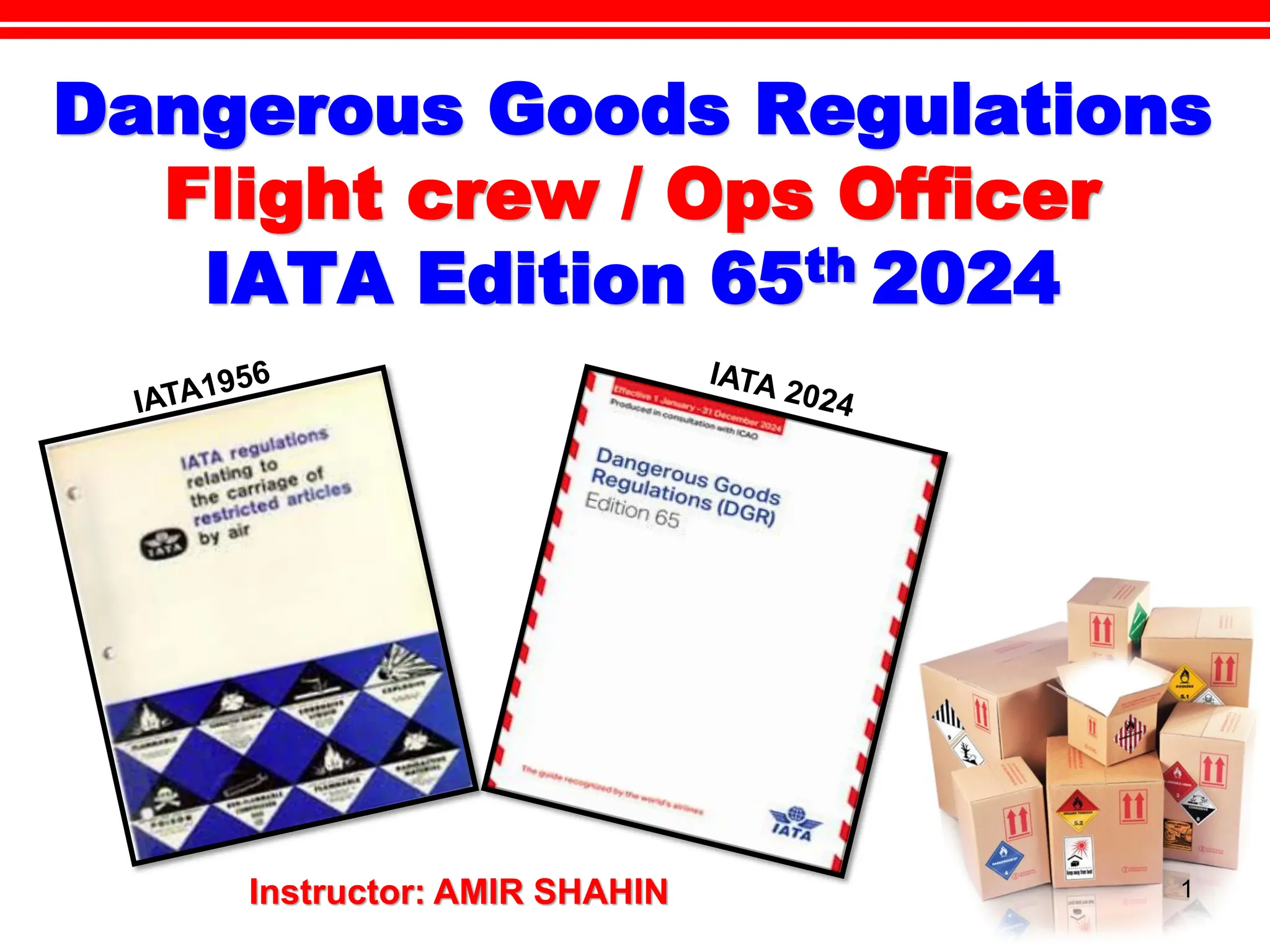
Dangerous Goods Regulations
Flight crew / Ops Officer
IATA Edition 65th 2024
Instructor: AMIR SHAHIN
Dangerous Goods
Regulations
Training CBTA
2
Why a course of Dangerous
Goods Regulations?
Safety
Legal Requirements
If you think that safety is
expensive Try an accident ! 3
By the end of this course you will be able to:
COURSE OBJECTIVES
• To provide Flight crew / Ops Officer the competencies
necessary for recognising undeclared dangerous goods
from visual indications;
• Verifying that dangerous goods cargo are loaded as
shown on the NOTOC and cargo manifest,
• There is no evidence of damage or leakage and that
dangerous goods are secured to prevent movement
during flight;
• Report dangerous goods incidents, accidents, and
undeclared dangerous goods; and
• Respond to emergencies involving dangerous goods.
4
5
SCOPE
• Section 1 Applicability
• Section 2 Responsibility, Training and Provision of
Information
• Section 3 Classification of Dangerous Goods
• Section 4 Marking and Labeling
• Section 5 Documentation
• Section 6 Storage and Loading
• Section 7 Exceptions
• Section 8 Dangerous Goods Emergency Response
6
SECTION 1
• General Philosophy
• Definition
• Application of the Regulations – The Legal
Basis
7
GENERAL PHILOSOPHY
Dangerous Goods can be transported safely as long as certain
principles are followed
• DG correctly classified
• Ensure prohibited items are not shipped by air
• Ensure correct packaging and labeling used
• All staff correctly trained
• DG are correctly declared
• The Captain is advised of the location of any DG on board
• All categories of staff check for hidden hazards
DEFINITION OF DANGEROUS GOODS
Dangerous Goods are articles or
substances which are capable of
posing a hazard to health, safety,
property or the environment, and which
are shown in the list of Dangerous
Goods in the Dangerous Goods
Regulations or which are classified
according to these Regulations.
8
9
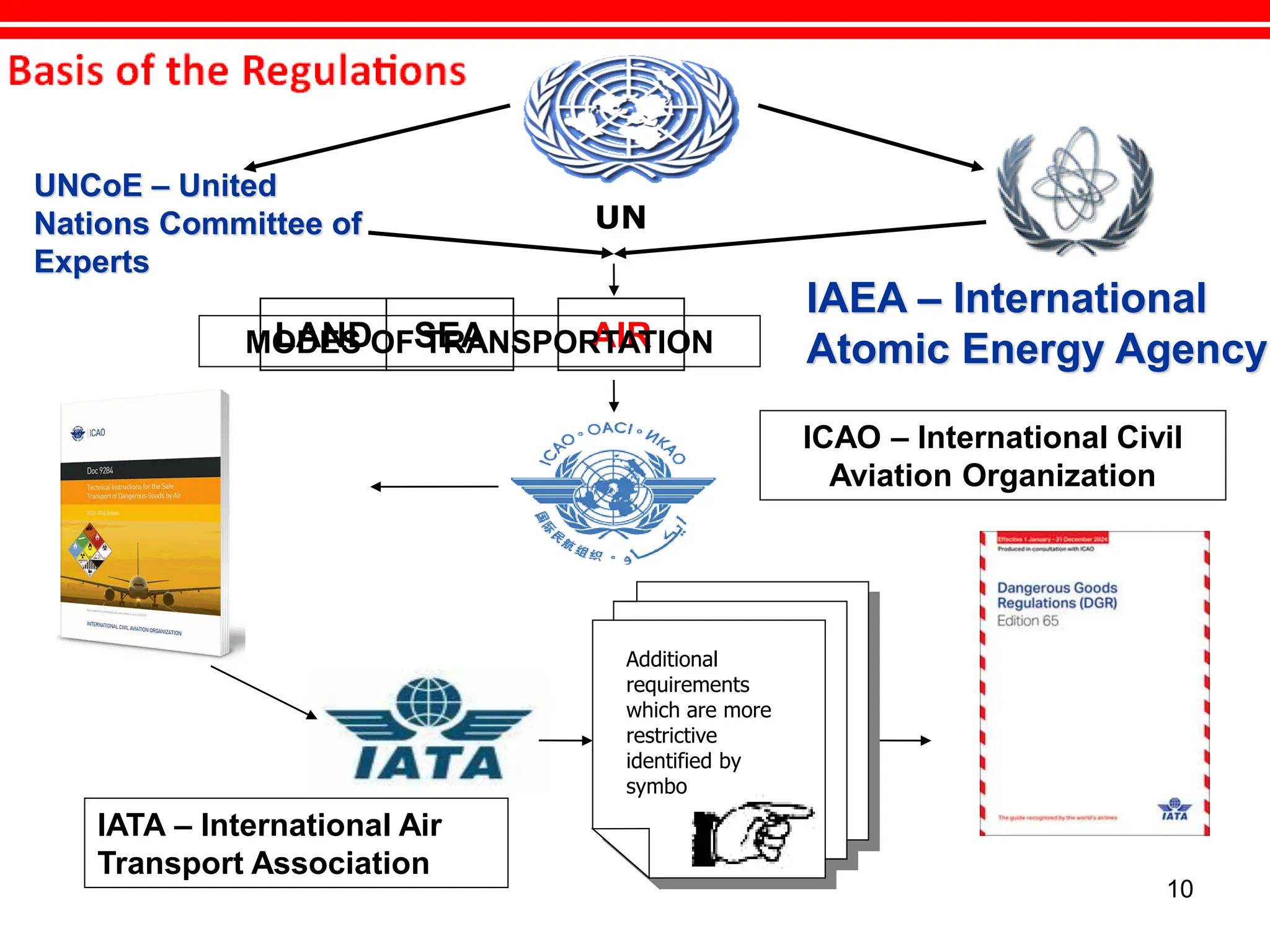
ICAO TI vs. IATA DGR
ICAO Technical Instructions
❑ Adopted as law by countries
❑ Enforceable by governments
❑ Published every 24 months
IATA Dangerous Goods Regulations
❑ Adopted as policy by airlines
❑ Not enforceable by governments
❑ Published every 12 months
❑ Based on ICAO TI—sometimes
more restrictive then ICAO
LAND SEA AIR
UN
Additional
requirements
which are more
restrictive
identified by
symbol
UNCoE – United
Nations Committee of
Experts
IAEA – International
Atomic Energy Agency
ICAO – International Civil
Aviation Organization
IATA – International Air
Transport Association
MODES OF TRANSPORTATION
10
11
Section 2 Responsibility, Training
and Provision of Information
Shipper’s Responsibility
– Ensure employees are trained to carry out their
responsibilities
– Establish whether the article is prohibited (forbidden)
for transport by air
– Ensure that Dangerous Goods are
1. Classified
2. Identified
3. Packed
4. Marked
5. Labeled
6. Documented
12
OPERATOR’S RESPONSIBILITY
• Acceptance
• Storage;
• Loading;
• Inspection;
• Provision of information, including
emergency response information;
• Reporting dangerous goods accidents
and incidents;
• Retention of records; and
• Training. 13
Our Training Products
Several course in the following areas :
CIVIL AVIATION
AIRPORTS
SECURITY
AIRLINES
CARGO HANDLING
WAREHOUSE 14
15
1. Training Requirement
a) Initial
b) Re-current
2. Training program
3. Training Curricula
4. Review and Approval
5. Record of Training
Training Requirements
• Refresher or recurrent training must be
received within 24 months of previous
DGR training to make sure that the
staff’s knowledge is up-to-date.
16
Information To Passengers
• Information with the passenger ticket .
• Notices warning passengers as to the type
of dangerous goods which are forbidden
for transport aboard an aircraft .
17
M. Tayfour 18
Samples
18
Posters
19
Display cabinet
20
21
22
• Dangerous Goods are divided into 9 classes
– The first 8 classes reflect the type of
Hazard.
– Class 9 contains articles which do not fit the
other 8 classes or have multiples hazards
• In some cases these classes are further
divided into sub-divisions
Example: Division 5.2 is the
Same as Class 5 Division 2
Definition of Classes & Divisions
23
General Packing Requirements
• Packing Group High Danger
• Packing Group Medium Danger
• Packing Group Low Danger
I
II
III
23
24
DGR Classification System
The basic of material :
• Solid
• Liquid
• Gas
The DGR also divides dangerous goods into :
• Substances
• Articles
25
HAZARD of
CLASSIFICATION
• Flammability
• Corrosivity
• Toxicity
• Radioactivity
• Magnetic effect
26
Divisions
1.1, 1.2, 1.3, 1.4, 1.5 and 1.6
Class 1
Explosive
27
Class 2
Gases
Divisions
2.1 Flammable Gas
2.2 Non-Flammable , non-toxic Gas
2.3 Toxic Gas
28
29
3
Flammable Liquids
Note : This class has no sub-divisions
Class 3
Flammable Liquids
30
31
Class 4
Flammable Solid
Divisions
4.1 Flammable Solid
4.2 Spontaneously Combustible
4.3 Dangerous when wet
32
33
Class 5
Oxidizing
Divisions
5.1 Oxidizing
5.2 Organic Peroxides
34
35
Class 6
Toxic Substances
Divisions
6.1 Toxic or Poison
6.2 Infectious Substances
36
37
Packing Group for class 6.1
37
a) Packing Group I — very risk;
b) Packing Group II — serious risk;
c) Packing Group III — low risk.
38
Class 7
Radioactive Material
Category
I – White
II - Yellow
III – Yellow
Fissile – Criticality Safety Index
39
40
41
8
Corrosive Material
Note : This class has no sub-divisions
Class 8
Corrosive Material
42
43
9
Miscellaneous DG
Note : This class has no sub-divisions
Class 9
Miscellaneous DG
44
45
46
Section 4 - Marking & Labeling
46
• General
• Marking
• Labeling
• List of Handling Labels
• Over packs
• Irrelevant Labeling
Marking & Labeling
47
• Markings & Labels indicate the
Package
–Contents
–Hazard
–Packing Material is approved and of
correct standard
–Handling and stowage information
Marking & Labeling
48
49
Packaging Use Markings
(P.U.M.)
50
Packaging Use Markings
• Proper Shipping Name:
• UN or ID Number:
• Net Weight :
• Full Name and address
of shipper:
• Full Name and address
of consignee:
ALLYL ACETATE
UN2333 Net weight 2 L
Shipper:
ABC Chemicals & Co., Ltd.
8 Old Bridge Road
London EC1, England
Consignee:
Chemical Exports Pte.
Novo Parque Industrial
Oporto, Portugal
51
Packaging Use Markings (P.U.M)
52
Package Specification Marking
(P.S.M)
53
UN Specification Package
Markings
4C1/X30/S/02 USA/BS 809
Note: Handwritten
marking is not acceptable.
54
UN Specification
package marking
Specification Code
55
56
ALLYL ACETATE, UN 2333
SHIPPER:
ABC Chemicals & Co. Ltd.
8 Old Ridge Road
London EC1, England
CONSIGNEE:
Chemical Exports Pte.
Novo Parque Industrial
Oporto, Portugal
4C1/X 30/S/02
USA/BS 809
Package Specification Markings (P.S.M)
57
58
58
59
“Lithium metal batteries” or
“Lithium ion batteries”
60
60
61
62
Handling Labels
Required on
packages
containing
self-reactive
substances of
Division 4.1
and on
Division 5.2
organic
peroxides.
62
63
Handling Labels
Used on “excepted
packages” of
radioactive
materials.
R
a
d
io
a
c
tiv
eM
a
te
ria
l, E
x
c
e
p
te
dP
a
c
k
a
g
e
T
h
isp
a
c
k
a
g
ec
o
n
ta
in
sra
d
io
a
c
tiv
em
a
te
ria
l, e
x
c
e
p
te
dp
a
c
k
a
g
ea
n
d
isina
ll re
s
p
e
c
tsinc
o
m
p
lia
n
c
ew
ithth
ea
p
p
lic
a
b
lein
te
rn
a
tio
n
a
l a
n
d
n
a
tio
n
a
l g
o
v
e
rn
m
e
n
ta
l re
g
u
la
tio
n
s
.
T
h
ein
fo
rm
a
tio
nfo
rth
isp
a
c
k
a
g
en
e
e
dn
o
t
a
p
p
e
a
ro
nth
eN
o
tific
a
tio
ntoC
a
p
ta
in(N
O
T
O
C
)
U
N_
_
_
_
_
_
_
_
_
_
Optional text
63
64
65
66
Labelling Overpacks
OVERPACK
Unless the labels on inside packages are visible, hazard and
handling labels must be reproduced on the outside of overpacks.
66
67
Incorrect application of labels
67
68
69
Incorrect application of labels
69
70
Incorrect application of labels
70
71
Incorrect application of labels
71
72
➢Excepted Packaging's
used for very small quantities.
➢Limited Quantities Packaging's
used for small quantities.
➢UN Specification Packaging's
used for normal quantities.
General Packing :
72
73
Dangerous goods, which may be carried as
excepted quantities in accordance with the
provisions of this Subsection are shown in
Column F of the List of Dangerous Goods
Regulations Book.
Maximum 1kg or 1 L
Excepted Quantities
73
Table 2.6.A
Excepted Quantity code for Table 4.2 (DGR 2.6.4.1)
Code Maximum net quantity
Per inner packaging
Maximum net quantity
Per outer packaging
E0 Not permitted as Excepted Quantity
E1 30 g/30 mL 1 kg/1 L
E2 30 g/30 mL 500 g/500 mL
E3 30 g/30 mL 300 g/300 mL
E4 1 g/1 mL 500 g/500 mL
E5 1 g/1 mL 300 g/300 mL
75
76
DGR 2.6 Excepted Quantities :
• No shipper Declaration for Dangerous
Goods is not required (DGD).
• No (NOTOC).
• No use of Marking and Labelling.
• No use Acceptance Checklist.
• No use UN Specification Packing.
76
Excepted Quantities
Package Must Not Exceed
1L / 1kg
77
77
78
Dangerous Goods in Limited Quantities
• Only dangerous goods which are permitted
on passenger aircraft and which meet the
criteria of the following classes, divisions
and packing groups (if appropriate) may be
carried under the provisions for dangerous
goods in limited quantities.
78
79
The quantities per package must be observed as stated on below table:
79
80
Dangerous Goods in Limited
Quantities
• The net quantity per package must
not exceed the quantity specified in
column H of the list of DG against
the packing instruction number
identified in column G.
• the gross weight of “Limited
Quantity” package must not exceed
30 kg (66 lbs.) 80
81
Dangerous Goods in Limited
Quantities
• Single packaging's, including composite
packaging's are not permitted.
• Limited Quantity of dangerous goods
must be packaged in accordance with
the applicable Limited Quantity packing
instructions indicated in the column G of
the list of dangerous goods and which is
identified be the prefix “Y”.
81
82
83
84
Handling Label
85
86
Do not ignore – it’s your responsibility to:
• Remove any irrelevant labels
• Report it!
Irrelevant Labeling
Exercise -3
87
Used when shipment is
forbidden in Passenger
Aircraft
Exercise -4
88
89
Section 5 - Documentation
Shipper's Responsibility
The shipper is responsible for the
completion of a prescribed declaration form
“Shipper's Declaration for Dangerous
Goods” for each and every shipment
containing dangerous goods so defined or
classified in these Regulations unless it is
stated that a Shipper's Declaration is not
required. For each shipment containing
dangerous goods the shipper must:
90
Shipper’s Declaration for DG (DGD)
91
Shipper’s Declaration for DG (DGD)
• Articles that do not require “Shipper’s Declaration of Dangerous
Goods”
– Dangerous goods in excepted quantities.
– UN 3164, Articles pressurized, hydraulic.
– UN 3164, Articles pressurized, pneumatic.
– UN 3373, Biological substance, Category B.
– UN 1845, Carbon dioxide, solid (Dry ice) when used as a
refrigerant for other than dangerous goods
– UN 3245, Genetically modified organisms, Genetically modified
microorganisms.
– Lithium ion or lithium metal cells or batteries meeting the
provisions of Section II of Packing Instructions 965-970 IATA DGR.
– UN 2807, Magnetized material.
– Radioactive material, excepted packages (RRE)
92
*
Air Waybill
• Air Waybill is provided for cargo (both DG and non
– DG) being transported on board a commercial
aircraft.
• For DG Shipments;
– Handling Information Box contain “Dangerous
Goods as per attached Shipper’s Declaration” or
“Dangerous Goods as per attached DGD”.
– If the DG need to be carried only on a cargo
aircraft, it may include “CAO” or “Cargo Only
Aircraft”
– The description of Dangerous Goods is provided
in the “Nature and Quantity of Goods” section.
93
94
Air Waybill
95
Air Waybill
96
Shipment “Not Restricted” by DGR
• Does not fit into any of the Hazard Classes or
Divisions.
• The phrase "Not Restricted" should appear in
the Nature and Quantity of Goods Section. If an
item meets a special provision's condition, the
words "Not Restricted, as per Special Provision
A70" appear.
97
NOTOC
Incase of emergency, crew to communicate with ATC mentioning the
emergency number on NOTOC for DG onboard information.
98
Retention of Documentation
• Min of 3 months after the flight on which
the Dangerous Goods were transported.
• If kept electronically, the shipper should
be able to reproduce in printed form.
99
*
Section 6
Storage and Loading
Storage & Loading
• Storage and Handling
• Loading
• Handling damaged and leaking
package
• Commodity Specific Requirements
101
Storage & Loading
• Dangerous Goods not permitted in
cabin or flight deck.
• DG may be carried in cargo
compartments on passenger aircraft.
• DG with “Cargo Aircraft Only” label
cannot be loaded in an aircraft
occupied by passenger.
102
103
Storage & Loading
While Storing;
•Protect from Damage
•Inspect – Leaks, Marks and Labels
•Special Requirements – “Keep away
from heat”.
Loading of Incompatible Dangerous Goods
104
EITHER
separating tie-down
of the packages:
OR
locating ordinary
non-dangerous cargo
packages between
incompatible packages:
Segregation can be achieved by:
105
106
Handling of Self-reactive Substances
and Organic Peroxides
Packages and unit load devices containing
packages of self-reactive substances of Division
4.1 and/or organic peroxides of Division 5.2 must
be protected from direct sunlight and kept away
from all sources of heat and be placed in
adequately ventilated areas during loading,
unloading and storage.
107
Inspection of Packages of Dangerous Goods
Inspection for Damage and Leak
The dangerous goods must be inspected
for damage or leakage prior to loading or
unloading;
Contaminated Cargo or Baggage
Identify Risk
Isolate cargo or baggage
Loading and Stowage of Radioactive
Material
Radioactive material in
Categories
I-White,
II-Yellow, or
III-Yellow,
must not be loaded in a
compartment occupied by
passengers or crew.
108
Package 1 = 5.5 TI
= needs 1.15 m separation from the top of the package
to the nearest inside surface of the floor of the aircraft
cabin. If the height of package 1 is 50 cm, then the cargo
hold must be at least 1.65 m high. i.e. 1.15 m + 50 cm
Package 2=4.2 TI
=needs 1.00 m separation from the top of the package
to the nearest inside surface of the floor of the aircraft
Example:
109
110
● Package 1 has the larger sum of TIs.
● Therefore, the minimum distance between Package 1 and Package 2
= 1.15 × 3
= 3.45 m
M. Tayfour *
Loading of Magnetized Materials
Magnetized materials must not
be loaded in such a position
that they will have a significant
effect on the direct-reading
magnetic compasses or on the
master compass detector units
of the aircraft.
*
Loading of Dry Ice (Carbon Dioxide, Solid)
Carbon dioxide, solid (dry ice)
shipped by itself or used as a
refrigerant for other
commodities may be carried
provided that the operator has
made suitable arrangements
dependent on the aircraft type.
Loading of Live Animals with DG
Live animals should not be loaded in
close proximity to cryogenic liquids or
dry ice. Live animals should be stowed
a level above packages containing dry
ice. They must be separated from
packages of Category II-Yellow and III-
Yellow radioactive materials by at least
0.5 m (1 ft 8 in) for journeys of 24 hours
or less and by at least 1 m (3 ft 4 in) for
longer journeys.
113
114
Visibility of Markings and Labels
During air transport, including storage, any
part of or connection to the package, or any
other label or marking, must not hide or
obscure the markings and labels specified by
these instructions.
115
Replacement of labels
When an operator detects that labels
have gotten missing, detached, or
unreadable, he must replace them using
the information on the "Shipper's
Declaration for Dangerous Goods." The
requirement does not apply if the labels
are absent or unreadable at the time of
acceptance.
Section 7 Exceptions
116
117
Hidden Dangerous Goods
• Operators' acceptance staff must be
adequately trained to assist them to identify
and detect dangerous goods presented as
general cargo.
UNDECLARED DANGEROUS GOODS
118
ORIGINAL CONSIGNMENT OF ACIDS
119
UNDECLARED SULPHURIC AND
HYDROCHLORIC ACID
120
CORROSION CAUSED BY ACID TO
PALLET BASE
121
UNDECLARED FLAMMABLE PAINT
122
UNDECLARED FLAMMABLE PAINT
123
Pesticides
124
Qantas Airways B747 – 400
“Oxygen cylinder”
125
126
Distress Flares
127
UNDECLARED FLAMMABLES / AEROSOLS
128
LIMITATIONS
OF DANGEROUS GOODS ON AIRCRAFT
• Acceptable for transport on both
Passenger and Cargo Aircraft.
• Forbidden for transport on a Passenger
Aircraft, but acceptable on Cargo
Aircraft only.
• Forbidden for transport unless exempted
by Variation of States.
• Forbidden for air transport under any
circumstances 129
130
Outside Temperature
AT 35.000 ft : -55°C
Passenger Cabin
Temp. at 35.000 ft
Maintained Between
20 to 30° C
Cargo Hold Temp. at
35.000 ft +4 to + 8 ° C
131
How dangerous goods become dangerous?
How to transport DG safely?
132
Proper Package
133
Dangerous Items in Your Home
134
135
136
137
138
139
1988 - American Airlines FL132
Chemical reaction between sodium
hydroxide and hydrogen peroxide solution 140
141
Forbidden Dangerous Goods
Any article or substance which, as
presented for transport, is liable to
explode, dangerously react, produce a
flame or dangerous evolution of heat
or dangerous emission of toxic,
corrosive or flammable gases or
vapours under conditions normally
facing in transport must not be carried
on aircraft under any circumstance.
142
143
144
145
Out
airport
In
airport
By Air
In
airport
Out
airport
Shipper
Cargo
Agent
Handling
Agent
Aircraft
Operator
Handling
Agent
Cargo
Agent Consignee
The Air Cargo Chain
The Air Cargo Chain
146
147
Dangerous Goods Security
• All persons engaged in the transport
of dangerous goods should consider
security requirements for the
dangerous goods.
• The training specified in the
Regulations for all categories of
personnel should include elements of
security awareness
148
149
Dangerous Goods Security
Operators, shippers and others (including infrastructure managers) engaged in
the transport of high consequence dangerous goods (see 1.7.3) should adopt,
implement and comply with a security plan that addresses at least the elements
specified in 1.7.4.2.
150
Type of DGR
3
Forbidden
Forbidden
unless
exempted
Totally
Forbidden by
Air
2
To be sent as
cargo
CAO
PAX
1
Acceptable
Passengers
Operating
Crew
COMAT
151
• Dangerous Goods with Passenger.
Some dangerous goods can only be
transported on an aircraft if a
competent person or organization
properly pack them. ... However, some
items listed in the regulations may be
carried onboard the aircraft by
passengers and crew if they fulfill the
listed restrictions and limitations.
Dangerous Goods Carried by
Passengers or Crew
151
152
• Can carry DGR with passenger and
crew by :
–Checked baggage;
–Carry-on baggage;
–Their person;
Dangerous Goods Carried by
Passengers or Crew
152
153
Checked Baggage
M. Tayfour 154
Carry-on Baggage
154
M. Tayfour 155
Carry-on Baggage
155
156
157
158
Person
159
160
161
IATA DGR 2.1.1 Dangerous Goods Forbidden
in Aircraft Under Any Circumstances
• Any article or substance which, as presented
for transport, is liable to explode,
dangerously react, produce a flame or
dangerous evolution of heat or dangerous
emission of toxic, corrosive or flammable
gases or vapours under conditions normally
encountered in transport must not be carried
on aircraft under any circumstance.
162
UNDECLARED DANGEROUS GOODS
163
164
Dangerous Goods Carried by
Passengers or Crew
Disabling Devices
(pepper spray)
Forbidden
M. Tayfour 165
Portable electronic devices
165
M. Tayfour 166
Sodium Ion Batteries
166
167
• Short Circuit.
• Overheat.
Risk of Batteries
167
DGR Carried by Passengers or Crew IATA Ref.2.3.A
168
169
The pilot-in-command must be informed of the location
Permitted in or as carry-on baggage
Permitted in or as checked baggage
The approval of the operator is required
170
171
172
173
174
Hand cuffs
Firecrackers
Electroshock device
Deodorant spray
175
Dangerous Goods in Operator's Property
• Aircraft Equipment
• Aircraft Spares
• Adhesives
• Aircraft Batteries
175
176
Dangerous Goods
Emergency Response
177
• A dangerous goods incidents is an occurrence, other than a
dangerous goods accident, associated with and related to
the transport of dangerous goods, not necessarily occurring
on board an aircraft.
• This includes breakage, spillage, leakage of chemical or
radiation or other evidence that the integrity of the
packaging has not been maintained.
Incidents
178
A dangerous goods accident is an
occurrence associated with and related
to the transport of dangerous goods
which results in fatal or serious injury to a
person or major property damage.
Accidents
179
An operator must report any occasion
when undeclared or mis-declared
dangerous goods are discovered in
cargo or mail.
Undeclared or Mis-declared
180
It is the operator's responsibility to guarantee that no
dangerous goods-containing package or overpack is
placed aboard an aircraft unless it has been
inspected immediately before to loading and
unloading and confirmed to be free of leakage or
damage.
Inspection of Aircraft for damage or leakage
181
• Emergency procedures must be available
wherever dangerous goods are handled
• Operators are required to provide information to
flight crew and other employees, in the operator’s
operations or other appropriate manual, on the
action to be taken in the event of emergencies
involving dangerous goods
• Emergency response training is required for all
categories of personnel.
Dangerous Goods Emergency Response
182
Procedures for Flight Crew
The ICAO Emergency Response Guide (Red Book) details them as:
1.Follow the appropriate aircraft emergency procedure for fire or smoke
removal
2.No smoking sign on
3.Consider landing as soon as possible
4.Determine the source of smoke/fumes/fire
5.For dangerous goods incidents in the passenger cabin,
see cabin crew checklist and coordinate cockpit/cabin crew actions
6.Determine emergency response drill code
7.Use guidance from aircraft emergency response drills chart to help deal
with incident if the situation permits, notify ATC being provided with the
telephone number from the NOTOC for them to obtain details of the
dangerous goods on board in the event of an emergency.
183
Procedures for Flight Crew
After landing:
1.Disembark passengers and crew before
opening any cargo compartment doors
2.Inform ground personnel, emergency service
of nature of item and where stowed
3.Make appropriate entry in maintenance log.
184
• If baggage or cargo that contains no DG has been contaminated by
DG, the operator must take reasonable steps to identify the nature
and source if contamination. The baggage or cargo must be isolated
and steps taken to nullify any hazard before it can be transported by
air.
• The operator must report to the appropriate authorities of the State of
the Operator and the State in which any accident or serious incident
has occurred.
• Why is the airline obliges to report undeclared or mis-declared
dangerous goods to the competent authority?
Contaminated Cargo Or Baggage Handling
185
Aircraft Emergency Response Drills
• Drill code is numeric alpha
• Pink pages
• Drill number – left column
• Inherent Hazard/Procedures etc
• Additional Hazard – Down the bottom
AIRCRAFT EMERGENCY RESPONSE DRILLS
186
Drill
No.
Inherent
Hazard
Hazard
aircraft
Hazard
occupants
Spill or leak
procedure
Firefighting
procedure
Additional
considerations
1
Explosion
may cause
structural
failure
Fire
and/or
explosion
As
indicated
by the drill
letter(s)
Use 100% oxygen;
no smoking
All agents
according to
availability;
use standard
fir procedure
Possible
abrupt loss of
pressurization
2
Gas, non-
flammable.
Pressure
may create
hazard in
fire
Minimal
As
indicated
by the drill
letter(s)
Use 100% oxygen
establish and
maintain
maximum
ventilation for “A”,
“I” or “P” drill
letter
All agents
according to
availability;
use standard
fire procedure
Possible
abrupt loss of
pressurization
3
Flammable
liquid or
solid
Fire
and/or
explosion
Smoke,
fumes and
heat, and
as
indicated
by the drill
letter(s)
Use 100% oxygen
establish and
maintain
maximum
ventilation; no
smoking;
minimum electrics
All agents
according to
availability;
no water on
“W” drill
letter
Possible
abrupt loss of
pressurization
187
Drill
Letter
Additional risk
Drill
Letter
Additional risk
A Anesthetic N Noxious
C Corrosive P Toxic * (Poison)
E Explosive S Spontaneously combustible or pyrophoric
F Flammable W If wet gives off poisonous flammable gas
H Highly ignitable X Oxidizer
I Irritant / tear producing Y Depending on the type of infectious substance, the
appropriate national authority may be required to
quarantine individuals, animals, cargo and the
aircraft.
L Other risk low or none
M Magnetic
Z
Aircraft cargo fire suppression system may not
extinguish or contain the fire; consider landing
Immediately
* Toxic has the same meaning as poison
Aircraft Emergency Drills Letter
188
Reporting
➢ Accident and Incidents
➢ Undeclared or Miss-declared
dangerous goods
➢ Information by operator in case of
an aircraft accident or incident
➢ Dangerous goods Occurrence
Report
189
190
191

Dangerous Goods Tran CBTA Flight Crew/FD

  • 1.
    1 Dangerous Goods Regulations Flightcrew / Ops Officer IATA Edition 65th 2024 Instructor: AMIR SHAHIN
  • 2.
  • 3.
    Why a courseof Dangerous Goods Regulations? Safety Legal Requirements If you think that safety is expensive Try an accident ! 3
  • 4.
    By the endof this course you will be able to: COURSE OBJECTIVES • To provide Flight crew / Ops Officer the competencies necessary for recognising undeclared dangerous goods from visual indications; • Verifying that dangerous goods cargo are loaded as shown on the NOTOC and cargo manifest, • There is no evidence of damage or leakage and that dangerous goods are secured to prevent movement during flight; • Report dangerous goods incidents, accidents, and undeclared dangerous goods; and • Respond to emergencies involving dangerous goods. 4
  • 5.
    5 SCOPE • Section 1Applicability • Section 2 Responsibility, Training and Provision of Information • Section 3 Classification of Dangerous Goods • Section 4 Marking and Labeling • Section 5 Documentation • Section 6 Storage and Loading • Section 7 Exceptions • Section 8 Dangerous Goods Emergency Response
  • 6.
    6 SECTION 1 • GeneralPhilosophy • Definition • Application of the Regulations – The Legal Basis
  • 7.
    7 GENERAL PHILOSOPHY Dangerous Goodscan be transported safely as long as certain principles are followed • DG correctly classified • Ensure prohibited items are not shipped by air • Ensure correct packaging and labeling used • All staff correctly trained • DG are correctly declared • The Captain is advised of the location of any DG on board • All categories of staff check for hidden hazards
  • 8.
    DEFINITION OF DANGEROUSGOODS Dangerous Goods are articles or substances which are capable of posing a hazard to health, safety, property or the environment, and which are shown in the list of Dangerous Goods in the Dangerous Goods Regulations or which are classified according to these Regulations. 8
  • 9.
    9 ICAO TI vs.IATA DGR ICAO Technical Instructions ❑ Adopted as law by countries ❑ Enforceable by governments ❑ Published every 24 months IATA Dangerous Goods Regulations ❑ Adopted as policy by airlines ❑ Not enforceable by governments ❑ Published every 12 months ❑ Based on ICAO TI—sometimes more restrictive then ICAO
  • 10.
    LAND SEA AIR UN Additional requirements whichare more restrictive identified by symbol UNCoE – United Nations Committee of Experts IAEA – International Atomic Energy Agency ICAO – International Civil Aviation Organization IATA – International Air Transport Association MODES OF TRANSPORTATION 10
  • 11.
    11 Section 2 Responsibility,Training and Provision of Information
  • 12.
    Shipper’s Responsibility – Ensureemployees are trained to carry out their responsibilities – Establish whether the article is prohibited (forbidden) for transport by air – Ensure that Dangerous Goods are 1. Classified 2. Identified 3. Packed 4. Marked 5. Labeled 6. Documented 12
  • 13.
    OPERATOR’S RESPONSIBILITY • Acceptance •Storage; • Loading; • Inspection; • Provision of information, including emergency response information; • Reporting dangerous goods accidents and incidents; • Retention of records; and • Training. 13
  • 14.
    Our Training Products Severalcourse in the following areas : CIVIL AVIATION AIRPORTS SECURITY AIRLINES CARGO HANDLING WAREHOUSE 14
  • 15.
    15 1. Training Requirement a)Initial b) Re-current 2. Training program 3. Training Curricula 4. Review and Approval 5. Record of Training Training Requirements
  • 16.
    Training Requirements • Refresheror recurrent training must be received within 24 months of previous DGR training to make sure that the staff’s knowledge is up-to-date. 16
  • 17.
    Information To Passengers •Information with the passenger ticket . • Notices warning passengers as to the type of dangerous goods which are forbidden for transport aboard an aircraft . 17
  • 18.
  • 19.
  • 20.
  • 21.
  • 22.
    22 • Dangerous Goodsare divided into 9 classes – The first 8 classes reflect the type of Hazard. – Class 9 contains articles which do not fit the other 8 classes or have multiples hazards • In some cases these classes are further divided into sub-divisions Example: Division 5.2 is the Same as Class 5 Division 2 Definition of Classes & Divisions
  • 23.
    23 General Packing Requirements •Packing Group High Danger • Packing Group Medium Danger • Packing Group Low Danger I II III 23
  • 24.
    24 DGR Classification System Thebasic of material : • Solid • Liquid • Gas The DGR also divides dangerous goods into : • Substances • Articles
  • 25.
    25 HAZARD of CLASSIFICATION • Flammability •Corrosivity • Toxicity • Radioactivity • Magnetic effect
  • 26.
    26 Divisions 1.1, 1.2, 1.3,1.4, 1.5 and 1.6 Class 1 Explosive
  • 27.
    27 Class 2 Gases Divisions 2.1 FlammableGas 2.2 Non-Flammable , non-toxic Gas 2.3 Toxic Gas
  • 28.
  • 29.
    29 3 Flammable Liquids Note :This class has no sub-divisions Class 3 Flammable Liquids
  • 30.
  • 31.
    31 Class 4 Flammable Solid Divisions 4.1Flammable Solid 4.2 Spontaneously Combustible 4.3 Dangerous when wet
  • 32.
  • 33.
  • 34.
  • 35.
    35 Class 6 Toxic Substances Divisions 6.1Toxic or Poison 6.2 Infectious Substances
  • 36.
  • 37.
    37 Packing Group forclass 6.1 37 a) Packing Group I — very risk; b) Packing Group II — serious risk; c) Packing Group III — low risk.
  • 38.
    38 Class 7 Radioactive Material Category I– White II - Yellow III – Yellow Fissile – Criticality Safety Index
  • 39.
  • 40.
  • 41.
    41 8 Corrosive Material Note :This class has no sub-divisions Class 8 Corrosive Material
  • 42.
  • 43.
    43 9 Miscellaneous DG Note :This class has no sub-divisions Class 9 Miscellaneous DG
  • 44.
  • 45.
  • 46.
    46 Section 4 -Marking & Labeling 46
  • 47.
    • General • Marking •Labeling • List of Handling Labels • Over packs • Irrelevant Labeling Marking & Labeling 47
  • 48.
    • Markings &Labels indicate the Package –Contents –Hazard –Packing Material is approved and of correct standard –Handling and stowage information Marking & Labeling 48
  • 49.
  • 50.
  • 51.
    Packaging Use Markings •Proper Shipping Name: • UN or ID Number: • Net Weight : • Full Name and address of shipper: • Full Name and address of consignee: ALLYL ACETATE UN2333 Net weight 2 L Shipper: ABC Chemicals & Co., Ltd. 8 Old Bridge Road London EC1, England Consignee: Chemical Exports Pte. Novo Parque Industrial Oporto, Portugal 51
  • 52.
  • 53.
  • 54.
    UN Specification Package Markings 4C1/X30/S/02USA/BS 809 Note: Handwritten marking is not acceptable. 54 UN Specification package marking
  • 55.
  • 56.
  • 57.
    ALLYL ACETATE, UN2333 SHIPPER: ABC Chemicals & Co. Ltd. 8 Old Ridge Road London EC1, England CONSIGNEE: Chemical Exports Pte. Novo Parque Industrial Oporto, Portugal 4C1/X 30/S/02 USA/BS 809 Package Specification Markings (P.S.M) 57
  • 58.
  • 59.
  • 60.
    “Lithium metal batteries”or “Lithium ion batteries” 60 60
  • 61.
  • 62.
    62 Handling Labels Required on packages containing self-reactive substancesof Division 4.1 and on Division 5.2 organic peroxides. 62
  • 63.
    63 Handling Labels Used on“excepted packages” of radioactive materials. R a d io a c tiv eM a te ria l, E x c e p te dP a c k a g e T h isp a c k a g ec o n ta in sra d io a c tiv em a te ria l, e x c e p te dp a c k a g ea n d isina ll re s p e c tsinc o m p lia n c ew ithth ea p p lic a b lein te rn a tio n a l a n d n a tio n a l g o v e rn m e n ta l re g u la tio n s . T h ein fo rm a tio nfo rth isp a c k a g en e e dn o t a p p e a ro nth eN o tific a tio ntoC a p ta in(N O T O C ) U N_ _ _ _ _ _ _ _ _ _ Optional text 63
  • 64.
  • 65.
  • 66.
    66 Labelling Overpacks OVERPACK Unless thelabels on inside packages are visible, hazard and handling labels must be reproduced on the outside of overpacks. 66
  • 67.
  • 68.
  • 69.
  • 70.
  • 71.
  • 72.
    72 ➢Excepted Packaging's used forvery small quantities. ➢Limited Quantities Packaging's used for small quantities. ➢UN Specification Packaging's used for normal quantities. General Packing : 72
  • 73.
    73 Dangerous goods, whichmay be carried as excepted quantities in accordance with the provisions of this Subsection are shown in Column F of the List of Dangerous Goods Regulations Book. Maximum 1kg or 1 L Excepted Quantities 73
  • 74.
    Table 2.6.A Excepted Quantitycode for Table 4.2 (DGR 2.6.4.1) Code Maximum net quantity Per inner packaging Maximum net quantity Per outer packaging E0 Not permitted as Excepted Quantity E1 30 g/30 mL 1 kg/1 L E2 30 g/30 mL 500 g/500 mL E3 30 g/30 mL 300 g/300 mL E4 1 g/1 mL 500 g/500 mL E5 1 g/1 mL 300 g/300 mL 75
  • 75.
    76 DGR 2.6 ExceptedQuantities : • No shipper Declaration for Dangerous Goods is not required (DGD). • No (NOTOC). • No use of Marking and Labelling. • No use Acceptance Checklist. • No use UN Specification Packing. 76
  • 76.
    Excepted Quantities Package MustNot Exceed 1L / 1kg 77 77
  • 77.
    78 Dangerous Goods inLimited Quantities • Only dangerous goods which are permitted on passenger aircraft and which meet the criteria of the following classes, divisions and packing groups (if appropriate) may be carried under the provisions for dangerous goods in limited quantities. 78
  • 78.
    79 The quantities perpackage must be observed as stated on below table: 79
  • 79.
    80 Dangerous Goods inLimited Quantities • The net quantity per package must not exceed the quantity specified in column H of the list of DG against the packing instruction number identified in column G. • the gross weight of “Limited Quantity” package must not exceed 30 kg (66 lbs.) 80
  • 80.
    81 Dangerous Goods inLimited Quantities • Single packaging's, including composite packaging's are not permitted. • Limited Quantity of dangerous goods must be packaged in accordance with the applicable Limited Quantity packing instructions indicated in the column G of the list of dangerous goods and which is identified be the prefix “Y”. 81
  • 81.
  • 82.
  • 83.
  • 84.
  • 85.
    86 Do not ignore– it’s your responsibility to: • Remove any irrelevant labels • Report it! Irrelevant Labeling
  • 86.
  • 87.
    Used when shipmentis forbidden in Passenger Aircraft Exercise -4 88
  • 88.
    89 Section 5 -Documentation
  • 89.
    Shipper's Responsibility The shipperis responsible for the completion of a prescribed declaration form “Shipper's Declaration for Dangerous Goods” for each and every shipment containing dangerous goods so defined or classified in these Regulations unless it is stated that a Shipper's Declaration is not required. For each shipment containing dangerous goods the shipper must: 90
  • 90.
  • 91.
    Shipper’s Declaration forDG (DGD) • Articles that do not require “Shipper’s Declaration of Dangerous Goods” – Dangerous goods in excepted quantities. – UN 3164, Articles pressurized, hydraulic. – UN 3164, Articles pressurized, pneumatic. – UN 3373, Biological substance, Category B. – UN 1845, Carbon dioxide, solid (Dry ice) when used as a refrigerant for other than dangerous goods – UN 3245, Genetically modified organisms, Genetically modified microorganisms. – Lithium ion or lithium metal cells or batteries meeting the provisions of Section II of Packing Instructions 965-970 IATA DGR. – UN 2807, Magnetized material. – Radioactive material, excepted packages (RRE) 92
  • 92.
    * Air Waybill • AirWaybill is provided for cargo (both DG and non – DG) being transported on board a commercial aircraft. • For DG Shipments; – Handling Information Box contain “Dangerous Goods as per attached Shipper’s Declaration” or “Dangerous Goods as per attached DGD”. – If the DG need to be carried only on a cargo aircraft, it may include “CAO” or “Cargo Only Aircraft” – The description of Dangerous Goods is provided in the “Nature and Quantity of Goods” section. 93
  • 93.
  • 94.
  • 95.
    96 Shipment “Not Restricted”by DGR • Does not fit into any of the Hazard Classes or Divisions. • The phrase "Not Restricted" should appear in the Nature and Quantity of Goods Section. If an item meets a special provision's condition, the words "Not Restricted, as per Special Provision A70" appear.
  • 96.
    97 NOTOC Incase of emergency,crew to communicate with ATC mentioning the emergency number on NOTOC for DG onboard information.
  • 97.
    98 Retention of Documentation •Min of 3 months after the flight on which the Dangerous Goods were transported. • If kept electronically, the shipper should be able to reproduce in printed form.
  • 98.
  • 99.
  • 100.
    Storage & Loading •Storage and Handling • Loading • Handling damaged and leaking package • Commodity Specific Requirements 101
  • 101.
    Storage & Loading •Dangerous Goods not permitted in cabin or flight deck. • DG may be carried in cargo compartments on passenger aircraft. • DG with “Cargo Aircraft Only” label cannot be loaded in an aircraft occupied by passenger. 102
  • 102.
    103 Storage & Loading WhileStoring; •Protect from Damage •Inspect – Leaks, Marks and Labels •Special Requirements – “Keep away from heat”.
  • 103.
    Loading of IncompatibleDangerous Goods 104
  • 104.
    EITHER separating tie-down of thepackages: OR locating ordinary non-dangerous cargo packages between incompatible packages: Segregation can be achieved by: 105
  • 105.
    106 Handling of Self-reactiveSubstances and Organic Peroxides Packages and unit load devices containing packages of self-reactive substances of Division 4.1 and/or organic peroxides of Division 5.2 must be protected from direct sunlight and kept away from all sources of heat and be placed in adequately ventilated areas during loading, unloading and storage.
  • 106.
    107 Inspection of Packagesof Dangerous Goods Inspection for Damage and Leak The dangerous goods must be inspected for damage or leakage prior to loading or unloading; Contaminated Cargo or Baggage Identify Risk Isolate cargo or baggage
  • 107.
    Loading and Stowageof Radioactive Material Radioactive material in Categories I-White, II-Yellow, or III-Yellow, must not be loaded in a compartment occupied by passengers or crew. 108
  • 108.
    Package 1 =5.5 TI = needs 1.15 m separation from the top of the package to the nearest inside surface of the floor of the aircraft cabin. If the height of package 1 is 50 cm, then the cargo hold must be at least 1.65 m high. i.e. 1.15 m + 50 cm Package 2=4.2 TI =needs 1.00 m separation from the top of the package to the nearest inside surface of the floor of the aircraft Example: 109
  • 109.
    110 ● Package 1has the larger sum of TIs. ● Therefore, the minimum distance between Package 1 and Package 2 = 1.15 × 3 = 3.45 m
  • 110.
    M. Tayfour * Loadingof Magnetized Materials Magnetized materials must not be loaded in such a position that they will have a significant effect on the direct-reading magnetic compasses or on the master compass detector units of the aircraft.
  • 111.
    * Loading of DryIce (Carbon Dioxide, Solid) Carbon dioxide, solid (dry ice) shipped by itself or used as a refrigerant for other commodities may be carried provided that the operator has made suitable arrangements dependent on the aircraft type.
  • 112.
    Loading of LiveAnimals with DG Live animals should not be loaded in close proximity to cryogenic liquids or dry ice. Live animals should be stowed a level above packages containing dry ice. They must be separated from packages of Category II-Yellow and III- Yellow radioactive materials by at least 0.5 m (1 ft 8 in) for journeys of 24 hours or less and by at least 1 m (3 ft 4 in) for longer journeys. 113
  • 113.
    114 Visibility of Markingsand Labels During air transport, including storage, any part of or connection to the package, or any other label or marking, must not hide or obscure the markings and labels specified by these instructions.
  • 114.
    115 Replacement of labels Whenan operator detects that labels have gotten missing, detached, or unreadable, he must replace them using the information on the "Shipper's Declaration for Dangerous Goods." The requirement does not apply if the labels are absent or unreadable at the time of acceptance.
  • 115.
  • 116.
    117 Hidden Dangerous Goods •Operators' acceptance staff must be adequately trained to assist them to identify and detect dangerous goods presented as general cargo.
  • 117.
  • 118.
  • 119.
  • 120.
    CORROSION CAUSED BYACID TO PALLET BASE 121
  • 121.
  • 122.
  • 123.
  • 124.
    Qantas Airways B747– 400 “Oxygen cylinder” 125
  • 125.
  • 126.
  • 127.
  • 128.
    LIMITATIONS OF DANGEROUS GOODSON AIRCRAFT • Acceptable for transport on both Passenger and Cargo Aircraft. • Forbidden for transport on a Passenger Aircraft, but acceptable on Cargo Aircraft only. • Forbidden for transport unless exempted by Variation of States. • Forbidden for air transport under any circumstances 129
  • 129.
    130 Outside Temperature AT 35.000ft : -55°C Passenger Cabin Temp. at 35.000 ft Maintained Between 20 to 30° C Cargo Hold Temp. at 35.000 ft +4 to + 8 ° C
  • 130.
  • 131.
    How dangerous goodsbecome dangerous? How to transport DG safely? 132
  • 132.
  • 133.
    Dangerous Items inYour Home 134
  • 134.
  • 135.
  • 136.
  • 137.
  • 138.
  • 139.
    1988 - AmericanAirlines FL132 Chemical reaction between sodium hydroxide and hydrogen peroxide solution 140
  • 140.
    141 Forbidden Dangerous Goods Anyarticle or substance which, as presented for transport, is liable to explode, dangerously react, produce a flame or dangerous evolution of heat or dangerous emission of toxic, corrosive or flammable gases or vapours under conditions normally facing in transport must not be carried on aircraft under any circumstance.
  • 141.
  • 142.
  • 143.
  • 144.
  • 145.
    The Air CargoChain 146
  • 146.
  • 147.
    Dangerous Goods Security •All persons engaged in the transport of dangerous goods should consider security requirements for the dangerous goods. • The training specified in the Regulations for all categories of personnel should include elements of security awareness 148
  • 148.
    149 Dangerous Goods Security Operators,shippers and others (including infrastructure managers) engaged in the transport of high consequence dangerous goods (see 1.7.3) should adopt, implement and comply with a security plan that addresses at least the elements specified in 1.7.4.2.
  • 149.
    150 Type of DGR 3 Forbidden Forbidden unless exempted Totally Forbiddenby Air 2 To be sent as cargo CAO PAX 1 Acceptable Passengers Operating Crew COMAT
  • 150.
    151 • Dangerous Goodswith Passenger. Some dangerous goods can only be transported on an aircraft if a competent person or organization properly pack them. ... However, some items listed in the regulations may be carried onboard the aircraft by passengers and crew if they fulfill the listed restrictions and limitations. Dangerous Goods Carried by Passengers or Crew 151
  • 151.
    152 • Can carryDGR with passenger and crew by : –Checked baggage; –Carry-on baggage; –Their person; Dangerous Goods Carried by Passengers or Crew 152
  • 152.
  • 153.
  • 154.
  • 155.
  • 156.
  • 157.
  • 158.
  • 159.
  • 160.
  • 161.
    IATA DGR 2.1.1Dangerous Goods Forbidden in Aircraft Under Any Circumstances • Any article or substance which, as presented for transport, is liable to explode, dangerously react, produce a flame or dangerous evolution of heat or dangerous emission of toxic, corrosive or flammable gases or vapours under conditions normally encountered in transport must not be carried on aircraft under any circumstance. 162
  • 162.
  • 163.
    164 Dangerous Goods Carriedby Passengers or Crew Disabling Devices (pepper spray) Forbidden
  • 164.
    M. Tayfour 165 Portableelectronic devices 165
  • 165.
    M. Tayfour 166 SodiumIon Batteries 166
  • 166.
    167 • Short Circuit. •Overheat. Risk of Batteries 167
  • 167.
    DGR Carried byPassengers or Crew IATA Ref.2.3.A 168
  • 168.
    169 The pilot-in-command mustbe informed of the location Permitted in or as carry-on baggage Permitted in or as checked baggage The approval of the operator is required
  • 169.
  • 170.
  • 171.
  • 172.
  • 173.
  • 174.
    175 Dangerous Goods inOperator's Property • Aircraft Equipment • Aircraft Spares • Adhesives • Aircraft Batteries 175
  • 175.
  • 176.
    177 • A dangerousgoods incidents is an occurrence, other than a dangerous goods accident, associated with and related to the transport of dangerous goods, not necessarily occurring on board an aircraft. • This includes breakage, spillage, leakage of chemical or radiation or other evidence that the integrity of the packaging has not been maintained. Incidents
  • 177.
    178 A dangerous goodsaccident is an occurrence associated with and related to the transport of dangerous goods which results in fatal or serious injury to a person or major property damage. Accidents
  • 178.
    179 An operator mustreport any occasion when undeclared or mis-declared dangerous goods are discovered in cargo or mail. Undeclared or Mis-declared
  • 179.
    180 It is theoperator's responsibility to guarantee that no dangerous goods-containing package or overpack is placed aboard an aircraft unless it has been inspected immediately before to loading and unloading and confirmed to be free of leakage or damage. Inspection of Aircraft for damage or leakage
  • 180.
    181 • Emergency proceduresmust be available wherever dangerous goods are handled • Operators are required to provide information to flight crew and other employees, in the operator’s operations or other appropriate manual, on the action to be taken in the event of emergencies involving dangerous goods • Emergency response training is required for all categories of personnel. Dangerous Goods Emergency Response
  • 181.
    182 Procedures for FlightCrew The ICAO Emergency Response Guide (Red Book) details them as: 1.Follow the appropriate aircraft emergency procedure for fire or smoke removal 2.No smoking sign on 3.Consider landing as soon as possible 4.Determine the source of smoke/fumes/fire 5.For dangerous goods incidents in the passenger cabin, see cabin crew checklist and coordinate cockpit/cabin crew actions 6.Determine emergency response drill code 7.Use guidance from aircraft emergency response drills chart to help deal with incident if the situation permits, notify ATC being provided with the telephone number from the NOTOC for them to obtain details of the dangerous goods on board in the event of an emergency.
  • 182.
    183 Procedures for FlightCrew After landing: 1.Disembark passengers and crew before opening any cargo compartment doors 2.Inform ground personnel, emergency service of nature of item and where stowed 3.Make appropriate entry in maintenance log.
  • 183.
    184 • If baggageor cargo that contains no DG has been contaminated by DG, the operator must take reasonable steps to identify the nature and source if contamination. The baggage or cargo must be isolated and steps taken to nullify any hazard before it can be transported by air. • The operator must report to the appropriate authorities of the State of the Operator and the State in which any accident or serious incident has occurred. • Why is the airline obliges to report undeclared or mis-declared dangerous goods to the competent authority? Contaminated Cargo Or Baggage Handling
  • 184.
    185 Aircraft Emergency ResponseDrills • Drill code is numeric alpha • Pink pages • Drill number – left column • Inherent Hazard/Procedures etc • Additional Hazard – Down the bottom
  • 185.
    AIRCRAFT EMERGENCY RESPONSEDRILLS 186 Drill No. Inherent Hazard Hazard aircraft Hazard occupants Spill or leak procedure Firefighting procedure Additional considerations 1 Explosion may cause structural failure Fire and/or explosion As indicated by the drill letter(s) Use 100% oxygen; no smoking All agents according to availability; use standard fir procedure Possible abrupt loss of pressurization 2 Gas, non- flammable. Pressure may create hazard in fire Minimal As indicated by the drill letter(s) Use 100% oxygen establish and maintain maximum ventilation for “A”, “I” or “P” drill letter All agents according to availability; use standard fire procedure Possible abrupt loss of pressurization 3 Flammable liquid or solid Fire and/or explosion Smoke, fumes and heat, and as indicated by the drill letter(s) Use 100% oxygen establish and maintain maximum ventilation; no smoking; minimum electrics All agents according to availability; no water on “W” drill letter Possible abrupt loss of pressurization
  • 186.
    187 Drill Letter Additional risk Drill Letter Additional risk AAnesthetic N Noxious C Corrosive P Toxic * (Poison) E Explosive S Spontaneously combustible or pyrophoric F Flammable W If wet gives off poisonous flammable gas H Highly ignitable X Oxidizer I Irritant / tear producing Y Depending on the type of infectious substance, the appropriate national authority may be required to quarantine individuals, animals, cargo and the aircraft. L Other risk low or none M Magnetic Z Aircraft cargo fire suppression system may not extinguish or contain the fire; consider landing Immediately * Toxic has the same meaning as poison Aircraft Emergency Drills Letter
  • 187.
    188 Reporting ➢ Accident andIncidents ➢ Undeclared or Miss-declared dangerous goods ➢ Information by operator in case of an aircraft accident or incident ➢ Dangerous goods Occurrence Report
  • 188.
  • 189.
  • 190.