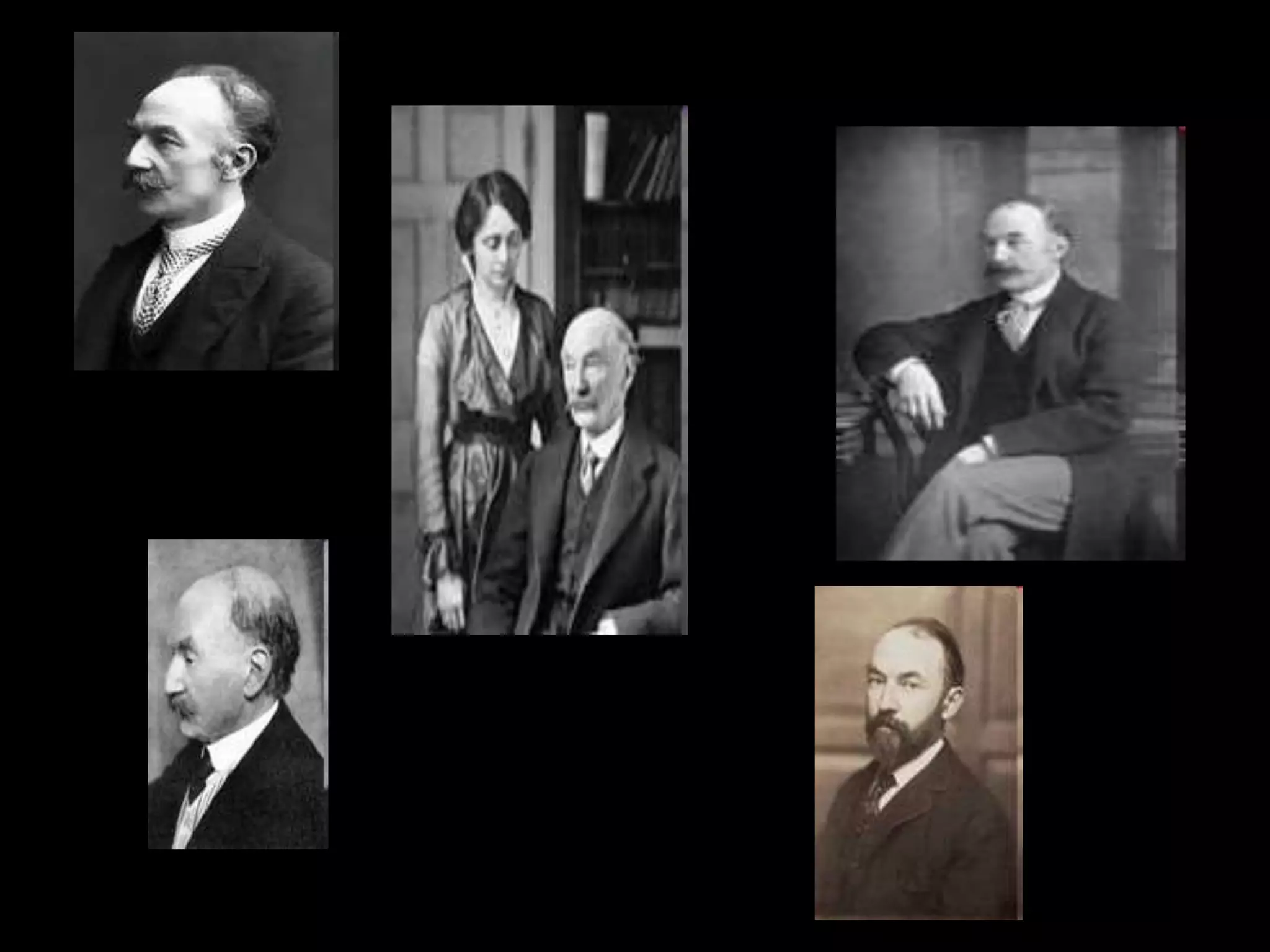
Poet and Novelist
Happiness was but an occasional
episode in a general drama of
pain
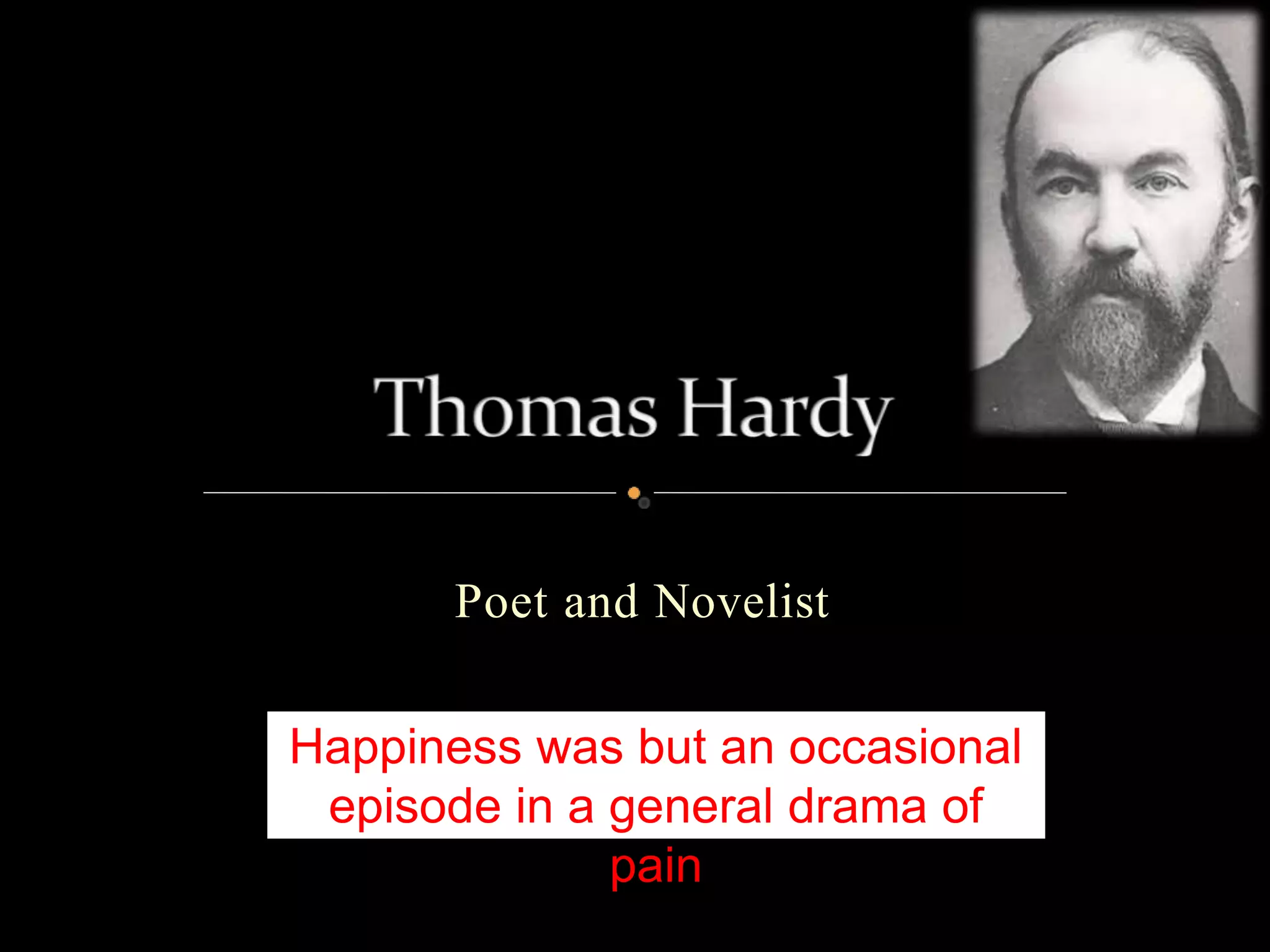
Thomas Hardy(2 June 1840 – 11January 1928)
was an English novelist and poet.
While Hardy wrote poetry throughout his life and
regarded himself primarily as a poet, his first
collection was not published until1898.
Initially, therefore, he gained fame as the author
of novels
Introduction
Thomas Hardy’s life can be divided into three phases:
1. The first phase (1840-1870) embraces childhood,
adolescence, apprenticeship, first marriage, early
poems and his first unpublishednovel.
2. The second phase (1871-1897) is marked by intensive
writing, which resulted in the publication of 14 novels and
a number of short stories.
3. In the third phase (1898-1928), the period of the writer’s
rising fame, heabandoned writing novels and returned to
poetry.
Hardy’s Life in relation to his work
 Victorian Age
 Victorian Literature
 Victorian Writers
His Time in history
 Period between 1832 and 1901
 From the Passage of the First
Reform Bill to the Death of Queen
Victoria
 Early Victorian Age 1832-1848
 Mid-Victorian Age 1848-1870
Victorian Age
 Late Victorian Age 1870-1901
Victorian Writers
Poets
 Tennyson
 Robert Browning
 Elizabeth Barrett Browning
 Christina Rossetti
 Matthew Arnold
 G. M. Hopkins
Victorian Writers
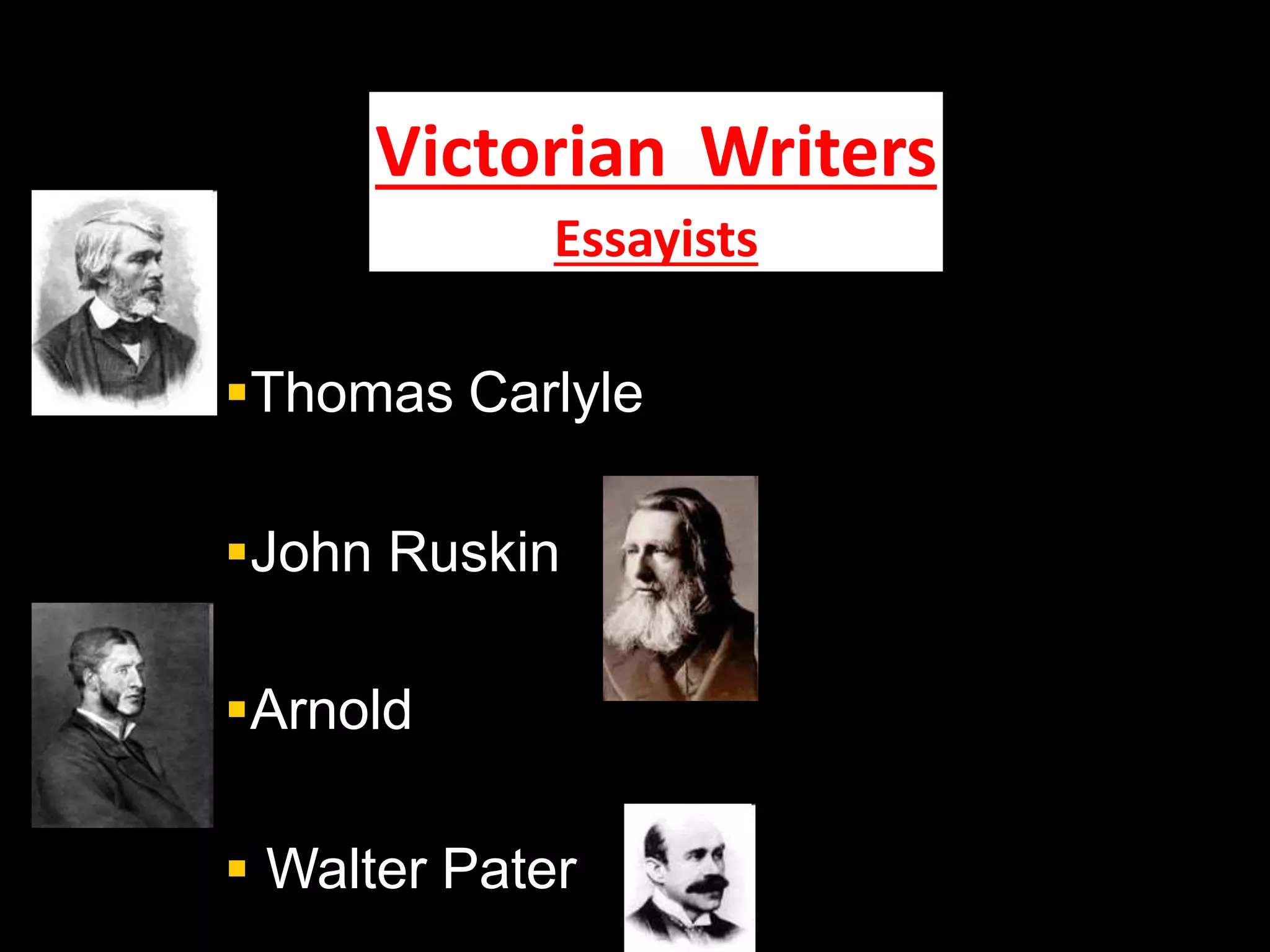
Essayists
Thomas Carlyle
John Ruskin
Arnold
 Walter Pater
Victorian Writers
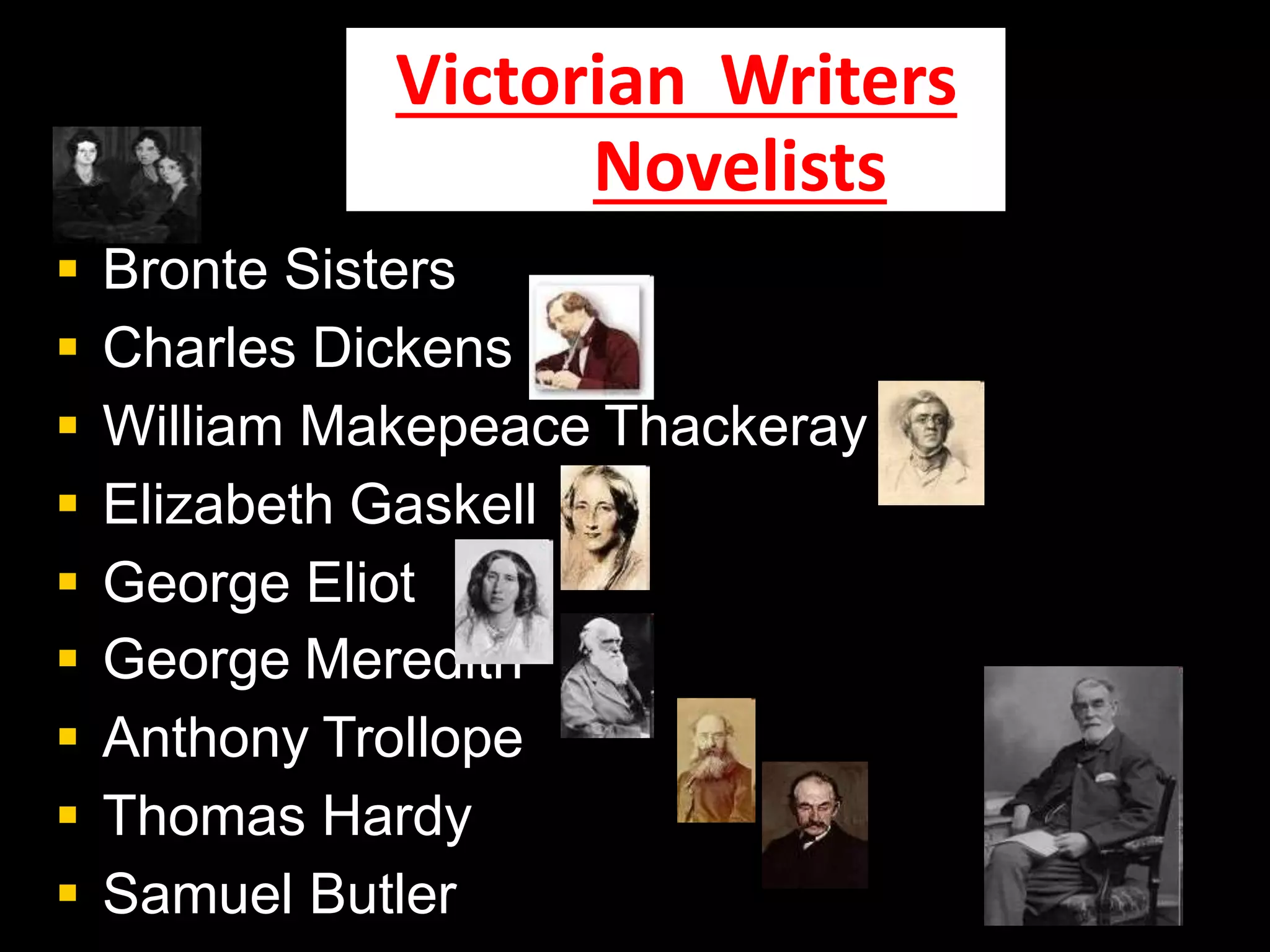
Novelists
 Bronte Sisters
 Charles Dickens
 William Makepeace Thackeray
 Elizabeth Gaskell
 George Eliot
 George Meredith
 Anthony Trollope
 Thomas Hardy
 Samuel Butler
Born on 2nd June, 1840 in the village of Higher[Upper]
Bockhampton in Stinsford parish near the town of
Dorchester in Dorset County,England
Early Life
Jemima Hardy
Mr Thomas
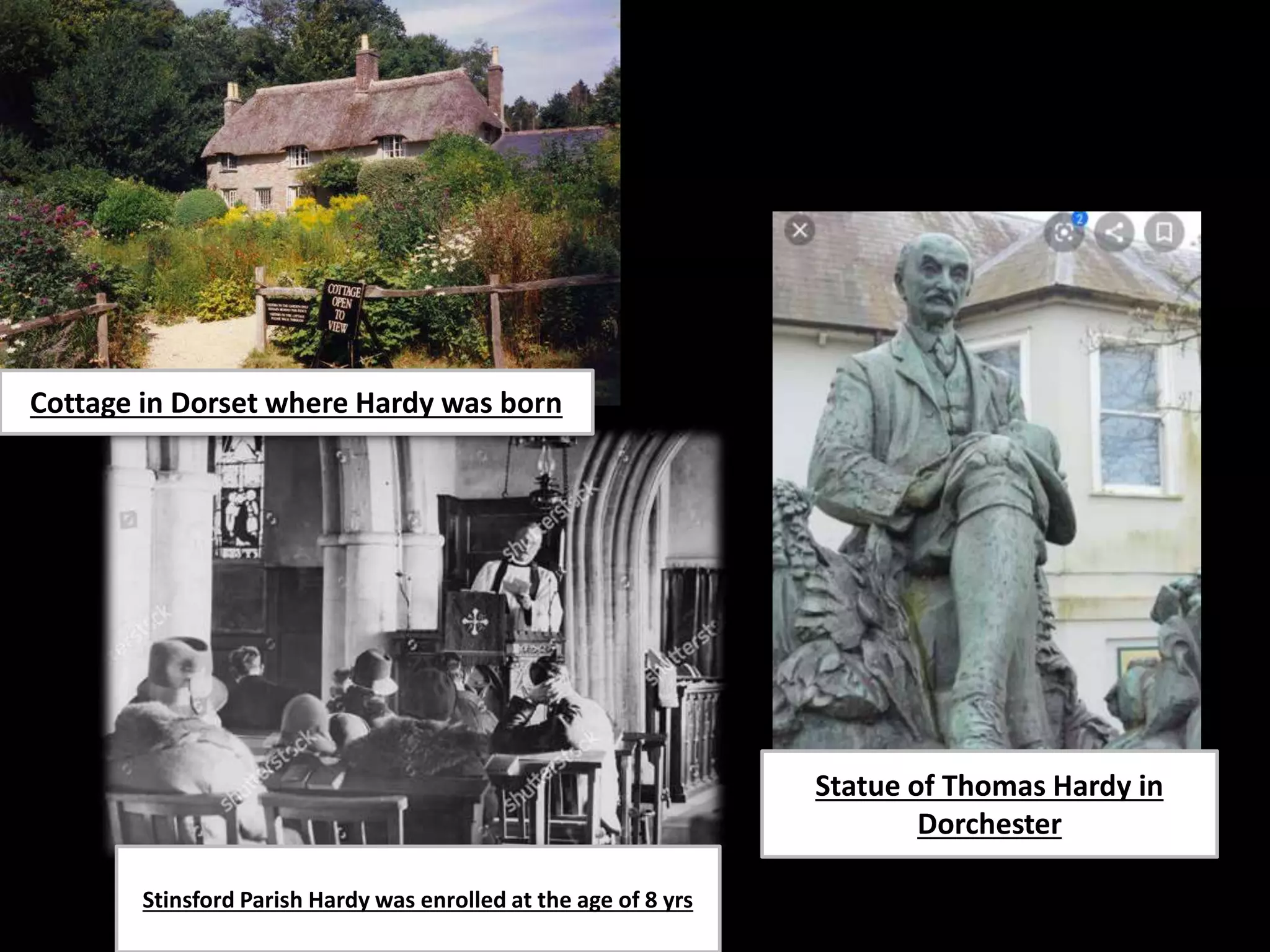
Statue of Thomas Hardy in
Dorchester
Stinsford Parish Hardy was enrolled at the age of 8 yrs
Cottage in Dorset where Hardy was born
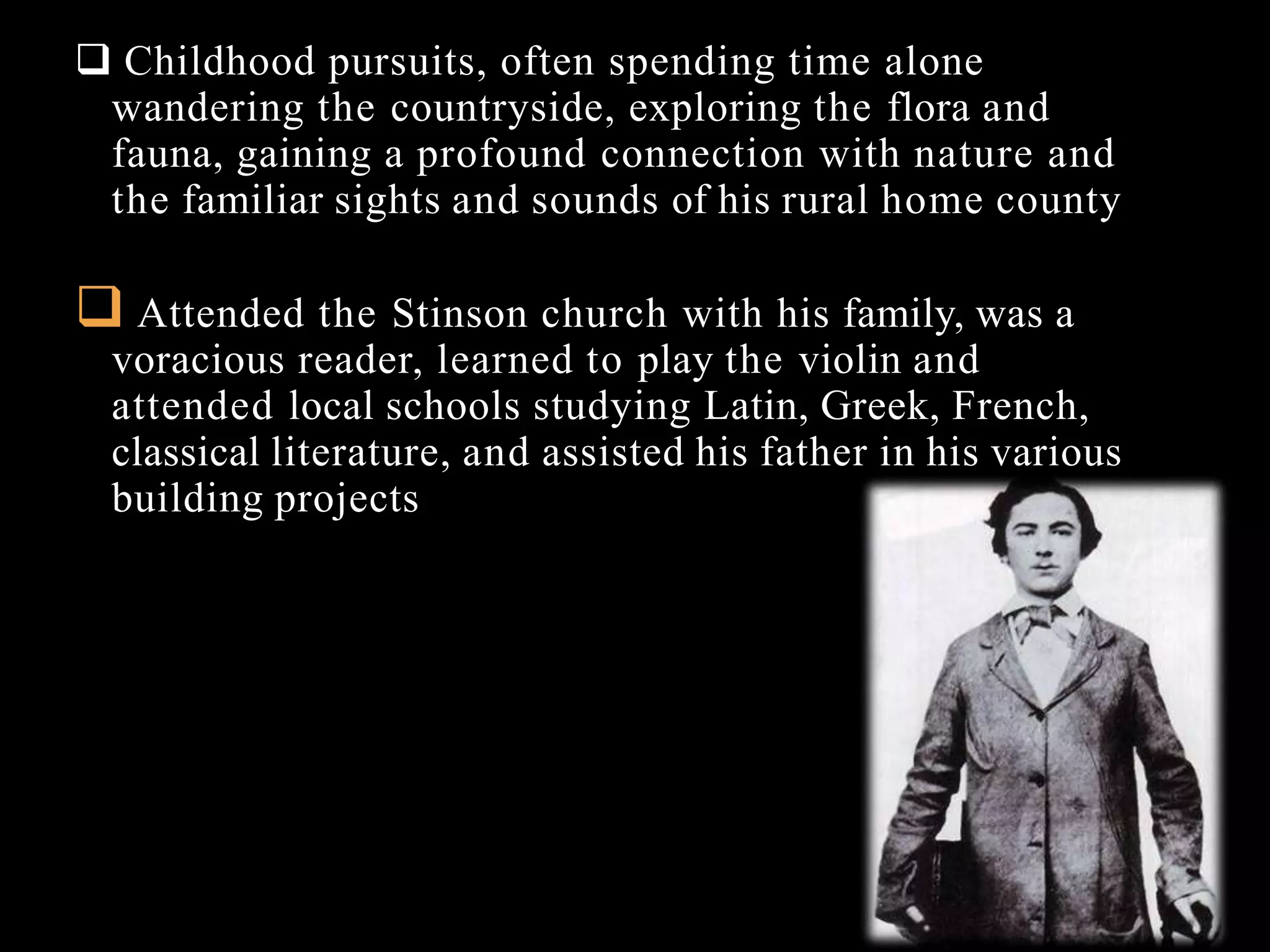
 Childhood pursuits, often spending time alone
wandering the countryside, exploring the flora and
fauna, gaining a profound connection with nature and
the familiar sights and sounds of his rural home county
 Attended the Stinson church with his family, was a
voracious reader, learned to play the violin and
attended local schools studying Latin, Greek, French,
classical literature, and assisted his father in his various
building projects
At the age of sixteen, Hardy was taken on as
apprentice to John Hicks, an architect inDorchester
Work before Writing
John Hicks
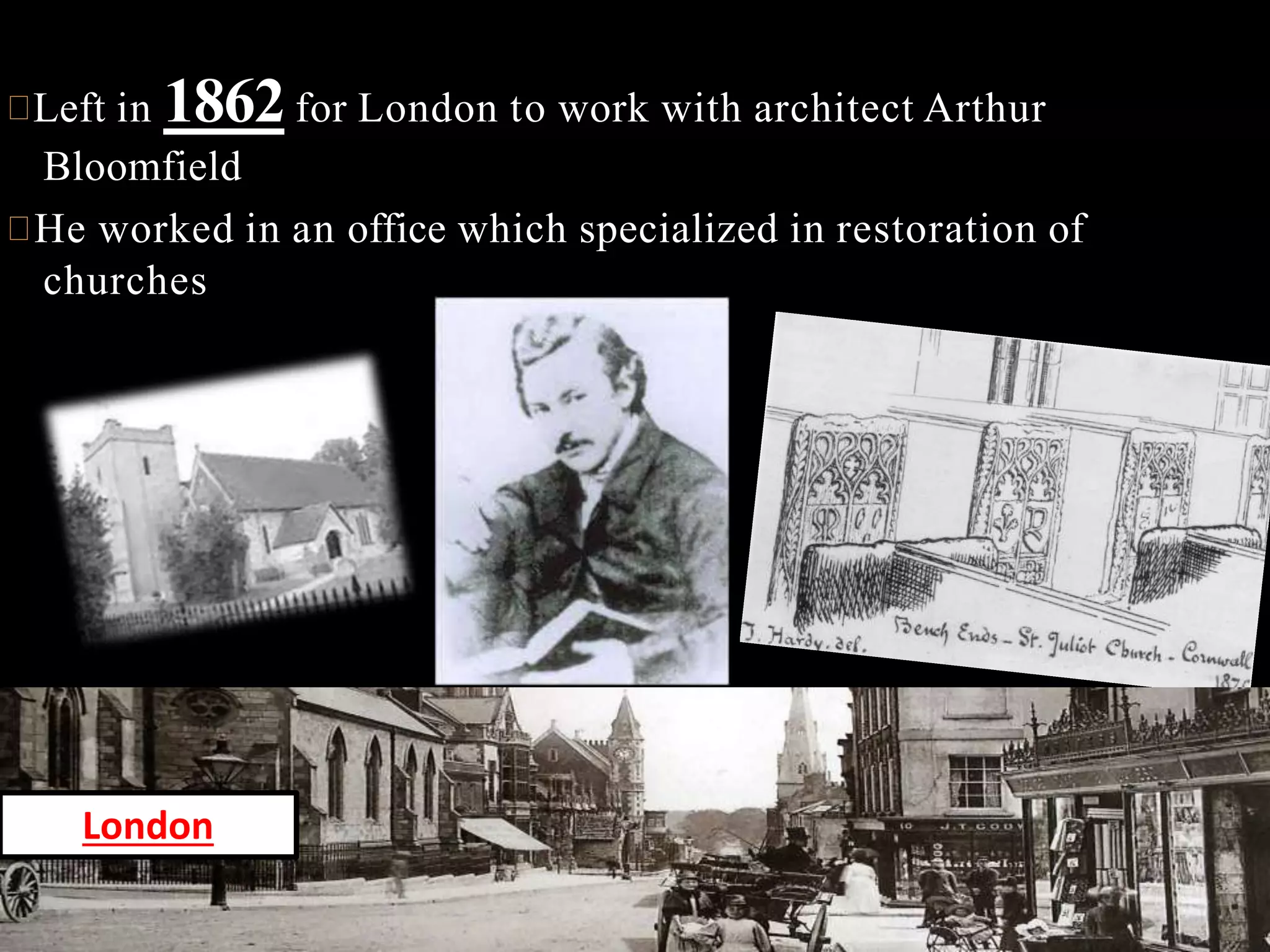
Left in 1862for London to work with architect Arthur
Bloomfield
He worked in an office which specialized in restoration of
churches
London
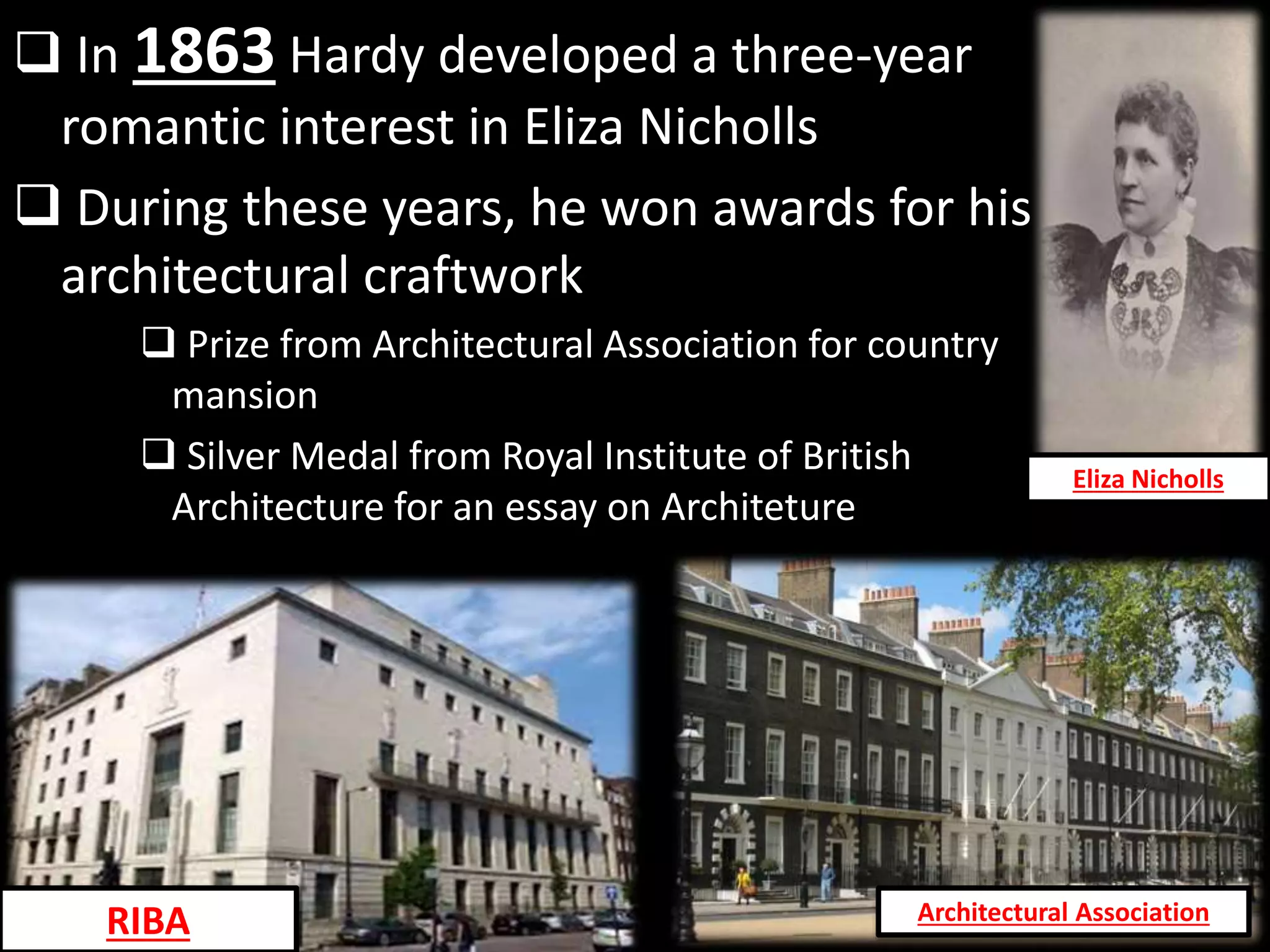
 In 1863 Hardy developed a three-year
romantic interest in Eliza Nicholls
 During these years, he won awards for his
architectural craftwork
 Prize from Architectural Association for country
mansion
 Silver Medal from Royal Institute of British
Architecture for an essay on Architeture
RIBA
Eliza Nicholls
Architectural Association
In 1865, he immersed himself in the city's vibrant literary
and cultural atmosphere, studying art, visiting the
National Gallery, attending the theatre, and writing prose
and poetry
• Prose sketch, “How I built myself a house” appeared
in Chamber’s Edinburgh Journal
 Five years later, in 1867, concerned about his
health, he returned to Dorset and decided to
dedicate himself to writing
• His First Novel, “The Poor Man and The Lady” was
written
 This novel was rejected for publication
 He met with George Meredith
Meredith Hardy’s First Novel
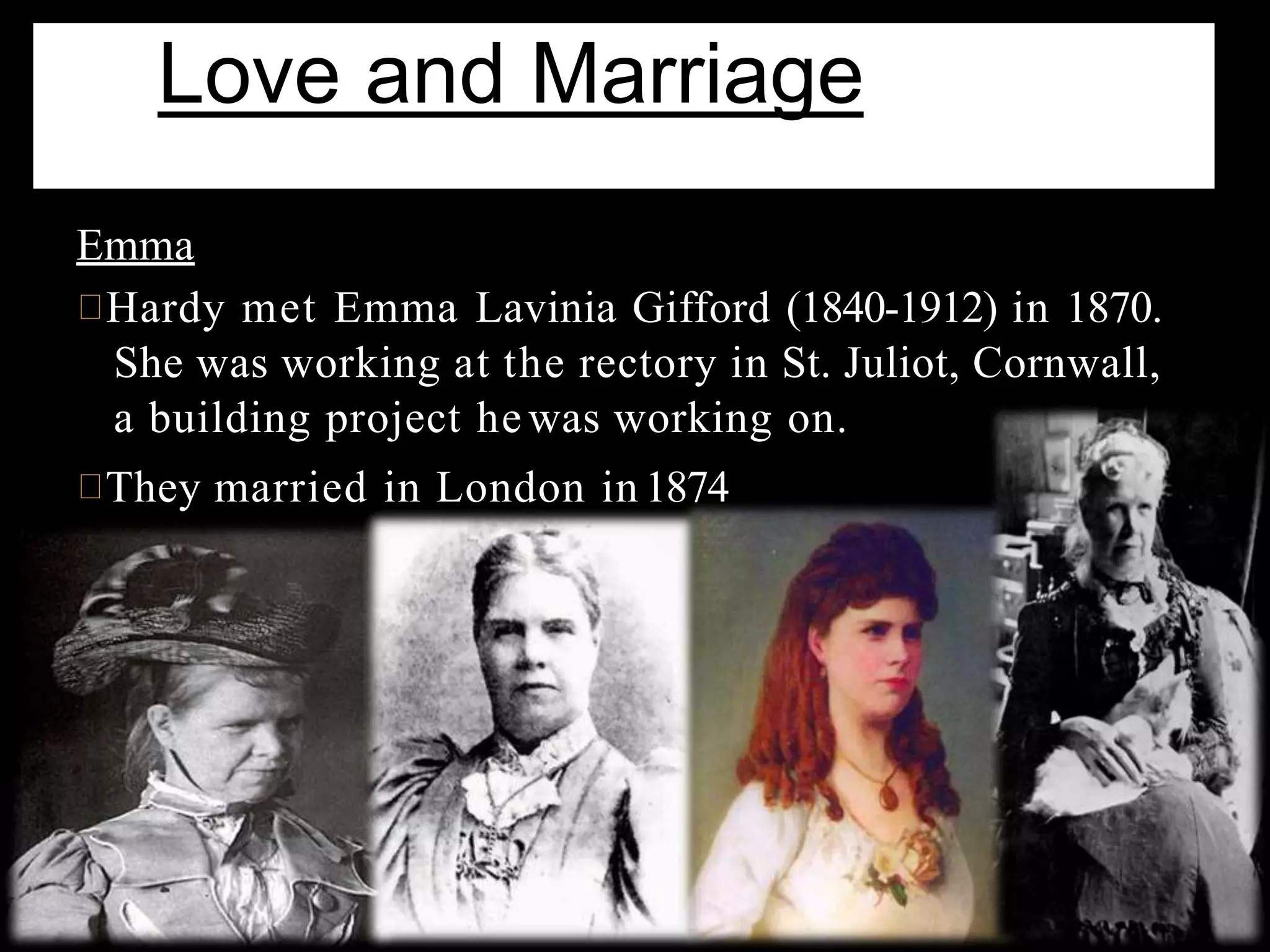
Emma
Hardy met Emma Lavinia Gifford (1840-1912) in 1870.
She was working at the rectory in St. Juliot, Cornwall,
a building project he was working on.
They married in London in1874
Love and Marriage
 In 1883, Hardy moved to Dorchester
 In 1885, He moved to Max Gate and lived
there for the rest of his life
 Tess of the D’Urbevilles
 Mayor of the Casterbridge
 In 1912, his first wife Emma died
In 1914,Hardy married his secretary,
Florence Emily Dugdale (1879-1937)
 Dugdale was 39 years his junior
 In 1919, his collection of poetry was published
 Three volumes of poetry were appeared during his
last decade of life
Hardy became ill with pleurisy in December 1927
He died at his home, Max Gate, in Dorchester on 11th
January 1928
Hardy narrated his final poem to his wife while on his
deathbed
His heart is buried in the cemetery of St. Michael's
Church in Stinsford, Dorset, where Emma and
Florence also now rest
His ashes were interred in Poet's Corner of
Westminster Abbey, London, England
Illness and Death
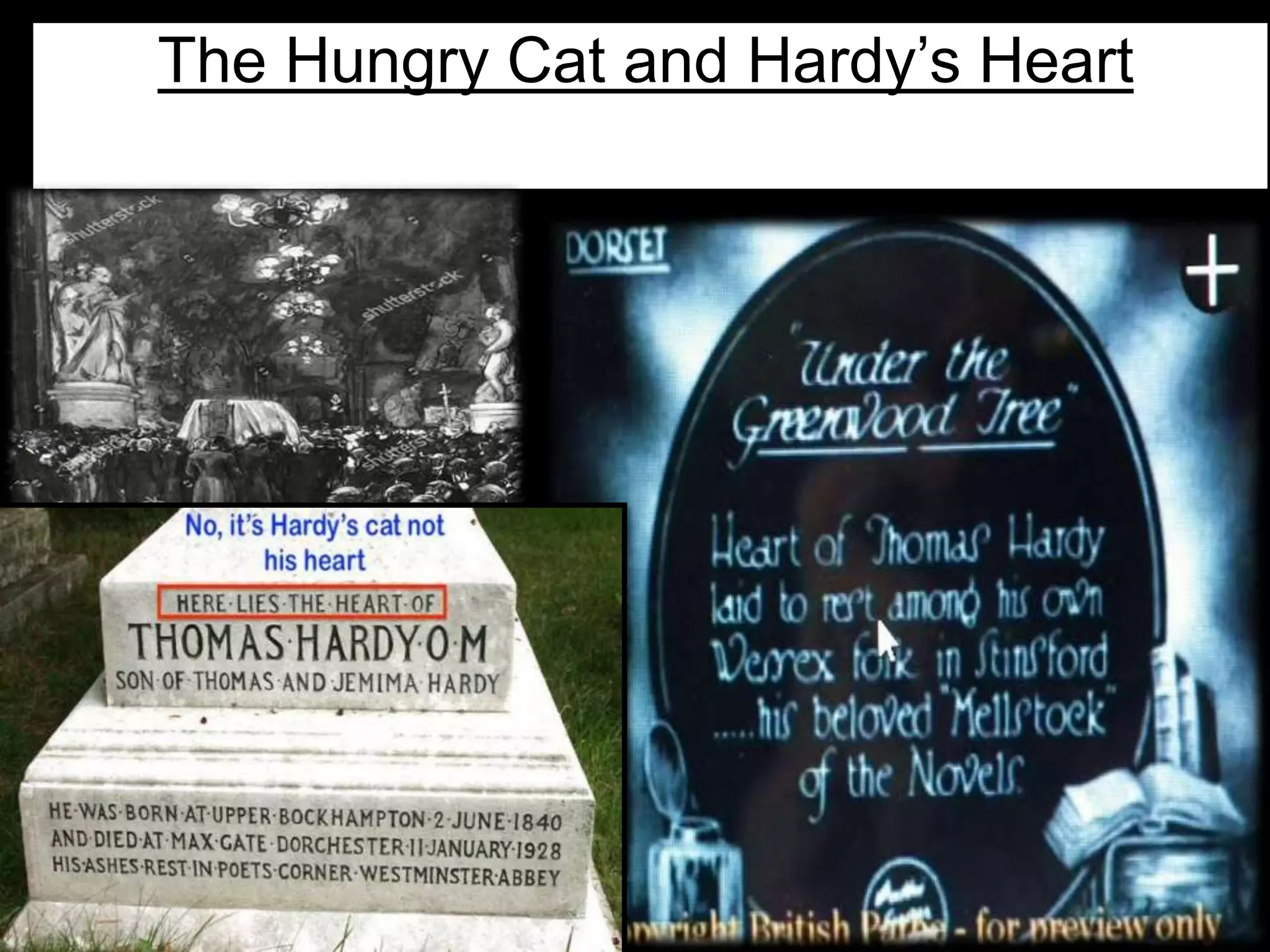
His heart is buried in Stinsford close to his parents
and beneath the tombstone of his beloved wife,
Emma
 Most of him, his ashes are buried with spadeful of
Dorset earth in Poets’ Corner of Westminster Abbey
Two Funerals of Hardy
The Hungry Cat and Hardy’s Heart
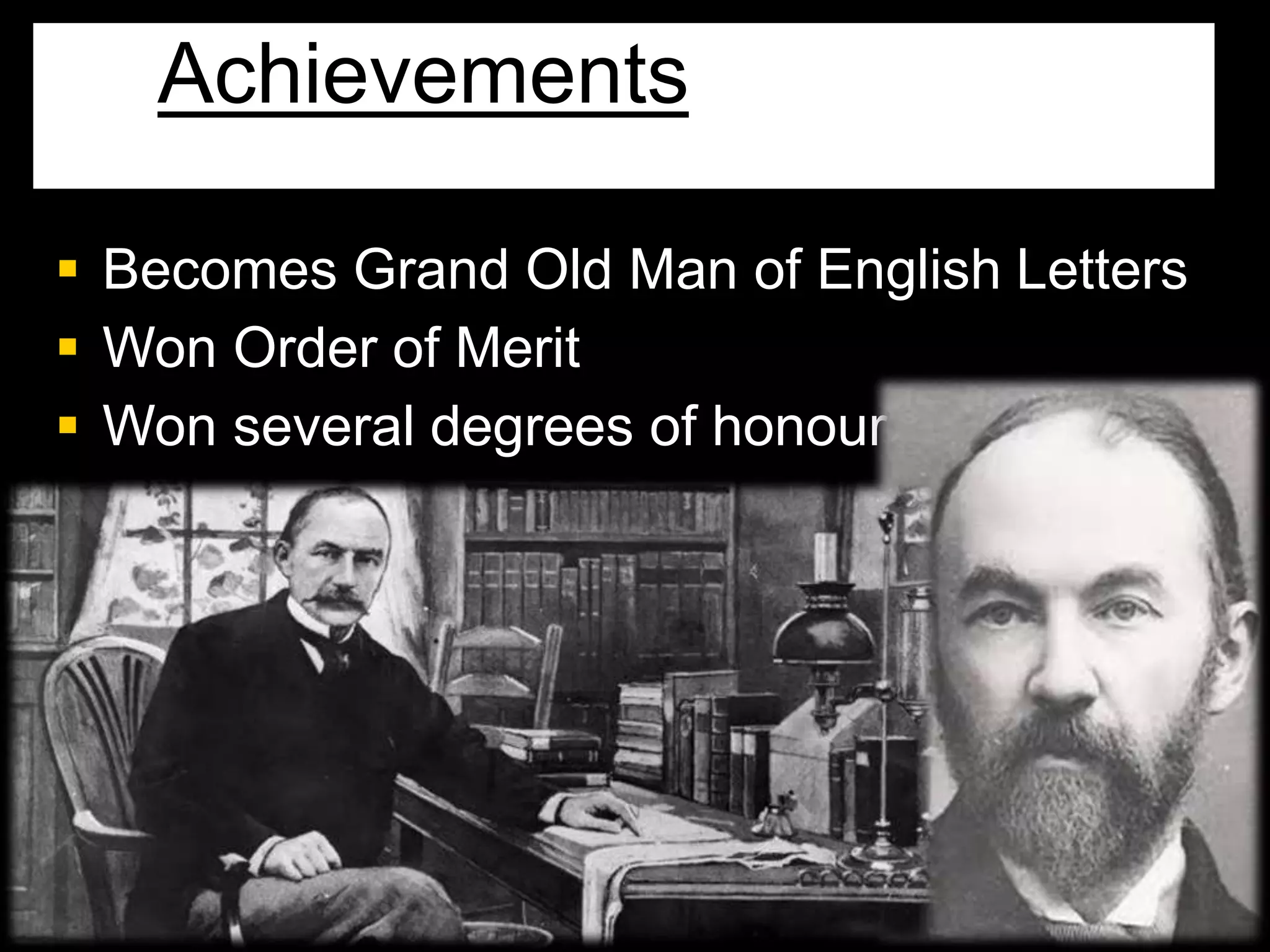
 Becomes Grand Old Man of English Letters
 Won Order of Merit
 Won several degrees of honour
Achievements
Hardy divided his novels and collected short stories
into three classes:
1. Novels of Character and Environment
2. Romance and Fantasies
3. Novels of Ingenuity
Novels
1.The Dynasts (verse drama)
The Dynasts, Part 1(1904)
The Dynasts, Part 2(1906)
The Dynasts, Part 3(1908)
2. The Famous Tragedy of the Queen of Cornwall at
Tintagel in Lyonnesse (1923) (one-act play)
Drama
Poetry was Hardy's first literary love
He wrote poems from the 1860s onward till near his
death, completing nearly a thousand poems (986)
Hardy is now recognised as one of the greatest poets
of the twentieth century
In 1898 Hardy published his first volume of poetry,
Wessex Poems, a collection of poems written over a
period of 30 years
Poetry
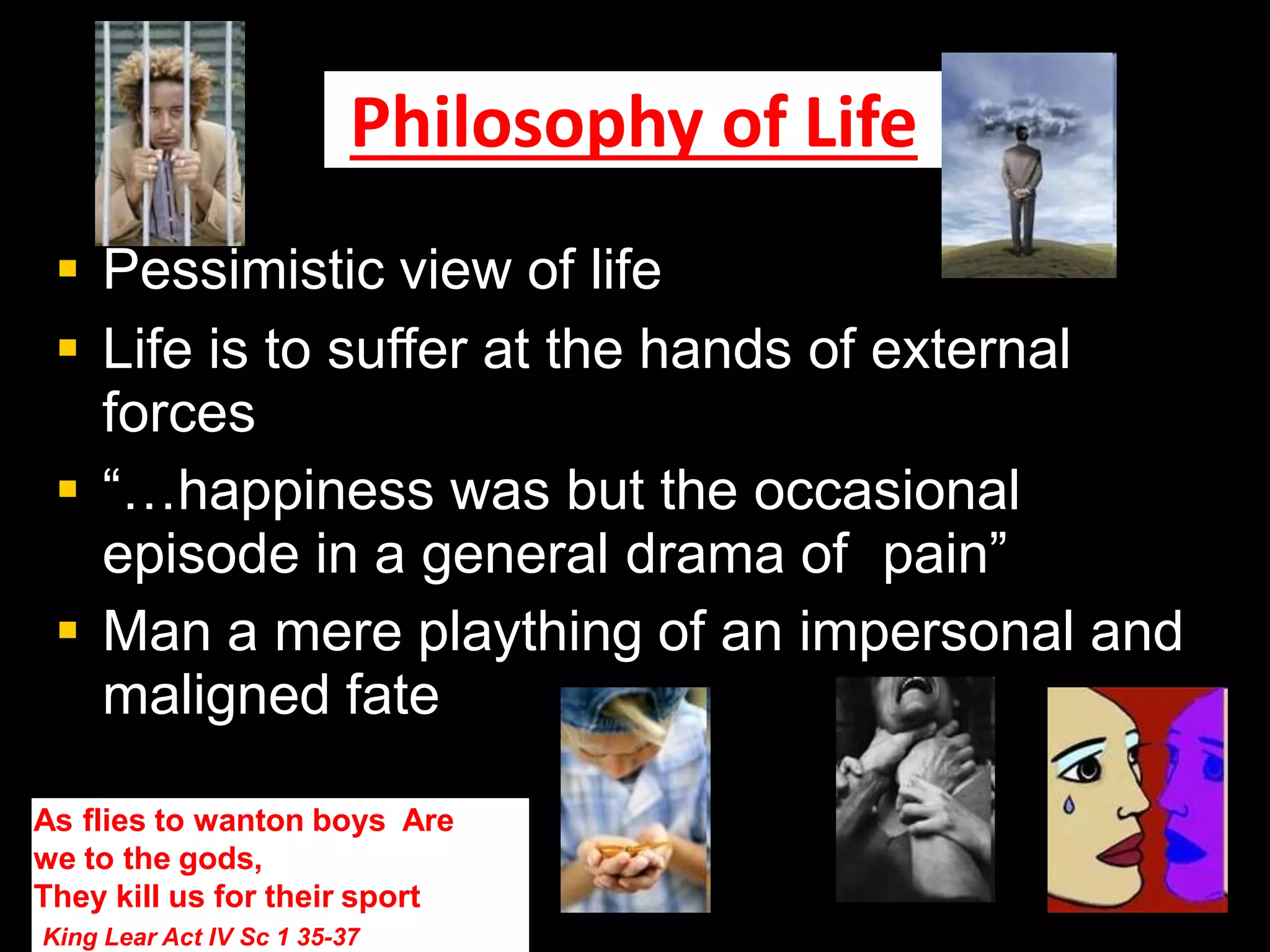
Philosophy of Life
 Pessimistic view of life
 Life is to suffer at the hands of external
forces
 “…happiness was but the occasional
episode in a general drama of pain”
 Man a mere plaything of an impersonal and
maligned fate
As flies to wanton boys Are
we to the gods,
They kill us for their sport
King Lear Act IV Sc 1 35-37
Features of His Works
 Accusing finger at destiny and taking sides with
the protagonist
 His plots hinges on Co-incidences and
mischances
 Close to nature, rural and country scenes
 Characters are mostly ordinary men and women
living close to the soil
 Minor rustics offer pithy humour
 Wessex finds a prominent place in his works
http://www.victorianweb.org/authors/hard/
http://www.hardysociety.org/
https://www.ucm.es/data/cont/docs/119-2014-02-
19-Thomas%20Hardy.pdf
http://www.gutenberg.org/ebooks/author/23
Milgate, Michael. Thomas Hardy: His Career as a
Novelist. New York: Random House, 1971.
Love is a possible strength in an
actual weakness
A man's silence is wonderful to
listen to
...our impulses are too strong for
our judgement sometimes
There is a condition worse than blindness, and that is, seeing
something that isn't there
No one can read with
profit that which he
cannot learn to read
with pleasure
The main object of religion is not
to get a man into heaven, but to
get heaven into him

Introduction to Thomas Hardy

  • 1.
    Poet and Novelist Happinesswas but an occasional episode in a general drama of pain
  • 3.
    Thomas Hardy(2 June1840 – 11January 1928) was an English novelist and poet. While Hardy wrote poetry throughout his life and regarded himself primarily as a poet, his first collection was not published until1898. Initially, therefore, he gained fame as the author of novels Introduction
  • 4.
    Thomas Hardy’s lifecan be divided into three phases: 1. The first phase (1840-1870) embraces childhood, adolescence, apprenticeship, first marriage, early poems and his first unpublishednovel. 2. The second phase (1871-1897) is marked by intensive writing, which resulted in the publication of 14 novels and a number of short stories. 3. In the third phase (1898-1928), the period of the writer’s rising fame, heabandoned writing novels and returned to poetry. Hardy’s Life in relation to his work
  • 5.
     Victorian Age Victorian Literature  Victorian Writers His Time in history  Period between 1832 and 1901  From the Passage of the First Reform Bill to the Death of Queen Victoria  Early Victorian Age 1832-1848  Mid-Victorian Age 1848-1870 Victorian Age  Late Victorian Age 1870-1901
  • 6.
    Victorian Writers Poets  Tennyson Robert Browning  Elizabeth Barrett Browning  Christina Rossetti  Matthew Arnold  G. M. Hopkins
  • 7.
  • 8.
    Victorian Writers Novelists  BronteSisters  Charles Dickens  William Makepeace Thackeray  Elizabeth Gaskell  George Eliot  George Meredith  Anthony Trollope  Thomas Hardy  Samuel Butler
  • 9.
    Born on 2ndJune, 1840 in the village of Higher[Upper] Bockhampton in Stinsford parish near the town of Dorchester in Dorset County,England Early Life Jemima Hardy Mr Thomas
  • 10.
    Statue of ThomasHardy in Dorchester Stinsford Parish Hardy was enrolled at the age of 8 yrs Cottage in Dorset where Hardy was born
  • 11.
     Childhood pursuits,often spending time alone wandering the countryside, exploring the flora and fauna, gaining a profound connection with nature and the familiar sights and sounds of his rural home county  Attended the Stinson church with his family, was a voracious reader, learned to play the violin and attended local schools studying Latin, Greek, French, classical literature, and assisted his father in his various building projects
  • 12.
    At the ageof sixteen, Hardy was taken on as apprentice to John Hicks, an architect inDorchester Work before Writing John Hicks
  • 13.
    Left in 1862forLondon to work with architect Arthur Bloomfield He worked in an office which specialized in restoration of churches London
  • 14.
     In 1863Hardy developed a three-year romantic interest in Eliza Nicholls  During these years, he won awards for his architectural craftwork  Prize from Architectural Association for country mansion  Silver Medal from Royal Institute of British Architecture for an essay on Architeture RIBA Eliza Nicholls Architectural Association
  • 15.
    In 1865, heimmersed himself in the city's vibrant literary and cultural atmosphere, studying art, visiting the National Gallery, attending the theatre, and writing prose and poetry • Prose sketch, “How I built myself a house” appeared in Chamber’s Edinburgh Journal
  • 16.
     Five yearslater, in 1867, concerned about his health, he returned to Dorset and decided to dedicate himself to writing • His First Novel, “The Poor Man and The Lady” was written  This novel was rejected for publication  He met with George Meredith Meredith Hardy’s First Novel
  • 17.
    Emma Hardy met EmmaLavinia Gifford (1840-1912) in 1870. She was working at the rectory in St. Juliot, Cornwall, a building project he was working on. They married in London in1874 Love and Marriage
  • 18.
     In 1883,Hardy moved to Dorchester  In 1885, He moved to Max Gate and lived there for the rest of his life  Tess of the D’Urbevilles  Mayor of the Casterbridge
  • 19.
     In 1912,his first wife Emma died In 1914,Hardy married his secretary, Florence Emily Dugdale (1879-1937)  Dugdale was 39 years his junior
  • 20.
     In 1919,his collection of poetry was published  Three volumes of poetry were appeared during his last decade of life
  • 21.
    Hardy became illwith pleurisy in December 1927 He died at his home, Max Gate, in Dorchester on 11th January 1928 Hardy narrated his final poem to his wife while on his deathbed His heart is buried in the cemetery of St. Michael's Church in Stinsford, Dorset, where Emma and Florence also now rest His ashes were interred in Poet's Corner of Westminster Abbey, London, England Illness and Death
  • 22.
    His heart isburied in Stinsford close to his parents and beneath the tombstone of his beloved wife, Emma  Most of him, his ashes are buried with spadeful of Dorset earth in Poets’ Corner of Westminster Abbey Two Funerals of Hardy
  • 23.
    The Hungry Catand Hardy’s Heart
  • 24.
     Becomes GrandOld Man of English Letters  Won Order of Merit  Won several degrees of honour Achievements
  • 25.
    Hardy divided hisnovels and collected short stories into three classes: 1. Novels of Character and Environment 2. Romance and Fantasies 3. Novels of Ingenuity Novels
  • 26.
    1.The Dynasts (versedrama) The Dynasts, Part 1(1904) The Dynasts, Part 2(1906) The Dynasts, Part 3(1908) 2. The Famous Tragedy of the Queen of Cornwall at Tintagel in Lyonnesse (1923) (one-act play) Drama
  • 27.
    Poetry was Hardy'sfirst literary love He wrote poems from the 1860s onward till near his death, completing nearly a thousand poems (986) Hardy is now recognised as one of the greatest poets of the twentieth century In 1898 Hardy published his first volume of poetry, Wessex Poems, a collection of poems written over a period of 30 years Poetry
  • 28.
    Philosophy of Life Pessimistic view of life  Life is to suffer at the hands of external forces  “…happiness was but the occasional episode in a general drama of pain”  Man a mere plaything of an impersonal and maligned fate As flies to wanton boys Are we to the gods, They kill us for their sport King Lear Act IV Sc 1 35-37
  • 29.
    Features of HisWorks  Accusing finger at destiny and taking sides with the protagonist  His plots hinges on Co-incidences and mischances  Close to nature, rural and country scenes  Characters are mostly ordinary men and women living close to the soil  Minor rustics offer pithy humour  Wessex finds a prominent place in his works
  • 30.
  • 31.
    Love is apossible strength in an actual weakness A man's silence is wonderful to listen to ...our impulses are too strong for our judgement sometimes There is a condition worse than blindness, and that is, seeing something that isn't there No one can read with profit that which he cannot learn to read with pleasure The main object of religion is not to get a man into heaven, but to get heaven into him