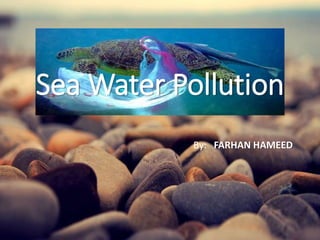
Sea Water Pollution
By: FARHAN HAMEED
Sea water Pollution(UN definition)
“The introduction by man, directly, or indirectly,
of substances or energy to the marine
environment resulting in deleterious effects such as
hazards to human health, hindrance to marine
activities, impairment of the quality of seawater
for various uses and reduction of amenities.”
Types of Sea Water Pollution
• Chemicals, Metals and Radioactive Substances
• Solid Waste
• Oil
• Sewage (Faecal Coliform and nutrients)
• Agricultural runoff (herbicides, pesticides and
nutrients)
• Biological
• Sedimentation
Major Pollutants
 Worldwide
• ~10 billion tones of ballast water with invasives
• ~ 10,000 million gallons of sewage annually
• ~3.25 million metric tones of oil annually
• Millions of tones of Solid waste
Major Pollutants
Metals
• Introduced dangerous metals include Mercury,
Lead, and Copper.
• Heavy Metals are a great concern because they
enter the food chain.
• Copper is dangerous to marine organisms and has
been used in marine anti-fouling paints.
• Human activities release 5 times as much mercury
and 17 times as much lead as is derived from
natural sources.
Heavy Metals Entering Oceans
Lead
68 %
Mercury
20%
Copper
8%
Natural
4%
Lead Mercury Copper Natural
Major Pollutants (Cont.)
Solid Waste
• A large portion and great danger is
nonbiodegradable plastic.
• ~46,000 pieces of floating plastic/sq mile of ocean
surface off the Northeastern United States coast.
Major Pollutants (Cont.)
Oil
• Oil spills at sea are generally much more damaging
than those on land.
• The International Tanker Owners Pollution
Federation has tracked 9,351 accidental spills that
have occurred since 1974.
• According to this study, most spills result from
routine operations such as loading cargo,
discharging cargo, and taking on fuel oil.
Major Pollutants (Cont.)
• 91% of the operational oil spills are small, resulting
in less than 7 metric tons per spill.
• On the other hand, spills resulting from accidents
like collisions, groundings, hull failures, and
explosions are much larger, with 84% of these
involving losses of over 700 metric tons.
Sewage and Agricultural runoff
• Direct disposal of sewage sludge to the open sea
and deep seafloor.
• The ‘best’ example is the “106-mile” dump site in
the deep (2500m) NW Atlantic, serving the
populations of New York and New Jersey.
• A total of around 42 million wet tons (1.5 million
dry tons) of sludge were disposed of at the 106-
mile site.
Sewage and Agricultural runoff (Cont.)
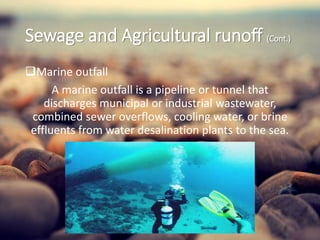
Marine outfall
A marine outfall is a pipeline or tunnel that
discharges municipal or industrial wastewater,
combined sewer overflows, cooling water, or brine
effluents from water desalination plants to the sea.
Radioactive Waste
• Radioactive waste is also dumped in the oceans
and usually comes from the nuclear power process,
medical use of radioisotopes, research use of
radioisotopes and industrial uses.
• The difference between industrial waste and
nuclear waste is that nuclear waste usually remains
radioactive for decades.
Biological Pollution
• Biological pollution, or biopollution, is a term that
defines adverse effects of invasive alien species
(IAS) on quality of aquatic and terrestrial
environment.
Effects of Pollution
Metals
• Generally marine pollution affects ecosystem
health, public health, recreational water quality.
• Heavy Metals are a great concern because they
enter the food chain.
• Copper is dangerous to marine organisms and has
been used in marine anti-fouling paints.
• Mercury and lead poisoning cause brain damage
and behavioral disturbances in children.
Solid Waste
• Sea turtles mistake plastic bags for jellyfish and die
from internal blockages.
Solid Waste (Cont.)
• Seals and sea lions starve after being entangled by
nets or muzzled by six-pack rings (decomposition
time 400 years).
• Plastic debris kills 100,000 marine mammals and
2 million sea birds die annually.
OIL
• The effects of an oil spill of marine life depend on a
number of physical and biological factors.
• The distribution of the oil spill will be affected by
currents and wind.
• In addition, the amount of oil spilled will determine
the eventual geographic boundaries of the impact
area.
• Environmental conditions such as salinity, water
temperature, and type and slope of shoreline will
determine habitat effects and clean-up procedures.
Oil (Cont.)
• Biological characteristics
of the organisms
affected will determine
the severity of impact.
• These characteristics
include the type of
species, life stage (larval,
juvenile or adult) and
size.
• Animals can be poisoned or suffer internal damage
from ingesting oil.
• Animals coated by even small amounts of oil may
be unable to swim or fly properly, maintain their
body temperature, feed or even reproduce.
Oil (Cont.)
Sewage and Agricultural runoff
• Most people think that all sewage is fully treated at
a sewage treatment plant and enters the ocean
relatively clean. Sewage contains a host of toxic
chemicals that can kill fish.
• Sewage contains hundreds of toxic chemicals
dumped into the sewage system by households,
businesses and industries. Some are harmful in
very low concentrations. Some toxins combine with
others in this deadly brew to create new
compounds that are even more dangerous.
Sewage and Agricultural runoff (Cont.)
• Even small amounts of the most hazardous
chemicals found in sewage can cause irreparable
harm to fish, particularly juveniles.
• The result is not immediate and visible like the
aftermath of an oil spill.
• It is a quiet, unseen death over time.
• Dead and dying fish are simply eaten by other
marine organisms.
Radioactive Waste
• If radioactive waste dump in concentrated areas,
most of it will not be evenly distributed throughout
the ocean.
• Most of it will remain in that location and will
contaminate organisms in that local area.
• Unfavorable situations might arise if a package of
radioactive material were found on the shore or
recovered in a fisherman's net or by a trawler or
dragger.
Solutions to Pollution
Two main methods
• Correction – costly and time intensive
• Prevention – requires attitude changes
Coastal Scientists believe that prevention is better
than cure since the effects of marine pollution may
be irreversible and we may therefore be creating
everlasting damage to the marine ecosystem.
“An ounce of prevention is worth a
pound of cure”
THANK YOU

Sea water pollution

  • 1.
  • 2.
    Sea water Pollution(UNdefinition) “The introduction by man, directly, or indirectly, of substances or energy to the marine environment resulting in deleterious effects such as hazards to human health, hindrance to marine activities, impairment of the quality of seawater for various uses and reduction of amenities.”
  • 3.
    Types of SeaWater Pollution • Chemicals, Metals and Radioactive Substances • Solid Waste • Oil • Sewage (Faecal Coliform and nutrients) • Agricultural runoff (herbicides, pesticides and nutrients) • Biological • Sedimentation
  • 4.
    Major Pollutants  Worldwide •~10 billion tones of ballast water with invasives • ~ 10,000 million gallons of sewage annually • ~3.25 million metric tones of oil annually • Millions of tones of Solid waste
  • 5.
    Major Pollutants Metals • Introduceddangerous metals include Mercury, Lead, and Copper. • Heavy Metals are a great concern because they enter the food chain. • Copper is dangerous to marine organisms and has been used in marine anti-fouling paints. • Human activities release 5 times as much mercury and 17 times as much lead as is derived from natural sources.
  • 6.
    Heavy Metals EnteringOceans Lead 68 % Mercury 20% Copper 8% Natural 4% Lead Mercury Copper Natural
  • 7.
    Major Pollutants (Cont.) SolidWaste • A large portion and great danger is nonbiodegradable plastic. • ~46,000 pieces of floating plastic/sq mile of ocean surface off the Northeastern United States coast.
  • 8.
    Major Pollutants (Cont.) Oil •Oil spills at sea are generally much more damaging than those on land. • The International Tanker Owners Pollution Federation has tracked 9,351 accidental spills that have occurred since 1974. • According to this study, most spills result from routine operations such as loading cargo, discharging cargo, and taking on fuel oil.
  • 9.
    Major Pollutants (Cont.) •91% of the operational oil spills are small, resulting in less than 7 metric tons per spill. • On the other hand, spills resulting from accidents like collisions, groundings, hull failures, and explosions are much larger, with 84% of these involving losses of over 700 metric tons.
  • 10.
    Sewage and Agriculturalrunoff • Direct disposal of sewage sludge to the open sea and deep seafloor. • The ‘best’ example is the “106-mile” dump site in the deep (2500m) NW Atlantic, serving the populations of New York and New Jersey. • A total of around 42 million wet tons (1.5 million dry tons) of sludge were disposed of at the 106- mile site.
  • 11.
    Sewage and Agriculturalrunoff (Cont.) Marine outfall A marine outfall is a pipeline or tunnel that discharges municipal or industrial wastewater, combined sewer overflows, cooling water, or brine effluents from water desalination plants to the sea.
  • 12.
    Radioactive Waste • Radioactivewaste is also dumped in the oceans and usually comes from the nuclear power process, medical use of radioisotopes, research use of radioisotopes and industrial uses. • The difference between industrial waste and nuclear waste is that nuclear waste usually remains radioactive for decades.
  • 13.
    Biological Pollution • Biologicalpollution, or biopollution, is a term that defines adverse effects of invasive alien species (IAS) on quality of aquatic and terrestrial environment.
  • 14.
  • 15.
    Metals • Generally marinepollution affects ecosystem health, public health, recreational water quality. • Heavy Metals are a great concern because they enter the food chain. • Copper is dangerous to marine organisms and has been used in marine anti-fouling paints. • Mercury and lead poisoning cause brain damage and behavioral disturbances in children.
  • 16.
    Solid Waste • Seaturtles mistake plastic bags for jellyfish and die from internal blockages.
  • 17.
    Solid Waste (Cont.) •Seals and sea lions starve after being entangled by nets or muzzled by six-pack rings (decomposition time 400 years). • Plastic debris kills 100,000 marine mammals and 2 million sea birds die annually.
  • 18.
    OIL • The effectsof an oil spill of marine life depend on a number of physical and biological factors. • The distribution of the oil spill will be affected by currents and wind. • In addition, the amount of oil spilled will determine the eventual geographic boundaries of the impact area. • Environmental conditions such as salinity, water temperature, and type and slope of shoreline will determine habitat effects and clean-up procedures.
  • 19.
    Oil (Cont.) • Biologicalcharacteristics of the organisms affected will determine the severity of impact. • These characteristics include the type of species, life stage (larval, juvenile or adult) and size.
  • 20.
    • Animals canbe poisoned or suffer internal damage from ingesting oil. • Animals coated by even small amounts of oil may be unable to swim or fly properly, maintain their body temperature, feed or even reproduce. Oil (Cont.)
  • 22.
    Sewage and Agriculturalrunoff • Most people think that all sewage is fully treated at a sewage treatment plant and enters the ocean relatively clean. Sewage contains a host of toxic chemicals that can kill fish. • Sewage contains hundreds of toxic chemicals dumped into the sewage system by households, businesses and industries. Some are harmful in very low concentrations. Some toxins combine with others in this deadly brew to create new compounds that are even more dangerous.
  • 23.
    Sewage and Agriculturalrunoff (Cont.) • Even small amounts of the most hazardous chemicals found in sewage can cause irreparable harm to fish, particularly juveniles. • The result is not immediate and visible like the aftermath of an oil spill. • It is a quiet, unseen death over time. • Dead and dying fish are simply eaten by other marine organisms.
  • 24.
    Radioactive Waste • Ifradioactive waste dump in concentrated areas, most of it will not be evenly distributed throughout the ocean. • Most of it will remain in that location and will contaminate organisms in that local area. • Unfavorable situations might arise if a package of radioactive material were found on the shore or recovered in a fisherman's net or by a trawler or dragger.
  • 25.
    Solutions to Pollution Twomain methods • Correction – costly and time intensive • Prevention – requires attitude changes Coastal Scientists believe that prevention is better than cure since the effects of marine pollution may be irreversible and we may therefore be creating everlasting damage to the marine ecosystem.
  • 26.
    “An ounce ofprevention is worth a pound of cure” THANK YOU