Course code : AQC 503
Course title : AQUACULTURE ENVIRONMENT MANAGEMENT (2+1)
Presented
by
Abisha R
AQC-MA7-02
M.F.Sc. 2017-19
Introduction
 Water quality is the most difficult production factor to
understand, predict and manage.
 Its quality directly affects feed efficiency, growth rate,
the fish’s health and its survival.
 The objective is to manage the water quality, so as
to provide a relatively stress free environment that
meets the physical, chemical and biological
standards for the fishes normal health and
production performance.
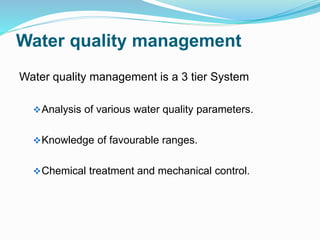
Water quality management
Water quality management is a 3 tier System
Analysis of various water quality parameters.
Knowledge of favourable ranges.
Chemical treatment and mechanical control.
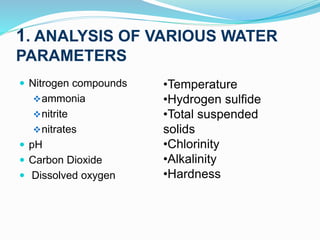
1. ANALYSIS OF VARIOUS WATER
PARAMETERS
 Nitrogen compounds
ammonia
nitrite
nitrates
 pH
 Carbon Dioxide
 Dissolved oxygen
•Temperature
•Hydrogen sulfide
•Total suspended
solids
•Chlorinity
•Alkalinity
•Hardness
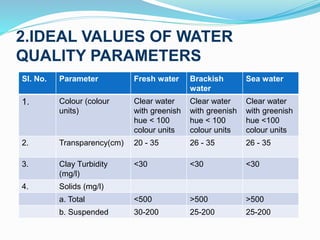
2.IDEAL VALUES OF WATER
QUALITY PARAMETERS
Sl. No. Parameter Fresh water Brackish
water
Sea water
1. Colour (colour
units)
Clear water
with greenish
hue < 100
colour units
Clear water
with greenish
hue < 100
colour units
Clear water
with greenish
hue <100
colour units
2. Transparency(cm) 20 - 35 26 - 35 26 - 35
3. Clay Turbidity
(mg/l)
<30 <30 <30
4. Solids (mg/l)
a. Total <500 >500 >500
b. Suspended 30-200 25-200 25-200
5. Temperature (0C )
a. Tropical climate 25-32 25-32 25-32
b. Temperate climate 10-12 10-12 10-12
6. pH 7.5-9.5 8.0-8.7 8.0-8.5
7. Hardness (mg/l) 30-180 >50 >50
8. Alkalinity (mg/l) 50-300 >50 >50
9. Chlorides (mg/l) 31-50 >500 >500
10. Salinity ( ppt ) <0.5 10-25 >30
11. Dissolved
Oxygen(mg/l)
5-10 5-10 5-10
12. Ammonia
Nitrogen(NH3
– N) ,
(mg/l)
a. Unionized (NH3) 0-0.1 0-0.1 0-0.1
b. Ionized (NH4
+) 0-1.0 0-1.0 0-1.0
Contd.
13. Nitrite
Nitrogen(NO2
-N) ,
(mg/l)
0-0.5 0-0.5 0-0.5
14. Nitrate
Nitrogen(NO3
-N
mg/l)
0-1.3 0-1.3 0-1.3
15. Total Nitrogen (mg/l) 0.5-4.5 0.5-4.5 0.5-4.5
16. Total phosphorus
(mg/l)
0.05-0.40 0.05-0.50 0.05-0.50
17. Potassium (mg/l) 0.5-10 >0.5 >0.5
18. Calcium (mg/l) 75-150 >75 >75
19. Magnesium (mg/l) 20-200 200-1350 >1350
20. Sulphate (mg/l) 20-200 200-885 >885
21. Silica (mg/l) 4-16 >5 >5
22. Iron (mg/l) 0.01-0.3 0.01-0.3 0.01-0.3
23. Manganese (mg/l) 0.001-0.002 0.002-0.02 0.002-0.02
24. Zinc (mg/l) 0.002-0.01 0.002-0.01 0.002-0.01
Contd.
25. Copper (mg/l) 0.003-0.005 0.003-0.005 0.003-0.005
26. Cobalt (mg/l) <0.003 <0.003 <0.003
27. Biochemical Oxygen
demand(BOD) (mg/l)
<10 <15 <15
28. Chemical oxygen
demand (COD) (mg/l)
<50 70 70
29. Hydrogen sulphide
(mg/l)
<0.002 <0.003 <0.003
30. Residual chlorine
(mg/l)
<0.003 <0.003 <0.003
31. Primary productivity
(mg C/m3/day)
1000 - 3000 1000 - 2500 1000 - 2500
32. Plankton(ml/100 litre) 2 1 1
33. Chlorophyll-a (µg/l) 20-275 20-250 20-250
34. Redox-potential(volts) 0.40-0.52 0.40-0.52 0.40-0.52
Contd.
3. CHEMICAL TREATMENT AND MECHANICAL
CONTROL
It is the last step in the water quality management practice.
CHEMICAL TREATMENT
 Liming
Lime is used in aquaculture practices to improve
water quality and acidity of soils.
-It creates a buffer system to prevent marked diurnal
changes of the water from acidic to alkaline conditions.
-It kills pathogens and promotes bacterial breakdown of
organic matter.
-It neutralizes soil acidity.
-It precipitates colloidal matters.
-It promotes plankton growth.
Contd.
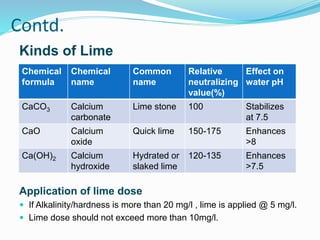
Kinds of Lime
Application of lime dose
 If Alkalinity/hardness is more than 20 mg/l , lime is applied @ 5 mg/l.
 Lime dose should not exceed more than 10mg/l.
Chemical
formula
Chemical
name
Common
name
Relative
neutralizing
value(%)
Effect on
water pH
CaCO3 Calcium
carbonate
Lime stone 100 Stabilizes
at 7.5
CaO Calcium
oxide
Quick lime 150-175 Enhances
>8
Ca(OH)2 Calcium
hydroxide
Hydrated or
slaked lime
120-135 Enhances
>7.5
Coagulation
If water contains turbidity <30 mg/l, it can be treated by
filtration without any pre-treatment.
If it exceeds >30mg/l , alum can be added.
Alum is used as a coagulating agent.
Al2(SO4)3 . 9H2O+ 3Ca(HCO3)2 = 2Al(OH)3 + 3CaSO4 + 9H2O + 6CO2
Al2(SO4)3 . 9H2O + 3MgCO3= 2Al(OH)3 + 3MgSO4 + 6H2O + 3CO2
Role of Alum in Aquaculture
-Acts as a coagulant.
-Neutralizes higher alkalinity.
-Removes undesirable turbidity.
-Reduces higher hardness.
-Controls eutrophication and higher pH.
-Precipitates colloids, silt and clay.
Oxidation/ aeration:
- Oxygen is the most vital factor in aquaculture.
-The minimum acceptable level of oxygen is 5ppm.
Below 4ppm, the fishes may survive but will not feed and
grow normally.
- Low concentration of Potassium Permanganate (2-
4ppm) can be used as oxidising agent.
-1 mg of KMnO4 can generate 4 mg of oxygen after
getting dissolved in water.
Chlorination
-Chlorinating agents – Sodium hypochlorite(NaOCl),
Bleaching powder (CaOCl2).
-Dechlorinating agent – Sodium thiosulphate
(Na2S2O3 . 5H2O).
Chlorine dosages in the water treatment
Sl. No. Purpose of chlorination Chlorine Dosage (ppm)
1. Disinfection with combined residual 1.0-5.0
2. Disinfection with free residual 1.0-5.0
3. Ammonia (NH3-N) removal 10 x NH3-N content
4. Hydrogen Sulphide ( H2S) removal 1.22 x 5 content of free
sulphur,
8.9 x 5 content to
sulphate
5. Iron (Fe) removal 0.64 x Fe content
6. Manganese (Mn) removal 0.65 x Mn content
7. Algal control 1.0 – 10.0
8. Slime control 1.0 – 10.0
 Dechlorination
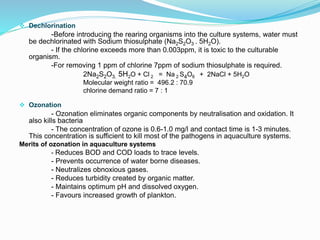
-Before introducing the rearing organisms into the culture systems, water must
be dechlorinated with Sodium thiosulphate (Na2S2O3 . 5H2O).
- If the chlorine exceeds more than 0.003ppm, it is toxic to the culturable
organism.
-For removing 1 ppm of chlorine 7ppm of sodium thiosulphate is required.
2Na2S2O3. 5H2O + Cl 2 = Na 2 S4O6 + 2NaCl + 5H2O
Molecular weight ratio = 496.2 : 70.9
chlorine demand ratio = 7 : 1
 Ozonation
- Ozonation eliminates organic components by neutralisation and oxidation. It
also kills bacteria
- The concentration of ozone is 0.6-1.0 mg/l and contact time is 1-3 minutes.
This concentration is sufficient to kill most of the pathogens in aquaculture systems.
Merits of ozonation in aquaculture systems
- Reduces BOD and COD loads to trace levels.
- Prevents occurrence of water borne diseases.
- Neutralizes obnoxious gases.
- Reduces turbidity created by organic matter.
- Maintains optimum pH and dissolved oxygen.
- Favours increased growth of plankton.
Mechanical control
 The process of removing undesirable impurities from a fluid by
passing it through a porous material is called filtration.
 Water is passed through a thick layer of sand and gravel which act
as strainer.
 While passing, the suspended and colloidal matter in the water and
also a large number of bacteria are caught in the interstices of the
sand.
Types of filters
• Mechanical filter
• Airlift filter
• Bio-filter
Mechanical filter:
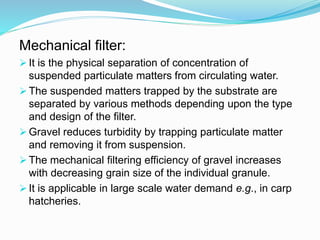
 It is the physical separation of concentration of
suspended particulate matters from circulating water.
 The suspended matters trapped by the substrate are
separated by various methods depending upon the type
and design of the filter.
 Gravel reduces turbidity by trapping particulate matter
and removing it from suspension.
 The mechanical filtering efficiency of gravel increases
with decreasing grain size of the individual granule.
 It is applicable in large scale water demand e.g., in carp
hatcheries.
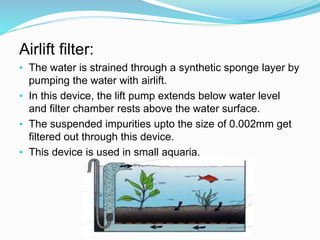
Airlift filter:
• The water is strained through a synthetic sponge layer by
pumping the water with airlift.
• In this device, the lift pump extends below water level
and filter chamber rests above the water surface.
• The suspended impurities upto the size of 0.002mm get
filtered out through this device.
• This device is used in small aquaria.
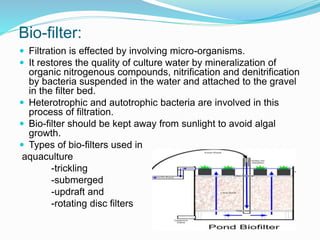
Bio-filter:
 Filtration is effected by involving micro-organisms.
 It restores the quality of culture water by mineralization of
organic nitrogenous compounds, nitrification and denitrification
by bacteria suspended in the water and attached to the gravel
in the filter bed.
 Heterotrophic and autotrophic bacteria are involved in this
process of filtration.
 Bio-filter should be kept away from sunlight to avoid algal
growth.
 Types of bio-filters used in
aquaculture
-trickling
-submerged
-updraft and
-rotating disc filters
Chemical filtration
 It is the process of removal of substances (primarily
dissolved organics but also nitrogen and phosphorus
compounds) by absorption or by direct fractionation or
oxidation.
 Absorption is done by activated carbon or charcoal.
 The granular activated carbon is used in aquaculture.
 It gives complete removal of dissolved impurities.
 It is used in prawn hatcheries.
Conclusion
 Quality water influences the health of the fish in the
culture system.
 When the food resources are in depleted state and
the population pressure is increasing on these
resources, the water quality is managed in optimal
values to increase the fish yields to meet the growing
demands of present day scenario.
References
 Ayyappan. S., 2006, Handbook of Fisheries and
Aquaculture. published by Indian Council of Agricultural
Research, pp 591-622.
 Bhatnagar Anita and Pooja Devi.,2013, Water Quality
Guidelines for the Management of pond fish culture.
International journal of Environmental sciences, Vol 3(6).
 Rouse Denis.,2002,Water quality management in pond
fish culture. Aburn University.
Thank you

Water quality management

  • 1.
    Course code :AQC 503 Course title : AQUACULTURE ENVIRONMENT MANAGEMENT (2+1) Presented by Abisha R AQC-MA7-02 M.F.Sc. 2017-19
  • 2.
    Introduction  Water qualityis the most difficult production factor to understand, predict and manage.  Its quality directly affects feed efficiency, growth rate, the fish’s health and its survival.  The objective is to manage the water quality, so as to provide a relatively stress free environment that meets the physical, chemical and biological standards for the fishes normal health and production performance.
  • 3.
    Water quality management Waterquality management is a 3 tier System Analysis of various water quality parameters. Knowledge of favourable ranges. Chemical treatment and mechanical control.
  • 4.
    1. ANALYSIS OFVARIOUS WATER PARAMETERS  Nitrogen compounds ammonia nitrite nitrates  pH  Carbon Dioxide  Dissolved oxygen •Temperature •Hydrogen sulfide •Total suspended solids •Chlorinity •Alkalinity •Hardness
  • 5.
    2.IDEAL VALUES OFWATER QUALITY PARAMETERS Sl. No. Parameter Fresh water Brackish water Sea water 1. Colour (colour units) Clear water with greenish hue < 100 colour units Clear water with greenish hue < 100 colour units Clear water with greenish hue <100 colour units 2. Transparency(cm) 20 - 35 26 - 35 26 - 35 3. Clay Turbidity (mg/l) <30 <30 <30 4. Solids (mg/l) a. Total <500 >500 >500 b. Suspended 30-200 25-200 25-200
  • 6.
    5. Temperature (0C) a. Tropical climate 25-32 25-32 25-32 b. Temperate climate 10-12 10-12 10-12 6. pH 7.5-9.5 8.0-8.7 8.0-8.5 7. Hardness (mg/l) 30-180 >50 >50 8. Alkalinity (mg/l) 50-300 >50 >50 9. Chlorides (mg/l) 31-50 >500 >500 10. Salinity ( ppt ) <0.5 10-25 >30 11. Dissolved Oxygen(mg/l) 5-10 5-10 5-10 12. Ammonia Nitrogen(NH3 – N) , (mg/l) a. Unionized (NH3) 0-0.1 0-0.1 0-0.1 b. Ionized (NH4 +) 0-1.0 0-1.0 0-1.0 Contd.
  • 7.
    13. Nitrite Nitrogen(NO2 -N) , (mg/l) 0-0.50-0.5 0-0.5 14. Nitrate Nitrogen(NO3 -N mg/l) 0-1.3 0-1.3 0-1.3 15. Total Nitrogen (mg/l) 0.5-4.5 0.5-4.5 0.5-4.5 16. Total phosphorus (mg/l) 0.05-0.40 0.05-0.50 0.05-0.50 17. Potassium (mg/l) 0.5-10 >0.5 >0.5 18. Calcium (mg/l) 75-150 >75 >75 19. Magnesium (mg/l) 20-200 200-1350 >1350 20. Sulphate (mg/l) 20-200 200-885 >885 21. Silica (mg/l) 4-16 >5 >5 22. Iron (mg/l) 0.01-0.3 0.01-0.3 0.01-0.3 23. Manganese (mg/l) 0.001-0.002 0.002-0.02 0.002-0.02 24. Zinc (mg/l) 0.002-0.01 0.002-0.01 0.002-0.01 Contd.
  • 8.
    25. Copper (mg/l)0.003-0.005 0.003-0.005 0.003-0.005 26. Cobalt (mg/l) <0.003 <0.003 <0.003 27. Biochemical Oxygen demand(BOD) (mg/l) <10 <15 <15 28. Chemical oxygen demand (COD) (mg/l) <50 70 70 29. Hydrogen sulphide (mg/l) <0.002 <0.003 <0.003 30. Residual chlorine (mg/l) <0.003 <0.003 <0.003 31. Primary productivity (mg C/m3/day) 1000 - 3000 1000 - 2500 1000 - 2500 32. Plankton(ml/100 litre) 2 1 1 33. Chlorophyll-a (µg/l) 20-275 20-250 20-250 34. Redox-potential(volts) 0.40-0.52 0.40-0.52 0.40-0.52 Contd.
  • 9.
    3. CHEMICAL TREATMENTAND MECHANICAL CONTROL It is the last step in the water quality management practice. CHEMICAL TREATMENT  Liming Lime is used in aquaculture practices to improve water quality and acidity of soils. -It creates a buffer system to prevent marked diurnal changes of the water from acidic to alkaline conditions. -It kills pathogens and promotes bacterial breakdown of organic matter. -It neutralizes soil acidity. -It precipitates colloidal matters. -It promotes plankton growth.
  • 10.
    Contd. Kinds of Lime Applicationof lime dose  If Alkalinity/hardness is more than 20 mg/l , lime is applied @ 5 mg/l.  Lime dose should not exceed more than 10mg/l. Chemical formula Chemical name Common name Relative neutralizing value(%) Effect on water pH CaCO3 Calcium carbonate Lime stone 100 Stabilizes at 7.5 CaO Calcium oxide Quick lime 150-175 Enhances >8 Ca(OH)2 Calcium hydroxide Hydrated or slaked lime 120-135 Enhances >7.5
  • 11.
    Coagulation If water containsturbidity <30 mg/l, it can be treated by filtration without any pre-treatment. If it exceeds >30mg/l , alum can be added. Alum is used as a coagulating agent. Al2(SO4)3 . 9H2O+ 3Ca(HCO3)2 = 2Al(OH)3 + 3CaSO4 + 9H2O + 6CO2 Al2(SO4)3 . 9H2O + 3MgCO3= 2Al(OH)3 + 3MgSO4 + 6H2O + 3CO2 Role of Alum in Aquaculture -Acts as a coagulant. -Neutralizes higher alkalinity. -Removes undesirable turbidity. -Reduces higher hardness. -Controls eutrophication and higher pH. -Precipitates colloids, silt and clay.
  • 12.
    Oxidation/ aeration: - Oxygenis the most vital factor in aquaculture. -The minimum acceptable level of oxygen is 5ppm. Below 4ppm, the fishes may survive but will not feed and grow normally. - Low concentration of Potassium Permanganate (2- 4ppm) can be used as oxidising agent. -1 mg of KMnO4 can generate 4 mg of oxygen after getting dissolved in water. Chlorination -Chlorinating agents – Sodium hypochlorite(NaOCl), Bleaching powder (CaOCl2). -Dechlorinating agent – Sodium thiosulphate (Na2S2O3 . 5H2O).
  • 13.
    Chlorine dosages inthe water treatment Sl. No. Purpose of chlorination Chlorine Dosage (ppm) 1. Disinfection with combined residual 1.0-5.0 2. Disinfection with free residual 1.0-5.0 3. Ammonia (NH3-N) removal 10 x NH3-N content 4. Hydrogen Sulphide ( H2S) removal 1.22 x 5 content of free sulphur, 8.9 x 5 content to sulphate 5. Iron (Fe) removal 0.64 x Fe content 6. Manganese (Mn) removal 0.65 x Mn content 7. Algal control 1.0 – 10.0 8. Slime control 1.0 – 10.0
  • 14.
     Dechlorination -Before introducingthe rearing organisms into the culture systems, water must be dechlorinated with Sodium thiosulphate (Na2S2O3 . 5H2O). - If the chlorine exceeds more than 0.003ppm, it is toxic to the culturable organism. -For removing 1 ppm of chlorine 7ppm of sodium thiosulphate is required. 2Na2S2O3. 5H2O + Cl 2 = Na 2 S4O6 + 2NaCl + 5H2O Molecular weight ratio = 496.2 : 70.9 chlorine demand ratio = 7 : 1  Ozonation - Ozonation eliminates organic components by neutralisation and oxidation. It also kills bacteria - The concentration of ozone is 0.6-1.0 mg/l and contact time is 1-3 minutes. This concentration is sufficient to kill most of the pathogens in aquaculture systems. Merits of ozonation in aquaculture systems - Reduces BOD and COD loads to trace levels. - Prevents occurrence of water borne diseases. - Neutralizes obnoxious gases. - Reduces turbidity created by organic matter. - Maintains optimum pH and dissolved oxygen. - Favours increased growth of plankton.
  • 15.
    Mechanical control  Theprocess of removing undesirable impurities from a fluid by passing it through a porous material is called filtration.  Water is passed through a thick layer of sand and gravel which act as strainer.  While passing, the suspended and colloidal matter in the water and also a large number of bacteria are caught in the interstices of the sand. Types of filters • Mechanical filter • Airlift filter • Bio-filter
  • 16.
    Mechanical filter:  Itis the physical separation of concentration of suspended particulate matters from circulating water.  The suspended matters trapped by the substrate are separated by various methods depending upon the type and design of the filter.  Gravel reduces turbidity by trapping particulate matter and removing it from suspension.  The mechanical filtering efficiency of gravel increases with decreasing grain size of the individual granule.  It is applicable in large scale water demand e.g., in carp hatcheries.
  • 17.
    Airlift filter: • Thewater is strained through a synthetic sponge layer by pumping the water with airlift. • In this device, the lift pump extends below water level and filter chamber rests above the water surface. • The suspended impurities upto the size of 0.002mm get filtered out through this device. • This device is used in small aquaria.
  • 18.
    Bio-filter:  Filtration iseffected by involving micro-organisms.  It restores the quality of culture water by mineralization of organic nitrogenous compounds, nitrification and denitrification by bacteria suspended in the water and attached to the gravel in the filter bed.  Heterotrophic and autotrophic bacteria are involved in this process of filtration.  Bio-filter should be kept away from sunlight to avoid algal growth.  Types of bio-filters used in aquaculture -trickling -submerged -updraft and -rotating disc filters
  • 19.
    Chemical filtration  Itis the process of removal of substances (primarily dissolved organics but also nitrogen and phosphorus compounds) by absorption or by direct fractionation or oxidation.  Absorption is done by activated carbon or charcoal.  The granular activated carbon is used in aquaculture.  It gives complete removal of dissolved impurities.  It is used in prawn hatcheries.
  • 20.
    Conclusion  Quality waterinfluences the health of the fish in the culture system.  When the food resources are in depleted state and the population pressure is increasing on these resources, the water quality is managed in optimal values to increase the fish yields to meet the growing demands of present day scenario.
  • 21.
    References  Ayyappan. S.,2006, Handbook of Fisheries and Aquaculture. published by Indian Council of Agricultural Research, pp 591-622.  Bhatnagar Anita and Pooja Devi.,2013, Water Quality Guidelines for the Management of pond fish culture. International journal of Environmental sciences, Vol 3(6).  Rouse Denis.,2002,Water quality management in pond fish culture. Aburn University.
  • 22.