A Seminar
on
MARINE POLLUTION
Presented by
VENKATESHA C K
1st Sem Applied Geology
Guided by
Prof.D.NAGARAJU
DOS in Earth Science
Manasagangotri
Mysore
A Seminar
on
• Introduction
• Sources of marine pollution
• Direct Discharge
• Plastic Debris
• Sewage
• Metallic wastes
• Ship Pollution
• Deep sea mining
• Types of marine Pollution
• Atmospheric Pollution
• Acidification
• Eutrophication
• Oils spills
• Radioactive Pollution
• Thermal Pollution
• Conclusion
• Reference
Term ‘Pollution' describes the occurrence and inputs
of wastes and the impact of these wastes on the
environment.
• Marine Pollution:
“The introduction by man, directly or indirectly of
substances or energy to the marine environment
resulting in deleterious effects such as: hazards to
human health, hindrance to marine activities,
impairment of the quality of seawater for various uses
and reduction of amenities.”
Direct discharge:
• Pollutants enter rivers and sea directly from urban
sewage and industrial wastes discharges, sometimes
in the form of hazardous and toxic wastes
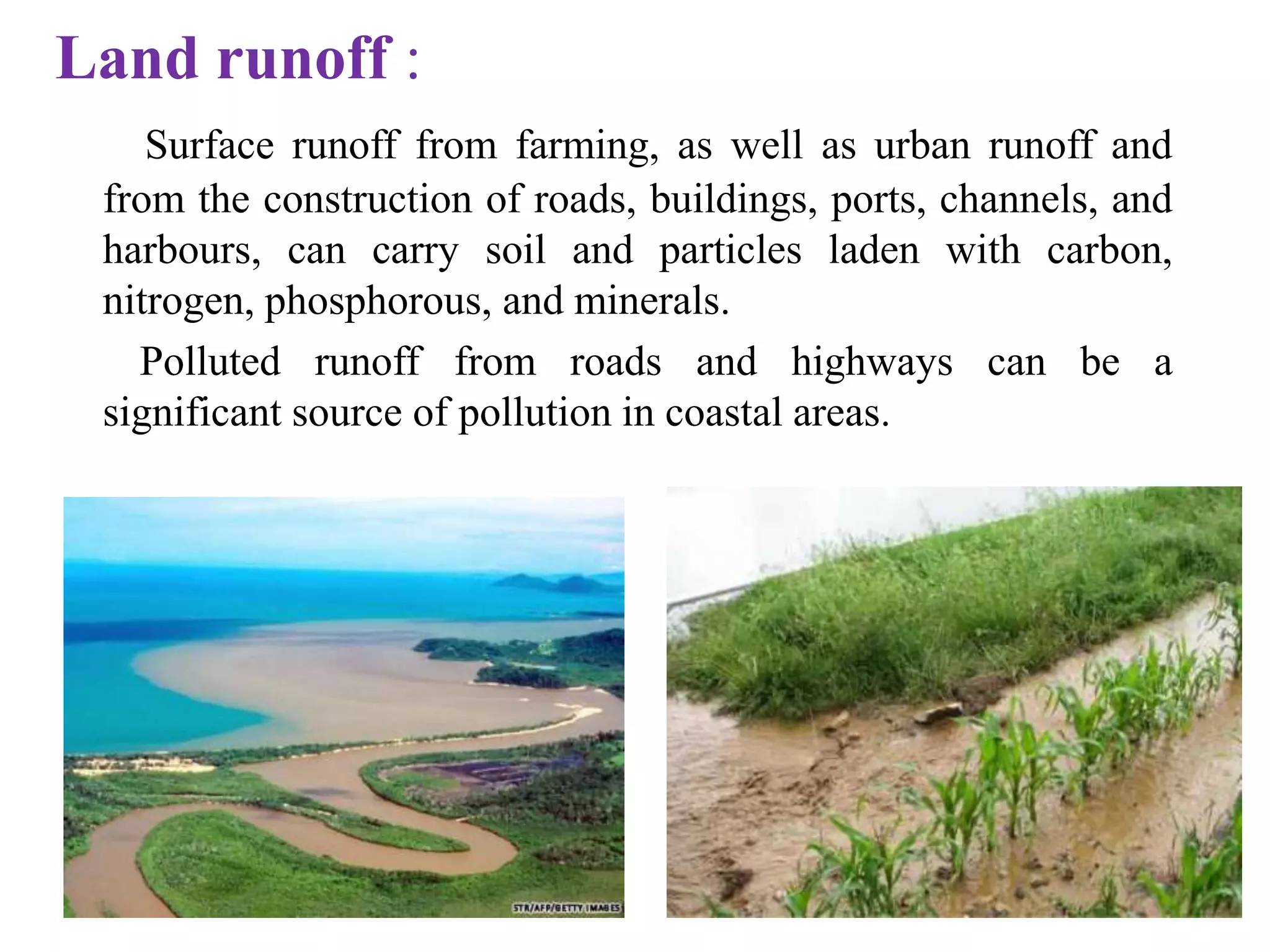
Land runoff :
Surface runoff from farming, as well as urban runoff and
from the construction of roads, buildings, ports, channels, and
harbours, can carry soil and particles laden with carbon,
nitrogen, phosphorous, and minerals.
Polluted runoff from roads and highways can be a
significant source of pollution in coastal areas.
Sewage:
Sewage pollution of coastal and estuarine is usually most severe during the
summer when temperatures are raised, river outflows reduced and populations
often increased.
There are three broad categories of discharges:
1. Untreated, containing much solid organic
material together with organic solutes and
some nitrate and phosphate.
2. Partially treated, containing a smaller
proportion of solids, with organic solutes
and a greater concentration of nitrate and
phosphate . The solids are macerated
before discharge.
3. Fully treated, containing virtually no
solid matter, and being mainly a solution
of nitrate and phosphate.
• Animal waste and human wastewater
from toilets and other household
activities such as bathing and
laundering as well as food
preparation are often washed directly
into the ocean from coastal
communities. Untreated sewage
contains microbes or pathogens that
precipitate disease when infected
seafood is consumed or skin contact
occurs. In some cases, solid sludge
from treated sewage is also dumped
into the oceans.
Pesticides:
• Pesticides are biological active chemicals which are
used for killing pests.
• Pesticides may enter the oceans from the atmosphere
after aerial spraying from overland runoff of sprayed
areas, or from international dumping in the sea.
• Certain organochlorine pesticides, notably
DDT(Dichlorodiphenyltrichloroethane), have become
widely dispersed throughout the oceans, even to the
Arctic and Antarctic. They are only very slowly
degraded. Some marine organisms, especially
crustacea, are extremely sensitive to both
organochlorine and organophosphorus compounds
are killed by very small concentrations. Because these
compounds are more soluble in fats than in the water.
Metallic wastes: Heavy metals are metallic
chemical elements that have a
relatively high density and are
toxic or poisonous at low
concentrations. Examples are
mercury, lead, nickel, arsenic and
cadmium. such toxins can
accumulate in the tissues of
many species of aquatic life in a
process called bioaccumulation,
which results in more toxicity in
fish. When we consume such
fishes, it will affect our nervous
system, kidney, brains,
respiratory system or even it will
lead us to death.
Ship pollution:
Ships can pollute waterways
and oceans in many ways. Oil
enters water from breakdowns on
derricks, wrecks of oil tankers,
accidental spillage, cleaning of
fuel tanks by merchant and war
ships, and also from street
cleaning. Discharge of cargo
residues from bulk carries can
pollute ports, waterways and
oceans. Oil spills can have many
devastating effects. While being
toxic to aquatic life in the surface
layers and also the coastal flora
and fauna. Ships also create noise
pollution that disturbs natural
wildlife, and from ballast tanks
can spread harmful algae and
other invasive species.
Atmospheric pollution:
Another pathway of pollution occurs through the
atmosphere. Wind blown dust and debris, including
plastic bags seaward from landfills and other areas.
Climate change is raising ocean temperatures and raising
levels of carbon dioxide in the atmosphere. These rising
levels of carbon dioxide are acidifying the oceans.
Acidification:
Dissolving carbon dioxide in sea water increases the
hydrogen ion concentration in the ocean, and thus decreases
ocean pH is known as acidification
The oceans are normally a natural carbon sink, absorbing
carbon dioxide from the atmosphere. Because the levels of
atmospheric carbon dioxide are increasing, the oceans are
becoming more acidic. The potential consequences of ocean
acidification are not fully understood, but there are concerns
that structures made of calcium carbonate may become
vulnerable to dissolution, affecting corals and the ability of
shellfish to form shells.
Deep sea mining:
All mining operations raise
questions about environment
damages to the surrounding
area. Here in water also the
concern is about disturbance
to the living organisms in the
area, change in sediment or
rock layer of sea floor, change
in toxicity of the water column
and food web. Removal parts
of the sea floor will disturb
the benthic layer. Permanent
disturbance to the habitat of
benthic organisms.
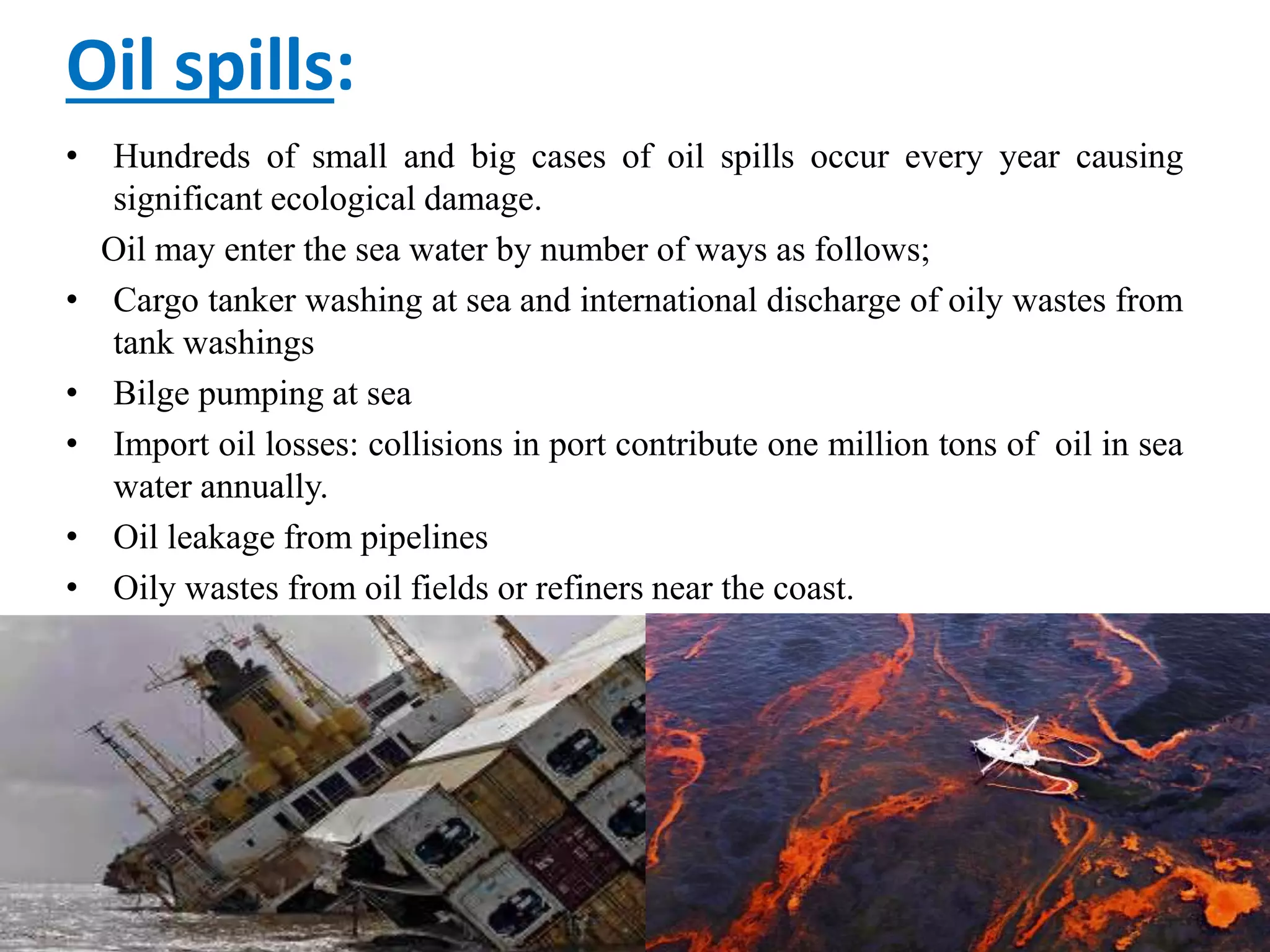
Oil spills:
• Hundreds of small and big cases of oil spills occur every year causing
significant ecological damage.
Oil may enter the sea water by number of ways as follows;
• Cargo tanker washing at sea and international discharge of oily wastes from
tank washings
• Bilge pumping at sea
• Import oil losses: collisions in port contribute one million tons of oil in sea
water annually.
• Oil leakage from pipelines
• Oily wastes from oil fields or refiners near the coast.
Apart from fouling of
beaches, which if severe can lead to
the destruction of much of the
intertidal population, the major
threat from oil pollution is to
seabirds and mammals. Oil readily
penetrates and mats the plumage of
seabirds, making flight impossible
and leading to loss of oil and gut
irritation. At the present time many
hundreds of thousands of seabirds
are destroyed annually by oil
fouling. The species at greatest risk
are those which live mainly on and
in the water, e.g. puffins, guillemots,
razorbills, shags, cormorants, ducks
and divers..
Eutrophication :
“The process by which a body of water acquires a high
concentration of nutrients, especially phosphates and
nitrates. These typically promote excessive growth of algae.
As the algae die and decompose, high levels of organic matter
and the decomposing organisms deplete the water of
available oxygen, causing the death of other organisms, such
as fish. Eutrophication is a natural, slow-aging process for a
water body, but human activity greatly speeds up the
process.”
• A large portion and great danger is
non biodegradable plastic
• 46,000 pieces of floating plastic/sq mile
of ocean surface off the N.E U.S. coast.
• Sea turtles mistake plastic bags for
jellyfish and die from internal blockages.
• Seals and sea lions starve after
being entangled by nets or muzzled by
six-pack rings (decomposition time
400 years).
• Plastic debris kills 1,00,000 marine
mammals and 2 million sea birds die
annually.
Radioactive pollution:
• Radioactive materials may
enter the sea from two main
sources; from weapon
testing via atmosphere
fallout and from atomic
power industries. Although
power station discharges are
kept very low in
radioactivity, sea foods
should not be collected from
their vicinity. Seaweeds
concentrate radioactive with
great rapidly and fish absorb
a variety of radioactive
substances.
• Some highly dangerous
radioactive wastes are
disposed of by dumping
into the deep oceans in
sealed containers. The
fate of these residues is
uncertain. There are
hopes that incorporation
of radioactive wastes into
solid glasses from which
nothing can leach or leak
may prove a safe method
of disposal.
Thermal pollution:
• Warm effluents discharged into bays and estuaries may raise the water
temperature. This reduces the solubility of oxygen, and the oxygenation
may be further, reduced by increased oxygen consumption by animals and
bacteria, and by reduced vertical mixing due to thermal stratification. The
effect may be that the underlying layers become deoxygenated and foul.
• Migratory fish, salmon may be discouraged from passing through the area.
Warm water may favour pests, such as shipworm and gribble, accelerating
their growth and extending their breeding seasons, and it may also
encourage the establishment of foreign pests. The fouling rate on ships
hulls is likely to be raised.
Conclusion
• Marine pollution occurs when harmful or potentially
harmful, effects results from the entry into the ocean of
chemicals, particles, industrial, agricultural and
residential waste, noise, or spread of invasive organisms.
• When pesticides are incorporated into the marine
ecosystem, the quickly become absorbed into marine
food webs.
• Toxic metals can also be introduced into marine food
webs. These can changes to tissue matter, biochemistry,
behaviour, reproduction, and suppress growth in marine
life.
REFERENCE:
Internet References
http://www.mcsuk.org/marineworld/pollution.htl
http://www.oceanlink.island.net/ask/pollution.htl
K. SIDHARTHA,, 2005, OCEONOGRAPHY A BRIEF
INTRODUCTION PP. NO.310-314
J.L.KUMAR, P.C.SINHA ,1998, MARINE POLLUTION, FOR
ANMOL PUBLICATIONS PP.NO 39-69
Marine pollution

Marine pollution

  • 1.
    A Seminar on MARINE POLLUTION Presentedby VENKATESHA C K 1st Sem Applied Geology Guided by Prof.D.NAGARAJU DOS in Earth Science Manasagangotri Mysore A Seminar on
  • 2.
    • Introduction • Sourcesof marine pollution • Direct Discharge • Plastic Debris • Sewage • Metallic wastes • Ship Pollution • Deep sea mining • Types of marine Pollution • Atmospheric Pollution • Acidification • Eutrophication • Oils spills • Radioactive Pollution • Thermal Pollution • Conclusion • Reference
  • 3.
    Term ‘Pollution' describesthe occurrence and inputs of wastes and the impact of these wastes on the environment. • Marine Pollution: “The introduction by man, directly or indirectly of substances or energy to the marine environment resulting in deleterious effects such as: hazards to human health, hindrance to marine activities, impairment of the quality of seawater for various uses and reduction of amenities.”
  • 4.
    Direct discharge: • Pollutantsenter rivers and sea directly from urban sewage and industrial wastes discharges, sometimes in the form of hazardous and toxic wastes
  • 5.
    Land runoff : Surfacerunoff from farming, as well as urban runoff and from the construction of roads, buildings, ports, channels, and harbours, can carry soil and particles laden with carbon, nitrogen, phosphorous, and minerals. Polluted runoff from roads and highways can be a significant source of pollution in coastal areas.
  • 6.
    Sewage: Sewage pollution ofcoastal and estuarine is usually most severe during the summer when temperatures are raised, river outflows reduced and populations often increased. There are three broad categories of discharges: 1. Untreated, containing much solid organic material together with organic solutes and some nitrate and phosphate. 2. Partially treated, containing a smaller proportion of solids, with organic solutes and a greater concentration of nitrate and phosphate . The solids are macerated before discharge. 3. Fully treated, containing virtually no solid matter, and being mainly a solution of nitrate and phosphate.
  • 7.
    • Animal wasteand human wastewater from toilets and other household activities such as bathing and laundering as well as food preparation are often washed directly into the ocean from coastal communities. Untreated sewage contains microbes or pathogens that precipitate disease when infected seafood is consumed or skin contact occurs. In some cases, solid sludge from treated sewage is also dumped into the oceans.
  • 8.
    Pesticides: • Pesticides arebiological active chemicals which are used for killing pests. • Pesticides may enter the oceans from the atmosphere after aerial spraying from overland runoff of sprayed areas, or from international dumping in the sea.
  • 9.
    • Certain organochlorinepesticides, notably DDT(Dichlorodiphenyltrichloroethane), have become widely dispersed throughout the oceans, even to the Arctic and Antarctic. They are only very slowly degraded. Some marine organisms, especially crustacea, are extremely sensitive to both organochlorine and organophosphorus compounds are killed by very small concentrations. Because these compounds are more soluble in fats than in the water.
  • 10.
    Metallic wastes: Heavymetals are metallic chemical elements that have a relatively high density and are toxic or poisonous at low concentrations. Examples are mercury, lead, nickel, arsenic and cadmium. such toxins can accumulate in the tissues of many species of aquatic life in a process called bioaccumulation, which results in more toxicity in fish. When we consume such fishes, it will affect our nervous system, kidney, brains, respiratory system or even it will lead us to death.
  • 11.
    Ship pollution: Ships canpollute waterways and oceans in many ways. Oil enters water from breakdowns on derricks, wrecks of oil tankers, accidental spillage, cleaning of fuel tanks by merchant and war ships, and also from street cleaning. Discharge of cargo residues from bulk carries can pollute ports, waterways and oceans. Oil spills can have many devastating effects. While being toxic to aquatic life in the surface layers and also the coastal flora and fauna. Ships also create noise pollution that disturbs natural wildlife, and from ballast tanks can spread harmful algae and other invasive species.
  • 12.
    Atmospheric pollution: Another pathwayof pollution occurs through the atmosphere. Wind blown dust and debris, including plastic bags seaward from landfills and other areas. Climate change is raising ocean temperatures and raising levels of carbon dioxide in the atmosphere. These rising levels of carbon dioxide are acidifying the oceans.
  • 13.
    Acidification: Dissolving carbon dioxidein sea water increases the hydrogen ion concentration in the ocean, and thus decreases ocean pH is known as acidification The oceans are normally a natural carbon sink, absorbing carbon dioxide from the atmosphere. Because the levels of atmospheric carbon dioxide are increasing, the oceans are becoming more acidic. The potential consequences of ocean acidification are not fully understood, but there are concerns that structures made of calcium carbonate may become vulnerable to dissolution, affecting corals and the ability of shellfish to form shells.
  • 14.
    Deep sea mining: Allmining operations raise questions about environment damages to the surrounding area. Here in water also the concern is about disturbance to the living organisms in the area, change in sediment or rock layer of sea floor, change in toxicity of the water column and food web. Removal parts of the sea floor will disturb the benthic layer. Permanent disturbance to the habitat of benthic organisms.
  • 15.
    Oil spills: • Hundredsof small and big cases of oil spills occur every year causing significant ecological damage. Oil may enter the sea water by number of ways as follows; • Cargo tanker washing at sea and international discharge of oily wastes from tank washings • Bilge pumping at sea • Import oil losses: collisions in port contribute one million tons of oil in sea water annually. • Oil leakage from pipelines • Oily wastes from oil fields or refiners near the coast.
  • 16.
    Apart from foulingof beaches, which if severe can lead to the destruction of much of the intertidal population, the major threat from oil pollution is to seabirds and mammals. Oil readily penetrates and mats the plumage of seabirds, making flight impossible and leading to loss of oil and gut irritation. At the present time many hundreds of thousands of seabirds are destroyed annually by oil fouling. The species at greatest risk are those which live mainly on and in the water, e.g. puffins, guillemots, razorbills, shags, cormorants, ducks and divers..
  • 17.
    Eutrophication : “The processby which a body of water acquires a high concentration of nutrients, especially phosphates and nitrates. These typically promote excessive growth of algae. As the algae die and decompose, high levels of organic matter and the decomposing organisms deplete the water of available oxygen, causing the death of other organisms, such as fish. Eutrophication is a natural, slow-aging process for a water body, but human activity greatly speeds up the process.”
  • 18.
    • A largeportion and great danger is non biodegradable plastic • 46,000 pieces of floating plastic/sq mile of ocean surface off the N.E U.S. coast. • Sea turtles mistake plastic bags for jellyfish and die from internal blockages. • Seals and sea lions starve after being entangled by nets or muzzled by six-pack rings (decomposition time 400 years). • Plastic debris kills 1,00,000 marine mammals and 2 million sea birds die annually.
  • 19.
    Radioactive pollution: • Radioactivematerials may enter the sea from two main sources; from weapon testing via atmosphere fallout and from atomic power industries. Although power station discharges are kept very low in radioactivity, sea foods should not be collected from their vicinity. Seaweeds concentrate radioactive with great rapidly and fish absorb a variety of radioactive substances.
  • 20.
    • Some highlydangerous radioactive wastes are disposed of by dumping into the deep oceans in sealed containers. The fate of these residues is uncertain. There are hopes that incorporation of radioactive wastes into solid glasses from which nothing can leach or leak may prove a safe method of disposal.
  • 21.
    Thermal pollution: • Warmeffluents discharged into bays and estuaries may raise the water temperature. This reduces the solubility of oxygen, and the oxygenation may be further, reduced by increased oxygen consumption by animals and bacteria, and by reduced vertical mixing due to thermal stratification. The effect may be that the underlying layers become deoxygenated and foul. • Migratory fish, salmon may be discouraged from passing through the area. Warm water may favour pests, such as shipworm and gribble, accelerating their growth and extending their breeding seasons, and it may also encourage the establishment of foreign pests. The fouling rate on ships hulls is likely to be raised.
  • 22.
    Conclusion • Marine pollutionoccurs when harmful or potentially harmful, effects results from the entry into the ocean of chemicals, particles, industrial, agricultural and residential waste, noise, or spread of invasive organisms. • When pesticides are incorporated into the marine ecosystem, the quickly become absorbed into marine food webs. • Toxic metals can also be introduced into marine food webs. These can changes to tissue matter, biochemistry, behaviour, reproduction, and suppress growth in marine life.
  • 23.
    REFERENCE: Internet References http://www.mcsuk.org/marineworld/pollution.htl http://www.oceanlink.island.net/ask/pollution.htl K. SIDHARTHA,,2005, OCEONOGRAPHY A BRIEF INTRODUCTION PP. NO.310-314 J.L.KUMAR, P.C.SINHA ,1998, MARINE POLLUTION, FOR ANMOL PUBLICATIONS PP.NO 39-69