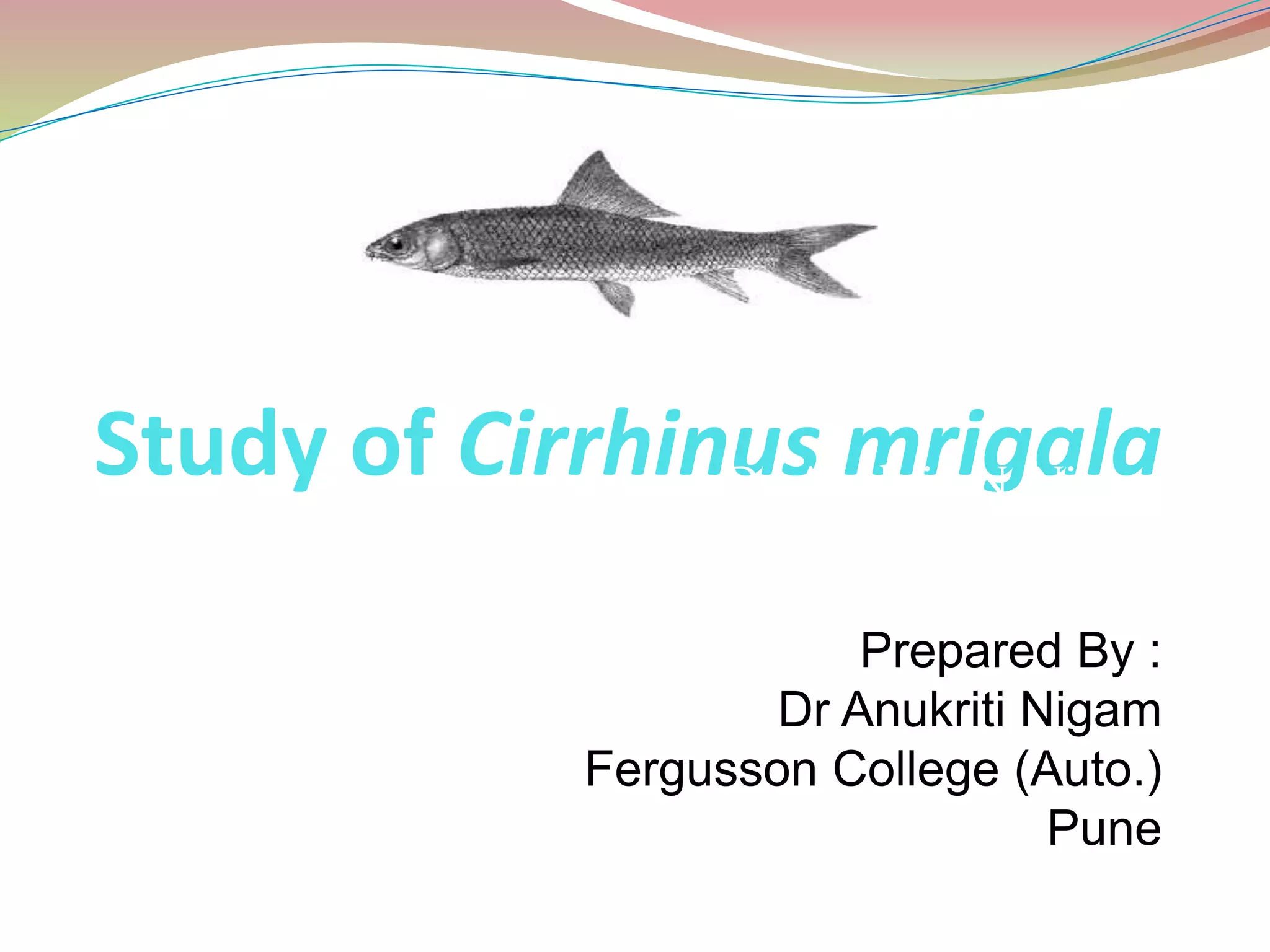
Study of Cirrhinus mrigala
Prepared By :
Dr Anukriti Nigam
Fergusson College (Auto.)
Pune
Dr. Anukriti N. Nigam
Habit , Habitat and Biology
Hatchlings of mrigal normally confine themselves to the
surface or sub-surface waters.
 The fry and fingerling tend to move to deeper water.
Adults are bottom dwellers.
It is stenophagous and an illiophage fish in its feeding
habit and.
 The principal food components of its diet are detritus
and decayed vegetation ,at the same time phytoplankton
and zooplankton comprise the rest.
Mrigal is eurythermal, and is reported to tolerate a
minimum temperature of 14 ºC.
 In culture condition , the fish usually attains 600gms -
700 gms in the first year, depending on stocking
density and management practices.
 Among the three Indian major carps, mrigal is
normally considered as a slow grower then catla and
rohu.
As the growth rate reduces after two years the rearing
period is usually confined to a maximum of two years,
only.
 However, mrigal is reported to survive for about
twelve years in natural waters.
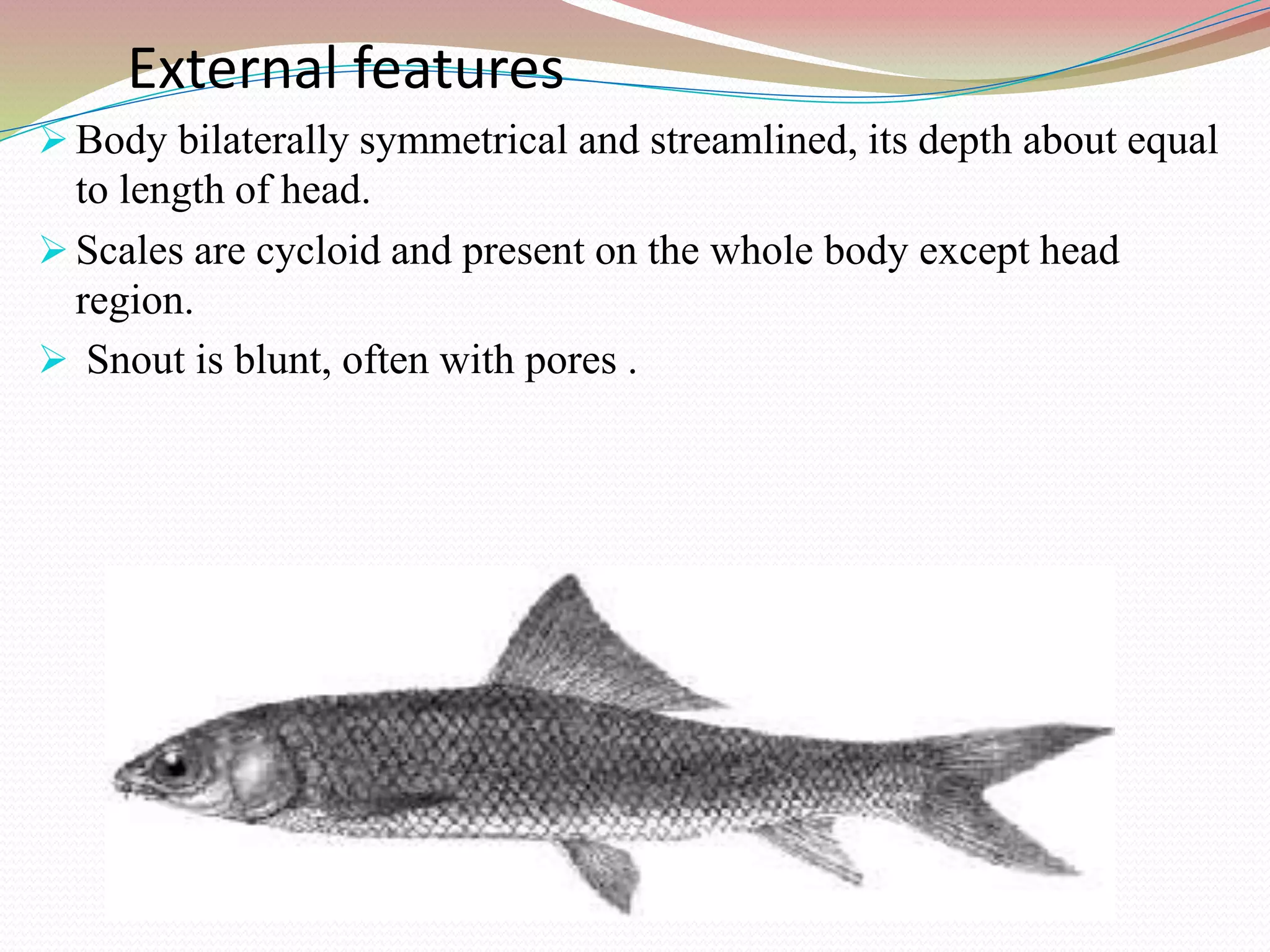
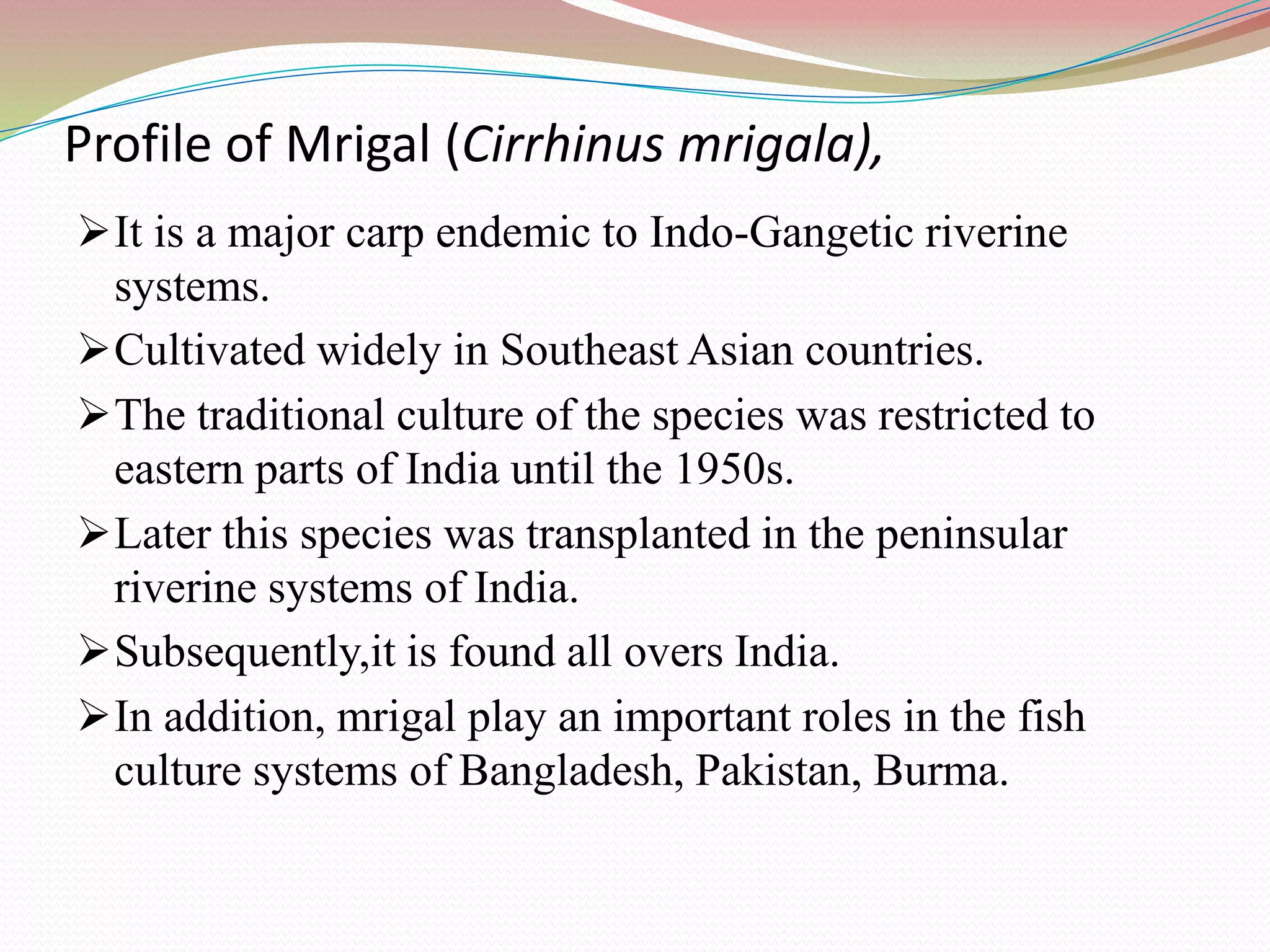
External features
 Body bilaterally symmetrical and streamlined, its depth about equal
to length of head.
 Scales are cycloid and present on the whole body except head
region.
 Snout is blunt, often with pores .
 mouth broad, transverse, upper lip is entire and not
continuous with lower lip, lower lip most indistinct.
 One pair of short rostral barbels.
 Pharyngeal teeth in three rows.
 A small post-symphysial knob or tubercle present in the
lower jaw .
 Dorsal fin as high as body with 12 or 13 branched rays.
 Non-osseous and non-serrated last unbranched ray of
dorsal fin.
 Pectoral fins shorter than head, caudal fin deeply
forked,anal fin not extending to caudal fin.
 Body colouration-usually dark grey above, silvery
beneath.
 Dorsal fin greyish and pectoral, pelvic and anal fins
orange-tipped (especially during breeding season).
Profile of Mrigal (Cirrhinus mrigala),
It is a major carp endemic to Indo-Gangetic riverine
systems.
Cultivated widely in Southeast Asian countries.
The traditional culture of the species was restricted to
eastern parts of India until the 1950s.
Later this species was transplanted in the peninsular
riverine systems of India.
Subsequently,it is found all overs India.
In addition, mrigal play an important roles in the fish
culture systems of Bangladesh, Pakistan, Burma.
Maturity is attained in two years in captivity.
Mrigal does not breed in ponds as it needs a fluviatile
environment for breeding it
However, it responds very well to induced breeding by
hypophysation and the use of synthetic hormones.
Mrigal is a highly fecund fish i.e 147eggs/gms body
weight.
 Fecundity increases with age, and normally ranges from
100 000-150 000 eggs/kg BW.
The spawning season depends upon the onset and duration
of the south-west monsoon, which in India, Bangladesh
and Pakistan extends from May to September.
Mrigal usually breeds at a temperature of 24 º-31 ºC.
Production systems
 Mrigal is cultured mainly as a component of carp
polyculture systems in the ponds of India and
Bangladesh, the major producing countries.
 Being a bottom feeder, mrigal is usually stocked at 20-
30 percent of the total species stocked in three-
species culture, while in six-species culture mrigal
constitutes only about 15-20 percent.
Seed supply
 Both mass scale seed production of mrigal in hatcheries
through induced breeding and riverine collection.
As mrigal does not breed in confined waters, injections of
pituitary extract and other synthetic commercial
formulations of purified salmon gonadotropin and
dopamine antagonists such as Ovaprim, Ovatide and
Wova-FH have also been successfully used in recent
years.
THANK YOU

Study of Cirrhinus mrigala

  • 1.
    Study of Cirrhinusmrigala Prepared By : Dr Anukriti Nigam Fergusson College (Auto.) Pune Dr. Anukriti N. Nigam
  • 2.
    Habit , Habitatand Biology Hatchlings of mrigal normally confine themselves to the surface or sub-surface waters.  The fry and fingerling tend to move to deeper water. Adults are bottom dwellers. It is stenophagous and an illiophage fish in its feeding habit and.  The principal food components of its diet are detritus and decayed vegetation ,at the same time phytoplankton and zooplankton comprise the rest. Mrigal is eurythermal, and is reported to tolerate a minimum temperature of 14 ºC.
  • 3.
     In culturecondition , the fish usually attains 600gms - 700 gms in the first year, depending on stocking density and management practices.  Among the three Indian major carps, mrigal is normally considered as a slow grower then catla and rohu. As the growth rate reduces after two years the rearing period is usually confined to a maximum of two years, only.  However, mrigal is reported to survive for about twelve years in natural waters.
  • 4.
    External features  Bodybilaterally symmetrical and streamlined, its depth about equal to length of head.  Scales are cycloid and present on the whole body except head region.  Snout is blunt, often with pores .
  • 5.
     mouth broad,transverse, upper lip is entire and not continuous with lower lip, lower lip most indistinct.  One pair of short rostral barbels.  Pharyngeal teeth in three rows.  A small post-symphysial knob or tubercle present in the lower jaw .  Dorsal fin as high as body with 12 or 13 branched rays.  Non-osseous and non-serrated last unbranched ray of dorsal fin.  Pectoral fins shorter than head, caudal fin deeply forked,anal fin not extending to caudal fin.  Body colouration-usually dark grey above, silvery beneath.  Dorsal fin greyish and pectoral, pelvic and anal fins orange-tipped (especially during breeding season).
  • 6.
    Profile of Mrigal(Cirrhinus mrigala), It is a major carp endemic to Indo-Gangetic riverine systems. Cultivated widely in Southeast Asian countries. The traditional culture of the species was restricted to eastern parts of India until the 1950s. Later this species was transplanted in the peninsular riverine systems of India. Subsequently,it is found all overs India. In addition, mrigal play an important roles in the fish culture systems of Bangladesh, Pakistan, Burma.
  • 7.
    Maturity is attainedin two years in captivity. Mrigal does not breed in ponds as it needs a fluviatile environment for breeding it However, it responds very well to induced breeding by hypophysation and the use of synthetic hormones. Mrigal is a highly fecund fish i.e 147eggs/gms body weight.  Fecundity increases with age, and normally ranges from 100 000-150 000 eggs/kg BW. The spawning season depends upon the onset and duration of the south-west monsoon, which in India, Bangladesh and Pakistan extends from May to September. Mrigal usually breeds at a temperature of 24 º-31 ºC.
  • 9.
    Production systems  Mrigalis cultured mainly as a component of carp polyculture systems in the ponds of India and Bangladesh, the major producing countries.  Being a bottom feeder, mrigal is usually stocked at 20- 30 percent of the total species stocked in three- species culture, while in six-species culture mrigal constitutes only about 15-20 percent.
  • 10.
    Seed supply  Bothmass scale seed production of mrigal in hatcheries through induced breeding and riverine collection. As mrigal does not breed in confined waters, injections of pituitary extract and other synthetic commercial formulations of purified salmon gonadotropin and dopamine antagonists such as Ovaprim, Ovatide and Wova-FH have also been successfully used in recent years.
  • 11.