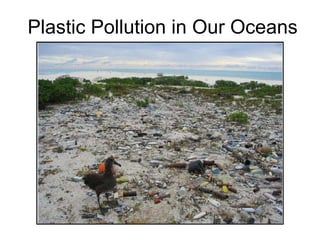
Plastic Pollution in Our Oceans
What will you learn? How plastic pollution is affecting our oceans? How the plastic gets into our oceans. What you can do about it!
Vocabulary and Concepts (before watching the video) Ocean Gyres – The North Pacific Gyre Plankton Plastic Polymers Watershed
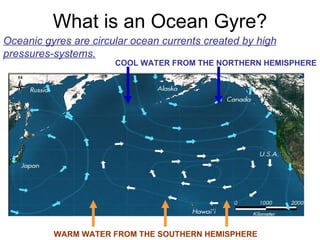
What is an Ocean Gyre? Oceanic gyres are circular ocean currents created by high pressures-systems. WARM WATER FROM THE SOUTHERN HEMISPHERE COOL WATER FROM THE NORTHERN HEMISPHERE
Where is the North Pacific Gyre? About half-way in between Hawaii and California. North Pacific Gyre
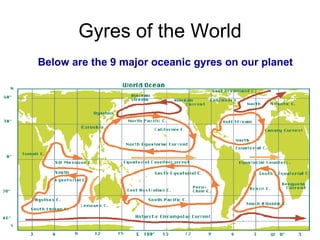
Gyres of the World Below are the 9 major oceanic gyres on our planet
What is the big deal? Studies show that an area of the Pacific gyre, (which is about twice Texas) contains  6 times more plastic debris  (trash),  than plankton . Captain Charles Moore of the Algalita Marine Research Foundation – holding up a sample of ocean water from the gyre.
What is the big deal? (continued) Plastic debris in an oceanic gyre may never leave. After decades of floating about, plastic may  break down into smaller particles, get absorbed into the food chain, or sink  and become part of ocean bottom sediment.
What is Plankton? Plankton is made up of animals and plants that either float passively in the water, or possess such limited powers of swimming that they are carried from place to place by the currents.  The word plankton comes from the Greek word  planktos , which means ‘wandering’ or ‘drifting’. Plankton dominates the well-lit surface layers of the world's oceans.
Phytoplankton Phytoplankton produce more oxygen than all plant life on earth.  Phytoplankton are tiny, photosynthetic organisms. This means they can manufacture their own food using energy from sunlight, producing oxygen as a by-product. They are often referred to as tiny plants because of this ability to photosynthesize.
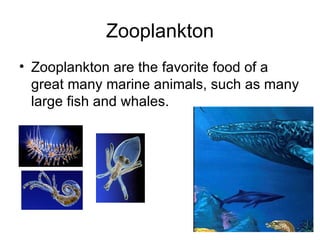
Zooplankton Zooplankton are the favorite food of a great many marine animals, such as many large fish and whales.
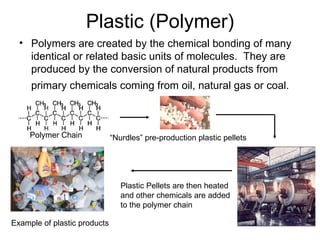
Plastic (Polymer) Polymers are created by the chemical bonding of many identical or related basic units of molecules.  They are produced by the conversion of natural products from primary chemicals coming from oil, natural gas or coal.   Polymer Chain “ Nurdles” pre-production plastic pellets Plastic Pellets are then heated and other chemicals are added to the polymer chain Example of plastic products
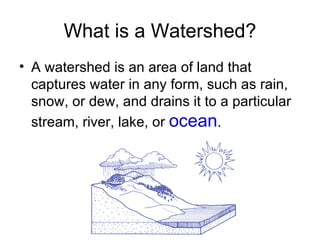
What is a Watershed? A watershed is an area of land that captures water in any form, such as rain, snow, or dew, and drains it to a particular stream, river, lake, or  ocean .
Watch the Video Click on the link  http://www.youtube.com/watch?v=No3yNJiEpjs or http://video.google.com/videoplay?docid=4645631283005360764&q=plastic+pollution&hl=en Once finished… Take the quiz…
What is an ocean gyre? Currents that travel through rivers. Circular ocean currents that are created by high-pressure systems. Ocean water that travels from the north pole to the south pole. Waves that crash on the shore. 1
Where is the North Pacific Gyre? About halfway in between __________ A. California and Japan B. California and Catalina Island C. California and Hawaii D. California and Alaska 2
Why are plankton important? A. They are at the bottom of the marine food chain. B. They create oxygen and filter our oceans. C. They are an important source of food for many marine animals. D. All of the above. 3
What is the ratio of plastic debris to plankton in the North Pacific Gyre? ( meaning how many pounds of plastic debris where found compared to pounds of naturally occuring plankton ) A. 1:1 B. 2:1 C. 4:1 D. 6:1 4
Does every piece of plastic ever produced still exist in some form? A. Yes B. No C. Maybe 5
How does plastic get into our oceans? A. Falls from the sky. B. Enters the ocean from litter in our watersheds. C. Is transported from landfills to the ocean. 6
How does plastic in our oceans create problems? They can absorb harmful toxins and pollutants in very high concentrations. They can enter the marine food chain, passing on toxins to many marine mammals. They can become ingested by marine birds. All of the above. 7
What can you do? List the three ways you can help the oceans by changing the way you use plastics,  (the 3 R’s) 1. 2. 3. 8
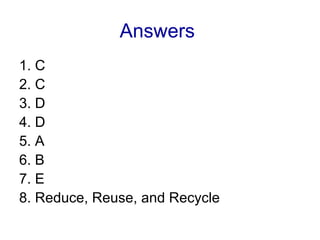
Answers  1. C 2. C 3. D 4. D 5. A 6. B 7. E 8. Reduce, Reuse, and Recycle

Plastic Pollution in Our Oceans

  • 1.
  • 2.
    What will youlearn? How plastic pollution is affecting our oceans? How the plastic gets into our oceans. What you can do about it!
  • 3.
    Vocabulary and Concepts(before watching the video) Ocean Gyres – The North Pacific Gyre Plankton Plastic Polymers Watershed
  • 4.
    What is anOcean Gyre? Oceanic gyres are circular ocean currents created by high pressures-systems. WARM WATER FROM THE SOUTHERN HEMISPHERE COOL WATER FROM THE NORTHERN HEMISPHERE
  • 5.
    Where is theNorth Pacific Gyre? About half-way in between Hawaii and California. North Pacific Gyre
  • 6.
    Gyres of theWorld Below are the 9 major oceanic gyres on our planet
  • 7.
    What is thebig deal? Studies show that an area of the Pacific gyre, (which is about twice Texas) contains 6 times more plastic debris (trash), than plankton . Captain Charles Moore of the Algalita Marine Research Foundation – holding up a sample of ocean water from the gyre.
  • 8.
    What is thebig deal? (continued) Plastic debris in an oceanic gyre may never leave. After decades of floating about, plastic may break down into smaller particles, get absorbed into the food chain, or sink and become part of ocean bottom sediment.
  • 9.
    What is Plankton?Plankton is made up of animals and plants that either float passively in the water, or possess such limited powers of swimming that they are carried from place to place by the currents. The word plankton comes from the Greek word planktos , which means ‘wandering’ or ‘drifting’. Plankton dominates the well-lit surface layers of the world's oceans.
  • 10.
    Phytoplankton Phytoplankton producemore oxygen than all plant life on earth. Phytoplankton are tiny, photosynthetic organisms. This means they can manufacture their own food using energy from sunlight, producing oxygen as a by-product. They are often referred to as tiny plants because of this ability to photosynthesize.
  • 11.
    Zooplankton Zooplankton arethe favorite food of a great many marine animals, such as many large fish and whales.
  • 12.
    Plastic (Polymer) Polymersare created by the chemical bonding of many identical or related basic units of molecules. They are produced by the conversion of natural products from primary chemicals coming from oil, natural gas or coal. Polymer Chain “ Nurdles” pre-production plastic pellets Plastic Pellets are then heated and other chemicals are added to the polymer chain Example of plastic products
  • 13.
    What is aWatershed? A watershed is an area of land that captures water in any form, such as rain, snow, or dew, and drains it to a particular stream, river, lake, or ocean .
  • 14.
    Watch the VideoClick on the link http://www.youtube.com/watch?v=No3yNJiEpjs or http://video.google.com/videoplay?docid=4645631283005360764&q=plastic+pollution&hl=en Once finished… Take the quiz…
  • 15.
    What is anocean gyre? Currents that travel through rivers. Circular ocean currents that are created by high-pressure systems. Ocean water that travels from the north pole to the south pole. Waves that crash on the shore. 1
  • 16.
    Where is theNorth Pacific Gyre? About halfway in between __________ A. California and Japan B. California and Catalina Island C. California and Hawaii D. California and Alaska 2
  • 17.
    Why are planktonimportant? A. They are at the bottom of the marine food chain. B. They create oxygen and filter our oceans. C. They are an important source of food for many marine animals. D. All of the above. 3
  • 18.
    What is theratio of plastic debris to plankton in the North Pacific Gyre? ( meaning how many pounds of plastic debris where found compared to pounds of naturally occuring plankton ) A. 1:1 B. 2:1 C. 4:1 D. 6:1 4
  • 19.
    Does every pieceof plastic ever produced still exist in some form? A. Yes B. No C. Maybe 5
  • 20.
    How does plasticget into our oceans? A. Falls from the sky. B. Enters the ocean from litter in our watersheds. C. Is transported from landfills to the ocean. 6
  • 21.
    How does plasticin our oceans create problems? They can absorb harmful toxins and pollutants in very high concentrations. They can enter the marine food chain, passing on toxins to many marine mammals. They can become ingested by marine birds. All of the above. 7
  • 22.
    What can youdo? List the three ways you can help the oceans by changing the way you use plastics, (the 3 R’s) 1. 2. 3. 8
  • 23.
    Answers 1.C 2. C 3. D 4. D 5. A 6. B 7. E 8. Reduce, Reuse, and Recycle