Marine
Pollution
Contents.
 Marine Pollution / Ocean Pollution
 Causes of Marine / Ocean Pollution
 Effects of ocean pollution
 Global Initiatives
 International conventions
 Greenpeace
 How to prevent Ocean pollution?
Marine Pollution / Ocean Pollution
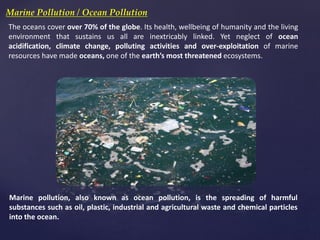
The oceans cover over 70% of the globe. Its health, wellbeing of humanity and the living
environment that sustains us all are inextricably linked. Yet neglect of ocean
acidification, climate change, polluting activities and over-exploitation of marine
resources have made oceans, one of the earth’s most threatened ecosystems.
Marine pollution, also known as ocean pollution, is the spreading of harmful
substances such as oil, plastic, industrial and agricultural waste and chemical particles
into the ocean.
Causes of Marine / Ocean Pollution
There are various ways in which pollution enters the ocean:
o The hazardous and toxic chemicals affects marine life.
o Also, they raise the temperature of the ocean and cause thermal pollution. Aquatic animals
and plants have difficulty surviving at higher temperatures.
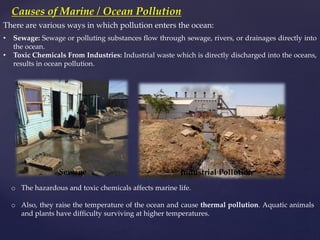
• Sewage: Sewage or polluting substances flow through sewage, rivers, or drainages directly into
the ocean.
• Toxic Chemicals From Industries: Industrial waste which is directly discharged into the oceans,
results in ocean pollution.
Industrial Pollution
Sewage
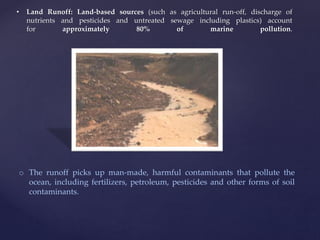
• Land Runoff: Land-based sources (such as agricultural run-off, discharge of
nutrients and pesticides and untreated sewage including plastics) account
for approximately 80% of marine pollution.
o The runoff picks up man-made, harmful contaminants that pollute the
ocean, including fertilizers, petroleum, pesticides and other forms of soil
contaminants.
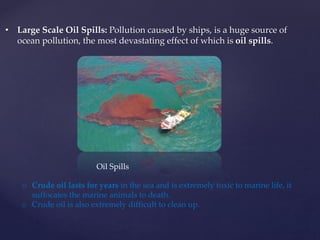
• Large Scale Oil Spills: Pollution caused by ships, is a huge source of
ocean pollution, the most devastating effect of which is oil spills.
o Crude oil lasts for years in the sea and is extremely toxic to marine life, it
suffocates the marine animals to death.
o Crude oil is also extremely difficult to clean up.
Oil Spills
o Once discarded, plastics are weathered and eroded into very small fragments known
as micro-plastics. These together with plastic pellets are already found in most beaches
around the world.
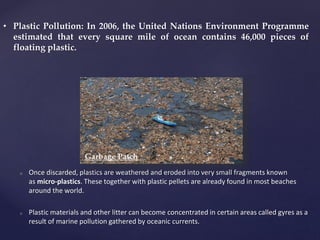
o Plastic materials and other litter can become concentrated in certain areas called gyres as a
result of marine pollution gathered by oceanic currents.
• Plastic Pollution: In 2006, the United Nations Environment Programme
estimated that every square mile of ocean contains 46,000 pieces of
floating plastic.
Garbage Patch
• In addition to all these factors, the oceans are highly affected
by carbon dioxide and climate changes, which impacts primarily the
ecosystems and fish communities that live in the ocean.
o In particular, the rising levels of CO2 leads to ocean acidification.
• Other factors like coastal tourism, port and harbour developments,
damming of rivers, urban development and construction, mining,
fisheries, aquaculture etc., are all sources of marine pollution
threatening coastal and marine habitats.
• For example, the North Pacific Gyre is now referred to as the Great Pacific
Garbage Patch, where waste material from across the North Pacific Ocean,
including coastal waters off North America and Japan, are drawn together.
EFFECTS OF OCEAN POLLUTION
Effect of Toxic Wastes on Marine Animals
Disruption to the Cycle of Coral Reefs
Depletes Oxygen Content in Water
Eutrophication
Failure in the Reproductive System of Sea Animals
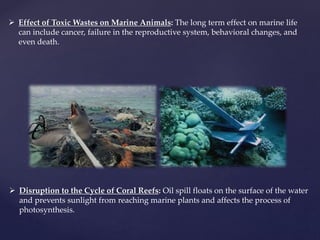
 Effect of Toxic Wastes on Marine Animals: The long term effect on marine life
can include cancer, failure in the reproductive system, behavioral changes, and
even death.
 Disruption to the Cycle of Coral Reefs: Oil spill floats on the surface of the water
and prevents sunlight from reaching marine plants and affects the process of
photosynthesis.
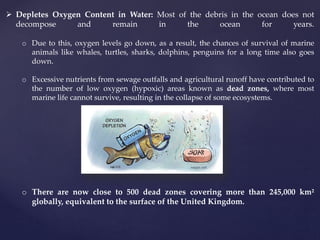
 Depletes Oxygen Content in Water: Most of the debris in the ocean does not
decompose and remain in the ocean for years.
o Due to this, oxygen levels go down, as a result, the chances of survival of marine
animals like whales, turtles, sharks, dolphins, penguins for a long time also goes
down.
o Excessive nutrients from sewage outfalls and agricultural runoff have contributed to
the number of low oxygen (hypoxic) areas known as dead zones, where most
marine life cannot survive, resulting in the collapse of some ecosystems.
o There are now close to 500 dead zones covering more than 245,000 km²
globally, equivalent to the surface of the United Kingdom.
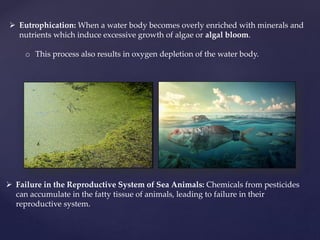
 Eutrophication: When a water body becomes overly enriched with minerals and
nutrients which induce excessive growth of algae or algal bloom.
o This process also results in oxygen depletion of the water body.
 Failure in the Reproductive System of Sea Animals: Chemicals from pesticides
can accumulate in the fatty tissue of animals, leading to failure in their
reproductive system.
Global Initiatives
• The Global Programme of Action (GPA) for the Protection of the Marine
Environment from Land-based Activities:
o The GPA is the only global intergovernmental mechanism directly addressing
the connectivity between terrestrial, freshwater, coastal and marine
ecosystems.
International conventions:
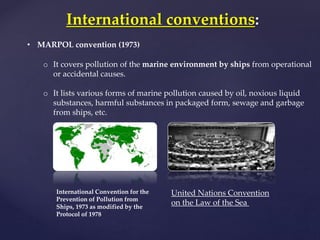
• MARPOL convention (1973)
o It covers pollution of the marine environment by ships from operational
or accidental causes.
o It lists various forms of marine pollution caused by oil, noxious liquid
substances, harmful substances in packaged form, sewage and garbage
from ships, etc.
International Convention for the
Prevention of Pollution from
Ships, 1973 as modified by the
Protocol of 1978
United Nations Convention
on the Law of the Sea
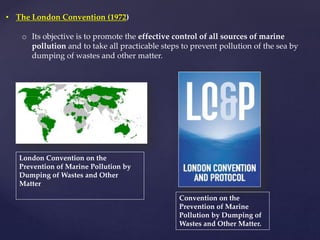
• The London Convention (1972)
o Its objective is to promote the effective control of all sources of marine
pollution and to take all practicable steps to prevent pollution of the sea by
dumping of wastes and other matter.
Convention on the
Prevention of Marine
Pollution by Dumping of
Wastes and Other Matter.
London Convention on the
Prevention of Marine Pollution by
Dumping of Wastes and Other
Matter
Greenpeace:
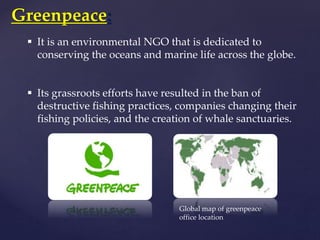
 It is an environmental NGO that is dedicated to
conserving the oceans and marine life across the globe.
 Its grassroots efforts have resulted in the ban of
destructive fishing practices, companies changing their
fishing policies, and the creation of whale sanctuaries.
Global map of greenpeace
office location
 Renewable energy source
 Encourage Organic Farming
 Proper sewage treatment
 Landfills
 Use of Biotechnology
 Green lifestyle
 Have a global treaty
How to prevent Ocean pollution?
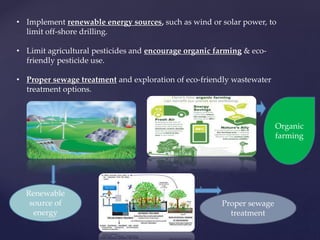
• Implement renewable energy sources, such as wind or solar power, to
limit off-shore drilling.
• Limit agricultural pesticides and encourage organic farming & eco-
friendly pesticide use.
• Proper sewage treatment and exploration of eco-friendly wastewater
treatment options.
Proper sewage
treatment
Renewable
source of
energy
Organic
farming
 Cut down on the industry and manufacturing waste and
contain it into landfills to avoid spillage.
o Use of Biotechnology: Bioremediation (use of specific
microorganisms to metabolize and remove harmful
substances) to treat oil spills.
• At individual level reduce carbon footprint by adopting
a "green" lifestyle.
• Have a global treaty on banning single-use plastics and
collaborated effort to clean up the ocean.
The world’s oceans – their temperature, chemistry, currents and
life - drive global systems that make the Earth habitable for
humankind. Over three billion people depend on marine and
coastal biodiversity for their livelihoods.
Thank you,

Environmental studies Marine Pollution

  • 1.
  • 2.
    Contents.  Marine Pollution/ Ocean Pollution  Causes of Marine / Ocean Pollution  Effects of ocean pollution  Global Initiatives  International conventions  Greenpeace  How to prevent Ocean pollution?
  • 3.
    Marine Pollution /Ocean Pollution The oceans cover over 70% of the globe. Its health, wellbeing of humanity and the living environment that sustains us all are inextricably linked. Yet neglect of ocean acidification, climate change, polluting activities and over-exploitation of marine resources have made oceans, one of the earth’s most threatened ecosystems. Marine pollution, also known as ocean pollution, is the spreading of harmful substances such as oil, plastic, industrial and agricultural waste and chemical particles into the ocean.
  • 4.
    Causes of Marine/ Ocean Pollution There are various ways in which pollution enters the ocean: o The hazardous and toxic chemicals affects marine life. o Also, they raise the temperature of the ocean and cause thermal pollution. Aquatic animals and plants have difficulty surviving at higher temperatures. • Sewage: Sewage or polluting substances flow through sewage, rivers, or drainages directly into the ocean. • Toxic Chemicals From Industries: Industrial waste which is directly discharged into the oceans, results in ocean pollution. Industrial Pollution Sewage
  • 5.
    • Land Runoff:Land-based sources (such as agricultural run-off, discharge of nutrients and pesticides and untreated sewage including plastics) account for approximately 80% of marine pollution. o The runoff picks up man-made, harmful contaminants that pollute the ocean, including fertilizers, petroleum, pesticides and other forms of soil contaminants.
  • 6.
    • Large ScaleOil Spills: Pollution caused by ships, is a huge source of ocean pollution, the most devastating effect of which is oil spills. o Crude oil lasts for years in the sea and is extremely toxic to marine life, it suffocates the marine animals to death. o Crude oil is also extremely difficult to clean up. Oil Spills
  • 7.
    o Once discarded,plastics are weathered and eroded into very small fragments known as micro-plastics. These together with plastic pellets are already found in most beaches around the world. o Plastic materials and other litter can become concentrated in certain areas called gyres as a result of marine pollution gathered by oceanic currents. • Plastic Pollution: In 2006, the United Nations Environment Programme estimated that every square mile of ocean contains 46,000 pieces of floating plastic. Garbage Patch
  • 8.
    • In additionto all these factors, the oceans are highly affected by carbon dioxide and climate changes, which impacts primarily the ecosystems and fish communities that live in the ocean. o In particular, the rising levels of CO2 leads to ocean acidification. • Other factors like coastal tourism, port and harbour developments, damming of rivers, urban development and construction, mining, fisheries, aquaculture etc., are all sources of marine pollution threatening coastal and marine habitats. • For example, the North Pacific Gyre is now referred to as the Great Pacific Garbage Patch, where waste material from across the North Pacific Ocean, including coastal waters off North America and Japan, are drawn together.
  • 9.
    EFFECTS OF OCEANPOLLUTION Effect of Toxic Wastes on Marine Animals Disruption to the Cycle of Coral Reefs Depletes Oxygen Content in Water Eutrophication Failure in the Reproductive System of Sea Animals
  • 10.
     Effect ofToxic Wastes on Marine Animals: The long term effect on marine life can include cancer, failure in the reproductive system, behavioral changes, and even death.  Disruption to the Cycle of Coral Reefs: Oil spill floats on the surface of the water and prevents sunlight from reaching marine plants and affects the process of photosynthesis.
  • 11.
     Depletes OxygenContent in Water: Most of the debris in the ocean does not decompose and remain in the ocean for years. o Due to this, oxygen levels go down, as a result, the chances of survival of marine animals like whales, turtles, sharks, dolphins, penguins for a long time also goes down. o Excessive nutrients from sewage outfalls and agricultural runoff have contributed to the number of low oxygen (hypoxic) areas known as dead zones, where most marine life cannot survive, resulting in the collapse of some ecosystems. o There are now close to 500 dead zones covering more than 245,000 km² globally, equivalent to the surface of the United Kingdom.
  • 12.
     Eutrophication: Whena water body becomes overly enriched with minerals and nutrients which induce excessive growth of algae or algal bloom. o This process also results in oxygen depletion of the water body.  Failure in the Reproductive System of Sea Animals: Chemicals from pesticides can accumulate in the fatty tissue of animals, leading to failure in their reproductive system.
  • 13.
    Global Initiatives • TheGlobal Programme of Action (GPA) for the Protection of the Marine Environment from Land-based Activities: o The GPA is the only global intergovernmental mechanism directly addressing the connectivity between terrestrial, freshwater, coastal and marine ecosystems.
  • 14.
    International conventions: • MARPOLconvention (1973) o It covers pollution of the marine environment by ships from operational or accidental causes. o It lists various forms of marine pollution caused by oil, noxious liquid substances, harmful substances in packaged form, sewage and garbage from ships, etc. International Convention for the Prevention of Pollution from Ships, 1973 as modified by the Protocol of 1978 United Nations Convention on the Law of the Sea
  • 15.
    • The LondonConvention (1972) o Its objective is to promote the effective control of all sources of marine pollution and to take all practicable steps to prevent pollution of the sea by dumping of wastes and other matter. Convention on the Prevention of Marine Pollution by Dumping of Wastes and Other Matter. London Convention on the Prevention of Marine Pollution by Dumping of Wastes and Other Matter
  • 16.
    Greenpeace:  It isan environmental NGO that is dedicated to conserving the oceans and marine life across the globe.  Its grassroots efforts have resulted in the ban of destructive fishing practices, companies changing their fishing policies, and the creation of whale sanctuaries. Global map of greenpeace office location
  • 17.
     Renewable energysource  Encourage Organic Farming  Proper sewage treatment  Landfills  Use of Biotechnology  Green lifestyle  Have a global treaty How to prevent Ocean pollution?
  • 18.
    • Implement renewableenergy sources, such as wind or solar power, to limit off-shore drilling. • Limit agricultural pesticides and encourage organic farming & eco- friendly pesticide use. • Proper sewage treatment and exploration of eco-friendly wastewater treatment options. Proper sewage treatment Renewable source of energy Organic farming
  • 19.
     Cut downon the industry and manufacturing waste and contain it into landfills to avoid spillage. o Use of Biotechnology: Bioremediation (use of specific microorganisms to metabolize and remove harmful substances) to treat oil spills. • At individual level reduce carbon footprint by adopting a "green" lifestyle. • Have a global treaty on banning single-use plastics and collaborated effort to clean up the ocean. The world’s oceans – their temperature, chemistry, currents and life - drive global systems that make the Earth habitable for humankind. Over three billion people depend on marine and coastal biodiversity for their livelihoods. Thank you,