SCURVY
• INTRODUCTION
• Vitamin C ( Ascorbic acid ) – water soluble vitamin.
• Ascorbic acid comes from Latin “Scorbutus” meaning
scurvy.
• Scurvy is a nutritional deficiency of vitaminC that
results from a few weeks to months of no vitamin C
supplementation.
History Of Scurvy
• Discovered by Capt James Cook in 1700s.
• James Lindt – Pioneer in the field of
preventing scurvy.
• Scurvy is characterised clinically by general
haemorrhagic tendency.
• Severe form of disease is rare
• Mild and subclinical types are relatively
common
• Main effects are on cells and tissues of
mesodermal origin, particularly skeletal
system.
Etiology
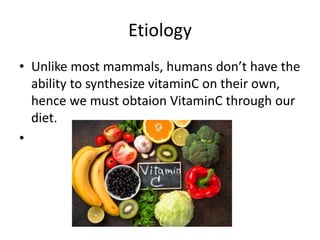
• Unlike most mammals, humans don’t have the
ability to synthesize vitaminC on their own,
hence we must obtaion VitaminC through our
diet.
•
• Occurs most commonly and frequently in
artificially fed infants between 5-10 months of
age.
• Since vitaminC is destroyed by heat(heating at
100 degrees centigrate destroys it) , exclusive
feeding with processed milk that is lacking VitC
will result in latent or symptomatic scurvy.
• Adult scurvy occurs amongst elderly who are on
restricted diet – manifests in the form of
subcutaneous haemorrhages with slight trauma
and delay in healing of wounds.
Patho-physiology.
• VitC deficiency impairs hydroxylation of lysine
and proline which are essential for collagen
formation.
• Impairs the cohesive property of matrix of
connective tissue and endothelium.
Consequenty capillary haemorrhage beneath
mucous menbrane and locations of abundant
capillary accumulations.
Extra-skeletal sites:
Gums
Intestine
Conjunctiva
Skin
Bladder
Kidney
Skeletal Manifestations
• Most vascular skeletal sites are beneath the
periosteum and in the marrow, particularly in
the metaphysis especially adjascent to the
most actively growing epiphysis :
• Lower end of femur
• Upper end of tibia
• Upper end of humerus
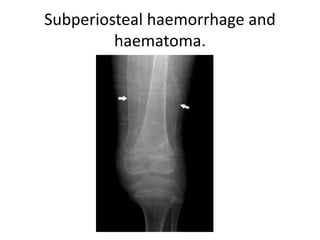
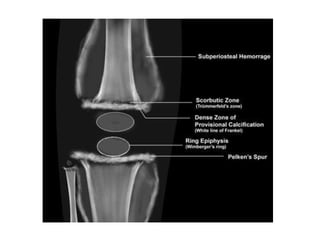
• Subperiosteal haemorrhage
•
• Accumulation of blood
•
• Ballooning out of periosteum
•
• Clotted blood either re-absorbed or
transformed to fibrous tissue.
•
• At this point when VitC is supplemented,
organised haematoma becomes ossified.
Subperiosteal haemorrhage and
haematoma.
• Haemorrhages within the metaphysis
interferes with osteoblastic tissue.
•
• Endochondral ossification proceeds normally
as far as calcified cartilage – accumulates in
large amounts
•
• Notable deficency of osteoblast and osteoclast
•
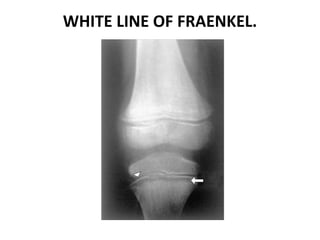
• Broadened layer of calcified cartilage
• ( White line of fraenkel)
WHITE LINE OF FRAENKEL.
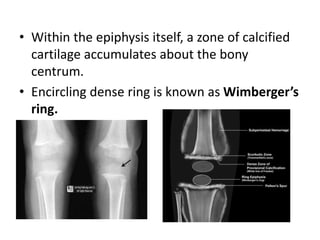
• Within the epiphysis itself, a zone of calcified
cartilage accumulates about the bony
centrum.
• Encircling dense ring is known as Wimberger’s
ring.
• Metaphysis in response to haemorrhage
becomes extremely hyperemic.
•
• Resultant resorption of bone and failure of
laying down of new bones.
•
• Extremely defficient ossification – appears as
dark zones of radiolucency next to the white
line.
• Lack of bone structure and and accumulation
of fragile calcified cartilage weaken epiphysio-
metaphyseal junction.
•
• Resultant fracture and epiphyseal separation.
•
• Epiphysis and epiphyseal plate may be
completely displaced from the shaft.
• Haemorrhage throughout the marrow.
•
• Fibrous changes and replacement of
haematopoietic tissue.
•
• Secondary anaemia.
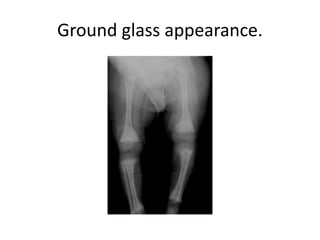
• Trabeculations – thinned and poorly
visualised(Ground glass appearance)
• Cortices become slender – may result in
pathological fracture – metaphysis in infants
and diaphysis in adults.
Ground glass appearance.
Clinical Picture
• Infant is restless, pale and febrile.
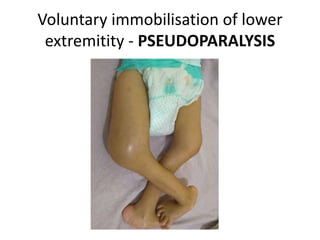
• Extremities are held immobile
• Muscles are in spasm
• Any attempt to move the limbs, results in the
child crying out in excruciating pain.
• Palpable, tender fixed swelling over a bone –
result of sub-periosteal haemorrhage.
• Recent haemorrhage – swelling soft and fluctuant
• Later – indurated and less tender.
Voluntary immobilisation of lower
extremitity - PSEUDOPARALYSIS
Clinical Picture
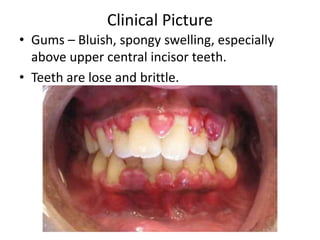
• Gums – Bluish, spongy swelling, especially
above upper central incisor teeth.
• Teeth are lose and brittle.
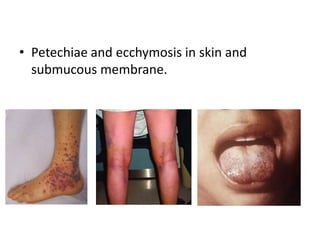
• Petechiae and ecchymosis in skin and
submucous membrane.
• Costo-chondral separations are typical.
• Sternum with the cartilagenous portion of ribs is displaced
posteriorly whilesharp anterior ends of the bony ribs protrude
anteriorly.
• SCORBUTIC ROSARY
• Haematemesis and haematuria may develop.
• Disease worsens – anorexia
• weight loss
• Progressive anaemia
Hyper pyrexia
Pneumonia
Death
LABs
• Blood ascorbic acid level :
• </= 0.5 mg/dl – diagnostic of scurvy
• Normal levels : 1mg/dl
• CBC – Anaemia.
Xray findings
• White line of Fraenkel
• Wimberger’s sign
• Ground glass translucency of bone
• Thinned out cortices.
• Sub-periosteal haemorrhage
• Epiphyseal separation
• Pelkan spur ( Small bony spur protruding out of
the lateral border of the metaphysis at its
junction with epiphysis)
Differential diagnosis
• Acute osteomyelitis :
Usually one bone is involved.
Localised pain and constitutional symptoms are severe.
Very high leukocyte counts.
Leutic osteochondritis:
Common before 3 months of age. (scurvy occurs in late infancy)
Mother’s serology is positive
H/O repeated spontaneous abortion
Differential Diagnosis
• Osteogenesis Imperfecta :
• Frcatures are diaphyseal rather than metaphyseal.
• Liabiloty of fractures lessens with advancing age.
• Diet is adequate.
• Blood contains adequate amount of ascorbic acid.
Treatment
• VitC supplementation :
Fruit juice, Tablets of cevitamic acid.
Required daily intake :
30mg for children.
50mg for adults.
Therapeutic dose : Minimum of 200mg per day.
Therapeutic dose for adult: 800-1000mg/day for
atleast 1 week, then 400mg/day till co mpleete
recovery.
THANK YOU

Scurvy

  • 1.
  • 2.
    • INTRODUCTION • VitaminC ( Ascorbic acid ) – water soluble vitamin. • Ascorbic acid comes from Latin “Scorbutus” meaning scurvy. • Scurvy is a nutritional deficiency of vitaminC that results from a few weeks to months of no vitamin C supplementation.
  • 3.
    History Of Scurvy •Discovered by Capt James Cook in 1700s. • James Lindt – Pioneer in the field of preventing scurvy.
  • 4.
    • Scurvy ischaracterised clinically by general haemorrhagic tendency. • Severe form of disease is rare • Mild and subclinical types are relatively common • Main effects are on cells and tissues of mesodermal origin, particularly skeletal system.
  • 5.
    Etiology • Unlike mostmammals, humans don’t have the ability to synthesize vitaminC on their own, hence we must obtaion VitaminC through our diet. •
  • 6.
    • Occurs mostcommonly and frequently in artificially fed infants between 5-10 months of age. • Since vitaminC is destroyed by heat(heating at 100 degrees centigrate destroys it) , exclusive feeding with processed milk that is lacking VitC will result in latent or symptomatic scurvy. • Adult scurvy occurs amongst elderly who are on restricted diet – manifests in the form of subcutaneous haemorrhages with slight trauma and delay in healing of wounds.
  • 7.
    Patho-physiology. • VitC deficiencyimpairs hydroxylation of lysine and proline which are essential for collagen formation. • Impairs the cohesive property of matrix of connective tissue and endothelium. Consequenty capillary haemorrhage beneath mucous menbrane and locations of abundant capillary accumulations.
  • 8.
  • 9.
    Skeletal Manifestations • Mostvascular skeletal sites are beneath the periosteum and in the marrow, particularly in the metaphysis especially adjascent to the most actively growing epiphysis : • Lower end of femur • Upper end of tibia • Upper end of humerus
  • 10.
    • Subperiosteal haemorrhage • •Accumulation of blood • • Ballooning out of periosteum • • Clotted blood either re-absorbed or transformed to fibrous tissue. • • At this point when VitC is supplemented, organised haematoma becomes ossified.
  • 11.
  • 12.
    • Haemorrhages withinthe metaphysis interferes with osteoblastic tissue. • • Endochondral ossification proceeds normally as far as calcified cartilage – accumulates in large amounts • • Notable deficency of osteoblast and osteoclast • • Broadened layer of calcified cartilage • ( White line of fraenkel)
  • 13.
    WHITE LINE OFFRAENKEL.
  • 14.
    • Within theepiphysis itself, a zone of calcified cartilage accumulates about the bony centrum. • Encircling dense ring is known as Wimberger’s ring.
  • 15.
    • Metaphysis inresponse to haemorrhage becomes extremely hyperemic. • • Resultant resorption of bone and failure of laying down of new bones. • • Extremely defficient ossification – appears as dark zones of radiolucency next to the white line.
  • 16.
    • Lack ofbone structure and and accumulation of fragile calcified cartilage weaken epiphysio- metaphyseal junction. • • Resultant fracture and epiphyseal separation. • • Epiphysis and epiphyseal plate may be completely displaced from the shaft.
  • 17.
    • Haemorrhage throughoutthe marrow. • • Fibrous changes and replacement of haematopoietic tissue. • • Secondary anaemia. • Trabeculations – thinned and poorly visualised(Ground glass appearance) • Cortices become slender – may result in pathological fracture – metaphysis in infants and diaphysis in adults.
  • 18.
  • 19.
    Clinical Picture • Infantis restless, pale and febrile. • Extremities are held immobile • Muscles are in spasm • Any attempt to move the limbs, results in the child crying out in excruciating pain. • Palpable, tender fixed swelling over a bone – result of sub-periosteal haemorrhage. • Recent haemorrhage – swelling soft and fluctuant • Later – indurated and less tender.
  • 20.
    Voluntary immobilisation oflower extremitity - PSEUDOPARALYSIS
  • 21.
    Clinical Picture • Gums– Bluish, spongy swelling, especially above upper central incisor teeth. • Teeth are lose and brittle.
  • 22.
    • Petechiae andecchymosis in skin and submucous membrane.
  • 23.
    • Costo-chondral separationsare typical. • Sternum with the cartilagenous portion of ribs is displaced posteriorly whilesharp anterior ends of the bony ribs protrude anteriorly. • SCORBUTIC ROSARY
  • 24.
    • Haematemesis andhaematuria may develop. • Disease worsens – anorexia • weight loss • Progressive anaemia Hyper pyrexia Pneumonia Death
  • 25.
    LABs • Blood ascorbicacid level : • </= 0.5 mg/dl – diagnostic of scurvy • Normal levels : 1mg/dl • CBC – Anaemia.
  • 26.
    Xray findings • Whiteline of Fraenkel • Wimberger’s sign • Ground glass translucency of bone • Thinned out cortices. • Sub-periosteal haemorrhage • Epiphyseal separation • Pelkan spur ( Small bony spur protruding out of the lateral border of the metaphysis at its junction with epiphysis)
  • 28.
    Differential diagnosis • Acuteosteomyelitis : Usually one bone is involved. Localised pain and constitutional symptoms are severe. Very high leukocyte counts. Leutic osteochondritis: Common before 3 months of age. (scurvy occurs in late infancy) Mother’s serology is positive H/O repeated spontaneous abortion
  • 29.
    Differential Diagnosis • OsteogenesisImperfecta : • Frcatures are diaphyseal rather than metaphyseal. • Liabiloty of fractures lessens with advancing age. • Diet is adequate. • Blood contains adequate amount of ascorbic acid.
  • 30.
    Treatment • VitC supplementation: Fruit juice, Tablets of cevitamic acid. Required daily intake : 30mg for children. 50mg for adults. Therapeutic dose : Minimum of 200mg per day. Therapeutic dose for adult: 800-1000mg/day for atleast 1 week, then 400mg/day till co mpleete recovery.
  • 31.