Presented by:
SANA ARMAN 
• OSTEO = Bone
• SARCOMA = Malignant tumour of
connective tissue
OVERVIEWOVERVIEW
• Introduction
• Epidemiology
• Classification
• Skeletal Distribution
• Etiology
• Clinical and Radiographic features
• Histopathology
• Staging
• Treatment and Prognosis
INTRODUCTIONINTRODUCTION
• 2nd
most common primary malignant bone
tumor after multiple myeloma.
• Arise from primitive mesenchymal bone
forming cells
• Formation of osteoid directly by sarcoma
cells.
EPIDEMIOLOGYEPIDEMIOLOGY
 Involves any age but highest occurrence
in adolescence i.e,10 to 25 yrs
 Males > Females
 Blacks > Whites
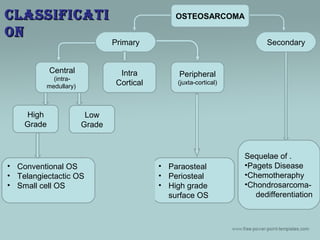
OSTEOSARCOMA
Primary Secondary
Central
(intra-
medullary)
Intra
Cortical
Peripheral
(juxta-cortical)
High
Grade
Low
Grade
• Paraosteal
• Periosteal
• High grade
surface OS
• Conventional OS
• Telangiectactic OS
• Small cell OS
Sequelae of .
•Pagets Disease
•Chemotheraphy
•Chondrosarcoma-
dedifferentiation
CLASSIFICATICLASSIFICATI
ONON
INTRA CORTICALINTRA MEDULLARY
(central)
JUXTA CORTICAL
(surface)
• 95%
• Metaphysis
• Fast growing
• Very rare
• Diaphysis
• 5%
• Metaphysis or Diaphysis
• Slow growing
ETIOLOGYETIOLOGY
• Exact cause is unknown.
• Risk Factors
– Rapid bone growth
– Environmental
 Radiation
 Oncogenic virus
– Genetic
 Mutation of RB gene
 Li Fraumeni syndrome – Mutation in p53 tumour suppressor gene
 Rothmund Thomson syndrome (Autosomal Recessive)
– Pre existing lesions – Ex: Fracture of bone, Infarcts, Pagets disease etc
SKELETAL DISTRIBUTIONSKELETAL DISTRIBUTION
• Sites
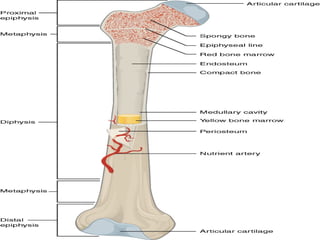
– Metaphysis > Diaphysis > Epiphysis
[89%] [10%] [1%]
• Distal Femur [40%]
• Proximal Tibia [20%]
• Proximal Humerus [10%]
• Others – Jaw [8%] or
Pelvis [8%]
CLINICAL ANDCLINICAL AND
RADIOGRAPHIC FEATURESRADIOGRAPHIC FEATURES
 Clinically
• Pain
• Swelling
• Loosening of teeth
• Paresthesia
• Nasal obstruction
 Radiographically
• Codmans triangle
• Sunburst appearance
• Symmetric widening of periodontal
ligament.
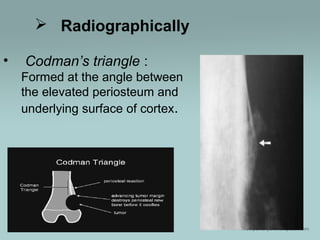
 Radiographically
• Codman’s triangle :
Formed at the angle between
the elevated periosteum and
underlying surface of cortex.
• Sunburst appearance: Due to
osteogenesis within the tumour.
 Radiographically
• Symmetric widening of periodontal
ligament space: Due to tumour infiltration.
 Radiographically
PATHOLOGYPATHOLOGY
 GROSSLY :
• Grey white
• Bulky mass
• Codmans triangle
• Cut surface shows areas of
hemorrhages and necrotic
bone.
g
HISTOLOGICALLYHISTOLOGICALLY :
• Sarcoma cells - Undifferentiated mesenchymal
stromal spindle shaped cells with hyperchromatic
nuclei.
• Osteogenesis – Osteoid matrix and bone is found
interspersed in the areas of tumour cells.
Osteiod
production
Spindle cells with
hyperchromatic
nuclie
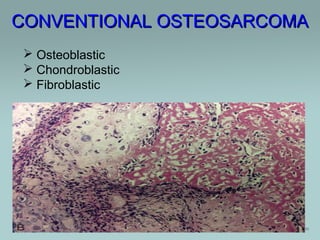
CONVENTIONAL OSTEOSARCOMACONVENTIONAL OSTEOSARCOMA
 Osteoblastic
 Chondroblastic
 Fibroblastic
 OSTEOBLASTIC OSTEOSARCOMAOSTEOBLASTIC OSTEOSARCOMA
 CHONDROBLASTIC OSTEOSARCOMACHONDROBLASTIC OSTEOSARCOMA
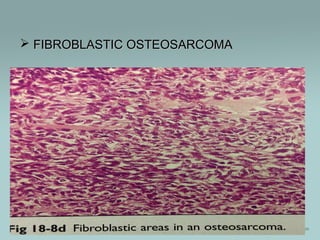
 FIBROBLASTIC OSTEOSARCOMAFIBROBLASTIC OSTEOSARCOMA
 Histologic variants
• Telangiectactic: Large,cavernous,dilated
vascular channels.
• Small cell: Small,uniform tumour cells.
• Fibrohistiocytic: Resembles malignant fibrous
histiocytoma
• Anaplastic: Marked anaplasia
• Well differentiated: Minimal cytologic atypia
EVALUATIONEVALUATION
Medical history and physical examination
Confirmed by investigations
• Plain x ray
• MRI scan
• CT scan
• Angiogram
• Bone scan
• Laboratory studies
• Biopsy
STAGINGSTAGING
• To stratify risk groups
 Stages :
• Stage I - Low grade lesions
• Stage II - High grade lesions
• Stage III - Metastatic disease
 Substages :
• A - Intramedullary lesions
• B - Local extramedullary spread
TREATMENT (plan)TREATMENT (plan)
• Radiological staging
• Biopsy to confirm diagnosis
• Preoperative chemotherapy
• Repeat radiological staging (access chemo response, finalize
surgical treatment plan)
• Surgical resection with wide margin
• Reconstruction using one of many techniques
• Post op chemotherapy based on pre op response
ChemotherapyChemotherapy
• Preoperatively - Neoadjuvant
chemotherapy (to decrease spread of
tumour cells during surgery; treat
micrometastasis)
• Postoperatively - Adjuvant chemotherapy
SurgerySurgery
For safe and complete removal of tumor
 Methods :
a.Amputation
b.Limb savage procedure
c. Rotationplasty
• In mandible - Hemimandibulectomy
• Maxillectomy is difficult to perform due to
the involvement of adjacent structures like
maxillary sinus, pterygopalatine fossa and
orbital fossa.
PROGNOSISPROGNOSIS
5 year survival rate
• Localised tumours : 60-80%
• Metastatic tumours : 15-30%
Osteosarcoma

Osteosarcoma