Dr Santosh Kumar Singh
Senior Consultant
Department of Pediatrics SMC
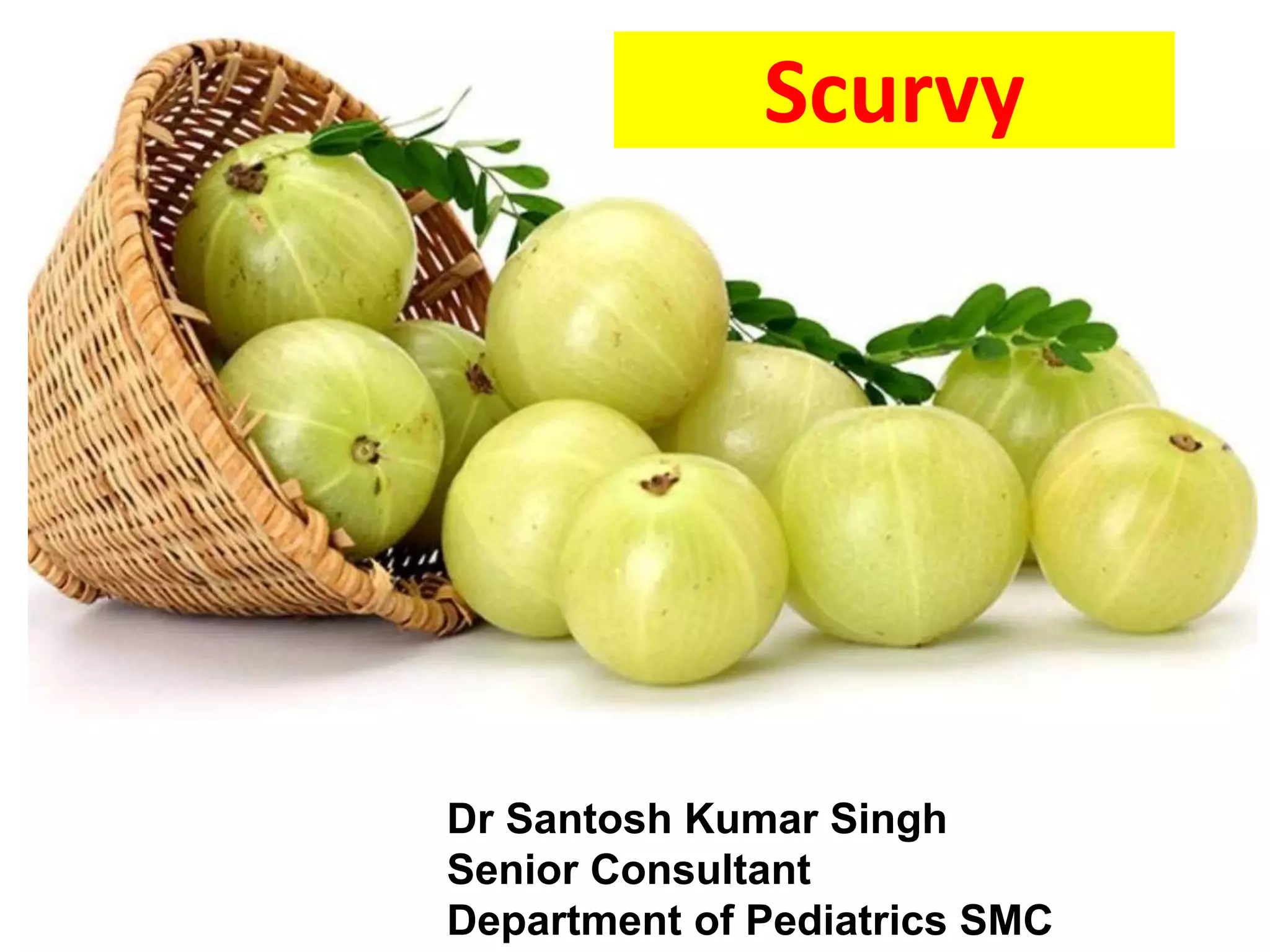
Scurvy
Definition
• Vitamins are organic compounds
• Required in the diet in small amounts
• To perform specific biological
functions
• For normal maintenance of optimum
Growth and Health of the organism.’
Vitamins speak
“ We are for growth, health and
welfare of organisms;
• Discharge our duties directly or
through coenzymes;
• Deficiency symptoms are our alert
signals;
• Satisfied we shall be, with additional
supplements.”
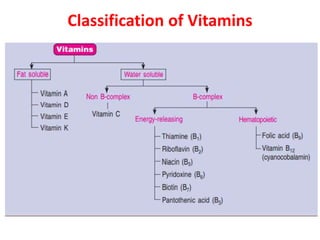
Classification of Vitamins
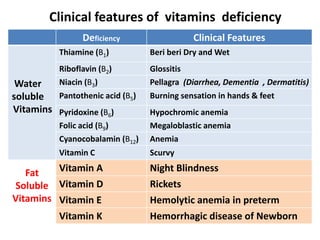
Deficiency Clinical Features
Water
soluble
Vitamins
Thiamine (B1) Beri beri Dry and Wet
Riboflavin (B2) Glossitis
Niacin (B3) Pellagra (Diarrhea, Dementia , Dermatitis)
Pantothenic acid (B5) Burning sensation in hands & feet
Pyridoxine (B6) Hypochromic anemia
Folic acid (B9) Megaloblastic anemia
Cyanocobalamin (B12) Anemia
Vitamin C Scurvy
Fat
Soluble
Vitamins
Vitamin A Night Blindness
Vitamin D Rickets
Vitamin E Hemolytic anemia in preterm
Vitamin K Hemorrhagic disease of Newborn
Clinical features of vitamins deficiency
Vitamin-C and Scurvy
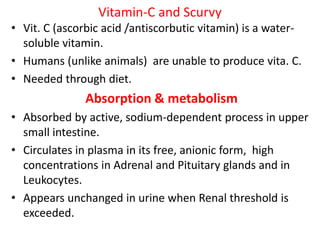
• Vit. C (ascorbic acid /antiscorbutic vitamin) is a water-
soluble vitamin.
• Humans (unlike animals) are unable to produce vita. C.
• Needed through diet.
Absorption & metabolism
• Absorbed by active, sodium-dependent process in upper
small intestine.
• Circulates in plasma in its free, anionic form, high
concentrations in Adrenal and Pituitary glands and in
Leukocytes.
• Appears unchanged in urine when Renal threshold is
exceeded.
Etiopathogenesis
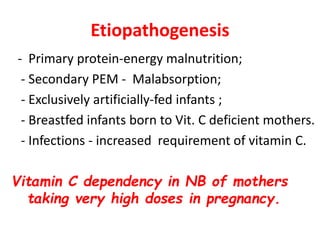
- Primary protein-energy malnutrition;
- Secondary PEM - Malabsorption;
- Exclusively artificially-fed infants ;
- Breastfed infants born to Vit. C deficient mothers.
- Infections - increased requirement of vitamin C.
Vitamin C dependency in NB of mothers
taking very high doses in pregnancy.
Functions
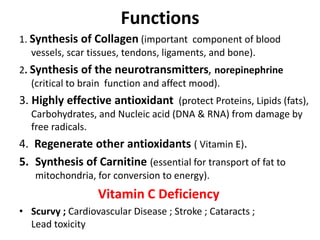
1. Synthesis of Collagen (important component of blood
vessels, scar tissues, tendons, ligaments, and bone).
2. Synthesis of the neurotransmitters, norepinephrine
(critical to brain function and affect mood).
3. Highly effective antioxidant (protect Proteins, Lipids (fats),
Carbohydrates, and Nucleic acid (DNA & RNA) from damage by
free radicals.
4. Regenerate other antioxidants ( Vitamin E).
5. Synthesis of Carnitine (essential for transport of fat to
mitochondria, for conversion to energy).
Vitamin C Deficiency
• Scurvy ; Cardiovascular Disease ; Stroke ; Cataracts ;
Lead toxicity
• The deficiency results in two major changes.
(1) Impaired collagen synthesis- causing defective
formation of osteoid and dentine.
(2) Modification of the intercellular ground substance
that binds the cells of capillary walls.
• This leads to changes in the calcified tissues
and capillary hemorrhages.
• Impaired wound healing and susceptibility to
infections.
Pathophysiology
Clinical Features
• NO AGE BAR but common in 6months to 2yrs.
• Initial vague symptoms- Irritability, Anorexia, GIT disturbances ,
Tachypnea
Infantile scurvy
1. Irritability, excessive crying , Tenderness especially in lower limbs.
2. Infant adopts “Frog-position” (partially flexed knees and hips ,
externally rotated lower limbs).
3. Posture of lower limbs gives an impression of paralysis,
(Pseudoparalysis).
4. Subperiosteal hemorrhage in lower third of femur. Prevents leg
movements.
5. Hemorrhages in skin & mucous membranes .Spongy swollen,
bluish purple gums.
6. Hemorrhages in internal organs causes Hematuria, Melena,
Subdural hemorrhage. Mild to moderate Anemia.
7. Scorbutic rosary results from posterior displacement of the
sternum. Tender, sharp and angular and has a “step-shaped”
configuration (sternum depressed).
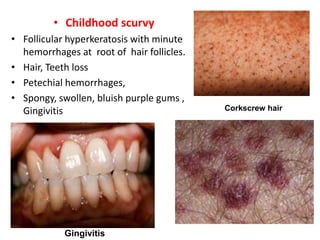
• Childhood scurvy
• Follicular hyperkeratosis with minute
hemorrhages at root of hair follicles.
• Hair, Teeth loss
• Petechial hemorrhages,
• Spongy, swollen, bluish purple gums ,
Gingivitis
• Subperiosteal hemorrhages.
Gingivitis
Corkscrew hair
Complications
• Skin problems: First signs perifollicular hyperkeratotic papules,
(reddish/bluish bruise-like spots surrounding hair follicles).
• Central hairs are twisted like corkscrews, break easily.
• Papules join together& form large areas of ecchymoses (bruises).
• Oral problems: Gums swelling, red, soft ,spongy. Slight friction
causes gum bleeding..
• Musculoskeletal problems: bleeding in joints causes joint pain,
swelling,
• Heart and lung problems: shortness of breath, low blood
pressure, and chest pain leading to shock and death.
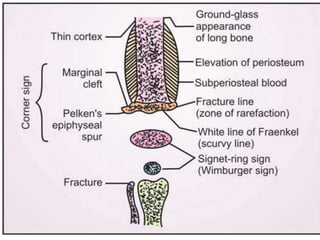
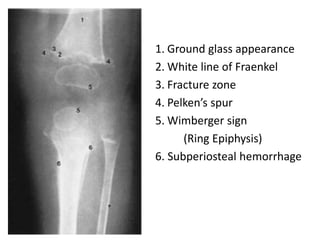
1. Ground glass appearance
2. White line of Fraenkel
3. Fracture zone
4. Pelken’s spur
5. Wimberger sign
(Ring Epiphysis)
6. Subperiosteal hemorrhage
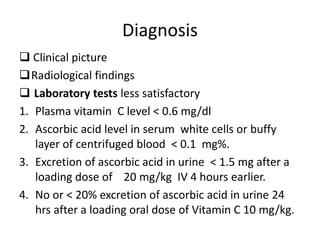
Diagnosis
 Clinical picture
Radiological findings
 Laboratory tests less satisfactory
1. Plasma vitamin C level < 0.6 mg/dl
2. Ascorbic acid level in serum white cells or buffy
layer of centrifuged blood < 0.1 mg%.
3. Excretion of ascorbic acid in urine < 1.5 mg after a
loading dose of 20 mg/kg IV 4 hours earlier.
4. No or < 20% excretion of ascorbic acid in urine 24
hrs after a loading oral dose of Vitamin C 10 mg/kg.
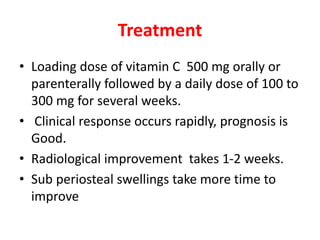
Treatment
• Loading dose of vitamin C 500 mg orally or
parenterally followed by a daily dose of 100 to
300 mg for several weeks.
• Clinical response occurs rapidly, prognosis is
Good.
• Radiological improvement takes 1-2 weeks.
• Sub periosteal swellings take more time to
improve
Prevention
• Breastfeeding of infants should be encouraged.
• Lactating mothers should receive vitamin C
100-150 mg/day
• Supplements of vitamin C 25 mg /day from
2-3 months in infants on artificial feeding.
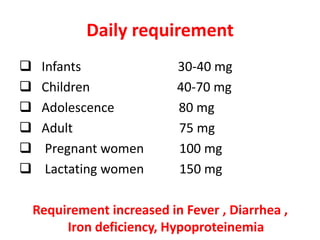
Daily requirement
 Infants 30-40 mg
 Children 40-70 mg
 Adolescence 80 mg
 Adult 75 mg
 Pregnant women 100 mg
 Lactating women 150 mg
Requirement increased in Fever , Diarrhea ,
Iron deficiency, Hypoproteinemia
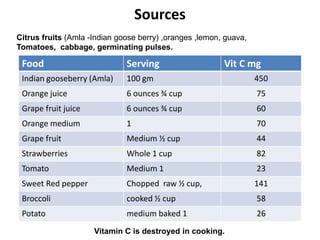
Sources
Food Serving Vit C mg
Indian gooseberry (Amla) 100 gm 450
Orange juice 6 ounces ¾ cup 75
Grape fruit juice 6 ounces ¾ cup 60
Orange medium 1 70
Grape fruit Medium ½ cup 44
Strawberries Whole 1 cup 82
Tomato Medium 1 23
Sweet Red pepper Chopped raw ½ cup, 141
Broccoli cooked ½ cup 58
Potato medium baked 1 26
Citrus fruits (Amla -Indian goose berry) ,oranges ,lemon, guava,
Tomatoes, cabbage, germinating pulses.
Vitamin C is destroyed in cooking.
20
Thank You

SCURVY .ppt

  • 1.
    Dr Santosh KumarSingh Senior Consultant Department of Pediatrics SMC Scurvy
  • 2.
    Definition • Vitamins areorganic compounds • Required in the diet in small amounts • To perform specific biological functions • For normal maintenance of optimum Growth and Health of the organism.’
  • 3.
    Vitamins speak “ Weare for growth, health and welfare of organisms; • Discharge our duties directly or through coenzymes; • Deficiency symptoms are our alert signals; • Satisfied we shall be, with additional supplements.”
  • 4.
  • 5.
    Deficiency Clinical Features Water soluble Vitamins Thiamine(B1) Beri beri Dry and Wet Riboflavin (B2) Glossitis Niacin (B3) Pellagra (Diarrhea, Dementia , Dermatitis) Pantothenic acid (B5) Burning sensation in hands & feet Pyridoxine (B6) Hypochromic anemia Folic acid (B9) Megaloblastic anemia Cyanocobalamin (B12) Anemia Vitamin C Scurvy Fat Soluble Vitamins Vitamin A Night Blindness Vitamin D Rickets Vitamin E Hemolytic anemia in preterm Vitamin K Hemorrhagic disease of Newborn Clinical features of vitamins deficiency
  • 6.
    Vitamin-C and Scurvy •Vit. C (ascorbic acid /antiscorbutic vitamin) is a water- soluble vitamin. • Humans (unlike animals) are unable to produce vita. C. • Needed through diet. Absorption & metabolism • Absorbed by active, sodium-dependent process in upper small intestine. • Circulates in plasma in its free, anionic form, high concentrations in Adrenal and Pituitary glands and in Leukocytes. • Appears unchanged in urine when Renal threshold is exceeded.
  • 7.
    Etiopathogenesis - Primary protein-energymalnutrition; - Secondary PEM - Malabsorption; - Exclusively artificially-fed infants ; - Breastfed infants born to Vit. C deficient mothers. - Infections - increased requirement of vitamin C. Vitamin C dependency in NB of mothers taking very high doses in pregnancy.
  • 8.
    Functions 1. Synthesis ofCollagen (important component of blood vessels, scar tissues, tendons, ligaments, and bone). 2. Synthesis of the neurotransmitters, norepinephrine (critical to brain function and affect mood). 3. Highly effective antioxidant (protect Proteins, Lipids (fats), Carbohydrates, and Nucleic acid (DNA & RNA) from damage by free radicals. 4. Regenerate other antioxidants ( Vitamin E). 5. Synthesis of Carnitine (essential for transport of fat to mitochondria, for conversion to energy). Vitamin C Deficiency • Scurvy ; Cardiovascular Disease ; Stroke ; Cataracts ; Lead toxicity
  • 9.
    • The deficiencyresults in two major changes. (1) Impaired collagen synthesis- causing defective formation of osteoid and dentine. (2) Modification of the intercellular ground substance that binds the cells of capillary walls. • This leads to changes in the calcified tissues and capillary hemorrhages. • Impaired wound healing and susceptibility to infections. Pathophysiology
  • 10.
    Clinical Features • NOAGE BAR but common in 6months to 2yrs. • Initial vague symptoms- Irritability, Anorexia, GIT disturbances , Tachypnea Infantile scurvy 1. Irritability, excessive crying , Tenderness especially in lower limbs. 2. Infant adopts “Frog-position” (partially flexed knees and hips , externally rotated lower limbs). 3. Posture of lower limbs gives an impression of paralysis, (Pseudoparalysis). 4. Subperiosteal hemorrhage in lower third of femur. Prevents leg movements. 5. Hemorrhages in skin & mucous membranes .Spongy swollen, bluish purple gums. 6. Hemorrhages in internal organs causes Hematuria, Melena, Subdural hemorrhage. Mild to moderate Anemia. 7. Scorbutic rosary results from posterior displacement of the sternum. Tender, sharp and angular and has a “step-shaped” configuration (sternum depressed).
  • 11.
    • Childhood scurvy •Follicular hyperkeratosis with minute hemorrhages at root of hair follicles. • Hair, Teeth loss • Petechial hemorrhages, • Spongy, swollen, bluish purple gums , Gingivitis • Subperiosteal hemorrhages. Gingivitis Corkscrew hair
  • 12.
    Complications • Skin problems:First signs perifollicular hyperkeratotic papules, (reddish/bluish bruise-like spots surrounding hair follicles). • Central hairs are twisted like corkscrews, break easily. • Papules join together& form large areas of ecchymoses (bruises). • Oral problems: Gums swelling, red, soft ,spongy. Slight friction causes gum bleeding.. • Musculoskeletal problems: bleeding in joints causes joint pain, swelling, • Heart and lung problems: shortness of breath, low blood pressure, and chest pain leading to shock and death.
  • 14.
    1. Ground glassappearance 2. White line of Fraenkel 3. Fracture zone 4. Pelken’s spur 5. Wimberger sign (Ring Epiphysis) 6. Subperiosteal hemorrhage
  • 15.
    Diagnosis  Clinical picture Radiologicalfindings  Laboratory tests less satisfactory 1. Plasma vitamin C level < 0.6 mg/dl 2. Ascorbic acid level in serum white cells or buffy layer of centrifuged blood < 0.1 mg%. 3. Excretion of ascorbic acid in urine < 1.5 mg after a loading dose of 20 mg/kg IV 4 hours earlier. 4. No or < 20% excretion of ascorbic acid in urine 24 hrs after a loading oral dose of Vitamin C 10 mg/kg.
  • 16.
    Treatment • Loading doseof vitamin C 500 mg orally or parenterally followed by a daily dose of 100 to 300 mg for several weeks. • Clinical response occurs rapidly, prognosis is Good. • Radiological improvement takes 1-2 weeks. • Sub periosteal swellings take more time to improve
  • 17.
    Prevention • Breastfeeding ofinfants should be encouraged. • Lactating mothers should receive vitamin C 100-150 mg/day • Supplements of vitamin C 25 mg /day from 2-3 months in infants on artificial feeding.
  • 18.
    Daily requirement  Infants30-40 mg  Children 40-70 mg  Adolescence 80 mg  Adult 75 mg  Pregnant women 100 mg  Lactating women 150 mg Requirement increased in Fever , Diarrhea , Iron deficiency, Hypoproteinemia
  • 19.
    Sources Food Serving VitC mg Indian gooseberry (Amla) 100 gm 450 Orange juice 6 ounces ¾ cup 75 Grape fruit juice 6 ounces ¾ cup 60 Orange medium 1 70 Grape fruit Medium ½ cup 44 Strawberries Whole 1 cup 82 Tomato Medium 1 23 Sweet Red pepper Chopped raw ½ cup, 141 Broccoli cooked ½ cup 58 Potato medium baked 1 26 Citrus fruits (Amla -Indian goose berry) ,oranges ,lemon, guava, Tomatoes, cabbage, germinating pulses. Vitamin C is destroyed in cooking.
  • 20.