2015 - OpenArc Campus – BIT UCSC
IT4305- Rapid Software Development
Upekha Vandebona
upe.vand@gmail.com
REF: Essential Scrum Practical Guide to the Most Popular Agile Process, Kenneth S. Rubin
Notice :
https://www.youtube.com
/playlist?list=PL1RGC7Ne
OQe74Y1B4h_M-
nwdwgz_n2mYG
Your Scrum Reference
Book Video Tutorials
Chapter 04 - Core Concepts
 4.1 - Scrum Framework
 4.2 - Sprints
 4.3 - Requirements and User Stories
 4.4 - Product Backlog
 4.5 - Estimation and Velocity
• Discuss how the requirements are handled in a Scrum project.
• Explain how and when to use User Stories
• Describe and practice how to handle nonfunctional requirements
and knowledge-acquisition in a scrum project.
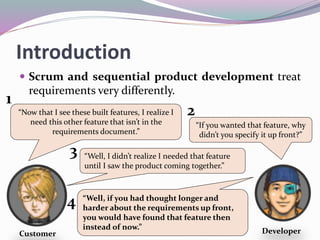
Introduction
 Scrum and sequential product development treat
requirements very differently.
Customer Developer
“Now that I see these built features, I realize I
need this other feature that isn’t in the
requirements document.”
“If you wanted that feature, why
didn’t you specify it up front?”
“Well, if you had thought longer and
harder about the requirements up front,
you would have found that feature then
instead of now.”
“Well, I didn’t realize I needed that feature
until I saw the product coming together.”
1
2
3
4
Intro – Traditional Req
 With sequential product development, requirements
are nonnegotiable, detailed up front, and meant to
stand alone.
 These requirements are created up front and given to
the development group in the form of a highly detailed
document.
 It is the job of the development group, then, to
produce a product that conforms to the detailed
requirements.
Intro – Scrum Req
 In Scrum, the details of a requirement are
negotiated through conversations that happen
continuously during development and are fleshed
out just in time and just enough for the teams to start
building functionality to support that requirement.
 In contrast, Scrum views requirements as an important
degree of freedom that we can manipulate to meet our
business goals.
Introduction
 The fact is, when developing innovative products, you
can’t create complete requirements or designs up front
by simply working longer and harder.
 Some requirements and design will always emerge
once product development is under way; no amount of
comprehensive up-front work will prevent that.
Intro – Scrum Req
 For example, if we’re running out of time or money, we
can drop low-value requirements.
 If, during development, new information indicates
that the cost/benefit ratio of a requirement has
become significantly less favorable, we can choose to
drop the requirement from the product.
 And if a new high-value requirement emerges, we
have the ability to add it to the product, perhaps
discarding a lower-value requirement to make room.
Introduction
 Thus, when using Scrum, we don’t invest a great deal
of time and money in fleshing out the details of a
requirement up front.
 Because we expect the specifics to change as time
passes and as we learn more about what we are
building, we avoid overinvesting in requirements that
we might later discard.
 Instead of compiling a large inventory of detailed
requirements up front, we create placeholders for the
requirements, called product backlog items (PBIs).
Each product backlog item represents desirable
business value.
Intro – Product Backlog Items
 Initially the product backlog items are large (representing
large swaths of business value), and there is very little
detail associated with them.
 Over time, we flow these product backlog items through a
series of conversations among the stakeholders, product
owner, and development team, refining them into a
collection of smaller, more detailed PBIs.
 Eventually a product backlog item is small and detailed
enough to move into a sprint, where it will be designed,
built, and tested.
 Even during the sprint, however, more details will be
exposed in conversations between the product owner and
the development team.
While Scrum doesn’t specify any standard
format for these product backlog items,
many teams represent PBIs as user stories.
You don’t have to.
Some teams prefer use cases,
and others choose to represent their PBIs in
their own custom formats.
Using Conversations (contd.)
 Sequential product development relies heavily on
written requirements, which look impressive but can
easily be misunderstood.
 A way to better ensure that the desired features are
being built is for the people who know what they want
to have timely conversations with the people who are
designing, building, and testing those features.
Using Conversations (contd.)
 In Scrum we leverage conversation as a key tool for
ensuring that requirements are properly discussed and
communicated.
 Verbal communication has the benefit of being high-
bandwidth and providing fast feedback, making it
easier and cheaper to gain a shared understanding.
 In addition, conversations enable bidirectional
communication that can spark ideas about problems
and opportunities—discussions that would not likely
arise from reading a document.
Using Conversations (contd.)
 Conversation, however, is just a tool. It doesn’t replace
all documents.
 In Scrum, the product backlog is a “living document,”
available at all times during product development.
 Those who still want or must have a requirements
specification document can create one at any time,
simply by collecting the product backlog items and all
of their associated details into a document formatted
however they like.
Progressive Refinement
 With sequential product development all
requirements must be at the same level of detail at the
same time. There are no details left to be added.
 When using Scrum, not all requirements have to be at
the same level of detail at the same time.
 Requirements that we’ll work on sooner will be smaller
and more detailed
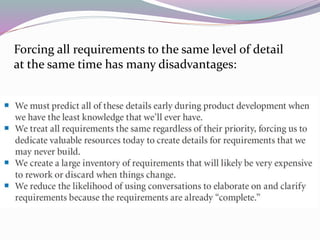
Forcing all requirements to the same level of detail
at the same time has many disadvantages:
User Stories
 User stories are a convenient format for expressing the
desired business value for many types of product
backlog items, especially features.
 User stories are crafted in a way that makes them
understandable to both business people and technical
people.
 They are structurally simple and provide a great
placeholder for a conversation.
 Additionally, they can be written at various levels of
granularity and are easy to progressively refine.
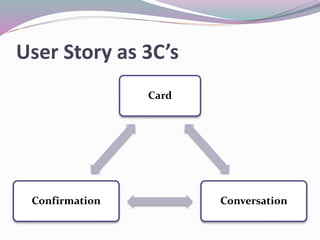
User Story as 3C’s
Card
ConversationConfirmation
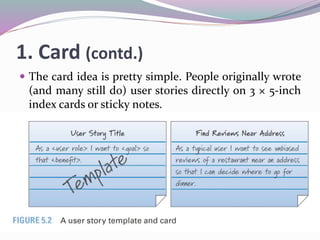
1. Card (contd.)
 The card idea is pretty simple. People originally wrote
(and many still do) user stories directly on 3 × 5-inch
index cards or sticky notes.
Card (contd.)
 The card isn’t intended to capture all of the
information that makes up the requirement.
 In fact, we deliberately use small cards with limited
space to promote brevity.
 A card should hold a few sentences that capture the
essence or intent of a requirement.
 It serves as the placeholder for more detailed
discussions that will take place among the
stakeholders, product owner, and development team.
2. Conversation (contd.)
 The details of a requirement are exposed and
communicated in a conversation among the
development team, product owner, and stakeholders.
The user story is simply a promise to have that
conversation.
 One of the benefits of user stories is that they shift
some of the focus away from writing and onto
conversations.
 These conversations enable a richer form of
exchanging information and collaborating to ensure
that the correct requirements are expressed and
understood by everyone.
Conversation (contd.)
 The conversation is typically not a one-time event, but
rather an ongoing dialogue.
 There can be an initial conversation when the user story
is written,
 Another conversation when it’s refined,
 Another when it’s estimated,
 Another during sprint planning (when the team is
diving intothe task-level details),
 Finally, ongoing conversations while the user story is
being designed, built, and tested during the sprint.
Conversation (contd.)
 Although conversations are largely verbal, they can be
and frequently are supplemented with documents.
Conversations may lead to a UI sketch, or an
elaboration of business rules that gets written down.
 We’re not tossing out all of our documents in favor of
user stories and their associated story cards.
 User stories are simply a good starting point for
eliciting the initial essence of what is desired, and for
providing a reminder to discuss requirements in more
detail when appropriate. However, user stories can and
should be supplemented with whatever other written
information helps provide clarity regarding what is
desired.
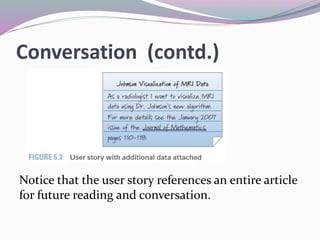
Conversation (contd.)
Notice that the user story references an entire article
for future reading and conversation.
3. Confirmation (contd.)
 A user story also contains confirmation information in
the form of conditions of satisfaction. These are
acceptance criteria that clarify the desired behavior.
They are used by the development team to better
understand what to build and test and by the product
owner to confirm that the user story has been
implemented to his satisfaction.
 If the front of the card has a few-line description of the
story, the back of the card could specify the conditions
of satisfaction
Confirmation (contd.)
 These conditions of satisfaction can be expressed as
high-level acceptance tests.
 However, these tests would not be the only tests that
are run when the story is being developed. In fact, for
the handful of acceptance tests that are associated
with a user story, the team will have many more tests
(perhaps 10 to 100 times more) at a detailed technical
level that the product owner doesn’t even know about.
Confirmation (contd.)
 The acceptance tests associated with the story exist for
several reasons.
 First, they are an important way to capture and
communicate, from the product owner’s perspective,
how to determine if the story has been implemented
correctly.
 These tests can also be a helpful way to create initial
stories and refine them as more details become known.
 This approach is sometimes called specification by example
or acceptance-test-driven development (ATTD). The idea
is fairly intuitive.
Confirmation (contd.)
 Discussions about the stories can and frequently do
focus on defining specific examples or desired
behaviors.
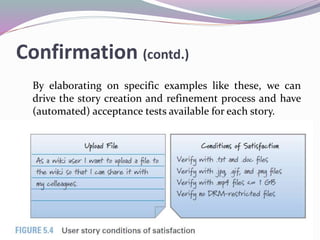
Initially, let’s limit uploaded file sizes to be 1 GB or
less. Also, make sure that we can properly load
common text and graphics files. And for legal
reasons we can’t have any files with digital rights
management (DRM) restrictions loaded to the wiki.
Confirmation (contd.)
By elaborating on specific examples like these, we can
drive the story creation and refinement process and have
(automated) acceptance tests available for each story.
Level of Detail (contd.)
 User stories can be written to capture customer and
user needs at various levels of abstraction.
 The largest would be stories that are a few to many
months in size and might span an entire release or
multiple releases.
 Many people refer to these as epics, alluding to the
idea that they are Lord of the Rings or War and Peace
size stories. Epics are helpful because they give a very
big-picture, high-level overview of what is desired.
Level of Detail (contd.)
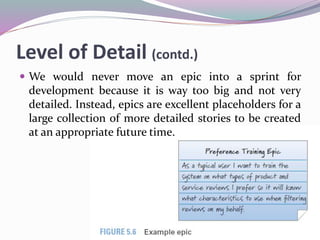
 We would never move an epic into a sprint for
development because it is way too big and not very
detailed. Instead, epics are excellent placeholders for a
large collection of more detailed stories to be created
at an appropriate future time.
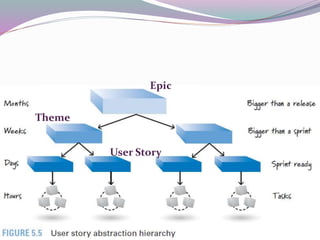
Epic
Theme
User Story
Level of Detail (contd.)
 Tasks are the layer below stories, typically worked on
by only one person, or perhaps a pair of people.
 Tasks typically require hours to perform. When we go
to the task layer, we are specifying how to build
something instead of what to build.
 Tasks are not stories, so we should avoid including
task-level detail when writing stories.
‘INVEST’ in Good Stories
 How do we know if the stories that we have written are
good stories?
 ‘INVEST’ offered six criteria that have proved useful
when evaluating whether our stories are fit for their
intended use or require some additional work
 Independent,
 Negotiable,
 Valuable,
 Estimatable,
 Small (sized appropriately),
 Testable
1. Independent (contd.)
 As much as is practical, user stories should be
independent or at least only loosely coupled with one
another. Stories that exhibit a high degree of
interdependence complicate estimating, prioritizing,
and planning.
Independent (contd.)
 Imagine that you have many different stories with a
high degree of interdependence. Trying to determine
how to prioritize all of these stories and deciding
which stories to work on in a sprint would be difficult
to say the least.
 When applying the independent criteria, the goal is not
to eliminate all dependencies, but instead to write
stories in a way that minimizes dependencies.
2. Negotiable (contd.)
 The details of stories should also be negotiable. Stories
are not a written contract in the form of an up-front
requirements document.
 Instead, stories are placeholders for the conversations
where the details will be negotiated.
 Good stories clearly capture the essence of what
business functionality is desired and why it is desired.
However, they leave room for the product owner, the
stakeholders, and the team to negotiate the details.
Negotiable (contd.)
 This negotiability helps everyone involved avoid the
us-versus-them, finger pointing mentality that is
commonplace with detailed up-front requirements
documents.
 When stories are negotiable, developers can’t really
say, “Hey, if you wanted it, you should have put it in
the document,” because the details are going to be
negotiated with the developers.
Negotiable (contd.)
 And the business people can’t really say, “Hey, you
obviously didn’t understand the requirements
document because you built the wrong thing,” because
the business people will be in frequent dialogue with
the developers to make sure there is shared clarity.
 Writing negotiable stories avoids the problems
associated with up-front detailed requirements by
making it clear that a dialogue is necessary.
Negotiable (contd.)
 A common example of where negotiability is violated
is when the product owner tells the team how to
implement a story.
 Stories should be about what and why, not how.
 When the how becomes nonnegotiable, opportunities
for the team to be innovative are diminished.
Negotiable (contd.)
 There are times, however, when how something is
built is actually important to the product owner.
 For example, there might be a regulatory obligation to
develop a feature in a particular way, or there might be
a business constraint directing the use of a specific
technology.
 In such cases the stories will be a bit less negotiable
because some aspect of the “how” is required. That’s
OK; not all stories are fully negotiable, but most stories
should be.
3. Valuable (contd.)
 Stories need to be valuable to a customer, user, or both.
 Customers (or choosers) select and pay for the product.
 Users actually use the product.
 If a story isn’t valuable to either, it doesn’t belong in
the product backlog.
 “Story #10 isn’t valuable to anyone, but let’s build it
anyway.”
 We wouldn’t do that. We would either rewrite the story
to make it valuable to a customer or user, or we would
just discard it.
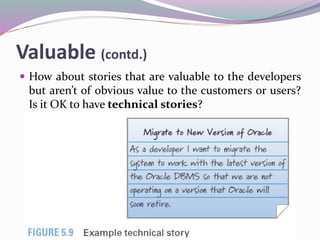
Valuable (contd.)
 How about stories that are valuable to the developers
but aren’t of obvious value to the customers or users?
Is it OK to have technical stories?
Valuable (contd.)
 The fundamental problem with technical stories is
that the product owner might not perceive any value in
them, making it difficult if not impossible to prioritize
them against business-valuable stories.
 For a technical story to exist, the product owner should
understand why he is paying for it and therefore what
value it will ultimately deliver.
Valuable (contd.)
 In the case of the “Migrate to New Version of Oracle”
story, the product owner might not initially
understand why it is valuable to change databases.
 However, once the team explains the risks of
continuing to develop on an unsupported version of a
database, the product owner might decide that
migrating databases is valuable enough to defer
building some new features until the migration is
done.
Valuable (contd.)
 By understanding the value, the product owner can
treat the technical story like any other business-
valuable story and make informed trade-offs.
 As a result, this technical story might be included in
the product backlog.
 In practice, though, most technical stories should not
be included in the product backlog.
 Instead, these types of stories should be tasks
associated with getting business valuable stories done.
Valuable (contd.)
 If the development team has a strong definition of
done, there should be no need to write stories like
these, because the work is implied by the definition of
being done.
 The crux of the valuable criteria is that all stories in the
backlog must be valuable (worth investing in) from
the product owner’s perspective, which represents the
customer and user perspectives.
 Not all stories are independent, and not all stories are
fully negotiable, but they all must be valuable.
4. Estimatable (contd.)
 Stories should be estimatable by the team that will
design, build, and test them.
 Estimates provide an indication of the size and
therefore the effort and cost of the stories.
 Bigger stories require more effort and therefore cost
more money to develop than smaller stories.
 Knowing a story’s size provides actionable information
to the Scrum team.
Estimatable (contd.)
 The product owner, for example, needs to know the
cost of a story to determine its final priority in the
product backlog. The Scrum team, on the other hand,
can determine from the size of the story whether
additional refinement or disaggregation is required.
 A large story that we plan to work on soon will need to
be broken into a set of smaller stories.
Estimatable (contd.)
 If the team isn’t able to size a story, the story is either
just too big or ambiguous to be sized, or the team
doesn’t have enough knowledge to estimate a size.
 If it’s too big, the team will need to work with the
product owner to break it into more manageable
stories.
 If the team lacks knowledge, some form of
exploratory activity will be needed to acquire the
information.
5. Sized Appropriately [Small]
 Stories should be sized appropriately for when we plan
to work on them.
 Stories worked on in sprints should be small.
 If we’re doing a several-week sprint, we want to work
on several stories that are each a few days in size.
 If we have a two-week sprint, we don’t want a two-
week-size story, because the risk of not finishing the
story is just too great.
6. Testable (contd.)
 Stories should be testable in a binary way—they either
pass or fail their associated tests.
 Being testable means having good acceptance criteria
(related to the conditions of satisfaction) associated
with the story, which is the “confirmation” aspect of a
user story.
 Without testable criteria, how would we know if the
story is done at the end of the sprint? Also, because
these tests frequently provide important story details,
they may be needed before the team can even estimate
the story.
Testable (contd.)
 It may not always be necessary or possible to test a
story. For example, epic-size stories probably don’t
have tests associated with them.
 Also, on occasion there might be a story that the
product owner deems valuable, yet there might not be
a practical way to test it.
 These are more likely to be nonfunctional requirements,
such as “As a user I want the system to have 99.999%
uptime.”
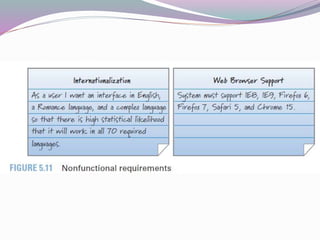
Nonfunctional Requirements (contd.)
 Nonfunctional requirements represent system-level
constraints.
 As system-level constraints, nonfunctional
requirements are important because they affect the
design and testing of most or all stories in the product
backlog.
 For example, having a “Web Browser Support”
nonfunctional requirement would be common on any
website project. When the team develops the website
features, it must ensure that the site features work with
all of the specified browsers.
 The team must also decide when to test all of the
browsers.
Nonfunctional Requirements (contd.)
 Each nonfunctional requirement is a prime target for
inclusion in the team’s definition of done.
 It is recommend that teams should try to include as
many of the nonfunctional requirements in their
definitions of done as they possibly can.
Knowledge-Acquisition
Stories (contd.)
 Sometimes we need to create a product backlog item
that focuses on knowledge acquisition. Perhaps we
don’t have enough exploitable knowledge about the
product or the process of building the product to move
forward.
 So we need to explore. Such exploration is known by
many names: prototype, proof of concept, experiment,
study, spike, and so on. They are all basically
exploration activities that involve buying information.
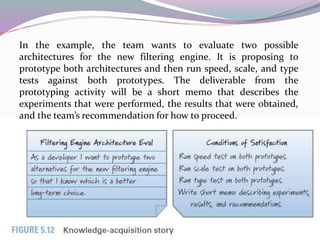
In the example, the team wants to evaluate two possible
architectures for the new filtering engine. It is proposing to
prototype both architectures and then run speed, scale, and type
tests against both prototypes. The deliverable from the
prototyping activity will be a short memo that describes the
experiments that were performed, the results that were obtained,
and the team’s recommendation for how to proceed.
Knowledge-Acquisition
Stories (contd.)
 This specific knowledge-acquisition story looks like a
technical story.
 The business value of any technical story has to be
justifiable to the product owner. Because product
owners think in economic terms, there needs to be an
economic justification for doing this prototyping
work.
 There is likely a compelling technical argument for
doing a knowledge-acquisition story because the team
is typically blocked from making forward progress
until it has the knowledge produced by the story.
Knowledge-Acquisition
Stories (contd.)
 The question for the Scrum team is whether the value of
the acquired information exceeds the cost of getting it.
 Here is how a Scrum team could approach answering that
question.
 First, we need to know the cost of the prototyping. No
good product owner will authorize unbounded
exploration. The team might not be able to answer
particular questions until an architectural decision has
been made, but it must be able to answer the question of
how much effort it wants to spend to buy the
information necessary to make the architectural
decision. So, we ask the team to size the prototyping
story.
Gathering Stories (contd.)
 How do user stories come into existence?
 Traditional approaches to requirements gathering
involve asking the users what they want. But users are
far better critics than they are authors.
“What do
you want?”
Developer User
User
I want ….
Uhmm….. Uhh…
I..- I don’t know
how to describe it.
“Yep, you gave me exactly
what I asked for. But now that I
see that I want something
different.”
Gathering Stories (contd.)
 A better approach is to involve the users as part of the
team that is determining what to build and is
constantly reviewing what is being built.
 To promote this level of participation, many
organizations prefer to employ user-story-writing
workshops as a principal means of generating at least
the initial set of user stories.
 Some also employ story mapping to organize and
provide a user-centered context to their stories.
1. User-Story-Writing
Workshop (contd.)
 The goal of a user-story-writing workshop is to
collectively brainstorm desired business value and
create user story placeholders for what the product or
service is supposed to do.
 The workshop frequently includes the product owner,
ScrumMaster, and development team, in conjunction
with internal and external stakeholders. Most
workshops last anywhere from a few hours to a few
days.
1. User-Story-Writing
Workshop (contd.)
 The goal isn’t to generate a full and complete set of
user stories up front (akin to a complete requirements
specification on a sequential development project).
 Instead, the workshop typically has a specific focus.
For example, do a workshop in conjunction with initial
release planning to generate a candidate set of stories
for the upcoming release.
1. User-Story-Writing
Workshop (contd.)
 If it is the first workshop, usually start by performing
user role analysis.
 The goal is to determine the collection of user roles
that can be used to populate the user role part of our
stories (“As a <user role>, I want to . . .”).
1. User-Story-Writing
Workshop (contd.)
 During the workshop there is no standard way of
generating user stories.
 The top-down approach
 involves the team starting with a large story (like an epic) and
then concentrating its efforts on generating a reasonable
collection of smaller stories associated with the epic.
 The bottom-up approach
 Involves start immediately brainstorming stories that are
associated with the next release of an existing system.
 There isn’t a right or wrong approach; use whatever
approach works well.
2. Story Mapping (contd.)
 A user-centric perspective for generating a set of user
stories. The basic idea is to decompose high-level user
activity into a workflow that can be further
decomposed into a set of detailed tasks.
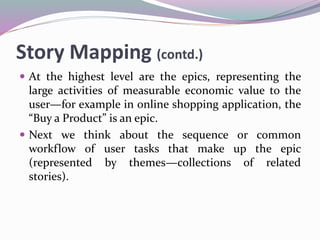
Story Mapping (contd.)
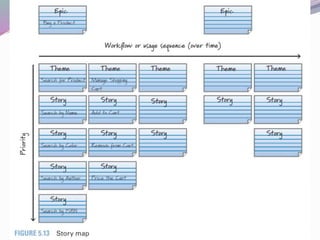
 At the highest level are the epics, representing the
large activities of measurable economic value to the
user—for example in online shopping application, the
“Buy a Product” is an epic.
 Next we think about the sequence or common
workflow of user tasks that make up the epic
(represented by themes—collections of related
stories).
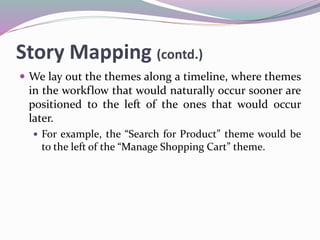
Story Mapping (contd.)
 We lay out the themes along a timeline, where themes
in the workflow that would naturally occur sooner are
positioned to the left of the ones that would occur
later.
 For example, the “Search for Product” theme would be
to the left of the “Manage Shopping Cart” theme.
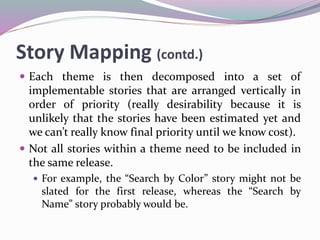
Story Mapping (contd.)
 Each theme is then decomposed into a set of
implementable stories that are arranged vertically in
order of priority (really desirability because it is
unlikely that the stories have been estimated yet and
we can’t really know final priority until we know cost).
 Not all stories within a theme need to be included in
the same release.
 For example, the “Search by Color” story might not be
slated for the first release, whereas the “Search by
Name” story probably would be.
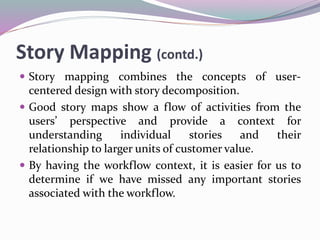
Story Mapping (contd.)
 Story mapping combines the concepts of user-
centered design with story decomposition.
 Good story maps show a flow of activities from the
users’ perspective and provide a context for
understanding individual stories and their
relationship to larger units of customer value.
 By having the workflow context, it is easier for us to
determine if we have missed any important stories
associated with the workflow.
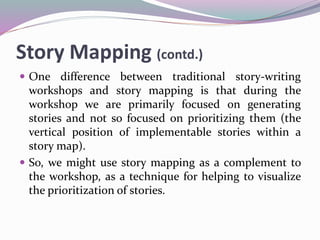
Story Mapping (contd.)
 One difference between traditional story-writing
workshops and story mapping is that during the
workshop we are primarily focused on generating
stories and not so focused on prioritizing them (the
vertical position of implementable stories within a
story map).
 So, we might use story mapping as a complement to
the workshop, as a technique for helping to visualize
the prioritization of stories.
Thank You
2015/ 05/ 17

Scrum - Requirements and User Stories

  • 1.
    2015 - OpenArcCampus – BIT UCSC IT4305- Rapid Software Development Upekha Vandebona upe.vand@gmail.com REF: Essential Scrum Practical Guide to the Most Popular Agile Process, Kenneth S. Rubin
  • 2.
  • 3.
    Chapter 04 -Core Concepts  4.1 - Scrum Framework  4.2 - Sprints  4.3 - Requirements and User Stories  4.4 - Product Backlog  4.5 - Estimation and Velocity
  • 4.
    • Discuss howthe requirements are handled in a Scrum project. • Explain how and when to use User Stories • Describe and practice how to handle nonfunctional requirements and knowledge-acquisition in a scrum project.
  • 5.
    Introduction  Scrum andsequential product development treat requirements very differently. Customer Developer “Now that I see these built features, I realize I need this other feature that isn’t in the requirements document.” “If you wanted that feature, why didn’t you specify it up front?” “Well, if you had thought longer and harder about the requirements up front, you would have found that feature then instead of now.” “Well, I didn’t realize I needed that feature until I saw the product coming together.” 1 2 3 4
  • 6.
    Intro – TraditionalReq  With sequential product development, requirements are nonnegotiable, detailed up front, and meant to stand alone.  These requirements are created up front and given to the development group in the form of a highly detailed document.  It is the job of the development group, then, to produce a product that conforms to the detailed requirements.
  • 7.
    Intro – ScrumReq  In Scrum, the details of a requirement are negotiated through conversations that happen continuously during development and are fleshed out just in time and just enough for the teams to start building functionality to support that requirement.  In contrast, Scrum views requirements as an important degree of freedom that we can manipulate to meet our business goals.
  • 8.
    Introduction  The factis, when developing innovative products, you can’t create complete requirements or designs up front by simply working longer and harder.  Some requirements and design will always emerge once product development is under way; no amount of comprehensive up-front work will prevent that.
  • 9.
    Intro – ScrumReq  For example, if we’re running out of time or money, we can drop low-value requirements.  If, during development, new information indicates that the cost/benefit ratio of a requirement has become significantly less favorable, we can choose to drop the requirement from the product.  And if a new high-value requirement emerges, we have the ability to add it to the product, perhaps discarding a lower-value requirement to make room.
  • 10.
    Introduction  Thus, whenusing Scrum, we don’t invest a great deal of time and money in fleshing out the details of a requirement up front.  Because we expect the specifics to change as time passes and as we learn more about what we are building, we avoid overinvesting in requirements that we might later discard.  Instead of compiling a large inventory of detailed requirements up front, we create placeholders for the requirements, called product backlog items (PBIs). Each product backlog item represents desirable business value.
  • 11.
    Intro – ProductBacklog Items  Initially the product backlog items are large (representing large swaths of business value), and there is very little detail associated with them.  Over time, we flow these product backlog items through a series of conversations among the stakeholders, product owner, and development team, refining them into a collection of smaller, more detailed PBIs.  Eventually a product backlog item is small and detailed enough to move into a sprint, where it will be designed, built, and tested.  Even during the sprint, however, more details will be exposed in conversations between the product owner and the development team.
  • 12.
    While Scrum doesn’tspecify any standard format for these product backlog items, many teams represent PBIs as user stories. You don’t have to. Some teams prefer use cases, and others choose to represent their PBIs in their own custom formats.
  • 13.
    Using Conversations (contd.) Sequential product development relies heavily on written requirements, which look impressive but can easily be misunderstood.  A way to better ensure that the desired features are being built is for the people who know what they want to have timely conversations with the people who are designing, building, and testing those features.
  • 14.
    Using Conversations (contd.) In Scrum we leverage conversation as a key tool for ensuring that requirements are properly discussed and communicated.  Verbal communication has the benefit of being high- bandwidth and providing fast feedback, making it easier and cheaper to gain a shared understanding.  In addition, conversations enable bidirectional communication that can spark ideas about problems and opportunities—discussions that would not likely arise from reading a document.
  • 15.
    Using Conversations (contd.) Conversation, however, is just a tool. It doesn’t replace all documents.  In Scrum, the product backlog is a “living document,” available at all times during product development.  Those who still want or must have a requirements specification document can create one at any time, simply by collecting the product backlog items and all of their associated details into a document formatted however they like.
  • 16.
    Progressive Refinement  Withsequential product development all requirements must be at the same level of detail at the same time. There are no details left to be added.  When using Scrum, not all requirements have to be at the same level of detail at the same time.  Requirements that we’ll work on sooner will be smaller and more detailed
  • 17.
    Forcing all requirementsto the same level of detail at the same time has many disadvantages:
  • 18.
    User Stories  Userstories are a convenient format for expressing the desired business value for many types of product backlog items, especially features.  User stories are crafted in a way that makes them understandable to both business people and technical people.  They are structurally simple and provide a great placeholder for a conversation.  Additionally, they can be written at various levels of granularity and are easy to progressively refine.
  • 19.
    User Story as3C’s Card ConversationConfirmation
  • 20.
    1. Card (contd.) The card idea is pretty simple. People originally wrote (and many still do) user stories directly on 3 × 5-inch index cards or sticky notes.
  • 21.
    Card (contd.)  Thecard isn’t intended to capture all of the information that makes up the requirement.  In fact, we deliberately use small cards with limited space to promote brevity.  A card should hold a few sentences that capture the essence or intent of a requirement.  It serves as the placeholder for more detailed discussions that will take place among the stakeholders, product owner, and development team.
  • 22.
    2. Conversation (contd.) The details of a requirement are exposed and communicated in a conversation among the development team, product owner, and stakeholders. The user story is simply a promise to have that conversation.  One of the benefits of user stories is that they shift some of the focus away from writing and onto conversations.  These conversations enable a richer form of exchanging information and collaborating to ensure that the correct requirements are expressed and understood by everyone.
  • 23.
    Conversation (contd.)  Theconversation is typically not a one-time event, but rather an ongoing dialogue.  There can be an initial conversation when the user story is written,  Another conversation when it’s refined,  Another when it’s estimated,  Another during sprint planning (when the team is diving intothe task-level details),  Finally, ongoing conversations while the user story is being designed, built, and tested during the sprint.
  • 24.
    Conversation (contd.)  Althoughconversations are largely verbal, they can be and frequently are supplemented with documents. Conversations may lead to a UI sketch, or an elaboration of business rules that gets written down.  We’re not tossing out all of our documents in favor of user stories and their associated story cards.  User stories are simply a good starting point for eliciting the initial essence of what is desired, and for providing a reminder to discuss requirements in more detail when appropriate. However, user stories can and should be supplemented with whatever other written information helps provide clarity regarding what is desired.
  • 25.
    Conversation (contd.) Notice thatthe user story references an entire article for future reading and conversation.
  • 26.
    3. Confirmation (contd.) A user story also contains confirmation information in the form of conditions of satisfaction. These are acceptance criteria that clarify the desired behavior. They are used by the development team to better understand what to build and test and by the product owner to confirm that the user story has been implemented to his satisfaction.  If the front of the card has a few-line description of the story, the back of the card could specify the conditions of satisfaction
  • 27.
    Confirmation (contd.)  Theseconditions of satisfaction can be expressed as high-level acceptance tests.  However, these tests would not be the only tests that are run when the story is being developed. In fact, for the handful of acceptance tests that are associated with a user story, the team will have many more tests (perhaps 10 to 100 times more) at a detailed technical level that the product owner doesn’t even know about.
  • 28.
    Confirmation (contd.)  Theacceptance tests associated with the story exist for several reasons.  First, they are an important way to capture and communicate, from the product owner’s perspective, how to determine if the story has been implemented correctly.  These tests can also be a helpful way to create initial stories and refine them as more details become known.  This approach is sometimes called specification by example or acceptance-test-driven development (ATTD). The idea is fairly intuitive.
  • 29.
    Confirmation (contd.)  Discussionsabout the stories can and frequently do focus on defining specific examples or desired behaviors. Initially, let’s limit uploaded file sizes to be 1 GB or less. Also, make sure that we can properly load common text and graphics files. And for legal reasons we can’t have any files with digital rights management (DRM) restrictions loaded to the wiki.
  • 30.
    Confirmation (contd.) By elaboratingon specific examples like these, we can drive the story creation and refinement process and have (automated) acceptance tests available for each story.
  • 31.
    Level of Detail(contd.)  User stories can be written to capture customer and user needs at various levels of abstraction.  The largest would be stories that are a few to many months in size and might span an entire release or multiple releases.  Many people refer to these as epics, alluding to the idea that they are Lord of the Rings or War and Peace size stories. Epics are helpful because they give a very big-picture, high-level overview of what is desired.
  • 32.
    Level of Detail(contd.)  We would never move an epic into a sprint for development because it is way too big and not very detailed. Instead, epics are excellent placeholders for a large collection of more detailed stories to be created at an appropriate future time.
  • 33.
  • 34.
    Level of Detail(contd.)  Tasks are the layer below stories, typically worked on by only one person, or perhaps a pair of people.  Tasks typically require hours to perform. When we go to the task layer, we are specifying how to build something instead of what to build.  Tasks are not stories, so we should avoid including task-level detail when writing stories.
  • 35.
    ‘INVEST’ in GoodStories  How do we know if the stories that we have written are good stories?  ‘INVEST’ offered six criteria that have proved useful when evaluating whether our stories are fit for their intended use or require some additional work  Independent,  Negotiable,  Valuable,  Estimatable,  Small (sized appropriately),  Testable
  • 36.
    1. Independent (contd.) As much as is practical, user stories should be independent or at least only loosely coupled with one another. Stories that exhibit a high degree of interdependence complicate estimating, prioritizing, and planning.
  • 37.
    Independent (contd.)  Imaginethat you have many different stories with a high degree of interdependence. Trying to determine how to prioritize all of these stories and deciding which stories to work on in a sprint would be difficult to say the least.  When applying the independent criteria, the goal is not to eliminate all dependencies, but instead to write stories in a way that minimizes dependencies.
  • 38.
    2. Negotiable (contd.) The details of stories should also be negotiable. Stories are not a written contract in the form of an up-front requirements document.  Instead, stories are placeholders for the conversations where the details will be negotiated.  Good stories clearly capture the essence of what business functionality is desired and why it is desired. However, they leave room for the product owner, the stakeholders, and the team to negotiate the details.
  • 39.
    Negotiable (contd.)  Thisnegotiability helps everyone involved avoid the us-versus-them, finger pointing mentality that is commonplace with detailed up-front requirements documents.  When stories are negotiable, developers can’t really say, “Hey, if you wanted it, you should have put it in the document,” because the details are going to be negotiated with the developers.
  • 40.
    Negotiable (contd.)  Andthe business people can’t really say, “Hey, you obviously didn’t understand the requirements document because you built the wrong thing,” because the business people will be in frequent dialogue with the developers to make sure there is shared clarity.  Writing negotiable stories avoids the problems associated with up-front detailed requirements by making it clear that a dialogue is necessary.
  • 41.
    Negotiable (contd.)  Acommon example of where negotiability is violated is when the product owner tells the team how to implement a story.  Stories should be about what and why, not how.  When the how becomes nonnegotiable, opportunities for the team to be innovative are diminished.
  • 42.
    Negotiable (contd.)  Thereare times, however, when how something is built is actually important to the product owner.  For example, there might be a regulatory obligation to develop a feature in a particular way, or there might be a business constraint directing the use of a specific technology.  In such cases the stories will be a bit less negotiable because some aspect of the “how” is required. That’s OK; not all stories are fully negotiable, but most stories should be.
  • 43.
    3. Valuable (contd.) Stories need to be valuable to a customer, user, or both.  Customers (or choosers) select and pay for the product.  Users actually use the product.  If a story isn’t valuable to either, it doesn’t belong in the product backlog.  “Story #10 isn’t valuable to anyone, but let’s build it anyway.”  We wouldn’t do that. We would either rewrite the story to make it valuable to a customer or user, or we would just discard it.
  • 44.
    Valuable (contd.)  Howabout stories that are valuable to the developers but aren’t of obvious value to the customers or users? Is it OK to have technical stories?
  • 45.
    Valuable (contd.)  Thefundamental problem with technical stories is that the product owner might not perceive any value in them, making it difficult if not impossible to prioritize them against business-valuable stories.  For a technical story to exist, the product owner should understand why he is paying for it and therefore what value it will ultimately deliver.
  • 46.
    Valuable (contd.)  Inthe case of the “Migrate to New Version of Oracle” story, the product owner might not initially understand why it is valuable to change databases.  However, once the team explains the risks of continuing to develop on an unsupported version of a database, the product owner might decide that migrating databases is valuable enough to defer building some new features until the migration is done.
  • 47.
    Valuable (contd.)  Byunderstanding the value, the product owner can treat the technical story like any other business- valuable story and make informed trade-offs.  As a result, this technical story might be included in the product backlog.  In practice, though, most technical stories should not be included in the product backlog.  Instead, these types of stories should be tasks associated with getting business valuable stories done.
  • 48.
    Valuable (contd.)  Ifthe development team has a strong definition of done, there should be no need to write stories like these, because the work is implied by the definition of being done.  The crux of the valuable criteria is that all stories in the backlog must be valuable (worth investing in) from the product owner’s perspective, which represents the customer and user perspectives.  Not all stories are independent, and not all stories are fully negotiable, but they all must be valuable.
  • 49.
    4. Estimatable (contd.) Stories should be estimatable by the team that will design, build, and test them.  Estimates provide an indication of the size and therefore the effort and cost of the stories.  Bigger stories require more effort and therefore cost more money to develop than smaller stories.  Knowing a story’s size provides actionable information to the Scrum team.
  • 50.
    Estimatable (contd.)  Theproduct owner, for example, needs to know the cost of a story to determine its final priority in the product backlog. The Scrum team, on the other hand, can determine from the size of the story whether additional refinement or disaggregation is required.  A large story that we plan to work on soon will need to be broken into a set of smaller stories.
  • 51.
    Estimatable (contd.)  Ifthe team isn’t able to size a story, the story is either just too big or ambiguous to be sized, or the team doesn’t have enough knowledge to estimate a size.  If it’s too big, the team will need to work with the product owner to break it into more manageable stories.  If the team lacks knowledge, some form of exploratory activity will be needed to acquire the information.
  • 52.
    5. Sized Appropriately[Small]  Stories should be sized appropriately for when we plan to work on them.  Stories worked on in sprints should be small.  If we’re doing a several-week sprint, we want to work on several stories that are each a few days in size.  If we have a two-week sprint, we don’t want a two- week-size story, because the risk of not finishing the story is just too great.
  • 53.
    6. Testable (contd.) Stories should be testable in a binary way—they either pass or fail their associated tests.  Being testable means having good acceptance criteria (related to the conditions of satisfaction) associated with the story, which is the “confirmation” aspect of a user story.  Without testable criteria, how would we know if the story is done at the end of the sprint? Also, because these tests frequently provide important story details, they may be needed before the team can even estimate the story.
  • 54.
    Testable (contd.)  Itmay not always be necessary or possible to test a story. For example, epic-size stories probably don’t have tests associated with them.  Also, on occasion there might be a story that the product owner deems valuable, yet there might not be a practical way to test it.  These are more likely to be nonfunctional requirements, such as “As a user I want the system to have 99.999% uptime.”
  • 56.
    Nonfunctional Requirements (contd.) Nonfunctional requirements represent system-level constraints.  As system-level constraints, nonfunctional requirements are important because they affect the design and testing of most or all stories in the product backlog.  For example, having a “Web Browser Support” nonfunctional requirement would be common on any website project. When the team develops the website features, it must ensure that the site features work with all of the specified browsers.  The team must also decide when to test all of the browsers.
  • 57.
    Nonfunctional Requirements (contd.) Each nonfunctional requirement is a prime target for inclusion in the team’s definition of done.  It is recommend that teams should try to include as many of the nonfunctional requirements in their definitions of done as they possibly can.
  • 58.
    Knowledge-Acquisition Stories (contd.)  Sometimeswe need to create a product backlog item that focuses on knowledge acquisition. Perhaps we don’t have enough exploitable knowledge about the product or the process of building the product to move forward.  So we need to explore. Such exploration is known by many names: prototype, proof of concept, experiment, study, spike, and so on. They are all basically exploration activities that involve buying information.
  • 59.
    In the example,the team wants to evaluate two possible architectures for the new filtering engine. It is proposing to prototype both architectures and then run speed, scale, and type tests against both prototypes. The deliverable from the prototyping activity will be a short memo that describes the experiments that were performed, the results that were obtained, and the team’s recommendation for how to proceed.
  • 60.
    Knowledge-Acquisition Stories (contd.)  Thisspecific knowledge-acquisition story looks like a technical story.  The business value of any technical story has to be justifiable to the product owner. Because product owners think in economic terms, there needs to be an economic justification for doing this prototyping work.  There is likely a compelling technical argument for doing a knowledge-acquisition story because the team is typically blocked from making forward progress until it has the knowledge produced by the story.
  • 61.
    Knowledge-Acquisition Stories (contd.)  Thequestion for the Scrum team is whether the value of the acquired information exceeds the cost of getting it.  Here is how a Scrum team could approach answering that question.  First, we need to know the cost of the prototyping. No good product owner will authorize unbounded exploration. The team might not be able to answer particular questions until an architectural decision has been made, but it must be able to answer the question of how much effort it wants to spend to buy the information necessary to make the architectural decision. So, we ask the team to size the prototyping story.
  • 62.
    Gathering Stories (contd.) How do user stories come into existence?  Traditional approaches to requirements gathering involve asking the users what they want. But users are far better critics than they are authors. “What do you want?” Developer User User I want …. Uhmm….. Uhh… I..- I don’t know how to describe it. “Yep, you gave me exactly what I asked for. But now that I see that I want something different.”
  • 63.
    Gathering Stories (contd.) A better approach is to involve the users as part of the team that is determining what to build and is constantly reviewing what is being built.  To promote this level of participation, many organizations prefer to employ user-story-writing workshops as a principal means of generating at least the initial set of user stories.  Some also employ story mapping to organize and provide a user-centered context to their stories.
  • 64.
    1. User-Story-Writing Workshop (contd.) The goal of a user-story-writing workshop is to collectively brainstorm desired business value and create user story placeholders for what the product or service is supposed to do.  The workshop frequently includes the product owner, ScrumMaster, and development team, in conjunction with internal and external stakeholders. Most workshops last anywhere from a few hours to a few days.
  • 65.
    1. User-Story-Writing Workshop (contd.) The goal isn’t to generate a full and complete set of user stories up front (akin to a complete requirements specification on a sequential development project).  Instead, the workshop typically has a specific focus. For example, do a workshop in conjunction with initial release planning to generate a candidate set of stories for the upcoming release.
  • 66.
    1. User-Story-Writing Workshop (contd.) If it is the first workshop, usually start by performing user role analysis.  The goal is to determine the collection of user roles that can be used to populate the user role part of our stories (“As a <user role>, I want to . . .”).
  • 67.
    1. User-Story-Writing Workshop (contd.) During the workshop there is no standard way of generating user stories.  The top-down approach  involves the team starting with a large story (like an epic) and then concentrating its efforts on generating a reasonable collection of smaller stories associated with the epic.  The bottom-up approach  Involves start immediately brainstorming stories that are associated with the next release of an existing system.  There isn’t a right or wrong approach; use whatever approach works well.
  • 68.
    2. Story Mapping(contd.)  A user-centric perspective for generating a set of user stories. The basic idea is to decompose high-level user activity into a workflow that can be further decomposed into a set of detailed tasks.
  • 69.
    Story Mapping (contd.) At the highest level are the epics, representing the large activities of measurable economic value to the user—for example in online shopping application, the “Buy a Product” is an epic.  Next we think about the sequence or common workflow of user tasks that make up the epic (represented by themes—collections of related stories).
  • 70.
    Story Mapping (contd.) We lay out the themes along a timeline, where themes in the workflow that would naturally occur sooner are positioned to the left of the ones that would occur later.  For example, the “Search for Product” theme would be to the left of the “Manage Shopping Cart” theme.
  • 72.
    Story Mapping (contd.) Each theme is then decomposed into a set of implementable stories that are arranged vertically in order of priority (really desirability because it is unlikely that the stories have been estimated yet and we can’t really know final priority until we know cost).  Not all stories within a theme need to be included in the same release.  For example, the “Search by Color” story might not be slated for the first release, whereas the “Search by Name” story probably would be.
  • 73.
    Story Mapping (contd.) Story mapping combines the concepts of user- centered design with story decomposition.  Good story maps show a flow of activities from the users’ perspective and provide a context for understanding individual stories and their relationship to larger units of customer value.  By having the workflow context, it is easier for us to determine if we have missed any important stories associated with the workflow.
  • 74.
    Story Mapping (contd.) One difference between traditional story-writing workshops and story mapping is that during the workshop we are primarily focused on generating stories and not so focused on prioritizing them (the vertical position of implementable stories within a story map).  So, we might use story mapping as a complement to the workshop, as a technique for helping to visualize the prioritization of stories.
  • 75.

Editor's Notes

  • #5 I describe the role of user stories as a common format for representing items of business value. I focus on what user stories are, how they can represent business value at multiple levels of abstraction, and how to determine when the user stories are good. I then describe how to handle nonfunctional requirements and knowledge-acquisition work on a Scrum project. I end by detailing two techniques for gathering user stories.
  • #6 We have probably all had the experience of writing a “complete” requirements document at the beginning of development, only to discover later that an important requirement was missing. When we discovered that missing requirement, the conversation probably sounded something like this:
  • #7 With sequential product development, requirements are treated much as they are in manufacturing: They are required, nonnegotiable specifications to which the product must conform.
  • #10 With sequential product development, requirements are treated much as they are in manufacturing: They are required, nonnegotiable specifications to which the product must conform.
  • #21 A common template format for writing user stories (as shown on the left in Figure 5.2) is to specify a class of users (the user role), what that class of users wants to achieve (the goal), and why the users want to achieve the goal (the benefit) (Cohn 2004). The “so that” part of a user story is optional, but unless the purpose of the story is completely obvious to everyone, we should include it with every user story.
  • #43  The resulting innovation waste could have devastating economic consequences.
  • #53 So ultimately we need small stories, but just because a story is large, that doesn’t mean it’s bad. Let’s say we have an epic-size story that we aren’t planning to work on for another year. Arguably that story is sized appropriately for when we plan to work on it. In fact, if we spent time today breaking that epic down into a collection of smaller stories, it could easily be a complete waste of our time. Of course, if we have an epic that we want to work on in the next sprint, it’s not sized appropriately and we have more work to do to bring it down to size. You must consider when the story will be worked on when applying this criterion.
  • #55 Although the acceptance criteria might be clear, there may be no set of tests that can be run when the system is put into production that can prove that this level of uptime has been met, but the requirement is still valuable as it will drive the design.
  • #58 If the team includes the “Web Browser Support” nonfunctional requirement in the definition of done, the team will have to test any new features added in the sprint with all of the listed browsers. If it doesn’t work with all of them, the story isn’t done. Waiting to test nonfunctional requirements until late in the development effort defers getting fast feedback on critical system performance characteristics.
  • #67 Of course, marketing or market research people might have created a good definition of our users in a separate activity prior to the story-writing workshop.
  • #75 Even if you don’t do formal story mapping, I still find the idea of using workflows to be helpful during my story-writing workshops. They focus the discussion on writing stories within the context of delivering a complete workflow of value to the user. Story maps provide a two-dimensional view of a product backlog instead of the traditional linear (one dimensional) product backlog representation.