
FABRIC STRUCTURE
TWILL WEAVE AND
DERIVATIVES
R.PARANTHAMAN, M.TECH, MBA
ASSISTANT PROFESSOR
INDIAN INSTITUTE OF HANDLOOM TECHNOLOGY,
SALEM
1
Twill and Derivatives
 Study of twill weaves up to 12 threads, classification of twills - warp faced twill,
weft faced twill and equal faced twill; angle of inclination of twill diagonals,
influence of the twist direction of yarn over prominence of twill lines; study of
derivatives of twill weaves - wavy twill, herringbone, transposed twill, broken
twill and curved twill, elongated twill, combined twill, shaded twill and figured
twill; diamond, diaper; regular and irregular sateen and satin up to 12 threads, dice
check using twill and satin weaves; design, draft, denting, peg/tie-up plan and
thread interlacing diagram of above weaves.
2
Twill weave 3
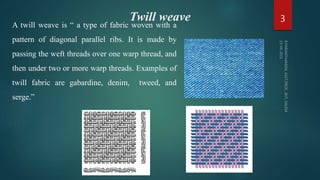
A twill weave is “ a type of fabric woven with a
pattern of diagonal parallel ribs. It is made by
passing the weft threads over one warp thread, and
then under two or more warp threads. Examples of
twill fabric are gabardine, denim, tweed, and
serge.”
Features of twill weave
• TWILL LINE OR DIAGONAL LINE ON THE FACE AND BACK OF THE FABRIC.
• Regular twill angle 45 degree
• Minimum twill angle 15 degree
• Maximum twill angle 75 degree
• Minimum repeat of twill weave: 3x3
• At least three heald frames are needed to produce a minimum repeat of twill weave.
• More compact fabric than plain cloth.
• Suitable for outer wear and repeated wearing.
• Straight drafting system for basic twill weave.
• It has fewer interlacing than plain weave.
It is wrinkle resistant.
• The twill direction is defined as left or right hand twill.
Factors influencing the prominence of twills
 Factors influencing the prominence of twills
The relative prominence of twills is chiefly determined by:
 (a) The character of weave
 (b) The character of yarn
 (c) The number of warp and weft threads per inch
 (d) The direction of twill in relation to the direction of twist imparted to the yarn.
5
Factors influencing the prominence of twills
 (a) The Character of Weave
Twill weaves will be relatively more pronounced if developed from longer than
from shorter floats of yarn.
 (b) Character of yarn
A more pronounced twill will result either from coarse spun of soft spun yarn
than from fine spun or hand spun yarns; also from folded yarn than from single yarn.
6
Factors influencing the prominence of twills
 (c) Number of Threads per inch
A twill will be relatively more or less pronounced in proportion to the number of
warp threads and picks of weft per inch.
 (d) Direction of twill with relation to the direction of twill in the yarn
If twills are produced in the reverse direction to that of the twist in the yarns, they
will be more pronounced and if twills are produced in the same direction as that of the
twist in the yarn, they will be less pronounced.
7
Classification of Twill weaves:
1. According to the way of construction:
Warp way twill weave
Weft way twill weave
2. According to the direction of twill lines on
the face of the fabric:
S-twill or left hand twill weave
Z-twill weave or right hand twill weave
8
3. According to the face yarn:
Warp face twill weave
Weft face twill weave
Equal or Double face twill weave
4. According to the nature of produced
twill line:
Simple twill weave
Expanded twill weave
Multiple twill weave
1. According to the way of construction
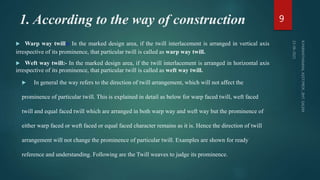
 Warp way twill:- In the marked design area, if the twill interlacement is arranged in vertical axis
irrespective of its prominence, that particular twill is called as warp way twill.
 Weft way twill:- In the marked design area, if the twill interlacement is arranged in horizontal axis
irrespective of its prominence, that particular twill is called as weft way twill.
 In general the way refers to the direction of twill arrangement, which will not affect the
prominence of particular twill. This is explained in detail as below for warp faced twill, weft faced
twill and equal faced twill which are arranged in both warp way and weft way but the prominence of
either warp faced or weft faced or equal faced character remains as it is. Hence the direction of twill
arrangement will not change the prominence of particular twill. Examples are shown for ready
reference and understanding. Following are the Twill weaves to judge its prominence.
9
1. According to the way of construction
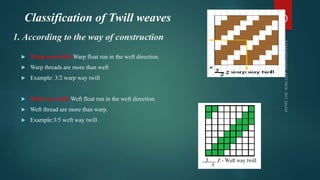
 Warp way twill: Warp float run in the weft direction.
 Warp threads are more than weft
 Example: 3/2 warp way twill
 Weft way twill: Weft float run in the weft direction.
 Weft thread are more than warp.
 Example:3/5 weft way twill
10
Classification of Twill weaves
2. According to the direction of twill line
11
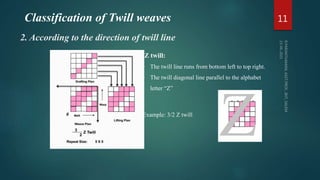
Z twill:
• The twill line runs from bottom left to top right.
• The twill diagonal line parallel to the alphabet
letter “Z”
Example: 3/2 Z twill
Classification of Twill weaves
2. According to the direction of twill line
12
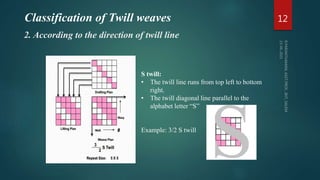
S twill:
• The twill line runs from top left to bottom
right.
• The twill diagonal line parallel to the
alphabet letter “S”
Example: 3/2 S twill
Classification of Twill weaves
 Classification of Twills – Warp Faced Twill, Weft Faced Twill and Equal
Faced Twill:
Twill weaves are classified into 3 categories basing on its Prominence. Prominence
refers to appearance of warp or weft content in one repeat of a twill weave on face
side. They are:
1) Warp Faced Twill, if warp content is greater than weft content on face side.
2) Weft Faced Twill, if weft content is greater than warp content on face side
3) Equal Faced Twill, if warp content and weft content on face side is equal.
Prominence of Twill is decided by looking into its interlacement. Twill weaves are
identified from its interlacement as warp prominence, weft prominence and equal
prominence.
13
3. According to the face yarn
Classification of Twill weaves
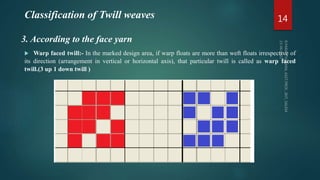
 Warp faced twill:- In the marked design area, if warp floats are more than weft floats irrespective of
its direction (arrangement in vertical or horizontal axis), that particular twill is called as warp faced
twill.(3 up 1 down twill )
14
3. According to the face yarn
Classification of Twill weaves
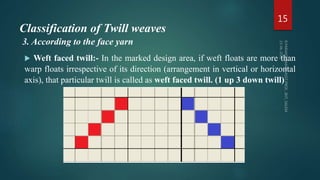
 Weft faced twill:- In the marked design area, if weft floats are more than
warp floats irrespective of its direction (arrangement in vertical or horizontal
axis), that particular twill is called as weft faced twill. (1 up 3 down twill)
15
3. According to the face yarn
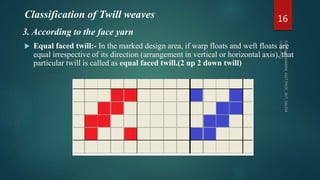
 Equal faced twill:- In the marked design area, if warp floats and weft floats are
equal irrespective of its direction (arrangement in vertical or horizontal axis), that
particular twill is called as equal faced twill.(2 up 2 down twill)
16
Classification of Twill weaves
3. According to the face yarn
4. According to the nature of twill line
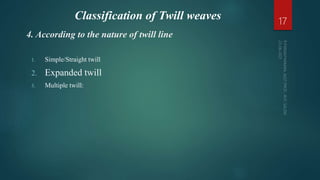
1. Simple/Straight twill
2. Expanded twill
3. Multiple twill:
17
Classification of Twill weaves
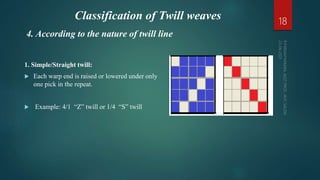
1. Simple/Straight twill:
 Each warp end is raised or lowered under only
one pick in the repeat.
 Example: 4/1 “Z” twill or 1/4 “S” twill
18
4. According to the nature of twill line
Classification of Twill weaves
4. According to the nature of twill line
19
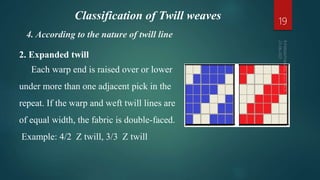
2. Expanded twill
Each warp end is raised over or lower
under more than one adjacent pick in the
repeat. If the warp and weft twill lines are
of equal width, the fabric is double-faced.
Example: 4/2 Z twill, 3/3 Z twill
Classification of Twill weaves
4. According to the nature of twill line
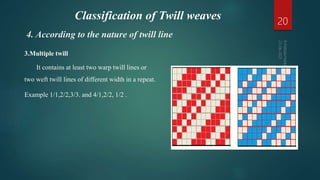
3.Multiple twill
It contains at least two warp twill lines or
two weft twill lines of different width in a repeat.
Example 1/1,2/2,3/3. and 4/1,2/2, 1/2 .
20
Classification of Twill weaves
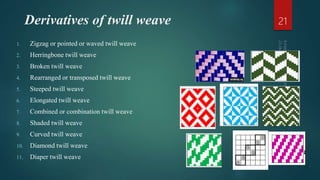
Derivatives of twill weave
1. Zigzag or pointed or waved twill weave
2. Herringbone twill weave
3. Broken twill weave
4. Rearranged or transposed twill weave
5. Steeped twill weave
6. Elongated twill weave
7. Combined or combination twill weave
8. Shaded twill weave
9. Curved twill weave
10. Diamond twill weave
11. Diaper twill weave
21
 These are also known as pointed or Zigzag twills.
 In these classes of twill weaves the twill progresses in one direction for half of the
repeat and then is reversed for the next half of the repeat.
 The reversal of the twill may be done in a regular or irregular manner. Ideally the
reversal of the twill should be done considering the series of threads that
predominate the face of the fabric.
 Thus warp way reversal is done in cases where the warp predominates over the
weft and weft way reversal is done in cases where the weft predominates over the
warp.
22
1. Zigzag or pointed or waved twill weave
 Regular twills are flexible to considerable degree of modification.
 Regular twills serve as bases to construct new designs.
 Wavy twills are one of the best modified forms of regular twills.
 Wavy twills refer to the shape and the form of waves in the sea.
 Wavy twills are constructed by reversing the regular twill, either in end way or pick way.
 Wavy twills are of two kinds;
1) Wavy twill across the cloth, and
2) Wavy twill along the cloth
23
1. Zigzag or pointed or waved twill weave
1. Wavy twill across the cloth:
 Wavy twill across is achieved by reversing the regular twill at suitable intervals upon a warp end.
 In this style wavy effects are produced across the cloth or horizontally in the cloth.
 To produce horizontal wavy effects in the cloth, pointed drafts are required in the loom.
 Draft order is reversed at suitable intervals.
 If draft order is reversed at one place uniformly, the resultant wavy effects are uniform and are called as,
‘Regular wavy twill’.
 If the draft order is reversed at many places without uniformity, the resultant wavy effects are ir – regular
or fancy and are called as, ‘Irregular wavy twill or Fancy wavy twills’.
 Wavy twills on more number of ends is possible with minimum number of heald shafts. Hence, design size
increases.
24
1. Zigzag or pointed or waved twill weave
 Ends per repeat of the design are calculated as below
Ends per repeat = No. of heald shafts x 2 – 2 or No. of ends in base x 2 – 2,
(Ex. For 4x4 twill is 4 x 2 – 2 = 6 ends with 4 picks )
Above two formulas are suitable to calculate the ends per repeat of wavy twills
reversing at one place.
25
1. Zigzag or pointed or waved twill weave
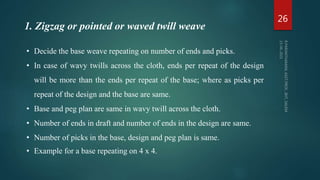
• Decide the base weave repeating on number of ends and picks.
• In case of wavy twills across the cloth, ends per repeat of the design
will be more than the ends per repeat of the base; where as picks per
repeat of the design and the base are same.
• Base and peg plan are same in wavy twill across the cloth.
• Number of ends in draft and number of ends in the design are same.
• Number of picks in the base, design and peg plan is same.
• Example for a base repeating on 4 x 4.
1. Zigzag or pointed or waved twill weave
26
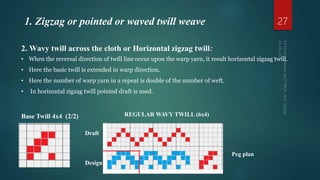
Base Twill 4x4 (2/2) REGULAR WAVY TWILL (6x4)
Design
Draft
Peg plan
1. Zigzag or pointed or waved twill weave
2. Wavy twill across the cloth or Horizontal zigzag twill:
• When the reversal direction of twill line occur upon the warp yarn, it result horizontal zigzag twill.
• Here the basic twill is extended in warp direction.
• Here the number of warp yarn in a repeat is double of the number of weft.
• In horizontal zigzag twill pointed draft is used.
27
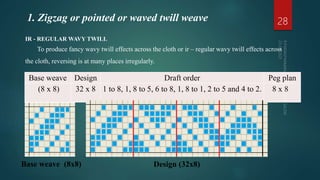
Base weave Design Draft order Peg plan
(8 x 8) 32 x 8 1 to 8, 1, 8 to 5, 6 to 8, 1, 8 to 1, 2 to 5 and 4 to 2. 8 x 8
Base weave (8x8) Design (32x8)
1. Zigzag or pointed or waved twill weave
IR - REGULAR WAVY TWILL
To produce fancy wavy twill effects across the cloth or ir – regular wavy twill effects across
the cloth, reversing is at many places irregularly.
28
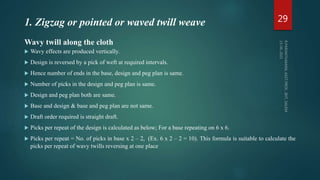
Wavy twill along the cloth
 Wavy effects are produced vertically.
 Design is reversed by a pick of weft at required intervals.
 Hence number of ends in the base, design and peg plan is same.
 Number of picks in the design and peg plan is same.
 Design and peg plan both are same.
 Base and design & base and peg plan are not same.
 Draft order required is straight draft.
 Picks per repeat of the design is calculated as below; For a base repeating on 6 x 6.
 Picks per repeat = No. of picks in base x 2 – 2, (Ex. 6 x 2 – 2 = 10). This formula is suitable to calculate the
picks per repeat of wavy twills reversing at one place
29
1. Zigzag or pointed or waved twill weave
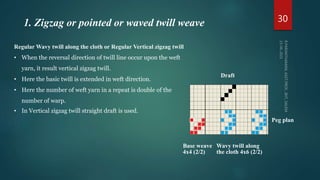
30
Base weave
4x4 (2/2)
Wavy twill along
the cloth 4x6 (2/2)
Draft
Peg plan
1. Zigzag or pointed or waved twill weave
Regular Wavy twill along the cloth or Regular Vertical zigzag twill
• When the reversal direction of twill line occur upon the weft
yarn, it result vertical zigzag twill.
• Here the basic twill is extended in weft direction.
• Here the number of weft yarn in a repeat is double of the
number of warp.
• In Vertical zigzag twill straight draft is used.
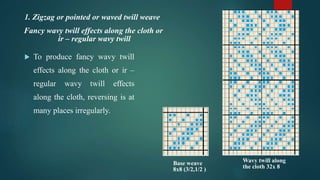
 To produce fancy wavy twill
effects along the cloth or ir –
regular wavy twill effects
along the cloth, reversing is at
many places irregularly.
31
1. Zigzag or pointed or waved twill weave
Base weave
8x8 (3/2,1/2 )
Wavy twill along
the cloth 32x 8
Fancy wavy twill effects along the cloth or
ir – regular wavy twill
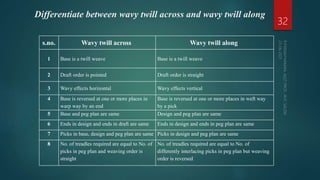
Differentiate between wavy twill across and wavy twill along
s.no. Wavy twill across Wavy twill along
1 Base is a twill weave Base is a twill weave
2 Draft order is pointed Draft order is straight
3 Wavy effects horizontal Wavy effects vertical
4 Base is reversed at one or more places in
warp way by an end
Base is reversed at one or more places in weft way
by a pick
5 Base and peg plan are same Design and peg plan are same
6 Ends in design and ends in draft are same Ends in design and ends in peg plan are same
7 Picks in base, design and peg plan are same Picks in design and peg plan are same
8 No. of treadles required are equal to No. of
picks in peg plan and weaving order is
straight
No. of treadles required are equal to No. of
differently interlacing picks in peg plan but weaving
order is reversed
32
Derivatives of twill weave
 In Herring Bone twills, the twill is reversed as in the event of pointed twills.
However, the pointed effect is broken. This type of construction produces a
distinct stripe effect and also prevents the formation of an extended float where the
weave turns. The herringbone twill is considered to be more benefit than the
pointedtwills.
33
2. Herringbone Twill
Derivatives of twill weave
 Herringbone Twills:
 Herringbone twills results the formation of zig- zag effects in the woven cloth.
 Herringbone twills depend upon the reversal of direction.
 Herringbone twills differ from wavy twills because at the place of reversing there will be,”
cut or break” effects in the fabric after weaving.
 Herringbone twills do not come to a point, where it changes the direction.
 Hence, there will not be continuity in the diagonal lines or at the places of reversing.
34
2. Herringbone Twill
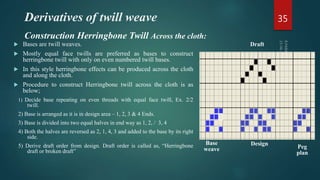
Derivatives of twill weave
 Bases are twill weaves.
 Mostly equal face twills are preferred as bases to construct
herringbone twill with only on even numbered twill bases.
 In this style herringbone effects can be produced across the cloth
and along the cloth.
 Procedure to construct Herringbone twill across the cloth is as
below;
1) Decide base repeating on even threads with equal face twill, Ex. 2/2
twill.
2) Base is arranged as it is in design area – 1, 2, 3 & 4 Ends.
3) Base is divided into two equal halves in end way as 1, 2, / 3, 4
4) Both the halves are reversed as 2, 1, 4, 3 and added to the base by its right
side.
5) Derive draft order from design. Draft order is called as, “Herringbone
draft or broken draft”
35
Construction Herringbone Twill Across the cloth:
Base
weave
Design
Peg
plan
Draft
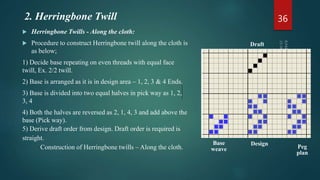
 Herringbone Twills - Along the cloth:
 Procedure to construct Herringbone twill along the cloth is
as below;
1) Decide base repeating on even threads with equal face
twill, Ex. 2/2 twill.
2) Base is arranged as it is in design area – 1, 2, 3 & 4 Ends.
3) Base is divided into two equal halves in pick way as 1, 2,
3, 4
4) Both the halves are reversed as 2, 1, 4, 3 and add above the
base (Pick way).
5) Derive draft order from design. Draft order is required is
straight.
Construction of Herringbone twills – Along the cloth.
36
2. Herringbone Twill
Base
weave
Design
Peg
plan
Draft
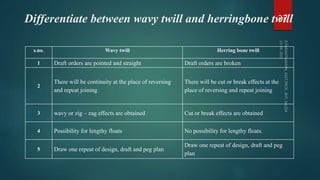
Differentiate between wavy twill and herringbone twill
37
s.no. Wavy twill Herring bone twill
1 Draft orders are pointed and straight Draft orders are broken
2
There will be continuity at the place of reversing
and repeat joining
There will be cut or break effects at the
place of reversing and repeat joining
3 wavy or zig – zag effects are obtained Cut or break effects are obtained
4 Possibility for lengthy floats No possibility for lengthy floats.
5 Draw one repeat of design, draft and peg plan
Draw one repeat of design, draft and peg
plan
Broken twills
Regular twills results the formation of continuous diagonal line. Breaking the regular twill diagonal
produce a large variety of attractive effects. Resultant effects are called as, “broken twills”.
Broken twill effects are obtained by reversing a portion of diagonal for breaking the continuity. Broken
twills are some what similar in appearance to that of herringbone twills. Cut or break effect is the feature of
broken twills at the place of reversing and repeat joining. Herringbone twills are called as broken twills, but
broken twills are not herringbone twills. Broken twills are arranged in two different styles;
1) Reversing style,
2) filling and missing style.
Broken twills
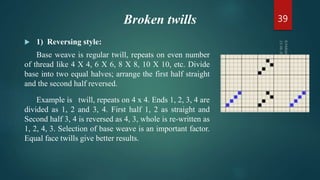
 1) Reversing style:
Base weave is regular twill, repeats on even number
of thread like 4 X 4, 6 X 6, 8 X 8, 10 X 10, etc. Divide
base into two equal halves; arrange the first half straight
and the second half reversed.
Example is twill, repeats on 4 x 4. Ends 1, 2, 3, 4 are
divided as 1, 2 and 3, 4. First half 1, 2 as straight and
Second half 3, 4 is reversed as 4, 3, whole is re-written as
1, 2, 4, 3. Selection of base weave is an important factor.
Equal face twills give better results.
39
Broken twills
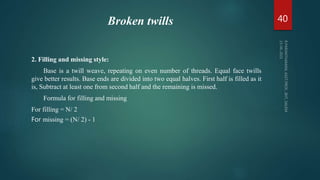
2. Filling and missing style:
Base is a twill weave, repeating on even number of threads. Equal face twills
give better results. Base ends are divided into two equal halves. First half is filled as it
is, Subtract at least one from second half and the remaining is missed.
Formula for filling and missing
For filling = N/ 2
For missing = (N/ 2) - 1
40
Broken twills
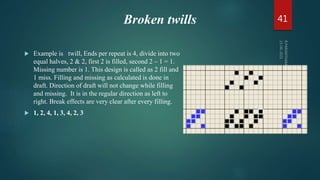
 Example is twill, Ends per repeat is 4, divide into two
equal halves, 2 & 2, first 2 is filled, second 2 – 1 = 1.
Missing number is 1. This design is called as 2 fill and
1 miss. Filling and missing as calculated is done in
draft. Direction of draft will not change while filling
and missing. It is in the regular direction as left to
right. Break effects are very clear after every filling.
 1, 2, 4, 1, 3, 4, 2, 3
41
Curved twills
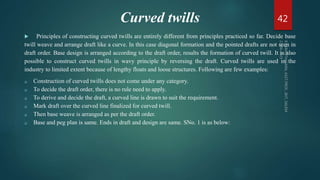
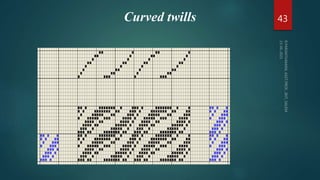
 Principles of constructing curved twills are entirely different from principles practiced so far. Decide base
twill weave and arrange draft like a curve. In this case diagonal formation and the pointed drafts are not seen in
draft order. Base design is arranged according to the draft order, results the formation of curved twill. It is also
possible to construct curved twills in wavy principle by reversing the draft. Curved twills are used in the
industry to limited extent because of lengthy floats and loose structures. Following are few examples:
 Construction of curved twills does not come under any category.
 To decide the draft order, there is no rule need to apply.
 To derive and decide the draft, a curved line is drawn to suit the requirement.
 Mark draft over the curved line finalized for curved twill.
 Then base weave is arranged as per the draft order.
 Base and peg plan is same. Ends in draft and design are same. SNo. 1 is as below:
42
Curved twills 43
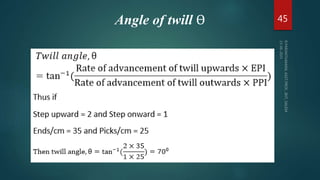
Angle of twill
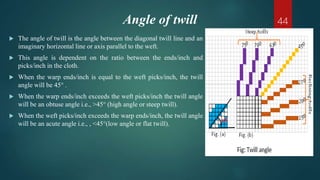
 The angle of twill is the angle between the diagonal twill line and an
imaginary horizontal line or axis parallel to the weft.
 This angle is dependent on the ratio between the ends/inch and
picks/inch in the cloth.
 When the warp ends/inch is equal to the weft picks/inch, the twill
angle will be 45° .
 When the warp ends/inch exceeds the weft picks/inch the twill angle
will be an obtuse angle i.e., >45° (high angle or steep twill).
 When the weft picks/inch exceeds the warp ends/inch, the twill angle
will be an acute angle i.e., , <45°(low angle or flat twill).
44
Angle of twill Ө 45
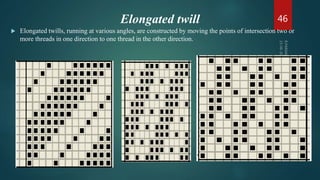
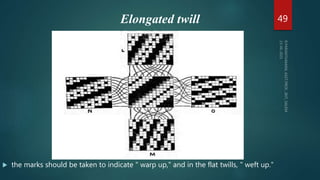
Elongated twill
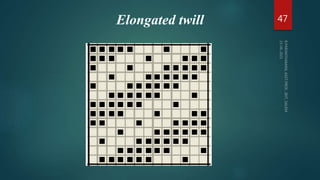
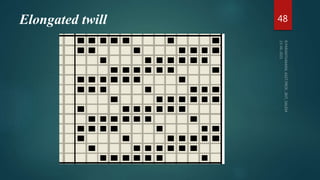
 Elongated twills, running at various angles, are constructed by moving the points of intersection two or
more threads in one direction to one thread in the other direction.
46
Elongated twill 47
Elongated twill 48
Elongated twill
 the marks should be taken to indicate " warp up," and in the flat twills, " weft up."
49
Combined Twills
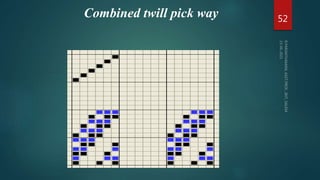
 It is possible to combine two or more ordinary twill weaves in the order of end on end or
pick on pick. Selection of twill bases is very important factor.
 There are several methods to construct combination of twill weaves.
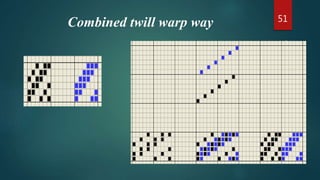
 Select two twill bases repeating on same number of ends and picks but differently
interlaced.
 Combine both the bases end on end alternately. First end from first base, first end from
second base; second end from first base, second end from second base; and so on till the
end.
 When both the bases are repeating on same number of ends and picks, (Ex. 6 x 6)
resultant combined twill will repeats on 12 x 6 if combined end way.
50
Combined twill warp way 51
Combined twill pick way 52
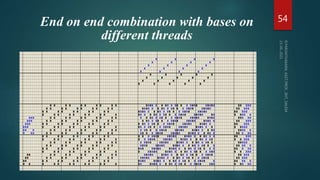
End on end combination with bases on
different threads
 Further it is also possible to combine two twill bases
repeating on different number of threads per repeat.
 A = 4x4 twill
 B = 5x 5 twill
 LCM of 4 and 5 =20
 The design on warp way combination is 40x 20
 The design on weft way combination is 20 x 40
53
End on end combination with bases on
different threads
54
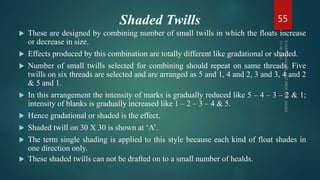
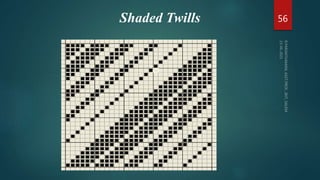
Shaded Twills
 These are designed by combining number of small twills in which the floats increase
or decrease in size.
 Effects produced by this combination are totally different like gradational or shaded.
 Number of small twills selected for combining should repeat on same threads. Five
twills on six threads are selected and are arranged as 5 and 1, 4 and 2, 3 and 3, 4 and 2
& 5 and 1.
 In this arrangement the intensity of marks is gradually reduced like 5 – 4 – 3 – 2 & 1;
intensity of blanks is gradually increased like 1 – 2 – 3 – 4 & 5.
 Hence gradational or shaded is the effect.
 Shaded twill on 30 X 30 is shown at ‘A’.
 The term single shading is applied to this style because each kind of float shades in
one direction only.
 These shaded twills can not be drafted on to a small number of healds.
55
Shaded Twills 56
Shaded Twills
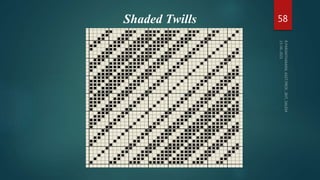
 The term double shading is applied to the style, which is composed
of number of small twills in ascending and descending order.
 Four twills on five threads are selected and are arranged as 1 and 4,
2 and 3, 3 and 2 & 4 and 1 in ascending order.
 Three twills on six threads are selected and are arranged as 4 and 2,
3 and 3 & 2 and 4 in descending order.
 Double shaded twill on 38 X 38 is shown at ‘B’.
57
Shaded Twills 58
Shaded Twills
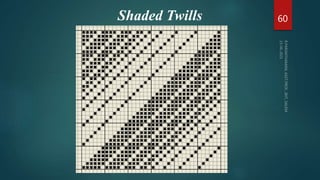
 Another style to produce shaded twill is with number of
small twills on different threads and by reverse. The
arrangement is 5 and 1, 4 and 1, 3 and 1 & 2 and 1; all the
four are reversed as 1 and 2, 1 and 3, 1 and 4 & 1 and 5.
This repeats on 36 X 36 is shown at ‘C’.
59
Shaded Twills 60
Figured Twills
 The arrangement of small spots or figures in conjunction with, and running
at the same angle, as ordinary twill is called as, “Figured Twills”.
 A spot may be repeated diagonally one or more times in each repeat of the
twill lines and to find the repeat of a spot, it is necessary to count the spaces
diagonally.
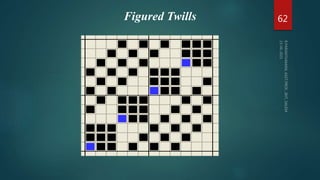
 For example, in design ‘A’ First colour at the beginning of spots, which
indicate corresponding positions of the spots, occur on every third space
counted diagonally and in order to show this clearly, second colour is
indicated between the crosses.
 The complete repeat of the twill is on 12 X 12 and the spot is therefore
repeated four times.
61
Figured Twills 62
Figured Twills
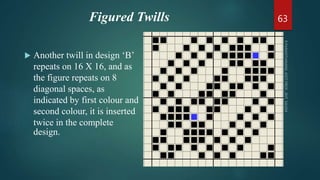
 Another twill in design ‘B’
repeats on 16 X 16, and as
the figure repeats on 8
diagonal spaces, as
indicated by first colour and
second colour, it is inserted
twice in the complete
design.
63
Figured Twills
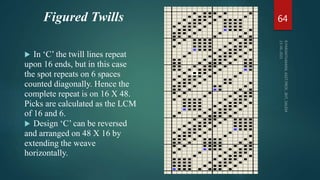
 In ‘C’ the twill lines repeat
upon 16 ends, but in this case
the spot repeats on 6 spaces
counted diagonally. Hence the
complete repeat is on 16 X 48.
Picks are calculated as the LCM
of 16 and 6.
 Design ‘C’ can be reversed
and arranged on 48 X 16 by
extending the weave
horizontally.
64
Figured Twills
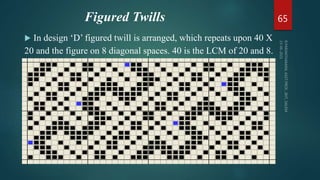
 In design ‘D’ figured twill is arranged, which repeats upon 40 X
20 and the figure on 8 diagonal spaces. 40 is the LCM of 20 and 8.
65
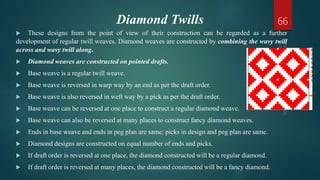
Diamond Twills
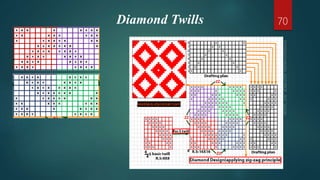
 These designs from the point of view of their construction can be regarded as a further
development of regular twill weaves. Diamond weaves are constructed by combining the wavy twill
across and wavy twill along.
 Diamond weaves are constructed on pointed drafts.
 Base weave is a regular twill weave.
 Base weave is reversed in warp way by an end as per the draft order.
 Base weave is also reversed in weft way by a pick as per the draft order.
 Base weave can be reversed at one place to construct a regular diamond weave.
 Base weave can also be reversed at many places to construct fancy diamond weaves.
 Ends in base weave and ends in peg plan are same; picks in design and peg plan are same.
 Diamond designs are constructed on equal number of ends and picks.
 If draft order is reversed at one place, the diamond constructed will be a regular diamond.
 If draft order is reversed at many places, the diamond constructed will be a fancy diamond.
66
Diamond Twills
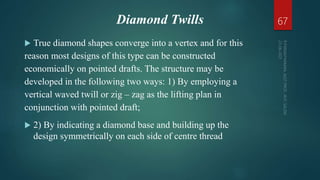
 True diamond shapes converge into a vertex and for this
reason most designs of this type can be constructed
economically on pointed drafts. The structure may be
developed in the following two ways: 1) By employing a
vertical waved twill or zig – zag as the lifting plan in
conjunction with pointed draft;
 2) By indicating a diamond base and building up the
design symmetrically on each side of centre thread
67
Diamond Twills
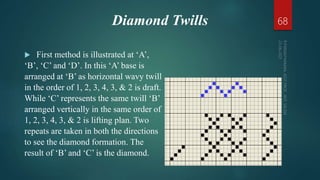
 First method is illustrated at ‘A’,
‘B’, ‘C’ and ‘D’. In this ‘A’ base is
arranged at ‘B’ as horizontal wavy twill
in the order of 1, 2, 3, 4, 3, & 2 is draft.
While ‘C’ represents the same twill ‘B’
arranged vertically in the same order of
1, 2, 3, 4, 3, & 2 is lifting plan. Two
repeats are taken in both the directions
to see the diamond formation. The
result of ‘B’ and ‘C’ is the diamond.
68
Diamond Twills
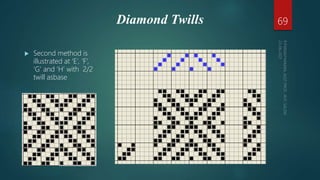
 Second method is
illustrated at ‘E’, ‘F’,
‘G’ and ‘H’ with 2/2
twill asbase
69
Diamond Twills 70
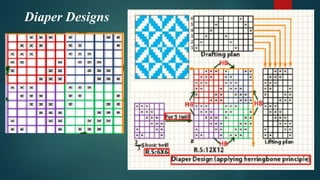
Diaper Designs
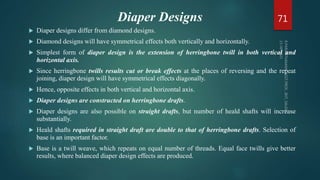
 Diaper designs differ from diamond designs.
 Diamond designs will have symmetrical effects both vertically and horizontally.
 Simplest form of diaper design is the extension of herringbone twill in both vertical and
horizontal axis.
 Since herringbone twills results cut or break effects at the places of reversing and the repeat
joining, diaper design will have symmetrical effects diagonally.
 Hence, opposite effects in both vertical and horizontal axis.
 Diaper designs are constructed on herringbone drafts.
 Diaper designs are also possible on straight drafts, but number of heald shafts will increase
substantially.
 Heald shafts required in straight draft are double to that of herringbone drafts. Selection of
base is an important factor.
 Base is a twill weave, which repeats on equal number of threads. Equal face twills give better
results, where balanced diaper design effects are produced.
71
 Diaper designs are constructed on equal number of ends and picks.
 More elaborate diaper designs are possible if the draft order is herringbone.
 In case of herringbone draft, number of ends in the base weave and the
number of heald shafts is equal.
 Number of picks in the design and peg plan is same.
 Number of ends in design and draft order is same.
 If the interlacement of a base weave is divided into two equal halves, and
both the halves are symmetrical interlacements, then the lifts in both the
halves of the base will have diametrically opposite interlacements.
72
Diaper Designs
Diaper Designs 73
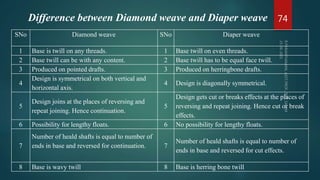
Difference between Diamond weave and Diaper weave
SNo Diamond weave SNo Diaper weave
1 Base is twill on any threads. 1 Base twill on even threads.
2 Base twill can be with any content. 2 Base twill has to be equal face twill.
3 Produced on pointed drafts. 3 Produced on herringbone drafts.
4
Design is symmetrical on both vertical and
horizontal axis.
4 Design is diagonally symmetrical.
5
Design joins at the places of reversing and
repeat joining. Hence continuation.
5
Design gets cut or breaks effects at the places of
reversing and repeat joining. Hence cut or break
effects.
6 Possibility for lengthy floats. 6 No possibility for lengthy floats.
7
Number of heald shafts is equal to number of
ends in base and reversed for continuation. 7
Number of heald shafts is equal to number of
ends in base and reversed for cut effects.
8 Base is wavy twill 8 Base is herring bone twill
74
Satin and Sateen
 Satin is a warp faced rearranged twill and sateen is a rearranged weft faced twill.
 Thus satin is the reverse side of sateen weaves.
 These weaves form an important category of weaves.
 They are used in combination with other weaves, particularly in case of ornamented
fabrics.
 The striking feature of these weaves is their bright appearance and smooth feel.
75
Satin and Sateen
 The basic characteristic of satin/sateen weaves are :
 (i) They are either warp or weft faced weaves
 (ii) Have no prominent weave structures
 (iii) Only one binding point in each end or pick
 (iv) No continuous twill lines
 (v) Have poor seam strength due to thread mobility
 (vi) More thread density is possible in warp and weft
 (vii) More mass per unit area is possible
 (viii) Have less binding points and more float lengths
 (ix) Use of move numbers (intervals of selection) is necessary to construct these weaves.
 x) construction on both the directions Horizontal axis direction, and Vertical axis direction
In the construction of satin/sateen weaves, the stitching points of warp or weft for a given repeat size is
done by the use of move numbers or stitch or float numbers. The move numbers
are selected according to the repeat size of the weave
76
Choosing move numbers
 In choosing move numbers for the construction of satin/sateen weaves, the
following rules are to be adopted:
 (a) The move number should not be equal to the repeat of the weave
 (b) It should not be one less than the repeat size
 (c) It should not be a factor of the repeat size, and
 (d) It should not be a multiple of the factor .
77
Characteristics of Satin weave
 Satin woven fabrics will have more number of ends than picks in a unit space.
 One end in a repeat of satin weave will float over all the picks except one.
 Stitching points in a repeat of satin weave is arranged apart.
 Hence, ends will move very close to each other resulting packed structures and heavy construction is possible.
 Satin weaves will not result the formation of diagonal line. Satin woven fabrics will have soft feel and subdued effects.
 Satin weaves are very widely used in textile industry in general and furnishings in particular.
 Fabrics woven with Satin weaves will produce silky appearance.
 Satin woven fabrics will have the maximum degree of smoothness and luster.
 Ends per inch are greater than picks per inch in satin woven fabrics.
 Hence, production is higher.
 Satin is further classified as:
1) Regular satin,
2) Ir – regular satin.
78
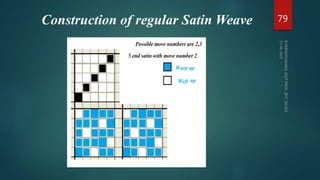
Construction of regular Satin Weave 79
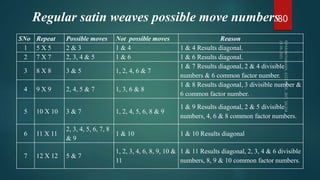
Regular satin weaves possible move numbers
SNo Repeat Possible moves Not possible moves Reason
1 5 X 5 2 & 3 1 & 4 1 & 4 Results diagonal.
2 7 X 7 2, 3, 4 & 5 1 & 6 1 & 6 Results diagonal.
3 8 X 8 3 & 5 1, 2, 4, 6 & 7
1 & 7 Results diagonal, 2 & 4 divisible
numbers & 6 common factor number.
4 9 X 9 2, 4, 5 & 7 1, 3, 6 & 8
1 & 8 Results diagonal, 3 divisible number &
6 common factor number.
5 10 X 10 3 & 7 1, 2, 4, 5, 6, 8 & 9
1 & 9 Results diagonal, 2 & 5 divisible
numbers, 4, 6 & 8 common factor numbers.
6 11 X 11
2, 3, 4, 5, 6, 7, 8
& 9
1 & 10 1 & 10 Results diagonal
7 12 X 12 5 & 7
1, 2, 3, 4, 6, 8, 9, 10 &
11
1 & 11 Results diagonal, 2, 3, 4 & 6 divisible
numbers, 8, 9 & 10 common factor numbers.
80
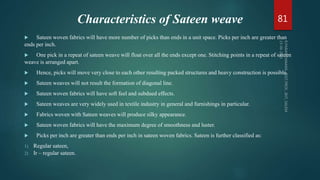
Characteristics of Sateen weave
 Sateen woven fabrics will have more number of picks than ends in a unit space. Picks per inch are greater than
ends per inch.
 One pick in a repeat of sateen weave will float over all the ends except one. Stitching points in a repeat of sateen
weave is arranged apart.
 Hence, picks will move very close to each other resulting packed structures and heavy construction is possible.
 Sateen weaves will not result the formation of diagonal line.
 Sateen woven fabrics will have soft feel and subdued effects.
 Sateen weaves are very widely used in textile industry in general and furnishings in particular.
 Fabrics woven with Sateen weaves will produce silky appearance.
 Sateen woven fabrics will have the maximum degree of smoothness and luster.
 Picks per inch are greater than ends per inch in sateen woven fabrics. Sateen is further classified as:
1) Regular sateen,
2) Ir – regular sateen.
81
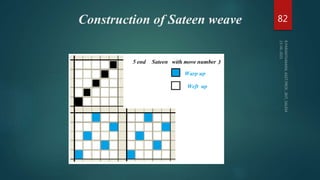
Construction of Sateen weave 82
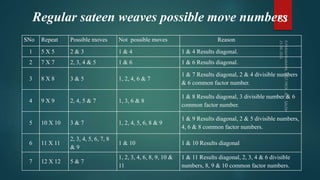
Regular sateen weaves possible move numbers
SNo Repeat Possible moves Not possible moves Reason
1 5 X 5 2 & 3 1 & 4 1 & 4 Results diagonal.
2 7 X 7 2, 3, 4 & 5 1 & 6 1 & 6 Results diagonal.
3 8 X 8 3 & 5 1, 2, 4, 6 & 7
1 & 7 Results diagonal, 2 & 4 divisible numbers
& 6 common factor number.
4 9 X 9 2, 4, 5 & 7 1, 3, 6 & 8
1 & 8 Results diagonal, 3 divisible number & 6
common factor number.
5 10 X 10 3 & 7 1, 2, 4, 5, 6, 8 & 9
1 & 9 Results diagonal, 2 & 5 divisible numbers,
4, 6 & 8 common factor numbers.
6 11 X 11
2, 3, 4, 5, 6, 7, 8
& 9
1 & 10 1 & 10 Results diagonal
7 12 X 12 5 & 7
1, 2, 3, 4, 6, 8, 9, 10 &
11
1 & 11 Results diagonal, 2, 3, 4 & 6 divisible
numbers, 8, 9 & 10 common factor numbers.
83
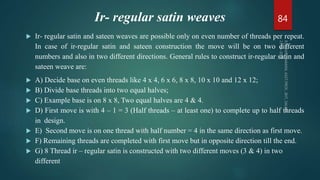
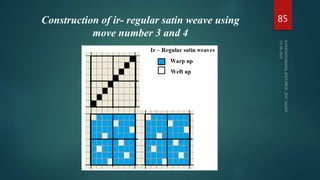
Ir- regular satin weaves
 Ir- regular satin and sateen weaves are possible only on even number of threads per repeat.
In case of ir-regular satin and sateen construction the move will be on two different
numbers and also in two different directions. General rules to construct ir-regular satin and
sateen weave are:
 A) Decide base on even threads like 4 x 4, 6 x 6, 8 x 8, 10 x 10 and 12 x 12;
 B) Divide base threads into two equal halves;
 C) Example base is on 8 x 8, Two equal halves are 4 & 4.
 D) First move is with 4 – 1 = 3 (Half threads – at least one) to complete up to half threads
in design.
 E) Second move is on one thread with half number = 4 in the same direction as first move.
 F) Remaining threads are completed with first move but in opposite direction till the end.
 G) 8 Thread ir – regular satin is constructed with two different moves (3 & 4) in two
different
84
Construction of ir- regular satin weave using
move number 3 and 4
85
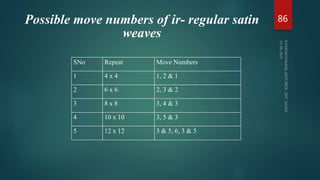
Possible move numbers of ir- regular satin
weaves
SNo Repeat Move Numbers
1 4 x 4 1, 2 & 1
2 6 x 6 2, 3 & 2
3 8 x 8 3, 4 & 3
4 10 x 10 3, 5 & 3
5 12 x 12 3 & 5, 6, 3 & 5
86
Ir – regular Sateen weaves
 In pure sateen weaves the surface of cloth consists entirely weft float.
 In the repeat of a weave each thread passes over all except one thread of the other series.
 In addition, the interlacing points are so arranged as to allow the floating threads to slip and cover the,
‘Binding point’ of one thread by the float of another.
 This results in the production of fabrics with a maximum degree of smoothness and luster and without any
prominent weave features.
 Threads in this weave are very closely packed structures are possible and quite heavy constructions can be
achieved.
 Fabrics with insufficiently close thread spacing, however exhibit poor seam strength in made up fabrics due
to seam slippage arising on account of the excessive freedom of threads.
 People in the Industry use the general term sateen for the fabrics woven with either warp face or weft face
prominence.
87
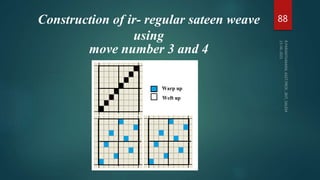
Construction of ir- regular sateen weave
using
move number 3 and 4
88
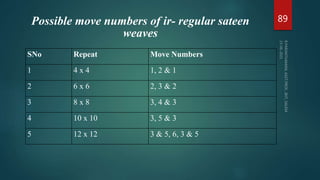
Possible move numbers of ir- regular sateen
weaves
SNo Repeat Move Numbers
1 4 x 4 1, 2 & 1
2 6 x 6 2, 3 & 2
3 8 x 8 3, 4 & 3
4 10 x 10 3, 5 & 3
5 12 x 12 3 & 5, 6, 3 & 5
89
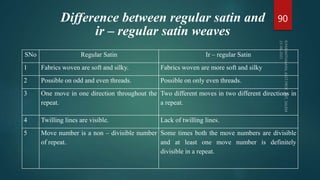
Difference between regular satin and
ir – regular satin weaves
SNo Regular Satin Ir – regular Satin
1 Fabrics woven are soft and silky. Fabrics woven are more soft and silky
2 Possible on odd and even threads. Possible on only even threads.
3 One move in one direction throughout the
repeat.
Two different moves in two different directions in
a repeat.
4 Twilling lines are visible. Lack of twilling lines.
5 Move number is a non – divisible number
of repeat.
Some times both the move numbers are divisible
and at least one move number is definitely
divisible in a repeat.
90
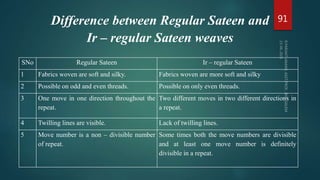
Difference between Regular Sateen and
Ir – regular Sateen weaves
SNo Regular Sateen Ir – regular Sateen
1 Fabrics woven are soft and silky. Fabrics woven are more soft and silky
2 Possible on odd and even threads. Possible on only even threads.
3 One move in one direction throughout the
repeat.
Two different moves in two different directions in
a repeat.
4 Twilling lines are visible. Lack of twilling lines.
5 Move number is a non – divisible number
of repeat.
Some times both the move numbers are divisible
and at least one move number is definitely
divisible in a repeat.
91
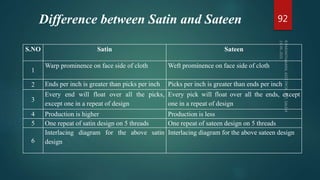
Difference between Satin and Sateen
S.NO Satin Sateen
1
Warp prominence on face side of cloth Weft prominence on face side of cloth
2 Ends per inch is greater than picks per inch Picks per inch is greater than ends per inch
3
Every end will float over all the picks,
except one in a repeat of design
Every pick will float over all the ends, except
one in a repeat of design
4 Production is higher Production is less
5 One repeat of satin design on 5 threads One repeat of sateen design on 5 threads
6
Interlacing diagram for the above satin
design
Interlacing diagram for the above sateen design
92
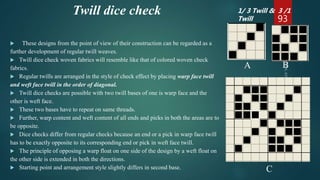
Twill dice check
 These designs from the point of view of their construction can be regarded as a
further development of regular twill weaves.
 Twill dice check woven fabrics will resemble like that of colored woven check
fabrics.
 Regular twills are arranged in the style of check effect by placing warp face twill
and weft face twill in the order of diagonal.
 Twill dice checks are possible with two twill bases of one is warp face and the
other is weft face.
 These two bases have to repeat on same threads.
 Further, warp content and weft content of all ends and picks in both the areas are to
be opposite.
 Dice checks differ from regular checks because an end or a pick in warp face twill
has to be exactly opposite to its corresponding end or pick in weft face twill.
 The principle of opposing a warp float on one side of the design by a weft float on
the other side is extended in both the directions.
 Starting point and arrangement style slightly differs in second base.
93
A B
C
1/ 3 Twill & 3 /1
Twill
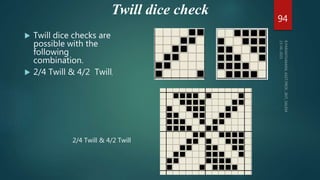
Twill dice check
 Twill dice checks are
possible with the
following
combination.
 2/4 Twill & 4/2 Twill,
94
2/4 Twill & 4/2 Twill
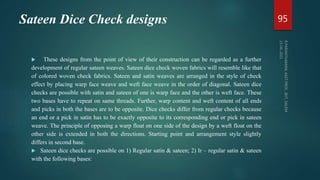
Sateen Dice Check designs
 These designs from the point of view of their construction can be regarded as a further
development of regular sateen weaves. Sateen dice check woven fabrics will resemble like that
of colored woven check fabrics. Sateen and satin weaves are arranged in the style of check
effect by placing warp face weave and weft face weave in the order of diagonal. Sateen dice
checks are possible with satin and sateen of one is warp face and the other is weft face. These
two bases have to repeat on same threads. Further, warp content and weft content of all ends
and picks in both the bases are to be opposite. Dice checks differ from regular checks because
an end or a pick in satin has to be exactly opposite to its corresponding end or pick in sateen
weave. The principle of opposing a warp float on one side of the design by a weft float on the
other side is extended in both the directions. Starting point and arrangement style slightly
differs in second base.
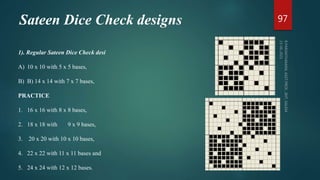
 Sateen dice checks are possible on 1) Regular satin & sateen; 2) Ir – regular satin & sateen
with the following bases:
95
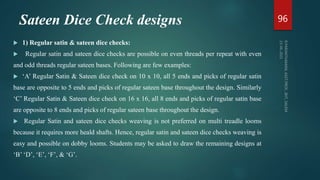
Sateen Dice Check designs
 1) Regular satin & sateen dice checks:
 Regular satin and sateen dice checks are possible on even threads per repeat with even
and odd threads regular sateen bases. Following are few examples:
 ‘A’ Regular Satin & Sateen dice check on 10 x 10, all 5 ends and picks of regular satin
base are opposite to 5 ends and picks of regular sateen base throughout the design. Similarly
‘C’ Regular Satin & Sateen dice check on 16 x 16, all 8 ends and picks of regular satin base
are opposite to 8 ends and picks of regular sateen base throughout the design.
 Regular Satin and sateen dice checks weaving is not preferred on multi treadle looms
because it requires more heald shafts. Hence, regular satin and sateen dice checks weaving is
easy and possible on dobby looms. Students may be asked to draw the remaining designs at
‘B’ ‘D’, ‘E’, ‘F’, & ‘G’.
96
Sateen Dice Check designs 97
1). Regular Sateen Dice Check desi
A) 10 x 10 with 5 x 5 bases,
B) B) 14 x 14 with 7 x 7 bases,
PRACTICE
1. 16 x 16 with 8 x 8 bases,
2. 18 x 18 with 9 x 9 bases,
3. 20 x 20 with 10 x 10 bases,
4. 22 x 22 with 11 x 11 bases and
5. 24 x 24 with 12 x 12 bases.
Sateen Dice Check designs
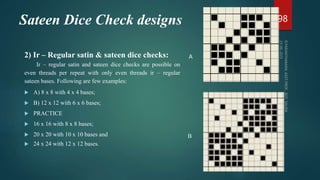
2) Ir – Regular satin & sateen dice checks:
Ir – regular satin and sateen dice checks are possible on
even threads per repeat with only even threads ir – regular
sateen bases. Following are few examples:
 A) 8 x 8 with 4 x 4 bases;
 B) 12 x 12 with 6 x 6 bases;
 PRACTICE
 16 x 16 with 8 x 8 bases;
 20 x 20 with 10 x 10 bases and
 24 x 24 with 12 x 12 bases.
98
B
A
Text book and References
 1. Grosicki Z. J. “Watson’s Textile Design and Colour: Vo.1, Woodhead Publications, Cambride
England, 2004.
 2. Grosicki Z. J., “Watson’s Advanced Textile Design and Colour”, Vol.II, Butterworths, London,
1989.
 REFERENCES:
 1. Wilson J., “Handbook of Textile Design”, Textile Instiute, Manchester, 2001.
 2. Home C.E., “Geometric Symmetry in Patterns and Tilings” Textile Institute, Manchester, 2000.
 3. Seyam A. M. “Structural Design of Woven Fabrics, Theory and Practice” Textile Institute,
Manchester, 2002.
 4. Geormer D, “Woven Structure and Design, part 1: Single Cloth Construction: WIRA, U.K. 1986.
 5. Geomer D, “Woven Structure and Design, Part 2: Compound Structures” WIRA, U.K., 1989
 Dr. N. Gokarneshan “Fabric structure and design”, New Age International (P) Limited, Publishers
4835/24, Ansari Road, Daryaganj, New Delhi – 110002.
99
THANK YOU
100

FABRIC STRUCTURE - TWILL AND DERIVATIVES

  • 1.
    FABRIC STRUCTURE TWILL WEAVEAND DERIVATIVES R.PARANTHAMAN, M.TECH, MBA ASSISTANT PROFESSOR INDIAN INSTITUTE OF HANDLOOM TECHNOLOGY, SALEM 1
  • 2.
    Twill and Derivatives Study of twill weaves up to 12 threads, classification of twills - warp faced twill, weft faced twill and equal faced twill; angle of inclination of twill diagonals, influence of the twist direction of yarn over prominence of twill lines; study of derivatives of twill weaves - wavy twill, herringbone, transposed twill, broken twill and curved twill, elongated twill, combined twill, shaded twill and figured twill; diamond, diaper; regular and irregular sateen and satin up to 12 threads, dice check using twill and satin weaves; design, draft, denting, peg/tie-up plan and thread interlacing diagram of above weaves. 2
  • 3.
    Twill weave 3 Atwill weave is “ a type of fabric woven with a pattern of diagonal parallel ribs. It is made by passing the weft threads over one warp thread, and then under two or more warp threads. Examples of twill fabric are gabardine, denim, tweed, and serge.”
  • 4.
    Features of twillweave • TWILL LINE OR DIAGONAL LINE ON THE FACE AND BACK OF THE FABRIC. • Regular twill angle 45 degree • Minimum twill angle 15 degree • Maximum twill angle 75 degree • Minimum repeat of twill weave: 3x3 • At least three heald frames are needed to produce a minimum repeat of twill weave. • More compact fabric than plain cloth. • Suitable for outer wear and repeated wearing. • Straight drafting system for basic twill weave. • It has fewer interlacing than plain weave. It is wrinkle resistant. • The twill direction is defined as left or right hand twill.
  • 5.
    Factors influencing theprominence of twills  Factors influencing the prominence of twills The relative prominence of twills is chiefly determined by:  (a) The character of weave  (b) The character of yarn  (c) The number of warp and weft threads per inch  (d) The direction of twill in relation to the direction of twist imparted to the yarn. 5
  • 6.
    Factors influencing theprominence of twills  (a) The Character of Weave Twill weaves will be relatively more pronounced if developed from longer than from shorter floats of yarn.  (b) Character of yarn A more pronounced twill will result either from coarse spun of soft spun yarn than from fine spun or hand spun yarns; also from folded yarn than from single yarn. 6
  • 7.
    Factors influencing theprominence of twills  (c) Number of Threads per inch A twill will be relatively more or less pronounced in proportion to the number of warp threads and picks of weft per inch.  (d) Direction of twill with relation to the direction of twill in the yarn If twills are produced in the reverse direction to that of the twist in the yarns, they will be more pronounced and if twills are produced in the same direction as that of the twist in the yarn, they will be less pronounced. 7
  • 8.
    Classification of Twillweaves: 1. According to the way of construction: Warp way twill weave Weft way twill weave 2. According to the direction of twill lines on the face of the fabric: S-twill or left hand twill weave Z-twill weave or right hand twill weave 8 3. According to the face yarn: Warp face twill weave Weft face twill weave Equal or Double face twill weave 4. According to the nature of produced twill line: Simple twill weave Expanded twill weave Multiple twill weave
  • 9.
    1. According tothe way of construction  Warp way twill:- In the marked design area, if the twill interlacement is arranged in vertical axis irrespective of its prominence, that particular twill is called as warp way twill.  Weft way twill:- In the marked design area, if the twill interlacement is arranged in horizontal axis irrespective of its prominence, that particular twill is called as weft way twill.  In general the way refers to the direction of twill arrangement, which will not affect the prominence of particular twill. This is explained in detail as below for warp faced twill, weft faced twill and equal faced twill which are arranged in both warp way and weft way but the prominence of either warp faced or weft faced or equal faced character remains as it is. Hence the direction of twill arrangement will not change the prominence of particular twill. Examples are shown for ready reference and understanding. Following are the Twill weaves to judge its prominence. 9
  • 10.
    1. According tothe way of construction  Warp way twill: Warp float run in the weft direction.  Warp threads are more than weft  Example: 3/2 warp way twill  Weft way twill: Weft float run in the weft direction.  Weft thread are more than warp.  Example:3/5 weft way twill 10 Classification of Twill weaves
  • 11.
    2. According tothe direction of twill line 11 Z twill: • The twill line runs from bottom left to top right. • The twill diagonal line parallel to the alphabet letter “Z” Example: 3/2 Z twill Classification of Twill weaves
  • 12.
    2. According tothe direction of twill line 12 S twill: • The twill line runs from top left to bottom right. • The twill diagonal line parallel to the alphabet letter “S” Example: 3/2 S twill Classification of Twill weaves
  • 13.
    Classification of Twillweaves  Classification of Twills – Warp Faced Twill, Weft Faced Twill and Equal Faced Twill: Twill weaves are classified into 3 categories basing on its Prominence. Prominence refers to appearance of warp or weft content in one repeat of a twill weave on face side. They are: 1) Warp Faced Twill, if warp content is greater than weft content on face side. 2) Weft Faced Twill, if weft content is greater than warp content on face side 3) Equal Faced Twill, if warp content and weft content on face side is equal. Prominence of Twill is decided by looking into its interlacement. Twill weaves are identified from its interlacement as warp prominence, weft prominence and equal prominence. 13 3. According to the face yarn
  • 14.
    Classification of Twillweaves  Warp faced twill:- In the marked design area, if warp floats are more than weft floats irrespective of its direction (arrangement in vertical or horizontal axis), that particular twill is called as warp faced twill.(3 up 1 down twill ) 14 3. According to the face yarn
  • 15.
    Classification of Twillweaves  Weft faced twill:- In the marked design area, if weft floats are more than warp floats irrespective of its direction (arrangement in vertical or horizontal axis), that particular twill is called as weft faced twill. (1 up 3 down twill) 15 3. According to the face yarn
  • 16.
     Equal facedtwill:- In the marked design area, if warp floats and weft floats are equal irrespective of its direction (arrangement in vertical or horizontal axis), that particular twill is called as equal faced twill.(2 up 2 down twill) 16 Classification of Twill weaves 3. According to the face yarn
  • 17.
    4. According tothe nature of twill line 1. Simple/Straight twill 2. Expanded twill 3. Multiple twill: 17 Classification of Twill weaves
  • 18.
    1. Simple/Straight twill: Each warp end is raised or lowered under only one pick in the repeat.  Example: 4/1 “Z” twill or 1/4 “S” twill 18 4. According to the nature of twill line Classification of Twill weaves
  • 19.
    4. According tothe nature of twill line 19 2. Expanded twill Each warp end is raised over or lower under more than one adjacent pick in the repeat. If the warp and weft twill lines are of equal width, the fabric is double-faced. Example: 4/2 Z twill, 3/3 Z twill Classification of Twill weaves
  • 20.
    4. According tothe nature of twill line 3.Multiple twill It contains at least two warp twill lines or two weft twill lines of different width in a repeat. Example 1/1,2/2,3/3. and 4/1,2/2, 1/2 . 20 Classification of Twill weaves
  • 21.
    Derivatives of twillweave 1. Zigzag or pointed or waved twill weave 2. Herringbone twill weave 3. Broken twill weave 4. Rearranged or transposed twill weave 5. Steeped twill weave 6. Elongated twill weave 7. Combined or combination twill weave 8. Shaded twill weave 9. Curved twill weave 10. Diamond twill weave 11. Diaper twill weave 21
  • 22.
     These arealso known as pointed or Zigzag twills.  In these classes of twill weaves the twill progresses in one direction for half of the repeat and then is reversed for the next half of the repeat.  The reversal of the twill may be done in a regular or irregular manner. Ideally the reversal of the twill should be done considering the series of threads that predominate the face of the fabric.  Thus warp way reversal is done in cases where the warp predominates over the weft and weft way reversal is done in cases where the weft predominates over the warp. 22 1. Zigzag or pointed or waved twill weave
  • 23.
     Regular twillsare flexible to considerable degree of modification.  Regular twills serve as bases to construct new designs.  Wavy twills are one of the best modified forms of regular twills.  Wavy twills refer to the shape and the form of waves in the sea.  Wavy twills are constructed by reversing the regular twill, either in end way or pick way.  Wavy twills are of two kinds; 1) Wavy twill across the cloth, and 2) Wavy twill along the cloth 23 1. Zigzag or pointed or waved twill weave
  • 24.
    1. Wavy twillacross the cloth:  Wavy twill across is achieved by reversing the regular twill at suitable intervals upon a warp end.  In this style wavy effects are produced across the cloth or horizontally in the cloth.  To produce horizontal wavy effects in the cloth, pointed drafts are required in the loom.  Draft order is reversed at suitable intervals.  If draft order is reversed at one place uniformly, the resultant wavy effects are uniform and are called as, ‘Regular wavy twill’.  If the draft order is reversed at many places without uniformity, the resultant wavy effects are ir – regular or fancy and are called as, ‘Irregular wavy twill or Fancy wavy twills’.  Wavy twills on more number of ends is possible with minimum number of heald shafts. Hence, design size increases. 24 1. Zigzag or pointed or waved twill weave
  • 25.
     Ends perrepeat of the design are calculated as below Ends per repeat = No. of heald shafts x 2 – 2 or No. of ends in base x 2 – 2, (Ex. For 4x4 twill is 4 x 2 – 2 = 6 ends with 4 picks ) Above two formulas are suitable to calculate the ends per repeat of wavy twills reversing at one place. 25 1. Zigzag or pointed or waved twill weave
  • 26.
    • Decide thebase weave repeating on number of ends and picks. • In case of wavy twills across the cloth, ends per repeat of the design will be more than the ends per repeat of the base; where as picks per repeat of the design and the base are same. • Base and peg plan are same in wavy twill across the cloth. • Number of ends in draft and number of ends in the design are same. • Number of picks in the base, design and peg plan is same. • Example for a base repeating on 4 x 4. 1. Zigzag or pointed or waved twill weave 26
  • 27.
    Base Twill 4x4(2/2) REGULAR WAVY TWILL (6x4) Design Draft Peg plan 1. Zigzag or pointed or waved twill weave 2. Wavy twill across the cloth or Horizontal zigzag twill: • When the reversal direction of twill line occur upon the warp yarn, it result horizontal zigzag twill. • Here the basic twill is extended in warp direction. • Here the number of warp yarn in a repeat is double of the number of weft. • In horizontal zigzag twill pointed draft is used. 27
  • 28.
    Base weave DesignDraft order Peg plan (8 x 8) 32 x 8 1 to 8, 1, 8 to 5, 6 to 8, 1, 8 to 1, 2 to 5 and 4 to 2. 8 x 8 Base weave (8x8) Design (32x8) 1. Zigzag or pointed or waved twill weave IR - REGULAR WAVY TWILL To produce fancy wavy twill effects across the cloth or ir – regular wavy twill effects across the cloth, reversing is at many places irregularly. 28
  • 29.
    Wavy twill alongthe cloth  Wavy effects are produced vertically.  Design is reversed by a pick of weft at required intervals.  Hence number of ends in the base, design and peg plan is same.  Number of picks in the design and peg plan is same.  Design and peg plan both are same.  Base and design & base and peg plan are not same.  Draft order required is straight draft.  Picks per repeat of the design is calculated as below; For a base repeating on 6 x 6.  Picks per repeat = No. of picks in base x 2 – 2, (Ex. 6 x 2 – 2 = 10). This formula is suitable to calculate the picks per repeat of wavy twills reversing at one place 29 1. Zigzag or pointed or waved twill weave
  • 30.
    30 Base weave 4x4 (2/2) Wavytwill along the cloth 4x6 (2/2) Draft Peg plan 1. Zigzag or pointed or waved twill weave Regular Wavy twill along the cloth or Regular Vertical zigzag twill • When the reversal direction of twill line occur upon the weft yarn, it result vertical zigzag twill. • Here the basic twill is extended in weft direction. • Here the number of weft yarn in a repeat is double of the number of warp. • In Vertical zigzag twill straight draft is used.
  • 31.
     To producefancy wavy twill effects along the cloth or ir – regular wavy twill effects along the cloth, reversing is at many places irregularly. 31 1. Zigzag or pointed or waved twill weave Base weave 8x8 (3/2,1/2 ) Wavy twill along the cloth 32x 8 Fancy wavy twill effects along the cloth or ir – regular wavy twill
  • 32.
    Differentiate between wavytwill across and wavy twill along s.no. Wavy twill across Wavy twill along 1 Base is a twill weave Base is a twill weave 2 Draft order is pointed Draft order is straight 3 Wavy effects horizontal Wavy effects vertical 4 Base is reversed at one or more places in warp way by an end Base is reversed at one or more places in weft way by a pick 5 Base and peg plan are same Design and peg plan are same 6 Ends in design and ends in draft are same Ends in design and ends in peg plan are same 7 Picks in base, design and peg plan are same Picks in design and peg plan are same 8 No. of treadles required are equal to No. of picks in peg plan and weaving order is straight No. of treadles required are equal to No. of differently interlacing picks in peg plan but weaving order is reversed 32
  • 33.
    Derivatives of twillweave  In Herring Bone twills, the twill is reversed as in the event of pointed twills. However, the pointed effect is broken. This type of construction produces a distinct stripe effect and also prevents the formation of an extended float where the weave turns. The herringbone twill is considered to be more benefit than the pointedtwills. 33 2. Herringbone Twill
  • 34.
    Derivatives of twillweave  Herringbone Twills:  Herringbone twills results the formation of zig- zag effects in the woven cloth.  Herringbone twills depend upon the reversal of direction.  Herringbone twills differ from wavy twills because at the place of reversing there will be,” cut or break” effects in the fabric after weaving.  Herringbone twills do not come to a point, where it changes the direction.  Hence, there will not be continuity in the diagonal lines or at the places of reversing. 34 2. Herringbone Twill
  • 35.
    Derivatives of twillweave  Bases are twill weaves.  Mostly equal face twills are preferred as bases to construct herringbone twill with only on even numbered twill bases.  In this style herringbone effects can be produced across the cloth and along the cloth.  Procedure to construct Herringbone twill across the cloth is as below; 1) Decide base repeating on even threads with equal face twill, Ex. 2/2 twill. 2) Base is arranged as it is in design area – 1, 2, 3 & 4 Ends. 3) Base is divided into two equal halves in end way as 1, 2, / 3, 4 4) Both the halves are reversed as 2, 1, 4, 3 and added to the base by its right side. 5) Derive draft order from design. Draft order is called as, “Herringbone draft or broken draft” 35 Construction Herringbone Twill Across the cloth: Base weave Design Peg plan Draft
  • 36.
     Herringbone Twills- Along the cloth:  Procedure to construct Herringbone twill along the cloth is as below; 1) Decide base repeating on even threads with equal face twill, Ex. 2/2 twill. 2) Base is arranged as it is in design area – 1, 2, 3 & 4 Ends. 3) Base is divided into two equal halves in pick way as 1, 2, 3, 4 4) Both the halves are reversed as 2, 1, 4, 3 and add above the base (Pick way). 5) Derive draft order from design. Draft order is required is straight. Construction of Herringbone twills – Along the cloth. 36 2. Herringbone Twill Base weave Design Peg plan Draft
  • 37.
    Differentiate between wavytwill and herringbone twill 37 s.no. Wavy twill Herring bone twill 1 Draft orders are pointed and straight Draft orders are broken 2 There will be continuity at the place of reversing and repeat joining There will be cut or break effects at the place of reversing and repeat joining 3 wavy or zig – zag effects are obtained Cut or break effects are obtained 4 Possibility for lengthy floats No possibility for lengthy floats. 5 Draw one repeat of design, draft and peg plan Draw one repeat of design, draft and peg plan
  • 38.
    Broken twills Regular twillsresults the formation of continuous diagonal line. Breaking the regular twill diagonal produce a large variety of attractive effects. Resultant effects are called as, “broken twills”. Broken twill effects are obtained by reversing a portion of diagonal for breaking the continuity. Broken twills are some what similar in appearance to that of herringbone twills. Cut or break effect is the feature of broken twills at the place of reversing and repeat joining. Herringbone twills are called as broken twills, but broken twills are not herringbone twills. Broken twills are arranged in two different styles; 1) Reversing style, 2) filling and missing style.
  • 39.
    Broken twills  1)Reversing style: Base weave is regular twill, repeats on even number of thread like 4 X 4, 6 X 6, 8 X 8, 10 X 10, etc. Divide base into two equal halves; arrange the first half straight and the second half reversed. Example is twill, repeats on 4 x 4. Ends 1, 2, 3, 4 are divided as 1, 2 and 3, 4. First half 1, 2 as straight and Second half 3, 4 is reversed as 4, 3, whole is re-written as 1, 2, 4, 3. Selection of base weave is an important factor. Equal face twills give better results. 39
  • 40.
    Broken twills 2. Fillingand missing style: Base is a twill weave, repeating on even number of threads. Equal face twills give better results. Base ends are divided into two equal halves. First half is filled as it is, Subtract at least one from second half and the remaining is missed. Formula for filling and missing For filling = N/ 2 For missing = (N/ 2) - 1 40
  • 41.
    Broken twills  Exampleis twill, Ends per repeat is 4, divide into two equal halves, 2 & 2, first 2 is filled, second 2 – 1 = 1. Missing number is 1. This design is called as 2 fill and 1 miss. Filling and missing as calculated is done in draft. Direction of draft will not change while filling and missing. It is in the regular direction as left to right. Break effects are very clear after every filling.  1, 2, 4, 1, 3, 4, 2, 3 41
  • 42.
    Curved twills  Principlesof constructing curved twills are entirely different from principles practiced so far. Decide base twill weave and arrange draft like a curve. In this case diagonal formation and the pointed drafts are not seen in draft order. Base design is arranged according to the draft order, results the formation of curved twill. It is also possible to construct curved twills in wavy principle by reversing the draft. Curved twills are used in the industry to limited extent because of lengthy floats and loose structures. Following are few examples:  Construction of curved twills does not come under any category.  To decide the draft order, there is no rule need to apply.  To derive and decide the draft, a curved line is drawn to suit the requirement.  Mark draft over the curved line finalized for curved twill.  Then base weave is arranged as per the draft order.  Base and peg plan is same. Ends in draft and design are same. SNo. 1 is as below: 42
  • 43.
  • 44.
    Angle of twill The angle of twill is the angle between the diagonal twill line and an imaginary horizontal line or axis parallel to the weft.  This angle is dependent on the ratio between the ends/inch and picks/inch in the cloth.  When the warp ends/inch is equal to the weft picks/inch, the twill angle will be 45° .  When the warp ends/inch exceeds the weft picks/inch the twill angle will be an obtuse angle i.e., >45° (high angle or steep twill).  When the weft picks/inch exceeds the warp ends/inch, the twill angle will be an acute angle i.e., , <45°(low angle or flat twill). 44
  • 45.
  • 46.
    Elongated twill  Elongatedtwills, running at various angles, are constructed by moving the points of intersection two or more threads in one direction to one thread in the other direction. 46
  • 47.
  • 48.
  • 49.
    Elongated twill  themarks should be taken to indicate " warp up," and in the flat twills, " weft up." 49
  • 50.
    Combined Twills  Itis possible to combine two or more ordinary twill weaves in the order of end on end or pick on pick. Selection of twill bases is very important factor.  There are several methods to construct combination of twill weaves.  Select two twill bases repeating on same number of ends and picks but differently interlaced.  Combine both the bases end on end alternately. First end from first base, first end from second base; second end from first base, second end from second base; and so on till the end.  When both the bases are repeating on same number of ends and picks, (Ex. 6 x 6) resultant combined twill will repeats on 12 x 6 if combined end way. 50
  • 51.
  • 52.
  • 53.
    End on endcombination with bases on different threads  Further it is also possible to combine two twill bases repeating on different number of threads per repeat.  A = 4x4 twill  B = 5x 5 twill  LCM of 4 and 5 =20  The design on warp way combination is 40x 20  The design on weft way combination is 20 x 40 53
  • 54.
    End on endcombination with bases on different threads 54
  • 55.
    Shaded Twills  Theseare designed by combining number of small twills in which the floats increase or decrease in size.  Effects produced by this combination are totally different like gradational or shaded.  Number of small twills selected for combining should repeat on same threads. Five twills on six threads are selected and are arranged as 5 and 1, 4 and 2, 3 and 3, 4 and 2 & 5 and 1.  In this arrangement the intensity of marks is gradually reduced like 5 – 4 – 3 – 2 & 1; intensity of blanks is gradually increased like 1 – 2 – 3 – 4 & 5.  Hence gradational or shaded is the effect.  Shaded twill on 30 X 30 is shown at ‘A’.  The term single shading is applied to this style because each kind of float shades in one direction only.  These shaded twills can not be drafted on to a small number of healds. 55
  • 56.
  • 57.
    Shaded Twills  Theterm double shading is applied to the style, which is composed of number of small twills in ascending and descending order.  Four twills on five threads are selected and are arranged as 1 and 4, 2 and 3, 3 and 2 & 4 and 1 in ascending order.  Three twills on six threads are selected and are arranged as 4 and 2, 3 and 3 & 2 and 4 in descending order.  Double shaded twill on 38 X 38 is shown at ‘B’. 57
  • 58.
  • 59.
    Shaded Twills  Anotherstyle to produce shaded twill is with number of small twills on different threads and by reverse. The arrangement is 5 and 1, 4 and 1, 3 and 1 & 2 and 1; all the four are reversed as 1 and 2, 1 and 3, 1 and 4 & 1 and 5. This repeats on 36 X 36 is shown at ‘C’. 59
  • 60.
  • 61.
    Figured Twills  Thearrangement of small spots or figures in conjunction with, and running at the same angle, as ordinary twill is called as, “Figured Twills”.  A spot may be repeated diagonally one or more times in each repeat of the twill lines and to find the repeat of a spot, it is necessary to count the spaces diagonally.  For example, in design ‘A’ First colour at the beginning of spots, which indicate corresponding positions of the spots, occur on every third space counted diagonally and in order to show this clearly, second colour is indicated between the crosses.  The complete repeat of the twill is on 12 X 12 and the spot is therefore repeated four times. 61
  • 62.
  • 63.
    Figured Twills  Anothertwill in design ‘B’ repeats on 16 X 16, and as the figure repeats on 8 diagonal spaces, as indicated by first colour and second colour, it is inserted twice in the complete design. 63
  • 64.
    Figured Twills  In‘C’ the twill lines repeat upon 16 ends, but in this case the spot repeats on 6 spaces counted diagonally. Hence the complete repeat is on 16 X 48. Picks are calculated as the LCM of 16 and 6.  Design ‘C’ can be reversed and arranged on 48 X 16 by extending the weave horizontally. 64
  • 65.
    Figured Twills  Indesign ‘D’ figured twill is arranged, which repeats upon 40 X 20 and the figure on 8 diagonal spaces. 40 is the LCM of 20 and 8. 65
  • 66.
    Diamond Twills  Thesedesigns from the point of view of their construction can be regarded as a further development of regular twill weaves. Diamond weaves are constructed by combining the wavy twill across and wavy twill along.  Diamond weaves are constructed on pointed drafts.  Base weave is a regular twill weave.  Base weave is reversed in warp way by an end as per the draft order.  Base weave is also reversed in weft way by a pick as per the draft order.  Base weave can be reversed at one place to construct a regular diamond weave.  Base weave can also be reversed at many places to construct fancy diamond weaves.  Ends in base weave and ends in peg plan are same; picks in design and peg plan are same.  Diamond designs are constructed on equal number of ends and picks.  If draft order is reversed at one place, the diamond constructed will be a regular diamond.  If draft order is reversed at many places, the diamond constructed will be a fancy diamond. 66
  • 67.
    Diamond Twills  Truediamond shapes converge into a vertex and for this reason most designs of this type can be constructed economically on pointed drafts. The structure may be developed in the following two ways: 1) By employing a vertical waved twill or zig – zag as the lifting plan in conjunction with pointed draft;  2) By indicating a diamond base and building up the design symmetrically on each side of centre thread 67
  • 68.
    Diamond Twills  Firstmethod is illustrated at ‘A’, ‘B’, ‘C’ and ‘D’. In this ‘A’ base is arranged at ‘B’ as horizontal wavy twill in the order of 1, 2, 3, 4, 3, & 2 is draft. While ‘C’ represents the same twill ‘B’ arranged vertically in the same order of 1, 2, 3, 4, 3, & 2 is lifting plan. Two repeats are taken in both the directions to see the diamond formation. The result of ‘B’ and ‘C’ is the diamond. 68
  • 69.
    Diamond Twills  Secondmethod is illustrated at ‘E’, ‘F’, ‘G’ and ‘H’ with 2/2 twill asbase 69
  • 70.
  • 71.
    Diaper Designs  Diaperdesigns differ from diamond designs.  Diamond designs will have symmetrical effects both vertically and horizontally.  Simplest form of diaper design is the extension of herringbone twill in both vertical and horizontal axis.  Since herringbone twills results cut or break effects at the places of reversing and the repeat joining, diaper design will have symmetrical effects diagonally.  Hence, opposite effects in both vertical and horizontal axis.  Diaper designs are constructed on herringbone drafts.  Diaper designs are also possible on straight drafts, but number of heald shafts will increase substantially.  Heald shafts required in straight draft are double to that of herringbone drafts. Selection of base is an important factor.  Base is a twill weave, which repeats on equal number of threads. Equal face twills give better results, where balanced diaper design effects are produced. 71
  • 72.
     Diaper designsare constructed on equal number of ends and picks.  More elaborate diaper designs are possible if the draft order is herringbone.  In case of herringbone draft, number of ends in the base weave and the number of heald shafts is equal.  Number of picks in the design and peg plan is same.  Number of ends in design and draft order is same.  If the interlacement of a base weave is divided into two equal halves, and both the halves are symmetrical interlacements, then the lifts in both the halves of the base will have diametrically opposite interlacements. 72 Diaper Designs
  • 73.
  • 74.
    Difference between Diamondweave and Diaper weave SNo Diamond weave SNo Diaper weave 1 Base is twill on any threads. 1 Base twill on even threads. 2 Base twill can be with any content. 2 Base twill has to be equal face twill. 3 Produced on pointed drafts. 3 Produced on herringbone drafts. 4 Design is symmetrical on both vertical and horizontal axis. 4 Design is diagonally symmetrical. 5 Design joins at the places of reversing and repeat joining. Hence continuation. 5 Design gets cut or breaks effects at the places of reversing and repeat joining. Hence cut or break effects. 6 Possibility for lengthy floats. 6 No possibility for lengthy floats. 7 Number of heald shafts is equal to number of ends in base and reversed for continuation. 7 Number of heald shafts is equal to number of ends in base and reversed for cut effects. 8 Base is wavy twill 8 Base is herring bone twill 74
  • 75.
    Satin and Sateen Satin is a warp faced rearranged twill and sateen is a rearranged weft faced twill.  Thus satin is the reverse side of sateen weaves.  These weaves form an important category of weaves.  They are used in combination with other weaves, particularly in case of ornamented fabrics.  The striking feature of these weaves is their bright appearance and smooth feel. 75
  • 76.
    Satin and Sateen The basic characteristic of satin/sateen weaves are :  (i) They are either warp or weft faced weaves  (ii) Have no prominent weave structures  (iii) Only one binding point in each end or pick  (iv) No continuous twill lines  (v) Have poor seam strength due to thread mobility  (vi) More thread density is possible in warp and weft  (vii) More mass per unit area is possible  (viii) Have less binding points and more float lengths  (ix) Use of move numbers (intervals of selection) is necessary to construct these weaves.  x) construction on both the directions Horizontal axis direction, and Vertical axis direction In the construction of satin/sateen weaves, the stitching points of warp or weft for a given repeat size is done by the use of move numbers or stitch or float numbers. The move numbers are selected according to the repeat size of the weave 76
  • 77.
    Choosing move numbers In choosing move numbers for the construction of satin/sateen weaves, the following rules are to be adopted:  (a) The move number should not be equal to the repeat of the weave  (b) It should not be one less than the repeat size  (c) It should not be a factor of the repeat size, and  (d) It should not be a multiple of the factor . 77
  • 78.
    Characteristics of Satinweave  Satin woven fabrics will have more number of ends than picks in a unit space.  One end in a repeat of satin weave will float over all the picks except one.  Stitching points in a repeat of satin weave is arranged apart.  Hence, ends will move very close to each other resulting packed structures and heavy construction is possible.  Satin weaves will not result the formation of diagonal line. Satin woven fabrics will have soft feel and subdued effects.  Satin weaves are very widely used in textile industry in general and furnishings in particular.  Fabrics woven with Satin weaves will produce silky appearance.  Satin woven fabrics will have the maximum degree of smoothness and luster.  Ends per inch are greater than picks per inch in satin woven fabrics.  Hence, production is higher.  Satin is further classified as: 1) Regular satin, 2) Ir – regular satin. 78
  • 79.
  • 80.
    Regular satin weavespossible move numbers SNo Repeat Possible moves Not possible moves Reason 1 5 X 5 2 & 3 1 & 4 1 & 4 Results diagonal. 2 7 X 7 2, 3, 4 & 5 1 & 6 1 & 6 Results diagonal. 3 8 X 8 3 & 5 1, 2, 4, 6 & 7 1 & 7 Results diagonal, 2 & 4 divisible numbers & 6 common factor number. 4 9 X 9 2, 4, 5 & 7 1, 3, 6 & 8 1 & 8 Results diagonal, 3 divisible number & 6 common factor number. 5 10 X 10 3 & 7 1, 2, 4, 5, 6, 8 & 9 1 & 9 Results diagonal, 2 & 5 divisible numbers, 4, 6 & 8 common factor numbers. 6 11 X 11 2, 3, 4, 5, 6, 7, 8 & 9 1 & 10 1 & 10 Results diagonal 7 12 X 12 5 & 7 1, 2, 3, 4, 6, 8, 9, 10 & 11 1 & 11 Results diagonal, 2, 3, 4 & 6 divisible numbers, 8, 9 & 10 common factor numbers. 80
  • 81.
    Characteristics of Sateenweave  Sateen woven fabrics will have more number of picks than ends in a unit space. Picks per inch are greater than ends per inch.  One pick in a repeat of sateen weave will float over all the ends except one. Stitching points in a repeat of sateen weave is arranged apart.  Hence, picks will move very close to each other resulting packed structures and heavy construction is possible.  Sateen weaves will not result the formation of diagonal line.  Sateen woven fabrics will have soft feel and subdued effects.  Sateen weaves are very widely used in textile industry in general and furnishings in particular.  Fabrics woven with Sateen weaves will produce silky appearance.  Sateen woven fabrics will have the maximum degree of smoothness and luster.  Picks per inch are greater than ends per inch in sateen woven fabrics. Sateen is further classified as: 1) Regular sateen, 2) Ir – regular sateen. 81
  • 82.
  • 83.
    Regular sateen weavespossible move numbers SNo Repeat Possible moves Not possible moves Reason 1 5 X 5 2 & 3 1 & 4 1 & 4 Results diagonal. 2 7 X 7 2, 3, 4 & 5 1 & 6 1 & 6 Results diagonal. 3 8 X 8 3 & 5 1, 2, 4, 6 & 7 1 & 7 Results diagonal, 2 & 4 divisible numbers & 6 common factor number. 4 9 X 9 2, 4, 5 & 7 1, 3, 6 & 8 1 & 8 Results diagonal, 3 divisible number & 6 common factor number. 5 10 X 10 3 & 7 1, 2, 4, 5, 6, 8 & 9 1 & 9 Results diagonal, 2 & 5 divisible numbers, 4, 6 & 8 common factor numbers. 6 11 X 11 2, 3, 4, 5, 6, 7, 8 & 9 1 & 10 1 & 10 Results diagonal 7 12 X 12 5 & 7 1, 2, 3, 4, 6, 8, 9, 10 & 11 1 & 11 Results diagonal, 2, 3, 4 & 6 divisible numbers, 8, 9 & 10 common factor numbers. 83
  • 84.
    Ir- regular satinweaves  Ir- regular satin and sateen weaves are possible only on even number of threads per repeat. In case of ir-regular satin and sateen construction the move will be on two different numbers and also in two different directions. General rules to construct ir-regular satin and sateen weave are:  A) Decide base on even threads like 4 x 4, 6 x 6, 8 x 8, 10 x 10 and 12 x 12;  B) Divide base threads into two equal halves;  C) Example base is on 8 x 8, Two equal halves are 4 & 4.  D) First move is with 4 – 1 = 3 (Half threads – at least one) to complete up to half threads in design.  E) Second move is on one thread with half number = 4 in the same direction as first move.  F) Remaining threads are completed with first move but in opposite direction till the end.  G) 8 Thread ir – regular satin is constructed with two different moves (3 & 4) in two different 84
  • 85.
    Construction of ir-regular satin weave using move number 3 and 4 85
  • 86.
    Possible move numbersof ir- regular satin weaves SNo Repeat Move Numbers 1 4 x 4 1, 2 & 1 2 6 x 6 2, 3 & 2 3 8 x 8 3, 4 & 3 4 10 x 10 3, 5 & 3 5 12 x 12 3 & 5, 6, 3 & 5 86
  • 87.
    Ir – regularSateen weaves  In pure sateen weaves the surface of cloth consists entirely weft float.  In the repeat of a weave each thread passes over all except one thread of the other series.  In addition, the interlacing points are so arranged as to allow the floating threads to slip and cover the, ‘Binding point’ of one thread by the float of another.  This results in the production of fabrics with a maximum degree of smoothness and luster and without any prominent weave features.  Threads in this weave are very closely packed structures are possible and quite heavy constructions can be achieved.  Fabrics with insufficiently close thread spacing, however exhibit poor seam strength in made up fabrics due to seam slippage arising on account of the excessive freedom of threads.  People in the Industry use the general term sateen for the fabrics woven with either warp face or weft face prominence. 87
  • 88.
    Construction of ir-regular sateen weave using move number 3 and 4 88
  • 89.
    Possible move numbersof ir- regular sateen weaves SNo Repeat Move Numbers 1 4 x 4 1, 2 & 1 2 6 x 6 2, 3 & 2 3 8 x 8 3, 4 & 3 4 10 x 10 3, 5 & 3 5 12 x 12 3 & 5, 6, 3 & 5 89
  • 90.
    Difference between regularsatin and ir – regular satin weaves SNo Regular Satin Ir – regular Satin 1 Fabrics woven are soft and silky. Fabrics woven are more soft and silky 2 Possible on odd and even threads. Possible on only even threads. 3 One move in one direction throughout the repeat. Two different moves in two different directions in a repeat. 4 Twilling lines are visible. Lack of twilling lines. 5 Move number is a non – divisible number of repeat. Some times both the move numbers are divisible and at least one move number is definitely divisible in a repeat. 90
  • 91.
    Difference between RegularSateen and Ir – regular Sateen weaves SNo Regular Sateen Ir – regular Sateen 1 Fabrics woven are soft and silky. Fabrics woven are more soft and silky 2 Possible on odd and even threads. Possible on only even threads. 3 One move in one direction throughout the repeat. Two different moves in two different directions in a repeat. 4 Twilling lines are visible. Lack of twilling lines. 5 Move number is a non – divisible number of repeat. Some times both the move numbers are divisible and at least one move number is definitely divisible in a repeat. 91
  • 92.
    Difference between Satinand Sateen S.NO Satin Sateen 1 Warp prominence on face side of cloth Weft prominence on face side of cloth 2 Ends per inch is greater than picks per inch Picks per inch is greater than ends per inch 3 Every end will float over all the picks, except one in a repeat of design Every pick will float over all the ends, except one in a repeat of design 4 Production is higher Production is less 5 One repeat of satin design on 5 threads One repeat of sateen design on 5 threads 6 Interlacing diagram for the above satin design Interlacing diagram for the above sateen design 92
  • 93.
    Twill dice check These designs from the point of view of their construction can be regarded as a further development of regular twill weaves.  Twill dice check woven fabrics will resemble like that of colored woven check fabrics.  Regular twills are arranged in the style of check effect by placing warp face twill and weft face twill in the order of diagonal.  Twill dice checks are possible with two twill bases of one is warp face and the other is weft face.  These two bases have to repeat on same threads.  Further, warp content and weft content of all ends and picks in both the areas are to be opposite.  Dice checks differ from regular checks because an end or a pick in warp face twill has to be exactly opposite to its corresponding end or pick in weft face twill.  The principle of opposing a warp float on one side of the design by a weft float on the other side is extended in both the directions.  Starting point and arrangement style slightly differs in second base. 93 A B C 1/ 3 Twill & 3 /1 Twill
  • 94.
    Twill dice check Twill dice checks are possible with the following combination.  2/4 Twill & 4/2 Twill, 94 2/4 Twill & 4/2 Twill
  • 95.
    Sateen Dice Checkdesigns  These designs from the point of view of their construction can be regarded as a further development of regular sateen weaves. Sateen dice check woven fabrics will resemble like that of colored woven check fabrics. Sateen and satin weaves are arranged in the style of check effect by placing warp face weave and weft face weave in the order of diagonal. Sateen dice checks are possible with satin and sateen of one is warp face and the other is weft face. These two bases have to repeat on same threads. Further, warp content and weft content of all ends and picks in both the bases are to be opposite. Dice checks differ from regular checks because an end or a pick in satin has to be exactly opposite to its corresponding end or pick in sateen weave. The principle of opposing a warp float on one side of the design by a weft float on the other side is extended in both the directions. Starting point and arrangement style slightly differs in second base.  Sateen dice checks are possible on 1) Regular satin & sateen; 2) Ir – regular satin & sateen with the following bases: 95
  • 96.
    Sateen Dice Checkdesigns  1) Regular satin & sateen dice checks:  Regular satin and sateen dice checks are possible on even threads per repeat with even and odd threads regular sateen bases. Following are few examples:  ‘A’ Regular Satin & Sateen dice check on 10 x 10, all 5 ends and picks of regular satin base are opposite to 5 ends and picks of regular sateen base throughout the design. Similarly ‘C’ Regular Satin & Sateen dice check on 16 x 16, all 8 ends and picks of regular satin base are opposite to 8 ends and picks of regular sateen base throughout the design.  Regular Satin and sateen dice checks weaving is not preferred on multi treadle looms because it requires more heald shafts. Hence, regular satin and sateen dice checks weaving is easy and possible on dobby looms. Students may be asked to draw the remaining designs at ‘B’ ‘D’, ‘E’, ‘F’, & ‘G’. 96
  • 97.
    Sateen Dice Checkdesigns 97 1). Regular Sateen Dice Check desi A) 10 x 10 with 5 x 5 bases, B) B) 14 x 14 with 7 x 7 bases, PRACTICE 1. 16 x 16 with 8 x 8 bases, 2. 18 x 18 with 9 x 9 bases, 3. 20 x 20 with 10 x 10 bases, 4. 22 x 22 with 11 x 11 bases and 5. 24 x 24 with 12 x 12 bases.
  • 98.
    Sateen Dice Checkdesigns 2) Ir – Regular satin & sateen dice checks: Ir – regular satin and sateen dice checks are possible on even threads per repeat with only even threads ir – regular sateen bases. Following are few examples:  A) 8 x 8 with 4 x 4 bases;  B) 12 x 12 with 6 x 6 bases;  PRACTICE  16 x 16 with 8 x 8 bases;  20 x 20 with 10 x 10 bases and  24 x 24 with 12 x 12 bases. 98 B A
  • 99.
    Text book andReferences  1. Grosicki Z. J. “Watson’s Textile Design and Colour: Vo.1, Woodhead Publications, Cambride England, 2004.  2. Grosicki Z. J., “Watson’s Advanced Textile Design and Colour”, Vol.II, Butterworths, London, 1989.  REFERENCES:  1. Wilson J., “Handbook of Textile Design”, Textile Instiute, Manchester, 2001.  2. Home C.E., “Geometric Symmetry in Patterns and Tilings” Textile Institute, Manchester, 2000.  3. Seyam A. M. “Structural Design of Woven Fabrics, Theory and Practice” Textile Institute, Manchester, 2002.  4. Geormer D, “Woven Structure and Design, part 1: Single Cloth Construction: WIRA, U.K. 1986.  5. Geomer D, “Woven Structure and Design, Part 2: Compound Structures” WIRA, U.K., 1989  Dr. N. Gokarneshan “Fabric structure and design”, New Age International (P) Limited, Publishers 4835/24, Ansari Road, Daryaganj, New Delhi – 110002. 99
  • 100.