SCIATIC NERVE
◤
INTRO
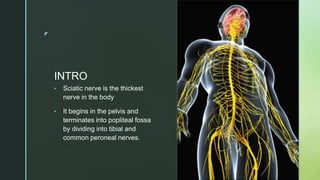
• Sciatic nerve is the thickest
nerve in the body
• It begins in the pelvis and
terminates into popliteal fossa
by dividing into tibial and
common peroneal nerves.
◤
ORIGIN AND ROOT VALUE
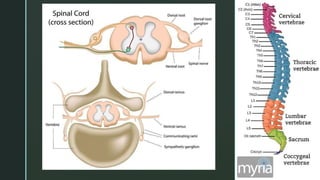
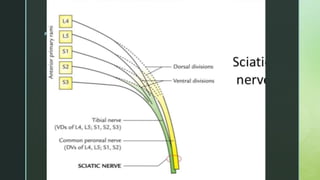
 This is the largest branch of sacral plexus. Its root value is
L4,L5,S1,S2,S3.
 It is made up of two parts , the tibial part and the common
peroneal part.
 The tibial part is formed by the ventral divisions of anterior
primary rami (ventral rami) of L4,L5,S1,S2,S3.
 The common peroneal part is formed by the dorsal divisions of
the anterior primary rami (ventral rami) of L4,L5,S1,S2
◤
ORIGIN
◤
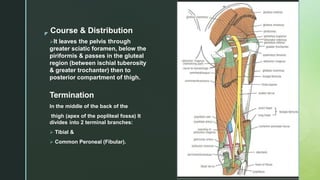
◤ Course & Distribution
It leaves the pelvis through
greater sciatic foramen, below the
piriformis & passes in the gluteal
region (between ischial tuberosity
& greater trochanter) then to
posterior compartment of thigh.
Termination
In the middle of the back of the
thigh (apex of the popliteal fossa) It
divides into 2 terminal branches:
 Tibial &
 Common Peroneal (Fibular).
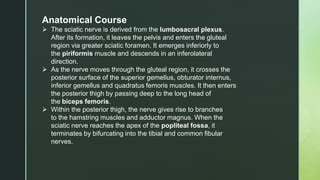
Anatomical Course
 The sciatic nerve is derived from the lumbosacral plexus.
After its formation, it leaves the pelvis and enters the gluteal
region via greater sciatic foramen. It emerges inferiorly to
the piriformis muscle and descends in an inferolateral
direction.
 As the nerve moves through the gluteal region, it crosses the
posterior surface of the superior gemellus, obturator internus,
inferior gemellus and quadratus femoris muscles. It then enters
the posterior thigh by passing deep to the long head of
the biceps femoris.
 Within the posterior thigh, the nerve gives rise to branches
to the hamstring muscles and adductor magnus. When the
sciatic nerve reaches the apex of the popliteal fossa, it
terminates by bifurcating into the tibial and common fibular
nerves.
◤
BRANCHES OF SCIATIC NERVE
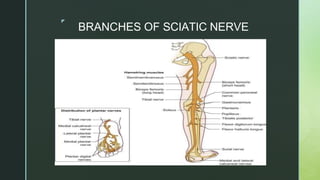
 1. Cutaneous:
⚫ To all leg & foot directly or indirectly EXCEPT:
Areas supplied by the saphenous nerve (branch of femoral
nerve).
◤
BRANCHES OF SCIATIC NERVE
2. Muscular:
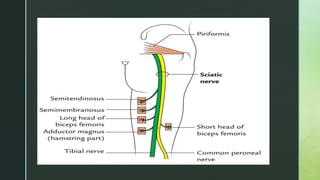
• To Hamstrings: It is one of the three posterior thigh muscles in
between the hip and knee (m-l, semimembranosus,
semitendonosus, and biceps femoris)
(flexors of knee & extensors of the hip).
(through tibial part) to:
1. Hamstring part of Adductor Magnus. ,(ischial part)
2. Long head of Biceps Femoris.
3. Semitendinosus.
4. Semimembranosus.
NB. The short head of biceps receives its branch (common
peroneal) nerve.
◤
◤
BRANCHES OF SCIATIC NERVE
◤
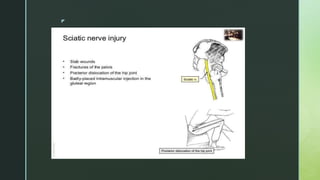
 The sciatic nerve is most frequently injured by…?
I- Badly placed intramuscular injections in the gluteal region.
 To avoid this,
injections should be done into the gluteus maximus or medius (into
the upper outer quadrant of buttock
In 90% of injuries, the common peroneal nerve is the mostly affected.
Why?
- The common peroneal nerve fibers lie superficial in the sciatic
nerve.
CAUSES OF SCIATIC NERVE INJURY
◤
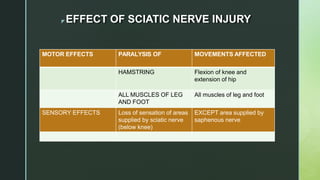
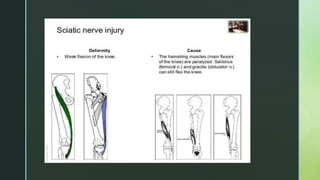
◤EFFECT OF SCIATIC NERVE INJURY
MOTOR EFFECTS PARALYSIS OF MOVEMENTS AFFECTED
HAMSTRING Flexion of knee and
extension of hip
ALL MUSCLES OF LEG
AND FOOT
All muscles of leg and foot
SENSORY EFFECTS Loss of sensation of areas
supplied by sciatic nerve
(below knee)
EXCEPT area supplied by
saphenous nerve
◤
◤
◤
OTHER CLINICAL ANATOMY
 SLEEPING FOOT : When a person sits on the edge of a hard
table or chair, the nerve gets compressed between the edge of
the table and femur. It results in the numbness of lower limb. But
the sensations come back when foot is hit on the ground a few
times.
 SCIATICA: It is the shooting pain along the cutaneous
distribution of the sciatic nerve and its terminal branches, chiefly
the common peroneal. Pain usually begins in the gluteal region,
and radiates along the back of the thigh, and the lateral side of
the leg, to the dorsum of the foot.

sciaticnerve pptx

  • 1.
  • 2.
    ◤ INTRO • Sciatic nerveis the thickest nerve in the body • It begins in the pelvis and terminates into popliteal fossa by dividing into tibial and common peroneal nerves.
  • 3.
    ◤ ORIGIN AND ROOTVALUE  This is the largest branch of sacral plexus. Its root value is L4,L5,S1,S2,S3.  It is made up of two parts , the tibial part and the common peroneal part.  The tibial part is formed by the ventral divisions of anterior primary rami (ventral rami) of L4,L5,S1,S2,S3.  The common peroneal part is formed by the dorsal divisions of the anterior primary rami (ventral rami) of L4,L5,S1,S2
  • 4.
  • 5.
  • 6.
    ◤ Course &Distribution It leaves the pelvis through greater sciatic foramen, below the piriformis & passes in the gluteal region (between ischial tuberosity & greater trochanter) then to posterior compartment of thigh. Termination In the middle of the back of the thigh (apex of the popliteal fossa) It divides into 2 terminal branches:  Tibial &  Common Peroneal (Fibular).
  • 7.
    Anatomical Course  Thesciatic nerve is derived from the lumbosacral plexus. After its formation, it leaves the pelvis and enters the gluteal region via greater sciatic foramen. It emerges inferiorly to the piriformis muscle and descends in an inferolateral direction.  As the nerve moves through the gluteal region, it crosses the posterior surface of the superior gemellus, obturator internus, inferior gemellus and quadratus femoris muscles. It then enters the posterior thigh by passing deep to the long head of the biceps femoris.  Within the posterior thigh, the nerve gives rise to branches to the hamstring muscles and adductor magnus. When the sciatic nerve reaches the apex of the popliteal fossa, it terminates by bifurcating into the tibial and common fibular nerves.
  • 8.
    ◤ BRANCHES OF SCIATICNERVE  1. Cutaneous: ⚫ To all leg & foot directly or indirectly EXCEPT: Areas supplied by the saphenous nerve (branch of femoral nerve).
  • 9.
    ◤ BRANCHES OF SCIATICNERVE 2. Muscular: • To Hamstrings: It is one of the three posterior thigh muscles in between the hip and knee (m-l, semimembranosus, semitendonosus, and biceps femoris) (flexors of knee & extensors of the hip). (through tibial part) to: 1. Hamstring part of Adductor Magnus. ,(ischial part) 2. Long head of Biceps Femoris. 3. Semitendinosus. 4. Semimembranosus. NB. The short head of biceps receives its branch (common peroneal) nerve.
  • 10.
  • 11.
  • 12.
    ◤  The sciaticnerve is most frequently injured by…? I- Badly placed intramuscular injections in the gluteal region.  To avoid this, injections should be done into the gluteus maximus or medius (into the upper outer quadrant of buttock In 90% of injuries, the common peroneal nerve is the mostly affected. Why? - The common peroneal nerve fibers lie superficial in the sciatic nerve. CAUSES OF SCIATIC NERVE INJURY
  • 13.
  • 14.
    ◤EFFECT OF SCIATICNERVE INJURY MOTOR EFFECTS PARALYSIS OF MOVEMENTS AFFECTED HAMSTRING Flexion of knee and extension of hip ALL MUSCLES OF LEG AND FOOT All muscles of leg and foot SENSORY EFFECTS Loss of sensation of areas supplied by sciatic nerve (below knee) EXCEPT area supplied by saphenous nerve
  • 15.
  • 16.
  • 17.
    ◤ OTHER CLINICAL ANATOMY SLEEPING FOOT : When a person sits on the edge of a hard table or chair, the nerve gets compressed between the edge of the table and femur. It results in the numbness of lower limb. But the sensations come back when foot is hit on the ground a few times.  SCIATICA: It is the shooting pain along the cutaneous distribution of the sciatic nerve and its terminal branches, chiefly the common peroneal. Pain usually begins in the gluteal region, and radiates along the back of the thigh, and the lateral side of the leg, to the dorsum of the foot.