WRIST JOINT COMPLEX
Dr. Chandan Verma(PT)
(BPT,MPT,YICC,)
Assistant pofessor
(Mahatma Gandhi Physiotherapy College, Jaipur)
INTRODUCTION
•Distal ends of Radius and
Ulna
•Carples bone-
4- proximal
4 distal carpal
•Metacarpal bone-5
•Phalanges-
proximal-5
middle-4
distal-5
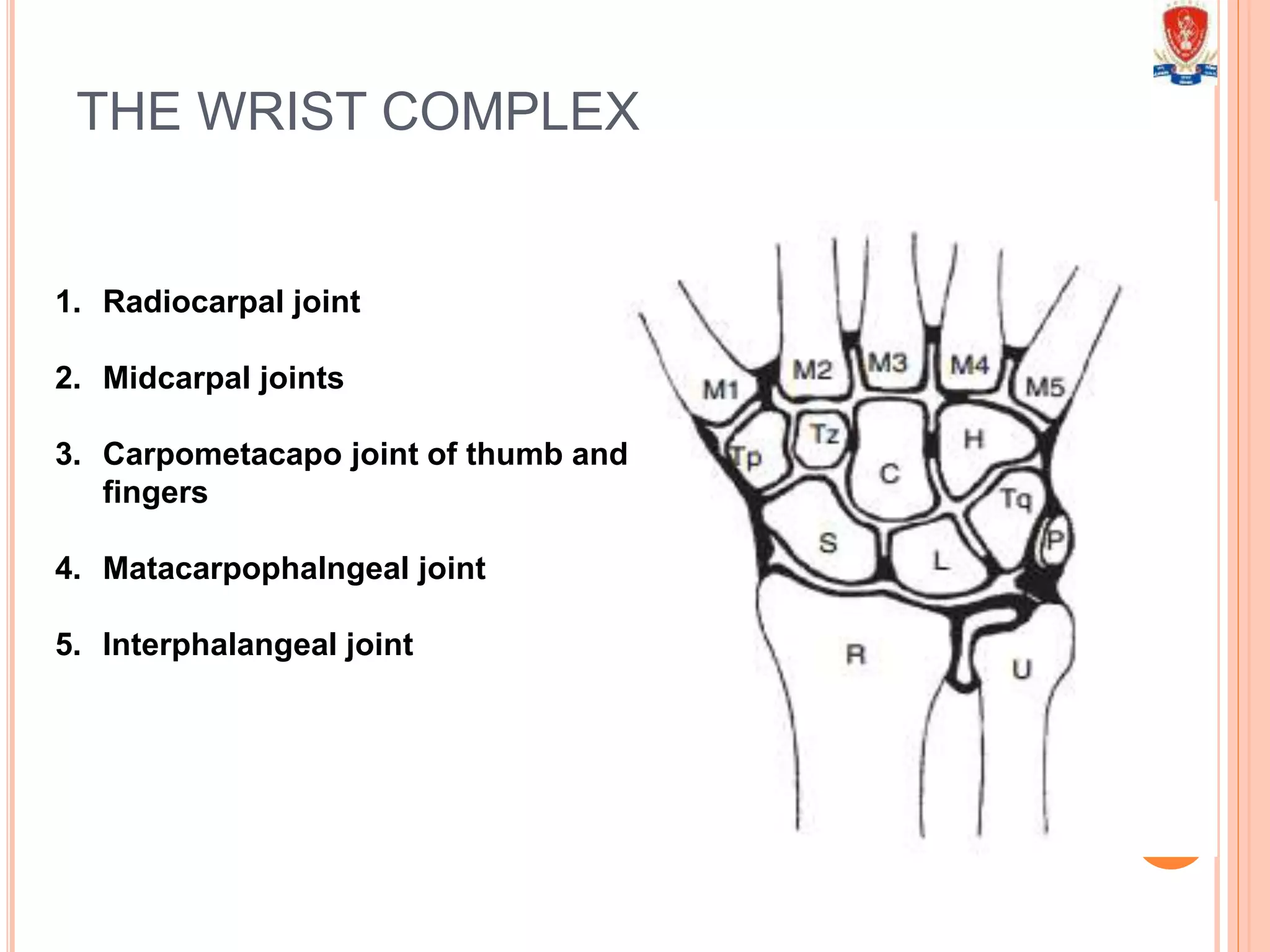
THE WRIST COMPLEX
1. Radiocarpal joint
2. Midcarpal joints
3. Carpometacapo joint of thumb and
fingers
4. Matacarpophalngeal joint
5. Interphalangeal joint
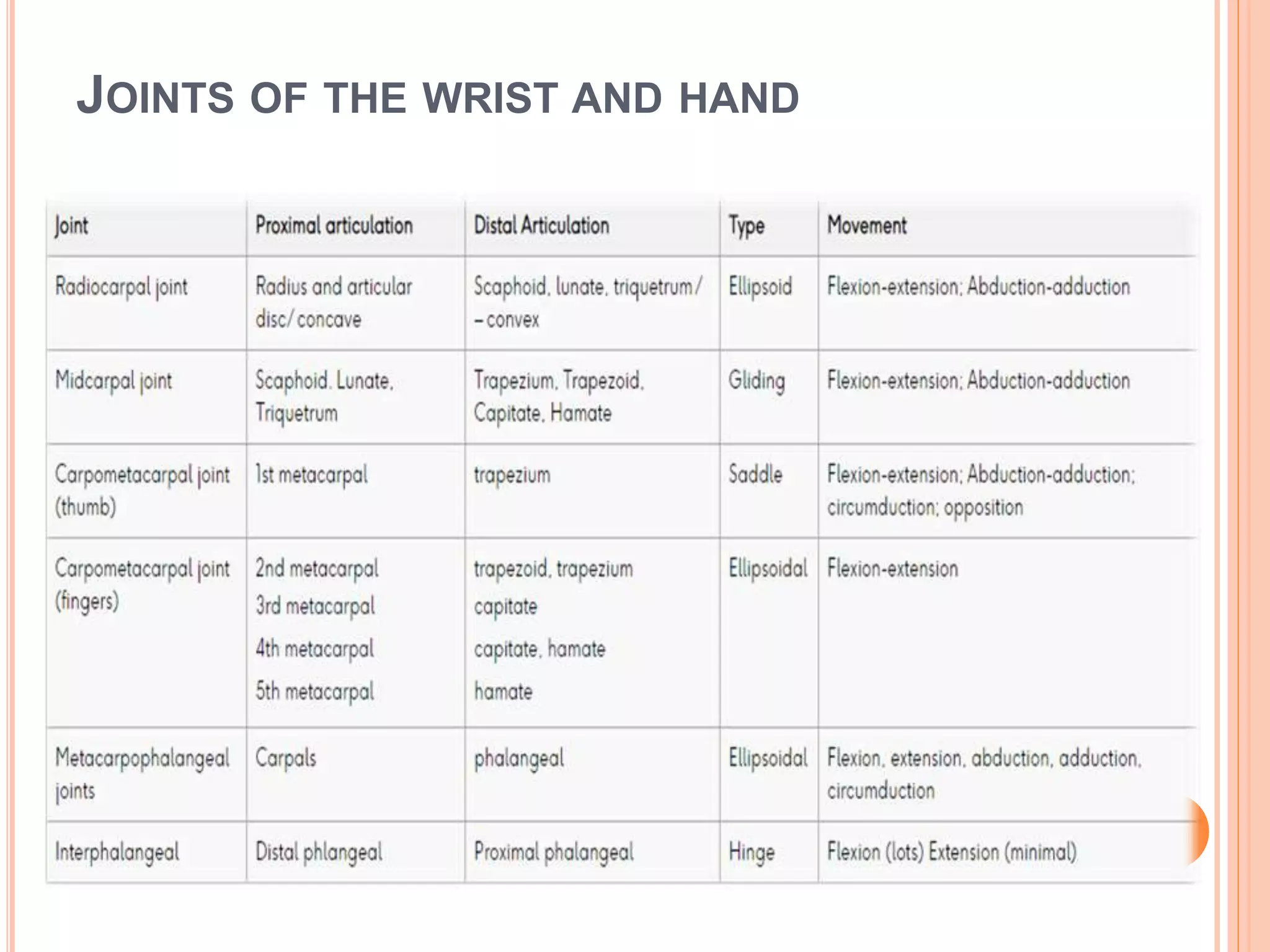
JOINTS OF THE WRIST AND HAND
TYPES OF JOINT IN WRIST COMPLEX
RADIOCARPAL JOINT STRUCTURE
The proximal joint surface is
composed of
(1) the lateral radial facet, which
articulates with the scaphoid;
(2) the medial radial facet, which
articulates with the lunate; and
(3) the triangular fibrocartilage
complex, which articulates
predominantly with the
triquetrum, although it also has
some contact with the lunate in
the neutral wrist.
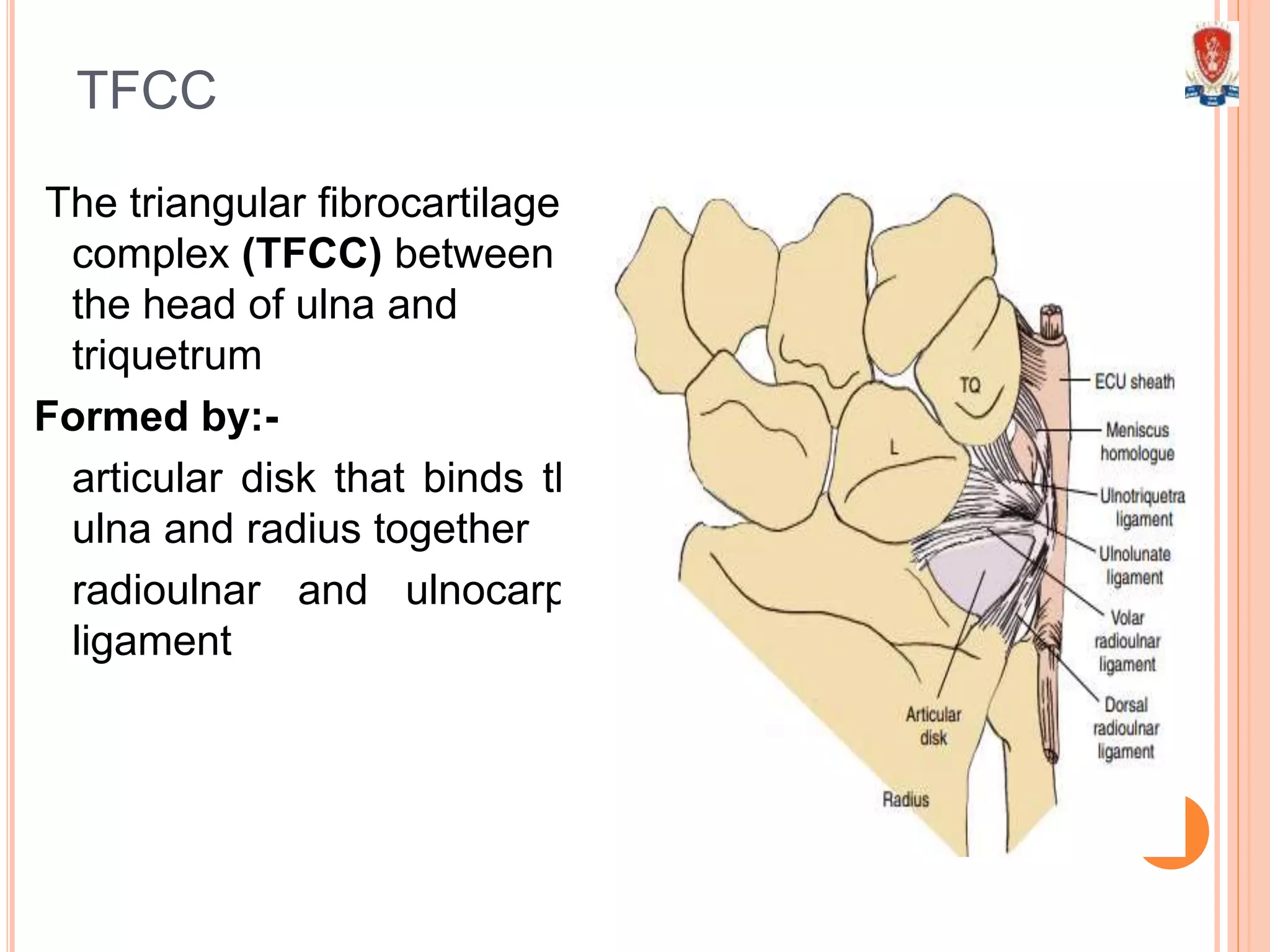
TFCC
The triangular fibrocartilage
complex (TFCC) between
the head of ulna and
triquetrum
Formed by:-
articular disk that binds the
ulna and radius together
radioulnar and ulnocarpal
ligament
VASCULAR SUPPLY
• The wrist joint receives
blood from branches of the
dorsal and palmar carpal
arches, which are derived
from the ulnar and radial
arteries.
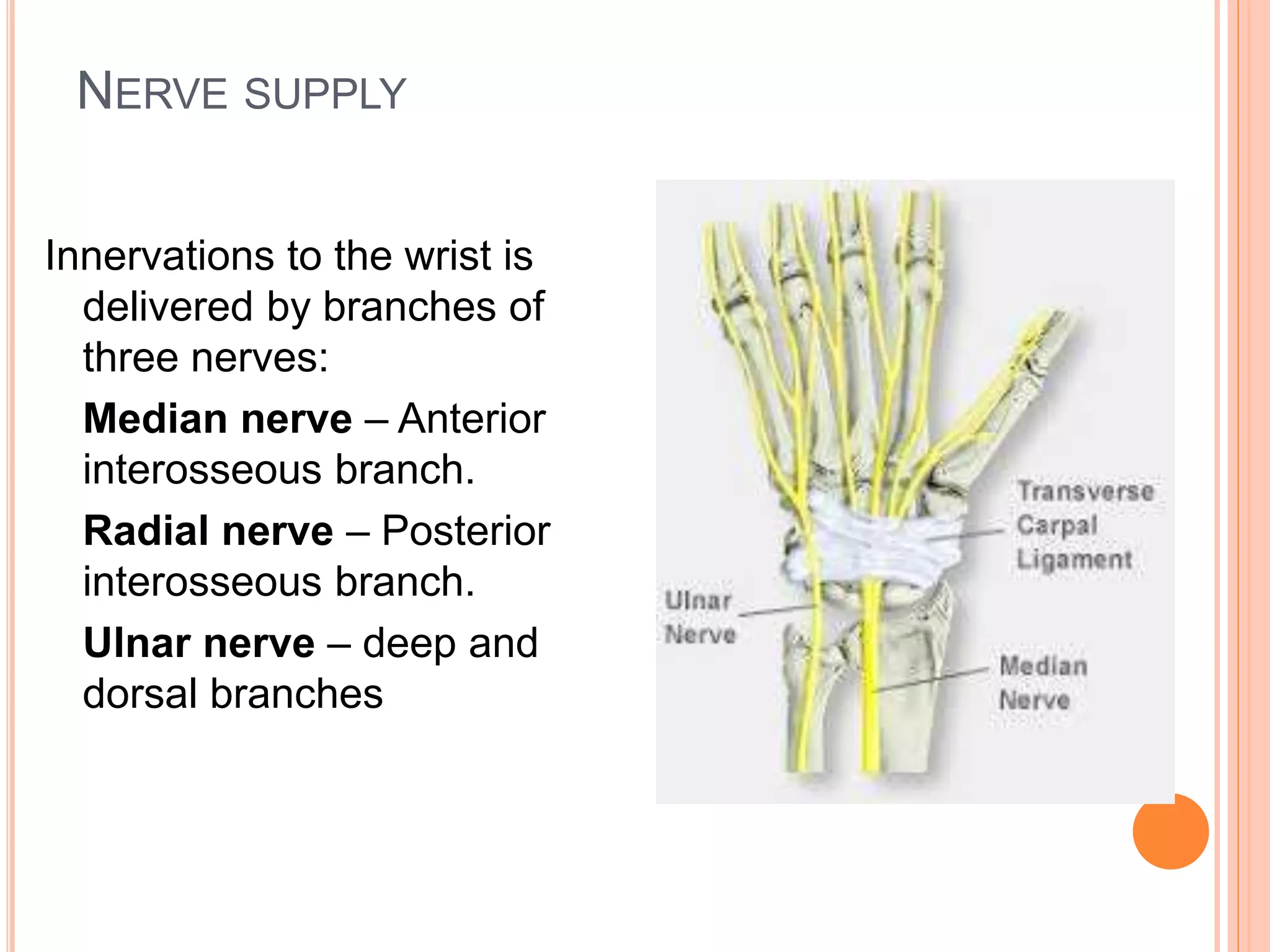
NERVE SUPPLY
Innervations to the wrist is
delivered by branches of
three nerves:
Median nerve – Anterior
interosseous branch.
Radial nerve – Posterior
interosseous branch.
Ulnar nerve – deep and
dorsal branches
JOINT CAPSULE
 Like any synovial joint, the capsule is double
layered.
• The fibrous outer layer attaches to the distal ends of
radius, ulna and the proximal row of the carpal
bones.
• The internal layer, synovial membrane extends up
to the margins of the articular surfaces.
ULNAR NEGATIVE & POSITIVE VARIANCE
Ulnar positive variance, the
distal ulna is long in relation to
the distal radius
Ulnar negative variance -
short ulna in comparison
with the radius at the
distal end
ULNAR POSATIVE VARIANCE
“long” ulna may be present after a distal radius fracture that healed in
a shortened position. Pain is commonly present with end-range
pronation and ulnar deviation because these motions increase the
likelihood of impingement of the ulnar structures.
ULNAR NEGATIVE VARIANCE
short ulna may result in abnormal force distribution across the
radiocarpal joint with potential degeneration at the radiocarpal joint &
Avascular necrosis of the lunate, Kienbock’s disease has been
associated with ulnar negative variance
RADIOCARPAL CAPSULE AND LIGAMENTS
 Most ligaments that cross the radiocarpal joint also
contribute to stability at the midcarpal joint, and so
all the ligaments will be presented together after
introduction of the midcarpal joint
 Radiocarpal joint is not crossed by any muscles
that act on the radiocarpal joint alone
 The flexor carpi ulnaris is the only muscle that
crosses the radiocarpal joint and attaches to any of
the bones of the proximal carpal row
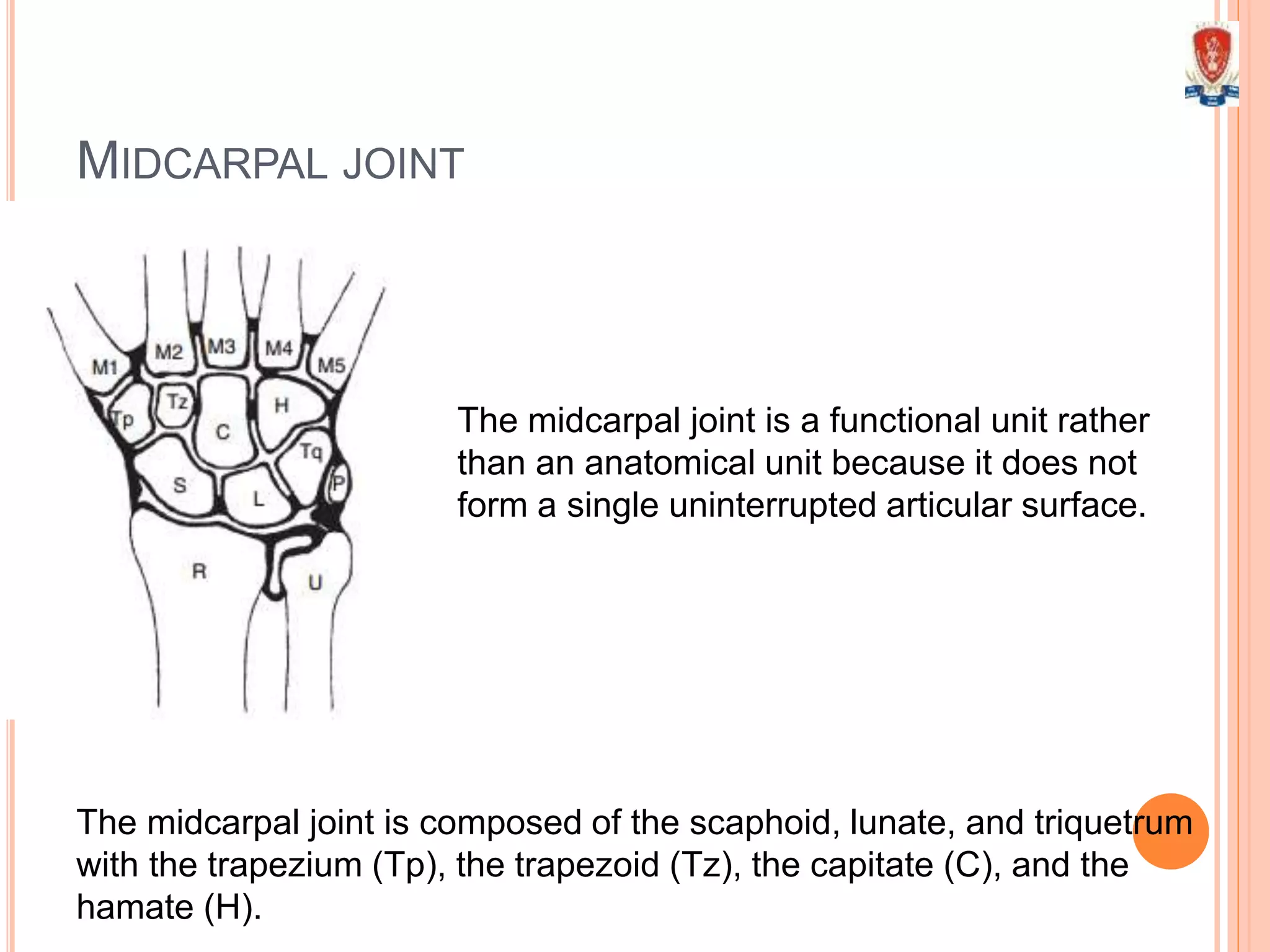
MIDCARPAL JOINT
The midcarpal joint is composed of the scaphoid, lunate, and triquetrum
with the trapezium (Tp), the trapezoid (Tz), the capitate (C), and the
hamate (H).
The midcarpal joint is a functional unit rather
than an anatomical unit because it does not
form a single uninterrupted articular surface.
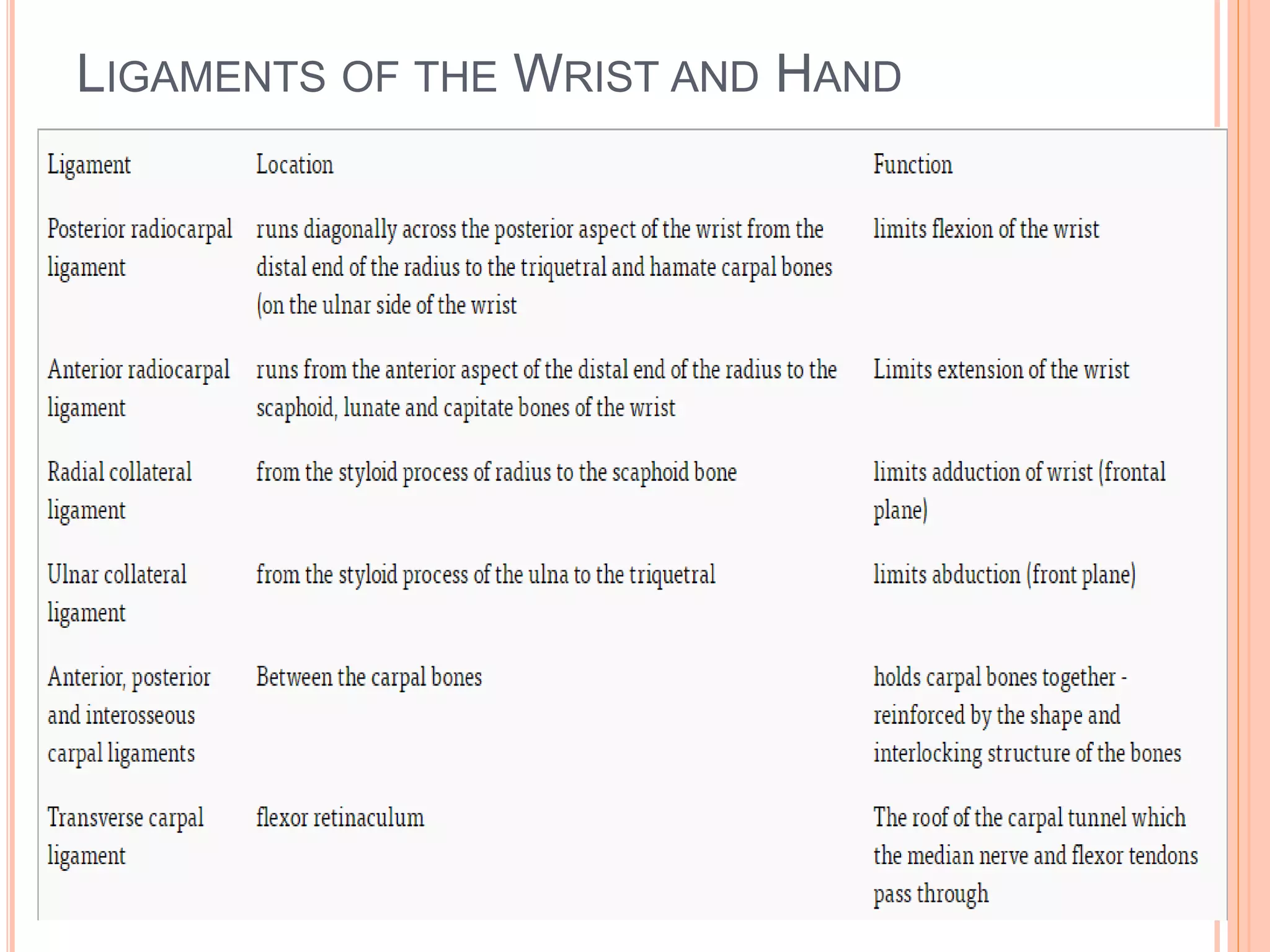
LIGAMENTS OF THE WRIST AND HAND
LIGAMENTS OF THE WRIST COMPLEX
Volar ligaments of the wrist complex, including the three bands
of the volar radiocarpal ligament: radioscaphocapitate,
radiolunate, and radioscapholunate. The two intrinsic ligaments
(scapholunate and lunotriquetral) are credited with maintaining
scaphoid stability.
Volar ligaments
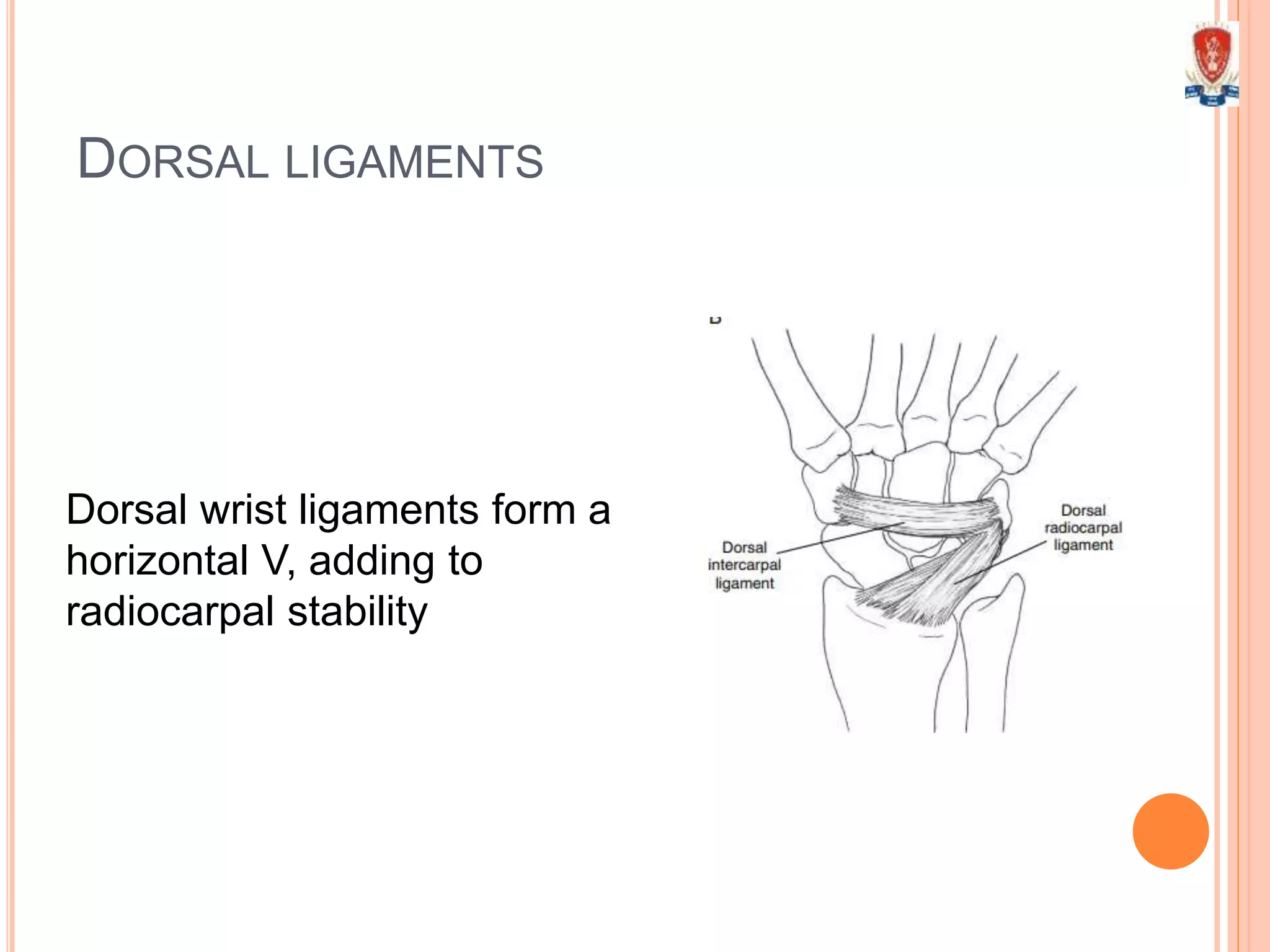
DORSAL LIGAMENTS
Dorsal wrist ligaments form a
horizontal V, adding to
radiocarpal stability
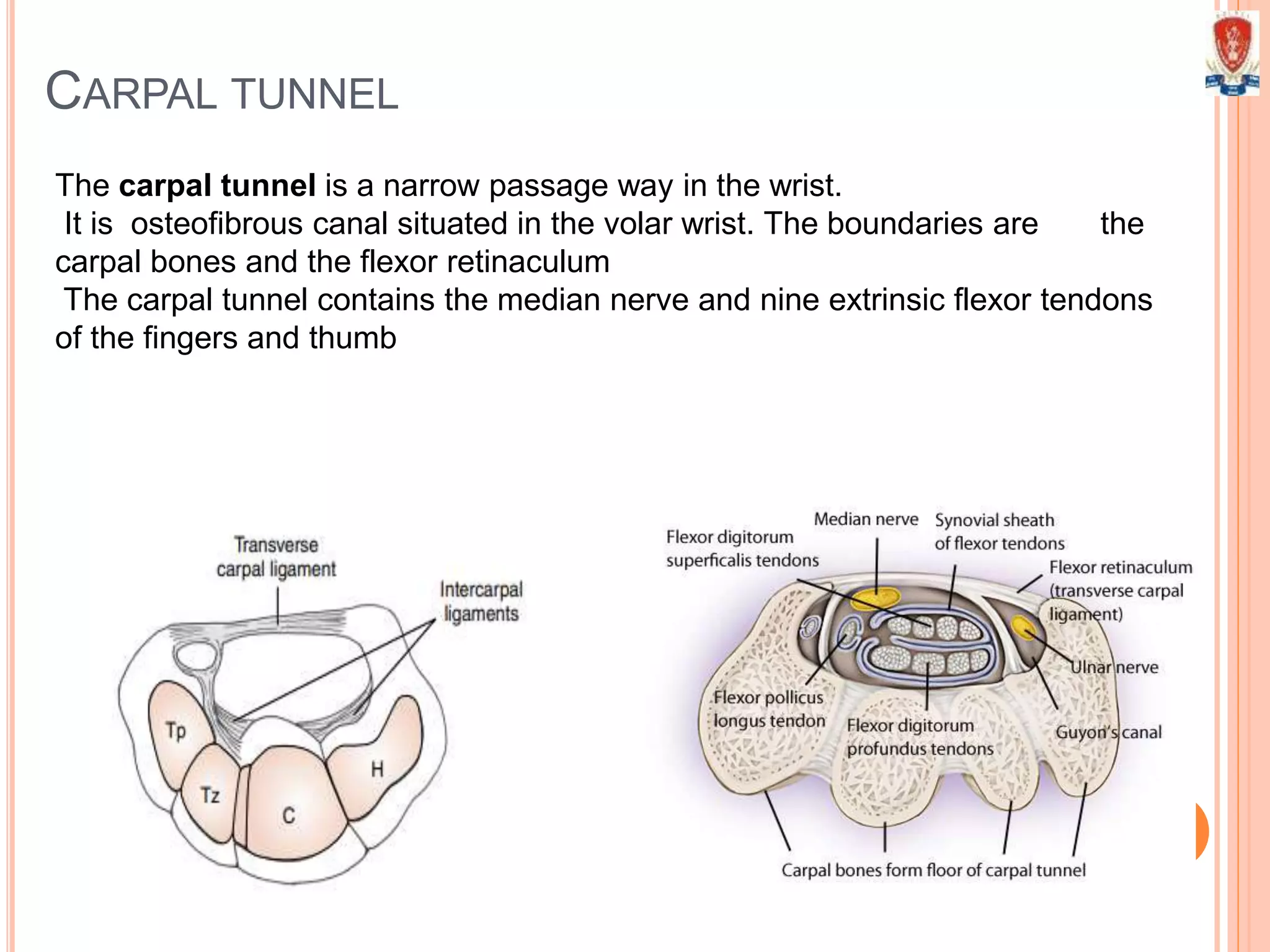
CARPAL TUNNEL
The carpal tunnel is a narrow passage way in the wrist.
It is osteofibrous canal situated in the volar wrist. The boundaries are the
carpal bones and the flexor retinaculum
The carpal tunnel contains the median nerve and nine extrinsic flexor tendons
of the fingers and thumb
MOVEMENTS OF THE RADIOCARPAL AND MIDCARPAL JOINTS
When wrist extension is initiated from
full flexion,
(1) the distal carpal row moves on the
proximal carpal row;
(2) the scaphoid and distal row move
on the lunate/triquetrum; and
(3) the carpals move as a unit on the
radius and triangular fibrocartilage
complex to achieve full wrist extension
C, capitate; L, lunate; S, scaphoid
Flexion/Extension of the Wrist
RADIAL/ULNAR DEVIATION OF THE WRIST
With radial deviation of the wrist (A), the flexion of the scaphoid makes the
scaphoid appear shorter than when the scapoid extends during ulnar
deviation (B). C, capitate; L, lunate; S, scaphoid.
WRIST INSTABILITY
The lunate and scaphoid flex on the
radius, whereas the triquetrum
extends. The distal carpal row
(capitate shown) follows the triquetrum
into extension.
The lunate, released from the flexed
scaphoid, extends on the radius. The
capitate moves in the opposite
direction (flexion) on top of the lunate.
Volar intercalated segmental
instability
(VISI)
Dorsal intercalated
segmental instability
(DISI)
Injury to one or more of the ligaments attached to the scaphoid and lunate may
diminish or remove the synergistic stabilization of the lunate and scaphoid. zigzag
pattern of the three segments (the scaphoid, the lunate/ triquetrum, and the distal
carpal row) is known as intercalated segmental instability
WRIST INSTABILITY…
With disruption of the scapholunate
ligaments through trauma, the
scaphoid and lunate migrate apart,
leaving a gap (diastasis)
(DISI)
Scapholunate advance
collapse (SLAC) with migration
of the capitate proximally and
erosion of the radioscaphoid
and capitate-lunate joints.
MOVEMENTS OF THE WRIST AND HAND
 Thirty-four muscles act on the hand.
 Intrinsic muscles of the hand contain the origin and
insertions within the carpal and metacarpal bones.
 Muscles originating in the forearm are the extrinsic
muscles of the hand.
 The intrinsic muscles of the hand provide the fine
motor movements while the extrinsic muscles permit
strength.
MUSCLES OF THE WRIST COMPLEX
Volar Wrist Musculature
(Six muscles have tendons crossing the volar aspect)
all of the volar wrist muscles pass beneath the flexor retinaculum along with the
median nerve except the palmaris longus and the flexor carpi ulnaris
muscles (
PRIMARY
• Palmaris
longus (PL)
• Flexor carpi
radialis (FCR)
• Flexor carpi
ulnaris
Secondary
• Flexor
digitorum
superficialis
(FDS)
• Flexor
digitorum
profundus
(FDP)
• Flexor pollicis
longus (FPL)
DORSAL WRIST MUSCULATURE
(NINE MUSCLES )
Primary
• ECRL (extensar
carpai radialis
longus)
• ECRB (extensar
carpai radialis
brevis)
• ECU (extensar
carpai ulnaris)
Secondary
• Extensor radius
communis
• Extensor indisus
proprious
• Extensor
digitorum minimi
• Extensor pollicis
longus
• Extensor pollicis
brevius
• Abductor pollicis
longus
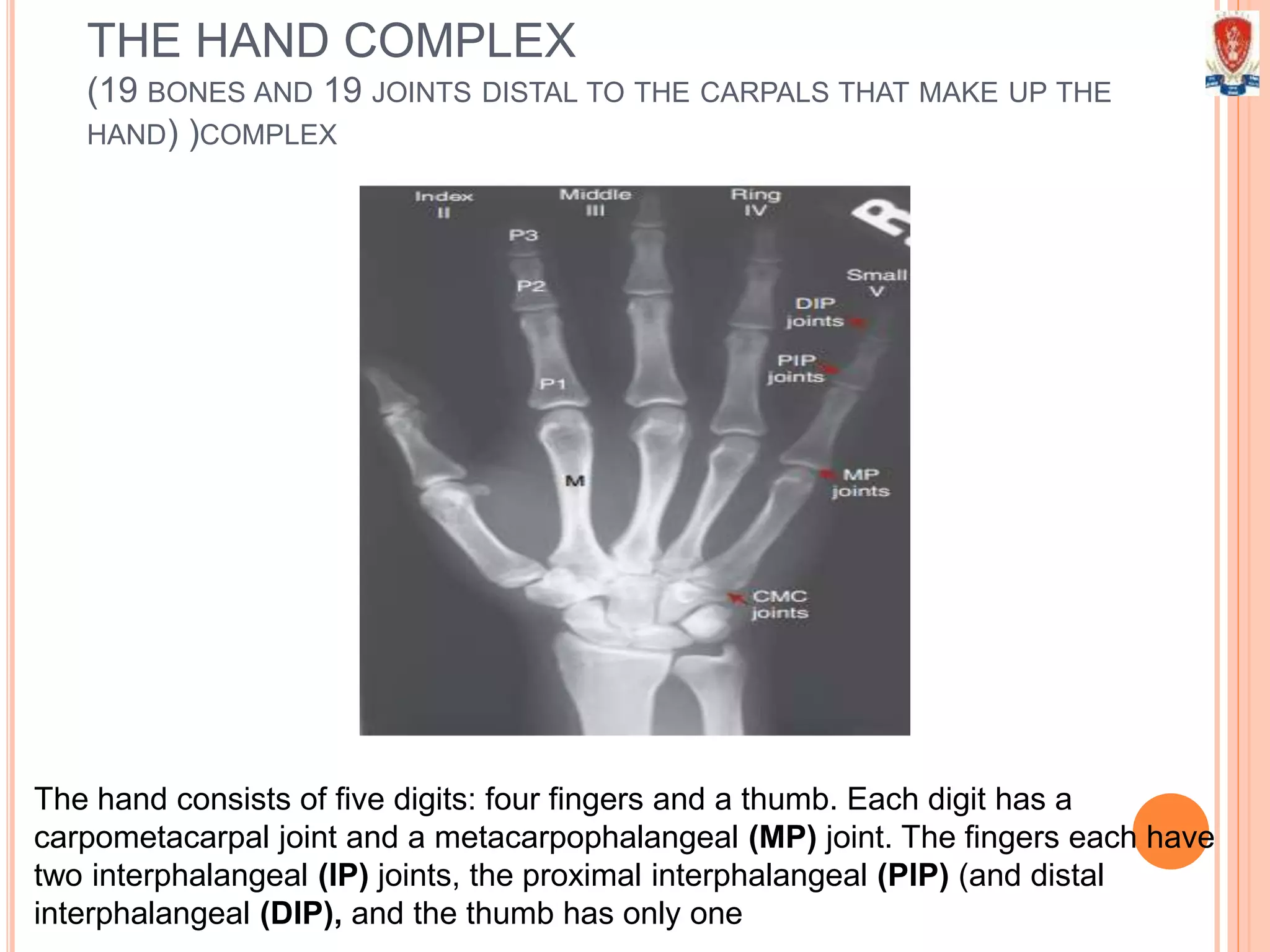
THE HAND COMPLEX
(19 BONES AND 19 JOINTS DISTAL TO THE CARPALS THAT MAKE UP THE
HAND) )COMPLEX
The hand consists of five digits: four fingers and a thumb. Each digit has a
carpometacarpal joint and a metacarpophalangeal (MP) joint. The fingers each have
two interphalangeal (IP) joints, the proximal interphalangeal (PIP) (and distal
interphalangeal (DIP), and the thumb has only one
CARPOMETACARPAL JOINT RANGE OF
MOTION
 The second through fourth carpometacarpal joints
are plane synovial joints with one degree of
freedom ( flexion/extension)
 second and third carpometacarpal joints are
essentially immobile and may be considered to
have “zero degrees of freedom. The immobile
second and third metacarpals provide a fixed and
stable axis about which the fourth and fifth
metacarpals and the very mobile first metacarpal
(thumb) can move The motion of the fourth and
fifth metacarpals facilitates the ability of the ring
and little fingers to oppose the thumb.
 The fourth carpometacarpal joint has
perceptible flexion/extension.
 The fifth carpometacarpal joint is a saddle joint
with two degrees of freedom, including
flexion/extension, some abduction/adduction, and
a limited amount of opposition
METACARPOPHALANGEAL JOINTS OF THE FINGERS
A- The volar plate at the
metacarpophalangeal joint attaches to
the base of the proximal phalanx.
B- In metacarpophalangeal joint
flexion, the flexible attachments of the
plate allow the plate to slide proximally
on the metacarpal head without
impeding motion. The collateral
ligament proper is loose in
metacarpophalangeal joint extension,
whereas the accessory collateral
ligament is taut..
The deep transverse metacarpal ligament
runs transversely across the heads of the four
metacarpophalangeal joints of the fingers.
SAGITTAL BANDS
The connections of the sagittal
bands to each side of the volar
plate, the collateral ligaments of the
MCP joint (via the capsule), and the
extensor digitorum communis
(EDC) muscle via the extensor
expansion help stabilize the volar
plates on the four metacarpal heads
volarly
ARCHES OF THE HAND
(A)Longitudinal Arches (Brown)
These are known as the carpometacarpophalangeal
arches run from the wrist to each digit and it is
concave. The most important of these arches are the
ones of the index finger and middles finger which are
used when gripping objects, especially the arch
formed to the index finger which we use when holding
and using objects such as a pen.
The hand, when in at rest, forms a hollow at the palm, with the fingers flexed
and the thumb in slight opposition. There are three distinct arches, longitudinal,
oblique and transverse, that are formed by the bones, ligaments and tendons
these are of vital importance when gripping and manipulating objects.
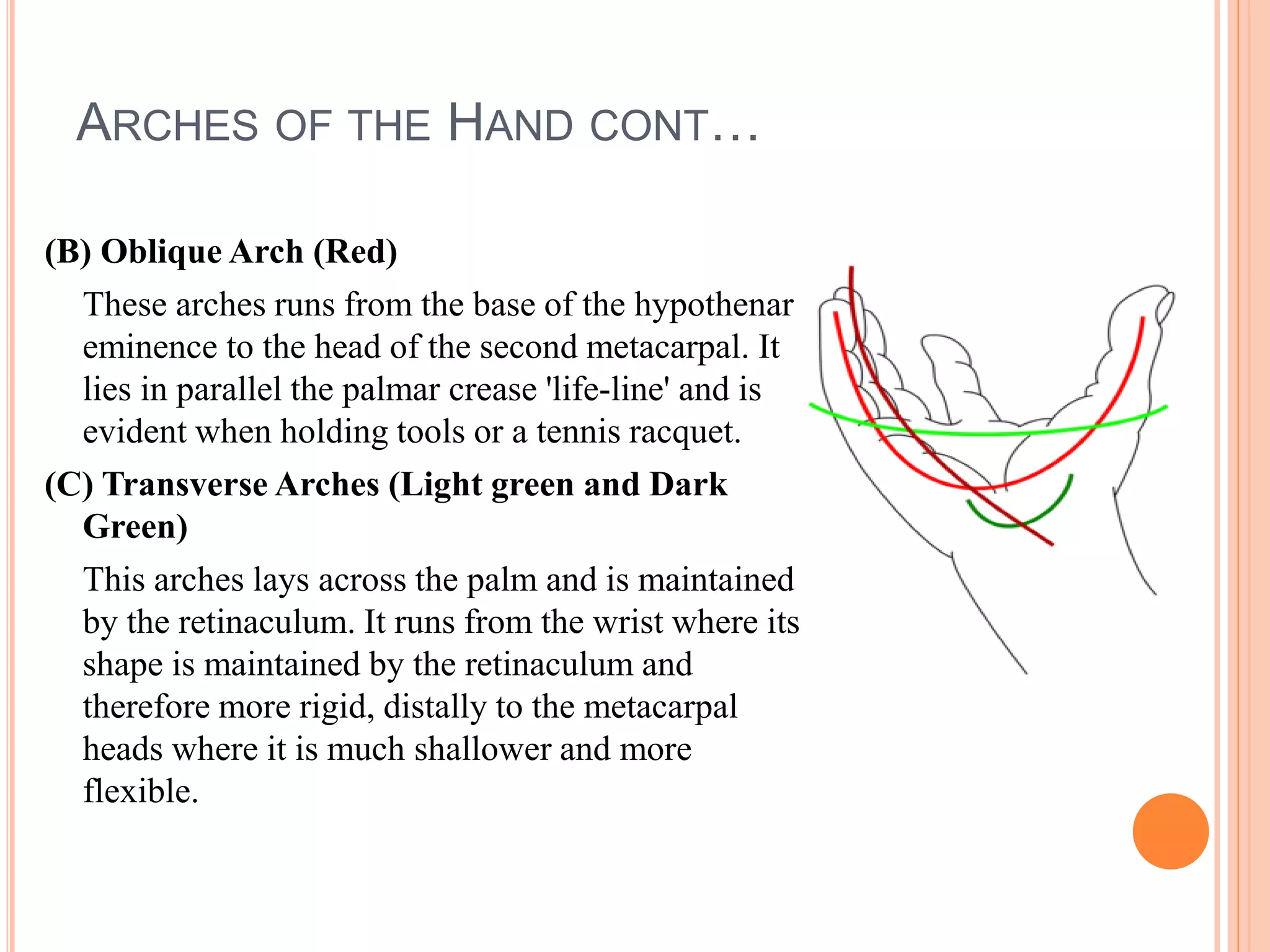
ARCHES OF THE HAND CONT…
(B) Oblique Arch (Red)
These arches runs from the base of the hypothenar
eminence to the head of the second metacarpal. It
lies in parallel the palmar crease 'life-line' and is
evident when holding tools or a tennis racquet.
(C) Transverse Arches (Light green and Dark
Green)
This arches lays across the palm and is maintained
by the retinaculum. It runs from the wrist where its
shape is maintained by the retinaculum and
therefore more rigid, distally to the metacarpal
heads where it is much shallower and more
flexible.
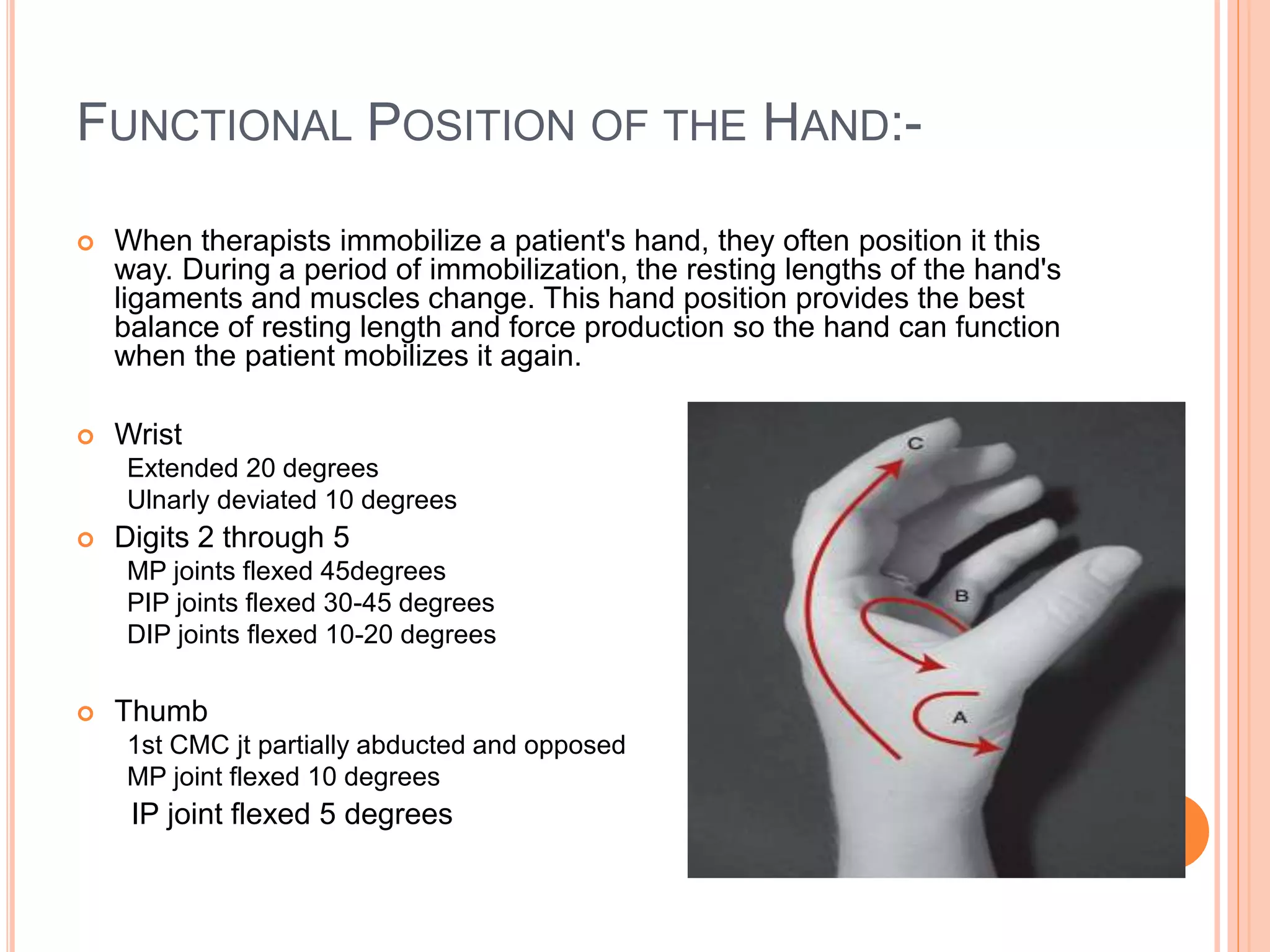
FUNCTIONAL POSITION OF THE HAND:-
 When therapists immobilize a patient's hand, they often position it this
way. During a period of immobilization, the resting lengths of the hand's
ligaments and muscles change. This hand position provides the best
balance of resting length and force production so the hand can function
when the patient mobilizes it again.
 Wrist
Extended 20 degrees
Ulnarly deviated 10 degrees
 Digits 2 through 5
MP joints flexed 45degrees
PIP joints flexed 30-45 degrees
DIP joints flexed 10-20 degrees
 Thumb
1st CMC jt partially abducted and opposed
MP joint flexed 10 degrees
IP joint flexed 5 degrees
THANK YOU

Wrist joint complex

  • 1.
    WRIST JOINT COMPLEX Dr.Chandan Verma(PT) (BPT,MPT,YICC,) Assistant pofessor (Mahatma Gandhi Physiotherapy College, Jaipur)
  • 2.
    INTRODUCTION •Distal ends ofRadius and Ulna •Carples bone- 4- proximal 4 distal carpal •Metacarpal bone-5 •Phalanges- proximal-5 middle-4 distal-5
  • 3.
    THE WRIST COMPLEX 1.Radiocarpal joint 2. Midcarpal joints 3. Carpometacapo joint of thumb and fingers 4. Matacarpophalngeal joint 5. Interphalangeal joint
  • 4.
    JOINTS OF THEWRIST AND HAND
  • 5.
    TYPES OF JOINTIN WRIST COMPLEX
  • 6.
    RADIOCARPAL JOINT STRUCTURE Theproximal joint surface is composed of (1) the lateral radial facet, which articulates with the scaphoid; (2) the medial radial facet, which articulates with the lunate; and (3) the triangular fibrocartilage complex, which articulates predominantly with the triquetrum, although it also has some contact with the lunate in the neutral wrist.
  • 7.
    TFCC The triangular fibrocartilage complex(TFCC) between the head of ulna and triquetrum Formed by:- articular disk that binds the ulna and radius together radioulnar and ulnocarpal ligament
  • 8.
    VASCULAR SUPPLY • Thewrist joint receives blood from branches of the dorsal and palmar carpal arches, which are derived from the ulnar and radial arteries.
  • 9.
    NERVE SUPPLY Innervations tothe wrist is delivered by branches of three nerves: Median nerve – Anterior interosseous branch. Radial nerve – Posterior interosseous branch. Ulnar nerve – deep and dorsal branches
  • 10.
    JOINT CAPSULE  Likeany synovial joint, the capsule is double layered. • The fibrous outer layer attaches to the distal ends of radius, ulna and the proximal row of the carpal bones. • The internal layer, synovial membrane extends up to the margins of the articular surfaces.
  • 11.
    ULNAR NEGATIVE &POSITIVE VARIANCE Ulnar positive variance, the distal ulna is long in relation to the distal radius Ulnar negative variance - short ulna in comparison with the radius at the distal end
  • 12.
    ULNAR POSATIVE VARIANCE “long”ulna may be present after a distal radius fracture that healed in a shortened position. Pain is commonly present with end-range pronation and ulnar deviation because these motions increase the likelihood of impingement of the ulnar structures.
  • 13.
    ULNAR NEGATIVE VARIANCE shortulna may result in abnormal force distribution across the radiocarpal joint with potential degeneration at the radiocarpal joint & Avascular necrosis of the lunate, Kienbock’s disease has been associated with ulnar negative variance
  • 14.
    RADIOCARPAL CAPSULE ANDLIGAMENTS  Most ligaments that cross the radiocarpal joint also contribute to stability at the midcarpal joint, and so all the ligaments will be presented together after introduction of the midcarpal joint  Radiocarpal joint is not crossed by any muscles that act on the radiocarpal joint alone  The flexor carpi ulnaris is the only muscle that crosses the radiocarpal joint and attaches to any of the bones of the proximal carpal row
  • 15.
    MIDCARPAL JOINT The midcarpaljoint is composed of the scaphoid, lunate, and triquetrum with the trapezium (Tp), the trapezoid (Tz), the capitate (C), and the hamate (H). The midcarpal joint is a functional unit rather than an anatomical unit because it does not form a single uninterrupted articular surface.
  • 16.
    LIGAMENTS OF THEWRIST AND HAND
  • 17.
    LIGAMENTS OF THEWRIST COMPLEX Volar ligaments of the wrist complex, including the three bands of the volar radiocarpal ligament: radioscaphocapitate, radiolunate, and radioscapholunate. The two intrinsic ligaments (scapholunate and lunotriquetral) are credited with maintaining scaphoid stability. Volar ligaments
  • 18.
    DORSAL LIGAMENTS Dorsal wristligaments form a horizontal V, adding to radiocarpal stability
  • 19.
    CARPAL TUNNEL The carpaltunnel is a narrow passage way in the wrist. It is osteofibrous canal situated in the volar wrist. The boundaries are the carpal bones and the flexor retinaculum The carpal tunnel contains the median nerve and nine extrinsic flexor tendons of the fingers and thumb
  • 20.
    MOVEMENTS OF THERADIOCARPAL AND MIDCARPAL JOINTS When wrist extension is initiated from full flexion, (1) the distal carpal row moves on the proximal carpal row; (2) the scaphoid and distal row move on the lunate/triquetrum; and (3) the carpals move as a unit on the radius and triangular fibrocartilage complex to achieve full wrist extension C, capitate; L, lunate; S, scaphoid Flexion/Extension of the Wrist
  • 21.
    RADIAL/ULNAR DEVIATION OFTHE WRIST With radial deviation of the wrist (A), the flexion of the scaphoid makes the scaphoid appear shorter than when the scapoid extends during ulnar deviation (B). C, capitate; L, lunate; S, scaphoid.
  • 22.
    WRIST INSTABILITY The lunateand scaphoid flex on the radius, whereas the triquetrum extends. The distal carpal row (capitate shown) follows the triquetrum into extension. The lunate, released from the flexed scaphoid, extends on the radius. The capitate moves in the opposite direction (flexion) on top of the lunate. Volar intercalated segmental instability (VISI) Dorsal intercalated segmental instability (DISI) Injury to one or more of the ligaments attached to the scaphoid and lunate may diminish or remove the synergistic stabilization of the lunate and scaphoid. zigzag pattern of the three segments (the scaphoid, the lunate/ triquetrum, and the distal carpal row) is known as intercalated segmental instability
  • 23.
    WRIST INSTABILITY… With disruptionof the scapholunate ligaments through trauma, the scaphoid and lunate migrate apart, leaving a gap (diastasis) (DISI) Scapholunate advance collapse (SLAC) with migration of the capitate proximally and erosion of the radioscaphoid and capitate-lunate joints.
  • 24.
    MOVEMENTS OF THEWRIST AND HAND  Thirty-four muscles act on the hand.  Intrinsic muscles of the hand contain the origin and insertions within the carpal and metacarpal bones.  Muscles originating in the forearm are the extrinsic muscles of the hand.  The intrinsic muscles of the hand provide the fine motor movements while the extrinsic muscles permit strength.
  • 25.
    MUSCLES OF THEWRIST COMPLEX Volar Wrist Musculature (Six muscles have tendons crossing the volar aspect) all of the volar wrist muscles pass beneath the flexor retinaculum along with the median nerve except the palmaris longus and the flexor carpi ulnaris muscles ( PRIMARY • Palmaris longus (PL) • Flexor carpi radialis (FCR) • Flexor carpi ulnaris Secondary • Flexor digitorum superficialis (FDS) • Flexor digitorum profundus (FDP) • Flexor pollicis longus (FPL)
  • 26.
    DORSAL WRIST MUSCULATURE (NINEMUSCLES ) Primary • ECRL (extensar carpai radialis longus) • ECRB (extensar carpai radialis brevis) • ECU (extensar carpai ulnaris) Secondary • Extensor radius communis • Extensor indisus proprious • Extensor digitorum minimi • Extensor pollicis longus • Extensor pollicis brevius • Abductor pollicis longus
  • 27.
    THE HAND COMPLEX (19BONES AND 19 JOINTS DISTAL TO THE CARPALS THAT MAKE UP THE HAND) )COMPLEX The hand consists of five digits: four fingers and a thumb. Each digit has a carpometacarpal joint and a metacarpophalangeal (MP) joint. The fingers each have two interphalangeal (IP) joints, the proximal interphalangeal (PIP) (and distal interphalangeal (DIP), and the thumb has only one
  • 28.
    CARPOMETACARPAL JOINT RANGEOF MOTION  The second through fourth carpometacarpal joints are plane synovial joints with one degree of freedom ( flexion/extension)  second and third carpometacarpal joints are essentially immobile and may be considered to have “zero degrees of freedom. The immobile second and third metacarpals provide a fixed and stable axis about which the fourth and fifth metacarpals and the very mobile first metacarpal (thumb) can move The motion of the fourth and fifth metacarpals facilitates the ability of the ring and little fingers to oppose the thumb.  The fourth carpometacarpal joint has perceptible flexion/extension.  The fifth carpometacarpal joint is a saddle joint with two degrees of freedom, including flexion/extension, some abduction/adduction, and a limited amount of opposition
  • 29.
    METACARPOPHALANGEAL JOINTS OFTHE FINGERS A- The volar plate at the metacarpophalangeal joint attaches to the base of the proximal phalanx. B- In metacarpophalangeal joint flexion, the flexible attachments of the plate allow the plate to slide proximally on the metacarpal head without impeding motion. The collateral ligament proper is loose in metacarpophalangeal joint extension, whereas the accessory collateral ligament is taut..
  • 30.
    The deep transversemetacarpal ligament runs transversely across the heads of the four metacarpophalangeal joints of the fingers.
  • 31.
    SAGITTAL BANDS The connectionsof the sagittal bands to each side of the volar plate, the collateral ligaments of the MCP joint (via the capsule), and the extensor digitorum communis (EDC) muscle via the extensor expansion help stabilize the volar plates on the four metacarpal heads volarly
  • 32.
    ARCHES OF THEHAND (A)Longitudinal Arches (Brown) These are known as the carpometacarpophalangeal arches run from the wrist to each digit and it is concave. The most important of these arches are the ones of the index finger and middles finger which are used when gripping objects, especially the arch formed to the index finger which we use when holding and using objects such as a pen. The hand, when in at rest, forms a hollow at the palm, with the fingers flexed and the thumb in slight opposition. There are three distinct arches, longitudinal, oblique and transverse, that are formed by the bones, ligaments and tendons these are of vital importance when gripping and manipulating objects.
  • 33.
    ARCHES OF THEHAND CONT… (B) Oblique Arch (Red) These arches runs from the base of the hypothenar eminence to the head of the second metacarpal. It lies in parallel the palmar crease 'life-line' and is evident when holding tools or a tennis racquet. (C) Transverse Arches (Light green and Dark Green) This arches lays across the palm and is maintained by the retinaculum. It runs from the wrist where its shape is maintained by the retinaculum and therefore more rigid, distally to the metacarpal heads where it is much shallower and more flexible.
  • 34.
    FUNCTIONAL POSITION OFTHE HAND:-  When therapists immobilize a patient's hand, they often position it this way. During a period of immobilization, the resting lengths of the hand's ligaments and muscles change. This hand position provides the best balance of resting length and force production so the hand can function when the patient mobilizes it again.  Wrist Extended 20 degrees Ulnarly deviated 10 degrees  Digits 2 through 5 MP joints flexed 45degrees PIP joints flexed 30-45 degrees DIP joints flexed 10-20 degrees  Thumb 1st CMC jt partially abducted and opposed MP joint flexed 10 degrees IP joint flexed 5 degrees
  • 35.